<?xml version="1.0" encoding="ISO-8859-1"?><article xmlns:mml="http://www.w3.org/1998/Math/MathML" xmlns:xlink="http://www.w3.org/1999/xlink" xmlns:xsi="http://www.w3.org/2001/XMLSchema-instance">
<front>
<journal-meta>
<journal-id>0872-1904</journal-id>
<journal-title><![CDATA[Portugaliae Electrochimica Acta]]></journal-title>
<abbrev-journal-title><![CDATA[Port. Electrochim. Acta]]></abbrev-journal-title>
<issn>0872-1904</issn>
<publisher>
<publisher-name><![CDATA[Sociedade Portuguesa de Electroquímica]]></publisher-name>
</publisher>
</journal-meta>
<article-meta>
<article-id>S0872-19042018000600003</article-id>
<article-id pub-id-type="doi">10.4152/pea.201806403</article-id>
<title-group>
<article-title xml:lang="en"><![CDATA[Cysteine Duality Effect on the Corrosion Inhibition and Acceleration of 3003 Aluminium Alloy in a 2% NaCl Solution]]></article-title>
</title-group>
<contrib-group>
<contrib contrib-type="author">
<name>
<surname><![CDATA[El Ibrahimi]]></surname>
<given-names><![CDATA[Brahim]]></given-names>
</name>
<xref ref-type="aff" rid="A01"/>
</contrib>
<contrib contrib-type="author">
<name>
<surname><![CDATA[Jmiai]]></surname>
<given-names><![CDATA[Aziz]]></given-names>
</name>
<xref ref-type="aff" rid="A01"/>
</contrib>
<contrib contrib-type="author">
<name>
<surname><![CDATA[Somoue]]></surname>
<given-names><![CDATA[Aziza]]></given-names>
</name>
<xref ref-type="aff" rid="A01"/>
</contrib>
<contrib contrib-type="author">
<name>
<surname><![CDATA[Oukhrib]]></surname>
<given-names><![CDATA[Rachid]]></given-names>
</name>
<xref ref-type="aff" rid="A01"/>
</contrib>
<contrib contrib-type="author">
<name>
<surname><![CDATA[Chadili]]></surname>
<given-names><![CDATA[Mohamed]]></given-names>
</name>
<xref ref-type="aff" rid="A01"/>
</contrib>
<contrib contrib-type="author">
<name>
<surname><![CDATA[El Issami]]></surname>
<given-names><![CDATA[Souad]]></given-names>
</name>
<xref ref-type="aff" rid="A01"/>
</contrib>
<contrib contrib-type="author">
<name>
<surname><![CDATA[Bazzi]]></surname>
<given-names><![CDATA[Lahcen]]></given-names>
</name>
<xref ref-type="aff" rid="A01"/>
</contrib>
</contrib-group>
<aff id="A01">
<institution><![CDATA[,University of Ibn Zohr Faculty of Sciences Applied Chemistry-Physic Team]]></institution>
<addr-line><![CDATA[Agadir ]]></addr-line>
<country>Morocco</country>
</aff>
<pub-date pub-type="pub">
<day>00</day>
<month>11</month>
<year>2018</year>
</pub-date>
<pub-date pub-type="epub">
<day>00</day>
<month>11</month>
<year>2018</year>
</pub-date>
<volume>36</volume>
<numero>6</numero>
<fpage>403</fpage>
<lpage>422</lpage>
<copyright-statement/>
<copyright-year/>
<self-uri xlink:href="http://scielo.pt/scielo.php?script=sci_arttext&amp;pid=S0872-19042018000600003&amp;lng=en&amp;nrm=iso"></self-uri><self-uri xlink:href="http://scielo.pt/scielo.php?script=sci_abstract&amp;pid=S0872-19042018000600003&amp;lng=en&amp;nrm=iso"></self-uri><self-uri xlink:href="http://scielo.pt/scielo.php?script=sci_pdf&amp;pid=S0872-19042018000600003&amp;lng=en&amp;nrm=iso"></self-uri><abstract abstract-type="short" xml:lang="en"><p><![CDATA[Cysteine's action on 3003 aluminum alloy dissolution in a 2% NaCl solution, at different pH values, has been investigated. Weight-loss measurements, potentiodynamic polarization and electrochemical impedance at OCP were performed. The surface morphology was analyzed by SEM. The main results showed that the alloy underwent severe corrosion at 2 and 11 pH values, as compared to at 5 and 8 pH values. Furthermore, a duality effect of cysteine was noted, as it acted as a corrosion inhibitor or accelerator, depending on its concentration, and on the solution's pH value. This particular behavior can be related to the instability of the formed film adsorbed onto the metal surface. All these findings show the high complexity of cysteine action on 3003 aluminum alloy, under the investigated conditions.]]></p></abstract>
<kwd-group>
<kwd lng="en"><![CDATA[cysteine]]></kwd>
<kwd lng="en"><![CDATA[AA3003]]></kwd>
<kwd lng="en"><![CDATA[corrosion]]></kwd>
<kwd lng="en"><![CDATA[pH]]></kwd>
<kwd lng="en"><![CDATA[2% NaCl]]></kwd>
</kwd-group>
</article-meta>
</front><body><![CDATA[   <!--     <p>&nbsp;</p>     <p>doi: 10.4152/pea.201806403</p> -->      <p><b>Cysteine Duality Effect on the Corrosion Inhibition and  Acceleration of 3003 Aluminium Alloy in a 2% NaCl Solution</b></p>      <p> <b>Brahim El Ibrahimi</b>, <b>Aziz Jmiai</b><sup><a href="#0">*</a></sup>, <b>Aziza Somoue</b>, <b>Rachid Oukhrib</b>,  <b>Mohamed Chadili</b>, <b> Souad El Issami</b> and <b>Lahcen Bazzi</b> </p>       <p><i>Applied Chemistry-Physic Team, Faculty of Sciences, University of Ibn Zohr,  P.O. Box 8106, Cité Dakhla, Agadir, Morocco </i></p>      <p>&nbsp;</p>     <p><b>Abstract</b></p>      <p>Cysteine&rsquo;s action on 3003 aluminum alloy dissolution in a 2% NaCl solution, at  different pH values, has been investigated. Weight-loss measurements, potentiodynamic  polarization and electrochemical impedance at OCP were performed. The surface  morphology was analyzed by SEM. The main results showed that the alloy underwent  severe corrosion at 2 and 11 pH values, as compared to at 5 and 8 pH values.  Furthermore, a duality effect of cysteine was noted, as it acted as a corrosion inhibitor  or accelerator, depending on its concentration, and on the solution&rsquo;s pH value. This  particular behavior can be related to the instability of the formed film adsorbed onto the  metal surface. All these findings show the high complexity of cysteine action on 3003  aluminum alloy, under the investigated conditions.</p>      <p><b><i>Keywords:</i></b> cysteine, AA3003, corrosion, pH and 2% NaCl.</p>       ]]></body>
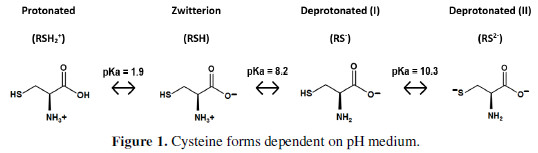
<body><![CDATA[<p>&nbsp;</p>     <p><b>Introduction</b></p>       <p>With an annual world consumption of 25 million tons, aluminum is the leader in  the metallurgy of non-ferrous metals [1]. The development of applications for  aluminum and its alloys, especially in the fields of transport, building, electrical  engineering and packaging, can be attributed to several of its useful properties  [2]. The most important feature of aluminum is its resistance to corrosion, due to  its capability to form a protective film (i.e., Al2O3) on its surface. This corrosion  resistance, however, easily deteriorates in acidic and basic media. The presence  of chloride ions in a medium, especially in seawater or marine atmosphere  conditions, is disadvantageous to aluminum and its alloys, as it produces pitting  in the oxide film, thus reducing its resistance to corrosion [1].</p>      <p>Many efforts have been devoted to avoid this problem. One of the most used  methods is to modify the electrolyte composition, by adding corrosion inhibitors  [3]. For a long time, the new compounds were found to act as effective corrosion  inhibitors, and were object of several investigations. However, due to strict  protocols imposed by environmental organizations, for the use and discharge of  corrosion inhibitors, in various countries, since the last two decades [4]  investigators have also added an environmental compatibility viewpoint of  inhibitors to their researches aims [5]. As B.E. Amitha Rani et al. [6] and G.  Gece [7] cited in their reviews, some researchers have reported the fruitful use of  some naturally occurring substances and drugs, to safely inhibit the corrosion of  metallic materials in various corrosive media.</p>      <p>Amino acids are nontoxic, biodegradable and soluble in aqueous media, easy to  produce with purities greater than 99% and relatively cheap [8-10]. These  properties have attracted many investigators in the world to explore amino acids  capacity to act as eco-friendly corrosion inhibitors for various metals, in different  aggressive media [11]. For example, magnesium alloys in a phosphate saline  solution (pH 7.4) [12], zinc in 0.05 M and 0.1 M HCl [13], tin in tartaric acid  [14], Pb-Ca-Sn alloy in sulfuricd acid [8], aluminum alloy (AA6063) in a deaerated  carbonate solution [15], iron in citric acid [16], and copper in a deaerated  H2SO4 solution [17].</p>      <p>Cysteine is a sulfur containing a-amino acid, which has three dissociable  protonation sites (pKSH = 10.25, pKNH3 + = 8.16 and PkCOOH = 1.91 (see <a href="#f1">Fig. 1</a>).</p>       <p>&nbsp;</p> <a name="f1"> <img src="/img/revistas/pea/v36n6/36n6a03f1.jpg">     
<p>&nbsp;</p>       <p>  In an aqueous solution, the ionization of this amino acid depends on the  solution&rsquo;s pH [18-20]. Based on the presence of three different heteroatoms (i.e.,  S, N and O) in its molecular structure, cysteine has the potential to become a  good corrosion inhibitor [21-23]. In his paper, N.O. Eddy [23] attributed the high  corrosion inhibition of cysteine, for mild steel in 0.1 M H2SO4 (compared to  serine, amino butyric acid, threonine, alanine, valine, phenylalanine, tryptophan  and tyrosine), to the presence of thiol and hydroxyl functional groups. D.Q.  Zhang et al. [24] conducted a comparative study between cysteine, alanine and  benzotriazole (BTA). They noted that cysteine showed the best inhibition  efficiency towards anodic copper dissolution in an aerated 0.5 M hydrochloric  acid solution.</p>      <p>However, several authors point out that the inhibition effect of amino acid  compounds does not only depend on their chemical and electronic structures, but  also on the solution&rsquo;s pH [25-29]. For instance, D.J. Kalota et al. [26] found that,  at a pH value lower than 9.5, aspartic acid appeared to catalyze (accelerate)  corrosion and, above this pH value, it acted as a good corrosion inhibitor for  steel. In another study [27], it was found that cysteine activated the corrosion  process in acidic (pH 2) and neutral media, but exhibited a protective effect in  basic media (pH 11) for lead metal.</p>      ]]></body>
<body><![CDATA[<p>As a representative of 3000 series aluminum alloys, AA3003 aluminum alloy has  a wide range of industrial applications, being used in heat exchangers, storage  tanks, drawn and spun parts manufacturing, and so on. This multicomponent  alloy contains Mn, Fe, Si, Cu and Zn. For these reasons, the aim of the present  work was to investigate the influence of pH values on the inhibition property of  cysteine at different concentrations, for AA3003 aluminum alloy corrosion in a  2% NaCl solution.</p>      <p><b>Experimental details</b></p>       <p><i><b>Materials and solutions</b></i></p>       <p>Materials used for this work were of a 3003 aluminum alloy (AA3003 notation  will be herein subsequently used) sheet. All reagents used in this work were of  Analar grade, and distilled water was used to prepare the solutions. The test  solutions were prepared by dissolving an appropriate mass of L-cysteine  hydrochloride monohydrate (Fuka®) in a 2% NaCl (Analytical Reagent®)  solution. The pH values (2, 5, 8 and 11) of the 2% NaCl solutions, without and  with different cysteine concentrations (10-3, 5 10-3 and 10-2 M), were adjusted  by using an analytical-grade reagent of hydrochloric acid (HCl) and sodium  hydroxide (NaOH). All of the pH measurements were made by a Jenway®  (3540) type pH-meter, with a precision of ± 0.01.</p>       <p><i><b>Weight loss method</b></i></p>       <p>The sheet was mechanically pressed cut into similar coupons of dimensions 1.7 ×  1.8 × 0.2 cm. Before measuring, all tested AA3003 coupons were mechanically  polished using emery paper of 800 and 1200 grade, degreased with acetone,  washed with distilled water, dried in the air, and then weighed using an electronic  SWISSQUALITY® (Precisa 125A) balance. Then, by using a fishing wire, each  coupon was completely immersed in 75 mL of the tested solution (in cysteine  absence and presence). After 24 hours of immersion at 25 ± 1 °C, each coupon  was rinsed with distilled water and dried before re-weighing. Four tests were  conducted for each experiment.</p>       <p><i><b>Electrochemical methods</b></i></p>       <p>The same tested piece was used to prepare the working electrode for the  electrochemical study, which was appropriately cut to obtain a rod, and then was  mounted into glass tubes by a two-component epoxy resin (Araldit®), leaving a  surface area of 0.12 cm2 with the contact solution. For electrochemical tests, it  was used a three electrode all-glass cell with double wall thermostats, with a  platinum (Pt) counter electrode and saturated calomel reference electrode (SCE).  Before each electrochemical experiment, the working electrode surface was  mechanically polished using emery paper of 1200 grade, washed with distilled  water, and quickly transferred to an electrochemical cell that contained the tested  solution.</p>       <p>The potentiodynamic polarization (PP) and electrochemical impedance  spectroscopy (EIS) measurements were conducted by using a VoltaLab®  (PGZ301) potentiostat/galvanostat and VoltaMaster 4 as control software. Before  each PP or EIS experiments, the open circuit potential (OCP) of the working  electrode was measured as a function of time. It was found that a duration of 45  min was appropriate to reach a quasi-stationary value for potential (Eocp);  afterwards, EIS measurements were performed at this potential, with a d10 mV  amplitude of the superimposed AC-signal, and the applied frequency ranged  from 100 KHz to 50 mHz. The anodic and cathodic polarization experiments  were performed at a scan rate of 1 mV s-1 between two potentials, which  depended on the pH value of the tested solution. To achieve reproducibility, each  electrochemical experiment was carried out at least 4 times (especially, at near  neutral pH values). The EIS data were analyzed with software based on a  simplex parameter regression called ZSimpWin 3.1® software. All experiments  were carried out in a stagnant natural aerated solution, at 25 ± 1 °C, using a water  thermostat (IKA® - WERE, EH4 basic).</p>       <p><i><b>Surface morphology analysis</b></i></p>       ]]></body>
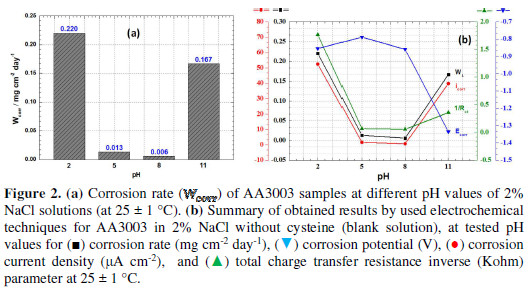
<body><![CDATA[<p>The surface morphology of the AA3003 specimens (before and after being  immersed in a 2% NaCl solution for one day, without and with 5 10-3 M of  cysteine, both at 2 and 11 pH values, at 25 ± 1 °C) was observed by a JEOL  JSM® - 6480 LV scanning electron microscope.</p>      <p><b>Results and discussion</b></p>        <p><i><b>Weight loss method</b></i></p>       <p>A comparison of the AA3003 corrosion rates (expressed in mg cm-2 day-1), after  an immersion time of one day, without cysteine, is shown in <a href="#f2">Fig. 2 (a)</a>. The  corrosion rate (Wcorr) over the exposure period was calculated using the  following <a href="#e1">equation</a>:</p>    <a name="e1"> <img src="/img/revistas/pea/v36n6/36n6a03e1.jpg">     
<p>&nbsp;</p> <a name="f2"> <img src="/img/revistas/pea/v36n6/36n6a03f2.jpg">     
<p>&nbsp;</p>      <p>where m1 and m2 are the weight (mg) before and after immersion in the test  solution, A is the specimen area (cm2), and t is the exposure time (day). As it can  be seen from <a href="#f2">Fig. 2 (a)</a>, the corrosion rate of AA3003 samples was high (uniform  corrosion type) at the extreme tested pH values of saline media (i.e., pH 2 and  11). However, in near neutral solutions (i.e., 5 and 8 pH values), the corrosion  rate was lower compared to the previous tested media&rsquo;s pH, because, in these  media, and in chloride ions presence, the corrosion mainly occurs through a  localized attack. For this purpose, and due to the used balance precision, we have  studied cysteine effect by this method, only for acidic and alkaline extreme pH  values of 2% NaCl solutions. According to the saline solution&rsquo;s pH value, in  cysteine absence, the corrosion rate increased as follows: Wcorr (pH 2) &gt; Wcorr  (pH 11) &gt; Wcorr (pH 5) &gt; Wcorr (pH 8) (<a href="#f2">Fig. 2</a>). </p>      <p>The inhibition efficiency percentage (IEw,%) obtained by weight loss method, for  2 and 11 pH values of the tested saline solution, was calculated by using the  following formula:</p>       <p>&nbsp;</p> <a name="e2"> <img src="/img/revistas/pea/v36n6/36n6a03e2.jpg">     
<p>&nbsp;</p>       ]]></body>
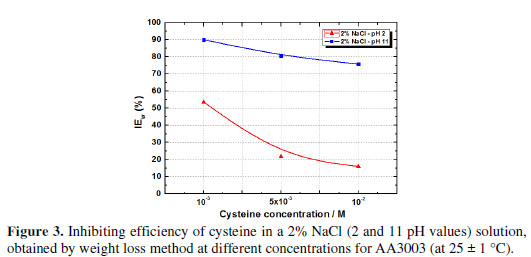
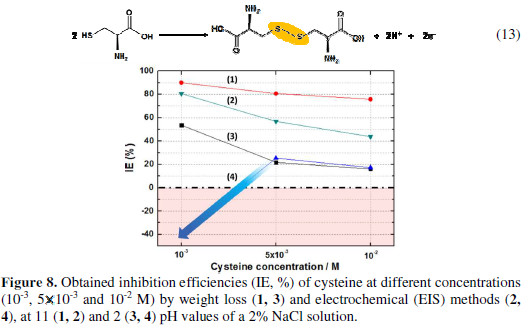
<body><![CDATA[<p>where Wcorr and W&rsquo;corr are AA3003 uninhibited and inhibited corrosion rate (in  terms of mg cm-2 day-1), respectively. <a href="#f3">Fig. 3</a> summarized cysteine&rsquo;s calculated  inhibition efficiency for AA3003 in a 2% NaCl solution, at 2 and 11 pH values.</p>       <p>&nbsp;</p> <a name="f3"> <img src="/img/revistas/pea/v36n6/36n6a03f3.jpg">     
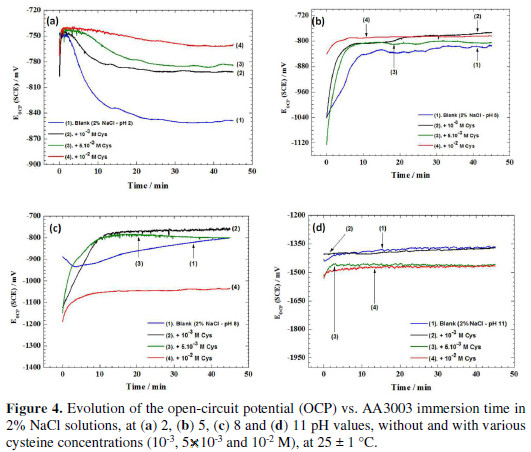
<p>&nbsp;</p>       <p>As it can be seen from this figure, the inhibition efficiency depended on pH  values and concentrations of the tested amino acid, whereas cysteine showed the  highest corrosion inhibitor properties in an alkaline medium. Further, this  property decreases with an increased cysteine concentration for both tested pH  values. This behavior can be attributed to the instability and dissolution of the  formed molecular layer on a metallic surface, as reported by several authors [29-  30], which indicated the possible existence of an optimum concentration (at  lower values) of this compound [28, 31].</p>      <p>On the other side, due to their highest precision [32], in the following parts of  this study we have used two electrochemical methods to investigate and  determine the inhibition efficiency of the tested amino acid in all pH values of  the 2% NaCl solution.</p>       <p><i><b>Open-circuit potential (OCP) measurements</b></i></p>       <p>OCP time dependence is commonly inferred as an overall indicator of a metallic  material corrosion behavior [33]. AA3003&rsquo;s OCP was observed for 45 min from  the electrode immersion in chloride solutions, in cysteine absence and presence.  <a href="#f4">Fig. 4</a> represents OCP variation with the immersion time of the AA3003  electrode in naturally aerated 2% NaCl solutions, at pH values varying from 2 to  11, at 25 &deg;C, in the presence of different cysteine concentrations.</p>       <p>&nbsp;</p> <a name="f4"> <img src="/img/revistas/pea/v36n6/36n6a03f4.jpg">     
<p>&nbsp;</p>        <p>In a 2% NaCl solution at pH 2, without cysteine (<a href="#f4">Fig. 4 (a)</a>), it can be seen,  during the first 30 min of AA3003 immersion, how the open circuit potential  moves towards more negative values, and then keeps a constant value (steadypotential)  around -849 mV. This behavior has been attributed to the destruction  and dissolution of the air formed pre-immersion Al2O3 layer, adjacent to the  metal surface, and to outer porous modification [34]. However, in cysteine  presence, the steady-potential shifted to more positive values with an increased  concentration, in less time than that of the solution without cysteine. In general,  this behavior could be attributed to a decrease in the metal activity, by cysteine  molecules adsorption onto the metal surface [35-38].</p>      ]]></body>
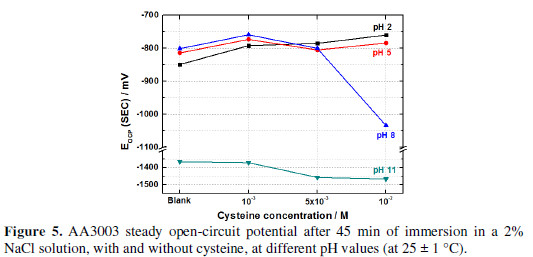
<body><![CDATA[<p>In their turn, for the three last cases (i.e., 5, 8 and 11 pH values), as shown in  <a href="#f4">Fig. 4(b)</a>, <a href="#f4">(c)</a> and <a href="#f4">(d)</a>,  AA3003 OCP in free cysteine solutions, as a whole, shifted  from negative to more positive potentials (into noble directions), particularly, at 5  and 8 pH values, which is often associated to a protective passive film formation  at the AA3003 surface [32, 39]. As noted in <a href="#f4">Fig. 4 (c)</a>, with higher cysteine  concentrations (10-2 M), in a solution at pH 8, the potential was displaced to  lower values. In its turn, the time to reach steady-potential value at pH 11 was  lesser than that for all other pH values of solutions without cysteine.</p>      <p>The same shapes of potential evolution have been found in cysteine presence.  However, the steady-potential values of the AA3003 electrode depended on the  solution&rsquo;s pH, and on the additive concentration, as summarized in <a href="#f5">Fig. 5</a>.</p>       <p>&nbsp;</p> <a name="f5"> <img src="/img/revistas/pea/v36n6/36n6a03f5.jpg">     
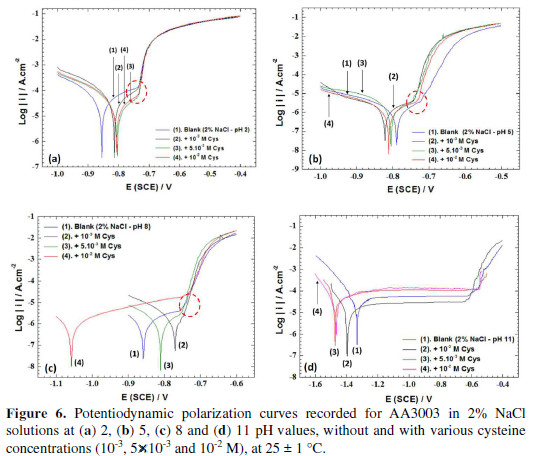
<p>&nbsp;</p>        <p>Literature [40, 41] reveals that the shift in this value can be ascribed to the  cysteine molecules interaction with the metal surface or with the oxide films.  Therefore, we noted that 45 min of immersion time were enough to establish the  AA3003 steady potential in all tested mediums.</p>       <p><i><b>Potentiodynamic polarization</b></i></p>       <p>Cysteine ability to act as a corrosion inhibitor for AA3003 was also investigated  on the basis of Tafel polarization measurements.</p>      <p><a href="#f6">Fig. 6</a> represents the potentiodynamic polarization curves of AA3003 in a 2%  NaCl solution, at different pH values, in the absence and presence of various  cysteine concentrations.</p>        <p>&nbsp;</p> <a name="f6"> <img src="/img/revistas/pea/v36n6/36n6a03f6.jpg">     
<p>&nbsp;</p>        ]]></body>
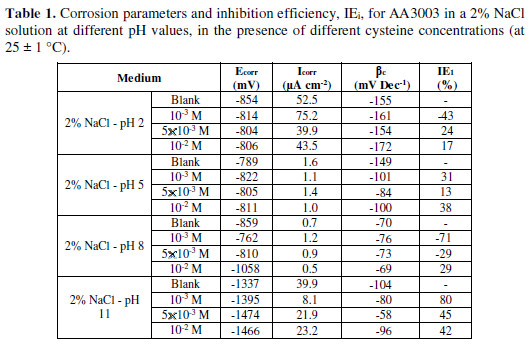
<body><![CDATA[<p>The electrochemical parameters, namely, corrosion  current density (icorr), corrosion potential (Ecorr), and cathodic Tafel slope (ßc),  obtained from polarization curves, and the corresponding inhibition efficiency  (IE1,%) values, at different cysteine concentrations and pH values, are given in  <a href="#t1">Table 1</a>.</p>        <p>&nbsp;</p> <a name="t1"> <img src="/img/revistas/pea/v36n6/36n6a03t1.jpg">     
<p>&nbsp;</p>        <p>As the anodic Tafel lines were invisible, the corrosion current density  values, with and without the tested compound, were determined by manual  extrapolation of the cathodic linear region, back to Ecorr [32, 42]. The inhibition  efficiency was calculated by the following <a href="#e3">equation</a>:</p>        <p>&nbsp;</p> <a name="e3"> <img src="/img/revistas/pea/v36n6/36n6a03e3.jpg">     
<p>&nbsp;</p>        <p>where icorr and i&rsquo;corr are AA3003 corrosion current densities, in cysteine absence  and presence, respectively.</p>       <p>From the polarization curves examination in <a href="#f6">Fig. 6</a>, it is seen that AA3003  electrode polarization curves show similar behaviors at 2, 5 and 8 pH values of  the 2% NaCl blank solutions. In all these cases, the anodic current slightly  increased from the corrosion potential (Ecorr) to a specific potential value (noted:  E2), which depended on the pH value of the medium (indicated by the red circle  in <a href="#f6">Fig. 6</a>), and then sharply increased. In another research carried out in parallel  with this study, we found that the plateau between Ecorr and E2 potential domain  abruptly increased in hydrodynamic conditions, because the corrosion potential  (Ecorr) shifted to more positives values, until it reached E2 potential. However, for  the cathodic part, the current has increased with decreasing potentials, and  followed the Tafel&rsquo;s law [39, 42-43]. In contrast, in a 2% NaCl solution at pH 11  (<a href="#f6">Fig. 6 (d)</a>, the anodic part of the curve showed a constant current density,  indicating a state of continuous passivity; then, the anodic current density  remarkably increased with an increasing applied anodic potential (<a href="#t1">Table 1</a>),  which indicated the development of pitting processes, due to chloride ions [44].</p>        <p>&nbsp;</p> <a name="t1"> <img src="/img/revistas/pea/v36n6/36n6a03t1.jpg">     
<p>&nbsp;</p>        ]]></body>
<body><![CDATA[<p>As at previous pH values, at pH 11 the cathodic part exhibited the same shape, as  verified by Tafel relationship. Furthermore, AA3003 corrosion speed followed  the same order as the one found by the weight loss method, which increased with  the corrosion current density (icorr), in this sequence: pH 2 &gt; pH 11 &gt;&gt; pH 5 &gt; pH  8 (see <a href="#f2">Fig. 2 (b)</a>).</p>       <p>Following Pourbaix (potential-pH) aluminum diagram, when the pH is within the  range from 4 to 9 (5 and 8 pH values, in our case), aluminum is oxidized to form  a stable oxide film on the electrode (Al2O3). The reactions in these conditions  were characterized by <a href="#e4">equations (4)</a> and <a href="#e5">(5)</a> [1, 45].</p>        <p>&nbsp;</p> <a name="e4"> <img src="/img/revistas/pea/v36n6/36n6a03e4.jpg">     
<p>&nbsp;</p> <a name="e5"> <img src="/img/revistas/pea/v36n6/36n6a03e5.jpg">     
<p>&nbsp;</p>        <p>It is well known that the main corrosion type of aluminum and its alloys, in Cl- ions presence, is the  localized failure of the passive film, leading to the initiation, and then to the  growth, of corrosion pits [44]. In a near neutral solution&rsquo;s pH, the corrosion  products formed on the AA generally consist of Al(OH)3, Al2O3 and AlCl3, as  reported by B. Wang et al. [46], for 3A21 and 7A09 aluminum alloys.</p>      <p>On the other hand, below and above the 4-9 pH range (in our case, 2 and 11 pH  values), the oxide film (Al2O3) solubility increases, and aluminum mostly  exhibits an uniform attack [42, 47]. <a href="#e6">Equations (6)</a> and <a href="#e7">(7)</a> represent the cathodic  and anodic reaction in acidic media, showing that aluminum dissolved to ion  form (Al3+), with a clearance of hydrogen gas.</p>        <p>&nbsp;</p> <a name="e6"> <img src="/img/revistas/pea/v36n6/36n6a03e6.jpg">     
<p>&nbsp;</p> <a name="e7"> <img src="/img/revistas/pea/v36n6/36n6a03e7.jpg">     
<p>&nbsp;</p>        ]]></body>
<body><![CDATA[<p>However, in an alkaline solution, the previously formed aluminum oxide layer  was dissolved by hydroxide ions, as indicated by <a href="#e8">reaction (8)</a>.</p>        <p>&nbsp;</p> <a name="e8"> <img src="/img/revistas/pea/v36n6/36n6a03e8.jpg">     
<p>&nbsp;</p>       <p>Then, oxygen and/or water react with aluminum to form aluminum hydroxide, Al(OH)3,  according to the <a href="#e4">reactions (4)</a> and/or <a href="#e9">(9)</a>, and <a href="#e10">(10)</a> [1, 48-51].</p>        <p>&nbsp;</p> <a name="e9"> <img src="/img/revistas/pea/v36n6/36n6a03e9.jpg">     
<p>&nbsp;</p> <a name="e10"> <img src="/img/revistas/pea/v36n6/36n6a03e10.jpg">     
<p>&nbsp;</p>        <p>Examination of <a href="#f6">Fig. 6</a> and <a href="#t1">Table 1</a> clearly show that the polarization shapes and  slopes of cathodic Tafel lines (ßc) of AA3003, with cysteine, were not  substantially different from those without it. These results indicate that cysteine  did not change AA3003 corrosion mechanism, at all investigated pH values of  2% NaCl solutions [32-33], which was confirmed by another used  electrochemical technique in this work (i.e., EIS). Likewise, we noted that  cysteine addition shifted AA3003 corrosion potential towards positive values, at  pH 2, and towards negative values, at 5 and 11 pH values of a 2% NaCl solution.  However, at pH 8, there was not a definite tendency for of Ecorr potential  displacement, in cysteine presence. In this context, it is important to note that  these potentials&rsquo; trends were similar to those previously found in open circuit  potential-time plots (see <a href="#f4">Fig. 4</a> and <a href="#f5">5</a>).</p>      <p>The inspection of the inhibition efficiency values given in <a href="#t1">Table 1</a> reveals that a  weak concentration of cysteine, at 2 and 8 pH values of a saline solution,  accelerates AA3003 corrosion rate, compared to that of a blank solution. For the  other concentrations and pH values, cysteine showed some ability as a corrosion  inhibitor, in particular, in an alkaline (pH 11) 2% NaCl solution, which offered  80% inhibition efficiency at 10-3 M. However, as mentioned in <a href="#t1">Table 1</a>, IE has  decreased with an increasing cysteine concentration. All those phenomena have  been reported by several authors for cysteine and other amino acids compounds,  for different metals in various media [26, 27, 52-54].</p>      <p><i><b>Electrochemical impedance spectroscopy</b></i></p>       ]]></body>
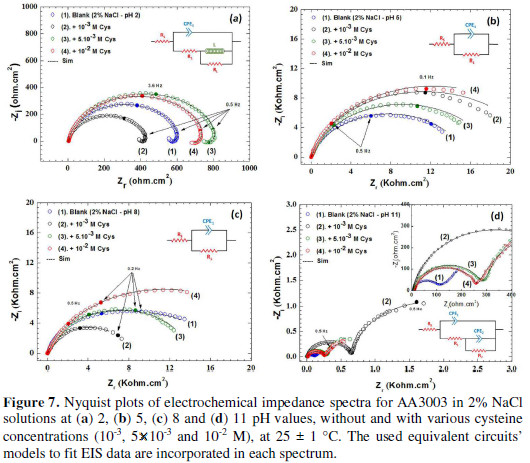
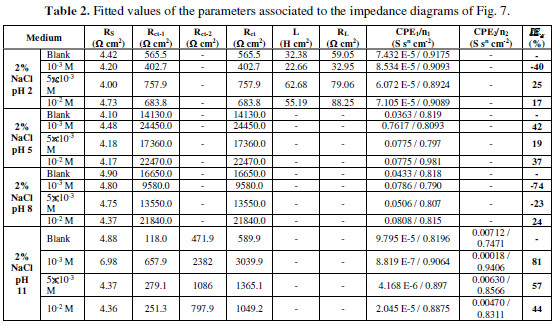
<body><![CDATA[<p>In order to obtain additional information on the electrochemical phenomena  taking place on the interface metal-solution, without and with cysteine, AC impedance  measurements were carried out. At open circuit potential, impedance  measurements have been performed. The potential values established during the  stabilization in all tested media, and at which impedance spectra were recorded,  are shown in <a href="#f5">Fig. 5</a>. <a href="#f7">Fig. 7</a> summarizes the obtained spectra through AA3003  Nyquist representations, in different tested media.</p>        <p>&nbsp;</p> <a name="f7"> <img src="/img/revistas/pea/v36n6/36n6a03f7.jpg">     
<p>&nbsp;</p>       <p>Firstly, in an acidic (pH 2) 2% NaCl solution, AA3003 Nyquist plots presented in  <a href="#f7">Fig. 7 (a)</a> are characterized by two time constants, namely: a depressed capacitive  time constant at high frequency values, and an inductive time constant at low  frequencies, either in cysteine absence and presence. Similar behavior has been  found by A. Yurt et al. [42], for aluminum in a 0.1 M HCl solution. In literature,  there is no common agreement about the origin of these time constants in  impedance spectra [35, 55]. In these spectra, at high frequencies, the depressed  capacitive loop attributed to the corrosion charge transfer process, concerning the  semicircle&rsquo;s depressive character, was mostly assigned to the inhomogeneous  metal surface [48]. The second time constant at low frequencies (inductive loop)  is often related to the species&rsquo; surface relaxation, or to the adsorption of the  intermediate products of the corrosion reaction onto the surface (involving  cysteine addition), as well as of the reactive products [35, 42, 56-59].</p>       <p>In near neutral (5 and 8 pH values) 2% NaCl solutions, the all complex-plan  impedances for AA3003, without and with cysteine, exhibited (in <a href="#f7">Fig. 7 (b)</a> and  <a href="#f7">(c)</a>) an alone depressed (due to the inhomogeneous metal surface) semi-circle,  showing that cysteine did not change the corrosion mechanism of aluminum  alloy at 5 and 8 pH values, which is mainly charge transfer controlled [9, 48]. In  other words, its diameter is a function of pH values and cysteine concentration.</p>       <p>The last tested medium was an alkaline (pH 11) 2% NaCl solution (<a href="#f7">Fig. 7 (d)</a>). In  cysteine absence and presence, at various concentrations, the impedance  diagrams show two depressed capacitive loops, one in high frequencies and  another in low frequencies. The first loop could be assigned to the double layer  and charge transfer characteristics. The second loop, in lower frequencies, can be  connected to the corrosion products film formation on the AA3003 surface [55].  The depressive character was mainly assigned to the inhomogeneous metal  surface [48].</p>       <p>The equivalent circuits&rsquo; models used to fit AA3003 experimental data depended  on the pH value of the medium. These electric equivalent circuits (integrated in  <a href="#f7">Fig. 7</a>) involve the following elements: RS, Rct-1, Rct-2, RL, L, (CPE)1 and (CPE)2.  In these circuits, R represents resistor elements, ct designs the charge transfer, L  represents the inductance element that is related to the inductive time constant at  low frequencies in the EIS spectrum, and CPE are the constant phase elements,  of which impedance is given by:</p>        <p>&nbsp;</p> <a name="e11"> <img src="/img/revistas/pea/v36n6/36n6a03e11.jpg">     
<p>&nbsp;</p>       <p>where j is an imaginary number, is the angular frequency in rad s-1 and n is the  impedance depressed feature [35]. This impedance term is employed to describe  the distribution of relaxation times, as a result of the inhomogeneity present at  the solid/liquid interface on a microscopic level [55]. The 1 and 2 for both Rct  (i.e., Rct-1 and Rct-2) and CPE (i.e., (CPE)1 and (CPE)2) refer to the first and  second depressed capacitive loop, respectively. The aim of the fitting procedure  was to find those parameter values that best describe the data; in other words, the  fitting model must be consistent with the experimental data [35, 60]. As show in  <a href="#f7">Fig. 7</a>, a good fit with these circuit models, regarding our experimental  impedance data, was obtained.</p>      ]]></body>
<body><![CDATA[<p>The parameters determined from Nyquist plots, by the regression calculation to  equivalent circuits&rsquo; models, and the inhibition efficiency (IEz,%), are given in  <a href="#t2">Table 2</a>.</p>        <p>&nbsp;</p> <a name="t2"> <img src="/img/revistas/pea/v36n6/36n6a03t2.jpg">     
<p>&nbsp;</p>       <p>The inhibition efficiency proportion at different cysteine concentrations,  for each tested medium, was calculated from charge transfer values, according to  the following equation:</p>        <p>&nbsp;</p> <a name="e12"> <img src="/img/revistas/pea/v36n6/36n6a03e12.jpg">     
<p>&nbsp;</p>       <p>where and are AA3003 total charge transfer resistances, without and with  cysteine in the tested medium, respectively. In the cases of acidic (pH 2) and  near neutral (5 and 8 pH values) 2% NaCl solutions, the latest grandeur was Rct-1  value. However, in alkaline media (i.e., pH 11), it was the sum of the two  resistances (Rct-1 and Rct-2) that was associated to the first and second loop,  respectively (see <a href="#f7">Fig. 7 (d)</a>) [41-42].</p>      <p>As it is well known, the charge transfer resistance, Rct, is inversely proportional  to the corrosion rate [35]. Consequently, AA3003 dissolution rate decreases in  the following order: pH 2 &gt; pH 11 &gt;&gt; pH 5 &gt; pH 8 (see <a href="#f2">Fig. 2 (b)</a>). Furthermore,  the data of <a href="#t2">Table 2</a> reveal that Rtc and CPE values depend on cysteine  concentration and pH value of the medium. Looking at the calculated inhibition  efficiency, cysteine in an alkaline (pH 11) 2% NaCl solution showed the highest  inhibition performance (81%) at 10-3 M, compared to the other media; then, it  declined with its concentration, at the same pH value (i.e., pH 11). With lower  concentrations, at 2 and 8 pH values, cysteine has accelerated (catalyzed) the  corrosion processes, although it has presented some ability to inhibit the  corrosion at higher concentrations. Generally, at pH 5, this amino acid has not a  defined trend concerning the inhibition efficiency. Concluding this part, these  results (EIS measurements) are comparable, and run parallel to those recorded by  the potentiodynamic polarization method. Furthermore, those results confirmed  the complex effect of cysteine on AA3003 corrosion in these conditions.</p>      <p><i><b>Weight loss method vs. electrochemical methods</b></i></p>       <p>The results of gravimetric measurements indicate that cysteine, at 2 and 11 pH  values, with all concentrations, presents a corrosion inhibiting property.  However, the electrochemical measurements (PP and EIS) exclude 10-3 M  concentration at pH 2, which has accelerated the corrosion processes (<a href="#f8">Fig. 8</a>).</p>        ]]></body>
<body><![CDATA[<p>&nbsp;</p> <a name="f8"> <img src="/img/revistas/pea/v36n6/36n6a03f8.jpg">     
<p>&nbsp;</p>       <p>This can be related to the immersion time effect (45 min for the electrochemical  method, and 24 hours for the weight loss study), which can affect the stability of  the used compound. A similar trend has been reported in the literature for other  systems [61-62]. In this context, it is well known that, in an aerated solution,  cysteine (RSH) is oxidized by the dissolved oxygen, forming a dimer with a  disulfide bridge, called cystine (RSSR) [18, 63-65]. The half reaction equation is  given by <a href="#e13">equation (13)</a>.</p>        <p>&nbsp;</p> <a name="e13"> <img src="/img/revistas/pea/v36n6/36n6a03e13.jpg">     
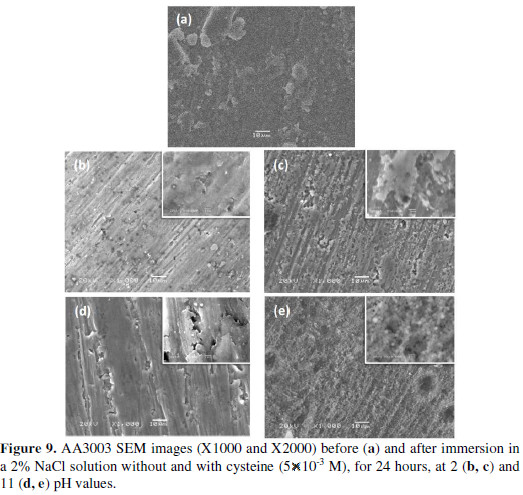
<p>&nbsp;</p>       <p>In other words, the concentration of the formed dimer  (RSSR), at 24 hours (weight loss method), was higher than at 45 min  (electrochemical method). Furthermore, in several studies [66-68], the RSSR  dimer has showed considerable ability to inhibit corrosion. Consequently, if there  is a cysteine accelerator effect at lower concentrations (as at pH 2), this can be  related to the metal dissolution by the formation of soluble complexes between  the metal ion and cysteine, via the sulfhydryl group (–SH) [69].</p>        <p><i><b>Surface morphology</b></i></p>       <p>In order to get information about AA3003 surface morphological state, and about  the effect of cysteine on this feature, SEM analysis was performed. Cysteine  concentration of 5 10-3 M was chosen, due to its reasonable inhibition  efficiency, both in acidic and alkaline media. <a href="#f9">Fig. 9</a> presents AA3003 typical  surface morphology, before and after its immersion (for 24 hours) in a 2% NaCl  solution, without and with cysteine, at 2 and 11 pH values.</p>        <p>&nbsp;</p> <a name="f9"> <img src="/img/revistas/pea/v36n6/36n6a03f9.jpg">     
<p>&nbsp;</p>       ]]></body>
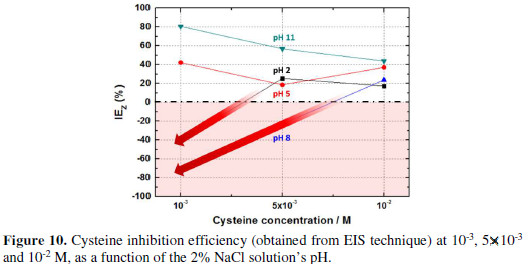
<body><![CDATA[<p>In the first stage, compared to AA3003 presence (<a href="#f9">Fig. 9 (a)</a>), the surface morphology in blank  solutions (<a href="#f9">Fig. 9(b)</a> and <a href="#f9">(c)</a>) was strongly corroded by the aggressive solution,  and it became scratched and porous, both at 2 and 11 pH values of 2% NaCl  solutions. These observations perfectly correlate to the highest corrosion rate of  the tested blank solutions, as proved by previous techniques <a href="#f2">(Fig. 2 (b))</a>. In the  second stage, cysteine (at 5 10-3 M) beneficially affected AA3003 surface  morphology, as the specimens (<a href="#f9">Fig. 9(d)</a> and <a href="#f9">(e)</a>) were better protected than in  solutions without cysteine (<a href="#f9">Fig. 9(b)</a> and <a href="#f9">(c))</a>. However, some heterogeneities  remain on AA3003 surfaces, in cysteine presence. Such observations agree with  the obtained inhibition efficiency at 5 10-3 M, namely, 25% and 57%, at 2 and  11 pH values, respectively.</p>        <p><i><b>Mechanism of action</b></i></p>       <p>Usually, the inhibition efficiency increases with the inhibitor concentration [12-  17, 32]. However, in our case, no linear trend was found, and IE strongly  depended on cysteine concentration and on the saline solution&rsquo;s pH (see <a href="#f10">Fig. 10)</a>.</p>        <p>&nbsp;</p> <a name="f10"> <img src="/img/revistas/pea/v36n6/36n6a03f10.jpg">     
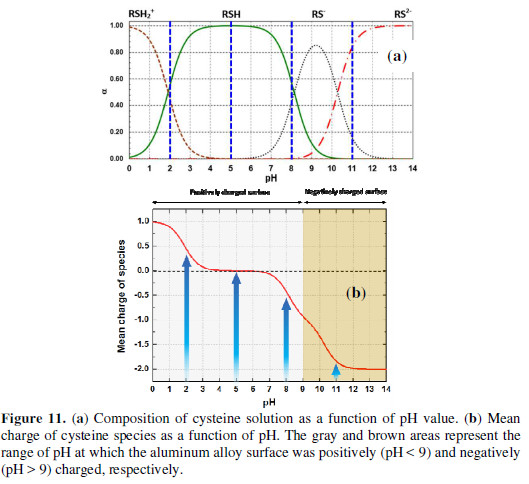
<p>&nbsp;</p>       <p>For this purpose, the solution&rsquo;s pH is an important element to explain obtained  results, because it may influence amino acids molecules (protonated,  deprotonated or zwitterion forms), the metallic surface and the corrosion  mechanism [25]. Depending on the solution&rsquo;s pH, cysteine is presented in  different forms (<a href="#f1">Fig. 1</a>) [19]. <a href="#f11">Fig. 11 (a)</a> shows the cysteine solution composition  (by molar ration: a) as a function of pH. This diagram was produced by using  CurTiPot 4.1.1. Microsoft Excel Macro file, programmed by Ivano G.R. Gutz  [70].</p>        <p>&nbsp;</p> <a name="f11"> <img src="/img/revistas/pea/v36n6/36n6a03f11.jpg">     
<p>&nbsp;</p>       <p>As it can be seen, at 5 and 11 pH values, the solution was mainly constituted by  two forms of cysteine: zwitterions (I) and deprotonated (II) forms, respectively.  However, at 2 and 8 pH values, both solutions contained a mixture of two  cysteine forms, namely, 55% protonated cysteine with 45% of zwitterions, and  58% of zwitterion with 42% deprotonated cysteine, respectively. The zwitterion  form was dominant, at the pH range from 1.9 to 8.2. Below or above these pH  values, the molecules are cationic or anionic, respectively. The pH effect on the  aluminum alloy surface state is visible in its electric charge and corrosion  products. So, below pH 9, it is positively charged, and above this value, it is  negatively charged [32]. The chemical nature of AA3003 surface (corrosion  products) was discussed in the previous part about the potentiodynamic  polarization study. As reported in some works [40, 71], cysteine adsorption mode  (chemisorption or physisorption) was found to depend on the pH value of the  medium. <a href="#f11">Fig. 11 (b)</a> represents the mean charge of cysteine, as a function of pH,  with a superposed charge of the metal surface [70].</p>      <p>As it can be seen in <a href="#f11">Fig. 11 (b)</a>, there is not a relationship between the mean  charge of cysteine species and that of the metal surface, at 2, 5 and 11 pH values.  This indicates that the direct physisorption process cannot satisfactorily explain  cysteine behavior in these cases, because this process was characterized by an  electrostatic interaction (dipole interaction) between the charged molecules and  the charged metal surface [72]. A possible reason for these results is the  chemisorption interaction of the species with the surface. However, at pH 11, IE  decreases with an increasing cysteine concentration. Furthermore, at pH 5, no IE  trend was noted with cysteine concentration. The same observation was noted at  2 and 8 pH values, with high cysteine concentrations. All these notes reflect the  instability of the formed adsorbed inhibitor film and, consequently, its  dissolution [9], which can be due to the weak chemisorption of cysteine  molecules onto the metal surface [69]. At 2 and 8 pH values, with low cysteine  concentrations, this amino acid acted as a corrosion accelerator (with negative IE  values (%)) for AA3003 in 2% NaCl. Commonly, this effect was explained by  a competition between strong cysteine complexation with metallic ions and  its weak chemisorption onto the metal surface [28, 29, 52, 69]. In the whole (see  <a href="#f11">Fig. 11 (b)</a>), the inhibition effectiveness at pH 5 was greater than that at 2 and 8  pH values, which can be attributed to the cysteine solution composition. From  <a href="#f11">Fig. 11 (a)</a>), at pH 5, the solution was composed from Zwitterion (RSH).</p>      ]]></body>
<body><![CDATA[<p>However, in addition to the RSH form, at 2 and 8 pH values, the solution also  contained other forms: deprotonated I (RSH2+) and deprotonated II (RS-) forms,  respectively. In addition to its proportion reduction, compared to at pH 5, it is  possible that the RSH form could have interfered with the other cysteine forms  (at 5 and 8 pH values) and, hence, reduce the RSH concentration adsorbed onto  the surface. This interference can be favored by the soft chemisorbed RSH form.</p>      <p>The same behavior was noted at pH 11, of which the main form was RS2- anion.  As a finding, corrosion inhibition by cysteine exhibited high complexity. In order  to understand better this corrosion inhibition or acceleration effect on AA3003 in  a saline solution, a second work will discuss it via quantum chemical calculations  and molecular Monte Carlo simulations.</p>        <p><b>Conclusions</b></p>       <p>Cysteine ability to inhibit 3003 aluminum alloy corrosion in a 2% NaCl solution,  at different pH conditions, was examined by weight loss and electrochemical  methods. Firstly, it was found that AA3003 corrosion rate and mechanism  depended on pH values. Then, a strong dependence was showed for cysteine  inhibition efficiency on its concentrations, as well as the saline solution&rsquo;s pH. In  this context, the investigated amino acid (i.e. cysteine) exhibited a better  corrosion inhibitory effect in an alkaline medium, regarding all tested pH values.  However, it acted as a corrosion accelerator in lower concentrations, at 2 and 8  pH values. Furthermore, as a whole, no increasing linear behavior of the  inhibition efficiency with the concentration was observed. These results allowed  the prediction that, in the AA3003 case in a 2% NaCl solution, cysteine (or its  dimerized form, cystine) would be adsorbed onto the metal surface through a  weak chemisorption process. Finally, following our results and the literature  findings, the use of cysteine as a metal corrosion inhibitor must be accompanied  by some precautions to avoid its corrosion catalytic effect.</p>       <p>&nbsp;</p>     <p><b>References</b></p>      <!-- ref --><p>1. Vargel C. Corrosion of Aluminium. 1st ed. Elsevier; 2004.    &nbsp;&nbsp;&nbsp;&nbsp;&nbsp;&nbsp;&nbsp;&nbsp;[&#160;<a href="javascript:void(0);" onclick="javascript: window.open('/scielo.php?script=sci_nlinks&ref=437354&pid=S0872-1904201800060000300001&lng=','','width=640,height=500,resizable=yes,scrollbars=1,menubar=yes,');">Links</a>&#160;]<!-- end-ref --></p>      <!-- ref --><p>2. Lumley R. Fundamentals of aluminium metallurgy: Production, processing  and applications. 1st ed. UK:Woodhead Publishing Ltd; 2011.    &nbsp;&nbsp;&nbsp;&nbsp;&nbsp;&nbsp;&nbsp;&nbsp;[&#160;<a href="javascript:void(0);" onclick="javascript: window.open('/scielo.php?script=sci_nlinks&ref=437356&pid=S0872-1904201800060000300002&lng=','','width=640,height=500,resizable=yes,scrollbars=1,menubar=yes,');">Links</a>&#160;]<!-- end-ref --></p>      ]]></body>
<body><![CDATA[<!-- ref --><p>3. Wang D, Gao L, Zhang D, et al. Mater Chem Phys. 2016;169:142.    &nbsp;&nbsp;&nbsp;&nbsp;&nbsp;&nbsp;&nbsp;&nbsp;[&#160;<a href="javascript:void(0);" onclick="javascript: window.open('/scielo.php?script=sci_nlinks&ref=437358&pid=S0872-1904201800060000300003&lng=','','width=640,height=500,resizable=yes,scrollbars=1,menubar=yes,');">Links</a>&#160;]<!-- end-ref --></p>      <!-- ref --><p>4. Sastri VS. Green Corrosion Inhibitors: Theory and Practice. 1st ed. John  Wiley & Sons Ltd; 2011.    &nbsp;&nbsp;&nbsp;&nbsp;&nbsp;&nbsp;&nbsp;&nbsp;[&#160;<a href="javascript:void(0);" onclick="javascript: window.open('/scielo.php?script=sci_nlinks&ref=437360&pid=S0872-1904201800060000300004&lng=','','width=640,height=500,resizable=yes,scrollbars=1,menubar=yes,');">Links</a>&#160;]<!-- end-ref --></p>      <!-- ref --><p>5. Raja PB, Sethuraman MG. Mater Lett. 2008;62:113.    &nbsp;&nbsp;&nbsp;&nbsp;&nbsp;&nbsp;&nbsp;&nbsp;[&#160;<a href="javascript:void(0);" onclick="javascript: window.open('/scielo.php?script=sci_nlinks&ref=437362&pid=S0872-1904201800060000300005&lng=','','width=640,height=500,resizable=yes,scrollbars=1,menubar=yes,');">Links</a>&#160;]<!-- end-ref --></p>      <!-- ref --><p>6. Rani BEA, Basu BBJ. Int J Corrosion. 2012;2012:15.    &nbsp;&nbsp;&nbsp;&nbsp;&nbsp;&nbsp;&nbsp;&nbsp;[&#160;<a href="javascript:void(0);" onclick="javascript: window.open('/scielo.php?script=sci_nlinks&ref=437364&pid=S0872-1904201800060000300006&lng=','','width=640,height=500,resizable=yes,scrollbars=1,menubar=yes,');">Links</a>&#160;]<!-- end-ref --></p>      <!-- ref --><p>7. Gece G. Corrosion Sci. 2011;53:3873.    &nbsp;&nbsp;&nbsp;&nbsp;&nbsp;&nbsp;&nbsp;&nbsp;[&#160;<a href="javascript:void(0);" onclick="javascript: window.open('/scielo.php?script=sci_nlinks&ref=437366&pid=S0872-1904201800060000300007&lng=','','width=640,height=500,resizable=yes,scrollbars=1,menubar=yes,');">Links</a>&#160;]<!-- end-ref --></p>      ]]></body>
<body><![CDATA[<!-- ref --><p>8. Kiani MA, Mousavi MF, Ghasemi S, et al. Corrosion Sci. 2008;50:1035.    &nbsp;&nbsp;&nbsp;&nbsp;&nbsp;&nbsp;&nbsp;&nbsp;[&#160;<a href="javascript:void(0);" onclick="javascript: window.open('/scielo.php?script=sci_nlinks&ref=437368&pid=S0872-1904201800060000300008&lng=','','width=640,height=500,resizable=yes,scrollbars=1,menubar=yes,');">Links</a>&#160;]<!-- end-ref --></p>      <!-- ref --><p>9. Zhang DQ, Xie B, Gao LX, et al. J Appl Electrochem. 2011;41:491.    &nbsp;&nbsp;&nbsp;&nbsp;&nbsp;&nbsp;&nbsp;&nbsp;[&#160;<a href="javascript:void(0);" onclick="javascript: window.open('/scielo.php?script=sci_nlinks&ref=437370&pid=S0872-1904201800060000300009&lng=','','width=640,height=500,resizable=yes,scrollbars=1,menubar=yes,');">Links</a>&#160;]<!-- end-ref --></p>      <!-- ref --><p>10. Fu JJ, Li SN, Cao LH, et al. J Mater Sci. 2010;45:979.    &nbsp;&nbsp;&nbsp;&nbsp;&nbsp;&nbsp;&nbsp;&nbsp;[&#160;<a href="javascript:void(0);" onclick="javascript: window.open('/scielo.php?script=sci_nlinks&ref=437372&pid=S0872-1904201800060000300010&lng=','','width=640,height=500,resizable=yes,scrollbars=1,menubar=yes,');">Links</a>&#160;]<!-- end-ref --></p>      <!-- ref --><p>11. El Ibrahimi B, Jmiai A, Bazzi L, et al. Arab J Chem. 2017. In press.    &nbsp;&nbsp;&nbsp;&nbsp;&nbsp;&nbsp;&nbsp;&nbsp;[&#160;<a href="javascript:void(0);" onclick="javascript: window.open('/scielo.php?script=sci_nlinks&ref=437374&pid=S0872-1904201800060000300011&lng=','','width=640,height=500,resizable=yes,scrollbars=1,menubar=yes,');">Links</a>&#160;]<!-- end-ref -->  <a href="https://doi.org/10.1016/j.arabjc.2017.07.013" target="_blank">https://doi.org/10.1016/j.arabjc.2017.07.013</a>.</p>      <!-- ref --><p>12. Fekry AM, Tammam RH. Int J Electrochem Sci. 2012;7:12254.    &nbsp;&nbsp;&nbsp;&nbsp;&nbsp;&nbsp;&nbsp;&nbsp;[&#160;<a href="javascript:void(0);" onclick="javascript: window.open('/scielo.php?script=sci_nlinks&ref=437376&pid=S0872-1904201800060000300012&lng=','','width=640,height=500,resizable=yes,scrollbars=1,menubar=yes,');">Links</a>&#160;]<!-- end-ref --></p>      ]]></body>
<body><![CDATA[<!-- ref --><p>13. Rajappa SK, Venkatesha TV. Tur. . Chem. 2003;27:189.    &nbsp;&nbsp;&nbsp;&nbsp;&nbsp;&nbsp;&nbsp;&nbsp;[&#160;<a href="javascript:void(0);" onclick="javascript: window.open('/scielo.php?script=sci_nlinks&ref=437378&pid=S0872-1904201800060000300013&lng=','','width=640,height=500,resizable=yes,scrollbars=1,menubar=yes,');">Links</a>&#160;]<!-- end-ref --></p>      <!-- ref --><p>14. El-Sherif RM, Badawy WA. Int J Electrochem Sci. 2011;6:6469.    &nbsp;&nbsp;&nbsp;&nbsp;&nbsp;&nbsp;&nbsp;&nbsp;[&#160;<a href="javascript:void(0);" onclick="javascript: window.open('/scielo.php?script=sci_nlinks&ref=437380&pid=S0872-1904201800060000300014&lng=','','width=640,height=500,resizable=yes,scrollbars=1,menubar=yes,');">Links</a>&#160;]<!-- end-ref --></p>      <!-- ref --><p>15. Salghi R, Hammouti B, Kertit S, et al. Bull Electrochem. 1997;13:399.    &nbsp;&nbsp;&nbsp;&nbsp;&nbsp;&nbsp;&nbsp;&nbsp;[&#160;<a href="javascript:void(0);" onclick="javascript: window.open('/scielo.php?script=sci_nlinks&ref=437382&pid=S0872-1904201800060000300015&lng=','','width=640,height=500,resizable=yes,scrollbars=1,menubar=yes,');">Links</a>&#160;]<!-- end-ref --></p>      <!-- ref --><p>16. Zerfaoui M, Oudda H, Hammouti B, et al. Prog Org Coat. 2004;51:134.    &nbsp;&nbsp;&nbsp;&nbsp;&nbsp;&nbsp;&nbsp;&nbsp;[&#160;<a href="javascript:void(0);" onclick="javascript: window.open('/scielo.php?script=sci_nlinks&ref=437384&pid=S0872-1904201800060000300016&lng=','','width=640,height=500,resizable=yes,scrollbars=1,menubar=yes,');">Links</a>&#160;]<!-- end-ref --></p>      <!-- ref --><p>17. Matos JB, Pereira LP, Agostinho SML,et al. J Electroanal Chem.  2004;570:91.    &nbsp;&nbsp;&nbsp;&nbsp;&nbsp;&nbsp;&nbsp;&nbsp;[&#160;<a href="javascript:void(0);" onclick="javascript: window.open('/scielo.php?script=sci_nlinks&ref=437386&pid=S0872-1904201800060000300017&lng=','','width=640,height=500,resizable=yes,scrollbars=1,menubar=yes,');">Links</a>&#160;]<!-- end-ref --></p>      ]]></body>
<body><![CDATA[<p>18. Silva AB, Agostinho SML, Barcia OE, et al. Corrosion Sci. 20016;48:3668.</p>      <!-- ref --><p>19. Kilberg MS, Haussinger D. Mammalian Amino Acid Transport. Springer  Science & Business Media; 1992.    &nbsp;&nbsp;&nbsp;&nbsp;&nbsp;&nbsp;&nbsp;&nbsp;[&#160;<a href="javascript:void(0);" onclick="javascript: window.open('/scielo.php?script=sci_nlinks&ref=437389&pid=S0872-1904201800060000300019&lng=','','width=640,height=500,resizable=yes,scrollbars=1,menubar=yes,');">Links</a>&#160;]<!-- end-ref --></p>      <!-- ref --><p>20. Milosev I, Pavlinac J, Hodoscek M, et al. J Serb Chem Soc. 2013;78:2069.    &nbsp;&nbsp;&nbsp;&nbsp;&nbsp;&nbsp;&nbsp;&nbsp;[&#160;<a href="javascript:void(0);" onclick="javascript: window.open('/scielo.php?script=sci_nlinks&ref=437391&pid=S0872-1904201800060000300020&lng=','','width=640,height=500,resizable=yes,scrollbars=1,menubar=yes,');">Links</a>&#160;]<!-- end-ref --></p>      <!-- ref --><p>21. Kabanda MM, Obot IB, Ebenso EE. Int J Electrochem Sci. 2013;8:10839.    &nbsp;&nbsp;&nbsp;&nbsp;&nbsp;&nbsp;&nbsp;&nbsp;[&#160;<a href="javascript:void(0);" onclick="javascript: window.open('/scielo.php?script=sci_nlinks&ref=437393&pid=S0872-1904201800060000300021&lng=','','width=640,height=500,resizable=yes,scrollbars=1,menubar=yes,');">Links</a>&#160;]<!-- end-ref --></p>      <!-- ref --><p>22. Zarrouk A, Zarrok H, Salghi R, et al. Int J Electrochem Sci. 2012;7:6353.    &nbsp;&nbsp;&nbsp;&nbsp;&nbsp;&nbsp;&nbsp;&nbsp;[&#160;<a href="javascript:void(0);" onclick="javascript: window.open('/scielo.php?script=sci_nlinks&ref=437395&pid=S0872-1904201800060000300022&lng=','','width=640,height=500,resizable=yes,scrollbars=1,menubar=yes,');">Links</a>&#160;]<!-- end-ref --></p>      <!-- ref --><p>23. Eddy NO. J Adv Res. 2011;2:35.    &nbsp;&nbsp;&nbsp;&nbsp;&nbsp;&nbsp;&nbsp;&nbsp;[&#160;<a href="javascript:void(0);" onclick="javascript: window.open('/scielo.php?script=sci_nlinks&ref=437397&pid=S0872-1904201800060000300023&lng=','','width=640,height=500,resizable=yes,scrollbars=1,menubar=yes,');">Links</a>&#160;]<!-- end-ref --></p>      <p>24. Zhang DQ, Gao LX, Zhou GD. J Appl Electrochem. 2005;35:1081.</p>      <!-- ref --><p>25. Varvara S, Rotaru I, Popa M, et al. Rev Roum Chim. 2011;56:793.    &nbsp;&nbsp;&nbsp;&nbsp;&nbsp;&nbsp;&nbsp;&nbsp;[&#160;<a href="javascript:void(0);" onclick="javascript: window.open('/scielo.php?script=sci_nlinks&ref=437400&pid=S0872-1904201800060000300025&lng=','','width=640,height=500,resizable=yes,scrollbars=1,menubar=yes,');">Links</a>&#160;]<!-- end-ref --></p>      <!-- ref --><p>26. Kalota DJ, Silverman DC. Corrosion. 1994;50:138.    &nbsp;&nbsp;&nbsp;&nbsp;&nbsp;&nbsp;&nbsp;&nbsp;[&#160;<a href="javascript:void(0);" onclick="javascript: window.open('/scielo.php?script=sci_nlinks&ref=437402&pid=S0872-1904201800060000300026&lng=','','width=640,height=500,resizable=yes,scrollbars=1,menubar=yes,');">Links</a>&#160;]<!-- end-ref --></p>      <!-- ref --><p>27. Helal NH, El-Rabiee MM, El-Hafer GMA, et al. J Alloys Compd.  2008;456:372.    &nbsp;&nbsp;&nbsp;&nbsp;&nbsp;&nbsp;&nbsp;&nbsp;[&#160;<a href="javascript:void(0);" onclick="javascript: window.open('/scielo.php?script=sci_nlinks&ref=437404&pid=S0872-1904201800060000300027&lng=','','width=640,height=500,resizable=yes,scrollbars=1,menubar=yes,');">Links</a>&#160;]<!-- end-ref --></p>      <!-- ref --><p>28. Ismail KM. Electrochim Acta. 2007;52:7811.    &nbsp;&nbsp;&nbsp;&nbsp;&nbsp;&nbsp;&nbsp;&nbsp;[&#160;<a href="javascript:void(0);" onclick="javascript: window.open('/scielo.php?script=sci_nlinks&ref=437406&pid=S0872-1904201800060000300028&lng=','','width=640,height=500,resizable=yes,scrollbars=1,menubar=yes,');">Links</a>&#160;]<!-- end-ref --></p>      ]]></body>
<body><![CDATA[<!-- ref --><p>29. Shkirskiy V, Keil P, Hintze-Bruening H, et al. Corrosion Sci. 2015;100:101.    &nbsp;&nbsp;&nbsp;&nbsp;&nbsp;&nbsp;&nbsp;&nbsp;[&#160;<a href="javascript:void(0);" onclick="javascript: window.open('/scielo.php?script=sci_nlinks&ref=437408&pid=S0872-1904201800060000300029&lng=','','width=640,height=500,resizable=yes,scrollbars=1,menubar=yes,');">Links</a>&#160;]<!-- end-ref --></p>      <!-- ref --><p>30. Aramaki K. Corrosion Sci. 2001;43:2201.    &nbsp;&nbsp;&nbsp;&nbsp;&nbsp;&nbsp;&nbsp;&nbsp;[&#160;<a href="javascript:void(0);" onclick="javascript: window.open('/scielo.php?script=sci_nlinks&ref=437410&pid=S0872-1904201800060000300030&lng=','','width=640,height=500,resizable=yes,scrollbars=1,menubar=yes,');">Links</a>&#160;]<!-- end-ref --></p>      <!-- ref --><p>31. Shen S, Guo X-Y, Song P, et al. Appl Surf Sci. 2013;276:167.    &nbsp;&nbsp;&nbsp;&nbsp;&nbsp;&nbsp;&nbsp;&nbsp;[&#160;<a href="javascript:void(0);" onclick="javascript: window.open('/scielo.php?script=sci_nlinks&ref=437412&pid=S0872-1904201800060000300031&lng=','','width=640,height=500,resizable=yes,scrollbars=1,menubar=yes,');">Links</a>&#160;]<!-- end-ref --></p>      <!-- ref --><p>32. Amin MA. Corrosion Sci. 2010;52:3243.    &nbsp;&nbsp;&nbsp;&nbsp;&nbsp;&nbsp;&nbsp;&nbsp;[&#160;<a href="javascript:void(0);" onclick="javascript: window.open('/scielo.php?script=sci_nlinks&ref=437414&pid=S0872-1904201800060000300032&lng=','','width=640,height=500,resizable=yes,scrollbars=1,menubar=yes,');">Links</a>&#160;]<!-- end-ref --></p>      <!-- ref --><p>33. Zaid B, Maddache N, Saidi D, et al. J Alloys Compd. 2015;629:188.    &nbsp;&nbsp;&nbsp;&nbsp;&nbsp;&nbsp;&nbsp;&nbsp;[&#160;<a href="javascript:void(0);" onclick="javascript: window.open('/scielo.php?script=sci_nlinks&ref=437416&pid=S0872-1904201800060000300033&lng=','','width=640,height=500,resizable=yes,scrollbars=1,menubar=yes,');">Links</a>&#160;]<!-- end-ref --></p>      ]]></body>
<body><![CDATA[<!-- ref --><p>34. Haleem SMAE, Wanees SAE, Aal EEAE, et al. Corrosion Sci. 2013;68:1.    &nbsp;&nbsp;&nbsp;&nbsp;&nbsp;&nbsp;&nbsp;&nbsp;[&#160;<a href="javascript:void(0);" onclick="javascript: window.open('/scielo.php?script=sci_nlinks&ref=437418&pid=S0872-1904201800060000300034&lng=','','width=640,height=500,resizable=yes,scrollbars=1,menubar=yes,');">Links</a>&#160;]<!-- end-ref --></p>      <!-- ref --><p>35. Khaled K. Corrosion Sci. 2010;52:2905.    &nbsp;&nbsp;&nbsp;&nbsp;&nbsp;&nbsp;&nbsp;&nbsp;[&#160;<a href="javascript:void(0);" onclick="javascript: window.open('/scielo.php?script=sci_nlinks&ref=437420&pid=S0872-1904201800060000300035&lng=','','width=640,height=500,resizable=yes,scrollbars=1,menubar=yes,');">Links</a>&#160;]<!-- end-ref --></p>      <!-- ref --><p>36. Zhang Q, Gao Z, Xu F, et al. Colloids Surf. 2011;380:191.    &nbsp;&nbsp;&nbsp;&nbsp;&nbsp;&nbsp;&nbsp;&nbsp;[&#160;<a href="javascript:void(0);" onclick="javascript: window.open('/scielo.php?script=sci_nlinks&ref=437422&pid=S0872-1904201800060000300036&lng=','','width=640,height=500,resizable=yes,scrollbars=1,menubar=yes,');">Links</a>&#160;]<!-- end-ref --></p>      <!-- ref --><p>37. Safak S, Duran B, Yurt A, et al. Corrosion Sci. 2012;54:251.    &nbsp;&nbsp;&nbsp;&nbsp;&nbsp;&nbsp;&nbsp;&nbsp;[&#160;<a href="javascript:void(0);" onclick="javascript: window.open('/scielo.php?script=sci_nlinks&ref=437424&pid=S0872-1904201800060000300037&lng=','','width=640,height=500,resizable=yes,scrollbars=1,menubar=yes,');">Links</a>&#160;]<!-- end-ref --></p>      <!-- ref --><p>38. Yurt A, Aykin O. Corrosion Sci. 2011;53:3725.    &nbsp;&nbsp;&nbsp;&nbsp;&nbsp;&nbsp;&nbsp;&nbsp;[&#160;<a href="javascript:void(0);" onclick="javascript: window.open('/scielo.php?script=sci_nlinks&ref=437426&pid=S0872-1904201800060000300038&lng=','','width=640,height=500,resizable=yes,scrollbars=1,menubar=yes,');">Links</a>&#160;]<!-- end-ref --></p>      ]]></body>
<body><![CDATA[<!-- ref --><p>39. Zaid B, Saidi D, Benzaid A, et al. Corrosion Sci. 2008;50:1841.    &nbsp;&nbsp;&nbsp;&nbsp;&nbsp;&nbsp;&nbsp;&nbsp;[&#160;<a href="javascript:void(0);" onclick="javascript: window.open('/scielo.php?script=sci_nlinks&ref=437428&pid=S0872-1904201800060000300039&lng=','','width=640,height=500,resizable=yes,scrollbars=1,menubar=yes,');">Links</a>&#160;]<!-- end-ref --></p>      <!-- ref --><p>40. Petrovic MB, Radovanovic MB, Simonovic AT, et al. Int J Electrochem Sci.  2012;7:9043.    &nbsp;&nbsp;&nbsp;&nbsp;&nbsp;&nbsp;&nbsp;&nbsp;[&#160;<a href="javascript:void(0);" onclick="javascript: window.open('/scielo.php?script=sci_nlinks&ref=437430&pid=S0872-1904201800060000300040&lng=','','width=640,height=500,resizable=yes,scrollbars=1,menubar=yes,');">Links</a>&#160;]<!-- end-ref --></p>      <!-- ref --><p>41. Ashassi-Sorkhabi H, Asghari E. J Appl Electrochem. 2010;40:631.    &nbsp;&nbsp;&nbsp;&nbsp;&nbsp;&nbsp;&nbsp;&nbsp;[&#160;<a href="javascript:void(0);" onclick="javascript: window.open('/scielo.php?script=sci_nlinks&ref=437432&pid=S0872-1904201800060000300041&lng=','','width=640,height=500,resizable=yes,scrollbars=1,menubar=yes,');">Links</a>&#160;]<!-- end-ref --></p>      <!-- ref --><p>42. Yurt A, Ulutas S, Dal H. Appl Surf Sci. 2006;253:919.    &nbsp;&nbsp;&nbsp;&nbsp;&nbsp;&nbsp;&nbsp;&nbsp;[&#160;<a href="javascript:void(0);" onclick="javascript: window.open('/scielo.php?script=sci_nlinks&ref=437434&pid=S0872-1904201800060000300042&lng=','','width=640,height=500,resizable=yes,scrollbars=1,menubar=yes,');">Links</a>&#160;]<!-- end-ref --></p>      <!-- ref --><p>43. Lashgari M, Malek AM. Electrochim Acta. 2010;55:5253.    &nbsp;&nbsp;&nbsp;&nbsp;&nbsp;&nbsp;&nbsp;&nbsp;[&#160;<a href="javascript:void(0);" onclick="javascript: window.open('/scielo.php?script=sci_nlinks&ref=437436&pid=S0872-1904201800060000300043&lng=','','width=640,height=500,resizable=yes,scrollbars=1,menubar=yes,');">Links</a>&#160;]<!-- end-ref --></p>      ]]></body>
<body><![CDATA[<!-- ref --><p>44. Halambek J, Berkovic K, Fura JV. Mater Chem Phys. 2013;137:788.    &nbsp;&nbsp;&nbsp;&nbsp;&nbsp;&nbsp;&nbsp;&nbsp;[&#160;<a href="javascript:void(0);" onclick="javascript: window.open('/scielo.php?script=sci_nlinks&ref=437438&pid=S0872-1904201800060000300044&lng=','','width=640,height=500,resizable=yes,scrollbars=1,menubar=yes,');">Links</a>&#160;]<!-- end-ref --></p>      <!-- ref --><p>45. Niu L, Cheng YF. Wear. 2008;367.    &nbsp;&nbsp;&nbsp;&nbsp;&nbsp;&nbsp;&nbsp;&nbsp;[&#160;<a href="javascript:void(0);" onclick="javascript: window.open('/scielo.php?script=sci_nlinks&ref=437440&pid=S0872-1904201800060000300045&lng=','','width=640,height=500,resizable=yes,scrollbars=1,menubar=yes,');">Links</a>&#160;]<!-- end-ref --></p>      <!-- ref --><p>46. Wang B, Zhang L, Su Y, et al. Mater Des. 2013;50:15.    &nbsp;&nbsp;&nbsp;&nbsp;&nbsp;&nbsp;&nbsp;&nbsp;[&#160;<a href="javascript:void(0);" onclick="javascript: window.open('/scielo.php?script=sci_nlinks&ref=437442&pid=S0872-1904201800060000300046&lng=','','width=640,height=500,resizable=yes,scrollbars=1,menubar=yes,');">Links</a>&#160;]<!-- end-ref --></p>      <!-- ref --><p>47. Hassan RM, Zaafarany IA. Materials. 2013;6:2436.    &nbsp;&nbsp;&nbsp;&nbsp;&nbsp;&nbsp;&nbsp;&nbsp;[&#160;<a href="javascript:void(0);" onclick="javascript: window.open('/scielo.php?script=sci_nlinks&ref=437444&pid=S0872-1904201800060000300047&lng=','','width=640,height=500,resizable=yes,scrollbars=1,menubar=yes,');">Links</a>&#160;]<!-- end-ref --></p>      <!-- ref --><p>48. Prabhu D, Rao P. Arabian J Chem. 2017;10:s2234.    &nbsp;&nbsp;&nbsp;&nbsp;&nbsp;&nbsp;&nbsp;&nbsp;[&#160;<a href="javascript:void(0);" onclick="javascript: window.open('/scielo.php?script=sci_nlinks&ref=437446&pid=S0872-1904201800060000300048&lng=','','width=640,height=500,resizable=yes,scrollbars=1,menubar=yes,');">Links</a>&#160;]<!-- end-ref --></p>      ]]></body>
<body><![CDATA[<!-- ref --><p>49. Abiola OK, Otaigbe JOE. Corrosion Sci. 2009;51:2790.    &nbsp;&nbsp;&nbsp;&nbsp;&nbsp;&nbsp;&nbsp;&nbsp;[&#160;<a href="javascript:void(0);" onclick="javascript: window.open('/scielo.php?script=sci_nlinks&ref=437448&pid=S0872-1904201800060000300049&lng=','','width=640,height=500,resizable=yes,scrollbars=1,menubar=yes,');">Links</a>&#160;]<!-- end-ref --></p>      <!-- ref --><p>50. Pyun S-I, Moon S-M. J. Solid State Electrochem. 2000;4:267.    &nbsp;&nbsp;&nbsp;&nbsp;&nbsp;&nbsp;&nbsp;&nbsp;[&#160;<a href="javascript:void(0);" onclick="javascript: window.open('/scielo.php?script=sci_nlinks&ref=437450&pid=S0872-1904201800060000300050&lng=','','width=640,height=500,resizable=yes,scrollbars=1,menubar=yes,');">Links</a>&#160;]<!-- end-ref --></p>      <!-- ref --><p>51. Moon S-M, Pyun S-I. J. Solid State Electrochem. 1999;3:104.    &nbsp;&nbsp;&nbsp;&nbsp;&nbsp;&nbsp;&nbsp;&nbsp;[&#160;<a href="javascript:void(0);" onclick="javascript: window.open('/scielo.php?script=sci_nlinks&ref=437452&pid=S0872-1904201800060000300051&lng=','','width=640,height=500,resizable=yes,scrollbars=1,menubar=yes,');">Links</a>&#160;]<!-- end-ref --></p>      <!-- ref --><p>52. Ashassi-Sorkhabi H, Majidi MR, Seyyedi K. Appl Surf Sci. 2004;225:176.    &nbsp;&nbsp;&nbsp;&nbsp;&nbsp;&nbsp;&nbsp;&nbsp;[&#160;<a href="javascript:void(0);" onclick="javascript: window.open('/scielo.php?script=sci_nlinks&ref=437454&pid=S0872-1904201800060000300052&lng=','','width=640,height=500,resizable=yes,scrollbars=1,menubar=yes,');">Links</a>&#160;]<!-- end-ref --></p>      <!-- ref --><p>53. Fu J-j, Li S-g, Wang Y, et al. J Mater Sci. 2010;45:6255.    &nbsp;&nbsp;&nbsp;&nbsp;&nbsp;&nbsp;&nbsp;&nbsp;[&#160;<a href="javascript:void(0);" onclick="javascript: window.open('/scielo.php?script=sci_nlinks&ref=437456&pid=S0872-1904201800060000300053&lng=','','width=640,height=500,resizable=yes,scrollbars=1,menubar=yes,');">Links</a>&#160;]<!-- end-ref --></p>      ]]></body>
<body><![CDATA[<!-- ref --><p>54. Oguzie EE, Li Y, Wang FH. J Colloid Interface Sci. 2007;310:90.    &nbsp;&nbsp;&nbsp;&nbsp;&nbsp;&nbsp;&nbsp;&nbsp;[&#160;<a href="javascript:void(0);" onclick="javascript: window.open('/scielo.php?script=sci_nlinks&ref=437458&pid=S0872-1904201800060000300054&lng=','','width=640,height=500,resizable=yes,scrollbars=1,menubar=yes,');">Links</a>&#160;]<!-- end-ref --></p>      <!-- ref --><p>55. Gudic S, Smoljko I, Kliskic M. J Alloy Compd. 2010;505:54.    &nbsp;&nbsp;&nbsp;&nbsp;&nbsp;&nbsp;&nbsp;&nbsp;[&#160;<a href="javascript:void(0);" onclick="javascript: window.open('/scielo.php?script=sci_nlinks&ref=437460&pid=S0872-1904201800060000300055&lng=','','width=640,height=500,resizable=yes,scrollbars=1,menubar=yes,');">Links</a>&#160;]<!-- end-ref --></p>      <!-- ref --><p>56. Frers SE, Stefenel MM, Mayer C, et al. J Appl Electrochem. 1990;20:996.    &nbsp;&nbsp;&nbsp;&nbsp;&nbsp;&nbsp;&nbsp;&nbsp;[&#160;<a href="javascript:void(0);" onclick="javascript: window.open('/scielo.php?script=sci_nlinks&ref=437462&pid=S0872-1904201800060000300056&lng=','','width=640,height=500,resizable=yes,scrollbars=1,menubar=yes,');">Links</a>&#160;]<!-- end-ref --></p>      <!-- ref --><p>57. Rehim SSAE, Hassan HH, Amin MA. Mater Chem Phys. 2001;70:64.    &nbsp;&nbsp;&nbsp;&nbsp;&nbsp;&nbsp;&nbsp;&nbsp;[&#160;<a href="javascript:void(0);" onclick="javascript: window.open('/scielo.php?script=sci_nlinks&ref=437464&pid=S0872-1904201800060000300057&lng=','','width=640,height=500,resizable=yes,scrollbars=1,menubar=yes,');">Links</a>&#160;]<!-- end-ref --></p>      <p>58. Gojic M, Horvat R, Metikos-Hukovic M. Proceedings of the Eightth  European Symposium on Corrosion Inhibitors (8 SEIC). Ann Univ Ferrrara;  1995.</p>      <!-- ref --><p>59. Frichet A, Gimenez P, Keddam M. Electrochim Acta. 1993;38:1957.    &nbsp;&nbsp;&nbsp;&nbsp;&nbsp;&nbsp;&nbsp;&nbsp;[&#160;<a href="javascript:void(0);" onclick="javascript: window.open('/scielo.php?script=sci_nlinks&ref=437467&pid=S0872-1904201800060000300059&lng=','','width=640,height=500,resizable=yes,scrollbars=1,menubar=yes,');">Links</a>&#160;]<!-- end-ref --></p>      <!-- ref --><p>60. Saifi H, Bernard MC, Joiret S, et al. Corrosion Sci. 2010;120:661.    &nbsp;&nbsp;&nbsp;&nbsp;&nbsp;&nbsp;&nbsp;&nbsp;[&#160;<a href="javascript:void(0);" onclick="javascript: window.open('/scielo.php?script=sci_nlinks&ref=437469&pid=S0872-1904201800060000300060&lng=','','width=640,height=500,resizable=yes,scrollbars=1,menubar=yes,');">Links</a>&#160;]<!-- end-ref --></p>      <!-- ref --><p>61. Otmacic H, Stupnisek-Lisac E. Electrochim Acta. 2003;48:985.    &nbsp;&nbsp;&nbsp;&nbsp;&nbsp;&nbsp;&nbsp;&nbsp;[&#160;<a href="javascript:void(0);" onclick="javascript: window.open('/scielo.php?script=sci_nlinks&ref=437471&pid=S0872-1904201800060000300061&lng=','','width=640,height=500,resizable=yes,scrollbars=1,menubar=yes,');">Links</a>&#160;]<!-- end-ref --></p>      <!-- ref --><p>62. Ferreira ES, Giacomelli C, Giacomelli FC, et al. Mater Chem Phys.  2004;83:129.    &nbsp;&nbsp;&nbsp;&nbsp;&nbsp;&nbsp;&nbsp;&nbsp;[&#160;<a href="javascript:void(0);" onclick="javascript: window.open('/scielo.php?script=sci_nlinks&ref=437473&pid=S0872-1904201800060000300062&lng=','','width=640,height=500,resizable=yes,scrollbars=1,menubar=yes,');">Links</a>&#160;]<!-- end-ref --></p>      <!-- ref --><p>63. Khavani M, Izadyar M, Housaindokht MR. Phosphorus, Sulfur, and Silicon  and the Related Elements. 2015.    &nbsp;&nbsp;&nbsp;&nbsp;&nbsp;&nbsp;&nbsp;&nbsp;[&#160;<a href="javascript:void(0);" onclick="javascript: window.open('/scielo.php?script=sci_nlinks&ref=437475&pid=S0872-1904201800060000300063&lng=','','width=640,height=500,resizable=yes,scrollbars=1,menubar=yes,');">Links</a>&#160;]<!-- end-ref --></p>      <!-- ref --><p>64. Ralph TR, Hitchman ML, Millington JP, et al. J Electroanal Chem.  1994;375:1.    &nbsp;&nbsp;&nbsp;&nbsp;&nbsp;&nbsp;&nbsp;&nbsp;[&#160;<a href="javascript:void(0);" onclick="javascript: window.open('/scielo.php?script=sci_nlinks&ref=437477&pid=S0872-1904201800060000300064&lng=','','width=640,height=500,resizable=yes,scrollbars=1,menubar=yes,');">Links</a>&#160;]<!-- end-ref --></p>      <!-- ref --><p>65. Kendall E, Nord F. J Biol Chem. 1926;69:295.    &nbsp;&nbsp;&nbsp;&nbsp;&nbsp;&nbsp;&nbsp;&nbsp;[&#160;<a href="javascript:void(0);" onclick="javascript: window.open('/scielo.php?script=sci_nlinks&ref=437479&pid=S0872-1904201800060000300065&lng=','','width=640,height=500,resizable=yes,scrollbars=1,menubar=yes,');">Links</a>&#160;]<!-- end-ref --></p>      <!-- ref --><p>66. Muzaffer O. J Solid State Electrochem. 2008;12:1653.    &nbsp;&nbsp;&nbsp;&nbsp;&nbsp;&nbsp;&nbsp;&nbsp;[&#160;<a href="javascript:void(0);" onclick="javascript: window.open('/scielo.php?script=sci_nlinks&ref=437481&pid=S0872-1904201800060000300066&lng=','','width=640,height=500,resizable=yes,scrollbars=1,menubar=yes,');">Links</a>&#160;]<!-- end-ref --></p>      <!-- ref --><p>67. Morad MS. J Appl Electrochem. 2008;38:1509.    &nbsp;&nbsp;&nbsp;&nbsp;&nbsp;&nbsp;&nbsp;&nbsp;[&#160;<a href="javascript:void(0);" onclick="javascript: window.open('/scielo.php?script=sci_nlinks&ref=437483&pid=S0872-1904201800060000300067&lng=','','width=640,height=500,resizable=yes,scrollbars=1,menubar=yes,');">Links</a>&#160;]<!-- end-ref --></p>      <!-- ref --><p>68. Aouniti A, Khaled KF, Hammouti B. Int J Electrochem Sci. 2013;8:5925.    &nbsp;&nbsp;&nbsp;&nbsp;&nbsp;&nbsp;&nbsp;&nbsp;[&#160;<a href="javascript:void(0);" onclick="javascript: window.open('/scielo.php?script=sci_nlinks&ref=437485&pid=S0872-1904201800060000300068&lng=','','width=640,height=500,resizable=yes,scrollbars=1,menubar=yes,');">Links</a>&#160;]<!-- end-ref --></p>      <!-- ref --><p>69. Hluchan V, Wheeler BL, Hackerman N. Werkst Korros. 1988;39:512.    &nbsp;&nbsp;&nbsp;&nbsp;&nbsp;&nbsp;&nbsp;&nbsp;[&#160;<a href="javascript:void(0);" onclick="javascript: window.open('/scielo.php?script=sci_nlinks&ref=437487&pid=S0872-1904201800060000300069&lng=','','width=640,height=500,resizable=yes,scrollbars=1,menubar=yes,');">Links</a>&#160;]<!-- end-ref --></p>      <!-- ref --><p>70. Gutz IGR. CurTiPot. <a href="http://www.iq.usp.br/gutz/Curtipot.html" target="_blank">http://www.iq.usp.br/gutz/Curtipot.html</a>, 2016.    &nbsp;&nbsp;&nbsp;&nbsp;&nbsp;&nbsp;&nbsp;&nbsp;[&#160;<a href="javascript:void(0);" onclick="javascript: window.open('/scielo.php?script=sci_nlinks&ref=437489&pid=S0872-1904201800060000300070&lng=','','width=640,height=500,resizable=yes,scrollbars=1,menubar=yes,');">Links</a>&#160;]<!-- end-ref --></p>      <!-- ref --><p>71. Simonovic AT, Petrovic MB, Radovanovic MB, et al. Chem Pap.  2014;68:362.    &nbsp;&nbsp;&nbsp;&nbsp;&nbsp;&nbsp;&nbsp;&nbsp;[&#160;<a href="javascript:void(0);" onclick="javascript: window.open('/scielo.php?script=sci_nlinks&ref=437491&pid=S0872-1904201800060000300071&lng=','','width=640,height=500,resizable=yes,scrollbars=1,menubar=yes,');">Links</a>&#160;]<!-- end-ref --></p>      <!-- ref --><p>72. Kovacevic N, Kokalj A. Corrosion Sci. 2011;53:909.    &nbsp;&nbsp;&nbsp;&nbsp;&nbsp;&nbsp;&nbsp;&nbsp;[&#160;<a href="javascript:void(0);" onclick="javascript: window.open('/scielo.php?script=sci_nlinks&ref=437493&pid=S0872-1904201800060000300072&lng=','','width=640,height=500,resizable=yes,scrollbars=1,menubar=yes,');">Links</a>&#160;]<!-- end-ref --></p>       <p>&nbsp;</p>     <p><b>Acknowledgements</b></p>      <p>B. EL IBRAHIMI expresses his appreciation for the support from Morocco  CNRST, through the excellence scholarship of the searching program (2014  Edition).</p>      ]]></body>
<body><![CDATA[<p>The laboratory of Engineering and Materials Science (LISM), University of  Reims Champagne Ardenne (France), is gratefully acknowledged for surface  morphology analysis.</p>      <p>&nbsp;</p>     <p><a name=0></a><sup><a href="#top">*</a></sup>Corresponding author. E-mail address: <a href="mailto:brahimmhm@gmail.com">brahimmhm@gmail.com</a></p>      <p>Received December 1, 2017; accepted January 21, 2018 </p>      <p><a href="http://www.peacta.org" target="_blank">www.peacta.org</a> </p>        ]]></body><back>
<ref-list>
<ref id="B1">
<label>1</label><nlm-citation citation-type="book">
<person-group person-group-type="author">
<name>
<surname><![CDATA[Vargel]]></surname>
<given-names><![CDATA[C]]></given-names>
</name>
</person-group>
<source><![CDATA[Corrosion of Aluminium]]></source>
<year>2004</year>
<edition>1st ed</edition>
<publisher-name><![CDATA[Elsevier]]></publisher-name>
</nlm-citation>
</ref>
<ref id="B2">
<label>2</label><nlm-citation citation-type="book">
<person-group person-group-type="author">
<name>
<surname><![CDATA[Lumley]]></surname>
<given-names><![CDATA[R]]></given-names>
</name>
</person-group>
<source><![CDATA[Fundamentals of aluminium metallurgy: Production, processing and applications.]]></source>
<year>2011</year>
<edition>1st ed.</edition>
<publisher-name><![CDATA[Woodhead Publishing Ltd]]></publisher-name>
</nlm-citation>
</ref>
<ref id="B3">
<label>3</label><nlm-citation citation-type="journal">
<person-group person-group-type="author">
<name>
<surname><![CDATA[Wang]]></surname>
<given-names><![CDATA[D]]></given-names>
</name>
<name>
<surname><![CDATA[Gao]]></surname>
<given-names><![CDATA[L]]></given-names>
</name>
<name>
<surname><![CDATA[Zhang]]></surname>
<given-names><![CDATA[D]]></given-names>
</name>
</person-group>
<source><![CDATA[Mater Chem Phys.]]></source>
<year>2016</year>
<volume>169</volume>
<page-range>142</page-range></nlm-citation>
</ref>
<ref id="B4">
<label>4</label><nlm-citation citation-type="book">
<person-group person-group-type="author">
<name>
<surname><![CDATA[Sastri]]></surname>
<given-names><![CDATA[V S]]></given-names>
</name>
</person-group>
<source><![CDATA[Green Corrosion Inhibitors: Theory and Practice]]></source>
<year>2011</year>
<edition>1st ed</edition>
<publisher-name><![CDATA[John Wiley & Sons Ltd]]></publisher-name>
</nlm-citation>
</ref>
<ref id="B5">
<label>5</label><nlm-citation citation-type="journal">
<person-group person-group-type="author">
<name>
<surname><![CDATA[Raja]]></surname>
<given-names><![CDATA[P B]]></given-names>
</name>
<name>
<surname><![CDATA[Sethuraman]]></surname>
<given-names><![CDATA[M G]]></given-names>
</name>
</person-group>
<source><![CDATA[Mater Lett.]]></source>
<year>2008</year>
<volume>62</volume>
<page-range>113</page-range></nlm-citation>
</ref>
<ref id="B6">
<label>6</label><nlm-citation citation-type="journal">
<person-group person-group-type="author">
<name>
<surname><![CDATA[Rani]]></surname>
<given-names><![CDATA[B E A]]></given-names>
</name>
<name>
<surname><![CDATA[Basu]]></surname>
<given-names><![CDATA[B B J.]]></given-names>
</name>
</person-group>
<source><![CDATA[Int J Corrosion.]]></source>
<year>2012</year>
<volume>2012</volume>
<page-range>15</page-range></nlm-citation>
</ref>
<ref id="B7">
<label>7</label><nlm-citation citation-type="journal">
<person-group person-group-type="author">
<name>
<surname><![CDATA[Gece]]></surname>
<given-names><![CDATA[G]]></given-names>
</name>
</person-group>
<source><![CDATA[Corrosion Sci.]]></source>
<year>2011</year>
<volume>53</volume>
<page-range>3873</page-range></nlm-citation>
</ref>
<ref id="B8">
<label>8</label><nlm-citation citation-type="journal">
<person-group person-group-type="author">
<name>
<surname><![CDATA[Kiani]]></surname>
<given-names><![CDATA[M A]]></given-names>
</name>
<name>
<surname><![CDATA[Mousavi]]></surname>
<given-names><![CDATA[M F]]></given-names>
</name>
<name>
<surname><![CDATA[Ghasemi]]></surname>
<given-names><![CDATA[S]]></given-names>
</name>
</person-group>
<source><![CDATA[Corrosion Sci.]]></source>
<year>2008</year>
<volume>50</volume>
<page-range>1035</page-range></nlm-citation>
</ref>
<ref id="B9">
<label>9</label><nlm-citation citation-type="journal">
<person-group person-group-type="author">
<name>
<surname><![CDATA[Zhang]]></surname>
<given-names><![CDATA[D Q]]></given-names>
</name>
<name>
<surname><![CDATA[Xie]]></surname>
<given-names><![CDATA[B]]></given-names>
</name>
<name>
<surname><![CDATA[Gao]]></surname>
<given-names><![CDATA[L X]]></given-names>
</name>
</person-group>
<source><![CDATA[J Appl Electrochem.]]></source>
<year>2011</year>
<volume>41</volume>
<page-range>491</page-range></nlm-citation>
</ref>
<ref id="B10">
<label>10</label><nlm-citation citation-type="journal">
<person-group person-group-type="author">
<name>
<surname><![CDATA[Fu]]></surname>
<given-names><![CDATA[J J]]></given-names>
</name>
<name>
<surname><![CDATA[Li]]></surname>
<given-names><![CDATA[S N]]></given-names>
</name>
<name>
<surname><![CDATA[Cao]]></surname>
<given-names><![CDATA[L H]]></given-names>
</name>
</person-group>
<source><![CDATA[J Mater Sci.]]></source>
<year>2010</year>
<volume>45</volume>
<page-range>979</page-range></nlm-citation>
</ref>
<ref id="B11">
<label>11</label><nlm-citation citation-type="journal">
<person-group person-group-type="author">
<name>
<surname><![CDATA[El Ibrahimi]]></surname>
<given-names><![CDATA[B]]></given-names>
</name>
<name>
<surname><![CDATA[Jmiai]]></surname>
<given-names><![CDATA[A]]></given-names>
</name>
<name>
<surname><![CDATA[Bazzi]]></surname>
<given-names><![CDATA[L]]></given-names>
</name>
</person-group>
<source><![CDATA[Arab J Chem.]]></source>
<year>2017</year>
</nlm-citation>
</ref>
<ref id="B12">
<label>12</label><nlm-citation citation-type="journal">
<person-group person-group-type="author">
<name>
<surname><![CDATA[Fekry]]></surname>
<given-names><![CDATA[A M]]></given-names>
</name>
<name>
<surname><![CDATA[Tammam]]></surname>
<given-names><![CDATA[R H]]></given-names>
</name>
</person-group>
<source><![CDATA[Int J Electrochem Sci.]]></source>
<year>2012</year>
<volume>7</volume>
<page-range>12254</page-range></nlm-citation>
</ref>
<ref id="B13">
<label>13</label><nlm-citation citation-type="journal">
<person-group person-group-type="author">
<name>
<surname><![CDATA[Rajappa]]></surname>
<given-names><![CDATA[S K]]></given-names>
</name>
<name>
<surname><![CDATA[Venkatesha]]></surname>
<given-names><![CDATA[T V]]></given-names>
</name>
</person-group>
<source><![CDATA[Tur. Chem.]]></source>
<year>2003</year>
<volume>27</volume>
<page-range>189</page-range></nlm-citation>
</ref>
<ref id="B14">
<label>14</label><nlm-citation citation-type="journal">
<person-group person-group-type="author">
<name>
<surname><![CDATA[El-Sherif]]></surname>
<given-names><![CDATA[R M]]></given-names>
</name>
<name>
<surname><![CDATA[Badawy]]></surname>
<given-names><![CDATA[W A]]></given-names>
</name>
</person-group>
<source><![CDATA[Int J Electrochem Sci.]]></source>
<year>2011</year>
<volume>6</volume>
<page-range>6469</page-range></nlm-citation>
</ref>
<ref id="B15">
<label>15</label><nlm-citation citation-type="journal">
<person-group person-group-type="author">
<name>
<surname><![CDATA[Salghi]]></surname>
<given-names><![CDATA[R]]></given-names>
</name>
<name>
<surname><![CDATA[Hammouti]]></surname>
<given-names><![CDATA[B]]></given-names>
</name>
<name>
<surname><![CDATA[Kertit]]></surname>
<given-names><![CDATA[S]]></given-names>
</name>
</person-group>
<source><![CDATA[Bull Electrochem.]]></source>
<year>1997</year>
<volume>13</volume>
<page-range>399</page-range></nlm-citation>
</ref>
<ref id="B16">
<label>16</label><nlm-citation citation-type="journal">
<person-group person-group-type="author">
<name>
<surname><![CDATA[Zerfaoui]]></surname>
<given-names><![CDATA[M]]></given-names>
</name>
<name>
<surname><![CDATA[Oudda]]></surname>
<given-names><![CDATA[H]]></given-names>
</name>
<name>
<surname><![CDATA[Hammouti]]></surname>
<given-names><![CDATA[B]]></given-names>
</name>
</person-group>
<source><![CDATA[Prog Org Coat.]]></source>
<year>2004</year>
<volume>51</volume>
<page-range>134</page-range></nlm-citation>
</ref>
<ref id="B17">
<label>17</label><nlm-citation citation-type="journal">
<person-group person-group-type="author">
<name>
<surname><![CDATA[Matos]]></surname>
<given-names><![CDATA[J B]]></given-names>
</name>
<name>
<surname><![CDATA[Pereira]]></surname>
<given-names><![CDATA[L P]]></given-names>
</name>
<name>
<surname><![CDATA[Agostinho]]></surname>
<given-names><![CDATA[S M L]]></given-names>
</name>
</person-group>
<source><![CDATA[J Electroanal Chem.]]></source>
<year>2004</year>
<volume>570</volume>
<page-range>91</page-range></nlm-citation>
</ref>
<ref id="B18">
<label>18</label><nlm-citation citation-type="journal">
<person-group person-group-type="author">
<name>
<surname><![CDATA[Silva]]></surname>
<given-names><![CDATA[AB]]></given-names>
</name>
<name>
<surname><![CDATA[Agostinho]]></surname>
<given-names><![CDATA[SML]]></given-names>
</name>
<name>
<surname><![CDATA[Barcia]]></surname>
<given-names><![CDATA[OE]]></given-names>
</name>
</person-group>
<source><![CDATA[Corrosion Sci.]]></source>
<year>2016</year>
<volume>48</volume>
<page-range>3668</page-range></nlm-citation>
</ref>
<ref id="B19">
<label>19</label><nlm-citation citation-type="book">
<person-group person-group-type="author">
<name>
<surname><![CDATA[Kilberg]]></surname>
<given-names><![CDATA[M S]]></given-names>
</name>
<name>
<surname><![CDATA[Haussinger]]></surname>
<given-names><![CDATA[D.]]></given-names>
</name>
</person-group>
<source><![CDATA[Mammalian Amino Acid Transport.]]></source>
<year>1992</year>
<publisher-name><![CDATA[Springer Science & Business Media;]]></publisher-name>
</nlm-citation>
</ref>
<ref id="B20">
<label>20</label><nlm-citation citation-type="journal">
<person-group person-group-type="author">
<name>
<surname><![CDATA[Milosev]]></surname>
<given-names><![CDATA[I]]></given-names>
</name>
<name>
<surname><![CDATA[Pavlinac]]></surname>
<given-names><![CDATA[J]]></given-names>
</name>
<name>
<surname><![CDATA[Hodoscek]]></surname>
<given-names><![CDATA[M]]></given-names>
</name>
</person-group>
<source><![CDATA[J Serb Chem Soc.]]></source>
<year>2013</year>
<volume>78</volume>
<page-range>2069</page-range></nlm-citation>
</ref>
<ref id="B21">
<label>21</label><nlm-citation citation-type="journal">
<person-group person-group-type="author">
<name>
<surname><![CDATA[Kabanda]]></surname>
<given-names><![CDATA[M M]]></given-names>
</name>
<name>
<surname><![CDATA[Obot]]></surname>
<given-names><![CDATA[I B]]></given-names>
</name>
<name>
<surname><![CDATA[Ebenso]]></surname>
<given-names><![CDATA[E E]]></given-names>
</name>
</person-group>
<source><![CDATA[Int J Electrochem Sci.]]></source>
<year>2013</year>
<volume>8</volume>
<page-range>10839</page-range></nlm-citation>
</ref>
<ref id="B22">
<label>22</label><nlm-citation citation-type="journal">
<person-group person-group-type="author">
<name>
<surname><![CDATA[Zarrouk]]></surname>
<given-names><![CDATA[A]]></given-names>
</name>
<name>
<surname><![CDATA[Zarrok]]></surname>
<given-names><![CDATA[H]]></given-names>
</name>
<name>
<surname><![CDATA[Salghi]]></surname>
<given-names><![CDATA[R]]></given-names>
</name>
</person-group>
<source><![CDATA[Int J Electrochem Sci.]]></source>
<year>2012</year>
<volume>7</volume>
<page-range>6353</page-range></nlm-citation>
</ref>
<ref id="B23">
<label>23</label><nlm-citation citation-type="journal">
<person-group person-group-type="author">
<name>
<surname><![CDATA[Eddy]]></surname>
<given-names><![CDATA[N O]]></given-names>
</name>
</person-group>
<source><![CDATA[J Adv Res.]]></source>
<year>2011</year>
<volume>2</volume>
<page-range>35</page-range></nlm-citation>
</ref>
<ref id="B24">
<label>24</label><nlm-citation citation-type="journal">
<person-group person-group-type="author">
<name>
<surname><![CDATA[Zhang]]></surname>
<given-names><![CDATA[D Q]]></given-names>
</name>
<name>
<surname><![CDATA[Gao]]></surname>
<given-names><![CDATA[L]]></given-names>
</name>
<name>
<surname><![CDATA[Zhou]]></surname>
<given-names><![CDATA[G D]]></given-names>
</name>
</person-group>
<source><![CDATA[J Appl Electrochem.]]></source>
<year>2005</year>
<volume>35</volume>
<page-range>1081</page-range></nlm-citation>
</ref>
<ref id="B25">
<label>25</label><nlm-citation citation-type="journal">
<person-group person-group-type="author">
<name>
<surname><![CDATA[Varvara]]></surname>
<given-names><![CDATA[S,]]></given-names>
</name>
<name>
<surname><![CDATA[Rotaru]]></surname>
<given-names><![CDATA[I]]></given-names>
</name>
<name>
<surname><![CDATA[Popa]]></surname>
<given-names><![CDATA[M]]></given-names>
</name>
</person-group>
<source><![CDATA[Rev Roum Chim.]]></source>
<year>2011</year>
<volume>56</volume>
<page-range>793</page-range></nlm-citation>
</ref>
<ref id="B26">
<label>26</label><nlm-citation citation-type="journal">
<person-group person-group-type="author">
<name>
<surname><![CDATA[Kalota]]></surname>
<given-names><![CDATA[D J]]></given-names>
</name>
<name>
<surname><![CDATA[Silverman]]></surname>
<given-names><![CDATA[D C]]></given-names>
</name>
</person-group>
<source><![CDATA[Corrosion.]]></source>
<year>1994</year>
<volume>50</volume>
<page-range>138</page-range></nlm-citation>
</ref>
<ref id="B27">
<label>27</label><nlm-citation citation-type="journal">
<person-group person-group-type="author">
<name>
<surname><![CDATA[Helal]]></surname>
<given-names><![CDATA[N H]]></given-names>
</name>
<name>
<surname><![CDATA[El-Rabiee]]></surname>
<given-names><![CDATA[M M]]></given-names>
</name>
<name>
<surname><![CDATA[El-Hafer]]></surname>
<given-names><![CDATA[G M A]]></given-names>
</name>
</person-group>
<source><![CDATA[J Alloys Compd.]]></source>
<year>2008</year>
<volume>456</volume>
<page-range>372</page-range></nlm-citation>
</ref>
<ref id="B28">
<label>28</label><nlm-citation citation-type="journal">
<person-group person-group-type="author">
<name>
<surname><![CDATA[Ismail]]></surname>
<given-names><![CDATA[KM]]></given-names>
</name>
</person-group>
<source><![CDATA[Electrochim Acta.]]></source>
<year>2007</year>
<volume>52</volume>
<page-range>7811</page-range></nlm-citation>
</ref>
<ref id="B29">
<label>29</label><nlm-citation citation-type="journal">
<person-group person-group-type="author">
<name>
<surname><![CDATA[Shkirskiy]]></surname>
<given-names><![CDATA[V]]></given-names>
</name>
<name>
<surname><![CDATA[Keil]]></surname>
<given-names><![CDATA[P]]></given-names>
</name>
<name>
<surname><![CDATA[Hintze-Bruening]]></surname>
<given-names><![CDATA[H]]></given-names>
</name>
</person-group>
<source><![CDATA[Corrosion Sci.]]></source>
<year>2015</year>
<volume>100</volume>
<page-range>101</page-range></nlm-citation>
</ref>
<ref id="B30">
<label>30</label><nlm-citation citation-type="journal">
<person-group person-group-type="author">
<name>
<surname><![CDATA[Aramaki]]></surname>
<given-names><![CDATA[K.]]></given-names>
</name>
</person-group>
<source><![CDATA[Corrosion Sci.]]></source>
<year>2001</year>
<volume>43</volume>
<page-range>2201</page-range></nlm-citation>
</ref>
<ref id="B31">
<label>31</label><nlm-citation citation-type="journal">
<person-group person-group-type="author">
<name>
<surname><![CDATA[Shen]]></surname>
<given-names><![CDATA[S]]></given-names>
</name>
<name>
<surname><![CDATA[Guo]]></surname>
<given-names><![CDATA[X. Y]]></given-names>
</name>
<name>
<surname><![CDATA[Song]]></surname>
<given-names><![CDATA[P]]></given-names>
</name>
</person-group>
<source><![CDATA[Appl Surf Sci.]]></source>
<year>2013</year>
<volume>276</volume>
<page-range>167</page-range></nlm-citation>
</ref>
<ref id="B32">
<label>32</label><nlm-citation citation-type="journal">
<person-group person-group-type="author">
<name>
<surname><![CDATA[Amin]]></surname>
<given-names><![CDATA[M A]]></given-names>
</name>
</person-group>
<source><![CDATA[Corrosion Sci.]]></source>
<year>2010</year>
<volume>52</volume>
<page-range>3243</page-range></nlm-citation>
</ref>
<ref id="B33">
<label>33</label><nlm-citation citation-type="journal">
<person-group person-group-type="author">
<name>
<surname><![CDATA[Zaid]]></surname>
<given-names><![CDATA[B]]></given-names>
</name>
<name>
<surname><![CDATA[Maddache]]></surname>
<given-names><![CDATA[N]]></given-names>
</name>
<name>
<surname><![CDATA[Saidi]]></surname>
<given-names><![CDATA[D]]></given-names>
</name>
</person-group>
<source><![CDATA[J Alloys Compd.]]></source>
<year>2015</year>
<volume>629</volume>
<page-range>188</page-range></nlm-citation>
</ref>
<ref id="B34">
<label>34</label><nlm-citation citation-type="journal">
<person-group person-group-type="author">
<name>
<surname><![CDATA[Haleem]]></surname>
<given-names><![CDATA[S M AE]]></given-names>
</name>
<name>
<surname><![CDATA[Wanees]]></surname>
<given-names><![CDATA[S A E]]></given-names>
</name>
<name>
<surname><![CDATA[Aal]]></surname>
<given-names><![CDATA[EEAE]]></given-names>
</name>
</person-group>
<source><![CDATA[Corrosion Sci.]]></source>
<year>2013</year>
<volume>68</volume>
<page-range>1</page-range></nlm-citation>
</ref>
<ref id="B35">
<label>35</label><nlm-citation citation-type="journal">
<person-group person-group-type="author">
<name>
<surname><![CDATA[Khaled]]></surname>
<given-names><![CDATA[K.]]></given-names>
</name>
</person-group>
<source><![CDATA[Corrosion Sci.]]></source>
<year>2010</year>
<volume>52</volume>
<page-range>2905</page-range></nlm-citation>
</ref>
<ref id="B36">
<label>36</label><nlm-citation citation-type="journal">
<person-group person-group-type="author">
<name>
<surname><![CDATA[Zhang]]></surname>
<given-names><![CDATA[Q]]></given-names>
</name>
<name>
<surname><![CDATA[Gao]]></surname>
<given-names><![CDATA[Z]]></given-names>
</name>
<name>
<surname><![CDATA[Xu]]></surname>
<given-names><![CDATA[F]]></given-names>
</name>
</person-group>
<source><![CDATA[Colloids Surf.]]></source>
<year>2011</year>
<volume>380</volume>
<page-range>191</page-range></nlm-citation>
</ref>
<ref id="B37">
<label>37</label><nlm-citation citation-type="journal">
<person-group person-group-type="author">
<name>
<surname><![CDATA[Safak]]></surname>
<given-names><![CDATA[S]]></given-names>
</name>
<name>
<surname><![CDATA[Duran]]></surname>
<given-names><![CDATA[B]]></given-names>
</name>
<name>
<surname><![CDATA[Yurt]]></surname>
<given-names><![CDATA[A]]></given-names>
</name>
</person-group>
<source><![CDATA[Corrosion Sci.]]></source>
<year>2012</year>
<volume>54</volume>
<page-range>251</page-range></nlm-citation>
</ref>
<ref id="B38">
<label>38</label><nlm-citation citation-type="journal">
<person-group person-group-type="author">
<name>
<surname><![CDATA[Yurt]]></surname>
<given-names><![CDATA[A]]></given-names>
</name>
<name>
<surname><![CDATA[Aykin]]></surname>
<given-names><![CDATA[O]]></given-names>
</name>
</person-group>
<source><![CDATA[Corrosion Sci]]></source>
<year>2011</year>
<volume>53</volume>
<page-range>3725</page-range></nlm-citation>
</ref>
<ref id="B39">
<label>39</label><nlm-citation citation-type="journal">
<person-group person-group-type="author">
<name>
<surname><![CDATA[Zaid]]></surname>
<given-names><![CDATA[B]]></given-names>
</name>
<name>
<surname><![CDATA[Saidi]]></surname>
<given-names><![CDATA[D]]></given-names>
</name>
<name>
<surname><![CDATA[Benzaid]]></surname>
<given-names><![CDATA[A]]></given-names>
</name>
</person-group>
<source><![CDATA[Corrosion Sci.]]></source>
<year>2008</year>
<volume>50</volume>
<page-range>1841</page-range></nlm-citation>
</ref>
<ref id="B40">
<label>40</label><nlm-citation citation-type="journal">
<person-group person-group-type="author">
<name>
<surname><![CDATA[Petrovic]]></surname>
<given-names><![CDATA[M B]]></given-names>
</name>
<name>
<surname><![CDATA[Radovanovic]]></surname>
<given-names><![CDATA[M B]]></given-names>
</name>
<name>
<surname><![CDATA[Simonovic]]></surname>
<given-names><![CDATA[A T]]></given-names>
</name>
</person-group>
<source><![CDATA[Int J Electrochem Sci.]]></source>
<year>2012</year>
<volume>7</volume>
<page-range>9043</page-range></nlm-citation>
</ref>
<ref id="B41">
<label>41</label><nlm-citation citation-type="journal">
<person-group person-group-type="author">
<name>
<surname><![CDATA[Ashassi-Sorkhabi]]></surname>
<given-names><![CDATA[H]]></given-names>
</name>
<name>
<surname><![CDATA[Asghari]]></surname>
<given-names><![CDATA[E.]]></given-names>
</name>
</person-group>
<source><![CDATA[J Appl Electrochem.]]></source>
<year>2010</year>
<volume>40</volume>
<page-range>631</page-range></nlm-citation>
</ref>
<ref id="B42">
<label>42</label><nlm-citation citation-type="journal">
<person-group person-group-type="author">
<name>
<surname><![CDATA[Yurt]]></surname>
<given-names><![CDATA[A]]></given-names>
</name>
<name>
<surname><![CDATA[Ulutas]]></surname>
<given-names><![CDATA[S]]></given-names>
</name>
<name>
<surname><![CDATA[Dal]]></surname>
<given-names><![CDATA[H.]]></given-names>
</name>
</person-group>
<source><![CDATA[Appl Surf Sci.]]></source>
<year>2006</year>
<volume>253</volume>
<page-range>919</page-range></nlm-citation>
</ref>
<ref id="B43">
<label>43</label><nlm-citation citation-type="journal">
<person-group person-group-type="author">
<name>
<surname><![CDATA[Lashgari]]></surname>
<given-names><![CDATA[M]]></given-names>
</name>
<name>
<surname><![CDATA[Malek]]></surname>
<given-names><![CDATA[AM.]]></given-names>
</name>
</person-group>
<source><![CDATA[Electrochim Acta.]]></source>
<year>2010</year>
<volume>55</volume>
<page-range>5253</page-range></nlm-citation>
</ref>
<ref id="B44">
<label>44</label><nlm-citation citation-type="journal">
<person-group person-group-type="author">
<name>
<surname><![CDATA[Halambek]]></surname>
<given-names><![CDATA[J]]></given-names>
</name>
<name>
<surname><![CDATA[Berkovic]]></surname>
<given-names><![CDATA[K]]></given-names>
</name>
<name>
<surname><![CDATA[Fura]]></surname>
<given-names><![CDATA[J V.]]></given-names>
</name>
</person-group>
<source><![CDATA[Mater Chem Phys.]]></source>
<year>2013</year>
<volume>137</volume>
<page-range>788</page-range></nlm-citation>
</ref>
<ref id="B45">
<label>45</label><nlm-citation citation-type="journal">
<person-group person-group-type="author">
<name>
<surname><![CDATA[Niu]]></surname>
<given-names><![CDATA[L]]></given-names>
</name>
<name>
<surname><![CDATA[Cheng]]></surname>
<given-names><![CDATA[Y F.]]></given-names>
</name>
</person-group>
<source><![CDATA[Wear.]]></source>
<year>2008</year>
<page-range>367</page-range></nlm-citation>
</ref>
<ref id="B46">
<label>46</label><nlm-citation citation-type="journal">
<person-group person-group-type="author">
<name>
<surname><![CDATA[Wang]]></surname>
<given-names><![CDATA[B]]></given-names>
</name>
<name>
<surname><![CDATA[Zhang]]></surname>
<given-names><![CDATA[L]]></given-names>
</name>
<name>
<surname><![CDATA[Su]]></surname>
<given-names><![CDATA[Y]]></given-names>
</name>
</person-group>
<source><![CDATA[Mater Des.]]></source>
<year>2013</year>
<volume>50</volume>
<page-range>15</page-range></nlm-citation>
</ref>
<ref id="B47">
<label>47</label><nlm-citation citation-type="journal">
<person-group person-group-type="author">
<name>
<surname><![CDATA[Hassan]]></surname>
<given-names><![CDATA[R M]]></given-names>
</name>
<name>
<surname><![CDATA[Zaafarany]]></surname>
<given-names><![CDATA[I A.]]></given-names>
</name>
</person-group>
<source><![CDATA[Materials.]]></source>
<year>2013</year>
<volume>6</volume>
<page-range>2436</page-range></nlm-citation>
</ref>
<ref id="B48">
<label>48</label><nlm-citation citation-type="journal">
<person-group person-group-type="author">
<name>
<surname><![CDATA[Prabhu]]></surname>
<given-names><![CDATA[D]]></given-names>
</name>
<name>
<surname><![CDATA[Rao]]></surname>
<given-names><![CDATA[P]]></given-names>
</name>
</person-group>
<source><![CDATA[Arabian J Chem.]]></source>
<year>2017</year>
<volume>10</volume>
<page-range>s2234</page-range></nlm-citation>
</ref>
<ref id="B49">
<label>49</label><nlm-citation citation-type="journal">
<person-group person-group-type="author">
<name>
<surname><![CDATA[Abiola]]></surname>
<given-names><![CDATA[O K]]></given-names>
</name>
<name>
<surname><![CDATA[Otaigbe]]></surname>
<given-names><![CDATA[J O E]]></given-names>
</name>
</person-group>
<source><![CDATA[Corrosion Sci.]]></source>
<year>2009</year>
<volume>51</volume>
<page-range>2790</page-range></nlm-citation>
</ref>
<ref id="B50">
<label>50</label><nlm-citation citation-type="journal">
<person-group person-group-type="author">
<name>
<surname><![CDATA[Pyun]]></surname>
<given-names><![CDATA[S I]]></given-names>
</name>
<name>
<surname><![CDATA[Moon]]></surname>
<given-names><![CDATA[S-M. J]]></given-names>
</name>
</person-group>
<source><![CDATA[Solid State Electrochem.]]></source>
<year>2000</year>
<volume>4</volume>
<page-range>267</page-range></nlm-citation>
</ref>
<ref id="B51">
<label>51</label><nlm-citation citation-type="journal">
<person-group person-group-type="author">
<name>
<surname><![CDATA[Moon]]></surname>
<given-names><![CDATA[S-M]]></given-names>
</name>
<name>
<surname><![CDATA[Pyun]]></surname>
<given-names><![CDATA[S-I]]></given-names>
</name>
</person-group>
<source><![CDATA[J. Solid State Electrochem.]]></source>
<year>1999</year>
<volume>3</volume>
<page-range>104</page-range></nlm-citation>
</ref>
<ref id="B52">
<label>52</label><nlm-citation citation-type="journal">
<person-group person-group-type="author">
<name>
<surname><![CDATA[Ashassi-Sorkhabi]]></surname>
<given-names><![CDATA[H]]></given-names>
</name>
<name>
<surname><![CDATA[Majidi]]></surname>
<given-names><![CDATA[MR]]></given-names>
</name>
<name>
<surname><![CDATA[Seyyedi]]></surname>
<given-names><![CDATA[K]]></given-names>
</name>
</person-group>
<source><![CDATA[Appl Surf Sci]]></source>
<year>2004</year>
<volume>225</volume>
<page-range>176</page-range></nlm-citation>
</ref>
<ref id="B53">
<label>53</label><nlm-citation citation-type="journal">
<person-group person-group-type="author">
<name>
<surname><![CDATA[Fu]]></surname>
<given-names><![CDATA[J-j]]></given-names>
</name>
<name>
<surname><![CDATA[Li]]></surname>
<given-names><![CDATA[S-g]]></given-names>
</name>
<name>
<surname><![CDATA[Wang]]></surname>
<given-names><![CDATA[Y]]></given-names>
</name>
</person-group>
<source><![CDATA[J Mater Sci.]]></source>
<year>2010</year>
<volume>45</volume>
<page-range>6255</page-range></nlm-citation>
</ref>
<ref id="B54">
<label>54</label><nlm-citation citation-type="journal">
<person-group person-group-type="author">
<name>
<surname><![CDATA[Oguzie]]></surname>
<given-names><![CDATA[E E]]></given-names>
</name>
<name>
<surname><![CDATA[Li]]></surname>
<given-names><![CDATA[Y]]></given-names>
</name>
<name>
<surname><![CDATA[Wang]]></surname>
<given-names><![CDATA[F H.]]></given-names>
</name>
</person-group>
<source><![CDATA[J Colloid Interface Sci.]]></source>
<year>2007</year>
<volume>310</volume>
<page-range>90</page-range></nlm-citation>
</ref>
<ref id="B55">
<label>55</label><nlm-citation citation-type="journal">
<person-group person-group-type="author">
<name>
<surname><![CDATA[Gudic]]></surname>
<given-names><![CDATA[S]]></given-names>
</name>
<name>
<surname><![CDATA[Smoljko]]></surname>
<given-names><![CDATA[I]]></given-names>
</name>
<name>
<surname><![CDATA[Kliskic]]></surname>
<given-names><![CDATA[M.]]></given-names>
</name>
</person-group>
<source><![CDATA[J Alloy Compd.]]></source>
<year>2010</year>
<volume>505</volume>
<page-range>54</page-range></nlm-citation>
</ref>
<ref id="B56">
<label>56</label><nlm-citation citation-type="journal">
<person-group person-group-type="author">
<name>
<surname><![CDATA[Frers]]></surname>
<given-names><![CDATA[S E]]></given-names>
</name>
<name>
<surname><![CDATA[Stefenel]]></surname>
<given-names><![CDATA[M M]]></given-names>
</name>
<name>
<surname><![CDATA[Mayer]]></surname>
<given-names><![CDATA[C]]></given-names>
</name>
</person-group>
<source><![CDATA[J Appl Electrochem.]]></source>
<year>1990</year>
<volume>20</volume>
<page-range>996</page-range></nlm-citation>
</ref>
<ref id="B57">
<label>57</label><nlm-citation citation-type="journal">
<person-group person-group-type="author">
<name>
<surname><![CDATA[Rehim]]></surname>
<given-names><![CDATA[SSAE]]></given-names>
</name>
<name>
<surname><![CDATA[Hassan]]></surname>
<given-names><![CDATA[HH]]></given-names>
</name>
<name>
<surname><![CDATA[Amin]]></surname>
<given-names><![CDATA[MA]]></given-names>
</name>
</person-group>
<source><![CDATA[Mater Chem Phys.]]></source>
<year>2001</year>
<volume>70</volume>
<page-range>64</page-range></nlm-citation>
</ref>
<ref id="B58">
<label>58</label><nlm-citation citation-type="book">
<person-group person-group-type="author">
<name>
<surname><![CDATA[Gojic]]></surname>
<given-names><![CDATA[M]]></given-names>
</name>
<name>
<surname><![CDATA[Horvat]]></surname>
<given-names><![CDATA[R]]></given-names>
</name>
<name>
<surname><![CDATA[Metikos-Hukovic]]></surname>
<given-names><![CDATA[M]]></given-names>
</name>
</person-group>
<source><![CDATA[Proceedings of the Eighth European Symposium on Corrosion Inhibitors (8 SEIC).]]></source>
<year>1995</year>
<publisher-name><![CDATA[Ann Univ Ferrrara]]></publisher-name>
</nlm-citation>
</ref>
<ref id="B59">
<label>59</label><nlm-citation citation-type="journal">
<person-group person-group-type="author">
<name>
<surname><![CDATA[Frichet]]></surname>
<given-names><![CDATA[A]]></given-names>
</name>
<name>
<surname><![CDATA[Gimenez]]></surname>
<given-names><![CDATA[P]]></given-names>
</name>
<name>
<surname><![CDATA[Keddam]]></surname>
<given-names><![CDATA[M.]]></given-names>
</name>
</person-group>
<source><![CDATA[Electrochim Acta.]]></source>
<year>1993</year>
<volume>38</volume>
<page-range>1957</page-range></nlm-citation>
</ref>
<ref id="B60">
<label>60</label><nlm-citation citation-type="journal">
<person-group person-group-type="author">
<name>
<surname><![CDATA[Saifi]]></surname>
<given-names><![CDATA[H]]></given-names>
</name>
<name>
<surname><![CDATA[Bernard]]></surname>
<given-names><![CDATA[M C]]></given-names>
</name>
<name>
<surname><![CDATA[Joiret]]></surname>
<given-names><![CDATA[S]]></given-names>
</name>
</person-group>
<source><![CDATA[Corrosion Sci.]]></source>
<year>2010</year>
<volume>120</volume>
<page-range>661</page-range></nlm-citation>
</ref>
<ref id="B61">
<label>61</label><nlm-citation citation-type="journal">
<person-group person-group-type="author">
<name>
<surname><![CDATA[Otmacic]]></surname>
<given-names><![CDATA[H]]></given-names>
</name>
<name>
<surname><![CDATA[Stupnisek-Lisac]]></surname>
<given-names><![CDATA[E.]]></given-names>
</name>
</person-group>
<source><![CDATA[Electrochim Acta.]]></source>
<year>2003</year>
<volume>48</volume>
<page-range>985</page-range></nlm-citation>
</ref>
<ref id="B62">
<label>62</label><nlm-citation citation-type="journal">
<person-group person-group-type="author">
<name>
<surname><![CDATA[Ferreira]]></surname>
<given-names><![CDATA[E S]]></given-names>
</name>
<name>
<surname><![CDATA[Giacomelli]]></surname>
<given-names><![CDATA[C]]></given-names>
</name>
<name>
<surname><![CDATA[Giacomelli]]></surname>
<given-names><![CDATA[F C]]></given-names>
</name>
</person-group>
<source><![CDATA[Mater Chem Phys.]]></source>
<year>2004</year>
<volume>83</volume>
<page-range>129</page-range></nlm-citation>
</ref>
<ref id="B63">
<label>63</label><nlm-citation citation-type="">
<person-group person-group-type="author">
<name>
<surname><![CDATA[Khavani]]></surname>
<given-names><![CDATA[M]]></given-names>
</name>
<name>
<surname><![CDATA[Izadyar]]></surname>
<given-names><![CDATA[M]]></given-names>
</name>
<name>
<surname><![CDATA[Housaindokht]]></surname>
<given-names><![CDATA[MR.]]></given-names>
</name>
</person-group>
<source><![CDATA[Phosphorus, Sulfur, and Silicon and the Related Elements.]]></source>
<year>2015</year>
</nlm-citation>
</ref>
<ref id="B64">
<label>64</label><nlm-citation citation-type="journal">
<person-group person-group-type="author">
<name>
<surname><![CDATA[Ralph]]></surname>
<given-names><![CDATA[T R]]></given-names>
</name>
<name>
<surname><![CDATA[Hitchman]]></surname>
<given-names><![CDATA[M L]]></given-names>
</name>
<name>
<surname><![CDATA[Millington]]></surname>
<given-names><![CDATA[J P]]></given-names>
</name>
</person-group>
<source><![CDATA[J Electroanal Chem.]]></source>
<year>1994</year>
<volume>375</volume>
<page-range>1</page-range></nlm-citation>
</ref>
<ref id="B65">
<label>65</label><nlm-citation citation-type="journal">
<person-group person-group-type="author">
<name>
<surname><![CDATA[Kendall]]></surname>
<given-names><![CDATA[E]]></given-names>
</name>
<name>
<surname><![CDATA[Nord]]></surname>
<given-names><![CDATA[F.]]></given-names>
</name>
</person-group>
<source><![CDATA[J Biol Chem.]]></source>
<year>1926</year>
<volume>69</volume>
<page-range>295</page-range></nlm-citation>
</ref>
<ref id="B66">
<label>66</label><nlm-citation citation-type="journal">
<person-group person-group-type="author">
<name>
<surname><![CDATA[Muzaffer]]></surname>
<given-names><![CDATA[O.]]></given-names>
</name>
</person-group>
<source><![CDATA[J Solid State Electrochem.]]></source>
<year>2008</year>
<volume>12</volume>
<page-range>1653</page-range></nlm-citation>
</ref>
<ref id="B67">
<label>67</label><nlm-citation citation-type="journal">
<person-group person-group-type="author">
<name>
<surname><![CDATA[Morad]]></surname>
<given-names><![CDATA[M S.]]></given-names>
</name>
</person-group>
<source><![CDATA[J Appl Electrochem.]]></source>
<year>2008</year>
<volume>38</volume>
<page-range>1509</page-range></nlm-citation>
</ref>
<ref id="B68">
<label>68</label><nlm-citation citation-type="journal">
<person-group person-group-type="author">
<name>
<surname><![CDATA[Aouniti]]></surname>
<given-names><![CDATA[A]]></given-names>
</name>
<name>
<surname><![CDATA[Khaled]]></surname>
<given-names><![CDATA[K F]]></given-names>
</name>
<name>
<surname><![CDATA[Hammouti]]></surname>
<given-names><![CDATA[B]]></given-names>
</name>
</person-group>
<source><![CDATA[Int J Electrochem Sci.]]></source>
<year>2013</year>
<volume>8</volume>
<page-range>5925</page-range></nlm-citation>
</ref>
<ref id="B69">
<label>69</label><nlm-citation citation-type="journal">
<person-group person-group-type="author">
<name>
<surname><![CDATA[Hluchan]]></surname>
<given-names><![CDATA[V]]></given-names>
</name>
<name>
<surname><![CDATA[Wheeler]]></surname>
<given-names><![CDATA[B L]]></given-names>
</name>
<name>
<surname><![CDATA[Hackerman]]></surname>
<given-names><![CDATA[N]]></given-names>
</name>
</person-group>
<source><![CDATA[Werkst Korros.]]></source>
<year>1988</year>
<volume>39</volume>
<page-range>512</page-range></nlm-citation>
</ref>
<ref id="B70">
<label>70</label><nlm-citation citation-type="">
<person-group person-group-type="author">
<name>
<surname><![CDATA[Gutz I G]]></surname>
<given-names><![CDATA[R.]]></given-names>
</name>
</person-group>
<source><![CDATA[CurTiPot.]]></source>
<year>2016</year>
</nlm-citation>
</ref>
<ref id="B71">
<label>71</label><nlm-citation citation-type="journal">
<person-group person-group-type="author">
<name>
<surname><![CDATA[Simonovic]]></surname>
<given-names><![CDATA[AT]]></given-names>
</name>
<name>
<surname><![CDATA[Petrovic]]></surname>
<given-names><![CDATA[MB]]></given-names>
</name>
<name>
<surname><![CDATA[Radovanovic]]></surname>
<given-names><![CDATA[MB]]></given-names>
</name>
</person-group>
<source><![CDATA[Chem Pap.]]></source>
<year>2014</year>
<volume>68</volume>
<page-range>362</page-range></nlm-citation>
</ref>
<ref id="B72">
<label>72</label><nlm-citation citation-type="journal">
<person-group person-group-type="author">
<name>
<surname><![CDATA[Kovacevic]]></surname>
<given-names><![CDATA[N]]></given-names>
</name>
<name>
<surname><![CDATA[Kokalj]]></surname>
<given-names><![CDATA[A.]]></given-names>
</name>
</person-group>
<source><![CDATA[Corrosion Sci.]]></source>
<year>2011</year>
<volume>53</volume>
<page-range>909</page-range></nlm-citation>
</ref>
</ref-list>
</back>
</article>