<?xml version="1.0" encoding="ISO-8859-1"?><article xmlns:mml="http://www.w3.org/1998/Math/MathML" xmlns:xlink="http://www.w3.org/1999/xlink" xmlns:xsi="http://www.w3.org/2001/XMLSchema-instance">
<front>
<journal-meta>
<journal-id>0872-1904</journal-id>
<journal-title><![CDATA[Portugaliae Electrochimica Acta]]></journal-title>
<abbrev-journal-title><![CDATA[Port. Electrochim. Acta]]></abbrev-journal-title>
<issn>0872-1904</issn>
<publisher>
<publisher-name><![CDATA[Sociedade Portuguesa de Electroquímica]]></publisher-name>
</publisher>
</journal-meta>
<article-meta>
<article-id>S0872-19042018000600005</article-id>
<article-id pub-id-type="doi">10.4152/pea.201806437</article-id>
<title-group>
<article-title xml:lang="en"><![CDATA[Electrochemical Characterization of Catechol-Dimethylamine Adduct at Different pH Values]]></article-title>
</title-group>
<contrib-group>
<contrib contrib-type="author">
<name>
<surname><![CDATA[Hafiz Mia]]></surname>
<given-names><![CDATA[M. A.]]></given-names>
</name>
<xref ref-type="aff" rid="A01"/>
</contrib>
<contrib contrib-type="author">
<name>
<surname><![CDATA[Abdul Motin]]></surname>
<given-names><![CDATA[M.]]></given-names>
</name>
<xref ref-type="aff" rid="A01"/>
</contrib>
<contrib contrib-type="author">
<name>
<surname><![CDATA[Huque]]></surname>
<given-names><![CDATA[Entazul M.]]></given-names>
</name>
<xref ref-type="aff" rid="A02"/>
</contrib>
</contrib-group>
<aff id="A01">
<institution><![CDATA[,Khulna University of Engineering & Technology Department of Chemistry ]]></institution>
<addr-line><![CDATA[Khulna ]]></addr-line>
<country>Bangladesh</country>
</aff>
<aff id="A02">
<institution><![CDATA[,Rajshahi University Department of Chemistry ]]></institution>
<addr-line><![CDATA[Rajshahi ]]></addr-line>
<country>Bangladesh</country>
</aff>
<pub-date pub-type="pub">
<day>00</day>
<month>11</month>
<year>2018</year>
</pub-date>
<pub-date pub-type="epub">
<day>00</day>
<month>11</month>
<year>2018</year>
</pub-date>
<volume>36</volume>
<numero>6</numero>
<fpage>437</fpage>
<lpage>454</lpage>
<copyright-statement/>
<copyright-year/>
<self-uri xlink:href="http://scielo.pt/scielo.php?script=sci_arttext&amp;pid=S0872-19042018000600005&amp;lng=en&amp;nrm=iso"></self-uri><self-uri xlink:href="http://scielo.pt/scielo.php?script=sci_abstract&amp;pid=S0872-19042018000600005&amp;lng=en&amp;nrm=iso"></self-uri><self-uri xlink:href="http://scielo.pt/scielo.php?script=sci_pdf&amp;pid=S0872-19042018000600005&amp;lng=en&amp;nrm=iso"></self-uri><abstract abstract-type="short" xml:lang="en"><p><![CDATA[Catechol, which underwent electrochemical oxidation to produce o-benzoquinone, as Michael acceptor, taking part in a nucleophilic attack by dimethylamine, has been studied in an aqueous solution, with various pH values, different electrodes and different dimethylamine concentrations, using cyclic voltammetry, controlled potential coulometry and differential pulse voltammetry. The participation of o-benzoquinone reaction with dimethylamine, at higher nucleophiles concentrations, in the second potential's scan, was observed. The products generated from the reaction were assumed to be 4-(dimethylamino)benzene-1,2-diol, which underwent electrons transfer at more negative potentials than those from catechol. Catechol pH effect, in dimethylamine presence, was studied by varying pH values from 3 to 9. The reaction was strongly influenced by pH, as well as by dimethylamine concentration. The reaction was mostly favorable in 150 mM of dimethylamine and 2 mM of catechol in a neutral medium. In both acidic and basic conditions, the reaction was not favored, due to amine protonation and hydroxylation. The reaction mechanism was of the ECE type, followed by the diffusion process.]]></p></abstract>
<kwd-group>
<kwd lng="en"><![CDATA[electro-oxidation]]></kwd>
<kwd lng="en"><![CDATA[reaction condition]]></kwd>
<kwd lng="en"><![CDATA[dimethylamine]]></kwd>
<kwd lng="en"><![CDATA[catechol]]></kwd>
<kwd lng="en"><![CDATA[cyclic voltammetry]]></kwd>
<kwd lng="en"><![CDATA[differential pulse voltammetry]]></kwd>
<kwd lng="en"><![CDATA[controlled potential coulometry]]></kwd>
</kwd-group>
</article-meta>
</front><body><![CDATA[   <!--     <p>&nbsp;</p>     <p>doi: 10.4152/pea.201806437</p> -->      <p><b>Electrochemical Characterization of Catechol-Dimethylamine  Adduct at Different pH Values</b></p>      <p> <b>M.A. Hafiz Mia</b>,<b>M. Abdul Motin</b><sup><a href="#0">*</a></sup> and <b>Entazul M. Huqueb</b> </p>      <p><i>aDepartment of Chemistry, Khulna University of Engineering & Technology (KUET),  Khulna 9203, Bangladesh</i></p>      <p><i>bDepartment of Chemistry, Rajshahi University, Rajshahi, Bangladesh</i></p>      <p>&nbsp;</p>     <p><b>Abstract</b></p>      <p>Catechol, which underwent electrochemical oxidation to produce o-benzoquinone, as  Michael acceptor, taking part in a nucleophilic attack by dimethylamine, has been  studied in an aqueous solution, with various pH values, different electrodes and  different dimethylamine concentrations, using cyclic voltammetry, controlled potential  coulometry and differential pulse voltammetry. The participation of o-benzoquinone  reaction with dimethylamine, at higher nucleophiles concentrations, in the second  potential&rsquo;s scan, was observed. The products generated from the reaction were assumed  to be 4-(dimethylamino)benzene-1,2-diol, which underwent electrons transfer at more  negative potentials than those from catechol. Catechol pH effect, in dimethylamine  presence, was studied by varying pH values from 3 to 9. The reaction was strongly  influenced by pH, as well as by dimethylamine concentration. The reaction was mostly  favorable in 150 mM of dimethylamine and 2 mM of catechol in a neutral medium. In  both acidic and basic conditions, the reaction was not favored, due to amine protonation  and hydroxylation. The reaction mechanism was of the ECE type, followed by the  diffusion process.</p>       ]]></body>
<body><![CDATA[<p><b><i>Keywords:</i></b> electro-oxidation, reaction condition, dimethylamine, catechol, cyclic  voltammetry, differential pulse voltammetry and controlled potential coulometry.</p>       <p>&nbsp;</p>     <p><b>Introduction</b></p>        <p>Catechol is one of the important building blocks in organic synthesis, and it is  produced in industrial scales, as the precursor of pesticides, perfumes and  pharmaceuticals [1]. The catechol skeleton also occurs in a variety of natural  products, especially antioxidants [2]. The most well-known characteristic of  catechol is that it can be easily oxidized, mainly due to its antioxidant activity  and low oxidation potentials [3]. The oxidation products are the corresponding  reactive and electron-deficient o-quinones. One of the most successful in situ  generations of reactive o-quinones species is electrochemical oxidation [4].</p>      <p> There are many reports on catechols electro-oxidation that produces o-quinones  as reactive intermediates in many useful homogeneous reactions [5].</p>      <p>Dimethylamine is a precursor to several industrially significant compounds. It  reacts with carbon disulfide to give dimethyldithiocarbamate, a precursor to a  family of chemicals widely used in rubber vulcanization. Dimethylformamide  and dimethylacetamide solvents are derived from dimethylamine. It is a raw  material for the production of many agrichemicals and pharmaceuticals, such as  dimefox and diphenhydramine, respectively. Tabun chemical weapon is derived  from dimethylamine. Lauryl dimethylamine oxide surfactant is found in soaps  and cleaning compounds. Unsymmetrical dimethylhydrazine, a rocket fuel, is  prepared from dimethylamine [6-7].</p>      <p>Catechol electrochemical oxidation, in the presence of some other nucleophiles,  such as methanol, aspartic acid, sulfanilic acid, glutamine, ethanol, 2-  thiobarbituric acid, b-diketones, 4-hydroxy-6-methyl-2-pyrone, 2-thiouracil,  dimedone, 4,7-dihydroxycoumarin, 4,5,7-trihydroxycoumarin, 4-hydroxy-6-  bromocoumarin, 3-hydroxy coumarin, 4-hydroxy-6-methyl-a-pyrone, 4-hydroxy-  6-methyl-2-pyridone and 4-hydroxycarbostyrile, has been studied [7–17]. A  literature survey reveals that, although several papers have been published on  catechols electrochemical oxidation, in the presence of secondary amines, and  with the synthesis of quinones derivatives [7, 18-19], they only have studied  catechol electro-catalytic effect with secondary amines, at a limited  concentration. However, due to the great importance of these compounds in the  pharmaceutical industry [20], and because of the increase in available data on  catechol electro oxidation, in nucleophiles presence, we have investigated  catechol electrochemical oxidation, in dimethylamine presence. In this paper, we  have studied catechol electrochemical properties, in dimethylamine presence,  with three different electrodes (Au, Gc and Pt), different dimethylamine  concentrations (110-300 mM), pH values, and scan rates, using cyclic  voltammetry (CV), differential pulse voltammetry (DPV), controlled potential  coulometry (CPC) and chronoamperometry (CA) techniques.</p>      <p>&nbsp;</p>     <p><b>Experimental section</b></p>        <p>Catechol, dimethylamine, acetic acid, sodium acetate, potassium chloride,  sodium dihydrogen orthophosphate and disodium hydrogen orthophosphate were  of analytical grade (E-Merck). Catechol and catechol with dimethylamine  solutions in different concentrations were prepared at different pH values, by  using acetate or phosphate buffer solutions. Platinum and gold disks of 1.6 mm  in diameter (BASi), and glassy carbon disks of 3 mm in diameter (BASi), were  used as working electrode for voltammetry. The working electrode used in  controlled potential coulometry was an assembly of three carbon rods (6 mm  diameter and 4 cm length). The electrode surface was polished with 0.05 µm  alumina before each run. The auxiliary electrode was a platinum coil (BASi).  The reference electrode was an Ag|AgCl electrode (BASi). Materials could be  adsorbed onto the working electrode surface, after each experiment. Then, the  current response would degrade, and the electrode surface would need to be   cleaned. The working electrode surface was polished with 0.05 µm alumina  before each run. A few drops of polish were placed on a polishing pad, and the  electrode was vertically held, and polished by softly pressing the electrode  against the polishing surface (0.05 µm alumina), for a period of 1-10 min,  depending upon the electrode surface condition. The electrode was then  thoroughly washed with deionized water. At this point, the electrode surface  would look like a shiny mirror. The potentiostat/galvanostat was µStat 400  (DropSens, Spain). Nitrogen gas was bubbled from the one-compartment cell  before the electrochemical run.</p>      ]]></body>
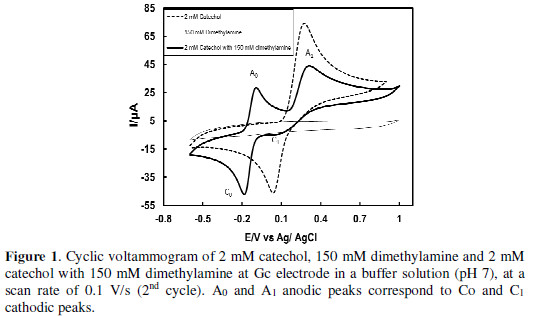
<body><![CDATA[<p>&nbsp;</p>     <p><b>Results and discussion</b></p>      <p><i><b>Electrochemical behavior of catechol and dimethylamine</b></i></p>      <p>Catechol electrochemical properties were studied in the absence and presence of  different dimethylamine concentrations, by cyclic voltammetry (CV), controlled  potential coulometry (CPC) and differential pulse voltammetry (DPV). <a href="#f1">Fig. 1</a>  (dashed line) represents the cyclic voltammogram of 2 mM catechol at the Gc  electrode in a buffer solution of pH 7, and at a scan rate of 0.1 V/s.</p>       <p>&nbsp;</p> <a name="f1"> <img src="/img/revistas/pea/v36n6/36n6a05f1.jpg">     
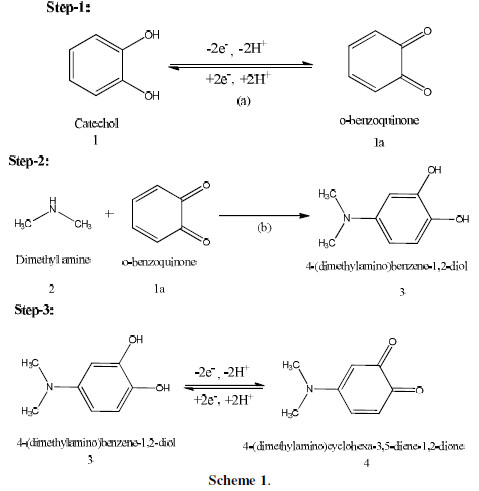
<p>&nbsp;</p>       <p>Catechol  cyclic voltammogram indicates a pair of redox couple at 0.26 V/0.05 V, due to its  inter conversion to o-quinone, and vice-versa. Pure dimethylamine is usually  electrochemically inactive, having no redox peaks in the investigated potential  range (<a href="#f1">Fig. 1</a>, solid line). <a href="#f1">Fig. 1</a>(deep solid line) shows catechol&rsquo;s CV (2 mM) in  dimethylamine presence (150 mM), in the second potential&rsquo;s scan, at the same  conditions. In the second potential&rsquo;s scan, catechol with dimethylamine showed  two anodic peaks at -0.1 V and 0.28 V, and a sharp cathodic peak at -0.18 V.</p>      <p>Upon dimethylamine addition to the catechol solution, A1 and C1 anodic and  cathodic peaks gradually decreased, and new Ao and Co anodic peaks appeared.  The newly appearance of Ao and Co peaks, decreases in A1 and C1 peaks, and also  shifting in the positions of A1 and C1 peaks, in dimethylamine presence, indicate  that this was due to the follow up reaction of catechol with dimethylamine. This  observation could be described by considering the nucleophilic attack of  dimethylamine to o-benzoquinone. This attack reduced o-benzoquinone  concentration in the reaction layer; simultaneously, A1 and C1 peaks were  reduced, whereas, at the same time, the catechol-dimethylamine adduct was  produced and, consequently, Ao and Co peaks appeared at the low potential  region. In the first potential&rsquo;s scan, the anodic catechol peak, in dimethylamine  presence, was very similar to that of only catechol. But, in the second potential&rsquo;s  scan, A1 peak current (deep solid line) significantly decreased compared to that of  free catechol (dashed line). The peak current ratio for A1 and C1 (Ipa1/ IPc1) peaks  noticeably decreased, which was indicative of a chemical reaction of  dimethylamine (2) with o-quinone (1a) produced at the electrode surface. These  observations may indicate the formation of 4-(dimethylamino)benzene-1,2-diol  through a nucleophilic substitution reaction (<a href="#s1">Scheme 1</a>).</p>       <p>&nbsp;</p> <a name="s1"> <img src="/img/revistas/pea/v36n6/36n6a05s1.jpg">     
<p>&nbsp;</p>       ]]></body>
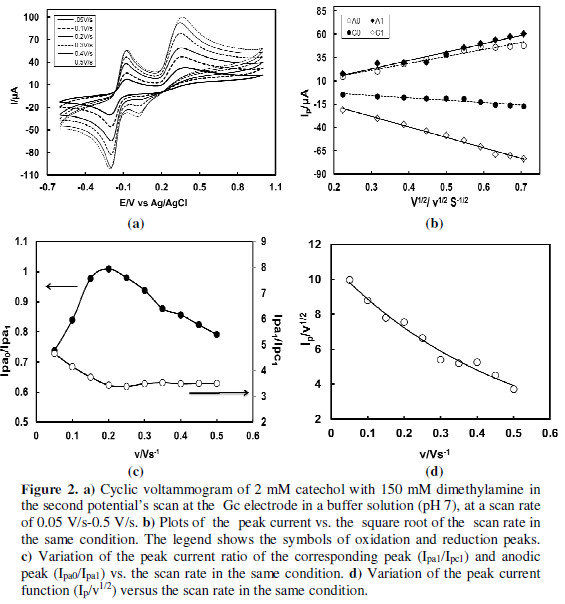
<body><![CDATA[<p>If the constituent is such that the potential for the product oxidation is lower,  then, further product oxidation is also lower, which is why further oxidation and  addition may occur [21]. In catechol case, in dimethylamine presence, instead of  o-benzoquinone, dimethylamine oxidation is easier than parent catechol  oxidation. This behavior is in agreement with that reported by other research  groups for similar electrochemically generated compounds, such as catechol and  different nucleophiles [7-23]. In the absence of other nucleophiles, water or  hydroxide ions often add to o-benzoquinone [24].</p>      <p><a href="#f2">Fig. 2 (a)</a>shows the CV of the second cycle of 2 mM catechol in the presence of  150 mM dimethylamine at Gc (3 mm) electrode in a buffer solution (pH 7), at  different scan rates.</p>       <p>&nbsp;</p> <a name="f2"> <img src="/img/revistas/pea/v36n6/36n6a05f2.jpg">     
<p>&nbsp;</p>       <p>The peak currents of both anodic and cathodic peaks gradually increased with the  increase in the scan rates from 0.05 V/s to 0.5 V/s. By varying the scan rates, it  can be seen that the cathodic peaks were shifted towards left, while the anodic  peaks went towards right. <a href="#f2">Fig. 2 (b)</a> shows plots of the anodic and cathodic net  peak currents of 2 mM catechol with 150 mM dimethylamine, for the second  cycle, against the square-root of the scan rates, where the net current means that  the second peak was subtracted from the first one by the scan-stopped method  [7]. Although the peak current proportionally increased with the increasing  square root of scan rates, the line did not pass through the origin, so, the peak  current of the reactant at each redox reaction was not purely controlled by the  diffusion process; i.e., during the reaction, some surface related chemical  complications occurred. At the scan rate of 0.05 V/s, the cathodic peak for obenzoquinone  reduction almost disappeared, as shown in <a href="#f2">Fig. 2 (a)</a>. By increasing  the scan rate, the cathodic peak for o-benzoquinone reduction began to appear  and increase. The corresponding peak current ratio (Ipa1/Ipc1) vs. scan rate, for a  mixture of catechol and dimethylamine, firstly decreased with an increasing scan  rate, and then, after 0.2 V/s, it was almost unchanged <a href="#f2">(Fig. 2c)</a>. The anodic peak  current ratio (Ipa0/Ipa1) vs. scan rate, for a mixture of catechol and dimethylamine,  firstly increased, and then, at 0.2 V/s, the scan rate remained constant, and it  decreased above 0.2 V/s <a href="#f2">(Fig. 2c)</a>. On the other hand, the value of the current  function (Ip/v1/2) was found to decrease with an increasing scan rate <a href="#f2">(Fig. 2d)</a>.</p>      <p>The exponential nature of the current function versus the scan rate plot indicates  the ECE mechanism for the electrode process [12]. This confirms obenzoquinone  (1a) reactivity towards dimethylamine (2), which firstly increased  at a slow scan rate, and then, at a higher scan rate, it decreased. This behavior is  in agreement with that reported by other research groups for similar  electrochemically generated compounds, such as catechol and different  nucleophiles [8, 15, 24].</p>      <p>The existence of a subsequent chemical reaction between o-benzoquinone 1a and  dimethylamine 2 is supported by the following evidence.</p>      <p>(i) In dimethylamine presence, both Ipa1 and Ipc1 decreased during the second  cycle (<a href="#f1">Fig. 1</a>); this could be indicative of the fact that electrochemically  generated o-benzoquinone (1a) is partially removed by the chemical  reaction with dimethylamine (2).</p>      <p>(ii) The corresponding peak current ratio (Ipa1/Ipc1) varies with the potential  sweep rate. For lower sweep rates, the peak current ratio (Ipa1/Ipc1) is lower  than one, and increases with a decreasing sweep rate. This is indicative of a  departure from the intermediate, and of an arrival to the diffusion region,  with an increasing sweep rate [7].</p>      <p>(iii) An increase in the scan rate causes a decrease in the progress of the  chemical reaction of 1a with 2, during the period of the cyclic  voltammogram recording and, therefore, a decrease in the peak current ratio  (Ipa0/Ipa1), at a higher scan rate.</p>      ]]></body>
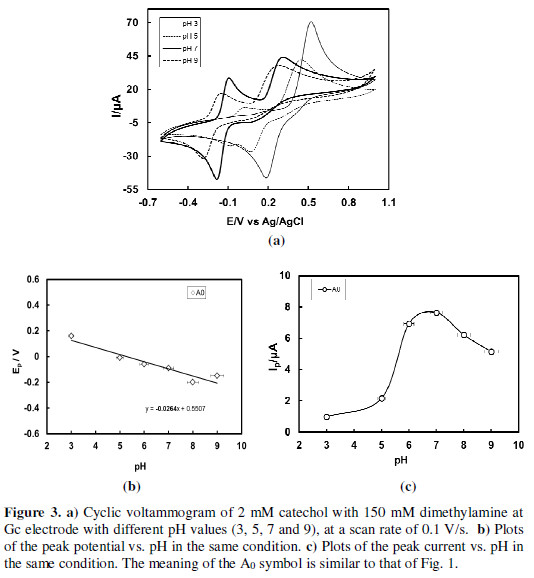
<body><![CDATA[<p>(iv) The current function, Ip/v1/2 for A1, was found to exponentially decrease  with an increasing scan rate. This indicates that the reaction mechanism of  the system was of the ECE type (<a href="#s1">Scheme 1</a>).</p>      <p>According to the results, it seems that the 1,4-Michael addition reaction of  dimethylamine (2) to o-benzoquinone (1a) led to product 3. The oxidation of this  compound (3) is easier than the oxidation of the parent molecule (1), by virtue of  the electron donating amine group presence.</p>      <p>Pure catechol CV in a buffer solution (pH 7), at different scan rates, was also  observed. The proportionality of the anodic and cathodic peak currents against  the square-root of the scan rates suggests that the peak current of the reactant at  each redox reaction was also controlled by the diffusion process.</p>      <p>&nbsp;</p>     <p><i><b>Influence of pH</b></i></p>      <p>In the presence of 150 mM of dimethylamine, cyclic voltammogram of 2 mM  catechol at Gc electrode was studied at different pH values ranging from pH 3 to  pH 9 (<a href="#f3">Fig. 3a</a>).</p>       <p>&nbsp;</p> <a name="f3"> <img src="/img/revistas/pea/v36n6/36n6a05f3.jpg">     
<p>&nbsp;</p>       <p>The electrochemical reaction of catechol occurring at pH below 7 is a twoproton,  two-electron transfer process (<a href="#s1">Scheme 1</a>), which was reported by  research groups for catechol and its derivatives [22-23]. Accordingly to the  electrochemical nature of catechol, in the presence of 150 mM dimethylamine at  different pH values (3, 5, 7 and 9), it can be seen that a new A0 anodic peak  appeared after repetitive cycling, and that the A1 peak started to shift at a lower  potential, while pH increased. A small peak current of the catechol-dimethyl  adduct at acidic media could be due to the inactivation of the amine group by  protonation. In the basic medium, catechol cyclic voltammogram also showed a  new peak, but the peak current intensity was lower. It was thus suggested that  catechol oxidation was followed by an irreversible chemical reaction with  hydroxyl ion, especially in alkaline solutions [23]. However, amines in this  condition can also act as nucleophiles. The peak position of the redox couple was  found to be dependent upon pH. Among these, we observed the maximum peak  current at pH 7, at which o-benzoquinone was most favorable for the  nucleophilic attack by the amine group.</p>      <p><a href="#f3">Fig. 3 (b)</a> reveals the plot of oxidation peak potential (Ep) values against pH. The  plot&rsquo;s slopes were graphically determined as the anodic peaks (26.4 mV/pH for  A0 appeared peak) at 0.1 V/s, which is close to the theoretical value of 30 mV/pH  for the two-electron, two-proton transfer process. These values indicate that the  catechol-dimethylamine adducts oxidation was preceded by the 2e-/2H+  processes (<a href="#s1">Scheme 1</a>). This also suggested that, during the reaction, not only  electrons but also protons were released from the catechol-dimethylamine  adduct. Similar behavior for catechol and its derivatives was also reported [25-  26]. In both acidic and basic conditions, the peak current intensity of the A0/C0  redox couple was very small, whereas, in the neutral medium, a sharp peak was  observed. This could be related to amine protonation and hydroxylation, and to  its inactivation towards Michael addition reaction with o-benzoquinone (2a).  This suggests that the coupling reaction rate is pH dependent, and enhanced by a  neutral medium. The peak current of the redox couple was also found to be  dependent upon pH. <a href="#f3">Fig. 3 (c)</a> shows the plot of the oxidation peak (A0) current  (Ip) against the solution&rsquo;s pH. From <a href="#f3">Fig. 3 (c)</a>, it is seen that the maximum peak  current was obtained at pH 7. At this pH, the difference between the peak current  ratio (Ipa1/Ipc1), in dimethylamine presence and absence, is maximum.  Consequently, in this study, a buffer solution of pH 7 has been selected as a  suitable medium for catechol electrochemical study, in dimethylamine presence.  This can be ascribed to the fact that catechol electrochemical oxidation, in  dimethylamine presence, is facilitated by a neutral media and, hence, the electron  transfer rate is faster.</p>      ]]></body>
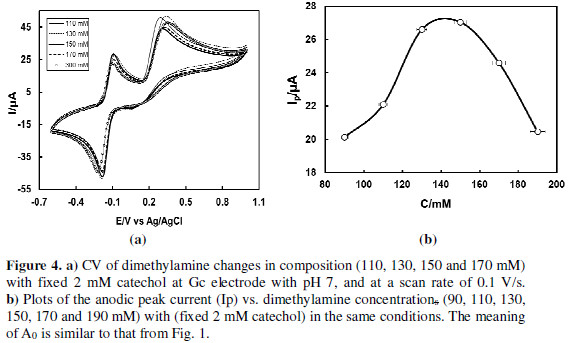
<body><![CDATA[<p>&nbsp;</p>     <p><i><b>Concentration effect of dimethylamine</b></i></p>      <p><a href="#f4">Fig. 4 (a)</a> shows the effect of different dimethylamine (110, 130, 150, 170 and  300 mM) concentrations on fixed catechol concentrations (2 mM) at Gc electrode  with pH 7, and at a scan rate of 0.1 V/s. A new peak appeared at -0.11 V, and the  anodic peaks positively shifted upon dimethylamine addition, which suggests the  formation of catechol-dimethylamine adduct. It can be seen that the net current  intensity of the newly appeared anodic peak increases with the increase in  dimethylamine composition up to 150 mM. After further addition of  dimethylamine (>150 mM), the anodic and cathodic peak currents slightly  decreased (<a href="#f4">Fig. 4b</a>). Catechol nucleophilic substitution reaction in dimethylamine  presence was maximum favorable up to 150 mM of dimethylamine, at pH 7. The  corresponding peak current ratio varied with dimethylamine concentration. This  phenomenon was related to the increase in the homogenous reaction rate of the  following chemical reaction between o-benzoquinone 1a and dimethylamine 2,  with increasing dimethylamine concentrations up to 150 mM. At higher  dimethylamine concentrations (>150 mM), the excess electro-inactive  dimethylamine could be deposited on the electrode surface and, consequently,  the peak current decreased.</p>       <p>&nbsp;</p> <a name="f4"> <img src="/img/revistas/pea/v36n6/36n6a05f4.jpg">     
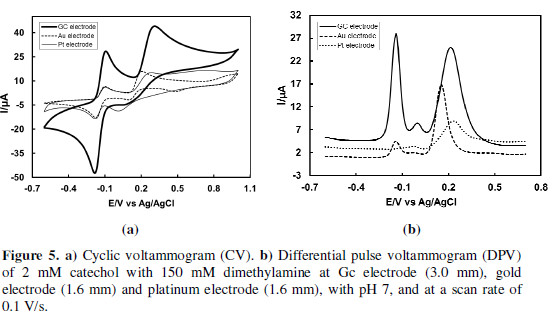
<p>&nbsp;</p>      <p><i><b>Effect of electrode materials</b></i></p>      <p>Catechol electrochemical properties in dimethylamine absence and presence were  examined by different electrodes, such as Gc, Au and Pt, at different pH values.  The CV and DPV of 2 mM catechol with 150 mM dimethylamine, at Gc, Au and  Pt electrodes, are shown in <a href="#f5">Fig. 5</a>).</p>       <p>&nbsp;</p> <a name="f5"> <img src="/img/revistas/pea/v36n6/36n6a05f5.jpg">     
<p>&nbsp;</p>      <p>The nature of voltammograms, the peak position and current intensity of the  studied systems are different for different electrodes, although the diameter of Gc  electrode (3 mm) is higher than those of Au and Pt (1.6 mm) (<a href="#f5">Fig. 5a</a>). The CV  nature at Au electrode is slightly different from those of Gc and Pt electrodes. Au  electrode shows two anodic and three cathodic peaks for the second scan. Gc  electrode shows two anodic and two cathodic peaks for the second potential&rsquo;s  scan, whereas Pt electrode shows two anodic and corresponding cathodic peaks.  Voltammetric measurements, performed at Au electrode, in the buffer solution  without catechol and dimethylamine, with pH 7, showed a reduction peak at 0.5  V, to the formation of Au(III) hydroxide. Similar behavior of Au electrode  oxidation at different pH values has been reported [27]. In the case of Gc and Pt  electrodes, for the second potential&rsquo;s cycle, a new oxidation and reduction peak  appeared at the lower oxidation potential, which can be attributed to the  oxidation of the adduct formed between o-benzoquinone and dimethylamine.</p>      ]]></body>
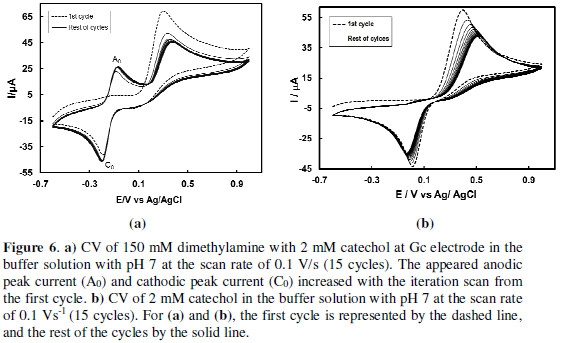
<body><![CDATA[<p><a href="#f5">Fig. 5(b)</a>shows better voltammetric response and extremely sharp adduct peak at  -0.145 V, -0.025 V and 0.2 V. Catechol electrochemical properties with  dimethylamine, for example, changes in pH, concentration, scan rate, etc., were  studied in detail using Pt and Au electrodes. But, among the electrodes, the  voltammetric response of Gc electrode was better than that of Pt and Au  electrodes in the studied systems.</p>      <p><i><b>Subsequent cycles of catechol-dimethylamine CV</b></i></p>      <p><a href="#f6">Fig. 6(a)</a> shows the cyclic voltammogram of the first 15 cycles of 2 mM catechol  with 150 mM dimethylamine at Gc electrode, in a buffer solution with pH 7, for  the potential range from -0.6 V to 1.0 V, at Gc electrode.</p>       <p>&nbsp;</p> <a name="f6"> <img src="/img/revistas/pea/v36n6/36n6a05f6.jpg">     
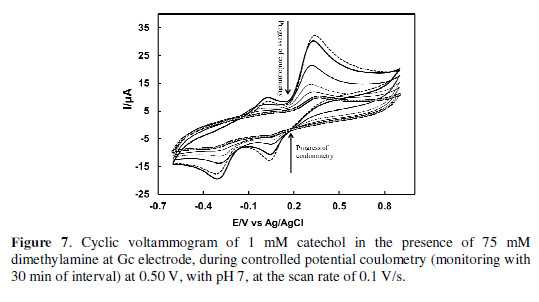
<p>&nbsp;</p>       <p>The voltammogram at  the 0.1 Vs-1 scan rate has one anodic peak at 0.28 V, and one cathodic peak at  0.18 V, when considered the first scan (dashed line). In the subsequent potential  cycles, a new anodic peak appeared at ~ -0.08 V, and the intensity of the first  anodic peak current progressively increased on cycling, but the second anodic  peak current decreased, and positively shifted on cycling. This can be attributed  to catechol-dimethylamine adduct production through the nucleophilic  substitution reaction in the electrode surface (<a href="#s1">Scheme 1</a>). The successive  decrease in the height of the catechol oxidation and reduction peaks with cycling  can be ascribed to the fact that the concentrations of the catechol-dimethylamine  adduct formation increased by cycling, leading to the decrease in catechol or  quinone concentrations at the electrode surface. The positive shift in the second  anodic peak, in dimethylamine presence, is probably due to the formation of a  thin product film at the electrode surface, inhibiting, to a certain extent, the  electrode process performance. Along with the increase in the number of  potential cycles, the first anodic peak current increased up to 10 cycles and, then,  the peak current was almost unchanged with subsequent cycles. This may be due  to the blockage of the electrode surface by the newly formed electro-inactive  species, after more cycling.</p>      <p><a href="#f6">Fig. 6(b)</a> shows the CV of the first 15 cycles of 2 mM catechol in a pH 7 buffer  solution, at Gc electrode. The voltammogram at the 0.1 Vs-1 scan rate has one  anodic peak at 0.38 V, and a cathodic peak at 0.03 V (dashed line). In the  subsequent potential cycles, no new anodic peak appeared. This may be because  catechol showed one anodic and corresponding cathodic peak related to its  transformation to o-quinone (<a href="#s1">Scheme 1</a>). During the repetitive potential&rsquo;s  cycling, the anodic and cathodic peak current ratios are nearly unity (<a href="#f6">Fig. 6b</a>);  that can be considered as a criterion for the stability of o-quinone produced at the  electrode surface [24], which is too slow. In other words, any hydroxylation [28-  31] or dimerization [26, 30] reactions that are too slow can be observed in the  time-scale of cyclic voltammetry [24]. A new reduction peak appeared at -0.19 V  after the addition of 150 mM dimethylamine to the solution, at the first cycle  (<a href="#f6">Fig. 6a</a>). Conversely, the reduction peak&rsquo;s shift, due to catechol species, has  diminished by dimethylamine addition. In the second potential&rsquo;s scan (<a href="#f6">Fig. 6a</a>), a  new oxidation peak also appeared at -0.08 V, which can be attributed to the  oxidation of the adduct formed between o-benzoquinone and dimethylamine,  according to <a href="#s1">Scheme 1</a>.</p>      <p>Controlled-potential coulometry was performed in an aqueous solution  containing 1 mM of catechol and 75 mM of dimethylamine at 0.45 V, with pH 7.  The electrolysis progress was monitored by CV (after 30 min of interval) (<a href="#f7">Fig. 7</a>).</p>       <p>&nbsp;</p> <a name="f7"> <img src="/img/revistas/pea/v36n6/36n6a05f7.jpg">     
<p>&nbsp;</p>       ]]></body>
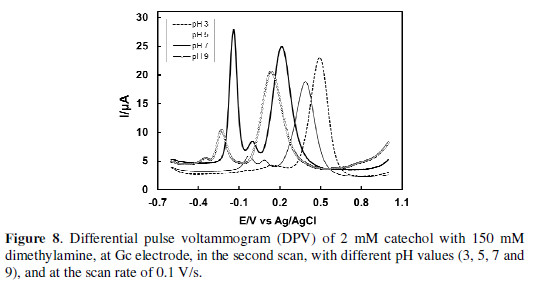
<body><![CDATA[<p>As <a href="#f7">Fig. 7</a> shows, during the course of coulometry, A0 and C0 peaks appeared,  and the height of the A0 peak proportionally increased with the advancement of  coulometry, parallel to the decrease in height of the A1 anodic peak. All anodic  and cathodic peaks disappeared after the consumption of 4 electrons per catechol.</p>      <p>These observations allow us to propose the pathway in <a href="#s1">Scheme 1</a> for catechol  electro-oxidation (1), in dimethylamine presence (2). According to our results, it  seems that the 1,4 addition reaction of 2 to o-quinone (1a) (reaction (2)) is faster  than other secondary reactions, leading to the 3 intermediate. The oxidation of  this compound (3) is easier than the oxidation of the parent starting molecule (1),  by virtue of the electron-donating group presence. Like o-quinone 1a, o-quinone  4 can also be attacked from the C-5 position by dimethylamine (2). However, no  over reaction was observed during the voltammetric experiments, because of the  low activity of the o-quinone 4 towards 1,4-(Michael) addition reaction with  dimethylamine (2).</p>      <p><i><b>Differential pulse voltammetry (DPV)</b></i></p>      <p>DPV technique was employed to make the catechol-dimethylamine substitution  reaction clearer. DPV obtained for 2 mM catechol in the presence of 150 mM  dimethylamine, in the second scan, with different pH values (3-9), was shown in  <a href="#f8">Fig. 8</a>.</p>       <p>&nbsp;</p> <a name="f8"> <img src="/img/revistas/pea/v36n6/36n6a05f8.jpg">     
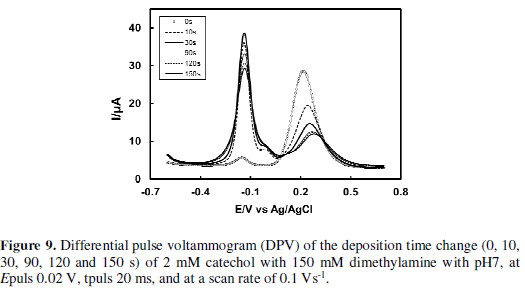
<p>&nbsp;</p>       <p>In the buffer solution, with pH 7 and pH 9, catechol gave a welldeveloped  wave in dimethylamine presence (<a href="#f8">Fig. 8</a>). At pH 7, the first, second  and third anodic peaks were showed at ~ -0.14 V, -0.02 and 0.2 V, respectively.  But, at pH 3 and pH 5, the second potential&rsquo;s scan of the first anodic peak current  intensity was very small. As it can be seen, two completely separated anodic  peaks with high current intensity are observed at pH 7, which can be attributed to  the oxidation of o-benzoquinone - dimethylamine new compound and obenzoquinone,  respectively.</p>      <p><a href="#f9">Fig. 9</a> shows the DPV of the deposition time change (0, 10, 30, 90, 120 and 150  s) of 2 mM catechol with 150 mM dimethylamine, with pH 7.</p>       <p>&nbsp;</p> <a name="f9"> <img src="/img/revistas/pea/v36n6/36n6a05f9.jpg">     
<p>&nbsp;</p>       ]]></body>
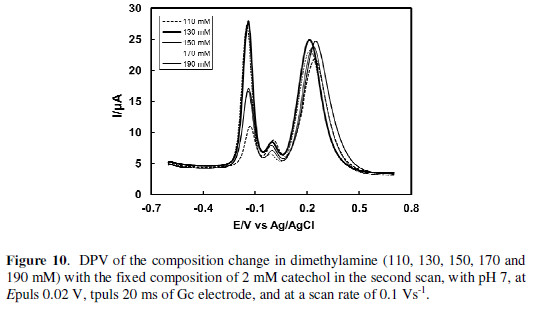
<body><![CDATA[<p>From this figure, it  is seen that the increase in the deposition time, from 0 to 30 s, led to the  development of a new peak at -0.145 V. When the deposition time increased 30  s, more nucleophilic attacks occurred and, consequently, more catecholdimethylamine  adducts led to a decrease in o-benzoquinone concentration, and  an increase in the catechol-dimethylamine adduct concentration at the electrode  surface. At further increase in the deposition time, from 30 s to 150 s, the first  anodic peak current decreased and the second anodic peak current decreased.</p>      <p>The effect of dimethylamine concentration on the differential pulse  voltammogram of catechol was studied. <a href="#f10">Fig. 10</a> shows DPV for 2 mM of the  catechol solution containing the buffer (pH 7), in the presence of various  dimethylamine concentrations, from 110 to 300 mM, at the Gc electrode surface.</p>       <p>&nbsp;</p> <a name="f10"> <img src="/img/revistas/pea/v36n6/36n6a05f10.jpg">     
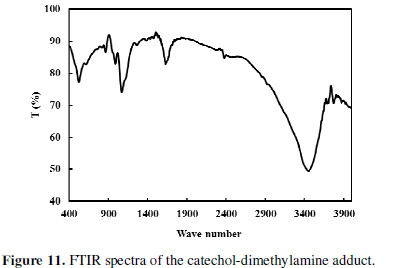
<p>&nbsp;</p>      <p>As indicated in this figure, two separated anodic peaks appeared again after  dimethylamine addition into catechol, similar to what is shown in <a href="#f8">Fig. 8</a>. In this  case, the increase in dimethylamine concentration, from 110 mM to 150 mM, led  to an increase in the first anodic peak current. At further increase in  concentrations from &gt;150 mM, the first and second anodic peak current  gradually decreased. At lower dimethylamine (&lt;110 mM) concentrations, the  nucleophilic substitution reaction took place in a comparable degree, whereas an  increase in dimethylamine concentration (150 mM) promoted the nucleophilic  attack of dimethylamine towards o-benzoquinone generated at the electrode  surface. At further dimethylamine (&gt;150 mM) addition into the catechol solution,  the excess electro-inactive dimethylamine was deposited on the electrode surface  and, hence, the peak current decreased.</p>      <p>In this study, comparatively, high dimethylamine concentrations (110-300 mM)  were sequentially used to determine the optimum condition for the nucleophilic  substitution reaction of catechol with dimethylamine. As the reaction occurred at  high nucleophiles concentrations, the voltammetric peaks (CV and DPV) for the  adduct noticeably appeared.</p>      <p><i><b>Spectral analysis of catechol with dimethylamine</b></i></p>      <p>The FTIR spectrum of the catechol-dimethylamine adduct vibrational modes has  been shown in <a href="#f11">Fig. 11</a>.</p>       <p>&nbsp;</p> <a name="f11"> <img src="/img/revistas/pea/v36n6/36n6a05f11.jpg">     
<p>&nbsp;</p>       ]]></body>
<body><![CDATA[<p>The catechol-dimethylamine adduct shows a broad  spectrum at 3450 cm-1, due to the O-H band, whereas dimethylamine N-H  stretching sharp band, at 3302 cm-1, is absent. This indicates that –NH proton was  replaced by the phenyl group, forming catechol-dimethylamine adduct. The  peaks at 2906 cm-1 are characteristic of the C-H aromatic nuclei stretching  vibration. In the catechol-dimethylamine adduct case, there is a more significant  change in the finger print region than that with only catechol, and only  dimethylamine.</p>      <p>From the study, it is seen that dimethylamine properly functions as a nucleophile  at pH 7. When the pH is below 7, the nucleophilic activity of dimethylamine  reduces, due to amine protonation. When the pH value is above 7, other  nucleophiles, such as –OH, are produced in the solution, therefore, amines  activity decreases, and catechol oxidation is followed by an irreversible chemical  reaction with hydroxyl ion [32].</p>      <p>Therefore, from the above discussion, it is clear that the nucleophilic substitution  reaction of catechol in dimethylamine presence is most favorable at 150 mM of  dimethylamine, and at pH 7, which is consistent with both CV and DPV. All  above observations can be attributed to the reaction between dimethylamine and  o-benzoquinone species produced at the electrode surface, with the new anodic  peak being attributed to the oxidation of the newly formed o-benzoquinonedimethylamine  adduct.</p>      <p>&nbsp;</p>     <p><b>Conclusions</b></p>      <p>Catechol electrochemical behavior, in dimethylamine absence and presence, was  investigated by cyclic voltammetry, controlled potential coulometry and  differential pulse voltammetry. Catechol anodic oxidation, which resulted in obenzoquinone,  was attacked by dimethylamine. The reaction products were  transferred electrons at more negative potentials than those from catechol. The  peak current of catechol- dimethylamine adduct at each redox reaction was  controlled by the diffusion process. Catechol nucleophilic substitution reaction,  in dimethylamine presence, was most favorable at 150 mM of dimethylamine,  and at Gc electrode with pH 7. In this condition, it can be deduced that  dimethylamine nucleophilic addition occurred through an ECE mechanism.</p>       <p>&nbsp;</p>     <p><b>References</b></p>      <p>1. Barner BA. Catechol. In Encyclopedia of Reagents for Organic Synthesis.  Paquette L, ed. New York: John Wiley & Sons; 2004.</p>      <!-- ref --><p>2. Khalafi L, Rafiee M. J Hazardous Mater. 2010;174:801.    &nbsp;&nbsp;&nbsp;&nbsp;&nbsp;&nbsp;&nbsp;&nbsp;[&#160;<a href="javascript:void(0);" onclick="javascript: window.open('/scielo.php?script=sci_nlinks&ref=437931&pid=S0872-1904201800060000500002&lng=','','width=640,height=500,resizable=yes,scrollbars=1,menubar=yes,');">Links</a>&#160;]<!-- end-ref --></p>      <!-- ref --><p>3. Bisby RH, Brooke R, Navaratnam S. Food Chem. 2008;108:1002.    &nbsp;&nbsp;&nbsp;&nbsp;&nbsp;&nbsp;&nbsp;&nbsp;[&#160;<a href="javascript:void(0);" onclick="javascript: window.open('/scielo.php?script=sci_nlinks&ref=437933&pid=S0872-1904201800060000500003&lng=','','width=640,height=500,resizable=yes,scrollbars=1,menubar=yes,');">Links</a>&#160;]<!-- end-ref --></p>      <!-- ref --><p>4. Rafiee M. Synlett. 2007;3:503.    &nbsp;&nbsp;&nbsp;&nbsp;&nbsp;&nbsp;&nbsp;&nbsp;[&#160;<a href="javascript:void(0);" onclick="javascript: window.open('/scielo.php?script=sci_nlinks&ref=437935&pid=S0872-1904201800060000500004&lng=','','width=640,height=500,resizable=yes,scrollbars=1,menubar=yes,');">Links</a>&#160;]<!-- end-ref --></p>      <!-- ref --><p>5. Nematollahi D, Rafiee M, Fotouhi L. J Iran Chem Soc. 2009;6:448.    &nbsp;&nbsp;&nbsp;&nbsp;&nbsp;&nbsp;&nbsp;&nbsp;[&#160;<a href="javascript:void(0);" onclick="javascript: window.open('/scielo.php?script=sci_nlinks&ref=437937&pid=S0872-1904201800060000500005&lng=','','width=640,height=500,resizable=yes,scrollbars=1,menubar=yes,');">Links</a>&#160;]<!-- end-ref --></p>      <p>6. Morrision RT, Boyd RN. Organic Chemistry. 6th ed. New York: Prentice  Hall Int; 1992.</p>      <p>7. Kiani A, Raoof JB, Nematollahi D, et al. Electroanalysis. 2005;17:1755.</p>      <!-- ref --><p>8. Motin MA, Uddin MA, Dhar PK, et al. Anal Bioanal Electrochem. 2016;8:505.    &nbsp;&nbsp;&nbsp;&nbsp;&nbsp;&nbsp;&nbsp;&nbsp;[&#160;<a href="javascript:void(0);" onclick="javascript: window.open('/scielo.php?script=sci_nlinks&ref=437941&pid=S0872-1904201800060000500008&lng=','','width=640,height=500,resizable=yes,scrollbars=1,menubar=yes,');">Links</a>&#160;]<!-- end-ref --></p>      <!-- ref --><p>9. Motin MA, Uddin MA, Uddin MN, et al. Port Electrochim Acta. 2017; 35:103.    &nbsp;&nbsp;&nbsp;&nbsp;&nbsp;&nbsp;&nbsp;&nbsp;[&#160;<a href="javascript:void(0);" onclick="javascript: window.open('/scielo.php?script=sci_nlinks&ref=437943&pid=S0872-1904201800060000500009&lng=','','width=640,height=500,resizable=yes,scrollbars=1,menubar=yes,');">Links</a>&#160;]<!-- end-ref --></p>      <!-- ref --><p>10. Hafiz MA, Motin MA, Huque EM, et al. Anal Bioanal Electrochem. 2017;9:597&nbsp;&nbsp;&nbsp;&nbsp;&nbsp;&nbsp;&nbsp;&nbsp;[&#160;<a href="javascript:void(0);" onclick="javascript: window.open('/scielo.php?script=sci_nlinks&ref=437945&pid=S0872-1904201800060000500010&lng=','','width=640,height=500,resizable=yes,scrollbars=1,menubar=yes,');">Links</a>&#160;]<!-- end-ref --><!-- ref --><p>11. Shahrokhian S, Hamzehloei A. Electrochem Commun. 2003;5:706.    &nbsp;&nbsp;&nbsp;&nbsp;&nbsp;&nbsp;&nbsp;&nbsp;[&#160;<a href="javascript:void(0);" onclick="javascript: window.open('/scielo.php?script=sci_nlinks&ref=437946&pid=S0872-1904201800060000500011&lng=','','width=640,height=500,resizable=yes,scrollbars=1,menubar=yes,');">Links</a>&#160;]<!-- end-ref --></p>      <!-- ref --><p>12. Nematollahi D, Golabi SM. Electroanalysis. 2001;13:1008.    &nbsp;&nbsp;&nbsp;&nbsp;&nbsp;&nbsp;&nbsp;&nbsp;[&#160;<a href="javascript:void(0);" onclick="javascript: window.open('/scielo.php?script=sci_nlinks&ref=437948&pid=S0872-1904201800060000500012&lng=','','width=640,height=500,resizable=yes,scrollbars=1,menubar=yes,');">Links</a>&#160;]<!-- end-ref --></p>      <!-- ref --><p>13. Grujic Z, Tabakovic I, Trkovnic M. Tetrahedron Lett.1976;17:4823.    &nbsp;&nbsp;&nbsp;&nbsp;&nbsp;&nbsp;&nbsp;&nbsp;[&#160;<a href="javascript:void(0);" onclick="javascript: window.open('/scielo.php?script=sci_nlinks&ref=437950&pid=S0872-1904201800060000500013&lng=','','width=640,height=500,resizable=yes,scrollbars=1,menubar=yes,');">Links</a>&#160;]<!-- end-ref --></p>      ]]></body>
<body><![CDATA[<!-- ref --><p>14. Nematollahi D, Goodarzi H. J Electroanal Chem. 2001; 510:108.    &nbsp;&nbsp;&nbsp;&nbsp;&nbsp;&nbsp;&nbsp;&nbsp;[&#160;<a href="javascript:void(0);" onclick="javascript: window.open('/scielo.php?script=sci_nlinks&ref=437952&pid=S0872-1904201800060000500014&lng=','','width=640,height=500,resizable=yes,scrollbars=1,menubar=yes,');">Links</a>&#160;]<!-- end-ref --></p>      <!-- ref --><p>15. Tabakovic I, Grujic Z, Bejtovic Z. J Heterocyclic Chem. 1983;20:635.    &nbsp;&nbsp;&nbsp;&nbsp;&nbsp;&nbsp;&nbsp;&nbsp;[&#160;<a href="javascript:void(0);" onclick="javascript: window.open('/scielo.php?script=sci_nlinks&ref=437954&pid=S0872-1904201800060000500015&lng=','','width=640,height=500,resizable=yes,scrollbars=1,menubar=yes,');">Links</a>&#160;]<!-- end-ref --></p>      <!-- ref --><p>16. Nematollahi D, Forooghi Z. Tetrahedron. 2002;58:4949.    &nbsp;&nbsp;&nbsp;&nbsp;&nbsp;&nbsp;&nbsp;&nbsp;[&#160;<a href="javascript:void(0);" onclick="javascript: window.open('/scielo.php?script=sci_nlinks&ref=437956&pid=S0872-1904201800060000500016&lng=','','width=640,height=500,resizable=yes,scrollbars=1,menubar=yes,');">Links</a>&#160;]<!-- end-ref --></p>      <!-- ref --><p>17. Golabi SM, Nourmohammadi F, Saadnia A. J Electroanal Chem. 2002;529:12.    &nbsp;&nbsp;&nbsp;&nbsp;&nbsp;&nbsp;&nbsp;&nbsp;[&#160;<a href="javascript:void(0);" onclick="javascript: window.open('/scielo.php?script=sci_nlinks&ref=437958&pid=S0872-1904201800060000500017&lng=','','width=640,height=500,resizable=yes,scrollbars=1,menubar=yes,');">Links</a>&#160;]<!-- end-ref --></p>      <!-- ref --><p>18. Nematollahi D, Dehdashtian S. Tetrahedron Lett. 2008;49:645.    &nbsp;&nbsp;&nbsp;&nbsp;&nbsp;&nbsp;&nbsp;&nbsp;[&#160;<a href="javascript:void(0);" onclick="javascript: window.open('/scielo.php?script=sci_nlinks&ref=437960&pid=S0872-1904201800060000500018&lng=','','width=640,height=500,resizable=yes,scrollbars=1,menubar=yes,');">Links</a>&#160;]<!-- end-ref --></p>      ]]></body>
<body><![CDATA[<!-- ref --><p>19. Nematollahi D, Tammari E, Sharifi S, et al. Electrochim Acta. 2004;49:591.    &nbsp;&nbsp;&nbsp;&nbsp;&nbsp;&nbsp;&nbsp;&nbsp;[&#160;<a href="javascript:void(0);" onclick="javascript: window.open('/scielo.php?script=sci_nlinks&ref=437962&pid=S0872-1904201800060000500019&lng=','','width=640,height=500,resizable=yes,scrollbars=1,menubar=yes,');">Links</a>&#160;]<!-- end-ref --></p>      <p>20. Patai S. Chemistry of quinonoid compounds. New York: John Wiley&amp;Sons; 1974.</p>      <!-- ref --><p>21. Thibodeau PA, Paquette B. Free Radic Biol Med. 1999;27:1367.    &nbsp;&nbsp;&nbsp;&nbsp;&nbsp;&nbsp;&nbsp;&nbsp;[&#160;<a href="javascript:void(0);" onclick="javascript: window.open('/scielo.php?script=sci_nlinks&ref=437965&pid=S0872-1904201800060000500021&lng=','','width=640,height=500,resizable=yes,scrollbars=1,menubar=yes,');">Links</a>&#160;]<!-- end-ref --></p>      <!-- ref --><p>22. Belenky P, Bogan KL, Brenner C. Trends Biochem Sci. 2007;32:12.    &nbsp;&nbsp;&nbsp;&nbsp;&nbsp;&nbsp;&nbsp;&nbsp;[&#160;<a href="javascript:void(0);" onclick="javascript: window.open('/scielo.php?script=sci_nlinks&ref=437967&pid=S0872-1904201800060000500022&lng=','','width=640,height=500,resizable=yes,scrollbars=1,menubar=yes,');">Links</a>&#160;]<!-- end-ref --></p>      <!-- ref --><p>23. Mazzini S, Monderelli R, Ragg E, et al. J Chem Soc Perkin Trans. 1995;2:285.    &nbsp;&nbsp;&nbsp;&nbsp;&nbsp;&nbsp;&nbsp;&nbsp;[&#160;<a href="javascript:void(0);" onclick="javascript: window.open('/scielo.php?script=sci_nlinks&ref=437969&pid=S0872-1904201800060000500023&lng=','','width=640,height=500,resizable=yes,scrollbars=1,menubar=yes,');">Links</a>&#160;]<!-- end-ref --></p>      <!-- ref --><p>24. Nematollahi D, Afkhami A, Mosaed F, et al. Res Chem Intermed. 2004;30:299.    &nbsp;&nbsp;&nbsp;&nbsp;&nbsp;&nbsp;&nbsp;&nbsp;[&#160;<a href="javascript:void(0);" onclick="javascript: window.open('/scielo.php?script=sci_nlinks&ref=437971&pid=S0872-1904201800060000500024&lng=','','width=640,height=500,resizable=yes,scrollbars=1,menubar=yes,');">Links</a>&#160;]<!-- end-ref --></p>      <!-- ref --><p>25. Papouchado L, Sandford RW, Petrie G, et al. J Electroanal Chem. 1975; 65:275.    &nbsp;&nbsp;&nbsp;&nbsp;&nbsp;&nbsp;&nbsp;&nbsp;[&#160;<a href="javascript:void(0);" onclick="javascript: window.open('/scielo.php?script=sci_nlinks&ref=437973&pid=S0872-1904201800060000500025&lng=','','width=640,height=500,resizable=yes,scrollbars=1,menubar=yes,');">Links</a>&#160;]<!-- end-ref --></p>      <!-- ref --><p>26. Stum DI, Suslov SN. Biofizika. 1976;21;40.    &nbsp;&nbsp;&nbsp;&nbsp;&nbsp;&nbsp;&nbsp;&nbsp;[&#160;<a href="javascript:void(0);" onclick="javascript: window.open('/scielo.php?script=sci_nlinks&ref=437975&pid=S0872-1904201800060000500026&lng=','','width=640,height=500,resizable=yes,scrollbars=1,menubar=yes,');">Links</a>&#160;]<!-- end-ref --></p>      <!-- ref --><p>27. Pasta M, Mantia FL, Cui Y. Electrochim Acta. 2010;55:5561.    &nbsp;&nbsp;&nbsp;&nbsp;&nbsp;&nbsp;&nbsp;&nbsp;[&#160;<a href="javascript:void(0);" onclick="javascript: window.open('/scielo.php?script=sci_nlinks&ref=437977&pid=S0872-1904201800060000500027&lng=','','width=640,height=500,resizable=yes,scrollbars=1,menubar=yes,');">Links</a>&#160;]<!-- end-ref --></p>      <!-- ref --><p>28. Papouchado L, Petrie G, Adams RN. J Electroanal Chem. 1972; 38:389.    &nbsp;&nbsp;&nbsp;&nbsp;&nbsp;&nbsp;&nbsp;&nbsp;[&#160;<a href="javascript:void(0);" onclick="javascript: window.open('/scielo.php?script=sci_nlinks&ref=437979&pid=S0872-1904201800060000500028&lng=','','width=640,height=500,resizable=yes,scrollbars=1,menubar=yes,');">Links</a>&#160;]<!-- end-ref --></p>      <!-- ref --><p>29. Papouchado L, Petrie G, Sharp JH, et al. J Am Chem Soc. 1968;90:5620.    &nbsp;&nbsp;&nbsp;&nbsp;&nbsp;&nbsp;&nbsp;&nbsp;[&#160;<a href="javascript:void(0);" onclick="javascript: window.open('/scielo.php?script=sci_nlinks&ref=437981&pid=S0872-1904201800060000500029&lng=','','width=640,height=500,resizable=yes,scrollbars=1,menubar=yes,');">Links</a>&#160;]<!-- end-ref --></p>      <p>30. Young TE, Griswold JR, Hulbert MH. Melanin. I. J Org Chem. 1974;39:1980.</p>      <!-- ref --><p>31. Brun A, Rosset R. J Electroanal Chem. 1974;49:287.    &nbsp;&nbsp;&nbsp;&nbsp;&nbsp;&nbsp;&nbsp;&nbsp;[&#160;<a href="javascript:void(0);" onclick="javascript: window.open('/scielo.php?script=sci_nlinks&ref=437984&pid=S0872-1904201800060000500031&lng=','','width=640,height=500,resizable=yes,scrollbars=1,menubar=yes,');">Links</a>&#160;]<!-- end-ref --></p>      <!-- ref --><p>32. Rayn MD, Yueh A, Yu CW. J Electrochem Soc.1980;127:1489.    &nbsp;&nbsp;&nbsp;&nbsp;&nbsp;&nbsp;&nbsp;&nbsp;[&#160;<a href="javascript:void(0);" onclick="javascript: window.open('/scielo.php?script=sci_nlinks&ref=437986&pid=S0872-1904201800060000500032&lng=','','width=640,height=500,resizable=yes,scrollbars=1,menubar=yes,');">Links</a>&#160;]<!-- end-ref --></p>         <p>&nbsp;</p>     <p><b>Acknowledgements</b></p>      <p>Thanks to the Ministry of Science and Technology, Government of the People&rsquo;s  Republic of Bangladesh and KUET, for providing the necessary facilities and  financial support to this research work.</p>      <p>&nbsp;</p>     ]]></body>
<body><![CDATA[<p><a name=0></a><sup><a href="#top">*</a></sup>Corresponding author. E-mail address: <a href="mailto:abdulmotin75@yahoo.com">abdulmotin75@yahoo.com</a></p>      <p>Received September 27, 2017; accepted April 21, 2018</p>      <p><a href="http://www.peacta.org" target="_blank">www.peacta.org</a> </p>                         ]]></body><back>
<ref-list>
<ref id="B1">
<label>1</label><nlm-citation citation-type="book">
<person-group person-group-type="author">
<name>
<surname><![CDATA[Barner]]></surname>
<given-names><![CDATA[BA]]></given-names>
</name>
</person-group>
<source><![CDATA[Catechol. In Encyclopedia of Reagents for Organic Synthesis]]></source>
<year>2004</year>
<publisher-loc><![CDATA[New York ]]></publisher-loc>
<publisher-name><![CDATA[Wiley]]></publisher-name>
</nlm-citation>
</ref>
<ref id="B2">
<label>2</label><nlm-citation citation-type="journal">
<person-group person-group-type="author">
<name>
<surname><![CDATA[Khalafi]]></surname>
<given-names><![CDATA[L]]></given-names>
</name>
<name>
<surname><![CDATA[Rafiee]]></surname>
<given-names><![CDATA[M]]></given-names>
</name>
</person-group>
<source><![CDATA[J Hazardous Mater]]></source>
<year>2010</year>
<volume>174</volume>
<page-range>801</page-range></nlm-citation>
</ref>
<ref id="B3">
<label>3</label><nlm-citation citation-type="journal">
<person-group person-group-type="author">
<name>
<surname><![CDATA[Bisby]]></surname>
<given-names><![CDATA[RH]]></given-names>
</name>
<name>
<surname><![CDATA[Brooke]]></surname>
<given-names><![CDATA[R]]></given-names>
</name>
<name>
<surname><![CDATA[Navaratnam]]></surname>
<given-names><![CDATA[S]]></given-names>
</name>
</person-group>
<source><![CDATA[Food Chem]]></source>
<year>2008</year>
<volume>108</volume>
<page-range>1002</page-range></nlm-citation>
</ref>
<ref id="B4">
<label>4</label><nlm-citation citation-type="journal">
<person-group person-group-type="author">
<name>
<surname><![CDATA[Rafiee]]></surname>
<given-names><![CDATA[M]]></given-names>
</name>
</person-group>
<source><![CDATA[Synlett]]></source>
<year>2007</year>
<volume>3</volume>
<page-range>503</page-range></nlm-citation>
</ref>
<ref id="B5">
<label>5</label><nlm-citation citation-type="journal">
<person-group person-group-type="author">
<name>
<surname><![CDATA[Nematollahi]]></surname>
<given-names><![CDATA[D]]></given-names>
</name>
<name>
<surname><![CDATA[Rafiee]]></surname>
<given-names><![CDATA[M]]></given-names>
</name>
<name>
<surname><![CDATA[Fotouhi]]></surname>
<given-names><![CDATA[L]]></given-names>
</name>
</person-group>
<source><![CDATA[J Iran Chem Soc]]></source>
<year>2009</year>
<volume>6</volume>
<page-range>448</page-range></nlm-citation>
</ref>
<ref id="B6">
<label>6</label><nlm-citation citation-type="journal">
<person-group person-group-type="author">
<name>
<surname><![CDATA[Ayers]]></surname>
<given-names><![CDATA[R]]></given-names>
</name>
<name>
<surname><![CDATA[Hackerman]]></surname>
<given-names><![CDATA[N]]></given-names>
</name>
</person-group>
<source><![CDATA[J Electrochem Soc]]></source>
<year>1963</year>
<volume>110</volume>
<page-range>507</page-range></nlm-citation>
</ref>
<ref id="B7">
<label>7</label><nlm-citation citation-type="journal">
<person-group person-group-type="author">
<name>
<surname><![CDATA[Donahue]]></surname>
<given-names><![CDATA[F]]></given-names>
</name>
<name>
<surname><![CDATA[Nobe]]></surname>
<given-names><![CDATA[K]]></given-names>
</name>
</person-group>
<source><![CDATA[J Electrochem Soc]]></source>
<year>1965</year>
<volume>112</volume>
<page-range>886</page-range></nlm-citation>
</ref>
<ref id="B8">
<label>8</label><nlm-citation citation-type="journal">
<person-group person-group-type="author">
<name>
<surname><![CDATA[Motin]]></surname>
<given-names><![CDATA[M A]]></given-names>
</name>
<name>
<surname><![CDATA[Uddin]]></surname>
<given-names><![CDATA[M A]]></given-names>
</name>
<name>
<surname><![CDATA[Dhar]]></surname>
<given-names><![CDATA[P K]]></given-names>
</name>
</person-group>
<source><![CDATA[Anal Bioanal Electrochem]]></source>
<year>2016</year>
<volume>8</volume>
<page-range>505</page-range></nlm-citation>
</ref>
<ref id="B9">
<label>9</label><nlm-citation citation-type="journal">
<person-group person-group-type="author">
<name>
<surname><![CDATA[Motin]]></surname>
<given-names><![CDATA[M A]]></given-names>
</name>
<name>
<surname><![CDATA[Uddin]]></surname>
<given-names><![CDATA[M A]]></given-names>
</name>
<name>
<surname><![CDATA[Uddin]]></surname>
<given-names><![CDATA[M N]]></given-names>
</name>
</person-group>
<source><![CDATA[Port Electrochim Acta]]></source>
<year>2017</year>
<volume>35</volume>
<page-range>103</page-range></nlm-citation>
</ref>
<ref id="B10">
<label>10</label><nlm-citation citation-type="journal">
<person-group person-group-type="author">
<name>
<surname><![CDATA[Hafiz]]></surname>
<given-names><![CDATA[MA]]></given-names>
</name>
<name>
<surname><![CDATA[Motin]]></surname>
<given-names><![CDATA[M A]]></given-names>
</name>
<name>
<surname><![CDATA[Huque]]></surname>
<given-names><![CDATA[E M]]></given-names>
</name>
</person-group>
<source><![CDATA[Anal Bioanal Electrochem]]></source>
<year>2017</year>
<volume>9</volume>
<page-range>597</page-range></nlm-citation>
</ref>
<ref id="B11">
<label>11</label><nlm-citation citation-type="journal">
<person-group person-group-type="author">
<name>
<surname><![CDATA[Shahrokhian]]></surname>
<given-names><![CDATA[S]]></given-names>
</name>
<name>
<surname><![CDATA[Hamzehloei]]></surname>
<given-names><![CDATA[A]]></given-names>
</name>
</person-group>
<source><![CDATA[Electrochem Commun]]></source>
<year>2003</year>
<volume>5</volume>
<page-range>706</page-range></nlm-citation>
</ref>
<ref id="B12">
<label>12</label><nlm-citation citation-type="journal">
<person-group person-group-type="author">
<name>
<surname><![CDATA[Nematollahi]]></surname>
<given-names><![CDATA[D]]></given-names>
</name>
<name>
<surname><![CDATA[Golabi]]></surname>
<given-names><![CDATA[S M]]></given-names>
</name>
</person-group>
<source><![CDATA[Electroanalysis]]></source>
<year>2001</year>
<volume>13</volume>
<page-range>1008</page-range></nlm-citation>
</ref>
<ref id="B13">
<label>13</label><nlm-citation citation-type="journal">
<person-group person-group-type="author">
<name>
<surname><![CDATA[Grujic]]></surname>
<given-names><![CDATA[Z]]></given-names>
</name>
<name>
<surname><![CDATA[Tabakovic]]></surname>
<given-names><![CDATA[I]]></given-names>
</name>
<name>
<surname><![CDATA[Trkovnic]]></surname>
<given-names><![CDATA[M]]></given-names>
</name>
</person-group>
<source><![CDATA[Tetrahedron Lett]]></source>
<year>1976</year>
<volume>17</volume>
<page-range>4823</page-range></nlm-citation>
</ref>
<ref id="B14">
<label>14</label><nlm-citation citation-type="journal">
<person-group person-group-type="author">
<name>
<surname><![CDATA[Nematollahi]]></surname>
<given-names><![CDATA[D]]></given-names>
</name>
<name>
<surname><![CDATA[Goodarzi]]></surname>
<given-names><![CDATA[H]]></given-names>
</name>
</person-group>
<source><![CDATA[J Electroanal Chem]]></source>
<year>2001</year>
<volume>510</volume>
<page-range>108</page-range></nlm-citation>
</ref>
<ref id="B15">
<label>15</label><nlm-citation citation-type="journal">
<person-group person-group-type="author">
<name>
<surname><![CDATA[Tabakovic]]></surname>
<given-names><![CDATA[I]]></given-names>
</name>
<name>
<surname><![CDATA[Grujic]]></surname>
<given-names><![CDATA[Z]]></given-names>
</name>
<name>
<surname><![CDATA[Bejtovic]]></surname>
<given-names><![CDATA[Z]]></given-names>
</name>
</person-group>
<source><![CDATA[J Heterocyclic Chem]]></source>
<year>1983</year>
<volume>20</volume>
<page-range>635</page-range></nlm-citation>
</ref>
<ref id="B16">
<label>16</label><nlm-citation citation-type="journal">
<person-group person-group-type="author">
<name>
<surname><![CDATA[Nematollahi]]></surname>
<given-names><![CDATA[D]]></given-names>
</name>
<name>
<surname><![CDATA[Forooghi]]></surname>
<given-names><![CDATA[Z]]></given-names>
</name>
</person-group>
<source><![CDATA[Tetrahedron]]></source>
<year>2002</year>
<volume>58</volume>
<page-range>4949</page-range></nlm-citation>
</ref>
<ref id="B17">
<label>17</label><nlm-citation citation-type="journal">
<person-group person-group-type="author">
<name>
<surname><![CDATA[Golabi]]></surname>
<given-names><![CDATA[SM]]></given-names>
</name>
<name>
<surname><![CDATA[Nourmohammadi]]></surname>
<given-names><![CDATA[F]]></given-names>
</name>
<name>
<surname><![CDATA[Saadnia]]></surname>
<given-names><![CDATA[A]]></given-names>
</name>
</person-group>
<source><![CDATA[J Electroanal Chem]]></source>
<year>2002</year>
<volume>529</volume>
<page-range>12</page-range></nlm-citation>
</ref>
<ref id="B18">
<label>18</label><nlm-citation citation-type="journal">
<person-group person-group-type="author">
<name>
<surname><![CDATA[Nematollahi]]></surname>
<given-names><![CDATA[D]]></given-names>
</name>
<name>
<surname><![CDATA[Dehdashtian]]></surname>
<given-names><![CDATA[S]]></given-names>
</name>
</person-group>
<source><![CDATA[Tetrahedron Lett]]></source>
<year>2008</year>
<volume>49</volume>
<page-range>645</page-range></nlm-citation>
</ref>
<ref id="B19">
<label>19</label><nlm-citation citation-type="journal">
<person-group person-group-type="author">
<name>
<surname><![CDATA[Nematollahi]]></surname>
<given-names><![CDATA[D]]></given-names>
</name>
<name>
<surname><![CDATA[Tammari]]></surname>
<given-names><![CDATA[E]]></given-names>
</name>
<name>
<surname><![CDATA[Sharifi]]></surname>
<given-names><![CDATA[S]]></given-names>
</name>
</person-group>
<source><![CDATA[Electrochim Acta]]></source>
<year>2004</year>
<volume>49</volume>
<page-range>591</page-range></nlm-citation>
</ref>
<ref id="B20">
<label>20</label><nlm-citation citation-type="book">
<person-group person-group-type="author">
<name>
<surname><![CDATA[Patai]]></surname>
<given-names><![CDATA[S]]></given-names>
</name>
</person-group>
<source><![CDATA[Chemistry of quinonoid compounds]]></source>
<year>1974</year>
<publisher-loc><![CDATA[New York ]]></publisher-loc>
<publisher-name><![CDATA[Wiley]]></publisher-name>
</nlm-citation>
</ref>
<ref id="B21">
<label>21</label><nlm-citation citation-type="journal">
<person-group person-group-type="author">
<name>
<surname><![CDATA[Thibodeau]]></surname>
<given-names><![CDATA[PA]]></given-names>
</name>
<name>
<surname><![CDATA[Paquette]]></surname>
<given-names><![CDATA[B]]></given-names>
</name>
</person-group>
<source><![CDATA[Free Radic Biol Med]]></source>
<year>1999</year>
<volume>27</volume>
<page-range>1367</page-range></nlm-citation>
</ref>
<ref id="B22">
<label>22</label><nlm-citation citation-type="journal">
<person-group person-group-type="author">
<name>
<surname><![CDATA[Belenky]]></surname>
<given-names><![CDATA[P]]></given-names>
</name>
<name>
<surname><![CDATA[Bogan]]></surname>
<given-names><![CDATA[K L]]></given-names>
</name>
<name>
<surname><![CDATA[Brenner]]></surname>
<given-names><![CDATA[C]]></given-names>
</name>
</person-group>
<source><![CDATA[Trends Biochem Sci]]></source>
<year>2007</year>
<volume>32</volume>
<page-range>12</page-range></nlm-citation>
</ref>
<ref id="B23">
<label>23</label><nlm-citation citation-type="journal">
<person-group person-group-type="author">
<name>
<surname><![CDATA[Mazzini]]></surname>
<given-names><![CDATA[S]]></given-names>
</name>
<name>
<surname><![CDATA[Monderelli]]></surname>
<given-names><![CDATA[R]]></given-names>
</name>
<name>
<surname><![CDATA[Ragg]]></surname>
<given-names><![CDATA[E]]></given-names>
</name>
</person-group>
<source><![CDATA[J Chem Soc Perkin Trans]]></source>
<year>1995</year>
<volume>2</volume>
<page-range>285</page-range></nlm-citation>
</ref>
<ref id="B24">
<label>24</label><nlm-citation citation-type="journal">
<person-group person-group-type="author">
<name>
<surname><![CDATA[Nematollahi]]></surname>
<given-names><![CDATA[D]]></given-names>
</name>
<name>
<surname><![CDATA[Afkhami]]></surname>
<given-names><![CDATA[A]]></given-names>
</name>
<name>
<surname><![CDATA[Mosaed]]></surname>
<given-names><![CDATA[F]]></given-names>
</name>
</person-group>
<source><![CDATA[Res Chem Intermed]]></source>
<year>2004</year>
<volume>30</volume>
<page-range>299</page-range></nlm-citation>
</ref>
<ref id="B25">
<label>25</label><nlm-citation citation-type="journal">
<person-group person-group-type="author">
<name>
<surname><![CDATA[Papouchado]]></surname>
<given-names><![CDATA[L]]></given-names>
</name>
<name>
<surname><![CDATA[Sandford]]></surname>
<given-names><![CDATA[R W]]></given-names>
</name>
<name>
<surname><![CDATA[Petrie]]></surname>
<given-names><![CDATA[G]]></given-names>
</name>
</person-group>
<source><![CDATA[J Electroanal Chem]]></source>
<year>1975</year>
<volume>65</volume>
<page-range>275</page-range></nlm-citation>
</ref>
<ref id="B26">
<label>26</label><nlm-citation citation-type="journal">
<person-group person-group-type="author">
<name>
<surname><![CDATA[Stum]]></surname>
<given-names><![CDATA[DI]]></given-names>
</name>
<name>
<surname><![CDATA[Suslov]]></surname>
<given-names><![CDATA[SN]]></given-names>
</name>
</person-group>
<source><![CDATA[Biofizika]]></source>
<year>1976</year>
<volume>21</volume>
<page-range>40</page-range></nlm-citation>
</ref>
<ref id="B27">
<label>27</label><nlm-citation citation-type="journal">
<person-group person-group-type="author">
<name>
<surname><![CDATA[Pasta]]></surname>
<given-names><![CDATA[M]]></given-names>
</name>
<name>
<surname><![CDATA[Mantia]]></surname>
<given-names><![CDATA[FL]]></given-names>
</name>
<name>
<surname><![CDATA[Cui]]></surname>
<given-names><![CDATA[Y]]></given-names>
</name>
</person-group>
<source><![CDATA[Electrochim Acta]]></source>
<year>2010</year>
<volume>55</volume>
<page-range>5561</page-range></nlm-citation>
</ref>
<ref id="B28">
<label>28</label><nlm-citation citation-type="journal">
<person-group person-group-type="author">
<name>
<surname><![CDATA[Papouchado]]></surname>
<given-names><![CDATA[L]]></given-names>
</name>
<name>
<surname><![CDATA[Petrie]]></surname>
<given-names><![CDATA[G]]></given-names>
</name>
<name>
<surname><![CDATA[Adams]]></surname>
<given-names><![CDATA[R N]]></given-names>
</name>
</person-group>
<source><![CDATA[J Electroanal Chem]]></source>
<year>1972</year>
<volume>38</volume>
<page-range>389</page-range></nlm-citation>
</ref>
<ref id="B29">
<label>29</label><nlm-citation citation-type="journal">
<person-group person-group-type="author">
<name>
<surname><![CDATA[Papouchado]]></surname>
<given-names><![CDATA[L]]></given-names>
</name>
<name>
<surname><![CDATA[Petrie]]></surname>
<given-names><![CDATA[G]]></given-names>
</name>
<name>
<surname><![CDATA[Sharp]]></surname>
<given-names><![CDATA[J H]]></given-names>
</name>
</person-group>
<source><![CDATA[J Am Chem Soc]]></source>
<year>1968</year>
<volume>90</volume>
<page-range>5620</page-range></nlm-citation>
</ref>
<ref id="B30">
<label>30</label><nlm-citation citation-type="journal">
<person-group person-group-type="author">
<name>
<surname><![CDATA[Young]]></surname>
<given-names><![CDATA[T E]]></given-names>
</name>
<name>
<surname><![CDATA[Griswold]]></surname>
<given-names><![CDATA[J R]]></given-names>
</name>
<name>
<surname><![CDATA[Hulbert]]></surname>
<given-names><![CDATA[M H]]></given-names>
</name>
</person-group>
<source><![CDATA[J Org Chem]]></source>
<year>1974</year>
<volume>39</volume>
<page-range>1980</page-range></nlm-citation>
</ref>
<ref id="B31">
<label>31</label><nlm-citation citation-type="journal">
<person-group person-group-type="author">
<name>
<surname><![CDATA[Brun]]></surname>
<given-names><![CDATA[A]]></given-names>
</name>
<name>
<surname><![CDATA[Rosset]]></surname>
<given-names><![CDATA[R]]></given-names>
</name>
</person-group>
<source><![CDATA[J Electroanal Chem]]></source>
<year>1974</year>
<volume>49</volume>
<page-range>287</page-range></nlm-citation>
</ref>
<ref id="B32">
<label>32</label><nlm-citation citation-type="journal">
<person-group person-group-type="author">
<name>
<surname><![CDATA[Rayn]]></surname>
<given-names><![CDATA[M D]]></given-names>
</name>
<name>
<surname><![CDATA[Yueh]]></surname>
<given-names><![CDATA[A]]></given-names>
</name>
<name>
<surname><![CDATA[Yu]]></surname>
<given-names><![CDATA[C W]]></given-names>
</name>
</person-group>
<source><![CDATA[J Electrochem Soc]]></source>
<year>1980</year>
<volume>127</volume>
<page-range>1489</page-range></nlm-citation>
</ref>
</ref-list>
</back>
</article>