<?xml version="1.0" encoding="ISO-8859-1"?><article xmlns:mml="http://www.w3.org/1998/Math/MathML" xmlns:xlink="http://www.w3.org/1999/xlink" xmlns:xsi="http://www.w3.org/2001/XMLSchema-instance">
<front>
<journal-meta>
<journal-id>0872-1904</journal-id>
<journal-title><![CDATA[Portugaliae Electrochimica Acta]]></journal-title>
<abbrev-journal-title><![CDATA[Port. Electrochim. Acta]]></abbrev-journal-title>
<issn>0872-1904</issn>
<publisher>
<publisher-name><![CDATA[Sociedade Portuguesa de Electroquímica]]></publisher-name>
</publisher>
</journal-meta>
<article-meta>
<article-id>S0872-19042019000100003</article-id>
<article-id pub-id-type="doi">10.4152/pea.201901043</article-id>
<title-group>
<article-title xml:lang="en"><![CDATA[Electrochemical Investigations on Semi-conducting Properties of a Passive Film on Conducting Polypyrrole Coated Low Carbon Steel in a Simulated Concrete Pore Solution]]></article-title>
</title-group>
<contrib-group>
<contrib contrib-type="author">
<name>
<surname><![CDATA[Munot]]></surname>
<given-names><![CDATA[H.]]></given-names>
</name>
<xref ref-type="aff" rid="A01"/>
</contrib>
<contrib contrib-type="author">
<name>
<surname><![CDATA[Deshpandea]]></surname>
<given-names><![CDATA[P.]]></given-names>
</name>
<xref ref-type="aff" rid="A01"/>
</contrib>
<contrib contrib-type="author">
<name>
<surname><![CDATA[Deligeorgiev]]></surname>
<given-names><![CDATA[T.]]></given-names>
</name>
<xref ref-type="aff" rid="A02"/>
</contrib>
</contrib-group>
<aff id="A01">
<institution><![CDATA[,College of Engineering  ]]></institution>
<addr-line><![CDATA[Pune ]]></addr-line>
<country>India</country>
</aff>
<aff id="A02">
<institution><![CDATA[,College of Engineering Sardar Vallabhbhai National Institute of Technology ]]></institution>
<addr-line><![CDATA[Surat Gujarat]]></addr-line>
<country>India</country>
</aff>
<pub-date pub-type="pub">
<day>00</day>
<month>01</month>
<year>2019</year>
</pub-date>
<pub-date pub-type="epub">
<day>00</day>
<month>01</month>
<year>2019</year>
</pub-date>
<volume>37</volume>
<numero>1</numero>
<fpage>43</fpage>
<lpage>50</lpage>
<copyright-statement/>
<copyright-year/>
<self-uri xlink:href="http://scielo.pt/scielo.php?script=sci_arttext&amp;pid=S0872-19042019000100003&amp;lng=en&amp;nrm=iso"></self-uri><self-uri xlink:href="http://scielo.pt/scielo.php?script=sci_abstract&amp;pid=S0872-19042019000100003&amp;lng=en&amp;nrm=iso"></self-uri><self-uri xlink:href="http://scielo.pt/scielo.php?script=sci_pdf&amp;pid=S0872-19042019000100003&amp;lng=en&amp;nrm=iso"></self-uri><abstract abstract-type="short" xml:lang="en"><p><![CDATA[Conducting polypyrrole was synthesized by the chemical oxidative method, and characterized using FTIR spectroscopy. An epoxy based paint containing conducting polypyrrole was prepared and applied on a low carbon steel sample, using a film applicator. The uncoated and painted steel samples were kept immersed in the simulated concrete pore solution. The Mott-Schottky technique was used to study the passive film formation on an uncoated low carbon steel, and the conducting polypyrrole coated low carbon steel was immersed in a simulated pore solution. The peaks at 1447 cm-1 and 1149 cm-1 are the responsible peaks of protonated nitrogen atoms in polypyrrole. The peak at 1538 cm-1 refers to the C-C stretching vibration in the pyrrole ring, and the peak at 1042 cm-1 denotes the C-H stretching vibration in the pyrrole ring. The M-S slope indicates that the passive film on uncoated low carbon steel exhibited n-type semi-conductive behaviour, and that the polypyrrole coating exhibited p- n type behaviour. However, with the increasing chloride contents and immersion time, the polypyrrole coating exhibited only p type behaviour.]]></p></abstract>
<kwd-group>
<kwd lng="en"><![CDATA[corrosion]]></kwd>
<kwd lng="en"><![CDATA[passive film]]></kwd>
<kwd lng="en"><![CDATA[concrete pore solution]]></kwd>
<kwd lng="en"><![CDATA[rebar]]></kwd>
<kwd lng="en"><![CDATA[conducting polypyrrole]]></kwd>
</kwd-group>
</article-meta>
</front><body><![CDATA[   <!--     <p>&nbsp;</p>     <p>doi: 10.4152/pea.201901043</p> -->      <p><b>Electrochemical Investigations on Semi-conducting Properties  of a Passive Film on Conducting Polypyrrole Coated Low  Carbon Steel in a Simulated Concrete Pore Solution</b></p>      <p> <b>H. Munot</b><sup><i>a</i></sup><b>, P. Deshpandea</b><sup><i>a</i>,<a href="#0">*</a></sup> and <b>T. Deligeorgiev</b><sup><i>b</i></sup> </p>      <p><sup><i>a</i></sup><i> College of Engineering, Pune, 411005, India</i></p>      <p><sup><i>b</i></sup><i> Sardar Vallabhbhai National Institute of Technology, Surat, Gujarat, 395007, India</i></p>        <p>&nbsp;</p>     <p><b>Abstract</b></p>      <p>Conducting polypyrrole was synthesized by the chemical oxidative method, and  characterized using FTIR spectroscopy. An epoxy based paint containing conducting  polypyrrole was prepared and applied on a low carbon steel sample, using a film  applicator. The uncoated and painted steel samples were kept immersed in the simulated  concrete pore solution. The Mott-Schottky technique was used to study the passive film  formation on an uncoated low carbon steel, and the conducting polypyrrole coated low  carbon steel was immersed in a simulated pore solution. The peaks at 1447 cm<sup>-1</sup> and  1149 cm<sup>-1</sup> are the responsible peaks of protonated nitrogen atoms in  polypyrrole. The peak at 1538 cm<sup>-1</sup> refers to the C-C stretching vibration in the  pyrrole ring, and the peak at 1042 cm<sup>-1</sup> denotes the C-H stretching vibration in  the pyrrole ring. The M-S slope indicates that the passive film on uncoated low carbon  steel exhibited n-type semi-conductive behaviour, and that the polypyrrole coating  exhibited p- n type behaviour. However, with the increasing chloride contents and  immersion time, the polypyrrole coating exhibited only p type behaviour.</p>      ]]></body>
<body><![CDATA[<p><b><i>Keywords</i></b>: corrosion, passive film, concrete pore solution, rebar and conducting  polypyrrole.</p>       <p>&nbsp;</p>     <p><b>Introduction</b></p>       <p>Steel reinforcement in concrete is corrosion protected, as long as the passive  film remains stable on its surface. High alkalinity (pH ~ 13), due to high  hydroxide concentration of the concrete pore solution, is responsible for the  formation of a passive film on the rebar. However, the passive film gets  damaged due to chloride attack, and or by carbonation, therefore, corrosion  begins [1].</p>       <p>During the last two decades, rebar corrosion protection has been the subject of a  large number of electrochemical investigations, including passive film  characterization studies. Zhang Yun-Lian et al. studied the electronic properties  of passive films on a rebar, in a simulated concrete pore solution, as well as the  effect of chloride ions and mineral admixtures in a concrete pore solution. It was  observed that the addition of chloride ions in solutions significantly decreased  the Mott- Schottky slopes, and caused an increase in donor density. It was also  found that the application of proper quantity mineral admixtures in concrete  could inhibit film breakdown, and delay pitting initiation [2]. Jon Williamson et  al. studied the effect of the composition of a simulated concrete pore solution and  chlorides on the electronic properties of passive films on a carbon steel rebar. It  was found that the passive film showed n-type semiconductive behavior, with  two discrete donor species and high donor densities. Deep donor densities  increased with an increase in passivation time. Less protective films resulted in  lower values of space charge capacitance and flat band potentials [3]. Yujie  Zhang et al. studied the semi conductive behavior of the passive film on carbon  steel in a simulated concrete pore solution under stress. It was noted that,  irrespectively of the type and magnitude of the applied load, the passive film on  the rebar displayed n- type behavior, and the chloride concentration decreased  the Mott-Schottky slopes [4]. L. Hamadou et al. characterized passive films  formed on low carbon steel in a borate buffer solution. It was observed that a  stable passive state appeared over a potential range from -0.2 to 0.9 V, and that  the passive film exhibited n type behavior [5]. To protect the rebar from  corrosion, various methods have been attempted, such as the use of high  performance concrete, low water/cement ratio, optimum thickness of the concrete  cover, use of corrosion inhibitors, application of cathodic protection, and use of  galvanizing and epoxy coatings [6].</p>       <p>Unfortunately, coated rebars are prone to mechanical damage during handling  and installation, and to subsequent corrosion. Recently, conducting polymers,  such as polyaniline and polypyrrole, have emerged as non-toxic and anticorrosive  pigments. Novelty of these conducting polymer based coatings is that,  in the case of damage, a passive film gets regenerated, and protects the  underlying metal from further corrosion [7].</p>       <p>We have recently shown the use of conducting polypyrrole based paints for the  rebar protection against chloride induced corrosion. The polypyrrole coated steel  sample was able to protect low carbon steel for up to 240 hours of immersion in  the pore solution without chlorides, and in the pore solution, with 0.25 M NaCl.  However, at 0.5 M NaCl and at higher concentrations, the self-healing property  of the polypyrrole coating is no longer able to protect the steel sample from  corrosion [8]. Since the stable passive film plays an important role in corrosion  protection, we extended this work, and have used Mott-Schottky technique to  study the semi-conducting properties of the passive film on the conducting  polypyrrole coated low carbon steel in a simulated concrete pore solution, and the  results are reported.</p>       <p>&nbsp;</p>     <p><b>Experimental study</b></p>     <p><b><i>Conducting polypyrrole based paint preparation</i></b></p>      ]]></body>
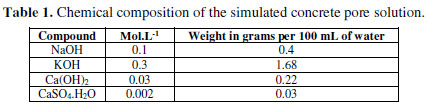
<body><![CDATA[<p>Conducting polypyrrole was synthesized by the method adapted by V. Truong et  al. [9], and conducting polypyrrole based paints were prepared by the method  described by P. Deshpande et al. [10], and elaborated as follows. Conducting  polypyrrole (2 g) as a pigment, 12 g of Xylene, 8 g of titanium dioxide (TiO2)  and 8 g of bis-(2-ethylhexyl) phthalate (dioctyl phthalate: DOP) were added to  the solution with 70 g of epoxy resin (GY 250 supplied by Huntsman Advanced  Materials (India) Pvt Ltd. Andheri (East), Mumbai- 400093, India). The mixture  was ball-milled for 16 hours (Ball mill supplied by Indo German Industries,  Daman, India. Drive motor: Crompton Make - 2HP, 1440 rpm, 415 V, 50 Hz).  The purpose of adding titanium dioxide and Di-octyl phthalate to epoxy resin  was to improve viscosity and elastic properties of paint. Xylene was used as a  solvent for the paint formulation. The paint was filtered through fine cotton, and  applied on the low carbon steel samples (AISI 1015 supplied by Rajasthan steels,  Pune, India) by a film applicator, to keep paint thickness (60 µm) uniform on the  entire surface. Finally, the painted low carbon steel samples were cured in air, at  ambient temperature, for 24 hours.</p>       <p><b><i>Preparation of a simulated pore solution</i></b></p>      <p>The electrolyte used for immersion should be an exact representative concrete  pore solution, with Ca<sup>+</sup>, K<sup>+</sup> and Na<sup>+</sup> ion additions [11]. The chemical  composition of the simulated concrete pore solution is shown in <a href="#t1">Table 1</a>.</p>       <p>&nbsp;</p> <a name="t1"> <img src="/img/revistas/pea/v37n1/37n1a03t1.jpg">     
<p>&nbsp;</p>       <p>One solution without chloride and three solutions with increasing chloride contents - 0.25  M NaCl, 0.5 M NaCl and 1 M NaCl - were prepared.</p>       <p><b><i>Characterization</i></b></p>      <p>Conducting polypyrrole was characterized using a Fourier Transmission Infra Red  Spectrometer (FTIR- 4100 JASCO, Japan.</p>       <p><b><i>Electro-chemical studies</i></b></p>      <p>A corrosion cell with a three electrode geometry of paint coated samples as  working electrode (8 cm2), platinum as counter electrode, and saturated calomel  (SCE: pH Products, Hyderabad, India) as reference electrode was used. The cell  was coupled with a Gamry reference system 1000 (Wilmington, USA) for Mott-  Schottky plots. All measurements were carried out five times to obtain good  results reproducibility. The Mott-Schottky measurements were monitored for bare  carbon steel samples, and the polypyrrole coated samples were immersed for 240  hours in a chloride free concrete pore solution, and in a concrete pore solution with  fixed chlorides amounts.       ]]></body>
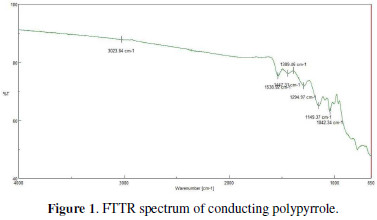
<body><![CDATA[<p>&nbsp;</p>     <p><b>Results and discussion</b></p>      <p>The FTIR spectrum of conducting polypyrrole is shown in <a href="#f1">Fig. 1</a>.</p>       <p>&nbsp;</p> <a name="f1"> <img src="/img/revistas/pea/v37n1/37n1a03f1.jpg">     
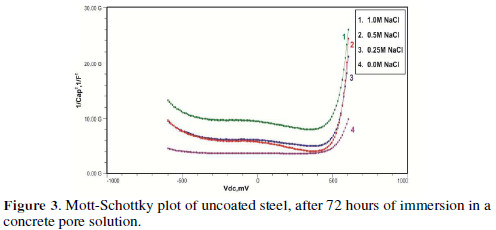
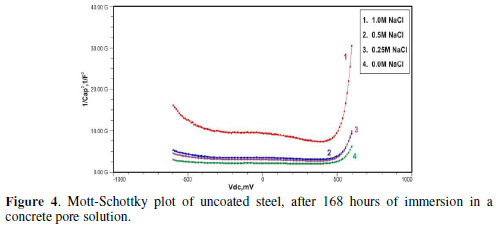
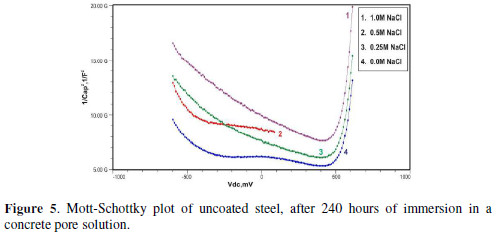
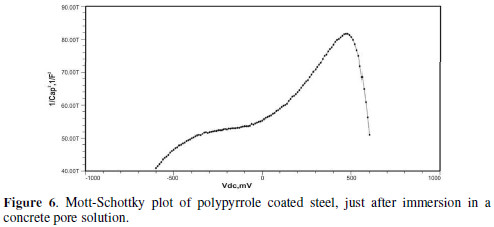
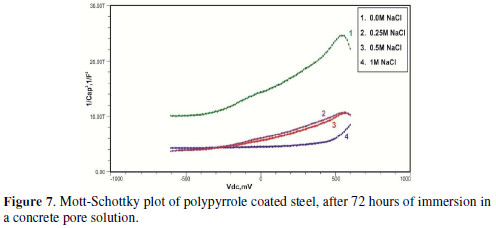
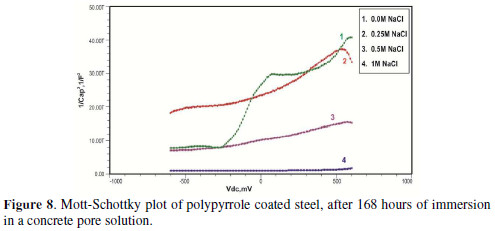
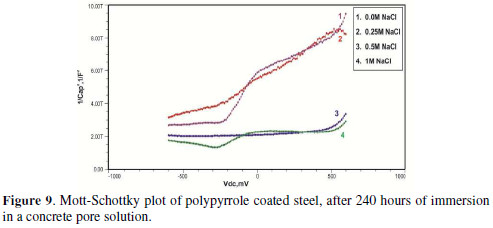
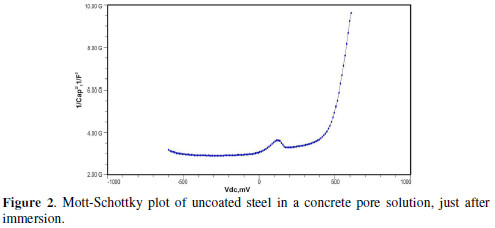
<p>&nbsp;</p>       <p>The peaks at 1447 cm<sup>-1</sup> and 1149 cm<sup>-1</sup> are the responsible peaks of  protonated nitrogen atoms in polypyrrole. The peak at 1538 cm<sup>-1</sup> refers to  the C-C stretching vibration in the pyrrole ring, and the peak at 1042 cm<sup>-1</sup>  denotes the C-H stretching vibration in the pyrrole ring [12].       <p><b><i>Mott-Schottky analysis</i></b></p>      <p>The formation of a passive film in the concrete pore solution takes place in two  stages: initially, ferrous hydroxide is formed on the rebar surface; subsequently,  it gets converted into the more stable ferric oxide - &gamma; Fe OOH [1]. The results of  the Mott-Schottky studies are depicted in <a href="#f2">Figs. 2</a> to <a href="#f5">5</a>, for uncoated steel samples,  and in <a href="#f6">Figs. 6</a> to <a href="#f9">9</a>, for polypyrrole coated steel samples.</p>       <p>&nbsp;</p> <a name="f2"> <img src="/img/revistas/pea/v37n1/37n1a03f2.jpg">     
<p>&nbsp;</p> <a name="f3"> <img src="/img/revistas/pea/v37n1/37n1a03f3.jpg">     
]]></body>
<body><![CDATA[<p>&nbsp;</p> <a name="f4"> <img src="/img/revistas/pea/v37n1/37n1a03f4.jpg">     
<p>&nbsp;</p> <a name="f5"> <img src="/img/revistas/pea/v37n1/37n1a03f5.jpg">     
<p>&nbsp;</p>       <p><a href="#f3">Figs. 3</a> to <a href="#f5">5</a> show Mott-Schottky plots of uncoated steel after 72 hours, 168 hours  and 240 hours of immersion in a concrete pore solution with no chlorides  addition, and 0. 25 M, 0. 5 M and 1 M chlorides addition, respectively.</p>       <p>&nbsp;</p> <a name="f6"> <img src="/img/revistas/pea/v37n1/37n1a03f6.jpg">     
<p>&nbsp;</p> <a name="f7"> <img src="/img/revistas/pea/v37n1/37n1a03f7.jpg">     
<p>&nbsp;</p> <a name="f8"> <img src="/img/revistas/pea/v37n1/37n1a03f8.jpg">     
<p>&nbsp;</p> <a name="f9"> <img src="/img/revistas/pea/v37n1/37n1a03f9.jpg">     
<p>&nbsp;</p>       <p>The slopes of all M-S plots, depicted in <a href="#f2">Figs. 2</a> <a href="#f3"> <a href="#f4"> to <a href="#f5">5</a>,  are positive, indicating n type behavior of the passive film. It seems that the essential features of the  passive films&rsquo; M-S plots formed in various solutions did not change, compared to  the just after immersion condition. The passive film still exhibited n-type  behavior. These results are in good agreement with previous work [2].</p>      ]]></body>
<body><![CDATA[<p>Initially, the slope of the M-S plot in the case of the polypyrrole coated sample is  positive, indicating n type behavior of the passive film. However, beyond 0.5 V,  a transition from a positive to a negative slope, i.e., n type to p type, was  observed. At 72 hours of immersion in a concrete pore solution, no such change  from n to p type was observed, except in the solution without chloride. After 168  hours and 240 hours of immersion, no transition from n type to p type was noted,  in the case of the solutions with 0.5 and 1 M NaCl, and in all solutions,  respectively. In previous work, it was found that the polypyrrole coated steel  sample was able to protect low carbon steel for up to 240 hours of immersion in  the pore solution without chlorides, and in the pore solution with 0.25 M NaCl.  However, at 0.5 M NaCl and higher concentrations, the self-healing property of  the polypyrrole coating was no longer able to protect the steel sample from  corrosion. Conducting polypyrrole coating can protect plain carbon steel from  corrosion by several mechanisms - barrier protection, passive film formation,  controlled inhibitor release mechanism, or by generation of an electric field [7-8].</p>       <p>&nbsp;</p>     <p><b>Conclusions</b></p>      <p>The M-S slope indicated that the passive film on uncoated low carbon steel  exhibited n-type semi-conductive behaviour, and that the polypyrrole coating  exhibited p - n type behaviour. However, with the increasing immersion time in a  concrete pore solution up to 240 hours, and chloride contents up to 1 M NaCl, the  polypyrrole coating on low carbon steel only exhibited p type behaviour.</p>      <p>&nbsp;</p>     <p><b>References</b></p>      <!-- ref --><p>1. Bentur A, Diamond S, Berke NS. Steel corrosion in concrete: Fundamentals  and Civil Engineering Practice. 1st ed. London: E & FN Spon; 1997.    &nbsp;&nbsp;&nbsp;&nbsp;&nbsp;&nbsp;&nbsp;&nbsp;[&#160;<a href="javascript:void(0);" onclick="javascript: window.open('/scielo.php?script=sci_nlinks&ref=438651&pid=S0872-1904201900010000300001&lng=','','width=640,height=500,resizable=yes,scrollbars=1,menubar=yes,');">Links</a>&#160;]<!-- end-ref --></p>      <!-- ref --><p>2. Yun-Lian Z, Qi-Ling L. J Zhejiang Univ Sci A. 2006;7:1447.    &nbsp;&nbsp;&nbsp;&nbsp;&nbsp;&nbsp;&nbsp;&nbsp;[&#160;<a href="javascript:void(0);" onclick="javascript: window.open('/scielo.php?script=sci_nlinks&ref=438653&pid=S0872-1904201900010000300002&lng=','','width=640,height=500,resizable=yes,scrollbars=1,menubar=yes,');">Links</a>&#160;]<!-- end-ref --></p>      ]]></body>
<body><![CDATA[<!-- ref --><p>3. Williamson J, Isgor OB. Corros Sci. 2016;106:82.    &nbsp;&nbsp;&nbsp;&nbsp;&nbsp;&nbsp;&nbsp;&nbsp;[&#160;<a href="javascript:void(0);" onclick="javascript: window.open('/scielo.php?script=sci_nlinks&ref=438655&pid=S0872-1904201900010000300003&lng=','','width=640,height=500,resizable=yes,scrollbars=1,menubar=yes,');">Links</a>&#160;]<!-- end-ref --></p>      <!-- ref --><p>4. Zhang Y, Poursaee A. Anti-Corrosion Methods Mater. 2015;62:363.    &nbsp;&nbsp;&nbsp;&nbsp;&nbsp;&nbsp;&nbsp;&nbsp;[&#160;<a href="javascript:void(0);" onclick="javascript: window.open('/scielo.php?script=sci_nlinks&ref=438657&pid=S0872-1904201900010000300004&lng=','','width=640,height=500,resizable=yes,scrollbars=1,menubar=yes,');">Links</a>&#160;]<!-- end-ref --></p>      <!-- ref --><p>5. Hamadou L, Kadri A, Benbrahim N. Appl Surf Sci. 2005;252:1510.    &nbsp;&nbsp;&nbsp;&nbsp;&nbsp;&nbsp;&nbsp;&nbsp;[&#160;<a href="javascript:void(0);" onclick="javascript: window.open('/scielo.php?script=sci_nlinks&ref=438659&pid=S0872-1904201900010000300005&lng=','','width=640,height=500,resizable=yes,scrollbars=1,menubar=yes,');">Links</a>&#160;]<!-- end-ref --></p>      <!-- ref --><p>6. Kumar V. Corros Rev. 1998;16:318.    &nbsp;&nbsp;&nbsp;&nbsp;&nbsp;&nbsp;&nbsp;&nbsp;[&#160;<a href="javascript:void(0);" onclick="javascript: window.open('/scielo.php?script=sci_nlinks&ref=438661&pid=S0872-1904201900010000300006&lng=','','width=640,height=500,resizable=yes,scrollbars=1,menubar=yes,');">Links</a>&#160;]<!-- end-ref --></p>      <!-- ref --><p>7. Deshpande P, Sazou D. Corrosion protection of Metals by Intrinsically  Conducting Polymers. Boca Raton:CRC Press; 2015.    &nbsp;&nbsp;&nbsp;&nbsp;&nbsp;&nbsp;&nbsp;&nbsp;[&#160;<a href="javascript:void(0);" onclick="javascript: window.open('/scielo.php?script=sci_nlinks&ref=438663&pid=S0872-1904201900010000300007&lng=','','width=640,height=500,resizable=yes,scrollbars=1,menubar=yes,');">Links</a>&#160;]<!-- end-ref --></p>      ]]></body>
<body><![CDATA[<!-- ref --><p>8. Munot H, Deshpande P, Modhera C. UPB Sci Bull. 2017;79.    &nbsp;&nbsp;&nbsp;&nbsp;&nbsp;&nbsp;&nbsp;&nbsp;[&#160;<a href="javascript:void(0);" onclick="javascript: window.open('/scielo.php?script=sci_nlinks&ref=438665&pid=S0872-1904201900010000300008&lng=','','width=640,height=500,resizable=yes,scrollbars=1,menubar=yes,');">Links</a>&#160;]<!-- end-ref --></p>      <!-- ref --><p>9. Truong V, PLai P, Moore B, et al. Synth Metals. 2000;110:7.    &nbsp;&nbsp;&nbsp;&nbsp;&nbsp;&nbsp;&nbsp;&nbsp;[&#160;<a href="javascript:void(0);" onclick="javascript: window.open('/scielo.php?script=sci_nlinks&ref=438667&pid=S0872-1904201900010000300009&lng=','','width=640,height=500,resizable=yes,scrollbars=1,menubar=yes,');">Links</a>&#160;]<!-- end-ref --></p>      <p>10. Deshpande P, Vagge S, Jagtap S, et al. Protection Metals Phys Chem Surf. 2012;48:356.</p>      <!-- ref --><p>11. Poursaee A. Concrete Research Lett. 2010;1: 90.    &nbsp;&nbsp;&nbsp;&nbsp;&nbsp;&nbsp;&nbsp;&nbsp;[&#160;<a href="javascript:void(0);" onclick="javascript: window.open('/scielo.php?script=sci_nlinks&ref=438670&pid=S0872-1904201900010000300011&lng=','','width=640,height=500,resizable=yes,scrollbars=1,menubar=yes,');">Links</a>&#160;]<!-- end-ref --></p>      <!-- ref --><p>12. Selvaraj M, Palraj S, Rajagopal G, et al. Synth Metals. 2008;158:894.    &nbsp;&nbsp;&nbsp;&nbsp;&nbsp;&nbsp;&nbsp;&nbsp;[&#160;<a href="javascript:void(0);" onclick="javascript: window.open('/scielo.php?script=sci_nlinks&ref=438672&pid=S0872-1904201900010000300012&lng=','','width=640,height=500,resizable=yes,scrollbars=1,menubar=yes,');">Links</a>&#160;]<!-- end-ref --></p>        <p>&nbsp;</p>     ]]></body>
<body><![CDATA[<p><b>Acknowledgements</b></p>      <p>The authors thank Prof. N.B. Dhokey, Head of the Department of Metallurgy and  Materials Science, College of Engineering, Pune (M.S.), for providing facilities,  and Prof. B. B. Ahuja, Director of the College of Engineering, Pune, (M.S.), for  his encouragement.</p>       <p>&nbsp;</p>     <p><a name=0></a><sup><a href="#top">*</a></sup>Corresponding author. E-mail address: <a href="mailto:pravinpd@hotmail.com">pravinpd@hotmail.com</a></p>      <p>Received June 24, 2017; accepted March 22, 2018</p>          <p><a href="http://www.peacta.org" target="_blank">www.peacta.org</a> </p>              ]]></body><back>
<ref-list>
<ref id="B1">
<label>1</label><nlm-citation citation-type="book">
<person-group person-group-type="author">
<name>
<surname><![CDATA[Bentur]]></surname>
<given-names><![CDATA[A]]></given-names>
</name>
<name>
<surname><![CDATA[Diamond]]></surname>
<given-names><![CDATA[S]]></given-names>
</name>
<name>
<surname><![CDATA[Berke]]></surname>
<given-names><![CDATA[N S]]></given-names>
</name>
</person-group>
<source><![CDATA[Steel corrosion in concrete: Fundamentals and Civil Engineering Practice]]></source>
<year>1997</year>
<edition>1st ed</edition>
<publisher-loc><![CDATA[London ]]></publisher-loc>
<publisher-name><![CDATA[E & FN Spon]]></publisher-name>
</nlm-citation>
</ref>
<ref id="B2">
<label>2</label><nlm-citation citation-type="journal">
<person-group person-group-type="author">
<name>
<surname><![CDATA[Yun-Lian]]></surname>
<given-names><![CDATA[Z]]></given-names>
</name>
<name>
<surname><![CDATA[Qi-Ling]]></surname>
<given-names><![CDATA[L]]></given-names>
</name>
</person-group>
<source><![CDATA[J Zhejiang Univ Sci A]]></source>
<year>2006</year>
<volume>7</volume>
<page-range>1447</page-range></nlm-citation>
</ref>
<ref id="B3">
<label>3</label><nlm-citation citation-type="journal">
<person-group person-group-type="author">
<name>
<surname><![CDATA[Williamson]]></surname>
<given-names><![CDATA[J]]></given-names>
</name>
<name>
<surname><![CDATA[Isgor]]></surname>
<given-names><![CDATA[O B]]></given-names>
</name>
</person-group>
<source><![CDATA[Corros Sci]]></source>
<year>2016</year>
<volume>106</volume>
<page-range>82</page-range></nlm-citation>
</ref>
<ref id="B4">
<label>4</label><nlm-citation citation-type="journal">
<person-group person-group-type="author">
<name>
<surname><![CDATA[Zhang]]></surname>
<given-names><![CDATA[Y]]></given-names>
</name>
<name>
<surname><![CDATA[Poursaee]]></surname>
<given-names><![CDATA[A]]></given-names>
</name>
</person-group>
<source><![CDATA[Anti-Corrosion Methods Mater]]></source>
<year>2015</year>
<volume>62</volume>
<page-range>363</page-range></nlm-citation>
</ref>
<ref id="B5">
<label>5</label><nlm-citation citation-type="journal">
<person-group person-group-type="author">
<name>
<surname><![CDATA[Hamadou]]></surname>
<given-names><![CDATA[L]]></given-names>
</name>
<name>
<surname><![CDATA[Kadri]]></surname>
<given-names><![CDATA[A]]></given-names>
</name>
<name>
<surname><![CDATA[Benbrahim]]></surname>
<given-names><![CDATA[N]]></given-names>
</name>
</person-group>
<source><![CDATA[Appl Surf Sci]]></source>
<year>2005</year>
<volume>252</volume>
<page-range>1510</page-range></nlm-citation>
</ref>
<ref id="B6">
<label>6</label><nlm-citation citation-type="journal">
<person-group person-group-type="author">
<name>
<surname><![CDATA[Kumar]]></surname>
<given-names><![CDATA[V]]></given-names>
</name>
</person-group>
<source><![CDATA[Corros Rev]]></source>
<year>1998</year>
<volume>16</volume>
<page-range>318</page-range></nlm-citation>
</ref>
<ref id="B7">
<label>7</label><nlm-citation citation-type="book">
<person-group person-group-type="author">
<name>
<surname><![CDATA[Deshpande]]></surname>
<given-names><![CDATA[P]]></given-names>
</name>
<name>
<surname><![CDATA[Sazou]]></surname>
<given-names><![CDATA[D]]></given-names>
</name>
</person-group>
<source><![CDATA[Corrosion protection of Metals by Intrinsically Conducting Polymers]]></source>
<year>2015</year>
<publisher-loc><![CDATA[Boca Raton ]]></publisher-loc>
<publisher-name><![CDATA[CRC Press]]></publisher-name>
</nlm-citation>
</ref>
<ref id="B8">
<label>8</label><nlm-citation citation-type="journal">
<person-group person-group-type="author">
<name>
<surname><![CDATA[Munot]]></surname>
<given-names><![CDATA[H]]></given-names>
</name>
<name>
<surname><![CDATA[Deshpande]]></surname>
<given-names><![CDATA[P]]></given-names>
</name>
<name>
<surname><![CDATA[Modhera]]></surname>
<given-names><![CDATA[C]]></given-names>
</name>
</person-group>
<source><![CDATA[UPB Sci Bull]]></source>
<year>2017</year>
<page-range>79</page-range></nlm-citation>
</ref>
<ref id="B9">
<label>9</label><nlm-citation citation-type="journal">
<person-group person-group-type="author">
<name>
<surname><![CDATA[Truong]]></surname>
<given-names><![CDATA[V]]></given-names>
</name>
<name>
<surname><![CDATA[Plai]]></surname>
<given-names><![CDATA[P]]></given-names>
</name>
<name>
<surname><![CDATA[Moore]]></surname>
<given-names><![CDATA[B]]></given-names>
</name>
</person-group>
<source><![CDATA[Synth Metals]]></source>
<year>2000</year>
<volume>110</volume>
<page-range>7</page-range></nlm-citation>
</ref>
<ref id="B10">
<label>10</label><nlm-citation citation-type="journal">
<person-group person-group-type="author">
<name>
<surname><![CDATA[Deshpande]]></surname>
<given-names><![CDATA[P]]></given-names>
</name>
<name>
<surname><![CDATA[Vagge]]></surname>
<given-names><![CDATA[S]]></given-names>
</name>
<name>
<surname><![CDATA[Jagtap]]></surname>
<given-names><![CDATA[S]]></given-names>
</name>
<name>
</name>
</person-group>
<source><![CDATA[Protection Metals Phys Chem Surf]]></source>
<year>2012</year>
<volume>48</volume>
<page-range>356</page-range></nlm-citation>
</ref>
<ref id="B11">
<label>11</label><nlm-citation citation-type="journal">
<person-group person-group-type="author">
<name>
<surname><![CDATA[Poursaee]]></surname>
<given-names><![CDATA[A]]></given-names>
</name>
</person-group>
<source><![CDATA[Concrete Research Lett]]></source>
<year>2010</year>
<volume>1</volume>
<page-range>90</page-range></nlm-citation>
</ref>
<ref id="B12">
<label>12</label><nlm-citation citation-type="journal">
<person-group person-group-type="author">
<name>
<surname><![CDATA[Selvaraj]]></surname>
<given-names><![CDATA[M]]></given-names>
</name>
<name>
<surname><![CDATA[Palraj]]></surname>
<given-names><![CDATA[S]]></given-names>
</name>
<name>
<surname><![CDATA[Rajagopal]]></surname>
<given-names><![CDATA[G]]></given-names>
</name>
</person-group>
<source><![CDATA[Synth Metals]]></source>
<year>2008</year>
<volume>158</volume>
<page-range>894</page-range></nlm-citation>
</ref>
</ref-list>
</back>
</article>