<?xml version="1.0" encoding="ISO-8859-1"?><article xmlns:mml="http://www.w3.org/1998/Math/MathML" xmlns:xlink="http://www.w3.org/1999/xlink" xmlns:xsi="http://www.w3.org/2001/XMLSchema-instance">
<front>
<journal-meta>
<journal-id>0872-1904</journal-id>
<journal-title><![CDATA[Portugaliae Electrochimica Acta]]></journal-title>
<abbrev-journal-title><![CDATA[Port. Electrochim. Acta]]></abbrev-journal-title>
<issn>0872-1904</issn>
<publisher>
<publisher-name><![CDATA[Sociedade Portuguesa de Electroquímica]]></publisher-name>
</publisher>
</journal-meta>
<article-meta>
<article-id>S0872-19042019000100004</article-id>
<article-id pub-id-type="doi">10.4152/pea.201901051</article-id>
<title-group>
<article-title xml:lang="en"><![CDATA[Electrochemical Characterization of Catechol-Dimethylamine Adduct at Different pH Values]]></article-title>
</title-group>
<contrib-group>
<contrib contrib-type="author">
<name>
<surname><![CDATA[Ahamed]]></surname>
<given-names><![CDATA[K. Riaz]]></given-names>
</name>
<xref ref-type="aff" rid="A01"/>
</contrib>
<contrib contrib-type="author">
<name>
<surname><![CDATA[Farzana]]></surname>
<given-names><![CDATA[B. Arifa]]></given-names>
</name>
<xref ref-type="aff" rid="A02"/>
</contrib>
<contrib contrib-type="author">
<name>
<surname><![CDATA[Diraviam]]></surname>
<given-names><![CDATA[S. Justin]]></given-names>
</name>
<xref ref-type="aff" rid="A01"/>
</contrib>
<contrib contrib-type="author">
<name>
<surname><![CDATA[Dorothy]]></surname>
<given-names><![CDATA[R.]]></given-names>
</name>
<xref ref-type="aff" rid="A02"/>
</contrib>
<contrib contrib-type="author">
<name>
<surname><![CDATA[Rajendran]]></surname>
<given-names><![CDATA[Susai]]></given-names>
</name>
<xref ref-type="aff" rid="A02"/>
<xref ref-type="aff" rid="A03"/>
</contrib>
<contrib contrib-type="author">
<name>
<surname><![CDATA[Al-Hashem]]></surname>
<given-names><![CDATA[Abdulhameed]]></given-names>
</name>
<xref ref-type="aff" rid="A04"/>
</contrib>
</contrib-group>
<aff id="A01">
<institution><![CDATA[,Jamal Mohamed College (Autonomous) Research Department of Chemistry PG]]></institution>
<addr-line><![CDATA[Tiruchirappalli ]]></addr-line>
<country>India</country>
</aff>
<aff id="A02">
<institution><![CDATA[,AMET University  ]]></institution>
<addr-line><![CDATA[Chennai ]]></addr-line>
<country>India</country>
</aff>
<aff id="A03">
<institution><![CDATA[,St. Antony's College of Arts and Sciences for Women Department of Chemistry ]]></institution>
<addr-line><![CDATA[Tamil Nadu ]]></addr-line>
<country>India</country>
</aff>
<aff id="A04">
<institution><![CDATA[,Kuwait Institute for Scientific Research Petroleum Research Centre ]]></institution>
<addr-line><![CDATA[ ]]></addr-line>
<country>Kuwait</country>
</aff>
<pub-date pub-type="pub">
<day>00</day>
<month>01</month>
<year>2019</year>
</pub-date>
<pub-date pub-type="epub">
<day>00</day>
<month>01</month>
<year>2019</year>
</pub-date>
<volume>37</volume>
<numero>1</numero>
<fpage>51</fpage>
<lpage>70</lpage>
<copyright-statement/>
<copyright-year/>
<self-uri xlink:href="http://scielo.pt/scielo.php?script=sci_arttext&amp;pid=S0872-19042019000100004&amp;lng=en&amp;nrm=iso"></self-uri><self-uri xlink:href="http://scielo.pt/scielo.php?script=sci_abstract&amp;pid=S0872-19042019000100004&amp;lng=en&amp;nrm=iso"></self-uri><self-uri xlink:href="http://scielo.pt/scielo.php?script=sci_pdf&amp;pid=S0872-19042019000100004&amp;lng=en&amp;nrm=iso"></self-uri><abstract abstract-type="short" xml:lang="en"><p><![CDATA[The efficiency of Commelina benghalensis leaves extract as a mild steel corrosion inhibitor in hydrochloric acid (HCl) and sulphuric acid (H2SO4) has been evaluated. The corrosion rates were determined using the gravimetric (weight loss) and electrochemical techniques. The results obtained in the absence and presence of Commelina benghalensis extracts were used to calculate the inhibition efficiency (%), and to propose the inhibition mechanism and adsorption type. The obtained results showed that the inhibition efficiency increased with the increase in concentration of Commelina benghalensis extract. The phenomenon of chemical adsorption was proposed, and the inhibitor adsorption was found to obey Langmuir, Temkin and kinetic thermodynamic models. The polarization study reveals that, in the inhibitor presence, the corrosion current value decreases, indicating the formation of a protective film on the metal surface, which prevents the electron release from it.]]></p></abstract>
<kwd-group>
<kwd lng="en"><![CDATA[Commelina benghalensis leaves extract]]></kwd>
<kwd lng="en"><![CDATA[corrosion inhibition]]></kwd>
<kwd lng="en"><![CDATA[weight loss]]></kwd>
<kwd lng="en"><![CDATA[polarization]]></kwd>
<kwd lng="en"><![CDATA[impedance study]]></kwd>
<kwd lng="en"><![CDATA[adsorption isotherm]]></kwd>
<kwd lng="en"><![CDATA[green inhibitors]]></kwd>
</kwd-group>
</article-meta>
</front><body><![CDATA[   <!--     <p>&nbsp;</p>     <p>doi: 10.4152/pea.201901051</p> -->      <p><b>Electrochemical Characterization of Catechol-Dimethylamine  Adduct at Different pH Values</b></p>      <p> <b>K. Riaz Ahamed</b><sup><i>a</i></sup>, <b>B. Arifa Farzana</b><sup><i>b</i>,<a href="#0">*</a></sup>, <b>S. Justin Diraviam</b><sup><i>a</i></sup>, <b>R. Dorothy</b><sup><i>b</i></sup>, <b>Susai Rajendran</b><sup><i>b,c</i></sup> and <b>Abdulhameed Al-Hashem</b><sup><i>d</i></sup> </p>      <p><sup><i>a</i></sup><i> PG and Research Department of Chemistry, Jamal Mohamed College (Autonomous),  Tiruchirappalli, India</i></p>      <p><sup><i>b</i></sup><i> AMET University, 135, East Coast Road, Kanathur-603 112, Chennai, India</i></p>       <p><sup><i>c</i></sup><i> Department of Chemistry, St. Antony's College of Arts and Sciences for Women,  Dindigul-624 005, Tamil Nadu, India</i></p>      <p><sup><i>d</i></sup><i> Petroleum Research Centre, Kuwait Institute for Scientific Research, Kuwait</i></p>      <p>&nbsp;</p>     ]]></body>
<body><![CDATA[<p><b>Abstract</b></p>      <p>The efficiency of <i>Commelina benghalensis</i>  leaves extract as a mild steel corrosion  inhibitor in hydrochloric acid (HCl) and sulphuric acid (H2SO4) has been evaluated. The  corrosion rates were determined using the gravimetric (weight loss) and electrochemical  techniques. The results obtained in the absence and presence of <i>Commelina benghalensis</i> extracts  were used to calculate the inhibition efficiency (%), and to  propose the inhibition mechanism and adsorption type. The obtained results showed that  the inhibition efficiency increased with the increase in concentration of <i>Commelina benghalensis</i> extract.  The phenomenon of chemical adsorption was proposed, and the  inhibitor adsorption was found to obey Langmuir, Temkin and kinetic thermodynamic  models. The polarization study reveals that, in the inhibitor presence, the corrosion  current value decreases, indicating the formation of a protective film on the metal  surface, which prevents the electron release from it.</p>      <p><b><i>Keywords</i></b>: <i>Commelina benghalensis</i> leaves extract, corrosion inhibition, weight loss,  polarization, impedance study, adsorption isotherm and green inhibitors.</p>      <p>&nbsp;</p>     <p><b>Introduction</b></p>      <p>Corrosion is a ubiquitous problem that continues to be of great relevance in a  wide range of industrial applications and products. The use of corrosion  inhibitors is the most economical and practical method in reducing corrosive  attack on metals. Nevertheless, the popularity and use of synthetic compounds as  corrosion inhibitors are diminishing, due to the strict environmental regulations,  and to the toxic effects of synthetic compounds on human and animal life. In  order to find out non-toxic, cheap and effective green corrosion inhibitors from  renewable sources, many natural products have been used by researchers.</p>      <p>Chraibi et al. have used <i>M. piperita</i> and <i>M. pulegium</i> essential oils for the  corrosion control of mild steel in a 1.0 M hydrochloric acid solution [1]. These  substances also have antibacterial activity. Evaluation of <i>Alpinia galanga</i> and its  active principle, 1'-acetochavicol acetate, as an eco-friendly corrosion inhibitor  on mild steel in acidic media, has been done by Ajeigbe et al. [2]. The  anticorrosive activity of <i>Schreabera swietenioids</i> leaves as a green inhibitor for  mild steel in an acidic solution has been reported by Sivakumar and Srikanth [3].  The corrosion inhibition of carbon steel in a 1 M H2SO4 solution by <i>Thapsia  villosa</i> extracts was investigated by Kalla et al. [4]. The use of <i>Piper longum</i>  extract as a green corrosion inhibitor for aluminium in a NaOH solution has been  studied by Singh et al. [5].</p>      <p>Junior et al. have evaluated the antioxidant activity and corrosion inhibition by  Brazilian plant extracts and their constituents [6]. The inhibition effect of some  trees cultivated in arid regions, against the corrosion of steel reinforcement in an  alkaline chloride solution, has been evaluated by Etteyeb et al. [7].</p>      <p>Mott-Schottky analysis showed the formation of a passive layer on the metallic  surface. EIS results suggest an increase in carbon steel corrosion resistance, in  the plants extract presence, comparatively to the blank systems. Furthermore,  SEM and EDS analyses corroborate these results.</p>      <p>An eco-friendly inhibitor for mild steel corrosion made from <i>Pennisetum  purpureum</i> biomass and synergistic intensifiers has been formulated by Ituen et  al. [8]. Kinetic data treatment indicated an increase in the energy barrier by  intensifier ions. The results demonstrate that elephant grass extract, blended with  halide ions, can act as an alternative eco-friendly inhibitor for mild steel, at  elevated temperatures.</p>      ]]></body>
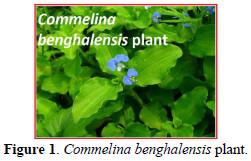
<body><![CDATA[<p>Dos Santos et al. have investigated carbon steel corrosion inhibition in acidic  chloride by Mangiferin. The results showed that carbon steel exposed to this  medium containing Mangiferin had a reduction in the mass loss process and a  higher electrochemical behavior, relatively to the carbon steel samples exposed  to the same medium, in Mangiferin absence. These results suggest that  Mangiferin shows an inhibitory action on the carbon steel corrosion process, in  the studied conditions [9].</p>         <p>Umoren et al. have evaluated mustard seed extract (MSE) as an eco-friendly  corrosion inhibitor for X60 steel in acidic media [10]. The obtained results show  that MSE inhibited steel corrosion in both media, which was more pronounced in  H<sub>2</sub>SO<sub>4</sub> than in HCl environments. The inhibition efficiency increased with higher  extract concentrations, but decreased with increased temperatures. The  potentiodynamic polarization studies revealed that MSE functions as a mixedtype  inhibitor. The corrosion inhibition is assumed to occur via adsorption of the  extract components onto the steel surface, which was found to obey Langmuir  adsorption isotherm model. The morphology of the corroding steel surface, in the  absence and presence of the mustard seed extract, was visualized using scanning  electron microscopy. Rajendran et al. have used extracts of various plant  materials, such as henna leaves, curcumin, caffeine and spirulina, to control  metals corrosion [11-36].</p>         <p>The present work was undertaken to evaluate the inhibition efficiency of an  aqueous extract of <i>Commelina benghalensis</i> leaves against mild steel corrosion  in hydrochloric acid and sulphuric acid media. Weight loss and electrochemical  methods, such as polarization study and AC impedance spectra, have been used.</p>        <p>&nbsp;</p>     <p><b>Materials and methods</b></p>       <p>The extract of <i>Commelina benghalensis</i> leaves was used as corrosion inhibitor in  the present study. The leaves and flowers of <i>Commelina benghalensis</i> are shown  in <a href="#f1">Fig. 1</a>.</p>       <p>&nbsp;</p> <a name="f1"> <img src="/img/revistas/pea/v37n1/37n1a04f1.jpg">     
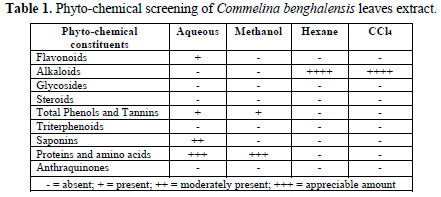
<p>&nbsp;</p>       <p>The botanical details of <i>Commelina benghalensis</i> are given below: it belongs to  the <i>Commelinaceae</i> family. The Tamil name is &ldquo;Kanavazhiain&rdquo;. In China, it is  used as a medicinal herb that is said to have diuretic, febrifugal and antiinflammatory  effects, while in Pakistan it is used to cure skin swellings, leprosy,  and as a laxative.</p>      <p>The phyto-chemical screening of <i>Commelina benghalensis</i> leaves extract is given  in <a href="#t1">Table 1</a> [37].</p>       ]]></body>
<body><![CDATA[<p>&nbsp;</p> <a name="t1"> <img src="/img/revistas/pea/v37n1/37n1a04t1.jpg">     
<p>&nbsp;</p>       <p>Preliminary phyto-chemical screening mainly revealed the presence of saponins,  phenols, flavonoids, alkaloids, tannins, proteins and amino acids.       <p><b>Extract preparation</b></p>       <p><i>Cold percolation method</i></p>        <p>The leaves were collected, shade dried and powdered. About 1 g of the powdered  leaves was macerated with 1000 mL of double distilled water, tightly covered  with aluminium foil, and kept for 24 hrs. After 24 hrs, the macerated extract was  filtered by a Whatmann filter paper. From the extract, the various concentrations  were prepared.       <p><i>Used materials and chemicals</i></p>       <p>Mild steel specimens (Wt %: 0.026%-S, 0.06%-P, 0.4%-Mn, 0.1%-C, and the  remainder iron) with the dimensions 1 x 5 x 0.2 cm were abraded to mirror  finish, degreased with acetone, and used for the weight loss method.  For the polarization study, a cylindrical mild steel rod embedded in Teflon, with  an exposed area of 1 cm2, was used. The electrodes were abraded with emery  papers of 0/0, 2/0, 3/0, and 4/0 grades, degreased with acetone, dried and used.       <p><b>Weight loss method</b></p>       <p>Weight loss measurements were performed in 1 M HCl and 0.5 M H2SO4, with  and without the inhibitor presence. Inhibition efficiencies for various inhibitor  concentrations were calculated using the <a href="#e1">relation</a>:</p>       ]]></body>
<body><![CDATA[<p>&nbsp;</p> <a name="e1"> <img src="/img/revistas/pea/v37n1/37n1a04e1.jpg">     
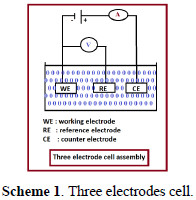
<p>&nbsp;</p>       <p>where W0 = weight loss in blank and Wi = weight loss in the inhibitor presence.       <p><b>Electrochemical studies</b></p>       <p>The polarization study and AC impedance spectra were recorded in a  potentiostat. The experiments were recorded in a three electrodes cell assembly,  which is shown in <a href="#s1">Scheme 1</a>.</p>       <p>&nbsp;</p> <a name="s1"> <img src="/img/revistas/pea/v37n1/37n1a04s1.jpg">     
<p>&nbsp;</p>       <p>Mild steel was used as working electrode. A saturated calomel electrode (SCE)  was used as reference electrode. A platinum foil (2 cm<sup>2</sup>) was used as counter  electrode. The used working electrode was a mild steel rod of the same  composition, embedded in araldite, and with an exposed area of 1 cm<sup>2</sup>.</p>      <p>From the potentiodynamic polarization study, the corrosion current, corrosion  potential and the Tafel slopes were derived. From AC impedance spectra, the  charge transfer resistance and double layer capacitance were calculated.</p>      <p>The counter electrode area is much larger compared to the working electrode  area. This will exert a uniform potential field on the working electrode.</p>      ]]></body>
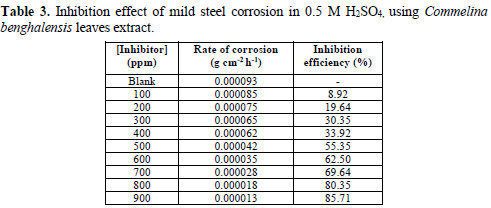
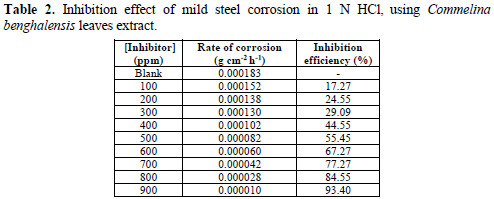
<body><![CDATA[<p>100 mL of the test solution were taken in a polarization cell. The working  electrode was successively abraded with 0/0, 1/0, 2/0, 3/0, and 4/0 emery papers,  and degreased with acetone. The working electrode, reference and auxiliary  platinum electrodes were assembled, and connections were made. Stirring was  provided to the test solutions, to avoid the system concentrations polarization  before the experiment start. A time interval of about 30 min was given for the  system to attain its state, and open circuit potential was recorded.</p>      <p>&nbsp;</p>     <p><b>Results and discussion</b></p>      <p><b><i>Weight loss studies</i></b></p>        <p>The inhibition efficiency of <i>Commelina benghalensis</i> leaves extract in  controlling mild steel corrosion in 0.5 M H2SO4 has been evaluated by the weight  loss method.</p>      <p><a href="#t2">Tables 2</a> and <a href="#t3">3</a> give the inhibition efficiency of different concentrations of  <i>Commelina benghalensis</i> leaves extract in 1 N HCl and 0.5 M H2SO4,  respectively.</p>       <p>&nbsp;</p> <a name="t2"> <img src="/img/revistas/pea/v37n1/37n1a04t2.jpg">     
<p>&nbsp;</p> <a name="t3"> <img src="/img/revistas/pea/v37n1/37n1a04t3.jpg">     
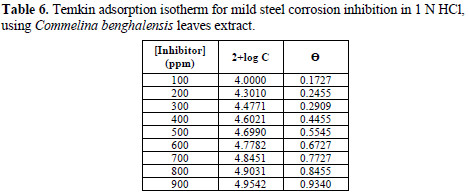
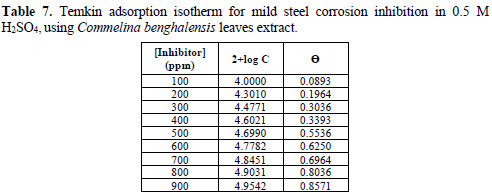
<p>&nbsp;</p>      <p>It was observed that, as the inhibitor concentration increased, the  inhibition efficiency also increased. 900 ppm of inhibitor offered 93.40 %  inhibition efficiency in 1 N HCl, and 85.71% in 0.5 M H2SO4.</p>      ]]></body>
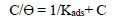
<body><![CDATA[<p><b><i>Adsorption isotherms</i></b></p>      <p>Adsorption isotherms are usually used to describe the adsorption process.  Adsorption isotherms are very important to determine the organoelectrochemical  reaction mechanism. The most frequently used isotherms  include: Langmuir, Temkin, Flory-Huggins, and the recently formulated  thermodynamic/kinetic model of El-Awady et al. The use of adsorption  isotherms that describe the adsorption of a corrosion inhibitor can provide  important clues about the nature of the metal-inhibitor interaction. Adsorption of  the organic molecules occurs when the interaction energy between the molecules  and the metal surface is higher than that between the H2O molecules and the  metal surface. It is important to know the adsorption mode, to understand this  part of the study.</p>       <p><b><i>Langmuir isotherm</i></b></p>  In order to obtain the adsorption isotherm, the degree of surface coverage (&theta;) for  various inhibitor concentrations has been calculated according to its equation.  Langmuir isotherm was tested for its fit to the experimental data. Langmuir  isotherm is given <a href="#e2">by</a>:</p>         <p>&nbsp;</p> <a name="e2"> <img src="/img/revistas/pea/v37n1/37n1a04e2.jpg">     
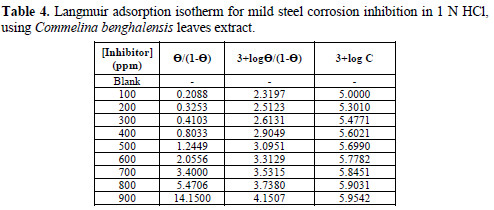
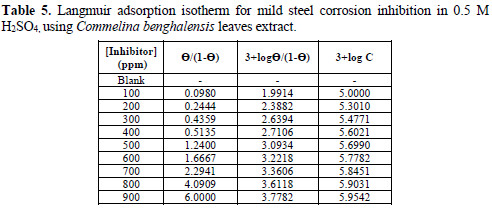
<p>&nbsp;</p>      <p>where &Theta; is the degree of surface coverage, C is the molar inhibitor in the bulk  solution and K<sub>ads</sub> is the equilibrium constant of the adsorption process.</p>         <p>Langmuir isotherm assumes that the metal surface contains a fixed number of  adsorption sites, and that each site holds one adsorbate; &Delta;G<sup>0</sup><sub>ads</sub> is  the same for all sites, and it is independent from &theta;; the adsorbates do not interact with each other,  i.e., there is no effect of the adsorbates lateral interaction on &Delta;G<sup>0</sup><sub>ads</sub>.  It is important to know this part of the study. <a href="#t4"> Tables 4</a> and <a href="#t5"> 5</a>  show that the obtained  values were fitted to Langmuir isotherm, and the best fit to the experimental data  was obtained.</p>         <p>&nbsp;</p> <a name="t4"> <img src="/img/revistas/pea/v37n1/37n1a04t4.jpg">     
<p>&nbsp;</p> <a name="t5"> <img src="/img/revistas/pea/v37n1/37n1a04t5.jpg">     
<p>&nbsp;</p>      ]]></body>
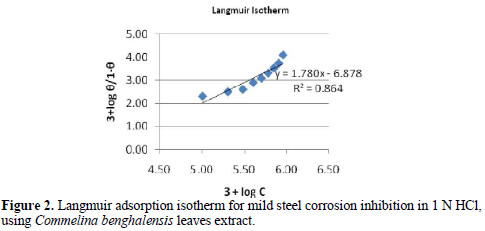
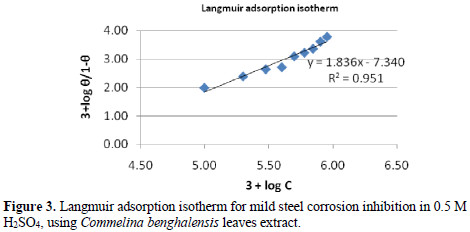
<body><![CDATA[<p>The plot of log log&theta;/(1-.) vs. log C is a straight line, as shown  in <a href="#f2"> Figs. 2</a> and <a href="#f3"> 3</a>.</p>         <p>&nbsp;</p> <a name="f2"> <img src="/img/revistas/pea/v37n1/37n1a04f2.jpg">     
<p>&nbsp;</p> <a name="f3"> <img src="/img/revistas/pea/v37n1/37n1a04f3.jpg">     
<p>&nbsp;</p>      <p>Thus, the Langmuir isotherm is valid for the inhibitor.</p>       <p><b><i>Temkin adsorption isotherm</i></b></p>       <p>The Temkin adsorption isotherm is given by the <a href="#e3"> expression</a>:       <p>&nbsp;</p> <a name="e3"> <img src="/img/revistas/pea/v37n1/37n1a04e3.jpg">     
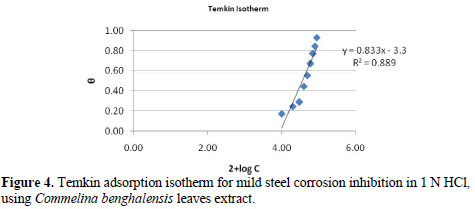
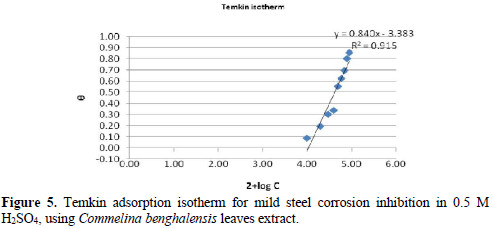
<p>&nbsp;</p>       <p>where 'K' is the adsorption equilibrium constant, and 'a' is the lateral interaction  parameter. <a href="#t6">Tables 6</a> and <a href="#t7">7</a> show the Temkin isotherm values,  and <a href="#f4">Figs. 4</a> and <a href="#f5">5</a>    show the plots of (2+log C) against &Theta;, at various temperatures.</p>         ]]></body>
<body><![CDATA[<p>&nbsp;</p> <a name="t6"> <img src="/img/revistas/pea/v37n1/37n1a04t6.jpg">     
<p>&nbsp;</p> <a name="t7"> <img src="/img/revistas/pea/v37n1/37n1a04t7.jpg">     
<p>&nbsp;</p> <a name="f4"> <img src="/img/revistas/pea/v37n1/37n1a04f4.jpg">     
<p>&nbsp;</p> <a name="f5"> <img src="/img/revistas/pea/v37n1/37n1a04f5.jpg">     
<p>&nbsp;</p>        <p>The linear plot indicates that Temkin adsorption isotherm was obeyed, and 'a' negative value  indicated repulsion in the adsorption layer.</p>         <p><b><i>Flory-Huggins adsorption isotherm</i></b></p>       <p>Flory-Huggins adsorption isotherm is given by the <a href="#e4"> expression</a>,</p>        <p>&nbsp;</p> <a name="e4"> <img src="/img/revistas/pea/v37n1/37n1a04e4.jpg">     
<p>&nbsp;</p>       ]]></body>
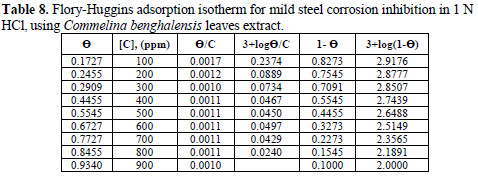
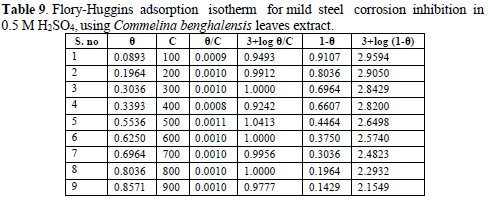
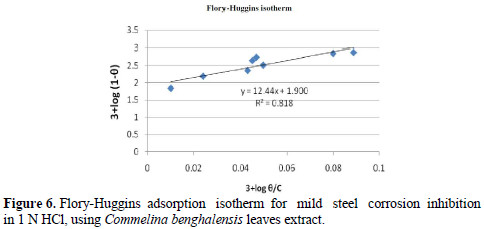
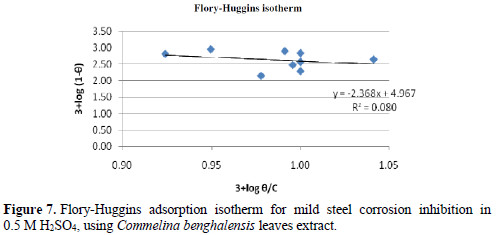
<body><![CDATA[<p>where 'x' is the size parameter, and it is a measure of the number of adsorbed  water molecules substituted by an inhibitor molecule. <a href="#t8">Tables 8</a> and <a href="#t9">9</a> and the  linear plot of 3+log &theta;/C against 3+log (1-&theta;) (<a href="#f6">Figs. 6</a> and <a href="#f7">7</a>) show that Flory-  Huggins isotherm was obeyed.</p>         <p>&nbsp;</p> <a name="t8"> <img src="/img/revistas/pea/v37n1/37n1a04t8.jpg">     
<p>&nbsp;</p> <a name="t9"> <img src="/img/revistas/pea/v37n1/37n1a04t9.jpg">     
<p>&nbsp;</p> <a name="f6"> <img src="/img/revistas/pea/v37n1/37n1a04f6.jpg">     
<p>&nbsp;</p> <a name="f7"> <img src="/img/revistas/pea/v37n1/37n1a04f7.jpg">     
<p>&nbsp;</p>        <p><b><i>El-Awady isotherm</i></b></p>       <p>El-Awady isotherm is given by the <a href="#e5">expression</a>:</p>        <p>&nbsp;</p> <a name="e5"> <img src="/img/revistas/pea/v37n1/37n1a04e5.jpg">     
<p>&nbsp;</p>       ]]></body>
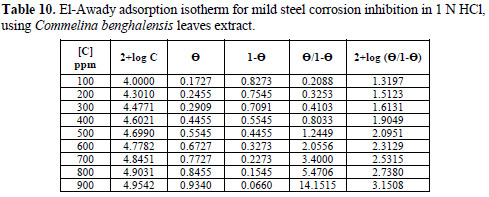
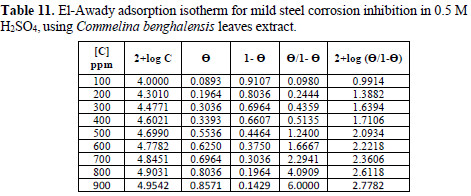
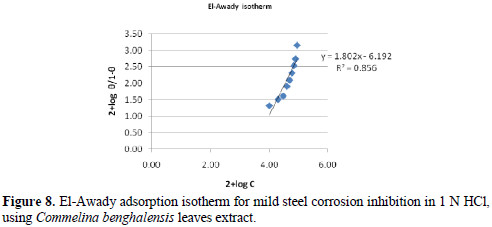
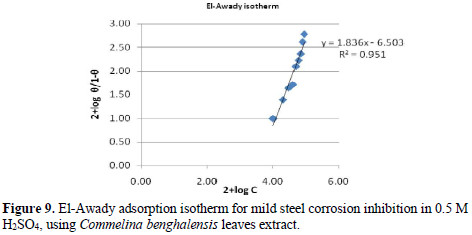
<body><![CDATA[<p>where K<sub>ads</sub> is the equilibrium constant of the adsorption process, calculated by  the relationship, K<sub>ads</sub> = 1/k. <a href="#t10">Tables 10</a> and <a href="#t11">11</a>, and a linear plot of 2+log (&theta;/1-&theta;)  against 2+log C (<a href="#f8">Figs. 8</a> and <a href="#f9">9</a>), show that El-Awady isotherm was obeyed.</p>         <p>&nbsp;</p> <a name="t10"> <img src="/img/revistas/pea/v37n1/37n1a04t10.jpg">     
<p>&nbsp;</p> <a name="t11"> <img src="/img/revistas/pea/v37n1/37n1a04t11.jpg">     
<p>&nbsp;</p> <a name="f8"> <img src="/img/revistas/pea/v37n1/37n1a04f8.jpg">     
<p>&nbsp;</p> <a name="f9"> <img src="/img/revistas/pea/v37n1/37n1a04f9.jpg">     
<p>&nbsp;</p>        <p><b><i>Free energy change</i></b></p>        <p>The inhibitor's free energy change of adsorption (&Delta;G<sup>0</sup> <sub>ads</sub>) onto mild steel surfaces  was related to the adsorption constant, according to the <a href="#e6">equation</a>:</p>        <p>&nbsp;</p> <a name="e6"> <img src="/img/revistas/pea/v37n1/37n1a04e6.jpg">     
<p>&nbsp;</p>         ]]></body>
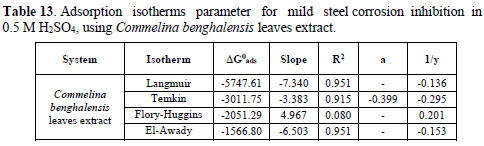
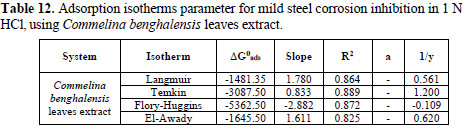
<body><![CDATA[<p>From the results, showed in <a href="#t12">Tables 12</a> and <a href="#t13">13</a>, &Delta;G<sup>0</sup><sub>ads</sub> values were found to be  negative, and were below the threshold value of -40kJ/mol, indicating that the  adsorption of <i>Commelina benghalensis</i> onto a mild steel surface is spontaneous,  and that the physical adsorption mechanism is applicable.       <p>&nbsp;</p> <a name="t12"> <img src="/img/revistas/pea/v37n1/37n1a04t12.jpg">     
<p>&nbsp;</p> <a name="t13"> <img src="/img/revistas/pea/v37n1/37n1a04t13.jpg">     
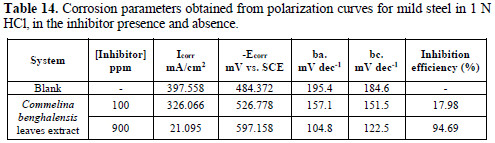
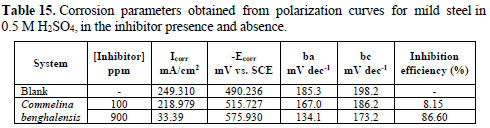
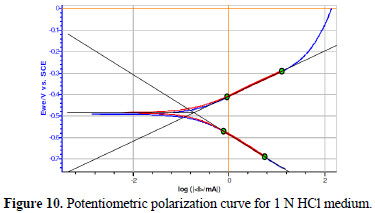
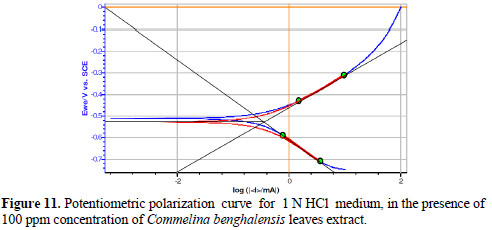
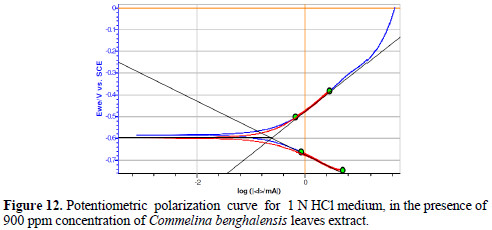
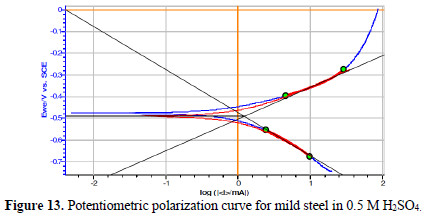
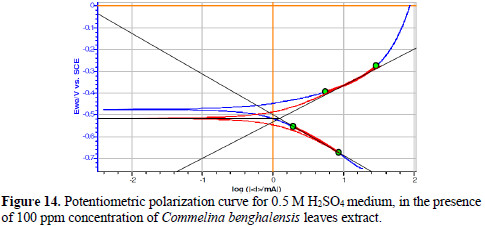
<p>&nbsp;</p>        <p><b><i>Potentiodynamic polarization studies</i></b></p>       <p>The polarization study has been used to investigate the formation of a protective  film during the corrosion inhibition study. Whenever there is corrosion  inhibition, the corrosion current value decreases [38-42].</p>       <p><a href="#t14">Tables 14</a> and <a href="#t15">15</a> and  <a href="#f10">Figs. 10</a> to <a href="#f15">15</a> give the potentiodynamic parameter values,  such as corrosion current (I</sub>corr</sub>), corrosion potential (E</sub>corr</sub>) and the cathodic Tafel  slopes (bc and ba) for the different concentrations shown in the green inhibitor  under study.</p>         <p>&nbsp;</p> <a name="t14"> <img src="/img/revistas/pea/v37n1/37n1a04t14.jpg">     
<p>&nbsp;</p> <a name="t15"> <img src="/img/revistas/pea/v37n1/37n1a04t15.jpg">     
<p>&nbsp;</p> <a name="f10"> <img src="/img/revistas/pea/v37n1/37n1a04f10.jpg">     
]]></body>
<body><![CDATA[<p>&nbsp;</p> <a name="f11"> <img src="/img/revistas/pea/v37n1/37n1a04f11.jpg">     
<p>&nbsp;</p> <a name="f12"> <img src="/img/revistas/pea/v37n1/37n1a04f12.jpg">     
<p>&nbsp;</p> <a name="f13"> <img src="/img/revistas/pea/v37n1/37n1a04f13.jpg">     
<p>&nbsp;</p> <a name="f14"> <img src="/img/revistas/pea/v37n1/37n1a04f14.jpg">     
<p>&nbsp;</p> <a name="f15"> <img src="/img/revistas/pea/v37n1/37n1a04f11.jpg">     
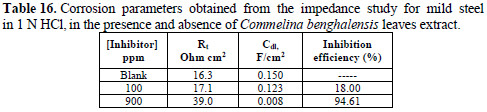
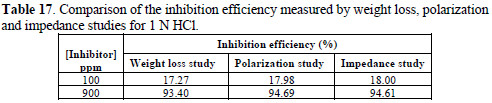
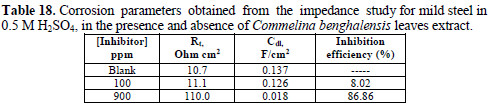
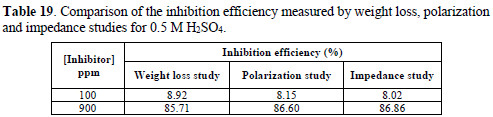
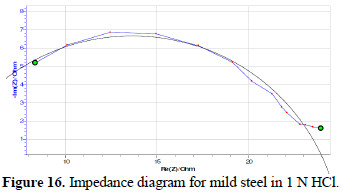
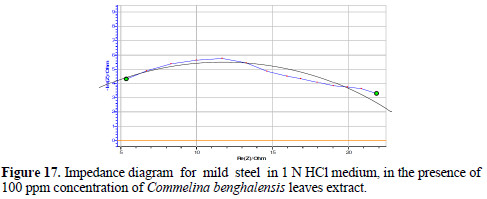
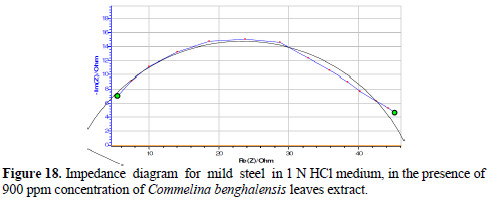
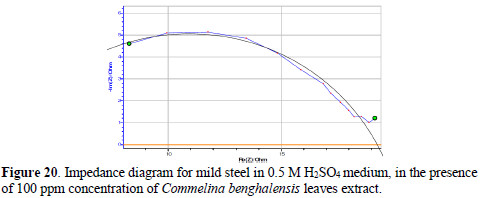
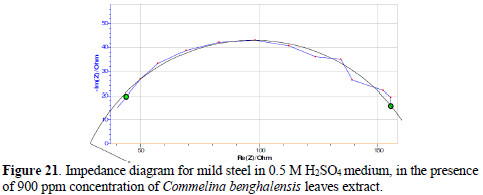
<p>&nbsp;</p>      <p>It can be seen that the active principles present in the extract have  been adsorbed onto the metal surface. When the inhibitor concentration is 100  ppm, the system functions as a mixed type inhibitor, because the shift in  corrosion potential is within 80 mV. However, at higher concentrations (900  ppm), the system functions as a cathodic type inhibitor, because the shift in the  corrosion potential is towards the cathodic side (more negative.</p>      <p><b><i>AC impedance study</i></b></p>       <p>AC impedance spectra have been used to investigate the formation of a  protective film on the metal surface, during the corrosion inhibition process.  When there is corrosion inhibition, charge transfer resistance value increases, and  double layer capacitance decreases [43-48].</p>      <p><a href="#t16">Tables 16</a> and <a href="#t18">18</a> and  <a href="#f16">Figs. 16</a> to <a href="#f21">21</a>  indicate AC impedance curves and values  for the inhibitor concentration. The Rt value increases, and Cdl value decreases  with the inhibitor concentration. This implies the formation of a protective film  on the metal surface. It can be also seen from  <a href="#t17">Tables 17</a> and <a href="#t19">19</a>  that there is a close agreement between the inhibition efficiencies values obtained from weight  loss measurements, polarization and impedance studies.</p>         ]]></body>
<body><![CDATA[<p>&nbsp;</p> <a name="t16"> <img src="/img/revistas/pea/v37n1/37n1a04t16.jpg">     
<p>&nbsp;</p> <a name="t17"> <img src="/img/revistas/pea/v37n1/37n1a04t17.jpg">     
<p>&nbsp;</p> <a name="t18"> <img src="/img/revistas/pea/v37n1/37n1a04t18.jpg">     
<p>&nbsp;</p> <a name="t19"> <img src="/img/revistas/pea/v37n1/37n1a04t19.jpg">     
<p>&nbsp;</p> <a name="f16"> <img src="/img/revistas/pea/v37n1/37n1a04f16.jpg">     
<p>&nbsp;</p> <a name="f17"> <img src="/img/revistas/pea/v37n1/37n1a04f17.jpg">     
<p>&nbsp;</p> <a name="f18"> <img src="/img/revistas/pea/v37n1/37n1a04f18.jpg">     
<p>&nbsp;</p> <a name="f20"> <img src="/img/revistas/pea/v37n1/37n1a04f20.jpg">     
<p>&nbsp;</p> <a name="f21"> <img src="/img/revistas/pea/v37n1/37n1a04f21.jpg">     
<p>&nbsp;</p>       ]]></body>
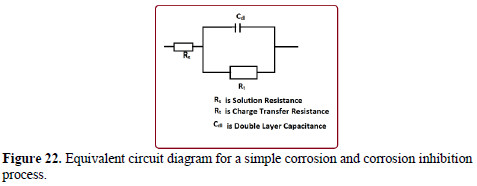
<body><![CDATA[<p>In the inhibitor presence,  a protective film is formed on the metal surface. It prevents electrons transfer  from the metal surface to the solution's bulk. That is why there is an increase in  the resistance to the electron transfer, and, in the inhibitor presence, the charge  transfer resistance increases.</p>      <p>It is inferred from the Nyquist plots that the process represents simple corrosion  and corrosion resistance. The equivalent circuit diagram for such a system is  shown in <a href="#f22">Fig. 22</a>.</p>        <p>&nbsp;</p> <a name="f22"> <img src="/img/revistas/pea/v37n1/37n1a04f22.jpg">     
<p>&nbsp;</p>       <p>&nbsp;</p>     <p><b>Conclusion</b></p>      <p>The inhibitive influence of Commelina benghalensis leaves extract on mild steel  corrosion in 1 N HCl and 0.5 M H2SO4 was studied by the weight loss method,  polarization and impedance measurements. The inhibition efficiency values  determined by these techniques showed close agreement. The corrosion  decreased with the increasing addition of Commelina benghalensis leaves  extract, probably due to the progressive adsorption of the inhibitor onto the metal  surface. The maximum inhibition efficiency was found to be 93.40% in 1 N HCl,  and 85.71% in 0.5 M H2SO4.</p>      <p>1. Mild steel corrosion in 1 N HCl and 0.5 M H2SO4 solutions was inhibited  by the addition of Commelina benghalensis leaves extract.</p>      <p>2. The percentage of inhibition efficiency increased with higher inhibitor  concentrations.</p>      <p>3. The corrosion inhibition of Commelina benghalensis leaves extract is  attributed to the adsorption of any of the phyto-chemical components  present in the inhibitor onto the mild steel surface. The adsorption was  assumed to arise from the -bond of the components onto the mild steel  surface.</p>      ]]></body>
<body><![CDATA[<p>4. The values obtained from the weight loss technique for the studied  inhibitor fit into the Langmuir and Temkin adsorption isotherms and the  kinetic thermodynamic model. The free energy values for the adsorption  processes indicate both physisorption and chemisorption (comprehensive  adsorption) of the studied Commelina benghalensis leaves extract onto the  mild steel surface.</p>      <p>5. AC impedance studies reveal that a protective film was formed on the  metal surface.</p>      <p>6. The results suggest that Commelina benghalensis leaves extract is a great  eco-friendly inhibitor.</p>      <p>7. The corrosion inhibition mechanism occurred by adsorption of the active  principles of the extract ingredients onto the metal surface.</p>       <p>&nbsp;</p>     <p><b>References</b></p>      <!-- ref --><p>1. Chraibi M, Benbrahim KF, Elmsellem H, et al. J Mater Environ Sci. 2017;8:972.    &nbsp;&nbsp;&nbsp;&nbsp;&nbsp;&nbsp;&nbsp;&nbsp;[&#160;<a href="javascript:void(0);" onclick="javascript: window.open('/scielo.php?script=sci_nlinks&ref=438853&pid=S0872-1904201900010000400001&lng=','','width=640,height=500,resizable=yes,scrollbars=1,menubar=yes,');">Links</a>&#160;]<!-- end-ref --></p>      <!-- ref --><p>2. Ajeigbe SO, Basar N, Maarof H, et al. J Mater Environ Sci. 2017;8:2040.    &nbsp;&nbsp;&nbsp;&nbsp;&nbsp;&nbsp;&nbsp;&nbsp;[&#160;<a href="javascript:void(0);" onclick="javascript: window.open('/scielo.php?script=sci_nlinks&ref=438855&pid=S0872-1904201900010000400002&lng=','','width=640,height=500,resizable=yes,scrollbars=1,menubar=yes,');">Links</a>&#160;]<!-- end-ref --></p>      ]]></body>
<body><![CDATA[<!-- ref --><p>3. Sivakumar PR, Srikanth AP. Asian J. Chem. 2017;29:274.    &nbsp;&nbsp;&nbsp;&nbsp;&nbsp;&nbsp;&nbsp;&nbsp;[&#160;<a href="javascript:void(0);" onclick="javascript: window.open('/scielo.php?script=sci_nlinks&ref=438857&pid=S0872-1904201900010000400003&lng=','','width=640,height=500,resizable=yes,scrollbars=1,menubar=yes,');">Links</a>&#160;]<!-- end-ref --></p>      <!-- ref --><p>4. Kalla A, Benahmed M, Djeddi N, et al. Int . Ind Chem. 2016;7:419.    &nbsp;&nbsp;&nbsp;&nbsp;&nbsp;&nbsp;&nbsp;&nbsp;[&#160;<a href="javascript:void(0);" onclick="javascript: window.open('/scielo.php?script=sci_nlinks&ref=438859&pid=S0872-1904201900010000400004&lng=','','width=640,height=500,resizable=yes,scrollbars=1,menubar=yes,');">Links</a>&#160;]<!-- end-ref --></p>      <!-- ref --><p>5. Singh A, Ahamad I, Quraishi MA. Arab J Chem. 2016;9:S1584.    &nbsp;&nbsp;&nbsp;&nbsp;&nbsp;&nbsp;&nbsp;&nbsp;[&#160;<a href="javascript:void(0);" onclick="javascript: window.open('/scielo.php?script=sci_nlinks&ref=438861&pid=S0872-1904201900010000400005&lng=','','width=640,height=500,resizable=yes,scrollbars=1,menubar=yes,');">Links</a>&#160;]<!-- end-ref --></p>      <!-- ref --><p>6. Junior JMF, Silva MGV, Monteiro JA, et al. Int J Electrochem Sci. 2016;11:3862.    &nbsp;&nbsp;&nbsp;&nbsp;&nbsp;&nbsp;&nbsp;&nbsp;[&#160;<a href="javascript:void(0);" onclick="javascript: window.open('/scielo.php?script=sci_nlinks&ref=438863&pid=S0872-1904201900010000400006&lng=','','width=640,height=500,resizable=yes,scrollbars=1,menubar=yes,');">Links</a>&#160;]<!-- end-ref --></p>      <!-- ref --><p>7. Etteyeb N, Novoa XR. Corros Sci. 2016;112:471.    &nbsp;&nbsp;&nbsp;&nbsp;&nbsp;&nbsp;&nbsp;&nbsp;[&#160;<a href="javascript:void(0);" onclick="javascript: window.open('/scielo.php?script=sci_nlinks&ref=438865&pid=S0872-1904201900010000400007&lng=','','width=640,height=500,resizable=yes,scrollbars=1,menubar=yes,');">Links</a>&#160;]<!-- end-ref --></p>      ]]></body>
<body><![CDATA[<!-- ref --><p>8. Ituen E, James A, Akaranta O, et al. Chin J Chem Eng. 2016;24:1442.    &nbsp;&nbsp;&nbsp;&nbsp;&nbsp;&nbsp;&nbsp;&nbsp;[&#160;<a href="javascript:void(0);" onclick="javascript: window.open('/scielo.php?script=sci_nlinks&ref=438867&pid=S0872-1904201900010000400008&lng=','','width=640,height=500,resizable=yes,scrollbars=1,menubar=yes,');">Links</a>&#160;]<!-- end-ref --></p>      <p>9. dos Santos JEP, Barroso APRN, Parente MMV, et al. Rev Materia. 2016;21:1045.</p>      <!-- ref --><p>10. Umoren SA. J Adhes Sci Technol. 2016;30:1858.    &nbsp;&nbsp;&nbsp;&nbsp;&nbsp;&nbsp;&nbsp;&nbsp;[&#160;<a href="javascript:void(0);" onclick="javascript: window.open('/scielo.php?script=sci_nlinks&ref=438870&pid=S0872-1904201900010000400010&lng=','','width=640,height=500,resizable=yes,scrollbars=1,menubar=yes,');">Links</a>&#160;]<!-- end-ref --></p>      <!-- ref --><p>11. Anthony N, Malarvizhi E, Maheshwari P, et al. Indian J Chem Technol. 2014;11:346.    &nbsp;&nbsp;&nbsp;&nbsp;&nbsp;&nbsp;&nbsp;&nbsp;[&#160;<a href="javascript:void(0);" onclick="javascript: window.open('/scielo.php?script=sci_nlinks&ref=438872&pid=S0872-1904201900010000400011&lng=','','width=640,height=500,resizable=yes,scrollbars=1,menubar=yes,');">Links</a>&#160;]<!-- end-ref --></p>      <!-- ref --><p>12. Rajendran S, Amalraj AJ, Joice MJ, et al. Corros Rev. 2014;22:233.    &nbsp;&nbsp;&nbsp;&nbsp;&nbsp;&nbsp;&nbsp;&nbsp;[&#160;<a href="javascript:void(0);" onclick="javascript: window.open('/scielo.php?script=sci_nlinks&ref=438874&pid=S0872-1904201900010000400012&lng=','','width=640,height=500,resizable=yes,scrollbars=1,menubar=yes,');">Links</a>&#160;]<!-- end-ref --></p>      <p>13. Rajendran S, Ganga Sri V, Arockiaselvi J, et al. Bull Electrochem. 2005;21:367.</p>      ]]></body>
<body><![CDATA[<!-- ref --><p>14. Rajendran S, Muthulakshmi S, Rajeswari R, et al. J Electrochem Soc. 2005;54:50.    &nbsp;&nbsp;&nbsp;&nbsp;&nbsp;&nbsp;&nbsp;&nbsp;[&#160;<a href="javascript:void(0);" onclick="javascript: window.open('/scielo.php?script=sci_nlinks&ref=438877&pid=S0872-1904201900010000400014&lng=','','width=640,height=500,resizable=yes,scrollbars=1,menubar=yes,');">Links</a>&#160;]<!-- end-ref --></p>      <!-- ref --><p>15. Priya SL, Chitra A, Rajendran S, et al. Surf Eng. 2005;21:229.    &nbsp;&nbsp;&nbsp;&nbsp;&nbsp;&nbsp;&nbsp;&nbsp;[&#160;<a href="javascript:void(0);" onclick="javascript: window.open('/scielo.php?script=sci_nlinks&ref=438879&pid=S0872-1904201900010000400015&lng=','','width=640,height=500,resizable=yes,scrollbars=1,menubar=yes,');">Links</a>&#160;]<!-- end-ref --></p>      <p>16. Shanmugapriya S, Rajalakshmi T, Amal Raj AJ. Corrosion. 2005;61:685.</p>      <!-- ref --><p>17. Anuradha K, Vimala R, Narayanasamy B, et al. Chem Eng Comm. 2008;195:352.    &nbsp;&nbsp;&nbsp;&nbsp;&nbsp;&nbsp;&nbsp;&nbsp;[&#160;<a href="javascript:void(0);" onclick="javascript: window.open('/scielo.php?script=sci_nlinks&ref=438882&pid=S0872-1904201900010000400017&lng=','','width=640,height=500,resizable=yes,scrollbars=1,menubar=yes,');">Links</a>&#160;]<!-- end-ref --></p>      <!-- ref --><p>18. Selvi JA, Gangasree V, Rajendran S. Port Electrochim Acta. 2008;27:1.    &nbsp;&nbsp;&nbsp;&nbsp;&nbsp;&nbsp;&nbsp;&nbsp;[&#160;<a href="javascript:void(0);" onclick="javascript: window.open('/scielo.php?script=sci_nlinks&ref=438884&pid=S0872-1904201900010000400018&lng=','','width=640,height=500,resizable=yes,scrollbars=1,menubar=yes,');">Links</a>&#160;]<!-- end-ref --></p>      <p>19. Rajendran S, Jeyasundari J, Selvi JA, et al. Port Electrochim Acta. 2009;27:153.</p>      ]]></body>
<body><![CDATA[<!-- ref --><p>20. Rajendran S, Paulraj J, Rengan P, et al. J Dent Oral Hyg. 2009;1:1.    &nbsp;&nbsp;&nbsp;&nbsp;&nbsp;&nbsp;&nbsp;&nbsp;[&#160;<a href="javascript:void(0);" onclick="javascript: window.open('/scielo.php?script=sci_nlinks&ref=438887&pid=S0872-1904201900010000400020&lng=','','width=640,height=500,resizable=yes,scrollbars=1,menubar=yes,');">Links</a>&#160;]<!-- end-ref --></p>      <!-- ref --><p>21. Rajendran S, Manivannan M. Zastit Mater. 2009;50:131.    &nbsp;&nbsp;&nbsp;&nbsp;&nbsp;&nbsp;&nbsp;&nbsp;[&#160;<a href="javascript:void(0);" onclick="javascript: window.open('/scielo.php?script=sci_nlinks&ref=438889&pid=S0872-1904201900010000400021&lng=','','width=640,height=500,resizable=yes,scrollbars=1,menubar=yes,');">Links</a>&#160;]<!-- end-ref --></p>      <!-- ref --><p>22. Rajendran S, Agasta M, Devi RB, et al. Zastit Mater. 2009;50:77.    &nbsp;&nbsp;&nbsp;&nbsp;&nbsp;&nbsp;&nbsp;&nbsp;[&#160;<a href="javascript:void(0);" onclick="javascript: window.open('/scielo.php?script=sci_nlinks&ref=438891&pid=S0872-1904201900010000400022&lng=','','width=640,height=500,resizable=yes,scrollbars=1,menubar=yes,');">Links</a>&#160;]<!-- end-ref --></p>      <!-- ref --><p>23. Rajendran S, Sumithira P, Devi BS, et al. Zastit Mater. 2009;50:223.    &nbsp;&nbsp;&nbsp;&nbsp;&nbsp;&nbsp;&nbsp;&nbsp;[&#160;<a href="javascript:void(0);" onclick="javascript: window.open('/scielo.php?script=sci_nlinks&ref=438893&pid=S0872-1904201900010000400023&lng=','','width=640,height=500,resizable=yes,scrollbars=1,menubar=yes,');">Links</a>&#160;]<!-- end-ref --></p>      <!-- ref --><p>24. Rajendran S, Uma V, Krishnaveni A, et al. Arab J Sci Eng. 2009;34:47.    &nbsp;&nbsp;&nbsp;&nbsp;&nbsp;&nbsp;&nbsp;&nbsp;[&#160;<a href="javascript:void(0);" onclick="javascript: window.open('/scielo.php?script=sci_nlinks&ref=438895&pid=S0872-1904201900010000400024&lng=','','width=640,height=500,resizable=yes,scrollbars=1,menubar=yes,');">Links</a>&#160;]<!-- end-ref --></p>      ]]></body>
<body><![CDATA[<!-- ref --><p>25. Anthony N, Sherina HB, Rajendran S. Int J Eng Sci Tech. 2009;2:2774.    &nbsp;&nbsp;&nbsp;&nbsp;&nbsp;&nbsp;&nbsp;&nbsp;[&#160;<a href="javascript:void(0);" onclick="javascript: window.open('/scielo.php?script=sci_nlinks&ref=438897&pid=S0872-1904201900010000400025&lng=','','width=640,height=500,resizable=yes,scrollbars=1,menubar=yes,');">Links</a>&#160;]<!-- end-ref --></p>      <!-- ref --><p>26. Rajendran S, Sumithra P, Devi BS, et al. Zastit Mater. 2009;5:223.    &nbsp;&nbsp;&nbsp;&nbsp;&nbsp;&nbsp;&nbsp;&nbsp;[&#160;<a href="javascript:void(0);" onclick="javascript: window.open('/scielo.php?script=sci_nlinks&ref=438899&pid=S0872-1904201900010000400026&lng=','','width=640,height=500,resizable=yes,scrollbars=1,menubar=yes,');">Links</a>&#160;]<!-- end-ref --></p>      <!-- ref --><p>27. Sangeetha M, Rajendran S, Megala TSM, et al. Zastit Mater. 2009;52:35.    &nbsp;&nbsp;&nbsp;&nbsp;&nbsp;&nbsp;&nbsp;&nbsp;[&#160;<a href="javascript:void(0);" onclick="javascript: window.open('/scielo.php?script=sci_nlinks&ref=438901&pid=S0872-1904201900010000400027&lng=','','width=640,height=500,resizable=yes,scrollbars=1,menubar=yes,');">Links</a>&#160;]<!-- end-ref --></p>      <!-- ref --><p>28. Devi BS, Rajendran S. Int J Electrochem Sci Tech. 2009;1:79.    &nbsp;&nbsp;&nbsp;&nbsp;&nbsp;&nbsp;&nbsp;&nbsp;[&#160;<a href="javascript:void(0);" onclick="javascript: window.open('/scielo.php?script=sci_nlinks&ref=438903&pid=S0872-1904201900010000400028&lng=','','width=640,height=500,resizable=yes,scrollbars=1,menubar=yes,');">Links</a>&#160;]<!-- end-ref --></p>      <!-- ref --><p>29. Sirbharathy V, Rajendran S, Sathyabama J. Int J Chem Sci Tech. 2011;1:108.    &nbsp;&nbsp;&nbsp;&nbsp;&nbsp;&nbsp;&nbsp;&nbsp;[&#160;<a href="javascript:void(0);" onclick="javascript: window.open('/scielo.php?script=sci_nlinks&ref=438905&pid=S0872-1904201900010000400029&lng=','','width=640,height=500,resizable=yes,scrollbars=1,menubar=yes,');">Links</a>&#160;]<!-- end-ref --></p>      ]]></body>
<body><![CDATA[<!-- ref --><p>30. Sangeetha M, Rajendran S, Bama JS, et al. Port Electrochim Acta. 2011;29:429.    &nbsp;&nbsp;&nbsp;&nbsp;&nbsp;&nbsp;&nbsp;&nbsp;[&#160;<a href="javascript:void(0);" onclick="javascript: window.open('/scielo.php?script=sci_nlinks&ref=438907&pid=S0872-1904201900010000400030&lng=','','width=640,height=500,resizable=yes,scrollbars=1,menubar=yes,');">Links</a>&#160;]<!-- end-ref --></p>      <!-- ref --><p>31. Sangeetha M, Sathyabama J, Rajendran S, et al. Nat Prod Plant Res. 2012;2:601.    &nbsp;&nbsp;&nbsp;&nbsp;&nbsp;&nbsp;&nbsp;&nbsp;[&#160;<a href="javascript:void(0);" onclick="javascript: window.open('/scielo.php?script=sci_nlinks&ref=438909&pid=S0872-1904201900010000400031&lng=','','width=640,height=500,resizable=yes,scrollbars=1,menubar=yes,');">Links</a>&#160;]<!-- end-ref --></p>      <!-- ref --><p>32. Florence JF, Rajendran S, Srinivasan KV. Electroplating Finishing. 2012;31:1.    &nbsp;&nbsp;&nbsp;&nbsp;&nbsp;&nbsp;&nbsp;&nbsp;[&#160;<a href="javascript:void(0);" onclick="javascript: window.open('/scielo.php?script=sci_nlinks&ref=438911&pid=S0872-1904201900010000400032&lng=','','width=640,height=500,resizable=yes,scrollbars=1,menubar=yes,');">Links</a>&#160;]<!-- end-ref --></p>      <!-- ref --><p>33. Sirbharathy V, Rajendran S. Chem Sci Rev Lett. 2012;1:25.    &nbsp;&nbsp;&nbsp;&nbsp;&nbsp;&nbsp;&nbsp;&nbsp;[&#160;<a href="javascript:void(0);" onclick="javascript: window.open('/scielo.php?script=sci_nlinks&ref=438913&pid=S0872-1904201900010000400033&lng=','','width=640,height=500,resizable=yes,scrollbars=1,menubar=yes,');">Links</a>&#160;]<!-- end-ref --></p>      <!-- ref --><p>34. Rajam K, Rajendran S, Banu NN. J Chem. 2012;11:521951.    &nbsp;&nbsp;&nbsp;&nbsp;&nbsp;&nbsp;&nbsp;&nbsp;[&#160;<a href="javascript:void(0);" onclick="javascript: window.open('/scielo.php?script=sci_nlinks&ref=438915&pid=S0872-1904201900010000400034&lng=','','width=640,height=500,resizable=yes,scrollbars=1,menubar=yes,');">Links</a>&#160;]<!-- end-ref --></p>      ]]></body>
<body><![CDATA[<!-- ref --><p>35. Johnsirani V, Sathiyabama J, Rajendran S, et al. ISRN Corros. 2012;9:574321.    &nbsp;&nbsp;&nbsp;&nbsp;&nbsp;&nbsp;&nbsp;&nbsp;[&#160;<a href="javascript:void(0);" onclick="javascript: window.open('/scielo.php?script=sci_nlinks&ref=438917&pid=S0872-1904201900010000400035&lng=','','width=640,height=500,resizable=yes,scrollbars=1,menubar=yes,');">Links</a>&#160;]<!-- end-ref --></p>      <p>36. Sribharathy V, and Rajendran S. ISRN Corros, Article ID 370802, 2012.</p>      <!-- ref --><p>37. Tadesse S, Ganesan K, Nair SKP, et al. Int J Pharm, Chem Biol Sci. 2016;6:103.    &nbsp;&nbsp;&nbsp;&nbsp;&nbsp;&nbsp;&nbsp;&nbsp;[&#160;<a href="javascript:void(0);" onclick="javascript: window.open('/scielo.php?script=sci_nlinks&ref=438920&pid=S0872-1904201900010000400037&lng=','','width=640,height=500,resizable=yes,scrollbars=1,menubar=yes,');">Links</a>&#160;]<!-- end-ref --></p>      <!-- ref --><p>38. Shanmugapriya S, Rajendran S, Prabakar P, et al. Int J Nano Corr Sci Eng. 2016;3:144.    &nbsp;&nbsp;&nbsp;&nbsp;&nbsp;&nbsp;&nbsp;&nbsp;[&#160;<a href="javascript:void(0);" onclick="javascript: window.open('/scielo.php?script=sci_nlinks&ref=438922&pid=S0872-1904201900010000400038&lng=','','width=640,height=500,resizable=yes,scrollbars=1,menubar=yes,');">Links</a>&#160;]<!-- end-ref --></p>      <!-- ref --><p>39. Anusuya S, Meenakshi SD. Int J Nano Corr Sci Eng. 2016;3:204.    &nbsp;&nbsp;&nbsp;&nbsp;&nbsp;&nbsp;&nbsp;&nbsp;[&#160;<a href="javascript:void(0);" onclick="javascript: window.open('/scielo.php?script=sci_nlinks&ref=438924&pid=S0872-1904201900010000400039&lng=','','width=640,height=500,resizable=yes,scrollbars=1,menubar=yes,');">Links</a>&#160;]<!-- end-ref --></p>      <!-- ref --><p>40. Abinaya M, Meenakshi SD. Int J Nano Corr Sci Eng. 2016;3:216.    &nbsp;&nbsp;&nbsp;&nbsp;&nbsp;&nbsp;&nbsp;&nbsp;[&#160;<a href="javascript:void(0);" onclick="javascript: window.open('/scielo.php?script=sci_nlinks&ref=438926&pid=S0872-1904201900010000400040&lng=','','width=640,height=500,resizable=yes,scrollbars=1,menubar=yes,');">Links</a>&#160;]<!-- end-ref --></p>      <!-- ref --><p>41. Rajendran S, Krishnaveni A, Muthukumar G. Int J Nano Corr Sci Eng. 2016;3:254.    &nbsp;&nbsp;&nbsp;&nbsp;&nbsp;&nbsp;&nbsp;&nbsp;[&#160;<a href="javascript:void(0);" onclick="javascript: window.open('/scielo.php?script=sci_nlinks&ref=438928&pid=S0872-1904201900010000400041&lng=','','width=640,height=500,resizable=yes,scrollbars=1,menubar=yes,');">Links</a>&#160;]<!-- end-ref --></p>      <!-- ref --><p>42. Thangakani JA, Rajendran S, Sathiabama J. Int J Nano Corr Sci Eng. 2016;3:280.    &nbsp;&nbsp;&nbsp;&nbsp;&nbsp;&nbsp;&nbsp;&nbsp;[&#160;<a href="javascript:void(0);" onclick="javascript: window.open('/scielo.php?script=sci_nlinks&ref=438930&pid=S0872-1904201900010000400042&lng=','','width=640,height=500,resizable=yes,scrollbars=1,menubar=yes,');">Links</a>&#160;]<!-- end-ref --></p>      <!-- ref --><p>43. Lavanyaa M, Suganya M. Int J Nano Corr Sci Eng. 2016;3:88.    &nbsp;&nbsp;&nbsp;&nbsp;&nbsp;&nbsp;&nbsp;&nbsp;[&#160;<a href="javascript:void(0);" onclick="javascript: window.open('/scielo.php?script=sci_nlinks&ref=438932&pid=S0872-1904201900010000400043&lng=','','width=640,height=500,resizable=yes,scrollbars=1,menubar=yes,');">Links</a>&#160;]<!-- end-ref --></p>      <!-- ref --><p>44. Vanitha AJ, Raja AS, Rajendran S. Int J Nano Corr Sci Eng. 2016;3:223.    &nbsp;&nbsp;&nbsp;&nbsp;&nbsp;&nbsp;&nbsp;&nbsp;[&#160;<a href="javascript:void(0);" onclick="javascript: window.open('/scielo.php?script=sci_nlinks&ref=438934&pid=S0872-1904201900010000400044&lng=','','width=640,height=500,resizable=yes,scrollbars=1,menubar=yes,');">Links</a>&#160;]<!-- end-ref --></p>      <!-- ref --><p>45. Anandan A, Rajendran S, Sathiyabama J, et al. Int J Nano Corr Sci Eng. 2016;3:9.    &nbsp;&nbsp;&nbsp;&nbsp;&nbsp;&nbsp;&nbsp;&nbsp;[&#160;<a href="javascript:void(0);" onclick="javascript: window.open('/scielo.php?script=sci_nlinks&ref=438936&pid=S0872-1904201900010000400045&lng=','','width=640,height=500,resizable=yes,scrollbars=1,menubar=yes,');">Links</a>&#160;]<!-- end-ref --></p>      <!-- ref --><p>46. Nithya K, Meenakshi SD. Int J Nano Corr Sci Eng. 2016;3:44.    &nbsp;&nbsp;&nbsp;&nbsp;&nbsp;&nbsp;&nbsp;&nbsp;[&#160;<a href="javascript:void(0);" onclick="javascript: window.open('/scielo.php?script=sci_nlinks&ref=438938&pid=S0872-1904201900010000400046&lng=','','width=640,height=500,resizable=yes,scrollbars=1,menubar=yes,');">Links</a>&#160;]<!-- end-ref --></p>      <!-- ref --><p>47. Devi PN, Sathiyabama J, Rajendran S, et al. Int J Nano Corr Sci Eng. 2016;3:56.    &nbsp;&nbsp;&nbsp;&nbsp;&nbsp;&nbsp;&nbsp;&nbsp;[&#160;<a href="javascript:void(0);" onclick="javascript: window.open('/scielo.php?script=sci_nlinks&ref=438940&pid=S0872-1904201900010000400047&lng=','','width=640,height=500,resizable=yes,scrollbars=1,menubar=yes,');">Links</a>&#160;]<!-- end-ref --></p>      <!-- ref --><p>48. Madhumitha S, Priyadharshini V, Sheela A, et al. Int J Nano Corr Sci Eng. 2016;3:80.    &nbsp;&nbsp;&nbsp;&nbsp;&nbsp;&nbsp;&nbsp;&nbsp;[&#160;<a href="javascript:void(0);" onclick="javascript: window.open('/scielo.php?script=sci_nlinks&ref=438942&pid=S0872-1904201900010000400048&lng=','','width=640,height=500,resizable=yes,scrollbars=1,menubar=yes,');">Links</a>&#160;]<!-- end-ref --></p>       <p>&nbsp;</p>     <p><b>Acknowledgement</b></p>      <p>The authors are thankful to their managements for their help and encouragement.</p>       ]]></body>
<body><![CDATA[<p>&nbsp;</p>      <p><a name=0></a><sup><a href="#top">*</a></sup>Corresponding author. E-mail address: <a href="mailto:farzana.arifa@yahoo.com">farzana.arifa@yahoo.com</a></p>      <p>Received June 27, 2017; accepted March 12, 2018 </p>          <p><a href="http://www.peacta.org" target="_blank">www.peacta.org</a> </p>              ]]></body><back>
<ref-list>
<ref id="B1">
<label>1</label><nlm-citation citation-type="journal">
<person-group person-group-type="author">
<name>
<surname><![CDATA[Chraibi]]></surname>
<given-names><![CDATA[M]]></given-names>
</name>
<name>
<surname><![CDATA[Benbrahim]]></surname>
<given-names><![CDATA[K F]]></given-names>
</name>
<name>
<surname><![CDATA[Elmsellem]]></surname>
<given-names><![CDATA[H]]></given-names>
</name>
</person-group>
<source><![CDATA[J Mater Environ Sci]]></source>
<year>2017</year>
<volume>8</volume>
<page-range>972</page-range></nlm-citation>
</ref>
<ref id="B2">
<label>2</label><nlm-citation citation-type="journal">
<person-group person-group-type="author">
<name>
<surname><![CDATA[Ajeigbe]]></surname>
<given-names><![CDATA[SO]]></given-names>
</name>
<name>
<surname><![CDATA[Basar]]></surname>
<given-names><![CDATA[N]]></given-names>
</name>
<name>
<surname><![CDATA[Maarof]]></surname>
<given-names><![CDATA[H]]></given-names>
</name>
</person-group>
<source><![CDATA[J Mater Environ Sci]]></source>
<year>2017</year>
<volume>8</volume>
<page-range>2040</page-range></nlm-citation>
</ref>
<ref id="B3">
<label>3</label><nlm-citation citation-type="journal">
<person-group person-group-type="author">
<name>
<surname><![CDATA[Sivakumar]]></surname>
<given-names><![CDATA[P R]]></given-names>
</name>
<name>
<surname><![CDATA[Srikanth]]></surname>
<given-names><![CDATA[A P]]></given-names>
</name>
</person-group>
<source><![CDATA[Asian J. Chem]]></source>
<year>2017</year>
<volume>29</volume>
<page-range>274</page-range></nlm-citation>
</ref>
<ref id="B4">
<label>4</label><nlm-citation citation-type="journal">
<person-group person-group-type="author">
<name>
<surname><![CDATA[Kalla]]></surname>
<given-names><![CDATA[A]]></given-names>
</name>
<name>
<surname><![CDATA[Benahmed]]></surname>
<given-names><![CDATA[M]]></given-names>
</name>
<name>
<surname><![CDATA[Djeddi]]></surname>
<given-names><![CDATA[N]]></given-names>
</name>
</person-group>
<source><![CDATA[Int . Ind Chem]]></source>
<year>2016</year>
<volume>7</volume>
<page-range>419</page-range></nlm-citation>
</ref>
<ref id="B5">
<label>5</label><nlm-citation citation-type="journal">
<person-group person-group-type="author">
<name>
<surname><![CDATA[Singh]]></surname>
<given-names><![CDATA[A]]></given-names>
</name>
<name>
<surname><![CDATA[Ahamad]]></surname>
<given-names><![CDATA[I]]></given-names>
</name>
<name>
<surname><![CDATA[Quraishi]]></surname>
<given-names><![CDATA[M A]]></given-names>
</name>
</person-group>
<source><![CDATA[Arab J Chem]]></source>
<year>2016</year>
<volume>9</volume>
<page-range>S1584</page-range></nlm-citation>
</ref>
<ref id="B6">
<label>6</label><nlm-citation citation-type="journal">
<person-group person-group-type="author">
<name>
<surname><![CDATA[Junior]]></surname>
<given-names><![CDATA[J M F]]></given-names>
</name>
<name>
<surname><![CDATA[Silva]]></surname>
<given-names><![CDATA[M G V]]></given-names>
</name>
<name>
<surname><![CDATA[Monteiro]]></surname>
<given-names><![CDATA[J A]]></given-names>
</name>
</person-group>
<source><![CDATA[Int J Electrochem Sci]]></source>
<year>2016</year>
<volume>11</volume>
<page-range>3862</page-range></nlm-citation>
</ref>
<ref id="B7">
<label>7</label><nlm-citation citation-type="journal">
<person-group person-group-type="author">
<name>
<surname><![CDATA[Etteyeb]]></surname>
<given-names><![CDATA[N]]></given-names>
</name>
<name>
<surname><![CDATA[Novoa]]></surname>
<given-names><![CDATA[X R]]></given-names>
</name>
</person-group>
<source><![CDATA[Corros Sci]]></source>
<year>2016</year>
<volume>112</volume>
<page-range>471</page-range></nlm-citation>
</ref>
<ref id="B8">
<label>8</label><nlm-citation citation-type="journal">
<person-group person-group-type="author">
<name>
<surname><![CDATA[Ituen]]></surname>
<given-names><![CDATA[E]]></given-names>
</name>
<name>
<surname><![CDATA[James]]></surname>
<given-names><![CDATA[A]]></given-names>
</name>
<name>
<surname><![CDATA[Akaranta]]></surname>
<given-names><![CDATA[O]]></given-names>
</name>
</person-group>
<source><![CDATA[Chin J Chem Eng]]></source>
<year>2016</year>
<volume>24</volume>
<page-range>1442</page-range></nlm-citation>
</ref>
<ref id="B9">
<label>9</label><nlm-citation citation-type="journal">
<person-group person-group-type="author">
<name>
<surname><![CDATA[Santos]]></surname>
<given-names><![CDATA[J E P]]></given-names>
</name>
<name>
<surname><![CDATA[Barroso]]></surname>
<given-names><![CDATA[A P R N]]></given-names>
</name>
<name>
<surname><![CDATA[Parente]]></surname>
<given-names><![CDATA[M M V]]></given-names>
</name>
</person-group>
<source><![CDATA[Rev Materia]]></source>
<year>2016</year>
<volume>21</volume>
<page-range>1045</page-range></nlm-citation>
</ref>
<ref id="B10">
<label>10</label><nlm-citation citation-type="journal">
<person-group person-group-type="author">
<name>
<surname><![CDATA[Umoren]]></surname>
<given-names><![CDATA[S A]]></given-names>
</name>
</person-group>
<source><![CDATA[J Adhes Sci Technol]]></source>
<year>2016</year>
<volume>30</volume>
<page-range>1858</page-range></nlm-citation>
</ref>
<ref id="B11">
<label>11</label><nlm-citation citation-type="journal">
<person-group person-group-type="author">
<name>
<surname><![CDATA[Anthony]]></surname>
<given-names><![CDATA[N]]></given-names>
</name>
<name>
<surname><![CDATA[Malarvizhi]]></surname>
<given-names><![CDATA[E]]></given-names>
</name>
<name>
<surname><![CDATA[Maheshwari]]></surname>
<given-names><![CDATA[P]]></given-names>
</name>
</person-group>
<source><![CDATA[Indian J Chem Technol]]></source>
<year>2014</year>
<volume>11</volume>
<page-range>346</page-range></nlm-citation>
</ref>
<ref id="B12">
<label>12</label><nlm-citation citation-type="journal">
<person-group person-group-type="author">
<name>
<surname><![CDATA[Rajendran]]></surname>
<given-names><![CDATA[S]]></given-names>
</name>
<name>
<surname><![CDATA[Amalraj]]></surname>
<given-names><![CDATA[A J]]></given-names>
</name>
<name>
<surname><![CDATA[Joice]]></surname>
<given-names><![CDATA[M J]]></given-names>
</name>
</person-group>
<source><![CDATA[Corros Rev]]></source>
<year>2014</year>
<volume>22</volume>
<page-range>233</page-range></nlm-citation>
</ref>
<ref id="B13">
<label>13</label><nlm-citation citation-type="journal">
<person-group person-group-type="author">
<name>
<surname><![CDATA[Rajendran]]></surname>
<given-names><![CDATA[S]]></given-names>
</name>
<name>
<surname><![CDATA[Ganga]]></surname>
<given-names><![CDATA[S V]]></given-names>
</name>
<name>
<surname><![CDATA[Arockiaselvi]]></surname>
<given-names><![CDATA[J]]></given-names>
</name>
</person-group>
<source><![CDATA[Bull Electrochem]]></source>
<year>2005</year>
<volume>21</volume>
<page-range>367</page-range></nlm-citation>
</ref>
<ref id="B14">
<label>14</label><nlm-citation citation-type="journal">
<person-group person-group-type="author">
<name>
<surname><![CDATA[Rajendran]]></surname>
<given-names><![CDATA[S]]></given-names>
</name>
<name>
<surname><![CDATA[Muthulakshmi]]></surname>
<given-names><![CDATA[S]]></given-names>
</name>
<name>
<surname><![CDATA[Rajeswari]]></surname>
<given-names><![CDATA[R]]></given-names>
</name>
</person-group>
<source><![CDATA[J Electrochem Soc]]></source>
<year>2005</year>
<volume>54</volume>
<page-range>50</page-range></nlm-citation>
</ref>
<ref id="B15">
<label>15</label><nlm-citation citation-type="journal">
<person-group person-group-type="author">
<name>
<surname><![CDATA[Priya]]></surname>
<given-names><![CDATA[S L]]></given-names>
</name>
<name>
<surname><![CDATA[Chitra]]></surname>
<given-names><![CDATA[A]]></given-names>
</name>
<name>
<surname><![CDATA[Rajendran]]></surname>
<given-names><![CDATA[S]]></given-names>
</name>
</person-group>
<source><![CDATA[Surf Eng]]></source>
<year>2005</year>
<volume>21</volume>
<page-range>229</page-range></nlm-citation>
</ref>
<ref id="B16">
<label>16</label><nlm-citation citation-type="journal">
<person-group person-group-type="author">
<name>
<surname><![CDATA[Shanmugapriya]]></surname>
<given-names><![CDATA[S]]></given-names>
</name>
<name>
<surname><![CDATA[Rajalakshmi]]></surname>
<given-names><![CDATA[T]]></given-names>
</name>
<name>
<surname><![CDATA[Amal]]></surname>
<given-names><![CDATA[R A J]]></given-names>
</name>
</person-group>
<source><![CDATA[Corrosion]]></source>
<year>2005</year>
<volume>61</volume>
<page-range>685</page-range></nlm-citation>
</ref>
<ref id="B17">
<label>17</label><nlm-citation citation-type="journal">
<person-group person-group-type="author">
<name>
<surname><![CDATA[Anuradha]]></surname>
<given-names><![CDATA[K]]></given-names>
</name>
<name>
<surname><![CDATA[Vimala]]></surname>
<given-names><![CDATA[R]]></given-names>
</name>
<name>
<surname><![CDATA[Narayanasamy]]></surname>
<given-names><![CDATA[B]]></given-names>
</name>
</person-group>
<source><![CDATA[Chem Eng Comm]]></source>
<year>2008</year>
<volume>195</volume>
<page-range>352</page-range></nlm-citation>
</ref>
<ref id="B18">
<label>18</label><nlm-citation citation-type="journal">
<person-group person-group-type="author">
<name>
<surname><![CDATA[Selvi]]></surname>
<given-names><![CDATA[J A]]></given-names>
</name>
<name>
<surname><![CDATA[Gangasree]]></surname>
<given-names><![CDATA[V]]></given-names>
</name>
<name>
<surname><![CDATA[Rajendran]]></surname>
<given-names><![CDATA[S]]></given-names>
</name>
</person-group>
<source><![CDATA[Port Electrochim Acta]]></source>
<year>2008</year>
<volume>27</volume>
<page-range>1</page-range></nlm-citation>
</ref>
<ref id="B19">
<label>19</label><nlm-citation citation-type="journal">
<person-group person-group-type="author">
<name>
<surname><![CDATA[Rajendran]]></surname>
<given-names><![CDATA[S]]></given-names>
</name>
<name>
<surname><![CDATA[Jeyasundari]]></surname>
<given-names><![CDATA[J]]></given-names>
</name>
<name>
<surname><![CDATA[Selvi]]></surname>
<given-names><![CDATA[J A]]></given-names>
</name>
</person-group>
<source><![CDATA[Port Electrochim Acta]]></source>
<year>2009</year>
<volume>27</volume>
<page-range>153</page-range></nlm-citation>
</ref>
<ref id="B20">
<label>20</label><nlm-citation citation-type="journal">
<person-group person-group-type="author">
<name>
<surname><![CDATA[Rajendran]]></surname>
<given-names><![CDATA[S]]></given-names>
</name>
<name>
<surname><![CDATA[Paulraj]]></surname>
<given-names><![CDATA[J]]></given-names>
</name>
<name>
<surname><![CDATA[Rengan]]></surname>
<given-names><![CDATA[P]]></given-names>
</name>
</person-group>
<source><![CDATA[J Dent Oral Hyg]]></source>
<year>2009</year>
<volume>1</volume>
<page-range>1</page-range></nlm-citation>
</ref>
<ref id="B21">
<label>21</label><nlm-citation citation-type="journal">
<person-group person-group-type="author">
<name>
<surname><![CDATA[Rajendran]]></surname>
<given-names><![CDATA[S]]></given-names>
</name>
<name>
<surname><![CDATA[Manivannan]]></surname>
<given-names><![CDATA[M]]></given-names>
</name>
</person-group>
<source><![CDATA[Zastit Mater]]></source>
<year>2009</year>
<volume>50</volume>
<page-range>131</page-range></nlm-citation>
</ref>
<ref id="B22">
<label>22</label><nlm-citation citation-type="journal">
<person-group person-group-type="author">
<name>
<surname><![CDATA[Rajendran]]></surname>
<given-names><![CDATA[S]]></given-names>
</name>
<name>
<surname><![CDATA[Agasta]]></surname>
<given-names><![CDATA[M]]></given-names>
</name>
<name>
<surname><![CDATA[Devi]]></surname>
<given-names><![CDATA[R B]]></given-names>
</name>
</person-group>
<source><![CDATA[Zastit Mater]]></source>
<year>2009</year>
<volume>50</volume>
<page-range>77</page-range></nlm-citation>
</ref>
<ref id="B23">
<label>23</label><nlm-citation citation-type="journal">
<person-group person-group-type="author">
<name>
<surname><![CDATA[Rajendran]]></surname>
<given-names><![CDATA[S]]></given-names>
</name>
<name>
<surname><![CDATA[Sumithira]]></surname>
<given-names><![CDATA[P]]></given-names>
</name>
<name>
<surname><![CDATA[Devi]]></surname>
<given-names><![CDATA[B S]]></given-names>
</name>
</person-group>
<source><![CDATA[Zastit Mater]]></source>
<year>2009</year>
<volume>50</volume>
<page-range>223</page-range></nlm-citation>
</ref>
<ref id="B24">
<label>24</label><nlm-citation citation-type="journal">
<person-group person-group-type="author">
<name>
<surname><![CDATA[Rajendran]]></surname>
<given-names><![CDATA[S]]></given-names>
</name>
<name>
<surname><![CDATA[Uma]]></surname>
<given-names><![CDATA[V]]></given-names>
</name>
<name>
<surname><![CDATA[Krishnaveni]]></surname>
<given-names><![CDATA[A]]></given-names>
</name>
</person-group>
<source><![CDATA[Arab J Sci Eng]]></source>
<year>2009</year>
<volume>34</volume>
<page-range>47</page-range></nlm-citation>
</ref>
<ref id="B25">
<label>25</label><nlm-citation citation-type="journal">
<person-group person-group-type="author">
<name>
<surname><![CDATA[Anthony]]></surname>
<given-names><![CDATA[N]]></given-names>
</name>
<name>
<surname><![CDATA[Sherina]]></surname>
<given-names><![CDATA[H B]]></given-names>
</name>
<name>
<surname><![CDATA[Rajendran]]></surname>
<given-names><![CDATA[S]]></given-names>
</name>
</person-group>
<source><![CDATA[Int J Eng Sci Tech]]></source>
<year>2009</year>
<volume>2</volume>
<page-range>2774</page-range></nlm-citation>
</ref>
<ref id="B26">
<label>26</label><nlm-citation citation-type="journal">
<person-group person-group-type="author">
<name>
<surname><![CDATA[Rajendran]]></surname>
<given-names><![CDATA[S]]></given-names>
</name>
<name>
<surname><![CDATA[Sumithra]]></surname>
<given-names><![CDATA[P]]></given-names>
</name>
<name>
<surname><![CDATA[Devi]]></surname>
<given-names><![CDATA[B S]]></given-names>
</name>
</person-group>
<source><![CDATA[Zastit Mater]]></source>
<year>2009</year>
<volume>5</volume>
<page-range>223</page-range></nlm-citation>
</ref>
<ref id="B27">
<label>27</label><nlm-citation citation-type="journal">
<person-group person-group-type="author">
<name>
<surname><![CDATA[Sangeetha]]></surname>
<given-names><![CDATA[M]]></given-names>
</name>
<name>
<surname><![CDATA[Rajendran]]></surname>
<given-names><![CDATA[S]]></given-names>
</name>
<name>
<surname><![CDATA[Megala]]></surname>
<given-names><![CDATA[T S M]]></given-names>
</name>
</person-group>
<source><![CDATA[Zastit Mater]]></source>
<year>2009</year>
<volume>52</volume>
<page-range>35</page-range></nlm-citation>
</ref>
<ref id="B28">
<label>28</label><nlm-citation citation-type="journal">
<person-group person-group-type="author">
<name>
<surname><![CDATA[Devi]]></surname>
<given-names><![CDATA[B S]]></given-names>
</name>
<name>
<surname><![CDATA[Rajendran]]></surname>
<given-names><![CDATA[S]]></given-names>
</name>
</person-group>
<source><![CDATA[Int J Electrochem Sci Tech]]></source>
<year>2009</year>
<volume>1</volume>
<page-range>79</page-range></nlm-citation>
</ref>
<ref id="B29">
<label>29</label><nlm-citation citation-type="journal">
<person-group person-group-type="author">
<name>
<surname><![CDATA[Sirbharathy]]></surname>
<given-names><![CDATA[V]]></given-names>
</name>
<name>
<surname><![CDATA[Rajendran]]></surname>
<given-names><![CDATA[S]]></given-names>
</name>
<name>
<surname><![CDATA[Sathyabama]]></surname>
<given-names><![CDATA[J]]></given-names>
</name>
</person-group>
<source><![CDATA[Int J Chem Sci Tech]]></source>
<year>2011</year>
<volume>1</volume>
<page-range>108</page-range></nlm-citation>
</ref>
<ref id="B30">
<label>30</label><nlm-citation citation-type="journal">
<person-group person-group-type="author">
<name>
<surname><![CDATA[Sangeetha]]></surname>
<given-names><![CDATA[M]]></given-names>
</name>
<name>
<surname><![CDATA[Rajendran]]></surname>
<given-names><![CDATA[S]]></given-names>
</name>
<name>
<surname><![CDATA[Bama]]></surname>
<given-names><![CDATA[J S]]></given-names>
</name>
</person-group>
<source><![CDATA[Port Electrochim Acta]]></source>
<year>2011</year>
<volume>29</volume>
<page-range>429</page-range></nlm-citation>
</ref>
<ref id="B31">
<label>31</label><nlm-citation citation-type="journal">
<person-group person-group-type="author">
<name>
<surname><![CDATA[Sangeetha]]></surname>
<given-names><![CDATA[M]]></given-names>
</name>
<name>
<surname><![CDATA[Sathyabama]]></surname>
<given-names><![CDATA[J]]></given-names>
</name>
<name>
<surname><![CDATA[Rajendran]]></surname>
<given-names><![CDATA[S]]></given-names>
</name>
</person-group>
<source><![CDATA[Nat Prod Plant Res]]></source>
<year>2012</year>
<volume>2</volume>
<page-range>601</page-range></nlm-citation>
</ref>
<ref id="B32">
<label>32</label><nlm-citation citation-type="journal">
<person-group person-group-type="author">
<name>
<surname><![CDATA[Florence]]></surname>
<given-names><![CDATA[J F]]></given-names>
</name>
<name>
<surname><![CDATA[Rajendran]]></surname>
<given-names><![CDATA[S]]></given-names>
</name>
<name>
<surname><![CDATA[Srinivasan]]></surname>
<given-names><![CDATA[K V]]></given-names>
</name>
</person-group>
<source><![CDATA[Electroplating Finishing]]></source>
<year>2012</year>
<volume>31</volume>
<page-range>1</page-range></nlm-citation>
</ref>
<ref id="B33">
<label>33</label><nlm-citation citation-type="journal">
<person-group person-group-type="author">
<name>
<surname><![CDATA[Sirbharathy]]></surname>
<given-names><![CDATA[V]]></given-names>
</name>
<name>
<surname><![CDATA[Rajendran]]></surname>
<given-names><![CDATA[S]]></given-names>
</name>
</person-group>
<source><![CDATA[Chem Sci Rev Lett]]></source>
<year>2012</year>
<volume>1</volume>
<page-range>25</page-range></nlm-citation>
</ref>
<ref id="B34">
<label>34</label><nlm-citation citation-type="journal">
<person-group person-group-type="author">
<name>
<surname><![CDATA[Rajam]]></surname>
<given-names><![CDATA[K]]></given-names>
</name>
<name>
<surname><![CDATA[Rajendran]]></surname>
<given-names><![CDATA[S]]></given-names>
</name>
<name>
<surname><![CDATA[Banu]]></surname>
<given-names><![CDATA[N N]]></given-names>
</name>
</person-group>
<source><![CDATA[J Chem]]></source>
<year>2012</year>
<volume>11</volume>
<page-range>521951</page-range></nlm-citation>
</ref>
<ref id="B35">
<label>35</label><nlm-citation citation-type="journal">
<person-group person-group-type="author">
<name>
<surname><![CDATA[Johnsirani]]></surname>
<given-names><![CDATA[V]]></given-names>
</name>
<name>
<surname><![CDATA[Sathiyabama]]></surname>
<given-names><![CDATA[J]]></given-names>
</name>
<name>
<surname><![CDATA[Rajendran]]></surname>
<given-names><![CDATA[S]]></given-names>
</name>
</person-group>
<source><![CDATA[ISRN Corros]]></source>
<year>2012</year>
<volume>9</volume>
<page-range>574321</page-range></nlm-citation>
</ref>
<ref id="B36">
<label>36</label><nlm-citation citation-type="journal">
<person-group person-group-type="author">
<name>
<surname><![CDATA[Sribharathy]]></surname>
<given-names><![CDATA[V]]></given-names>
</name>
<name>
<surname><![CDATA[Rajendran]]></surname>
<given-names><![CDATA[S]]></given-names>
</name>
</person-group>
<source><![CDATA[ISRN Corros]]></source>
<year>2012</year>
</nlm-citation>
</ref>
<ref id="B37">
<label>37</label><nlm-citation citation-type="journal">
<person-group person-group-type="author">
<name>
<surname><![CDATA[Tadesse]]></surname>
<given-names><![CDATA[S]]></given-names>
</name>
<name>
<surname><![CDATA[Ganesan]]></surname>
<given-names><![CDATA[K]]></given-names>
</name>
<name>
<surname><![CDATA[Nair]]></surname>
<given-names><![CDATA[S K P]]></given-names>
</name>
</person-group>
<source><![CDATA[Int J Pharm, Chem Biol Sci]]></source>
<year>2016</year>
<volume>6</volume>
<page-range>103</page-range></nlm-citation>
</ref>
<ref id="B38">
<label>38</label><nlm-citation citation-type="journal">
<person-group person-group-type="author">
<name>
<surname><![CDATA[Shanmugapriya]]></surname>
<given-names><![CDATA[S]]></given-names>
</name>
<name>
<surname><![CDATA[Rajendran]]></surname>
<given-names><![CDATA[S]]></given-names>
</name>
<name>
<surname><![CDATA[Prabakar]]></surname>
<given-names><![CDATA[P]]></given-names>
</name>
</person-group>
<source><![CDATA[Int J Nano Corr Sci Eng]]></source>
<year>2016</year>
<volume>3</volume>
<page-range>144</page-range></nlm-citation>
</ref>
<ref id="B39">
<label>39</label><nlm-citation citation-type="journal">
<person-group person-group-type="author">
<name>
<surname><![CDATA[Anusuya]]></surname>
<given-names><![CDATA[S]]></given-names>
</name>
<name>
<surname><![CDATA[Meenakshi]]></surname>
<given-names><![CDATA[S D]]></given-names>
</name>
</person-group>
<source><![CDATA[Int J Nano Corr Sci Eng]]></source>
<year>2016</year>
<volume>3</volume>
<page-range>204</page-range></nlm-citation>
</ref>
<ref id="B40">
<label>40</label><nlm-citation citation-type="journal">
<person-group person-group-type="author">
<name>
<surname><![CDATA[Abinaya]]></surname>
<given-names><![CDATA[M]]></given-names>
</name>
<name>
<surname><![CDATA[Meenakshi]]></surname>
<given-names><![CDATA[S D]]></given-names>
</name>
</person-group>
<source><![CDATA[Int J Nano Corr Sci Eng]]></source>
<year>2016</year>
<volume>3</volume>
<page-range>216</page-range></nlm-citation>
</ref>
<ref id="B41">
<label>41</label><nlm-citation citation-type="journal">
<person-group person-group-type="author">
<name>
<surname><![CDATA[Rajendran]]></surname>
<given-names><![CDATA[S]]></given-names>
</name>
<name>
<surname><![CDATA[Krishnaveni]]></surname>
<given-names><![CDATA[A]]></given-names>
</name>
<name>
<surname><![CDATA[Muthukumar]]></surname>
<given-names><![CDATA[G]]></given-names>
</name>
</person-group>
<source><![CDATA[Int J Nano Corr Sci Eng]]></source>
<year>2016</year>
<volume>3</volume>
<page-range>254</page-range></nlm-citation>
</ref>
<ref id="B42">
<label>42</label><nlm-citation citation-type="journal">
<person-group person-group-type="author">
<name>
<surname><![CDATA[Thangakani]]></surname>
<given-names><![CDATA[J A]]></given-names>
</name>
<name>
<surname><![CDATA[Rajendran]]></surname>
<given-names><![CDATA[S]]></given-names>
</name>
<name>
<surname><![CDATA[Sathiabama]]></surname>
<given-names><![CDATA[J]]></given-names>
</name>
</person-group>
<source><![CDATA[Int J Nano Corr Sci Eng]]></source>
<year>2016</year>
<volume>3</volume>
<page-range>280</page-range></nlm-citation>
</ref>
<ref id="B43">
<label>43</label><nlm-citation citation-type="journal">
<person-group person-group-type="author">
<name>
<surname><![CDATA[Lavanyaa]]></surname>
<given-names><![CDATA[M]]></given-names>
</name>
<name>
<surname><![CDATA[Suganya]]></surname>
<given-names><![CDATA[M]]></given-names>
</name>
</person-group>
<source><![CDATA[Int J Nano Corr Sci Eng]]></source>
<year>2016</year>
<volume>3</volume>
<page-range>88</page-range></nlm-citation>
</ref>
<ref id="B44">
<label>44</label><nlm-citation citation-type="journal">
<person-group person-group-type="author">
<name>
<surname><![CDATA[Vanitha]]></surname>
<given-names><![CDATA[A J]]></given-names>
</name>
<name>
<surname><![CDATA[Raja]]></surname>
<given-names><![CDATA[A S]]></given-names>
</name>
<name>
<surname><![CDATA[Rajendran]]></surname>
<given-names><![CDATA[S]]></given-names>
</name>
</person-group>
<source><![CDATA[Int J Nano Corr Sci Eng]]></source>
<year>2016</year>
<volume>3</volume>
<page-range>223</page-range></nlm-citation>
</ref>
<ref id="B45">
<label>45</label><nlm-citation citation-type="journal">
<person-group person-group-type="author">
<name>
<surname><![CDATA[Anandan]]></surname>
<given-names><![CDATA[A]]></given-names>
</name>
<name>
<surname><![CDATA[Rajendran]]></surname>
<given-names><![CDATA[S]]></given-names>
</name>
<name>
<surname><![CDATA[Sathiyabama]]></surname>
<given-names><![CDATA[J]]></given-names>
</name>
</person-group>
<source><![CDATA[Int J Nano Corr Sci Eng]]></source>
<year>2016</year>
<volume>3</volume>
<page-range>9</page-range></nlm-citation>
</ref>
<ref id="B46">
<label>46</label><nlm-citation citation-type="journal">
<person-group person-group-type="author">
<name>
<surname><![CDATA[Nithya]]></surname>
<given-names><![CDATA[K]]></given-names>
</name>
<name>
<surname><![CDATA[Meenakshi]]></surname>
<given-names><![CDATA[S D]]></given-names>
</name>
</person-group>
<source><![CDATA[Int J Nano Corr Sci Eng]]></source>
<year>2016</year>
<volume>3</volume>
<page-range>44</page-range></nlm-citation>
</ref>
<ref id="B47">
<label>47</label><nlm-citation citation-type="journal">
<person-group person-group-type="author">
<name>
<surname><![CDATA[Devi]]></surname>
<given-names><![CDATA[P N]]></given-names>
</name>
<name>
<surname><![CDATA[Sathiyabama]]></surname>
<given-names><![CDATA[J]]></given-names>
</name>
<name>
<surname><![CDATA[Rajendran]]></surname>
<given-names><![CDATA[S]]></given-names>
</name>
</person-group>
<source><![CDATA[Int J Nano Corr Sci Eng]]></source>
<year>2016</year>
<volume>3</volume>
<page-range>56</page-range></nlm-citation>
</ref>
<ref id="B48">
<label>48</label><nlm-citation citation-type="journal">
<person-group person-group-type="author">
<name>
<surname><![CDATA[Madhumitha]]></surname>
<given-names><![CDATA[S]]></given-names>
</name>
<name>
<surname><![CDATA[Priyadharshini]]></surname>
<given-names><![CDATA[V]]></given-names>
</name>
<name>
<surname><![CDATA[Sheela]]></surname>
<given-names><![CDATA[A]]></given-names>
</name>
</person-group>
<source><![CDATA[Int J Nano Corr Sci Eng]]></source>
<year>2016</year>
<volume>3</volume>
<page-range>80</page-range></nlm-citation>
</ref>
</ref-list>
</back>
</article>