<?xml version="1.0" encoding="ISO-8859-1"?><article xmlns:mml="http://www.w3.org/1998/Math/MathML" xmlns:xlink="http://www.w3.org/1999/xlink" xmlns:xsi="http://www.w3.org/2001/XMLSchema-instance">
<front>
<journal-meta>
<journal-id>0872-1904</journal-id>
<journal-title><![CDATA[Portugaliae Electrochimica Acta]]></journal-title>
<abbrev-journal-title><![CDATA[Port. Electrochim. Acta]]></abbrev-journal-title>
<issn>0872-1904</issn>
<publisher>
<publisher-name><![CDATA[Sociedade Portuguesa de Electroquímica]]></publisher-name>
</publisher>
</journal-meta>
<article-meta>
<article-id>S0872-19042019000200001</article-id>
<article-id pub-id-type="doi">10.4152/pea.201902083</article-id>
<title-group>
<article-title xml:lang="en"><![CDATA[Shatavari (Asparagus Racemosus) as Green Corrosion Inhibitor of Aluminium in Acidic Medium]]></article-title>
</title-group>
<contrib-group>
<contrib contrib-type="author">
<name>
<surname><![CDATA[Bashir]]></surname>
<given-names><![CDATA[Sumayah]]></given-names>
</name>
<xref ref-type="aff" rid="A01"/>
</contrib>
<contrib contrib-type="author">
<name>
<surname><![CDATA[Singh]]></surname>
<given-names><![CDATA[Garima]]></given-names>
</name>
<xref ref-type="aff" rid="A01"/>
</contrib>
<contrib contrib-type="author">
<name>
<surname><![CDATA[Kumar]]></surname>
<given-names><![CDATA[Ashish]]></given-names>
</name>
<xref ref-type="aff" rid="A02"/>
</contrib>
</contrib-group>
<aff id="A01">
<institution><![CDATA[,Lovely Professional University School of Physical Sciences Department of Chemistry]]></institution>
<addr-line><![CDATA[ Punjab]]></addr-line>
<country>India</country>
</aff>
<aff id="A02">
<institution><![CDATA[,Lovely Professional University School of Civil Engineering Department of Chemistry]]></institution>
<addr-line><![CDATA[ Punjab]]></addr-line>
<country>India</country>
</aff>
<pub-date pub-type="pub">
<day>00</day>
<month>03</month>
<year>2019</year>
</pub-date>
<pub-date pub-type="epub">
<day>00</day>
<month>03</month>
<year>2019</year>
</pub-date>
<volume>37</volume>
<numero>2</numero>
<fpage>83</fpage>
<lpage>91</lpage>
<copyright-statement/>
<copyright-year/>
<self-uri xlink:href="http://scielo.pt/scielo.php?script=sci_arttext&amp;pid=S0872-19042019000200001&amp;lng=en&amp;nrm=iso"></self-uri><self-uri xlink:href="http://scielo.pt/scielo.php?script=sci_abstract&amp;pid=S0872-19042019000200001&amp;lng=en&amp;nrm=iso"></self-uri><self-uri xlink:href="http://scielo.pt/scielo.php?script=sci_pdf&amp;pid=S0872-19042019000200001&amp;lng=en&amp;nrm=iso"></self-uri><abstract abstract-type="short" xml:lang="en"><p><![CDATA[Plant extracts containing heteroatoms can be used as corrosion inhibitors as they are non-polluting, cheap and eco-friendly. The present work focuses on Asparagus Racemosus (Shatavari) as a corrosion inhibitor of aluminium in acidic medium. The techniques that have been used include weight loss method, quantum chemical analysis and scanning electron microscopy. It was seen that at 4000 ppm concentration of inhibitor the corrosion inhibition efficiency was 72.28%. The inhibition efficiency increased with increase in concentration. The best description of adsorption isotherm was seen to follow Langmuir adsorption isotherm. In order to elucidate the reactivity and molecular structure of inhibitor, quantum chemical parameters were utilized. The surface properties of the metal specimen were determined by SEM.]]></p></abstract>
<kwd-group>
<kwd lng="en"><![CDATA[Corrosion]]></kwd>
<kwd lng="en"><![CDATA[weight loss]]></kwd>
<kwd lng="en"><![CDATA[HOMO]]></kwd>
<kwd lng="en"><![CDATA[LUMO]]></kwd>
<kwd lng="en"><![CDATA[HCl]]></kwd>
<kwd lng="en"><![CDATA[asparagus racemosus]]></kwd>
<kwd lng="en"><![CDATA[inhibition efficiency]]></kwd>
</kwd-group>
</article-meta>
</front><body><![CDATA[   <!--     <p>&nbsp;</p>     <p>doi: 10.4152/pea.201902083</p> -->      <p><b>Shatavari (Asparagus Racemosus) as Green Corrosion       Inhibitor of Aluminium in Acidic Medium</b></p>      <p> <b>Sumayah Bashir</b><sup><i>a</i></sup>,<b>Garima Singh</b><sup><i>a</i></sup> and <b>Ashish Kumar</b><sup><i>b</i></sup><a href="#0">*</a></sup>  </p>      <p><sup><i>a</i></sup><i> Department of Chemistry, School of Physical Sciences, Lovely Professional University,  Punjab, India</i></p>      <p><sup><i>b</i></sup><i> Department of Chemistry, School of Civil Engineering, Lovely Professional University,  Punjab, India</i></p>       <p>&nbsp;</p>     <p><b>Abstract</b></p>      <p>Plant extracts containing heteroatoms can be used as corrosion inhibitors as they are  non-polluting, cheap and eco-friendly. The present work focuses on Asparagus  Racemosus (Shatavari) as a corrosion inhibitor of aluminium in acidic medium. The  techniques that have been used include weight loss method, quantum chemical analysis  and scanning electron microscopy. It was seen that at 4000 ppm concentration of  inhibitor the corrosion inhibition efficiency was 72.28%. The inhibition efficiency  increased with increase in concentration. The best description of adsorption isotherm  was seen to follow Langmuir adsorption isotherm. In order to elucidate the reactivity  and molecular structure of inhibitor, quantum chemical parameters were utilized. The  surface properties of the metal specimen were determined by SEM.</p>      ]]></body>
<body><![CDATA[<p><b><i>Keywords</i></b>: Corrosion, weight loss, HOMO, LUMO, HCl, asparagus racemosus,  inhibition efficiency.</p>      <p>&nbsp;</p>     <p><b>Introduction</b></p>      <p>Aluminium plays a pivotal role in automobiles, packaging, utensils, pipelines etc.  In relation to corrosion, one of the most affected sectors is petroleum industry,  metal industry, shipping segment, leading to major economical and resource loss  &#91;1&#93;. Aluminium has a protective oxide layer over its surface which acts as an  added advantage against corrosion. This aluminium oxide layer is, however,  amphoteric in nature and thus, in highly acidic or basic medium it gets dissolved.  This breakdown of protective oxide layer exposes bare metal surface for  corrosion, therefore making it necessary to investigate methods for mitigation of  corrosion in aluminium.</p>      <p>Aluminium metal (in the bare, protective oxide layer free form) once exposed to  the electrolyte undergoes corrosion. The <a href="#r1">reaction</a> corresponding to the presence  of chloride ions in the medium is:</p>       <p>&nbsp;</p> <a name="r1"> <img src="/img/revistas/pea/v37n2/37n2a01r1.jpg">     
<p>&nbsp;</p>      <p>Since the order of the reaction obtained is three, thus a <a href="#r2">soluble complex </a> &#91;Al (OH)  Cl&#93; Cl will be formed:</p>       <p>&nbsp;</p> <a name="r2"> <img src="/img/revistas/pea/v37n2/37n2a01r2.jpg">     
<p>&nbsp;</p>      ]]></body>
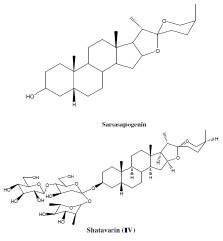
<body><![CDATA[<p>Formation of this soluble complex ion leads to an increase in the deliquescence  of metal which depends on the concentration of chloride ions. Thus, we can say,  with the increasing concentration of HCl, an increase in the corrosion rate is  observed &#91;2-3&#93;.</p>      <p>Large numbers of organic compounds have been used as corrosion inhibitors.  Mostly, the compounds containing heteroatoms like O, N, S in their structure are  thought to be efficient in preventing corrosion of Al in many inhibitors, a lot of  them having been used, e.g., imidazoline derivatives &#91;4&#93;, capparis decidua &#91;5&#93;,  delonix regia extract &#91;6&#93;, gongronima latifolium extract &#91;7&#93;, Bismarck brown eye  &#91;8&#93;, methyl orange &#91;9&#93;, onion extract &#91;10&#93;, hibiscus rosa-Sinesis &#91;11&#93;, etc. These  inhibitors have numerous N, O and S containing alkaloids which get adsorbed  onto the metal surface which basically hinder the release of H<sup>+</sup> and disintegration  of metal ions. Steroidal Saponin-Shatavarin (I-IV) and Sarsasapogenin are the  active constituents of Asparagus Racemosus. The <a href="#s1">structure</a> of these constituents  is given below:</p>       <p>&nbsp;</p> <a name="s1"> <img src="/img/revistas/pea/v37n2/37n2a01s1.jpg">     
<p>&nbsp;</p>      <p>Inhibition efficiency of corrosion inhibitors increases with increase in  concentration of active components as well as it is directly proportional to the  number of electron withdrawing or electron donating groups present in the  inhibitor &#91;12&#93;. Presence of heteroatoms, polar functional groups and &pi;-electrons  as active centers in a particular compound makes it an effective corrosion  inhibitor &#91;13-15&#93; because these heteroatoms or &pi;-electrons facilitate electronic  interactions between metal and inhibitor, which in turn helps in the adsorption of  inhibitor onto the metal surface &#91;16&#93;. Increase in environmental awareness has  raised the demand of green, non-toxic, cheap and environmentally friendly  corrosion inhibitors &#91;17-19&#93;.</p>       <p>&nbsp;</p>     <p><b>Experimental</b></p>     <p><b><i>Materials</i></b></p>       <p>Aluminium coupons having chemical composition 0.35% Fe, 0.25% Si, 0.05%  Cu, 0.05% Zn, 0.03% Mg, 0.03% Mn, 0.03% Ti and remainder Al have been  utilized.</p>       <p><b><i>Weight loss method</i></b></p>       ]]></body>
<body><![CDATA[<p>The dimensions of aluminium coupons used were 2 &times; 2.5 &times; 0.1 cm. Before  performing the experiment the coupons were abraded with emery papers of grade  nos. 100, 220 and 400, and then washed with distilled water and acetone. The  weight loss of polished and dried aluminium coupons was ascertained by  weighing the metal coupon before and after immersing in 100 cc of 1 M HCl in  absence (blank) and presence of inhibitor. The percentage inhibition efficiency  was calculated using the following <a href="#e1">formula</a>:</p>       <p>&nbsp;</p> <a name="e1"> <img src="/img/revistas/pea/v37n2/37n2a01e1.jpg">     
<p>&nbsp;</p>      <p>where, W0 = weight loss in the blank solution, Wi = weight loss in the presence  of the inhibitor at the said concentration.</p>       <p><b><i>Quantum chemical analysis </i></b></p>       <p>Quantum substance examination was performed utilizing the MNDO and AM1  technique for the quantum chemical package MOPAC 6.0 of Hyperchem 7.5.  The algorithm utilized for calculation was Polak-Rieberre, which is quick and  precise. The accompanying parameters were (E<sub>HOMO</sub>), (E<sub>LUMO</sub>), energy band gap,  &Delta;E = E<sub>HOMO</sub>-E<sub>LUMO</sub>, binding energy, heat of formations and the dipole moment  (&mu;).</p>       <p><b><i>SEM analysis </i></b></p>       <p>For SEM analysis, the aluminium coupons were immersed in 100 mL of 1 M  HCl in the presence and absence of optimum concentration of the two inhibitors,  separately, for 1 hr. Then they were removed, rinsed quickly (with sodium  bicarbonate, water and acetone) and dried. The surface morphology of the metal  coupons was determined and recorded using Scanning electron microscope.</p>       <p>&nbsp;</p>     <p><b>Results and discussion</b></p>     ]]></body>
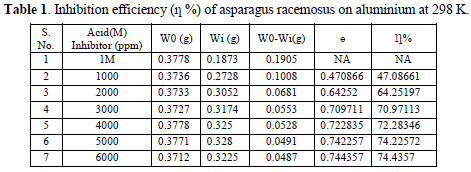
<body><![CDATA[<p><b><i>Weight loss studies</i></b></p>       <p>Separately weight loss studies with respect to concentration of inhibitor, time of  immersion and temperature, have been carried out. As the temperature was  increased, the corrosion inhibition efficiency was also seen to increase.  <a href="#t1">Table 1</a> summarizes the effect of inhibitor concentration on the corrosion inhibition  efficiency.</p>       <p>&nbsp;</p> <a name="t1"> <img src="/img/revistas/pea/v37n2/37n2a01t1.jpg">     
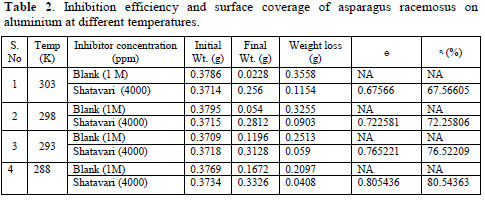
<p>&nbsp;</p>      <p>The maximum efficiency of 74.4% is seen at the inhibitor  concentration of 6000 ppm. All these results are observed at 298 K. The increase  in inhibition efficiency with the increase in concentration is because of the  increased adsorption coverage of aluminium caused by the addition of the  inhibitor.</p>      <p>It was seen that increase in temperature leads to decrease in inhibition efficiency.  The inhibition efficiency was seen at the temperatures varying from 288 to 303 K  at the inhibitor concentration of 4000 ppm. As the temperature increases, the  corrosion rate also increases leading to the decrease in inhibition. The corrosion  of metal in acidic medium is typically joined by the evolution of H2 gas; increase  in temperature fastens the corrosion rate resulting in higher dissolution of the  metal &#91;20&#93;. <a href="#t2">Table 2</a> gives the estimations of inhibition efficiency and surface  coverage at various temperatures.</p>       <p>&nbsp;</p> <a name="t2"> <img src="/img/revistas/pea/v37n2/37n2a01t2.jpg">     
<p>&nbsp;</p>      <p><b><i>Adsorption study</i></b></p>       <p>In order to comprehend the interaction of inhibitor particles and the metal  surface, adsorption isotherms can be utilized. The estimations of surface  coverage relating to concentrations of inhibitor are utilized to get the best straight  adsorption fit isotherm. The most generally utilized adsorption isotherms are  Langmuir and Freundlich ones. <a href="#e2">Equations (2)</a> and <a href="#e3">(3)</a> represent such isotherms.</p>       ]]></body>
<body><![CDATA[<p>&nbsp;</p> <a name="e2"> <img src="/img/revistas/pea/v37n2/37n2a01e2.jpg">     
<p>&nbsp;</p> <a name="e3"> <img src="/img/revistas/pea/v37n2/37n2a01e3.jpg">     
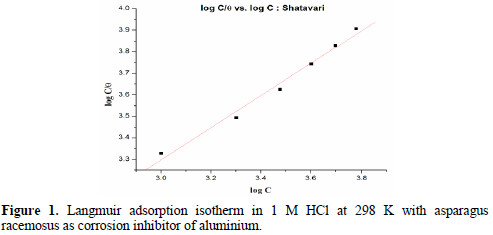
<p>&nbsp;</p>      <p>K<sub>ads</sub> stands for the adsorption equilibrium constant, &Theta; is the surface coverage and  C defines the concentration of inhibitor in ppm. <a href="#t2">Fig. 1 </a> gives the Langmuir  adsorption isotherm.</p>       <p>&nbsp;</p> <a name="f1"> <img src="/img/revistas/pea/v37n2/37n2a01f1.jpg">     
<p>&nbsp;</p>       <p>Slope of C/&Theta; vs. C gives a straight line with slope almost  equal to 1, suggesting the adsorption of inhibitor on aluminium surface follows  Langmuir adsorption isotherm &#91;21&#93;.</p>       <p>Thermodynamic activation parameters were elucidated based on the temperature  dependence of corrosion rate by <a href="#e4">Arrhenius equation </a>:</p>       <p>&nbsp;</p> <a name="e4"> <img src="/img/revistas/pea/v37n2/37n2a01e4.jpg">     
<p>&nbsp;</p>       ]]></body>
<body><![CDATA[<p>where E<sub>a</sub> is the apparent effective activation energy, R is the general gas  constant, C<sub>R</sub> is the corrosion rate. The enthalpy of activation was calculated by  using <a href="#e5">Eyring equation </a>:</p>       <p>&nbsp;</p> <a name="e5"> <img src="/img/revistas/pea/v37n2/37n2a01e5.jpg">     
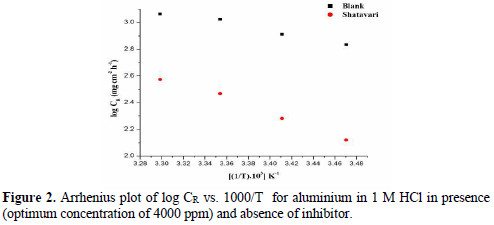
<p>&nbsp;</p>       <p>where, h is the Planck´s constant, N is the Avogadro&rsquo;s number, &Delta;H is the  enthalpy of activation and &Delta;S is the entropy of activation.</p>       <p>A plot of log C<sub>R</sub> versus 1000/T gave a straight line, as appeared in <a href="#f2">Fig. 2 </a>.</p>       <p>&nbsp;</p> <a name="f2"> <img src="/img/revistas/pea/v37n2/37n2a01f2.jpg">     
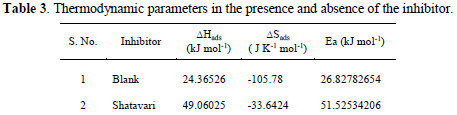
<p>&nbsp;</p>       <p>The estimations of activation energy acquired from the slope of lines are recorded in  <a href="#t3">Table 3 </a>.</p>       <p>&nbsp;</p> <a name="t3"> <img src="/img/revistas/pea/v37n2/37n2a01t3.jpg">     
<p>&nbsp;</p>       ]]></body>
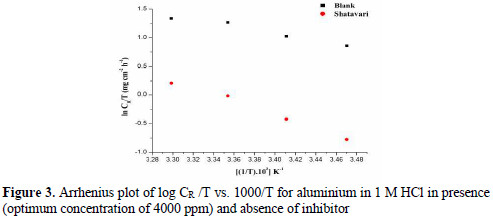
<body><![CDATA[<p><a href="#f3">Fig. 3 </a> demonstrated the plot of log CR/T versus 1000/T.</p>       <p>&nbsp;</p> <a name="f3"> <img src="/img/revistas/pea/v37n2/37n2a01f3.jpg">     
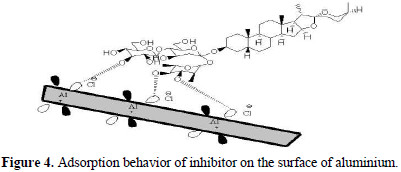
<p>&nbsp;</p>       <p>Straight lines were acquired with a slant of (- &Delta;H/R) and intercept of &#91;(ln(R/Nh) + (&Delta;S/R)&#93;  from which estimations of &Delta;H and &Delta;S are ascertained. Examination of <a href="#t3">Table 3 </a>  demonstrated that values of E<sub>a</sub> measured for the solution containing the inhibitor  are greater than in blank HCl. Elevation in E<sub>a</sub> determines either physical  adsorption or decline in the adsorption of inhibitor particles on aluminum as a  result of increase temperature &#91;20&#93;.</p>       <p>The endothermic nature of reaction was demonstrated by the positive value of  &Delta;H. Estimations of &Delta;S show the ordering of inhibitor atoms on the surface of  metal &#91;22&#93;.</p>        <p><b><i>Mechanism of adsorption </i></b></p>       <p>The interaction of metal and the inhibitor is based on the mechanism of  inhibition. Mechanism of adsorptions gives us an idea about the metal electron  interaction with the protective inhibitor molecules. Aluminium is considered to  be positively charged in HCl with respect to the potential zero charge. Hence,  inhibitor exists as neutral molecule in acidic solution.  <a href="#f4">Fig. 4 </a> elucidates the donoracceptor  interaction between unshared electrons of the heteroatom and the vacant  p orbital of aluminium metal.</p>       <p>&nbsp;</p> <a name="f4"> <img src="/img/revistas/pea/v37n2/37n2a01f4.jpg">     
<p>&nbsp;</p>        <p><b><i>Quantum chemical study</i></b></p>       ]]></body>
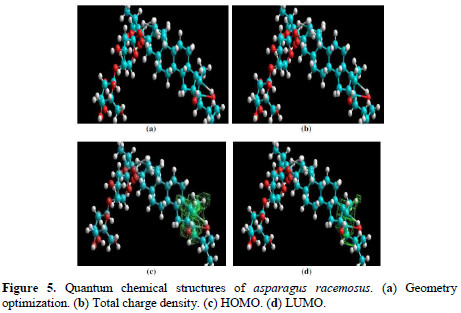
<body><![CDATA[<p>These estimations were performed so as to explore the process of adsorption and  mechanism of inhibition examined for inhibitor molecule. The different  optimized structures of inhibitor are given in <a href="#f5">Fig. 5 </a>.</p>       <p>&nbsp;</p> <a name="f5"> <img src="/img/revistas/pea/v37n2/37n2a01f5.jpg">     
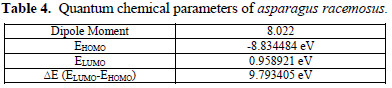
<p>&nbsp;</p>        <p>Keeping in mind the end goal to develop a molecular structure and reactivity of an inhibitor,  it might be essential to concentrate on the properties that specifically impact the metal  inhibitor interaction. Some of these parameters include energies of sub-atomic  orbital, E<sub>HOMO</sub>, E<sub>LUMO</sub>, &Delta;E (E<sub>LUMO</sub> – E<sub>HOMO</sub>), and dipole moment. The estimation  of these computed quantum compound parameters are given in <a href="#t4">Table 4 </a>.</p>       <p>&nbsp;</p> <a name="t4"> <img src="/img/revistas/pea/v37n2/37n2a01t4.jpg">     
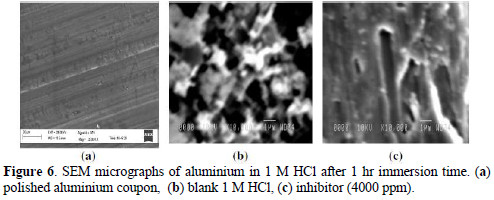
<p>&nbsp;</p>        <p>As E<sub>HOMO</sub> indicates with electron donating capacity of a molecule, higher E<sub>HOMO</sub>  values are prone to demonstrate an inclination of molecule for donation of  electrons to the acceptor molecule. Larger values of E<sub>HOMO</sub> encourage adsorption  by impacting the transport process through adsorbed layer. This way, the energy  of E<sub>LUMO</sub> demonstrates the capacity of an atom to accept electrons. At the lower  ELUMO values, the more likely is that the atom will accept electrons. Lower values  of &Delta;E (E<sub>LUMO</sub> – E<sub>HOMO</sub>) propose higher corrosion inhibition efficiency because  the energy required for removing the electron will be low &#91;23&#93;. Higher dipole  moment proposes more adsorption and in this way higher inhibition efficiency  because of more polarization &#91;20&#93;.</p>        <p><b><i>SEM analysis</i></b></p>       <p>The morphology of the metal specimen was revealed by SEM. The micrographs  in <a href="#f6">Fig. 6 </a> (a, b, c) show the micrograph of polished aluminium coupon without  immersion in either of the solutions, specimen in blank HCl and inhibitor  solution, respectively. It is clear from the figure that <a href="#f6">(a) </a> has large number of pits  and cavities and also the surface is rough, whereas in case of <a href="#f6">(b) </a> the pits are less  and the surface is smooth, which is an evidence that inhibitor has formed a  protective layer on the surface of the metal through adsorption &#91;24&#93;.</p>       <p>&nbsp;</p> <a name="f6"> <img src="/img/revistas/pea/v37n2/37n2a01f6.jpg">     
]]></body>
<body><![CDATA[<p>&nbsp;</p>        <p><b>Conclusion</b></p>       <p>The results demonstrate that asparagus racemosus is an effective corrosion  inhibitor of aluminium in acidic medium. The positive value of &Delta;H suggests that  the reaction is endothermic and the rate of corrosion is slow. The adsorption of  inhibitor on the surface of aluminium obeys Langmuir adsorption isotherm. The  addition of inhibitor leads to increase in activation energy showing that the  inhibitor is being physically adsorbed on the surface of the metal. Quantum  compound approach is adequate to estimate the effectiveness of inhibitor  utilizing hypothetical approach.</p>        <p>&nbsp;</p>     <p><b>References</b></p>       <!-- ref --><p>1. Hurlen T, Lian H, Odegard O, Valand T. Electrochim Acta. 1984;49:537.    &nbsp;&nbsp;&nbsp;&nbsp;&nbsp;&nbsp;&nbsp;&nbsp;[&#160;<a href="javascript:void(0);" onclick="javascript: window.open('/scielo.php?script=sci_nlinks&ref=439293&pid=S0872-1904201900020000100001&lng=','','width=640,height=500,resizable=yes,scrollbars=1,menubar=yes,');">Links</a>&#160;]<!-- end-ref --></p>       <!-- ref --><p>2. Ford FP, Burstein GT, Hoar TP. J Electrochem Soc. 1980;127:127.    &nbsp;&nbsp;&nbsp;&nbsp;&nbsp;&nbsp;&nbsp;&nbsp;[&#160;<a href="javascript:void(0);" onclick="javascript: window.open('/scielo.php?script=sci_nlinks&ref=439295&pid=S0872-1904201900020000100002&lng=','','width=640,height=500,resizable=yes,scrollbars=1,menubar=yes,');">Links</a>&#160;]<!-- end-ref --></p>       <!-- ref --><p>3. Nguyen TH, Foley RT. J Electrochem Soc. 1982;129:129.    &nbsp;&nbsp;&nbsp;&nbsp;&nbsp;&nbsp;&nbsp;&nbsp;[&#160;<a href="javascript:void(0);" onclick="javascript: window.open('/scielo.php?script=sci_nlinks&ref=439297&pid=S0872-1904201900020000100003&lng=','','width=640,height=500,resizable=yes,scrollbars=1,menubar=yes,');">Links</a>&#160;]<!-- end-ref --></p>       <!-- ref --><p>4. Putilova IN, Balizin SA, Baranik VP. Met Corr Inhib Per. 1960;305.    &nbsp;&nbsp;&nbsp;&nbsp;&nbsp;&nbsp;&nbsp;&nbsp;[&#160;<a href="javascript:void(0);" onclick="javascript: window.open('/scielo.php?script=sci_nlinks&ref=439299&pid=S0872-1904201900020000100004&lng=','','width=640,height=500,resizable=yes,scrollbars=1,menubar=yes,');">Links</a>&#160;]<!-- end-ref --></p>       <!-- ref --><p>5. JainT, Choudhary R, Mathur SP. Mater Corros. 2006;57:422.    &nbsp;&nbsp;&nbsp;&nbsp;&nbsp;&nbsp;&nbsp;&nbsp;[&#160;<a href="javascript:void(0);" onclick="javascript: window.open('/scielo.php?script=sci_nlinks&ref=439301&pid=S0872-1904201900020000100005&lng=','','width=640,height=500,resizable=yes,scrollbars=1,menubar=yes,');">Links</a>&#160;]<!-- end-ref --></p>       <!-- ref --><p>6 Okafor PC, Ikpi ME, Uwah IE, et al. Corros Sci. 2008;50:2310.    &nbsp;&nbsp;&nbsp;&nbsp;&nbsp;&nbsp;&nbsp;&nbsp;[&#160;<a href="javascript:void(0);" onclick="javascript: window.open('/scielo.php?script=sci_nlinks&ref=439303&pid=S0872-1904201900020000100006&lng=','','width=640,height=500,resizable=yes,scrollbars=1,menubar=yes,');">Links</a>&#160;]<!-- end-ref --></p>       <!-- ref --><p>7. Choudhary R, Jain T, Mathur SP. Bull Electrochem. 2004;20:67.    &nbsp;&nbsp;&nbsp;&nbsp;&nbsp;&nbsp;&nbsp;&nbsp;[&#160;<a href="javascript:void(0);" onclick="javascript: window.open('/scielo.php?script=sci_nlinks&ref=439305&pid=S0872-1904201900020000100007&lng=','','width=640,height=500,resizable=yes,scrollbars=1,menubar=yes,');">Links</a>&#160;]<!-- end-ref --></p>       <!-- ref --><p>8. Sharma P, Upadhyay RK, Chaturvedi A, et al. JTR Chem. 2008;15:21.    &nbsp;&nbsp;&nbsp;&nbsp;&nbsp;&nbsp;&nbsp;&nbsp;[&#160;<a href="javascript:void(0);" onclick="javascript: window.open('/scielo.php?script=sci_nlinks&ref=439307&pid=S0872-1904201900020000100008&lng=','','width=640,height=500,resizable=yes,scrollbars=1,menubar=yes,');">Links</a>&#160;]<!-- end-ref --></p>       <!-- ref --><p>9. Talati JD, Gandhi DK. Ind J Technol. 1991;29:227.    &nbsp;&nbsp;&nbsp;&nbsp;&nbsp;&nbsp;&nbsp;&nbsp;[&#160;<a href="javascript:void(0);" onclick="javascript: window.open('/scielo.php?script=sci_nlinks&ref=439309&pid=S0872-1904201900020000100009&lng=','','width=640,height=500,resizable=yes,scrollbars=1,menubar=yes,');">Links</a>&#160;]<!-- end-ref --></p>       <!-- ref --><p>10. Dubey RS, Upadhyay SN. J Electrochem Soc India. 1944;74:143.    &nbsp;&nbsp;&nbsp;&nbsp;&nbsp;&nbsp;&nbsp;&nbsp;[&#160;<a href="javascript:void(0);" onclick="javascript: window.open('/scielo.php?script=sci_nlinks&ref=439311&pid=S0872-1904201900020000100010&lng=','','width=640,height=500,resizable=yes,scrollbars=1,menubar=yes,');">Links</a>&#160;]<!-- end-ref --></p>       <!-- ref --><p>11. Rajendran S, Jeyasundari J, Usha P, et al. Port Electrochim Acta.  2009;27:153.    &nbsp;&nbsp;&nbsp;&nbsp;&nbsp;&nbsp;&nbsp;&nbsp;[&#160;<a href="javascript:void(0);" onclick="javascript: window.open('/scielo.php?script=sci_nlinks&ref=439313&pid=S0872-1904201900020000100011&lng=','','width=640,height=500,resizable=yes,scrollbars=1,menubar=yes,');">Links</a>&#160;]<!-- end-ref --></p>       <!-- ref --><p>12. Verma C, Olasunkanmi LO, Ebenso EE, et al. J Phys Chem C. 120  2016;120:11598.    &nbsp;&nbsp;&nbsp;&nbsp;&nbsp;&nbsp;&nbsp;&nbsp;[&#160;<a href="javascript:void(0);" onclick="javascript: window.open('/scielo.php?script=sci_nlinks&ref=439315&pid=S0872-1904201900020000100012&lng=','','width=640,height=500,resizable=yes,scrollbars=1,menubar=yes,');">Links</a>&#160;]<!-- end-ref --></p>       <!-- ref --><p>13. Quraishi MA, Ansari KR, Yadav DK, et al. Int J Electrochem Sci. 7  2012;7:12301.    &nbsp;&nbsp;&nbsp;&nbsp;&nbsp;&nbsp;&nbsp;&nbsp;[&#160;<a href="javascript:void(0);" onclick="javascript: window.open('/scielo.php?script=sci_nlinks&ref=439317&pid=S0872-1904201900020000100013&lng=','','width=640,height=500,resizable=yes,scrollbars=1,menubar=yes,');">Links</a>&#160;]<!-- end-ref --></p>       <!-- ref --><p>14. Bousskri A, Anejjar A, Messali M, et al. J Mol Liq. 2015;211:1000.    &nbsp;&nbsp;&nbsp;&nbsp;&nbsp;&nbsp;&nbsp;&nbsp;[&#160;<a href="javascript:void(0);" onclick="javascript: window.open('/scielo.php?script=sci_nlinks&ref=439319&pid=S0872-1904201900020000100014&lng=','','width=640,height=500,resizable=yes,scrollbars=1,menubar=yes,');">Links</a>&#160;]<!-- end-ref --></p>       <!-- ref --><p>15. Belghiti ME, Tighadouini S, Karzazi Y, et al. J Mater Environ Sci.  2016;7:319.    &nbsp;&nbsp;&nbsp;&nbsp;&nbsp;&nbsp;&nbsp;&nbsp;[&#160;<a href="javascript:void(0);" onclick="javascript: window.open('/scielo.php?script=sci_nlinks&ref=439321&pid=S0872-1904201900020000100015&lng=','','width=640,height=500,resizable=yes,scrollbars=1,menubar=yes,');">Links</a>&#160;]<!-- end-ref --></p>       <!-- ref --><p>16. Geethamani P, Kasthuri PK. Cog Chem. 2015;1:1091558.    &nbsp;&nbsp;&nbsp;&nbsp;&nbsp;&nbsp;&nbsp;&nbsp;[&#160;<a href="javascript:void(0);" onclick="javascript: window.open('/scielo.php?script=sci_nlinks&ref=439323&pid=S0872-1904201900020000100016&lng=','','width=640,height=500,resizable=yes,scrollbars=1,menubar=yes,');">Links</a>&#160;]<!-- end-ref --></p>       <!-- ref --><p>17. Majidi L, Znini M, Ansari A, et al. Int J Electrochem Sci. 2013;8:7381.    &nbsp;&nbsp;&nbsp;&nbsp;&nbsp;&nbsp;&nbsp;&nbsp;[&#160;<a href="javascript:void(0);" onclick="javascript: window.open('/scielo.php?script=sci_nlinks&ref=439325&pid=S0872-1904201900020000100017&lng=','','width=640,height=500,resizable=yes,scrollbars=1,menubar=yes,');">Links</a>&#160;]<!-- end-ref --></p>       <!-- ref --><p>18. Elmouaden K, Chaouay A, Oukhrib R, et al. Int J Electrochem Sci.  2015;10:7955.    &nbsp;&nbsp;&nbsp;&nbsp;&nbsp;&nbsp;&nbsp;&nbsp;[&#160;<a href="javascript:void(0);" onclick="javascript: window.open('/scielo.php?script=sci_nlinks&ref=439327&pid=S0872-1904201900020000100018&lng=','','width=640,height=500,resizable=yes,scrollbars=1,menubar=yes,');">Links</a>&#160;]<!-- end-ref --></p>       <!-- ref --><p>19. Gerengi H, Ugras HI, Solomon MM, et al. J Adh Sci Tech. 2016;1:1.    &nbsp;&nbsp;&nbsp;&nbsp;&nbsp;&nbsp;&nbsp;&nbsp;[&#160;<a href="javascript:void(0);" onclick="javascript: window.open('/scielo.php?script=sci_nlinks&ref=439329&pid=S0872-1904201900020000100019&lng=','','width=640,height=500,resizable=yes,scrollbars=1,menubar=yes,');">Links</a>&#160;]<!-- end-ref --></p>       <!-- ref --><p>20. Yadav DK, Maiti B, Quraishi MA. Corros Sci. 2010;52:3586.    &nbsp;&nbsp;&nbsp;&nbsp;&nbsp;&nbsp;&nbsp;&nbsp;[&#160;<a href="javascript:void(0);" onclick="javascript: window.open('/scielo.php?script=sci_nlinks&ref=439331&pid=S0872-1904201900020000100020&lng=','','width=640,height=500,resizable=yes,scrollbars=1,menubar=yes,');">Links</a>&#160;]<!-- end-ref --></p>       <!-- ref --><p>21. Hmamou DB, Salghi R, Zarrouk A, et al. Int J Ind Chem. 2012;3:25.    &nbsp;&nbsp;&nbsp;&nbsp;&nbsp;&nbsp;&nbsp;&nbsp;[&#160;<a href="javascript:void(0);" onclick="javascript: window.open('/scielo.php?script=sci_nlinks&ref=439333&pid=S0872-1904201900020000100021&lng=','','width=640,height=500,resizable=yes,scrollbars=1,menubar=yes,');">Links</a>&#160;]<!-- end-ref --></p>       <!-- ref --><p>22. Quraishi MA, Danish J. Mat Chem Phys. 2003;78:687.    &nbsp;&nbsp;&nbsp;&nbsp;&nbsp;&nbsp;&nbsp;&nbsp;[&#160;<a href="javascript:void(0);" onclick="javascript: window.open('/scielo.php?script=sci_nlinks&ref=439335&pid=S0872-1904201900020000100022&lng=','','width=640,height=500,resizable=yes,scrollbars=1,menubar=yes,');">Links</a>&#160;]<!-- end-ref --></p>       <!-- ref --><p>23. Belghiti ME, Karzazi Y, Tighadouini S, et al. J Mater Environ Sci.  2016;7:956.    &nbsp;&nbsp;&nbsp;&nbsp;&nbsp;&nbsp;&nbsp;&nbsp;[&#160;<a href="javascript:void(0);" onclick="javascript: window.open('/scielo.php?script=sci_nlinks&ref=439337&pid=S0872-1904201900020000100023&lng=','','width=640,height=500,resizable=yes,scrollbars=1,menubar=yes,');">Links</a>&#160;]<!-- end-ref --></p>       <!-- ref --><p>24. Pandian BR, Sethuraman MG. Mater Lett. 2008;62:2977.    &nbsp;&nbsp;&nbsp;&nbsp;&nbsp;&nbsp;&nbsp;&nbsp;[&#160;<a href="javascript:void(0);" onclick="javascript: window.open('/scielo.php?script=sci_nlinks&ref=439339&pid=S0872-1904201900020000100024&lng=','','width=640,height=500,resizable=yes,scrollbars=1,menubar=yes,');">Links</a>&#160;]<!-- end-ref --></p>       <p>&nbsp;</p>     <p><b>Acknowledgement</b></p>      <p>The authors are pleased to acknowledge Lovely Professional University (LPU)    for providing the facilities for the research.</p>      <p>&nbsp;</p>      <p><a name=0></a><sup><a href="#top">*</a></sup>Corresponding author. E-mail address: <a href="mailto:drashishchemlpu@gmail.com">drashishchemlpu@gmail.com</a></p>      <p>Received July 20, 2016; accepted June 15, 2017 </p>          <p><a href="http://www.peacta.org" target="_blank">www.peacta.org</a> </p>             ]]></body>
<body><![CDATA[ ]]></body><back>
<ref-list>
<ref id="B1">
<label>1</label><nlm-citation citation-type="journal">
<person-group person-group-type="author">
<name>
<surname><![CDATA[Hurlen]]></surname>
<given-names><![CDATA[T]]></given-names>
</name>
<name>
<surname><![CDATA[Lian]]></surname>
<given-names><![CDATA[H]]></given-names>
</name>
<name>
<surname><![CDATA[Odegard]]></surname>
<given-names><![CDATA[O]]></given-names>
</name>
<name>
<surname><![CDATA[Valand]]></surname>
<given-names><![CDATA[T]]></given-names>
</name>
</person-group>
<source><![CDATA[Electrochim Acta]]></source>
<year>1984</year>
<volume>49</volume>
<page-range>537</page-range></nlm-citation>
</ref>
<ref id="B2">
<label>2</label><nlm-citation citation-type="journal">
<person-group person-group-type="author">
<name>
<surname><![CDATA[Ford]]></surname>
<given-names><![CDATA[FP]]></given-names>
</name>
<name>
<surname><![CDATA[Burstein]]></surname>
<given-names><![CDATA[G T]]></given-names>
</name>
<name>
<surname><![CDATA[Hoar]]></surname>
<given-names><![CDATA[T P]]></given-names>
</name>
</person-group>
<source><![CDATA[J Electrochem Soc]]></source>
<year>1980</year>
<volume>127</volume>
<page-range>127</page-range></nlm-citation>
</ref>
<ref id="B3">
<label>3</label><nlm-citation citation-type="journal">
<person-group person-group-type="author">
<name>
<surname><![CDATA[Nguyen]]></surname>
<given-names><![CDATA[T H]]></given-names>
</name>
<name>
<surname><![CDATA[Foley]]></surname>
<given-names><![CDATA[R T]]></given-names>
</name>
</person-group>
<source><![CDATA[J Electrochem Soc]]></source>
<year>1982</year>
<volume>129</volume>
<page-range>129</page-range></nlm-citation>
</ref>
<ref id="B4">
<label>4</label><nlm-citation citation-type="journal">
<person-group person-group-type="author">
<name>
<surname><![CDATA[Putilova]]></surname>
<given-names><![CDATA[I N]]></given-names>
</name>
<name>
<surname><![CDATA[Balizin]]></surname>
<given-names><![CDATA[S A]]></given-names>
</name>
<name>
<surname><![CDATA[Baranik]]></surname>
<given-names><![CDATA[V P]]></given-names>
</name>
</person-group>
<source><![CDATA[Met Corr Inhib Per]]></source>
<year>1960</year>
<page-range>305</page-range></nlm-citation>
</ref>
<ref id="B5">
<label>5</label><nlm-citation citation-type="journal">
<person-group person-group-type="author">
<name>
<surname><![CDATA[Jain]]></surname>
<given-names><![CDATA[T]]></given-names>
</name>
<name>
<surname><![CDATA[Choudhary]]></surname>
<given-names><![CDATA[R]]></given-names>
</name>
<name>
<surname><![CDATA[Mathur]]></surname>
<given-names><![CDATA[S P]]></given-names>
</name>
</person-group>
<source><![CDATA[Mater Corros]]></source>
<year>2006</year>
<volume>57</volume>
<page-range>422</page-range></nlm-citation>
</ref>
<ref id="B6">
<label>6</label><nlm-citation citation-type="journal">
<person-group person-group-type="author">
<name>
<surname><![CDATA[Okafor]]></surname>
<given-names><![CDATA[P C]]></given-names>
</name>
<name>
<surname><![CDATA[Ikpi]]></surname>
<given-names><![CDATA[M E]]></given-names>
</name>
<name>
<surname><![CDATA[Uwah]]></surname>
<given-names><![CDATA[I E]]></given-names>
</name>
</person-group>
<source><![CDATA[Corros Sci]]></source>
<year>2008</year>
<volume>50</volume>
<page-range>2310</page-range></nlm-citation>
</ref>
<ref id="B7">
<label>7</label><nlm-citation citation-type="journal">
<person-group person-group-type="author">
<name>
<surname><![CDATA[Choudhary]]></surname>
<given-names><![CDATA[R]]></given-names>
</name>
<name>
<surname><![CDATA[Jain]]></surname>
<given-names><![CDATA[T]]></given-names>
</name>
<name>
<surname><![CDATA[Mathur]]></surname>
<given-names><![CDATA[SP]]></given-names>
</name>
</person-group>
<source><![CDATA[Bull Electrochem]]></source>
<year>2004</year>
<volume>20</volume>
<page-range>67</page-range></nlm-citation>
</ref>
<ref id="B8">
<label>8</label><nlm-citation citation-type="journal">
<person-group person-group-type="author">
<name>
<surname><![CDATA[Sharma]]></surname>
<given-names><![CDATA[P]]></given-names>
</name>
<name>
<surname><![CDATA[Upadhyay]]></surname>
<given-names><![CDATA[R K]]></given-names>
</name>
<name>
<surname><![CDATA[Chaturvedi]]></surname>
<given-names><![CDATA[A]]></given-names>
</name>
</person-group>
<source><![CDATA[JTR Chem]]></source>
<year>2008</year>
<volume>15</volume>
<page-range>21</page-range></nlm-citation>
</ref>
<ref id="B9">
<label>9</label><nlm-citation citation-type="journal">
<person-group person-group-type="author">
<name>
<surname><![CDATA[Talati]]></surname>
<given-names><![CDATA[J D]]></given-names>
</name>
<name>
<surname><![CDATA[Gandhi]]></surname>
<given-names><![CDATA[D K]]></given-names>
</name>
</person-group>
<source><![CDATA[Ind J Technol]]></source>
<year>1991</year>
<volume>29</volume>
<page-range>227</page-range></nlm-citation>
</ref>
<ref id="B10">
<label>10</label><nlm-citation citation-type="journal">
<person-group person-group-type="author">
<name>
<surname><![CDATA[Dubey]]></surname>
<given-names><![CDATA[R S]]></given-names>
</name>
<name>
<surname><![CDATA[Upadhyay]]></surname>
<given-names><![CDATA[S N]]></given-names>
</name>
</person-group>
<source><![CDATA[J Electrochem Soc India]]></source>
<year>1944</year>
<volume>74</volume>
<page-range>143</page-range></nlm-citation>
</ref>
<ref id="B11">
<label>11</label><nlm-citation citation-type="journal">
<person-group person-group-type="author">
<name>
<surname><![CDATA[Rajendran]]></surname>
<given-names><![CDATA[S]]></given-names>
</name>
<name>
<surname><![CDATA[Jeyasundari]]></surname>
<given-names><![CDATA[J]]></given-names>
</name>
<name>
<surname><![CDATA[Usha]]></surname>
<given-names><![CDATA[P]]></given-names>
</name>
</person-group>
<source><![CDATA[Port Electrochim Acta]]></source>
<year>2009</year>
<volume>27</volume>
<page-range>153</page-range></nlm-citation>
</ref>
<ref id="B12">
<label>12</label><nlm-citation citation-type="journal">
<person-group person-group-type="author">
<name>
<surname><![CDATA[Verma]]></surname>
<given-names><![CDATA[C]]></given-names>
</name>
<name>
<surname><![CDATA[Olasunkanmi]]></surname>
<given-names><![CDATA[L O]]></given-names>
</name>
<name>
<surname><![CDATA[Ebenso]]></surname>
<given-names><![CDATA[E E]]></given-names>
</name>
</person-group>
<source><![CDATA[J Phys Chem C]]></source>
<year>2016</year>
<volume>120</volume>
<page-range>11598</page-range></nlm-citation>
</ref>
<ref id="B13">
<label>13</label><nlm-citation citation-type="journal">
<person-group person-group-type="author">
<name>
<surname><![CDATA[Quraishi]]></surname>
<given-names><![CDATA[M A]]></given-names>
</name>
<name>
<surname><![CDATA[Ansari]]></surname>
<given-names><![CDATA[KR]]></given-names>
</name>
<name>
<surname><![CDATA[Yadav]]></surname>
<given-names><![CDATA[DK]]></given-names>
</name>
</person-group>
<source><![CDATA[Int J Electrochem Sci]]></source>
<year>2012</year>
<volume>7</volume>
<page-range>12301</page-range></nlm-citation>
</ref>
<ref id="B14">
<label>14</label><nlm-citation citation-type="journal">
<person-group person-group-type="author">
<name>
<surname><![CDATA[Bousskri]]></surname>
<given-names><![CDATA[A]]></given-names>
</name>
<name>
<surname><![CDATA[Anejjar]]></surname>
<given-names><![CDATA[A]]></given-names>
</name>
<name>
<surname><![CDATA[Messali]]></surname>
<given-names><![CDATA[M]]></given-names>
</name>
</person-group>
<source><![CDATA[J Mol Liq]]></source>
<year>2015</year>
<volume>211</volume>
<page-range>1000</page-range></nlm-citation>
</ref>
<ref id="B15">
<label>15</label><nlm-citation citation-type="journal">
<person-group person-group-type="author">
<name>
<surname><![CDATA[Belghiti]]></surname>
<given-names><![CDATA[M E]]></given-names>
</name>
<name>
<surname><![CDATA[Tighadouini]]></surname>
<given-names><![CDATA[S]]></given-names>
</name>
<name>
<surname><![CDATA[Karzazi]]></surname>
<given-names><![CDATA[Y]]></given-names>
</name>
</person-group>
<source><![CDATA[J Mater Environ Sci]]></source>
<year>2016</year>
<volume>7</volume>
<page-range>319</page-range></nlm-citation>
</ref>
<ref id="B16">
<label>16</label><nlm-citation citation-type="journal">
<person-group person-group-type="author">
<name>
<surname><![CDATA[Geethamani]]></surname>
<given-names><![CDATA[P]]></given-names>
</name>
<name>
<surname><![CDATA[Kasthuri]]></surname>
<given-names><![CDATA[P K]]></given-names>
</name>
</person-group>
<source><![CDATA[Cog Chem]]></source>
<year>2015</year>
<volume>1</volume>
<page-range>1091558</page-range></nlm-citation>
</ref>
<ref id="B17">
<label>17</label><nlm-citation citation-type="journal">
<person-group person-group-type="author">
<name>
<surname><![CDATA[Majidi]]></surname>
<given-names><![CDATA[L]]></given-names>
</name>
<name>
<surname><![CDATA[Znini]]></surname>
<given-names><![CDATA[M]]></given-names>
</name>
<name>
<surname><![CDATA[Ansari]]></surname>
<given-names><![CDATA[A]]></given-names>
</name>
</person-group>
<source><![CDATA[Int J Electrochem Sci]]></source>
<year>2013</year>
<volume>8</volume>
<page-range>7381</page-range></nlm-citation>
</ref>
<ref id="B18">
<label>18</label><nlm-citation citation-type="journal">
<person-group person-group-type="author">
<name>
<surname><![CDATA[Elmouaden]]></surname>
<given-names><![CDATA[K]]></given-names>
</name>
<name>
<surname><![CDATA[Chaouay]]></surname>
<given-names><![CDATA[A]]></given-names>
</name>
<name>
<surname><![CDATA[Oukhrib]]></surname>
<given-names><![CDATA[R]]></given-names>
</name>
</person-group>
<source><![CDATA[Int J Electrochem Sci]]></source>
<year>2015</year>
<volume>10</volume>
<page-range>7955</page-range></nlm-citation>
</ref>
<ref id="B19">
<label>19</label><nlm-citation citation-type="journal">
<person-group person-group-type="author">
<name>
<surname><![CDATA[Gerengi]]></surname>
<given-names><![CDATA[H]]></given-names>
</name>
<name>
<surname><![CDATA[Ugras]]></surname>
<given-names><![CDATA[H I]]></given-names>
</name>
<name>
<surname><![CDATA[Solomon]]></surname>
<given-names><![CDATA[MM]]></given-names>
</name>
</person-group>
<source><![CDATA[J Adh Sci Tech]]></source>
<year>2016</year>
<volume>1</volume>
<page-range>1</page-range></nlm-citation>
</ref>
<ref id="B20">
<label>20</label><nlm-citation citation-type="journal">
<person-group person-group-type="author">
<name>
<surname><![CDATA[Yadav]]></surname>
<given-names><![CDATA[D K]]></given-names>
</name>
<name>
<surname><![CDATA[Maiti]]></surname>
<given-names><![CDATA[B]]></given-names>
</name>
<name>
<surname><![CDATA[Quraishi]]></surname>
<given-names><![CDATA[M A]]></given-names>
</name>
</person-group>
<source><![CDATA[Corros Sci]]></source>
<year>2010</year>
<volume>52</volume>
<page-range>3586</page-range></nlm-citation>
</ref>
<ref id="B21">
<label>21</label><nlm-citation citation-type="journal">
<person-group person-group-type="author">
<name>
<surname><![CDATA[Hmamou]]></surname>
<given-names><![CDATA[DB]]></given-names>
</name>
<name>
<surname><![CDATA[Salghi]]></surname>
<given-names><![CDATA[R]]></given-names>
</name>
<name>
<surname><![CDATA[Zarrouk]]></surname>
<given-names><![CDATA[A]]></given-names>
</name>
</person-group>
<source><![CDATA[Int J Ind Chem]]></source>
<year>2012</year>
<volume>3</volume>
<page-range>25</page-range></nlm-citation>
</ref>
<ref id="B22">
<label>22</label><nlm-citation citation-type="journal">
<person-group person-group-type="author">
<name>
<surname><![CDATA[Quraishi]]></surname>
<given-names><![CDATA[M A]]></given-names>
</name>
<name>
<surname><![CDATA[Danish]]></surname>
<given-names><![CDATA[J]]></given-names>
</name>
</person-group>
<source><![CDATA[Mat Chem Phys]]></source>
<year>2003</year>
<volume>78</volume>
<page-range>687</page-range></nlm-citation>
</ref>
<ref id="B23">
<label>23</label><nlm-citation citation-type="journal">
<person-group person-group-type="author">
<name>
<surname><![CDATA[Belghiti]]></surname>
<given-names><![CDATA[M E]]></given-names>
</name>
<name>
<surname><![CDATA[Karzazi]]></surname>
<given-names><![CDATA[Y]]></given-names>
</name>
<name>
<surname><![CDATA[Tighadouini]]></surname>
<given-names><![CDATA[S]]></given-names>
</name>
</person-group>
<source><![CDATA[J Mater Environ Sci]]></source>
<year>2016</year>
<volume>7</volume>
<page-range>956</page-range></nlm-citation>
</ref>
<ref id="B24">
<label>24</label><nlm-citation citation-type="journal">
<person-group person-group-type="author">
<name>
<surname><![CDATA[Pandian]]></surname>
<given-names><![CDATA[B R]]></given-names>
</name>
<name>
<surname><![CDATA[Sethuraman]]></surname>
<given-names><![CDATA[M G]]></given-names>
</name>
</person-group>
<source><![CDATA[Mater Lett]]></source>
<year>2008</year>
<volume>62</volume>
<page-range>2977</page-range></nlm-citation>
</ref>
</ref-list>
</back>
</article>