<?xml version="1.0" encoding="ISO-8859-1"?><article xmlns:mml="http://www.w3.org/1998/Math/MathML" xmlns:xlink="http://www.w3.org/1999/xlink" xmlns:xsi="http://www.w3.org/2001/XMLSchema-instance">
<front>
<journal-meta>
<journal-id>0872-1904</journal-id>
<journal-title><![CDATA[Portugaliae Electrochimica Acta]]></journal-title>
<abbrev-journal-title><![CDATA[Port. Electrochim. Acta]]></abbrev-journal-title>
<issn>0872-1904</issn>
<publisher>
<publisher-name><![CDATA[Sociedade Portuguesa de Electroquímica]]></publisher-name>
</publisher>
</journal-meta>
<article-meta>
<article-id>S0872-19042019000200002</article-id>
<article-id pub-id-type="doi">10.4152/pea.201902093</article-id>
<title-group>
<article-title xml:lang="en"><![CDATA[Simulation of Adsorption Kinetics of Malachite Green onto Activated Carbon]]></article-title>
</title-group>
<contrib-group>
<contrib contrib-type="author">
<name>
<surname><![CDATA[Benmaamar]]></surname>
<given-names><![CDATA[Z.]]></given-names>
</name>
<xref ref-type="aff" rid="A01"/>
</contrib>
<contrib contrib-type="author">
<name>
<surname><![CDATA[Boutoumi]]></surname>
<given-names><![CDATA[H.]]></given-names>
</name>
<xref ref-type="aff" rid="A02"/>
</contrib>
<contrib contrib-type="author">
<name>
<surname><![CDATA[Hamitouche]]></surname>
<given-names><![CDATA[H.]]></given-names>
</name>
<xref ref-type="aff" rid="A01"/>
</contrib>
<contrib contrib-type="author">
<name>
<surname><![CDATA[Benmaamar]]></surname>
<given-names><![CDATA[H.]]></given-names>
</name>
<xref ref-type="aff" rid="A01"/>
</contrib>
<contrib contrib-type="author">
<name>
<surname><![CDATA[Benmaamar]]></surname>
<given-names><![CDATA[A.]]></given-names>
</name>
<xref ref-type="aff" rid="A01"/>
</contrib>
<contrib contrib-type="author">
<name>
<surname><![CDATA[Benmaamar]]></surname>
<given-names><![CDATA[A.]]></given-names>
</name>
<xref ref-type="aff" rid="A01"/>
</contrib>
<contrib contrib-type="author">
<name>
<surname><![CDATA[Aggounb]]></surname>
<given-names><![CDATA[A.]]></given-names>
</name>
<xref ref-type="aff" rid="A02"/>
</contrib>
</contrib-group>
<aff id="A01">
<institution><![CDATA[,University of Blida1 Laboratoire d'Application Energétique de l'Hydrogène ]]></institution>
<addr-line><![CDATA[Soumaa Blida]]></addr-line>
<country>Algeria</country>
</aff>
<aff id="A02">
<institution><![CDATA[,University of Blida1 Laboratoire de Génie Chimique ]]></institution>
<addr-line><![CDATA[Soumaa Blida]]></addr-line>
<country>Algeria</country>
</aff>
<pub-date pub-type="pub">
<day>00</day>
<month>03</month>
<year>2019</year>
</pub-date>
<pub-date pub-type="epub">
<day>00</day>
<month>03</month>
<year>2019</year>
</pub-date>
<volume>37</volume>
<numero>2</numero>
<fpage>93</fpage>
<lpage>104</lpage>
<copyright-statement/>
<copyright-year/>
<self-uri xlink:href="http://scielo.pt/scielo.php?script=sci_arttext&amp;pid=S0872-19042019000200002&amp;lng=en&amp;nrm=iso"></self-uri><self-uri xlink:href="http://scielo.pt/scielo.php?script=sci_abstract&amp;pid=S0872-19042019000200002&amp;lng=en&amp;nrm=iso"></self-uri><self-uri xlink:href="http://scielo.pt/scielo.php?script=sci_pdf&amp;pid=S0872-19042019000200002&amp;lng=en&amp;nrm=iso"></self-uri><abstract abstract-type="short" xml:lang="en"><p><![CDATA[In this work, activated carbon was produced from residue of fruit of Sapindus and used for the application of adsorption removal of malachite green dye from simulated aqueous solution. Adsorption kinetics of malachite green onto actived carbon was studied in a batch system. The effects of pH and contact time were examined. The malachite green maximum adsorption occurred at pH 6 (4.5 mg/g) and the lowest adsorption occurred at pH 2 (4.1 mg/g). The apparent equilibrium was reached after 120 min. Optimal experimental conditions were determined. In order to determine the bestfit- adsorption Kinetics, the experimental data were analyzed using pseudo-first-order, pseudo-second-order, pseudo-third-order, Esquivel, and Elovich models. Linear regressive and non-linear regressive methods were used to obtain the relative parameters. The statistical functions were estimated to find the suitable method which fit better the experimental data. Both methods were suitable to obtain the parameters. The non-linear pseudo-first-order model was the best to fit the equilibrium data. The present work showed that activated carbon can be used as a low cost adsorbent for the malachite green removal from water.]]></p></abstract>
<kwd-group>
<kwd lng="en"><![CDATA[Activated carbon]]></kwd>
<kwd lng="en"><![CDATA[malachite green]]></kwd>
<kwd lng="en"><![CDATA[linear]]></kwd>
<kwd lng="en"><![CDATA[non-linear regression]]></kwd>
</kwd-group>
</article-meta>
</front><body><![CDATA[   <!--     <p>&nbsp;</p>     <p>doi: 10.4152/pea.201902093</p> -->      <p><b>Simulation of Adsorption Kinetics of Malachite Green  onto Activated Carbon</b></p>      <p> <b>Z. Benmaamar</b><sup><i>a</i></sup> <a href="#0">*</a></sup>,<b>H. Boutoumi</b><sup><i>b</i></sup>,<b>H. Hamitouche</b><sup><i>a</i></sup>, <b>H. Benmaamar</b><sup><i>a</i></sup>, <b>A. Benmaamar</b><sup><i>a</i></sup>, <b>A. Benmaamar</b><sup><i>a</i></sup> and <b>A. Aggounb</b><sup><i>b</i></sup>   </p>      <p><sup><i>a</i></sup><i> Laboratoire d&rsquo;Application Energétique de l'Hydrogène, University of Blida1,  Soumaa,9000 Blida, Algeria</i></p>      <p><sup><i>b</i></sup><i> Laboratoire de Génie Chimique, University of Blida1, Soumaa,9000 Blida, Algeria</i></p>       <p>&nbsp;</p>     <p><b>Abstract</b></p>      <p>In this work, activated carbon was produced from residue of fruit of Sapindus and used  for the application of adsorption removal of malachite green dye from simulated  aqueous solution. Adsorption kinetics of malachite green onto actived carbon was  studied in a batch system. The effects of pH and contact time were examined. The  malachite green maximum adsorption occurred at pH 6 (4.5 mg/g) and the lowest  adsorption occurred at pH 2 (4.1 mg/g). The apparent equilibrium was reached after 120  min. Optimal experimental conditions were determined. In order to determine the bestfit- adsorption Kinetics, the experimental data were analyzed using pseudo-first-order,  pseudo-second-order, pseudo-third-order, Esquivel, and Elovich models. Linear  regressive and non-linear regressive methods were used to obtain the relative  parameters. The statistical functions were estimated to find the suitable method which  fit better the experimental data. Both methods were suitable to obtain the parameters.  The non-linear pseudo-first-order model was the best to fit the equilibrium data. The  present work showed that activated carbon can be used as a low cost adsorbent for the  malachite green removal from water.</p>       ]]></body>
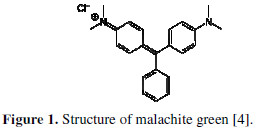
<body><![CDATA[<p><b><i>Keywords</i></b>: Activated carbon (AC), malachite green (MG), linear, non-linear regression.</p>      <p>&nbsp;</p>     <p><b>Introduction</b></p>      <p>Malachite green (MG) is used in coloring paper, dyeing cottons, wools, silk,  leather and coating for paper stock. The treatment of effluents containing such  dyes is of great interest due to their harmful impacts on receiving waters &#91;1&#93;. The  best efficient method used for the quickly removal of dyes from the aqueous  solution is the physical adsorption &#91;2&#93;. Aromatic solutes showed slighty better  adsorption than aliphatic solutes, due to the potential to form &pi;-&pi; bonds with  the basal planes of activated carbon. No significant influence of solute charge or  size was observed &#91;3&#93;. This work aims to understand the potential of activated  carbon (AC) to remove MG dye from simulated aqueous solution in batch mode.  The adsorption kinetics efficiency of MG was investigated in order to optimize  the experimental parameters such as contact time and pH at an agitation speed of  300 rpm, initial adsorbent concentration of 5 mg/L and temperature of 25 °C. The  statistical functions were used to estimate the error deviations between  experimental and theoretically predicted adsorption kinetic values, including  Linear and non-linear method. The optimization procedure required a defined  error function in order to evaluate the fit of equation to the experimental data.</p>      <p>&nbsp;</p>     <p><b>Material and methods</b></p>      <p>MG (4-(4-(dimethylamino) alpha-phenylbenzylidene)-2,5-cyclohexadien-1-  ylidene) dimethylammonium chloride, C23H25ClN2, Mw = 364 g/mol (<a href="#f1">Fig. 1</a>)  used in the present study, was purchased from Merck (Germany) and was  selected from the list of dyes normally used in Algeria.</p>       <p>&nbsp;</p> <a name="f1"> <img src="/img/revistas/pea/v37n2/37n2a02f1.jpg">     
<p>&nbsp;</p>      <p>The sieved residue of  fruit of Sapindus was washed with distilled water to remove any residues or  impurities. Subsequently, it was dried in an oven for 12 hours at 80 °C. The  material was pyrolysized in a fluidized bed furnace at different temperature  range. The pyrolysis process was undergone at temperatures of 300, 400 and  500 °C for half an hour. Then, the material produced was discharged from the  first cyclone of the fluidized bed furnace. This fast pyrolysis method produced  variety of material at different temperatures. Activation of the material was done  by using steam average flowrate 300 cc/min at 800 °C in a muffle furnace for 1  and 2 hours. The activated carbon was then ground and dried in an oven at  100 °C for overnight.</p>      ]]></body>
<body><![CDATA[<p>Adsorption kinetics of MG onto AC was studied in a batch system. The effects of  pH and equilibrium time were examined. The adsorption parameters were  optimized. In each experiment pre weighed amount of adsorbent (50 mg) was  added to 50 mL of dye solution (5 mg/L) taken in a 250 mL of conical flask and  0.1 M NaOH or 0.1 M HCl were added to adjust the pH value. This solution was  agitated at 300 rpm and centrifugated. The MG concentration in solution was  determined at &lambda;max = 620 nm by spectrophotometer UV-1700 PHARMA SPEC  SHIMADZU. The amount of MG adsorbed per mass unit of adsorbent at time t,  q (mg/g), (<a href="#e1">Eq. (1)</a>) was calculated as:</p>       <p>&nbsp;</p> <a name="e1"> <img src="/img/revistas/pea/v37n2/37n2a02e1.jpg">     
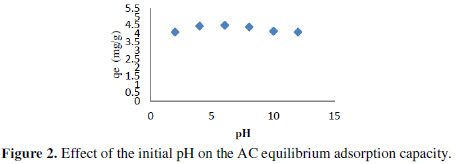
<p>&nbsp;</p>      <p>where C<sub>0</sub> is the initial MG concentration (mg/L), C is the dye concentration at  time t, V is the solution volume (L) and M is the adsorbent mass &#91;g) &#91;5&#93;. The  effect of pH was conducted by mixing 1 g of adsorbent with 1 L of MG synthetic  solution of 5 mg/L. The solution pH was varied from 2 to 12, by adding 0.1 M  NaOH or 0.1 M HCl solutions. The suspension was shaken for 24 h at 25 °C.  Kinetic experiments were performed by mixing 50 mL of dye solution (5 mg/L)  with 50 mg (0.05 g) of adsorbent. The initial pH for each dye solution was set at  6. The suspensions were kept under agitation during 24 hours. MG  concentrations in the supernatants were calculated and allowed to determine the  amount adsorbed of dyes onto AC. The experiments were realized against time  (5, 10, 15, 20, 25, 30, 40, 50, 60, 90, 120, 150, 180, 240 and 300 min).</p>      <p>&nbsp;</p>     <p><b>Results and discussion</b></p>      <p>To study the effect of every parameter, it is necessary to fix the values of others.  The elimination of pollutant from simulated aqueous solution by adsorption is  extremely influenced by the medium of the solution which affects the nature of  the adsorbent surface charge, the ionization extent, the aqueous adsorbate species  speciation and the adsorption rate. The adsorptive process through functional  groups dissociation on the adsorbate and adsorbent were affected by a pH change  &#91;6&#93;. The adsorption of MG increases with the increase of pH of the solution. <a href="#f2">Fig. 2</a> shows the effect of the pH on the adsorption capacity of MG onto AC at  various initial solution pH in the range 2–12 under the following conditions:  initial dye concentration of 5 mg/L and AC dose of 1 g.</p>       <p>&nbsp;</p> <a name="f2"> <img src="/img/revistas/pea/v37n2/37n2a02f2.jpg">     
<p>&nbsp;</p>      <p>From <a href="#f2">Fig. 2</a>, we noticed  that the pH of the medium affect strongly the kinetic of MG fixation, showing an  increase of the adsorption capacity with the pH, from 4.1 to 4.5 mg/g for pH  increasing from 2 to 6.</p>      ]]></body>
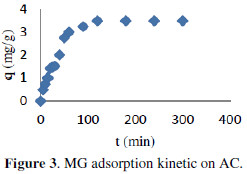
<body><![CDATA[<p>From this study, it is obvious that in the basic medium, the negatively charged  species tends dominating and the surface began to acquire a negative charge. In  this case the adsorbent surface is negatively charged. The MG adsorption  increased due to the increasing of electrostatic attractions between the negative  charge of AC particles and the positive charge of MG species.</p>      <p><a href="#f3">Fig. 3</a> highlights the adsorption Kinetics of MG onto AC.</p>       <p>&nbsp;</p> <a name="f3"> <img src="/img/revistas/pea/v37n2/37n2a02f3.jpg">     
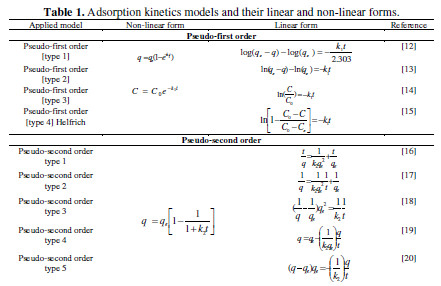
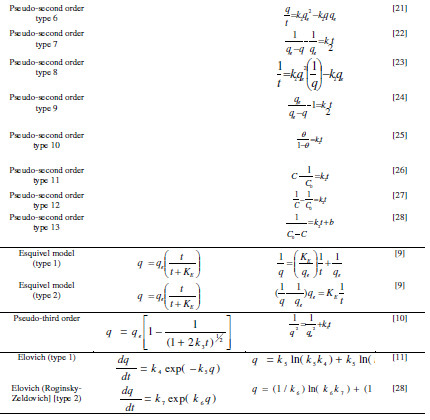
<p>&nbsp;</p>      <p>In the light of the  result, the synthetic sample could be divided in three zones: (i) 0-30 min, which  indicated the fast adsorption of MG, suggesting rapid external diffusion and  surface adsorption; (ii) 30-60 min, showed a gradual equilibrium, and (iii) 60-300  min, indicated the plateau of the equilibrium state. The adsorption was rapid at  the initial stage of the contact, but it gradually slowed down until the equilibrium.</p>      <p>The fast adsorption at the initial stage can be attributed to the fact that a large  number of surface sites are available for adsorption. After a lapse of time, the  remaining surface sites are difficult to be occupied because of the repulsion  between the solute molecules of the solid and bulk phases make it take too long  time to reach equilibrium. Adsorption is a complex process whereby it is  influenced by several parameters related to adsorbent and to the physicochemical  conditions under which the process is carried out &#91;7&#93;. In order to understand the  mechanism of the adsorption process, the following equations: &#91;pseudo-first  order (Lagergren Model) &#91;1&#93;, pseudo-second order &#91;8&#93;, Esquivel &#91;9&#93;, pseudo-third  order &#91;10&#93;, and Elovich &#91;11&#93;&#93; were selected to fit the experimental kinetic data.  Equations of these models were illustrated in <a href="#t1a">Table 1</a> <a href="#t1b"></a>.</p>       <p>&nbsp;</p> <a name="t1a"> <img src="/img/revistas/pea/v37n2/37n2a02t1a.jpg">     
<p><a name="t1b"> <img src="/img/revistas/pea/v37n2/37n2a02t1b.jpg">     
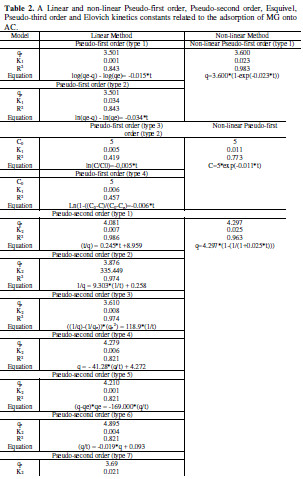
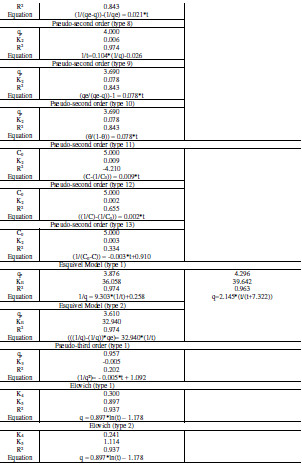
<p>&nbsp;</p>       <p>where k<sub>1</sub> is pseudo-first order rate constant (min<sup>-1</sup>), k<sub>2</sub> is pseudo-second order  rate constant (g/(mg min)), k<sub>3</sub> is pseudo-third order rate constant (g<sup>2</sup>/(mg<sup>2</sup> min)),  K<sub>E</sub> is Esquivel rate constant (min), k<sub>4</sub> is Elovich rate constant (mg/(g min)), k<sub>5</sub> is  extent of surface coverage and activation energy of the process (g/mg), k<sub>6</sub> extent  of surface coverage and activation energy of the process (g/mg), k<sub>7</sub> Elovich rate  constant (mg/(g min)), q<sub>e</sub> is amount of adsorption at equilibrium (mg/g), and &Theta;  dimensionless parameter (=q/qe). A non-linear and linear fitting procedure using  Excel and Origin software were used, respectively. The constants of all models  are given in <a href="#t2a">Table 2</a> <a href="#t2b"></a>.</p>       ]]></body>
<body><![CDATA[<p>&nbsp;</p> <a name="t2a"> <img src="/img/revistas/pea/v37n2/37n2a02t2a.jpg">     
<p><a name="t2b"> <img src="/img/revistas/pea/v37n2/37n2a02t2b.jpg">     
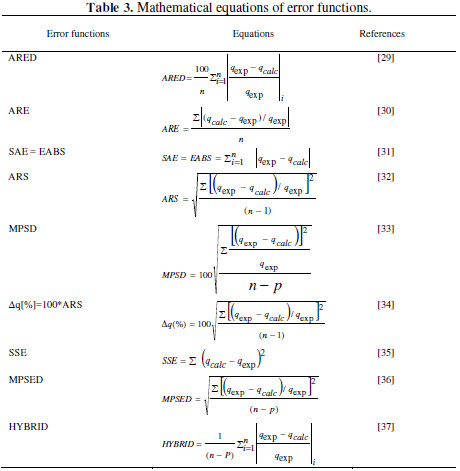
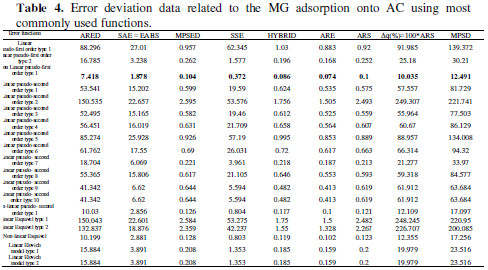
<p>&nbsp;</p>       <p>The optimization procedure required a defined error function in order to evaluate  the fit of equation to the experimental data. In this part, the best-fitting equation  is determined using the well-known special functions to calculate the error  deviation between experimental and predicted data. The mathematical equations  of these error functions are illustrated in <a href="#t3">Table 3</a>.</p>       <p>&nbsp;</p> <a name="t3"> <img src="/img/revistas/pea/v37n2/37n2a02t3.jpg">     
<p>&nbsp;</p>       <p>where <i>n</i> is the number of experimental data points, q<sub>calc</sub> is the predicted  (calculated) quantity of MG adsorbed onto AC, q<sub>exp</sub> are the experimental data, p  is the number of parameters in each kinetic model, ARED is the average relative  error deviation (dimensionless parameter), ARE is the average relative error  (dimensionless parameter, ARS is the average relative standard error  (dimensionless parameter), HYBRID is the hybrid fractional error function  (dimensionless parameter), <i>MPSD</i> Marquardt&rsquo;s is the percent standard deviation  (dimensionless parameter),<i>MPSED</i> Marquardt&rsquo;s is the percent standard  deviation (dimensionless parameter), SAE=EABS is the sum of absolute error  (mg/g), SSE is the sum of the squares of the errors (mg/g)<sup>2</sup>, and &Delta;q(%) is the  normalized standard deviation (mg/g). The constants of all error analysis are  represented in <a href="#t4">Table 4</a>.</p>       <p>&nbsp;</p> <a name="t4"> <img src="/img/revistas/pea/v37n2/37n2a02t4.jpg">     
<p>&nbsp;</p>       <p>Adsorption kinetic data are the basic requirements for the design of adsorption  systems. In order to optimize the design of a specific sorbate/sorbent system to  remove MG from aqueous solution, it is important to establish the most  appropriate correlation for the experimental kinetic data. Applicability of some  statistical tools to predict optimum adsorption kinetic of MG onto AC after linear  regression analysis showed that the highest R<sup>2</sup> value and the lowest ARED, ARE,  SAE, ARS, MPSD, .q, SSE, MSPED, and HYBRID values could be suitable  and meaningful tools to predict the best-fitting equation models. The best fitting  is determined based on the use of these functions to calculate the error deviation  between experimental and predicted equilibrium adsorption kinetic data, after  linear analysis. Hence, according to <a href="#t4">Table 4</a>, it seems that the non-linear pseudofirst  order model was the most suitable model to satisfactorily describe the  studied adsorption phenomenon. Therefore, based on these mentioned results, the  best useful error estimation statistical tools should point out the non-linear  pseudo-first order model followed by non-linear pseudo-second order and nonlinear  Esquivel as the best-fitting models.</p>        ]]></body>
<body><![CDATA[<p><b>Conclusion</b></p>       <p>AC was used for the MG adsorption in simulated aqueous solution. In batch  mode, the adsorption was highly dependent on various operating parameters,  such as contact time, and pH. The obtained results allowed to establish the  following optimal conditions: 120 min time contact and pH 6 leading to 70 %  MG removal obtained at home temperature. The adsorption kinetic of MG onto  AC can be better fitted by the pseudo-second order linear model &#91;type 9 and type  10) as compared to the non-linear pseudo-second-order model, linear pseudosecond- order model, pseudo first order, pseudo third order, and Esquivel models.  On the whole, the experimental results showed that AC is suitable adsorbent for  the removal of MG dye.</p>        <p>&nbsp;</p>     <p><b>References</b></p>       <p>1. Kushwaha AK, Gupta N, Chattopadhyaya MC. Removal of cationic  methylene blue and malachite green dyes from aqueous solution by waste  materials of Daucus carota. J Saudi Chem Soc. 2014;18:200–207.</p>       <p>2. Allen SJ, Koumanova B. Decolourisation of water/wastewater using  adsorption. J Univ Chem Technol Metal. 2005;40:175-192.</p>       <!-- ref --><p>3. De Ridder DJ. Adsorption of organic micropollutants onto activated carbon  and zeolites. Netherlands: Water Management Acad Press; 2012.    &nbsp;&nbsp;&nbsp;&nbsp;&nbsp;&nbsp;&nbsp;&nbsp;[&#160;<a href="javascript:void(0);" onclick="javascript: window.open('/scielo.php?script=sci_nlinks&ref=439432&pid=S0872-1904201900020000200003&lng=','','width=640,height=500,resizable=yes,scrollbars=1,menubar=yes,');">Links</a>&#160;]<!-- end-ref --></p>       <p>4. Al-Degs YS, Sweileh JA. Simultaneous determination of five commercial  cationic dyes in stream waters using diatomite solid-phase extractant and  multivariate calibration. Arab J Chem. 2012;5:219–224.</p>       <p>5. Santhi T, Manonmani S, Smitha T, et al. Adsorption kinetics of cationic  dyes from aqueous solution by bioadsorption onto activated carbon  prepared from Cucumis Sativa. J Appl Sci Environ Sanit. 2009;4:263-271.</p>       ]]></body>
<body><![CDATA[<p>6. Khattria SD, Singh MK. Removal of malachite green from dye wastewater  using neem sawdust by adsorption. J Hazard Mater. 2009;167:1089–1094.</p>       <p>7. Dahri MK, Kooh MRR, Lim LBL. Water remediation using low cost  adsorbent walnut shell for removal of malachite green: Equilibrium;  kinetics; thermodynamic and regeneration studies. J Environ Chem Eng.  2014;2:1434-1444.</p>       <p>8. Baek MH, Ijagbemi CO, Kim DS. Removal of Malachite Green from  aqueous solution using degreased coffee bean. J Hazard Mater.  2010;176:820–828.</p>       <p>9. Shilpi A, Shivhare US, Basu S. Supercritical CO2 Extraction of Compounds  with Antioxidant Activity from Fruits and Vegetables Waste. Foc Modern  Food Ind. 2013;2:43-62.</p>       <p>10. Kyzas GZ, Lazaridis NK, Mitropoulos AC. Removal of dyes from aqueous  solutions with untreated coffee residues as potential low-cost adsorbents:  Equilibrium; reuse and thermodynamic approach. Chem Eng J. 2012;189–  190:148–159.</p>       <p>11. Secula MC, Cagnon B, Cretescu I, et al. Studii si Cercetari Stiintifice  Chimie si Inginerie Chimica. Biotehnologii Industrie Alimentara.  2011;12:307.</p>       <p>12. Santhi T, Manonmani S, Smitha T. Kinetics and Isotherm Studies on  Cationic Dyes Adsorption onto Annona Squmosa Seed Activated Carbon.  Int J Eng Sci Technol. 2010;2:287-295.</p>       <p>13. Tavlieva MP, Genieva SD, Georgieva VG, et al. Kinetic study of brilliant  green adsorption from aqueous solution onto white rice husk ash. J Colloid  Interf Sci. 2013;409:112–122.</p>       <p>14. Keng CS, Zainal Z, Abdullah AH. Removal of cationic and anionic dyes by  immobilized titanium dioxide loaded activated carbon. Malays J Anal Sci.  2008;12:451–457.</p>       <p>15 Rao VS, Chakrapani C, Babu CS, et al. Studies on sorption of fluoride by  prepared activated Kaza&rsquo;s carbons. Der Pharma Chem. 2011;3:73-83.</p>       ]]></body>
<body><![CDATA[<p>16. Wu FC, Tseng RL, Juang RS. Kinetic modeling of liquid-phase adsorption  of reactive dyes and metal ions on chitosan. Water Res. 2001;35:613-618.</p>       <p>17. Shen K, Gondal MA. Removal of hazardous Rhodamine dye from water by  adsorption onto exhausted coffee ground. J Saudi Chem Soc.  2017;21:S120-S127.</p>       <p>18. Sheng GD, Li JX, Shao DD, et al. Adsorption of copper(II) on multiwalled  carbon nanotubes in the absence and presence of humic or fulvic acids. J  Hazard Mater.2010;178:333–340.</p>       <p>19. Schierz A, Zaenker H. Aqueous suspensions of carbon nanotubes: surface  oxidation; colloidal stability and uranium sorption. Environ Pollut.  2009;157:1088–1094.</p>       <p>20. Ho YS. Second-order kinetic model for the sorption of cadmium onto tree  fern: A comparison of linear and non-linear methods Water Res.  2006;40:119 – 125.</p>       <p>21. Giannakopoulos E, Christoforidis KC, Tsipis A, et al. Influence of Pb(II) on  the radical properties of humic substances and model compounds. J Phys  Chem A. 2005;109:2223–2232.</p>       <p>22. Escudero C, Gabaldon C, Marzal P, et al. Effect of EDTA on divalent metal  adsorption onto grape stalk and exhausted coffee wastes. J Hazard Mater.  2008;152:476-485.</p>       <p>23. Kumar KV. Linear and non-linear regression analysis for the sorption  kinetics of methylene blue onto activated carbon. J Hazard Mater.  2006;137:1538–1544.</p>       <p>24. Kumar KV, Ivanesan S. Pseudo second order kinetics and pseudo isotherms  for malachite green onto activated carbon: Comparison of linear and nonlinear  regression methods. J Hazard Mater. 2006;36:721–726.</p>       <p>25. Sobkowsk J, Czerwinski A. Kinetics of carbon dioxide adsorption on a  platinum electrode. J Electroanal Chem. 1974;55:391–397.</p>       ]]></body>
<body><![CDATA[<!-- ref --><p>26. Pereira L, Alves M. Dyes: Environmental impact and remediation. In:  Environmental Protection Strategies for Sustainable Development  Strategies for Sustainability. Malik A, Grohmann E, eds. Springer; 2012. pp  111–162.    &nbsp;&nbsp;&nbsp;&nbsp;&nbsp;&nbsp;&nbsp;&nbsp;[&#160;<a href="javascript:void(0);" onclick="javascript: window.open('/scielo.php?script=sci_nlinks&ref=439456&pid=S0872-1904201900020000200026&lng=','','width=640,height=500,resizable=yes,scrollbars=1,menubar=yes,');">Links</a>&#160;]<!-- end-ref --></p>       <p>27. Blanachard G, Maunaye M, Martin G. Removal of heavy metals from  waters by means of natural zeolites. Water Res. 1984;18:1501-1507.</p>       <p>28. Ho YS, Ng JCY, McKay G. Kinetics of pollutant sorption by biosorbents,  Review. Sep Purif Meth. 2000;29:189-232.</p>       <p>29. Riahi K, Chaabane S, Ben-Thayer B. A kinetic modeling study of  phosphate adsorption onto Phoenix dactylifera L. date palm fibers in batch  mode. J Saudi Chem Soc. 2017;21:S143-S152.</p>       <p>30. Han R, Zhang J, Han P, et al. Study of equilibrium; kinetic and  thermodynamic parameters about methylene blue adsorption onto natural  zeolite. Chem Eng J. 2009;145:496–504.</p>       <p>31. Hsu TC. Adsorption of an acid dye onto coal fly ash. Fuel. 2008;87:3040–  3045.</p>       <p>32. Bajic ZJ, Djokc VR, Velickovic ZS, et al. Equilibrium; kinetic and  thermodynamic studies on removal of Cd(II); Pb(II) AND As(V) from  wastewater using CARP (Cyprinus Carpio) Scales. Digest J Nanomater  Biostruct. 2013;8:1581–1590.</p>       <p>33. Alihosseini A, Taghikhani V, Safekordi AA, et al. Equilibrium sorption of  crude oil by expanded perlite using different adsorption isotherms at 298.15  K. Int J Environ Sci Techn. 2010;7:591-598.</p>       <p>34. Wang L, Zhang J, Zhao R, et al. Adsorption of Pb(II) on activated carbon  prepared from Polygonum orientale Linn.: Kinetics; isotherms; pH; and  ionic strength studies. Biores Technol. 2010;101:5808-5814.</p>       ]]></body>
<body><![CDATA[<p>35. Udoji IA, Etim EE. Dynamics of Mx+ Salts of Fatty Acids Adsorption onto  Metallic Ores. Int J Environ Sci Devel. 2015;6: 205-210.</p>       <p>36. Ncibi MC. Applicability of some statistical tools to predict optimum  adsorption isotherm after linear and non-linear regression analysis. J Hazard  Mater. 2008;153:207–212.</p>       <p>37. Gulipall CS, Prasad B, Wasewar KL. Batch study; equilibrium; and kinetics  of adsorption of selenium using Rice Husk Ash (RHA), J Eng Sci Technol.  2011;6: 586–605.</p>      <p>&nbsp;</p>      <p><a name=0></a><sup><a href="#top">*</a></sup>Corresponding author. E-mail address: <a href="mailto:benmaamarzoubir@yahoo.fr">benmaamarzoubir@yahoo.fr</a></p>      <p>Received August 10, 2016; accepted June 13, 2017 </p>          <p><a href="http://www.peacta.org" target="_blank">www.peacta.org</a> </p>              ]]></body><back>
<ref-list>
<ref id="B1">
<label>1</label><nlm-citation citation-type="journal">
<person-group person-group-type="author">
<name>
<surname><![CDATA[Kushwaha]]></surname>
<given-names><![CDATA[A K]]></given-names>
</name>
<name>
<surname><![CDATA[Gupta]]></surname>
<given-names><![CDATA[N]]></given-names>
</name>
<name>
<surname><![CDATA[Chattopadhyaya]]></surname>
<given-names><![CDATA[M C]]></given-names>
</name>
</person-group>
<source><![CDATA[J Saudi Chem Soc]]></source>
<year>2014</year>
<volume>18</volume>
<page-range>200</page-range></nlm-citation>
</ref>
<ref id="B2">
<label>2</label><nlm-citation citation-type="journal">
<person-group person-group-type="author">
<name>
<surname><![CDATA[Allen]]></surname>
<given-names><![CDATA[SJ]]></given-names>
</name>
<name>
<surname><![CDATA[Koumanova]]></surname>
<given-names><![CDATA[B]]></given-names>
</name>
</person-group>
<source><![CDATA[J Univ Chem Technol Metal]]></source>
<year>2005</year>
<volume>40</volume>
<page-range>175</page-range></nlm-citation>
</ref>
<ref id="B3">
<label>3</label><nlm-citation citation-type="book">
<person-group person-group-type="author">
<name>
<surname><![CDATA[De Ridder]]></surname>
<given-names><![CDATA[D J]]></given-names>
</name>
</person-group>
<source><![CDATA[Adsorption of organic micropollutants onto activated carbon and zeolites]]></source>
<year>2012</year>
<publisher-name><![CDATA[Water Management Acad Press]]></publisher-name>
</nlm-citation>
</ref>
<ref id="B4">
<label>4</label><nlm-citation citation-type="journal">
<person-group person-group-type="author">
<name>
<surname><![CDATA[Al-Degs]]></surname>
<given-names><![CDATA[Y S]]></given-names>
</name>
<name>
<surname><![CDATA[Sweileh]]></surname>
<given-names><![CDATA[J A]]></given-names>
</name>
</person-group>
<source><![CDATA[Arab J Chem]]></source>
<year>2012</year>
<volume>5</volume>
<page-range>219</page-range></nlm-citation>
</ref>
<ref id="B5">
<label>5</label><nlm-citation citation-type="journal">
<person-group person-group-type="author">
<name>
<surname><![CDATA[Santhi]]></surname>
<given-names><![CDATA[T]]></given-names>
</name>
<name>
<surname><![CDATA[Manonmani]]></surname>
<given-names><![CDATA[S]]></given-names>
</name>
<name>
<surname><![CDATA[Smitha]]></surname>
<given-names><![CDATA[T]]></given-names>
</name>
</person-group>
<source><![CDATA[J Appl Sci Environ Sanit]]></source>
<year>2009</year>
<volume>4</volume>
<page-range>263</page-range></nlm-citation>
</ref>
<ref id="B6">
<label>6</label><nlm-citation citation-type="journal">
<person-group person-group-type="author">
<name>
<surname><![CDATA[Khattria]]></surname>
<given-names><![CDATA[S D]]></given-names>
</name>
<name>
<surname><![CDATA[Singh]]></surname>
<given-names><![CDATA[M K]]></given-names>
</name>
</person-group>
<source><![CDATA[J Hazard Mater]]></source>
<year>2009</year>
<volume>167</volume>
<page-range>10894</page-range></nlm-citation>
</ref>
<ref id="B7">
<label>7</label><nlm-citation citation-type="journal">
<person-group person-group-type="author">
<name>
<surname><![CDATA[Dahri]]></surname>
<given-names><![CDATA[M K]]></given-names>
</name>
<name>
<surname><![CDATA[Kooh]]></surname>
<given-names><![CDATA[M R R]]></given-names>
</name>
<name>
<surname><![CDATA[Lim]]></surname>
<given-names><![CDATA[L B L]]></given-names>
</name>
</person-group>
<source><![CDATA[J Environ Chem Eng]]></source>
<year>2014</year>
<volume>2</volume>
<page-range>1434</page-range></nlm-citation>
</ref>
<ref id="B8">
<label>8</label><nlm-citation citation-type="journal">
<person-group person-group-type="author">
<name>
<surname><![CDATA[Baek]]></surname>
<given-names><![CDATA[M H]]></given-names>
</name>
<name>
<surname><![CDATA[Ijagbemi]]></surname>
<given-names><![CDATA[C O]]></given-names>
</name>
<name>
<surname><![CDATA[Kim]]></surname>
<given-names><![CDATA[D S]]></given-names>
</name>
</person-group>
<source><![CDATA[J Hazard Mater]]></source>
<year>2010</year>
<volume>176</volume>
<page-range>820</page-range></nlm-citation>
</ref>
<ref id="B9">
<label>9</label><nlm-citation citation-type="journal">
<person-group person-group-type="author">
<name>
<surname><![CDATA[Shilpi]]></surname>
<given-names><![CDATA[A]]></given-names>
</name>
<name>
<surname><![CDATA[Shivhare]]></surname>
<given-names><![CDATA[U S]]></given-names>
</name>
</person-group>
<source><![CDATA[Foc Modern Food Ind]]></source>
<year>2013</year>
<volume>2</volume>
<page-range>43</page-range></nlm-citation>
</ref>
<ref id="B10">
<label>10</label><nlm-citation citation-type="journal">
<person-group person-group-type="author">
<name>
<surname><![CDATA[Kyzas]]></surname>
<given-names><![CDATA[G Z]]></given-names>
</name>
<name>
<surname><![CDATA[Lazaridis]]></surname>
<given-names><![CDATA[N K]]></given-names>
</name>
<name>
<surname><![CDATA[Mitropoulos]]></surname>
<given-names><![CDATA[A C]]></given-names>
</name>
</person-group>
<source><![CDATA[Chem Eng J]]></source>
<year>2012</year>
<volume>189-190</volume>
<page-range>148</page-range></nlm-citation>
</ref>
<ref id="B11">
<label>11</label><nlm-citation citation-type="journal">
<person-group person-group-type="author">
<name>
<surname><![CDATA[Secula]]></surname>
<given-names><![CDATA[M C]]></given-names>
</name>
<name>
<surname><![CDATA[Cagnon]]></surname>
<given-names><![CDATA[B]]></given-names>
</name>
<name>
<surname><![CDATA[Cretescu]]></surname>
<given-names><![CDATA[I]]></given-names>
</name>
</person-group>
<source><![CDATA[Biotehnologii Industrie Alimentara]]></source>
<year>2011</year>
<volume>12</volume>
<page-range>307</page-range></nlm-citation>
</ref>
<ref id="B12">
<label>12</label><nlm-citation citation-type="journal">
<person-group person-group-type="author">
<name>
<surname><![CDATA[Santhi]]></surname>
<given-names><![CDATA[T]]></given-names>
</name>
<name>
<surname><![CDATA[Manonmani]]></surname>
<given-names><![CDATA[S]]></given-names>
</name>
<name>
<surname><![CDATA[Smitha]]></surname>
<given-names><![CDATA[T]]></given-names>
</name>
</person-group>
<source><![CDATA[Int J Eng Sci Technol]]></source>
<year>2010</year>
<volume>2</volume>
<page-range>287</page-range></nlm-citation>
</ref>
<ref id="B13">
<label>13</label><nlm-citation citation-type="journal">
<person-group person-group-type="author">
<name>
<surname><![CDATA[Tavlieva]]></surname>
<given-names><![CDATA[M P]]></given-names>
</name>
<name>
<surname><![CDATA[Genieva]]></surname>
<given-names><![CDATA[S D]]></given-names>
</name>
<name>
<surname><![CDATA[Georgieva]]></surname>
<given-names><![CDATA[VG]]></given-names>
</name>
</person-group>
<source><![CDATA[J Colloid Interf Sci]]></source>
<year>2013</year>
<volume>409</volume>
<page-range>112</page-range></nlm-citation>
</ref>
<ref id="B14">
<label>14</label><nlm-citation citation-type="journal">
<person-group person-group-type="author">
<name>
<surname><![CDATA[Keng]]></surname>
<given-names><![CDATA[C S]]></given-names>
</name>
<name>
<surname><![CDATA[Zainal]]></surname>
<given-names><![CDATA[Z]]></given-names>
</name>
<name>
<surname><![CDATA[Abdullah]]></surname>
<given-names><![CDATA[A H]]></given-names>
</name>
</person-group>
<source><![CDATA[Malays J Anal Sci]]></source>
<year>2008</year>
<volume>12</volume>
<page-range>451</page-range></nlm-citation>
</ref>
<ref id="B15">
<label>15</label><nlm-citation citation-type="journal">
<person-group person-group-type="author">
<name>
<surname><![CDATA[Rao]]></surname>
<given-names><![CDATA[V S]]></given-names>
</name>
<name>
<surname><![CDATA[Chakrapani]]></surname>
<given-names><![CDATA[C]]></given-names>
</name>
<name>
<surname><![CDATA[Babu]]></surname>
<given-names><![CDATA[C S]]></given-names>
</name>
</person-group>
<source><![CDATA[Der Pharma Chem]]></source>
<year>2011</year>
<volume>3</volume>
<page-range>73</page-range></nlm-citation>
</ref>
<ref id="B16">
<label>16</label><nlm-citation citation-type="journal">
<person-group person-group-type="author">
<name>
<surname><![CDATA[Wu]]></surname>
<given-names><![CDATA[F C]]></given-names>
</name>
<name>
<surname><![CDATA[Tseng]]></surname>
<given-names><![CDATA[R L]]></given-names>
</name>
<name>
<surname><![CDATA[Juang]]></surname>
<given-names><![CDATA[R S]]></given-names>
</name>
</person-group>
<source><![CDATA[Water Res]]></source>
<year>2001</year>
<volume>35</volume>
<page-range>613</page-range></nlm-citation>
</ref>
<ref id="B17">
<label>17</label><nlm-citation citation-type="journal">
<person-group person-group-type="author">
<name>
<surname><![CDATA[Shen]]></surname>
<given-names><![CDATA[K]]></given-names>
</name>
<name>
<surname><![CDATA[Gondal]]></surname>
<given-names><![CDATA[M A]]></given-names>
</name>
</person-group>
<source><![CDATA[J Saudi Chem Soc]]></source>
<year>2017</year>
<volume>21</volume>
<page-range>S120</page-range></nlm-citation>
</ref>
<ref id="B18">
<label>18</label><nlm-citation citation-type="journal">
<person-group person-group-type="author">
<name>
<surname><![CDATA[Sheng]]></surname>
<given-names><![CDATA[G D]]></given-names>
</name>
<name>
<surname><![CDATA[Li]]></surname>
<given-names><![CDATA[J X]]></given-names>
</name>
<name>
<surname><![CDATA[Shao]]></surname>
<given-names><![CDATA[D D]]></given-names>
</name>
</person-group>
<source><![CDATA[J Hazard Mater]]></source>
<year>2010</year>
<volume>178</volume>
<page-range>333</page-range></nlm-citation>
</ref>
<ref id="B19">
<label>19</label><nlm-citation citation-type="journal">
<person-group person-group-type="author">
<name>
<surname><![CDATA[Schierz]]></surname>
<given-names><![CDATA[A]]></given-names>
</name>
<name>
<surname><![CDATA[Zaenker]]></surname>
<given-names><![CDATA[H]]></given-names>
</name>
</person-group>
<source><![CDATA[Environ Pollut]]></source>
<year>2009</year>
<volume>157</volume>
<page-range>1088</page-range></nlm-citation>
</ref>
<ref id="B20">
<label>20</label><nlm-citation citation-type="journal">
<person-group person-group-type="author">
<name>
<surname><![CDATA[Ho]]></surname>
<given-names><![CDATA[Y S]]></given-names>
</name>
</person-group>
<source><![CDATA[Water Res]]></source>
<year>2006</year>
<volume>40</volume>
<page-range>119</page-range></nlm-citation>
</ref>
<ref id="B21">
<label>21</label><nlm-citation citation-type="journal">
<person-group person-group-type="author">
<name>
<surname><![CDATA[Giannakopoulos]]></surname>
<given-names><![CDATA[E]]></given-names>
</name>
<name>
<surname><![CDATA[Christoforidis]]></surname>
<given-names><![CDATA[K C]]></given-names>
</name>
<name>
<surname><![CDATA[Tsipis]]></surname>
<given-names><![CDATA[A]]></given-names>
</name>
</person-group>
<source><![CDATA[J Phys Chem A]]></source>
<year>2005</year>
<volume>109</volume>
<page-range>2223</page-range></nlm-citation>
</ref>
<ref id="B22">
<label>22</label><nlm-citation citation-type="journal">
<person-group person-group-type="author">
<name>
<surname><![CDATA[Escudero]]></surname>
<given-names><![CDATA[C]]></given-names>
</name>
<name>
<surname><![CDATA[Gabaldon]]></surname>
<given-names><![CDATA[C]]></given-names>
</name>
<name>
<surname><![CDATA[Marzal]]></surname>
<given-names><![CDATA[P]]></given-names>
</name>
</person-group>
<source><![CDATA[J Hazard Mater]]></source>
<year>2008</year>
<volume>152</volume>
<page-range>476</page-range></nlm-citation>
</ref>
<ref id="B23">
<label>23</label><nlm-citation citation-type="journal">
<person-group person-group-type="author">
<name>
<surname><![CDATA[Kumar]]></surname>
<given-names><![CDATA[KV]]></given-names>
</name>
</person-group>
<source><![CDATA[J Hazard Mater]]></source>
<year>2006</year>
<volume>137</volume>
<page-range>1538</page-range></nlm-citation>
</ref>
<ref id="B24">
<label>24</label><nlm-citation citation-type="journal">
<person-group person-group-type="author">
<name>
<surname><![CDATA[Kumar]]></surname>
<given-names><![CDATA[K V]]></given-names>
</name>
<name>
<surname><![CDATA[Ivanesan]]></surname>
<given-names><![CDATA[S]]></given-names>
</name>
</person-group>
<source><![CDATA[J Hazard Mater]]></source>
<year>2006</year>
<volume>36</volume>
<page-range>721</page-range></nlm-citation>
</ref>
<ref id="B25">
<label>25</label><nlm-citation citation-type="journal">
<person-group person-group-type="author">
<name>
<surname><![CDATA[Sobkowsk]]></surname>
<given-names><![CDATA[J]]></given-names>
</name>
<name>
<surname><![CDATA[Czerwinski]]></surname>
<given-names><![CDATA[A]]></given-names>
</name>
</person-group>
<source><![CDATA[J Electroanal Chem]]></source>
<year>1974</year>
<volume>55</volume>
<page-range>391</page-range></nlm-citation>
</ref>
<ref id="B26">
<label>26</label><nlm-citation citation-type="book">
<person-group person-group-type="author">
<name>
<surname><![CDATA[Pereira]]></surname>
<given-names><![CDATA[L]]></given-names>
</name>
<name>
<surname><![CDATA[Alves]]></surname>
<given-names><![CDATA[M.]]></given-names>
</name>
</person-group>
<article-title xml:lang="en"><![CDATA[Dyes: Environmental impact and remediation]]></article-title>
<person-group person-group-type="editor">
<name>
<surname><![CDATA[Malik]]></surname>
<given-names><![CDATA[A]]></given-names>
</name>
<name>
<surname><![CDATA[Grohmann]]></surname>
<given-names><![CDATA[E]]></given-names>
</name>
</person-group>
<source><![CDATA[Environmental Protection Strategies for Sustainable Development Strategies for Sustainability]]></source>
<year>2012</year>
<page-range>111-162</page-range><publisher-name><![CDATA[Springer]]></publisher-name>
</nlm-citation>
</ref>
<ref id="B27">
<label>27</label><nlm-citation citation-type="journal">
<person-group person-group-type="author">
<name>
<surname><![CDATA[Blanachard]]></surname>
<given-names><![CDATA[G]]></given-names>
</name>
<name>
<surname><![CDATA[Maunaye]]></surname>
<given-names><![CDATA[M]]></given-names>
</name>
<name>
<surname><![CDATA[Martin]]></surname>
<given-names><![CDATA[G]]></given-names>
</name>
</person-group>
<source><![CDATA[Water Res]]></source>
<year>1984</year>
<volume>18</volume>
<page-range>1501</page-range></nlm-citation>
</ref>
<ref id="B28">
<label>28</label><nlm-citation citation-type="journal">
<person-group person-group-type="author">
<name>
<surname><![CDATA[Ho]]></surname>
<given-names><![CDATA[Y S]]></given-names>
</name>
<name>
<surname><![CDATA[Ng]]></surname>
<given-names><![CDATA[J C Y]]></given-names>
</name>
<name>
<surname><![CDATA[McKay]]></surname>
<given-names><![CDATA[G]]></given-names>
</name>
</person-group>
<source><![CDATA[Sep Purif Meth]]></source>
<year>2000</year>
<volume>29</volume>
<page-range>189</page-range></nlm-citation>
</ref>
<ref id="B29">
<label>29</label><nlm-citation citation-type="journal">
<person-group person-group-type="author">
<name>
<surname><![CDATA[Riahi]]></surname>
<given-names><![CDATA[K]]></given-names>
</name>
<name>
<surname><![CDATA[Chaabane]]></surname>
<given-names><![CDATA[S]]></given-names>
</name>
<name>
<surname><![CDATA[Ben-Thayer]]></surname>
<given-names><![CDATA[B]]></given-names>
</name>
</person-group>
<source><![CDATA[J Saudi Chem Soc]]></source>
<year>2017</year>
<volume>21</volume>
<page-range>S143</page-range></nlm-citation>
</ref>
<ref id="B30">
<label>30</label><nlm-citation citation-type="journal">
<person-group person-group-type="author">
<name>
<surname><![CDATA[Han]]></surname>
<given-names><![CDATA[R]]></given-names>
</name>
<name>
<surname><![CDATA[Zhang]]></surname>
<given-names><![CDATA[J]]></given-names>
</name>
<name>
<surname><![CDATA[Han]]></surname>
<given-names><![CDATA[P]]></given-names>
</name>
</person-group>
<source><![CDATA[Chem Eng J]]></source>
<year>2009</year>
<volume>145</volume>
<page-range>496</page-range></nlm-citation>
</ref>
<ref id="B31">
<label>31</label><nlm-citation citation-type="journal">
<person-group person-group-type="author">
<name>
<surname><![CDATA[Hsu]]></surname>
<given-names><![CDATA[TC]]></given-names>
</name>
</person-group>
<source><![CDATA[Fuel]]></source>
<year>2008</year>
<volume>87</volume>
<page-range>3040</page-range></nlm-citation>
</ref>
<ref id="B32">
<label>32</label><nlm-citation citation-type="journal">
<person-group person-group-type="author">
<name>
<surname><![CDATA[Bajic]]></surname>
<given-names><![CDATA[Z J]]></given-names>
</name>
<name>
<surname><![CDATA[Djokc]]></surname>
<given-names><![CDATA[V R]]></given-names>
</name>
<name>
<surname><![CDATA[Velickovic]]></surname>
<given-names><![CDATA[Z S]]></given-names>
</name>
</person-group>
<source><![CDATA[Digest J Nanomater Biostruct]]></source>
<year>2013</year>
<volume>8</volume>
<page-range>1581</page-range></nlm-citation>
</ref>
<ref id="B33">
<label>33</label><nlm-citation citation-type="journal">
<person-group person-group-type="author">
<name>
<surname><![CDATA[Alihosseini]]></surname>
<given-names><![CDATA[A]]></given-names>
</name>
<name>
<surname><![CDATA[Taghikhani]]></surname>
<given-names><![CDATA[V]]></given-names>
</name>
<name>
<surname><![CDATA[Safekordi]]></surname>
<given-names><![CDATA[A A]]></given-names>
</name>
</person-group>
<source><![CDATA[Int J Environ Sci Techn]]></source>
<year>2010</year>
<volume>7</volume>
<page-range>591</page-range></nlm-citation>
</ref>
<ref id="B34">
<label>34</label><nlm-citation citation-type="journal">
<person-group person-group-type="author">
<name>
<surname><![CDATA[Wang]]></surname>
<given-names><![CDATA[L]]></given-names>
</name>
<name>
<surname><![CDATA[Zhang]]></surname>
<given-names><![CDATA[J]]></given-names>
</name>
<name>
<surname><![CDATA[Zhao]]></surname>
<given-names><![CDATA[R]]></given-names>
</name>
</person-group>
<source><![CDATA[Biores Technol]]></source>
<year>2010</year>
<volume>101</volume>
<page-range>5808</page-range></nlm-citation>
</ref>
<ref id="B35">
<label>35</label><nlm-citation citation-type="journal">
<person-group person-group-type="author">
<name>
<surname><![CDATA[Udoji]]></surname>
<given-names><![CDATA[I A]]></given-names>
</name>
<name>
<surname><![CDATA[Etim]]></surname>
<given-names><![CDATA[E E]]></given-names>
</name>
</person-group>
<source><![CDATA[Int J Environ Sci Devel]]></source>
<year>2015</year>
<volume>6</volume>
<page-range>205</page-range></nlm-citation>
</ref>
<ref id="B36">
<label>36</label><nlm-citation citation-type="journal">
<person-group person-group-type="author">
<name>
<surname><![CDATA[Ncibi]]></surname>
<given-names><![CDATA[M C]]></given-names>
</name>
</person-group>
<source><![CDATA[J Hazard Mater]]></source>
<year>2008</year>
<volume>153</volume>
<page-range>207</page-range></nlm-citation>
</ref>
<ref id="B37">
<label>37</label><nlm-citation citation-type="journal">
<person-group person-group-type="author">
<name>
<surname><![CDATA[Gulipall]]></surname>
<given-names><![CDATA[C S]]></given-names>
</name>
<name>
<surname><![CDATA[Prasad]]></surname>
<given-names><![CDATA[B]]></given-names>
</name>
<name>
<surname><![CDATA[Wasewar]]></surname>
<given-names><![CDATA[K L]]></given-names>
</name>
</person-group>
<source><![CDATA[J Eng Sci Technol]]></source>
<year>2011</year>
<volume>6</volume>
<page-range>586</page-range></nlm-citation>
</ref>
</ref-list>
</back>
</article>