<?xml version="1.0" encoding="ISO-8859-1"?><article xmlns:mml="http://www.w3.org/1998/Math/MathML" xmlns:xlink="http://www.w3.org/1999/xlink" xmlns:xsi="http://www.w3.org/2001/XMLSchema-instance">
<front>
<journal-meta>
<journal-id>0872-1904</journal-id>
<journal-title><![CDATA[Portugaliae Electrochimica Acta]]></journal-title>
<abbrev-journal-title><![CDATA[Port. Electrochim. Acta]]></abbrev-journal-title>
<issn>0872-1904</issn>
<publisher>
<publisher-name><![CDATA[Sociedade Portuguesa de Electroquímica]]></publisher-name>
</publisher>
</journal-meta>
<article-meta>
<article-id>S0872-19042019000200004</article-id>
<article-id pub-id-type="doi">10.4152/pea.201902115</article-id>
<title-group>
<article-title xml:lang="en"><![CDATA[Study of Bitter Leaves Extract as Inhibitive Agent in HCl Medium for the Treatment of Mild Steel through Pickling]]></article-title>
</title-group>
<contrib-group>
<contrib contrib-type="author">
<name>
<surname><![CDATA[Onukwuli]]></surname>
<given-names><![CDATA[O. D.]]></given-names>
</name>
<xref ref-type="aff" rid="A01"/>
</contrib>
<contrib contrib-type="author">
<name>
<surname><![CDATA[Omotioma]]></surname>
<given-names><![CDATA[M.]]></given-names>
</name>
<xref ref-type="aff" rid="A02"/>
</contrib>
</contrib-group>
<aff id="A01">
<institution><![CDATA[,Nnamdi Azikiwe University Department of Chemical Engineering ]]></institution>
<addr-line><![CDATA[Awka ]]></addr-line>
<country>Nigeria</country>
</aff>
<aff id="A02">
<institution><![CDATA[,Enugu State University of Science and Technology Department of Chemical Engineering ]]></institution>
<addr-line><![CDATA[Enugu ]]></addr-line>
<country>Nigeria</country>
</aff>
<pub-date pub-type="pub">
<day>00</day>
<month>03</month>
<year>2019</year>
</pub-date>
<pub-date pub-type="epub">
<day>00</day>
<month>03</month>
<year>2019</year>
</pub-date>
<volume>37</volume>
<numero>2</numero>
<fpage>115</fpage>
<lpage>121</lpage>
<copyright-statement/>
<copyright-year/>
<self-uri xlink:href="http://scielo.pt/scielo.php?script=sci_arttext&amp;pid=S0872-19042019000200004&amp;lng=en&amp;nrm=iso"></self-uri><self-uri xlink:href="http://scielo.pt/scielo.php?script=sci_abstract&amp;pid=S0872-19042019000200004&amp;lng=en&amp;nrm=iso"></self-uri><self-uri xlink:href="http://scielo.pt/scielo.php?script=sci_pdf&amp;pid=S0872-19042019000200004&amp;lng=en&amp;nrm=iso"></self-uri><abstract abstract-type="short" xml:lang="en"><p><![CDATA[Bitter leaves extract as inhibitive agent in HCl medium for the treatment of mild steel through pickling was studied. Thermometric, gravimetric and potentiodynamic polarization methods were employed in the corrosion inhibition study. The bitter leaves extract was analyzed using gas chromatography-mass spectrometer. The analysis of the extract revealed the presence of C6H8O (96 g/mole: 2,4-Hexadienal); C7H12(96 g/mole: 3,4-Heptadiene; 1,3-Diethylallene) and C10H18O2 (170 g/mole: 2-Decenoic acid) as the predominant chemical constituents. The activation energy for the corrosion inhibition process ranged from 39.831 to 77.533 kJ/mol, while the heat of adsorption ranged from -16.093 to -30.224 kJ/mol. These values showed that exothermic and spontaneous adsorption of the extract on the mild steel followed the mechanism of physical adsorption. Maximum inhibition efficiency of 85.4% was obtained. The extract was highly efficient in the corrosion inhibition function. The plant-based inhibitor of bitter leaves extract is a suitable additive for pickling, cleaning and descaling operations.]]></p></abstract>
<kwd-group>
<kwd lng="en"><![CDATA[Bitter leaves]]></kwd>
<kwd lng="en"><![CDATA[treatment]]></kwd>
<kwd lng="en"><![CDATA[mild steel]]></kwd>
<kwd lng="en"><![CDATA[pickling]]></kwd>
</kwd-group>
</article-meta>
</front><body><![CDATA[   <!--     <p>&nbsp;</p>     <p>doi: 10.4152/pea.201902115</p> -->      <p><b>Study of Bitter Leaves Extract as Inhibitive Agent in HCl  Medium for the Treatment of Mild Steel through Pickling</b></p>      <p> <b>O.D. Onukwuli</b><sup><i>a</i></sup> and <b>M. Omotioma</b><sup><i>b</i></sup><a href="#0">*</a></sup>  </p>      <p><sup><i>a</i></sup><i> Department of Chemical Engineering, Nnamdi Azikiwe University, Awka, Nigeria</i></p>      <p><sup><i>b</i></sup><i> Department of Chemical Engineering, Enugu State University of Science and Technology,  P.M.B. 01660, Enugu, Nigeria</i></p>       <p>&nbsp;</p>     <p><b>Abstract</b></p>      <p>Bitter leaves extract as inhibitive agent in HCl medium for the treatment of mild steel  through pickling was studied. Thermometric, gravimetric and potentiodynamic  polarization methods were employed in the corrosion inhibition study. The bitter leaves  extract was analyzed using gas chromatography-mass spectrometer. The analysis of the  extract revealed the presence of C<sub>6</sub>H<sub>8</sub>O (96 g/mole: 2,4-Hexadienal); C<sub>7</sub>H<sub>12</sub>(96 g/mole:  3,4-Heptadiene; 1,3-Diethylallene) and C<sub>10</sub>H<sub>18</sub>O<sub>2</sub> (170 g/mole: 2-Decenoic acid) as the  predominant chemical constituents. The activation energy for the corrosion inhibition  process ranged from 39.831 to 77.533 kJ/mol, while the heat of adsorption ranged from  -16.093 to -30.224 kJ/mol. These values showed that exothermic and spontaneous  adsorption of the extract on the mild steel followed the mechanism of physical  adsorption. Maximum inhibition efficiency of 85.4% was obtained. The extract was  highly efficient in the corrosion inhibition function. The plant-based inhibitor of bitter  leaves extract is a suitable additive for pickling, cleaning and descaling operations.</p>       ]]></body>
<body><![CDATA[<p><b><i>Keywords</i></b>: Bitter leaves, treatment, mild steel, pickling.</p>       <p>&nbsp;</p>     <p><b>Introduction</b></p>      <p>Mild steel is a vital metallic material used in engineering, transportation and  construction industries. It has good machining properties and can be hardened by  heat treatment. Besides carbon, steel contains many chemical elements which are  added into iron to form steel of different kinds having various physical properties  &#91;1&#93;. Mild steel is a medium carbon steel with carbon content of 0.2 – 0.5% &#91;2&#93;. It  is weldable, which expands its possible applications. It is used for the production  of lightly stressed machine fittings, turbine motors, railways axels, pipes and  drums. Mild steel is widely used in the manufacturing of installations for  chemical and allied industries. Most often processes within these industries such  maintenance operations involve contact between mild steel and aggressive  solution.</p>      <p>Mild steel structures corrode as a result of electrochemical reaction with its  environment. In most industries, maintenance operations such as pickling,  cleaning and descaling are carried out to prolong the life span of the mild steel  structures. But aggressive hydrochloric acid used for such operations often  corrodes the mild steel structures. Considering the viability of mild steel and its  high cost of production and installation, several steps are taken to prolong its life  span. The synthetic chemicals commonly used as corrosion inhibitors are harmful  to the environment. There is need for the corrosion inhibition using eco-friendly  inhibitors of plant origin. Bitter leaves extract has been found useful in  pharmaceutical applications &#91;3, 4&#93;. The chemical constituents of bitter leaves  extract include several organic compounds with polar atoms capable of  exhibiting electrochemical activity of strong adsorption onto mild steel surface.  Quantum chemical methods have been employed in determining the molecular  structure as well as describing the electronic structure and reactivity. The  chemical techniques apply the knowledge of the density for a complete  determination of all ground state molecular properties. The basic <a href="#e1">relationship</a> of  the density functional theory of chemical reactivity is the one that links the  chemical potential of density functional theory with the first derivative of the  energy with respect to the number of electrons, and therefore with the negative of  the electronegativity <i>&Chi;</i> &#91;5&#93;.</p>       <p>&nbsp;</p> <a name="e1"> <img src="/img/revistas/pea/v37n2/37n2a04e1.jpg">     
<p>&nbsp;</p>      <p>where &mu; is the chemical potential, E is the total energy, N is the number of  electrons, and &nu;(r) is the external potential of the system.</p>       <p>For detail understanding of the chemical constituents of plant extract,  sophisticated device (such as gas chromatography-mass spectrometer) is needed  for the characterization of the plant extract. Gas chromatography-mass  spectrometer helps in identifying the molecular compositions of the extract for  the corrosion inhibition functions.</p>       <p>&nbsp;</p>     ]]></body>
<body><![CDATA[<p><b>Experimental methods</b></p>      <p>Leaves of bitter leaf (Vernonia amygdalina) were collected from Akpugo, Enugu  State, Nigeria. Sheet of mild steel with composition of P (0.02%), Mn (0.11%),  Si (0.02%), S (0.02%), Cu (0.01%), C (0.23%), Ni (0.02), Cr (0.01%) and Fe  (99.56 %) were cut into coupons (5 cm &times; 4 cm). In the extraction of the bitter  leaves extract and surface preparation of the mild steel, the method used in the  previous study was adopted &#91;6&#93;. Chemical analysis of the bitter leaves extract  was carried out using gas chromatography-mass spectrometer (GCMS-QP2010  PLUS, SHIMADZU). The method used by previous authors was adopted &#91;7, 8&#93;.</p>       <p>Thermometric, gravimetric and potentiodynamic polarization methods were used  in the corrosion inhibition study. The method of the thermometric measurements  used by previous authors was adopted with slight modification &#91;9, 10&#93;. The  inhibitor efficiency was determined using <a href="#e2">Equation (2)</a>.</p>       <p>&nbsp;</p> <a name="e2"> <img src="/img/revistas/pea/v37n2/37n2a04e2.jpg">     
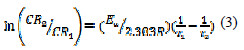
<p>&nbsp;</p>      <p>where RN<sub>free</sub> and RN<sub>add</sub> are the reaction numbers for the metal dissolution in free  and inhibited corrosive medium, respectively.</p>       <p>The potentiodynamic polarization study was carried out according to the method  used by previous authors &#91;11, 12&#93;. For the gravimetric method, the weight loss  (&Delta;w), corrosion rate (CR), inhibition efficiency (IE) and degree of surface  coverage, were determined using the standard Equations &#91;6, 13&#93;.  Considering the corrosion rates of the metal at T<sub>1</sub> and T<sub>2</sub> as CR<sub>1</sub> and CR<sub>2</sub>, the  activation energy, E<sub>a</sub>, was obtained using <a href="#e3">Equation (3)</a> &#91;14, 15, 16&#93;.</p>       <p>&nbsp;</p> <a name="e3"> <img src="/img/revistas/pea/v37n2/37n2a04e3.jpg">     
<p>&nbsp;</p>      <p>The heat of adsorption Q<sub>ads</sub>(kJmol<sup>-1</sup>) was calculated using <a href="#e4">Equation (4)</a> &#91;15, 17&#93;.</p>       ]]></body>
<body><![CDATA[<p>&nbsp;</p> <a name="e4"> <img src="/img/revistas/pea/v37n2/37n2a04e4.jpg">     
<p>&nbsp;</p>      <p>where R is the gas constant, &Theta;1 and &Theta;2 are the degree of surface coverage at  temperatures T<sub>1</sub> and T<sub>2</sub>, respectively.</p>      <p>Different adsorption isotherms (The Langmuir, Frumkin, Temkin and Flory-  Huggins isotherms) were used to determine the mechanism of the adsorption of  the extract on the metal surface &#91;6, 15, 18, 19, 20&#93;.</p>      <p>The free energy of adsorption (&Delta;G<sub>ads</sub>) was calculated according to <a href="#e5">Equation (5)</a>  &#91;6, 15, 18&#93;.</p>       <p>&nbsp;</p> <a name="e5"> <img src="/img/revistas/pea/v37n2/37n2a04e5.jpg">     
<p>&nbsp;</p>      <p>where R is the gas constant, T is temperature and K is the adsorption equilibrium  constant.</p>       <p>&nbsp;</p>     <p><b>Results and discussion</b></p>     ]]></body>
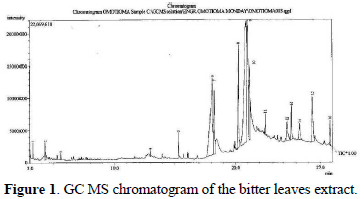
<body><![CDATA[<p><b><i>Analysis of the bitter leaves extract</i></b></p>       <p>In <a href="#f1">Fig. 1</a>, the GC MS chromatogram of the bitter leaves extract shows various  levels of peaks.</p>       <p>&nbsp;</p> <a name="f1"> <img src="/img/revistas/pea/v37n2/37n2a04f1.jpg">     
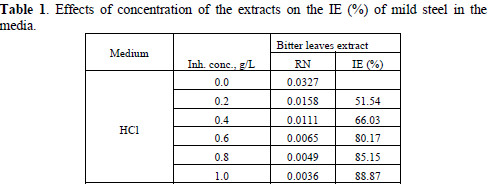
<p>&nbsp;</p>      <p>The analysis revealed the presence of C<sub>6</sub>H<sub>8</sub>O (96 g/mole: 2,4-  Hexadienal; Sorbaldehyde , n-Hex-2,4-dienal, Hexa-2,4-dienal; Sorbic aldehyde  1,3-Pentadiene-1-carboxaldehyde; 2,4-Hexadien-1-al; 2,4-Hexadienal;  trans,trans-2,4-Hexadienal; 3-Propyleneacrolein); C<sub>7</sub>H<sub>12</sub>(96 g/mole: 3,4-  Heptadiene; 1,3-Diethylallene); C<sub>10</sub>H<sub>18</sub>O<sub>2</sub>(170 g/mole: 2-Decenoic acid).</p>      <p>Other compounds present in the extract include C<sub>9</sub>H<sub>16</sub>O<sub>2</sub>(156 g/mole: 2-  Nonenoic acid; trans-2-Nonenoic acid; Nonylenic acid, 2-Nonenylic acid);  C<sub>12</sub>H<sub>14</sub>N<sub>2</sub>O<sub>6</sub>(282g/mole: Phenol, 2-(1-methylpropyl)-4,6-dinitro-, acetate;  Acetic acid, 2-(sec-butyl)-4,6-dinitrophenyl ester); C<sub>12</sub>H<sub>18</sub>O (178 g/mole:  Benzene ethanol; 2-(3-Isopropylphenyl)-1-propanol); C<sub>18</sub>H<sub>34</sub>O<sub>2</sub> (282 g/mole:  Oleic Acid, 9-Octadecenoic acid; cis-9-Octadecenoic Acid); C<sub>18</sub>H<sub>34</sub>O (266  g/mole: 13-Octadecenal; cis-13-Octadecenal) and C<sub>16</sub>H<sub>30</sub>O (238g/mol: cis-9-  Hexadecenal; 9-Hexadecenal).</p>      <p><b><i>Results of the thermometric method</i></b></p>       <p><a href="#t1">Table 1</a> presents the effect of concentration on the reaction number and inhibition  efficiency. The reaction number decreases with increase in concentration, while  the inhibition efficiency increases with increase in concentration.</p>       <p>&nbsp;</p> <a name="t1"> <img src="/img/revistas/pea/v37n2/37n2a04t1.jpg">     
<p>&nbsp;</p>       ]]></body>
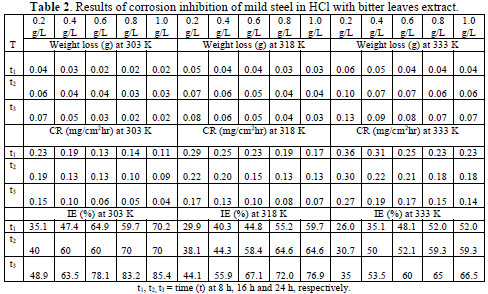
<body><![CDATA[<p><b><i>Results of the gravimetric method</i></b></p>      <p>The results of corrosion inhibition of mild steel in HCl medium with bitter leaves  extract are presented in <a href="#t2">Table 2</a>.</p>       <p>&nbsp;</p> <a name="t2"> <img src="/img/revistas/pea/v37n2/37n2a04t2.jpg">     
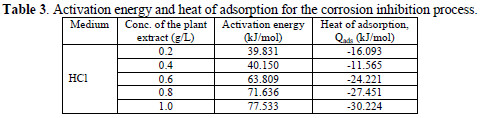
<p>&nbsp;</p>       <p>The corrosion rate decreases with increase in  concentration of the extract. This is in agreement with previous studies &#91;6, 15&#93;.  Maximum inhibition efficiency of 85.4% was obtained. It showed that the extract  of bitter leaf can be used as additive for pickling, cleaning and descaling  operations. The extract is efficient for corrosion control of mild steel in the  hydrochloric acid medium.</p>      <p><b><i>The activation energy and heat of adsorption</i></b></p>       <p>The activation energy and heat of adsorption are presented in <a href="#t3">Table 3</a>.</p>       <p>&nbsp;</p> <a name="t3"> <img src="/img/revistas/pea/v37n2/37n2a04t3.jpg">     
<p>&nbsp;</p>       <p>The activation energy for the corrosion inhibition process ranged from 39.831 to  77.533 kJ/mol, while the heat of adsorption ranged from -16.093 to -30.224  kJ/mol. These values showed that exothermic and spontaneous adsorption of the  extract on the mild steel followed the mechanism of physical adsorption.</p>      ]]></body>
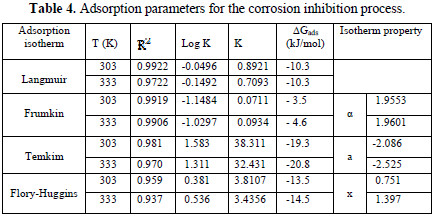
<body><![CDATA[<p><b><i>Adsorption parameters for the corrosion inhibition process</i></b></p>       <p>Adsorption parameters for the corrosion inhibition of mild steel in HCl by bitter  leaves extract are shown in <a href="#t4">Table 4</a>.</p>       <p>&nbsp;</p> <a name="t4"> <img src="/img/revistas/pea/v37n2/37n2a04t4.jpg">     
<p>&nbsp;</p>       <p>The values of free energy of adsorption  (&Delta;G<sub>ads</sub>) were less than the threshold value of -40 kJ/mol required for chemical  adsorption. The lateral interaction term (<i>a</i>) gave positive values, indicating  attractive behaviour of the extract on the mild steel surface. The attractive  parameter value (a) is negative, which implies that repulsion exists in the  adsorption layer &#91;16&#93;. The value of the size parameter (x) is positive. The  adsorbed species of the bitter leaves extract was bulky. This is in agreement with  previous works &#91;6, 15, 21&#93;. The values of the correlation coefficient (R<sup>2</sup>) are  close to unity (1), which implies that the Langmuir, Frumkin, Temkin and Flory-  Huggins isotherms of Equations <a href="#e6">(6)</a> , <a href="#e7">(7)</a>,  <a href="#e8">(8)</a> and <a href="#e9">(9)</a> were obeyed &#91;15, 22&#93;.</p>       <p>&nbsp;</p> <a name="e6"> <img src="/img/revistas/pea/v37n2/37n2a04e6.jpg">     
<p>&nbsp;</p> <a name="e7"> <img src="/img/revistas/pea/v37n2/37n2a04e7.jpg">     
<p>&nbsp;</p> <a name="e8"> <img src="/img/revistas/pea/v37n2/37n2a04e8.jpg">     
<p>&nbsp;</p> <a name="e9"> <img src="/img/revistas/pea/v37n2/37n2a04e9.jpg">      
<p>&nbsp;</p>      ]]></body>
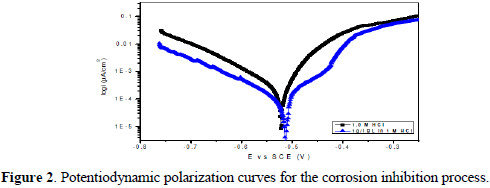
<body><![CDATA[<p>where C is the concentration of the inhibitor, K is the adsorption equilibrium  constant and &Theta; is the degree of surface coverage.</p>      <p><b>Potentiodynamic polarization curves</b></p>       <p>Potentiodynamic polarization curves for mild steel in HCl in absence and  presence of bitter leaves extract are shown in <a href="#f2">Fig. 2</a>.</p>       <p>&nbsp;</p> <a name="f2"> <img src="/img/revistas/pea/v37n2/37n2a04f2.jpg">     
<p>&nbsp;</p>       <p>The extract inhibited the corrosion of the mild steel in the HCl medium, affecting  both the cathodic and anodic reactions, indicating that it is a mixed type inhibitor.</p>      <p>&nbsp;</p>      <p><b>Conclusion</b></p>       <p>From the analysis of the experimental results the following conclusions can be  drawn:</p>       <p>· The bitter leaves extract was highly efficient in the corrosion inhibition of  the mild steel in HCl medium.</p>       ]]></body>
<body><![CDATA[<p>· It is effective for corrosion prevention of mild steel in the corrosive  medium.</p>       <p>· The exothermic and spontaneous adsorption of the extract on the mild  steel followed the mechanism of physical adsorption.</p>       <p>·The plant-based inhibitor of bitter leaves extract should be applied as  additive for pickling, cleaning and descaling operations.</p>       <p>&nbsp;</p>     <p><b>References</b></p>       <!-- ref --><p>1. Uppal MM, Bhatia SC. Engineering Chemistry (chemical technology). 7th  ed. New Delhi: Khanna Publ; 2009.    &nbsp;&nbsp;&nbsp;&nbsp;&nbsp;&nbsp;&nbsp;&nbsp;[&#160;<a href="javascript:void(0);" onclick="javascript: window.open('/scielo.php?script=sci_nlinks&ref=439778&pid=S0872-1904201900020000400001&lng=','','width=640,height=500,resizable=yes,scrollbars=1,menubar=yes,');">Links</a>&#160;]<!-- end-ref --></p>       <!-- ref --><p>2. Aggarwal OP. Engineering Chemistry. 3rd ed. New Delhi: Khanna Publ;  2010.    &nbsp;&nbsp;&nbsp;&nbsp;&nbsp;&nbsp;&nbsp;&nbsp;[&#160;<a href="javascript:void(0);" onclick="javascript: window.open('/scielo.php?script=sci_nlinks&ref=439780&pid=S0872-1904201900020000400002&lng=','','width=640,height=500,resizable=yes,scrollbars=1,menubar=yes,');">Links</a>&#160;]<!-- end-ref --></p>       <!-- ref --><p>3. Masaba SC. Ethiopian J Health Develop. 2000;13:211-216.    &nbsp;&nbsp;&nbsp;&nbsp;&nbsp;&nbsp;&nbsp;&nbsp;[&#160;<a href="javascript:void(0);" onclick="javascript: window.open('/scielo.php?script=sci_nlinks&ref=439782&pid=S0872-1904201900020000400003&lng=','','width=640,height=500,resizable=yes,scrollbars=1,menubar=yes,');">Links</a>&#160;]<!-- end-ref --></p>       <!-- ref --><p>4. Nwajo HU. Nig J Physiol Sci. 2005;20:39 - 42.    &nbsp;&nbsp;&nbsp;&nbsp;&nbsp;&nbsp;&nbsp;&nbsp;[&#160;<a href="javascript:void(0);" onclick="javascript: window.open('/scielo.php?script=sci_nlinks&ref=439784&pid=S0872-1904201900020000400004&lng=','','width=640,height=500,resizable=yes,scrollbars=1,menubar=yes,');">Links</a>&#160;]<!-- end-ref --></p>       <!-- ref --><p>5. Udhayakala P, Rajendiran TV, Gunasekaran S. J Comp Methods Molec  Design. 2012;2:1-15.    &nbsp;&nbsp;&nbsp;&nbsp;&nbsp;&nbsp;&nbsp;&nbsp;[&#160;<a href="javascript:void(0);" onclick="javascript: window.open('/scielo.php?script=sci_nlinks&ref=439786&pid=S0872-1904201900020000400005&lng=','','width=640,height=500,resizable=yes,scrollbars=1,menubar=yes,');">Links</a>&#160;]<!-- end-ref --></p>       <!-- ref --><p>6. Omotioma M, Onukwuli OD. Port Electrochim Acta. 2016;34:287-294.    &nbsp;&nbsp;&nbsp;&nbsp;&nbsp;&nbsp;&nbsp;&nbsp;[&#160;<a href="javascript:void(0);" onclick="javascript: window.open('/scielo.php?script=sci_nlinks&ref=439788&pid=S0872-1904201900020000400006&lng=','','width=640,height=500,resizable=yes,scrollbars=1,menubar=yes,');">Links</a>&#160;]<!-- end-ref --></p>       <!-- ref --><p>7. El Ouariachi E, Paolini J, Bouklah M, et al. Acta Metal Sin. 2010;23:13-20.    &nbsp;&nbsp;&nbsp;&nbsp;&nbsp;&nbsp;&nbsp;&nbsp;[&#160;<a href="javascript:void(0);" onclick="javascript: window.open('/scielo.php?script=sci_nlinks&ref=439790&pid=S0872-1904201900020000400007&lng=','','width=640,height=500,resizable=yes,scrollbars=1,menubar=yes,');">Links</a>&#160;]<!-- end-ref --></p>       <!-- ref --><p>8. Rosaline-Vimela J, Leema RA, Raja S. Der Chemica Sinica. 2012;3:582-  588.    &nbsp;&nbsp;&nbsp;&nbsp;&nbsp;&nbsp;&nbsp;&nbsp;[&#160;<a href="javascript:void(0);" onclick="javascript: window.open('/scielo.php?script=sci_nlinks&ref=439792&pid=S0872-1904201900020000400008&lng=','','width=640,height=500,resizable=yes,scrollbars=1,menubar=yes,');">Links</a>&#160;]<!-- end-ref --></p>       <!-- ref --><p>9. Mabrouk EM, Shokry H, Abu Al-Naja KM. Chem Met Alloys. 2011;4:98-  106.    &nbsp;&nbsp;&nbsp;&nbsp;&nbsp;&nbsp;&nbsp;&nbsp;[&#160;<a href="javascript:void(0);" onclick="javascript: window.open('/scielo.php?script=sci_nlinks&ref=439794&pid=S0872-1904201900020000400009&lng=','','width=640,height=500,resizable=yes,scrollbars=1,menubar=yes,');">Links</a>&#160;]<!-- end-ref --></p>       <!-- ref --><p>10. Eddy NO, Ita BI, Dodo SN, et al. Green Chem Lett Rev. 2012;5:43-53.    &nbsp;&nbsp;&nbsp;&nbsp;&nbsp;&nbsp;&nbsp;&nbsp;[&#160;<a href="javascript:void(0);" onclick="javascript: window.open('/scielo.php?script=sci_nlinks&ref=439796&pid=S0872-1904201900020000400010&lng=','','width=640,height=500,resizable=yes,scrollbars=1,menubar=yes,');">Links</a>&#160;]<!-- end-ref --></p>       <!-- ref --><p>11. Oguzie EE, Enenebeaku CK, Akalezi CO, et al. J Colloid Interf Sci.  2010;349:283-292.    &nbsp;&nbsp;&nbsp;&nbsp;&nbsp;&nbsp;&nbsp;&nbsp;[&#160;<a href="javascript:void(0);" onclick="javascript: window.open('/scielo.php?script=sci_nlinks&ref=439798&pid=S0872-1904201900020000400011&lng=','','width=640,height=500,resizable=yes,scrollbars=1,menubar=yes,');">Links</a>&#160;]<!-- end-ref --></p>       <!-- ref --><p>12. Ihebrodike MM, Nwandu MC, Kelechukwu BO, et al. J Mater Sci.  2011;47:2559-2572.    &nbsp;&nbsp;&nbsp;&nbsp;&nbsp;&nbsp;&nbsp;&nbsp;[&#160;<a href="javascript:void(0);" onclick="javascript: window.open('/scielo.php?script=sci_nlinks&ref=439800&pid=S0872-1904201900020000400012&lng=','','width=640,height=500,resizable=yes,scrollbars=1,menubar=yes,');">Links</a>&#160;]<!-- end-ref --></p>       <!-- ref --><p>13. Nagm AN, Kandile NG, Badr EA, et al. Corros Sci. 2012;65:94-103.    &nbsp;&nbsp;&nbsp;&nbsp;&nbsp;&nbsp;&nbsp;&nbsp;[&#160;<a href="javascript:void(0);" onclick="javascript: window.open('/scielo.php?script=sci_nlinks&ref=439802&pid=S0872-1904201900020000400013&lng=','','width=640,height=500,resizable=yes,scrollbars=1,menubar=yes,');">Links</a>&#160;]<!-- end-ref --></p>       <!-- ref --><p>14. Octave L. Chemical Reaction Engineering. 3rd ed. New York: John Wiley  and Sons; 2003.    &nbsp;&nbsp;&nbsp;&nbsp;&nbsp;&nbsp;&nbsp;&nbsp;[&#160;<a href="javascript:void(0);" onclick="javascript: window.open('/scielo.php?script=sci_nlinks&ref=439804&pid=S0872-1904201900020000400014&lng=','','width=640,height=500,resizable=yes,scrollbars=1,menubar=yes,');">Links</a>&#160;]<!-- end-ref --></p>       <!-- ref --><p>15. Orubite-Okorosaye K, Oforka NC. J Appl Sci Environ Mgt. 2004;8:57-61.    &nbsp;&nbsp;&nbsp;&nbsp;&nbsp;&nbsp;&nbsp;&nbsp;[&#160;<a href="javascript:void(0);" onclick="javascript: window.open('/scielo.php?script=sci_nlinks&ref=439806&pid=S0872-1904201900020000400015&lng=','','width=640,height=500,resizable=yes,scrollbars=1,menubar=yes,');">Links</a>&#160;]<!-- end-ref --></p>       <!-- ref --><p>16. Nwabanne J T, Okafor VN. JETEAS. 2011;2:619-625.    &nbsp;&nbsp;&nbsp;&nbsp;&nbsp;&nbsp;&nbsp;&nbsp;[&#160;<a href="javascript:void(0);" onclick="javascript: window.open('/scielo.php?script=sci_nlinks&ref=439808&pid=S0872-1904201900020000400016&lng=','','width=640,height=500,resizable=yes,scrollbars=1,menubar=yes,');">Links</a>&#160;]<!-- end-ref --></p>       <!-- ref --><p>17. Alinno IJ, Ejikeme PM. Am Chem Sci J. 2012;2:122-135.    &nbsp;&nbsp;&nbsp;&nbsp;&nbsp;&nbsp;&nbsp;&nbsp;[&#160;<a href="javascript:void(0);" onclick="javascript: window.open('/scielo.php?script=sci_nlinks&ref=439810&pid=S0872-1904201900020000400017&lng=','','width=640,height=500,resizable=yes,scrollbars=1,menubar=yes,');">Links</a>&#160;]<!-- end-ref --></p>       <!-- ref --><p>18. Li X, Deng S. Corros Sci. 2012;65:299-308.    &nbsp;&nbsp;&nbsp;&nbsp;&nbsp;&nbsp;&nbsp;&nbsp;[&#160;<a href="javascript:void(0);" onclick="javascript: window.open('/scielo.php?script=sci_nlinks&ref=439812&pid=S0872-1904201900020000400018&lng=','','width=640,height=500,resizable=yes,scrollbars=1,menubar=yes,');">Links</a>&#160;]<!-- end-ref --></p>       <!-- ref --><p>19. Patel NS, Jauhariand S, Mehta GN, et al. Int J Electrochem Sci.  2013;8:2635-2655.    &nbsp;&nbsp;&nbsp;&nbsp;&nbsp;&nbsp;&nbsp;&nbsp;[&#160;<a href="javascript:void(0);" onclick="javascript: window.open('/scielo.php?script=sci_nlinks&ref=439814&pid=S0872-1904201900020000400019&lng=','','width=640,height=500,resizable=yes,scrollbars=1,menubar=yes,');">Links</a>&#160;]<!-- end-ref --></p>       <!-- ref --><p>20. Vasudha VG, Shanmuga PK. Res J Chem Sci. 2013;3:21-26.    &nbsp;&nbsp;&nbsp;&nbsp;&nbsp;&nbsp;&nbsp;&nbsp;[&#160;<a href="javascript:void(0);" onclick="javascript: window.open('/scielo.php?script=sci_nlinks&ref=439816&pid=S0872-1904201900020000400020&lng=','','width=640,height=500,resizable=yes,scrollbars=1,menubar=yes,');">Links</a>&#160;]<!-- end-ref --></p>       <!-- ref --><p>21. Ndibe OM, Menkiti MC, Ijomah MNC, et al. EJEAFChe. 2011;10:2847-  2860.    &nbsp;&nbsp;&nbsp;&nbsp;&nbsp;&nbsp;&nbsp;&nbsp;[&#160;<a href="javascript:void(0);" onclick="javascript: window.open('/scielo.php?script=sci_nlinks&ref=439818&pid=S0872-1904201900020000400021&lng=','','width=640,height=500,resizable=yes,scrollbars=1,menubar=yes,');">Links</a>&#160;]<!-- end-ref --></p>       <!-- ref --><p>22. Nnanna LA, Owate IO, Nwadiuko OC, et al. Int J Mater Chem. 2013;3:10-16.    &nbsp;&nbsp;&nbsp;&nbsp;&nbsp;&nbsp;&nbsp;&nbsp;[&#160;<a href="javascript:void(0);" onclick="javascript: window.open('/scielo.php?script=sci_nlinks&ref=439820&pid=S0872-1904201900020000400022&lng=','','width=640,height=500,resizable=yes,scrollbars=1,menubar=yes,');">Links</a>&#160;]<!-- end-ref --></p>       <p>&nbsp;</p>     ]]></body>
<body><![CDATA[<p><b>Acknowledgement</b></p>      <p>The authors wish to thank National Research Institute for Chemical Technology  (NARICT), Zaria, Nigeria, for the GC-MS analysis of the bitter leaves extract.</p>       <p>&nbsp;</p>      <p><a name=0></a><sup><a href="#top">*</a></sup>Corresponding author. E-mail address: <a href="mailto:omorchem@yahoo.com">omorchem@yahoo.com</a></p>      <p>Received October 12, 2016; accepted March 8, 2017</p>          <p><a href="http://www.peacta.org" target="_blank">www.peacta.org</a> </p>              ]]></body><back>
<ref-list>
<ref id="B1">
<label>1</label><nlm-citation citation-type="book">
<person-group person-group-type="author">
<name>
<surname><![CDATA[Uppal]]></surname>
<given-names><![CDATA[M M]]></given-names>
</name>
<name>
<surname><![CDATA[Bhatia]]></surname>
<given-names><![CDATA[S C]]></given-names>
</name>
</person-group>
<source><![CDATA[Engineering Chemistry (chemical technology)]]></source>
<year>2009</year>
<edition>7th ed</edition>
<publisher-loc><![CDATA[New Delhi ]]></publisher-loc>
<publisher-name><![CDATA[Khanna Publ]]></publisher-name>
</nlm-citation>
</ref>
<ref id="B2">
<label>2</label><nlm-citation citation-type="book">
<person-group person-group-type="author">
<name>
<surname><![CDATA[Aggarwal]]></surname>
<given-names><![CDATA[O P]]></given-names>
</name>
</person-group>
<source><![CDATA[Engineering Chemistry]]></source>
<year>2010</year>
<edition>3rd ed</edition>
<publisher-loc><![CDATA[New Delhi ]]></publisher-loc>
<publisher-name><![CDATA[Khanna Publ]]></publisher-name>
</nlm-citation>
</ref>
<ref id="B3">
<label>3</label><nlm-citation citation-type="journal">
<person-group person-group-type="author">
<name>
<surname><![CDATA[Masaba]]></surname>
<given-names><![CDATA[SC]]></given-names>
</name>
</person-group>
<source><![CDATA[Ethiopian J Health Develop]]></source>
<year>2000</year>
<volume>13</volume>
<page-range>211</page-range></nlm-citation>
</ref>
<ref id="B4">
<label>4</label><nlm-citation citation-type="journal">
<person-group person-group-type="author">
<name>
<surname><![CDATA[Nwajo]]></surname>
<given-names><![CDATA[H U]]></given-names>
</name>
</person-group>
<source><![CDATA[Nig J Physiol Sci]]></source>
<year>2005</year>
<volume>20</volume>
<page-range>39</page-range></nlm-citation>
</ref>
<ref id="B5">
<label>5</label><nlm-citation citation-type="journal">
<person-group person-group-type="author">
<name>
<surname><![CDATA[Udhayakala]]></surname>
<given-names><![CDATA[P]]></given-names>
</name>
<name>
<surname><![CDATA[Rajendiran]]></surname>
<given-names><![CDATA[T V]]></given-names>
</name>
<name>
<surname><![CDATA[Gunasekaran]]></surname>
<given-names><![CDATA[S]]></given-names>
</name>
</person-group>
<source><![CDATA[J Comp Methods Molec Design]]></source>
<year>2012</year>
<volume>2</volume>
<page-range>1</page-range></nlm-citation>
</ref>
<ref id="B6">
<label>6</label><nlm-citation citation-type="journal">
<person-group person-group-type="author">
<name>
<surname><![CDATA[Omotioma]]></surname>
<given-names><![CDATA[M]]></given-names>
</name>
<name>
<surname><![CDATA[Onukwuli]]></surname>
<given-names><![CDATA[O D]]></given-names>
</name>
</person-group>
<source><![CDATA[Port Electrochim Acta]]></source>
<year>2016</year>
<volume>34</volume>
<page-range>287</page-range></nlm-citation>
</ref>
<ref id="B7">
<label>7</label><nlm-citation citation-type="journal">
<person-group person-group-type="author">
<name>
<surname><![CDATA[El Ouariachi]]></surname>
<given-names><![CDATA[E]]></given-names>
</name>
<name>
<surname><![CDATA[Paolini]]></surname>
<given-names><![CDATA[J]]></given-names>
</name>
<name>
<surname><![CDATA[Bouklah]]></surname>
<given-names><![CDATA[M]]></given-names>
</name>
</person-group>
<source><![CDATA[Acta Metal Sin]]></source>
<year>2010</year>
<volume>23</volume>
<page-range>13</page-range></nlm-citation>
</ref>
<ref id="B8">
<label>8</label><nlm-citation citation-type="journal">
<person-group person-group-type="author">
<name>
<surname><![CDATA[Rosaline-Vimela]]></surname>
<given-names><![CDATA[J]]></given-names>
</name>
<name>
<surname><![CDATA[Leema]]></surname>
<given-names><![CDATA[R A]]></given-names>
</name>
<name>
<surname><![CDATA[Raja]]></surname>
<given-names><![CDATA[S]]></given-names>
</name>
</person-group>
<source><![CDATA[Der Chemica Sinica]]></source>
<year>2012</year>
<volume>3</volume>
<page-range>582</page-range></nlm-citation>
</ref>
<ref id="B9">
<label>9</label><nlm-citation citation-type="journal">
<person-group person-group-type="author">
<name>
<surname><![CDATA[Mabrouk]]></surname>
<given-names><![CDATA[E M]]></given-names>
</name>
<name>
<surname><![CDATA[Shokry]]></surname>
<given-names><![CDATA[H]]></given-names>
</name>
<name>
<surname><![CDATA[Abu Al-Naja]]></surname>
<given-names><![CDATA[K M]]></given-names>
</name>
</person-group>
<source><![CDATA[Chem Met Alloys]]></source>
<year>2011</year>
<volume>4</volume>
<page-range>98</page-range></nlm-citation>
</ref>
<ref id="B10">
<label>10</label><nlm-citation citation-type="journal">
<person-group person-group-type="author">
<name>
<surname><![CDATA[Eddy]]></surname>
<given-names><![CDATA[N O]]></given-names>
</name>
<name>
<surname><![CDATA[Ita]]></surname>
<given-names><![CDATA[B I]]></given-names>
</name>
<name>
<surname><![CDATA[Dodo]]></surname>
<given-names><![CDATA[S N]]></given-names>
</name>
</person-group>
<source><![CDATA[Green Chem Lett Rev]]></source>
<year>2012</year>
<volume>5</volume>
<page-range>43</page-range></nlm-citation>
</ref>
<ref id="B11">
<label>11</label><nlm-citation citation-type="journal">
<person-group person-group-type="author">
<name>
<surname><![CDATA[Oguzie]]></surname>
<given-names><![CDATA[E E]]></given-names>
</name>
<name>
<surname><![CDATA[Enenebeaku]]></surname>
<given-names><![CDATA[C K]]></given-names>
</name>
<name>
<surname><![CDATA[Akalezi]]></surname>
<given-names><![CDATA[CO]]></given-names>
</name>
</person-group>
<source><![CDATA[J Colloid Interf Sci]]></source>
<year>2010</year>
<volume>349</volume>
<page-range>283</page-range></nlm-citation>
</ref>
<ref id="B12">
<label>12</label><nlm-citation citation-type="journal">
<person-group person-group-type="author">
<name>
<surname><![CDATA[Ihebrodike]]></surname>
<given-names><![CDATA[M M]]></given-names>
</name>
<name>
<surname><![CDATA[Nwandu]]></surname>
<given-names><![CDATA[M C]]></given-names>
</name>
<name>
<surname><![CDATA[Kelechukwu]]></surname>
<given-names><![CDATA[B O]]></given-names>
</name>
</person-group>
<source><![CDATA[J Mater Sci]]></source>
<year>2011</year>
<volume>47</volume>
<page-range>2559</page-range></nlm-citation>
</ref>
<ref id="B13">
<label>13</label><nlm-citation citation-type="journal">
<person-group person-group-type="author">
<name>
<surname><![CDATA[Nagm]]></surname>
<given-names><![CDATA[A N]]></given-names>
</name>
<name>
<surname><![CDATA[Kandile]]></surname>
<given-names><![CDATA[N G]]></given-names>
</name>
<name>
<surname><![CDATA[Badr]]></surname>
<given-names><![CDATA[EA]]></given-names>
</name>
</person-group>
<source><![CDATA[Corros Sci]]></source>
<year>2012</year>
<volume>65</volume>
<page-range>94</page-range></nlm-citation>
</ref>
<ref id="B14">
<label>14</label><nlm-citation citation-type="book">
<person-group person-group-type="author">
<name>
<surname><![CDATA[Octave]]></surname>
<given-names><![CDATA[L]]></given-names>
</name>
</person-group>
<source><![CDATA[Chemical Reaction Engineering]]></source>
<year>2003</year>
<edition>3rd ed</edition>
<publisher-loc><![CDATA[New York ]]></publisher-loc>
<publisher-name><![CDATA[John Wiley and Sons]]></publisher-name>
</nlm-citation>
</ref>
<ref id="B15">
<label>15</label><nlm-citation citation-type="journal">
<person-group person-group-type="author">
<name>
<surname><![CDATA[Orubite-Okorosaye]]></surname>
<given-names><![CDATA[K]]></given-names>
</name>
<name>
<surname><![CDATA[Oforka]]></surname>
<given-names><![CDATA[N C]]></given-names>
</name>
</person-group>
<source><![CDATA[J Appl Sci Environ Mgt]]></source>
<year>2004</year>
<volume>8</volume>
<page-range>57</page-range></nlm-citation>
</ref>
<ref id="B16">
<label>16</label><nlm-citation citation-type="journal">
<person-group person-group-type="author">
<name>
<surname><![CDATA[Nwabanne J]]></surname>
<given-names><![CDATA[T]]></given-names>
</name>
<name>
<surname><![CDATA[Okafor]]></surname>
<given-names><![CDATA[V N]]></given-names>
</name>
</person-group>
<source><![CDATA[JETEAS]]></source>
<year>2011</year>
<volume>2</volume>
<page-range>619</page-range></nlm-citation>
</ref>
<ref id="B17">
<label>17</label><nlm-citation citation-type="journal">
<person-group person-group-type="author">
<name>
<surname><![CDATA[Alinno]]></surname>
<given-names><![CDATA[I J]]></given-names>
</name>
<name>
<surname><![CDATA[Ejikeme]]></surname>
<given-names><![CDATA[P M]]></given-names>
</name>
</person-group>
<source><![CDATA[Am Chem Sci J]]></source>
<year>2012</year>
<volume>2</volume>
<page-range>122</page-range></nlm-citation>
</ref>
<ref id="B18">
<label>18</label><nlm-citation citation-type="journal">
<person-group person-group-type="author">
<name>
<surname><![CDATA[Li]]></surname>
<given-names><![CDATA[X]]></given-names>
</name>
<name>
<surname><![CDATA[Deng]]></surname>
<given-names><![CDATA[S]]></given-names>
</name>
</person-group>
<source><![CDATA[Corros Sci]]></source>
<year>2012</year>
<volume>65</volume>
<page-range>299</page-range></nlm-citation>
</ref>
<ref id="B19">
<label>19</label><nlm-citation citation-type="journal">
<person-group person-group-type="author">
<name>
<surname><![CDATA[Patel]]></surname>
<given-names><![CDATA[N S]]></given-names>
</name>
<name>
<surname><![CDATA[Jauhariand]]></surname>
<given-names><![CDATA[S]]></given-names>
</name>
<name>
<surname><![CDATA[Mehta]]></surname>
<given-names><![CDATA[G N]]></given-names>
</name>
</person-group>
<source><![CDATA[Int J Electrochem Sci]]></source>
<year>2013</year>
<volume>8</volume>
<page-range>2635</page-range></nlm-citation>
</ref>
<ref id="B20">
<label>20</label><nlm-citation citation-type="journal">
<person-group person-group-type="author">
<name>
<surname><![CDATA[Vasudha]]></surname>
<given-names><![CDATA[V G]]></given-names>
</name>
<name>
<surname><![CDATA[Shanmuga]]></surname>
<given-names><![CDATA[P K]]></given-names>
</name>
</person-group>
<source><![CDATA[Res J Chem Sci]]></source>
<year>2013</year>
<volume>3</volume>
<page-range>21</page-range></nlm-citation>
</ref>
<ref id="B21">
<label>21</label><nlm-citation citation-type="journal">
<person-group person-group-type="author">
<name>
<surname><![CDATA[Ndibe]]></surname>
<given-names><![CDATA[O M]]></given-names>
</name>
<name>
<surname><![CDATA[Menkiti]]></surname>
<given-names><![CDATA[M C]]></given-names>
</name>
<name>
<surname><![CDATA[Ijomah]]></surname>
<given-names><![CDATA[M N C]]></given-names>
</name>
</person-group>
<source><![CDATA[EJEAFChe]]></source>
<year>2011</year>
<volume>10</volume>
<page-range>2847</page-range></nlm-citation>
</ref>
<ref id="B22">
<label>22</label><nlm-citation citation-type="journal">
<person-group person-group-type="author">
<name>
<surname><![CDATA[Nnanna]]></surname>
<given-names><![CDATA[L A]]></given-names>
</name>
<name>
<surname><![CDATA[Owate]]></surname>
<given-names><![CDATA[I O]]></given-names>
</name>
<name>
<surname><![CDATA[Nwadiuko]]></surname>
<given-names><![CDATA[O C]]></given-names>
</name>
</person-group>
<source><![CDATA[Int J Mater Chem]]></source>
<year>2013</year>
<volume>3</volume>
<page-range>10</page-range></nlm-citation>
</ref>
</ref-list>
</back>
</article>