<?xml version="1.0" encoding="ISO-8859-1"?><article xmlns:mml="http://www.w3.org/1998/Math/MathML" xmlns:xlink="http://www.w3.org/1999/xlink" xmlns:xsi="http://www.w3.org/2001/XMLSchema-instance">
<front>
<journal-meta>
<journal-id>0872-8178</journal-id>
<journal-title><![CDATA[Jornal Português de Gastrenterologia ]]></journal-title>
<abbrev-journal-title><![CDATA[J Port Gastrenterol.]]></abbrev-journal-title>
<issn>0872-8178</issn>
<publisher>
<publisher-name><![CDATA[Sociedade Portuguesa de Gastrenterologia]]></publisher-name>
</publisher>
</journal-meta>
<article-meta>
<article-id>S0872-81782010000100007</article-id>
<title-group>
<article-title xml:lang="en"><![CDATA[Anorectal Melanoma]]></article-title>
<article-title xml:lang="pt"><![CDATA[Melanoma Anorectal]]></article-title>
</title-group>
<contrib-group>
<contrib contrib-type="author">
<name>
<surname><![CDATA[Arroja]]></surname>
<given-names><![CDATA[Bruno]]></given-names>
</name>
<xref ref-type="aff" rid="A01"/>
</contrib>
<contrib contrib-type="author">
<name>
<surname><![CDATA[Canhoto]]></surname>
<given-names><![CDATA[Manuela]]></given-names>
</name>
<xref ref-type="aff" rid="A01"/>
</contrib>
<contrib contrib-type="author">
<name>
<surname><![CDATA[Gonçalves]]></surname>
<given-names><![CDATA[Cláudia]]></given-names>
</name>
<xref ref-type="aff" rid="A01"/>
</contrib>
<contrib contrib-type="author">
<name>
<surname><![CDATA[Silva]]></surname>
<given-names><![CDATA[Filipe]]></given-names>
</name>
<xref ref-type="aff" rid="A01"/>
</contrib>
<contrib contrib-type="author">
<name>
<surname><![CDATA[Cotrim]]></surname>
<given-names><![CDATA[Isabel]]></given-names>
</name>
<xref ref-type="aff" rid="A01"/>
</contrib>
<contrib contrib-type="author">
<name>
<surname><![CDATA[Vasconcelos]]></surname>
<given-names><![CDATA[Helena]]></given-names>
</name>
<xref ref-type="aff" rid="A01"/>
</contrib>
<contrib contrib-type="author">
<name>
<surname><![CDATA[Cunha]]></surname>
<given-names><![CDATA[Fernanda]]></given-names>
</name>
<xref ref-type="aff" rid="A02"/>
</contrib>
</contrib-group>
<aff id="A01">
<institution><![CDATA[,Hospital de Santo André EPE Department of Gastroenterology ]]></institution>
<addr-line><![CDATA[Leiria ]]></addr-line>
<country>Portugal</country>
</aff>
<aff id="A02">
<institution><![CDATA[,Hospital de Santo André EPE Department of Pathology ]]></institution>
<addr-line><![CDATA[Leiria ]]></addr-line>
<country>Portugal</country>
</aff>
<pub-date pub-type="pub">
<day>00</day>
<month>01</month>
<year>2010</year>
</pub-date>
<pub-date pub-type="epub">
<day>00</day>
<month>01</month>
<year>2010</year>
</pub-date>
<volume>17</volume>
<numero>1</numero>
<fpage>32</fpage>
<lpage>33</lpage>
<copyright-statement/>
<copyright-year/>
<self-uri xlink:href="http://scielo.pt/scielo.php?script=sci_arttext&amp;pid=S0872-81782010000100007&amp;lng=en&amp;nrm=iso"></self-uri><self-uri xlink:href="http://scielo.pt/scielo.php?script=sci_abstract&amp;pid=S0872-81782010000100007&amp;lng=en&amp;nrm=iso"></self-uri><self-uri xlink:href="http://scielo.pt/scielo.php?script=sci_pdf&amp;pid=S0872-81782010000100007&amp;lng=en&amp;nrm=iso"></self-uri></article-meta>
</front><body><![CDATA[ <p><b>Anorectal Melanoma</b></p>      <p><b>Melanoma Anorectal</b></p>      <p>&nbsp;</p>      <p><b>Bruno Arroja<sup>1</sup>, Manuela Canhoto<sup>1</sup>, Cláudia Gonçalves<sup>1</sup>,    Filipe Silva<sup>1</sup>, Isabel Cotrim<sup>1</sup>, Helena Vasconcelos<sup>1</sup>,    Fernanda Cunha<sup>2</sup></b></p>      <p><sup>1</sup>Department of Gastroenterology, Hospital de Santo André EPE, Leiria,    Portugal; </p>     <p><sup>2</sup>Department of Pathology, Hospital de Santo André EPE, Leiria, Portugal;    Hospital de Santo André, EPE, Leiria</p>     <p><a name="top0"></a><a href="#0">Correspondência</a></p>      <p>&nbsp;</p>     <p>&nbsp;</p>      <p><b>INTRODUCTION</b></p>      ]]></body>
<body><![CDATA[<p>Primary anorectal melanoma is a rare condition accounting for 0,2-3% of all    melanomas and approximately 1% of cancers afflicting this particular area<sup><a name="top1"></a><a href="#1">1</a></sup>.</p>      <p>The mean survival time after diagnosis is 24 months and only 10% of all patients    will be alive at 5 years. Nearly 60% of patients present with metastatic disease<a name="top2"></a><sup><a href="#2">2</a></sup>.</p>      <p>The most frequent presentation symptom is rectal bleeding followed by change    in defecatory habits<sup><a href="#1">1-5</a></sup>.</p>      <p>Albeit the large majority of anorectal melanomas have evident gross or microscopic    pigmentation there are 30% of which are amelanotic<a name="top4"></a><sup><a href="#4">4</a></sup>.</p>      <p>Currently abdomino-perineal resection with bilateral inguinal lymphadenectomy    remains the first option procedure especially in large or obstructing lesions<sup><a href="#1">1-3</a>,<a name="top5"></a><a href="#5">5</a></sup>.</p>      <p>&nbsp;</p>      <p><b>CASE DESCRIPTION</b></p>      <p>A 77-year old female living in a nursing home with Alzheimer’s, diabetes and hypertension was referred to the Gastroenterology Department for a large prolapsed anorectal mass in December of 2007.</p>      <p>Three months previously the patient had undergone a left-sided colonoscopy performed outside the hospital after persistent rectal bleeding had ensued. A sessile polyp with 1 cm was then registered in the distal rectum. </p>      <p>Our physical examination identified a polypoid, prolapsed, pedunculated and mobile mass with white coloured areas alternating with necrotic ones, measuring 4-5 cm in diameter.</p>      ]]></body>
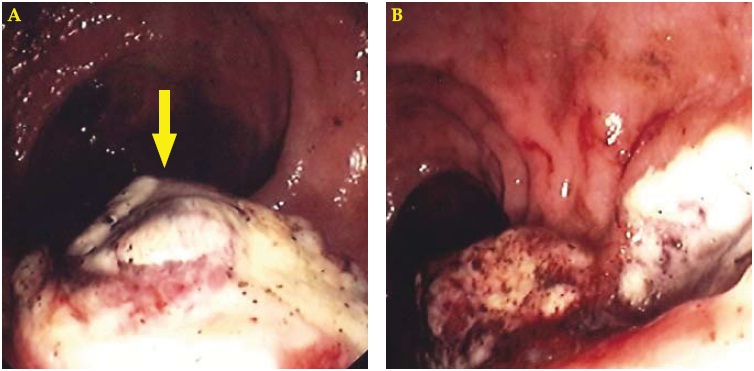
<body><![CDATA[<p>Laboratory data was: hematocrit 29,2%; platelet count 367,6 x10&#094;3/&#956;l; INR 1,09; aPTT 24,2 seconds.</p>      <p>Total colonoscopy did not detect further lesions along the remaining colon.</p>      <p>The lesion was almost completely excised by fragmentation using a large polipectomy    snare (<b>Fig. 1a, 1b</b>). </p>     <p>&nbsp;</p>     <p><img src="/img/revistas/ge/v17n1/17n1a07f1.jpg" width="754" height="371"></p>      
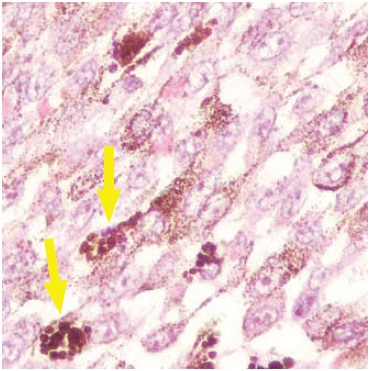
<p>Fig. 1. Endoscopic view showing a large polypoid white lesion in the distal    rectum (a). This lesion was partially excised with a polipectomy snare (b).</p>     <p>&nbsp;</p>     <p>Histological findings were consistent with malignant melanoma (<b>Fig. 2</b>)    and immunohistochemical stain was positive for S100 and HMB45 confirming the    diagnosis.</p>     <p>&nbsp;</p>     <p><img src="/img/revistas/ge/v17n1/17n1a07f2.jpg" width="371" height="371"></p>     
]]></body>
<body><![CDATA[<p>Fig. 2. Histological observation revealed pigmented areas (400 x magnification)    suggesting melanoma (a).</p>      <p>&nbsp;</p>     <p>Accordingly the patient was referred to a specialized oncology centre where    abdomino-perineal resection was performed in January of 2008 showing no involvement    of regional lymph nodes. Six months after surgery liver metastasis were diagnosed    and the patient eventually died one month later.</p>     <p>The authors emphasize the rarity of this condition and the rapid tumour growth in a very short period of time.</p>      <p>&nbsp;</p>      <p><b>Bibliografia</b><b>&nbsp;</b></p>      <p><a name="1"></a><a href="#top1">1</a>.&nbsp;&nbsp;&nbsp; Balicevic D, Tomic    K, Bekavac-Beslin M, Kovacevic I, Mijic A, Belicza M, et al. Synchronous anorectal    melanoma. World J Gastroenterol. 2006;12:3453-3455.</p>      <p><a href="#top2">2</a>.&nbsp;<a name="2"></a>&nbsp;&nbsp; van Schaik PM, Ernst    MF, Meijer HA, Bosscha K. Melanoma of the rectum: A rare entity. World J Gastroenterol.    2008;14:1633-1635.</p>      <p><a href="#top1">3</a>.&nbsp;&nbsp;&nbsp; Tsigris C, Pikoulis E, Bramis J, Leppäniemi    A, Alexiou D, Bastounis E. Malignant melanoma of the anorectal area. Report    of two cases. Dig Surg 2000;17:194-196.</p>      <p><a href="#top4">4</a>.&nbsp;<a name="4"></a>&nbsp;&nbsp; Hillenbrand A, Barth    TF, Henne-Bruns D, Formentini A. Anorectal amelanotic melanoma. Colorectal Dis    2008;10:612-615.</p>      ]]></body>
<body><![CDATA[<!-- ref --><p><a href="#top5">5</a>.&nbsp;<a name="5"></a>&nbsp;&nbsp; Stroh C, Manger T.    Primary amelanotic anorectal melanoma – a case report. Zentralbl Chir 2007;132:560-563.&nbsp;&nbsp;&nbsp;&nbsp;&nbsp;&nbsp;&nbsp;&nbsp;[&#160;<a href="javascript:void(0);" onclick="javascript: window.open('/scielo.php?script=sci_nlinks&ref=000043&pid=S0872-8178201000010000700001&lng=','','width=640,height=500,resizable=yes,scrollbars=1,menubar=yes,');">Links</a>&#160;]<!-- end-ref --><p>&nbsp;</p>      <p><b><a name="0"></a><a href="#top0">Correspondência</a>:</b> Bruno Arroja; Morada:    Hospital de Santo André EPE, Serviço de Gastrenterologia; Rua das Olhalvas –    Pousos 2410 – 197, Leiria, Portugal; <b>Contacto telefónico hospitalar:</b>    244 817 000; <b>Contacto telefónico pessoal:</b> 91 9917216</p>     <p>&nbsp;</p>     <p><b>Recebido para publicação:</b> 22/03/2008 e <b>Aceite para publicação: </b>30    /07/2008</p>         ]]></body><back>
<ref-list>
<ref id="B1">
<nlm-citation citation-type="journal">
<person-group person-group-type="author">
<name>
<surname><![CDATA[Stroh]]></surname>
<given-names><![CDATA[C]]></given-names>
</name>
<name>
<surname><![CDATA[Manger]]></surname>
<given-names><![CDATA[T.]]></given-names>
</name>
</person-group>
<article-title xml:lang="en"><![CDATA[Primary amelanotic anorectal melanoma: a case report]]></article-title>
<source><![CDATA[Zentralbl Chir]]></source>
<year>2007</year>
<numero>132</numero>
<issue>132</issue>
<page-range>560-563</page-range></nlm-citation>
</ref>
</ref-list>
</back>
</article>