<?xml version="1.0" encoding="ISO-8859-1"?><article xmlns:mml="http://www.w3.org/1998/Math/MathML" xmlns:xlink="http://www.w3.org/1999/xlink" xmlns:xsi="http://www.w3.org/2001/XMLSchema-instance">
<front>
<journal-meta>
<journal-id>0872-8178</journal-id>
<journal-title><![CDATA[Jornal Português de Gastrenterologia ]]></journal-title>
<abbrev-journal-title><![CDATA[J Port Gastrenterol.]]></abbrev-journal-title>
<issn>0872-8178</issn>
<publisher>
<publisher-name><![CDATA[Sociedade Portuguesa de Gastrenterologia]]></publisher-name>
</publisher>
</journal-meta>
<article-meta>
<article-id>S0872-81782011000300009</article-id>
<title-group>
<article-title xml:lang="pt"><![CDATA[Apresentação invulgar de colite associada ao Clostridium difficile]]></article-title>
<article-title xml:lang="en"><![CDATA[Unusual presentation of Clostridium difficile-associated colitis]]></article-title>
</title-group>
<contrib-group>
<contrib contrib-type="author">
<name>
<surname><![CDATA[Ferreira]]></surname>
<given-names><![CDATA[Rosa]]></given-names>
</name>
<xref ref-type="aff" rid="A01"/>
</contrib>
<contrib contrib-type="author">
<name>
<surname><![CDATA[Torres]]></surname>
<given-names><![CDATA[Joana]]></given-names>
</name>
<xref ref-type="aff" rid="A01"/>
</contrib>
<contrib contrib-type="author">
<name>
<surname><![CDATA[Alves]]></surname>
<given-names><![CDATA[Joana]]></given-names>
</name>
<xref ref-type="aff" rid="A02"/>
</contrib>
<contrib contrib-type="author">
<name>
<surname><![CDATA[Pereira]]></surname>
<given-names><![CDATA[Maria João]]></given-names>
</name>
<xref ref-type="aff" rid="A01"/>
</contrib>
<contrib contrib-type="author">
<name>
<surname><![CDATA[Carvalheiro]]></surname>
<given-names><![CDATA[Joana]]></given-names>
</name>
<xref ref-type="aff" rid="A01"/>
</contrib>
<contrib contrib-type="author">
<name>
<surname><![CDATA[Mendes]]></surname>
<given-names><![CDATA[Sofia]]></given-names>
</name>
<xref ref-type="aff" rid="A01"/>
</contrib>
<contrib contrib-type="author">
<name>
<surname><![CDATA[Ferreira]]></surname>
<given-names><![CDATA[Margarida]]></given-names>
</name>
<xref ref-type="aff" rid="A01"/>
</contrib>
<contrib contrib-type="author">
<name>
<surname><![CDATA[Agostinho]]></surname>
<given-names><![CDATA[Cláudia]]></given-names>
</name>
<xref ref-type="aff" rid="A01"/>
</contrib>
<contrib contrib-type="author">
<name>
<surname><![CDATA[Panão]]></surname>
<given-names><![CDATA[Edgard]]></given-names>
</name>
<xref ref-type="aff" rid="A01"/>
</contrib>
<contrib contrib-type="author">
<name>
<surname><![CDATA[Campos]]></surname>
<given-names><![CDATA[Mário Júlio]]></given-names>
</name>
<xref ref-type="aff" rid="A01"/>
</contrib>
</contrib-group>
<aff id="A01">
<institution><![CDATA[,Centro Hospitalar de Coimbra Serviço de Gastrenterologia ]]></institution>
<addr-line><![CDATA[ ]]></addr-line>
</aff>
<aff id="A02">
<institution><![CDATA[,Centro Hospitalar de Coimbra Serviço de Anatomia Patológica ]]></institution>
<addr-line><![CDATA[ ]]></addr-line>
</aff>
<pub-date pub-type="pub">
<day>00</day>
<month>05</month>
<year>2011</year>
</pub-date>
<pub-date pub-type="epub">
<day>00</day>
<month>05</month>
<year>2011</year>
</pub-date>
<volume>18</volume>
<numero>3</numero>
<fpage>141</fpage>
<lpage>142</lpage>
<copyright-statement/>
<copyright-year/>
<self-uri xlink:href="http://scielo.pt/scielo.php?script=sci_arttext&amp;pid=S0872-81782011000300009&amp;lng=en&amp;nrm=iso"></self-uri><self-uri xlink:href="http://scielo.pt/scielo.php?script=sci_abstract&amp;pid=S0872-81782011000300009&amp;lng=en&amp;nrm=iso"></self-uri><self-uri xlink:href="http://scielo.pt/scielo.php?script=sci_pdf&amp;pid=S0872-81782011000300009&amp;lng=en&amp;nrm=iso"></self-uri></article-meta>
</front><body><![CDATA[ <p><b>Apresentação invulgar de colite associada ao Clostridium difficile</b></p>     <p><b>Unusual presentation of Clostridium difficile-associated colitis</b></p>      <p>&nbsp;</p>       <p><b>Rosa Ferreira<sup>1</sup>, Joana Torres<sup>1</sup>, Joana Alves<sup>2</sup>, Maria João Pereira<sup>1</sup>, Joana Carvalheiro<sup>1</sup>, Sofia Mendes<sup>1</sup>, Margarida Ferreira<sup>1</sup>, Cláudia Agostinho<sup>1</sup>, Edgard Panão<sup>1</sup>, Mário Júlio Campos<sup>1</sup></b></p>      <p><sup>1</sup>Serviço de Gastrenterologia, Centro Hospitalar de Coimbra; <sup>2</sup>Serviço de Anatomia Patológica, Centro Hospitalar de Coimbra</p>      <p> <a name="top0"></a><a href="#0">Correspond&ecirc;ncia</a></p>     <p>&nbsp;</p>      <p>A 67-year-old woman, resident in a nursing home since the age of 41 due to mental retardation, presented in the emergency department withmelena followed by hematochezia for the past two days. There was no history of hematemesis, nausea, abdominal pain, diarrhea or fever. She was only on antipsychotic and anti-epileptic medication.</p>      <p>Physical examination was unremarkable except for pallor and hypotension (95/56mmHg).</p>      <p>Laboratory data revealed anemia of 10.8 g/dL (normal range (NR): 12 - 16), hypoalbuminemia of 26 g/L (NR: 35 - 50) and elevation of C-reactive protein of 11.8 mg/dL (NR: &lt; 0.5).</p>      ]]></body>
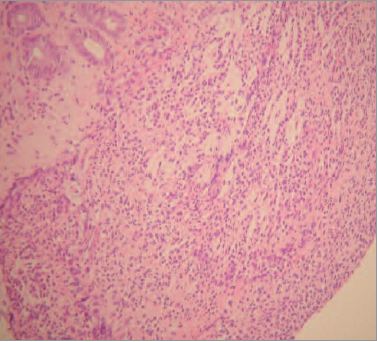
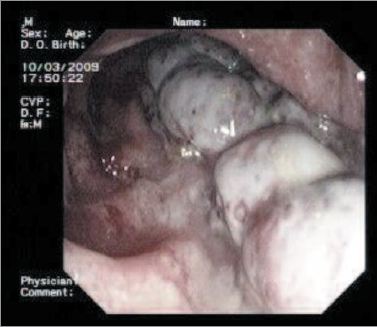
<body><![CDATA[<p>Upper endoscopy was performed which was normal. Total colonoscopy revealed a tortuous mucosal prominence of purple color, extending longitudinally from the sigmoid to the distal transverse colon, occupying one fifth of the lumen, partially covered with a whitish exudate not removed by vigorous lavage, resembling a colonicvarix (Fig. 1). Adjacent mucosa was erythematous and friable, with small whitish exudates, which biopsies showed colonic mucosa with superficial erosion and pseudomembranes with volcanic appearance, composed of fibrin, mucus and neutrophils (Fig. 2), suggesting Clostridium difficile (CD) associated colitis. On suspicion of infectious colitis, she startedmetronidazole 500 mg tid orally during 14 days. No rebleeding episodes were seen. Further evaluation excluded portal hypertension. Follow-up colonoscopy one month later showed complete disappearance of the endoscopic findings and no mucosal lesions. A final diagnosis of CD-associated colitis was established.</p>      <p>&nbsp;</p>     <p><img src="/img/revistas/ge/v18n3/18n3a09f1.jpg"></p>     
<p><b>Fig. 1.</b> Colonoscopy showing an apparent varix of the transverse colon with erythematous and friable adjacent mucosa.</p>     <p>&nbsp;</p>       <p><img src="/img/revistas/ge/v18n3/18n3a09f2.jpg"></p>     
<p><b>Fig. 2.</b> Pseudomembrane of volcanic appearance composed by fibrin, mucin andneutrophils. (Haematoxylin &amp; eosin, X 400).</p>     <p>&nbsp;</p>      <p>Infection from CD occurs when a susceptible host ingests spores of this anaerobic, gram positive bacillus, which colonize the large bowel and release 2 toxins that may cause diarrhea and colitis<sup>1</sup>. Although the main risk factor for CD infection is antibiotic use, hospitalization, residence in nursing homes and age greater than 65 years are also predisposing factors<sup>1-4</sup>. This patient met two of these risk factors. Diarrhea, usually watery, is the main symptom<sup>2,3</sup>. Rarely, as in this case, there are bloody stools<sup>2,3</sup>.</p>      <p>Endoscopically, colonic pseudomembranes are almostpathognomonic for CD infection, but are not found in all areas of the colon and may be absent in half of the patients<sup>2,3</sup>. Pseudomembranes are raised yellow or whitish plaques, up to 2 cm of diameter, which are interspersed with normal mucosa and cannot be removed by lavage<sup>2</sup>. In this case, the pseudomembranes assumed an unusual form, mimicking a colonic varix, an aspect, to our knowledge, not yet described in the literature. Although CD infection may be confirmed by a positive test for CD toxins in stool, false positives and false negatives are not uncommon<sup>4</sup>. In this case, the absence of diarrhea and recent use of antibiotics, associated with atypical endoscopic features led us to startmetronidazole prior to the collection of stool samples. Treatment of CD infection involves the evaluation of the clinical and laboratory markers of disease severity<sup>1,2</sup>. The only treatments proven effective are antibiotic therapy andcolectomy for fulminant disease non-responding to antibiotics <sup>1</sup>. Although vancomycin is currently considered the first-line treatment in severe CD infection <sup>1</sup>, our patient was successfully treated with metronidazole. In summary, this case illustrates an atypical presentation of CD colitis, characterized clinically by gastrointestinal bleeding and endoscopically by pseudomembranes resembling colonicvarices.</p>      ]]></body>
<body><![CDATA[<p>&nbsp;</p>      <p>&nbsp;</p>      <p><b>REFERENCES</b></p>      <!-- ref --><p>1. Leffler DA, Lamont JT. Treatment of Clostridium difficile-associated disease. Gastroenterology 2009;136:1899-1912.&nbsp;&nbsp;&nbsp;&nbsp;&nbsp;&nbsp;&nbsp;&nbsp;[&#160;<a href="javascript:void(0);" onclick="javascript: window.open('/scielo.php?script=sci_nlinks&ref=000026&pid=S0872-8178201100030000900001&lng=','','width=640,height=500,resizable=yes,scrollbars=1,menubar=yes,');">Links</a>&#160;]<!-- end-ref --><!-- ref --><p>2. Hookman P, Barkin JS. Clostridium difficile associated infection, diarrhea and colitis. World J Gastroenterol 2009;15:1554-1580.&nbsp;&nbsp;&nbsp;&nbsp;&nbsp;&nbsp;&nbsp;&nbsp;[&#160;<a href="javascript:void(0);" onclick="javascript: window.open('/scielo.php?script=sci_nlinks&ref=000027&pid=S0872-8178201100030000900002&lng=','','width=640,height=500,resizable=yes,scrollbars=1,menubar=yes,');">Links</a>&#160;]<!-- end-ref --><!-- ref --><p>3. Bartlett JG, Gerding DN. Clinical recognition and diagnosis of Clostridium difficile infection.Clin Infect Dis 2008;15:12-18.&nbsp;&nbsp;&nbsp;&nbsp;&nbsp;&nbsp;&nbsp;&nbsp;[&#160;<a href="javascript:void(0);" onclick="javascript: window.open('/scielo.php?script=sci_nlinks&ref=000028&pid=S0872-8178201100030000900003&lng=','','width=640,height=500,resizable=yes,scrollbars=1,menubar=yes,');">Links</a>&#160;]<!-- end-ref --><!-- ref --><p>4. Durai R. Epidemiology, pathogenesis, and management of Clostridium difficile infection. Dig Dis Sci 2007;52:2958-2962.&nbsp;&nbsp;&nbsp;&nbsp;&nbsp;&nbsp;&nbsp;&nbsp;[&#160;<a href="javascript:void(0);" onclick="javascript: window.open('/scielo.php?script=sci_nlinks&ref=000029&pid=S0872-8178201100030000900004&lng=','','width=640,height=500,resizable=yes,scrollbars=1,menubar=yes,');">Links</a>&#160;]<!-- end-ref --><!-- ref --><p>5. Tonna I, Welsby PD. Pathogenesis and treatment of Clostridium difficile    infection. Postgrad Med J 2005;81:367-369.&nbsp;&nbsp;&nbsp;&nbsp;&nbsp;&nbsp;&nbsp;&nbsp;[&#160;<a href="javascript:void(0);" onclick="javascript: window.open('/scielo.php?script=sci_nlinks&ref=000030&pid=S0872-8178201100030000900005&lng=','','width=640,height=500,resizable=yes,scrollbars=1,menubar=yes,');">Links</a>&#160;]<!-- end-ref --><p>&nbsp;</p>     <p><a name="0"></a><a href="#top0">Correspondência</a>: Rosa Ferreira; Rua Carlos    Seixas, n&ordm; 266, 2&ordm;dto, 3030-177 Coimbra &#8211; Portugal; Telem&oacute;vel:    +351 966 510 601; Fax: +351 239 800 053; E-mail: <a href="mailto:rosa.l.ferreira@gmail.com">rosa.l.ferreira@gmail.com</a></p>     ]]></body>
<body><![CDATA[<p>&nbsp;</p>     <p>Recebido para publica&ccedil;&atilde;o: 28/07/2010 e Aceite para publica&ccedil;&atilde;o:    20/10/2010.</p>         ]]></body><back>
<ref-list>
<ref id="B1">
<label>1</label><nlm-citation citation-type="journal">
<person-group person-group-type="author">
<name>
<surname><![CDATA[Leffler]]></surname>
<given-names><![CDATA[DA]]></given-names>
</name>
<name>
<surname><![CDATA[Lamont]]></surname>
<given-names><![CDATA[JT]]></given-names>
</name>
</person-group>
<article-title xml:lang="en"><![CDATA[Treatment of Clostridium difficile-associated disease]]></article-title>
<source><![CDATA[Gastroenterology]]></source>
<year>2009</year>
<volume>136</volume>
<page-range>1899-1912</page-range></nlm-citation>
</ref>
<ref id="B2">
<label>2</label><nlm-citation citation-type="journal">
<person-group person-group-type="author">
<name>
<surname><![CDATA[Hookman]]></surname>
<given-names><![CDATA[P]]></given-names>
</name>
<name>
<surname><![CDATA[Barkin]]></surname>
<given-names><![CDATA[JS]]></given-names>
</name>
</person-group>
<article-title xml:lang="en"><![CDATA[Clostridium difficile associated infection, diarrhea and colitis]]></article-title>
<source><![CDATA[World J Gastroenterol]]></source>
<year>2009</year>
<volume>15</volume>
<page-range>1554-1580</page-range></nlm-citation>
</ref>
<ref id="B3">
<label>3</label><nlm-citation citation-type="journal">
<person-group person-group-type="author">
<name>
<surname><![CDATA[Bartlett]]></surname>
<given-names><![CDATA[JG]]></given-names>
</name>
<name>
<surname><![CDATA[Gerding]]></surname>
<given-names><![CDATA[DN]]></given-names>
</name>
</person-group>
<article-title xml:lang="en"><![CDATA[Clinical recognition and diagnosis of Clostridium difficile infection]]></article-title>
<source><![CDATA[Clin Infect Dis]]></source>
<year>2008</year>
<volume>15</volume>
<page-range>12-18</page-range></nlm-citation>
</ref>
<ref id="B4">
<label>4</label><nlm-citation citation-type="journal">
<person-group person-group-type="author">
<name>
<surname><![CDATA[Durai]]></surname>
<given-names><![CDATA[R]]></given-names>
</name>
</person-group>
<article-title xml:lang="en"><![CDATA[Epidemiology, pathogenesis, and management of Clostridium difficile infection]]></article-title>
<source><![CDATA[Dig Dis Sci]]></source>
<year>2007</year>
<volume>52</volume>
<page-range>2958-2962</page-range></nlm-citation>
</ref>
<ref id="B5">
<label>5</label><nlm-citation citation-type="journal">
<person-group person-group-type="author">
<name>
<surname><![CDATA[Tonna]]></surname>
<given-names><![CDATA[I]]></given-names>
</name>
<name>
<surname><![CDATA[Welsby]]></surname>
<given-names><![CDATA[PD]]></given-names>
</name>
</person-group>
<article-title xml:lang="en"><![CDATA[Pathogenesis and treatment of Clostridium difficile infection]]></article-title>
<source><![CDATA[Postgrad Med J]]></source>
<year>2005</year>
<volume>81</volume>
<page-range>367-369</page-range></nlm-citation>
</ref>
</ref-list>
</back>
</article>