<?xml version="1.0" encoding="ISO-8859-1"?><article xmlns:mml="http://www.w3.org/1998/Math/MathML" xmlns:xlink="http://www.w3.org/1999/xlink" xmlns:xsi="http://www.w3.org/2001/XMLSchema-instance">
<front>
<journal-meta>
<journal-id>0873-2159</journal-id>
<journal-title><![CDATA[Revista Portuguesa de Pneumologia]]></journal-title>
<abbrev-journal-title><![CDATA[Rev Port Pneumol]]></abbrev-journal-title>
<issn>0873-2159</issn>
<publisher>
<publisher-name><![CDATA[Sociedade Portuguesa de Pneumologia]]></publisher-name>
</publisher>
</journal-meta>
<article-meta>
<article-id>S0873-21592010000400012</article-id>
<title-group>
<article-title xml:lang="en"><![CDATA[Watermelon stomach, hemorrhagic pericarditis, small cell carcinoma of the lung and synchronous squamous cell carcinoma of the tongue base]]></article-title>
<article-title xml:lang="pt"><![CDATA[Estômago em melancia, pericardite hemorrágica, tumor de pequenas células do pulmão e carcinoma pavimentocelular síncrono da base da língua]]></article-title>
</title-group>
<contrib-group>
<contrib contrib-type="author">
<name>
<surname><![CDATA[Murinello]]></surname>
<given-names><![CDATA[A]]></given-names>
</name>
<xref ref-type="aff" rid="A01"/>
</contrib>
<contrib contrib-type="author">
<name>
<surname><![CDATA[Damásio]]></surname>
<given-names><![CDATA[H]]></given-names>
</name>
<xref ref-type="aff" rid="A01"/>
</contrib>
<contrib contrib-type="author">
<name>
<surname><![CDATA[Figueiredo]]></surname>
<given-names><![CDATA[AM]]></given-names>
</name>
<xref ref-type="aff" rid="A01"/>
</contrib>
<contrib contrib-type="author">
<name>
<surname><![CDATA[Netta]]></surname>
<given-names><![CDATA[J]]></given-names>
</name>
<xref ref-type="aff" rid="A01"/>
</contrib>
<contrib contrib-type="author">
<name>
<surname><![CDATA[Carvalho]]></surname>
<given-names><![CDATA[A]]></given-names>
</name>
<xref ref-type="aff" rid="A01"/>
</contrib>
<contrib contrib-type="author">
<name>
<surname><![CDATA[Matos]]></surname>
<given-names><![CDATA[AA]]></given-names>
</name>
<xref ref-type="aff" rid="A01"/>
</contrib>
<contrib contrib-type="author">
<name>
<surname><![CDATA[Murillo]]></surname>
<given-names><![CDATA[MJ]]></given-names>
</name>
<xref ref-type="aff" rid="A01"/>
</contrib>
<contrib contrib-type="author">
<name>
<surname><![CDATA[Albuquerque]]></surname>
<given-names><![CDATA[A]]></given-names>
</name>
<xref ref-type="aff" rid="A01"/>
</contrib>
</contrib-group>
<aff id="A01">
<institution><![CDATA[,Hospital Curry Cabral Histopathology Medicine 1]]></institution>
<addr-line><![CDATA[Lisboa ]]></addr-line>
<country>Portugal</country>
</aff>
<pub-date pub-type="pub">
<day>00</day>
<month>08</month>
<year>2010</year>
</pub-date>
<pub-date pub-type="epub">
<day>00</day>
<month>08</month>
<year>2010</year>
</pub-date>
<volume>16</volume>
<numero>4</numero>
<fpage>659</fpage>
<lpage>670</lpage>
<copyright-statement/>
<copyright-year/>
<self-uri xlink:href="http://scielo.pt/scielo.php?script=sci_arttext&amp;pid=S0873-21592010000400012&amp;lng=en&amp;nrm=iso"></self-uri><self-uri xlink:href="http://scielo.pt/scielo.php?script=sci_abstract&amp;pid=S0873-21592010000400012&amp;lng=en&amp;nrm=iso"></self-uri><self-uri xlink:href="http://scielo.pt/scielo.php?script=sci_pdf&amp;pid=S0873-21592010000400012&amp;lng=en&amp;nrm=iso"></self-uri><abstract abstract-type="short" xml:lang="en"><p><![CDATA[Based on a case of gastric antral vascular ectasia (watermelon stomach) that was associated with hemorrhagic pericarditis, small cell lung carcinoma with mediastinal lymph node metastases and a synchronous squamous cell carcinoma of the base of the tongue, the authors made a review of the clinical, endoscopic and histopathological aspects of this type of gastropathy, and its association with other diseases, and of the results of its endoscopic therapy. The causes of hemorrhagic pericarditis are considered, emphasizing the necessity to know if the effusion has a malignant etiology. To the best of our knowledge the association of watermelon stomach to small cell lung carcinoma and squamous cell carcinoma of the base of the tongue has not yet been described. Extensive metastases to mediastal lymph nodes are common to small cell lung carcinoma.]]></p></abstract>
<abstract abstract-type="short" xml:lang="pt"><p><![CDATA[Baseados num caso de gastropatia antral com ectasia vascular (estômago em melancia) associado a pericardite hemorrágica e a um carcinoma de pequenas células do pulmão com metástases ganglionares ao longo do mediastino e a um carcinoma pavimentocelular síncrono da base da língua, os autores fazem uma revisão dos aspectos clínicos, endoscópicos e histopatológicos deste tipo de gastropatia, da sua associação a outras doenças e das possibilidades terapêuticas actuais por via endoscópica. Referem-se igualmente as causas mais frequentes de pericardite hemorrágica, salientando-se a origem neoplásica. Não está referida na literatura a associação deste tipo de gastropatia ao carcinoma de pequenas células do pulmão nem ao carcinoma pavimento-celular da base da língua. A invasão extensa dos gânglios mediastínicos pelo carcinoma de pequenas células do pulmão é ocorrência frequente.]]></p></abstract>
<kwd-group>
<kwd lng="en"><![CDATA[Gastric antral vascular ectasia]]></kwd>
<kwd lng="en"><![CDATA[watermelon stomach]]></kwd>
<kwd lng="en"><![CDATA[small cell lung carcinoma]]></kwd>
<kwd lng="en"><![CDATA[oat cell lung carcinoma]]></kwd>
<kwd lng="en"><![CDATA[squamous cell carcinoma of the base of the tongue]]></kwd>
<kwd lng="en"><![CDATA[hemorrhagic pericarditis]]></kwd>
<kwd lng="pt"><![CDATA[Gastropatia antral com ectasia vascular]]></kwd>
<kwd lng="pt"><![CDATA[estômago em melancia]]></kwd>
<kwd lng="pt"><![CDATA[carcinoma de pequenas células do pulmão]]></kwd>
<kwd lng="pt"><![CDATA[carcinoma pavimentocelular da base da língua]]></kwd>
<kwd lng="pt"><![CDATA[pericardite hemorrágica]]></kwd>
</kwd-group>
</article-meta>
</front><body><![CDATA[ <p><b>Watermelon stomach, hemorrhagic pericarditis, small cell carcinoma of the    lung and synchronous squamous cell carcinoma of the tongue base</b></p>      <p>&nbsp;</p>      <p><b>A Murinello 1, H Damásio 2, AM Figueiredo 3, J Netta    4, A Carvalho 5, AA Matos 6, MJ Murillo 7 e A Albuquerque    8</b></p>      <p>1 Graduated Chief Service of Internal Medicine of the HCL (Hospital Curry Cabral)</p>     <p>   2 Graduated Hospital Assistant of Internal Medicine (Medicine 1)</p>     <p>   3 Resident of Internal Medicine (Medicine 1)</p>     <p>   4 Resident of Histopathology</p>     <p>   5 Graduated Hospital Assistant of Histopathology</p>     <p>   6 Biologist, Ph.D. Superior Technician of Health. Histopathology (Electron Microscopy)</p>     <p>   7 Hospital Assistant of Histopathology</p>     ]]></body>
<body><![CDATA[<p>   8 Resident of the Common Year</p>     <p>   Units: Internal Medicine 1, Histopathology</p>     <p>   Hospital Curry Cabral. Lisboa. Portugal</p>     <p> <i>e-mail</i>: <a href="mailto:amurinello@yahoo.com">amurinello@yahoo.com</a></p>     <p>&nbsp;</p>     <p><b>Abstract</b></p>     <p> Based on a case of gastric antral vascular ectasia (watermelon stomach) that    was associated with hemorrhagic pericarditis, small cell lung carcinoma with    mediastinal lymph node metastases and a synchronous squamous cell carcinoma    of the base of the tongue, the authors made a review of the clinical, endoscopic    and histopathological aspects of this type of gastropathy, and its association    with other diseases, and of the results of its endoscopic therapy. The causes    of hemorrhagic pericarditis are considered, emphasizing the necessity to know    if the effusion has a malignant etiology. To the best of our knowledge the association    of watermelon stomach to small cell lung carcinoma and squamous cell carcinoma    of the base of the tongue has not yet been described. Extensive metastases to    mediastal lymph nodes are common to small cell lung carcinoma. </p>     <p> <b>Key-words</b>: Gastric antral vascular ectasia, watermelon stomach, small    cell lung carcinoma, oat cell lung carcinoma, squamous cell carcinoma of the    base of the tongue, hemorrhagic pericarditis.</p>     <p>&nbsp;</p>     <p><b>Estômago em melancia, pericardite hemorrágica, tumor de pequenas células    do pulmão e carcinoma pavimentocelular síncrono da base da língua</b></p>      ]]></body>
<body><![CDATA[<p><b>Resumo</b></p>      <p>Baseados num caso de gastropatia antral com ectasia vascular (estômago em melancia) associado a pericardite hemorrágica e a um carcinoma de pequenas células do pulmão com metástases ganglionares ao longo do mediastino e a um carcinoma pavimentocelular síncrono da base da língua, os autores fazem uma revisão dos aspectos clínicos, endoscópicos e histopatológicos deste tipo de gastropatia, da sua associação a outras doenças e das possibilidades terapêuticas actuais por via endoscópica. Referem-se igualmente as causas mais frequentes de pericardite hemorrágica, salientando-se a origem neoplásica. Não está referida na literatura a associação deste tipo de gastropatia ao carcinoma de pequenas células do pulmão nem ao carcinoma pavimento-celular da base da língua. A invasão extensa dos gânglios mediastínicos pelo carcinoma de pequenas células do pulmão é ocorrência frequente. </p>      <p><b>Palavras-chave: </b>Gastropatia antral com ectasia vascular, estômago em    melancia, carcinoma de pequenas células do pulmão, carcinoma pavimentocelular    da base da língua, pericardite hemorrágica.</p>     <p>&nbsp;</p>      <p><b>Introduction</b></p>      <p>Watermelon stomach is a characteristic endoscopic finding of Gastric Antral    Vascular Ectasia (GAVE), so named because of the intensely erythematous longitudinal    streaks or columns of ectatic and sacculated blood vessels at the apices of    prominent folds running across the gastric antrum and radiating to the pylorus    sphincter, and resembling strips on a watermelon rind<sup><a href="#1">1</a></sup><a name="top1"></a>,<sup><a href="#2">2</a></sup><a name="top2"></a>. GAVE is different    from ordinary antral gastritis by its location on the antral folds and sharply    demarcated lesion that blanches on pressure<sup><a href="#3">3</a></sup><a name="top3"></a>. </p>     <p>GAVE is a rare cause of chronic iron deficiency anaemia due to slow and intermittent    gastrointestinal bleeding, brought about by the erosion of submucosal ectatic    vessels through the gastric mucosa<sup><a href="#4">4</a></sup><a name="top4"></a>. Since the diagnosis is often delayed, it    is common for patients to have received multiple packed red cell transfusions<sup><a href="#5">5</a></sup><a name="top5"></a>.    Even though it is a rare disorder, GAVE is responsible for roughly 4% of non-variceal    upper gastrointestinal bleeding<sup><a href="#6">6</a></sup><a name="top6"></a>. Profuse gastric hemorrhage is rare with this    disorder but may occur as a result of superimposed bleeding diathesis which    is present in the majority of patients reporting melena, and is determined by    the concomitant presence of conditions such as biliary cirrhosis, valvular heart    disease, congestive heart failure, nonsteroidal anti-inflammatory use, CREST    syndrome and systemic sclerosis, and chronic renal insufficiency, which can    occur in association with watermelon stomach<sup><a href="#3">3</a></sup>. Most cases of GAVE are idiopathic    and occur more commonly in older women (with a 9:1 female-to-male ratio). Achlorydria    is a frequent finding in these patients due to atrophic gastritis<sup><a href="#7">7</a></sup><a name="top7"></a>. Rarely,    GAVE may occur in association with bone marrow transplantation<sup><a href="#8">8</a></sup><a name="top8"></a>, pernicious    anemia<sup><a href="#9">9</a></sup><a name="top9"></a>, diabetes<sup><a href="#10">10</a></sup><a name="top10"></a>, chronic obstructive pulmonary disease<sup><a href="#10">10</a></sup>, lymphoma<sup><a href="#11">11</a></sup><a name="top11"></a>, glucagonoma<sup><a href="#12">12</a></sup><a name="top12"></a>,    and neuroendocrine tumor (gastric carcinoid)10. </p>     <p>The association of GAVE with cirrhosis and portal hypertension is considered    unreliable with regards to a cause and effect relationship<sup><a href="#13">13</a></sup><a name="top13"></a>.    It is important to differentiate GAVE from portal gastropathy because the former    responds to endoscopic therapy but not to portal hypertension reduction, whereas    the latter does not respond to endoscopic therapy but responds to portal pressure    reduction<sup><a href="#13">13</a></sup>.</p>     <p>The authors present a case of a 59-year-old woman with a previous history of    chronic anemia, who was admitted due to acute dyspnea and with an initial diagnosis    of hypoxemic bronchopneumonia. The investigation of the patient concludes for    the association of GAVE to: (1) Small Cell Lung Carcinoma (SCLC) with mediastinal    lymph node metastases, (2) a synchronous Squamous Cell Carcinoma of the base    of the tongue, and (3) malignant hemorrhagic pericarditis. </p>      <p>&nbsp;</p>      ]]></body>
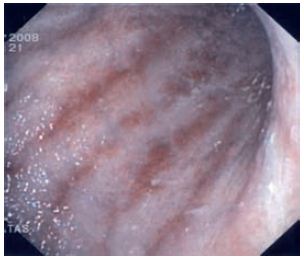
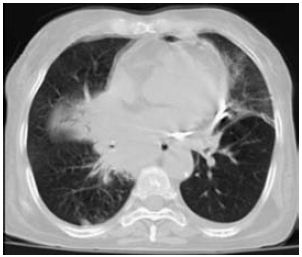
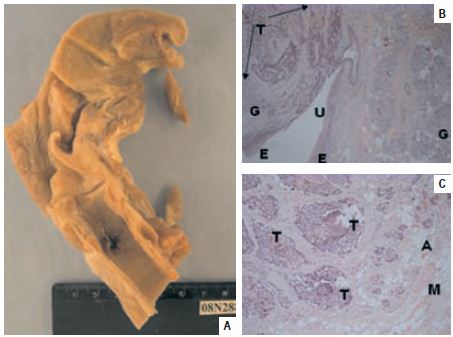
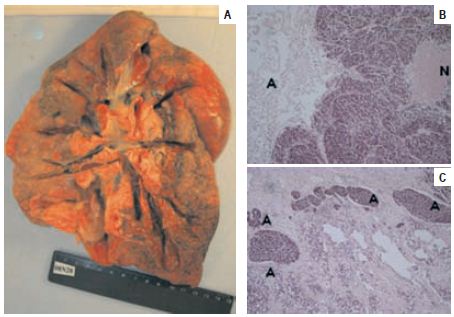
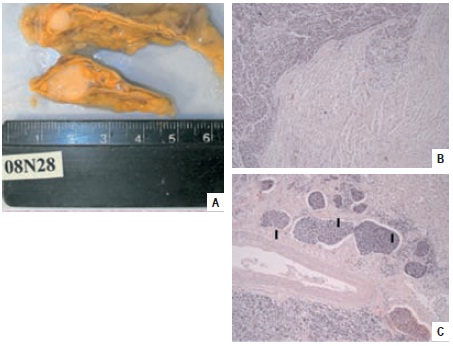
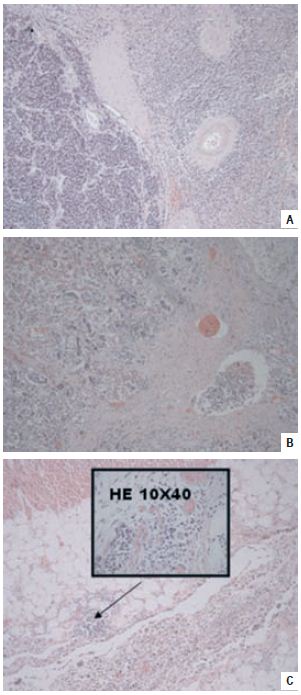
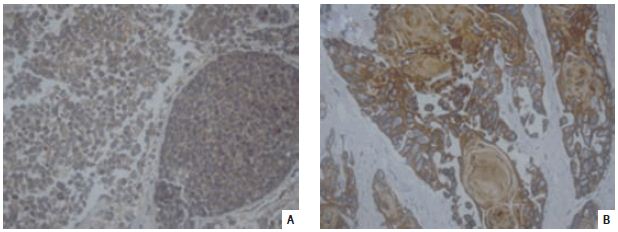
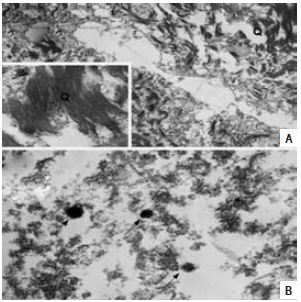
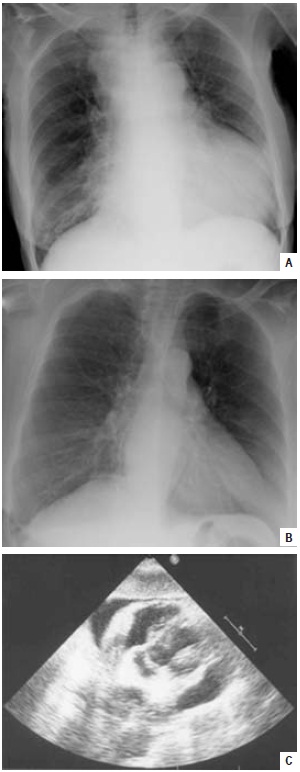
<body><![CDATA[<p><b>Clinical report</b></p>      <p>A 59-year-old Caucasian female was admitted to our Unit on 08AUG21 due to progressive    dyspnea with a provisory diagnoses of Acute Bronchopneumonia, Congestive Heart    Failure and Iron Deficiency Anemia. She was started on Ceftriaxone and Chlarytromycin.  </p>     <p>The patient started feeling sick a month prior to admission (PTA), when she    became anorexic and asthenic. Fifteen days PTA, the patient developed cough    productive of mucopurulent sputum. Ten days PTA, she began to complain of odynophagia    and dysphagia for solid food, as well as progressive orthopnea. There was also    associated 10 kg weight loss. She denied any other symptoms.Past medical history    revealed she had been treated for pulmonary tuberculosis (20 years ago) and    gastric ulcer. She was also frequently noted to be anemic. She has been a heavy    smoker (40 cigarettes/day) and a heavy alcoholic drinker (but has stopped 12    years ago). </p>      <p>On <b>physical exam </b>she was pale, very thin, profoundly dehydrated, and in respiratory distress with a RR=30 breaths/min, BP=87/68 mm Hg, HR=97 beats/min, T0=35.5ºC. and supraclavicular retraction, blood pressure 87/68 mm Hg, heart rate 97 bpm, temperature 35.5ºC. She was edentulous and had frequent sialorrhoea. There was supraclavicular retraction and numerous supraclavicular lymphadenopathies. Thyroid gland was unenlarged. Auscultation of the lungs revealed bilateral diffuse ronchi and wheezes. Heart sounds were slightly muffled. Negative for breast masses, hepatosplenomegaly and peripheral edema. </p>      <p><b>Blood tests </b>showed the following findings: leukocytosis with neutrophilia    (18 600/mm<sup>3</sup>; 94.3%); microcytic anemia (Hb 7.5 g/dL; MCV 76.4 fl;    MCH 24.2 pg), adequate platelets. Normal protime, elevated PCR 16.4 mg/dL (N&lt;1.00);    hypoalbuminemia 2.62 g/dL; low serum iron and transferrin and ferritin; no monoclonal    gammapathy; elevated LDH 752 U/L (N 313-618); other biochemical analysis were    normal (glucose; renal and liver function tests; lipid profile; calcium and    phosphorus); normal thyroid function tests; Arterial Blood Gas: respiratory    alkalosis and hypoxemia (pH 7.514; pCO<sub>2</sub> – 32.7 mmHg; pO<sub>2</sub> – 53.1 mmHg; HCO<sup>3</sup>–    mmol/L; Sat O<sub>2</sub> – 90.2%); several <b>blood cultures</b>, including <b>BACTEC</b>,    were negative. <b>Sputum exam</b>: Ziehl-Nielsen and Lowenstein were negative.    The <b>Chest PA </b>revealed an enlarged cardiac silhouette, a widened superior    mediastinum and an illdefined image of right paracardiac condensation (Fig.    1A). A comparative reading with a chest x-ray dated Dec 2006 (Fig. 1B) lead    us to suspect pericardium effusion, which was confirmed by <b>echocardiography</b>,    showing massive effusion and signs of cardiac pretamponade, with diastolic collapse    of the right atria and pre-collapse of the right ventricle (Fig. 1C), and estimated    PSAP of 51 mm Hg. An immediate <b>pericardiocentesis </b>was performed with    drainage of 820 mL of pericardial hemorrhagic effusion (in two days) that yielded    moderately elevated number of granulocytes and erythrocytes, but negative for    <i>Mycobacteria </i>and other bactéria on culture. No malignant cells found.    <b>Upper gastrointestinal endoscopy to explain dysphagia </b>showed a normal    esophagus, but revealed typical aspects of GAVE (Fig. 2). We were unable to    confirm it histologically through biopsy, because the patient became very dyspneic    during the procedure. Bronchofibroscopy was not possible to realize due to progressive    respiratory failure and the impossibility to do it in our hospital. <b>Biopsy    of a supraclavicular lymph node </b>showed infiltration by small cell carcinoma    (CAM 5.2 +, AE1/AE3 +, CK7 +; sinaptophysin +, LCA -, TTF1 , cromogranin -;    S100 -). The patient’s condition rapidly deteriorated with development of acute    pulmonary edema. After stabilizing the patient, a <b>non-contrast thoracic CT    scan </b>(Fig. 3) was done, which revealed prominence of the central pulmonary    artery and main right and left branches; numerous hypertrophied mediastinal    lymphadenopathies, mainly in the peri-esophageal area, causing compression of    the médium esophagus and also of the main right and left bronchus. At the level    of right middle lobe and of the lingual lobe there were images suggestive of    infection. The patient died on the 7<sup>th</sup> hospital day (08AUG28) due to respiratory    failure. There were no medical conditions to proceed to bronchofibroscopy. <b>Necropsy    </b>revealed the following <b>macroscopic </b>and <b>microscopic </b>(hematoxylin-eosin)    aspects (Figs. 4 A,B,C; 5 A,B,C; 6 A,B,C; 7 A,B,C): <b>Macroscopically</b>:    a) na ulcerated tumor of the base of the tongue measuring 3.5 cm at its widest    diameter; b) a mediastinal tumor mass comprising a lymphadenopathic conglomerate    involving all the compartments and the right pulmonary hilus, the main right    bronchus and a small adjacent area of the lung; c) a tumor metastasis on the    right adrenal; d) a tumor metastasis on the right kidney; e) a tumor metastasis    on the spleen; <b>Microscopically</b>: a small cell carcinoma (identical to    the one described on the ganglionar biopsy) of the right bronchus with extensive    mediastinal, tracheal and ganglionar extension, and with metastasis to the spleen,    right adrenal, right kidney, pericardium, and hypophysis. Small cell carcinoma    was confirmed by neuroendocrine markers using immunohistochemis- try (Fig. 8A).    Surprisingly, the tumor located at the tongue base was a (synchronous) squamous    cell carcinoma with metastasis only in the hypophysis, which was confirmed by    immunohistochemistry (Fig. 8B). There were areas with poorly differentiated    pattern but the neuroendocrine markers (sinaptophysin, cromogranin, NSE) were    consistently negative. The ultrastructural study performed on both tumors (bronchus    and tongue) by electron microscopy confirmed the aforementioned different nature    of these tumors (Fig. 9).</p>      <p>&nbsp;</p>     <p><img src="/img/revistas/pne/v16n4/16n4a12f1.jpg" width="300" height="772"></p>     
<p><b>Fig. 1</b> &#8211; A/B: PA views of the thorax X-rays (AUG08/DEC06) revealing    significant enlarged cardiac silhouette; C: Echocardiography: cardiac pre-tamponade    due to voluminous anterior and posterior pericardial effusion</p>     <p>&nbsp;</p>     <p><img src="/img/revistas/pne/v16n4/16n4a12f2.jpg" width="304" height="259"></p>     
]]></body>
<body><![CDATA[<p><b>Fig. 2 </b>&#8211; Upper gastrointestinal endoscopy showing characteristic    aspects of watermelon stomach</p>     <p>&nbsp;</p>     <p><img src="/img/revistas/pne/v16n4/16n4a12f3.jpg" width="302" height="257"></p>     
<p><b>Fig. 3</b> &#8211; Thoracic CT-scan: numerous mediastinic lymphadenopathies    causing compression of the medial esophagus and of the main right bronchus</p>     <p>&nbsp;</p>     <p><img src="/img/revistas/pne/v16n4/16n4a12f4.jpg" width="453" height="337"></p>     
<p><b>Fig. 4</b> &#8211; <b>A</b>: Base of the tongue with an extensive ulcerated    lesion, with macroscopic extension to the valecula;<b> B</b>: HE 10X5 &#8211;    Squamous neoplasia (T) infiltrating the muscle of the tongue and the minor salivary    glands (G), ulcerating (U) the squamous epithelium (E); <b>C</b>: HE 10X10 &#8211;    Squamous cell carcinoma (T) proliferating and infiltrating the neighbour tissues,    adipose tissue (A), muscle (M).</p>     <p>&nbsp;</p>     <p><img src="/img/revistas/pne/v16n4/16n4a12f5.jpg" width="454" height="317"></p>     
<p><b>Fig. 5</b> &#8211; <b>A</b>: Right lung with a tumor mass proliferating    within the submucosa of the main bronchus and infiltrating the hilus. The mucosal    surface of the bronchial tree was intact; <b>B</b>: HE 10X10 &#8211; SCLC with    necrosis (N); <b>C</b>: HE 10X10 &#8211; Lymphatic invasion by the SCLC (A)</p>     ]]></body>
<body><![CDATA[<p>&nbsp;</p>     <p><img src="/img/revistas/pne/v16n4/16n4a12f6.jpg" width="453" height="346"></p>     
<p><b>Fig. 6 </b>&#8211; <b>A</b>: Macroscopic aspect of adrenal gland metastasis;    <b>B</b>: HE 10X10 &#8211; Adrenal gland metastasis of SCLC; <b>C</b>: HE 10X10    &#8211; Kidney metastasis of SCLC, with lymphatic invasion (I)</p>     <p>&nbsp;</p>     <p><img src="/img/revistas/pne/v16n4/16n4a12f7.jpg" width="301" height="695"></p>     
<p><b>Fig. 7 &#8211; A</b>: HE 10X10 &#8211; Spleen metastasis of SCLC; <b>B</b>:    HE 10X10 &#8211; Hypophysis gland metastasis of SCLC and squamous cell carcinoma;    <b>C</b>: HE 10X10 &#8211; Pericardium metastasis of SCLC</p>     <p>&nbsp;</p>     <p><img src="/img/revistas/pne/v16n4/16n4a12f8.jpg" width="618" height="232"></p>     
<p><b>Fig. 8</b> &#8211; Immunohistochemistry: <b>A</b>: 10X40 &#8211; SCLC expressing    neuroendocrine markers (cromogranin, NSE, and sinaptophysin); <b>B</b>: 10X40    &#8211; The neoplasia that involved the hypopharynx, expressed positivity for    cytokeratins (34BE12 or CK903)</p>     <p>&nbsp;</p>     ]]></body>
<body><![CDATA[<p><img src="/img/revistas/pne/v16n4/16n4a12f9.jpg" width="301" height="302"></p>     
<p><b>Fig. 9</b> &#8211; Post-mortem samples recovered from paraffin blocks and    reprocessed for electron microscopy: <b>A</b>: Tumor of the base of the tongue.    The cytoplasm of the tumor cells displays well developed bundles of keratin    filaments (Q). Inset &#8211; High magnification of keratin filament; <b>B</b>:    Mediastinic tumor. Dense neurosecretory-like granules (arrows) in the cytoplasm of the tumor    cells</p>     <p>&nbsp;</p>          <p><b>Discussion</b></p>      <p>The findings of a prominent antral folds and antral thickening in upper gastrointestinal    radiologic series and on CT scans in na elderly patient with chronic anemia    should alert the radiologist to the possibility of GAVE, which should be confirmed    endoscopically with biopsy<sup><a href="#14">14</a></sup><a name="top14"></a>. </p>     <p>GAVE can be safely biopsied with only minimally increased and minor bleeding    because of its low-intravascular pressure. Biopsy of the involved gastric folds    reveals characteristic findings of dilated, tortuous mucosal capillaries often    occluded by bland fibrin thrombi in the lamina propria and dilated submucosal    veins without inflammatory infiltration<sup><a href="#15">15</a></sup><a name="top15"></a>,<sup><a href="#16">16</a></sup><a name="top16"></a>, together with foveolar hyperplasia    and fibromuscular spindle cell hyperplasia of the lamina propria<sup><a href="#17">17</a></sup><a name="top17"></a>.</p>     <p> The cause of GAVE is unknown, but Jabbari1 had proposed that it could result    from repetitive low-grade trauma caused by repeated prolapse of the loosely    attached mucosa of the distal antrum into the duodenum during gastric peristalsis    due to antral hypercontractility, primary or acquired, with consequent elongation    and secondary reactive muscular hyperplasia and ectasia of the mucosal vessels.    Thrombosed ectatic vessels are a distinctive feature and are seen only in GAVE<sup><a href="#18">18</a></sup><a name="top18"></a>,<sup><a href="#19">19</a></sup><a name="top19"></a>.  </p>     <p>Since GAVE is not acid related pharmacotherapy with histamine receptor antagonists    and proton pump inhibitors is ineffective. Evidence for effective pharmacologic    therapy with oestrogen (and/or progesterone), tranexamic acid or thalidomide,    are mentioned in some case reports only<sup><a href="#6">6</a></sup>. Ultimately, treatment of any underlying    medical comorbidities may lead to resolution of GAVE6. Many authors consider    endoscopic therapy as the primary therapy, namely argon plasma coagulation (APC),    which appears to be preferable in comparison with contact methods (heater probe,    electrocautery with bipolar electrocoagulation probe, or Gold probe) or other    noncontact ablative modality (Nd:YAG laser). Despite some contrary opinion<sup><a href="#10">10</a></sup>,    APC should probably be the treatment of choice for GAVE due to the diffuse nature    and superficial location of the lesion<sup><a href="#20">20</a></sup><a name="top20"></a>,<sup><a href="#21">21</a></sup><a name="top21"></a>. APC is well tolerated and safe    because it produces only shallow tissue injury<sup><a href="#22">22</a></sup><a name="top22"></a>. Usually several sessions are    needed, but requirements of blood transfusions are generally diminished in the    large majority of patients<sup><a href="#23">23</a></sup><a name="top23"></a>,<sup><a href="#24">24</a></sup><a name="top24"></a>,<sup><a href="#25">25</a></sup><a name="top25"></a>.</p>     <p>Antrectomy is recommended if endoscopic hemostasis fails. It removes the lesion    and nearly always cures the disease, but entails significant morbidity and 5%    mortality<sup><a href="#26">26</a></sup><a name="top26"></a>.</p>     <p> Despite the generally good results obtained with APC, recently there were    some authors who were able to get a much better result with Endoscopic Band    Ligation (EBL) in cases of GAVE (especially in patients having large areas of    diseased mucosa and submucosa)<sup><a href="#27">27</a></sup><a name="top27"></a>    that have been treated with APC but would still have recurrent hemorrhage<sup><a href="#27">27</a></sup>.    These authors suggest that EBL could be more superior to endoscopic thermal    therapy (ETT) for the management of GAVE. In their study consisting of 22 patients    treated either with EBL or ETT, including four patients in the EBL group that    failed prior ETT, they found that statistically EBL had a significantly higher    rate of bleeding cessation (67% vs 23%, P = .04), fewer treatment sessions required    for cessation of bleeding (1.9 vs 4.7, P = .05), a greater increase in hemoglobin    values ( 2.8 g/dL vs 0.9 g/dL, P = .05), a greater decrease in transfusion requirements    ( -12.7 vs -5.2, P = .02), and a greater decrease in hospital admissions ( -2.6    vs -0.5, P = .02) during the follow-up period. EBL for GAVE includes ligation    bands applied to abnormal-appearing mucosa in the antrum, beginning in the most    distal antrum, adjacent to the pylorus, and subsequently more proximally until    as much as possible of the abnormal-appearing mucosa, thus obtaining resection    of large amounts of antral mucosa and submucosa. The superiority of EBL compared    with ETT is probably due to the fact that EBL providing more reliable obliteration    of the abnormal vasculature in the mucosa and submucosa. Complications are also    rarer with EBL than with APC<sup><a href="#27">27</a></sup>.</p>     ]]></body>
<body><![CDATA[<p> The main causes of non-traumatic hemorrhagic pericarditis are tuberculosis    in developing countries, frequently associated today with AIDS<sup><a href="#28">28</a></sup><a name="top28"></a>, and malignancy    in developed<sup><a href="#29">29</a></sup><a name="top29"></a>. Meyers <i>et al </i><sup><a href="#30">30</a></sup><a name="top30"></a> demonstrated that most pericardial effusions    are sero-sanguineous or hemorrhagic (72.6%), there was a great number of possible    etiologies, and erythrocytes counts were not significantly different among the    diagnostic groups. Other possible causes are post-myocardial infarction rupture    of the free wall of the ventricle, retrograde bleeding due to dissecting aneurysm    of the proximal thoracic aorta (mostly due to atherosclerotic disease; on old    times also syphilitic aneurysm), anticoagulant or antifibrinolytic therapy,    congestive heart failure, uremia, connective tissue diseases, and any type of    infectious pericarditis<sup><a href="#31">31</a></sup><a name="top31"></a>,<sup><a href="#32">32</a></sup><a name="top32"></a>,<sup><a href="#33">33</a></sup><a name="top33"></a>,<sup><a href="#34">34</a></sup><a name="top34"></a>,<sup><a href="#35">35</a></sup><a name="top35"></a>,<sup><a href="#36">36</a></sup><a name="top36"></a>,<sup><a href="#37">37</a></sup><a name="top37"></a>,<sup><a href="#38">38</a></sup><a name="top38"></a>,<sup><a href="#39">39</a></sup><a name="top39"></a>. </p>     <p>In a review of 127 patients with malignancy-related pericardial effusion by    Wilkes<sup><a href="#40">40</a></sup><a name="top40"></a>, 55% of cases were malignant in etiology while in the remaining 45%,    a malignant cause for the effusion could not be determined and no definitive    etiology was identified in 74% of these effusions. Diagnosis by cytology and    pericardial biopsy had sensitivities of 90% and 50%, respectively. 71% of primary    tumors were adenocarcinomas of the lung, breast, esophagus, hematologic malignancies,    and of unknown primary site.</p>     <p>Effusions caused by tumors often progress to cardiac tamponade, eliciting bleeding    in the pericardium<sup><a href="#41">41</a></sup><a name="top41"></a>,<sup><a href="#42">42</a></sup><a name="top42"></a>.    Malignancy-related hemorrhagic pericardial effusions are frequently a terminal    event in patients with disease unresponsive to therapy. However, bloody pericardial    effusion can be the presenting manifestation of a newly diagnosed malignancy,    either metastatic<sup><a href="#43">43</a></sup><a name="top43"></a>,<sup><a href="#44">44</a></sup><a name="top44"></a>,<sup><a href="#45">45</a></sup><a name="top45"></a>,<sup><a href="#46">46</a></sup><a name="top46"></a>,<sup><a href="#47">47</a></sup><a name="top47"></a>,    or rarely due to primary malignancy of the pericardium (exº mesothelioma<sup><a href="#48">48</a></sup><a name="top48"></a>).    We shell also think on the possibility of pericardial effusion due to primary    malignancy of the heart, and on Kaposi sarcoma and lymphoma in patients with    AIDS<sup><a href="#48">48</a></sup>. </p>     <p>In most cancer patients with pericardial effusion, or tamponade, it is important    that neoplastic involvement of the pericardium be confirmed by identification    of malignant cells in pericardial fluid. Confirmation is important because other    forms of pericardial disease can occur in patients who have or had cancer<sup><a href="#48">48</a></sup>,<sup><a href="#49">49</a></sup><a name="top49"></a>,<sup><a href="#50">50</a></sup><a name="top50"></a>.  </p>     <p>In our patient the cytological examination of the pericardium fluid was negative,    but the extensive histological analysis of the pericardium during necropsy,    revealed a tiny metastatic focus of small cell carcinoma, confirming the clinical    suspicion of a malignant etiology of the pericardium effusion. </p>     <p>The median age at diagnosis for primary cancer of the tongue is 61 years of    age. The lifetime risk of developing cancer of the tongue is 1 in 361 men and    woman<sup><a href="#51">51</a></sup><a name="top51"></a>. People who drink large amounts of alcohol and use tobacco are especially    at risk. Tongue cancers are subdivided in cancers of the proximal two-thirds    of the tongue – buccal tumors, and cancers of the posterior third – tongue base    cancers or oropharyngeal cancers, which are often diagnosed quite late. Most    of the tumors are squamous cells tumors<sup><a href="#52">52</a></sup><a name="top52"></a>. </p>     <p>Symptoms of cancer of the tongue are: (a) chronic pain in the pharynx, mostly    at mastication or swallowing, (b) numbness of the tongue or of the mouth, (c)    a small lump, (d) unexplained bleeding from the tongue<sup><a href="#53">53</a></sup><a name="top53"></a>, (e) non-cicatrizing    ulcer of the tongue, (f ) otalgia due to pain irradiation, (g) bad breath, (h)    drooling, (i) difficulty in breathing, (j) trouble swallowing, (k) difficulty    in speaking, (l) bad odour breath. If untreated, the tumor may spread throughout    the tongue to the floor of the mouth and to the gum (jaws). As tumor grows it    can evolutes to cause metastases to lymph nodes in the neck and later on in    the rest of the body<sup><a href="#54">54</a></sup><a name="top54"></a>. </p>     <p>Neuroendocrine carcinomas are tumors and are more commonly found in the thyroid,    lung and skin. Their diagnosis is based on the recognition of the characteristic    morphology and architecture, but immunohistochemical confirmation of the neuroendocrine    nature of neoplasm cells is always required.</p>     <p> In our patient, the problem wasn’t centered on the histological diagnosis    but rather at his origin. The main tumor mass was located at the mediastinum,    but is starting to invade the bronchus and lung. We could specu late a thymus    origin, but small cell carcinoma is rare at the thymus, and it is much more    frequent at the lung. In order to make a diagnosis of small cell carcinoma of    the thymus, it is necessary to exclude a lung origin, which we certainly can’t    do in our case. So, we think that we have to consider that in this patient,    the origin was pulmonary with extensive mediastinal and ganglionar extension.</p>     <p> SCLC has an aggressive behavior, with rapid growth, early spread to distant    sites (mediastinal lymph nodes, liver, bones, adrenal glands, and brain), frequently    exhibit paraneoplasm syndromes and neurologic autoimmune phenomena, and distinct    sensitivity to chemotherapy and radiotherapy. Surgery is rarely useful. SCLC    generally presents with onset of symptoms within 8-12 weeks prior to admission.    The symptoms can result from local tumor growth, intrathoracic spread, distant    spread, para-neoplasm syndromes (inappropriate secretion of antidiuretic hormone,    ectopic secretion of ACTH) and autoimmune neurologic phenomena. Common symptoms    are fatigue, anorexia, weight loss, cough, dyspnea, hemoptysis, symptoms due    to vena cava obstruction, hoarseness, dysphagia, stridor, neurological dysfunction,    bone pain, abdominal pain due to metastases. Usually SCLC is centrally located    and may cause obstruction of the major airway, with distal collapse and post-obstructive    pneumonitis. Due to rapid growth and spread, patients at presentation may have    a very large intra-thoracic tumor, making difficult to distinguish primary tumor    from lymph node metastases. Pleural and pericardial effusions are common<sup><a href="#55">55</a></sup><a name="top55"></a>.  </p>      ]]></body>
<body><![CDATA[<p>&nbsp;</p>      <p><b>Acknowledgments</b></p>      <p>Due to the following performances at our Hospital: Dr Pratas J (Unit of Gastrenterology) – upper gastrointestinal endoscopy; Drs Brizida L and Dr Ramos Aª (Unit of Cardiology) – cardiac echocardiography and pericardicentesis; Dr Ramalho V (Unit of Radiology) – CT-scan of the thorax</p>      <p>&nbsp;</p>      <p><b>Bibliography</b></p>      <!-- ref --><p><a name="1"></a><a href="#top1">1</a>. Jabbari M, Cherry R, Lough JO, Daly    DS, Kinnear DG, Goresky CA. Gastric antral vascular ectasia: the watermelon    stomach. Gastroenterol 1984; 87:1165- 1170.&nbsp;&nbsp;&nbsp;&nbsp;&nbsp;&nbsp;&nbsp;&nbsp;[&#160;<a href="javascript:void(0);" onclick="javascript: window.open('/scielo.php?script=sci_nlinks&ref=000088&pid=S0873-2159201000040001200001&lng=','','width=640,height=500,resizable=yes,scrollbars=1,menubar=yes,');">Links</a>&#160;]<!-- end-ref --><!-- ref --><p><a name="2"></a><a href="#top2">2</a>. Ikeda M, Ishida H, Nakamura E, <i>et    al. </i>An endoscopy follow-up study of the development of diffuse antral vascular    ectasia. Endoscopy 1996; 28:390-393. &nbsp;&nbsp;&nbsp;&nbsp;&nbsp;&nbsp;&nbsp;&nbsp;[&#160;<a href="javascript:void(0);" onclick="javascript: window.open('/scielo.php?script=sci_nlinks&ref=000089&pid=S0873-2159201000040001200002&lng=','','width=640,height=500,resizable=yes,scrollbars=1,menubar=yes,');">Links</a>&#160;]<!-- end-ref --><!-- ref --><p><a name="3"></a><a href="#top3">3</a>. Novitsky YW, Kercher KW, Czerniach DR,    <i>et al. </i>Watermelon stomach: pathophysiology, diagnosis and management.    J Gastroint Surg 2003; 7:652-661.&nbsp;&nbsp;&nbsp;&nbsp;&nbsp;&nbsp;&nbsp;&nbsp;[&#160;<a href="javascript:void(0);" onclick="javascript: window.open('/scielo.php?script=sci_nlinks&ref=000090&pid=S0873-2159201000040001200003&lng=','','width=640,height=500,resizable=yes,scrollbars=1,menubar=yes,');">Links</a>&#160;]<!-- end-ref --><!-- ref --><p><a name="4"></a><a href="#top4">4</a>. Chatterjee MD. Watermelon stomach. CMAJ    2008; 179:162. &nbsp;&nbsp;&nbsp;&nbsp;&nbsp;&nbsp;&nbsp;&nbsp;[&#160;<a href="javascript:void(0);" onclick="javascript: window.open('/scielo.php?script=sci_nlinks&ref=000091&pid=S0873-2159201000040001200004&lng=','','width=640,height=500,resizable=yes,scrollbars=1,menubar=yes,');">Links</a>&#160;]<!-- end-ref --><!-- ref --><p><a name="5"></a><a href="#top5">5</a>. Toyota M, Hiroda Y, Nakogawa N. Gastric    antral vascular ectasia causing severe anemia. J Gastroenterol 1996; 31:710-713.&nbsp;&nbsp;&nbsp;&nbsp;&nbsp;&nbsp;&nbsp;&nbsp;[&#160;<a href="javascript:void(0);" onclick="javascript: window.open('/scielo.php?script=sci_nlinks&ref=000092&pid=S0873-2159201000040001200005&lng=','','width=640,height=500,resizable=yes,scrollbars=1,menubar=yes,');">Links</a>&#160;]<!-- end-ref --><!-- ref --><p><a name="6"></a><a href="#top6">6</a>. Selinger CP, Ang YS. Gastric antral    vascular ectasia (GAVE): an update on clinical presentation, pathophysiology    and treatment. Digestion 2008; 77:131-137.&nbsp;&nbsp;&nbsp;&nbsp;&nbsp;&nbsp;&nbsp;&nbsp;[&#160;<a href="javascript:void(0);" onclick="javascript: window.open('/scielo.php?script=sci_nlinks&ref=000093&pid=S0873-2159201000040001200006&lng=','','width=640,height=500,resizable=yes,scrollbars=1,menubar=yes,');">Links</a>&#160;]<!-- end-ref --><!-- ref --><p><a name="7"></a><a href="#top7">7</a>. Bersch G. Diffuse gastric antral vascular    ectasia: the “watermelon stomach” revisited (letter). Am J Gastroenterol 1987;    82:1333-1334.&nbsp;&nbsp;&nbsp;&nbsp;&nbsp;&nbsp;&nbsp;&nbsp;[&#160;<a href="javascript:void(0);" onclick="javascript: window.open('/scielo.php?script=sci_nlinks&ref=000094&pid=S0873-2159201000040001200007&lng=','','width=640,height=500,resizable=yes,scrollbars=1,menubar=yes,');">Links</a>&#160;]<!-- end-ref --><!-- ref --><p><a name="8"></a><a href="#top8">8</a>. Herman BE, Vargo JJ, Baum S, Silverman    ED, Eisold J. Gastric antral vascular ectasia: a case report and review of the    literature. J Nucl Med 1996; 37:854-856. &nbsp;&nbsp;&nbsp;&nbsp;&nbsp;&nbsp;&nbsp;&nbsp;[&#160;<a href="javascript:void(0);" onclick="javascript: window.open('/scielo.php?script=sci_nlinks&ref=000095&pid=S0873-2159201000040001200008&lng=','','width=640,height=500,resizable=yes,scrollbars=1,menubar=yes,');">Links</a>&#160;]<!-- end-ref --><!-- ref --><p> <a name="9"></a><a href="#top9">9</a>. Gostout CJ, Viggiano TR, Ahlquist DA,    Wang KK, Larson MV, Balm R. The clinical and endoscopic Spectrum of the watermelon    stomach. J Clin Gastroenterol 1992; 15:256-263.&nbsp;&nbsp;&nbsp;&nbsp;&nbsp;&nbsp;&nbsp;&nbsp;[&#160;<a href="javascript:void(0);" onclick="javascript: window.open('/scielo.php?script=sci_nlinks&ref=000096&pid=S0873-2159201000040001200009&lng=','','width=640,height=500,resizable=yes,scrollbars=1,menubar=yes,');">Links</a>&#160;]<!-- end-ref --><!-- ref --><p><a name="10"></a><a href="#top10">10</a>. Chaves DM, Sakai P, Oliveira CV,    Cheng S, Ishiaka S. Watermelon stomach: clinical aspects and treatment with    argon plasma coagulation. Arq Gastroenterol 2006; 43:191-195.&nbsp;&nbsp;&nbsp;&nbsp;&nbsp;&nbsp;&nbsp;&nbsp;[&#160;<a href="javascript:void(0);" onclick="javascript: window.open('/scielo.php?script=sci_nlinks&ref=000097&pid=S0873-2159201000040001200010&lng=','','width=640,height=500,resizable=yes,scrollbars=1,menubar=yes,');">Links</a>&#160;]<!-- end-ref --><!-- ref --><p><a name="11"></a><a href="#top11">11</a>. Park RH, Danesh BJ, Upadhyay R, Howatson    AG, Lec FD, Russel RJ. Gastric antral vascular ectasia (watermelon stomach)    – therapeutic options. Postgrad Med J 1990: 66:720-723.&nbsp;&nbsp;&nbsp;&nbsp;&nbsp;&nbsp;&nbsp;&nbsp;[&#160;<a href="javascript:void(0);" onclick="javascript: window.open('/scielo.php?script=sci_nlinks&ref=000098&pid=S0873-2159201000040001200011&lng=','','width=640,height=500,resizable=yes,scrollbars=1,menubar=yes,');">Links</a>&#160;]<!-- end-ref --><!-- ref --><p> <a name="12"></a><a href="#top12">12</a>. Weitgasser R, Sungler P, Hauser-Kroberger    C, Dietze O, Sattlegger P, Hacker GW. Immunohistochemical assessment of an asymptomatic    glucagonoma in a patient with hypergastrinemia and marked antral angiodysplasia.    Appl Immunohistochem Molecul Morphol 2001; 9:92-96.&nbsp;&nbsp;&nbsp;&nbsp;&nbsp;&nbsp;&nbsp;&nbsp;[&#160;<a href="javascript:void(0);" onclick="javascript: window.open('/scielo.php?script=sci_nlinks&ref=000099&pid=S0873-2159201000040001200012&lng=','','width=640,height=500,resizable=yes,scrollbars=1,menubar=yes,');">Links</a>&#160;]<!-- end-ref --><!-- ref --><p><a name="13"></a><a href="#top13">13</a>. Spahr L, Villeneuve JP, Dufresne    MP, <i>et al. </i>Gastric antral vascular ectasia in cirrhotic patients: absence    of relation with portal hypertension. GUT 1999; 44:739-742.&nbsp;&nbsp;&nbsp;&nbsp;&nbsp;&nbsp;&nbsp;&nbsp;[&#160;<a href="javascript:void(0);" onclick="javascript: window.open('/scielo.php?script=sci_nlinks&ref=000100&pid=S0873-2159201000040001200013&lng=','','width=640,height=500,resizable=yes,scrollbars=1,menubar=yes,');">Links</a>&#160;]<!-- end-ref --><!-- ref --><p><a name="14"></a><a href="#top14">14</a>. Urban BA, Jones B, Fisman EK, Kern    SE, Ravich WJ. Gastric antral vascular ectasia (“the watermelon stomach”): radiologic    findings. Radiology 1991; 178:517-518.&nbsp;&nbsp;&nbsp;&nbsp;&nbsp;&nbsp;&nbsp;&nbsp;[&#160;<a href="javascript:void(0);" onclick="javascript: window.open('/scielo.php?script=sci_nlinks&ref=000101&pid=S0873-2159201000040001200014&lng=','','width=640,height=500,resizable=yes,scrollbars=1,menubar=yes,');">Links</a>&#160;]<!-- end-ref --><!-- ref --><p><a name="15"></a><a href="#top15">15</a>. Gilliam JH 3rd, Geisinger KR, Wu    WC, <i>et al. </i>Endoscopic biopsy is diagnostic in gastric vascular ectasia:    the “watermelon” stomach. Dig Dis Sci 1989; 34:885-888.&nbsp;&nbsp;&nbsp;&nbsp;&nbsp;&nbsp;&nbsp;&nbsp;[&#160;<a href="javascript:void(0);" onclick="javascript: window.open('/scielo.php?script=sci_nlinks&ref=000102&pid=S0873-2159201000040001200015&lng=','','width=640,height=500,resizable=yes,scrollbars=1,menubar=yes,');">Links</a>&#160;]<!-- end-ref --><!-- ref --><p><a name="16"></a><a href="#top16">16</a>. Cappel MS, Fredal D. Acute nonvariceal    upper gastrointestinal bleeding: endoscopic diagnosis and therapy. Med Clin    N Am 2008; 92:511-550.&nbsp;&nbsp;&nbsp;&nbsp;&nbsp;&nbsp;&nbsp;&nbsp;[&#160;<a href="javascript:void(0);" onclick="javascript: window.open('/scielo.php?script=sci_nlinks&ref=000103&pid=S0873-2159201000040001200016&lng=','','width=640,height=500,resizable=yes,scrollbars=1,menubar=yes,');">Links</a>&#160;]<!-- end-ref --><!-- ref --><p><a name="17"></a><a href="#top17">17</a>. Suit PF, Petras RE, Bauer TW, Petrini    JL. Gastric antral vascular ectasia: a histologic and morphometric study of    the watermelon stomach. Am J Surg Pathol 1987; 11:750-775.&nbsp;&nbsp;&nbsp;&nbsp;&nbsp;&nbsp;&nbsp;&nbsp;[&#160;<a href="javascript:void(0);" onclick="javascript: window.open('/scielo.php?script=sci_nlinks&ref=000104&pid=S0873-2159201000040001200017&lng=','','width=640,height=500,resizable=yes,scrollbars=1,menubar=yes,');">Links</a>&#160;]<!-- end-ref --><!-- ref --><p> <a name="18"></a><a href="#top18">18</a>. DuBouly C, Fairbother J, Isaacson    PG. Mucosal prolapse syndrome: a unifying concept for solitary syndrome and    related disorders. J Clin Pathol 1983; 36:1264-1268.&nbsp;&nbsp;&nbsp;&nbsp;&nbsp;&nbsp;&nbsp;&nbsp;[&#160;<a href="javascript:void(0);" onclick="javascript: window.open('/scielo.php?script=sci_nlinks&ref=000105&pid=S0873-2159201000040001200018&lng=','','width=640,height=500,resizable=yes,scrollbars=1,menubar=yes,');">Links</a>&#160;]<!-- end-ref --><!-- ref --><p><a name="19"></a><a href="#top19">19</a>. Tuibia N, Sanyal A. Portal hypertension    and variceal hemorrhage. Med Clin N Am 2008; 92:551-574.&nbsp;&nbsp;&nbsp;&nbsp;&nbsp;&nbsp;&nbsp;&nbsp;[&#160;<a href="javascript:void(0);" onclick="javascript: window.open('/scielo.php?script=sci_nlinks&ref=000106&pid=S0873-2159201000040001200019&lng=','','width=640,height=500,resizable=yes,scrollbars=1,menubar=yes,');">Links</a>&#160;]<!-- end-ref --><!-- ref --><p> <a name="20"></a><a href="#top20">20</a>. Pavey DA, Cray PI. Endoscopic therapy    for upper GI vascular ectasia. Gastroint Endosc 2004; 59:233-231.&nbsp;&nbsp;&nbsp;&nbsp;&nbsp;&nbsp;&nbsp;&nbsp;[&#160;<a href="javascript:void(0);" onclick="javascript: window.open('/scielo.php?script=sci_nlinks&ref=000107&pid=S0873-2159201000040001200020&lng=','','width=640,height=500,resizable=yes,scrollbars=1,menubar=yes,');">Links</a>&#160;]<!-- end-ref --><!-- ref --><p><a name="21"></a><a href="#top21">21</a>. Ng I, Lai KC, Ng M. Clinical and    histologic features of gastric vascular ectasia: successful treatment with endoscopic    laser therapy. J Gastroent Hepatol 1996; 11:270-274.&nbsp;&nbsp;&nbsp;&nbsp;&nbsp;&nbsp;&nbsp;&nbsp;[&#160;<a href="javascript:void(0);" onclick="javascript: window.open('/scielo.php?script=sci_nlinks&ref=000108&pid=S0873-2159201000040001200021&lng=','','width=640,height=500,resizable=yes,scrollbars=1,menubar=yes,');">Links</a>&#160;]<!-- end-ref --><!-- ref --><p> <a name="22"></a><a href="#top22">22</a>. Kwan v, Bourke MJ, Williams SJ,    <i>et al. </i>Argon plasma coagulation in the management of symptomatic gastrointestinal    vascular lesions: experience in 100 consecutive patients with long-term follow-up.    Am J Gastrenterol 2006; 101:58-63.&nbsp;&nbsp;&nbsp;&nbsp;&nbsp;&nbsp;&nbsp;&nbsp;[&#160;<a href="javascript:void(0);" onclick="javascript: window.open('/scielo.php?script=sci_nlinks&ref=000109&pid=S0873-2159201000040001200022&lng=','','width=640,height=500,resizable=yes,scrollbars=1,menubar=yes,');">Links</a>&#160;]<!-- end-ref --><!-- ref --><p> <a name="23"></a><a href="#top23">23</a>. Roman S, Saurin JC, Dumortier J,    <i>et al. </i>Tolerance and efficacy of argon plasma coagulation for controlling    bleeding in patients with typical and atypical manifestations of watermelon    stomach. Endoscopy 2003; 35:1024-1028.&nbsp;&nbsp;&nbsp;&nbsp;&nbsp;&nbsp;&nbsp;&nbsp;[&#160;<a href="javascript:void(0);" onclick="javascript: window.open('/scielo.php?script=sci_nlinks&ref=000110&pid=S0873-2159201000040001200023&lng=','','width=640,height=500,resizable=yes,scrollbars=1,menubar=yes,');">Links</a>&#160;]<!-- end-ref --><!-- ref --><p><a name="24"></a><a href="#top24">24</a>. Sebastian S, Mehoughin R, Gasim A,    <i>et al. </i>Endoscopic argon plasma coagulation for the treatment of gastric    antral vascular ectasia (watermelon stomach): longterm results. Dig Liv Dis    2004; 36:212-217.&nbsp;&nbsp;&nbsp;&nbsp;&nbsp;&nbsp;&nbsp;&nbsp;[&#160;<a href="javascript:void(0);" onclick="javascript: window.open('/scielo.php?script=sci_nlinks&ref=000111&pid=S0873-2159201000040001200024&lng=','','width=640,height=500,resizable=yes,scrollbars=1,menubar=yes,');">Links</a>&#160;]<!-- end-ref --><!-- ref --><p><a name="25"></a><a href="#top25">25</a>. Pereira-Lima JC, Hornos AP, Marques    DL, Lopes CV, Waechter FL, Saul C, <i>et al. </i>Tratamento da ectasia vascular    do antro gástrico por electrocoagulação com argônio. GED 2002, 21:213-217 (in    portuguese).&nbsp;&nbsp;&nbsp;&nbsp;&nbsp;&nbsp;&nbsp;&nbsp;[&#160;<a href="javascript:void(0);" onclick="javascript: window.open('/scielo.php?script=sci_nlinks&ref=000112&pid=S0873-2159201000040001200025&lng=','','width=640,height=500,resizable=yes,scrollbars=1,menubar=yes,');">Links</a>&#160;]<!-- end-ref --><!-- ref --><p><a name="26"></a><a href="#top26">26</a>. Bourke M, Hope DL, Boyd P, <i>et    al. </i>Endoscopic laser therapy for watermelon stomach. J Gastroenterol Hepatol    1996; 11:832-836.&nbsp;&nbsp;&nbsp;&nbsp;&nbsp;&nbsp;&nbsp;&nbsp;[&#160;<a href="javascript:void(0);" onclick="javascript: window.open('/scielo.php?script=sci_nlinks&ref=000113&pid=S0873-2159201000040001200026&lng=','','width=640,height=500,resizable=yes,scrollbars=1,menubar=yes,');">Links</a>&#160;]<!-- end-ref --><!-- ref --><p><a name="27"></a><a href="#top27">27</a>. Wells CD, Harrison ME, Gurudu SR,    Crowell MD, Bynne TJ, Depekis G, <i>et al. </i>Treatment of gastric antral vascular    ectasia (watermelon stomach) with endoscopic band ligation. Gastrointest Endosc    2008; 66:231-236.&nbsp;&nbsp;&nbsp;&nbsp;&nbsp;&nbsp;&nbsp;&nbsp;[&#160;<a href="javascript:void(0);" onclick="javascript: window.open('/scielo.php?script=sci_nlinks&ref=000114&pid=S0873-2159201000040001200027&lng=','','width=640,height=500,resizable=yes,scrollbars=1,menubar=yes,');">Links</a>&#160;]<!-- end-ref --><!-- ref --><p><a name="28"></a><a href="#top28">28</a>. Mayosi BM, Burgess LJ, Douhell AF.    Tuberculous pericarditis. Circulation 2005; 112:3608-3616.&nbsp;&nbsp;&nbsp;&nbsp;&nbsp;&nbsp;&nbsp;&nbsp;[&#160;<a href="javascript:void(0);" onclick="javascript: window.open('/scielo.php?script=sci_nlinks&ref=000115&pid=S0873-2159201000040001200028&lng=','','width=640,height=500,resizable=yes,scrollbars=1,menubar=yes,');">Links</a>&#160;]<!-- end-ref --><!-- ref --><p><a name="29"></a><a href="#top29">29</a>. Dequanter D, Lothaire PH, Berghmans    T, Scubier JP. Severe pericardial effusion in patients with concurrent malignancy:    a retrospective analysis of prognostic factors influencing survival. Ann Surg    Oncol 2008; 15:3268-3271.&nbsp;&nbsp;&nbsp;&nbsp;&nbsp;&nbsp;&nbsp;&nbsp;[&#160;<a href="javascript:void(0);" onclick="javascript: window.open('/scielo.php?script=sci_nlinks&ref=000116&pid=S0873-2159201000040001200029&lng=','','width=640,height=500,resizable=yes,scrollbars=1,menubar=yes,');">Links</a>&#160;]<!-- end-ref --><!-- ref --><p> <a name="30"></a><a href="#top30">30</a>. Meyers DG, Meyers RE, Prendergast    TW. The usefullness of diagnostic tests on pericardial fluid. Chest 1997; 111:1213-1221.  &nbsp;&nbsp;&nbsp;&nbsp;&nbsp;&nbsp;&nbsp;&nbsp;[&#160;<a href="javascript:void(0);" onclick="javascript: window.open('/scielo.php?script=sci_nlinks&ref=000117&pid=S0873-2159201000040001200030&lng=','','width=640,height=500,resizable=yes,scrollbars=1,menubar=yes,');">Links</a>&#160;]<!-- end-ref --><!-- ref --><p><a name="31"></a><a href="#top31">31</a>. Hoit BD. Pericardial disease and    pericardial tamponade. Crit Care Med 2007; 35:8(Suppl.)S355-S364.&nbsp;&nbsp;&nbsp;&nbsp;&nbsp;&nbsp;&nbsp;&nbsp;[&#160;<a href="javascript:void(0);" onclick="javascript: window.open('/scielo.php?script=sci_nlinks&ref=000118&pid=S0873-2159201000040001200031&lng=','','width=640,height=500,resizable=yes,scrollbars=1,menubar=yes,');">Links</a>&#160;]<!-- end-ref --><!-- ref --><p><a name="32"></a><a href="#top32">32</a>. Stern JB, Sobel HJ. Hemorrhagic rheumatoid    pericarditis. Am J Cardiol 1961; 8: 670-673.&nbsp;&nbsp;&nbsp;&nbsp;&nbsp;&nbsp;&nbsp;&nbsp;[&#160;<a href="javascript:void(0);" onclick="javascript: window.open('/scielo.php?script=sci_nlinks&ref=000119&pid=S0873-2159201000040001200032&lng=','','width=640,height=500,resizable=yes,scrollbars=1,menubar=yes,');">Links</a>&#160;]<!-- end-ref --><!-- ref --><p> <a name="33"></a><a href="#top33">33</a>. Saxena A, Singh N, Romakrishnan    S, Kothari S. Bacteriasl pericarditis presenting as hemorrhagic pericardial    effusion in a 6-year-old girl. Ann Pediatr Card 2008; 1:68-69.&nbsp;&nbsp;&nbsp;&nbsp;&nbsp;&nbsp;&nbsp;&nbsp;[&#160;<a href="javascript:void(0);" onclick="javascript: window.open('/scielo.php?script=sci_nlinks&ref=000120&pid=S0873-2159201000040001200033&lng=','','width=640,height=500,resizable=yes,scrollbars=1,menubar=yes,');">Links</a>&#160;]<!-- end-ref --><!-- ref --><p><a name="34"></a><a href="#top34">34</a>. Tenenbaum T, Heusch A, Henrich B,    Mackenzie CR, Scmidt KG, Schroten H. Acute hemorrhagic pericarditis in a child    with pneumonia due to Chlamydophila pneumonia. J Clin Microbiol 2005; 43:520-522.&nbsp;&nbsp;&nbsp;&nbsp;&nbsp;&nbsp;&nbsp;&nbsp;[&#160;<a href="javascript:void(0);" onclick="javascript: window.open('/scielo.php?script=sci_nlinks&ref=000121&pid=S0873-2159201000040001200034&lng=','','width=640,height=500,resizable=yes,scrollbars=1,menubar=yes,');">Links</a>&#160;]<!-- end-ref --><!-- ref --><p><a name="35"></a><a href="#top35">35</a>. Zanini G, Antonieli E, Vizzardi E,    Raddino R, Cas LD. Hemorrhagic pericarditis with cardiac tamponade due to Coxsackie    virus infection. Am J Clin Reports 2008; 9:60-63.&nbsp;&nbsp;&nbsp;&nbsp;&nbsp;&nbsp;&nbsp;&nbsp;[&#160;<a href="javascript:void(0);" onclick="javascript: window.open('/scielo.php?script=sci_nlinks&ref=000122&pid=S0873-2159201000040001200035&lng=','','width=640,height=500,resizable=yes,scrollbars=1,menubar=yes,');">Links</a>&#160;]<!-- end-ref --><p> <a name="36"></a><a href="#top36">36</a>. Spodick DH. Infectious pericarditis.    <i>In </i>Spodick DH (Ed.). The pericardium: a comprehensive textbook. New York:    Marcel Dekker 1997: 260-290.</p>      <!-- ref --><p><a name="37"></a><a href="#top37">37</a>. Zayas R, Anguit M. Incidence of specific    etiology and role of methods for specific etiologic diagnosis of primary acute    pericarditis. Am J Cardiol 1995; 75:378- 382.&nbsp;&nbsp;&nbsp;&nbsp;&nbsp;&nbsp;&nbsp;&nbsp;[&#160;<a href="javascript:void(0);" onclick="javascript: window.open('/scielo.php?script=sci_nlinks&ref=000124&pid=S0873-2159201000040001200036&lng=','','width=640,height=500,resizable=yes,scrollbars=1,menubar=yes,');">Links</a>&#160;]<!-- end-ref --><!-- ref --><p><a name="38"></a><a href="#top38">38</a>. Permaneyer-Miralda G. Acute pericardial    disease: approach to the etiologic diagnosis. Heart 2004, 90:252- 254. &nbsp;&nbsp;&nbsp;&nbsp;&nbsp;&nbsp;&nbsp;&nbsp;[&#160;<a href="javascript:void(0);" onclick="javascript: window.open('/scielo.php?script=sci_nlinks&ref=000125&pid=S0873-2159201000040001200037&lng=','','width=640,height=500,resizable=yes,scrollbars=1,menubar=yes,');">Links</a>&#160;]<!-- end-ref --><!-- ref --><p><a name="39"></a><a href="#top39">39</a>. Olson LJ. Edwards WD, Olney BA, Orsulak    TA, Josa M. Hemorrhagic cardiac tamponade: a clinicopathologic correlation.    Mayo Clin Proc 1984; 59:785- 790.&nbsp;&nbsp;&nbsp;&nbsp;&nbsp;&nbsp;&nbsp;&nbsp;[&#160;<a href="javascript:void(0);" onclick="javascript: window.open('/scielo.php?script=sci_nlinks&ref=000126&pid=S0873-2159201000040001200038&lng=','','width=640,height=500,resizable=yes,scrollbars=1,menubar=yes,');">Links</a>&#160;]<!-- end-ref --><!-- ref --><p><a name="40"></a><a href="#top40">40</a>. Wilkes JD, Fidias P, Vaickus L, Perez    RP. Malignancy- related pericardial effusion: 127 cases from the Roswell Park    cancer Institute. Cancer 1995; 76:1377- 1387.&nbsp;&nbsp;&nbsp;&nbsp;&nbsp;&nbsp;&nbsp;&nbsp;[&#160;<a href="javascript:void(0);" onclick="javascript: window.open('/scielo.php?script=sci_nlinks&ref=000127&pid=S0873-2159201000040001200039&lng=','','width=640,height=500,resizable=yes,scrollbars=1,menubar=yes,');">Links</a>&#160;]<!-- end-ref --><p><a name="41"></a><a href="#top41">41</a>. Valley VT, Fly CA. Pericarditis and    cardiac tamponade. Available at: <a href="http://www.emedicine.com/EMERG/topic412.htm" target="_blank">http://www.emedicine.com/EMERG/topic412.htm</a>    – Updated May 12, 2008.</p>      <!-- ref --><p><a name="42"></a><a href="#top42">42</a>. Spodik DH. Acute pericarditis, pericardial    effusion and cardiac tamponade. Bull Saudy Heart Association 1990; 2:67-76.&nbsp;&nbsp;&nbsp;&nbsp;&nbsp;&nbsp;&nbsp;&nbsp;[&#160;<a href="javascript:void(0);" onclick="javascript: window.open('/scielo.php?script=sci_nlinks&ref=000129&pid=S0873-2159201000040001200040&lng=','','width=640,height=500,resizable=yes,scrollbars=1,menubar=yes,');">Links</a>&#160;]<!-- end-ref --><!-- ref --><p><a name="43"></a><a href="#top43">43</a>. Atar S, Chiu J, Forrester JS, Siegel    RJ. Bloody pericardial effusion in patients with cardiac tamponade – Is the    cause cancerous, tuberculous, or iatrogenic in the 1990’s? Chest 1999; 116:1564-1569.&nbsp;&nbsp;&nbsp;&nbsp;&nbsp;&nbsp;&nbsp;&nbsp;[&#160;<a href="javascript:void(0);" onclick="javascript: window.open('/scielo.php?script=sci_nlinks&ref=000130&pid=S0873-2159201000040001200041&lng=','','width=640,height=500,resizable=yes,scrollbars=1,menubar=yes,');">Links</a>&#160;]<!-- end-ref --><!-- ref --><p><a name="44"></a><a href="#top44">44</a>. Tsolakis EJ, Charitos CE, Mitsibounas    D, Nanas JN. Cardiac tamponade rapidly evolving toward constrictive pericarditis    and shock as first manifestation of noncardiac cancer. J Cardiac Surg 2004:    19:134-135.&nbsp;&nbsp;&nbsp;&nbsp;&nbsp;&nbsp;&nbsp;&nbsp;[&#160;<a href="javascript:void(0);" onclick="javascript: window.open('/scielo.php?script=sci_nlinks&ref=000131&pid=S0873-2159201000040001200042&lng=','','width=640,height=500,resizable=yes,scrollbars=1,menubar=yes,');">Links</a>&#160;]<!-- end-ref --><!-- ref --><p><a name="45"></a><a href="#top45">45</a>. Muir KW, Rodger JC. Cardiac tamponade    as the initial manifestation of malignancy: is it as rare as previously supposed?    Postgraduate Med J 1994; 70:703- 707.&nbsp;&nbsp;&nbsp;&nbsp;&nbsp;&nbsp;&nbsp;&nbsp;[&#160;<a href="javascript:void(0);" onclick="javascript: window.open('/scielo.php?script=sci_nlinks&ref=000132&pid=S0873-2159201000040001200043&lng=','','width=640,height=500,resizable=yes,scrollbars=1,menubar=yes,');">Links</a>&#160;]<!-- end-ref --><!-- ref --><p><a name="46"></a><a href="#top46">46</a>. Fincher RM. Case report: malignant    pericardial effusion as the initial manifestation of malignancy. Am J Med Sci    1993; 305:106-110. &nbsp;&nbsp;&nbsp;&nbsp;&nbsp;&nbsp;&nbsp;&nbsp;[&#160;<a href="javascript:void(0);" onclick="javascript: window.open('/scielo.php?script=sci_nlinks&ref=000133&pid=S0873-2159201000040001200044&lng=','','width=640,height=500,resizable=yes,scrollbars=1,menubar=yes,');">Links</a>&#160;]<!-- end-ref --><!-- ref --><p><a name="47"></a><a href="#top47">47</a>. Yuan P-J, Wong W-K. Cardiac tamponade    as the initial presentation of thymic carcinoma – A case report. Acta Cardiol    Sin 2006; 22:112-116.&nbsp;&nbsp;&nbsp;&nbsp;&nbsp;&nbsp;&nbsp;&nbsp;[&#160;<a href="javascript:void(0);" onclick="javascript: window.open('/scielo.php?script=sci_nlinks&ref=000134&pid=S0873-2159201000040001200045&lng=','','width=640,height=500,resizable=yes,scrollbars=1,menubar=yes,');">Links</a>&#160;]<!-- end-ref --><p><a name="48"></a><a href="#top48">48</a>. Lewinter MM, Kabbani S. Pericardial    diseases. <i>In </i>Zippes DP, Libby P, Bonow RO, Braunwald E (Eds.). Braunwald’s    heart disease 7th ed. Philadeplia: Elsevier Saunders 2005: 1757-1780. </p>      <p><a name="49"></a><a href="#top49">49</a>. Ben-Horin S, Bank I, Guetta V, Livneh    A. Large symptomatic pericardial effusion as the presentation of unrecognized    cancer: a study in 173 consecutive patients undergoing pericardiocentesis. Medicine    2996; 85:49-53.</p>     <!-- ref --><p><a name="50"></a><a href="#top50">50</a>. Ch iles C, Woodard RD, Singh SP,    Lipy GY. Management of pericardial effusion by drainage: a survey of 10 years    experience in a city centre general hospital serving a multiracial population.    Postgraduate Med J 2000; 76:809-813.&nbsp;&nbsp;&nbsp;&nbsp;&nbsp;&nbsp;&nbsp;&nbsp;[&#160;<a href="javascript:void(0);" onclick="javascript: window.open('/scielo.php?script=sci_nlinks&ref=000137&pid=S0873-2159201000040001200047&lng=','','width=640,height=500,resizable=yes,scrollbars=1,menubar=yes,');">Links</a>&#160;]<!-- end-ref --><p><a name="51"></a><a href="#top51">51</a>. Edwards BK (Eds.). SEER cancer statistic    reviews, 1997-2005, National Cancer Institute. Bethesda. Available at: <a href="http://seer.cancer.gov/csr/1975_2005/" target="_blank">http://seer.cancer.gov/csr/1975_2005/</a>.</p>      <p> <a name="52"></a><a href="#top52">52</a>. Available at: <a href="http://www.mayoclinic.org/tonguebase-cancer/" target="_blank">http://www.mayoclinic.org/tonguebase-cancer/</a>    Tongue base cancer – Diagnosis and treatment options at Mayo Clinic.</p>      <!-- ref --><p><a name="53"></a><a href="#top53">53</a>. Marioni G, Savartano M, Mattielo    L, Koussis H, Carpene S, Marina F, <i>et al. </i>Tongue base metastasis from    neuroendocrine endometrial small cell carcinoma. Am J Otolaryng 2007; 28:284-287.&nbsp;&nbsp;&nbsp;&nbsp;&nbsp;&nbsp;&nbsp;&nbsp;[&#160;<a href="javascript:void(0);" onclick="javascript: window.open('/scielo.php?script=sci_nlinks&ref=000140&pid=S0873-2159201000040001200048&lng=','','width=640,height=500,resizable=yes,scrollbars=1,menubar=yes,');">Links</a>&#160;]<!-- end-ref --><p><a name="54"></a><a href="#top54">54</a>. Available at: <a href="http://www.cancer-info-guide.com/tongue-cancer.html" target="_blank">http://www.cancer-info-guide.com/tongue-cancer.html</a>.</p>      <p><a name="55"></a><a href="#top55">55</a>. Magfoor I, Perry M. Lung cancer,    oat cell (small cell). <i>In </i>Internet GIST Alliance. Available at: <a href="http://emedicine.medscape.com/article/280104" target="_blank">http://emedicine.medscape.com/article/280104</a>,    overview, Updated October 15, 2008.</p>     ]]></body>
<body><![CDATA[<p>&nbsp;</p>     <p>Recebido para publica&ccedil;&atilde;o/<i>received for publication</i>: 09.05.21</p>     <p> Aceite para publica&ccedil;&atilde;o/<i>accepted for publication</i>: 10.01.07</p>         ]]></body><back>
<ref-list>
<ref id="B1">
<label>1</label><nlm-citation citation-type="journal">
<person-group person-group-type="author">
<name>
<surname><![CDATA[Jabbari]]></surname>
<given-names><![CDATA[M]]></given-names>
</name>
<name>
<surname><![CDATA[Cherry]]></surname>
<given-names><![CDATA[R]]></given-names>
</name>
<name>
<surname><![CDATA[Lough]]></surname>
<given-names><![CDATA[JO]]></given-names>
</name>
<name>
<surname><![CDATA[Daly]]></surname>
<given-names><![CDATA[DS]]></given-names>
</name>
<name>
<surname><![CDATA[Kinnear]]></surname>
<given-names><![CDATA[DG]]></given-names>
</name>
<name>
<surname><![CDATA[Goresky]]></surname>
<given-names><![CDATA[CA]]></given-names>
</name>
</person-group>
<article-title xml:lang="en"><![CDATA[Gastric antral vascular ectasia: the watermelon stomach]]></article-title>
<source><![CDATA[Gastroenterol]]></source>
<year>1984</year>
<volume>87</volume>
<page-range>1165- 1170</page-range></nlm-citation>
</ref>
<ref id="B2">
<label>2</label><nlm-citation citation-type="journal">
<person-group person-group-type="author">
<name>
<surname><![CDATA[Ikeda]]></surname>
<given-names><![CDATA[M]]></given-names>
</name>
<name>
<surname><![CDATA[Ishida]]></surname>
<given-names><![CDATA[H]]></given-names>
</name>
<name>
<surname><![CDATA[Nakamura]]></surname>
<given-names><![CDATA[E]]></given-names>
</name>
</person-group>
<article-title xml:lang="en"><![CDATA[An endoscopy follow-up study of the development of diffuse antral vascular ectasia]]></article-title>
<source><![CDATA[Endoscopy]]></source>
<year>1996</year>
<volume>28</volume>
<page-range>390-393</page-range></nlm-citation>
</ref>
<ref id="B3">
<label>3</label><nlm-citation citation-type="journal">
<person-group person-group-type="author">
<name>
<surname><![CDATA[Novitsky]]></surname>
<given-names><![CDATA[YW]]></given-names>
</name>
<name>
<surname><![CDATA[Kercher]]></surname>
<given-names><![CDATA[KW]]></given-names>
</name>
<name>
<surname><![CDATA[Czerniach]]></surname>
<given-names><![CDATA[DR]]></given-names>
</name>
</person-group>
<article-title xml:lang="en"><![CDATA[Watermelon stomach: pathophysiology, diagnosis and management]]></article-title>
<source><![CDATA[J Gastroint Surg]]></source>
<year>2003</year>
<volume>7</volume>
<page-range>652-661</page-range></nlm-citation>
</ref>
<ref id="B4">
<label>4</label><nlm-citation citation-type="journal">
<person-group person-group-type="author">
<name>
<surname><![CDATA[Chatterjee]]></surname>
<given-names><![CDATA[MD]]></given-names>
</name>
</person-group>
<article-title xml:lang="en"><![CDATA[Watermelon stomach]]></article-title>
<source><![CDATA[CMAJ]]></source>
<year>2008</year>
<volume>179</volume>
<page-range>162</page-range></nlm-citation>
</ref>
<ref id="B5">
<label>5</label><nlm-citation citation-type="journal">
<person-group person-group-type="author">
<name>
<surname><![CDATA[Toyota]]></surname>
<given-names><![CDATA[M]]></given-names>
</name>
<name>
<surname><![CDATA[Hiroda]]></surname>
<given-names><![CDATA[Y]]></given-names>
</name>
<name>
<surname><![CDATA[Nakogawa]]></surname>
<given-names><![CDATA[N]]></given-names>
</name>
</person-group>
<article-title xml:lang="en"><![CDATA[Gastric antral vascular ectasia causing severe anemia]]></article-title>
<source><![CDATA[J Gastroenterol]]></source>
<year>1996</year>
<volume>31</volume>
<page-range>710-713</page-range></nlm-citation>
</ref>
<ref id="B6">
<label>6</label><nlm-citation citation-type="journal">
<person-group person-group-type="author">
<name>
<surname><![CDATA[Selinger]]></surname>
<given-names><![CDATA[CP]]></given-names>
</name>
<name>
<surname><![CDATA[Ang]]></surname>
<given-names><![CDATA[YS]]></given-names>
</name>
</person-group>
<article-title xml:lang="en"><![CDATA[Gastric antral vascular ectasia (GAVE): an update on clinical presentation, pathophysiology and treatment]]></article-title>
<source><![CDATA[Digestion]]></source>
<year>2008</year>
<volume>77</volume>
<page-range>131-137</page-range></nlm-citation>
</ref>
<ref id="B7">
<label>7</label><nlm-citation citation-type="journal">
<person-group person-group-type="author">
<name>
<surname><![CDATA[Bersch]]></surname>
<given-names><![CDATA[G]]></given-names>
</name>
</person-group>
<article-title xml:lang="en"><![CDATA[Diffuse gastric antral vascular ectasia: the “watermelon stomach” revisited (letter)]]></article-title>
<source><![CDATA[Am J Gastroenterol]]></source>
<year>1987</year>
<volume>82</volume>
<page-range>1333-1334</page-range></nlm-citation>
</ref>
<ref id="B8">
<label>8</label><nlm-citation citation-type="journal">
<person-group person-group-type="author">
<name>
<surname><![CDATA[Herman]]></surname>
<given-names><![CDATA[BE]]></given-names>
</name>
<name>
<surname><![CDATA[Vargo]]></surname>
<given-names><![CDATA[JJ]]></given-names>
</name>
<name>
<surname><![CDATA[Baum]]></surname>
<given-names><![CDATA[S]]></given-names>
</name>
<name>
<surname><![CDATA[Silverman]]></surname>
<given-names><![CDATA[ED]]></given-names>
</name>
<name>
<surname><![CDATA[Eisold]]></surname>
<given-names><![CDATA[J]]></given-names>
</name>
</person-group>
<article-title xml:lang="en"><![CDATA[Gastric antral vascular ectasia: a case report and review of the literature]]></article-title>
<source><![CDATA[J Nucl Med]]></source>
<year>1996</year>
<volume>37</volume>
<page-range>854-856</page-range></nlm-citation>
</ref>
<ref id="B9">
<label>9</label><nlm-citation citation-type="journal">
<person-group person-group-type="author">
<name>
<surname><![CDATA[Gostout]]></surname>
<given-names><![CDATA[CJ]]></given-names>
</name>
<name>
<surname><![CDATA[Viggiano]]></surname>
<given-names><![CDATA[TR]]></given-names>
</name>
<name>
<surname><![CDATA[Ahlquist]]></surname>
<given-names><![CDATA[DA]]></given-names>
</name>
<name>
<surname><![CDATA[Wang]]></surname>
<given-names><![CDATA[KK]]></given-names>
</name>
<name>
<surname><![CDATA[Larson]]></surname>
<given-names><![CDATA[MV]]></given-names>
</name>
<name>
<surname><![CDATA[Balm]]></surname>
<given-names><![CDATA[R]]></given-names>
</name>
</person-group>
<article-title xml:lang="en"><![CDATA[The clinical and endoscopic Spectrum of the watermelon stomach]]></article-title>
<source><![CDATA[J Clin Gastroenterol]]></source>
<year>1992</year>
<volume>15</volume>
<page-range>256-263</page-range></nlm-citation>
</ref>
<ref id="B10">
<label>10</label><nlm-citation citation-type="journal">
<person-group person-group-type="author">
<name>
<surname><![CDATA[Chaves]]></surname>
<given-names><![CDATA[DM]]></given-names>
</name>
<name>
<surname><![CDATA[Sakai]]></surname>
<given-names><![CDATA[P]]></given-names>
</name>
<name>
<surname><![CDATA[Oliveira]]></surname>
<given-names><![CDATA[CV]]></given-names>
</name>
<name>
<surname><![CDATA[Cheng]]></surname>
<given-names><![CDATA[S]]></given-names>
</name>
<name>
<surname><![CDATA[Ishiaka]]></surname>
<given-names><![CDATA[S]]></given-names>
</name>
</person-group>
<article-title xml:lang="en"><![CDATA[Watermelon stomach: clinical aspects and treatment with argon plasma coagulation]]></article-title>
<source><![CDATA[Arq Gastroenterol]]></source>
<year>2006</year>
<volume>43</volume>
<page-range>191-195</page-range></nlm-citation>
</ref>
<ref id="B11">
<label>11</label><nlm-citation citation-type="journal">
<person-group person-group-type="author">
<name>
<surname><![CDATA[Park]]></surname>
<given-names><![CDATA[RH]]></given-names>
</name>
<name>
<surname><![CDATA[Danesh]]></surname>
<given-names><![CDATA[BJ]]></given-names>
</name>
<name>
<surname><![CDATA[Upadhyay]]></surname>
<given-names><![CDATA[R]]></given-names>
</name>
<name>
<surname><![CDATA[Howatson]]></surname>
<given-names><![CDATA[AG]]></given-names>
</name>
<name>
<surname><![CDATA[Lec]]></surname>
<given-names><![CDATA[FD]]></given-names>
</name>
<name>
<surname><![CDATA[Russel]]></surname>
<given-names><![CDATA[RJ]]></given-names>
</name>
</person-group>
<article-title xml:lang="en"><![CDATA[Gastric antral vascular ectasia (watermelon stomach) - therapeutic options]]></article-title>
<source><![CDATA[Postgrad Med J]]></source>
<year>1990</year>
<volume>66</volume>
<page-range>720-723</page-range></nlm-citation>
</ref>
<ref id="B12">
<label>12</label><nlm-citation citation-type="journal">
<person-group person-group-type="author">
<name>
<surname><![CDATA[Weitgasser]]></surname>
<given-names><![CDATA[R]]></given-names>
</name>
<name>
<surname><![CDATA[Sungler]]></surname>
<given-names><![CDATA[P]]></given-names>
</name>
<name>
<surname><![CDATA[Hauser-Kroberger]]></surname>
<given-names><![CDATA[C]]></given-names>
</name>
<name>
<surname><![CDATA[Dietze]]></surname>
<given-names><![CDATA[O]]></given-names>
</name>
<name>
<surname><![CDATA[Sattlegger]]></surname>
<given-names><![CDATA[P]]></given-names>
</name>
<name>
<surname><![CDATA[Hacker]]></surname>
<given-names><![CDATA[GW]]></given-names>
</name>
</person-group>
<article-title xml:lang="en"><![CDATA[Immunohistochemical assessment of an asymptomatic glucagonoma in a patient with hypergastrinemia and marked antral angiodysplasia]]></article-title>
<source><![CDATA[Appl Immunohistochem Molecul Morphol]]></source>
<year>2001</year>
<volume>9</volume>
<page-range>92-96</page-range></nlm-citation>
</ref>
<ref id="B13">
<label>13</label><nlm-citation citation-type="journal">
<person-group person-group-type="author">
<name>
<surname><![CDATA[Spahr]]></surname>
<given-names><![CDATA[L]]></given-names>
</name>
<name>
<surname><![CDATA[Villeneuve]]></surname>
<given-names><![CDATA[JP]]></given-names>
</name>
<name>
<surname><![CDATA[Dufresne]]></surname>
<given-names><![CDATA[MP]]></given-names>
</name>
</person-group>
<article-title xml:lang="en"><![CDATA[Gastric antral vascular ectasia in cirrhotic patients: absence of relation with portal hypertension]]></article-title>
<source><![CDATA[GUT]]></source>
<year>1999</year>
<volume>44</volume>
<page-range>739-742</page-range></nlm-citation>
</ref>
<ref id="B14">
<label>14</label><nlm-citation citation-type="journal">
<person-group person-group-type="author">
<name>
<surname><![CDATA[Urban]]></surname>
<given-names><![CDATA[BA]]></given-names>
</name>
<name>
<surname><![CDATA[Jones]]></surname>
<given-names><![CDATA[B]]></given-names>
</name>
<name>
<surname><![CDATA[Fisman]]></surname>
<given-names><![CDATA[EK]]></given-names>
</name>
<name>
<surname><![CDATA[Kern]]></surname>
<given-names><![CDATA[SE]]></given-names>
</name>
<name>
<surname><![CDATA[Ravich]]></surname>
<given-names><![CDATA[WJ]]></given-names>
</name>
</person-group>
<article-title xml:lang="en"><![CDATA[Gastric antral vascular ectasia (“the watermelon stomach”): radiologic findings]]></article-title>
<source><![CDATA[Radiology]]></source>
<year>1991</year>
<volume>178</volume>
<page-range>517-518</page-range></nlm-citation>
</ref>
<ref id="B15">
<label>15</label><nlm-citation citation-type="journal">
<person-group person-group-type="author">
<name>
<surname><![CDATA[Gilliam]]></surname>
<given-names><![CDATA[JH 3rd]]></given-names>
</name>
<name>
<surname><![CDATA[Geisinger]]></surname>
<given-names><![CDATA[KR]]></given-names>
</name>
<name>
<surname><![CDATA[Wu]]></surname>
<given-names><![CDATA[WC]]></given-names>
</name>
</person-group>
<article-title xml:lang="en"><![CDATA[Endoscopic biopsy is diagnostic in gastric vascular ectasia: the “watermelon” stomach]]></article-title>
<source><![CDATA[Dig Dis Sci]]></source>
<year>1989</year>
<volume>34</volume>
<page-range>885-888</page-range></nlm-citation>
</ref>
<ref id="B16">
<label>16</label><nlm-citation citation-type="journal">
<person-group person-group-type="author">
<name>
<surname><![CDATA[Cappel]]></surname>
<given-names><![CDATA[MS]]></given-names>
</name>
<name>
<surname><![CDATA[Fredal]]></surname>
<given-names><![CDATA[D]]></given-names>
</name>
</person-group>
<article-title xml:lang="en"><![CDATA[Acute nonvariceal upper gastrointestinal bleeding: endoscopic diagnosis and therapy]]></article-title>
<source><![CDATA[Med Clin N Am]]></source>
<year>2008</year>
<volume>92</volume>
<page-range>511-550</page-range></nlm-citation>
</ref>
<ref id="B17">
<label>17</label><nlm-citation citation-type="journal">
<person-group person-group-type="author">
<name>
<surname><![CDATA[Suit]]></surname>
<given-names><![CDATA[PF]]></given-names>
</name>
<name>
<surname><![CDATA[Petras]]></surname>
<given-names><![CDATA[RE]]></given-names>
</name>
<name>
<surname><![CDATA[Bauer]]></surname>
<given-names><![CDATA[TW]]></given-names>
</name>
<name>
<surname><![CDATA[Petrini]]></surname>
<given-names><![CDATA[JL]]></given-names>
</name>
</person-group>
<article-title xml:lang="en"><![CDATA[Gastric antral vascular ectasia: a histologic and morphometric study of the watermelon stomach]]></article-title>
<source><![CDATA[Am J Surg Pathol]]></source>
<year>1987</year>
<volume>11</volume>
<page-range>750-775</page-range></nlm-citation>
</ref>
<ref id="B18">
<label>18</label><nlm-citation citation-type="journal">
<person-group person-group-type="author">
<name>
<surname><![CDATA[DuBouly]]></surname>
<given-names><![CDATA[C]]></given-names>
</name>
<name>
<surname><![CDATA[Fairbother]]></surname>
<given-names><![CDATA[J]]></given-names>
</name>
<name>
<surname><![CDATA[Isaacson]]></surname>
<given-names><![CDATA[PG]]></given-names>
</name>
</person-group>
<article-title xml:lang="en"><![CDATA[Mucosal prolapse syndrome: a unifying concept for solitary syndrome and related disorders]]></article-title>
<source><![CDATA[J Clin Pathol]]></source>
<year>1983</year>
<volume>36</volume>
<page-range>1264-1268</page-range></nlm-citation>
</ref>
<ref id="B19">
<label>19</label><nlm-citation citation-type="journal">
<person-group person-group-type="author">
<name>
<surname><![CDATA[Tuibia]]></surname>
<given-names><![CDATA[N]]></given-names>
</name>
<name>
<surname><![CDATA[Sanyal]]></surname>
<given-names><![CDATA[A]]></given-names>
</name>
</person-group>
<article-title xml:lang="en"><![CDATA[Portal hypertension and variceal hemorrhage]]></article-title>
<source><![CDATA[Med Clin N Am]]></source>
<year>2008</year>
<volume>92</volume>
<page-range>551-574</page-range></nlm-citation>
</ref>
<ref id="B20">
<label>20</label><nlm-citation citation-type="journal">
<person-group person-group-type="author">
<name>
<surname><![CDATA[Pavey]]></surname>
<given-names><![CDATA[DA]]></given-names>
</name>
<name>
<surname><![CDATA[Cray]]></surname>
<given-names><![CDATA[PI]]></given-names>
</name>
</person-group>
<article-title xml:lang="en"><![CDATA[Endoscopic therapy for upper GI vascular ectasia]]></article-title>
<source><![CDATA[Gastroint Endosc]]></source>
<year>2004</year>
<volume>59</volume>
<page-range>233-231</page-range></nlm-citation>
</ref>
<ref id="B21">
<label>21</label><nlm-citation citation-type="journal">
<person-group person-group-type="author">
<name>
<surname><![CDATA[Ng]]></surname>
<given-names><![CDATA[I]]></given-names>
</name>
<name>
<surname><![CDATA[Lai]]></surname>
<given-names><![CDATA[KC]]></given-names>
</name>
<name>
<surname><![CDATA[Ng]]></surname>
<given-names><![CDATA[M]]></given-names>
</name>
</person-group>
<article-title xml:lang="en"><![CDATA[Clinical and histologic features of gastric vascular ectasia: successful treatment with endoscopic laser therapy]]></article-title>
<source><![CDATA[J Gastroent Hepatol]]></source>
<year>1996</year>
<volume>11</volume>
<page-range>270-274</page-range></nlm-citation>
</ref>
<ref id="B22">
<label>22</label><nlm-citation citation-type="journal">
<person-group person-group-type="author">
<name>
<surname><![CDATA[Kwan]]></surname>
<given-names><![CDATA[v]]></given-names>
</name>
<name>
<surname><![CDATA[Bourke]]></surname>
<given-names><![CDATA[MJ]]></given-names>
</name>
<name>
<surname><![CDATA[Williams]]></surname>
<given-names><![CDATA[SJ]]></given-names>
</name>
</person-group>
<article-title xml:lang="en"><![CDATA[Argon plasma coagulation in the management of symptomatic gastrointestinal vascular lesions: experience in 100 consecutive patients with long-term follow-up]]></article-title>
<source><![CDATA[Am J Gastrenterol]]></source>
<year>2006</year>
<volume>101</volume>
<page-range>58-63</page-range></nlm-citation>
</ref>
<ref id="B23">
<label>23</label><nlm-citation citation-type="journal">
<person-group person-group-type="author">
<name>
<surname><![CDATA[Roman]]></surname>
<given-names><![CDATA[S]]></given-names>
</name>
<name>
<surname><![CDATA[Saurin]]></surname>
<given-names><![CDATA[JC]]></given-names>
</name>
<name>
<surname><![CDATA[Dumortier]]></surname>
<given-names><![CDATA[J]]></given-names>
</name>
</person-group>
<article-title xml:lang="en"><![CDATA[Tolerance and efficacy of argon plasma coagulation for controlling bleeding in patients with typical and atypical manifestations of watermelon stomach]]></article-title>
<source><![CDATA[Endoscopy]]></source>
<year>2003</year>
<volume>35</volume>
<page-range>1024-1028</page-range></nlm-citation>
</ref>
<ref id="B24">
<label>24</label><nlm-citation citation-type="journal">
<person-group person-group-type="author">
<name>
<surname><![CDATA[Sebastian]]></surname>
<given-names><![CDATA[S]]></given-names>
</name>
<name>
<surname><![CDATA[Mehoughin]]></surname>
<given-names><![CDATA[R]]></given-names>
</name>
<name>
<surname><![CDATA[Gasim]]></surname>
<given-names><![CDATA[A]]></given-names>
</name>
</person-group>
<article-title xml:lang="en"><![CDATA[Endoscopic argon plasma coagulation for the treatment of gastric antral vascular ectasia (watermelon stomach): longterm results]]></article-title>
<source><![CDATA[Dig Liv Dis]]></source>
<year>2004</year>
<volume>36</volume>
<page-range>212-217</page-range></nlm-citation>
</ref>
<ref id="B25">
<label>25</label><nlm-citation citation-type="journal">
<person-group person-group-type="author">
<name>
<surname><![CDATA[Pereira-Lima]]></surname>
<given-names><![CDATA[JC]]></given-names>
</name>
<name>
<surname><![CDATA[Hornos]]></surname>
<given-names><![CDATA[AP]]></given-names>
</name>
<name>
<surname><![CDATA[Marques]]></surname>
<given-names><![CDATA[DL]]></given-names>
</name>
<name>
<surname><![CDATA[Lopes]]></surname>
<given-names><![CDATA[CV]]></given-names>
</name>
<name>
<surname><![CDATA[Waechter]]></surname>
<given-names><![CDATA[FL]]></given-names>
</name>
<name>
<surname><![CDATA[Saul]]></surname>
<given-names><![CDATA[C]]></given-names>
</name>
</person-group>
<article-title xml:lang="pt"><![CDATA[Tratamento da ectasia vascular do antro gástrico por electrocoagulação com argônio]]></article-title>
<source><![CDATA[GED]]></source>
<year>2002</year>
<volume>21</volume>
<page-range>213-217</page-range></nlm-citation>
</ref>
<ref id="B26">
<label>26</label><nlm-citation citation-type="journal">
<person-group person-group-type="author">
<name>
<surname><![CDATA[Bourke]]></surname>
<given-names><![CDATA[M]]></given-names>
</name>
<name>
<surname><![CDATA[Hope]]></surname>
<given-names><![CDATA[DL]]></given-names>
</name>
<name>
<surname><![CDATA[Boyd]]></surname>
<given-names><![CDATA[P]]></given-names>
</name>
</person-group>
<article-title xml:lang="en"><![CDATA[Endoscopic laser therapy for watermelon stomach]]></article-title>
<source><![CDATA[J Gastroenterol Hepatol]]></source>
<year>1996</year>
<volume>11</volume>
<page-range>832-836</page-range></nlm-citation>
</ref>
<ref id="B27">
<label>27</label><nlm-citation citation-type="journal">
<person-group person-group-type="author">
<name>
<surname><![CDATA[Wells]]></surname>
<given-names><![CDATA[CD]]></given-names>
</name>
<name>
<surname><![CDATA[Harrison]]></surname>
<given-names><![CDATA[ME]]></given-names>
</name>
<name>
<surname><![CDATA[Gurudu]]></surname>
<given-names><![CDATA[SR]]></given-names>
</name>
<name>
<surname><![CDATA[Crowell]]></surname>
<given-names><![CDATA[MD]]></given-names>
</name>
<name>
<surname><![CDATA[Bynne]]></surname>
<given-names><![CDATA[TJ]]></given-names>
</name>
<name>
<surname><![CDATA[Depekis]]></surname>
<given-names><![CDATA[G]]></given-names>
</name>
</person-group>
<article-title xml:lang="en"><![CDATA[Treatment of gastric antral vascular ectasia (watermelon stomach) with endoscopic band ligation]]></article-title>
<source><![CDATA[Gastrointest Endosc]]></source>
<year>2008</year>
<volume>66</volume>
<page-range>231-236</page-range></nlm-citation>
</ref>
<ref id="B28">
<label>28</label><nlm-citation citation-type="journal">
<person-group person-group-type="author">
<name>
<surname><![CDATA[Mayosi]]></surname>
<given-names><![CDATA[BM]]></given-names>
</name>
<name>
<surname><![CDATA[Burgess]]></surname>
<given-names><![CDATA[LJ]]></given-names>
</name>
<name>
<surname><![CDATA[Douhell]]></surname>
<given-names><![CDATA[AF]]></given-names>
</name>
</person-group>
<article-title xml:lang="en"><![CDATA[Tuberculous pericarditis]]></article-title>
<source><![CDATA[Circulation]]></source>
<year>2005</year>
<volume>112</volume>
<page-range>3608-3616</page-range></nlm-citation>
</ref>
<ref id="B29">
<label>29</label><nlm-citation citation-type="journal">
<person-group person-group-type="author">
<name>
<surname><![CDATA[Dequanter]]></surname>
<given-names><![CDATA[D]]></given-names>
</name>
<name>
<surname><![CDATA[Lothaire]]></surname>
<given-names><![CDATA[PH]]></given-names>
</name>
<name>
<surname><![CDATA[Berghmans]]></surname>
<given-names><![CDATA[T]]></given-names>
</name>
<name>
<surname><![CDATA[Scubier]]></surname>
<given-names><![CDATA[JP]]></given-names>
</name>
</person-group>
<article-title xml:lang="en"><![CDATA[Severe pericardial effusion in patients with concurrent malignancy: a retrospective analysis of prognostic factors influencing survival]]></article-title>
<source><![CDATA[Ann Surg Oncol]]></source>
<year>2008</year>
<volume>15</volume>
<page-range>3268-3271</page-range></nlm-citation>
</ref>
<ref id="B30">
<label>30</label><nlm-citation citation-type="journal">
<person-group person-group-type="author">
<name>
<surname><![CDATA[Meyers]]></surname>
<given-names><![CDATA[DG]]></given-names>
</name>
<name>
<surname><![CDATA[Meyers]]></surname>
<given-names><![CDATA[RE]]></given-names>
</name>
<name>
<surname><![CDATA[Prendergast]]></surname>
<given-names><![CDATA[TW]]></given-names>
</name>
</person-group>
<article-title xml:lang="en"><![CDATA[The usefullness of diagnostic tests on pericardial fluid]]></article-title>
<source><![CDATA[Chest]]></source>
<year>1997</year>
<volume>111</volume>
<page-range>1213-1221</page-range></nlm-citation>
</ref>
<ref id="B31">
<label>31</label><nlm-citation citation-type="journal">
<person-group person-group-type="author">
<name>
<surname><![CDATA[Hoit]]></surname>
<given-names><![CDATA[BD.]]></given-names>
</name>
</person-group>
<article-title xml:lang="en"><![CDATA[Pericardial disease and pericardial tamponade]]></article-title>
<source><![CDATA[Crit Care Med]]></source>
<year>2007</year>
<volume>35</volume>
<numero>8</numero>
<issue>8</issue>
<page-range>S355-S364</page-range></nlm-citation>
</ref>
<ref id="B32">
<label>32</label><nlm-citation citation-type="journal">
<person-group person-group-type="author">
<name>
<surname><![CDATA[Stern]]></surname>
<given-names><![CDATA[JB]]></given-names>
</name>
<name>
<surname><![CDATA[Sobel]]></surname>
<given-names><![CDATA[HJ]]></given-names>
</name>
</person-group>
<article-title xml:lang="en"><![CDATA[Hemorrhagic rheumatoid pericarditis]]></article-title>
<source><![CDATA[Am J Cardiol]]></source>
<year>1961</year>
<volume>8</volume>
<page-range>670-673</page-range></nlm-citation>
</ref>
<ref id="B33">
<label>33</label><nlm-citation citation-type="journal">
<person-group person-group-type="author">
<name>
<surname><![CDATA[Saxena]]></surname>
<given-names><![CDATA[A]]></given-names>
</name>
<name>
<surname><![CDATA[Singh]]></surname>
<given-names><![CDATA[N]]></given-names>
</name>
<name>
<surname><![CDATA[Romakrishnan]]></surname>
<given-names><![CDATA[S]]></given-names>
</name>
<name>
<surname><![CDATA[Kothari]]></surname>
<given-names><![CDATA[S]]></given-names>
</name>
</person-group>
<article-title xml:lang="en"><![CDATA[Bacteriasl pericarditis presenting as hemorrhagic pericardial effusion in a 6-year-old girl]]></article-title>
<source><![CDATA[Ann Pediatr Card]]></source>
<year>2008</year>
<volume>1</volume>
<page-range>68-69</page-range></nlm-citation>
</ref>
<ref id="B34">
<label>34</label><nlm-citation citation-type="journal">
<person-group person-group-type="author">
<name>
<surname><![CDATA[Tenenbaum]]></surname>
<given-names><![CDATA[T]]></given-names>
</name>
<name>
<surname><![CDATA[Heusch]]></surname>
<given-names><![CDATA[A]]></given-names>
</name>
<name>
<surname><![CDATA[Henrich]]></surname>
<given-names><![CDATA[B]]></given-names>
</name>
<name>
<surname><![CDATA[Mackenzie]]></surname>
<given-names><![CDATA[CR]]></given-names>
</name>
<name>
<surname><![CDATA[Scmidt]]></surname>
<given-names><![CDATA[KG]]></given-names>
</name>
<name>
<surname><![CDATA[Schroten]]></surname>
<given-names><![CDATA[H]]></given-names>
</name>
</person-group>
<article-title xml:lang="en"><![CDATA[Acute hemorrhagic pericarditis in a child with pneumonia due to Chlamydophila pneumonia]]></article-title>
<source><![CDATA[J Clin Microbiol]]></source>
<year>2005</year>
<volume>43</volume>
<page-range>520-522</page-range></nlm-citation>
</ref>
<ref id="B35">
<label>35</label><nlm-citation citation-type="journal">
<person-group person-group-type="author">
<name>
<surname><![CDATA[Zanini]]></surname>
<given-names><![CDATA[G]]></given-names>
</name>
<name>
<surname><![CDATA[Antonieli]]></surname>
<given-names><![CDATA[E]]></given-names>
</name>
<name>
<surname><![CDATA[Vizzardi]]></surname>
<given-names><![CDATA[E]]></given-names>
</name>
<name>
<surname><![CDATA[Raddino]]></surname>
<given-names><![CDATA[R]]></given-names>
</name>
<name>
<surname><![CDATA[Cas]]></surname>
<given-names><![CDATA[LD]]></given-names>
</name>
</person-group>
<article-title xml:lang="en"><![CDATA[Hemorrhagic pericarditis with cardiac tamponade due to Coxsackie virus infection]]></article-title>
<source><![CDATA[Am J Clin Reports]]></source>
<year>2008</year>
<volume>9</volume>
<page-range>60-63</page-range></nlm-citation>
</ref>
<ref id="B36">
<label>37</label><nlm-citation citation-type="journal">
<person-group person-group-type="author">
<name>
<surname><![CDATA[Zayas]]></surname>
<given-names><![CDATA[R]]></given-names>
</name>
<name>
<surname><![CDATA[Anguit]]></surname>
<given-names><![CDATA[M]]></given-names>
</name>
</person-group>
<article-title xml:lang="en"><![CDATA[Incidence of specific etiology and role of methods for specific etiologic diagnosis of primary acute pericarditis]]></article-title>
<source><![CDATA[Am J Cardiol]]></source>
<year>1995</year>
<volume>75</volume>
<page-range>378- 382</page-range></nlm-citation>
</ref>
<ref id="B37">
<label>38</label><nlm-citation citation-type="journal">
<person-group person-group-type="author">
<name>
<surname><![CDATA[Permaneyer-Miralda]]></surname>
<given-names><![CDATA[G]]></given-names>
</name>
</person-group>
<article-title xml:lang="en"><![CDATA[Acute pericardial disease: approach to the etiologic diagnosis]]></article-title>
<source><![CDATA[Heart]]></source>
<year>2004</year>
<volume>90</volume>
<page-range>252- 254</page-range></nlm-citation>
</ref>
<ref id="B38">
<label>39</label><nlm-citation citation-type="journal">
<person-group person-group-type="author">
<name>
<surname><![CDATA[Olson]]></surname>
<given-names><![CDATA[LJ. Edwards WD]]></given-names>
</name>
<name>
<surname><![CDATA[Olney]]></surname>
<given-names><![CDATA[BA]]></given-names>
</name>
<name>
<surname><![CDATA[Orsulak]]></surname>
<given-names><![CDATA[TA]]></given-names>
</name>
<name>
<surname><![CDATA[Josa]]></surname>
<given-names><![CDATA[M]]></given-names>
</name>
</person-group>
<article-title xml:lang="en"><![CDATA[Hemorrhagic cardiac tamponade: a clinicopathologic correlation]]></article-title>
<source><![CDATA[Mayo Clin Proc]]></source>
<year>1984</year>
<volume>59</volume>
<page-range>785- 790</page-range></nlm-citation>
</ref>
<ref id="B39">
<label>40</label><nlm-citation citation-type="journal">
<person-group person-group-type="author">
<name>
<surname><![CDATA[Wilkes]]></surname>
<given-names><![CDATA[JD]]></given-names>
</name>
<name>
<surname><![CDATA[Fidias]]></surname>
<given-names><![CDATA[P]]></given-names>
</name>
<name>
<surname><![CDATA[Vaickus]]></surname>
<given-names><![CDATA[L]]></given-names>
</name>
<name>
<surname><![CDATA[Perez]]></surname>
<given-names><![CDATA[RP]]></given-names>
</name>
</person-group>
<article-title xml:lang="en"><![CDATA[Malignancy- related pericardial effusion: 127 cases from the Roswell Park cancer Institute]]></article-title>
<source><![CDATA[Cancer]]></source>
<year>1995</year>
<volume>76</volume>
<page-range>1377- 1387</page-range></nlm-citation>
</ref>
<ref id="B40">
<label>42</label><nlm-citation citation-type="journal">
<person-group person-group-type="author">
<name>
<surname><![CDATA[Spodik]]></surname>
<given-names><![CDATA[DH]]></given-names>
</name>
</person-group>
<article-title xml:lang="en"><![CDATA[Acute pericarditis, pericardial effusion and cardiac tamponade]]></article-title>
<source><![CDATA[Bull Saudy Heart Association]]></source>
<year>1990</year>
<volume>2</volume>
<page-range>67-76</page-range></nlm-citation>
</ref>
<ref id="B41">
<label>43</label><nlm-citation citation-type="journal">
<person-group person-group-type="author">
<name>
<surname><![CDATA[Atar]]></surname>
<given-names><![CDATA[S]]></given-names>
</name>
<name>
<surname><![CDATA[Chiu]]></surname>
<given-names><![CDATA[J]]></given-names>
</name>
<name>
<surname><![CDATA[Forrester]]></surname>
<given-names><![CDATA[JS]]></given-names>
</name>
<name>
<surname><![CDATA[Siegel]]></surname>
<given-names><![CDATA[RJ.]]></given-names>
</name>
</person-group>
<article-title xml:lang="en"><![CDATA[Bloody pericardial effusion in patients with cardiac tamponade - Is the cause cancerous, tuberculous, or iatrogenic in the 1990’s?]]></article-title>
<source><![CDATA[Chest]]></source>
<year>1999</year>
<volume>116</volume>
<page-range>1564-1569</page-range></nlm-citation>
</ref>
<ref id="B42">
<label>44</label><nlm-citation citation-type="journal">
<person-group person-group-type="author">
<name>
<surname><![CDATA[Tsolakis]]></surname>
<given-names><![CDATA[EJ]]></given-names>
</name>
<name>
<surname><![CDATA[Charitos]]></surname>
<given-names><![CDATA[CE]]></given-names>
</name>
<name>
<surname><![CDATA[Mitsibounas]]></surname>
<given-names><![CDATA[D]]></given-names>
</name>
<name>
<surname><![CDATA[Nanas]]></surname>
<given-names><![CDATA[JN]]></given-names>
</name>
</person-group>
<article-title xml:lang="en"><![CDATA[Cardiac tamponade rapidly evolving toward constrictive pericarditis and shock as first manifestation of noncardiac cancer]]></article-title>
<source><![CDATA[J Cardiac Surg]]></source>
<year>2004</year>
<volume>19</volume>
<page-range>134-135</page-range></nlm-citation>
</ref>
<ref id="B43">
<label>45</label><nlm-citation citation-type="journal">
<person-group person-group-type="author">
<name>
<surname><![CDATA[Muir]]></surname>
<given-names><![CDATA[KW]]></given-names>
</name>
<name>
<surname><![CDATA[Rodger]]></surname>
<given-names><![CDATA[JC.]]></given-names>
</name>
</person-group>
<article-title xml:lang="en"><![CDATA[Cardiac tamponade as the initial manifestation of malignancy: is it as rare as previously supposed?]]></article-title>
<source><![CDATA[Postgraduate Med J]]></source>
<year>1994</year>
<volume>70</volume>
<page-range>703- 707</page-range></nlm-citation>
</ref>
<ref id="B44">
<label>46</label><nlm-citation citation-type="journal">
<person-group person-group-type="author">
<name>
<surname><![CDATA[Fincher]]></surname>
<given-names><![CDATA[RM]]></given-names>
</name>
</person-group>
<article-title xml:lang="en"><![CDATA[Case report: malignant pericardial effusion as the initial manifestation of malignancy]]></article-title>
<source><![CDATA[Am J Med Sci]]></source>
<year>1993</year>
<volume>305</volume>
<page-range>106-110</page-range></nlm-citation>
</ref>
<ref id="B45">
<label>47</label><nlm-citation citation-type="journal">
<person-group person-group-type="author">
<name>
<surname><![CDATA[Yuan]]></surname>
<given-names><![CDATA[P-J]]></given-names>
</name>
<name>
<surname><![CDATA[Wong]]></surname>
<given-names><![CDATA[W-K]]></given-names>
</name>
</person-group>
<article-title xml:lang="en"><![CDATA[Cardiac tamponade as the initial presentation of thymic carcinoma - A case report]]></article-title>
<source><![CDATA[Acta Cardiol Sin]]></source>
<year>2006</year>
<volume>22</volume>
<page-range>112-116</page-range></nlm-citation>
</ref>
<ref id="B46">
<label>49</label><nlm-citation citation-type="journal">
<person-group person-group-type="author">
<name>
<surname><![CDATA[Ben-Horin]]></surname>
<given-names><![CDATA[S]]></given-names>
</name>
<name>
<surname><![CDATA[Bank]]></surname>
<given-names><![CDATA[I]]></given-names>
</name>
<name>
<surname><![CDATA[Guetta]]></surname>
<given-names><![CDATA[V]]></given-names>
</name>
<name>
<surname><![CDATA[Livneh]]></surname>
<given-names><![CDATA[A]]></given-names>
</name>
</person-group>
<article-title xml:lang="en"><![CDATA[Large symptomatic pericardial effusion as the presentation of unrecognized cancer: a study in 173 consecutive patients undergoing pericardiocentesis]]></article-title>
<source><![CDATA[Medicine]]></source>
<year>1996</year>
<volume>85</volume>
<page-range>49-53</page-range></nlm-citation>
</ref>
<ref id="B47">
<label>50</label><nlm-citation citation-type="journal">
<person-group person-group-type="author">
<name>
<surname><![CDATA[Chiles]]></surname>
<given-names><![CDATA[C]]></given-names>
</name>
<name>
<surname><![CDATA[Woodard]]></surname>
<given-names><![CDATA[RD]]></given-names>
</name>
<name>
<surname><![CDATA[Singh]]></surname>
<given-names><![CDATA[SP]]></given-names>
</name>
<name>
<surname><![CDATA[Lipy]]></surname>
<given-names><![CDATA[GY]]></given-names>
</name>
</person-group>
<article-title xml:lang="en"><![CDATA[Management of pericardial effusion by drainage: a survey of 10 years experience in a city centre general hospital serving a multiracial population]]></article-title>
<source><![CDATA[Postgraduate Med J]]></source>
<year>2000</year>
<volume>76</volume>
<page-range>809-813</page-range></nlm-citation>
</ref>
<ref id="B48">
<label>53</label><nlm-citation citation-type="journal">
<person-group person-group-type="author">
<name>
<surname><![CDATA[Marioni]]></surname>
<given-names><![CDATA[G]]></given-names>
</name>
<name>
<surname><![CDATA[Savartano]]></surname>
<given-names><![CDATA[M]]></given-names>
</name>
<name>
<surname><![CDATA[Mattielo]]></surname>
<given-names><![CDATA[L]]></given-names>
</name>
<name>
<surname><![CDATA[Koussis]]></surname>
<given-names><![CDATA[H]]></given-names>
</name>
<name>
<surname><![CDATA[Carpene]]></surname>
<given-names><![CDATA[S]]></given-names>
</name>
<name>
<surname><![CDATA[Marina]]></surname>
<given-names><![CDATA[F]]></given-names>
</name>
</person-group>
<article-title xml:lang="en"><![CDATA[Tongue base metastasis from neuroendocrine endometrial small cell carcinoma]]></article-title>
<source><![CDATA[Am J Otolaryng]]></source>
<year>2007</year>
<volume>28</volume>
<page-range>284-287</page-range></nlm-citation>
</ref>
</ref-list>
</back>
</article>