Shaping lives: negotiating and narrating memories
Moldar vidas: negociação e narração de memórias
Peter AronssonI
ILinnaeus University, Sweden. E-mail: peter.aronsson@lnu.se
]]>
ABSTRACT
Life stories and experiences are shaped within a broad range of uses of heavily institutionalized identity politics, mediated narratives and situational bodily experiences. Acting upon individual desires is a necessity for formation of collective identities and identification, communicatively constructing society. Examples from a variety of contexts will be used to argue that meaning is created through exchange between spheres of different logics: existential, political, market and institutional logics might openly oppose and contradict each other and crave for autonomy. When successful in establishing a powerful historical culture they do nevertheless more often reinforce each other when life experiences and new utopias are being shaped through narrating and negotiating memories to deal with contemporary challenges.
Keywords: uses of the past, historical consciousness, heritage.
RESUMO
As experiências e histórias de vida são moldadas no âmbito de um vasto leque de usos de políticas de identidade fortemente institucionalizadas, narrativas mediadas e experiências situacionais concretas. A ação sobre os desejos individuais é necessária para a formação de identidades e identificações coletivas, construindo comunicacionalmente a sociedade. São apresentados exemplos de vários contextos para argumentar que o significado é criado por meio de trocas entre esferas de diferentes lógicas – existenciais, políticas, de mercado e institucionais – que podem opor-se e contradizer-se claramente e aspirar à autonomia. Contudo, se conseguirem estabelecer uma história cultural forte, estas lógicas reforçam-se mutuamente com maior frequência quando são moldadas experiências de vida e novas utopias através da narração e da negociação de memórias para fazer frente aos desafios contemporâneos.
Palavras-chave: usos do passado, consciência histórica, património
]]> For an historian, the making and shaping of institutions and collectives is traditionally at the centre of attention. Bringing individuals to attention, and then not only the biographies of the elite, is a less common trade among historians, although not completely absent since the days of historical anthropology and the Annales school (Le Roy Ladurie 1980; Ginzburg 1983). Eventually some of the lives are elevated to the status of heroes or villains of society – i. e. part of an articulate or silenced voice institutionalized as heritage. This article is about the conditions and consequences of the circulation of cultural goods as parts of a historical culture, between individuals and institutions. In this field the traditions of ethnology and anthropology are immensely valuable in order to achieve the necessary multi-disciplinary approach and restate and reform the traditional function and relevance of the division of labour between humanities disciplines.[1]
A perspective where the question is how institutions in a broad sense are shaped by and shape lives, interacting with life trajectories, told and untold biographies, is valuable for both understanding and invigorating the relevance of history and humanities in their old tasks of giving ethical and existential guidance, all too often regarded as contradictory to objectivity and scientific rigour and left to other commercial actors.
To put it very briefly, the traditional division of labour between cultural disciplines has enhanced the integrative function of the nation and state during certain phases in history. History as an academic discipline helps to emphasize and naturalize the nation as a political unity and places internal differences of regions and class at the margin, naturalizing the borders and orders of contemporary nation states (Berger and Lorenz 2010). Archaeology roots community in the ground with silent proofs of stone-age axes and traces of Neolithic soil toiled by early peasants, our forefathers, speaking loudly of the genesis of the land and people and their successive evolution. Ethnology culturalizes the same regional and class differences, ignored by history, making them into a tasty nationally encapsulated hotchpotch, a beautiful composition of a national concert or a bouquet of different colours or even modernized as a multi-cultural fruit bowl, assembled in heritage institutions to enjoy on a Sunday afternoon (Eriksen 2004; Aronsson 2012b). Simultaneously, the past is made into a foreign country honoured as the definite and unchangeable foundation of contemporary society (Lowenthal 1985) to communicate the pastness and evolution of the group and society thus delineated and presented.
Unfortunately, these tasks are still valid and relevant performances of academic cultural disciplines in the battle between states and nations for legitimation. We are slower to deal with new groups demanding space and recognition, new functions of heritage as resources for other demands than national ones, too slow to contribute to understanding the reshaping and remaking of heritage since it all too readily naturalizes its existence in the public sphere. New cooperations, incentives and divisions of labour are much needed to meet challenges related to globalization, digitalization or migration.
The ecology of uses of the past
Life stories and experiences are shaped within a broad range of uses of both heavily institutionalized identity politics, mediated narratives and situated bodily experiences. The construction of society and history as narratives conveying the connection between past, present and future are communicative acts using public spheres to form collective identities and identification. Doing so means acting upon individual desires, hopes and fears. The formation of communities and individualities is negotiated simultaneously.
The modernist division of separate spheres for private and public, politics and economy, etc., needs to be understood as part of an ecosystem in the making of meaning. I argue that meaning is created through the exchange between spheres of different rationalities; existential, political, market and institutional logics might openly oppose each other and crave for autonomy, but actually more often reinforce each other when both life experiences, new utopias and real institutions are being successfully shaped through narrating and negotiating memories. This needs to be recognized by the academic disciplines, both for the complexity and methodology in the study of uses of the past and for reshaping the role of the academy in shaping society.
In the early 19th century the urgent need to create and defend national cultures lay at the core of inventive identity politics, also involving cultural sciences and the universities. This was, however, not a purely collective process but aroused the emotions and engagement of individuals spurred by public historical culture and changing sensibilities.
In the early 21st century strong desires arose to renegotiate not only these but a whole set of modern identities where the advancement of more individualized, secular, cosmopolitan values supporting self-expression are at the fore but still in need of collective representation and related to collective identities for reasons of new understandings of political, gendered and ethnic communities, to mention only a few. These new attempts meet older logics, reinvigorated nationalism and religion, negotiate and add to them.
]]> My second argument is the need to recognize a more organic relationship between academic practice and its historical embeddedness. The consequence of the linear understanding of historical progress inherent in the professional appreciation of innovation, advances and the uniqueness of the latest achievement is that academic disciplines constantly produce new proposals of radical shifts or turns. In itself productive, this undermines an understanding of the historical embeddedness of and dependence on knowledge institutions. While at times needed to create the necessary critical distance to the phenomenon under study, it is today producing too much of a distance to contemporary issues to release the full potential of cultural research in the ecology of knowledge in society in general, and as in focus here, the circulation of uses of the past to help dealing with contemporary issues of great importance (Aronsson 2011b).Old strategies and institutions, like national museums, survive and adjust, while new places and landscapes create meaning, attract attention and eventually evolve into a more prominent place in historical culture as heritage. For the visitor, tourist, schoolchild and citizen these exist simultaneously as part of the lived world and might be experienced the same week if not the same day. Hence, the specialization of cultural research poses a problem that needs to be overcome to get closer to an understanding of the shaping of lives in the performing of uses of the past and the making of heritage. I will provide two examples of both old and new heritage processes before returning to the theoretical arguments.
Old and new attractions
At national museums, and by this I mean any collections and displays claiming, negotiating, articulating and representing dominant national values, myths and realities, i. e., representations of the nation, lives are involved and shaped in at least four dimensions (Aronsson 2012c).
The traditional histories of museums are about their founders, directors and curators as the heroic makers, carriers of enlightenment ideals or national engagement, be it Sir Hans Sloane at the British Museum, Alexandre Lenoire (les musées des Monuments français, 1795-1816) or Artur Hazelius, the creator of Skansen and the Nordic Museum in Stockholm.
They take on a second life when their lives and strivings are elevated to models or traditions that direct the future development of the institution. The interpretation of them as carriers of values makes their biographies into resources for museum stakeholders in their negotiations (Hillström 2012).
Thirdly, the museum themselves are homes of heroes and villains from Saint Stephen in Hungary, the heroes of the French revolution via inventors and instigators of democratic institutions and cultural geniuses in recent centuries to occupiers and Nazi war criminals. Nations narrated as personalities carry a plot, usually a in a U-formed shape of a Golden Age as a pastoral starting point followed by external threats, trials and tribulations and eventually salvation and progress into the present state of affairs – to put it mildly ironically, but possible to substantiate by research.
The fourth dimension is, however, where we all come in – how is the visitor brought into the story, made part of the nation and its communities? The techniques are manifold: donating artefacts, paying taxes, visiting and appropriating, making the stories one’s own.
It is at the latter level I will present one example to illustrate the plasticity of these grand institutions, which indeed makes them sometimes into very efficient vehicles to negotiate the construction of communities and their values, indeed into the backbone of long-standing cultural constitutions supporting the more rigid structures of political constitutions (Aronsson and Elgenius 2015).
]]> At a national historical museum in any country of the world you will meet artefacts and skeletons representing the beginning of the story of the nation, personified and naturalized by tools made of stone and human remains, skeletons. So also in Denmark and Sweden.A narration about “the Woman from Bäckaskog” was created 65 years ago in the context of the second world war, an evolutionary and racist discourse talking about the Nordic race as having the longest continuity in the world, hence providing the irrefutable proof of the right to the nation and its territories by the Swedes (and not by the Sami or any other tribe).
Today the same skeleton is framed as part of a narration of social life in the same territory but characterized as belonging to an age before Sweden and Swedes existed, creating, in other words, a radically different world. However, as a visitor you are invited to meet her as mother and woman, an individual with similar fears, needs and desires as your own. Her trans-historic values are universalized and de-nationalized (even though she happens to come from a territory of present-day Sweden, Scania, occupied 350 years ago, which might confuse the visitor – why not from any part of northern Europe if territorial provenience is of no relevance?).
In Denmark you will meet another long deceased girl in the opening of the pre-history exhibition. Since she is, however, without hesitation presented as the first Danish girl to be identified, she becomes the starting point of a long evolutionary tale of progress where society and the Danish people undergo ever more advanced cultural, political and economic stages without losing sight of the ethnic Danish identity.
Two newly rearranged exhibitions, using similar old artefacts for quite different narratives, meet the challenges of national discourse differently – and in tune with differences in contemporary political culture and, more specifically, immigration politics. Swedish political culture is dominated by a multi-cultural and universalizing modern rationality. Denmark strongly emphasizes the assimilation and transfer of traditional Danish values to any newcomer, through a set standard of canonical cultural values. Both countries are striving to establish national consensus and community in a globalized world but choose quite different historical arguments to promote their case.
This example is drawn from a large comparative project I have been coordinating: “European National Museums: Identity Politics, the Uses of the Past and the European Citizen” (EuNaMus). National museums in this context refer to collections and displays claiming, negotiating, articulating and representing dominant national values, myths and realities. They need therefore to be explored as historic and contemporary processes of institutionalized negotiations of what values will constitute the basis for national communities and for dynamic state-formation.[2] The two cases demonstrate how the most formalized format for institutional presentation of grand narratives gives space to very different horizons of expectations for citizens and communities to deal with contemporary issues of community, ethnicity and migration.
However important these institutions are as the formal carriers of national cultural policy, research, learning and educational policies, there are other forms of historical culture with a much larger audience, and possibly a greater impact on the shaping of individual lives. Examples from any mass media like film, TV, books and the Internet could be taken that outrank any statistics of visitors to national museums and heritage sites (Holtorf and Drew 2007; De Groot 2009; Figge and Ward 2010; Aronsson and Gradén 2013). They add both context and dynamics to the role played by formal cultural institutions and cultural policy proper.
The power and desire to visit places and experience materiality will remain strong and growing among all digital opportunities. The desire to experience complex sites sometimes carries complex narratives, which claim authenticity and emotional values for the visitor and range from “eternal” Rome and Stratford-upon-Avon to the new landscapes of Dracula in Transylvania, Wallander’s town of Ystad and Stieg Larsson’s, or rather fictive Lisbeth Salander’s, criminal Stockholm. The impact of the latter for marketing Stockholm was estimated by 2013 at 100 million EUR with another half of that sum added for tourist consumption by 2013 (Cloudberry Communications 2011).
I will not follow up the miracle of Swedish crime novels and film, but rather the more permanent impact that can be mapped through the heritage of Astrid Lindgren, the author of children’s books and not least the creator of Pippi Longstocking. Translated all over the world and made into film, it also attracts half a million visitors to an otherwise deserted part of the Swedish countryside, her home town of Vimmerby.
This will provide my second example of the dynamics of uses of the past in creating new forms of heritage, not yet protected by authorized heritage discourses (Smith 2006) and hence more open for dynamic creation and interaction. Astrid Lindgren (1907-2002), who was born in the province of Småland in the south of Sweden, used her own childhood as the source of a very rich production of books and later films, mainly for children and young readers.
]]> Beginning in the 1980s, a complex process has been creating a heritage landscape (not formally recognized as such) in and around Lindgren’s birth-place in Vimmerby, encompassing her own biography, the pastoral landscape and the small town, linking it to national romantic sentiments blended with green eco-utopias. The imaginary landscapes, places were films were shot, a theme park with actors and a miniature world, museums, conference centres, a joint venture with universities exchanging professors in children’s literature, and a national centre for outdoor education and regional strategies for cultural planning add new meanings to this place.Behind the development lies a complex set of actors from private families, venture capital, small-scale entrepreneurs, Astrid Lindgren herself and, later on, a copyright-holding company. The municipality and the local council have turned from being reluctant providers of parking-space and public toilets to the major promoters of this site and Astrid Lindgren as the holder and provider of the ethos nourishing the local community with a future; courage, responsibility and fantasy are virtues distilled from her life and work, stipulated to guide all work to promote the development and trademark of the town of Vimmerby.
Visitors come for the vision of a Sweden of the past, a sunny countryside accessible to children and their families for dreaming of a simpler life compared with the hectic puzzle modern egalitarian Swedes try to solve in their urban professional everyday life. Buying quality time with the family compensates for low-class entertainment, fast food and lack of time, creating a gap especially for the Nordic families whose family ideal is centred round the competent child as the gravity point of family values. Pippi Longstocking is a strong export item of this culture, even as a symbol of the assessment of the current economic growth of the country, which has eventually put Lindgren herself on the banknotes.
The quality of the literature and its international fame as well as the glamour and sense of community created by popular culture and film add to the experience. Vimmerby, a town with fewer than 8000 inhabitants, attracted through this newly set-up heritage half a million of visitors in 2010, thus accounting for a larger part of the economy than traditional industry (Hjemdahl 2002; Strömberg 2007; Bohlin 2009; Jonsson 2010; Lindeborg and Lindkvist 2013).
These two examples provide us with two contemporary uses of the past, offering material to individuals and communities to make meaning. They span between being fostered by old heritage institutions and the creation of new places of desire following market conditions. Still, both draw on old imaginaries and renegotiate them in contemporary society. The narratives range between four different tropes, those of progress, of good old days to long for, of presenting a transhistoric space for dialogue, and of creating an understanding where the past is gone and our position is radically new – contradictory tropes in any theoretical discourse, but made to live with and contain and reconcile contradictions which each one of us has to live with every day – corresponding to life experiences, the making of biographies and inclusive stories of communities.
How are we to understand the capacity and consequences of heritage to be shaped and address meaning-making in contemporary society, keeping in mind that we live in a set of delivered meanings?
Exploring these complex performances, I will proceed to make some proposals for concepts, theoretical frames or paths and perspectives to adopt. I think these are needed as productive for understanding the interconnected dynamics of making heritage and its meaning in negotiating individual and collective identities out of both institutional and commercial cultures in encounters with the individual desires and fears of our time.
Heritage regimes: long-standing division of labour – and uses of the past
Cultural processes paralleled by market penetration and neo-liberal victories, epitomized by events in 1989-2001, unleashed various uses of the past in popular and institutional historical cultures. Changing and uncertain “horizons of expectation” spark attempts to restructure the “space of experiences.” Changing futures beg both individual and collective experience for new pasts (Koselleck 1985).
]]> They were responded to in academic disciplines by an interest in memory studies, heritage, identity politics and uses of the past by other than academics, on the one hand, and the exploration of alternative framings of narratives, on the other (Nora and Kritzman 1996; Lowenthal 1998; Rüsen 2002; Aronsson 2004; Jenkins, Morgan and Munslow 2007; Aronsson 2010).Within the academy this has led not only to adding a new thematic field to cultural history, but rather bringing out a new perspective in many cultural sciences and in society at large. When studying what uses of the past are reshaping the understanding and practice of community, it is not possible to stay confined within disciplinary historiographies. The relationship between disciplinary historiography and cultural uses of the past in society has rapidly changed from having been predominantly formulated as abuses (lies, vulgarization) to active ethic and political cultures of regret and sorrow, Vergangenheitsbewältigung in the German context, the recreation of nationalisms in newly re-established states in Eastern Europe or more self-confident Asian Tiger economies to exploring more openly the historical impact of uses of the past as a historical force in its own right both in politics, economy and popular culture.
The real challenge to cultural sciences is not one of simply safeguarding traditional autonomy and objectivity, but the more awkward and difficult one of how to transform the function of academic knowledge and add to its role of producing national relevance to a broader set of dimensions, exploring the gap between individual historicities and academic epistemologies in their contemporary shape (Aronsson 2011b). The ability must improve in order to contribute to changing desires for meaning and hence the capacity to renovate the relevance of cultural sciences to investigate an expanding set of meaningful landscapes and lieux de memoir, to speak with Pierre Nora and the many creative followers on that path of research, but also to act on the quality of the performances of a more commercial and vernacular constitution – like Astrid Lindgren’s Vimmerby.
In more theoretical terms, I would argue that the current situation presents a possibility of repositioning professional historical reflection in the productive gap set by existential historicity, Geschichtlichkeit in a phenomenological sense (Husserl etc.), on the one hand, and more objective epistemologies and metaphysics of history and historical explanation, on the other. Closing the gap is not an option but is constitutive to the relationship between individuality and society, ethics and cognition, expanding the area of historical reflection and opening it to multidisciplinary collaboration in ways that change the meaning of cultural sciences by placing them on a par with other actors in historical culture, whether as suppliers of data or re-users of shared discourses and practical reason (Carr 2005).[3] For too long, simple strategies have been suggested for dealing with the tension presented by existential motivation and inter-subjective communication, either denying the viability of the first in an objectivist discourse or collapsing the two in too simple versions of post-modernism.
Using the past
I suggested ten years ago that concepts like the culture of history, the uses of history and historical consciousness are just as potentially important concepts in historical research as are social aspects, culture, mentality and gender, in terms of their potential for changing the perspective and relevance of research.[4] I think the expansion of the field has proved this to be not totally mistaken.
“The culture of history” constitutes the totality of the artefacts, rituals, customs and assertions with references to the past which allow us to trace, link and narrate the relationship between the past, present and future, forming an extended archive of the history of humanity. They are, however, not just one amassment of references, but assign meaning to the understanding of what sphere of interaction they belong to (the market, politics, the private sphere, knowledge), which I will come back to shortly.
“Uses of the past” is perhaps the most central concept, connoting the activity where parts of the culture of history are performed to form definite opinions and action-oriented totalities. History and heritage “proper” are only two marginal but important outputs of these practices. “Historical consciousness and identities” are shaped through the uses of the past making a figure of the historical culture internalized as qualities and values of an individual or community. By being formatted and encompassed as narratives they constitute a link between the past, present and future which directs the creating of a useful past from the possibilities provided in the culture of history. Institutionalized practices of schools, universities and heritage institutions are important for the stability of these framings, while ongoing negotiations of the meaning and viability are part of their interaction with political, economic and existential logics and desires.
A certain selection of the culture of history is activated as communities of memory, forming a specific historical consciousness, a regime or frame of how history is thought to be meaningful. I would like to emphasize the role of ongoing negotiations in the formation, the need for activity to procure meaning and the process of creating historical consciousness from the potentialities and possibilities at hand.
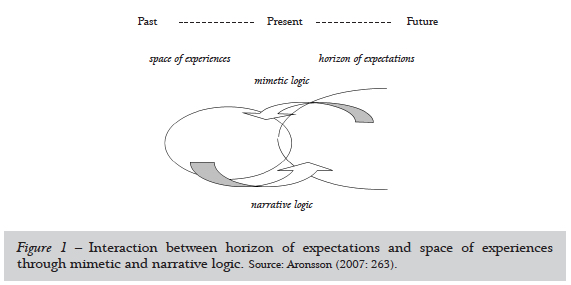
The concept of the categories of “space of experiences” and “horizon of expectations” taken from Reinhart Koselleck (1985) fits well into this framework. Knowledge and descriptions of the past create opportunities for certain assumptions about the future. The hopes and fears created by images of the future in the present influence the relationship between what is memorialized and what is forgotten in a space of experience. The uses of history take place in the dynamic process that links the spaces of experience and horizon of expectations in a specific situation.
]]> The field of cultures of history might be separated into communicating spheres, where some are more explicit and some more implicit in their use of history, while the references to the past are made according to different logics, as shown in figure 1.
The past in private life is recollected to bring meaning and coherence into the biography of the individual and is usually thought of as memories rather than history. The frame of shared understanding and using the past as history is located beyond individually relevant pasts, often grasped and contrasted to concepts like memory and experience created in the public sphere with legitimate input from knowledge institutions. I have argued that the act of bringing meaning to and communicating the destiny of the individuals places them in direct relation to collective forms of understanding, both more informal and more institutionalized ones. This means that strong statements about the disparity of memory and history, or individual and collective memories, are here apprehended as polarities that stand in a dialectic and, in fact, necessary relation of exchange to each other. Historicity as a part of existential predicaments needs to be closely related to the justification for historical epistemologies, instead of being hidden away as an undue subjective bias.
The communal framing of individual emotions and collectively organized performances of meaning, be it in the disguise of religion or of demands on intersubjective scientific methods, share the quality of acting as different modes of legitimizing and anchoring understanding of the world that serves as an adjuration of a frightening contingency of matter and ultimately of death and disappearance of all existence.
In the public sphere and politics, references to the past are more often made as statements and judgment of facts for the purpose of justifying the present order of things or plans for the future. The formal institutions in the right-hand corner of the field are assigned the power of legitimate care, protection and communication of the past to citizens, students and children.
Consuming and communicating the past is of course in some sense done in all these spheres, but when the logic becomes predominantly market-oriented the need to build on facts, adhere to political orders and still attract the desire of the individual becomes intensively negotiated in order to bring about the necessary profit.
Two theses are related to this graph:
]]> – The impact of a specific use of the past is dependent on the intertwined combination of uses in several spheres. When an epoch like the medieval era or some other past period reaches a pivotal interest above others, when a regional level is articulated more than national or local levels, a minority is brought to be represented more strongly, which is possible because it speaks through all these channels. The net production of meaning is often enhanced, rather than undermined, by contradictory combinations. This is clearly applicable to Astrid Lindgren but more so than usually considered also for the institutional heritage – being more complex through both contingencies and negotiations than explicated in its predominantly naturalizing voice.– The source of legitimacy heavily invested on the right side of the graph has spread more evenly during the last few decades. Legitimate uses of the past are publicly recognized both as private experiences, political community-building and commercial goals, the striving for knowledge being only one field of special interest. The interaction between them seems to be a matter of legitimacy by cross-reference rather than of contradiction, which used to be the foundation of the traditional evaluation of critical science.
The fact that these examples could be multiplied is an argument for the generality of the theses made around the two chosen by me as ideal types of heritage processes. Developing strategies for combining university research, heritage management, tourism, local and regional development, live re-enactment to meet the desire to entertain, negotiating gender issues, ethnic inclusion and religious interest by staging heritage is part of the multi-layered argumentation for the uses of the past put forward in many individual countries and the EU, in cultural and educational policies, cultural industries and economic strategies. Politicians and entrepreneurs are also looking for a new future for their community.
The desire for history
New desires find their ways into the performance of heritage in a much broader setting than has been possible to appreciate by approaches so far institutionalized by academic research and heritage institutions.
History needs to be taken from the historians – not because it is too dangerous, but because it is in need to restore its complexity and not its purity. The professional desire to focus on the cognitive intersubjectivity is legitimate in the midst of lies and fraud, but when meaning and, moreover, the negotiating power, are lost, reconnecting cognitive, ethical and aesthetical dimensions in uses of the past is called for.[5]
It is when recollection connects these by choosing vanishing points that allow for coinciding horizons on these scales that we obtain strong formats of uses of the past, connecting individual and collective uses with the power of a reality effect, utilizing the classical figure, not of either true, good or beautiful, but all of them together. Then both a relevant analysis and use of the past are on its way.
The Holocaust has provided one of the dominant collective vanishing points for European uses of the past and for contemplating the foundational values of human rights. I have chosen less apocalyptic performances of heritage for my arguments: on the one hand, the long-standing presence of national museums as guarantees of the cultural constitutional autonomy of a collective community and, on the other, more nitty-gritty entrepreneurial processes which produce new heritage in close connection with contemporary societies’ want of leisure, new jobs, but also with negotiating identities. I have proposed a set of concepts and perspectives enabling a more articulate perspective on both these, as parts of similar performances and negotiations in uses of the past, relating different spheres and logics to each other instead of keeping them apart. The purpose is not to produce more material for research but to enhance the capacity for higher degrees of relevance of the results to all the actors involved. That is, in the current climate of marginalization of cultural research but simultaneously high hopes for the capacity of culture, to make new futures a double challenge to be taken up.
]]> References
ARONSSON, Peter, 2004, Historiebruk: att använda det förflutna. Lund, Studentlitteratur. [ Links ]
ARONSSON, Peter, 2007, “The old cultural regionalism – and the new”, in B. Lancaster, D. Newton and N. Vall (eds.), An Agenda for Regional History. Newcastle, Northumbria University Press, 251-270.
ARONSSON, Peter, 2010, “Introduction: uses of the past, Nordic historical cultures in a comparative perspective”, Culture Unbound: Journal of Current Cultural Research, 2: 553-563.
ARONSSON, Peter, 2011a, BeGreppbart: Historia. Malmö, Liber. [ Links ]
ARONSSON, Peter, 2011b, “The productive dilemmas of history”, in H. Ruin and A. Ers (eds.), Rethinking Time: Essays on History, Memory and Representation. Stockholm, Södertörn University, 29-38.
ARONSSON, Peter, 2012a, “Exhibiting Scandinavian culture: the national museums of Denmark and Sweden”, in S. Berger, C. Lorenz and B. Melman (eds.), Popularizing National Pasts: 1800 to the Present. London, Routledge, 169-195.
ARONSSON, Peter, 2012b, “Framing uses of the past: nations, academia and museums conjuring history”, in C. Raudvere, K. Stala and T. S. Willert (eds.), Rethinking the Space for Religion: New Actors in Central and Southeast Europe on Religion, Authenticity and Belonging. Lund, Nordic Academic Press, 285-312.
]]> ARONSSON, Peter, 2012c, “Writing the museum”, in J. E. Hegardt (ed.), The Museum beyond the Nation. Stockholm, National Historical Museum, 17-40.ARONSSON, Peter, and Gabriella ELGENIUS (eds.), 2015, National Museums and Nation-Building in Europe, 1750-2010: Mobilization and Legitimacy, Continuity and Change. New York, Routledge. [ Links ]
ARONSSON, Peter, and L. GRADÉN, 2013, “Introduction: performing Nordic heritage, institutional preservation and popular practices”, in P. Aronsson and L. Gradén (eds.), Performing Nordic Heritage: Everyday Practices and Institutional Culture. Burlington, Ashgate, 1-26.
BERGER, Stefan, and Chris LORENZ (eds.), 2010, Nationalizing the Past: Historians as Nation Builders in Modern Europe. Basingstoke, Palgrave Macmillan. [ Links ]
BOHLIN, Magnus (ed.), 2009, Astrid Lindgrens landskap: Hur landskapets kulturarv förändras, förstås, förvaltas och förmedlas. Stockholm, Kungl. Vitterhets historie och antikvitets akademien. [ Links ]
CARR, David, 2005, “Phenomenology of historical time”, in M. S. C. Schuback and H. Ruin (eds.), The Past’s Presence: Essays on the Historicity of Philosophical Thinking. Huddinge, Södertörns högskola, 221 ss.
CLOUDBERRY COMMUNICATIONS, 2011, Millenniumrapporten: Ekonomiska effekter och exponeringsvärdet av Stockholmsregionen i de svenska Milleniumfilmerna. Stockholm, Cloudberry Communications AB, available at http://www.frsm.se/wp-content/uploads/2012/07/Millennium_Rapport_20110407.pdf (last access in September 2015). [ Links ]
DE GROOT, Jerome (ed.), 2009, Consuming History: Historians and Heritage in Contemporary Popular Culture. London, Routledge. [ Links ]
ERIKSEN, Thomas Hylland, 2004, Rötter och fötter: identitet i en ombytlig tid. Nora, Nya Doxa. [ Links ]
FIGGE, Susan G., and Jenifer K. WARD (eds.), 2010, Reworking the German Past: Adaptations in Film, the Arts, and Popular Culture. Rochester, NY, Camden House. [ Links ]
GINZBURG, Carlo, 1983, Osten och maskarna: en 1500-talsmjölnares tankar om skapelsen. Stockholm, Ordfront. [ Links ]
HILLSTRÖM, Magdalena, 2012, “Nordiska museet and Skansen: displays of floating nationalities”, in D. Poulot, F. Bodenstein and J. M. Lanzarote Guiral (eds.), Great Narratives of the Past: Traditions and Revisions in National Museums, Conference Proceedings from EuNaMus, European National Museums: Identity Politics, the Uses of the Past and the European Citizen, Paris 28 June–1 July and 25-26 November 2011. Linköping, Linköping University Electronic Press, available at http://www.ep.liu.se/ecp/078/004/ecp12078004.pdf (last access in September 2015.
]]>HJEMDAHL, Kirsti Mathiesen, 2002, Tur/retur temapark: oppdragelse, opplevelse, kommers. Bergen, Universitetet i Bergen, thesis. [ Links ]
HOLTORF, Cornelius, and Quentin DREW, 2007, Archaeology is a Brand! The Meaning of Archaeology in Contemporary Popular Culture. Oxford, Archaeopress. [ Links ]
JENKINS, Keith, Sue MORGAN, and Alun MUNSLOW (eds.), 2007, Manifestos for History. New York, NY, Routledge. [ Links ]
JONSSON, Leif (ed.), 2010, Astrid Lindgrens världar i Vimmerby: en studie om kulturarv och samhällsutveckling. Lund, Nordic Academic Press. [ Links ]
KNELL, Simon J., et al., 2011, National Museums: New Studies from Around the World. London, Routledge. [ Links ]
]]>KOSELLECK, Reinhart, 1985, Futures Past: On the Semantics of Historical Time. Cambridge, MA, The MIT Press. [ Links ]
LE ROY LADURIE, Emmanuel, 1980, Montaillou: en fransk by 1294-1324. Stockholm, Atlantis. [ Links ]
LINDEBORG, Lisbeth, and Lars LINDKVIST (eds.), 2013, The Value of Arts and Culture for Regional Development: A Scandinavian Perspective. London, Routledge. [ Links ]
LOWENTHAL, David, 1985, The Past Is a Foreign Country. Cambridge and New York, Cambridge University Press. [ Links ]
LOWENTHAL, David, 1998, The Heritage Crusade and the Spoils of History. Cambridge and New York, Cambridge University Press. [ Links ]
]]>NORA, Pierre, and Lawrence D. KRITZMAN (eds.), 1996, Realms of Memory: Rethinking the French Past, New York, Columbia University Press. [ Links ]
RÜSEN, Jörn, 2002, Geschichte im Kulturprozess. Köln, Weimar and Wien, Böhlau. [ Links ]
SMITH, Laura Jane, 2006, Uses of Heritage. New York, Routledge. [ Links ]
STRÖMBERG, Per, 2007, Upplevelseindustrins turistmiljöer: Visuella berättarstrategier i svenska turistanläggningar, 1985-2005. Uppsala, Konstvetenskapliga institutionen, Uppsala universitet. [ Links ]
NOTES
]]> [1] This article was conceived as a keynote speech to the 10th SIEF Congress in Lisbon in April 2011. It has been slightly updated with new references included. It draws on work in three projects: “European National Museums: Identity Politics, the Uses of the Past and the European Citizen” – a research programme funded and supported by the European Commission, spanning over three years and including eight work packages between 2010 and 2013; “Nordic Spaces”; and “Time, Memory and Representation,” funded by Riksbankens Jubileumsfond.[2] Publications are available in Open Access at www.eunamus.eu. See also Knell et al. (2011) and Aronsson (2012a), where these examples are further elaborated in a wider comparative context.
[3] In a way this is moving reflection to a position similar to the organic relationship it once had in the national framing, but more in tune with contemporary desires. No doubt, the gain in relevance might have its downsides, which need to be balanced by critical reflection. This is exactly why it should be pursued in the academy and not be exclusively developed by market response, as otherwise might be the case.
[4] This introduction to a theory of uses of the past is a shorthand of Aronsson (2004); in English, in a context of regional uses of the past, see Aronsson (2007, 2012b).
[5] This is an argument I develop in greater depth in the project “Time, Memory and Representation” (www.histcon.se) and in Aronsson (2011a).
]]>