<?xml version="1.0" encoding="ISO-8859-1"?><article xmlns:mml="http://www.w3.org/1998/Math/MathML" xmlns:xlink="http://www.w3.org/1999/xlink" xmlns:xsi="http://www.w3.org/2001/XMLSchema-instance">
<front>
<journal-meta>
<journal-id>0873-6561</journal-id>
<journal-title><![CDATA[Etnográfica]]></journal-title>
<abbrev-journal-title><![CDATA[Etnográfica]]></abbrev-journal-title>
<issn>0873-6561</issn>
<publisher>
<publisher-name><![CDATA[Centro em Rede de Investigação em Antropologia - CRIA]]></publisher-name>
</publisher>
</journal-meta>
<article-meta>
<article-id>S0873-65612015000300011</article-id>
<title-group>
<article-title xml:lang="en"><![CDATA[Ethnobiological research and ethnographic challenges in the “ecological era”]]></article-title>
<article-title xml:lang="pt"><![CDATA[Pesquisa etnobiológica e desafios etnográficos na “era ecológica”]]></article-title>
</title-group>
<contrib-group>
<contrib contrib-type="author">
<name>
<surname><![CDATA[Frazão-Moreira]]></surname>
<given-names><![CDATA[Amélia]]></given-names>
</name>
<xref ref-type="aff" rid="A01"/>
</contrib>
</contrib-group>
<aff id="A01">
<institution><![CDATA[,Universidade Nova de Lisboa Faculdade de Ciências Sociais e Humanas Centro em Rede de Investigação em Antropologia]]></institution>
<addr-line><![CDATA[ ]]></addr-line>
<country>Portugal</country>
</aff>
<pub-date pub-type="pub">
<day>00</day>
<month>10</month>
<year>2015</year>
</pub-date>
<pub-date pub-type="epub">
<day>00</day>
<month>10</month>
<year>2015</year>
</pub-date>
<volume>19</volume>
<numero>3</numero>
<fpage>605</fpage>
<lpage>624</lpage>
<copyright-statement/>
<copyright-year/>
<self-uri xlink:href="http://scielo.pt/scielo.php?script=sci_arttext&amp;pid=S0873-65612015000300011&amp;lng=en&amp;nrm=iso"></self-uri><self-uri xlink:href="http://scielo.pt/scielo.php?script=sci_abstract&amp;pid=S0873-65612015000300011&amp;lng=en&amp;nrm=iso"></self-uri><self-uri xlink:href="http://scielo.pt/scielo.php?script=sci_pdf&amp;pid=S0873-65612015000300011&amp;lng=en&amp;nrm=iso"></self-uri><abstract abstract-type="short" xml:lang="en"><p><![CDATA[Local knowledge and the ecological practices have been important matters in the study of the ways that people make places and feel the world. Nowadays, in the “ecological era,” this subject gained new prominence. However, different dynamics emerge that, in some way, can seem epistemologically ambiguous. Ethnobiological studies, heirs of linguistic and cognitive anthropology, are permeable to deductive logics and etic approaches. The ethnoecological paradigm is associated with the rhetoric of “indigenous rights” and is politically situated. The applied ethnobiological surveys are engaged in global nature conservation programs and in intangible cultural heritage safeguarding initiatives, but also in community development projects. Therefore, we can consider the ethical and political dimensions of research relationships and the relevance of ethnographic approaches in contemporary ecological research. Taking data from different contexts and focusing in personal fieldwork experiences, some of these theoretical and methodological challenges are outlined and the ethnobiological construction of how people make the places is discussed.]]></p></abstract>
<abstract abstract-type="short" xml:lang="pt"><p><![CDATA[O conhecimento local e as práticas ecológicas têm sido elementos importantes no estudo das formas como as pessoas “fazem lugares” e sentem o mundo. Na atualidade, na “era ecológica” que agora vivemos, este assunto ganha nova importância. No entanto, estamos a assistir a diferentes dinâmicas que, de alguma forma, podem parecer epistemologicamente ambíguas. Os estudos etnobiológicos, herdeiros da antropologia linguística e cognitiva, são permeáveis à lógica dedutiva e a abordagens etic. O paradigma etnoecológico é associado à retórica, politicamente situada, dos “direitos indígenas”. As pesquisas etnobiológicas aplicadas fazem parte de programas, marcadamente globalizantes, de conservação da natureza e de salvaguarda do património cultural imaterial, mas também de projetos de desenvolvimento comunitário. Assim, podemos considerar as dimensões éticas e políticas das relações de pesquisa e a relevância da abordagem etnográfica na pesquisa ecológica contemporânea. Partindo de dados de diferentes contextos e de apontamentos de experiências de terreno pessoais, são descritos alguns desses desafios teóricos e metodológicos e é discutida a construção etnobiológica de modo como as pessoas “fazem os lugares”.]]></p></abstract>
<kwd-group>
<kwd lng="en"><![CDATA[ethnobiology]]></kwd>
<kwd lng="en"><![CDATA[ethnography]]></kwd>
<kwd lng="en"><![CDATA[nature]]></kwd>
<kwd lng="en"><![CDATA[ecological knowledge]]></kwd>
<kwd lng="en"><![CDATA[colonial and post-colonial]]></kwd>
<kwd lng="pt"><![CDATA[etnobiologia]]></kwd>
<kwd lng="pt"><![CDATA[etnografia]]></kwd>
<kwd lng="pt"><![CDATA[natureza]]></kwd>
<kwd lng="pt"><![CDATA[conhecimento ecológico]]></kwd>
<kwd lng="pt"><![CDATA[colonial e pós-colonial]]></kwd>
</kwd-group>
</article-meta>
</front><body><![CDATA[ 
    <p align="right"><font size="2" face="Verdana"><b>DOSSIÊ</b></font></p>


    <p>&nbsp;</p>
    <p><b><font size="4" face="Verdana">Ethnobiological research and ethnographic
  challenges in the “ecological era”</font></b></p>
    <p>&nbsp;</p>
    <p><b><font size="3" face="Verdana">Pesquisa etnobiológica e desafios
  etnográficos na “era ecológica”</font></b></p>
    <p>&nbsp;</p>
    <p>&nbsp;</p>
    <p><font size="2" face="Verdana"><b>Amélia Frazão-Moreira<sup>I</sup></b></font></p>
<font size="2" face="Verdana">
    <p><sup>I</sup>Centro em Rede de Investigação
em Antropologia (CRIA), Faculdade de Ciências Sociais
e Humanas da Universidade
Nova de Lisboa (FCSH/NOVA), Portugal. <i>E-mail</i>: 
<a
href="mailto:amoreira@fcsh.unl.pt">amoreira@fcsh.unl.pt</a></p>
    ]]></body>
<body><![CDATA[<p>&nbsp;</p>

    <p>&nbsp;</p>
<hr noshade size="1">
    <p><b>ABSTRACT</b></p>
    <p>Local knowledge and
the ecological practices have been important matters in the study of the ways
that people make places and feel the world. Nowadays, in the “ecological era,”
this subject gained new prominence. However, different dynamics emerge that, in
some way, can seem epistemologically ambiguous. Ethnobiological
studies, heirs of linguistic and cognitive anthropology, are permeable to
deductive logics and <i>etic</i> approaches.
The ethnoecological paradigm is associated with the
rhetoric of “indigenous rights” and is politically situated. The applied ethnobiological surveys are engaged in global nature
conservation programs and in intangible cultural heritage safeguarding
initiatives, but also in community development projects. Therefore, we can
consider the ethical and political dimensions of research relationships and the
relevance of ethnographic approaches in contemporary ecological research.
Taking data from different contexts and focusing in personal fieldwork
experiences, some of these theoretical and methodological challenges are
outlined and the ethnobiological construction of how
people make the places is discussed.</p>

    <p><b>keywords: </b>ethnobiology, ethnography, nature, ecological
knowledge, colonial and post-colonial</p>
<hr noshade size="1">
    <p><b>RESUMO</b></p>

    <p>O conhecimento local e as práticas ecológicas têm sido
elementos importantes no estudo das formas como as pessoas “fazem lugares” e
sentem o mundo. Na atualidade, na “era ecológica” que agora vivemos, este
assunto ganha nova importância. No entanto, estamos a assistir a diferentes
dinâmicas que, de alguma forma, podem parecer epistemologicamente ambíguas. Os
estudos etnobiológicos, herdeiros da antropologia linguística e cognitiva, são
permeáveis à lógica dedutiva e a abordagens <i>etic</i>.
O paradigma etnoecológico é associado à retórica, politicamente situada, dos
“direitos indígenas”. As pesquisas etnobiológicas aplicadas fazem parte de
programas, marcadamente globalizantes, de conservação da natureza e de
salvaguarda do património cultural imaterial, mas também de projetos de
desenvolvimento comunitário. Assim, podemos considerar as dimensões éticas e
políticas das relações de pesquisa e a relevância da abordagem etnográfica na
pesquisa ecológica contemporânea. Partindo de dados de diferentes contextos e
de apontamentos de experiências de terreno pessoais, são descritos alguns
desses desafios teóricos e metodológicos e é discutida a
construção etnobiológica de modo como as pessoas “fazem os lugares”.</p>

    <p><b>Palavras-chave</b>: etnobiologia, etnografia, natureza,
conhecimento ecológico, colonial e pós-colonial</p>
<hr noshade size="1">
    <p>&nbsp;</p>
    <p>&nbsp;</p>
    ]]></body>
<body><![CDATA[<p>Some practices and beliefs concerning
non-human living beings appear in different
historical and cultural contexts, while others remain contained in local ones.<a
style='mso-footnote-id:ftn1' href="#_ftn1" name="_ftnref1" title=""><sup>[1]</sup></a> Jack Goody says it about
plants in an absolutely charming manner in his book <i>The Culture of Flowers</i> (1994). In this historical and comparative
approach, he shows how a “culture of flowers” makes communication, as well as
differentiation, possible between human groups.</p>

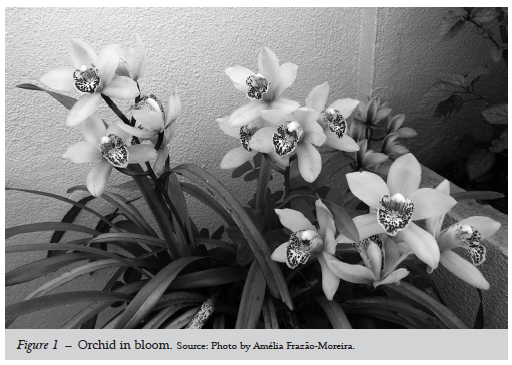
    <p>Reminding his words, I chose
the image of an orchid in bloom (<a href="#f1">figure&nbsp;1</a>), the orchid that I have on the
veranda at home, as a symbol of gratitude and an emotional way to communicate
with attendees.<a style='mso-footnote-id:ftn2' href="#_ftn2" name="_ftnref2"
title=""><sup>[2]</sup></a> My orchid only occasionally
flowers, suddenly without warning, in response to biological and climatic
cycles and conditions that I make no effort to master. What is certain is that
on those rare years in which this orchid presents me with flowers, it seems
that everything will turn out well and I feel, I almost believe, that the year
is going to turn out to be a good one…</p>
    <p>&nbsp;</p>
    <p><a name="f1"></a></p>
    <p align="center"><img src="/img/revistas/etn/v19n3/19n3a11f1.jpg" width="512" height="365"></p>
    
<p>&nbsp;</p>
    <p>In this way, my orchid is also a reminder of
the possibilities of a subjective interpretation of cultural schemes, in this
case, perhaps, in an individual appropriation of the “analogism” that Philippe Descola (2005) proposed as a form of identification between
humans and other natural beings. My orchid transports us to anthropological horizons
and evokes the ethnobiological perspective.</p>

    <p>I left my orchid alone there on the veranda…
And I sought out other plants and environments in what I would like to be an
encounter between ethnography and ethnobiology.</p>

    <p>Ethnobiology is an interdisciplinary field
that is nowadays understood as, to use the words of Roy Ellen,</p>

    <blockquote>“[…] first and foremost,
the study of how people of all, and of any, cultural tradition interpret,
conceptualize, represent, cope with, utilize, and generally manage their
knowledge of those domains of environmental experience which encompass living
organisms, and whose scientific study we demarcate as botany, zoology, and
ecology” (2006:&nbsp;3).</blockquote>

    ]]></body>
<body><![CDATA[<p>The borders between scientific disciplines
are rather tenuous and often even non-operational. It is difficult to
differentiate currently much of the research undertaken as being either ethnobiological or environmental anthropology, or even as
symbolic ecology or political ecology…</p>

    <p>However, we can briefly recall the different
theoretical and methodological approaches to research that are labelled
ethnobiology. Eugene Hunn (2007) situates these
different approaches in phases because they have emerged at different moments
in this discipline’s history. When ethnobiology started as a discipline, local
habits of biological beings were examined from a science viewpoint, within a
functional, <i>etic</i> and ethnocentric
perspective. Later, ethnobiology was presented as an ethnoscience, interested
in finding the cognitive structures in the indigenous constructions of the
world and close to linguistics and cognitive psychology (e. g. Conklin
1954; Sturtevant 1964; Berlin, Bredlove and Rave
1973).<a style='mso-footnote-id:ftn3' href="#_ftn3" name="_ftnref3" title=""><sup>[3]</sup></a> In the next phase, after the
80s, ethnobiological studies were concerned with the
relations between knowledge and practice. They focused on “traditional
ecological knowledge” and in the understanding of local forms of management and
treatment of natural resources. Traditional knowledge was no longer understood
to be merely about animals and plants but included all ecological fields (soil,
climate, water…). The importance of ethnobiological
studies to the conservation of biodiversity and sustainable development then
came to the fore (e. g. Orlove and Brush 1996; Berkes 1999). Especially from the 1990s onwards, this ethnoecological viewpoint is linked to the protection of
“indigenous rights” and “intellectual property rights,” thereby positioning the
discipline politically and widening its scope to include participative
methodologies and committed standpoints (e. g. Toledo 1992, 2002; Brush
1993; Posey and Dutfield 1996).</p>

    <p>Although one must agree with putting ethnobiological research into successive phases, it’s also
a fact that all these different approaches exist and are juxtaposed nowadays,
and the interdisciplinary nature of ethnobiology means that researchers are
heirs to different epistemological outlines.<a style='mso-footnote-id:ftn4'
href="#_ftn4" name="_ftnref4" title=""><sup>[4]</sup></a><sup></sup></p>
</font>    <p><font size="2" face="Verdana">Nevertheless, the ways that people make places
and feel the world have been portrayed and narrated by so many studies that are
labelled ethnobiological.
This is what is interesting about ethnobiology: an understanding of cultural
realities through an ethnobiological prism is a way
of substantiating anthropological frameworks and debates such as the one about
universality versus cultural diversities, or else the deconstruction of the
dichotomist views about nature/culture or
cognition/praxis… Or as Ellen (2006) argued, ethnobiology is
after all vital for anthropology. On the other hand, insofar as ethnobiology
appropriates the ethnographic methodology, it manages to produce a systematic
view, framing man’s place in a specific environment. There has been wide and
fruitful debate and reflection about the theoretical and conceptual, as well as
the methodological lines of studies of the relationship humans have with nature
(e. g. Descola and Pálsson
1996; Ellen and Fukui 1996; Ingold 2000; Milton 2002). I have chosen for this
paper to outline one or two of these debates, concerns and challenges starting
from instances in some of my researches in three different scenarios. I have
chosen to tell some stories of people and places… with plants.</font></p>
<font size="2" face="Verdana">    <p>&nbsp;</p>
</font>

    <p><b><font size="3" face="Verdana">First scenario: ethnography in Cantanhez National Park, southern
Guinea-Bissau, 2008</font></b></p>
<font size="2" face="Verdana">
    <p>In one of the villages of the Nalu people, where I had stayed many years before, I
attended the first meeting of the village people with an operative from a new
Guinean local development NGO.<a style='mso-footnote-id:ftn5' href="#_ftn5"
name="_ftnref5" title=""><sup>[5]</sup></a> In accordance with the usual
procedure at this kind of meeting, men and women were asked to make a list of
the problems and capabilities of the village. I must admit I was a little
drowsy listening to these lists, which were alike in every way to those
presented for the benefit of numerous organizations for decades, when suddenly
in the list of the village capabilities &#8211; like the importance of palm oil
extraction, the existence of a community school, and the resistance of
community spirit &#8211; I heard of the existence of a <i>mato</i><i> sagrado</i> (sacred forest).</p>

    <p>Then I remembered that in the mid-1990s it was
not thought that a “sacred forest” existed in that very village, but only a very
small ritual place. I also remembered that the location of these “sacred
forests” in the region was kept secret.</p>

    <p>The Nalu are recent
converts to Islam,<a style='mso-footnote-id:ftn6' href="#_ftn6" name="_ftnref6"
title=""><sup>[6]</sup></a> and a pre-Islamic cosmology
exists in a syncretic form according to which supernatural beings (genies, or <i>irans</i> as they are
called in Guinea-Bissau) protect people and the territory. Places where these
beings live are considered sacred and, as such, they are preserved as taboo
objects and ritual places. In general, natural beings, whether animals or plants,
are seen as elements of the world at the same level as humans in a holistic and
systemic vision of the universe. This pre-Islamic Nalu
cosmology is thus another illustration of what many authors, such as Strathern (1995 [1980]) or Ingold (1996, 2000), have been
arguing when they say that non-Western views cannot be adapted to a naturalist
eye influenced by an anthropocentric viewpoint and the opposition between
culture and nature.</p>

    <p>However, the acknowledgment of the existence
of sacred forests doesn’t mean in any way that the preserved areas of the
forest remain untouchable nor that they keep a fixed dimension. Mainly as a
result of demographic pressures and the development of a market economy,
deforestation has accelerated. This subsequently abolishes any romantic idea as
to the link between the sacred character of places and the existence of
pristine nature. It removes the “myth” of African life in symbiosis with nature
(Dabiré 1993).</p>

    ]]></body>
<body><![CDATA[<p>The existence of areas of forest that are
preserved is certainly similar to other cultural contexts. This led to their
appropriation as an instrument of nature conservation and its consequent institutionalisation in line with the international trend
towards the recent heritagization of Sacred Natural
Sites, that is to say, according to the International Union for Conservation of
Nature (IUCN) definition, “areas of land or water having special spiritual
significance to peoples and communities”:</p>

    <blockquote>“For many peoples, sacred natural sites are areas where nature, connection to
the great universe, and collective or individual recollections come together in
meaningful ways. Sacred natural sites can be the abode of deities, nature
spirits and ancestors or are associated with hermits, prophets, saints and
visionary spiritual leaders. They can be feared or they can be benign. They can
be areas for ceremony and contemplation, prayer and meditation […]” (Wild and
McLeod 2008: 5).</blockquote>

    <p>Following such formulations, “sacred
forests” emerged as a protected category recognised
by Guinea-Bissau’s law. The law concerning the protected areas establishes the
following classification: National Parks, Natural Parks, Nature Reserves,
Environmentally Sensitive&nbsp;Perimeters,
Ecological Sanctuaries, and Sacred Forests. Sacred Forests are considered
“natural areas reserved exclusively for traditional cultural and religious
manifestations where management of its natural resources is determined by the
uses and customs of the community that utilizes them” (Article No.&nbsp;3, Decree Law No.&nbsp;3/97, Protected Areas Framework Law).</p>

    <p>In reports and documents we come across an
adaptation of traditional local cosmologies in conservationist language when
they refer to the existence of sacred forests as a factor that permitted and
continues to allow the conservation of biodiversity and even view it as a
potential touristic resource (Brito 2007; Campredon 1997; IBAP 2007).</p>

    <p>So we can understand the episode that I
started off by describing, that is to say, that the villagers claimed the
“sacred forest” category for their small ritual place in an effort for this to
be taken into account in negotiations offering minor benefits to their village.
This effort has possibly been facilitated by the fact that the view of the
pre-Islamic world is losing importance in the face of ontology with Moslem
roots, which is considered anthropocentric (as demonstrated by works such as Meddeb 1993, Ally 1996, and Manzoor
2003).</p>

    <p>We can interpret the incorporation of sacred
landscape categories as a strategy for nature conservation, as an imposition
that not only forces a reconfiguration of the local perception of places, but
also tends to reduce the flexibility that the local community is seen to have
in manipulating natural resources. As Temudo says, analysing the history of Cantanhez
landscape, nowadays “liberalism triumphs and the forests are released from
their symbolic value to become a commodity in the world ecomarket”
(2009: 257, free translation). This is a process that is in every way similar
to other contexts; a process of re-writing “tradition,” of heritagization
and commoditisation of ecological relations (see, for
instance, King and Stewart 1996; Broch-Due and Schroeder 2000; Peluso and Alexiades 2005; Igoe and Brockington 2007).</p>

    <p>In a different perspective, we can see that
when elements of the local culture are at stake in processes that follow globalising directives, then local communities, albeit in a
very subaltern position, have a larger possibility to turn these mechanisms in favour of their survival.</p>

    <p>Other examples in this ethnographic scenario
can reinforce that kind of ways of “remaking places.” However, what I would
like to argue is that the recent and postcolonial processes of remaking places
are similar in form to past ones, especially in the colonial history, as can be
exemplified by an episode that occurred in 1913 during the Mansoa
War, in the then Portuguese Guinea (cf. Pélissier 1989).</p>

    <p>In the Mansoa War,
the Portuguese involved the Fula ethnic group in fighting against the rebellion
of the Balanta, another ethnic group. At the end of
this conflict, the victorious colonial administration rewarded the Fula chief
for his services by giving him land in Nalu’s
territory. The Nalu chiefs negotiated between
themselves and with the Portuguese administration which area they would let him
have. In the words of one of the older Nalu who in
1995 recalled the event (Frazão-Moreira
2009: 43): “the white man would end up giving whatever land he wanted to, even
if it were by force. So it was better then for us to
choose the land we would give him.”&nbsp;<a
style='mso-footnote-id:ftn7' href="#_ftn7" name="_ftnref7" title=""><sup>[7]</sup></a></p>

    <p>In short, facing an outside imposition and the
threat of control over their territory, the Nalu of
the past responded by reconfiguring this territory; likewise, facing the
obligations of nature conservation directives, the Nalu
of today reconfigured the meaning of their places.</p>

    ]]></body>
<body><![CDATA[<p>It seems to me that one of the challenges
posed to ethnography is to understand the changes in the way “people make
places” as a response to exogenous and certainly hegemonic political agendas,
but also as local manipulations to guarantee cultural continuity and survival.</p>

    <p>It is the “adaptive capacity to learn and
change that allows for long-term survival, and confers resilience on the
social-ecological system,” as Davidson-Hunt and Berkes
(2003) defend.</p>

    <p>In order to develop this diachronic idea I
move on to the second scenario.</p>
    <p>&nbsp;</p>
</font>

    <p><b><font size="3" face="Verdana">Second scenario: biodiversity colour photographs, 2010</font></b></p>
<font size="2" face="Verdana">
    <p>In January 2010, a
photographic exhibition called “Nha Terra” (My
Homeland) was shown at UNESCO in Paris. This was an exhibition of 49 very
beautiful photographs that IBAP (The Institute of Biodiversity and Protected
Areas of Guinea-Bissau) commissioned the French photographer Nedjma Berder to produce for the
International Year of Biodiversity. The photos were taken in the protected
areas of Guinea-Bissau and were presented in the following manner:</p>

    <blockquote>“The images obtained
show another face of Africa where quality of life and food security are ensured
by biodiversity. Whatever the difficulties faced by these communities, namely
poverty, conflict, climate change, they are able to balance diet, to have
access to traditional medicines, clothing, habitat, to develop handicrafts and
artistic creation and to keep alive their beliefs while biodiversity is
conserved” (in pamphlet of the photo exhibition “Nha
Terra,” by Nedjma Berder,
Institute of Biodiversity and Protected Areas of Guinea-Bissau, 2010).</blockquote>

    <p>The photos have captions that explain the
flora or fauna they want to highlight (indicator of biodiversity) and the
person that presents this element (indicator of cultural diversity).</p>

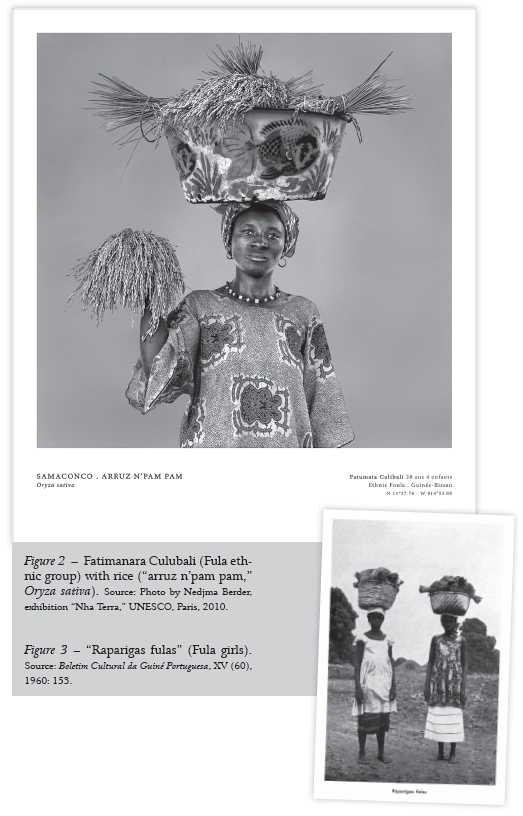
    <p>The first photograph I would like to present
is of a young Fula girl. The caption makes it clear that the local production
of rice is in the hands of Fatimanara Culubali, from the Fula ethnic group, Guinea-Bissau, with
the exact longitude and latitude as per GPS coordinates
(<a href="#f2">figure&nbsp;2</a>).</p>

    <p>&nbsp;</p>
    ]]></body>
<body><![CDATA[<p><a name="f2"></a></p>
    <p align="center"><img src="/img/revistas/etn/v19n3/19n3a11f2.jpg" width="523" height="816"></p>
    
<p align="center">&nbsp;</p>
    <p>Apart from the beauty of the photographs, or
perhaps even because of it, I couldn’t help thinking of images from other times
(<a href="#f2">figure&nbsp;3</a>). They reminded me
of the photographs published in the colonial journal named <i>Boletim Cultural da Guiné Portuguesa</i> and
especially in its section on “Aspectos e Tipos na Guiné Portuguesa”
(Aspects and Types in Portuguese Guinea), examined by Carvalho (2004). In these
photos, the portrayed people are never named, and in the end the physical and
cultural differences of pure “types” are extolled in an endeavor to classify
them, in a manner that is similar to what was done in other Portuguese colonial
contexts, as Jill Dias (1991) shows, or even by other colonial powers, as
becomes clear in the works, for instance, of Maxwell (1999) and Landau (2002).</p>
    <p>&nbsp;</p>
    <p><a name="f3"></a></p>
    <p align="center"><img src="/img/revistas/etn/v19n3/19n3a11f3.jpg" width="520" height="820"></p>
    
<p align="center">&nbsp;</p>
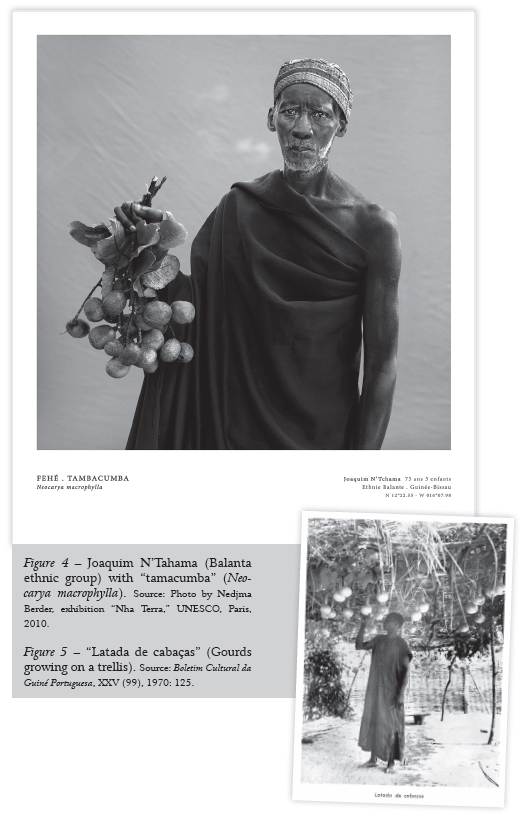
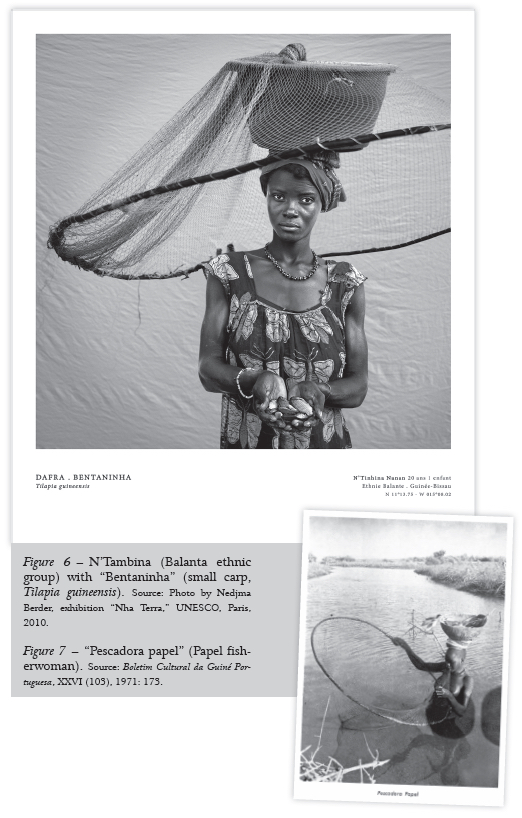
    <p>As for Berder’s
photos, some parallels and divergences become evident. Two more examples: the Balanta named Joaquim N’Tahama with gingerbread plum
from 2010 (<a href="#f3">figure&nbsp;4</a>) and “Gourds
growing on a trellis” from 1970 (<a href="#f3">figure&nbsp;5</a>); the Balanta
named N’Tambina Nana with “bentaninha”
(a small carp; <i>Tilapia guineensis</i>) from 2010 (<a href="#f4">figure&nbsp;6</a>) and a Papel fisherwoman from 1971 (<a href="#f4">figure&nbsp;7</a>).</p>
    <p>&nbsp;</p>
    ]]></body>
<body><![CDATA[<p><a name="f4"></a></p>
    <p align="center"><img src="/img/revistas/etn/v19n3/19n3a11f4.jpg" width="522" height="818"></p>
    
<p align="center">&nbsp;</p>
    <p>Photos nowadays bring together natural and
cultural aspects, but while the subjects photographed certainly gain
individuality, they don’t lose the typologisation of
ethnic identity. It is interesting that Berder’s
original photos were in colour, and the photographer
later worked on them to bring to the fore the flora and fauna elements, the
only ones to come out in colour, thereby indicating
the importance of biodiversity. In the end, this brings them close, at least in
aesthetic terms, to colonial images. However, the seemingly slight difference,
the fact that the photographer respects the individuality of the subject,
expresses, after all, a huge ideological difference. Now, the photos expose
people and practices of everyday action.</p>

    <p>These images from 2010 were exhibited not only
in Paris but throughout the world via the Internet to promote the richness of
Guinea-Bissau’s heritage. They are comparable to photos and videos that are
used in this country, as in others, as imaginary representations of the
environment. We can think about them as “fetishisations
of biodiversity by environmentalists,” and as images that can easily stir
emotional identification (Milton 2002; Foale and
&shy;Macintyre 2005). They are no longer instruments for colonial powers’
hegemony, but, in a sense, they can be seen as images of “ecocolonialism”
(e. g. Bonner 1993; Cox and Elmqvist 1997).</p>

    <p>These images are misleading because they
ultimately put in second place the real difficulties, such as the shortage of
food, lack of hospitals, short life expectancy, and high child mortality rates.
So it is easy to draw analogies between these representations and the colonial
ones. However, this is the most economical and easy path to take. Too easy! If
we just go by the narratives of the images, how, in fact, will we understand
the specificities and the differences of the processes?</p>

    <p>How will we provide answers to questions such
as:</p>

    <p>&#8211; What were the specific contexts in which these photos were
produced? In what way did the different interlocutors &#8211; park staff, the
people who were photographed, local chiefs &#8211; participate and what was
their level of decision-making?</p>

    <p>&#8211; In what way are these images being
appropriated or not?</p>

    <p>To borrow an
expression from Anna Tsing (1999) &#8211; How are these “green fantasies of the
exotic” being disseminated and used? As she has shown us, the challenge of
ethnography no longer lies in understanding the disagreements that arise
between conservationists and local populations, or the forms of contestation,
but rather in understanding collaboration, in ensuring procedures that allow us
to understand the creativity that emerges when the local encounters the global,
in the fields of policies, practices and knowledge.</p>

    ]]></body>
<body><![CDATA[<p>It is precisely knowledge the protagonist of
my third and last scenario.</p>
    <p>&nbsp;</p>
</font>

    <p><b><font size="3" face="Verdana">Third
scenario: ethnography
in Trás-os-Montes, northeastern Portugal, 2006-2009</font></b></p>
<font size="2" face="Verdana">
    <p>In various disciplinary traditions, the ecological knowledge became
the central aim of research. First it was called “indigenous knowledge” and was
linked with development perspectives and with the protection of “indigenous
rights.” The epistemological distinction between “indigenous knowledge” and
“Western knowledge” was then defined and constructed (Inglis
1993; Ellen, Parkes and Bicker 2000; Nazarea 2006). This is, in fact, a distinction that has
been outlined according to dichotomous constructions of types of thinking that
emerged in the theoretical frameworks of anthropology, for instance, in
Lévi-Strauss (1983 [1962]) and Horton (1967). Following a number of different
designations (“indigenous technical knowledge,” “tribal knowledge,” “folk
knowledge,” “traditional knowledge,” etc.), the choice ended up falling on
“traditional ecological knowledge” (TEK), partly because of criticisms made
about the limitations of the term “indigenous knowledge” and partly because of its
association with nature conservation and genetic resources, and, more recently,
the safeguarding of Intangible Cultural Heritage. I will return later to this
matter of the different types of knowledge.</p>

    <p>The data I am presenting in this final
scenario are part of a specific research project called “Ethnobotany
of the Northeastern region of Portugal: local knowledge, plants and uses.”&nbsp;<a style='mso-footnote-id:ftn8' href="#_ftn8"
name="_ftnref8" title=""><sup>[8]</sup></a> Case
studies were carried out in two communities, one in the Montesinho
Natural Park and the other in the International Douro Natural Park, two of the
fourteen Portuguese such areas. They are two rural contexts that are undergoing
social and economic change with an emerging “new rurality”
and greatly influenced by agricultural decline.</p>

    <p>So it was not surprising that we should find a
social variability of ethnobotanical knowledge
similar to rural contexts also undergoing change in other countries and
continents (for instance, Zent 2001; Heckler 2002;
Ross 2002; Reyes-García et al. 2005; Gómez-Baggethun
et al. 2010). We verified the existence of a past knowledge with no practical
application, forgotten by many yet much valued by others, especially by a group
we could call “specialists,” consisting of women and men (aged between 50 and
65) who are eager to increase their knowledge of local flora through any type
of information they can find.<a style='mso-footnote-id:ftn9' href="#_ftn9"
name="_ftnref9" title=""><sup>[9]</sup></a> The “specialists”
get exogenous knowledge through books and other publications, through
television and even by exchanging information with practitioners of different
medicines. They acquire scientific knowledge or then very often just the systematisation of exogenous folk knowledge, which they
then connect to local traditional knowledge.</p>

    <p>The plant “malva”
(“mallow”; <i>Malva</i><i> sylvestris</i>)<b
style='mso-bidi-font-weight:normal'> </b>is a good example of what I intend to
show. A 72-year-old shepherd told us something he had always seen done: “Boil
the plant [‘malva’] to clean cuts and wounds so that
they heal more quickly.” This plant was used in the past mainly as a
disinfectant and healing aid applied externally. An infusion of “malva” leaves is also recommended to soothe urinary tracts
and as a diuretic. A 60-year-old woman, a farmer, also told us about the uses
of “malva,” information
that was based on what she had learnt in books about medicinal plants: “malva is used to make tea and it’s good for losing weight,
but one must be careful and not take it in large quantities as it eats up our
red blood cells.” With women’s growing concern over diet and their looks, a new
use for this plant has emerged. An infusion of leaves is now indicated as suitable
to help weight loss and control cellulite. In the end, these women are doing
little more than returning to an old use, diuretic infusions, under the cover
of a new concept, in a creative manner of connection.</p>

    <p>We found similar examples in the field of
pharmacological knowledge and uses, and in other spheres of activity (Frazão-Moreira, Carvalho and
Martins 2007, 2009; Carvalho and Frazão-Moreira 2011). All the examples show that it would be a
useless, incoherent and artificial task to try to disentangle traditional
knowledge from recent knowledge and practices. This distinction has no social
meaning, as it was demonstrated by social actors when confronted by researchers
and their attempts to find out about the nature of their knowledge.</p>

    <p>We can always recall critical positions, such
as that of Agrawal (1995), that point towards the difficulty, indeed the
futility, of establishing, even in epistemological terms, clear differences
between traditional and scientific knowledge. We can always argue that what we
find is hybrid knowledge after all (Canclini 1995).</p>

    <p>However, as Ingold (2003) suggests, the
conceptualisation of traditional ecological knowledge in administrative
policies and many ethnobiological studies is
different from the local perception of traditional knowledge. In the local
conceptualisation, traditional knowledge “is continually generated within the
contexts of people’s skilled, practical involvement with significant components
of the environment” (2003: 307). That is to say, it is understood as “a kind of
process” and not as “a kind of substance.”</p>

    ]]></body>
<body><![CDATA[<p>In the context we are now looking at, the
economic and social changes in the rural world and the disappearance of a
survival system greatly dependent on available natural resources mean that a
great deal of plant knowledge stopped being part of consumption, work and
ritual. It is now explained and further crystallised
knowledge, and frequently has no connection with any activity, either because
it now lies only in past memories or because it is exogenous knowledge, erudite
and found in books, learnt not through a “know how to do” but a “know how to
say” process. Changes in plant uses and knowledge are linked to the change of
the practical involvement with the environment. We could equally analyse these changes
as the heightening of a patrimonial view of ethnobotanical
knowledge, whose richness people want to increase, and as associated to an idea
of nature as a value to defend and protect. This is a vision of nature shared
by people that feel the world, but, in a certain way, no longer feel part of
the world.</p>

    <p>This is then the great challenge that has been
put to carrying out ethnobiology with an ethnographic gaze: to understand,
without any kind of nostalgia filter, that the way different peoples of the world
make places are uniform in its outlines, following environmentalist viewpoints
that in the end separate them from ontologies that are truly ecological; to
understand, without the filter of dogmatism, that this doesn’t imply the
inexistence of creative adaptations that allow for the continuation of
different forms of feeling the world.</p></font>
    <p>&nbsp;</p>
    <p><b><font size="3" face="Verdana">References</font></b></p>
<font size="2" face="Verdana">
    <!-- ref --><p>AGRAWAL, Arun, 1995, “Dismantling
the divide between indigenous and scientific knowledge”, <i>Development and Change</i>, 26: 413-439.    &nbsp;&nbsp;&nbsp;&nbsp;&nbsp;&nbsp;&nbsp;&nbsp;[&#160;<a href="javascript:void(0);" onclick="javascript: window.open('/scielo.php?script=sci_nlinks&ref=189645&pid=S0873-6561201500030001100001&lng=','','width=640,height=500,resizable=yes,scrollbars=1,menubar=yes,');">Links</a>&#160;]<!-- end-ref --></p>

    <!-- ref --><p>ALLY, Mashuq
ibn, 1996, “Islam”, in P.&nbsp;Morgan and C.&nbsp;Lawton (eds.), <i>Ethical Issues in Six Religious Traditions</i>.
Edinburgh, Edinburgh University Press, 220-263.    &nbsp;&nbsp;&nbsp;&nbsp;&nbsp;&nbsp;&nbsp;&nbsp;[&#160;<a href="javascript:void(0);" onclick="javascript: window.open('/scielo.php?script=sci_nlinks&ref=189647&pid=S0873-6561201500030001100002&lng=','','width=640,height=500,resizable=yes,scrollbars=1,menubar=yes,');">Links</a>&#160;]<!-- end-ref --></p>

    <!-- ref --><p>Álvares, Francisco, et al.,
2011, “Cultural dimension of wolves in the Iberian Peninsula: implications of ethnozoology in conservation biology, innovation”, <i>The European Journal of Social Science
Research</i>, 24&nbsp;(3): 313-331.    &nbsp;&nbsp;&nbsp;&nbsp;&nbsp;&nbsp;&nbsp;&nbsp;[&#160;<a href="javascript:void(0);" onclick="javascript: window.open('/scielo.php?script=sci_nlinks&ref=189649&pid=S0873-6561201500030001100003&lng=','','width=640,height=500,resizable=yes,scrollbars=1,menubar=yes,');">Links</a>&#160;]<!-- end-ref --></p>

    ]]></body>
<body><![CDATA[<!-- ref --><p>Alves, J. P. Galhano, 2002, <i>Vivre
en biodiversité totale: des hommes, des grandes carnivores et des grandes
herbivores sauvages, deux études de cas: loups au Portugal, tigres en Inde</i>.
Villeneuve d’Ascq, Presses Universitaires du Septentrion.    &nbsp;&nbsp;&nbsp;&nbsp;&nbsp;&nbsp;&nbsp;&nbsp;[&#160;<a href="javascript:void(0);" onclick="javascript: window.open('/scielo.php?script=sci_nlinks&ref=189651&pid=S0873-6561201500030001100004&lng=','','width=640,height=500,resizable=yes,scrollbars=1,menubar=yes,');">Links</a>&#160;]<!-- end-ref --></p>

    <!-- ref --><p>Alves, J. P. Galhano, 2012, <i>Anthropologie
et écosystèmes au Niger: humains, lions et esprits de la forêt dans la culture
gourmantché</i>. Paris, Editions l’Harmattan.    &nbsp;&nbsp;&nbsp;&nbsp;&nbsp;&nbsp;&nbsp;&nbsp;[&#160;<a href="javascript:void(0);" onclick="javascript: window.open('/scielo.php?script=sci_nlinks&ref=189653&pid=S0873-6561201500030001100005&lng=','','width=640,height=500,resizable=yes,scrollbars=1,menubar=yes,');">Links</a>&#160;]<!-- end-ref --></p>

    <!-- ref --><p>ATRAN, Scott, 1986, <i>Fondements de
l’histoire naturelle: Pour une anthropologie de la science</i>. Paris, Editions
Complexe.    &nbsp;&nbsp;&nbsp;&nbsp;&nbsp;&nbsp;&nbsp;&nbsp;[&#160;<a href="javascript:void(0);" onclick="javascript: window.open('/scielo.php?script=sci_nlinks&ref=189655&pid=S0873-6561201500030001100006&lng=','','width=640,height=500,resizable=yes,scrollbars=1,menubar=yes,');">Links</a>&#160;]<!-- end-ref --></p>

    <!-- ref --><p>BERKES, Fikret, 1999, <i>Sacred Ecology:
Traditional Ecological Knowledge and Resource Management</i>. Philadelphia,
Taylor and Francis.    &nbsp;&nbsp;&nbsp;&nbsp;&nbsp;&nbsp;&nbsp;&nbsp;[&#160;<a href="javascript:void(0);" onclick="javascript: window.open('/scielo.php?script=sci_nlinks&ref=189657&pid=S0873-6561201500030001100007&lng=','','width=640,height=500,resizable=yes,scrollbars=1,menubar=yes,');">Links</a>&#160;]<!-- end-ref --></p>

    <!-- ref --><p>BERLIN, Brent, 1992, <i>Ethnobiological</i><i> Classification Principles of Categorization</i>.
Princeton, Princeton University Press.    &nbsp;&nbsp;&nbsp;&nbsp;&nbsp;&nbsp;&nbsp;&nbsp;[&#160;<a href="javascript:void(0);" onclick="javascript: window.open('/scielo.php?script=sci_nlinks&ref=189659&pid=S0873-6561201500030001100008&lng=','','width=640,height=500,resizable=yes,scrollbars=1,menubar=yes,');">Links</a>&#160;]<!-- end-ref --></p>

    ]]></body>
<body><![CDATA[<!-- ref --><p>BERLIN, Brent, Dennis E. BREDLOVE, and
Peter H. RAVE, 1973, “General principles of classification and nomenclature in
folk biology”, <i>American Anthropologist</i>,
75&nbsp;(1): 214-242.    &nbsp;&nbsp;&nbsp;&nbsp;&nbsp;&nbsp;&nbsp;&nbsp;[&#160;<a href="javascript:void(0);" onclick="javascript: window.open('/scielo.php?script=sci_nlinks&ref=189661&pid=S0873-6561201500030001100009&lng=','','width=640,height=500,resizable=yes,scrollbars=1,menubar=yes,');">Links</a>&#160;]<!-- end-ref --></p>

    <!-- ref --><p>BONNER, Raymond, 1993<i>, At the Hand of Man: Peril and Hope for Africa’s Wildlife</i>. New
York, Knopf.    &nbsp;&nbsp;&nbsp;&nbsp;&nbsp;&nbsp;&nbsp;&nbsp;[&#160;<a href="javascript:void(0);" onclick="javascript: window.open('/scielo.php?script=sci_nlinks&ref=189663&pid=S0873-6561201500030001100010&lng=','','width=640,height=500,resizable=yes,scrollbars=1,menubar=yes,');">Links</a>&#160;]<!-- end-ref --></p>

    <!-- ref --><p>Brito,
Brígida Rocha, 2007, <i>Estudo das Potencialidades e dos
Constrangimentos do Ecoturismo na Região de Tombali</i>. Lisbon, Instituto
Marquês de Valle Flôr/Acção para o Desenvolvimento.    &nbsp;&nbsp;&nbsp;&nbsp;&nbsp;&nbsp;&nbsp;&nbsp;[&#160;<a href="javascript:void(0);" onclick="javascript: window.open('/scielo.php?script=sci_nlinks&ref=189665&pid=S0873-6561201500030001100011&lng=','','width=640,height=500,resizable=yes,scrollbars=1,menubar=yes,');">Links</a>&#160;]<!-- end-ref --></p>

    <!-- ref --><p>Broch-Due,
Vigdis, and Richard A.&nbsp;SCHROEDER (eds.),
2000, <i>Producing Nature and Poverty in
Africa</i>. Stockholm, Elanders Gotab.    &nbsp;&nbsp;&nbsp;&nbsp;&nbsp;&nbsp;&nbsp;&nbsp;[&#160;<a href="javascript:void(0);" onclick="javascript: window.open('/scielo.php?script=sci_nlinks&ref=189667&pid=S0873-6561201500030001100012&lng=','','width=640,height=500,resizable=yes,scrollbars=1,menubar=yes,');">Links</a>&#160;]<!-- end-ref --></p>

    <!-- ref --><p>BROWN, Cecil H., 1984, <i>Language and Living Things: Uniformities in
Folk Classifications and Naming</i>. New Brunswick, NJ, Rutgers University
Press.    &nbsp;&nbsp;&nbsp;&nbsp;&nbsp;&nbsp;&nbsp;&nbsp;[&#160;<a href="javascript:void(0);" onclick="javascript: window.open('/scielo.php?script=sci_nlinks&ref=189669&pid=S0873-6561201500030001100013&lng=','','width=640,height=500,resizable=yes,scrollbars=1,menubar=yes,');">Links</a>&#160;]<!-- end-ref --></p>

    ]]></body>
<body><![CDATA[<!-- ref --><p>BRUSH, Stephen B., 1993, “Indigenous
knowledge of biological resources and intellectual property rights: the role of
Anthropology”, <i>American Anthropologist</i>,
95&nbsp;(3): 653-686.    &nbsp;&nbsp;&nbsp;&nbsp;&nbsp;&nbsp;&nbsp;&nbsp;[&#160;<a href="javascript:void(0);" onclick="javascript: window.open('/scielo.php?script=sci_nlinks&ref=189671&pid=S0873-6561201500030001100014&lng=','','width=640,height=500,resizable=yes,scrollbars=1,menubar=yes,');">Links</a>&#160;]<!-- end-ref --></p>

    <!-- ref --><p>CAMEJO-RODRIGUES, Joana Salomé, 2002, <i>Plantas Medicinais da Serra do Açor</i>.
Lisbon, Instituto da Conservação da Natureza, Área de Paisagem Protegida da
Serra do Açor.    &nbsp;&nbsp;&nbsp;&nbsp;&nbsp;&nbsp;&nbsp;&nbsp;[&#160;<a href="javascript:void(0);" onclick="javascript: window.open('/scielo.php?script=sci_nlinks&ref=189673&pid=S0873-6561201500030001100015&lng=','','width=640,height=500,resizable=yes,scrollbars=1,menubar=yes,');">Links</a>&#160;]<!-- end-ref --></p>

    <!-- ref --><p>CAMEJO-RODRIGUES, Joana, et al., 2003, “An ethnobotanical
study of medicinal and aromatic plants in the Natural Park of Serra de São Mamede (Portugal)”, <i>Journal
of Ethnopharmacology</i>, 89: 199-209.    &nbsp;&nbsp;&nbsp;&nbsp;&nbsp;&nbsp;&nbsp;&nbsp;[&#160;<a href="javascript:void(0);" onclick="javascript: window.open('/scielo.php?script=sci_nlinks&ref=189675&pid=S0873-6561201500030001100016&lng=','','width=640,height=500,resizable=yes,scrollbars=1,menubar=yes,');">Links</a>&#160;]<!-- end-ref --></p>

    <!-- ref --><p>CAMPREDON, Pierre, 1997, <i>Cantanhez: Forêts sacrées de Guinée-Bissau</i>.
Bissau, Tiniguena.    &nbsp;&nbsp;&nbsp;&nbsp;&nbsp;&nbsp;&nbsp;&nbsp;[&#160;<a href="javascript:void(0);" onclick="javascript: window.open('/scielo.php?script=sci_nlinks&ref=189677&pid=S0873-6561201500030001100017&lng=','','width=640,height=500,resizable=yes,scrollbars=1,menubar=yes,');">Links</a>&#160;]<!-- end-ref --></p>

    <!-- ref --><p>CANCLINI, Nestor García, 1995,<i> Hybrid Cultures: Strategies for Entering
and Leaving Modernity</i>. Minneapolis, University of Minnesota Press.    &nbsp;&nbsp;&nbsp;&nbsp;&nbsp;&nbsp;&nbsp;&nbsp;[&#160;<a href="javascript:void(0);" onclick="javascript: window.open('/scielo.php?script=sci_nlinks&ref=189679&pid=S0873-6561201500030001100018&lng=','','width=640,height=500,resizable=yes,scrollbars=1,menubar=yes,');">Links</a>&#160;]<!-- end-ref --></p>

    ]]></body>
<body><![CDATA[<!-- ref --><p>CARREIRA, António, 1961, “Organização
social e económica dos povos da Guiné Portuguesa”, <i>Boletim Cultural da Guiné Portuguesa</i>, 16&nbsp;(64): 641-736.    &nbsp;&nbsp;&nbsp;&nbsp;&nbsp;&nbsp;&nbsp;&nbsp;[&#160;<a href="javascript:void(0);" onclick="javascript: window.open('/scielo.php?script=sci_nlinks&ref=189681&pid=S0873-6561201500030001100019&lng=','','width=640,height=500,resizable=yes,scrollbars=1,menubar=yes,');">Links</a>&#160;]<!-- end-ref --></p>

    <!-- ref --><p>CARVALHO, Ana Maria, 2010, <i>Plantas y Sabiduría Popular del Parque Natural
de Montesinho: Un Estudio Etnobotánico en Portugal</i>. Madrid, Consejo
Superior de Investigaciones Científicas.    &nbsp;&nbsp;&nbsp;&nbsp;&nbsp;&nbsp;&nbsp;&nbsp;[&#160;<a href="javascript:void(0);" onclick="javascript: window.open('/scielo.php?script=sci_nlinks&ref=189683&pid=S0873-6561201500030001100020&lng=','','width=640,height=500,resizable=yes,scrollbars=1,menubar=yes,');">Links</a>&#160;]<!-- end-ref --></p>

    <!-- ref --><p>Carvalho,
Ana Maria,
and Amélia Frazão-Moreira, 2006,
“Caminhos de agora e do futuro: um rol de publicações e projectos à laia de
conclusão”, in A.&nbsp;Frazão-Moreira and M. M. Fernandes (eds.), <i>Plantas e Saberes: No Limiar da Etnobotânica
em Portugal</i>. Lisbon, Edições Colibri, 103-112.    &nbsp;&nbsp;&nbsp;&nbsp;&nbsp;&nbsp;&nbsp;&nbsp;[&#160;<a href="javascript:void(0);" onclick="javascript: window.open('/scielo.php?script=sci_nlinks&ref=189685&pid=S0873-6561201500030001100021&lng=','','width=640,height=500,resizable=yes,scrollbars=1,menubar=yes,');">Links</a>&#160;]<!-- end-ref --></p>

    <!-- ref --><p>CARVALHO, Ana Maria, and Amélia Frazão-Moreira,
2011, “Importance of local knowledge in plant resources management and
conservation in two protected areas from Trás-os-Montes,
Portugal”, <i>Journal of Ethnobiology
and Ethnomedicine</i>, 7: 36.    &nbsp;&nbsp;&nbsp;&nbsp;&nbsp;&nbsp;&nbsp;&nbsp;[&#160;<a href="javascript:void(0);" onclick="javascript: window.open('/scielo.php?script=sci_nlinks&ref=189687&pid=S0873-6561201500030001100022&lng=','','width=640,height=500,resizable=yes,scrollbars=1,menubar=yes,');">Links</a>&#160;]<!-- end-ref --></p>

    <!-- ref --><p>CARVALHO, Ana Maria, and Ramón MORALES,
2010, “Persistence of wild food and wild medicinal plant knowledge in a
North-Eastern region of Portugal”, in M.&nbsp;Pardo de &shy;Santayana, A.&nbsp;Pieroni, and R.&nbsp;Puri (eds.), <i>Ethnobotany</i><i> in the New Europe: People, Health and Wild Plant Resources</i>.
Oxford, Berghahn Books, 147-171.    &nbsp;&nbsp;&nbsp;&nbsp;&nbsp;&nbsp;&nbsp;&nbsp;[&#160;<a href="javascript:void(0);" onclick="javascript: window.open('/scielo.php?script=sci_nlinks&ref=189689&pid=S0873-6561201500030001100023&lng=','','width=640,height=500,resizable=yes,scrollbars=1,menubar=yes,');">Links</a>&#160;]<!-- end-ref --></p>

    ]]></body>
<body><![CDATA[<!-- ref --><p>CARVALHO, Clara, 2004, “O olhar colonial:
fotografia e antropologia no Centro de Estudos da Guiné Portuguesa”, in
C.&nbsp;Carvalho and J.&nbsp;de
Pina-Cabral (eds.), <i>A Persistência da História: Passado e
Contemporaneidade em África</i>. Lisbon, Imprensa de Ciências Sociais, 119-147.    &nbsp;&nbsp;&nbsp;&nbsp;&nbsp;&nbsp;&nbsp;&nbsp;[&#160;<a href="javascript:void(0);" onclick="javascript: window.open('/scielo.php?script=sci_nlinks&ref=189691&pid=S0873-6561201500030001100024&lng=','','width=640,height=500,resizable=yes,scrollbars=1,menubar=yes,');">Links</a>&#160;]<!-- end-ref --></p>

    <!-- ref --><p>CONKLIN, Harold C., 1954, <i>The Relation of Hanunóo
Culture to the Plant World</i>. New Haven, CT, Yale University.    &nbsp;&nbsp;&nbsp;&nbsp;&nbsp;&nbsp;&nbsp;&nbsp;[&#160;<a href="javascript:void(0);" onclick="javascript: window.open('/scielo.php?script=sci_nlinks&ref=189693&pid=S0873-6561201500030001100025&lng=','','width=640,height=500,resizable=yes,scrollbars=1,menubar=yes,');">Links</a>&#160;]<!-- end-ref --></p>

    <!-- ref --><p>COX, P. A., and T. ELMQVIST, 1997, “Ecocolonialism
and indigenous-controlled rainforest preserves in Samoa”, <i>Ambio</i>, 26&nbsp;(2): 84-89.    &nbsp;&nbsp;&nbsp;&nbsp;&nbsp;&nbsp;&nbsp;&nbsp;[&#160;<a href="javascript:void(0);" onclick="javascript: window.open('/scielo.php?script=sci_nlinks&ref=189695&pid=S0873-6561201500030001100026&lng=','','width=640,height=500,resizable=yes,scrollbars=1,menubar=yes,');">Links</a>&#160;]<!-- end-ref --></p>

    <!-- ref --><p>DABIRÉ, C. G., 1993, “Afrique: le
‘mythe’ de la vie en symbiose”, in D.&nbsp;Bourg (dir.), <i>Les Sentiments de la nature</i>. Paris, Editions La Découverte, 85-98.    &nbsp;&nbsp;&nbsp;&nbsp;&nbsp;&nbsp;&nbsp;&nbsp;[&#160;<a href="javascript:void(0);" onclick="javascript: window.open('/scielo.php?script=sci_nlinks&ref=189697&pid=S0873-6561201500030001100027&lng=','','width=640,height=500,resizable=yes,scrollbars=1,menubar=yes,');">Links</a>&#160;]<!-- end-ref --></p>

    <!-- ref --><p>Davidson-Hunt, Iain, and Fikret Berkes, 2003, “Learning as you journey: Anishinaabe perception of social-ecological environments
and adaptive learning”, <i>Conservation
&shy;Ecology</i>, 8<b style='mso-bidi-font-weight:normal'>&nbsp;</b>(1): #5,
available at <a
href="http://www.consecol.org/vol8/iss1/art5" target="_blank">http://www.consecol.org/vol8/iss1/art5</a> (last access in
September 2015).    &nbsp;&nbsp;&nbsp;&nbsp;&nbsp;&nbsp;&nbsp;&nbsp;[&#160;<a href="javascript:void(0);" onclick="javascript: window.open('/scielo.php?script=sci_nlinks&ref=189699&pid=S0873-6561201500030001100028&lng=','','width=640,height=500,resizable=yes,scrollbars=1,menubar=yes,');">Links</a>&#160;]<!-- end-ref --></p>

    ]]></body>
<body><![CDATA[<!-- ref --><p>DESCOLA, Philippe, 2005, <i>Par-delà nature et culture</i>. Paris,
Editions Gallimard.    &nbsp;&nbsp;&nbsp;&nbsp;&nbsp;&nbsp;&nbsp;&nbsp;[&#160;<a href="javascript:void(0);" onclick="javascript: window.open('/scielo.php?script=sci_nlinks&ref=189701&pid=S0873-6561201500030001100029&lng=','','width=640,height=500,resizable=yes,scrollbars=1,menubar=yes,');">Links</a>&#160;]<!-- end-ref --></p>

    <!-- ref --><p>DESCOLA, Philippe, and Gísli PÁLSSON
(eds.), 1996, <i>Nature and Society:
Anthropological Perspectives</i>. London, Routledge.    &nbsp;&nbsp;&nbsp;&nbsp;&nbsp;&nbsp;&nbsp;&nbsp;[&#160;<a href="javascript:void(0);" onclick="javascript: window.open('/scielo.php?script=sci_nlinks&ref=189703&pid=S0873-6561201500030001100030&lng=','','width=640,height=500,resizable=yes,scrollbars=1,menubar=yes,');">Links</a>&#160;]<!-- end-ref --></p>

    <!-- ref --><p>DIAS, Jill R., 1991, “Photographic sources
for the history of Portuguese-speaking Africa, 1870-1914”, <i>History in Africa</i>, 18: 67-92.    &nbsp;&nbsp;&nbsp;&nbsp;&nbsp;&nbsp;&nbsp;&nbsp;[&#160;<a href="javascript:void(0);" onclick="javascript: window.open('/scielo.php?script=sci_nlinks&ref=189705&pid=S0873-6561201500030001100031&lng=','','width=640,height=500,resizable=yes,scrollbars=1,menubar=yes,');">Links</a>&#160;]<!-- end-ref --></p>

    <!-- ref --><p>ELLEN, Roy, 1993, <i>The Cultural Relations of Classification: An Analysis of Nuaulu Categories from Central Seram</i>. Cambridge,
Cambridge University Press.    &nbsp;&nbsp;&nbsp;&nbsp;&nbsp;&nbsp;&nbsp;&nbsp;[&#160;<a href="javascript:void(0);" onclick="javascript: window.open('/scielo.php?script=sci_nlinks&ref=189707&pid=S0873-6561201500030001100032&lng=','','width=640,height=500,resizable=yes,scrollbars=1,menubar=yes,');">Links</a>&#160;]<!-- end-ref --></p>

    <!-- ref --><p>ELLEN, Roy, 2006, “Introduction”, in
R.&nbsp;Ellen (ed.), <i>Ethnobiology and the
Science of Humankind</i>. Malden, MA, Blackwell Publishing, 1-27.    &nbsp;&nbsp;&nbsp;&nbsp;&nbsp;&nbsp;&nbsp;&nbsp;[&#160;<a href="javascript:void(0);" onclick="javascript: window.open('/scielo.php?script=sci_nlinks&ref=189709&pid=S0873-6561201500030001100033&lng=','','width=640,height=500,resizable=yes,scrollbars=1,menubar=yes,');">Links</a>&#160;]<!-- end-ref --></p>

    ]]></body>
<body><![CDATA[<!-- ref --><p>ELLEN, Roy, and Katsuyoshi
FUKUI (eds.), 1996, <i>Redefining Nature:
Ecology, Culture and Domestication.</i> Oxford, Berg Publishers.    &nbsp;&nbsp;&nbsp;&nbsp;&nbsp;&nbsp;&nbsp;&nbsp;[&#160;<a href="javascript:void(0);" onclick="javascript: window.open('/scielo.php?script=sci_nlinks&ref=189711&pid=S0873-6561201500030001100034&lng=','','width=640,height=500,resizable=yes,scrollbars=1,menubar=yes,');">Links</a>&#160;]<!-- end-ref --></p>

    <!-- ref --><p>Ellen,
Roy, Peter PARKES, and Alan BICKER (eds.),
2000, <i>Indigenous Environmental
Knowledge and Its Transformations: Critical Anthropological Perspectives</i>.
London, Routledge.    &nbsp;&nbsp;&nbsp;&nbsp;&nbsp;&nbsp;&nbsp;&nbsp;[&#160;<a href="javascript:void(0);" onclick="javascript: window.open('/scielo.php?script=sci_nlinks&ref=189713&pid=S0873-6561201500030001100035&lng=','','width=640,height=500,resizable=yes,scrollbars=1,menubar=yes,');">Links</a>&#160;]<!-- end-ref --></p>

    <!-- ref --><p>FOALE, Simon, and Martha MACINTYRE, 2005,
“Green fantasies: photographic representations of biodiversity and ecotourism
in the Western Pacific”, <i>Journal of
Political Ecology</i>, 12: 1-22.    &nbsp;&nbsp;&nbsp;&nbsp;&nbsp;&nbsp;&nbsp;&nbsp;[&#160;<a href="javascript:void(0);" onclick="javascript: window.open('/scielo.php?script=sci_nlinks&ref=189715&pid=S0873-6561201500030001100036&lng=','','width=640,height=500,resizable=yes,scrollbars=1,menubar=yes,');">Links</a>&#160;]<!-- end-ref --></p>

    <!-- ref --><p>Frazão-Moreira, Amélia, 2009, <i>Plantas e
“Pecadores”: Percepções da Natureza em África</i>. &shy;Lisbon, Livros
Horizonte.    &nbsp;&nbsp;&nbsp;&nbsp;&nbsp;&nbsp;&nbsp;&nbsp;[&#160;<a href="javascript:void(0);" onclick="javascript: window.open('/scielo.php?script=sci_nlinks&ref=189717&pid=S0873-6561201500030001100037&lng=','','width=640,height=500,resizable=yes,scrollbars=1,menubar=yes,');">Links</a>&#160;]<!-- end-ref --></p>

    <!-- ref --><p>Frazão-Moreira, Amélia, Ana Maria CARVALHO, and Maria Elisabete MARTINS, 2007,
“Conocimientos acerca de plantas en la nueva ruralidad: cambio social y agro
ecología en el Parque Natural de Montesinho (Portugal)”, <i>Perifèria</i>, 7, available at <a
href="http://revistes.uab.cat/periferia/article/view/173/190" target="_blank">http://revistes.uab.cat/periferia/article/view/173/190</a>
(last access in September
2015).    &nbsp;&nbsp;&nbsp;&nbsp;&nbsp;&nbsp;&nbsp;&nbsp;[&#160;<a href="javascript:void(0);" onclick="javascript: window.open('/scielo.php?script=sci_nlinks&ref=189719&pid=S0873-6561201500030001100038&lng=','','width=640,height=500,resizable=yes,scrollbars=1,menubar=yes,');">Links</a>&#160;]<!-- end-ref --></p>

    ]]></body>
<body><![CDATA[<!-- ref --><p>Frazão-Moreira, Amélia, Ana Maria CARVALHO,
and Maria Elisabete MARTINS, 2009, “Local ecological
knowledge also ‘comes from books’: cultural change, landscape transformation
and conservation of biodiversity in two protected areas in Portugal”, <i>Anthropological Notebooks</i>, 15&nbsp;(1):
27-36.    &nbsp;&nbsp;&nbsp;&nbsp;&nbsp;&nbsp;&nbsp;&nbsp;[&#160;<a href="javascript:void(0);" onclick="javascript: window.open('/scielo.php?script=sci_nlinks&ref=189721&pid=S0873-6561201500030001100039&lng=','','width=640,height=500,resizable=yes,scrollbars=1,menubar=yes,');">Links</a>&#160;]<!-- end-ref --></p>

    <!-- ref --><p>Frazão-Moreira, Amélia, and Ana Maria CARVALHO, 2009, <i>Etnobotânica do Nordeste Português: Saberes, Plantas e Usos: Relatório
Final do Projecto POCI/ANT/59395/2004</i>.
Lisbon, Centro em Rede de Investigação em Antropologia (CRIA) and Centro de
Investigação de Montanha (Cimo), unpublished.    &nbsp;&nbsp;&nbsp;&nbsp;&nbsp;&nbsp;&nbsp;&nbsp;[&#160;<a href="javascript:void(0);" onclick="javascript: window.open('/scielo.php?script=sci_nlinks&ref=189723&pid=S0873-6561201500030001100040&lng=','','width=640,height=500,resizable=yes,scrollbars=1,menubar=yes,');">Links</a>&#160;]<!-- end-ref --></p>

    <!-- ref --><p>FRIEDBERG, Claudine, 1990, <i>Le savoir botanique des Bunaq:
Percevoir et classer dans le Haut Lamaknen (Timor, Indonésie)</i>.
Paris, Muséum National d’Histoire Naturelle.    &nbsp;&nbsp;&nbsp;&nbsp;&nbsp;&nbsp;&nbsp;&nbsp;[&#160;<a href="javascript:void(0);" onclick="javascript: window.open('/scielo.php?script=sci_nlinks&ref=189725&pid=S0873-6561201500030001100041&lng=','','width=640,height=500,resizable=yes,scrollbars=1,menubar=yes,');">Links</a>&#160;]<!-- end-ref --></p>

    <!-- ref --><p>GÓMEZ-BAGGETHUN, Erik, et al., 2010,
“Traditional ecological knowledge trends in the transition to a marked economy:
empirical study in the Doñana Natural Areas”, <i>Conservation Biology</i>, 24&nbsp;(3):
721-729.    &nbsp;&nbsp;&nbsp;&nbsp;&nbsp;&nbsp;&nbsp;&nbsp;[&#160;<a href="javascript:void(0);" onclick="javascript: window.open('/scielo.php?script=sci_nlinks&ref=189727&pid=S0873-6561201500030001100042&lng=','','width=640,height=500,resizable=yes,scrollbars=1,menubar=yes,');">Links</a>&#160;]<!-- end-ref --></p>

    <!-- ref --><p>GOODY, Jack, 1994, <i>La culture des fleurs</i>. Paris, Seuil.    &nbsp;&nbsp;&nbsp;&nbsp;&nbsp;&nbsp;&nbsp;&nbsp;[&#160;<a href="javascript:void(0);" onclick="javascript: window.open('/scielo.php?script=sci_nlinks&ref=189729&pid=S0873-6561201500030001100043&lng=','','width=640,height=500,resizable=yes,scrollbars=1,menubar=yes,');">Links</a>&#160;]<!-- end-ref --></p>

    ]]></body>
<body><![CDATA[<!-- ref --><p>Heckler,
S., 2002, “Traditional ethnobotanical knowledge loss
and gender among the Piaroa”, in R.&nbsp;Stepp, F. S.
Wyndham and R. K. Zarger
(eds.), <i>Ethnobiology</i><i> and Biocultural
Diversity: Proceedings of the Seventh International Congress of Ethnobiology</i>.
Athens, International Society of Ethnobiology, 532-548.    &nbsp;&nbsp;&nbsp;&nbsp;&nbsp;&nbsp;&nbsp;&nbsp;[&#160;<a href="javascript:void(0);" onclick="javascript: window.open('/scielo.php?script=sci_nlinks&ref=189731&pid=S0873-6561201500030001100044&lng=','','width=640,height=500,resizable=yes,scrollbars=1,menubar=yes,');">Links</a>&#160;]<!-- end-ref --></p>

    <!-- ref --><p>Hockings, Kimberley, and Cláudia Sousa, 2013, “Human-chimpanzee sympatry and interactions in Cantanhez
National Park, Guinea-Bissau: current research and future directions”, <i>Primate Conservation</i>, 26: 57-65.    &nbsp;&nbsp;&nbsp;&nbsp;&nbsp;&nbsp;&nbsp;&nbsp;[&#160;<a href="javascript:void(0);" onclick="javascript: window.open('/scielo.php?script=sci_nlinks&ref=189733&pid=S0873-6561201500030001100045&lng=','','width=640,height=500,resizable=yes,scrollbars=1,menubar=yes,');">Links</a>&#160;]<!-- end-ref --></p>

    <!-- ref --><p>HORTON, Robin, 1967, “African traditional
thought and western science”, <i>Science
(Africa)</i>, 37&nbsp;(1-2): 131-171.    &nbsp;&nbsp;&nbsp;&nbsp;&nbsp;&nbsp;&nbsp;&nbsp;[&#160;<a href="javascript:void(0);" onclick="javascript: window.open('/scielo.php?script=sci_nlinks&ref=189735&pid=S0873-6561201500030001100046&lng=','','width=640,height=500,resizable=yes,scrollbars=1,menubar=yes,');">Links</a>&#160;]<!-- end-ref --></p>

    <!-- ref --><p>HUNN, Eugene, 2007, “Ethnobiology in four
phases”, <i>Journal of Ethnobiology</i>, 27:
1-10.    &nbsp;&nbsp;&nbsp;&nbsp;&nbsp;&nbsp;&nbsp;&nbsp;[&#160;<a href="javascript:void(0);" onclick="javascript: window.open('/scielo.php?script=sci_nlinks&ref=189737&pid=S0873-6561201500030001100047&lng=','','width=640,height=500,resizable=yes,scrollbars=1,menubar=yes,');">Links</a>&#160;]<!-- end-ref --></p>

    <!-- ref --><p>IBAP (Instituto da Biodiversidade e das
Área Protegidas), 2007,<i> Estratégia
Nacional para as Áreas Protegidas e a Conservação da Biodiversidade na
Guiné-Bissau 2007-2011</i>. Bissau, IBAP.    &nbsp;&nbsp;&nbsp;&nbsp;&nbsp;&nbsp;&nbsp;&nbsp;[&#160;<a href="javascript:void(0);" onclick="javascript: window.open('/scielo.php?script=sci_nlinks&ref=189739&pid=S0873-6561201500030001100048&lng=','','width=640,height=500,resizable=yes,scrollbars=1,menubar=yes,');">Links</a>&#160;]<!-- end-ref --></p>

    ]]></body>
<body><![CDATA[<!-- ref --><p>IGOE, Jim, and Dan BROCKINGTON, 2007,
“Neoliberal conservation: a brief introduction”, <i>Conservation and Society</i>, 5&nbsp;(4): 432-449.    &nbsp;&nbsp;&nbsp;&nbsp;&nbsp;&nbsp;&nbsp;&nbsp;[&#160;<a href="javascript:void(0);" onclick="javascript: window.open('/scielo.php?script=sci_nlinks&ref=189741&pid=S0873-6561201500030001100049&lng=','','width=640,height=500,resizable=yes,scrollbars=1,menubar=yes,');">Links</a>&#160;]<!-- end-ref --></p>

    <!-- ref --><p>Inglis, Julian T. (ed.), 1993, <i>Traditional
Ecological Knowledge: Concepts and Cases</i>. Ottawa, International Program on
Traditional Ecological Knowledge and International Development Research Centre.    &nbsp;&nbsp;&nbsp;&nbsp;&nbsp;&nbsp;&nbsp;&nbsp;[&#160;<a href="javascript:void(0);" onclick="javascript: window.open('/scielo.php?script=sci_nlinks&ref=189743&pid=S0873-6561201500030001100050&lng=','','width=640,height=500,resizable=yes,scrollbars=1,menubar=yes,');">Links</a>&#160;]<!-- end-ref --></p>

    <!-- ref --><p>INGOLD, Tim, 1996, “Hunting and gathering
as way of perceiving the environment”, in R.&nbsp;Ellen and K.&nbsp;Fukui
(eds.), <i>Redefining Nature: Ecology,
Culture and Domestication</i>. Oxford, Berg Publishers, 117-155.    &nbsp;&nbsp;&nbsp;&nbsp;&nbsp;&nbsp;&nbsp;&nbsp;[&#160;<a href="javascript:void(0);" onclick="javascript: window.open('/scielo.php?script=sci_nlinks&ref=189745&pid=S0873-6561201500030001100051&lng=','','width=640,height=500,resizable=yes,scrollbars=1,menubar=yes,');">Links</a>&#160;]<!-- end-ref --></p>

    <!-- ref --><p>INGOLD, Tim, 2000, <i>The Perception of the Environment: Essays in Livelihood, Dwelling and
Skill</i>. London, Routledge.    &nbsp;&nbsp;&nbsp;&nbsp;&nbsp;&nbsp;&nbsp;&nbsp;[&#160;<a href="javascript:void(0);" onclick="javascript: window.open('/scielo.php?script=sci_nlinks&ref=189747&pid=S0873-6561201500030001100052&lng=','','width=640,height=500,resizable=yes,scrollbars=1,menubar=yes,');">Links</a>&#160;]<!-- end-ref --></p>

    <!-- ref --><p>INGOLD, Tim, 2003, “Two reflections on
ecological knowledge”, in G.&nbsp;Sanga and G.&nbsp;Ortalli (eds.), <i>Nature Knowledge: Ethnoscience, Cognition,
and Utility</i>. New York, Berghahn Books, 301-311.    &nbsp;&nbsp;&nbsp;&nbsp;&nbsp;&nbsp;&nbsp;&nbsp;[&#160;<a href="javascript:void(0);" onclick="javascript: window.open('/scielo.php?script=sci_nlinks&ref=189749&pid=S0873-6561201500030001100053&lng=','','width=640,height=500,resizable=yes,scrollbars=1,menubar=yes,');">Links</a>&#160;]<!-- end-ref --></p>

    ]]></body>
<body><![CDATA[<!-- ref --><p>KING, David A., and William P. STEWART,
1996, “Ecotourism and commodification: protecting people and places”, <i>Biodiversity and Conservation</i>, 5:
293-305.    &nbsp;&nbsp;&nbsp;&nbsp;&nbsp;&nbsp;&nbsp;&nbsp;[&#160;<a href="javascript:void(0);" onclick="javascript: window.open('/scielo.php?script=sci_nlinks&ref=189751&pid=S0873-6561201500030001100054&lng=','','width=640,height=500,resizable=yes,scrollbars=1,menubar=yes,');">Links</a>&#160;]<!-- end-ref --></p>

    <!-- ref --><p>Landau, P., 2002, “Empires of the visual: photography and colonial
administration in Africa”, in P.&nbsp;Landau and D. D. Kaspin
(eds.), <i>Images and Empires: Visuality in Colonial and Postcolonial Africa</i>. Berkeley
and Los Angeles, University of California Press, 141-171.    &nbsp;&nbsp;&nbsp;&nbsp;&nbsp;&nbsp;&nbsp;&nbsp;[&#160;<a href="javascript:void(0);" onclick="javascript: window.open('/scielo.php?script=sci_nlinks&ref=189753&pid=S0873-6561201500030001100055&lng=','','width=640,height=500,resizable=yes,scrollbars=1,menubar=yes,');">Links</a>&#160;]<!-- end-ref --></p>

    <!-- ref --><p>LÉVI-STRAUSS, Claude, 1983 [1962], <i>La pensée sauvage</i>. Paris, Plon.    &nbsp;&nbsp;&nbsp;&nbsp;&nbsp;&nbsp;&nbsp;&nbsp;[&#160;<a href="javascript:void(0);" onclick="javascript: window.open('/scielo.php?script=sci_nlinks&ref=189755&pid=S0873-6561201500030001100056&lng=','','width=640,height=500,resizable=yes,scrollbars=1,menubar=yes,');">Links</a>&#160;]<!-- end-ref --></p>

    <!-- ref --><p>MANZOOR, S. Parvez,
2003, “Nature and culture: an Islamic perspective”, in H.&nbsp;Selin and
A.&nbsp;Kalland (eds.), <i>Nature Across Cultures: Views of Nature and the Environment in
Non-Western Cultures</i>. Dordrecht, Klumer Academic
Publishers, 421- 432.    &nbsp;&nbsp;&nbsp;&nbsp;&nbsp;&nbsp;&nbsp;&nbsp;[&#160;<a href="javascript:void(0);" onclick="javascript: window.open('/scielo.php?script=sci_nlinks&ref=189757&pid=S0873-6561201500030001100057&lng=','','width=640,height=500,resizable=yes,scrollbars=1,menubar=yes,');">Links</a>&#160;]<!-- end-ref --></p>

    <!-- ref --><p>Maxwell, Anne, 1999, “Introduction: the great exhibitions, photography and the
making of European identities”, in A.&nbsp;Maxwell,
<i>Colonial Photography and Exhibitions:
Representations of the “Native” and the Making of European Identities</i>.
London and New York, Leicester University Press, 1-14.    &nbsp;&nbsp;&nbsp;&nbsp;&nbsp;&nbsp;&nbsp;&nbsp;[&#160;<a href="javascript:void(0);" onclick="javascript: window.open('/scielo.php?script=sci_nlinks&ref=189759&pid=S0873-6561201500030001100058&lng=','','width=640,height=500,resizable=yes,scrollbars=1,menubar=yes,');">Links</a>&#160;]<!-- end-ref --></p>

    ]]></body>
<body><![CDATA[<!-- ref --><p>MEDDEB, Abdelwahab, 1993, “Le sentiment de la
nature en Islam”, in D.&nbsp;Bourg (ed.), <i>Les
Sentiments de la Nature</i>. Paris, Editions la Découverte, 72-84.    &nbsp;&nbsp;&nbsp;&nbsp;&nbsp;&nbsp;&nbsp;&nbsp;[&#160;<a href="javascript:void(0);" onclick="javascript: window.open('/scielo.php?script=sci_nlinks&ref=189761&pid=S0873-6561201500030001100059&lng=','','width=640,height=500,resizable=yes,scrollbars=1,menubar=yes,');">Links</a>&#160;]<!-- end-ref --></p>

    <!-- ref --><p>Milheiras, Sérgio,
and Ian Hodge, 2011, “Attitudes
towards compensation for wolf damage to livestock in Viana do Castelo, North of Portugal, Innovation”, <i>The European Journal of Social Science
Research</i>, 24&nbsp;(3): 333-351.    &nbsp;&nbsp;&nbsp;&nbsp;&nbsp;&nbsp;&nbsp;&nbsp;[&#160;<a href="javascript:void(0);" onclick="javascript: window.open('/scielo.php?script=sci_nlinks&ref=189763&pid=S0873-6561201500030001100060&lng=','','width=640,height=500,resizable=yes,scrollbars=1,menubar=yes,');">Links</a>&#160;]<!-- end-ref --></p>

    <!-- ref --><p>MILTON, Kay, 2002, <i>Loving Nature: Towards an Ecology of Emotion</i>. London, Routledge.    &nbsp;&nbsp;&nbsp;&nbsp;&nbsp;&nbsp;&nbsp;&nbsp;[&#160;<a href="javascript:void(0);" onclick="javascript: window.open('/scielo.php?script=sci_nlinks&ref=189765&pid=S0873-6561201500030001100061&lng=','','width=640,height=500,resizable=yes,scrollbars=1,menubar=yes,');">Links</a>&#160;]<!-- end-ref --></p>

    <!-- ref --><p>NAZAREA, Virginia D., 2006, “Local
knowledge and memory in biodiversity conservation”, <i>Annual Review of Anthropology</i>, 35: 317-335.    &nbsp;&nbsp;&nbsp;&nbsp;&nbsp;&nbsp;&nbsp;&nbsp;[&#160;<a href="javascript:void(0);" onclick="javascript: window.open('/scielo.php?script=sci_nlinks&ref=189767&pid=S0873-6561201500030001100062&lng=','','width=640,height=500,resizable=yes,scrollbars=1,menubar=yes,');">Links</a>&#160;]<!-- end-ref --></p>

    <!-- ref --><p>NOVAIS, M. H., et al., 2004,
“Studies on pharmaceutical ethnobotany in Arrábida Natural Park (Portugal)”, <i>Journal of Ethnopharmacology</i>, 93:
183-195.    &nbsp;&nbsp;&nbsp;&nbsp;&nbsp;&nbsp;&nbsp;&nbsp;[&#160;<a href="javascript:void(0);" onclick="javascript: window.open('/scielo.php?script=sci_nlinks&ref=189769&pid=S0873-6561201500030001100063&lng=','','width=640,height=500,resizable=yes,scrollbars=1,menubar=yes,');">Links</a>&#160;]<!-- end-ref --></p>

    ]]></body>
<body><![CDATA[<!-- ref --><p>ORLOVE, Benjamin S., and Stephen B. BRUSH,
1996, “Anthropology and the conservation of biodiversity”, <i>Annual Review of Anthropology</i>, 25, 329-352.    &nbsp;&nbsp;&nbsp;&nbsp;&nbsp;&nbsp;&nbsp;&nbsp;[&#160;<a href="javascript:void(0);" onclick="javascript: window.open('/scielo.php?script=sci_nlinks&ref=189771&pid=S0873-6561201500030001100064&lng=','','width=640,height=500,resizable=yes,scrollbars=1,menubar=yes,');">Links</a>&#160;]<!-- end-ref --></p>

    <!-- ref --><p>Pélissier, René, 1989, <i>História da Guiné</i>,
vol.&nbsp;II. Lisbon, Editorial Estampa.    &nbsp;&nbsp;&nbsp;&nbsp;&nbsp;&nbsp;&nbsp;&nbsp;[&#160;<a href="javascript:void(0);" onclick="javascript: window.open('/scielo.php?script=sci_nlinks&ref=189773&pid=S0873-6561201500030001100065&lng=','','width=640,height=500,resizable=yes,scrollbars=1,menubar=yes,');">Links</a>&#160;]<!-- end-ref --></p>

    <!-- ref --><p>Peluso, Daniela M., and Miguel&nbsp;N. Alexiades,
2005, “Indigenous urbanization and Amazonia’s post-traditional environmental
economy”, <i>Traditional Settlements and
Dwelling Review</i>, 16: 7-16.    &nbsp;&nbsp;&nbsp;&nbsp;&nbsp;&nbsp;&nbsp;&nbsp;[&#160;<a href="javascript:void(0);" onclick="javascript: window.open('/scielo.php?script=sci_nlinks&ref=189775&pid=S0873-6561201500030001100066&lng=','','width=640,height=500,resizable=yes,scrollbars=1,menubar=yes,');">Links</a>&#160;]<!-- end-ref --></p>

    <!-- ref --><p>POSEY, Darrell A., and Graham DUTFIELD,
1996, <i>Beyond Intellectual Property:
Toward Traditional Resource Rights for Indigenous Peoples and Local Communities</i>.
Ottawa, International Development Research Centre.    &nbsp;&nbsp;&nbsp;&nbsp;&nbsp;&nbsp;&nbsp;&nbsp;[&#160;<a href="javascript:void(0);" onclick="javascript: window.open('/scielo.php?script=sci_nlinks&ref=189777&pid=S0873-6561201500030001100067&lng=','','width=640,height=500,resizable=yes,scrollbars=1,menubar=yes,');">Links</a>&#160;]<!-- end-ref --></p>

    <!-- ref --><p>Reyes-García, Victoria, et al., 2005, “Market economy and the loss of folk knowledge
of plant uses: estimates from the Tsimane of the
Bolivian Amazon”, <i>Current Anthropology</i>,
46&nbsp;(4): 651-656.    &nbsp;&nbsp;&nbsp;&nbsp;&nbsp;&nbsp;&nbsp;&nbsp;[&#160;<a href="javascript:void(0);" onclick="javascript: window.open('/scielo.php?script=sci_nlinks&ref=189779&pid=S0873-6561201500030001100068&lng=','','width=640,height=500,resizable=yes,scrollbars=1,menubar=yes,');">Links</a>&#160;]<!-- end-ref --></p>

    ]]></body>
<body><![CDATA[<!-- ref --><p>ROSS, Norbert, 2002, “Cognitive aspects of
intergenerational change: mental models, cultural change and environmental
behavior among the Lacandon Maya of Southern &shy;Mexico”, <i>Human Organization</i>, 61&nbsp;(2): 125-137.    &nbsp;&nbsp;&nbsp;&nbsp;&nbsp;&nbsp;&nbsp;&nbsp;[&#160;<a href="javascript:void(0);" onclick="javascript: window.open('/scielo.php?script=sci_nlinks&ref=189781&pid=S0873-6561201500030001100069&lng=','','width=640,height=500,resizable=yes,scrollbars=1,menubar=yes,');">Links</a>&#160;]<!-- end-ref --></p>

    <!-- ref --><p>SEQUEIRA, M. Menezes de, et al., 2006, <i>Plantas e Usos Tradicionais nas Memórias de
Hoje</i>. Santana, Freguesia da Ilha e Casa do Povo da Ilha.    &nbsp;&nbsp;&nbsp;&nbsp;&nbsp;&nbsp;&nbsp;&nbsp;[&#160;<a href="javascript:void(0);" onclick="javascript: window.open('/scielo.php?script=sci_nlinks&ref=189783&pid=S0873-6561201500030001100070&lng=','','width=640,height=500,resizable=yes,scrollbars=1,menubar=yes,');">Links</a>&#160;]<!-- end-ref --></p>

    <!-- ref --><p>SILVA, Artur Augusto, 1956, “Arte Nalú”, <i>Boletim Cultural da Guiné Portuguesa</i>,
11&nbsp;(44): 27-47.    &nbsp;&nbsp;&nbsp;&nbsp;&nbsp;&nbsp;&nbsp;&nbsp;[&#160;<a href="javascript:void(0);" onclick="javascript: window.open('/scielo.php?script=sci_nlinks&ref=189785&pid=S0873-6561201500030001100071&lng=','','width=640,height=500,resizable=yes,scrollbars=1,menubar=yes,');">Links</a>&#160;]<!-- end-ref --></p>

    <!-- ref --><p>SOUSA, Cláudia, and Amélia Frazão-Moreira, 2010, “Etnoprimatologia
ao serviço da conservação na Guiné-Bissau: o chimpanzé como exemplo”, in
A.&nbsp;Alves, F.&nbsp;Souto, and N.&nbsp;Peroni (eds.), <i>Etnoecologia em Perspectiva: Natureza, Cultura e Conservação</i>.
Recife, NUPEEA, 187-200.    &nbsp;&nbsp;&nbsp;&nbsp;&nbsp;&nbsp;&nbsp;&nbsp;[&#160;<a href="javascript:void(0);" onclick="javascript: window.open('/scielo.php?script=sci_nlinks&ref=189787&pid=S0873-6561201500030001100072&lng=','','width=640,height=500,resizable=yes,scrollbars=1,menubar=yes,');">Links</a>&#160;]<!-- end-ref --></p>

    <!-- ref --><p>STRATHERN, Marilyn, 1995 [1980], “No
nature, no culture: the Hagen case”, in C.&nbsp;&shy;MacCormack
and M.&nbsp;Strathern (eds.), <i>Nature, Culture and Gender</i>. Cambridge, &shy;Cambridge University
Press, 174-222.    &nbsp;&nbsp;&nbsp;&nbsp;&nbsp;&nbsp;&nbsp;&nbsp;[&#160;<a href="javascript:void(0);" onclick="javascript: window.open('/scielo.php?script=sci_nlinks&ref=189789&pid=S0873-6561201500030001100073&lng=','','width=640,height=500,resizable=yes,scrollbars=1,menubar=yes,');">Links</a>&#160;]<!-- end-ref --></p>

    ]]></body>
<body><![CDATA[<!-- ref --><p>STURTEVANT, William C., 1964, “Studies in
ethnoscience”, <i>American Anthropologist</i>,
66&nbsp;(3): 99-131.    &nbsp;&nbsp;&nbsp;&nbsp;&nbsp;&nbsp;&nbsp;&nbsp;[&#160;<a href="javascript:void(0);" onclick="javascript: window.open('/scielo.php?script=sci_nlinks&ref=189791&pid=S0873-6561201500030001100074&lng=','','width=640,height=500,resizable=yes,scrollbars=1,menubar=yes,');">Links</a>&#160;]<!-- end-ref --></p>

    <!-- ref --><p>TEMUDO, Marina Padrão, 2009, “A narrativa
da degradação ambiental no Sul da Guiné-Bissau: uma desconstrução etnográfica”,<i> Etnográfica</i>, 13&nbsp;(2): 237-264, available at <a
href="http://etnografica.revues.org/1341" target="_blank">http://etnografica.revues.org/1341</a> (last access in September 2015).    &nbsp;&nbsp;&nbsp;&nbsp;&nbsp;&nbsp;&nbsp;&nbsp;[&#160;<a href="javascript:void(0);" onclick="javascript: window.open('/scielo.php?script=sci_nlinks&ref=189793&pid=S0873-6561201500030001100075&lng=','','width=640,height=500,resizable=yes,scrollbars=1,menubar=yes,');">Links</a>&#160;]<!-- end-ref --></p>

    <!-- ref --><p>TOLEDO, Victor Manuel, 1992, “What is Ethnoecology? Origins, scope, and implications of a rising
discipline”, <i>Etnoecológica</i>,
1: 5-21.    &nbsp;&nbsp;&nbsp;&nbsp;&nbsp;&nbsp;&nbsp;&nbsp;[&#160;<a href="javascript:void(0);" onclick="javascript: window.open('/scielo.php?script=sci_nlinks&ref=189795&pid=S0873-6561201500030001100076&lng=','','width=640,height=500,resizable=yes,scrollbars=1,menubar=yes,');">Links</a>&#160;]<!-- end-ref --></p>

    <!-- ref --><p>TOLEDO, Victor Manuel, 2002, “Ethnoecology: a conceptual framework for the study of
indigenous knowledge of nature”, in J.&nbsp;Stepp,
F.&nbsp;Wyndham and R.&nbsp;Zarger (eds.), <i>Ethnobiology</i><i> and Biocultural
Diversity</i>. Athens, International Society of Ethnobiology, 511-522.    &nbsp;&nbsp;&nbsp;&nbsp;&nbsp;&nbsp;&nbsp;&nbsp;[&#160;<a href="javascript:void(0);" onclick="javascript: window.open('/scielo.php?script=sci_nlinks&ref=189797&pid=S0873-6561201500030001100077&lng=','','width=640,height=500,resizable=yes,scrollbars=1,menubar=yes,');">Links</a>&#160;]<!-- end-ref --></p>

    <!-- ref --><p>TSING, Anna, 1999, “Becoming a tribal
elder, and other fantasies of green development”, in T.&nbsp;Li (ed.), <i>Transforming the Indonesian Uplands</i>.
London, Harwood Academic Press, 159-202.    &nbsp;&nbsp;&nbsp;&nbsp;&nbsp;&nbsp;&nbsp;&nbsp;[&#160;<a href="javascript:void(0);" onclick="javascript: window.open('/scielo.php?script=sci_nlinks&ref=189799&pid=S0873-6561201500030001100078&lng=','','width=640,height=500,resizable=yes,scrollbars=1,menubar=yes,');">Links</a>&#160;]<!-- end-ref --></p>

    ]]></body>
<body><![CDATA[<!-- ref --><p>Wild, Rob, and Cristopher McLeod
(eds.), 2008, <i>Sacred Natural Sites:
Guidelines for Protected Area Managers.</i> Gland, International Union for
Conservation of Nature (IUCN).    &nbsp;&nbsp;&nbsp;&nbsp;&nbsp;&nbsp;&nbsp;&nbsp;[&#160;<a href="javascript:void(0);" onclick="javascript: window.open('/scielo.php?script=sci_nlinks&ref=189801&pid=S0873-6561201500030001100079&lng=','','width=640,height=500,resizable=yes,scrollbars=1,menubar=yes,');">Links</a>&#160;]<!-- end-ref --></p>

    <!-- ref --><p>ZENT, Stanford, 2001, “Acculturation and ethnobotanical knowledge loss among the Piaroa
of Venezuela: demonstration of a quantitative method for the empirical study of
TEK change”, in L.&nbsp;Maffi
(ed.), <i>On Biocultural
Diversity: Linking Language, Knowledge, and the Environment</i>. Washington<b
style='mso-bidi-font-weight:normal'>,</b> Smithsonian Institution Press,
190-211.    &nbsp;&nbsp;&nbsp;&nbsp;&nbsp;&nbsp;&nbsp;&nbsp;[&#160;<a href="javascript:void(0);" onclick="javascript: window.open('/scielo.php?script=sci_nlinks&ref=189803&pid=S0873-6561201500030001100080&lng=','','width=640,height=500,resizable=yes,scrollbars=1,menubar=yes,');">Links</a>&#160;]<!-- end-ref --></p></font>
    <p>&nbsp;</p>
    <p><b><font size="3" face="Verdana">NOTES</font></b></p>


<font size="2" face="Verdana">
    <p><a style='mso-footnote-id:ftn1' href="#_ftnref1"
name="_ftn1" title=""><sup>[1]</sup></a>&nbsp;&nbsp;&nbsp;&nbsp; I’d
like to acknowledge the Nalu of Cubucaré and the villagers in the Montesinho and
Douro International National Parks for their hospitality and friendship and for sharing their knowledge, Ana Maria Carvalho for all her
unconditional help and commitment
without which the “Ethnobotany of the Northeastern Region of Portugal” project (FCT-POCTI/ANT/59395/2004) would not have been possible, and Maria Cardeira
da Silva (“Portuguese castles
abroad: Heritage and
cultural co-operation between
Portugal and the Arab-Islamic
countries” and “Portuguese Castles
aboard&nbsp;II: Heritage, tourism and Portuguese cultural cooperation in African contexts” projects; FCT-POCTI/ANT/48629/2002 and FCT-PTDC/HAH/67235/2006) as well as Cláudia Sousa (“Chimpanzee distribution and relation with
local human communities in coastal area of Guinea-Bissau” project; FCT-POCI/ANT/57434/2004) for giving me the opportunity to take part and learn so much in the projects they coordinated.
I’d also like to thank Nedjma Berder
for authorizing the use of some of his photos from the exhibition “Nha Terra.”</p>


    <p><a style='mso-footnote-id:ftn2' href="#_ftnref2"
name="_ftn2" title=""><sup>[2]</sup></a>&nbsp;&nbsp;&nbsp;&nbsp; This paper was presented
at the keynote session “Ecology and Ethics” of the
10th&nbsp;International SIEF Congress
“People make places: ways
of feeling the world,” Lisbon, April 2011. I would
like to thank the congress organizers for the invitation.</p>


    <p><a style='mso-footnote-id:ftn3' href="#_ftnref3"
name="_ftn3" title=""><sup>[3]</sup></a>&nbsp;&nbsp;&nbsp;&nbsp; The cognitive approach has great importance in ethnobiology, not without a critical perspective; authors of reference are, among others: Atran (1986), Berlin
(1992), Brown (1984), Ellen (1993), Friedberg (1990).</p>


    <p><a style='mso-footnote-id:ftn4' href="#_ftnref4"
name="_ftn4" title=""><sup>[4]</sup></a>&nbsp;&nbsp;&nbsp;&nbsp; In Portugal, I suppose that one could say that descriptions of usage
practices and knowledge about plants and animals appear in classic Portuguese ethnographic works although not exactly as the main subject. Unlike other European countries, ethnobotany or ethnozoology
weren’t constituted as fields of study within which knowledge in these areas
was collected throughout the twentieth century. However, in recent decades,
there has been some investigation in Portugal, mostly in ethnobotany
and ethnopharmacology, with a focus on the useful
properties of plants (for instance Camejo-&shy;Rodrigues
2002; Camejo-Rodrigues et al. 2003; Novais et al.
2004; Sequeira et al. 2006; Carvalho 2010;
&shy;Carvalho and Morales 2010). The nature of most of this research work
doesn’t relate it to anthropology or the social sciences, which means that very
little research has an ethnographic approach. In a way, it could be said that
most research work falls into the category of what Brush (1993) called
“descriptive historic particularism demonstrated in the knowledge of natural
elements,” in this case that of plants (see list of the studies conducted
between 1996 and 2005 in Carvalho and Frazão-Moreira 2006). Unlike ethnobotany,
ethnozoology was never a separate discipline in
Portugal. However, this doesn’t mean that it didn’t exist, and research is being
carried out nowadays both in the fields of anthropology and biology, in a way
that is close to an ethnobiological approach. Today,
emerging from the heart of Portuguese anthropology, ethnographic research work
is regularly conducted that focuses on the social appropriation of biophysical
environment in different cultural contexts, environmentalist culture, nature
conservation and human and non-human interaction (for instance: Alves 2002,
2012; Sousa and &shy;Frazão-Moreira
2010; Álvares et al. 2011; Milheiras
and Hodge 2011; Hockings and Sousa 2013).</p>


    ]]></body>
<body><![CDATA[<p><a style='mso-footnote-id:ftn5' href="#_ftnref5"
name="_ftn5" title=""><sup>[5]</sup></a>&nbsp;&nbsp;&nbsp;&nbsp; Fieldwork
carried out for the project
“Chimpanzee distribution and relation with local human communities in the coastal area
of Guinea-Bissau” (FCT-PTDC/CS-ANT/121124/2010),
coordinated by Cláudia
Sousa.</p>


    <p><a style='mso-footnote-id:ftn6' href="#_ftnref6"
name="_ftn6" title=""><sup>[6]</sup></a>&nbsp;&nbsp;&nbsp;&nbsp; The Islamisation process took place in the 20th century (e. g. Silva 1956; Carreira
1961; Frazão-Moreira 2009).</p>


    <p><a style='mso-footnote-id:ftn7' href="#_ftnref7"
name="_ftn7" title=""><sup>[7]</sup></a>&nbsp;&nbsp;&nbsp;&nbsp; In this
oral version of history, the name
of the area itself, which remained Nalu territory,
emerged at that time: the chiefs suggested that the river should mark the border between
the Nalu zone and the new Fula
zone, saying in the Nalu language “ka m’tess” (“n’tess” means river), which the Portuguese administrator understood as “cantanhêsse.” And that is how the territory got its name
&#8211; Cantanhez.</p>


    <p><a style='mso-footnote-id:ftn8' href="#_ftnref8"
name="_ftn8" title=""><sup>[8]</sup></a>&nbsp;&nbsp;&nbsp;&nbsp; Projet “Ethnobotany of the Northeastern region of Portugal: local knowledge,
plants and uses,” funded by the Portuguese
Foundation for Science and Technology,
FCT (POCTI/ANT/59395/2004). All the data
presented is a result of joint work with Ana Maria Carvalho (Cimo &#8211;
Mountain Research Center/School of Agriculture of the Polytechnic
Institute of Bragança) and collected with the help of Maria Elisabete
Martins, grant holder.</p>


    <p><a style='mso-footnote-id:ftn9' href="#_ftnref9"
name="_ftn9" title=""><sup>[9]</sup></a>&nbsp;&nbsp;&nbsp;&nbsp; Summary
of Project’s results in Frazão-Moreira and Carvalho
(2009).</p></font>


     ]]></body><back>
<ref-list>
<ref id="B1">
<nlm-citation citation-type="journal">
<person-group person-group-type="author">
<name>
<surname><![CDATA[AGRAWAL]]></surname>
<given-names><![CDATA[Arun]]></given-names>
</name>
</person-group>
<article-title xml:lang="en"><![CDATA[Dismantling the divide between indigenous and scientific knowledge]]></article-title>
<source><![CDATA[Development and Change]]></source>
<year>1995</year>
<volume>26</volume>
<numero>413-439</numero>
<issue>413-439</issue>
</nlm-citation>
</ref>
<ref id="B2">
<nlm-citation citation-type="book">
<person-group person-group-type="author">
<name>
<surname><![CDATA[ALLY]]></surname>
<given-names><![CDATA[Mashuq ibn]]></given-names>
</name>
</person-group>
<article-title xml:lang="en"><![CDATA[Islam]]></article-title>
<person-group person-group-type="editor">
<name>
<surname><![CDATA[Morgan]]></surname>
<given-names><![CDATA[P.]]></given-names>
</name>
<name>
<surname><![CDATA[Lawton]]></surname>
<given-names><![CDATA[C.]]></given-names>
</name>
</person-group>
<source><![CDATA[Ethical Issues in Six Religious Traditions]]></source>
<year>1996</year>
<page-range>220-263</page-range><publisher-loc><![CDATA[Edinburgh ]]></publisher-loc>
<publisher-name><![CDATA[Edinburgh University Press]]></publisher-name>
</nlm-citation>
</ref>
<ref id="B3">
<nlm-citation citation-type="journal">
<person-group person-group-type="author">
<name>
<surname><![CDATA[Álvares]]></surname>
<given-names><![CDATA[Francisco]]></given-names>
</name>
</person-group>
<article-title xml:lang="en"><![CDATA[Cultural dimension of wolves in the Iberian Peninsula: implications of ethnozoology in conservation biology, innovation]]></article-title>
<source><![CDATA[The European Journal of Social Science Research]]></source>
<year>2011</year>
<volume>24</volume>
<numero>3</numero>
<issue>3</issue>
<page-range>313-331</page-range></nlm-citation>
</ref>
<ref id="B4">
<nlm-citation citation-type="book">
<person-group person-group-type="author">
<name>
<surname><![CDATA[Alves]]></surname>
<given-names><![CDATA[J. P. Galhano]]></given-names>
</name>
</person-group>
<source><![CDATA[Vivre en biodiversité totale: des hommes, des grandes carnivores et des grandes herbivores sauvages, deux études de cas: loups au Portugal, tigres en Inde]]></source>
<year>2002</year>
<publisher-loc><![CDATA[Villeneuve d’Ascq ]]></publisher-loc>
<publisher-name><![CDATA[Presses Universitaires du Septentrion]]></publisher-name>
</nlm-citation>
</ref>
<ref id="B5">
<nlm-citation citation-type="book">
<person-group person-group-type="author">
<name>
<surname><![CDATA[Alves]]></surname>
<given-names><![CDATA[J. P. Galhano]]></given-names>
</name>
</person-group>
<source><![CDATA[Anthropologie et écosystèmes au Niger: humains, lions et esprits de la forêt dans la culture gourmantché]]></source>
<year>2012</year>
<publisher-loc><![CDATA[Paris ]]></publisher-loc>
<publisher-name><![CDATA[Editions l’Harmattan]]></publisher-name>
</nlm-citation>
</ref>
<ref id="B6">
<nlm-citation citation-type="book">
<person-group person-group-type="author">
<name>
<surname><![CDATA[ATRAN]]></surname>
<given-names><![CDATA[Scott]]></given-names>
</name>
</person-group>
<source><![CDATA[Fondements de l’histoire naturelle: Pour une anthropologie de la science]]></source>
<year>1986</year>
<publisher-loc><![CDATA[Paris ]]></publisher-loc>
<publisher-name><![CDATA[Editions Complexe]]></publisher-name>
</nlm-citation>
</ref>
<ref id="B7">
<nlm-citation citation-type="book">
<person-group person-group-type="author">
<name>
<surname><![CDATA[BERKES]]></surname>
<given-names><![CDATA[Fikret]]></given-names>
</name>
</person-group>
<source><![CDATA[Sacred Ecology: Traditional Ecological Knowledge and Resource Management]]></source>
<year>1999</year>
<publisher-loc><![CDATA[Philadelphia ]]></publisher-loc>
<publisher-name><![CDATA[Taylor and Francis]]></publisher-name>
</nlm-citation>
</ref>
<ref id="B8">
<nlm-citation citation-type="book">
<person-group person-group-type="author">
<name>
<surname><![CDATA[BERLIN]]></surname>
<given-names><![CDATA[Brent]]></given-names>
</name>
</person-group>
<source><![CDATA[Ethnobiological Classification Principles of Categorization]]></source>
<year>1992</year>
<publisher-loc><![CDATA[Princeton ]]></publisher-loc>
<publisher-name><![CDATA[Princeton University Press]]></publisher-name>
</nlm-citation>
</ref>
<ref id="B9">
<nlm-citation citation-type="journal">
<person-group person-group-type="author">
<name>
<surname><![CDATA[BERLIN]]></surname>
<given-names><![CDATA[Brent]]></given-names>
</name>
<name>
<surname><![CDATA[BREDLOVE]]></surname>
<given-names><![CDATA[Dennis E.]]></given-names>
</name>
<name>
<surname><![CDATA[RAVE]]></surname>
<given-names><![CDATA[Peter H.]]></given-names>
</name>
</person-group>
<article-title xml:lang="en"><![CDATA[General principles of classification and nomenclature in folk biology]]></article-title>
<source><![CDATA[American Anthropologist]]></source>
<year>1973</year>
<volume>75</volume>
<numero>1</numero>
<issue>1</issue>
<page-range>214-242</page-range></nlm-citation>
</ref>
<ref id="B10">
<nlm-citation citation-type="book">
<person-group person-group-type="author">
<name>
<surname><![CDATA[BONNER]]></surname>
<given-names><![CDATA[Raymond]]></given-names>
</name>
</person-group>
<source><![CDATA[At the Hand of Man: Peril and Hope for Africa’s Wildlife]]></source>
<year>1993</year>
<publisher-loc><![CDATA[New York ]]></publisher-loc>
<publisher-name><![CDATA[Knopf]]></publisher-name>
</nlm-citation>
</ref>
<ref id="B11">
<nlm-citation citation-type="book">
<person-group person-group-type="author">
<name>
<surname><![CDATA[Brito]]></surname>
<given-names><![CDATA[Brígida Rocha]]></given-names>
</name>
</person-group>
<source><![CDATA[Estudo das Potencialidades e dos Constrangimentos do Ecoturismo na Região de Tombali]]></source>
<year>2007</year>
<publisher-loc><![CDATA[Lisbon ]]></publisher-loc>
<publisher-name><![CDATA[Instituto Marquês de Valle Flôr/Acção para o Desenvolvimento]]></publisher-name>
</nlm-citation>
</ref>
<ref id="B12">
<nlm-citation citation-type="book">
<person-group person-group-type="author">
<name>
<surname><![CDATA[Broch-Due]]></surname>
<given-names><![CDATA[Vigdis]]></given-names>
</name>
<name>
<surname><![CDATA[SCHROEDER]]></surname>
<given-names><![CDATA[Richard A.]]></given-names>
</name>
</person-group>
<source><![CDATA[Producing Nature and Poverty in Africa]]></source>
<year>2000</year>
<publisher-loc><![CDATA[Stockholm ]]></publisher-loc>
<publisher-name><![CDATA[Elanders Gotab]]></publisher-name>
</nlm-citation>
</ref>
<ref id="B13">
<nlm-citation citation-type="book">
<person-group person-group-type="author">
<name>
<surname><![CDATA[BROWN]]></surname>
<given-names><![CDATA[Cecil H.]]></given-names>
</name>
</person-group>
<source><![CDATA[Language and Living Things: Uniformities in Folk Classifications and Naming]]></source>
<year>1984</year>
<publisher-loc><![CDATA[New Brunswick^eNJ NJ]]></publisher-loc>
<publisher-name><![CDATA[Rutgers University Press]]></publisher-name>
</nlm-citation>
</ref>
<ref id="B14">
<nlm-citation citation-type="journal">
<person-group person-group-type="author">
<name>
<surname><![CDATA[BRUSH]]></surname>
<given-names><![CDATA[Stephen B.]]></given-names>
</name>
</person-group>
<article-title xml:lang="en"><![CDATA[Indigenous knowledge of biological resources and intellectual property rights: the role of Anthropology]]></article-title>
<source><![CDATA[American Anthropologist]]></source>
<year>1993</year>
<volume>95</volume>
<numero>3</numero>
<issue>3</issue>
<page-range>653-686</page-range></nlm-citation>
</ref>
<ref id="B15">
<nlm-citation citation-type="book">
<person-group person-group-type="author">
<name>
<surname><![CDATA[CAMEJO-RODRIGUES]]></surname>
<given-names><![CDATA[Joana Salomé]]></given-names>
</name>
</person-group>
<source><![CDATA[Plantas Medicinais da Serra do Açor]]></source>
<year>2002</year>
<publisher-loc><![CDATA[Lisbon ]]></publisher-loc>
<publisher-name><![CDATA[Instituto da Conservação da Natureza, Área de Paisagem Protegida da Serra do Açor]]></publisher-name>
</nlm-citation>
</ref>
<ref id="B16">
<nlm-citation citation-type="journal">
<person-group person-group-type="author">
<name>
<surname><![CDATA[CAMEJO-RODRIGUES]]></surname>
<given-names><![CDATA[Joana]]></given-names>
</name>
</person-group>
<article-title xml:lang="en"><![CDATA[An ethnobotanical study of medicinal and aromatic plants in the Natural Park of Serra de São Mamede (Portugal)]]></article-title>
<source><![CDATA[Journal of Ethnopharmacology]]></source>
<year>2003</year>
<volume>89</volume>
<page-range>199-209</page-range></nlm-citation>
</ref>
<ref id="B17">
<nlm-citation citation-type="book">
<person-group person-group-type="author">
<name>
<surname><![CDATA[CAMPREDON]]></surname>
<given-names><![CDATA[Pierre]]></given-names>
</name>
</person-group>
<source><![CDATA[Cantanhez: Forêts sacrées de Guinée-Bissau]]></source>
<year>1997</year>
<publisher-loc><![CDATA[Bissau ]]></publisher-loc>
<publisher-name><![CDATA[Tiniguena]]></publisher-name>
</nlm-citation>
</ref>
<ref id="B18">
<nlm-citation citation-type="book">
<person-group person-group-type="author">
<name>
<surname><![CDATA[CANCLINI]]></surname>
<given-names><![CDATA[Nestor García]]></given-names>
</name>
</person-group>
<source><![CDATA[Hybrid Cultures: Strategies for Entering and Leaving Modernity]]></source>
<year>1995</year>
<publisher-loc><![CDATA[Minneapolis ]]></publisher-loc>
<publisher-name><![CDATA[University of Minnesota Press]]></publisher-name>
</nlm-citation>
</ref>
<ref id="B19">
<nlm-citation citation-type="journal">
<person-group person-group-type="author">
<name>
<surname><![CDATA[CARREIRA]]></surname>
<given-names><![CDATA[António]]></given-names>
</name>
</person-group>
<article-title xml:lang="pt"><![CDATA[Organização social e económica dos povos da Guiné Portuguesa]]></article-title>
<source><![CDATA[Boletim Cultural da Guiné Portuguesa]]></source>
<year>1961</year>
<volume>16</volume>
<numero>64</numero>
<issue>64</issue>
<page-range>641-736</page-range></nlm-citation>
</ref>
<ref id="B20">
<nlm-citation citation-type="book">
<person-group person-group-type="author">
<name>
<surname><![CDATA[CARVALHO]]></surname>
<given-names><![CDATA[Ana Maria]]></given-names>
</name>
</person-group>
<source><![CDATA[Plantas y Sabiduría Popular del Parque Natural de Montesinho: Un Estudio Etnobotánico en Portugal]]></source>
<year>2010</year>
<publisher-loc><![CDATA[Madrid ]]></publisher-loc>
<publisher-name><![CDATA[Consejo Superior de Investigaciones Científicas]]></publisher-name>
</nlm-citation>
</ref>
<ref id="B21">
<nlm-citation citation-type="book">
<person-group person-group-type="author">
<name>
<surname><![CDATA[Carvalho]]></surname>
<given-names><![CDATA[Ana Maria]]></given-names>
</name>
<name>
<surname><![CDATA[Frazão-Moreira]]></surname>
<given-names><![CDATA[Amélia]]></given-names>
</name>
</person-group>
<article-title xml:lang="pt"><![CDATA[Caminhos de agora e do futuro: um rol de publicações e projectos à laia de conclusão]]></article-title>
<person-group person-group-type="editor">
<name>
<surname><![CDATA[Frazão-Moreira]]></surname>
<given-names><![CDATA[A.]]></given-names>
</name>
<name>
<surname><![CDATA[Fernandes]]></surname>
<given-names><![CDATA[M. M.]]></given-names>
</name>
</person-group>
<source><![CDATA[Plantas e Saberes: No Limiar da Etnobotânica em Portugal]]></source>
<year>2006</year>
<page-range>103-112</page-range><publisher-loc><![CDATA[Lisbon ]]></publisher-loc>
<publisher-name><![CDATA[Edições Colibri]]></publisher-name>
</nlm-citation>
</ref>
<ref id="B22">
<nlm-citation citation-type="journal">
<person-group person-group-type="author">
<name>
<surname><![CDATA[CARVALHO]]></surname>
<given-names><![CDATA[Ana Maria]]></given-names>
</name>
<name>
<surname><![CDATA[Frazão-Moreira]]></surname>
<given-names><![CDATA[Amélia]]></given-names>
</name>
</person-group>
<article-title xml:lang="en"><![CDATA[Importance of local knowledge in plant resources management and conservation in two protected areas from Trás-os-Montes, Portugal]]></article-title>
<source><![CDATA[Journal of Ethnobiology and Ethnomedicine]]></source>
<year>2011</year>
<volume>7</volume>
<page-range>36</page-range></nlm-citation>
</ref>
<ref id="B23">
<nlm-citation citation-type="book">
<person-group person-group-type="author">
<name>
<surname><![CDATA[CARVALHO]]></surname>
<given-names><![CDATA[Ana Maria]]></given-names>
</name>
<name>
<surname><![CDATA[MORALES]]></surname>
<given-names><![CDATA[Ramón]]></given-names>
</name>
</person-group>
<article-title xml:lang="en"><![CDATA[Persistence of wild food and wild medicinal plant knowledge in a North-Eastern region of Portugal]]></article-title>
<person-group person-group-type="editor">
<name>
<surname><![CDATA[­Santayana]]></surname>
<given-names><![CDATA[M. Pardo de]]></given-names>
</name>
<name>
<surname><![CDATA[Pieroni]]></surname>
<given-names><![CDATA[A.]]></given-names>
</name>
<name>
<surname><![CDATA[Puri]]></surname>
<given-names><![CDATA[R.]]></given-names>
</name>
</person-group>
<source><![CDATA[Ethnobotany in the New Europe: People, Health and Wild Plant Resources]]></source>
<year>2010</year>
<page-range>147-171</page-range><publisher-loc><![CDATA[Oxford ]]></publisher-loc>
<publisher-name><![CDATA[Berghahn Books]]></publisher-name>
</nlm-citation>
</ref>
<ref id="B24">
<nlm-citation citation-type="book">
<person-group person-group-type="author">
<name>
<surname><![CDATA[CARVALHO]]></surname>
<given-names><![CDATA[Clara]]></given-names>
</name>
</person-group>
<article-title xml:lang="pt"><![CDATA[O olhar colonial: fotografia e antropologia no Centro de Estudos da Guiné Portuguesa]]></article-title>
<person-group person-group-type="editor">
<name>
<surname><![CDATA[Carvalho]]></surname>
<given-names><![CDATA[C.]]></given-names>
</name>
<name>
<surname><![CDATA[Pina-Cabral]]></surname>
<given-names><![CDATA[J. de]]></given-names>
</name>
</person-group>
<source><![CDATA[A Persistência da História: Passado e Contemporaneidade em África]]></source>
<year>2004</year>
<page-range>119-147</page-range><publisher-loc><![CDATA[Lisbon ]]></publisher-loc>
<publisher-name><![CDATA[Imprensa de Ciências Sociais]]></publisher-name>
</nlm-citation>
</ref>
<ref id="B25">
<nlm-citation citation-type="book">
<person-group person-group-type="author">
<name>
<surname><![CDATA[CONKLIN]]></surname>
<given-names><![CDATA[Harold C.]]></given-names>
</name>
</person-group>
<source><![CDATA[The Relation of Hanunóo Culture to the Plant World]]></source>
<year>1954</year>
<publisher-loc><![CDATA[New Haven^eCT CT]]></publisher-loc>
<publisher-name><![CDATA[Yale University]]></publisher-name>
</nlm-citation>
</ref>
<ref id="B26">
<nlm-citation citation-type="journal">
<person-group person-group-type="author">
<name>
<surname><![CDATA[COX]]></surname>
<given-names><![CDATA[P. A.]]></given-names>
</name>
<name>
<surname><![CDATA[ELMQVIST]]></surname>
<given-names><![CDATA[T.]]></given-names>
</name>
</person-group>
<article-title xml:lang="en"><![CDATA[Ecocolonialism and indigenous-controlled rainforest preserves in Samoa]]></article-title>
<source><![CDATA[Ambio]]></source>
<year>1997</year>
<volume>26</volume>
<numero>2</numero>
<issue>2</issue>
<page-range>84-89</page-range></nlm-citation>
</ref>
<ref id="B27">
<nlm-citation citation-type="book">
<person-group person-group-type="author">
<name>
<surname><![CDATA[DABIRÉ]]></surname>
<given-names><![CDATA[C. G.]]></given-names>
</name>
</person-group>
<article-title xml:lang="fr"><![CDATA[Afrique: le ‘mythe’ de la vie en symbiose]]></article-title>
<person-group person-group-type="editor">
<name>
<surname><![CDATA[Bourg]]></surname>
<given-names><![CDATA[D.]]></given-names>
</name>
</person-group>
<source><![CDATA[Les Sentiments de la nature]]></source>
<year>1993</year>
<page-range>85-98</page-range><publisher-loc><![CDATA[Paris ]]></publisher-loc>
<publisher-name><![CDATA[Editions La Découverte]]></publisher-name>
</nlm-citation>
</ref>
<ref id="B28">
<nlm-citation citation-type="journal">
<person-group person-group-type="author">
<name>
<surname><![CDATA[Davidson-Hunt]]></surname>
<given-names><![CDATA[Iain]]></given-names>
</name>
<name>
<surname><![CDATA[Berkes]]></surname>
<given-names><![CDATA[Fikret]]></given-names>
</name>
</person-group>
<article-title xml:lang="en"><![CDATA[Learning as you journey: Anishinaabe perception of social-ecological environments and adaptive learning]]></article-title>
<source><![CDATA[Conservation ­Ecology]]></source>
<year>2003</year>
<month>20</month>
<day>15</day>
<volume>8</volume>
<numero>1</numero>
<issue>1</issue>
<page-range>#5</page-range></nlm-citation>
</ref>
<ref id="B29">
<nlm-citation citation-type="book">
<person-group person-group-type="author">
<name>
<surname><![CDATA[DESCOLA]]></surname>
<given-names><![CDATA[Philippe]]></given-names>
</name>
</person-group>
<source><![CDATA[Par-delà nature et culture]]></source>
<year>2005</year>
<publisher-loc><![CDATA[Paris ]]></publisher-loc>
<publisher-name><![CDATA[Editions Gallimard]]></publisher-name>
</nlm-citation>
</ref>
<ref id="B30">
<nlm-citation citation-type="book">
<person-group person-group-type="author">
<name>
<surname><![CDATA[DESCOLA]]></surname>
<given-names><![CDATA[Philippe]]></given-names>
</name>
<name>
<surname><![CDATA[PÁLSSON]]></surname>
<given-names><![CDATA[Gísli]]></given-names>
</name>
</person-group>
<source><![CDATA[Nature and Society: Anthropological Perspectives]]></source>
<year>1996</year>
<publisher-loc><![CDATA[London ]]></publisher-loc>
<publisher-name><![CDATA[Routledge]]></publisher-name>
</nlm-citation>
</ref>
<ref id="B31">
<nlm-citation citation-type="journal">
<person-group person-group-type="author">
<name>
<surname><![CDATA[DIAS]]></surname>
<given-names><![CDATA[Jill R.]]></given-names>
</name>
</person-group>
<article-title xml:lang="en"><![CDATA[Photographic sources for the history of Portuguese-speaking Africa, 1870-1914]]></article-title>
<source><![CDATA[History in Africa]]></source>
<year>1991</year>
<volume>18</volume>
<page-range>67-92</page-range></nlm-citation>
</ref>
<ref id="B32">
<nlm-citation citation-type="book">
<person-group person-group-type="author">
<name>
<surname><![CDATA[ELLEN]]></surname>
<given-names><![CDATA[Roy]]></given-names>
</name>
</person-group>
<source><![CDATA[The Cultural Relations of Classification: An Analysis of Nuaulu Categories from Central Seram]]></source>
<year>1993</year>
<publisher-loc><![CDATA[Cambridge ]]></publisher-loc>
<publisher-name><![CDATA[Cambridge University Press]]></publisher-name>
</nlm-citation>
</ref>
<ref id="B33">
<nlm-citation citation-type="book">
<person-group person-group-type="author">
<name>
<surname><![CDATA[ELLEN]]></surname>
<given-names><![CDATA[Roy]]></given-names>
</name>
</person-group>
<article-title xml:lang="en"><![CDATA[Introduction]]></article-title>
<person-group person-group-type="editor">
<name>
<surname><![CDATA[Ellen]]></surname>
<given-names><![CDATA[R.]]></given-names>
</name>
</person-group>
<source><![CDATA[Ethnobiology and the Science of Humankind]]></source>
<year>2006</year>
<page-range>1-27</page-range><publisher-loc><![CDATA[Malden^eMA MA]]></publisher-loc>
<publisher-name><![CDATA[Blackwell Publishing]]></publisher-name>
</nlm-citation>
</ref>
<ref id="B34">
<nlm-citation citation-type="book">
<person-group person-group-type="author">
<name>
<surname><![CDATA[ELLEN]]></surname>
<given-names><![CDATA[Roy]]></given-names>
</name>
<name>
<surname><![CDATA[Katsuyoshi]]></surname>
<given-names><![CDATA[FUKUI]]></given-names>
</name>
</person-group>
<source><![CDATA[Redefining Nature: Ecology, Culture and Domestication]]></source>
<year>1996</year>
<publisher-loc><![CDATA[Oxford ]]></publisher-loc>
<publisher-name><![CDATA[Berg Publishers]]></publisher-name>
</nlm-citation>
</ref>
<ref id="B35">
<nlm-citation citation-type="book">
<person-group person-group-type="author">
<name>
<surname><![CDATA[Ellen]]></surname>
<given-names><![CDATA[Roy]]></given-names>
</name>
<name>
<surname><![CDATA[PARKES]]></surname>
<given-names><![CDATA[Peter]]></given-names>
</name>
<name>
<surname><![CDATA[BICKER]]></surname>
<given-names><![CDATA[Alan]]></given-names>
</name>
</person-group>
<source><![CDATA[Indigenous Environmental Knowledge and Its Transformations: Critical Anthropological Perspectives]]></source>
<year>2000</year>
<publisher-loc><![CDATA[London ]]></publisher-loc>
<publisher-name><![CDATA[Routledge]]></publisher-name>
</nlm-citation>
</ref>
<ref id="B36">
<nlm-citation citation-type="journal">
<person-group person-group-type="author">
<name>
<surname><![CDATA[FOALE]]></surname>
<given-names><![CDATA[Simon]]></given-names>
</name>
<name>
<surname><![CDATA[MACINTYRE]]></surname>
<given-names><![CDATA[Martha]]></given-names>
</name>
</person-group>
<article-title xml:lang="en"><![CDATA[Green fantasies: photographic representations of biodiversity and ecotourism in the Western Pacific]]></article-title>
<source><![CDATA[Journal of Political Ecology]]></source>
<year>2005</year>
<volume>12</volume>
<page-range>1-22</page-range></nlm-citation>
</ref>
<ref id="B37">
<nlm-citation citation-type="book">
<person-group person-group-type="author">
<name>
<surname><![CDATA[Frazão-Moreira]]></surname>
<given-names><![CDATA[Amélia]]></given-names>
</name>
</person-group>
<source><![CDATA[Plantas e “Pecadores”: Percepções da Natureza em África]]></source>
<year>2009</year>
<publisher-loc><![CDATA[­Lisbon ]]></publisher-loc>
<publisher-name><![CDATA[Livros Horizonte]]></publisher-name>
</nlm-citation>
</ref>
<ref id="B38">
<nlm-citation citation-type="journal">
<person-group person-group-type="author">
<name>
<surname><![CDATA[Frazão-Moreira]]></surname>
<given-names><![CDATA[Amélia]]></given-names>
</name>
<name>
<surname><![CDATA[CARVALHO]]></surname>
<given-names><![CDATA[Ana Maria]]></given-names>
</name>
<name>
<surname><![CDATA[MARTINS]]></surname>
<given-names><![CDATA[Maria Elisabete]]></given-names>
</name>
</person-group>
<article-title xml:lang="es"><![CDATA[Conocimientos acerca de plantas en la nueva ruralidad: cambio social y agro ecología en el Parque Natural de Montesinho (Portugal)]]></article-title>
<source><![CDATA[Perifèria]]></source>
<year>2007</year>
<month>20</month>
<day>15</day>
<volume>7</volume>
</nlm-citation>
</ref>
<ref id="B39">
<nlm-citation citation-type="journal">
<person-group person-group-type="author">
<name>
<surname><![CDATA[Frazão-Moreira]]></surname>
<given-names><![CDATA[Amélia]]></given-names>
</name>
<name>
<surname><![CDATA[CARVALHO]]></surname>
<given-names><![CDATA[Ana Maria]]></given-names>
</name>
<name>
<surname><![CDATA[MARTINS]]></surname>
<given-names><![CDATA[Maria Elisabete]]></given-names>
</name>
</person-group>
<article-title xml:lang="en"><![CDATA[Local ecological knowledge also ‘comes from books’: cultural change, landscape transformation and conservation of biodiversity in two protected areas in Portugal]]></article-title>
<source><![CDATA[Anthropological Notebooks]]></source>
<year>2009</year>
<volume>15</volume>
<numero>1</numero>
<issue>1</issue>
<page-range>27-36</page-range></nlm-citation>
</ref>
<ref id="B40">
<nlm-citation citation-type="book">
<person-group person-group-type="author">
<name>
<surname><![CDATA[Frazão-Moreira]]></surname>
<given-names><![CDATA[Amélia]]></given-names>
</name>
<name>
<surname><![CDATA[CARVALHO]]></surname>
<given-names><![CDATA[Ana Maria]]></given-names>
</name>
</person-group>
<source><![CDATA[Etnobotânica do Nordeste Português: Saberes, Plantas e Usos: Relatório Final do Projecto POCI/ANT/59395/2004]]></source>
<year>2009</year>
<publisher-loc><![CDATA[Lisbon ]]></publisher-loc>
<publisher-name><![CDATA[Centro em Rede de Investigação em Antropologia (CRIA)Centro de Investigação de Montanha (Cimo)]]></publisher-name>
</nlm-citation>
</ref>
<ref id="B41">
<nlm-citation citation-type="book">
<person-group person-group-type="author">
<name>
<surname><![CDATA[FRIEDBERG]]></surname>
<given-names><![CDATA[Claudine]]></given-names>
</name>
</person-group>
<source><![CDATA[Le savoir botanique des Bunaq: Percevoir et classer dans le Haut Lamaknen (Timor, Indonésie)]]></source>
<year>1990</year>
<publisher-loc><![CDATA[Paris ]]></publisher-loc>
<publisher-name><![CDATA[Muséum National d’Histoire Naturelle]]></publisher-name>
</nlm-citation>
</ref>
<ref id="B42">
<nlm-citation citation-type="journal">
<person-group person-group-type="author">
<name>
<surname><![CDATA[GÓMEZ-BAGGETHUN]]></surname>
<given-names><![CDATA[Erik]]></given-names>
</name>
</person-group>
<article-title xml:lang="pt"><![CDATA[Traditional ecological knowledge trends in the transition to a marked economy: empirical study in the Doñana Natural Areas]]></article-title>
<source><![CDATA[Conservation Biology]]></source>
<year>2010</year>
<volume>24</volume>
<numero>3</numero>
<issue>3</issue>
<page-range>721-729</page-range></nlm-citation>
</ref>
<ref id="B43">
<nlm-citation citation-type="book">
<person-group person-group-type="author">
<name>
<surname><![CDATA[GOODY]]></surname>
<given-names><![CDATA[Jack]]></given-names>
</name>
</person-group>
<source><![CDATA[La culture des fleurs]]></source>
<year>1994</year>
<publisher-loc><![CDATA[Paris ]]></publisher-loc>
<publisher-name><![CDATA[Seuil]]></publisher-name>
</nlm-citation>
</ref>
<ref id="B44">
<nlm-citation citation-type="book">
<person-group person-group-type="author">
<name>
<surname><![CDATA[Heckler]]></surname>
<given-names><![CDATA[S.]]></given-names>
</name>
</person-group>
<article-title xml:lang="en"><![CDATA[Traditional ethnobotanical knowledge loss and gender among the Piaroa]]></article-title>
<person-group person-group-type="editor">
<name>
<surname><![CDATA[Stepp]]></surname>
<given-names><![CDATA[R.]]></given-names>
</name>
<name>
<surname><![CDATA[Wyndham]]></surname>
<given-names><![CDATA[F. S.]]></given-names>
</name>
<name>
<surname><![CDATA[Zarger]]></surname>
<given-names><![CDATA[R. K.]]></given-names>
</name>
</person-group>
<source><![CDATA[Ethnobiology and Biocultural Diversity: Proceedings of the Seventh International Congress of Ethnobiology]]></source>
<year>2002</year>
<page-range>532-548</page-range><publisher-loc><![CDATA[Athens ]]></publisher-loc>
<publisher-name><![CDATA[International Society of Ethnobiology]]></publisher-name>
</nlm-citation>
</ref>
<ref id="B45">
<nlm-citation citation-type="journal">
<person-group person-group-type="author">
<name>
<surname><![CDATA[Hockings]]></surname>
<given-names><![CDATA[Kimberley]]></given-names>
</name>
<name>
<surname><![CDATA[Sousa]]></surname>
<given-names><![CDATA[Cláudia]]></given-names>
</name>
</person-group>
<article-title xml:lang="en"><![CDATA[Human-chimpanzee sympatry and interactions in Cantanhez National Park, Guinea-Bissau: current research and future directions]]></article-title>
<source><![CDATA[Primate Conservation]]></source>
<year>2013</year>
<volume>26</volume>
<page-range>57-65</page-range></nlm-citation>
</ref>
<ref id="B46">
<nlm-citation citation-type="journal">
<person-group person-group-type="author">
<name>
<surname><![CDATA[HORTON]]></surname>
<given-names><![CDATA[Robin]]></given-names>
</name>
</person-group>
<article-title xml:lang="en"><![CDATA[African traditional thought and western science]]></article-title>
<source><![CDATA[Science (Africa)]]></source>
<year>1967</year>
<volume>37</volume>
<numero>1-2</numero>
<issue>1-2</issue>
<page-range>131-171</page-range></nlm-citation>
</ref>
<ref id="B47">
<nlm-citation citation-type="journal">
<person-group person-group-type="author">
<name>
<surname><![CDATA[HUNN]]></surname>
<given-names><![CDATA[Eugene]]></given-names>
</name>
</person-group>
<article-title xml:lang="en"><![CDATA[Ethnobiology in four phases]]></article-title>
<source><![CDATA[Journal of Ethnobiology]]></source>
<year>2007</year>
<volume>27</volume>
<page-range>1-10</page-range></nlm-citation>
</ref>
<ref id="B48">
<nlm-citation citation-type="book">
<collab>Instituto da Biodiversidade e das Área Protegidas</collab>
<source><![CDATA[Estratégia Nacional para as Áreas Protegidas e a Conservação da Biodiversidade na Guiné-Bissau 2007-2011]]></source>
<year>2007</year>
<publisher-loc><![CDATA[Bissau ]]></publisher-loc>
<publisher-name><![CDATA[IBAP]]></publisher-name>
</nlm-citation>
</ref>
<ref id="B49">
<nlm-citation citation-type="journal">
<person-group person-group-type="author">
<name>
<surname><![CDATA[IGOE]]></surname>
<given-names><![CDATA[Jim]]></given-names>
</name>
<name>
<surname><![CDATA[BROCKINGTON]]></surname>
<given-names><![CDATA[Dan]]></given-names>
</name>
</person-group>
<article-title xml:lang="en"><![CDATA[Neoliberal conservation: a brief introduction]]></article-title>
<source><![CDATA[Conservation and Society]]></source>
<year>2007</year>
<volume>5</volume>
<numero>4</numero>
<issue>4</issue>
<page-range>432-449</page-range></nlm-citation>
</ref>
<ref id="B50">
<nlm-citation citation-type="book">
<person-group person-group-type="author">
<name>
<surname><![CDATA[Inglis]]></surname>
<given-names><![CDATA[Julian T.]]></given-names>
</name>
</person-group>
<source><![CDATA[Traditional Ecological Knowledge: Concepts and Cases]]></source>
<year>1993</year>
<publisher-loc><![CDATA[Ottawa ]]></publisher-loc>
<publisher-name><![CDATA[International Program on Traditional Ecological Knowledge and International Development Research Centre]]></publisher-name>
</nlm-citation>
</ref>
<ref id="B51">
<nlm-citation citation-type="book">
<person-group person-group-type="author">
<name>
<surname><![CDATA[INGOLD]]></surname>
<given-names><![CDATA[Tim]]></given-names>
</name>
</person-group>
<article-title xml:lang="en"><![CDATA[Hunting and gathering as way of perceiving the environment]]></article-title>
<person-group person-group-type="editor">
<name>
<surname><![CDATA[Ellen]]></surname>
<given-names><![CDATA[R.]]></given-names>
</name>
<name>
<surname><![CDATA[Fukui]]></surname>
<given-names><![CDATA[K.]]></given-names>
</name>
</person-group>
<source><![CDATA[Redefining Nature: Ecology, Culture and Domestication]]></source>
<year>1996</year>
<page-range>117-155</page-range><publisher-loc><![CDATA[Oxford ]]></publisher-loc>
<publisher-name><![CDATA[Berg Publishers]]></publisher-name>
</nlm-citation>
</ref>
<ref id="B52">
<nlm-citation citation-type="book">
<person-group person-group-type="author">
<name>
<surname><![CDATA[INGOLD]]></surname>
<given-names><![CDATA[Tim]]></given-names>
</name>
</person-group>
<source><![CDATA[The Perception of the Environment: Essays in Livelihood, Dwelling and Skill]]></source>
<year>2000</year>
<publisher-loc><![CDATA[London ]]></publisher-loc>
<publisher-name><![CDATA[Routledge]]></publisher-name>
</nlm-citation>
</ref>
<ref id="B53">
<nlm-citation citation-type="book">
<person-group person-group-type="author">
<name>
<surname><![CDATA[INGOLD]]></surname>
<given-names><![CDATA[Tim]]></given-names>
</name>
</person-group>
<article-title xml:lang="en"><![CDATA[Two reflections on ecological knowledge]]></article-title>
<person-group person-group-type="editor">
<name>
<surname><![CDATA[Sanga]]></surname>
<given-names><![CDATA[G.]]></given-names>
</name>
<name>
<surname><![CDATA[Ortalli]]></surname>
<given-names><![CDATA[G.]]></given-names>
</name>
</person-group>
<source><![CDATA[Nature Knowledge: Ethnoscience, Cognition, and Utility]]></source>
<year>2003</year>
<page-range>301-311</page-range><publisher-loc><![CDATA[New York ]]></publisher-loc>
<publisher-name><![CDATA[Berghahn Books]]></publisher-name>
</nlm-citation>
</ref>
<ref id="B54">
<nlm-citation citation-type="journal">
<person-group person-group-type="author">
<name>
<surname><![CDATA[KING]]></surname>
<given-names><![CDATA[David A.]]></given-names>
</name>
<name>
<surname><![CDATA[STEWART]]></surname>
<given-names><![CDATA[William P.]]></given-names>
</name>
</person-group>
<article-title xml:lang="en"><![CDATA[Ecotourism and commodification: protecting people and places]]></article-title>
<source><![CDATA[Biodiversity and Conservation]]></source>
<year>1996</year>
<volume>5</volume>
<page-range>293-305</page-range></nlm-citation>
</ref>
<ref id="B55">
<nlm-citation citation-type="book">
<person-group person-group-type="author">
<name>
<surname><![CDATA[Landau]]></surname>
<given-names><![CDATA[P.]]></given-names>
</name>
</person-group>
<article-title xml:lang="en"><![CDATA[Empires of the visual: photography and colonial administration in Africa]]></article-title>
<person-group person-group-type="editor">
<name>
<surname><![CDATA[Landau]]></surname>
<given-names><![CDATA[P.]]></given-names>
</name>
<name>
<surname><![CDATA[Kaspin]]></surname>
<given-names><![CDATA[D. D.]]></given-names>
</name>
</person-group>
<source><![CDATA[Images and Empires: Visuality in Colonial and Postcolonial Africa]]></source>
<year>2002</year>
<page-range>141-171</page-range><publisher-loc><![CDATA[BerkeleyLos Angeles ]]></publisher-loc>
<publisher-name><![CDATA[University of California Press]]></publisher-name>
</nlm-citation>
</ref>
<ref id="B56">
<nlm-citation citation-type="book">
<person-group person-group-type="author">
<name>
<surname><![CDATA[LÉVI-STRAUSS]]></surname>
<given-names><![CDATA[Claude]]></given-names>
</name>
</person-group>
<source><![CDATA[La pensée sauvage]]></source>
<year>1983</year>
<publisher-loc><![CDATA[Paris ]]></publisher-loc>
<publisher-name><![CDATA[Plon]]></publisher-name>
</nlm-citation>
</ref>
<ref id="B57">
<nlm-citation citation-type="book">
<person-group person-group-type="author">
<name>
<surname><![CDATA[MANZOOR]]></surname>
<given-names><![CDATA[S. Parvez]]></given-names>
</name>
</person-group>
<article-title xml:lang="en"><![CDATA[Nature and culture: an Islamic perspective]]></article-title>
<person-group person-group-type="editor">
<name>
<surname><![CDATA[Selin]]></surname>
<given-names><![CDATA[H.]]></given-names>
</name>
<name>
<surname><![CDATA[Kalland]]></surname>
<given-names><![CDATA[A.]]></given-names>
</name>
</person-group>
<source><![CDATA[Nature Across Cultures: Views of Nature and the Environment in Non-Western Cultures]]></source>
<year>2003</year>
<page-range>421- 432</page-range><publisher-loc><![CDATA[Dordrecht ]]></publisher-loc>
<publisher-name><![CDATA[Klumer Academic Publishers]]></publisher-name>
</nlm-citation>
</ref>
<ref id="B58">
<nlm-citation citation-type="book">
<person-group person-group-type="author">
<name>
<surname><![CDATA[Maxwell]]></surname>
<given-names><![CDATA[Anne]]></given-names>
</name>
</person-group>
<article-title xml:lang="en"><![CDATA[Introduction: the great exhibitions, photography and the making of European identities]]></article-title>
<person-group person-group-type="editor">
<name>
<surname><![CDATA[Maxwell]]></surname>
<given-names><![CDATA[A.]]></given-names>
</name>
</person-group>
<source><![CDATA[Colonial Photography and Exhibitions: Representations of the “Native” and the Making of European Identities]]></source>
<year>1999</year>
<page-range>1-14</page-range><publisher-loc><![CDATA[LondonNew York ]]></publisher-loc>
<publisher-name><![CDATA[Leicester University Press]]></publisher-name>
</nlm-citation>
</ref>
<ref id="B59">
<nlm-citation citation-type="book">
<person-group person-group-type="author">
<name>
<surname><![CDATA[MEDDEB]]></surname>
<given-names><![CDATA[Abdelwahab]]></given-names>
</name>
</person-group>
<article-title xml:lang="fr"><![CDATA[Le sentiment de la nature en Islam]]></article-title>
<person-group person-group-type="editor">
<name>
<surname><![CDATA[Bourg]]></surname>
<given-names><![CDATA[D.]]></given-names>
</name>
</person-group>
<source><![CDATA[Les Sentiments de la Nature]]></source>
<year>1993</year>
<page-range>72-84</page-range><publisher-loc><![CDATA[Paris ]]></publisher-loc>
<publisher-name><![CDATA[Editions la Découverte]]></publisher-name>
</nlm-citation>
</ref>
<ref id="B60">
<nlm-citation citation-type="journal">
<person-group person-group-type="author">
<name>
<surname><![CDATA[Milheiras]]></surname>
<given-names><![CDATA[Sérgio]]></given-names>
</name>
<name>
<surname><![CDATA[Hodge]]></surname>
<given-names><![CDATA[Ian]]></given-names>
</name>
</person-group>
<article-title xml:lang="en"><![CDATA[Attitudes towards compensation for wolf damage to livestock in Viana do Castelo, North of Portugal, Innovation]]></article-title>
<source><![CDATA[The European Journal of Social Science Research]]></source>
<year>2011</year>
<volume>24</volume>
<numero>3</numero>
<issue>3</issue>
<page-range>333-351</page-range></nlm-citation>
</ref>
<ref id="B61">
<nlm-citation citation-type="book">
<person-group person-group-type="author">
<name>
<surname><![CDATA[MILTON]]></surname>
<given-names><![CDATA[Kay]]></given-names>
</name>
</person-group>
<source><![CDATA[Loving Nature: Towards an Ecology of Emotion]]></source>
<year>2002</year>
<publisher-loc><![CDATA[London ]]></publisher-loc>
<publisher-name><![CDATA[Routledge]]></publisher-name>
</nlm-citation>
</ref>
<ref id="B62">
<nlm-citation citation-type="journal">
<person-group person-group-type="author">
<name>
<surname><![CDATA[NAZAREA]]></surname>
<given-names><![CDATA[Virginia D.]]></given-names>
</name>
</person-group>
<article-title xml:lang="en"><![CDATA[Local knowledge and memory in biodiversity conservation]]></article-title>
<source><![CDATA[Annual Review of Anthropology]]></source>
<year>2006</year>
<volume>35</volume>
<numero>317-335</numero>
<issue>317-335</issue>
</nlm-citation>
</ref>
<ref id="B63">
<nlm-citation citation-type="journal">
<person-group person-group-type="author">
<name>
<surname><![CDATA[NOVAIS]]></surname>
<given-names><![CDATA[M. H.]]></given-names>
</name>
</person-group>
<article-title xml:lang="en"><![CDATA[Studies on pharmaceutical ethnobotany in Arrábida Natural Park (Portugal)]]></article-title>
<source><![CDATA[Journal of Ethnopharmacology]]></source>
<year>2004</year>
<volume>93</volume>
<page-range>183-195</page-range></nlm-citation>
</ref>
<ref id="B64">
<nlm-citation citation-type="journal">
<person-group person-group-type="author">
<name>
<surname><![CDATA[ORLOVE]]></surname>
<given-names><![CDATA[Benjamin S.]]></given-names>
</name>
<name>
<surname><![CDATA[BRUSH]]></surname>
<given-names><![CDATA[Stephen B.]]></given-names>
</name>
</person-group>
<article-title xml:lang="en"><![CDATA[Anthropology and the conservation of biodiversity]]></article-title>
<source><![CDATA[Annual Review of Anthropology]]></source>
<year>1996</year>
<volume>25</volume>
<page-range>329-352</page-range></nlm-citation>
</ref>
<ref id="B65">
<nlm-citation citation-type="book">
<person-group person-group-type="author">
<name>
<surname><![CDATA[Pélissier]]></surname>
<given-names><![CDATA[René]]></given-names>
</name>
</person-group>
<source><![CDATA[História da Guiné]]></source>
<year>1989</year>
<volume>II</volume>
<publisher-loc><![CDATA[Lisbon ]]></publisher-loc>
<publisher-name><![CDATA[Editorial Estampa]]></publisher-name>
</nlm-citation>
</ref>
<ref id="B66">
<nlm-citation citation-type="journal">
<person-group person-group-type="author">
<name>
<surname><![CDATA[Peluso]]></surname>
<given-names><![CDATA[Daniela M.]]></given-names>
</name>
<name>
<surname><![CDATA[Alexiades]]></surname>
<given-names><![CDATA[Miguel N.]]></given-names>
</name>
</person-group>
<article-title xml:lang="en"><![CDATA[Indigenous urbanization and Amazonia’s post-traditional environmental economy]]></article-title>
<source><![CDATA[Traditional Settlements and Dwelling Review]]></source>
<year>2005</year>
<volume>16</volume>
<page-range>7-16</page-range></nlm-citation>
</ref>
<ref id="B67">
<nlm-citation citation-type="book">
<person-group person-group-type="author">
<name>
<surname><![CDATA[POSEY]]></surname>
<given-names><![CDATA[Darrell A.]]></given-names>
</name>
<name>
<surname><![CDATA[DUTFIELD]]></surname>
<given-names><![CDATA[Graham]]></given-names>
</name>
</person-group>
<source><![CDATA[Beyond Intellectual Property: Toward Traditional Resource Rights for Indigenous Peoples and Local Communities]]></source>
<year>1996</year>
<publisher-loc><![CDATA[Ottawa ]]></publisher-loc>
<publisher-name><![CDATA[International Development Research Centre]]></publisher-name>
</nlm-citation>
</ref>
<ref id="B68">
<nlm-citation citation-type="journal">
<person-group person-group-type="author">
<name>
<surname><![CDATA[Reyes-García]]></surname>
<given-names><![CDATA[Victoria]]></given-names>
</name>
</person-group>
<article-title xml:lang="en"><![CDATA[Market economy and the loss of folk knowledge of plant uses: estimates from the Tsimane of the Bolivian Amazon]]></article-title>
<source><![CDATA[Current Anthropology]]></source>
<year>2005</year>
<volume>46</volume>
<numero>4</numero>
<issue>4</issue>
<page-range>651-656</page-range></nlm-citation>
</ref>
<ref id="B69">
<nlm-citation citation-type="journal">
<person-group person-group-type="author">
<name>
<surname><![CDATA[ROSS]]></surname>
<given-names><![CDATA[Norbert]]></given-names>
</name>
</person-group>
<article-title xml:lang="en"><![CDATA[Cognitive aspects of intergenerational change: mental models, cultural change and environmental behavior among the Lacandon Maya of Southern ­Mexico]]></article-title>
<source><![CDATA[Human Organization]]></source>
<year>2002</year>
<volume>61</volume>
<numero>2</numero>
<issue>2</issue>
<page-range>125-137</page-range></nlm-citation>
</ref>
<ref id="B70">
<nlm-citation citation-type="book">
<person-group person-group-type="author">
<name>
<surname><![CDATA[SEQUEIRA]]></surname>
<given-names><![CDATA[M. Menezes de]]></given-names>
</name>
</person-group>
<source><![CDATA[Plantas e Usos Tradicionais nas Memórias de Hoje]]></source>
<year>2006</year>
<publisher-loc><![CDATA[Santana ]]></publisher-loc>
<publisher-name><![CDATA[Freguesia da Ilha e Casa do Povo da Ilha]]></publisher-name>
</nlm-citation>
</ref>
<ref id="B71">
<nlm-citation citation-type="journal">
<person-group person-group-type="author">
<name>
<surname><![CDATA[SILVA]]></surname>
<given-names><![CDATA[Artur Augusto]]></given-names>
</name>
</person-group>
<article-title xml:lang="pt"><![CDATA[Arte Nalú]]></article-title>
<source><![CDATA[Boletim Cultural da Guiné Portuguesa]]></source>
<year>1956</year>
<volume>11</volume>
<numero>44</numero>
<issue>44</issue>
<page-range>27-47</page-range></nlm-citation>
</ref>
<ref id="B72">
<nlm-citation citation-type="book">
<person-group person-group-type="author">
<name>
<surname><![CDATA[SOUSA]]></surname>
<given-names><![CDATA[Cláudia]]></given-names>
</name>
<name>
<surname><![CDATA[Frazão-Moreira]]></surname>
<given-names><![CDATA[Amélia]]></given-names>
</name>
</person-group>
<article-title xml:lang="pt"><![CDATA[Etnoprimatologia ao serviço da conservação na Guiné-Bissau: o chimpanzé como exemplo]]></article-title>
<person-group person-group-type="editor">
<name>
<surname><![CDATA[Alves]]></surname>
<given-names><![CDATA[A.]]></given-names>
</name>
<name>
<surname><![CDATA[Souto]]></surname>
<given-names><![CDATA[F.]]></given-names>
</name>
<name>
<surname><![CDATA[Peroni]]></surname>
<given-names><![CDATA[N.]]></given-names>
</name>
</person-group>
<source><![CDATA[Etnoecologia em Perspectiva: Natureza, Cultura e Conservação]]></source>
<year>2010</year>
<page-range>187-200</page-range><publisher-loc><![CDATA[Recife ]]></publisher-loc>
<publisher-name><![CDATA[NUPEEA]]></publisher-name>
</nlm-citation>
</ref>
<ref id="B73">
<nlm-citation citation-type="book">
<person-group person-group-type="author">
<name>
<surname><![CDATA[STRATHERN]]></surname>
<given-names><![CDATA[Marilyn]]></given-names>
</name>
</person-group>
<article-title xml:lang="en"><![CDATA[No nature, no culture: the Hagen case]]></article-title>
<person-group person-group-type="editor">
<name>
<surname><![CDATA[­MacCormack]]></surname>
<given-names><![CDATA[C.]]></given-names>
</name>
<name>
<surname><![CDATA[Strathern]]></surname>
<given-names><![CDATA[M.]]></given-names>
</name>
</person-group>
<source><![CDATA[Nature, Culture and Gender]]></source>
<year>1995</year>
<page-range>174-222</page-range><publisher-loc><![CDATA[Cambridge ]]></publisher-loc>
<publisher-name><![CDATA[­Cambridge University Press]]></publisher-name>
</nlm-citation>
</ref>
<ref id="B74">
<nlm-citation citation-type="journal">
<person-group person-group-type="author">
<name>
<surname><![CDATA[STURTEVANT]]></surname>
<given-names><![CDATA[William C.]]></given-names>
</name>
</person-group>
<article-title xml:lang="en"><![CDATA[Studies in ethnoscience]]></article-title>
<source><![CDATA[American Anthropologist]]></source>
<year>1964</year>
<volume>66</volume>
<numero>3</numero>
<issue>3</issue>
<page-range>99-131</page-range></nlm-citation>
</ref>
<ref id="B75">
<nlm-citation citation-type="journal">
<person-group person-group-type="author">
<name>
<surname><![CDATA[TEMUDO]]></surname>
<given-names><![CDATA[Marina Padrão]]></given-names>
</name>
</person-group>
<article-title xml:lang="pt"><![CDATA[A narrativa da degradação ambiental no Sul da Guiné-Bissau: uma desconstrução etnográfica]]></article-title>
<source><![CDATA[Etnográfica]]></source>
<year>2009</year>
<volume>13</volume>
<numero>2</numero>
<issue>2</issue>
<page-range>237-264</page-range></nlm-citation>
</ref>
<ref id="B76">
<nlm-citation citation-type="journal">
<person-group person-group-type="author">
<name>
<surname><![CDATA[TOLEDO]]></surname>
<given-names><![CDATA[Victor Manuel]]></given-names>
</name>
</person-group>
<article-title xml:lang="en"><![CDATA[What is Ethnoecology?: Origins, scope, and implications of a rising discipline]]></article-title>
<source><![CDATA[Etnoecológica]]></source>
<year>1992</year>
<volume>1</volume>
<page-range>5-21</page-range></nlm-citation>
</ref>
<ref id="B77">
<nlm-citation citation-type="book">
<person-group person-group-type="author">
<name>
<surname><![CDATA[TOLEDO]]></surname>
<given-names><![CDATA[Victor Manuel]]></given-names>
</name>
</person-group>
<article-title xml:lang="en"><![CDATA[Ethnoecology: a conceptual framework for the study of indigenous knowledge of nature]]></article-title>
<person-group person-group-type="editor">
<name>
<surname><![CDATA[Stepp]]></surname>
<given-names><![CDATA[J.]]></given-names>
</name>
<name>
<surname><![CDATA[Wyndham]]></surname>
<given-names><![CDATA[F.]]></given-names>
</name>
<name>
<surname><![CDATA[Zarger]]></surname>
<given-names><![CDATA[R.]]></given-names>
</name>
</person-group>
<source><![CDATA[Ethnobiology and Biocultural Diversity]]></source>
<year>2002</year>
<page-range>511-522</page-range><publisher-loc><![CDATA[Athens ]]></publisher-loc>
<publisher-name><![CDATA[International Society of Ethnobiology]]></publisher-name>
</nlm-citation>
</ref>
<ref id="B78">
<nlm-citation citation-type="book">
<person-group person-group-type="author">
<name>
<surname><![CDATA[TSING]]></surname>
<given-names><![CDATA[Anna]]></given-names>
</name>
</person-group>
<article-title xml:lang="en"><![CDATA[Becoming a tribal elder, and other fantasies of green development]]></article-title>
<person-group person-group-type="editor">
<name>
<surname><![CDATA[Li]]></surname>
<given-names><![CDATA[T.]]></given-names>
</name>
</person-group>
<source><![CDATA[Transforming the Indonesian Uplands]]></source>
<year>1999</year>
<page-range>159-202</page-range><publisher-loc><![CDATA[London ]]></publisher-loc>
<publisher-name><![CDATA[Harwood Academic Press]]></publisher-name>
</nlm-citation>
</ref>
<ref id="B79">
<nlm-citation citation-type="book">
<person-group person-group-type="author">
<name>
<surname><![CDATA[Wild]]></surname>
<given-names><![CDATA[Rob]]></given-names>
</name>
<name>
<surname><![CDATA[McLeod]]></surname>
<given-names><![CDATA[Cristopher]]></given-names>
</name>
</person-group>
<source><![CDATA[Sacred Natural Sites: Guidelines for Protected Area Managers]]></source>
<year>2008</year>
<publisher-loc><![CDATA[Gland ]]></publisher-loc>
<publisher-name><![CDATA[International Union for Conservation of Nature (IUCN)]]></publisher-name>
</nlm-citation>
</ref>
<ref id="B80">
<nlm-citation citation-type="book">
<person-group person-group-type="author">
<name>
<surname><![CDATA[ZENT]]></surname>
<given-names><![CDATA[Stanford]]></given-names>
</name>
</person-group>
<article-title xml:lang="en"><![CDATA[Acculturation and ethnobotanical knowledge loss among the Piaroa of Venezuela: demonstration of a quantitative method for the empirical study of TEK change]]></article-title>
<person-group person-group-type="editor">
<name>
<surname><![CDATA[Maffi]]></surname>
<given-names><![CDATA[L.]]></given-names>
</name>
</person-group>
<source><![CDATA[On Biocultural Diversity: Linking Language, Knowledge, and the Environment]]></source>
<year>2001</year>
<page-range>190-211</page-range><publisher-loc><![CDATA[Washington ]]></publisher-loc>
<publisher-name><![CDATA[Smithsonian Institution Press]]></publisher-name>
</nlm-citation>
</ref>
</ref-list>
</back>
</article>