<?xml version="1.0" encoding="ISO-8859-1"?><article xmlns:mml="http://www.w3.org/1998/Math/MathML" xmlns:xlink="http://www.w3.org/1999/xlink" xmlns:xsi="http://www.w3.org/2001/XMLSchema-instance">
<front>
<journal-meta>
<journal-id>0873-6561</journal-id>
<journal-title><![CDATA[Etnográfica]]></journal-title>
<abbrev-journal-title><![CDATA[Etnográfica]]></abbrev-journal-title>
<issn>0873-6561</issn>
<publisher>
<publisher-name><![CDATA[Centro em Rede de Investigação em Antropologia - CRIA]]></publisher-name>
</publisher>
</journal-meta>
<article-meta>
<article-id>S0873-65612016000300009</article-id>
<title-group>
<article-title xml:lang="en"><![CDATA[Across disciplinary boundaries: remembering Cláudia Sousa]]></article-title>
<article-title xml:lang="pt"><![CDATA[Para além das fronteiras disciplinares: lembrando Cláudia Sousa]]></article-title>
</title-group>
<contrib-group>
<contrib contrib-type="author">
<name>
<surname><![CDATA[Fernandes]]></surname>
<given-names><![CDATA[Margarida]]></given-names>
</name>
<xref ref-type="aff" rid="A01"/>
<xref ref-type="aff" rid="A02"/>
</contrib>
<contrib contrib-type="author">
<name>
<surname><![CDATA[Frazão-Moreira]]></surname>
<given-names><![CDATA[Amélia]]></given-names>
</name>
<xref ref-type="aff" rid="A01"/>
<xref ref-type="aff" rid="A02"/>
</contrib>
<contrib contrib-type="author">
<name>
<surname><![CDATA[Hockings]]></surname>
<given-names><![CDATA[Kimberley J.]]></given-names>
</name>
<xref ref-type="aff" rid="A01"/>
<xref ref-type="aff" rid="A02"/>
</contrib>
<contrib contrib-type="author">
<name>
<surname><![CDATA[Alves-Cardoso]]></surname>
<given-names><![CDATA[Francisca]]></given-names>
</name>
<xref ref-type="aff" rid="A01"/>
<xref ref-type="aff" rid="A02"/>
</contrib>
</contrib-group>
<aff id="A01">
<institution><![CDATA[,Centro em Rede de Investigação em Antropologia  ]]></institution>
<addr-line><![CDATA[ ]]></addr-line>
</aff>
<aff id="A02">
<institution><![CDATA[,Universidade Nova de Lisboa Faculdade de Ciências Sociais e Humanas ]]></institution>
<addr-line><![CDATA[ ]]></addr-line>
<country>Portugal</country>
</aff>
<pub-date pub-type="pub">
<day>01</day>
<month>10</month>
<year>2016</year>
</pub-date>
<pub-date pub-type="epub">
<day>01</day>
<month>10</month>
<year>2016</year>
</pub-date>
<volume>20</volume>
<numero>3</numero>
<fpage>633</fpage>
<lpage>640</lpage>
<copyright-statement/>
<copyright-year/>
<self-uri xlink:href="http://scielo.pt/scielo.php?script=sci_arttext&amp;pid=S0873-65612016000300009&amp;lng=en&amp;nrm=iso"></self-uri><self-uri xlink:href="http://scielo.pt/scielo.php?script=sci_abstract&amp;pid=S0873-65612016000300009&amp;lng=en&amp;nrm=iso"></self-uri><self-uri xlink:href="http://scielo.pt/scielo.php?script=sci_pdf&amp;pid=S0873-65612016000300009&amp;lng=en&amp;nrm=iso"></self-uri><abstract abstract-type="short" xml:lang="en"><p><![CDATA[This dossier pays homage to the primatologist Cláudia Sousa and is the result of a seminar held in her memory. It collates the presentations of Cláudia&#8217;s colleagues on themes that demonstrate not only the importance of her work but also the legacy that she left. It highlights the potential for novel ways to bring together social and human sciences and biological sciences in the field of anthropology.]]></p></abstract>
<abstract abstract-type="short" xml:lang="pt"><p><![CDATA[Este dossiê em homenagem à primatóloga Cláudia Sousa resulta do seminário realizado em sua memória e reúne textos apresentados por colegas em torno de temas que ilustram não só a importância do trabalho desenvolvido pela Cláudia mas também o legado que nos deixou e o potencial para desenvolvimentos futuros de aproximação entre as ciências sociais e humanas e as ciências biológicas no campo da antropologia.]]></p></abstract>
<kwd-group>
<kwd lng="en"><![CDATA[anthropology]]></kwd>
<kwd lng="en"><![CDATA[primatology]]></kwd>
<kwd lng="en"><![CDATA[environment]]></kwd>
<kwd lng="en"><![CDATA[ethnoecology]]></kwd>
<kwd lng="en"><![CDATA[conservation]]></kwd>
<kwd lng="en"><![CDATA[nature]]></kwd>
<kwd lng="en"><![CDATA[local knowledge]]></kwd>
<kwd lng="pt"><![CDATA[antropologia]]></kwd>
<kwd lng="pt"><![CDATA[primatologia]]></kwd>
<kwd lng="pt"><![CDATA[ambiente]]></kwd>
<kwd lng="pt"><![CDATA[etnoecologia]]></kwd>
<kwd lng="pt"><![CDATA[conservação]]></kwd>
<kwd lng="pt"><![CDATA[natureza]]></kwd>
<kwd lng="pt"><![CDATA[saber local]]></kwd>
</kwd-group>
</article-meta>
</front><body><![CDATA[ <P align="right"><font size="2" face="Verdana"><b>MEM&Oacute;RIA</b></font></P>     <P>&nbsp;</P>     <P><b><font size="4" face="Verdana">Across   disciplinary boundaries: remembering Cl&aacute;udia Sousa</font></b></P>     <P>&nbsp;</P>     <P><b><font size="3" face="Verdana">Para al&eacute;m   das fronteiras disciplinares: lembrando Cl&aacute;udia Sousa</font></b></P>     <P>&nbsp;</P>     <P>&nbsp;</P>     <P><b><font size="2" face="Verdana">Margarida   Fernandes<sup>I</sup></font><font size="2" face="Verdana">; Am&eacute;lia Fraz&atilde;o-Moreira<sup>II</sup></font><font size="2" face="Verdana">; Kimberley J. Hockings<sup>III</sup></font><font size="2" face="Verdana">; Francisca Alves-Cardoso<sup>IV</sup></font></b></P>     <P><font size="2" face="Verdana"> <sup>I</sup>CRIA;   Faculdade de Ci&ecirc;ncias Sociais e Humanas, Universidade Nova de Lisboa (FCSH/Nova), Portugal. <i>E-mail:</i>  <A HREF="mailto:m.fernandes@fcsh.unl.pt">m.fernandes@fcsh.unl.pt    <br> </A></font><font size="2" face="Verdana"><sup>II</sup>CRIA;   Faculdade de Ci&ecirc;ncias Sociais e Humanas, Universidade Nova de Lisboa (FCSH/Nova), Portugal. <i>E-mail:</i>  <A HREF="mailto:amoreira@fcsh.unl.pt">amoreira@fcsh.unl.pt    ]]></body>
<body><![CDATA[<br> </A></font><font size="2" face="Verdana"><sup>III</sup>CRIA;   Faculdade de Ci&ecirc;ncias Sociais e Humanas, Universidade Nova de Lisboa (FCSH/Nova), Portugal. <i>E-mail:</i>  <A HREF="mailto:hock@fcsh.unl.pt">hock@fcsh.unl.pt    <br> </A></font><font size="2" face="Verdana"><sup>IV</sup>CRIA;   Faculdade de Ci&ecirc;ncias Sociais e Humanas, Universidade Nova de Lisboa (FCSH/Nova), Portugal. <i>E-mail:</i> <A HREF="mailto:francicard@fcsh.unl.pt">francicard@fcsh.unl.pt</A></font></P>     <P>&nbsp;</P>     <P>&nbsp;</P> <hr noshade size="1">     <P><font size="2" face="Verdana"><b>ABSTRACT</b></font></P>     <P><font size="2" face="Verdana">This   dossier pays homage to the primatologist Cl&aacute;udia Sousa and is   the result of a seminar held in her memory. It collates the   presentations of Cl&aacute;udia&rsquo;s colleagues on themes that   demonstrate not only the importance of her work but also the legacy   that she left. It highlights the potential for novel ways to bring   together social and human sciences and biological sciences in the   field of anthropology.</font></P>     <P><font size="2" face="Verdana"> <b>Keywords:</b> anthropology,   primatology, environment, ethnoecology, conservation, nature, local knowledge</font>.</P> <hr noshade size="1">     <P><b><font size="2" face="Verdana">RESUMO</font></b></P>     <P><b><font size="2" face="Verdana"></font></b><font size="2" face="Verdana">Este   dossi&ecirc; em homenagem &agrave; primat&oacute;loga Cl&aacute;udia   Sousa resulta do semin&aacute;rio realizado em sua mem&oacute;ria e   re&uacute;ne textos apresentados por colegas em torno de temas que   ilustram n&atilde;o s&oacute; a import&acirc;ncia do trabalho   desenvolvido pela Cl&aacute;udia mas tamb&eacute;m o legado que nos   deixou e o potencial para desenvolvimentos futuros de aproxima&ccedil;&atilde;o   entre as ci&ecirc;ncias sociais e humanas e as ci&ecirc;ncias   biol&oacute;gicas no campo da antropologia.</font></P>     <P><font size="2" face="Verdana"> <b>Palavras-chave:</b> antropologia,   primatologia, ambiente, etnoecologia, conserva&ccedil;&atilde;o, natureza, saber local</font>.</P> <hr noshade size="1">     ]]></body>
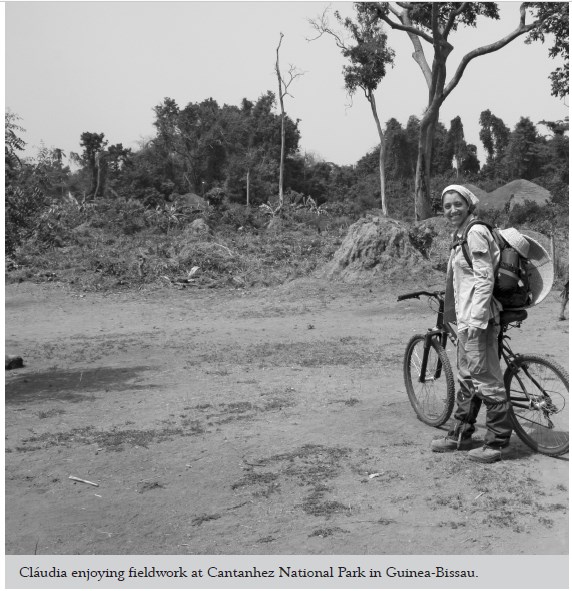
<body><![CDATA[<P>&nbsp;</P>     <P>&nbsp;</P>     <P><font size="2" face="Verdana"> Cl&aacute;udia Sousa (1975-2014) devoted her life to Primatology. She   studied chimpanzee behaviour and cognition in both captive and wild   populations and her research contributed to diverse fields including   primate conservation, human-primate interactions, and human   evolution. Originally trained as a biologist, the breadth of her work   surpassed her own area of expertise. Cl&aacute;udia was capable of   conducting fieldwork with the sensitivity and competence of a social   scientist, and always maintained that conservation could not succeed   without taking on board the perceptions, knowledge, and interests of local human populations.</font></P>     <P>&nbsp;</P>     <P align="center"><b><font size="2" face="Verdana"><img src="/img/revistas/etn/v20n3/20n3a09f1.jpg" width="572" height="591"></font></b></P>     
<P>&nbsp;</P>     <P><font size="2" face="Verdana">The extent of Cl&aacute;udia&rsquo;s   contribution to anthropology was witnessed by everyone who attended   the conference held in her memory on the 9<SUP>th</SUP> October   2015.<A NAME="sdfootnote1anc" HREF="#sdfootnote1sym"><SUP>1</SUP></A>   This special dossier of <I>Etnogr&aacute;fica</I> contains extended   abstracts of the presentations from this conference and constitutes a   further contribution to perpetuate Cl&aacute;udia&rsquo;s work.</font></P>     <P><font size="2" face="Verdana">The conference aimed to gather guest   speakers who worked with Cl&aacute;udia, including former mentors and   students, and to discuss the issues and research areas that she was   passionate about. It was divided into two sections: one dedicated to   &ldquo;Cognition, behaviour and human evolution&rdquo; and the other   to &ldquo;Conservation and human-primate interactions&rdquo;. These   are two major areas of research where Claudia&rsquo;s work had considerable impact in the field of primatology.</font></P>     <P><font size="2" face="Verdana">Primate cognition is the study of the   intellectual and behavioural skills of nonhuman primates (Tomasello   and Call 1997). Cognitive abilities evolve to solve the adaptive   problems a species faces, with both ecological and social problems   important in the evolution of primate intelligence (Byrne and Bates   2006). Great apes in particular are known for their behavioural   flexibility, frequent innovation, and high degree of cultural   variation (Whiten <I>et</I>&nbsp;<I>al</I>. 1999; McGrew 2004). In   the last three decades new theoretical paradigms have been employed   to investigate the natural cognitive skills of primates, including   complex tool-use (Matsuzawa 2001; Seed and Tomasello 2010). Tool use   and manufacture has been reported many times in both wild and captive   primates, particularly the great apes. Tool use is an important part   of being human and has been central to research into the evolutionary   origins of human intelligence. Nonetheless, many basic human   cognitive skills are also held by our &shy;living &shy;primate   relatives. This is unsurprising considering human and chimpanzee DNA   differ by only about 1.23%. However, humans are unique in many ways   and display specific cognitive skills that very likely evolved   relatively recently in our evolutionary history and that are linked to our cultural way of life.</font></P>     <P><font size="2" face="Verdana">Tetsuro Matsuzawa and Dora Biro&rsquo;s   paper focuses on chimpanzee cognition and more specifically, on   flexible tool use. The tools range from &ldquo;tokens&rdquo;, used as   if they were money in a laboratorial context, stones used in the wild   to crack nuts, and leaves to gather water. Cl&aacute;udia&rsquo;s   research at the Primate Research Institute (PRI), Kyoto University,   Japan, and in the forests of West Africa focused on physical   cognition, social learning, laterality and cognitive development.   More specifically, it contributed to a better understanding of   chimpanzees&rsquo; ability to think rationally, to find solutions to   their problems and learn from their peers. Experiments by Cl&aacute;udia   on chimpanzee use of tokens in social situations are described by   Satoshi Hirata. They point to a general social intelligence in   chimpanzee daily lives, showing that like humans, chimpanzees have highly sophisticated social skills.</font></P>     ]]></body>
<body><![CDATA[<P><font size="2" face="Verdana">Pursuit for a deeper understanding of   tool use by wild chimpanzees sparked the field of primate   archaeology. Susana Carvalho introduces the new discipline of primate   archaeology highlighting Cl&aacute;udia&rsquo;s priceless   contribution to its foundation. Primate archaeology examines the   material record of primates through analyses of tool making, tool use   and the spatially patterned accumulation of refuse. Hence it provides   an evolutionary framework for understanding primate behaviour.   Moreover, &ldquo;examination of the contexts for nonhuman primate   artefact and landscape use, alongside early hominin equivalents,   provides a new understanding of the origins and evolution of human behaviour&rdquo; (Haslam <I>et</I>&nbsp;<I>al</I>. 2009:&nbsp;339).</font></P>     <P><font size="2" face="Verdana">Eug&eacute;nia Cunha&rsquo;s   presentation shows that human ancestors were likely capable of   compassion &ndash; a feeling linked to humanity.<A NAME="sdfootnote2anc" HREF="#sdfootnote2sym"><SUP>2</SUP></A>   This idea is explored through the analysis of studies reporting   evidence of care and attention in the fossil record, such as the   willingness and capability to attend individuals with lesions caused   by trauma, infection and other impairing pathologies. Cases date back   to circa 3.4 million years (Cook <I>et</I>&nbsp;<I>al</I>. 1983) to   much more recent examples (Tiley 2015). The author concluded her   presentation by suggesting how examining the behaviour of our closest   living relatives can contribute to our understanding of the behaviour   of our human ancestors (Cuozzo and Sauther 2004; Hublin 2009). The   hypothesis presented by Bracinha Vieira relates to the origins of   language and how it is linked with the development of lithic   industries in the Palaeolithic. He suggests that brain development   and the acquisition of language in humans are associated with the capability to manipulate tools.</font></P>     <P><font size="2" face="Verdana">This set of contributions highlights   the importance of studies into the cognitive abilities of nonhuman   primates, especially tool use by chimpanzees, and how this informs   various aspects of human evolution, which was a particular focus of Cl&aacute;udia&rsquo;s research.</font></P>     <P><font size="2" face="Verdana">The second set of extended abstracts in   this dossier focus on great ape conservation. In our current epoch,   increasingly known as the Anthropocene (Crutzen and Stoermer 2000;   Steffen <I>et</I>&nbsp;<I>al</I>. 2011; Maris 2015), we see the   emergence of biodiversity conservation, which some authors argue is   important for the survival of humankind (Harmon 2001). However, the   extensive (often negative) influence of humans on wild ecosystems   where apes are found is undeniable (Hockings <I>et</I>&nbsp;<I>al</I>.   2015). Contemporary biodiversity conservation does not ignore the   presence and role of humans in wild ecosystems. Instead it   acknowledges that local ecological knowledge and human practices are   essential for biodiversity conservation and sustainability (Orlove   and Brush 1996; Berkes 1999). Moreover, the value of both biological   and human cultural diversity underlines the importance and need to   preserve &ldquo;biocultural diversity&rdquo; (Maffi 2001; Stepp,   Wyndham and Zarger 2002; for a critical review of this process see Vidal and Dias 2016).</font></P>     <P><font size="2" face="Verdana">The complex relationship between   ethnobiology, ethnoecology and conservation (Ellen 2006; Nazarea   2006) will provide new opportunities for intricately examining   relationships between human and nonhuman primates using mixed-methods   in social anthropology and primatology (ethnoprimatology: Fuentes   2006, 2012; Riley 2006; Sousa and Fraz&atilde;o-Moreira 2010; Fuentes   and Hockings 2010). Moreover, a methodological framework that enables   the understanding of the ecological complexity based on multispecies   ethnography will push this field forward (Kirksey and Helmreich 2010; Malone <I>et</I>&nbsp;<I>al</I>. 2014; Smart 2014).</font></P>     <P><font size="2" face="Verdana">Kimberley Hockings and Am&eacute;lia   Fraz&atilde;o-Moreira explore these theoretical and methodological   advances, whilst showing how Cl&aacute;udia Sousa pioneered work in   the field of human-primate interactions. The paper by &shy;Kimberley   Hockings on the use of natural and &shy;cultivated foods by wild   chimpanzees at Caiquene-Cadique in Cantanhez National Park   (&shy;Guinea-Bissau) shows how this chimpanzee community can flexibly   modify their behaviour to changing ecological conditions. She   discusses how shared resource use might impact the sustainability of   interactions with local people, and ways to promote long-term   coexistence in anthropogenic habitats. Am&eacute;lia Fraz&atilde;o-Moreira   explores crossovers in social anthropology and primatology for the   conservation of chimpanzees in Cantanhez National Park and Cufada   Natural Park, &shy;Guinea-Bissau. She focuses on the human contexts   of conservation, including local narratives and perceptions about   chimpanzees; local ecological knowledge and its relation to   scientific knowledge; and territory uses and management. She   emphasizes the need to connect social variability and the   reconfiguration of humanized ecological systems to conservation models and expectations.</font></P>     <P><font size="2" face="Verdana">Discussions into the connections   between social anthropology, primatology and conservation highlight   the complex political and ethical dimensions in biodiversity   conservation. Catherine Hill and Matthew McLennan reflect upon the   ethics of research focusing on &ldquo;village&rdquo; chimpanzee   behaviour and ecology and discuss the role of the primatologist as a   social actor in a complex socio-political landscape. Spartaco   Gippoliti maintains the importance of an ethical approach to   biodiversity conservation, and highlights the political paradoxes of   universalizing conservation models <I>in situ</I>, reinforcing the idea of conservation embedded in local cultures.</font></P>     <P><font size="2" face="Verdana">Biologists, psychologists and   biological anthropologists have played a crucial role in the   development of primatology as a scientific discipline. The dialogue   between social anthropology and primatology allows us to develop a   realistic and holistic understanding of how nonhuman primates fit in   an increasingly humanised world. Whether we are discussing the ways   in which cognitive studies of nonhuman primates inform human   evolution, or the myriad of ways humans interact with nonhuman   primates, we are blurring the lines between &ldquo;cultural&rdquo;   and &ldquo;natural&rdquo; approaches, and contributing to important   social and biological debates in contemporary anthropology (Ingold and Palsson 2013).</font></P>     <P><font size="2" face="Verdana">That is the legacy of Cl&aacute;udia Sousa.</font></P>     <P>&nbsp;</P>     ]]></body>
<body><![CDATA[<P><font size="3" face="Verdana"> <b>BIBLIOGRAFIA</b></font></P>     <!-- ref --><P><font size="3" face="Verdana"></font><font size="2" face="Verdana">BERKES, Fikret, 1999, <I>Sacred Ecology: Traditional Ecological   Knowledge and Resource Management</I>. Philadelphia, Taylor and   Francis.    &nbsp;&nbsp;&nbsp;&nbsp;&nbsp;&nbsp;&nbsp;&nbsp;[&#160;<a href="javascript:void(0);" onclick="javascript: window.open('/scielo.php?script=sci_nlinks&ref=196342&pid=S0873-6561201600030000900001&lng=','','width=640,height=500,resizable=yes,scrollbars=1,menubar=yes,');">Links</a>&#160;]<!-- end-ref --></font></P>     <P><font size="2" face="Verdana"> BYRNE, Richard William, and Lucy A. BATES, 2006, &ldquo;Why are   animals cognitive?&rdquo;, <I>Current Biology</I>, 16&nbsp;(12): R445-R447.</font></P>     <P><font size="2" face="Verdana"> COOK, Della Collins, et al., 1983, &ldquo;Vertebral pathology in the   Afar australopithecines&rdquo;, <I>American Journal of Physical Anthropology</I>, 60: 83-101.</font></P>     <P><font size="2" face="Verdana"> CRUTZEN, Paul, and Eugene STOERMER, 2000, &ldquo;The   &lsquo;Anthropocene&rsquo;  &rdquo;, <I>Global Change Newsletter</I>, 41: 17-18.</font></P>     <P><font size="2" face="Verdana"> CUOZZO, Frank, and Michelle SAUTHER, 2004, &ldquo;Tooth loss,   survival, and resource use in wild ring-tailed lemurs (Lemur catta): implications for inferring conspecific care in fossil hominids&rdquo;, <I>Journal of Human Evolution</I>, 46 (5): 623-631.</font></P>     <P><font size="2" face="Verdana"> ELLEN, Roy, 2006, &ldquo;Introduction&rdquo;, in Roy Ellen (ed.), <I>Ethnobiology and the Science of Humankind</I>. Malden, MA, Blackwell Publishing, 1-27.</font></P>     <P><font size="2" face="Verdana"> FUENTES, Agustin, 2006, &ldquo;Human-nonhuman primate interconnections and their relevance to anthropology&rdquo;, <I>Ecological and Environmental Anthropology</I>, 2: 1-11.</font></P>     <P><font size="2" face="Verdana"> FUENTES, Agustin, 2012, &ldquo;Ethnoprimatology and the anthropology   of the human-primate interface&rdquo;, <I>Annual Review of Anthropology</I>, 41:&nbsp;101-117.</font></P>     ]]></body>
<body><![CDATA[<P><font size="2" face="Verdana"> FUENTES, Agustin, and Kimberley Jane HOCKINGS, 2010, &ldquo;The   ethnoprimatological approach in primatology&rdquo;, <I>American Journal of Primatology</I>, 72&nbsp;(10): 841-847.</font></P>     <P><font size="2" face="Verdana"> HARMON, David, 2001, &ldquo;On the meaning and moral imperative of   diversity&rdquo;, in Luisa Maffi (ed.), <I>On Biocultural Diversity:     Linking Language, Knowledge, and the Environment</I>. Washington, DC, Smithsonian Institution Press, 53-70.</font></P>     <P><font size="2" face="Verdana"> HASLAM, Michael, et al., 2009, &ldquo;Primate Archaeology&rdquo;, <I>Nature</I>, 460: 339-344.</font></P>     <P><font size="2" face="Verdana"> HOCKINGS, Kimberley J., et al., 2015, &ldquo;Apes in the   Anthropocene: flexibility and survival&rdquo;, <I>Trends in Ecology and Evolution</I>, 30: 215-222.</font></P>     <P><font size="2" face="Verdana"> HUBLIN, Jean-Jacques, 2009, &ldquo;The prehistory of compassion&rdquo;, <I>Proceedings of the National Academy of Sciences of the United States of America (PNAS)</I>, 106 (16): 6429-6430.</font></P>     <!-- ref --><P><font size="2" face="Verdana">   INGOLD, Tim, and Gisli PALSSON, 2013, <I>Biosocial Becomings:     Integrating Social and Biological Anthropology</I>. Cambridge, Cambridge University Press.    &nbsp;&nbsp;&nbsp;&nbsp;&nbsp;&nbsp;&nbsp;&nbsp;[&#160;<a href="javascript:void(0);" onclick="javascript: window.open('/scielo.php?script=sci_nlinks&ref=196356&pid=S0873-6561201600030000900014&lng=','','width=640,height=500,resizable=yes,scrollbars=1,menubar=yes,');">Links</a>&#160;]<!-- end-ref --></font></P>     <P><font size="2" face="Verdana"> KIRKSEY, S. Eben, and Stefan HELMREICH, 2010, &ldquo;The emergence of   multispecies ethnography&rdquo;, <I>Cultural Anthropology</I>, 25&nbsp;(4): 545-576.</font></P>     <!-- ref --><P><font size="2" face="Verdana">   MAFFI, Luisa (ed.), 2001, <I>On Biocultural Diversity: Linking     Language, Knowledge, and the Environment</I>. Washington, DC, Smithsonian Institution Press.    &nbsp;&nbsp;&nbsp;&nbsp;&nbsp;&nbsp;&nbsp;&nbsp;[&#160;<a href="javascript:void(0);" onclick="javascript: window.open('/scielo.php?script=sci_nlinks&ref=196359&pid=S0873-6561201600030000900016&lng=','','width=640,height=500,resizable=yes,scrollbars=1,menubar=yes,');">Links</a>&#160;]<!-- end-ref --></font></P>     ]]></body>
<body><![CDATA[<P><font size="2" face="Verdana"> MALONE, Nicholas, et al., 2014, &ldquo;Ethnoprimatology-critical   interdisciplinarity&rdquo;, <I>Critique of Anthropology</I>, 34&nbsp;(1): 8-29.</font></P>     <P><font size="2" face="Verdana"> MARIS, Virginie, 2015, &ldquo;Back to the Holocene: a conceptual, and   possibly practical, return to a nature not intended for humans&rdquo;,   in Clive Hamilton, Christophe Bonneuil and Fran&ccedil;ois Gemenne   (eds.), <I>The Anthropocene and the Global Environmental Crisis:     Rethinking Modernity in a New Epoch</I>. London and New York, Routledge, 123-133.</font></P>     <!-- ref --><P><font size="2" face="Verdana">   MATSUZAWA, Tetsuro, 2001, <I>Primate Origins of Human Cognition and Behavior</I>. Tokyo, Springer.    &nbsp;&nbsp;&nbsp;&nbsp;&nbsp;&nbsp;&nbsp;&nbsp;[&#160;<a href="javascript:void(0);" onclick="javascript: window.open('/scielo.php?script=sci_nlinks&ref=196363&pid=S0873-6561201600030000900019&lng=','','width=640,height=500,resizable=yes,scrollbars=1,menubar=yes,');">Links</a>&#160;]<!-- end-ref --></font></P>     <!-- ref --><P><font size="2" face="Verdana">   McGREW, William C. (ed.), 2004, <I>The Cultured Chimpanzee:     Reflections on Cultural Primatology</I>. Cambridge, Cambridge University Press.    &nbsp;&nbsp;&nbsp;&nbsp;&nbsp;&nbsp;&nbsp;&nbsp;[&#160;<a href="javascript:void(0);" onclick="javascript: window.open('/scielo.php?script=sci_nlinks&ref=196365&pid=S0873-6561201600030000900020&lng=','','width=640,height=500,resizable=yes,scrollbars=1,menubar=yes,');">Links</a>&#160;]<!-- end-ref --></font></P>     <P><font size="2" face="Verdana"> NAZAREA, Virginia D., 2006, &ldquo;Local knowledge and memory in   biodiversity conservation&rdquo;, <I>Annual Review of Anthropology</I>, 35: 317-335.</font></P>     <P><font size="2" face="Verdana"> ORLOVE, Ben, and Stephen BRUSH, 1996, &ldquo;Anthropology and the   conservation of biodiversity&rdquo;, <I>Annual Review of Anthropology</I>, 25: 329-352.</font></P>     <P><font size="2" face="Verdana"> RILEY, Erin, 2006, &ldquo;Ethnoprimatology: toward reconciliation of   biological and cultural anthropology&rdquo;, <I>Ecological and Environmental Anthropology</I>, 2&nbsp;(2): 75-86.</font></P>     <P><font size="2" face="Verdana"> SEED, Amanda, and Michael TOMASELLO, 2010, &ldquo;Primate cognition&rdquo;, <I>Topics in Cognitive Science</I>, 2: 407-419.</font></P>     ]]></body>
<body><![CDATA[<P><font size="2" face="Verdana"> SMART, Alan, 2014, &ldquo;Critical perspectives on multispecies   ethnography&rdquo;, <I>Critique of Anthropology</I>, 34&nbsp;(1): 3-7.</font></P>     <P><font size="2" face="Verdana"> SOUSA, Cl&aacute;udia, and Am&eacute;lia FRAZ&Atilde;O-MOREIRA, 2010,   &ldquo;Etnoprimatologia ao servi&ccedil;o da conserva&ccedil;&atilde;o   na Guin&eacute;-Bissau: o chimpanz&eacute; como exemplo&rdquo;, in   &Acirc;ngelo Giuseppe Chaves Alves, Francisco Jos&eacute; Bezerra   Souto and Nivaldo&nbsp;Peroni (eds.), <I>Etnoecologia em Perspectiva:     Natureza, Cultura e Conserva&ccedil;&atilde;o</I>. Recife, NUPEEA, 187-200.</font></P>     <P><font size="2" face="Verdana"> STEFFEN, Will, et al., 2011, &ldquo;The Anthropocene: conceptual and   historical perspectives&rdquo;, <I>Philosophical Transactions of the     Royal Society of London&nbsp;A: Mathematical, Physical and Engineering Sciences</I>, 369: 842-867.</font></P>     <!-- ref --><P><font size="2" face="Verdana">   STEPP, John, Felice WYNDHAM, and Rebecca ZARGER (eds.), 2002,       <I>Ethnobiology and Biocultural Diversity</I>. Athens, International Society of Ethnobiology.    &nbsp;&nbsp;&nbsp;&nbsp;&nbsp;&nbsp;&nbsp;&nbsp;[&#160;<a href="javascript:void(0);" onclick="javascript: window.open('/scielo.php?script=sci_nlinks&ref=196374&pid=S0873-6561201600030000900028&lng=','','width=640,height=500,resizable=yes,scrollbars=1,menubar=yes,');">Links</a>&#160;]<!-- end-ref --></font></P>     <!-- ref --><P><font size="2" face="Verdana">   TILEY, Lorna, 2015, <I>Theory and Practice in the Bioarchaeology of Care: Bioarchaeology and Social Theory</I>. London, Springer.    &nbsp;&nbsp;&nbsp;&nbsp;&nbsp;&nbsp;&nbsp;&nbsp;[&#160;<a href="javascript:void(0);" onclick="javascript: window.open('/scielo.php?script=sci_nlinks&ref=196376&pid=S0873-6561201600030000900029&lng=','','width=640,height=500,resizable=yes,scrollbars=1,menubar=yes,');">Links</a>&#160;]<!-- end-ref --></font></P>     <!-- ref --><P><font size="2" face="Verdana">   TOMASELLO, Michael, and Josep CALL, 1997, <I>Primate Cognition</I>. Oxford, Oxford University Press.    &nbsp;&nbsp;&nbsp;&nbsp;&nbsp;&nbsp;&nbsp;&nbsp;[&#160;<a href="javascript:void(0);" onclick="javascript: window.open('/scielo.php?script=sci_nlinks&ref=196378&pid=S0873-6561201600030000900030&lng=','','width=640,height=500,resizable=yes,scrollbars=1,menubar=yes,');">Links</a>&#160;]<!-- end-ref --></font></P>     <!-- ref --><P><font size="2" face="Verdana"> VIDAL, Fernando, and N&eacute;lia DIAS, 2016, <I>Endangerment, Biodiversity and Culture</I>. London, Routledge.    &nbsp;&nbsp;&nbsp;&nbsp;&nbsp;&nbsp;&nbsp;&nbsp;[&#160;<a href="javascript:void(0);" onclick="javascript: window.open('/scielo.php?script=sci_nlinks&ref=196380&pid=S0873-6561201600030000900031&lng=','','width=640,height=500,resizable=yes,scrollbars=1,menubar=yes,');">Links</a>&#160;]<!-- end-ref --></font></P>     <P><font size="2" face="Verdana"> WHITEN, Andrew, et al., 1999, &ldquo;Cultures in chimpanzees&rdquo;, <I>Nature</I>, 399: 682-685.</font></P>     <P>&nbsp;</P>     <P><font face="Verdana"><b><font size="3">NOTAS</font></b></font></P>     <P>   <font size="2" face="Verdana"><A NAME="sdfootnote1sym" HREF="#sdfootnote1anc">1</A> The     conference was organised by FCSH and CRIA and had the financial     support of FCT &ndash; Funda&ccedil;&atilde;o para a Ci&ecirc;ncia e     a Tecnologia (Science and Technology Foundation) through the     programme FACC &ndash; Fundo de Apoio &agrave; Comunidade Cient&iacute;fica     (Scientific Community Support Fund) and the Project     CRIA      /      ANT      /      04038      /      2013. The     conference was held in the National Museum of Ethnology in Lisbon,     Portugal. We would like to express our gratitude to the Museum&rsquo;s     Director, Dr.&nbsp;Paulo Costa, and staff, especially Mr.&nbsp;Alexandre     Raposo for all their support. A photographic display in the museum     entrance provided a visual journey through Cl&aacute;udia&rsquo;s     research career, from her early days working with captive primates     in Japan up to more recent research on primate conservation in     Guinea-Bissau. Exclusive unedited footage of Cl&aacute;udia&rsquo;s     research work in the laboratory at the Primate Research Institute     (PRI, Kyoto University) and in the field at Bossou (Guinea) were     shown at the conference and are now available at the Kyoto     University webpage which is dedicated to Cl&aacute;udia&rsquo;s     work. The same site provides information on the Cl&aacute;udia Sousa     Memorial Fund for the Advancement of Portuguese Primatology, the aim     of which is to give inspiration and encouragement to future     generations of Portuguese primatologists. Coinciding with the     Conference, the Library services of FCSH      /      NOVA prepared     a display of Cl&aacute;udia&rsquo;s books which were generously     donated by her family. These books, available to students and     researchers, are organised in a special collection in the ID &ndash;   Research and PhD&rsquo;s Documentation Centre (&lt;    <a href="http://www.fcsh.unl.pt/faculdade/bibliotecas/biblioteca-id" target="_blank">http://www.fcsh.unl.pt/faculdade/bibliotecas/biblioteca-id</a></font> <font size="2" face="Verdana">&gt;).</font></P>     <P>   <font size="2" face="Verdana"><A NAME="sdfootnote2sym" HREF="#sdfootnote2anc">2</A> On     the conference two speakers, unable to attend in person, made video     presentations. We are grateful to Catarina Alves Costa     (CRIA      /      FCSH-Nova) and David Navega (University of     Coimbra), for directing and editing, respectively, Professor Ant&oacute;nio     Bracinha Vieira&rsquo;s and Professor Eug&eacute;nia Cunha&rsquo;s     video presentations.</font></P>      ]]></body><back>
<ref-list>
<ref id="B1">
<nlm-citation citation-type="book">
<person-group person-group-type="author">
<name>
<surname><![CDATA[BERKES]]></surname>
<given-names><![CDATA[Fikret]]></given-names>
</name>
</person-group>
<source><![CDATA[Sacred Ecology: Traditional Ecological Knowledge and Resource Management]]></source>
<year>1999</year>
<publisher-loc><![CDATA[Philadelphia ]]></publisher-loc>
<publisher-name><![CDATA[Taylor and Francis]]></publisher-name>
</nlm-citation>
</ref>
<ref id="B2">
<nlm-citation citation-type="journal">
<person-group person-group-type="author">
<name>
<surname><![CDATA[BYRNE]]></surname>
<given-names><![CDATA[Richard William]]></given-names>
</name>
<name>
<surname><![CDATA[BATES]]></surname>
<given-names><![CDATA[Lucy A.]]></given-names>
</name>
</person-group>
<article-title xml:lang="en"><![CDATA[Why are animals cognitive?]]></article-title>
<source><![CDATA[Current Biology]]></source>
<year>2006</year>
<volume>16</volume>
<numero>12</numero>
<issue>12</issue>
<page-range>R445-R447</page-range></nlm-citation>
</ref>
<ref id="B3">
<nlm-citation citation-type="journal">
<person-group person-group-type="author">
<name>
<surname><![CDATA[COOK]]></surname>
<given-names><![CDATA[Della Collins]]></given-names>
</name>
</person-group>
<article-title xml:lang="en"><![CDATA[Vertebral pathology in the Afar australopithecines]]></article-title>
<source><![CDATA[American Journal of Physical Anthropology]]></source>
<year>1983</year>
<volume>60</volume>
<page-range>83-101</page-range></nlm-citation>
</ref>
<ref id="B4">
<nlm-citation citation-type="journal">
<person-group person-group-type="author">
<name>
<surname><![CDATA[CRUTZEN]]></surname>
<given-names><![CDATA[Paul]]></given-names>
</name>
<name>
<surname><![CDATA[STOERMER]]></surname>
<given-names><![CDATA[Eugene]]></given-names>
</name>
</person-group>
<article-title xml:lang="en"><![CDATA[The &#8216;Anthropocene&#8217;]]></article-title>
<source><![CDATA[Global Change Newsletter]]></source>
<year>2000</year>
<volume>41</volume>
<page-range>17-18</page-range></nlm-citation>
</ref>
<ref id="B5">
<nlm-citation citation-type="journal">
<person-group person-group-type="author">
<name>
<surname><![CDATA[CUOZZO]]></surname>
<given-names><![CDATA[Frank]]></given-names>
</name>
<name>
<surname><![CDATA[SAUTHER]]></surname>
<given-names><![CDATA[Michelle]]></given-names>
</name>
</person-group>
<article-title xml:lang="en"><![CDATA[Tooth loss, survival, and resource use in wild ring-tailed lemurs (Lemur catta): implications for inferring conspecific care in fossil hominids]]></article-title>
<source><![CDATA[Journal of Human Evolution]]></source>
<year>2004</year>
<volume>46</volume>
<numero>5</numero>
<issue>5</issue>
<page-range>623-631</page-range></nlm-citation>
</ref>
<ref id="B6">
<nlm-citation citation-type="book">
<person-group person-group-type="author">
<name>
<surname><![CDATA[ELLEN]]></surname>
<given-names><![CDATA[Roy]]></given-names>
</name>
</person-group>
<article-title xml:lang="en"><![CDATA[Introduction]]></article-title>
<person-group person-group-type="editor">
<name>
<surname><![CDATA[Ellen]]></surname>
<given-names><![CDATA[Roy]]></given-names>
</name>
</person-group>
<source><![CDATA[Ethnobiology and the Science of Humankind]]></source>
<year>2006</year>
<page-range>1-27</page-range><publisher-loc><![CDATA[Malden^eMA MA]]></publisher-loc>
<publisher-name><![CDATA[Blackwell Publishing]]></publisher-name>
</nlm-citation>
</ref>
<ref id="B7">
<nlm-citation citation-type="journal">
<person-group person-group-type="author">
<name>
<surname><![CDATA[FUENTES]]></surname>
<given-names><![CDATA[Agustin]]></given-names>
</name>
</person-group>
<article-title xml:lang="en"><![CDATA[Human-nonhuman primate interconnections and their relevance to anthropology]]></article-title>
<source><![CDATA[Ecological and Environmental Anthropology]]></source>
<year>2006</year>
<volume>2</volume>
<page-range>1-11</page-range></nlm-citation>
</ref>
<ref id="B8">
<nlm-citation citation-type="journal">
<person-group person-group-type="author">
<name>
<surname><![CDATA[FUENTES]]></surname>
<given-names><![CDATA[Agustin]]></given-names>
</name>
</person-group>
<article-title xml:lang="en"><![CDATA[Ethnoprimatology and the anthropology of the human-primate interface]]></article-title>
<source><![CDATA[Annual Review of Anthropology]]></source>
<year>2012</year>
<volume>41</volume>
<page-range>101-117</page-range></nlm-citation>
</ref>
<ref id="B9">
<nlm-citation citation-type="journal">
<person-group person-group-type="author">
<name>
<surname><![CDATA[FUENTES]]></surname>
<given-names><![CDATA[Agustin]]></given-names>
</name>
<name>
<surname><![CDATA[HOCKINGS]]></surname>
<given-names><![CDATA[Kimberley Jane]]></given-names>
</name>
</person-group>
<article-title xml:lang="en"><![CDATA[The ethnoprimatological approach in primatology]]></article-title>
<source><![CDATA[American Journal of Primatology]]></source>
<year>2010</year>
<volume>72</volume>
<numero>10</numero>
<issue>10</issue>
<page-range>841-847</page-range></nlm-citation>
</ref>
<ref id="B10">
<nlm-citation citation-type="book">
<person-group person-group-type="author">
<name>
<surname><![CDATA[HARMON]]></surname>
<given-names><![CDATA[David]]></given-names>
</name>
</person-group>
<article-title xml:lang="en"><![CDATA[On the meaning and moral imperative of diversity]]></article-title>
<person-group person-group-type="editor">
<name>
<surname><![CDATA[Maffi]]></surname>
<given-names><![CDATA[Luisa]]></given-names>
</name>
</person-group>
<source><![CDATA[On Biocultural Diversity: Linking Language, Knowledge, and the Environment]]></source>
<year>2001</year>
<page-range>53-70</page-range><publisher-loc><![CDATA[Washington^eDC DC]]></publisher-loc>
<publisher-name><![CDATA[Smithsonian Institution Press]]></publisher-name>
</nlm-citation>
</ref>
<ref id="B11">
<nlm-citation citation-type="journal">
<person-group person-group-type="author">
<name>
<surname><![CDATA[HASLAM]]></surname>
<given-names><![CDATA[Michael]]></given-names>
</name>
</person-group>
<article-title xml:lang="en"><![CDATA[Primate Archaeology]]></article-title>
<source><![CDATA[Nature]]></source>
<year>2009</year>
<volume>460</volume>
<page-range>339-344</page-range></nlm-citation>
</ref>
<ref id="B12">
<nlm-citation citation-type="journal">
<person-group person-group-type="author">
<name>
<surname><![CDATA[HOCKINGS]]></surname>
<given-names><![CDATA[Kimberley J.]]></given-names>
</name>
</person-group>
<article-title xml:lang="en"><![CDATA[Apes in the Anthropocene: flexibility and survival]]></article-title>
<source><![CDATA[Trends in Ecology and Evolution]]></source>
<year>2015</year>
<volume>30</volume>
<page-range>215-222</page-range></nlm-citation>
</ref>
<ref id="B13">
<nlm-citation citation-type="journal">
<person-group person-group-type="author">
<name>
<surname><![CDATA[HUBLIN]]></surname>
<given-names><![CDATA[Jean-Jacques]]></given-names>
</name>
</person-group>
<article-title xml:lang="en"><![CDATA[The prehistory of compassion]]></article-title>
<source><![CDATA[Proceedings of the National Academy of Sciences of the United States of America (PNAS)]]></source>
<year>2009</year>
<volume>106</volume>
<numero>16</numero>
<issue>16</issue>
<page-range>6429-6430</page-range></nlm-citation>
</ref>
<ref id="B14">
<nlm-citation citation-type="book">
<person-group person-group-type="author">
<name>
<surname><![CDATA[INGOLD]]></surname>
<given-names><![CDATA[Tim]]></given-names>
</name>
<name>
<surname><![CDATA[PALSSON]]></surname>
<given-names><![CDATA[Gisli]]></given-names>
</name>
</person-group>
<source><![CDATA[Biosocial Becomings: Integrating Social and Biological Anthropology]]></source>
<year>2013</year>
<publisher-loc><![CDATA[Cambridge ]]></publisher-loc>
<publisher-name><![CDATA[Cambridge University Press]]></publisher-name>
</nlm-citation>
</ref>
<ref id="B15">
<nlm-citation citation-type="journal">
<person-group person-group-type="author">
<name>
<surname><![CDATA[KIRKSEY]]></surname>
<given-names><![CDATA[S. Eben]]></given-names>
</name>
<name>
<surname><![CDATA[HELMREICH]]></surname>
<given-names><![CDATA[Stefan]]></given-names>
</name>
</person-group>
<article-title xml:lang="en"><![CDATA[The emergence of multispecies ethnography]]></article-title>
<source><![CDATA[Cultural Anthropology]]></source>
<year>2010</year>
<volume>25</volume>
<numero>4</numero>
<issue>4</issue>
<page-range>545-576</page-range></nlm-citation>
</ref>
<ref id="B16">
<nlm-citation citation-type="book">
<person-group person-group-type="author">
<name>
<surname><![CDATA[MAFFI]]></surname>
<given-names><![CDATA[Luisa]]></given-names>
</name>
</person-group>
<source><![CDATA[On Biocultural Diversity: Linking Language, Knowledge, and the Environment]]></source>
<year>2001</year>
<publisher-loc><![CDATA[Washington^eDC DC]]></publisher-loc>
<publisher-name><![CDATA[Smithsonian Institution Press]]></publisher-name>
</nlm-citation>
</ref>
<ref id="B17">
<nlm-citation citation-type="journal">
<person-group person-group-type="author">
<name>
<surname><![CDATA[MALONE]]></surname>
<given-names><![CDATA[Nicholas]]></given-names>
</name>
</person-group>
<article-title xml:lang="en"><![CDATA[Ethnoprimatology-critical interdisciplinarity]]></article-title>
<source><![CDATA[Critique of Anthropology]]></source>
<year>2014</year>
<volume>34</volume>
<numero>1</numero>
<issue>1</issue>
<page-range>8-29</page-range></nlm-citation>
</ref>
<ref id="B18">
<nlm-citation citation-type="book">
<person-group person-group-type="author">
<name>
<surname><![CDATA[MARIS]]></surname>
<given-names><![CDATA[Virginie]]></given-names>
</name>
</person-group>
<article-title xml:lang="en"><![CDATA[Back to the Holocene: a conceptual, and possibly practical, return to a nature not intended for humans]]></article-title>
<person-group person-group-type="editor">
<name>
<surname><![CDATA[Hamilton]]></surname>
<given-names><![CDATA[Clive]]></given-names>
</name>
<name>
<surname><![CDATA[Bonneuil]]></surname>
<given-names><![CDATA[Christophe]]></given-names>
</name>
<name>
<surname><![CDATA[Gemenne]]></surname>
<given-names><![CDATA[François]]></given-names>
</name>
</person-group>
<source><![CDATA[The Anthropocene and the Global Environmental Crisis: Rethinking Modernity in a New Epoch]]></source>
<year>2015</year>
<page-range>123-133</page-range><publisher-loc><![CDATA[LondonNew York ]]></publisher-loc>
<publisher-name><![CDATA[Routledge]]></publisher-name>
</nlm-citation>
</ref>
<ref id="B19">
<nlm-citation citation-type="book">
<person-group person-group-type="author">
<name>
<surname><![CDATA[MATSUZAWA]]></surname>
<given-names><![CDATA[Tetsuro]]></given-names>
</name>
</person-group>
<source><![CDATA[Primate Origins of Human Cognition and Behavior]]></source>
<year>2001</year>
<publisher-loc><![CDATA[Tokyo ]]></publisher-loc>
<publisher-name><![CDATA[Springer]]></publisher-name>
</nlm-citation>
</ref>
<ref id="B20">
<nlm-citation citation-type="book">
<person-group person-group-type="author">
<name>
<surname><![CDATA[McGREW]]></surname>
<given-names><![CDATA[William C.]]></given-names>
</name>
</person-group>
<source><![CDATA[The Cultured Chimpanzee: Reflections on Cultural Primatology]]></source>
<year>2004</year>
<publisher-loc><![CDATA[Cambridge ]]></publisher-loc>
<publisher-name><![CDATA[Cambridge University Press]]></publisher-name>
</nlm-citation>
</ref>
<ref id="B21">
<nlm-citation citation-type="journal">
<person-group person-group-type="author">
<name>
<surname><![CDATA[NAZAREA]]></surname>
<given-names><![CDATA[Virginia D.]]></given-names>
</name>
</person-group>
<article-title xml:lang="en"><![CDATA[Local knowledge and memory in biodiversity conservation]]></article-title>
<source><![CDATA[Annual Review of Anthropology]]></source>
<year>2006</year>
<volume>35</volume>
<page-range>317-335</page-range></nlm-citation>
</ref>
<ref id="B22">
<nlm-citation citation-type="journal">
<person-group person-group-type="author">
<name>
<surname><![CDATA[ORLOVE]]></surname>
<given-names><![CDATA[Ben]]></given-names>
</name>
<name>
<surname><![CDATA[BRUSH]]></surname>
<given-names><![CDATA[Stephen]]></given-names>
</name>
</person-group>
<article-title xml:lang="en"><![CDATA[Anthropology and the conservation of biodiversity]]></article-title>
<source><![CDATA[Annual Review of Anthropology]]></source>
<year>1996</year>
<volume>25</volume>
<page-range>329-352</page-range></nlm-citation>
</ref>
<ref id="B23">
<nlm-citation citation-type="journal">
<person-group person-group-type="author">
<name>
<surname><![CDATA[RILEY]]></surname>
<given-names><![CDATA[Erin]]></given-names>
</name>
</person-group>
<article-title xml:lang="en"><![CDATA[Ethnoprimatology: toward reconciliation of biological and cultural anthropology]]></article-title>
<source><![CDATA[Ecological and Environmental Anthropology]]></source>
<year>2006</year>
<volume>2</volume>
<numero>2</numero>
<issue>2</issue>
<page-range>75-86</page-range></nlm-citation>
</ref>
<ref id="B24">
<nlm-citation citation-type="journal">
<person-group person-group-type="author">
<name>
<surname><![CDATA[SEED]]></surname>
<given-names><![CDATA[Amanda]]></given-names>
</name>
<name>
<surname><![CDATA[TOMASELLO]]></surname>
<given-names><![CDATA[Michael]]></given-names>
</name>
</person-group>
<article-title xml:lang="en"><![CDATA[Primate cognition]]></article-title>
<source><![CDATA[Topics in Cognitive Science]]></source>
<year>2010</year>
<volume>2</volume>
<page-range>407-419</page-range></nlm-citation>
</ref>
<ref id="B25">
<nlm-citation citation-type="journal">
<person-group person-group-type="author">
<name>
<surname><![CDATA[SMART]]></surname>
<given-names><![CDATA[Alan]]></given-names>
</name>
</person-group>
<article-title xml:lang="en"><![CDATA[Critical perspectives on multispecies ethnography]]></article-title>
<source><![CDATA[Critique of Anthropology]]></source>
<year>2014</year>
<volume>34</volume>
<numero>1</numero>
<issue>1</issue>
<page-range>3-7</page-range></nlm-citation>
</ref>
<ref id="B26">
<nlm-citation citation-type="book">
<person-group person-group-type="author">
<name>
<surname><![CDATA[SOUSA]]></surname>
<given-names><![CDATA[Cláudia]]></given-names>
</name>
<name>
<surname><![CDATA[FRAZÃO-MOREIRA]]></surname>
<given-names><![CDATA[Amélia]]></given-names>
</name>
</person-group>
<article-title xml:lang="pt"><![CDATA[Etnoprimatologia ao serviço da conservação na Guiné-Bissau: o chimpanzé como exemplo]]></article-title>
<person-group person-group-type="editor">
<name>
<surname><![CDATA[Alves]]></surname>
<given-names><![CDATA[Ângelo Giuseppe Chaves]]></given-names>
</name>
<name>
<surname><![CDATA[Souto]]></surname>
<given-names><![CDATA[Francisco José Bezerra]]></given-names>
</name>
<name>
<surname><![CDATA[Peroni]]></surname>
<given-names><![CDATA[Nivaldo]]></given-names>
</name>
</person-group>
<source><![CDATA[Etnoecologia em Perspectiva: Natureza, Cultura e Conservação]]></source>
<year>2010</year>
<page-range>187-200</page-range><publisher-loc><![CDATA[Recife ]]></publisher-loc>
<publisher-name><![CDATA[NUPEEA]]></publisher-name>
</nlm-citation>
</ref>
<ref id="B27">
<nlm-citation citation-type="journal">
<person-group person-group-type="author">
<name>
<surname><![CDATA[STEFFEN]]></surname>
<given-names><![CDATA[Will]]></given-names>
</name>
</person-group>
<article-title xml:lang="en"><![CDATA[The Anthropocene: conceptual and historical perspectives]]></article-title>
<source><![CDATA[Philosophical Transactions of the Royal Society of London A: Mathematical, Physical and Engineering Sciences]]></source>
<year>2011</year>
<volume>369</volume>
<page-range>842-867</page-range></nlm-citation>
</ref>
<ref id="B28">
<nlm-citation citation-type="book">
<person-group person-group-type="author">
<name>
<surname><![CDATA[STEPP]]></surname>
<given-names><![CDATA[John]]></given-names>
</name>
<name>
<surname><![CDATA[WYNDHAM]]></surname>
<given-names><![CDATA[Felice]]></given-names>
</name>
<name>
<surname><![CDATA[ZARGER]]></surname>
<given-names><![CDATA[Rebecca]]></given-names>
</name>
</person-group>
<source><![CDATA[Ethnobiology and Biocultural Diversity]]></source>
<year>2002</year>
<publisher-loc><![CDATA[Athens ]]></publisher-loc>
<publisher-name><![CDATA[International Society of Ethnobiology]]></publisher-name>
</nlm-citation>
</ref>
<ref id="B29">
<nlm-citation citation-type="book">
<person-group person-group-type="author">
<name>
<surname><![CDATA[TILEY]]></surname>
<given-names><![CDATA[Lorna]]></given-names>
</name>
</person-group>
<source><![CDATA[Theory and Practice in the Bioarchaeology of Care: Bioarchaeology and Social Theory]]></source>
<year>2015</year>
<publisher-loc><![CDATA[London ]]></publisher-loc>
<publisher-name><![CDATA[Springer]]></publisher-name>
</nlm-citation>
</ref>
<ref id="B30">
<nlm-citation citation-type="book">
<person-group person-group-type="author">
<name>
<surname><![CDATA[TOMASELLO]]></surname>
<given-names><![CDATA[Michael]]></given-names>
</name>
<name>
<surname><![CDATA[CALL]]></surname>
<given-names><![CDATA[Josep]]></given-names>
</name>
</person-group>
<source><![CDATA[Primate Cognition]]></source>
<year>1997</year>
<publisher-loc><![CDATA[Oxford ]]></publisher-loc>
<publisher-name><![CDATA[Oxford University Press]]></publisher-name>
</nlm-citation>
</ref>
<ref id="B31">
<nlm-citation citation-type="book">
<person-group person-group-type="author">
<name>
<surname><![CDATA[VIDAL]]></surname>
<given-names><![CDATA[Fernando]]></given-names>
</name>
<name>
<surname><![CDATA[DIAS]]></surname>
<given-names><![CDATA[Nélia]]></given-names>
</name>
</person-group>
<source><![CDATA[Endangerment, Biodiversity and Culture]]></source>
<year>2016</year>
<publisher-loc><![CDATA[London ]]></publisher-loc>
<publisher-name><![CDATA[Routledge]]></publisher-name>
</nlm-citation>
</ref>
<ref id="B32">
<nlm-citation citation-type="journal">
<person-group person-group-type="author">
<name>
<surname><![CDATA[WHITEN]]></surname>
<given-names><![CDATA[Andrew]]></given-names>
</name>
</person-group>
<article-title xml:lang="en"><![CDATA[Cultures in chimpanzees]]></article-title>
<source><![CDATA[Nature]]></source>
<year>1999</year>
<volume>399</volume>
<page-range>682-685</page-range></nlm-citation>
</ref>
</ref-list>
</back>
</article>
