<?xml version="1.0" encoding="ISO-8859-1"?><article xmlns:mml="http://www.w3.org/1998/Math/MathML" xmlns:xlink="http://www.w3.org/1999/xlink" xmlns:xsi="http://www.w3.org/2001/XMLSchema-instance">
<front>
<journal-meta>
<journal-id>0874-2049</journal-id>
<journal-title><![CDATA[Psicologia]]></journal-title>
<abbrev-journal-title><![CDATA[Psicologia]]></abbrev-journal-title>
<issn>0874-2049</issn>
<publisher>
<publisher-name><![CDATA[Associação Portuguesa de Psicologia (APP)Edições Colibri]]></publisher-name>
</publisher>
</journal-meta>
<article-meta>
<article-id>S0874-20491996000100001</article-id>
<article-id pub-id-type="doi">10.17575/rpsicol.v11i1.586</article-id>
<title-group>
<article-title xml:lang="en"><![CDATA[Gender, Expertise and Authority: The effect of gender and specialized knowledge on the perception of authority]]></article-title>
</title-group>
<contrib-group>
<contrib contrib-type="author">
<name>
<surname><![CDATA[Amâncio]]></surname>
<given-names><![CDATA[Lígia]]></given-names>
</name>
<xref ref-type="aff" rid="A01"/>
</contrib>
</contrib-group>
<aff id="A01">
<institution><![CDATA[,ISCTE, Instituto Superior de Lisboa Centro de Investigação e Estudos de Sociologia ]]></institution>
<addr-line><![CDATA[Lisboa ]]></addr-line>
</aff>
<pub-date pub-type="pub">
<day>00</day>
<month>01</month>
<year>1996</year>
</pub-date>
<pub-date pub-type="epub">
<day>00</day>
<month>01</month>
<year>1996</year>
</pub-date>
<volume>11</volume>
<numero>1</numero>
<fpage>11</fpage>
<lpage>25</lpage>
<copyright-statement/>
<copyright-year/>
<self-uri xlink:href="http://scielo.pt/scielo.php?script=sci_arttext&amp;pid=S0874-20491996000100001&amp;lng=en&amp;nrm=iso"></self-uri><self-uri xlink:href="http://scielo.pt/scielo.php?script=sci_abstract&amp;pid=S0874-20491996000100001&amp;lng=en&amp;nrm=iso"></self-uri><self-uri xlink:href="http://scielo.pt/scielo.php?script=sci_pdf&amp;pid=S0874-20491996000100001&amp;lng=en&amp;nrm=iso"></self-uri><abstract abstract-type="short" xml:lang="en"><p><![CDATA[The experiment reported here belongs to a larger research project which aims at analyzing the effects of gender representation and expectatation on the perception of the authority of experts in their organization. In this experiment, an episode was presented to 118 managers of both sexes. The situation presented in the episode concerned the implementation of a technological change in a departement of an anonymous firm. Two independent variables were manipulated in the identification of the actor that have been chosen by the administration to lead the process - the actor's sex and his/her college degree (business administration, engeneering and none). After reading the episode subjects were asked to evaluate the difficulty of the task, to attribute causes for this difficulty and for the choice of that person by the administration. Results will be discussed within the framework of gender stereotypical roles, as well as power and knowledge.]]></p></abstract>
<abstract abstract-type="short" xml:lang="pt"><p><![CDATA[A experiência aqui relatada integra-se num mais lato projecto de pesquisa que visa analisar os efeitos de representação dos sexos e das expectativas na percepção da autoridade dos especialistas na sua organização. Nesta experiência, um episódio foi apresentado a 118 gestores de ambos os sexos. A situação apresentada no episódio dizia respeito à implementação de uma transformação tecnológica num departamento de uma empresa anónima. Duas variáveis independentes foram manipuladas na identificação do actor escolhido pela administração para liderar o processo: o sexo do actor e a sua licenciatura (gestão de empresas, engenharia ou nenhuma). Após a leitura do episódio foi pedido aos sujeitos que avaliassem a dificuldade da tarefa, que atribuíssem causas a essas dificuldade e à escolha do actor realizada pela administração. Os resultados serão discutidos quer no âmbito dos estereótipos relativos aos papéis sexuais, quer no âmbito dos conceitos de poder e conhecimento.]]></p></abstract>
</article-meta>
</front><body><![CDATA[ <p><font face="Verdana" size="4"><b>Gender, Expertise and Authority. The effect of gender and specialized knowledge on the perception of authority</b></font></p>      <p>&nbsp;</p>      <p><font face="Verdana" size="4"><b>L&#237;gia Am&#226;ncio<sup>*</sup></b></font></p>      <p><font face="Verdana" size="2"><sup>*</sup>Centro de Investiga&#231;&#227;o e Estudos de Sociologia Instituto Superior de Ci&#234;ncias do. Trabalho e da Empresa, Lisboa</font></p>      <p>&nbsp;</p> <hr size="1" noshade>       <p><font face="Verdana" size="2"><b>ABSTRACT</b></font></p>      <p><font face="Verdana" size="2">The experiment reported here belongs to a larger research project which aims at analyzing the effects of gender representation and expectatation on the perception of the authority of experts in their organization. In this experiment, an episode was presented to 118 managers of both sexes.</font></p>      <p><font face="Verdana" size="2">The situation presented in the episode concerned the implementation of a technological change in a departement of an anonymous firm. Two independent variables were manipulated in the identification of the actor that have been chosen by the administration to lead the process - the actor&rsquo;s sex and his/her college degree (business administration, engeneering and none). After reading the episode subjects were asked to evaluate the difficulty of the task, to attribute causes for this difficulty and for the choice of that person by the administration. Results will be discussed within the framework of gender stereotypical roles, as well as power and knowledge.</font></p>  <hr size="1" noshade>      <p><font face="Verdana" size="2"><b>RESUMO</b></font></p>      <p><font face="Verdana" size="2">A experi&#234;ncia aqui relatada integra-se num mais lato projecto de pesquisa que visa analisar os efeitos de representa&#231;&#227;o dos sexos e das expectativas na percep&#231;&#227;o da autoridade dos especialistas na sua organiza&#231;&#227;o. Nesta experi&#234;ncia, um epis&#243;dio foi apresentado a 118 gestores de ambos os sexos. A situa&#231;&#227;o apresentada no epis&#243;dio dizia respeito &#224; implementa&#231;&#227;o de uma transforma&#231;&#227;o tecnol&#243;gica num departamento de uma empresa an&#243;nima. Duas vari&#225;veis independentes foram manipuladas na identifica&#231;&#227;o do actor escolhido pela administra&#231;&#227;o para liderar o processo: o sexo do actor e a sua licenciatura (gest&#227;o de empresas, engenharia ou nenhuma). Ap&#243;s a leitura do epis&#243;dio foi pedido aos sujeitos que avaliassem a dificuldade da tarefa, que atribu&#237;ssem causas a essas dificuldade e &#224; escolha do actor realizada pela administra&#231;&#227;o. Os resultados ser&#227;o discutidos quer no &#226;mbito dos estere&#243;tipos relativos aos pap&#233;is sexuais, quer no &#226;mbito dos conceitos de poder e conhecimento.</font></p>  <hr size="1" noshade>     ]]></body>
<body><![CDATA[<p>&nbsp;</p>      <p><font face="Verdana" size="2"><b><i>Introduction.</i></b></font></p>      <p><font face="Verdana" size="2">The elimination of formal barriers to women&rsquo;s education and occupational activity has given place to a growing interest in the situation of women in maledominated occupations (Reskin and Roos, 1990) and professions, such as law (Epstein, 1981, Crosby et al., 1983, Marshall and Wetherell, 1989) and engineering (Hacker, 1981, Cockburn, 1985, Robinson and Mcllwee, 1991). Research on this field has evidenced the existence of &#171;informal barriers&#187; (Epstein, 1988, p. 153) originated by the &#171;genderization&#187; (Martin, 1992) of traits and characteristics associated with performance.</font></p>      <p><font face="Verdana" size="2">In the case of management, which is focused in this paper, American social psychologists have shown that subjects of both sexes associate masculine traits, such as autonomy, independence, achievement motivation and rationality with the manager (Schein, 1973, 1975), and studies performed in Europe also showed that the descriptions of man, leader and manager, shared common dimensions (Kruse and Wintermantel, 1986). The inconsistency of attributes related to power use, leadership and ascendency over others with the feminine may account for the difficulties felt by women in management positions, particularly in male-dominated occupations, to see their authority recognized (Jaffee, 1989) and to exercise it (Wolf and Fligstein, 1979). As they are supposed to lack those &#171;auxiliary characteristics&#187; (Cassidy and Warren, 1991, p. 195) that managers are expected to possess, female styles of management are also expected to differ from male styles of management (Statham, 1987) and expectations of power and mobility in the organization are higher for newly promoted male managers than for female managers (Wiley and Eskilson, 1983) who also face greater difficulties in their access to power positions than their male counterparts (Ragins and Sundstrom, 1989, 1990, Ragins, 1991).</font></p>      <p><font face="Verdana" size="2">Most of these studies enhance the role of gender stereotypes in judgments and expectations regarding female managers, rather independently of their performance and educational attainment, although the prevalence of university degrees in the work force is expected to reduce fellow employees&rsquo; prejudices against them (Jones and Walsh, 1991).</font></p>      <p><font face="Verdana" size="2">However, if we turn to formal education there is also evidence that certain fields of knowledge are impregnated by stereotypical traits and skills. In the case of business administration this influence is more evident, as we have said before, at the level of power skills than at the level of the specialized knowledge. Another field that has a long tradition in industrial management is engineering but in this case, mechanical mastery, technical know-how (Cockburn, 1985) and formal abstract knowledge are important dimensions of university training which contribute to a masculine professional &#171;culture&#187; (Robinson and Mcllwee, 1991). According to these authors, engineering remains a predominantly male-dominated profession in the United-States, just like in Great-Britain (McRae, Devine and Lakey, 1991) and Portugal (Ruivo, 1987), in spite of the great numbers of women entering this course in the last two decades. The expectation of attaining a management position in an organization is another dimension of that culture that is particularly salient among male university students of engineering (Hacker, 1981).</font></p>      <p><font face="Verdana" size="2">In a study performed in Portugal with engineering and business students we also registered this expectation in both groups. However engineering students associated the exercise of power in the organizations with the specialized training obtained at the University, whereas business students associated this power with experience and leadership skills (Amando and Carapinheiro, 1992). On the other hand, interviews with managers showed the existence of a similar implicit theory concerning the particular competence of engineers in organizational management, as they are expected to combine technical competence with management skills (Carapinheiro and Am&#226;ncio, 1992). The traditional predominance of engineers in Portuguese industrial organizations is certainly related to these results<a href="#1"><sup>1</sup></a><a name="top1"></a>. A recent survey with a representative sample of top managers in the Portuguese industry showed that 95.5% of them were male, that only 20% had a university degree, and that 48.6% of those who had it were engineers (Cardoso <i>et al,</i> 1990, p. 29-30).</font></p>      <p><font face="Verdana" size="2">Thus, the analysis of the influence of gender stereotypes in judgements of managerial expertise is particularly interesting at this moment when the overall improvement in higher education of the Portuguese male and female population, together with the very significant participation of women in the work force might be considered as sufficient conditions to facilitate the access of women to management positions<a href="#2"><sup>2</sup></a><a name="top2"></a>. Social psychology research is there, however, to show how social thinking plays some tricks in these processes of social change, as the growing number of female managers is not necessarily accompanied by a growing recognition of their qualities as experts (Kirchler, 1992).</font></p>      <p><font face="Verdana" size="2"><b>Hypothesis.</b></font></p>      <p><font face="Verdana" size="2">1. In a situation concerning a technological innovation in an organization we expected: a) a manager graduated in engineering to elicit greater expectations of success than a manager graduated in business, whereas a non-graduated manager would elicit the least expectations of success;</font></p>      ]]></body>
<body><![CDATA[<p><font face="Verdana" size="2">b) however, male subjects were expected to accentuate the lower expectations of success of the female manager, as compared to the male manager, particularly in the conditions in which managers were graduated in engineering and were non-graduated.</font></p>      <p><font face="Verdana" size="2">2.  Concerning the explanations for the difficulty of success, a) technical reasons would be more used to justify the difficulty of success of the non-graduated managers, as compared to the graduated managers;</font></p>      <p><font face="Verdana" size="2">b) &nbsp;&nbsp;&nbsp;on the other hand, we expected both sexes to explain the difficulty of success of female managers with reasons pertaining to interpersonal relations,</font></p>      <p><font face="Verdana" size="2">c) &nbsp;&nbsp;&nbsp;but in these conditions, male subjects were also expected to use reasons related to technical aspects.</font></p>      <p><font face="Verdana" size="2">3.  Concerning the reasons for the designation of the manager by the administration, a) we expected the graduation in engineering to be considered a better reason than the graduation in business, b) internal reasons such as personal characteristics, working experience and previous success in similar tasks were expected to be more attributed to the male manager than to the female manager, particularly by male subjects.</font></p>      <p><font face="Verdana" size="2"><b>Method.</b></font></p>      <p><font face="Verdana" size="2">Subjects.</font></p>      <p><font face="Verdana" size="2">118 top managers of both sexes (77 male and 41 female) participated in this experiment.</font></p>      <p><font face="Verdana" size="2">Male subjects were slightly older (mean age=37.5) than female subjects (mean age=35.8) but this difference was not significant. The percentage of subjects without college graduation was also similar for both sexes (25.9% for male subjects and 26.8% for female subjects).</font></p>      <p><font face="Verdana" size="2">Design.</font></p>      ]]></body>
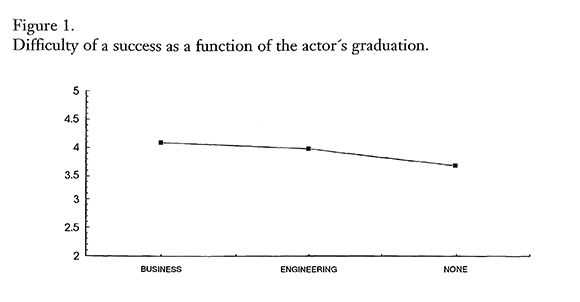
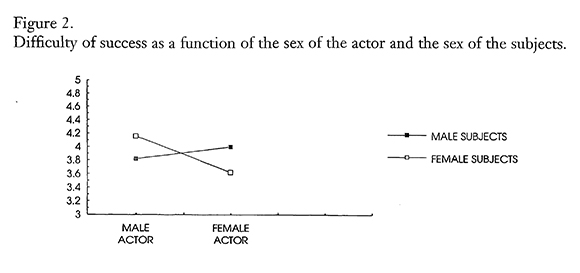
<body><![CDATA[<p><font face="Verdana" size="2">Subjects were randomly assigned to the treatment conditions of a 2x2x3 factorial design.</font></p>      <p><font face="Verdana" size="2">The independent variables were sex of the subjects, sex of the actor and graduation of the actor (business administration, engineering and none).</font></p>      <p><font face="Verdana" size="2">Procedure.</font></p>      <p><font face="Verdana" size="2">Subjects were asked to read an episode in which the actor was either male or female and was either graduated in business administration, engineering or had no college graduation.</font></p>      <p><font face="Verdana" size="2">The part of the episode that was common to all experimental conditions concerned the designation of the actor, who was a director in a trading firm for over 10 years, to implement a technological innovation in one department of the firm which implicated a considerable amount of investment as well as personnel reduction and training. As the episode was included in a questionnaire which aimed at characterizing subjects&rsquo; careers and domains of authority in the organization, as well as to obtain their opinions about the changes in management styles and practices in Portugal, the attributes of the manager&rsquo;s profile and the attributes that contributed to a manager&rsquo;s expert authority, half of the subjects received the episode before filling the questionnaire and the other half after filling the questionnaire.</font></p>      <p><font face="Verdana" size="2">The Dependent Variables.</font></p>      <p><font face="Verdana" size="2">After reading the episode subjects were asked to estimate the degree of difficulty to implement the technological change successfully on a 5 point scale (5=very high and 1=very low). Secondly they were asked to estimate the contribution of a number of reasons for that difficulty on a 5 point scale (5 = contributes very much and 1 = does not contribute at all): two of these reasons concerned interpersonal aspects, such as coping with the conflicts that this kind of organizational process brings about and being recognized as the person with authority over the process, whereas the other two concerned technical aspects, such as the management and investment of capital and the return of the invested capital. Finally subjects were asked to estimate the importance of several reasons for the choice of the actor to undertake this specific task. These reasons were the graduation course (which was only included in those versions of the episode where the actor was graduated), the working experience in the firm, personal characteristics, the combination of the three/two previous aspects, the trust granted by the hrm&rsquo;s administration and the success of the actor in previous similar tasks. All these 5/4 reasons were followed by 5 point scales (5 = very important and 1 = not at all important).</font></p>      <p><font face="Verdana" size="2"><b>Results.</b></font></p>      <p><font face="Verdana" size="2">The ANOVA performed on the estimation of the degree of difficulty in implementing the technological change showed a main effect of the actor&rsquo;s graduation (F(2,103)=4.46, p=.01), an interaction effect of the sex of the actor and the sex of the subjects (F(1,103)=8.44, p=.004) and an interaction effect of the three independent variables (F(2,103)=7.33, p=.001). As <a href="#f1">Figure 1</a> shows, subjects attributed the greatest difficulty to the actor graduated in business administration and the least difficulty to the non-graduated actor but, according to <a href="#f2">Figure 2</a>, female subjects attributed significantly less difficulty to the female actor (mean=3.62) than to the the male actor (mean=4.16) (t(l 11)= 2.41, p=.01), whereas male subjects&rsquo; scores varied in the opposite direction, although not significantly.</font></p>      <p>&nbsp;</p> <a name="f1"> <img src="/img/revistas/psi/v11n1/11n1a01f1.jpg">     
]]></body>
<body><![CDATA[<p>&nbsp;</p>      <p>&nbsp;</p> <a name="f2"> <img src="/img/revistas/psi/v11n1/11n1a01f2.jpg">     
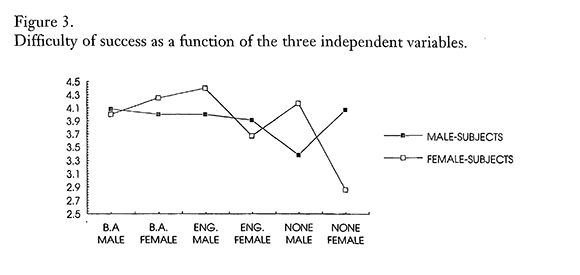
<p>&nbsp;</p>      <p><font face="Verdana" size="2">Inspection of <a href="#f3">Figure 3</a> helps to elucidate the previous results, as it shows that both sexes establish significant differences between the female and male non-graduated actors (mean=2.86 and mean=4.17 respectively, t(103)=3.61, p=.0001 for female subjects and means=4.07 and 3.38, t(103)=2.77, p=.007 for male subjects) and that these differences vary in opposite directions: whereas in the case of the non-graduated male actor less difficulty is attributed by male subjects and greater difficulty by female subjects (t(103)=2.43, p=.01), the reverse happens in the case of the non-graduated female actor (t(103)= 4.06, p=.0001).</font></p>      <p>&nbsp;</p> <a name="f3"> <img src="/img/revistas/psi/v11n1/11n1a01f3.jpg">     
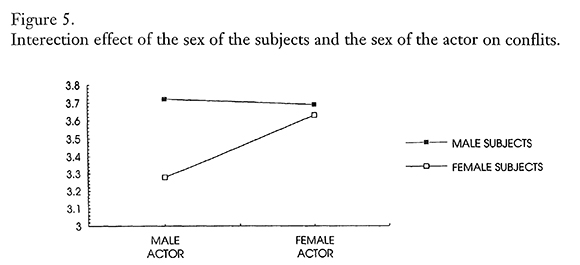
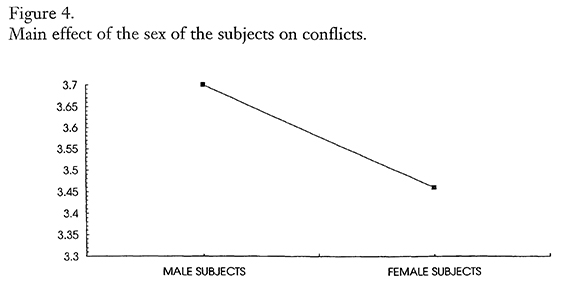
<p>&nbsp;</p>      <p><font face="Verdana" size="2">As for the reasons contributing to this difficulty male subjects attribute significantly more importance to conflicts than female subjects (F(1,96)=3.74, p=.05) (<a href="#f4">Figure 4</a>), but the marginally significant interaction effect of the sex of the subjects and the sex of the actor reveals, as shown in <a href="#f5">Figure 5</a>, that both sexes tend to consider this reason to be important in the case of the female actor, whereas female subjects tend to consider it less important than male subjects in the case of the male actor (F(1,96)=3.12, p=.08). No significant effects were found in the other three reasons.</font></p>      <p>&nbsp;</p> <a name="f4"> <img src="/img/revistas/psi/v11n1/11n1a01f4.jpg">     
<p>&nbsp;</p>      <p>&nbsp;</p> <a name="f5"> <img src="/img/revistas/psi/v11n1/11n1a01f5.jpg">     
]]></body>
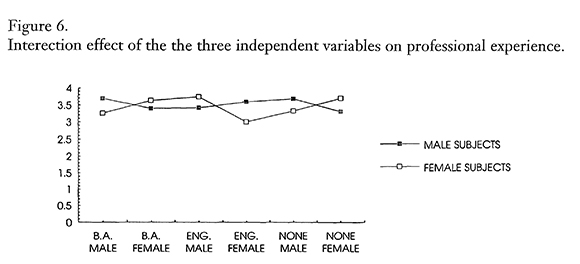
<body><![CDATA[<p>&nbsp;</p>      <p><font face="Verdana" size="2">Concerning the reasons for the choice of the actor a significant interaction effect of the three independent variables was found in the working experience (F(2,97)=3.03, p=.05). As can be seen in <a href="#f6">Figure 6</a> female subjects attribute slightly less importance to this reason than male subjects in the case of the male graduated in business administration and non-graduated, as well as in the case of the female graduated in engineering, whereas their scores are slightly higher than male subjects&rsquo; scores in the case of the male graduated in engineering and the non-graduated female.</font></p>      <p>&nbsp;</p> <a name="f6"> <img src="/img/revistas/psi/v11n1/11n1a01f6.jpg">     
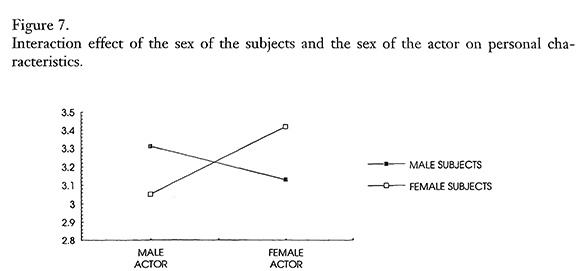
<p>&nbsp;</p>      <p><font face="Verdana" size="2">Male and female subjects also disagree as to the importance of personal characteristics as a function of the sex of the actor. Inspection of <a href="#f7">Figure 7</a> indicates that female subjects consider personal characteristics to be a more important reason for the choice of the female actor than male subjects, whereas the reverse happens in the case of the male actor.</font></p>      <p>&nbsp;</p> <a name="f7"> <img src="/img/revistas/psi/v11n1/11n1a01f7.jpg">     
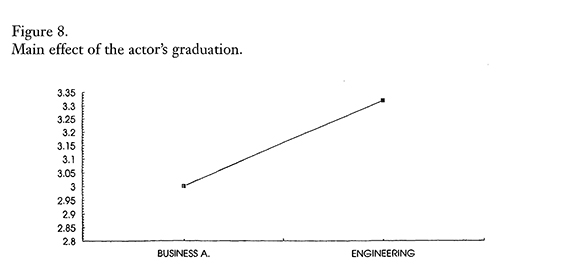
<p>&nbsp;</p>      <p><font face="Verdana" size="2">On the other hand, a degree in engineering tends to be considered a better reason for the choice of the graduated actor, than a degree in business adiministration, as shown in <a href="#f8">Figure 8</a> (F(1,62)=3.35, p=.07). In this case the ANOVA was computed on the basis of a 2x2x2 factorial design, as this reason was only included in the episodes in which the actors were graduated (in business administration and in engineering).</font></p>      <p>&nbsp;</p> <a name="f8"> <img src="/img/revistas/psi/v11n1/11n1a01f8.jpg">     
<p>&nbsp;</p>      ]]></body>
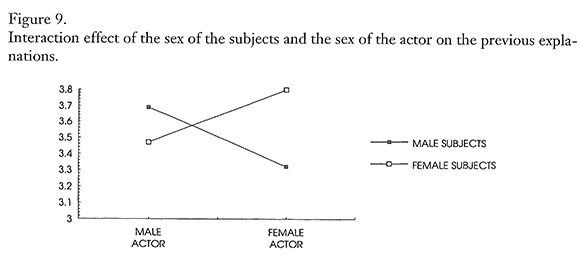
<body><![CDATA[<p><font face="Verdana" size="2">In the combination of working experience and personal characteristics we found a significant interaction effect of the sex of the actor and the sex of the subjects (F(1,103)=9.07, p=.003) indicating, as shown in <a href="#f9">Figure 9</a>, that male and female subjects differ in the attribution of this combination of reasons particularly in the case of the female actor. The similarity of these results with those obtained for the personal characteristics (see <a href="#f7">Figure 7</a>) seems to indicate that the latter reason contributed more to these results than the working experience. Furthermore, when the combination of the previous reasons also included the graduation course of the actor we found the same significant interaction as reported above (F(1.67)=5.19, p=.02).</font></p>      <p>&nbsp;</p> <a name="f9"> <img src="/img/revistas/psi/v11n1/11n1a01f9.jpg">     
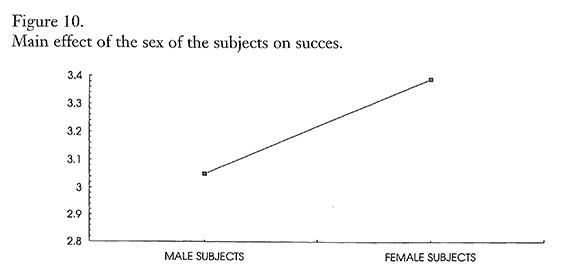
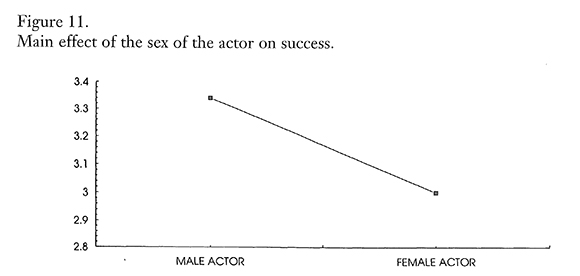
<p>&nbsp;</p>      <p><font face="Verdana" size="2">As for the success of the actor in previous similar tasks female subjects consider it a better reason for the choice of the actor than male subjects (F(1.100)= 3.90, p=.05) as can be sâ€žeen in <a href="#f10">Figure 10</a> and this reason is also more attributed to the male actor than to the female actor (F(1.100)=3.82, p=.05) as shown in <a href="#f11">Figure 11</a>. Although no significant interaction effect of these variables was found, contrasts indicate that male subjects tend to establish a greater difference between the male actor (mean= 3.24) and the female actor (mean=2.86) (t(108=1.83, p=.07) than the female subjects (means=3.53 and 3.26, respectively).</font></p>      <p>&nbsp;</p> <a name="f10"> <img src="/img/revistas/psi/v11n1/11n1a01f10.jpg">     
<p>&nbsp;</p>      <p>&nbsp;</p> <a name="f11"> <img src="/img/revistas/psi/v11n1/11n1a01f11.jpg">     
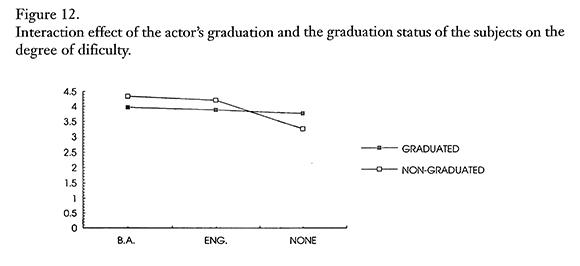
<p>&nbsp;</p>      <p><font face="Verdana" size="2">Since approximatley 1/3 of the subjects participating in this experiment had no college graduation we also looked for effects of the graduation status of the subjects. In order to do this ANOVAs were computed on all dependent variables using a factorial design where the graduation status of the subjects (graduated vs. non-graduated) replaced the sex of the subjects. We found a significant interaction effect (F(2,103)=3.52, p=.03) of the actor&rsquo;s graduation and the subjects&rsquo; graduation status on the estimation of the degree of difficulty according to which (<a href="#f12">Figure 12</a>) non-graduated subjects attributed less difficulty to the non-graduated actor than graduated subjects.</font></p>      <p>&nbsp;</p> <a name="f12"> <img src="/img/revistas/psi/v11n1/11n1a01f12.jpg">     
]]></body>
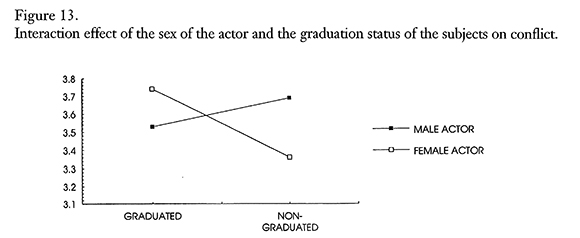
<body><![CDATA[<p>&nbsp;</p>      <p><font face="Verdana" size="2">Concerning the reasons that contribute to the difficulty in implementing the technological change, non-graduated subjects consider that coping with conflicts causes greater difficulty to male actors than to female actors, whereas graduated subjects scores vary in the opposite direction (F(1,96)=4.16, p=.04) (<a href="#f13">Figure 13</a>). No significant effects were found on the other dependent variables.</font></p>      <p>&nbsp;</p> <a name="f13"> <img src="/img/revistas/psi/v11n1/11n1a01f13.jpg">     
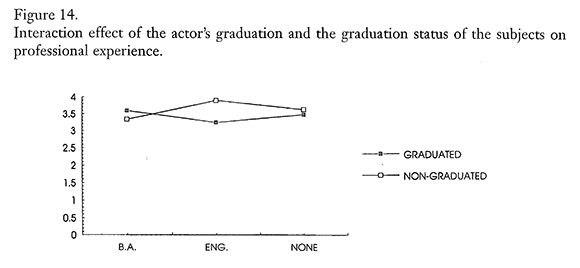
<p>&nbsp;</p>      <p><font face="Verdana" size="2">As for the reasons for the choice of the actor, non-graduated subjects attribute more importance to the working experience of the actor graduated in engineering than graduated subjects, as shown in <a href="#f14">Figure 14</a>. No significant effects were found for the other reasons for the choice of the actor.</font></p>      <p>&nbsp;</p> <a name="f14"> <img src="/img/revistas/psi/v11n1/11n1a01f14.jpg">     
<p>&nbsp;</p>      <p><font face="Verdana" size="2">Discussion.</font></p>      <p><font face="Verdana" size="2">Results do not support the hypothesis of the lowest expectations of success for the non-graduated manager, as non-graduated subjects contradicted this prediction, but the second highest expectation of success was found for the manager graduated in engineering. As predicted, male subjects accentuate the difficulties of success of the female manager when she has no graduation or has a graduation in engineering but female subjects also accentuate the male managers&rsquo; difficulties in those same conditions. Contrary to our predictions, no effects were found on those explanations for the difficulty of success that were related with technical aspects but results support the prediction that both sexes would use reasons pertaining to interpersonal relations, to explain the difficulty of success of the female manager. However, this effect was found only on conflicts. As predicted, the graduation in engineering is considered a better reason for the choice of the mallager thall the graduation in business administration. Concerning the other internal reasons, male subjects consider the manages personal characteristics a good reason for the choice of the male mallager, as predicted, but female subjects also consider it a good reason for the choice of the female manager. Furthermore, male subjects consider previous success a better reason for the choice of the male manager, than for the choice of the female manager.</font></p>      <p><font face="Verdana" size="2">In a situation concerning the implementation of a technological innovation results did not entirely support those hypothesis predicting that male subjects would establish greater differences between male and female managers than female subjects. First, because our results reveal that both sexes try to protect the image of the least educated manager of the same sex. Secondly, because female subjects&rsquo; differentiation between male and female managers is higher on an attribution that is related to the feminine stereotype, such as interpersonal conflicts, and is lower on an attribution that is related to the masculine stereotype, such as previous success. The latter set of results indicates that female subjects are more influenced by gender categorial contents than male subjects, but this has to do with the particular situation of female managers, as other results help to elucidate.</font></p>      ]]></body>
<body><![CDATA[<p><font face="Verdana" size="2">When we included the graduation status of the subjects results showed that non-graduated subjects minimized the difSculty of success of the managers with the same status. This result may indicate that social comparison between graduated and non-graduated managers in the organizations is increasingly defavourable for the latter group. However, male subjects only accentuate the difficulty of success of the female non-graduated manager. Thus, our results may enllance the coexistence of a growing positive evaluation of the graduates&rsquo; expertise with the prevalence of the male stereotypical &#171;natural&#187; competence for management. The coexistence of these implicit theories may place women in a clear disadvantage when they have no college education, without placing them in equality with men, when they have it. On the other hand, engineering is the most positive evaluated expert knowledge for the exercise of management, and this is also the most &#171;masculine&#187; kind of expertise and the one that the least number of women have.</font></p>      <p><font face="Verdana" size="2">One last aspect concerns the apparent incongruency between feminine traits and formal education Non-graduated subjects consider that female managers have less difficulties in coping with conflicts, as opposed to graduated subjects. This could indicate that a higher education and level of expertise are associated with the lost of &#171;feminine competences&#187; and if it is so, then higher educated women managers may be perceived as more &#171;masculine&#187; by their peers and subordinates.</font></p>      <p><font face="Verdana" size="2">Therefore, if female subjects appear to be more influenced by gender categorial contents than male subjects, this seems to be determined by the quantitative and qualitative asymmetry in the symbolic resources available to both sexes in management positions. As long as men and women share a dominant set of implicit theories that associate this occupation, and some expert knowledge relevant to exercise it, with the male category and masculine traits, women can only negotiate their identity with the situation, in such a way, that reproduces their &#171;specificity&#187;.</font></p>      <p>&nbsp;</p>      <p><font face="Verdana" size="2"><b>Refer&#234;ncias</b></font>      <!-- ref --><p><font face="Verdana" size="2">Am&#226;ncio, L. and Carapinheiro, G. (1992) Dimens&#245;es do Poder e do Saber. Uma Abordagem Explorat&#243;ria,    &nbsp;&nbsp;&nbsp;&nbsp;&nbsp;&nbsp;&nbsp;&nbsp;[&#160;<a href="javascript:void(0);" onclick="javascript: window.open('/scielo.php?script=sci_nlinks&ref=516739&pid=S0874-2049199600010000100001&lng=','','width=640,height=500,resizable=yes,scrollbars=1,menubar=yes,');">Links</a>&#160;]<!-- end-ref --> Paper presented at the Col&#243;quio <i>Comunidade Cient&#237;fica e Poder,</i> Lisboa.</font></p>      <!-- ref --><p><font face="Verdana" size="2">Carapinheiro, G. and Am&#226;ncio, L. (1992) A V&#227; Gl&#243;ria de Mandar. Estrat&#233;gias de Legitima&#231;&#227;o da Autoridade Cient&#237;fica e T&#233;cnica,    &nbsp;&nbsp;&nbsp;&nbsp;&nbsp;&nbsp;&nbsp;&nbsp;[&#160;<a href="javascript:void(0);" onclick="javascript: window.open('/scielo.php?script=sci_nlinks&ref=516741&pid=S0874-2049199600010000100002&lng=','','width=640,height=500,resizable=yes,scrollbars=1,menubar=yes,');">Links</a>&#160;]<!-- end-ref --> Paper presented at the II <i>Congresso Portugu&#234;s de Sociologia</i>, Lisboa.</font></p>      <!-- ref --><p><font face="Verdana" size="2">Cardoso, J.L., Brand&#227;o de Brito, J.M., Mendes, F.R. and Rodri gues, M.L. (1990) <i>Empres&#225;rios e Gestores da Ind&#250;stria em Portugal</i>, Lisboa: Dom Quixote.    &nbsp;&nbsp;&nbsp;&nbsp;&nbsp;&nbsp;&nbsp;&nbsp;[&#160;<a href="javascript:void(0);" onclick="javascript: window.open('/scielo.php?script=sci_nlinks&ref=516743&pid=S0874-2049199600010000100003&lng=','','width=640,height=500,resizable=yes,scrollbars=1,menubar=yes,');">Links</a>&#160;]<!-- end-ref --></font></p>      <!-- ref --><p><font face="Verdana" size="2">Cassidy, M. L. and Warren, B.O. (1991) Status Consistency and Work Satisfaction among Professional and Managerial Women and Men. <i>Gender and Society</i>, 5, 2, 193-206.    &nbsp;&nbsp;&nbsp;&nbsp;&nbsp;&nbsp;&nbsp;&nbsp;[&#160;<a href="javascript:void(0);" onclick="javascript: window.open('/scielo.php?script=sci_nlinks&ref=516745&pid=S0874-2049199600010000100004&lng=','','width=640,height=500,resizable=yes,scrollbars=1,menubar=yes,');">Links</a>&#160;]<!-- end-ref --></font></p>      <!-- ref --><p><font face="Verdana" size="2">Cockburn, C. (1985) <i>Machineiy Qf Dominance. Women. Men Technical Rnow-how,</i> London: Pluto Press.    &nbsp;&nbsp;&nbsp;&nbsp;&nbsp;&nbsp;&nbsp;&nbsp;[&#160;<a href="javascript:void(0);" onclick="javascript: window.open('/scielo.php?script=sci_nlinks&ref=516747&pid=S0874-2049199600010000100005&lng=','','width=640,height=500,resizable=yes,scrollbars=1,menubar=yes,');">Links</a>&#160;]<!-- end-ref --></font></p>      <!-- ref --><p><font face="Verdana" size="2">Crosby, F., Golding, J. and Resnick, A. (1983) Discontent among Male Lawyers, Female Lawyers and Female Legal Secretaries. <i>Journal of Applied Social Psvchology</i>, 13, 1, 183-190.    &nbsp;&nbsp;&nbsp;&nbsp;&nbsp;&nbsp;&nbsp;&nbsp;[&#160;<a href="javascript:void(0);" onclick="javascript: window.open('/scielo.php?script=sci_nlinks&ref=516749&pid=S0874-2049199600010000100006&lng=','','width=640,height=500,resizable=yes,scrollbars=1,menubar=yes,');">Links</a>&#160;]<!-- end-ref --></font></p>      <!-- ref --><p><font face="Verdana" size="2">Epstein, C.F. (1981) <i>Women in Law,</i> New York: Basic Books.    &nbsp;&nbsp;&nbsp;&nbsp;&nbsp;&nbsp;&nbsp;&nbsp;[&#160;<a href="javascript:void(0);" onclick="javascript: window.open('/scielo.php?script=sci_nlinks&ref=516751&pid=S0874-2049199600010000100007&lng=','','width=640,height=500,resizable=yes,scrollbars=1,menubar=yes,');">Links</a>&#160;]<!-- end-ref --></font></p>      <!-- ref --><p><font face="Verdana" size="2">Epstein, C.F. (1988) <i>Deceptive Distinctions. Sex Gender and the Social Order</i>, NewHaven: University Press.    &nbsp;&nbsp;&nbsp;&nbsp;&nbsp;&nbsp;&nbsp;&nbsp;[&#160;<a href="javascript:void(0);" onclick="javascript: window.open('/scielo.php?script=sci_nlinks&ref=516753&pid=S0874-2049199600010000100008&lng=','','width=640,height=500,resizable=yes,scrollbars=1,menubar=yes,');">Links</a>&#160;]<!-- end-ref --></font></p>      <!-- ref --><p><font face="Verdana" size="2">Hacker, S.L. (1981) The Culture of Engineering: Woman, Workplace and Machine. <i>Womer&#237;s Studies International Ouarterly</i>, 4, 3, 341-353.    &nbsp;&nbsp;&nbsp;&nbsp;&nbsp;&nbsp;&nbsp;&nbsp;[&#160;<a href="javascript:void(0);" onclick="javascript: window.open('/scielo.php?script=sci_nlinks&ref=516755&pid=S0874-2049199600010000100009&lng=','','width=640,height=500,resizable=yes,scrollbars=1,menubar=yes,');">Links</a>&#160;]<!-- end-ref --></font></p>      <!-- ref --><p><font face="Verdana" size="2">Jaffee, D. (1989) Gender Inequality in Workplace Autonomy and Authority. <i>Social Science Ouarterly</i>, 70, 2, 375-90.    &nbsp;&nbsp;&nbsp;&nbsp;&nbsp;&nbsp;&nbsp;&nbsp;[&#160;<a href="javascript:void(0);" onclick="javascript: window.open('/scielo.php?script=sci_nlinks&ref=516757&pid=S0874-2049199600010000100010&lng=','','width=640,height=500,resizable=yes,scrollbars=1,menubar=yes,');">Links</a>&#160;]<!-- end-ref --></font></p>      <p><font face="Verdana" size="2">Jones, J.C.H. and Wash, W.D. (1991) Product Mauket Imperfections, Job Content Differences, and Gender Employment Discrimination at the Management Level: Some evidence from the Canadian manufacturing sector in 1971 and 1981. <i>Canadian Journal of Economics / Revue Canadienne d&rsquo;Economique,</i> XXI V, 4, 843-858.</font></p>      <!-- ref --><p><font face="Verdana" size="2">Kirchler (1992) Adorable Women, Expert Men: Changing Gender Images of Women and Men in Management. <i>European Journal of Social Psvchology</i>, 22, 4, 363-373.    &nbsp;&nbsp;&nbsp;&nbsp;&nbsp;&nbsp;&nbsp;&nbsp;[&#160;<a href="javascript:void(0);" onclick="javascript: window.open('/scielo.php?script=sci_nlinks&ref=516760&pid=S0874-2049199600010000100012&lng=','','width=640,height=500,resizable=yes,scrollbars=1,menubar=yes,');">Links</a>&#160;]<!-- end-ref --></font></p>      <!-- ref --><p><font face="Verdana" size="2">Kruse, L. and Wintermantel, M. (1985) Leadership Ms.-Qualified I. The Gender Bias in Everyday and Scientific Thinking. In C.F. Graumann e S. Moscovici (Eds.) <i>Changing Conceptions of Leadership,</i> New York: Springer-Verlag.    &nbsp;&nbsp;&nbsp;&nbsp;&nbsp;&nbsp;&nbsp;&nbsp;[&#160;<a href="javascript:void(0);" onclick="javascript: window.open('/scielo.php?script=sci_nlinks&ref=516762&pid=S0874-2049199600010000100013&lng=','','width=640,height=500,resizable=yes,scrollbars=1,menubar=yes,');">Links</a>&#160;]<!-- end-ref --></font></p>      ]]></body>
<body><![CDATA[<!-- ref --><p><font face="Verdana" size="2">Marshall, H. and Wetherell, M. (1989) Talking about Career and Gender Identites: A discourse analysis perspective. In S. Skevington and D. Baker (Eds.) <i>The Social Identity of Women,</i> London: Sage Publications.    &nbsp;&nbsp;&nbsp;&nbsp;&nbsp;&nbsp;&nbsp;&nbsp;[&#160;<a href="javascript:void(0);" onclick="javascript: window.open('/scielo.php?script=sci_nlinks&ref=516764&pid=S0874-2049199600010000100014&lng=','','width=640,height=500,resizable=yes,scrollbars=1,menubar=yes,');">Links</a>&#160;]<!-- end-ref --></font></p>      <!-- ref --><p><font face="Verdana" size="2">Martin, J.R. (1992) The Contradiction and the Challenge of the Educated Woman. In R. Zalk and J. Gordon-Kelter (Eds.) <i>Revolutions in Knowledge,</i> Oxford: Westview Press.    &nbsp;&nbsp;&nbsp;&nbsp;&nbsp;&nbsp;&nbsp;&nbsp;[&#160;<a href="javascript:void(0);" onclick="javascript: window.open('/scielo.php?script=sci_nlinks&ref=516766&pid=S0874-2049199600010000100015&lng=','','width=640,height=500,resizable=yes,scrollbars=1,menubar=yes,');">Links</a>&#160;]<!-- end-ref --></font></p>      <!-- ref --><p><font face="Verdana" size="2">McRae, S., Devine, F. e Lakey, J. (1991) <i>Women into Engineering and Science. Employers Policies and Practices,</i> Londres, Policy Studies Institute.    &nbsp;&nbsp;&nbsp;&nbsp;&nbsp;&nbsp;&nbsp;&nbsp;[&#160;<a href="javascript:void(0);" onclick="javascript: window.open('/scielo.php?script=sci_nlinks&ref=516768&pid=S0874-2049199600010000100016&lng=','','width=640,height=500,resizable=yes,scrollbars=1,menubar=yes,');">Links</a>&#160;]<!-- end-ref --></font></p>      <p><font face="Verdana" size="2">Reskin, B.F. and Roos, P.A. (1990) Job Queues. Gender Oueues: Explaining Women&rsquo;s Inroads into Male Occupations, Philadelphia: Temple University Press.</font></p>      <!-- ref --><p><font face="Verdana" size="2">Ragins, B.R. (1991) Gender Effects in Subordinate Evaluations of Leader: Real or Artifact? <i>Journal of Organizational Behavior</i>, 12, 259-268.    &nbsp;&nbsp;&nbsp;&nbsp;&nbsp;&nbsp;&nbsp;&nbsp;[&#160;<a href="javascript:void(0);" onclick="javascript: window.open('/scielo.php?script=sci_nlinks&ref=516771&pid=S0874-2049199600010000100018&lng=','','width=640,height=500,resizable=yes,scrollbars=1,menubar=yes,');">Links</a>&#160;]<!-- end-ref --></font></p>      <!-- ref --><p><font face="Verdana" size="2">Ragins, B.R. e Sundstrom, E. (1989) Gender and Power in Organizations: A longitudinal perspective. <i>Psychological Bulletin,</i> 105,1, 51-88.    &nbsp;&nbsp;&nbsp;&nbsp;&nbsp;&nbsp;&nbsp;&nbsp;[&#160;<a href="javascript:void(0);" onclick="javascript: window.open('/scielo.php?script=sci_nlinks&ref=516773&pid=S0874-2049199600010000100019&lng=','','width=640,height=500,resizable=yes,scrollbars=1,menubar=yes,');">Links</a>&#160;]<!-- end-ref --></font></p>      <!-- ref --><p><font face="Verdana" size="2">Ragins, B.R. e Sundstrom, E. (1990) Gender and Perceived Power in Manager-subordinate relations. <i>Journal of Occupational Psychology,</i> 63, 273-87.    &nbsp;&nbsp;&nbsp;&nbsp;&nbsp;&nbsp;&nbsp;&nbsp;[&#160;<a href="javascript:void(0);" onclick="javascript: window.open('/scielo.php?script=sci_nlinks&ref=516775&pid=S0874-2049199600010000100020&lng=','','width=640,height=500,resizable=yes,scrollbars=1,menubar=yes,');">Links</a>&#160;]<!-- end-ref --></font></p>      <!-- ref --><p><font face="Verdana" size="2">Mcllwee, J. S. (1992) Men, Women and The Culture of Engineering. <i>The Sociological Quarterly</i>, 32, 3, 403-421.    &nbsp;&nbsp;&nbsp;&nbsp;&nbsp;&nbsp;&nbsp;&nbsp;[&#160;<a href="javascript:void(0);" onclick="javascript: window.open('/scielo.php?script=sci_nlinks&ref=516777&pid=S0874-2049199600010000100021&lng=','','width=640,height=500,resizable=yes,scrollbars=1,menubar=yes,');">Links</a>&#160;]<!-- end-ref --></font></p>      <!-- ref --><p><font face="Verdana" size="2">Ruivo, B. (1987) Portugal: A Mulher no Ensino Superior e em Actividades de Investiga&#231;&#227;o Cient&#237;fica (dados estat&#237;sticos). In <i>A Mulher, o Ensino Superior</i>; <i>a Investiga&#231;&#227;o Cient&#237;fica e as Novas Tecnologias em Portugal</i>, Cadernos Condi&#231;&#227;o Feminina, n.<sup>o</sup> 21, 337-344.    &nbsp;&nbsp;&nbsp;&nbsp;&nbsp;&nbsp;&nbsp;&nbsp;[&#160;<a href="javascript:void(0);" onclick="javascript: window.open('/scielo.php?script=sci_nlinks&ref=516779&pid=S0874-2049199600010000100022&lng=','','width=640,height=500,resizable=yes,scrollbars=1,menubar=yes,');">Links</a>&#160;]<!-- end-ref --></font></p>      <!-- ref --><p><font face="Verdana" size="2">Schien, V (1973) The Relationship Between Sex-Role Stereotypes and Requisite Management Characteristics. <i>Journal of Applied Psvchology,</i> 57, 95-100.    &nbsp;&nbsp;&nbsp;&nbsp;&nbsp;&nbsp;&nbsp;&nbsp;[&#160;<a href="javascript:void(0);" onclick="javascript: window.open('/scielo.php?script=sci_nlinks&ref=516781&pid=S0874-2049199600010000100023&lng=','','width=640,height=500,resizable=yes,scrollbars=1,menubar=yes,');">Links</a>&#160;]<!-- end-ref --></font></p>      <!-- ref --><p><font face="Verdana" size="2">Schien, V (1975) Relationships Between Sex-Role Stereotypes and Requisite Management Characteristics among Female Managers. <i>Journal of Applied Psychology</i>, 60, 340-344</font>&nbsp;&nbsp;&nbsp;&nbsp;&nbsp;&nbsp;&nbsp;&nbsp;[&#160;<a href="javascript:void(0);" onclick="javascript: window.open('/scielo.php?script=sci_nlinks&ref=516783&pid=S0874-2049199600010000100024&lng=','','width=640,height=500,resizable=yes,scrollbars=1,menubar=yes,');">Links</a>&#160;]<!-- end-ref --><!-- ref --><p><font face="Verdana" size="2">Statham, A. (1987) The gender model revisited: Differences in the management styles of men and women. <i>Sex Roles</i>, 16, 7-8, 409-429</font>&nbsp;&nbsp;&nbsp;&nbsp;&nbsp;&nbsp;&nbsp;&nbsp;[&#160;<a href="javascript:void(0);" onclick="javascript: window.open('/scielo.php?script=sci_nlinks&ref=516784&pid=S0874-2049199600010000100025&lng=','','width=640,height=500,resizable=yes,scrollbars=1,menubar=yes,');">Links</a>&#160;]<!-- end-ref --><!-- ref --><p><font face="Verdana" size="2">Wiley, M.G. and Eskilson, A. (1983) Scaling tile colporate ladder: Sex Differences in Expectations for Performance, Power and Mobility, <i>Social Psychologv Ouaterly</i>, 46, 4, 35 1-359</font>&nbsp;&nbsp;&nbsp;&nbsp;&nbsp;&nbsp;&nbsp;&nbsp;[&#160;<a href="javascript:void(0);" onclick="javascript: window.open('/scielo.php?script=sci_nlinks&ref=516785&pid=S0874-2049199600010000100026&lng=','','width=640,height=500,resizable=yes,scrollbars=1,menubar=yes,');">Links</a>&#160;]<!-- end-ref --><!-- ref --><p><font face="Verdana" size="2">Wolf, W.C. e Fligstein, N.D. (1979) Sex and authority in the workplace: The causes of sexual inequality. <i>American Sociological Review,</i> 44, 235-252</font>&nbsp;&nbsp;&nbsp;&nbsp;&nbsp;&nbsp;&nbsp;&nbsp;[&#160;<a href="javascript:void(0);" onclick="javascript: window.open('/scielo.php?script=sci_nlinks&ref=516786&pid=S0874-2049199600010000100027&lng=','','width=640,height=500,resizable=yes,scrollbars=1,menubar=yes,');">Links</a>&#160;]<!-- end-ref --><p>&nbsp;</p>      <p><font face="Verdana" size="2"><b>Notes</b></font>      <p><font face="Verdana" size="2"><a href="#top1"><sup>1</sup></a><a name="1"></a>The first graduation course in BA. was initiated in Portugal ISCTE in 1972. Today, almost 100 private and public institutions offer this degree (or training) all over the country.</font></p>      <p><font face="Verdana" size="2"><a href="#top2"><sup>2</sup></a><a name="2"></a>The rate of college graduates entering the work market is the same for both sexes, according to a recent survey by the Grupo de Peritos, &#171;A Mulher e o Emprego Identifica&#231;&#227;o de Dom&#237;nios Priorit&#225;rios de Interven&#231;&#227;o na Forma&#231;&#227;o/Emprego das Mulheres&#187;, IEFP/CISEP, 1991 (In Bulletin on Women and Employment in the EEC/Bulletin sur les Femmes et l&rsquo;Emploi dans la C.E., n. 2, april 1993, p. 7, published by the Manchester School of Managemellt) On the other hand, 47% of the portuguese women aged 14 or more are employed and this rate grows to 71% of women aged 25-49 years. The first rate places Portugal in the third position of the ranking of feminine employment in the EC countries, after Denmark and Great-Britain, whereas the second rate places this country in the fourth position, after Denmark, Great-Britain and France (Bulletin on Women and Employment in the EEC/Bulletin sur les Femmes et PEmploi dans la C.E.. n. 1, October 1992, p. 2, published by the Manchester School of Management).</font></p>       ]]></body><back>
<ref-list>
<ref id="B1">
<nlm-citation citation-type="">
<person-group person-group-type="author">
<name>
<surname><![CDATA[Amâncio]]></surname>
<given-names><![CDATA[L.]]></given-names>
</name>
<name>
<surname><![CDATA[Carapinheiro]]></surname>
<given-names><![CDATA[G.]]></given-names>
</name>
</person-group>
<source><![CDATA[Dimensões do Poder e do Saber: Uma Abordagem Exploratória]]></source>
<year>1992</year>
</nlm-citation>
</ref>
<ref id="B2">
<nlm-citation citation-type="">
<person-group person-group-type="author">
<name>
<surname><![CDATA[Carapinheiro]]></surname>
<given-names><![CDATA[G.]]></given-names>
</name>
<name>
<surname><![CDATA[Amâncio]]></surname>
<given-names><![CDATA[L.]]></given-names>
</name>
</person-group>
<source><![CDATA[A Vã Glória de Mandar: Estratégias de Legitimação da Autoridade Científica e Técnica]]></source>
<year>1992</year>
</nlm-citation>
</ref>
<ref id="B3">
<nlm-citation citation-type="book">
<person-group person-group-type="author">
<name>
<surname><![CDATA[Cardoso]]></surname>
<given-names><![CDATA[J.L.]]></given-names>
</name>
<name>
<surname><![CDATA[Brandão de Brito]]></surname>
<given-names><![CDATA[J.M.]]></given-names>
</name>
<name>
<surname><![CDATA[Mendes]]></surname>
<given-names><![CDATA[F.R.]]></given-names>
</name>
<name>
<surname><![CDATA[Rodri gues]]></surname>
<given-names><![CDATA[M.L.]]></given-names>
</name>
</person-group>
<source><![CDATA[Empresários e Gestores da Indústria em Portugal]]></source>
<year>1990</year>
<publisher-loc><![CDATA[Lisboa ]]></publisher-loc>
<publisher-name><![CDATA[Dom Quixote]]></publisher-name>
</nlm-citation>
</ref>
<ref id="B4">
<nlm-citation citation-type="journal">
<person-group person-group-type="author">
<name>
<surname><![CDATA[Cassidy]]></surname>
<given-names><![CDATA[M. L.]]></given-names>
</name>
<name>
<surname><![CDATA[Warren]]></surname>
<given-names><![CDATA[B.O.]]></given-names>
</name>
</person-group>
<article-title xml:lang="en"><![CDATA[Status Consistency and Work Satisfaction among Professional and Managerial Women and Men]]></article-title>
<source><![CDATA[Gender and Society]]></source>
<year>1991</year>
<volume>5</volume>
<numero>2</numero>
<issue>2</issue>
<page-range>193-206</page-range></nlm-citation>
</ref>
<ref id="B5">
<nlm-citation citation-type="book">
<person-group person-group-type="author">
<name>
<surname><![CDATA[Cockburn]]></surname>
<given-names><![CDATA[C.]]></given-names>
</name>
</person-group>
<source><![CDATA[Machineiy Qf Dominance. Women: Men Technical Rnow-how]]></source>
<year>1985</year>
<publisher-loc><![CDATA[London ]]></publisher-loc>
<publisher-name><![CDATA[Pluto Press]]></publisher-name>
</nlm-citation>
</ref>
<ref id="B6">
<nlm-citation citation-type="journal">
<person-group person-group-type="author">
<name>
<surname><![CDATA[Crosby]]></surname>
<given-names><![CDATA[F.]]></given-names>
</name>
<name>
<surname><![CDATA[Golding]]></surname>
<given-names><![CDATA[J.]]></given-names>
</name>
<name>
<surname><![CDATA[Resnick]]></surname>
<given-names><![CDATA[A.]]></given-names>
</name>
</person-group>
<article-title xml:lang="en"><![CDATA[Discontent among Male Lawyers, Female Lawyers and Female Legal Secretaries]]></article-title>
<source><![CDATA[Journal of Applied Social Psvchology]]></source>
<year>1983</year>
<volume>13</volume>
<numero>1</numero>
<issue>1</issue>
<page-range>183-190</page-range></nlm-citation>
</ref>
<ref id="B7">
<nlm-citation citation-type="book">
<person-group person-group-type="author">
<name>
<surname><![CDATA[Epstein]]></surname>
<given-names><![CDATA[C.F.]]></given-names>
</name>
</person-group>
<source><![CDATA[Women in Law]]></source>
<year>1981</year>
<publisher-loc><![CDATA[New York ]]></publisher-loc>
<publisher-name><![CDATA[Basic Books]]></publisher-name>
</nlm-citation>
</ref>
<ref id="B8">
<nlm-citation citation-type="book">
<person-group person-group-type="author">
<name>
<surname><![CDATA[Epstein]]></surname>
<given-names><![CDATA[C.F.]]></given-names>
</name>
</person-group>
<source><![CDATA[Deceptive Distinctions: Sex Gender and the Social Order]]></source>
<year>1988</year>
<publisher-loc><![CDATA[NewHaven ]]></publisher-loc>
<publisher-name><![CDATA[University Press]]></publisher-name>
</nlm-citation>
</ref>
<ref id="B9">
<nlm-citation citation-type="journal">
<person-group person-group-type="author">
<name>
<surname><![CDATA[Hacker]]></surname>
<given-names><![CDATA[S.L.]]></given-names>
</name>
</person-group>
<article-title xml:lang="en"><![CDATA[The Culture of Engineering: Woman, Workplace and Machine]]></article-title>
<source><![CDATA[Womerís Studies International Ouarterly]]></source>
<year>1981</year>
<volume>4</volume>
<numero>3</numero>
<issue>3</issue>
<page-range>341-353</page-range></nlm-citation>
</ref>
<ref id="B10">
<nlm-citation citation-type="journal">
<person-group person-group-type="author">
<name>
<surname><![CDATA[Jaffee]]></surname>
<given-names><![CDATA[D.]]></given-names>
</name>
</person-group>
<article-title xml:lang="en"><![CDATA[Gender Inequality in Workplace Autonomy and Authority]]></article-title>
<source><![CDATA[Social Science Ouarterly]]></source>
<year>1989</year>
<volume>70</volume>
<numero>2</numero>
<issue>2</issue>
<page-range>375-90</page-range></nlm-citation>
</ref>
<ref id="B11">
<nlm-citation citation-type="journal">
<person-group person-group-type="author">
<name>
<surname><![CDATA[Jones]]></surname>
<given-names><![CDATA[J.C.H.]]></given-names>
</name>
<name>
<surname><![CDATA[Wash]]></surname>
<given-names><![CDATA[W.D.]]></given-names>
</name>
</person-group>
<article-title xml:lang="en"><![CDATA[Product Mauket Imperfections, Job Content Differences, and Gender Employment Discrimination at the Management Level: Some evidence from the Canadian manufacturing sector in 1971 and 1981]]></article-title>
<source><![CDATA[Canadian Journal of Economics / Revue Canadienne d'Economique]]></source>
<year>1991</year>
<volume>XXI V</volume>
<numero>4</numero>
<issue>4</issue>
<page-range>843-858</page-range></nlm-citation>
</ref>
<ref id="B12">
<nlm-citation citation-type="journal">
<person-group person-group-type="author">
<name>
<surname><![CDATA[Kirchler]]></surname>
</name>
</person-group>
<article-title xml:lang="en"><![CDATA[Adorable Women, Expert Men: Changing Gender Images of Women and Men in Management]]></article-title>
<source><![CDATA[European Journal of Social Psvchology]]></source>
<year>1992</year>
<volume>22</volume>
<numero>4</numero>
<issue>4</issue>
<page-range>363-373</page-range></nlm-citation>
</ref>
<ref id="B13">
<nlm-citation citation-type="book">
<person-group person-group-type="author">
<name>
<surname><![CDATA[Kruse]]></surname>
<given-names><![CDATA[L.]]></given-names>
</name>
<name>
<surname><![CDATA[Wintermantel]]></surname>
<given-names><![CDATA[M.]]></given-names>
</name>
</person-group>
<article-title xml:lang="en"><![CDATA[Leadership Ms.-Qualified I: The Gender Bias in Everyday and Scientific Thinking]]></article-title>
<person-group person-group-type="editor">
<name>
<surname><![CDATA[Graumann]]></surname>
<given-names><![CDATA[C.F.]]></given-names>
</name>
<name>
<surname><![CDATA[Moscovici]]></surname>
<given-names><![CDATA[S.]]></given-names>
</name>
</person-group>
<source><![CDATA[Changing Conceptions of Leadership]]></source>
<year>1985</year>
<publisher-loc><![CDATA[New York ]]></publisher-loc>
<publisher-name><![CDATA[Springer-Verlag]]></publisher-name>
</nlm-citation>
</ref>
<ref id="B14">
<nlm-citation citation-type="book">
<person-group person-group-type="author">
<name>
<surname><![CDATA[Marshall]]></surname>
<given-names><![CDATA[H.]]></given-names>
</name>
<name>
<surname><![CDATA[Wetherell]]></surname>
<given-names><![CDATA[M.]]></given-names>
</name>
</person-group>
<article-title xml:lang="en"><![CDATA[Talking about Career and Gender Identites: A discourse analysis perspective]]></article-title>
<person-group person-group-type="editor">
<name>
<surname><![CDATA[Skevington]]></surname>
<given-names><![CDATA[S.]]></given-names>
</name>
<name>
<surname><![CDATA[Baker]]></surname>
<given-names><![CDATA[D.]]></given-names>
</name>
</person-group>
<source><![CDATA[The Social Identity of Women]]></source>
<year>1989</year>
<publisher-loc><![CDATA[London ]]></publisher-loc>
<publisher-name><![CDATA[Sage Publications]]></publisher-name>
</nlm-citation>
</ref>
<ref id="B15">
<nlm-citation citation-type="book">
<person-group person-group-type="author">
<name>
<surname><![CDATA[Martin]]></surname>
<given-names><![CDATA[J.R.]]></given-names>
</name>
</person-group>
<article-title xml:lang="en"><![CDATA[The Contradiction and the Challenge of the Educated Woman]]></article-title>
<person-group person-group-type="editor">
<name>
<surname><![CDATA[Zalk]]></surname>
<given-names><![CDATA[R.]]></given-names>
</name>
<name>
<surname><![CDATA[Gordon-Kelter]]></surname>
<given-names><![CDATA[J.]]></given-names>
</name>
</person-group>
<source><![CDATA[Revolutions in Knowledge]]></source>
<year>1992</year>
<publisher-loc><![CDATA[Oxford ]]></publisher-loc>
<publisher-name><![CDATA[Westview Press]]></publisher-name>
</nlm-citation>
</ref>
<ref id="B16">
<nlm-citation citation-type="book">
<person-group person-group-type="author">
<name>
<surname><![CDATA[McRae]]></surname>
<given-names><![CDATA[S.]]></given-names>
</name>
<name>
<surname><![CDATA[Devine]]></surname>
<given-names><![CDATA[F.]]></given-names>
</name>
<name>
<surname><![CDATA[Lakey]]></surname>
<given-names><![CDATA[J.]]></given-names>
</name>
</person-group>
<source><![CDATA[Women into Engineering and Science: Employers Policies and Practices]]></source>
<year>1991</year>
<publisher-loc><![CDATA[Londres ]]></publisher-loc>
<publisher-name><![CDATA[Policy Studies Institute]]></publisher-name>
</nlm-citation>
</ref>
<ref id="B17">
<nlm-citation citation-type="book">
<person-group person-group-type="author">
<name>
<surname><![CDATA[Reskin]]></surname>
<given-names><![CDATA[B.F.]]></given-names>
</name>
<name>
<surname><![CDATA[Roos]]></surname>
<given-names><![CDATA[P.A.]]></given-names>
</name>
</person-group>
<source><![CDATA[Job Queues: Gender Oueues: Explaining Women's Inroads into Male Occupations]]></source>
<year>1990</year>
<publisher-loc><![CDATA[Philadelphia ]]></publisher-loc>
<publisher-name><![CDATA[Temple University Press]]></publisher-name>
</nlm-citation>
</ref>
<ref id="B18">
<nlm-citation citation-type="journal">
<person-group person-group-type="author">
<name>
<surname><![CDATA[Ragins]]></surname>
<given-names><![CDATA[B.R.]]></given-names>
</name>
</person-group>
<article-title xml:lang="en"><![CDATA[Gender Effects in Subordinate Evaluations of Leader: Real or Artifact?]]></article-title>
<source><![CDATA[Journal of Organizational Behavior]]></source>
<year>1991</year>
<volume>12</volume>
<page-range>259-268</page-range></nlm-citation>
</ref>
<ref id="B19">
<nlm-citation citation-type="journal">
<person-group person-group-type="author">
<name>
<surname><![CDATA[Ragins]]></surname>
<given-names><![CDATA[B.R.]]></given-names>
</name>
<name>
<surname><![CDATA[Sundstrom]]></surname>
<given-names><![CDATA[E.]]></given-names>
</name>
</person-group>
<article-title xml:lang="en"><![CDATA[Gender and Power in Organizations: A longitudinal perspective]]></article-title>
<source><![CDATA[Psychological Bulletin]]></source>
<year>1989</year>
<volume>105</volume>
<numero>1</numero>
<issue>1</issue>
<page-range>51-88</page-range></nlm-citation>
</ref>
<ref id="B20">
<nlm-citation citation-type="journal">
<person-group person-group-type="author">
<name>
<surname><![CDATA[Ragins]]></surname>
<given-names><![CDATA[B.R.]]></given-names>
</name>
<name>
<surname><![CDATA[Sundstrom]]></surname>
<given-names><![CDATA[E.]]></given-names>
</name>
</person-group>
<article-title xml:lang="en"><![CDATA[Gender and Perceived Power in Manager-subordinate relations]]></article-title>
<source><![CDATA[Journal of Occupational Psychology]]></source>
<year>1990</year>
<volume>63</volume>
<page-range>273-87</page-range></nlm-citation>
</ref>
<ref id="B21">
<nlm-citation citation-type="journal">
<person-group person-group-type="author">
<name>
<surname><![CDATA[Mcllwee]]></surname>
<given-names><![CDATA[J. S.]]></given-names>
</name>
</person-group>
<article-title xml:lang="en"><![CDATA[Men, Women and The Culture of Engineering]]></article-title>
<source><![CDATA[The Sociological Quarterly]]></source>
<year>1992</year>
<volume>32</volume>
<numero>3</numero>
<issue>3</issue>
<page-range>403-421</page-range></nlm-citation>
</ref>
<ref id="B22">
<nlm-citation citation-type="">
<person-group person-group-type="author">
<name>
<surname><![CDATA[Ruivo]]></surname>
<given-names><![CDATA[B.]]></given-names>
</name>
</person-group>
<article-title xml:lang="pt"><![CDATA[Portugal: A Mulher no Ensino Superior e em Actividades de Investigação Científica (dados estatísticos)]]></article-title>
<source><![CDATA[A Mulher, o Ensino Superior; a Investigação Científica e as Novas Tecnologias em Portugal]]></source>
<year>1987</year>
</nlm-citation>
</ref>
<ref id="B23">
<nlm-citation citation-type="journal">
<person-group person-group-type="author">
<name>
<surname><![CDATA[Schien]]></surname>
<given-names><![CDATA[V]]></given-names>
</name>
</person-group>
<article-title xml:lang="en"><![CDATA[The Relationship Between Sex-Role Stereotypes and Requisite Management Characteristics]]></article-title>
<source><![CDATA[Journal of Applied Psvchology]]></source>
<year>1973</year>
<volume>57</volume>
<page-range>95-100</page-range></nlm-citation>
</ref>
<ref id="B24">
<nlm-citation citation-type="journal">
<person-group person-group-type="author">
<name>
<surname><![CDATA[Schien]]></surname>
<given-names><![CDATA[V]]></given-names>
</name>
</person-group>
<article-title xml:lang="en"><![CDATA[Relationships Between Sex-Role Stereotypes and Requisite Management Characteristics among Female Managers]]></article-title>
<source><![CDATA[Journal of Applied Psychology]]></source>
<year>1975</year>
<volume>60</volume>
<page-range>340-344</page-range></nlm-citation>
</ref>
<ref id="B25">
<nlm-citation citation-type="journal">
<person-group person-group-type="author">
<name>
<surname><![CDATA[Statham]]></surname>
<given-names><![CDATA[A.]]></given-names>
</name>
</person-group>
<article-title xml:lang="en"><![CDATA[The gender model revisited: Differences in the management styles of men and women]]></article-title>
<source><![CDATA[Sex Roles]]></source>
<year>1987</year>
<volume>16</volume>
<numero>7-8</numero>
<issue>7-8</issue>
<page-range>409-429</page-range></nlm-citation>
</ref>
<ref id="B26">
<nlm-citation citation-type="journal">
<person-group person-group-type="author">
<name>
<surname><![CDATA[Wiley]]></surname>
<given-names><![CDATA[M.G.]]></given-names>
</name>
<name>
<surname><![CDATA[Eskilson]]></surname>
<given-names><![CDATA[A.]]></given-names>
</name>
</person-group>
<article-title xml:lang="en"><![CDATA[Scaling tile colporate ladder: Sex Differences in Expectations for Performance, Power and Mobility]]></article-title>
<source><![CDATA[Social Psychologv Ouaterly]]></source>
<year>1983</year>
<volume>46</volume>
<numero>4, 35</numero>
<issue>4, 35</issue>
<page-range>1-359</page-range></nlm-citation>
</ref>
<ref id="B27">
<nlm-citation citation-type="journal">
<person-group person-group-type="author">
<name>
<surname><![CDATA[Wolf]]></surname>
<given-names><![CDATA[W.C.]]></given-names>
</name>
<name>
<surname><![CDATA[Fligstein]]></surname>
<given-names><![CDATA[N.D.]]></given-names>
</name>
</person-group>
<article-title xml:lang="en"><![CDATA[Sex and authority in the workplace: The causes of sexual inequality]]></article-title>
<source><![CDATA[American Sociological Review]]></source>
<year>1979</year>
<volume>44</volume>
<page-range>235-252</page-range></nlm-citation>
</ref>
</ref-list>
</back>
</article>