<?xml version="1.0" encoding="ISO-8859-1"?><article xmlns:mml="http://www.w3.org/1998/Math/MathML" xmlns:xlink="http://www.w3.org/1999/xlink" xmlns:xsi="http://www.w3.org/2001/XMLSchema-instance">
<front>
<journal-meta>
<journal-id>0874-2049</journal-id>
<journal-title><![CDATA[Psicologia]]></journal-title>
<abbrev-journal-title><![CDATA[Psicologia]]></abbrev-journal-title>
<issn>0874-2049</issn>
<publisher>
<publisher-name><![CDATA[Associação Portuguesa de Psicologia (APP)Edições Colibri]]></publisher-name>
</publisher>
</journal-meta>
<article-meta>
<article-id>S0874-20491996000100005</article-id>
<article-id pub-id-type="doi">10.17575/rpsicol.v11i1.590</article-id>
<title-group>
<article-title xml:lang="en"><![CDATA[Spontaneous Activation of Schemata under Stress Getting control over earthquake threat]]></article-title>
</title-group>
<contrib-group>
<contrib contrib-type="author">
<name>
<surname><![CDATA[Lima]]></surname>
<given-names><![CDATA[Maria Luísa]]></given-names>
</name>
<xref ref-type="aff" rid="A01"/>
</contrib>
</contrib-group>
<aff id="A01">
<institution><![CDATA[,ISCTE, Instituto Universitário de Lisboa  ]]></institution>
<addr-line><![CDATA[Lisboa ]]></addr-line>
</aff>
<pub-date pub-type="pub">
<day>00</day>
<month>01</month>
<year>1996</year>
</pub-date>
<pub-date pub-type="epub">
<day>00</day>
<month>01</month>
<year>1996</year>
</pub-date>
<volume>11</volume>
<numero>1</numero>
<fpage>57</fpage>
<lpage>65</lpage>
<copyright-statement/>
<copyright-year/>
<self-uri xlink:href="http://scielo.pt/scielo.php?script=sci_arttext&amp;pid=S0874-20491996000100005&amp;lng=en&amp;nrm=iso"></self-uri><self-uri xlink:href="http://scielo.pt/scielo.php?script=sci_abstract&amp;pid=S0874-20491996000100005&amp;lng=en&amp;nrm=iso"></self-uri><self-uri xlink:href="http://scielo.pt/scielo.php?script=sci_pdf&amp;pid=S0874-20491996000100005&amp;lng=en&amp;nrm=iso"></self-uri></article-meta>
</front><body><![CDATA[ <p><font face="Verdana" size="4"><b>Spontaneous Activation of Schemata under Stress Getting control over earthquake threat<a href="#1"><sup>1</sup></a><a name="top1"></a></b></font></p>      <p>&nbsp;</p>      <p><font face="Verdana" size="4"><b>Maria Lu&#237;sa Lima<sup>*</sup></b></font></p>      <p><font face="Verdana" size="2"><sup>*</sup>ISCTE, Lisboa</font></p>      <p>&nbsp;</p> <hr size="1" noshade>      <p><font face="Verdana" size="2"><i>Problem and Theoretical Approach.</i></font></p>      <p><font face="Verdana" size="2">The idea that a sense of control or mastery is an essential part of psychological wellbeing has been widely accepted. But research has repeatedly found that perceptions of control go far beyond our actual capabilities to master the environment, and they are extended to situations were no objective control is exerted (e.g., Langer, 1975). Contrarily to objectivistic views of mental health, beliefs of control over uncontrollable events have been found to positively relate to wellbeing (Taylor, 1983; Taylor &amp; Brown, 1988). Within this kind of approach, coping with earthquake threat is an interesting topic to study because it deals with coping with a highly destructive and uncontrollable event. As a matter of fact:</font></p>      <p><font face="Verdana" size="2">1.  Earthquake hazard is the most threatening natural hazard that Portuguese population has to face.</font></p>      <p><font face="Verdana" size="2">2.  Although seismic phenomena are well characterised by the geophysical Sciences, it is still impossible to accurately predict the occurrence of such a destructive event.</font></p>      <p><font face="Verdana" size="2">3.  According to our previous research, people perceive seismic risk both as a highly uncontrollable risk and a risk that affects themselves. Nevertheless, other studies on the Portuguese population show that the common citizen is not informed about what to do in case of an earthquake.</font></p>      ]]></body>
<body><![CDATA[<p>&nbsp;</p> <a name="f1"> <img src="/img/revistas/psi/v11n1/11n1a05f1.jpg">     
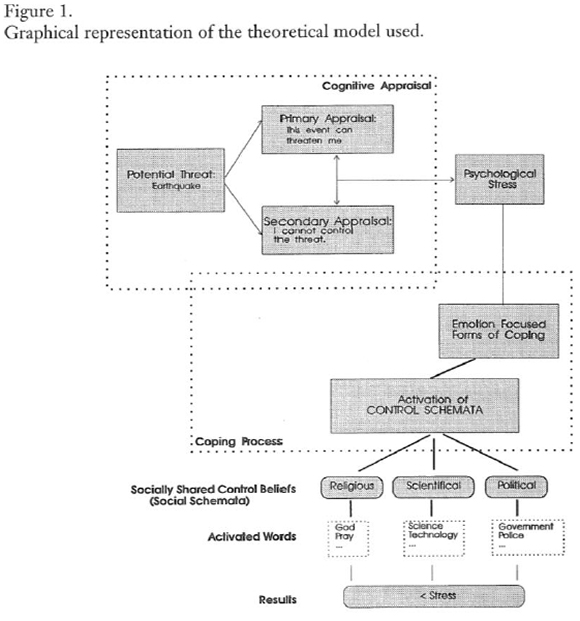
<p>&nbsp;</p>      <p><font face="Verdana" size="2">In Lazarus and Folkman&rsquo;s (1984) model of stress, tdie possibility of an earthquake, being perceived as personally threatening (primary appraisal) and uncontrollable (secondary appraisal), corresponds to a &#171;stressor&#187;, leading to psychological and physiological stress responses. As there is nothing to do to prevent the earthquake to happen, according to the same model people will engage in emotion focused coping strategies to deal with the unpleasant feelings the threat imposes on them.</font></p>      <p><font face="Verdana" size="2">Research on systematic exposition to hazards has shown that people who live in hazard prone environments develop some cognitive adjustments to deal with danger and uncertainty (e.g., Kates, Burton and White, 1978). In line with those results, we have shown in a field study (Lima, 1991) that people who move to an environment with higher levels of seismic risk present stronger control beliefs over the earthquakes than those who remained in lower seismic risk areas. Those control beliefs are a kind of vicarious secondary control (Rothbaum <i>et. al</i>., 1982), whereby people rely on some more powerful agent to restore their sense of control over the environment. In our research, although subjects perceived earthquakes as externally determined, they could still keep some control over the phenomenon, rising three types of socially produced control beliefs:</font></p>      <p><font face="Verdana" size="2"><i>Religious Control.</i> If God is considered as the ultimate determiner of earthquakes, believers can start a serie of actions in order to influence God&rsquo;s Will (to pray, to make a promise) and to prevent a disaster.</font></p>      <p><font face="Verdana" size="2"><i>Scientific-Technical Control.</i> If earthquakes are considered as natural phenomena and Science is seen as efficient to deal with nature, we can suppose that the confidence on Science and technology is another form of restoring the control over an uncertain situation.</font></p>      <p><font face="Verdana" size="2"><i>Political Control.</i> If there is political trust, if people believe that their government has efficient plans to deal with a disaster, they can restore their sense of mastering over the environment.</font></p>      <p><font face="Verdana" size="2">In line with those results, this p&#243;ster presents an experimental study that tries to show that: <i>When earthquake threat is made salient, people will spontaneously activate control schemata to cope with the threat.</i> This hypothesis will be tested in three studies, each one dealing with a specific kind of control beliefs: Religious, Scientific and Political.</font></p>      <p><font face="Verdana" size="2"><i>Method</i></font></p>      <p><font face="Verdana" size="2">Subjects.</font></p>      ]]></body>
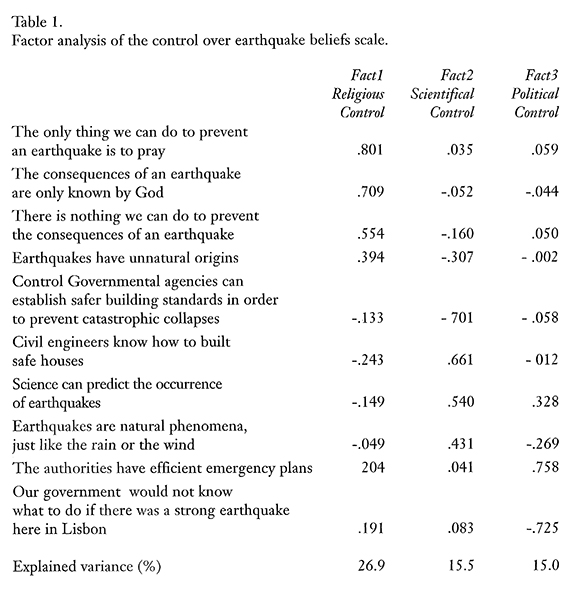
<body><![CDATA[<p><font face="Verdana" size="2">480 students participated in these studies, which ran on two phases. On the First Phase, all subjects answered a questionnaire containing a control over the earthquake beliefs scale (Lima, 1991, see <a href="#t1">Table 1</a>, p. 60) and a trait anxiety scale (STAI-Y2, Spielberger et al., 1983). The second part of the experiment took place a mounth later. On this Second Phase 79 subjects (St<sub>1</sub>:N=24; St<sub>2</sub>:N=28; St<sub>3</sub>:N=27) were selected, according to (i) their anxiety levels: low trait anxiety subjects; and (ii) strength of control beliefs: either very high (schematic subjects) or very low aschematic subjects) on each of the three types of control beliefs).</font></p>      <p>&nbsp;</p> <a name="t1"> <img src="/img/revistas/psi/v11n1/11n1a05t1.jpg">     
<p>&nbsp;</p>      <p><font face="Verdana" size="2">Manipulated variable.</font></p>      <p><font face="Verdana" size="2">The independent manipulated variable in this study was &#171;earthquake threat&#187;. In each of the three studies, subjects were randomly assigned to either the experimental or the control conditions.</font></p>      <p><font face="Verdana" size="2">In the experimental condition (Threat) subjects were told that they would participate in a study concerning the responses to an emergency situation. They were trained in the experimental task until they fully understood it, and they were asked to watch a 3 minutes video/film about earthquakes. Immediately afterwards, the experimental task took place.</font></p>      <p><font face="Verdana" size="2">In the control conditions, subjects rehearsed the experimental task and afterwards they performed it.</font></p>      <p><font face="Verdana" size="2">Experimental task.</font></p>      <p><font face="Verdana" size="2">The task employed was a word location test (Cambor <i>et al.,</i> 1988; Stward <i>et al</i>1991). Subjects were asked to press a key (left or right) as quickly as possible in response to the location of a target word. The target word was presented either above or bellow a fixation point, indicated by in the Center of a Computer monitor. Target words were presented for 5 00 mseconds, with a 1.5 seconds interval between trials. Reaction times (RTs) were recorded. Each subject practised on a series of 10 neutral words. The experimental task consisted of 52 words, including 26 schema related words (i.e., &#171;God&#187; for religion schematic subjects; &#171;engeneering&#187; for the Science schematic subjects and &#171;government&#187; for the politic schematic subjects) and 26 neutral words paired on length and frequency with the others.</font></p>      <p><font face="Verdana" size="2"><i>Results.</i></font></p>      ]]></body>
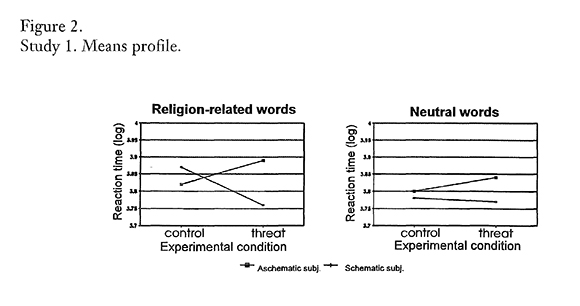
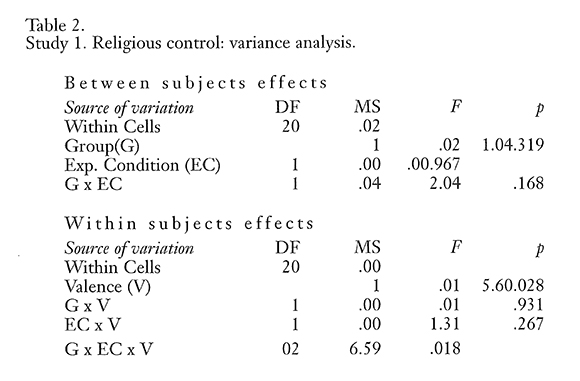
<body><![CDATA[<p><font face="Verdana" size="2">Study 1. Religious schema.</font></p>      <p><font face="Verdana" size="2">A three way ANOVA (with repeated measures on the last factor) was performed on the mean RTs : Experimental condition (control vs. threat) x Group ( schematic vs. aschematic) x Valence (schema related word vs. neutral word). Results show that all subjects respond quicker to neutral than religious words, except schematic subjects under threat. In that situation, religious subjects respond quicker to the schema related words than to the neutral words (<a href="#t2">Table 2</a> and <a href="#f2">Figure 2</a>). This result, compatible with our predictions, allows us to say that in a condition of earthquake threat, religious subjects spontaneously activate their control beliefs in order to restore their sense of control over the environment. Separate ANOVAS performed on neutral and schema related words confirm this result: while there is no signifficant effect for the neutral words (Exp.Cond. F(1,20)=.088, p&gt;.70; Group F(1,20)=.883, p&gt;.30; Interaction F(1,20)=.378, p&gt;.70), there is a signifficant interaction in the case of religious words (Interaction F(1,20)=5.44, p&lt;.03; Exp. Cond. F(1,20)=.422, p&gt;.50; Group F(1,20)=.895, p&gt;.30).</font></p>      <p>&nbsp;</p> <a name="t2"> <img src="/img/revistas/psi/v11n1/11n1a05t2.jpg">     
<p>&nbsp;</p>      <p>&nbsp;</p> <a name="f2"> <img src="/img/revistas/psi/v11n1/11n1a05f2.jpg">     
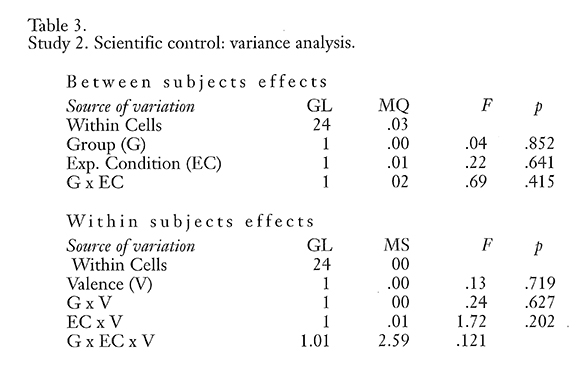
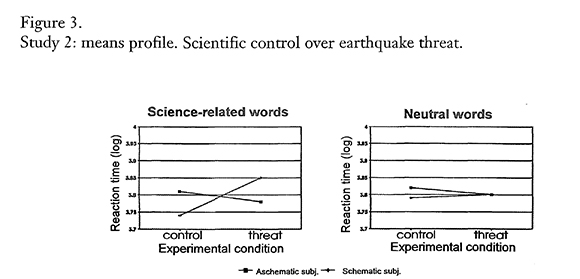
<p>&nbsp;</p>      <p><font face="Verdana" size="2">Study 2. Scientific-Technical schema.</font></p>      <p><font face="Verdana" size="2">A three way ANOVA (with a repeated measure on the last factor) was performed on the mean RTs : Experimental condition (control vs. threat) x Group (schematic vs. aschematic) x Valence (schema related word vs. neutral word). Contrarily to our predictions, no significant effects were found. Separate ANOVAs performed on neutral and schema related words do not show any signifficant effects either (<a href="#t3">Table 3</a> and <a href="#f3">Figure 3</a>).</font></p>      <p>&nbsp;</p> <a name="t3"> <img src="/img/revistas/psi/v11n1/11n1a05t3.jpg">     
<p>&nbsp;</p>      ]]></body>
<body><![CDATA[<p>&nbsp;</p> <a name="f3"> <img src="/img/revistas/psi/v11n1/11n1a05f3.jpg">     
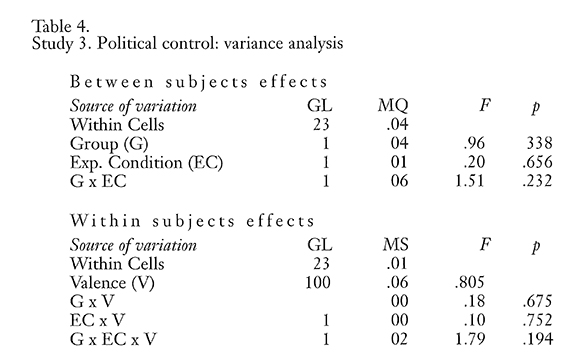
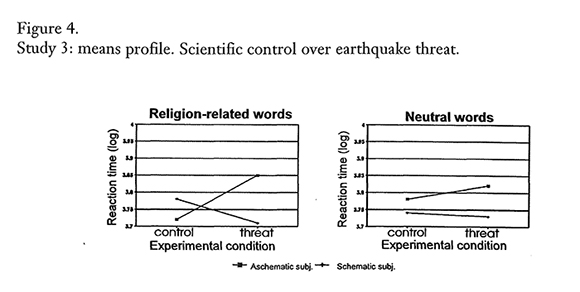
<p>&nbsp;</p>      <p><font face="Verdana" size="2">Study 3. Political schema.</font></p>      <p><font face="Verdana" size="2">The same kind of ANOVA was performed on RTs related to this kind of schema. The pattern of results is very similar to the first study, though the results only approach the significance level. Separate 2 (Group) x 2 (Experimental Condition) ANOVAS were performed for each type of word (<a href="#t4">Table 4</a> and <a href="#f4">Figure 4</a>).</font></p>      <p>&nbsp;</p> <a name="t4"> <img src="/img/revistas/psi/v11n1/11n1a05t4.jpg">     
<p>&nbsp;</p>      <p>&nbsp;</p> <a name="f4"> <img src="/img/revistas/psi/v11n1/11n1a05f4.jpg">     
<p>&nbsp;</p>      <p><font face="Verdana" size="2">For schema related words, only the interaction effect approaches the significance levels (Interaction F(1,23)=2.97, p&lt;.09; Exp. Cond. F(1,23)=.237, p&gt;.60; Group F(1,23)=.387, p&gt;.50). For neutral words there are no significant effects (Exp.cond. F(1,23)=.055, p&gt;.80; Group F(1,23)=1.065, p&gt;.30; Interaction F(1,23)=.233, p&gt;.60).</font></p>      <p><font face="Verdana" size="2">These results tend to show that only schematic subjects under stress preferentially process schema related words, in order to regain the sense of control over the threat.</font></p>      ]]></body>
<body><![CDATA[<p><font face="Verdana" size="2"><i>Conclusions.</i></font></p>      <p><font face="Verdana" size="2">Our results show that two kinds of control schemata are activated by subjects in an earthquake threat condition: religious and political control schemata. We could find no evidence for the activation of the scientific schema in the same situation.</font></p>      <p><font face="Verdana" size="2">These kind of control schemata, as we argued elsewhere (Lima, 1990), are cognitive products of interactive social groups, who, for a long time, have managed to cope with stress in a earthquake prone area. The individual activation of these kind of cognitive structure in a threat situation is, on our view, an example of both the impact of social factors on individual cognition and the motivationally driven cognitive processing.</font></p>      <p>&nbsp;</p>     <p><font face="Verdana" size="2"><b>References</b></font></p>      <!-- ref --><p><font face="Verdana" size="2">Cambor, R., Shear, M. K., Speilman, L Bargh, J. &amp; Sweeney, J. (1988<i>) Attentional bias in panic disorder.    &nbsp;&nbsp;&nbsp;&nbsp;&nbsp;&nbsp;&nbsp;&nbsp;[&#160;<a href="javascript:void(0);" onclick="javascript: window.open('/scielo.php?script=sci_nlinks&ref=517186&pid=S0874-2049199600010000500001&lng=','','width=640,height=500,resizable=yes,scrollbars=1,menubar=yes,');">Links</a>&#160;]<!-- end-ref --></i> Communication presented at the 141 th Annual Meeting of the American Psychiatric Association, Montreal, May</font></p>      <!-- ref --><p><font face="Verdana" size="2">Kates, R. W., Burton, I. &amp; White, G.F. (1978) <i>The environment as hazard.</i> New York: Oxford University Press.    &nbsp;&nbsp;&nbsp;&nbsp;&nbsp;&nbsp;&nbsp;&nbsp;[&#160;<a href="javascript:void(0);" onclick="javascript: window.open('/scielo.php?script=sci_nlinks&ref=517188&pid=S0874-2049199600010000500002&lng=','','width=640,height=500,resizable=yes,scrollbars=1,menubar=yes,');">Links</a>&#160;]<!-- end-ref --></font></p>      <!-- ref --><p><font face="Verdana" size="2">Langer, E. J. (1975) The illusion of control. <i>Journal of Personality and SocialPsychology.,</i> 32, 311-328.    &nbsp;&nbsp;&nbsp;&nbsp;&nbsp;&nbsp;&nbsp;&nbsp;[&#160;<a href="javascript:void(0);" onclick="javascript: window.open('/scielo.php?script=sci_nlinks&ref=517190&pid=S0874-2049199600010000500003&lng=','','width=640,height=500,resizable=yes,scrollbars=1,menubar=yes,');">Links</a>&#160;]<!-- end-ref --></font></p>      <!-- ref --><p><font face="Verdana" size="2">Lazarus, R. S. &amp; Folkman, S. (1984) <i>Stress, Appraisal and Coping.</i> New York: Springer.    &nbsp;&nbsp;&nbsp;&nbsp;&nbsp;&nbsp;&nbsp;&nbsp;[&#160;<a href="javascript:void(0);" onclick="javascript: window.open('/scielo.php?script=sci_nlinks&ref=517192&pid=S0874-2049199600010000500004&lng=','','width=640,height=500,resizable=yes,scrollbars=1,menubar=yes,');">Links</a>&#160;]<!-- end-ref --></font></p>      <!-- ref --><p><font face="Verdana" size="2">Lima, M. L. (1990) &#171;Controlar o incontrol&#225;vel: esquemas cognitivos de adapta&#231;&#227;o ao risco s&#237;smico&#187;. <i>Revista de Psicologia Social</i>, 5 (2-3): 171-183.    &nbsp;&nbsp;&nbsp;&nbsp;&nbsp;&nbsp;&nbsp;&nbsp;[&#160;<a href="javascript:void(0);" onclick="javascript: window.open('/scielo.php?script=sci_nlinks&ref=517194&pid=S0874-2049199600010000500005&lng=','','width=640,height=500,resizable=yes,scrollbars=1,menubar=yes,');">Links</a>&#160;]<!-- end-ref --></font></p>      <!-- ref --><p><font face="Verdana" size="2">Lima, M. L. (1991) &#171;Cognitive schemata to cope with seismic risk: moving to a high risk environment&#187;    &nbsp;&nbsp;&nbsp;&nbsp;&nbsp;&nbsp;&nbsp;&nbsp;[&#160;<a href="javascript:void(0);" onclick="javascript: window.open('/scielo.php?script=sci_nlinks&ref=517196&pid=S0874-2049199600010000500006&lng=','','width=640,height=500,resizable=yes,scrollbars=1,menubar=yes,');">Links</a>&#160;]<!-- end-ref -->. P&#243;ster presented to the International Conference Stress, Anxiety and Emotional Disorders. Braga, July.</font></p>      <!-- ref --><p><font face="Verdana" size="2">Rothbaum, F., Weisz, J. R. and Snyder, S. S. (1982) &#171;Changing the world and changing the self: a two process model of perceived control&#187;. <i>Journal of Personality and Social Psychology</i>, 42: 5-37.    &nbsp;&nbsp;&nbsp;&nbsp;&nbsp;&nbsp;&nbsp;&nbsp;[&#160;<a href="javascript:void(0);" onclick="javascript: window.open('/scielo.php?script=sci_nlinks&ref=517198&pid=S0874-2049199600010000500007&lng=','','width=640,height=500,resizable=yes,scrollbars=1,menubar=yes,');">Links</a>&#160;]<!-- end-ref --></font></p>      <!-- ref --><p><font face="Verdana" size="2">Steward, S. H., Achille, M., Dubois-Nguyen,I. &amp; Phill, R.O. (1991) <i>Sellective attention bias for threat in anxiety sensitive subjects.    &nbsp;&nbsp;&nbsp;&nbsp;&nbsp;&nbsp;&nbsp;&nbsp;[&#160;<a href="javascript:void(0);" onclick="javascript: window.open('/scielo.php?script=sci_nlinks&ref=517200&pid=S0874-2049199600010000500008&lng=','','width=640,height=500,resizable=yes,scrollbars=1,menubar=yes,');">Links</a>&#160;]<!-- end-ref --></i> P&#243;ster presented to the International Conference Stress, Anxiety and Emotional Disorders. Braga, July.</font></p>      <!-- ref --><p><font face="Verdana" size="2">Taylor, S. E. (1983) Adjustment to threatening events: A theory of cognitive adaptation. <i>American Psychologist</i>, 38: 1161-1173.    &nbsp;&nbsp;&nbsp;&nbsp;&nbsp;&nbsp;&nbsp;&nbsp;[&#160;<a href="javascript:void(0);" onclick="javascript: window.open('/scielo.php?script=sci_nlinks&ref=517202&pid=S0874-2049199600010000500009&lng=','','width=640,height=500,resizable=yes,scrollbars=1,menubar=yes,');">Links</a>&#160;]<!-- end-ref --></font></p>      <!-- ref --><p><font face="Verdana" size="2">Taylor, S.E. &amp; Brown J. (1988) Illusion and well being: A social psychology perspective on mental health. <i>Psychological Bulletin</i>, 103:193-210.    &nbsp;&nbsp;&nbsp;&nbsp;&nbsp;&nbsp;&nbsp;&nbsp;[&#160;<a href="javascript:void(0);" onclick="javascript: window.open('/scielo.php?script=sci_nlinks&ref=517204&pid=S0874-2049199600010000500010&lng=','','width=640,height=500,resizable=yes,scrollbars=1,menubar=yes,');">Links</a>&#160;]<!-- end-ref --></font></p>      <p>&nbsp;</p>     <p><font face="Verdana" size="2"><b>Financed by</b></font></p>      <p><font face="Verdana" size="2">Research for this study was supported by a grant from Instituto Nacional de Investiga&#231;&#227;o Cient&#237;fica (Proc. 29 558).</font></p>      <p>&nbsp;</p>     <p><font face="Verdana" size="2"><b>Notas</b></font></p>      ]]></body>
<body><![CDATA[<p><font face="Verdana" size="2"><a href="#top1"><sup>1</sup></a><a name="1"></a>The author thanks all the colleages and students from Escola Superior de Enfermagem Calouste Gulbenkian, Escola Superior de Enfermagem Artur Ravara e Escola Superior de Enfermagem Francisco Gentil, who made this study possible.</font></p>       ]]></body><back>
<ref-list>
<ref id="B1">
<nlm-citation citation-type="">
<person-group person-group-type="author">
<name>
<surname><![CDATA[Cambor]]></surname>
<given-names><![CDATA[R.]]></given-names>
</name>
<name>
<surname><![CDATA[Shear]]></surname>
<given-names><![CDATA[M. K.]]></given-names>
</name>
<name>
<surname><![CDATA[Speilman]]></surname>
<given-names><![CDATA[L]]></given-names>
</name>
<name>
<surname><![CDATA[Bargh]]></surname>
<given-names><![CDATA[J.]]></given-names>
</name>
<name>
<surname><![CDATA[Sweeney]]></surname>
<given-names><![CDATA[J.]]></given-names>
</name>
</person-group>
<source><![CDATA[Attentional bias in panic disorder]]></source>
<year>1988</year>
</nlm-citation>
</ref>
<ref id="B2">
<nlm-citation citation-type="book">
<person-group person-group-type="author">
<name>
<surname><![CDATA[Kates]]></surname>
<given-names><![CDATA[R. W.]]></given-names>
</name>
<name>
<surname><![CDATA[Burton]]></surname>
<given-names><![CDATA[I.]]></given-names>
</name>
<name>
<surname><![CDATA[White]]></surname>
<given-names><![CDATA[G.F.]]></given-names>
</name>
</person-group>
<source><![CDATA[The environment as hazard]]></source>
<year>1978</year>
<publisher-loc><![CDATA[New York ]]></publisher-loc>
<publisher-name><![CDATA[Oxford University Press]]></publisher-name>
</nlm-citation>
</ref>
<ref id="B3">
<nlm-citation citation-type="journal">
<person-group person-group-type="author">
<name>
<surname><![CDATA[Langer]]></surname>
<given-names><![CDATA[E. J.]]></given-names>
</name>
</person-group>
<article-title xml:lang="en"><![CDATA[The illusion of control]]></article-title>
<source><![CDATA[Journal of Personality and SocialPsychology]]></source>
<year>1975</year>
<volume>32</volume>
<page-range>311-328</page-range></nlm-citation>
</ref>
<ref id="B4">
<nlm-citation citation-type="book">
<person-group person-group-type="author">
<name>
<surname><![CDATA[Lazarus]]></surname>
<given-names><![CDATA[R. S.]]></given-names>
</name>
<name>
<surname><![CDATA[Folkman]]></surname>
<given-names><![CDATA[S.]]></given-names>
</name>
</person-group>
<source><![CDATA[Stress, Appraisal and Coping]]></source>
<year>1984</year>
<publisher-loc><![CDATA[New York ]]></publisher-loc>
<publisher-name><![CDATA[Springer]]></publisher-name>
</nlm-citation>
</ref>
<ref id="B5">
<nlm-citation citation-type="journal">
<person-group person-group-type="author">
<name>
<surname><![CDATA[Lima]]></surname>
<given-names><![CDATA[M. L.]]></given-names>
</name>
</person-group>
<article-title xml:lang="en"><![CDATA[«Controlar o incontrolável: esquemas cognitivos de adaptação ao risco sísmico»]]></article-title>
<source><![CDATA[Revista de Psicologia Social]]></source>
<year>1990</year>
<volume>5</volume>
<numero>2-3</numero>
<issue>2-3</issue>
<page-range>171-183</page-range></nlm-citation>
</ref>
<ref id="B6">
<nlm-citation citation-type="">
<person-group person-group-type="author">
<name>
<surname><![CDATA[Lima]]></surname>
<given-names><![CDATA[M. L.]]></given-names>
</name>
</person-group>
<source><![CDATA[«Cognitive schemata to cope with seismic risk: moving to a high risk environment»]]></source>
<year>1991</year>
</nlm-citation>
</ref>
<ref id="B7">
<nlm-citation citation-type="journal">
<person-group person-group-type="author">
<name>
<surname><![CDATA[Rothbaum]]></surname>
<given-names><![CDATA[F.]]></given-names>
</name>
<name>
<surname><![CDATA[Weisz]]></surname>
<given-names><![CDATA[J. R.]]></given-names>
</name>
<name>
<surname><![CDATA[Snyder]]></surname>
<given-names><![CDATA[S. S.]]></given-names>
</name>
</person-group>
<article-title xml:lang="en"><![CDATA[«Changing the world and changing the self: a two process model of perceived control»]]></article-title>
<source><![CDATA[Journal of Personality and Social Psychology]]></source>
<year>1982</year>
<volume>42</volume>
<page-range>5-37</page-range></nlm-citation>
</ref>
<ref id="B8">
<nlm-citation citation-type="">
<person-group person-group-type="author">
<name>
<surname><![CDATA[Steward]]></surname>
<given-names><![CDATA[S. H.]]></given-names>
</name>
<name>
<surname><![CDATA[Achille]]></surname>
<given-names><![CDATA[M.]]></given-names>
</name>
<name>
<surname><![CDATA[Dubois-Nguyen]]></surname>
<given-names><![CDATA[I.]]></given-names>
</name>
<name>
<surname><![CDATA[Phill]]></surname>
<given-names><![CDATA[R.O.]]></given-names>
</name>
</person-group>
<source><![CDATA[Sellective attention bias for threat in anxiety sensitive subjects]]></source>
<year>1991</year>
</nlm-citation>
</ref>
<ref id="B9">
<nlm-citation citation-type="journal">
<person-group person-group-type="author">
<name>
<surname><![CDATA[Taylor]]></surname>
<given-names><![CDATA[S. E.]]></given-names>
</name>
</person-group>
<article-title xml:lang="en"><![CDATA[Adjustment to threatening events: A theory of cognitive adaptation]]></article-title>
<source><![CDATA[American Psychologist]]></source>
<year>1983</year>
<volume>38</volume>
<page-range>1161-1173</page-range></nlm-citation>
</ref>
<ref id="B10">
<nlm-citation citation-type="journal">
<person-group person-group-type="author">
<name>
<surname><![CDATA[Taylor]]></surname>
<given-names><![CDATA[S.E.]]></given-names>
</name>
<name>
<surname><![CDATA[Brown]]></surname>
<given-names><![CDATA[J.]]></given-names>
</name>
</person-group>
<article-title xml:lang="en"><![CDATA[Illusion and well being: A social psychology perspective on mental health]]></article-title>
<source><![CDATA[Psychological Bulletin]]></source>
<year>1988</year>
<volume>103</volume>
<page-range>193-210</page-range></nlm-citation>
</ref>
</ref-list>
</back>
</article>