<?xml version="1.0" encoding="ISO-8859-1"?><article xmlns:mml="http://www.w3.org/1998/Math/MathML" xmlns:xlink="http://www.w3.org/1999/xlink" xmlns:xsi="http://www.w3.org/2001/XMLSchema-instance">
<front>
<journal-meta>
<journal-id>0874-2049</journal-id>
<journal-title><![CDATA[Psicologia]]></journal-title>
<abbrev-journal-title><![CDATA[Psicologia]]></abbrev-journal-title>
<issn>0874-2049</issn>
<publisher>
<publisher-name><![CDATA[Associação Portuguesa de Psicologia (APP)Edições Colibri]]></publisher-name>
</publisher>
</journal-meta>
<article-meta>
<article-id>S0874-20492008000200005</article-id>
<title-group>
<article-title xml:lang="en"><![CDATA[Recognizing facial expressions of social emotions: do males and females differ?]]></article-title>
<article-title xml:lang="pt"><![CDATA[Reconhecimento de Expressões Faciais de Emoções Sociais: Existe Diferença Entre Homens e Mulheres?]]></article-title>
</title-group>
<contrib-group>
<contrib contrib-type="author">
<name>
<surname><![CDATA[Simão]]></surname>
<given-names><![CDATA[Cláudia P.]]></given-names>
</name>
<xref ref-type="aff" rid="A01"/>
</contrib>
<contrib contrib-type="author">
<name>
<surname><![CDATA[Justo]]></surname>
<given-names><![CDATA[Mariline G.]]></given-names>
</name>
<xref ref-type="aff" rid="A01"/>
</contrib>
<contrib contrib-type="author">
<name>
<surname><![CDATA[Martins]]></surname>
<given-names><![CDATA[Ana T.]]></given-names>
</name>
<xref ref-type="aff" rid="A02"/>
</contrib>
</contrib-group>
<aff id="A01">
<institution><![CDATA[,ISCTE - Instituto Universitário de Lisboa Centro de Investigação e Intervenção Social ]]></institution>
<addr-line><![CDATA[ ]]></addr-line>
</aff>
<aff id="A02">
<institution><![CDATA[,University of Algarve Department of Psychology ]]></institution>
<addr-line><![CDATA[ ]]></addr-line>
</aff>
<pub-date pub-type="pub">
<day>00</day>
<month>07</month>
<year>2008</year>
</pub-date>
<pub-date pub-type="epub">
<day>00</day>
<month>07</month>
<year>2008</year>
</pub-date>
<volume>22</volume>
<numero>2</numero>
<fpage>71</fpage>
<lpage>85</lpage>
<copyright-statement/>
<copyright-year/>
<self-uri xlink:href="http://scielo.pt/scielo.php?script=sci_arttext&amp;pid=S0874-20492008000200005&amp;lng=en&amp;nrm=iso"></self-uri><self-uri xlink:href="http://scielo.pt/scielo.php?script=sci_abstract&amp;pid=S0874-20492008000200005&amp;lng=en&amp;nrm=iso"></self-uri><self-uri xlink:href="http://scielo.pt/scielo.php?script=sci_pdf&amp;pid=S0874-20492008000200005&amp;lng=en&amp;nrm=iso"></self-uri><abstract abstract-type="short" xml:lang="en"><p><![CDATA[Social behaviour plays an important role on individual&#8217;s interpersonal relations and it is mainly regulated by social emotions expression and recognition. This social emotional processing is distributed differently by gender relations and roles. In this sense, the main goal of this study was to assess gender differences in social emotion recognition. Three social emotions were selected (arrogance, guilt and jealousy) and assessed by a group of 60 participants (30 men and 30 women), using an emotion recognition paradigm. Results suggested that genders differ on emotion recognition. Overall females presented higher accuracy scores and inferior reaction times when compared to males. These findings suggest that emotional processing evolved to regulate social behaviour is based on gender roles.]]></p></abstract>
<abstract abstract-type="short" xml:lang="pt"><p><![CDATA[O comportamento social é maioritariamente regulado pela expressão e reconhecimento de emoções sociais, considerando que o processamento emocional está distribuído diferentemente pelas relações e papéis de género. Para analisar esta diferença, o presente estudo focalizou-se nas diferenças de género no reconhecimento de emoções sociais. Com recurso a um paradigma de reconhecimento emocional, foram seleccionadas três emoções sociais (arrogância, culpa e ciúme) e avaliadas por 60 participantes (30 homens e 30 mulheres). Os resultados obtidos sugerem que homens e mulheres diferem no reconhecimento de emoções sociais. De um modo geral, as mulheres apresentam uma acuidade mais elevada, assim como tempos de reacção inferiores, sugerindo que o processamento emocional evolui baseado nos papéis de género, como forma de regular o comportamento social.]]></p></abstract>
<kwd-group>
<kwd lng="en"><![CDATA[Gender]]></kwd>
<kwd lng="en"><![CDATA[emotion recognition]]></kwd>
<kwd lng="en"><![CDATA[social emotions]]></kwd>
<kwd lng="en"><![CDATA[arrogance]]></kwd>
<kwd lng="en"><![CDATA[jealousy]]></kwd>
<kwd lng="en"><![CDATA[guilt]]></kwd>
<kwd lng="en"><![CDATA[cognition]]></kwd>
<kwd lng="pt"><![CDATA[Género]]></kwd>
<kwd lng="pt"><![CDATA[reconhecimento de emoções]]></kwd>
<kwd lng="pt"><![CDATA[emoções sociais]]></kwd>
<kwd lng="pt"><![CDATA[arrogância]]></kwd>
<kwd lng="pt"><![CDATA[ciúme]]></kwd>
<kwd lng="pt"><![CDATA[culpa]]></kwd>
<kwd lng="pt"><![CDATA[cognição]]></kwd>
</kwd-group>
</article-meta>
</front><body><![CDATA[ <p><font face="Verdana" size="4"><b>Recognizing facial expressions of social emotions: do males and females differ?</b></font></p>            <p><font face="Verdana" size="2"><b>Reconhecimento de Express&#245;es Faciais de Emo&#231;&#245;es Sociais: Existe Diferen&#231;a Entre Homens e Mulheres?</b></font></p>          <p>&nbsp;</p>          <p><font face="Verdana" size="2"><b>Cl&#225;udia P. Sim&#227;o<sup>1</sup>; Mariline G. Justo<sup>2</sup>; Ana T. Martins<sup>3</sup></b></font></p>          <p><font face="Verdana" size="2"><sup>1</sup>Centro de Investiga&#231;&#227;o e Interven&#231;&#227;o Social (CIS), ISCTE - Instituto Universit&#225;rio de Lisboa. Email: <a href="mailto:cpc.simao@gmail.com">cpc.simao@gmail.com</a></font></p>          <p><font face="Verdana" size="2"><sup>2</sup>Centro de Investiga&#231;&#227;o e Interven&#231;&#227;o Social (CIS), ISCTE - Instituto Universit&#225;rio de Lisboa.</font></p>          <p><font face="Verdana" size="2"><sup>3</sup>Department of Psychology, University of Algarve.</font></p>          <p>&nbsp;</p>     <hr size="1" noshade>          <p><font face="Verdana" size="2"><b>ABSTRACT</b></font></p>          <p><font face="Verdana" size="2">Social behaviour plays an important role on individual&#8217;s interpersonal relations and it is mainly regulated by social emotions expression and recognition. This social emotional processing is distributed differently by gender relations and roles. In this sense, the main goal of this study was to assess gender differences in social emotion recognition. Three social emotions were selected (arrogance, guilt and jealousy) and assessed by a group of 60 participants (30 men and 30 women), using an emotion recognition paradigm. Results suggested that genders differ on emotion recognition. Overall females presented higher accuracy scores and inferior reaction times when compared to males. These findings suggest that emotional processing evolved to regulate social behaviour is based on gender roles.</font></p>          ]]></body>
<body><![CDATA[<p><font face="Verdana" size="2"><b>Keywords</b>: Gender, emotion recognition, social emotions, arrogance, jealousy, guilt, cognition.</font></p>        <hr size="1" noshade>          <p><font face="Verdana" size="2"><b>RESUMO</b></font></p>          <p><font face="Verdana" size="2">O comportamento social &#233; maioritariamente regulado pela express&#227;o e reconhecimento de emo&#231;&#245;es sociais, considerando que o processamento emocional est&#225; distribu&#237;do diferentemente pelas rela&#231;&#245;es e pap&#233;is de g&#233;nero. Para analisar esta diferen&#231;a, o presente estudo focalizou-se nas diferen&#231;as de g&#233;nero no reconhecimento de emo&#231;&#245;es sociais. Com recurso a um paradigma de reconhecimento emocional, foram seleccionadas tr&#234;s emo&#231;&#245;es sociais (arrog&#226;ncia, culpa e ci&#250;me) e avaliadas por 60 participantes (30 homens e 30 mulheres). Os resultados obtidos sugerem que homens e mulheres diferem no reconhecimento de emo&#231;&#245;es sociais. De um modo geral, as mulheres apresentam uma acuidade mais elevada, assim como tempos de reac&#231;&#227;o inferiores, sugerindo que o processamento emocional evolui baseado nos pap&#233;is de g&#233;nero, como forma de regular o comportamento social.</b></font></p>          <p><font face="Verdana" size="2"><b>Palavras-chave</b>: G&#233;nero, reconhecimento de emo&#231;&#245;es, emo&#231;&#245;es sociais, arrog&#226;ncia, ci&#250;me, culpa, cogni&#231;&#227;o.</font></p>           <p>&nbsp;</p>     <hr size="1" noshade>          <p><font face="Verdana" size="2">Emotional states are extremely important in people&#8217;s daily social life. Interpersonal communication, human relationships and social behaviours are dependent mostly on correct decoding of emotional facial expressions of other people (Dolan, 2002; Martins, Muresan, Justo, &#38; Simao, 2008; Tamietto, Adenzato, Geminiani, &#38; Gelder, 2007). Research on emotional facial expressions has been one of the core domains in studying the concept of emotion (e.g., Damasio, 1994; Ekman, 1992; Russell, 1980). Six emotions were described as basic and universal: happiness, sadness, fear, disgust, surprise and anger. People should recognise these six emotions independently of their culture (Ekman, 1992).</font></p>          <p><font face="Verdana" size="2">Social emotions are characterized as subcategories or combinations of basic emotions (Russel &#38; Fernandez-Dols, 1997). Some examples of these social emotions are sympathy, compassion, embarrassment, shame, guilt, pride, jealousy, envy, gratitude, admiration or contempt (Damasio, 2003). Social emotions are suggested to play a central role in regulating social behaviour (see also Adolphs, 2003). Unlike basic emotions, social emotions require more extensive self-representation, as well as representation of internal mental sates of other people (see also Adolphs, 2002). This is due to the fact that social emotions are related to social norms and values (Damasio, 2000), and this close relation between social emotions and social context suggests the need of a sophisticated evaluation of social emotional stimuli (Griffiths, 1997). Moreover, non-basic emotions are believed to be difficult to describe, because their recognition may involve not only facial expression, but also bodily posture (Tracy &#38; Robins, 2004).</font></p>          <p><font face="Verdana" size="2">Regarding the different gender roles in society, it would be interesting to know whether males and females differ when they evaluate social emotions. Is the evaluation of social emotions more sophisticated for women than for men? Evolutionary approaches hint that it is: the primary caretaker hypothesis states that society prepares women to be the first caretakers of their children, which may lead to an advantage in emotion recognition (Babchuk, Hames, &#38; Thompson, 1985). Women spend more time with children, and this fact may facilitate emotional recognition. It helps caretakers to respond efficiently to needs their children communicate non-verbally.</font></p>          <p><font face="Verdana" size="2">Thus, women would learn to recognise facial expressions more accurately and more rapidly (Hampson, van Anders, &#38; Mullin, 2006). However, not only caretaker roles are an important explanation for differences in emotion recognition, but also the process of socialization. Different gender roles have lead to different power and status in males and females influencing which emotions are acceptable to each gender (see also Brody, 1993).</font></p>          <p><font face="Verdana" size="2">Brebner (2003) assessed the relation between gender and emotion in two different cultural groups: one Australian group and one international group (people from 41 distinct countries). Using self-report scales, the author observed that overall, women experienced more basic and social emotions than men. These gender differences in reporting emotional states might be due to cultural background: gender differences might be a culturally learned product and differ according to society.</font></p>          ]]></body>
<body><![CDATA[<p><font face="Verdana" size="2">More recently, behavioural studies and neuroscientific approaches gave further insight into gender differences in the processing of emotional information. Anatomic and neurophysiologic differences in emotional processing between males and females have been observed in recent studies (Adolphs, Baron-Cohen, &#38; Tranel, 2002; Canli, Desmond, Zhao, &#38; Gabrieli, 2002; Damasio, 2007; Hofer <i>et al,</i> 2006; Lee <i>et al.,</i> 2002; Pizzagalli, Shackman, &#38; Davidson, 2003). Hall and Matsumoto (2004) found gender differences in emotion recognition and judgment using two distinct tasks: in the first task, subjects were exposed to a facial emotional stimulus for a long period of time; in the second task, the stimulus was presented for a shorter period of time. Using self-report scales, participants had to categorize the observed emotion and rate its level of intensity. Women were more accurate than men in judging emotional meaning from non-verbal cues.</font></p>          <p><font face="Verdana" size="2">Generally, emotion recognition studies report evidence for a better performance in women: they recognise facial expressions of basic emotions more accurately than men (e.g., Suzuki, Hoshino, &#38; Shigemasu, 2006). These differences in social emotion processing between genders seem to be pertinent because interpersonal relationships and communication intercede in gender roles in society (Kring &#38; Gordon, 1998; LaFrance, Hecht, &#38; Paluck, 2003; see also McClure, 2000). Because facial expressions are crucial to understand people&#8217;s intentions and needs, identifying the significance of emotional faces allows us to have more appropriate social interactions (Calvo &#38; Esteves, 2005).</font></p>          <p><font face="Verdana" size="2">The goal of the current study is to analyse gender differences in emotion recognition using facial expressions of social emotions. Previous studies have not focused on gender differences for facial expressions of these specific social emotions (arrogance, jealousy and guilt). If complex mental states are closely related to social interaction, we hypothesized that women should be more attentive to social facial stimuli. In this way, it is expected that women will perform better than men on accuracy scores and react faster to recognise arrogance, jealousy and guilt.</font></p>          <p><font face="Verdana" size="2">Furthermore, social emotions have been thought to involve more complex cognitive procedures (Griffiths, 1997). Cognitive functioning seems to be closely related to emotional processing. Perception of a stimulus, memory, attention and comprehension are some examples of cognitive functions which play important roles in emotion recognition (Haxby, Hoffman, &#38; Gobbini, 2000). Based on these facts, we assessed participants&#8217; cognitive functioning through a cognitive battery. We hypothesized that results of cognitive tests would influence social emotion recognition. Thus, it is expected that participants who have higher levels of abstract reasoning, memory and spatial attention would score higher and would be faster in recognising arrogance, jealousy and guilt.</font></p>          <p><font face="Verdana" size="2"><b>Method</b></font></p>          <p><font face="Verdana" size="2"><i>Participants</i></font></p>          <p><font face="Verdana" size="2">Sixty volunteers (30 men and 30 women), contributed with data for this experiment. All participants were native Portuguese speakers ranged from age 18 to 29 (M = 20,52 years, <i>SD</i> = 2,05). In order to assure that no cognitive deficits would interfere with the emotion recognition task, we used a battery of cognitive tests. After the cognitive battery a visual recognition paradigm was applied.</font></p>          <p>&nbsp;</p>     <a href="/img/revistas/psi/v22n2/22n2a05t1.jpg">Table 1</a>         
<p>&nbsp;</p>          <p><font face="Verdana" size="2"><i>Cognitive Tests</i></font></p>          ]]></body>
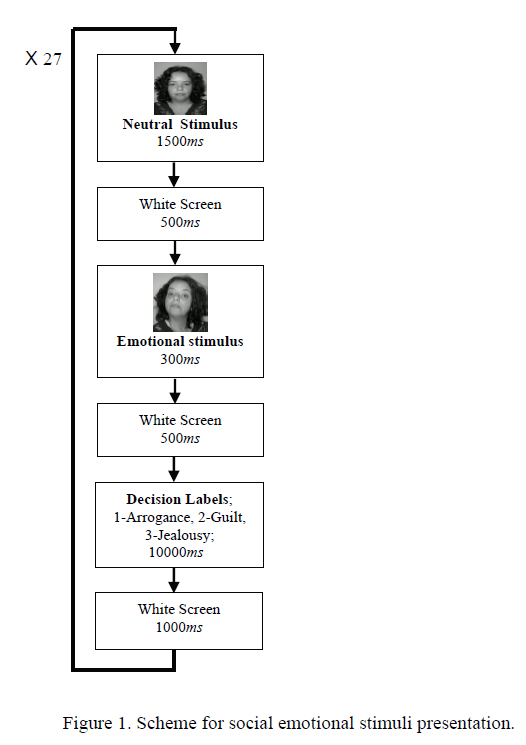
<body><![CDATA[<p><font face="Verdana" size="2">The cognitive measures included the following tests:</font></p>          <p><font face="Verdana" size="2"><i>Raven&#8217;s progressive matrices (RPM).</i> Raven&#8217;s Progressive Matrices are multiple choice tests of abstract reasoning. The booklet comprises five sets (A to E) of 12 items each, with items within each set presented in increasingly order of difficulty (Raven, Court, &#38; Raven, 2001).</font></p>          <p><font face="Verdana" size="2"><i>Wechsler&#8217;s memory scale-digit span (WM).</i> Wechsler&#8217;s memory scale digit span task has two distinct phases. In the first phase participants had to repeat a series of numbers forward, i.e., exactly like he/she listened. In the second phase participants had to repeat it backwards, i.e., in the reversed order he/she listened. In the end, the average of numbers correctly repeated was calculated (Wechsler, 1999).</font></p>          <p><font face="Verdana" size="2"><i>Trail making test - part B (TMT).</i> This is an attention and planning task. Participants should connect numbers and letters in an increasing order (e.g., A-1). In this task accuracy and time needed to complete the task were assessed (O&#8217;Bryant, Hilsabeck, Fisher, &#38; McCaffrey, 2003).</font></p>          <p><font face="Verdana" size="2"><i>Verbal fluency test (VFT).</i> This cognitive test was used to assess speech fluency. Participants were asked to name as many animals as possible in just one minute.</font></p>          <p><font face="Verdana" size="2"><i>Famous faces recognition test (FFRT).</i> This is a facial and emotional recognition task. This task allowed us to see if participants had deficits in recognising facial or emotional expressions. Pictures of famous Portuguese people were shown to participants. Afterwards, participants were asked who that person was and what that person was feeling.</font></p>          <p><font face="Verdana" size="2"><i>Stimuli and Task</i></font></p>          <p><font face="Verdana" size="2">A social emotion recognition task was designed to assess participants&#8217; ability to recognise social emotions. It consisted of stimuli presentation and accuracy and reaction times were measured. In order to present stimuli and to register accuracy and reaction times, a computer software Presentation was used (version 0.7).</font></p>          <p><font face="Verdana" size="2">The stimuli material used was previously validated (Martins &#38; Reis, 2007). Three actors were selected (one man and two women), who represented three different social emotions with an <i>Alpha of Krippendorff</i> &#8217;s<a href="#4"><sup>4</sup></a><a name="top4"></a> index &#60; 70: arrogance, guilt, jealousy, and one neutral per actor. Black and White photographs, with 44,46 cm / 50 cm were selected. Each of the three selected actors represented each of the three social emotions under study (nine different photographs were used). Each photograph was presented three times to each participant, so each emotion was presented nine times (minimum score=0; maximum score=9). In this way, each participant perceived 27 stimuli (minimum score = 0; maximum score = 27).</font></p>          <p><font face="Verdana" size="2">The paradigm used to measure participants&#8217; ability to decode specific emotional facial expressions was adapted from Kessler, Bayerl, Deighton and Traue (2002). This paradigm was composed of the stimuli described above: photographs of the same actor were presented sequentially: first, a neutral photograph (presented for 1500 ms) and then a photograph representing one of the three social emotions (300 ms). Each participant was instructed to categorise each presented emotion within a visual forced-choice answering format (10000 ms). All three forced-choice categories were presented in a randomized order. After participants had made their choice, or after the 10000 ms timed out, the next trial started automatically. To use the same actor in the neutral and in the emotional phases allowed us to control the physiognomic changes, and allowed participants to interpret modifications in the actor&#8217;s facial expression.</font></p>          ]]></body>
<body><![CDATA[<p><font face="Verdana" size="2"><i>Procedure</i></font></p>          <p><font face="Verdana" size="2">An individual session was arranged with each participant, with a medium duration of 60 minutes in a quiet room. Informed consent was obtained from all subjects, after the nature of the study had been explained. In the beginning participants filled in a demographic questionnaire, where they were also asked about neurological medical record. After filling in the demographic questionnaire, cognitive tests described above were administered, always in the same order (RPM, WM, TMT, VFT, and FFRT<a href="#5"><sup>5</sup></a><a name="top5"></a>). Afterwards participants performed the visual emotion recognition task. At the end of the session participants were thanked and debriefed.</font></p>      <p>&nbsp;</p> <img src="/img/revistas/psi/v22n2/22n2a05f1.jpg">     
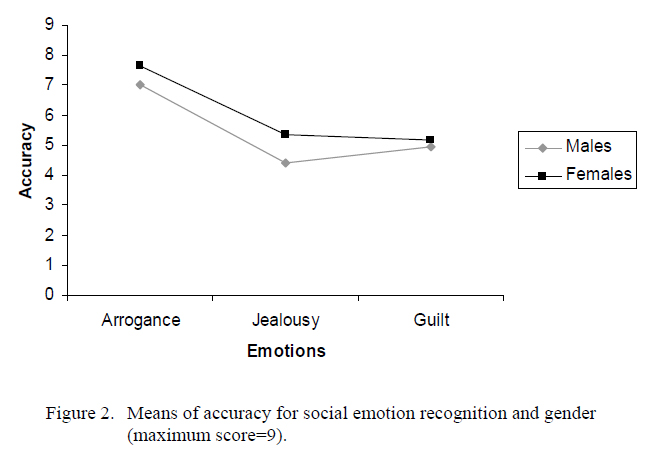
<p>&nbsp;</p>          <p><font face="Verdana" size="2"><b>Results</b></font></p>          <p><font face="Verdana" size="2"><i>Accuracy Rates</i></font></p>          <p><font face="Verdana" size="2">In our first set of analyses, we assessed accuracy rates of recognition of facial emotional expressions, for male and female participants. Accuracy scores were tested against chance level (33,3%) for males and females. Scores were converted in percentages and analysed with t-test. Both genders performed above chance level for arrogance recognition (males: <i>M</i> = 78,52%, <i>SD</i> = 17,73, <i>t</i> (29) = 13,97, <i>p</i> &#60; 0,001; females: <i>M</i> = 85,19%, <i>SD</i> = 14,69, <i>t</i> (29) = 19,35, <i>p</i> &#60; 0,001), for jealousy recognition (males: <i>M</i> = 49,63%, <i>SD</i> = 20,99, <i>t</i> (29) = 4,26, <i>p</i> &#60; 0,001; females: <i>M</i> = 59,63%, <i>SD</i> = 21,73, <i>t</i> (29) = 6,64, <i>p</i> &#60; 0,001), and for guilt recognition (males: <i>M</i> = 52,96%, <i>SD</i> = 20,15, <i>t</i> (29) = 5,35, <i>p</i> &#60; 0,001; females: <i>M</i> = 57,41%, <i>SD</i> = 19,59, <i>t</i> (29)= 6,14, p &#60; 0,001). A 2 (gender of participant: male vs. female) x 3 (social emotions recognition: arrogance vs. jealousy vs. guilt) repeated measures ANOVA was calculated. Gender was entered as a between subjects factor and facial emotion expression as a within subjects factor. The results showed a main effect of gender (F(1, 58) = 4,71, <i>p</i> &#60; 0,05, n/ = 0,08), and a main effect of facial emotional expression <i>(F(2, </i>57) = 54,31, <i>p</i> &#60; 0,001, n<i>p</i> = 0,66). Pairwise comparisons showed higher scores for arrogance (M = 7,37, <i>SD</i> = 1,48) when compared to jealousy (M = 4,92, <i>SD</i> = 1,96, <i>p</i> &#60; 0,001), and to guilt (M = 4,97, <i>SD</i> = 1,78, <i>p</i> &#60; 0,001). No significant interaction effect between gender and emotion accuracy levels was found. Generally, a difference between males and females in recognition of social emotions was observed. Women showed higher levels of accuracy for arrogance <i>(M</i> = 7,67, <i>SD</i> = 1,32), for jealousy (M = 5,37, <i>SD</i> = 1,96) and for guilt (M = 5,17, <i>SD</i> = 1,76) compared to males (arrogance: <i>M</i> = 7,07, <i>SD</i> = 1,60; jealousy: <i>M</i> = 4,46, <i>SD</i> = 1,89; and guilt: <i>M</i> = 4,77, <i>SD</i> = 1,81) (<a href="/img/revistas/psi/v22n2/22n2a05f2.jpg">Figure 2</a>).</font></p>          
<p><font face="Verdana" size="2"><i>Reaction Times</i></font></p>          <p><font face="Verdana" size="2">Reaction times (in ms) of accurate responses were analysed in order to assess the relative speed of males and females in emotion recognition. A 2 (gender of participant: male vs. female) x 3 (social emotions recognition: arrogance vs. jealousy vs. guilt) repeated measures ANOVA was calculated. Gender was entered as a between subjects factor and recognition reaction times as a within subjects factor. There was a significant main effect for social emotions recognition (F(2, 57) = 45,76, <i>p</i> &#60; 0,001, p/ = 0,62). Pairwise comparisons showed that reaction times for arrogance recognition were inferior (M = 1656,82; <i>SD</i> = 708,73) when compared to jealousy (M = 2608,04, <i>SD</i> = 817,20, <i>p</i> &#60; 0,001) and to guilt (M = 2304,74, <i>SD</i> = 845,05, <i>p</i> &#60; 0,001). Reaction times to responses were also superior for jealousy than for guilt <i>(p</i> &#60; 0,05). There was no main effect of gender <i>(F</i> &#60; 1). A significant interaction effect between gender and social emotions emerged (F(2, 57) = 3,21, <i>p</i> &#60; 0,05, n/ = 0,10). Females presented a more consistent pattern of response speed (arrogance: <i>M</i> = 1777,35, <i>SD</i> = 790,12; jealousy: <i>M </i>= 2537,05, <i>SD</i> = 696,59; guilt: <i>M</i> = 2158,49, <i>SD</i> = 792,48) while males were faster than females to recognise arrogance (M = 1536,29, <i>SD</i> = 606,27), but slower to recognise jealousy <i>(M</i> = 2679,02, <i>SD</i> = 928,97) and guilt (M = 2456,03, <i>SD</i> = 898,70).</font></p>          <p>&nbsp;</p>     <a href="/img/revistas/psi/v22n2/22n2a05f3.jpg">Figure 3</a>         
]]></body>
<body><![CDATA[<p>&nbsp;</p>          <p><font face="Verdana" size="2"><i>Cognitive Tests</i></font></p>          <p><font face="Verdana" size="2">We analysed cognitive abilities to test whether they were related to emotion recognition. A Pearson&#8217;s correlation was used to analyse the relation between emotions (accuracy and reaction times) and cognitive functioning. To test this prediction, we computed a variable with the sum of accuracy scores (minimum score = 0; maximum = 27), and another variable with the individual global average of reaction times for correct emotion recognition.</font></p>          <p><font face="Verdana" size="2">Accordingly, participants who scored higher in <i>Raven&#8217;s Progressive Matrices</i> presented a better global accuracy score in emotion recognition (r = 0,38, <i>p</i> &#60; 0,01). The present results reported also a correlation between the average of speed for <i>TMT test</i> and the average of general speed for emotion recognition (r = 0,31, <i>p</i> &#60; 0,01). Generally, our results suggested a correlation between global intelligence and accuracy in emotion recognition, as well as a correlation between attention and speed of response.</font></p>          <p><font face="Verdana" size="2"><b>Discussion</b></font></p>          <p><font face="Verdana" size="2">The present study was designed to assess gender differences in social emotion recognition. These results suggest a difference between males and females in recognising arrogance, jealousy and guilt. Generally females scored more accurately and faster. This is consistent with previous studies, which have focused on gender differences for recognising basic emotions (Boyatzis <i>et al.,</i> 1993; Brackett, Rivers, Shiffman, Lerner, &#38; Salovey, 2006; Brody <i>et al.,</i> 1990; Thayer &#38; Johnsen, 2000). Recognition of emotional states allows people to socially interact, to decode others&#8217; emotional expression, and to respond adequately to their needs. The role played by females in society can be a possible justification for females&#8217; better performance in emotion recognition. Evolutionary approaches state that gender differences evolved based on social roles: males were more attentive to provide food and protection while females were responsible for childcare (Bjorklund &#38; Pellegrini, 2000). Women have always been considered as main children&#8217;s caretakers, and this requirement for decoding facial expressions in young children evolved as an adaptive function. In order to respond to children&#8217;s needs, females might have to be more observant, improving their ability for recognising emotions (Babchuck <i>et al.,</i> 1985; Hampson <i>et al.,</i> 2006). Moreover, socialization differences can play an important role in emotion processing. Socialization process attributes to males and females different roles and functions, as well as different motivations, conflicts, social expectations and experiences. This functioning influences emotional experience: females are believed to be more facially expressive and they externalise emotions more often while males tend to internalise it (see also Brody, 1993).</font></p>          <p><font face="Verdana" size="2">This outline is also perceived in distinct cultures. Females experience more, and more intensively, emotional states when compared to males. Even when females report more emotional states than males, this appears to have a different pattern according to each culture, as well as each society (Brebner, 2003).</font></p>          <p><font face="Verdana" size="2">Conversely, not only culture, but also neuroanatomic differences seem to be involved in the explanation of gender differences for emotion recognition. Neurobehavioural studies have elucidated distinct neural networks for males and females, whenever they perform an emotion recognition task. Some anatomic and neurophysiologic differences between sexes have been suggested. Males and females appear to activate different neural areas and with distinct intensity. (Canli <i>et al.,</i> 2002; Hofer <i>et al.,</i> 2006; Lee <i>et al.,</i> 2002; Pizzagalli <i>et al.,</i> 2003). For instance, Klein <i>et al.</i> (2003) observed that recognition of some emotional states in women increased the activation of important brain structures to social emotion recognition, like the amygdala.</font></p>          <p><font face="Verdana" size="2">Evidence shows that women are more accurate than men when they judge non-verbal emotional content (Hall &#38; Matsumoto, 2004). Even when they are presented with minimal stimulus information, women tend to decode facial expressions more easily than men. This might be due to distinct cognitive functioning for genders (Hall &#38; Matsumoto, 2004).</font></p>          <p><font face="Verdana" size="2">Our results indicate that cognition and emotion recognition appear to have a close relation. It seems that cognitive functioning and emotion recognition influence each other. Our results regarding cognitive assessment indicate an influence of global intelligence and attention on social emotion recognition. Ohman, Flykt and Esteves (2001) observed the importance of attention on threatening stimuli. These authors concluded that emotionally provocative stimuli were more successful in capturing the focus of attention. It would be interesting to analyse cognitive differences according to gender, and to relate these with emotion recognition. Unfortunately, our sample size is not large enough to do this analysis by gender, comparing males and females. It would be also good to increase the number of participants, in order to assess gender differences in a larger sample. Another limitation of this study is the number of negative social facial expressions that we used in this paradigm. Ideally, further research should include facial expressions representative of positive social emotions.</font></p>          ]]></body>
<body><![CDATA[<p><font face="Verdana" size="2">On a more general level, the present research adds a new perspective for social emotion recognition. The ability to recognise emotions is one of the main abilities in social life. Emotional recognition has been explored using mainly facial expressions of basic emotions. Tracy and Robins (2004) suggest that non-basic emotions are not easy to describe, because they involve not only facial expression, but also bodily posture. Even anatomically, social emotions require more complex cognitive procedures (Griffiths, 1997), and their recognition may depend on the social context. This complexity associated to social emotional expressions is one of the reasons why social emotions are understudied. However, basic emotions as well as social emotions play an important role in regulating social behaviour. Indeed social emotions are suggested to be especially important to regulate both, social and, more specifically, moral behaviour (see also Adolphs, 2003). On the other hand, gender roles modulate, and are modulated by social behaviour: emotional concepts raise distinct behaviours and schemes in males and females (Shields, 2002). Using minimal stimuli information as facial expressions of social emotions, it is possible to distinguish a different pattern between males and females for social emotion recognition. It might be that males and females learn to use emotional information distinctly, and the pattern of recognition of social emotions like arrogance, jealousy, and guilt might justify differences in social and moral behaviour.</font></p>               <p>&nbsp;</p>         <p><font face="Verdana" size="2"><b>References</b></font></p>          <!-- ref --><p><font face="Verdana" size="2">Adolphs, R. (2002). Recognizing emotions from facial expressions: Psychological and neurological mechanisms. <i>Behavioral and Cognitive Neuroscience Reviews, 1,</i>21-62.    &nbsp;&nbsp;&nbsp;&nbsp;&nbsp;&nbsp;&nbsp;&nbsp;[&#160;<a href="javascript:void(0);" onclick="javascript: window.open('/scielo.php?script=sci_nlinks&ref=461249&pid=S0874-2049200800020000500001&lng=','','width=640,height=500,resizable=yes,scrollbars=1,menubar=yes,');">Links</a>&#160;]<!-- end-ref --></font></p>          <!-- ref --><p><font face="Verdana" size="2">Adolphs, R. (2003). Cognitive neuroscience of human social behaviour. <i>Nature Reviews Neuroscience, 4,</i> 165-178.    &nbsp;&nbsp;&nbsp;&nbsp;&nbsp;&nbsp;&nbsp;&nbsp;[&#160;<a href="javascript:void(0);" onclick="javascript: window.open('/scielo.php?script=sci_nlinks&ref=461251&pid=S0874-2049200800020000500002&lng=','','width=640,height=500,resizable=yes,scrollbars=1,menubar=yes,');">Links</a>&#160;]<!-- end-ref --></font></p>          <!-- ref --><p><font face="Verdana" size="2">Adolphs, R., Baron-Cohen, S., &#38; Tranel, D. (2002). Impaired recognition of social emotions following amygdala damage. <i>Journal of Cognitive Neuroscience, 14, </i>1264-1274.    &nbsp;&nbsp;&nbsp;&nbsp;&nbsp;&nbsp;&nbsp;&nbsp;[&#160;<a href="javascript:void(0);" onclick="javascript: window.open('/scielo.php?script=sci_nlinks&ref=461253&pid=S0874-2049200800020000500003&lng=','','width=640,height=500,resizable=yes,scrollbars=1,menubar=yes,');">Links</a>&#160;]<!-- end-ref --></font></p>          <!-- ref --><p><font face="Verdana" size="2">Babchuk, W.A., Hames, R.B., &#38; Thompson, R.A. (1985). Sex differences in the recognition of infant facial expressions of emotion: The primary caretaker hypothesis. <i>Ethology and Sociobiology, 6,</i> 89-101.    &nbsp;&nbsp;&nbsp;&nbsp;&nbsp;&nbsp;&nbsp;&nbsp;[&#160;<a href="javascript:void(0);" onclick="javascript: window.open('/scielo.php?script=sci_nlinks&ref=461255&pid=S0874-2049200800020000500004&lng=','','width=640,height=500,resizable=yes,scrollbars=1,menubar=yes,');">Links</a>&#160;]<!-- end-ref --></font></p>          <!-- ref --><p><font face="Verdana" size="2">Bjorklund, D. F., &#38; Pellegrini, A. D. (2000). Child development and evolutionary psychology. <i>Child Development, 71,</i> 1687-1708.    &nbsp;&nbsp;&nbsp;&nbsp;&nbsp;&nbsp;&nbsp;&nbsp;[&#160;<a href="javascript:void(0);" onclick="javascript: window.open('/scielo.php?script=sci_nlinks&ref=461257&pid=S0874-2049200800020000500005&lng=','','width=640,height=500,resizable=yes,scrollbars=1,menubar=yes,');">Links</a>&#160;]<!-- end-ref --></font></p>          <!-- ref --><p><font face="Verdana" size="2">Boyatzis, C. J., Chazan, E., &#38; Ting, C. Z. (1993). Preschool children&#8217;s decoding of facial emotions. <i>Journal of Genetic Psychology, 154,</i>375-382.    &nbsp;&nbsp;&nbsp;&nbsp;&nbsp;&nbsp;&nbsp;&nbsp;[&#160;<a href="javascript:void(0);" onclick="javascript: window.open('/scielo.php?script=sci_nlinks&ref=461259&pid=S0874-2049200800020000500006&lng=','','width=640,height=500,resizable=yes,scrollbars=1,menubar=yes,');">Links</a>&#160;]<!-- end-ref --></font></p>          <!-- ref --><p><font face="Verdana" size="2">Brackett, M. A., Rivers, S. E., Shiffman, S., Lerner, N., &#38; Salovey, P. (2006). Relating emotional abilities to social functioning: A comparison of self-report and performance measures of emotional intelligence. <i>Journal of Personality and Social Psychology, 91,</i> 780-795.    &nbsp;&nbsp;&nbsp;&nbsp;&nbsp;&nbsp;&nbsp;&nbsp;[&#160;<a href="javascript:void(0);" onclick="javascript: window.open('/scielo.php?script=sci_nlinks&ref=461261&pid=S0874-2049200800020000500007&lng=','','width=640,height=500,resizable=yes,scrollbars=1,menubar=yes,');">Links</a>&#160;]<!-- end-ref --></font></p>          <!-- ref --><p><font face="Verdana" size="2">Brebner, J. (2003). Gender and emotion. <i>Personality and Individual Differences, 34,</i> 387-394.    &nbsp;&nbsp;&nbsp;&nbsp;&nbsp;&nbsp;&nbsp;&nbsp;[&#160;<a href="javascript:void(0);" onclick="javascript: window.open('/scielo.php?script=sci_nlinks&ref=461263&pid=S0874-2049200800020000500008&lng=','','width=640,height=500,resizable=yes,scrollbars=1,menubar=yes,');">Links</a>&#160;]<!-- end-ref --></font></p>          <p><font face="Verdana" size="2">Brody, L. R. (1993). On understanding gender differences in the expression of emotions: Gender roles, socialization, and language. In S. L. Ablon, D. Brown, E. J. Khantzian, &#38; J. E. Mack (Eds.), <i>Human feelings: Explorations in affect development and meaning</i> (pp. 89-121). Hillsdale, N. J.: Analytic Press.</font></p>          ]]></body>
<body><![CDATA[<!-- ref --><p><font face="Verdana" size="2">Brody, L. R., Hay, D. H., &#38; Vandewater, E. A. (1990). Gender, gender-role identity and children&#8217;s reported feelings toward the same and opposite sex. <i>Sex Roles, 23,</i> 363-387.    &nbsp;&nbsp;&nbsp;&nbsp;&nbsp;&nbsp;&nbsp;&nbsp;[&#160;<a href="javascript:void(0);" onclick="javascript: window.open('/scielo.php?script=sci_nlinks&ref=461266&pid=S0874-2049200800020000500010&lng=','','width=640,height=500,resizable=yes,scrollbars=1,menubar=yes,');">Links</a>&#160;]<!-- end-ref --></font></p>          <!-- ref --><p><font face="Verdana" size="2">Calvo, M. G., &#38; Esteves, F. (2005). Detection of emotional faces: Low perceptual threshold and wide attentional span. <i>Visual Cognition, 12,</i>13-27.    &nbsp;&nbsp;&nbsp;&nbsp;&nbsp;&nbsp;&nbsp;&nbsp;[&#160;<a href="javascript:void(0);" onclick="javascript: window.open('/scielo.php?script=sci_nlinks&ref=461268&pid=S0874-2049200800020000500011&lng=','','width=640,height=500,resizable=yes,scrollbars=1,menubar=yes,');">Links</a>&#160;]<!-- end-ref --></font></p>          <!-- ref --><p><font face="Verdana" size="2">Canli, T., Desmond, J. E., Zhao, Z., &#38; Gabrieli, J. D. E. (2002). Sex differences in the neural bases of emotional memories. <i>Proceedings of the National Academy of Sciences, 99,</i> 10789-10794.    &nbsp;&nbsp;&nbsp;&nbsp;&nbsp;&nbsp;&nbsp;&nbsp;[&#160;<a href="javascript:void(0);" onclick="javascript: window.open('/scielo.php?script=sci_nlinks&ref=461270&pid=S0874-2049200800020000500012&lng=','','width=640,height=500,resizable=yes,scrollbars=1,menubar=yes,');">Links</a>&#160;]<!-- end-ref --></font></p>          <!-- ref --><p><font face="Verdana" size="2">Dam&#225;sio, A. R. (1994). <i>Descartes&#8217; error: Emotion, reason and the human brain.</i> New York: Grosset/Putnam.    &nbsp;&nbsp;&nbsp;&nbsp;&nbsp;&nbsp;&nbsp;&nbsp;[&#160;<a href="javascript:void(0);" onclick="javascript: window.open('/scielo.php?script=sci_nlinks&ref=461272&pid=S0874-2049200800020000500013&lng=','','width=640,height=500,resizable=yes,scrollbars=1,menubar=yes,');">Links</a>&#160;]<!-- end-ref --></font></p>          <!-- ref --><p><font face="Verdana" size="2">Dam&#225;sio, A. R. (2000). <i>The feeling of what happens: Body and emotion in the making of consciousness</i>. London: Vintage.    &nbsp;&nbsp;&nbsp;&nbsp;&nbsp;&nbsp;&nbsp;&nbsp;[&#160;<a href="javascript:void(0);" onclick="javascript: window.open('/scielo.php?script=sci_nlinks&ref=461274&pid=S0874-2049200800020000500014&lng=','','width=640,height=500,resizable=yes,scrollbars=1,menubar=yes,');">Links</a>&#160;]<!-- end-ref --></font></p>          ]]></body>
<body><![CDATA[<p><font face="Verdana" size="2">Dam&#225;sio, A. R. (2003). <i>Ao encontro de Espinosa - As emo&#231;&#245;es sociais e a neurologia do sentir</i> [Looking for Spinoza: Joy, sorrow, and the feeling brain]. Lisboa: Publica&#231;&#245;es Europa-Am&#233;rica.</font></p>          <!-- ref --><p><font face="Verdana" size="2">Dam&#225;sio, A. R. (2007). Neuroscience and ethics: Intersections. <i>The American Journal of Bioethics,</i> 7, 3.    &nbsp;&nbsp;&nbsp;&nbsp;&nbsp;&nbsp;&nbsp;&nbsp;[&#160;<a href="javascript:void(0);" onclick="javascript: window.open('/scielo.php?script=sci_nlinks&ref=461277&pid=S0874-2049200800020000500016&lng=','','width=640,height=500,resizable=yes,scrollbars=1,menubar=yes,');">Links</a>&#160;]<!-- end-ref --></font></p>          <!-- ref --><p><font face="Verdana" size="2">Dolan, R. J. (2002). Emotion, cognition, and behavior. <i>Science, 298,</i>1191-1194.    &nbsp;&nbsp;&nbsp;&nbsp;&nbsp;&nbsp;&nbsp;&nbsp;[&#160;<a href="javascript:void(0);" onclick="javascript: window.open('/scielo.php?script=sci_nlinks&ref=461279&pid=S0874-2049200800020000500017&lng=','','width=640,height=500,resizable=yes,scrollbars=1,menubar=yes,');">Links</a>&#160;]<!-- end-ref --></font></p>          <!-- ref --><p><font face="Verdana" size="2">Ekman, P. (1992). An argument for basic emotions. <i>Cognition and Emotion, 6,</i>169-200.    &nbsp;&nbsp;&nbsp;&nbsp;&nbsp;&nbsp;&nbsp;&nbsp;[&#160;<a href="javascript:void(0);" onclick="javascript: window.open('/scielo.php?script=sci_nlinks&ref=461281&pid=S0874-2049200800020000500018&lng=','','width=640,height=500,resizable=yes,scrollbars=1,menubar=yes,');">Links</a>&#160;]<!-- end-ref --></font></p>          <!-- ref --><p><font face="Verdana" size="2">Griffiths, P. E. (1997). <i>What emotions really are: The problem of psychological categories.</i> Chicago: University of Chicago Press.    &nbsp;&nbsp;&nbsp;&nbsp;&nbsp;&nbsp;&nbsp;&nbsp;[&#160;<a href="javascript:void(0);" onclick="javascript: window.open('/scielo.php?script=sci_nlinks&ref=461283&pid=S0874-2049200800020000500019&lng=','','width=640,height=500,resizable=yes,scrollbars=1,menubar=yes,');">Links</a>&#160;]<!-- end-ref --></font></p>          <!-- ref --><p><font face="Verdana" size="2">Hall, J. A., &#38; Matsumoto, D. (2004). Gender differences in judgements of multiple emotions of facial expressions. <i>Emotion, 4,</i> 201-206.    &nbsp;&nbsp;&nbsp;&nbsp;&nbsp;&nbsp;&nbsp;&nbsp;[&#160;<a href="javascript:void(0);" onclick="javascript: window.open('/scielo.php?script=sci_nlinks&ref=461285&pid=S0874-2049200800020000500020&lng=','','width=640,height=500,resizable=yes,scrollbars=1,menubar=yes,');">Links</a>&#160;]<!-- end-ref --></font></p>          <!-- ref --><p><font face="Verdana" size="2">Hampson, E., van Andres, S.M., &#38; Mullin, L. (2006). A female advantage in the recognition of emotional facial expressions: Test of an evolutionary hypothesis. Evolution and Human Behavior, 27,</i> 401-416.    &nbsp;&nbsp;&nbsp;&nbsp;&nbsp;&nbsp;&nbsp;&nbsp;[&#160;<a href="javascript:void(0);" onclick="javascript: window.open('/scielo.php?script=sci_nlinks&ref=461287&pid=S0874-2049200800020000500021&lng=','','width=640,height=500,resizable=yes,scrollbars=1,menubar=yes,');">Links</a>&#160;]<!-- end-ref --></font></p>          <!-- ref --><p><font face="Verdana" size="2">Haxby, J. V., Hoffman, E. A., &#38; Gobbini, M. I. (2000). The distributed human neural system for face perception. <i>Trends in Cognitive Science, 4,</i> 223-233.    &nbsp;&nbsp;&nbsp;&nbsp;&nbsp;&nbsp;&nbsp;&nbsp;[&#160;<a href="javascript:void(0);" onclick="javascript: window.open('/scielo.php?script=sci_nlinks&ref=461289&pid=S0874-2049200800020000500022&lng=','','width=640,height=500,resizable=yes,scrollbars=1,menubar=yes,');">Links</a>&#160;]<!-- end-ref --></font></p>          <!-- ref --><p><font face="Verdana" size="2">Hayes, A. F., &#38; Krippendorff, K. (2007). Answering the call for a standard reliability measure for coding data. <i>Communication Methods and Measures, 1,</i>77-89.    &nbsp;&nbsp;&nbsp;&nbsp;&nbsp;&nbsp;&nbsp;&nbsp;[&#160;<a href="javascript:void(0);" onclick="javascript: window.open('/scielo.php?script=sci_nlinks&ref=461291&pid=S0874-2049200800020000500023&lng=','','width=640,height=500,resizable=yes,scrollbars=1,menubar=yes,');">Links</a>&#160;]<!-- end-ref --></font></p>          <!-- ref --><p><font face="Verdana" size="2">Hofer, A., Siedentopf, C. M., Ischebeck, A., Rettenbacher, M. A., Verius, M., Fel-ber, S., <i>et al.</i> (2006). Gender differences in regional cerebral activity during the perception of emotion: A functional MRI study. <i>Neuroimage, 32,</i> 854-862.    &nbsp;&nbsp;&nbsp;&nbsp;&nbsp;&nbsp;&nbsp;&nbsp;[&#160;<a href="javascript:void(0);" onclick="javascript: window.open('/scielo.php?script=sci_nlinks&ref=461293&pid=S0874-2049200800020000500024&lng=','','width=640,height=500,resizable=yes,scrollbars=1,menubar=yes,');">Links</a>&#160;]<!-- end-ref --></font></p>          <!-- ref --><p><font face="Verdana" size="2">Kessler, H., Bayerl, P., Deighton, R. M., &#38; Traue, H. C. (2002). Facially expressed emotion labelling (feel): Pc-gestutzter test zur emotionserkennung. <i>Verhaltenstherapie und Verhaltensmedizin, 23,</i> 297-306.    &nbsp;&nbsp;&nbsp;&nbsp;&nbsp;&nbsp;&nbsp;&nbsp;[&#160;<a href="javascript:void(0);" onclick="javascript: window.open('/scielo.php?script=sci_nlinks&ref=461295&pid=S0874-2049200800020000500025&lng=','','width=640,height=500,resizable=yes,scrollbars=1,menubar=yes,');">Links</a>&#160;]<!-- end-ref --></font></p>          <!-- ref --><p><font face="Verdana" size="2">Klein, S., Smolka, M. N., Wrase, J., Gruesser, S. M., Mann, K., Braus, D. F., <i>et al.</i> (2003). The influence of gender and emotional valence of visual cues on fMRI activation in humans. <i>Pharmacopsychiatry, 36,</i> 191-194.    &nbsp;&nbsp;&nbsp;&nbsp;&nbsp;&nbsp;&nbsp;&nbsp;[&#160;<a href="javascript:void(0);" onclick="javascript: window.open('/scielo.php?script=sci_nlinks&ref=461297&pid=S0874-2049200800020000500026&lng=','','width=640,height=500,resizable=yes,scrollbars=1,menubar=yes,');">Links</a>&#160;]<!-- end-ref --></font></p>          <!-- ref --><p><font face="Verdana" size="2">Kring, A. M., &#38; Gordon, A. H. (1998). Sex differences in emotion: Expression, experience and physiology. <i>Journal of Personality and Social Psychology, 74, </i>686-703.    &nbsp;&nbsp;&nbsp;&nbsp;&nbsp;&nbsp;&nbsp;&nbsp;[&#160;<a href="javascript:void(0);" onclick="javascript: window.open('/scielo.php?script=sci_nlinks&ref=461299&pid=S0874-2049200800020000500027&lng=','','width=640,height=500,resizable=yes,scrollbars=1,menubar=yes,');">Links</a>&#160;]<!-- end-ref --></font></p>          <!-- ref --><p><font face="Verdana" size="2">LaFrance, M., Hecht, M. A., &#38; Paluck, E. L. (2003). The contingent smile: A meta-analysis of sex differences in smiling. <i>Psychological Bulletin, 129,</i>305-324.    &nbsp;&nbsp;&nbsp;&nbsp;&nbsp;&nbsp;&nbsp;&nbsp;[&#160;<a href="javascript:void(0);" onclick="javascript: window.open('/scielo.php?script=sci_nlinks&ref=461301&pid=S0874-2049200800020000500028&lng=','','width=640,height=500,resizable=yes,scrollbars=1,menubar=yes,');">Links</a>&#160;]<!-- end-ref --></font></p>          <!-- ref --><p><font face="Verdana" size="2">Lee, T. M., Liu, H. L., Hoosain, R., Liao, W. T., Wu, C. T., Yuen, K. S., <i>et al.</i> (2002). Gender differences in neural correlates of recognition of happy and sad faces in human assessed by functional magnetic resonance imaging. <i>Neuroscience Letters, 333,</i> 13-16.    &nbsp;&nbsp;&nbsp;&nbsp;&nbsp;&nbsp;&nbsp;&nbsp;[&#160;<a href="javascript:void(0);" onclick="javascript: window.open('/scielo.php?script=sci_nlinks&ref=461303&pid=S0874-2049200800020000500029&lng=','','width=640,height=500,resizable=yes,scrollbars=1,menubar=yes,');">Links</a>&#160;]<!-- end-ref --></font></p>          <p><font face="Verdana" size="2">Martins, A., &#38; Reis, A. (2007). Valida&#231;&#227;o de est&#237;mulos para constru&#231;&#227;o de paradigmas para o estudo do reconhecimento de emo&#231;&#245;es [Stimuli validation for emotion recognition paradigms]. Provas de Aptid&#227;o e Capacidade Cient&#237;fica pela Universidade do Algarve.</font></p>          ]]></body>
<body><![CDATA[<p><font face="Verdana" size="2">Martins, A., Muresan, A., Justo, M., &#38; Sim&#227;o, C. (2008). Basic and social emotion recognition in patients with Parkinson disease. <i>Journal of Neurological Sciences [Turkish], 25,</i> 247-257.</font></p>          <p><font face="Verdana" size="2">McClure, E. B. (2000). A meta-analytic review of sex differences in facial expression processing and their development in infants, children, and adolescents.</font></p>          <p><font face="Verdana" size="2"><i>Psychological Bulletin, 126,</i>424-453.</font></p>          <!-- ref --><p><font face="Verdana" size="2">O&#8217;Bryant, S. E., Hilsabeck, R. L., Fisher, J. M., &#38; McCaffrey, R. J. (2003). Utility of the trail making test in the assessment of malingering in a sample of mild traumatic brain injury litigants. <i>The Clinical Neuropsychologist, 17,</i> 69-74.    &nbsp;&nbsp;&nbsp;&nbsp;&nbsp;&nbsp;&nbsp;&nbsp;[&#160;<a href="javascript:void(0);" onclick="javascript: window.open('/scielo.php?script=sci_nlinks&ref=461309&pid=S0874-2049200800020000500033&lng=','','width=640,height=500,resizable=yes,scrollbars=1,menubar=yes,');">Links</a>&#160;]<!-- end-ref --></font></p>          <!-- ref --><p><font face="Verdana" size="2">Ohman, A., Flykt, A., &#38; Esteves, F. (2001). Emotion drives attention: Detecting the snake in the grass. <i>Journal of Experimental Psychology: General, 130,</i>466-478.    &nbsp;&nbsp;&nbsp;&nbsp;&nbsp;&nbsp;&nbsp;&nbsp;[&#160;<a href="javascript:void(0);" onclick="javascript: window.open('/scielo.php?script=sci_nlinks&ref=461311&pid=S0874-2049200800020000500034&lng=','','width=640,height=500,resizable=yes,scrollbars=1,menubar=yes,');">Links</a>&#160;]<!-- end-ref --></font></p>          <!-- ref --><p><font face="Verdana" size="2">Pizzagalli, D., Shackman, A. J., &#38; Davidson, R. J. (2003). The functional neuroimaging of human emotion: Asymmetric contributions of cortical and subcortical circuitry. In R. Davidson &#38; K. Hugdahl (Eds.), <i>The asymmetrical brain</i> (pp. 511-532). Cambridge: MIT Press.    &nbsp;&nbsp;&nbsp;&nbsp;&nbsp;&nbsp;&nbsp;&nbsp;[&#160;<a href="javascript:void(0);" onclick="javascript: window.open('/scielo.php?script=sci_nlinks&ref=461313&pid=S0874-2049200800020000500035&lng=','','width=640,height=500,resizable=yes,scrollbars=1,menubar=yes,');">Links</a>&#160;]<!-- end-ref --></font></p>          <p><font face="Verdana" size="2">Raven, J., Court, J. H, &#38; Raven, J. C. (2001). <i>Raven matrices progresivas</i>[Raven&#8217;s progressive matrices]<i>.</i>Madrid: Publicaciones de Psicolog&#237;a Aplicada.</font></p>          ]]></body>
<body><![CDATA[<!-- ref --><p><font face="Verdana" size="2">Russell, J. A. (1980). A circumplex model of affect. <i>Journal of Personality and Social Psychology, 39,</i> 1161-1178.    &nbsp;&nbsp;&nbsp;&nbsp;&nbsp;&nbsp;&nbsp;&nbsp;[&#160;<a href="javascript:void(0);" onclick="javascript: window.open('/scielo.php?script=sci_nlinks&ref=461316&pid=S0874-2049200800020000500037&lng=','','width=640,height=500,resizable=yes,scrollbars=1,menubar=yes,');">Links</a>&#160;]<!-- end-ref --></font></p>          <!-- ref --><p><font face="Verdana" size="2">Russel, J. A., &#38; Fern&#225;ndez-Dols, J. M. (1997). What does a facial expression mean? In J. A. Russel &#38; J. Fern&#225;ndez-Dols (Eds.), <i>The psychology of facial expression</i>pp. 3-30). New York: Cambridge University Press.    &nbsp;&nbsp;&nbsp;&nbsp;&nbsp;&nbsp;&nbsp;&nbsp;[&#160;<a href="javascript:void(0);" onclick="javascript: window.open('/scielo.php?script=sci_nlinks&ref=461318&pid=S0874-2049200800020000500038&lng=','','width=640,height=500,resizable=yes,scrollbars=1,menubar=yes,');">Links</a>&#160;]<!-- end-ref --></font></p>          <!-- ref --><p><font face="Verdana" size="2">Shields, A. (2002). <i>Speaking from the heart: Gender and the social meaning of emotion.</i> Cambridge: Cambridge University Press.    &nbsp;&nbsp;&nbsp;&nbsp;&nbsp;&nbsp;&nbsp;&nbsp;[&#160;<a href="javascript:void(0);" onclick="javascript: window.open('/scielo.php?script=sci_nlinks&ref=461320&pid=S0874-2049200800020000500039&lng=','','width=640,height=500,resizable=yes,scrollbars=1,menubar=yes,');">Links</a>&#160;]<!-- end-ref --></font></p>          <!-- ref --><p><font face="Verdana" size="2">Suzuki, A., Hoshino, T., &#38; Shigemasu, K. (2006). Measuring individual differences in sensivities to basic emotions in faces. <i>Cognition, 99,</i>327-353.    &nbsp;&nbsp;&nbsp;&nbsp;&nbsp;&nbsp;&nbsp;&nbsp;[&#160;<a href="javascript:void(0);" onclick="javascript: window.open('/scielo.php?script=sci_nlinks&ref=461322&pid=S0874-2049200800020000500040&lng=','','width=640,height=500,resizable=yes,scrollbars=1,menubar=yes,');">Links</a>&#160;]<!-- end-ref --></font></p>          <!-- ref --><p><font face="Verdana" size="2">Tamietto, M., Adenzato, M., Geminiani, G., &#38; Gelder, B. (2007) Fast recognition of social emotions takes the whole brain: Interhemispheric cooperation in the absence of cerebral asymmetry. <i>Neuropsychologia, 45,</i> 836-843.    &nbsp;&nbsp;&nbsp;&nbsp;&nbsp;&nbsp;&nbsp;&nbsp;[&#160;<a href="javascript:void(0);" onclick="javascript: window.open('/scielo.php?script=sci_nlinks&ref=461324&pid=S0874-2049200800020000500041&lng=','','width=640,height=500,resizable=yes,scrollbars=1,menubar=yes,');">Links</a>&#160;]<!-- end-ref --></font></p>          ]]></body>
<body><![CDATA[<!-- ref --><p><font face="Verdana" size="2">Thayer, J. F., &#38; Johnsen, B. H. (2000). Sex differences in judgement of facial affect: A multivariate analysis of recognition errors. <i>Scandinavian Journal of Psychology, 41,</i> 243-246.    &nbsp;&nbsp;&nbsp;&nbsp;&nbsp;&nbsp;&nbsp;&nbsp;[&#160;<a href="javascript:void(0);" onclick="javascript: window.open('/scielo.php?script=sci_nlinks&ref=461326&pid=S0874-2049200800020000500042&lng=','','width=640,height=500,resizable=yes,scrollbars=1,menubar=yes,');">Links</a>&#160;]<!-- end-ref --></font></p>          <!-- ref --><p><font face="Verdana" size="2">Tracy, J. L., &#38; Robins, R. W. (2004). Putting the self into self-conscious emotions: A theoretical model. <i>Psychological Inquiry, 15,</i> 103-125.    &nbsp;&nbsp;&nbsp;&nbsp;&nbsp;&nbsp;&nbsp;&nbsp;[&#160;<a href="javascript:void(0);" onclick="javascript: window.open('/scielo.php?script=sci_nlinks&ref=461328&pid=S0874-2049200800020000500043&lng=','','width=640,height=500,resizable=yes,scrollbars=1,menubar=yes,');">Links</a>&#160;]<!-- end-ref --></font></p>          <p><font face="Verdana" size="2">Wechsler, D. (1999). <i>WAIS escala de inteligencia de Wechsler para adultos</i> [Wechsler adult intelligence scale (WAIS)]<i>.</i>Madrid: Publicaciones de Psi-colog&#237;a Aplicada.</font></p>          <p>&nbsp;</p>         <p><font face="Verdana" size="2">We wish to thank Allard Feddes for statistical advice and Lisa Schubert and Rodrigo Brito for helpful comments on previous drafts.</font></p>          <p>&nbsp;</p>         <p><font face="Verdana" size="2"><b>Notes</b></font></p>         <p><font face="Verdana" size="2"><a href="#top4"><sup>4</sup></a><a name="4"></a>Krippendorffs Alpha is a coefficient of reliability developed to assess the agreement between independent observers, who were given common instructions to the same set of phenomena (Hayes &#38; Krippendorff, 2007).</font></p>         ]]></body>
<body><![CDATA[<p><font face="Verdana" size="2"><a href="#top5"><sup>5</sup></a><a name="5"></a>RPM - Raven&#8217;s Progressive Matrices; WM - Wechsler Memory Scale; TMT (Trail Making Test - Part B); VFT - Verbal Fluency Test; FFRT - Famous Faces Recognition Test.</font></p>         ]]></body><back>
<ref-list>
<ref id="B1">
<nlm-citation citation-type="journal">
<person-group person-group-type="author">
<name>
<surname><![CDATA[Adolphs]]></surname>
<given-names><![CDATA[R.]]></given-names>
</name>
</person-group>
<article-title xml:lang="en"><![CDATA[Recognizing emotions from facial expressions: Psychological and neurological mechanisms]]></article-title>
<source><![CDATA[Behavioral and Cognitive Neuroscience Reviews]]></source>
<year>2002</year>
<volume>1</volume>
<page-range>21-62</page-range></nlm-citation>
</ref>
<ref id="B2">
<nlm-citation citation-type="journal">
<person-group person-group-type="author">
<name>
<surname><![CDATA[Adolphs]]></surname>
<given-names><![CDATA[R.]]></given-names>
</name>
</person-group>
<article-title xml:lang="en"><![CDATA[Cognitive neuroscience of human social behaviour]]></article-title>
<source><![CDATA[Nature Reviews Neuroscience]]></source>
<year>2003</year>
<volume>4</volume>
<page-range>165-178</page-range></nlm-citation>
</ref>
<ref id="B3">
<nlm-citation citation-type="journal">
<person-group person-group-type="author">
<name>
<surname><![CDATA[Adolphs]]></surname>
<given-names><![CDATA[R.]]></given-names>
</name>
<name>
<surname><![CDATA[Baron-Cohen]]></surname>
<given-names><![CDATA[S.]]></given-names>
</name>
<name>
<surname><![CDATA[Tranel]]></surname>
<given-names><![CDATA[D.]]></given-names>
</name>
</person-group>
<article-title xml:lang="en"><![CDATA[Impaired recognition of social emotions following amygdala damage]]></article-title>
<source><![CDATA[Journal of Cognitive Neuroscience]]></source>
<year>2002</year>
<volume>14</volume>
<page-range>1264-1274</page-range></nlm-citation>
</ref>
<ref id="B4">
<nlm-citation citation-type="journal">
<person-group person-group-type="author">
<name>
<surname><![CDATA[Babchuk]]></surname>
<given-names><![CDATA[W.A.]]></given-names>
</name>
<name>
<surname><![CDATA[Hames]]></surname>
<given-names><![CDATA[R.B.]]></given-names>
</name>
<name>
<surname><![CDATA[Thompson]]></surname>
<given-names><![CDATA[R.A.]]></given-names>
</name>
</person-group>
<article-title xml:lang="en"><![CDATA[Sex differences in the recognition of infant facial expressions of emotion: The primary caretaker hypothesis]]></article-title>
<source><![CDATA[Ethology and Sociobiology]]></source>
<year>1985</year>
<volume>6</volume>
<page-range>89-101</page-range></nlm-citation>
</ref>
<ref id="B5">
<nlm-citation citation-type="journal">
<person-group person-group-type="author">
<name>
<surname><![CDATA[Bjorklund]]></surname>
<given-names><![CDATA[D. F.]]></given-names>
</name>
<name>
<surname><![CDATA[Pellegrini]]></surname>
<given-names><![CDATA[A. D.]]></given-names>
</name>
</person-group>
<article-title xml:lang="en"><![CDATA[Child development and evolutionary psychology]]></article-title>
<source><![CDATA[Child Development]]></source>
<year>2000</year>
<volume>71</volume>
<page-range>1687-1708</page-range></nlm-citation>
</ref>
<ref id="B6">
<nlm-citation citation-type="journal">
<person-group person-group-type="author">
<name>
<surname><![CDATA[Boyatzis]]></surname>
<given-names><![CDATA[C. J.]]></given-names>
</name>
<name>
<surname><![CDATA[Chazan]]></surname>
<given-names><![CDATA[E.]]></given-names>
</name>
<name>
<surname><![CDATA[Ting]]></surname>
<given-names><![CDATA[C. Z.]]></given-names>
</name>
</person-group>
<article-title xml:lang="en"><![CDATA[Preschool children&#8217;s decoding of facial emotions]]></article-title>
<source><![CDATA[Journal of Genetic Psychology]]></source>
<year>1993</year>
<volume>154</volume>
<page-range>375-382</page-range></nlm-citation>
</ref>
<ref id="B7">
<nlm-citation citation-type="journal">
<person-group person-group-type="author">
<name>
<surname><![CDATA[Brackett]]></surname>
<given-names><![CDATA[M. A.]]></given-names>
</name>
<name>
<surname><![CDATA[Rivers]]></surname>
<given-names><![CDATA[S. E.]]></given-names>
</name>
<name>
<surname><![CDATA[Shiffman]]></surname>
<given-names><![CDATA[S.]]></given-names>
</name>
<name>
<surname><![CDATA[Lerner]]></surname>
<given-names><![CDATA[N.]]></given-names>
</name>
<name>
<surname><![CDATA[Salovey]]></surname>
<given-names><![CDATA[P.]]></given-names>
</name>
</person-group>
<article-title xml:lang="en"><![CDATA[Relating emotional abilities to social functioning: A comparison of self-report and performance measures of emotional intelligence]]></article-title>
<source><![CDATA[Journal of Personality and Social Psychology]]></source>
<year>2006</year>
<volume>91</volume>
<page-range>780-795</page-range></nlm-citation>
</ref>
<ref id="B8">
<nlm-citation citation-type="journal">
<person-group person-group-type="author">
<name>
<surname><![CDATA[Brebner]]></surname>
<given-names><![CDATA[J.]]></given-names>
</name>
</person-group>
<article-title xml:lang="en"><![CDATA[Gender and emotion]]></article-title>
<source><![CDATA[Personality and Individual Differences]]></source>
<year>2003</year>
<volume>34</volume>
<page-range>387-394</page-range></nlm-citation>
</ref>
<ref id="B9">
<nlm-citation citation-type="book">
<person-group person-group-type="author">
<name>
<surname><![CDATA[Brody]]></surname>
<given-names><![CDATA[L. R.]]></given-names>
</name>
</person-group>
<article-title xml:lang="en"><![CDATA[On understanding gender differences in the expression of emotions: Gender roles, socialization, and language]]></article-title>
<person-group person-group-type="editor">
<name>
<surname><![CDATA[Ablon]]></surname>
<given-names><![CDATA[S. L.]]></given-names>
</name>
<name>
<surname><![CDATA[Brown]]></surname>
<given-names><![CDATA[D.]]></given-names>
</name>
<name>
<surname><![CDATA[Khantzian]]></surname>
<given-names><![CDATA[E. J.]]></given-names>
</name>
<name>
<surname><![CDATA[Mack]]></surname>
<given-names><![CDATA[J. E.]]></given-names>
</name>
</person-group>
<source><![CDATA[Human feelings: Explorations in affect development and meaning]]></source>
<year>1993</year>
<page-range>89-121</page-range><publisher-loc><![CDATA[Hillsdale ]]></publisher-loc>
<publisher-name><![CDATA[Analytic Press]]></publisher-name>
</nlm-citation>
</ref>
<ref id="B10">
<nlm-citation citation-type="journal">
<person-group person-group-type="author">
<name>
<surname><![CDATA[Brody]]></surname>
<given-names><![CDATA[L. R.]]></given-names>
</name>
<name>
<surname><![CDATA[Hay]]></surname>
<given-names><![CDATA[D. H.]]></given-names>
</name>
<name>
<surname><![CDATA[Vandewater]]></surname>
<given-names><![CDATA[E. A.]]></given-names>
</name>
</person-group>
<article-title xml:lang="en"><![CDATA[Gender, gender-role identity and children&#8217;s reported feelings toward the same and opposite sex]]></article-title>
<source><![CDATA[Sex Roles]]></source>
<year>1990</year>
<volume>23</volume>
<page-range>363-387</page-range></nlm-citation>
</ref>
<ref id="B11">
<nlm-citation citation-type="journal">
<person-group person-group-type="author">
<name>
<surname><![CDATA[Calvo]]></surname>
<given-names><![CDATA[M. G.]]></given-names>
</name>
<name>
<surname><![CDATA[Esteves]]></surname>
<given-names><![CDATA[F.]]></given-names>
</name>
</person-group>
<article-title xml:lang="en"><![CDATA[Detection of emotional faces: Low perceptual threshold and wide attentional span]]></article-title>
<source><![CDATA[Visual Cognition]]></source>
<year>2005</year>
<volume>12</volume>
<page-range>13-27</page-range></nlm-citation>
</ref>
<ref id="B12">
<nlm-citation citation-type="journal">
<person-group person-group-type="author">
<name>
<surname><![CDATA[Canli]]></surname>
<given-names><![CDATA[T.]]></given-names>
</name>
<name>
<surname><![CDATA[Desmond]]></surname>
<given-names><![CDATA[J. E.]]></given-names>
</name>
<name>
<surname><![CDATA[Zhao]]></surname>
<given-names><![CDATA[Z.]]></given-names>
</name>
<name>
<surname><![CDATA[Gabrieli]]></surname>
<given-names><![CDATA[J. D. E.]]></given-names>
</name>
</person-group>
<article-title xml:lang="en"><![CDATA[Sex differences in the neural bases of emotional memories]]></article-title>
<source><![CDATA[Proceedings of the National Academy of Sciences]]></source>
<year>2002</year>
<volume>99</volume>
<page-range>10789-10794</page-range></nlm-citation>
</ref>
<ref id="B13">
<nlm-citation citation-type="book">
<person-group person-group-type="author">
<name>
<surname><![CDATA[Damásio]]></surname>
<given-names><![CDATA[A. R.]]></given-names>
</name>
</person-group>
<source><![CDATA[Descartes&#8217; error: Emotion, reason and the human brain]]></source>
<year>1994</year>
<publisher-loc><![CDATA[New York ]]></publisher-loc>
<publisher-name><![CDATA[Grosset/Putnam]]></publisher-name>
</nlm-citation>
</ref>
<ref id="B14">
<nlm-citation citation-type="book">
<person-group person-group-type="author">
<name>
<surname><![CDATA[Damásio]]></surname>
<given-names><![CDATA[A. R.]]></given-names>
</name>
</person-group>
<source><![CDATA[The feeling of what happens: Body and emotion in the making of consciousness]]></source>
<year>2000</year>
<publisher-loc><![CDATA[London ]]></publisher-loc>
<publisher-name><![CDATA[Vintage]]></publisher-name>
</nlm-citation>
</ref>
<ref id="B15">
<nlm-citation citation-type="book">
<person-group person-group-type="author">
<name>
<surname><![CDATA[Damásio]]></surname>
<given-names><![CDATA[A. R.]]></given-names>
</name>
</person-group>
<source><![CDATA[Ao encontro de Espinosa - As emoções sociais e a neurologia do sentir &#091: Looking for Spinoza: Joy, sorrow, and the feeling brain&#093]]></source>
<year>2003</year>
<publisher-loc><![CDATA[Lisboa ]]></publisher-loc>
<publisher-name><![CDATA[Publicações Europa-América]]></publisher-name>
</nlm-citation>
</ref>
<ref id="B16">
<nlm-citation citation-type="journal">
<person-group person-group-type="author">
<name>
<surname><![CDATA[Damásio]]></surname>
<given-names><![CDATA[A. R.]]></given-names>
</name>
</person-group>
<article-title xml:lang="en"><![CDATA[Neuroscience and ethics: Intersections]]></article-title>
<source><![CDATA[The American Journal of Bioethics]]></source>
<year>2007</year>
<volume>7</volume>
<page-range>3</page-range></nlm-citation>
</ref>
<ref id="B17">
<nlm-citation citation-type="journal">
<person-group person-group-type="author">
<name>
<surname><![CDATA[Dolan]]></surname>
<given-names><![CDATA[R. J.]]></given-names>
</name>
</person-group>
<article-title xml:lang="en"><![CDATA[Emotion, cognition, and behavior]]></article-title>
<source><![CDATA[Science]]></source>
<year>2002</year>
<volume>298</volume>
<page-range>1191-1194</page-range></nlm-citation>
</ref>
<ref id="B18">
<nlm-citation citation-type="journal">
<person-group person-group-type="author">
<name>
<surname><![CDATA[Ekman]]></surname>
<given-names><![CDATA[P.]]></given-names>
</name>
</person-group>
<article-title xml:lang="en"><![CDATA[An argument for basic emotions]]></article-title>
<source><![CDATA[Cognition and Emotion]]></source>
<year>1992</year>
<volume>6</volume>
<page-range>169-200</page-range></nlm-citation>
</ref>
<ref id="B19">
<nlm-citation citation-type="book">
<person-group person-group-type="author">
<name>
<surname><![CDATA[Griffiths]]></surname>
<given-names><![CDATA[P. E.]]></given-names>
</name>
</person-group>
<source><![CDATA[What emotions really are: The problem of psychological categories]]></source>
<year>1997</year>
<publisher-loc><![CDATA[Chicago ]]></publisher-loc>
<publisher-name><![CDATA[University of Chicago Press]]></publisher-name>
</nlm-citation>
</ref>
<ref id="B20">
<nlm-citation citation-type="journal">
<person-group person-group-type="author">
<name>
<surname><![CDATA[Hall]]></surname>
<given-names><![CDATA[J. A.]]></given-names>
</name>
<name>
<surname><![CDATA[Matsumoto]]></surname>
<given-names><![CDATA[D.]]></given-names>
</name>
</person-group>
<article-title xml:lang="en"><![CDATA[Gender differences in judgements of multiple emotions of facial expressions]]></article-title>
<source><![CDATA[Emotion]]></source>
<year>2004</year>
<volume>4</volume>
<page-range>201-206</page-range></nlm-citation>
</ref>
<ref id="B21">
<nlm-citation citation-type="journal">
<person-group person-group-type="author">
<name>
<surname><![CDATA[Hampson]]></surname>
<given-names><![CDATA[E.]]></given-names>
</name>
<name>
<surname><![CDATA[van Andres]]></surname>
<given-names><![CDATA[S.M.]]></given-names>
</name>
<name>
<surname><![CDATA[Mullin]]></surname>
<given-names><![CDATA[L.]]></given-names>
</name>
</person-group>
<article-title xml:lang="en"><![CDATA[A female advantage in the recognition of emotional facial expressions: Test of an evolutionary hypothesis]]></article-title>
<source><![CDATA[Evolution and Human Behavior]]></source>
<year>2006</year>
<volume>27</volume>
<page-range>401-416</page-range></nlm-citation>
</ref>
<ref id="B22">
<nlm-citation citation-type="journal">
<person-group person-group-type="author">
<name>
<surname><![CDATA[Haxby]]></surname>
<given-names><![CDATA[J. V.]]></given-names>
</name>
<name>
<surname><![CDATA[Hoffman]]></surname>
<given-names><![CDATA[E. A.]]></given-names>
</name>
<name>
<surname><![CDATA[Gobbini]]></surname>
<given-names><![CDATA[M. I.]]></given-names>
</name>
</person-group>
<article-title xml:lang="en"><![CDATA[The distributed human neural system for face perception]]></article-title>
<source><![CDATA[Trends in Cognitive Science]]></source>
<year>2000</year>
<volume>4</volume>
<page-range>223-233</page-range></nlm-citation>
</ref>
<ref id="B23">
<nlm-citation citation-type="journal">
<person-group person-group-type="author">
<name>
<surname><![CDATA[Hayes]]></surname>
<given-names><![CDATA[A. F.]]></given-names>
</name>
<name>
<surname><![CDATA[Krippendorff]]></surname>
<given-names><![CDATA[K.]]></given-names>
</name>
</person-group>
<article-title xml:lang="en"><![CDATA[Answering the call for a standard reliability measure for coding data]]></article-title>
<source><![CDATA[Communication Methods and Measures]]></source>
<year>2007</year>
<volume>1</volume>
<page-range>77-89</page-range></nlm-citation>
</ref>
<ref id="B24">
<nlm-citation citation-type="journal">
<person-group person-group-type="author">
<name>
<surname><![CDATA[Hofer]]></surname>
<given-names><![CDATA[A.]]></given-names>
</name>
<name>
<surname><![CDATA[Siedentopf]]></surname>
<given-names><![CDATA[C. M.]]></given-names>
</name>
<name>
<surname><![CDATA[Ischebeck]]></surname>
<given-names><![CDATA[A.]]></given-names>
</name>
<name>
<surname><![CDATA[Rettenbacher]]></surname>
<given-names><![CDATA[M. A.]]></given-names>
</name>
<name>
<surname><![CDATA[Verius]]></surname>
<given-names><![CDATA[M.]]></given-names>
</name>
<name>
<surname><![CDATA[Fel-ber]]></surname>
<given-names><![CDATA[S.]]></given-names>
</name>
</person-group>
<article-title xml:lang="en"><![CDATA[Gender differences in regional cerebral activity during the perception of emotion: A functional MRI study]]></article-title>
<source><![CDATA[Neuroimage]]></source>
<year>2006</year>
<volume>32</volume>
<page-range>854-862</page-range></nlm-citation>
</ref>
<ref id="B25">
<nlm-citation citation-type="journal">
<person-group person-group-type="author">
<name>
<surname><![CDATA[Kessler]]></surname>
<given-names><![CDATA[H.]]></given-names>
</name>
<name>
<surname><![CDATA[Bayerl]]></surname>
<given-names><![CDATA[P.]]></given-names>
</name>
<name>
<surname><![CDATA[Deighton]]></surname>
<given-names><![CDATA[R. M.]]></given-names>
</name>
<name>
<surname><![CDATA[Traue]]></surname>
<given-names><![CDATA[H. C.]]></given-names>
</name>
</person-group>
<article-title xml:lang="en"><![CDATA[Facially expressed emotion labelling (feel): Pc-gestutzter test zur emotionserkennung]]></article-title>
<source><![CDATA[Verhaltenstherapie und Verhaltensmedizin]]></source>
<year>2002</year>
<volume>23</volume>
<page-range>297-306</page-range></nlm-citation>
</ref>
<ref id="B26">
<nlm-citation citation-type="journal">
<person-group person-group-type="author">
<name>
<surname><![CDATA[Klein]]></surname>
<given-names><![CDATA[S.]]></given-names>
</name>
<name>
<surname><![CDATA[Smolka]]></surname>
<given-names><![CDATA[M. N.]]></given-names>
</name>
<name>
<surname><![CDATA[Wrase]]></surname>
<given-names><![CDATA[J.]]></given-names>
</name>
<name>
<surname><![CDATA[Gruesser]]></surname>
<given-names><![CDATA[S. M.]]></given-names>
</name>
<name>
<surname><![CDATA[Mann]]></surname>
<given-names><![CDATA[K.]]></given-names>
</name>
<name>
<surname><![CDATA[Braus]]></surname>
<given-names><![CDATA[D. F.]]></given-names>
</name>
</person-group>
<article-title xml:lang="en"><![CDATA[The influence of gender and emotional valence of visual cues on fMRI activation in humans]]></article-title>
<source><![CDATA[Pharmacopsychiatry]]></source>
<year>2003</year>
<volume>36</volume>
<page-range>191-194</page-range></nlm-citation>
</ref>
<ref id="B27">
<nlm-citation citation-type="journal">
<person-group person-group-type="author">
<name>
<surname><![CDATA[Kring]]></surname>
<given-names><![CDATA[A. M.]]></given-names>
</name>
<name>
<surname><![CDATA[Gordon]]></surname>
<given-names><![CDATA[A. H.]]></given-names>
</name>
</person-group>
<article-title xml:lang="en"><![CDATA[Sex differences in emotion: Expression, experience and physiology]]></article-title>
<source><![CDATA[Journal of Personality and Social Psychology]]></source>
<year>1998</year>
<volume>74</volume>
<page-range>686-703</page-range></nlm-citation>
</ref>
<ref id="B28">
<nlm-citation citation-type="journal">
<person-group person-group-type="author">
<name>
<surname><![CDATA[LaFrance]]></surname>
<given-names><![CDATA[M.]]></given-names>
</name>
<name>
<surname><![CDATA[Hecht]]></surname>
<given-names><![CDATA[M. A.]]></given-names>
</name>
<name>
<surname><![CDATA[Paluck]]></surname>
<given-names><![CDATA[E. L.]]></given-names>
</name>
</person-group>
<article-title xml:lang="en"><![CDATA[The contingent smile: A meta-analysis of sex differences in smiling]]></article-title>
<source><![CDATA[Psychological Bulletin]]></source>
<year>2003</year>
<volume>129</volume>
<page-range>305-324</page-range></nlm-citation>
</ref>
<ref id="B29">
<nlm-citation citation-type="journal">
<person-group person-group-type="author">
<name>
<surname><![CDATA[Lee]]></surname>
<given-names><![CDATA[T. M.]]></given-names>
</name>
<name>
<surname><![CDATA[Liu]]></surname>
<given-names><![CDATA[H. L.]]></given-names>
</name>
<name>
<surname><![CDATA[Hoosain]]></surname>
<given-names><![CDATA[R.]]></given-names>
</name>
<name>
<surname><![CDATA[Liao]]></surname>
<given-names><![CDATA[W. T.]]></given-names>
</name>
<name>
<surname><![CDATA[Wu]]></surname>
<given-names><![CDATA[C. T.]]></given-names>
</name>
<name>
<surname><![CDATA[Yuen]]></surname>
<given-names><![CDATA[K. S.]]></given-names>
</name>
</person-group>
<article-title xml:lang="en"><![CDATA[Gender differences in neural correlates of recognition of happy and sad faces in human assessed by functional magnetic resonance imaging]]></article-title>
<source><![CDATA[Neuroscience Letters]]></source>
<year>2002</year>
<volume>333</volume>
<page-range>13-16</page-range></nlm-citation>
</ref>
<ref id="B30">
<nlm-citation citation-type="book">
<person-group person-group-type="author">
<name>
<surname><![CDATA[Martins]]></surname>
<given-names><![CDATA[A.]]></given-names>
</name>
<name>
<surname><![CDATA[Reis]]></surname>
<given-names><![CDATA[A.]]></given-names>
</name>
</person-group>
<source><![CDATA[Validação de estímulos para construção de paradigmas para o estudo do reconhecimento de emoções &#091: Stimuli validation for emotion recognition paradigms&#093]]></source>
<year>2007</year>
<publisher-name><![CDATA[Provas de Aptidão e Capacidade Científica pela Universidade do Algarve]]></publisher-name>
</nlm-citation>
</ref>
<ref id="B31">
<nlm-citation citation-type="journal">
<person-group person-group-type="author">
<name>
<surname><![CDATA[Martins]]></surname>
<given-names><![CDATA[A.]]></given-names>
</name>
<name>
<surname><![CDATA[Muresan]]></surname>
<given-names><![CDATA[A.]]></given-names>
</name>
<name>
<surname><![CDATA[Justo]]></surname>
<given-names><![CDATA[M.]]></given-names>
</name>
<name>
<surname><![CDATA[Simão]]></surname>
<given-names><![CDATA[C.]]></given-names>
</name>
</person-group>
<article-title xml:lang="en"><![CDATA[Basic and social emotion recognition in patients with Parkinson disease]]></article-title>
<source><![CDATA[Journal of Neurological Sciences [Turkish&#093]]></source>
<year>2008</year>
<volume>25</volume>
<page-range>247-257</page-range></nlm-citation>
</ref>
<ref id="B32">
<nlm-citation citation-type="journal">
<person-group person-group-type="author">
<name>
<surname><![CDATA[McClure]]></surname>
<given-names><![CDATA[E. B.]]></given-names>
</name>
</person-group>
<article-title xml:lang="en"><![CDATA[A meta-analytic review of sex differences in facial expression processing and their development in infants, children, and adolescents]]></article-title>
<source><![CDATA[Psychological Bulletin]]></source>
<year>2000</year>
<volume>126</volume>
<page-range>424-453</page-range></nlm-citation>
</ref>
<ref id="B33">
<nlm-citation citation-type="journal">
<person-group person-group-type="author">
<name>
<surname><![CDATA[O&#8217;Bryant]]></surname>
<given-names><![CDATA[S. E.]]></given-names>
</name>
<name>
<surname><![CDATA[Hilsabeck]]></surname>
<given-names><![CDATA[R. L.]]></given-names>
</name>
<name>
<surname><![CDATA[Fisher]]></surname>
<given-names><![CDATA[J. M.]]></given-names>
</name>
<name>
<surname><![CDATA[McCaffrey]]></surname>
<given-names><![CDATA[R. J.]]></given-names>
</name>
</person-group>
<article-title xml:lang="en"><![CDATA[Utility of the trail making test in the assessment of malingering in a sample of mild traumatic brain injury litigants]]></article-title>
<source><![CDATA[The Clinical Neuropsychologist]]></source>
<year>2003</year>
<volume>17</volume>
<page-range>69-74</page-range></nlm-citation>
</ref>
<ref id="B34">
<nlm-citation citation-type="journal">
<person-group person-group-type="author">
<name>
<surname><![CDATA[Ohman]]></surname>
<given-names><![CDATA[A.]]></given-names>
</name>
<name>
<surname><![CDATA[Flykt]]></surname>
<given-names><![CDATA[A.]]></given-names>
</name>
<name>
<surname><![CDATA[Esteves]]></surname>
<given-names><![CDATA[F.]]></given-names>
</name>
</person-group>
<article-title xml:lang="en"><![CDATA[Emotion drives attention: Detecting the snake in the grass]]></article-title>
<source><![CDATA[Journal of Experimental Psychology: General]]></source>
<year>2001</year>
<volume>130</volume>
<page-range>466-478</page-range></nlm-citation>
</ref>
<ref id="B35">
<nlm-citation citation-type="book">
<person-group person-group-type="author">
<name>
<surname><![CDATA[Pizzagalli]]></surname>
<given-names><![CDATA[D.]]></given-names>
</name>
<name>
<surname><![CDATA[Shackman]]></surname>
<given-names><![CDATA[A. J.]]></given-names>
</name>
<name>
<surname><![CDATA[Davidson]]></surname>
<given-names><![CDATA[R. J.]]></given-names>
</name>
</person-group>
<article-title xml:lang="en"><![CDATA[The functional neuroimaging of human emotion: Asymmetric contributions of cortical and subcortical circuitry]]></article-title>
<person-group person-group-type="editor">
<name>
<surname><![CDATA[Davidson]]></surname>
<given-names><![CDATA[R.]]></given-names>
</name>
<name>
<surname><![CDATA[Hugdahl]]></surname>
<given-names><![CDATA[K.]]></given-names>
</name>
</person-group>
<source><![CDATA[The asymmetrical brain]]></source>
<year>2003</year>
<page-range>511-532</page-range><publisher-loc><![CDATA[Cambridge ]]></publisher-loc>
<publisher-name><![CDATA[MIT Press]]></publisher-name>
</nlm-citation>
</ref>
<ref id="B36">
<nlm-citation citation-type="book">
<person-group person-group-type="author">
<name>
<surname><![CDATA[Raven]]></surname>
<given-names><![CDATA[J.]]></given-names>
</name>
<name>
<surname><![CDATA[Court]]></surname>
<given-names><![CDATA[J. H]]></given-names>
</name>
<name>
<surname><![CDATA[Raven]]></surname>
<given-names><![CDATA[J. C.]]></given-names>
</name>
</person-group>
<source><![CDATA[Raven matrices progresivas&#091: Raven&#8217;s progressive matrices]]]></source>
<year>2001</year>
<publisher-loc><![CDATA[Madrid ]]></publisher-loc>
<publisher-name><![CDATA[Publicaciones de Psicología Aplicada]]></publisher-name>
</nlm-citation>
</ref>
<ref id="B37">
<nlm-citation citation-type="journal">
<person-group person-group-type="author">
<name>
<surname><![CDATA[Russell]]></surname>
<given-names><![CDATA[J. A.]]></given-names>
</name>
</person-group>
<article-title xml:lang="en"><![CDATA[A circumplex model of affect]]></article-title>
<source><![CDATA[Journal of Personality and Social Psychology]]></source>
<year>1980</year>
<volume>39</volume>
<page-range>1161-1178</page-range></nlm-citation>
</ref>
<ref id="B38">
<nlm-citation citation-type="book">
<person-group person-group-type="author">
<name>
<surname><![CDATA[Russel]]></surname>
<given-names><![CDATA[J. A.]]></given-names>
</name>
<name>
<surname><![CDATA[Fernández-Dols]]></surname>
<given-names><![CDATA[J. M.]]></given-names>
</name>
</person-group>
<article-title xml:lang="en"><![CDATA[What does a facial expression mean?]]></article-title>
<person-group person-group-type="editor">
<name>
<surname><![CDATA[Russel]]></surname>
<given-names><![CDATA[J. A.]]></given-names>
</name>
<name>
<surname><![CDATA[Fernández-Dols]]></surname>
<given-names><![CDATA[J.]]></given-names>
</name>
</person-group>
<source><![CDATA[The psychology of facial expression]]></source>
<year>1997</year>
<page-range>3-30</page-range><publisher-loc><![CDATA[New York ]]></publisher-loc>
<publisher-name><![CDATA[Cambridge University Press]]></publisher-name>
</nlm-citation>
</ref>
<ref id="B39">
<nlm-citation citation-type="book">
<person-group person-group-type="author">
<name>
<surname><![CDATA[Shields]]></surname>
<given-names><![CDATA[A.]]></given-names>
</name>
</person-group>
<source><![CDATA[Speaking from the heart: Gender and the social meaning of emotion]]></source>
<year>2002</year>
<publisher-loc><![CDATA[Cambridge ]]></publisher-loc>
<publisher-name><![CDATA[Cambridge University Press]]></publisher-name>
</nlm-citation>
</ref>
<ref id="B40">
<nlm-citation citation-type="journal">
<person-group person-group-type="author">
<name>
<surname><![CDATA[Suzuki]]></surname>
<given-names><![CDATA[A.]]></given-names>
</name>
<name>
<surname><![CDATA[Hoshino]]></surname>
<given-names><![CDATA[T.]]></given-names>
</name>
<name>
<surname><![CDATA[Shigemasu]]></surname>
<given-names><![CDATA[K.]]></given-names>
</name>
</person-group>
<article-title xml:lang="en"><![CDATA[Measuring individual differences in sensivities to basic emotions in faces]]></article-title>
<source><![CDATA[Cognition]]></source>
<year>2006</year>
<volume>99</volume>
<page-range>327-353</page-range></nlm-citation>
</ref>
<ref id="B41">
<nlm-citation citation-type="journal">
<person-group person-group-type="author">
<name>
<surname><![CDATA[Tamietto]]></surname>
<given-names><![CDATA[M.]]></given-names>
</name>
<name>
<surname><![CDATA[Adenzato]]></surname>
<given-names><![CDATA[M.]]></given-names>
</name>
<name>
<surname><![CDATA[Geminiani]]></surname>
<given-names><![CDATA[G.]]></given-names>
</name>
<name>
<surname><![CDATA[Gelder]]></surname>
<given-names><![CDATA[B.]]></given-names>
</name>
</person-group>
<article-title xml:lang="en"><![CDATA[Fast recognition of social emotions takes the whole brain: Interhemispheric cooperation in the absence of cerebral asymmetry]]></article-title>
<source><![CDATA[Neuropsychologia]]></source>
<year>2007</year>
<volume>45</volume>
<page-range>836-843</page-range></nlm-citation>
</ref>
<ref id="B42">
<nlm-citation citation-type="journal">
<person-group person-group-type="author">
<name>
<surname><![CDATA[Thayer]]></surname>
<given-names><![CDATA[J. F.]]></given-names>
</name>
<name>
<surname><![CDATA[Johnsen]]></surname>
<given-names><![CDATA[B. H.]]></given-names>
</name>
</person-group>
<article-title xml:lang="en"><![CDATA[Sex differences in judgement of facial affect: A multivariate analysis of recognition errors]]></article-title>
<source><![CDATA[Scandinavian Journal of Psychology]]></source>
<year>2000</year>
<volume>41</volume>
<page-range>243-246</page-range></nlm-citation>
</ref>
<ref id="B43">
<nlm-citation citation-type="journal">
<person-group person-group-type="author">
<name>
<surname><![CDATA[Tracy]]></surname>
<given-names><![CDATA[J. L.]]></given-names>
</name>
<name>
<surname><![CDATA[Robins]]></surname>
<given-names><![CDATA[R. W.]]></given-names>
</name>
</person-group>
<article-title xml:lang="en"><![CDATA[Putting the self into self-conscious emotions: A theoretical model]]></article-title>
<source><![CDATA[Psychological Inquiry]]></source>
<year>2004</year>
<volume>15</volume>
<page-range>103-125</page-range></nlm-citation>
</ref>
<ref id="B44">
<nlm-citation citation-type="book">
<person-group person-group-type="author">
<name>
<surname><![CDATA[Wechsler]]></surname>
<given-names><![CDATA[D.]]></given-names>
</name>
</person-group>
<source><![CDATA[WAIS escala de inteligencia de Wechsler para adultos &#091: Wechsler adult intelligence scale (WAIS)&#093]]></source>
<year>1999</year>
<publisher-loc><![CDATA[Madrid ]]></publisher-loc>
<publisher-name><![CDATA[Publicaciones de Psi-cología Aplicada]]></publisher-name>
</nlm-citation>
</ref>
</ref-list>
</back>
</article>