<?xml version="1.0" encoding="ISO-8859-1"?><article xmlns:mml="http://www.w3.org/1998/Math/MathML" xmlns:xlink="http://www.w3.org/1999/xlink" xmlns:xsi="http://www.w3.org/2001/XMLSchema-instance">
<front>
<journal-meta>
<journal-id>0874-2049</journal-id>
<journal-title><![CDATA[Psicologia]]></journal-title>
<abbrev-journal-title><![CDATA[Psicologia]]></abbrev-journal-title>
<issn>0874-2049</issn>
<publisher>
<publisher-name><![CDATA[Associação Portuguesa de Psicologia (APP)Edições Colibri]]></publisher-name>
</publisher>
</journal-meta>
<article-meta>
<article-id>S0874-20492010000200005</article-id>
<title-group>
<article-title xml:lang="en"><![CDATA[Emotional responses (verbal and psychophysiological) to pictures of food stimuli]]></article-title>
<article-title xml:lang="pt"><![CDATA[Respostas emocionais (verbais e psicofisiológicas) perante imagens de estímulos alimentares]]></article-title>
</title-group>
<contrib-group>
<contrib contrib-type="author">
<name>
<surname><![CDATA[Esteves]]></surname>
<given-names><![CDATA[Francisco]]></given-names>
</name>
<xref ref-type="aff" rid="A01"/>
</contrib>
<contrib contrib-type="author">
<name>
<surname><![CDATA[Arriaga]]></surname>
<given-names><![CDATA[Patrícia]]></given-names>
</name>
<xref ref-type="aff" rid="A01"/>
</contrib>
<contrib contrib-type="author">
<name>
<surname><![CDATA[Carneiro]]></surname>
<given-names><![CDATA[Paula]]></given-names>
</name>
<xref ref-type="aff" rid="A01"/>
</contrib>
<contrib contrib-type="author">
<name>
<surname><![CDATA[Flykt]]></surname>
<given-names><![CDATA[Anders]]></given-names>
</name>
<xref ref-type="aff" rid="A02"/>
</contrib>
</contrib-group>
<aff id="A01">
<institution><![CDATA[,ISCTE-IUL Centro de Investigação e Intervenção Social ]]></institution>
<addr-line><![CDATA[Lisboa ]]></addr-line>
<country>Portugal</country>
</aff>
<aff id="A02">
<institution><![CDATA[,MidSweden University  ]]></institution>
<addr-line><![CDATA[Östersund ]]></addr-line>
<country>Sweden</country>
</aff>
<pub-date pub-type="pub">
<day>00</day>
<month>07</month>
<year>2010</year>
</pub-date>
<pub-date pub-type="epub">
<day>00</day>
<month>07</month>
<year>2010</year>
</pub-date>
<volume>24</volume>
<numero>2</numero>
<fpage>89</fpage>
<lpage>111</lpage>
<copyright-statement/>
<copyright-year/>
<self-uri xlink:href="http://scielo.pt/scielo.php?script=sci_arttext&amp;pid=S0874-20492010000200005&amp;lng=en&amp;nrm=iso"></self-uri><self-uri xlink:href="http://scielo.pt/scielo.php?script=sci_abstract&amp;pid=S0874-20492010000200005&amp;lng=en&amp;nrm=iso"></self-uri><self-uri xlink:href="http://scielo.pt/scielo.php?script=sci_pdf&amp;pid=S0874-20492010000200005&amp;lng=en&amp;nrm=iso"></self-uri><abstract abstract-type="short" xml:lang="en"><p><![CDATA[Emotional processing of food-related pictures was studied in four experiments, comparing participants who revealed unhealthy attitudes toward food, dieting and body shape with control groups. All subjects were female and responses to pictures of low and of high calorie foods were compared to responses to other emotional stimuli. The first three experiments measured verbal and autonomic responses and Experiment 4 was a classical conditioning study. In Experiments 2-4, pictures were presented backward masked in order to observe automatic, non-conscious responses. The results showed that, in general, food pictures were processed in the same way as other emotional material, both verbally and psychophysiologically. Although there were some results indicating a difference between groups, the general pattern was that participants selected for being more worried about food and dieting did not show higher reactivity to food cues.]]></p></abstract>
<abstract abstract-type="short" xml:lang="pt"><p><![CDATA[O processamento emocional de imagens com estímulos alimentares foi estudado em quatro experiências, comparando participantes que revelaram ter atitudes pouco saudáveis face à alimentação, dieta e forma do corpo, com grupos de controlo. Todos os participantes eram do sexo feminino e as respostas a imagens de alimentos de baixo e elevado teor calórico foram comparadas às respostas a outros estímulos emocionais. Nas primeiras três experiências foram medidas as respostas verbais e autonómicas; a Experiência 4 foi um estudo de condicionamento clássico. Nas experiências 2-4 foi usado um procedimento backward masking de apresentação de imagens com o intuito de observar respostas automáticas, não-conscientes. Os resultados mostraram, no geral, que as imagens de alimentos foram processadas de modo semelhante a outro material emocional, a nível verbal e fisiológico. Embora alguns resultados indicassem diferenças entre grupos, o padrão geral foi o de que as participantes com maiores preocupações com a alimentação e dieta mostraram maior reactividade a estímulos alimentares.]]></p></abstract>
<kwd-group>
<kwd lng="en"><![CDATA[food stimuli]]></kwd>
<kwd lng="en"><![CDATA[psychophysiology]]></kwd>
<kwd lng="en"><![CDATA[emotions]]></kwd>
<kwd lng="en"><![CDATA[skin conductance]]></kwd>
<kwd lng="pt"><![CDATA[Estímulos alimentares]]></kwd>
<kwd lng="pt"><![CDATA[psicofisiologia]]></kwd>
<kwd lng="pt"><![CDATA[emoções]]></kwd>
<kwd lng="pt"><![CDATA[condutância dérmica da pele]]></kwd>
</kwd-group>
</article-meta>
</front><body><![CDATA[ <p><font face="Verdana" size="4"><b>Emotional responses (verbal and psychophysiological) to pictures of food stimuli</b></font></p>      <p><font face="Verdana" size="3"><b>Respostas emocionais (verbais e psicofisiol&#243;gicas) perante imagens de est&#237;mulos alimentares</b></font></p>      <p>&nbsp;</p>      <p><font face="Verdana" size="2"><b>Francisco Esteves<sup>1</sup>; Patr&#237;cia Arriaga<sup>2</sup>; Paula Carneiro<sup>3</sup> Anders Flykt<sup>4</sup></b></font></p>      <p><font face="Verdana" size="2"><sup>1-3</sup>Instituto Universit&#225;rio de Lisboa (ISCTE-IUL), Centro de Investiga&#231;&#227;o e Interven&#231;&#227;o Social (Cis-IUL), Lisboa, Portugal</font></p>      <p><font face="Verdana" size="2"><sup>4</sup>MidSweden University, &#214;stersund, Sweden</font></p>      <p><font face="Verdana" size="2"><sup>*</sup><a href="#c0">Correspondence</a><a name="topc0"></a></font></p>      <p>&nbsp;</p> <hr size="1" noshade>      <p><font face="Verdana" size="2"><b>ABSTRACT</b></font></p>      <p><font face="Verdana" size="2">Emotional processing of food-related pictures was studied in four experiments, comparing participants who revealed unhealthy attitudes toward food, dieting and body shape with control groups. All subjects were female and responses to pictures of low and of high calorie foods were compared to responses to other emotional stimuli. The first three experiments measured verbal and autonomic responses and Experiment 4 was a classical conditioning study. In Experiments 2-4, pictures were presented backward masked in order to observe automatic, non-conscious responses. The results showed that, in general, food pictures were processed in the same way as other emotional material, both verbally and psychophysiologically. Although there were some results indicating a difference between groups, the general pattern was that participants selected for being more worried about food and dieting did not show higher reactivity to food cues.</font></p>      ]]></body>
<body><![CDATA[<p><font face="Verdana" size="2"><b>Keywords:</b> food stimuli, psychophysiology, emotions, skin conductance</font></p>  <hr size="1" noshade>      <p><font face="Verdana" size="2"><b>RESUMO</b></font></p>      <p><font face="Verdana" size="2">O processamento emocional de imagens com est&#237;mulos alimentares foi estudado em quatro experi&#234;ncias, comparando participantes que revelaram ter atitudes pouco saud&#225;veis face &#224; alimenta&#231;&#227;o, dieta e forma do corpo, com grupos de controlo. Todos os participantes eram do sexo feminino e as respostas a imagens de alimentos de baixo e elevado teor cal&#243;rico foram comparadas &#224;s respostas a outros est&#237;mulos emocionais. Nas primeiras tr&#234;s experi&#234;ncias foram medidas as respostas verbais e auton&#243;micas; a Experi&#234;ncia 4 foi um estudo de condicionamento cl&#225;ssico. Nas experi&#234;ncias 2-4 foi usado um procedimento <i>backward masking</i> de apresenta&#231;&#227;o de imagens com o intuito de observar respostas autom&#225;ticas, n&#227;o-conscientes. Os resultados mostraram, no geral, que as imagens de alimentos foram processadas de modo semelhante a outro material emocional, a n&#237;vel verbal e fisiol&#243;gico. Embora alguns resultados indicassem diferen&#231;as entre grupos, o padr&#227;o geral foi o de que as participantes com maiores preocupa&#231;&#245;es com a alimenta&#231;&#227;o e dieta mostraram maior reactividade a est&#237;mulos alimentares.</font></p>      <p><font face="Verdana" size="2"><b>Palavras-chave:</b> Est&#237;mulos alimentares, psicofisiologia, emo&#231;&#245;es, condut&#226;ncia d&#233;rmica da pele</font></p>  <hr size="1" noshade>     <p>&nbsp;</p>      <p><font face="Verdana" size="2">One strategy used to investigate emotional phenomena is to induce emotions in controlled settings and measure the modifications caused by that manipulation. Since the classic <i>Velten Mood Induction Procedure</i> (Lopes &#38; Garcia-Marques, 2003; Velten, 1968), in which participants were asked to read emotionally coloured statements to induce a particular mood (<i>e.g</i>., happy or sad), several methods have been used. Some are straightforward, other are more sophisticated, such as asking participants to make different facial expressions <i>(e.g.,</i> Laird &#38; Strout, 2007), using hypnosis (e.g., Bower, 1981; Maccallum, McConkey, Bryant, &#38; Barnier, 2000), or exposure to different kinds of emotional material, such as films (Arriaga &#38; Almeida, 2000; Rottenberg, Ray, &#38; Gross, 2007), odours (Villemure, Slotnick, &#38; Bushnell, 2003), music (Arriaga, Franco, &#38; Campos, 2010; Koelsch, Fritz, Von Cramon, Muller, &#38; Friederici, 2006), or pictures (Bradley &#38; Lang, 2007; Bradley, Cuthbert, &#38; Lang, 1991).</font></p>      <p><font face="Verdana" size="2">Probably because it is easy to implement and because it allows a good control of the independent variables, the use of pictures, presented either on a wall screen or on the computer monitor, is the most used method for studying emotional reactions. Pictures are used that are either usually emotionally arousing to most adult human beings (e.g., nudes, mutilated bodies) or that have some kind of relevance to the participant <i>(e.g,</i> a picture of a snake presented to a person with snake phobia). Another method that has been used is the induction of affective relevance by means of classical conditioning. Presenting an emotionally neutral picture together with an aversive unconditioned stimulus in order to get a laboratory-analogue fear response is a strategy that has been used with success in the study of fears and phobic reactions (Ohman, 1986, 2000).</font></p>      <p><font face="Verdana" size="2">One central issue in the study of induced fears in the laboratory is the distinction between stimuli with phylogenetic relevance (for example, animals that were dangerous to our ancestors, like reptiles) and those that are associated with fear in our society, like guns. Thirty years of classic conditioning experiments conducted by Ohman and colleagues (see Ohman, 2000, for a review) and by other research groups <i>(e.g,</i> Schell, Dawson, &#38; Marinkovic, 1991) have supported the existence of an evolutionary basis for fear learning and for the activation of defensive fear responses. Using pictures of small animals like snakes and spiders as fear-relevant stimuli and flowers and mushrooms as fear-irrelevant stimuli, participants were conditioned to either a fear-relevant or a fear-irrelevant picture. Although other dependent variables were used in some experiments <i>(e.g,</i> heart rate changes), in most studies skin conductance responses (SCRs) were measured. The general pattern of results showed that, after a conditioning procedure in which an aversive unconditioned stimulus was paired with one picture, having another picture as the control stimulus, the difficulty of extinguishing the conditioned response was enhanced when the conditioned stimulus was a fear-relevant picture (Hugdahl &#38; Ohman, 1977; Ohman, Fredrikson, &#38; Hugdahl, 1978). A similar result has been observed using pictures of faces showing different emotional expressions. Extinction of a conditioned response was more difficult when an angry expression was used as the conditioned stimulus than when, for example, a happy face was used (Dimberg, 1987; Ohman &#38; Dimberg, 1978). On the other hand, when onto-genetically fear-relevant stimuli <i>(e.g,</i> electrical outlets, guns) were used as the conditioned stimulus, the pattern of resistance to extinction was reduced (Cook, Hodes, &#38; Lang, 1986; Hugdahl &#38; Karker, 1981).</font></p>      <p><font face="Verdana" size="2">Food stimuli can also be interesting for at least two important reasons. First, as stimuli that have existed in human life since the very beginning, they have a clear phylogenetic relevance. Second, the clinical relevance of eating disorders is reflected in the growth of this research field (Preti <i>et al., </i>2009), especially because it is associated with increased mortality <i>(e.g, </i>Crow <i>et al.,</i> 2009). It is relevant, both from an evolutionary theoretical point of view and from a clinical perspective, to investigate people&#8217;s reactions to food stimuli and to understand the mechanisms of information processing of food cues. In fact, from the classic Pavlovian experiment to the taste aversion studies conducted by Garcia and co-workers (see Garcia, 1989, for a review), food has been used to elicit bodily responses and to study learning processes. A distinction should, however, be made between &#8220;real food&#8221;, with the important taste and smell components, and pictures of food, like the ones used in the series of experiments to be described below. Considering the phylogenetic/ontogenetic distinction, the sight of a running wild boar was certainly a relevant food stimulus to our ancestors, eliciting not only action readiness that characterizes emotions (Frijda, 1986), but also, if possible, real hunting behaviour. With the exception of some existing hunting people, the association between a picture of a running wild boar and food has, however, become less evident. Nowadays, to most young people over the world (with the exception of some Obelix fans), the picture of the McDonald&#8217;s symbol would most probably be a more relevant food cue (Gillen, 1998). Thus, despite the evolutionary relevance of food stimuli, the learning history of each individual, within a cultural and social context, makes the presentation of food-related pictures more similar to ontogenetic-relevant stimuli.</font></p>      <p><font face="Verdana" size="2">Eating disorders have become an important concern in our society, both with regard to theoretical issues like aetiology and to the development of clinical intervention methods (see Striegel-Moore &#38; Smolak, 2001; Treasure, van Furth, &#38; Schmidt, 2003, for reviews). In recent years there has been an increased interest in cognitive aspects, and some cognitive models of anorexia nervosa and bulimia nervosa have been proposed <i>(e.g,</i> Greben &#38; Kaplan, 1995; Spangler, 2002; see also Treasure, <i>et al.,</i> 2003). In general, these models emphasized the importance of information processing mechanisms, for example, the way attention is drawn to specific stimuli. It could be suggested that, in a similar way to what has been observed in different anxiety disorders (see Williams, Watts, MacLeod, &#38; Mathews, 1997, for a review), selective attention toward stimuli relevant to the patients&#8217; concerns could be a factor contributing to the maintenance of different eating problems.</font></p>      ]]></body>
<body><![CDATA[<p><font face="Verdana" size="2">Using the modified Stroop colour naming task, Cooper and Fairburn (1992) found that selective attention to information related to eating, weight, and shape occurred in anorexia and bulimic patients. Perpina, Leonard, Treasure, Bond, and Banos (1998) also found that patients with eating disorders were slower than controls in the colour-naming task with food words, and that this effect was larger with anorectic patients. Furthermore, this interference pattern was also found in participants without clinical diagnosis, but with a history of dieting and other disorder-related behaviours (Cooper &#38; Fairburn, 1992). Perpina, Hemsley, Treasure, and Desilva (1993) also identified attentional biases in non-clinical restrained eaters who presented strong concerns about their thinness.</font></p>      <p><font face="Verdana" size="2">The study of emotional reactions to food-related stimuli increases our understanding of the underlying mechanisms of these psychopathologies. The present series of studies was designed to investigate emotional responses (both psychological, through self-reported measures, and psychophysiological) to visually presented food stimuli. Furthermore, special emphasis was placed on automatic reactions: While Experiment 1 exposed pictures for four seconds, Experiments 2, 3 and 4 used backward masked stimuli, presented beyond participants&#8217; consciousness. Experiments 2 and 3 analyzed autonomic responses and cognitive appraisal, and Experiment 4 was a classical conditioning study with food slides as conditioned stimuli. As eating disorders are much more frequently diagnosed among women (about 90 % of the patients are female, Smolak &#38; Muenen, 2001), only female subjects participated in the studies. Although no clinical sample was used, subjects were selected on the basis of a self-report questionnaire about eating attitudes, in order to compare participants worried about eating and dieting with participants without any sign of these problems.</font></p>      <p><font face="Verdana" size="2">Experiment 1</font></p>      <p><font face="Verdana" size="2">The aim of the first study was to investigate the way subjects automatically responded to pictures of food, by measuring skin conductance responses (SCRs). Thus a group of female participants who showed worries with food and eating behaviour was compared with a control group. SCRs were recorded throughout the presentation of the pictures. After exposure to each slide, participants had to rate their affective response (i.e., pleasure-displeasure).</font></p>      <p><font face="Verdana" size="2"><i>Method</i></font></p>      <p><font face="Verdana" size="2"><i>Participants</i>. From a sample of 198 female university students, a group of thirty-one volunteers (M<sub>age</sub> = 20.1) were selected by means of the <i>Eating Attitudes Test</i> (Garner &#38; Garfinkel, 1979): Fifteen had higher scores indicating a worried attitude toward food and eating habits, and the sixteen with lower scores were selected to be a control group because they reported a carefree attitude toward food and eating.</font></p>      <p><font face="Verdana" size="2"><i>Measures. The Eating Attitudes Test (EAT;</i> Garner &#38; Garfinkel, 1979; Portuguese translation by Santos, Cruz, Costa, &#38; Baptista, 1998) was used to select the participants. EAT is a self-rating scale with 40 items (e.g., &#8220;I eat diet food&#8221;, &#8220;I feel guilty after eating&#8221;), developed to assess symptoms associated with <i>Anorexia Nervosa.</i> Participants had to rate the frequency with which each item applied to them on a 6-point rating scale, ranging from 1 (&#8220;never&#8221;) to 6 (&#8220;always&#8221;).</font></p>      <p><font face="Verdana" size="2">The <i>Body Shape Questionnaire</i> (BSQ; Cooper, Taylor, Cooper, &#38; Fairburn, 1987; Portuguese translation by Santos, Cruz, Costa &#38; Baptista, 1997) was also applied. It is a self-rating scale with 34 questions about how the individual has felt about her own body during the past month (e.g., &#8220;Have you been ashamed of your body?&#8221;; &#8220;Do you avoid running because you are afraid your body will shake?&#8221;). The answers are given on a 6-point frequency rating scale, ranging from 1 (&#8220;never&#8221;) to 6 (&#8220;always&#8221;).</font></p>      <p><font face="Verdana" size="2">Skin conductance responses (SCRs) were measured through silver/silver-chloride electrodes, 6 mm diameter, filled with NaCl electrode paste. A Biopac hardware (MP100 TEL) and software system (Acknowledge) was used to continuously record SCRs.</font></p>      <p><font face="Verdana" size="2">The pictures were 34 slides chosen from the <i>International Affective Picture System (IAPS;</i> Lang, Bradley, &#38; Cuthbert, 1997), distributed across six categories: high calorie food, low calorie food, nudes, sports, neutral, and unpleasant pictures. The slides were projected with a Kodak EktaPro 9020 slide projector from outside the experimental chamber onto a milk-glass screen window.</font></p>      ]]></body>
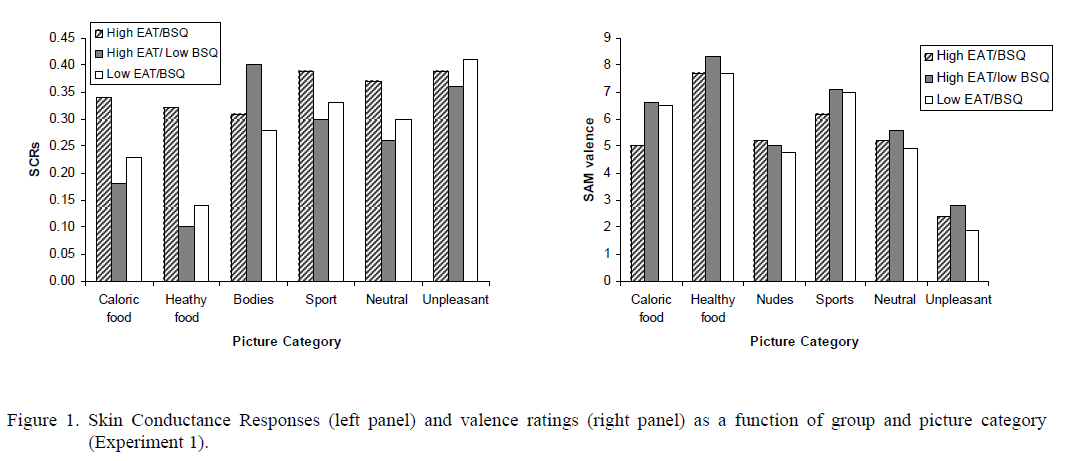
<body><![CDATA[<p><font face="Verdana" size="2">Affective valence of the slides was rated using the <i>Self Assessment Manikin (SAM;</i> Bradley &#38; Lang, 1994). SAM, a pictorial rating scale, measures three dimensions: valence, arousal, and dominance. Only the valence scale was used in the present experiment. This scale is composed of five pictures, each depicting a human figure, that define a 9-point scale, ranging from very happy and smiling, to sad and negative.</font></p>      <p><font face="Verdana" size="2"><i>Procedure.</i> In a pre-experimental phase, first-year university students filled in the EAT questionnaire. Once informed about the confidentiality of the data, students were encouraged to leave their telephone numbers in order to participate in a psychophysiology experiment. Only participants with either high or low values in the EAT were selected. Each participant was tested individually. After arrival at the psychology laboratory, each participant was seated on a chair and skin conductance electrodes were fastened with Velcro-straps to the palmar side of the second phalanx of the first and second fingers of the participant&#8217;s non-dominant hand (Dawson, Schell, &#38; Filion, 2000). Participants were informed that they were going to see a series of slides presented on a screen 1 meter from them. Each slide was exposed for four seconds, and after the presentation they were asked to rate their affective valence by using the SAM scale, that is, rate how they felt after exposure to each image by selecting the SAM figure that best matched their feelings or putting an X between two mannequins, making it a 9-point scale. After the exposure to the slide series, participants were asked to fill in the BSQ and their participation was acknowledged.</font></p>      <p><font face="Verdana" size="2"><i>Data scoring.</i> Phasic SCRs were scores as the maximal deflection, starting in the interval between 1 and 4 seconds after picture onset. The minimal response criterion was .1 microsiemens. Both amplitude and frequency (number of responses within each category) were analyzed.</font></p>      <p><font face="Verdana" size="2"><i>Results</i></font></p>      <p><font face="Verdana" size="2">The results of the BSQ showed a general high correlation with the EAT data (r= .87). Two subgroups within the High EAT-group could, however, be differentiated: one with high scores on the BSQ and another with low scores. Data analyses were therefore done comparing three groups: a group with high scores on both the EAT and the BSQ (&#171;=8), a group with high EATs but low BSQ (n=7), and a group with low scores on both scales (&#171;=16).</font></p>      <p><font face="Verdana" size="2"><i>Skin conductance responses.</i> To correct for the general individual variation observed, a range correction transformation was done by dividing each response by the largest response of the participant (Lykken &#38; Venables, 1971). Range and frequency were analyzed separately. Analyses of Variance (ANOVAs) were run, with Group (high EAT/BSQ, high-EAT/lowBSQ, and low EAT/BSQ) as a between-participants variable, and Picture Category (high calorie food, low calorie food, nudes, sports, neutral and unpleasant pictures) as a repeated measure. The 3x6 ANOVA on SCRs amplitude showed a main effect of Category, <i>F</i> (5, 140) = 5.87, p&#60;.001, but no reliable effect of Group and no interaction effect were found. A post-hoc Tukey HSD test indicated that SCRs to low calorie food were not significantly different from responses to high calorie food, but significantly smaller than SCRs to the other four categories. The difference between high calorie food and negative pictures was also significant (see <a href="/img/revistas/psi/v24n2/24n2a05f1.jpg">Figure 1</a>, left panel). As we were interested in the comparison between the three groups on reactions to the food slides, a 2x3 ANOVA was performed with Food slides (high calorie and low calorie) as repeated measures and Group as a between-subjects factor. There was a main effect of Category, F(1, 28) = 4.23, p&#60;.05, corresponding to smaller responses to low calorie food compared with high calorie food, and a marginally reliable difference between groups, <i>F</i>(2, 28) = 3.07, p=.06. Participants in the group with high scores on both the EAT and the BSQ showed a tendency to larger SCRs to food slides than the other two groups. The comparison between the groups on reactions to the other slides did not show significant differences.</font></p>        
<p><font face="Verdana" size="2">Frequency data were analyzed in the same way. The 3x6 ANOVA again showed a reliable main effect of Category, F(5, 140) = 2.75, p&#60;.05, with responses to low calorie food being less frequent compared with negative pictures and bodies. The separate analysis of food stimuli, similar to the one carried out with amplitude data, showed no significant effects.</font></p>      <p><font face="Verdana" size="2"><i>Affective valence.</i> SAM ratings on the affective valence of the different images were also analyzed by a 3x6 ANOVA. As expected, there was a clear main effect of Category, F(5, 140) = 70.10, p&#60;.001. A Tukey post-hoc test showed that almost all categories differed statistically from one another. The only exceptions were the high calorie food slides being rated equal to sport and neutral pictures, and naked bodies to neutral pictures (see <a href="/img/revistas/psi/v24n2/24n2a05f1.jpg">Figure 1</a>, right panel).</font></p>      
<p><font face="Verdana" size="2"><i>Discussion</i></font></p>      <p><font face="Verdana" size="2">Although the effects were not statistically significant, a tendency was observed for a difference between the group with high scores on both the EAT and the BSQ and the other two groups. The group that reported more worries about food, dieting and body shape on the self-evaluation scales had a tendency to show larger skin conductance responses to food pictures than the other two groups as well as to rate food slides as less positive than the other participants.</font></p>      ]]></body>
<body><![CDATA[<p><font face="Verdana" size="2">In this experiment participants were aware of the stimuli, and although SCRs reflect an immediate emotional response, it is a reaction mediated by a conscious appraisal of the stimuli and by expectancies within a specific &#8220;artificial&#8221; context. Thus, if more automatic responses are to be studied, a subliminal presentation (under the threshold for conscious awareness) should be used.</font></p>      <p><font face="Verdana" size="2">Within information processing research, a distinction is usually made between two modes of processing. One is automatic, involuntary, and pre-attentive, and the other is voluntarily-controlled and accessible to consciousness (Shiffrin &#38; Schneider, 1977). Although there are several studies about cognitive biases in eating disorders <i>(e.g,</i> Cooper, Anastasiades, &#38; Fairburn, 1992), almost all use methods that allow a conscious perception of the stimuli used. Exceptions are the studies done by Waller and collaborators that investigated processing of threat cues presented subliminally. Using a measure of the amount eaten after exposure, they found that non-clinical women with unhealthy eating attitudes ate more after a subliminally presented threat (Waller &#38; Mijatovich, 1998). This result was replicated by Meyer and Waller (1999), who showed that an anger cue elicited a greater amount to be eaten than in a neutral condition.</font></p>      <p><font face="Verdana" size="2">Using a backward masking procedure, Experiment 2 was designed to allow the study of autonomic responses to food stimuli presented outside of consciousness.</font></p>      <p><font face="Verdana" size="2"><b>Experiment 2</b></font></p>      <p><font face="Verdana" size="2">To investigate the possibility of non-conscious activation of emotional reactions to food-related stimuli, Experiment 2 included a subliminal condition. In Experiment 2 the series of exposures of emotional stimuli could thus be separated into two parts. In the first part, using a backward masking procedure, participants were exposed to a very brief presentation of the emotional pictures masked with another, neutral, irrelevant picture. The mask prevented conscious awareness of the relevant target stimulus. The second part of the exposure series was a replication of Experiment 1, with a series of the same emotional pictures, but presented on a supraliminal level. As in Experiment 1, a pre-selection was done in order to compare women worried about food and dieting with a control group.</font></p>      <p><font face="Verdana" size="2"><i>Method</i></font></p>      <p><font face="Verdana" size="2"><i>Participants.</i> Thirty female participants were selected from a sample of 165 volunteers according to the <i>Eating Attitudes Test</i> (EAT) and the <i>Body Shape Questionnaire</i> (BSQ) scores. Fifteen had high scores on both questionnaires, revealing worries about food, dieting, and body shape; the control group (n = 15) had low scores. Mean age of the participants was 23 years. Due to problems during the psychophysiological data collection, four participants had to be discarded from data analysis.</font></p>      <p><font face="Verdana" size="2"><i>Material.</i> Twenty four pictures from the same categories used in Experiment 1 were selected from the <i>International Affective Picture System (IAPS).</i> To mask these pictures in subliminal trials, eight pictures were processed to become abstract colour patterns. These pictures were tested previously in order to assure their masking effect. <i>Testes Cognitivos</i> (TEC, 1.4.1) software was used to control for the images presentation, the subliminal exposure, the time of exposure, and the inter-stimulus interval. Together with the affective valence, participants rated their excitement on the arousal scale of SAM.</font></p>      <p><font face="Verdana" size="2"><i>Procedure.</i> The general procedure was similar to Experiment 1. The main differences were the fact that participants had to look at a computer screen instead of the window used in Experiment 1, and that they had to rate each picture both on the affective valence and on the arousal scales of SAM. The exposure series was divided into two parts, one subliminal, in which the emotional pictures were presented for 20 ms, followed by a mask for four seconds; and one supraliminal, with the same pictures presented for four seconds without masks. After exposure to each picture, participants rated how they felt on SAM scales. Ratings were also collected during the subliminal part of the exposure series. Thus, without consciously perceiving the target pictures, participants rated the abstract masks, which were counterbalanced between different picture categories.</font></p>      <p><font face="Verdana" size="2"><i>Results</i></font></p>      ]]></body>
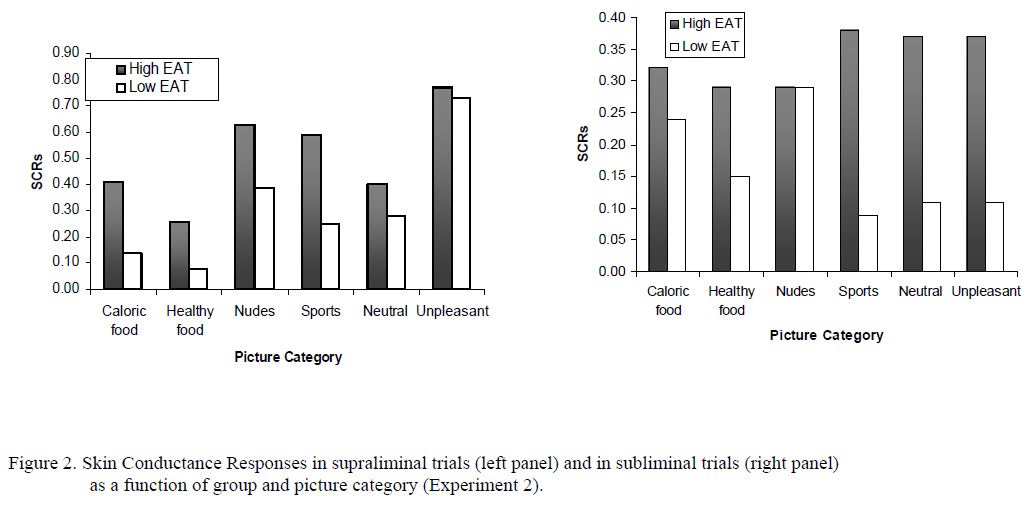
<body><![CDATA[<p><font face="Verdana" size="2">Data scoring and individual range transformation was done as in Experiment 1. Amplitude of the SCRs was analyzed separately for the subliminal and the supraliminal data by means of 2x6 ANOVAs. Thus, the six categories (high calorie food, low calorie food, bodies, sports, neutral and negative pictures) were repeated measures, and the Group (high EAT/BSQ and low EAT/BSQ), was a between-participant factor.</font></p>      <p><font face="Verdana" size="2"><i>Skin conductance responses.</i> The analysis of the supraliminal data showed that the group scoring high on worries with food and body shape had, in general, significantly larger SCRs than the control group, F(1, 24) = 18.94, p&#60;.001. A reliable main effect of Category was also obtained, <i>F</i> (5, 120) = 15.47, p&#60;.001, with negative pictures eliciting larger SCRs and low calorie food as the less arousing stimuli (see <a href="/img/revistas/psi/v24n2/24n2a05f2.jpg">Figure 2</a>, left panel).</font></p>        
<p><font face="Verdana" size="2">Data from subliminal trials showed that the group scoring high on worries had a general pattern of significantly larger SCRs compared with the control group, <i>F</i> (1, 24) =7.38, p&#60;.05; no statistically significant differences were, however, obtained for the different picture categories (see <a href="/img/revistas/psi/v24n2/24n2a05f2.jpg">Figure 2</a>, right panel).</font></p>      
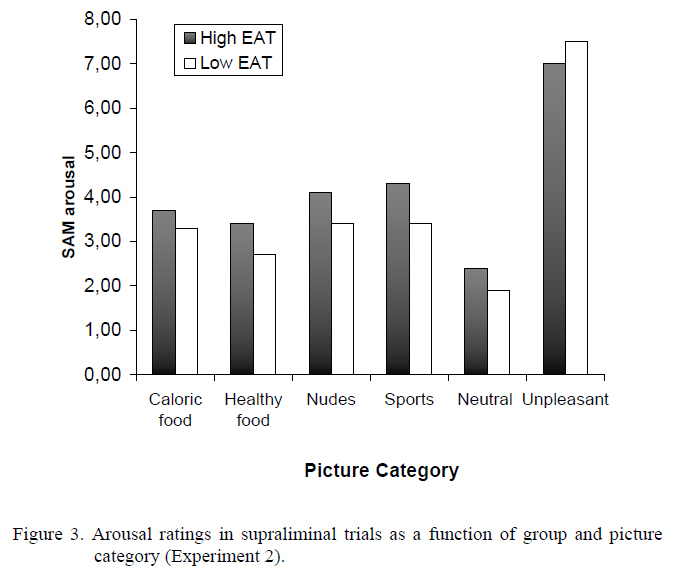
<p><font face="Verdana" size="2"><i>Affective ratings.</i> SAM-ratings data were analyzed separately for affective valence and arousal, both for the supraliminal trials and for the subliminal exposures. Again, 2x6 ANOVAs were run. It should be noted that in subliminal trials participants were only aware of the masking picture. Data analyses were, however, done with the category of the target pictures as a factor.</font></p>      <p><font face="Verdana" size="2">Affective valence ratings for the supraliminal pictures showed a pattern of results similar to those obtained in Experiment 1, with a main effect of Category, <i>F</i> (5, 120) = 92.35, p&#60;.001, and a clear distinction between pleasant stimulus categories and negative pictures. Data from the subliminarily presented trials showed reliable main effects for both Group, <i>F</i> (1, 24) = 7.85, p&#60;.01, and Category, <i>F</i> (5, 120) = 2.75, p&#60;.05. In general, participants in the control group felt less pleasure when exposed to the masked pictures than the High EAT/BSQ group.</font></p>      <p><font face="Verdana" size="2">Arousal ratings of the supraliminal data also showed a Category main effect, <i>F</i> (5, 120) = 41.35, p&#60;.001, but no reliable effect of Group. A post-hoc Tukey test showed that negative pictures were considered more arousing than all other categories, and the neutral ones were the least arousing (significantly different from the other categories, except from low calorie food) (see <a href="/img/revistas/psi/v24n2/24n2a05f3.jpg">Figure 3</a>). Arousal ratings of the subliminal trials showed a general pattern of low values <i>(M</i> = 3.4), with no significant differences across conditions.</font></p>      
<p><font face="Verdana" size="2"><i>Discussion</i></font></p>      <p><font face="Verdana" size="2">The skin conductance data showed a general difference between groups. Participants from the group worried about food and body shape had larger responses than the control group. Interestingly, this pattern (which could be due to a sensitization effect) was also observed during the first part of the experiment - the subliminal phase, when participants did not know to what kind of stimuli they were being exposed. On the other hand, the expected difference between groups in terms of reactions to food stimuli was not observed. That is, there was a general differentiation, with the control group showing smaller responses, but this effect was not specific to food pictures, as was observed in Experiment 1. One possible explanation could be that this group was more anxious than the control group.</font></p>      <p><font face="Verdana" size="2">The general absence of differences in SAM ratings to the subliminal exposure may be considered indirect evidence that participants were not aware of stimuli content. On the other hand, the supraliminal data replicated the affective ratings of Experiment 1, and the arousal ratings also showed a clear difference between stimuli categories.</font></p>      <p><font face="Verdana" size="2">To sum up, there was no evidence for a preferential processing of food stimuli in the group that revealed food and body shape worries. Skin conductance responses were, in general, larger in this group, but the effect was not specific to food stimuli. Verbal ratings also did not show this difference. In order to again test the emotional reactions to subliminally presented food cues, a third experiment was run with a larger sample.</font></p>      ]]></body>
<body><![CDATA[<p><font face="Verdana" size="2"><b>Experiment 3</b></font></p>      <p><font face="Verdana" size="2">Experiment 3 was designed to replicate Experiment 2, with some improvements. The sample was increased, a self-rating scale on anxiety was introduced, heart rate was also monitored, and participants were tested with a behavioural task after exposure to the picture series. In fact, emotional reactions can be measured in three different response systems: verbal, psychophysiological, and behavioural (Lang, 1993). In Experiments 1 and 2 only psychophysiological and verbal responses were measured. In Experiment 3 a behavioural measure was introduced at the end of the experiment.</font></p>      <p><font face="Verdana" size="2"><i>Method</i></font></p>      <p><font face="Verdana" size="2"><i>Participants.</i> Sixty female participants (M<sub>age</sub> = 20.9 years) were selected from a sample of 417 university students who filled in the EAT-26 (Garner &#38; Garfinkel, 1979). Sixty participants were selected (30 with high EAT-26 scores; the other 30 with low scores).</font></p>      <p><font face="Verdana" size="2"><i>Material.</i> In general, the instruments used were similar to those of Experiment 2. The <i>State-Trait Anxiety Inventory-State (STAI-S;</i> Spielberger, Gorsuch, Lushene, Vagg, &#38; Jacobs, 1983) was added. The STAI-S is a self-rating questionnaire that measures the state of anxiety at the present moment. Confronted with statements like &#8220;I am happy&#8221;, participants have to choose, from four levels, from &#8220;nothing&#8221; to &#8220;very much&#8221;, the one that best corresponds to how they feel at that moment. A shorter version of the EAT was also used (EAT-26), because it is easier to fill in and the correlation between the 40-item original and this version is very high (.98) (Garner &#38; Garfinkel, 1979).</font></p>      <p><font face="Verdana" size="2">Twenty five images were selected from the IAPS (Lang, <i>et al.,</i> 1997), with five images from each of the following categories: high calorie food, low calorie food, sports/physical appearance, pleasant, and unpleasant images. Thus, compared with Experiments 1 and 2, neutral images were replaced by pleasant ones, and sport and body images were grouped together. We also chose clear body images when selecting the sport pictures.</font></p>      <p><font face="Verdana" size="2">Heart rate was also monitored during the exposure using the Biopac MP100 system. Disposable pre-gelled electrodes (41mm diameter) were used.</font></p>      <p><font face="Verdana" size="2"><i>Procedure.</i> The general procedure was similar to Experiment 2. ECG electrodes were fastened to both wrists and to the left ankle of the participant. After the exposure to the stimulus series, participants were left alone in the experimental room and were instructed to fill in the STAI-State questionnaire. A bowl with peanuts was left on the table, and participants were told they could take some if they wanted.</font></p>      <p><font face="Verdana" size="2"><i>Results</i></font></p>      <p><font face="Verdana" size="2">The procedures for data analysis, scoring and data transformations were the same as those in Experiments 1 and 2. Heart rate was analyzed by comparing changes from baseline (before the images exposure) in the different conditions.</font></p>      ]]></body>
<body><![CDATA[<p><font face="Verdana" size="2"><i>Psychophysiological data.</i> Analysis of the supraliminal data showed, once again, a reliable main effect of Category, <i>F</i> (4, 128) = 2.56, p&#60;.05. Nevertheless, a post-hoc Tukey test did not give any significant differences between the categories. Data from subliminal trials showed no significant effects, all <i>Fs</i> &#60; 1.9, p&#62;.10.</font></p>      <p><font face="Verdana" size="2">There were no significant changes in heart rate during the supraliminal trials. A 2x5 ANOVA on subliminal data also showed no significant effects. In order to analyze if there were, however, any differences in reactions to the specific food pictures, a 2x2 ANOVA was conducted, comparing food related pictures with other emotional images as a repeated measure, and Group as a between-subjects factor. A tendency for a significant interaction was observed, <i>F</i> (1, 32) = 3.36, p=.076, with participants in the high EAT group showing a higher score in heart rate to food pictures, while the control group did not show this pattern (see <a href="/img/revistas/psi/v24n2/24n2a05f4.jpg">Figure 4</a>).</font></p>      
<p><font face="Verdana" size="2"><i>Affective ratings.</i> The analysis of subliminal data showed no significant effects on SAM ratings. As in the previous experiments, however, there was a clear difference between categories in valence ratings in supraliminal trials, <i>F</i> (4, 248) = 284.78, p&#60;.001, and also for arousal, <i>F</i> (4, 248) = 111.05, p&#60;.001. In general, unpleasant stimuli were considered more arousing and less pleasant than stimuli from the other categories.</font></p>      <p><font face="Verdana" size="2"><i>Behavioural test.</i> No reliable differences between groups were found for the amount of peanuts the participants ate after the exposure, <i>t</i> (56) = .68, p=.50.</font></p>      <p><font face="Verdana" size="2"><i>Discussion</i></font></p>      <p><font face="Verdana" size="2">In general, the results of Experiment 3 replicated the main effects of Experiments 1 and 2. No discrimination of verbal data in the subliminal condition indicated that participants were not aware of the target stimulus and that ratings of the mask pictures were not affected by the preceding targets. In fact, the significant effects observed in valence ratings in Experiment 2 were not replicated. On the other hand, ratings of emotions while pictures were presented subliminally indicated that participants clearly discriminated pleasant from unpleasant images, food stimuli being, in general, perceived as pleasant; nevertheless, no group effects were observed. Independently of group conditions, participants rated their emotions toward pictures in a rather expected way (Lang, Bradley, &#38; Cuthbert, 1997).</font></p>      <p><font face="Verdana" size="2">The skin conductance data did not confirm a difference between groups in their responses to food-related pictures. The heart rate acceleration tendency during the subliminal exposure to food pictures was, however, an interesting result. Heart rate acceleration is considered a measure of a defensive reaction, usually observed in phobic patients when visualizing their feared stimuli (Globish, Hamm, Esteves, &#38; Ohman, 1997). Thus, although the effects were not clear-cut, it seems that food pictures might have some preferred processing in people worried about food, dieting and body shape. One possible way to test this preferred processing is to use a classical conditioning trial, using food stimuli as the conditioned stimulus. This was the main aim of the last experiment.</font></p>      <p><font face="Verdana" size="2"><b>Experiment 4</b></font></p>      <p><font face="Verdana" size="2">In 1970, Seligman suggested that evolution has prepared humans and other organisms to associate specific conditional stimuli with, for example, dangerous situations. This proposal, the &#8220;preparedness&#8221; hypothesis, has since been invoked to account for some characteristics of simple phobias <i>(e.g, </i>Marks, 1977). Using a differential classical conditioning paradigm, Ohman and colleagues have conducted several series of experiments to test the preferred association between aversive unconditioned stimuli and different fear-relevant categories (see Ohman &#38; Mineka, 2001, for a review). Several studies have also tested the possibility of unconscious activation of conditioned responses. For example, using a backward masking procedure to prevent the participant becoming aware of the pictures presented, this non-conscious activation of fear responses has been shown using small animals, like spiders and snakes (Ohman, 1986, 2000), and angry faces (Esteves, Dimberg, &#38; Ohman, 1994). Furthermore, the possibility of unconscious associative learning, using a similar procedure, has also been tested, and the results showed that participants could learn fear responses to pictures of small animals (Ohman &#38; Soares, 1998) and to angry facial expressions (Esteves, Parra, Dimberg, &#38; Ohman, 1994) previously associated with an aversive contingency.</font></p>      <p><font face="Verdana" size="2">One major issue is, however, that these unconsciously learned responses were only observed with stimuli that had some kind of fear-relevance from a biological point of view (i.e., stimuli that our ancestors would have considered dangerous). That is, emotional stimuli that were relevant for the participant (or became relevant by means of classical conditioning), and that were important from a phylogenetic point of view. One interpretation of these results is that fear-relevant stimuli get some kind of preferred cognitive processing and automatically activate fear responses (Ohman &#38; Mineka, 2001).</font></p>      ]]></body>
<body><![CDATA[<p><font face="Verdana" size="2">An extension of these studies is to test if it is possible to observe a similar pattern with food stimuli. More specifically, if participants who are worried about food and dieting will process food-related pictures in a similar way to which phobic individuals process phobic images (Ohman &#38; Soares, 1994). It will be of great interest to analyze if it could be easier to associate pictures of food than a control picture with an aversive unconditioned stimulus. Experiment 4 seeks to investigate if conditioning to backward masked food pictures is possible, especially for participants anxious about food and dieting.</font></p>      <p><font face="Verdana" size="2"><i>Method</i></font></p>      <p><font face="Verdana" size="2"><i>Participants.</i> Eighty university female students were randomly assigned to one of four groups. Half of the participants were conditioned to a food-related picture <i>(e.g.,</i> ice-cream), with a neutral picture <i>(e.g.,</i> a basket) as the control stimulus (CS-). The other half were conditioned to the neutral stimulus and a food image was used as the CS-. Within both conditions, one group had high scores on the EAT-26 and the other group had low scores.</font></p>      <p><font face="Verdana" size="2"><i>Apparatus.</i> Five different food pictures and four neutral ones, selected from the IAPS, were used as the conditioned stimulus (CS+) and/or the control stimulus (CS-). Each participant was only exposed to one pair of images, and each combination CS+/CS- was only used once within each group. Two masking pictures, selected from the ones presented before, were used.</font></p>      <p><font face="Verdana" size="2">The unconditioned stimulus (UCS) was an aversive broad band noise, presented in both ears through headphones. Skin conductance responses (SCRs) were recorded using the same method and apparatus as in Experiments 1-3.</font></p>      <p><font face="Verdana" size="2"><i>Procedure.</i> After entering the laboratory, participants were asked to sit down in an arm-chair. Electrodermal electrodes were applied, and headphones were put on. Participants were instructed to sit quietly during the experiment and to watch the images. They were informed that during the exposure to the picture series a noise would be presented via headphones several times.</font></p>      <p><font face="Verdana" size="2">The experiment consisted of three phases. A Habituation phase, with two presentations of the to-become CS+ and two presentations of the to-become CS-. These exposures were very brief (20 ms) and were masked by an abstract picture that was exposed during four seconds. After that, the Acquisition phase consisted of a series of 24 pictures, twelve presentations of the CS+, immediately followed by the white noise (UCS), and 12 exposures of the CS- (without UCS presentation). This phase was also masked, using the same stimuli and exposure time as in the Habituation phase. Finally, the Extinction phase, with sixteen trials, eight of each stimulus. During this phase no noise was delivered and CS+ and CS- were presented unmasked, for four seconds. From the participants&#8217; point of view, the three phases were not separated, although participants might have noticed that pictures in the beginning were abstract and without a specific theme, while in the last part of the series they could recognize a couple of objects.</font></p>      <p><font face="Verdana" size="2"><i>Results</i></font></p>      <p><font face="Verdana" size="2">ANOVAs were conducted separately for the Habituation phase and for the Extinction phase. The habituation data analysis was conducted to verify whether there were any differences before conditioning. The extinction data analysis was done to analyse whether there were differences between groups in terms of resistance to extinction. ANOVAs were done with two between-subjects factors, the EAT category (high or low) and the CS+ (food or neutral), and two repeated measures, CS (CS+ or CS-) and Trial.</font></p>      <p><font face="Verdana" size="2">The analysis of the Habituation phase showed a main effect of Trial, <i>F</i> (1, 75) = 14.36, p&#60;.001. Participants reacted more in the first trial than in the second one. No other significant effects were obtained. A 2x2x2x8 ANOVA was run for the extinction data. Only a significant effect of Trial was obtained, <i>F</i> (7, 525) = 31.58, p&#60;.001, showing an expected decrease in the magnitude of the SCRs during the extinction phase. No differences between groups or between the reinforced CS+ and the control CS- were obtained.</font></p>      ]]></body>
<body><![CDATA[<p><font face="Verdana" size="2"><i>Discussion</i></font></p>      <p><font face="Verdana" size="2">Non-conscious associative learning has been observed in several experiments with biologically fear-relevant stimuli (Ohman &#38; Mineka, 2001). In the present experiment, the hypothesis that this effect could be observed with food stimuli on &#8220;food-worried&#8221; participants was tested. The results did not, however, show the expected learning effects. Thus, independently of the conditioned stimulus (a food picture or a neutral picture), and independently of their food anxieties, there were no differences in the autonomic responses, measured by skin conductance, during the extinction phase. Although it is not possible to prove the null hypothesis, the results are more similar to the data on fear-irrelevant stimuli than the data on fear-relevant stimuli (Esteves, Parra, <i>et al.,</i> 1994) and suggest that food stimuli do not have preferential cognitive processing and do not activate a fear response.</font></p>      <p><font face="Verdana" size="2"><b>General discussion</b></font></p>      <p><font face="Verdana" size="2">The general aim of this series of experiments was to investigate emotional reactions to food-related stimuli, both when the pictures were presented with a duration that allowed a complete conscious perception, and when awareness of stimulus content was prevented by means of backward masking.</font></p>      <p><font face="Verdana" size="2">The pattern of results of the four experiments showed that with conscious presentations, food stimuli are processed in a similar way to other emotional visual material. Thus, verbal ratings showed that food pictures can be considered, in general, pleasant stimuli that are not especially arousing. With the masked presentation, there was a tendency for a difference between groups that could indicate that heart rate changes could be modulated by the participants&#8217; attitudes toward food and body shape. The general pattern is, however, an absence of subliminal effects. Comparing these results with the conditioning literature, it thus seems that there is no parallel with fear-relevant stimuli and the preferred processing observed there (Ohman, 2000;</font></p>      <p><font face="Verdana" size="2">Ohman &#38; Mineka, 2001). As has been referred to before, non-aware associative learning has only been observed with stimuli that were biologically fear-relevant. The use of ontogenetically fear-relevant stimuli <i>(e.g,</i> guns or electrical outlets) has failed to produce this effect (Cook <i>et al.,</i> 1986). It could thus be concluded from our results that food stimuli presented as pictures are not processed as fear-relevant material. While food pictures have no negative associations for most individuals, we selected as participants young women who reported unhealthy attitudes toward food and dieting. Thus, in accordance with the studies of Cooper and Fairburn (1992) and Perpin&#226; and colleagues (1997), a difference in stimulus processing could be expected between participants showing behaviours and attitudes similar to those that characterise eating disorders and participants without that kind of problems. Although the pattern was not clear-cut, some differences were observed. In Experiment 1, for example, there was a tendency in the &#8220;worried&#8221; group to larger skin conductance responses to food images. This result may reflect some kind of automatic reaction to food stimuli that could be associated with a specific sensitivity to food cues in these participants. The global pattern of results does not, however, confirm this hypothesis. It should nevertheless be noted that our participants were not a clinical sample. From the clinical point of view it would be interesting to further investigate this possible sensitivity. The potential use in detecting risk-groups and evaluating treatment effects would certainly be a valuable help. The study of information processing of food cues in participants with eating disorders, and not only of &#8220;worried&#8221; people, such as those who participated in our studies, could thus be valuable.</font></p>      <p><font face="Verdana" size="2"><b>References</b></font></p>      <!-- ref --><p><font face="Verdana" size="2">Arriaga, P., &#38; Almeida, G. (2000). F&#225;brica de emo&#231;&#245;es: A efic&#225;cia de excertos de filmes na indu&#231;&#227;o de emo&#231;&#245;es. <i>Laborat&#243;rio de Psicologia, 8,</i> 63-80.    &nbsp;&nbsp;&nbsp;&nbsp;&nbsp;&nbsp;&nbsp;&nbsp;[&#160;<a href="javascript:void(0);" onclick="javascript: window.open('/scielo.php?script=sci_nlinks&ref=468848&pid=S0874-2049201000020000500001&lng=','','width=640,height=500,resizable=yes,scrollbars=1,menubar=yes,');">Links</a>&#160;]<!-- end-ref --></font></p>      <!-- ref --><p><font face="Verdana" size="2">Arriaga, P., Franco, A., &#38; Campos, P. (2010). Indu&#231;&#227;o de emo&#231;&#245;es atrav&#233;s de excertos musicais. <i>Laborat&#243;rio de Psicologia, 8,</i> 3-20.    &nbsp;&nbsp;&nbsp;&nbsp;&nbsp;&nbsp;&nbsp;&nbsp;[&#160;<a href="javascript:void(0);" onclick="javascript: window.open('/scielo.php?script=sci_nlinks&ref=468850&pid=S0874-2049201000020000500002&lng=','','width=640,height=500,resizable=yes,scrollbars=1,menubar=yes,');">Links</a>&#160;]<!-- end-ref --></font></p>      <!-- ref --><p><font face="Verdana" size="2">Bower, G. H. (1981). Mood and memory. <i>American Psychologist, 36,</i> 129-148.    &nbsp;&nbsp;&nbsp;&nbsp;&nbsp;&nbsp;&nbsp;&nbsp;[&#160;<a href="javascript:void(0);" onclick="javascript: window.open('/scielo.php?script=sci_nlinks&ref=468852&pid=S0874-2049201000020000500003&lng=','','width=640,height=500,resizable=yes,scrollbars=1,menubar=yes,');">Links</a>&#160;]<!-- end-ref --></font></p>      <!-- ref --><p><font face="Verdana" size="2">Bradley, M., &#38; Lang, P. J. (2007). The International Affective Picture System (IAPS) in the study of emotion and attention. In J. A. Coan &#38; J. G. Allen (Eds.), <i>Handbook of emotion and elicitation and assessment</i>(pp. 29-46). Oxford: Oxford University Press.    &nbsp;&nbsp;&nbsp;&nbsp;&nbsp;&nbsp;&nbsp;&nbsp;[&#160;<a href="javascript:void(0);" onclick="javascript: window.open('/scielo.php?script=sci_nlinks&ref=468854&pid=S0874-2049201000020000500004&lng=','','width=640,height=500,resizable=yes,scrollbars=1,menubar=yes,');">Links</a>&#160;]<!-- end-ref --></font></p>      <!-- ref --><p><font face="Verdana" size="2">Bradley, M. M., Cuthbert, B. N., &#38; Lang, P. J. (1991). Startle and emotion: Lateral acoustic probes and the bilateral blink. <i>Psychophysiology, 28,</i>285-295.    &nbsp;&nbsp;&nbsp;&nbsp;&nbsp;&nbsp;&nbsp;&nbsp;[&#160;<a href="javascript:void(0);" onclick="javascript: window.open('/scielo.php?script=sci_nlinks&ref=468856&pid=S0874-2049201000020000500005&lng=','','width=640,height=500,resizable=yes,scrollbars=1,menubar=yes,');">Links</a>&#160;]<!-- end-ref --></font></p>      <!-- ref --><p><font face="Verdana" size="2">Bradley, M. M., &#38; Lang, P. J. (1994). Measuring emotion: The Self-Assessment Mannequin and the Semantic Differential. <i>Journal of Behavior Therapy and Experimental Psychiatry, 25,</i> 49-59.    &nbsp;&nbsp;&nbsp;&nbsp;&nbsp;&nbsp;&nbsp;&nbsp;[&#160;<a href="javascript:void(0);" onclick="javascript: window.open('/scielo.php?script=sci_nlinks&ref=468858&pid=S0874-2049201000020000500006&lng=','','width=640,height=500,resizable=yes,scrollbars=1,menubar=yes,');">Links</a>&#160;]<!-- end-ref --></font></p>      <!-- ref --><p><font face="Verdana" size="2">Cook, E. W., Hodes, R. L., &#38; Lang, P. J. (1986). Preparedness and phobia: Effects of stimulus content on human visceral conditioning. <i>Journal of Abnormal Psychology, 95,</i> 195-207.    &nbsp;&nbsp;&nbsp;&nbsp;&nbsp;&nbsp;&nbsp;&nbsp;[&#160;<a href="javascript:void(0);" onclick="javascript: window.open('/scielo.php?script=sci_nlinks&ref=468860&pid=S0874-2049201000020000500007&lng=','','width=640,height=500,resizable=yes,scrollbars=1,menubar=yes,');">Links</a>&#160;]<!-- end-ref --></font></p>      <!-- ref --><p><font face="Verdana" size="2">Cooper, M. J., Anastasiades, P., &#38; Fairburn, C. G. (1992). Selective processing of eating-related, shape-related, and weight-related words in persons with bulimia-nervosa. <i>Journal of Abnormal Psychology, 101,</i>352-355.    &nbsp;&nbsp;&nbsp;&nbsp;&nbsp;&nbsp;&nbsp;&nbsp;[&#160;<a href="javascript:void(0);" onclick="javascript: window.open('/scielo.php?script=sci_nlinks&ref=468862&pid=S0874-2049201000020000500008&lng=','','width=640,height=500,resizable=yes,scrollbars=1,menubar=yes,');">Links</a>&#160;]<!-- end-ref --></font></p>      <!-- ref --><p><font face="Verdana" size="2">Cooper, M. J., &#38; Fairburn, C. G. (1992). Selective processing of eating, weight and shape related words in patients with eating disorders and dieters. <i>British Journal of Clinical Psychology, 31,</i> 363-365.    &nbsp;&nbsp;&nbsp;&nbsp;&nbsp;&nbsp;&nbsp;&nbsp;[&#160;<a href="javascript:void(0);" onclick="javascript: window.open('/scielo.php?script=sci_nlinks&ref=468864&pid=S0874-2049201000020000500009&lng=','','width=640,height=500,resizable=yes,scrollbars=1,menubar=yes,');">Links</a>&#160;]<!-- end-ref --></font></p>      <!-- ref --><p><font face="Verdana" size="2">Cooper, P. J., Taylor, M. J., Cooper, Z., &#38; Fairburn, C. G. (1987). The development and validation of the Body Shape Questionnaire. <i>International Journal of Eating Disorders, 6,</i> 485-494.    &nbsp;&nbsp;&nbsp;&nbsp;&nbsp;&nbsp;&nbsp;&nbsp;[&#160;<a href="javascript:void(0);" onclick="javascript: window.open('/scielo.php?script=sci_nlinks&ref=468866&pid=S0874-2049201000020000500010&lng=','','width=640,height=500,resizable=yes,scrollbars=1,menubar=yes,');">Links</a>&#160;]<!-- end-ref --></font></p>      <!-- ref --><p><font face="Verdana" size="2">Crow, S. J., Peterson, C. B., Swanson, S. A., Raymond, N. C., Specker, S., Eckert, E. D., &#38; Mitchell, M. D. (2009). Increased mortality in bulimia nervosa and other eating disorders. <i>American Journal of Psychiatry, 166,</i>1342-1346.    &nbsp;&nbsp;&nbsp;&nbsp;&nbsp;&nbsp;&nbsp;&nbsp;[&#160;<a href="javascript:void(0);" onclick="javascript: window.open('/scielo.php?script=sci_nlinks&ref=468868&pid=S0874-2049201000020000500011&lng=','','width=640,height=500,resizable=yes,scrollbars=1,menubar=yes,');">Links</a>&#160;]<!-- end-ref --></font></p>      <!-- ref --><p><font face="Verdana" size="2">Dam&#225;sio, A. (Ed.). (1994). <i>Descartes error.</i> New York: Putman.    &nbsp;&nbsp;&nbsp;&nbsp;&nbsp;&nbsp;&nbsp;&nbsp;[&#160;<a href="javascript:void(0);" onclick="javascript: window.open('/scielo.php?script=sci_nlinks&ref=468870&pid=S0874-2049201000020000500012&lng=','','width=640,height=500,resizable=yes,scrollbars=1,menubar=yes,');">Links</a>&#160;]<!-- end-ref --></font></p>      <!-- ref --><p><font face="Verdana" size="2">Dam&#225;sio, A. (Ed.). (1999). <i>The feeling of what happens.</i> London: William Heinemann.    &nbsp;&nbsp;&nbsp;&nbsp;&nbsp;&nbsp;&nbsp;&nbsp;[&#160;<a href="javascript:void(0);" onclick="javascript: window.open('/scielo.php?script=sci_nlinks&ref=468872&pid=S0874-2049201000020000500013&lng=','','width=640,height=500,resizable=yes,scrollbars=1,menubar=yes,');">Links</a>&#160;]<!-- end-ref --></font></p>      <!-- ref --><p><font face="Verdana" size="2">Dawson, M. E., Schell, A. M., &#38; Filion, D. L. (2000). The electrodermal system. In J. T. Cacioppo, L. G. Tassinary &#38; G. G. Berntson (Eds.), <i>Handbook of psychophysiology</i> (Vol. 2<sup>nd</sup> ed., pp. 200-223). Cambridge: Cambridge University Press.    &nbsp;&nbsp;&nbsp;&nbsp;&nbsp;&nbsp;&nbsp;&nbsp;[&#160;<a href="javascript:void(0);" onclick="javascript: window.open('/scielo.php?script=sci_nlinks&ref=468874&pid=S0874-2049201000020000500014&lng=','','width=640,height=500,resizable=yes,scrollbars=1,menubar=yes,');">Links</a>&#160;]<!-- end-ref --></font></p>      <!-- ref --><p><font face="Verdana" size="2">Dimberg, U. (1987). Facial reactions, autonomic activity and experienced emotion: A three-component model of emotional conditioning. <i>Biological Psychology, 24,</i> 105-122.    &nbsp;&nbsp;&nbsp;&nbsp;&nbsp;&nbsp;&nbsp;&nbsp;[&#160;<a href="javascript:void(0);" onclick="javascript: window.open('/scielo.php?script=sci_nlinks&ref=468876&pid=S0874-2049201000020000500015&lng=','','width=640,height=500,resizable=yes,scrollbars=1,menubar=yes,');">Links</a>&#160;]<!-- end-ref --></font></p>      <!-- ref --><p><font face="Verdana" size="2">Esteves, F., Dimberg, U., &#38; Ohman, A. (1994). Automatically elicited fear: Conditioned skin-conductance responses to masked facial expressions. <i>Cognition &#38; Emotion, 8,</i>393-413.    &nbsp;&nbsp;&nbsp;&nbsp;&nbsp;&nbsp;&nbsp;&nbsp;[&#160;<a href="javascript:void(0);" onclick="javascript: window.open('/scielo.php?script=sci_nlinks&ref=468878&pid=S0874-2049201000020000500016&lng=','','width=640,height=500,resizable=yes,scrollbars=1,menubar=yes,');">Links</a>&#160;]<!-- end-ref --></font></p>      <!-- ref --><p><font face="Verdana" size="2">Esteves, F., Parra, C., Dimberg, U., &#38; Ohman, A. (1994). Nonconscious associative learning: Pavlovian conditioning of skin-conductance responses to masked fear-relevant facial stimuli. <i>Psychophysiology, 31,</i> 375-385.    &nbsp;&nbsp;&nbsp;&nbsp;&nbsp;&nbsp;&nbsp;&nbsp;[&#160;<a href="javascript:void(0);" onclick="javascript: window.open('/scielo.php?script=sci_nlinks&ref=468880&pid=S0874-2049201000020000500017&lng=','','width=640,height=500,resizable=yes,scrollbars=1,menubar=yes,');">Links</a>&#160;]<!-- end-ref --></font></p>      <!-- ref --><p><font face="Verdana" size="2">Frijda, N. H. (1986). <i>The emotions.</i> New York: Cambridge University Press.    &nbsp;&nbsp;&nbsp;&nbsp;&nbsp;&nbsp;&nbsp;&nbsp;[&#160;<a href="javascript:void(0);" onclick="javascript: window.open('/scielo.php?script=sci_nlinks&ref=468882&pid=S0874-2049201000020000500018&lng=','','width=640,height=500,resizable=yes,scrollbars=1,menubar=yes,');">Links</a>&#160;]<!-- end-ref --></font></p>      <p><font face="Verdana" size="2">Garcia, J. (1989). Food for Tolman: Cognition and cathexis in concert. In T. A. Archer &#38; L. G. Nilsson (Eds.), <i>Aversion, avoidance and anxiety</i> (pp. 45-85). Hillsdale, NJ: Lawrence Erlbaum Associates.</font></p>      <!-- ref --><p><font face="Verdana" size="2">Garner, D. M., &#38; Garfinkel, P. E. (1979). Eating Attitudes Test: An index of the symptoms of anorexia-nervosa. <i>Psychological Medicine, 9,</i> 273-279.    &nbsp;&nbsp;&nbsp;&nbsp;&nbsp;&nbsp;&nbsp;&nbsp;[&#160;<a href="javascript:void(0);" onclick="javascript: window.open('/scielo.php?script=sci_nlinks&ref=468885&pid=S0874-2049201000020000500020&lng=','','width=640,height=500,resizable=yes,scrollbars=1,menubar=yes,');">Links</a>&#160;]<!-- end-ref --></font></p>      <!-- ref --><p><font face="Verdana" size="2">Gillen, P. (1998). Welcome to McWorld (The growing number of McDonald&#39;s fast food chains around the world). <i>Meanjin, 57,</i> 104-115.    &nbsp;&nbsp;&nbsp;&nbsp;&nbsp;&nbsp;&nbsp;&nbsp;[&#160;<a href="javascript:void(0);" onclick="javascript: window.open('/scielo.php?script=sci_nlinks&ref=468887&pid=S0874-2049201000020000500021&lng=','','width=640,height=500,resizable=yes,scrollbars=1,menubar=yes,');">Links</a>&#160;]<!-- end-ref --></font></p>      <!-- ref --><p><font face="Verdana" size="2">Globisch, J., Hamm, A., Esteves, F., &#38; Ohman, A. (1999). Fear appears fast: Temporal course of startle reflex potentiation in animal fearful subjects. <i>Psychophysiology, 36,</i> 66-75.    &nbsp;&nbsp;&nbsp;&nbsp;&nbsp;&nbsp;&nbsp;&nbsp;[&#160;<a href="javascript:void(0);" onclick="javascript: window.open('/scielo.php?script=sci_nlinks&ref=468889&pid=S0874-2049201000020000500022&lng=','','width=640,height=500,resizable=yes,scrollbars=1,menubar=yes,');">Links</a>&#160;]<!-- end-ref --></font></p>      ]]></body>
<body><![CDATA[<!-- ref --><p><font face="Verdana" size="2">Greben, D. H., &#38; Kaplan, A. S. (1995). Conceptual models and integrative therapy: Anorexia nervosa as a prototype. <i>Canadian Journal of Psychiatry-Revue Canadienne de Psychiatrie, 40</i>, 584-592.    &nbsp;&nbsp;&nbsp;&nbsp;&nbsp;&nbsp;&nbsp;&nbsp;[&#160;<a href="javascript:void(0);" onclick="javascript: window.open('/scielo.php?script=sci_nlinks&ref=468891&pid=S0874-2049201000020000500023&lng=','','width=640,height=500,resizable=yes,scrollbars=1,menubar=yes,');">Links</a>&#160;]<!-- end-ref --></font></p>      <!-- ref --><p><font face="Verdana" size="2">Hugdahl, K., &#38; K&#227;rker, A. C. (1981). Biological vs. experimental factors in phobic conditioning. <i>Behaviour Research and Therapy, 19,</i>109-115.    &nbsp;&nbsp;&nbsp;&nbsp;&nbsp;&nbsp;&nbsp;&nbsp;[&#160;<a href="javascript:void(0);" onclick="javascript: window.open('/scielo.php?script=sci_nlinks&ref=468893&pid=S0874-2049201000020000500024&lng=','','width=640,height=500,resizable=yes,scrollbars=1,menubar=yes,');">Links</a>&#160;]<!-- end-ref --></font></p>      <!-- ref --><p><font face="Verdana" size="2">Hugdahl, K., &#38; Ohman, A. (1977). Effects of instruction on acquisition and extinction of electrodermal responses to fear-relevant stimuli. <i>Journal of Experimental Psychology-Human Learning and Memory, 3,</i>608-618.    &nbsp;&nbsp;&nbsp;&nbsp;&nbsp;&nbsp;&nbsp;&nbsp;[&#160;<a href="javascript:void(0);" onclick="javascript: window.open('/scielo.php?script=sci_nlinks&ref=468895&pid=S0874-2049201000020000500025&lng=','','width=640,height=500,resizable=yes,scrollbars=1,menubar=yes,');">Links</a>&#160;]<!-- end-ref --></font></p>      <!-- ref --><p><font face="Verdana" size="2">Koelsch, S., Fritz, T., Von Cramon, D. Y., Muller, K., &#38; Friederici, A. D. (2006). Investigating emotion with music: An fMRI study. <i>Human Brain Mapping, 27, </i>239-250.    &nbsp;&nbsp;&nbsp;&nbsp;&nbsp;&nbsp;&nbsp;&nbsp;[&#160;<a href="javascript:void(0);" onclick="javascript: window.open('/scielo.php?script=sci_nlinks&ref=468897&pid=S0874-2049201000020000500026&lng=','','width=640,height=500,resizable=yes,scrollbars=1,menubar=yes,');">Links</a>&#160;]<!-- end-ref --></font></p>      <!-- ref --><p><font face="Verdana" size="2">Laird, J. D., &#38; Strout, S. (2007). Emotional behaviors as emotional stimuli. In J. A. Coan &#38; J. J. B. Allen (Eds.), <i>Handbook of emotion elicitation and assessment </i>(pp. 54-64). Oxford: Oxford University Press.    &nbsp;&nbsp;&nbsp;&nbsp;&nbsp;&nbsp;&nbsp;&nbsp;[&#160;<a href="javascript:void(0);" onclick="javascript: window.open('/scielo.php?script=sci_nlinks&ref=468899&pid=S0874-2049201000020000500027&lng=','','width=640,height=500,resizable=yes,scrollbars=1,menubar=yes,');">Links</a>&#160;]<!-- end-ref --></font></p>      ]]></body>
<body><![CDATA[<p><font face="Verdana" size="2">Lang, P. J. (1993). The network model of emotion: Motivational connections. In R. S. J. Wyer &#38; T. K. Srull (Eds.), <i>Perspectives on anger and emotion. Advances in social cognition</i> (Vol. 6, pp. 109-133). Hillsdale, NJ: Lawrence Erlbaum Associates.</font></p>      <!-- ref --><p><font face="Verdana" size="2">Lang, P. J., Bradley, M. M., &#38; Cuthbert, B. N. (Eds.). (1997). <i>International Affective Picture System (IAPS): Technical manual and affective ratings.</i>NIMH Center for the study of emotion and attention.    &nbsp;&nbsp;&nbsp;&nbsp;&nbsp;&nbsp;&nbsp;&nbsp;[&#160;<a href="javascript:void(0);" onclick="javascript: window.open('/scielo.php?script=sci_nlinks&ref=468902&pid=S0874-2049201000020000500029&lng=','','width=640,height=500,resizable=yes,scrollbars=1,menubar=yes,');">Links</a>&#160;]<!-- end-ref --></font></p>      <!-- ref --><p><font face="Verdana" size="2">Lazarus, R. S. (1999). The cognition-emotion debate: A bit of history. In T. Dalgleish &#38; M. J. Power (Eds.), <i>Handbook of cognition and emotion. </i>Chichester: John Wiley &#38; Sons.    &nbsp;&nbsp;&nbsp;&nbsp;&nbsp;&nbsp;&nbsp;&nbsp;[&#160;<a href="javascript:void(0);" onclick="javascript: window.open('/scielo.php?script=sci_nlinks&ref=468904&pid=S0874-2049201000020000500030&lng=','','width=640,height=500,resizable=yes,scrollbars=1,menubar=yes,');">Links</a>&#160;]<!-- end-ref --></font></p>      <!-- ref --><p><font face="Verdana" size="2">LeDoux, J. (Ed.). (1996). <i>The emotional brain.</i> New York: Simon &#38; Schuster.    &nbsp;&nbsp;&nbsp;&nbsp;&nbsp;&nbsp;&nbsp;&nbsp;[&#160;<a href="javascript:void(0);" onclick="javascript: window.open('/scielo.php?script=sci_nlinks&ref=468906&pid=S0874-2049201000020000500031&lng=','','width=640,height=500,resizable=yes,scrollbars=1,menubar=yes,');">Links</a>&#160;]<!-- end-ref --></font></p>      <!-- ref --><p><font face="Verdana" size="2">LeDoux, J. (Ed.). (2002). <i>Synaptic self: How our brains become who we are.</i>New York: Viking Press.    &nbsp;&nbsp;&nbsp;&nbsp;&nbsp;&nbsp;&nbsp;&nbsp;[&#160;<a href="javascript:void(0);" onclick="javascript: window.open('/scielo.php?script=sci_nlinks&ref=468908&pid=S0874-2049201000020000500032&lng=','','width=640,height=500,resizable=yes,scrollbars=1,menubar=yes,');">Links</a>&#160;]<!-- end-ref --></font></p>      <!-- ref --><p><font face="Verdana" size="2">Lopes, M. M., &#38; Garcia-Marques, T. (2003). Procedimento de indu&#231;&#227;o de estados de esp&#237;rito, de Velten: Tradu&#231;&#227;o e adapta&#231;&#227;o &#224; l&#237;ngua Portuguesa. <i>Laborat&#243;rio de Psicologia, 1</i>, 57-66.    &nbsp;&nbsp;&nbsp;&nbsp;&nbsp;&nbsp;&nbsp;&nbsp;[&#160;<a href="javascript:void(0);" onclick="javascript: window.open('/scielo.php?script=sci_nlinks&ref=468910&pid=S0874-2049201000020000500033&lng=','','width=640,height=500,resizable=yes,scrollbars=1,menubar=yes,');">Links</a>&#160;]<!-- end-ref --></font></p>      <!-- ref --><p><font face="Verdana" size="2">Lykken, D. T., &#38; Venables, P. H. (1971). Direct measurement of skin conductance: A proposal for standardization. <i>Psychophysiology, 8,</i> 656-672.    &nbsp;&nbsp;&nbsp;&nbsp;&nbsp;&nbsp;&nbsp;&nbsp;[&#160;<a href="javascript:void(0);" onclick="javascript: window.open('/scielo.php?script=sci_nlinks&ref=468912&pid=S0874-2049201000020000500034&lng=','','width=640,height=500,resizable=yes,scrollbars=1,menubar=yes,');">Links</a>&#160;]<!-- end-ref --></font></p>      <!-- ref --><p><font face="Verdana" size="2">Maccallum, F., McConkey, K. M., Bryant, R. A., &#38; Barnier, A. J. (2000). Specific autobiographical memory following hypnotically induced mood state. <i>International Journal of Clinical and Experimental Hypnosis, 48,</i> 361-373.    &nbsp;&nbsp;&nbsp;&nbsp;&nbsp;&nbsp;&nbsp;&nbsp;[&#160;<a href="javascript:void(0);" onclick="javascript: window.open('/scielo.php?script=sci_nlinks&ref=468914&pid=S0874-2049201000020000500035&lng=','','width=640,height=500,resizable=yes,scrollbars=1,menubar=yes,');">Links</a>&#160;]<!-- end-ref --></font></p>      <!-- ref --><p><font face="Verdana" size="2">Meyer, C., &#38; Waller, G. (1999). The impact of emotion upon eating behavior: The role of subliminal visual processing of threat cues. <i>International Journal of Eating Disorders, 25,</i> 319-326.    &nbsp;&nbsp;&nbsp;&nbsp;&nbsp;&nbsp;&nbsp;&nbsp;[&#160;<a href="javascript:void(0);" onclick="javascript: window.open('/scielo.php?script=sci_nlinks&ref=468916&pid=S0874-2049201000020000500036&lng=','','width=640,height=500,resizable=yes,scrollbars=1,menubar=yes,');">Links</a>&#160;]<!-- end-ref --></font></p>      <!-- ref --><p><font face="Verdana" size="2">Ohman, A. (1986). Face the beast and fear the face: Animal and social fears as prototypes for evolutionary analyses of emotion. <i>Psychophysiology, 23,</i>123-145.    &nbsp;&nbsp;&nbsp;&nbsp;&nbsp;&nbsp;&nbsp;&nbsp;[&#160;<a href="javascript:void(0);" onclick="javascript: window.open('/scielo.php?script=sci_nlinks&ref=468918&pid=S0874-2049201000020000500037&lng=','','width=640,height=500,resizable=yes,scrollbars=1,menubar=yes,');">Links</a>&#160;]<!-- end-ref --></font></p>      <!-- ref --><p><font face="Verdana" size="2">Ohman, A. (2000). Fear and anxiety: Evolutionary, cognitive and clinical perspectives. In M. Lewis &#38; J. M. Haviland (Eds.), <i>Handbook of emotions </i>(2<sup>nd</sup> ed., pp. 573-593). New York: Guilford Press.    &nbsp;&nbsp;&nbsp;&nbsp;&nbsp;&nbsp;&nbsp;&nbsp;[&#160;<a href="javascript:void(0);" onclick="javascript: window.open('/scielo.php?script=sci_nlinks&ref=468920&pid=S0874-2049201000020000500038&lng=','','width=640,height=500,resizable=yes,scrollbars=1,menubar=yes,');">Links</a>&#160;]<!-- end-ref --></font></p>      <!-- ref --><p><font face="Verdana" size="2">Ohman, A., &#38; Dimberg, U. (1978). Facial expressions as conditioned stimuli for electrodermal responses: Case of preparedness. <i>Journal of Personality and Social Psychology, 36,</i> 1251-1258.    &nbsp;&nbsp;&nbsp;&nbsp;&nbsp;&nbsp;&nbsp;&nbsp;[&#160;<a href="javascript:void(0);" onclick="javascript: window.open('/scielo.php?script=sci_nlinks&ref=468922&pid=S0874-2049201000020000500039&lng=','','width=640,height=500,resizable=yes,scrollbars=1,menubar=yes,');">Links</a>&#160;]<!-- end-ref --></font></p>      <!-- ref --><p><font face="Verdana" size="2">Ohman, A., Fredrikson, M., &#38; Hugdahl, K. (1978). Orienting and defensive responding in electrodermal system: Palmar-dorsal differences and recovery rate during conditioning to potentially phobic stimuli. <i>Psychophysiology, 15,</i> 93-101.    &nbsp;&nbsp;&nbsp;&nbsp;&nbsp;&nbsp;&nbsp;&nbsp;[&#160;<a href="javascript:void(0);" onclick="javascript: window.open('/scielo.php?script=sci_nlinks&ref=468924&pid=S0874-2049201000020000500040&lng=','','width=640,height=500,resizable=yes,scrollbars=1,menubar=yes,');">Links</a>&#160;]<!-- end-ref --></font></p>      <!-- ref --><p><font face="Verdana" size="2">Ohman, A., &#38; Mineka, S. (2001). Fears, phobias, and preparedness: Toward an evolved module of fear and fear learning. <i>Psychological Review, 108,</i> 483-522.    &nbsp;&nbsp;&nbsp;&nbsp;&nbsp;&nbsp;&nbsp;&nbsp;[&#160;<a href="javascript:void(0);" onclick="javascript: window.open('/scielo.php?script=sci_nlinks&ref=468926&pid=S0874-2049201000020000500041&lng=','','width=640,height=500,resizable=yes,scrollbars=1,menubar=yes,');">Links</a>&#160;]<!-- end-ref --></font></p>      <!-- ref --><p><font face="Verdana" size="2">Perpina, C., Hemsley, D., Treasure, J., &#38; Desilva, P. (1993). Is the selective information-processing of food and body words specific to patients with eating disorders?. <i>International Journal of Eating Disorders, 14,</i>359-366.    &nbsp;&nbsp;&nbsp;&nbsp;&nbsp;&nbsp;&nbsp;&nbsp;[&#160;<a href="javascript:void(0);" onclick="javascript: window.open('/scielo.php?script=sci_nlinks&ref=468928&pid=S0874-2049201000020000500042&lng=','','width=640,height=500,resizable=yes,scrollbars=1,menubar=yes,');">Links</a>&#160;]<!-- end-ref --></font></p>      <!-- ref --><p><font face="Verdana" size="2">Perpina, C., Leonard, T., Treasure, J., Bond, A., &#38; Banos, R. (1998). Selective processing of food- and body-related information and autonomic arousal in patients with eating disorders. <i>The Spanish Journal of Psychology, 1,</i>3-10.    &nbsp;&nbsp;&nbsp;&nbsp;&nbsp;&nbsp;&nbsp;&nbsp;[&#160;<a href="javascript:void(0);" onclick="javascript: window.open('/scielo.php?script=sci_nlinks&ref=468930&pid=S0874-2049201000020000500043&lng=','','width=640,height=500,resizable=yes,scrollbars=1,menubar=yes,');">Links</a>&#160;]<!-- end-ref --></font></p>      <!-- ref --><p><font face="Verdana" size="2">Preti, A., de Girolamo, G., Vilagut, G., Alonso, J., de Graaf, R., Bruffaerts, R., Henaere, D. K., Pinto-Meza, A., Horo, J. M., Morosini, P., &#38; the ESEN e D-WRH Investigators (2009). The epidemiology of eating disorders in six European countries: Results of the ESEMeD-WMH project. <i>Journal of Psychiatric Research, 43,</i> 1125-1132.    &nbsp;&nbsp;&nbsp;&nbsp;&nbsp;&nbsp;&nbsp;&nbsp;[&#160;<a href="javascript:void(0);" onclick="javascript: window.open('/scielo.php?script=sci_nlinks&ref=468932&pid=S0874-2049201000020000500044&lng=','','width=640,height=500,resizable=yes,scrollbars=1,menubar=yes,');">Links</a>&#160;]<!-- end-ref --></font></p>      <!-- ref --><p><font face="Verdana" size="2">Rottenberg, J., Ray, R. R., &#38; Gross, J. J. (2007). Emotion elicitation using film clips. In J. A. Coan &#38; J. J. B. Allen (Eds.), <i>Handbook of emotion elicitation and assessment</i> (pp. 9-28). Oxford: Oxford University Press.    &nbsp;&nbsp;&nbsp;&nbsp;&nbsp;&nbsp;&nbsp;&nbsp;[&#160;<a href="javascript:void(0);" onclick="javascript: window.open('/scielo.php?script=sci_nlinks&ref=468934&pid=S0874-2049201000020000500045&lng=','','width=640,height=500,resizable=yes,scrollbars=1,menubar=yes,');">Links</a>&#160;]<!-- end-ref --></font></p>      <!-- ref --><p><font face="Verdana" size="2">Schell, A. M., Dawson, M. E., &#38; Marinkovic, K. (1991). Effects of potentially phobic conditioned-stimuli on retention, reconditioning, and extinction of the conditioned skin-conductance response. <i>Psychophysiology, 28,</i> 140-153.    &nbsp;&nbsp;&nbsp;&nbsp;&nbsp;&nbsp;&nbsp;&nbsp;[&#160;<a href="javascript:void(0);" onclick="javascript: window.open('/scielo.php?script=sci_nlinks&ref=468936&pid=S0874-2049201000020000500046&lng=','','width=640,height=500,resizable=yes,scrollbars=1,menubar=yes,');">Links</a>&#160;]<!-- end-ref --></font></p>      <!-- ref --><p><font face="Verdana" size="2">Shiffrin, R. M., &#38; Schneider, W. (1977). Controlled and automatic human information-processing: II. Perceptual learning, automatic attending, and a general theory. <i>Psychological Review, 84,</i> 127-190.    &nbsp;&nbsp;&nbsp;&nbsp;&nbsp;&nbsp;&nbsp;&nbsp;[&#160;<a href="javascript:void(0);" onclick="javascript: window.open('/scielo.php?script=sci_nlinks&ref=468938&pid=S0874-2049201000020000500047&lng=','','width=640,height=500,resizable=yes,scrollbars=1,menubar=yes,');">Links</a>&#160;]<!-- end-ref --></font></p>      <!-- ref --><p><font face="Verdana" size="2">Smolak, L., &#38; Muenen, S. K. (2001). Gender and eating problems. In R. H. Striegel-Moore &#38; L. Smolak (Eds.), <i>Eating disorders: Innovative directions in research and practice</i>. Washington: American Psychological Association.    &nbsp;&nbsp;&nbsp;&nbsp;&nbsp;&nbsp;&nbsp;&nbsp;[&#160;<a href="javascript:void(0);" onclick="javascript: window.open('/scielo.php?script=sci_nlinks&ref=468940&pid=S0874-2049201000020000500048&lng=','','width=640,height=500,resizable=yes,scrollbars=1,menubar=yes,');">Links</a>&#160;]<!-- end-ref --></font></p>      <!-- ref --><p><font face="Verdana" size="2">Spangler, D. L. (2002). Testing the cognitive model of eating disorders: The role of dysfunctional beliefs about appearance. <i>Behavior Therapy, 33,</i> 87-105.    &nbsp;&nbsp;&nbsp;&nbsp;&nbsp;&nbsp;&nbsp;&nbsp;[&#160;<a href="javascript:void(0);" onclick="javascript: window.open('/scielo.php?script=sci_nlinks&ref=468942&pid=S0874-2049201000020000500049&lng=','','width=640,height=500,resizable=yes,scrollbars=1,menubar=yes,');">Links</a>&#160;]<!-- end-ref --></font></p>      <!-- ref --><p><font face="Verdana" size="2">Striegel-Moore, R. H., &#38; Smolak, L. (Eds.). (2001). <i>Eating disorders: Innovative directions in research and practice</i>. Washington: American Psychological Association.    &nbsp;&nbsp;&nbsp;&nbsp;&nbsp;&nbsp;&nbsp;&nbsp;[&#160;<a href="javascript:void(0);" onclick="javascript: window.open('/scielo.php?script=sci_nlinks&ref=468944&pid=S0874-2049201000020000500050&lng=','','width=640,height=500,resizable=yes,scrollbars=1,menubar=yes,');">Links</a>&#160;]<!-- end-ref --></font></p>      <p><font face="Verdana" size="2">Treasure, J., van Furth, E., &#38; Schmidt, U. (Eds.) (2003). <i>Handbook of eating disorders: Theory, treatment and research.</i> Hoboken, NJ: John Wiley &#38; Sons.</font></p>      <!-- ref --><p><font face="Verdana" size="2">Velten, E. (1968). A laboratory task for induction of mood states. <i>Behaviour Research and Therapy, 6,</i> 473-482.    &nbsp;&nbsp;&nbsp;&nbsp;&nbsp;&nbsp;&nbsp;&nbsp;[&#160;<a href="javascript:void(0);" onclick="javascript: window.open('/scielo.php?script=sci_nlinks&ref=468947&pid=S0874-2049201000020000500052&lng=','','width=640,height=500,resizable=yes,scrollbars=1,menubar=yes,');">Links</a>&#160;]<!-- end-ref --></font></p>      <!-- ref --><p><font face="Verdana" size="2">Villemure, C., Slotnick, B. M., &#38; Bushnell, M. C. (2003). Effects of odors on pain perception: Deciphering the roles of emotion and attention. <i>Pain, 106,</i> 101-108.    &nbsp;&nbsp;&nbsp;&nbsp;&nbsp;&nbsp;&nbsp;&nbsp;[&#160;<a href="javascript:void(0);" onclick="javascript: window.open('/scielo.php?script=sci_nlinks&ref=468949&pid=S0874-2049201000020000500053&lng=','','width=640,height=500,resizable=yes,scrollbars=1,menubar=yes,');">Links</a>&#160;]<!-- end-ref --></font></p>      ]]></body>
<body><![CDATA[<!-- ref --><p><font face="Verdana" size="2">Waller, G., &#38; Mijatovich, S. (1998). Preconscious processing of threat cues: Impact on eating among women with unhealthy eating attitudes. <i>International Journal of Eating Disorders, 24,</i> 83-89.    &nbsp;&nbsp;&nbsp;&nbsp;&nbsp;&nbsp;&nbsp;&nbsp;[&#160;<a href="javascript:void(0);" onclick="javascript: window.open('/scielo.php?script=sci_nlinks&ref=468951&pid=S0874-2049201000020000500054&lng=','','width=640,height=500,resizable=yes,scrollbars=1,menubar=yes,');">Links</a>&#160;]<!-- end-ref --></font></p>      <!-- ref --><p><font face="Verdana" size="2">Williams, J. M. G., Watts, F. N., MacLeod, C., &#38; Mathews, A. (Eds.) (1997). <i>Cognitive psychology and emotional disorders</i> (2<sup>nd</sup> ed.). New York: John Wiley &#38; Sons.    &nbsp;&nbsp;&nbsp;&nbsp;&nbsp;&nbsp;&nbsp;&nbsp;[&#160;<a href="javascript:void(0);" onclick="javascript: window.open('/scielo.php?script=sci_nlinks&ref=468953&pid=S0874-2049201000020000500055&lng=','','width=640,height=500,resizable=yes,scrollbars=1,menubar=yes,');">Links</a>&#160;]<!-- end-ref --></font></p>      <!-- ref --><p><font face="Verdana" size="2">Zajonc, R. B. (1980). Feeling and thinking: Preferences need no inferences. <i>American Psychologist, 35,</i> 151-175.    &nbsp;&nbsp;&nbsp;&nbsp;&nbsp;&nbsp;&nbsp;&nbsp;[&#160;<a href="javascript:void(0);" onclick="javascript: window.open('/scielo.php?script=sci_nlinks&ref=468955&pid=S0874-2049201000020000500056&lng=','','width=640,height=500,resizable=yes,scrollbars=1,menubar=yes,');">Links</a>&#160;]<!-- end-ref --></font></p>      <p>&nbsp;</p>     <p><font face="Verdana" size="2"><sup>*</sup><a href="#topc0">Correspondence</a><a name="c0"></a></font></p>     <p><font face="Verdana" size="2">Francisco Esteves, Instituto Universit&#225;rio de Lisboa (ISCTE-IUL), Centro de Investiga&#231;&#227;o e Interven&#231;&#227;o Social (Cis-IUL), Av. das For&#231;as Armadas, 1649-026 Lisboa, Portugal</font></p>       <p><font face="Verdana" size="2">This research was supported by a grant from Bial Foundation (ref: 44/98).</font></p>      ]]></body>
<body><![CDATA[ ]]></body><back>
<ref-list>
<ref id="B1">
<nlm-citation citation-type="journal">
<person-group person-group-type="author">
<name>
<surname><![CDATA[Arriaga]]></surname>
<given-names><![CDATA[P.]]></given-names>
</name>
<name>
<surname><![CDATA[Almeida]]></surname>
<given-names><![CDATA[G.]]></given-names>
</name>
</person-group>
<article-title xml:lang="pt"><![CDATA[Fábrica de emoções: A eficácia de excertos de filmes na indução de emoções]]></article-title>
<source><![CDATA[Laboratório de Psicologia]]></source>
<year>2000</year>
<volume>8</volume>
<page-range>63-80</page-range></nlm-citation>
</ref>
<ref id="B2">
<nlm-citation citation-type="journal">
<person-group person-group-type="author">
<name>
<surname><![CDATA[Arriaga]]></surname>
<given-names><![CDATA[P.]]></given-names>
</name>
<name>
<surname><![CDATA[Franco]]></surname>
<given-names><![CDATA[A.]]></given-names>
</name>
<name>
<surname><![CDATA[Campos]]></surname>
<given-names><![CDATA[P.]]></given-names>
</name>
</person-group>
<article-title xml:lang="pt"><![CDATA[Indução de emoções através de excertos musicais]]></article-title>
<source><![CDATA[Laboratório de Psicologia]]></source>
<year>2010</year>
<volume>8</volume>
<page-range>3-20</page-range></nlm-citation>
</ref>
<ref id="B3">
<nlm-citation citation-type="journal">
<person-group person-group-type="author">
<name>
<surname><![CDATA[Bower]]></surname>
<given-names><![CDATA[G. H.]]></given-names>
</name>
</person-group>
<article-title xml:lang="en"><![CDATA[Mood and memory]]></article-title>
<source><![CDATA[American Psychologist]]></source>
<year>1981</year>
<volume>36</volume>
<page-range>129-148</page-range></nlm-citation>
</ref>
<ref id="B4">
<nlm-citation citation-type="book">
<person-group person-group-type="author">
<name>
<surname><![CDATA[Bradley]]></surname>
<given-names><![CDATA[M.]]></given-names>
</name>
<name>
<surname><![CDATA[Lang]]></surname>
<given-names><![CDATA[P. J.]]></given-names>
</name>
</person-group>
<article-title xml:lang="en"><![CDATA[The International Affective Picture System (IAPS) in the study of emotion and attention]]></article-title>
<person-group person-group-type="editor">
<name>
<surname><![CDATA[Coan]]></surname>
<given-names><![CDATA[J. A.]]></given-names>
</name>
<name>
<surname><![CDATA[Allen]]></surname>
<given-names><![CDATA[J. G.]]></given-names>
</name>
</person-group>
<source><![CDATA[Handbook of emotion and elicitation and assessment]]></source>
<year>2007</year>
<page-range>29-46</page-range><publisher-loc><![CDATA[Oxford ]]></publisher-loc>
<publisher-name><![CDATA[Oxford University Press]]></publisher-name>
</nlm-citation>
</ref>
<ref id="B5">
<nlm-citation citation-type="journal">
<person-group person-group-type="author">
<name>
<surname><![CDATA[Bradley]]></surname>
<given-names><![CDATA[M. M.]]></given-names>
</name>
<name>
<surname><![CDATA[Cuthbert]]></surname>
<given-names><![CDATA[B. N.]]></given-names>
</name>
<name>
<surname><![CDATA[Lang]]></surname>
<given-names><![CDATA[P. J.]]></given-names>
</name>
</person-group>
<article-title xml:lang="en"><![CDATA[Startle and emotion: Lateral acoustic probes and the bilateral blink]]></article-title>
<source><![CDATA[Psychophysiology]]></source>
<year>1991</year>
<volume>28</volume>
<page-range>285-295</page-range></nlm-citation>
</ref>
<ref id="B6">
<nlm-citation citation-type="journal">
<person-group person-group-type="author">
<name>
<surname><![CDATA[Bradley]]></surname>
<given-names><![CDATA[M. M.]]></given-names>
</name>
<name>
<surname><![CDATA[Lang]]></surname>
<given-names><![CDATA[P. J.]]></given-names>
</name>
</person-group>
<article-title xml:lang="en"><![CDATA[Measuring emotion: The Self-Assessment Mannequin and the Semantic Differential]]></article-title>
<source><![CDATA[Journal of Behavior Therapy and Experimental Psychiatry]]></source>
<year>1994</year>
<volume>25</volume>
<page-range>49-59</page-range></nlm-citation>
</ref>
<ref id="B7">
<nlm-citation citation-type="journal">
<person-group person-group-type="author">
<name>
<surname><![CDATA[Cook]]></surname>
<given-names><![CDATA[E. W.]]></given-names>
</name>
<name>
<surname><![CDATA[Hodes]]></surname>
<given-names><![CDATA[R. L.]]></given-names>
</name>
<name>
<surname><![CDATA[Lang]]></surname>
<given-names><![CDATA[P. J.]]></given-names>
</name>
</person-group>
<article-title xml:lang="en"><![CDATA[Preparedness and phobia: Effects of stimulus content on human visceral conditioning]]></article-title>
<source><![CDATA[Journal of Abnormal Psychology]]></source>
<year>1986</year>
<volume>95</volume>
<page-range>195-207</page-range></nlm-citation>
</ref>
<ref id="B8">
<nlm-citation citation-type="journal">
<person-group person-group-type="author">
<name>
<surname><![CDATA[Cooper]]></surname>
<given-names><![CDATA[M. J.]]></given-names>
</name>
<name>
<surname><![CDATA[Anastasiades]]></surname>
<given-names><![CDATA[P.]]></given-names>
</name>
<name>
<surname><![CDATA[Fairburn]]></surname>
<given-names><![CDATA[C. G.]]></given-names>
</name>
</person-group>
<article-title xml:lang="en"><![CDATA[Selective processing of eating-related, shape-related, and weight-related words in persons with bulimia-nervosa]]></article-title>
<source><![CDATA[Journal of Abnormal Psychology]]></source>
<year>1992</year>
<volume>101</volume>
<page-range>352-355</page-range></nlm-citation>
</ref>
<ref id="B9">
<nlm-citation citation-type="journal">
<person-group person-group-type="author">
<name>
<surname><![CDATA[Cooper]]></surname>
<given-names><![CDATA[M. J.]]></given-names>
</name>
<name>
<surname><![CDATA[Fairburn]]></surname>
<given-names><![CDATA[C. G.]]></given-names>
</name>
</person-group>
<article-title xml:lang="en"><![CDATA[Selective processing of eating, weight and shape related words in patients with eating disorders and dieters]]></article-title>
<source><![CDATA[British Journal of Clinical Psychology]]></source>
<year>1992</year>
<volume>31</volume>
<page-range>363-365</page-range></nlm-citation>
</ref>
<ref id="B10">
<nlm-citation citation-type="journal">
<person-group person-group-type="author">
<name>
<surname><![CDATA[Cooper]]></surname>
<given-names><![CDATA[P. J.]]></given-names>
</name>
<name>
<surname><![CDATA[Taylor]]></surname>
<given-names><![CDATA[M. J.]]></given-names>
</name>
<name>
<surname><![CDATA[Cooper]]></surname>
<given-names><![CDATA[Z.]]></given-names>
</name>
<name>
<surname><![CDATA[Fairburn]]></surname>
<given-names><![CDATA[C. G.]]></given-names>
</name>
</person-group>
<article-title xml:lang="en"><![CDATA[The development and validation of the Body Shape Questionnaire]]></article-title>
<source><![CDATA[International Journal of Eating Disorders]]></source>
<year>1987</year>
<volume>6</volume>
<page-range>485-494</page-range></nlm-citation>
</ref>
<ref id="B11">
<nlm-citation citation-type="journal">
<person-group person-group-type="author">
<name>
<surname><![CDATA[Crow]]></surname>
<given-names><![CDATA[S. J.]]></given-names>
</name>
<name>
<surname><![CDATA[Peterson]]></surname>
<given-names><![CDATA[C. B.]]></given-names>
</name>
<name>
<surname><![CDATA[Swanson]]></surname>
<given-names><![CDATA[S. A.]]></given-names>
</name>
<name>
<surname><![CDATA[Raymond]]></surname>
<given-names><![CDATA[N. C.]]></given-names>
</name>
<name>
<surname><![CDATA[Specker]]></surname>
<given-names><![CDATA[S.]]></given-names>
</name>
<name>
<surname><![CDATA[Eckert]]></surname>
<given-names><![CDATA[E. D.]]></given-names>
</name>
<name>
<surname><![CDATA[Mitchell]]></surname>
<given-names><![CDATA[M. D.]]></given-names>
</name>
</person-group>
<article-title xml:lang="en"><![CDATA[Increased mortality in bulimia nervosa and other eating disorders]]></article-title>
<source><![CDATA[American Journal of Psychiatry]]></source>
<year>2009</year>
<volume>166</volume>
<page-range>1342-1346</page-range></nlm-citation>
</ref>
<ref id="B12">
<nlm-citation citation-type="book">
<person-group person-group-type="author">
<name>
<surname><![CDATA[Damásio]]></surname>
<given-names><![CDATA[A.]]></given-names>
</name>
</person-group>
<source><![CDATA[Descartes error]]></source>
<year>1994</year>
<publisher-loc><![CDATA[New York ]]></publisher-loc>
<publisher-name><![CDATA[Putman]]></publisher-name>
</nlm-citation>
</ref>
<ref id="B13">
<nlm-citation citation-type="book">
<person-group person-group-type="author">
<name>
<surname><![CDATA[Damásio]]></surname>
<given-names><![CDATA[A.]]></given-names>
</name>
</person-group>
<source><![CDATA[The feeling of what happens]]></source>
<year>1999</year>
<publisher-loc><![CDATA[London ]]></publisher-loc>
<publisher-name><![CDATA[William Heinemann]]></publisher-name>
</nlm-citation>
</ref>
<ref id="B14">
<nlm-citation citation-type="book">
<person-group person-group-type="author">
<name>
<surname><![CDATA[Dawson]]></surname>
<given-names><![CDATA[M. E.]]></given-names>
</name>
<name>
<surname><![CDATA[Schell]]></surname>
<given-names><![CDATA[A. M.]]></given-names>
</name>
<name>
<surname><![CDATA[Filion]]></surname>
<given-names><![CDATA[D. L.]]></given-names>
</name>
</person-group>
<article-title xml:lang="en"><![CDATA[The electrodermal system]]></article-title>
<person-group person-group-type="editor">
<name>
<surname><![CDATA[Cacioppo]]></surname>
<given-names><![CDATA[J. T.]]></given-names>
</name>
<name>
<surname><![CDATA[Tassinary]]></surname>
<given-names><![CDATA[L. G.]]></given-names>
</name>
<name>
<surname><![CDATA[Berntson]]></surname>
<given-names><![CDATA[G. G.]]></given-names>
</name>
</person-group>
<source><![CDATA[Handbook of psychophysiology]]></source>
<year>2000</year>
<edition>2nd ed.</edition>
<page-range>200-223</page-range><publisher-loc><![CDATA[Cambridge ]]></publisher-loc>
<publisher-name><![CDATA[Cambridge University Press]]></publisher-name>
</nlm-citation>
</ref>
<ref id="B15">
<nlm-citation citation-type="journal">
<person-group person-group-type="author">
<name>
<surname><![CDATA[Dimberg]]></surname>
<given-names><![CDATA[U.]]></given-names>
</name>
</person-group>
<article-title xml:lang="en"><![CDATA[Facial reactions, autonomic activity and experienced emotion: A three-component model of emotional conditioning]]></article-title>
<source><![CDATA[Biological Psychology]]></source>
<year>1987</year>
<volume>24</volume>
<page-range>105-122</page-range></nlm-citation>
</ref>
<ref id="B16">
<nlm-citation citation-type="journal">
<person-group person-group-type="author">
<name>
<surname><![CDATA[Esteves]]></surname>
<given-names><![CDATA[F.]]></given-names>
</name>
<name>
<surname><![CDATA[Dimberg]]></surname>
<given-names><![CDATA[U.]]></given-names>
</name>
<name>
<surname><![CDATA[Ohman]]></surname>
<given-names><![CDATA[A.]]></given-names>
</name>
</person-group>
<article-title xml:lang="en"><![CDATA[Automatically elicited fear: Conditioned skin-conductance responses to masked facial expressions]]></article-title>
<source><![CDATA[Cognition & Emotion]]></source>
<year>1994</year>
<volume>8</volume>
<page-range>393-413</page-range></nlm-citation>
</ref>
<ref id="B17">
<nlm-citation citation-type="journal">
<person-group person-group-type="author">
<name>
<surname><![CDATA[Esteves]]></surname>
<given-names><![CDATA[F.]]></given-names>
</name>
<name>
<surname><![CDATA[Parra]]></surname>
<given-names><![CDATA[C.]]></given-names>
</name>
<name>
<surname><![CDATA[Dimberg]]></surname>
<given-names><![CDATA[U.]]></given-names>
</name>
<name>
<surname><![CDATA[Ohman]]></surname>
<given-names><![CDATA[A.]]></given-names>
</name>
</person-group>
<article-title xml:lang="en"><![CDATA[Nonconscious associative learning: Pavlovian conditioning of skin-conductance responses to masked fear-relevant facial stimuli]]></article-title>
<source><![CDATA[Psychophysiology]]></source>
<year>1994</year>
<volume>31</volume>
<page-range>375-385</page-range></nlm-citation>
</ref>
<ref id="B18">
<nlm-citation citation-type="book">
<person-group person-group-type="author">
<name>
<surname><![CDATA[Frijda]]></surname>
<given-names><![CDATA[N. H.]]></given-names>
</name>
</person-group>
<source><![CDATA[The emotions]]></source>
<year>1986</year>
<publisher-loc><![CDATA[New York ]]></publisher-loc>
<publisher-name><![CDATA[Cambridge University Press]]></publisher-name>
</nlm-citation>
</ref>
<ref id="B19">
<nlm-citation citation-type="book">
<person-group person-group-type="author">
<name>
<surname><![CDATA[Garcia]]></surname>
<given-names><![CDATA[J.]]></given-names>
</name>
</person-group>
<article-title xml:lang="en"><![CDATA[Food for Tolman: Cognition and cathexis in concert]]></article-title>
<person-group person-group-type="editor">
<name>
<surname><![CDATA[Archer]]></surname>
<given-names><![CDATA[T. A.]]></given-names>
</name>
<name>
<surname><![CDATA[Nilsson]]></surname>
<given-names><![CDATA[L. G.]]></given-names>
</name>
</person-group>
<source><![CDATA[Aversion, avoidance and anxiety]]></source>
<year>1989</year>
<page-range>45-85</page-range><publisher-loc><![CDATA[Hillsdale ]]></publisher-loc>
<publisher-name><![CDATA[Lawrence Erlbaum Associates]]></publisher-name>
</nlm-citation>
</ref>
<ref id="B20">
<nlm-citation citation-type="journal">
<person-group person-group-type="author">
<name>
<surname><![CDATA[Garner]]></surname>
<given-names><![CDATA[D. M.]]></given-names>
</name>
<name>
<surname><![CDATA[Garfinkel]]></surname>
<given-names><![CDATA[P. E.]]></given-names>
</name>
</person-group>
<article-title xml:lang="en"><![CDATA[Eating Attitudes Test: An index of the symptoms of anorexia-nervosa]]></article-title>
<source><![CDATA[Psychological Medicine]]></source>
<year>1979</year>
<volume>9</volume>
<page-range>273-279</page-range></nlm-citation>
</ref>
<ref id="B21">
<nlm-citation citation-type="journal">
<person-group person-group-type="author">
<name>
<surname><![CDATA[Gillen]]></surname>
<given-names><![CDATA[P.]]></given-names>
</name>
</person-group>
<article-title xml:lang="en"><![CDATA[Welcome to McWorld (The growing number of McDonald's fast food chains around the world)]]></article-title>
<source><![CDATA[Meanjin]]></source>
<year>1998</year>
<volume>57</volume>
<page-range>104-115</page-range></nlm-citation>
</ref>
<ref id="B22">
<nlm-citation citation-type="journal">
<person-group person-group-type="author">
<name>
<surname><![CDATA[Globisch]]></surname>
<given-names><![CDATA[J.]]></given-names>
</name>
<name>
<surname><![CDATA[Hamm]]></surname>
<given-names><![CDATA[A.]]></given-names>
</name>
<name>
<surname><![CDATA[Esteves]]></surname>
<given-names><![CDATA[F.]]></given-names>
</name>
<name>
<surname><![CDATA[Ohman]]></surname>
<given-names><![CDATA[A.]]></given-names>
</name>
</person-group>
<article-title xml:lang="en"><![CDATA[Fear appears fast: Temporal course of startle reflex potentiation in animal fearful subjects]]></article-title>
<source><![CDATA[Psychophysiology]]></source>
<year>1999</year>
<volume>36</volume>
<page-range>66-75</page-range></nlm-citation>
</ref>
<ref id="B23">
<nlm-citation citation-type="journal">
<person-group person-group-type="author">
<name>
<surname><![CDATA[Greben]]></surname>
<given-names><![CDATA[D. H.]]></given-names>
</name>
<name>
<surname><![CDATA[Kaplan]]></surname>
<given-names><![CDATA[A. S.]]></given-names>
</name>
</person-group>
<article-title xml:lang="en"><![CDATA[Conceptual models and integrative therapy: Anorexia nervosa as a prototype]]></article-title>
<source><![CDATA[Canadian Journal of Psychiatry-Revue Canadienne de Psychiatrie]]></source>
<year>1995</year>
<volume>40</volume>
<page-range>584-592</page-range></nlm-citation>
</ref>
<ref id="B24">
<nlm-citation citation-type="journal">
<person-group person-group-type="author">
<name>
<surname><![CDATA[Hugdahl]]></surname>
<given-names><![CDATA[K.]]></given-names>
</name>
<name>
<surname><![CDATA[Kãrker]]></surname>
<given-names><![CDATA[A. C.]]></given-names>
</name>
</person-group>
<article-title xml:lang="en"><![CDATA[Biological vs. experimental factors in phobic conditioning]]></article-title>
<source><![CDATA[Behaviour Research and Therapy]]></source>
<year>1981</year>
<volume>19</volume>
<page-range>109-115</page-range></nlm-citation>
</ref>
<ref id="B25">
<nlm-citation citation-type="journal">
<person-group person-group-type="author">
<name>
<surname><![CDATA[Hugdahl]]></surname>
<given-names><![CDATA[K.]]></given-names>
</name>
<name>
<surname><![CDATA[Ohman]]></surname>
<given-names><![CDATA[A.]]></given-names>
</name>
</person-group>
<article-title xml:lang="en"><![CDATA[Effects of instruction on acquisition and extinction of electrodermal responses to fear-relevant stimuli]]></article-title>
<source><![CDATA[Journal of Experimental Psychology-Human Learning and Memory]]></source>
<year>1977</year>
<volume>3</volume>
<page-range>608-618</page-range></nlm-citation>
</ref>
<ref id="B26">
<nlm-citation citation-type="journal">
<person-group person-group-type="author">
<name>
<surname><![CDATA[Koelsch]]></surname>
<given-names><![CDATA[S.]]></given-names>
</name>
<name>
<surname><![CDATA[Fritz]]></surname>
<given-names><![CDATA[T.]]></given-names>
</name>
<name>
<surname><![CDATA[Von Cramon]]></surname>
<given-names><![CDATA[D. Y.]]></given-names>
</name>
<name>
<surname><![CDATA[Muller]]></surname>
<given-names><![CDATA[K.]]></given-names>
</name>
<name>
<surname><![CDATA[Friederici]]></surname>
<given-names><![CDATA[A. D.]]></given-names>
</name>
</person-group>
<article-title xml:lang="en"><![CDATA[Investigating emotion with music: An fMRI study]]></article-title>
<source><![CDATA[Human Brain Mapping]]></source>
<year>2006</year>
<volume>27</volume>
<page-range>239-250</page-range></nlm-citation>
</ref>
<ref id="B27">
<nlm-citation citation-type="book">
<person-group person-group-type="author">
<name>
<surname><![CDATA[Laird]]></surname>
<given-names><![CDATA[J. D.]]></given-names>
</name>
<name>
<surname><![CDATA[Strout]]></surname>
<given-names><![CDATA[S.]]></given-names>
</name>
</person-group>
<article-title xml:lang="en"><![CDATA[Emotional behaviors as emotional stimuli]]></article-title>
<person-group person-group-type="editor">
<name>
<surname><![CDATA[Coan]]></surname>
<given-names><![CDATA[J. A.]]></given-names>
</name>
<name>
<surname><![CDATA[Allen]]></surname>
<given-names><![CDATA[J. J. B.]]></given-names>
</name>
</person-group>
<source><![CDATA[Handbook of emotion elicitation and assessment]]></source>
<year>2007</year>
<page-range>54-64</page-range><publisher-loc><![CDATA[Oxford ]]></publisher-loc>
<publisher-name><![CDATA[Oxford University Press]]></publisher-name>
</nlm-citation>
</ref>
<ref id="B28">
<nlm-citation citation-type="book">
<person-group person-group-type="author">
<name>
<surname><![CDATA[Lang]]></surname>
<given-names><![CDATA[P. J.]]></given-names>
</name>
</person-group>
<article-title xml:lang="en"><![CDATA[The network model of emotion: Motivational connections]]></article-title>
<person-group person-group-type="editor">
<name>
<surname><![CDATA[Wyer]]></surname>
<given-names><![CDATA[R. S. J.]]></given-names>
</name>
<name>
<surname><![CDATA[Srull]]></surname>
<given-names><![CDATA[T. K.]]></given-names>
</name>
</person-group>
<source><![CDATA[Perspectives on anger and emotion: Advances in social cognition]]></source>
<year>1993</year>
<page-range>109-133</page-range><publisher-loc><![CDATA[Hillsdale ]]></publisher-loc>
<publisher-name><![CDATA[Lawrence Erlbaum Associates]]></publisher-name>
</nlm-citation>
</ref>
<ref id="B29">
<nlm-citation citation-type="">
<person-group person-group-type="author">
<name>
<surname><![CDATA[Lang]]></surname>
<given-names><![CDATA[P. J.]]></given-names>
</name>
<name>
<surname><![CDATA[Bradley]]></surname>
<given-names><![CDATA[M. M.]]></given-names>
</name>
<name>
<surname><![CDATA[Cuthbert]]></surname>
<given-names><![CDATA[B. N.]]></given-names>
</name>
</person-group>
<source><![CDATA[International Affective Picture System (IAPS): Technical manual and affective ratings]]></source>
<year>1997</year>
</nlm-citation>
</ref>
<ref id="B30">
<nlm-citation citation-type="book">
<person-group person-group-type="author">
<name>
<surname><![CDATA[Lazarus]]></surname>
<given-names><![CDATA[R. S.]]></given-names>
</name>
</person-group>
<article-title xml:lang="en"><![CDATA[The cognition-emotion debate: A bit of history]]></article-title>
<person-group person-group-type="editor">
<name>
<surname><![CDATA[Dalgleish]]></surname>
<given-names><![CDATA[T.]]></given-names>
</name>
<name>
<surname><![CDATA[Power]]></surname>
<given-names><![CDATA[M. J.]]></given-names>
</name>
</person-group>
<source><![CDATA[Handbook of cognition and emotion]]></source>
<year>1999</year>
<publisher-loc><![CDATA[Chichester ]]></publisher-loc>
<publisher-name><![CDATA[John Wiley & Sons]]></publisher-name>
</nlm-citation>
</ref>
<ref id="B31">
<nlm-citation citation-type="book">
<person-group person-group-type="author">
<name>
<surname><![CDATA[LeDoux]]></surname>
<given-names><![CDATA[J.]]></given-names>
</name>
</person-group>
<source><![CDATA[The emotional brain]]></source>
<year>1996</year>
<publisher-loc><![CDATA[New York ]]></publisher-loc>
<publisher-name><![CDATA[Simon & Schuster]]></publisher-name>
</nlm-citation>
</ref>
<ref id="B32">
<nlm-citation citation-type="book">
<person-group person-group-type="author">
<name>
<surname><![CDATA[LeDoux]]></surname>
<given-names><![CDATA[J.]]></given-names>
</name>
</person-group>
<source><![CDATA[Synaptic self: How our brains become who we are]]></source>
<year>2002</year>
<publisher-loc><![CDATA[New York ]]></publisher-loc>
<publisher-name><![CDATA[Viking Press]]></publisher-name>
</nlm-citation>
</ref>
<ref id="B33">
<nlm-citation citation-type="journal">
<person-group person-group-type="author">
<name>
<surname><![CDATA[Lopes]]></surname>
<given-names><![CDATA[M. M.]]></given-names>
</name>
<name>
<surname><![CDATA[Garcia-Marques]]></surname>
<given-names><![CDATA[T.]]></given-names>
</name>
</person-group>
<article-title xml:lang="pt"><![CDATA[Procedimento de indução de estados de espírito, de Velten: Tradução e adaptação à língua Portuguesa]]></article-title>
<source><![CDATA[Laboratório de Psicologia]]></source>
<year>2003</year>
<volume>1</volume>
<page-range>57-66</page-range></nlm-citation>
</ref>
<ref id="B34">
<nlm-citation citation-type="journal">
<person-group person-group-type="author">
<name>
<surname><![CDATA[Lykken]]></surname>
<given-names><![CDATA[D. T.]]></given-names>
</name>
<name>
<surname><![CDATA[Venables]]></surname>
<given-names><![CDATA[P. H.]]></given-names>
</name>
</person-group>
<article-title xml:lang="en"><![CDATA[Direct measurement of skin conductance: A proposal for standardization]]></article-title>
<source><![CDATA[Psychophysiology]]></source>
<year>1971</year>
<volume>8</volume>
<page-range>656-672</page-range></nlm-citation>
</ref>
<ref id="B35">
<nlm-citation citation-type="journal">
<person-group person-group-type="author">
<name>
<surname><![CDATA[Maccallum]]></surname>
<given-names><![CDATA[F.]]></given-names>
</name>
<name>
<surname><![CDATA[McConkey]]></surname>
<given-names><![CDATA[K. M.]]></given-names>
</name>
<name>
<surname><![CDATA[Bryant]]></surname>
<given-names><![CDATA[R. A.]]></given-names>
</name>
<name>
<surname><![CDATA[Barnier]]></surname>
<given-names><![CDATA[A. J.]]></given-names>
</name>
</person-group>
<article-title xml:lang="en"><![CDATA[Specific autobiographical memory following hypnotically induced mood state]]></article-title>
<source><![CDATA[International Journal of Clinical and Experimental Hypnosis]]></source>
<year>2000</year>
<volume>48</volume>
<page-range>361-373</page-range></nlm-citation>
</ref>
<ref id="B36">
<nlm-citation citation-type="journal">
<person-group person-group-type="author">
<name>
<surname><![CDATA[Meyer]]></surname>
<given-names><![CDATA[C.]]></given-names>
</name>
<name>
<surname><![CDATA[Waller]]></surname>
<given-names><![CDATA[G.]]></given-names>
</name>
</person-group>
<article-title xml:lang="en"><![CDATA[The impact of emotion upon eating behavior: The role of subliminal visual processing of threat cues]]></article-title>
<source><![CDATA[International Journal of Eating Disorders]]></source>
<year>1999</year>
<volume>25</volume>
<page-range>319-326</page-range></nlm-citation>
</ref>
<ref id="B37">
<nlm-citation citation-type="journal">
<person-group person-group-type="author">
<name>
<surname><![CDATA[Ohman]]></surname>
<given-names><![CDATA[A.]]></given-names>
</name>
</person-group>
<article-title xml:lang="en"><![CDATA[Face the beast and fear the face: Animal and social fears as prototypes for evolutionary analyses of emotion]]></article-title>
<source><![CDATA[Psychophysiology]]></source>
<year>1986</year>
<volume>23</volume>
<page-range>123-145</page-range></nlm-citation>
</ref>
<ref id="B38">
<nlm-citation citation-type="book">
<person-group person-group-type="author">
<name>
<surname><![CDATA[Ohman]]></surname>
<given-names><![CDATA[A.]]></given-names>
</name>
</person-group>
<article-title xml:lang="en"><![CDATA[Fear and anxiety: Evolutionary, cognitive and clinical perspectives]]></article-title>
<person-group person-group-type="editor">
<name>
<surname><![CDATA[Lewis]]></surname>
<given-names><![CDATA[M.]]></given-names>
</name>
<name>
<surname><![CDATA[Haviland]]></surname>
<given-names><![CDATA[J. M.]]></given-names>
</name>
</person-group>
<source><![CDATA[Handbook of emotions]]></source>
<year>2000</year>
<edition>2nd ed.</edition>
<page-range>573-593</page-range><publisher-loc><![CDATA[New York ]]></publisher-loc>
<publisher-name><![CDATA[Guilford Press]]></publisher-name>
</nlm-citation>
</ref>
<ref id="B39">
<nlm-citation citation-type="journal">
<person-group person-group-type="author">
<name>
<surname><![CDATA[Ohman]]></surname>
<given-names><![CDATA[A.]]></given-names>
</name>
<name>
<surname><![CDATA[Dimberg]]></surname>
<given-names><![CDATA[U.]]></given-names>
</name>
</person-group>
<article-title xml:lang="en"><![CDATA[Facial expressions as conditioned stimuli for electrodermal responses: Case of preparedness]]></article-title>
<source><![CDATA[Journal of Personality and Social Psychology]]></source>
<year>1978</year>
<volume>36</volume>
<page-range>1251-1258</page-range></nlm-citation>
</ref>
<ref id="B40">
<nlm-citation citation-type="journal">
<person-group person-group-type="author">
<name>
<surname><![CDATA[Ohman]]></surname>
<given-names><![CDATA[A.]]></given-names>
</name>
<name>
<surname><![CDATA[Fredrikson]]></surname>
<given-names><![CDATA[M.]]></given-names>
</name>
<name>
<surname><![CDATA[Hugdahl]]></surname>
<given-names><![CDATA[K.]]></given-names>
</name>
</person-group>
<article-title xml:lang="en"><![CDATA[Orienting and defensive responding in electrodermal system: Palmar-dorsal differences and recovery rate during conditioning to potentially phobic stimuli]]></article-title>
<source><![CDATA[Psychophysiology]]></source>
<year>1978</year>
<volume>15</volume>
<page-range>93-101</page-range></nlm-citation>
</ref>
<ref id="B41">
<nlm-citation citation-type="journal">
<person-group person-group-type="author">
<name>
<surname><![CDATA[Ohman]]></surname>
<given-names><![CDATA[A.]]></given-names>
</name>
<name>
<surname><![CDATA[Mineka]]></surname>
<given-names><![CDATA[S.]]></given-names>
</name>
</person-group>
<article-title xml:lang="en"><![CDATA[Fears, phobias, and preparedness: Toward an evolved module of fear and fear learning]]></article-title>
<source><![CDATA[Psychological Review]]></source>
<year>2001</year>
<volume>108</volume>
<page-range>483-522</page-range></nlm-citation>
</ref>
<ref id="B42">
<nlm-citation citation-type="journal">
<person-group person-group-type="author">
<name>
<surname><![CDATA[Perpina]]></surname>
<given-names><![CDATA[C.]]></given-names>
</name>
<name>
<surname><![CDATA[Hemsley]]></surname>
<given-names><![CDATA[D.]]></given-names>
</name>
<name>
<surname><![CDATA[Treasure]]></surname>
<given-names><![CDATA[J.]]></given-names>
</name>
<name>
<surname><![CDATA[Desilva]]></surname>
<given-names><![CDATA[P.]]></given-names>
</name>
</person-group>
<article-title xml:lang="en"><![CDATA[Is the selective information-processing of food and body words specific to patients with eating disorders?]]></article-title>
<source><![CDATA[International Journal of Eating Disorders]]></source>
<year>1993</year>
<volume>14</volume>
<page-range>359-366</page-range></nlm-citation>
</ref>
<ref id="B43">
<nlm-citation citation-type="journal">
<person-group person-group-type="author">
<name>
<surname><![CDATA[Perpina]]></surname>
<given-names><![CDATA[C.]]></given-names>
</name>
<name>
<surname><![CDATA[Leonard]]></surname>
<given-names><![CDATA[T.]]></given-names>
</name>
<name>
<surname><![CDATA[Treasure]]></surname>
<given-names><![CDATA[J.]]></given-names>
</name>
<name>
<surname><![CDATA[Bond]]></surname>
<given-names><![CDATA[A.]]></given-names>
</name>
<name>
<surname><![CDATA[Banos]]></surname>
<given-names><![CDATA[R.]]></given-names>
</name>
</person-group>
<article-title xml:lang="en"><![CDATA[Selective processing of food- and body-related information and autonomic arousal in patients with eating disorders]]></article-title>
<source><![CDATA[The Spanish Journal of Psychology]]></source>
<year>1998</year>
<volume>1</volume>
<page-range>3-10</page-range></nlm-citation>
</ref>
<ref id="B44">
<nlm-citation citation-type="journal">
<person-group person-group-type="author">
<name>
<surname><![CDATA[Preti]]></surname>
<given-names><![CDATA[A.]]></given-names>
</name>
<name>
<surname><![CDATA[de Girolamo]]></surname>
<given-names><![CDATA[G.]]></given-names>
</name>
<name>
<surname><![CDATA[Vilagut]]></surname>
<given-names><![CDATA[G.]]></given-names>
</name>
<name>
<surname><![CDATA[Alonso]]></surname>
<given-names><![CDATA[J.]]></given-names>
</name>
<name>
<surname><![CDATA[de Graaf]]></surname>
<given-names><![CDATA[R.]]></given-names>
</name>
<name>
<surname><![CDATA[Bruffaerts]]></surname>
<given-names><![CDATA[R.]]></given-names>
</name>
<name>
<surname><![CDATA[Henaere]]></surname>
<given-names><![CDATA[D. K.]]></given-names>
</name>
<name>
<surname><![CDATA[Pinto-Meza]]></surname>
<given-names><![CDATA[A.]]></given-names>
</name>
<name>
<surname><![CDATA[Horo]]></surname>
<given-names><![CDATA[J. M.]]></given-names>
</name>
<name>
<surname><![CDATA[Morosini]]></surname>
<given-names><![CDATA[P.]]></given-names>
</name>
<name>
<surname><![CDATA[ESEN]]></surname>
</name>
<name>
<surname><![CDATA[D-WRH Investigators]]></surname>
</name>
</person-group>
<article-title xml:lang="en"><![CDATA[The epidemiology of eating disorders in six European countries: Results of the ESEMeD-WMH project]]></article-title>
<source><![CDATA[Journal of Psychiatric Research]]></source>
<year>2009</year>
<volume>43</volume>
<page-range>1125-1132</page-range></nlm-citation>
</ref>
<ref id="B45">
<nlm-citation citation-type="book">
<person-group person-group-type="author">
<name>
<surname><![CDATA[Rottenberg]]></surname>
<given-names><![CDATA[J.]]></given-names>
</name>
<name>
<surname><![CDATA[Ray]]></surname>
<given-names><![CDATA[R. R.]]></given-names>
</name>
<name>
<surname><![CDATA[Gross]]></surname>
<given-names><![CDATA[J. J.]]></given-names>
</name>
</person-group>
<article-title xml:lang="en"><![CDATA[Emotion elicitation using film clips]]></article-title>
<person-group person-group-type="editor">
<name>
<surname><![CDATA[Coan]]></surname>
<given-names><![CDATA[J. A.]]></given-names>
</name>
<name>
<surname><![CDATA[Allen]]></surname>
<given-names><![CDATA[J. J. B.]]></given-names>
</name>
</person-group>
<source><![CDATA[Handbook of emotion elicitation and assessment]]></source>
<year>2007</year>
<page-range>9-28</page-range><publisher-loc><![CDATA[Oxford ]]></publisher-loc>
<publisher-name><![CDATA[Oxford University Press]]></publisher-name>
</nlm-citation>
</ref>
<ref id="B46">
<nlm-citation citation-type="journal">
<person-group person-group-type="author">
<name>
<surname><![CDATA[Schell]]></surname>
<given-names><![CDATA[A. M.]]></given-names>
</name>
<name>
<surname><![CDATA[Dawson]]></surname>
<given-names><![CDATA[M. E.]]></given-names>
</name>
<name>
<surname><![CDATA[Marinkovic]]></surname>
<given-names><![CDATA[K.]]></given-names>
</name>
</person-group>
<article-title xml:lang="en"><![CDATA[Effects of potentially phobic conditioned-stimuli on retention, reconditioning, and extinction of the conditioned skin-conductance response]]></article-title>
<source><![CDATA[Psychophysiology]]></source>
<year>1991</year>
<volume>28</volume>
<page-range>140-153</page-range></nlm-citation>
</ref>
<ref id="B47">
<nlm-citation citation-type="journal">
<person-group person-group-type="author">
<name>
<surname><![CDATA[Shiffrin]]></surname>
<given-names><![CDATA[R. M.]]></given-names>
</name>
<name>
<surname><![CDATA[Schneider]]></surname>
<given-names><![CDATA[W.]]></given-names>
</name>
</person-group>
<article-title xml:lang="en"><![CDATA[Controlled and automatic human information-processing: II. Perceptual learning, automatic attending, and a general theory]]></article-title>
<source><![CDATA[Psychological Review]]></source>
<year>1977</year>
<volume>84</volume>
<page-range>127-190</page-range></nlm-citation>
</ref>
<ref id="B48">
<nlm-citation citation-type="book">
<person-group person-group-type="author">
<name>
<surname><![CDATA[Smolak]]></surname>
<given-names><![CDATA[L.]]></given-names>
</name>
<name>
<surname><![CDATA[Muenen]]></surname>
<given-names><![CDATA[S. K.]]></given-names>
</name>
</person-group>
<article-title xml:lang="en"><![CDATA[Gender and eating problems]]></article-title>
<person-group person-group-type="editor">
<name>
<surname><![CDATA[Striegel-Moore]]></surname>
<given-names><![CDATA[R. H.]]></given-names>
</name>
<name>
<surname><![CDATA[Smolak]]></surname>
<given-names><![CDATA[L.]]></given-names>
</name>
</person-group>
<source><![CDATA[Eating disorders: Innovative directions in research and practice]]></source>
<year>2001</year>
<publisher-loc><![CDATA[Washington ]]></publisher-loc>
<publisher-name><![CDATA[American Psychological Association]]></publisher-name>
</nlm-citation>
</ref>
<ref id="B49">
<nlm-citation citation-type="journal">
<person-group person-group-type="author">
<name>
<surname><![CDATA[Spangler]]></surname>
<given-names><![CDATA[D. L.]]></given-names>
</name>
</person-group>
<article-title xml:lang="en"><![CDATA[Testing the cognitive model of eating disorders: The role of dysfunctional beliefs about appearance]]></article-title>
<source><![CDATA[Behavior Therapy]]></source>
<year>2002</year>
<volume>33</volume>
<page-range>87-105</page-range></nlm-citation>
</ref>
<ref id="B50">
<nlm-citation citation-type="book">
<person-group person-group-type="author">
<name>
<surname><![CDATA[Striegel-Moore]]></surname>
<given-names><![CDATA[R. H.]]></given-names>
</name>
<name>
<surname><![CDATA[Smolak]]></surname>
<given-names><![CDATA[L.]]></given-names>
</name>
</person-group>
<source><![CDATA[Eating disorders: Innovative directions in research and practice]]></source>
<year>2001</year>
<publisher-loc><![CDATA[Washington ]]></publisher-loc>
<publisher-name><![CDATA[American Psychological Association]]></publisher-name>
</nlm-citation>
</ref>
<ref id="B51">
<nlm-citation citation-type="book">
<person-group person-group-type="author">
<name>
<surname><![CDATA[Treasure]]></surname>
<given-names><![CDATA[J.]]></given-names>
</name>
<name>
<surname><![CDATA[van Furth]]></surname>
<given-names><![CDATA[E.]]></given-names>
</name>
<name>
<surname><![CDATA[Schmidt]]></surname>
<given-names><![CDATA[U.]]></given-names>
</name>
</person-group>
<source><![CDATA[Handbook of eating disorders: Theory, treatment and research]]></source>
<year>2003</year>
<publisher-loc><![CDATA[Hoboken ]]></publisher-loc>
<publisher-name><![CDATA[John Wiley & Sons]]></publisher-name>
</nlm-citation>
</ref>
<ref id="B52">
<nlm-citation citation-type="journal">
<person-group person-group-type="author">
<name>
<surname><![CDATA[Velten]]></surname>
<given-names><![CDATA[E.]]></given-names>
</name>
</person-group>
<article-title xml:lang="en"><![CDATA[A laboratory task for induction of mood states]]></article-title>
<source><![CDATA[Behaviour Research and Therapy]]></source>
<year>1968</year>
<volume>6</volume>
<page-range>473-482</page-range></nlm-citation>
</ref>
<ref id="B53">
<nlm-citation citation-type="journal">
<person-group person-group-type="author">
<name>
<surname><![CDATA[Villemure]]></surname>
<given-names><![CDATA[C.]]></given-names>
</name>
<name>
<surname><![CDATA[Slotnick]]></surname>
<given-names><![CDATA[B. M.]]></given-names>
</name>
<name>
<surname><![CDATA[Bushnell]]></surname>
<given-names><![CDATA[M. C.]]></given-names>
</name>
</person-group>
<article-title xml:lang="en"><![CDATA[Effects of odors on pain perception: Deciphering the roles of emotion and attention]]></article-title>
<source><![CDATA[Pain]]></source>
<year>2003</year>
<volume>106</volume>
<page-range>101-108</page-range></nlm-citation>
</ref>
<ref id="B54">
<nlm-citation citation-type="journal">
<person-group person-group-type="author">
<name>
<surname><![CDATA[Waller]]></surname>
<given-names><![CDATA[G.]]></given-names>
</name>
<name>
<surname><![CDATA[Mijatovich]]></surname>
<given-names><![CDATA[S.]]></given-names>
</name>
</person-group>
<article-title xml:lang="en"><![CDATA[Preconscious processing of threat cues: Impact on eating among women with unhealthy eating attitudes]]></article-title>
<source><![CDATA[International Journal of Eating Disorders]]></source>
<year>1998</year>
<volume>24</volume>
<page-range>83-89</page-range></nlm-citation>
</ref>
<ref id="B55">
<nlm-citation citation-type="book">
<person-group person-group-type="author">
<name>
<surname><![CDATA[Williams]]></surname>
<given-names><![CDATA[J. M. G.]]></given-names>
</name>
<name>
<surname><![CDATA[Watts]]></surname>
<given-names><![CDATA[F. N.]]></given-names>
</name>
<name>
<surname><![CDATA[MacLeod]]></surname>
<given-names><![CDATA[C.]]></given-names>
</name>
<name>
<surname><![CDATA[Mathews]]></surname>
<given-names><![CDATA[A.]]></given-names>
</name>
</person-group>
<source><![CDATA[Cognitive psychology and emotional disorders]]></source>
<year>1997</year>
<edition>2nd ed.</edition>
<publisher-loc><![CDATA[New York ]]></publisher-loc>
<publisher-name><![CDATA[John Wiley & Sons]]></publisher-name>
</nlm-citation>
</ref>
<ref id="B56">
<nlm-citation citation-type="journal">
<person-group person-group-type="author">
<name>
<surname><![CDATA[Zajonc]]></surname>
<given-names><![CDATA[R. B.]]></given-names>
</name>
</person-group>
<article-title xml:lang="en"><![CDATA[Feeling and thinking: Preferences need no inferences]]></article-title>
<source><![CDATA[American Psychologist]]></source>
<year>1980</year>
<volume>35</volume>
<page-range>151-175</page-range></nlm-citation>
</ref>
</ref-list>
</back>
</article>