<?xml version="1.0" encoding="ISO-8859-1"?><article xmlns:mml="http://www.w3.org/1998/Math/MathML" xmlns:xlink="http://www.w3.org/1999/xlink" xmlns:xsi="http://www.w3.org/2001/XMLSchema-instance">
<front>
<journal-meta>
<journal-id>0874-2049</journal-id>
<journal-title><![CDATA[Psicologia]]></journal-title>
<abbrev-journal-title><![CDATA[Psicologia]]></abbrev-journal-title>
<issn>0874-2049</issn>
<publisher>
<publisher-name><![CDATA[Associação Portuguesa de Psicologia (APP)Edições Colibri]]></publisher-name>
</publisher>
</journal-meta>
<article-meta>
<article-id>S0874-20492016000200004</article-id>
<article-id pub-id-type="doi">10.17575/rpsicol.v30i2.1125</article-id>
<title-group>
<article-title xml:lang="en"><![CDATA[Further evidence for the structure of the Resilience Scale in portuguese language countries: An invariance study with brazilian and portuguese adolescents]]></article-title>
<article-title xml:lang="pt"><![CDATA[Evidência adicional para a estrutura da Resilience Scale em países de Língua Portuguesa: Um estudo de invariância com adolescentes brasileiros e portugueses]]></article-title>
</title-group>
<contrib-group>
<contrib contrib-type="author">
<name>
<surname><![CDATA[Dias]]></surname>
<given-names><![CDATA[Paulo César]]></given-names>
</name>
<xref ref-type="aff" rid="A01"/>
</contrib>
<contrib contrib-type="author">
<name>
<surname><![CDATA[Cadime]]></surname>
<given-names><![CDATA[Irene]]></given-names>
</name>
<xref ref-type="aff" rid="A02"/>
</contrib>
<contrib contrib-type="author">
<name>
<surname><![CDATA[Perim]]></surname>
<given-names><![CDATA[Paulo Castelar]]></given-names>
</name>
<xref ref-type="aff" rid="A03"/>
</contrib>
</contrib-group>
<aff id="A01">
<institution><![CDATA[,Catholic University Faculty of Philosophy and Social Sciences ]]></institution>
<addr-line><![CDATA[ ]]></addr-line>
<country>Portugal</country>
</aff>
<aff id="A02">
<institution><![CDATA[,University of Minho Research Centre on Child Studies ]]></institution>
<addr-line><![CDATA[ ]]></addr-line>
<country>Portugal</country>
</aff>
<aff id="A03">
<institution><![CDATA[,Universidade Federal do Espirito Santo  ]]></institution>
<addr-line><![CDATA[Vitória ]]></addr-line>
<country>Brasil</country>
</aff>
<pub-date pub-type="pub">
<day>00</day>
<month>12</month>
<year>2016</year>
</pub-date>
<pub-date pub-type="epub">
<day>00</day>
<month>12</month>
<year>2016</year>
</pub-date>
<volume>30</volume>
<numero>2</numero>
<fpage>33</fpage>
<lpage>46</lpage>
<copyright-statement/>
<copyright-year/>
<self-uri xlink:href="http://scielo.pt/scielo.php?script=sci_arttext&amp;pid=S0874-20492016000200004&amp;lng=en&amp;nrm=iso"></self-uri><self-uri xlink:href="http://scielo.pt/scielo.php?script=sci_abstract&amp;pid=S0874-20492016000200004&amp;lng=en&amp;nrm=iso"></self-uri><self-uri xlink:href="http://scielo.pt/scielo.php?script=sci_pdf&amp;pid=S0874-20492016000200004&amp;lng=en&amp;nrm=iso"></self-uri><abstract abstract-type="short" xml:lang="en"><p><![CDATA[Especially since the last decades of the 20th century, research about resilience provided some insights into how people deal and overcome adversity in a positive way. Given the recent research history on this topic, discussion about theories and measures is still ongoing. In this study we aim to explore the structural invariance of the Wagnild and Young’s Resilience Scale (RS), one of the most widely used measures of resilience, across Portuguese and Brazilian adolescents. A sample of 969 adolescents with ages ranging between 13 and 18 years old completed the RS. A five- and a two-factor structure for the full RS version with 25 items and a one-factor structure for a RS short version, composed of 14 items, were tested using confirmatory factor analysis (CFA). After determining the best fitting structure, a multi-group CFA was performed to test the invariance of the instrument across the Portuguese and Brazilian samples. The five- and two-factor structures for the full version revealed a poor fit. The one-factor structure revealed a good fit in both samples. Moreover, evidence for the partial measurement invariance of the short version across both samples was found. Our results indicate that the RS short version can be used for cross-cultural studies of resilience in both countries and that the five- and two-factor structures might be inadequate for comparison purposes.]]></p></abstract>
<abstract abstract-type="short" xml:lang="pt"><p><![CDATA[Especialmente desde as últimas décadas do século 20, a investigação sobre a resiliência contribuiu para aumentar o conhecimento sobre a forma como as pessoas lidam com a adversidade e a superam de uma forma positiva. Tendo em conta que este tópico de investigação é relativamente recente, continua a existir algum debate em torno das teorias e dos instrumentos de medida da resiliência. Neste estudo pretendeu-se explorar a invariância da estrutura fatorial de uma das medidas de resiliência mais utilizadas - a Resilience Scale (RS) desenvolvida por Wagnild e Young-, entre adolescentes Portugueses e Brasileiros. Utilizou-se uma amostra de 969 adolescentes, com idades que variavam entre os 13 e os 18 anos. Com recurso à análise fatorial confirmatória, testaram-se estruturas de cinco e de dois fatores para a escala completa composta por 25 itens, bem como uma estrutura unidimensional para uma versão reduzida da escala composta por 14 itens. Depois de determinada a estrutura fatorial mais ajustada, realizou-se uma análise multi-grupo para testar a invariância da medida entre as amostras de adolescentes Portugueses e Brasileiros. As estruturas de cinco e de dois fatores obtiveram um ajustamento pobre. A estrutura unidimensional revelou-se ajustada em ambas as amostras. Além disso, obteve-se evidência de invariância parcial para a estrutura unidimensional relativa à versão reduzida. Estes resultados sugerem que a versão reduzida da RS pode ser utilizada para estudos transculturais na área da resiliência em ambos os países e que as estruturas de cinco e de dois fatores são inadequadas para propósitos de comparação.]]></p></abstract>
<kwd-group>
<kwd lng="en"><![CDATA[Resilience]]></kwd>
<kwd lng="en"><![CDATA[Measurement invariance]]></kwd>
<kwd lng="en"><![CDATA[Cross-cultural studies]]></kwd>
<kwd lng="en"><![CDATA[Adolescents]]></kwd>
<kwd lng="pt"><![CDATA[Resiliência]]></kwd>
<kwd lng="pt"><![CDATA[Invariância de medida]]></kwd>
<kwd lng="pt"><![CDATA[Estudos transculturais]]></kwd>
<kwd lng="pt"><![CDATA[Adolescentes]]></kwd>
</kwd-group>
</article-meta>
</front><body><![CDATA[  <head> </head>      <p><font face="Verdana" size="4"><b>Further evidence for the structure of the Resilience Scale in portuguese language countries: An invariance study with brazilian and portuguese adolescents</b></font></p>      <p><font face="Verdana" size="3"><b>Evid&ecirc;ncia adicional para a estrutura da <i>Resilience Scale</i> em pa&iacute;ses de L&iacute;ngua Portuguesa: Um estudo de invari&acirc;ncia com adolescentes brasileiros e portugueses:</b></font></p>      <p>&nbsp;</p>      <p><font face="Verdana" size="2"><b>Paulo C&eacute;sar Dias<sup>I</sup>; Irene Cadime<sup>II</sup>; Paulo Castelar Perim<sup>III</sup></b></font></p>      <p><font face="Verdana" size="2"><sup>I</sup>Faculty of Philosophy and Social Sciences, Catholic University of Portugal, Portugal</font></p>      <p><font face="Verdana" size="2"><sup>II</sup>Research Centre on Child Studies, University of Minho, Portugal</font></p>      <p><font face="Verdana" size="2"><sup>III</sup>Universidade Federal do Espirito Santo, Vit&oacute;ria, Brasil</font></p>  <hr size="1" noshade>     <p>&nbsp;</p>      <p><font face="Verdana" size="2"><b>ABSTRACT</b></font></p>      ]]></body>
<body><![CDATA[<p><font face="Verdana" size="2">Especially since the last decades of the 20th century, research about resilience provided some insights into how people deal and overcome adversity in a positive way. Given the recent research history on this topic, discussion about theories and measures is still ongoing. In this study we aim to explore the structural invariance of the Wagnild and Young&rsquo;s Resilience Scale (RS), one of the most widely used measures of resilience, across Portuguese and Brazilian adolescents. A sample of 969 adolescents with ages ranging between 13 and 18 years old completed the RS. A five- and a two-factor structure for the full RS version with 25 items and a one-factor structure for a RS short version, composed of 14 items, were tested using confirmatory factor analysis (CFA). After determining the best fitting structure, a multi-group CFA was performed to test the invariance of the instrument across the Portuguese and Brazilian samples.&nbsp; The five- and two-factor structures for the full version revealed a poor fit. The one-factor structure revealed a good fit in both samples. Moreover, evidence for the partial measurement invariance of the short version across both samples was found. Our results indicate that the RS short version can be used for cross-cultural studies of resilience in both countries and that the five- and two-factor structures might be inadequate for comparison purposes.</font></p>      <p><font face="Verdana" size="2"><b>Keywords:</b> Resilience, Measurement invariance, Cross-cultural studies, Adolescents.</font></p>  <hr size"1" noshade>      <p><font face="Verdana" size="2"><b>RESUMO</b></font></p>      <p><font face="Verdana" size="2">Especialmente desde as &uacute;ltimas d&eacute;cadas do s&eacute;culo 20, a investiga&ccedil;&atilde;o sobre a resili&ecirc;ncia contribuiu para aumentar o conhecimento sobre a forma como as pessoas lidam com a adversidade e a superam de uma forma positiva. Tendo em conta que este t&oacute;pico de investiga&ccedil;&atilde;o &eacute; relativamente recente, continua a existir algum debate em torno das teorias e dos instrumentos de medida da resili&ecirc;ncia. Neste estudo pretendeu-se explorar a invari&acirc;ncia da estrutura fatorial de uma das medidas de resili&ecirc;ncia mais utilizadas &mdash; a Resilience Scale (RS) desenvolvida por Wagnild e Young&mdash;, entre adolescentes Portugueses e Brasileiros. Utilizou-se uma amostra de 969 adolescentes, com idades que variavam entre os 13 e os 18 anos. Com recurso &agrave; an&aacute;lise fatorial confirmat&oacute;ria, testaram-se estruturas de cinco e de dois fatores para a escala completa composta por 25 itens, bem como uma estrutura unidimensional para uma vers&atilde;o reduzida da escala composta por 14 itens. Depois de determinada a estrutura fatorial mais ajustada, realizou-se uma an&aacute;lise multi-grupo para testar a invari&acirc;ncia da medida entre as amostras de adolescentes Portugueses e Brasileiros. As estruturas de cinco e de dois fatores obtiveram um ajustamento pobre. A estrutura unidimensional revelou-se ajustada em ambas as amostras. Al&eacute;m disso, obteve-se evid&ecirc;ncia de invari&acirc;ncia parcial para a estrutura unidimensional relativa &agrave; vers&atilde;o reduzida. Estes resultados sugerem que a vers&atilde;o reduzida da RS pode ser utilizada para estudos transculturais na &aacute;rea da resili&ecirc;ncia em ambos os pa&iacute;ses e que as estruturas de cinco e de dois fatores s&atilde;o inadequadas para prop&oacute;sitos de compara&ccedil;&atilde;o.</font></p>      <p><font face="Verdana" size="2"><b>Palavras-chave:</b> Resili&ecirc;ncia, Invari&acirc;ncia de medida, Estudos transculturais, Adolescentes.</font></p>      <p>&nbsp;</p> <hr size="1" noshade>      <p><font face="Verdana" size="2">Psychological research has dedicated efforts to understand how people adapt themselves to and overcome adversity, whether this adversity is related to psychopathology or health issues, poverty or traumatic events, such as natural disasters, terrorism, or others. Much of the research in the field of social and emotional development has dedicated efforts to the prevention and promotion of transversal skills. Especially motivated by the works of Hawkins, Catalano and Miller (1992), many studies conducted in the nineties focused on the factors that increased or decreased the probability of developing certain skills and of developing healthy or risk behaviors. According to this perspective, on one side, a high number of risk factors increases the probability of involvement in risk behaviors and, on the other side, a high number of protective factors is related with less vulnerability and healthier behaviors and lifestyles. The identification of these factors, whether individual, familiar, from the school or community, could therefore explain people&rsquo;s behaviors and to help practitioners in developing specific intervention programs.</font></p>      <p><font face="Verdana" size="2">Despite the large number of studies that endorse this perspective, a significant body of empirical evidence indicates that the exposition to risk factors, even in a substantial number, does not translate necessarily in risk behaviors (Constantine, Benard, &amp; Diaz, 1999; Dillon <i>et al</i>., 2007; Zolkoski &amp; Bullock, 2012). Some longitudinal studies also highlight that even in adverse contexts a large number of individuals maintains a positive individual development, an idea that started to be widely disseminated in the seventies of the 20<sup>th</sup> century. A classic example was presented by Werner who studied children from Kauai, in Hawai, and noticed that approximately one-third of children of alcoholic or mentally ill parents did not exhibit maladaptive behaviors (Werner, Bierman, &amp; French, 1971; Werner &amp; Smith, 1977). Garmezy and colleagues reported cases of children of schizophrenic mothers or with other serious mental health problems who kept to an adjusted developmental path despite all the adversity during childhood and adolescence (Garmezy, 1971, 1974; Garmezy &amp; Streitman, 1974). Also Rutter in his studies in the Isle of Wight noticed that half of children growing up with mentally ill parents experienced positive outcomes and did not become mentally ill or present problematic behaviors (Rutter, 1979). Following these seminal works, the focus of the research has changed and efforts have been directed from the simple identification of the risk and protective factors, related to illness or psychopathology, to a deeper acknowledgment of resilient profiles and to the promotion of positive psychological adjustment and positive development (e.g.: Luthar, 1993; Masten, 1999; Rutter, 1993, 2012; Windle, Bennett, &amp; Noyes, 2011; Zimmerman, 2013). Despite this enthusiasm, much discussion exists regarding definitions of resilience and its theoretical background. As a consequence, the evaluation of this construct continues to be a controversial issue in the international context and specifically in western culture (Zolkoski &amp; Bullock, 2012).</font></p>      <p><font face="Verdana" size="2">In this study, we adopted the perspective of Wagnild and Young (1993) that defines resilience as the ability to adapt or &ldquo;bounce back&rdquo; from adversity and significant challenges. Following this perspective, the main aim of this study was to explore the factor structure and to test the measurement invariance of the Resilience Scale (Wagnild &amp; Young, 1993) across Portuguese and Brazilian samples of adolescents. Research on these issues can contribute to the body of knowledge regarding this perspective and its evaluation, reinforce a broader consensus on the characteristics of this measure in both contexts and support the advance of basic and applied research in the resilience field. Resilience seems to be more than a children&rsquo;s or adolescents&rsquo; trait, as it occurs always in a certain social and cultural context (Ungar, 2005, 2010). However, several researchers notice the lack of empirical data, whether qualitative or quantitative, from cross-cultural studies (Hunter, 2001; Ungar, 2008), which has evident consequences for further research and clinical practices.&nbsp;</font></p>      <p>&nbsp;</p>      ]]></body>
<body><![CDATA[<p><font face="Verdana" size="2"><b>Resilience in adolescents: From the theory to the evaluation </b></font></p>      <p><font face="Verdana" size="2">The word resilience has a Latin origin (<i>resiliens)</i> and was originally used to describe the elastic quality of a determined substance (Joseph, 1994) in the field of physics. Therefore, resilience was used to describe the capacity of materials or buildings (e.g., a bridge) to absorb energy, resist to the weather, maintain its integrity and recover from eventual damages. The term resilience was later imported in the field of social sciences. In the seventies, the works of developmental psychologists, such as Werner, Garmezy or Rutter, were determinant to the establishment of a solid line of inquiry about resilience within the social sciences.</font></p>      <p><font face="Verdana" size="2">In an attempt to integrate the main milestones, Wright, Masten and Narayan (2013) identified four waves on the study of positive adaptation in the context of adversity. The first wave was centered in the definition of concepts and methodologies to understand individual factors related to resilience that make children invulnerable to adversity. Specially focused in the individual that overcome adversity contexts, the so called &ldquo;resilient children&rdquo; (e.g.: Luthar, 1993; Rutter, 1987; Werner &amp; Smith, 1982), the studies that contributed to this wave considered resilience as a personality trait that would be more or less correlated with risk and protective factors (Masten &amp; Garmezy, 1985; Wagnild, 2003). These definitions led to the development of several labels that were applied to the children and young people that resisted or balanced the risks to which they were exposed to (Rutter, 2012), as the &ldquo;hardy,&rdquo; &ldquo;invulnerable,&rdquo; or &ldquo;invincible&rdquo;. Doing so, resilience was associated to individual traits such as personality, self-efficacy or creativity (e.g., Affi &amp; Macmillan, 2011; Friborg, Barlaug, Martinussen, Rosenvinge, &amp; Hjemdal, 2005; Waaktaar, Christie, Borge, &amp; Turgersen, 2004). The second wave, which was dominant especially during the nineties of the 20<sup>th</sup> century contributed to an understanding of resilience as a more dynamic process resulting from the influence of other individuals and the systems in which each person is embedded (Benard, 1999; Luthar, 1999; Masten, 1999). Resilience was then positively related to proximal factors, such as family support, positive appraisals and the type of interactions with parents (Affi &amp; Macmillan, 2011; Carbonell, Reinherz, Giaconia, Stashwick, Paradis, &amp; Beardslee, 2002; Fergus &amp; Zimmerman, 2005; Vanderbilt-Adriance &amp; Shaw, 2008), but also with teachers&rsquo; support (Brooks, 2006; Smokowski, Reynolds, &amp; Bezrucko, 1999), or community relationships and resources (Davies, Thind, Chandler, &amp; Tucker, 2011; Sameroff &amp; Rosenblum, 2006). The third wave was composed of a body of research that attempted to translate the research findings into practice with the ultimate goal of fostering resilience. Results of successful intervention programs such as the Head Start, the Fast Track or the Project Competence Longitudinal Study (see a review in Prince-Embury &amp; Saklofske, 2014), highlight the importance of developing an ecological systems approach to promote the positive development of the individual. Finally, the fourth wave refers to a deepening of resilience research at the level of multiple-systems, epigenetic processes and neurobiological processes. Within this wave, new interdisciplinary research (e.g., genetics, neurosciences or neurobiology) and advanced techniques of data collection (e.g., biomarkers) bring new contributions to the definition of this construct and new implications to practice (e.g.: Daskalakis, Bagot, Parker, Vinkers, &amp; de Kloet, 2013; Friedman, Walsh, Juarez, Ku, Chaudhury, &amp; Wang, 2014; Russo, Murrough, Han, Charney, &amp; Nestler, 2012; Wu et al., 2013).</font></p>      <p><font face="Verdana" size="2">Resilience can be broadly defined as a dynamic process that allows people in adverse contexts to achieve positive outcomes (Luthar, 2006; Masten, 2001, 2014). These two dimensions &ndash; the existence of adversity contexts and positive adjustment &ndash; seem to be consensual across different definitions of resilience (Luthar &amp; Cicchetti, 2000). Consequently, in terms of evaluation, several instruments and techniques have been developed (Ospina Mu&ntilde;oz, 2007; Windle <i>et al</i>., 2011). Despite the inexistence of a current &ldquo;gold standard&rdquo; measure of resilience, the majority of the studies have used self-rated tests, and one of the most accepted and well-established measure is the Resilience Scale (RS, Wagnild &amp; Young, 1993). The adaptation of this scale for about 40 languages makes it one of the most disseminated and most adapted to different cultures and age groups (Ahern, Kiehl, Sole, &amp; Byers, 2006; Ospina Mu&ntilde;oz, 2007; Windle <i>et al</i>., 2011). Generally showing good psychometric properties, it is considered one of the most appropriate measures to evaluate resilience in adolescence (Ahern et al., 2006).</font></p>      <p><font face="Verdana" size="2">The RS was developed by Wagnild and Young in 1993, based on a previous qualitative study (Wagnild &amp; Young, 1990) with 24 American women, identified as resilient after experiencing extreme stress following major life events. Based on 50 statements from the initial qualitative study, the scale was reduced to 25 items, theoretically reflecting five dimensions (Wagnild, 2009; Wagnild &amp; Young, 1993): (1) self-reliance &ndash; the belief of the person in his/her abilities or strengths and limitations to overcome challenges; (2) meaningfulness &ndash; directly correlated with the real perception that his/her life has a meaning, a purpose or there is a good motive to live; (3) equanimity &ndash; as the ability to face life events accepting and dealing in a balanced perspective, in the best way possible; (4) perseverance &ndash; capacity to maintain motivation to act, deal with challenges with strength despite eventual setbacks; and (5) existential aloneness &ndash; the ability to feel unique and, therefore, valuing that experiences can and should be faced by each one (Wagnild &amp; Young, 1993). The resilience scale used a likert-type response scale, ranging from 1 (strongly disagree) to 7 (strongly agree) and therefore total scores ranged from 25 to 175, with higher scores indicating higher levels of resilience. However, the empirical data collected from 810 adults did not support the hypothesized five-factor structure (Wagnild &amp; Young, 1993). Instead, results of exploratory factor analysis suggested a factor solution with two dimensions: &ldquo;personal competence&rdquo; and &ldquo;acceptance of self and life&rdquo;.&nbsp; Evidence of concurrent validity was also provided, by obtaining correlations with better physical health, life satisfaction, higher morale and lower levels of depression (Wagnild &amp; Young, 1993).</font></p>      <p><font face="Verdana" size="2">Other studies obtained positive correlations between resilience as measured by the RS, and self-esteem, health and wellbeing (Losoi et al., 2013; Nishi, Uehara, Kondo, &amp; Matsuoka, 2010; Pesce, Assis, Avanci, Santos, Malaquias, &amp; Carvalhaes, 2005), as well as negative correlations with anxiety and depression (Oliveira, Matos, Pinheiro, &amp; Oliveira, 2015; Nishi <i>et al</i>., 2010; Oliveira &amp; Machado, 2011; Pinheiro &amp; Matos, 2013; Skrove, Romundstad, &amp; Indredarik, 2013). Studies conducted with adolescents, have found significant correlations between the scores obtained in the RS and better family health practices, particularly mothers&rsquo; health practices (Black &amp; Ford-Gilboe, 2004), lower hopelessness and higher connectedness (Rew, Taylor-Seehafer, Thomas, &amp; Yockey, 2001).</font></p>      <p><font face="Verdana" size="2">The growing attention devoted by the research to the topic of resilience, led to a dissemination of the RS and numerous studies were conducted in order to adapt and validate this instrument to other languages and countries such as Russia (Aroian, Morris, Neary, Spitzer, &amp; Tran, 1997), Sweden (Lundman, Strandberg, Eisemann, Gustafson, &amp; Brulin, 2007), Finland (Losoi <i>et al</i>., 2013), Japan (Nishi <i>et al</i>., 2010), Spain (Heilemann, Lee, &amp; Kury, 2003), Portugal (Vara &amp; Sani, 2006) or Brazil (Pesce et al., 2005). However, the results of the adaptation studies were not always positive or congruent. For example, in the study of the Swedish adaptation, the five-factor structure of the original scale was replicated using two different samples (Lundman et al., 2007), whereas in the adaptation for the Spanish population, a two-factor structure composed of 23 items was the one that fitted better (Heilemann et al., 2003) and in the study of the Finnish version good reliability indicators were obtained but no clear evidence of validity was found (Losoi et al., 2013).</font></p>      <p><font face="Verdana" size="2">In Brazil, the first study with this measure was performed about one decade ago, and the first psychometric data supported a three-factor structure (Pesce et al., 2005). In Portugal, the first study of the scale was performed about at the same time, with 334 adolescents aged between 12 and 18 years old (Vara &amp; Sani, 2006). For this Portuguese version, results from exploratory factor analysis indicated also the existence of a three-factor structure, but the items in each factor were not the same as in the study of the Brazilian version (Vara &amp; Sani, 2006). A study conducted later, used exploratory factor analysis to test the dimensionality of the Portuguese version, using a sample of adolescents aged between 10 and 16 years (Felgueiras, Festas, &amp; Vieira, 2010). The results of this study suggested a five-factor-structure, despite not totally correspondent with the original version. Similar results were found in a study developed by Oliveira and Machado (2011) with university students. However, Pinheiro and Matos (2013) tested the dimensionality of this 25-item version with a sample of 180 adolescents using exploratory factor analysis and presented a 23&ndash;item version with a final factorial solution supporting a single factor.</font></p>      <p><font face="Verdana" size="2">Recent studies have worked on a refinement of the RS, by excluding items with low inter-item correlations, resulting in a shorter version composed of 14 items (Wagnild, 2010). This 14-item short version (RS-14) demonstrated sound psychometric properties: evidence of a one-factor structure was found and high reliability (Cronbach&rsquo;s alpha = .93) and a strong correlation with the full version (<i>r </i>= .97, <i>p </i>= .001) were obtained. This short version of the RS has been adapted to Japan (Nishi et al., 2010) and Finland (Losoi <i>et al</i>., 2013). Moreover, it was adapted to assess different ethnic groups in the US (Aiena, Baczwaski, Schulenberg, &amp; Buchanan, 2015; Pritzker &amp; Minter, 2014).</font></p>      <p><font face="Verdana" size="2">This short version has also been tested using Brazilian and Portuguese samples, but the results regarding its structure are not totally consistent. The Brazilian version was studied using 1139 participants with ages ranging from 14 to 59 years old (Dam&aacute;sio, Borsa, &amp; Silva, 2011) and the results of this study led to a reduction of the RS to 13 items. A study conducted with Portuguese adolescents, with ages ranging between 12 and 17 years old, suggested a reduction of the scale to 12 items (A. Oliveira et al., 2015).</font></p>      ]]></body>
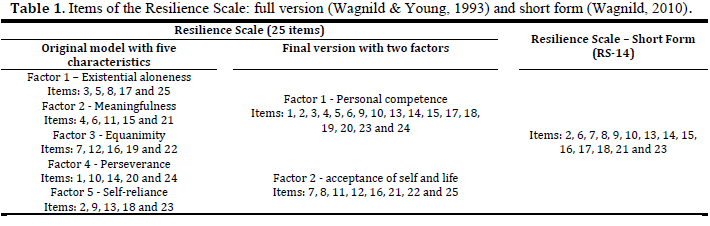
<body><![CDATA[<p><font face="Verdana" size="2">In conclusion, some discrepancies between different studies regarding the factor structure of the RS have been obtained. These discrepancies can eventually result from sampling issues: some studies used participants from very different developmental phases (e.g., Dam&aacute;sio <i>et al.</i>, 2011), and others used participants with less than 13 years old, an option that is not appropriate given that the authors of the RS advise against the use of the scale with participants from earlier ages (Wagnild, 2010). Considering that cross-cultural studies of resilience can provide important insights about the construct and its theoretical definition and to support the translation of the research findings to the practice in the domain of positive adjustment and health, it is important to guarantee the equivalence of the measurements across the populations that are to be compared. Therefore, the present study aims to investigate the best fitting solution for the RS and its invariance across Brazilian and Portuguese samples. Two competing factor models, namely the original five and two factor solutions, were tested for the RS full version (composed of 25 items). Moreover, a one-dimension solution for the14-item short version was also investigated.&nbsp; Obtaining evidence for the equivalence of the measured construct between samples of both countries can allow future cross-cultural studies on the topic of resilience.</font></p>      <p><font face="Verdana" size="2"><b>METHOD</b></font></p>      <p><font face="Verdana" size="2"><b>Participants</b></font></p>      <p><font face="Verdana" size="2">The sample was composed of 969 adolescents, from which 391 (40.4%) were Portuguese and 578 (59.6%) were Brazilian.&nbsp; About half of the adolescents were girls (<i>n</i> = 522, 53.9%). The age of the participants ranged between 13 and 18 years old (<i>M</i> = 15.40, <i>SD</i> = 1.357). As we can see in <a href="/img/revistas/psi/v30n2/30n2a04t2.jpg">Table 2</a>, the number of girls was higher in the Portuguese sample, given that a significant difference was found between groups, <i>&chi;</i><sup>2</sup> = 11.407, <i>p</i> = .001. Mean age of the participants was 15.40 for the Portuguese sample (<i>SD</i> = 1.388) and 15.41 (<i>SD </i>= 1.336) for the Brazilian sample, and therefore both samples did not differ in terms of age, <i>&chi;</i><sup>2</sup> = 9.316, <i>p</i> = .097.</font></p>      <p><font face="Verdana" size="2"><b>Measures</b></font></p>      <p><font face="Verdana" size="2">The Resilience Scale (Wagnild &amp; Young, 1993) is composed of 25 items that each adolescent should classify using a likert response scale ranging between 1 (<i>strongly disagree</i>) and 7 (<i>strongly agree</i>). The Portuguese version used by Vara and Sani (2006), with Cronbach alpha of .86, and the Brazilian version used by Pesce and colleagues (2005), with Cronbach alpha of .80, were administered in this study. Both versions were available as official translations of the Resilience Scale to European and Brazilian Portuguese at the website of the scale. To test the psychometric properties of the RS-14, only the 14 items indicated by Wagnild (2010) of the original version were used in the analysis (see <a href="/img/revistas/psi/v30n2/30n2a04t1.jpg">Table 1</a>).</font></p>      <p><font face="Verdana" size="2"><b>Procedure</b></font></p>      <p><font face="Verdana" size="2">Samples were recruited in schools located in suburban areas of S&atilde;o Paulo, in Brazil, and Porto, in Portugal, using a non-probabilistic method. These cities were selected by their geographical proximity with the research centers involved, despite the cultural and demographical differences between the contexts. After gathering the informed consent of school boards and parents, the 25-item Resilience Scale version was administered to the participants in their classrooms, by a member of the research team specially trained to the task. Data was collected in the second period of the school year by a graduate student, trained by their supervisors for this specific purpose. Adolescents were also informed about the anonymous, confidential and voluntary nature of their participation.</font></p>      <p><font face="Verdana" size="2"><b>Statistical analyses</b></font></p>      <p><font face="Verdana" size="2">Confirmatory factor analysis (CFA) was used to test three models for the RS. For the full version, and following the approach used in previous studies, a five-factor and a two-factor model were tested. For the reduced version, composed of 14 items, a one-factor model was fitted. In a first step, each model was run separately for each sample and their fit was assessed.</font></p>      ]]></body>
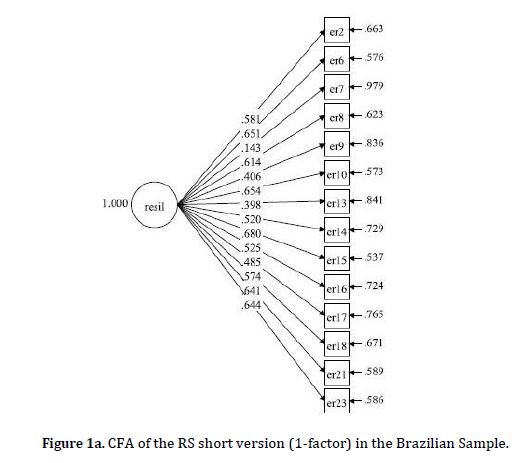
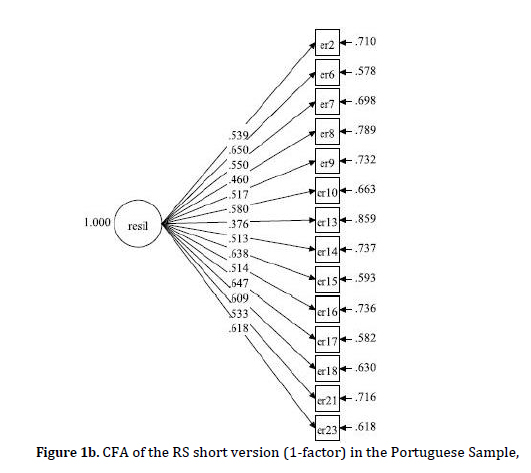
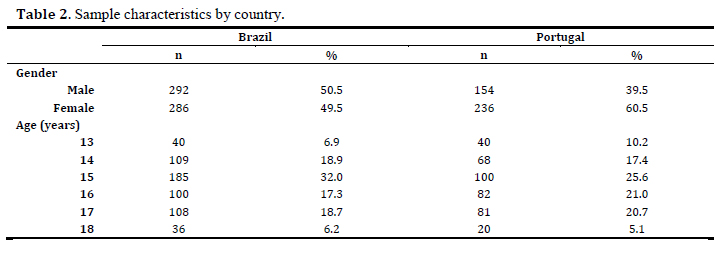
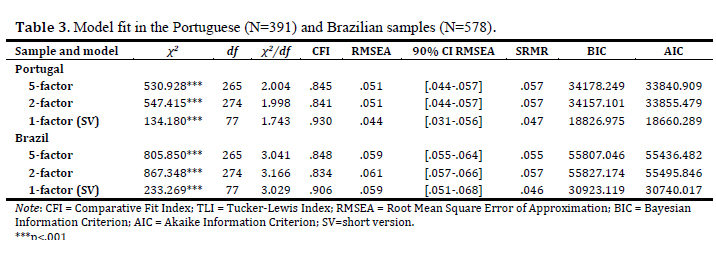
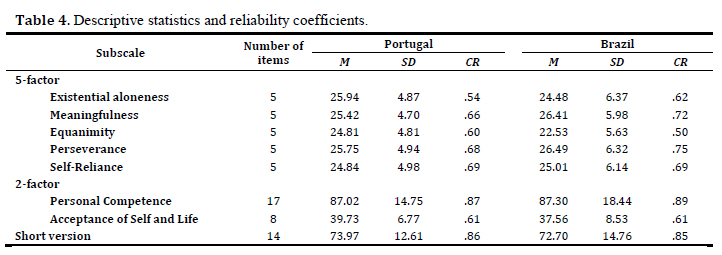
<body><![CDATA[<p><font face="Verdana" size="2">To assess the global fit of the tested models, the following criteria were used: the chi-square (<i>&chi;<sup>2</sup></i>) values, the ratio between the chi-square and the degrees of freedom (<i>&chi;<sup>2</sup>/df</i>), the comparative fit index (CFI), the root mean square error of approximation (RMSEA) and the standardized root mean square residual (SRMR). Cut-off values for fit were considered adequate when <i>&chi;<sup>2</sup>/df</i> was lower than 3.00 and CFI values were higher than .90. Values lower than .08 for the RMSEA and lower than .10 for the SRMR were considered to indicate an acceptable fit and values lower than .05 indicators of a good fit (Kleine, 2010; Schermelleh-Engel, Moosbrugger, &amp; M&uuml;ller, 2003). The Bayesian Information Criteria (BIC) and the Akaike Information Criterion (AIC) were used to compare the models. The model with the lowest value was considered to be the one that best represents the data. Additionally, composite reliability was computed. Values higher than .70 were considered adequate (Hair, Black, Babin, &amp; Anderson, 2009).</font></p>      <p><font face="Verdana" size="2">After determining which model was the one that best fitted the data, in a second step, multi-group CFA was performed to test the invariance of the instrument&rsquo;s flagged structure across the Portuguese and the Brazilian samples. The procedure outlined by van&nbsp; de&nbsp; Schoot,&nbsp; Lugtig,&nbsp; and Hox (2012) was followed. First, a configural model, where all parameters were freely estimated, was tested. Next, metric invariance was assessed, where the factor loadings were constrained but the intercepts were freely estimated. In a third step, scalar invariance, sometimes also called strong invariance, was tested, where both loadings and intercepts were constrained to be equal across both samples. Evidence for the invariance of the model across both samples is achieved when the constraint of parameters performed in testing the subsequent models does not worsen the fit indices. When the subsequent model presented a worse fit than the previous one, partial measurement invariance was established. In order to compare model fit, and given that these models were nested, we considered not only BIC and AIC values, but also computed Satorra-Bentler scaled chi-square difference tests. However, and given that the statistical power of the study is high due to the large sample size, two additional criteria were considered, as recommended by Cheung and Rensvold (2002) and Chen (2007): (a) change in CFI (<i>&Delta;CFI</i> &le; .01) and (b) change in RMSEA (<i>&Delta;RMSEA</i> &le; .015). Differences in the latent means between the Brazilian and the Portuguese samples were calculated after establishing the partial invariance of the factor structure.</font></p>      <p><font face="Verdana" size="2">All analyses were conducted using Mplus, version 7 (Muth&eacute;n &amp; Muth&eacute;n, 2012), and using the maximum likelihood robust (MLR) estimator. Only 5.3% of the sample had missing values, but the pattern of missing&rsquo;s was completely at random, as indicated by Little's (1988) MCAR test, <i>&chi;&sup2;</i>(775) =645.504, <i>p</i>=.99. Therefore, the full information method available in Mplus was used to deal with the missing data.</font></p>      <p>&nbsp;</p>      <p><font face="Verdana" size="2"><b>RESULTS</b></font></p>      <p><font face="Verdana" size="2"><a href="/img/revistas/psi/v30n2/30n2a04t3.jpg">Table 3</a> presents the model fit for each one of the three tested models. Results for the five-factor model and for the two-factor model were very similar: for both models acceptable values for RMSEA and SRMR were obtained for both samples. CFI values were inadequate in both samples for both models. When observing the AIC and BIC indices to compare the fit of the five- and two-factor models, in the Brazilian sample the lowest value is obtained for the five-factor model, indicating that this model is the one that best fits the data if considering the full version of the instrument. However, for the Portuguese sample, if considering especially the BIC, which is the comparison index that provides a better trade-off between fit and model complexity (van de Schoot <i>et al</i>., 2012), the two-factor model has the lowest value and therefore seems to have a slight better fit in the full version of the instrument.</font></p>      <p><font face="Verdana" size="2">The one-factor model for the 14-item short version of the instrument presented adequate values in all fit indices in both samples.</font></p>      <p><font face="Verdana" size="2"><a href="/img/revistas/psi/v30n2/30n2a04t4.jpg">Table 4</a> presents the descriptive statistics and the composite reliability for each dimension, considering all the tested models. Composite reliability was low in both samples for all five subscales, if considering the ones resulting from a five-factor solution. If considering the two-factor solution, the items of the &ldquo;Personal Competence&rdquo; subscale reached acceptable values, but the items of the &ldquo;Acceptance of Self and Life&rdquo; subscale had very low reliability in both samples. Composite reliability values for the one-dimensional short version were very high in both samples.</font></p>      <p><font face="Verdana" size="2">Therefore, considering the concerns raised in previous research about the factor structure of the full version of the instrument, the results of the CFA obtained in our study, indicating that the best fitting solution for the full version is different for each country, and the poor internal reliability obtained for the full version of the instrument regardless of the number of factors considered (two or five), led us to further test the invariance only of the short version. Moreover, the short version was the one that presented a good fit in both samples. <a href="#f1">Figures 1</a> and <a href="#f2">2</a> show the factor loadings for the items in the short version. All factor loadings were higher than .30, except for item 7 in the Brazilian sample.</font></p>      <p>&nbsp;</p> <a name="f1"> <img src="/img/revistas/psi/v30n2/30n2a04f1.jpg">     
]]></body>
<body><![CDATA[<p>&nbsp;</p>      <p>&nbsp;</p> <a name="f2"> <img src="/img/revistas/psi/v30n2/30n2a04f2.jpg">     
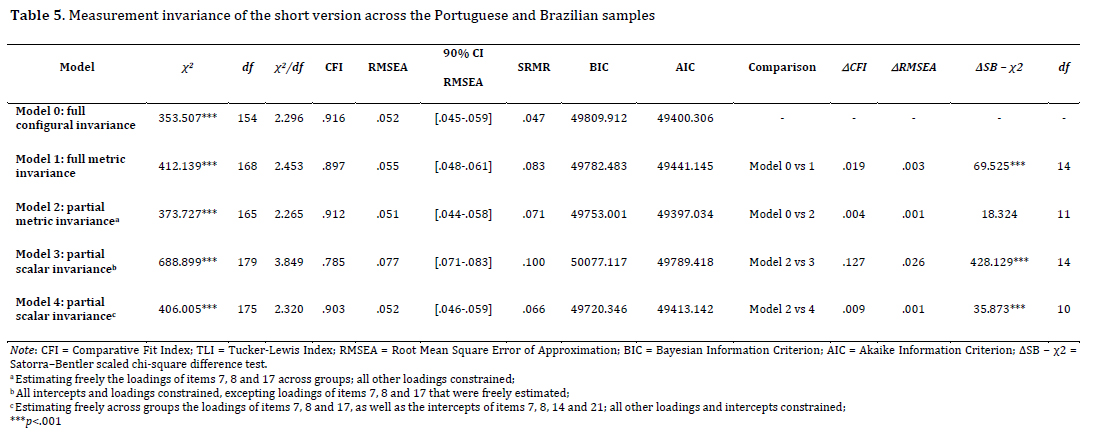
<p>&nbsp;</p>      <p><font face="Verdana" size="2"><a href="/img/revistas/psi/v30n2/30n2a04t5.jpg">Table 5</a> presents the results of the invariance testing. The configural invariance model (model 0) had a good fit. The results for the metric invariance model (model 1) indicated a poorer fit: not only the Satorra-Bentler scaled chi-square test of differences was significant, but also the difference in the CFI between the configural and the metric invariance models was higher than .01. After inspecting the factor loadings and the modification indices, three items were flagged as non-invariant (see <a href="/img/revistas/psi/v30n2/30n2a04t5.jpg">Table 5</a>). Therefore, a partial metric invariance model (model 2) was tested, where the loadings of these three items were freely estimated across groups. This model had a good fit and did not fit worse than the configural model. Therefore, partial metric invariance was established. In a next model (model 3), the invariant loadings as well as all the intercepts were constrained equal across samples. This model showed a worse fit than the previous one in all the criteria considered for model comparison (see <a href="/img/revistas/psi/v30n2/30n2a04t5.jpg">Table 5</a>). Four intercepts were then flagged as non-invariant and a new model was run (model 4) where these intercepts were also allowed to differ. This model had a better fit than the previous one. Moreover, model 4 did not fit worse than model 3 as indicated by the differences in CFI and RMSEA. Therefore, we established partial scalar measurement invariance across the Portuguese and the Brazilian samples for the short version of the instrument.</font></p>      <p><font face="Verdana" size="2">Given that no full scalar invariance was established, cross-cultural comparisons must be made with caution. Therefore, we compared the differences in the latent means considering only the results for the non-invariant items. A significant mean difference favoring the Brazilian sample was found in the latent trait measured by the short version (<i>DM</i>=.16; <i>p</i>=.026).</font></p>      <p><font face="Verdana" size="2"><b>DISCUSSION AND CONCLUSIONS</b></font></p>      <p><font face="Verdana" size="2">Despite the enthusiasm showed in the last decades and the consequent growth of research in the field of resilience, some challenges remain, especially relating to the universality of the findings across cultures. Also different theoretical models and instruments have been developed and tested in several countries and contexts. One of the measures that has received major attention is the Resilience Scale (Wagnild &amp; Young, 1993) and this interest has been translated into several psychometric studies and adaptations to different populations. Nonetheless, the findings of the research in the different countries have not been consistent regarding the RS factor structure: although the authors of the original version used a theoretical framework with five dimensions, empirical results have supported either a two-factor (Wagnild &amp; Young, 1993) or a five-factor structure (Felgueiras <i>et al</i>., 2010; Lundman et al., 2007; Oliveira &amp; Machado, 2011); others have not found a clear factor structure (Losoi <i>et al</i>., 2013; Nishi <i>et al</i>, 2010). Therefore, as previously stated by some authors, comparing the evidence of cross-cultural validity of the theoretical models is difficult (Hjemdal, Roazzi, Dias &amp; Friborg, 2015).</font></p>      <p><font face="Verdana" size="2">In the Portuguese and Brazilian contexts, the results of some studies supported the original five factor structure (Felgueiras et al., 2010; Oliveira &amp; Machado, 2011), despite the items that loaded on each factor were not totally correspondent to the ones indicated in the study of the original version (Wagnild &amp; Young, 1993), and others supported a three factor structure (Pesce et al., 2005; Vara &amp; Sani, 2006). To overcome these difficulties, a short-version of the measure with just 14 items (RS-14) was developed and a one-factor structure has been consistently found in the different adaptations of this version for different countries (e.g., Aiena <i>et al</i>., 2015; Oliveira, <i>et al</i>., 2015; Losoi <i>et al</i>., 2013; Nishi <i>et al</i>., 2010; Pritzker &amp; Minter, 2014). Despite this consensus, some studies propose alternative short versions with 13 (Dam&aacute;sio <i>et al</i>., 2011) or 12 items (Oliveira <i>et al</i>., 2015). Note that most of this body of research has used exploratory factor analysis. The main aim of our study was to investigate the factor structure of the RS, either in its full and short version, using confirmatory factor analysis (CFA) and to test measurement invariance across Brazilian and Portuguese samples, so that fair cross-cultural comparisons can be performed. CFA allows the direct testing of the fit of the data to a theoretical model, the testing of the fit of concurrent models and the testing of measurement invariance (Kleine, 2010) and consequently was preferred in our study.</font></p>      <p><font face="Verdana" size="2">When considering the factor structure testing of the full version of the RS, the five-factor structure seems to fit better in the Brazilian sample, whereas the two-factor structure seems to fit slightly better in the Portuguese sample. This finding indicates that, even if resilience is a construct that can be fragmented into smaller competences (e.g., meaningfulness, perseverance, acceptance of life and self, among others), these competences might not be easily compared across distinct countries and cultures. Besides this lack of concordance in the best fitting structure, low reliability values were found for the full version of the RS in both countries, regardless of the number of factors considered. The reliability values were more adequate in the RS-14, and the hypothesized one factor structure presented a good fit, with all items having factor loadings higher than .30 in both samples.</font></p>      <p><font face="Verdana" size="2">Moreover, our results provided evidence of partial measurement invariance across the Portuguese and the Brazilian samples for the short version of the instrument, supporting the assumption that most of the items that compose the instrument measure the same psychological construct in both groups. This finding allows future direct comparisons of the scores obtained by adolescents from Brazil and Portugal, but these comparisons must be performed only using the invariant items. This finding can also have theoretical implications: a common one-dimensional structure for both samples seems to mean that the resilience construct, defined as a whole, is comparable in both cultures. However, considering that no full scalar invariance was established, cross-cultural comparisons should consider social construction, the countries, cultures and children&rsquo;s and adolescents&rsquo; representation of resilience construct (Ungar, 2005, 2010).</font></p>      ]]></body>
<body><![CDATA[<p><font face="Verdana" size="2">The findings of the present study are particularly useful for research in the field of resilience in Portugal and Brazil. Firstly, the results highlight that the short version of the RS-14 scale has good psychometric properties, but also point out the partial scalar measurement invariance of the 14-item short version. This contributes to strengthen the validity of the measure and allows us to ensure the comparable nature of the results evaluated with this measure in both countries. Moreover, the use of the short version for the assessment of resilience has practical advantages, as it is less time consuming. Overall, our results also highlight some limitations of the full version of the RS, even when the samples include only adolescents with ages higher than 13 years old.</font></p>      <p><font face="Verdana" size="2">A possible limitation of the study is the lack of information about adolescents&rsquo; life events. This is a current issue in adaptation studies of resilience measures. However, further studies should involve more adolescents eligible according the adversity and the outcomes, whether to explore the profile of resilient adolescent or to compare adolescents&rsquo; characteristics with extreme profiles. Given the existing discussion about gender or age effects on resilience (e.g.: Losoi et al., 2013; Lundman et al., 2007; Sun &amp; Stewart, 2007), further studies should also explore the effect of demographic variables in resilience. Also the cultural and demographic differences between both cities involved should be considered as a limitation of the present study. It would be interesting to include other measures about adolescents&rsquo; perceptions of their context of living, whether at social, educational but also cultural level, considering values and norms in their communities to a broader and culturally based definition of resilience (Ungar, 2005, 2008). Finally, data from the RS-14 version was collected from the original 25-items version. Further studies with different groups or using both measures can be used.</font></p>      <p><font face="Verdana" size="2">To conclude, we recall the need to use reliable and valid measures in research and in the evaluation of projects. Only using sound literature and empirically-based measures we can ensure the effective results of intervention. Considering the dialectic relationship between theory and practice, this study gives us some insights to improve literature-based interventions that could be evaluated with RS-14. We expect that this study contributes to stimulate cross-cultural resilience research and that new boundaries can emerge between both countries, translating the results of research studies into practice.</font></p>      <p>&nbsp;</p>      <p><font face="Verdana" size="2"><b>References</b></font></p>      <!-- ref --><p><font face="Verdana" size="2">Affi, T. O., &amp; Macmillan, H. L. (2011). Resilience following child maltreatment: A review of protective factors. <i>Canadian Journal of Psychiatry, 56</i>, 266-272.&nbsp; <a href="https://doi.org/10.1177/070674371105600505" target="_blank">https://doi.org/10.1177/070674371105600505</a></font>&nbsp;&nbsp;&nbsp;&nbsp;&nbsp;&nbsp;&nbsp;&nbsp;[&#160;<a href="javascript:void(0);" onclick="javascript: window.open('/scielo.php?script=sci_nlinks&ref=472203&pid=S0874-2049201600020000400001&lng=','','width=640,height=500,resizable=yes,scrollbars=1,menubar=yes,');">Links</a>&#160;]<!-- end-ref --><!-- ref --><p><font face="Verdana" size="2">Ahern, N. R., Kiehl, E. M., Sole, M. L., &amp; Byers, J. (2006). A review of instruments measuring resilience. <i>Issues in Comprehensive Pediatric Nursing, 29</i>, 103-125. <a href="https://doi.org/10.1080/01460860600677643" target="_blank">https://doi.org/10.1080/01460860600677643</a></font>&nbsp;&nbsp;&nbsp;&nbsp;&nbsp;&nbsp;&nbsp;&nbsp;[&#160;<a href="javascript:void(0);" onclick="javascript: window.open('/scielo.php?script=sci_nlinks&ref=472204&pid=S0874-2049201600020000400002&lng=','','width=640,height=500,resizable=yes,scrollbars=1,menubar=yes,');">Links</a>&#160;]<!-- end-ref --><p><font face="Verdana" size="2">Aiena, B. J., Baczwaski, B. J., Schulenberg, S. E., &amp; Buchanan, E. M. (2015). Measuring resilience with the RS&ndash;14: A tale of two samples. <i>Journal of Personality Assessment, 97</i>, 291-300. <a href="https://doi.org/10.1080/00223891.2014.951445" target="_blank">https://doi.org/10.1080/00223891.2014.951445</a></font></p>      <!-- ref --><p><font face="Verdana" size="2">Aroian, K. J., Morris, S. N., Neary, S., Spitzer, A., &amp; Tran, T. V. (1997). Psychometric evaluation of the Russian Language version of the Resilience Scale. <i>Journal of Nursing Measurement, 5</i>, 151-164.    &nbsp;&nbsp;&nbsp;&nbsp;&nbsp;&nbsp;&nbsp;&nbsp;[&#160;<a href="javascript:void(0);" onclick="javascript: window.open('/scielo.php?script=sci_nlinks&ref=472206&pid=S0874-2049201600020000400004&lng=','','width=640,height=500,resizable=yes,scrollbars=1,menubar=yes,');">Links</a>&#160;]<!-- end-ref --></font></p>      ]]></body>
<body><![CDATA[<!-- ref --><p><font face="Verdana" size="2">Benard, B. (1999). Applications of resilience: Possibilities and promise. In M. Glantz, &amp; J. Johnson (Ed.), <i>Resilience and development: Positive life adaptation</i> (pp. 2269-2277). Nueva York: Plenum.    &nbsp;&nbsp;&nbsp;&nbsp;&nbsp;&nbsp;&nbsp;&nbsp;[&#160;<a href="javascript:void(0);" onclick="javascript: window.open('/scielo.php?script=sci_nlinks&ref=472208&pid=S0874-2049201600020000400005&lng=','','width=640,height=500,resizable=yes,scrollbars=1,menubar=yes,');">Links</a>&#160;]<!-- end-ref --></font></p>      <!-- ref --><p><font face="Verdana" size="2">Black, C., &amp; Ford-Gilboe, M. (2004). Adolescent mothers: Resilience, family health work and health-promoting practices. <i>Journal of Advanced Nursing, 48</i>, 351-360. <a href="https://doi.org/10.1111/j.1365-2648.2004.03204.x" target="_blank">https://doi.org/10.1111/j.1365-2648.2004.03204.x</a></font>&nbsp;&nbsp;&nbsp;&nbsp;&nbsp;&nbsp;&nbsp;&nbsp;[&#160;<a href="javascript:void(0);" onclick="javascript: window.open('/scielo.php?script=sci_nlinks&ref=472210&pid=S0874-2049201600020000400006&lng=','','width=640,height=500,resizable=yes,scrollbars=1,menubar=yes,');">Links</a>&#160;]<!-- end-ref --><!-- ref --><p><font face="Verdana" size="2">Brooks, J. E. (2006). Strengthening resilience in children and youths: Maximizing opportunities through the schools. <i>Children and Schools, 28</i>, 69-76. <a href="https://doi.org/10.1093/cs/28.2.69" target="_blank">https://doi.org/10.1093/cs/28.2.69</a></font>&nbsp;&nbsp;&nbsp;&nbsp;&nbsp;&nbsp;&nbsp;&nbsp;[&#160;<a href="javascript:void(0);" onclick="javascript: window.open('/scielo.php?script=sci_nlinks&ref=472211&pid=S0874-2049201600020000400007&lng=','','width=640,height=500,resizable=yes,scrollbars=1,menubar=yes,');">Links</a>&#160;]<!-- end-ref --><!-- ref --><p><font face="Verdana" size="2">Carbonell, D. N., Reinherz, H. Z., Giaconia, R. M., Stashwick, C. K., Paradis, A. D., &amp; Beardslee, W. R. (2002). Adolescent protective factors promoting resilience in young adults at risk for depression. <i>Child and Adolescent Social Work Journal, 19</i>, 393-412. <a href="https://doi.org/10.1023/A:1020274531345" target="_blank">https://doi.org/10.1023/A:1020274531345</a></font>&nbsp;&nbsp;&nbsp;&nbsp;&nbsp;&nbsp;&nbsp;&nbsp;[&#160;<a href="javascript:void(0);" onclick="javascript: window.open('/scielo.php?script=sci_nlinks&ref=472212&pid=S0874-2049201600020000400008&lng=','','width=640,height=500,resizable=yes,scrollbars=1,menubar=yes,');">Links</a>&#160;]<!-- end-ref --><!-- ref --><p><font face="Verdana" size="2">Chen, F. F. (2007). Sensitivity of goodness of fit indexes to lack of measurement invariance. <i>Structural Equation Modeling: A Multidisciplinary Journal, 14</i>, 464-504. <a href="https://doi.org/10.1080/10705510701301834" target="_blank">https://doi.org/10.1080/10705510701301834</a></font>&nbsp;&nbsp;&nbsp;&nbsp;&nbsp;&nbsp;&nbsp;&nbsp;[&#160;<a href="javascript:void(0);" onclick="javascript: window.open('/scielo.php?script=sci_nlinks&ref=472213&pid=S0874-2049201600020000400009&lng=','','width=640,height=500,resizable=yes,scrollbars=1,menubar=yes,');">Links</a>&#160;]<!-- end-ref --><!-- ref --><p><font face="Verdana" size="2">Cheung, G. W., &amp; Rensvold, R. B. (2002). Evaluating goodness-of-fit indexes for testing measurement invariance. <i>Structural Equation Modeling: A Multidisciplinary Journal, 9</i>, 233-255. <a href="https://doi.org/10.1207/S15328007SEM0902_5" target="_blank">https://doi.org/10.1207/S15328007SEM0902_5</a></font>&nbsp;&nbsp;&nbsp;&nbsp;&nbsp;&nbsp;&nbsp;&nbsp;[&#160;<a href="javascript:void(0);" onclick="javascript: window.open('/scielo.php?script=sci_nlinks&ref=472214&pid=S0874-2049201600020000400010&lng=','','width=640,height=500,resizable=yes,scrollbars=1,menubar=yes,');">Links</a>&#160;]<!-- end-ref --><!-- ref --><p><font face="Verdana" size="2">Constantine, N. A., Benard, B., &amp; Diaz, M. (1999). <i>Measuring protective factors and resilience traits in youth: The Healthy Kids Resilience Assessment</i>.    &nbsp;&nbsp;&nbsp;&nbsp;&nbsp;&nbsp;&nbsp;&nbsp;[&#160;<a href="javascript:void(0);" onclick="javascript: window.open('/scielo.php?script=sci_nlinks&ref=472215&pid=S0874-2049201600020000400011&lng=','','width=640,height=500,resizable=yes,scrollbars=1,menubar=yes,');">Links</a>&#160;]<!-- end-ref --> Paper presented at the Seventh Annual Meeting of the Society for Prevention Research, New Orleans. Retrieved from <a href="http://crahd.phi.org/papers/HKRA-99.pdf">http://crahd.phi.org/papers/HKRA-99.pdf</a></font></p>      <!-- ref --><p><font face="Verdana" size="2">Dam&aacute;sio, B. F., Borsa, J. C., &amp; Silva, J. P. (2011). 14-Item Resilience Scale (RS-14): Psychometric properties of the Brazilian version. <i>Journal of Nursing Measurement, 19</i>, 131-145. <a href="https://doi.org/10.1891/1061-3749.19.3.131" target="_blank">https://doi.org/10.1891/1061-3749.19.3.131</a></font>&nbsp;&nbsp;&nbsp;&nbsp;&nbsp;&nbsp;&nbsp;&nbsp;[&#160;<a href="javascript:void(0);" onclick="javascript: window.open('/scielo.php?script=sci_nlinks&ref=472217&pid=S0874-2049201600020000400012&lng=','','width=640,height=500,resizable=yes,scrollbars=1,menubar=yes,');">Links</a>&#160;]<!-- end-ref --><!-- ref --><p><font face="Verdana" size="2">Daskalakis, N. P., Bagot, R. C., Parker, K. J., Vinkers, C. H., &amp; de Kloet, E. R. (2013). The three-hit concept of vulnerability and resilience: Toward understanding adaptation to early-life adversity outcome. <i>Psychoneuroendocrinology, 38</i>, 1858-1873. <a href="https://doi.org/10.1016/j.psyneuen.2013.06.008" target="_blank">https://doi.org/10.1016/j.psyneuen.2013.06.008</a>.    &nbsp;&nbsp;&nbsp;&nbsp;&nbsp;&nbsp;&nbsp;&nbsp;[&#160;<a href="javascript:void(0);" onclick="javascript: window.open('/scielo.php?script=sci_nlinks&ref=472218&pid=S0874-2049201600020000400013&lng=','','width=640,height=500,resizable=yes,scrollbars=1,menubar=yes,');">Links</a>&#160;]<!-- end-ref --></font></p>      <!-- ref --><p><font face="Verdana" size="2">Davies, S. L., Thind, H. R., Chandler, S. D., &amp; Tucker, J. A. (2011). Enhancing resilience among young people: The role of communities and asset-building approaches to intervention. <i>Adolescent Medicine: State of the Art Reviews, 22</i>, 402-440.    &nbsp;&nbsp;&nbsp;&nbsp;&nbsp;&nbsp;&nbsp;&nbsp;[&#160;<a href="javascript:void(0);" onclick="javascript: window.open('/scielo.php?script=sci_nlinks&ref=472220&pid=S0874-2049201600020000400014&lng=','','width=640,height=500,resizable=yes,scrollbars=1,menubar=yes,');">Links</a>&#160;]<!-- end-ref --></font></p>      <!-- ref --><p><font face="Verdana" size="2">Dillon, D., Chivite-Matthews, N., Grewal, I., Brown, R., Webster, S., Weddell, E., Brown, G., &amp; Smith, N. (2007). <i>Risk, protective factors and resilience to drug use: Identifying resilient young people and learning from their experiences</i>. London: Home Office.    &nbsp;&nbsp;&nbsp;&nbsp;&nbsp;&nbsp;&nbsp;&nbsp;[&#160;<a href="javascript:void(0);" onclick="javascript: window.open('/scielo.php?script=sci_nlinks&ref=472222&pid=S0874-2049201600020000400015&lng=','','width=640,height=500,resizable=yes,scrollbars=1,menubar=yes,');">Links</a>&#160;]<!-- end-ref --></font></p>      <!-- ref --><p><font face="Verdana" size="2">Felgueiras, M. C., Festas, C., &amp; Vieira, M. (2010). Adapta&ccedil;&atilde;o e valida&ccedil;&atilde;o da Resilience Scale de Wagnild e Young para a cultura portuguesa (Adaptation and validation of the Wagnild and Young Resilience Scale to Portuguese Culture). <i>Cadernos de Sa&uacute;de, 3</i>, 73-80.    &nbsp;&nbsp;&nbsp;&nbsp;&nbsp;&nbsp;&nbsp;&nbsp;[&#160;<a href="javascript:void(0);" onclick="javascript: window.open('/scielo.php?script=sci_nlinks&ref=472224&pid=S0874-2049201600020000400016&lng=','','width=640,height=500,resizable=yes,scrollbars=1,menubar=yes,');">Links</a>&#160;]<!-- end-ref --></font></p>      <!-- ref --><p><font face="Verdana" size="2">Fergus, S., &amp; Zimmerman, M. A. (2005). Adolescent resilience: A framework for understanding healthy development in the face of risk. <i>Annual Review of Public Health, 26</i>, 399-419. <a href="https://doi.org/10.1146/annurev.publhealth.26.021304.144357" target="_blank">https://doi.org/10.1146/annurev.publhealth.26.021304.144357</a></font>&nbsp;&nbsp;&nbsp;&nbsp;&nbsp;&nbsp;&nbsp;&nbsp;[&#160;<a href="javascript:void(0);" onclick="javascript: window.open('/scielo.php?script=sci_nlinks&ref=472226&pid=S0874-2049201600020000400017&lng=','','width=640,height=500,resizable=yes,scrollbars=1,menubar=yes,');">Links</a>&#160;]<!-- end-ref --><!-- ref --><p><font face="Verdana" size="2">Friborg, O., Barlaug, D., Martinussen, M., Rosenvinge, J. H., &amp; Hjemdal, O. (2005). Resilience in relation to personality and intelligence. <i>International Journal of Methods in Psychiatric Research, 14</i>, 29-40. <a href="https://doi.org/10.1002/mpr.15" target="_blank">https://doi.org/10.1002/mpr.15</a></font>&nbsp;&nbsp;&nbsp;&nbsp;&nbsp;&nbsp;&nbsp;&nbsp;[&#160;<a href="javascript:void(0);" onclick="javascript: window.open('/scielo.php?script=sci_nlinks&ref=472227&pid=S0874-2049201600020000400018&lng=','','width=640,height=500,resizable=yes,scrollbars=1,menubar=yes,');">Links</a>&#160;]<!-- end-ref --><!-- ref --><p><font face="Verdana" size="2">Friedman, A. K., Walsh, J. J., Juarez, B., Ku, S. M., Chaudhury, D., &amp; Wang, J. (2014). Enhancing depression mechanisms in midbrain dopamine neurons achieves homeostatic resilience. <i>Science, 344</i>, 313-319. <a href="https://doi.org/10.1126/science.1249240" target="_blank">https://doi.org/10.1126/science.1249240</a></font>&nbsp;&nbsp;&nbsp;&nbsp;&nbsp;&nbsp;&nbsp;&nbsp;[&#160;<a href="javascript:void(0);" onclick="javascript: window.open('/scielo.php?script=sci_nlinks&ref=472228&pid=S0874-2049201600020000400019&lng=','','width=640,height=500,resizable=yes,scrollbars=1,menubar=yes,');">Links</a>&#160;]<!-- end-ref --><!-- ref --><p><font face="Verdana" size="2">Garmezy, N., &amp; Streitman, S. (1974). Children at risk: The search for the antecedents of schizophrenia: Conceptual models and research methods. <i>Schizophrenia Bulletin, 8</i>, 14-90. <a href="https://doi.org/10.1093/schbul/1.8.14" target="_blank">https://doi.org/10.1093/schbul/1.8.14</a></font>&nbsp;&nbsp;&nbsp;&nbsp;&nbsp;&nbsp;&nbsp;&nbsp;[&#160;<a href="javascript:void(0);" onclick="javascript: window.open('/scielo.php?script=sci_nlinks&ref=472229&pid=S0874-2049201600020000400020&lng=','','width=640,height=500,resizable=yes,scrollbars=1,menubar=yes,');">Links</a>&#160;]<!-- end-ref --><!-- ref --><p><font face="Verdana" size="2">Garmezy, N. (1971). Vulnerability research and the issue of primary prevention. <i>American Journal of Orthopsychiatry, 41</i>, 101-116. <a href="https://doi.org/10.1111/j.1939-0025.1971.tb01111.x" target="_blank">https://doi.org/10.1111/j.1939-0025.1971.tb01111.x</a></font>&nbsp;&nbsp;&nbsp;&nbsp;&nbsp;&nbsp;&nbsp;&nbsp;[&#160;<a href="javascript:void(0);" onclick="javascript: window.open('/scielo.php?script=sci_nlinks&ref=472230&pid=S0874-2049201600020000400021&lng=','','width=640,height=500,resizable=yes,scrollbars=1,menubar=yes,');">Links</a>&#160;]<!-- end-ref --><!-- ref --><p><font face="Verdana" size="2">Garmezy, N. (1974). The study of competence in children at risk for severe psychopathology. In E. J. Anthony, &amp; C. Koupernik (eds.), <i>The child in his family: Children at psychiatric risk</i> (Vol. 3, pp. 77-98). New York: Wiley.    &nbsp;&nbsp;&nbsp;&nbsp;&nbsp;&nbsp;&nbsp;&nbsp;[&#160;<a href="javascript:void(0);" onclick="javascript: window.open('/scielo.php?script=sci_nlinks&ref=472231&pid=S0874-2049201600020000400022&lng=','','width=640,height=500,resizable=yes,scrollbars=1,menubar=yes,');">Links</a>&#160;]<!-- end-ref --></font></p>      <p><font face="Verdana" size="2">Hair, J. F., Black, W. C., Babin, B. J., &amp; Anderson, R. E. (2009). <i>Multivariate data analysis (7th ed.)</i>. Upper Saddle River, NJ: Prentice hall.</font></p>      <!-- ref --><p><font face="Verdana" size="2">Hawkins, J. D., Catalano, R. F., &amp; Miller, J. Y. (1992). Risk and protective factors for alcohol and other drug problems in adolescence and early adulthood: Implications for substance abuse prevention. <i>Psychological Bulletin, 112</i>, 64-105. <a href="https://doi.org/10.1037/0033-2909.112.1.64" target="_blank">https://doi.org/10.1037/0033-2909.112.1.64</a></font>&nbsp;&nbsp;&nbsp;&nbsp;&nbsp;&nbsp;&nbsp;&nbsp;[&#160;<a href="javascript:void(0);" onclick="javascript: window.open('/scielo.php?script=sci_nlinks&ref=472234&pid=S0874-2049201600020000400024&lng=','','width=640,height=500,resizable=yes,scrollbars=1,menubar=yes,');">Links</a>&#160;]<!-- end-ref --><!-- ref --><p><font face="Verdana" size="2">Heilemann, M. V., Lee, K., &amp; Kury, F. S. (2003). Psychometric properties of the Spanish version of the Resilience Scale. <i>Journal of Nursing Measurement, 11</i>, 61-72. <a href="https://doi.org/10.1891/106137403780954976" target="_blank">https://doi.org/10.1891/106137403780954976</a></font>&nbsp;&nbsp;&nbsp;&nbsp;&nbsp;&nbsp;&nbsp;&nbsp;[&#160;<a href="javascript:void(0);" onclick="javascript: window.open('/scielo.php?script=sci_nlinks&ref=472235&pid=S0874-2049201600020000400025&lng=','','width=640,height=500,resizable=yes,scrollbars=1,menubar=yes,');">Links</a>&#160;]<!-- end-ref --><!-- ref --><p><font face="Verdana" size="2">Hjemdal, O., Roazzi, A., Dias, M.G., &amp; Friborg, O. (2015). The cross-cultural validity of the Resilience Scale for Adults: A comparison between Norway and Brazil. <i>BMC Psychology, 3</i>, 18. <a href="https://doi.org/10.1186/s40359-015-0076-1" target="_blank">https://doi.org/10.1186/s40359-015-0076-1</a></font>&nbsp;&nbsp;&nbsp;&nbsp;&nbsp;&nbsp;&nbsp;&nbsp;[&#160;<a href="javascript:void(0);" onclick="javascript: window.open('/scielo.php?script=sci_nlinks&ref=472236&pid=S0874-2049201600020000400026&lng=','','width=640,height=500,resizable=yes,scrollbars=1,menubar=yes,');">Links</a>&#160;]<!-- end-ref --><!-- ref --><p><font face="Verdana" size="2">Hunter, A.J. (2001). A cross-cultural comparison of resilience in adolescents. <i>Journal of Pediatric Nursing, 16</i>,172-179. <a href="https://doi.org/10.1053/jpdn.2001.24180" target="_blank">https://doi.org/10.1053/jpdn.2001.24180</a></font>&nbsp;&nbsp;&nbsp;&nbsp;&nbsp;&nbsp;&nbsp;&nbsp;[&#160;<a href="javascript:void(0);" onclick="javascript: window.open('/scielo.php?script=sci_nlinks&ref=472237&pid=S0874-2049201600020000400027&lng=','','width=640,height=500,resizable=yes,scrollbars=1,menubar=yes,');">Links</a>&#160;]<!-- end-ref --><p><font face="Verdana" size="2">Joseph, J. (1994). <i>The resilient child</i>. New York, NY: Insight Books.</font></p>      <p><font face="Verdana" size="2">Kleine, R. B. (2010). <i>Principles and practice of structural equation modelling </i>(3rd ed.). New York, NY: Guilford.</font></p>      <!-- ref --><p><font face="Verdana" size="2">Little, R.J. (1988). A test of missing completely at random for multivariate data with missing values. <i>Journal of the American Statistical Association, 83</i>, 1198-1202. <a href="https://doi.org/10.2307/2290157" target="_blank">https://doi.org/10.2307/2290157</a></font>&nbsp;&nbsp;&nbsp;&nbsp;&nbsp;&nbsp;&nbsp;&nbsp;[&#160;<a href="javascript:void(0);" onclick="javascript: window.open('/scielo.php?script=sci_nlinks&ref=472240&pid=S0874-2049201600020000400030&lng=','','width=640,height=500,resizable=yes,scrollbars=1,menubar=yes,');">Links</a>&#160;]<!-- end-ref --><!-- ref --><p><font face="Verdana" size="2">Losoi, H., Turunen, S., W&auml;ljas, M., Helminen, M., &Ouml;hman, J., Julkunun, J., &amp; Rosti-Otaj&auml;rvi, E. (2013). Psychometric properties of the Finnish version of Resilience Scale and its short version.&nbsp;<i>Psychology, Community, &amp; Health, 2</i>, 1-10. <a href="https://doi.org/10.5964/pch.v2i1.40" target="_blank">https://doi.org/10.5964/pch.v2i1.40</a>.    &nbsp;&nbsp;&nbsp;&nbsp;&nbsp;&nbsp;&nbsp;&nbsp;[&#160;<a href="javascript:void(0);" onclick="javascript: window.open('/scielo.php?script=sci_nlinks&ref=472241&pid=S0874-2049201600020000400031&lng=','','width=640,height=500,resizable=yes,scrollbars=1,menubar=yes,');">Links</a>&#160;]<!-- end-ref --></font></p>      <!-- ref --><p><font face="Verdana" size="2">Lundman, B., Strandberg, G., Eisemann, M., Gustafson, Y., &amp; Brulin, C. (2007).&nbsp; Psychometric properties of the Swedish version of the Resilience Scale. <i>Scandinavian Journal of Caring Sciences, 21</i>, 229-237. <a href="https://doi.org/10.1111/j.1471-6712.2007.00461.x" target="_blank">https://doi.org/10.1111/j.1471-6712.2007.00461.x</a></font>&nbsp;&nbsp;&nbsp;&nbsp;&nbsp;&nbsp;&nbsp;&nbsp;[&#160;<a href="javascript:void(0);" onclick="javascript: window.open('/scielo.php?script=sci_nlinks&ref=472243&pid=S0874-2049201600020000400032&lng=','','width=640,height=500,resizable=yes,scrollbars=1,menubar=yes,');">Links</a>&#160;]<!-- end-ref --><!-- ref --><p><font face="Verdana" size="2">Luthar, S. S. (1993). Annotation: Methodological and conceptual issues in research on childhood resilience. <i>Journal of Psychology and Psychiatry, 34</i>, 441-453. <a href="https://doi.org/10.1111/j.1469-7610.1993.tb01030.x" target="_blank">https://doi.org/10.1111/j.1469-7610.1993.tb01030.x</a></font>&nbsp;&nbsp;&nbsp;&nbsp;&nbsp;&nbsp;&nbsp;&nbsp;[&#160;<a href="javascript:void(0);" onclick="javascript: window.open('/scielo.php?script=sci_nlinks&ref=472244&pid=S0874-2049201600020000400033&lng=','','width=640,height=500,resizable=yes,scrollbars=1,menubar=yes,');">Links</a>&#160;]<!-- end-ref --><p><font face="Verdana" size="2">Luthar, S. S. (1999). <i>Poverty and children's adjustment</i>. Newbury Park, CA: Sage.&nbsp;</font></p>      <!-- ref --><p><font face="Verdana" size="2">Luthar, S. S. (2006). Resilience in development: A synthesis of research across five decades. In D. Cicchetti, D.J. (eds.), <i>Developmental psychopathology: Risk, disorder, and adaptation</i> (pp. 740-795). New York: Wiley.    &nbsp;&nbsp;&nbsp;&nbsp;&nbsp;&nbsp;&nbsp;&nbsp;[&#160;<a href="javascript:void(0);" onclick="javascript: window.open('/scielo.php?script=sci_nlinks&ref=472246&pid=S0874-2049201600020000400035&lng=','','width=640,height=500,resizable=yes,scrollbars=1,menubar=yes,');">Links</a>&#160;]<!-- end-ref --></font></p>      ]]></body>
<body><![CDATA[<!-- ref --><p><font face="Verdana" size="2">Luthar, S. S., &amp; Cicchetti, D. (2000). The construct of resilience: Implications for interventions and social policies. <i>Development and Psychopathology, 12</i>, 857-885. <a href="https://doi.org/10.1017/S0954579400004156" target="_blank">https://doi.org/10.1017/S0954579400004156</a></font>&nbsp;&nbsp;&nbsp;&nbsp;&nbsp;&nbsp;&nbsp;&nbsp;[&#160;<a href="javascript:void(0);" onclick="javascript: window.open('/scielo.php?script=sci_nlinks&ref=472248&pid=S0874-2049201600020000400036&lng=','','width=640,height=500,resizable=yes,scrollbars=1,menubar=yes,');">Links</a>&#160;]<!-- end-ref --><!-- ref --><p><font face="Verdana" size="2">Masten, A. S. (1999). Commentary: The promise and perils of resilience research as a guide to preventive interventions. In M. D. Glantz, &amp; J. L. Johnson (eds.), <i>Resilience and development: Positive life adaptations</i> (pp. 251-257). New York: Plenum Press.    &nbsp;&nbsp;&nbsp;&nbsp;&nbsp;&nbsp;&nbsp;&nbsp;[&#160;<a href="javascript:void(0);" onclick="javascript: window.open('/scielo.php?script=sci_nlinks&ref=472249&pid=S0874-2049201600020000400037&lng=','','width=640,height=500,resizable=yes,scrollbars=1,menubar=yes,');">Links</a>&#160;]<!-- end-ref --></font></p>      <!-- ref --><p><font face="Verdana" size="2">Masten, A. S. (2001). Ordinary magic: Resilience processes in development. <i>American Psychologist</i>, <i>56</i>, 227-238. <a href="https://doi.org/10.1037/0003-066X.56.3.227" target="_blank">https://doi.org/10.1037/0003-066X.56.3.227</a></font>&nbsp;&nbsp;&nbsp;&nbsp;&nbsp;&nbsp;&nbsp;&nbsp;[&#160;<a href="javascript:void(0);" onclick="javascript: window.open('/scielo.php?script=sci_nlinks&ref=472251&pid=S0874-2049201600020000400038&lng=','','width=640,height=500,resizable=yes,scrollbars=1,menubar=yes,');">Links</a>&#160;]<!-- end-ref --><!-- ref --><p><font face="Verdana" size="2">Masten, A. S. (2014). Global perspectives on resilience in children and youth. <i>Child Development, 85</i>, 6-20. <a href="https://doi.org/10.1111/cdev.12205" target="_blank">https://doi.org/10.1111/cdev.12205</a></font>&nbsp;&nbsp;&nbsp;&nbsp;&nbsp;&nbsp;&nbsp;&nbsp;[&#160;<a href="javascript:void(0);" onclick="javascript: window.open('/scielo.php?script=sci_nlinks&ref=472252&pid=S0874-2049201600020000400039&lng=','','width=640,height=500,resizable=yes,scrollbars=1,menubar=yes,');">Links</a>&#160;]<!-- end-ref --><p><font face="Verdana" size="2">Masten, A. S., &amp; Garmezy, N. (1985). Risk, vulnerability, and protective factors in developmental psychopathology. In B. Lahey, &amp; A. Kazdin (eds.), <i>Advances in clinical child psychology</i> (vol. 8. pp. 1&ndash;52). New York: Plenum Press.</font></p>      <p><font face="Verdana" size="2">Muth&eacute;n, L. K., &amp; Muth&eacute;n, B. O. (2012). <i>Mplus User&rsquo;s Guide </i>(7th ed.). Los Angeles, CA: Muth&eacute;n &amp; Muth&eacute;n.</font></p>      <!-- ref --><p><font face="Verdana" size="2">Nishi, D., Uehara, R., Kondo, M., &amp; Matsuoka, Y. (2010). Reliability and validity of the Japanese version of the Resilience Scale and its short version.&nbsp;<i>BMC Research Notes</i>,&nbsp;<i>3</i>, Article 310. <a href="https://doi.org/10.1186/1756-0500-3-310" target="_blank">https://doi.org/10.1186/1756-0500-3-310</a>.    &nbsp;&nbsp;&nbsp;&nbsp;&nbsp;&nbsp;&nbsp;&nbsp;[&#160;<a href="javascript:void(0);" onclick="javascript: window.open('/scielo.php?script=sci_nlinks&ref=472255&pid=S0874-2049201600020000400042&lng=','','width=640,height=500,resizable=yes,scrollbars=1,menubar=yes,');">Links</a>&#160;]<!-- end-ref --></font></p>      <!-- ref --><p><font face="Verdana" size="2">Oliveira, M. F., &amp; Machado, T. S. (2011). Tradu&ccedil;&atilde;o e valida&ccedil;&atilde;o da Escala de Resili&ecirc;ncia para Estudantes do Ensino Superior. (Translation and validation of the Resilience Scale for Higher Education Students). <i>An&aacute;lise Psicol&oacute;gica, 29</i>, 579-591.    &nbsp;&nbsp;&nbsp;&nbsp;&nbsp;&nbsp;&nbsp;&nbsp;[&#160;<a href="javascript:void(0);" onclick="javascript: window.open('/scielo.php?script=sci_nlinks&ref=472257&pid=S0874-2049201600020000400043&lng=','','width=640,height=500,resizable=yes,scrollbars=1,menubar=yes,');">Links</a>&#160;]<!-- end-ref --></font></p>      <!-- ref --><p><font face="Verdana" size="2">Oliveira, A., Matos, A. P., Pinheiro, M. R., &amp; Oliveira, S. (2015). Confirmatory factor analysis of the Resilience Scale short form in a Portuguese adolescent sample. <i>Procedia - Social and Behavioral Sciences, 165</i>, 260-266. <a href="https://doi.org/10.1016/j.sbspro.2014.12.630" target="_blank">https://doi.org/10.1016/j.sbspro.2014.12.630</a></font>&nbsp;&nbsp;&nbsp;&nbsp;&nbsp;&nbsp;&nbsp;&nbsp;[&#160;<a href="javascript:void(0);" onclick="javascript: window.open('/scielo.php?script=sci_nlinks&ref=472259&pid=S0874-2049201600020000400044&lng=','','width=640,height=500,resizable=yes,scrollbars=1,menubar=yes,');">Links</a>&#160;]<!-- end-ref --><!-- ref --><p><font face="Verdana" size="2">Ospina Mu&ntilde;oz, D. E. (2007). La medici&oacute;n de la resiliencia. (The Resilience measurement).&nbsp; <i>Investigaci&oacute;n y Educaci&oacute;n en Enfermer&iacute;a, 25</i>, 58-65.    &nbsp;&nbsp;&nbsp;&nbsp;&nbsp;&nbsp;&nbsp;&nbsp;[&#160;<a href="javascript:void(0);" onclick="javascript: window.open('/scielo.php?script=sci_nlinks&ref=472260&pid=S0874-2049201600020000400045&lng=','','width=640,height=500,resizable=yes,scrollbars=1,menubar=yes,');">Links</a>&#160;]<!-- end-ref --></font></p>      <!-- ref --><p><font face="Verdana" size="2">Pesce, R. P., Assis, S. G., Avanci, J. Q., Santos, J. C., Malaquias, J. V., &amp; Carvalhaes, R. (2005). Adapta&ccedil;&atilde;o transcultural, confiabilidade e validade da escala de resili&ecirc;ncia. (Cross-cultural adaptation, reliability and validity of the resilience scale). <i>Cadernos de Sa&uacute;de P&uacute;blica, 21</i>, 436-448. <a href="https://doi.org/10.1590/S0102-311X2005000200010" target="_blank">https://doi.org/10.1590/S0102-311X2005000200010</a></font>&nbsp;&nbsp;&nbsp;&nbsp;&nbsp;&nbsp;&nbsp;&nbsp;[&#160;<a href="javascript:void(0);" onclick="javascript: window.open('/scielo.php?script=sci_nlinks&ref=472262&pid=S0874-2049201600020000400046&lng=','','width=640,height=500,resizable=yes,scrollbars=1,menubar=yes,');">Links</a>&#160;]<!-- end-ref --><!-- ref --><p><font face="Verdana" size="2">Pinheiro, M. R., &amp; Matos, A. P. (2013). Exploring the construct validity of the two versions of the Resilience Scale in a Portuguese adolescent sample.&nbsp;<i>The European Journal of Social &amp; Behavioural Sciences</i>,&nbsp;<i>2</i>, 178-189. <a href="https://doi.org/10.15405/FutureAcademy/ejsbs(2301-2218).2012.2.5&nbsp;" target="_blank">https://doi.org/10.15405/FutureAcademy/ejsbs(2301-2218).2012.2.5&nbsp;    &nbsp;&nbsp;&nbsp;&nbsp;&nbsp;&nbsp;&nbsp;&nbsp;[&#160;<a href="javascript:void(0);" onclick="javascript: window.open('/scielo.php?script=sci_nlinks&ref=472263&pid=S0874-2049201600020000400047&lng=','','width=640,height=500,resizable=yes,scrollbars=1,menubar=yes,');">Links</a>&#160;]<!-- end-ref --></a></font></p>      <!-- ref --><p><font face="Verdana" size="2">Prince-Embury, S., &amp; Saklofske, D. (Eds.) (2014). <i>Resilience interventions for youth in diverse populations</i>. New York: Springer.    &nbsp;&nbsp;&nbsp;&nbsp;&nbsp;&nbsp;&nbsp;&nbsp;[&#160;<a href="javascript:void(0);" onclick="javascript: window.open('/scielo.php?script=sci_nlinks&ref=472265&pid=S0874-2049201600020000400048&lng=','','width=640,height=500,resizable=yes,scrollbars=1,menubar=yes,');">Links</a>&#160;]<!-- end-ref --></font></p>      <!-- ref --><p><font face="Verdana" size="2">Pritzker, S., &amp; Minter, A. (2014). Measuring adolescent resilience: An examination of the cross-ethnic validity of the RS-14. <i>Children and Youth Services Review, 44,</i> 328-333. <a href="https://doi.org/10.1016/j.childyouth.2014.06.022" target="_blank">https://doi.org/10.1016/j.childyouth.2014.06.022</a></font>&nbsp;&nbsp;&nbsp;&nbsp;&nbsp;&nbsp;&nbsp;&nbsp;[&#160;<a href="javascript:void(0);" onclick="javascript: window.open('/scielo.php?script=sci_nlinks&ref=472267&pid=S0874-2049201600020000400049&lng=','','width=640,height=500,resizable=yes,scrollbars=1,menubar=yes,');">Links</a>&#160;]<!-- end-ref --><!-- ref --><p><font face="Verdana" size="2">Rew, L., Taylor-Seehafer, M., Thomas, N. Y., &amp; Yockey, R. D. (2001). Correlates of resilience in homeless adolescents. <i>Journal of Nursing Scholarship, 33</i>, 33-40. <a href="https://doi.org/10.1111/j.1547-5069.2001.00033.x" target="_blank">https://doi.org/10.1111/j.1547-5069.2001.00033.x</a></font>&nbsp;&nbsp;&nbsp;&nbsp;&nbsp;&nbsp;&nbsp;&nbsp;[&#160;<a href="javascript:void(0);" onclick="javascript: window.open('/scielo.php?script=sci_nlinks&ref=472268&pid=S0874-2049201600020000400050&lng=','','width=640,height=500,resizable=yes,scrollbars=1,menubar=yes,');">Links</a>&#160;]<!-- end-ref --><!-- ref --><p><font face="Verdana" size="2">Russo, S. J., Murrough, J. W., Han, M. H., Charney, D. S., &amp; Nestler, E. J. (2012). Neurobiology of resilience. <i>Nature Neuroscience, 15</i>, 1475-1484. <a href="https://doi.org/10.1038/nn.3234" target="_blank">https://doi.org/10.1038/nn.3234</a></font>&nbsp;&nbsp;&nbsp;&nbsp;&nbsp;&nbsp;&nbsp;&nbsp;[&#160;<a href="javascript:void(0);" onclick="javascript: window.open('/scielo.php?script=sci_nlinks&ref=472269&pid=S0874-2049201600020000400051&lng=','','width=640,height=500,resizable=yes,scrollbars=1,menubar=yes,');">Links</a>&#160;]<!-- end-ref --><p><font face="Verdana" size="2">Rutter, M. (1979). Protective factors in children's responses to stress and disadvantage. In M. W. Kent, &amp; J. E. Rolf (Eds.), <i>Primary prevention in psychopathology: Social competence in children</i> (vol. 8, pp. 49-74). Hanover, NH: University Press of New England.</font></p>      <!-- ref --><p><font face="Verdana" size="2">Rutter, M. (1987). Psychosocial resilience and protective mechanisms. <i>American Journal Orthopsychiatry, 57</i>, 316-329. <a href="https://doi.org/10.1111/j.1939-0025.1987.tb03541.x" target="_blank">https://doi.org/10.1111/j.1939-0025.1987.tb03541.x</a></font>&nbsp;&nbsp;&nbsp;&nbsp;&nbsp;&nbsp;&nbsp;&nbsp;[&#160;<a href="javascript:void(0);" onclick="javascript: window.open('/scielo.php?script=sci_nlinks&ref=472271&pid=S0874-2049201600020000400053&lng=','','width=640,height=500,resizable=yes,scrollbars=1,menubar=yes,');">Links</a>&#160;]<!-- end-ref --><!-- ref --><p><font face="Verdana" size="2">Rutter, M. (1993). Resilience: Some conceptual considerations. <i>Journal of Adolescent Health, 14</i>, 626-631. <a href="https://doi.org/10.1016/1054-139X(93)90196-V" target="_blank">https://doi.org/10.1016/1054-139X(93)90196-V</a></font>&nbsp;&nbsp;&nbsp;&nbsp;&nbsp;&nbsp;&nbsp;&nbsp;[&#160;<a href="javascript:void(0);" onclick="javascript: window.open('/scielo.php?script=sci_nlinks&ref=472272&pid=S0874-2049201600020000400054&lng=','','width=640,height=500,resizable=yes,scrollbars=1,menubar=yes,');">Links</a>&#160;]<!-- end-ref --><!-- ref --><p><font face="Verdana" size="2">Rutter, M. (2012). Resilience as a dynamic concept. <i>Development and Psychopathology, 24</i>, 335-344. <a href="https://doi.org/10.1017/S0954579412000028" target="_blank">https://doi.org/10.1017/S0954579412000028</a></font>&nbsp;&nbsp;&nbsp;&nbsp;&nbsp;&nbsp;&nbsp;&nbsp;[&#160;<a href="javascript:void(0);" onclick="javascript: window.open('/scielo.php?script=sci_nlinks&ref=472273&pid=S0874-2049201600020000400055&lng=','','width=640,height=500,resizable=yes,scrollbars=1,menubar=yes,');">Links</a>&#160;]<!-- end-ref --><!-- ref --><p><font face="Verdana" size="2">Sameroff, A. J., &amp; Rosenblum, K. L.&nbsp; (2006). Psychosocial constraints on the development of resilience. <i>Annals of the New York Academy of Sciences, 1094</i>, 116-124. <a href="https://doi.org/10.1196/annals.1376.010" target="_blank">https://doi.org/10.1196/annals.1376.010</a></font>&nbsp;&nbsp;&nbsp;&nbsp;&nbsp;&nbsp;&nbsp;&nbsp;[&#160;<a href="javascript:void(0);" onclick="javascript: window.open('/scielo.php?script=sci_nlinks&ref=472274&pid=S0874-2049201600020000400056&lng=','','width=640,height=500,resizable=yes,scrollbars=1,menubar=yes,');">Links</a>&#160;]<!-- end-ref --><!-- ref --><p><font face="Verdana" size="2">Schermelleh-Engel, K., Moosbrugger, H., &amp; M&uuml;ller, H. (2003). Evaluating the fit of structural equation models: Tests of significance and descriptive goodness-of-fit measures. <i>Methods of Psychological Research Online, 8</i>, 23-74.    &nbsp;&nbsp;&nbsp;&nbsp;&nbsp;&nbsp;&nbsp;&nbsp;[&#160;<a href="javascript:void(0);" onclick="javascript: window.open('/scielo.php?script=sci_nlinks&ref=472275&pid=S0874-2049201600020000400057&lng=','','width=640,height=500,resizable=yes,scrollbars=1,menubar=yes,');">Links</a>&#160;]<!-- end-ref --></font></p>      <!-- ref --><p><font face="Verdana" size="2">Skrove, M., Romundstad, P., &amp; Indredarik, M. (2013). Resilience, lifestyle and symptoms of anxiety and depression in adolescence: The Young HUNT study. <i>Social and Psychiatry and Psychiatric Epidemiology, 48</i>, 407-416. <a href="https://doi.org/10.1007/s00127-012-0561-2" target="_blank">https://doi.org/10.1007/s00127-012-0561-2</a></font>&nbsp;&nbsp;&nbsp;&nbsp;&nbsp;&nbsp;&nbsp;&nbsp;[&#160;<a href="javascript:void(0);" onclick="javascript: window.open('/scielo.php?script=sci_nlinks&ref=472277&pid=S0874-2049201600020000400058&lng=','','width=640,height=500,resizable=yes,scrollbars=1,menubar=yes,');">Links</a>&#160;]<!-- end-ref --><!-- ref --><p><font face="Verdana" size="2">Smokowski, P. R., Reynolds, A. J., &amp; Bezrucko, N. (1999). Resilience and protective factors in adolescence: An autobiographical perspective from disadvantaged youth. <i>Journal of School Psychology, 37</i>, 425-448. <a href="https://doi.org/10.1016/S0022-4405(99)00028-X" target="_blank">https://doi.org/10.1016/S0022-4405(99)00028-X</a></font>&nbsp;&nbsp;&nbsp;&nbsp;&nbsp;&nbsp;&nbsp;&nbsp;[&#160;<a href="javascript:void(0);" onclick="javascript: window.open('/scielo.php?script=sci_nlinks&ref=472278&pid=S0874-2049201600020000400059&lng=','','width=640,height=500,resizable=yes,scrollbars=1,menubar=yes,');">Links</a>&#160;]<!-- end-ref --><!-- ref --><p><font face="Verdana" size="2">Sun, J., &amp; Stewart, D. (2007). Development of populationâ€based resilience measures in the primary school setting. <i>Health Education, 107</i>, 575-599. <a href="https://doi.org/10.1108/09654280710827957" target="_blank">https://doi.org/10.1108/09654280710827957</a></font>&nbsp;&nbsp;&nbsp;&nbsp;&nbsp;&nbsp;&nbsp;&nbsp;[&#160;<a href="javascript:void(0);" onclick="javascript: window.open('/scielo.php?script=sci_nlinks&ref=472279&pid=S0874-2049201600020000400060&lng=','','width=640,height=500,resizable=yes,scrollbars=1,menubar=yes,');">Links</a>&#160;]<!-- end-ref --><!-- ref --><p><font face="Verdana" size="2">Ungar, M. (2005). Introduction: Resilience across cultures and contexts. In M. Ungar (Ed.), <i>Handbook for working with children and youth: Pathways to resilience across cultures and contexts</i> (pp. 15-39). Thousand Oaks: Sage Publications.    &nbsp;&nbsp;&nbsp;&nbsp;&nbsp;&nbsp;&nbsp;&nbsp;[&#160;<a href="javascript:void(0);" onclick="javascript: window.open('/scielo.php?script=sci_nlinks&ref=472280&pid=S0874-2049201600020000400061&lng=','','width=640,height=500,resizable=yes,scrollbars=1,menubar=yes,');">Links</a>&#160;]<!-- end-ref --></font></p>      <!-- ref --><p><font face="Verdana" size="2">Ungar, M. (2008). Resilience across cultures. <i>British Journal of Social Work, 38</i>, 218-235. <a href="https://doi.org/10.1093/bjsw/bcl343" target="_blank">https://doi.org/10.1093/bjsw/bcl343</a></font>&nbsp;&nbsp;&nbsp;&nbsp;&nbsp;&nbsp;&nbsp;&nbsp;[&#160;<a href="javascript:void(0);" onclick="javascript: window.open('/scielo.php?script=sci_nlinks&ref=472282&pid=S0874-2049201600020000400062&lng=','','width=640,height=500,resizable=yes,scrollbars=1,menubar=yes,');">Links</a>&#160;]<!-- end-ref --><!-- ref --><p><font face="Verdana" size="2">Ungar, M. (2010). What is resilience across cultures and contexts? Advances to the theory of positive development among individuals and families under stress. <i>Journal of Family Psychotherapy, 21</i>, 1-16. <a href="https://doi.org/10.1080/08975351003618494" target="_blank">https://doi.org/10.1080/08975351003618494</a></font>&nbsp;&nbsp;&nbsp;&nbsp;&nbsp;&nbsp;&nbsp;&nbsp;[&#160;<a href="javascript:void(0);" onclick="javascript: window.open('/scielo.php?script=sci_nlinks&ref=472283&pid=S0874-2049201600020000400063&lng=','','width=640,height=500,resizable=yes,scrollbars=1,menubar=yes,');">Links</a>&#160;]<!-- end-ref --><!-- ref --><p><font face="Verdana" size="2">van de Schoot, R., Lugtig, P., &amp; Hox, J. (2012). A checklist for testing measurement invariance. <i>European Journal of Developmental Psychology, 9</i>, 486-492. <a href="https://doi.org/10.1080/17405629.2012.686740" target="_blank">https://doi.org/10.1080/17405629.2012.686740</a></font>&nbsp;&nbsp;&nbsp;&nbsp;&nbsp;&nbsp;&nbsp;&nbsp;[&#160;<a href="javascript:void(0);" onclick="javascript: window.open('/scielo.php?script=sci_nlinks&ref=472284&pid=S0874-2049201600020000400064&lng=','','width=640,height=500,resizable=yes,scrollbars=1,menubar=yes,');">Links</a>&#160;]<!-- end-ref --><!-- ref --><p><font face="Verdana" size="2">Vanderbilt-Adriance, E., &amp; Shaw, D. S. (2008). Protective factors and the development of resilience in the context of neighborhood disadvantage. <i>Journal of Abnormal Child Psychology, 36</i>, 887-901. doi:10.1007/s10802-008-9220-1</font>&nbsp;&nbsp;&nbsp;&nbsp;&nbsp;&nbsp;&nbsp;&nbsp;[&#160;<a href="javascript:void(0);" onclick="javascript: window.open('/scielo.php?script=sci_nlinks&ref=472285&pid=S0874-2049201600020000400065&lng=','','width=640,height=500,resizable=yes,scrollbars=1,menubar=yes,');">Links</a>&#160;]<!-- end-ref --><!-- ref --><p><font face="Verdana" size="2">Vara, M., &amp; Sani, A. I. (2006). Escala de resili&ecirc;ncia de Wagnild &amp; Young (1993): Estudo preliminar de valida&ccedil;&atilde;o. (Wagnild &amp; Young Resilience Scale: Preliminary validation study). In C. Machado, L. Almeida, M. A. Guisande, M. Gon&ccedil;alves, &amp; V. Ramalho (Orgs.), <i>Actas da xi confer&ecirc;ncia internacional de avalia&ccedil;&atilde;o psicol&oacute;gica: Formas e contextos</i> (pp. 333-340). Braga: Psiquilibrios Edi&ccedil;&otilde;es.    &nbsp;&nbsp;&nbsp;&nbsp;&nbsp;&nbsp;&nbsp;&nbsp;[&#160;<a href="javascript:void(0);" onclick="javascript: window.open('/scielo.php?script=sci_nlinks&ref=472286&pid=S0874-2049201600020000400066&lng=','','width=640,height=500,resizable=yes,scrollbars=1,menubar=yes,');">Links</a>&#160;]<!-- end-ref --></font></p>      ]]></body>
<body><![CDATA[<p><font face="Verdana" size="2">Waaktaar, T., Christie, H. J., Borge, A. I., &amp; Turgersen, S. (2004). How can young people&rsquo;s resilience be enhanced? Experiences from a clinical intervention project. <i>Clinical Child Psychology and Psychiatry, 9</i>, 167. doi:10.1177/1359104504041917</font></p>      <!-- ref --><p><font face="Verdana" size="2">Wagnild, G. M. (2003). Resilience and successful aging: Comparison among low and high income older adults. <i>Journal of Gerontological Nursing, 29</i>, 42-49. <a href="https://doi.org/10.3928/0098-9134-20031201-09" target="_blank">https://doi.org/10.3928/0098-9134-20031201-09</a></font>&nbsp;&nbsp;&nbsp;&nbsp;&nbsp;&nbsp;&nbsp;&nbsp;[&#160;<a href="javascript:void(0);" onclick="javascript: window.open('/scielo.php?script=sci_nlinks&ref=472289&pid=S0874-2049201600020000400068&lng=','','width=640,height=500,resizable=yes,scrollbars=1,menubar=yes,');">Links</a>&#160;]<!-- end-ref --><!-- ref --><p><font face="Verdana" size="2">Wagnild, G. M. (2009). A review of the Resilience Scale. <i>Journal of Nursing Measurement, 17</i>, 105-113. <a href="https://doi.org/10.1891/1061-3749.17.2.105" target="_blank">https://doi.org/10.1891/1061-3749.17.2.105</a></font>&nbsp;&nbsp;&nbsp;&nbsp;&nbsp;&nbsp;&nbsp;&nbsp;[&#160;<a href="javascript:void(0);" onclick="javascript: window.open('/scielo.php?script=sci_nlinks&ref=472290&pid=S0874-2049201600020000400069&lng=','','width=640,height=500,resizable=yes,scrollbars=1,menubar=yes,');">Links</a>&#160;]<!-- end-ref --><p><font face="Verdana" size="2">Wagnild, G. M. (2010).<i> The Resilience Scale user&rsquo;s guide for the US English version of the Resilience Scale and the 14-Item Resilience Scale (RS-14)</i>. Worden, MT: The Resilience Center.</font></p>      <!-- ref --><p><font face="Verdana" size="2">Wagnild, G. M., &amp; Young, H. M. (1990). Resilience among older women. <i>Journal of Nursing Scholarship, 22</i>, 252-255. <a href="https://doi.org/10.1111/j.1547-5069.1990.tb00224.x" target="_blank">https://doi.org/10.1111/j.1547-5069.1990.tb00224.x</a></font>&nbsp;&nbsp;&nbsp;&nbsp;&nbsp;&nbsp;&nbsp;&nbsp;[&#160;<a href="javascript:void(0);" onclick="javascript: window.open('/scielo.php?script=sci_nlinks&ref=472292&pid=S0874-2049201600020000400071&lng=','','width=640,height=500,resizable=yes,scrollbars=1,menubar=yes,');">Links</a>&#160;]<!-- end-ref --><!-- ref --><p><font face="Verdana" size="2">Wagnild, G. M., &amp; Young, H. M. (1993). Development and psychometric evaluation of the Resilience Scale. <i>Journal of Nursing Measurement, 1</i>, 165-178.    &nbsp;&nbsp;&nbsp;&nbsp;&nbsp;&nbsp;&nbsp;&nbsp;[&#160;<a href="javascript:void(0);" onclick="javascript: window.open('/scielo.php?script=sci_nlinks&ref=472293&pid=S0874-2049201600020000400072&lng=','','width=640,height=500,resizable=yes,scrollbars=1,menubar=yes,');">Links</a>&#160;]<!-- end-ref --></font></p>      <!-- ref --><p><font face="Verdana" size="2">Werner, E. E., Bierman, J. M., &amp; French, F. E.&nbsp;(1971). <i>The children of Kauai Honolulu</i>.&nbsp;Hawaii: University of Hawaii Press.    &nbsp;&nbsp;&nbsp;&nbsp;&nbsp;&nbsp;&nbsp;&nbsp;[&#160;<a href="javascript:void(0);" onclick="javascript: window.open('/scielo.php?script=sci_nlinks&ref=472295&pid=S0874-2049201600020000400073&lng=','','width=640,height=500,resizable=yes,scrollbars=1,menubar=yes,');">Links</a>&#160;]<!-- end-ref --></font></p>      <!-- ref --><p><font face="Verdana" size="2">Werner, E. E., &amp; Smith, R. S. (1977). <i>Kauai's children come of age</i>.&nbsp;Honolulu: University of Hawaii Press.    &nbsp;&nbsp;&nbsp;&nbsp;&nbsp;&nbsp;&nbsp;&nbsp;[&#160;<a href="javascript:void(0);" onclick="javascript: window.open('/scielo.php?script=sci_nlinks&ref=472297&pid=S0874-2049201600020000400074&lng=','','width=640,height=500,resizable=yes,scrollbars=1,menubar=yes,');">Links</a>&#160;]<!-- end-ref --></font></p>      <!-- ref --><p><font face="Verdana" size="2">Werner, E. E., &amp; Smith, R. S. (1982). <i>Vulnerable but invincible: A longitudinal study of resilient children and youth</i>. New York: McGraw Hill.    &nbsp;&nbsp;&nbsp;&nbsp;&nbsp;&nbsp;&nbsp;&nbsp;[&#160;<a href="javascript:void(0);" onclick="javascript: window.open('/scielo.php?script=sci_nlinks&ref=472299&pid=S0874-2049201600020000400075&lng=','','width=640,height=500,resizable=yes,scrollbars=1,menubar=yes,');">Links</a>&#160;]<!-- end-ref --></font></p>      <!-- ref --><p><font face="Verdana" size="2">Windle, G., Bennett, K. M., &amp; Noyes, J. (2011). A methodological review of resilience measurement scales. <i>Health and Quality of Life Outcomes, 9</i>, 8. <a href="https://doi.org/ 10.1186/1477-7525-9-8" target="_blank">https://doi.org/ 10.1186/1477-7525-9-8</a></font>&nbsp;&nbsp;&nbsp;&nbsp;&nbsp;&nbsp;&nbsp;&nbsp;[&#160;<a href="javascript:void(0);" onclick="javascript: window.open('/scielo.php?script=sci_nlinks&ref=472301&pid=S0874-2049201600020000400076&lng=','','width=640,height=500,resizable=yes,scrollbars=1,menubar=yes,');">Links</a>&#160;]<!-- end-ref --><!-- ref --><p><font face="Verdana" size="2">Wright, M. O., Masten, A. S., &amp; Narayan A. J. (2013). Resilience processes in development: Four waves of research on positive adaptation in the context of adversity. In S. Goldstein and R.B. Brooks (eds.), <i>Handbook of resilience in children</i> (pp. 15-37). New York: Springer.    &nbsp;&nbsp;&nbsp;&nbsp;&nbsp;&nbsp;&nbsp;&nbsp;[&#160;<a href="javascript:void(0);" onclick="javascript: window.open('/scielo.php?script=sci_nlinks&ref=472302&pid=S0874-2049201600020000400077&lng=','','width=640,height=500,resizable=yes,scrollbars=1,menubar=yes,');">Links</a>&#160;]<!-- end-ref --></font></p>      <!-- ref --><p><font face="Verdana" size="2">Wu, G., Feder, A., Cohen, H., Kim, J. J., Calderon, S., Charney, D. S., &amp; Math&eacute;, A. A. (2013) Understanding resilience. <i>Frontiers in Behavioral Neuroscience, 7</i>, 10. <a href="https://doi.org/10.3389/fnbeh.2013.00010" target="_blank">https://doi.org/10.3389/fnbeh.2013.00010</a></font>&nbsp;&nbsp;&nbsp;&nbsp;&nbsp;&nbsp;&nbsp;&nbsp;[&#160;<a href="javascript:void(0);" onclick="javascript: window.open('/scielo.php?script=sci_nlinks&ref=472304&pid=S0874-2049201600020000400078&lng=','','width=640,height=500,resizable=yes,scrollbars=1,menubar=yes,');">Links</a>&#160;]<!-- end-ref --><!-- ref --><p><font face="Verdana" size="2">Zimmerman, M. A. (2013). Resiliency theory: A strengths-based approach to research and practice for adolescent health. <i>Health Education &amp; Behavior, 40</i>, 381-383. <a href="https://doi.org/ 10.1177/1090198113493782" target="_blank">https://doi.org/ 10.1177/1090198113493782</a></font>&nbsp;&nbsp;&nbsp;&nbsp;&nbsp;&nbsp;&nbsp;&nbsp;[&#160;<a href="javascript:void(0);" onclick="javascript: window.open('/scielo.php?script=sci_nlinks&ref=472305&pid=S0874-2049201600020000400079&lng=','','width=640,height=500,resizable=yes,scrollbars=1,menubar=yes,');">Links</a>&#160;]<!-- end-ref --><!-- ref --><p><font face="Verdana" size="2">Zolkoski, S. M., &amp; Bullock, L. M. (2012). Resilience in children and youth: A review. <i>Children and Youth Services Review, 34,</i> 2295-2303. <a href="https://doi.org/10.1016/j.childyouth.2012.08.009" target="_blank">https://doi.org/10.1016/j.childyouth.2012.08.009</a></font>&nbsp;&nbsp;&nbsp;&nbsp;&nbsp;&nbsp;&nbsp;&nbsp;[&#160;<a href="javascript:void(0);" onclick="javascript: window.open('/scielo.php?script=sci_nlinks&ref=472306&pid=S0874-2049201600020000400080&lng=','','width=640,height=500,resizable=yes,scrollbars=1,menubar=yes,');">Links</a>&#160;]<!-- end-ref --><p>&nbsp;</p>      ]]></body>
<body><![CDATA[<p><font face="Verdana" size="2"><i>Historial do artigo</i></font></p>      <p><font face="Verdana" size="2">Recebido: 15/03/2016</font></p>      <p><font face="Verdana" size="2">Aceite: 30/10/2016</font></p>      <p><font face="Verdana" size="2">Publicado: 12/2016</font></p>       <p>&nbsp;</p>     <p><font face="Verdana" size="2"><sup>c</sup><a href="#topc0">Correspondence to:</a><a name="c0"></a></font></p>       <p><font face="Verdana" size="2">Paulo C. Dias,&nbsp; Faculty of Philosophy and Social Sciences of the Catholic University of Portugal, Pra&ccedil;a da Faculdade,1, 4710 - 297 Braga, Portugal. Tel.: +351 253 208 076. Email: <a href="mailto:pcdias@braga.ucp.pt">pcdias@braga.ucp.pt</a>.</font></p>       <p>&nbsp;</p>     <p><font face="Verdana" size="2">Financed by:</font></p>      <p><font face="Verdana" size="2">This work was supported by National Funds, provided through FCT (<i>Funda&ccedil;&atilde;o para a Ci&ecirc;ncia e a Tecnologia</i>) to the strategic projects UID/CE/00317/2013 and PEst-OE/FIL/UI0683/2014. The second author is also supported by grant SFRH/BPD/102549/2014 from FCT.</font></p>     ]]></body>
<body><![CDATA[ ]]></body><back>
<ref-list>
<ref id="B1">
<nlm-citation citation-type="journal">
<person-group person-group-type="author">
<name>
<surname><![CDATA[Affi]]></surname>
<given-names><![CDATA[T. O.]]></given-names>
</name>
<name>
<surname><![CDATA[Macmillan]]></surname>
<given-names><![CDATA[H. L.]]></given-names>
</name>
</person-group>
<article-title xml:lang="en"><![CDATA[Resilience following child maltreatment: A review of protective factors]]></article-title>
<source><![CDATA[Canadian Journal of Psychiatry]]></source>
<year>2011</year>
<volume>56</volume>
<page-range>266-272</page-range></nlm-citation>
</ref>
<ref id="B2">
<nlm-citation citation-type="journal">
<person-group person-group-type="author">
<name>
<surname><![CDATA[Ahern]]></surname>
<given-names><![CDATA[N. R.]]></given-names>
</name>
<name>
<surname><![CDATA[Kiehl]]></surname>
<given-names><![CDATA[E. M.]]></given-names>
</name>
<name>
<surname><![CDATA[Sole]]></surname>
<given-names><![CDATA[M. L.]]></given-names>
</name>
<name>
<surname><![CDATA[Byers]]></surname>
<given-names><![CDATA[J.]]></given-names>
</name>
</person-group>
<article-title xml:lang="en"><![CDATA[A review of instruments measuring resilience]]></article-title>
<source><![CDATA[Issues in Comprehensive Pediatric Nursing]]></source>
<year>2006</year>
<volume>29</volume>
<page-range>103-125</page-range></nlm-citation>
</ref>
<ref id="B3">
<nlm-citation citation-type="journal">
<person-group person-group-type="author">
<name>
<surname><![CDATA[Aiena]]></surname>
<given-names><![CDATA[B. J.]]></given-names>
</name>
<name>
<surname><![CDATA[Baczwaski]]></surname>
<given-names><![CDATA[B. J.]]></given-names>
</name>
<name>
<surname><![CDATA[Schulenberg]]></surname>
<given-names><![CDATA[S. E.]]></given-names>
</name>
<name>
<surname><![CDATA[Buchanan]]></surname>
<given-names><![CDATA[E. M.]]></given-names>
</name>
</person-group>
<article-title xml:lang="en"><![CDATA[Measuring resilience with the RS-14: A tale of two samples]]></article-title>
<source><![CDATA[Journal of Personality Assessment]]></source>
<year>2015</year>
<volume>97</volume>
<page-range>291-300</page-range></nlm-citation>
</ref>
<ref id="B4">
<nlm-citation citation-type="journal">
<person-group person-group-type="author">
<name>
<surname><![CDATA[Aroian]]></surname>
<given-names><![CDATA[K. J.]]></given-names>
</name>
<name>
<surname><![CDATA[Morris]]></surname>
<given-names><![CDATA[S. N.]]></given-names>
</name>
<name>
<surname><![CDATA[Neary]]></surname>
<given-names><![CDATA[S.]]></given-names>
</name>
<name>
<surname><![CDATA[Spitzer]]></surname>
<given-names><![CDATA[A.]]></given-names>
</name>
<name>
<surname><![CDATA[Tran]]></surname>
<given-names><![CDATA[T. V.]]></given-names>
</name>
</person-group>
<article-title xml:lang="en"><![CDATA[Psychometric evaluation of the Russian Language version of the Resilience Scale]]></article-title>
<source><![CDATA[Journal of Nursing Measurement]]></source>
<year>1997</year>
<volume>5</volume>
<page-range>151-164</page-range></nlm-citation>
</ref>
<ref id="B5">
<nlm-citation citation-type="book">
<person-group person-group-type="author">
<name>
<surname><![CDATA[Benard]]></surname>
<given-names><![CDATA[B.]]></given-names>
</name>
</person-group>
<article-title xml:lang="en"><![CDATA[Applications of resilience: Possibilities and promise]]></article-title>
<person-group person-group-type="editor">
<name>
<surname><![CDATA[Glantz]]></surname>
<given-names><![CDATA[M.]]></given-names>
</name>
<name>
<surname><![CDATA[Johnson]]></surname>
<given-names><![CDATA[J.]]></given-names>
</name>
</person-group>
<source><![CDATA[Resilience and development: Positive life adaptation]]></source>
<year>1999</year>
<page-range>2269-2277</page-range><publisher-loc><![CDATA[Nueva York ]]></publisher-loc>
<publisher-name><![CDATA[Plenum]]></publisher-name>
</nlm-citation>
</ref>
<ref id="B6">
<nlm-citation citation-type="journal">
<person-group person-group-type="author">
<name>
<surname><![CDATA[Black]]></surname>
<given-names><![CDATA[C.]]></given-names>
</name>
<name>
<surname><![CDATA[Ford-Gilboe]]></surname>
<given-names><![CDATA[M.]]></given-names>
</name>
</person-group>
<article-title xml:lang="en"><![CDATA[Adolescent mothers: Resilience, family health work and health-promoting practices]]></article-title>
<source><![CDATA[Journal of Advanced Nursing]]></source>
<year>2004</year>
<volume>48</volume>
<page-range>351-360</page-range></nlm-citation>
</ref>
<ref id="B7">
<nlm-citation citation-type="journal">
<person-group person-group-type="author">
<name>
<surname><![CDATA[Brooks]]></surname>
<given-names><![CDATA[J. E.]]></given-names>
</name>
</person-group>
<article-title xml:lang="en"><![CDATA[Strengthening resilience in children and youths: Maximizing opportunities through the schools]]></article-title>
<source><![CDATA[Children and Schools]]></source>
<year>2006</year>
<volume>28</volume>
<page-range>69-76</page-range></nlm-citation>
</ref>
<ref id="B8">
<nlm-citation citation-type="journal">
<person-group person-group-type="author">
<name>
<surname><![CDATA[Carbonell]]></surname>
<given-names><![CDATA[D. N.]]></given-names>
</name>
<name>
<surname><![CDATA[Reinherz]]></surname>
<given-names><![CDATA[H. Z.]]></given-names>
</name>
<name>
<surname><![CDATA[Giaconia]]></surname>
<given-names><![CDATA[R. M.]]></given-names>
</name>
<name>
<surname><![CDATA[Stashwick]]></surname>
<given-names><![CDATA[C. K.]]></given-names>
</name>
<name>
<surname><![CDATA[Paradis]]></surname>
<given-names><![CDATA[A. D.]]></given-names>
</name>
<name>
<surname><![CDATA[Beardslee]]></surname>
<given-names><![CDATA[W. R.]]></given-names>
</name>
</person-group>
<article-title xml:lang="en"><![CDATA[Adolescent protective factors promoting resilience in young adults at risk for depression]]></article-title>
<source><![CDATA[Child and Adolescent Social Work Journal]]></source>
<year>2002</year>
<volume>19</volume>
<page-range>393-412</page-range></nlm-citation>
</ref>
<ref id="B9">
<nlm-citation citation-type="journal">
<person-group person-group-type="author">
<name>
<surname><![CDATA[Chen]]></surname>
<given-names><![CDATA[F. F.]]></given-names>
</name>
</person-group>
<article-title xml:lang="en"><![CDATA[Sensitivity of goodness of fit indexes to lack of measurement invariance]]></article-title>
<source><![CDATA[Structural Equation Modeling: A Multidisciplinary Journal]]></source>
<year>2007</year>
<volume>14</volume>
<page-range>464-504</page-range></nlm-citation>
</ref>
<ref id="B10">
<nlm-citation citation-type="journal">
<person-group person-group-type="author">
<name>
<surname><![CDATA[Cheung]]></surname>
<given-names><![CDATA[G. W.]]></given-names>
</name>
<name>
<surname><![CDATA[Rensvold]]></surname>
<given-names><![CDATA[R. B.]]></given-names>
</name>
</person-group>
<article-title xml:lang="en"><![CDATA[Evaluating goodness-of-fit indexes for testing measurement invariance]]></article-title>
<source><![CDATA[Structural Equation Modeling: A Multidisciplinary Journal]]></source>
<year>2002</year>
<volume>9</volume>
<page-range>233-255</page-range></nlm-citation>
</ref>
<ref id="B11">
<nlm-citation citation-type="">
<person-group person-group-type="author">
<name>
<surname><![CDATA[Constantine]]></surname>
<given-names><![CDATA[N. A.]]></given-names>
</name>
<name>
<surname><![CDATA[Benard]]></surname>
<given-names><![CDATA[B.]]></given-names>
</name>
<name>
<surname><![CDATA[Diaz]]></surname>
<given-names><![CDATA[M.]]></given-names>
</name>
</person-group>
<source><![CDATA[Measuring protective factors and resilience traits in youth: The Healthy Kids Resilience Assessment]]></source>
<year>1999</year>
</nlm-citation>
</ref>
<ref id="B12">
<nlm-citation citation-type="journal">
<person-group person-group-type="author">
<name>
<surname><![CDATA[Damásio]]></surname>
<given-names><![CDATA[B. F.]]></given-names>
</name>
<name>
<surname><![CDATA[Borsa]]></surname>
<given-names><![CDATA[J. C.]]></given-names>
</name>
<name>
<surname><![CDATA[Silva]]></surname>
<given-names><![CDATA[J. P.]]></given-names>
</name>
</person-group>
<article-title xml:lang="en"><![CDATA[14-Item Resilience Scale (RS-14): Psychometric properties of the Brazilian version]]></article-title>
<source><![CDATA[Journal of Nursing Measurement]]></source>
<year>2011</year>
<volume>19</volume>
<page-range>131-145</page-range></nlm-citation>
</ref>
<ref id="B13">
<nlm-citation citation-type="journal">
<person-group person-group-type="author">
<name>
<surname><![CDATA[Daskalakis]]></surname>
<given-names><![CDATA[N. P.]]></given-names>
</name>
<name>
<surname><![CDATA[Bagot]]></surname>
<given-names><![CDATA[R. C.]]></given-names>
</name>
<name>
<surname><![CDATA[Parker]]></surname>
<given-names><![CDATA[K. J.]]></given-names>
</name>
<name>
<surname><![CDATA[Vinkers]]></surname>
<given-names><![CDATA[C. H.]]></given-names>
</name>
<name>
<surname><![CDATA[Kloet]]></surname>
<given-names><![CDATA[E. R.]]></given-names>
</name>
</person-group>
<article-title xml:lang="en"><![CDATA[The three-hit concept of vulnerability and resilience: Toward understanding adaptation to early-life adversity outcome]]></article-title>
<source><![CDATA[Psychoneuroendocrinology]]></source>
<year>2013</year>
<volume>38</volume>
<page-range>1858-1873</page-range></nlm-citation>
</ref>
<ref id="B14">
<nlm-citation citation-type="journal">
<person-group person-group-type="author">
<name>
<surname><![CDATA[Davies]]></surname>
<given-names><![CDATA[S. L.]]></given-names>
</name>
<name>
<surname><![CDATA[Thind]]></surname>
<given-names><![CDATA[H. R.]]></given-names>
</name>
<name>
<surname><![CDATA[Chandler]]></surname>
<given-names><![CDATA[S. D.]]></given-names>
</name>
<name>
<surname><![CDATA[Tucker]]></surname>
<given-names><![CDATA[J. A.]]></given-names>
</name>
</person-group>
<article-title xml:lang="en"><![CDATA[Enhancing resilience among young people: The role of communities and asset-building approaches to intervention]]></article-title>
<source><![CDATA[Adolescent Medicine: State of the Art Reviews]]></source>
<year>2011</year>
<volume>22</volume>
<page-range>402-440</page-range></nlm-citation>
</ref>
<ref id="B15">
<nlm-citation citation-type="book">
<person-group person-group-type="author">
<name>
<surname><![CDATA[Dillon]]></surname>
<given-names><![CDATA[D.]]></given-names>
</name>
<name>
<surname><![CDATA[Chivite-Matthews]]></surname>
<given-names><![CDATA[N.]]></given-names>
</name>
<name>
<surname><![CDATA[Grewal]]></surname>
<given-names><![CDATA[I.]]></given-names>
</name>
<name>
<surname><![CDATA[Brown]]></surname>
<given-names><![CDATA[R.]]></given-names>
</name>
<name>
<surname><![CDATA[Webster]]></surname>
<given-names><![CDATA[S.]]></given-names>
</name>
<name>
<surname><![CDATA[Weddell]]></surname>
<given-names><![CDATA[E.]]></given-names>
</name>
<name>
<surname><![CDATA[Brown]]></surname>
<given-names><![CDATA[G.]]></given-names>
</name>
<name>
<surname><![CDATA[Smith]]></surname>
<given-names><![CDATA[N.]]></given-names>
</name>
</person-group>
<source><![CDATA[Risk, protective factors and resilience to drug use: Identifying resilient young people and learning from their experiences]]></source>
<year>2007</year>
<publisher-loc><![CDATA[London ]]></publisher-loc>
<publisher-name><![CDATA[Home Office]]></publisher-name>
</nlm-citation>
</ref>
<ref id="B16">
<nlm-citation citation-type="journal">
<person-group person-group-type="author">
<name>
<surname><![CDATA[Felgueiras]]></surname>
<given-names><![CDATA[M. C.]]></given-names>
</name>
<name>
<surname><![CDATA[Festas]]></surname>
<given-names><![CDATA[C.]]></given-names>
</name>
<name>
<surname><![CDATA[Vieira]]></surname>
<given-names><![CDATA[M.]]></given-names>
</name>
</person-group>
<article-title xml:lang="pt"><![CDATA[Adaptação e validação da Resilience Scale de Wagnild e Young para a cultura portuguesa]]></article-title>
<source><![CDATA[Cadernos de Saúde]]></source>
<year>2010</year>
<volume>3</volume>
<page-range>73-80</page-range></nlm-citation>
</ref>
<ref id="B17">
<nlm-citation citation-type="journal">
<person-group person-group-type="author">
<name>
<surname><![CDATA[Fergus]]></surname>
<given-names><![CDATA[S.]]></given-names>
</name>
<name>
<surname><![CDATA[Zimmerman]]></surname>
<given-names><![CDATA[M. A.]]></given-names>
</name>
</person-group>
<article-title xml:lang="en"><![CDATA[Adolescent resilience: A framework for understanding healthy development in the face of risk]]></article-title>
<source><![CDATA[Annual Review of Public Health]]></source>
<year>2005</year>
<volume>26</volume>
<page-range>399-419</page-range></nlm-citation>
</ref>
<ref id="B18">
<nlm-citation citation-type="journal">
<person-group person-group-type="author">
<name>
<surname><![CDATA[Friborg]]></surname>
<given-names><![CDATA[O.]]></given-names>
</name>
<name>
<surname><![CDATA[Barlaug]]></surname>
<given-names><![CDATA[D.]]></given-names>
</name>
<name>
<surname><![CDATA[Martinussen]]></surname>
<given-names><![CDATA[M.]]></given-names>
</name>
<name>
<surname><![CDATA[Rosenvinge]]></surname>
<given-names><![CDATA[J. H.]]></given-names>
</name>
<name>
<surname><![CDATA[Hjemdal]]></surname>
<given-names><![CDATA[O.]]></given-names>
</name>
</person-group>
<article-title xml:lang="en"><![CDATA[Resilience in relation to personality and intelligence]]></article-title>
<source><![CDATA[International Journal of Methods in Psychiatric Research]]></source>
<year>2005</year>
<volume>14</volume>
<page-range>29-40</page-range></nlm-citation>
</ref>
<ref id="B19">
<nlm-citation citation-type="journal">
<person-group person-group-type="author">
<name>
<surname><![CDATA[Friedman]]></surname>
<given-names><![CDATA[A. K.]]></given-names>
</name>
<name>
<surname><![CDATA[Walsh]]></surname>
<given-names><![CDATA[J. J.]]></given-names>
</name>
<name>
<surname><![CDATA[Juarez]]></surname>
<given-names><![CDATA[B.]]></given-names>
</name>
<name>
<surname><![CDATA[Ku]]></surname>
<given-names><![CDATA[S. M.]]></given-names>
</name>
<name>
<surname><![CDATA[Chaudhury]]></surname>
<given-names><![CDATA[D.]]></given-names>
</name>
<name>
<surname><![CDATA[Wang]]></surname>
<given-names><![CDATA[J.]]></given-names>
</name>
</person-group>
<article-title xml:lang="en"><![CDATA[Enhancing depression mechanisms in midbrain dopamine neurons achieves homeostatic resilience]]></article-title>
<source><![CDATA[Science]]></source>
<year>2014</year>
<volume>344</volume>
<page-range>313-319</page-range></nlm-citation>
</ref>
<ref id="B20">
<nlm-citation citation-type="journal">
<person-group person-group-type="author">
<name>
<surname><![CDATA[Garmezy]]></surname>
<given-names><![CDATA[N.]]></given-names>
</name>
<name>
<surname><![CDATA[Streitman]]></surname>
<given-names><![CDATA[S.]]></given-names>
</name>
</person-group>
<article-title xml:lang="en"><![CDATA[Children at risk: The search for the antecedents of schizophrenia: Conceptual models and research methods]]></article-title>
<source><![CDATA[Schizophrenia Bulletin]]></source>
<year>1974</year>
<volume>8</volume>
<page-range>14-90</page-range></nlm-citation>
</ref>
<ref id="B21">
<nlm-citation citation-type="journal">
<person-group person-group-type="author">
<name>
<surname><![CDATA[Garmezy]]></surname>
<given-names><![CDATA[N.]]></given-names>
</name>
</person-group>
<article-title xml:lang="en"><![CDATA[Vulnerability research and the issue of primary prevention]]></article-title>
<source><![CDATA[American Journal of Orthopsychiatry]]></source>
<year>1971</year>
<volume>41</volume>
<page-range>101-116</page-range></nlm-citation>
</ref>
<ref id="B22">
<nlm-citation citation-type="book">
<person-group person-group-type="author">
<name>
<surname><![CDATA[Garmezy]]></surname>
<given-names><![CDATA[N.]]></given-names>
</name>
</person-group>
<article-title xml:lang="en"><![CDATA[The study of competence in children at risk for severe psychopathology]]></article-title>
<person-group person-group-type="editor">
<name>
<surname><![CDATA[Anthony]]></surname>
<given-names><![CDATA[E. J.]]></given-names>
</name>
<name>
<surname><![CDATA[Koupernik]]></surname>
<given-names><![CDATA[C.]]></given-names>
</name>
</person-group>
<source><![CDATA[The child in his family: Children at psychiatric risk]]></source>
<year>1974</year>
<page-range>77-98</page-range><publisher-loc><![CDATA[New York ]]></publisher-loc>
<publisher-name><![CDATA[Wiley]]></publisher-name>
</nlm-citation>
</ref>
<ref id="B23">
<nlm-citation citation-type="book">
<person-group person-group-type="author">
<name>
<surname><![CDATA[Hair]]></surname>
<given-names><![CDATA[J. F.]]></given-names>
</name>
<name>
<surname><![CDATA[Black]]></surname>
<given-names><![CDATA[W. C.]]></given-names>
</name>
<name>
<surname><![CDATA[Babin]]></surname>
<given-names><![CDATA[B. J.]]></given-names>
</name>
<name>
<surname><![CDATA[Anderson]]></surname>
<given-names><![CDATA[R. E.]]></given-names>
</name>
</person-group>
<source><![CDATA[Multivariate data analysis]]></source>
<year>2009</year>
<edition>7th</edition>
<publisher-loc><![CDATA[Upper Saddle River ]]></publisher-loc>
<publisher-name><![CDATA[Prentice hall]]></publisher-name>
</nlm-citation>
</ref>
<ref id="B24">
<nlm-citation citation-type="journal">
<person-group person-group-type="author">
<name>
<surname><![CDATA[Hawkins]]></surname>
<given-names><![CDATA[J. D.]]></given-names>
</name>
<name>
<surname><![CDATA[Catalano]]></surname>
<given-names><![CDATA[R. F.]]></given-names>
</name>
<name>
<surname><![CDATA[Miller]]></surname>
<given-names><![CDATA[J. Y.]]></given-names>
</name>
</person-group>
<article-title xml:lang="en"><![CDATA[Risk and protective factors for alcohol and other drug problems in adolescence and early adulthood: Implications for substance abuse prevention]]></article-title>
<source><![CDATA[Psychological Bulletin]]></source>
<year>1992</year>
<volume>112</volume>
<page-range>64-105</page-range></nlm-citation>
</ref>
<ref id="B25">
<nlm-citation citation-type="journal">
<person-group person-group-type="author">
<name>
<surname><![CDATA[Heilemann]]></surname>
<given-names><![CDATA[M. V.]]></given-names>
</name>
<name>
<surname><![CDATA[Lee]]></surname>
<given-names><![CDATA[K.]]></given-names>
</name>
<name>
<surname><![CDATA[Kury]]></surname>
<given-names><![CDATA[F. S.]]></given-names>
</name>
</person-group>
<article-title xml:lang="en"><![CDATA[Psychometric properties of the Spanish version of the Resilience Scale]]></article-title>
<source><![CDATA[Journal of Nursing Measurement]]></source>
<year>2003</year>
<volume>11</volume>
<page-range>61-72</page-range></nlm-citation>
</ref>
<ref id="B26">
<nlm-citation citation-type="journal">
<person-group person-group-type="author">
<name>
<surname><![CDATA[Hjemdal]]></surname>
<given-names><![CDATA[O.]]></given-names>
</name>
<name>
<surname><![CDATA[Roazzi]]></surname>
<given-names><![CDATA[A.]]></given-names>
</name>
<name>
<surname><![CDATA[Dias]]></surname>
<given-names><![CDATA[M.G.]]></given-names>
</name>
<name>
<surname><![CDATA[Friborg]]></surname>
<given-names><![CDATA[O.]]></given-names>
</name>
</person-group>
<article-title xml:lang="en"><![CDATA[The cross-cultural validity of the Resilience Scale for Adults: A comparison between Norway and Brazil]]></article-title>
<source><![CDATA[BMC Psychology]]></source>
<year>2015</year>
<volume>3</volume>
<page-range>18</page-range></nlm-citation>
</ref>
<ref id="B27">
<nlm-citation citation-type="journal">
<person-group person-group-type="author">
<name>
<surname><![CDATA[Hunter]]></surname>
<given-names><![CDATA[A.J.]]></given-names>
</name>
</person-group>
<article-title xml:lang="en"><![CDATA[A cross-cultural comparison of resilience in adolescents]]></article-title>
<source><![CDATA[Journal of Pediatric Nursing]]></source>
<year>2001</year>
<volume>16</volume>
<page-range>172-179</page-range></nlm-citation>
</ref>
<ref id="B28">
<nlm-citation citation-type="book">
<person-group person-group-type="author">
<name>
<surname><![CDATA[Joseph]]></surname>
<given-names><![CDATA[J.]]></given-names>
</name>
</person-group>
<source><![CDATA[The resilient child]]></source>
<year>1994</year>
<publisher-loc><![CDATA[New York ]]></publisher-loc>
<publisher-name><![CDATA[Insight Books]]></publisher-name>
</nlm-citation>
</ref>
<ref id="B29">
<nlm-citation citation-type="book">
<person-group person-group-type="author">
<name>
<surname><![CDATA[Kleine]]></surname>
<given-names><![CDATA[R. B.]]></given-names>
</name>
</person-group>
<source><![CDATA[Principles and practice of structural equation modelling]]></source>
<year>2010</year>
<edition>3rd</edition>
<publisher-loc><![CDATA[New York ]]></publisher-loc>
<publisher-name><![CDATA[Guilford]]></publisher-name>
</nlm-citation>
</ref>
<ref id="B30">
<nlm-citation citation-type="journal">
<person-group person-group-type="author">
<name>
<surname><![CDATA[Little]]></surname>
<given-names><![CDATA[R.J.]]></given-names>
</name>
</person-group>
<article-title xml:lang="en"><![CDATA[A test of missing completely at random for multivariate data with missing values]]></article-title>
<source><![CDATA[Journal of the American Statistical Association]]></source>
<year>1988</year>
<volume>83</volume>
<page-range>1198-1202</page-range></nlm-citation>
</ref>
<ref id="B31">
<nlm-citation citation-type="journal">
<person-group person-group-type="author">
<name>
<surname><![CDATA[Losoi]]></surname>
<given-names><![CDATA[H.]]></given-names>
</name>
<name>
<surname><![CDATA[Turunen]]></surname>
<given-names><![CDATA[S.]]></given-names>
</name>
<name>
<surname><![CDATA[Wäljas]]></surname>
<given-names><![CDATA[M.]]></given-names>
</name>
<name>
<surname><![CDATA[Helminen]]></surname>
<given-names><![CDATA[M.]]></given-names>
</name>
<name>
<surname><![CDATA[Öhman]]></surname>
<given-names><![CDATA[J.]]></given-names>
</name>
<name>
<surname><![CDATA[Julkunun]]></surname>
<given-names><![CDATA[J.]]></given-names>
</name>
<name>
<surname><![CDATA[Rosti-Otajärvi]]></surname>
<given-names><![CDATA[E.]]></given-names>
</name>
</person-group>
<article-title xml:lang="en"><![CDATA[Psychometric properties of the Finnish version of Resilience Scale and its short version]]></article-title>
<source><![CDATA[Psychology, Community, & Health]]></source>
<year>2013</year>
<volume>2</volume>
<page-range>1-10</page-range></nlm-citation>
</ref>
<ref id="B32">
<nlm-citation citation-type="journal">
<person-group person-group-type="author">
<name>
<surname><![CDATA[Lundman]]></surname>
<given-names><![CDATA[B.]]></given-names>
</name>
<name>
<surname><![CDATA[Strandberg]]></surname>
<given-names><![CDATA[G.]]></given-names>
</name>
<name>
<surname><![CDATA[Eisemann]]></surname>
<given-names><![CDATA[M.]]></given-names>
</name>
<name>
<surname><![CDATA[Gustafson]]></surname>
<given-names><![CDATA[Y.]]></given-names>
</name>
<name>
<surname><![CDATA[Brulin]]></surname>
<given-names><![CDATA[C.]]></given-names>
</name>
</person-group>
<article-title xml:lang="en"><![CDATA[Psychometric properties of the Swedish version of the Resilience Scale]]></article-title>
<source><![CDATA[Scandinavian Journal of Caring Sciences]]></source>
<year>2007</year>
<volume>21</volume>
<page-range>229-237</page-range></nlm-citation>
</ref>
<ref id="B33">
<nlm-citation citation-type="journal">
<person-group person-group-type="author">
<name>
<surname><![CDATA[Luthar]]></surname>
<given-names><![CDATA[S. S.]]></given-names>
</name>
</person-group>
<article-title xml:lang="en"><![CDATA[Annotation: Methodological and conceptual issues in research on childhood resilience]]></article-title>
<source><![CDATA[Journal of Psychology and Psychiatry]]></source>
<year>1993</year>
<volume>34</volume>
<page-range>441-453</page-range></nlm-citation>
</ref>
<ref id="B34">
<nlm-citation citation-type="book">
<person-group person-group-type="author">
<name>
<surname><![CDATA[Luthar]]></surname>
<given-names><![CDATA[S. S.]]></given-names>
</name>
</person-group>
<source><![CDATA[Poverty and children's adjustment]]></source>
<year>1999</year>
<publisher-loc><![CDATA[Newbury Park ]]></publisher-loc>
<publisher-name><![CDATA[Sage]]></publisher-name>
</nlm-citation>
</ref>
<ref id="B35">
<nlm-citation citation-type="book">
<person-group person-group-type="author">
<name>
<surname><![CDATA[Luthar]]></surname>
<given-names><![CDATA[S. S.]]></given-names>
</name>
</person-group>
<article-title xml:lang="en"><![CDATA[Resilience in development: A synthesis of research across five decades]]></article-title>
<person-group person-group-type="editor">
<name>
<surname><![CDATA[D. Cicchetti]]></surname>
<given-names><![CDATA[D.J.]]></given-names>
</name>
</person-group>
<source><![CDATA[Developmental psychopathology: Risk, disorder, and adaptation]]></source>
<year>2006</year>
<page-range>740-795</page-range><publisher-loc><![CDATA[New York ]]></publisher-loc>
<publisher-name><![CDATA[Wiley]]></publisher-name>
</nlm-citation>
</ref>
<ref id="B36">
<nlm-citation citation-type="journal">
<person-group person-group-type="author">
<name>
<surname><![CDATA[Luthar]]></surname>
<given-names><![CDATA[S. S.]]></given-names>
</name>
<name>
<surname><![CDATA[Cicchetti]]></surname>
<given-names><![CDATA[D.]]></given-names>
</name>
</person-group>
<article-title xml:lang="en"><![CDATA[The construct of resilience: Implications for interventions and social policies]]></article-title>
<source><![CDATA[Development and Psychopathology]]></source>
<year>2000</year>
<volume>12</volume>
<page-range>857-885</page-range></nlm-citation>
</ref>
<ref id="B37">
<nlm-citation citation-type="book">
<person-group person-group-type="author">
<name>
<surname><![CDATA[Masten]]></surname>
<given-names><![CDATA[A. S.]]></given-names>
</name>
</person-group>
<article-title xml:lang="en"><![CDATA[Commentary: The promise and perils of resilience research as a guide to preventive interventions]]></article-title>
<person-group person-group-type="editor">
<name>
<surname><![CDATA[Glantz]]></surname>
<given-names><![CDATA[M. D.]]></given-names>
</name>
<name>
<surname><![CDATA[Johnson]]></surname>
<given-names><![CDATA[J. L.]]></given-names>
</name>
</person-group>
<source><![CDATA[Resilience and development: Positive life adaptations]]></source>
<year>1999</year>
<page-range>251-257</page-range><publisher-loc><![CDATA[New York ]]></publisher-loc>
<publisher-name><![CDATA[Plenum Press]]></publisher-name>
</nlm-citation>
</ref>
<ref id="B38">
<nlm-citation citation-type="journal">
<person-group person-group-type="author">
<name>
<surname><![CDATA[Masten]]></surname>
<given-names><![CDATA[A. S.]]></given-names>
</name>
</person-group>
<article-title xml:lang="en"><![CDATA[Ordinary magic: Resilience processes in development]]></article-title>
<source><![CDATA[American Psychologist]]></source>
<year>2001</year>
<volume>56</volume>
<page-range>227-238</page-range></nlm-citation>
</ref>
<ref id="B39">
<nlm-citation citation-type="journal">
<person-group person-group-type="author">
<name>
<surname><![CDATA[Masten]]></surname>
<given-names><![CDATA[A. S.]]></given-names>
</name>
</person-group>
<article-title xml:lang="en"><![CDATA[Global perspectives on resilience in children and youth]]></article-title>
<source><![CDATA[Child Development]]></source>
<year>2014</year>
<volume>85</volume>
<page-range>6-20</page-range></nlm-citation>
</ref>
<ref id="B40">
<nlm-citation citation-type="book">
<person-group person-group-type="author">
<name>
<surname><![CDATA[Masten]]></surname>
<given-names><![CDATA[A. S.]]></given-names>
</name>
<name>
<surname><![CDATA[Garmezy]]></surname>
<given-names><![CDATA[N.]]></given-names>
</name>
</person-group>
<article-title xml:lang="en"><![CDATA[Risk, vulnerability, and protective factors in developmental psychopathology]]></article-title>
<person-group person-group-type="editor">
<name>
<surname><![CDATA[Lahey]]></surname>
<given-names><![CDATA[B.]]></given-names>
</name>
<name>
<surname><![CDATA[Kazdin]]></surname>
<given-names><![CDATA[A.]]></given-names>
</name>
</person-group>
<source><![CDATA[Advances in clinical child psychology]]></source>
<year>1985</year>
<page-range>1-52</page-range><publisher-loc><![CDATA[New York ]]></publisher-loc>
<publisher-name><![CDATA[Plenum Press]]></publisher-name>
</nlm-citation>
</ref>
<ref id="B41">
<nlm-citation citation-type="book">
<person-group person-group-type="author">
<name>
<surname><![CDATA[Muthén]]></surname>
<given-names><![CDATA[L. K.]]></given-names>
</name>
<name>
<surname><![CDATA[Muthén]]></surname>
<given-names><![CDATA[B. O.]]></given-names>
</name>
</person-group>
<source><![CDATA[Mplus User’s Guide]]></source>
<year>2012</year>
<edition>7th</edition>
<publisher-loc><![CDATA[Los Angeles ]]></publisher-loc>
<publisher-name><![CDATA[Muthén & Muthén]]></publisher-name>
</nlm-citation>
</ref>
<ref id="B42">
<nlm-citation citation-type="journal">
<person-group person-group-type="author">
<name>
<surname><![CDATA[Nishi]]></surname>
<given-names><![CDATA[D.]]></given-names>
</name>
<name>
<surname><![CDATA[Uehara]]></surname>
<given-names><![CDATA[R.]]></given-names>
</name>
<name>
<surname><![CDATA[Kondo]]></surname>
<given-names><![CDATA[M.]]></given-names>
</name>
<name>
<surname><![CDATA[Matsuoka]]></surname>
<given-names><![CDATA[Y.]]></given-names>
</name>
</person-group>
<article-title xml:lang="en"><![CDATA[Reliability and validity of the Japanese version of the Resilience Scale and its short version]]></article-title>
<source><![CDATA[BMC Research Notes]]></source>
<year>2010</year>
<volume>3</volume>
<page-range>Article 310</page-range></nlm-citation>
</ref>
<ref id="B43">
<nlm-citation citation-type="journal">
<person-group person-group-type="author">
<name>
<surname><![CDATA[Oliveira]]></surname>
<given-names><![CDATA[M. F.]]></given-names>
</name>
<name>
<surname><![CDATA[Machado]]></surname>
<given-names><![CDATA[T. S.]]></given-names>
</name>
</person-group>
<article-title xml:lang="pt"><![CDATA[Tradução e validação da Escala de Resiliência para Estudantes do Ensino Superior]]></article-title>
<source><![CDATA[Análise Psicológica]]></source>
<year>2011</year>
<volume>29</volume>
<page-range>579-591</page-range></nlm-citation>
</ref>
<ref id="B44">
<nlm-citation citation-type="journal">
<person-group person-group-type="author">
<name>
<surname><![CDATA[Oliveira]]></surname>
<given-names><![CDATA[A.]]></given-names>
</name>
<name>
<surname><![CDATA[Matos]]></surname>
<given-names><![CDATA[A. P.]]></given-names>
</name>
<name>
<surname><![CDATA[Pinheiro]]></surname>
<given-names><![CDATA[M. R.]]></given-names>
</name>
<name>
<surname><![CDATA[Oliveira]]></surname>
<given-names><![CDATA[S.]]></given-names>
</name>
</person-group>
<article-title xml:lang="en"><![CDATA[Confirmatory factor analysis of the Resilience Scale short form in a Portuguese adolescent sample]]></article-title>
<source><![CDATA[Procedia - Social and Behavioral Sciences]]></source>
<year>2015</year>
<volume>165</volume>
<page-range>260-266</page-range></nlm-citation>
</ref>
<ref id="B45">
<nlm-citation citation-type="journal">
<person-group person-group-type="author">
<name>
<surname><![CDATA[Ospina Muñoz]]></surname>
<given-names><![CDATA[D. E.]]></given-names>
</name>
</person-group>
<article-title xml:lang="es"><![CDATA[La medición de la resiliencia]]></article-title>
<source><![CDATA[Investigación y Educación en Enfermería]]></source>
<year>2007</year>
<volume>25</volume>
<page-range>58-65</page-range></nlm-citation>
</ref>
<ref id="B46">
<nlm-citation citation-type="journal">
<person-group person-group-type="author">
<name>
<surname><![CDATA[Pesce]]></surname>
<given-names><![CDATA[R. P.]]></given-names>
</name>
<name>
<surname><![CDATA[Assis]]></surname>
<given-names><![CDATA[S. G.]]></given-names>
</name>
<name>
<surname><![CDATA[Avanci]]></surname>
<given-names><![CDATA[J. Q.]]></given-names>
</name>
<name>
<surname><![CDATA[Santos]]></surname>
<given-names><![CDATA[J. C.]]></given-names>
</name>
<name>
<surname><![CDATA[Malaquias]]></surname>
<given-names><![CDATA[J. V.]]></given-names>
</name>
<name>
<surname><![CDATA[Carvalhaes]]></surname>
<given-names><![CDATA[R.]]></given-names>
</name>
</person-group>
<article-title xml:lang="pt"><![CDATA[Adaptação transcultural, confiabilidade e validade da escala de resiliência]]></article-title>
<source><![CDATA[Cadernos de Saúde Pública]]></source>
<year>2005</year>
<volume>21</volume>
<page-range>436-448</page-range></nlm-citation>
</ref>
<ref id="B47">
<nlm-citation citation-type="journal">
<person-group person-group-type="author">
<name>
<surname><![CDATA[Pinheiro]]></surname>
<given-names><![CDATA[M. R.]]></given-names>
</name>
<name>
<surname><![CDATA[Matos]]></surname>
<given-names><![CDATA[A. P.]]></given-names>
</name>
</person-group>
<article-title xml:lang="en"><![CDATA[Exploring the construct validity of the two versions of the Resilience Scale in a Portuguese adolescent sample]]></article-title>
<source><![CDATA[The European Journal of Social & Behavioural Sciences]]></source>
<year>2013</year>
<volume>2</volume>
<page-range>178-189</page-range></nlm-citation>
</ref>
<ref id="B48">
<nlm-citation citation-type="book">
<person-group person-group-type="author">
<name>
<surname><![CDATA[Prince-Embury]]></surname>
<given-names><![CDATA[S.]]></given-names>
</name>
<name>
<surname><![CDATA[Saklofske]]></surname>
<given-names><![CDATA[D.]]></given-names>
</name>
</person-group>
<source><![CDATA[Resilience interventions for youth in diverse populations]]></source>
<year>2014</year>
<publisher-loc><![CDATA[New York ]]></publisher-loc>
<publisher-name><![CDATA[Springer]]></publisher-name>
</nlm-citation>
</ref>
<ref id="B49">
<nlm-citation citation-type="journal">
<person-group person-group-type="author">
<name>
<surname><![CDATA[Pritzker]]></surname>
<given-names><![CDATA[S.]]></given-names>
</name>
<name>
<surname><![CDATA[Minter]]></surname>
<given-names><![CDATA[A.]]></given-names>
</name>
</person-group>
<article-title xml:lang="en"><![CDATA[Measuring adolescent resilience: An examination of the cross-ethnic validity of the RS-14]]></article-title>
<source><![CDATA[Children and Youth Services Review]]></source>
<year>2014</year>
<volume>44</volume>
<page-range>328-333</page-range></nlm-citation>
</ref>
<ref id="B50">
<nlm-citation citation-type="journal">
<person-group person-group-type="author">
<name>
<surname><![CDATA[Rew]]></surname>
<given-names><![CDATA[L.]]></given-names>
</name>
<name>
<surname><![CDATA[Taylor-Seehafer]]></surname>
<given-names><![CDATA[M.]]></given-names>
</name>
<name>
<surname><![CDATA[Thomas]]></surname>
<given-names><![CDATA[N. Y.]]></given-names>
</name>
<name>
<surname><![CDATA[Yockey]]></surname>
<given-names><![CDATA[R. D.]]></given-names>
</name>
</person-group>
<article-title xml:lang="en"><![CDATA[Correlates of resilience in homeless adolescents]]></article-title>
<source><![CDATA[Journal of Nursing Scholarship]]></source>
<year>2001</year>
<volume>33</volume>
<page-range>33-40</page-range></nlm-citation>
</ref>
<ref id="B51">
<nlm-citation citation-type="journal">
<person-group person-group-type="author">
<name>
<surname><![CDATA[Russo]]></surname>
<given-names><![CDATA[S. J.]]></given-names>
</name>
<name>
<surname><![CDATA[Murrough]]></surname>
<given-names><![CDATA[J. W.]]></given-names>
</name>
<name>
<surname><![CDATA[Han]]></surname>
<given-names><![CDATA[M. H.]]></given-names>
</name>
<name>
<surname><![CDATA[Charney]]></surname>
<given-names><![CDATA[D. S.]]></given-names>
</name>
<name>
<surname><![CDATA[Nestler]]></surname>
<given-names><![CDATA[E. J.]]></given-names>
</name>
</person-group>
<article-title xml:lang="en"><![CDATA[Neurobiology of resilience]]></article-title>
<source><![CDATA[Nature Neuroscience]]></source>
<year>2012</year>
<volume>15</volume>
<page-range>1475-1484</page-range></nlm-citation>
</ref>
<ref id="B52">
<nlm-citation citation-type="book">
<person-group person-group-type="author">
<name>
<surname><![CDATA[Rutter]]></surname>
<given-names><![CDATA[M.]]></given-names>
</name>
</person-group>
<article-title xml:lang="en"><![CDATA[Protective factors in children's responses to stress and disadvantage]]></article-title>
<person-group person-group-type="editor">
<name>
<surname><![CDATA[Kent]]></surname>
<given-names><![CDATA[M. W.]]></given-names>
</name>
<name>
<surname><![CDATA[Rolf]]></surname>
<given-names><![CDATA[J. E.]]></given-names>
</name>
</person-group>
<source><![CDATA[Primary prevention in psychopathology: Social competence in children]]></source>
<year>1979</year>
<page-range>49-74</page-range><publisher-loc><![CDATA[Hanover ]]></publisher-loc>
<publisher-name><![CDATA[University Press of New England]]></publisher-name>
</nlm-citation>
</ref>
<ref id="B53">
<nlm-citation citation-type="journal">
<person-group person-group-type="author">
<name>
<surname><![CDATA[Rutter]]></surname>
<given-names><![CDATA[M.]]></given-names>
</name>
</person-group>
<article-title xml:lang="en"><![CDATA[Psychosocial resilience and protective mechanisms]]></article-title>
<source><![CDATA[American Journal Orthopsychiatry]]></source>
<year>1987</year>
<volume>57</volume>
<page-range>316-329</page-range></nlm-citation>
</ref>
<ref id="B54">
<nlm-citation citation-type="journal">
<person-group person-group-type="author">
<name>
<surname><![CDATA[Rutter]]></surname>
<given-names><![CDATA[M.]]></given-names>
</name>
</person-group>
<article-title xml:lang="en"><![CDATA[Resilience: Some conceptual considerations]]></article-title>
<source><![CDATA[Journal of Adolescent Health]]></source>
<year>1993</year>
<volume>14</volume>
<page-range>626-631</page-range></nlm-citation>
</ref>
<ref id="B55">
<nlm-citation citation-type="journal">
<person-group person-group-type="author">
<name>
<surname><![CDATA[Rutter]]></surname>
<given-names><![CDATA[M.]]></given-names>
</name>
</person-group>
<article-title xml:lang="en"><![CDATA[Resilience as a dynamic concept]]></article-title>
<source><![CDATA[Development and Psychopathology]]></source>
<year>2012</year>
<volume>24</volume>
<page-range>335-344</page-range></nlm-citation>
</ref>
<ref id="B56">
<nlm-citation citation-type="journal">
<person-group person-group-type="author">
<name>
<surname><![CDATA[Sameroff]]></surname>
<given-names><![CDATA[A. J.]]></given-names>
</name>
<name>
<surname><![CDATA[Rosenblum]]></surname>
<given-names><![CDATA[K. L.]]></given-names>
</name>
</person-group>
<article-title xml:lang="en"><![CDATA[Psychosocial constraints on the development of resilience]]></article-title>
<source><![CDATA[Annals of the New York Academy of Sciences]]></source>
<year>2006</year>
<volume>1094</volume>
<page-range>116-124</page-range></nlm-citation>
</ref>
<ref id="B57">
<nlm-citation citation-type="journal">
<person-group person-group-type="author">
<name>
<surname><![CDATA[Schermelleh-Engel]]></surname>
<given-names><![CDATA[K.]]></given-names>
</name>
<name>
<surname><![CDATA[Moosbrugger]]></surname>
<given-names><![CDATA[H.]]></given-names>
</name>
<name>
<surname><![CDATA[Müller]]></surname>
<given-names><![CDATA[H.]]></given-names>
</name>
</person-group>
<article-title xml:lang="en"><![CDATA[Evaluating the fit of structural equation models: Tests of significance and descriptive goodness-of-fit measures]]></article-title>
<source><![CDATA[Methods of Psychological Research Online]]></source>
<year>2003</year>
<volume>8</volume>
<page-range>23-74</page-range></nlm-citation>
</ref>
<ref id="B58">
<nlm-citation citation-type="journal">
<person-group person-group-type="author">
<name>
<surname><![CDATA[Skrove]]></surname>
<given-names><![CDATA[M.]]></given-names>
</name>
<name>
<surname><![CDATA[Romundstad]]></surname>
<given-names><![CDATA[P.]]></given-names>
</name>
<name>
<surname><![CDATA[Indredarik]]></surname>
<given-names><![CDATA[M.]]></given-names>
</name>
</person-group>
<article-title xml:lang="en"><![CDATA[Resilience, lifestyle and symptoms of anxiety and depression in adolescence: The Young HUNT study]]></article-title>
<source><![CDATA[Social and Psychiatry and Psychiatric Epidemiology]]></source>
<year>2013</year>
<volume>48</volume>
<page-range>407-416</page-range></nlm-citation>
</ref>
<ref id="B59">
<nlm-citation citation-type="journal">
<person-group person-group-type="author">
<name>
<surname><![CDATA[Smokowski]]></surname>
<given-names><![CDATA[P. R.]]></given-names>
</name>
<name>
<surname><![CDATA[Reynolds]]></surname>
<given-names><![CDATA[A. J.]]></given-names>
</name>
<name>
<surname><![CDATA[Bezrucko]]></surname>
<given-names><![CDATA[N.]]></given-names>
</name>
</person-group>
<article-title xml:lang="en"><![CDATA[Resilience and protective factors in adolescence: An autobiographical perspective from disadvantaged youth]]></article-title>
<source><![CDATA[Journal of School Psychology]]></source>
<year>1999</year>
<volume>37</volume>
<page-range>425-448</page-range></nlm-citation>
</ref>
<ref id="B60">
<nlm-citation citation-type="journal">
<person-group person-group-type="author">
<name>
<surname><![CDATA[Sun]]></surname>
<given-names><![CDATA[J.]]></given-names>
</name>
<name>
<surname><![CDATA[Stewart]]></surname>
<given-names><![CDATA[D.]]></given-names>
</name>
</person-group>
<article-title xml:lang="en"><![CDATA[Development of populationâ€based resilience measures in the primary school setting]]></article-title>
<source><![CDATA[Health Education]]></source>
<year>2007</year>
<volume>107</volume>
<page-range>575-599</page-range></nlm-citation>
</ref>
<ref id="B61">
<nlm-citation citation-type="book">
<person-group person-group-type="author">
<name>
<surname><![CDATA[Ungar]]></surname>
<given-names><![CDATA[M.]]></given-names>
</name>
</person-group>
<article-title xml:lang="en"><![CDATA[Introduction: Resilience across cultures and contexts]]></article-title>
<person-group person-group-type="editor">
<name>
<surname><![CDATA[Ungar]]></surname>
<given-names><![CDATA[M.]]></given-names>
</name>
</person-group>
<source><![CDATA[Handbook for working with children and youth: Pathways to resilience across cultures and contexts]]></source>
<year>2005</year>
<page-range>15-39</page-range><publisher-loc><![CDATA[Thousand Oaks ]]></publisher-loc>
<publisher-name><![CDATA[Sage Publications]]></publisher-name>
</nlm-citation>
</ref>
<ref id="B62">
<nlm-citation citation-type="journal">
<person-group person-group-type="author">
<name>
<surname><![CDATA[Ungar]]></surname>
<given-names><![CDATA[M.]]></given-names>
</name>
</person-group>
<article-title xml:lang="en"><![CDATA[Resilience across cultures]]></article-title>
<source><![CDATA[British Journal of Social Work]]></source>
<year>2008</year>
<volume>38</volume>
<page-range>218-235</page-range></nlm-citation>
</ref>
<ref id="B63">
<nlm-citation citation-type="journal">
<person-group person-group-type="author">
<name>
<surname><![CDATA[Ungar]]></surname>
<given-names><![CDATA[M.]]></given-names>
</name>
</person-group>
<article-title xml:lang="en"><![CDATA[What is resilience across cultures and contexts?: Advances to the theory of positive development among individuals and families under stress]]></article-title>
<source><![CDATA[Journal of Family Psychotherapy]]></source>
<year>2010</year>
<volume>21</volume>
<page-range>1-16</page-range></nlm-citation>
</ref>
<ref id="B64">
<nlm-citation citation-type="journal">
<person-group person-group-type="author">
<name>
<surname><![CDATA[van de Schoot]]></surname>
<given-names><![CDATA[R.]]></given-names>
</name>
<name>
<surname><![CDATA[Lugtig]]></surname>
<given-names><![CDATA[P.]]></given-names>
</name>
<name>
<surname><![CDATA[Hox]]></surname>
<given-names><![CDATA[J.]]></given-names>
</name>
</person-group>
<article-title xml:lang="en"><![CDATA[A checklist for testing measurement invariance]]></article-title>
<source><![CDATA[European Journal of Developmental Psychology]]></source>
<year>2012</year>
<volume>9</volume>
<page-range>486-492</page-range></nlm-citation>
</ref>
<ref id="B65">
<nlm-citation citation-type="journal">
<person-group person-group-type="author">
<name>
<surname><![CDATA[Vanderbilt-Adriance]]></surname>
<given-names><![CDATA[E.]]></given-names>
</name>
<name>
<surname><![CDATA[Shaw]]></surname>
<given-names><![CDATA[D. S.]]></given-names>
</name>
</person-group>
<article-title xml:lang="en"><![CDATA[Protective factors and the development of resilience in the context of neighborhood disadvantage]]></article-title>
<source><![CDATA[Journal of Abnormal Child Psychology]]></source>
<year>2008</year>
<volume>36</volume>
<page-range>887-901</page-range></nlm-citation>
</ref>
<ref id="B66">
<nlm-citation citation-type="book">
<person-group person-group-type="author">
<name>
<surname><![CDATA[Vara]]></surname>
<given-names><![CDATA[M.]]></given-names>
</name>
<name>
<surname><![CDATA[Sani]]></surname>
<given-names><![CDATA[A. I.]]></given-names>
</name>
</person-group>
<article-title xml:lang="pt"><![CDATA[Escala de resiliência de Wagnild & Young (1993): Estudo preliminar de validação]]></article-title>
<person-group person-group-type="editor">
<name>
<surname><![CDATA[Machado]]></surname>
<given-names><![CDATA[C.]]></given-names>
</name>
<name>
<surname><![CDATA[Almeida]]></surname>
<given-names><![CDATA[L.]]></given-names>
</name>
<name>
<surname><![CDATA[Guisande]]></surname>
<given-names><![CDATA[M. A.]]></given-names>
</name>
<name>
<surname><![CDATA[Gonçalves]]></surname>
<given-names><![CDATA[M.]]></given-names>
</name>
<name>
<surname><![CDATA[Ramalho]]></surname>
<given-names><![CDATA[V.]]></given-names>
</name>
</person-group>
<source><![CDATA[Actas da xi conferência internacional de avaliação psicológica: Formas e contextos]]></source>
<year>2006</year>
<page-range>333-340</page-range><publisher-loc><![CDATA[Braga ]]></publisher-loc>
<publisher-name><![CDATA[Psiquilibrios Edições]]></publisher-name>
</nlm-citation>
</ref>
<ref id="B67">
<nlm-citation citation-type="journal">
<person-group person-group-type="author">
<name>
<surname><![CDATA[Waaktaar]]></surname>
<given-names><![CDATA[T.]]></given-names>
</name>
<name>
<surname><![CDATA[Christie]]></surname>
<given-names><![CDATA[H. J.]]></given-names>
</name>
<name>
<surname><![CDATA[Borge]]></surname>
<given-names><![CDATA[A. I.]]></given-names>
</name>
<name>
<surname><![CDATA[Turgersen]]></surname>
<given-names><![CDATA[S.]]></given-names>
</name>
</person-group>
<article-title xml:lang="en"><![CDATA[How can young people’s resilience be enhanced?: Experiences from a clinical intervention project]]></article-title>
<source><![CDATA[Clinical Child Psychology and Psychiatry]]></source>
<year>2004</year>
<volume>9</volume>
<page-range>167</page-range></nlm-citation>
</ref>
<ref id="B68">
<nlm-citation citation-type="journal">
<person-group person-group-type="author">
<name>
<surname><![CDATA[Wagnild]]></surname>
<given-names><![CDATA[G. M.]]></given-names>
</name>
</person-group>
<article-title xml:lang="en"><![CDATA[Resilience and successful aging: Comparison among low and high income older adults]]></article-title>
<source><![CDATA[Journal of Gerontological Nursing]]></source>
<year>2003</year>
<volume>29</volume>
<page-range>42-49</page-range></nlm-citation>
</ref>
<ref id="B69">
<nlm-citation citation-type="journal">
<person-group person-group-type="author">
<name>
<surname><![CDATA[Wagnild]]></surname>
<given-names><![CDATA[G. M.]]></given-names>
</name>
</person-group>
<article-title xml:lang="en"><![CDATA[A review of the Resilience Scale]]></article-title>
<source><![CDATA[Journal of Nursing Measurement]]></source>
<year>2009</year>
<volume>17</volume>
<page-range>105-113</page-range></nlm-citation>
</ref>
<ref id="B70">
<nlm-citation citation-type="book">
<person-group person-group-type="author">
<name>
<surname><![CDATA[Wagnild]]></surname>
<given-names><![CDATA[G. M.]]></given-names>
</name>
</person-group>
<source><![CDATA[The Resilience Scale user’s guide for the US English version of the Resilience Scale and the 14-Item Resilience Scale (RS-14)]]></source>
<year>2010</year>
<publisher-loc><![CDATA[Worden ]]></publisher-loc>
<publisher-name><![CDATA[The Resilience Center]]></publisher-name>
</nlm-citation>
</ref>
<ref id="B71">
<nlm-citation citation-type="journal">
<person-group person-group-type="author">
<name>
<surname><![CDATA[Wagnild]]></surname>
<given-names><![CDATA[G. M.]]></given-names>
</name>
<name>
<surname><![CDATA[Young]]></surname>
<given-names><![CDATA[H. M.]]></given-names>
</name>
</person-group>
<article-title xml:lang="en"><![CDATA[Resilience among older women]]></article-title>
<source><![CDATA[Journal of Nursing Scholarship]]></source>
<year>1990</year>
<volume>22</volume>
<page-range>252-255</page-range></nlm-citation>
</ref>
<ref id="B72">
<nlm-citation citation-type="journal">
<person-group person-group-type="author">
<name>
<surname><![CDATA[Wagnild]]></surname>
<given-names><![CDATA[G. M.]]></given-names>
</name>
<name>
<surname><![CDATA[Young]]></surname>
<given-names><![CDATA[H. M.]]></given-names>
</name>
</person-group>
<article-title xml:lang="en"><![CDATA[Development and psychometric evaluation of the Resilience Scale]]></article-title>
<source><![CDATA[Journal of Nursing Measurement]]></source>
<year>1993</year>
<volume>1</volume>
<page-range>165-178</page-range></nlm-citation>
</ref>
<ref id="B73">
<nlm-citation citation-type="book">
<person-group person-group-type="author">
<name>
<surname><![CDATA[Werner]]></surname>
<given-names><![CDATA[E. E.]]></given-names>
</name>
<name>
<surname><![CDATA[Bierman]]></surname>
<given-names><![CDATA[J. M.]]></given-names>
</name>
<name>
<surname><![CDATA[French]]></surname>
<given-names><![CDATA[F. E.]]></given-names>
</name>
</person-group>
<source><![CDATA[The children of Kauai Honolulu]]></source>
<year>1971</year>
<publisher-loc><![CDATA[Hawaii ]]></publisher-loc>
<publisher-name><![CDATA[University of Hawaii Press]]></publisher-name>
</nlm-citation>
</ref>
<ref id="B74">
<nlm-citation citation-type="book">
<person-group person-group-type="author">
<name>
<surname><![CDATA[Werner]]></surname>
<given-names><![CDATA[E. E.]]></given-names>
</name>
<name>
<surname><![CDATA[Smith]]></surname>
<given-names><![CDATA[R. S.]]></given-names>
</name>
</person-group>
<source><![CDATA[Kauai's children come of age]]></source>
<year>1977</year>
<publisher-loc><![CDATA[Honolulu ]]></publisher-loc>
<publisher-name><![CDATA[University of Hawaii Press]]></publisher-name>
</nlm-citation>
</ref>
<ref id="B75">
<nlm-citation citation-type="book">
<person-group person-group-type="author">
<name>
<surname><![CDATA[Werner]]></surname>
<given-names><![CDATA[E. E.]]></given-names>
</name>
<name>
<surname><![CDATA[Smith]]></surname>
<given-names><![CDATA[R. S.]]></given-names>
</name>
</person-group>
<source><![CDATA[Vulnerable but invincible: A longitudinal study of resilient children and youth]]></source>
<year>1982</year>
<publisher-loc><![CDATA[New York ]]></publisher-loc>
<publisher-name><![CDATA[McGraw Hill]]></publisher-name>
</nlm-citation>
</ref>
<ref id="B76">
<nlm-citation citation-type="journal">
<person-group person-group-type="author">
<name>
<surname><![CDATA[Windle]]></surname>
<given-names><![CDATA[G.]]></given-names>
</name>
<name>
<surname><![CDATA[Bennett]]></surname>
<given-names><![CDATA[K. M.]]></given-names>
</name>
<name>
<surname><![CDATA[Noyes]]></surname>
<given-names><![CDATA[J.]]></given-names>
</name>
</person-group>
<article-title xml:lang="en"><![CDATA[A methodological review of resilience measurement scales]]></article-title>
<source><![CDATA[Health and Quality of Life Outcomes]]></source>
<year>2011</year>
<volume>9</volume>
<page-range>8</page-range></nlm-citation>
</ref>
<ref id="B77">
<nlm-citation citation-type="book">
<person-group person-group-type="author">
<name>
<surname><![CDATA[Wright]]></surname>
<given-names><![CDATA[M. O.]]></given-names>
</name>
<name>
<surname><![CDATA[Masten]]></surname>
<given-names><![CDATA[A. S.]]></given-names>
</name>
<name>
<surname><![CDATA[Narayan]]></surname>
<given-names><![CDATA[A. J.]]></given-names>
</name>
</person-group>
<article-title xml:lang="en"><![CDATA[Resilience processes in development: Four waves of research on positive adaptation in the context of adversity]]></article-title>
<person-group person-group-type="editor">
<name>
<surname><![CDATA[Goldstein]]></surname>
<given-names><![CDATA[S.]]></given-names>
</name>
<name>
<surname><![CDATA[Brooks]]></surname>
<given-names><![CDATA[R.B.]]></given-names>
</name>
</person-group>
<source><![CDATA[Handbook of resilience in children]]></source>
<year>2013</year>
<page-range>15-37</page-range><publisher-loc><![CDATA[New York ]]></publisher-loc>
<publisher-name><![CDATA[Springer]]></publisher-name>
</nlm-citation>
</ref>
<ref id="B78">
<nlm-citation citation-type="journal">
<person-group person-group-type="author">
<name>
<surname><![CDATA[Wu]]></surname>
<given-names><![CDATA[G.]]></given-names>
</name>
<name>
<surname><![CDATA[Feder]]></surname>
<given-names><![CDATA[A.]]></given-names>
</name>
<name>
<surname><![CDATA[Cohen]]></surname>
<given-names><![CDATA[H.]]></given-names>
</name>
<name>
<surname><![CDATA[Kim]]></surname>
<given-names><![CDATA[J. J.]]></given-names>
</name>
<name>
<surname><![CDATA[Calderon]]></surname>
<given-names><![CDATA[S.]]></given-names>
</name>
<name>
<surname><![CDATA[Charney]]></surname>
<given-names><![CDATA[D. S.]]></given-names>
</name>
<name>
<surname><![CDATA[Mathé]]></surname>
<given-names><![CDATA[A. A.]]></given-names>
</name>
</person-group>
<article-title xml:lang="en"><![CDATA[Understanding resilience.]]></article-title>
<source><![CDATA[Frontiers in Behavioral Neuroscience]]></source>
<year>2013</year>
<volume>7</volume>
<page-range>10</page-range></nlm-citation>
</ref>
<ref id="B79">
<nlm-citation citation-type="journal">
<person-group person-group-type="author">
<name>
<surname><![CDATA[Zimmerman]]></surname>
<given-names><![CDATA[M. A.]]></given-names>
</name>
</person-group>
<article-title xml:lang="en"><![CDATA[Resiliency theory: A strengths-based approach to research and practice for adolescent health]]></article-title>
<source><![CDATA[Health Education & Behavior]]></source>
<year>2013</year>
<volume>40</volume>
<page-range>381-383</page-range></nlm-citation>
</ref>
<ref id="B80">
<nlm-citation citation-type="journal">
<person-group person-group-type="author">
<name>
<surname><![CDATA[Zolkoski]]></surname>
<given-names><![CDATA[S. M.]]></given-names>
</name>
<name>
<surname><![CDATA[Bullock]]></surname>
<given-names><![CDATA[L. M.]]></given-names>
</name>
</person-group>
<article-title xml:lang="en"><![CDATA[Resilience in children and youth: A review]]></article-title>
<source><![CDATA[Children and Youth Services Review]]></source>
<year>2012</year>
<volume>34</volume>
<page-range>2295-2303</page-range></nlm-citation>
</ref>
</ref-list>
</back>
</article>