<?xml version="1.0" encoding="ISO-8859-1"?><article xmlns:mml="http://www.w3.org/1998/Math/MathML" xmlns:xlink="http://www.w3.org/1999/xlink" xmlns:xsi="http://www.w3.org/2001/XMLSchema-instance">
<front>
<journal-meta>
<journal-id>0874-2049</journal-id>
<journal-title><![CDATA[Psicologia]]></journal-title>
<abbrev-journal-title><![CDATA[Psicologia]]></abbrev-journal-title>
<issn>0874-2049</issn>
<publisher>
<publisher-name><![CDATA[Associação Portuguesa de Psicologia (APP)Edições Colibri]]></publisher-name>
</publisher>
</journal-meta>
<article-meta>
<article-id>S0874-20492018000200002</article-id>
<article-id pub-id-type="doi">10.17575/rpsicol.v32i2.1334</article-id>
<title-group>
<article-title xml:lang="en"><![CDATA[Social Well-Being Scales: Validity and Reliability Evidence in the Portuguese Context]]></article-title>
<article-title xml:lang="pt"><![CDATA[Escalas de Bem-Estar Social: Evidências de validade e fidelidade no contexto português]]></article-title>
</title-group>
<contrib-group>
<contrib contrib-type="author">
<name>
<surname><![CDATA[Lages]]></surname>
<given-names><![CDATA[Ana]]></given-names>
</name>
<xref ref-type="aff" rid="A01"/>
</contrib>
<contrib contrib-type="author">
<name>
<surname><![CDATA[Magalhães]]></surname>
<given-names><![CDATA[Eunice]]></given-names>
</name>
<xref ref-type="aff" rid="A02"/>
</contrib>
<contrib contrib-type="author">
<name>
<surname><![CDATA[Antunes]]></surname>
<given-names><![CDATA[Carla]]></given-names>
</name>
<xref ref-type="aff" rid="A01"/>
</contrib>
<contrib contrib-type="author">
<name>
<surname><![CDATA[Ferreira]]></surname>
<given-names><![CDATA[Célia]]></given-names>
</name>
<xref ref-type="aff" rid="A01"/>
</contrib>
</contrib-group>
<aff id="A01">
<institution><![CDATA[,Universidade Lusófona do Porto  ]]></institution>
<addr-line><![CDATA[ ]]></addr-line>
<country>Portugal</country>
</aff>
<aff id="A02">
<institution><![CDATA[,Instituto Universitário de Lisboa Centro de Investigação e Intervenção Social ]]></institution>
<addr-line><![CDATA[Lisboa ]]></addr-line>
<country>Portugal</country>
</aff>
<pub-date pub-type="pub">
<day>00</day>
<month>12</month>
<year>2018</year>
</pub-date>
<pub-date pub-type="epub">
<day>00</day>
<month>12</month>
<year>2018</year>
</pub-date>
<volume>32</volume>
<numero>2</numero>
<fpage>15</fpage>
<lpage>26</lpage>
<copyright-statement/>
<copyright-year/>
<self-uri xlink:href="http://scielo.pt/scielo.php?script=sci_arttext&amp;pid=S0874-20492018000200002&amp;lng=en&amp;nrm=iso"></self-uri><self-uri xlink:href="http://scielo.pt/scielo.php?script=sci_abstract&amp;pid=S0874-20492018000200002&amp;lng=en&amp;nrm=iso"></self-uri><self-uri xlink:href="http://scielo.pt/scielo.php?script=sci_pdf&amp;pid=S0874-20492018000200002&amp;lng=en&amp;nrm=iso"></self-uri><abstract abstract-type="short" xml:lang="en"><p><![CDATA[This study aims to provide evidence of validity and reliability of the Social Well-being Scales in the Portuguese context. A cross-sectional study was developed with 322 adults (M = 30.45; SD = 8.52) aged from 18 to 58 years old, mostly females (65.8%). Confirmatory factor analysis revealed a good model fit considering the five-factor model consistent with the original theoretical proposal. Also, additional validity evidence was obtained with statistically significant associations being found between social well-being dimensions and satisfaction with life, depression and anxiety. Reliability data also showed adequate internal consistency of all well-being dimensions. This reliable and valid scale is useful to evaluate social well-being in adulthood in the Portuguese context, not only allowing a more comprehensive approach to the mental health research but also providing opportunities of assessment and intervention focused on a positive framework.]]></p></abstract>
<abstract abstract-type="short" xml:lang="pt"><p><![CDATA[Este estudo pretende providenciar evidências de validade e fidelidade das Escalas de Bem-Estar Social no contexto português. Foi desenvolvido um estudo transversal com 322 adultos (M=30.45; SD= 8.52) com idades compreendidas entre os 18 e 58 anos, maioritariamente do sexo feminino (65.8%). A Análise Fatorial Confirmatória revelou um bom ajustamento do modelo, considerando o modelo dos cinco fatores consistente com a proposta teórica original. Além disso, evidências de validade adicional foram obtidas através das associações estatisticamente significativas obtidas entre as dimensões de bem-estar social e a satisfação com a vida, depressão e ansiedade. Dados de fidelidade revelam adequada consistência interna para todas as dimensões de bem-estar. Esta escala é útil para avaliar o bem-estar social na idade adulta no contexto português, permitindo não só uma abordagem mais compreensiva da saúde mental, mas também providenciando oportunidades de avaliação e intervenção centradas numa perspetiva positiva.]]></p></abstract>
<kwd-group>
<kwd lng="en"><![CDATA[Social Well-being Scales]]></kwd>
<kwd lng="en"><![CDATA[Mental Health]]></kwd>
<kwd lng="en"><![CDATA[Psychometrics]]></kwd>
<kwd lng="en"><![CDATA[Adulthood]]></kwd>
<kwd lng="pt"><![CDATA[Escalas de Bem-Estar Social]]></kwd>
<kwd lng="pt"><![CDATA[Saúde Mental]]></kwd>
<kwd lng="pt"><![CDATA[Psicometria]]></kwd>
<kwd lng="pt"><![CDATA[Idade Adulta]]></kwd>
</kwd-group>
</article-meta>
</front><body><![CDATA[ <p><font face="Verdana" size="4"><b>Social Well-Being Scales: Validity and Reliability    Evidence in the Portuguese Context</b></font></p>     <p><font face="Verdana" size="3"><b>Escalas de Bem-Estar Social: Evid&ecirc;ncias    de validade e fidelidade no contexto portugu&ecirc;s</b></font></p>     <p>&nbsp;</p>     <p><font face="Verdana" size="2"><b>Ana Lages<sup>1</sup>; Eunice Magalh&atilde;es<sup>2,    c</sup>; Carla Antunes<sup>1</sup>; C&eacute;lia Ferreira<sup>1</sup></b></font></p>     <p><font face="Verdana" size="2"><sup>1</sup>Universidade Lus&oacute;fona do Porto,    Portugal</font></p>     <p><font face="Verdana" size="2"><sup>2</sup>Instituto Universit&aacute;rio de    Lisboa (ISCTE-IUL), Cis-IUL, Lisboa, Portugal</font></p>     <p><font face="Verdana" size="2"><sup>c</sup><a href="#c0">Morada para correspond&ecirc;ncia</a><a name="topc0"></a></font></p>     <p>&nbsp;</p> <hr size="1" noshade>     <p><font face="Verdana" size="2"><b>ABSTRACT</b></font></p>     <p><font face="Verdana" size="2">This study aims to provide evidence of validity    and reliability of the Social Well-being Scales in the Portuguese context. A    cross-sectional study was developed with 322 adults (<i>M </i>= 30.45; <i>SD</i>    = 8.52) aged from 18 to 58 years old, mostly females (65.8%). Confirmatory factor    analysis revealed a good model fit considering the five-factor model consistent    with the original theoretical proposal. Also, additional validity evidence was    obtained with statistically significant associations being found between social    well-being dimensions and satisfaction with life, depression and anxiety. Reliability    data also showed adequate internal consistency of all well-being dimensions.    This reliable and valid scale is useful to evaluate social well-being in adulthood    in the Portuguese context, not only allowing a more comprehensive approach to    the mental health research but also providing opportunities of assessment and    intervention focused on a positive framework.</font></p>     ]]></body>
<body><![CDATA[<p><font face="Verdana" size="2"><b>Keywords:</b> Social Well-being Scales; Mental    Health; Psychometrics; Adulthood.</font></p> <hr size="1" noshade>     <p><font face="Verdana" size="2"><b>RESUMO</b></font></p>     <p><font face="Verdana" size="2">Este estudo pretende providenciar evid&ecirc;ncias    de validade e fidelidade das Escalas de Bem-Estar Social no contexto portugu&ecirc;s.    Foi desenvolvido um estudo transversal com 322 adultos (<i>M</i>=30.45; SD=    8.52) com idades compreendidas entre os 18 e 58 anos, maioritariamente do sexo    feminino (65.8%). A An&aacute;lise Fatorial Confirmat&oacute;ria revelou um    bom ajustamento do modelo, considerando o modelo dos cinco fatores consistente    com a proposta te&oacute;rica original. Al&eacute;m disso, evid&ecirc;ncias    de validade adicional foram obtidas atrav&eacute;s das associa&ccedil;&otilde;es    estatisticamente significativas obtidas entre as dimens&otilde;es de bem-estar    social e a satisfa&ccedil;&atilde;o com a vida, depress&atilde;o e ansiedade.    Dados de fidelidade revelam adequada consist&ecirc;ncia interna para todas as    dimens&otilde;es de bem-estar. Esta escala &eacute; &uacute;til para avaliar    o bem-estar social na idade adulta no contexto portugu&ecirc;s, permitindo n&atilde;o    s&oacute; uma abordagem mais compreensiva da sa&uacute;de mental, mas tamb&eacute;m    providenciando oportunidades de avalia&ccedil;&atilde;o e interven&ccedil;&atilde;o    centradas numa perspetiva positiva.</font></p>     <p><font face="Verdana" size="2"><b>Palavras-chave: </b>Escalas de Bem-Estar Social;    Sa&uacute;de Mental; Psicometria; Idade Adulta.</font></p> <hr size="1" noshade>     <p>&nbsp;</p>     <p><font face="Verdana" size="2"> The social dimension of well-being has been    progressively stressed in the literature as an important contribution to understanding    how an individual functions (Larson, 1993). It is not, in fact, only the significant    others who are important; the feeling of social integration also has positive    effects on psychological states: in terms of a sense of belonging and self-esteem    (Kawachi &amp; Berkman, 2001). The positive influence of social integration    and social roles is well-recognised in fostering self-esteem and preventing    psychopathology (Berkman, Glass, Brissette, &amp; Seeman, 2000). Moreover, the    World Health Organisation reinforces the importance of well-being indicators    in terms of mental health, with its definition of health involving &ldquo;a    state of complete physical, mental and social well-being&rdquo; (WHO, 2003).    In this paper, we aim to provide evidence of the validity and reliability of    a scale measuring social well-being in the Portuguese context, given that there    is still a general lack of such measures.</font></p>     <p><font face="Verdana" size="2">Social well-being was defined by Keyes (1998)    as &ldquo;the appraisal of one&rsquo;s circumstance and functioning in society&rdquo;    (p. 122), specifying that living has a social nature and its challenges are    viewed as criteria for achieving a better quality of life. As such, well-being,    as derived from the social structure, is viewed by the author (Keyes, 1998)    through a multidimensional model made up of five dimensions: a) Social integration    is the perceived quality of an individual&rsquo;s relationship with their society    and community. The individual feels integrated when they have something in common    with the other members of their social context; b) Social acceptance involves    the meaning the individual has constructed of their society, based on the characteristics    and qualities of others. Individuals who demonstrate higher levels of social    acceptance rely on others, consider that others are able to be gentle, and believe    that people can be diligent; c) Social contribution includes the individual&rsquo;s    assessment of their social value: their self-efficacy and perceived responsibility,    including the belief that they are an important member of the society; d) Social    actualisation refers to the individual&rsquo;s evaluation of how the society    develops and its trajectory, evolution and potential, which implies they believe    that social growth is beneficial. Finally, e) Social coherence implies the individual&rsquo;s    perception of the quality, organisation and functioning of the social world.    Socially healthy individuals have a realistic view of the world and the desire    to give meaning to life experiences (Keyes, 1998).</font></p>     <p><font face="Verdana" size="2">Consistent with the theoretical model, the author    developed the Social Well-Being Scales (Keyes, 1998) in order to address the    need of theoretically driven measurement tools. Several measures have been provided    to assess individuals&rsquo; perceptions of their social relationships or affiliation    (e.g. The Social Support Questionnaire; Sarason, Levine, Basham, &amp; Sarason,    1983), as well as to evaluate anomie (e.g. The Perception of Anomie Scale; Teymoori    et al., 2016) or alienation (The MOS alienation scale; Travis, 1993). However,    even if these terms are used interchangeably in the literature, they are theoretically    different. Social networks, more than synonyms of social integration, are conceptualised    as a precursor of social engagement (Berkman et al., 2000). Neither are we interested    in a traditional negative view of individual psychological adjustment (e.g.    anomie). The aim here is rather to provide evidence of the validity and reliability    of a scale based on a positive criteria of psychological functioning (Keyes,    1998). This measure effectively allows us to capture well-being, highlighting    the importance of social structures to human development and the social context    to the individual&rsquo;s well-being (Cicognani et al., 2008). There are benefits    from social life (e.g. feeling connected to a community or society, as well    as believing in the society&rsquo;s evolution may be associated with healthy    life trajectories; Keyes, 1998) that reinforce the need to assess social well-being,    more than merely evaluating individual aspects of well-being (e.g. self-acceptance,    autonomy and purpose in life; Ryff, 1995; or satisfaction with one's life; Diener,    Lucas, &amp; Oishi, 2002).</font></p>     <p><font face="Verdana" size="2">As far as we know, no other measure of social    well-being has been developed from a solid theoretical model and been psychometrically    tested. The scale was based on two studies: the first included 373 adults from    a local town (Dane County, Wisconsin), while the second had 3 032 adults from    48 North American States (Keyes, 1998). A confirmatory factor analysis was performed    on both studies to evaluate the model fit of those five theoretical constructs,    and adequate results were found on the goodness of fit model. Keyes (1998) has    also provided evidence of convergent and discriminant validity, correlating    the social well-being dimensions with measures of anomie, generativity, perceived    social constraints, community involvement and neighbourhood quality, dysphoria,    global well-being, physical health and optimism. Furthermore, reliability evidence    was also achieved through the following values of internal consistency: a) Study    1 - Social Integration (&alpha; = .81), Social Acceptance (&alpha; = .77), Social    Contribution (&alpha; = .75), Social Actualisation (&alpha; = .69) and Social    Coherence (&alpha; = .57); b) Study 2 - Social Integration (&alpha; = .73),    Social Acceptance (&alpha; = .41), Social Contribution (&alpha; = .66), Social    Actualisation (&alpha; = .64) and Social Coherence (&alpha; = .64) (Keyes, 1998).    The author has suggested that some low internal consistencies could be derived    from sampling variations and methodological specificities between the studies    (one item was added to the social acceptance scale in the second study) (Keyes,    1998).</font></p>     <p><font face="Verdana" size="2">Even considering some low values of internal    consistency, this measure seems the most appropriate for the gauging of Portuguese    social well-being. It enables the assessment of multiple social dimensions of    well-being outcomes (as postulated above), together with its international widespread    use (Li, Yang, Ding, &amp; Kong, 2015; Keyes, 2006, 2007). Besides this, well-being    has traditionally been conceptualised and measured from an intra-individual    perspective (i.e. focused on depression, or perceived satisfaction with one's    life), neglecting that individuals are socially constructed and integrated into    a social structure (Keyes, 1998).</font></p>     ]]></body>
<body><![CDATA[<p><font face="Verdana" size="2">Although there has been a clear growth of research    in Portugal focused on the adaptation and validation of measures on subjective    (Sim&otilde;es, 1992) and psychological well-being (Novo, 2003), social well-being    has not been considered. However, a proper understanding of mental health derives    from the existence of valid and reliable measurement instruments, theoretically    driven, and adapted to their application contexts. As such, we aimed to adapt    and provide evidence of validity and reliability of the Social Well-being Scales    in the Portuguese context. Specifically, we intended to explore a) validity    evidence based on the internal structure (i.e. construct validity); b) validity    evidence based on the relationship with other variables (i.e. convergent validity);    and c) reliability evidence (i.e. internal consistency).</font></p>     <p><font face="Verdana" size="2"><b>METHOD</b></font></p>     <p><font face="Verdana" size="2"><b>Participants</b></font></p>     <p><font face="Verdana" size="2">The participants in this study were 322 community    adults, mostly female (65.8%) and aged from 18 to 58 (<i>M</i><sub>age</sub>=    30.45; <i>SD</i> = 8.52). Most of these participants completed a higher education    course (bachelor&rsquo;s degree: 37.1% and master&rsquo;s degree: 29.6%), and    were currently working (66%). A large percentage of our participants were single    (69.8%), with only 25.2% married, 4.4% divorced and 0.6% widow.</font></p>     <p><font face="Verdana" size="2"><b>Measures</b></font></p>     <p><font face="Verdana" size="2"><b>Sociodemographic questionnaire.</b> This questionnaire    was used to describe our participants through a set of descriptive variables:    their demographic attributes (e.g. sex, age and marital status) or academic    and professional experience (e.g. the last academic degree completed and current    professional status).</font></p>     <p><font face="Verdana" size="2"><b>Social Well-Being Scales (Keyes, 1998). </b>This    scale consists of 33 items organised in five dimensions: Social Integration,    Social Acceptance, Social Contribution, Social Actualisation and Social Coherence    (Keyes, 1998). Through a Likert scale from 1 to 7 (from <i>Strongly Disagree</i>    to <i>Strongly Agree</i>), participants are asked to rate their degree of social    well-being. Higher scores mean that socially healthier people should not see    society as unpleasant and see themselves as important members. They should care    about and feel safe in the community, living a coherent life.</font></p>     <p><font face="Verdana" size="2"><b>Brief Symptom Inventory (BSI; Derogatis, 1982)</b>.    The Portuguese version of BSI was used in this study (Canavarro, 2007) in order    to evaluate psychopathological symptoms. This inventory allows us to assess    9 dimensions (Somatisation, Obsessive-Compulsive, Interpersonal Sensitivity,    Depression, Anxiety, Hostility, Phobic Anxiety, Paranoid Ideation and Psychoticism).    In the present study, however, only the Anxiety Scale (6 items; <i>&alpha;</i>    = .77) and the Depression Scale (6 items; <i>&alpha;</i> = .73) were evaluated    (Canavarro, 2007). This option is due to national and international data suggesting    that anxiety (3.6% of the world population) and depression (4.4%) are the most    prevalent disorders (e.g. Carvalho, 2017). The items are answered using a Likert    scale from 0 to 4 (from <i>Never</i> to <i>Many Times</i>). Higher scores mean    great depression and anxiety symptomatology.</font></p>     <p><font face="Verdana" size="2"><b>Satisfaction with Life Scale (SWLS; Diener    et al., 1985)</b>. The Portuguese version of this scale was used (Sim&otilde;es,    1992) to assess the participants&rsquo; life satisfaction. The scale consists    of five items, positively written and answered in a Likert scale of 5 points    (1 &ndash; <i>Strongly Disagree</i> to 5- <i>Strongly Agree</i>). Higher scores    mean that our participants are extremely satisfied with their life. The internal    consistency of the scale is good with a <i>Cronbach's alpha</i> of .87 (Sim&otilde;es,    1992).</font></p>     <p><font face="Verdana" size="2"><b>Procedures</b></font></p>     ]]></body>
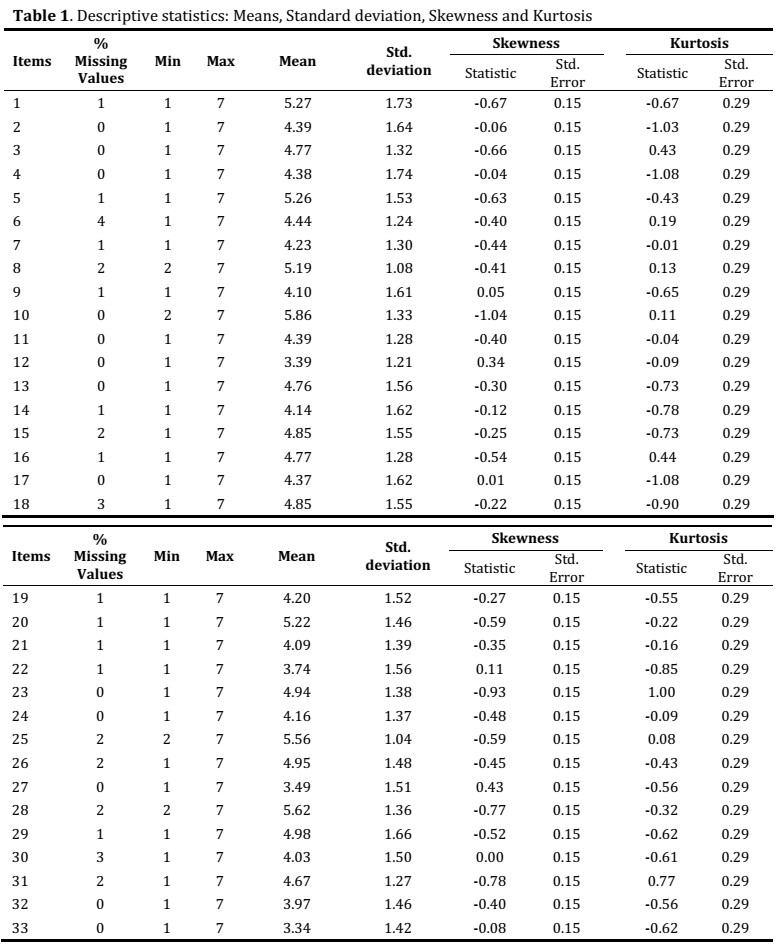
<body><![CDATA[<p><font face="Verdana" size="2"><b>Translation and adaptation of the Social Well-Being    Scales. </b>Firstly, permission to adapt these scales was requested from the    author. The translation and sociocultural adaptation were then carried out,    following international recommendations (Behling &amp; Kenneth, 2000). A first    translation was made by a researcher, which was then reviewed by two other independent    researchers, fluent in the original (English) and target (Portuguese) language,    as well as having particular expertise in the field. These two senior reviewers    analysed and discussed the quality of the translation, taking into account semantic,    linguistic and contextual/experiential equivalence. Semantic equivalence referred    to the accordance in the meaning and sense of words; language equivalence considered    colloquialisms and/or linguistic specificities, with non-linear translation;    contextual/experiential equivalence pondered possible cultural specificities,    ensuring the translation&rsquo;s suitability for the national context. For reasons    of intelligibility and understanding, all translated items were reformulated    and rewritten using the first-person singular. All other suggestions for improvement    were incorporated, and the final translated version was back-translated by a    bilingual researcher. The original and back-translation was then discussed in    order to analyse the comparability of the items. Most of the back-translated    items corresponded integrally to their original items (with the exception of    the grammatical person). In the remaining cases, it was concluded that the discrepancies    preserved the central idea of the original item (e.g., Original item: &ldquo;<i>You    think you have something valuable to give to the world</i>&rdquo;; back-translated    item: &ldquo;I<i> think that I have something useful to offer the world</i>&rdquo;).</font></p>     <p><font face="Verdana" size="2"><b>Procedures of data collection. </b>An online    survey was carried out through institutional contacts (e.g. mailing lists of    higher education institutions) and social networks (e.g. Facebook). The participation    conditions were clarified, reinforcing the idea that participation was voluntary,    anonymous and confidential.</font></p>     <p><font face="Verdana" size="2"><b>Procedures of data analyses. </b>Data analysis    began with a sociodemographic description of our participants, followed by a    descriptive analysis of all items from the scale, with 39 outliers being identified    and removed. A total of 283 participants were considered for the validity and    reliability analyses. Some items were reversed and a descriptive analysis was    performed to evaluate the distribution normality (Skewness and Kurtosis). The    low number of missing values led to their imputation (cf. <a href="/img/revistas/psi/v32n2/32n2a02t1.jpg">table    1</a>). The construct validity was tested using confirmatory factor analysis.    Given that social well-being is a well-established construct in the literature,    performing an Exploratory Factor Analysis (EFA) was considered unnecessary.    Fit model criteria were: <i>ï£2/df</i> (chi square/freedom degrees) &lt; 3,    The goodness of fit index (GFI) &gt; or equal to .90, the Comparative fit index    (CFI) &gt; or equal to .95, the Parsimony Goodness-of-Fit Index (PGFI) &gt;    or equal to .60, the Root Mean Square Error of Approximation (RMSEA) &lt; .08,    and the Standardised Root Mean Square Residual (SRMR) &lt; .10 (Hair, Black,    Babin, &amp; Anderson, 2010; Hu &amp; Bentler, 1999; Schermelleh-Engel, Moosbrugger,    &amp; Muller, 2003). Also, factor weights, individual reliability and modification    indices were considered to obtain adequate measurement models.</font></p>     
<p><font face="Verdana" size="2">The validity evidence based on the relationship    with other variables (convergent validity) was tested by Pearson's correlation    between all social well-being dimensions and life satisfaction, anxiety and    depression. The internal consistency was analysed based on the <i>Cronbach's    Alpha</i> for each dimension. Data analysis was performed through <i>IBM SPSS</i><sup><i>&circledR;</i></sup><i>    for Windows</i> (Version 23.0) and <i>IBM AMOS</i><sup><i>&circledR;</i></sup><i>    for Windows</i> (Version 20.0), with a <i>p</i>-value threshold of 0.05.</font></p>     <p><font face="Verdana" size="2"><b>Results</b></font></p>     <p><font face="Verdana" size="2"><b>Descriptive Analysis</b></font></p>     <p><font face="Verdana" size="2">The values of skewness (sk) and kurtosis (ku)    of all items revealed that the assumption of normality was met (sk &lt;3; ku    &lt;8) (Kline, 2005) (cf. <a href="/img/revistas/psi/v32n2/32n2a02t1.jpg">table    1</a>). The majority of these items (88%) reveal that participants provided    responses ranging from one to seven (except four items), which suggests that    our items are relatively well-discriminated. Low percentages of missing values,    moreover, reinforce the quality of data and the degree to which we can rely    on these results.</font></p>     
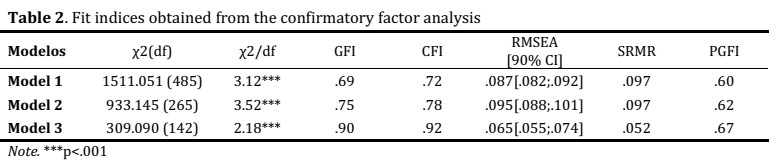
<p><font face="Verdana" size="2"><b>Validity Evidence Based on the Internal Structure</b></font></p>     <p><font face="Verdana" size="2">The confirmatory factor analysis was performed    considering the original theoretical and measurement model (Model 1), composed    of 33 items. However, this first model showed poor fit indices (cf. <a href="/img/revistas/psi/v32n2/32n2a02t2.jpg">table    2</a>).</font></p>     
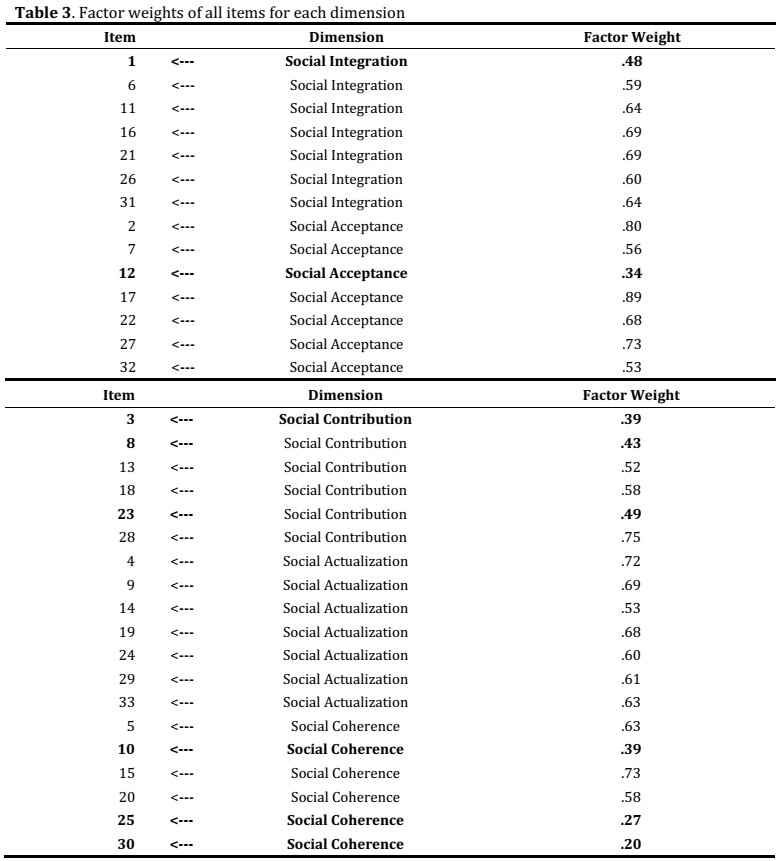
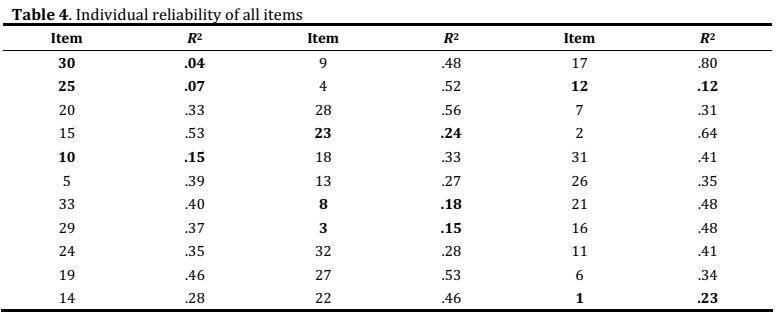
<p><font face="Verdana" size="2">In order to understand how the fit model could    be improved, factor weights and individual reliability were analysed for all    items. We found that eight items showed factor weights &lt;0.5 (cf. <a href="/img/revistas/psi/v32n2/32n2a02t3.jpg">table    3</a>; bold items) and values of <i>R</i><sup><i>2</i></sup> &lt;.25 (cf. <a href="/img/revistas/psi/v32n2/32n2a02t4.jpg">table    4</a>).</font></p>     
]]></body>
<body><![CDATA[<p><font face="Verdana" size="2">These items were removed from the analysis, as    suggested in the literature (Maroco, 2010), and a second model was tested. This    model also showed weak fit indices (Model 2; cf. <a href="/img/revistas/psi/v32n2/32n2a02t2.jpg">table    2</a>) and, therefore, an analysis of the modification indices was carried out.    Based on this analysis, five items were removed (7, 19, 21, 32, 33), which had    high modification indices with items or dimensions representing a different    theoretical factor (Maroco, 2010). After the removal of these items, we found    that item 24 showed a factor weight &lt;0.5 (Maroco, 2010), and it was also    removed from the model in accordance with our previous criteria. Finally, the    new model showed an adequate model fit (Model 3; cf. <a href="/img/revistas/psi/v32n2/32n2a02t2.jpg">table    2</a>), including the 5 original theoretical dimensions and containing 19 items    (cf. <a href="/img/revistas/psi/v32n2/32n2a02f1.jpg">figura 1</a>; see    the Portuguese items in the appendix).</font></p>     
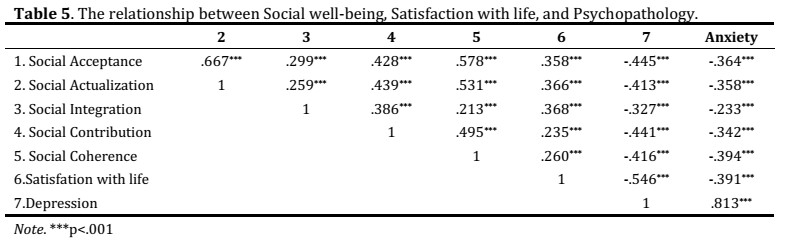
<p><font face="Verdana" size="2"><b>Validity Evidence Based on the Relationship    between Social Well-Being and Life Satisfaction, Depression and Anxiety </b></font></p>     <p><font face="Verdana" size="2">Statistically, significant correlations were    found between all the social well-being dimensions. Low correlations (&lt;.30)    were found between Social Integration and Social Acceptance, Social Contribution    and Social Actualisation. Furthermore, the results revealed a positive correlation    between social well-being dimensions and satisfaction with life, while a negative    correlation was obtained with depression and anxiety. Concomitantly, there were    positive correlations between all the dimensions of social well-being. Higher    levels of social well-being are, thus, associated with greater life satisfaction    and with lower symptoms of anxiety and depression (cf. <a href="/img/revistas/psi/v32n2/32n2a02t5.jpg">table    5</a>).</font></p>     
<p><font face="Verdana" size="2"><b>Reliability</b></font></p>     <p><font face="Verdana" size="2"><i>Cronbach's alpha</i> coefficients were appropriate    considering all social well-being dimensions: Social Acceptance (<i>&alpha;</i>    = .86), Social Actualisation (<i>&alpha;</i> = .76), Social Integration (<i>&alpha;</i>    = .80), Social Contribution (<i>&alpha;</i> = .70) and Social Coherence (<i>&alpha;</i>    = .67).</font></p>     <p><font face="Verdana" size="2"><b>Discussion</b></font></p>     <p><font face="Verdana" size="2">The present study aimed to address the need of    a valid and reliable scale to evaluate social well-being, taking into account    the importance of this domain for the functioning of an individual (Berkman    et al., 2000; Kawachi &amp; Berkman, 2001; Keyes, 1998, 2005). The validity    evidence based on the internal structure (i.e. construct validity) was assessed    through a confirmatory factor analysis, and the results revealed that the original    structure showed poor fit indices. Based on the literature suggestions (Maroco,    2010), a set of analytical strategies were implemented, which resulted in a    final model composed of 19 items and with adequate fit indices. Even considering    that the CFI was not greater than .95 (Schermelleh-Engel et al., 2003), it can    be considered acceptable since it was above .90 and close to .95 (Bentler, 1990).    Even considering these results, the decision about not performing an EFA before    the CFA was taken, considering that the construct of social well-being is theoretically    well-established (Keyes, 1998). In that an equivalent factorial structure with    the Portuguese sample was found, proving validity and reliability, these methodological    options remain appropriate.</font></p>     <p><font face="Verdana" size="2">The validity evidence, based on the relationship    with other variables (i.e. convergent validity), reinforced the soundness of    this scale in the Portuguese context given that all dimensions of social well-being    correlated positively with life satisfaction, and were consistent with previous    evidence (Li et al., 2015). Specifically, lower correlations were found with    social contribution and social coherence, which may suggest that satisfaction    with life is more related to individuals&rsquo; perceptions of the quality of    their relationship with others/society (social integration), the perceived qualities    of other people (social acceptance) and the society&rsquo;s evolution beliefs    (social actualisation). On the other hand, subjective well-being seems to be    less related to individuals&rsquo; beliefs about their social value (i.e. they    believe that they are vital to society), as well as their understanding about    what is happening in the society/world (Keyes, 1998). As such, we hypothesise    that individuals may judge their standards about circumstances of life (Pavot    &amp; Diener, 1993) more in terms of their relationships and integration than    in terms of their role in the society.</font></p>     <p><font face="Verdana" size="2">Moreover, significant and negative correlations    were found among all dimensions of social well-being and depressive and anxious    symptoms, which is also theoretically and empirically consistent with previous    data (Berkman et al., 2000; Keyes, 2005). Specifically, social integration revealed    a lower correlation coefficient than other dimensions of social well-being,    with both depression and anxiety. As such, contrarily to the association between    social integration and life satisfaction, it seems that social integration appears    less related to depressive or anxious symptoms. Furthermore, social well-being    subscales seem to be more strongly associated with depression than with anxiety,    suggesting that feeling sad, a negative mood, loss of energy and feelings of    guilt (depressive symptoms) could be more associated with lower levels of social    well-being than being significantly nervous or worried.</font></p>     <p><font face="Verdana" size="2">Finally, reliability evidence was achieved with    Cronbach Alpha coefficients being around or above .70 for all dimensions. Comparing    this data with the original one, we found higher values of reliability for some    dimensions (e.g. Social Acceptance, Social Actualisation and Social Coherence)    (Keyes, 1998), which suggests that, despite the need to reduce the number of    items in our final model, it does not seem to have weakened the internal consistency    of these scales. More than the number of items per dimension, it seems to be    the quality of those items that matters in measuring social well-being, with    our results reinforcing the conceptual equivalence of the social well-being    structure. Actually, considering that Cronbach Alpha is sensitive to the number    of questions, our results may suggest that a smaller number of questions reduced    redundancy, but did not undermine the internal consistency of well-being subscales.</font></p>     ]]></body>
<body><![CDATA[<p><font face="Verdana" size="2">Even considering the theoretical and empirical    relevance of these results, it is important to identify some limitations. First,    this study includes a non-random sample. In addition, data was only collected    online, and it would be important to include other participants than those who    have access to online platforms in order to have a more diverse and representative    adult sample. Nevertheless, online data collection also has some advantages,    such as low costs, less time consuming and flexibility for participants answering    the instruments in their own time and place. Finally, additional types of validity    should be tested in the future, namely with longitudinal designs enabling predictive    validity evidence to be obtained. Despite these limitations, our results may    significantly contribute to the development of this area, involving a range    of important implications for research and practice.</font></p>     <p><font face="Verdana" size="2">This study, in fact, provided significant evidence    about the validity and reliability of this scale, which is an important step    for future studies on social well-being, and particularly when considering a    holistic approach to mental health during adulthood. Having a scale that reveals    adequate psychometric evidence may allow for the testing of some theoretical    assumptions disseminated in the literature; namely, that &ldquo;the presence    of mental health is presumed to be the summum bonum of personal functioning    and social value&rdquo; (Keyes, 2005, p. 539). In the Portuguese context, therefore,    if we have psychometrically sound scales on personal functioning (i.e. subjective    and psychological well-being), social well-being caused some research problems.    Moreover, the original five dimension measurement model was replicated in our    study. This allowed for the development of cross-cultural studies, as well as    the international comparability of findings.</font></p>     <p><font face="Verdana" size="2">Considering the intervention and professional    practices, this study has a set of important implications. First of all, psychological    assessment benefits from the availability of a scale focused on social dimensions    of well-being, going further than the traditional focus on psychopathology measurement    or the simple assessment of subjective and psychological well-being. Considering    the widely discussed importance of social context in human development, if professionals    have the opportunity to collect that information, then they will be able to    formulate more accurate clinical hypotheses about adult functioning. Second,    this improvement in the quality of psychological assessment has implications    for intervention effectiveness in mental health, as well as for other health    outcomes. If we are able to develop an intervention focused on the promotion    of social well-being and not merely on symptom reduction, we are also promoting    other positive outcomes in individual development. There is evidence that when    comparing completely mentally healthy individuals (high levels of well-being    and low psychopathology) with those having low psychopathology but also low    well-being, it is the latter group that tend to show more physical health problems    (Keyes, 2007). Specifically, the author suggests that &ldquo;it is noteworthy    that mental health status was a significant predictor of chronic physical conditions    even after adjustment for the usual sociodemographic variables as well as body    mass index, diabetes status, smoking status, and level of physical exercise&rdquo;    (Keyes, 2007, p.101). On the other hand, mental health professionals must be    aware of the importance of reducing social isolation, promoting social integration    and contributing to higher levels of social well-being, which has positive implications    for the sense of belonging and security and also for self-esteem (Kawachi &amp;    Berkman, 2001).</font></p>     <p><font face="Verdana" size="2">In sum, there are a set of reasons to invest    in well-being. Not only do higher levels of well-being tend to be associated    with positive physical health outcomes and longevity, but they are also related    to successful functioning at the workplace or in an academic setting. It is    less expensive to promote well-being than reduce mental illness (Howell, Coffey,    Fosco, Kracke, Nelson, Rothman &amp; Grych, 2016); and, for that reason, psychometrically    sound instruments must be available.</font></p>     <p>&nbsp;</p>     <p><font face="Verdana" size="2"><b>References</b></font></p>     <p><font face="Verdana" size="2">Behling, O. &amp; Kenneth, S. L. (2000). <i>Translating    questionnaires and other research instruments: Problems and solutions</i>. Thousand    Oaks CA: SAGE Publications, Inc.</font></p>     <!-- ref --><p><font face="Verdana" size="2">Bentler, P. M. (1990). Comparative fit indexes    in structural models. <i>Psychological Bulletin, 107</i>(2), 238-246. <a href="http://dx.doi.org/10.1037/0033-2909.107.2.238" target="_blank">http://dx.doi.org/10.1037/0033-2909.107.2.238</a></font>&nbsp;&nbsp;&nbsp;&nbsp;&nbsp;&nbsp;&nbsp;&nbsp;[&#160;<a href="javascript:void(0);" onclick="javascript: window.open('/scielo.php?script=sci_nlinks&ref=506530&pid=S0874-2049201800020000200002&lng=','','width=640,height=500,resizable=yes,scrollbars=1,menubar=yes,');">Links</a>&#160;]<!-- end-ref --><!-- ref --><p><font face="Verdana" size="2">Berkman, L. F., Glass, T., Brissette, I., &amp;    Seeman, T. E. (2000). From social integration to health: Durkheim in the new    Millennium. <i>Social Science &amp; Medicine, 51</i>(6), 843-857. <a href="https://doi.org/10.1016/S0277-9536(00)00065-4" target="_blank">https://doi.org/10.1016/S0277-9536(00)00065-4</a></font>&nbsp;&nbsp;&nbsp;&nbsp;&nbsp;&nbsp;&nbsp;&nbsp;[&#160;<a href="javascript:void(0);" onclick="javascript: window.open('/scielo.php?script=sci_nlinks&ref=506531&pid=S0874-2049201800020000200003&lng=','','width=640,height=500,resizable=yes,scrollbars=1,menubar=yes,');">Links</a>&#160;]<!-- end-ref --><!-- ref --><p><font face="Verdana" size="2">Canavarro, M. C. (2007). Invent&aacute;rio de    Sintomas Psicopatol&oacute;gicos (BSI). Uma revis&atilde;o cr&iacute;tica dos    estudos realizados em Portugal. <i>In </i>M. R. Sim&otilde;es, C. Machado, M.    M. Gon&ccedil;alves, &amp; L. S. Almeida (Coords.), <i>Avalia&ccedil;&atilde;o    psicol&oacute;gica: Instrumentos validados para a popula&ccedil;&atilde;o portuguesa    (Vol. III) </i>(pp. 305-331). Coimbra: Quarteto.    &nbsp;&nbsp;&nbsp;&nbsp;&nbsp;&nbsp;&nbsp;&nbsp;[&#160;<a href="javascript:void(0);" onclick="javascript: window.open('/scielo.php?script=sci_nlinks&ref=506532&pid=S0874-2049201800020000200004&lng=','','width=640,height=500,resizable=yes,scrollbars=1,menubar=yes,');">Links</a>&#160;]<!-- end-ref --></font></p>     <!-- ref --><p><font face="Verdana" size="2">Carvalho, A. (2017). <i>Depress&atilde;o e outras    perturba&ccedil;&otilde;es mentais comuns. Enquadramento global e nacional e    refer&ecirc;ncia de recurso em casos emergentes</i>. Lisboa: Dire&ccedil;&atilde;o-Geral    da Sa&uacute;de.    &nbsp;&nbsp;&nbsp;&nbsp;&nbsp;&nbsp;&nbsp;&nbsp;[&#160;<a href="javascript:void(0);" onclick="javascript: window.open('/scielo.php?script=sci_nlinks&ref=506534&pid=S0874-2049201800020000200005&lng=','','width=640,height=500,resizable=yes,scrollbars=1,menubar=yes,');">Links</a>&#160;]<!-- end-ref --></font></p>     <!-- ref --><p><font face="Verdana" size="2">Cicognani, E., Pirini, C., Keyes, C., Joshanloo,    M., Rostami, R., &amp; Nosratabadi, M. (2008). Social participation, sense of    community and social well-being: A study on American, Italian and Iranian university    students. <i>Social Indicator Research, 89</i>(1), 97-112. <a href="http://dx.doi.org/10.1007/s11205-007-9222-3" target="_blank">http://dx.doi.org/10.1007/s11205-007-9222-3</a></font>&nbsp;&nbsp;&nbsp;&nbsp;&nbsp;&nbsp;&nbsp;&nbsp;[&#160;<a href="javascript:void(0);" onclick="javascript: window.open('/scielo.php?script=sci_nlinks&ref=506536&pid=S0874-2049201800020000200006&lng=','','width=640,height=500,resizable=yes,scrollbars=1,menubar=yes,');">Links</a>&#160;]<!-- end-ref --><!-- ref --><p><font face="Verdana" size="2">Diener, E., Lucas, R. E., &amp; Oishi, S. (2002).    Subjective well-being. The science of happiness and life satisfaction. <i>In    </i>C. R. Snyder &amp; S. J. Lopez (Eds.), <i>Handbook of Positive Psychology</i>    (pp. 63-73). London: Oxford University Press.    &nbsp;&nbsp;&nbsp;&nbsp;&nbsp;&nbsp;&nbsp;&nbsp;[&#160;<a href="javascript:void(0);" onclick="javascript: window.open('/scielo.php?script=sci_nlinks&ref=506537&pid=S0874-2049201800020000200007&lng=','','width=640,height=500,resizable=yes,scrollbars=1,menubar=yes,');">Links</a>&#160;]<!-- end-ref --></font></p>     <!-- ref --><p><font face="Verdana" size="2">Hair, J. F., Black, W. C., Babin, B. J., &amp;    Anderson, R. E. (2010). <i>Multivariate data analysis</i> (7th ed.). Englewood    Cliffs: Prentice Hallâ€¨.    &nbsp;&nbsp;&nbsp;&nbsp;&nbsp;&nbsp;&nbsp;&nbsp;[&#160;<a href="javascript:void(0);" onclick="javascript: window.open('/scielo.php?script=sci_nlinks&ref=506539&pid=S0874-2049201800020000200008&lng=','','width=640,height=500,resizable=yes,scrollbars=1,menubar=yes,');">Links</a>&#160;]<!-- end-ref --></font></p>     <!-- ref --><p><font face="Verdana" size="2">Howell, K. H., Coffey, J. K., Fosco, G. M., Kracke,    K., Nelson, S. K., Rothman, E., F., &amp; Grych, J. H. (2016). Seven reasons    to invest in well-being. <i>Psychology of Violence, 6</i>(1), 8-14. <a href="http://dx.doi.org/10.1037/vio0000019" target="_blank">http://dx.doi.org/10.1037/vio0000019</a></font>&nbsp;&nbsp;&nbsp;&nbsp;&nbsp;&nbsp;&nbsp;&nbsp;[&#160;<a href="javascript:void(0);" onclick="javascript: window.open('/scielo.php?script=sci_nlinks&ref=506541&pid=S0874-2049201800020000200009&lng=','','width=640,height=500,resizable=yes,scrollbars=1,menubar=yes,');">Links</a>&#160;]<!-- end-ref --><!-- ref --><p><font face="Verdana" size="2">Hu, L. &amp; Bentler, P. (1999). Cutoff criteria    for fit indexes in covariance structure analysis: Conventional criteria versus    new alternatives. <i>Structural Equation Modelling, 6</i>(1), 1-55. <a href="http://dx.doi.org/10.1080/10705519909540118" target="_blank">http://dx.doi.org/10.1080/10705519909540118</a></font>&nbsp;&nbsp;&nbsp;&nbsp;&nbsp;&nbsp;&nbsp;&nbsp;[&#160;<a href="javascript:void(0);" onclick="javascript: window.open('/scielo.php?script=sci_nlinks&ref=506542&pid=S0874-2049201800020000200010&lng=','','width=640,height=500,resizable=yes,scrollbars=1,menubar=yes,');">Links</a>&#160;]<!-- end-ref --><!-- ref --><p><font face="Verdana" size="2">Kawachi, I. &amp; Berkman, L. F. (2001). Social    ties and mental health. <i>Journal of Urban Health, 78</i>(3), 458-467. <a href="http://dx.doi.org/10.1093/jurban/78.3.458" target="_blank">http://dx.doi.org/10.1093/jurban/78.3.458</a></font>&nbsp;&nbsp;&nbsp;&nbsp;&nbsp;&nbsp;&nbsp;&nbsp;[&#160;<a href="javascript:void(0);" onclick="javascript: window.open('/scielo.php?script=sci_nlinks&ref=506543&pid=S0874-2049201800020000200011&lng=','','width=640,height=500,resizable=yes,scrollbars=1,menubar=yes,');">Links</a>&#160;]<!-- end-ref --><!-- ref --><p><font face="Verdana" size="2">Keyes, C. L. M. (1998). Social well-being. <i>Social    Psychology Quarterly</i>, <i>61</i>(2), 121-140. <a href="http://dx.doi.org/10.2307/2787065" target="_blank">http://dx.doi.org/10.2307/2787065</a></font>&nbsp;&nbsp;&nbsp;&nbsp;&nbsp;&nbsp;&nbsp;&nbsp;[&#160;<a href="javascript:void(0);" onclick="javascript: window.open('/scielo.php?script=sci_nlinks&ref=506544&pid=S0874-2049201800020000200012&lng=','','width=640,height=500,resizable=yes,scrollbars=1,menubar=yes,');">Links</a>&#160;]<!-- end-ref --><!-- ref --><p><font face="Verdana" size="2">Keyes, C. L. M. (2005). Mental illness and/or    mental health? Investigating axioms of the complete state model of health. <i>Journal    of Consulting and Clinical Psychology, 73</i>(3), 539-548. <a href="http://dx.doi.org/10.1037/0022-006X.73.3.539" target="_blank">http://dx.doi.org/10.1037/0022-006X.73.3.539</a></font>&nbsp;&nbsp;&nbsp;&nbsp;&nbsp;&nbsp;&nbsp;&nbsp;[&#160;<a href="javascript:void(0);" onclick="javascript: window.open('/scielo.php?script=sci_nlinks&ref=506545&pid=S0874-2049201800020000200013&lng=','','width=640,height=500,resizable=yes,scrollbars=1,menubar=yes,');">Links</a>&#160;]<!-- end-ref --><!-- ref --><p><font face="Verdana" size="2">Keyes, C. L. M. (2006). Subjective well-being    in mental health and human development research worldwide: An introduction.    <i>Social Indicators Research, 77</i>, 1-10. <a href="http://dx.doi.org/10.1007/s11205-005-5550-3" target="_blank">http://dx.doi.org/10.1007/s11205-005-5550-3</a></font>&nbsp;&nbsp;&nbsp;&nbsp;&nbsp;&nbsp;&nbsp;&nbsp;[&#160;<a href="javascript:void(0);" onclick="javascript: window.open('/scielo.php?script=sci_nlinks&ref=506546&pid=S0874-2049201800020000200014&lng=','','width=640,height=500,resizable=yes,scrollbars=1,menubar=yes,');">Links</a>&#160;]<!-- end-ref --><!-- ref --><p><font face="Verdana" size="2">Keyes, C. L. M. (2007). Promoting and protecting    mental health as flourishing. A complementary strategy for improving national    mental health. <i>American Psychologist, 62</i>(2), 95-108. <a href="http://dx.doi.org/10.1037/0003-066X.62.2.95" target="_blank">http://dx.doi.org/10.1037/0003-066X.62.2.95</a></font>&nbsp;&nbsp;&nbsp;&nbsp;&nbsp;&nbsp;&nbsp;&nbsp;[&#160;<a href="javascript:void(0);" onclick="javascript: window.open('/scielo.php?script=sci_nlinks&ref=506547&pid=S0874-2049201800020000200015&lng=','','width=640,height=500,resizable=yes,scrollbars=1,menubar=yes,');">Links</a>&#160;]<!-- end-ref --><!-- ref --><p><font face="Verdana" size="2">Kline, R. (2005). <i>Principles and practice    of structural equations modeling </i>(2nd ed.). London: Guilford.    &nbsp;&nbsp;&nbsp;&nbsp;&nbsp;&nbsp;&nbsp;&nbsp;[&#160;<a href="javascript:void(0);" onclick="javascript: window.open('/scielo.php?script=sci_nlinks&ref=506548&pid=S0874-2049201800020000200016&lng=','','width=640,height=500,resizable=yes,scrollbars=1,menubar=yes,');">Links</a>&#160;]<!-- end-ref --></font></p>     <!-- ref --><p><font face="Verdana" size="2">Larson, J. S. (1993). The measurement of social    well-being. <i>Social Indicators Research, 28</i>(3), 285-296. <a href="http://dx.doi.org/10.1007/BF01079022" target="_blank">http://dx.doi.org/10.1007/BF01079022</a></font>&nbsp;&nbsp;&nbsp;&nbsp;&nbsp;&nbsp;&nbsp;&nbsp;[&#160;<a href="javascript:void(0);" onclick="javascript: window.open('/scielo.php?script=sci_nlinks&ref=506550&pid=S0874-2049201800020000200017&lng=','','width=640,height=500,resizable=yes,scrollbars=1,menubar=yes,');">Links</a>&#160;]<!-- end-ref --><!-- ref --><p><font face="Verdana" size="2">Li, M., Yang, D., Ding, C., &amp; Kong, F. (2015).    Validation of the social well-being scale in a Chinese sample and invariance    across gender.&nbsp;<i>Social Indicators Research</i>,&nbsp;<i>121</i>(2), 607-618.    <a href="http://dx.doi.org/10.1007/s11205-014-0639-1" target="_blank">http://dx.doi.org/10.1007/s11205-014-0639-1</a></font>&nbsp;&nbsp;&nbsp;&nbsp;&nbsp;&nbsp;&nbsp;&nbsp;[&#160;<a href="javascript:void(0);" onclick="javascript: window.open('/scielo.php?script=sci_nlinks&ref=506551&pid=S0874-2049201800020000200018&lng=','','width=640,height=500,resizable=yes,scrollbars=1,menubar=yes,');">Links</a>&#160;]<!-- end-ref --><!-- ref --><p><font face="Verdana" size="2">Maroco, J. (2010). <i>An&aacute;lise de Equa&ccedil;&otilde;es    Estruturais: Fundamentos T&eacute;cnicos, Software &amp; Aplica&ccedil;&otilde;es</i>.    Pero Pinheiro: ReportNumber.    &nbsp;&nbsp;&nbsp;&nbsp;&nbsp;&nbsp;&nbsp;&nbsp;[&#160;<a href="javascript:void(0);" onclick="javascript: window.open('/scielo.php?script=sci_nlinks&ref=506552&pid=S0874-2049201800020000200019&lng=','','width=640,height=500,resizable=yes,scrollbars=1,menubar=yes,');">Links</a>&#160;]<!-- end-ref --></font></p>     <!-- ref --><p><font face="Verdana" size="2">Novo, R. F. (2003).&nbsp;<i>Para al&eacute;m    da eudaimonia. O bem-estar psicol&oacute;gico em mulheres na idade adulta avan&ccedil;ada</i>.    Lisboa: Funda&ccedil;&atilde;o Calouste Gulbenkian. Funda&ccedil;&atilde;o para    a Ci&ecirc;ncia e Tecnologia.    &nbsp;&nbsp;&nbsp;&nbsp;&nbsp;&nbsp;&nbsp;&nbsp;[&#160;<a href="javascript:void(0);" onclick="javascript: window.open('/scielo.php?script=sci_nlinks&ref=506554&pid=S0874-2049201800020000200020&lng=','','width=640,height=500,resizable=yes,scrollbars=1,menubar=yes,');">Links</a>&#160;]<!-- end-ref -->&nbsp;</font></p>     <!-- ref --><p><font face="Verdana" size="2">Pavot, W. &amp; Diener, E. (1993). Review of    the Satisfaction With Life Scale. <i>Psychological Assessment, 5</i>(2), 164-172.    <a href="http://dx.doi.org/10.1037/1040-3590.5.2.164" target="_blank">http://dx.doi.org/10.1037/1040-3590.5.2.164</a></font>&nbsp;&nbsp;&nbsp;&nbsp;&nbsp;&nbsp;&nbsp;&nbsp;[&#160;<a href="javascript:void(0);" onclick="javascript: window.open('/scielo.php?script=sci_nlinks&ref=506556&pid=S0874-2049201800020000200021&lng=','','width=640,height=500,resizable=yes,scrollbars=1,menubar=yes,');">Links</a>&#160;]<!-- end-ref --><!-- ref --><p><font face="Verdana" size="2">Ryff, C. D. (1995). Psychological well-being    in adult life. <i>Current Directions in Psychological Science, 4</i>(4), 99-104.    <a href="http://dx.doi.org/10.1111/1467-8721.ep10772395" target="_blank">http://dx.doi.org/10.1111/1467-8721.ep10772395</a></font>&nbsp;&nbsp;&nbsp;&nbsp;&nbsp;&nbsp;&nbsp;&nbsp;[&#160;<a href="javascript:void(0);" onclick="javascript: window.open('/scielo.php?script=sci_nlinks&ref=506557&pid=S0874-2049201800020000200022&lng=','','width=640,height=500,resizable=yes,scrollbars=1,menubar=yes,');">Links</a>&#160;]<!-- end-ref --><!-- ref --><p><font face="Verdana" size="2">Sarason, I. G., Levine, H. M., Basham, R. B.,    &amp; Sarason, B. R. (1983). Assessing social support: The Social Support Questionnaire.    <i>Journal of Personality and Social Psychology, 44</i>(1), 127-139. <a href="http://dx.doi.org/10.1037/0022-3514.44.1.127" target="_blank">http://dx.doi.org/10.1037/0022-3514.44.1.127</a></font>&nbsp;&nbsp;&nbsp;&nbsp;&nbsp;&nbsp;&nbsp;&nbsp;[&#160;<a href="javascript:void(0);" onclick="javascript: window.open('/scielo.php?script=sci_nlinks&ref=506558&pid=S0874-2049201800020000200023&lng=','','width=640,height=500,resizable=yes,scrollbars=1,menubar=yes,');">Links</a>&#160;]<!-- end-ref --><!-- ref --><p><font face="Verdana" size="2">Schermelleh-Engel, K., Moosbrugger, H., &amp;    Muller, H. (2003). Evaluating the fit of structural equation models: Tests of    significance and descriptive goodness-of-fit measures. <i>Methods of Psychological    Research Online, 8</i>(2), 23-74.    &nbsp;&nbsp;&nbsp;&nbsp;&nbsp;&nbsp;&nbsp;&nbsp;[&#160;<a href="javascript:void(0);" onclick="javascript: window.open('/scielo.php?script=sci_nlinks&ref=506559&pid=S0874-2049201800020000200024&lng=','','width=640,height=500,resizable=yes,scrollbars=1,menubar=yes,');">Links</a>&#160;]<!-- end-ref --></font></p>     <p><font face="Verdana" size="2">Sim&otilde;es, A. (1992). Ulterior validacÌ§&atilde;o    de uma Escala de SatisfacÌ§&atilde;o com a Vida (SWLS). <i>Revista Portuguesa    de Pedagogia</i>, <i>XXVI</i>(3), 503-515.</font></p>     <!-- ref --><p><font face="Verdana" size="2">Teymoori, A., Jetten, J., Bastian, B., Ariyanto,    A., Autin, F., Ayub, N., et al. (2016). Revisiting the measurement of anomie.    <i>PLOS ONE, 11</i>(7), 1-27. <a href="http://dx.doi.org/10.1371/journal.pone.0158370" target="_blank">http://dx.doi.org/10.1371/journal.pone.0158370</a>.    &nbsp;&nbsp;&nbsp;&nbsp;&nbsp;&nbsp;&nbsp;&nbsp;[&#160;<a href="javascript:void(0);" onclick="javascript: window.open('/scielo.php?script=sci_nlinks&ref=506562&pid=S0874-2049201800020000200026&lng=','','width=640,height=500,resizable=yes,scrollbars=1,menubar=yes,');">Links</a>&#160;]<!-- end-ref --></font></p>     <!-- ref --><p><font face="Verdana" size="2">Travis, R. (1993). The MOS Alienation Scale:    An alternative to Srole's Anomia Scale. Social <i>Indicators Research, 28</i>(1),    71-91.    &nbsp;&nbsp;&nbsp;&nbsp;&nbsp;&nbsp;&nbsp;&nbsp;[&#160;<a href="javascript:void(0);" onclick="javascript: window.open('/scielo.php?script=sci_nlinks&ref=506564&pid=S0874-2049201800020000200027&lng=','','width=640,height=500,resizable=yes,scrollbars=1,menubar=yes,');">Links</a>&#160;]<!-- end-ref --></font></p>     <!-- ref --><p><font face="Verdana" size="2">World Health Organization (WHO) (2003). <i>Investing    in Mental Health</i>. Geneva: WHO.    &nbsp;&nbsp;&nbsp;&nbsp;&nbsp;&nbsp;&nbsp;&nbsp;[&#160;<a href="javascript:void(0);" onclick="javascript: window.open('/scielo.php?script=sci_nlinks&ref=506566&pid=S0874-2049201800020000200028&lng=','','width=640,height=500,resizable=yes,scrollbars=1,menubar=yes,');">Links</a>&#160;]<!-- end-ref --></font></p>     <p>&nbsp;</p>     <p><font face="Verdana" size="2"><i>Historial do artigo</i></font></p>     <p><font face="Verdana" size="2">Recebido</font></p>     <p><font face="Verdana" size="2">25/07/2017</font></p>     <p><font face="Verdana" size="2">Aceite</font></p>     ]]></body>
<body><![CDATA[<p><font face="Verdana" size="2">09/08/2018</font></p>     <p><font face="Verdana" size="2">Publicado</font></p>     <p><font face="Verdana" size="2">12/2018</font></p>     <p>&nbsp;</p>     <p><font face="Verdana" size="2"><b>APPENDIX</b></font></p>     <p><font face="Verdana" size="2"><b>Social Well-Being Scales &ndash; Portuguese    Items (<i>Original Items</i>)</b></font></p>     <p><font face="Verdana" size="2"><b>Social Integration</b></font></p>     <p><font face="Verdana" size="2">Sinto que sou uma parte importante da minha comunidade    (<i>You feel like you're an important part of your community</i>)</font></p>     <p><font face="Verdana" size="2">Se eu tivesse algo a dizer, considero que as    pessoas da minha comunidade me ouviriam (<i>If you had something to say, you    believe people in your community would listen to you</i>)</font></p>     <p><font face="Verdana" size="2">Sinto-me pr&oacute;ximo de outras pessoas na    minha comunidade (<i>You feel close to other people in your community</i>)</font></p>     ]]></body>
<body><![CDATA[<p><font face="Verdana" size="2">Vejo a minha comunidade como uma fonte de suporte    (<i>You see your community as a source of comfort</i>)</font></p>     <p><font face="Verdana" size="2">Considero que as outras pessoas na sociedade    me valorizam como pessoa (<i>You believe other people in society value you as    a person</i>)</font></p>     <p><font face="Verdana" size="2"><b>Social Acceptance</b></font></p>     <p><font face="Verdana" size="2">Penso que as outras pessoas n&atilde;o s&atilde;o    fi&aacute;veis* (<i>You think that other people are unreliable</i>)</font></p>     <p><font face="Verdana" size="2">Sinto que as pessoas n&atilde;o s&atilde;o de    confian&ccedil;a* (<i>You feel that people are not trustworthy</i>)</font></p>     <p><font face="Verdana" size="2">Penso que as pessoas vivem apenas para si pr&oacute;prias*    (<i>You think that people live only for themselves</i>)</font></p>     <p><font face="Verdana" size="2">Considero que, nos dias de hoje, as pessoas s&atilde;o    cada vez mais desonestas* (<i>You believe that people are more and more dishonest    these days</i>)</font></p>     <p><font face="Verdana" size="2"><b>Social Contribution</b></font></p>     <p><font face="Verdana" size="2">As minhas atividades di&aacute;rias n&atilde;o    s&atilde;o uma mais-valia para a minha comunidade* (<i>Your daily activities    do not produce anything worthwhile for your community</i>)</font></p>     <p><font face="Verdana" size="2">N&atilde;o tenho o tempo ou a energia para dar    algo &agrave; minha comunidade* (<i>You don't have the time or energy to give    anything to your community</i>)</font></p>     ]]></body>
<body><![CDATA[<p><font face="Verdana" size="2">Sinto que n&atilde;o tenho nada de importante    a contribuir para a sociedade* (<i>You feel you have nothing important to contribute    to society</i>)</font></p>     <p><font face="Verdana" size="2"><b>Social Actualization</b></font></p>     <p><font face="Verdana" size="2">Considero que a sociedade parou de progredir*    (<i>You believe that society has stopped making progress</i>)</font></p>     <p><font face="Verdana" size="2">Para pessoas como eu, a sociedade n&atilde;o    tem melhorado* (<i>Society isn't improving for people like you</i>)</font></p>     <p><font face="Verdana" size="2">Penso que as entidades sociais (e.g., legais    e governamentais) n&atilde;o melhoram a minha vida* (<i>You don't think social    institutions like law and government make your life better</i>)</font></p>     <p><font face="Verdana" size="2">Para mim n&atilde;o existe verdadeiro progresso    social* (<i>For you there's no such thing as social progress</i>)</font></p>     <p><font face="Verdana" size="2"><b>Social Coherence</b></font></p>     <p><font face="Verdana" size="2">O mundo &eacute; demasiado complexo para mim*    (<i>The world is too complex for you</i>)</font></p>     <p><font face="Verdana" size="2">Eu n&atilde;o consigo dar sentido ao que acontece    no mundo* (<i>You cannot make sense of what's going on in the world</i>)</font></p>     <p><font face="Verdana" size="2">A maioria das culturas &eacute; t&atilde;o estranha    que n&atilde;o as consigo perceber* (<i>Most cultures are so strange that you    cannot understand them</i>)</font></p>     ]]></body>
<body><![CDATA[<p>&nbsp;</p>     <p><font face="Verdana" size="2"><sup>c</sup><a href="#topc0">Morada para correspond&ecirc;ncia:</a><a name="c0"></a></font></p>     <p><font face="Verdana" size="2">Eunice Magalh&atilde;es, Centro de Investiga&ccedil;&atilde;o    e Interven&ccedil;&atilde;o Social, ISCTE-Instituto Universit&aacute;rio de    Lisboa, Edf. ISCTE-IUL, Av. das For&ccedil;as Armadas, 1649-026 Lisboa, Portugal.    E-mail: <a href="mailto:Eunice_magalhaes@iscte-iul.pt">Eunice_magalhaes@iscte-iul.pt</a></font></p>      ]]></body><back>
<ref-list>
<ref id="B1">
<nlm-citation citation-type="book">
<person-group person-group-type="author">
<name>
<surname><![CDATA[Behling]]></surname>
<given-names><![CDATA[O.]]></given-names>
</name>
<name>
<surname><![CDATA[Kenneth]]></surname>
<given-names><![CDATA[S. L.]]></given-names>
</name>
</person-group>
<source><![CDATA[Translating questionnaires and other research instruments: Problems and solutions]]></source>
<year>2000</year>
<publisher-loc><![CDATA[Thousand Oaks ]]></publisher-loc>
<publisher-name><![CDATA[SAGE Publications, Inc.]]></publisher-name>
</nlm-citation>
</ref>
<ref id="B2">
<nlm-citation citation-type="journal">
<person-group person-group-type="author">
<name>
<surname><![CDATA[Bentler]]></surname>
<given-names><![CDATA[P. M.]]></given-names>
</name>
</person-group>
<article-title xml:lang="en"><![CDATA[Comparative fit indexes in structural models.]]></article-title>
<source><![CDATA[Psychological Bulletin]]></source>
<year>1990</year>
<volume>107</volume>
<numero>2</numero>
<issue>2</issue>
<page-range>238-246</page-range></nlm-citation>
</ref>
<ref id="B3">
<nlm-citation citation-type="journal">
<person-group person-group-type="author">
<name>
<surname><![CDATA[Berkman]]></surname>
<given-names><![CDATA[L. F.]]></given-names>
</name>
<name>
<surname><![CDATA[Glass]]></surname>
<given-names><![CDATA[T.]]></given-names>
</name>
<name>
<surname><![CDATA[Brissette]]></surname>
<given-names><![CDATA[I.]]></given-names>
</name>
<name>
<surname><![CDATA[Seeman]]></surname>
<given-names><![CDATA[T. E.]]></given-names>
</name>
</person-group>
<article-title xml:lang="en"><![CDATA[From social integration to health: Durkheim in the new Millennium]]></article-title>
<source><![CDATA[Social Science & Medicine]]></source>
<year>2000</year>
<volume>51</volume>
<numero>6</numero>
<issue>6</issue>
<page-range>843-857</page-range></nlm-citation>
</ref>
<ref id="B4">
<nlm-citation citation-type="book">
<person-group person-group-type="author">
<name>
<surname><![CDATA[Canavarro]]></surname>
<given-names><![CDATA[M. C.]]></given-names>
</name>
</person-group>
<article-title xml:lang="pt"><![CDATA[Inventário de Sintomas Psicopatológicos (BSI): Uma revisão crítica dos estudos realizados em Portugal.]]></article-title>
<person-group person-group-type="editor">
<name>
<surname><![CDATA[Simões]]></surname>
<given-names><![CDATA[M. R.]]></given-names>
</name>
<name>
<surname><![CDATA[Machado]]></surname>
<given-names><![CDATA[C.]]></given-names>
</name>
<name>
<surname><![CDATA[Gonçalves]]></surname>
<given-names><![CDATA[M. M.]]></given-names>
</name>
<name>
<surname><![CDATA[Almeida]]></surname>
<given-names><![CDATA[L. S.]]></given-names>
</name>
</person-group>
<source><![CDATA[Avaliação psicológica: Instrumentos validados para a população portuguesa (Vol. III)]]></source>
<year>2007</year>
<page-range>305-331</page-range><publisher-loc><![CDATA[Coimbra ]]></publisher-loc>
<publisher-name><![CDATA[Quarteto]]></publisher-name>
</nlm-citation>
</ref>
<ref id="B5">
<nlm-citation citation-type="book">
<person-group person-group-type="author">
<name>
<surname><![CDATA[Carvalho]]></surname>
<given-names><![CDATA[A.]]></given-names>
</name>
</person-group>
<source><![CDATA[Depressão e outras perturbações mentais comuns: Enquadramento global e nacional e referência de recurso em casos emergentes]]></source>
<year>2017</year>
<publisher-loc><![CDATA[Lisboa ]]></publisher-loc>
<publisher-name><![CDATA[Direção-Geral da Saúde]]></publisher-name>
</nlm-citation>
</ref>
<ref id="B6">
<nlm-citation citation-type="journal">
<person-group person-group-type="author">
<name>
<surname><![CDATA[Cicognani]]></surname>
<given-names><![CDATA[E.]]></given-names>
</name>
<name>
<surname><![CDATA[Pirini]]></surname>
<given-names><![CDATA[C.]]></given-names>
</name>
<name>
<surname><![CDATA[Keyes]]></surname>
<given-names><![CDATA[C.]]></given-names>
</name>
<name>
<surname><![CDATA[Joshanloo]]></surname>
<given-names><![CDATA[M.]]></given-names>
</name>
<name>
<surname><![CDATA[Rostami]]></surname>
<given-names><![CDATA[R.]]></given-names>
</name>
<name>
<surname><![CDATA[Nosratabadi]]></surname>
<given-names><![CDATA[M.]]></given-names>
</name>
</person-group>
<article-title xml:lang="en"><![CDATA[Social participation, sense of community and social well-being: A study on American, Italian and Iranian university students.]]></article-title>
<source><![CDATA[Social Indicator Research]]></source>
<year>2008</year>
<volume>89</volume>
<numero>1</numero>
<issue>1</issue>
<page-range>97-112</page-range></nlm-citation>
</ref>
<ref id="B7">
<nlm-citation citation-type="book">
<person-group person-group-type="author">
<name>
<surname><![CDATA[Diener]]></surname>
<given-names><![CDATA[E.]]></given-names>
</name>
<name>
<surname><![CDATA[Lucas]]></surname>
<given-names><![CDATA[R. E.]]></given-names>
</name>
<name>
<surname><![CDATA[Oishi]]></surname>
<given-names><![CDATA[S.]]></given-names>
</name>
</person-group>
<article-title xml:lang="en"><![CDATA[Subjective well-being: The science of happiness and life satisfaction]]></article-title>
<person-group person-group-type="editor">
<name>
<surname><![CDATA[Snyder]]></surname>
<given-names><![CDATA[C. R.]]></given-names>
</name>
<name>
<surname><![CDATA[Lopez]]></surname>
<given-names><![CDATA[S. J.]]></given-names>
</name>
</person-group>
<source><![CDATA[Handbook of Positive Psychology]]></source>
<year>2002</year>
<page-range>63-73</page-range><publisher-loc><![CDATA[London ]]></publisher-loc>
<publisher-name><![CDATA[Oxford University Press]]></publisher-name>
</nlm-citation>
</ref>
<ref id="B8">
<nlm-citation citation-type="book">
<person-group person-group-type="author">
<name>
<surname><![CDATA[Hair]]></surname>
<given-names><![CDATA[J. F.]]></given-names>
</name>
<name>
<surname><![CDATA[Black]]></surname>
<given-names><![CDATA[W. C.]]></given-names>
</name>
<name>
<surname><![CDATA[Babin]]></surname>
<given-names><![CDATA[B. J.]]></given-names>
</name>
<name>
<surname><![CDATA[Anderson]]></surname>
<given-names><![CDATA[R. E.]]></given-names>
</name>
</person-group>
<source><![CDATA[Multivariate data analysis]]></source>
<year>2010</year>
<edition>7</edition>
<publisher-loc><![CDATA[Englewood Cliffs ]]></publisher-loc>
<publisher-name><![CDATA[Prentice Hall]]></publisher-name>
</nlm-citation>
</ref>
<ref id="B9">
<nlm-citation citation-type="journal">
<person-group person-group-type="author">
<name>
<surname><![CDATA[Howell]]></surname>
<given-names><![CDATA[K. H.]]></given-names>
</name>
<name>
<surname><![CDATA[Coffey]]></surname>
<given-names><![CDATA[J. K.]]></given-names>
</name>
<name>
<surname><![CDATA[Fosco]]></surname>
<given-names><![CDATA[G. M.]]></given-names>
</name>
<name>
<surname><![CDATA[Kracke]]></surname>
<given-names><![CDATA[K.]]></given-names>
</name>
<name>
<surname><![CDATA[Nelson]]></surname>
<given-names><![CDATA[S. K.]]></given-names>
</name>
<name>
<surname><![CDATA[Rothman]]></surname>
<given-names><![CDATA[E., F.]]></given-names>
</name>
<name>
<surname><![CDATA[Grych]]></surname>
<given-names><![CDATA[J. H.]]></given-names>
</name>
</person-group>
<article-title xml:lang="en"><![CDATA[Seven reasons to invest in well-being.]]></article-title>
<source><![CDATA[Psychology of Violence]]></source>
<year>2016</year>
<volume>6</volume>
<numero>1</numero>
<issue>1</issue>
<page-range>8-14</page-range></nlm-citation>
</ref>
<ref id="B10">
<nlm-citation citation-type="journal">
<person-group person-group-type="author">
<name>
<surname><![CDATA[Hu]]></surname>
<given-names><![CDATA[L.]]></given-names>
</name>
<name>
<surname><![CDATA[Bentler]]></surname>
<given-names><![CDATA[P.]]></given-names>
</name>
</person-group>
<article-title xml:lang="en"><![CDATA[Cutoff criteria for fit indexes in covariance structure analysis: Conventional criteria versus new alternatives.]]></article-title>
<source><![CDATA[Structural Equation Modelling]]></source>
<year>1999</year>
<volume>6</volume>
<numero>1</numero>
<issue>1</issue>
<page-range>1-55</page-range></nlm-citation>
</ref>
<ref id="B11">
<nlm-citation citation-type="journal">
<person-group person-group-type="author">
<name>
<surname><![CDATA[Kawachi]]></surname>
<given-names><![CDATA[I.]]></given-names>
</name>
<name>
<surname><![CDATA[Berkman]]></surname>
<given-names><![CDATA[L. F.]]></given-names>
</name>
</person-group>
<article-title xml:lang="en"><![CDATA[Social ties and mental health]]></article-title>
<source><![CDATA[Journal of Urban Health]]></source>
<year>2001</year>
<volume>78</volume>
<numero>3</numero>
<issue>3</issue>
<page-range>458-467</page-range></nlm-citation>
</ref>
<ref id="B12">
<nlm-citation citation-type="journal">
<person-group person-group-type="author">
<name>
<surname><![CDATA[Keyes]]></surname>
<given-names><![CDATA[C. L. M.]]></given-names>
</name>
</person-group>
<article-title xml:lang="en"><![CDATA[Social well-being]]></article-title>
<source><![CDATA[Social Psychology Quarterly]]></source>
<year>1998</year>
<volume>61</volume>
<numero>2</numero>
<issue>2</issue>
<page-range>121-140</page-range></nlm-citation>
</ref>
<ref id="B13">
<nlm-citation citation-type="journal">
<person-group person-group-type="author">
<name>
<surname><![CDATA[Keyes]]></surname>
<given-names><![CDATA[C. L. M.]]></given-names>
</name>
</person-group>
<article-title xml:lang="en"><![CDATA[Mental illness and/or mental health?: Investigating axioms of the complete state model of health.]]></article-title>
<source><![CDATA[Journal of Consulting and Clinical Psychology]]></source>
<year>2005</year>
<volume>73</volume>
<numero>3</numero>
<issue>3</issue>
<page-range>539-548</page-range></nlm-citation>
</ref>
<ref id="B14">
<nlm-citation citation-type="journal">
<person-group person-group-type="author">
<name>
<surname><![CDATA[Keyes]]></surname>
<given-names><![CDATA[C. L. M.]]></given-names>
</name>
</person-group>
<article-title xml:lang="en"><![CDATA[Subjective well-being in mental health and human development research worldwide: An introduction]]></article-title>
<source><![CDATA[Social Indicators Research]]></source>
<year>2006</year>
<volume>77</volume>
<page-range>1-10</page-range></nlm-citation>
</ref>
<ref id="B15">
<nlm-citation citation-type="journal">
<person-group person-group-type="author">
<name>
<surname><![CDATA[Keyes]]></surname>
<given-names><![CDATA[C. L. M.]]></given-names>
</name>
</person-group>
<article-title xml:lang="en"><![CDATA[Promoting and protecting mental health as flourishing: A complementary strategy for improving national mental health.]]></article-title>
<source><![CDATA[American Psychologist]]></source>
<year>2007</year>
<volume>62</volume>
<numero>2</numero>
<issue>2</issue>
<page-range>95-108</page-range></nlm-citation>
</ref>
<ref id="B16">
<nlm-citation citation-type="book">
<person-group person-group-type="author">
<name>
<surname><![CDATA[Kline]]></surname>
<given-names><![CDATA[R.]]></given-names>
</name>
</person-group>
<source><![CDATA[Principles and practice of structural equations modeling]]></source>
<year>2005</year>
<edition>2</edition>
<publisher-loc><![CDATA[London ]]></publisher-loc>
<publisher-name><![CDATA[Guilford]]></publisher-name>
</nlm-citation>
</ref>
<ref id="B17">
<nlm-citation citation-type="journal">
<person-group person-group-type="author">
<name>
<surname><![CDATA[Larson]]></surname>
<given-names><![CDATA[J. S.]]></given-names>
</name>
</person-group>
<article-title xml:lang="en"><![CDATA[The measurement of social well-being]]></article-title>
<source><![CDATA[Social Indicators Research]]></source>
<year>1993</year>
<volume>28</volume>
<numero>3</numero>
<issue>3</issue>
<page-range>285-296</page-range></nlm-citation>
</ref>
<ref id="B18">
<nlm-citation citation-type="journal">
<person-group person-group-type="author">
<name>
<surname><![CDATA[Li]]></surname>
<given-names><![CDATA[M.]]></given-names>
</name>
<name>
<surname><![CDATA[Yang]]></surname>
<given-names><![CDATA[D.]]></given-names>
</name>
<name>
<surname><![CDATA[Ding]]></surname>
<given-names><![CDATA[C.]]></given-names>
</name>
<name>
<surname><![CDATA[Kong]]></surname>
<given-names><![CDATA[F.]]></given-names>
</name>
</person-group>
<article-title xml:lang="en"><![CDATA[Validation of the social well-being scale in a Chinese sample and invariance across gender]]></article-title>
<source><![CDATA[Social Indicators Research]]></source>
<year>2015</year>
<volume>121</volume>
<numero>2</numero>
<issue>2</issue>
<page-range>607-618</page-range></nlm-citation>
</ref>
<ref id="B19">
<nlm-citation citation-type="book">
<person-group person-group-type="author">
<name>
<surname><![CDATA[Maroco]]></surname>
<given-names><![CDATA[J.]]></given-names>
</name>
</person-group>
<source><![CDATA[Análise de Equações Estruturais: Fundamentos Técnicos, Software & Aplicações]]></source>
<year>2010</year>
<publisher-loc><![CDATA[Pero Pinheiro ]]></publisher-loc>
<publisher-name><![CDATA[ReportNumber]]></publisher-name>
</nlm-citation>
</ref>
<ref id="B20">
<nlm-citation citation-type="book">
<person-group person-group-type="author">
<name>
<surname><![CDATA[Novo]]></surname>
<given-names><![CDATA[R. F.]]></given-names>
</name>
</person-group>
<source><![CDATA[Para além da eudaimonia: O bem-estar psicológico em mulheres na idade adulta avançada]]></source>
<year>2003</year>
<publisher-loc><![CDATA[Lisboa ]]></publisher-loc>
<publisher-name><![CDATA[Fundação Calouste Gulbenkian. Fundação para a Ciência e Tecnologia.]]></publisher-name>
</nlm-citation>
</ref>
<ref id="B21">
<nlm-citation citation-type="journal">
<person-group person-group-type="author">
<name>
<surname><![CDATA[Pavot]]></surname>
<given-names><![CDATA[W.]]></given-names>
</name>
<name>
<surname><![CDATA[Diener]]></surname>
<given-names><![CDATA[E.]]></given-names>
</name>
</person-group>
<article-title xml:lang="en"><![CDATA[Review of the Satisfaction With Life Scale]]></article-title>
<source><![CDATA[Psychological Assessment]]></source>
<year>1993</year>
<volume>5</volume>
<numero>2</numero>
<issue>2</issue>
<page-range>164-172</page-range></nlm-citation>
</ref>
<ref id="B22">
<nlm-citation citation-type="journal">
<person-group person-group-type="author">
<name>
<surname><![CDATA[Ryff]]></surname>
<given-names><![CDATA[C. D.]]></given-names>
</name>
</person-group>
<article-title xml:lang="en"><![CDATA[Psychological well-being in adult life.]]></article-title>
<source><![CDATA[Current Directions in Psychological Science]]></source>
<year>1995</year>
<volume>4</volume>
<numero>4</numero>
<issue>4</issue>
<page-range>99-104</page-range></nlm-citation>
</ref>
<ref id="B23">
<nlm-citation citation-type="journal">
<person-group person-group-type="author">
<name>
<surname><![CDATA[Sarason]]></surname>
<given-names><![CDATA[I. G.]]></given-names>
</name>
<name>
<surname><![CDATA[Levine]]></surname>
<given-names><![CDATA[H. M.]]></given-names>
</name>
<name>
<surname><![CDATA[Basham]]></surname>
<given-names><![CDATA[R. B.]]></given-names>
</name>
<name>
<surname><![CDATA[Sarason]]></surname>
<given-names><![CDATA[B. R.]]></given-names>
</name>
</person-group>
<article-title xml:lang="en"><![CDATA[Assessing social support: The Social Support Questionnaire]]></article-title>
<source><![CDATA[Journal of Personality and Social Psychology]]></source>
<year>1983</year>
<volume>44</volume>
<numero>1</numero>
<issue>1</issue>
<page-range>127-139</page-range></nlm-citation>
</ref>
<ref id="B24">
<nlm-citation citation-type="journal">
<person-group person-group-type="author">
<name>
<surname><![CDATA[Schermelleh-Engel]]></surname>
<given-names><![CDATA[K.]]></given-names>
</name>
<name>
<surname><![CDATA[Moosbrugger]]></surname>
<given-names><![CDATA[H.]]></given-names>
</name>
<name>
<surname><![CDATA[Muller]]></surname>
<given-names><![CDATA[H.]]></given-names>
</name>
</person-group>
<article-title xml:lang="en"><![CDATA[Evaluating the fit of structural equation models: Tests of significance and descriptive goodness-of-fit measures]]></article-title>
<source><![CDATA[Methods of Psychological Research Online]]></source>
<year>2003</year>
<volume>8</volume>
<numero>2</numero>
<issue>2</issue>
<page-range>23-74</page-range></nlm-citation>
</ref>
<ref id="B25">
<nlm-citation citation-type="journal">
<person-group person-group-type="author">
<name>
<surname><![CDATA[Simões]]></surname>
<given-names><![CDATA[A.]]></given-names>
</name>
</person-group>
<article-title xml:lang="pt"><![CDATA[Ulterior validação de uma Escala de Satisfação com a Vida (SWLS)]]></article-title>
<source><![CDATA[Revista Portuguesa de Pedagogia]]></source>
<year>1992</year>
<volume>XXVI</volume>
<numero>3</numero>
<issue>3</issue>
<page-range>503-515</page-range></nlm-citation>
</ref>
<ref id="B26">
<nlm-citation citation-type="journal">
<person-group person-group-type="author">
<name>
<surname><![CDATA[Teymoori]]></surname>
<given-names><![CDATA[A.]]></given-names>
</name>
<name>
<surname><![CDATA[Jetten]]></surname>
<given-names><![CDATA[J.]]></given-names>
</name>
<name>
<surname><![CDATA[Bastian]]></surname>
<given-names><![CDATA[B.]]></given-names>
</name>
<name>
<surname><![CDATA[Ariyanto]]></surname>
<given-names><![CDATA[A.]]></given-names>
</name>
<name>
<surname><![CDATA[Autin]]></surname>
<given-names><![CDATA[F.]]></given-names>
</name>
<name>
<surname><![CDATA[Ayub]]></surname>
<given-names><![CDATA[N.]]></given-names>
</name>
</person-group>
<article-title xml:lang="en"><![CDATA[Revisiting the measurement of anomie]]></article-title>
<source><![CDATA[PLOS ONE]]></source>
<year>2016</year>
<volume>11</volume>
<numero>7</numero>
<issue>7</issue>
<page-range>1-27</page-range></nlm-citation>
</ref>
<ref id="B27">
<nlm-citation citation-type="journal">
<person-group person-group-type="author">
<name>
<surname><![CDATA[Travis]]></surname>
<given-names><![CDATA[R.]]></given-names>
</name>
</person-group>
<article-title xml:lang="en"><![CDATA[The MOS Alienation Scale: An alternative to Srole's Anomia Scale.]]></article-title>
<source><![CDATA[Social Indicators Research]]></source>
<year>1993</year>
<volume>28</volume>
<numero>1</numero>
<issue>1</issue>
<page-range>71-91</page-range></nlm-citation>
</ref>
<ref id="B28">
<nlm-citation citation-type="book">
<collab>World Health Organization (WHO)</collab>
<source><![CDATA[Investing in Mental Health]]></source>
<year>2003</year>
<publisher-loc><![CDATA[Geneva ]]></publisher-loc>
<publisher-name><![CDATA[WHO]]></publisher-name>
</nlm-citation>
</ref>
</ref-list>
</back>
</article>