<?xml version="1.0" encoding="ISO-8859-1"?><article xmlns:mml="http://www.w3.org/1998/Math/MathML" xmlns:xlink="http://www.w3.org/1999/xlink" xmlns:xsi="http://www.w3.org/2001/XMLSchema-instance">
<front>
<journal-meta>
<journal-id>0874-2049</journal-id>
<journal-title><![CDATA[Psicologia]]></journal-title>
<abbrev-journal-title><![CDATA[Psicologia]]></abbrev-journal-title>
<issn>0874-2049</issn>
<publisher>
<publisher-name><![CDATA[Associação Portuguesa de Psicologia (APP)Edições Colibri]]></publisher-name>
</publisher>
</journal-meta>
<article-meta>
<article-id>S0874-20492020000100002</article-id>
<article-id pub-id-type="doi">10.17575/psicologia.v34i1.1467</article-id>
<title-group>
<article-title xml:lang="en"><![CDATA[Job Demands-Control model and employees’ mental health: The mediate role of work-family conflict]]></article-title>
<article-title xml:lang="pt"><![CDATA[O modelo das exigências-controlo e a saúde mental dos empregados: O papel mediador do conflito trabalho-família]]></article-title>
</title-group>
<contrib-group>
<contrib contrib-type="author">
<name>
<surname><![CDATA[Chambel]]></surname>
<given-names><![CDATA[Maria José]]></given-names>
</name>
<xref ref-type="aff" rid="A01"/>
</contrib>
<contrib contrib-type="author">
<name>
<surname><![CDATA[Carvalho]]></surname>
<given-names><![CDATA[Vânia Sofia]]></given-names>
</name>
<xref ref-type="aff" rid="A01"/>
</contrib>
<contrib contrib-type="author">
<name>
<surname><![CDATA[Neto]]></surname>
<given-names><![CDATA[Mariana]]></given-names>
</name>
<xref ref-type="aff" rid="A02"/>
<xref ref-type="aff" rid="A03"/>
</contrib>
</contrib-group>
<aff id="A01">
<institution><![CDATA[,Universidade de Lisboa Faculdade de Psicologia ]]></institution>
<addr-line><![CDATA[ ]]></addr-line>
</aff>
<aff id="A02">
<institution><![CDATA[,Instituto Nacional de Sauúde Doutor Ricardo Jorge  ]]></institution>
<addr-line><![CDATA[ ]]></addr-line>
</aff>
<aff id="A03">
<institution><![CDATA[,Universidade de Lisboa Faculdade de Medicina Instituto de Sauúde Ambiental]]></institution>
<addr-line><![CDATA[ ]]></addr-line>
</aff>
<pub-date pub-type="pub">
<day>00</day>
<month>08</month>
<year>2020</year>
</pub-date>
<pub-date pub-type="epub">
<day>00</day>
<month>08</month>
<year>2020</year>
</pub-date>
<volume>34</volume>
<numero>1</numero>
<fpage>13</fpage>
<lpage>23</lpage>
<copyright-statement/>
<copyright-year/>
<self-uri xlink:href="http://scielo.pt/scielo.php?script=sci_arttext&amp;pid=S0874-20492020000100002&amp;lng=en&amp;nrm=iso"></self-uri><self-uri xlink:href="http://scielo.pt/scielo.php?script=sci_abstract&amp;pid=S0874-20492020000100002&amp;lng=en&amp;nrm=iso"></self-uri><self-uri xlink:href="http://scielo.pt/scielo.php?script=sci_pdf&amp;pid=S0874-20492020000100002&amp;lng=en&amp;nrm=iso"></self-uri><abstract abstract-type="short" xml:lang="en"><p><![CDATA[This paper has two goals: examine the effect of job characteristics proposed in the Job Demands-Control (JDC) model on work-family conflict (WFC) and the effect of this variable on employees’ mental health; examine the mediate role of WFC between these job characteristics and employees’ mental health. The hypotheses, using structural equation modeling, were tested with cross-lagged analyses based on two waves over a 6-months period in a sample of 958 employees with different functions in a Portuguese organization from service sector. The findings show that job demands are significant in determining WFC, which in turn mediates the relationship between these job characteristics and employees’ mental health six months later. No relationship is found between job control and WFC. The paper highlights the relevance to intervene on job demands and WFC to control employees´ mental health.]]></p></abstract>
<abstract abstract-type="short" xml:lang="pt"><p><![CDATA[Este estudo dois objetivos: analisar o efeito das características do trabalho propostas no modelo Job Demands-Control no conflito trabalho-família (WFC), e o efeito desta variável na saúde mental; considerar o papel mediador do WFC entre estas características do trabalho e a saúde mental dos trabalhadores. As hipóteses foram testadas, usando modelos de equações estruturais, em dois momentos, separados por um período de 6 meses, numa amostra de 958 empregados com funções diferentes numa organização portuguesa do setor de serviços. Os resultados mostram que as exigências do trabalho são significativas na determinação do WFC, o qual, por sua vez medeia a relação entre essas exigências do trabalho e a saúde mental dos funcionários seis meses depois. No entanto, a relação entre o controle e o WFC não foi significativa. O artigo destaca a relevância de intervir nas exigências do trabalho e no WFC para controlar a saúde mental dos trabalhadores.]]></p></abstract>
<kwd-group>
<kwd lng="en"><![CDATA[Work-family conflict]]></kwd>
<kwd lng="en"><![CDATA[employees’ mental health]]></kwd>
<kwd lng="en"><![CDATA[job demands-control mode]]></kwd>
<kwd lng="pt"><![CDATA[Conflito trabalho-família]]></kwd>
<kwd lng="pt"><![CDATA[saúde mental dos trabalhadores]]></kwd>
<kwd lng="pt"><![CDATA[modelo das exigências-controlo]]></kwd>
</kwd-group>
</article-meta>
</front><body><![CDATA[ <p><font face="Verdana" size="4"><b>Job Demands-Control model and employees&rsquo; mental health: The mediate role of work-family conflict</b></font></p>      <p><font face="Verdana" size="3"><b>O modelo das exig&ecirc;ncias-controlo e a sa&uacute;de mental dos empregados: O papel mediador do conflito trabalho-fam&iacute;lia.</b></font></p>      <p>&nbsp;</p>      <p><font face="Verdana" size="2"><b>Maria Jos&eacute; Chambel<sup>1, c</sup>, V&acirc;nia Sofia Carvalho<sup>1</sup> &amp; Mariana Neto<sup>2,3</sup></b></font></p>      <p><font face="Verdana" size="2"><sup>1</sup>Faculdade de Psicologia da Universidade de Lisboa</font></p>      <p><font face="Verdana" size="2"><sup>2</sup>Instituto Nacional de Sau&uacute;de Doutor Ricardo Jorge</font></p>      <p><font face="Verdana" size="2"><sup>3</sup>Instituto de Sau&uacute;de Ambiental, Faculdade de Medicina da Universidade de Lisboa</font></p>      <p><font face="Verdana" size="2"><sup>c</sup><a href="#c0">Correspondence author</a><a name="topc0"></a></font></p>  <hr size="1" noshade>     <p>&nbsp;</p>      <p><font face="Verdana" size="2"><b>ABSTRACT</b></font></p>      ]]></body>
<body><![CDATA[<p><font face="Verdana" size="2">This paper has two goals: examine the effect of job characteristics proposed in the Job Demands-Control (JDC) model on work-family conflict (WFC) and the effect of this variable on employees&rsquo; mental health; examine the mediate role of WFC between these job characteristics and employees&rsquo; mental health. The hypotheses, using structural equation modeling, were tested with cross-lagged analyses based on two waves over a 6-months period in a sample of 958 employees with different functions in a Portuguese organization from service sector. The findings show that job demands are significant in determining WFC, which in turn mediates the relationship between these job characteristics and employees&rsquo; mental health six months later. No relationship is found between job control and WFC. The paper highlights the relevance to intervene on job demands and WFC to control employees&acute; mental health.</font></p>      <p><font face="Verdana" size="2"><b>Keywords:</b> Work-family conflict; employees&rsquo; mental health; job demands-control model.</font></p>  <hr size="1" noshade>      <p><font face="Verdana" size="2"><b>RESUMO</b></font></p>      <p><font face="Verdana" size="2">Este estudo dois objetivos: analisar o efeito das caracter&iacute;sticas do trabalho propostas no modelo <i>Job Demands-Control</i> no conflito trabalho-fam&iacute;lia (WFC), e o efeito desta vari&aacute;vel na sa&uacute;de mental; considerar o papel mediador do WFC entre estas caracter&iacute;sticas do trabalho e a sa&uacute;de mental dos trabalhadores. As hip&oacute;teses foram testadas, usando modelos de equa&ccedil;&otilde;es estruturais, em dois momentos, separados por um per&iacute;odo de 6 meses, numa amostra de 958 empregados com fun&ccedil;&otilde;es diferentes numa organiza&ccedil;&atilde;o portuguesa do setor de servi&ccedil;os. Os resultados mostram que as exig&ecirc;ncias do trabalho s&atilde;o significativas na determina&ccedil;&atilde;o do WFC, o qual, por sua vez medeia a rela&ccedil;&atilde;o entre essas exig&ecirc;ncias do trabalho e a sa&uacute;de mental dos funcion&aacute;rios seis meses depois. No entanto, a rela&ccedil;&atilde;o entre o controle e o WFC n&atilde;o foi significativa. O artigo destaca a relev&acirc;ncia de intervir nas exig&ecirc;ncias do trabalho e no WFC para controlar a sa&uacute;de mental dos trabalhadores.</font></p>      <p><font face="Verdana" size="2"><b>Palavras-chave:</b> Conflito trabalho-fam&iacute;lia; sa&uacute;de mental dos trabalhadores; modelo das exig&ecirc;ncias-controlo.</font></p>      <p>&nbsp;</p> <hr size="1" noshade>      <p><font face="Verdana" size="2">The job demands-decision latitude model (Karasek, 1979) focused on job characteristics (i.e. job demands and job control) experienced by employees as key determinants of employee well-being. Furthermore, empirical evidence points to high job demands negatively predicting employee&rsquo;s well-being, while job control positively predict employee&rsquo;s well-being (Luchman and Gonz&aacute;lez-Morales, 2013).</font></p>      <p><font face="Verdana" size="2">On the other side, the study of the relationship between work and family demonstrates that an accumulation of roles can have multiple consequences for individuals&rsquo; well-being (Nohe, Meier, Sonntag and Michel, 2015). These consequences mainly focus on a negative perspective, called Work-Family Conflict (WFC) (Greenhaus and Beutell, 1985), which refers to the pressure that professional role exerts on the individual, making it difficult to perform the family role (Kahn, Wolf, Quinn, Snoek and Rosenthal, 1964). The literature has consciously shown that employees who experience this negative interference present poorer levels of health and well-being, both physically and psychologically (Allen, Herst, Bruck and Sutton, 2000; Greenhaus, Allen and Spector, 2006; Neto, Carvalho, Chambel, Manuel, Miguel and Reis, 2016; Noehe et al., 2015).</font></p>      <p><font face="Verdana" size="2">As work and family represent the two key domains of employee life, the complete understanding of employee well-being requires that job characteristics and WFC be considered in an integrated way. In investigating mental health among employees, this study takes on the Karasek model (JDC) and integrates the work&ndash;family interface perspective (Edwards and Rothbard 2000). Our assumption is that the WFC may have a crucial role in explaining the relationship between job demands-control and employees&rsquo; well-being. Moreover, we considered that mental health is a main outcome to understand employees&rsquo; well-being (Banks et al., 1980) that can be evaluated through somatic symptoms (e.g. headaches), anxiety/insomnia (e.g., loss of sleep), social dysfunction (e.g., social withdrawal) and depression symptoms (e.g., thoughts of uselessness of life) (Golberg and Hillier, 1972).</font></p>      <p><font face="Verdana" size="2">In particular, this study attempts to make contributions to the literature of occupational health and the work&ndash;family interface in four ways. First, although the Job Demands-Control (JDC, Karasek, 1979) has been the most extensively tested and empirically validated model which explains workers&rsquo; well-being as a function of job characteristics (Fila, Purl and Griffeth, 2017; Luchman and Gonz&aacute;lez-Morales, 2013; Mauno, MaÌˆkikangas and Kinnunen, 2016), few efforts have been in order to clarify the mechanisms that explain the relationship between these job characteristics and well-being (Schaufeli and Taris, 2014). Considering the potential effect of job characteristics on work-family relationship (Greenhaus and Beutell 1985; Frone et al. 1992; Edwards and Rothbard 2000), it is reasonable to argue that the influences of job characteristics on employees&rsquo; mental health arise from the conflict of these both life domains. By examining the potential mediating role of work-family conflict, we seek to specify processes by which job characteristics cause employee&rsquo;s mental health.</font></p>      ]]></body>
<body><![CDATA[<p><font face="Verdana" size="2">Second, to our knowledge, only one previous study establishing this mediate role of WFC between job demands-control and employees&rsquo; well-being (Chambel, Carvalho, Ces&aacute;rio and Lopes, 2017). However, this study was a cross-sectional design that limit the conclusions in terms of the direction of the effects between job characteristics and WFC or the effects between WFC and employees&rsquo; well-being. In the present study, we conduct a two-wave study to understand the causal effect between job characteristics and WFC and between WFC and employees&rsquo; mental health.</font></p>      <p><font face="Verdana" size="2">Third, despite the majority of previous studies assessed work-domain well-being outcomes (e.g. job satisfaction, burnout) related to WFC or to job demands-control characteristics (Fila et al., 2017), the strongest WFC effects were shown with domain-unspecific well-being (e.g. health problems, general stress) (Amstad, Meier, Fasel, Elfering and Semmer, 2011; Kossek and Ozeki, 1998). In this study we used a domain-unspecific well-being indicator, i.e. mental health, as WFC and job characteristics outcome.</font></p>      <p><font face="Verdana" size="2">Finally, this study investigates the mediate role of WFC between the effects of job demands-control on employees&rsquo; mental health in Portugal. Despite the scarcity of studies in this country, there were several reasons to considered job characteristics and work&ndash;family issues particularly relevant in Portugal. First, Portugal is a country where around 40% of workers revels trends in work-family conflict (Eurofond, 2018). Second, Portugal has been considered a collectivistic culture and, consequently, individuals spend a lot of time in work but viewed it as contributing to serve the family needs (Vieira, Lopez, and Matos, 2014). Third, Portugal is experiencing one of the worst economic crises in its long history as a sovereign state with an increase of grim austerity measures that create an insecure and unstable climate that could promoted poor job conditions, namely high demands and low control (Ioakimidis, Santos, and Herrero, 2014). Moreover, Vieira, Lopez, and Matos (2014) highlighted that family organizational support in Portugal is sparse and employees face a set of sources of conflict between work and family domains.</font></p>      <p><font face="Verdana" size="2">Lastly, this study has contributions to practice namely to human resource management policies and practices. The examination of the roles of job characteristics and WFC in determining mental health among employees can provide companies with important guidelines in designing and implementing family-friendly policies and work design programs.</font></p>      <p><font face="Verdana" size="2"><b>Theoretical background and hypotheses</b></font></p>      <p><font face="Verdana" size="2"><b>Job Characteristics and the Work&ndash;Family Conflict</b><b>. </b>The roots of WFC are based on a scarcity hypothesis (Goode, 1960) defending that an individual has limited resources such as energy, time, and attention to spend on life roles. Thus, when these resources become exhausted due to different norms and responsibilities, a conflict emerges and spills over from work domain to the family domain (Greenhaus and Beautel, 1985). Thus, participation in the family domain is hampered by participation in the work domain. The incompatible aspects can occur at the following levels: the pressure on the professional roles that the individual performs; the time spent on this role; or the specific behaviors required for this role and that make difficult the performance the family role.</font></p>      <p><font face="Verdana" size="2">Several studies have pointed to the importance of job characteristics as antecedents of WFC (Allen et al., 2020; Michel, Kotrba, Mitchelson, Clark, and Baltes, 2011). One of the most influential models to integrate important job characteristics is the JDC model (Karasek, 1989). This model proposes that jobs with low demands and high control predict positive results, whereas jobs with high demands and low autonomy predict negative results (Fila et al., 2017; Luchman and Gonz&aacute;lez-Morales, 2013; Mauno et al., 2016). As WFC occurs when individuals&rsquo; work participation conflicts with family participation (Greenhaus and Beutell, 1985), the presence of job characteristics that exhaust workers are fatal for the WFC, whereas the presence of characteristics that help workers to face work demands are important to prevent the WFC (Nohe et al., 2015).</font></p>      <p><font face="Verdana" size="2">Job demands (e.g., workload; time-based demands) may be understood as a perceived lack of potential loss of personal resources for dealing with job requirements (Fila et al., 2017; Luchman and Gonz&aacute;lez-Morales, 2013). Thus, they are seen as a threat to the work-family balance by promoting conflict, as demonstrated by a number of studies (Allen et al., 2019; Michel et al., 2011). On the contrary, control refers to the ability to make decisions about work, the ability to be creative and to use and develop new skills, or professional development (Karasek, 1979). A worker has control when he/she has the opportunity to use skills and decision authority (the individual&rsquo;s ability to make a decision on the work itself). Thus, control enables a worker to deal with the demands which, in turn, may prevent the WFC through the management of time and space devoted to work or family roles (Grzywacz and Marks, 2000).</font></p>      <p><font face="Verdana" size="2">Thus, we formulate our first hypothesis:</font></p>      <p><font face="Verdana" size="2"><i>Hypothesis 1:</i>Job characteristics will have a cross-lagged impact on work-family conflict, namely job demands will be a positive effect <i>(H1a)</i> and job control <i>(H1b</i>), will be a negative effect.</font></p>      ]]></body>
<body><![CDATA[<p><font face="Verdana" size="2"><b>Work-family Conflict Mediation</b><b>. </b>When employees undergo WFC, the inter-role conflict limits their experiences, thereby interfering with their ability to function optimally in family role (Greenhaus and Beutell, 1985). In fact, when employee has WFC not only can have no time or energy but can also have negative emotions and moods that negatively affects to perform his/her family role. Failure in dealing with the demands in family domain can be considered a potential source of stress that has may hurt employees&rsquo; well-being (e.g., Geurts, Kompier, Roxburgh, and Houtman, 2003). Empirical studies have been confirmed this negative relationship between WFC and employees&rsquo; well-being (Amstad, et al., 2011; Kossek and Ozeki, 1998; Nohe et al., 2015).</font></p>      <p><font face="Verdana" size="2">On the other hand, as aforementioned, job characteristics have an important role to explain WFC (Allen et al., 2019; Michel, et al., 2011). Thus, we can consider that job-characteristics (i.e. job demands and job control) will affects employees&rsquo; mental health through the mediation of WFC. Such a mediation relationship would be one of the mechanisms by which job characteristics affect mental health and is in line with previous findings in the work&ndash;family interface literature. For example, Demerouti, Bakker and Bulters (2004) used a three-wave panel study with a 6-week time interval and found that work pressure predicted work-home interference, and that work-home interference, in turn, predicted exhaustion. Peeters, De Jonge, Janssen, van der Linden (2004), in their 1- year follow-up investigation, found evidence for predominant time-lagged paths from T1 cognitive, emotional and physical stressors to T2 work-home interference. In addition, they showed that work-home interference played a partial mediating role between all three types of job stressors and exhaustion.</font></p>      <p><font face="Verdana" size="2">While these previous longitudinal studies have addressed the stressor &ndash; work-home interference - strain model, to the best of our knowledge, none of them has dealt with the impact of job characteristics concern by JDC model (i.e. job demands and job control) on WFC and the effect of this upon mental health.</font></p>      <p><font face="Verdana" size="2"><i>Hypothesis 2:</i>The effect of job demands (<i>H2a</i>) and the effect of job control (<i>H2b</i>) on employees&rsquo; mental health will be mediated by work-family conflict.</font></p>      <p><font face="Verdana" size="2"><b>METHOD</b></font></p>      <p><font face="Verdana" size="2"><b>Procedure and Participants</b></font></p>      <p><font face="Verdana" size="2">All employees at a large Portuguese company of service sector were invited to participated in this research and 2105 employees answer the questionnaire at T1 (51%); 958 of the employees identified 6 months later (n=1879) participated in the second wave (T2) (45.5%). The sample was composed of 958 employees who answered the questionnaire at the two-time points. We analyzed the dropouts to rule out selection problems as a result of panel loss. There were no significant differences in the comparison between the dropouts and the participants involved in two study time points concerning demographic data (eg, sex, age, education, occupation, marital status, age, and number of child) and study variables (eg, job demands, job control, WFC and mental health). Participation was voluntary and the overall results were reported to the CEO (survey feedback method). All respondents completed the survey anonymously and the correspondence between the responses given in T1 and T2 were performed through a code created by each participant.</font></p>      <p><font face="Verdana" size="2">Of the sample, 81.2% were male and 18.8% were female. The mean age of the respondents was 49.5 years (SD = 10.3). The workers had different occupational positions and all respondents worked full-time. The majority of the respondents were married or cohabiting (71.2%).</font></p>      <p><font face="Verdana" size="2"><b>Measures</b></font></p>      <p><font face="Verdana" size="2"><b>Job characteristics.</b>We measured job characteristics using the Job Content Questionnaire (Karasek, Brisson, Kawakami, Houtman, Bongers and Amick, 1998), which was used in previous Portuguese studies (&Acirc;ngelo and Chambel, 2014; Castanheira and Chambel, 2010). Items were: job demands, i.e. workload and time pressure (7 items, T1 &alpha; = 0.85, T2 &alpha; =0.85) &ndash; &ldquo;<i>I have too much to do</i>&rdquo;; job control (4 items, T1 &alpha; = 0.81, T2 &alpha; =0.84) &ndash; &ldquo;<i>I have the opportunity to decide how to organize my work</i>&rdquo;. Participants were asked to indicate the extent to which they agreed with each statement on a 4-point scale (1 &lsquo;&lsquo;strongly disagree&rsquo;&rsquo; to 4 &lsquo;&lsquo;strongly agree&rsquo;&rsquo;).</font></p>      ]]></body>
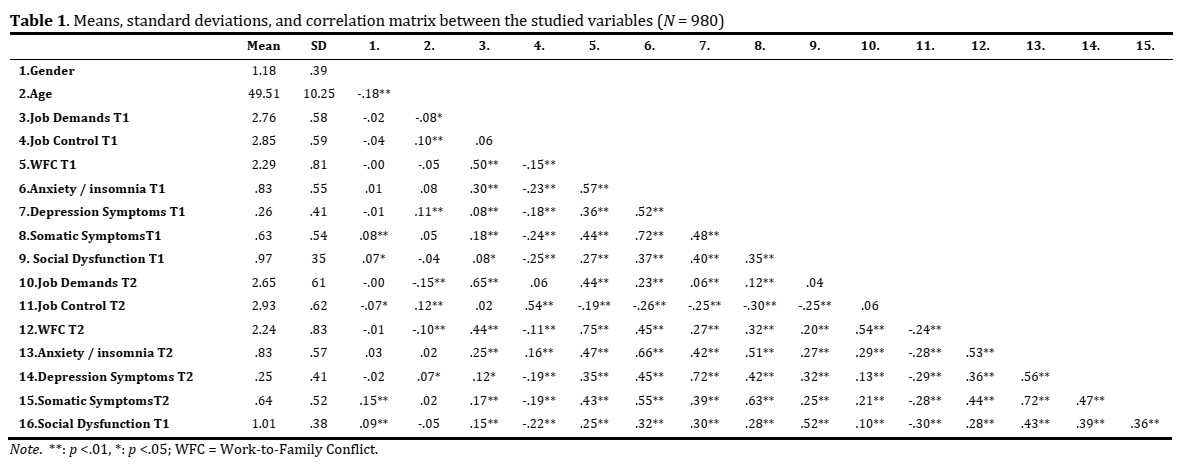
<body><![CDATA[<p><font face="Verdana" size="2"><b>Work-family conflict.</b>We measured WFC using fourteen items from the scale of Carlson, Kacmar e Williams (2000) A sample of items is &ldquo;<i>After work I am too tired when I come home to do some of the things I&rsquo;d like to do</i>&rsquo;&rsquo; and &lsquo;&lsquo;<i>My job takes time from me that I would like spend with my family/friends.</i>&rsquo;&rsquo; Items were scored on a five-point rating scale from (1) &ldquo;<i>totally disagree</i>&rdquo; to (5) &ldquo;<i>totally agree</i>&rdquo; (T1 &alpha; = 0.95, T2 &alpha; =0.95). This scale has previously been validated for the Portuguese population (Vieira et al., 2014).</font></p>      <p><font face="Verdana" size="2"><b>Mental Health.</b>This variable was measured with a Portuguese version of the General Health Questionnaire-28 (GHQ: Goldberg and Hillier, 1979), which includes four dimensions: somatic symptoms (seven items, &lsquo;&lsquo;<i>Have you recently been feeling perfectly well and in a good health</i>?&rsquo;&rsquo;, (T1 &alpha; = 0.75, T2 &alpha; = 0.78); anxiety/ insomnia (seven items, &lsquo;&lsquo;<i>Have you recently lost sleep over worry</i>?&rsquo;&rsquo;), (T1 &alpha; = 0.88, T2 &alpha; = 0.90); social dysfunction (seven items, &lsquo;&lsquo;<i>Have you recently been taking longer over the things you do</i>?&rsquo;&rsquo;, (T1 &alpha; = 0.82, T2 &alpha; = 0.84); and depression symptoms (seven items, &ldquo;<i>Have you recently felt that life is entirely hopeless?</i>&rdquo;) (T1 &alpha; = 0.88, T2 &alpha; = 0.87). In the GHQ-28, the respondent is asked to compare his recent psychological state with his usual state. The response scale ranged from 1 (<i>not at all</i>) to 4 (<i>much more than usual</i>) and higher scores indicate poor mental health. This scale has previously been validated for the Portuguese population (Monteiro, 2011).</font></p>      <p><font face="Verdana" size="2"><b>Control variables.</b>Age, sex and number of children can be related to WFC (Byron, 2005) and individuals&rsquo; capacity to adapt to stress and develop strategies to deal with it (Schaufeli and Buunk, 2003). Accordingly, we controlled for sex, codified as a dummy variable (0 if the respondent was female and 1 if male), age (in years) and number of children.</font></p>      <p><font face="Verdana" size="2"><b>Statistical analyses</b></font></p>      <p><font face="Verdana" size="2">In order to investigate the cross-lagged longitudinal analyses, we employed structural equation modelling (SEM) techniques using the AMOS 25.0 software package. Several indicators for each latent variable were used in the tested models at both times. As a preliminary step in the analyses, we tested the measurement model that defines the relations between all observed and unobserved study variables. The measurement model (CFA) specifies the pattern by which each measure is loaded on a particular factor (Byrne, 2001).</font></p>      <p><font face="Verdana" size="2">Next, in order to test the hypothesized structural model with two time waves we applied the approach suggested by Cole and Maxwell (2003) and Taris and Kompier (2006) that was applied, for example, by Hakanen, Schaufeli and Ahola (2008). To test mediation with two-wave designs, they recommend a pair of longitudinal tests that can detect partial mediation so that separate analyses are conducted for: (1) causal relationships between predictor(s) and mediator(s) and (2) causal relationships between mediator(s) and outcome(s). In our study, this procedure implied two pairs of cross-lagged tests for structural models: testing cross-lagged relationships between (1) job characteristics (predictors) and WFC (mediator) and (2) between WFC (mediator) and mental health (outcomes). Auto-regression effects were included in order to control for baseline levels for each endogenous variable. In addition, synchronous correlations between the latent variables were allowed in all tested models. Moreover, the error terms of each indicator at T1 were allowed to covary with the corresponding indicator at T2, as is usual in longitudinal structural equation models. We tested several competing structural models using full panel designs to investigate the proposed cross-lagged effects: (1) the stability model (M<sub>stabil</sub>), which included the autoregressive effects over time of each latent variable but did not include any cross-lagged associations; (2) the causality model (M<sub>causal</sub>), which included the autoregressive effects as in M<sub>stabil</sub> combined with the causal relationships as hypothesized.</font></p>      <p><font face="Verdana" size="2"><b>RESULTS</b></font></p>      <p><font face="Verdana" size="2">The means, standard deviations, and correlations of variables are reported in <a href="/img/revistas/psi/v34n1/34n1a02t1.jpg">Table 1</a>.</font></p>      <p><font face="Verdana" size="2"><b>Measurement Model</b></font></p>      <p><font face="Verdana" size="2">We began by comparing various factor structures to test the distinctiveness of the constructs used in this study. At time 1, four measurement models were compared: a one-factor model, a two- factor model, a three-factor model and a six-factor model. In the one-factor model, all items loaded on a single latent variable, whereas in the two-factor model the mental health items were grouped together under one factor and job characteristics and WFC items were grouped in another, in the three-factor model the mental health items were grouped together under one factor, job characteristics items in another and work-family conflict items in another, and in the four-factor model all observed items loaded on their respective latent variables (job demands, autonomy, WFC and mental health &ndash; this last was a second order latent variable that had four first order latent variables, i.e., depression, anxiety, social dysfunction and somatization, with their indicators corresponding to the items that compose the scale). The latent variables were allowed to correlate with each other. The one factor model showed a poor fit to the data (<i>&Chi;</i><sup><i>2</i></sup>(1208) = 12833.52, <i>&rcy;</i> &lt; 0.001; SRMR= .11; TLI = .63; CFI = .65; RMSEA = .10). The two-factor or three-factor models, although indicating a better fit, also showed a poor fit (<i>&Chi;</i><sup><i>2</i></sup>(1203) = 7005.33, <i>&rcy;</i> &lt; 0.001; SRMR= .08; TLI = .81; CFI = .81; RMSEA = .07 and (<i>&Chi;</i><sup><i>2</i></sup>(1201) = 5349.19, <i>&rcy;</i> &lt; 0.001; SRMR= .08; TLI = .87; CFI = .87; RMSEA = .06, respectively). The four-factor model obtained an acceptable fit (<i>&Chi;</i><sup><i>2</i></sup>(1198)= 4108.25 <i>&rcy;</i> &lt; 0.001; SRMR= .06; TLI = .91; CFI = .91; RMSEA = .05) and fit the data significantly better than the one-factor model (&Delta;<i>&Chi;</i><sup><i>2</i></sup>(10) =-8725.27 <i>&rcy;</i> &lt; 0.01), the two-factor model (&Delta;<i>&Chi;</i><sup><i>2</i></sup>(5) = 2897.08, <i>&rcy;</i> &lt; 0.01), and the three-factor model (&Delta;<i>&Chi;</i><sup><i>2</i></sup>(3) = 1240.94, <i>&rcy;</i> &lt; 0.01). These analyses showed that the factor structures of the research variables were consistent with the conceptual model and also that the manifest variables loaded on the latent variables, as intended. At time 2, the four-factor model also obtained an acceptable fit (<i>&Chi;</i><sup><i>2</i></sup>(1198) = 4190.03 <i>&rcy;</i> &lt; 0.001; SRMR= .06; TLI = .91; CFI = .91; RMSEA = .05).</font></p>      ]]></body>
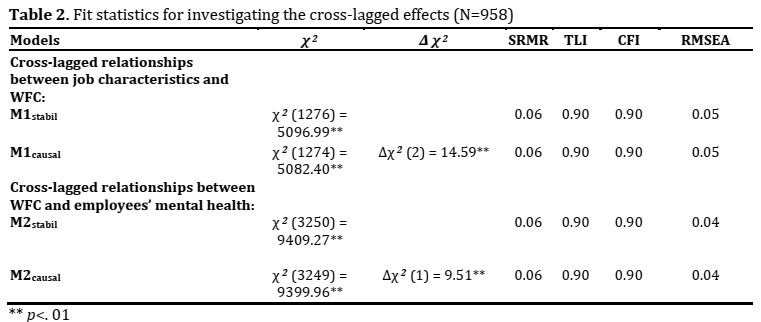
<body><![CDATA[<p><font face="Verdana" size="2"><b>Longitudinal testing of the relationship between job characteristics and WFC</b></font></p>      <p><font face="Verdana" size="2">As can be seen in <a href="/img/revistas/psi/v34n1/34n1a02t2.jpg">Table 2</a>, the causal model (M1<sub>causal</sub>) with the cross-lagged associations between T1 job characteristics and T2 WFC provided a better fit to the data than the stability model without cross-lagged associations (M1<sub>stabil</sub>; &Delta;<i>&Chi;</i><sup><i>2</i></sup>(2) = 14.59, <i>&rcy;</i> &lt; 0.01), which in terms of parsimony was thereby the best fitting model.</font></p>      <p><font face="Verdana" size="2">In M1<sub>causal</sub> (see <a href="/img/revistas/psi/v34n1/34n1a02f1.jpg">Figure 1</a>), as expected, job demands (&beta;= 0.06; &rho;&lt;0.05) at T1 had a longitudinal cross-lagged effect on WFC T2, even after the autoregressive effects of the latent variables were controlled for. However, job control (&beta;= 0.01; n.s.) at T1 did not have a significant longitudinal cross-lagged effect on WFC T2. Thus, our results supported H1a but H1b was refuted.</font></p>      <p><font face="Verdana" size="2"><b>Longitudinal testing of the relationship between WFC and employees&rsquo; mental health</b></font></p>      <p><font face="Verdana" size="2"><a href="/img/revistas/psi/v34n1/34n1a02t2.jpg">Table 2</a> shows that again the causal model (M2<sub>causal</sub>) with the cross-lagged associations between T1 WFC and T2 employees&rsquo; mental health presented a better fit to the data than the stability model (M2<sub>stabil</sub>; &Delta;<i>&Chi;</i><sup><i>2</i></sup>(1) =9.51, <i>&rcy;</i> &lt; 0.01), suggesting that M2<sub>causal</sub> was the best fitting model, as expected. Accordingly, <a href="/img/revistas/psi/v34n1/34n1a02f2.jpg">Figure 2</a> shows that, in addition to autoregressive effects, WFC had a positive cross-lagged effect on employees&rsquo; mental health six months later (&beta;=0.11; &rho;&lt;0.01).</font></p>      <p><font face="Verdana" size="2">To summarize, the two-phase cross-lagged panel analyses supported both (1) the expected cross-lagged effect from job demands and WFC (hypotheses 1a), and (2) the expected mediated WFC role leading from job characteristics through this variable to employees&rsquo; mental health (hypotheses 2) over a 6-month follow-up period. However, contrary to hypothesis 1b job control did not predict WFC.</font></p>      <p><font face="Verdana" size="2">Control variables exhibited several significant associations with research variables. Namely: number of children was significantly associated with higher job demands on Time 1 (&beta;=0.07; &rho;&lt;0.05), higher WFC on Time 1 (&beta;=0.08; &rho;&lt;0.05) and on Time 2 (&beta;=0.05; &rho;&lt;0.05), higher mental health on Time 1 (&beta;=0.07; &rho;&lt;0.05) and on Time 2 (&beta;=0.08; &rho;&lt;0.05); age was significantly associated with higher job demands on Time 1 (&beta;=0.08; &rho;&lt;0.05) and on Time 2 (&beta;=0.10; &rho;&lt;0.01) and higher WFC on Time 1 (&beta;=0.07; &rho;&lt;0.05); gender was associated with higher mental health on Time 2 (&beta;=0.06; &rho;&lt;0.05).</font></p>      <p><font face="Verdana" size="2"><b>DISCUSSION</b></font></p>      <p><font face="Verdana" size="2">The main purpose of the present study was to test the JDC model, in which we posited that job demands and job control are related to employees&rsquo; mental health and that the mediating role of the WFC is present in this relationship. The results from the cross-lagged analyses supported the hypothesized model and revealed that the WFC had a relevant role in explaining the effect between employees&rsquo; perceptions of job demands and their mental health, however the relationship between employees&rsquo; perceptions of job control and the WFC was not significant. These findings lead to a number of implications.</font></p>      <p><font face="Verdana" size="2">The present study supports the view that job demands have an important effect in predicting the negative interference of work on family. In line with previous studies, we confirm that when employees considered have workload and high time-based demands they perceived a lack of potential loss of personal resources for dealing with job requirements which result in a threat to the work-family balance by promoting conflict between these two domains (Allen et al., 2019; Michel et al., 2011).</font></p>      ]]></body>
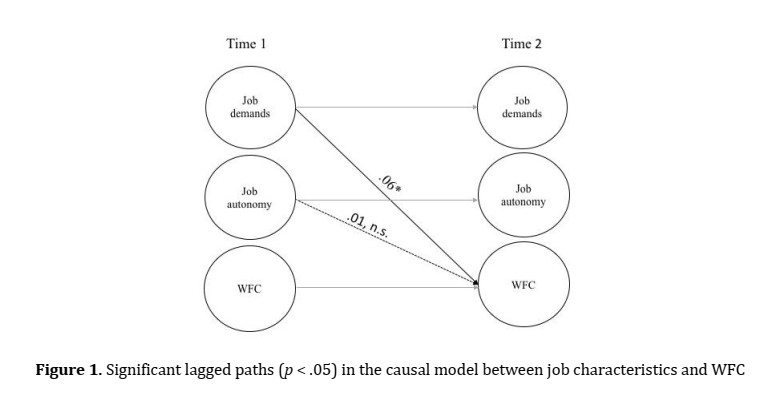
<body><![CDATA[<p><font face="Verdana" size="2">More interesting we verified that WFC plays a central role in explain the relationship between job demands and mental health. Although ten Brummelhuis and Bakker (2012) had argued that the work-to-family relationship was an important mechanism for explaining the relationship between job characteristics and employees&rsquo; workplace well-being (i.e. burnout and engagement), our study developed a broader conceptualization of the employees&rsquo; well-being. In line with the idea that what individual lives on job role or what he/she lives in the relationship between roles affect his/her general well-being, our study confirmed that WFC affected the employees&rsquo; mental health and explain the relationship between job demands and this domain-unspecific well-being (Amstad, et al., 2011).</font></p>      <p><font face="Verdana" size="2">Contrary of our expectations, job control did not affect WFC. In this study, we used job control to refer to job characteristics support within the JDC model (Karasek, 1989) and this job characteristic should not be related to the WFC. However, if we had considered control with different contours, perhaps we might have obtained a significant effect. Indeed, control related to schedule options, such as flextime or compressed work weeks, should have a significant effect because can help employees better balance work and family responsibilities. Moreover, some variables (e.g. gender, nationality, occupations) could have influence in the control perception, in the interrelationship between demands and control and in relationship between job characteristics and outcomes (Fila et al., 2017).</font></p>      <p><font face="Verdana" size="2">The present study has some limitations. First, our research measured the general control and did not include a specific control in terms of the work-family conflict, i.e. control of schedule or the possibility to work from home, which can help the performance and management of the family role and may attenuate the WFC. Moreover, we tested the JDC model but should be useful used the JDCS model (Johnson and Hall, 1988) and include social support. Specifically, a meta-analysis showed that the supervisory work-to-family support form of social context support is important to explain how employees balance work and family roles (Kossek, Pichler, Bodner and Hammer, 2011) and another meta-analysis highlight the important role that support from the workplace, namely organizational support, plays in helping individuals manage work&ndash;family conflict (French, Dumani, Allen and Shockley, 2018). Thus, future studies should analyze the hypothesis that work-to-family control and supervisor and organizational work-to-family support are job characteristics that affect employees&rsquo; well-being through positive influence in the management of the work-family relationship. Second, all the outcomes in the present study were assessed with self-reported measures. Such measures may be impacted by social desirability, and we thus encourage researchers to conduct additional research using an objective assessment of well-being and mental health. Third, the present sample comprised only employees from one company in one country (Portugal). Thus, future research is needed with employees from other companies and countries to replicate and broaden the present results and to promote the generalization of these results. Furthermore, in line with this generalization of the results problem, this study had not a probability sample and future studies need create samples that are representative of the population. Fourth, in line with the suggestion of Amstad et al. (2011) we used a domain-unspecific well-being indicator (i.e. mental well-being). However, we can presuppose that the context-free mental health can be influenced by job-related well-being (Kelloway and Barling, 1991; Warr, 2007). Thus, in future research will be interesting include a more proximal variable (i.e. work-specific well-being) and test it mediator role between WFC a more distal variable (i.e. domain-unspecific well-being) (Frone, Russell and Cooper, 1992).</font></p>      <p><font face="Verdana" size="2">Despite these limitations, the present findings also have some practical implications for promoting employees&rsquo; mental health. Our findings suggest that perceived high demands, lead to an increase in the WFC, which in turn facilitates the reduction of the mental health. Therefore, the low demands play a key role in the promotion of employees&rsquo; mental health. In light of these results, it appears to be important that the company implements steps to diminish workload and time pressure. On the other hand, our findings also suggest that an employee who senses that his/her professional activity interferes negatively with his/her family role experiences less mental health than a worker who feels that this interference does not exist. Thus, it seems crucial that the company should develop actions that contribute to employees&rsquo; reconciling their work and family roles. For example, schedule options, such as flextime or compressed work weeks are probably essential for employees needing to balance their work schedules against family role demands. In association to these organizational actions the individual also can developed some actions and strategies first to cope with high demands (e.g. time management strategies) and second to cope with work-family conflict (e.g. boundaries segmentation between work and family domains).</font></p>       <p>&nbsp;</p>     <p><font face="Verdana" size="2"><b>References</b></font></p>      <p><font face="Verdana" size="2">Allen, T. D., French, K. A., Dumani, S., &amp; Shockley, K. M. (2020). A cross-national meta-analytic examination of predictors and outcomes associated with work&ndash;family conflict.<i>Journal of Applied Psychology, 105</i>(6), 539-576. <a href="https://doi.org/10.1037/apl0000442" target="_blank">https://doi.org/10.1037/apl0000442</a></font></p>      <p><font face="Verdana" size="2">Allen, T.D., Herst, D.E.L., Bruck, C.S., &amp; Sutton, M. (2000). Consequences associated with work-to-family conflict: A review and agenda for further research. <i>Journal of Occupational Health Psychology, 5</i>(2), 278&ndash;308. <a href="https://doi.org/10.1037//1076-8998.5.2.278" target="_blank">https://doi.org/10.1037//1076-8998.5.2.278</a></font></p>      <p><font face="Verdana" size="2">Amstad, F.T., Meier, L.L., Fasel, U., Elfering, A., &amp; Semmer, N.K. (2011). A meta-analysis of work-family conflict and various outcomes with a special emphasis on cross-domain versus matching-domain relations.<i> Journal of Occupational Health Psychology, 16</i>(2), 151&ndash;69. <a href="https://doi.org/10.1037/a0022170" target="_blank">https://doi.org/10.1037/a0022170</a></font></p>      <p><font face="Verdana" size="2">&Acirc;ngelo, R.P., &amp; Chambel, M.J. (2014). The role of proactive coping in the Job Demands&ndash;Resources Model: A cross-section study with firefighters. <i>European Journal of Work and Organizational Psychology, 23</i>(2), 203-216. <a href="https://doi.org/10.1080/1359432X.2012.728701" target="_blank">https://doi.org/10.1080/1359432X.2012.728701</a></font></p>      ]]></body>
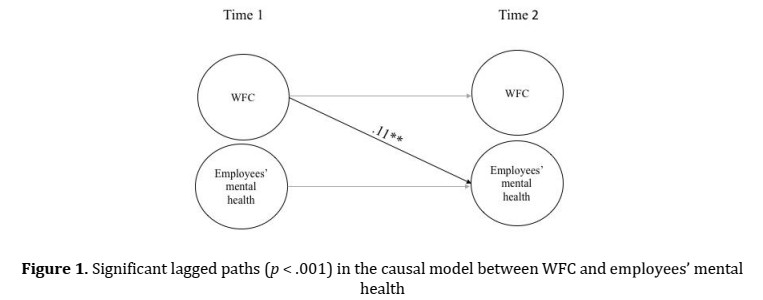
<body><![CDATA[<!-- ref --><p><font face="Verdana" size="2">Banks, M. et al. (1980). The use of the General Health Questionnaire as an indicator of mental health in occupational studies. <i>Journal of Occupational Psychology, 53</i>(3), 187-194. <a href="https://doi.org/10.1111/j.2044-8325.1980.tb00024.x" target="_blank">https://doi.org/10.1111/j.2044-8325.1980.tb00024.x</a></font>&nbsp;&nbsp;&nbsp;&nbsp;&nbsp;&nbsp;&nbsp;&nbsp;[&#160;<a href="javascript:void(0);" onclick="javascript: window.open('/scielo.php?script=sci_nlinks&ref=509373&pid=S0874-2049202000010000200005&lng=','','width=640,height=500,resizable=yes,scrollbars=1,menubar=yes,');">Links</a>&#160;]<!-- end-ref --><!-- ref --><p><font face="Verdana" size="2">Byrne, B.M. (2001). <i>Structural equation modeling with AMOS: Basic concepts, applications and programming</i>. Lawrence Erlbaum.    &nbsp;&nbsp;&nbsp;&nbsp;&nbsp;&nbsp;&nbsp;&nbsp;[&#160;<a href="javascript:void(0);" onclick="javascript: window.open('/scielo.php?script=sci_nlinks&ref=509374&pid=S0874-2049202000010000200006&lng=','','width=640,height=500,resizable=yes,scrollbars=1,menubar=yes,');">Links</a>&#160;]<!-- end-ref --></font></p>      <p><font face="Verdana" size="2">Byron, K. (2005). A meta-analytic review of work&ndash;family conflict and its antecedents. <i>Journal of Vocational Behavior, 67</i>(2), 169&ndash;198. <a href="https://doi.org/10.1016/j.jvb.2004.08.009" target="_blank">https://doi.org/10.1016/j.jvb.2004.08.009</a></font></p>      <p><font face="Verdana" size="2">Carlson, D.S., Kacmar, K.M., &amp; Williams, L.J. (2000). Construction and initial validation of a multidimensional measure of work&ndash;family conflict. <i>Journal of Vocational Behavior, 56</i>(2), 249&ndash;276. <a href="https://doi.org/10.1006/jvbe.1999.1713" target="_blank">https://doi.org/10.1006/jvbe.1999.1713</a></font></p>      <!-- ref --><p><font face="Verdana" size="2">Castanheira, F., &amp; Chambel, M.J. (2010). Reducing burnout in call centers through HR practices. <i>Human Resources Management, 49</i>(6), 1047-1065. <a href="https://doi.org/10.1002/hrm.20393" target="_blank">https://doi.org/10.1002/hrm.20393</a></font>&nbsp;&nbsp;&nbsp;&nbsp;&nbsp;&nbsp;&nbsp;&nbsp;[&#160;<a href="javascript:void(0);" onclick="javascript: window.open('/scielo.php?script=sci_nlinks&ref=509378&pid=S0874-2049202000010000200009&lng=','','width=640,height=500,resizable=yes,scrollbars=1,menubar=yes,');">Links</a>&#160;]<!-- end-ref --><!-- ref --><p><font face="Verdana" size="2">Chambel, M.J., Carvalho, V.S., Ces&aacute;rio, F., &amp; Lopes, S. (2017). The work-to-life conflict mediation between job characteristics and well-being at work: Part-time vs. full-time employees. <i>Career Development International, 22</i>(2), 142-164. <a href="https://doi.org/10.1108/CDI-06-2016-0096" target="_blank">https://doi.org/10.1108/CDI-06-2016-0096</a></font>&nbsp;&nbsp;&nbsp;&nbsp;&nbsp;&nbsp;&nbsp;&nbsp;[&#160;<a href="javascript:void(0);" onclick="javascript: window.open('/scielo.php?script=sci_nlinks&ref=509379&pid=S0874-2049202000010000200010&lng=','','width=640,height=500,resizable=yes,scrollbars=1,menubar=yes,');">Links</a>&#160;]<!-- end-ref --><p><font face="Verdana" size="2">Cole, D.A., &amp; Maxwell, S.E. (2003). Testing mediational models with longitudinal data: Questions and tips in the use of structural equation models. <i>Journal of Abnormal Psychology, 112</i>(4), 558&ndash;577. <a href="https://doi.org/10.1037/0021-843X.112.4.558" target="_blank">https://doi.org/10.1037/0021-843X.112.4.558</a></font></p>      <!-- ref --><p><font face="Verdana" size="2">Demerouti, E., Bakker, A.B., &amp; Bulters, A.J. (2004). The loss spiral of work pressure, work-home interference and exhaustion: Reciprocal relations in a three-wave study. <i>Journal of Vocational Behavior, 64</i>(1), 131-49. <a href="https://doi.org/10.1016/S0001-8791(03)00030-7" target="_blank">https://doi.org/10.1016/S0001-8791(03)00030-7</a></font>&nbsp;&nbsp;&nbsp;&nbsp;&nbsp;&nbsp;&nbsp;&nbsp;[&#160;<a href="javascript:void(0);" onclick="javascript: window.open('/scielo.php?script=sci_nlinks&ref=509381&pid=S0874-2049202000010000200012&lng=','','width=640,height=500,resizable=yes,scrollbars=1,menubar=yes,');">Links</a>&#160;]<!-- end-ref --><p><font face="Verdana" size="2">Edwards, J.R., &amp; Rothbard, N.P. (2000). Mechanisms linking work and family: Clarifying the relationship between work and family constructs. <i>Academy of Management Review, 25</i>(1), 178&ndash;199. <a href="https://doi.org/10.2307/259269" target="_blank">https://doi.org/10.2307/259269</a></font></p>      ]]></body>
<body><![CDATA[<!-- ref --><p><font face="Verdana" size="2">Eurofound (2018). <i>Striking a balance: Reconciling work and life in the EU</i>. Publications Office of the European Union.    &nbsp;&nbsp;&nbsp;&nbsp;&nbsp;&nbsp;&nbsp;&nbsp;[&#160;<a href="javascript:void(0);" onclick="javascript: window.open('/scielo.php?script=sci_nlinks&ref=509383&pid=S0874-2049202000010000200014&lng=','','width=640,height=500,resizable=yes,scrollbars=1,menubar=yes,');">Links</a>&#160;]<!-- end-ref --></font></p>      <!-- ref --><p><font face="Verdana" size="2">Fila, M.F., Purl, J., &amp; Griffeth, R.W. (2017). Job demands, control and support: Meta-analyzing moderator effects of gender, nationality, and occupation. <i>Human Resource Management Review, 27</i>(1), 39-60. <a href="https://doi.org/10.1016/j.hrmr.2016.09.004" target="_blank">https://doi.org/10.1016/j.hrmr.2016.09.004</a></font>&nbsp;&nbsp;&nbsp;&nbsp;&nbsp;&nbsp;&nbsp;&nbsp;[&#160;<a href="javascript:void(0);" onclick="javascript: window.open('/scielo.php?script=sci_nlinks&ref=509385&pid=S0874-2049202000010000200015&lng=','','width=640,height=500,resizable=yes,scrollbars=1,menubar=yes,');">Links</a>&#160;]<!-- end-ref --><p><font face="Verdana" size="2">French, K. A., Dumani, S., Allen, T. D., &amp; Shockley, K. M. (2018). A meta-analysis of work&ndash;family conflict and social support. <i>Psychological Bulletin, 144</i>(3), 284&ndash;314. doi10.1037/bul0000120.</font></p>      <p><font face="Verdana" size="2">Frone, M.R., Russell, M., &amp; Cooper, M.L. (1992). Antecedents and outcomes of work&ndash;family conflict: Testing a model of the work&ndash;family interface.<i> Journal of Applied Psychology, 77</i>(1), 65&ndash;78. <a href="Https://doi.org/10.1037//0021-9010.77.1.65" target="_blank">Https://doi.org/10.1037//0021-9010.77.1.65</a></font></p>      <p><font face="Verdana" size="2">Geurts, S., Kompier, M., Roxburgh, S., &amp; Houtman, I.L. (2003). Does work&ndash;home interference mediate the relationship between workload and well-being? <i>Journal of Vocational Behavior, 63</i>(3), 532&ndash;559. <a href="https://doi.org/10.1016/S0001-8791(02)00025-8" target="_blank">https://doi.org/10.1016/S0001-8791(02)00025-8</a></font></p>      <!-- ref --><p><font face="Verdana" size="2">Goldberg, D., &amp; Hillier, V. (1979). A scaled version of the general health questionnaire. <i>Psychological Medicine, 9,</i> 139-145. <a href="https://doi.org/10.1017/s0033291700021644" target="_blank">https://doi.org/10.1017/s0033291700021644</a></font>&nbsp;&nbsp;&nbsp;&nbsp;&nbsp;&nbsp;&nbsp;&nbsp;[&#160;<a href="javascript:void(0);" onclick="javascript: window.open('/scielo.php?script=sci_nlinks&ref=509389&pid=S0874-2049202000010000200019&lng=','','width=640,height=500,resizable=yes,scrollbars=1,menubar=yes,');">Links</a>&#160;]<!-- end-ref --><!-- ref --><p><font face="Verdana" size="2">Goode, W.J. (1960). A theory of role strain. <i>American Sociological Review, 25</i>, 483-496. <a href="https://doi.org/10.2307/2092933" target="_blank">https://doi.org/10.2307/2092933</a></font>&nbsp;&nbsp;&nbsp;&nbsp;&nbsp;&nbsp;&nbsp;&nbsp;[&#160;<a href="javascript:void(0);" onclick="javascript: window.open('/scielo.php?script=sci_nlinks&ref=509390&pid=S0874-2049202000010000200020&lng=','','width=640,height=500,resizable=yes,scrollbars=1,menubar=yes,');">Links</a>&#160;]<!-- end-ref --><p><font face="Verdana" size="2">Greenhaus, J. H., Allen, T. D., &amp; Spector, P. E. (2006). Health consequences of work-family conflict: The dark side of the work-family interface. In P. L. Perrew&eacute; &amp; D. C. Ganster (Eds.),&nbsp;<i>Research in occupational stress and well-being: Vol. 5. Employee health, coping and methodologies</i>&nbsp;(pp. 61&ndash;98). Elsevier Science/JAI Press. <a href="https://doi.org/10.1016/S1479-3555(05)05002-X" target="_blank">https://doi.org/10.1016/S1479-3555(05)05002-X</a></font></p>      <p><font face="Verdana" size="2">Greenhaus, J.H., &amp; Beutell, N.J. (1985). Sources of and conflict family between work and Family Roles. <i>Academy of Management Review, 10</i>(1), 76&ndash;88. <a href="https://doi.org/10.2307/258214" target="_blank">https://doi.org/10.2307/258214</a></font></p>      ]]></body>
<body><![CDATA[<p><font face="Verdana" size="2">Grzywacz, J.G., &amp; Marks, N.F. (2000). Reconceptualizing the work-family interface: An ecological perspective on the correlates of positive and negative spillover between work and family. <i>Journal of Occupational Health Psychology, 5</i>(1), 111&ndash;126. <a href="https://doi.org/I0.1037//I076-8998.5.1.11I" target="_blank">https://doi.org/I0.1037//I076-8998.5.1.11I</a></font></p>      <p><font face="Verdana" size="2">Hakanen, J.J., Schaufeli, W.B., &amp; Ahola, K. (2008). The Job Demands-Resources model: A three-year cross-lagged study of burnout, depression, commitment, and work engagement. <i>Work Stress, 22</i>(3), 224&ndash;241. <a href="https://doi.org/10.1080/02678370802379432" target="_blank">https://doi.org/10.1080/02678370802379432</a></font></p>      <p><font face="Verdana" size="2">Ioakimidis, V., Santos, C.C., &amp; Herrero, I.M. (2014) Reconceptualizing social work in times of crisis: An examination of the cases of Greece, Spain and Portugal. <i>International Social Work, 57</i>(4), 285&ndash;300. <a href="https://doi.org/10.1177/0020872814524967" target="_blank">https://doi.org/10.1177/0020872814524967</a></font></p>      <!-- ref --><p><font face="Verdana" size="2">Johnson, J.V., &amp; Hall, E.M. (1988). Job strain, workplace social support, and cardiovascular disease. A cross-sectorial study of a random sample of the Swedish Working population. <i>American Journal of Public Health, 78</i>(10), 1336-1342. <a href="https://doi.org/10.2105/ajph.78.10.1336" target="_blank">https://doi.org/10.2105/ajph.78.10.1336</a></font>&nbsp;&nbsp;&nbsp;&nbsp;&nbsp;&nbsp;&nbsp;&nbsp;[&#160;<a href="javascript:void(0);" onclick="javascript: window.open('/scielo.php?script=sci_nlinks&ref=509396&pid=S0874-2049202000010000200026&lng=','','width=640,height=500,resizable=yes,scrollbars=1,menubar=yes,');">Links</a>&#160;]<!-- end-ref --><!-- ref --><p><font face="Verdana" size="2">Kahn, R.L., Wolfe, D.M., Quinn, R.P., Snoek, J.D., &amp; Rosenthal, R.A. (1964). <i>Organizational stress: Studies in role conflict and ambiguity</i>. Wiley.    &nbsp;&nbsp;&nbsp;&nbsp;&nbsp;&nbsp;&nbsp;&nbsp;[&#160;<a href="javascript:void(0);" onclick="javascript: window.open('/scielo.php?script=sci_nlinks&ref=509397&pid=S0874-2049202000010000200027&lng=','','width=640,height=500,resizable=yes,scrollbars=1,menubar=yes,');">Links</a>&#160;]<!-- end-ref --></font></p>      <p><font face="Verdana" size="2">Karasek, R.A., Brisson, C., Kawakami, N., Houtman, I., Bongers, P., &amp; Amick, B. (1998). The job content questionnaire: An instrument for internationally comparative assessments of psychosocial job characteristics. <i>Journal of Occupational Health Psychology, 3</i>(4), 322&ndash;355. <a href="https://doi.org/10.1037//1076-8998.3.4.322" target="_blank">https://doi.org/10.1037//1076-8998.3.4.322</a></font></p>      <!-- ref --><p><font face="Verdana" size="2">Karasek, R.A. (1979). Job demands, job decision latitude, and mental strain: Implications for job redesign. <i>Administrative Science Quarterly, 24</i>(2), 285-308. <a href="https://doi.org/10.2307/2392498" target="_blank">https://doi.org/10.2307/2392498</a></font>&nbsp;&nbsp;&nbsp;&nbsp;&nbsp;&nbsp;&nbsp;&nbsp;[&#160;<a href="javascript:void(0);" onclick="javascript: window.open('/scielo.php?script=sci_nlinks&ref=509400&pid=S0874-2049202000010000200029&lng=','','width=640,height=500,resizable=yes,scrollbars=1,menubar=yes,');">Links</a>&#160;]<!-- end-ref --><!-- ref --><p><font face="Verdana" size="2">Karasek, R.A. (1989). Control in the workplace and its health-related aspects. In S.L. Sauter, J.J. Hurrell and C.L. Cooper (Eds.),&nbsp;<i>Job control and worker health</i>. Wiley.    &nbsp;&nbsp;&nbsp;&nbsp;&nbsp;&nbsp;&nbsp;&nbsp;[&#160;<a href="javascript:void(0);" onclick="javascript: window.open('/scielo.php?script=sci_nlinks&ref=509401&pid=S0874-2049202000010000200030&lng=','','width=640,height=500,resizable=yes,scrollbars=1,menubar=yes,');">Links</a>&#160;]<!-- end-ref --></font></p>      ]]></body>
<body><![CDATA[<p><font face="Verdana" size="2">Kelloway, E.K., &amp; Barling, J. (1991). Job characteristics, role stress and mental health. <i>Journal of Occupational Health Psychology, 64</i>(4), 291&ndash;304. <a href="https://doi.org/10.1111/j.2044-8325.1991.tb00561.x" target="_blank">https://doi.org/10.1111/j.2044-8325.1991.tb00561.x</a></font></p>      <!-- ref --><p><font face="Verdana" size="2">Kossek, E.E., Pichler, S., Bodner, T., &amp; Hammer, L.B. (2011). Workplace social support and work-family conflict: A meta-analysis clarifying the influence of general and work-family-specific supervisor and organizational support. <i>Personnel Psychology, 64</i>(2), 289-313 <a href="https://doi.org/10.1111/j.1744-6570.2011.01211.x" target="_blank">https://doi.org/10.1111/j.1744-6570.2011.01211.x</a></font>&nbsp;&nbsp;&nbsp;&nbsp;&nbsp;&nbsp;&nbsp;&nbsp;[&#160;<a href="javascript:void(0);" onclick="javascript: window.open('/scielo.php?script=sci_nlinks&ref=509404&pid=S0874-2049202000010000200032&lng=','','width=640,height=500,resizable=yes,scrollbars=1,menubar=yes,');">Links</a>&#160;]<!-- end-ref --><!-- ref --><p><font face="Verdana" size="2">Kossek, E.E., &amp; Ozeki, C. (1998). Work-family conflict, policies, and the job-life satisfaction relationship: A review and directions for organizational behavior-human resources research. <i>Journal of Applied Psychology, 83</i>(2), 139-149. <a href="https://doi.org/10.1037/0021-9010.83.2.139" target="_blank">https://doi.org/10.1037/0021-9010.83.2.139</a></font>&nbsp;&nbsp;&nbsp;&nbsp;&nbsp;&nbsp;&nbsp;&nbsp;[&#160;<a href="javascript:void(0);" onclick="javascript: window.open('/scielo.php?script=sci_nlinks&ref=509405&pid=S0874-2049202000010000200033&lng=','','width=640,height=500,resizable=yes,scrollbars=1,menubar=yes,');">Links</a>&#160;]<!-- end-ref --><p><font face="Verdana" size="2">Luchman, J.N., &amp; Gonz&aacute;lez-Morales, M.G. (2013). Demands, control, and support: A meta-analytic review of work characteristics interrelationships.<i> Journal Occupational Health Psychology, 18</i>(1), 37&ndash;52. <a href="https://doi.org/10.1037/a0030541" target="_blank">https://doi.org/10.1037/a0030541</a></font></p>      <!-- ref --><p><font face="Verdana" size="2">Mauno, S, MaÌˆkikangas, A, &amp; Kinnunen U (2016). A longitudinal person-centred approach to the job demands-control model. <i>European Journal of Work and Organizational Psychology, 25</i>(6), 914-927. <a href="https://doi.org/10.1080/1359432X.2016.1187135" target="_blank">https://doi.org/10.1080/1359432X.2016.1187135</a></font>&nbsp;&nbsp;&nbsp;&nbsp;&nbsp;&nbsp;&nbsp;&nbsp;[&#160;<a href="javascript:void(0);" onclick="javascript: window.open('/scielo.php?script=sci_nlinks&ref=509407&pid=S0874-2049202000010000200035&lng=','','width=640,height=500,resizable=yes,scrollbars=1,menubar=yes,');">Links</a>&#160;]<!-- end-ref --><!-- ref --><p><font face="Verdana" size="2">Michel, J.S., Kotrba, L.M., Mitchelson, J.K., Clark, M.A., &amp; Baltes, B.B. (2011). Antecedents of work-family conflictâ€¯: A meta-analytic review. <i>Journal of Organizational Behavior, 32</i>(5), 689-725. <a href="https://doi.org/10.1002/job.695" target="_blank">https://doi.org/10.1002/job.695</a></font>&nbsp;&nbsp;&nbsp;&nbsp;&nbsp;&nbsp;&nbsp;&nbsp;[&#160;<a href="javascript:void(0);" onclick="javascript: window.open('/scielo.php?script=sci_nlinks&ref=509408&pid=S0874-2049202000010000200036&lng=','','width=640,height=500,resizable=yes,scrollbars=1,menubar=yes,');">Links</a>&#160;]<!-- end-ref --><p><font face="Verdana" size="2">Monteiro, A.V. (2011). Assessment of the factor structure and reliability of the Portuguese version of the General Health Questionnaire-28 among adults. <i>Journal of Mental Health, 20</i>(1), 15&ndash;20. <a href="https://doi.org/10.3109/09638237.2010.492414" target="_blank">https://doi.org/10.3109/09638237.2010.492414</a></font></p>      <!-- ref --><p><font face="Verdana" size="2">Neto, M., Carvalho, V.S., Chambel, M.J., Manuel, S., Pereira, M.J.P., &amp; Reis, M.F. (2016). Work-family conflict and employee psychological well-being over time: The loss spiral effect. <i>Journal of Occupational Environmental Medicine, 58</i>(5), 429-435. <a href="https://doi.org/10.1097/JOM.0000000000000707" target="_blank">https://doi.org/10.1097/JOM.0000000000000707</a></font>&nbsp;&nbsp;&nbsp;&nbsp;&nbsp;&nbsp;&nbsp;&nbsp;[&#160;<a href="javascript:void(0);" onclick="javascript: window.open('/scielo.php?script=sci_nlinks&ref=509410&pid=S0874-2049202000010000200038&lng=','','width=640,height=500,resizable=yes,scrollbars=1,menubar=yes,');">Links</a>&#160;]<!-- end-ref --><p><font face="Verdana" size="2">Nohe, C., Meier, L.L., Sonntag, K. , &amp; Michel, A. (2015). The chicken or the egg? A meta-analysis of panel studies of the relationship between work&ndash;family conflict and strain. <i>Journal of Applied Psychology, 100</i>(2), 522-536. <a href="https://doi.org/10.1037/a0038012" target="_blank">https://doi.org/10.1037/a0038012</a></font></p>      <p><font face="Verdana" size="2">Peeters, M., de Jonge, J., Janssen, P., &amp; van der Linden, S. (2004). Work &ndash; home interference, job stressors, and employee health in a longitudinal perspective. <i>International Journal of Stress Management, 11</i>(4), 305- 322. <a href="https://doi.org/10.1037/1072-5245.11.4.305" target="_blank">https://doi.org/10.1037/1072-5245.11.4.305</a></font></p>      ]]></body>
<body><![CDATA[<!-- ref --><p><font face="Verdana" size="2">Schaufeli, W.B., &amp; Buunk, B.P. (2003). Burnout: An overview of 25 years of research and theorizing. In M.J. Schabracq, J.A.M. Winnubst, and C.L. Cooper (Eds.), <i>Handbook of work and health psychology</i> (pp.383-425). Wiley.    &nbsp;&nbsp;&nbsp;&nbsp;&nbsp;&nbsp;&nbsp;&nbsp;[&#160;<a href="javascript:void(0);" onclick="javascript: window.open('/scielo.php?script=sci_nlinks&ref=509413&pid=S0874-2049202000010000200041&lng=','','width=640,height=500,resizable=yes,scrollbars=1,menubar=yes,');">Links</a>&#160;]<!-- end-ref --></font></p>      <!-- ref --><p><font face="Verdana" size="2">Schaufeli, W.B., &amp; Taris, T.W. (2014). A critical review of the Job Demands-Resources Model: Implications for improving work and health. In G. Bauer and O. HaÌˆmmig (Eds.), <i>Bridging Occupational, Organizational and Public Health: A Transdisciplinary Approach</i> (pp.43-68). Springer.    &nbsp;&nbsp;&nbsp;&nbsp;&nbsp;&nbsp;&nbsp;&nbsp;[&#160;<a href="javascript:void(0);" onclick="javascript: window.open('/scielo.php?script=sci_nlinks&ref=509415&pid=S0874-2049202000010000200042&lng=','','width=640,height=500,resizable=yes,scrollbars=1,menubar=yes,');">Links</a>&#160;]<!-- end-ref --></font></p>      <!-- ref --><p><font face="Verdana" size="2">Taris T., &amp; Kompier M. (2006). Games researchers play extreme group analysis and mediation analysis in longitudinal occupational health research. Scandinavian <i>Journal of Work, Environment and Health, 32</i>(6), 463-472. <a href="https://doi.org/10.5271/sjweh.1051" target="_blank">https://doi.org/10.5271/sjweh.1051</a></font>&nbsp;&nbsp;&nbsp;&nbsp;&nbsp;&nbsp;&nbsp;&nbsp;[&#160;<a href="javascript:void(0);" onclick="javascript: window.open('/scielo.php?script=sci_nlinks&ref=509417&pid=S0874-2049202000010000200043&lng=','','width=640,height=500,resizable=yes,scrollbars=1,menubar=yes,');">Links</a>&#160;]<!-- end-ref --><p><font face="Verdana" size="2">ten Brummelhuis, T.L., &amp; Bakker, A.B. (2012). A resource perspective on the work-home interface: The work-home resources model. <i>American Psychologist, 67</i>(7), 545&ndash;556. <a href="https://doi.org/10.1037/a0027974" target="_blank">https://doi.org/10.1037/a0027974</a></font></p>      <!-- ref --><p><font face="Verdana" size="2">Vieira, J.M., Lopez, F.G., &amp; Matos, P.M. (2014). Further validation of work family conflict and work family enrichment scales among Portuguese working parents. <i>Journal of Career Assessment, 22</i>(2), 329-344. <a href="https://doi.org/10.1177/1069072713493987" target="_blank">https://doi.org/10.1177/1069072713493987</a></font>&nbsp;&nbsp;&nbsp;&nbsp;&nbsp;&nbsp;&nbsp;&nbsp;[&#160;<a href="javascript:void(0);" onclick="javascript: window.open('/scielo.php?script=sci_nlinks&ref=509419&pid=S0874-2049202000010000200045&lng=','','width=640,height=500,resizable=yes,scrollbars=1,menubar=yes,');">Links</a>&#160;]<!-- end-ref --><!-- ref --><p><font face="Verdana" size="2">Warr, P. (2007). <i>Work, happiness, and unhappiness.</i> Lawrence Erlbaum Associates Publishers.    &nbsp;&nbsp;&nbsp;&nbsp;&nbsp;&nbsp;&nbsp;&nbsp;[&#160;<a href="javascript:void(0);" onclick="javascript: window.open('/scielo.php?script=sci_nlinks&ref=509420&pid=S0874-2049202000010000200046&lng=','','width=640,height=500,resizable=yes,scrollbars=1,menubar=yes,');">Links</a>&#160;]<!-- end-ref --></font></p>      <p>&nbsp;</p>     ]]></body>
<body><![CDATA[<p><font face="Verdana" size="2"><i>Historial do artigo</i></font></p>      <p><font face="Verdana" size="2">Recebido</font></p>      <p><font face="Verdana" size="2">03/2019</font></p>      <p><font face="Verdana" size="2">Aceite</font></p>      <p><font face="Verdana" size="2">07/2020</font></p>      <p><font face="Verdana" size="2">Publicado</font></p>      <p><font face="Verdana" size="2">08/2020</font></p>      <p>&nbsp;</p>     <p><font face="Verdana" size="2"><sup>c</sup><a href="#topc0">Correspondence to:</a><a name="c0"></a></font></p>      <p><font face="Verdana" size="2">Maria Jos&eacute; Chambel, Faculdade de Psicologia, Universidade de Lisboa, Alameda da Universidade, 1649-013 Lisboa. E-mail: <a href="mailto:mjchambel@psicologia.ulisboa.pt">mjchambel@psicologia.ulisboa.pt</a>.</font></p>       ]]></body>
<body><![CDATA[<p>&nbsp;</p>     <p><font face="Verdana" size="2"><b>Financed by:</b></font></p>      <p><font face="Verdana" size="2">This research was funded by CicPsi &ndash; Centro de Ci&ecirc;ncia Psicol&oacute;gica da Universidade de Lisboa.</font></p>       ]]></body><back>
<ref-list>
<ref id="B1">
<nlm-citation citation-type="journal">
<person-group person-group-type="author">
<name>
<surname><![CDATA[Allen]]></surname>
<given-names><![CDATA[T. D.]]></given-names>
</name>
<name>
<surname><![CDATA[French]]></surname>
<given-names><![CDATA[K. A.]]></given-names>
</name>
<name>
<surname><![CDATA[Dumani]]></surname>
<given-names><![CDATA[S.]]></given-names>
</name>
<name>
<surname><![CDATA[Shockley]]></surname>
<given-names><![CDATA[K. M.]]></given-names>
</name>
</person-group>
<article-title xml:lang="en"><![CDATA[A cross-national meta-analytic examination of predictors and outcomes associated with work-family conflict]]></article-title>
<source><![CDATA[Journal of Applied Psychology]]></source>
<year>2020</year>
<volume>105</volume>
<numero>6</numero>
<issue>6</issue>
<page-range>539-576</page-range></nlm-citation>
</ref>
<ref id="B2">
<nlm-citation citation-type="journal">
<person-group person-group-type="author">
<name>
<surname><![CDATA[Allen]]></surname>
<given-names><![CDATA[T.D.]]></given-names>
</name>
<name>
<surname><![CDATA[Herst]]></surname>
<given-names><![CDATA[D.E.L.]]></given-names>
</name>
<name>
<surname><![CDATA[Bruck]]></surname>
<given-names><![CDATA[C.S.]]></given-names>
</name>
<name>
<surname><![CDATA[Sutton]]></surname>
<given-names><![CDATA[M.]]></given-names>
</name>
</person-group>
<article-title xml:lang="en"><![CDATA[Consequences associated with work-to-family conflict: A review and agenda for further research]]></article-title>
<source><![CDATA[Journal of Occupational Health Psychology]]></source>
<year>2000</year>
<volume>5</volume>
<numero>2</numero>
<issue>2</issue>
<page-range>278-308</page-range></nlm-citation>
</ref>
<ref id="B3">
<nlm-citation citation-type="journal">
<person-group person-group-type="author">
<name>
<surname><![CDATA[Amstad]]></surname>
<given-names><![CDATA[F.T.]]></given-names>
</name>
<name>
<surname><![CDATA[Meier]]></surname>
<given-names><![CDATA[L.L.]]></given-names>
</name>
<name>
<surname><![CDATA[Fasel]]></surname>
<given-names><![CDATA[U.]]></given-names>
</name>
<name>
<surname><![CDATA[Elfering]]></surname>
<given-names><![CDATA[A.]]></given-names>
</name>
<name>
<surname><![CDATA[Semmer]]></surname>
<given-names><![CDATA[N.K.]]></given-names>
</name>
</person-group>
<article-title xml:lang="en"><![CDATA[A meta-analysis of work-family conflict and various outcomes with a special emphasis on cross-domain versus matching-domain relations]]></article-title>
<source><![CDATA[Journal of Occupational Health Psychology]]></source>
<year>2011</year>
<volume>16</volume>
<numero>2</numero>
<issue>2</issue>
<page-range>151-69</page-range></nlm-citation>
</ref>
<ref id="B4">
<nlm-citation citation-type="journal">
<person-group person-group-type="author">
<name>
<surname><![CDATA[Ângelo]]></surname>
<given-names><![CDATA[R.P.]]></given-names>
</name>
<name>
<surname><![CDATA[Chambel]]></surname>
<given-names><![CDATA[M.J.]]></given-names>
</name>
</person-group>
<article-title xml:lang="en"><![CDATA[The role of proactive coping in the Job Demands-Resources Model: A cross-section study with firefighters]]></article-title>
<source><![CDATA[European Journal of Work and Organizational Psychology]]></source>
<year>2014</year>
<volume>23</volume>
<numero>2</numero>
<issue>2</issue>
<page-range>203-216</page-range></nlm-citation>
</ref>
<ref id="B5">
<nlm-citation citation-type="journal">
<person-group person-group-type="author">
<name>
<surname><![CDATA[Banks]]></surname>
<given-names><![CDATA[M.]]></given-names>
</name>
</person-group>
<article-title xml:lang="en"><![CDATA[The use of the General Health Questionnaire as an indicator of mental health in occupational studies]]></article-title>
<source><![CDATA[Journal of Occupational Psychology]]></source>
<year>1980</year>
<volume>53</volume>
<numero>3</numero>
<issue>3</issue>
<page-range>187-194</page-range></nlm-citation>
</ref>
<ref id="B6">
<nlm-citation citation-type="book">
<person-group person-group-type="author">
<name>
<surname><![CDATA[Byrne]]></surname>
<given-names><![CDATA[B.M.]]></given-names>
</name>
</person-group>
<source><![CDATA[Structural equation modeling with AMOS: Basic concepts, applications and programming]]></source>
<year>2001</year>
<publisher-name><![CDATA[Lawrence Erlbaum]]></publisher-name>
</nlm-citation>
</ref>
<ref id="B7">
<nlm-citation citation-type="journal">
<person-group person-group-type="author">
<name>
<surname><![CDATA[Byron]]></surname>
<given-names><![CDATA[K.]]></given-names>
</name>
</person-group>
<article-title xml:lang="en"><![CDATA[A meta-analytic review of work-family conflict and its antecedents]]></article-title>
<source><![CDATA[Journal of Vocational Behavior]]></source>
<year>2005</year>
<volume>67</volume>
<numero>2</numero>
<issue>2</issue>
<page-range>169-198</page-range></nlm-citation>
</ref>
<ref id="B8">
<nlm-citation citation-type="journal">
<person-group person-group-type="author">
<name>
<surname><![CDATA[Carlson]]></surname>
<given-names><![CDATA[D.S.]]></given-names>
</name>
<name>
<surname><![CDATA[Kacmar]]></surname>
<given-names><![CDATA[K.M.]]></given-names>
</name>
<name>
<surname><![CDATA[Williams]]></surname>
<given-names><![CDATA[L.J.]]></given-names>
</name>
</person-group>
<article-title xml:lang="en"><![CDATA[Construction and initial validation of a multidimensional measure of work-family conflict]]></article-title>
<source><![CDATA[Journal of Vocational Behavior]]></source>
<year>2000</year>
<volume>56</volume>
<numero>2</numero>
<issue>2</issue>
<page-range>249-276</page-range></nlm-citation>
</ref>
<ref id="B9">
<nlm-citation citation-type="journal">
<person-group person-group-type="author">
<name>
<surname><![CDATA[Castanheira]]></surname>
<given-names><![CDATA[F.]]></given-names>
</name>
<name>
<surname><![CDATA[Chambel]]></surname>
<given-names><![CDATA[M.J.]]></given-names>
</name>
</person-group>
<article-title xml:lang="en"><![CDATA[Reducing burnout in call centers through HR practices]]></article-title>
<source><![CDATA[Human Resources Management]]></source>
<year>2010</year>
<volume>49</volume>
<numero>6</numero>
<issue>6</issue>
<page-range>1047-1065</page-range></nlm-citation>
</ref>
<ref id="B10">
<nlm-citation citation-type="journal">
<person-group person-group-type="author">
<name>
<surname><![CDATA[Chambel]]></surname>
<given-names><![CDATA[M.J.]]></given-names>
</name>
<name>
<surname><![CDATA[Carvalho]]></surname>
<given-names><![CDATA[V.S.]]></given-names>
</name>
<name>
<surname><![CDATA[Cesário]]></surname>
<given-names><![CDATA[F.]]></given-names>
</name>
<name>
<surname><![CDATA[Lopes]]></surname>
<given-names><![CDATA[S.]]></given-names>
</name>
</person-group>
<article-title xml:lang="en"><![CDATA[The work-to-life conflict mediation between job characteristics and well-being at work: Part-time vs. full-time employees]]></article-title>
<source><![CDATA[Career Development International]]></source>
<year>2017</year>
<volume>22</volume>
<numero>2</numero>
<issue>2</issue>
<page-range>142-164</page-range></nlm-citation>
</ref>
<ref id="B11">
<nlm-citation citation-type="journal">
<person-group person-group-type="author">
<name>
<surname><![CDATA[Cole]]></surname>
<given-names><![CDATA[D.A.]]></given-names>
</name>
<name>
<surname><![CDATA[Maxwell]]></surname>
<given-names><![CDATA[S.E.]]></given-names>
</name>
</person-group>
<article-title xml:lang="en"><![CDATA[Testing mediational models with longitudinal data: Questions and tips in the use of structural equation models]]></article-title>
<source><![CDATA[Journal of Abnormal Psychology]]></source>
<year>2003</year>
<volume>112</volume>
<numero>4</numero>
<issue>4</issue>
<page-range>558-577</page-range></nlm-citation>
</ref>
<ref id="B12">
<nlm-citation citation-type="journal">
<person-group person-group-type="author">
<name>
<surname><![CDATA[Demerouti]]></surname>
<given-names><![CDATA[E.]]></given-names>
</name>
<name>
<surname><![CDATA[Bakker]]></surname>
<given-names><![CDATA[A.B.]]></given-names>
</name>
<name>
<surname><![CDATA[Bulters]]></surname>
<given-names><![CDATA[A.J.]]></given-names>
</name>
</person-group>
<article-title xml:lang="en"><![CDATA[The loss spiral of work pressure, work-home interference and exhaustion: Reciprocal relations in a three-wave study]]></article-title>
<source><![CDATA[Journal of Vocational Behavior]]></source>
<year>2004</year>
<volume>64</volume>
<numero>1</numero>
<issue>1</issue>
<page-range>131-49</page-range></nlm-citation>
</ref>
<ref id="B13">
<nlm-citation citation-type="journal">
<person-group person-group-type="author">
<name>
<surname><![CDATA[Edwards]]></surname>
<given-names><![CDATA[J.R.]]></given-names>
</name>
<name>
<surname><![CDATA[Rothbard]]></surname>
<given-names><![CDATA[N.P.]]></given-names>
</name>
</person-group>
<article-title xml:lang="en"><![CDATA[Mechanisms linking work and family: Clarifying the relationship between work and family constructs]]></article-title>
<source><![CDATA[Academy of Management Review]]></source>
<year>2000</year>
<volume>25</volume>
<numero>1</numero>
<issue>1</issue>
<page-range>178-199</page-range></nlm-citation>
</ref>
<ref id="B14">
<nlm-citation citation-type="book">
<collab>Eurofound</collab>
<source><![CDATA[Striking a balance: Reconciling work and life in the EU]]></source>
<year>2018</year>
<publisher-name><![CDATA[Publications Office of the European Union]]></publisher-name>
</nlm-citation>
</ref>
<ref id="B15">
<nlm-citation citation-type="journal">
<person-group person-group-type="author">
<name>
<surname><![CDATA[Fila]]></surname>
<given-names><![CDATA[M.F.]]></given-names>
</name>
<name>
<surname><![CDATA[Purl]]></surname>
<given-names><![CDATA[J.]]></given-names>
</name>
<name>
<surname><![CDATA[Griffeth]]></surname>
<given-names><![CDATA[R.W.]]></given-names>
</name>
</person-group>
<article-title xml:lang="en"><![CDATA[Job demands, control and support: Meta-analyzing moderator effects of gender, nationality, and occupation]]></article-title>
<source><![CDATA[Human Resource Management Review]]></source>
<year>2017</year>
<volume>27</volume>
<numero>1</numero>
<issue>1</issue>
<page-range>39-60</page-range></nlm-citation>
</ref>
<ref id="B16">
<nlm-citation citation-type="journal">
<person-group person-group-type="author">
<name>
<surname><![CDATA[French]]></surname>
<given-names><![CDATA[K. A.]]></given-names>
</name>
<name>
<surname><![CDATA[Dumani]]></surname>
<given-names><![CDATA[S.]]></given-names>
</name>
<name>
<surname><![CDATA[Allen]]></surname>
<given-names><![CDATA[T. D.]]></given-names>
</name>
<name>
<surname><![CDATA[Shockley]]></surname>
<given-names><![CDATA[K. M.]]></given-names>
</name>
</person-group>
<article-title xml:lang="en"><![CDATA[A meta-analysis of work-family conflict and social support]]></article-title>
<source><![CDATA[Psychological Bulletin]]></source>
<year>2018</year>
<volume>144</volume>
<numero>3</numero>
<issue>3</issue>
<page-range>284-314</page-range></nlm-citation>
</ref>
<ref id="B17">
<nlm-citation citation-type="journal">
<person-group person-group-type="author">
<name>
<surname><![CDATA[Frone]]></surname>
<given-names><![CDATA[M.R.]]></given-names>
</name>
<name>
<surname><![CDATA[Russell]]></surname>
<given-names><![CDATA[M.]]></given-names>
</name>
<name>
<surname><![CDATA[Cooper]]></surname>
<given-names><![CDATA[M.L.]]></given-names>
</name>
</person-group>
<article-title xml:lang="en"><![CDATA[Antecedents and outcomes of work-family conflict: Testing a model of the work-family interface]]></article-title>
<source><![CDATA[Journal of Applied Psychology]]></source>
<year>199</year>
<volume>77</volume>
<numero>1</numero>
<issue>1</issue>
<page-range>65-78</page-range></nlm-citation>
</ref>
<ref id="B18">
<nlm-citation citation-type="journal">
<person-group person-group-type="author">
<name>
<surname><![CDATA[Geurts]]></surname>
<given-names><![CDATA[S.]]></given-names>
</name>
<name>
<surname><![CDATA[Kompier]]></surname>
<given-names><![CDATA[M.]]></given-names>
</name>
<name>
<surname><![CDATA[Roxburgh]]></surname>
<given-names><![CDATA[S.]]></given-names>
</name>
<name>
<surname><![CDATA[Houtman]]></surname>
<given-names><![CDATA[I.L.]]></given-names>
</name>
</person-group>
<article-title xml:lang="en"><![CDATA[Does work-home interference mediate the relationship between workload and well-being?]]></article-title>
<source><![CDATA[Journal of Vocational Behavior]]></source>
<year>2003</year>
<volume>63</volume>
<numero>3</numero>
<issue>3</issue>
<page-range>532-559</page-range></nlm-citation>
</ref>
<ref id="B19">
<nlm-citation citation-type="journal">
<person-group person-group-type="author">
<name>
<surname><![CDATA[Goldberg]]></surname>
<given-names><![CDATA[D.]]></given-names>
</name>
<name>
<surname><![CDATA[Hillier]]></surname>
<given-names><![CDATA[V.]]></given-names>
</name>
</person-group>
<article-title xml:lang="en"><![CDATA[A scaled version of the general health questionnaire]]></article-title>
<source><![CDATA[Psychological Medicine]]></source>
<year>1979</year>
<volume>9</volume>
<page-range>139-145</page-range></nlm-citation>
</ref>
<ref id="B20">
<nlm-citation citation-type="journal">
<person-group person-group-type="author">
<name>
<surname><![CDATA[Goode]]></surname>
<given-names><![CDATA[W.J.]]></given-names>
</name>
</person-group>
<article-title xml:lang="en"><![CDATA[A theory of role strain]]></article-title>
<source><![CDATA[American Sociological Review]]></source>
<year>1960</year>
<volume>25</volume>
<page-range>483-496</page-range></nlm-citation>
</ref>
<ref id="B21">
<nlm-citation citation-type="book">
<person-group person-group-type="author">
<name>
<surname><![CDATA[Greenhaus]]></surname>
<given-names><![CDATA[J. H.]]></given-names>
</name>
<name>
<surname><![CDATA[Allen]]></surname>
<given-names><![CDATA[T. D.]]></given-names>
</name>
<name>
<surname><![CDATA[Spector]]></surname>
<given-names><![CDATA[P. E.]]></given-names>
</name>
</person-group>
<article-title xml:lang="en"><![CDATA[Health consequences of work-family conflict: The dark side of the work-family interface]]></article-title>
<person-group person-group-type="editor">
<name>
<surname><![CDATA[Perrewé]]></surname>
<given-names><![CDATA[P. L.]]></given-names>
</name>
<name>
<surname><![CDATA[Ganster]]></surname>
<given-names><![CDATA[D. C.]]></given-names>
</name>
</person-group>
<source><![CDATA[Research in occupational stress and well-being: Vol. 5. Employee health, coping and methodologies]]></source>
<year>2006</year>
<page-range>61-98</page-range><publisher-name><![CDATA[Elsevier Science/JAI Press]]></publisher-name>
</nlm-citation>
</ref>
<ref id="B22">
<nlm-citation citation-type="journal">
<person-group person-group-type="author">
<name>
<surname><![CDATA[Greenhaus]]></surname>
<given-names><![CDATA[J.H.]]></given-names>
</name>
<name>
<surname><![CDATA[Beutell]]></surname>
<given-names><![CDATA[N.J.]]></given-names>
</name>
</person-group>
<article-title xml:lang="en"><![CDATA[Sources of and conflict family between work and Family Roles]]></article-title>
<source><![CDATA[Academy of Management Review]]></source>
<year>1985</year>
<volume>10</volume>
<numero>1</numero>
<issue>1</issue>
<page-range>76-88</page-range></nlm-citation>
</ref>
<ref id="B23">
<nlm-citation citation-type="journal">
<person-group person-group-type="author">
<name>
<surname><![CDATA[Grzywacz]]></surname>
<given-names><![CDATA[J.G.]]></given-names>
</name>
<name>
<surname><![CDATA[Marks]]></surname>
<given-names><![CDATA[N.F.]]></given-names>
</name>
</person-group>
<article-title xml:lang="en"><![CDATA[Reconceptualizing the work-family interface: An ecological perspective on the correlates of positive and negative spillover between work and family]]></article-title>
<source><![CDATA[Journal of Occupational Health Psychology]]></source>
<year>2000</year>
<volume>5</volume>
<numero>1</numero>
<issue>1</issue>
<page-range>111-126</page-range></nlm-citation>
</ref>
<ref id="B24">
<nlm-citation citation-type="journal">
<person-group person-group-type="author">
<name>
<surname><![CDATA[Hakanen]]></surname>
<given-names><![CDATA[J.J.]]></given-names>
</name>
<name>
<surname><![CDATA[Schaufeli]]></surname>
<given-names><![CDATA[W.B.]]></given-names>
</name>
<name>
<surname><![CDATA[Ahola]]></surname>
<given-names><![CDATA[K.]]></given-names>
</name>
</person-group>
<article-title xml:lang="en"><![CDATA[The Job Demands-Resources model: A three-year cross-lagged study of burnout, depression, commitment, and work engagement]]></article-title>
<source><![CDATA[Work Stress]]></source>
<year>2008</year>
<volume>22</volume>
<numero>3</numero>
<issue>3</issue>
<page-range>224-241</page-range></nlm-citation>
</ref>
<ref id="B25">
<nlm-citation citation-type="journal">
<person-group person-group-type="author">
<name>
<surname><![CDATA[Ioakimidis]]></surname>
<given-names><![CDATA[V.]]></given-names>
</name>
<name>
<surname><![CDATA[Santos]]></surname>
<given-names><![CDATA[C.C.]]></given-names>
</name>
<name>
<surname><![CDATA[Herrero]]></surname>
<given-names><![CDATA[I.M.]]></given-names>
</name>
</person-group>
<article-title xml:lang="en"><![CDATA[Reconceptualizing social work in times of crisis: An examination of the cases of Greece, Spain and Portugal]]></article-title>
<source><![CDATA[International Social Work]]></source>
<year>2014</year>
<volume>57</volume>
<numero>4</numero>
<issue>4</issue>
<page-range>285-300</page-range></nlm-citation>
</ref>
<ref id="B26">
<nlm-citation citation-type="journal">
<person-group person-group-type="author">
<name>
<surname><![CDATA[Johnson]]></surname>
<given-names><![CDATA[J.V.]]></given-names>
</name>
<name>
<surname><![CDATA[Hall]]></surname>
<given-names><![CDATA[E.M.]]></given-names>
</name>
</person-group>
<article-title xml:lang="en"><![CDATA[Job strain, workplace social support, and cardiovascular disease: A cross-sectorial study of a random sample of the Swedish Working population]]></article-title>
<source><![CDATA[American Journal of Public Health]]></source>
<year>1988</year>
<volume>78</volume>
<numero>10</numero>
<issue>10</issue>
<page-range>1336-1342</page-range></nlm-citation>
</ref>
<ref id="B27">
<nlm-citation citation-type="book">
<person-group person-group-type="author">
<name>
<surname><![CDATA[Kahn]]></surname>
<given-names><![CDATA[R.L]]></given-names>
</name>
<name>
<surname><![CDATA[Wolfe]]></surname>
<given-names><![CDATA[D.M.]]></given-names>
</name>
<name>
<surname><![CDATA[Quinn]]></surname>
<given-names><![CDATA[R.P.]]></given-names>
</name>
<name>
<surname><![CDATA[Snoek]]></surname>
<given-names><![CDATA[J.D.]]></given-names>
</name>
<name>
<surname><![CDATA[Rosenthal]]></surname>
<given-names><![CDATA[R.A.]]></given-names>
</name>
</person-group>
<source><![CDATA[Organizational stress: Studies in role conflict and ambiguity]]></source>
<year>1964</year>
<publisher-name><![CDATA[Wiley]]></publisher-name>
</nlm-citation>
</ref>
<ref id="B28">
<nlm-citation citation-type="journal">
<person-group person-group-type="author">
<name>
<surname><![CDATA[Karasek]]></surname>
<given-names><![CDATA[R.A.]]></given-names>
</name>
<name>
<surname><![CDATA[Brisson]]></surname>
<given-names><![CDATA[C.]]></given-names>
</name>
<name>
<surname><![CDATA[Kawakami]]></surname>
<given-names><![CDATA[N.]]></given-names>
</name>
<name>
<surname><![CDATA[Houtman]]></surname>
<given-names><![CDATA[I.]]></given-names>
</name>
<name>
<surname><![CDATA[Bongers]]></surname>
<given-names><![CDATA[P.]]></given-names>
</name>
<name>
<surname><![CDATA[Amick]]></surname>
<given-names><![CDATA[B.]]></given-names>
</name>
</person-group>
<article-title xml:lang="en"><![CDATA[The job content questionnaire: An instrument for internationally comparative assessments of psychosocial job characteristics]]></article-title>
<source><![CDATA[Journal of Occupational Health Psychology]]></source>
<year>1998</year>
<volume>3</volume>
<numero>4</numero>
<issue>4</issue>
<page-range>322-355</page-range></nlm-citation>
</ref>
<ref id="B29">
<nlm-citation citation-type="journal">
<person-group person-group-type="author">
<name>
<surname><![CDATA[Karasek]]></surname>
<given-names><![CDATA[R.A.]]></given-names>
</name>
</person-group>
<article-title xml:lang="en"><![CDATA[Job demands, job decision latitude, and mental strain: Implications for job redesign]]></article-title>
<source><![CDATA[Administrative Science Quarterly]]></source>
<year>1979</year>
<volume>24</volume>
<numero>2</numero>
<issue>2</issue>
<page-range>285-30</page-range></nlm-citation>
</ref>
<ref id="B30">
<nlm-citation citation-type="book">
<person-group person-group-type="author">
<name>
<surname><![CDATA[Karasek]]></surname>
<given-names><![CDATA[R.A.]]></given-names>
</name>
</person-group>
<article-title xml:lang="en"><![CDATA[Control in the workplace and its health-related aspects]]></article-title>
<person-group person-group-type="editor">
<name>
<surname><![CDATA[Sauter]]></surname>
<given-names><![CDATA[S.L.]]></given-names>
</name>
<name>
<surname><![CDATA[Hurrell]]></surname>
<given-names><![CDATA[J.J.]]></given-names>
</name>
<name>
<surname><![CDATA[Cooper]]></surname>
<given-names><![CDATA[C.L.]]></given-names>
</name>
</person-group>
<source><![CDATA[Job control and worker health]]></source>
<year>1989</year>
<publisher-name><![CDATA[Wiley]]></publisher-name>
</nlm-citation>
</ref>
<ref id="B31">
<nlm-citation citation-type="journal">
<person-group person-group-type="author">
<name>
<surname><![CDATA[Kelloway]]></surname>
<given-names><![CDATA[E.K.]]></given-names>
</name>
<name>
<surname><![CDATA[Barling]]></surname>
<given-names><![CDATA[J.]]></given-names>
</name>
</person-group>
<article-title xml:lang="en"><![CDATA[Job characteristics, role stress and mental health]]></article-title>
<source><![CDATA[Journal of Occupational Health Psychology]]></source>
<year>1991</year>
<volume>64</volume>
<numero>4</numero>
<issue>4</issue>
<page-range>291-304</page-range></nlm-citation>
</ref>
<ref id="B32">
<nlm-citation citation-type="journal">
<person-group person-group-type="author">
<name>
<surname><![CDATA[Kossek]]></surname>
<given-names><![CDATA[E.E.]]></given-names>
</name>
<name>
<surname><![CDATA[Pichler]]></surname>
<given-names><![CDATA[S.]]></given-names>
</name>
<name>
<surname><![CDATA[Bodner]]></surname>
<given-names><![CDATA[T.]]></given-names>
</name>
<name>
<surname><![CDATA[Hammer]]></surname>
<given-names><![CDATA[L.B.]]></given-names>
</name>
</person-group>
<article-title xml:lang="en"><![CDATA[Workplace social support and work-family conflict: A meta-analysis clarifying the influence of general and work-family-specific supervisor and organizational support]]></article-title>
<source><![CDATA[Personnel Psychology]]></source>
<year>2011</year>
<volume>64</volume>
<numero>2</numero>
<issue>2</issue>
<page-range>289-313</page-range></nlm-citation>
</ref>
<ref id="B33">
<nlm-citation citation-type="journal">
<person-group person-group-type="author">
<name>
<surname><![CDATA[Kossek]]></surname>
<given-names><![CDATA[E.E.]]></given-names>
</name>
<name>
<surname><![CDATA[Ozeki]]></surname>
<given-names><![CDATA[C.]]></given-names>
</name>
</person-group>
<article-title xml:lang="en"><![CDATA[Work-family conflict, policies, and the job-life satisfaction relationship: A review and directions for organizational behavior-human resources research]]></article-title>
<source><![CDATA[Journal of Applied Psychology]]></source>
<year>1998</year>
<volume>83</volume>
<numero>2</numero>
<issue>2</issue>
<page-range>139-149</page-range></nlm-citation>
</ref>
<ref id="B34">
<nlm-citation citation-type="journal">
<person-group person-group-type="author">
<name>
<surname><![CDATA[Luchman]]></surname>
<given-names><![CDATA[J.N.]]></given-names>
</name>
<name>
<surname><![CDATA[González-Morales]]></surname>
<given-names><![CDATA[M.G.]]></given-names>
</name>
</person-group>
<article-title xml:lang="en"><![CDATA[Demands, control, and support: A meta-analytic review of work characteristics interrelationships]]></article-title>
<source><![CDATA[Journal Occupational Health Psychology]]></source>
<year>2013</year>
<volume>18</volume>
<numero>1</numero>
<issue>1</issue>
<page-range>37-52</page-range></nlm-citation>
</ref>
<ref id="B35">
<nlm-citation citation-type="journal">
<person-group person-group-type="author">
<name>
<surname><![CDATA[Mauno]]></surname>
<given-names><![CDATA[S,]]></given-names>
</name>
<name>
<surname><![CDATA[MaÌˆkikangas]]></surname>
<given-names><![CDATA[A,]]></given-names>
</name>
<name>
<surname><![CDATA[Kinnunen]]></surname>
<given-names><![CDATA[U]]></given-names>
</name>
</person-group>
<article-title xml:lang="en"><![CDATA[A longitudinal person-centred approach to the job demands-control model]]></article-title>
<source><![CDATA[European Journal of Work and Organizational Psychology]]></source>
<year>2016</year>
<volume>25</volume>
<numero>6</numero>
<issue>6</issue>
<page-range>914-927</page-range></nlm-citation>
</ref>
<ref id="B36">
<nlm-citation citation-type="journal">
<person-group person-group-type="author">
<name>
<surname><![CDATA[Michel]]></surname>
<given-names><![CDATA[J.S.]]></given-names>
</name>
<name>
<surname><![CDATA[Kotrba]]></surname>
<given-names><![CDATA[L.M.]]></given-names>
</name>
<name>
<surname><![CDATA[Mitchelson]]></surname>
<given-names><![CDATA[J.K.]]></given-names>
</name>
<name>
<surname><![CDATA[Clark]]></surname>
<given-names><![CDATA[M.A.]]></given-names>
</name>
<name>
<surname><![CDATA[Baltes]]></surname>
<given-names><![CDATA[B.B.]]></given-names>
</name>
</person-group>
<article-title xml:lang="en"><![CDATA[Antecedents of work-family conflictâ€¯: A meta-analytic review]]></article-title>
<source><![CDATA[Journal of Organizational Behavior]]></source>
<year>2011</year>
<volume>32</volume>
<numero>5</numero>
<issue>5</issue>
<page-range>689-725</page-range></nlm-citation>
</ref>
<ref id="B37">
<nlm-citation citation-type="journal">
<person-group person-group-type="author">
<name>
<surname><![CDATA[Monteiro]]></surname>
<given-names><![CDATA[A.V.]]></given-names>
</name>
</person-group>
<article-title xml:lang="en"><![CDATA[Assessment of the factor structure and reliability of the Portuguese version of the General Health Questionnaire-28 among adults]]></article-title>
<source><![CDATA[Journal of Mental Health]]></source>
<year>2011</year>
<volume>20</volume>
<numero>1</numero>
<issue>1</issue>
<page-range>15-20</page-range></nlm-citation>
</ref>
<ref id="B38">
<nlm-citation citation-type="journal">
<person-group person-group-type="author">
<name>
<surname><![CDATA[Neto]]></surname>
<given-names><![CDATA[M.]]></given-names>
</name>
<name>
<surname><![CDATA[Carvalho]]></surname>
<given-names><![CDATA[V.S.]]></given-names>
</name>
<name>
<surname><![CDATA[Chambel]]></surname>
<given-names><![CDATA[M.J.]]></given-names>
</name>
<name>
<surname><![CDATA[Manuel]]></surname>
<given-names><![CDATA[S.]]></given-names>
</name>
<name>
<surname><![CDATA[Pereira]]></surname>
<given-names><![CDATA[M.J.P.]]></given-names>
</name>
<name>
<surname><![CDATA[Reis]]></surname>
<given-names><![CDATA[M.F.]]></given-names>
</name>
</person-group>
<article-title xml:lang="en"><![CDATA[Work-family conflict and employee psychological well-being over time: The loss spiral effect]]></article-title>
<source><![CDATA[Journal of Occupational Environmental Medicine]]></source>
<year>2016</year>
<volume>58</volume>
<numero>5</numero>
<issue>5</issue>
<page-range>429-435</page-range></nlm-citation>
</ref>
<ref id="B39">
<nlm-citation citation-type="journal">
<person-group person-group-type="author">
<name>
<surname><![CDATA[Nohe]]></surname>
<given-names><![CDATA[C.]]></given-names>
</name>
<name>
<surname><![CDATA[Meier]]></surname>
<given-names><![CDATA[L.L.]]></given-names>
</name>
<name>
<surname><![CDATA[Sonntag]]></surname>
<given-names><![CDATA[K.]]></given-names>
</name>
<name>
<surname><![CDATA[Michel]]></surname>
<given-names><![CDATA[A.]]></given-names>
</name>
</person-group>
<article-title xml:lang="en"><![CDATA[The chicken or the egg?: A meta-analysis of panel studies of the relationship between work-family conflict and strain]]></article-title>
<source><![CDATA[Journal of Applied Psychology]]></source>
<year>2015</year>
<volume>100</volume>
<numero>2</numero>
<issue>2</issue>
<page-range>522-536</page-range></nlm-citation>
</ref>
<ref id="B40">
<nlm-citation citation-type="journal">
<person-group person-group-type="author">
<name>
<surname><![CDATA[Peeters]]></surname>
<given-names><![CDATA[M.]]></given-names>
</name>
<name>
<surname><![CDATA[de Jonge]]></surname>
<given-names><![CDATA[J.]]></given-names>
</name>
<name>
<surname><![CDATA[Janssen]]></surname>
<given-names><![CDATA[P.]]></given-names>
</name>
<name>
<surname><![CDATA[van der Linden]]></surname>
<given-names><![CDATA[S.]]></given-names>
</name>
</person-group>
<article-title xml:lang="en"><![CDATA[Work - home interference, job stressors, and employee health in a longitudinal perspective]]></article-title>
<source><![CDATA[International Journal of Stress Management]]></source>
<year>2004</year>
<volume>11</volume>
<numero>4</numero>
<issue>4</issue>
<page-range>305- 322</page-range></nlm-citation>
</ref>
<ref id="B41">
<nlm-citation citation-type="book">
<person-group person-group-type="author">
<name>
<surname><![CDATA[Schaufeli]]></surname>
<given-names><![CDATA[W.B.]]></given-names>
</name>
<name>
<surname><![CDATA[Buunk]]></surname>
<given-names><![CDATA[B.P.]]></given-names>
</name>
</person-group>
<article-title xml:lang="en"><![CDATA[Burnout: An overview of 25 years of research and theorizing]]></article-title>
<person-group person-group-type="editor">
<name>
<surname><![CDATA[Schabracq]]></surname>
<given-names><![CDATA[M.J.]]></given-names>
</name>
<name>
<surname><![CDATA[Winnubst]]></surname>
<given-names><![CDATA[J.A.M.]]></given-names>
</name>
<name>
<surname><![CDATA[Cooper]]></surname>
<given-names><![CDATA[C.L.]]></given-names>
</name>
</person-group>
<source><![CDATA[Handbook of work and health psychology]]></source>
<year>2003</year>
<page-range>383-425</page-range><publisher-name><![CDATA[Wiley]]></publisher-name>
</nlm-citation>
</ref>
<ref id="B42">
<nlm-citation citation-type="book">
<person-group person-group-type="author">
<name>
<surname><![CDATA[Schaufeli]]></surname>
<given-names><![CDATA[W.B.]]></given-names>
</name>
<name>
<surname><![CDATA[Taris]]></surname>
<given-names><![CDATA[T.W.]]></given-names>
</name>
</person-group>
<article-title xml:lang="en"><![CDATA[A critical review of the Job Demands-Resources Model: Implications for improving work and health]]></article-title>
<person-group person-group-type="editor">
<name>
<surname><![CDATA[Bauer]]></surname>
<given-names><![CDATA[G.]]></given-names>
</name>
<name>
<surname><![CDATA[HaÌˆmmig]]></surname>
<given-names><![CDATA[O.]]></given-names>
</name>
</person-group>
<source><![CDATA[Bridging Occupational, Organizational and Public Health: A Transdisciplinary Approach]]></source>
<year>2014</year>
<page-range>43-68</page-range><publisher-name><![CDATA[Springer]]></publisher-name>
</nlm-citation>
</ref>
<ref id="B43">
<nlm-citation citation-type="journal">
<person-group person-group-type="author">
<name>
<surname><![CDATA[Taris]]></surname>
<given-names><![CDATA[T.]]></given-names>
</name>
<name>
<surname><![CDATA[Kompier]]></surname>
<given-names><![CDATA[M.]]></given-names>
</name>
</person-group>
<article-title xml:lang="en"><![CDATA[Games researchers play extreme group analysis and mediation analysis in longitudinal occupational health research]]></article-title>
<source><![CDATA[Scandinavian Journal of Work, Environment and Health]]></source>
<year>2006</year>
<volume>32</volume>
<numero>6</numero>
<issue>6</issue>
<page-range>463-472</page-range></nlm-citation>
</ref>
<ref id="B44">
<nlm-citation citation-type="journal">
<person-group person-group-type="author">
<name>
<surname><![CDATA[ten Brummelhuis]]></surname>
<given-names><![CDATA[T.L.]]></given-names>
</name>
<name>
<surname><![CDATA[Bakker]]></surname>
<given-names><![CDATA[A.B.]]></given-names>
</name>
</person-group>
<article-title xml:lang="en"><![CDATA[A resource perspective on the work-home interface: The work-home resources model]]></article-title>
<source><![CDATA[American Psychologist]]></source>
<year>2012</year>
<volume>67</volume>
<numero>7</numero>
<issue>7</issue>
<page-range>545-556</page-range></nlm-citation>
</ref>
<ref id="B45">
<nlm-citation citation-type="journal">
<person-group person-group-type="author">
<name>
<surname><![CDATA[Vieira]]></surname>
<given-names><![CDATA[J.M.]]></given-names>
</name>
<name>
<surname><![CDATA[Lopez]]></surname>
<given-names><![CDATA[F.G.]]></given-names>
</name>
<name>
<surname><![CDATA[Matos]]></surname>
<given-names><![CDATA[P.M.]]></given-names>
</name>
</person-group>
<article-title xml:lang="en"><![CDATA[Further validation of work family conflict and work family enrichment scales among Portuguese working parents]]></article-title>
<source><![CDATA[Journal of Career Assessment]]></source>
<year>2014</year>
<volume>22</volume>
<numero>2</numero>
<issue>2</issue>
<page-range>329-344</page-range></nlm-citation>
</ref>
<ref id="B46">
<nlm-citation citation-type="book">
<person-group person-group-type="author">
<name>
<surname><![CDATA[Warr]]></surname>
<given-names><![CDATA[P.]]></given-names>
</name>
</person-group>
<source><![CDATA[Work, happiness, and unhappiness]]></source>
<year>2007</year>
<publisher-name><![CDATA[Lawrence Erlbaum Associates Publishers]]></publisher-name>
</nlm-citation>
</ref>
</ref-list>
</back>
</article>