<?xml version="1.0" encoding="ISO-8859-1"?><article xmlns:mml="http://www.w3.org/1998/Math/MathML" xmlns:xlink="http://www.w3.org/1999/xlink" xmlns:xsi="http://www.w3.org/2001/XMLSchema-instance">
<front>
<journal-meta>
<journal-id>0874-2049</journal-id>
<journal-title><![CDATA[Psicologia]]></journal-title>
<abbrev-journal-title><![CDATA[Psicologia]]></abbrev-journal-title>
<issn>0874-2049</issn>
<publisher>
<publisher-name><![CDATA[Associação Portuguesa de Psicologia (APP)Edições Colibri]]></publisher-name>
</publisher>
</journal-meta>
<article-meta>
<article-id>S0874-20492020000100017</article-id>
<article-id pub-id-type="doi">10.17575/psicologia.v34i1.1518</article-id>
<title-group>
<article-title xml:lang="en"><![CDATA[Creativity and cognitive reserve in old age: an exploratory study in the Portuguese population]]></article-title>
<article-title xml:lang="pt"><![CDATA[Criatividade e reserva cognitiva na idade avançada: um estudo exploratório na população portuguesa]]></article-title>
</title-group>
<contrib-group>
<contrib contrib-type="author">
<name>
<surname><![CDATA[Mendes]]></surname>
<given-names><![CDATA[Andreia]]></given-names>
</name>
<xref ref-type="aff" rid="A01"/>
</contrib>
<contrib contrib-type="author">
<name>
<surname><![CDATA[Câmara]]></surname>
<given-names><![CDATA[Joana]]></given-names>
</name>
<xref ref-type="aff" rid="A02"/>
</contrib>
<contrib contrib-type="author">
<name>
<surname><![CDATA[Caires]]></surname>
<given-names><![CDATA[Ana Luísa]]></given-names>
</name>
<xref ref-type="aff" rid="A01"/>
</contrib>
<contrib contrib-type="author">
<name>
<surname><![CDATA[Garcês]]></surname>
<given-names><![CDATA[Soraia]]></given-names>
</name>
<xref ref-type="aff" rid="A03"/>
<xref ref-type="aff" rid="A04"/>
</contrib>
<contrib contrib-type="author">
<name>
<surname><![CDATA[Pocinho]]></surname>
<given-names><![CDATA[Margarida]]></given-names>
</name>
<xref ref-type="aff" rid="A03"/>
<xref ref-type="aff" rid="A04"/>
</contrib>
</contrib-group>
<aff id="A01">
<institution><![CDATA[,Associação para Pessoas com Autismo &#8220;Os Grandes Azuis&#8221;  ]]></institution>
<addr-line><![CDATA[ ]]></addr-line>
</aff>
<aff id="A02">
<institution><![CDATA[,Universidade Católica Portuguesa Instituto de Ciências da Saúde ]]></institution>
<addr-line><![CDATA[ ]]></addr-line>
</aff>
<aff id="A03">
<institution><![CDATA[,Universidade da Madeira Centro de Investigação em Estudos Regionais e Locais ]]></institution>
<addr-line><![CDATA[ ]]></addr-line>
</aff>
<aff id="A04">
<institution><![CDATA[,Research Centre for Spatial and Organizational Dynamics Research Centre for Tourism, Sustainability and Well-being ]]></institution>
<addr-line><![CDATA[ ]]></addr-line>
</aff>
<pub-date pub-type="pub">
<day>00</day>
<month>08</month>
<year>2020</year>
</pub-date>
<pub-date pub-type="epub">
<day>00</day>
<month>08</month>
<year>2020</year>
</pub-date>
<volume>34</volume>
<numero>1</numero>
<fpage>229</fpage>
<lpage>235</lpage>
<copyright-statement/>
<copyright-year/>
<self-uri xlink:href="http://scielo.pt/scielo.php?script=sci_arttext&amp;pid=S0874-20492020000100017&amp;lng=en&amp;nrm=iso"></self-uri><self-uri xlink:href="http://scielo.pt/scielo.php?script=sci_abstract&amp;pid=S0874-20492020000100017&amp;lng=en&amp;nrm=iso"></self-uri><self-uri xlink:href="http://scielo.pt/scielo.php?script=sci_pdf&amp;pid=S0874-20492020000100017&amp;lng=en&amp;nrm=iso"></self-uri><abstract abstract-type="short" xml:lang="en"><p><![CDATA[The present study aims to investigate the relationship between creativity, particularly divergent thinking, and cognitive reserve (CR), in a sample of older adults without cognitive impairment. 53 community-dwelling subjects met the inclusion criteria and were submitted to the Creativity Test (ProCriativ) and the Cognitive Reserve Questionnaire (CRQ). The correlational analysis revealed that ProCriativ&#8217;s fluency and flexibility indexes were positively and significantly correlated with the CRQ. However, according to the backward stepwise regression analysis, only flexibility was a significant predictor of CRQ. Our results are in line with former studies that found a clear association between creativity and CR. Additionally, in other studies fluency and originality were also predictors of CR proxies besides flexibility. It is speculated that creativity could represent another indicator of CR. Further investigation is needed to corroborate the previous findings.]]></p></abstract>
<abstract abstract-type="short" xml:lang="pt"><p><![CDATA[O presente estudo teve como objetivo investigar a relação entre a criatividade, particularmente o pensamento divergente, e a reserva cognitiva (RC), numa amostra de pessoas com idade avançada e sem defeito cognitivo. 53 participantes provenientes da comunidade cumpriram os critérios de inclusão e foram avaliados através da Prova de Criatividade (ProCriativ) e do Questionário de Reserva Cognitiva (QRC). A análise correlacional revelou que os índices de fluência e flexibilidade da ProCriativ estavam positiva e significativamente correlacionados com o QRC. Contudo, segundo a análise de regressão, a flexibilidade foi o único preditor da RC. Estes resultados estão em conformidade com estudos prévios que encontraram uma clara associação entre a criatividade e a RC. Adicionalmente, em outros estudos a fluência e a originalidade foram também preditores dos indicadores de RC. Especula-se que a criatividade possa representar outro indicador da RC. Investigação adicional é necessária para corroborar estes resultados.]]></p></abstract>
<kwd-group>
<kwd lng="en"><![CDATA[Creativity]]></kwd>
<kwd lng="en"><![CDATA[Divergent thinking]]></kwd>
<kwd lng="en"><![CDATA[Cognitive reserve]]></kwd>
<kwd lng="pt"><![CDATA[Criatividade]]></kwd>
<kwd lng="pt"><![CDATA[Pensamento Divergente]]></kwd>
<kwd lng="pt"><![CDATA[Reserva cognitiva]]></kwd>
</kwd-group>
</article-meta>
</front><body><![CDATA[ <p><font face="Verdana" size="4"><b>Creativity and cognitive reserve in old age: an exploratory study in the Portuguese population</b></font></p>      <p><font face="Verdana" size="3"><b>Criatividade e reserva cognitiva na idade avan&ccedil;ada: um estudo explorat&oacute;rio na popula&ccedil;&atilde;o portuguesa</b></font></p>      <p>&nbsp;</p>      <p><font face="Verdana" size="2"><b>Andreia Mendes<sup>1</sup>, Joana C&acirc;mara<sup>2,c</sup>, Ana Lu&iacute;sa Caires<sup>1</sup>, Soraia Garc&ecirc;s<sup>3,4</sup> &amp; Margarida Pocinho<sup>3,4</sup></b></font></p>      <p><font face="Verdana" size="2"><sup>1</sup>Associa&ccedil;&atilde;o para Pessoas com Autismo &ldquo;Os Grandes Azuis&rdquo;</font></p>      <p><font face="Verdana" size="2"><sup>2</sup>Instituto de Ci&ecirc;ncias da Sa&uacute;de da Universidade Cat&oacute;lica Portuguesa</font></p>      <p><font face="Verdana" size="2"><sup>3</sup>Centro de Investiga&ccedil;&atilde;o em Estudos Regionais e Locais da Universidade da Madeira (CIERL/UMa)</font></p>      <p><font face="Verdana" size="2"><sup>4</sup>Research Centre for Spatial and Organizational Dynamics and Research Centre for Tourism, Sustainability and Well-being (CIEO/CinTurs)</font></p>      <p><font face="Verdana" size="2"><font face="Verdana" size="2"><sup>c</sup><a href="#c0">Correspondence author</a><a name="topc0"></a></font></font></p></p>  <hr size="1" noshade>     <p>&nbsp;</p>      ]]></body>
<body><![CDATA[<p><font face="Verdana" size="2"><b>ABSTRACT</b></font></p>      <p><font face="Verdana" size="2">The present study aims to investigate the relationship between creativity, particularly divergent thinking, and cognitive reserve (CR), in a sample of older adults without cognitive impairment. 53 community-dwelling subjects met the inclusion criteria and were submitted to the Creativity Test (ProCriativ) and the Cognitive Reserve Questionnaire (CRQ). The correlational analysis revealed that ProCriativ&rsquo;s fluency and flexibility indexes were positively and significantly correlated with the CRQ. However, according to the backward stepwise regression analysis, only flexibility was a significant predictor of CRQ. Our results are in line with former studies that found a clear association between creativity and CR. Additionally, in other studies fluency and originality were also predictors of CR proxies besides flexibility. It is speculated that creativity could represent another indicator of CR. Further investigation is needed to corroborate the previous findings.</font></p>      <p><font face="Verdana" size="2"><b>Keywords:</b> Creativity, Divergent thinking, Cognitive reserve.</font></p>  <hr size="1" noshade>      <p><font face="Verdana" size="2">O presente estudo teve como objetivo investigar a rela&ccedil;&atilde;o entre a criatividade, particularmente o pensamento divergente, e a reserva cognitiva (RC), numa amostra de pessoas com idade avan&ccedil;ada e sem defeito cognitivo. 53 participantes provenientes da comunidade cumpriram os crit&eacute;rios de inclus&atilde;o e foram avaliados atrav&eacute;s da Prova de Criatividade (ProCriativ) e do Question&aacute;rio de Reserva Cognitiva (QRC). A an&aacute;lise correlacional revelou que os &iacute;ndices de flu&ecirc;ncia e flexibilidade da ProCriativ estavam positiva e significativamente correlacionados com o QRC. Contudo, segundo a an&aacute;lise de regress&atilde;o, a flexibilidade foi o &uacute;nico preditor da RC. Estes resultados est&atilde;o em conformidade com estudos pr&eacute;vios que encontraram uma clara associa&ccedil;&atilde;o entre a criatividade e a RC. Adicionalmente, em outros estudos a flu&ecirc;ncia e a originalidade foram tamb&eacute;m preditores dos indicadores de RC. Especula-se que a criatividade possa representar outro indicador da RC. Investiga&ccedil;&atilde;o adicional &eacute; necess&aacute;ria para corroborar estes resultados.</font></p>      <p><font face="Verdana" size="2"><b>Palavras-chave:</b> Criatividade, Pensamento Divergente, Reserva cognitiva.</font></p>      <p>&nbsp;</p> <hr size="1" noshade>      <p><font face="Verdana" size="2">Creativity is a complex, multifaceted and hard to define construct. In general terms, creativity can be conceptualized as a set of cognitive processes that facilitate the creation of innovative (i.e., original or atypical) and relevant (i.e., useful or functional) end products (Abraham, 2015; Beaty, Benedek, Silvia, &amp; Schacter, 2016; Sternberg &amp; Lubart, 1996). Creative thinking is commonly studied through divergent thinking (DT), an ability that involves the production of an unlimited number of novel and alternative ideas/solutions to an open-ended problem, which is particularly useful in the ideation stage of the creative process (Abraham et al., 2015; Mel&eacute;ndez, Alfonso-Benlliure, Mayordomo, &amp; Sales, 2016). It is important to note, however, that DT represents an indicator of the creative potential rather than a construct that defines the entire creative process, once the latter also requires, for instance, convergent thinking (i.e., the ability to select the response that is most suitable for a given problem or task) (Mel&eacute;ndez et al., 2016; Runco &amp; Jaeger, 2012; Snowden, Pringle, &amp; Gabora, 2015).</font></p>      <p><font face="Verdana" size="2">Despite DT being previously thought to decline with aging, several new studies have shown that DT, specially its verbal component, remains mostly stable across lifespan, possibly due to the relative integrity of crystallized abilities (e.g., semantic memory and verbal skills) in old age (Barbey, 2018; Foos &amp; Boone, 2008; Palmiero, Di Giacomo, &amp; Passafiume, 2014; Palmiero, Nori, &amp; Piccardi, 2017). According to the literature, reported differences between young and old people in DT tasks tend to dissipate when controlling some cognitive functions (e.g., working memory) and time restrictions (Foos &amp; Boone, 2008; Roskos-ewoldsen, Black, &amp; McCown, 2008).</font></p>      <p><font face="Verdana" size="2">Cognitive Reserve (CR) is a dynamic hypothetical construct defined as the brain&rsquo;s ability to cope with age or pathology-related changes through &ldquo;differential recruitment of brain networks, which perhaps reflect the use of alternate cognitive strategies&rdquo; (Stern, 2002, p. 451). This hypothetical <i>modus operandi</i> of CR (i.e., employment of alternative or more flexible strategies to cope with cognitive challenge) is thought to be somehow associated with executive functions (Tucker &amp; Stern, 2011; Stern, 2009). There has been an increased effort to determine if there is a &ldquo;common&rdquo; CR network across subjects. In their meta-analysis, Colangeli et al. (2016) investigated which brain areas were related with specific CR proxies in healthy and unhealthy (Alzheimer&rsquo;s disease and mild cognitive impairment) older adults. Regarding healthy older adults, the authors found that activity in regions such as the dorsolateral prefrontal cortex, the anterior cingulate and the precuneus &ndash; brain areas implicated in executive and memory functions &ndash; was linked to CR proxies.</font></p>      <p><font face="Verdana" size="2">Subjects with higher levels of CR tend to be more resilient to age-related decline and neurodegenerative conditions like Alzheimer&rsquo;s disease (Stern 2012). This resilience may be determined by neural mechanisms underlying CR, specifically neural reserve and neural compensation (Barulli &amp; Stern, 2013). Epidemiological evidence suggests the protective effect of person-specific variables (e.g., education, occupational attainment, leisure activities and cognitive function) in CR (Consentino &amp; Stern, 2019). Given that CR cannot be directly quantified, the variables mentioned above serve as proxies of CR and have been used to estimate the level of CR (Stern, 2009). It is possible to build CR throughout life, including old age, with the proper environmental exposures; for instance, by engaging in social and cognitive stimulation activities (Evans et al., 2018; Krell-Roesch et al., 2019; Wilson et al., 2002).</font></p>      ]]></body>
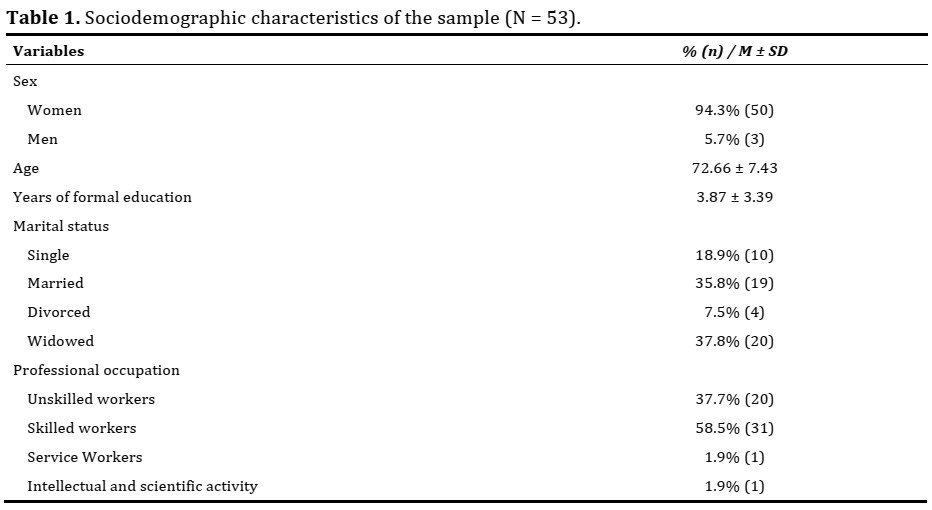
<body><![CDATA[<p><font face="Verdana" size="2">The idea of studying the association between creativity and CR is relatively new and it was introduced by Palmiero, Giacomo and Passafiume (2016). Based on a theoretical assumption, the aforementioned authors propose that creativity can predict CR. After confirming their hypothesis, Palmiero et al. (2016) argue that creativity could represent a protective factor against cognitive decline and, therefore, if stimulated, enhance CR. In fact, there seems to be some overlap between brain regions important to executive functions that may support CR in healthy aging and DT aspects of creativity (Beaty et al., 2016; Colangeli et al., 2016; Palmiero et al., 2017). In this sense, it is reasonable to hypothesize that some of the cognitive processes implicated in performing creative tasks must be partially related to the ones involved in CR.</font></p>      <p><font face="Verdana" size="2">According to Colombo, Antonietti and Daneau (2018) creativity and CR may have, at least, three cognitive processes in common. Antonietti and Colombo (2013, 2016) describe the cognitive processes thought to entail creative thinking, namely: (a) widening (the ability to keep an open mind to a great deal of elements); (b) connecting (the ability to create novel associations between elements); and (c) reorganizing (the ability to shift between perspectives and to rearrange pre-existing relationships among elements). Colombo et al. (2018) reason that the use of alternative strategies to deal with age-related decline or brain dysfunction &ndash; a core feature of CR&rsquo;s definition that can be associated with cognitive flexibility &ndash; might involve underlying cognitive processes indissociable from the creative process, i.e., widening, connecting and reorganizing. The enlisted cognitive processes have an executive nature, for they require working memory, cognitive flexibility, monitoring and inhibitory control, and evidence shows that the prefrontal cortex has a great influence on creativity (Heilman, 2016). Concerning this idea, Beaty et al. (2016) emphasize the dynamic interaction between the default and executive control networks in creative thinking, especially when the task must meet specific requirements (e.g., a DT task in which the goal is to generate possible uses for a particular object). The spontaneous and free flow of ideas, associated with the default mode network, is constrainted by executive mechanisms (e.g., controlled attention, inhibition and cognitive flexibility) that allow for goal-directed behaviour (Beaty et al., 2016; Beaty, Silvia, Nusbaum, Jauk, &amp; Benedek, 2014).</font></p>      <p><font face="Verdana" size="2">Palmiero et al. (2016) and Colombo et al. (2018) found a positive association between verbal creativity &ndash; as measured by DT&rsquo;s core elements (e.g., fluency, flexibility and originality) &ndash; and CR proxies (e.g., vocabulary, digit span and similarities (WAIS-IV subtests), education, frequency of leisure activities and professional occupation). These authors speculate that creativity could be accounted as another proxy of CR. In addition, they drew some practical implications from these results, related with the advantages of incorporating verbal DT-based creative activities in cognitive stimulation programs in order to promote healthy aging.</font></p>      <p><font face="Verdana" size="2">To the best of our knowledge, only two studies (Palmiero et al., 2016; Colombo et al., 2018) have investigated the association between creativity and CR. Concerning creativity, we have focused only on DT, more specifically in its verbal component, since the available studies in this field of research assess creativity through DT tasks. Therefore, the aim of the present study is to explore the relationship between DT and CR in a sample of Portuguese older adults without cognitive impairment. We hypothesize that there is a positive and significant association between both constructs.</font></p>      <p><font face="Verdana" size="2"><b>METHOD</b></font></p>      <p><font face="Verdana" size="2"><b>Participants</b></font></p>      <p><font face="Verdana" size="2">All subjects were recruited from four community centres located in the city of Funchal, Portugal. Subjects were included if they met the following eligibility criteria: (a) were at least 60 years old; (b) had a normal score in MMSE in order to rule out cognitive impairment; and (c) had enough visual and auditory acuity. We screened 71 subjects but only 53 were included. The sociodemographic characteristics of our sample are presented in <a href="/img/revistas/psi/v34n1/34n1a17t1.jpg">Table 1</a>.</font></p>      <p><font face="Verdana" size="2"><b>Measures</b></font></p>      <p><font face="Verdana" size="2"><b>Sociodemographic questionnaire</b><b>. </b>We&rsquo;ve developed an <i>ad-hoc</i>questionnaire to collect sociodemographic data (e.g., sex, age, years of formal education, professional classification based on the National Institute of Statistics in Portugal (Instituto Nacional de Estat&iacute;stica (INE), 2011) and marital status).</font></p>      <p><font face="Verdana" size="2"><b>Mini-Mental State Examination</b><b>.</b>The Mini-Mental State Examination (MMSE) is a 30-item cognitive screening instrument that assesses different cognitive domains, such as orientation, memory (registration and recall), attention and calculation, language and visual construction. We used MMSE&rsquo;s Portuguese version by Guerreiro (1998) with the following cut-off values, adjusted to the subjects&rsquo; education level: illiterate subjects, subjects between 1-11 years of education and subjects with more than 11 years of education had to score above 15, 22 and 27 points, respectively, in order to rule out cognitive impairment. The maximum score is 30 points; higher scores suggest better cognitive functioning.</font></p>      ]]></body>
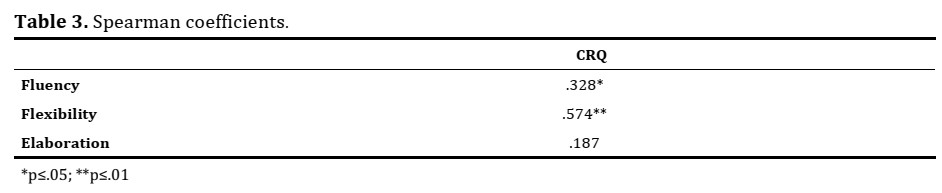
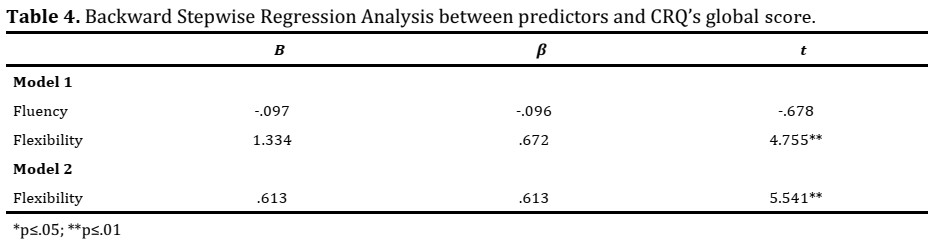
<body><![CDATA[<p><font face="Verdana" size="2"><b>Creativity test. </b>The Creativity Test (ProCriativ) (Pocinho &amp; Garc&ecirc;s, 2018) comprises three timed items (<a href="/img/revistas/psi/v34n1/34n1a17t1.jpg">Table 1</a>) inspired in the Alternate Uses Test from Guilford (1967), the Instances Test from Wallach and Kogan (1965) and the<i>Prueba de Imaginaci&oacute;n Creativa para jovenes</i> (Creative Imagination test for young people) from Artola, Ancillo, Mosteiro, and Barraca (2004). This test measures four main DT components: fluency (number of responses), flexibility (number of different categories), elaboration (number of enriching details in the responses) and originality (number of infrequent responses). Former validation studies of the ProCriativ with younger samples have demonstrated its potential utility in measuring DT (Faria, Perneta, Teixeira, &amp; F&eacute;lix, 2018; Freitas, Jesus, Fernandes, &amp; Martins, 2018; Lemos, Gomes, &amp; Gouveia, 2018; Mendes, 2016; Pita, Santos, Abreu, Alho, &amp; Pinto, 2018). This test is currently being validated for the older Portuguese population. In this study we have only used three DT elements &ndash; fluency, flexibility and elaboration.</font></p>       <p>&nbsp;</p> <a href="/img/revistas/psi/v34n1/34n1a17t2.jpg">Table 2</a>     <p>&nbsp;</p>      <p><font face="Verdana" size="2"><b>Cognitive Reserve Questionnaire. </b>The Cognitive Reserve Questionnaire (CRQ) (Portuguese version from Sobral, Pestana &amp; Pa&uacute;l, 2014) is a simple tool used to quantify CR. CRQ consists of eight items, namely education, parental education, training courses, occupation, musical training, languages, reading and intellectual games. The maximum score is 24 points; scores equal or below six points represent a low level of CR and scores equal or above seven points indicate a medium-to-high level of CR. The CRQ showed high reliability (Cronbach&rsquo;s Alfa=.795) and adequate construct validity (Sobral et al., 2014).</font></p>      <p><font face="Verdana" size="2"><b>Procedure</b></font></p>      <p><font face="Verdana" size="2">Whenever participants revealed interest in participating, researchers carefully explained the purpose of the study and written informed consent was obtained. All participants were selected based on the eligibility criteria listed above (participants section). Then, sociodemographic data was collected, and participants were assessed with the ProCriativ and the CRQ. Test administration lasted, approximately, 30 minutes.</font></p>      <p><font face="Verdana" size="2">Data analysis was performed using the IBM Software Statistical Package for the Social Sciences (SPSS) 25.0 and nonparametric statistics was used due to small sample size. Results were considered statistically significant when <i>p</i>&le;.05.</font></p>      <p><font face="Verdana" size="2"><b>RESULTS</b></font></p>      <p><font face="Verdana" size="2"><a href="/img/revistas/psi/v34n1/34n1a17t3.jpg">Table 3</a> shows the Spearman coefficients and their significance levels. The analysis showed that the CRQ&rsquo;s global score was positively and significantly correlated with fluency (r<sub>s</sub>=.328; <i>p</i>&le;.05) and flexibility (r<sub>s</sub>=.574; **<i>p</i>&le;.01) indexes of the ProCriativ, which means that CR has a positive association with fluency and flexibility aspects of DT.</font></p>      <p><font face="Verdana" size="2">After verifying linear regression&rsquo;s underlying assumptions, we performed a backward stepwise regression analysis in order to investigate the extent in which DT indexes &ndash; fluency and flexibility &ndash; predict CR (<a href="/img/revistas/psi/v34n1/34n1a17t4.jpg">Table 4</a>). For this purpose, CRQ&rsquo;s global score was considered the dependent variable and ProCriativ&rsquo;s fluency and flexibility indexes were defined as the predictors. The first model was statistically significant (F(2,50)=15.419, <i>p</i>&lt;.001) and explained 35.7% of variance (R<sup>2</sup>=.381; Adjusted R<sup>2</sup>=.357) of the CRQ&rsquo;s global score; however, since the fluency index lacked predictive value (<i>p</i>&gt;0.05), we decided to remove it from the analysis. The second model, also statistically significant (F(1,51)=30.703, <i>p</i>&lt;.001), was considered the best since it explained 36.4% of variance (R<sup>2</sup>=.376; Adjusted R<sup>2</sup>=.364) of the CRQ&rsquo;s global score. Overall, the analysis showed that the flexibility index alone has a greater ability to predict CR.</font></p>      ]]></body>
<body><![CDATA[<p><font face="Verdana" size="2"><b>DISCUSSION</b></font></p>      <p><font face="Verdana" size="2">Creativity and CR are two very complex research concepts that can be seen as instrumental for future cognitive impairment prevention. The relationship between the two is still not very clear but the existing literature provides potential for further research (Colombo et al., 2018; Palmiero et al., 2016). Therefore, the purpose of the present study was not only to analyse the relationship between DT &ndash; an indicator of creative potential &ndash; and CR, in a sample of older adults without cognitive impairment, but also to contribute with additional insights about this topic.</font></p>      <p><font face="Verdana" size="2">The correlation analysis showed that fluency and flexibility were positively and significantly associated with CR, a finding that confirms our hypothesis and is also consistent with previous studies (Colombo et al., 2018; Palmiero et al., 2016). This suggests that the process of generating a greater number of responses or ideas from different categories &ndash; abilities that imply executive processes such as cognitive flexibility &ndash;, is related with higher levels of CR.</font></p>      <p><font face="Verdana" size="2">Regarding the regression analysis, it was found that flexibility was the only significant predictor of CR, despite, according to Colombo et al. (2018) and Palmiero et al. (2016), fluency and originality having also been identified as significant predictors of CR proxies. We hypothesized that this difference can be explained since CR involves not so much fluency but particularly cognitive flexibility, which is the core nature of the DT index flexibility. This idea is aligned with Colombo et al. (2018) when they acknowledged that one of the main characteristics of CR, i.e., the ability to use alternative cognitive strategies to deal with age-related cognitive decline or impairment due to brain pathology, can be related to the creative process, since the latter requires a great deal of cognitive flexibility. Considering that verbal DT tasks involve executive processes that, according to Tucker and Stern (2011) and Colangeli et al. (2016), may be related with CR, integrating these tasks in cognitive stimulation programs, designed to foster active aging, can contribute to promote CR. Colombo et al. (2018) and Palmiero et al. (2016) believe that creativity can be used as another indicator of CR, despite further investigation is needed to reinforce the previous findings.</font></p>      <p><font face="Verdana" size="2">This study showed that creativity and CR have some underlying relationship. However, given its exploratory nature, the present study has several limitations that need to be addressed in future research. The following recommendations should be taken into account: (a) to collect a larger and more balanced sample (e.g., in terms of sex distribution); (b) to conduct a brief clinical interview and to perform a detailed neuropsychological assessment to better characterize the cognitive functioning of the subjects in order to exclude subjects with cognitive impairment that are not normally detected by tests with ceiling effects like MMSE; (c) to use a validated DT measure for Portuguese older adults with composite and global scores, that includes verbal and visual components, and to take into consideration other DT elements (e.g., originality); and (d) to incorporate a more comprehensive measure of CR (e.g., Cognitive Reserve Index Questionnaire (CRIq)).</font></p>      <p>&nbsp;</p>     <p><font face="Verdana" size="2"><b>References</b></font></p>      <!-- ref --><p><font face="Verdana" size="2">Abraham, A. (2016). Gender and creativity: An overview of psychological and neuroscientific literature.&nbsp;<i>Brain Imaging and Behavior</i>,&nbsp;<i>10</i>(2), 609-618. <a href="https://doi.org/10.1007/s11682-015-9410-8" target="_blank">https://doi.org/10.1007/s11682-015-9410-8</a></font>&nbsp;&nbsp;&nbsp;&nbsp;&nbsp;&nbsp;&nbsp;&nbsp;[&#160;<a href="javascript:void(0);" onclick="javascript: window.open('/scielo.php?script=sci_nlinks&ref=512995&pid=S0874-2049202000010001700001&lng=','','width=640,height=500,resizable=yes,scrollbars=1,menubar=yes,');">Links</a>&#160;]<!-- end-ref --><!-- ref --><p><font face="Verdana" size="2">Antonietti, A., &amp; Colombo, B. (2013). Three creative mental operations. In T. Ai-Girl (Eds.). <i>Creativity, Talent and Excellence</i> (1st ed.,pp.13-26). Springer. <a href="https://www.springer.com/gp/book/9789814021920" target="_blank">https://www.springer.com/gp/book/9789814021920</a></font>&nbsp;&nbsp;&nbsp;&nbsp;&nbsp;&nbsp;&nbsp;&nbsp;[&#160;<a href="javascript:void(0);" onclick="javascript: window.open('/scielo.php?script=sci_nlinks&ref=512996&pid=S0874-2049202000010001700002&lng=','','width=640,height=500,resizable=yes,scrollbars=1,menubar=yes,');">Links</a>&#160;]<!-- end-ref --><!-- ref --><p><font face="Verdana" size="2">Antonietti, A., &amp; Colombo, B. (2016). Creative cognition: how cultura matters. In V. P. Glaveanu (Eds.). <i>The Palgrave Handbook of Creativity and Culture Research</i> (1st ed., pp. 101-124). Springer Nature. <a href="https://doi.org/10.1057/978-1-137-46344-9" target="_blank">https://doi.org/10.1057/978-1-137-46344-9</a></font>&nbsp;&nbsp;&nbsp;&nbsp;&nbsp;&nbsp;&nbsp;&nbsp;[&#160;<a href="javascript:void(0);" onclick="javascript: window.open('/scielo.php?script=sci_nlinks&ref=512997&pid=S0874-2049202000010001700003&lng=','','width=640,height=500,resizable=yes,scrollbars=1,menubar=yes,');">Links</a>&#160;]<!-- end-ref --><!-- ref --><p><font face="Verdana" size="2">Artola, T., Ancillo, I., Mosteiro, P. &amp; Barraca, J. (2004). <i>PIC. Prueba de Imaginaci&oacute;n Creativa</i>. TEA, Ediciones.    &nbsp;&nbsp;&nbsp;&nbsp;&nbsp;&nbsp;&nbsp;&nbsp;[&#160;<a href="javascript:void(0);" onclick="javascript: window.open('/scielo.php?script=sci_nlinks&ref=512998&pid=S0874-2049202000010001700004&lng=','','width=640,height=500,resizable=yes,scrollbars=1,menubar=yes,');">Links</a>&#160;]<!-- end-ref --></font></p>      <!-- ref --><p><font face="Verdana" size="2">Barbey, A. K. (2018). Network neuroscience theory of human intelligence.&nbsp;<i>Trends in Cognitive Sciences</i>,&nbsp;<i>22</i>(1), 8-20. <a href="https://doi.org/10.1016/j.tics.2017.10.001" target="_blank">https://doi.org/10.1016/j.tics.2017.10.001</a></font>&nbsp;&nbsp;&nbsp;&nbsp;&nbsp;&nbsp;&nbsp;&nbsp;[&#160;<a href="javascript:void(0);" onclick="javascript: window.open('/scielo.php?script=sci_nlinks&ref=513000&pid=S0874-2049202000010001700005&lng=','','width=640,height=500,resizable=yes,scrollbars=1,menubar=yes,');">Links</a>&#160;]<!-- end-ref --><!-- ref --><p><font face="Verdana" size="2">Barulli, D., &amp; Stern, Y. (2013). Efficiency, capacity, compensation, maintenance, plasticity: emerging concepts in cognitive reserve.&nbsp;<i>Trends in Cognitive Sciences</i>,&nbsp;<i>17</i>(10), 502-509. <a href="https://doi.org/10.1016/j.tics.2013.08.012" target="_blank">https://doi.org/10.1016/j.tics.2013.08.012</a></font>&nbsp;&nbsp;&nbsp;&nbsp;&nbsp;&nbsp;&nbsp;&nbsp;[&#160;<a href="javascript:void(0);" onclick="javascript: window.open('/scielo.php?script=sci_nlinks&ref=513001&pid=S0874-2049202000010001700006&lng=','','width=640,height=500,resizable=yes,scrollbars=1,menubar=yes,');">Links</a>&#160;]<!-- end-ref --><!-- ref --><p><font face="Verdana" size="2">Beaty, R. E., Benedek, M., Silvia, P. J., &amp; Schacter, D. L. (2016). Creative cognition and brain network dynamics.&nbsp;<i>Trends in Cognitive Sciences</i>,&nbsp;<i>20</i>(2), 87-95. <a href="https://doi.org/10.1016/j.tics.2015.10.004" target="_blank">https://doi.org/10.1016/j.tics.2015.10.004</a></font>&nbsp;&nbsp;&nbsp;&nbsp;&nbsp;&nbsp;&nbsp;&nbsp;[&#160;<a href="javascript:void(0);" onclick="javascript: window.open('/scielo.php?script=sci_nlinks&ref=513002&pid=S0874-2049202000010001700007&lng=','','width=640,height=500,resizable=yes,scrollbars=1,menubar=yes,');">Links</a>&#160;]<!-- end-ref --><!-- ref --><p><font face="Verdana" size="2">Beaty, R. E., Silvia, P. J., Nusbaum, E. C., Jauk, E., &amp; Benedek, M. (2014). The roles of associative and executive processes in creative cognition.&nbsp;<i>Memory &amp; Cognition</i>,&nbsp;<i>42</i>(7), 1186-1197. <a href="https://doi.org/10.3758/s13421-014-0428-8" target="_blank">https://doi.org/10.3758/s13421-014-0428-8</a></font>&nbsp;&nbsp;&nbsp;&nbsp;&nbsp;&nbsp;&nbsp;&nbsp;[&#160;<a href="javascript:void(0);" onclick="javascript: window.open('/scielo.php?script=sci_nlinks&ref=513003&pid=S0874-2049202000010001700008&lng=','','width=640,height=500,resizable=yes,scrollbars=1,menubar=yes,');">Links</a>&#160;]<!-- end-ref --><p><font face="Verdana" size="2">Colangeli, S., Boccia, M., Verde, P., Guariglia, P., Bianchini, F., &amp; Piccardi, L. (2016). Cognitive reserve in healthy aging and Alzheimer&rsquo;s disease: a meta-analysis of fMRI studies.&nbsp;<i>American Journal of Alzheimer's Disease &amp; Other Dementias</i>,&nbsp;<i>31</i>(5), 443-449. <a href="https://doi.org/10.1177/1533317516653826" target="_blank">https://doi.org/10.1177/1533317516653826</a></font></p>      <!-- ref --><p><font face="Verdana" size="2">Colombo, B., Antonietti, A., &amp; Daneau, B. (2018). The relationships between cognitive reserve and creativity. A study on American aging population.&nbsp;<i>Frontiers in Psychology</i>,&nbsp;<i>9</i>, 79-89. <a href="https://doi.org/10.3389/fpsyg.2018.00764" target="_blank">https://doi.org/10.3389/fpsyg.2018.00764</a></font>&nbsp;&nbsp;&nbsp;&nbsp;&nbsp;&nbsp;&nbsp;&nbsp;[&#160;<a href="javascript:void(0);" onclick="javascript: window.open('/scielo.php?script=sci_nlinks&ref=513005&pid=S0874-2049202000010001700010&lng=','','width=640,height=500,resizable=yes,scrollbars=1,menubar=yes,');">Links</a>&#160;]<!-- end-ref --><!-- ref --><p><font face="Verdana" size="2">Cosentino, S., &amp; Stern, Y. (2019). Consideration of cognitive reserve. In&nbsp;L. D. Ravdin &amp; H. L. Katzen (Eds.). <i>Handbook on the Neuropsychology of Aging and Dementia</i>&nbsp;(2nd ed., pp. 11-23). Springer. <a href="https://doi.org/10.1007/978-3-319-93497-6" target="_blank">https://doi.org/10.1007/978-3-319-93497-6</a></font>&nbsp;&nbsp;&nbsp;&nbsp;&nbsp;&nbsp;&nbsp;&nbsp;[&#160;<a href="javascript:void(0);" onclick="javascript: window.open('/scielo.php?script=sci_nlinks&ref=513006&pid=S0874-2049202000010001700011&lng=','','width=640,height=500,resizable=yes,scrollbars=1,menubar=yes,');">Links</a>&#160;]<!-- end-ref --><!-- ref --><p><font face="Verdana" size="2">Evans, I. E., Llewellyn, D. J., Matthews, F. E., Woods, R. T., Brayne, C., Clare, L., &amp; CFAS-Wales Research Team. (2018). Social isolation, cognitive reserve, and cognition in healthy older people.&nbsp;<i>PloS One</i>,&nbsp;<i>13</i>(8). <a href="https://10.1371/journal.pone.0201008" target="_blank">https://10.1371/journal.pone.0201008</a></font>&nbsp;&nbsp;&nbsp;&nbsp;&nbsp;&nbsp;&nbsp;&nbsp;[&#160;<a href="javascript:void(0);" onclick="javascript: window.open('/scielo.php?script=sci_nlinks&ref=513007&pid=S0874-2049202000010001700012&lng=','','width=640,height=500,resizable=yes,scrollbars=1,menubar=yes,');">Links</a>&#160;]<!-- end-ref --><!-- ref --><p><font face="Verdana" size="2">Faria A., Perneta, A., Teixeira, C., &amp; F&eacute;lix, F. (2018). A Complexidade da Criatividade. In M. Pocinho &amp; S. Garc&ecirc;s (Eds.), <i>Psicologia da Criatividade</i> (1st ed., pp. 20-46). Universidade da Madeira. <a href="https://digituma.uma.pt/bitstream/10400.13/2006/1/Psicologia%20da%20Criatividade.pdf" target="_blank">https://digituma.uma.pt/bitstream/10400.13/2006/1/Psicologia%20da%20Criatividade.pdf</a></font>&nbsp;&nbsp;&nbsp;&nbsp;&nbsp;&nbsp;&nbsp;&nbsp;[&#160;<a href="javascript:void(0);" onclick="javascript: window.open('/scielo.php?script=sci_nlinks&ref=513008&pid=S0874-2049202000010001700013&lng=','','width=640,height=500,resizable=yes,scrollbars=1,menubar=yes,');">Links</a>&#160;]<!-- end-ref --><!-- ref --><p><font face="Verdana" size="2">Foos, P. W., &amp; Boone, D. (2008). Adult age differences in divergent thinking: It's just a matter of time.&nbsp;<i>Educational Gerontology</i>,&nbsp;<i>34</i>(7), 587-594. <a href="https://doi.org/10.1080/03601270801949393" target="_blank">https://doi.org/10.1080/03601270801949393</a></font>&nbsp;&nbsp;&nbsp;&nbsp;&nbsp;&nbsp;&nbsp;&nbsp;[&#160;<a href="javascript:void(0);" onclick="javascript: window.open('/scielo.php?script=sci_nlinks&ref=513009&pid=S0874-2049202000010001700014&lng=','','width=640,height=500,resizable=yes,scrollbars=1,menubar=yes,');">Links</a>&#160;]<!-- end-ref --><!-- ref --><p><font face="Verdana" size="2">Freitas, A., Jesus, M., Fernandes, M., &amp; Martins, P. (2018). Europa Criativa. In M. Pocinho &amp; S. Garc&ecirc;s (Eds.), <i>Psicologia da Criatividade</i>(1st ed., pp. 6-19). Universidade da Madeira. <a href="https://digituma.uma.pt/bitstream/10400.13/2006/1/Psicologia%20da%20Criatividade.pdf" target="_blank">https://digituma.uma.pt/bitstream/10400.13/2006/1/Psicologia%20da%20Criatividade.pdf</a></font>&nbsp;&nbsp;&nbsp;&nbsp;&nbsp;&nbsp;&nbsp;&nbsp;[&#160;<a href="javascript:void(0);" onclick="javascript: window.open('/scielo.php?script=sci_nlinks&ref=513010&pid=S0874-2049202000010001700015&lng=','','width=640,height=500,resizable=yes,scrollbars=1,menubar=yes,');">Links</a>&#160;]<!-- end-ref --><!-- ref --><p><font face="Verdana" size="2">Guerreiro, M. M. G. (1998).&nbsp;<i>Contributo da neuropsicologia para o estudo das dem&ecirc;ncias.</i>&nbsp;(Tese de doutoramento n&atilde;o publicada). Universidade de Lisboa,    &nbsp;&nbsp;&nbsp;&nbsp;&nbsp;&nbsp;&nbsp;&nbsp;[&#160;<a href="javascript:void(0);" onclick="javascript: window.open('/scielo.php?script=sci_nlinks&ref=513011&pid=S0874-2049202000010001700016&lng=','','width=640,height=500,resizable=yes,scrollbars=1,menubar=yes,');">Links</a>&#160;]<!-- end-ref --> Faculdade de Medicina de Lisboa.</font></p>      <!-- ref --><p><font face="Verdana" size="2">Guilford, J. P. (1967). <i>The Nature of Human Intelligence</i>. McGraw-Hill.    &nbsp;&nbsp;&nbsp;&nbsp;&nbsp;&nbsp;&nbsp;&nbsp;[&#160;<a href="javascript:void(0);" onclick="javascript: window.open('/scielo.php?script=sci_nlinks&ref=513013&pid=S0874-2049202000010001700017&lng=','','width=640,height=500,resizable=yes,scrollbars=1,menubar=yes,');">Links</a>&#160;]<!-- end-ref --></font></p>      <!-- ref --><p><font face="Verdana" size="2">Heilman, K. M. (2016). Possible brain mechanisms of creativity.&nbsp;<i>Archives of Clinical Neuropsychology</i>,&nbsp;<i>31</i>(4), 285-296. <a href="https://doi.org/10.1093/arclin/acw009" target="_blank">https://doi.org/10.1093/arclin/acw009</a></font>&nbsp;&nbsp;&nbsp;&nbsp;&nbsp;&nbsp;&nbsp;&nbsp;[&#160;<a href="javascript:void(0);" onclick="javascript: window.open('/scielo.php?script=sci_nlinks&ref=513015&pid=S0874-2049202000010001700018&lng=','','width=640,height=500,resizable=yes,scrollbars=1,menubar=yes,');">Links</a>&#160;]<!-- end-ref --><!-- ref --><p><font face="Verdana" size="2">Instituto Nacional de Estat&iacute;stica (2011).&nbsp;<i>Censos 2011 - Resultados Provis&oacute;rios</i>. http://www.ine.pt</font>&nbsp;&nbsp;&nbsp;&nbsp;&nbsp;&nbsp;&nbsp;&nbsp;[&#160;<a href="javascript:void(0);" onclick="javascript: window.open('/scielo.php?script=sci_nlinks&ref=513016&pid=S0874-2049202000010001700019&lng=','','width=640,height=500,resizable=yes,scrollbars=1,menubar=yes,');">Links</a>&#160;]<!-- end-ref --><!-- ref --><p><font face="Verdana" size="2">Krell-Roesch, J., Syrjanen, J. A., Vassilaki, M., Machulda, M. M., Mielke, M. M., Knopman, D. S., ... &amp; Geda, Y. E. (2019). Quantity and quality of mental activities and the risk of incident mild cognitive impairment.&nbsp;<i>Neurology</i>,&nbsp;<i>93</i>(6), e548-e558. <a href="https://doi.org/10.1212/WNL.0000000000007897" target="_blank">https://doi.org/10.1212/WNL.0000000000007897</a></font>&nbsp;&nbsp;&nbsp;&nbsp;&nbsp;&nbsp;&nbsp;&nbsp;[&#160;<a href="javascript:void(0);" onclick="javascript: window.open('/scielo.php?script=sci_nlinks&ref=513017&pid=S0874-2049202000010001700020&lng=','','width=640,height=500,resizable=yes,scrollbars=1,menubar=yes,');">Links</a>&#160;]<!-- end-ref --><!-- ref --><p><font face="Verdana" size="2">Lemos, A., Gomes, F., &amp; Gouveia, L. (2018). Efeitos das Vari&aacute;veis Sociodemogr&aacute;ficas na Criatividade. In M. Pocinho &amp; S. Garc&ecirc;s (Eds.), <i>Psicologia da Criatividade</i>(1st ed., pp. 63-87). Universidade da Madeira. <a href="https://digituma.uma.pt/bitstream/10400.13/2006/1/Psicologia%20da%20Criatividade.pdf" target="_blank">https://digituma.uma.pt/bitstream/10400.13/2006/1/Psicologia%20da%20Criatividade.pdf</a></font>&nbsp;&nbsp;&nbsp;&nbsp;&nbsp;&nbsp;&nbsp;&nbsp;[&#160;<a href="javascript:void(0);" onclick="javascript: window.open('/scielo.php?script=sci_nlinks&ref=513018&pid=S0874-2049202000010001700021&lng=','','width=640,height=500,resizable=yes,scrollbars=1,menubar=yes,');">Links</a>&#160;]<!-- end-ref --><!-- ref --><p><font face="Verdana" size="2">Mel&eacute;ndez, J. C., Alfonso-Benlliure, V., Mayordomo, T., &amp; Sales, A. (2016). Is age just a number? Cognitive reserve as a predictor of divergent thinking in late adulthood.&nbsp;<i>Creativity Research Journal</i>,&nbsp;<i>28</i>(4), 435-441. <a href="https://doi.org/10.1080/1040041" target="_blank">https://doi.org/10.1080/1040041</a></font>&nbsp;&nbsp;&nbsp;&nbsp;&nbsp;&nbsp;&nbsp;&nbsp;[&#160;<a href="javascript:void(0);" onclick="javascript: window.open('/scielo.php?script=sci_nlinks&ref=513019&pid=S0874-2049202000010001700022&lng=','','width=640,height=500,resizable=yes,scrollbars=1,menubar=yes,');">Links</a>&#160;]<!-- end-ref --><!-- ref --><p><font face="Verdana" size="2">Mendes, A. (2016). <i>A avalia&ccedil;&atilde;o da criatividade em crian&ccedil;as em idade pr&eacute;-escolar: Um estudo explorat&oacute;rio</i>. (Disserta&ccedil;&atilde;o de mestrado). <a href="https://digituma.uma.pt/handle/10400.13/1588" target="_blank">https://digituma.uma.pt/handle/10400.13/1588</a></font>&nbsp;&nbsp;&nbsp;&nbsp;&nbsp;&nbsp;&nbsp;&nbsp;[&#160;<a href="javascript:void(0);" onclick="javascript: window.open('/scielo.php?script=sci_nlinks&ref=513020&pid=S0874-2049202000010001700023&lng=','','width=640,height=500,resizable=yes,scrollbars=1,menubar=yes,');">Links</a>&#160;]<!-- end-ref --><!-- ref --><p><font face="Verdana" size="2">Palmiero, M., Di Giacomo, D., &amp; Passafiume, D. (2016). Can creativity predict cognitive reserve?.&nbsp;<i>The Journal of Creative Behavior</i>,&nbsp;<i>50</i>(1), 7-23. <a href="https://doi.org/10.1002/jocb.62" target="_blank">https://doi.org/10.1002/jocb.62</a></font>&nbsp;&nbsp;&nbsp;&nbsp;&nbsp;&nbsp;&nbsp;&nbsp;[&#160;<a href="javascript:void(0);" onclick="javascript: window.open('/scielo.php?script=sci_nlinks&ref=513021&pid=S0874-2049202000010001700024&lng=','','width=640,height=500,resizable=yes,scrollbars=1,menubar=yes,');">Links</a>&#160;]<!-- end-ref --><!-- ref --><p><font face="Verdana" size="2">Palmiero, M., Nori, R., &amp; Piccardi, L. (2017). Verbal and visual divergent thinking in aging.&nbsp;<i>Experimental Brain Research</i>,&nbsp;<i>235</i>(4), 1021-1029. <a href="https://doi.org/10.1007/s00221-016-4857-4" target="_blank">https://doi.org/10.1007/s00221-016-4857-4</a></font>&nbsp;&nbsp;&nbsp;&nbsp;&nbsp;&nbsp;&nbsp;&nbsp;[&#160;<a href="javascript:void(0);" onclick="javascript: window.open('/scielo.php?script=sci_nlinks&ref=513022&pid=S0874-2049202000010001700025&lng=','','width=640,height=500,resizable=yes,scrollbars=1,menubar=yes,');">Links</a>&#160;]<!-- end-ref --><!-- ref --><p><font face="Verdana" size="2">Pita, F. A. P. (2015). <i>A criatividade no Ensino B&aacute;sico: constru&ccedil;&atilde;o de uma prova para avalia&ccedil;&atilde;o do pensamento divergente.</i> (Disserta&ccedil;&atilde;o de mestrado). <a href="https://digituma.uma.pt/handle/10400.13/1001" target="_blank">https://digituma.uma.pt/handle/10400.13/1001</a></font>&nbsp;&nbsp;&nbsp;&nbsp;&nbsp;&nbsp;&nbsp;&nbsp;[&#160;<a href="javascript:void(0);" onclick="javascript: window.open('/scielo.php?script=sci_nlinks&ref=513023&pid=S0874-2049202000010001700026&lng=','','width=640,height=500,resizable=yes,scrollbars=1,menubar=yes,');">Links</a>&#160;]<!-- end-ref --><!-- ref --><p><font face="Verdana" size="2">Pita, F., Santos, A., Abreu, J., Alho, L., &amp; Pinto, W. (2018). Criatividade, Psicologia da Cor e Prova de Avalia&ccedil;&atilde;o do Pensamento Divergente. In M. Pocinho &amp; S. Garc&ecirc;s (Eds.), <i>Psicologia da Criatividade</i> (1 st ed., pp. 47-62). Universidade da Madeira. <a href="https://digituma.uma.pt/bitstream/10400.13/2006/1/Psicologia%20da%20Criatividade.pdf" target="_blank">https://digituma.uma.pt/bitstream/10400.13/2006/1/Psicologia%20da%20Criatividade.pdf</a></font>&nbsp;&nbsp;&nbsp;&nbsp;&nbsp;&nbsp;&nbsp;&nbsp;[&#160;<a href="javascript:void(0);" onclick="javascript: window.open('/scielo.php?script=sci_nlinks&ref=513024&pid=S0874-2049202000010001700027&lng=','','width=640,height=500,resizable=yes,scrollbars=1,menubar=yes,');">Links</a>&#160;]<!-- end-ref --><!-- ref --><p><font face="Verdana" size="2">Pocinho, M., &amp; Garc&ecirc;s, S. (2018). Prova de Criatividade (ProCriativ): da ideia &agrave; realidade. In M. Pocinho &amp; S. Garc&ecirc;s (Eds.), <i>Psicologia da Criatividade</i> (1st ed., pp. 103-116). Universidade da Madeira. <a href="https://digituma.uma.pt/bitstream/10400.13/2006/1/Psicologia%20da%20Criatividade.pdf" target="_blank">https://digituma.uma.pt/bitstream/10400.13/2006/1/Psicologia%20da%20Criatividade.pdf</a></font>&nbsp;&nbsp;&nbsp;&nbsp;&nbsp;&nbsp;&nbsp;&nbsp;[&#160;<a href="javascript:void(0);" onclick="javascript: window.open('/scielo.php?script=sci_nlinks&ref=513025&pid=S0874-2049202000010001700028&lng=','','width=640,height=500,resizable=yes,scrollbars=1,menubar=yes,');">Links</a>&#160;]<!-- end-ref --><!-- ref --><p><font face="Verdana" size="2">Roskos-ewoldsen, B., Black, S. R., &amp; McCown, S. M. (2008). Age-related changes in creative thinking.&nbsp;<i>The Journal of Creative Behavior</i>,&nbsp;<i>42</i>(1), 33-59. <a href="https://doi.org/10.1002/j.2162-6057.2008.tb01079.x" target="_blank">https://doi.org/10.1002/j.2162-6057.2008.tb01079.x</a></font>&nbsp;&nbsp;&nbsp;&nbsp;&nbsp;&nbsp;&nbsp;&nbsp;[&#160;<a href="javascript:void(0);" onclick="javascript: window.open('/scielo.php?script=sci_nlinks&ref=513026&pid=S0874-2049202000010001700029&lng=','','width=640,height=500,resizable=yes,scrollbars=1,menubar=yes,');">Links</a>&#160;]<!-- end-ref --><!-- ref --><p><font face="Verdana" size="2">Runco, M. A., &amp; Jaeger, G. J. (2012). The standard definition of creativity.&nbsp;<i>Creativity Research Journal</i>,&nbsp;<i>24</i>(1), 92-96. <a href="https://doi.org/10.1080/10400419.2012.650092" target="_blank">https://doi.org/10.1080/10400419.2012.650092</a></font>&nbsp;&nbsp;&nbsp;&nbsp;&nbsp;&nbsp;&nbsp;&nbsp;[&#160;<a href="javascript:void(0);" onclick="javascript: window.open('/scielo.php?script=sci_nlinks&ref=513027&pid=S0874-2049202000010001700030&lng=','','width=640,height=500,resizable=yes,scrollbars=1,menubar=yes,');">Links</a>&#160;]<!-- end-ref --><!-- ref --><p><font face="Verdana" size="2">Sobral, M., Pestana, M. H., &amp; Pa&uacute;l, C. (2014). A import&acirc;ncia da quantifica&ccedil;&atilde;o da reserva cognitiva.&nbsp;<i>Revista Portuguesa de Enfermagem de Sa&uacute;de Mental</i>, (12), 51-58.    &nbsp;&nbsp;&nbsp;&nbsp;&nbsp;&nbsp;&nbsp;&nbsp;[&#160;<a href="javascript:void(0);" onclick="javascript: window.open('/scielo.php?script=sci_nlinks&ref=513028&pid=S0874-2049202000010001700031&lng=','','width=640,height=500,resizable=yes,scrollbars=1,menubar=yes,');">Links</a>&#160;]<!-- end-ref --></font></p>      <!-- ref --><p><font face="Verdana" size="2">Sowden, P. T., Pringle, A., &amp; Gabora, L. (2015). The shifting sands of creative thinking: Connections to dual-process theory.&nbsp;<i>Thinking &amp; Reasoning</i>,&nbsp;<i>21</i>(1), 40-60. <a href="https://doi.org/10.1080/13546783.2014.885464" target="_blank">https://doi.org/10.1080/13546783.2014.885464</a></font>&nbsp;&nbsp;&nbsp;&nbsp;&nbsp;&nbsp;&nbsp;&nbsp;[&#160;<a href="javascript:void(0);" onclick="javascript: window.open('/scielo.php?script=sci_nlinks&ref=513030&pid=S0874-2049202000010001700032&lng=','','width=640,height=500,resizable=yes,scrollbars=1,menubar=yes,');">Links</a>&#160;]<!-- end-ref --><!-- ref --><p><font face="Verdana" size="2">Stern, Y. (2002). What is cognitive reserve? Theory and research application of the reserve concept.&nbsp;<i>Journal of the International Neuropsychological Society</i>,&nbsp;<i>8</i>(3), 448-460. <a href="https://doi.org/10.1017/S1355617702813248" target="_blank">https://doi.org/10.1017/S1355617702813248</a></font>&nbsp;&nbsp;&nbsp;&nbsp;&nbsp;&nbsp;&nbsp;&nbsp;[&#160;<a href="javascript:void(0);" onclick="javascript: window.open('/scielo.php?script=sci_nlinks&ref=513031&pid=S0874-2049202000010001700033&lng=','','width=640,height=500,resizable=yes,scrollbars=1,menubar=yes,');">Links</a>&#160;]<!-- end-ref --><!-- ref --><p><font face="Verdana" size="2">Stern, Y. (2009). Cognitive reserve.&nbsp;<i>Neuropsychologia</i>,&nbsp;<i>47</i>(10), 2015-2028. <a href="https://doi.org/10.1016/j.neuropsychologia.2009.03.004" target="_blank">https://doi.org/10.1016/j.neuropsychologia.2009.03.004</a></font>&nbsp;&nbsp;&nbsp;&nbsp;&nbsp;&nbsp;&nbsp;&nbsp;[&#160;<a href="javascript:void(0);" onclick="javascript: window.open('/scielo.php?script=sci_nlinks&ref=513032&pid=S0874-2049202000010001700034&lng=','','width=640,height=500,resizable=yes,scrollbars=1,menubar=yes,');">Links</a>&#160;]<!-- end-ref --><!-- ref --><p><font face="Verdana" size="2">Stern, Y. (2012). Cognitive reserve in ageing and Alzheimer's disease.&nbsp;<i>The Lancet Neurology</i>,&nbsp;<i>11</i>(11), 1006-1012. <a href="https://doi.org/10.1016/S1474-4422(12)70191-6" target="_blank">https://doi.org/10.1016/S1474-4422(12)70191-6</a></font>&nbsp;&nbsp;&nbsp;&nbsp;&nbsp;&nbsp;&nbsp;&nbsp;[&#160;<a href="javascript:void(0);" onclick="javascript: window.open('/scielo.php?script=sci_nlinks&ref=513033&pid=S0874-2049202000010001700035&lng=','','width=640,height=500,resizable=yes,scrollbars=1,menubar=yes,');">Links</a>&#160;]<!-- end-ref --><!-- ref --><p><font face="Verdana" size="2">Sternberg, R. J., &amp; Lubart, T. I. (1996). Investing in creativity.&nbsp;<i>American Psychologist</i>,&nbsp;<i>51</i>(7), 677-688. <a href="https://doi.org/10.1207/s15327965pli040316" target="_blank">https://doi.org/10.1207/s15327965pli040316</a></font>&nbsp;&nbsp;&nbsp;&nbsp;&nbsp;&nbsp;&nbsp;&nbsp;[&#160;<a href="javascript:void(0);" onclick="javascript: window.open('/scielo.php?script=sci_nlinks&ref=513034&pid=S0874-2049202000010001700036&lng=','','width=640,height=500,resizable=yes,scrollbars=1,menubar=yes,');">Links</a>&#160;]<!-- end-ref --><!-- ref --><p><font face="Verdana" size="2">Tucker, M. A., &amp; Stern, Y. (2011). Cognitive reserve in aging.&nbsp;<i>Current Alzheimer Research</i>,&nbsp;<i>8</i>(4), 354-360. <a href="https://doi.org/10.2174/156720511795745320" target="_blank">https://doi.org/10.2174/156720511795745320</a></font>&nbsp;&nbsp;&nbsp;&nbsp;&nbsp;&nbsp;&nbsp;&nbsp;[&#160;<a href="javascript:void(0);" onclick="javascript: window.open('/scielo.php?script=sci_nlinks&ref=513035&pid=S0874-2049202000010001700037&lng=','','width=640,height=500,resizable=yes,scrollbars=1,menubar=yes,');">Links</a>&#160;]<!-- end-ref --><!-- ref --><p><font face="Verdana" size="2">Wallach, M., &amp; Kogan, N. (1965). <i>Modes of Thinking in Young Children. A study of the creativity-intelligence distinction</i>. Holt, Rinehart &amp; Winston.    &nbsp;&nbsp;&nbsp;&nbsp;&nbsp;&nbsp;&nbsp;&nbsp;[&#160;<a href="javascript:void(0);" onclick="javascript: window.open('/scielo.php?script=sci_nlinks&ref=513036&pid=S0874-2049202000010001700038&lng=','','width=640,height=500,resizable=yes,scrollbars=1,menubar=yes,');">Links</a>&#160;]<!-- end-ref --></font></p>      ]]></body>
<body><![CDATA[<!-- ref --><p><font face="Verdana" size="2">Wilson, R. S., De Leon, C. F. M., Barnes, L. L., Schneider, J. A., Bienias, J. L., Evans, D. A., &amp; Bennett, D. A. (2002). Participation in cognitively stimulating activities and risk of incident Alzheimer disease.&nbsp;<i>Jama</i>,&nbsp;<i>287</i>(6), 742-748. doi:<a href="https://doi.org/10.1001/jama.287.6.742" target="_blank">10.1001/jama.287.6.742</a></font>&nbsp;&nbsp;&nbsp;&nbsp;&nbsp;&nbsp;&nbsp;&nbsp;[&#160;<a href="javascript:void(0);" onclick="javascript: window.open('/scielo.php?script=sci_nlinks&ref=513038&pid=S0874-2049202000010001700039&lng=','','width=640,height=500,resizable=yes,scrollbars=1,menubar=yes,');">Links</a>&#160;]<!-- end-ref --><p>&nbsp;</p>     <p><font face="Verdana" size="2"><i>Historial do artigo</i></font></p>      <p><font face="Verdana" size="2">Recebido</font></p>      <p><font face="Verdana" size="2">07/2019</font></p>      <p><font face="Verdana" size="2">Aceite</font></p>      <p><font face="Verdana" size="2">06/2020</font></p>      <p><font face="Verdana" size="2">Publicado</font></p>      <p><font face="Verdana" size="2">08/2020</font></p>       <p>&nbsp;</p>     ]]></body>
<body><![CDATA[<p><font face="Verdana" size="2"><sup>c</sup><a href="#topc0">Correspondence to:</a><a name="c0"></a></font></p>      <p><font face="Verdana" size="2">Joana C&acirc;mara, Palma de Cima, 1649-023, Lisboa, Portugal, Portugal. E-mail: <a href="mailto:joana.fcamara@gmail.com">joana.fcamara@gmail.com</a>.</font></p>       ]]></body><back>
<ref-list>
<ref id="B1">
<nlm-citation citation-type="journal">
<person-group person-group-type="author">
<name>
<surname><![CDATA[Abraham]]></surname>
<given-names><![CDATA[A.]]></given-names>
</name>
</person-group>
<article-title xml:lang="en"><![CDATA[Gender and creativity: An overview of psychological and neuroscientific literature]]></article-title>
<source><![CDATA[Brain Imaging and Behavior]]></source>
<year>2016</year>
<volume>10</volume>
<numero>2</numero>
<issue>2</issue>
<page-range>609-618</page-range></nlm-citation>
</ref>
<ref id="B2">
<nlm-citation citation-type="book">
<person-group person-group-type="author">
<name>
<surname><![CDATA[Antonietti]]></surname>
<given-names><![CDATA[A.]]></given-names>
</name>
<name>
<surname><![CDATA[Colombo]]></surname>
<given-names><![CDATA[B.]]></given-names>
</name>
</person-group>
<article-title xml:lang="en"><![CDATA[Three creative mental operations]]></article-title>
<person-group person-group-type="editor">
<name>
<surname><![CDATA[Ai-Girl]]></surname>
<given-names><![CDATA[T.]]></given-names>
</name>
</person-group>
<source><![CDATA[Creativity, Talent and Excellence]]></source>
<year>2013</year>
<edition>1st ed.</edition>
<page-range>13-26</page-range><publisher-name><![CDATA[Springer]]></publisher-name>
</nlm-citation>
</ref>
<ref id="B3">
<nlm-citation citation-type="book">
<person-group person-group-type="author">
<name>
<surname><![CDATA[Antonietti]]></surname>
<given-names><![CDATA[A.]]></given-names>
</name>
<name>
<surname><![CDATA[Colombo]]></surname>
<given-names><![CDATA[B.]]></given-names>
</name>
</person-group>
<article-title xml:lang="en"><![CDATA[Creative cognition: how cultura matters]]></article-title>
<person-group person-group-type="editor">
<name>
<surname><![CDATA[Glaveanu]]></surname>
<given-names><![CDATA[V. P.]]></given-names>
</name>
</person-group>
<source><![CDATA[The Palgrave Handbook of Creativity and Culture Research]]></source>
<year>2016</year>
<edition>1st ed.</edition>
<page-range>101-124</page-range><publisher-name><![CDATA[Springer Nature]]></publisher-name>
</nlm-citation>
</ref>
<ref id="B4">
<nlm-citation citation-type="book">
<person-group person-group-type="author">
<name>
<surname><![CDATA[Artola]]></surname>
<given-names><![CDATA[T.]]></given-names>
</name>
<name>
<surname><![CDATA[Ancillo]]></surname>
<given-names><![CDATA[I.]]></given-names>
</name>
<name>
<surname><![CDATA[Mosteiro]]></surname>
<given-names><![CDATA[P.]]></given-names>
</name>
<name>
<surname><![CDATA[Barraca]]></surname>
<given-names><![CDATA[J.]]></given-names>
</name>
</person-group>
<source><![CDATA[PIC. Prueba de Imaginación Creativa]]></source>
<year>2004</year>
<publisher-name><![CDATA[TEA, Ediciones]]></publisher-name>
</nlm-citation>
</ref>
<ref id="B5">
<nlm-citation citation-type="journal">
<person-group person-group-type="author">
<name>
<surname><![CDATA[Barbey]]></surname>
<given-names><![CDATA[A. K.]]></given-names>
</name>
</person-group>
<article-title xml:lang="en"><![CDATA[Network neuroscience theory of human intelligence]]></article-title>
<source><![CDATA[Trends in Cognitive Sciences]]></source>
<year>2018</year>
<volume>22</volume>
<numero>1</numero>
<issue>1</issue>
<page-range>8-20</page-range></nlm-citation>
</ref>
<ref id="B6">
<nlm-citation citation-type="journal">
<person-group person-group-type="author">
<name>
<surname><![CDATA[Barulli]]></surname>
<given-names><![CDATA[D.]]></given-names>
</name>
<name>
<surname><![CDATA[Stern]]></surname>
<given-names><![CDATA[Y.]]></given-names>
</name>
</person-group>
<article-title xml:lang="en"><![CDATA[Efficiency, capacity, compensation, maintenance, plasticity: emerging concepts in cognitive reserve]]></article-title>
<source><![CDATA[Trends in Cognitive Sciences]]></source>
<year>2013</year>
<volume>17</volume>
<numero>10</numero>
<issue>10</issue>
<page-range>502-509</page-range></nlm-citation>
</ref>
<ref id="B7">
<nlm-citation citation-type="journal">
<person-group person-group-type="author">
<name>
<surname><![CDATA[Beaty]]></surname>
<given-names><![CDATA[R. E.]]></given-names>
</name>
<name>
<surname><![CDATA[Benedek]]></surname>
<given-names><![CDATA[M.]]></given-names>
</name>
<name>
<surname><![CDATA[Silvia]]></surname>
<given-names><![CDATA[P. J.]]></given-names>
</name>
<name>
<surname><![CDATA[Schacter]]></surname>
<given-names><![CDATA[D. L.]]></given-names>
</name>
</person-group>
<article-title xml:lang="en"><![CDATA[Creative cognition and brain network dynamics]]></article-title>
<source><![CDATA[Trends in Cognitive Sciences]]></source>
<year>2016</year>
<volume>20</volume>
<numero>2</numero>
<issue>2</issue>
<page-range>87-95</page-range></nlm-citation>
</ref>
<ref id="B8">
<nlm-citation citation-type="journal">
<person-group person-group-type="author">
<name>
<surname><![CDATA[Beaty]]></surname>
<given-names><![CDATA[R. E.]]></given-names>
</name>
<name>
<surname><![CDATA[Silvia]]></surname>
<given-names><![CDATA[P. J.]]></given-names>
</name>
<name>
<surname><![CDATA[Nusbaum]]></surname>
<given-names><![CDATA[E. C.]]></given-names>
</name>
<name>
<surname><![CDATA[Jauk]]></surname>
<given-names><![CDATA[E.]]></given-names>
</name>
<name>
<surname><![CDATA[Benedek]]></surname>
<given-names><![CDATA[M.]]></given-names>
</name>
</person-group>
<article-title xml:lang="en"><![CDATA[The roles of associative and executive processes in creative cognition]]></article-title>
<source><![CDATA[Memory & Cognition]]></source>
<year>2014</year>
<volume>42</volume>
<numero>7</numero>
<issue>7</issue>
<page-range>1186-1197</page-range></nlm-citation>
</ref>
<ref id="B9">
<nlm-citation citation-type="journal">
<person-group person-group-type="author">
<name>
<surname><![CDATA[Colangeli]]></surname>
<given-names><![CDATA[S.]]></given-names>
</name>
<name>
<surname><![CDATA[Boccia]]></surname>
<given-names><![CDATA[M.]]></given-names>
</name>
<name>
<surname><![CDATA[Verde]]></surname>
<given-names><![CDATA[P.]]></given-names>
</name>
<name>
<surname><![CDATA[Guariglia]]></surname>
<given-names><![CDATA[P.]]></given-names>
</name>
<name>
<surname><![CDATA[Bianchini]]></surname>
<given-names><![CDATA[F.]]></given-names>
</name>
<name>
<surname><![CDATA[Piccardi]]></surname>
<given-names><![CDATA[L.]]></given-names>
</name>
</person-group>
<article-title xml:lang="en"><![CDATA[Cognitive reserve in healthy aging and Alzheimer&#8217;s disease: a meta-analysis of fMRI studies]]></article-title>
<source><![CDATA[American Journal of Alzheimer's Disease & Other Dementias]]></source>
<year>2016</year>
<volume>31</volume>
<numero>5</numero>
<issue>5</issue>
<page-range>443-449</page-range></nlm-citation>
</ref>
<ref id="B10">
<nlm-citation citation-type="journal">
<person-group person-group-type="author">
<name>
<surname><![CDATA[Colombo]]></surname>
<given-names><![CDATA[B.]]></given-names>
</name>
<name>
<surname><![CDATA[Antonietti]]></surname>
<given-names><![CDATA[A.]]></given-names>
</name>
<name>
<surname><![CDATA[Daneau]]></surname>
<given-names><![CDATA[B.]]></given-names>
</name>
</person-group>
<article-title xml:lang="en"><![CDATA[The relationships between cognitive reserve and creativity. A study on American aging population]]></article-title>
<source><![CDATA[Frontiers in Psychology]]></source>
<year>2018</year>
<volume>9</volume>
<page-range>79-89</page-range></nlm-citation>
</ref>
<ref id="B11">
<nlm-citation citation-type="book">
<person-group person-group-type="author">
<name>
<surname><![CDATA[Cosentino]]></surname>
<given-names><![CDATA[S.]]></given-names>
</name>
<name>
<surname><![CDATA[Stern]]></surname>
<given-names><![CDATA[Y.]]></given-names>
</name>
</person-group>
<article-title xml:lang="en"><![CDATA[Consideration of cognitive reserve]]></article-title>
<person-group person-group-type="editor">
<name>
<surname><![CDATA[Ravdin]]></surname>
<given-names><![CDATA[L. D.]]></given-names>
</name>
<name>
<surname><![CDATA[Katzen]]></surname>
<given-names><![CDATA[H. L.]]></given-names>
</name>
</person-group>
<source><![CDATA[Handbook on the Neuropsychology of Aging and Dementia]]></source>
<year>2019</year>
<edition>2nd ed.</edition>
<page-range>11-23</page-range><publisher-name><![CDATA[Springer]]></publisher-name>
</nlm-citation>
</ref>
<ref id="B12">
<nlm-citation citation-type="journal">
<person-group person-group-type="author">
<name>
<surname><![CDATA[Evans]]></surname>
<given-names><![CDATA[I. E.]]></given-names>
</name>
<name>
<surname><![CDATA[Llewellyn]]></surname>
<given-names><![CDATA[D. J.]]></given-names>
</name>
<name>
<surname><![CDATA[Matthews]]></surname>
<given-names><![CDATA[F. E.]]></given-names>
</name>
<name>
<surname><![CDATA[Woods]]></surname>
<given-names><![CDATA[R. T.]]></given-names>
</name>
<name>
<surname><![CDATA[Brayne]]></surname>
<given-names><![CDATA[C.]]></given-names>
</name>
<name>
<surname><![CDATA[Clare]]></surname>
<given-names><![CDATA[L.]]></given-names>
</name>
</person-group>
<collab>CFAS-Wales Research Team</collab>
<article-title xml:lang="en"><![CDATA[Social isolation, cognitive reserve, and cognition in healthy older people]]></article-title>
<source><![CDATA[PloS One]]></source>
<year>2018</year>
<volume>13</volume>
<numero>8</numero>
<issue>8</issue>
</nlm-citation>
</ref>
<ref id="B13">
<nlm-citation citation-type="book">
<person-group person-group-type="author">
<name>
<surname><![CDATA[Faria]]></surname>
</name>
<name>
<surname><![CDATA[Perneta]]></surname>
<given-names><![CDATA[A.]]></given-names>
</name>
<name>
<surname><![CDATA[Teixeira]]></surname>
<given-names><![CDATA[C.]]></given-names>
</name>
<name>
<surname><![CDATA[Félix]]></surname>
<given-names><![CDATA[F.]]></given-names>
</name>
</person-group>
<article-title xml:lang="pt"><![CDATA[A Complexidade da Criatividade]]></article-title>
<person-group person-group-type="editor">
<name>
<surname><![CDATA[Pocinho]]></surname>
<given-names><![CDATA[M.]]></given-names>
</name>
<name>
<surname><![CDATA[Garcês]]></surname>
<given-names><![CDATA[S.]]></given-names>
</name>
</person-group>
<source><![CDATA[Psicologia da Criatividade]]></source>
<year>2018</year>
<edition>1st ed.</edition>
<page-range>20-46</page-range><publisher-name><![CDATA[Universidade da Madeira]]></publisher-name>
</nlm-citation>
</ref>
<ref id="B14">
<nlm-citation citation-type="journal">
<person-group person-group-type="author">
<name>
<surname><![CDATA[Foos]]></surname>
<given-names><![CDATA[P. W.]]></given-names>
</name>
<name>
<surname><![CDATA[Boone]]></surname>
<given-names><![CDATA[D.]]></given-names>
</name>
</person-group>
<article-title xml:lang="en"><![CDATA[Adult age differences in divergent thinking: It's just a matter of time]]></article-title>
<source><![CDATA[Educational Gerontology]]></source>
<year>2008</year>
<volume>34</volume>
<numero>7</numero>
<issue>7</issue>
<page-range>587-594</page-range></nlm-citation>
</ref>
<ref id="B15">
<nlm-citation citation-type="book">
<person-group person-group-type="author">
<name>
<surname><![CDATA[Freitas]]></surname>
<given-names><![CDATA[A.]]></given-names>
</name>
<name>
<surname><![CDATA[Jesus]]></surname>
<given-names><![CDATA[M.]]></given-names>
</name>
<name>
<surname><![CDATA[Fernandes]]></surname>
<given-names><![CDATA[M.]]></given-names>
</name>
<name>
<surname><![CDATA[Martins]]></surname>
<given-names><![CDATA[P.]]></given-names>
</name>
</person-group>
<article-title xml:lang="pt"><![CDATA[Europa Criativa]]></article-title>
<person-group person-group-type="editor">
<name>
<surname><![CDATA[Pocinho]]></surname>
<given-names><![CDATA[M.]]></given-names>
</name>
<name>
<surname><![CDATA[Garcês]]></surname>
<given-names><![CDATA[S.]]></given-names>
</name>
</person-group>
<source><![CDATA[Psicologia da Criatividade]]></source>
<year>2018</year>
<edition>1st ed.</edition>
<page-range>6-19</page-range><publisher-name><![CDATA[Universidade da Madeira]]></publisher-name>
</nlm-citation>
</ref>
<ref id="B16">
<nlm-citation citation-type="">
<person-group person-group-type="author">
<name>
<surname><![CDATA[Guerreiro]]></surname>
<given-names><![CDATA[M. M. G.]]></given-names>
</name>
</person-group>
<source><![CDATA[Contributo da neuropsicologia para o estudo das demências]]></source>
<year>1998</year>
</nlm-citation>
</ref>
<ref id="B17">
<nlm-citation citation-type="book">
<person-group person-group-type="author">
<name>
<surname><![CDATA[Guilford]]></surname>
<given-names><![CDATA[J. P.]]></given-names>
</name>
</person-group>
<source><![CDATA[The Nature of Human Intelligence]]></source>
<year>1967</year>
<publisher-name><![CDATA[McGraw-Hill]]></publisher-name>
</nlm-citation>
</ref>
<ref id="B18">
<nlm-citation citation-type="journal">
<person-group person-group-type="author">
<name>
<surname><![CDATA[Heilman]]></surname>
<given-names><![CDATA[K. M.]]></given-names>
</name>
</person-group>
<article-title xml:lang="en"><![CDATA[Possible brain mechanisms of creativity]]></article-title>
<source><![CDATA[Archives of Clinical Neuropsychology]]></source>
<year>2016</year>
<volume>31</volume>
<numero>4</numero>
<issue>4</issue>
<page-range>285-296</page-range></nlm-citation>
</ref>
<ref id="B19">
<nlm-citation citation-type="">
<collab>Instituto Nacional de Estatística</collab>
<source><![CDATA[Censos 2011 - Resultados Provisórios]]></source>
<year>2011</year>
</nlm-citation>
</ref>
<ref id="B20">
<nlm-citation citation-type="journal">
<person-group person-group-type="author">
<name>
<surname><![CDATA[Krell-Roesch]]></surname>
<given-names><![CDATA[J.]]></given-names>
</name>
<name>
<surname><![CDATA[Syrjanen]]></surname>
<given-names><![CDATA[J. A.]]></given-names>
</name>
<name>
<surname><![CDATA[Vassilaki]]></surname>
<given-names><![CDATA[M.]]></given-names>
</name>
<name>
<surname><![CDATA[Machulda]]></surname>
<given-names><![CDATA[M. M.]]></given-names>
</name>
<name>
<surname><![CDATA[Mielke]]></surname>
<given-names><![CDATA[M. M.]]></given-names>
</name>
<name>
<surname><![CDATA[Knopman]]></surname>
<given-names><![CDATA[D. S.]]></given-names>
</name>
<name>
<surname><![CDATA[Geda]]></surname>
<given-names><![CDATA[Y. E.]]></given-names>
</name>
</person-group>
<article-title xml:lang="en"><![CDATA[Quantity and quality of mental activities and the risk of incident mild cognitive impairment]]></article-title>
<source><![CDATA[Neurology]]></source>
<year>2019</year>
<volume>93</volume>
<numero>6</numero>
<issue>6</issue>
<page-range>e548-e558</page-range></nlm-citation>
</ref>
<ref id="B21">
<nlm-citation citation-type="book">
<person-group person-group-type="author">
<name>
<surname><![CDATA[Lemos]]></surname>
<given-names><![CDATA[A.]]></given-names>
</name>
<name>
<surname><![CDATA[Gomes]]></surname>
<given-names><![CDATA[F.]]></given-names>
</name>
<name>
<surname><![CDATA[Gouveia]]></surname>
<given-names><![CDATA[L.]]></given-names>
</name>
</person-group>
<article-title xml:lang="pt"><![CDATA[Efeitos das Variáveis Sociodemográficas na Criatividade]]></article-title>
<person-group person-group-type="editor">
<name>
<surname><![CDATA[Pocinho]]></surname>
<given-names><![CDATA[M.]]></given-names>
</name>
<name>
<surname><![CDATA[Garcês]]></surname>
<given-names><![CDATA[S.]]></given-names>
</name>
</person-group>
<source><![CDATA[Psicologia da Criatividade]]></source>
<year>2018</year>
<edition>1st ed.</edition>
<page-range>63-87</page-range><publisher-name><![CDATA[Universidade da Madeira]]></publisher-name>
</nlm-citation>
</ref>
<ref id="B22">
<nlm-citation citation-type="journal">
<person-group person-group-type="author">
<name>
<surname><![CDATA[Meléndez]]></surname>
<given-names><![CDATA[J. C.]]></given-names>
</name>
<name>
<surname><![CDATA[Alfonso-Benlliure]]></surname>
<given-names><![CDATA[V.]]></given-names>
</name>
<name>
<surname><![CDATA[Mayordomo]]></surname>
<given-names><![CDATA[T.]]></given-names>
</name>
<name>
<surname><![CDATA[Sales]]></surname>
<given-names><![CDATA[A.]]></given-names>
</name>
</person-group>
<article-title xml:lang="en"><![CDATA[Is age just a number? Cognitive reserve as a predictor of divergent thinking in late adulthood]]></article-title>
<source><![CDATA[Creativity Research Journal]]></source>
<year>2016</year>
<volume>28</volume>
<numero>4</numero>
<issue>4</issue>
<page-range>435-441</page-range></nlm-citation>
</ref>
<ref id="B23">
<nlm-citation citation-type="">
<person-group person-group-type="author">
<name>
<surname><![CDATA[Mendes]]></surname>
<given-names><![CDATA[A.]]></given-names>
</name>
</person-group>
<source><![CDATA[A avaliação da criatividade em crianças em idade pré-escolar: Um estudo exploratório]]></source>
<year>2016</year>
</nlm-citation>
</ref>
<ref id="B24">
<nlm-citation citation-type="journal">
<person-group person-group-type="author">
<name>
<surname><![CDATA[Palmiero]]></surname>
<given-names><![CDATA[M.]]></given-names>
</name>
<name>
<surname><![CDATA[Di Giacomo]]></surname>
<given-names><![CDATA[D.]]></given-names>
</name>
<name>
<surname><![CDATA[Passafiume]]></surname>
<given-names><![CDATA[D.]]></given-names>
</name>
</person-group>
<article-title xml:lang="en"><![CDATA[Can creativity predict cognitive reserve?]]></article-title>
<source><![CDATA[The Journal of Creative Behavior]]></source>
<year>2016</year>
<volume>50</volume>
<numero>1</numero>
<issue>1</issue>
<page-range>7-23</page-range></nlm-citation>
</ref>
<ref id="B25">
<nlm-citation citation-type="journal">
<person-group person-group-type="author">
<name>
<surname><![CDATA[Palmiero]]></surname>
<given-names><![CDATA[M.]]></given-names>
</name>
<name>
<surname><![CDATA[Nori]]></surname>
<given-names><![CDATA[R.]]></given-names>
</name>
<name>
<surname><![CDATA[Piccardi]]></surname>
<given-names><![CDATA[L.]]></given-names>
</name>
</person-group>
<article-title xml:lang="en"><![CDATA[Verbal and visual divergent thinking in aging]]></article-title>
<source><![CDATA[Experimental Brain Research]]></source>
<year>2017</year>
<volume>235</volume>
<numero>4</numero>
<issue>4</issue>
<page-range>1021-1029</page-range></nlm-citation>
</ref>
<ref id="B26">
<nlm-citation citation-type="">
<person-group person-group-type="author">
<name>
<surname><![CDATA[Pita]]></surname>
<given-names><![CDATA[F. A. P.]]></given-names>
</name>
</person-group>
<source><![CDATA[A criatividade no Ensino Básico: construção de uma prova para avaliação do pensamento divergente]]></source>
<year>2015</year>
</nlm-citation>
</ref>
<ref id="B27">
<nlm-citation citation-type="book">
<person-group person-group-type="author">
<name>
<surname><![CDATA[Pita]]></surname>
<given-names><![CDATA[F.]]></given-names>
</name>
<name>
<surname><![CDATA[Santos]]></surname>
<given-names><![CDATA[A.]]></given-names>
</name>
<name>
<surname><![CDATA[Abreu]]></surname>
<given-names><![CDATA[J.]]></given-names>
</name>
<name>
<surname><![CDATA[Alho]]></surname>
<given-names><![CDATA[L.]]></given-names>
</name>
<name>
<surname><![CDATA[Pinto]]></surname>
<given-names><![CDATA[W.]]></given-names>
</name>
</person-group>
<article-title xml:lang="pt"><![CDATA[Criatividade, Psicologia da Cor e Prova de Avaliação do Pensamento Divergente]]></article-title>
<person-group person-group-type="editor">
<name>
<surname><![CDATA[Pocinho]]></surname>
<given-names><![CDATA[M.]]></given-names>
</name>
<name>
<surname><![CDATA[Garcês]]></surname>
<given-names><![CDATA[S.]]></given-names>
</name>
</person-group>
<source><![CDATA[Psicologia da Criatividade]]></source>
<year>2018</year>
<edition>1 st ed.</edition>
<page-range>47-62</page-range><publisher-name><![CDATA[Universidade da Madeira]]></publisher-name>
</nlm-citation>
</ref>
<ref id="B28">
<nlm-citation citation-type="book">
<person-group person-group-type="author">
<name>
<surname><![CDATA[Pocinho]]></surname>
<given-names><![CDATA[M.]]></given-names>
</name>
<name>
<surname><![CDATA[Garcês]]></surname>
<given-names><![CDATA[S.]]></given-names>
</name>
</person-group>
<article-title xml:lang="pt"><![CDATA[Prova de Criatividade (ProCriativ): da ideia à realidade]]></article-title>
<person-group person-group-type="editor">
<name>
<surname><![CDATA[Pocinho]]></surname>
<given-names><![CDATA[M.]]></given-names>
</name>
<name>
<surname><![CDATA[Garcês]]></surname>
<given-names><![CDATA[S.]]></given-names>
</name>
</person-group>
<source><![CDATA[Psicologia da Criatividade]]></source>
<year>2018</year>
<edition>1st ed.</edition>
<page-range>103-116</page-range><publisher-name><![CDATA[Universidade da Madeira]]></publisher-name>
</nlm-citation>
</ref>
<ref id="B29">
<nlm-citation citation-type="journal">
<person-group person-group-type="author">
<name>
<surname><![CDATA[Roskos-ewoldsen]]></surname>
<given-names><![CDATA[B.]]></given-names>
</name>
<name>
<surname><![CDATA[Black]]></surname>
<given-names><![CDATA[S. R.]]></given-names>
</name>
<name>
<surname><![CDATA[McCown]]></surname>
<given-names><![CDATA[S. M.]]></given-names>
</name>
</person-group>
<article-title xml:lang="en"><![CDATA[Age-related changes in creative thinking]]></article-title>
<source><![CDATA[The Journal of Creative Behavior]]></source>
<year>2008</year>
<volume>42</volume>
<numero>1</numero>
<issue>1</issue>
<page-range>33-59</page-range></nlm-citation>
</ref>
<ref id="B30">
<nlm-citation citation-type="journal">
<person-group person-group-type="author">
<name>
<surname><![CDATA[Runco]]></surname>
<given-names><![CDATA[M. A]]></given-names>
</name>
<name>
<surname><![CDATA[Jaeger]]></surname>
<given-names><![CDATA[G. J.]]></given-names>
</name>
</person-group>
<article-title xml:lang="en"><![CDATA[The standard definition of creativity]]></article-title>
<source><![CDATA[Creativity Research Journal]]></source>
<year>2012</year>
<volume>24</volume>
<numero>1</numero>
<issue>1</issue>
<page-range>92-96</page-range></nlm-citation>
</ref>
<ref id="B31">
<nlm-citation citation-type="journal">
<person-group person-group-type="author">
<name>
<surname><![CDATA[Sobral]]></surname>
<given-names><![CDATA[M.]]></given-names>
</name>
<name>
<surname><![CDATA[Pestana]]></surname>
<given-names><![CDATA[M. H.]]></given-names>
</name>
<name>
<surname><![CDATA[Paúl]]></surname>
<given-names><![CDATA[C.]]></given-names>
</name>
</person-group>
<article-title xml:lang="pt"><![CDATA[A importância da quantificação da reserva cognitiva]]></article-title>
<source><![CDATA[Revista Portuguesa de Enfermagem de Saúde Mental]]></source>
<year>2014</year>
<volume>12</volume>
<page-range>51-58</page-range></nlm-citation>
</ref>
<ref id="B32">
<nlm-citation citation-type="journal">
<person-group person-group-type="author">
<name>
<surname><![CDATA[Sowden]]></surname>
<given-names><![CDATA[P. T.]]></given-names>
</name>
<name>
<surname><![CDATA[Pringle]]></surname>
<given-names><![CDATA[A.]]></given-names>
</name>
<name>
<surname><![CDATA[Gabora]]></surname>
<given-names><![CDATA[L.]]></given-names>
</name>
</person-group>
<article-title xml:lang="en"><![CDATA[The shifting sands of creative thinking: Connections to dual-process theory]]></article-title>
<source><![CDATA[Thinking & Reasoning]]></source>
<year>2015</year>
<volume>21</volume>
<numero>1</numero>
<issue>1</issue>
<page-range>40-60</page-range></nlm-citation>
</ref>
<ref id="B33">
<nlm-citation citation-type="journal">
<person-group person-group-type="author">
<name>
<surname><![CDATA[Stern]]></surname>
<given-names><![CDATA[Y.]]></given-names>
</name>
</person-group>
<article-title xml:lang="en"><![CDATA[What is cognitive reserve? Theory and research application of the reserve concept]]></article-title>
<source><![CDATA[Journal of the International Neuropsychological Society]]></source>
<year>2002</year>
<volume>8</volume>
<numero>3</numero>
<issue>3</issue>
<page-range>448-460</page-range></nlm-citation>
</ref>
<ref id="B34">
<nlm-citation citation-type="journal">
<person-group person-group-type="author">
<name>
<surname><![CDATA[Stern]]></surname>
<given-names><![CDATA[Y.]]></given-names>
</name>
</person-group>
<article-title xml:lang="en"><![CDATA[Cognitive reserve]]></article-title>
<source><![CDATA[Neuropsychologia]]></source>
<year>2009</year>
<volume>47</volume>
<numero>10</numero>
<issue>10</issue>
<page-range>2015-2028</page-range></nlm-citation>
</ref>
<ref id="B35">
<nlm-citation citation-type="journal">
<person-group person-group-type="author">
<name>
<surname><![CDATA[Stern]]></surname>
<given-names><![CDATA[Y.]]></given-names>
</name>
</person-group>
<article-title xml:lang="en"><![CDATA[Cognitive reserve in ageing and Alzheimer's disease]]></article-title>
<source><![CDATA[The Lancet Neurology]]></source>
<year>2012</year>
<volume>11</volume>
<numero>11</numero>
<issue>11</issue>
<page-range>1006-1012</page-range></nlm-citation>
</ref>
<ref id="B36">
<nlm-citation citation-type="journal">
<person-group person-group-type="author">
<name>
<surname><![CDATA[Sternberg]]></surname>
<given-names><![CDATA[R. J.]]></given-names>
</name>
<name>
<surname><![CDATA[Lubart]]></surname>
<given-names><![CDATA[T. I.]]></given-names>
</name>
</person-group>
<article-title xml:lang="en"><![CDATA[Investing in creativity]]></article-title>
<source><![CDATA[American Psychologist]]></source>
<year>1996</year>
<volume>51</volume>
<numero>7</numero>
<issue>7</issue>
<page-range>677-688</page-range></nlm-citation>
</ref>
<ref id="B37">
<nlm-citation citation-type="journal">
<person-group person-group-type="author">
<name>
<surname><![CDATA[Tucker]]></surname>
<given-names><![CDATA[M. A.]]></given-names>
</name>
<name>
<surname><![CDATA[Stern]]></surname>
<given-names><![CDATA[Y.]]></given-names>
</name>
</person-group>
<article-title xml:lang="en"><![CDATA[Cognitive reserve in aging]]></article-title>
<source><![CDATA[Current Alzheimer Research]]></source>
<year>2011</year>
<volume>8</volume>
<numero>4</numero>
<issue>4</issue>
<page-range>354-360</page-range></nlm-citation>
</ref>
<ref id="B38">
<nlm-citation citation-type="book">
<person-group person-group-type="author">
<name>
<surname><![CDATA[Wallach]]></surname>
<given-names><![CDATA[M.]]></given-names>
</name>
<name>
<surname><![CDATA[Kogan]]></surname>
<given-names><![CDATA[N.]]></given-names>
</name>
</person-group>
<source><![CDATA[Modes of Thinking in Young Children. A study of the creativity-intelligence distinction]]></source>
<year>1965</year>
<publisher-name><![CDATA[Holt, Rinehart & Winston]]></publisher-name>
</nlm-citation>
</ref>
<ref id="B39">
<nlm-citation citation-type="journal">
<person-group person-group-type="author">
<name>
<surname><![CDATA[Wilson]]></surname>
<given-names><![CDATA[R. S.]]></given-names>
</name>
<name>
<surname><![CDATA[De Leon]]></surname>
<given-names><![CDATA[C. F. M.]]></given-names>
</name>
<name>
<surname><![CDATA[Barnes]]></surname>
<given-names><![CDATA[L. L.]]></given-names>
</name>
<name>
<surname><![CDATA[Schneider]]></surname>
<given-names><![CDATA[J. A.]]></given-names>
</name>
<name>
<surname><![CDATA[Bienias]]></surname>
<given-names><![CDATA[J. L.]]></given-names>
</name>
<name>
<surname><![CDATA[Evans]]></surname>
<given-names><![CDATA[D. A.]]></given-names>
</name>
<name>
<surname><![CDATA[Bennett]]></surname>
<given-names><![CDATA[D. A.]]></given-names>
</name>
</person-group>
<article-title xml:lang="en"><![CDATA[Participation in cognitively stimulating activities and risk of incident Alzheimer disease]]></article-title>
<source><![CDATA[Jama]]></source>
<year>2002</year>
<volume>287</volume>
<numero>6</numero>
<issue>6</issue>
<page-range>742-748</page-range></nlm-citation>
</ref>
</ref-list>
</back>
</article>