Ana Prata*
California State University, Northridge
Abstract
In 1982, the Communist Party presented a proposed law on abortion decriminalization and the women’s movement tactics converged at parliamentary members. Despite that, we know little about this contested political process and the attempts for legal change that occurred from the interaction between activists, double-militants, and MPs. Findings show that women’s organizations remained as ‘outsiders’ and excluded from the political process, but that most of their preferred framings were put forward by their few political allies. The «failure» to pass abortion reform in 1982 cannot overshadow what the debate ultimately represented – a precursor of the approval of abortion decriminalization in Parliament just two years later, in 1984.
Keywords women’s movements, abortion rights, framing, policy-formation, movement outcomes
«Fracasso à partida? – A luta do movimento das mulheres pela descriminalização do aborto na Assembleia da República Portuguesa (1982)»
]]> ResumoEm 1982, o Partido Comunista apresentou um projeto de lei sobre a despenalização do aborto que resultou numa convergência de táticas do movimento de mulheres tendo como alvo o Parlamento. No entanto, sabemos pouco acerca deste processo de contestação política decorrente das interações entre ativistas, militantes-duplas e deputados. Esta investigação demonstra que as organizações de mulheres permaneceram excluídas deste processo político, mas muitos dos seus enquadramentos interpretativos foram inseridos no Parlamento pelos seus poucos aliados políticos. O ‘fracasso’ em reformar a lei do aborto não pode ser interpretado como um fracasso político, mas como percursor da aprovação da despenalização do aborto dois anos depois, em 1984.
Palavras-chave movimentos de mulheres, direito ao aborto, enquadramento interpretativo, formação de políticas, resultados dos movimentos
«Échec de lancement? La lutte du mouvement des femmes pour la dépénalisation de l’avortement dans le Parlement portugais (1982)»
Résumé
En 1982, le Parti Communiste présentait un projet de loi sur la légalisation de l’avortement qui a abouti à une convergence des tactiques du mouvement des femmes et qui ciblaient les membres du parlement. Malgré cela, nous savons peu de choses sur ce processus politique contesté qui ont résulté des interactions entre activistes, double-militants, et députés. Cette recherche démontre que les organisations de femmes restaient exclues du processus politique. L’ «échec» de la réforme de la loi sur l’avortement en 1982 ne peut pas être interprété comme un échec politique, mais comme un précurseur de la loi autorisant l’avortement, votée à peine deux ans plus tard, en 1984.
Mots-clé mouvements des femmes, droit à l’avortement, frame, formation des politiques, résultats du mouvement
Introduction
]]> In Portugal, abortion was first criminalized in 1886. Although imprisonment for abortion was not a common occurrence, the criminalization of abortion kept abortion procedures underground and one of the main causes of death among women of childbearing age.1 Since the late 1970s, the women’s movement targeted parliamentary members to produce legal change on the abortion issue. Nonetheless, it took almost a century since abortion was first criminalized, and eight years from the fall of the dictatorship, for abortion reform to be debated in the Portuguese parliament.In November 1982, the Communist Party (PCP) presented for the first time a proposed law on abortion decriminalization that was debated, voted, and rejected. Two years later, the Socialist Party (PS) won the elections and overturned the previous center-right Democratic Alliance (AD). They brought the abortion bill back to the Parliament and their proposal was approved in January 1984. The struggle for abortion liberalization in Portugal was a long one and it did not end in 1984. In fact, it was only in 2007 that abortion on demand was liberalized up to ten weeks of pregnancy in an authorized health center (law n.16/2007) (Oliveira, 2009; Peniche, 2007; Santos et al., 2010).
From the time the Communists made demands for abortion legal reform, to the passing of PS’s abortion bill in 1984, few parliamentary discussions on abortion took place. Therefore, the 1982 debate is important because it was the first time abortion decriminalization was debated and voted on in Parliament, and the first time the women’s movement tactics converged and were directed at the parliamentary members. Despite that, we know little about this contested political process and the attempts for political and legal change that occurred from the interaction between activists and the parliamentary members.
Without the women’s movement struggle and the role of double militants, that is, activists with a double participation in women’s organizations and in political parties (Beckwith, 2000), the parliamentary debate on abortion decriminalization could have been postponed further, and the discourse less inclusive of a gendered framing. Looking at the 1982 debate sheds light into how activists found allies and deployed tactics to deal with a continuously shifting policy environment. Therefore, the goal of this study is twofold. First, I evaluate the impact of the Portuguese women’s movement on abortion policy by analyzing the activists’ access to the political process, their political representation, their political alliances, and their policy gains in the 1982 abortion debate. Second, I analyze the political discourse on abortion by looking at the prevalence of specific frames within the Parliament and if those coincided with the ones used by women’s organizations. I show that the first abortion parliamentary debate is indicative of how the women’s movement lacked access to the political process, despite several attempts to influence the debate. Further, I demonstrate that outcomes should not be seen one-dimensionally as success or failure, but that movements interact with other actors to produce social change through sometimes indirect and joint effects of multiple and interacting actors.
Assessing Social Movement Outcomes
Recent social movement research focused on movement outcomes (McAdam & Tilly, 1999; Tsutsui & Shin, 2008).This scholarship has recognized that movement success and failure cannot be assessed just in terms of legal and policy changes or gaining access to the political process (Gamson, 1990). But assessing movement outcomes needs to move beyond strict «political» outcomes to include broader understandings of the impact of social movements (Staggenborg, 1995).
At the core of the research on movement outcomes is the issue of movement success and failure. How social movements succeed is often difficult to ascertain. One way to overcome the ambiguity of evaluating social movement success is to concentrate on a particular outcome. Most of the research focuses on policy adaptations (Banaszak, 1996); a challenger’s access to the political process (Rochon & Mazmanian, 1993), and political redistribution of rights and goods (Amenta & Young, 1999; Gelb, 1987).
Assessing outcomes poses various methodological challenges when it comes to the notion of success. One can easily correlate outcomes with movement efforts, but knowing what particular movement action is the cause of a specific outcome is much more complicated (Tarrow, 1998). In addition, only under exceptional circumstances do movement actions have an immediate and successful impact, i.e., that a declared goal by a challenging group is reached as an immediate result, at least in part, of that group’s actions (Giugni, 1998). What is common are situations in which movements promote their actions cumulatively over long periods of time (Tilly, 1998).
Outcomes are also reached by unintended and indirect movement actions, by intervention of third parties and countermovements, by independent actions of authorities and by changes in the political environment. Multiple causal chains lead to diverse possible effects. Other social actors besides the ones involved with social movement activity participate and contribute to those effects. Thus, in order to identify social movement outcomes, we should keep in mind that some of those effects are joint effects of movement actions and outside influences, such as, events and actions (Giugni, 1998).
]]> Tracing the causal processes by which social movements produce their effects can only be done by analyzing the political realm in which movements operate and the dynamics of social movement interactions. Therefore, I situate my research within the larger political environment in which the women’s movement operates. I examine, in particular, the role of the political opportunity structure as an intervening factor that mediates and contributes to outcomes of interest to movements (Giugni, 1998). For example, the presence of allies within the polity, such as double-militants or women parliamentary members (MPs), can be an important factor in producing the policy outcomes that movements pursue. Therefore, by concentrating on one specific political process (the 1982 parliamentary debate) and one concrete policy outcome (failure to pass abortion decriminalization), allows to devote attention to multiple intervening factors and the unintended effects of movement actions. This is a complex story that I weave together by resorting to multiple sources of data.
Methods and data: tracing a political process
To examine how the first abortion debate unfolded in Parliament, I do a content analysis of the diary of parliamentary debates available on the Parliament digital archive (DR).2 These data enable the extraction from its text of concepts (Carley, 1993; Franzosi, 1990) that help piece together the framing of MPs on the issue.3 Frames have distinct functions for parliamentary members, such as, defining a problem, offering a solution, or attributing blame (della Porta 1999; Snow & Benford, 1992). This type of approach allows for both a quantitative and qualitative assessement of how concepts and meanings are selected by specific political actors. My approach focuses on the content of abortion talk and the cultural contest in which abortion discourse is shaped in Parliament (Ferree et al., 2002). Who is at the forefront of bringing abortion decriminalization to the Chamber; what are their framing strategies; and what voices and what meanings coincide with the stance and the framing also used by the women’s movement? Additionally, I also trace back the political process that led to the emergence of the issue in 1982, while at the same time contextualizing the women’s movement collective actions on abortion (their tactics, positioning, frames) and outcomes. In order to do that, I rely on empirical data drawn from eight in-depth interviews conducted with activists4, historical data in the form of organizational archives, pamphlets, motions, press releases; newspaper articles from that time period, and secondary sources.
The years before
During the democratization years there were two main political moments in Parliamentary debates on the abortion issue. The first one was in 1982 and corresponds to the Communist abortion decriminalization proposal; the second debate was connected to the discussion of Abortion Law 6/1984.
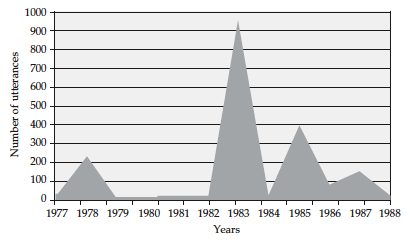
In figure 1, I trace the life-cycle of the abortion issue in the Portuguese Parliament, based on the utterances of the word ‘abortion’ (aborto).5
Figure 1
 ]]>
]]>
One of the women’s organizations main tactics in the late 1970’s was to lobby and petition for abortion policy reform (Fiadeiro, 1989; Tavares, 2003). Parliamentary members were a preferred target of lobbying in the late 1970s. The Commission for Legal Abortion (CLA) handed to Parliament a petition with more than 5,000 signatures demanding abortion legalization; and the Women’s Democratic Movement (WDM) handed out a letter proposing new reproductive rights’ legislation. These documents demonstrate the prevalence of specific frames in understanding the abortion issue as a matter of social justice («safe abortions are only available to those with more economic means»); women’s rights («affects particularly Portuguese women»); women’s health rights («about 2000 women die»); and democratic/developmental terms («a truly democratic society does not have repressive laws») (DR 11/3/1977, p. 2829-30). They also demanded abortion reform in tandem with an overall reform on contraception and sexuality (Abranches & Ferreira, 1986). In the late 1970s most of the proabortion rights utterances within the Portuguese Parliament were due to women’s organizations’ actions, which were trying to raise awareness and gain support from parliamentary members on abortion legal reform.
In January of 1980, a small left-wing party, the UDP, became the first political party in Parliament to demand the inclusion of abortion legal reform in the governmental agenda (DR 7/1/71980). However, the UDP law proposal 500/I was never formally debated in Parliament since it could not gather enough support. The UDP was a party that had strong connections to a radical women’s organization, the UMAR.6
The UDP narrow political appeal and the autonomy of its double-militants both help explain this party’s stance on proposing abortion reform (Tavares, 2003). Following the UDP, the Communists would also propose abortion legislation reform.
The first policy debate: Communists proposal (1982)
The first abortion debate in the Parliament happened in 1982.7
After the authoritarian regime was overthrown in 1974, women’s organizations initiated demands for the abortion issue to be «solved». After Palla’s and Massano’s trials in 1979, the Portuguese women’s movement came together to demand abortion reform, and this grievance became one of their top priorities (Magalhães, 1998; Prata, 2010). However, the movement was still in its emergence (Tavares, 2011) and only had the support of small left wing parties.8 Even the Communist Party, which had many double-militants, did not have a leadership responsive to the issue of abortion reform. The party’s position only changed in 1982. Ana a double-militant alluded to this fact,«the small left wing parties always clearly assumed the abortion grievance. … the Communist party, only began demanding some kind of abortion decriminalization when they realized it was a popular issue. Then, the Communist women got some support...» (Ana’s interview, 7/2/2005).
These «Communist women» are double-militants who tried to push abortion reform within the Communist party, as well as onto the parliamentary agenda. Tania, who was with the PCP, but not with the party’s main women’s organization (the WDM), pointed to the lack of power and autonomy doublemilitants faced within the party.
]]> «When I was in the Communist Party, I was never part of the WDM, because I am not going to be part of a women’s group that is led by men, it is a principle that I hold... The WDM was led by Moniz Abrantes, a comrade from the leadership of the Communist party. He was the one leading the WDM, everybody else followed, Luísa Amorim, Zita Seabra, all of them did not answer to the women in the movement, they answered to him...» (Tania’s interview, 25/6/2005).
While the UMAR, which was connected to the UDP, was able to keep its autonomy, the WDM was perceived among women activists as dependent on the Communist leadership. This probably contributed to delay the adoption of abortion reform as a party grievance. If these double-militants had been more influential within the PCP, abortion reform might have emerged earlier. Therefore, one can argue that autonomy and not just the presence of double-militants seems to matter in influencing political parties.
In 1982, most of the parliamentary seats were held by a center-right coalition, the Democratic Alliance (AD), which was also the governing party. Given the political context, it was unlikely that a center-right coalition would take the initiative of proposing any abortion reform. However, when the Communists took the lead and proposed abortion reform, their proposal stood a good chance of producing a policy outcome. Two main reasons accounted for this. First, most of the political parties in the Parliament had included some kind of abortion decriminalization proposals in their electoral programs. Second, the Communist abortion law proposal only decriminalized abortion on strict grounds, including therapeutic, eugenic, ethical, and socio-economic reasons. Therefore, the conditions were set for their proposal to have broader appeal among more moderate deputies.
The PCP abortion reform was part of a three-tier law proposal that included also a maternity/paternity law, and a family planning/sexual education law (DR 3/2/1982). In this proposal the abortion issue was linked to contraception and family planning reform. This is not surprising given the fact that women experienced these issues together. This was also how the women’s movement framed the abortion issue since they adopted this grievance (Tavares, 2003).
Social Justice Framing
Another major point of agreement, between the framing used by women’s organizations and the 1982 abortion discourse, was the prevalence of social justice frames, as exemplified here by the left-wing deputy Mário Tomé,
«These [social] differences are what impedes worker and peasant women from having access to family planning, which then results in underground abortion. While the bourgeoisie women from the PSD or the CDS have access to family planning, and when this one fails, they go and have an abortion in a luxury clinic in England.» (DR, 12/11/1982, p.379).
References to the ‘social justice’ frame were used to remind center-right women deputies that abortion affects women differently. Unlike them, many women do not have the economic resources to either avoid abortion or to gain access to abortion by going abroad. The salience of the ‘social justice’ framing existed among women’s organizations, but it also pervaded the parliamentary discussions. Social class, not gender, was the main injustice frame regarding abortion criminalization. This kind of framing resonated with both activists and MPs, in a frame alignment that resulted from a shared Marxist/Socialist ideology.
]]>‘Right timing’ and ‘democratic/developmental’ framing
Another framing emerging in the parliamentary debates is the ‘right timing’ claim for abortion decriminalization. Portugal’s early transition to democracy (1974-1977) was a politically tumultuous time.9 Activists and politicians had questioned years before the appropriateness of pressing for abortion rights during a period of severe political instability. Thus, some women’s organizations had chosen to postpone what was seen by many as a radical grievance (Ferreira, 1996). However, by the 1980s most of the political turmoil in the country had subsided, so it was time to bring the abortion rights agenda to the Parliament. Claiming for abortion rights was also intertwined with revising citizenship rights and gender roles in Portugal’s new democracy. Zita Seabra alluded to this by taking a liberal and socialist feminist discourse to her fellow MPs,
«some of you always panic when we… debate women’s [abortion] problems, as you do when we present to women a road towards their full citizenship rights, which puts at stake what you perceive as your interests. That is when you no longer can count on the «porcelain dolls» or with the ‘Susie homemakers’ that were destined to be marginalized...
(…) In the 1980s, a civilized state cannot ask… from its female citizens to make a barbaric choice of taking to term an undesired pregnancy or go to prison on an abortion sentence (…) Article 358 of the Criminal Code is not compatible with the Portuguese Constitution and with the democratic regime in which we live.» (DR, 2/3/1982, p. 2393, 2400).
The links between women’s citizenship and a ‘democratic/developmental’ framing provided visibility to the criminalization of abortion as both a democratic deficit and a women’s marginalization/inequality issue. Abortion reform was thus part of ‘democratic/developmental’ framing also used by women’s organizations. In fact, one of the main ways that the abortion debate was gendered was through references to «women’s citizenship». This is related to Radcliff’s notion that democratic transitions are important moments to redefine gender roles and engage in gender reassessment (2001). Portuguese women were described by activists and by double-militants in parliamentary debates as «full citizens», in order to draw attention to how repressive abortion legislation contradicts women’s full attainment of citizenship rights (Peniche, 2007; Santos et al., 2010).
‘Lack of representation’ framing
Another major frame used in the 1982 parliamentary discourses connects abortion rights to the lack of representation of women’s interests (and voices). Teresa Ambrósio argued that a male-dominated chamber would decide on abortion reform without proper representation of women’s interests and that partisan politics would eventually determine how the abortion debate would unfold. Moreover, left-wing deputy Octávio Cunha, declared that it would be up to a few women deputies to really represent in parliament the immense but silenced majority of Portuguese women,
]]>«The debate we begin today is a biased debate... grounded on the electoral interests of the time, and on strategic partisan goals... A debate in these conditions is a humiliation to us female deputies… it is also heartbreaking to find that a Parliament of men, and only a few women, will decide how it is going to punish us...» (DR, 12/11/1982, p.335).
«our homage also goes to the women, more than to the deputies, Zita Seabra, Teresa Ambrósio and Natália Correia, who we know will be… the voices of many others that are silent, suffering and in fear» (DR, 11/10/1982, p.273).
As predicted, the small share of female MP’s impacted the overall representation of different points of view, which resulted in an underrepresentation of certain frames (e.g., women’s body right/mother’s rights) vis-à-vis other competing frames (e.g., right to life/fetus rights).10 Importantly, this also signaled that parliamentary members saw women deputies, and not women’s organizations, as the real representatives of the ‘silenced female constituency’. Thus showing that the women’s movement was perceived mostly as an outsider political actor even despite the many tactics directed at parliamentary members by women’s organizations.
The underrepresentation of women’s rights and their distinct voices is clear in the 1982 parliamentary discussions. For example, framing the abortion issue as a matter of ‘women’s body’ rights had been selected by some women’s organizations (Tavares, 2003), but it was only raised in a small percentage of floor debates and was highly contested. This particular frame, in its pro-direction11, was mentioned by women deputies and double-militants, such as, Zita Seabra (PCP), Natália Correia (PSD), and Teresa Ambrósio (PS). If among women deputies, this framing crossed party-lines, the same did not happen with male deputies. Only Mário Tomé, a left-wing MP, selected this framing. In this case, an electoral underrepresentation of women in Parliamentary seats did correlate with an underrepresentation of women’s diverse voices and interests. Nonetheless, in its anti-direction the ‘women’s body’ right frame was more often selected.
In conclusion, the first policy debate demonstrates the critical importance of double-militants’ autonomy (versus just its presence), women MPs (across partylines), and few left-wing deputies (from very small parties), as the only political allies of the women’s movement in Parliament. Although, these political actors were few in number – which contributed to an overall underrepresentation of women’s organizations’ interests and frames; it also demonstrates how these MPs selected some of the movement preferred framings (on ‘social justice’, ‘democratic/developmental’, and ‘citizenship rights’).
The first policy debate: women’s movement tactics
Women’s organizations did lack access to the polity in regards to abortion reform decision-making, but that did not stop them from using multiple tactics «from the outside» to influence the debate. According to Gamson, «Those [political actors] who are outside are challengers. They lack the basic prerogative of members – routine access to the decisions that affect them.» (1975: 140). Nonetheless, several women’s groups through their collective actions tried to affect the decisions that were being made in 1982.
The CNAC took a stance on the Communists’ abortion law proposal, by arguing that although the proposal represented a major improvement, it did not fully assure women’s rights and still limited their right to choose.12 This critical positioning of the CNAC had to do with the fact that the PCP’s proposal limited abortion rights and did not considered the women’s decision (Tavares, 2003). In June of 1982, the CLA13, with the support of many other women’s organizations handed an extensive folder on the abortion issue to MPs. The tactics of Portuguese women’s organizations were frequently inspired by collective actions used by women’s organizations in other countries.
]]> Closer to the end of the year, when the debate was coming to a close, the women’s movement actions’ grew in number. The CNAC and the CLA, both planned an «abortion decriminalization awareness week»14 in which they organized several street actions, a special newspaper issue, and several manifestos directed at deputies, doctors, and intellectuals (Tavares, 2003). At this time, a group of women, including the well know three Marias, handed also an open letter to the deputies to vote favorably.Among the center-right Social Democrats, a few deputies defected from the party’s official position and declared their support for the PCP proposal, such as, MP Helena Roseta (PSD) (Tavares, 2003). While women’s organizations through different tactics tried to influence parliamentary members to support the bill, only a few deputies were responsive. The women’s movement lacked access to decision-making and political alliances with the governing parties, thus remaining as having an outsider status.
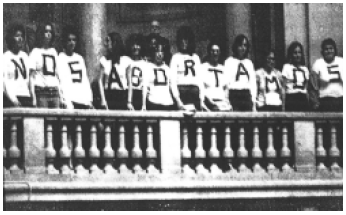
Many distinct women’s groups rallied in support of abortion reform. Most of these actions came to a close on November 11, the day that the proposal was voted on. That day, several women’s organizations gathered and demonstrated outside the Parliament, marking an important event in the history of Portuguese abortion struggle and in the history of Portuguese democratization. That day the parliament’s galleries were used, for the first time, as a site of protest by a social movement organization. The UMAR was the women’s organization leading this protest action. In the words of one of the UMAR’s activists who participated in this protest,
we had decided to do [an action] in the Parliament following that idea of the ‘we had an abortion’ petition. Each one of us would carry a letter [on a t-shirt] and we would show it in the Parliament. It was the first time such a thing was going to happen in Parliament! No other group, workers’ organization and all, had demonstrated inside the Parliament (Marta’s interview, 14/6/2005).
But this protest action almost failed:
when we entered the Parliament some of us went to one section and the others went to another. Since each one of us had a little card with a section number of where we were suppose to sit, we could not move. But those debates take a very long time, so we arranged… to meet in the restroom and pass their t-shirts on to the women in our section. … we took the jackets off, the media took the pictures and we stayed like that for a little bit, until President of the Table asked us to leave. We left. (...) I can proudly say that I was the letter «_» in the staging of ‘we had an abortion’ sentence (Marta’s interview, 14/6/2005).
Here is a picture from that day.15 Figure 2: UMAR protest at the Portuguese Parliament (1982)
 ]]>
]]>
Women’s organization tactics were highly diversified throughout that year, and included petitions, press releases, letters, lobbying, an awareness week, demonstrations. Nonetheless, the «t-shirt disruption» in Parliament represented a tactical innovation within the Portuguese social movement repertoire of the time (McAdam, 1997). It gave this movement organization significant media exposure and disrupted the parliamentary discussion forcing MPs to listen to the movement.
Alongside the women’s movement tactics, the anti-decriminalization movement also geared up to pressure legislators.16 Their campaign reached a critical point when they handed out a pamphlet with the caption «Mom gets ready to murder little Johnny»17 in several high schools. This pamphlet caused an outrage and was traced back to a CDS organization (DR 26/1/1984). In fact, the antidecriminalization movement had, unlike the women’s movement, a powerful ally – one of the governing parties, and this alliance would prove to be of critical importance for the outcome that was reached.
The first policy debate: outcomes
Despite the opposition from the Church and from the conservative sectors of society the PCP proposed law was a moderate one, and, as such, it stood a good chance of being approved. In the end, it was not. The abortion decriminalization proposal 309/II was rejected on November 12, with 127 votes against and 105 in favor (DR, 12/11/1982, p.406). The main reason was the fact that partisan politics determined the voting process, as deputy Ambrósio had predicted.
Several political constraints led to the rejection of the proposal. First, the governing coalition (AD) did not support the bill. This coalition included the largest party, the Social Democrats and the right-wing CDS. The Christian Democrats adopted the official position of the Church on the matter, and were completely opposed to any abortion decriminalization. However, in the 1982 debate, this party took its opposition to abortion a little further. Once it acknowledged that there were different opinions on abortion reform within the PSD, and realized that several MPs did in fact support the proposal, the Christian Democrats fought back. They promptly threatened the Social Democrats that if they voted in favor, the coalition would cease, and the government would fall. This was a serious political threat and one that could only arise because of the coalitional structure of the government.
The Social Democrats, who initially supported abortion decriminalization, demanded that its deputies vote against the proposal and imposed party discipline for the vote.18 Without any voting freedom, only a few deputies from the Social Democrats voted in favor of the proposal. Three of them were women and the other one was a doctor. Although most of the Socialists deputies backed the Communist proposal that support was not enough.19
Within the print media, the dominant idea was that the Social Democrats had succumbed to the pressures of the Christian Democrats and that partisan politics had won. As a journalist alluded to at the time, «electoral calculations conditioned the PSD».20
This led the voting process to follow strict party lines, which created a division in the Parliament between the ‘left’ and the ‘right’. This happened on a matter that many thought should cut across party alignments.Partisan politics did play a role in the defeat of the Communist proposal. I argue that the Christian Democrats threat to end the governing coalition also needs to be understood as a response to the support that the proposal initially gathered among moderate MPs. One can argue that it was the early effectiveness of women’s organizations that led to the hardening and ideological radicalization of the conservative sectors in Parliament, that ultimately led to the defeat of the proposal. Nonetheless, from the point of view of women’s groups, this first abortion policy debate ended up representing not a defeat, but rather a stepping stone towards future abortion reform. The involvement of different women’s groups, their high mobilization potential, and the support they gathered politically, all meant that abortion decriminalization stood a better chance after 1982 than before the Communist proposal.
]]> In fact, during the time that the proposal was being debated in Parliament, the women’s movement was able to mobilize new resources and to engage in diverse tactics to influence the debate. Although the proposal did not coincide entirely with the movement’s goals, which included abortion on demand, they still rallied for its approval. In tracing the political process that led to the defeat of the proposal we see that the debate was influenced not only by women’s organizations, but also by other political actors from within and from outside the Parliament. In the end, the abortion reform debate unfolded as the result of a shifting policy environment and through the interactions of parliamentary members with activists.
Conclusion
Portuguese women’s organizations mobilized significantly in 1982 and used different tactics to pressure legislators. For the most part, they were able to find some political allies within the Parliament, namely double-militants and some women and leftist deputies. These political alliances were few in number, which accounted for some underrepresentation of women’s organizations’ interests and frames within the overall 1982 parliamentary debates. Nonetheless, I argue that the impact of women activists is better understood by looking at their interactions with parliamentary members and with the policy environment as a whole. On the one hand, women’s organizations remained as ‘outsiders’ and excluded from the political process, but, on the other hand, most of their preferred framings were put forward in the parliamentary debates by their few political allies, thus providing them with some degree of representation and indirect influence. The frame alignment or overlapping on how abortion decriminalization was understood did contribute to voice women’s organizations interests and their specific framing within the Parliament. This demonstrates that often times we need to look at other political actors besides the ones involved with social movement activity, to contextualize the outcomes produced and grasp that those could be both indirect and joint effects.
The 1982 abortion debate also demonstrates that tracing movement outcomes as a simple failure to launch abortion decriminalization really does not capture how the political environment evolves and how it impacts movement organizations and their interactions. Although no favorable outcome from the movement perspective was reached at the end of the 1982 debate, one can argue that some of the movement successful tactics did in fact set in motion a process that led the Christian Democrats’ hardliners to radicalize their position and threaten to end the governing coalition. One indirect and unintended outcome of the 1982 debate was the mobilization it generated, and with that, the strengthening of the ideological divide between the «left» and the «right» on the abortion issue. The «failure» on a specific outcome cannot overshadow what the 1982 debate ultimately represented, a debate that cannot be perceived as a failure of the movement, but a precursor to what would be the approval of abortion decriminalization in Parliament just two years later, in 1984.
References
Abranches, Graça, Ferreira, Virgínia (1986), «O debate sobre o aborto e a ortopedia discursiva da sexualidade», Análise Social, XXII (92-93), pp. 477-492. [ Links ]
Amenta, Edwin, Young, Michael (1999), «Making an impact: Conceptual and methodological implications of the collective criterion», in Marco Giugni, Doug McAdam, Charles Tilly (eds.), How Social Movements Matter, Minneapolis, Minnesota University Press, pp. 22-41. [ Links ]
Banaszak, Lee Ann (1996), Why Movements Succeed or Fail: Opportunity, Culture, and the Struggle for Women Suffrage, Princeton, Princeton University Press. [ Links ]
Beckwith, Karen (2000). «Beyond compare? Women’s movements in comparative perspective», European Journal of Political Research, 37, pp. 431-468. [ Links ]
Carley, Katheleen (1993), «Coding Choices for Textual Analysis: A Comparison of Content Analysis and Map Analysis», Sociological Methodology, 23, pp. 75-126. [ Links ]
Della Porta, Donatella (1999), «Protest, Protestors, and Protest Policing: Public Discourses in Italy and Germany from the 1960s to the 1980s», in Marco Giugni, Doug McAdam, Charles Tilly (eds.), How Social Movements Matter, Minneapolis, University of Minnesota Press, pp. 66-96. [ Links ]
Ferree, Myra Marx et al. (2002), Shaping Abortion Discourse. Cambridge, Cambridge University Press. [ Links ]
Fiadeiro, Maria Antónia (1989), Cronologia da luta das mulheres (74-88), Lisboa, LDM. [ Links ]
Ferreira, Virgínia (1996), «A Questão do Aborto em Portugal: Sob a Égide da Hipocrisia e Passividade », Sexualidade e Planeamento Familiar, 9/10, pp. [ Links ] 26-30.
Fishman, Robert (1990), «Rethinking state and regime: Southern Europe’s transition to democracy», World Politics, 42, pp. 422-440. [ Links ]
Franzosi, Roberto (1990), «From Words to Numbers: A generalized and Linguistic-based Coding for Collecting Textual Data», in Cliford Clogg (ed.), Sociological Methodology, San Francisco, Jossey- Bass, pp. 263-298. [ Links ]
Gamson, William (1975), The Strategy of Social Protest, Homewood, Dorsey Press. [ Links ]
Gamson, William (1990), The Strategy of Social Prote, Belmont, Wadsworth. [ Links ]
Gelb, Joyce (1987), «Social movement success: A comparative analysis of feminism in the United States and the United Kingdom», in Mary Katzenstein, Carol Mueller (eds.), How Social Movements Matter, Minneapolis, University of Minnesota Press, pp. 149-181. [ Links ]
Giugni, Marco (1998), «Was it worth the effort? The Outcomes and Consequences of Social Movements », Annual Review of Sociology, 98, pp. 371-393. [ Links ]
Giugni, Marco, McAdam, Adam, Charles Tilly (eds.) (1999), How Social Movements Matter, Minneapolis, University of Minnesota Press. [ Links ]
Magalhães, Maria José (1998), Movimento Feminista e Educação, Oeiras, Celta Editora. [ Links ]
McAdam, Doug (1982), Political Process and the Development of the Black Insurgency 1930-1970, Chicago, University of Chicago Press. [ Links ]
McAdam, Doug (1997), «Tactical Innovation and the pace of Insurgency», in Doug McAdam, David Snow (eds.), Social Movements – Readings on their Emergence, Mobilization and Dynamics, Los Angeles, Roxbury Publishing Company, pp. 340-356. [ Links ]
Peniche, Andreia (2007), Elas Somos Nós. O direito ao aborto como reivindicação democrática e cidadã, Porto, Edições Afrontamento. [ Links ]
Pinto, António Costa (1998), «Dealing with the Legacy of Authoritarianism: Political Purge and Radical Right Movement’s in Portugal’s Transition to democracy (1974-1976)», in Stein Larsen, Bernt Hagtvet (eds.), Modern Europe after Fascism, Boulder, Social Science Monographs, pp. 1679-1718. [ Links ]
Prata, Ana (2010), «Finding a Voice: Abortion claim-making during the Portuguese democratization», Women’s Studies International Forum, 33, pp. 579-588. [ Links ]
Radcliff, Pamela Beth (2001), «Imagining Female Citizenship in the ‘New Spain’: Gendering the Democrati Transition, 1975-1978», Gender & History 13, pp. 498-523. [ Links ]
Rochon, Thomas, Daniel Mazmanian (1993), «Social Movements and the Policy Process», Annals of the American Academy of Political and Social Sciences, 528, pp. 75-87. [ Links ]
Santos, Boaventura Sousa et al. (2010), Cometi um Crime? Representações sobre a (i)legalidade do aborto, Porto, Afrontamento. [ Links ]
Snow, David A., Robert D. Benford (1992), «Master Frames and Cycle of Protest», in Aldon Morris, Carol M. Mueller (eds.), Frontiers in Social Movement Theory, New Haven, Yale University Press, pp. 133-155. [ Links ]
Staggenborg, Suzanne (1995), «The survival of the pro-choice movement», Journal of Policy History, 7, pp. 160-175. [ Links ]
Tarrow, Sidney (1989), Democracy and Disorder: Protest and Politics in Italy, 1965-1975, Oxford, Oxford University Press. [ Links ]
Tarrow, Sidney (1998), Power in Movement: Social Movements and Contentious Politics, Cambridge, Cambridge University Press. [ Links ]
Tavares, Manuela (2003), Aborto e Contracepção em Portugal, Lisboa, Livros Horizonte. [ Links ]
Tavares, Manuela (2011), Feminismos, Percursos e Desafios (1947-2007), Lisboa, Texto Editores. [ Links ]
Tilly, Charles (1978), From Mobilization to Revolution, Reading, Addison-Wesley. [ Links ]
Artigo recebido em 30 de setembro de 2011 e aceite para publicação em 20 de fevereiro de 2012.
Notas:
*É Professora Assistente de Sociologia na California State University, Northridge. Os seus interesses académicos e publicações são nas áreas de movimentos de mulheres, aborto, democratização, género e sexualidade, e tráfico sexual. Atualmente está envolvida num projeto de investigação longitudinal intitulado «Associativismo no Feminino no Portugal Democrático (1974-2010)». ana.prata@csun.edu
1Punishment for abortion offenders went from two to eight years of imprisonment (Law 358 of the Criminal Code).
2The diaries of parliamentary debates are available at <http://debates.parlamento.pt/?pid=r3>
3Frames are the interpretive schemata that simplify and condense «the world out there» to a designated set of idea elements.
4The interviews used in this paper are part of the researcher’s dissertation. These data were collected in 2005 and activists’ names have been altered.
]]> 5Values in the Y axis show absolute numbers of times the word ‘abortion’ (aborto) appeared in any speech on the Parliament floor in each year.6Union of Alternative and Responsive Women (União de Mulheres Alternativa e Resposta).
7In this year, the word ‘abortion’ (aborto) was mentioned a total of 880 times on the floor speeches.
8Ana’s interview, 6/25/2005; Tania’s interview 6/25/2005.
9For more information on the political instability of the Portuguese democratization in the early years of transition see Pinto, 1998; Fishman, 1990.
10A quantitative analyses of frames used in the 1982 debate shows that parliamentary members mentioned ‘right to life/fetus rights’ about twice as much ‘women’s rights’ (81 compared to 38 utterances).
11Abortion frames often have a pro or anti-direction (Ferree et al., 2002).
12National Campaign for Abortion and Contraception (CNAC Press Release, 7/6/1982).
13The Campaign for the Liberalization of Abortion (CLA) worked with the CNAC, UMAR,The Campaign for the Liberalization of Abortion (CLA) worked with the CNAC, UMAR, WLM, the Information/Documentation Women’s Group (IDM), and Autonomous Oporto Women’s Group (GAMP)(Ana’s interview, 7/2/2005).
14Expresso 11/6/1982, p. 5; Diário de Notícias 11/4/1982. p. 8.
]]> 15Source: Revista Mulheres (1/1984).16The Pro-life Movement also made a public statement stating that «life starts at the moment of conception, and God creates the soul at the moment of conception» (Nota Pastoral). They also declared their firm opposition to «any legislation that would favor or allow abortion, independently of any designation.» (Ordem 11/3/1982).
17«A mãe prepara o assassinato do Zézinho».
18Expresso, 23/10/1982, p. 24.
19The Socialist party tried to remain neutral by stating that its individual MPs had the freedom to vote as they pleased, but the party did not support, or oppose, the Communist proposal (Expresso, 11/13/1982, p. 14R).
20Expresso, 11/13/1982, p. 15.
]]>