Bárbara Figueiredo, Tiffany Field, Miguel Diego, Maria Hernandez-Reif, Osvelia Deeds, & Angela Ascencio
School of Psychology, University of Minho, Portugal.
Department of Pediatrics, Touch Research Institutes, University of Miami School of Medicine, USA.
University of Alabama, USA.
Contactar para Email: bbfi@psi.uminho.pt
Abstract
]]> To assess anxiety, depression and relationship satisfaction in both women and men during pregnancy, the State Anxiety Inventory (STAI), The Center for Epidemiological Studies-Depression Scale (CESD) and The Relationship Questionnaire (RQ) were administered during the second trimester to a sample of 59 pregnant women and their partners. Anxious pregnant women rated their relationships as less positive. Depressed pregnant women also rated their relationships as less positive. The women’s anxiety scores were predictive of their positive and negative relationship scores. The women and their partners’ negative relationship scores were also predictive of each others’ negative relationship scores. These results highlight the importance of targeting anxiety as well as depression, and pregnant women as well as their partners in prenatal intervention programs.Keywords: Anxiety; depression; pregnancy; partner relationships.
Relacionamento conjugal durante a gravidez em mulheres e homens ansiosos e deprimidos
Resumo
Para avaliar a ansiedade, a depressão e o relacionamento conjugal em mulheres e homens durante a gravidez, o State Anxiety Inventory (STAI), o Center for Epidemiological Studies Depression Scale (CESD) e o Relationship Questionnaire (RQ) foram administrados durante o segundo trimestre a uma amostra de 59 grávidas e seus companheiros. As mulheres grávidas ansiosas avaliaram o seu relacionamento como menos positivo. As mulheres grávidas deprimidas também avaliaram o seu relacionamento como mesmo positivo. Os valores de ansiedade mostraram ser preditores do relacionamento positivo e negativo. Os valores do relacionamento da mulher e do seu companheiro também se mostraram mutuamente preditores dos seus relacionamentos negativos. Estes resultados mostram a importância de considerar a ansiedade tanto quanto a depressão e a mulher grávida tanto quanto o seu companheiro em programas de intervenção pré-natal.
Palavras-chave: Ansiedade; depressão; gravidez; relacionamento conjugal.
The transition to parenthood has been associated with a decrease in proximity and communication and an increase in conflict and ambivalence between the two members of the couple, resulting in less partner relationship satisfaction (Harwood, McLean, & Durkin, 2007; Perren, von Wyl, Bürgin, Simoni, & von Klitzing, 2005). Partner conflict and low social support have been linked with symptoms of depression and anxiety during the second trimester of pregnancy in a large community sample of women (Glazier, Elgar, Goel, & Holzapfel, 2004). Conversely, depression (Westdahl, Milan, Magriples, Kershaw, Rising, & Ickovics, 2007) and anxiety (Andersson, Sundstrom-Poromaa, Wulff, Astrom, & Bixo, 2006; Britton, 2005) have been noted to affect relationships during pregnancy in several studies. Less marital satisfaction has been observed during pregnancy in depressed women and men (Feeney, Alexander, Noller, & Hohaus, 2003; Zelkowitz, & Milet, 1996).
The quality of partner relationships during the transition to parenthood is notably as important for men’s psychological adjustment. Men with poor partner relationships are at risk for depression as much as women during pregnancy (Matthey, Barnett, Ungerer, & Waters, 2000). Symptoms are also highly correlated within the couple (Matthey, Barnett, Howie, & Kavanagh, 2003), and these depend on the quality of their relationship. The men’s mental health status impacts on both the quality of the marital relationship and the support provided to the women, which in turn affects women’s wellbeing during pregnancy (e.g., Ritter, Hobfoll, Lavin, Cameron, & Hulsizer, 2000; Rubertsson, Waldenström, & Wickberg, 2003). Men who are anxious or depressed during pregnancy reports more partner relationship problems (Boyce, Condon, Barton, & Corkindale, 2007; Condon, Boyce, & Corkindale, 2004; Buist, Morse, & Durkin, 2003) in the same way as women (Lovisi, Lopez, Coutinho, & Patel, 2005).
]]> The present study was designed to assess anxiety, depression and relationship satisfaction in both women and men during pregnancy, including: (1) the differences between anxious and non-anxious women and between depressed and non-depressed women on their relationship scores, and the differences between anxious and non-anxious men and between depressed and non-depressed men on their relationship scores; and (2) the predictors of women’s and men’s relationship scores.
METHODS
Participants
Fifty-nine pregnant women and their partners were recruited during their second trimester of pregnancy before their ultrasound examination at a large urban University Hospital. Women were excluded from participation in this study if they: (1) were less than 18yearsold; (2) had multiple fetuses; (3) reported HIV/AIDS status or medical complications; and (4) were not involved in a relationship with a significant other.
The women were between 18 and 45yearsold (M = 27.9; SD = 6.21), and the men between 20 and 44years old (M = 30.42; SD = 7.00). They were all involved in a relationship, 48% were married and 52% had a boyfriend. The women had between 0 (58%) and 4 previous children. The sample was comprised of women/men with a college (26%) or high-school degree or less (44%). Participants had a predominantly low (80%) to middle (20%) socioeconomic status (Hollingshead Two-factor Index of Social Status). Their ethnicity was distributed: 80% Hispanic, 18% Black and 2% Caucasian (only 15% were born in the US). Most women/men (90%) were happy when they found out about the pregnancy, but 46% reported having a stressful situation during the pregnancy.
Measures
The Relationship Questionnaire (RQ, Figueiredo, Field, Diego, Hernandez-Reif, Deeds, & Ascencio, 2008) is a brief self-report scale comprised of 12items rated on a 4 point Liker scale, and divided into two subscales: the positive (8 items) and the negative subscale (4 items). The questionnaire was designed for this study to be completed in a short time (less than 2 minutes), to be behaviorally focused, to be as relevant for women as for men, and to be focused on positive and negative aspects of the relationship. Positive dimensions include a sense of support and care, as well as affection, closeness and joint interests and activities, and negative dimensions include irritability, arguments and criticisms that have been associated with undesirable outcomes. The questionnaire has good internal consistency (Cronbach Alpha of .79) and test-retest reliability (r = .74).
The Center for Epidemiological Studies-Depression Scale (CESD, Radloff, 1977) is a 20item scale that assesses the frequency of depressive symptoms within the last week. With scores ranging from 0 to 60, a cut-off of 16 is used for classifying a major depressive episode, with only a 6% false positive and 36% false negative rate (Myers & Weismann, 1980). This scale has been shown to be reliable and valid for diverse demographic groups (Radloff, 1977) and has been successfully used as a self-report assessment of depression in a number of studies that involved similar populations (e.g., Marcus, Flynn, Blow, & Barry, 2003).
]]> The State-Trait Anxiety Inventory (STAI, Spielberger et al., 1970) is comprised of 20 items and assesses the intensity of anxiety symptoms. The scores range from 20 to 90 and the cutoff for high anxiety is 48. The inventory has adequate concurrent validity and internal consistency (Spielberger Gorsuch, & Lushene, 1970), and has been used in several studies with pregnant women (e.g., Da Costa, Larouche, Drista, & Brender, 2000).
Procedures
This study received approval from the Institutional Review Boards (IRBs). Mothers and fathers-to-be who expressed interest in participating in this study were asked to sign an informed consent at the ultrasound clinic while waiting for their ultrasound. Then, they were both separately interviewed to obtain demographic data and to complete the Relationship Questionnaire (RQ) (Figueiredo, et al., 2008), as well as the Center for Epidemiological Studies-Depression Scale (CESD) (Radloff, 1977) and the State-Trait Anxiety Inventory (STAI) (Spielberger, etal., 1970).
Statistical Analyses
The cut points for depression on the CESD (a score of 16 or higher) and for anxiety on the STAI (a score of 48 or higher) were used to assign the women to depressed/non-depressed and anxious/non-anxious groups for the purpose of data analyses. The same cut points were used for the men (the pregnant women’s partners) in separate data analyses.
One-way analyses of variance were conducted to compare the RQ positive and negative subscale scores of: (1) women and men; (2) anxious and non-anxious women; (3) depressed and non-depressed women; (4) anxious and non-anxious men (the partners of the women); and (5) depressed and non-depressed men. Stepwise regression analyses were also conducted to determine the predictors of women’s and men’s relationship scores.
RESULTS
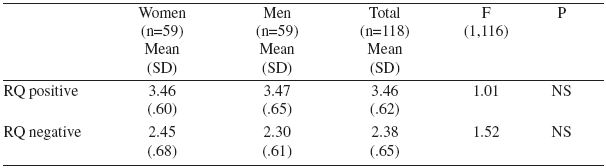
]]> Relationship scores of women and men during the second trimester of pregnancyOne-way analyses of variance revealed that the positive and negative relationship scores of women and men did not significantly differ (see Table 1). Although the women’s and men’s positive RQ scores were not correlated (r (59) = .06, p = .65), their negative RQ scores were highly correlated (r (59) = .36, p = .005).
Table 1
Relationship scores for depressed and non-depressed women and men during the second trimester of pregnancy
Relationship scores of anxious versus non-anxious and of depressed versus non-depressed women and men during the second trimester of pregnancy
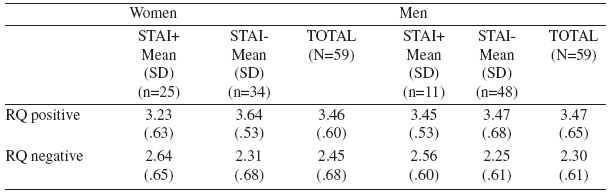
One-way analyses of variance showed that 1) the anxious versus non-anxious women had lower RQ positive subscale scores (F (1,57) = 7.49, p = .008) and borderline higher scores on the RQ negative subscale (F (1,57) = 3.42, p = .07) (see table 2); and 3) no significant group differences were noted for the high anxiety versus low anxiety men’s groups.
]]> Table 2
Relationship scores for anxious and non-anxious women and men during the second trimester of pregnancy
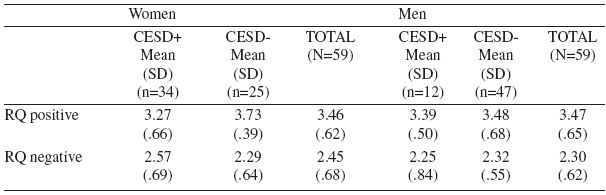
One-way analyses of variance showed that: 1) depressed versus non-depressed women had lower scores on the RQ positive scale (F (1,57) = 9.56, p = .003); 2) no significant differences were obtained for RQ negative scores for the women; and 3) no significant group differences were noted for the depressed versus non-depressed men (see table 3).
Table 3
Relationship scores for depressed and non-depressed women and men during the second trimester of pregnancy
]]> Predictors of women’s and men’s relationship scores during the second trimester of pregnancy
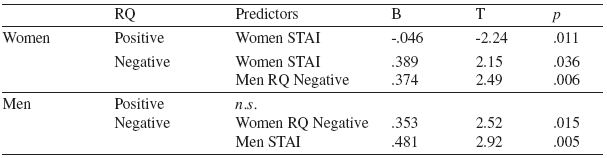
The stepwise regression analyses suggested that: 1) the women’s STAI was the best predictor for the women’s RQ positive subscale scores, explaining 24% of the variance (R2 = .24; Adjusted R2 = .15; F(6,52) = 2.70, p = .02); 2) the women’s STAI was the best predictor for the women’s RQ negative subscale scores as well, and the men’s (their partners’) RQ negative subscale scores were also a significant predictor, with these two variables explaining 24% of the variance (R2 = .24; Adjusted R2 = .15; F(6,52) = 2.81, p = .02); and 3) the women’s RQ negative subscale scores were the best predictor of the men’s (their partners’) RQ negative scores, and the men’s STAI scores were a significant predictor as well, together explaining 26% of the variance (R2= .26; Adjusted R2= .18; F(6,52)= 3.05, p= .01). No significant predictors were found for the men’s RQ positive scores (see Table 4).
Table 4
Predictors of women and men positive and negative relationship scores during the 2nd trimester of pregnancy
DISCUSSION
The women’s and men’s relationship scores did not differ. The anxious women had lower positive and borderline higher negative relationship scores, and the anxious men did not differ from the non-anxious men on their scores during pregnancy. The depressed women had lower positive relationship scores, but no differences were found on the negative relationship scores. And, the depressed men did not differ from the non depressed men on their relationship scores. The women’s anxiety scores were the strongest predictors of both the women’s positive and negative relationship scores. These data are consistent with other research reporting that anxious and depressed women have worse relationships during pregnancy when compared to non-anxious or non-depressed women (Andersson et al., 2006; Westdahl et al., 2007). A unique finding of the present study was that positive and negative relationship scores during pregnancy were more related to anxiety than depression scores. This finding is difficult to interpret and deserves further investigation.
Surprisingly, the men’s relationship scores in this study did not differ as a function of their anxiety or depression. This is inconsistent with other reports in the literature (Boyce et al, 2007; Condon et al, 2004). The discrepant results from the current study may relate to the analyses being underpowered or the extremely unequal Ns in the high/low anxiety men’s groups (N = 11 and 48 respectively) and the depressed/non-depressed men’s groups (N = 12 and 47 respectively). This could be corrected in a future study by recruiting male samples during pregnancy rather than comparing the male partners of the pregnant women, as was done in this study.
]]> Nonetheless, the current results highlight the importance of considering relationships in couples during pregnancy (Diaz, Cooper, & Munoz, 2007). The women’s negative relationship scores predicted the men’s (their partners’) negative relationship scores, and the men’s negative relationship scores predicted the women’s (their partners’) negative relationship scores, highlighting the impact of negative relationships. Interventions could benefit the depressed and anxious pregnant women as well as their partners. Women’s anxiety scores as opposed to depression scores were significant predictors of the relationship scores, highlighting the importance of targeting anxiety in prenatal intervention programs.
REFERENCES
Andersson, L., Sundstrom-Poromaa, I., Wulff, M., Astrom, M., & Bixo, M. (2006). Depression and anxiety during pregnancy and six months postpartum: A follow-up study. Acta Obstetricia et Gynecologica Scandinavica, 85(8), 937944.
Boyce, P., Condon, J., Barton, J., & Corkindale, C. (2007) First-Time Fathers’ Study: Psychological distress in expectant fathers during pregnancy. The Australian and New Zealand Journal of Psychiatry, 41(9), 718725.
Britton, J. R. (2005). Pre-discharge anxiety among mothers of well newborns: Prevalence and correlates. Acta Paediatrica, 94(12), 17711776. [ Links ]
Buist, A., Morse, C. A., Durkin, S. (2003). Men’s adjustment to fatherhood: Implications for obstetric health care. Journal of Obstetric, Gynecologic, and Neonatal Nursing, 32(2), 172180.
Condon, J. T., Boyce, P., & Corkindale, C. J. (2004). The First-Time Fathers Study: A prospective study of the mental health and wellbeing of men during the transition to parenthood. The Australian and New Zealand Journal of Psychiatry, 38(12), 5664
Da Costa, D., Larouche, J., Dritsa, M., & Brender, W. (2000). Psychosocial correlates of prepartum and postpartum depressed mood. Journal of Affective Disorders, 59(1), 3140.
Diaz, M. A., Le, H. N., Cooper, B. A., Muñoz, R. F. (2007). Interpersonal factors and perinatal depressive symptomatology in a low-income Latina sample. Cultural Diversity & Ethnic Minority Psychology, 13(4), 328336.
]]> Feeney, J., Alexander, R., Noller, P., & Hohaus, L. (2003). Attachment insecurity, depression, and the transition to parenthood. Personal Relationships, 10(4), 475 – 493.Figueiredo, B., Field, T., Diego, M., Hernandez-Reif, M., Deeds, O., Ascencio, A. (2008). Partner relationships during the transition to parenthood. Journal of Reproductive and Infant Psychology, 26(2), 99–107.
Glazier, R. H., Elgar, F. J., Goel, V., & Holzapfel, S. (2004). Stress, social support, and emotional distress in a community sample of pregnant women. Journal of Psychosomatic Obstetrics and Gynaecology, 25(34), 247255.
Harwood, K., McLean, N., & Durkin, K., (2007). First-time mothers’ expectations of parenthood: What happens when optimistic expectations are not matched by later experiences? Developmental Psychology, 43(1), 112.
Lovisi, G. M., Lopez, J. R., Continuo, E. S., & Patel, V. (2005). Poverty, violence and depression during pregnancy: A survey of mothers attending a public hospital in Brazil. Psychological Medicine, 35(10), 14851492
Marcus, S. M., Flynn, H. A., Blow, F. C., & Barry, K. L. (2003). Depressive symptoms among pregnant women screened in obstetrics settings. Journal of Women’s Health,12(4), 373380.
Matthey, S., Barnett, B., Howie, P., & Kavanagh, D. J. (2003). Diagnosing postpartum depression in mothers and fathers: Whatever happened to anxiety? Journal of Affective Disorders, 74(2), 139147.
Matthey, S., Barnett, B., Ungerer, J., & Waters, B. (2000). Paternal and maternal depressed mood during the transition to parenthood. Journal of Affective Disorders, 60(2), 7585.
Myers, J.K. & Weismann, M.M. (1980). Use of a self-report symptom scale to detect depression in a community sample. American Journal of Psychiatry, 137, 10811084.
Perren, S., von Wyl, A., Bürgin, D., Simoni, H., & von Klitzing, K. (2005). Intergenerational transmission of marital quality across the transition to parenthood. Family Process, 44(4), 441459.
]]> Radloff, L. (1977). The CESD Scale: A self-report depression scale for research in the general population. Applied Psychological Measures, 3, 385401.Ritter, C., Hobfoll, S. E., Lavin, J., Cameron, R. P., & Hulsizer, M. R. (2000). Stress, psychosocial resources, and depressive symptomatology during pregnancy in low-income, innercity women. Health Psychology, 19(6), 576585.
Rubertsson, C., Waldenströem, U., & Wickberg, B. (2003). Depressive mood in early pregnancy: Prevalence and women at risk in a national Swedish sample. Journal of Reproductive and Infant Psychology, 21, 113123.
Spielberger, C., Gorsuch, R.L. & Lushene, R.E. (1970). The State Trait Anxiety Inventory, Consulting Psychology Press, Paolo Alto, CA
Westdahl, C., Milan, S., Magriples, U., Kershaw, T. S., Rising, S. S., & Ickovics, J. R. (2007). Social support and social conflict as predictors of prenatal depression. Obstetrics and Gynecology, 110(1), 134140.
Zelkowitz, P., & Milet, T. H. (1996). Postpartum psychiatric disorders: Their relationship to psychological adjustment and marital satisfaction in the spouses. Journal of Abnormal Psychology, 105(2), 281285.
This research was supported by grants from the March of Dimes (12FY0348) and NIMH (MH# 46586) and NIMH Research Scientist Awards (MH# 00331 and AT# 001585) to Tiffany Field, funding from Johnson & Johnson to the Touch Research Institutes, and a fellowship to Barbara Figueiredo (POCI/SAUESP/56397/2004, funded under the 2010 Science and Innovation Operational Program (POCI 2010) of the Community Support Board III, and supported by the European Community Fund FEDER).
Recebido em 1 de Janeiro de 2010/ Aceite em 29 Maio de 2010
]]>