<?xml version="1.0" encoding="ISO-8859-1"?><article xmlns:mml="http://www.w3.org/1998/Math/MathML" xmlns:xlink="http://www.w3.org/1999/xlink" xmlns:xsi="http://www.w3.org/2001/XMLSchema-instance">
<front>
<journal-meta>
<journal-id>1645-0086</journal-id>
<journal-title><![CDATA[Psicologia, Saúde & Doenças]]></journal-title>
<abbrev-journal-title><![CDATA[Psic., Saúde & Doenças]]></abbrev-journal-title>
<issn>1645-0086</issn>
<publisher>
<publisher-name><![CDATA[Sociedade Portuguesa de Psicologia da Saúde]]></publisher-name>
</publisher>
</journal-meta>
<article-meta>
<article-id>S1645-00862018000300001</article-id>
<article-id pub-id-type="doi">10.15309/18psd190301</article-id>
<title-group>
<article-title xml:lang="pt"><![CDATA[Validação portuguesa do positive youth development short form (pyd-sf): uma versão reduzida]]></article-title>
<article-title xml:lang="en"><![CDATA[Portuguese validation of the positive youth development short form (pyd-sf): a shorten version]]></article-title>
</title-group>
<contrib-group>
<contrib contrib-type="author">
<name>
<surname><![CDATA[Matos]]></surname>
<given-names><![CDATA[Margarida Gaspar de]]></given-names>
</name>
<xref ref-type="aff" rid="A1 "/>
<xref ref-type="aff" rid="A A"/>
</contrib>
<contrib contrib-type="author">
<name>
<surname><![CDATA[Santos]]></surname>
<given-names><![CDATA[Teresa]]></given-names>
</name>
<xref ref-type="aff" rid="A1"/>
</contrib>
<contrib contrib-type="author">
<name>
<surname><![CDATA[Reis]]></surname>
<given-names><![CDATA[Marta]]></given-names>
</name>
<xref ref-type="aff" rid="A1 "/>
</contrib>
<contrib contrib-type="author">
<name>
<surname><![CDATA[Marques]]></surname>
<given-names><![CDATA[Adilson]]></given-names>
</name>
<xref ref-type="aff" rid="A1 "/>
</contrib>
<contrib contrib-type="author">
<name>
<surname><![CDATA[Tomé]]></surname>
<given-names><![CDATA[Gina]]></given-names>
</name>
<xref ref-type="aff" rid="A1 "/>
</contrib>
<contrib contrib-type="author">
<name>
<surname><![CDATA[Simões]]></surname>
<given-names><![CDATA[Celeste]]></given-names>
</name>
<xref ref-type="aff" rid="A1 "/>
</contrib>
<contrib contrib-type="author">
<name>
<surname><![CDATA[Wiium]]></surname>
<given-names><![CDATA[Nora]]></given-names>
</name>
<xref ref-type="aff" rid="A4"/>
</contrib>
</contrib-group>
<aff id="AA1">
<institution><![CDATA[,Universidade de Lisboa Faculdade de Motricidade Humana ]]></institution>
<addr-line><![CDATA[Lisboa ]]></addr-line>
<country>Portugal</country>
</aff>
<aff id="AA2">
<institution><![CDATA[,Universidade de Lisboa Faculdade de Medicina Instituto de Saúde Ambiental]]></institution>
<addr-line><![CDATA[Lisboa ]]></addr-line>
<country>Portugal</country>
</aff>
<aff id="AA3">
<institution><![CDATA[,ISPA - Instituto Universitário William James Center for Research ]]></institution>
<addr-line><![CDATA[Lisboa ]]></addr-line>
<country>Portugal</country>
</aff>
<aff id="AA4">
<institution><![CDATA[,University of Bergen Faculty of Psychology Department of Psychosocial Science]]></institution>
<addr-line><![CDATA[ ]]></addr-line>
<country>Norway</country>
</aff>
<pub-date pub-type="pub">
<day>00</day>
<month>12</month>
<year>2018</year>
</pub-date>
<pub-date pub-type="epub">
<day>00</day>
<month>12</month>
<year>2018</year>
</pub-date>
<volume>19</volume>
<numero>3</numero>
<fpage>477</fpage>
<lpage>489</lpage>
<copyright-statement/>
<copyright-year/>
<self-uri xlink:href="http://scielo.pt/scielo.php?script=sci_arttext&amp;pid=S1645-00862018000300001&amp;lng=en&amp;nrm=iso"></self-uri><self-uri xlink:href="http://scielo.pt/scielo.php?script=sci_abstract&amp;pid=S1645-00862018000300001&amp;lng=en&amp;nrm=iso"></self-uri><self-uri xlink:href="http://scielo.pt/scielo.php?script=sci_pdf&amp;pid=S1645-00862018000300001&amp;lng=en&amp;nrm=iso"></self-uri><abstract abstract-type="short" xml:lang="en"><p><![CDATA[The Positive Youth Development-PYD concept highlighted the importance of strengthening internal and external developmental assets in the youth’s contexts. This paper examines the psychometric properties of PYD-Short Form (PYD-SF) and its validation for Portuguese youths. The sample included 2700 college students (73.3% girls), with a mean age of 21.3±2.79 years old. Exploratory-EFA and Confirmatory Factorial Analysis-CFA were conducted on the 34 items of the PYD-SF, a final shorten instrument (20 items) was achieved, and in the final model, CFA displayed an acceptable model fit (?2 (174)=1349.20; GFI=0.95; NFI=0.95; CFI=0.95; and RMSEA=0.05, CI(RMSEA)=0.05-0.06). The developed measure showed adequate psychometric properties (validity and reliability) to estimate PYD in Portuguese youths. Such instrument can be an advantage for its administration in larger population samples and a support for decision-making in professional practices and policies, encouraging a shift in youth care services approach: from a perspective focused on deficits/difficulties, towards a viewpoint focalized on possibilities/opportunities.]]></p></abstract>
<abstract abstract-type="short" xml:lang="pt"><p><![CDATA[O conceito de Desenvolvimento Positivo em Jovens (Positive Youth Development -PYD) destacou a importância de fortalecer as “forças” internas e externas do desenvolvimento nos contextos da juventude. Este artigo examina as propriedades psicométricas de PYD-Short Form (PYD-SF) e sua validação para jovens Portugueses. A amostra incluiu 2700 estudantes universitários (73,3% raparigas), com idade média e desvio-padrão de 21,3±2,79 anos. Aos 34 items do PYD-SF foi aplicada a Análise Factorial Exploratória (AFE) e Análise Factorial Confirmatória (AFC), obtendo-se um instrumento final mais reduzido (com 20 itens). No modelo final, a AFC apresentou um modelo ajustado aceitável (?2 (174) = 1349,20, GFI = 0,95, NFI = 0,95, CFI = 0,95 e RMSEA = 0,05, CI (RMSEA) = 0,05-0,06). O instrumento desenvolvido demonstrou propriedades psicométricas adequadas (validade e confiabilidade) para estimar o PYD em jovens Portugueses. Tal instrumento pode constituir-se uma vantagem para a sua administração em amostras populacionais maiores e um suporte para a tomada de decisões nas políticas e práticas profissionais, incentivando uma mudança na abordagem dos serviços de prestação de cuidados à juventude: de um ponto de vista focado em déficits/dificuldades, para uma perspectiva centrada em possibilidades/oportunidades.]]></p></abstract>
<kwd-group>
<kwd lng="en"><![CDATA[adolescents]]></kwd>
<kwd lng="en"><![CDATA[developmental assets]]></kwd>
<kwd lng="en"><![CDATA[five cs]]></kwd>
<kwd lng="en"><![CDATA[portugal]]></kwd>
<kwd lng="en"><![CDATA[positive youth development short form (PYD-SF)]]></kwd>
<kwd lng="en"><![CDATA[youth]]></kwd>
<kwd lng="pt"><![CDATA[adolescentes]]></kwd>
<kwd lng="pt"><![CDATA[“forças” do desenvolvimento]]></kwd>
<kwd lng="pt"><![CDATA[Cinco Cs]]></kwd>
<kwd lng="pt"><![CDATA[Portugal]]></kwd>
<kwd lng="pt"><![CDATA[Desenvolvimento Positivo]]></kwd>
<kwd lng="pt"><![CDATA[Positive Youth Development Short Form (PYD-SF)]]></kwd>
<kwd lng="pt"><![CDATA[Jovens]]></kwd>
</kwd-group>
</article-meta>
</front><body><![CDATA[ <p><font size="4"><b>Portuguese validation of the positive youth development short    form (pyd-sf): a shorten version</b></font></p>     <p><font size="3"><b>Validação portuguesa do positive youth development short    form (pyd-sf): uma versão reduzida</b></font></p>     <p><b>Margarida Gaspar de Matos<sup>1</sup>, Teresa Santos<sup>1</sup>, Marta    Reis<sup>2</sup>, Adilson Marques<sup>2</sup>, Gina Tomé<sup>2</sup>, Celeste    Simões<sup>2</sup>, Nora Wiium<sup>3</sup></b></p>     <p><sup> </sup><sup>1</sup> Faculdade de Motricidade Humana (Equipa Aventura Social),    Universidade de Lisboa, Portugal; Instituto de Saúde Ambiental, Faculdade de    Medicina, Universidade de Lisboa, Portugal; William James Center for Research,    ISPA - Instituto Universitário, Lisboa, Portugal, <a href="mailto:mmatos@fmh.ulisboa.pt">mmatos@fmh.ulisboa.pt</a></p>     <p><sup>2</sup> Faculdade de Motricidade Humana (Equipa Aventura Social), Universidade    de Lisboa, Portugal; Instituto de Saúde Ambiental, Faculdade de Medicina, Universidade    de Lisboa, Portugal, <a href="mailto:amarques@fmh.ulisboa.pt">amarques@fmh.ulisboa.pt</a>,    <a href="mailto:csimoes@fmh.ulisboa.pt">csimoes@fmh.ulisboa.pt</a></p>     <p><sup>3</sup> Department of Psychosocial Science, Faculty of Psychology, University    of Bergen, Norway, Nora.<a href="mailto:Wiium@uib.no">Wiium@uib.no</a></p> <hr/>     <p>&nbsp;</p>     <p><b>ABSTRACT</b> </p>     <p>The Positive Youth Development-PYD concept highlighted the importance of strengthening    internal and external developmental assets in the youth&rsquo;s contexts. This paper    examines the psychometric properties of PYD-Short Form (PYD-SF) and its validation    for Portuguese youths. The sample included 2700 college students (73.3% girls),    with a mean age of 21.3±2.79 years old. Exploratory-EFA and Confirmatory Factorial    Analysis-CFA were conducted on the 34 items of the PYD-SF, a final shorten instrument    (20 items) was achieved, and in the final model, CFA displayed an acceptable    model fit (&#967;2 (174)=1349.20; GFI=0.95; NFI=0.95; CFI=0.95; and RMSEA=0.05,    CI(RMSEA)=0.05-0.06). The developed measure showed adequate psychometric properties    (validity and reliability) to estimate PYD in Portuguese youths. Such instrument    can be an advantage for its administration in larger population samples and    a support for decision-making in professional practices and policies, encouraging    a shift in youth care services approach: from a perspective focused on deficits/difficulties,    towards a viewpoint focalized on possibilities/opportunities.</p>     <p><b>Keywords:</b> adolescents, developmental assets, five cs, portugal, positive    youth development short form (PYD-SF), youth</p> <hr/>     ]]></body>
<body><![CDATA[<p>&nbsp;</p>     <p><b>RESUMO</b></p>     <p>O conceito de Desenvolvimento Positivo em Jovens (<i>Positive Youth Development</i>    -PYD) destacou a importância de fortalecer as &ldquo;forças&rdquo; internas e externas do    desenvolvimento nos contextos da juventude. Este artigo examina as propriedades    psicométricas de PYD-<i>Short Form</i> (PYD-SF) e sua validação para jovens    Portugueses. A amostra incluiu 2700 estudantes universitários (73,3% raparigas),    com idade média e desvio-padrão de 21,3±2,79 anos. Aos 34 items do PYD-SF foi    aplicada a Análise Factorial Exploratória (AFE) e Análise Factorial Confirmatória    (AFC), obtendo-se um instrumento final mais reduzido (com 20 itens). No modelo    final, a AFC apresentou um modelo ajustado aceitável (&#967;2 (174) = 1349,20,    GFI = 0,95, NFI = 0,95, CFI = 0,95 e RMSEA = 0,05, CI (RMSEA) = 0,05-0,06).    O instrumento desenvolvido demonstrou propriedades psicométricas adequadas (validade    e confiabilidade) para estimar o PYD em jovens Portugueses. Tal instrumento    pode constituir-se uma vantagem para a sua administração em amostras populacionais    maiores e um suporte para a tomada de decisões nas políticas e práticas profissionais,    incentivando uma mudança na abordagem dos serviços de prestação de cuidados    à juventude: de um ponto de vista focado em <i>déficits</i>/dificuldades, para    uma perspectiva centrada em possibilidades/oportunidades.</p>     <p><b>Palavras-chave:</b> adolescentes, &ldquo;forças&rdquo; do desenvolvimento, Cinco Cs,    Portugal, Desenvolvimento Positivo, <i>Positive Youth Development Short Form</i>    (PYD-SF), Jovens</p> <hr/>     <p>&nbsp;</p>     <p>In the past century the study of young people has been essentially outlined    by a &ldquo;deficit perspective&rdquo;, and within this approach, the concept of positive    development was simply characterized by the absence or the decrease of problems    (Geldhof et al., 2014). This perspective influenced policies, research and practice    that were informed by measures used by programs and service organizations to    assess youth functioning that was mainly based on risk and problem behaviours.</p>     <p>However, over the past two decades, the study of positive indicators of child    well-being have significantly increased (Lippman, Moore, &amp; McIntosh, 2011).    Additionally, it was largely recognized in the literature that youth programs    and interventions would have limited impact if they mainly focus on risks and    vulnerabilities. Thus, strength-based approaches have been found to be empowering    and effective in various contexts (Benson, Scales, Hamilton, &amp; Sesma, 2006)    and the interest in preventing youth problems and promoting healthy youth development    has led practitioners, policy makers and researchers to develop a wide range    of such approaches relying on several theoretical frameworks (Small &amp; Memmo,    2004).</p>     <p>Positive Youth Development-PYD has highlighted the importance of strengthening    internal and external developmental assets that are embedded in the social ecology    of an youth&rsquo;s networks and opportunities (Catalano, Berglund, Ryan, Lonczak,    &amp; Hawkins, 2004; Small &amp; Memmo, 2004). Within the PYD approach, positive    indicators such as the Search Institute&rsquo;s Developmental Assets model&rsquo;s (Benson,    Leffert, Scales, &amp; Blyth, 1998) and the Five Cs model of PYD (Lerner et    al., 2013; Lerner et al., 2011) have been widely studied. The Search Institute&rsquo;s    Developmental Assets framework identified and comprised 40 relevant developmental    assets (Benson et al., 1998), that reflect two major asset blocks, each consisting    of 4 asset categories, respectively: 1) external assets (categories: support;    empowerment; boundaries and expectations; constructive use of time); and 2)    internal assets (categories: commitment to learning; positive values; social    competencies; positive identity). In line the empirical evidence (Busseri &amp;    Rose-Krasnor, 2009; Lerner et al., 2005; Lerner et al., 2011), the Five Cs (Lerner    et al., 2013; Lerner et al., 2011) have been operationalized through the assessment    of different Cs: 1) Competence, Confidence, Character, Connection and Caring.    Competence is related to the positive view of one&rsquo;s actions in speci&#64257;c    areas, such as social (interpersonal skills), academic (school grades, attendance    and test scores), cognitive (cognitive abilities) and vocational (working habits,    the search for career options and entrepreneurship). Confidence refers to an    internal sense of overall positive self-worth, self-ef&#64257;cacy and identity.    Character concerns the respect for societal and cultural values, the existence    of standard ideas for correct behaviours, a general sense of morality (right/wrong)    and integrity. Connection is related to relationships to self and others, positive    bidirectional exchanges with the individual and other people, institutions,    peers, family, school, and community. Caring refers to empathy and compassion    for others (Lerner et al., 2005). When young people experience developmental    assets that reflect an alignment of youth strengths with human and structural    resources in youth context, positive development is facilitated. Accordingly,    an adaptive developmental regulation process takes place where young people    are able to contribute to the development of both self and society. </p>     <p>The Five Cs model of PYD has been used as a measure of positive outcomes, mainly    in US samples, but also in non-US samples to some extend (Scales, 2011). Several    versions of the PYD scale (for example the 78-item scale and the 34-item scale)    have been developed and tested, and their psychometric properties have been    largely verified (Geldhof et al., 2014; Lerner et al., 2014). The shorter version    of the PYD scale was developed to promote among others, ease of use by researchers    and practitioners (Geldhof et al., 2014). More studies looking at the psychometric    properties of the shorter version are needed to ascertain its psychometric properties    and applicability, especially in non-US contexts. This paper aims to examine    the psychometric properties of the 34-item scale of PYD (PYD Short Form, PYD-SF)    and its validation for Portuguese youths. </p>     <p><b>Method    ]]></body>
<body><![CDATA[<br>   </b><i>Study design</i></p>     <p><i> </i>The present validation was conducted within the project BePositive,    a cross-sectional study and a part of the local national survey Health Behaviour    in School-aged Children (HBSC/WHO) extended to Portuguese Universities (HBSC/JUnP).    The HBSC/JUnP followed all the rules for research outlined in the Declaration    of Helsinki (WMA, 2008) and was approved by the Ethics Commission of the Medicine    Academic Center of Lisbon (<i>Centro Académico de Medicina de Lisbo</i>a), CHLN/FMUL/IMM    (Centro Hospitalar Lisboa Norte/Faculdade de Medicina de Lisboa/Instituto de    Medicina Molecular). This University study is a result of the Portuguese partnership    within the Positive Youth Development cross-national project (<a href="http://www.uib.no/en/rg/sipa/pydcrossnational" target="_blank">http://www.uib.no/en/rg/sipa/pydcrossnational</a>),    which involves more than twenty countries across Europe, Africa, Asia, the US    and Latin America. </p>     <p>The cross-national project aims to: 1) examine the extent to which developmental    (internal and external) assets are accessible to young people in different national    contexts; 2) understand how these assets can be related to positive youth outcomes,    such as the &ldquo;5 Cs&rdquo; of PYD (i.e., confidence, competence, character, caring and    connection) and thriving indictors (e.g., school success, values diversity,    resists danger and exhibit leadership); 3) highlight how positive outcomes are    associated to young people&rsquo;s contribution to the development of the self and    to the involving society.</p>     <p><i>Participants</i></p>     <p>A total of 2700 university students (1979 women), aged from 16 to 29 years    old (21.3±2.8) participated in the study. Most of the participants had Portuguese    nationality (n=2614), were born in Lisbon (n=902), were living in an urban area    (n=1253), were graduate students (n=1715) and had a middle socioeconomic status    (SES) level (n=1828).</p>     <p><i>Procedure</i></p>     <p><b> </b>Data collection was performed throughout an online survey, using the    Limesurvey platform. Prior to data collection, the students were informed about    the purpose of the study and informed consents were obtained. Informed consent    from parents was sought as well where necessary. Students were assured confidentiality    of their responses to the questionnaire and during the handling of the data.    The survey followed all the rules for research outlined in the Declaration of    Helsinki of the World Medical Association and was approved by the Ethics Commission    of the Medicine Academic Centre of Lisbon of the Faculty of Medicine, University    of Lisbon. </p>     <p><s> </s><i>Instrument</i></p>     <p><b> </b>The original version of PYD scale was developed using data from the    4-H Study in its different waves (Bowers et al., 2010; Jelicic, Bobek, Phelps,    Lerner, &amp; Lerner, 2007; Lerner et al., 2005) that proposed and tested a    higher-order measure of PYD, consisting of a &#64257;ve &#64257;rst-order latent    constructs, each representing one of the Five Cs of PYD, published elsewhere    (Geldhof et al., 2014). The structural component of PYD has been con&#64257;rmed    within the 4-H Study data set with early and mid-adolescence samples (i.e.,    from approximately 10-16 years) (Geldhof et al., 2014). The 78 items from the    original scale were drawn and adapted from Profile of Students Life: Attitudes    and Behaviours (PSL) (Institute, 2006), Self-Perception Profile for Adolescents    (SPPA) (Harter, 1988), Teen Assessment Project (TAP) Survey Question Bank (Small    &amp; Rodgers, 1995), Eisenberg Sympathy Scale (ESS) (Eisenberg et al., 1996),    and Empathic Concern Subscale of the Interpersonal Reactivity Index (IRI) (Davis,    1980). The items for the &ldquo;competence&rdquo; were retrieved from the SPPA, the items    for the &ldquo;connection&rdquo; from the PSL and TAP, the items for the &ldquo;confidence&rdquo; and    &ldquo;character&rdquo; from the PSL and SPPA, and the items for the &ldquo;caring&rdquo; are a composite    of modified items from the ESS and IRI.</p>     <p>More recently, a shorter version of this scale was developed - the Positive    Youth Development Short Form (PYD-SF). The conducted analysis examined the measure    across more waves of measurement, reduced the length of the scale from 78 to    34 items, scanned items rather than parcels and empirically tested the tenability    of a higher-order factor structure. It was also emphasized a parsimonious representation    of the Five Cs and created separate forms for early <i>vs.</i> middle/late adolescents    (Geldhof et al., 2014).</p>     ]]></body>
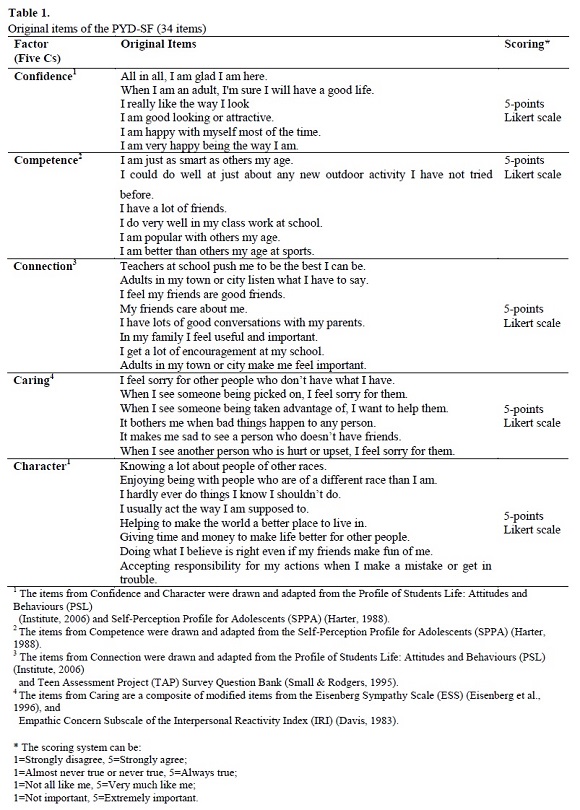
<body><![CDATA[<p>The PYD-SF was translated from the original English version into Portuguese    language (and back translation), and was then revised by a group of specialized    experts within the area. Afterwards the psychometrics properties of the instrument    were examined in terms of the frequency, internal consistency, reliability,    correlation analysis, exploratory factor analysis and confirmatory factor analysis.  </p>     <p><b> </b><b>Measures</b>    <br>   <b> </b>Detailed information concerning the measures of the PYD-SF is described    in <a href="#t1">Table 1</a>.</p>     <p>&nbsp;</p>     <p align="center"><a name="t1"></a><img src="/img/revistas/psd/v19n3/19n3a01t1.jpg"/></p>     
<p>&nbsp;</p>     <p><i>Data analysis</i></p>     <p>Data from <i>Limesurvey</i> was transferred to an electronic data file. All    variables were checked for data inaccuracy by running SPSS frequencies, and    afterwards, an analysis on missing values was conducted. Descriptive analysis    (means, standard deviation and percentage) were used to characterize the sample.    All data were tested for normality prior to any analyses using Kolmogorov-Smirnov    tests, as well as Levene's test for the homogeneity of the variance. To examine    the factor structure of the PYD-SF, Exploratory Factor Analysis (EFA) with Maximum    Likelihood Estimation and Oblimin rotation was used. The Kaiser-Guttman rule    was used to retain factors with eigenvalues of &#8805;1.00. Cronbach&rsquo;s alpha    was computed to examine internal consistency of the PYD-SF dimensions (Five    Cs). </p>     <p>A Confirmatory Factorial Analysis (CFA) was performed to confirm the Five Cs    structure of the PYD-SF. The Maximum Estimation procedure was used to derive    parameter estimates in PYD-SF model. The analysis were performed on the covariance    matrix. For model identification purposes, a scale was assigned for each latent    variable by setting one of its factor loadings to unity. Multiple fit indexes    were used to evaluate goodness of fit of models tested in the study: chi-square    statistics (&#967;<sup>2</sup>), comparative fit index (CFI), non-normed fit    index (NNFI), root mean square error of approximation (RMSEA), and standardized    root mean squared residual (SRMR). The cross validity of the model was formally    tested for measure and structural invariance between the two split halves of    the sample. The analyses were conducted using the SPSS 24.0 (Statistical Package    for Social Sciences) and the Structural Equation Modelling with software AMOS    24.0. The significance level was set at p&lt;0.05.</p>     <p><b>Results</b>    ]]></body>
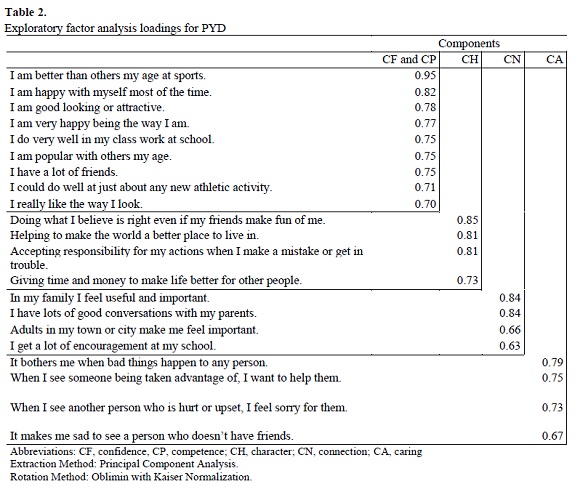
<body><![CDATA[<br>   <b> </b><i>Exploratory factor analysis</i></p>     <p>Data from the 34 items were subjected to an Exploratory Factor Analysis (EFA).    The Maximum Likelihood extraction with Oblimin Rotation produced a nine-factor    solution based on eigenvalues greater than 1, and accounted for 68.08% of the    explained variance. The Kaiser-Meyer-Olkin (KMO) measure of sampling adequacy    was satisfactory (KMO=0.84). Bartlett&rsquo;s test of sphericity (&#967;2(561)=47618.85,    p&lt;0.001) indicated that items correlation were sufficiently large for factor    analysis (Field, 2013). Although the EFA resulted in a nine-factor solution,    Lerner&rsquo;s theory defined the existence of 5 dimensions, considered the Five Cs    (Lerner et al., 2013; Lerner et al., 2011). The obtained solution in the present    study showed that the items were not well represented according to Lerner&rsquo;s    theory and were spread between nine-factors. Thus, an effort was made to maintain    the Five Cs defined in the theory.</p>     <p>Three items with communalities lower than 0.50 were subsequently removed, and    an analysis to assess the internal consistency of each dimension (Chronbach&rsquo;s    Alpha) was run. The analysis showed that the deletion of the items with a worse    representation would increase the Alpha values, in each dimension. Therefore,    ten items were deleted. With the remaining 21 items, another EFA was performed.    The Maximum Likelihood extraction with Oblimin Rotation produced a four-factor    solution based on eigenvalues greater than 1, and accounted for 60.57% of the    explained variance. The Kaiser-Meyer-Olkin (KMO) measure of sampling adequacy    was good (KMO=0.86). Bartlett&rsquo;s test of sphericity was (&#967;2(210)=27568.67,    p&lt;0.001). Items were considered to have loaded a factor if values exceeded    0.50 and were considered uniquely loaded if cross-loadings on other factors    were less than 0.50. The first component was named &ldquo;Confidence-Competence&rdquo; and    comprised nine items. The other components were named &ldquo;Character&rdquo;, &ldquo;Connection&rdquo;    and &ldquo;Caring&rdquo;, each one consisting of four items. The exploratory factor analysis    loadings for PYD are presented in <a href="#t2">Table 2</a>.</p>     <p>&nbsp;</p>     <p align="center"><a name="t2"></a><img src="/img/revistas/psd/v19n3/19n3a01t2.jpg"/></p>     
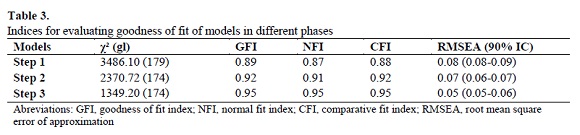
<p>&nbsp;</p>     <p><i>Internal Consistency</i></p>     <p><i> </i>To further examine the reliability of the items reflecting the PYD    components, Cronbach&rsquo;s Alpha was computed for each component. For such analysis    and despite the four-factor solution, that has been obtained in previous analysis,    the authors decided to have a conservative approach, maintaining the Five Cs    structure based on Lerner&rsquo;s theory (Lerner, Phelps, Forman, &amp; Bowers, 2009;    Lerner et al., 2013; Lerner et al., 2011). This means that the factor &ldquo;Confidence-Competence&rdquo;    was divided into two separated components, respectively &ldquo;Confidence&rdquo; and &ldquo;Competence&rdquo;.    &ldquo;Confidence&rdquo; had an internal consistency of &#945;=0.83, &ldquo;Competence&rdquo; &#945;=0.87,    &ldquo;Character&rdquo; &#945;=0.82, &ldquo;Connection&rdquo; &#945;=0.74, &ldquo;Caring&rdquo; &#945;=0.74. Considering    that each component included four and one of them included five items, the internal    consistencies can be considered as adequate.</p>     <p><i>Confirmatory factor analysis</i></p>     <p>In a separate analysis, a CFA was conducted on data from the 2700 participants.    Multiple fit indexes were used as guides to evaluate goodness of fit of models    tested in the study (&#967;2, GFI, NFI, CFI and RMSEA). The fit indices for    both the original and modified models are showed in <a href="#t3">table 3</a>.    The fit indices of the original model were indicative of a poor fitting model    (&#967;2(179)=3486.10; GFI=0.89; NFI=0.87; CFI=0.88; and RMSEA=0.08, CI(RMSEA)=0.08-0.09).    Modification indices were examined, and model fit was improved by adding arrows    between the highest error&rsquo;s covariance in each dimension. Although the Chi-Square    values remained poor, the model fit generally improved (&#967;2(174)=2370.72;    GFI=0.92; NFI=0.91; CFI=0.92; and RMSEA=0.07, CI(RMSEA)=0.06-0.07). Based on    modification indices, the error&rsquo;s covariance among items were inspected again.    The modification indices suggested that one item from Competence was also saturated    in Confidence and also showed a higher error covariance with other items from    the Confidence and Competence. Thus, this item was deleted and the resulting    CFA displayed acceptable model fit (&#967;2(174)=1349.20; GFI=0.95; NFI=0.95;    CFI=0.95; and RMSEA=0.05, CI(RMSEA)=0.05-0.06). The &#967;2/df values remained    poor, however, &#967;2/df is not considered to be a useful fit index (Hayduk,    Cummings, Boadu, Pazderka-Robinson, &amp; Boulianne, 2007), because it is affected    by the sample size and the distribution of variables. The indices for evaluating    goodness of fit of the models in the different phases are presented in <a href="#t3">Table    3</a>.</p>     ]]></body>
<body><![CDATA[<p>&nbsp;</p>     <p align="center"><a name="t3"></a><img src="/img/revistas/psd/v19n3/19n3a01t3.jpg"/></p>     
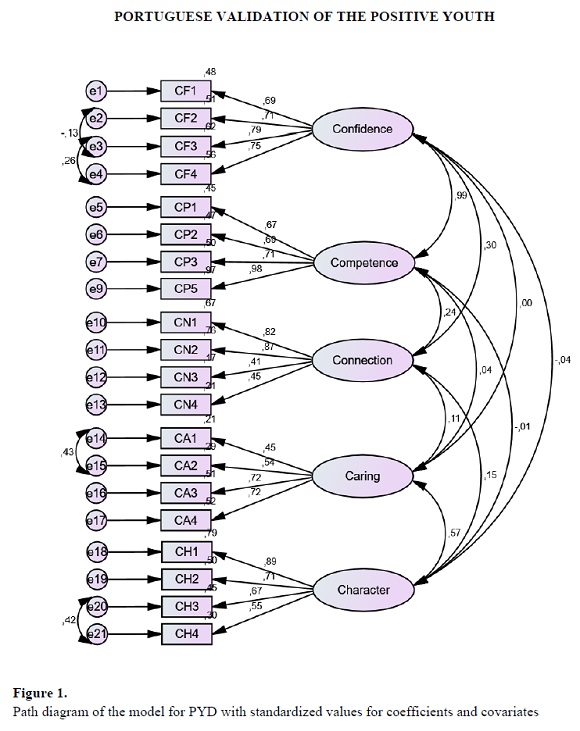
<p>&nbsp;</p>     <p>The composite reliability of the factors was high for the following C components:    Confidence (0.83), Competence (0.85), Character (0.82); and adequate for the    following C components: Connection (0.74) and Caring (0.74). The discriminant    validity of the factors was tested by the comparing the average variance extracted    with the squared correlation among factors. The factors showed discriminant    validity between each other, with the exception of the C&rsquo;s Confidence and Competence.    The relation between Confidence and Competence had been already observed in    the EFA. In the current analysis, these two Cs were not found to be separate    components or factors, although theoretically two constructs surfaced in Lerner&rsquo;s    theory. Aiming to maintain theoretical coherence and to preserve the structure    as close as possible to the original, Confidence and Competence were retained    as two constructs, even though they had no discriminating validity.</p>     <p>The final model is shown in <a href="#f1">Figure 1</a>. </p>     <p>&nbsp;</p>     <p align="center"><a name="f1"></a><img src="/img/revistas/psd/v19n3/19n3a01f1.jpg"/></p>     
<p>&nbsp;</p>     <p>In order to cross validate the results, measurement and structural invariance    were tested on the two split halves of the sample. To test for measurement invariance,    the formal structure from the calibration of the final standardized solution    was examined. Fit indices for this multi-group model were good, thus proving    its validity for interpreting the PYD model (&#967;2(310)=2079.08; GFI=0.93;    NFI=0.92; CFI=0.93; and RMSEA=0.05, CI(RMSEA)=0.04-0.05). </p>     <p>Afterwards, a psychometric analysis for internal consistency was performed    and the following Cronbach&rsquo;s Alphas were achieved: &#945;=0.83 for Confidence,    &#945;=0.85 for Competence, &#945;=0.74 for Connection, &#945;=0.74 for Caring,    &#945;=0.82 for Character, and &#945;=0.83 for the total PYD score. These values    were in line with the coefficient of internal consistency obtained in the original    Portuguese PYD-SF (34 items), specifically &#945;=0.77 for Confidence, &#945;=0.86    for Competence, &#945;=0.80 for Connection, &#945;=0.77 for Caring, &#945;=0.67    for Character, and &#945;=0.87 for the total PYD score. The final shorten version    of the PYD-SF (20 items) in Portuguese can be found in the Supplementary File    1.</p>     ]]></body>
<body><![CDATA[<p><b>Discussion</b>    <br>   <b> </b>The purpose of this paper was to examine the psychometric properties    of an assessment scale use to address the concept of PYD (PYD Short Form, PYD-SF)    and its validation in a Portuguese sample. The research was conducted with a    sample of 2700 university students with a mean age of 21.3 years old. </p>     <p>Throughout the past century, the study of young people has been essentially    outlined by a &ldquo;deficit perspective&rdquo; (Geldhof et al., 2014; Moore, Lippman, &amp;    Brown, 2004). However, in the last two decades, the study of positive indicators    of child well-being have significantly improved (Lippman, Moore, &amp; McIntosh,    2011). This current study was based on a theoretically structure of PYD categorized    into Five Cs: Confidence, Competence, Connection, Caring and Character, and    an EFA, a CFA and an analysis on internal consistency were conducted. These    analyses examined, empirically tested and confirmed the tenability of a higher-order    factor structure of the PYD-SF and also allowed to reduce the length of the    scale. </p>     <p>Data from the 34 items PYD-SF were subjected to EFA and a good nine-factor    solution was obtained, instead of the components of PYD. Making an effort to    keep in line with the theoretical perspective, communalities of the items were    computed, items were deleted and EFA was run on the remaining 21 items. A good    four-factor solution was obtained. Items were considered loaded to have loaded    onto a factor if factor loading exceeded 0.50 and were considered uniquely loaded    if cross-loadings on other factors were less than 0.50. To further examine the    reliability of the items comprising the PYD components, Cronbach&rsquo;s Alpha was    computed for each component and all the components showed an adequate internal    consistency. Based on the results from the aforementioned analyses, the authors    decided to have a conservative approach by maintaining the Five Cs structure.    Thus, the factor &ldquo;Confidence-Competence&rdquo; in the four-factor model was divided    into two separated components, &ldquo;Confidence&rdquo; and &ldquo;Competence&rdquo;.</p>     <p>Next, a CFA was performed and multiple fit indexes were used as guides to evaluate    goodness of fit of the models that were tested. Here, one more item was deleted    and the resulting CFA displayed an acceptable model fit. The RMSEA was equal    to 0.05, the upper limit of 90% confidence interval was lower than .04, and    CFI was higher than 0.90. The composite reliability of the factors demonstrated    to be high (&#8805;0.70) for all the five Cs.</p>     <p>Afterwards, internal consistency was examined and the Cronbach&rsquo;s Alphas (&#8805;0.74)    that were achieved for the Five Cs and for the total PYD score, were comparable    to those obtained in the original Portuguese PYD-SF (34 items). In addition,    similar statistical analysis that were previously run on the PYD-SF (34 items)    regarding gender, age, and socioeconomic status (SES) (Matos, Santos, &amp;    Reis, 2017) were repeated on the reduced version of PYD-SF (20 items), and similar    results were found and will be target in a future publication. </p>     <p>The results confirm a model with a five-factor structure, like the one obtained    in the original PYD-SF scale, but at the same time present a shortened version    with 20 items that have adequate psychometric properties and appears to reflect    a valid, reliable and sensitive instrument to estimate PYD in Portuguese youths.    Compared to the version with 34 items version, to have a shorter version of    20 items can represent a major advantage for its administration in larger population    samples, constituting an interesting option for professionals, because it can    be more cost-effective. It is expected in the future, that comparisons of instruments    from the several countries included in the cross-national PYD project can be    done. </p>     <p>Moreover, it is suggested that to have data on PYD in youths through a reliable    instrument is one of the key issues to implement strength-based approaches that    have been found to be empowering and effective in various contexts (Benson et    al., 2006). In addition, it may also help health and education policy makers    to prevent youth problems and promote their health (Small &amp; Memmo, 2004).</p>     <p><i>Limitations and Strengths</i></p>     <p><b> </b>Despite the attempt to ensure the psychometric quality of the PYD-SF,    this study has some limitations. First, in spite of the confirmation of the    Five Cs structure, the original items were retrieved from multiple instrument    sources and accordingly were scored using different metrics. In the present    PYD-SF (34 items) scale an attempt to reduce this limitation was achieved by    finding a standardized score system for all items in a 5-point Likert scale,    in line with the literature suggestion (Geldorf et al., 2014). Second, the non-representativeness    of the sample and the cross-sectional study design can limit the extent to which    the findings of the present study can be generalized. In addition, the sample    consisted of youths from 16 to 26 years old and the results might differ across    gender ad age groups if these multi-group analyses were done. These issues are    to be addressed in the future.</p>     ]]></body>
<body><![CDATA[<p>Nevertheless, this study has numerous strengths. First, it makes use of a reliable    and valid instrument to assess PYD in Portuguese youths, which provides innovation    and novelty in this area, constituting a pioneer initiative in Portugal. Second,    its inclusion in a cross-national project allows the study of cultural diversity    and the possibility to learn about the process of validation in the other countries.    Third, to have a short, reliable and valid instrument to measure PYD (20 items)    can be a major advantage due to its ease of administration in large population    studies. </p>     <p>The PYD perspective is being increasingly adopted by researchers of youth development,    developmental scientists, youth-services and policy makers. Therefore, it is    crucial to have a valid, objective and reliable instruments to measure youth    positive development, with good psychometric properties. The short PYD version    (20 items) presented in this study provide this instrument to assess youth&rsquo;s    positive attributes that are categorized in the Five Cs. It is highlighted that    this short version can be easily administrated by researchers and practitioners    in several contexts, aiming to improve the scientific knowledge on the area    of youth development, and also the implementation of more effective interventions    for youths as well as creating a more solid basis for public policies. It is    expected that such information may actively contribute to facilitate and encourage    the necessary shift of approach in youth care services: from a perspective focused    on deficits and difficulties, towards a viewpoint that focuses on possibilities    and opportunities for youths to develop their full potential. </p>     <p>&nbsp;</p>     <p><i> </i><b>REFERENCES</b></p>     <!-- ref --><p><b> </b>Benson, P. L., Leffert, N., Scales, P. C., &amp; Blyth, D. A. (1998).    Beyond the village rhetoric: Creating healthy communities for children and adolescents.    <i>Applied Developmental Science, 2</i>, 138-159.    &nbsp;&nbsp;&nbsp;&nbsp;&nbsp;&nbsp;&nbsp;&nbsp;[&#160;<a href="javascript:void(0);" onclick="javascript: window.open('/scielo.php?script=sci_nlinks&ref=557474&pid=S1645-0086201800030000100001&lng=','','width=640,height=500,resizable=yes,scrollbars=1,menubar=yes,');">Links</a>&#160;]<!-- end-ref --></p>     <!-- ref --><p>Benson, P. L., Scales, P. C., Hamilton, S. F., &amp; Sesma, A. (2006). Positive    youth development: Theory, research and application. In W. Damon &amp; R. M.    Lerner (Eds.), <i>Handbook of child psychology,</i> (pp. 894-941). New York:    Wiley.    &nbsp;&nbsp;&nbsp;&nbsp;&nbsp;&nbsp;&nbsp;&nbsp;[&#160;<a href="javascript:void(0);" onclick="javascript: window.open('/scielo.php?script=sci_nlinks&ref=557476&pid=S1645-0086201800030000100002&lng=','','width=640,height=500,resizable=yes,scrollbars=1,menubar=yes,');">Links</a>&#160;]<!-- end-ref --></p>     <!-- ref --><p>Bowers, E. P., Li, Y., Kiely, M. K., Brittian, A., Lerner, J. V., &amp; Lerner,    R. M. (2010). The Five Cs model of positive youth development: a longitudinal    analysis of confirmatory factor structure and measurement invariance. <i>J Youth    Adolesc, 39</i>(7), 720-735.    &nbsp;&nbsp;&nbsp;&nbsp;&nbsp;&nbsp;&nbsp;&nbsp;[&#160;<a href="javascript:void(0);" onclick="javascript: window.open('/scielo.php?script=sci_nlinks&ref=557478&pid=S1645-0086201800030000100003&lng=','','width=640,height=500,resizable=yes,scrollbars=1,menubar=yes,');">Links</a>&#160;]<!-- end-ref --></p>     ]]></body>
<body><![CDATA[<!-- ref --><p>Busseri, M. A., &amp; Rose-Krasnor, L. (2009). Breadth and intensity: salient,    separable, and developmentally significant dimensions of structured youth activity    involvement. <i>Br J Dev Psychol, 27</i>(Pt 4), 907-933.    &nbsp;&nbsp;&nbsp;&nbsp;&nbsp;&nbsp;&nbsp;&nbsp;[&#160;<a href="javascript:void(0);" onclick="javascript: window.open('/scielo.php?script=sci_nlinks&ref=557480&pid=S1645-0086201800030000100004&lng=','','width=640,height=500,resizable=yes,scrollbars=1,menubar=yes,');">Links</a>&#160;]<!-- end-ref --></p>     <!-- ref --><p>Catalano, R. F., Berglund, M. L., Ryan, J. A. M., Lonczak, H. S., &amp; Hawkins,    J. D. (2004). Positive youth development in the United States: Research findings    on evaluations of positive youth development programs. <i>Annals of the American    Academy of Political and Social Science, 591</i>, 98-124.    &nbsp;&nbsp;&nbsp;&nbsp;&nbsp;&nbsp;&nbsp;&nbsp;[&#160;<a href="javascript:void(0);" onclick="javascript: window.open('/scielo.php?script=sci_nlinks&ref=557482&pid=S1645-0086201800030000100005&lng=','','width=640,height=500,resizable=yes,scrollbars=1,menubar=yes,');">Links</a>&#160;]<!-- end-ref --></p>     <!-- ref --><p>Davis, M. (1980). A multidimensional approach to individual differences in    empathy. <i>Catalog of Selected Documents in Psychology, 10</i>(4), 1-17.    &nbsp;&nbsp;&nbsp;&nbsp;&nbsp;&nbsp;&nbsp;&nbsp;[&#160;<a href="javascript:void(0);" onclick="javascript: window.open('/scielo.php?script=sci_nlinks&ref=557484&pid=S1645-0086201800030000100006&lng=','','width=640,height=500,resizable=yes,scrollbars=1,menubar=yes,');">Links</a>&#160;]<!-- end-ref --></p>     <!-- ref --><p>Eisenberg, N., Fabes, R. A., Murphy, B., Karbon, M., Smith, M., &amp; Maszk,    P. (1996). The relations of children's dispositional empathy-related responding    to their emotionality, regulation, and social functioning. <i>Developmental    Psychology, 32</i>(2), 195-209.    &nbsp;&nbsp;&nbsp;&nbsp;&nbsp;&nbsp;&nbsp;&nbsp;[&#160;<a href="javascript:void(0);" onclick="javascript: window.open('/scielo.php?script=sci_nlinks&ref=557486&pid=S1645-0086201800030000100007&lng=','','width=640,height=500,resizable=yes,scrollbars=1,menubar=yes,');">Links</a>&#160;]<!-- end-ref --></p>     <!-- ref --><p>Field, A. (2013). <i>Discovering statistics using IBM SPSS statistics</i> (4th    ed.). London: Sage.    &nbsp;&nbsp;&nbsp;&nbsp;&nbsp;&nbsp;&nbsp;&nbsp;[&#160;<a href="javascript:void(0);" onclick="javascript: window.open('/scielo.php?script=sci_nlinks&ref=557488&pid=S1645-0086201800030000100008&lng=','','width=640,height=500,resizable=yes,scrollbars=1,menubar=yes,');">Links</a>&#160;]<!-- end-ref --></p>     ]]></body>
<body><![CDATA[<!-- ref --><p>Geldhof, G. J., Bowers, E. P., Boyd, M. J., Mueller, M. K., Napolitano, C.    M., Schmid, K. L., . . . Lerner, R. M. (2014). Creation of short and very short    measures of the five Cs of positive youth development. <i>Journal of Research    on Adolescence, 24</i>(1), 163-176.    &nbsp;&nbsp;&nbsp;&nbsp;&nbsp;&nbsp;&nbsp;&nbsp;[&#160;<a href="javascript:void(0);" onclick="javascript: window.open('/scielo.php?script=sci_nlinks&ref=557490&pid=S1645-0086201800030000100009&lng=','','width=640,height=500,resizable=yes,scrollbars=1,menubar=yes,');">Links</a>&#160;]<!-- end-ref --></p>     <p>Harter, S. (1988). <i>Manual for the self-perception profile for adolescents    (SPPA)</i>. Denver, CO: University of Denver.</p>     <!-- ref --><p>Hayduk, L., Cummings, G., Boadu, K., Pazderka-Robinson, H., &amp; Boulianne,    S. (2007). Testing! testing! one, two, three - Testing the theory in structural    equation models! <i>Personality and Individual Differences, 42</i>(5), 841-850.    &nbsp;&nbsp;&nbsp;&nbsp;&nbsp;&nbsp;&nbsp;&nbsp;[&#160;<a href="javascript:void(0);" onclick="javascript: window.open('/scielo.php?script=sci_nlinks&ref=557493&pid=S1645-0086201800030000100011&lng=','','width=640,height=500,resizable=yes,scrollbars=1,menubar=yes,');">Links</a>&#160;]<!-- end-ref --></p>     <p>Institute, S. (2006). <i>40 development assents for adolescents</i>. Minneapolis,    MN: Search Institute.</p>     <!-- ref --><p>Jelicic, H., Bobek, D. L., Phelps, E., Lerner, R. M., &amp; Lerner, J. V. (2007).    Using positive youth development to predict contribution and risk behaviors    in early adolescence: Findings from the first two waves of the 4-H study of    positive youth development. <i>International Journal of Behavioral Development,    31</i>(3), 263-273.    &nbsp;&nbsp;&nbsp;&nbsp;&nbsp;&nbsp;&nbsp;&nbsp;[&#160;<a href="javascript:void(0);" onclick="javascript: window.open('/scielo.php?script=sci_nlinks&ref=557496&pid=S1645-0086201800030000100013&lng=','','width=640,height=500,resizable=yes,scrollbars=1,menubar=yes,');">Links</a>&#160;]<!-- end-ref --></p>     <p>Lerner, J. V., Bowers, E. P., Minor, K., Boyd, M. J., Mueller, M. K., Schmid,    K. L., . . . Lerner, R. M. (2013). Positive youth development: processes, philosophies,    and programs. In R. M. Lerner, M. A. Easterbrooks &amp; J. Mistry (Eds.), <i>Handbook    of psychology, volume 6: Developmental Psychology</i> (pp. 365-392). Hoboken,    NJ: Wiley.</p>     <!-- ref --><p>Lerner, R. M., Lerner, J. V., Almerigi, J. B., Theokas, C., Phelps, E., Gestsdottir,    S., . . . von Eye, A. (2005). Positive Youth Development, participation in community    youth development programs, and community contributions of fifth-grade adolescents:    Findings from the first wave of the 4-H study of positive youth development.    <i>Journal of Early Adolescence, 25</i>(1), 17-71.    &nbsp;&nbsp;&nbsp;&nbsp;&nbsp;&nbsp;&nbsp;&nbsp;[&#160;<a href="javascript:void(0);" onclick="javascript: window.open('/scielo.php?script=sci_nlinks&ref=557499&pid=S1645-0086201800030000100015&lng=','','width=640,height=500,resizable=yes,scrollbars=1,menubar=yes,');">Links</a>&#160;]<!-- end-ref --></p>     <!-- ref --><p>Lerner, R. M., Lerner, J. V., Lewin-Bizan, S., Bowers, E. P., Boyd, M., Mueller,    M., . . . Napolitano, C. (2011). Positive youth development: Processes, programs,    and problematics. <i>Journal of Youth Development, 6</i>(3), 40-64.    &nbsp;&nbsp;&nbsp;&nbsp;&nbsp;&nbsp;&nbsp;&nbsp;[&#160;<a href="javascript:void(0);" onclick="javascript: window.open('/scielo.php?script=sci_nlinks&ref=557501&pid=S1645-0086201800030000100016&lng=','','width=640,height=500,resizable=yes,scrollbars=1,menubar=yes,');">Links</a>&#160;]<!-- end-ref --></p>     <!-- ref --><p>Lerner, R. M., Wang, J., Chase, P. A., Gutierrez, A. S., Harris, E. M., Rubin,    R. O., &amp; Yalin, C. (2014). Using relational developmental systems theory    to link program goals, activities, and outcomes: The sample case of the 4-H    study of positive youth development. <i>New Directions for Youth Development,    144</i>, 17-30.    &nbsp;&nbsp;&nbsp;&nbsp;&nbsp;&nbsp;&nbsp;&nbsp;[&#160;<a href="javascript:void(0);" onclick="javascript: window.open('/scielo.php?script=sci_nlinks&ref=557503&pid=S1645-0086201800030000100017&lng=','','width=640,height=500,resizable=yes,scrollbars=1,menubar=yes,');">Links</a>&#160;]<!-- end-ref --></p>     <!-- ref --><p>Lippman, L. H., Moore, K. A., &amp; McIntosh, H. (2011). Positive Indicators    of Child Well-Being: A Conceptual Framework, Measures, and Methodological Issues.    <i>Applied Research in Quality of Life, 6</i>(4), 425-449.    &nbsp;&nbsp;&nbsp;&nbsp;&nbsp;&nbsp;&nbsp;&nbsp;[&#160;<a href="javascript:void(0);" onclick="javascript: window.open('/scielo.php?script=sci_nlinks&ref=557505&pid=S1645-0086201800030000100018&lng=','','width=640,height=500,resizable=yes,scrollbars=1,menubar=yes,');">Links</a>&#160;]<!-- end-ref --></p>     <!-- ref --><p>Matos, M. G., Santos, T., &amp; Reis, M. (2017). <i>BePositive project: Positive    Youth Development (PYD) in adolescents. Portuguese report</i>. Saarbrucken:    Lambert Academic Publishing.    &nbsp;&nbsp;&nbsp;&nbsp;&nbsp;&nbsp;&nbsp;&nbsp;[&#160;<a href="javascript:void(0);" onclick="javascript: window.open('/scielo.php?script=sci_nlinks&ref=557507&pid=S1645-0086201800030000100019&lng=','','width=640,height=500,resizable=yes,scrollbars=1,menubar=yes,');">Links</a>&#160;]<!-- end-ref --></p>     <!-- ref --><p>Moore, K. A., Lippman, L., &amp; Brown, B. (2004). Indicators of child well-being:    The promise for positive youth development. <i>Annals of the American Academy    of Political and Social Science, 591</i>, 125-145.    &nbsp;&nbsp;&nbsp;&nbsp;&nbsp;&nbsp;&nbsp;&nbsp;[&#160;<a href="javascript:void(0);" onclick="javascript: window.open('/scielo.php?script=sci_nlinks&ref=557509&pid=S1645-0086201800030000100020&lng=','','width=640,height=500,resizable=yes,scrollbars=1,menubar=yes,');">Links</a>&#160;]<!-- end-ref --></p>     <!-- ref --><p>Scales, P. C. (2011). Youth developmental assets in global perspective: results    from international adaptations of the developmental assets profile. <i>Child    Indicators Research, 4</i>(4), 619-645.    &nbsp;&nbsp;&nbsp;&nbsp;&nbsp;&nbsp;&nbsp;&nbsp;[&#160;<a href="javascript:void(0);" onclick="javascript: window.open('/scielo.php?script=sci_nlinks&ref=557511&pid=S1645-0086201800030000100021&lng=','','width=640,height=500,resizable=yes,scrollbars=1,menubar=yes,');">Links</a>&#160;]<!-- end-ref --></p>     <!-- ref --><p>Small, S., &amp; Memmo, M. (2004). Contemporary models of youth development    and problem prevention: Toward an integration of terms, concepts, and models.    <i>Family Relations, 53</i>(1), 3-11.    &nbsp;&nbsp;&nbsp;&nbsp;&nbsp;&nbsp;&nbsp;&nbsp;[&#160;<a href="javascript:void(0);" onclick="javascript: window.open('/scielo.php?script=sci_nlinks&ref=557513&pid=S1645-0086201800030000100022&lng=','','width=640,height=500,resizable=yes,scrollbars=1,menubar=yes,');">Links</a>&#160;]<!-- end-ref --></p>     <!-- ref --><p>Small, S. A., &amp; Rodgers, K. B. (1995). <i>Teen Assessment Project (TAP)    survey question bank</i>. Madison: University of Wisconsin-Madison.    &nbsp;&nbsp;&nbsp;&nbsp;&nbsp;&nbsp;&nbsp;&nbsp;[&#160;<a href="javascript:void(0);" onclick="javascript: window.open('/scielo.php?script=sci_nlinks&ref=557515&pid=S1645-0086201800030000100023&lng=','','width=640,height=500,resizable=yes,scrollbars=1,menubar=yes,');">Links</a>&#160;]<!-- end-ref --></p>     <!-- ref --><p>WMA - World Medical Association (2008). <i>World medical association declaration    of Helsinki: Ethical principles for medical research involving human subjects.    </i>Retrieved from <a href="http://www.wma.net/en/20activities/10ethics/10helsinki/" target="_blank">http://www.wma.net/en/20activities/10ethics/10helsinki/</a>&nbsp;&nbsp;&nbsp;&nbsp;&nbsp;&nbsp;&nbsp;&nbsp;[&#160;<a href="javascript:void(0);" onclick="javascript: window.open('/scielo.php?script=sci_nlinks&ref=557517&pid=S1645-0086201800030000100024&lng=','','width=640,height=500,resizable=yes,scrollbars=1,menubar=yes,');">Links</a>&#160;]<!-- end-ref --><p>&nbsp;</p>     <p>Competing interests</p>     ]]></body>
<body><![CDATA[<p><i> </i>None of the authors reported any financial interests or potential conflicts    of interest. </p>     <p>Acknowledgements</p>     <p>A special thanks to all the universities, students, teachers and experts who    participated in this study. To National experts for their collaboration in revising    the methodology and the used instruments. To the HBSC/WHO network (<a href="http://www.hbsc.org/" target="_blank">www.hbsc.org</a>)    whose survey was partially used for this purpose. To Nora Wiium and the other    colleagues from PYD international: <a href="http://www.uib.no/en/rg/sipa/pydcrossnational" target="_blank">http://www.uib.no/en/rg/sipa/pydcrossnational</a>    for all support and inspiration.</p>     <p>&nbsp;</p>     <p>Recebido em 23 de Janeiro de 2018/ Aceite em 25 de Setembro de 2018</p>      ]]></body><back>
<ref-list>
<ref id="B1">
<nlm-citation citation-type="journal">
<person-group person-group-type="author">
<name>
<surname><![CDATA[Benson]]></surname>
<given-names><![CDATA[P. L.]]></given-names>
</name>
<name>
<surname><![CDATA[Leffert]]></surname>
<given-names><![CDATA[N.]]></given-names>
</name>
<name>
<surname><![CDATA[Scales]]></surname>
<given-names><![CDATA[P. C.]]></given-names>
</name>
<name>
<surname><![CDATA[Blyth]]></surname>
<given-names><![CDATA[D. A.]]></given-names>
</name>
</person-group>
<article-title xml:lang="en"><![CDATA[Beyond the village rhetoric: Creating healthy communities for children and adolescents]]></article-title>
<source><![CDATA[Applied Developmental Science]]></source>
<year>1998</year>
<volume>2</volume>
<page-range>138-159</page-range></nlm-citation>
</ref>
<ref id="B2">
<nlm-citation citation-type="book">
<person-group person-group-type="author">
<name>
<surname><![CDATA[Benson]]></surname>
<given-names><![CDATA[P. L.]]></given-names>
</name>
<name>
<surname><![CDATA[Scales]]></surname>
<given-names><![CDATA[P. C.]]></given-names>
</name>
<name>
<surname><![CDATA[Hamilton]]></surname>
<given-names><![CDATA[S. F.]]></given-names>
</name>
<name>
<surname><![CDATA[Sesma]]></surname>
<given-names><![CDATA[A.]]></given-names>
</name>
</person-group>
<article-title xml:lang="en"><![CDATA[Positive youth development: Theory, research and application]]></article-title>
<person-group person-group-type="editor">
<name>
<surname><![CDATA[Damon]]></surname>
<given-names><![CDATA[W.]]></given-names>
</name>
<name>
<surname><![CDATA[Lerner]]></surname>
<given-names><![CDATA[R. M.]]></given-names>
</name>
</person-group>
<source><![CDATA[Handbook of child psychology]]></source>
<year>2006</year>
<page-range>894-941</page-range><publisher-loc><![CDATA[New York ]]></publisher-loc>
<publisher-name><![CDATA[Wiley]]></publisher-name>
</nlm-citation>
</ref>
<ref id="B3">
<nlm-citation citation-type="journal">
<person-group person-group-type="author">
<name>
<surname><![CDATA[Bowers]]></surname>
<given-names><![CDATA[E. P.]]></given-names>
</name>
<name>
<surname><![CDATA[Li]]></surname>
<given-names><![CDATA[Y.]]></given-names>
</name>
<name>
<surname><![CDATA[Kiely]]></surname>
<given-names><![CDATA[M. K.]]></given-names>
</name>
<name>
<surname><![CDATA[Brittian]]></surname>
<given-names><![CDATA[A.]]></given-names>
</name>
<name>
<surname><![CDATA[Lerner]]></surname>
<given-names><![CDATA[J. V.]]></given-names>
</name>
<name>
<surname><![CDATA[Lerner]]></surname>
<given-names><![CDATA[R. M.]]></given-names>
</name>
</person-group>
<article-title xml:lang="en"><![CDATA[The Five Cs model of positive youth development: a longitudinal analysis of confirmatory factor structure and measurement invariance]]></article-title>
<source><![CDATA[J Youth Adolesc]]></source>
<year>2010</year>
<volume>39</volume>
<numero>7</numero>
<issue>7</issue>
<page-range>720-735</page-range></nlm-citation>
</ref>
<ref id="B4">
<nlm-citation citation-type="journal">
<person-group person-group-type="author">
<name>
<surname><![CDATA[Busseri]]></surname>
<given-names><![CDATA[M. A.]]></given-names>
</name>
<name>
<surname><![CDATA[Rose-Krasnor]]></surname>
<given-names><![CDATA[L.]]></given-names>
</name>
</person-group>
<article-title xml:lang="en"><![CDATA[Breadth and intensity: salient, separable, and developmentally significant dimensions of structured youth activity involvement]]></article-title>
<source><![CDATA[Br J Dev Psychol]]></source>
<year>2009</year>
<volume>27</volume>
<numero>Pt 4</numero>
<issue>Pt 4</issue>
<page-range>907-933</page-range></nlm-citation>
</ref>
<ref id="B5">
<nlm-citation citation-type="journal">
<person-group person-group-type="author">
<name>
<surname><![CDATA[Catalano]]></surname>
<given-names><![CDATA[R. F.]]></given-names>
</name>
<name>
<surname><![CDATA[Berglund]]></surname>
<given-names><![CDATA[M. L.]]></given-names>
</name>
<name>
<surname><![CDATA[Ryan]]></surname>
<given-names><![CDATA[J. A. M.]]></given-names>
</name>
<name>
<surname><![CDATA[Lonczak]]></surname>
<given-names><![CDATA[H. S.]]></given-names>
</name>
<name>
<surname><![CDATA[Hawkins]]></surname>
<given-names><![CDATA[J. D.]]></given-names>
</name>
</person-group>
<article-title xml:lang="en"><![CDATA[Positive youth development in the United States: Research findings on evaluations of positive youth development programs]]></article-title>
<source><![CDATA[Annals of the American Academy of Political and Social Science]]></source>
<year>2004</year>
<volume>591</volume>
<page-range>98-124</page-range></nlm-citation>
</ref>
<ref id="B6">
<nlm-citation citation-type="journal">
<person-group person-group-type="author">
<name>
<surname><![CDATA[Davis]]></surname>
<given-names><![CDATA[M.]]></given-names>
</name>
</person-group>
<article-title xml:lang="en"><![CDATA[A multidimensional approach to individual differences in empathy]]></article-title>
<source><![CDATA[Catalog of Selected Documents in Psychology]]></source>
<year>1980</year>
<volume>10</volume>
<numero>4</numero>
<issue>4</issue>
<page-range>1-17</page-range></nlm-citation>
</ref>
<ref id="B7">
<nlm-citation citation-type="journal">
<person-group person-group-type="author">
<name>
<surname><![CDATA[Eisenberg]]></surname>
<given-names><![CDATA[N.]]></given-names>
</name>
<name>
<surname><![CDATA[Fabes]]></surname>
<given-names><![CDATA[R. A.]]></given-names>
</name>
<name>
<surname><![CDATA[Murphy]]></surname>
<given-names><![CDATA[B.]]></given-names>
</name>
<name>
<surname><![CDATA[Karbon]]></surname>
<given-names><![CDATA[M.]]></given-names>
</name>
<name>
<surname><![CDATA[Smith]]></surname>
<given-names><![CDATA[M.]]></given-names>
</name>
<name>
<surname><![CDATA[Maszk]]></surname>
<given-names><![CDATA[P.]]></given-names>
</name>
</person-group>
<article-title xml:lang="en"><![CDATA[The relations of children's dispositional empathy-related responding to their emotionality, regulation, and social functioning]]></article-title>
<source><![CDATA[Developmental Psychology]]></source>
<year>1996</year>
<volume>32</volume>
<numero>2</numero>
<issue>2</issue>
<page-range>195-209</page-range></nlm-citation>
</ref>
<ref id="B8">
<nlm-citation citation-type="book">
<person-group person-group-type="author">
<name>
<surname><![CDATA[Field]]></surname>
<given-names><![CDATA[A.]]></given-names>
</name>
</person-group>
<source><![CDATA[Discovering statistics using IBM SPSS statistics]]></source>
<year>2013</year>
<edition>4</edition>
<publisher-loc><![CDATA[London ]]></publisher-loc>
<publisher-name><![CDATA[Sage]]></publisher-name>
</nlm-citation>
</ref>
<ref id="B9">
<nlm-citation citation-type="journal">
<person-group person-group-type="author">
<name>
<surname><![CDATA[Geldhof]]></surname>
<given-names><![CDATA[G. J.]]></given-names>
</name>
<name>
<surname><![CDATA[Bowers]]></surname>
<given-names><![CDATA[E. P.]]></given-names>
</name>
<name>
<surname><![CDATA[Boyd]]></surname>
<given-names><![CDATA[M. J.]]></given-names>
</name>
<name>
<surname><![CDATA[Mueller]]></surname>
<given-names><![CDATA[M. K.]]></given-names>
</name>
<name>
<surname><![CDATA[Napolitano]]></surname>
<given-names><![CDATA[C. M.]]></given-names>
</name>
<name>
<surname><![CDATA[Schmid]]></surname>
<given-names><![CDATA[K. L.]]></given-names>
</name>
<name>
<surname><![CDATA[Lerner]]></surname>
<given-names><![CDATA[R. M.]]></given-names>
</name>
</person-group>
<article-title xml:lang="en"><![CDATA[Creation of short and very short measures of the five Cs of positive youth development]]></article-title>
<source><![CDATA[Journal of Research on Adolescence]]></source>
<year>2014</year>
<volume>24</volume>
<numero>1</numero>
<issue>1</issue>
<page-range>163-176</page-range></nlm-citation>
</ref>
<ref id="B10">
<nlm-citation citation-type="book">
<person-group person-group-type="author">
<name>
<surname><![CDATA[Harter]]></surname>
<given-names><![CDATA[S.]]></given-names>
</name>
</person-group>
<source><![CDATA[Manual for the self-perception profile for adolescents (SPPA)]]></source>
<year>1988</year>
<publisher-loc><![CDATA[Denver ]]></publisher-loc>
<publisher-name><![CDATA[University of Denver]]></publisher-name>
</nlm-citation>
</ref>
<ref id="B11">
<nlm-citation citation-type="journal">
<person-group person-group-type="author">
<name>
<surname><![CDATA[Hayduk]]></surname>
<given-names><![CDATA[L.]]></given-names>
</name>
<name>
<surname><![CDATA[Cummings]]></surname>
<given-names><![CDATA[G.]]></given-names>
</name>
<name>
<surname><![CDATA[Boadu]]></surname>
<given-names><![CDATA[K.]]></given-names>
</name>
<name>
<surname><![CDATA[Pazderka-Robinson]]></surname>
<given-names><![CDATA[H.]]></given-names>
</name>
<name>
<surname><![CDATA[Boulianne]]></surname>
<given-names><![CDATA[S.]]></given-names>
</name>
</person-group>
<article-title xml:lang="en"><![CDATA[Testing! testing! one, two, three: Testing the theory in structural equation models!]]></article-title>
<source><![CDATA[Personality and Individual Differences]]></source>
<year>2007</year>
<volume>42</volume>
<numero>5</numero>
<issue>5</issue>
<page-range>841-850</page-range></nlm-citation>
</ref>
<ref id="B12">
<nlm-citation citation-type="book">
<person-group person-group-type="author">
<name>
<surname><![CDATA[Institute]]></surname>
<given-names><![CDATA[S.]]></given-names>
</name>
</person-group>
<source><![CDATA[40 development assents for adolescents]]></source>
<year>2006</year>
<publisher-loc><![CDATA[Minneapolis ]]></publisher-loc>
<publisher-name><![CDATA[Search Institute]]></publisher-name>
</nlm-citation>
</ref>
<ref id="B13">
<nlm-citation citation-type="journal">
<person-group person-group-type="author">
<name>
<surname><![CDATA[Jelicic]]></surname>
<given-names><![CDATA[H.]]></given-names>
</name>
<name>
<surname><![CDATA[Bobek]]></surname>
<given-names><![CDATA[D. L.]]></given-names>
</name>
<name>
<surname><![CDATA[Phelps]]></surname>
<given-names><![CDATA[E.]]></given-names>
</name>
<name>
<surname><![CDATA[Lerner]]></surname>
<given-names><![CDATA[R. M.]]></given-names>
</name>
<name>
<surname><![CDATA[Lerner]]></surname>
<given-names><![CDATA[J. V.]]></given-names>
</name>
</person-group>
<article-title xml:lang="en"><![CDATA[Using positive youth development to predict contribution and risk behaviors in early adolescence: Findings from the first two waves of the 4-H study of positive youth development]]></article-title>
<source><![CDATA[International Journal of Behavioral Development]]></source>
<year>2007</year>
<volume>31</volume>
<numero>3</numero>
<issue>3</issue>
<page-range>263-273</page-range></nlm-citation>
</ref>
<ref id="B14">
<nlm-citation citation-type="book">
<person-group person-group-type="author">
<name>
<surname><![CDATA[Lerner]]></surname>
<given-names><![CDATA[J. V.]]></given-names>
</name>
<name>
<surname><![CDATA[Bowers]]></surname>
<given-names><![CDATA[E. P.]]></given-names>
</name>
<name>
<surname><![CDATA[Minor]]></surname>
<given-names><![CDATA[K.]]></given-names>
</name>
<name>
<surname><![CDATA[Boyd]]></surname>
<given-names><![CDATA[M. J.]]></given-names>
</name>
<name>
<surname><![CDATA[Mueller]]></surname>
<given-names><![CDATA[M. K.]]></given-names>
</name>
<name>
<surname><![CDATA[Schmid]]></surname>
<given-names><![CDATA[K. L.]]></given-names>
</name>
<name>
<surname><![CDATA[Lerner]]></surname>
<given-names><![CDATA[R. M.]]></given-names>
</name>
</person-group>
<article-title xml:lang="en"><![CDATA[Positive youth development: processes, philosophies, and programs]]></article-title>
<person-group person-group-type="editor">
<name>
<surname><![CDATA[Lerner]]></surname>
<given-names><![CDATA[R. M.]]></given-names>
</name>
<name>
<surname><![CDATA[Easterbrooks]]></surname>
<given-names><![CDATA[M. A.]]></given-names>
</name>
<name>
<surname><![CDATA[Mistry]]></surname>
<given-names><![CDATA[J.]]></given-names>
</name>
</person-group>
<source><![CDATA[Handbook of psychology, volume 6: Developmental Psychology]]></source>
<year>2013</year>
<page-range>365-392</page-range><publisher-loc><![CDATA[Hoboken ]]></publisher-loc>
<publisher-name><![CDATA[Wiley]]></publisher-name>
</nlm-citation>
</ref>
<ref id="B15">
<nlm-citation citation-type="journal">
<person-group person-group-type="author">
<name>
<surname><![CDATA[Lerner]]></surname>
<given-names><![CDATA[R. M.]]></given-names>
</name>
<name>
<surname><![CDATA[Lerner]]></surname>
<given-names><![CDATA[J. V.]]></given-names>
</name>
<name>
<surname><![CDATA[Almerigi]]></surname>
<given-names><![CDATA[J. B.]]></given-names>
</name>
<name>
<surname><![CDATA[Theokas]]></surname>
<given-names><![CDATA[C.]]></given-names>
</name>
<name>
<surname><![CDATA[Phelps]]></surname>
<given-names><![CDATA[E.]]></given-names>
</name>
<name>
<surname><![CDATA[Gestsdottir]]></surname>
<given-names><![CDATA[S.]]></given-names>
</name>
<name>
<surname><![CDATA[von Eye]]></surname>
<given-names><![CDATA[A.]]></given-names>
</name>
</person-group>
<article-title xml:lang="en"><![CDATA[Positive Youth Development, participation in community youth development programs, and community contributions of fifth-grade adolescents: Findings from the first wave of the 4-H study of positive youth development]]></article-title>
<source><![CDATA[Journal of Early Adolescence]]></source>
<year>2005</year>
<volume>25</volume>
<numero>1</numero>
<issue>1</issue>
<page-range>17-71</page-range></nlm-citation>
</ref>
<ref id="B16">
<nlm-citation citation-type="journal">
<person-group person-group-type="author">
<name>
<surname><![CDATA[Lerner]]></surname>
<given-names><![CDATA[R. M.]]></given-names>
</name>
<name>
<surname><![CDATA[Lerner]]></surname>
<given-names><![CDATA[J. V.]]></given-names>
</name>
<name>
<surname><![CDATA[Lewin-Bizan]]></surname>
<given-names><![CDATA[S.]]></given-names>
</name>
<name>
<surname><![CDATA[Bowers]]></surname>
<given-names><![CDATA[E. P.]]></given-names>
</name>
<name>
<surname><![CDATA[Boyd]]></surname>
<given-names><![CDATA[M.]]></given-names>
</name>
<name>
<surname><![CDATA[Mueller]]></surname>
<given-names><![CDATA[M.]]></given-names>
</name>
<name>
<surname><![CDATA[Napolitano]]></surname>
<given-names><![CDATA[C.]]></given-names>
</name>
</person-group>
<article-title xml:lang="en"><![CDATA[Positive youth development: Processes, programs, and problematics]]></article-title>
<source><![CDATA[Journal of Youth Development]]></source>
<year>2011</year>
<volume>6</volume>
<numero>3</numero>
<issue>3</issue>
<page-range>40-64</page-range></nlm-citation>
</ref>
<ref id="B17">
<nlm-citation citation-type="journal">
<person-group person-group-type="author">
<name>
<surname><![CDATA[Lerner]]></surname>
<given-names><![CDATA[R. M.]]></given-names>
</name>
<name>
<surname><![CDATA[Wang]]></surname>
<given-names><![CDATA[J.]]></given-names>
</name>
<name>
<surname><![CDATA[Chase]]></surname>
<given-names><![CDATA[P. A.]]></given-names>
</name>
<name>
<surname><![CDATA[Gutierrez]]></surname>
<given-names><![CDATA[A. S.]]></given-names>
</name>
<name>
<surname><![CDATA[Harris]]></surname>
<given-names><![CDATA[E. M.]]></given-names>
</name>
<name>
<surname><![CDATA[Rubin]]></surname>
<given-names><![CDATA[R. O.]]></given-names>
</name>
<name>
<surname><![CDATA[Yalin]]></surname>
<given-names><![CDATA[C.]]></given-names>
</name>
</person-group>
<article-title xml:lang="en"><![CDATA[Using relational developmental systems theory to link program goals, activities, and outcomes: The sample case of the 4-H study of positive youth development]]></article-title>
<source><![CDATA[New Directions for Youth Development]]></source>
<year>2014</year>
<volume>144</volume>
<page-range>17-30</page-range></nlm-citation>
</ref>
<ref id="B18">
<nlm-citation citation-type="journal">
<person-group person-group-type="author">
<name>
<surname><![CDATA[Lippman]]></surname>
<given-names><![CDATA[L. H.]]></given-names>
</name>
<name>
<surname><![CDATA[Moore]]></surname>
<given-names><![CDATA[K. A.]]></given-names>
</name>
<name>
<surname><![CDATA[McIntosh]]></surname>
<given-names><![CDATA[H.]]></given-names>
</name>
</person-group>
<article-title xml:lang="en"><![CDATA[Positive Indicators of Child Well-Being: A Conceptual Framework, Measures, and Methodological Issues]]></article-title>
<source><![CDATA[Applied Research in Quality of Life]]></source>
<year>2011</year>
<volume>6</volume>
<numero>4</numero>
<issue>4</issue>
<page-range>425-449</page-range></nlm-citation>
</ref>
<ref id="B19">
<nlm-citation citation-type="book">
<person-group person-group-type="author">
<name>
<surname><![CDATA[Matos]]></surname>
<given-names><![CDATA[M. G.]]></given-names>
</name>
<name>
<surname><![CDATA[Santos]]></surname>
<given-names><![CDATA[T.]]></given-names>
</name>
<name>
<surname><![CDATA[Reis]]></surname>
<given-names><![CDATA[M.]]></given-names>
</name>
</person-group>
<source><![CDATA[BePositive project: Positive Youth Development (PYD) in adolescents: Portuguese report]]></source>
<year>2017</year>
<publisher-loc><![CDATA[Saarbrucken ]]></publisher-loc>
<publisher-name><![CDATA[Lambert Academic Publishing]]></publisher-name>
</nlm-citation>
</ref>
<ref id="B20">
<nlm-citation citation-type="journal">
<person-group person-group-type="author">
<name>
<surname><![CDATA[Moore]]></surname>
<given-names><![CDATA[K. A.]]></given-names>
</name>
<name>
<surname><![CDATA[Lippman]]></surname>
<given-names><![CDATA[L.]]></given-names>
</name>
<name>
<surname><![CDATA[Brown]]></surname>
<given-names><![CDATA[B.]]></given-names>
</name>
</person-group>
<article-title xml:lang="en"><![CDATA[Indicators of child well-being: The promise for positive youth development]]></article-title>
<source><![CDATA[Annals of the American Academy of Political and Social Science]]></source>
<year>2004</year>
<volume>591</volume>
<page-range>125-145</page-range></nlm-citation>
</ref>
<ref id="B21">
<nlm-citation citation-type="journal">
<person-group person-group-type="author">
<name>
<surname><![CDATA[Scales]]></surname>
<given-names><![CDATA[P. C.]]></given-names>
</name>
</person-group>
<article-title xml:lang="en"><![CDATA[Youth developmental assets in global perspective: results from international adaptations of the developmental assets profile]]></article-title>
<source><![CDATA[Child Indicators Research]]></source>
<year>2011</year>
<volume>4</volume>
<numero>4</numero>
<issue>4</issue>
<page-range>619-645</page-range></nlm-citation>
</ref>
<ref id="B22">
<nlm-citation citation-type="journal">
<person-group person-group-type="author">
<name>
<surname><![CDATA[Small]]></surname>
<given-names><![CDATA[S.]]></given-names>
</name>
<name>
<surname><![CDATA[Memmo]]></surname>
<given-names><![CDATA[M.]]></given-names>
</name>
</person-group>
<article-title xml:lang="en"><![CDATA[Contemporary models of youth development and problem prevention: Toward an integration of terms, concepts, and models]]></article-title>
<source><![CDATA[Family Relations]]></source>
<year>2004</year>
<volume>53</volume>
<numero>1</numero>
<issue>1</issue>
<page-range>3-11</page-range></nlm-citation>
</ref>
<ref id="B23">
<nlm-citation citation-type="book">
<person-group person-group-type="author">
<name>
<surname><![CDATA[Small]]></surname>
<given-names><![CDATA[S. A.]]></given-names>
</name>
<name>
<surname><![CDATA[Rodgers]]></surname>
<given-names><![CDATA[K. B.]]></given-names>
</name>
</person-group>
<source><![CDATA[Teen Assessment Project (TAP) survey question bank]]></source>
<year>1995</year>
<publisher-loc><![CDATA[Madison ]]></publisher-loc>
<publisher-name><![CDATA[University of Wisconsin-Madison]]></publisher-name>
</nlm-citation>
</ref>
<ref id="B24">
<nlm-citation citation-type="">
<collab>World Medical Association</collab>
<source><![CDATA[World medical association declaration of Helsinki: Ethical principles for medical research involving human subjects]]></source>
<year>2008</year>
</nlm-citation>
</ref>
</ref-list>
</back>
</article>