Entrepreneurship in Portugal in relation to other European Union countries from 2010 to 2014: Are we far from or close to the tipping point?
Empreendedorismo em Portugal em comparação com os países da União Europeia entre 2010 e 2014: Estaremos perto (ou não) do ponto de viragem?
Emprendimiento en Portugal en comparación con los países de la Unión Europea 2010-2014: Estaremos cerca (o no) del punto de inflexión?
Susana C. SantosI; António CaetanoII
]]> IPhD in Human Resources Management and Organizational Behaviour, ISCTE-IUL – University Institute of Lisbon. Researcher, ISCTE-IUL – University Institute of Lisbon, Business Research Unit (BRU-IUL), 1649-026 Lisbon, Portugal. E-mail: susana.santos@iscte.pt
ABSTRACT
This study analyses the dynamics of entrepreneurship in Portugal and other European Union countries from 2010 to 2014. We used the Global Entrepreneurship Monitor (GEM) data collected through representative samples of the population of each country to analyze three main areas: entrepreneurial activity, entrepreneurial attitudes and entrepreneurial aspirations. Our results show that in 2010, 2011, 2012 and 2013, the total early-entrepreneurship rate in Portugal was the same as the average in EU countries but in 2014 it was higher. However, this rise in entrepreneurial activity in Portugal in 2014 was mainly necessity-driven and not improvement-driven. The results also show that despite the fact that Portugal was perceived to have poor opportunities for new business during this period, Portuguese people believe more strongly than people in other countries that they have the required knowledge and skills to start a business. In general, although entrepreneurial attitudes in Portugal are characterized by average entrepreneurial intentions, lower perceived opportunities, higher perceived capabilities to start a business, their fear of failure would prevent them from starting a business. These results are relevant with regard to rethinking the promotion of entrepreneurship in Portugal.
Keywords: Entrepreneurship; Early-Stage Entrepreneurial Activity; Portugal; European Union
RESUMO
O presente estudo analisa a dinâmica do empreendedorismo em Portugal e noutros países da União Europeia entre 2010 e 2014. Foram utilizados os dados do Global Entrepreneurship Monitor (GEM), recolhidos através de amostras representativas da população de cada país, para analisar três áreas principais: atividade empreendedora, atitudes empreendedoras e aspirações empreendedoras. Os resultados mostram que, em 2010, 2011, 2012 e 2013, a taxa de atividade empreendedora early-stage em Portugal foi igual à média nos países da União Europeia mas mais elevada em 2014. No entanto, este aumento da atividade empresarial em Portugal, neste último ano, foi principalmente motivado não pela oportunidade mas pela necessidade. Os resultados mostram também que, apesar do facto de em Portugal existir a perceção de que há poucas oportunidades para a criação de empresas, neste período, os portugueses estão, simultaneamente, convictos de que possuem as competências e os conhecimentos necessários à criação de uma empresa. Em geral, apesar das atitudes empreendedoras em Portugal serem caracterizadas por intenções empreendedoras de nível médio, por menos oportunidades percebidas e por maiores capacidades percebidas para a criação de empresas, o medo do fracasso impediria a criação de empresas. Estes resultados são importantes para a reflexão da promoção do empreendedorismo em Portugal.
Palavras-chave: Empreendedorismo; Atividade Empreendedora Early-Stage; Portugal; União Europeia
El presente estudio analiza la dinámica del emprendimiento en Portugal y otros países de la Unión Europea en 2010, 2011, 2012, 2013 y 2014. Fueron utilizados los datos de Global Entrepreneurship Monitor (GEM), recogidos a través de muestras representativas de la población de cada país para analizar tres áreas principales: actividad emprendedora, actitudes emprendedoras y aspiraciones emprendedoras. Los resultados muestran que, en 2010, 2011, 2012 y 2013, la tasa de actividad emprendedora early-stage en Portugal fue igual a la media de los países de la Unión Europea, aunque más elevada en 2014. Sin embargo, este aumento de la actividad empresarial en Portugal, en 2014, fue principalmente motivada no por la oportunidad, sino por la necesidad. Los resultados también muestran que, a pesar del hecho de que en Portugal existe la percepción de que hay pocas oportunidades para la creación de empresas, en este periodo, los portugueses están simultáneamente convencidos de que poseen las habilidades y conocimientos necesarios para la creación de una empresa. En general, a pesar de que las actitudes emprendedoras en Portugal sean caracterizadas por intenciones emprendedoras de nivel medio, por menos oportunidades percibidas y por mayores capacidades percibidas para la creación de empresas, el miedo al fracaso impediría la creación de empresas. Estos resultados son importantes para reflexionar sobre la promoción del emprendimiento en Portugal.
Palabras clave: Emprendimiento; Actividad Emprendedora Early-Stage; Portugal; Unión Europea
Entrepreneurship has been broadly conceptualized as critical to social, educational, regulatory and economic development (Holcombe, 1998; Acs and Szerb, 2007; Acs and Amorós, 2008). Today, most economists, politicians and decision makers acknowledge the important role entrepreneurs play in society. Economic development is associated with the introduction and implementation of innovative ideas, whether that be with regard to a product, a process, a market or organizational innovations. When new ventures are successfully launched, new jobs are also created and consequently, during times of economic crisis, reliance on entrepreneurship is even greater (e.g., Kotsios and Mitsios, 2013; Papaoikonomou et al., 2012).
Bygrave and Hofer (1991) clearly stressed the relevance of revealing the entrepreneurship process and model for society in general: “If researchers could develop a model or theory to explain entrepreneurial processes, they would have the key that unlocks the mystery of entrepreneurship. (…) With that kind of predictive power, we would have the key to economic growth! (…) Entrepreneurship would be the giant of the business sciences, perhaps all the social sciences!!” (p. 16). Hence, discovering the dynamics of entrepreneurship in a specific country or context can contribute towards clarifying the mysteries of entrepreneurship.
In this study, we aim to describe the dynamics of entrepreneurship in Portugal and other European Union (EU) countries from 2010 to 2014. These five consecutive years include the period when the economic, financial and social crises were at their most dramatic in Portugal (2010 to 2012) and the two subsequent years when there was a slow recovery from the crisis (2013 and 2014). We will focus on the indicators of entrepreneurial activity, entrepreneurial attitudes and entrepreneurial aspirations in Portugal and in other EU countries.
This paper contributes to understanding the evolution of entrepreneurship in Portugal during the crisis, in comparison to other EU countries. Theoretically, we contribute to the conceptualization of entrepreneurship indicators at a national level. In practice, our study allows us to analyse the strengths and weaknesses of entrepreneurship in Portugal during the years of crisis and slow recovery. We analyse the position of Portugal in relation to other EU countries, and how close or far away it is from the “tipping point” of entrepreneurship, compared with those countries.
The tipping point was described by Malcolm Gladwell (2000, p. 12) as “the moment of critical mass, the threshold, the boiling point” of the transformation of opportunities, social aspirations or tendencies into real action – that is: the launching of new businesses, changing of mentalities and innovating cultures. We borrow the expression “tipping point” as a metaphor for the transformation of entrepreneurial spirit into real entrepreneurial activities and cultures that are required in Portugal in order to contribute towards overcoming the crisis.
]]>Entrepreneurship activity and economic growth
Literature repeatedly suggests that entrepreneurial activity leads to economic growth, both at national and local level (Kreft and Sobel, 2005). More specifically, research conducted using the most relevant data – the worldwide barometer of entrepreneurship (Global Entrepreneurship Monitor – GEM) – showed that the level of entrepreneurial activity in a country can explain a significant part of the differences in economic growth rates (Reynolds et al., 1999).
In general, there is a U-shaped relationship between national entrepreneurship levels and economic growth (Wennekers et al., 2005). Nevertheless, there are several variables that influence this relationship. These include the different types of entrepreneurship: necessity vs. opportunity entrepreneurship – (Wong et al., 2005); types of economic development – emerging vs. developed countries (e.g., Valliere and Peterson, 2009); characteristics of export orientation (Hessels and van Stel, 2009); or income distribution (Martin et al., 2010).
Despite the relevance of the moderators in the relationship, the outcomes of entrepreneurial activity are, by themselves, highly associated with economic growth, since they are capable of fostering job creation, increasing income and wealth, opening new markets or establishing connections between local and global economies (e.g., Minniti, 1999; Bygrave and Cowling, 2007; Koellinger and Minniti, 2009).
In the context of the economic and financial crisis, entrepreneurship is considered to be one of the most promising engines that can help foster the dynamics of the system.
The entrepreneurship barometer
GEM is a joint research initiative of Babson College in Wellesley (USA) and the London Business School. The first GEM data wave was collected in 1997. At that time, GEM focused on the G7 countries (i.e., Canada, France, Germany, Italy, Japan, United Kingdom and United States) and on Denmark, Finland, and Israel. Nowadays, GEM comprises 99 economies (Xavier et al., 2013).
The GEM defines entrepreneurship as “any attempt at new business or new venture creation, such as self-employment, a new business organisation, or the expansion of an existing business, by an individual, a team of individuals, or an established business” (Bosma et al., 2012, p. 9). The entrepreneurship process defined by the GEM comprises several phases. The first phase focuses on the intention to start a business and involves potential entrepreneurs. Following this, the process includes the nascent entrepreneurial activity, including those who are actually starting a business, or running new businesses; i.e., businesses with more than three months but less than three and a half years. Together, nascent and new business owners are part of the TEA in an economy. TEA is the main index of GEM research and represents the percentage of adults in the population who are involved in either nascent or new firms. The difference between nascent and new firms is that the first are those that have survived the start-up phase, i.e., they have been active for over twelve months. The next stage refers to established businesses, which includes those that have been in existence for more than three and a half years (Xavier et al., 2013).
]]> The entrepreneurship process is embedded in an institutional environment that affects entrepreneurship and economic development, which explains how entrepreneurship is affected by national conditions. This institutional environment includes entrepreneurial framework conditions that influence individual decisions and entrepreneurship profiles across economies (Bosma et al., 2009; Xavier et al., 2013).Using the typology suggested by Porter et al. (2002), GEM classifies countries according to their economies that can be targeted for different purposes: factor-driven economies, efficiency-driven economies and innovation-driven economies. In factor-driven economies, the basis of economic development is still largely dependent on agricultural activity and progression of this economy is realized through the gradual migration of labour to the secondary and tertiary sectors. Some countries that are part of this group and participate in the GEM study include the Middle East and North Africa (e.g., Algeria, Egypt, Iran and Palestine), sub-Saharan Africa (e.g., Angola, Botswana, Ethiopia, Ghana, Malawi, Nigeria, Uganda and Zambia) and Asia Pacific and south Asia, Pakistan (Xavier et al., 2013).
In economies predominantly oriented towards efficiency, the industrial sector is already developed and new companies can enter the market to enhance economic productivity and generate capital investment. The efficiency-driven economies are in the regions of Latin-America and the Caribbean (e.g., Argentina, Barbados, Brazil, Chile, Colombia, Costa Rica, Ecuador, El Salvador, Mexico, Panama, Peru, Trinidad and Tobago, and Uruguay), in the Middle East and North Africa, such as Tunisia; in sub-Saharan Africa (e.g., Namibia and South Africa), in the Asia-Pacific region and South Asia (e.g., China, Malaysia, and Thailand), some countries in the European Union (e.g., Estonia, Hungary, Latvia, Lithuania, Croatia, Poland and Romania) and non-European Union countries (e.g., Bosnia and Herzegovina, Macedonia, Russia, and Turkey) (Xavier et al., 2013).
Finally, the innovation-driven economies are based on a large increase in the services sector, while the development of industry and agriculture undergoes considerable change and improvement. The fact that these economies take a gamble on innovation and R&D projects, promotes the growth of entrepreneurial activity that seeks to optimize the opportunities for innovation and is oriented to the needs of an increasingly demanding population. In the Middle East and North Africa, Israel is the innovation economy country. In the Asia-Pacific region and South Asia the four countries which are considered to be innovation-driven are: Japan, Republic of Korea, Singapore, and Taiwan. In addition, the European Union (e.g., Austria, Belgium, Denmark, Finland, France, Germany, Greece, Ireland, Italy, Netherlands, Portugal, Slovakia, Slovenia, Spain, Sweden and United Kingdom), non-European union countries (e.g., Norway and Switzerland) and the United States are also integrated in this category of economic development (Xavier et al., 2013).
In addition to economic indicators, the GEM also takes into account three components of entrepreneurship: entrepreneurial activity, entrepreneurial attitude, and entrepreneurial aspirations. Entrepreneurial activity is the degree to which people actually implement their business ideas. Entrepreneurial attitude is the position of individuals in relation to entrepreneurship, which is to say – their perception of existing opportunities, or the perception of risk that individuals are willing to take. Finally, entrepreneurial aspiration reflects the qualitative nature of business opportunities with regard to its development, internationalization, and product innovation, among others.
To our knowledge, there are still a lot of questions regarding the impact of entrepreneurship in a context of crisis. Some exceptions include a study about the role of entrepreneurship in the Greek economy (Kotsios and Mitsios, 2013); and the role of entrepreneurial small and medium enterprises in times of crisis (Papaoikonomou et al., 2012).
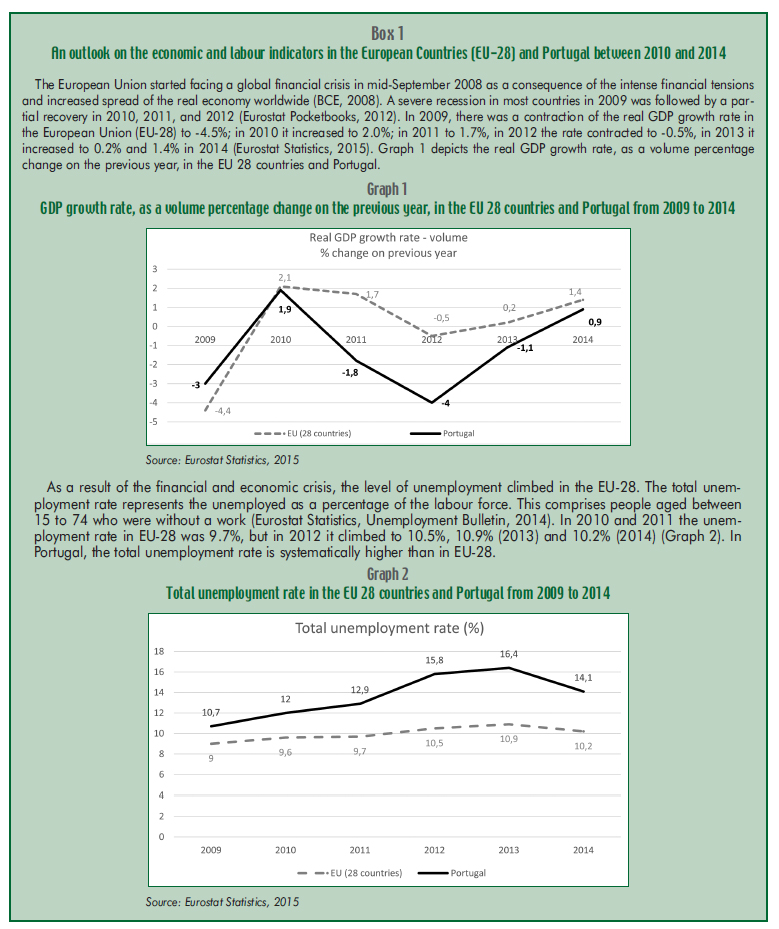
In this paper, we describe the dynamics of entrepreneurship in Portugal and the other European Union countries in 2010, 2011 and 2012 – three years when the economic, financial and social crisis were more dramatic - and in 2013 and 2014 – two years when there was a slow recovery from the crisis. In the next section, we describe the measures and results of the entrepreneurship activity, entrepreneurial attitudes and entrepreneurial aspirations in Portugal and other European Union (EU) countries from 2010 to 2014. We focus our analysis on 2010, 2011 and 2012 because this time span is integrated in the Eurozone crisis (Quarterly Report on the Euro Area, 2010), and 2013 and 2014 as this is a time span characterized by a slow recovery from the crisis. In Box 1 we describe the European socio-economic environment during the period under analysis.
Method
Sample
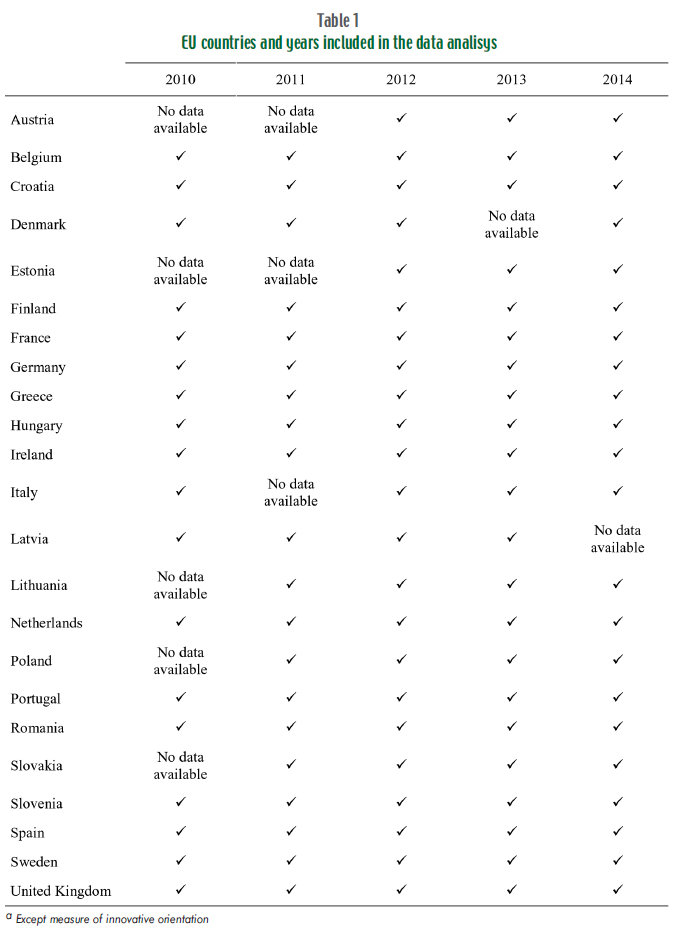
]]> We used the GEM data based on representative samples, at the national level, from EU countries in 2010 (Kelley et al., 2011), 2011 (Kelley et al., 2012), 2012 (Xavier et al., 2013), 2013 (Amorós and Bosma, 2014) and 2014 (Singer et al., 2015). A total of 23 EU countries were included in our sample.The GEM data were not collected in Bulgaria, Cyprus, Luxembourg, the Czech Republic and Malta for more than two years during this period, thus our analysis does not include these countries. Furthermore, some countries did not collect data in the five years we are interested in. Table 1 presents the countries and correspondent years on which we based our results.
Measures
Over a five-year period, we analysed entrepreneurship activity, entrepreneurial attitudes and entrepreneurial aspirations in the countries included in our study.
The entrepreneurship activity indicators
The main entrepreneurship activity indicators following the GEM model are: the TEA, necessity, and opportunity-driven entrepreneurs.
The TEA measures the proportion of adults (18 to 64 years old) in an economy who are nascent and new entrepreneurs. The TEA is, then, an analysis of entrepreneurial businesses which are up and running in the year in which the country is analysed (Bosma et al., 2012; Xavier et al., 2013).
The GEM also differentiates the individuals who start their own business in answer to their need for an income to support themselves and families; from those individuals who start their businesses as an answer to an opportunity they identified and decided to exploit. The former are named necessity entrepreneurs, and are driven by necessity motives such as no better job option, or a need to make a living to support families. The latter – named improvement-driven opportunity entrepreneurs – are driven by an opportunity they have identified, and what motives them is a desire for greater independence and a higher income.
Thus, the necessity-driven entrepreneurs correspond to a percentage of those involved in total early‐stage entrepreneurial activity who are involved in entrepreneurship because they had no other work option. The opportunity-driven entrepreneurs, on the other hand, correspond to the percentage of those involved in total early‐stage entrepreneurial activity who: (i) claim to be driven by opportunity, as opposed to finding no other work option; and (ii) who indicate that the main driver for being involved in this opportunity is to become independent or increase their income, rather than merely maintain their income (Bosma et al., 2012; Xavier et al., 2013).
The entrepreneurial attitude indicators
]]> The entrepreneurial attitude indicators include four measures: opportunity perceptions, capability perceptions, fear of failure and intention to start a business. These indicators, which refer to individual assessments based on perceptions, allow us insight into national beliefs on entrepreneurial attitudes.Opportunity perceptions assess the perception of good opportunities to start a business in the area you live in and is operationalized by a question “In the next six months, will there be good opportunities for starting a business in the area where you live?” (e.g., Kelley et al., 2011). This refers to the percentage of 18-64-year olds who see good opportunities to start a firm in the area where they live.
Capability perceptions are a measure of whether someone has the required knowledge and skills to start a business. Capability perception is assessed through the question “Do you have the knowledge, skill and experience required to start a new business?”, and refers to the percentage of 18-64-year-olds in the population who believe they have the required skills and knowledge to start a business.
Fear of failure is a measure of fear regarding the launch of a business and is assessed by means of the item “Would fear of failure prevent you from starting a business?”. It corresponds to the percentage of 18-64-year-olds in the population with positive perceived opportunities who indicate that fear of failure would prevent them from setting up a business.
The intention to start a business is measured by the item “Are you, alone or with others, expecting to start a new business, including any type of self-employment, within the next three years?” and relates to an individual’s intention to launch a business. It refers to the percentage of the 18-64-year-old population (individuals involved in any stage of entrepreneurial activity excluded) who intend to start a business within three years (Kelley et al., 2011; Bosma et al., 2012; Xavier et al., 2013).
The entrepreneurial aspiration indicators
Besides entrepreneurial activity and attitudes, the GEM model also includes entrepreneurial aspirations in order to assess the aspiration levels of the individuals involved in the entrepreneurial activity. Entrepreneurial aspirations involve three main indicators: growth expectations, new product or innovative orientation; and international orientation. These indicators can assess the qualitative nature of entrepreneurial activity, such as the growth in human resources, the introduction of new products or processes, or their entrance to foreign markets (Bosma et al., 2009).
Growth expectation early-stage entrepreneurial activity refers to the percentage of TEA that expect to employ at least five employees five years from now. This is assessed through the question “How many people will be working for this business, not counting the owners but including all exclusive subcontractors, when it is five years old?”.
The new product early-stage entrepreneurial activity, or innovative orientation, refers to the percentage of TEA that indicate their product or service is new to at least some customers. The item which allows us to assess the innovative orientation is “Will all, some, or none of your potential customers consider this product or service new and unfamiliar?”.
The international orientation early-stage entrepreneurial activity is the percentage of TEA that indicate that at least 25% of the customers come from other countries, as the answer to the question “What proportion of your customers will normally live outside your country?”.
]]> In the next section, we present the results of our analysis, organized in three topics: entrepreneurship activity, entrepreneurial attitudes and entrepreneurial aspirations.
Results
Entrepreneurship activity results in Portugal in comparison with other European Union countries from 2010 to 2014
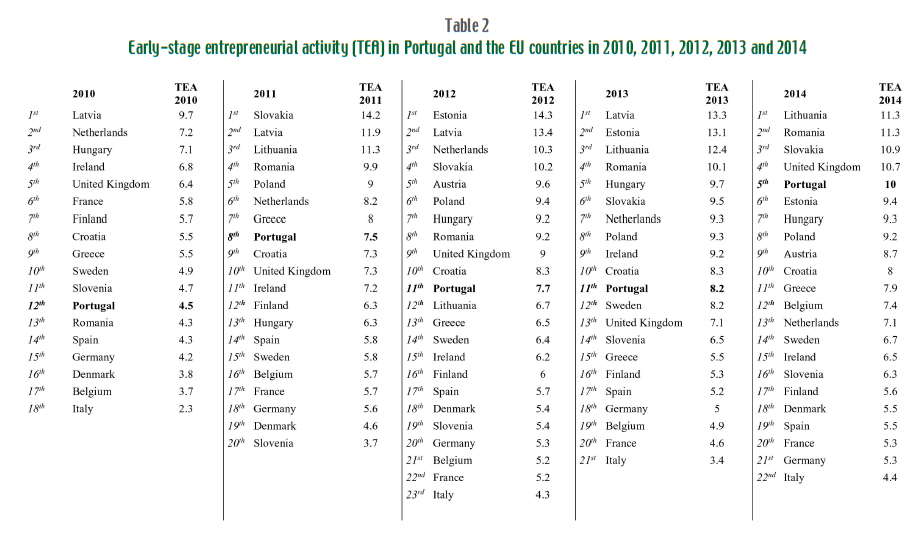
In 2010, Portugal evidenced a TEA index of 4.5%, showing that there were 4 to 5 early-stage entrepreneurs per 100 people aged between 18-64. In 2011, Portugal evidenced a TEA index of 7.5%. The 2012 TEA for Portugal was 7.7%, showing that there were 7 to 8 early-stage entrepreneurs per 100 people. In 2013, this increased to 8.2% and, in 2014, to 10%. Amongst the eighteen European Union (EU) countries participating in 2010, Portugal ranked 12th, preceded by Slovenia (TEA=4.7%) and followed by Romania (TEA=4.3%) and Spain (TEA=4.3%). Latvia had the highest early-stage entrepreneurial activity in 2010 (TEA=9.7%) and Italy the lowest (TEA = 2.3%). In 2011, data were collected in twenty countries and Portugal was ranked 8th, with Slovakia being ranked 1st (TEA=14.2%), and Slovenia the last (TEA=3.7%). Portugal was between Greece (TEA=8%) and Croatia (TEA=7.3%). In 2012, there were twenty-three countries involved. Estonia was the highest in the early stage entrepreneurial activity (TEA=14.3%) and Italy was the lowest (TEA=4.3%). Portugal occupied 11th position in the ranking, between Croatia (TEA=8.3%) and Lithuania (TEA=6.7%). Table 2 describes the early-stage entrepreneurial activity in the EU countries in the five years of analysis.
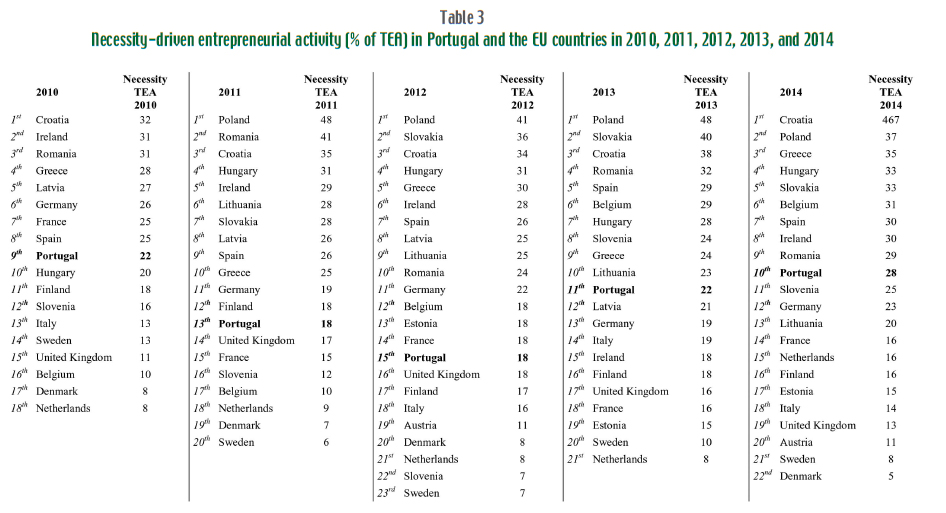
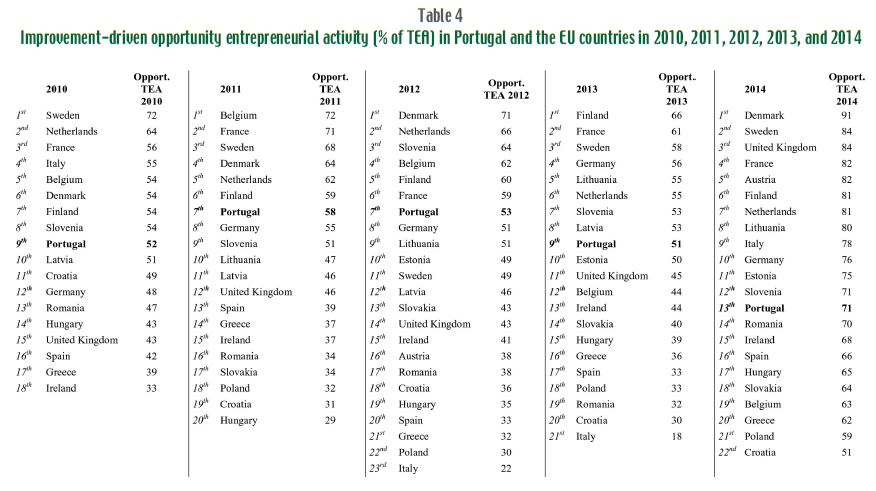
Another entrepreneurship activity indicator refers to the motivation underlying the entrepreneurial activity: necessity (see Table 3) and improvement-driven opportunity entrepreneurship (see Table 4). In 2010, 22% of the Portuguese early-stage entrepreneurial activity was driven by necessity, while in 2011 and 2012 the percentage went down to the 18%. However, in 2013 and 2014 Portuguese necessity-driven entrepreneurial activity increased to 22% and 28%, respectively. In 2010, the necessity-driven result for Portugal was between Spain (25%) and Hungary (20%), with Croatia having the highest percentage (32%) and the Netherlands the lowest (8%). In 2011, the necessity-driven rate in Finland was equivalent to that of Portugal (18%), while the United Kingdom (UK) was slightly lower (17%). In 2012, Belgium, Estonia, France, Portugal and the UK all showed the same necessity-driven rate (18%), and the EU countries results varied between 41% in Poland and 7% in Sweden. In 2013, the necessity-driven result of Portugal ranked 11th, between Lithuania (Necessity-driven=23%) and Latvia (Necessity-driven=21%), with Poland having the highest percentage (48%) and the Netherlands and Denmark the lowest (8%). In 2014, the necessity-driven TEA of Portugal occupied the 10th highest position in the ranking, between Romania (29%) and Slovenia (25%). But necessity-driven entrepreneurship cannot be dissociated from improvement-driven opportunity entrepreneurship. In fact, the results of both complement each other.
The results of the improvement-opportunity driven early-stage entrepreneurial activity in Portugal were quite stable over four of the five years under analysis. More specifically, these were: 52% in 2010, 58% in 2011, 53% in 2012, and 51% in 2013. In 2014, the improvement-opportunity driven entrepreneurs in Portugal was 71%. In 2010, the highest improvement-driven opportunity rates were in Sweden (72%), in 2011 in Belgium (72%), in 2012 in Denmark (71%), in 2013 in Finland (66%) and in 2014 in Denmark (91%). Conversely, the lowest improvement-driven opportunity rates were in Ireland in 2010 (33%), in Hungary in 2011 (29%), in Italy in 2012 (22%) and 2013 (18%), and in Croatia in 2014 (51%).
It is interesting to note that in Portugal the percentage of improvement-opportunity driven entrepreneurship was always higher than the percentage of necessity-driven entrepreneurship. This is the most recurrent pattern amongst the EU countries under analysis. Nevertheless, there are some exceptions, such as Poland, Romania, Croatia and Hungary in 2011; and Poland in 2012, where necessity-driven entrepreneurship was higher than that of improvement-opportunity.
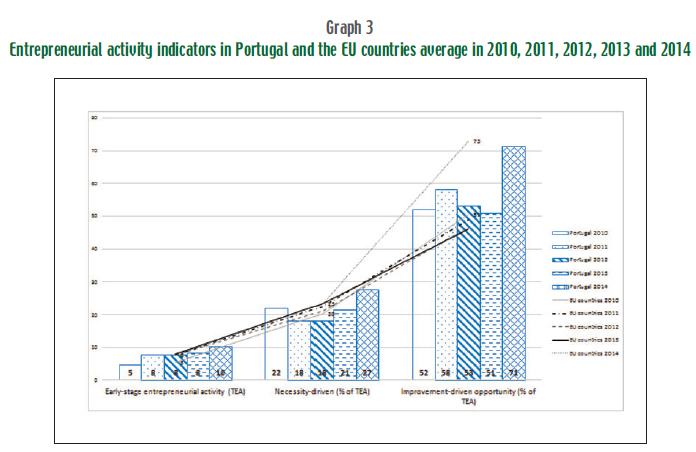
The results from the indicators of the entrepreneurial activity (TEA; necessity-driven entrepreneurship and improvement-driven opportunity entrepreneurship) showed that Portugal’s results improved, albeit modestly, from 2010 to 2014. In general, this was the pattern throughout the EU countries: there was an increase in the early-stage entrepreneurial activity from 2010 to 2014 (e.g., Belgium, Croatia, Denmark, Hungary, Italy, Latvia, the Netherlands, Poland, Slovenia, Spain, Sweden and the United Kingdom). Nevertheless, it is relevant to stress that the TEA of Portugal was either below (2010) or equal (2011, 2012 and 2013) to the average TEA in the other EU countries. In 2014, the TEA of Portugal was slightly higher than the TEA in the other EU countries (TEAPortugal2014=10; TEAEU2014=8).
The behaviour of the necessity-driven entrepreneurship does not show a particular trend amongst the EU countries. The necessity-driven entrepreneurship in Portugal was above the EU average (MEU2010= 20.22%) in 2010, but was below the EU average in 2011, 2012 and 2013 (MEU2011=23%; MEU2012=21%; MEU2013=23%). In 2014, necessity-driven entrepreneurship in Portugal was above the EU average (MEU2014= 23% in EU countries and 27% in Portugal). The behaviour of the improvement-driven opportunity entrepreneurship is quite similar. The percentage of improvement-driven opportunity in Portugal in 2010, 2011, 2012 and 2013 was always above the EU average (MEU2010=51%; MEU2011=49%; MEU2012=47%; MEU2013=46%), but in 2014 it was below the EU average (MEU2014=73%). Graph 3 presents the position of Portugal’s indicators of entrepreneurial activity from 2010 to 2014 and the EU countries average.
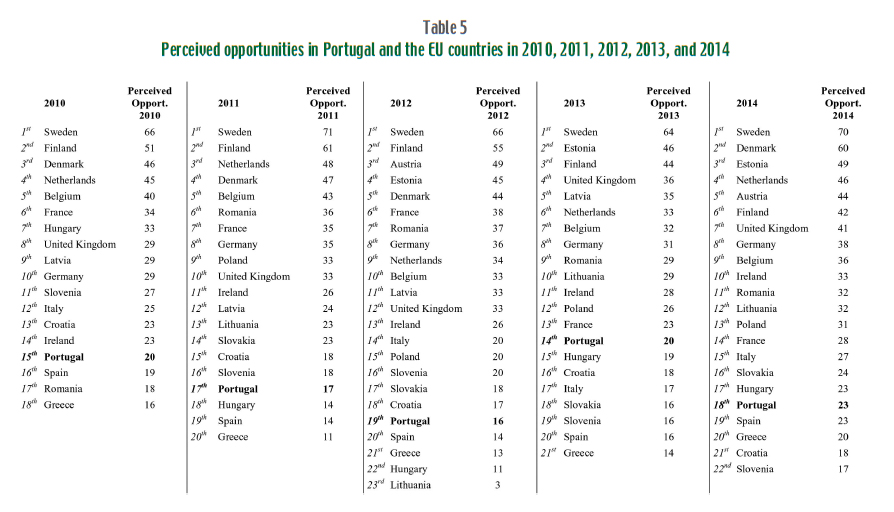
]]> Entrepreneurial attitude results in Portugal in comparison with other European Union countries from 2010 to 2012From 2010 onward, perceived opportunities (see Table 5) in Portugal were successively at the tail end of the EU countries. In 2010, Portugal had a score of 20%, in 2011 it was 17%, in 2012 it was 16%, in 2013 it was 20% and in 2014 it was 23%. These values pushed Portugal to the bottom of the EU ranking, and were in stark contrast to the highest scores for perceived opportunities that were evidenced in Sweden (2010=66%; 2011=71%; 2012=66%; 2013=64%; and 2014=70%). Also at the bottom of the EU ranking were countries such as Greece (2010=16%; 2011=11%; 2013=14%), Lithuania (2012=3%) and Slovenia (2014=17%).
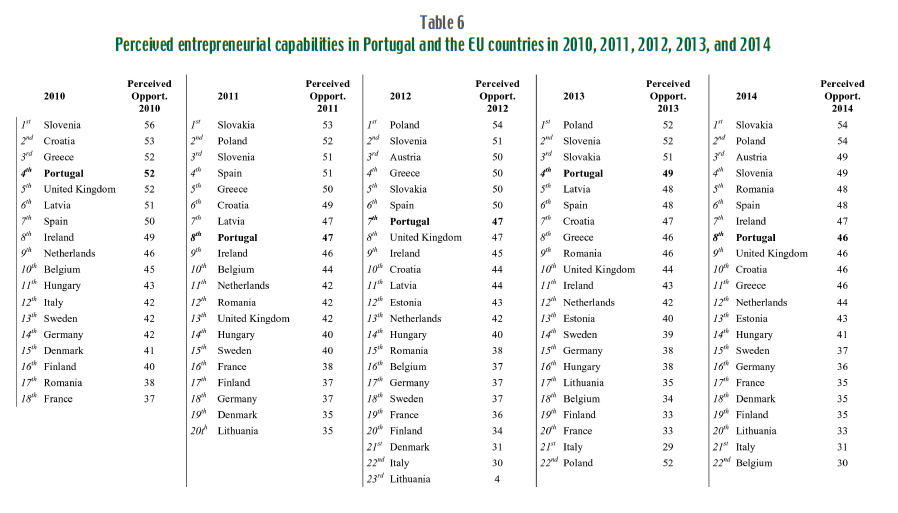
The results for perceived capabilities (see Table 6) in Portugal were among the top EU countries. For example, in 2010, 52% of the Portuguese population believed they had the required skills and knowledge to start a business. Only Croatia, Greece and Slovenia reported higher scores. At the tail end for their perceived capabilities for starting a business in 2010 were countries such as Finland, Romania and France (37%). In 2011, the Portuguese percentage went down to 47%, but it was still the 8th highest of the EU countries. In that year, Slovakia ranked top with 53%, and Lithuania was in the lowest position with 35% of the population believing they had the required skills and knowledge to start a business. In 2012, 47% of the populations in both Portugal and the United Kingdom believed they had the required skills and knowledge to start a business. Percentages above this were found in Poland (54%), Slovenia, Austria, Greece, Slovakia and Spain. Lithuania again registered the lowest value with a small percentage of 4%, in contrast to Italy the second lowest, with 30%. In 2013, Portugal was ranked 4th with 49% of people confident of their perceived entrepreneurial capabilities. In 2014, the value decreased slightly to 46% (down to 8th position). These results are presented in detail in Table 6.
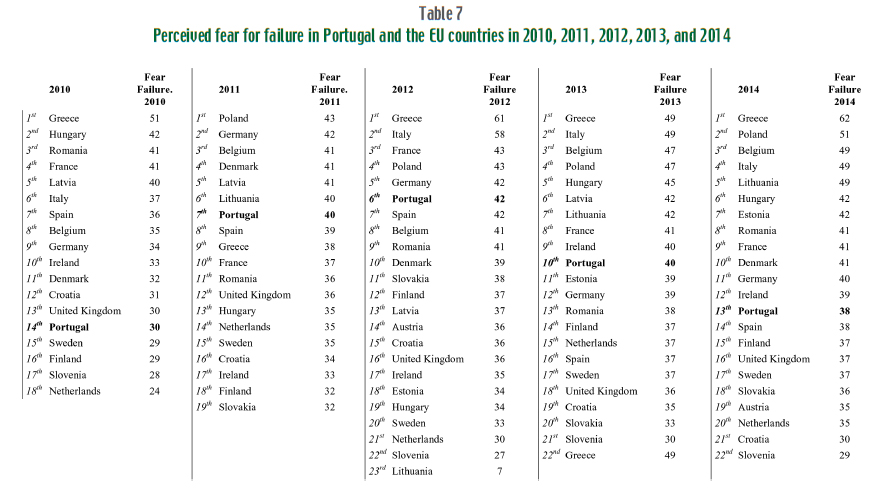
Fear of failure (see Table 7) is another critical measure of entrepreneurial attitudes, and the behaviour of Portugal in this indicator showed changes from 2010 to 2014. In 2010, Portugal had one of the lowest scores in fear of failure (30%), with the Netherlands having the lowest value (24%). This meant that in Portugal in 2010, 30% of the population who perceived opportunities indicated that fear of failure would prevent them from setting up a business. In 2011, this percentage rose to 40% and in 2012 it rose to 42%. These results took Portugal to among the top ranked EU countries, with Poland having the highest result in 2011 (43%), and Greece in 2012 (61%). In 2013, Portugal decreased to 40% and then to 38% in 2014, which placed the country in middle position regarding fear of failure.
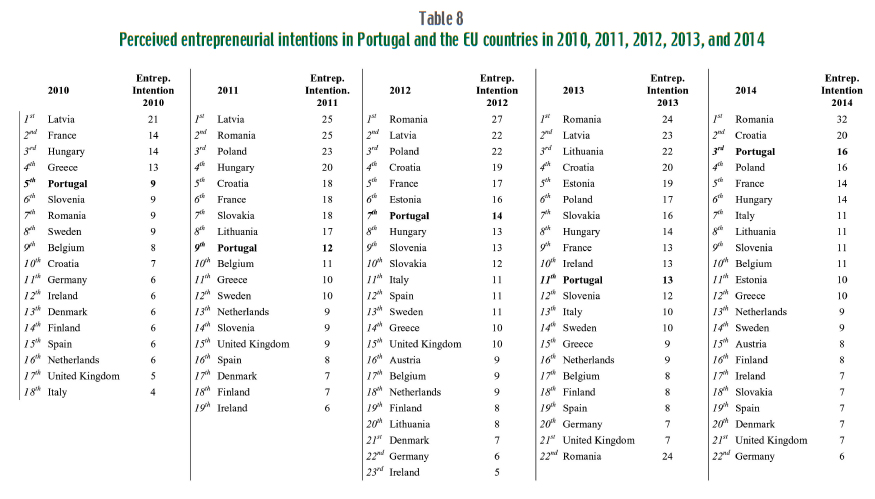
Entrepreneurial intentions (see Table 8) in Portugal grew from 2010 to 2014. In 2010, 9% of the population intended to start a business within three years. In 2011, the percentage rose to 12%, in 2012 it was 14%, in 2013 it was 13% and in 2014 it was 16%. The highest scores were in Latvia in 2010 (21%), and 2011 (25%), and in Romania in 2012 (27%), 2013 (24%) and 2014 (32%). The lowest scores were 4% in Italy 2010, 6% in Ireland 2011 and 2012, and Germany 2014 (6%).
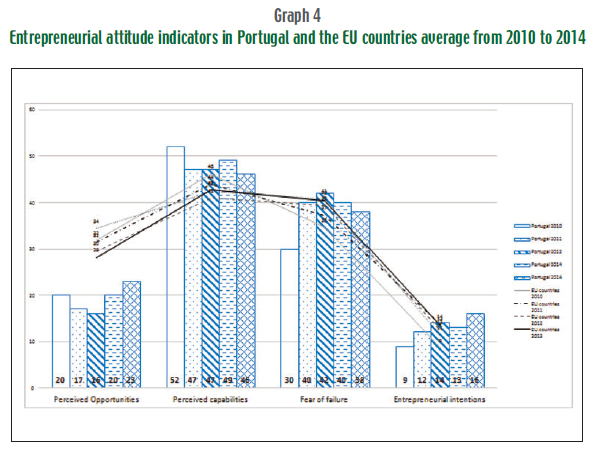
The position of Portuguese entrepreneurial attitudes in relation to the other EU countries was not consistent over the four indicators. With regard to perceived opportunities, Portugal was below the EU average during the five years under analysis (MEU2010=32%; MEU2011=32%; MEU2012=30%; MEU2013=28%; MEU2014=34%). As far as perceived capabilities are concerned, Portugal was above the EU average from 2010 to 2014 (MEU2010=46%; (MEU2011=44%; MEU2012=41%; MEU2013=43%; MEU2014=42%). In 2010, Portugal reported a lower fear of failure than the EU average (MEU2010=35%), but this tendency was inverted in 2011 and 2012, when Portugal was above the EU average (MEU2011=37%; MEU2012=38%). In 2013 and 2014, the Portuguese fear of failure was again below the EU average (MEU2013=40%; MEU2014=34%). The position of entrepreneurial intentions in Portugal was the same as the EU average in 2010 (MEU2010=9%), 2011 (MEU2011=14%), 2012 (MEU2012=14%), and 2013 (MEU2013=13%), but was above the average in 2014 (MEU2014=11%). Graph 4 presents the entrepreneurial attitude indicator scores in Portugal and the EU countries average from 2010 to 2014.
Entrepreneurial aspiration results in Portugal in comparison with other European Union countries from 2010 to 2012
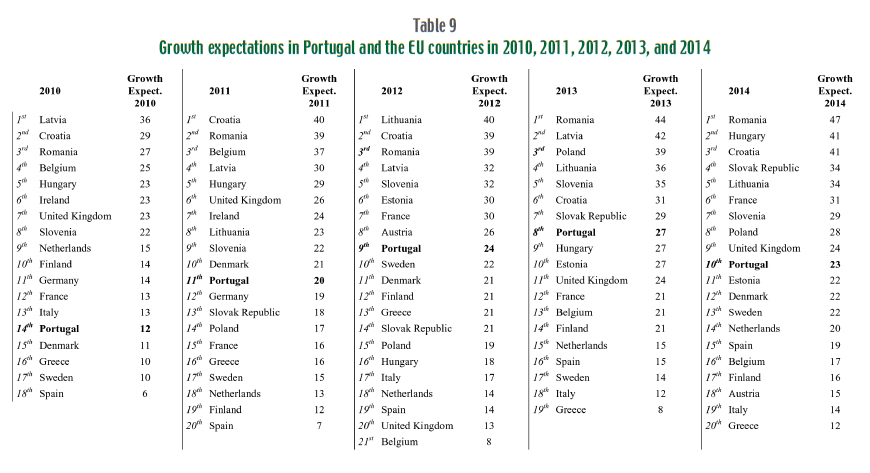
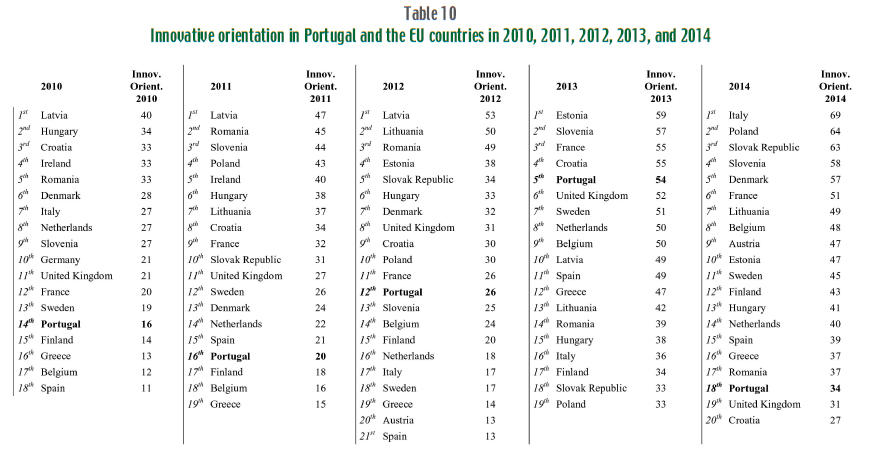
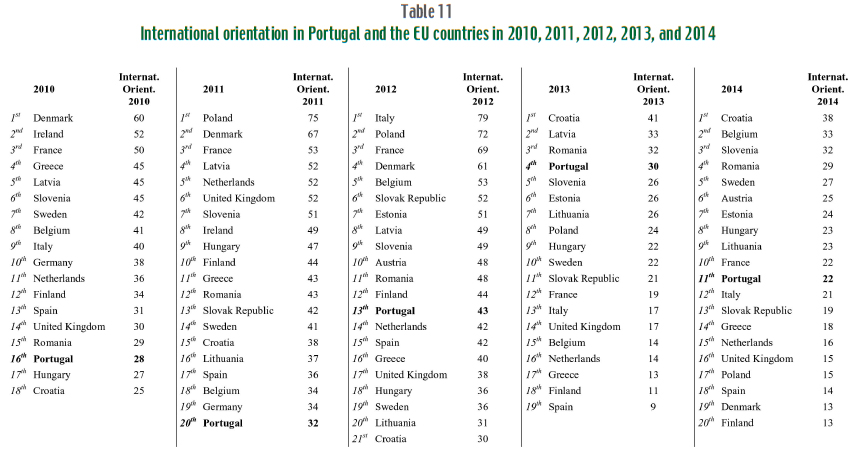
Entrepreneurial aspirations comprise three main measures: growth expectations (see Table 9), innovative orientation (see Table 10), and international orientation (see Table 11). The highest growth expectations in 2010 amongst the EU countries was registered in Latvia (36%), with Portugal being far below that value with a modest 12% of early-stage entrepreneurs who expected to employ at least five employees five years from that time. Portugal’s scores in 2011, 2012, 2013 and 2014 increased to 20%, 24%, 27% and 23% respectively, showing greater aspiration in the growth of the early-stage entrepreneurs. From 2011 to 2014, Portugal was ranked in about the middle of the EU countries. Croatia was ranked 1st in 2011 (40%), Lithuania in 2012 (40%), Romania in 2013 (44%) and 2014 (47%). At the bottom of the EU countries was Spain in 2010 and 2011 (6% and 7%, respectively), Belgium in 2012 (8%), and Greece in 2013 and 2014 (8% and 12%), accordingly.
The pace of Portuguese growth expectation was accompanied by the innovative orientation of early stage entrepreneurs. In 2010, while Portugal’s innovative orientation of 16% was one of the lowest values amongst the EU countries, the highest percentage was that of Latvia (40%). In 2011, although Portugal increased to 20%, it was again amongst the lowest percentages among the EU countries, followed by Finland (18%), Belgium (16%) and Greece (15%). The highest percentage in 2011 was, again, that of Latvia (47%). In 2012, innovative orientation in Portugal grew to 26% and reached a higher ranking; the lowest value was 13% in Spain. Once again, the highest score in innovative orientation in 2012 was that of Latvia (53%). In 2013, innovative orientation in Portugal grew to 54%, achieving 5th position in the ranking. In 2014, however, Portugal dropped dramatically to 18th place, with innovation orientation of 34%. These results showed that innovative orientation in Portugal peaked in 2013.
International orientation in Portugal also increased from 2010 to 2012. In 2010, although international orientation in Portugal was 28%, it was the third lowest amongst the EU countries, with Hungary (27%) and Croatia (25%) just below. This score contrasted with the two highest, which were Denmark with 60% and Ireland with 52%. In 2011, despite increasing to 32%, Portugal was the lowest amongst the EU countries. In 2012, however, international orientation in Portugal rose to 43% and the country took 13th place in the ranking. In 2013, international orientation in Portugal was the 4th highest among the EU countries, but reported a value of 30%, and in 2014 the value went down again to 22%, and Portugal was ranked 11th.
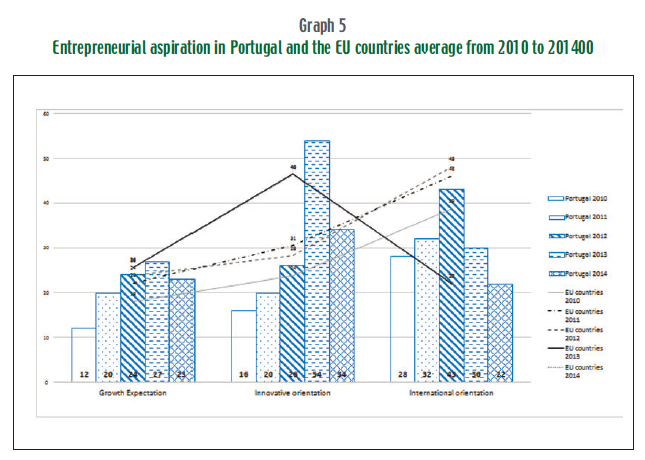
]]> Once again, these results show a peak for Portugal in 2013, which is not in line with the results in the other years under analysis. Despite this atypical year, Portugal systematically ranked in the lower or middle positions in the EU countries.Despite the fact that Portugal peaked in all the indicators of entrepreneurial aspirations in 2013, the results for the country were consistently below (or coincident with), the EU countries average in the other years. In 2010, the growth expectation average in the EU was 18%, in 2011 it was 22%, in 2012 it was 24%, and in 2013 and 2014 it was 26%. Similarly, the innovative orientation average amongst the EU countries was also higher than the scores found in Portugal for all the years under analysis, expect for the atypical 2013 (MEU2010=24%; MEU2011=31%; MEU2012=28%; MEU2014=46%). The same pattern was evidenced in the international orientation average, which was consecutively higher than the scores of Portugal in 2010, 2011, 2012 and 2014 (MEU2010=39%; MEU2011=46%; MEU2012=48%; MEU2014=22%). In Graph 5, we can analyse the position of the Portuguese results in the indicators of entrepreneurial aspirations in relation to the EU countries average.
Discussion
Is entrepreneurship in Portugal far from or close to the tipping point?
The economic, financial and social crises that Portugal has been facing since 2009, is still taking its toll on the country today. In order to overcome this, entrepreneurship has been encouraged as a critical mechanism for contributing to economic development, following the evidence from scientific research (e.g., Wennekers and Thurik, 1999; Reynolds et al., 1999).
Despite this effort, there were several questions about the effective behaviour of Portuguese entrepreneurship indicators during the economic and financial crisis. To clarify these issues, we analysed the indicators of entrepreneurial activity, attitudes and aspirations in Portugal and the other European Union countries in the years of economic and social crisis (2010, 2011 and 2012) and in the two years that showed a slight recovery (2013 and 2014).
In general, the entrepreneurial activity results in Portugal from 2010 to 2014 kept pace with the trend in the rest of Europe. In 2010, 2011, 2012 and 2013, the TEA rate in Portugal was equivalent to the EU countries average. However, in 2014, it was higher, showing increased entrepreneurial activity in Portugal. Necessity-driven entrepreneurship in 2010 was slightly higher in Portugal than the EU countries average, but was lower in 2011, 2012 and 2013. In 2014, Portugal had more necessity-driven entrepreneurial activity than the average of the European countries.
This result suggests that the increase in the TEA rate in Portugal in 2014 was mainly due to necessity-based entrepreneurship, probably as a self-employment solution and income substitution, due to the high unemployment rates. Accordingly, there was less opportunity-driven entrepreneurship in 2014 in Portugal than in the average of the EU countries. However, the trend from 2010 to 2013 was that Portugal had more improvement-driven opportunity entrepreneurship than the average of the EU countries.
In sum, the entrepreneurship activity in Portugal kept up with the EU average from 2010 to 2013. In 2014, despite the fact that Portugal had more entrepreneurial activity than the other EU countries, these were mainly necessity-driven and not improvement-driven.
]]> Perceived opportunities in Portugal were also consistently lower than the EU average. This would suggest that in Portugal, there is a perception of less good opportunities to start a business in the area they live than in the other European countries. This result can be potentially explained by the crisis and by the insecure environment perceived in Portugal during the economic crisis years. Despite the fact that Portugal was perceived to have low opportunities for new business during this period, this was also the country where there was a higher belief among the population that they had the required knowledge and skills to start a business. Indeed, with regard to the perception of its entrepreneurial capabilities, between 2010 to 2014 Portugal had higher results than the average EU countries.The perception of fear of failure in 2010 was lower in Portugal than the average in the EU countries, but was equivalent in 2011, 2012, 2013 and 2014. This result shows that from 2011 onwards, fear of failure would prevent Portuguese entrepreneurs from setting up a business, as in the other EU countries. Entrepreneurial intentions in Portugal in 2010 and 2013 were coincident with the EU average, slightly lower in 2011 and slightly higher in 2012. The most interesting results were in 2014, when entrepreneurial intentions in Portugal were higher than the average of the EU countries. In general, entrepreneurial attitudes in Portugal are characterized by average entrepreneurial intentions, lower perceived opportunities, higher perceived capabilities to start a business, although fear of failure would prevent them from actually starting a business.
Compared to the EU countries average, entrepreneurial aspirations in Portugal were constantly lower in the three indicators and over time, except for 2013. This trend was consistent with growth expectation, innovative orientation and international orientation. Thus, Portugal in 2010, 2011, 2012 and 2014 revealed lower entrepreneurial aspirations than the average of the EU countries in growth expectation, in new product, and in international orientation early-stage entrepreneurial activity.
In general, these results indicate that Portugal has entrepreneurial activity that corresponds to the average of the other EU countries, as much at the total early entrepreneurship stage, as in necessity and improvement driven entrepreneurship. Surprisingly, and not congruently, there is a lower perception about the availability of good business opportunities in the area they live and a higher fear of failure that would prevent individuals from launching a business. There is a higher perception of the individual skills and knowledge that are required to launch a business, so Portugal shows a national belief in its entrepreneurial skills and capabilities. Nevertheless, and probably due to the crisis environment, entrepreneurial aspirations in Portugal were consistently lower than in the other EU countries. Overall, this pattern of entrepreneurship results suggests that Portugal is far from the EU countries tipping point.
As a consequence of this result, we suggest that Portugal should promote entrepreneurial attitudes and growth. National and international policy decision-makers refer to entrepreneurship as one of the main mechanisms driving economic development (e.g., Acs and Szerb, 2007; Acs, 2006; Martin et al., 2010; Stel et al., 2005; Wong et al., 2005), and thus attitudes, aspirations and growth gain a critical relevance. For instance, entrepreneurship can be conceptualized as a method, analogous to the scientific method, which can help to promote the necessary conditions for developing capacity for enterprise (Ventakaraman et al., 2012). The inclusion of curricula focused on developing entrepreneurial skills from the early school years would, by the generational effect, unleash the entrepreneurial potential of human nature.
By leveraging the generational process, entrepreneurship would solidify as an agent of transformation for careers, communities, and political, economic and social systems. This paradigm shift is ambitious, challenging and progressive. The contributions made by research and activities for entrepreneurship that we observe today are only the beginning. And on their own, and as temporary and hitherto unframed policies, they will not have the desired effect. Entrepreneurship needs to be fostered and integrated in our culture as action, method and strategy.
Furthermore, at the macro and societal level, society needs to be culturally prepared to generate innovative ideas and effective and efficient management of resources. At the intermediate and group level, organizations, private and public institutions have to urgently start the process of intrapreneurship by encouraging employees to take risks, to accept and learn from failure and to be responsible for the development of innovative products or services for their businesses. Individually, each person chooses to engage in entrepreneurship and to stimulate their ability to recognize business opportunities, participate in business idea competitions (Santos and Caetano, 2014), and consider entrepreneurship as a stage in their active working life (Costa et al., in press). In general, the success or failure of entrepreneurship does not depend on a set of individual, sporadic or surgical activities conducted at a national or local level. They will rely rather on combined intra and inter level strategies that trigger a shift towards an entrepreneurial culture, climate and method.
In the present social and economic context in Portugal, specifically, and in Europe, in general, entrepreneurship appears as a “ray of light” (e.g., Caetano et al., 2012). It is perceived as a way to deal with countries’ main socio-economic problems such as unemployment, economic downturn and deep changes in employment patterns.
This study has several limitations. It was not possible to include all European Union countries, as data was not available. Thus, the description in our study is restricted to the countries and variables that were available. A second limitation refers to the period of time selected. At the present moment it is only possible to analyse data up to 2014. In future research, we will also integrate data from 2015 and 2016, when the Eurozone crisis is expected to be resolved.
This research aimed to be a first step towards developing systematic and analytical research on the entrepreneurial activity, attitudes and aspirations in Portugal. It would be interesting to extend this in future research in order to identify the determinants of these changes over time and across countries.
]]>References
Acs, Z. (2006), “How is entrepreneurship good for economic growth?”. Innovations Technology Governance Globalization, vol. 1(1), pp. 97-107. [ Links ]
Acs, Z. J. & Amorós, J. E. (2008), “Entrepreneurship and competitiveness dynamics in Latin America”. Small Business Economics, vol. 31(3), pp. 305-322. [ Links ]
Acs, Z. J. & Szerb, L. (2007), “Entrepreneurship, economic growth and public policy”. Small Business Economics, vol. 28(2-3), pp. 109-122. [ Links ]
Amorós, J. E. & Bosma, N. (2014), Global Entrepreneurship Monitor 2013 Global Report. Babson College, Babson Park, MA; Universidad del Desarollo, Santiago, Chile; Universiti Tun Abdul Razak, Kuala Lampur, Malaysia and London Business School, London, UK. [ Links ]
]]>BCE Central European Bank (2008), Monthly Bulletin. https://www.ecb.europa.eu/pub/economic-bulletin/mb/html/index.en.html. [ Links ]
Bosma, N.; Acs, Z. J.; Autio, E.; Coduras, A. & Levie, J. (2009), Global Entrepreneurship Monitor 2008 Executive Report. [ Links ]
Bosma, N.; Wennekers, S. & Amorós, J. E. (2012), “Global Entrepreneurship Monitor extended report 2011: Entrepreneurs and entrepreneurial employees across the globe”. Global Entrepreneurship Research Association, London. http://www.gemconsortium.org/docs/2409/gem-2011-global-report. [ Links ]
Bygrave, W. & Cowling, M. (2007), “Entrepreneurship, welfare provision and unemployment: Relationships between unemployment, welfare provision, and entrepreneurship in thirty-seven nations participating in the Global Entrepreneurship Monitor (GEM) 2002”. Comparative Labor Law & Policy Journal, 28, no. 4. [ Links ]
Bygrave, W. D. & Hofer, C. W. (1991), “Theorizing about entrepreneurship”. Entrepreneurship Theory and Practice, 16, pp. 13-22. [ Links ]
]]>CAETANO, A.; SANTOS, S. C. & COSTA, S. F. (2012), Psicologia do Empreendedorismo: Processos, Oportunidades e Competências. Editora Mundos Sociais, Lisboa. [ Links ]
Costa, S. F.; Caetano, A. & Santos, S. C. (in press), “Entrepreneurship as career option: Do temporary workers have the competencies, intentions and willingness to become entrepreneurs?”. Journal of Entrepreneurship. [ Links ]
Eurostat Statistics (2015), “Your key to European Statistics”. http://ec.europa.eu/eurostat. [ Links ]
Gladwell, M. (2000), The Tipping Point: How Little Things Can Make a Big Difference. Little Brown, USA. [ Links ]
Hessels, J. & van Stel, A. (2009), “Entrepreneurship, export orientation, and economic growth”. Small Business Economics, vol. 37(2), pp. 1-14. [ Links ]
]]>Holcombe, R. (1998), “Entrepreneurship and economic growth”. The Quarterly Journal of Austrian Economics, vol. 1, pp. 45-62. http://dx.doi.org/10.1007/s12113-998-1008-1. [ Links ]
Kelley, D.; Bosma, N. & Amorós, J. E. (2011), Global Entrepreneurship Monitor 2010 Executive Report. Babson College, Babson Park; Universidad del Desarollo, Santiago, Chile and London Business School, London, UK. [ Links ]
Kelley, D.; Singer, S. & Herrington, M. (2012), Global Entrepreneurship Monitor 2011 Executive Report. Babson College, Babson Park, MA; Universidad del Desarollo, Santiago, Chile; Universiti Tun Abdul Razak, Kuala Lampur, Malaysia and London Business School, London, UK. [ Links ]
Koellinger, P. & Minniti, M. (2009), “Unemployment benefits crowd out nascent entrepreneurial activity”. Economics Letters, vol. 103, no. 2, pp. 96-98. [ Links ]
Kotsios, P. & Mitsios, V. (2013), “Entrepreneurship in Greece: A way out of the crisis or a dive in?”. Research in Applied Economics, vol. 5(1), pp. 22-44. http://dx.doi.org/10.5296/rae.v5i1.3142. [ Links ]
]]>Kreft, S. & Sobel, R. (2005), “Public policy, entrepreneurship, and economic freedom”. Cato Journal, vol. 25(3), pp. 595-616. [ Links ]
Martin, M. G.; Picazo, M. & Navarro, J. (2010), “Entrepreneurship, income distribution and economic growth”. International Entrepreneurship Management Journal, vol. 6, pp. 131-141. [ Links ]
Minniti, M. (1999), “Entrepreneurial activity and economic growth”. Global Business and Economics Review, vol. 1, pp. 31-42. [ Links ]
Papaoikonomou, E.; Segarra, P. & Li, X. (2012), “Entrepreneurship in the context of crisis: Identifying barriers and proposing strategies”. International Advances in Economic Research, vol. 18(1), pp. 111-119. [ Links ]
Porter, M. E.; Sachs, J. D. & McArthur, J. W. (2001), “Executive summary: Competitiveness and stages of economic development”. In The Global Competitiveness Report 2001-2002 (M. E. Porter et al. Eds). Oxford University Press, New York, pp. 16-25. [ Links ]
]]>Reynolds, P. D.; Hay, M. & Camp, S. M. (1999), Global Entrepreneurship Monitor 1999 Executive Report. Kauffman Center for Entrepreneurial Leadership, Kansas City, KS. [ Links ]
Santos, S. C. & Caetano, A. (2014), “Entrepreneur selection methodology for entrepreneurship promotion programmes”. Journal of Entrepreneurship, vol. 23(2), pp. 201-230. [ Links ]
Singer, S.; Amorós, J. E.; Moska, D. & Global Entrepreneurship Research Association GERA (2015), Global Entrepreneurship Monitor 2014 Global Report. Babson College, Babson Park, MA; Universidad del Desarollo, Santiago, Chile; Universiti Tun Abdul Razak, Kuala Lampur, Malaysia; Tecnológico de Monterrey, Monterrey, Mexico and London Business School, London, UK. [ Links ]
Stel, A. J. van; Carree, M. A. & Thurik, A. R. (2005), “The effect of entrepreneurial activity on national economic growth”. Small Business Economics, vol. 24(3), pp. 311-321. [ Links ]
Valliere, D. & Peterson, R. (2009), “Entrepreneurship and economic growth: Evidence from emerging and developed countries”. Entrepreneurship and Regional Development, vol. 21 (5-6), pp. 459-480. [ Links ]
]]>Venkataraman, S.; Sarasvathy, S. D.; Dew, N. & Forster W. R. (2012), “Reflections on the 2010 AMR decade award: Whiter the promise? Moving forward with entrepreneurship as a science of the artificial”. Academy of Management Review, vol. 37(1), pp. 21-33. [ Links ]
Wennekers, S. & Thurik, A. R. (1999), “Linking entrepreneurship and economic growth”. Small Business Economics, vol. 13(1), pp. 27-56. [ Links ]
Wennekers, S.; van Stel, A.; Thurik, R. & Reynolds, P. (2005), “Nascent entrepreneurship and the level of economic development”. Small Business Economics, vol. 24(3), pp. 293-309. [ Links ]
Wong, P. K.; Ho, Y. P. & Autio, E. (2005), “Entrepreneurship, innovation, and economic growth: Evidence from GEM data”. Small Business Economics, vol. 24(3), pp. 335-350. [ Links ]
Xavier, S. R.; Kelley, D.; Kew, J.; Herrington M. & Vorderwülbecke, A. (2013), Global Entrepreneurship Monitor 2012 Global Report. Babson College, Babson Park, MA; Universidad del Desarollo, Santiago, Chile; Universiti Tun Abdul Razak, Kuala Lampur, Malaysia and London Business School, London, UK. http://www.gemconsortium.org/docs/2645/gem-2012-global-report. [ Links ]
]]>
Recebido em setembro de 2015 e aceite em dezembro de 2015.
Received in September 2015 and accepted in December 2015.
Recibido en septiembre de 2015 y aceptado en diciembre de 2015.