<?xml version="1.0" encoding="ISO-8859-1"?><article xmlns:mml="http://www.w3.org/1998/Math/MathML" xmlns:xlink="http://www.w3.org/1999/xlink" xmlns:xsi="http://www.w3.org/2001/XMLSchema-instance">
<front>
<journal-meta>
<journal-id>1645-6432</journal-id>
<journal-title><![CDATA[e-Journal of Portuguese History]]></journal-title>
<abbrev-journal-title><![CDATA[e-JPH]]></abbrev-journal-title>
<issn>1645-6432</issn>
<publisher>
<publisher-name><![CDATA[Universidade do PortoBrown University]]></publisher-name>
</publisher>
</journal-meta>
<article-meta>
<article-id>S1645-64322014000100002</article-id>
<title-group>
<article-title xml:lang="en"><![CDATA[The Rise of a Tax State: Portugal, 1371-1401]]></article-title>
</title-group>
<contrib-group>
<contrib contrib-type="author">
<name>
<surname><![CDATA[Henriques]]></surname>
<given-names><![CDATA[António Castro]]></given-names>
</name>
<xref ref-type="aff" rid="A01"/>
</contrib>
</contrib-group>
<aff id="A01">
<institution><![CDATA[,University of Porto Faculty of Economics ]]></institution>
<addr-line><![CDATA[Porto ]]></addr-line>
<country>Portugal</country>
</aff>
<pub-date pub-type="pub">
<day>00</day>
<month>00</month>
<year>2014</year>
</pub-date>
<pub-date pub-type="epub">
<day>00</day>
<month>00</month>
<year>2014</year>
</pub-date>
<volume>12</volume>
<numero>1</numero>
<fpage>49</fpage>
<lpage>66</lpage>
<copyright-statement/>
<copyright-year/>
<self-uri xlink:href="http://scielo.pt/scielo.php?script=sci_arttext&amp;pid=S1645-64322014000100002&amp;lng=en&amp;nrm=iso"></self-uri><self-uri xlink:href="http://scielo.pt/scielo.php?script=sci_abstract&amp;pid=S1645-64322014000100002&amp;lng=en&amp;nrm=iso"></self-uri><self-uri xlink:href="http://scielo.pt/scielo.php?script=sci_pdf&amp;pid=S1645-64322014000100002&amp;lng=en&amp;nrm=iso"></self-uri><abstract abstract-type="short" xml:lang="en"><p><![CDATA[This paper uses the case of fourteenth-century Portugal to question a common assumption of “fiscal history” literature, namely the linear relationship between war-related fiscal demands increase the level of taxation. It is shown that this relationship is not straightforward and that not all wars decisively affect fiscal systems. In fact, as some contemporaries suggested, the effects of war on state revenues are essentially negative. As such, the rise of a tax state does not necessarily imply higher revenues. These two general contributions are grounded in a revision of the fiscal bargaining that took place between sovereign and subjects and in a revision of the existing quantitative evidence for the period 1367-1401. The paper makes use of unpublished data and also offers a critical review of the adoption of sales taxes (sisas) as a form of permanent taxation.]]></p></abstract>
<abstract abstract-type="short" xml:lang="pt"><p><![CDATA[Este artigo utiliza o caso de Portugal nos finais do século XIV para questionar um tema muito importante da literatura sobre história fiscal: a existência de uma relação linear entre as exigências financeiras das guerras e as chamadas revoluções fiscais. O caso português confirma que esta relação não é linear e que só em determinadas condições é que as exigências materiais das guerras têm um impacto decisivo no sistema fiscal. Na verdade, como sugerido pelos autores coevos, os efeitos da guerra na receita estatal são essencialmente negativos. Como tal, a afirmação de um estado contributivo (tax state) não implica necessariamente uma receita superior, ao contrário do que sugere a literatura. Estes dois contributos gerais encontram-se fundamentados através da reinterpretação da negociação fiscal entre súbditos e soberanos ao longo do século XIV, tanto a nível das Cortes como a nível municipal, e através de uma análise dos dados quantitativos sobre a receita do estado português entre 1367 e 1401. Estas duas análises integram dados inéditos e uma revisão crítica do processo de adopção das sisas como imposto régio permanente.]]></p></abstract>
<kwd-group>
<kwd lng="en"><![CDATA[Fiscal history]]></kwd>
<kwd lng="en"><![CDATA[Ratchet effect]]></kwd>
<kwd lng="en"><![CDATA[constitutional history]]></kwd>
<kwd lng="en"><![CDATA[fiscal burden]]></kwd>
<kwd lng="en"><![CDATA[taxation]]></kwd>
<kwd lng="pt"><![CDATA[História fiscal]]></kwd>
<kwd lng="pt"><![CDATA[Sisas]]></kwd>
<kwd lng="pt"><![CDATA[história constitucional]]></kwd>
<kwd lng="pt"><![CDATA[carga fiscal]]></kwd>
</kwd-group>
</article-meta>
</front><body><![CDATA[ <p align="right"><b>ARTICLES</b></p>         <p><b>The Rise of a Tax State: Portugal, 1371-1401</b></p>           <p><b>António Castro Henriques<sup>1</sup>&nbsp; </b> </p> 	 	    <p><sup>1</sup>&nbsp; 		Faculty of Economics - University of Porto. 4200-464, Porto, Portugal. E-Mail: <a href="mailto:antonio@castrohenriques.com">antonio@castrohenriques.com </a> 	</p> 			 			 	    <p>&nbsp;</p>         <p>         <b>ABSTRACT</b>     </p>         <p>         This paper uses the case of fourteenth-century Portugal to question a common assumption of “fiscal history” literature, namely the linear relationship         between war-related fiscal demands increase the level of taxation. It is shown that this relationship is not straightforward and that not all wars         decisively affect fiscal systems. In fact, as some contemporaries suggested, the effects of war on state revenues are essentially negative. As such,         the rise of a tax state does not necessarily imply higher revenues. These two general contributions are grounded in a revision of the fiscal bargaining         that took place between sovereign and subjects and in a revision of the existing quantitative evidence for the period 1367-1401. The paper makes use of         unpublished data and also offers a critical review of the adoption of sales taxes (<i>sisas</i>) as a form of permanent taxation.     </p>         <p>         <b>Keywords: </b>Fiscal history, Ratchet effect, constitutional history, fiscal burden, taxation     </p> 	    <p>&nbsp;</p>         <p>         <b>RESUMO</b>     </p>         ]]></body>
<body><![CDATA[<p>         Este artigo utiliza o caso de Portugal nos finais do século XIV para questionar um tema muito importante da literatura sobre história fiscal: a         existência de uma relação linear entre as exigências financeiras das guerras e as chamadas revoluções fiscais. O caso português confirma que esta         relação não é linear e que só em determinadas condições é que as exigências materiais das guerras têm um impacto decisivo no sistema fiscal. Na         verdade, como sugerido pelos autores coevos, os efeitos da guerra na receita estatal são essencialmente negativos. Como tal, a afirmação de um estado         contributivo (tax state) não implica necessariamente uma receita superior, ao contrário do que sugere a literatura. Estes dois contributos gerais         encontram-se fundamentados através da reinterpretação da negociação fiscal entre súbditos e soberanos ao longo do século XIV, tanto a nível das Cortes         como a nível municipal, e através de uma análise dos dados quantitativos sobre a receita do estado português entre 1367 e 1401. Estas duas análises         integram dados inéditos e uma revisão crítica do processo de adopção das sisas como imposto régio permanente.     </p>         <p>         <b>Palavras-chave: </b>História fiscal, Sisas, história constitucional, carga fiscal     </p> 	    <p>&nbsp;</p>         <p>         <b>Introduction</b>     </p>         <p>         “Wars came and a new world was born, a world very different to the one before.” Thus reads the prologue to the chronicle of King Fernando written by         Fernão Lopes. Throughout his works, Lopes often ascribed to the Fernandine Wars (1369-71; 1372-3; 1381-2) and the ensuing War of Independence         (1383-1411) the profound changes undergone by Portuguese state finances: the squandering of the royal treasure, the feeble war coinages, the         unprecedented tax burdens, or even the stringency of the court of João I (<i>CF</i>: Prologue, Chapters XLIX, LIV; CJ: Chapter CCI).     </p>         <p>         Twentieth-century Portuguese historiography followed F. Lopes and acknowledged that the later fourteenth-century wars meant a radical change for Portuguese state finances. Gama Barros and A.H. Oliveira Marques emphasized that the intense depreciation of coinage under Fernando I (        <i>regnavit </i>1369-83) and João I (<i>regnavit </i>1385-1433) was intended to fund military campaigns (Barros, 1945-54: III, p. 147, Marques,         1987: pp. 201-10). Iria Gonçalves claimed that previously rare kingdom-wide taxes were frequently levied in this period (Gonçalves, 1964). This         increase in extraordinary taxation led, in turn, to a more frequent meeting of the <i>Cortes </i>for fiscal purposes, as shown by Armindo de Sousa         (Sousa, 1990). Most importantly, these late fourteenth-century wars have been highlighted by historiography as the direct cause for the adoption of         ‘public’ taxation in the shape of sales taxes or <i>sisa </i>(plural: <i>sisas</i>). Some historians even claimed that it was sales taxes that led         to the creation of important institutions like the <i>almoxarifado </i>(Marques, 1986: p. 300, Godinho, 1999) and the <i>vedor da fazenda </i>         (Homem, 1990: p. 129), although these institutions dated from earlier times (Henriques, 2008: p. 138-51, 313).     </p>         <p>         These ideas echo the conclusions drawn by the self-styled “fiscal history” works (Bonney, 1999, Bonney and Ormrod, 1999, Bonney, 1995). In the words of         Bonney, major wars constitute the <i>primum mobile</i> that leads to major changes in the level of revenues and in the structural features of state         finance (Bonney, 1995: 13). This view was later developed in an important essay by Bonney and Ormrod (1999), which related the evolution of state         finances to “revolutions” that toppled existing fiscal systems and replaced them with new ones. These “revolutions” were essentially triggered by wars         and implied not only a lasting increase in the level of revenues and expenditures but also profound changes in the whole institutional and political         framework. In the wake of Schumpeter’s <i>Domänenstaat</i>/<i>Steuerstaat</i> dichotomy, Bonney and Ormrod identified different types of fiscal         systems: “tribute state,” “domain state,” “tax state” and “fiscal state.” A fiscal revolution meant a transition between any of these types.     </p>         <p>         This linear relationship between the demands of war and fiscal revolutions requires major qualification in order to fit the existing cases.         Importantly, many well-informed contemporaries thought otherwise. Fernão Lopes, as mentioned, considered that wars impoverished rulers because they         impoverished subjects (CF: Prologue). Ibn Khaldun (1336-1408) theorized that the burdens brought by wars led to excessive taxation and a decrease of         trade and production (Alferai and Brun, 1994). In his political testament of 1419, Dodge Mócenigo used an impressive array of figures to warn that the         real revenues of states and their citizens fall dramatically after wars (Visentini, 1903: doc. 82). These observers cannot be lightly discarded.         Moreover, not all wars, however protracted and expensive they may be, cause such decisive, no-turning-back “revolutions.” Fifteenth-century England provides a case in point. The fiscal demands related with the Hundred Years War did not give rise to a permanent tax comparable to the French        <i>gabelle</i>or the Castillian <i>alcabala</i>. Instead, by the end of this secular conflict, England reverted to the status of a “domain state.”         Wars might well be a necessary cause for a fiscal revolution, but they certainly are not a sufficient cause.     </p>         <p>         The present state of research requires in-depth case studies in order to clarify the forces that lead to changes in fiscal systems. The present work         assesses the impact of war on late fourteenth-century Portuguese state finances in order to test the thesis of warfare-led fiscal revolution. This         requires that we revise the existing scholarship on taxation justified by military efforts, namely the <i>sisa</i> tax, and its empirical foundations         (Part I). Part II deals with the constitutional aspects of taxation. Part III attempts to quantify and assess the impact of the new taxation on state         finances at the local level. Finally, Part IV does the same thing at aggregate level. All these sections make use of both published and unpublished         sources. The conclusion summarizes the contribution of the present case study.     </p>         <p>        <b> I </b>     </p>         ]]></body>
<body><![CDATA[<p>         Schumpeter’s original <i>Domänenstaat</i>/<i>Steuerstaat</i> dichotomy is built from a constitutional standpoint. The former was sustained by the         means that the prince could freely dispose of, whilst the latter implied resources with a public rationale (Musgrave, 1992: pp. 90-3). The participants         at mid-fifteenth-century <i>Cortes </i>would have little trouble in understanding the gist of Schumpeter’s theory. From their words, it is clear that         royal revenues were twofold, consisting of <i>direitos reais </i>and <i>sisas</i>.<i> </i>This distinction was as much a historical as a         constitutional one—while the former encompassed ancient proceeds collected since the time of the “old kings,” the latter<i> </i>had been granted by the <i>Cortes</i> to the crown during the defensive war against Castile. <sup><a href="#2">2</a></sup><a name="top2"></a>&nbsp;     </p>         <p>         The representatives of the municipalities, or <i>Povos, </i>regarded the <i>sisa </i>tax as a conditional, temporary service to the king. Instead         of a voluntary, and hence precarious, grant to the monarchy, the <i>sisa</i> had become a proper tax, in the sense that it was imposed permanently in         order to protect a public objective. As the <i>Povos </i>would repeatedly remind the monarchs well into the sixteenth century, this tax was not to be         mistaken for a <i>direito real </i>(Dias, 2003: p. 98).     </p>         <p>         As the municipal representatives explained in a grievance presented in the <i>Cortes </i>of 1439, the <i>direitos reais </i>were intrinsic to the crown (<i>comfiscaaes com a Coroa</i>) and worked as a permanent endowment for the upholding of the royal <i>estado</i>.  <sup><a href="#3">3</a></sup><a name="top3"></a>&nbsp; Many         different taxes and proceeds fell under this guise. It included tributes paid by the religious minorities (Jews and Muslims), tolls, customs, land         rents, court fees, judicial fines, old levies that had lost their rationale centuries before (<i>sãojoaneira, fossadeira, jugada, moeda foreira</i>),         revenues from the king’s churches and monopoly rents. While seemingly disparate and archaic, these revenues were bundled together, first at a municipal         and then at a regional level. They were administered through a network of <i>almoxarifados</i>from the 1260s onwards (Henriques, 2008: pp. 112-46).     </p>         <p>         Parliamentary discourse was, of course, one-sided. In his chronicle of João I, Fernão Lopes, who worked as a secretary of Prince Duarte,<i> </i>         provided an educated response to the claims of the contemporary municipal representatives: ‘some reckon and avow nowadays that the kings made up this yoke and set it upon the people; yet, because things did not go this way, we want to dispel this opinion: (…) since the time of Afonso IV (…) the        <i>Povos </i>already held <i>sisas </i>among them in their towns (…). Seeing the income of these <i>sisas</i>, the kings yearned for them and evoked past or future necessities to ask for these taxes graciously for no more than two or three years.’ <sup><a href="#4">4</a></sup><a name="top4"></a>&nbsp;     </p>         <p> Historians, namely Gama Barros (1944-54), Iria Gonçalves (1964) and Jorge Faro (1965), built upon the interpretation of Fernão Lopes and regarded        <i>sisas </i>first and foremost as a municipal tax alienated by the monarchs. Faro pointed out that the use of<i>sisas </i>responded to the         problems created by the older municipal levies based upon income and property (<i>talha </i>and <i>finta</i>). The yield of these levies was         limited by collective exemptions, namely the church and the nobility, which meant that much of the existing land and/or wealth remained untaxed.         According to the same author, the <i>sisa </i>tax also made it possible to assemble the required sum relatively fast, in contrast with the lengthy         procedures arising from taxes on income or wealth (Faro, 1965: p. lxxxi). These historians also regarded <i>sisas </i>as striking an optimal balance         between efficiency and equity. It seemed that fourteenth-century Portuguese municipalities had found a tax that was as acceptable as it was productive, whilst royal finances remained tied to the patrimonial <i>direitos reais</i>. Thus, Fernando I and João I used the pretext of war to wrestle the        <i>sisas </i>from the municipalities, eventually making them the mainstay of royal finances. This was, after all, a seductive narrative that         presented state-building as a bottom-up construct and fits well the concept of <i>centralização</i>, the notion that a limited, “medieval” state         progressively morphed into a “centralized,” “modern” one.     </p>         <p> This narrative, which ultimately derives from Fernão Lopes, requires a critical revision. First of all, the earliest known occurrence of a        <i>sisa </i>is not to be found among the municipalities but among the Jewry. In 1316, this community used sales taxes (<i>sisa</i>) as a means of apportioning their yearly <i>serviço</i> to Dinis I in 1316. <sup><a href="#5">5</a></sup><a name="top5"></a>&nbsp; The first         evidence of a <i>sisa </i>collected within a municipality dates from 1336. However, the <i>sisas </i>collected in that year were not used to pay         for municipal expenses. Likely preparing his attack on Castile (Martins, 2005: pp. 25-9), Afonso IV requested from Lisbon and Porto that their         customary service to the king should take the form of a <i>sisa </i>on wine, as we are informed by royal letters kept in both municipal archives         (AMP, Livro 1 de Pergaminhos, n. 18; Câmara Municipal de Lisboa, 1949: doc. 3).     </p>         <p>         In the letter sent to the municipality of Lisbon in 1336, Afonso IV commanded the municipal officers of Lisbon to summon the assembly in order to         authorize (<i>outorgar</i>) the application of the <i>sisa</i>. In this instance at least, <i>sisas </i>were not municipal taxes, but the means         chosen to collect a subsidy required by the crown. The 1336 <i>sisa </i>is the first in a long list of <i>sisas </i>collected within the         municipality by municipal officers, but ending up in the king’s coffers. In fact, nearly all of the <i>sisas </i>documented in the fourteenth century         were demanded by the king (Henriques, 2008: p. 152). Instances of <i>sisas </i>levied by the municipalities to pay for their own expenses were first documented in Lisbon only in 1355 (Câmara Municipal de Lisboa, 1949: docs. 5 and 6). In spite of Lopes’ emphatic claim that the monarchy diverted the        <i>sisas </i>for its own purposes, it is also possible to document the opposite situation: the municipality of Porto collected sales taxes<i> </i>         in 1367 in order to pay a service to the king, but the proceeds from the tax were diverted to repair the city walls with royal authorization (AMP,         Livro A, fol. 149).     </p>         <p>         The key question is not whether it was the monarchy, the Jewry or the municipality who created the <i>sisas</i>. Quite probably, all these entities         were aware of the fiscal solutions used by Aragonese and Castilian cities (Duarte, 2000). Given the scarce documentary basis, this remains an open         problem. What is clear is that the <i>sisa </i>could hardly have existed without the collaboration, if not the initiative, of the crown. In fact,         municipalities could not bind privileged groups—nobles, clergymen, tenants of the king’s lands (<i>reguengueiros</i>)—to pay for the tax without borrowing royal authority. In the 1336 letter to Lisbon, the monarch explicitly indicated that he would allow the wine sold by his        <i>reguengueiros </i>to be taxed. Jorge Faro identified another telling case: faced with the fiscal evasion of the clergy and their dependants, the         Algarve towns witnessed a serious fall in the revenue received from the <i>sisas </i>they<i> </i>imposed to pay for the construction of         watchtowers. Thus, their representatives required King Afonso IV to compel the clergy to pay these taxes along with the others (Faro, 1965: p. lxxxix).     </p>         <p>         The fact that the <i>sisas </i>demanded (or at least sanctioned) by the crown overrode privilege made them more expedient for municipalities and         crown alike. The efficiency of indirect taxation<i> </i>required universal liability; otherwise, the privileged would channel the taxed merchandise.         Thus, equity and efficiency were interrelated, as Gonçalves and Faro suggested.     </p>         <p>         While the notion of an autonomous development of the <i>sisa </i>by the local governments clashes with the existing sources, municipal interests and         values played an important part in the development of the <i>sisa</i>.<i> </i>As hinted at by Fernão Lopes and confirmed here, the adoption of         sales taxes resulted largely from a deliberate choice of taxpayers at the municipal level. The <i>sisa </i>provided an opportunity to extend the tax         base to those who dodged older levies on income and land (the <i>finta </i>and<i> the talha). </i>These very arguments were used in the case of         Porto to justify the option for the use of <i>sisas </i>instead of the taxes on land income (<i>talhas</i>) “from which some would be exempt” (AMP, Livro A, fol. 149). In 1336, the Lisbon municipal officers and assembly “unanimously” preferred the <i>sisa </i>on wine to its alternative, the<i>talha</i> (Câmara Municipal de Lisboa, 1949: doc. 3). According to a letter sent by the municipality of Porto to the king in 1368, the        <i>sisa</i> on wine also avoided the endless disputes brought by the application of the<i>talha</i> (Faro, 1965: pp. lxxviii-lxxx). At Porto, the         1368 <i>sisa </i>was thus regarded as “a common and beneficial good for all,” “as both great and small paid communally according to what they spent”         (Ferreira, 1980: pp. 364-66).     </p>         ]]></body>
<body><![CDATA[<p> All in all, it is not enough to understand the development of the <i>sisa </i>tax as a zero-sum game, as Fernão Lopes or the fifteenth-century        <i>Cortes </i>did. During the fourteenth century, <i>sisas </i>represented an instance in which two institutions negotiated in order to further         their own interests. The monarchy obtained the necessary sums, while the municipality temporarily borrowed the wider, ‘universal’ authority of the         kings. Also, as argued by M. Farelo, it is important not to exaggerate the antagonism between two institutions that were served by the same social         groups. Tax-farmers, municipal elites and holders of state offices largely coincided (Farelo, 2008: Chapter 3).     </p>         <p>         The existing interests had found an equilibrium that would be seriously disrupted by the Fernandine Wars. After an unsuccessful attempt to seize the         throne of Castile, funded with the treasure amassed by his ancestors and by debasements, King Fernando sought new ways of financing his second         (1372-73) and third (1381-82) war against Castile.     </p>         <p>         <b>II</b>     </p>         <p>         In 1372, in the context of the Second Fernandine War, the monarchy imposed <i>sisas </i>in all the lands of the kingdom (Marques, 1990b: p. 141).         This imposition was deemed a scandal for two reasons. Firstly, the municipal representatives were consulted neither in parliament nor individually. Secondly, this <i>sisa </i>was to be collected <i>ad valorem</i>. This was a decisive break with the past. It is highly telling that the first        <i>ad valorem </i>sales tax<i> </i>dates from a period when the monetary manipulations of Fernando I were at their liveliest (Marques, 1978).         Collecting an <i>ad valorem </i>sales tax would leave the value of the revenue unscathed by the price rises caused by debasement.     </p>         <p>         Whilst clearly beneficial to the monarchy, the change to an <i>ad valorem </i>rate was deeply resented by the municipalities, who argued that it led         to a “dearth” in the taxed products (AML, Livro I de Serviços a El Rei, doc. 4). At the <i>Cortes </i>of Évora held in 1374, the <i>Povos </i>         complained to Fernando I that <i>sisas </i>were causing a standstill in trade across the border (Marques 1990b: p. 141). The municipality of Lisbon         also claimed that <i>ad valorem </i>taxes had caused a ‘scandal among the people’ (AML, Livro I de Serviços a El Rei, n. 4). For this reason, some         border municipalities (Bragança, Mós and Torre de Moncorvo) obtained a reduction in the rate of the <i>sisa</i> that was applied<i> </i>(Cunha and Costa, 2004: docs. 43 and 44; Marques, 1990b: pp. 142-43). Other municipalities were allowed to find an alternative to the <i>sisas.</i> <sup><a href="#6">6</a></sup><a name="top6"></a>&nbsp;     </p>         <p>         The hostility against <i>ad valorem </i>sales taxes lingered. One of the first demands of the <i>Cortes </i>that elected João I as king         (Coimbra/1385) was the cancellation of all the <i>sisas</i> that were then being collected and their replacement with a direct tax yielding the same         amount (Barros, 1944-54: vol. IX, p. 419).<i> </i>Newly acclaimed João I could not refuse. However, two years later, João I demanded a temporary         grant of the <i>sisa </i>tax, again in its much-maligned <i>ad valorem </i>form. With the Castilian threat still looming, the<i>Povos </i>did not refuse either (AML, Livro I de Cortes, doc. 7, fol. 63; AMP, Livro A, fol. 177v-180). The defensive context changed everything. These new        <i>sisas </i>had a high <i>ad valorem </i>rate of 10 per cent, equal to the contemporary Castilian <i>alcabala </i>(Menjot, s.d.), but three times higher than the scandalous 3.2 per cent demanded by Fernando I in 1371. Nevertheless, its defensive rationale made it acceptable to the        <i>Povos</i>.     </p>         <p>         <b> </b>     </p>         <p>         <b>III</b>     </p>         <p>         The historians’ acknowledgment of the importance of <i>sisas </i>has not been matched by any noticeable effort in quantifying their impact on state         finances. As is the case with “fiscal history” studies, it is assumed that tax states have higher revenues. The purpose of this section is to fill this         gap by comparing the value of the <i>sisas</i> with that of the <i>direitos reais</i>.     </p>         <p>         Contrary to what Lopes and the <i>Povos </i>suggested, the <i>sisas </i>of the 1330s were very different from those introduced during the         Fernandine Wars, which remained in place until 1538. Until the reign of Fernando I, <i>sisas </i>were levied on the transport of merchandise to the         municipal boundaries. The <i>sisas </i>collected in 1336 (both in Porto and Lisbon) and in Lisbon in 1355 taxed all wine entering the municipality,         where it would have been consumed, sold or exported. As such, these levies were closer to tolls than to proper sales taxes.     </p>         ]]></body>
<body><![CDATA[<p>         Tolls were hardly new. Twelfth- and thirteenth-century municipal charters set tolls (<i>portatica</i>/<i>portagens</i>) on a considerable range of         commodities crossing over municipal boundaries and detailed the <i>ad ponderum </i>rates that these were liable to. A few of these charters also included proper sales taxes, the <i>alcavalas</i>. The preexistence of tolls and other dues affecting trade and consumption makes the triumph of the        <i>sisas </i>intriguing. It is not possible to claim that this new contribution expanded the tax base to include hitherto untapped wealth. So why were <i>sisas </i>more rewarding than tolls or <i>alcavalas</i>? One first reason is that tolls and sales taxes were collected according to        <i>ad ponderum </i>rates rigidly set in twelfth-century charters, as in the case of Lisbon. After two centuries of price increases, these rates         tapped an increasingly small share in the value of the trade. Secondly, the liquidity of tolls was also affected by the custom of <i>vizinhança</i>,         by virtue of which locals became exempt only by paying a small annual fee (Farelo, 2008: pp. 212-3). Finally, kings often exempted individuals and         entire municipalities from the payment of tolls.     </p>         <p>         Thus, the <i>sisas </i>had two advantages over the existing levies: they admitted no exceptions and they were collected according to new,<i> </i> realistic rates. This implied that <i>sisas</i> taxed sources of wealth that had previously evaded municipal and royal taxation. In 1336, the        <i>sisa </i>levied on wine in Lisbon brought in 25,000 libras<i> </i>per annum (Câmara Municipal de Lisboa, 1949: doc. 3), whilst tolls on all         goods in the same year only amounted to 15,000 <i>libras</i> in a tax-farming contract (Marques, 1990a: II, pp. 80-3).<i></i>According to Fernão Lopes, the <i>sisa </i>on wine collected at the port of Setúbal<i> </i>in the reign of Afonso IV, but before the Plague (1325-47), yielded 4,000        <i>libras</i>, whilst its tolls only brought in 1,100 <i>libras </i>in 1336. These examples show that <i>sisas </i>taxed wealth that escaped the         old tolls.     </p>         <p>         We can argue that this new form of taxation<i> </i>drew revenue from wealth that had evaded earlier taxes. This difference can be observed by comparing a handful of cases, for there was both the tax-farming contract for the payment of <i>sisa </i>and the total amount of the        <i>direitos reais </i>at a disaggregated level.     </p> 	     <p><a href="#t1">Table 1</a> confirms that the contribution of the <i>sisas</i>    was in fact important but, contrary to what has been assumed by most historians,    it did not immediately obliterate the <i>direitos reais</i>. The <i>sisa    / direitos reais</i> ratio was only greater than 2 in Lamas de Orelhão and    Vila Viçosa, two municipalities whose <i>direitos reais </i>had been devolved    to local governments in exchange for an annual payment in 1259 and 1297. This    was not the general rule, however, as there were no more than 38 municipalities    in this situation, of which only Guarda, Trancoso, Vila Real and Viana appear    to have been of any considerable size (Reis, 2007: p. 116). By contrast, in    the case of the <i>comarca </i>of the Algarve, which included customs duties,    it appears that<i> direitos reais </i>still remained the mainstay of royal    finances. This is also confirmed by the municipality of Arronches. The trajectory    of the revenues collected in Sintra between 1297 and 1370 is also indicative    of the fact that the <i>direitos reais </i>were able to withstand inflation.  </p>     <p>&nbsp;</p>     <p></p>     <p> <b><a name="t1"></a>Table 1 – <i>Direitos Reais </i>(at the local level)    and <i>Sisas </i>collected in 1382 (in <i>libras</i>)</b> </p> <table>   <thead>     <tr>        <td>     <p> <b>Territory</b> </p></td>       <td>     <p> <b><i>Direitos Reais</i></b> </p></td>       <td>     <p> <b><i>Sisas</i></b> </p>             ]]></body>
<body><![CDATA[<p> <b><i>In 1382</i></b> </p></td>       <td>     <p> <b><i>Sisa </i></b> <b>/ <i>Direitos Reais</i></b> </p></td>     </tr>     <tr>        <td>     <p> Algarve </p></td>       <td>     <p> 27000 (value of the farm in 1383) </p></td>       <td>     <p> 13000 </p></td>       <td>     <p> 0.48 </p></td>     </tr>     <tr>        <td>     <p> Arronches </p></td>       <td>     <p> 1500 (revenue in 1371) </p></td>       <td>     <p> 1000 </p></td>       <td>     <p> 0.66 </p></td>     </tr>     <tr>        <td>     ]]></body>
<body><![CDATA[<p> Lamas de Orelhão </p></td>       <td>     <p> 200 (fixed rent agreed in 1259) </p></td>       <td>     <p> 1250 </p></td>       <td>     <p> 6.25 </p></td>     </tr>     <tr>        <td>     <p> Portalegre </p></td>       <td>     <p> 1200 (revenue in 1297) </p></td>       <td>     <p> 2000 </p></td>       <td>     <p> 1.66 </p></td>     </tr>     <tr>        <td>     <p> Sintra </p></td>       <td>     <p> 3400 (revenue in 1297) </p>             ]]></body>
<body><![CDATA[<p> 4200 (revenue in 1370) </p></td>       <td>     <p> 4400 </p></td>       <td>     <p> 1.29 </p>             <p> 1.05 </p></td>     </tr>     <tr>        <td>     <p> Vila Viçosa </p></td>       <td>     <p> 1000 (fixed rent agreed in 1297) </p></td>       <td>     <p> 2167 </p></td>       <td>     <p> 2.16 </p></td>     </tr>   </thead> </table>     <p> Source: for 1382 <i>sisas</i>,<i> </i>TT, CHR, Fernando I, Lv. 3, fols.    18v (Lamas de Orelhão), 20 (Arronches), 37 (Vila Viçosa), 54 (Portalegre), 86-86v    (Sintra); for municipal rents<i>, </i>TT, CHR, Fernando I, Lv. 3, fol. 20    (Arronches, 1371), TT, CHR. Afonso III, Lv. 1, fol. 195 (Lamas de Orelhão, 1259),    (Sá-Nogueira, 2003: doc. 68), doc. 68 (Portalegre and Sintra, 1297); TT, CHR,    Dinis, Lv. 3, fol. 1v (Vila Viçosa, 1297), ASV, Collectoriae 179, fol. 22v (for    SIntra 1370), Marques, 1988: vol. III, p. 420 (for the Algarve, 1383). </p>     <p>&nbsp;</p>          ]]></body>
<body><![CDATA[<p> The tax-farming contracts of the 1382-84 <i>sisas </i>agreed in the winter    of 1381 make it possible to estimate the total revenue (<a href="#t2">Table    2</a>). Although none of the tax-farm contracts contained the rates of the <i>sisa    geral</i>, a later contract drawn up in accordance with these <i>sisas </i>shows    that they were collected <i>ad ponderum </i>(TT, Gavetas, Gaveta 12, m. 1,    doc. 13). </p> 	    <p>&nbsp;</p>          <p> <b><a name="t2"></a>Table 2 – Tax-Farms of the <i>sisas </i>for 1382<i>,    </i>by <i>comarca</i></b> </p>           <table>         <tbody>             <tr>                 <td>                         <p>                         <b><i>Comarca</i></b>                     </p>                 </td>                 <td>                         <p>                         <b>Value (in thousands of <i>libras</i>)</b>                     </p>                 </td>                 <td>                         <p>                         <b>Notes</b>                     </p>                 </td>             </tr>             <tr>                 <td>                         <p>                         Lisbon                     </p>                 </td>                 <td>                         <p>                         105                     </p>                 </td>                 <td>                 </td>             </tr>             <tr>                 <td>                         <p>                         Entre Tejo e Odiana                     </p>                 </td>                 <td>                         <p>                         96                     </p>                 </td>                 <td>                         ]]></body>
<body><![CDATA[<p>                         Estimated value (obtained by multiplying the average of the 11 tax farms known for this <i>comarca </i>by the 45 municipalities                         existing in this <i>comarca</i>).                     </p>                 </td>             </tr>             <tr>                 <td>                         <p>                         Estremadura                     </p>                 </td>                 <td>                         <p>                         79                     </p>                 </td>                 <td>                         <p>                         Estimated value (obtained by multiplying the average of the 16 tax farms known for this <i>comarca </i>by the 38 municipalities                         existing in this <i>comarca</i>).                     </p>                 </td>             </tr>             <tr>                 <td>                         <p>                         Beira                     </p>                 </td>                 <td>                         <p>                         40                     </p>                 </td>                 <td>                 </td>             </tr>             <tr>                 <td>                         <p>                         Entre Douro e Minho                     </p>                 </td>                 <td>                         <p>                         25                     </p>                 </td>                 <td>                         <p>                         Estimated value, assuming that the total value of the tax farm was 400,000 <i>libras.</i>                     </p>                 </td>             </tr>             <tr>                 <td>                         <p>                         Porto                     </p>                 </td>                 <td>                         ]]></body>
<body><![CDATA[<p>                         22                     </p>                 </td>                 <td>                 </td>             </tr>             <tr>                 <td>                         <p>                         Trás-os-Montes                     </p>                 </td>                 <td>                         <p>                         20                     </p>                 </td>                 <td>                 </td>             </tr>             <tr>                 <td>                         <p>                         Algarve                     </p>                 </td>                 <td>                         <p>                         13                     </p>                 </td>                 <td>                 </td>             </tr>             <tr>                 <td>                         <p>                         TOTAL                     </p>                 </td>                 <td>                         <p>                         400                     </p>                 </td>                 <td>                 </td>             </tr>         </tbody>     </table>         <p>         Note: Lisbon and Porto were not <i>comarcas</i>; they are shown here separately from Estremadura and Entre Douro e Minho because of their importance.     </p>          <p> Source: TT, CHR. Fernando I, Lv. 3, fols. 3-96. </p>     <p>&nbsp; </p>         ]]></body>
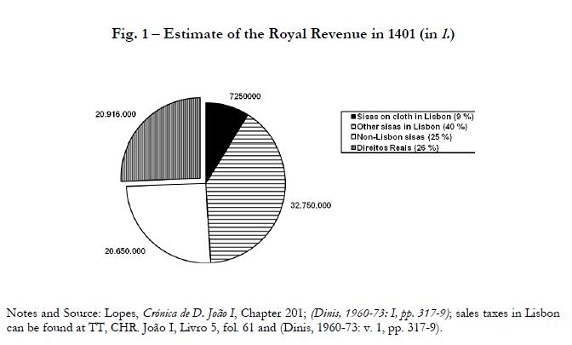
<body><![CDATA[<p>         Given that the <i>Cortes </i>of 1385 proposed to João I a subsidy of 400,000 <i>libras </i>to make up for the <i>sisas</i>, there is little doubt         that the 1382-84 <i>sisas </i>were expected to yield that sum per annum. Considering the average yearly ordinary revenue of 960,000<i>libras </i>         under Pedro I (1357-67), indicated by Fernão Lopes<i>, </i>the <i>sisas</i> represented an increase of 41%. By 1382, the proportion would be even         higher, on account of at least three factors: a) the effects of war on production and trade; b) the assignment of sources of revenue to noble captains;         c) debasements, which affected land rents and debt arrears. Thus, the temporary <i>ad ponderum</i> sales taxes of 1382 implied an increase of about         40% in overall revenue.     </p>         <p>         As has been seen, war and the corresponding collection of the <i>sisas </i>did not mean an immediate transition to a tax state. No quantitative data         whatsoever exist for the years of intense warfare between 1383 and 1400. Nonetheless, the ten-year truce agreed between Portugal and Castile in 1401         was an opportunity for João I to estimate his ordinary revenues in order to set his expenditure. A combination of three different sources, including         data used by Fernão Lopes, allows for a rough breakdown of the revenues of the Portuguese crown in 1401, as shown in <a name="f1"></a><a href="#f1">Fig. 1</a></a>.     </p>  	     <p>&nbsp;</p>  	<a name="f1"> 	<img src="/img/revistas/ejph/v12n1/12n1a02f1.jpg">  	     
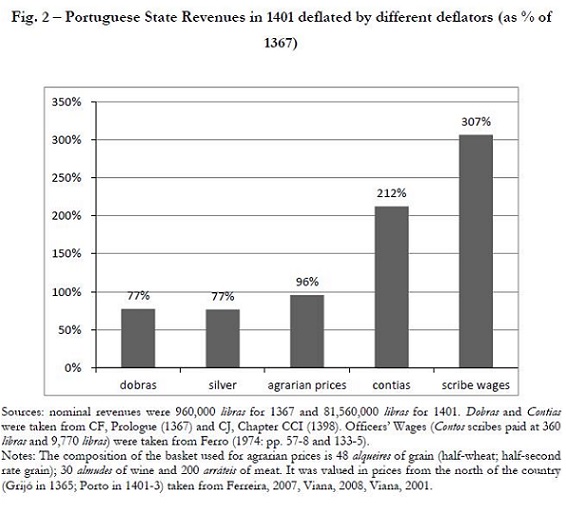
<p>&nbsp;</p> 	         <p>         In 1401, after three decades of war, the nominal revenue of the monarchy had rocketed: it was roughly 80 times higher than in 1367. However, this reflects mainly the debasement of the Portuguese coinage. What appears more remarkable is the change in the structure of tax receipts. By 1401, the        <i>sisa </i>had become the mainstay of royal finances, accounting for 74 per cent of revenue, whereas the temporary <i>sisa</i> in 1382 represented         only 28 per cent of revenue.     </p>         <p>         This transition to the ‘tax state’ should be largely ascribed to debasement. Whilst debasement and price rises threatened land rents and taxation based         upon <i>ad ponderum </i>rates, they did not harm the value of <i>sisas</i>. As these were <i>ad valorem</i>, they<i> </i>were pegged to         inflation. Whilst price increases led to a growth in tax revenue, they also led to a decrease in <i>Direitos Reais</i>. Traditional revenues – tolls, customs, land rents – had their values and <i>ad ponderum </i>rates denominated mostly in <i>libras</i>. <sup><a href="#7">7</a></sup><a name="top7"></a>&nbsp;     </p>         <p>         <b> </b>     </p>         <p>         IV     </p>         <p>         The permanent adoption of <i>sisas </i>led to a radical change in state finances as these taxes eventually became the major form of contribution in the domain. This predominance would continue throughout the fifteenth century. <sup><a href="#8">8</a></sup><a name="top8"></a>&nbsp; However, it         is unclear whether this change in the composition of tax receipts did in fact lead to an effective increase in the crown’s revenue. As mentioned         earlier, Fernão Lopes and his contemporaries regarded wars as a destructive influence on royal revenues. This is especially likely in the present case,         where minting profits and debased currency were essential for ensuring the victory over Castile. Were Lopes and his contemporaries right?     </p>         <p>         Available sources allow us to compare the revenues for two benchmark years, 1367 and 1401, conveniently placed before and after the period of intense         military activity. The choice for a term of comparison is more problematic, however. Nominal values are meaningless for this comparison, given the         serial debasements that started in 1385. The metallic content of the nominal currency, an alternative measurement commonly used by the literature, is         less misleading. Additionally, we can also imitate fifteenth-century chroniclers, who used past exchange rates with stable gold coins when attempting         to make diachronic comparisons of nominal values. The exchange rate of the <i>dobra </i>in <i>libras</i> provided by Lopes allows for this.     </p>         ]]></body>
<body><![CDATA[<p>         Yet, these two methods are insufficient, given that the stock of precious metals probably suffered major changes in these 34 unstable years, moreover         given that the ‘silver famine’ was particularly acute in Portugal (Ferro, 1974: pp. 21-5). Metallic content and exchange rate conversions are no         substitute for real values, which measure the purchasing power of nominal sums. Real values also have the advantage of proxying crown revenues as a         percentage of output. Assuming that these three decades saw no trend growth in per capita output or in population and that the shares of the sectors         did not change dramatically, the prices of a realistic individual consumption basket are a good proxy for total output. Thus, real values not only         provide an apt deflator, but they also serve as a proxy for the variation in the share of the country’s output paid as taxes.     </p>          <p>         Although both purchasing power and metallic content are useful terms of comparison, it should be noticed that price inflation was not a direct threat         to the Portuguese crown, which relied on its own lands for consumption and sale. The increasing price of services, mostly military in nature, was far         more threatening. There is no information available on military wage rates for these two dates. However, two other meaningful items have been included         here: the yearly subsidy paid to the nobles in order to maintain their fighting equipment and horse, the <i>contia</i>, and the wages of the scribe         of the <i>Contos</i>,<i> </i>a particularly well-documented office. The results of these five different deflators are shown in <a name="f2"></a><a href="#f2">Fig. 2</a>.     </p>  	    <p>&nbsp;</p> 	<a name="f2"> 	<img src="/img/revistas/ejph/v12n1/12n1a02f2.jpg">	    
<p>&nbsp;</p> 	          <p> Were the “old kings” wealthier than João I, as implied by Fernão Lopes? The    answer is not straightforward as, tellingly, different deflators indicate different    trajectories. Looking at the situation from the perspectives of metallic content    and exchange rates, it appears that Lopes was right. Despite its impressive    contribution, the<i> sisa</i> could not halt the decay of the intrinsic content    of the revenues. This did not, however, mean that the ‘old kings’ used to have    a considerably larger command over agrarian goods. When total revenues are deflated    in real terms, the two periods appear remarkably similar (revenues in 1401 were    96% of those of 1367). Likely, the share of total output was broadly similar    in the two periods. As the <i>sisas </i>were applied according to <i>ad valorem</i>taxes    the crown’s real revenue remained the same in spite of the price increases.    Seen from this angle, the transition from domain to taxation revenues did not    translate into a higher capacity to capture the value in the economy. </p>         <p>         The key difference lies in the fact that João I could secure specialized services in far greater quantity than his predecessors before the war.         Benefiting from <i>ad valorem </i>sales taxes, the state was not harmed by rising prices. By 1400, in contrast, the state turned price changes to its         favor by postponing the adjustment between inflation and wages: with broadly the same revenue, the crown could pay for three times as many officers as         in 1367 and could disburse twice the amount of <i>contias </i>(which were the sole source of income for many a poor knight). While, for most         subjects, price increases could well be a life-or-death matter, for a monarchy with lands of its own, some coercive power over labor and a fiscal         system based on <i>ad valorem </i>sales taxes, debasement-fuelled dearth did not constitute a major problem.     </p>         <p>         <b>Conclusion</b>     </p>         <p>         <b> </b>     </p>         <p>         War was certainly a decisive factor in Portugal’s emergence as a tax state. By 1400, after the long confrontation with Castile, sales taxes<i> </i>         represented three quarters of receipts, with the traditional sources of revenue accounting for the remaining 25%. However, it was the defensive war         against the Castilian invasion, rather then the expansionist conflict than the expansionist conflicts triggered by Fernando I, that led to this result.         Whilst Fernando I had to settle for temporary, low-rate taxation, João I obtained permanent high taxes (<i>ad valorem </i>sales taxes at 10%). In         fact, the “defense of the realm” provided the only constitutional setting that allowed the monarchy to obtain a firm grip on the <i>sisas</i>.         English kings claiming the French throne did not enjoy the same support and, as such, many royal attempts to expand the fiscal burden were thwarted         (Ormrod, 1994; Ormrod, 1999: p. 184). Likewise, the French <i>gabelle </i>and the Castilian <i>alcabalas </i>were born of the constitutionally         legitimate aims: defense of the realm against the English and the Reconquest, respectively. It appears that just wars are more likely to bring about         fiscal revolutions.     </p>         <p>         The second contribution of the present case study lies in the study of the real revenues. The revenues of the Portuguese “taxe state” were similar to         those of the domain state. The “ratchet effect” was absent because, as authors like Fernão Lopes well knew, the destruction and the debasement wrought         by wars diminished the domain revenues. As such, successful tax states had to adjust their fiscal system to the military context. In Portugal, the         solution took the form of heavy sales taxes which, being <i>ad valorem</i>, hedged the value of royal revenues against the effects of a conflict         essentially subsidized by debasement. The rise of the Portuguese tax state did not imply a real increase in the fiscal burden. It was a response to the         destructive effects of war on the domanial revenues.     </p> 	    ]]></body>
<body><![CDATA[<p>&nbsp;</p>         <p>         <b>ABBREVIATIONS</b>     </p>         <p>         AML - Arquivo Municipal de Lisboa     </p>         <p>         AMP - Arquivo Municipal do Porto     </p>         <p>         ASV - Archivio Segreto Vaticano     </p>         <p>         CF – <i>Crónica de D. Fernando I.</i>     </p>         <p>         CHR – Chancelarias Régias     </p>         <p>         CJ – <i>Crónica de D. João I</i>     </p>         <p>         TT – Torre do Tombo     </p> 	    <p>&nbsp;</p>         ]]></body>
<body><![CDATA[<p>         <b>REFERENCES</b>     </p>         <!-- ref --><p>ALFERAI, A. and BRUN, M. 1994. Ibn Khaldun: Dynastic change and its economic consequences. <i>Arab Studies Quarterly,</i> 16<b>,</b> 73-87.    &nbsp;&nbsp;&nbsp;&nbsp;&nbsp;&nbsp;&nbsp;&nbsp;[&#160;<a href="javascript:void(0);" onclick="javascript: window.open('/scielo.php?script=sci_nlinks&ref=000144&pid=S1645-6432201400010000200001&lng=','','width=640,height=500,resizable=yes,scrollbars=1,menubar=yes,');">Links</a>&#160;]<!-- end-ref -->     </p> 	         <!-- ref --><p>BARROS, H.D.G. 1945-54. <i>História da Administração Pública em Portugal, </i>Lisbon.    &nbsp;&nbsp;&nbsp;&nbsp;&nbsp;&nbsp;&nbsp;&nbsp;[&#160;<a href="javascript:void(0);" onclick="javascript: window.open('/scielo.php?script=sci_nlinks&ref=000146&pid=S1645-6432201400010000200002&lng=','','width=640,height=500,resizable=yes,scrollbars=1,menubar=yes,');">Links</a>&#160;]<!-- end-ref -->     </p> 	         <!-- ref --><p>BONNEY, R. (ed.) 1995. <i>Economic Systems and State Finance, </i>Oxford.    &nbsp;&nbsp;&nbsp;&nbsp;&nbsp;&nbsp;&nbsp;&nbsp;[&#160;<a href="javascript:void(0);" onclick="javascript: window.open('/scielo.php?script=sci_nlinks&ref=000148&pid=S1645-6432201400010000200003&lng=','','width=640,height=500,resizable=yes,scrollbars=1,menubar=yes,');">Links</a>&#160;]<!-- end-ref -->     </p> 	         <!-- ref --><p>BONNEY, R. (ed.) 1999. <i>The Rise of the Fiscal State in Europe, c.1200-1815, </i>Oxford.    &nbsp;&nbsp;&nbsp;&nbsp;&nbsp;&nbsp;&nbsp;&nbsp;[&#160;<a href="javascript:void(0);" onclick="javascript: window.open('/scielo.php?script=sci_nlinks&ref=000150&pid=S1645-6432201400010000200004&lng=','','width=640,height=500,resizable=yes,scrollbars=1,menubar=yes,');">Links</a>&#160;]<!-- end-ref -->     </p> 	         <!-- ref --><p>BONNEY, R. and ORMROD, W.M. (eds.) 1999. <i>Crisis, revolutions and self-sustained growth: Towards a conceptual model of change in Fiscal History, </i>Stamford: Shaun Tyas.    &nbsp;&nbsp;&nbsp;&nbsp;&nbsp;&nbsp;&nbsp;&nbsp;[&#160;<a href="javascript:void(0);" onclick="javascript: window.open('/scielo.php?script=sci_nlinks&ref=000152&pid=S1645-6432201400010000200005&lng=','','width=640,height=500,resizable=yes,scrollbars=1,menubar=yes,');">Links</a>&#160;]<!-- end-ref -->     </p>          <!-- ref --><p>CÂMARA MUNICIPAL DE LISBOA (ed.) 1949. <i>Livro I de Místicos. Livro II del-rei Dom Fernando, </i>Lisbon: CML.    &nbsp;&nbsp;&nbsp;&nbsp;&nbsp;&nbsp;&nbsp;&nbsp;[&#160;<a href="javascript:void(0);" onclick="javascript: window.open('/scielo.php?script=sci_nlinks&ref=000154&pid=S1645-6432201400010000200006&lng=','','width=640,height=500,resizable=yes,scrollbars=1,menubar=yes,');">Links</a>&#160;]<!-- end-ref -->     </p> 	         <!-- ref --><p>CUNHA, C. and COSTA, P.P. (eds.) 2004. <i>Trás-os-Montes Medieval e Moderno. Transcrição de Fontes Documentais, </i>Bragança: Arquivo Distrital             de Bragança.    &nbsp;&nbsp;&nbsp;&nbsp;&nbsp;&nbsp;&nbsp;&nbsp;[&#160;<a href="javascript:void(0);" onclick="javascript: window.open('/scielo.php?script=sci_nlinks&ref=000156&pid=S1645-6432201400010000200007&lng=','','width=640,height=500,resizable=yes,scrollbars=1,menubar=yes,');">Links</a>&#160;]<!-- end-ref -->     </p>          <!-- ref --><p>DIAS, J.J.A. (ed.) 2003. <i>Cortes Portuguesas. Reinado de D. Manuel I (Cortes de 1498), </i>Lisbon: CEH.    &nbsp;&nbsp;&nbsp;&nbsp;&nbsp;&nbsp;&nbsp;&nbsp;[&#160;<a href="javascript:void(0);" onclick="javascript: window.open('/scielo.php?script=sci_nlinks&ref=000158&pid=S1645-6432201400010000200008&lng=','','width=640,height=500,resizable=yes,scrollbars=1,menubar=yes,');">Links</a>&#160;]<!-- end-ref -->     </p> 	         <!-- ref --><p>DINIS, A.J.D. (ed.) 1960-73. <i>Monumenta Henricina, </i>Coimbra: Comissão Executiva para a comemoração dos 500 anos da morte do infante D.             Henrique.    &nbsp;&nbsp;&nbsp;&nbsp;&nbsp;&nbsp;&nbsp;&nbsp;[&#160;<a href="javascript:void(0);" onclick="javascript: window.open('/scielo.php?script=sci_nlinks&ref=000160&pid=S1645-6432201400010000200009&lng=','','width=640,height=500,resizable=yes,scrollbars=1,menubar=yes,');">Links</a>&#160;]<!-- end-ref -->     </p> 	         <!-- ref --><p>DUARTE, L.M. 2000. A Fiscalidade Municipal Portuguesa. Estado da Questão. <i>Congrés d'Historia de la Corona d'Aragó.</i> Barcelona: Universitat             de Barcelona.    &nbsp;&nbsp;&nbsp;&nbsp;&nbsp;&nbsp;&nbsp;&nbsp;[&#160;<a href="javascript:void(0);" onclick="javascript: window.open('/scielo.php?script=sci_nlinks&ref=000162&pid=S1645-6432201400010000200010&lng=','','width=640,height=500,resizable=yes,scrollbars=1,menubar=yes,');">Links</a>&#160;]<!-- end-ref -->     </p> 	         <!-- ref --><p>FARELO, M.S.D.S. 2008. <i>A Oligarquia Camarária de Lisboa (1325-1433).</i> PhD dissertation, Universidade de Lisboa.    &nbsp;&nbsp;&nbsp;&nbsp;&nbsp;&nbsp;&nbsp;&nbsp;[&#160;<a href="javascript:void(0);" onclick="javascript: window.open('/scielo.php?script=sci_nlinks&ref=000164&pid=S1645-6432201400010000200011&lng=','','width=640,height=500,resizable=yes,scrollbars=1,menubar=yes,');">Links</a>&#160;]<!-- end-ref -->     </p> 	         <!-- ref --><p>FARO, J. (ed.) 1965. <i>Receitas e Despesas da Fazenda Real de 1384 a 1481. Subsídios Documentais, </i>Lisbon: Centro de Estudos Económicos.    &nbsp;&nbsp;&nbsp;&nbsp;&nbsp;&nbsp;&nbsp;&nbsp;[&#160;<a href="javascript:void(0);" onclick="javascript: window.open('/scielo.php?script=sci_nlinks&ref=000166&pid=S1645-6432201400010000200012&lng=','','width=640,height=500,resizable=yes,scrollbars=1,menubar=yes,');">Links</a>&#160;]<!-- end-ref -->            </p> 	         <!-- ref --><p>FERREIRA, J.A.P. (ed.) 1980. <i>Vereaçoens. Anos de 1401-1449, </i>Porto: Gabinete de Estudos de História do Porto.    &nbsp;&nbsp;&nbsp;&nbsp;&nbsp;&nbsp;&nbsp;&nbsp;[&#160;<a href="javascript:void(0);" onclick="javascript: window.open('/scielo.php?script=sci_nlinks&ref=000168&pid=S1645-6432201400010000200013&lng=','','width=640,height=500,resizable=yes,scrollbars=1,menubar=yes,');">Links</a>&#160;]<!-- end-ref -->     </p> 	         <!-- ref --><p>FERREIRA, S.C. 2007. <i>Preços e Salários em Portugal na Baixa Idade Média.</i> Mestrado, Universidade do Porto.    &nbsp;&nbsp;&nbsp;&nbsp;&nbsp;&nbsp;&nbsp;&nbsp;[&#160;<a href="javascript:void(0);" onclick="javascript: window.open('/scielo.php?script=sci_nlinks&ref=000170&pid=S1645-6432201400010000200014&lng=','','width=640,height=500,resizable=yes,scrollbars=1,menubar=yes,');">Links</a>&#160;]<!-- end-ref -->     </p> 	         <!-- ref --><p>FERRO, M.J.P. 1974. <i>Estudos de História Monetária Portuguesa, </i>Lisbon, s.n.    &nbsp;&nbsp;&nbsp;&nbsp;&nbsp;&nbsp;&nbsp;&nbsp;[&#160;<a href="javascript:void(0);" onclick="javascript: window.open('/scielo.php?script=sci_nlinks&ref=000172&pid=S1645-6432201400010000200015&lng=','','width=640,height=500,resizable=yes,scrollbars=1,menubar=yes,');">Links</a>&#160;]<!-- end-ref -->     </p> 	         <!-- ref --><p>GODINHO, V.M. 1999. Finanças Públicas e Estrutura do Estado. <i>Dicionário de História de Portugal, </i>2nd ed. Porto.    &nbsp;&nbsp;&nbsp;&nbsp;&nbsp;&nbsp;&nbsp;&nbsp;[&#160;<a href="javascript:void(0);" onclick="javascript: window.open('/scielo.php?script=sci_nlinks&ref=000174&pid=S1645-6432201400010000200016&lng=','','width=640,height=500,resizable=yes,scrollbars=1,menubar=yes,');">Links</a>&#160;]<!-- end-ref -->     </p> 	         <!-- ref --><p>GONÇALVES, I. 1964. <i>Pedidos e Empréstimos Públicos em Portugal durante a Idade Média, </i>Lisbon, Cadernos de Ciência e Técnica Fiscal.    &nbsp;&nbsp;&nbsp;&nbsp;&nbsp;&nbsp;&nbsp;&nbsp;[&#160;<a href="javascript:void(0);" onclick="javascript: window.open('/scielo.php?script=sci_nlinks&ref=000176&pid=S1645-6432201400010000200017&lng=','','width=640,height=500,resizable=yes,scrollbars=1,menubar=yes,');">Links</a>&#160;]<!-- end-ref -->     </p> 	         <!-- ref --><p>HENRIQUES, A.C. 2008. <i>State Finance, War and Redistribution in Portugal. </i><i>1249-1527.</i> PhD, University of York.    &nbsp;&nbsp;&nbsp;&nbsp;&nbsp;&nbsp;&nbsp;&nbsp;[&#160;<a href="javascript:void(0);" onclick="javascript: window.open('/scielo.php?script=sci_nlinks&ref=000178&pid=S1645-6432201400010000200018&lng=','','width=640,height=500,resizable=yes,scrollbars=1,menubar=yes,');">Links</a>&#160;]<!-- end-ref -->     </p> 	         <!-- ref --><p>HOMEM, A.L.D.C. 1990. <i>O Desembargo Régio (1320-1433), </i>Porto, Junta Nacional de Investigação Científica.    &nbsp;&nbsp;&nbsp;&nbsp;&nbsp;&nbsp;&nbsp;&nbsp;[&#160;<a href="javascript:void(0);" onclick="javascript: window.open('/scielo.php?script=sci_nlinks&ref=000180&pid=S1645-6432201400010000200019&lng=','','width=640,height=500,resizable=yes,scrollbars=1,menubar=yes,');">Links</a>&#160;]<!-- end-ref -->     </p> 	         <!-- ref --><p>MARQUES, A.H.D.O. 1986. <i>Portugal na Crise dos Séculos XV e XVI, </i>Lisbon, Presença.    &nbsp;&nbsp;&nbsp;&nbsp;&nbsp;&nbsp;&nbsp;&nbsp;[&#160;<a href="javascript:void(0);" onclick="javascript: window.open('/scielo.php?script=sci_nlinks&ref=000182&pid=S1645-6432201400010000200020&lng=','','width=640,height=500,resizable=yes,scrollbars=1,menubar=yes,');">Links</a>&#160;]<!-- end-ref -->     </p> 	         <!-- ref --><p>MARQUES, A.H.D.O. (ed.) 1990a. <i>Chancelarias portuguesas: D. Afonso IV</i>: Lisbon.    &nbsp;&nbsp;&nbsp;&nbsp;&nbsp;&nbsp;&nbsp;&nbsp;[&#160;<a href="javascript:void(0);" onclick="javascript: window.open('/scielo.php?script=sci_nlinks&ref=000184&pid=S1645-6432201400010000200021&lng=','','width=640,height=500,resizable=yes,scrollbars=1,menubar=yes,');">Links</a>&#160;]<!-- end-ref -->     </p> 	         <!-- ref --><p>MARQUES, A.H.D.O. (ed.) 1990b. <i>Cortes Portuguesas. Reinado de D. Fernando I, </i>Lisbon: INIC.    &nbsp;&nbsp;&nbsp;&nbsp;&nbsp;&nbsp;&nbsp;&nbsp;[&#160;<a href="javascript:void(0);" onclick="javascript: window.open('/scielo.php?script=sci_nlinks&ref=000186&pid=S1645-6432201400010000200022&lng=','','width=640,height=500,resizable=yes,scrollbars=1,menubar=yes,');">Links</a>&#160;]<!-- end-ref -->     </p> 	         <!-- ref --><p>MARQUES, J.D.S. (ed.) 1988. <i>Descobrimentos Portugueses. Documentos para o seu estudo, </i>Lisbon: INIC.    &nbsp;&nbsp;&nbsp;&nbsp;&nbsp;&nbsp;&nbsp;&nbsp;[&#160;<a href="javascript:void(0);" onclick="javascript: window.open('/scielo.php?script=sci_nlinks&ref=000188&pid=S1645-6432201400010000200023&lng=','','width=640,height=500,resizable=yes,scrollbars=1,menubar=yes,');">Links</a>&#160;]<!-- end-ref -->     </p> 	         <!-- ref --><p>MARQUES, M.G. 1978. <i>Moedas de D. Fernando I, </i>Lisbon, s.n.    &nbsp;&nbsp;&nbsp;&nbsp;&nbsp;&nbsp;&nbsp;&nbsp;[&#160;<a href="javascript:void(0);" onclick="javascript: window.open('/scielo.php?script=sci_nlinks&ref=000190&pid=S1645-6432201400010000200024&lng=','','width=640,height=500,resizable=yes,scrollbars=1,menubar=yes,');">Links</a>&#160;]<!-- end-ref -->     </p> 	         <!-- ref --><p>MARTINS, M.G. 2005. A Guerra Esquiva. O Conflito Luso-Castelhano de 1336-38. <i>Promontoria,</i> 3.    &nbsp;&nbsp;&nbsp;&nbsp;&nbsp;&nbsp;&nbsp;&nbsp;[&#160;<a href="javascript:void(0);" onclick="javascript: window.open('/scielo.php?script=sci_nlinks&ref=000192&pid=S1645-6432201400010000200025&lng=','','width=640,height=500,resizable=yes,scrollbars=1,menubar=yes,');">Links</a>&#160;]<!-- end-ref -->     </p> 	         <!-- ref --><p>MENJOT, D. s.d. Alcabalas. In MENJOT, D., SÁNCHEZ MARTÍNEZ, M. and VERDÉS PIJUAN, P. (eds.) <i>Glosario Critico de Fiscalidad Medieval.</i>                Barcelona: CSIC.    &nbsp;&nbsp;&nbsp;&nbsp;&nbsp;&nbsp;&nbsp;&nbsp;[&#160;<a href="javascript:void(0);" onclick="javascript: window.open('/scielo.php?script=sci_nlinks&ref=000194&pid=S1645-6432201400010000200026&lng=','','width=640,height=500,resizable=yes,scrollbars=1,menubar=yes,');">Links</a>&#160;]<!-- end-ref -->     </p> 	         <!-- ref --><p>MUSGRAVE, R.A. 1992. Schumpeter's crisis of the tax state: An essay in fiscal sociology. <i>Journal of Evolutionary Economics,</i> 2            <b>,</b> 89-113.    &nbsp;&nbsp;&nbsp;&nbsp;&nbsp;&nbsp;&nbsp;&nbsp;[&#160;<a href="javascript:void(0);" onclick="javascript: window.open('/scielo.php?script=sci_nlinks&ref=000196&pid=S1645-6432201400010000200027&lng=','','width=640,height=500,resizable=yes,scrollbars=1,menubar=yes,');">Links</a>&#160;]<!-- end-ref -->     </p>          <!-- ref --><p>ORMROD, W.M. 1994. The domestic response to the Hundred Years War In CURRY, A. and HUGHES, M. (eds.)            <i>Arms, Armies and Fortifications in the Hundred Years War.</i> Woodridge: Woodridge.    &nbsp;&nbsp;&nbsp;&nbsp;&nbsp;&nbsp;&nbsp;&nbsp;[&#160;<a href="javascript:void(0);" onclick="javascript: window.open('/scielo.php?script=sci_nlinks&ref=000198&pid=S1645-6432201400010000200028&lng=','','width=640,height=500,resizable=yes,scrollbars=1,menubar=yes,');">Links</a>&#160;]<!-- end-ref -->     </p> 	         <!-- ref --><p>ORMROD, W.M. 1999. Finance and Trade under Richard II. In GOODMAN, A. and GILLESPIE, J.L. (eds.) <i>Richard II. The Art of Kingship.</i>             Cambridge: Cambridge University Press.    &nbsp;&nbsp;&nbsp;&nbsp;&nbsp;&nbsp;&nbsp;&nbsp;[&#160;<a href="javascript:void(0);" onclick="javascript: window.open('/scielo.php?script=sci_nlinks&ref=000200&pid=S1645-6432201400010000200029&lng=','','width=640,height=500,resizable=yes,scrollbars=1,menubar=yes,');">Links</a>&#160;]<!-- end-ref -->     </p>         <!-- ref --><p>REIS, A.M. 2007. <i>História dos Municípios. 1050-1383, </i>Lisbon, Horizonte.    &nbsp;&nbsp;&nbsp;&nbsp;&nbsp;&nbsp;&nbsp;&nbsp;[&#160;<a href="javascript:void(0);" onclick="javascript: window.open('/scielo.php?script=sci_nlinks&ref=000202&pid=S1645-6432201400010000200030&lng=','','width=640,height=500,resizable=yes,scrollbars=1,menubar=yes,');">Links</a>&#160;]<!-- end-ref -->     </p> 	         <!-- ref --><p>SÁ-NOGUEIRA, B.D. (ed.) 2003. <i>O Livro das Lezírias d'El-rei Dom Dinis, </i>Lisbon: Centro de Estudos Históricos.    &nbsp;&nbsp;&nbsp;&nbsp;&nbsp;&nbsp;&nbsp;&nbsp;[&#160;<a href="javascript:void(0);" onclick="javascript: window.open('/scielo.php?script=sci_nlinks&ref=000204&pid=S1645-6432201400010000200031&lng=','','width=640,height=500,resizable=yes,scrollbars=1,menubar=yes,');">Links</a>&#160;]<!-- end-ref -->     </p> 	         <!-- ref --><p>SOUSA, A.D. 1990. <i>As Cortes Medievais Portuguesas (1385-1490) </i>Porto, INIC.    &nbsp;&nbsp;&nbsp;&nbsp;&nbsp;&nbsp;&nbsp;&nbsp;[&#160;<a href="javascript:void(0);" onclick="javascript: window.open('/scielo.php?script=sci_nlinks&ref=000206&pid=S1645-6432201400010000200032&lng=','','width=640,height=500,resizable=yes,scrollbars=1,menubar=yes,');">Links</a>&#160;]<!-- end-ref -->     </p> 	         <!-- ref --><p>VIANA, M. 2001. Alguns Preços de Vinho em Portugal (séculos XIV-XV). <i>Arquipélago - História,</i> 5 (2ª série).    &nbsp;&nbsp;&nbsp;&nbsp;&nbsp;&nbsp;&nbsp;&nbsp;[&#160;<a href="javascript:void(0);" onclick="javascript: window.open('/scielo.php?script=sci_nlinks&ref=000208&pid=S1645-6432201400010000200033&lng=','','width=640,height=500,resizable=yes,scrollbars=1,menubar=yes,');">Links</a>&#160;]<!-- end-ref -->     </p> 	         <!-- ref --><p>VIANA, M. 2008. Alguns Preços de Cereais em Portugal (Séculos XIII-XVI) <i>Arquipélago - História,</i> 2ª série, XI - XII<b>,</b>             207-280.    &nbsp;&nbsp;&nbsp;&nbsp;&nbsp;&nbsp;&nbsp;&nbsp;[&#160;<a href="javascript:void(0);" onclick="javascript: window.open('/scielo.php?script=sci_nlinks&ref=000210&pid=S1645-6432201400010000200034&lng=','','width=640,height=500,resizable=yes,scrollbars=1,menubar=yes,');">Links</a>&#160;]<!-- end-ref -->     </p> 	          <!-- ref --><p>VISENTINI, F. (ed.) 1903. <i>Bilanci generali della repubblica di Venezia,    </i>Venice: Reale Commissione per la pubblicazione dei documenti finanziari    della repubblica di Venezia.    &nbsp;&nbsp;&nbsp;&nbsp;&nbsp;&nbsp;&nbsp;&nbsp;[&#160;<a href="javascript:void(0);" onclick="javascript: window.open('/scielo.php?script=sci_nlinks&ref=000212&pid=S1645-6432201400010000200035&lng=','','width=640,height=500,resizable=yes,scrollbars=1,menubar=yes,');">Links</a>&#160;]<!-- end-ref --> </p>     <p>&nbsp; </p> 	       <p>             Received for publication: 18 December 2013         </p>             <p>             Accepted in revised form: 17 February 2014         </p>             <p>             Recebido para publicação: 18 de Dezembro de 2013         </p>             <p>             Aceite após revisão: 17 de Fevereiro de 2014         </p>  		    <p>&nbsp;</p> 		    <p><b> NOTES </b></p>  			    <p><sup><a name="2"></a><a href="#top2">2</a></sup>&nbsp;             The contrast between <i>sisas</i> and <i>direitos reais</i> was formulated in 1439 and in 1459: TT, Suplemento de Cortes, maço 4, doc. 41; TT,             Cortes, maço 2, n. 14.         </p>    			    <p><sup><a name="3"></a><a href="#top3">3</a></sup>&nbsp;             See note 1.         </p> 		 			    ]]></body>
<body><![CDATA[<p><sup><a name="4"></a><a href="#top4">4</a></sup>&nbsp;             <i>                 E vendo os Reis taaes remdas de sissas, avemdo vontade de as aver, mostravã ao povo necesidades pasadas ou que eram por vir e pedimdolhas                 graciosamente por dous ou tres anos que logo as leixariom             </i>             . <i>Cron. João I</i>, Chapter CCI.         </p>      		    <p><sup><a name="5"></a><a href="#top5">5</a></sup>&nbsp;             TT, CHR, Dinis, Lv. 3, fol. 104: ‘<i>per razom da ssisa que antressi fezerom pera pagarem a mim os meus seruiços</i>’. The Jews were still using             the <i>sisa</i> in 1328 (TT, Gavetas, Gaveta 12, m. 4, doc. 24).         </p>      	    <p><sup><a name="6"></a><a href="#top6">6</a></sup>&nbsp; The municipality of Lisbon vowed to compensate the king by collecting a two per cent tax on wealth in 1373. But it ended up returning to the            <i>sisa</i> in the same year (AML, Livro de Serviços a El Rei, n. 5). After this, the municipality of Lisbon extracted from Fernando I the             promise that the city would not pay <i>sisas</i>again (AML, <i>Livro I de Serviços a El Rei</i>, n. 6).         </p>      	    <p><sup><a name="7"></a><a href="#top7">7</a></sup>&nbsp;             In 1401, the all-important Lisbon customs and tolls were collected according to <i>ad ponderum </i>rates set in around 1377. The rights and             jurisdictions from the bishop of Porto that João I captured were worth a paltry 300,000 <i>libras </i>in 1405 (TT, Gavetas, Gaveta 1, m. 1, n.             15)         </p>      	     <p><sup><a name="8"></a><a href="#top8">8</a></sup>&nbsp; <i>Sisas </i> represented    less than 90 per cent of the revenues at the <i>almoxarifado </i>level. Compare    TT, CHR. Afonso V, Lv. 27, fol. 164 (Beja, 1440) with TT, CHR, Manuel I, Lv.    17, fl. 41 (Beja in 1498).</p> 		 		     ]]></body><back>
<ref-list>
<ref id="B1">
<nlm-citation citation-type="journal">
<person-group person-group-type="author">
<name>
<surname><![CDATA[ALFERAI]]></surname>
<given-names><![CDATA[A.]]></given-names>
</name>
<name>
<surname><![CDATA[BRUN]]></surname>
<given-names><![CDATA[M.]]></given-names>
</name>
</person-group>
<article-title xml:lang="en"><![CDATA[Ibn Khaldun: Dynastic change and its economic consequences]]></article-title>
<source><![CDATA[Arab Studies Quarterly]]></source>
<year>1994</year>
<volume>16</volume>
<page-range>73-87</page-range></nlm-citation>
</ref>
<ref id="B2">
<nlm-citation citation-type="">
<person-group person-group-type="author">
<name>
<surname><![CDATA[BARROS]]></surname>
<given-names><![CDATA[H.D.G]]></given-names>
</name>
</person-group>
<source><![CDATA[História da Administração Pública em Portugal]]></source>
<year>1945</year>
<month>-5</month>
<day>4</day>
<publisher-loc><![CDATA[Lisbon ]]></publisher-loc>
</nlm-citation>
</ref>
<ref id="B3">
<nlm-citation citation-type="">
<person-group person-group-type="author">
<name>
<surname><![CDATA[BONNEY]]></surname>
<given-names><![CDATA[R.]]></given-names>
</name>
</person-group>
<source><![CDATA[Economic Systems and State Finance]]></source>
<year>1995</year>
<publisher-loc><![CDATA[Oxford ]]></publisher-loc>
</nlm-citation>
</ref>
<ref id="B4">
<nlm-citation citation-type="">
<person-group person-group-type="author">
<name>
<surname><![CDATA[BONNEY]]></surname>
<given-names><![CDATA[R.]]></given-names>
</name>
</person-group>
<source><![CDATA[The Rise of the Fiscal State in Europe, c.1200-1815]]></source>
<year>1999</year>
<publisher-loc><![CDATA[Oxford ]]></publisher-loc>
</nlm-citation>
</ref>
<ref id="B5">
<nlm-citation citation-type="book">
<person-group person-group-type="author">
<name>
<surname><![CDATA[BONNEY]]></surname>
<given-names><![CDATA[R]]></given-names>
</name>
<name>
<surname><![CDATA[ORMROD]]></surname>
<given-names><![CDATA[W.M]]></given-names>
</name>
</person-group>
<source><![CDATA[Crisis, revolutions and self-sustained growth: Towards a conceptual model of change in Fiscal History]]></source>
<year>1999</year>
<publisher-loc><![CDATA[Stamford ]]></publisher-loc>
<publisher-name><![CDATA[Shaun Tyas]]></publisher-name>
</nlm-citation>
</ref>
<ref id="B6">
<nlm-citation citation-type="book">
<source><![CDATA[Livro I de Místicos. Livro II del-rei Dom Fernando]]></source>
<year>1949</year>
<publisher-loc><![CDATA[Lisbon ]]></publisher-loc>
<publisher-name><![CDATA[CÂMARA MUNICIPAL DE LISBOACML]]></publisher-name>
</nlm-citation>
</ref>
<ref id="B7">
<nlm-citation citation-type="book">
<person-group person-group-type="author">
<name>
<surname><![CDATA[CUNHA]]></surname>
<given-names><![CDATA[C]]></given-names>
</name>
<name>
<surname><![CDATA[COSTA]]></surname>
<given-names><![CDATA[P.P.]]></given-names>
</name>
</person-group>
<source><![CDATA[Trás-os-Montes Medieval e Moderno: Transcrição de Fontes Documentais]]></source>
<year>2004</year>
<publisher-loc><![CDATA[Bragança ]]></publisher-loc>
<publisher-name><![CDATA[Arquivo Distrital de Bragança]]></publisher-name>
</nlm-citation>
</ref>
<ref id="B8">
<nlm-citation citation-type="book">
<person-group person-group-type="author">
<name>
<surname><![CDATA[DIAS]]></surname>
<given-names><![CDATA[J.J.A]]></given-names>
</name>
</person-group>
<source><![CDATA[Cortes Portuguesas. Reinado de D. Manuel I (Cortes de 1498)]]></source>
<year>2003</year>
<publisher-loc><![CDATA[Lisbon ]]></publisher-loc>
<publisher-name><![CDATA[CEH]]></publisher-name>
</nlm-citation>
</ref>
<ref id="B9">
<nlm-citation citation-type="book">
<person-group person-group-type="author">
<name>
<surname><![CDATA[DINIS]]></surname>
<given-names><![CDATA[A.J.D]]></given-names>
</name>
</person-group>
<source><![CDATA[Monumenta Henricina]]></source>
<year>1960</year>
<month>-7</month>
<day>3</day>
<publisher-loc><![CDATA[Coimbra ]]></publisher-loc>
<publisher-name><![CDATA[Comissão Executiva para a comemoração dos 500 anos da morte do infante D. Henrique]]></publisher-name>
</nlm-citation>
</ref>
<ref id="B10">
<nlm-citation citation-type="journal">
<person-group person-group-type="author">
<name>
<surname><![CDATA[DUARTE]]></surname>
<given-names><![CDATA[L.M]]></given-names>
</name>
</person-group>
<article-title xml:lang="pt"><![CDATA[A Fiscalidade Municipal Portuguesa. Estado da Questão]]></article-title>
<source><![CDATA[Congrés d'Historia de la Corona d'Aragó]]></source>
<year>2000</year>
<publisher-loc><![CDATA[Barcelona ]]></publisher-loc>
<publisher-name><![CDATA[Universitat de Barcelona]]></publisher-name>
</nlm-citation>
</ref>
<ref id="B11">
<nlm-citation citation-type="book">
<person-group person-group-type="author">
<name>
<surname><![CDATA[FARELO]]></surname>
<given-names><![CDATA[M.S.D.S]]></given-names>
</name>
</person-group>
<source><![CDATA[A Oligarquia Camarária de Lisboa (1325-1433)]]></source>
<year>2008</year>
<publisher-name><![CDATA[Universidade de Lisboa]]></publisher-name>
</nlm-citation>
</ref>
<ref id="B12">
<nlm-citation citation-type="book">
<person-group person-group-type="author">
<name>
<surname><![CDATA[FARO]]></surname>
<given-names><![CDATA[J]]></given-names>
</name>
</person-group>
<source><![CDATA[Receitas e Despesas da Fazenda Real de 1384 a 1481.: Subsídios Documentais]]></source>
<year>1965</year>
<publisher-loc><![CDATA[Lisbon ]]></publisher-loc>
<publisher-name><![CDATA[Centro de Estudos Económicos]]></publisher-name>
</nlm-citation>
</ref>
<ref id="B13">
<nlm-citation citation-type="book">
<person-group person-group-type="author">
<name>
<surname><![CDATA[FERREIRA]]></surname>
<given-names><![CDATA[J.A.P]]></given-names>
</name>
</person-group>
<source><![CDATA[Vereaçoens.: Anos de 1401-1449]]></source>
<year>1980</year>
<publisher-loc><![CDATA[Porto ]]></publisher-loc>
<publisher-name><![CDATA[Gabinete de Estudos de História do Porto]]></publisher-name>
</nlm-citation>
</ref>
<ref id="B14">
<nlm-citation citation-type="book">
<person-group person-group-type="author">
<name>
<surname><![CDATA[FERREIRA]]></surname>
<given-names><![CDATA[S.C]]></given-names>
</name>
</person-group>
<source><![CDATA[Preços e Salários em Portugal na Baixa Idade Média]]></source>
<year>2007</year>
<publisher-name><![CDATA[Universidade do Porto]]></publisher-name>
</nlm-citation>
</ref>
<ref id="B15">
<nlm-citation citation-type="">
<person-group person-group-type="author">
<name>
<surname><![CDATA[FERRO]]></surname>
<given-names><![CDATA[M.J.P]]></given-names>
</name>
</person-group>
<source><![CDATA[Estudos de História Monetária Portuguesa]]></source>
<year>1974</year>
<publisher-loc><![CDATA[Lisbon ]]></publisher-loc>
</nlm-citation>
</ref>
<ref id="B16">
<nlm-citation citation-type="">
<person-group person-group-type="author">
<name>
<surname><![CDATA[GODINHO]]></surname>
<given-names><![CDATA[V.M.]]></given-names>
</name>
</person-group>
<source><![CDATA[Finanças Públicas e Estrutura do Estado]]></source>
<year>1999</year>
<edition>2nd</edition>
<publisher-loc><![CDATA[Porto ]]></publisher-loc>
</nlm-citation>
</ref>
<ref id="B17">
<nlm-citation citation-type="book">
<person-group person-group-type="author">
<name>
<surname><![CDATA[GONÇALVES]]></surname>
<given-names><![CDATA[I]]></given-names>
</name>
</person-group>
<source><![CDATA[Pedidos e Empréstimos Públicos em Portugal durante a Idade Média]]></source>
<year>1964</year>
<publisher-loc><![CDATA[Lisbon ]]></publisher-loc>
<publisher-name><![CDATA[Cadernos de Ciência e Técnica Fiscal]]></publisher-name>
</nlm-citation>
</ref>
<ref id="B18">
<nlm-citation citation-type="book">
<person-group person-group-type="author">
<name>
<surname><![CDATA[HENRIQUES]]></surname>
<given-names><![CDATA[A.C.]]></given-names>
</name>
</person-group>
<source><![CDATA[State Finance, War and Redistribution in Portugal.: 1249-1527]]></source>
<year>2008</year>
<publisher-name><![CDATA[University of York]]></publisher-name>
</nlm-citation>
</ref>
<ref id="B19">
<nlm-citation citation-type="book">
<person-group person-group-type="author">
<name>
<surname><![CDATA[HOMEM]]></surname>
<given-names><![CDATA[A.L.D.C]]></given-names>
</name>
</person-group>
<source><![CDATA[O Desembargo Régio (1320-1433)]]></source>
<year>1990</year>
<publisher-loc><![CDATA[Porto ]]></publisher-loc>
<publisher-name><![CDATA[Junta Nacional de Investigação Científica]]></publisher-name>
</nlm-citation>
</ref>
<ref id="B20">
<nlm-citation citation-type="book">
<person-group person-group-type="author">
<name>
<surname><![CDATA[MARQUES]]></surname>
<given-names><![CDATA[A.H.D.O]]></given-names>
</name>
</person-group>
<source><![CDATA[Portugal na Crise dos Séculos XV e XVI]]></source>
<year>1986</year>
<publisher-loc><![CDATA[Lisbon ]]></publisher-loc>
<publisher-name><![CDATA[Presença]]></publisher-name>
</nlm-citation>
</ref>
<ref id="B21">
<nlm-citation citation-type="">
<person-group person-group-type="author">
<name>
<surname><![CDATA[MARQUES]]></surname>
<given-names><![CDATA[A.H.D.O.]]></given-names>
</name>
</person-group>
<source><![CDATA[Chancelarias portuguesas: D. Afonso IV]]></source>
<year>1990</year>
<publisher-loc><![CDATA[Lisbon ]]></publisher-loc>
</nlm-citation>
</ref>
<ref id="B22">
<nlm-citation citation-type="book">
<person-group person-group-type="author">
<name>
<surname><![CDATA[MARQUES]]></surname>
<given-names><![CDATA[A.H.D.O.]]></given-names>
</name>
</person-group>
<source><![CDATA[Cortes Portuguesas. Reinado de D. Fernando I]]></source>
<year>1990</year>
<publisher-loc><![CDATA[Lisbon ]]></publisher-loc>
<publisher-name><![CDATA[INIC]]></publisher-name>
</nlm-citation>
</ref>
<ref id="B23">
<nlm-citation citation-type="book">
<person-group person-group-type="author">
<name>
<surname><![CDATA[MARQUES]]></surname>
<given-names><![CDATA[J.D.S.]]></given-names>
</name>
</person-group>
<source><![CDATA[Descobrimentos Portugueses.: Documentos para o seu estudo]]></source>
<year>1988</year>
<publisher-loc><![CDATA[Lisbon ]]></publisher-loc>
<publisher-name><![CDATA[INIC]]></publisher-name>
</nlm-citation>
</ref>
<ref id="B24">
<nlm-citation citation-type="">
<person-group person-group-type="author">
<name>
<surname><![CDATA[MARQUES]]></surname>
<given-names><![CDATA[M.G.]]></given-names>
</name>
</person-group>
<source><![CDATA[Moedas de D. Fernando I]]></source>
<year>1978</year>
<publisher-loc><![CDATA[Lisbon ]]></publisher-loc>
</nlm-citation>
</ref>
<ref id="B25">
<nlm-citation citation-type="journal">
<person-group person-group-type="author">
<name>
<surname><![CDATA[MARTINS]]></surname>
<given-names><![CDATA[M.G.]]></given-names>
</name>
</person-group>
<article-title xml:lang="pt"><![CDATA[A Guerra Esquiva: O Conflito Luso-Castelhano de 1336-38]]></article-title>
<source><![CDATA[Promontoria]]></source>
<year>2005</year>
<volume>3</volume>
</nlm-citation>
</ref>
<ref id="B26">
<nlm-citation citation-type="book">
<person-group person-group-type="author">
<name>
<surname><![CDATA[MENJOT]]></surname>
<given-names><![CDATA[D.]]></given-names>
</name>
</person-group>
<article-title xml:lang="es"><![CDATA[Alcabalas]]></article-title>
<person-group person-group-type="editor">
<name>
<surname><![CDATA[MENJOT]]></surname>
<given-names><![CDATA[D.]]></given-names>
</name>
<name>
<surname><![CDATA[SÁNCHEZ MARTÍNEZ]]></surname>
<given-names><![CDATA[M.]]></given-names>
</name>
<name>
<surname><![CDATA[VERDÉS PIJUAN]]></surname>
<given-names><![CDATA[P.]]></given-names>
</name>
</person-group>
<source><![CDATA[Critico de Fiscalidad Medieval]]></source>
<year></year>
<publisher-loc><![CDATA[Barcelona ]]></publisher-loc>
<publisher-name><![CDATA[CSIC]]></publisher-name>
</nlm-citation>
</ref>
<ref id="B27">
<nlm-citation citation-type="journal">
<person-group person-group-type="author">
<name>
<surname><![CDATA[MUSGRAVE]]></surname>
<given-names><![CDATA[R.A.]]></given-names>
</name>
</person-group>
<article-title xml:lang="en"><![CDATA[Schumpeter's crisis of the tax state: An essay in fiscal sociology]]></article-title>
<source><![CDATA[Journal of Evolutionary Economics]]></source>
<year>1992</year>
<volume>2</volume>
<page-range>89-113</page-range></nlm-citation>
</ref>
<ref id="B28">
<nlm-citation citation-type="book">
<person-group person-group-type="author">
<name>
<surname><![CDATA[ORMROD]]></surname>
<given-names><![CDATA[W.M.]]></given-names>
</name>
</person-group>
<article-title xml:lang="en"><![CDATA[The domestic response to the Hundred Years War]]></article-title>
<person-group person-group-type="editor">
<name>
<surname><![CDATA[CURRY]]></surname>
<given-names><![CDATA[A.]]></given-names>
</name>
<name>
<surname><![CDATA[HUGHES]]></surname>
<given-names><![CDATA[M.]]></given-names>
</name>
</person-group>
<source><![CDATA[Arms, Armies and Fortifications in the Hundred Years War]]></source>
<year>1994</year>
<publisher-loc><![CDATA[Woodridge ]]></publisher-loc>
<publisher-name><![CDATA[Woodridge]]></publisher-name>
</nlm-citation>
</ref>
<ref id="B29">
<nlm-citation citation-type="book">
<person-group person-group-type="author">
<name>
<surname><![CDATA[ORMROD]]></surname>
<given-names><![CDATA[W.M]]></given-names>
</name>
</person-group>
<article-title xml:lang="en"><![CDATA[Finance and Trade under Richard II]]></article-title>
<person-group person-group-type="editor">
<name>
<surname><![CDATA[GOODMAN]]></surname>
<given-names><![CDATA[A.]]></given-names>
</name>
<name>
<surname><![CDATA[GILLESPIE]]></surname>
<given-names><![CDATA[J.L.]]></given-names>
</name>
</person-group>
<source><![CDATA[Richard II: The Art of Kingship]]></source>
<year>1999</year>
<publisher-loc><![CDATA[Cambridge ]]></publisher-loc>
<publisher-name><![CDATA[Cambridge University Press]]></publisher-name>
</nlm-citation>
</ref>
<ref id="B30">
<nlm-citation citation-type="book">
<person-group person-group-type="author">
<name>
<surname><![CDATA[REIS]]></surname>
<given-names><![CDATA[A.M]]></given-names>
</name>
</person-group>
<source><![CDATA[História dos Municípios. 1050-1383]]></source>
<year>2007</year>
<publisher-loc><![CDATA[Lisbon ]]></publisher-loc>
<publisher-name><![CDATA[Horizonte]]></publisher-name>
</nlm-citation>
</ref>
<ref id="B31">
<nlm-citation citation-type="book">
<person-group person-group-type="author">
<name>
<surname><![CDATA[SÁ-NOGUEIRA]]></surname>
<given-names><![CDATA[B.D.]]></given-names>
</name>
</person-group>
<source><![CDATA[O Livro das Lezírias d'El-rei Dom Dinis,]]></source>
<year>2003</year>
<publisher-loc><![CDATA[Lisbon ]]></publisher-loc>
<publisher-name><![CDATA[Centro de Estudos Históricos]]></publisher-name>
</nlm-citation>
</ref>
<ref id="B32">
<nlm-citation citation-type="book">
<person-group person-group-type="author">
<name>
<surname><![CDATA[SOUSA]]></surname>
<given-names><![CDATA[A.D.]]></given-names>
</name>
</person-group>
<source><![CDATA[As Cortes Medievais Portuguesas (1385-1490)]]></source>
<year>1990</year>
<publisher-loc><![CDATA[Porto ]]></publisher-loc>
<publisher-name><![CDATA[INIC]]></publisher-name>
</nlm-citation>
</ref>
<ref id="B33">
<nlm-citation citation-type="journal">
<person-group person-group-type="author">
<name>
<surname><![CDATA[VIANA]]></surname>
<given-names><![CDATA[M.]]></given-names>
</name>
</person-group>
<article-title xml:lang="pt"><![CDATA[Alguns Preços de Vinho em Portugal (séculos XIV-XV)]]></article-title>
<source><![CDATA[Arquipélago - História]]></source>
<year>2001</year>
<volume>5</volume>
</nlm-citation>
</ref>
<ref id="B34">
<nlm-citation citation-type="journal">
<person-group person-group-type="author">
<name>
<surname><![CDATA[VIANA]]></surname>
<given-names><![CDATA[M.]]></given-names>
</name>
</person-group>
<article-title xml:lang="pt"><![CDATA[Alguns Preços de Cereais em Portugal (Séculos XIII-XVI)]]></article-title>
<source><![CDATA[Arquipélago - História]]></source>
<year>2008</year>
<volume>XI - XII</volume>
<page-range>207-280</page-range></nlm-citation>
</ref>
<ref id="B35">
<nlm-citation citation-type="book">
<person-group person-group-type="author">
<name>
<surname><![CDATA[VISENTINI]]></surname>
<given-names><![CDATA[F.]]></given-names>
</name>
</person-group>
<source><![CDATA[Bilanci generali della repubblica di Venezia]]></source>
<year>1903</year>
<publisher-loc><![CDATA[Venice ]]></publisher-loc>
<publisher-name><![CDATA[Reale Commissione per la pubblicazione dei documenti finanziari della repubblica di Venezia]]></publisher-name>
</nlm-citation>
</ref>
</ref-list>
</back>
</article>