World War I and the Arts: The “Geração de Orpheu” and the Emergence of a Cosmopolitan Avant-Garde
Ellen W. Sapega1
1 Professor of Portuguese. University of Wisconsin-Madison, USA. Faculty Director of the Institute for Regional and International Studies (IRIS). E-Mail:ewsapega@wisc.edu.
ABSTRACT
The outbreak of First World War had a significant impact on the circulation of people, objects, and ideas. During the summer of 1914, Portuguese writers and painters, forced to leave in Paris and return to their native land, brought with them first-hand experience of the avant-garde practices that had dominated the Parisian scene in the decade prior to the war. In the years that followed, many new, inventive, and exciting publications were launched, and Lisbon would host exhibits of painting, dance, and futurist-inspired events that shook the foundations of Portuguese literature and art.
Keywords: Fernando Pessoa; Orpheu; futurism; modernism; war
]]> RESUMO
A eclosão da Primeira Guerra Mundial teve um impacto significante na circulação de pessoas, objetos e ideias. No verão de 1914, vários escritores e pintores portugueses viram-se forçados a deixar Paris e regressar à Pátria, levando consigo experiências de primeira mão das práticas vanguardistas que dominavam o meio parisiense na década anterior à Guerra. Nos anos que se seguiram, lançaram-se muitas novas publicações inovadoras e Lisboa serviu de palco para exposições de pintura, espetáculos de dança e happenings futuristas que abalaram os alicerces da literatura e arte portuguesa.
Palavras-chave: Fernando Pessoa; Orpheu; futurismo; modernismo; guerra
Some twenty years after the end of the First World War, Gertrude Stein looked back at the event and commented that the composition of the war was akin to the composition of a cubist painting:
Really the composition of this war … was not the composition of all previous wars, the composition was not a composition in which there was one man in the center surrounded by a lot of other men but a composition that had neither a beginning nor an end, a composition of which one corner was as important as another corner, in fact the composition of cubism (Kern, 1983: 288).
This observation appears at the start of the final chapter of Stephen Kern’s 1983 book The Culture of Time and Space 1888-1918. As he sets about explaining the ways in which the war “embodied most of the transformations of time and space of the pre-war period,” Kern notes that during the war, consciousness was “riveted in an eternal present,” in a “spatial extension of the present that included a multiplicity of distant events” (Kern, 1983: 294). Continuing his discussion of the war, which “released powerful and dislocating forces that broke up the old dividers and forged new unities” (Kern, 1983: 307), the author cites a series of concrete examples, such as cubism’s direct influence on the invention and development of camouflage (Kern, 1983: 302) and the idea that structural changes in the art of war like the “defense in depth” were analogous to the shift in painting from a single vanishing point perspective to the multiple perspectives of cubism (Kern, 1983: 305).
In a sign of the new perceptions of time and space that would shape the battlefield experience, the Portuguese modernist poet Mário de Sá-Carneiro described the “curious atmosphere of Paris” in a letter that he sent to his friend, Fernando Pessoa, on 1 August 1914. At a moment when war seemed unavoidable, Sá-Carneiro remarked on a new kind of unity that reminded him of intersectionism, one of the experimental literary techniques that he and Pessoa recently had been busy theorizing and practicing:
]]> In short, some kind of fluid undulates in the atmosphere, besides the air – sincerely, that is my impression. And I am reminded – now via literature – that in fact the psychic force of everyone thinking the same thing – of so many minds with the same profound preoccupation, in the same way, with the same inflections – could, should presumably create in the surrounding atmosphere some type of subtlety... This would make an interesting chronicle... a chronicle, in fact, stained by intersectionism.2
Three weeks later, after having sent several more letters to Pessoa describing his beloved city as “astonished, frightened and deserted” 3 , Sá-Carneiro would announce to Pessoa that he was leaving France for Barcelona, where he planned to wait out the war.
Sá-Carneiro’s letters to Pessoa are often cited as valuable documents that trace the development of aesthetic ideas and practices – of paulismo (swampism) and interseccionismo (intersectionism) – that informed the two poets’ works at this time.4 Like cubism, these Portuguese-born literary experiments were creative responses to “broad cultural pressures that bore down on all sorts of traditional forms and necessitated new compositions and new perspectives” (Kern, 1983: 312). Additionally, Sá-Carneiro’s letters record key information about the activities that he and other young Portuguese artists participated in during their years in Paris prior to the war. The correspondence from August and September 1914, in particular, provides a window onto a moment in the early part of the twentieth century, when centripetal flows, drawing exiles and émigrés to Paris, quite suddenly became centrifugal (Lewis, 2011: 6).
On 1 September 1914, Sá-Carneiro wrote Pessoa from Barcelona registering his surprise at encountering Antoni Gaudi’s Temple of the Sacred Family, which he exclaimed was “A swampist cathedral. Yes! Pure swampism – even almost cubist.”5 Like many artists before and after him, Sá-Carneiro was astonished by the Catalan architect’s skill at translating late symbolism’s seemingly most ephemeral qualities into palpably concrete materials. Several days later, Sá-Carneiro was able to acquire a postcard image of Gaudi’s cathedral, which he sent to his friend back in Portugal.
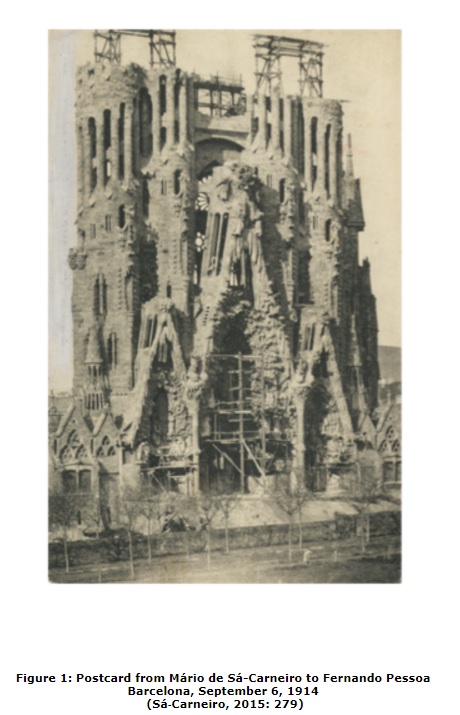
From Barcelona, he would then travel to Madrid and finally on to Lisbon, where he would arrive on 9 September.6
Mário de Sá-Carneiro was not alone, of course, in following this route out of France in the late summer of 1914. Ironically, in fact, the aging poet Guerra Junqueiro (1850-1923) was on the same train that brought the author of A Confissão de Lúcio to Gaudi’s cathedral. Named Plenipotentiary Minister to Switzerland in 1911, Guerra Junqueiro’s service to the Republic came to an end with start of the war, and his chance encounter with Sá-Carneiro gave the younger man an unexpected opportunity to amuse his interlocutor, Pessoa, with an anecdote about the provincialism of a member of the literary generation of 1870.7 Moreover, at around the same time, twenty-six year old Amadeo de Souza Cardoso was making his way back home to Amarante. Both Eduardo Viana (thirty-three years old) and Santa-Rita Pintor (twenty-five years old) would also make a similar return trip to Portugal. While the Portuguese proto-modernists formed a somewhat dispersed group in Paris, they would come together much more closely in Lisbon in the months that followed.
The most important Portuguese literary movement of twentieth century – the Geração de Orpheu – emerged from this concatenation of actors and events. Like other European avant-garde artists, the poets and painters who participated in the launch of the modernist journal in March 1915 had begun experiments that challenged traditional perspectives and broke up unitary notions of time and space in the years prior to the war. However, it was during the war years, when they came together in Portugal, that their art matured and developed into a true movement dedicated to shocking the republican bourgeoisie, renewing the bases of representation, and creating “the Portuguese fatherland of the twentieth century”8 that José de Almada Negreiros would later demand (Negreiros, 1993: 42). Between 1915 and 1918, some of the most significant poems and narratives of Portuguese modernism were produced or published, some of the most striking paintings were exhibited, and other public events that challenged prevailing aesthetic norms were staged. In many respects, the explosion of creativity that characterized the Orpheu generation’s production during the years of the First World War may be interpreted as a response to, and even a reflection of, the socio-political instability of the war years in Portugal.
As I will show in the final part of this essay, several of the leading modernists used their art to register oblique images of the conflict during and after the war. However, the impact of this event on their world must be measured first in terms of the opportunities afforded to them by the accelerated movement of people and ideas that occurred at this time. Pessoa, Sá-Carneiro, Almada, and many others openly expressed an intent to challenge the tastes and practices of their day, regularly producing irreverent works and choreographing scandalous events that were explicitly critical of the republican government and of the cultural establishment that supported it.9 As the prevailing stance amongst these latter parties was strongly in favor of Portugal’s entrance into the war on the side of the allies, the Orpheu generation would accordingly reject their arguments, often by remaining silent on the topic or by adopting ambiguous positions that celebrated the idea of the war as means of forcing change upon the Portuguese nation.
]]> Orpheu and Atlântida – Two Luso-Brazilian InitiativesNews about the war occupied the pages of daily and weekly newspapers and magazines in Portugal during 1915, as debates raged over whether the nation should enter the conflict. That same year, two transatlantic literary publications, founded as joint initiatives between Portuguese and Brazilian writers, made their debut. Atlântida, which counted João de Barros (Portugal) and João do Rio (Brazil) as its directors, would enjoy a five-year run, beginning in November 1915. Orpheu, on the other hand, saw only two issues come to press in March and June of 1915 (a third, projected, issue of the review never came to press). Published monthly, Atlântida sought to combat nativist stances on both sides of the Atlantic, responding to anti-Portuguese positions that were common in Brazil and to Portuguese intellectuals who saw Brazilian literary advances as a threat or an affront (vexame) to their literary tradition (Martuscelli, 2015: 90). During 1915 and early 1916, this explicitly pro-republican publication would lobby actively in favor of Portugal’s entrance in the war on the side of the Allies. Orpheu, on the other hand, was conceived as an apolitical project that presented itself as an “exile of artistic temperaments.”10 For the most part, “exile” can be understood here as advocating for position in favor of “art for art’s sake” (arte pela arte). While several of Orpheu ’s contributors were openly against the republic in their daily lives, in their art they withheld their opinions regarding current debates about Portuguese intervention in the conflict.11
Many articles published in Atlântida clearly map out responses to the authors’ immediate context, thereby making that publication a useful source for understanding the debates of the day. Critics today, however, are in agreement that Orpheu was the more significant publication. Arnaldo Saraiva has observed that Atlântida “was almost completely closed to modernity.”12 As one of the final expressions of a vitalist neo-romantic aesthetic that originated around the turn of the century, its pages were filled with works that adhered to standards that were conservative in form, in addition to invoking conventional or frivolous themes, often patriotically exalted Portuguese intervention in the war as a means of reviving the nation’s glorious past.13 The aging ultra-romantic poet Guerra Junqueiro leant an authoritative air to this review, which counted among its contributors some of most powerful cultural brokers of the day. If we recall the encounter between Mário de Sá-Carneiro and Guerra Junqueiro in Perpignan, France, in late August 1914, it is not difficult to imagine that young writers and artists associated with Orpheu would hold Atlântida in great contempt. Sá-Carneiro used the opportunity provided by that meeting to belittle this prominent member of the government who was also a staid representative of the literary establishment, joking to Pessoa about his stinginess and noting the poor quality of his spoken French. In addition to Guerra Junqueiro, one of Atlântida’s most tireless collaborators was Júlio Dantas. He published a sonnet in its inaugural issue (as did Olavo Bilac [1865-1918]). Dantas, who enjoyed great popularity and wielded a good deal of political power, would become the target of José de Almada Negreiros’s scathing “Manifesto Anti-Dantas” the following year.
Although the two published issues of Orpheu had appeared in the months prior to the launch of Atlântida, there is next to no notice of the activities of the modernist group on its pages.14 This silence may be interpreted, in part, as following Dantas’s admonishment that the best way to neutralize the effects of the modernist avant-garde was to ignore their works altogether (Trindade, 2014: 218). The immediate hostility to the project that was launched with the publication of Orpheuopened Dantas to ridicule, however, and when his play titled Soror Mariana opened in the autumn of 1915, Almada responded with his “Manifesto Anti-Dantas,” where he proclaimed that “Dantas was born to prove that not everyone who writes knows how to write!” 15 Still, the first number of Orpheuwas not as radical as promoters and detractors would purport. In addition to containing a number of post-symbolist compositions that would not have been much out of place on the pages of Atântida, Orpheu, like its aesthetic adversary, also emerged from an attempt to forge a transatlantic partnership.
The poet Luís de Montalvor returned to Portugal from Brazil just as Sá-Carneiro and his friends were forced to leave Paris. While working in Rio as a secretary in the Portuguese embassy, Montalvor, together with the Brazilian poet Ronald de Carvalho, had conceived a new literary review that would bring together poets from both Portugal and Brazil; he gave this review the name Orpheu. Thus, the inaugural number of the publication that would rock the foundations of Portuguese literature identified Carvalho and Montalvor as the editorial directors and the title page of that issue promoted Orpheu as a transatlantic enterprise. There is no indication, however, that Orpheu was ever distributed in Rio de Janeiro, and the three numbers of the review (two published, one projected) included works by only two Brazilian poets (Carvalho and Eduardo Guimaraens). With the publication of the second number, in June 1915, the designation “Portugal – Brazil” had disappeared from the magazine’s opening page, as had the names of Montalvor and Carvalho. The directors of Orpheu 2 were now identified as Fernando Pessoa and Mário de Sá-Carneiro, both of whom had undoubtedly constituted a driving force behind the content of the previous issue as well.
With the exception of the magazine’s closing text – “Ode Triunfal” (“Triumphal Ode”), signed by Pessoa’s heteronym, Álvaro de Campos – most of the contributions to the inaugural issue of Orpheuwere not as scandalous as Pessoa and Sá-Carneiro would later assert. They exhibited a late symbolist aesthetic that favored highly interiorized evocations of experience, constructed with elaborate correspondences and synesthesias. Such was the case with the series of twelve poems by Sá-Carneiro dated 1913-15, and with Pessoa’s ‘own’ contribution to the issue: a “Static Drama” titled O Marinheiro(The Mariner), dated October 1913. The long closing poem bearing the signature of Álvaro de Campos goes a step further still, however, for it abandons a post-symbolist fascination with the subjective world of dream imagery and exhibits a new complex objectivity that O Marinheiro had lacked. Although “Ode Triunfal” is not identified as belonging to any specific literary current, its style and content were clearly inspired by the futurist example.
The influence of avant-garde techniques would be much more in evidence in the second number of Orpheu. In an apparent challenge to critics who had considered the review’s collaborators as possibly insane, that issue opened with the collaboration of a poet (Ângelo de Lima) who had been long confined to a state mental institution. Curiously, Lima’s contribution was the only text in both numbers of Orpheu to include the word “war.” It is likely, nonetheless, that the term was not meant, in any concrete way, to reference the poet’s or the readers’ immediate socio-political context (Dix, 2015: 27). Immediately after Lima’s sonnets, Sá-Carneiro published two poems dedicated to an associate from his time in Paris, the artist Santa-Rita Pintor. The second of these poems, “Manucure,” takes up some vanguard techniques that he had experimented with earlier that display an attempt to effect a rupture in form, syntax, and subject matter, as the incorporation of varied typefaces, verbal montages, and onomatopoeias demonstrate. These techniques appear somewhat forced, however. By contrast, Álvaro de Campos’s magisterial “Ode Marítima” (“Maritime Ode”), which occupies thirty-six pages of Orpheu 2 and is also dedicated to Santa-Rita Pintor, employs a similar method of montage to surprising effect. Aside from the work of Campos, Pessoa’s ‘own’ contribution to this issue was a series of six “intersectionist” poems titled “Slanting Rain.” Additionally, the second issue of the journal, unlike the inaugural number, which had no illustrations or other visual content, included reproductions of four collages by Santa-Rita Pintor.
Due to financial problems, the third issue of Orpheu was never published, although attempts were made to revive the project in 1916 and 1917. From Pessoa’s correspondence of those years, we do know that Pessoa and Sá-Carneiro intended to continue the practice of including visual material related to the group’s literary experiments. After the example of Santa Rita’s four “definitivos trabalhos futuristas” (four definitive works) that appeared in Orpheu 2, it would be Amadeo de Souza Cardoso’s turn to collaborate. While we cannot be certain exactly which of his paintings were selected, it is quite possible that they included recent examples of his work that had been completed after his return to Portugal. 16 Sousa Cardoso would have to wait another year to see reproductions of his work published. In 1916, he would bring out a small album titled “12 Reproductions,” and in the following year, two of his paintings would appear on the pages of Portugal Futurista. That publication, which effectively signals the end of the “heroic” years of Portuguese modernism, came out in November 1917, more than a year after Portugal’s entry into the war and less than one month prior to the coup led by Sidónio Pais that put an end to Afonso Costa’s government. Portugal Futurista was noticeably different from Orpheu in several respects. It included collaborations by French and Italian futurist poets and painters and much of its content was both more shocking and ostensibly more political. In order to explain the rapid expansion and the aesthetic radicalization of the modernist project in Portugal, it will be necessary to turn our attention, once again, to the comings and goings of various avant-garde artists and to other public events precipitated by the outbreak of the war.
Collaboration and Confrontation: Amadeo de Souza Cardoso, Robert and Sonia Delaunay, and the Suppression of Portugal Futurista
In the summer of 1914, Amadeo de Sousa Cardoso and his lover, Lucie Pecetto, were on holiday in Barcelona when they learned of the outbreak of the war. Deciding to return to Portugal, they married shortly after arriving at the painter’s family home in September of that year. During the decade that Amadeo had spent in Paris, he made regular visits to his family’s properties in northern Portugal, spending months at the quinta in Manhufe, where he was born, or in Espinho, where the family would spend their summers. During one of these visits, in 1910, Amadeo’s father built him a studio in Manhufe, and it was there that he began a period of intense work in late 1914. The paintings that date from the war period are considered his most original works (Leal, 1999: 21). In them, Amadeo began to incorporate more expressionistic, figurative elements, moving away from the experiments with cubism and pure abstraction that characterized his Parisian compositions. Additionally, once back in Portugal, Amadeo would develop an iconography of his home country that is both popular and erudite (Freitas, 2006: 51). Personal symbols and popular images, such as windmills, weirs or dams (açudes), water mills (azenhas), earthenware bowls (alguidares), and pitchers (cântaros) appear in the art that he produced at this time. Moreover, a special quality of light is captured in these works, a light that recalls the intensity of the sun of his native land.
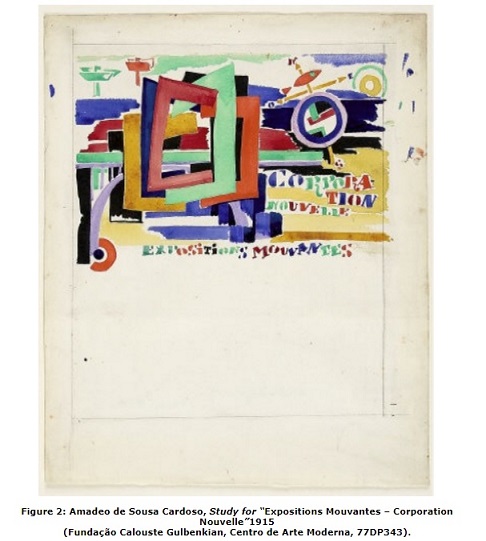
]]>
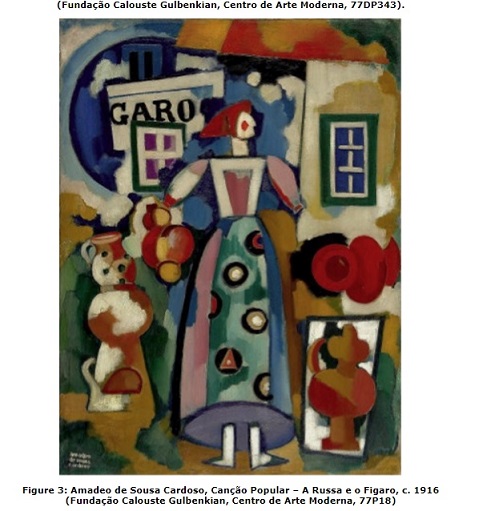
During this period of intense activity, Amadeo and Lucy would also act as hosts for painters Robert and Sonia Delaunay, who set up residence in Vila do Conde in the spring of 1915. On their trip to northern Portugal, the couple, well known as the originators of Orphism, passed through Lisbon, where they met with Almada Negreiros, Eduardo Viana, and José Pacheco (I have found no indication that they met Pessoa, but that is certainly a possibility). While in the capital, they undoubtedly saw the first number of Orpheu, which had come out in March of that year. A project would be born from this meeting with the main figures associated withOrpheu, and the group formed what came to be called the Corporation Nouvelle, which had the goal of organizing art exhibitions and producing original albums. The Delaunays named their home in Vila do Conde the Villa Simultanée, and they welcomed Eduardo Viana and the North American painter Sam Halpert into their midst. This space became a nucleus of activity and inspiration for the group of young Portuguese artists that formed around them.
The Corporation Nouvelle’s, plans for organizing “moving exhibits” (“expositions mouvantes”) in Barcelona, Stockholm, and Oslo would not come to fruition. Nonetheless, Amadeo did produce several studies promoting this initiative and, during the period of 1915-16, the project stimulated a lively exchange of letters between the Delaunays, Amadeo, Viana, Pacheco, and Almada17 Almada, moreover, was so enthusiastic about this friendship that he announced a number of works that ostensibly involved Sonia’s collaboration. As the front matter from Almada’s 1917 novella A Engomadeira attests, he and Sonia began collaborating on a series of “10 Poemas Portugueses.” Additionally, Almada included his plans to develop a ballet (Ballet Veronèse et Bleu) that would be dedicated to Sonia.
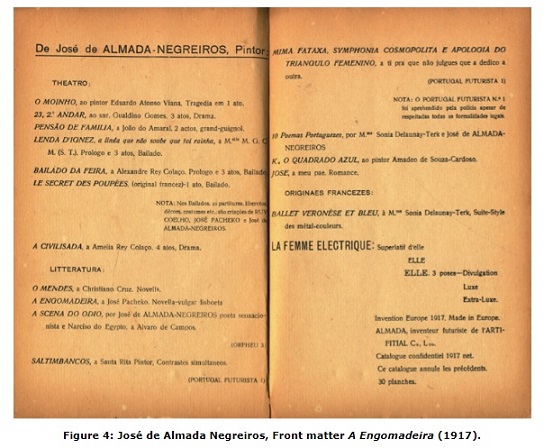
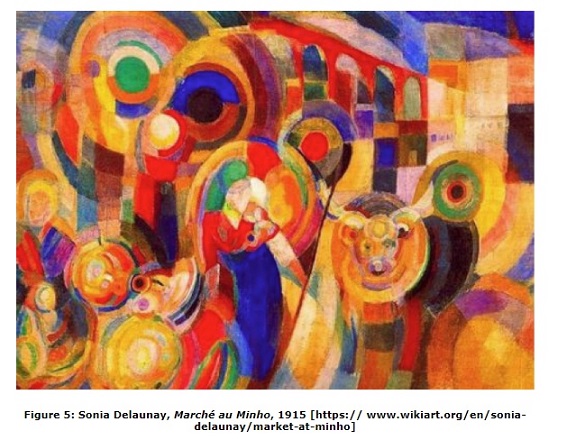
The Delaunays’ stay in the Minho region was very productive for both. The quality of light they encountered on Portugal’s northern coast impressed them greatly, as did the local culture’s vibrant folk elements. Years later, Sonia would recall that “[t]he light there wasn’t violent but it intensified all the colors. There were multi-colored or bright white houses … I remember the peasants in their popular attire, the fabrics, the ceramics that had an ancient beauty and exceptional purity, the crowds at the fairs and the bulls with massive horns. // We had the impression that we were living in a land of dreams.”18 Robert, at that time, returned to figurativism, mixing images of the people and the products of the land filtered through his emblematic chromatic disks in a series of still lifes and in the painting La Grande Portugaise (1916). Sonia, in particular, was fascinated by the popular culture she encountered in the markets, capturing the colors and movement of those spaces in works like Marché au Minho (1916).
 ]]>
]]>
Additionally, Russian-born Sonia took advantage of the villa’s garden space to paint, and she began work outdoors on a series of very large canvases. In the spring of 1916, this apparently simple act would contribute to charges against her for spying. Portugal had just entered the war on England’s side and German submarines had begun to appear regularly along the nation’s northern coast. Some in the area believed that Sonia’s paintings contained bizarre ‘signs’ that communicated hidden messages to the enemy (Santos, 2000: 9). The confusion was eventually cleared up, but only after Robert spent time in Vigo, prohibited from returning to Portugal. While the reasons for this detention remain obscure, the charges against the Delaunays were very real. Besides the possibility that the large canvases displayed in their garden were perceived as signals to the enemy, others have noted that Robert continued his correspondence with artists and galleries he had collaborated with in Germany, even after that country’s declaration of war against Portugal, and that Vila do Conde also counted a small shipyard at the time that had a contract with the French government (Belém; Ramalho, 2009: 153). This conjunction of events illustrates, most importantly, that worries born of the tensions surrounding Portugal’s entrance in the war extended to all corners of society. As Amadeo noted in a letter to Sonia, dated 28 August 1916, politics was a dangerous business: “J’aime vraiment votre art, c’est dommage que vous fassiez tant de politique.” (Ferreira, 1981: 186). Upon Robert’s release, the couple subsequently moved to Valença do Minho; by early 1917, they had decided to leave Portugal definitively.
While the Delaunays’ stay in Portugal was cut short, in part, for political reasons, their influence on the artists associated with Orpheu would continue through the end of 1917, when Portugal Futuristasaw the light of day. That review included unpublished works by the noted poets Appolinaire and Blaise Cendrars that had been provided to the editors by Sonia Delaunay. In addition to Saint-Point’sFuturist Manifesto of Lust and the Manifesto of Futurist Painters, also in the original French, a Portuguese translation of Marinetti’s manifesto “O Music-Hall” also appeared on its pages (several of these texts had been presented to the public previously, on April 24, 1917, when Almada staged his “Conferência Futurista”). Portugal Futurista was immediately seized by the police upon its publication, although the reasons for its suppression are unclear. It is possible that alleged obscenities contained in Almada’s novella Saltimbancos or the virulent language of Álvaro de Campos’s Ultimatum may have precipitated that response. Fernando Pessoa, in an unpublished preface that he drafted for an English translation of Campos’s Ultimatum, observed that “no such publication could be printed while the War lasted.” In this text, Pessoa recognizes the political context and the role it might have played in Portugal Futurista’s apprehension, noting that the journal was suppressed by “the Democratic ministry which was thrown out of power by Sidonio Paes.” He concedes, moreover, that “it is difficult to imagine how any ministry at all, when the country was at war, could allow the publication of the ULTIMATUM, which, original and magnificent as it is, and although not pro-German (being anti-everything, Allied and German), contains scathing insults on the Allies, as also on Portugal and Brazil, the very countries where PF was destined to be read” (Pessoa, 2009: 275).
Published at almost the same time as the coup that would put Sidónio Pais in power, it is not surprising that the authorities perceived this review as a possible threat to the public order. As Luís Trindade observes, theUltimatum attributed to Campos, like Almada’s Ultimatum Futurista para as Gerações Portuguesas do Século XX, which followed it on the pages of Portugal Futurista, had a clear political reference. Both were systematically organized in the form of a doctrine, and the objective of both was to “think about taking advantage of the energies liberated by the War.” (Trindade, 2014: 216)19 . At a moment when public opinion against the war was at its height, the titles of these texts, which recall the British Ultimatum of 1890, would likely have resonated with the pro-German faction in the capital and with other elements that were opposed to the União Sagrada government led by Afonso Costa. The suppression of Portugal Futurista can be understood, therefore, as an example of the Costa government’s increasingly repressive measures in the months leading up to the Sidonist coup.
Conclusion: Echoes of the War in Modernist Works
The rise of a cosmopolitan avant-garde in Portugal coincided almost precisely with the period of the First World War. Nonetheless, it is difficult (and risky) to characterize the work of this generation as constituting some sort of ‘voice’ of the time. On the contrary, Pessoa, Sá-Carneiro, and others of their generation largely made every effort to avoid referencing the world of politics in their work. The war years brought people together, nonetheless, and facilitated the explosion of creativity that characterized the Geração de Orpheu. The occasions afforded by the friendships and collaborations that occurred in Portugal during these years had a significant impact on the development of a modernist culture. Moreover, by 1917, or thereabouts, the powerful and disturbing forces that had provoked transformations in the apprehension of time and space registered in the modernists’ literary and visual production had been proven on the battlefield, where soldiers experienced an intensified sense of the present and “time seemed to burn brightly …, riveting consciousness in an eternal present” (Kern, 1983: 293). Certain attitudes and techniques that were considered subversive in 1914-15 were slowly becoming more familiar and less threatening. While still not part of the cultural mainstream, a number of avant-garde practices and techniques had begun to generate enthusiasm among certain elements of the elite. This is evidenced by the welcome accorded to Serge Diaghilev’s Ballets Russes when it came to Lisbon in December 1917. In preparation for the troupe’s arrival, Almada, José Pacheco, and Ruy Coelho penned a manifesto in support of it that was included in the opening pages of Portugal Futurista, while other more conventional publications such as Ilustração Portugueza, República, A Capital, and Lucta also reported on its performances (Tércio 2010: 114-122).
Examples of specific instances in which the new avant-garde modes of production addressed the war are sparse, at best, however. In October of 1914, Sá-Carneiro published a chronicle in A Restauraçãotitled “Paris e a Guerra” that developed several of the impressions he had communicated to Pessoa in his letter of August 1 of that year. In a somewhat more conventional description of the conflict that appeared on the pages of A Ilustração Portugueza in late 1915, he would recall the Battle of the Marne. It is unlikely, however, that the author actually had visited the site.20 Almada, following Marinetti’s lead, made a series of combative pronouncements in his Ultimatum Futurista about war as a creative act that “does away with all feelings of saudade in regard to the dead praising instead the living and honoring them with luck.”21 He incorporates no concrete mention of the actual conflict, nonetheless. Likewise, certain elements of Álvaro de Campos’s Ultimatum may be construed as responses to the current political situation, but that text’s complexity precludes us from understanding it as a solely political tract. The best contemporary example of a modernist text that situates its content in a wartime context is Almada’s experimental novella A Engomadeira. Published in late 1917, soon after Portugal Futurista, this short fictional work is prefaced by a letter from the author to José Pacheco, explaining that he had completed the text in 1915.
Certain plot elements of this novella reveal that its author was lying (or mistaken) when he asserted that he had changed nothing since 1915. The war appears in the backdrop of this experimental “Novela Vulgar Lisboeta,” the opening chapters of which may well have been written prior to March 1916. In Chapter III, the narrator captures cheers of “Viva a Gália!” solicited by the declaration of war; a few pages later, mention is made of a rally in support of the allied nations (Chapter V). By the novella’s mid-point, however, the narrator incorporates a reference to newspaper accounts of the battle of Verdun and, in a subsequent chapter, a comment on the movement of Portuguese troops is ironically interspersed with the scene of an adulterous seduction (Negreiros, 1989: 69; 75). Throughout the text, the narrator’s foil is a certain Sr. Barbosa, a symbol of bourgeois mediocrity who is an active member of the comissões de vigilância. Ardently supportive of the Allied forces, Sr. Barbosa on occasion defends his companion against accusations that he is a germanófilo. 22
Whether Almada himself, or any of his companions, was a vocal germanófilo is more difficult to assess. None of the writers and artists that comprised the Geração de Orpheu actually went to the front or witnessed combat. We should remember, as well, that reactions to the war would take time to percolate in art and literature; it was in the years after the peace that cultural production would reflect back on that time. In this respect, we cannot overlook the fact that by 1918, several of the key figures of Portuguese modernism had disappeared: Sá-Carneiro committed suicide in April of 1916; two years later, also in April, Santa-Rita Pintor died of complications of tuberculosis and syphilis; also that same year (October 25, 1918), the Spanish flu claimed the life of Amadeo de Souza-Cardoso. In the chaotic years that followed the end of the First World War, Almada and Pessoa would continue to produce literature and art, striving to keep the memory and dream of Orpheu alive in the public imagination. Each, however, would follow new paths of artistic discovery and when they looked back at that time, their memories rarely, if ever, included direct references to the war.
A curious exception to this generalized tendency to elide references to the event that had a profound impact on Portuguese politics in the early twentieth century can be found, however, in a poem that Fernando Pessoa published in the 1920s. Ten years after Portugal’s entry to the war, in 1926, the poem titled “O Menino da Sua Mãe” (“Mother’s Boy”) appeared in the literary review Contemporânea(Series III, n. 1). This short ballad that describes a young soldier fallen on the battlefield would become one of the poet’s best-known works. Several critics have posited that it was probably written a decade earlier (Lind, 1972: 19; Monteiro, 2015: 51), at a time during which the author penned several other poems, in English, French, and Portuguese, that addressed the topic of war in more general terms. These latter poems (or fragments of poems) were discovered in Pessoa’s espólio after his death, as were other brief notes regarding British writers against the war.23 They confirm that during the war years, the creator of the heteronyms had explored the possibility of using poetry to address contemporary events. Like so much of the poet’s work, these texts did not see the light of day until many years after they were written.
]]> “O Menino da Sua Mãe,” (His Mother’s Child) on the other hand, was published three times during Pessoa’s lifetime (Monteiro, 2015: 62). After its initial appearance on the pages of Contemporânea, this short poem would be reprinted in O Notícias Ilustrado on November 11, 1928. Two years later, it was also included in Cancioneiro — I Salão dos Independentes. While it is all but impossible to ascertain exactly when this poem was written or what it meant to its author, it is worth noting that in O Notícias Ilustrado, it was explicitly linked to the tenth anniversary of the Armistice of Compiègne. Thus it became a small element of wider efforts in Portugal to instrumentalize the memory of a war that, as Gertrude Stein reminds us, was unlike previous wars. The memory communicated in the poem is one of loss and senseless death, of an innocent victim whose sacrifice comes to symbolize the uselessness of war (Lind, 1972: 20). In a seemingly unimportant corner of the conflict, forgotten on an unnamed battlefield and left there to rot, the fate of Pessoa’s “menino da sua mãe” is unknown to his mother and the old nurse who had carried him about. In the final stanza, an ironic parenthetical observation astutely equates their personal loss with one of the main causes of the Great War:“Far off, at home, there is prayer:
Return him soon — safe, sound.
(Webs that the Empire weaves!)
He lies dead and rots,
This mother’s boy.”24
Not surprisingly, the poet’s aside has continued to resonate for subsequent generations of readers.
REFERENCES
]]>Belém, Margarida Cunha; Ramalho, Margarida de Magalhães (2009), Fotobiografias do Século XX. Amadeo de Souza Cardoso. Lisbon: Temas & Debates. [ Links ]
Barreto, José (2015), “O Ano de Orpheu em Portugal”. In Steffen Dix (ed.), 1915 O Ano de Orpheu, Lisbon: Tinta da China, 67-95. [ Links ]
Braga, Duarte Drumond (2016), “A ‘Terra de Ninguém’ do Poema: A Poesia Portuguesa e a Grande Guerra”. Colóquio/Letras, 191, 58-68. [ Links ]
Dix, Steffen (2015), ”O Ano de 1915. Um Mundo em Fragmentos e a Normalização dos Extremos”. In Steffen Dix (ed.), 1915 O Ano de Orpheu, Lisbon: Tinta da China, 15-34. [ Links ]
Ferreira, Paulo (1981), Correspondance de Quatre Artistes Portugais. Paris: Presses Universitaires de France. [ Links ]
]]>Freitas, Helena de (2006), “Amadeo de Souza-Cardoso: Diálogo de Vanguardas”. In Various Authors, Diálogo de Vanguardas. Lisbon: Centro de Arte Moderna José de Azeredo Perdigão, Fundação Calouste Gulbenkian. [ Links ]
Kern, Stephan (1983), The Culture of Time and Space (1880-1918). Cambridge, Mass.: Harvard University Press. [ Links ]
Leal, Joana Cunha (1999), ”Amadeo de Souza Cardoso: A Biography”. In Maria de Lourdes Simões de Carvalho (dir.); Laura Coyle (ed.), At the Edge: A Portuguese Futurist, Amadeo de Souza Cardoso. Lisbon: Gabinete das Relações Internacionais, 17-25. [ Links ]
Lewis, Pericles (2007), The Cambridge Introduction to Modernism. Cambridge: Cambridge University Press. [ Links ]
Ling, Georg Rudolf (1972), “Fernando Pessoa Perante a Primeira Guerra Mundial”. Ocidente, vol. 82, 405, 11-23. [ Links ]
]]>Martuscelli, Tânia (2015), “Os Cem Anos de “Atlântida” (1915-1920)”. Colóquio Letras n. 190, 90-99. [ Links ]
Monteiro, George (2015), “World War I: Europe, Africa and ‘O Menino da Sua Mãe’”. Portuguese Literary and Cultural Studies, n. 28, 47-65. [ Links ]
Negreiros, José de Almada (1989), Obras Completas, vol. 4 Contos e Novelas. Lisbon: Imprensa Nacional-Casa da Moeda. [ Links ]
Negreiros, José de Almada (1993), Obras Completas, vol. 6 Textos de Intervenção. Lisbon: Imprensa Nacional-Casa da Moeda. [ Links ]
Pereira, José Carlos Seabra (2015), “Em Torno do Orpheu. A Outra Literatura”. In Steffen Dix (ed.), 1915 O Ano de Orpheu, Lisbon: Tinta da China, 97-119. [ Links ]
]]>Pessoa, Fernando (2014), Poèmes Français, edited by Patricio Ferrari. Paris: Éditions de la Différence. [ Links ]
Pessoa, Fernando (2009), Sensacionismo e Outros Ismos, edited by Jerónimo Pizarro. Volume X da Edição Crítica de Fernando Pessoa. Lisbon: Imprensa Nacional-Casa de Moeda. [ Links ]
Sá-Carneiro, Mário (2015), Em Ouro e Alma: Correspondência com Fernando Pessoa, edited by Ricardo Vasconcelos and Jerónimo Pizarro. Lisbon: Tinta da China. [ Links ]
Santos, Joaquim Manuel (2000), Cronologia. 1a Homenagem a Sónia Delaunay em Vila do Conde. Catálogo de Exposição . Vila do Conde: Câmara Municipal de Vila do Conde. [ Links ]
Saraiva, Arnaldo (1986), O Modernismo Brasileiro e o Modernismo Português: Subsídios para o Seu Estudo e para a História das Suas Relações . Porto: n.p. [ Links ]
]]>Soares, Marta (2015), “Os 4 Hors-textes de Orpheu 3”. In Richard Lopes Zenith; Fátima, Rêgo (eds), Os Caminhos de Orpheu. Lisbon: Biblioteca Nacional & Babel, 103-105. [ Links ]
Tércio, Daniel (2010), “Russos e Futuristas no Chiado”. In Daniel Tércio (ed.), Dançar para a República. Lisbon: Caminho, 103-143. [ Links ]
Trindade, Luís (2014), “A Cultura”. In Nuno Severiano Teixeira (ed.),História Contemporânea de Portugal, 1808-2019, vol. 3, A Crise do Liberalismo. Lisbon: Objectiva, 197-234. [ Links ]
Vasconcelos, Ricardo (in press), “Mário de Sá-Carneiro, Paris e a Primeira Guerra Mundial”. In Mário de Sá-Carneiro et les autres. Ed. Fernando Curopos e Maria Araújo. Paris: Éditions Hispaniques. [ Links ]
]]> ILLUSTRATIONS
Figure 1: Postcard from Mário de Sá-Carneiro to Fernando Pessoa, Barcelona, September 6, 1914 (Sá-Carneiro: 2015, 279).
Figure 2: Amadeo de Sousa Cardoso, Study for “Expositions Mouvantes, Corportation Nouvelle,” 1915(Fundação Calouste Gulbenkian, Centro de Arte Moderna, 77DP343).
Figure 3: Amadeo de Sousa Cardoso, Canção Popular – A Russa e o Figaro, c. 1916 (Fundação Calouste Gulbenkian, Centro de Arte Moderna, 77P18).
Figure 4: José de Almada Negreiros, Front matter A Engomadeira (1917).
]]> Figure 5: Sonia Delaunay, Marché au Minho, 1915 [ https://www.wikiart.org/en/sonia-delaunay/market-at-minho]
Received for publication: 29 November 2016
Accepted in revised form: 28 April 2017
Recebido para publicação: 29 de Novembro de 2016
Aceite após revisão: 28 de Abril de 2017
NOTES
]]>
2 “Emfim, qualquer fluido ondea na atmosfera alem do ar — tenho, em sinceridade, essa impressão. E lembro-me — agora por literatura — que em verdade a força psiquica de toda a gente pensando na mesma coisa — de tanto cerebro com a mesma preocupação profunda, de igual sentido, de iguais inflexões —poderia, deveria presumivelmente criar na atmosfera envolvente qualquer coisa de subtil... Isto seria uma crónica interessante a desenvolver... uma crónica, sabido, laivada de interseccionismo.” Sá-Carneiro, 2015: 253.3 “atónito, apavorado e deserto.” Sá-Carneiro, 2015: 255.
4 The term “paulismo” takes its name from the two-part poem titled “Impressões do Crepúsculo” (Twilight impressions) that Pessoa published in A Rensascença, Revista de Crítica, Literatura, Arte in February of 1914. The first word of the second poem was “Pauis” (Swamps). The first of several aesthetic movements theorized by Pessoa during the period of 1913-1915, paulismo was a short-lived experiment that drew upon dark, murky images that were often of an aquatic nature.
5 “Uma Catedral Paúlica. Sim! Pleno paúlismo—quase cubismo até.”
6 In all, Sá-Carneiro was in Barcelona from August 29 to September 7.
7 See letter of September 5.
8 “a pátria portuguesa do século XX.”
9 As Ricardo Vasconcelos has noted, World War I fueled the appearance of Orpheu ‘por algo tão simples quanto o facto de Sá-Carneiro se ver forçado à vida em Lisboa, e procurar reproduzir aí algum espírito da blague parisiense’ (due to something as simple as the fact that, finding himself forced to return to Lisbon, Sá-Carneiro sought to reproduce there the spirit of the Parisian blague). Vasconcelos (in press), np.
10 “um exílio de temperamentos de arte.” Orpheu 1, 1915, 11.
11 In an overview of the events of 1915, José Barreto describes two public incidents that tarnished Orpheu’s reputation among supporters of the republic. In the first instance, Fernando Pessoa, writing in the name of Álvaro de Campos, sent a letter to the director of A Capital in the aftermath of Afonso Costa’s disastrous fall from a streetcar. A paragraph of the letter, attributing the accident to Divine Providence, was published under the headline “Antipático futurismo—Os poetas de Orpheu não passam, afinal, de criaturas de maus sentimentos” (“Antipathetic futurism—The poets of Orpheu are nothing more than poorly behaved creatures”). This letter was then linked to a public intervention by Raul Leal that had taken place shortly before the accident. That poet had publicly distributed an insulting anti-republican manifesto in which he identified himself a collaborator of Orpheu. According to Barreto, these incidents, which may have hindered the continuation of the review, were eventually neutralized by other members of the group. Sá-Carneiro, in particular, was pressed to defend the idea that Orpheu was only interested in art and did not assume a collective position of any sort, either in politics or in art. Barreto, 2015: 75-78.
]]> 12 “se fechava quase por completa à modernidade.” Saraiva, 1986: 139.13 Pereira, 2015: 106-108. For a description and analysis of saudosista and neo-romantic poets that take up the war as a theme, see Braga, 2016.
14 There is a reference by V. F. (Victor Falcão) in n. 14 (15 December 1916) to works by Almada Negreiros and José Pacheco that were exhibited in the Galeria das Artes.
15 “O Dantas nasceu para provar que nem todos os que escrevem sabem escrever!” Negreiros,1993: 20.
16 Recent information uncovered in the papers of Almada Negreiros has led Marta Soares to speculate that the paintings intended for inclusion wereArabesco Dinâmico…, Parto da Viola…, Oceano Vermelhão Azul Cabeça… and Par Ímpar 121. Soares, 2015: 105.
17 See Ferreira, 1981.
18 “Lá a luz não era violenta mas exaltava todas as cores. Havia casas multicolores ou dum branco esplendoroso, duma linha sempre sóbria. Lembro os camponeses e os seus fatos populares, os tecidos, as cerâmicas duma beleza antiga, duma pureza excepcional, as multidões nas festas e os bois de grandes cornos. // Tínhamos a impressão de viver num país de sonho.” Santos, 2000: 8.
19 “pensar como aproveitar as energias libertadas pela Guerra.”
20 See Vasconcelos (in press) for details. In the same essay, the author defends the hypothesis that Sá-Carneiro’s sonnet “O Fantasma” (1916) makes explicit use of a wartime imaginary.
21 “acaba com todo o sentimento da saudade para com os mortos fazendo em troca o elogio dos vivos e condecorando-lhes a Sorte.” Negreiros, 1993: 39.
]]> 22 A character similar to Senhor Barbosa also appears in Almada’s long and vituperative poem “A Cena do Ódio” that was dated May 14, 1915. This poem was set to appear in the ill-fated third number of Orpheu. During the war years, efforts were made to revive the project and, by the summer of 1917, it appears that a good portion of its contents, including Almada’s poem, had been typeset. It is possible that the turbulent political situation of that time contributed to its failure.23 According to Lind, Pessoa wrote eight poems that have content related to the war. Of these, only two were published in the poet’s lifetime (“O Menino da Sua Mãe” and “Tomámos a Vila Depois de um Intenso Bombardeamento,” which also appeared in O Notícias Ilustrado). Two other, unpublished poems were attributed to Ricardo Reis (“Ouvi contar outrora, quando a Pérsia…” and “Prefiro rosas, meu amor, à patria…”), one poem was attributed to Álvaro de Campos (“Ode Marcial”), and two, written in English, were not attributed to any particular heteronym. Lind’s final example comes from Caeiro’s “Poemas Inconjuntos.” I am grateful to Patricio Ferrari for providing me with information about the notes found in Pessoa’s espólio and for calling my attention to another poem referencing the war that Pessoa had drafted in French. Pessoa, 2014: 258.
24 “Lá longe em casa, há a prece: / Que volte cedo, e bem! / (Malhas que o Império tece!) / Jaz morto e apodrece, / O menino da sua mãe.” Trans. Monteiro, 2015: 53.
Copyright 2017, ISSN 1645-6432
e-JPH, Vol. 15, number 1, June 2017
]]>