<?xml version="1.0" encoding="ISO-8859-1"?><article xmlns:mml="http://www.w3.org/1998/Math/MathML" xmlns:xlink="http://www.w3.org/1999/xlink" xmlns:xsi="http://www.w3.org/2001/XMLSchema-instance">
<front>
<journal-meta>
<journal-id>1645-6432</journal-id>
<journal-title><![CDATA[e-Journal of Portuguese History]]></journal-title>
<abbrev-journal-title><![CDATA[e-JPH]]></abbrev-journal-title>
<issn>1645-6432</issn>
<publisher>
<publisher-name><![CDATA[Universidade do PortoBrown University]]></publisher-name>
</publisher>
</journal-meta>
<article-meta>
<article-id>S1645-64322017000200001</article-id>
<title-group>
<article-title xml:lang="en"><![CDATA[Overseas Elements in Portuguese Armorials from the Modern Era]]></article-title>
</title-group>
<contrib-group>
<contrib contrib-type="author">
<name>
<surname><![CDATA[Seixas]]></surname>
<given-names><![CDATA[Miguel Metelo de]]></given-names>
</name>
<xref ref-type="aff" rid="A01"/>
<xref ref-type="aff" rid="A02"/>
<xref ref-type="aff" rid="A03"/>
</contrib>
</contrib-group>
<aff id="A01">
<institution><![CDATA[,Universidade Nova de Lisboa  ]]></institution>
<addr-line><![CDATA[ ]]></addr-line>
</aff>
<aff id="A02">
<institution><![CDATA[,Universidade Lusíada  ]]></institution>
<addr-line><![CDATA[Lisbon ]]></addr-line>
<country>Portugal</country>
</aff>
<aff id="A03">
<institution><![CDATA[,Universidade Nova de Lisboa Faculdade de Ciências Sociais e Humanas Instituto de Estudos Medievais]]></institution>
<addr-line><![CDATA[ ]]></addr-line>
</aff>
<pub-date pub-type="pub">
<day>00</day>
<month>00</month>
<year>2017</year>
</pub-date>
<pub-date pub-type="epub">
<day>00</day>
<month>00</month>
<year>2017</year>
</pub-date>
<volume>15</volume>
<numero>2</numero>
<fpage>1</fpage>
<lpage>29</lpage>
<copyright-statement/>
<copyright-year/>
<self-uri xlink:href="http://scielo.pt/scielo.php?script=sci_arttext&amp;pid=S1645-64322017000200001&amp;lng=en&amp;nrm=iso"></self-uri><self-uri xlink:href="http://scielo.pt/scielo.php?script=sci_abstract&amp;pid=S1645-64322017000200001&amp;lng=en&amp;nrm=iso"></self-uri><self-uri xlink:href="http://scielo.pt/scielo.php?script=sci_pdf&amp;pid=S1645-64322017000200001&amp;lng=en&amp;nrm=iso"></self-uri><abstract abstract-type="short" xml:lang="en"><p><![CDATA[The aim of this article is to analyze the presence of overseas elements in the armorials compiled in Portugal between the sixteenth and eighteenth centuries. Such representations frequently took the form of elements inserted into the coats of arms of families linked to overseas expansion, both through the addition of already existing insignia and the creation of new devices. However, from a certain time onwards, they also included the coats of arms attributed to the political entities exercising power in overseas territories that were either subject to the authority of the king of Portugal or subsidiary thereto. This was the case, for example, with some attempts at heraldic acculturation on the part of a restricted but significant group of municipalities.]]></p></abstract>
<abstract abstract-type="short" xml:lang="pt"><p><![CDATA[O objectivo do presente artigo consiste em analisar a presença do Ultramar nos armoriais coligidos em Portugal entre os séculos XV e XVIII. Tais representações podem tomar a forma de elementos inseridos nas armas de famílias ligadas à expansão ultramarina, tanto por acrescentamento de insígnias já existentes, como por criação de emblemas novos. Mas abrangem também, a partir de certa altura, as armas atribuídas às próprias entidades políticas que exerciam o poder nos territórios ultramarinos submetidos à autoridade do rei de Portugal ou subsidiários a ela: caso de algumas tentativas de aculturação heráldica de organizações políticas autóctones e, sobretudo, de um conjunto restrito, mas significativo de municípios.]]></p></abstract>
<kwd-group>
<kwd lng="en"><![CDATA[Heraldry]]></kwd>
<kwd lng="en"><![CDATA[Overseas]]></kwd>
<kwd lng="en"><![CDATA[Iconography of power]]></kwd>
<kwd lng="en"><![CDATA[Visual culture]]></kwd>
<kwd lng="en"><![CDATA[Modern Era]]></kwd>
<kwd lng="pt"><![CDATA[Heráldica]]></kwd>
<kwd lng="pt"><![CDATA[Ultramar]]></kwd>
<kwd lng="pt"><![CDATA[Representação do poder]]></kwd>
<kwd lng="pt"><![CDATA[Cultura visual]]></kwd>
<kwd lng="pt"><![CDATA[Idade Moderna]]></kwd>
</kwd-group>
</article-meta>
</front><body><![CDATA[ <p align="right"><b>ARTICLES</b></p>     <p>&nbsp;</p>        <p> <b>     Overseas Elements in Portuguese Armorials from the Modern Era</b> </p>     <p>     <b> Miguel Metelo de Seixas<sup>1</sup> </b> </p>     <p>      <sup>1</sup>     Universidade Nova de Lisboa and Universidade Lusíada, Lisbon, Portugal.     Researcher at IEM /FCSH/Universidade NOVA de Lisboa. <i>E-mail</i>:     <a href="mailto:miguelmeteloseixas@gmail.com">         miguelmeteloseixas@gmail.com     </a> </p>     <p>&nbsp;</p>     <p>     <b>ABSTRACT</b> </p>     <p>     The aim of this article is to analyze the presence of overseas elements in     the armorials compiled in Portugal between the sixteenth and eighteenth     centuries. Such representations frequently took the form of elements     inserted into the coats of arms of families linked to overseas expansion,     both through the addition of already existing insignia and the creation of     new devices. However, from a certain time onwards, they also included the     coats of arms attributed to the political entities exercising power in     overseas territories that were either subject to the authority of the king     of Portugal or subsidiary thereto. This was the case, for example, with     some attempts at heraldic acculturation on the part of a restricted but     significant group of municipalities. </p>     <p>     <b>Keywords: </b>Heraldry; Overseas; Iconography of power; Visual culture; Modern Era </p>     <p>&nbsp;</p>     ]]></body>
<body><![CDATA[<p>     <b>RESUMO</b> </p>     <p>     O objectivo do presente artigo consiste em analisar a presença do Ultramar     nos armoriais coligidos em Portugal entre os séculos XV e XVIII. Tais     representações podem tomar a forma de elementos inseridos nas armas de     famílias ligadas à expansão ultramarina, tanto por acrescentamento de     insígnias já existentes, como por criação de emblemas novos. Mas abrangem     também, a partir de certa altura, as armas atribuídas às próprias entidades     políticas que exerciam o poder nos territórios ultramarinos submetidos à     autoridade do rei de Portugal ou subsidiários a ela: caso de algumas     tentativas de aculturação heráldica de organizações políticas autóctones e,     sobretudo, de um conjunto restrito, mas significativo de municípios. </p>     <p>     <b>Palavras-chave: </b>Heráldica; Ultramar; Representação do poder; Cultura visual; Idade Moderna </p>     <p>&nbsp;</p>     <p>     This text seeks to assess the impact of the overseas elements found in     Portuguese heraldry from the sixteenth to the eighteenth century through the study of their presence in the armorials produced at that time.    <sup><a href="#2">2</a></sup><a name="top2"></a>&nbsp; For this purpose, an attempt will be made, first of all, to     define the research object from a heuristic point of view, enquiring into     the nature of armorials and their role in the political culture of the     time. Next, the armorials produced in this particular period will be     characterized, in order to enumerate and analyze those coats of arms     contained within them that displayed overseas motifs. Finally, an attempt     will be made to ascertain the presence and the nature of the heraldry     attributed to the overseas territories themselves through works of this     kind. </p>     <p>     Pastoureau drew attention to the need to undertake a study of the heraldic     literature produced throughout the Modern and Contemporary Eras,     highlighting the divorce that has taken place between our current heraldic     science and this type of literature (Pastoureau 1985: 129). Erudite     heraldry has thus tended to move away from a genre of literature that it     has abandoned to the hands of bibliophiles, resulting in a remarkable     divorce between heraldic studies such as they are understood by these     “dilettantes” and such as they are practiced by researchers: the former     kind of heraldry is characterized by theoretical and normative criteria,     enclosing itself within a system of rules and didactic examples that it     then seeks to pursue to exhaustion; the latter, on the contrary, is     malleable and lively, and frequently transgresses these supposed rules that     are meant to guide it. </p>     <p>     Boudreau took the study of the relationship between treatises on armory and     armorials a step further, stressing that they were both founded on the     touchstone of the notion of justice. Coats of arms were intended to reward,     to remember and to establish forever the merits of a person, in accordance     with the unavoidable criterion of truth and justice (Boudreau 1997: 388).     In the midst of this mission of justice, the armorial served as a work of     reference, as a testimony for identifying the best. The treatises, on the     other hand, laid down aged statutes, preserving ancient ordinances and     teaching the true science of armory. The armorials, in their turn, recorded     coats of arms expressing ancient deeds, fixed the history of lineages, and     exalted the glories of ancestors. For their authors, each set of books     fundamentally conveyed the same memory: that of people’s origins. They were     instruments used for the elaboration, conservation, and transmission of a     collective memory that lay at the very basis of the culture of the nobility     (Menéndez Pidal 2008; Guillén Berrendero 2012). </p>     <p>     In this way, armorials and treatises on armory, when used together,     conveyed an original conception of the heraldic system. Through these two     types of works, what was established, above all, was the honorary nature of     coats of arms, as well as their integration into a system of common     reference, organized according to hierarchic criteria (Savorelli 2013:     289-315). Viewing heraldry as a system of honorific emblems is the key to     understanding both its role in modern society and its insertion into     coetaneous cultural production (Menéndez Pidal 2014: 437-459). When one     considers the envy existing between professional and lay people, in other     words between those who were officers of arms and those who were not, the     cause for such rivalry must be sought in the very idea that heraldry served     to construct and conserve the genealogical memory not only of noble     lineages, but also of all the other individuals and all the other     institutions that used a coat of arms for their identification. The close     association of heraldry with genealogy and nobility derived from these     functions: the former made it possible to recognize the lineages and the     latter established the role that each entity was allotted in the     established order (Figueirôa-Rêgo 2008). </p>     <p>     For the Portuguese case, characterizing the production of heraldic books in     the Modern Era would require engaging in the rather complex prior work of     drawing up a list of such works, first of all establishing those that are     exclusively or mainly dedicated to heraldic matters (treatises and manuals     of armory, but also armorials, glossaries and specialized bibliographies)     and also comprising, at a secondary level, works with a more general scope     that include chapters on heraldry. Such a task has been partly undertaken     by some heraldic scholars (Cabral 1929; Norton 2006: III, 27-45) and two     proposals have been made for their systematization and interpretation     (Borges 2004: II, 1003-1006; Seixas 2010: 357-413). From the group of such     treatises, however, only four have recently been published in fresh     editions (<i>Livro de Arautos </i>1977; Rodrigues 1931; Norton 2006: III,     25-335; Velho 1958-1963).As far as the armorials are concerned, stress     should be placed, above all, on the editions of the two monumental sixteenth-century manuscripts (<i>Livro do Armeiro-mor </i>1956;<i>Livro do Armeiro-mor</i> 2000;    <i>Livro da nobreza e perfeiçam das armas, </i>Godinho 1987); to which one may add only two works from the seventeenth century (    <i>Brasonário da Nobreza de Portugal </i>1999; Morais 2013). The     parsimonious nature of recently published works clearly reveals that this     type of production has been condemned to a state of almost complete     forgetfulness. And this stands in marked contrast to the great profusion of     manuscripts of this type—both armorials and treatises on armory—that were     published from the sixteenth to the eighteenth century (Seixas 2011:     265-320). </p>     <p>     In Portugal, it can be seen that the sudden appearance of these     compilations and treatises coincided with the appropriation of heraldry by     the Crown in the transition from the Middle Ages to the Modern Era.     Heraldry was then placed at the service of a certain princely and noble     ideal, functioning as an instrument for the centralization of power.     Armorials and treatises thus combined to produce a series of legal     provisions adopted by the Crown in heraldic matters, beginning with the     letters granting the right to have or to add to coats of arms (Seixas &amp;     Galvão-Telles 2014: 257-284). The number of these instruments for the     appropriation of heraldic rights continued to increase in the fifteenth     century, in keeping with the implantation of the political model for royal     centralization, of which they were simultaneously a consequence and an     instrument. From the reign of Afonso V onwards, a systematic policy was     followed of bestowing coats of arms on the servants of the Crown with     augmentations. Such augmentations were sometimes made as a way of     symbolically alluding to a certain feat that was intended to be remembered,     or sometimes amounted to the concession of a part of the coat of arms of     the sovereign himself, thus binding the recipient to a relationship of     symbolically perpetuated and established dependence (Lopes 1960: 107-124;     Oliveira &amp; Seixas 2002: 31-56). The reign of Afonso Vwas also     characterized by another circumstance that had quite weighty consequences:     the issue of the first known legal provision in matters relating to     heraldry, dated May 21, 1476. This document sought to restrict the heraldic     authority to the main officer of arms in the service of the Crown, who at     that time was given the title of the Portugal king of arms (São Payo 1927:     35). </p>     ]]></body>
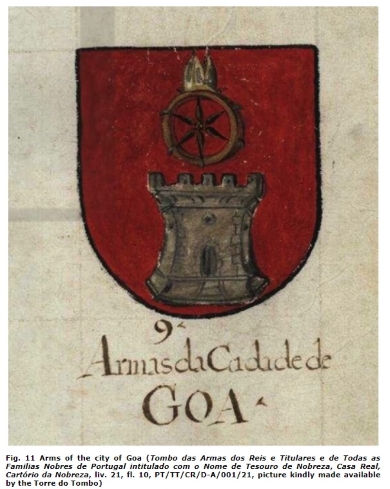
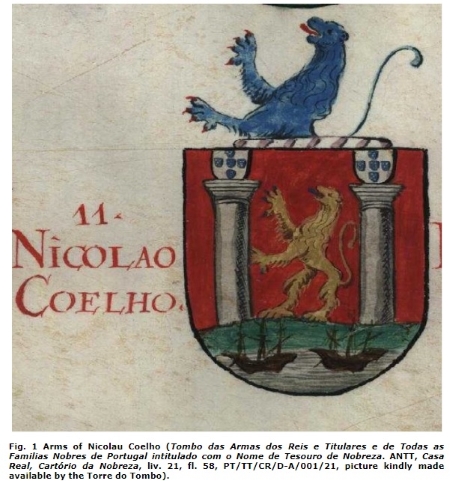
<body><![CDATA[<p>     This whole process took place simultaneously with the great exploits of     Portugal’s overseas discoveries and territorial expansion, which justifies     the purpose of this present article: to assess how the elements alluding to     the overseas dominions were incorporated into these imaginary edifices,     serving as agents of a collective memory of the Portuguese monarchy and its     nobility at the beginning of the Modern Era. </p>     <p>     The two sixteenth-century armorials that have survived until the present-day, the already-mentioned <i>Livro do armeiro-mor </i>and    <i>Livro da nobreza e perfeiçam das armas</i>, contained references to an     overseas dimension in Portuguese heraldry. Some of this heraldry belonged     to the category that heraldists have classified as “imaginary,” or, in     other words, it consisted of arms that were attributed to entities that did     not put them to any effective use (Pastoureau 2006). In these same two     Portuguese armorials, imaginary heraldry is limited to a series of arms     disseminated through previous compilations, namely with regard to the     insignia of imaginary kingdoms (Azevedo 1966: 103-120), a procedure that     was expressed, above all, in a desire to convey a complete image of the     world, being closely linked to <i>portolanos</i> (portolans) and all     manner of cartographic and cosmographic instruments (Savorelli 2015:     101-136). </p>     <p>     Even more interesting is the way in which, in these same armorials, we can     find heraldic reflections of the feats that were performed overseas. Royal     intervention in the heraldry of the lineages connected to the overseas     conquests took a variety of forms. First of all, the creation of one’s own     insignia, granted by the king through a letter of arms. The cases were     listed by Braamcamp Freire and later studied by various authors (Freire     1989; Cabral 1955: 361-374; Lopes 1960: 107-124; Borges &amp; Borges     1987/1988: 5-28; Oliveira &amp; Seixas 2002: 31-56; Seixas 2012: 1-37). The     following reports on heraldic figures are based on the comparison and     analysis of the data provided by these various studies. Many of these     insignia involved the superimposition of ancient and modern devices: which     was the case with “augmentations”, which were placed on pre-existing arms;     this was also the case with the new arms that recovered the figures of the     lineages themselves, differentiating them in some way and combining them     with others, invented for the purpose and alluding more directly either to     the nature of the feats that had generated the award of this favor or to     their geographical context. Thus, without completely doing away with the     pre-existing insignia, the arms that were redesigned in this way once again     formed part of the logic that was commonly found among those who performed     services for the Crown, and which was intended to spread the fame and     perpetuate the memory of the family’s involvement in the overseas     expansion. </p>     <p>     In certain cases, the granted elements had no specific or evident     relationship with the exploits performed overseas. This was the case with     some traditional figures, which were associated only in an abstract fashion     with certain warlike qualities or religious devotions that one wished to     exalt: the lions of Gil and Vicente Simões, Fernão Luís, Rui Vasques,     Nicolau Coelho (<a href="#f1">Fig. 1</a>), Duarte Coelho, Lourenço de Oliva, Fernão Moreira     Perangal and Bento Maciel Parente; the lion’s heads of Gonçalo Vaz de     Campos; the eagles of Fernão Gil de Monterroio, Lopo Esteves and Gabriel     Gonçalves de Freitas; the cross of Álvaro Afonso Frade; and the Franciscan     cord of Gabriel Gonçalves de Freitas. Other figures were merely canting in     nature: the heron (<i>garça</i>) of João Garcês; the archer of João     Fernandes do Arco; the tower and wolves (<i>lobos</i>) of João Gonçalves     da Câmara de Lobos; the wild olive-tree (<i>azambujeiro</i>) of Gaspar Pacheco do Azambujal; the shoe of Wolfgang Holtzschuher; and the citadel (    <i>alcáçova</i>) of Pêro de Alcáçova. There were yet other figures whose     interpretation was difficult: the crow of João Lopes; the antlers of Rui     Vasques; the bezants of Filipe de Brito de Nicote; the door knockers of     Vasco Fernandes Caminha; the indented chief of João Lourenço; the indented     fess of Fernão Moreira Perangal. </p>     <p>&nbsp;</p>     <p><a name="f1"></a> <img src="/img/revistas/ejph/v15n2/15n2a01f1.jpg"> </p>     
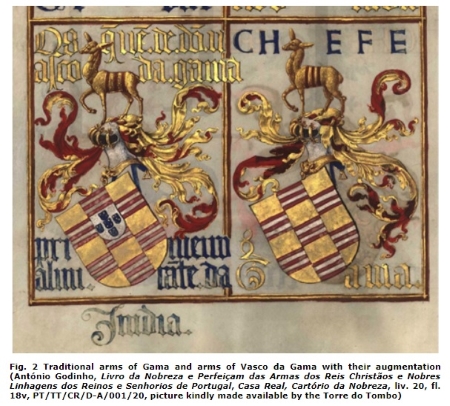
<p>&nbsp;</p>     <p>     At a second level, such a relationship was established in a clearer fashion     without resorting to elements directly alluding to the overseas, as in the     case of the figures traditionally associated with the symbolics of the     victory over the Islamists (the crescents of Fernão Gil de Monterroio and     Sebastião Gonçalves Pita; the stars of Álvaro Gonçalves de Cáceres, João     Lourenço, João Garcês, Gonçalo Mendes Sacoto, Fernão Moreira Perangal, and     André Caldeira) or in the concession of some of the royal emblems     themselves (the bezant of Álvaro Afonso Frade, the escutcheon of     Portugal-Antigo [the royal Portuguese arms without the bordure of castles]     of Vasco da Gama [<a href="#f2">Fig. 2</a>], the <i>quina</i>[escutcheon with bezants] of     Nicolau Coelho [<a href="#f1">Fig. 1</a>], the castle of João Lobo, the cross of the Order of     Christ of Wolfgang Holtzschuher and João de Figueiredo). </p>     <p>&nbsp;</p>     <p><a name="f2"></a>   <img src="/img/revistas/ejph/v15n2/15n2a01f2.jpg"></p>     
]]></body>
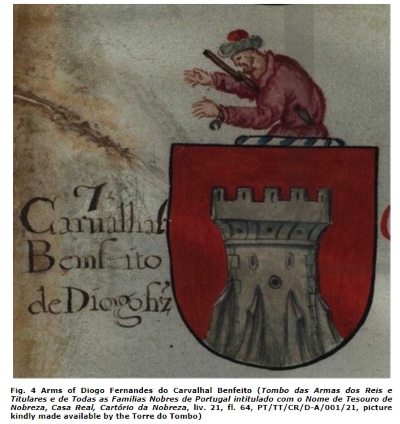
<body><![CDATA[<p>&nbsp;</p>      <p>     Finally, at a third level, the insignia might directly represent the     circumstances of an overseas involvement:Most of these elements     demonstrated warlike feats, displayed in the form of military constructions     (the castles of Diogo de Azambuja, Álvaro do Couto and Filipe de Brito de     Nicote; the towers of João Gonçalves da Câmara de Lobos, Martim Esteves     Boto, Fernão Luís, Duarte Coelho, Cristóvão Leitão [<a href="#f3">Fig. 3</a>], Lopo Barriga,     João de Figueiredo, and Bento Maciel Parente; the walls of Manuel Mendes de     Tânger and Francisco Monteiro de Pale; the bastions of Diogo Fernandes do     Carvalhal Benfeito [<a href="#f4">Fig. 4</a>], Pedro Anes do Canto, and Belchior Vieira     Ternate; the city of Luís de Loureiro), weapons (the lances of Manuel     Mendes de Tânger, Diogo Fernandes do Carvalhal Benfeito [<a href="#f4">Fig. 4</a>], and     Lourenço de Oliva; the cannons and arrows of Cristóvão Leitão [<a href="/img/revistas/ejph/v15n2/15n2a01f3.jpg">Fig. 3</a>] and     Francisco Monteiro de Pale; the sword of Belchior Vieira Ternate; the oval     shield of Gaspar Pacheco do Azambujal; the scaling ladder of Luís de     Loureiro), trophies (the flags of Luís de Loureiro, Vasco Fernandes César,     and Cristóvão Leitão [<a href="#f3">Fig. 3</a>]), boats (the pinnaces of Vasco Fernandes     César; the canoe of Bento Maciel Parente); </p>     <p>&nbsp;</p> <a name="f3"></a> <img src="/img/revistas/ejph/v15n2/15n2a01f3.jpg">     
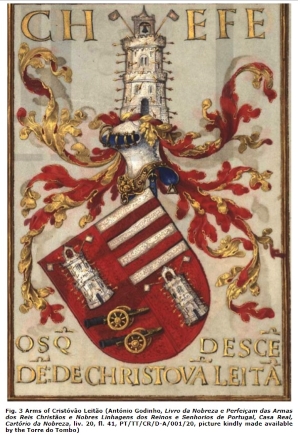
<p>&nbsp;</p>       <p>&nbsp;</p> <a name="f4"></a> <img src="/img/revistas/ejph/v15n2/15n2a01f4.jpg">     
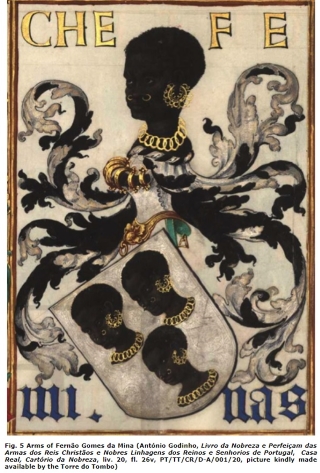
<p>&nbsp;</p>  <ul type="disc">         <li>         As well as in the concrete representation of defeated enemies (the         Moors’ heads of Martim Esteves Boto, Gabriel Gonçalves de Freitas,         Manuel Mendes de Tânger, Gonçalo Mendes Sacoto, Belchior Vieira         Ternate, and Fernão Moreira Perangal; the Moors’ busts of Wolfgang         Holtzschuher, Diogo Fernandes do Carvalhal Benfeito [<a href="#f4">Fig. 4</a>], António         Correia Barém, and Lourenço de Oliva; the full-bodied Moor of Francisco         Monteiro de Pale; and the governor of Azamor in the timbre of Luís de         Loureiro);     </li>         <li>         Or in the representation of the hero himself (the armed arms of Vasco         Fernandes Caminha and Belchior Vieira Ternate; the full-bodied warrior         of Francisco Monteiro de Pale);More rarely, the figures alluded to         navigation (the undy point of Álvaro Afonso Frade, Nicolau Coelho [<a href="#f1">Fig. 1</a>         ], Álvaro do Couto, and Bento Maciel Parente; the azure point of         Gaspar Pacheco do Azambujal; the undy quarter of Filipe de Brito de         Nicote; the seahorse of André Caldeira) and to the discovery and         appropriation of territories (the columns [<i>padrões</i>] of Diogo         Cão and Nicolau Coelho [<a href="#f1">Fig. 1</a>]; the cliffs of Diogo Cão and Lopo         Barriga; the cave of Bento Maciel Parente; the cross of Duarte Coelho);     </li>         <li>         Finally, they incorporated exotic elements (the palm trees of Álvaro         Gonçalves de Cáceres and João Lopes; the African heads of Fernão Gomes         da Mina [<a href="#f5">Fig. 5</a>]; the leopards of Nuno Martins Garro and Sebastião         Gonçalves Pita; the tiger of Bento Maciel Parente).     </li>     </ul>     ]]></body>
<body><![CDATA[<p>&nbsp;</p> <a name="f5"></a> <img src="/img/revistas/ejph/v15n2/15n2a01f5.jpg">     
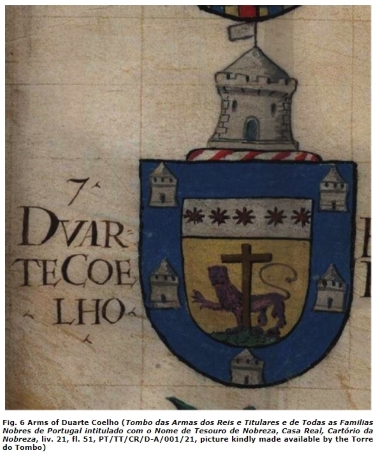
<p>&nbsp;</p>       <p>     Sometimes, the choice of figures alluding to overseas feats was combined     with elements of pre-existing heraldry. One of the paradigmatic cases in     this sense consisted in the coat of arms conceived by King João III for     Duarte Coelho (<a href="#f6">Fig. 6</a>), the first donatary captain of Pernambuco (Freire     1989: 145-146). Such arms, which were absent from the great Manueline armorials, are to be found in the<i>Livro Darmas da nobreza fidalgia do Reino de purtugal </i>(fl. 91)    <i>, </i>compiled by Brás Pereira Brandão, with later additions by Brás     Pereira de Miranda (Albuquerque 1988: 66-70).<sup><a href="#3">3</a></sup><a name="top3"></a>&nbsp; In these arms,     elements of the ancient arms of Coelho (lion, bordure) were joined together     with a series of new figures—a Latin cross standing on a hill and a chief     charged with five stars and a bordure with five castles. The cross standing     on the hill alluded to the invocation of the Holy Cross in the denomination     of the land that was beginning to be colonized, while the stars represented     the Southern Cross. As far as the bordure is concerned, it may also point     to the visual mimicry that this implied as a way of drawing closer to the     Portuguese royal arms. Although such a statement may seem rather bold in     nature, the policy of augmentations granted in the fifteenth and sixteenth     centuries expresses a clear desire to create visual links between those     receiving the awards and the royal insignia. This amounted to yet another     way of reinforcing the idea of this communion between the king and the     nobility, or, to put it another way, expressed the pressing need to include     the component of service to the Crown as the central axis of the new ideal     of the nobility (Gomes 1998: 179-188). </p>     <p>     With this combination of old and new elements, the coat of arms of Duarte     Coelho (<a href="#f6">Fig. 6</a>) clearly conveys the intervention of the Crown in the     construction of the image of a nobility that, without denying its links to     a long, ancient, and therefore glorious past, sought to project itself into     the future through its service to the king in the country’s overseas     enterprise not only in the battlefields of North Africa or Asia, but also,     from the reign of João III onwards, in the colonizing efforts being     undertaken in Brazil. The identification of the illumination of the     armorial of Brás Pereira is significant in this sense: beneath the name of     Duarte Coelho is included the specification that he is “of the new     Lusitania.” Such a specification transmits the set of ideas that lay behind     the refounding of the kingdom in those equatorial far reaches that Coelho     had been allotted to govern and to where he sought to transfer a cultural     model, in which, based on the principle of the Catholic faith, medieval     traditions were merged together with the reinterpreted classical legacy     (Mello 2002: 70-71). After all, it is this same message that his coat of     arms ends up transmitting, with its fusion of pristine elements together     with others alluding to the new dominions, framed by a bordure that     imitated that of the royal coat of arms. This was a visual emblem of the     project of New Lusitania as conceived by Duarte Coelho, and as stated on     the coat of arms itself, where João III refers to the “many loyal services     that Duarte Coelho, a nobleman of my household, has performed in the parts     of India, where he has served for a long time in the war that I always have     against the Moors and Infidels, as is the case in the captaincy of Fernão     Buco of the New Lusitania in Brazil where, through my mandate, he is now my     captain and governor” (Freire 1989: 146). </p>     <p>&nbsp;</p> <a name="f6"></a> <img src="/img/revistas/ejph/v15n2/15n2a01f6.jpg">     
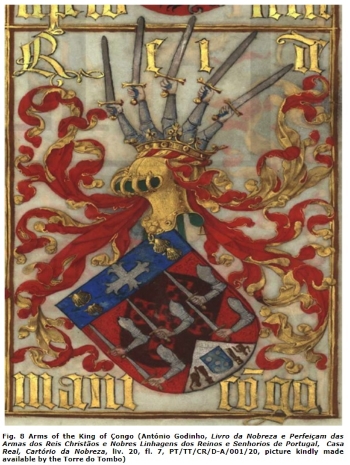
<p>&nbsp;</p>      <p>     Generally speaking, however, in the heraldry of the nobility that was     involved in overseas expansion, there was a fondness for traditional     figures, corresponding to the predominantly military and chivalrous nature     of the feats alluded to in the grants of arms. Hence also the clear     preponderance of the North African territory as the stage that lent itself     to such feats; this was the quintessential field of combat against the infidel, in the pursuit of the ideals of the crusade and the    <i>Reconquista</i>. Such a formal and spiritual connection made it     possible to establish a real or imaginary link in genealogical terms with     the notion of antiquity and the perpetuation of lineages, essential in the     mentality of the nobility. And this same link was shaped in the     construction of one’s own highly chivalrous exploits based on heroic     reports of a historical or mythical nature. This preference was in sharp     contrast to what was taking place in the neighboring Spanish monarchy,     where the expressive figures of “Americanness” began to establish their own     important presence in the heraldry both of the conquerors of these     territories and of the respective native elites that had been incorporated     into their governance (López-Fanjul de Argüelles 2014: 151-178; 2015:     229-266). </p>     <p>     The Portuguese Crown did, in fact, seek to transplant the same logic to     some social and political organizations that it came across overseas. Thus,     João II awarded a coat of arms to Bemoim, of the Kingdom of Jalofo, in     which there was a combination of a cross and the <i>quinas</i> (Resende     1991: 116; <a href="#f7">Fig. 7</a>)<sup><a href="#4">4</a></sup><a name="top4"></a>&nbsp;. Even more significant was the award of a     coat of arms to King Afonso I of Congo, in which all the symbolic and     legendary elements relating to Ourique and the ideal of the crusade were     boldly transposed to equatorial Africa (Rosa 2006: 19-36). The heraldic     acculturation that was started at this time also included the sending of 20     grants of arms to the Congolese sovereign authorizing the setting up (and     control) within his kingdom of a heraldic representation of the nobility,     together with their respective titles (Seixas 1996: 330-334). It is     revealing that the new coat of arms of the Congolese sovereign converted to Christianity was included in the chapters of both<i>Livro do Armeiro-mor</i> and    <i>Livro da Nobreza e Perfeiçam das Armas </i>dedicated to the heraldry     of all the kingdoms existing in the world. By including such insignia, the     compiler incorporated into this list a kingdom that was assumed as a     subsidiary of the Portuguese Crown, which, in this way, strengthened its     imperial dimension (<a href="#f8">Fig. 8</a>). </p>      <p>&nbsp;</p> <a name="f7"></a> <img src="/img/revistas/ejph/v15n2/15n2a01f7.jpg">     
<p>&nbsp;</p>      ]]></body>
<body><![CDATA[<p>&nbsp;</p> <a name="f8"></a> <img src="/img/revistas/ejph/v15n2/15n2a01f8.jpg">     
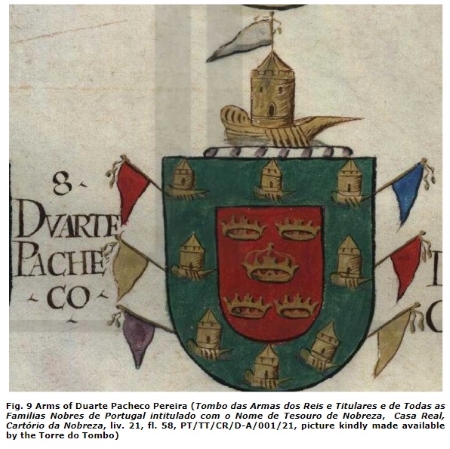
<p>&nbsp;</p>      <p>     One peculiar case was that of Duarte Pacheco Pereira. In the     newly-discovered territories, the Portuguese did not find emblematic     systems that were in any way similar to those of European heraldry (with     the possible exception of the Japanese <i>mon</i>), but they sometimes     applied the notion that those who were recognized as having the dignity of     a sovereign should also have the power to grant arms. Thus, Duarte Pacheco     was granted a new coat of arms by the king of Cochin (<a href="#f9">Fig. 9</a>). Such     insignia were organized, in every respect, according to the principles     applied to the heraldry of the beneficiaries of grants of arms issued for     exploits performed overseas: the shield comprised five crowns and a bordure     charged with castles placed on ships and waves, surrounded by six banners     placed beneath (Mattos 1936). Besides the allusion to the overseas     exploits, the visual impact of the coat of arms was an obvious emulation of     the Portuguese royal coat of arms, in the form of an imitation similar to     that observed in the case of the arms of Duarte Coelho. </p>     <p>&nbsp;</p> <a name="f9"></a> <img src="/img/revistas/ejph/v15n2/15n2a01f9.jpg">     
<p>&nbsp;</p>     <p>     The group of coats of arms thus distinguished with elements relating to     overseas themes appears in the two already-mentioned sixteenth-century     armorials: they are to be found scattered among the manuscripts, thus     providing, from the visual point of view, a fusion between the old and the     new insignia. In this way, these armorials mirror the fusion between the     old and the new aristocracy in the melting pot of the new ideal of the nobility linked to the service rendered to the Crown. And together with the    <i>Sala dos Brasões</i> at the royal palace of Sintra, they confirm a     hierarchy of nobles based precisely on the principle of loyalty to the     Crown (Freire 1973: I, 39). </p>     <p>     From the mid-sixteenth century onwards, there was in Portugal an increase     in the production of heraldic works. The first armorials compiled by private initiative began to appear, such as    <i>Livro Darmas da nobreza fidalgia do Reino de purtugal </i>by Brás Pereira Brandão, <i>Livro do Senhor Dom Duarte</i>,    <i>Livro dos Brazoens das Familias deste Reyno, com suas origens </i>by     António de Ataíde, and <i>Blasones </i>by Jorge de Montemor (Sousa 1745:     I, 51-154). The initiative for the production of heraldic texts had ceased     to be an exclusive privilege of officers of arms. What lay behind this     reality? One possible answer may be the reaction to the rules that had been     imposed by the willful intervention of the Crown since the times of Afonso     V, culminating in the legislation of Manuel I. Works produced outside the     scope of the authority of the officers of arms were a reaction against the     idea of transforming heraldry into an instrument that remained at the sole     service of the Crown and its purposes. Seen from this point of view, it is     easy to understand the bitter discussions and controversy that arose in the     late sixteenth century around the role played by private individuals in     conserving the nation’s memory, away from the state institutions, namely     the <i>Cartório da Nobreza</i> (Nobility Registry Office, Figueirôa-Rêgo     2008: 185-6). Thereafter, in the heraldry of the Portuguese nobility,     elements reflecting overseas service were perpetuated in the armorials     successively compiled both by the officers of the Crown and by private     individuals (Seixas 2010: 357-413). </p>     <p>     Notably absent from the sixteenth-century armorials were, however, the     coats of arms of the actual territories that were discovered, conquered or     colonized by the Portuguese Crown, with the exception of the     already-mentioned coat of arms of the kingdom of Congo. Such an absence may     be considered surprising. All the more so since it is in sharp contrast to     what was happening in the neighboring Spanish America, where there was an     abundant concession of coats of arms to cities by Carlos V and Filipe II     (Amerlinck 1993: 19-30). </p>     <p>     The reasons for this absence may be rooted, first of all, in the lack of a     tradition on the part of the Portuguese Crown in awarding municipal coats     of arms, unlike other European monarchies: in Portugal, civic arms were     established and changed at the initiative of the councils themselves     (Seixas 2011: 189-222). When the overseas expansion took place, this scheme     was partly transposed to the new territories. In the early days, when the     Portuguese presence was limited to Northwest Africa and the Atlantic     archipelagoes, the emblems that were to be found there tended to repeat the     theme of the royal coat of arms (with the variations of the second-born     sons, lords of these islands) and that of the cross of the Order of Christ.     As the Crown began to completely appropriate the expansionist enterprise,     royal arms and badges prevailed over all other signs. When Manuel I became     simultaneously king and governor of the Order of Christ, a combination that     was later made definitive by his son João III, the triad of the royal coat     of arms/armillary sphere/cross of the Order of Christ became a predominant,     if not exclusive, feature of the Portuguese overseas territories. </p>     <p>     Accordingly, there were few overseas institutions and territories that had     their own heraldry, which was, in fact, perfectly in keeping with the     centralization of the royal power. Further contributing to this outcome was     the traditional absence of any intermediate bodies in the Portuguese     monarchy: there was no other organ of sovereignty that could interpose     itself between the municipalities and the king. Indeed, one had to wait     until the seventeenth century for the Portuguese armorials to begin to     mention any heraldry belonging solely to the overseas dominions themselves,     all of which was of a municipal nature. </p>     ]]></body>
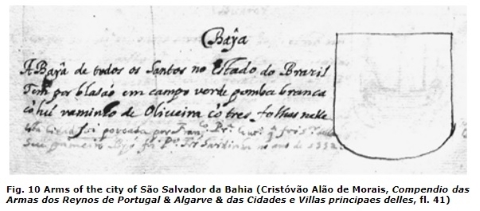
<body><![CDATA[<p>     The first such manifestation occurred in roughly 1630, through the pen of     António Soares Albergaria (Cabral 1929), who conceived and produced a quite     unique heraldic work: not only did he set himself the task of compiling the     coats of arms of all known entities, but he also set out to explain all of     their symbolic meaning, thereby integrating them into a system of clearly     defined symbolic values. This was an extremely vast and innovative project.     Underlying Albergaria’s armorial was the idea that all the entities that     participated in the construction of the Portuguese monarchy should express     their contribution through a symbolic manifestation, or, in other words,     through their respective coat of arms (hence the inclusion of all types of     heraldry: family, dynasty, state, ecclesiastic, university, corporative,     military, municipal). This latter form of heraldry therefore illustrated     the individuality of each municipality and demonstrated the contribution     that each of these had made to constructing the edifice of the monarchy, as     well as the importance of the efforts that they had all made to the     achievement of this same purpose). Hence the inclusion of four overseas     municipalities: Funchal, Ponta Delgada, Goa, and Malacca (Albergaria:     304v-308v). Albergaria revealed these overseas arms because they were     effectively used by the municipalities, but they were also explicitly     inscribed in the collective memory of the Portuguese monarchy (the symbolic     importance of Goa, the political and religious center of the Portuguese     dominions in Asia and on the east coast of Africa, and of Malacca, marked     out as the strategic key for the control of the Indian Ocean). </p>     <p>     The period around the time of the Restoration of Portuguese independence     from Spanish rule in 1640 coincided with a previously unseen interest in     civic heraldry (Seixas 2011: 385-390). It was then that the iconographic     series of coats of arms of the cities began to be disseminated. In relation     to this context, it is interesting to note that the richest approaches were     probably to be found in the works produced by two magistrates: João Pinto     Ribeiro (Seixas 2006: 189-206) and Cristóvão Alão de Morais (Morais 2013).     The first highlighted the ways in which the symbolics of municipal power     was inserted into coetaneous political doctrine. The second sought to     establish the corpus of heraldic emblems of that same power. Both of them     worked with the clear purpose of building a political edifice in which     sovereignty, although nominally held in an absolute form by the prince, was     based on the idea of the composition of various historical bodies united     under the auspices of the Crown. Among these, the municipalities were of     prime importance, both in relation to the residual part of sovereignty that     they held (and which did not fall under the king’s power, to which they     submitted voluntarily, reiterating their allegiance at certain special     moments and rituals) and in regard to the role that they played in the     effective administration of the territory. It is not, therefore, surprising     that the most complete armorial of the municipalities in the Modern Era was     compiled by a magistrate from the time of the Restoration of Portuguese     rule in 1640. </p>     <p>     The restoration of Portuguese independence was, in fact, a moment when the     various bodies that composed the monarchy underwent a period of     reconstruction and a re-equilibrium of the forces between them. In the same     way that a debate was held over the relative merits of the pen versus the     sword, so was questioned the relative contribution of the various     institutions and social strata that strove to build, defend, maintain, and     expand the whole edifice of the monarchy. In this multifaceted equilibrium,     the municipalities played an important role, which various authors     presented as the immemorial manifestation of sovereignty and of the     administration of the territory. It was within the context of this same     pact that, in turn, the learned scholars and civil servants claimed for     themselves and played an increasingly leading role as agents linking     together the forces in question and the bodies that were in the service of     the Crown. The civic armorial compiled by Alão de Morais thus reflects this     dual role of cultural and political construction. As far as the overseas     territories were concerned, the author included the arms of two cities from     the Atlantic archipelagoes (Angra and Funchal) and, for the first time,     those of a city in Brazil: São Salvador da Bahia (Morais 2013: 27, 30, 41)     (<a href="#f10">Fig. 10</a>). </p>     <p>&nbsp;</p> <a name="f10"></a> <img src="/img/revistas/ejph/v15n2/15n2a01f10.jpg">     
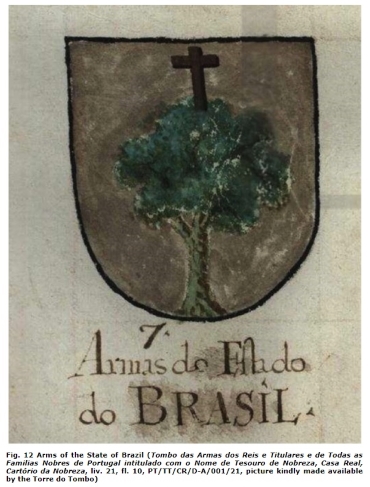
<p>&nbsp;</p>     <p>     The reason why the arms of Bahia were included in Morais’ civic armorial is     the same as the one that had dictated the inclusion of those of Goa and     Malacca in the earlier ones. Following the restoration of Bahia from its     Dutch conquerors and the central role that the city played as the seat of     the royal authority in Brazil, the city of Salvador had earned the     legitimate right to be inscribed in the monarchy’s register of epic feats     not only in the Portuguese monarchy, it should be noted, but also in the     Spanish monarchy. At the royal palace of Buen Retiro, the ceremonial hall     displayed, on one side, the cycle of the labors of Hercules, and, on the     other side, the heroic moments of the surrender of Breda and the     restoration of Bahia (Sabatier 2003: 97). Just as had happened at the time     of the debate about the reconfiguration of the royal coat of arms in the     reign of João II, the principle of honesty dictated the possibility of     certain arms being inscribed in the armorials as representative of the     contribution that each body represented in this way rendered to the     composite edifice of the monarchy (Seixas 2015: 285-309). Very much in     keeping with the tastes of that time, privilege was given to the expression     of that heraldry through a series of artistic and literary means,     interlinked with one another through their common reference to the elements     that composed the arms and the <i>ingenious</i> links that they made it     possible to establish (Loskoutoff 2000). </p>     <p>     In that sense, Bahia’s arms mark a turning point in the understanding of     heraldry. According to Morais, “the Bay of All Saints in the State of     Brazil has as its blazon a dove argent on a field vert with an olive branch     with three leaves” (Morais 2013: 30). These figures were not inspired by     the traditional heraldic repertoire, nor did they include exotic elements     alluding to the overseas dominions. The choice of a dove with an olive     branch was an explicit reference to a biblical inspiration, with a highly symbolic and political charge, reinforced by the presence of the legend    <i>Sic illa ad Arcam reversa est</i>. In fact, instead of representing a     particular military feat, the chosen sign was intended to symbolize the     idea of the refounding of the kingdom in America, giving continuity to the     project of New Lusitania generated in the sixteenth century by Duarte     Coelho. This explains the choice of the dove with the olive branch, which     in the biblical episode of the Flood returned to the ark to signal to Noah     the world’s redemption and the prospect of a New Alliance, upon which a     newly implanted society would be built. Mention should be made of the     exceptional nature of its composition inspired by the Old Testament, which     only had a parallel in the heraldry of the town of Santa María de la Vera     Paz, on what was at that time called Hispaniola, which had been the subject     of a heraldic concession made by the Catholic Monarchs in 1508 (Herrera y     Tordesillas 1601-1615: I, 225-226). This sign was justifiably adapted to     the city of Salvador, the capital of the State of Brazil, all the more so     after the definitive victory over the invading Dutch and French forces. </p>     <p>     The plan for a universal armorial of the Portuguese monarchy conceived by     Albergaria was also taken up once again by his contemporary António Coelho,     the Portugal king of arms (Norton 2006: III, 27-45), and later by his son     Francisco Coelho, the India king of arms (Seixas 2011: 361-366). In the     armorial compiled by the latter, an extensive chapter was written about the     arms of the cities of Portugal, preceded by another somewhat shorter one     entitled “Arms of Some Cities of the Conquests of Portugal” (Coelho: 10).     This included the kingdom of the Algarve with its four cities (Tavira,     Lagos, Silves, and Faro), the cities of Funchal and Goa (<a href="#f11">Fig. 11</a>), and the     islands of São Miguel and Terceira. Even more interesting, however, is the     inclusion in this same folio of a shield of arms attributed to the State of     Brazil, consisting of a tree surmounted by a cross (<a href="#f12">Fig. 12</a>). </p>     <p>&nbsp;</p> <a name="f11"></a> <img src="/img/revistas/ejph/v15n2/15n2a01f11.jpg">     
<p>&nbsp;</p>      ]]></body>
<body><![CDATA[<p>&nbsp;</p> <a name="f12"></a> <img src="/img/revistas/ejph/v15n2/15n2a01f12.jpg">     
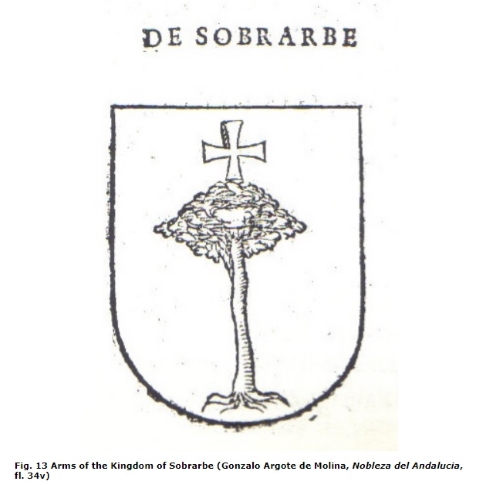
<p>&nbsp;</p>     <p>     This is a curious case in various senses, mainly because it constitutes an     example of imaginary heraldry. As was said earlier, the royal authority in     the Portuguese overseas territories was invariably represented by the     figuration of the royal emblems, making use of the coat of arms itself, the     badge of the armillary sphere, and also the cross of the Order of Christ.     All of the institutions and individuals who acted on behalf of the king     thus made use of these royal insignia as a visual instrument for the     legitimization and affirmation of their authority, whatever might be their     rank, position (viceroy, governor-general, governor, etc.) or nature     (municipal council, law court, military command, etc.). Even when there     existed a central political and administrative entity, as was the case with     the general government of Brazil, there were still no autonomous signs. The     arms with the tree surmounted by a cross were therefore situated in the     field of imaginary heraldry, since they were never used by any authority in     the American dominions of the Portuguese Crown. </p>     <p>     Secondly, the arms imputed by the king of arms to the State of Brazil are     important for their typological characteristics. They were, in fact, a     creation, in which the possible levels of interpretation were multiple and     overlapping, indicating the heraldic culture of their creator. Indeed, the     Latin cross was an evident allusion to the territory’s name of Santa Cruz     (Holy Cross), with which it had been christened at the time of its discovery; while the tree can be understood as a reference to the    <i>pau-brasil </i>(Brazilwood), whose name ended up prevailing over the     original religious invocation. In truth, in both cases, the antecedents of     the chosen images are gathered together in the cartography, in which the     identification of the Portuguese territory on the American continent was     realized, through a Latin cross or a tree, among other images. The solution     of the tree surmounted by the cross therefore joins the two models     together. With the advantage that, by doing so, it amounted to the     remission of a symbolically devalued toponymy: the replacement of the     invocation of the Cross by the name arising from that of a simple tree with     commercial interest (and, what is more, red in color) did not cease to have     connotations with the devilish influences that were spreading across the     American territories (Souza 1993). </p>     <p>     Nonetheless, the theme of the cross-tree also had its roots in an Iberian     tradition of imaginary heraldry (Seixas &amp; Galvão-Telles 2009: 205-217).     Gonzalo Argote de Molina attributed this same figure to the mythical reign     of Sobrarbe, explaining that there existed a communion of Iberian royal     symbolics centered around the model of the cross, to which all the     Peninsula’s sovereigns linked their coats of arms in one way or another     (<a href="#f13">Fig. 13</a>). This same author thus defended the existence of a background     shared by all Spanish monarchs, based on the principle of the crusades and     the expansion of the Christian faith, guided by a common teleology that     justified the Iberian political unity eventually achieved with Filipe II.     Specifically in Portugal, however, the heraldic theme of the tree-cross was     linked, above all, to the mythical explanation of the arms of the Pereira     family, referring to the miraculous appearance of a luminous cross above a     tree during various battles in which successive members of the family line     had distinguished themselves, most notably at the Battle of Rio Salado in     1340, where the prior Gonçalo Álvares Pereira, father of the Constable Nuno     Álvares Pereira, had fought. It was from this latter figure that the Dukes     of Bragança were descended, becoming his genealogical representatives, and,     from the Restoration onwards, through this same lineage, the kings of     Portugal. In fact, the mythical origin of the heraldry of the Pereira     lineage was placed in parallel with that of the royal coat of arms itself,     insofar as they were both based on the same model of the miraculous appearance that originated the transmission of a visual sign (cross,    <i>quinas</i>) that displayed the sacred dimension of the lineage and the     mission that had been entrusted to it. </p>     <p>&nbsp;</p> <a name="f13"></a> <img src="/img/revistas/ejph/v15n2/15n2a01f13.jpg">     
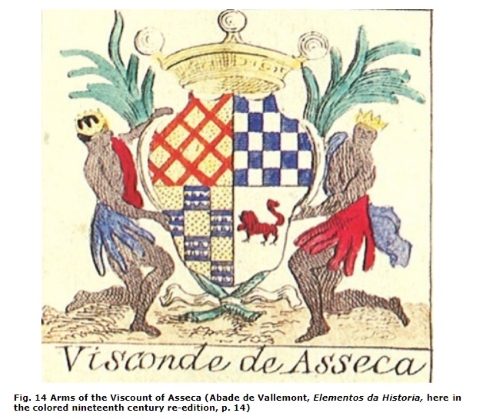
<p>&nbsp;</p>     <p>     Portuguese armorials in the eighteenth century do not present any     particular innovation in relation to the previous century as far as the     representation of overseas exploits is concerned. There is, however, one     exception: in 1741, Pedro de Sousa de Castelo Branco published a translated     version of <i>Les Eléments de l’Histoire</i> by Abbé Vallemont, which he     sought to adapt to the Portuguese reality, namely in the part relating to     heraldry (Vallemont 1741). For this purpose, the translator included in     that chapter a series of additional engravings, among which was the coat of     arms used at that time by the Viscounts of Asseca (<a href="#f14">Fig. 14</a>). Inside the     shield, these arms followed the customary quartered pattern that indicated     the family’s genealogical origins and the representation of its entailed     heritage; but, outside the shield, the coat of arms introduced a novelty.     On one side was an African king and, on the other, an Indian chief,     standing on a terrace and supporting the shield. This was an allusion to     the feats performed by Salvador Correia de Sá in the Portuguese dominions     on both sides of the Atlantic, as well as to the perpetuation of this     lineage in what had become transformed into the central axis of the     Portuguese overseas dominions. </p>     <p>&nbsp;</p> <a name="f14"></a> <img src="/img/revistas/ejph/v15n2/15n2a01f14.jpg">     
<p>&nbsp;</p>     ]]></body>
<body><![CDATA[<p>&nbsp;   </p>     <p>     <b>SOURCES</b> </p>     <!-- ref --><p> Albergaria, António Soares. <i>Armaria</i>. BNP Cód. 1118.    <i>Brasonário da Nobreza de Portugal</i>. Anonymous manuscript from the     seventeenth century (1999). Lisbon: Moreira &amp; Almeida.    &nbsp;&nbsp;&nbsp;&nbsp;&nbsp;&nbsp;&nbsp;&nbsp;[&#160;<a href="javascript:void(0);" onclick="javascript: window.open('/scielo.php?script=sci_nlinks&ref=172448&pid=S1645-6432201700020000100001&lng=','','width=640,height=500,resizable=yes,scrollbars=1,menubar=yes,');">Links</a>&#160;]<!-- end-ref --> </p>     <!-- ref --><p>     Coelho, Francisco. <i>Thesouro da Nobreza.</i> ANTT, <i>Casa Forte</i>,     n.º 169.    &nbsp;&nbsp;&nbsp;&nbsp;&nbsp;&nbsp;&nbsp;&nbsp;[&#160;<a href="javascript:void(0);" onclick="javascript: window.open('/scielo.php?script=sci_nlinks&ref=172450&pid=S1645-6432201700020000100002&lng=','','width=640,height=500,resizable=yes,scrollbars=1,menubar=yes,');">Links</a>&#160;]<!-- end-ref --> </p>     <!-- ref --><p>     Godinho, António (1987). <i>Livro da nobreza e perfeiçam das armas</i>.     Lisbon: Inapa.    &nbsp;&nbsp;&nbsp;&nbsp;&nbsp;&nbsp;&nbsp;&nbsp;[&#160;<a href="javascript:void(0);" onclick="javascript: window.open('/scielo.php?script=sci_nlinks&ref=172452&pid=S1645-6432201700020000100003&lng=','','width=640,height=500,resizable=yes,scrollbars=1,menubar=yes,');">Links</a>&#160;]<!-- end-ref --> </p>     <!-- ref --><p>     Herrera y Tordesillas, Antonio de (1601-1615).     <i>         Historia General de los hechos de los Castellanos en las islas i tierra         firme del mar oceano     </i>     . Madrid: Emprenta Real.    &nbsp;&nbsp;&nbsp;&nbsp;&nbsp;&nbsp;&nbsp;&nbsp;[&#160;<a href="javascript:void(0);" onclick="javascript: window.open('/scielo.php?script=sci_nlinks&ref=172454&pid=S1645-6432201700020000100004&lng=','','width=640,height=500,resizable=yes,scrollbars=1,menubar=yes,');">Links</a>&#160;]<!-- end-ref --> </p>     ]]></body>
<body><![CDATA[<!-- ref --><p>     <i>Livro de Arautos</i>     (1977). Lisbon: FLUL.    &nbsp;&nbsp;&nbsp;&nbsp;&nbsp;&nbsp;&nbsp;&nbsp;[&#160;<a href="javascript:void(0);" onclick="javascript: window.open('/scielo.php?script=sci_nlinks&ref=172456&pid=S1645-6432201700020000100005&lng=','','width=640,height=500,resizable=yes,scrollbars=1,menubar=yes,');">Links</a>&#160;]<!-- end-ref --> </p>     <!-- ref --><p>     <i>Livro do Armeiro-mor</i>     (2000). Lisbon: Inapa.    &nbsp;&nbsp;&nbsp;&nbsp;&nbsp;&nbsp;&nbsp;&nbsp;[&#160;<a href="javascript:void(0);" onclick="javascript: window.open('/scielo.php?script=sci_nlinks&ref=172458&pid=S1645-6432201700020000100006&lng=','','width=640,height=500,resizable=yes,scrollbars=1,menubar=yes,');">Links</a>&#160;]<!-- end-ref --> </p>     <!-- ref --><p>     <i>Livro do Armeiro-mor</i>     , organized and illuminated by Jean du Cros (1956). Lisbon: Academia     Portuguesa da História.    &nbsp;&nbsp;&nbsp;&nbsp;&nbsp;&nbsp;&nbsp;&nbsp;[&#160;<a href="javascript:void(0);" onclick="javascript: window.open('/scielo.php?script=sci_nlinks&ref=172460&pid=S1645-6432201700020000100007&lng=','','width=640,height=500,resizable=yes,scrollbars=1,menubar=yes,');">Links</a>&#160;]<!-- end-ref --> </p>     <!-- ref --><p>     Morais, Cristóvão Alão de.     <i>         Compendio das Armas dos Reynos de Portugal &amp; Algarve &amp; das         Cidades e Villas principaes delles     </i>     .<strong> </strong>Porto: 2013.    &nbsp;&nbsp;&nbsp;&nbsp;&nbsp;&nbsp;&nbsp;&nbsp;[&#160;<a href="javascript:void(0);" onclick="javascript: window.open('/scielo.php?script=sci_nlinks&ref=172462&pid=S1645-6432201700020000100008&lng=','','width=640,height=500,resizable=yes,scrollbars=1,menubar=yes,');">Links</a>&#160;]<!-- end-ref --> </p>     <!-- ref --><p>     Rodrigues, António (1931). <i>Tratado Geral de Nobreza</i>. Porto:     Biblioteca Pública Municipal.    &nbsp;&nbsp;&nbsp;&nbsp;&nbsp;&nbsp;&nbsp;&nbsp;[&#160;<a href="javascript:void(0);" onclick="javascript: window.open('/scielo.php?script=sci_nlinks&ref=172464&pid=S1645-6432201700020000100009&lng=','','width=640,height=500,resizable=yes,scrollbars=1,menubar=yes,');">Links</a>&#160;]<!-- end-ref --> </p>     ]]></body>
<body><![CDATA[<!-- ref --><p> Sousa, D. Antonio Caetano de (1735).    <i>Historia Genealogica da Casa Real Portugueza</i>. Lisbon: Joseph     Antonio da Sylva.    &nbsp;&nbsp;&nbsp;&nbsp;&nbsp;&nbsp;&nbsp;&nbsp;[&#160;<a href="javascript:void(0);" onclick="javascript: window.open('/scielo.php?script=sci_nlinks&ref=172466&pid=S1645-6432201700020000100010&lng=','','width=640,height=500,resizable=yes,scrollbars=1,menubar=yes,');">Links</a>&#160;]<!-- end-ref --> </p>     <!-- ref --><p>     Vallemont, Abade de (1741). <i>Elementos da Historia</i>. Lisbon: Miguel     Rodrigues.    &nbsp;&nbsp;&nbsp;&nbsp;&nbsp;&nbsp;&nbsp;&nbsp;[&#160;<a href="javascript:void(0);" onclick="javascript: window.open('/scielo.php?script=sci_nlinks&ref=172468&pid=S1645-6432201700020000100011&lng=','','width=640,height=500,resizable=yes,scrollbars=1,menubar=yes,');">Links</a>&#160;]<!-- end-ref --> </p>     <!-- ref --><p>     Velho, António José Vaz (1958-1963). <i>Tesouro Heráldico de Portugal</i>     . Lisbon: Gabinete de Estudos Heráldicos e Genealógicos.    &nbsp;&nbsp;&nbsp;&nbsp;&nbsp;&nbsp;&nbsp;&nbsp;[&#160;<a href="javascript:void(0);" onclick="javascript: window.open('/scielo.php?script=sci_nlinks&ref=172470&pid=S1645-6432201700020000100012&lng=','','width=640,height=500,resizable=yes,scrollbars=1,menubar=yes,');">Links</a>&#160;]<!-- end-ref --> </p>     <p>&nbsp;  </p>     <p>    <b> BIBLIOGRAPHY </b> </p>     <!-- ref --><p> Albuquerque, Martim de (1988).    <i>A expressão do poder em Luís de Camões</i>. Lisbon: INCM.    &nbsp;&nbsp;&nbsp;&nbsp;&nbsp;&nbsp;&nbsp;&nbsp;[&#160;<a href="javascript:void(0);" onclick="javascript: window.open('/scielo.php?script=sci_nlinks&ref=172474&pid=S1645-6432201700020000100013&lng=','','width=640,height=500,resizable=yes,scrollbars=1,menubar=yes,');">Links</a>&#160;]<!-- end-ref --> </p>     ]]></body>
<body><![CDATA[<!-- ref --><p>     Amerlinck, Teodoro (1993). “Heráldica municipal en la Nueva España durante     el siglo XVI.” In Menéndez Pidal (ed.).     <i>         Las armerías en Europa al comenzar la Edad Moderna y su proyección al         Nuevo Mundo     </i>     . Madrid: Dirección de Archivos Estatales: 19-30.    &nbsp;&nbsp;&nbsp;&nbsp;&nbsp;&nbsp;&nbsp;&nbsp;[&#160;<a href="javascript:void(0);" onclick="javascript: window.open('/scielo.php?script=sci_nlinks&ref=172476&pid=S1645-6432201700020000100014&lng=','','width=640,height=500,resizable=yes,scrollbars=1,menubar=yes,');">Links</a>&#160;]<!-- end-ref --> </p>     <!-- ref --><p> Azevedo, Francisco S.A. de (1966).    <i>Uma interpretação histórico-cultural do Livro do Armeiro-Mor</i>.     Lisbon: Author’s edition.    &nbsp;&nbsp;&nbsp;&nbsp;&nbsp;&nbsp;&nbsp;&nbsp;[&#160;<a href="javascript:void(0);" onclick="javascript: window.open('/scielo.php?script=sci_nlinks&ref=172478&pid=S1645-6432201700020000100015&lng=','','width=640,height=500,resizable=yes,scrollbars=1,menubar=yes,');">Links</a>&#160;]<!-- end-ref --> </p>     <!-- ref --><p>     Borges, J.G. Calvão (2004).” A Armaria em Portugal e na Cultura Portuguesa.” In Redondo Veintemillas (ed.).    <i>Actas del I Congreso Internacional de Emblemática General</i>.     Zaragoza: Institución «Fernando el Católico»: II, 983-1011.    &nbsp;&nbsp;&nbsp;&nbsp;&nbsp;&nbsp;&nbsp;&nbsp;[&#160;<a href="javascript:void(0);" onclick="javascript: window.open('/scielo.php?script=sci_nlinks&ref=172480&pid=S1645-6432201700020000100016&lng=','','width=640,height=500,resizable=yes,scrollbars=1,menubar=yes,');">Links</a>&#160;]<!-- end-ref --> </p>     <!-- ref --><p>     Brault, Gerard (1997). <i>Early Blazon</i>. Woodbridge: Boydell Press.    &nbsp;&nbsp;&nbsp;&nbsp;&nbsp;&nbsp;&nbsp;&nbsp;[&#160;<a href="javascript:void(0);" onclick="javascript: window.open('/scielo.php?script=sci_nlinks&ref=172482&pid=S1645-6432201700020000100017&lng=','','width=640,height=500,resizable=yes,scrollbars=1,menubar=yes,');">Links</a>&#160;]<!-- end-ref --> </p>     <!-- ref --><p>     Borges, M.L. Calvão; Borges, J.G. Calvão (1987-1988). “Estudos de Heráldica     Portuguesa – I – O Armorial das Conquistas e Descobrimentos e o Armorial da     Távola Redonda.” In <i>Armas e Troféus</i>, VI, I, 5-28.    &nbsp;&nbsp;&nbsp;&nbsp;&nbsp;&nbsp;&nbsp;&nbsp;[&#160;<a href="javascript:void(0);" onclick="javascript: window.open('/scielo.php?script=sci_nlinks&ref=172484&pid=S1645-6432201700020000100018&lng=','','width=640,height=500,resizable=yes,scrollbars=1,menubar=yes,');">Links</a>&#160;]<!-- end-ref --> </p>     ]]></body>
<body><![CDATA[<!-- ref --><p>     Boudreau, Claire (2006). <i>L’Héritage symbolique des hérauts d’armes</i>     .Paris: Le Léopard d’Or.    &nbsp;&nbsp;&nbsp;&nbsp;&nbsp;&nbsp;&nbsp;&nbsp;[&#160;<a href="javascript:void(0);" onclick="javascript: window.open('/scielo.php?script=sci_nlinks&ref=172486&pid=S1645-6432201700020000100019&lng=','','width=640,height=500,resizable=yes,scrollbars=1,menubar=yes,');">Links</a>&#160;]<!-- end-ref --> </p>     <!-- ref --><p>     Boudreau, Claire (1997). “Traités de blason et armoriaux: pédagogie et     mémoire. ” In Holtz, Louis (ed.). <i>Les armoriaux médiévaux</i>. Paris:     Le Leópard d’Or: 383-394.    &nbsp;&nbsp;&nbsp;&nbsp;&nbsp;&nbsp;&nbsp;&nbsp;[&#160;<a href="javascript:void(0);" onclick="javascript: window.open('/scielo.php?script=sci_nlinks&ref=172488&pid=S1645-6432201700020000100020&lng=','','width=640,height=500,resizable=yes,scrollbars=1,menubar=yes,');">Links</a>&#160;]<!-- end-ref --> </p>     <!-- ref --><p> Cabral, António M.F.P. (1929).    <i>António Soares de Albergaria heráldista do século XVII</i>. Lisbon:     Tombo Histórico.    &nbsp;&nbsp;&nbsp;&nbsp;&nbsp;&nbsp;&nbsp;&nbsp;[&#160;<a href="javascript:void(0);" onclick="javascript: window.open('/scielo.php?script=sci_nlinks&ref=172490&pid=S1645-6432201700020000100021&lng=','','width=640,height=500,resizable=yes,scrollbars=1,menubar=yes,');">Links</a>&#160;]<!-- end-ref --> </p>     <!-- ref --><p>     Cabral, António M.F.P. (1955). “Simbolismo heráldico dos descobrimentos e     conquistas portugueses.” In     <i>         Comunicaciones y conclusiones del III Congreso Internacional de         Genealogia y     </i>     Madrid: Instituto Internacional de Genealogia y Heráldica: 361-374.    &nbsp;&nbsp;&nbsp;&nbsp;&nbsp;&nbsp;&nbsp;&nbsp;[&#160;<a href="javascript:void(0);" onclick="javascript: window.open('/scielo.php?script=sci_nlinks&ref=172492&pid=S1645-6432201700020000100022&lng=','','width=640,height=500,resizable=yes,scrollbars=1,menubar=yes,');">Links</a>&#160;]<!-- end-ref --> </p>     <!-- ref --><p>     Figueirôa-Rêgo, João de (2008). <i>Reflexos de um poder discreto</i>     .Lisbon: CHAM.    &nbsp;&nbsp;&nbsp;&nbsp;&nbsp;&nbsp;&nbsp;&nbsp;[&#160;<a href="javascript:void(0);" onclick="javascript: window.open('/scielo.php?script=sci_nlinks&ref=172494&pid=S1645-6432201700020000100023&lng=','','width=640,height=500,resizable=yes,scrollbars=1,menubar=yes,');">Links</a>&#160;]<!-- end-ref --> </p>     ]]></body>
<body><![CDATA[<!-- ref --><p>     Freire, A. Braamcamp (1989). <i>Armaria Portuguesa</i>. Lisbon: Cota     d’Armas.    &nbsp;&nbsp;&nbsp;&nbsp;&nbsp;&nbsp;&nbsp;&nbsp;[&#160;<a href="javascript:void(0);" onclick="javascript: window.open('/scielo.php?script=sci_nlinks&ref=172496&pid=S1645-6432201700020000100024&lng=','','width=640,height=500,resizable=yes,scrollbars=1,menubar=yes,');">Links</a>&#160;]<!-- end-ref --> </p>     <!-- ref --><p>     Freire, A. Braamcamp (1973). <i>Brasões da Sala de Sintra</i>. Lisbon:     INCM.    &nbsp;&nbsp;&nbsp;&nbsp;&nbsp;&nbsp;&nbsp;&nbsp;[&#160;<a href="javascript:void(0);" onclick="javascript: window.open('/scielo.php?script=sci_nlinks&ref=172498&pid=S1645-6432201700020000100025&lng=','','width=640,height=500,resizable=yes,scrollbars=1,menubar=yes,');">Links</a>&#160;]<!-- end-ref --> </p>     <!-- ref --><p>     Gomes, Rita Costa (1988). “A curialização da nobreza.” In Curto, D. Ramada     (ed.). <i>O tempo de Vasco da Gama</i>. S.l.: Difel: 179-188.    &nbsp;&nbsp;&nbsp;&nbsp;&nbsp;&nbsp;&nbsp;&nbsp;[&#160;<a href="javascript:void(0);" onclick="javascript: window.open('/scielo.php?script=sci_nlinks&ref=172500&pid=S1645-6432201700020000100026&lng=','','width=640,height=500,resizable=yes,scrollbars=1,menubar=yes,');">Links</a>&#160;]<!-- end-ref --> </p>     <!-- ref --><p>     Guillén Berrendero, J.A. (2012).     <i>         La Edad de la Nobleza: identidad nobiliaria en Castilla y Portugal         (1556-1621)     </i>     . Madrid: Ediciones Polifemo.    &nbsp;&nbsp;&nbsp;&nbsp;&nbsp;&nbsp;&nbsp;&nbsp;[&#160;<a href="javascript:void(0);" onclick="javascript: window.open('/scielo.php?script=sci_nlinks&ref=172502&pid=S1645-6432201700020000100027&lng=','','width=640,height=500,resizable=yes,scrollbars=1,menubar=yes,');">Links</a>&#160;]<!-- end-ref --> </p>     <!-- ref --><p>     Lopes, C. Silva (1960). “As conquistas e descobrimentos na heráldica     portuguesa do século XVI.” In <i>Armas e Troféus</i>, II, I: 107-124.    &nbsp;&nbsp;&nbsp;&nbsp;&nbsp;&nbsp;&nbsp;&nbsp;[&#160;<a href="javascript:void(0);" onclick="javascript: window.open('/scielo.php?script=sci_nlinks&ref=172504&pid=S1645-6432201700020000100028&lng=','','width=640,height=500,resizable=yes,scrollbars=1,menubar=yes,');">Links</a>&#160;]<!-- end-ref --> </p>     ]]></body>
<body><![CDATA[<!-- ref --><p>     López-Fanjul de Argüelles, Carlos (2014). “Las armerías de los     conquistadores de Indias.” In <i>Historia y Genealogía</i>, 4: 151-178.    &nbsp;&nbsp;&nbsp;&nbsp;&nbsp;&nbsp;&nbsp;&nbsp;[&#160;<a href="javascript:void(0);" onclick="javascript: window.open('/scielo.php?script=sci_nlinks&ref=172506&pid=S1645-6432201700020000100029&lng=','','width=640,height=500,resizable=yes,scrollbars=1,menubar=yes,');">Links</a>&#160;]<!-- end-ref --> </p>     <!-- ref --><p>     López-Fanjul de Argüelles, Carlos (2015). “La imaginación heráldica en la     España del siglo XVI. Las armerías de los caciques y los muebles     americanos.” In <i>Historia y Genealogía</i>, 5: 229-266.    &nbsp;&nbsp;&nbsp;&nbsp;&nbsp;&nbsp;&nbsp;&nbsp;[&#160;<a href="javascript:void(0);" onclick="javascript: window.open('/scielo.php?script=sci_nlinks&ref=172508&pid=S1645-6432201700020000100030&lng=','','width=640,height=500,resizable=yes,scrollbars=1,menubar=yes,');">Links</a>&#160;]<!-- end-ref --> </p>     <!-- ref --><p>     Loskoutoff, Yvan (2000). <i>L’armorial de Calliope</i>. Tubingen: Gunter     Narr Verlag.    &nbsp;&nbsp;&nbsp;&nbsp;&nbsp;&nbsp;&nbsp;&nbsp;[&#160;<a href="javascript:void(0);" onclick="javascript: window.open('/scielo.php?script=sci_nlinks&ref=172510&pid=S1645-6432201700020000100031&lng=','','width=640,height=500,resizable=yes,scrollbars=1,menubar=yes,');">Links</a>&#160;]<!-- end-ref --> </p>     <!-- ref --><p> Mattos, Armando de (1936).    <i>As “armas-novas” de Duarte Pacheco Pereira</i>. Coimbra: Coimbra     Editora.    &nbsp;&nbsp;&nbsp;&nbsp;&nbsp;&nbsp;&nbsp;&nbsp;[&#160;<a href="javascript:void(0);" onclick="javascript: window.open('/scielo.php?script=sci_nlinks&ref=172512&pid=S1645-6432201700020000100032&lng=','','width=640,height=500,resizable=yes,scrollbars=1,menubar=yes,');">Links</a>&#160;]<!-- end-ref --> </p>     <!-- ref --><p>     Mello, Evaldo Cabral (1987). <i>Imagens do Brasil holandês</i>. Rio de     Janeiro: Fundação Nacional próMemória.    &nbsp;&nbsp;&nbsp;&nbsp;&nbsp;&nbsp;&nbsp;&nbsp;[&#160;<a href="javascript:void(0);" onclick="javascript: window.open('/scielo.php?script=sci_nlinks&ref=172514&pid=S1645-6432201700020000100033&lng=','','width=640,height=500,resizable=yes,scrollbars=1,menubar=yes,');">Links</a>&#160;]<!-- end-ref --> </p>     ]]></body>
<body><![CDATA[<!-- ref --><p> Menéndez Pidal, Faustino (2008).    <i>La nobleza en España: ideas, estructuras, historia</i>. Madrid:     Fundación Cultural de la Nobleza Española.    &nbsp;&nbsp;&nbsp;&nbsp;&nbsp;&nbsp;&nbsp;&nbsp;[&#160;<a href="javascript:void(0);" onclick="javascript: window.open('/scielo.php?script=sci_nlinks&ref=172516&pid=S1645-6432201700020000100034&lng=','','width=640,height=500,resizable=yes,scrollbars=1,menubar=yes,');">Links</a>&#160;]<!-- end-ref --> </p>     <!-- ref --><p> Menéndez Pidal, Faustino (2014).    <i>Los emblemas heráldicos. Novecientos años de historia</i>. Seville:     Real Maestranza de Caballería.    &nbsp;&nbsp;&nbsp;&nbsp;&nbsp;&nbsp;&nbsp;&nbsp;[&#160;<a href="javascript:void(0);" onclick="javascript: window.open('/scielo.php?script=sci_nlinks&ref=172518&pid=S1645-6432201700020000100035&lng=','','width=640,height=500,resizable=yes,scrollbars=1,menubar=yes,');">Links</a>&#160;]<!-- end-ref --> </p>     <!-- ref --><p>     Norton, Manuel Artur (2006). <i>A Heráldica em Portugal</i>.Lisbon:     Dislivro Histórica.    &nbsp;&nbsp;&nbsp;&nbsp;&nbsp;&nbsp;&nbsp;&nbsp;[&#160;<a href="javascript:void(0);" onclick="javascript: window.open('/scielo.php?script=sci_nlinks&ref=172520&pid=S1645-6432201700020000100036&lng=','','width=640,height=500,resizable=yes,scrollbars=1,menubar=yes,');">Links</a>&#160;]<!-- end-ref --> </p>     <!-- ref --><p>     Oliveira, Humberto N.; Seixas, Miguel Metelo de (2002). “As armas de D.     Vasco da Gama e os acrescentamentos honrosos na heráldica portuguesa dos     séculos XV e XVI. ” In <i>Tabardo</i>, 1: 31-56.    &nbsp;&nbsp;&nbsp;&nbsp;&nbsp;&nbsp;&nbsp;&nbsp;[&#160;<a href="javascript:void(0);" onclick="javascript: window.open('/scielo.php?script=sci_nlinks&ref=172522&pid=S1645-6432201700020000100037&lng=','','width=640,height=500,resizable=yes,scrollbars=1,menubar=yes,');">Links</a>&#160;]<!-- end-ref --> </p>     <!-- ref --><p>     Paravicini, Werner (2008). “Signes et couleurs au Concile de Constance: le     témoignage d’un héraut d’armes portugais. ” In Denise Turrell (ed.).     <i>         Signes et couleurs des identités politiques. Du Moyen Age à nos jours     </i>     . Rennes: PUR: 155-188.    &nbsp;&nbsp;&nbsp;&nbsp;&nbsp;&nbsp;&nbsp;&nbsp;[&#160;<a href="javascript:void(0);" onclick="javascript: window.open('/scielo.php?script=sci_nlinks&ref=172524&pid=S1645-6432201700020000100038&lng=','','width=640,height=500,resizable=yes,scrollbars=1,menubar=yes,');">Links</a>&#160;]<!-- end-ref --> </p>     ]]></body>
<body><![CDATA[<!-- ref --><p> Pastoureau, Michel (2006).    <i>Armorial des chevaliers de la Table Ronde</i>. Paris: Le Léopard d’Or.    &nbsp;&nbsp;&nbsp;&nbsp;&nbsp;&nbsp;&nbsp;&nbsp;[&#160;<a href="javascript:void(0);" onclick="javascript: window.open('/scielo.php?script=sci_nlinks&ref=172526&pid=S1645-6432201700020000100039&lng=','','width=640,height=500,resizable=yes,scrollbars=1,menubar=yes,');">Links</a>&#160;]<!-- end-ref --> </p>     <!-- ref --><p>     Pastoureau, Michel (1985). “L’historien et les traités du blason. In Roger     Harmignies (ed.). <i>Sources de l’Héraldique en Europe Occidentale</i>.”     Brussels: Académie Internationale d’Héraldique: 129-139.    &nbsp;&nbsp;&nbsp;&nbsp;&nbsp;&nbsp;&nbsp;&nbsp;[&#160;<a href="javascript:void(0);" onclick="javascript: window.open('/scielo.php?script=sci_nlinks&ref=172528&pid=S1645-6432201700020000100040&lng=','','width=640,height=500,resizable=yes,scrollbars=1,menubar=yes,');">Links</a>&#160;]<!-- end-ref --> </p>     <!-- ref --><p>     Rosa, Maria de Lurdes (2006). “Velhos, novos e imutáveis sagrados… Um olhar     antropológico sobre formas ‘religiosas’ de percepção e interpretação da     conquista africana.” In <i>Lusitania Sacra</i>, 18: 13-85.    &nbsp;&nbsp;&nbsp;&nbsp;&nbsp;&nbsp;&nbsp;&nbsp;[&#160;<a href="javascript:void(0);" onclick="javascript: window.open('/scielo.php?script=sci_nlinks&ref=172530&pid=S1645-6432201700020000100041&lng=','','width=640,height=500,resizable=yes,scrollbars=1,menubar=yes,');">Links</a>&#160;]<!-- end-ref --> </p>     <!-- ref --><p>     Sabatier, Gérard (2003). “Le palais d’Etat en Europe.” In Marie-France     Auzépy (ed.). <i>Palais et pouvoir. De Constantinople à Versailles</i>.     Vincennes: PUV.    &nbsp;&nbsp;&nbsp;&nbsp;&nbsp;&nbsp;&nbsp;&nbsp;[&#160;<a href="javascript:void(0);" onclick="javascript: window.open('/scielo.php?script=sci_nlinks&ref=172532&pid=S1645-6432201700020000100042&lng=','','width=640,height=500,resizable=yes,scrollbars=1,menubar=yes,');">Links</a>&#160;]<!-- end-ref --> </p>     <!-- ref --><p>     São Payo, Conde de (1927). <i>Do Direito Heraldico Português</i>. Lisbon:     Centro Tipografico Colonial.    &nbsp;&nbsp;&nbsp;&nbsp;&nbsp;&nbsp;&nbsp;&nbsp;[&#160;<a href="javascript:void(0);" onclick="javascript: window.open('/scielo.php?script=sci_nlinks&ref=172534&pid=S1645-6432201700020000100043&lng=','','width=640,height=500,resizable=yes,scrollbars=1,menubar=yes,');">Links</a>&#160;]<!-- end-ref --> </p>     ]]></body>
<body><![CDATA[<!-- ref --><p>     Savorelli, Alessandro (2013). “L’araldica per la storia: una fonte     ausiliaria?” In Maria Pia Paoli (ed.).     <i>         Nel laboratorio della storia. Una guida alle fonti dell’età moderna     </i>     . Rome: Carocci: 289-315.    &nbsp;&nbsp;&nbsp;&nbsp;&nbsp;&nbsp;&nbsp;&nbsp;[&#160;<a href="javascript:void(0);" onclick="javascript: window.open('/scielo.php?script=sci_nlinks&ref=172536&pid=S1645-6432201700020000100044&lng=','','width=640,height=500,resizable=yes,scrollbars=1,menubar=yes,');">Links</a>&#160;]<!-- end-ref --> </p>     <!-- ref --><p>     Savorelli, Alessandro (2015). Atlanti simbolici dello spazio politico. I portolani e il Libro deConocimiento de todos los Reinos. In    <i>Armas e Troféus</i>,IX-XVII: 101-136 &nbsp;&nbsp;&nbsp;&nbsp;&nbsp;&nbsp;&nbsp;&nbsp;[&#160;<a href="javascript:void(0);" onclick="javascript: window.open('/scielo.php?script=sci_nlinks&ref=172538&pid=S1645-6432201700020000100045&lng=','','width=640,height=500,resizable=yes,scrollbars=1,menubar=yes,');">Links</a>&#160;]<!-- end-ref --><!-- ref --><p> Seixas, Miguel Metelo de (1996). As armas do rei do Congo. In    <i>Os Descobrimentos e a Expansão Portuguesa no Mundo</i>. Lisbon:     Universidade Lusíada: 317-346.    &nbsp;&nbsp;&nbsp;&nbsp;&nbsp;&nbsp;&nbsp;&nbsp;[&#160;<a href="javascript:void(0);" onclick="javascript: window.open('/scielo.php?script=sci_nlinks&ref=172539&pid=S1645-6432201700020000100046&lng=','','width=640,height=500,resizable=yes,scrollbars=1,menubar=yes,');">Links</a>&#160;]<!-- end-ref --> </p>     <!-- ref --><p> Seixas, Miguel Metelo de (2011).    <i>Heráldica, representação do poder e memória da nação.</i> Lisbon:     Universidade Lusíada.    &nbsp;&nbsp;&nbsp;&nbsp;&nbsp;&nbsp;&nbsp;&nbsp;[&#160;<a href="javascript:void(0);" onclick="javascript: window.open('/scielo.php?script=sci_nlinks&ref=172541&pid=S1645-6432201700020000100047&lng=','','width=640,height=500,resizable=yes,scrollbars=1,menubar=yes,');">Links</a>&#160;]<!-- end-ref --> </p>     <!-- ref --><p>     Seixas, Miguel Metelo de (2006). “João Pinto Ribeiro e a vexilologia municipal portuguesa. Em torno de uma polémica seiscentista.” In    <i>Revista Lusófona de Genealogia e Heráldica</i>, 1: 189-206.    &nbsp;&nbsp;&nbsp;&nbsp;&nbsp;&nbsp;&nbsp;&nbsp;[&#160;<a href="javascript:void(0);" onclick="javascript: window.open('/scielo.php?script=sci_nlinks&ref=172543&pid=S1645-6432201700020000100048&lng=','','width=640,height=500,resizable=yes,scrollbars=1,menubar=yes,');">Links</a>&#160;]<!-- end-ref --> </p>     <!-- ref --><p>     Seixas, Miguel Metelo de (2010). “Qual pedra íman: a matéria heráldica na     produção cultural do Antigo Regime.” In <i>Lusíada. Série de História</i>     , II-7: 357-413.    &nbsp;&nbsp;&nbsp;&nbsp;&nbsp;&nbsp;&nbsp;&nbsp;[&#160;<a href="javascript:void(0);" onclick="javascript: window.open('/scielo.php?script=sci_nlinks&ref=172545&pid=S1645-6432201700020000100049&lng=','','width=640,height=500,resizable=yes,scrollbars=1,menubar=yes,');">Links</a>&#160;]<!-- end-ref --> </p>     <!-- ref --><p>     Seixas, Miguel Metelo de (2012). “Reflexos ultramarinos na heráldica da nobreza de Portugal.” In Miguel J. Rodrigues (ed.).    <i>Pequena Nobreza e Impérios Ibéricos de Antigo Regime</i>. Lisbon:     IICT: 1-37.    &nbsp;&nbsp;&nbsp;&nbsp;&nbsp;&nbsp;&nbsp;&nbsp;[&#160;<a href="javascript:void(0);" onclick="javascript: window.open('/scielo.php?script=sci_nlinks&ref=172547&pid=S1645-6432201700020000100050&lng=','','width=640,height=500,resizable=yes,scrollbars=1,menubar=yes,');">Links</a>&#160;]<!-- end-ref --> </p>     <!-- ref --><p>     Seixas, Miguel Metelo de (2010).<strong> “</strong>El simbolismo del     territorio en la heráldica regia portuguesa. En torno a las armas del Reino     Unido de Portugal, Brasil y Algarves.” In <i>Emblemata</i>, XVI: 285-330.    &nbsp;&nbsp;&nbsp;&nbsp;&nbsp;&nbsp;&nbsp;&nbsp;[&#160;<a href="javascript:void(0);" onclick="javascript: window.open('/scielo.php?script=sci_nlinks&ref=172549&pid=S1645-6432201700020000100051&lng=','','width=640,height=500,resizable=yes,scrollbars=1,menubar=yes,');">Links</a>&#160;]<!-- end-ref --> </p>     <!-- ref --><p>     Seixas, Miguel Metelo de (2015). « Art et héraldique au service de la     représentation du pouvoir sous Jean II de Portugal (1481-1495). » In Matteo     Ferrari (ed.).<strong> </strong>     <i>         L’Arme Segreta. Araldica e Storia dell’Arte nel Medioevo (secoli         XIII-XV)     </i>     . Florence: Le Lettere, 285-309.    &nbsp;&nbsp;&nbsp;&nbsp;&nbsp;&nbsp;&nbsp;&nbsp;[&#160;<a href="javascript:void(0);" onclick="javascript: window.open('/scielo.php?script=sci_nlinks&ref=172551&pid=S1645-6432201700020000100052&lng=','','width=640,height=500,resizable=yes,scrollbars=1,menubar=yes,');">Links</a>&#160;]<!-- end-ref --> </p>     <!-- ref --><p>     Seixas, Miguel Metelo de; Galvão-Telles, João Bernardo (2009). “O     condestável D. Nun’Álvares e as armas dos Pereiras revisitadas.” In Humberto N. Oliveira (ed.).    <i>D. Nuno Álvares Pereira: homem, herói e santo</i>. Lisbon:     Universidade Lusíada: 205-217.    &nbsp;&nbsp;&nbsp;&nbsp;&nbsp;&nbsp;&nbsp;&nbsp;[&#160;<a href="javascript:void(0);" onclick="javascript: window.open('/scielo.php?script=sci_nlinks&ref=172553&pid=S1645-6432201700020000100053&lng=','','width=640,height=500,resizable=yes,scrollbars=1,menubar=yes,');">Links</a>&#160;]<!-- end-ref --> </p>     <!-- ref --><p>     Seixas, Miguel Metelo de; Galvão-Telles, João Bernardo (2014). “Elementos     de uma cultura visual e dinástica: os sinais heráldicos e emblemáticos do rei D. Duarte.” In Catarina F. Barreira (ed.).    <i>D. Duarte e a sua época: arte, cultura, poder e espiritualidade</i>.     Lisbon: IEM: 257-284.    &nbsp;&nbsp;&nbsp;&nbsp;&nbsp;&nbsp;&nbsp;&nbsp;[&#160;<a href="javascript:void(0);" onclick="javascript: window.open('/scielo.php?script=sci_nlinks&ref=172555&pid=S1645-6432201700020000100054&lng=','','width=640,height=500,resizable=yes,scrollbars=1,menubar=yes,');">Links</a>&#160;]<!-- end-ref --> </p>     <!-- ref --><p>     Seixas, Miguel Metelo de; Portugal, João (2012). “À sombra dos príncipes. A heráldica dos Sousas no mosteiro de Santa Maria da Vitória da Batalha.”<strong> </strong>In Pedro Redol (ed.).    <i>A Capela dos Sousas no Mosteiro da Batalha</i>. Batalha: Município da     Batalha: 27-63.    &nbsp;&nbsp;&nbsp;&nbsp;&nbsp;&nbsp;&nbsp;&nbsp;[&#160;<a href="javascript:void(0);" onclick="javascript: window.open('/scielo.php?script=sci_nlinks&ref=172557&pid=S1645-6432201700020000100055&lng=','','width=640,height=500,resizable=yes,scrollbars=1,menubar=yes,');">Links</a>&#160;]<!-- end-ref --> </p>     <!-- ref --><p>     Souza, Laura de Mello e (1989). <i>O Diabo e a Terra de Santa Cruz. </i>     São Paulo: Companhia das Letras.    &nbsp;&nbsp;&nbsp;&nbsp;&nbsp;&nbsp;&nbsp;&nbsp;[&#160;<a href="javascript:void(0);" onclick="javascript: window.open('/scielo.php?script=sci_nlinks&ref=172559&pid=S1645-6432201700020000100056&lng=','','width=640,height=500,resizable=yes,scrollbars=1,menubar=yes,');">Links</a>&#160;]<!-- end-ref --> </p>     <!-- ref --><p> Souza, Laura de Mello e (1993).    <i>Inferno Atlântico: demonologia e colonização</i>. São Paulo: Companhia     das Letras.    &nbsp;&nbsp;&nbsp;&nbsp;&nbsp;&nbsp;&nbsp;&nbsp;[&#160;<a href="javascript:void(0);" onclick="javascript: window.open('/scielo.php?script=sci_nlinks&ref=172561&pid=S1645-6432201700020000100057&lng=','','width=640,height=500,resizable=yes,scrollbars=1,menubar=yes,');">Links</a>&#160;]<!-- end-ref --> </p>     <p>&nbsp;  </p>     <p>    <b> NOTES </b> </p>     <p>      ]]></body>
<body><![CDATA[<p><sup><a name="2"></a><a href="#top2">2</a></sup>&nbsp;     This present research was undertaken as part of the project “BAHIA 16-19.     Salvador da Bahia: American, European and African forging of a colonial     capital city,” Marie Curie Actions, reference PIRSES-GA-2012-318988. This     article had the support of CHAM (FCSH/NOVA-UAc), through the strategic     project sponsored by FCT (UID/HIS/04666/2013). </p>     <p><sup><a name="3"></a><a href="#top3">3</a></sup>&nbsp;     The author wishes to thank Martim de Albuquerque and João Portugal for     allowing him to consult and reproduce a copy of this armorial. </p>     <p><sup><a name="4"></a><a href="#top4">4</a></sup>&nbsp; Note that the first known representation of these arms was to be found in<i>Livro Darmas da nobreza fidalgia do Reino de purtugal</i>, fl. 95    <i>bis</i>, </p>     <p>&nbsp;  </p>     <p>     Received for publication: 27 September 2016 </p>     <p>     Accepted in revised form: 09 May 2017 </p>     <p>     Recebido para publicação: 27 de Setembro de 2016 </p>     <p>     Aceite após revisão: 09 de Maio de 2017 </p>     <p>&nbsp;  </p>     <p>     <i>         Copyright 2017, ISSN 1645-6432 </p>     ]]></body>
<body><![CDATA[<p>         e-JPH, Vol. 15, number 2, December 2017     </i> </p>        ]]></body><back>
<ref-list>
<ref id="B1">
<nlm-citation citation-type="book">
<person-group person-group-type="author">
<name>
<surname><![CDATA[Albergaria]]></surname>
<given-names><![CDATA[António Soares]]></given-names>
</name>
</person-group>
<article-title xml:lang="pt"><![CDATA[Armaria: BNP Cód. 1118]]></article-title>
<source><![CDATA[Brasonário da Nobreza de Portugal]]></source>
<year>1999</year>
<publisher-loc><![CDATA[Lisbon ]]></publisher-loc>
<publisher-name><![CDATA[Moreira & Almeida]]></publisher-name>
</nlm-citation>
</ref>
<ref id="B2">
<nlm-citation citation-type="">
<person-group person-group-type="author">
<name>
<surname><![CDATA[Coelho]]></surname>
<given-names><![CDATA[Francisco]]></given-names>
</name>
</person-group>
<source><![CDATA[Thesouro da Nobreza]]></source>
<year></year>
</nlm-citation>
</ref>
<ref id="B3">
<nlm-citation citation-type="book">
<person-group person-group-type="author">
<name>
<surname><![CDATA[Godinho]]></surname>
<given-names><![CDATA[António]]></given-names>
</name>
</person-group>
<source><![CDATA[Livro da nobreza e perfeiçam das armas]]></source>
<year>1987</year>
<publisher-loc><![CDATA[Lisbon ]]></publisher-loc>
<publisher-name><![CDATA[Inapa]]></publisher-name>
</nlm-citation>
</ref>
<ref id="B4">
<nlm-citation citation-type="book">
<person-group person-group-type="author">
<name>
<surname><![CDATA[Herrera y Tordesillas]]></surname>
<given-names><![CDATA[Antonio de]]></given-names>
</name>
</person-group>
<source><![CDATA[Historia General de los hechos de los Castellanos en las islas i tierra firme del mar oceano]]></source>
<year>1601</year>
<month>-1</month>
<day>61</day>
<publisher-loc><![CDATA[Madrid ]]></publisher-loc>
<publisher-name><![CDATA[Emprenta Real]]></publisher-name>
</nlm-citation>
</ref>
<ref id="B5">
<nlm-citation citation-type="book">
<source><![CDATA[Livro de Arautos]]></source>
<year>1977</year>
<publisher-loc><![CDATA[Lisbon ]]></publisher-loc>
<publisher-name><![CDATA[FLUL]]></publisher-name>
</nlm-citation>
</ref>
<ref id="B6">
<nlm-citation citation-type="book">
<source><![CDATA[Livro do Armeiro-mor]]></source>
<year>2000</year>
<publisher-loc><![CDATA[Lisbon ]]></publisher-loc>
<publisher-name><![CDATA[Inapa]]></publisher-name>
</nlm-citation>
</ref>
<ref id="B7">
<nlm-citation citation-type="book">
<source><![CDATA[Livro do Armeiro-mor: organized and illuminated by Jean du Cros]]></source>
<year>1956</year>
<publisher-loc><![CDATA[Lisbon ]]></publisher-loc>
<publisher-name><![CDATA[Academia Portuguesa da História]]></publisher-name>
</nlm-citation>
</ref>
<ref id="B8">
<nlm-citation citation-type="">
<person-group person-group-type="author">
<name>
<surname><![CDATA[Morais]]></surname>
<given-names><![CDATA[Cristóvão Alão de]]></given-names>
</name>
</person-group>
<source><![CDATA[Compendio das Armas dos Reynos de Portugal & Algarve & das Cidades e Villas principaes delles]]></source>
<year>2013</year>
<publisher-loc><![CDATA[Porto ]]></publisher-loc>
</nlm-citation>
</ref>
<ref id="B9">
<nlm-citation citation-type="book">
<person-group person-group-type="author">
<name>
<surname><![CDATA[Rodrigues]]></surname>
<given-names><![CDATA[António]]></given-names>
</name>
</person-group>
<source><![CDATA[Tratado Geral de Nobreza]]></source>
<year>1931</year>
<publisher-loc><![CDATA[Porto ]]></publisher-loc>
<publisher-name><![CDATA[Biblioteca Pública Municipa]]></publisher-name>
</nlm-citation>
</ref>
<ref id="B10">
<nlm-citation citation-type="book">
<person-group person-group-type="author">
<name>
<surname><![CDATA[Sousa]]></surname>
<given-names><![CDATA[D. Antonio Caetano de]]></given-names>
</name>
</person-group>
<source><![CDATA[Historia Genealogica da Casa Real Portugueza]]></source>
<year>1735</year>
<publisher-loc><![CDATA[Lisbon ]]></publisher-loc>
<publisher-name><![CDATA[Joseph Antonio da Sylva]]></publisher-name>
</nlm-citation>
</ref>
<ref id="B11">
<nlm-citation citation-type="book">
<person-group person-group-type="author">
<name>
<surname><![CDATA[Vallemont]]></surname>
<given-names><![CDATA[Abade de]]></given-names>
</name>
</person-group>
<source><![CDATA[Elementos da Historia]]></source>
<year>1741</year>
<publisher-loc><![CDATA[Lisbon ]]></publisher-loc>
<publisher-name><![CDATA[Miguel Rodrigues]]></publisher-name>
</nlm-citation>
</ref>
<ref id="B12">
<nlm-citation citation-type="book">
<person-group person-group-type="author">
<name>
<surname><![CDATA[Velho]]></surname>
<given-names><![CDATA[António José Vaz]]></given-names>
</name>
</person-group>
<source><![CDATA[Tesouro Heráldico de Portugal]]></source>
<year>1958</year>
<month>-1</month>
<day>96</day>
<publisher-loc><![CDATA[Lisbon ]]></publisher-loc>
<publisher-name><![CDATA[Gabinete de Estudos Heráldicos e Genealógicos]]></publisher-name>
</nlm-citation>
</ref>
<ref id="B13">
<nlm-citation citation-type="book">
<person-group person-group-type="author">
<name>
<surname><![CDATA[Albuquerque]]></surname>
<given-names><![CDATA[Martim de]]></given-names>
</name>
</person-group>
<source><![CDATA[A expressão do poder em Luís de Camões]]></source>
<year>1988</year>
<publisher-loc><![CDATA[Lisbon ]]></publisher-loc>
<publisher-name><![CDATA[INCM]]></publisher-name>
</nlm-citation>
</ref>
<ref id="B14">
<nlm-citation citation-type="book">
<person-group person-group-type="author">
<name>
<surname><![CDATA[Amerlinck]]></surname>
<given-names><![CDATA[Teodoro]]></given-names>
</name>
</person-group>
<article-title xml:lang="es"><![CDATA[Heráldica municipal en la Nueva España durante el siglo XVI]]></article-title>
<person-group person-group-type="editor">
<name>
<surname><![CDATA[Pidal]]></surname>
<given-names><![CDATA[Menéndez]]></given-names>
</name>
</person-group>
<source><![CDATA[Las armerías en Europa al comenzar la Edad Moderna y su proyección al Nuevo Mundo]]></source>
<year>1993</year>
<page-range>19-30</page-range><publisher-loc><![CDATA[Madrid ]]></publisher-loc>
<publisher-name><![CDATA[Dirección de Archivos Estatales]]></publisher-name>
</nlm-citation>
</ref>
<ref id="B15">
<nlm-citation citation-type="book">
<person-group person-group-type="author">
<name>
<surname><![CDATA[Azevedo]]></surname>
<given-names><![CDATA[Francisco S.A. de]]></given-names>
</name>
</person-group>
<source><![CDATA[Uma interpretação histórico-cultural do Livro do Armeiro-Mor]]></source>
<year>1966</year>
<publisher-loc><![CDATA[Lisbon ]]></publisher-loc>
<publisher-name><![CDATA[Author’s edition]]></publisher-name>
</nlm-citation>
</ref>
<ref id="B16">
<nlm-citation citation-type="book">
<person-group person-group-type="author">
<name>
<surname><![CDATA[Borges]]></surname>
<given-names><![CDATA[J.G. Calvão]]></given-names>
</name>
</person-group>
<article-title xml:lang="pt"><![CDATA[A Armaria em Portugal e na Cultura Portuguesa]]></article-title>
<person-group person-group-type="editor">
<name>
<surname><![CDATA[Veintemillas]]></surname>
<given-names><![CDATA[Redondo]]></given-names>
</name>
</person-group>
<source><![CDATA[Actas del I Congreso Internacional de Emblemática General]]></source>
<year>2004</year>
<volume>II</volume>
<page-range>983-1011</page-range><publisher-loc><![CDATA[Zaragoza ]]></publisher-loc>
<publisher-name><![CDATA[Institución «Fernando el Católico»]]></publisher-name>
</nlm-citation>
</ref>
<ref id="B17">
<nlm-citation citation-type="book">
<person-group person-group-type="author">
<name>
<surname><![CDATA[Brault]]></surname>
<given-names><![CDATA[Gerard]]></given-names>
</name>
</person-group>
<source><![CDATA[Early Blazon]]></source>
<year>1997</year>
<publisher-loc><![CDATA[Woodbridge ]]></publisher-loc>
<publisher-name><![CDATA[Boydell Press]]></publisher-name>
</nlm-citation>
</ref>
<ref id="B18">
<nlm-citation citation-type="journal">
<person-group person-group-type="author">
<name>
<surname><![CDATA[Borges]]></surname>
<given-names><![CDATA[M.L. Calvão]]></given-names>
</name>
<name>
<surname><![CDATA[Borges]]></surname>
<given-names><![CDATA[J.G. Calvão]]></given-names>
</name>
</person-group>
<article-title xml:lang="pt"><![CDATA[Estudos de Heráldica Portuguesa: I - O Armorial das Conquistas e Descobrimentos e o Armorial da Távola Redonda.]]></article-title>
<source><![CDATA[Armas e Troféus]]></source>
<year>1987</year>
<volume>VI</volume>
<numero>I</numero>
<issue>I</issue>
<page-range>5-28</page-range></nlm-citation>
</ref>
<ref id="B19">
<nlm-citation citation-type="book">
<person-group person-group-type="author">
<name>
<surname><![CDATA[Boudreau]]></surname>
<given-names><![CDATA[Claire]]></given-names>
</name>
</person-group>
<source><![CDATA[L’Héritage symbolique des hérauts d’armes]]></source>
<year>2006</year>
<publisher-loc><![CDATA[Paris ]]></publisher-loc>
<publisher-name><![CDATA[Le Léopard d’Or]]></publisher-name>
</nlm-citation>
</ref>
<ref id="B20">
<nlm-citation citation-type="book">
<person-group person-group-type="author">
<name>
<surname><![CDATA[Boudreau]]></surname>
<given-names><![CDATA[Claire]]></given-names>
</name>
</person-group>
<article-title xml:lang="fr"><![CDATA[Traités de blason et armoriaux: pédagogie et mémoire]]></article-title>
<person-group person-group-type="editor">
<name>
<surname><![CDATA[Holtz]]></surname>
<given-names><![CDATA[Louis]]></given-names>
</name>
</person-group>
<source><![CDATA[Les armoriaux médiévaux]]></source>
<year>1997</year>
<page-range>383-394</page-range><publisher-loc><![CDATA[Paris ]]></publisher-loc>
<publisher-name><![CDATA[Le Leópard d’Or]]></publisher-name>
</nlm-citation>
</ref>
<ref id="B21">
<nlm-citation citation-type="book">
<person-group person-group-type="author">
<name>
<surname><![CDATA[Cabral]]></surname>
<given-names><![CDATA[António M.F.P.]]></given-names>
</name>
</person-group>
<source><![CDATA[António Soares de Albergaria heráldista do século XVII]]></source>
<year>1929</year>
<publisher-loc><![CDATA[Lisbon ]]></publisher-loc>
<publisher-name><![CDATA[Tombo Histórico]]></publisher-name>
</nlm-citation>
</ref>
<ref id="B22">
<nlm-citation citation-type="book">
<person-group person-group-type="author">
<name>
<surname><![CDATA[Cabral]]></surname>
<given-names><![CDATA[António M.F.P.]]></given-names>
</name>
</person-group>
<article-title xml:lang="pt"><![CDATA[Simbolismo heráldico dos descobrimentos e conquistas portugueses]]></article-title>
<source><![CDATA[Comunicaciones y conclusiones del III Congreso Internacional de Genealogia y]]></source>
<year>1955</year>
<page-range>361-374</page-range><publisher-loc><![CDATA[Madrid ]]></publisher-loc>
<publisher-name><![CDATA[Instituto Internacional de Genealogia y Heráldica]]></publisher-name>
</nlm-citation>
</ref>
<ref id="B23">
<nlm-citation citation-type="book">
<person-group person-group-type="author">
<name>
<surname><![CDATA[Figueirôa-Rêgo]]></surname>
<given-names><![CDATA[João de]]></given-names>
</name>
</person-group>
<source><![CDATA[Reflexos de um poder discreto]]></source>
<year>2008</year>
<publisher-loc><![CDATA[Lisbon ]]></publisher-loc>
<publisher-name><![CDATA[CHAM]]></publisher-name>
</nlm-citation>
</ref>
<ref id="B24">
<nlm-citation citation-type="book">
<person-group person-group-type="author">
<name>
<surname><![CDATA[Freire]]></surname>
<given-names><![CDATA[A. Braamcamp]]></given-names>
</name>
</person-group>
<source><![CDATA[Armaria Portuguesa]]></source>
<year>1989</year>
<publisher-loc><![CDATA[Lisbon ]]></publisher-loc>
<publisher-name><![CDATA[Cota d’Armas]]></publisher-name>
</nlm-citation>
</ref>
<ref id="B25">
<nlm-citation citation-type="book">
<person-group person-group-type="author">
<name>
<surname><![CDATA[Freire]]></surname>
<given-names><![CDATA[A. Braamcamp]]></given-names>
</name>
</person-group>
<source><![CDATA[Brasões da Sala de Sintra]]></source>
<year>1973</year>
<publisher-loc><![CDATA[Lisbon ]]></publisher-loc>
<publisher-name><![CDATA[INCM]]></publisher-name>
</nlm-citation>
</ref>
<ref id="B26">
<nlm-citation citation-type="book">
<person-group person-group-type="author">
<name>
<surname><![CDATA[Gomes]]></surname>
<given-names><![CDATA[Rita Costa]]></given-names>
</name>
</person-group>
<article-title xml:lang="pt"><![CDATA[A curialização da nobreza]]></article-title>
<person-group person-group-type="editor">
<name>
<surname><![CDATA[Curto]]></surname>
<given-names><![CDATA[D. Ramada]]></given-names>
</name>
</person-group>
<source><![CDATA[O tempo de Vasco da Gama]]></source>
<year>1988</year>
<page-range>179-188</page-range><publisher-loc><![CDATA[S.l ]]></publisher-loc>
<publisher-name><![CDATA[Difel]]></publisher-name>
</nlm-citation>
</ref>
<ref id="B27">
<nlm-citation citation-type="book">
<person-group person-group-type="author">
<name>
<surname><![CDATA[Guillén Berrendero]]></surname>
<given-names><![CDATA[J.A.]]></given-names>
</name>
</person-group>
<source><![CDATA[La Edad de la Nobleza: identidad nobiliaria en Castilla y Portugal (1556-1621)]]></source>
<year>2012</year>
<publisher-loc><![CDATA[Madrid ]]></publisher-loc>
<publisher-name><![CDATA[Ediciones Polifemo]]></publisher-name>
</nlm-citation>
</ref>
<ref id="B28">
<nlm-citation citation-type="journal">
<person-group person-group-type="author">
<name>
<surname><![CDATA[Lopes]]></surname>
<given-names><![CDATA[C. Silva]]></given-names>
</name>
</person-group>
<article-title xml:lang="pt"><![CDATA[As conquistas e descobrimentos na heráldica portuguesa do século XVI]]></article-title>
<source><![CDATA[Armas e Troféus]]></source>
<year>1960</year>
<volume>II</volume>
<numero>I</numero>
<issue>I</issue>
<page-range>107-124</page-range></nlm-citation>
</ref>
<ref id="B29">
<nlm-citation citation-type="journal">
<person-group person-group-type="author">
<name>
<surname><![CDATA[López-Fanjul de Argüelles]]></surname>
<given-names><![CDATA[Carlos]]></given-names>
</name>
</person-group>
<article-title xml:lang="es"><![CDATA[Las armerías de los conquistadores de Indias]]></article-title>
<source><![CDATA[Historia y Genealogía]]></source>
<year>2014</year>
<volume>4</volume>
<page-range>151-178</page-range></nlm-citation>
</ref>
<ref id="B30">
<nlm-citation citation-type="journal">
<person-group person-group-type="author">
<name>
<surname><![CDATA[López-Fanjul de Argüelles]]></surname>
<given-names><![CDATA[Carlos]]></given-names>
</name>
</person-group>
<article-title xml:lang="es"><![CDATA[La imaginación heráldica en la España del siglo XVI: Las armerías de los caciques y los muebles americanos]]></article-title>
<source><![CDATA[Historia y Genealogía]]></source>
<year>2015</year>
<volume>5</volume>
<page-range>229-266</page-range></nlm-citation>
</ref>
<ref id="B31">
<nlm-citation citation-type="book">
<person-group person-group-type="author">
<name>
<surname><![CDATA[Loskoutoff]]></surname>
<given-names><![CDATA[Yvan]]></given-names>
</name>
</person-group>
<source><![CDATA[L’armorial de Calliope]]></source>
<year>2000</year>
<publisher-loc><![CDATA[Tubingen ]]></publisher-loc>
<publisher-name><![CDATA[Gunter Narr Verlag]]></publisher-name>
</nlm-citation>
</ref>
<ref id="B32">
<nlm-citation citation-type="book">
<person-group person-group-type="author">
<name>
<surname><![CDATA[Mattos]]></surname>
<given-names><![CDATA[Armando de]]></given-names>
</name>
</person-group>
<source><![CDATA[As “armas-novas” de Duarte Pacheco Pereira]]></source>
<year>1936</year>
<publisher-loc><![CDATA[Coimbra ]]></publisher-loc>
<publisher-name><![CDATA[Coimbra Editora]]></publisher-name>
</nlm-citation>
</ref>
<ref id="B33">
<nlm-citation citation-type="book">
<person-group person-group-type="author">
<name>
<surname><![CDATA[Mello]]></surname>
<given-names><![CDATA[Evaldo Cabral]]></given-names>
</name>
</person-group>
<source><![CDATA[Imagens do Brasil holandês]]></source>
<year>1987</year>
<publisher-loc><![CDATA[Rio de Janeiro ]]></publisher-loc>
<publisher-name><![CDATA[Fundação Nacional próMemória]]></publisher-name>
</nlm-citation>
</ref>
<ref id="B34">
<nlm-citation citation-type="book">
<person-group person-group-type="author">
<name>
<surname><![CDATA[Menéndez Pidal]]></surname>
<given-names><![CDATA[Faustino]]></given-names>
</name>
</person-group>
<source><![CDATA[La nobleza en España: ideas, estructuras, historia]]></source>
<year>2008</year>
<publisher-loc><![CDATA[Madrid ]]></publisher-loc>
<publisher-name><![CDATA[Fundación Cultural de la Nobleza Española]]></publisher-name>
</nlm-citation>
</ref>
<ref id="B35">
<nlm-citation citation-type="book">
<person-group person-group-type="author">
<name>
<surname><![CDATA[Menéndez Pidal]]></surname>
<given-names><![CDATA[Faustino]]></given-names>
</name>
</person-group>
<source><![CDATA[Los emblemas heráldicos: Novecientos años de historia]]></source>
<year>2014</year>
<publisher-loc><![CDATA[Seville ]]></publisher-loc>
<publisher-name><![CDATA[Real Maestranza de Caballería]]></publisher-name>
</nlm-citation>
</ref>
<ref id="B36">
<nlm-citation citation-type="book">
<person-group person-group-type="author">
<name>
<surname><![CDATA[Norton]]></surname>
<given-names><![CDATA[Manuel Artur]]></given-names>
</name>
</person-group>
<source><![CDATA[A Heráldica em Portugal]]></source>
<year>2006</year>
<publisher-loc><![CDATA[Lisbon ]]></publisher-loc>
<publisher-name><![CDATA[Dislivro Histórica]]></publisher-name>
</nlm-citation>
</ref>
<ref id="B37">
<nlm-citation citation-type="journal">
<person-group person-group-type="author">
<name>
<surname><![CDATA[Oliveira]]></surname>
<given-names><![CDATA[Humberto N.]]></given-names>
</name>
<name>
<surname><![CDATA[Seixas]]></surname>
<given-names><![CDATA[Miguel Metelo de]]></given-names>
</name>
</person-group>
<article-title xml:lang="pt"><![CDATA[As armas de D. Vasco da Gama e os acrescentamentos honrosos na heráldica portuguesa dos séculos XV e XVI]]></article-title>
<source><![CDATA[Tabardo]]></source>
<year>2002</year>
<volume>1</volume>
<page-range>31-56</page-range></nlm-citation>
</ref>
<ref id="B38">
<nlm-citation citation-type="book">
<person-group person-group-type="author">
<name>
<surname><![CDATA[Paravicini]]></surname>
<given-names><![CDATA[Werner]]></given-names>
</name>
</person-group>
<article-title xml:lang="fr"><![CDATA[Signes et couleurs au Concile de Constance: le témoignage d’un héraut d’armes portugais.]]></article-title>
<person-group person-group-type="editor">
<name>
<surname><![CDATA[Turrell]]></surname>
<given-names><![CDATA[Denise]]></given-names>
</name>
</person-group>
<source><![CDATA[Signes et couleurs des identités politiques: Du Moyen Age à nos jours]]></source>
<year>2008</year>
<page-range>155-188</page-range><publisher-loc><![CDATA[Rennes ]]></publisher-loc>
<publisher-name><![CDATA[PUR]]></publisher-name>
</nlm-citation>
</ref>
<ref id="B39">
<nlm-citation citation-type="book">
<person-group person-group-type="author">
<name>
<surname><![CDATA[Pastoureau]]></surname>
<given-names><![CDATA[Michel]]></given-names>
</name>
</person-group>
<source><![CDATA[Armorial des chevaliers de la Table Ronde]]></source>
<year>2006</year>
<publisher-loc><![CDATA[Paris ]]></publisher-loc>
<publisher-name><![CDATA[Le Léopard d’Or]]></publisher-name>
</nlm-citation>
</ref>
<ref id="B40">
<nlm-citation citation-type="book">
<person-group person-group-type="author">
<name>
<surname><![CDATA[Pastoureau]]></surname>
<given-names><![CDATA[Michel]]></given-names>
</name>
</person-group>
<article-title xml:lang="fr"><![CDATA[L’historien et les traités du blason]]></article-title>
<person-group person-group-type="editor">
<name>
<surname><![CDATA[Harmignies]]></surname>
<given-names><![CDATA[Roger]]></given-names>
</name>
</person-group>
<source><![CDATA[Sources de l’Héraldique en Europe Occidentale]]></source>
<year>1985</year>
<page-range>129-139</page-range><publisher-loc><![CDATA[Brussels ]]></publisher-loc>
<publisher-name><![CDATA[Académie Internationale d’Héraldique]]></publisher-name>
</nlm-citation>
</ref>
<ref id="B41">
<nlm-citation citation-type="journal">
<person-group person-group-type="author">
<name>
<surname><![CDATA[Rosa]]></surname>
<given-names><![CDATA[Maria de Lurdes]]></given-names>
</name>
</person-group>
<article-title xml:lang="pt"><![CDATA[Velhos, novos e imutáveis sagrados…: Um olhar antropológico sobre formas ‘religiosas’ de percepção e interpretação da conquista africana.]]></article-title>
<source><![CDATA[Lusitania Sacra]]></source>
<year>2006</year>
<volume>18</volume>
<page-range>13-85</page-range></nlm-citation>
</ref>
<ref id="B42">
<nlm-citation citation-type="book">
<person-group person-group-type="author">
<name>
<surname><![CDATA[Sabatier]]></surname>
<given-names><![CDATA[Gérard]]></given-names>
</name>
</person-group>
<article-title xml:lang="fr"><![CDATA[Le palais d’Etat en Europe]]></article-title>
<person-group person-group-type="editor">
<name>
<surname><![CDATA[Auzépy]]></surname>
<given-names><![CDATA[Marie-France]]></given-names>
</name>
</person-group>
<source><![CDATA[Palais et pouvoir: De Constantinople à Versailles]]></source>
<year>2003</year>
<publisher-loc><![CDATA[Vincennes ]]></publisher-loc>
<publisher-name><![CDATA[PUV]]></publisher-name>
</nlm-citation>
</ref>
<ref id="B43">
<nlm-citation citation-type="book">
<person-group person-group-type="author">
<name>
<surname><![CDATA[São Payo]]></surname>
<given-names><![CDATA[Conde de]]></given-names>
</name>
</person-group>
<source><![CDATA[Do Direito Heraldico Português]]></source>
<year>1927</year>
<publisher-loc><![CDATA[Lisbon ]]></publisher-loc>
<publisher-name><![CDATA[Centro Tipografico Colonial]]></publisher-name>
</nlm-citation>
</ref>
<ref id="B44">
<nlm-citation citation-type="book">
<person-group person-group-type="author">
<name>
<surname><![CDATA[Savorelli]]></surname>
<given-names><![CDATA[Alessandro]]></given-names>
</name>
</person-group>
<article-title xml:lang="it"><![CDATA[L’araldica per la storia: una fonte ausiliaria]]></article-title>
<person-group person-group-type="editor">
<name>
<surname><![CDATA[Paoli]]></surname>
<given-names><![CDATA[Maria Pia]]></given-names>
</name>
</person-group>
<source><![CDATA[Nel laboratorio della storia: Una guida alle fonti dell’età moderna]]></source>
<year>2013</year>
<page-range>289-315</page-range><publisher-loc><![CDATA[Rome ]]></publisher-loc>
<publisher-name><![CDATA[Carocci]]></publisher-name>
</nlm-citation>
</ref>
<ref id="B45">
<nlm-citation citation-type="journal">
<person-group person-group-type="author">
<name>
<surname><![CDATA[Savorelli]]></surname>
<given-names><![CDATA[Alessandro]]></given-names>
</name>
</person-group>
<article-title xml:lang="it"><![CDATA[Atlanti simbolici dello spazio politico: I portolani e il Libro deConocimiento de todos los Reinos]]></article-title>
<source><![CDATA[Armas e Troféus]]></source>
<year>2015</year>
<volume>IX-XVII</volume>
<page-range>101-136</page-range></nlm-citation>
</ref>
<ref id="B46">
<nlm-citation citation-type="book">
<person-group person-group-type="author">
<name>
<surname><![CDATA[Seixas]]></surname>
<given-names><![CDATA[Miguel Metelo de]]></given-names>
</name>
</person-group>
<article-title xml:lang="pt"><![CDATA[As armas do rei do Congo]]></article-title>
<source><![CDATA[Os Descobrimentos e a Expansão Portuguesa no Mundo]]></source>
<year>1996</year>
<page-range>317-346</page-range><publisher-loc><![CDATA[Lisbon ]]></publisher-loc>
<publisher-name><![CDATA[Universidade Lusíada]]></publisher-name>
</nlm-citation>
</ref>
<ref id="B47">
<nlm-citation citation-type="book">
<person-group person-group-type="author">
<name>
<surname><![CDATA[Seixas]]></surname>
<given-names><![CDATA[Miguel Metelo de]]></given-names>
</name>
</person-group>
<source><![CDATA[Heráldica, representação do poder e memória da nação]]></source>
<year>2011</year>
<publisher-loc><![CDATA[Lisbon ]]></publisher-loc>
<publisher-name><![CDATA[Universidade Lusíada]]></publisher-name>
</nlm-citation>
</ref>
<ref id="B48">
<nlm-citation citation-type="journal">
<person-group person-group-type="author">
<name>
<surname><![CDATA[Seixas]]></surname>
<given-names><![CDATA[Miguel Metelo de]]></given-names>
</name>
</person-group>
<article-title xml:lang="pt"><![CDATA[João Pinto Ribeiro e a vexilologia municipal portuguesa: Em torno de uma polémica seiscentista]]></article-title>
<source><![CDATA[Revista Lusófona de Genealogia e Heráldica]]></source>
<year>2006</year>
<volume>1</volume>
<page-range>189-206</page-range></nlm-citation>
</ref>
<ref id="B49">
<nlm-citation citation-type="journal">
<person-group person-group-type="author">
<name>
<surname><![CDATA[Seixas]]></surname>
<given-names><![CDATA[Miguel Metelo de]]></given-names>
</name>
</person-group>
<article-title xml:lang="pt"><![CDATA[Qual pedra íman: a matéria heráldica na produção cultural do Antigo Regime]]></article-title>
<source><![CDATA[Lusíada. Série de História]]></source>
<year>2010</year>
<volume>II</volume>
<numero>7</numero>
<issue>7</issue>
<page-range>357-413</page-range></nlm-citation>
</ref>
<ref id="B50">
<nlm-citation citation-type="book">
<person-group person-group-type="author">
<name>
<surname><![CDATA[Seixas]]></surname>
<given-names><![CDATA[Miguel Metelo de]]></given-names>
</name>
</person-group>
<article-title xml:lang="pt"><![CDATA[Reflexos ultramarinos na heráldica da nobreza de Portugal]]></article-title>
<person-group person-group-type="editor">
<name>
<surname><![CDATA[Rodrigues]]></surname>
<given-names><![CDATA[Miguel J.]]></given-names>
</name>
</person-group>
<source><![CDATA[Pequena Nobreza e Impérios Ibéricos de Antigo Regime]]></source>
<year>2012</year>
<page-range>1-37</page-range><publisher-loc><![CDATA[Lisbon ]]></publisher-loc>
<publisher-name><![CDATA[IICT]]></publisher-name>
</nlm-citation>
</ref>
<ref id="B51">
<nlm-citation citation-type="journal">
<person-group person-group-type="author">
<name>
<surname><![CDATA[Seixas]]></surname>
<given-names><![CDATA[Miguel Metelo de]]></given-names>
</name>
</person-group>
<article-title xml:lang="es"><![CDATA[El simbolismo del territorio en la heráldica regia portuguesa: En torno a las armas del Reino Unido de Portugal, Brasil y Algarves]]></article-title>
<source><![CDATA[Emblemata]]></source>
<year>2010</year>
<volume>XVI</volume>
<page-range>285-330</page-range></nlm-citation>
</ref>
<ref id="B52">
<nlm-citation citation-type="book">
<person-group person-group-type="author">
<name>
<surname><![CDATA[Seixas]]></surname>
<given-names><![CDATA[Miguel Metelo de]]></given-names>
</name>
</person-group>
<article-title xml:lang="fr"><![CDATA[Art et héraldique au service de la représentation du pouvoir sous Jean II de Portugal (1481-1495)]]></article-title>
<person-group person-group-type="editor">
<name>
<surname><![CDATA[Ferrari]]></surname>
<given-names><![CDATA[Matteo]]></given-names>
</name>
</person-group>
<source><![CDATA[L’Arme Segreta: Araldica e Storia dell’Arte nel Medioevo (secoli XIII-XV)]]></source>
<year>2015</year>
<page-range>285-309</page-range><publisher-loc><![CDATA[Florence ]]></publisher-loc>
<publisher-name><![CDATA[Le Lettere]]></publisher-name>
</nlm-citation>
</ref>
<ref id="B53">
<nlm-citation citation-type="book">
<person-group person-group-type="author">
<name>
<surname><![CDATA[Seixas]]></surname>
<given-names><![CDATA[Miguel Metelo de]]></given-names>
</name>
<name>
<surname><![CDATA[Galvão-Telles]]></surname>
<given-names><![CDATA[João Bernardo]]></given-names>
</name>
</person-group>
<article-title xml:lang="pt"><![CDATA[O condestável D. Nun’Álvares e as armas dos Pereiras revisitadas]]></article-title>
<person-group person-group-type="editor">
<name>
<surname><![CDATA[Oliveira]]></surname>
<given-names><![CDATA[Humberto N.]]></given-names>
</name>
</person-group>
<source><![CDATA[D. Nuno Álvares Pereira: homem, herói e santo]]></source>
<year>2009</year>
<page-range>205-217</page-range><publisher-loc><![CDATA[Lisbon ]]></publisher-loc>
<publisher-name><![CDATA[Universidade Lusíada]]></publisher-name>
</nlm-citation>
</ref>
<ref id="B54">
<nlm-citation citation-type="book">
<person-group person-group-type="author">
<name>
<surname><![CDATA[Seixas]]></surname>
<given-names><![CDATA[Miguel Metelo de]]></given-names>
</name>
<name>
<surname><![CDATA[Galvão-Telles]]></surname>
<given-names><![CDATA[João Bernard]]></given-names>
</name>
</person-group>
<article-title xml:lang="pt"><![CDATA[Elementos de uma cultura visual e dinástica: os sinais heráldicos e emblemáticos do rei D. Duarte]]></article-title>
<person-group person-group-type="editor">
<name>
<surname><![CDATA[Barreira]]></surname>
<given-names><![CDATA[Catarina F.]]></given-names>
</name>
</person-group>
<source><![CDATA[D. Duarte e a sua época: arte, cultura, poder e espiritualidade]]></source>
<year>2014</year>
<page-range>257-284</page-range><publisher-loc><![CDATA[Lisbon ]]></publisher-loc>
<publisher-name><![CDATA[IEM]]></publisher-name>
</nlm-citation>
</ref>
<ref id="B55">
<nlm-citation citation-type="book">
<person-group person-group-type="author">
<name>
<surname><![CDATA[Seixas]]></surname>
<given-names><![CDATA[Miguel Metelo de]]></given-names>
</name>
</person-group>
<article-title xml:lang="pt"><![CDATA[Portugal, João (2012). “À sombra dos príncipes.: A heráldica dos Sousas no mosteiro de Santa Maria da Vitória da Batalha]]></article-title>
<person-group person-group-type="editor">
<name>
<surname><![CDATA[Redol]]></surname>
<given-names><![CDATA[Pedro]]></given-names>
</name>
</person-group>
<source><![CDATA[A Capela dos Sousas no Mosteiro da Batalha]]></source>
<year></year>
<page-range>27-63</page-range><publisher-loc><![CDATA[Batalha ]]></publisher-loc>
<publisher-name><![CDATA[Município da Batalha]]></publisher-name>
</nlm-citation>
</ref>
<ref id="B56">
<nlm-citation citation-type="book">
<person-group person-group-type="author">
<name>
<surname><![CDATA[Souza]]></surname>
<given-names><![CDATA[Laura de Mello e]]></given-names>
</name>
</person-group>
<source><![CDATA[O Diabo e a Terra de Santa Cruz]]></source>
<year>1989</year>
<publisher-loc><![CDATA[São Paulo ]]></publisher-loc>
<publisher-name><![CDATA[Companhia das Letras]]></publisher-name>
</nlm-citation>
</ref>
<ref id="B57">
<nlm-citation citation-type="book">
<person-group person-group-type="author">
<name>
<surname><![CDATA[Souza]]></surname>
<given-names><![CDATA[Laura de Mello e]]></given-names>
</name>
</person-group>
<source><![CDATA[Inferno Atlântico: demonologia e colonização]]></source>
<year>1993</year>
<publisher-loc><![CDATA[São Paulo ]]></publisher-loc>
<publisher-name><![CDATA[Companhia das Letras]]></publisher-name>
</nlm-citation>
</ref>
</ref-list>
</back>
</article>