<?xml version="1.0" encoding="ISO-8859-1"?><article xmlns:mml="http://www.w3.org/1998/Math/MathML" xmlns:xlink="http://www.w3.org/1999/xlink" xmlns:xsi="http://www.w3.org/2001/XMLSchema-instance">
<front>
<journal-meta>
<journal-id>1646-107X</journal-id>
<journal-title><![CDATA[Motricidade]]></journal-title>
<abbrev-journal-title><![CDATA[Motri.]]></abbrev-journal-title>
<issn>1646-107X</issn>
<publisher>
<publisher-name><![CDATA[Edições Desafio Singular]]></publisher-name>
</publisher>
</journal-meta>
<article-meta>
<article-id>S1646-107X2014000300011</article-id>
<article-id pub-id-type="doi">10.6063/motricidade.10(3).3052</article-id>
<title-group>
<article-title xml:lang="en"><![CDATA[The spatiotemporal constraint on the swimmer’s decision-making of turning]]></article-title>
<article-title xml:lang="pt"><![CDATA[A restrição espaciotemporal sobre a tomada de decisão de virar do nadador]]></article-title>
</title-group>
<contrib-group>
<contrib contrib-type="author">
<name>
<surname><![CDATA[Oliveira]]></surname>
<given-names><![CDATA[Thiago A. Costa de]]></given-names>
</name>
<xref ref-type="aff" rid="A01"/>
</contrib>
<contrib contrib-type="author">
<name>
<surname><![CDATA[Torriani-Pasin]]></surname>
<given-names><![CDATA[Camila]]></given-names>
</name>
<xref ref-type="aff" rid="A01"/>
</contrib>
<contrib contrib-type="author">
<name>
<surname><![CDATA[Silva]]></surname>
<given-names><![CDATA[Silvia Letícia]]></given-names>
</name>
<xref ref-type="aff" rid="A01"/>
</contrib>
<contrib contrib-type="author">
<name>
<surname><![CDATA[Denardi]]></surname>
<given-names><![CDATA[Renata Alvares]]></given-names>
</name>
<xref ref-type="aff" rid="A01"/>
</contrib>
<contrib contrib-type="author">
<name>
<surname><![CDATA[Madureira]]></surname>
<given-names><![CDATA[Fabrício]]></given-names>
</name>
<xref ref-type="aff" rid="A01"/>
</contrib>
<contrib contrib-type="author">
<name>
<surname><![CDATA[Apolinário]]></surname>
<given-names><![CDATA[Marcos Roberto]]></given-names>
</name>
<xref ref-type="aff" rid="A01"/>
</contrib>
<contrib contrib-type="author">
<name>
<surname><![CDATA[Corrêa]]></surname>
<given-names><![CDATA[Umberto Cesar]]></given-names>
</name>
<xref ref-type="aff" rid="A01"/>
</contrib>
</contrib-group>
<aff id="A01">
<institution><![CDATA[,Universidade de São Paulo Escola de Educação Física e Esporte ]]></institution>
<addr-line><![CDATA[São Paulo ]]></addr-line>
<country>Brasil</country>
</aff>
<pub-date pub-type="pub">
<day>00</day>
<month>09</month>
<year>2014</year>
</pub-date>
<pub-date pub-type="epub">
<day>00</day>
<month>09</month>
<year>2014</year>
</pub-date>
<volume>10</volume>
<numero>3</numero>
<fpage>90</fpage>
<lpage>98</lpage>
<copyright-statement/>
<copyright-year/>
<self-uri xlink:href="http://scielo.pt/scielo.php?script=sci_arttext&amp;pid=S1646-107X2014000300011&amp;lng=en&amp;nrm=iso"></self-uri><self-uri xlink:href="http://scielo.pt/scielo.php?script=sci_abstract&amp;pid=S1646-107X2014000300011&amp;lng=en&amp;nrm=iso"></self-uri><self-uri xlink:href="http://scielo.pt/scielo.php?script=sci_pdf&amp;pid=S1646-107X2014000300011&amp;lng=en&amp;nrm=iso"></self-uri><abstract abstract-type="short" xml:lang="en"><p><![CDATA[This study investigated the swimmer’s decision-making process for turning, based on spatiotemporal informational variables. The men and women 50-metre front crawl and backstroke events were selected and analyzed using TACTO software. Participants included 120 adults of both genders aged between 20 and 70 years. The distance to the pool wall at which the swimmers initiated the turn was analyzed with regards to velocity and variability of previous displacement. These factors were split into four groups adopting, quartiles as the cut-off points. Results showed that for all conditions, the swimmers who showed a higher velocity and a lower variability of displacement decided to initiate the turn at a greater distance to the pool wall. Furthermore, the greater distance seemed to be associated with a more successful performance. These results suggest that swimmers should be attuned to spatiotemporal and spatial information in order to maximize their performance.]]></p></abstract>
<abstract abstract-type="short" xml:lang="pt"><p><![CDATA[Este estudo investigou a tomada de decisão de virar do nadador a partir de variáveis informativas espaciotemporais. Para este fim, provas de 50 metros dos nados crawl e costas para homens e mulheres foram selecionados de uma competição de natação, e analisadas através do software Tacto. Os participantes foram 120 adultos de ambos os sexos com idades entre 20 e 70 anos. As distâncias da parede da piscina em que os nadadores iniciaram a viragem foram analisadas em relação à velocidade e à variabilidade de deslocamento, as quais foram divididas em quatro grupos adotando-se quartis como os pontos de corte. Os resultados mostraram que para todas as condições, os nadadores que apresentaram maior velocidade e menor variabilidade de deslocamento decidiram iniciar a viragem a uma distância maior da parede da piscina, e vice-versa. Além disso, a maior distância pareceu estar relacionada ao desempenho bem-sucedido. Estes resultados sugerem que os nadadores devem estar em sintonia com a informação espaciotemporal e espacial a fim de maximizar o seu desempenho.]]></p></abstract>
<kwd-group>
<kwd lng="en"><![CDATA[turn of swimming]]></kwd>
<kwd lng="en"><![CDATA[spatiotemporal constraint]]></kwd>
<kwd lng="en"><![CDATA[decision-making]]></kwd>
<kwd lng="pt"><![CDATA[viragens em natação]]></kwd>
<kwd lng="pt"><![CDATA[restrição espaciotemporal]]></kwd>
<kwd lng="pt"><![CDATA[tomada de decisão]]></kwd>
</kwd-group>
</article-meta>
</front><body><![CDATA[ <p align="right"><font size="2" face="Verdana"><b>ORIGINAL ARTICLE</b></font></p>     <p>&nbsp;</p>     <p><b><font size="4" face="Verdana">The   spatiotemporal constraint on the swimmer&#8217;s decision-making of turning </font></b></p>     <p>&nbsp;</p>     <p><b><font size="3" face="Verdana">A restri&#231;&#227;o espaciotemporal sobre a tomada de decis&#227;o de virar   do nadador </font></b></p>     <p>&nbsp;</p>     <p>&nbsp;</p>     <p><font size="2" face="Verdana"><b>Thiago A. Costa de Oliveira<sup>1</sup>; Camila   Torriani-Pasin<sup>1</sup>; Silvia Let&#237;cia Silva<sup>1</sup>; Renata Alvares Denardi<sup>1</sup>; Fabr&#237;cio Madureira<sup>1</sup>; Marcos Roberto Apolin&#225;rio<sup>1</sup>; Umberto Cesar Corr&#234;a<sup>1,<a href="#end">*</a></sup></b></font><a name="topo" id="topo"></a></p>     <p><font size="2" face="Verdana"><sup>1</sup><i >Escola de Educa&#231;&#227;o F&#237;sica e Esporte, Universidade de S&#227;o Paulo, S&#227;o Paulo, Brasil</i> </font></p>     <p>&nbsp;</p>     ]]></body>
<body><![CDATA[<p>&nbsp;</p> <hr size="1" noshade>     <p><font size="2" face="Verdana"><b >ABSTRACT</b> </font></p>     <p><font size="2" face="Verdana">This   study investigated the swimmer&#8217;s decision-making process for turning, based on   spatiotemporal informational variables. The men and women 50-metre front crawl and   backstroke events were selected and analyzed using   TACTO software. Participants included 120 adults of both genders aged between   20 and 70 years. The distance to the pool wall at which the swimmers initiated   the turn was analyzed with regards to velocity and variability of previous   displacement. These factors were split into four groups adopting, quartiles as   the cut-off points. Results showed that for all conditions, the swimmers who showed   a higher velocity and a lower variability of displacement decided to initiate   the turn at a greater distance to the pool wall. Furthermore, the greater distance   seemed to be associated with a more successful performance. These results   suggest that swimmers should be attuned to spatiotemporal and spatial information in order to maximize their performance. </font></p>     <p><font size="2" face="Verdana"><b>Keywords: </b>turn of swimming, spatiotemporal constraint,   decision-making </font></p> <hr size="1" noshade>     <p><font size="2" face="Verdana"><b >RESUMO</b> </font></p>     <p><font size="2" face="Verdana">Este estudo investigou a tomada de decis&#227;o de virar do   nadador a partir de vari&#225;veis informativas espaciotemporais. Para este fim,   provas de 50 metros dos nados crawl e costas para homens e mulheres foram   selecionados de uma competi&#231;&#227;o de nata&#231;&#227;o, e analisadas atrav&#233;s do software   Tacto. Os participantes foram 120 adultos de ambos os sexos com idades entre 20   e 70 anos. As dist&#226;ncias da parede da piscina em que os nadadores iniciaram a viragem   foram analisadas em rela&#231;&#227;o &#224; velocidade e &#224; variabilidade de deslocamento, as   quais foram divididas em quatro grupos adotando-se quartis como os pontos de   corte. Os resultados mostraram que para todas as condi&#231;&#245;es, os nadadores que   apresentaram maior velocidade e menor variabilidade de deslocamento decidiram   iniciar a viragem a uma dist&#226;ncia maior da parede da piscina, e vice-versa.   Al&#233;m disso, a maior dist&#226;ncia pareceu estar relacionada ao desempenho   bem-sucedido. Estes resultados sugerem que os nadadores devem estar em sintonia   com a informa&#231;&#227;o espaciotemporal e espacial a fim de maximizar o seu desempenho. </font></p>     <p><font size="2" face="Verdana"><b>Palavras-chave: </b>viragens em nata&#231;&#227;o, restri&#231;&#227;o espaciotemporal, tomada de decis&#227;o </font></p> <hr size="1" noshade>     <p>&nbsp;</p>     <p>&nbsp;</p>     <p><font size="3" face="Verdana"><b>INTRODUCTION </b></font></p>     ]]></body>
<body><![CDATA[<p><font size="2" face="Verdana">Swimming is   one of the oldest activities still participated in by humans (Kehm, 2007; Mood,   Musker, & Rink, 2012). Due the complexity of this human activity, research   on swimming has been conducted at several analyses levels, including the   physiological, biomechanical, behavioural, psychological, and sociocultural   levels. Previous research has also focused on different areas of the sport of   swimming, such as the development of programmes and the identification of   mechanisms and processes subjacent to performance (Anderson & Petrie, 2012;   Freudenheim, Wulf, Madureira, Pasetto, & Corr&#234;a, 2010; Madureira,   Freudenheim, Bastos, Corr&#234;a, & Ferreira, 2012; Sanders, et al., 2012;   Zamparo, Capelli, & Pendergast, 2011). Over the past few decades, there has   been an increasing level of interest in research that focuses on swimming   performance in competitive contexts, including research on the understanding of   key components as one of the most influential aspects of the performance. </font></p>     <p><font size="2" face="Verdana">Similar to   a complex system, the type of swimming components present is dependent of the   hierarchical level of focus (Corr&#234;a, Alegre, Freudenheim, Santos, & Tani,   2012). For instance, some researchers have carried out studies that consider   the components of specific movement patterns. In this case, arm stroke and   breathing have been the essential components investigated most often,   especially in relation to front crawl swimming (Apolin&#225;rio, et al., 2012;   Chollet, Chalies & Chatard, 2000; Lerda & Cardelli, 2003; Lerda,   Cardelli & Chollet, 2001; Payton, Bartlett, Baltzopoulos & Coombs,   1999; Seifert, Chehensse, Chollet, Lemaitre, & Chollet, 2008; Vezos et al., 2007). </font></p>     <p><font size="2" face="Verdana">Chollet et   al. (2000) proposed an index of coordination of the front crawl (IdC).  This index identifies three coordination patterns   related to arm movements: opposition, catch-up, and superposition. The   researchers analysed swimmers of three different skill levels (high,   intermediate, and low) who swam 25 metres at maximal velocity three times, simulating   competitions of 800, 100, and 50 metres. The results showed that for 800   metres, the coordination pattern was found to be catch-up for all groups. For   the 100 and 50-metre races, the most skilled swimmers showed the pattern of   opposition, unlike those swimmers that were less skilled. Furthermore, it was   verified that with the increase in velocity, the most skilled swimmers   increased the relative timing of the propulsive phases of the arm strokes more   than did the less skilled swimmers. And finally, it was observed that only the   most skilled swimmers were able to decrease the relative length of the entry   and catch-up phases, due to the increased velocity. In summary, the authors   found that IdC varies depending on the swimming velocity and skill level of the   swimmer. </font></p>     <p><font size="2" face="Verdana">In addition   to the contribution of the above-cited studies towards the understanding of   swimming performance, variables beyond that of movement pattern, such as front   crawl swimming, have recently been considered to be essential components of   swimming performance. For example, Kjendlie, Haljand, Fjortoft, and Stallman   (2006) analysed the velocities of starting, turning, and finishing of swimmers   of different levels of expertise in a 100-metre freestyle race. Adding to this   analysis, the swimming velocity in the middle of the path was also considered.   It was verified that the more skilled swimmers showed the lowest proportion of   time for turning, starting, and finishing. This led the authors to suggest the   relative importance of these components, in this order, as a criterion of   success.  </font></p>     <p><font size="2" face="Verdana">The   importance of the turns for swimming performance in competitive contexts has   stimulated a number of studies in order to understand the variables involved in   this component. It seems that the turn is crucial in the swimming performance, since   the change of inertial acceleration after the turn is superior to that obtained   from the execution of the movement pattern, such as the front crawl, when it is   observed in isolation (Zamparo, Vicentini, Scattolini, Rigamonti & Bonifazi, 2012). </font></p>     <p><font size="2" face="Verdana">The current   body of research has focused on the turns in swimming performances, primarily   in the front crawl (Ara&#250;jo et al., 2010; Blanksby, Gathercole, & Marshall,   1996; Lyttle, Blanksby, Elliott, & Lloyd, 1999; Lyttle & Mason, 1997;   Pereira, Ara&#250;jo, Freitas, Gatti, & Silveira 2006; Potdevin, Albety,   Chevutschi, Pelayo, & Sidney, 2011; Prins, & Patz, 2006; Silveira et   al., 2011).  However, research has also   been conducted in the turns of other movement patterns, including the   backstroke, butterfly, and breaststroke (Blanksby, Skender, Elliott, McElroy,   & Landers, 2004; Tourny-Chollet, Chollet, Hogie, & Papparodopoulos,   2002). These studies have used physical measures, such as peak force, time of   contact of the feet on the wall, angle of knee flexion, and time of turn, which   have produced information on "how" to turn. For example, Ara&#250;jo et   al. (2010) revealed the existence of a knee flexion angle to maximise   performance between 100&#186; and 120&#186; for skilled swimmers. Yet, Silveira et al.   (2011) showed the peak force and the contact of the feet with the wall as the decisive variables for greater velocity recovery in swimming. </font></p>     <p><font size="2" face="Verdana">In the   present study, we extended the pre-existing knowledge on how to turn by investigating   the decision-making on &#8220;where&#8221; and &#8220;when&#8221; to turn. Considering that the turn is   performed by having the swimmers move quickly towards the pool wall, it seems important   to investigate the timing of starting the turn in order to maximise the performance according to the aspects and items cited above. </font></p>     <p><font size="2" face="Verdana">Indeed, a   number of studies developed at an ecological level of analysis, such as the   competitive contexts, have shown that in several sports, the individual&#8217;s   decision-making is based on spatial and temporal informational variables   (Corr&#234;a, Vilar, Davids, & Renshaw, 2012; Vilar, Ara&#250;jo, Davids, &   Button, 2012). Specifically, studies have focused on the decision-making   process in sports, based on information relating to three main types of   physical measures of interaction: (1) between athletes, including interpersonal   distance and relative velocity (Passos et al., 2008); (2) between athlete and   an object or ball, such as the time to ball interception (Travassos et al.,   2012); and (3) between athlete and a place, such as the distance to basket   (Ara&#250;jo, Davids, Bennett, Button & Chapman, 2004). The third physical   measure of interaction is most relevant to this study. For example, Millar,   Oldham, and Renshaw (2013) investigated which variable influenced the rowers&#8217;   decision-making by considering a 2-person boat-rowing situation. In this   example, one rower cannot see the actions of the other rower seated behind him.   The researchers showed that both rowers coordinated their actions based on the   changes in acceleration related to the flow of water passing by the boat. Still,   Rocha, Ara&#250;jo, and Fernandes (2005) showed that with regards to sailing   athletes, decision-making is based on the perception of wind direction, the position   of the opponent boat, including distance or angle, and the distance of a beacon. </font></p>     <p><font size="2" face="Verdana">The main   assumption in these studies is that the performers make successful decisions by   perceiving information related to the physical properties that reflect the   interaction of the performer with his or her performance environment. The decision-making   in the context of sports has been viewed as a consequence of the possibilities   of action, such as affordances, that emerge from the interaction&#8217;s purpose over   time in the performance environment (Ara&#250;jo, Davids, & Hristovski, 2006).   Thus, the decision-making is most likely to be an emergent behavior, instead of something that occur a priori. </font></p>     <p><font size="2" face="Verdana">Studies   have shown that in sporting contexts, decisions are made when spatiotemporal   variables reach critical values and function as a potential control parameter   (Passos et al., 2008). A control parameter refers to the naturally occurring   environmental variations that move the system through patterned states and   cause them to change (Kelso, 2000). In other words, a control parameter is   something that causes changes. For example, Corr&#234;a et al. (2012) showed that   the futsal players decided the passing direction when the relative angles of   interpersonal coordination involving (a) the ball carrier, ball receiver, and   ball carrier relative to the direct defender reached 70&#186;, and (b) the ball carrier, ball receiver, ball receiver&#8217;s direct defender reached 31&#186;. </font></p>     ]]></body>
<body><![CDATA[<p><font size="2" face="Verdana">After   reviewing prior research, we sought to understand the nature of the   spatiotemporal information that a swimmer uses in the competitive context of   performance. We also wanted to understand how the velocity and the variability   of displacement influences when and where to turn. Considering the   spatiotemporal characteristic of competitive swimming that the displacement on   and in the water is fast, we hypothesized that swimmers would decide to turn   based on their distance to the pool wall and the velocity of displacement. </font></p>     <p>&nbsp;</p>     <p><font size="3" face="Verdana"><b>METHOD</b>   </font>     <p><font size="2" face="Verdana"><b>Participants   </b> </font></p> <font size="2" face="Verdana">Participants included 120 adults, including both males and females (<i >M</i>= 41.0 years,<i > SD</i>= 13.7). They were all swimmers that participated in at least one of the following 50 meter races in a Master Championship of Swimming: (i) front crawl swim for males (n= 37), (ii) front crawl swim for females (n= 25), (iii) backstroke for males (n= 34), and backstroke for females (n= 24).</font>     <p><font size="2" face="Verdana"><b>Data collection</b> </font>     <p><font size="2" face="Verdana">The   swimming races were recorded using a digital camera with a frequency of 25 Hz.   The camera was located above and behind the short axis of a pool that measures   12.5 &#215; 25 meters. This procedure involved the collection of data on the displacement   of each swimmer from 5.4 meters before the pool wall until the moment he or she initiated the turn. </font>     <p><font size="2" face="Verdana"><b>Descriptive analysis</b> </font>     <p><font size="2" face="Verdana">TACTO   software (Fernandes, Folgado, Duarte, & Malta, 2010) was used to capture   the swimmers&#8217; movement displacement trajectories by following the head of each   swimmer as the working point with a computer mouse in a slow motion video image   with a frequency of 25 Hz. Then, the virtual coordinates (pixels) were   transformed into real coordinates (meters) using a bi-dimensional direct linear   transformation method (2D-DLT) filtered with a low pass filter (6 Hz) (Winter,   2005). This method considers the <i >z</i>-coordinates   to be equal to zero and directly correlates an object point located in the   object space/plane and a corresponding image point on the image plane (Duarte et al., 2010; Fernandes et al., 2010). </font>     <p><font size="2" face="Verdana">In summary,   the TACTO software allowed us to obtain the <i >x</i> and <i >y</i> values of displacement in a   frequency of 25 frames per second, from the initial point at a distance of 5.4   meters from the pool wall to the turning point at the moment he or she initiated the turn. </font>     <p><font size="2" face="Verdana">The <i >x</i>-coordinates were those related to the   deep pool wall. This was defined as the pool wall related to the direction of   the swim. The <i >y</i>-coordinates were   considered in relation to the lateral pool wall. For front crawl and the backstroke   for males and females, the turning point was defined as the moment the swimmer&#8217;s   head began to submerge. From the displacement coordinates of the swimmers from   the initial point to the turning point, we calculated the (i) distance of   turning, (ii) velocity of swimming, and (iii) variability of swimming with   regards to the <i >y</i>-axis (swimmer&#180;s displacement on the streak). </font>     ]]></body>
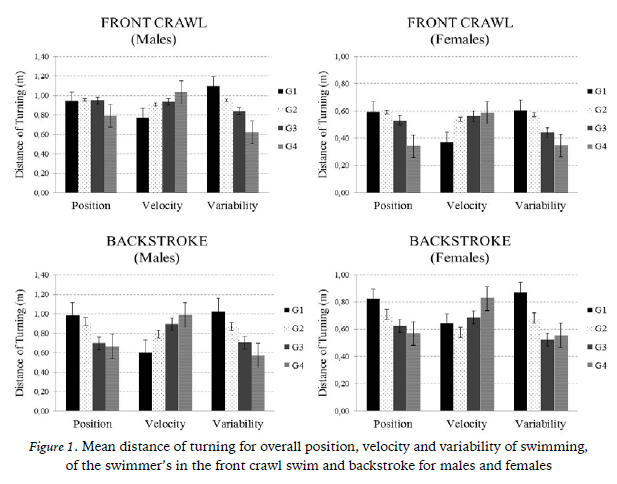
<body><![CDATA[<p><font size="2" face="Verdana">The   distance of turning was used to infer the decision-making on when and where to   turn, and the variability and velocity of swimming were considered in regards   to those spatial and spatiotemporal variables that would constrain such   decision-making behavior. The overall race position was used to analyze the   effectiveness of the decision-making. The distance of turning referred to the   value of the <i >y</i>-coordinate related to the turning point. </font>     <p><font size="2" face="Verdana">The   velocity of swimming was obtained by <i >vs</i> = (<i >yIP</i> &#8211; <i >yTP</i>) / ?<i >t</i>, where <i >vs</i> was the velocity of swimming. In   addition, <i >yIP</i> was the <i >y </i>coordinate at the initial point where <i >yTP</i> referred to the <i >y</i> coordinate at the turning point. Finally, ?<i >t</i> was the swimming time between these   two points. The variability of swimming with regards the <i >y</i>-axis was calculated by <i >yCV</i> = <i >s</i> / <i >x¯</i>, where <i >yCV</i> is the coefficient of variation of the <i >y</i> coordinates, <i >s</i> refers to the standard deviation,   and <i >x¯</i> is the arithmetic mean. Both the velocity and the variability of swimming were   considered as spatiotemporal and spatial ratios of displacement of the   swimmer&#8217;s approach to the wall. The analyses were made by three examiners that were experienced in   using the TACTO software. In order to verify the intra-analyzer reliability,   the images of five athletes were randomly selected and re-digitized. Pearson's correlation test found <i >r</i>= 0.91, <i >p</i>&#60; 0.01. </font>     <p><font size="2" face="Verdana"><b>Statistical analyses</b>   </font>     <p><font size="2" face="Verdana">In order to   understand the swimmer&#8217;s decision-making on the turn, the distance of turning   was analyzed as dependent in relation to the velocity and variability of   swimming. Additionally, the swimmer&#8217;s overall race position and overall time of   race were considered in the analyses. All of these independent variables were   split into four groups (G1, G2, G3, and G4). Data were ordered from the   smallest to the largest with respect to the distance of the turn&#8217;s beginning   and the quartiles adopted as the cut-off points (Altman & Bland, 1994). For   each one, the comparisons were made by using ANOVA, followed by the Tukey HSD   post-hoc tests. For all analyses, the level of significance was set at <i >p</i>&#60; 0.05, using the STATISTICA<sup>&#174;</sup> 11.0 program by Tulsa, Oklahoma&#8217;s Stat Soft. </font></p>     <p>&nbsp;</p>     <p><font size="3" face="Verdana"><b>RESULTS</b>      </font>     <p><font size="2" face="Verdana">Concerning   the front crawl for males, the ANOVAs revealed significant effects for the   velocity of swimming (<i >F</i><sub>(3, 33)</sub>   = 4.20, <i >p</i>= 0.012, ?<sup>2</sup>= 0.27) and for the variability of swimming (<i >F</i><sub>(3, 33)</sub>= 37.57, <i >p</i>= 0.001, ?<sup>2</sup>= 0.77). Regarding velocity, the Tukey<sub>HSD</sub>   test showed that G1 had a smaller distance of turning than did G4. In addition,   for the variability of swimming, it was observed that G1 had a smaller distance   of turning than did the other groups, and that G4 had a greater distance of   turning than did the remaining groups. No effects were revealed for the overall position.</font></p>     <p>&nbsp;</p>     <p align="center"><a href="/img/revistas/mot/v10n3/10n3a11f1.jpg"><font size="2" face="Verdana">Figure 1</font></a></p>     
<p>&nbsp;</p>     ]]></body>
<body><![CDATA[<p><font size="2" face="Verdana">With   respect to the front crawl for females, the ANOVAs revealed significant effects   for all variables: overall position regarding swimming time (<i >F</i><sub>(3, 21)</sub>= 15.22, <i >p</i>&#60; 0.001, ?<sup>2</sup>= 0.68), velocity of swimming (<i >F</i><sub>(3, 21)</sub>= 5.54, <i >p</i>&#60; 0.005, ?<sup>2</sup>= 0.44), and variability of swimming (<i >F</i><sub>(3, 21)</sub>= 13.85, <i >p</i>&#60; 0.001, ?<sup>2</sup>= 0.66). The Tukey<sub>HSD</sub> tests showed   that: (i) the swimmers in last positions (G4) had a smaller distance of turning   than did the remaining groups; (ii) the swimmers who approached the pool wall   more slowly (G1) had a smaller distance of turning than did the remaining   groups; and (iii) the lower the variability of turning implied a greater   distance of turning. </font></p>     <p><font size="2" face="Verdana">Regarding   the backstroke for males, the ANOVAs revealed effects for overall position <i >(F</i><sub>(3, 30)</sub>= 8.21, <i >p</i>= 0.001, ?<sup>2</sup>= 0.45), velocity of swimming (<i >F</i><sub>(3, 30)</sub>= 10.59, <i >p</i>= 0.001, ?<sup>2</sup>= 0.51), and variability of swimming (<i >F</i><sub>(3, 30)</sub>= 29.35, <i >p</i>= 0.001, ?<sup>2</sup>= 0.74). Similarly, the post-hoc tests showed   that (i) swimmers who   started the turning in smaller distances (G3 and G4) completed the tests in   late positions and, conversely, swimmers that started the turning in greater   distance (G1 and G2), finished the race in the first positions; (ii) the swimmers in G3 and G4 had   a greater distance of turning than did slower swimmers (G1 and G2); and, (iii)   the lower the variability of turning implied greater distance of turning. </font></p>     <p><font size="2" face="Verdana">Finally,   with respect to the backstroke for females the ANOVAs also revealed significant   effects for all variables: overall position (<i >F</i><sub>(3, 20)</sub>= 3.91, <i >p</i>=   0.023, ?<sup>2</sup>= 0.37),   velocity of swimming (<i >F</i><sub>(3, 20)</sub>=   3.39, <i >p</i>= 0.037, ?<sup>2</sup>= 0.33), and variability of swimming (<i >F</i><sub>(3, 20)</sub>= 34.92, <i >p</i>&#60; 0.001, ?<sup>2</sup>= 0.84). The Tukey<sub>HSD</sub> tests pointed   out that (i) the swimmers in last positions (G4) had a smaller distance of   turning than did those in G1 (first positions); (ii) the swimmers in G4 had a   greater distance of turning than did the remaining positions; and (iii) G1 and   G2 (lower variability) had a greater distance of turning than did the groups   with higher variability of swimming (G3 and G4), and, G1 had a greater distance   of turning than did G2.   </font>     <p>&nbsp;</p>     <p><font size="3" face="Verdana"><b>DISCUSSION   </b> </font></p> <font size="2" face="Verdana">The aim of this study was to investigate the spatiotemporal information that a swimmer uses in the competitive context of swimming performance. Specifically, we sought to understand how the velocity and the variability of displacement would influence when and where to turn. Results showed that the decision-making on where to turn was constrained by the swimmer&#8217;s ratios of displacement. More precisely, it was observed that in the four competitive situations (front crawl and backstroke each for male and female), swimmers who moved faster in their approaching of the pool wall decided to turn earlier than did those swimmers who swan more slowly. The results also showed that the distance of turning was influenced by variability, because those swimmers who had lower variability of swimming decided to initiate the turn earlier than did those swimmers who had a high variability of swimming.      <p>It seems   that together, the spatiotemporal and spatial variables, such as velocity and   variability of swimming, might have functioned as control parameters and,   therefore, supplied the essential information for swimmers&#8217; decision-making for   the turn. For instance, in terms of velocity, it has been proposed that the   temporal rate of change throughout space seems to provide the necessary   information for the regulation or prospective control of movement (Corr&#234;a, et   al., 2012; Fajen, Riley & Turvey, 2009). In addition, we could hypothesize   that the high variability of swimming might have reflected a certain level of   uncertainty on when and where to turn. As a consequence of the uncertainty, the   swimmers may have decided to perform the turn closer to the pool wall. </p>     <p>Several   types of dragging, such as friction drag, wave, and body shape, are influenced   by the speed of swimming. Consequently, the high variability in the velocity   might affect the maintenance of the velocity as the pattern of swimming which,   in turn, would directly affect the performance in the turn (Stager &   Tanner, 2008). For example, sprinters tend to initiate the turn earlier,   because they are probably moving to the pool end faster and without loss of   speed. The high variability in the velocity affects the turning, especially in   the approaching phase, because it can cause the swimmer to lose the velocity   (Maglischo, 2003). Important to highlight that the recent studies by Puel et   al. (2012), Chakravorti et al. (2012), and Veiga, Cala, Frutos, and Navarro   (2013) have described the pool wall as an important point of reference for the   approaching phase. </p>     <p>Moreover,   the results of this study support those findings related to how to perform the   effective turn, since the swimmers who achieved the first race positions turned   at greater distances than did those in the last positions in the front crawl   for females and in the backstroke for both males and females. In this regard,   studies have shown that the turn at a greater distance allows the swimmers to   optimise the knee flexion and extension, the contact of the feet with the pool   wall, and the time of recovery of swimming (Ara&#250;jo et al., 2010; Puel et al.,   2012; Rejman & Borowska, 2008; Silveira et al., 2011). Furthermore, the   literature has suggested that the swimmers must be aware of the pool end in   order to adjust the turn without losing speed (Maglischo, 2003). Thus, we could   suggest that the swimmers should be attuned to the spatiotemporal and spatial   information in order to maximize their performance. In other words, swimmers   should be alert to the edge of the pool so that they can make changes in their   approaching phase in order to turn without losing velocity (Maglischo, 2003). </p>     <p>In summary,   the results of the present study allow us to conclude that the turns in the   races investigated were influenced by the spatiotemporal and spatial variables.   Regardless of swimming style and gender, the swimmers who had a higher velocity   and lower variability during the approach of the pool wall decided to initiate   the turn at a greater distance of the pool wall. Further studies could consider   additional visual references of the approach to the wall, for example, the &#8220;T&#8221;   reference in the bottom of the pool, in order to achieve additional support for   this conclusion. </p>     <p><b>Practical implications</b></p>     ]]></body>
<body><![CDATA[<p>In terms of   practical implications, results point to how to improve the ability of swimmers   to make decisions regarding where to turn based on information from the   spatiotemporal ratio of displacement. For instance, during training, the swimmers   should be advised to try to keep the approaching velocity of the wall in mind.   In other words, they should be aware of the pool end in order to adjust the   turn without losing speed. In addition, swimmers should practice the turns far   from the pool wall.</p> </font>     <p>&nbsp;</p>     <p><font size="3" face="Verdana"><b>REFERENCES</b></font></p>     <!-- ref --><p><font size="2" face="Verdana">Altman, D. G., & Bland, J. M. (1994). Statistics notes: Quartiles,   quintiles, centiles, and other quantiles. <i >British     Medical Journal, 309</i>, 996. doi: 10.1136/bmj.309.6960.996 </font>&nbsp;&nbsp;&nbsp;&nbsp;&nbsp;&nbsp;&nbsp;&nbsp;[&#160;<a href="javascript:void(0);" onclick="javascript: window.open('/scielo.php?script=sci_nlinks&ref=000066&pid=S1646-107X201400030001100001&lng=','','width=640,height=500,resizable=yes,scrollbars=1,menubar=yes,');">Links</a>&#160;]<!-- end-ref --><!-- ref --><p><font size="2" face="Verdana">Anderson C., & Petrie T. A. (2012). Prevalence of disordered eating   and pathogenic weight control behaviors among NCAA division I female collegiate   gymnasts and swimmers. <i >Research Quarterly for Exercise   & Sport</i>, <i >3</i>(1), 120-124.    &nbsp;&nbsp;&nbsp;&nbsp;&nbsp;&nbsp;&nbsp;&nbsp;[&#160;<a href="javascript:void(0);" onclick="javascript: window.open('/scielo.php?script=sci_nlinks&ref=000067&pid=S1646-107X201400030001100002&lng=','','width=640,height=500,resizable=yes,scrollbars=1,menubar=yes,');">Links</a>&#160;]<!-- end-ref --> </font></p>     <!-- ref --><p><font size="2" face="Verdana">Apolin&#225;rio, M., Oliveira, T. A. C., Ferreira, L., Basso, L., Corr&#234;a, U.   C., & Freudenheim, A. (2012). Efeitos de diferentes padr&#245;es respirat&#243;rios   no desempenho e na organiza&#231;&#227;o temporal das bra&#231;adas do nado crawl. <i >Revista Brasileira de Educa&#231;&#227;o F&#237;sica e Esporte</i>, <i >26</i>, 149&#8211;159.    &nbsp;&nbsp;&nbsp;&nbsp;&nbsp;&nbsp;&nbsp;&nbsp;[&#160;<a href="javascript:void(0);" onclick="javascript: window.open('/scielo.php?script=sci_nlinks&ref=000069&pid=S1646-107X201400030001100003&lng=','','width=640,height=500,resizable=yes,scrollbars=1,menubar=yes,');">Links</a>&#160;]<!-- end-ref --> </font></p>     <!-- ref --><p><font size="2" face="Verdana">Ara&#250;jo, D., Davids, K., & Hristovski, R.   (2006). The ecological   dynamics of decision making in sport. <i >Psychology     of Sport and Exercise</i>, <i >7</i>, 653-676.    &nbsp;&nbsp;&nbsp;&nbsp;&nbsp;&nbsp;&nbsp;&nbsp;[&#160;<a href="javascript:void(0);" onclick="javascript: window.open('/scielo.php?script=sci_nlinks&ref=000071&pid=S1646-107X201400030001100004&lng=','','width=640,height=500,resizable=yes,scrollbars=1,menubar=yes,');">Links</a>&#160;]<!-- end-ref --> </font></p>     ]]></body>
<body><![CDATA[<!-- ref --><p><font size="2" face="Verdana">Ara&#250;jo, D., Davids, K., Bennett, S., Button, C., & Chapman, G.   (2004). Emergence of sport skills under constraints. In A. M. Williams & N.   J. Hodges (Eds.), <i >Skill acquisition in     sport: Research, theory and practice</i> (pp. 409-433). London: Routledge, Taylor & Francis.    &nbsp;&nbsp;&nbsp;&nbsp;&nbsp;&nbsp;&nbsp;&nbsp;[&#160;<a href="javascript:void(0);" onclick="javascript: window.open('/scielo.php?script=sci_nlinks&ref=000073&pid=S1646-107X201400030001100005&lng=','','width=640,height=500,resizable=yes,scrollbars=1,menubar=yes,');">Links</a>&#160;]<!-- end-ref --> </font></p>     <!-- ref --><p><font size="2" face="Verdana">Ara&#250;jo, L., Pereira, S., Gatti, R., Freitas, E., Jacomel, G., Roesler,   H., & Villas-Boas, J. (2010). Analysis of the lateral push-off in the freestyle flip turn. <i >Journal of Sports Science</i>, <i >28</i>(11), 1175-1181.    &nbsp;&nbsp;&nbsp;&nbsp;&nbsp;&nbsp;&nbsp;&nbsp;[&#160;<a href="javascript:void(0);" onclick="javascript: window.open('/scielo.php?script=sci_nlinks&ref=000075&pid=S1646-107X201400030001100006&lng=','','width=640,height=500,resizable=yes,scrollbars=1,menubar=yes,');">Links</a>&#160;]<!-- end-ref --> </font></p>     <!-- ref --><p><font size="2" face="Verdana">Blanksby, B. A., Gathercole, D. G., & Marshall, R. N. (1996). Force   plate and video analysis of the tumble turn by age-group swimmers. <i >The Journal of Swimming Research</i>. <i >11</i>, 40-45.    &nbsp;&nbsp;&nbsp;&nbsp;&nbsp;&nbsp;&nbsp;&nbsp;[&#160;<a href="javascript:void(0);" onclick="javascript: window.open('/scielo.php?script=sci_nlinks&ref=000077&pid=S1646-107X201400030001100007&lng=','','width=640,height=500,resizable=yes,scrollbars=1,menubar=yes,');">Links</a>&#160;]<!-- end-ref --> </font></p>     <!-- ref --><p><font size="2" face="Verdana">Blanksby, B., Skender, S., Elliott, B., McElroy, K., & Landers, G.   (2004). An analysis of the rollover backstroke turn by age-group swimmers. <i >Sports Biomechanical</i>, <i >3</i>(1), 1-14.    &nbsp;&nbsp;&nbsp;&nbsp;&nbsp;&nbsp;&nbsp;&nbsp;[&#160;<a href="javascript:void(0);" onclick="javascript: window.open('/scielo.php?script=sci_nlinks&ref=000079&pid=S1646-107X201400030001100008&lng=','','width=640,height=500,resizable=yes,scrollbars=1,menubar=yes,');">Links</a>&#160;]<!-- end-ref --> </font></p>     <!-- ref --><p><font size="2" face="Verdana">Chakravorti, N., Slawson, S. E., Cossor, J., Conway, P. P. & West,   A. A. (2012). Swimming turn technique optimisation by real-time measurement of   foot pressure and position. <i >Procedia     Engineering</i>, <i >34,</i> 586-591.    &nbsp;&nbsp;&nbsp;&nbsp;&nbsp;&nbsp;&nbsp;&nbsp;[&#160;<a href="javascript:void(0);" onclick="javascript: window.open('/scielo.php?script=sci_nlinks&ref=000081&pid=S1646-107X201400030001100009&lng=','','width=640,height=500,resizable=yes,scrollbars=1,menubar=yes,');">Links</a>&#160;]<!-- end-ref --> </font></p>     ]]></body>
<body><![CDATA[<!-- ref --><p><font size="2" face="Verdana">Chollet, D., Chalies, S., & Chatard, J. C. (2000). A new index of   coordination for the crawl: Description and usefulness. <i >International Journal of Sports Medicine</i>, <i >21</i>, 54-59.    &nbsp;&nbsp;&nbsp;&nbsp;&nbsp;&nbsp;&nbsp;&nbsp;[&#160;<a href="javascript:void(0);" onclick="javascript: window.open('/scielo.php?script=sci_nlinks&ref=000083&pid=S1646-107X201400030001100010&lng=','','width=640,height=500,resizable=yes,scrollbars=1,menubar=yes,');">Links</a>&#160;]<!-- end-ref --> </font></p>     <!-- ref --><p><font size="2" face="Verdana">Corr&#234;a, U.C., Alegre, F., Freudenheim, A. M., Santos, S., & Tani, G.   (2012). The game of   futsal as an adaptive process. <i >Nonlinear     Dynamics, Psychology and Life Sciences</i>, <i >16</i>,   185-204.    &nbsp;&nbsp;&nbsp;&nbsp;&nbsp;&nbsp;&nbsp;&nbsp;[&#160;<a href="javascript:void(0);" onclick="javascript: window.open('/scielo.php?script=sci_nlinks&ref=000085&pid=S1646-107X201400030001100011&lng=','','width=640,height=500,resizable=yes,scrollbars=1,menubar=yes,');">Links</a>&#160;]<!-- end-ref -->  </font></p>     <!-- ref --><p><font size="2" face="Verdana">Corr&#234;a, U.C., Vilar, L., Davids, K., & Renshaw, I. (2012). Informational constraints on the emergence   of passing direction in the team sport of futsal. <i >European Journal of     Sport Science</i>, <i >6</i>, 1-8.    &nbsp;&nbsp;&nbsp;&nbsp;&nbsp;&nbsp;&nbsp;&nbsp;[&#160;<a href="javascript:void(0);" onclick="javascript: window.open('/scielo.php?script=sci_nlinks&ref=000087&pid=S1646-107X201400030001100012&lng=','','width=640,height=500,resizable=yes,scrollbars=1,menubar=yes,');">Links</a>&#160;]<!-- end-ref -->  </font></p>     <!-- ref --><p><font size="2" face="Verdana">Duarte, R., Ara&#250;jo, D., Gazimba, V., Fernandes, O., Folgado, H.,   Marmeleira, J., & Davids, K. (2010). The ecological dynamics of 1v1 sub-phases in   association football. <i >The Open Sports     Sciences Journal</i>, <i >3</i>, 16-18. doi: 10.2174/1875399X01003010016 </font>&nbsp;&nbsp;&nbsp;&nbsp;&nbsp;&nbsp;&nbsp;&nbsp;[&#160;<a href="javascript:void(0);" onclick="javascript: window.open('/scielo.php?script=sci_nlinks&ref=000089&pid=S1646-107X201400030001100013&lng=','','width=640,height=500,resizable=yes,scrollbars=1,menubar=yes,');">Links</a>&#160;]<!-- end-ref --><!-- ref --><p><font size="2" face="Verdana">Fajen, B. R., Riley, M. A., & Turvey, M. T. (2009). Information,   affordances, and control of action in sport. <i >International Journal of Sport Psychology</i>, <i >40,</i> 79-107.    &nbsp;&nbsp;&nbsp;&nbsp;&nbsp;&nbsp;&nbsp;&nbsp;[&#160;<a href="javascript:void(0);" onclick="javascript: window.open('/scielo.php?script=sci_nlinks&ref=000090&pid=S1646-107X201400030001100014&lng=','','width=640,height=500,resizable=yes,scrollbars=1,menubar=yes,');">Links</a>&#160;]<!-- end-ref --> </font></p>     <!-- ref --><p><font size="2" face="Verdana">Fernandes, O., Folgado, H., Duarte, R., & Malta, P. (2010). Validation of the tool for applied   and contextual time-series observation. <i >International     Journal of Sport Psychology</i>, <i >41</i>,   63-64.    &nbsp;&nbsp;&nbsp;&nbsp;&nbsp;&nbsp;&nbsp;&nbsp;[&#160;<a href="javascript:void(0);" onclick="javascript: window.open('/scielo.php?script=sci_nlinks&ref=000092&pid=S1646-107X201400030001100015&lng=','','width=640,height=500,resizable=yes,scrollbars=1,menubar=yes,');">Links</a>&#160;]<!-- end-ref --> </font></p>     <!-- ref --><p><font size="2" face="Verdana">Freudenheim, A. M., Wulf, G., Madureira, F., Pasetto, S. C., &   Corr&#234;a, U. C. (2010). An   external focus of attention results in greater swimming speed. <i >International Journal of Sports Science   & Coaching</i>,<i > 5</i>, 533-542.    &nbsp;&nbsp;&nbsp;&nbsp;&nbsp;&nbsp;&nbsp;&nbsp;[&#160;<a href="javascript:void(0);" onclick="javascript: window.open('/scielo.php?script=sci_nlinks&ref=000094&pid=S1646-107X201400030001100016&lng=','','width=640,height=500,resizable=yes,scrollbars=1,menubar=yes,');">Links</a>&#160;]<!-- end-ref --> </font></p>     <!-- ref --><p><font size="2" face="Verdana">Kehm, G. (2007). <i >Great moments in   Olympic history: Olympic swimming and diving</i>. New York: The Rosen Publishing   Group.    &nbsp;&nbsp;&nbsp;&nbsp;&nbsp;&nbsp;&nbsp;&nbsp;[&#160;<a href="javascript:void(0);" onclick="javascript: window.open('/scielo.php?script=sci_nlinks&ref=000096&pid=S1646-107X201400030001100017&lng=','','width=640,height=500,resizable=yes,scrollbars=1,menubar=yes,');">Links</a>&#160;]<!-- end-ref --> </font></p>     <!-- ref --><p><font size="2" face="Verdana">Kelso, J.A.S. (2000). Principles of dynamic pattern formation and change   for a science of human behavior. In Bergman, L.R., Cairns, R.B., Nilsson, L-G.   & Nystedt, L. (Eds.), <i >Developmental     science and the holistic approach </i>(pp. 63-83). New Jersey: Lawrence Erlbaum   Associates.    &nbsp;&nbsp;&nbsp;&nbsp;&nbsp;&nbsp;&nbsp;&nbsp;[&#160;<a href="javascript:void(0);" onclick="javascript: window.open('/scielo.php?script=sci_nlinks&ref=000098&pid=S1646-107X201400030001100018&lng=','','width=640,height=500,resizable=yes,scrollbars=1,menubar=yes,');">Links</a>&#160;]<!-- end-ref --> </font></p>     <!-- ref --><p><font size="2" face="Verdana">Kjendlie, P., L., Haljand, R., Fjortoft, O., & Stallman, R. K.   (2006). The temporal distribution of race elements in elite swimmers. <i >Revista Portuguesa de Ci&#234;ncia e Desporto</i>,   <i >6</i>(Supl.2), 54-60.    &nbsp;&nbsp;&nbsp;&nbsp;&nbsp;&nbsp;&nbsp;&nbsp;[&#160;<a href="javascript:void(0);" onclick="javascript: window.open('/scielo.php?script=sci_nlinks&ref=000100&pid=S1646-107X201400030001100019&lng=','','width=640,height=500,resizable=yes,scrollbars=1,menubar=yes,');">Links</a>&#160;]<!-- end-ref -->  </font></p>     <!-- ref --><p><font size="2" face="Verdana">Lerda, R., & Cardelli, C. (2003). Breathing and propelling in crawl   as a function of skill and swim velocity. <i >International     Journal of Sports Medicine</i>, <i >24</i>,   75-80.    &nbsp;&nbsp;&nbsp;&nbsp;&nbsp;&nbsp;&nbsp;&nbsp;[&#160;<a href="javascript:void(0);" onclick="javascript: window.open('/scielo.php?script=sci_nlinks&ref=000102&pid=S1646-107X201400030001100020&lng=','','width=640,height=500,resizable=yes,scrollbars=1,menubar=yes,');">Links</a>&#160;]<!-- end-ref --> </font></p>     <!-- ref --><p><font size="2" face="Verdana">Lerda, R., Cardelli, C., & Chollet, D. (2001). Analysis of   interaction between breathing and arm actions in front crawl. <i >Journal of Human Movement Studies</i>, <i >40</i>, 129-144.    &nbsp;&nbsp;&nbsp;&nbsp;&nbsp;&nbsp;&nbsp;&nbsp;[&#160;<a href="javascript:void(0);" onclick="javascript: window.open('/scielo.php?script=sci_nlinks&ref=000104&pid=S1646-107X201400030001100021&lng=','','width=640,height=500,resizable=yes,scrollbars=1,menubar=yes,');">Links</a>&#160;]<!-- end-ref -->  </font></p>     <!-- ref --><p><font size="2" face="Verdana">Lyttle, A., & Mason, B. (1997). A kinematic and kinetic analysis of   the freestyle and butterfly turns. <i >Journal     of Swimming Research</i>, <i >12</i>, 7-11.    &nbsp;&nbsp;&nbsp;&nbsp;&nbsp;&nbsp;&nbsp;&nbsp;[&#160;<a href="javascript:void(0);" onclick="javascript: window.open('/scielo.php?script=sci_nlinks&ref=000106&pid=S1646-107X201400030001100022&lng=','','width=640,height=500,resizable=yes,scrollbars=1,menubar=yes,');">Links</a>&#160;]<!-- end-ref -->  </font></p>     <!-- ref --><p><font size="2" face="Verdana">Lyttle, A., Blanksby, B., Elliott, C., & Lloyd, D. (1999).   Investigating kinetics in the freestyle flip turn push-off. <i >Journal of Applied Biomechanics</i>, <i >15</i>,   242-252.    &nbsp;&nbsp;&nbsp;&nbsp;&nbsp;&nbsp;&nbsp;&nbsp;[&#160;<a href="javascript:void(0);" onclick="javascript: window.open('/scielo.php?script=sci_nlinks&ref=000108&pid=S1646-107X201400030001100023&lng=','','width=640,height=500,resizable=yes,scrollbars=1,menubar=yes,');">Links</a>&#160;]<!-- end-ref --> </font></p>     <!-- ref --><p><font size="2" face="Verdana">Madureira, F., Freudenheim, A., Bastos, F., Corr&#234;a, U. C., &   Ferreira, T. (2012). Assessment   of beginners front crawl stroke efficiency. <i >Perceptual     and Motor Skills</i>, <i >115</i>, 300-308.    &nbsp;&nbsp;&nbsp;&nbsp;&nbsp;&nbsp;&nbsp;&nbsp;[&#160;<a href="javascript:void(0);" onclick="javascript: window.open('/scielo.php?script=sci_nlinks&ref=000110&pid=S1646-107X201400030001100024&lng=','','width=640,height=500,resizable=yes,scrollbars=1,menubar=yes,');">Links</a>&#160;]<!-- end-ref --> </font></p>     <!-- ref --><p><font size="2" face="Verdana">Maglischo, E. (2003). <i >Swimming   fastest</i>. Champaign, Il: Human Kinetics.    &nbsp;&nbsp;&nbsp;&nbsp;&nbsp;&nbsp;&nbsp;&nbsp;[&#160;<a href="javascript:void(0);" onclick="javascript: window.open('/scielo.php?script=sci_nlinks&ref=000112&pid=S1646-107X201400030001100025&lng=','','width=640,height=500,resizable=yes,scrollbars=1,menubar=yes,');">Links</a>&#160;]<!-- end-ref --> </font></p>     <!-- ref --><p><font size="2" face="Verdana">Millar, S-K., Oldham, A. R., & Renshaw, I. (2013). Interpersonal,   intrapersonal, extrapersonal&#8204; Qualitatively investigating coordinative couplings   between rowers in Olympic sculling. <i >Nonlinear     Dynamics, Psychology and Life Sciences,</i> <i >17,</i>   425-443.    &nbsp;&nbsp;&nbsp;&nbsp;&nbsp;&nbsp;&nbsp;&nbsp;[&#160;<a href="javascript:void(0);" onclick="javascript: window.open('/scielo.php?script=sci_nlinks&ref=000114&pid=S1646-107X201400030001100026&lng=','','width=640,height=500,resizable=yes,scrollbars=1,menubar=yes,');">Links</a>&#160;]<!-- end-ref --> </font></p>     <!-- ref --><p><font size="2" face="Verdana">Mood, D., Musker, F., & Rink, J. (2012). <i >Sports and recreational activities</i>. New York: McGraw-Hill.    &nbsp;&nbsp;&nbsp;&nbsp;&nbsp;&nbsp;&nbsp;&nbsp;[&#160;<a href="javascript:void(0);" onclick="javascript: window.open('/scielo.php?script=sci_nlinks&ref=000116&pid=S1646-107X201400030001100027&lng=','','width=640,height=500,resizable=yes,scrollbars=1,menubar=yes,');">Links</a>&#160;]<!-- end-ref -->  </font></p>     <!-- ref --><p><font size="2" face="Verdana">Passos, P., Ara&#250;jo, D., Davids, K., Gouveia,   L., Milho, J., & Serpa, S. (2008). Information-governing dynamics of attacker-defender interactions in   youth rugby union. <i >Journal of Sports     Sciences</i>, <i >26</i>, 1421-1429.    &nbsp;&nbsp;&nbsp;&nbsp;&nbsp;&nbsp;&nbsp;&nbsp;[&#160;<a href="javascript:void(0);" onclick="javascript: window.open('/scielo.php?script=sci_nlinks&ref=000118&pid=S1646-107X201400030001100028&lng=','','width=640,height=500,resizable=yes,scrollbars=1,menubar=yes,');">Links</a>&#160;]<!-- end-ref --> </font></p>     <!-- ref --><p><font size="2" face="Verdana">Payton, C. J., Bartlett, R. M., Baltzopoulos, V., & Coombs, R.   (1999). Upper extremity kinematics and body roll during preferred side   breathing and breath-holding front crawl swimming. <i >Journal of Sports Sciences,</i> <i >17</i>,   689-696.    &nbsp;&nbsp;&nbsp;&nbsp;&nbsp;&nbsp;&nbsp;&nbsp;[&#160;<a href="javascript:void(0);" onclick="javascript: window.open('/scielo.php?script=sci_nlinks&ref=000120&pid=S1646-107X201400030001100029&lng=','','width=640,height=500,resizable=yes,scrollbars=1,menubar=yes,');">Links</a>&#160;]<!-- end-ref --> </font></p>     <!-- ref --><p><font size="2" face="Verdana">Pereira, S. M., Ara&#250;jo, L. G., Freitas, E., Gatti, R., & Silveira,   G. (2006). Biomechanical   analysis of the turn in front crawl swimming. <i >Revista Portuguesa de Ci&#234;ncias do Desporto</i>, <i >6</i>(Supl.2), 77-79.    &nbsp;&nbsp;&nbsp;&nbsp;&nbsp;&nbsp;&nbsp;&nbsp;[&#160;<a href="javascript:void(0);" onclick="javascript: window.open('/scielo.php?script=sci_nlinks&ref=000122&pid=S1646-107X201400030001100030&lng=','','width=640,height=500,resizable=yes,scrollbars=1,menubar=yes,');">Links</a>&#160;]<!-- end-ref --> </font></p>     <!-- ref --><p><font size="2" face="Verdana">Potdevin, F. J., Albety, M. E., Chevutschi,   A., Pelayo, P., & Sidney, M. C. (2011). Effects of a 6-week plyometric training program on performances in   pubescent swimmers. <i >Journal of Strength and     Conditioning Research</i>, <i >25</i>(1), 80-86.    &nbsp;&nbsp;&nbsp;&nbsp;&nbsp;&nbsp;&nbsp;&nbsp;[&#160;<a href="javascript:void(0);" onclick="javascript: window.open('/scielo.php?script=sci_nlinks&ref=000124&pid=S1646-107X201400030001100031&lng=','','width=640,height=500,resizable=yes,scrollbars=1,menubar=yes,');">Links</a>&#160;]<!-- end-ref --> </font></p>     <!-- ref --><p><font size="2" face="Verdana">Prins, J.H., & Patz, A. (2006). The influence of tuck index, depth of   foot-plant, and wall contact time on the velocity of push-off in the freestyle   flip turn. <i >Revista Portuguesa de Ci&#234;ncias do Desporto</i>, <i >6</i>(Supl.2), 82-85.    &nbsp;&nbsp;&nbsp;&nbsp;&nbsp;&nbsp;&nbsp;&nbsp;[&#160;<a href="javascript:void(0);" onclick="javascript: window.open('/scielo.php?script=sci_nlinks&ref=000126&pid=S1646-107X201400030001100032&lng=','','width=640,height=500,resizable=yes,scrollbars=1,menubar=yes,');">Links</a>&#160;]<!-- end-ref --> </font></p>     <!-- ref --><p><font size="2" face="Verdana">Puel, F., Morlier, J., Avalos, M., Mesnard,   M., Cid, M., & Hellard, P. (2012). 3D Kinematic and dynamic analysis of the front crawl tumble turn in   elite male swimmers. <i >Journal of     Biomechanics</i>, <i >45</i>(3), 510-515.    &nbsp;&nbsp;&nbsp;&nbsp;&nbsp;&nbsp;&nbsp;&nbsp;[&#160;<a href="javascript:void(0);" onclick="javascript: window.open('/scielo.php?script=sci_nlinks&ref=000128&pid=S1646-107X201400030001100033&lng=','','width=640,height=500,resizable=yes,scrollbars=1,menubar=yes,');">Links</a>&#160;]<!-- end-ref -->  </font></p>     <!-- ref --><p><font size="2" face="Verdana">Rejman, M., & Borowska, G. (2008). Searching for criteria in   evaluating the monofin swimming turn from the perspective of coaching and improving   technique. <i >Journal of Sports Science and     Medicine</i>, <i >7</i>, 67-77.    &nbsp;&nbsp;&nbsp;&nbsp;&nbsp;&nbsp;&nbsp;&nbsp;[&#160;<a href="javascript:void(0);" onclick="javascript: window.open('/scielo.php?script=sci_nlinks&ref=000130&pid=S1646-107X201400030001100034&lng=','','width=640,height=500,resizable=yes,scrollbars=1,menubar=yes,');">Links</a>&#160;]<!-- end-ref --> </font></p>     <!-- ref --><p><font size="2" face="Verdana">Rocha, L., Ara&#250;jo, D., & Fernandes, O.   (2005). A din&#226;mica da tomada de decis&#227;o na largada em regatas &#224; vela. In D.   Ara&#250;jo (Ed.), <i >O contexto da decis&#227;o &#8211; A a&#231;&#227;o t&#225;tica no desporto</i> (pp. 313&#8211;339). Lisboa: Vis&#227;o e Contextos.    &nbsp;&nbsp;&nbsp;&nbsp;&nbsp;&nbsp;&nbsp;&nbsp;[&#160;<a href="javascript:void(0);" onclick="javascript: window.open('/scielo.php?script=sci_nlinks&ref=000132&pid=S1646-107X201400030001100035&lng=','','width=640,height=500,resizable=yes,scrollbars=1,menubar=yes,');">Links</a>&#160;]<!-- end-ref --> </font></p>     <!-- ref --><p><font size="2" face="Verdana">Sanders, R., Thow, J., Alcock, A., Fairweather, M., Riach, I., &   Mather, F. (2012). How can asymmetries in swimming be identified and measured&#8204; <i >Journal Swimming Research</i>, 19-21.    &nbsp;&nbsp;&nbsp;&nbsp;&nbsp;&nbsp;&nbsp;&nbsp;[&#160;<a href="javascript:void(0);" onclick="javascript: window.open('/scielo.php?script=sci_nlinks&ref=000134&pid=S1646-107X201400030001100036&lng=','','width=640,height=500,resizable=yes,scrollbars=1,menubar=yes,');">Links</a>&#160;]<!-- end-ref -->  </font></p>     <!-- ref --><p><font size="2" face="Verdana">Seifert, L., Chehensse, A., Chollet, C. T., Lemaitre, F., & Chollet,   D. (2008). Effect of breathing pattern on arm coordination symmetry in front   crawl. <i >Journal of Strength and     Conditioning Research,</i> <i >22</i>, 1670-1676.    &nbsp;&nbsp;&nbsp;&nbsp;&nbsp;&nbsp;&nbsp;&nbsp;[&#160;<a href="javascript:void(0);" onclick="javascript: window.open('/scielo.php?script=sci_nlinks&ref=000136&pid=S1646-107X201400030001100037&lng=','','width=640,height=500,resizable=yes,scrollbars=1,menubar=yes,');">Links</a>&#160;]<!-- end-ref --> </font></p>     <!-- ref --><p><font size="2" face="Verdana">Silveira, G. A., Ara&#250;jo L. G., Elinai, S. F., Schutz G. R., Souza, T. G.,   Pereira, S. M., & Roesler, H. (2011). Proposta de padroniza&#231;&#227;o para a dist&#226;ncia de   an&#225;lise do desempenho da virada no nado crawl. <i >Revista Brasileira de Cineantro-pometria e Desempenho Humano</i>, <i >13</i>(3), 177-182.    &nbsp;&nbsp;&nbsp;&nbsp;&nbsp;&nbsp;&nbsp;&nbsp;[&#160;<a href="javascript:void(0);" onclick="javascript: window.open('/scielo.php?script=sci_nlinks&ref=000138&pid=S1646-107X201400030001100038&lng=','','width=640,height=500,resizable=yes,scrollbars=1,menubar=yes,');">Links</a>&#160;]<!-- end-ref -->  </font></p>     <!-- ref --><p><font size="2" face="Verdana">Stager, J. M. & Tanner, D. (2008). <i >Nata&#231;&#227;o: Manual de medicina e ci&#234;ncia do esporte</i>. S&#227;o Paulo: Manole.    &nbsp;&nbsp;&nbsp;&nbsp;&nbsp;&nbsp;&nbsp;&nbsp;[&#160;<a href="javascript:void(0);" onclick="javascript: window.open('/scielo.php?script=sci_nlinks&ref=000140&pid=S1646-107X201400030001100039&lng=','','width=640,height=500,resizable=yes,scrollbars=1,menubar=yes,');">Links</a>&#160;]<!-- end-ref --> </font></p>     <!-- ref --><p><font size="2" face="Verdana">Tourny-Chollet, C., Chollet, D., Hogie, S., & Papparodopoulos, C.   (2002). Kinematic analysis of butterfly turns of international and national   swimmers<i >. Journal of Sports Sciences</i>,   <i >20</i>, 383-390.    &nbsp;&nbsp;&nbsp;&nbsp;&nbsp;&nbsp;&nbsp;&nbsp;[&#160;<a href="javascript:void(0);" onclick="javascript: window.open('/scielo.php?script=sci_nlinks&ref=000142&pid=S1646-107X201400030001100040&lng=','','width=640,height=500,resizable=yes,scrollbars=1,menubar=yes,');">Links</a>&#160;]<!-- end-ref --> </font></p>     <!-- ref --><p><font size="2" face="Verdana">Travassos, B., Ara&#250;jo, D., Davids, K., Vilar, L., Esteves, P., &   Vanda, C. (2012). Informational   constraints shape emergent functional behaviours during performance of   interceptive actions in team sports. <i >Psychology     of Sport and Exercise</i>, <i >13</i>, 216-223.    &nbsp;&nbsp;&nbsp;&nbsp;&nbsp;&nbsp;&nbsp;&nbsp;[&#160;<a href="javascript:void(0);" onclick="javascript: window.open('/scielo.php?script=sci_nlinks&ref=000144&pid=S1646-107X201400030001100041&lng=','','width=640,height=500,resizable=yes,scrollbars=1,menubar=yes,');">Links</a>&#160;]<!-- end-ref --> </font></p>     <!-- ref --><p><font size="2" face="Verdana">Veiga, A., Cala, A, Frutos, P. G., & Navarro, E. (2013). Kinematical comparison of the 200 m   backstroke turns between national and regional level swimmers. <i >Journal of Sports Science and Medicine</i>, <i >12</i>, 730-737.    &nbsp;&nbsp;&nbsp;&nbsp;&nbsp;&nbsp;&nbsp;&nbsp;[&#160;<a href="javascript:void(0);" onclick="javascript: window.open('/scielo.php?script=sci_nlinks&ref=000146&pid=S1646-107X201400030001100042&lng=','','width=640,height=500,resizable=yes,scrollbars=1,menubar=yes,');">Links</a>&#160;]<!-- end-ref --> </font></p>     <!-- ref --><p><font size="2" face="Verdana">Vezos, N., Gourgoulis, V., Aggeloussis, N., Kasimatis, P.,   Christoforidis, C., & Mavromatis, G. (2007). Underwater stroke kinematics   during breathing and breath-holding front crawl swimming. <i >Journal of Sports Science and Medicine</i>, <i >6</i>, 58-62.    &nbsp;&nbsp;&nbsp;&nbsp;&nbsp;&nbsp;&nbsp;&nbsp;[&#160;<a href="javascript:void(0);" onclick="javascript: window.open('/scielo.php?script=sci_nlinks&ref=000148&pid=S1646-107X201400030001100043&lng=','','width=640,height=500,resizable=yes,scrollbars=1,menubar=yes,');">Links</a>&#160;]<!-- end-ref -->  </font></p>     <!-- ref --><p><font size="2" face="Verdana">Vilar, L., Ara&#250;jo, D., Davids, K., & Button, C. (2012). The role of ecological dynamics in   analysing performance in team sports. <i >Sports     Medicine</i>, <i >42</i>(1), 1-10.    &nbsp;&nbsp;&nbsp;&nbsp;&nbsp;&nbsp;&nbsp;&nbsp;[&#160;<a href="javascript:void(0);" onclick="javascript: window.open('/scielo.php?script=sci_nlinks&ref=000150&pid=S1646-107X201400030001100044&lng=','','width=640,height=500,resizable=yes,scrollbars=1,menubar=yes,');">Links</a>&#160;]<!-- end-ref --> </font></p>     <!-- ref --><p><font size="2" face="Verdana">Winter, D.A. (2005). <i >Biomechanics   and motor control of human movement</i> (3rd ed.). New York: John Wiley & Sons, Inc.    &nbsp;&nbsp;&nbsp;&nbsp;&nbsp;&nbsp;&nbsp;&nbsp;[&#160;<a href="javascript:void(0);" onclick="javascript: window.open('/scielo.php?script=sci_nlinks&ref=000152&pid=S1646-107X201400030001100045&lng=','','width=640,height=500,resizable=yes,scrollbars=1,menubar=yes,');">Links</a>&#160;]<!-- end-ref --> </font></p>     <!-- ref --><p><font size="2" face="Verdana">Zamparo, P., Capelli, C., & Pendergast, D. (2011). Energetics of swimming: A historical   perspective. <i >European Journal of Applied     Physiology</i>, <i >111</i>(3), 367-378. doi:   10.1007/s00421-010-1433-7 </font>&nbsp;&nbsp;&nbsp;&nbsp;&nbsp;&nbsp;&nbsp;&nbsp;[&#160;<a href="javascript:void(0);" onclick="javascript: window.open('/scielo.php?script=sci_nlinks&ref=000154&pid=S1646-107X201400030001100046&lng=','','width=640,height=500,resizable=yes,scrollbars=1,menubar=yes,');">Links</a>&#160;]<!-- end-ref --><!-- ref --><p><font size="2" face="Verdana">Zamparo, P., Vicentini, M., Scattolini, A., Riga-monti, M., & Bonifazi,   M. (2012). The contribution   of underwater kicking efficiency in determining "turning performance"   in front crawl swimming. <i >Journal     of Sports Medicine and Physical Fitness</i>, <i >52</i>(5), 457-464.    &nbsp;&nbsp;&nbsp;&nbsp;&nbsp;&nbsp;&nbsp;&nbsp;[&#160;<a href="javascript:void(0);" onclick="javascript: window.open('/scielo.php?script=sci_nlinks&ref=000155&pid=S1646-107X201400030001100047&lng=','','width=640,height=500,resizable=yes,scrollbars=1,menubar=yes,');">Links</a>&#160;]<!-- end-ref -->  </font></p>     <p>&nbsp;</p>     <p><font size="2" face="Verdana"><b >Acknowledgments:    <br> </b></font><font size="2" face="Verdana">Nothing to declare.    <br> </font><font size="2" face="Verdana"><b >Conflicts of Interest</b>:    <br> </font><font size="2" face="Verdana">Nothing   to declare. </font>    <br>   <font size="2" face="Verdana"><b >Funding:</b> </font>    ]]></body>
<body><![CDATA[<br>   <font size="2" face="Verdana">Nothing to declare. </font></p>     <p><font size="2" face="Verdana">Manuscript received October 4, 2013; Revised February 2, 2014; Accepted   February 24, 2014 </font></p>     <p>&nbsp;</p>     <p>&nbsp;</p>     <p><font size="2" face="Verdana"><a name="end"></a><a href="#topo">*</a><i >Corresponding author</i>: School   of Physical Education and Sport - University of S&#227;o Paulo, Av. Prof. Mello Moraes, 65, Cidade Universit&#225;ria, CEP   05508-030 S&#227;o Paulo, SP - Brazil; <i >E-mail</i>: <a href="mailto:umbertoc@usp.br">umbertoc@usp.br</a></font></p>      ]]></body><back>
<ref-list>
<ref id="B1">
<nlm-citation citation-type="journal">
<person-group person-group-type="author">
<name>
<surname><![CDATA[Altman]]></surname>
<given-names><![CDATA[D. G.]]></given-names>
</name>
<name>
<surname><![CDATA[Bland]]></surname>
<given-names><![CDATA[J. M.]]></given-names>
</name>
</person-group>
<article-title xml:lang="en"><![CDATA[Statistics notes: Quartiles, quintiles, centiles, and other quantiles]]></article-title>
<source><![CDATA[British Medical Journal]]></source>
<year>1994</year>
<volume>309</volume>
<page-range>996</page-range></nlm-citation>
</ref>
<ref id="B2">
<nlm-citation citation-type="journal">
<person-group person-group-type="author">
<name>
<surname><![CDATA[Anderson]]></surname>
<given-names><![CDATA[C.]]></given-names>
</name>
<name>
<surname><![CDATA[Petrie]]></surname>
<given-names><![CDATA[T. A.]]></given-names>
</name>
</person-group>
<article-title xml:lang="en"><![CDATA[Prevalence of disordered eating and pathogenic weight control behaviors among NCAA division I female collegiate gymnasts and swimmers]]></article-title>
<source><![CDATA[Research Quarterly for Exercise & Sport]]></source>
<year>2012</year>
<volume>3</volume>
<numero>1</numero>
<issue>1</issue>
<page-range>120-124</page-range></nlm-citation>
</ref>
<ref id="B3">
<nlm-citation citation-type="journal">
<person-group person-group-type="author">
<name>
<surname><![CDATA[Apolinário]]></surname>
<given-names><![CDATA[M.]]></given-names>
</name>
<name>
<surname><![CDATA[Oliveira]]></surname>
<given-names><![CDATA[T. A. C.]]></given-names>
</name>
<name>
<surname><![CDATA[Ferreira]]></surname>
<given-names><![CDATA[L.]]></given-names>
</name>
<name>
<surname><![CDATA[Basso]]></surname>
<given-names><![CDATA[L.]]></given-names>
</name>
<name>
<surname><![CDATA[Corrêa]]></surname>
<given-names><![CDATA[U. C.]]></given-names>
</name>
<name>
<surname><![CDATA[Freudenheim]]></surname>
<given-names><![CDATA[A.]]></given-names>
</name>
</person-group>
<article-title xml:lang="pt"><![CDATA[Efeitos de diferentes padrões respiratórios no desempenho e na organização temporal das braçadas do nado crawl]]></article-title>
<source><![CDATA[Revista Brasileira de Educação Física e Esporte]]></source>
<year>2012</year>
<volume>26</volume>
<page-range>149-159</page-range></nlm-citation>
</ref>
<ref id="B4">
<nlm-citation citation-type="journal">
<person-group person-group-type="author">
<name>
<surname><![CDATA[Araújo]]></surname>
<given-names><![CDATA[D.]]></given-names>
</name>
<name>
<surname><![CDATA[Davids]]></surname>
<given-names><![CDATA[K.]]></given-names>
</name>
<name>
<surname><![CDATA[Hristovski]]></surname>
<given-names><![CDATA[R.]]></given-names>
</name>
</person-group>
<article-title xml:lang="en"><![CDATA[The ecological dynamics of decision making in sport]]></article-title>
<source><![CDATA[Psychology of Sport and Exercise]]></source>
<year>2006</year>
<volume>7</volume>
<page-range>653-676</page-range></nlm-citation>
</ref>
<ref id="B5">
<nlm-citation citation-type="book">
<person-group person-group-type="author">
<name>
<surname><![CDATA[Araújo]]></surname>
<given-names><![CDATA[D.]]></given-names>
</name>
<name>
<surname><![CDATA[Davids]]></surname>
<given-names><![CDATA[K.]]></given-names>
</name>
<name>
<surname><![CDATA[Bennett]]></surname>
<given-names><![CDATA[S.]]></given-names>
</name>
<name>
<surname><![CDATA[Button]]></surname>
<given-names><![CDATA[C.]]></given-names>
</name>
<name>
<surname><![CDATA[Chapman]]></surname>
<given-names><![CDATA[G.]]></given-names>
</name>
</person-group>
<article-title xml:lang="en"><![CDATA[Emergence of sport skills under constraints]]></article-title>
<person-group person-group-type="editor">
<name>
<surname><![CDATA[Williams]]></surname>
<given-names><![CDATA[A. M.]]></given-names>
</name>
<name>
<surname><![CDATA[Hodges]]></surname>
<given-names><![CDATA[N. J.]]></given-names>
</name>
</person-group>
<source><![CDATA[Skill acquisition in sport: Research, theory and practice]]></source>
<year>2004</year>
<page-range>409-433</page-range><publisher-loc><![CDATA[London ]]></publisher-loc>
<publisher-name><![CDATA[RoutledgeTaylor & Francis]]></publisher-name>
</nlm-citation>
</ref>
<ref id="B6">
<nlm-citation citation-type="journal">
<person-group person-group-type="author">
<name>
<surname><![CDATA[Araújo]]></surname>
<given-names><![CDATA[L.]]></given-names>
</name>
<name>
<surname><![CDATA[Pereira]]></surname>
<given-names><![CDATA[S.]]></given-names>
</name>
<name>
<surname><![CDATA[Gatti]]></surname>
<given-names><![CDATA[R.]]></given-names>
</name>
<name>
<surname><![CDATA[Freitas]]></surname>
<given-names><![CDATA[E.]]></given-names>
</name>
<name>
<surname><![CDATA[Jacomel]]></surname>
<given-names><![CDATA[G.]]></given-names>
</name>
<name>
<surname><![CDATA[Roesler]]></surname>
<given-names><![CDATA[H.]]></given-names>
</name>
<name>
<surname><![CDATA[Villas-Boas]]></surname>
<given-names><![CDATA[J.]]></given-names>
</name>
</person-group>
<article-title xml:lang="en"><![CDATA[Analysis of the lateral push-off in the freestyle flip turn]]></article-title>
<source><![CDATA[Journal of Sports Science]]></source>
<year>2010</year>
<volume>28</volume>
<numero>11</numero>
<issue>11</issue>
<page-range>1175-1181</page-range></nlm-citation>
</ref>
<ref id="B7">
<nlm-citation citation-type="journal">
<person-group person-group-type="author">
<name>
<surname><![CDATA[Blanksby]]></surname>
<given-names><![CDATA[B. A.]]></given-names>
</name>
<name>
<surname><![CDATA[Gathercole]]></surname>
<given-names><![CDATA[D. G.]]></given-names>
</name>
<name>
<surname><![CDATA[Marshall]]></surname>
<given-names><![CDATA[R. N.]]></given-names>
</name>
</person-group>
<article-title xml:lang="en"><![CDATA[Force plate and video analysis of the tumble turn by age-group swimmers]]></article-title>
<source><![CDATA[The Journal of Swimming Research]]></source>
<year>1996</year>
<volume>11</volume>
<page-range>40-45</page-range></nlm-citation>
</ref>
<ref id="B8">
<nlm-citation citation-type="journal">
<person-group person-group-type="author">
<name>
<surname><![CDATA[Blanksby]]></surname>
<given-names><![CDATA[B.]]></given-names>
</name>
<name>
<surname><![CDATA[Skender]]></surname>
<given-names><![CDATA[S.]]></given-names>
</name>
<name>
<surname><![CDATA[Elliott]]></surname>
<given-names><![CDATA[B.]]></given-names>
</name>
<name>
<surname><![CDATA[McElroy]]></surname>
<given-names><![CDATA[K.]]></given-names>
</name>
<name>
<surname><![CDATA[Landers]]></surname>
<given-names><![CDATA[G.]]></given-names>
</name>
</person-group>
<article-title xml:lang="en"><![CDATA[An analysis of the rollover backstroke turn by age-group swimmers]]></article-title>
<source><![CDATA[Sports Biomechanical]]></source>
<year>2004</year>
<volume>3</volume>
<numero>1</numero>
<issue>1</issue>
<page-range>1-14</page-range></nlm-citation>
</ref>
<ref id="B9">
<nlm-citation citation-type="journal">
<person-group person-group-type="author">
<name>
<surname><![CDATA[Chakravorti]]></surname>
<given-names><![CDATA[N.]]></given-names>
</name>
<name>
<surname><![CDATA[Slawson]]></surname>
<given-names><![CDATA[S. E.]]></given-names>
</name>
<name>
<surname><![CDATA[Cossor]]></surname>
<given-names><![CDATA[J.]]></given-names>
</name>
<name>
<surname><![CDATA[Conway]]></surname>
<given-names><![CDATA[P. P.]]></given-names>
</name>
<name>
<surname><![CDATA[West]]></surname>
<given-names><![CDATA[A. A.]]></given-names>
</name>
</person-group>
<article-title xml:lang="en"><![CDATA[Swimming turn technique optimisation by real-time measurement of foot pressure and position]]></article-title>
<source><![CDATA[Procedia Engineering]]></source>
<year>2012</year>
<volume>34</volume>
<page-range>586-591</page-range></nlm-citation>
</ref>
<ref id="B10">
<nlm-citation citation-type="journal">
<person-group person-group-type="author">
<name>
<surname><![CDATA[Chollet]]></surname>
<given-names><![CDATA[D.]]></given-names>
</name>
<name>
<surname><![CDATA[Chalies]]></surname>
<given-names><![CDATA[S.]]></given-names>
</name>
<name>
<surname><![CDATA[Chatard]]></surname>
<given-names><![CDATA[J. C.]]></given-names>
</name>
</person-group>
<article-title xml:lang="en"><![CDATA[A new index of coordination for the crawl: Description and usefulness]]></article-title>
<source><![CDATA[International Journal of Sports Medicine]]></source>
<year>2000</year>
<volume>21</volume>
<page-range>54-59</page-range></nlm-citation>
</ref>
<ref id="B11">
<nlm-citation citation-type="journal">
<person-group person-group-type="author">
<name>
<surname><![CDATA[Corrêa]]></surname>
<given-names><![CDATA[U.C.]]></given-names>
</name>
<name>
<surname><![CDATA[Alegre]]></surname>
<given-names><![CDATA[F.]]></given-names>
</name>
<name>
<surname><![CDATA[Freudenheim]]></surname>
<given-names><![CDATA[A. M.]]></given-names>
</name>
<name>
<surname><![CDATA[Santos]]></surname>
<given-names><![CDATA[S.]]></given-names>
</name>
<name>
<surname><![CDATA[Tani]]></surname>
<given-names><![CDATA[G.]]></given-names>
</name>
</person-group>
<article-title xml:lang="en"><![CDATA[The game of futsal as an adaptive process]]></article-title>
<source><![CDATA[Nonlinear Dynamics, Psychology and Life Sciences]]></source>
<year>2012</year>
<volume>16</volume>
<page-range>185-204</page-range></nlm-citation>
</ref>
<ref id="B12">
<nlm-citation citation-type="journal">
<person-group person-group-type="author">
<name>
<surname><![CDATA[Corrêa]]></surname>
<given-names><![CDATA[U.C.]]></given-names>
</name>
<name>
<surname><![CDATA[Vilar]]></surname>
<given-names><![CDATA[L.]]></given-names>
</name>
<name>
<surname><![CDATA[Davids]]></surname>
<given-names><![CDATA[K.]]></given-names>
</name>
<name>
<surname><![CDATA[Renshaw]]></surname>
<given-names><![CDATA[I.]]></given-names>
</name>
</person-group>
<article-title xml:lang="en"><![CDATA[Informational constraints on the emergence of passing direction in the team sport of futsal]]></article-title>
<source><![CDATA[European Journal of Sport Science]]></source>
<year>2012</year>
<volume>6</volume>
<page-range>1-8</page-range></nlm-citation>
</ref>
<ref id="B13">
<nlm-citation citation-type="journal">
<person-group person-group-type="author">
<name>
<surname><![CDATA[Duarte]]></surname>
<given-names><![CDATA[R.]]></given-names>
</name>
<name>
<surname><![CDATA[Araújo]]></surname>
<given-names><![CDATA[D.]]></given-names>
</name>
<name>
<surname><![CDATA[Gazimba]]></surname>
<given-names><![CDATA[V.]]></given-names>
</name>
<name>
<surname><![CDATA[Fernandes]]></surname>
<given-names><![CDATA[O.]]></given-names>
</name>
<name>
<surname><![CDATA[Folgado]]></surname>
<given-names><![CDATA[H.]]></given-names>
</name>
<name>
<surname><![CDATA[Marmeleira]]></surname>
<given-names><![CDATA[J.]]></given-names>
</name>
<name>
<surname><![CDATA[Davids]]></surname>
<given-names><![CDATA[K.]]></given-names>
</name>
</person-group>
<article-title xml:lang="en"><![CDATA[The ecological dynamics of 1v1 sub-phases in association football]]></article-title>
<source><![CDATA[The Open Sports Sciences Journal]]></source>
<year>2010</year>
<volume>3</volume>
<page-range>16-18</page-range></nlm-citation>
</ref>
<ref id="B14">
<nlm-citation citation-type="journal">
<person-group person-group-type="author">
<name>
<surname><![CDATA[Fajen]]></surname>
<given-names><![CDATA[B. R.]]></given-names>
</name>
<name>
<surname><![CDATA[Riley]]></surname>
<given-names><![CDATA[M. A.]]></given-names>
</name>
<name>
<surname><![CDATA[Turvey]]></surname>
<given-names><![CDATA[M. T.]]></given-names>
</name>
</person-group>
<article-title xml:lang="en"><![CDATA[Information, affordances, and control of action in sport]]></article-title>
<source><![CDATA[International Journal of Sport Psychology]]></source>
<year>2009</year>
<volume>40</volume>
<page-range>79-107</page-range></nlm-citation>
</ref>
<ref id="B15">
<nlm-citation citation-type="journal">
<person-group person-group-type="author">
<name>
<surname><![CDATA[Fernandes]]></surname>
<given-names><![CDATA[O.]]></given-names>
</name>
<name>
<surname><![CDATA[Folgado]]></surname>
<given-names><![CDATA[H.]]></given-names>
</name>
<name>
<surname><![CDATA[Duarte]]></surname>
<given-names><![CDATA[R.]]></given-names>
</name>
<name>
<surname><![CDATA[Malta]]></surname>
<given-names><![CDATA[P.]]></given-names>
</name>
</person-group>
<article-title xml:lang="en"><![CDATA[Validation of the tool for applied and contextual time-series observation]]></article-title>
<source><![CDATA[International Journal of Sport Psychology]]></source>
<year>2010</year>
<volume>41</volume>
<page-range>63-64</page-range></nlm-citation>
</ref>
<ref id="B16">
<nlm-citation citation-type="journal">
<person-group person-group-type="author">
<name>
<surname><![CDATA[Freudenheim]]></surname>
<given-names><![CDATA[A. M.]]></given-names>
</name>
<name>
<surname><![CDATA[Wulf]]></surname>
<given-names><![CDATA[G.]]></given-names>
</name>
<name>
<surname><![CDATA[Madureira]]></surname>
<given-names><![CDATA[F.]]></given-names>
</name>
<name>
<surname><![CDATA[Pasetto]]></surname>
<given-names><![CDATA[S. C.]]></given-names>
</name>
<name>
<surname><![CDATA[Corrêa]]></surname>
<given-names><![CDATA[U. C.]]></given-names>
</name>
</person-group>
<article-title xml:lang="en"><![CDATA[An external focus of attention results in greater swimming speed]]></article-title>
<source><![CDATA[International Journal of Sports Science & Coaching]]></source>
<year>2010</year>
<volume>5</volume>
<page-range>533-542</page-range></nlm-citation>
</ref>
<ref id="B17">
<nlm-citation citation-type="book">
<person-group person-group-type="author">
<name>
<surname><![CDATA[Kehm]]></surname>
<given-names><![CDATA[G.]]></given-names>
</name>
</person-group>
<source><![CDATA[Great moments in Olympic history: Olympic swimming and diving]]></source>
<year>2007</year>
<publisher-loc><![CDATA[New York ]]></publisher-loc>
<publisher-name><![CDATA[The Rosen Publishing Group]]></publisher-name>
</nlm-citation>
</ref>
<ref id="B18">
<nlm-citation citation-type="book">
<person-group person-group-type="author">
<name>
<surname><![CDATA[Kelso]]></surname>
<given-names><![CDATA[J.A.S.]]></given-names>
</name>
</person-group>
<article-title xml:lang="en"><![CDATA[Principles of dynamic pattern formation and change for a science of human behavior]]></article-title>
<person-group person-group-type="editor">
<name>
<surname><![CDATA[Bergman]]></surname>
<given-names><![CDATA[L.R.]]></given-names>
</name>
<name>
<surname><![CDATA[Cairns]]></surname>
<given-names><![CDATA[R.B.]]></given-names>
</name>
<name>
<surname><![CDATA[Nilsson]]></surname>
<given-names><![CDATA[L-G.]]></given-names>
</name>
<name>
<surname><![CDATA[Nystedt]]></surname>
<given-names><![CDATA[L.]]></given-names>
</name>
</person-group>
<source><![CDATA[Developmental science and the holistic approach]]></source>
<year>2000</year>
<page-range>63-83</page-range><publisher-loc><![CDATA[New Jersey ]]></publisher-loc>
<publisher-name><![CDATA[Lawrence Erlbaum Associates]]></publisher-name>
</nlm-citation>
</ref>
<ref id="B19">
<nlm-citation citation-type="journal">
<person-group person-group-type="author">
<name>
<surname><![CDATA[Kjendlie]]></surname>
<given-names><![CDATA[P., L.]]></given-names>
</name>
<name>
<surname><![CDATA[Haljand]]></surname>
<given-names><![CDATA[R.]]></given-names>
</name>
<name>
<surname><![CDATA[Fjortoft]]></surname>
<given-names><![CDATA[O.]]></given-names>
</name>
<name>
<surname><![CDATA[Stallman]]></surname>
<given-names><![CDATA[R. K.]]></given-names>
</name>
</person-group>
<article-title xml:lang="en"><![CDATA[The temporal distribution of race elements in elite swimmers]]></article-title>
<source><![CDATA[Revista Portuguesa de Ciência e Desporto]]></source>
<year>2006</year>
<volume>6</volume>
<numero>^s2</numero>
<issue>^s2</issue>
<supplement>2</supplement>
<page-range>54-60</page-range></nlm-citation>
</ref>
<ref id="B20">
<nlm-citation citation-type="journal">
<person-group person-group-type="author">
<name>
<surname><![CDATA[Lerda]]></surname>
<given-names><![CDATA[R.]]></given-names>
</name>
<name>
<surname><![CDATA[Cardelli]]></surname>
<given-names><![CDATA[C.]]></given-names>
</name>
</person-group>
<article-title xml:lang="en"><![CDATA[Breathing and propelling in crawl as a function of skill and swim velocity]]></article-title>
<source><![CDATA[International Journal of Sports Medicine]]></source>
<year>2003</year>
<volume>24</volume>
<page-range>75-80</page-range></nlm-citation>
</ref>
<ref id="B21">
<nlm-citation citation-type="journal">
<person-group person-group-type="author">
<name>
<surname><![CDATA[Lerda]]></surname>
<given-names><![CDATA[R.]]></given-names>
</name>
<name>
<surname><![CDATA[Cardelli]]></surname>
<given-names><![CDATA[C.]]></given-names>
</name>
<name>
<surname><![CDATA[Chollet]]></surname>
<given-names><![CDATA[D.]]></given-names>
</name>
</person-group>
<article-title xml:lang="en"><![CDATA[Analysis of interaction between breathing and arm actions in front crawl]]></article-title>
<source><![CDATA[Journal of Human Movement Studies]]></source>
<year>2001</year>
<volume>40</volume>
<page-range>129-144</page-range></nlm-citation>
</ref>
<ref id="B22">
<nlm-citation citation-type="journal">
<person-group person-group-type="author">
<name>
<surname><![CDATA[Lyttle]]></surname>
<given-names><![CDATA[A.]]></given-names>
</name>
<name>
<surname><![CDATA[Mason]]></surname>
<given-names><![CDATA[B.]]></given-names>
</name>
</person-group>
<article-title xml:lang="en"><![CDATA[A kinematic and kinetic analysis of the freestyle and butterfly turns]]></article-title>
<source><![CDATA[Journal of Swimming Research]]></source>
<year>1997</year>
<volume>12</volume>
<page-range>7-11</page-range></nlm-citation>
</ref>
<ref id="B23">
<nlm-citation citation-type="journal">
<person-group person-group-type="author">
<name>
<surname><![CDATA[Lyttle]]></surname>
<given-names><![CDATA[A.]]></given-names>
</name>
<name>
<surname><![CDATA[Blanksby]]></surname>
<given-names><![CDATA[B.]]></given-names>
</name>
<name>
<surname><![CDATA[Elliott]]></surname>
<given-names><![CDATA[C.]]></given-names>
</name>
<name>
<surname><![CDATA[Lloyd]]></surname>
<given-names><![CDATA[D.]]></given-names>
</name>
</person-group>
<article-title xml:lang="en"><![CDATA[Investigating kinetics in the freestyle flip turn push-off]]></article-title>
<source><![CDATA[Journal of Applied Biomechanics]]></source>
<year>1999</year>
<volume>15</volume>
<page-range>242-252</page-range></nlm-citation>
</ref>
<ref id="B24">
<nlm-citation citation-type="journal">
<person-group person-group-type="author">
<name>
<surname><![CDATA[Madureira]]></surname>
<given-names><![CDATA[F.]]></given-names>
</name>
<name>
<surname><![CDATA[Freudenheim]]></surname>
<given-names><![CDATA[A.]]></given-names>
</name>
<name>
<surname><![CDATA[Bastos]]></surname>
<given-names><![CDATA[F.]]></given-names>
</name>
<name>
<surname><![CDATA[Corrêa]]></surname>
<given-names><![CDATA[U. C.]]></given-names>
</name>
<name>
<surname><![CDATA[Ferreira]]></surname>
<given-names><![CDATA[T.]]></given-names>
</name>
</person-group>
<article-title xml:lang="en"><![CDATA[Assessment of beginners front crawl stroke efficiency]]></article-title>
<source><![CDATA[Perceptual and Motor Skills]]></source>
<year>2012</year>
<volume>115</volume>
<page-range>300-308</page-range></nlm-citation>
</ref>
<ref id="B25">
<nlm-citation citation-type="book">
<person-group person-group-type="author">
<name>
<surname><![CDATA[Maglischo]]></surname>
<given-names><![CDATA[E.]]></given-names>
</name>
</person-group>
<source><![CDATA[Swimming fastest]]></source>
<year>2003</year>
<publisher-loc><![CDATA[Champaign^eIl Il]]></publisher-loc>
<publisher-name><![CDATA[Human Kinetics]]></publisher-name>
</nlm-citation>
</ref>
<ref id="B26">
<nlm-citation citation-type="journal">
<person-group person-group-type="author">
<name>
<surname><![CDATA[Millar]]></surname>
<given-names><![CDATA[S-K.]]></given-names>
</name>
<name>
<surname><![CDATA[Oldham]]></surname>
<given-names><![CDATA[A. R.]]></given-names>
</name>
<name>
<surname><![CDATA[Renshaw]]></surname>
<given-names><![CDATA[I.]]></given-names>
</name>
</person-group>
<article-title xml:lang="en"><![CDATA[Interpersonal, intrapersonal, extrapersonal&#8204; Qualitatively investigating coordinative couplings between rowers in Olympic sculling]]></article-title>
<source><![CDATA[Nonlinear Dynamics, Psychology and Life Sciences]]></source>
<year>2013</year>
<volume>17</volume>
<page-range>425-443</page-range></nlm-citation>
</ref>
<ref id="B27">
<nlm-citation citation-type="book">
<person-group person-group-type="author">
<name>
<surname><![CDATA[Mood]]></surname>
<given-names><![CDATA[D.]]></given-names>
</name>
<name>
<surname><![CDATA[Musker]]></surname>
<given-names><![CDATA[F.]]></given-names>
</name>
<name>
<surname><![CDATA[Rink]]></surname>
<given-names><![CDATA[J.]]></given-names>
</name>
</person-group>
<source><![CDATA[Sports and recreational activities]]></source>
<year>2012</year>
<publisher-loc><![CDATA[New York ]]></publisher-loc>
<publisher-name><![CDATA[McGraw-Hill]]></publisher-name>
</nlm-citation>
</ref>
<ref id="B28">
<nlm-citation citation-type="journal">
<person-group person-group-type="author">
<name>
<surname><![CDATA[Passos]]></surname>
<given-names><![CDATA[P.]]></given-names>
</name>
<name>
<surname><![CDATA[Araújo]]></surname>
<given-names><![CDATA[D.]]></given-names>
</name>
<name>
<surname><![CDATA[Davids]]></surname>
<given-names><![CDATA[K.]]></given-names>
</name>
<name>
<surname><![CDATA[Gouveia]]></surname>
<given-names><![CDATA[L.]]></given-names>
</name>
<name>
<surname><![CDATA[Milho]]></surname>
<given-names><![CDATA[J.]]></given-names>
</name>
<name>
<surname><![CDATA[Serpa]]></surname>
<given-names><![CDATA[S.]]></given-names>
</name>
</person-group>
<article-title xml:lang="en"><![CDATA[Information-governing dynamics of attacker-defender interactions in youth rugby union]]></article-title>
<source><![CDATA[Journal of Sports Sciences]]></source>
<year>2008</year>
<volume>26</volume>
<page-range>1421-1429</page-range></nlm-citation>
</ref>
<ref id="B29">
<nlm-citation citation-type="journal">
<person-group person-group-type="author">
<name>
<surname><![CDATA[Payton]]></surname>
<given-names><![CDATA[C. J.]]></given-names>
</name>
<name>
<surname><![CDATA[Bartlett]]></surname>
<given-names><![CDATA[R. M.]]></given-names>
</name>
<name>
<surname><![CDATA[Baltzopoulos]]></surname>
<given-names><![CDATA[V.]]></given-names>
</name>
<name>
<surname><![CDATA[Coombs]]></surname>
<given-names><![CDATA[R.]]></given-names>
</name>
</person-group>
<article-title xml:lang="en"><![CDATA[Upper extremity kinematics and body roll during preferred side breathing and breath-holding front crawl swimming]]></article-title>
<source><![CDATA[Journal of Sports Sciences]]></source>
<year>1999</year>
<volume>17</volume>
<page-range>689-696</page-range></nlm-citation>
</ref>
<ref id="B30">
<nlm-citation citation-type="journal">
<person-group person-group-type="author">
<name>
<surname><![CDATA[Pereira]]></surname>
<given-names><![CDATA[S. M.]]></given-names>
</name>
<name>
<surname><![CDATA[Araújo]]></surname>
<given-names><![CDATA[L. G.]]></given-names>
</name>
<name>
<surname><![CDATA[Freitas]]></surname>
<given-names><![CDATA[E.]]></given-names>
</name>
<name>
<surname><![CDATA[Gatti]]></surname>
<given-names><![CDATA[R.]]></given-names>
</name>
<name>
<surname><![CDATA[Silveira]]></surname>
<given-names><![CDATA[G.]]></given-names>
</name>
</person-group>
<article-title xml:lang="en"><![CDATA[Biomechanical analysis of the turn in front crawl swimming]]></article-title>
<source><![CDATA[Revista Portuguesa de Ciências do Desporto]]></source>
<year>2006</year>
<volume>6</volume>
<numero>^s2</numero>
<issue>^s2</issue>
<supplement>2</supplement>
<page-range>77-79</page-range></nlm-citation>
</ref>
<ref id="B31">
<nlm-citation citation-type="journal">
<person-group person-group-type="author">
<name>
<surname><![CDATA[Potdevin]]></surname>
<given-names><![CDATA[F. J.]]></given-names>
</name>
<name>
<surname><![CDATA[Albety]]></surname>
<given-names><![CDATA[M. E.]]></given-names>
</name>
<name>
<surname><![CDATA[Chevutschi]]></surname>
<given-names><![CDATA[A.]]></given-names>
</name>
<name>
<surname><![CDATA[Pelayo]]></surname>
<given-names><![CDATA[P.]]></given-names>
</name>
<name>
<surname><![CDATA[Sidney]]></surname>
<given-names><![CDATA[M. C.]]></given-names>
</name>
</person-group>
<article-title xml:lang="en"><![CDATA[Effects of a 6-week plyometric training program on performances in pubescent swimmers]]></article-title>
<source><![CDATA[Journal of Strength and Conditioning Research]]></source>
<year>2011</year>
<volume>25</volume>
<numero>1</numero>
<issue>1</issue>
<page-range>80-86</page-range></nlm-citation>
</ref>
<ref id="B32">
<nlm-citation citation-type="journal">
<person-group person-group-type="author">
<name>
<surname><![CDATA[Prins]]></surname>
<given-names><![CDATA[J.H.]]></given-names>
</name>
<name>
<surname><![CDATA[Patz]]></surname>
<given-names><![CDATA[A.]]></given-names>
</name>
</person-group>
<article-title xml:lang="en"><![CDATA[The influence of tuck index, depth of foot-plant, and wall contact time on the velocity of push-off in the freestyle flip turn]]></article-title>
<source><![CDATA[Revista Portuguesa de Ciências do Desporto]]></source>
<year>2006</year>
<volume>6</volume>
<numero>^s2</numero>
<issue>^s2</issue>
<supplement>2</supplement>
<page-range>82-85</page-range></nlm-citation>
</ref>
<ref id="B33">
<nlm-citation citation-type="journal">
<person-group person-group-type="author">
<name>
<surname><![CDATA[Puel]]></surname>
<given-names><![CDATA[F.]]></given-names>
</name>
<name>
<surname><![CDATA[Morlier]]></surname>
<given-names><![CDATA[J.]]></given-names>
</name>
<name>
<surname><![CDATA[Avalos]]></surname>
<given-names><![CDATA[M.]]></given-names>
</name>
<name>
<surname><![CDATA[Mesnard]]></surname>
<given-names><![CDATA[M.]]></given-names>
</name>
<name>
<surname><![CDATA[Cid]]></surname>
<given-names><![CDATA[M.]]></given-names>
</name>
<name>
<surname><![CDATA[Hellard]]></surname>
<given-names><![CDATA[P.]]></given-names>
</name>
</person-group>
<article-title xml:lang="en"><![CDATA[3D Kinematic and dynamic analysis of the front crawl tumble turn in elite male swimmers]]></article-title>
<source><![CDATA[Journal of Biomechanics]]></source>
<year>2012</year>
<volume>45</volume>
<numero>3</numero>
<issue>3</issue>
<page-range>510-515</page-range></nlm-citation>
</ref>
<ref id="B34">
<nlm-citation citation-type="journal">
<person-group person-group-type="author">
<name>
<surname><![CDATA[Rejman]]></surname>
<given-names><![CDATA[M.]]></given-names>
</name>
<name>
<surname><![CDATA[Borowska]]></surname>
<given-names><![CDATA[G.]]></given-names>
</name>
</person-group>
<article-title xml:lang="en"><![CDATA[Searching for criteria in evaluating the monofin swimming turn from the perspective of coaching and improving technique]]></article-title>
<source><![CDATA[Journal of Sports Science and Medicine]]></source>
<year>2008</year>
<volume>7</volume>
<page-range>67-77</page-range></nlm-citation>
</ref>
<ref id="B35">
<nlm-citation citation-type="book">
<person-group person-group-type="author">
<name>
<surname><![CDATA[Rocha]]></surname>
<given-names><![CDATA[L.]]></given-names>
</name>
<name>
<surname><![CDATA[Araújo]]></surname>
<given-names><![CDATA[D.]]></given-names>
</name>
<name>
<surname><![CDATA[Fernandes]]></surname>
<given-names><![CDATA[O.]]></given-names>
</name>
</person-group>
<article-title xml:lang="en"><![CDATA[A dinâmica da tomada de decisão na largada em regatas à vela]]></article-title>
<person-group person-group-type="editor">
<name>
<surname><![CDATA[Araújo]]></surname>
<given-names><![CDATA[D.]]></given-names>
</name>
</person-group>
<source><![CDATA[O contexto da decisão: A ação tática no desporto]]></source>
<year>2005</year>
<page-range>313-339</page-range><publisher-loc><![CDATA[Lisboa ]]></publisher-loc>
<publisher-name><![CDATA[Visão e Contextos]]></publisher-name>
</nlm-citation>
</ref>
<ref id="B36">
<nlm-citation citation-type="journal">
<person-group person-group-type="author">
<name>
<surname><![CDATA[Sanders]]></surname>
<given-names><![CDATA[R.]]></given-names>
</name>
<name>
<surname><![CDATA[Thow]]></surname>
<given-names><![CDATA[J.]]></given-names>
</name>
<name>
<surname><![CDATA[Alcock]]></surname>
<given-names><![CDATA[A.]]></given-names>
</name>
<name>
<surname><![CDATA[Fairweather]]></surname>
<given-names><![CDATA[M.]]></given-names>
</name>
<name>
<surname><![CDATA[Riach]]></surname>
<given-names><![CDATA[I.]]></given-names>
</name>
<name>
<surname><![CDATA[Mather]]></surname>
<given-names><![CDATA[F.]]></given-names>
</name>
</person-group>
<article-title xml:lang="en"><![CDATA[How can asymmetries in swimming be identified and measured&#8204;]]></article-title>
<source><![CDATA[Journal Swimming Research]]></source>
<year>2012</year>
<page-range>19-21</page-range></nlm-citation>
</ref>
<ref id="B37">
<nlm-citation citation-type="journal">
<person-group person-group-type="author">
<name>
<surname><![CDATA[Seifert]]></surname>
<given-names><![CDATA[L.]]></given-names>
</name>
<name>
<surname><![CDATA[Chehensse]]></surname>
<given-names><![CDATA[A.]]></given-names>
</name>
<name>
<surname><![CDATA[Chollet]]></surname>
<given-names><![CDATA[C. T.]]></given-names>
</name>
<name>
<surname><![CDATA[Lemaitre]]></surname>
<given-names><![CDATA[F.]]></given-names>
</name>
<name>
<surname><![CDATA[Chollet]]></surname>
<given-names><![CDATA[D.]]></given-names>
</name>
</person-group>
<article-title xml:lang="en"><![CDATA[Effect of breathing pattern on arm coordination symmetry in front crawl]]></article-title>
<source><![CDATA[Journal of Strength and Conditioning Research]]></source>
<year>2008</year>
<volume>22</volume>
<page-range>1670-1676</page-range></nlm-citation>
</ref>
<ref id="B38">
<nlm-citation citation-type="journal">
<person-group person-group-type="author">
<name>
<surname><![CDATA[Silveira]]></surname>
<given-names><![CDATA[G. A.]]></given-names>
</name>
<name>
<surname><![CDATA[Araújo]]></surname>
<given-names><![CDATA[L. G.]]></given-names>
</name>
<name>
<surname><![CDATA[Elinai]]></surname>
<given-names><![CDATA[S. F.]]></given-names>
</name>
<name>
<surname><![CDATA[Schutz]]></surname>
<given-names><![CDATA[G. R.]]></given-names>
</name>
<name>
<surname><![CDATA[Souza]]></surname>
<given-names><![CDATA[T. G.]]></given-names>
</name>
<name>
<surname><![CDATA[Pereira]]></surname>
<given-names><![CDATA[S. M.]]></given-names>
</name>
<name>
<surname><![CDATA[Roesler]]></surname>
<given-names><![CDATA[H.]]></given-names>
</name>
</person-group>
<article-title xml:lang="pt"><![CDATA[Proposta de padronização para a distância de análise do desempenho da virada no nado crawl]]></article-title>
<source><![CDATA[Revista Brasileira de Cineantro-pometria e Desempenho Humano]]></source>
<year>2011</year>
<volume>13</volume>
<numero>3</numero>
<issue>3</issue>
<page-range>177-182</page-range></nlm-citation>
</ref>
<ref id="B39">
<nlm-citation citation-type="book">
<person-group person-group-type="author">
<name>
<surname><![CDATA[Stager]]></surname>
<given-names><![CDATA[J. M.]]></given-names>
</name>
<name>
<surname><![CDATA[Tanner]]></surname>
<given-names><![CDATA[D.]]></given-names>
</name>
</person-group>
<source><![CDATA[Natação: Manual de medicina e ciência do esporte]]></source>
<year>2008</year>
<publisher-loc><![CDATA[São Paulo ]]></publisher-loc>
<publisher-name><![CDATA[Manole]]></publisher-name>
</nlm-citation>
</ref>
<ref id="B40">
<nlm-citation citation-type="journal">
<person-group person-group-type="author">
<name>
<surname><![CDATA[Tourny-Chollet]]></surname>
<given-names><![CDATA[C.]]></given-names>
</name>
<name>
<surname><![CDATA[Chollet]]></surname>
<given-names><![CDATA[D.]]></given-names>
</name>
<name>
<surname><![CDATA[Hogie]]></surname>
<given-names><![CDATA[S.]]></given-names>
</name>
<name>
<surname><![CDATA[Papparodopoulos]]></surname>
<given-names><![CDATA[C.]]></given-names>
</name>
</person-group>
<article-title xml:lang="en"><![CDATA[Kinematic analysis of butterfly turns of international and national swimmers]]></article-title>
<source><![CDATA[Journal of Sports Sciences]]></source>
<year>2002</year>
<volume>20</volume>
<page-range>383-390</page-range></nlm-citation>
</ref>
<ref id="B41">
<nlm-citation citation-type="journal">
<person-group person-group-type="author">
<name>
<surname><![CDATA[Travassos]]></surname>
<given-names><![CDATA[B.]]></given-names>
</name>
<name>
<surname><![CDATA[Araújo]]></surname>
<given-names><![CDATA[D.]]></given-names>
</name>
<name>
<surname><![CDATA[Davids]]></surname>
<given-names><![CDATA[K.]]></given-names>
</name>
<name>
<surname><![CDATA[Vilar]]></surname>
<given-names><![CDATA[L.]]></given-names>
</name>
<name>
<surname><![CDATA[Esteves]]></surname>
<given-names><![CDATA[P.]]></given-names>
</name>
<name>
<surname><![CDATA[Vanda]]></surname>
<given-names><![CDATA[C.]]></given-names>
</name>
</person-group>
<article-title xml:lang="en"><![CDATA[Informational constraints shape emergent functional behaviours during performance of interceptive actions in team sports]]></article-title>
<source><![CDATA[Psychology of Sport and Exercise]]></source>
<year>2012</year>
<volume>13</volume>
<page-range>216-223</page-range></nlm-citation>
</ref>
<ref id="B42">
<nlm-citation citation-type="journal">
<person-group person-group-type="author">
<name>
<surname><![CDATA[Veiga]]></surname>
<given-names><![CDATA[A.]]></given-names>
</name>
<name>
<surname><![CDATA[Cala]]></surname>
<given-names><![CDATA[A]]></given-names>
</name>
<name>
<surname><![CDATA[Frutos]]></surname>
<given-names><![CDATA[P. G.]]></given-names>
</name>
<name>
<surname><![CDATA[Navarro]]></surname>
<given-names><![CDATA[E.]]></given-names>
</name>
</person-group>
<article-title xml:lang="en"><![CDATA[Kinematical comparison of the 200 m backstroke turns between national and regional level swimmers]]></article-title>
<source><![CDATA[Journal of Sports Science and Medicine]]></source>
<year>2013</year>
<volume>12</volume>
<page-range>730-737</page-range></nlm-citation>
</ref>
<ref id="B43">
<nlm-citation citation-type="journal">
<person-group person-group-type="author">
<name>
<surname><![CDATA[Vezos]]></surname>
<given-names><![CDATA[N.]]></given-names>
</name>
<name>
<surname><![CDATA[Gourgoulis]]></surname>
<given-names><![CDATA[V.]]></given-names>
</name>
<name>
<surname><![CDATA[Aggeloussis]]></surname>
<given-names><![CDATA[N.]]></given-names>
</name>
<name>
<surname><![CDATA[Kasimatis]]></surname>
<given-names><![CDATA[P.]]></given-names>
</name>
<name>
<surname><![CDATA[Christoforidis]]></surname>
<given-names><![CDATA[C.]]></given-names>
</name>
<name>
<surname><![CDATA[Mavromatis]]></surname>
<given-names><![CDATA[G.]]></given-names>
</name>
</person-group>
<article-title xml:lang="en"><![CDATA[Underwater stroke kinematics during breathing and breath-holding front crawl swimming]]></article-title>
<source><![CDATA[Journal of Sports Science and Medicine]]></source>
<year>2007</year>
<volume>6</volume>
<page-range>58-62</page-range></nlm-citation>
</ref>
<ref id="B44">
<nlm-citation citation-type="journal">
<person-group person-group-type="author">
<name>
<surname><![CDATA[Vilar]]></surname>
<given-names><![CDATA[L.]]></given-names>
</name>
<name>
<surname><![CDATA[Araújo]]></surname>
<given-names><![CDATA[D.]]></given-names>
</name>
<name>
<surname><![CDATA[Davids]]></surname>
<given-names><![CDATA[K.]]></given-names>
</name>
<name>
<surname><![CDATA[Button]]></surname>
<given-names><![CDATA[C.]]></given-names>
</name>
</person-group>
<article-title xml:lang="en"><![CDATA[The role of ecological dynamics in analysing performance in team sports.]]></article-title>
<source><![CDATA[Sports Medicine]]></source>
<year>2012</year>
<volume>42</volume>
<numero>1</numero>
<issue>1</issue>
<page-range>1-10</page-range></nlm-citation>
</ref>
<ref id="B45">
<nlm-citation citation-type="book">
<person-group person-group-type="author">
<name>
<surname><![CDATA[Winter]]></surname>
<given-names><![CDATA[D.A.]]></given-names>
</name>
</person-group>
<source><![CDATA[Biomechanics and motor control of human movement]]></source>
<year>2005</year>
<edition>3</edition>
<publisher-loc><![CDATA[New York ]]></publisher-loc>
<publisher-name><![CDATA[John Wiley & Sons, Inc.]]></publisher-name>
</nlm-citation>
</ref>
<ref id="B46">
<nlm-citation citation-type="journal">
<person-group person-group-type="author">
<name>
<surname><![CDATA[Zamparo]]></surname>
<given-names><![CDATA[P.]]></given-names>
</name>
<name>
<surname><![CDATA[Capelli]]></surname>
<given-names><![CDATA[C.]]></given-names>
</name>
<name>
<surname><![CDATA[Pendergast]]></surname>
<given-names><![CDATA[D.]]></given-names>
</name>
</person-group>
<article-title xml:lang="en"><![CDATA[Energetics of swimming: A historical perspective]]></article-title>
<source><![CDATA[European Journal of Applied Physiology]]></source>
<year>2011</year>
<volume>111</volume>
<numero>3</numero>
<issue>3</issue>
<page-range>367-378</page-range></nlm-citation>
</ref>
<ref id="B47">
<nlm-citation citation-type="journal">
<person-group person-group-type="author">
<name>
<surname><![CDATA[Zamparo]]></surname>
<given-names><![CDATA[P.]]></given-names>
</name>
<name>
<surname><![CDATA[Vicentini]]></surname>
<given-names><![CDATA[M.]]></given-names>
</name>
<name>
<surname><![CDATA[Scattolini]]></surname>
<given-names><![CDATA[A.]]></given-names>
</name>
<name>
<surname><![CDATA[Riga-monti]]></surname>
<given-names><![CDATA[M.]]></given-names>
</name>
<name>
<surname><![CDATA[Bonifazi]]></surname>
<given-names><![CDATA[M.]]></given-names>
</name>
</person-group>
<article-title xml:lang="en"><![CDATA[The contribution of underwater kicking efficiency in determining "turning performance" in front crawl swimming]]></article-title>
<source><![CDATA[Journal of Sports Medicine and Physical Fitness]]></source>
<year>2012</year>
<volume>52</volume>
<numero>5</numero>
<issue>5</issue>
<page-range>457-464</page-range></nlm-citation>
</ref>
</ref-list>
</back>
</article>