<?xml version="1.0" encoding="ISO-8859-1"?><article xmlns:mml="http://www.w3.org/1998/Math/MathML" xmlns:xlink="http://www.w3.org/1999/xlink" xmlns:xsi="http://www.w3.org/2001/XMLSchema-instance">
<front>
<journal-meta>
<journal-id>1646-107X</journal-id>
<journal-title><![CDATA[Motricidade]]></journal-title>
<abbrev-journal-title><![CDATA[Motri.]]></abbrev-journal-title>
<issn>1646-107X</issn>
<publisher>
<publisher-name><![CDATA[Edições Desafio Singular]]></publisher-name>
</publisher>
</journal-meta>
<article-meta>
<article-id>S1646-107X2014000400005</article-id>
<article-id pub-id-type="doi">10.6063/motricidade.10(4).2905</article-id>
<title-group>
<article-title xml:lang="en"><![CDATA[Effects of the amount and schedule of varied practice after constant practice on the adaptive process of motor learning]]></article-title>
<article-title xml:lang="pt"><![CDATA[Efeitos da quantidade e do regime de prática variada após a prática constante sobre o processo adaptativo de aprendizagem motora]]></article-title>
</title-group>
<contrib-group>
<contrib contrib-type="author">
<name>
<surname><![CDATA[Corrêa]]></surname>
<given-names><![CDATA[Umberto C.]]></given-names>
</name>
<xref ref-type="aff" rid="A01"/>
</contrib>
<contrib contrib-type="author">
<name>
<surname><![CDATA[Walter]]></surname>
<given-names><![CDATA[Cinthya]]></given-names>
</name>
<xref ref-type="aff" rid="A01"/>
</contrib>
<contrib contrib-type="author">
<name>
<surname><![CDATA[Torriani-Pasin]]></surname>
<given-names><![CDATA[Camila]]></given-names>
</name>
<xref ref-type="aff" rid="A01"/>
</contrib>
<contrib contrib-type="author">
<name>
<surname><![CDATA[Barros]]></surname>
<given-names><![CDATA[João]]></given-names>
</name>
<xref ref-type="aff" rid="A02"/>
</contrib>
<contrib contrib-type="author">
<name>
<surname><![CDATA[Tani]]></surname>
<given-names><![CDATA[Go]]></given-names>
</name>
<xref ref-type="aff" rid="A01"/>
</contrib>
</contrib-group>
<aff id="A01">
<institution><![CDATA[,Universidade de São Paulo Escola de Educação Física e Esporte ]]></institution>
<addr-line><![CDATA[São Paulo ]]></addr-line>
<country>Brasil</country>
</aff>
<aff id="A02">
<institution><![CDATA[,California State University Department of Kinesiology ]]></institution>
<addr-line><![CDATA[Fullerton ]]></addr-line>
<country>USA</country>
</aff>
<pub-date pub-type="pub">
<day>01</day>
<month>12</month>
<year>2014</year>
</pub-date>
<pub-date pub-type="epub">
<day>01</day>
<month>12</month>
<year>2014</year>
</pub-date>
<volume>10</volume>
<numero>4</numero>
<fpage>35</fpage>
<lpage>46</lpage>
<copyright-statement/>
<copyright-year/>
<self-uri xlink:href="http://scielo.pt/scielo.php?script=sci_arttext&amp;pid=S1646-107X2014000400005&amp;lng=en&amp;nrm=iso"></self-uri><self-uri xlink:href="http://scielo.pt/scielo.php?script=sci_abstract&amp;pid=S1646-107X2014000400005&amp;lng=en&amp;nrm=iso"></self-uri><self-uri xlink:href="http://scielo.pt/scielo.php?script=sci_pdf&amp;pid=S1646-107X2014000400005&amp;lng=en&amp;nrm=iso"></self-uri><abstract abstract-type="short" xml:lang="en"><p><![CDATA[This study investigated the effects of different amounts and schedules of varied practice, after constant practice, on the adaptive process of motor learning. Participants were one hundred and seven children with a mean age of 11.1 ± 0.9 years. Three experiments were carried out using a complex anticipatory timing task manipulating the following components in the varied practice: visual stimulus speed (experiment 1); sequential response pattern (experiment 2); and visual stimulus speed plus sequential response pattern (experiment 3). In all experiments the design involved three amounts (18, 36, and 63 trials), and two schedules (random and blocked) of varied practice. The experiments also involved two learning phases: stabilization and adaptation. The dependent variables were the absolute, variable, and constant errors related to the task goal, and the relative timing of the sequential response. Results showed that all groups worsened the performances in the adaptation phase, and no difference was observed between them. Altogether, the results of the three experiments allow the conclusion that the amounts of trials manipulated in the random and blocked practices did not promote the diversification of the skill since no adaptation was observed.]]></p></abstract>
<abstract abstract-type="short" xml:lang="pt"><p><![CDATA[Este estudo investigou os efeitos de diferentes quantidades estruturas de prática variada, após a prática constante, no processo adaptativo de aprendizagem motora. Os participantes foram 107 crianças com idade média de 11.1 ± 0.9 anos. Três experimentos foram realizados usando uma tarefa de timing antecipatório complexo manipulando os seguintes componentes na prática variada: velocidade visuais estímulo (experimento 1); padrão de resposta sequencial (experimento 2), e velocidade de estímulo visual mais padrão de resposta sequencial (experimento 3). Em todos os experimentos, o design envolveu três quantidades (18, 36 e 63 ensaios), e dois regimes (aleatória e por blocos) da prática variada. Os experimentos também envolveram duas fases de aprendizagem: estabilização e adaptação. As variáveis dependentes foram os erros absoluto, variável e constante relacionados ao objetivo da tarefa, e o timing relativo para avaliar o padrão de resposta. Os resultados mostraram que todos os grupos pioraram os desempenhos na fase de adaptação, e nenhuma diferença entre eles foi observada. No seu conjunto, os resultados dos três experimentos permitem concluir que as quantidades de tentativas manipuladas nas práticas aleatória e por blocos não promoveram a diversificação da habilidade desde que não foi observada nenhuma adaptação.]]></p></abstract>
<kwd-group>
<kwd lng="en"><![CDATA[adaptive system]]></kwd>
<kwd lng="en"><![CDATA[practice schedule]]></kwd>
<kwd lng="en"><![CDATA[variability]]></kwd>
<kwd lng="en"><![CDATA[coincident timing]]></kwd>
<kwd lng="pt"><![CDATA[processo adaptativo]]></kwd>
<kwd lng="pt"><![CDATA[estrutura de prática]]></kwd>
<kwd lng="pt"><![CDATA[variabilidade]]></kwd>
<kwd lng="pt"><![CDATA[timing coincidente]]></kwd>
</kwd-group>
</article-meta>
</front><body><![CDATA[ <p align="right"><b><font size="2" face="Verdana">ORIGINAL     ARTICLE </font></b></p>     <p>&nbsp;</p>      <p><b><font size="4" face="Verdana">Effects   of the amount and schedule of varied practice after  constant practice on the adaptive process of motor learning</font></b></p>     <p>&nbsp;</p>     <p><b><font size="3" face="Verdana">Efeitos da quantidade e do regime de pr&#225;tica variada ap&#243;s a   pr&#225;tica    constante sobre o processo adaptativo de aprendizagem motora</font></b></p>     <p>&nbsp;</p>     <p>&nbsp;</p>     <p><font size="2" face="Verdana"><b>Umberto C. Corr&#234;a<sup>1,<a href="#end">*</a></sup><a name="topo"></a>; Cinthya Walter<sup>1</sup>;   Camila Torriani-Pasin<sup>1</sup>;   Jo&#227;o Barros<sup>2</sup>; Go Tani<sup>1</sup></b></font></p>     <p><font size="2" face="Verdana"><sup>1</sup><i >Escola de Educa&#231;&#227;o F&#237;sica e Esporte, Universidade de S&#227;o Paulo, S&#227;o Paulo, Brasil    <br> </i></font><font size="2" face="Verdana"><sup>2</sup><i >Department of Kinesiology at California State University, Fullerton, USA</i></font></p>     ]]></body>
<body><![CDATA[<p>&nbsp;</p>     <p>&nbsp;</p> <hr noshade size="1">     <p><font size="2" face="Verdana"><b >ABSTRACT</b></font></p>     <p><font size="2" face="Verdana">This   study investigated the effects of different amounts and schedules of varied   practice, after constant practice, on the adaptive process of motor learning. Participants   were one hundred and seven children with a mean age of 11.1 &#177; 0.9 years. Three   experiments were carried out using a complex anticipatory timing task   manipulating the following components in the varied practice: visual stimulus   speed (experiment 1); sequential response pattern (experiment 2); and visual   stimulus speed plus sequential response pattern (experiment 3). In all   experiments the design involved three amounts (18, 36, and 63 trials), and two   schedules (random and blocked) of varied practice. The experiments also   involved two learning phases: stabilization and adaptation. The dependent   variables were the absolute, variable, and constant errors related to the task   goal, and the relative timing of the sequential response. Results showed that   all groups worsened the performances in the adaptation phase, and no difference   was observed between them. Altogether, the results of the three experiments   allow the conclusion that the amounts of trials manipulated in the random and   blocked practices did not promote the diversification of the skill since no adaptation was observed.</font></p>     <p><font size="2" face="Verdana"><b>Keywords:</b> adaptive system, practice schedule, variability, coincident timing</font></p> <hr noshade size="1">     <p><font size="2" face="Verdana"><b >RESUMO</b></font></p>     <p><font size="2" face="Verdana">Este estudo investigou os efeitos de diferentes   quantidades estruturas de pr&#225;tica variada, ap&#243;s a pr&#225;tica constante, no   processo adaptativo de aprendizagem motora. Os participantes foram 107 crian&#231;as   com idade m&#233;dia de 11.1 &#177; 0.9 anos. Tr&#234;s experimentos foram realizados usando   uma tarefa de timing antecipat&#243;rio complexo manipulando os seguintes   componentes na pr&#225;tica variada: velocidade visuais est&#237;mulo (experimento 1);   padr&#227;o de resposta sequencial (experimento 2), e velocidade de est&#237;mulo visual   mais padr&#227;o de resposta sequencial (experimento 3). Em todos os experimentos, o   design envolveu tr&#234;s quantidades (18, 36 e 63 ensaios), e dois regimes   (aleat&#243;ria e por blocos) da pr&#225;tica variada. Os experimentos tamb&#233;m envolveram   duas fases de aprendizagem: estabiliza&#231;&#227;o e adapta&#231;&#227;o. As vari&#225;veis dependentes   foram os erros absoluto, vari&#225;vel e constante relacionados ao objetivo da   tarefa, e o timing relativo para avaliar o padr&#227;o de resposta. Os resultados   mostraram que todos os grupos pioraram os desempenhos na fase de adapta&#231;&#227;o, e   nenhuma diferen&#231;a entre eles foi observada. No seu conjunto, os resultados dos   tr&#234;s experimentos permitem concluir que as quantidades de tentativas   manipuladas nas pr&#225;ticas aleat&#243;ria e por blocos n&#227;o promoveram a diversifica&#231;&#227;o da habilidade desde que n&#227;o foi observada nenhuma adapta&#231;&#227;o.</font></p>     <p><font size="2" face="Verdana"><b>Palavras-chave:</b> processo adaptativo, estrutura de pr&#225;tica, variabilidade, timing coincidente</font></p> <hr noshade size="1">     <p>&nbsp;</p>     <p>&nbsp;</p>     ]]></body>
<body><![CDATA[<p><font size="3" face="Verdana"><b>INTRODUCTION</b></font><font size="2" face="Verdana"> </font></p> <font size="2" face="Verdana">    <p>Motor   skills are among those phenomena that have most intrigued scientists over the   centuries (Connolly, 2000), probably because their biological, psychological,   social, cultural and evolutionary importance to human beings are without question.   Motor skills, as other human skills are essentially adaptive behaviors because   they are the means by which individuals constantly interact with their changing environment.</p>     <p>In the last   few years a non-equilibrium model has been developed in order to explain motor   skill learning as an adaptive process (Choshi, 1985, 2000; Choshi & Tani,   1983; Tani, 2005a). Non-equilibrium models are characterized by the interplay   of positive and negative feedback mechanisms, i.e., they explain the motor   skill learning by considering its nonlinear and self-organizational characteristics   (Tani et al., 2014). The adaptive process model considers motor learning as   comprised by two phases: stabilization and adaptation. In the stabilization   phase, initially inconsistent and incorrect responses are gradually reduced by   a negative feedback mechanism. As a result, a functional stabilization is   achieved, which means the formation of a structure, i.e., pattern (Corr&#234;a,   Ugrinowitsch, Benda, & Tani, 2010a; Corr&#234;a, Alegre, Freudenheim, Santos, & Tani, 2012; Tani, 1995, 2005b).</p>     <p>In this   model the skill structure is assumed to be organized in two hierarchical   levels: macroscopic and microscopic. The macrostructure corresponds to the   overall pattern which emerges from the interaction between the system&#8217;s   components, which is responsible for consistency in the actions consistent.   And, the microstructure refers to the individuals components. It is oriented to   disorder, leading to variability in the actions. Functional stabilization, and   the skill macro and microstructure have been accessed, respectively, by   measures related to the (i) goal task, (ii) sequencing, relative size, and   relative timing, and (iii) total size, and movement time (Tani et al., 2014, for details).</p>     <p>In open   systems the new environmental demands and changes in the task&#8217;s goal may   challenge (or perturb) the learner, even when stabilization is achieved. In   such situations, they need to adapt. Thus, the adaptation phase refers to the reorganization   of a pre-existing structure, which implies a breakdown of stability followed by   another regimen of stability. Adaptation in this case can take place in three   different ways: (i) based on the flexibility of the previously acquired   structure, that is, keeping the structure and modifying only the movement   parameters (e.g., overall time, direction, and force of movement); (ii) by the   reorganization of the structure itself, that is, changing the way some   components or parts (e.g., relative timing of a component) of the previous   structure interact; or (iii) through the emergence of a completely new structure, that is, a new pattern of interaction between components.</p>     <p>This   adaptive process model of motor learning has stimulated two main research lines.   The first one has been developed in order to investigate the model&#8217;s   propositions (Fonseca, Benda, Profeta, & Ugrinowitsch, 2012; Ugrinowitsch   & Tani, 2004). Results have shown that the adaptation depends on the levels of the stabilization achieved and on type of perturbation introduced.</p>     <p>In the   second line of research, the adaptive process model has been investigated   regarding the effects of practice schedules (Corr&#234;a, Benda, Meira Jr., &   Tani, 2003; Corr&#234;a et al., 2010a). Practice is a <i >sine qua non</i> condition for learning. The main question has been how   adaptive process takes place when the process of stabilization is carried out   under different practice schedules. The results of this body of studies have   indicated that the constant followed by random practice (constant-random)   promotes better adaptation than the constant, random, and random followed by   constant (random-constant) practice schedules. For instance, Corr&#234;a et al.   (2010a) using a complex coincident timing task showed that when the modification   in the task involved changes in perceptual and motor requirements   simultaneously (e.g., velocities of the visual stimulus and sequences of   responses), the constant-random group adapted by reorganizing the acquired   structure; similar result was observed when the task was modified only in terms   of motor requirements, but when the modification was perceptual, the adaptation did not demand any modification of the acquired structure.</p>     <p>As an   explanation of these results, it has been hypothesized that the benefits of the   constant-random practice for the adaptive process are mainly due to the effect   of earlier constant practice. This sequence of practice allows the formation of   an initial structure of the task so that the subsequent variations by random   practice promote its diversification. According to Corr&#234;a et al. (2010a),   diversification can be thought as a process of applying different parameters to   the skill structure that increases its flexibility facilitating adaptation. To   put it in another way, the varied practice promote the increase of an array of   skill parameters, items, values or/and appropriate solutions for a given motor problem (Ugrinowitsch, Corr&#234;a & Tani, 2005).</p>     <p>Based on   those findings further studies have been carried out in order to verify in which   stabilization level (i.e., stage of structure formation) the process of skill   diversification could be initiated. Three studies investigated this problem   (Corr&#234;a, Gon&#231;alves, Barros, & Massigli, 2006; Corr&#234;a, Barros, Massigli,   Gon&#231;alves, & Tani, 2007; Corr&#234;a et al., 2010b). In each one the design   involved three groups of different amounts of constant practice, before random   practice. These experiments were different in relation to the aspects of the   task manipulated during the random practice (perceptual, motor, and both aspects).   Results showed that in all studies the varying amounts of constant practice   prior to random practice had similar effects on the adaptive process. Therefore,   it was concluded that the minimum amount of practice needed to the formation of   the structure was enough for initiating the skill diversification process. It   seems that the minimum amount of practice was sufficient to put the learners   into a region of self-organized criticality. In such a region a given system   becomes located at the border or edge of chaos ready for creation, innovation,   and evolution (Kauffman, 1993; Langton, 1992; Packard, 1988). Thus, one could   say that the minimum amount of practice could prepare the learner for diversification.</p>     <p>From this   point, we sought to investigate the practice during the diversification   process. Two main questions were posed: whether the amount of practice in the   diversification process would affect the adaptation, and whether the   diversification of motor skills could occur in a different schedule of varied   practice (random and blocked). In fact, blocked practice has been used in   numerous motor learning studies in the last four decades as an alternative to   random practice (see Brady, 1998, 2004; Magill & Hall, 1990; for a review).   While random practice is characterized by the execution of different tasks in a   non-systematic or unpredictable way, the blocked practice is characterized by a   sequence of stable conditions because the learner performs all trials of each   task variation before moving to next variation. Therefore, the aim of this   study was to investigate the effects of different amounts and schedules of   varied practice after constant practice on the adaptive process of motor learning.</p> </font>     ]]></body>
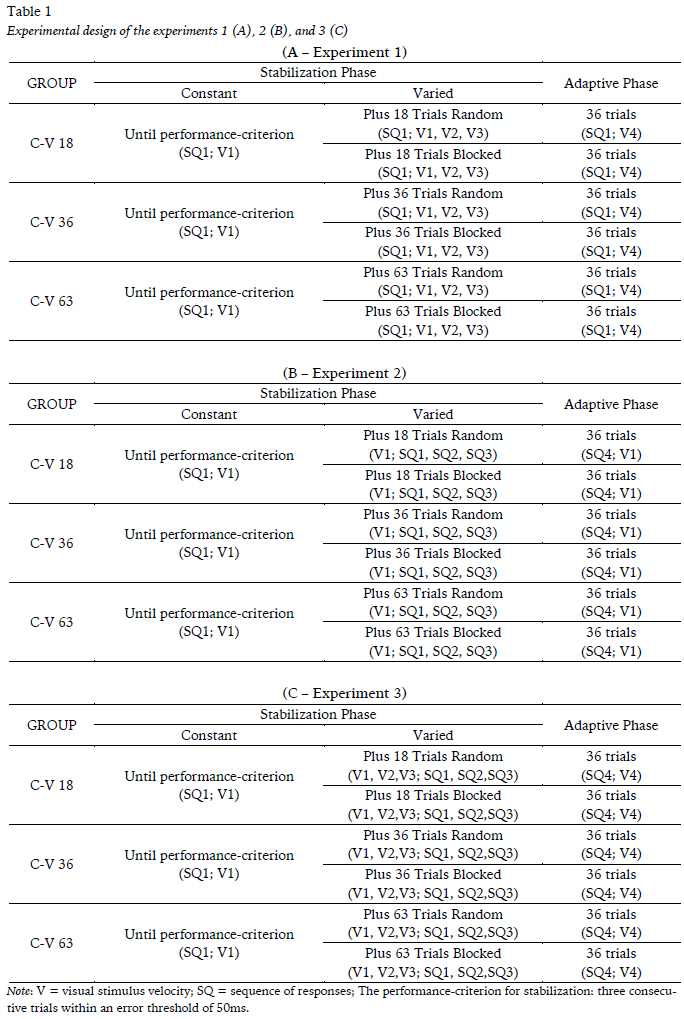
<body><![CDATA[<p>&nbsp;  </p>     <p><b><font size="3" face="Verdana">EXPERIMENT 1</font></b></p> <font size="2" face="Verdana">     <p>In this   experiment the random and blocked practices were manipulated in relation to perceptual requirements of the task, that is, different visual stimulus speeds (<a href="/img/revistas/mot/v10n4/10n04a05t1.jpg">Table 1A</a>).</p> </font>     
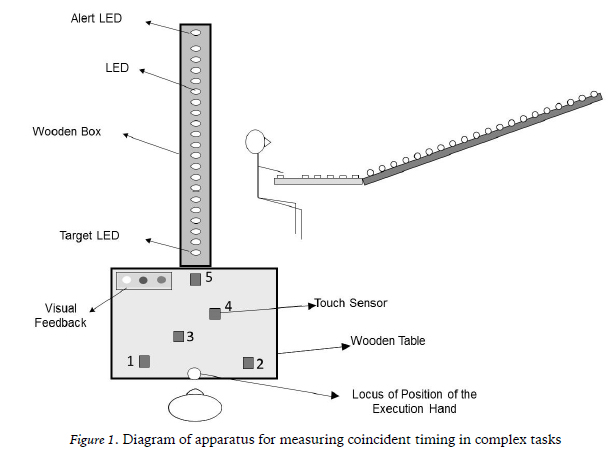
<p><b><font size="2" face="Verdana">Participants</font></b><font size="2" face="Verdana"></font></p> <font size="2" face="Verdana">     <p>Participants,   task, and apparatus were similar to those used by Corr&#234;a and colleagues in   previous studies (Corr&#234;a et al., 2006, 2007, 2010a, 2010b). Thirty-six   right-handed children, both boys (n = 20) and girls (n = 16), with a mean age of 11.6 years (SD = 0.5) took part in the experiment. Participation required the written consent of those responsible for the children. The study was approved by the Institutional Review Board of the University of S&#227;o Paulo.</p> </font>     <p><b><font size="2" face="Verdana">Instruments and task</font></b> <font size="2" face="Verdana">     <p>A complex   coincident timing apparatus was used (<a href="/img/revistas/mot/v10n4/10n04a05f1.jpg">Fig. 1</a>). The task required the participants   to touch with the dominant hand five response keys during the presentation of a   visual stimulus, so that the touch on the last one coincided with the lighting   of the final led (see <a href="/img/revistas/mot/v10n4/10n04a05f1.jpg">Fig. 1</a>). The visual stimulus consisted of a sequence of   LEDs that started to light in a sequence two seconds after the participant has been warned by LED alert.</p> </font>     
<p><font size="2" face="Verdana"><b>Design and procedures</b></font></p> <font size="2" face="Verdana">     <p>The design   utilized characterized this research as quasi-experimental. The experiment   involved the stabilization and adaptation phases. In the first, the children   performed the trials under constant practice until the following   performance-criterion for stabilization: three consecutive trials within an   error threshold of &#177;50 msec. Studies have shown that inexperienced adults can   stabilize their performance at &#177;30 msec error threshold in this kind of task   (Fonseca et al., 2012). However, children need &#177;50 msec to do that (Corr&#234;a et   al., 2006, 2007, 2010a, 2010b). Thus, the criterion of three consecutive trials   within an error threshold of &#177;50 msec was used in this study in order to guarantee   that all learners reach the same performance level. After achieving that they performed the practice trials under either random or blocked practice.</p>     <p>According   to <a href="/img/revistas/mot/v10n4/10n04a05t1.jpg">Table 1A</a>, children of C-V 18 groups performed 18 trials under random (C-R   18) or blocked practice (C-B 18). The C-V 36 groups performed 36 trials under   random (C-R 36) or blocked practice (C-B 36), and the C-V 63 groups performed 63 trials under random (C-R 63) or blocked practice (C-B 63).</p>     
]]></body>
<body><![CDATA[<p>In the stabilization   phase, while the practice was constant the children performed the trials in the   same sequence of responses (SQ1=1-2-4-3-5, <a href="/img/revistas/mot/v10n4/10n04a05f1.jpg">Figure 1</a>) and visual stimulus speed   (V1= 1.422 m/s). Subsequent trials were performed varying the visual stimulus   speeds (V1= 1.422 m/s; V2= 1.657 m/s; and V3= 1.245 m/s) according to the   varied condition (random or blocked). In this phase the children received   knowledge of results after each trial by one 10 cm wide, 20 cm long and 2 cm   high box with diodes that indicated that the performance was within (central   diode) or out of criterion (right or left diode), respectively, when the   individual touched the sensor after or before that criterion (<a href="/img/revistas/mot/v10n4/10n04a05f1.jpg">Fig. 1</a>). Still,   children were given explanations about the task, and they were informed that   from the moment they reached the criterion of performance the speed of visual   stimulus, touch sequence of the sensors, or both would begin to vary, according   to each experiment. In the adaptation phase a new visual stimulus speed (V4 =   1.049 m/s) was introduced for all groups. No KR was provided in this phase. In both phases a six seconds interval between trials was provided.</p> </font>     
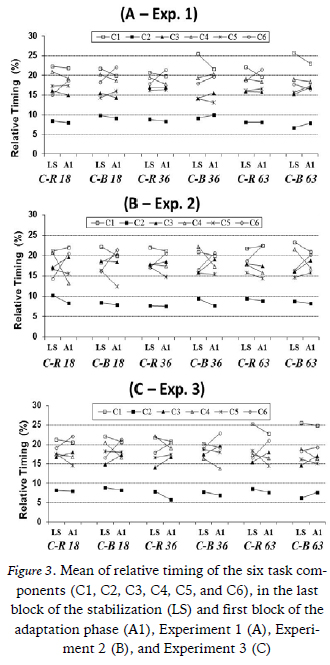
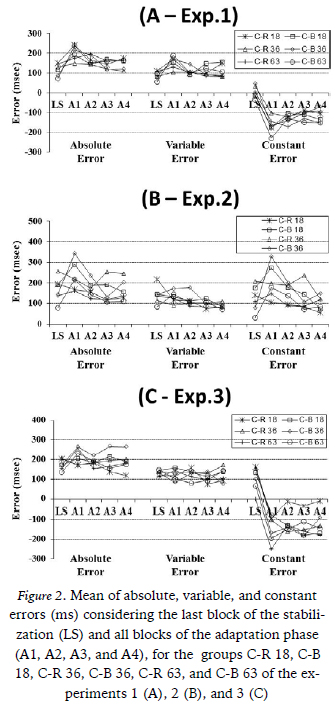
<p><font size="2" face="Verdana"><b>Data analyses</b></font> <font size="2" face="Verdana">    <p>Data were   analyzed in relation to two performance measures: (i) coincident timing and   (ii) response pattern. The first one referred to the difference between the   last touch and the firing LED target. It was analyzed in relation to absolute,   variable, and constant errors in order to evaluate the performance concerning   accuracy, consistency, and time bias of responses, respectively. To consider   the interactions among amount of varied practice (18, 36, and 63 trials),   schedule (random and blocked), and blocks of trials, 3 &#215; 2 &#215; 3 ANOVAs were conducted,   with repeated measures on the last factor. To ensure the power of the   statistical analyzes for all these interactions the last block of the   stabilization phase and two blocks of the adaptation phase (first and last) were compared.</p>     <p>Response   pattern was analyzed by relative timing of each task component (C). It referred   to the proportion of time of each task component in relation to the overall   response time (time between the start of the visual stimulus and the   performance of the last &#8211; fifth &#8211; touch). It consisted of six time intervals:   the reaction time, i.e., the time between the firing of the first diode and the   beginning of the movement, i.e., withdrawal of the dominant hand of a sensor   (C1) and the time before each of the five subsequent touches (C2, C3, C4, C5,   and C6). In order to verify how the adaptation took place in terms of response   pattern, the analyses considered the last block of the stabilization phase and   the first block of the adaptation phase. A 6 &#215; 2 ANOVA was carried out for each   group to identify main effects of components and blocks of trials. Observed   significant effects were followed up using TukeyHSD post-hoc tests. For all   analyses, the level of significance was set at <i >p</i>< 0.05, using STATISTICA&#174; 10.0 software (Stat Soft Inc., Tulsa,   USA). The observed difference in the degrees of freedom reported in the ANOVA&#8217;s   results referred to the missing data caused by outliers and technical problems   related to the software. For instance, outliers emerged when the children   performed a wrong sequence of movements, repeated or missed a particular sensor, or forgot to finish the sequence (e.g., to perform the last touch).</p> </font>     <p>&nbsp;  </p>     <p><b><font size="3" face="Verdana">RESULTS</font></b></p> <font size="2" face="Verdana">     <p>The   performances related to the coincident timing and to the response pattern are presented at the <a href="#f2">Figures 2A</a> and <a href="#f3">3A</a>, respectively.</p>     <p><a name="f2"></a></p>     <p>&nbsp;</p>     <p align="center"><img src="/img/revistas/mot/v10n4/10n04a05f2.jpg" width="335" height="705"></p>     
]]></body>
<body><![CDATA[<p align="center">&nbsp;</p>     <p><a name="f3"></a></p>     <p>&nbsp;</p>     <p align="center"><img src="/img/revistas/mot/v10n4/10n04a05f3.jpg" width="330" height="665"></p>     
<p>&nbsp;</p> </font>     <p><font size="2" face="Verdana"><b>Coincident timing</b></font></p> <font size="2" face="Verdana">    <p>For   absolute error, a 3 &#215; 2 &#215; 3 ANOVA (amount of varied practice &#215; practice   schedule &#215; blocks of trials) revealed interaction between blocks and practice   schedule (<i >F</i><sub>(2, 64)</sub>= 8.84, <i >p</i>< 0.01, ?<sup>2</sup>= 0.22). It was observed that the constant-blocked   practice groups increased error from the last block of the stabilization phase   to the first of adaptation block (<i >p</i><   0.01), and decreased from first to last adaptation block (<i >p</i>< 0.01).</p>     <p>Concerning   variable error, a 3 &#215; 2 &#215; 3 ANOVA (amount of varied practice &#215; practice schedule &#215; blocks of trials) also revealed an interaction between practice schedule and blocks (<i >F</i><sub>(2, 64)</sub>= 3.26, <i >p</i><   0.05, ?<sup>2</sup>= 0.09).   Post hoc testing showed that the constant-blocked practice groups increased the   variable error from the last block of the stabilization phase to the first   adaptation block (<i >p</i>< 0.01), and diminished from first to last adaptation block (<i >p</i>< 0.01).</p> </font>     <p><font size="2" face="Verdana">Finally,   for constant error a 3 &#215; 2 &#215; 3 ANOVA (amount of varied practice &#215; practice   schedule &#215; blocks of trials) revealed effects only for blocks (<i >F</i><sub>(2, 64)</sub>= 55.31, <i >p</i>< 0.01, ?<sup>2</sup>= 0.64). Post hoc testing showed that this   error changed from positive (execution of the final touch after the firing LED   target) to negative signal (execution of the final touch before the firing LED   target), from the last block of the stabilization phase to all adaptation   blocks (<i >p</i>< 0.01), and diminished   from first to last adaptation block (<i >p</i><   0.05).</font></p>     <p><b><font size="2" face="Verdana">Response pattern</font></b><b><font size="2" face="Verdana"></font></b><font size="2" face="Verdana"> </font></p> <font size="2" face="Verdana">    ]]></body>
<body><![CDATA[<p>For all   groups, the 6 &#215; 2 ANOVA revealed main interaction effects between components   and blocks of trials: C-V 18 R (<i >F</i><sub>(5, 25)</sub>= 17.58, <i >p</i>< 0.01), C-V 18 BL (<i >F</i><sub>(5,     25)</sub>= 13.61, <i >p</i>< 0.01), C-V 36   R (<i >F</i><sub>(5, 25)</sub>= 22.59, <i >p</i><   0.01), C-V 36 BL (<i >F</i><sub>(5, 25)</sub>= 21.89, <i >p</i>< 0.01), C-V 63 R (<i >F</i><sub>(5,     25)</sub>= 20.95, <i >p</i>< 0.01), and   C-V 63 BL (<i >F</i><sub>(5, 25)</sub>= 35.16, <i >p</i><   0.01). Post hoc testing showed that with the introduction of the new visual   stimulus velocity all groups changed their response pattern by diminishing the relative timing of the first and fourth components (<i >p</i>< 0.01).</p> </font>     <p>&nbsp;</p>     <p><b><font size="3" face="Verdana">EXPERIMENT 2</font></b><font size="2" face="Verdana"></font></p> <font size="2" face="Verdana">    <p>In this   experiment, the varied practice (blocked and random) was manipulated in relation   to the movement pattern, that is, different sequences of touches in the sensors (<a href="/img/revistas/mot/v10n4/10n04a05t1.jpg">Table 1B</a>).</p> </font>     
<p><font size="2" face="Verdana"><b>Participants, task and equipment, design and procedures, and data analyses</b></font> <font size="2" face="Verdana">    <p>These   aspects were similar to those of experiment 1. Participants were thirty-six   children, both boys (<i>n</i>= 18) and girls (<i>n</i>= 18), with mean age of 11.4 years (<i>SD </i>= 1.0).</p>     <p>In this   experiment, during the constant practice the learners performed the task trials   in the same sequence of touches in the sensors (SQ1= 1-2-4-3-5, <a href="/img/revistas/mot/v10n4/10n04a05f1.jpg">Figure 1</a>) and   visual stimulus speed (V1= 1.422 m/s). Subsequent trials were performed varying   the sequence of touches (SQ1= 1-2-4-3-5, SQ2= 1-3-2-4-5 e SQ3= 1-4-2-3-5,   <a href="/img/revistas/mot/v10n4/10n04a05f1.jpg">Figure 1</a>) according to varied condition (random or blocked). For adaptation   phase a new movement pattern (SQ4= 1-4-3-2-5, <a href="/img/revistas/mot/v10n4/10n04a05f1.jpg">Figure 1</a>) was introduced for all   groups. Regarding the variability of the touch sequence of the sensors,   children were visually informed, before each trial by a paper put on the left corner of the table.</p> </font>     
<p>&nbsp;</p>     <p><b><font size="3" face="Verdana">RESULTS</font></b><font size="2" face="Verdana"></font></p> <font size="2" face="Verdana">    <p>The   performances related to the coincident timing and to the response pattern are presented at the <a href="#f2">Figures 2B</a> and <a href="#f3">3B</a>, respectively.</p> </font>     ]]></body>
<body><![CDATA[<p><b><font size="2" face="Verdana">Coincident timing</font></b> <font size="2" face="Verdana">    <p>For   absolute error, a 3 &#215; 2 &#215; 3 ANOVA (amount of varied practice x practice   schedule x blocks of trials) revealed interaction between practice schedule and   blocks (<i >F</i><sub>(2, 62)</sub>= 6.13, <i >p</i>< 0.01, ?<sup>2</sup>= 0.16). It was observed that the constant-blocked   practice groups increased the absolute error from the last block of the stabilization   phase to the first adaptation block (<i >p</i><   0.01), and decreased from first to last adaptation block (<i >p</i>< 0.01).</p>     <p>Regarding   variable error, a 3 &#215; 2 &#215; 3 ANOVA (amount of varied practice &#215; practice   schedule &#215; blocks of trials) revealed effects only for blocks (<i >F</i><sub>(2, 58)</sub>= 3.45, <i >p</i>< 0.05, ?<sup>2</sup>= 0.10). Post hoc testing showed that this   error diminished from last block of the stabilization phase to the last blocks   of the adaptation phase (<i >p</i>< 0.01).   And, in relation to the constant error, a 3 &#215; 2 &#215; 3 ANOVA (amount of varied   practice &#215; practice schedule &#215; blocks of trials) revealed interaction between   blocks and practice schedule (<i >F</i><sub>(2,     62)</sub>= 4.83, <i >p</i>< 0.05, ?<sup>2</sup>= 0.13). Similarly to the absolute error, the   Tukey<sub>HSD</sub> tests showed that the constant-blocked groups increased the   absolute error from the last block of the stabilization phase to the first   adaptation block (<i >p</i>< 0.01), and decreased from first to last adaptation block (<i >p</i>< 0.01).</p> </font>     <p><font size="2" face="Verdana"><b>Response pattern</b></font> <font size="2" face="Verdana">    <p>For all   groups the 6 &#215; 2 ANOVA revealed main interaction effects between components and   blocks of trials: C-V 18 R (<i >F</i><sub>(5, 20)</sub>= 8.82, <i >p</i>< 0.01), C-V 18 BL (<i >F</i><sub>(5,     25)</sub>= 17.03, <i >p</i>< 0.01), C-V 36   R (<i >F</i><sub>(5, 25)</sub>= 12.59, <i >p</i><   0.01), C-V 36 BL (<i >F</i><sub>(5, 25)</sub>= 21.72, <i >p</i>< 0.01), C-V 63 R (<i >F</i><sub>(5,     25)</sub>= 14.91, <i >p</i>< 0.01), and   C-V 63 BL (<i >F</i><sub>(5, 25)</sub>= 14.51, <i >p</i><   0.01). Post hoc testing showed that with the introduction of the new sequence   of touching all groups changed their response pattern by reducing the relative   timing of the first and fourth components (<i >p</i><   0.01). Furthermore, there was an increase of the relative timing of sixth component   for the C-V 18 BL and C-V 63 R groups (<i >p</i><   0.01), and of the second component for the C-V 36 BL group (<i >p</i>< 0.05) (<a href="#f3">Figure 3B</a>).</p> </font>     <p>&nbsp;</p>     <p><font size="3" face="Verdana"><b>EXPERIMENT 3</b></font></p>      <p><font size="2" face="Verdana">In this   experiment, the varied practices were manipulated both in terms of velocities   of  the visual stimulus and sequences of touching.</font></p>     <p><font size="2" face="Verdana"><b>Participants, task and   equipment, design and procedures, and data analyses</b> </font></p> <font size="2" face="Verdana">    <p>These   aspects were also similar to those of experiment 1 and 2 (<a href="/img/revistas/mot/v10n4/10n04a05t1.jpg">Table 1C</a>).   Participants were thirty-five children, both boys (<i>n</i>= 18) and girls (<i>n</i>= 17), with mean age of 10.4 years (<i>SD </i>= 1.0).</p>     
]]></body>
<body><![CDATA[<p>In this   experiment, during the constant practice the learners performed the task trials   in the same sequence of touches in the sensors (SQ1= 1-2-4-3-5, <a href="/img/revistas/mot/v10n4/10n04a05f1.jpg">Figure 1</a>) and   visual stimulus speed (V1= 1.422 m/s). The remaining trials were performed varying   the sequence of touches (SQ1= 1-2-4-3-5, SQ2= 1-3-2-4-5 e SQ3= 1-4-2-3-5, <a href="/img/revistas/mot/v10n4/10n04a05f1.jpg">Figure   1</a>) and the visual stimulus speeds (V1= 1.422 m/s; V2= 1.657 m/s; and V3= 1.245   m/s) according to varied condition (random or blocked). For adaptation phase a   new movement pattern (SQ4= 1-4-3-2-5, <a href="/img/revistas/mot/v10n4/10n04a05f1.jpg">Figure 1</a>) and visual stimulus speed (V4 = 1.049 m/s) were introduced for all groups.</p> </font>     
<p>&nbsp;</p>     <p><b><font size="3" face="Verdana">RESULTS</font></b><font size="2" face="Verdana"></font></p> <font size="2" face="Verdana">    <p>The   performances related to the coincident timing and the response pattern are presented at the <a href="#f2">Figures 2C</a> and <a href="#f3">3C</a>, respectively.</p> </font>     <p><font size="2" face="Verdana"><b>Coincident timing</b></font> <font size="2" face="Verdana">    <p>The   statistical analysis revealed no differences for the absolute, variable, and constant errors.  </p> </font>     <p><font size="2" face="Verdana"><b>Response pattern</b></font></p> <font size="2" face="Verdana">    <p>For all   groups the 6 &#215; 2 ANOVA revealed main interaction effects between components and   blocks of trials: C-V 18 R (<i >F</i><sub>(5, 25)</sub>= 21.65, <i >p</i>< 0.01), C-V 18 BL (<i >F</i><sub>(5,     20)</sub>= 26.19, <i >p</i>< 0.01), C-V 36   R (<i >F</i><sub>(5, 25)</sub>= 25.02, <i >p</i><   0.01), C-V 36 BL (<i >F</i><sub>(5, 25)</sub>= 6.70, <i >p</i>< 0.01), C-V 63 R (<i >F</i><sub>(5,     25)</sub>= 13.47, <i >p</i>< 0.01), and   C-V 63 BL (<i >F</i><sub>(5, 25)</sub>= 15.33, <i >p</i><   0.01). Post hoc testing showed that with the introduction of the new sequence   of touching all groups changed their response pattern by reducing the relative   timing of the first and fourth components (<i >p</i><   0.01). Furthermore, there was an increase of the relative timing of the sixth   component for the C-V 18 R group (<i >p</i><   0.01), and of the second component for the C-V 36 R group (<i >p</i>< 0.01).</p> </font>     <p>&nbsp;</p>     <p><font size="3" face="Verdana"><b>DISCUSSION</b></font></p> <font size="2" face="Verdana">     ]]></body>
<body><![CDATA[<p>The aim of   this study was to investigate the effects of different amounts and schedules of   varied practice after constant practice on the adaptive process of motor   learning. We asked whether the amount and schedule of varied practice for   diversification of the skill in terms of different task demands (e.g., perceptual and motor) would affect the adaptive process of motor learning.</p>     <p>It was   hypothesized that the varied practice of applying different parameters to the   skill structure would promote its diversification, thus increasing its flexibility   and facilitating adaptation, independently of the amount of practice. Actually,   with regard to the amount of practice we expected that there would be a critical   threshold in which the acquired flexibility would be enough to promote   adaptation as in the case of systems placed in a region of self-organized   criticality (Kauffman, 1993; Langton, 1992; Packard, 1988). For instance,   Corr&#234;a et al. (2006, 2007, 2010b) showed that varying amounts of constant   practice prior to random practice had similar effects on the adaptive process,   and they concluded that the minimum amount of practice needed to the formation of a structure was enough for initiating the diversification process.</p>     <p>However,   the results of the three experiments suggest that the amounts and schedules of   varied practice manipulated in this study did not promote the diversification   of the skill. It is because a new regime of stability should be reached in the   adaptive phase and it did not occur. For instance, in all blocks of adaptation   phase the absolute error remained above 100 msec, that is, two times higher   than the criterion of 50 msec considered for stabilization. Therefore, since   the motor skill acquisition involves the formation of more complex structures   by a breakdown of stability followed by another regime of stability in a   cyclical way (Choshi, 1985, 2000; Choshi & Tani, 1983; Tani, 2005a) we   could say that individuals failed to achieve the new stabilization of performance,   given  they remained with high levels of error.</p>     <p>It is important   to note that the main focus is on the performance in the adaptive phase and not   on the levels of performance during the varied practice in the stabilization   phase. While in the varied practice we manipulated the independent variable   (amount and schedule), the adaptation was the locus of the effect investigated.   Actually, it was expected that the level of error would be higher during the   varied practice than in the practice without variability because of the   difficulty learners would have to use feedback during the varied practice. That   is, while the constant practice allows the individuals to use information   related to the previous trial in the next trial, the varied practice involves changes of that information trial to trial or of block to block.</p>     <p>Thus, it is   possible that the diversification of the skill did not take place, and the   flexibility of the formed skill structure with the constant practice had been   insufficient to deal with the perturbation. In other words, the demands of the   new task might have been beyond the predictability of the system (Corr&#234;a et al., 2012) so that no adaptation was observed.</p>     <p>In addition   to that we propose two possible explanations that obviously require investigation.   First, the variations introduced after constant practice may have been   inadequate to promote skill diversification. They may have acted as a perturbation   to the pattern formed with constant practice. In other words, instead of   promoting diversification, they may have impaired it, so that when the new task   was introduced, the system was already disturbed. This hypothesis is based on   the fact that neither the aspect of the task manipulated in the varied practice nor the amount of practice was able to positively affect the adaptation.</p>     <p>Second,   although previous studies have   pointed for performance-criterion of three consecutive trials within an error   threshold of &#177;50 msec for achieving functional stabilization, i.e.   structure/pattern formation (Corr&#234;a et al., 2006, 2007, 2010a, 2010b), one   could think that this may not have been enough to prepare the skill structure   for the diversification process. In this regards, recent studies by   Ugrinowitsch et al. (2010, 2011) have shown that the extensive practice during   the stabilization phase can provide the learners with more capacity to   adapt.  For instance, Ugrinowitsch et al.   (2010) investigated the effects of the stabilization level on adaptation in   motor skill learning. They manipulated two performance-criteria: three consecutive trials with an error of = 25 msec and six blocks of three   trials with an error of = 25 msec. Results showed better adaptation for those learners who practiced six blocks of three trials within the error level established.</p>     <p>Interestingly,   our results also showed that the aforementioned effects did not occur equally   with regard to the kinds of varied practice. For instance, the results of   interactions between blocks and practice schedule observed in experiments 1 and   2, respectively those that varied the velocity of visual stimulus and sequence   of touches, showed that only the performance of the constant-blocked groups worsened   at the beginning of the adaptation phase. Furthermore, the behaviors of the   groups were also different with regard to the response pattern. While in the   experiment 1 they changed equally their response patterns by reducing the   relative timing of the first and fourth components, in experiment 2 some groups   changed their response pattern in relation to these components (first and   fourth) and other altered it in relation to those first, fourth, and sixth . Furthermore,   in experiment 3, results showed that the groups C-R 18 and C-R 36 altered their   movement pattern in relation to the three components (first, fourth, and sixth;   first, second, and fourth, respectively). The remaining groups changed only two   components (first and fourth). Considering the propositions of adaptive process   of motor learning described in the introduction and the level of performance of   all groups in the adaptation phase, we could suggest that those modifications   in the response patterns did not refer to an adaptation by  the modifying the structure of the skill.   Considering there was degradation of the performance in the adaptation phase,   these alterations in components might indicate a system dismantling. There are   basically three possibilities for responding when a system is perturbed. It can   (i) attempt to neutralize the perturbation while maintaining stability, (ii)   use the perturbation as source of order toward higher states of complexity.   These two possibilities have as a prerequisite the competence acquired by the   system. The absence of this implies the third possibility: (iii) the system is destroyed (Tani, 2005).</p>     <p>In the   present study, after the initial characterization of the motor skill, i.e. structure   formation by the constant practice, the diversification of the skill was the   focus of analysis. It was operationalized by varying the quantity of trials of   blocked or random practices. Three experiments were carried out in order to   investigate the diversification in terms of the perceptual (exp. 1), motor   (exp. 2), and perceptual coupled to motor aspects of the task (exp. 3). The findings   of this study allow us to conclude that the amounts of trials manipulated in   the random and blocked practices did not promote the diversification of the   skill since no adaptation was observed. Concerning the study&#8217;s limitations two   aspects warrant further investigations: (1) the establishment of different   criteria for inferring the pattern formation considering both the value of the   error as the number of trials, and (2) the variation of specific items   practiced (e.g., values of velocities of visual stimulus) and/or the amount of   specific items varied in the practice (e.g., amount of velocities of visual stimulus).</p> </font>     <p>&nbsp;</p>     ]]></body>
<body><![CDATA[<p><font size="3" face="Verdana"><b>REFERENCES</b></font></p> <font size="2" face="Verdana">    <!-- ref --><p>Brady, F. (1998). A theoretical and empirical review of the contextual interference effect and learning of motor skills. <i >Quest, 50,</i> 266-293.    &nbsp;&nbsp;&nbsp;&nbsp;&nbsp;&nbsp;&nbsp;&nbsp;[&#160;<a href="javascript:void(0);" onclick="javascript: window.open('/scielo.php?script=sci_nlinks&ref=000104&pid=S1646-107X201400040000500001&lng=','','width=640,height=500,resizable=yes,scrollbars=1,menubar=yes,');">Links</a>&#160;]<!-- end-ref --></p>     <!-- ref --><p>Brady, F. (2004). Contextual interference: A meta-analytic study. <i >Perceptual and Motor Skills, 99,</i> 116-126. doi: 10.2466/pms.99.1.116-126&nbsp;&nbsp;&nbsp;&nbsp;&nbsp;&nbsp;&nbsp;&nbsp;[&#160;<a href="javascript:void(0);" onclick="javascript: window.open('/scielo.php?script=sci_nlinks&ref=000106&pid=S1646-107X201400040000500002&lng=','','width=640,height=500,resizable=yes,scrollbars=1,menubar=yes,');">Links</a>&#160;]<!-- end-ref --><!-- ref --><p>Choshi, K. (1985). Adaptive process of perceptual-motor learning: Complexity   and complementarity. <i >Memoirs of the Faculty of Integrated Arts and Sciences, 3,</i> 21-30.    &nbsp;&nbsp;&nbsp;&nbsp;&nbsp;&nbsp;&nbsp;&nbsp;[&#160;<a href="javascript:void(0);" onclick="javascript: window.open('/scielo.php?script=sci_nlinks&ref=000107&pid=S1646-107X201400040000500003&lng=','','width=640,height=500,resizable=yes,scrollbars=1,menubar=yes,');">Links</a>&#160;]<!-- end-ref --></p>     <!-- ref --><p>Choshi, K. (2000). Aprendizagem motora como um problema mal-definido. <i >Revista Paulista de Educa&#231;&#227;o F&#237;sica, 3,</i> 17-23.    &nbsp;&nbsp;&nbsp;&nbsp;&nbsp;&nbsp;&nbsp;&nbsp;[&#160;<a href="javascript:void(0);" onclick="javascript: window.open('/scielo.php?script=sci_nlinks&ref=000109&pid=S1646-107X201400040000500004&lng=','','width=640,height=500,resizable=yes,scrollbars=1,menubar=yes,');">Links</a>&#160;]<!-- end-ref --></p>     <!-- ref --><p>Choshi, K., & Tani, G. (1983). Stable system and adaptive system in   motor learning. In <i >Japanese Association     of Biomechanics</i> (Ed.), The science of movement (pp. 346-351). Tokyo: Kiorin.    &nbsp;&nbsp;&nbsp;&nbsp;&nbsp;&nbsp;&nbsp;&nbsp;[&#160;<a href="javascript:void(0);" onclick="javascript: window.open('/scielo.php?script=sci_nlinks&ref=000111&pid=S1646-107X201400040000500005&lng=','','width=640,height=500,resizable=yes,scrollbars=1,menubar=yes,');">Links</a>&#160;]<!-- end-ref --></p>     ]]></body>
<body><![CDATA[<!-- ref --><p>Connolly, K. (2000). Desenvolvimento motor: Passado,   presente e futuro. <i >Revista Paulista de Educa&#231;&#227;o F&#237;sica, 3,</i> 6-15.    &nbsp;&nbsp;&nbsp;&nbsp;&nbsp;&nbsp;&nbsp;&nbsp;[&#160;<a href="javascript:void(0);" onclick="javascript: window.open('/scielo.php?script=sci_nlinks&ref=000113&pid=S1646-107X201400040000500006&lng=','','width=640,height=500,resizable=yes,scrollbars=1,menubar=yes,');">Links</a>&#160;]<!-- end-ref --></p>     <!-- ref --><p>Corr&#234;a, U. C., Benda, R. N., Meira Jr., C. M.,   & Tani, G. (2003). Practice   schedule and adaptive process in the acquisition of a manual force control   task. <i >Journal of Human Movement Studies, 44,</i> 121-38.    &nbsp;&nbsp;&nbsp;&nbsp;&nbsp;&nbsp;&nbsp;&nbsp;[&#160;<a href="javascript:void(0);" onclick="javascript: window.open('/scielo.php?script=sci_nlinks&ref=000115&pid=S1646-107X201400040000500007&lng=','','width=640,height=500,resizable=yes,scrollbars=1,menubar=yes,');">Links</a>&#160;]<!-- end-ref --></p>     <!-- ref --><p>Corr&#234;a, U. C., Barros, J. A., Massigli, M., Gon&#231;alves, L. A., &   Tani, G. (2007). A pr&#225;tica constante-aleat&#243;ria e o processo adaptativo   de aprendizagem motora: Efeitos da quantidade de pr&#225;tica constante. <i >Revista Brasileira de Educa&#231;&#227;o F&#237;sica e Esporte, 21,</i> 301-314.    &nbsp;&nbsp;&nbsp;&nbsp;&nbsp;&nbsp;&nbsp;&nbsp;[&#160;<a href="javascript:void(0);" onclick="javascript: window.open('/scielo.php?script=sci_nlinks&ref=000117&pid=S1646-107X201400040000500008&lng=','','width=640,height=500,resizable=yes,scrollbars=1,menubar=yes,');">Links</a>&#160;]<!-- end-ref --></p>     <!-- ref --><p>Corr&#234;a, U. C., Ugrinowitsch, H., Benda, R. N.,   & Tani, G. (2010a). Effects of practice schedule on the adaptive process of motor learning. <i >Portuguese Journal of Sport Sciences, 10,</i> 158-171.    &nbsp;&nbsp;&nbsp;&nbsp;&nbsp;&nbsp;&nbsp;&nbsp;[&#160;<a href="javascript:void(0);" onclick="javascript: window.open('/scielo.php?script=sci_nlinks&ref=000119&pid=S1646-107X201400040000500009&lng=','','width=640,height=500,resizable=yes,scrollbars=1,menubar=yes,');">Links</a>&#160;]<!-- end-ref --></p>     <!-- ref --><p>Corr&#234;a, U. C., Massigli, M., Barros, J. A. ,   Gon&#231;alves, L. A., Tani, G., & Oliveira, J. A. (2010b). Constant-random practice and the adaptive   process in motor learning with varying amounts of constant practice. <i >Perceptual and Motor Skills, 110,</i> 442-452. doi: 10.2466/pms.110.2.442-452.    &nbsp;&nbsp;&nbsp;&nbsp;&nbsp;&nbsp;&nbsp;&nbsp;[&#160;<a href="javascript:void(0);" onclick="javascript: window.open('/scielo.php?script=sci_nlinks&ref=000121&pid=S1646-107X201400040000500010&lng=','','width=640,height=500,resizable=yes,scrollbars=1,menubar=yes,');">Links</a>&#160;]<!-- end-ref --></p>     ]]></body>
<body><![CDATA[<!-- ref --><p>Corr&#234;a, U. C., Gon&#231;alves, L. A., Barros, J. A., & Massigli, M.   (2006). Pr&#225;tica constante-aleat&#243;ria e aprendizagem motora: Efeitos da   quantidade de pr&#225;tica constante e da manipula&#231;&#227;o de exig&#234;ncias motoras da tarefa. <i >Brazilian Journal of Motor Behavior, 1,</i> 41-52.    &nbsp;&nbsp;&nbsp;&nbsp;&nbsp;&nbsp;&nbsp;&nbsp;[&#160;<a href="javascript:void(0);" onclick="javascript: window.open('/scielo.php?script=sci_nlinks&ref=000123&pid=S1646-107X201400040000500011&lng=','','width=640,height=500,resizable=yes,scrollbars=1,menubar=yes,');">Links</a>&#160;]<!-- end-ref --></p>     <!-- ref --><p>Corr&#234;a, U. C., Alegre, F. A. M., Freudenheim, A. M., Santos, S., & Tani, G. (2012). The game of futsal as an adaptive process. <i >Nonlinear Dynamics, Psychology and Life Sciences, 16,</i> 185-204.    &nbsp;&nbsp;&nbsp;&nbsp;&nbsp;&nbsp;&nbsp;&nbsp;[&#160;<a href="javascript:void(0);" onclick="javascript: window.open('/scielo.php?script=sci_nlinks&ref=000125&pid=S1646-107X201400040000500012&lng=','','width=640,height=500,resizable=yes,scrollbars=1,menubar=yes,');">Links</a>&#160;]<!-- end-ref --></p>     <!-- ref --><p>Fonseca, F. S., Benda, R. N., Profeta, V. L.   S., & Ugrinowitsch, H. (2012). Extensive practice improves adaptation to unpredictable perturbations in a sequential coincident timing task. <i>Neuroscience Letters, 517,</i> 123-127. doi: 10.1016/j.neulet.2012.04.041&nbsp;&nbsp;&nbsp;&nbsp;&nbsp;&nbsp;&nbsp;&nbsp;[&#160;<a href="javascript:void(0);" onclick="javascript: window.open('/scielo.php?script=sci_nlinks&ref=000127&pid=S1646-107X201400040000500013&lng=','','width=640,height=500,resizable=yes,scrollbars=1,menubar=yes,');">Links</a>&#160;]<!-- end-ref --><!-- ref --><p>Kauffman, S. A. (1993). <i >The   origins of order: Self-organization and selection in evolution</i>. Oxford: Oxford University Press.    &nbsp;&nbsp;&nbsp;&nbsp;&nbsp;&nbsp;&nbsp;&nbsp;[&#160;<a href="javascript:void(0);" onclick="javascript: window.open('/scielo.php?script=sci_nlinks&ref=000128&pid=S1646-107X201400040000500014&lng=','','width=640,height=500,resizable=yes,scrollbars=1,menubar=yes,');">Links</a>&#160;]<!-- end-ref --></p>     <!-- ref --><p>Langton, C. G. (1992). Life at the edge of chaos. In C. G. Langton, C.   Taylor, J. D. Farmer, & S. Rasmussen (Eds.), <i >Artificial life II: SFI studies in the sciences of complexity - V</i> (pp. 41-92) Redwood City: Addison-Wesley.    &nbsp;&nbsp;&nbsp;&nbsp;&nbsp;&nbsp;&nbsp;&nbsp;[&#160;<a href="javascript:void(0);" onclick="javascript: window.open('/scielo.php?script=sci_nlinks&ref=000130&pid=S1646-107X201400040000500015&lng=','','width=640,height=500,resizable=yes,scrollbars=1,menubar=yes,');">Links</a>&#160;]<!-- end-ref --></p>     <!-- ref --><p>Magill, R. A., & Hall, K. G. (1990). A review of the contextual interference   effect in motor skill acquisition. <i >Human Movement Science</i>, 9(3-5), 241-289. doi: 10.1016/0167-9457(90)90005-X&nbsp;&nbsp;&nbsp;&nbsp;&nbsp;&nbsp;&nbsp;&nbsp;[&#160;<a href="javascript:void(0);" onclick="javascript: window.open('/scielo.php?script=sci_nlinks&ref=000132&pid=S1646-107X201400040000500016&lng=','','width=640,height=500,resizable=yes,scrollbars=1,menubar=yes,');">Links</a>&#160;]<!-- end-ref --><!-- ref --><p>Packard, N. H. (1988). Adaptation toward the edge of chaos. In J. A. S.   Kelso, A. J. Mandel, & M. F. Shlesinger (Eds.), <i >Dynamic patterns in complex systems</i> (pp. 293-301). Singapore: World Scientific Publishing.    &nbsp;&nbsp;&nbsp;&nbsp;&nbsp;&nbsp;&nbsp;&nbsp;[&#160;<a href="javascript:void(0);" onclick="javascript: window.open('/scielo.php?script=sci_nlinks&ref=000133&pid=S1646-107X201400040000500017&lng=','','width=640,height=500,resizable=yes,scrollbars=1,menubar=yes,');">Links</a>&#160;]<!-- end-ref --></p>     <!-- ref --><p>Tani, G. (1995). <i>Hierarchical organization of an action programme and   the development of skilled actions.</i> (Unpublished technical report). Sheffield: University of Sheffield, Department of Psychology.    &nbsp;&nbsp;&nbsp;&nbsp;&nbsp;&nbsp;&nbsp;&nbsp;[&#160;<a href="javascript:void(0);" onclick="javascript: window.open('/scielo.php?script=sci_nlinks&ref=000135&pid=S1646-107X201400040000500018&lng=','','width=640,height=500,resizable=yes,scrollbars=1,menubar=yes,');">Links</a>&#160;]<!-- end-ref --></p>     <!-- ref --><p>Tani, G. (2005a). Processo adaptativo: Uma concep&#231;&#227;o de aprendizagem   motora al&#233;m da estabiliza&#231;&#227;o. In G. Tani (Ed.), <i >Comportamento motor: Aprendizagem e desenvolvimento</i> (pp. 60-70). Rio de Janeiro: Guanabara Koogan.    &nbsp;&nbsp;&nbsp;&nbsp;&nbsp;&nbsp;&nbsp;&nbsp;[&#160;<a href="javascript:void(0);" onclick="javascript: window.open('/scielo.php?script=sci_nlinks&ref=000137&pid=S1646-107X201400040000500019&lng=','','width=640,height=500,resizable=yes,scrollbars=1,menubar=yes,');">Links</a>&#160;]<!-- end-ref --></p>     <!-- ref --><p>Tani, G. (2005b). Programa&#231;&#227;o motora: Organiza&#231;&#227;o hier&#225;rquica, ordem e   desordem. In G. Tani (Ed.), <i >Comportamento     motor: Aprendizagem e desenvolvimento</i> (pp. 82-105). Rio de Janeiro: Guanabara Koogan.    &nbsp;&nbsp;&nbsp;&nbsp;&nbsp;&nbsp;&nbsp;&nbsp;[&#160;<a href="javascript:void(0);" onclick="javascript: window.open('/scielo.php?script=sci_nlinks&ref=000139&pid=S1646-107X201400040000500020&lng=','','width=640,height=500,resizable=yes,scrollbars=1,menubar=yes,');">Links</a>&#160;]<!-- end-ref --></p>     <!-- ref --><p>Tani, G., Corr&#234;a, U. C., Basso, L., Benda, R. N., Ugrinowitsch, H.,   & Choshi, K. (2014). An   adaptive process model of motor learning: Insights for the teaching of motor skills. <i >Nonlinear Dynamics Psychology and Life Sciences, 18</i>, 47-65.    &nbsp;&nbsp;&nbsp;&nbsp;&nbsp;&nbsp;&nbsp;&nbsp;[&#160;<a href="javascript:void(0);" onclick="javascript: window.open('/scielo.php?script=sci_nlinks&ref=000141&pid=S1646-107X201400040000500021&lng=','','width=640,height=500,resizable=yes,scrollbars=1,menubar=yes,');">Links</a>&#160;]<!-- end-ref --></p>     ]]></body>
<body><![CDATA[<!-- ref --><p>Ugrinowitsch, H., Corr&#234;a, U.C., & Tani, G. (2005). Perturba&#231;&#227;o   perceptiva e processo adaptativo na aprendizagem de uma tarefa de timing coincidente. <i >Revista Brasileira de Educa&#231;&#227;o F&#237;sica e Esporte</i>,<i > 19,</i> 277-284.    &nbsp;&nbsp;&nbsp;&nbsp;&nbsp;&nbsp;&nbsp;&nbsp;[&#160;<a href="javascript:void(0);" onclick="javascript: window.open('/scielo.php?script=sci_nlinks&ref=000143&pid=S1646-107X201400040000500022&lng=','','width=640,height=500,resizable=yes,scrollbars=1,menubar=yes,');">Links</a>&#160;]<!-- end-ref --></p>     <!-- ref --><p>Ugrinowitsch, H., Fialho, J., Fonseca, F., Profeta, V., Albuquerque, M.,   & Benda, R. N. (2010). Effects of perceptive perturbation and level   of stabilization in motor learning adaptability. <i >International Journal of Sport Psychology, 41,</i> S.113-S.114.    &nbsp;&nbsp;&nbsp;&nbsp;&nbsp;&nbsp;&nbsp;&nbsp;[&#160;<a href="javascript:void(0);" onclick="javascript: window.open('/scielo.php?script=sci_nlinks&ref=000145&pid=S1646-107X201400040000500023&lng=','','width=640,height=500,resizable=yes,scrollbars=1,menubar=yes,');">Links</a>&#160;]<!-- end-ref --></p>     <!-- ref --><p>Ugrinowitsch, H., Santos-Naves, S. P.,   Carbinatto, M. V., Benda, R. N., & Tani, G. (2011). Motor skill adaptation   depends on the level of learning. <i >International Journal of Human and Social Sciences, 6,</i> 177-181.    &nbsp;&nbsp;&nbsp;&nbsp;&nbsp;&nbsp;&nbsp;&nbsp;[&#160;<a href="javascript:void(0);" onclick="javascript: window.open('/scielo.php?script=sci_nlinks&ref=000147&pid=S1646-107X201400040000500024&lng=','','width=640,height=500,resizable=yes,scrollbars=1,menubar=yes,');">Links</a>&#160;]<!-- end-ref --></p>     <!-- ref --><p>Ugrinowitsch, H., & Tani, G. (2004). Perceptive perturbation in   different levels of performance's stabilization and adaptive process in motor learning. <i >The FIEP Bulletin</i>,<i > 74</i>(special issue)<i >,</i> 38-41.    &nbsp;&nbsp;&nbsp;&nbsp;&nbsp;&nbsp;&nbsp;&nbsp;[&#160;<a href="javascript:void(0);" onclick="javascript: window.open('/scielo.php?script=sci_nlinks&ref=000149&pid=S1646-107X201400040000500025&lng=','','width=640,height=500,resizable=yes,scrollbars=1,menubar=yes,');">Links</a>&#160;]<!-- end-ref --></p> </font>     <p>&nbsp;</p>     <p><font size="2" face="Verdana"><b >Acknowledgments:    ]]></body>
<body><![CDATA[<br> </b></font><font size="2" face="Verdana">Nothing to declare.    <br> </font><font size="2" face="Verdana"><b >Conflicts of Interest:    <br> </b></font><font size="2" face="Verdana">Nothing to declare.    <br> </font><font size="2" face="Verdana"><b >Funding:    <br> </b></font><font size="2" face="Verdana">Nothing to declare.</font></p>     <p><font size="2" face="Verdana">Manuscript received September 30, 2013; Revised December 19, 2013;   Accepted March 14, 2014</font> </p>     <p>&nbsp;</p>     <p>&nbsp;</p>      <p><font size="2" face="Verdana"><a name="end"></a><a href="#topo">*</a><i >Corresponding author</i>: School   of Physical Education and Sport - University of S&#227;o Paulo, Av. Prof. Mello Moraes, 65, Cidade Universit&#225;ria, CEP   05508-030 S&#227;o Paulo, SP - Brazil; <i >E-mail</i>:   <a href="mailto:umbertoc@usp.br">umbertoc@usp.br</a></font></p>      ]]></body><back>
<ref-list>
<ref id="B1">
<nlm-citation citation-type="journal">
<person-group person-group-type="author">
<name>
<surname><![CDATA[Brady]]></surname>
<given-names><![CDATA[F.]]></given-names>
</name>
</person-group>
<article-title xml:lang="en"><![CDATA[A theoretical and empirical review of the contextual interference effect and learning of motor skills]]></article-title>
<source><![CDATA[Quest]]></source>
<year>1998</year>
<volume>50</volume>
<page-range>266-293</page-range></nlm-citation>
</ref>
<ref id="B2">
<nlm-citation citation-type="journal">
<person-group person-group-type="author">
<name>
<surname><![CDATA[Brady]]></surname>
<given-names><![CDATA[F.]]></given-names>
</name>
</person-group>
<article-title xml:lang="en"><![CDATA[Contextual interference: A meta-analytic study]]></article-title>
<source><![CDATA[Perceptual and Motor Skills]]></source>
<year>2004</year>
<volume>99</volume>
<page-range>116-126</page-range></nlm-citation>
</ref>
<ref id="B3">
<nlm-citation citation-type="journal">
<person-group person-group-type="author">
<name>
<surname><![CDATA[Choshi]]></surname>
<given-names><![CDATA[K.]]></given-names>
</name>
</person-group>
<article-title xml:lang="en"><![CDATA[Adaptive process of perceptual-motor learning: Complexity and complementarity]]></article-title>
<source><![CDATA[Memoirs of the Faculty of Integrated Arts and Sciences]]></source>
<year>1985</year>
<volume>3</volume>
<page-range>21-30</page-range></nlm-citation>
</ref>
<ref id="B4">
<nlm-citation citation-type="journal">
<person-group person-group-type="author">
<name>
<surname><![CDATA[Choshi]]></surname>
<given-names><![CDATA[K.]]></given-names>
</name>
</person-group>
<article-title xml:lang="pt"><![CDATA[Aprendizagem motora como um problema mal-definido]]></article-title>
<source><![CDATA[Revista Paulista de Educação Física]]></source>
<year>2000</year>
<volume>3</volume>
<page-range>17-23</page-range></nlm-citation>
</ref>
<ref id="B5">
<nlm-citation citation-type="book">
<person-group person-group-type="author">
<name>
<surname><![CDATA[Choshi]]></surname>
<given-names><![CDATA[K.]]></given-names>
</name>
<name>
<surname><![CDATA[Tani]]></surname>
<given-names><![CDATA[G.]]></given-names>
</name>
</person-group>
<article-title xml:lang="en"><![CDATA[Stable system and adaptive system in motor learning]]></article-title>
<collab>Japanese Association of Biomechanics</collab>
<source><![CDATA[The science of movement]]></source>
<year>1983</year>
<page-range>346-351</page-range><publisher-loc><![CDATA[Tokyo ]]></publisher-loc>
<publisher-name><![CDATA[Kiorin]]></publisher-name>
</nlm-citation>
</ref>
<ref id="B6">
<nlm-citation citation-type="journal">
<person-group person-group-type="author">
<name>
<surname><![CDATA[Connolly]]></surname>
<given-names><![CDATA[K.]]></given-names>
</name>
</person-group>
<article-title xml:lang="pt"><![CDATA[Desenvolvimento motor: Passado, presente e futuro]]></article-title>
<source><![CDATA[Revista Paulista de Educação Física]]></source>
<year>2000</year>
<volume>3</volume>
<page-range>6-15</page-range></nlm-citation>
</ref>
<ref id="B7">
<nlm-citation citation-type="journal">
<person-group person-group-type="author">
<name>
<surname><![CDATA[Corrêa]]></surname>
<given-names><![CDATA[U. C.]]></given-names>
</name>
<name>
<surname><![CDATA[Benda]]></surname>
<given-names><![CDATA[R. N.]]></given-names>
</name>
<name>
<surname><![CDATA[Meira Jr.]]></surname>
<given-names><![CDATA[C. M.]]></given-names>
</name>
<name>
<surname><![CDATA[Tani]]></surname>
<given-names><![CDATA[G.]]></given-names>
</name>
</person-group>
<article-title xml:lang="en"><![CDATA[Practice schedule and adaptive process in the acquisition of a manual force control task]]></article-title>
<source><![CDATA[Journal of Human Movement Studies]]></source>
<year>2003</year>
<volume>44</volume>
<page-range>121-38</page-range></nlm-citation>
</ref>
<ref id="B8">
<nlm-citation citation-type="journal">
<person-group person-group-type="author">
<name>
<surname><![CDATA[Corrêa]]></surname>
<given-names><![CDATA[U. C.]]></given-names>
</name>
<name>
<surname><![CDATA[Barros]]></surname>
<given-names><![CDATA[J. A.]]></given-names>
</name>
<name>
<surname><![CDATA[Massigli]]></surname>
<given-names><![CDATA[M.]]></given-names>
</name>
<name>
<surname><![CDATA[Gonçalves]]></surname>
<given-names><![CDATA[L. A.]]></given-names>
</name>
<name>
<surname><![CDATA[Tani]]></surname>
<given-names><![CDATA[G.]]></given-names>
</name>
</person-group>
<article-title xml:lang="pt"><![CDATA[A prática constante-aleatória e o processo adaptativo de aprendizagem motora: Efeitos da quantidade de prática constante]]></article-title>
<source><![CDATA[Revista Brasileira de Educação Física e Esporte]]></source>
<year>2007</year>
<volume>21</volume>
<page-range>301-314</page-range></nlm-citation>
</ref>
<ref id="B9">
<nlm-citation citation-type="journal">
<person-group person-group-type="author">
<name>
<surname><![CDATA[Corrêa]]></surname>
<given-names><![CDATA[U. C.]]></given-names>
</name>
<name>
<surname><![CDATA[Ugrinowitsch]]></surname>
<given-names><![CDATA[H.]]></given-names>
</name>
<name>
<surname><![CDATA[Benda]]></surname>
<given-names><![CDATA[R. N.]]></given-names>
</name>
<name>
<surname><![CDATA[Tani]]></surname>
<given-names><![CDATA[G.]]></given-names>
</name>
</person-group>
<article-title xml:lang="en"><![CDATA[Effects of practice schedule on the adaptive process of motor learning]]></article-title>
<source><![CDATA[Portuguese Journal of Sport Sciences]]></source>
<year>2010</year>
<volume>10</volume>
<page-range>158-171</page-range></nlm-citation>
</ref>
<ref id="B10">
<nlm-citation citation-type="journal">
<person-group person-group-type="author">
<name>
<surname><![CDATA[Corrêa]]></surname>
<given-names><![CDATA[U. C.]]></given-names>
</name>
<name>
<surname><![CDATA[Massigli]]></surname>
<given-names><![CDATA[M.]]></given-names>
</name>
<name>
<surname><![CDATA[Barros]]></surname>
<given-names><![CDATA[J. A.]]></given-names>
</name>
<name>
<surname><![CDATA[Gonçalves]]></surname>
<given-names><![CDATA[L. A.]]></given-names>
</name>
<name>
<surname><![CDATA[Tani]]></surname>
<given-names><![CDATA[G.]]></given-names>
</name>
<name>
<surname><![CDATA[Oliveira]]></surname>
<given-names><![CDATA[J. A.]]></given-names>
</name>
</person-group>
<article-title xml:lang="en"><![CDATA[Constant-random practice and the adaptive process in motor learning with varying amounts of constant practice]]></article-title>
<source><![CDATA[Perceptual and Motor Skills]]></source>
<year>2010</year>
<volume>110</volume>
<page-range>442-452</page-range></nlm-citation>
</ref>
<ref id="B11">
<nlm-citation citation-type="journal">
<person-group person-group-type="author">
<name>
<surname><![CDATA[Corrêa]]></surname>
<given-names><![CDATA[U. C.]]></given-names>
</name>
<name>
<surname><![CDATA[Gonçalves]]></surname>
<given-names><![CDATA[L. A.]]></given-names>
</name>
<name>
<surname><![CDATA[Barros]]></surname>
<given-names><![CDATA[J. A.]]></given-names>
</name>
<name>
<surname><![CDATA[Massigli]]></surname>
<given-names><![CDATA[M.]]></given-names>
</name>
</person-group>
<article-title xml:lang="pt"><![CDATA[Prática constante-aleatória e aprendizagem motora: Efeitos da quantidade de prática constante e da manipulação de exigências motoras da tarefa]]></article-title>
<source><![CDATA[Brazilian Journal of Motor Behavior]]></source>
<year>2006</year>
<volume>1</volume>
<page-range>41-52</page-range></nlm-citation>
</ref>
<ref id="B12">
<nlm-citation citation-type="journal">
<person-group person-group-type="author">
<name>
<surname><![CDATA[Corrêa]]></surname>
<given-names><![CDATA[U. C.]]></given-names>
</name>
<name>
<surname><![CDATA[Alegre]]></surname>
<given-names><![CDATA[F. A. M.]]></given-names>
</name>
<name>
<surname><![CDATA[Freudenheim]]></surname>
<given-names><![CDATA[A. M.]]></given-names>
</name>
<name>
<surname><![CDATA[Santos]]></surname>
<given-names><![CDATA[S.]]></given-names>
</name>
<name>
<surname><![CDATA[Tani]]></surname>
<given-names><![CDATA[G.]]></given-names>
</name>
</person-group>
<article-title xml:lang="en"><![CDATA[The game of futsal as an adaptive process]]></article-title>
<source><![CDATA[Nonlinear Dynamics, Psychology and Life Sciences]]></source>
<year>2012</year>
<volume>16</volume>
<page-range>185-204</page-range></nlm-citation>
</ref>
<ref id="B13">
<nlm-citation citation-type="journal">
<person-group person-group-type="author">
<name>
<surname><![CDATA[Fonseca]]></surname>
<given-names><![CDATA[F. S.]]></given-names>
</name>
<name>
<surname><![CDATA[Benda]]></surname>
<given-names><![CDATA[R. N.]]></given-names>
</name>
<name>
<surname><![CDATA[Profeta]]></surname>
<given-names><![CDATA[V. L. S.]]></given-names>
</name>
<name>
<surname><![CDATA[Ugrinowitsch]]></surname>
<given-names><![CDATA[H.]]></given-names>
</name>
</person-group>
<article-title xml:lang="en"><![CDATA[Extensive practice improves adaptation to unpredictable perturbations in a sequential coincident timing task]]></article-title>
<source><![CDATA[Neuroscience Letters]]></source>
<year>2012</year>
<volume>517</volume>
<page-range>123-127</page-range></nlm-citation>
</ref>
<ref id="B14">
<nlm-citation citation-type="book">
<person-group person-group-type="author">
<name>
<surname><![CDATA[Kauffman]]></surname>
<given-names><![CDATA[S. A.]]></given-names>
</name>
</person-group>
<source><![CDATA[The origins of order: Self-organization and selection in evolution]]></source>
<year>1993</year>
<publisher-loc><![CDATA[Oxford ]]></publisher-loc>
<publisher-name><![CDATA[Oxford University Press]]></publisher-name>
</nlm-citation>
</ref>
<ref id="B15">
<nlm-citation citation-type="book">
<person-group person-group-type="author">
<name>
<surname><![CDATA[Langton]]></surname>
<given-names><![CDATA[C. G.]]></given-names>
</name>
</person-group>
<article-title xml:lang="en"><![CDATA[Life at the edge of chaos]]></article-title>
<person-group person-group-type="editor">
<name>
<surname><![CDATA[Langton]]></surname>
<given-names><![CDATA[C. G.]]></given-names>
</name>
<name>
<surname><![CDATA[Taylor]]></surname>
<given-names><![CDATA[C.]]></given-names>
</name>
<name>
<surname><![CDATA[Farmer]]></surname>
<given-names><![CDATA[J. D.]]></given-names>
</name>
<name>
<surname><![CDATA[Rasmussen]]></surname>
<given-names><![CDATA[S.]]></given-names>
</name>
</person-group>
<source><![CDATA[Artificial life II: SFI studies in the sciences of complexity - V]]></source>
<year>1992</year>
<page-range>41-92</page-range><publisher-loc><![CDATA[Redwood City ]]></publisher-loc>
<publisher-name><![CDATA[Addison-Wesley]]></publisher-name>
</nlm-citation>
</ref>
<ref id="B16">
<nlm-citation citation-type="journal">
<person-group person-group-type="author">
<name>
<surname><![CDATA[Magill]]></surname>
<given-names><![CDATA[R. A.]]></given-names>
</name>
<name>
<surname><![CDATA[Hall]]></surname>
<given-names><![CDATA[K. G.]]></given-names>
</name>
</person-group>
<article-title xml:lang="en"><![CDATA[A review of the contextual interference effect in motor skill acquisition]]></article-title>
<source><![CDATA[Human Movement Science]]></source>
<year>1990</year>
<volume>9</volume>
<numero>3-5</numero>
<issue>3-5</issue>
<page-range>241-289</page-range></nlm-citation>
</ref>
<ref id="B17">
<nlm-citation citation-type="book">
<person-group person-group-type="author">
<name>
<surname><![CDATA[Packard]]></surname>
<given-names><![CDATA[N. H.]]></given-names>
</name>
</person-group>
<article-title xml:lang="en"><![CDATA[Adaptation toward the edge of chaos]]></article-title>
<person-group person-group-type="editor">
<name>
<surname><![CDATA[Kelso]]></surname>
<given-names><![CDATA[J. A. S.]]></given-names>
</name>
<name>
<surname><![CDATA[Mandel]]></surname>
<given-names><![CDATA[A. J.]]></given-names>
</name>
<name>
<surname><![CDATA[Shlesinger]]></surname>
<given-names><![CDATA[M. F.]]></given-names>
</name>
</person-group>
<source><![CDATA[Dynamic patterns in complex systems]]></source>
<year>1988</year>
<page-range>293-301</page-range><publisher-loc><![CDATA[Singapore ]]></publisher-loc>
<publisher-name><![CDATA[World Scientific Publishing]]></publisher-name>
</nlm-citation>
</ref>
<ref id="B18">
<nlm-citation citation-type="book">
<person-group person-group-type="author">
<name>
<surname><![CDATA[Tani]]></surname>
<given-names><![CDATA[G.]]></given-names>
</name>
</person-group>
<source><![CDATA[Hierarchical organization of an action programme and the development of skilled actions]]></source>
<year>1995</year>
<publisher-loc><![CDATA[Sheffield ]]></publisher-loc>
<publisher-name><![CDATA[University of Sheffield, Department of Psychology]]></publisher-name>
</nlm-citation>
</ref>
<ref id="B19">
<nlm-citation citation-type="book">
<person-group person-group-type="author">
<name>
<surname><![CDATA[Tani]]></surname>
<given-names><![CDATA[G.]]></given-names>
</name>
</person-group>
<article-title xml:lang="pt"><![CDATA[Processo adaptativo: Uma concepção de aprendizagem motora além da estabilização]]></article-title>
<person-group person-group-type="editor">
<name>
<surname><![CDATA[Tani]]></surname>
<given-names><![CDATA[G.]]></given-names>
</name>
</person-group>
<source><![CDATA[Comportamento motor: Aprendizagem e desenvolvimento]]></source>
<year>2005</year>
<page-range>60-70</page-range><publisher-loc><![CDATA[Rio de Janeiro ]]></publisher-loc>
<publisher-name><![CDATA[Guanabara Koogan]]></publisher-name>
</nlm-citation>
</ref>
<ref id="B20">
<nlm-citation citation-type="book">
<person-group person-group-type="author">
<name>
<surname><![CDATA[Tani]]></surname>
<given-names><![CDATA[G.]]></given-names>
</name>
</person-group>
<article-title xml:lang="pt"><![CDATA[Programação motora: Organização hierárquica, ordem e desordem]]></article-title>
<person-group person-group-type="editor">
<name>
<surname><![CDATA[Tani]]></surname>
<given-names><![CDATA[G.]]></given-names>
</name>
</person-group>
<source><![CDATA[Comportamento motor: Aprendizagem e desenvolvimento]]></source>
<year>2005</year>
<page-range>82-105</page-range><publisher-loc><![CDATA[Rio de Janeiro ]]></publisher-loc>
<publisher-name><![CDATA[Guanabara Koogan]]></publisher-name>
</nlm-citation>
</ref>
<ref id="B21">
<nlm-citation citation-type="journal">
<person-group person-group-type="author">
<name>
<surname><![CDATA[Tani]]></surname>
<given-names><![CDATA[G.]]></given-names>
</name>
<name>
<surname><![CDATA[Corrêa]]></surname>
<given-names><![CDATA[U. C.]]></given-names>
</name>
<name>
<surname><![CDATA[Basso]]></surname>
<given-names><![CDATA[L.]]></given-names>
</name>
<name>
<surname><![CDATA[Benda]]></surname>
<given-names><![CDATA[R. N.]]></given-names>
</name>
<name>
<surname><![CDATA[Ugrinowitsch]]></surname>
<given-names><![CDATA[H.]]></given-names>
</name>
<name>
<surname><![CDATA[Choshi]]></surname>
<given-names><![CDATA[K.]]></given-names>
</name>
</person-group>
<article-title xml:lang="en"><![CDATA[An adaptive process model of motor learning: Insights for the teaching of motor skills]]></article-title>
<source><![CDATA[Nonlinear Dynamics Psychology and Life Sciences]]></source>
<year>2014</year>
<volume>18</volume>
<page-range>47-65</page-range></nlm-citation>
</ref>
<ref id="B22">
<nlm-citation citation-type="journal">
<person-group person-group-type="author">
<name>
<surname><![CDATA[Ugrinowitsch]]></surname>
<given-names><![CDATA[H.]]></given-names>
</name>
<name>
<surname><![CDATA[Corrêa]]></surname>
<given-names><![CDATA[U.C.]]></given-names>
</name>
<name>
<surname><![CDATA[Tani]]></surname>
<given-names><![CDATA[G.]]></given-names>
</name>
</person-group>
<article-title xml:lang="pt"><![CDATA[Perturbação perceptiva e processo adaptativo na aprendizagem de uma tarefa de timing coincidente]]></article-title>
<source><![CDATA[Revista Brasileira de Educação Física e Esporte]]></source>
<year>2005</year>
<volume>19</volume>
<page-range>277-284</page-range></nlm-citation>
</ref>
<ref id="B23">
<nlm-citation citation-type="journal">
<person-group person-group-type="author">
<name>
<surname><![CDATA[Ugrinowitsch]]></surname>
<given-names><![CDATA[H.]]></given-names>
</name>
<name>
<surname><![CDATA[Fialho]]></surname>
<given-names><![CDATA[J.]]></given-names>
</name>
<name>
<surname><![CDATA[Fonseca]]></surname>
<given-names><![CDATA[F.]]></given-names>
</name>
<name>
<surname><![CDATA[Profeta]]></surname>
<given-names><![CDATA[V.]]></given-names>
</name>
<name>
<surname><![CDATA[Albuquerque]]></surname>
<given-names><![CDATA[M.]]></given-names>
</name>
<name>
<surname><![CDATA[Benda]]></surname>
<given-names><![CDATA[R. N.]]></given-names>
</name>
</person-group>
<article-title xml:lang="en"><![CDATA[Effects of perceptive perturbation and level of stabilization in motor learning adaptability]]></article-title>
<source><![CDATA[International Journal of Sport Psychology]]></source>
<year>2010</year>
<volume>41</volume>
<page-range>S.113-S.114</page-range></nlm-citation>
</ref>
<ref id="B24">
<nlm-citation citation-type="journal">
<person-group person-group-type="author">
<name>
<surname><![CDATA[Ugrinowitsch]]></surname>
<given-names><![CDATA[H.]]></given-names>
</name>
<name>
<surname><![CDATA[Santos-Naves]]></surname>
<given-names><![CDATA[S. P.]]></given-names>
</name>
<name>
<surname><![CDATA[Carbinatto]]></surname>
<given-names><![CDATA[M. V.]]></given-names>
</name>
<name>
<surname><![CDATA[Benda]]></surname>
<given-names><![CDATA[R. N.]]></given-names>
</name>
<name>
<surname><![CDATA[Tani]]></surname>
<given-names><![CDATA[G.]]></given-names>
</name>
</person-group>
<article-title xml:lang="en"><![CDATA[Motor skill adaptation depends on the level of learning]]></article-title>
<source><![CDATA[International Journal of Human and Social Sciences]]></source>
<year>2011</year>
<volume>6</volume>
<page-range>177-181</page-range></nlm-citation>
</ref>
<ref id="B25">
<nlm-citation citation-type="journal">
<person-group person-group-type="author">
<name>
<surname><![CDATA[Ugrinowitsch]]></surname>
<given-names><![CDATA[H.]]></given-names>
</name>
<name>
<surname><![CDATA[Tani]]></surname>
<given-names><![CDATA[G.]]></given-names>
</name>
</person-group>
<article-title xml:lang="en"><![CDATA[Perceptive perturbation in different levels of performance's stabilization and adaptive process in motor learning]]></article-title>
<source><![CDATA[The FIEP Bulletin]]></source>
<year>2004</year>
<volume>74</volume>
<page-range>38-41</page-range></nlm-citation>
</ref>
</ref-list>
</back>
</article>