<?xml version="1.0" encoding="ISO-8859-1"?><article xmlns:mml="http://www.w3.org/1998/Math/MathML" xmlns:xlink="http://www.w3.org/1999/xlink" xmlns:xsi="http://www.w3.org/2001/XMLSchema-instance">
<front>
<journal-meta>
<journal-id>1646-107X</journal-id>
<journal-title><![CDATA[Motricidade]]></journal-title>
<abbrev-journal-title><![CDATA[Motri.]]></abbrev-journal-title>
<issn>1646-107X</issn>
<publisher>
<publisher-name><![CDATA[Edições Desafio Singular]]></publisher-name>
</publisher>
</journal-meta>
<article-meta>
<article-id>S1646-107X2014000400009</article-id>
<article-id pub-id-type="doi">10.6063/motricidade.10(4).3395</article-id>
<title-group>
<article-title xml:lang="en"><![CDATA[Muscle activation differences between stable push-ups and push-ups with a unilateral v-shaped suspension system at different heights]]></article-title>
<article-title xml:lang="pt"><![CDATA[Diferenças na ativação muscular entre a realização de flexões com apoio fixo e com um sistema de suspensão unilateral em forma de V em diferentes alturas]]></article-title>
</title-group>
<contrib-group>
<contrib contrib-type="author">
<name>
<surname><![CDATA[Calatayud]]></surname>
<given-names><![CDATA[Joaquin]]></given-names>
</name>
<xref ref-type="aff" rid="A01"/>
</contrib>
<contrib contrib-type="author">
<name>
<surname><![CDATA[Borreani]]></surname>
<given-names><![CDATA[Sebastien]]></given-names>
</name>
<xref ref-type="aff" rid="A01"/>
</contrib>
<contrib contrib-type="author">
<name>
<surname><![CDATA[Colado]]></surname>
<given-names><![CDATA[Juan C.]]></given-names>
</name>
<xref ref-type="aff" rid="A01"/>
</contrib>
<contrib contrib-type="author">
<name>
<surname><![CDATA[Martin]]></surname>
<given-names><![CDATA[Fernando]]></given-names>
</name>
<xref ref-type="aff" rid="A01"/>
</contrib>
<contrib contrib-type="author">
<name>
<surname><![CDATA[Batalha]]></surname>
<given-names><![CDATA[Nuno]]></given-names>
</name>
<xref ref-type="aff" rid="A02"/>
<xref ref-type="aff" rid="A03"/>
</contrib>
<contrib contrib-type="author">
<name>
<surname><![CDATA[Silva]]></surname>
<given-names><![CDATA[António]]></given-names>
</name>
<xref ref-type="aff" rid="A03"/>
<xref ref-type="aff" rid="A04"/>
</contrib>
</contrib-group>
<aff id="A01">
<institution><![CDATA[,University of Valencia Department of Physical Education and Sports Laboratory of Physical Activity and Health]]></institution>
<addr-line><![CDATA[Valencia ]]></addr-line>
<country>Spain</country>
</aff>
<aff id="A02">
<institution><![CDATA[,University of Évora Sport and Health Department ]]></institution>
<addr-line><![CDATA[Évora ]]></addr-line>
<country>Portugal</country>
</aff>
<aff id="A03">
<institution><![CDATA[,Research Centre of Sports, Health and Human Development  ]]></institution>
<addr-line><![CDATA[Vila Real ]]></addr-line>
<country>Portugal</country>
</aff>
<aff id="A04">
<institution><![CDATA[,University of Trás-os-Montes and Alto Douro  ]]></institution>
<addr-line><![CDATA[Vila Real ]]></addr-line>
<country>Portugal</country>
</aff>
<pub-date pub-type="pub">
<day>01</day>
<month>12</month>
<year>2014</year>
</pub-date>
<pub-date pub-type="epub">
<day>01</day>
<month>12</month>
<year>2014</year>
</pub-date>
<volume>10</volume>
<numero>4</numero>
<fpage>84</fpage>
<lpage>93</lpage>
<copyright-statement/>
<copyright-year/>
<self-uri xlink:href="http://scielo.pt/scielo.php?script=sci_arttext&amp;pid=S1646-107X2014000400009&amp;lng=en&amp;nrm=iso"></self-uri><self-uri xlink:href="http://scielo.pt/scielo.php?script=sci_abstract&amp;pid=S1646-107X2014000400009&amp;lng=en&amp;nrm=iso"></self-uri><self-uri xlink:href="http://scielo.pt/scielo.php?script=sci_pdf&amp;pid=S1646-107X2014000400009&amp;lng=en&amp;nrm=iso"></self-uri><abstract abstract-type="short" xml:lang="en"><p><![CDATA[This study was designed to analyze upper extremity and core muscle activation performing push-ups under different stability conditions and body positions. Trained university male students (n= 29) performed 3 push-ups each under stable conditions and using suspension device (AirFit Trainer ProTM) with their hands at 2 different heights (i.e., 10 and 65 cm). Push-up speed was controlled using a metronome and the testing order was randomized. The average amplitudes of the electromyographic root mean square of the Triceps Brachii, Upper Trapezius, Anterior Deltoid, Clavicular Pectoralis, Rectus Abdominis, Rectus Femoris, Lumbar Erector Spinae and Gluteus Maximus were recorded and normalized to the maximum voluntary isometric contraction. A repeated-measures analysis of variance with a Bonferroni post hoc test was used to analyze data. Suspended push-ups provided greater activity than the stable condition, except for the Anterior Deltoid and Clavicular Pectoralis. Therefore, suspended push-ups are especially advantageous if the goal of the exercise is targeting the TRICEP, TRAPS and/or core training. Overall, performing push-ups at 65 cm from the floor decreases exercise intensity and muscle activity in comparison with the 10 cm position.]]></p></abstract>
<abstract abstract-type="short" xml:lang="pt"><p><![CDATA[Este estudo foi realizado com vista a analisar a ativação muscular do tronco e &#8220;core&#8221; na realização de flexões sob diferentes condições de estabilidade e posições corporais. Estudantes universitários do sexo masculino treinados (n= 29) realizaram três flexões de braços em condições estáveis e em suspensão (AirFit instrutor ProTM) com as mãos em duas alturas diferentes (10 e 65 cm). A velocidade de execução foi controlada usando um metrónomo sendo a ordem dos testes aleatória. A amplitude média da atividade eletromiográfica do Triceps Brachii, Upper Trapezius, Anterior Deltoid, Clavicular Pectoralis, Rectus Abdominis, Rectus Femoris, Lumbar Erector Spinae e Gluteus Maximus foram registados e normalizados tendo por base a contração isométrica máxima. Foi utilizada a análise de variância para medidas repetidas, com o teste de Bonferroni para análise dos dados. Flexões de braços suspensas proporcionam maior atividade muscular do que realizadas em condição de estabilidade, com exceção do Anterior Deltoid e Clavicular Pectoralis. Portanto, flexões de braços suspensas são especialmente vantajosas se o objetivo for o treino dos Triceps Brachii, Upper Trapezius e/ou dos músculos do &#8220;core&#8221;. A realização de flexões a 65 cm do chão diminui a intensidade do exercício e a atividade muscular comparativamente com a posição a 10 cm.]]></p></abstract>
<kwd-group>
<kwd lng="en"><![CDATA[EMG]]></kwd>
<kwd lng="en"><![CDATA[suspension training]]></kwd>
<kwd lng="en"><![CDATA[core]]></kwd>
<kwd lng="en"><![CDATA[body position]]></kwd>
<kwd lng="pt"><![CDATA[eletromiografia]]></kwd>
<kwd lng="pt"><![CDATA[treino em suspensão]]></kwd>
<kwd lng="pt"><![CDATA[core]]></kwd>
<kwd lng="pt"><![CDATA[posição corporal]]></kwd>
</kwd-group>
</article-meta>
</front><body><![CDATA[ <p align="right"><font size="2" face="Verdana"><b>ORIGINAL ARTICLE </b></font></p>      <p>&nbsp;</p>     <p><b><font size="4" face="Verdana">Muscle   activation differences between stable push-ups and push-ups with a unilateral   v-shaped suspension system at  different heights</font></b></p>     <p>&nbsp;</p>     <p><font size="3" face="Verdana"><b>Diferen&#231;as na ativa&#231;&#227;o muscular entre a realiza&#231;&#227;o de flex&#245;es   com    apoio fixo e com um sistema de suspens&#227;o unilateral em forma de V  em diferentes alturas</b></font></p>     <p>&nbsp;</p>     <p>&nbsp;</p>     <p><b><font size="2" face="Verdana">Joaquin Calatayud<sup>1</sup>; Sebastien Borreani<sup>1</sup>; Juan C. Colado<sup>1,<a href="#end">*</a><a name="topo"></a></sup>; Fernando Martin<sup>1</sup>; Nuno Batalha<sup>2,3</sup>; Ant&#243;nio Silva<sup>3,4</sup></font></b></p>     <p><font size="2" face="Verdana"><sup>1</sup><i >Research Group in Sport and Health,   Laboratory of Physical Activity and Health, Department of Physical Education and Sports, University of Valencia, Valencia, Spain    <br> </i></font><font size="2" face="Verdana"><sup>2</sup><i >University of &#201;vora, Sport and Health Department, &#201;vora, Portugal    ]]></body>
<body><![CDATA[<br> </i></font><font size="2" face="Verdana"><sup>3</sup><i >Research Centre of Sports, Health and Human Development (CIDESD), Vila Real, Portugal    <br> </i></font><font size="2" face="Verdana"><sup>4</sup><i >University of Tr&#225;s-os-Montes and Alto Douro, Vila Real, Portugal</i></font></p>     <p>&nbsp;</p>     <p>&nbsp;</p> <hr noshade size="1">     <p><font size="2" face="Verdana"><b >ABSTRACT</b></font></p>     <p><font size="2" face="Verdana">This   study was designed to analyze upper extremity and core muscle activation performing   push-ups under different stability conditions and body positions. Trained   university male students (n= 29) performed 3 push-ups each under stable   conditions and using suspension device (AirFit Trainer ProTM) with their hands   at 2 different heights (i.e., 10 and 65 cm). Push-up speed was controlled using   a metronome and the testing order was randomized. The average amplitudes of the   electromyographic root mean square of the Triceps Brachii, Upper Trapezius,   Anterior Deltoid, Clavicular Pectoralis, Rectus Abdominis, Rectus Femoris,   Lumbar Erector Spinae and Gluteus Maximus were recorded and normalized to the   maximum voluntary isometric contraction. A repeated-measures analysis of   variance with a Bonferroni post hoc test was used to analyze data. Suspended   push-ups provided greater activity than the stable condition, except for the   Anterior Deltoid and Clavicular Pectoralis. Therefore, suspended push-ups are   especially advantageous if the goal of the exercise is targeting the TRICEP,   TRAPS and/or core training. Overall, performing push-ups at 65 cm from the   floor decreases exercise intensity and muscle activity in comparison with the 10 cm position.</font></p>     <p><font size="2" face="Verdana"><b>Keywords: </b>EMG, suspension training, core, body position</font></p> <hr noshade size="1">     <p><font size="2" face="Verdana"><b >RESUMO</b></font></p>     <p><font size="2" face="Verdana">Este estudo foi realizado com vista a analisar a   ativa&#231;&#227;o muscular do tronco e &#8220;core&#8221; na realiza&#231;&#227;o de flex&#245;es sob diferentes   condi&#231;&#245;es de estabilidade e posi&#231;&#245;es corporais. Estudantes universit&#225;rios do   sexo masculino treinados (n= 29) realizaram tr&#234;s flex&#245;es de bra&#231;os em condi&#231;&#245;es   est&#225;veis e em   suspens&#227;o (AirFit instrutor ProTM) com as m&#227;os em duas alturas diferentes (10 e   65 cm). A velocidade de execu&#231;&#227;o foi controlada usando um metr&#243;nomo sendo a   ordem dos testes aleat&#243;ria. A amplitude m&#233;dia da atividade eletromiogr&#225;fica do <i >Triceps Brachii, Upper Trapezius, Anterior     Deltoid, Clavicular Pectoralis, Rectus Abdominis, Rectus Femoris, Lumbar     Erector Spinae</i> e <i >Gluteus Maximus</i> foram registados e normalizados tendo por base a contra&#231;&#227;o isom&#233;trica m&#225;xima.   Foi utilizada a an&#225;lise de vari&#226;ncia para medidas repetidas, com o teste de   Bonferroni para an&#225;lise dos dados. Flex&#245;es de bra&#231;os suspensas proporcionam   maior atividade muscular do que realizadas em condi&#231;&#227;o de estabilidade, com   exce&#231;&#227;o do <i >Anterior Deltoid</i> e <i >Clavicular Pectoralis</i>. Portanto, flex&#245;es   de bra&#231;os suspensas s&#227;o especialmente vantajosas se o objetivo for o treino dos <i >Triceps Brachii</i>, <i >Upper Trapezius</i> e/ou dos m&#250;sculos do &#8220;core&#8221;. A realiza&#231;&#227;o de   flex&#245;es a 65 cm do ch&#227;o diminui a intensidade do exerc&#237;cio e a atividade muscular comparativamente com a posi&#231;&#227;o a 10 cm.</font></p>     <p><font size="2" face="Verdana"><b>Palavras-chave:</b> eletromiografia, treino em suspens&#227;o, core, posi&#231;&#227;o corporal</font></p> <hr noshade size="1">     ]]></body>
<body><![CDATA[<p>&nbsp;</p>    <p>&nbsp;</p>     <p><b><font size="3" face="Verdana">INTRODUCTION</font></b></p>     <p><font size="2" face="Verdana">The push-up   is a popular exercise for strengthening the upper body (Gouvali & Boudolos,   2005; Youdas et al., 2010). The push-up is simple to learn and can be customized   (Gouvali & Boudolos, 2005). Variations in the exercise may change muscular   activation patterns (Youdas et al., 2010). One possible modification is varying   the height of the hands and performing the exercise in unstable conditions.   Several authors reported muscle activity changes when they compared unstable   push-ups with standard floor push-ups (Freeman, Karpowicz, Gray, & McGill,   2006; Lehman, Macmillan, MacIntyre, Chivers, & Fluter, 2006). Lehman et al.   (2006) discovered that push-ups performed using unstable devices activate the   triceps brachii in a greater extent. Freeman et al. (2006) found that unstable   push-ups lead to a higher percentage of maximum voluntary isometric contraction   (MVIC) especially for the abdominal wall. Similarly, Marshall and Murphy (2005)   found higher rectus abdominis muscle activation during the unstable condition than in the stable condition.</font></p>     <p><font size="2" face="Verdana">A   relatively new potential variation of the push-up consists of performing the   exercise with a suspension training device. However, only one study regarding   suspended push-ups has been published and these authors did not study upper   extremity muscles (Beach, Howarth & Callaghan, 2008). Beach et al. (2008)   reported a significant increase in abdominal wall activity during push-ups performed with suspended chains compared with the stable conditions.</font></p>     <p><font size="2" face="Verdana">One of   several types of suspension training systems are those that provide greater   unilateral motion because of the movement allowed by a pulley and thus also   provide a different instability degree. However, there is a lack of evidence   with regard to the effects that provide this kind of suspension devices on   muscle activation during push-up exercises at different heights in comparison   to traditional floor push-ups. Therefore, this study aimed to compare muscle   activation of the upper extremity and core muscles during push-ups performed in   stable and unstable conditions (i.e., stable and unilateral v-shaped suspended   system) at different heights (i.e., 10 and 65 cm). Our first hypothesis was   that the greater unstable degree and the unilateral motion allowed by the use   of the suspension device would significantly increase global muscle activation   of upper extremity and core muscles. Our second hypothesis was that for the   clavicular pec&#173;toralis and anterior deltoid similar muscle activation in stable and unstable conditions would be achieved.</font></p>     <p>&nbsp;</p>     <p><font size="3" face="Verdana"><b>METHOD</b></font>     <p><font size="2" face="Verdana"><b>Participants</b></font>     <p><font size="2" face="Verdana">Twenty nine   healthy university students (n= 29; mean &#177; SD - age: 23.5 &#177; 3.1 years; height:   178.2 &#177; 5.9 cm; body mass: 75.2 &#177; 8.5 kg; body fat percentage: 10.0 &#177; 2.5 % and   biacromial width: 39.1 &#177; 1.5 cm) volunteered to take part in this study. The   number of subjects chosen was calculated using G Power Software (University of   Kiel, Germany) and was based on effect size of 0.25 SD with an a level of 0.05 and power at 0.80. Participants   had a minimum of 1 year of resistance training, performing at least 2 sessions   per week of moderate to vigorous intensity. No subject included in this study   presented musculoskeletal pain, neuromuscular disorders or any form of joint or   bone disease. This study was carried out in the spring. All participants signed   an institutional informed consent form before starting the protocol and   Institutional Review Board approval was obtained before the study. All   procedures described in this section comply with the requirements listed in the 1975 Declaration of Helsinki and its 2008 amendment.</font></p>     ]]></body>
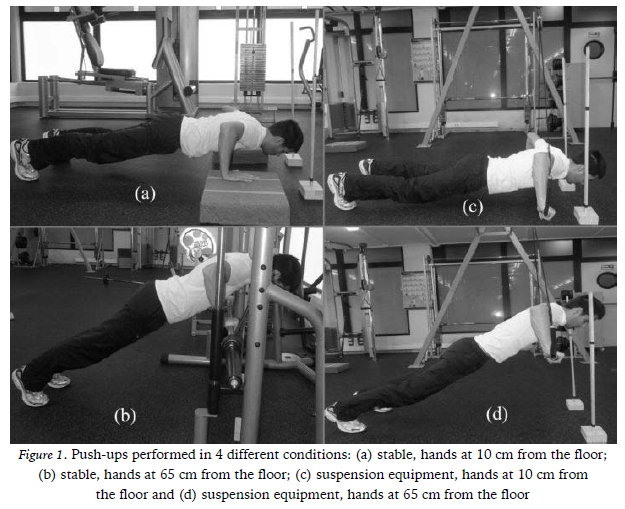
<body><![CDATA[<p><font size="2" face="Verdana"><b>Procedures and Instruments</b></font>     <p><font size="2" face="Verdana">Each   subject took part in 2 sessions: familiarization and experimental sessions -   both at the same time in the morning. The first session took place 48-72 hrs   before data collection in the experimental session. Several restrictions were   imposed on the volunteers: no food, drinks or stimulants (e.g., caffeine) to be   consumed 3-4 hrs before the sessions and no physical activity more intense than   normal daily activities 12 hrs before the exercises. They were instructed to   sleep more than 8 hours the night before data collection. The same   investigators made all measurements, during the morning and the procedures were   always conducted in the same sportive facility (with temperature at 20&#186; C). The study was done during April.</font></p>     <p><i><font size="2" face="Verdana">Familiarization Session</font></i></p>     <p><font size="2" face="Verdana">During the   familiarization session, the participants were familiarized with the push-up   exercise, the stable conditions, suspension device, movement amplitude, body   position and cadence of movement that would later be used during data   collection. Participants practiced the exercises typically 1-3 times each until   the subject felt confident and the researcher was satisfied that the form had   been achieved. In addition, height (IP0955, Invicta Plastics Limited,   Leicester, England), body mass, body fat percentages (Tanita model BF- 350) and   biacromial width were obtained according to the protocols used in previous studies (Garc&#237;a-Mass&#243; et al., 2011).</font></p>     <p><i><font size="2" face="Verdana">Experimental Session</font></i></p>     <p><font size="2" face="Verdana">The   protocol started with the preparation of participants&#8217; skin, followed by   electrode placement, MVIC collection and performance of the exercise. Hair was   removed from the skin overlying the muscles of interest and the skin was then   cleaned by rubbing with cotton wool dipped in alcohol for the subsequent   electrode placement (positioned according to the recommendations of Cram,   Kasman, and Holtz, 1998) on the Triceps Brachii (TRICEP), Upper Trapezius   (TRAPS), Anterior Deltoid (DELT), Clavicular Pectoralis (PEC), Rectus Abdominis   (ABS), Rectus Femoris (FEM), Lumbar Erector Spinae (LUMB) and Gluteus Maximus   (GLUT) on the dominant side of the body. Pre-gelled bipolar silver/silver   chloride surface electrodes (Blue Sensor M-00-S, Medicotest, Olstykke, DNK)   were placed on the following muscle groups with an inter-electrode distance of   25 mm: a) TRICEP (parallel to the muscle fibers, 2 cm medial from midline of   the arm, approximately 50% of the distance between the acromion and the olecranon   or elbow), b) TRAPS (parallel to the muscle fibers of the upper trapezius,   along the ridge of the shoulder, slightly lateral to and one-half the distance   between the cervical spine at C-7 and the acromion), c) DELT (on the anterior   aspect of the arm, approximately 4 cm below the clavicle, parallel to the   muscle fibers), d) PEC (on the chest wall at an oblique angle toward the   clavicle, approximately 2 cm below the clavicle, just medial to the axillary   fold), e) ABS (3 cm apart and parallel to the muscle fibers so that they are   located approximately 2 cm lateral and across from the umbilicus over the   muscle belly), f) FEM (on the center of the anterior surface of the thigh,   approximately half the distance between the knee and the iliac spine, parallel   to the muscle fibers), g) LUMB (parallel to the spine, approximately 2 cm from   the L-3 vertebra over the muscle mass), and h) GLUT (in the middle of the   muscle clearly below the level of the trochanter, 2 to 3 cm above the gluteal   fold). The reference electrode was placed between the active electrodes,   approximately 10 cm away from each muscle, in accordance with the manufacturer&#8217;s   specifications. Once the electrodes were placed, participants performed 2   standard push-ups on the floor in order to check signal saturation. All signals   were acquired at a sampling frequency of 1 kHz, amplified and converted from   analog to digital. All records of myoelectrical activity (in microvolts) were   stored on a hard drive for later analysis. An ME6000P8 (Mega Electronics, Ltd.,   Kuopio, Finland) biosignal conditioner was used to acquire the surface EMG signals produced during exercise.</font></p>     <p><font size="2" face="Verdana">Prior to the   dynamic exercises described below, two 5s MVICs were performed for each muscle   and the trial with the highest EMG was used (Jakobsen, Sundstrup, Andersen,   Aagaard, & Andersen, 2013). Participants performed 1 practice trial to   ensure that they understood the task, 1-minute rest was given between each MVIC   and standardized verbal encouragement was provided to motivate all participants   to achieve their maximum. Positions for the MVICs were performed according to   standardized procedures, chosen based on commonly used muscle testing positions   for the (1) TRICEP (Kendall, McCreary, Provance, Rodgers, & Romani, 2005),   (2) PEC (Snyder & Fry, 2012),(3) DELT (Ekstrom, Soderberg, & Donatelli,   2005), (4) TRAPS (Ekstrom et al., 2005), (5) ABS (Vera-Garc&#237;a, Moreside, & McGill,   2010), (6) LUMB (Jakobsen et al., 2013), (7) GLUT (Distefano, Blackburn, Marshall,   & Padua, 2009), (8) FEM (Jakobsen et al., 2013) and were performed against   a fixed immovable resistance (i.e., Smith machine). Concretely: (1) forearm   extension with elbows at 90&#186; in a seated position an erect posture with no back   support (2) bench press with a grip at 150% of biacromial width, the shoulder   abducted at 45&#186; and feet flat on the bench (3) deltoid flexion at 90&#186; in a   seated position an erect posture with no back support (4) deltoid abduction at   90&#186; in a seated position an erect posture with no back support and (5) curl up   at 40&#186; with arms on chest and pressing against the bar with the participant   lying on the bench and feet flat on the bench, (6) trunk extension (with the participant   lying on the bench and pelvis fixated, the trunk was extended against the bar),   (7) resisting maximum-effort hip extension, performed with the subject lying   prone on a treatment table, with the knee flexed 90&#176; and (8) static knee extension   (with the participant positioned in a Biodex dynamometer: knee angle: 70&#186; and hip angle: 110&#186;).</font></p>     <p><font size="2" face="Verdana">The   participants performed the 3 push-ups under 4 conditions (see <a href="/img/revistas/mot/v10n4/10n04a09f1.jpg">Figure 1</a>) in a   random order to reduce threats to the study&#8217;s internal validity, with 2 min   interval between them. Stable and suspension equipment (AirFit Trainer Pro,   PurMotion&#8482;, Pelham, AL, USA) conditions were performed at 10 cm and 65 cm from   the floor. AirFit Trainer Pro has a main band supported by a spring and a V   cable with a pulley in the middle. Therefore, friction is reduced and greater   unilateral motion is allowed. Greater unilateral movements provide disruptive   torque that contributes to instability (Behm & Colado, 2012), thus this   equipment is considered very unstable. The participants started the push-ups in   an extended arm (up) position with forearms and wrists pronated, feet at   biacromial (shoulder) width. The arm was positioned perpendicular to the floor.   In the down position, the forearm and wrists were kept pronated, while the   elbow was flexed at approximately 90&#186; and the shoulder abducted at approximately   45&#186;. A Cross Line Auto Laser Level was fixated with a tripod (Black &   Decker LZR6TP, New Britain, CT, USA) and used as a visual feedback for   researchers in connection to requested elbow and shoulder joint positioning   during exercises. Hip and spine were maintained neutral during all repetitions.   Push-ups at 10 cm and 65 cm under stable condition were performed with each   hand placed on a box and with both hands grasping a bar in a Smith machine,   respectively. Push-ups at 10 cm and 65 cm with suspension equipment were   performed with each hand grasping a handle. Each subject performed three   consecutive repetitions in all conditions. A 2-second rate for descent and   ascent of an individual push-up cycle was maintained by a 30-Hz metronome   (Ableton Live 6, Ableton AG, Berlin, Germany) to standardize speed of movement   (Freeman et al., 2006). Each subject used a standardized grip width of 150% of   biacromial width (distance in centimeters between the tips of right and left   third digits). Visual feedback was given to the participants in order to   maintain the range of movement and hand distance during the data collection. A   trial was discarded and repeated if participants were unable to perform the exercise with the correct technique.</font></p>     
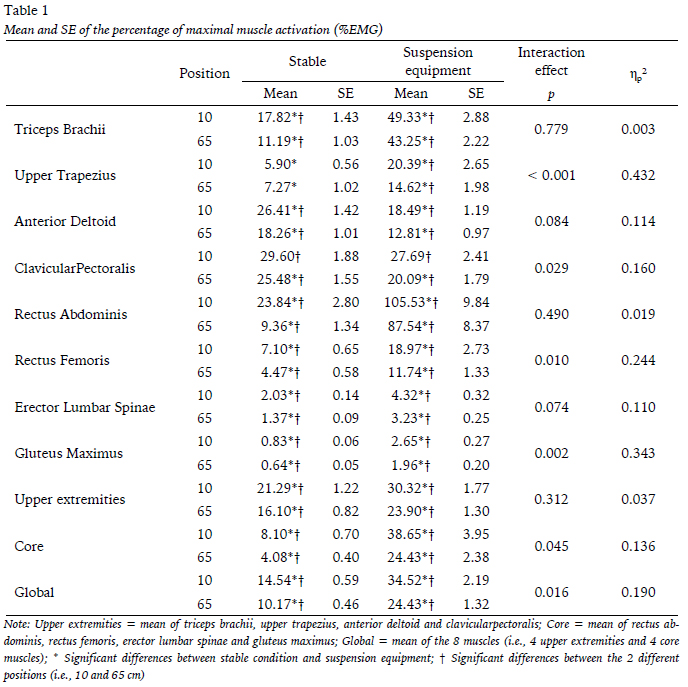
<p><i><font size="2" face="Verdana">Data analysis</font></i></p>     <p><font size="2" face="Verdana">Surface EMG signal analyses were performed formed using Matlab 7.0 (Mathworks Inc., Natick, MA, USA). Surface   EMG signals related to isometric exercises were analyzed by using the 3 middle   seconds of the 5-second isometric contraction. The EMG signals of the dynamic   exercises were analyzed by taking the average of the entire three repetitions.   All signals were bandpass filtered at a 20- to 400-Hz cutoff frequency with a   fourth-order Butterworth filter. Surface EMG amplitude in the time domain was   quantified by using the root mean square (RMS) and processed every 100 ms. Mean   RMS values were selected for every trial. The data obtained were normalized by   using the maximum RMS values during the MVIC and expressed as a percentage of   the maximum EMG (%MVIC). Mean values of the %MVIC of the upper extremities   muscles (i.e. TRICEP, TRAPS, DELT and PEC); of the core muscles (i.e., ABS,   FEM, LUMB and GLUT) and global mean of all muscles (i.e., TRICEP, TRAPS, DELT, PEC, ABS, FEM, LUMB and GLUT) were also calculated and analyzed.</font></p>     ]]></body>
<body><![CDATA[<p><b><font size="2" face="Verdana">Statistical Analyses</font></b>     <p><font size="2" face="Verdana">Statistical   analysis was carried out using SPSS version 17 (SPSS inc., Chicago, IL, USA).   All variables were found to be normally distributed (Shapiro-Wilk&#8217;s normality   test) before data analysis. The results are reported as mean &#177; <i >SE</i>. Statistical comparisons for each   muscle were performed using a two-way (Stability [stable, suspension equipment]   &#215; Height [10 and 65 cm]) repeated measures analysis of variance (ANOVA).   Greenhouse&#8211;Geisser correction was used when the assumption of sphericity   (Mauchly&#8217;s test) was violated. Post hoc analysis with Bonferroni correction was   used in the case of significant effects. Effect sizes are reported as partial   eta-squared (?<sub>p</sub>&#178;), with cut-off values of 0.01, 0.06, and 0.14   for small, medium, and large effects, respectively (Cohen, 1988). Significant   interaction effects were followed by simple effect analyses using Student t-tests.   Significance was accepted when <i >p</i>=   0.05.</font></p>     <p>&nbsp;</p>     <p><font size="3"><b><font face="Verdana">RESULTS</font></b></font>     <p><font size="2" face="Verdana">In the   TRAPS, PEC, FEM, GLUT, Mean core and Global mean there was a significant stability   <i >vs</i>. height interaction. Therefore, the main effects of equipment and position were not examined for these muscles.</font></p>     <p><font size="2" face="Verdana">An analysis   of simple effects revealed that suspended push-ups elicit higher TRAPS, FEM,   GLUT, Mean core and Global mean muscle activation than stable push-ups at 10 cm   and 65 cm, except for PEC where no significant differences were found at 10 cm   and the stable condition leads to significantly higher muscle activation at 65   cm. For all muscles which did not show significant interaction, the push-ups performed   with suspension equipment showed significantly higher TRICEP, ABS, LUMB and   Mean upper extremities muscle activation than those performed in a stable   condition except for DELT where push-ups performed on the floor led to higher muscle activation than</font> <font size="2" face="Verdana"></font><font size="2" face="Verdana">performed with the suspension equipment.</font></p>     <p><font size="2" face="Verdana">Simple   effect analysis also revealed that stable push-ups at 10 cm led to higher PEC,   FEM, GLUT, Mean core and Global mean muscle activation than stable push-up at   65 cm. However, the TRAPS showed no significant differences during the stable   condition. In addition, suspended push-ups at 10 cm lead to higher TRAPS, PEC,   FEM, GLUT, Mean core and Global mean than suspended push-up at 65 cm. For all   muscles which did not show significant interaction, the push-ups performed with   a body position at 10 cm showed significantly higher TRICEP, DELT, ABS, LUMB   and Mean upper extremities muscle activation than those performed with a body position at 65 cm. Complete results are indicated in <a href="/img/revistas/mot/v10n4/10n04a09t1.jpg">Table 1</a>.</font></p>     
<p>&nbsp;</p>     <p><font size="3"><strong><font face="Verdana">DISCUSSION</font></strong></font></p>     <p><font size="3" face="Verdana"></font><font size="2" face="Verdana">The results   of this study supported the first hypothesis: greater global muscle activation   was found when using a suspension device. However, in regard of the second   hypothesis, we expected that stable and unstable conditions would lead to   similar PEC and DELT muscle activation and our results showed that higher or similar muscle activation was achieved under stable condition.</font></p>     ]]></body>
<body><![CDATA[<p><font size="2" face="Verdana">TRICEP   showed more than double the activation with the suspension device in the two   positions when compared with a stable condition. These findings are in   accordance with authors who reported greater TRICEP activation with push-ups on   a Swiss ball (Lehman et al., 2006) than on the floor. On the other hand,   Freeman et al. (2006) found no differences between conditions, although the   unstable device used in this study consisted of two basketballs that probably   lacked the appropriate degree of instability to lead to changes in muscle activation.</font></p>     <p><font size="2" face="Verdana">A   substantial increase occurred for TRAPS using the suspension device, especially   at 10 cm where push-ups elicited more than triple the activation levels when compared   with a stable condition. De Oliveira, de Morais Carvalho, and de Brum (2008)   found greater TRAPS activation when participants performed a one arm maintained   push-up on the medicine ball compared with the same exercise on the floor. In   addition, push-up plus (protracting and retracting scapula) on the floor showed   similar TRAPS activation to push-up plus with feet elevated and hands placed on   a mini-trampoline (Lear & Gross, 1998). However, as the authors stated,   changes in body weight that vary load magnitude and an insufficient instability   degree of the mini-trampoline may explain the insignificant changes (Lear &   Gross, 1998). Probably due to the scapular synergist stabilizer role of the   TRAPS (Lear & Gross, 1998), it seems that a push-up exercise under higher instability doses provides higher TRAPS amount of activation.</font></p>     <p><font size="2" face="Verdana">Different   muscle activation patterns were found for the DELT where standard push-ups on   the floor lead to significantly higher activation. Other studies reported   similar DELT activation during push-ups with the hands on two separate balls   (Freeman et al., 2006) in comparison with a stable surface. Despite variations   in gleno-humeral joint position during the exercise and different instability   degrees may change muscle activity results. Literature findings suggest that   DELT activation do not increase during unstable conditions, which corresponds with our results.</font></p>     <p><font size="2" face="Verdana">We found   that push-ups performed on the floor led to higher PEC activation than push-ups   with suspension equipment at 65 cm, whereas similar activation was found at 10   cm. De Oliveira et al. (2008) reported that a mantained one-arm push-up on   medicine ball decreased PEC activation when compared with a stable surface.   Other studies showed no significant differences for the pectoralis major during   stable push-ups in comparison with push-ups on a Swiss ball (Lehman et al.,   2006). However, Freeman et al. (2006) found that greater pectoralis major   activity occurred when participants performed the exercise with hands on two   separate balls, compared with the stable condition. Due to the primary movement   of the pectoralis major in the push-up and a smaller stabilizer role (Lehman et   al., 2006), it was possible that less instability was required to increase   muscle activation as has been suggested by some authors (Behm & Colado,   2012). At 65 cm, probably due to the same cause and the less body weight load   supported during the flexion, stable push-ups reported greater PEC activation than unstable push-ups.</font></p>     <p><font size="2" face="Verdana">On the   other hand, the instability elicited by the suspension device greatly increased   the activation of core muscles. More specifically, suspended push-ups were very   efficient at promoting ABS activation compared with the stable push-up. Similar   results were found in favour of unstable conditions to elicit ABS muscle   activity during push-ups (Freeman et al., 2006) and other similar positions   such as the push-up plus (Lehman et al., 2006), press up on top (Marshall &   Murphy, 2005), prone bridge (Lehman, Hoda, & Oliver, 2005), and prone   bridge with feet raised on an unstable device (Imai et al., 2010). The greater   activation of FEM when push-ups were performed with the suspension device in   comparison with the floor was probably due to the additional effort re&#173;quired   to sustain the posture and perform the exercise. Care should be taken due to   the pos&#173;sible greater lumbar lordosis when participants show higher FEM   activity (Sundstrup, Jakobsen, Andersen, Jay, & Andersen, 2012). Thus, our   results and others (Sundstrup et al., 2012; Beach et al., 2008) suggest that   standard floor push-ups may be safer for those with low back injury risk.   Suspension equipment pro&#173;voked double the LUMB activation of floor push-ups,   although activity levels were low. In the same vein, a low activation rate in the   same muscle was found during suspended push-ups (Beach et al., 2008) and   push-ups with hands on two balls (Freeman et al., 2006). In addition, no differences   were reported between stable and unstable conditions during a prone bridge   (Lehman et al., 2005) and during a press up on top (Marshall & Murphy,   2005). In contrast, with a similar exercise, Imai et al. (2010) found   differences between the stable and un&#173;stable conditions for LUMB, although the   au&#173;thors used an additional unstable device to keep their feet raised and LUMB   activation was also lower than 20%MVIC. It appears that LUMB may achieve   significant differences with the correct degree of instability. GLUT also   showed higher activation during suspended push-ups than with standard push-ups.   It should be noted that activation levels were also low in both exercises.   Improving GLUT strength and activation is a relevant rehabilita&#173;tion factor and   may reduce the risk of injury (Distefano et al., 2009). The literature includes   attempts to find the most efficient exercises to target the gluteal muscles   (Distefano et al., 2009; Ayotte, Stetts, Keenan, & Greenway, 2007; Boren et al., 2011).</font></p>     <p><font size="2" face="Verdana">Generally,   our results showed that higher intensity was achieved for upper extremity   muscles when more body weight was sup&#173;ported by the hands (i.e., 10 cm) except   for TRAPS, which showed different recruitment patterns to all the other muscles   in a stable condition. The scapular stabilizer role of TRAPS (Lear & Gross,   1998) in a stable con&#173;dition might not be as relevant as in an unsta&#173;ble   condition and therefore any changes were found in the different stable body   positions. In order to stabilize the body and resist external imbalances   (Anderson & Behm, 2005), a greater amount of core muscle activation oc&#173;curred   when greater body weight was sup&#173;ported by the hands and therefore higher in&#173;stability levels were reached.</font></p>     <p>&nbsp;</p>     <p><font size="3" face="Verdana"><b>CONCLUSIONS</b></font>     <p><font size="2" face="Verdana">In   conclusion, if the push-up is performed in order to recruit the pectoralis   major muscle, the suspended version of the exercise provides no additional   benefit. Performing push-ups at 65 cm from the floor decreases exercise   intensity and muscle activity in comparison with the 10 cm position. Intensity   progression may be performed using both heights. It should be pointed out that   performing suspended push-ups may change the recruitment patterns of the   muscles involved. Practitioners must evaluate training goals and be aware that   suspended push-ups increase activation of all muscles (except for PEC and   DELT), reaching high and very high activity levels for TRICEP and ABS, respectively, compared with the classic push-up.</font></p>     <p>&nbsp;</p>     ]]></body>
<body><![CDATA[<p><font size="3"><b><font face="Verdana">REFERENCES</font></b></font></p>     <!-- ref --><p><font size="2" face="Verdana">Anderson, K. & Behm, D. G. (2005). The impact of instability resistance training on balance and stability. <i >Sports Medicine, 35</i>(1), 43-53. doi: 10.2165/00007256-200535010-00004</font>&nbsp;&nbsp;&nbsp;&nbsp;&nbsp;&nbsp;&nbsp;&nbsp;[&#160;<a href="javascript:void(0);" onclick="javascript: window.open('/scielo.php?script=sci_nlinks&ref=000064&pid=S1646-107X201400040000900001&lng=','','width=640,height=500,resizable=yes,scrollbars=1,menubar=yes,');">Links</a>&#160;]<!-- end-ref --><!-- ref --><p><font size="2" face="Verdana">Ayotte, N. W., Stetts, D. M., Keenan, G., & Greenway, E. H. (2007).   Electromyographical analysis of selected lower extremity muscles during 5 unilateral   weight-bearing exercises. <i >Journal of Orthopaedic & Sports Physical Therapy, 37</i>(2), 48-55. doi: 10.2519/jospt.2007.2354</font>&nbsp;&nbsp;&nbsp;&nbsp;&nbsp;&nbsp;&nbsp;&nbsp;[&#160;<a href="javascript:void(0);" onclick="javascript: window.open('/scielo.php?script=sci_nlinks&ref=000065&pid=S1646-107X201400040000900002&lng=','','width=640,height=500,resizable=yes,scrollbars=1,menubar=yes,');">Links</a>&#160;]<!-- end-ref --><!-- ref --><p><font size="2" face="Verdana">Beach, T. A., Howarth, S. J., & Callaghan, J. P. (2008). Muscular   contribution to low-back loading and stiffness during standard and suspended   push-ups. <i >Human Movement Science</i>, 27, 457-472. doi: 10.1016/j.humov.2007.12.002</font>&nbsp;&nbsp;&nbsp;&nbsp;&nbsp;&nbsp;&nbsp;&nbsp;[&#160;<a href="javascript:void(0);" onclick="javascript: window.open('/scielo.php?script=sci_nlinks&ref=000066&pid=S1646-107X201400040000900003&lng=','','width=640,height=500,resizable=yes,scrollbars=1,menubar=yes,');">Links</a>&#160;]<!-- end-ref --><!-- ref --><p><font size="2" face="Verdana">Behm, D. G. & Colado, J. C. (2012). The effectiveness of resistance training using unstable surfaces and devices for rehabilitation. <i >International Journal of Sports Physical Therapy, 7</i>(2), 226-241.    &nbsp;&nbsp;&nbsp;&nbsp;&nbsp;&nbsp;&nbsp;&nbsp;[&#160;<a href="javascript:void(0);" onclick="javascript: window.open('/scielo.php?script=sci_nlinks&ref=000067&pid=S1646-107X201400040000900004&lng=','','width=640,height=500,resizable=yes,scrollbars=1,menubar=yes,');">Links</a>&#160;]<!-- end-ref --></font></p>     <!-- ref --><p><font size="2" face="Verdana">Boren, K., Conrey, C., Le Coguic, J., Paprocki, L., Voight, M., &   Robinson, T. K. (2011). Electromyographic analysis of gluteus medius and gluteus   maximus during rehabilitation exercises. <i >International     Journal of Sports Physical Therapy</i>, <i >6</i>(3), 206-223.    &nbsp;&nbsp;&nbsp;&nbsp;&nbsp;&nbsp;&nbsp;&nbsp;[&#160;<a href="javascript:void(0);" onclick="javascript: window.open('/scielo.php?script=sci_nlinks&ref=000069&pid=S1646-107X201400040000900005&lng=','','width=640,height=500,resizable=yes,scrollbars=1,menubar=yes,');">Links</a>&#160;]<!-- end-ref --></font></p>     <!-- ref --><p><font size="2" face="Verdana">Cohen, J. (1988). <i >Statistical   power analysis for the behavioral sciences. </i>Hillsdale, NJ: Lawrence Erlbaum.    &nbsp;&nbsp;&nbsp;&nbsp;&nbsp;&nbsp;&nbsp;&nbsp;[&#160;<a href="javascript:void(0);" onclick="javascript: window.open('/scielo.php?script=sci_nlinks&ref=000071&pid=S1646-107X201400040000900006&lng=','','width=640,height=500,resizable=yes,scrollbars=1,menubar=yes,');">Links</a>&#160;]<!-- end-ref --></font></p>     ]]></body>
<body><![CDATA[<!-- ref --><p><font size="2" face="Verdana">Cram, J. R., Kasman, G. S., & Holtz, J. (1998). <i >Introduction to surface electromyography</i>. Gaithersburg: Aspen Publishers.    &nbsp;&nbsp;&nbsp;&nbsp;&nbsp;&nbsp;&nbsp;&nbsp;[&#160;<a href="javascript:void(0);" onclick="javascript: window.open('/scielo.php?script=sci_nlinks&ref=000073&pid=S1646-107X201400040000900007&lng=','','width=640,height=500,resizable=yes,scrollbars=1,menubar=yes,');">Links</a>&#160;]<!-- end-ref --></font></p>     <!-- ref --><p><font size="2" face="Verdana">de Oliveira, A. S., de Morais Carvalho, M.,   & de Brum, D. P. (2008). Activation   of the shoulder and arm muscles during axial load exercises on a stable base of   support and on a medicine ball. <i >Journal     of Electromyogrography and Kinesiology, 18</i>(3), 472-479. doi: 10.1016/j.jelekin.2006.09.009</font>&nbsp;&nbsp;&nbsp;&nbsp;&nbsp;&nbsp;&nbsp;&nbsp;[&#160;<a href="javascript:void(0);" onclick="javascript: window.open('/scielo.php?script=sci_nlinks&ref=000075&pid=S1646-107X201400040000900008&lng=','','width=640,height=500,resizable=yes,scrollbars=1,menubar=yes,');">Links</a>&#160;]<!-- end-ref --><!-- ref --><p><font size="2" face="Verdana">Distefano, L. J., Blackburn, J. T., Marshall, S. W., & Padua, D. A.   (2009). Gluteal muscle activation during common therapeutic exercises. <i >Journal of Orthopaedic & Sports Physical Therapy, 39</i>(7), 532-540. doi: 10.2519/jospt.2009.2796</font>&nbsp;&nbsp;&nbsp;&nbsp;&nbsp;&nbsp;&nbsp;&nbsp;[&#160;<a href="javascript:void(0);" onclick="javascript: window.open('/scielo.php?script=sci_nlinks&ref=000076&pid=S1646-107X201400040000900009&lng=','','width=640,height=500,resizable=yes,scrollbars=1,menubar=yes,');">Links</a>&#160;]<!-- end-ref --><!-- ref --><p><font size="2" face="Verdana">Ekstrom, R. A., Soderberg, G. L., & Donatelli, R. A. (2005).   Normalization procedures using maximum voluntary isometric contractions for the   serratus anterior and trapezius muscles during surface EMG analysis. <i >Journal of Electromyography and Kinesiology, 15</i>(4), 418-428. doi: 10.1016/j.jelekin.2004.09.006</font>&nbsp;&nbsp;&nbsp;&nbsp;&nbsp;&nbsp;&nbsp;&nbsp;[&#160;<a href="javascript:void(0);" onclick="javascript: window.open('/scielo.php?script=sci_nlinks&ref=000077&pid=S1646-107X201400040000900010&lng=','','width=640,height=500,resizable=yes,scrollbars=1,menubar=yes,');">Links</a>&#160;]<!-- end-ref --><!-- ref --><p><font size="2" face="Verdana">Freeman, S., Karpowicz, A, Gray, J., & McGill, S. (2006).   Quantifying muscle patterns and spine load during various forms of the push-up. <i >Medicine and Science in Sports and Exercise, 38</i>(3), 570-577.    &nbsp;&nbsp;&nbsp;&nbsp;&nbsp;&nbsp;&nbsp;&nbsp;[&#160;<a href="javascript:void(0);" onclick="javascript: window.open('/scielo.php?script=sci_nlinks&ref=000078&pid=S1646-107X201400040000900011&lng=','','width=640,height=500,resizable=yes,scrollbars=1,menubar=yes,');">Links</a>&#160;]<!-- end-ref --></font></p>     <!-- ref --><p><font size="2" face="Verdana">Garc&#237;a-Mass&#243;, X., Colado, J. C., Gonz&#225;lez, L. M., Salv&#225;, P., Alves J.,   Tella, V., & Triplett, N. T. (2011). Myoelectric activation and kinetics of   different plyometric push-up exercises. <i >Journal     of Strength and Conditioning Research, 25</i>, 2040-2047. doi: 10.1519/JSC.0b013e3181e4f7ce</font>&nbsp;&nbsp;&nbsp;&nbsp;&nbsp;&nbsp;&nbsp;&nbsp;[&#160;<a href="javascript:void(0);" onclick="javascript: window.open('/scielo.php?script=sci_nlinks&ref=000080&pid=S1646-107X201400040000900012&lng=','','width=640,height=500,resizable=yes,scrollbars=1,menubar=yes,');">Links</a>&#160;]<!-- end-ref --><!-- ref --><p><font size="2" face="Verdana">Gouvali, M. K. & Boudolos, K. (2005). Dynamic and electromyographical   analysis in variants of push-up exercise. <i >Journal of Strength and Conditioning Research, 19</i>(1), 146-151. doi: 10.1519/14733.1</font>&nbsp;&nbsp;&nbsp;&nbsp;&nbsp;&nbsp;&nbsp;&nbsp;[&#160;<a href="javascript:void(0);" onclick="javascript: window.open('/scielo.php?script=sci_nlinks&ref=000081&pid=S1646-107X201400040000900013&lng=','','width=640,height=500,resizable=yes,scrollbars=1,menubar=yes,');">Links</a>&#160;]<!-- end-ref --><!-- ref --><p><font size="2" face="Verdana">Imai, A., Kaneoka, K., Okubo, Y., Shiina, I., Tatsumura, M., Izumi, S.,   & Shiraki, H. (2010). Trunk muscle activity during lumbar stabilization exercises   on both a stable and unstable surface. <i >Journal     of Orthopaedic & Sports Physical Therapy, 40</i>(6), 369-375. doi: 10.2519/jospt.2010.3211</font>&nbsp;&nbsp;&nbsp;&nbsp;&nbsp;&nbsp;&nbsp;&nbsp;[&#160;<a href="javascript:void(0);" onclick="javascript: window.open('/scielo.php?script=sci_nlinks&ref=000082&pid=S1646-107X201400040000900014&lng=','','width=640,height=500,resizable=yes,scrollbars=1,menubar=yes,');">Links</a>&#160;]<!-- end-ref --><!-- ref --><p><font size="2" face="Verdana">Jakobsen, M. D., Sundstrup, E., Andersen, C. H., Aagaard, P., &   Andersen, L. L. (2013). Muscle activity during leg strengthening exercise using   free weights and elastic resistance: Effects of ballistic vs. controlled   contractions. <i >Human Movement Science, 32</i>(1), 65-78. doi: 10.1016/j.humov.2012.07.002</font>&nbsp;&nbsp;&nbsp;&nbsp;&nbsp;&nbsp;&nbsp;&nbsp;[&#160;<a href="javascript:void(0);" onclick="javascript: window.open('/scielo.php?script=sci_nlinks&ref=000083&pid=S1646-107X201400040000900015&lng=','','width=640,height=500,resizable=yes,scrollbars=1,menubar=yes,');">Links</a>&#160;]<!-- end-ref --><!-- ref --><p><font size="2" face="Verdana">Kendall, F. P., McCreary, E. K., Provance, P. G., Rodgers, M. M., &   Romani, W. A. (2005). <i >Muscles: Testing and     function with posture and pain</i> (5th ed.). Baltimore: Lippincott Williams & Wilkins.    &nbsp;&nbsp;&nbsp;&nbsp;&nbsp;&nbsp;&nbsp;&nbsp;[&#160;<a href="javascript:void(0);" onclick="javascript: window.open('/scielo.php?script=sci_nlinks&ref=000084&pid=S1646-107X201400040000900016&lng=','','width=640,height=500,resizable=yes,scrollbars=1,menubar=yes,');">Links</a>&#160;]<!-- end-ref --></font></p>     <!-- ref --><p><font size="2" face="Verdana">Lear, L. J., & Gross, M.T. (1998). An electromyographical analysis   of the scapular stabilizing synergists during a push-up progression. <i >Journal of Orthopaedic & Sports Physical Therapy, 28</i>(3), 146-157. doi: 10.2519/jospt.1998.28.3.146</font>&nbsp;&nbsp;&nbsp;&nbsp;&nbsp;&nbsp;&nbsp;&nbsp;[&#160;<a href="javascript:void(0);" onclick="javascript: window.open('/scielo.php?script=sci_nlinks&ref=000086&pid=S1646-107X201400040000900017&lng=','','width=640,height=500,resizable=yes,scrollbars=1,menubar=yes,');">Links</a>&#160;]<!-- end-ref --><!-- ref --><p><font size="2" face="Verdana">Lehman, G. J., Hoda, W., & Oliver, S. (2005). Trunk muscle activity during   bridging exercises on and off a Swiss ball. <i >Chiropractic & osteopathy, 13</i>, 14. doi: 10.1186/1746-1340-13-14</font>&nbsp;&nbsp;&nbsp;&nbsp;&nbsp;&nbsp;&nbsp;&nbsp;[&#160;<a href="javascript:void(0);" onclick="javascript: window.open('/scielo.php?script=sci_nlinks&ref=000087&pid=S1646-107X201400040000900018&lng=','','width=640,height=500,resizable=yes,scrollbars=1,menubar=yes,');">Links</a>&#160;]<!-- end-ref --><!-- ref --><p><font size="2" face="Verdana">Lehman, G. J., MacMillan, B., MacIntyre, I., Chivers, M., & Fluter,   M. (2006). Shoulder muscle EMG activity during push up variations on and off a   Swiss ball. <i >Dynamic Medicine, 5</i>, 7. doi: 10.1186/1476-5918-5-7.    &nbsp;&nbsp;&nbsp;&nbsp;&nbsp;&nbsp;&nbsp;&nbsp;[&#160;<a href="javascript:void(0);" onclick="javascript: window.open('/scielo.php?script=sci_nlinks&ref=000088&pid=S1646-107X201400040000900019&lng=','','width=640,height=500,resizable=yes,scrollbars=1,menubar=yes,');">Links</a>&#160;]<!-- end-ref --></font></p>     <!-- ref --><p><font size="2" face="Verdana">Marshall, P. W., & Murphy B. A. (2005). Core stability exercises on   and off a Swiss ball. <i >Archives of Physical Medicine and Rehabilitation, 86</i>(2), 242-249. doi:10.1016/j.apmr.2004.05.004</font>&nbsp;&nbsp;&nbsp;&nbsp;&nbsp;&nbsp;&nbsp;&nbsp;[&#160;<a href="javascript:void(0);" onclick="javascript: window.open('/scielo.php?script=sci_nlinks&ref=000090&pid=S1646-107X201400040000900020&lng=','','width=640,height=500,resizable=yes,scrollbars=1,menubar=yes,');">Links</a>&#160;]<!-- end-ref --><!-- ref --><p><font size="2" face="Verdana">Snyder, B. J. & Fry, W. R. (2012). Effect of verbal instruction on   muscle activity during the bench press exercise. <i >Journal of Strength and Conditioning Research, 26</i>(9), 2394-2400. doi: 10.1519/JSC.0b013e31823f8d11.    &nbsp;&nbsp;&nbsp;&nbsp;&nbsp;&nbsp;&nbsp;&nbsp;[&#160;<a href="javascript:void(0);" onclick="javascript: window.open('/scielo.php?script=sci_nlinks&ref=000091&pid=S1646-107X201400040000900021&lng=','','width=640,height=500,resizable=yes,scrollbars=1,menubar=yes,');">Links</a>&#160;]<!-- end-ref --></font></p>     ]]></body>
<body><![CDATA[<!-- ref --><p><font size="2" face="Verdana">Sundstrup, E., Jakobsen, M. D., Andersen, C. H., Jay, K., &   Andersen, L. L. (2012). Swiss ball abdominal crunch with added elastic resistance is an effective alternative to training machines. <i >International Journal of Sports Physical Therapy, 7</i>(4), 372-380.    &nbsp;&nbsp;&nbsp;&nbsp;&nbsp;&nbsp;&nbsp;&nbsp;[&#160;<a href="javascript:void(0);" onclick="javascript: window.open('/scielo.php?script=sci_nlinks&ref=000093&pid=S1646-107X201400040000900022&lng=','','width=640,height=500,resizable=yes,scrollbars=1,menubar=yes,');">Links</a>&#160;]<!-- end-ref --></font></p>     <!-- ref --><p><font size="2" face="Verdana">Vera-Garc&#237;a, F. J., Moreside, J. M., &   McGill, S. M. (2010). MVC   techniques to normalize trunk muscle EMG in healthy women. <i >Journal of Electromyography and Kinesiology, 20</i>(1), 10-16. doi: 10.1016/j.jelekin.2009.03.010.    &nbsp;&nbsp;&nbsp;&nbsp;&nbsp;&nbsp;&nbsp;&nbsp;[&#160;<a href="javascript:void(0);" onclick="javascript: window.open('/scielo.php?script=sci_nlinks&ref=000095&pid=S1646-107X201400040000900023&lng=','','width=640,height=500,resizable=yes,scrollbars=1,menubar=yes,');">Links</a>&#160;]<!-- end-ref --></font></p>     <!-- ref --><p><font size="2" face="Verdana">Youdas, J., Budach, B., Ellerbusch, J., Stucky, C., Wait, K., & Hollman,   J. (2010). Comparison of muscle-activation patterns during the conventional   push-up and perfect pushup&#8482; exercises. <i >Journal of Strength and Conditioning Research, </i>24(12), 3352-3362. doi: 10.1519/JSC.0b013e3181cc23b0</font>&nbsp;&nbsp;&nbsp;&nbsp;&nbsp;&nbsp;&nbsp;&nbsp;[&#160;<a href="javascript:void(0);" onclick="javascript: window.open('/scielo.php?script=sci_nlinks&ref=000097&pid=S1646-107X201400040000900024&lng=','','width=640,height=500,resizable=yes,scrollbars=1,menubar=yes,');">Links</a>&#160;]<!-- end-ref --><p>&nbsp;</p>     <p><font size="2" face="Verdana"><b >Acknowledgments:    <br> </b>The   authors wish to thank the participants for their contribution to this study. In   addition, the authors thank specially Aerobic & Fitness S. L. (Sant Salvador   de Guardiola, Barcelona, Spain) for the donation of the suspension equipment employed.    <br> <b >Conflicts of Interest    <br> </b>Nothing to declare.    ]]></body>
<body><![CDATA[<br> <b >Funding:    <br> </b>Nothing to declare.</font></p>     <p><font size="2" face="Verdana">Manuscript received January 20, 2014; Revised February 18, 2014;   Accepted March 13, 2014</font></p>     <p>&nbsp;</p>     <p>&nbsp;</p>     <p><font size="2" face="Verdana"><a name="end"></a><a href="#topo">*</a><i >Corresponding author</i>: Universidad   de Valencia (FCAFE), Aulario Multiusos, C/ Gasco Oliag, 3, 46010 Valencia,   Spain; <i >E-mail</i>: <a href="mailto:juan.colado@uv.es">juan.colado@uv.es</a></font></p>      ]]></body><back>
<ref-list>
<ref id="B1">
<nlm-citation citation-type="journal">
<person-group person-group-type="author">
<name>
<surname><![CDATA[Anderson]]></surname>
<given-names><![CDATA[K.]]></given-names>
</name>
<name>
<surname><![CDATA[Behm]]></surname>
<given-names><![CDATA[D. G.]]></given-names>
</name>
</person-group>
<article-title xml:lang="en"><![CDATA[The impact of instability resistance training on balance and stability]]></article-title>
<source><![CDATA[Sports Medicine]]></source>
<year>2005</year>
<volume>35</volume>
<numero>1</numero>
<issue>1</issue>
<page-range>43-53</page-range></nlm-citation>
</ref>
<ref id="B2">
<nlm-citation citation-type="journal">
<person-group person-group-type="author">
<name>
<surname><![CDATA[Ayotte]]></surname>
<given-names><![CDATA[N. W.]]></given-names>
</name>
<name>
<surname><![CDATA[Stetts]]></surname>
<given-names><![CDATA[D. M.]]></given-names>
</name>
<name>
<surname><![CDATA[Keenan]]></surname>
<given-names><![CDATA[G.]]></given-names>
</name>
<name>
<surname><![CDATA[Greenway]]></surname>
<given-names><![CDATA[E. H.]]></given-names>
</name>
</person-group>
<article-title xml:lang="en"><![CDATA[Electromyographical analysis of selected lower extremity muscles during 5 unilateral weight-bearing exercises]]></article-title>
<source><![CDATA[Journal of Orthopaedic & Sports Physical Therapy]]></source>
<year>2007</year>
<volume>37</volume>
<numero>2</numero>
<issue>2</issue>
<page-range>48-55</page-range></nlm-citation>
</ref>
<ref id="B3">
<nlm-citation citation-type="journal">
<person-group person-group-type="author">
<name>
<surname><![CDATA[Beach]]></surname>
<given-names><![CDATA[T. A.]]></given-names>
</name>
<name>
<surname><![CDATA[Howarth]]></surname>
<given-names><![CDATA[S. J.]]></given-names>
</name>
<name>
<surname><![CDATA[Callaghan]]></surname>
<given-names><![CDATA[J. P.]]></given-names>
</name>
</person-group>
<article-title xml:lang="en"><![CDATA[Muscular contribution to low-back loading and stiffness during standard and suspended push-ups]]></article-title>
<source><![CDATA[Human Movement Science]]></source>
<year>2008</year>
<volume>27</volume>
<page-range>457-472</page-range></nlm-citation>
</ref>
<ref id="B4">
<nlm-citation citation-type="journal">
<person-group person-group-type="author">
<name>
<surname><![CDATA[Behm]]></surname>
<given-names><![CDATA[D. G.]]></given-names>
</name>
<name>
<surname><![CDATA[Colado]]></surname>
<given-names><![CDATA[J. C.]]></given-names>
</name>
</person-group>
<article-title xml:lang="en"><![CDATA[The effectiveness of resistance training using unstable surfaces and devices for rehabilitation]]></article-title>
<source><![CDATA[International Journal of Sports Physical Therapy]]></source>
<year>2012</year>
<volume>7</volume>
<numero>2</numero>
<issue>2</issue>
<page-range>226-241</page-range></nlm-citation>
</ref>
<ref id="B5">
<nlm-citation citation-type="journal">
<person-group person-group-type="author">
<name>
<surname><![CDATA[Boren]]></surname>
<given-names><![CDATA[K.]]></given-names>
</name>
<name>
<surname><![CDATA[Conrey]]></surname>
<given-names><![CDATA[C.]]></given-names>
</name>
<name>
<surname><![CDATA[Le Coguic]]></surname>
<given-names><![CDATA[J.]]></given-names>
</name>
<name>
<surname><![CDATA[Paprocki]]></surname>
<given-names><![CDATA[L.]]></given-names>
</name>
<name>
<surname><![CDATA[Voight]]></surname>
<given-names><![CDATA[M.]]></given-names>
</name>
<name>
<surname><![CDATA[Robinson]]></surname>
<given-names><![CDATA[T. K.]]></given-names>
</name>
</person-group>
<article-title xml:lang="en"><![CDATA[Electromyographic analysis of gluteus medius and gluteus maximus during rehabilitation exercises]]></article-title>
<source><![CDATA[International Journal of Sports Physical Therapy]]></source>
<year>2011</year>
<volume>6</volume>
<numero>3</numero>
<issue>3</issue>
<page-range>206-223</page-range></nlm-citation>
</ref>
<ref id="B6">
<nlm-citation citation-type="book">
<person-group person-group-type="author">
<name>
<surname><![CDATA[Cohen]]></surname>
<given-names><![CDATA[J.]]></given-names>
</name>
</person-group>
<source><![CDATA[Statistical power analysis for the behavioral sciences]]></source>
<year>1988</year>
<publisher-loc><![CDATA[Hillsdale^eNJ NJ]]></publisher-loc>
<publisher-name><![CDATA[Lawrence Erlbaum]]></publisher-name>
</nlm-citation>
</ref>
<ref id="B7">
<nlm-citation citation-type="book">
<person-group person-group-type="author">
<name>
<surname><![CDATA[Cram]]></surname>
<given-names><![CDATA[J. R.]]></given-names>
</name>
<name>
<surname><![CDATA[Kasman]]></surname>
<given-names><![CDATA[G. S.]]></given-names>
</name>
<name>
<surname><![CDATA[Holtz]]></surname>
<given-names><![CDATA[J.]]></given-names>
</name>
</person-group>
<source><![CDATA[Introduction to surface electromyography]]></source>
<year>1998</year>
<publisher-loc><![CDATA[Gaithersburg ]]></publisher-loc>
<publisher-name><![CDATA[Aspen Publishers]]></publisher-name>
</nlm-citation>
</ref>
<ref id="B8">
<nlm-citation citation-type="journal">
<person-group person-group-type="author">
<name>
<surname><![CDATA[de Oliveira]]></surname>
<given-names><![CDATA[A. S.]]></given-names>
</name>
<name>
<surname><![CDATA[de Morais Carvalho]]></surname>
<given-names><![CDATA[M.]]></given-names>
</name>
<name>
<surname><![CDATA[de Brum]]></surname>
<given-names><![CDATA[D. P.]]></given-names>
</name>
</person-group>
<article-title xml:lang="en"><![CDATA[Activation of the shoulder and arm muscles during axial load exercises on a stable base of support and on a medicine ball]]></article-title>
<source><![CDATA[Journal of Electromyogrography and Kinesiology]]></source>
<year>2008</year>
<volume>18</volume>
<numero>3</numero>
<issue>3</issue>
<page-range>472-479</page-range></nlm-citation>
</ref>
<ref id="B9">
<nlm-citation citation-type="journal">
<person-group person-group-type="author">
<name>
<surname><![CDATA[Distefano]]></surname>
<given-names><![CDATA[L. J.]]></given-names>
</name>
<name>
<surname><![CDATA[Blackburn]]></surname>
<given-names><![CDATA[J. T.]]></given-names>
</name>
<name>
<surname><![CDATA[Marshall]]></surname>
<given-names><![CDATA[S. W.]]></given-names>
</name>
<name>
<surname><![CDATA[Padua]]></surname>
<given-names><![CDATA[D. A.]]></given-names>
</name>
</person-group>
<article-title xml:lang="en"><![CDATA[Gluteal muscle activation during common therapeutic exercises]]></article-title>
<source><![CDATA[Journal of Orthopaedic & Sports Physical Therapy]]></source>
<year>2009</year>
<volume>39</volume>
<numero>7</numero>
<issue>7</issue>
<page-range>532-540</page-range></nlm-citation>
</ref>
<ref id="B10">
<nlm-citation citation-type="journal">
<person-group person-group-type="author">
<name>
<surname><![CDATA[Ekstrom]]></surname>
<given-names><![CDATA[R. A.]]></given-names>
</name>
<name>
<surname><![CDATA[Soderberg]]></surname>
<given-names><![CDATA[G. L.]]></given-names>
</name>
<name>
<surname><![CDATA[Donatelli]]></surname>
<given-names><![CDATA[R. A.]]></given-names>
</name>
</person-group>
<article-title xml:lang="en"><![CDATA[Normalization procedures using maximum voluntary isometric contractions for the serratus anterior and trapezius muscles during surface EMG analysis]]></article-title>
<source><![CDATA[Journal of Electromyography and Kinesiology]]></source>
<year>2005</year>
<volume>15</volume>
<numero>4</numero>
<issue>4</issue>
<page-range>418-428</page-range></nlm-citation>
</ref>
<ref id="B11">
<nlm-citation citation-type="journal">
<person-group person-group-type="author">
<name>
<surname><![CDATA[Freeman]]></surname>
<given-names><![CDATA[S.]]></given-names>
</name>
<name>
<surname><![CDATA[Karpowicz]]></surname>
<given-names><![CDATA[A]]></given-names>
</name>
<name>
<surname><![CDATA[Gray]]></surname>
<given-names><![CDATA[J.]]></given-names>
</name>
<name>
<surname><![CDATA[McGill]]></surname>
<given-names><![CDATA[S.]]></given-names>
</name>
</person-group>
<article-title xml:lang="en"><![CDATA[Quantifying muscle patterns and spine load during various forms of the push-up]]></article-title>
<source><![CDATA[Medicine and Science in Sports and Exercise]]></source>
<year>2006</year>
<volume>38</volume>
<numero>3</numero>
<issue>3</issue>
<page-range>570-577</page-range></nlm-citation>
</ref>
<ref id="B12">
<nlm-citation citation-type="journal">
<person-group person-group-type="author">
<name>
<surname><![CDATA[García-Massó]]></surname>
<given-names><![CDATA[X.]]></given-names>
</name>
<name>
<surname><![CDATA[Colado]]></surname>
<given-names><![CDATA[J. C.]]></given-names>
</name>
<name>
<surname><![CDATA[González]]></surname>
<given-names><![CDATA[L. M.]]></given-names>
</name>
<name>
<surname><![CDATA[Salvá]]></surname>
<given-names><![CDATA[P.]]></given-names>
</name>
<name>
<surname><![CDATA[Alves]]></surname>
<given-names><![CDATA[J.]]></given-names>
</name>
<name>
<surname><![CDATA[Tella]]></surname>
<given-names><![CDATA[V.]]></given-names>
</name>
<name>
<surname><![CDATA[Triplett]]></surname>
<given-names><![CDATA[N. T.]]></given-names>
</name>
</person-group>
<article-title xml:lang="en"><![CDATA[Myoelectric activation and kinetics of different plyometric push-up exercises]]></article-title>
<source><![CDATA[Journal of Strength and Conditioning Research]]></source>
<year>2011</year>
<volume>25</volume>
<page-range>2040-2047</page-range></nlm-citation>
</ref>
<ref id="B13">
<nlm-citation citation-type="journal">
<person-group person-group-type="author">
<name>
<surname><![CDATA[Gouvali]]></surname>
<given-names><![CDATA[M. K.]]></given-names>
</name>
<name>
<surname><![CDATA[Boudolos]]></surname>
<given-names><![CDATA[K.]]></given-names>
</name>
</person-group>
<article-title xml:lang="en"><![CDATA[Dynamic and electromyographical analysis in variants of push-up exercise]]></article-title>
<source><![CDATA[Journal of Strength and Conditioning Research]]></source>
<year>2005</year>
<volume>19</volume>
<numero>1</numero>
<issue>1</issue>
<page-range>146-151</page-range></nlm-citation>
</ref>
<ref id="B14">
<nlm-citation citation-type="journal">
<person-group person-group-type="author">
<name>
<surname><![CDATA[Imai]]></surname>
<given-names><![CDATA[A.]]></given-names>
</name>
<name>
<surname><![CDATA[Kaneoka]]></surname>
<given-names><![CDATA[K.]]></given-names>
</name>
<name>
<surname><![CDATA[Okubo]]></surname>
<given-names><![CDATA[Y.]]></given-names>
</name>
<name>
<surname><![CDATA[Shiina]]></surname>
<given-names><![CDATA[I.]]></given-names>
</name>
<name>
<surname><![CDATA[Tatsumura]]></surname>
<given-names><![CDATA[M.]]></given-names>
</name>
<name>
<surname><![CDATA[Izumi]]></surname>
<given-names><![CDATA[S.]]></given-names>
</name>
<name>
<surname><![CDATA[Shiraki]]></surname>
<given-names><![CDATA[H.]]></given-names>
</name>
</person-group>
<article-title xml:lang="en"><![CDATA[Trunk muscle activity during lumbar stabilization exercises on both a stable and unstable surface]]></article-title>
<source><![CDATA[Journal of Orthopaedic & Sports Physical Therapy]]></source>
<year>2010</year>
<volume>40</volume>
<numero>6</numero>
<issue>6</issue>
<page-range>369-375</page-range></nlm-citation>
</ref>
<ref id="B15">
<nlm-citation citation-type="journal">
<person-group person-group-type="author">
<name>
<surname><![CDATA[Jakobsen]]></surname>
<given-names><![CDATA[M. D.]]></given-names>
</name>
<name>
<surname><![CDATA[Sundstrup]]></surname>
<given-names><![CDATA[E.]]></given-names>
</name>
<name>
<surname><![CDATA[Andersen]]></surname>
<given-names><![CDATA[C. H.]]></given-names>
</name>
<name>
<surname><![CDATA[Aagaard]]></surname>
<given-names><![CDATA[P.]]></given-names>
</name>
<name>
<surname><![CDATA[Andersen]]></surname>
<given-names><![CDATA[L. L.]]></given-names>
</name>
</person-group>
<article-title xml:lang="en"><![CDATA[Muscle activity during leg strengthening exercise using free weights and elastic resistance: Effects of ballistic vs. controlled contractions]]></article-title>
<source><![CDATA[Human Movement Science]]></source>
<year>2013</year>
<volume>32</volume>
<numero>1</numero>
<issue>1</issue>
<page-range>65-78</page-range></nlm-citation>
</ref>
<ref id="B16">
<nlm-citation citation-type="book">
<person-group person-group-type="author">
<name>
<surname><![CDATA[Kendall]]></surname>
<given-names><![CDATA[F. P.]]></given-names>
</name>
<name>
<surname><![CDATA[McCreary]]></surname>
<given-names><![CDATA[E. K.]]></given-names>
</name>
<name>
<surname><![CDATA[Provance]]></surname>
<given-names><![CDATA[P. G.]]></given-names>
</name>
<name>
<surname><![CDATA[Rodgers]]></surname>
<given-names><![CDATA[M. M.]]></given-names>
</name>
<name>
<surname><![CDATA[Romani]]></surname>
<given-names><![CDATA[W. A.]]></given-names>
</name>
</person-group>
<source><![CDATA[Muscles: Testing and function with posture and pain]]></source>
<year>2005</year>
<edition>5</edition>
<publisher-loc><![CDATA[Baltimore ]]></publisher-loc>
<publisher-name><![CDATA[Lippincott Williams & Wilkins]]></publisher-name>
</nlm-citation>
</ref>
<ref id="B17">
<nlm-citation citation-type="journal">
<person-group person-group-type="author">
<name>
<surname><![CDATA[Lear]]></surname>
<given-names><![CDATA[L. J.]]></given-names>
</name>
<name>
<surname><![CDATA[Gross]]></surname>
<given-names><![CDATA[M.T.]]></given-names>
</name>
</person-group>
<article-title xml:lang="en"><![CDATA[An electromyographical analysis of the scapular stabilizing synergists during a push-up progression]]></article-title>
<source><![CDATA[Journal of Orthopaedic & Sports Physical Therapy]]></source>
<year>1998</year>
<volume>28</volume>
<numero>3</numero>
<issue>3</issue>
<page-range>146-157</page-range></nlm-citation>
</ref>
<ref id="B18">
<nlm-citation citation-type="journal">
<person-group person-group-type="author">
<name>
<surname><![CDATA[Lehman]]></surname>
<given-names><![CDATA[G. J.]]></given-names>
</name>
<name>
<surname><![CDATA[Hoda]]></surname>
<given-names><![CDATA[W.]]></given-names>
</name>
<name>
<surname><![CDATA[Oliver]]></surname>
<given-names><![CDATA[S.]]></given-names>
</name>
</person-group>
<article-title xml:lang="en"><![CDATA[Trunk muscle activity during bridging exercises on and off a Swiss ball]]></article-title>
<source><![CDATA[Chiropractic & osteopathy]]></source>
<year>2005</year>
<volume>13</volume>
<numero>14</numero>
<issue>14</issue>
</nlm-citation>
</ref>
<ref id="B19">
<nlm-citation citation-type="journal">
<person-group person-group-type="author">
<name>
<surname><![CDATA[Lehman]]></surname>
<given-names><![CDATA[G. J.]]></given-names>
</name>
<name>
<surname><![CDATA[MacMillan]]></surname>
<given-names><![CDATA[B.]]></given-names>
</name>
<name>
<surname><![CDATA[MacIntyre]]></surname>
<given-names><![CDATA[I.]]></given-names>
</name>
<name>
<surname><![CDATA[Chivers]]></surname>
<given-names><![CDATA[M.]]></given-names>
</name>
<name>
<surname><![CDATA[Fluter]]></surname>
<given-names><![CDATA[M.]]></given-names>
</name>
</person-group>
<article-title xml:lang="en"><![CDATA[Shoulder muscle EMG activity during push up variations on and off a Swiss ball]]></article-title>
<source><![CDATA[Dynamic Medicine]]></source>
<year>2006</year>
<volume>5</volume>
<page-range>7</page-range></nlm-citation>
</ref>
<ref id="B20">
<nlm-citation citation-type="journal">
<person-group person-group-type="author">
<name>
<surname><![CDATA[Marshall]]></surname>
<given-names><![CDATA[P. W.]]></given-names>
</name>
<name>
<surname><![CDATA[Murphy]]></surname>
<given-names><![CDATA[B. A.]]></given-names>
</name>
</person-group>
<article-title xml:lang="en"><![CDATA[Core stability exercises on and off a Swiss ball]]></article-title>
<source><![CDATA[Archives of Physical Medicine and Rehabilitation]]></source>
<year>2005</year>
<volume>86</volume>
<numero>2</numero>
<issue>2</issue>
<page-range>242-249</page-range></nlm-citation>
</ref>
<ref id="B21">
<nlm-citation citation-type="journal">
<person-group person-group-type="author">
<name>
<surname><![CDATA[Snyder]]></surname>
<given-names><![CDATA[B. J.]]></given-names>
</name>
<name>
<surname><![CDATA[Fry]]></surname>
<given-names><![CDATA[W. R.]]></given-names>
</name>
</person-group>
<article-title xml:lang="en"><![CDATA[Effect of verbal instruction on muscle activity during the bench press exercise]]></article-title>
<source><![CDATA[Journal of Strength and Conditioning Research]]></source>
<year>2012</year>
<volume>26</volume>
<numero>9</numero>
<issue>9</issue>
<page-range>2394-2400</page-range></nlm-citation>
</ref>
<ref id="B22">
<nlm-citation citation-type="journal">
<person-group person-group-type="author">
<name>
<surname><![CDATA[Sundstrup]]></surname>
<given-names><![CDATA[E.]]></given-names>
</name>
<name>
<surname><![CDATA[Jakobsen]]></surname>
<given-names><![CDATA[M. D.]]></given-names>
</name>
<name>
<surname><![CDATA[Andersen]]></surname>
<given-names><![CDATA[C. H.]]></given-names>
</name>
<name>
<surname><![CDATA[Jay]]></surname>
<given-names><![CDATA[K.]]></given-names>
</name>
<name>
<surname><![CDATA[Andersen]]></surname>
<given-names><![CDATA[L. L.]]></given-names>
</name>
</person-group>
<article-title xml:lang="en"><![CDATA[Swiss ball abdominal crunch with added elastic resistance is an effective alternative to training machines]]></article-title>
<source><![CDATA[International Journal of Sports Physical Therapy]]></source>
<year>2012</year>
<volume>7</volume>
<numero>4</numero>
<issue>4</issue>
<page-range>372-380</page-range></nlm-citation>
</ref>
<ref id="B23">
<nlm-citation citation-type="journal">
<person-group person-group-type="author">
<name>
<surname><![CDATA[Vera-García]]></surname>
<given-names><![CDATA[F. J.]]></given-names>
</name>
<name>
<surname><![CDATA[Moreside]]></surname>
<given-names><![CDATA[J. M.]]></given-names>
</name>
<name>
<surname><![CDATA[McGill]]></surname>
<given-names><![CDATA[S. M.]]></given-names>
</name>
</person-group>
<article-title xml:lang="en"><![CDATA[MVC techniques to normalize trunk muscle EMG in healthy women]]></article-title>
<source><![CDATA[Journal of Electromyography and Kinesiology]]></source>
<year>2010</year>
<volume>20</volume>
<numero>1</numero>
<issue>1</issue>
<page-range>10-16</page-range></nlm-citation>
</ref>
<ref id="B24">
<nlm-citation citation-type="journal">
<person-group person-group-type="author">
<name>
<surname><![CDATA[Youdas]]></surname>
<given-names><![CDATA[J.]]></given-names>
</name>
<name>
<surname><![CDATA[Budach]]></surname>
<given-names><![CDATA[B.]]></given-names>
</name>
<name>
<surname><![CDATA[Ellerbusch]]></surname>
<given-names><![CDATA[J.]]></given-names>
</name>
<name>
<surname><![CDATA[Stucky]]></surname>
<given-names><![CDATA[C.]]></given-names>
</name>
<name>
<surname><![CDATA[Wait]]></surname>
<given-names><![CDATA[K.]]></given-names>
</name>
<name>
<surname><![CDATA[Hollman]]></surname>
<given-names><![CDATA[J.]]></given-names>
</name>
</person-group>
<article-title xml:lang="en"><![CDATA[Comparison of muscle-activation patterns during the conventional push-up and perfect pushup&#8482; exercises]]></article-title>
<source><![CDATA[Journal of Strength and Conditioning Research]]></source>
<year>2010</year>
<volume>24</volume>
<numero>12</numero>
<issue>12</issue>
<page-range>3352-3362</page-range></nlm-citation>
</ref>
</ref-list>
</back>
</article>