<?xml version="1.0" encoding="ISO-8859-1"?><article xmlns:mml="http://www.w3.org/1998/Math/MathML" xmlns:xlink="http://www.w3.org/1999/xlink" xmlns:xsi="http://www.w3.org/2001/XMLSchema-instance">
<front>
<journal-meta>
<journal-id>1646-107X</journal-id>
<journal-title><![CDATA[Motricidade]]></journal-title>
<abbrev-journal-title><![CDATA[Motri.]]></abbrev-journal-title>
<issn>1646-107X</issn>
<publisher>
<publisher-name><![CDATA[Edições Desafio Singular]]></publisher-name>
</publisher>
</journal-meta>
<article-meta>
<article-id>S1646-107X2014000400011</article-id>
<article-id pub-id-type="doi">10.6063/motricidade.10(4).3567</article-id>
<title-group>
<article-title xml:lang="en"><![CDATA[Body composition analysis of athletes from the elite of Brazilian soccer players]]></article-title>
<article-title xml:lang="pt"><![CDATA[Análise da composição corporal de atletas da elite do futebol brasileiro]]></article-title>
</title-group>
<contrib-group>
<contrib contrib-type="author">
<name>
<surname><![CDATA[Gerosa-Neto]]></surname>
<given-names><![CDATA[José]]></given-names>
</name>
<xref ref-type="aff" rid="A01"/>
</contrib>
<contrib contrib-type="author">
<name>
<surname><![CDATA[Rossi]]></surname>
<given-names><![CDATA[Fabrício Eduardo]]></given-names>
</name>
<xref ref-type="aff" rid="A01"/>
</contrib>
<contrib contrib-type="author">
<name>
<surname><![CDATA[Silva]]></surname>
<given-names><![CDATA[Camila Buonani]]></given-names>
</name>
<xref ref-type="aff" rid="A01"/>
</contrib>
<contrib contrib-type="author">
<name>
<surname><![CDATA[Campos]]></surname>
<given-names><![CDATA[Eduardo Zapaterra]]></given-names>
</name>
<xref ref-type="aff" rid="A01"/>
</contrib>
<contrib contrib-type="author">
<name>
<surname><![CDATA[Fernandes]]></surname>
<given-names><![CDATA[Rômulo Araujo]]></given-names>
</name>
<xref ref-type="aff" rid="A01"/>
</contrib>
<contrib contrib-type="author">
<name>
<surname><![CDATA[Freitas Júnior]]></surname>
<given-names><![CDATA[Ismael Forte]]></given-names>
</name>
<xref ref-type="aff" rid="A01"/>
</contrib>
</contrib-group>
<aff id="A01">
<institution><![CDATA[,Universidade Estadual Paulista Departamento de Educação Física ]]></institution>
<addr-line><![CDATA[ ]]></addr-line>
<country>Brasil</country>
</aff>
<pub-date pub-type="pub">
<day>01</day>
<month>12</month>
<year>2014</year>
</pub-date>
<pub-date pub-type="epub">
<day>01</day>
<month>12</month>
<year>2014</year>
</pub-date>
<volume>10</volume>
<numero>4</numero>
<fpage>105</fpage>
<lpage>110</lpage>
<copyright-statement/>
<copyright-year/>
<self-uri xlink:href="http://scielo.pt/scielo.php?script=sci_arttext&amp;pid=S1646-107X2014000400011&amp;lng=en&amp;nrm=iso"></self-uri><self-uri xlink:href="http://scielo.pt/scielo.php?script=sci_abstract&amp;pid=S1646-107X2014000400011&amp;lng=en&amp;nrm=iso"></self-uri><self-uri xlink:href="http://scielo.pt/scielo.php?script=sci_pdf&amp;pid=S1646-107X2014000400011&amp;lng=en&amp;nrm=iso"></self-uri><abstract abstract-type="short" xml:lang="en"><p><![CDATA[This study analyzed the body composition and bone mineral density of elite Brazilian soccer players and compared its differences according to the player position. Eighty-two soccer players competing at Brazilian first division were split according to their field positions: Goalkeepers (GK, n= 10), Back-fielders (BF, n= 10), Lateral-mid?elders (LM, n= 15), Central-mid?elders (CM, n= 25), Forwards (FW, n= 22), and a Control Group (CG, n= 72) of university students. To estimate fat free mass (FFM), fat mass (FM), percentage of body fat (%FM), fat free mass of legs (FFM-Legs) and bone mineral density (BMD), a DEXA was selected. The positions LM (10.5 ± 5.2), CM (9.7 ± 4.0) and FW (9.9 ± 4.4) had lower values of FM and %FM than the GK (17.3 ± 6.0) and the control group (15.0 ± 5.3). Compared to the other positions, FFM was higher in the GK (68.2 ± 10.9) and BF (64.6 ± 6.8) (p< 0.05). All the soccer players were different from the CG (p< 0.05). Soccer players have an FFM, FFM-Legs and BMD significantly higher and FM and %FM lower than the control group.]]></p></abstract>
<abstract abstract-type="short" xml:lang="pt"><p><![CDATA[Este estudo analisou a composição corporal e densidade mineral óssea de atletas da elite do futebol brasileiro e comparar as diferenças entre as posições de jogo. Oitenta e dois jogadores de futebol da primeira divisão do Brasil foram divididos de acordo com a posição de jogo. Goleiros (GL, n= 10), Defensores (DF, n= 10), Laterais (LT, n= 15), Centrais (CT, n= 25), Atacantes (AT, n= 22) e um grupo controle (CG, n= 72). Para estimar a massa livre de gordura (MLG), massa gorda (MG), percentual de massa gorda (%MG), massa livre de gordura de pernas (MLG-Pernas) e densidade mineral óssea (DMO), foi usado o DEXA. A posição LT (10.5 ± 5.2), CT (9.7 ± 4.0) e AT (9.9 ± 4.4) apresentaram menores valores de MG e %MG que os GL (17.3 ± 6.0) e GC (15.0 ± 5.3). Comparado a outras posições, a MLG foi maior nos GL (68.2 ± 10.9) e DF (64.6 ± 6.8) (p< 0.05). Todos os jogadores apresentaram diferenças significativas em relação ao grupo controle (p< 0.05). Em suma, conclui-se que atletas da elite do futebol brasileiro apresentaram significativamente maior MLG, MLG-Pernas, DMO e menor MG e %MG que o grupo controle.]]></p></abstract>
<kwd-group>
<kwd lng="en"><![CDATA[athletes]]></kwd>
<kwd lng="en"><![CDATA[muscle mass]]></kwd>
<kwd lng="en"><![CDATA[bone density]]></kwd>
<kwd lng="en"><![CDATA[DXA]]></kwd>
<kwd lng="pt"><![CDATA[atletas]]></kwd>
<kwd lng="pt"><![CDATA[massa muscular]]></kwd>
<kwd lng="pt"><![CDATA[densidade mineral óssea]]></kwd>
</kwd-group>
</article-meta>
</front><body><![CDATA[ <p align="right"><b><font size="2" face="Verdana">   ORIGINAL ARTICLE</font></b></p>     <p>&nbsp;</p>      <p><font size="4" face="Verdana"><b>Body composition analysis of athletes from the elite of Brazilian soccer players</b></font></p>     <p>&nbsp;</p>     <p><b><font size="3" face="Verdana">An&#225;lise da composi&#231;&#227;o corporal de atletas da elite do futebol   brasileiro</font></b></p>     <p>&nbsp;</p>     <p>&nbsp;</p>     <p><font size="2" face="Verdana"><b>Jos&#233; Gerosa-Neto<sup>1,<a href="#end">*</a></sup><a name="topo"></a>; Fabr&#237;cio Eduardo   Rossi<sup>1</sup>;   Camila Buonani Silva<sup>1</sup>;   Eduardo Zapaterra Campos<sup>1</sup>;   R&#244;mulo Araujo Fernandes<sup>1</sup>;   Ismael Forte Freitas J&#250;nior<sup>1</sup></b></font></p>     <p><font size="2" face="Verdana"><sup>1</sup><i >Departamento de Educa&#231;&#227;o F&#237;sica, Universidade Estadual Paulista (UNESP), Brasil</i></font></p>     <p>&nbsp;</p>     ]]></body>
<body><![CDATA[<p>&nbsp;</p> <hr noshade size="1">     <p><font size="2" face="Verdana"><b >ABSTRACT</b></font></p>     <p><font size="2" face="Verdana">This   study analyzed the body composition and bone mineral density of elite Brazilian   soccer players and compared its differences according to the player position.   Eighty-two soccer players competing at Brazilian first division were split   according to their field positions: Goalkeepers (GK, n= 10), Back-fielders (BF,   n= 10), Lateral-mid?elders (LM, n= 15), Central-mid?elders   (CM, n= 25), Forwards (FW, n= 22), and a Control Group (CG, n= 72) of   university students. To estimate fat free mass (FFM), fat mass (FM), percentage   of body fat (%FM), fat free mass of legs (FFM-Legs) and bone mineral density   (BMD), a DEXA was selected.   The positions LM (10.5 &#177; 5.2), CM (9.7 &#177; 4.0) and FW (9.9 &#177; 4.4) had lower   values of FM and %FM than the GK (17.3 &#177; 6.0) and the control group (15.0 &#177;   5.3). Compared to the other positions, FFM was higher in the GK (68.2 &#177; 10.9)   and BF (64.6 &#177; 6.8) (<i >p</i>< 0.05). All   the soccer players were different from the CG (<i >p</i>< 0.05). Soccer players have an FFM, FFM-Legs and BMD significantly higher and FM and %FM lower than the control group.</font></p>     <p><font size="2" face="Verdana"><b>Keywords: </b>athletes, muscle mass, bone density, DXA</font></p> <hr noshade size="1">     <p><font size="2" face="Verdana"><b >RESUMO</b></font></p>     <p><font size="2" face="Verdana">Este estudo analisou a composi&#231;&#227;o corporal e densidade   mineral &#243;ssea de atletas da elite do futebol brasileiro e comparar as   diferen&#231;as entre as posi&#231;&#245;es de jogo. Oitenta e dois jogadores de futebol da   primeira divis&#227;o do Brasil foram divididos de acordo com a posi&#231;&#227;o de jogo.   Goleiros (GL, n= 10), Defensores (DF, n= 10), Laterais (LT, n= 15), Centrais   (CT, n= 25), Atacantes (AT, n= 22) e um grupo controle (CG, n= 72). Para   estimar a massa livre de gordura (MLG), massa gorda (MG), percentual de massa   gorda (%MG), massa livre de gordura de pernas (MLG-Pernas) e densidade mineral   &#243;ssea (DMO), foi usado o DEXA. A posi&#231;&#227;o LT (10.5 &#177; 5.2), CT (9.7 &#177; 4.0) e AT   (9.9 &#177; 4.4) apresentaram menores valores de MG e %MG que os GL (17.3 &#177; 6.0) e   GC (15.0 &#177; 5.3). Comparado a outras posi&#231;&#245;es, a MLG foi maior nos GL (68.2 &#177;   10.9) e DF (64.6 &#177; 6.8) (<i >p</i>< 0.05).   Todos os jogadores apresentaram diferen&#231;as significativas em rela&#231;&#227;o ao grupo   controle (<i >p</i>< 0.05). Em suma,   conclui-se que atletas da elite do futebol brasileiro apresentaram significativamente maior MLG, MLG-Pernas, DMO e menor MG e %MG que o grupo controle.</font></p>     <p><font size="2" face="Verdana"><b>Palavras-chave:</b> atletas, massa muscular; densidade mineral &#243;ssea</font></p> <hr noshade size="1">     <p>&nbsp;</p>     <p>&nbsp;</p>     <p><font size="3" face="Verdana"><b>INTRODUCTION</b></font><font size="2" face="Verdana"></font></p> <font size="2" face="Verdana">    ]]></body>
<body><![CDATA[<p>Soccer is   considered the most popular sport in the world, being practiced in almost all nations   (Reilly & Williams, 2003), and as sporting performance evolves, concerns   about the factors involved in its improvement increases, so that the monitoring   of body composition variables to achieve better results becomes more important.   Accordingly, given morphological characteristics obtained in the anthropometric   assessments and in the body composition (body mass [BM], height, fat free mass [FFM] and fat mass [FM]) are important to excel in soccer.</p>     <p>Due to the size   of the soccer pitch and the duration of the game, each players performs one   specific function within the team, showing specific physical characteristics   (Davis, Brewer, & Atkin, 1992; Goulding et al., 2009; Silvestre, West, Maresh, & Kraemer, 2006; Sporis, Jukic, Ostojic, & Milanovic, 2009)</p>     <p>Aside from   some research which has been carried out with these athletes (Carling &   Orhant, 2010; Casajus, 2001; Davis et al., 1992; Franks, Williams, Reilly,   & Nevill, 1999; Reilly, Bangsbo, & Franks, 2000; Rhodes et al., 1986; Rienzi,   Mazza, Carter, & Reilly, 1998; Silvestre et al., 2006), sports science has   been more dedicated to the studies of aerobic and anaerobic fitness, with less   attention given to the morphological variables, which are generally studied by a bi-compartmental model of evaluation (BM= FFM+ FM).</p>     <p>Research   having as main framework multi-compartmental models in which the body is split   into three or more components is a must (Heyms&#173;field, Wang, Visser, Gallagher,   & Pierson, 1996), allowing a detailed study that takes into consideration   the distribution of the FFM in a segmented way. Additionally, there are few   studies that have investigated the body composition of Brazilian soccer   players, and analyzed according to field position. Thus, the objective of the   present study was to analyze the body composition and bone mineral density of   athletes from elite Brazilian soccer teams and to compare the differences between the field positions.</p> </font>     <p>&nbsp;</p>     <p><font size="3" face="Verdana"><b>METHODS</b></font> <font size="2" face="Verdana">    <p>The study   has a cross-sectional design and was carried out in 2010 and 2011 at the University Estadual Paulista (UNESP) - Presidente Prudente - SP.</p> </font>     <p><b><font size="2" face="Verdana">Participants</font></b><font size="2" face="Verdana"> </font> <font size="2" face="Verdana">    <p>The sample   was split into two groups: 82 soccer players (23.6 &#177; 4.2 years, 179.9 &#177; 8.1 cm   and 77.0 &#177; 12.7 kg) that can be broken-down into their position. The players   were classified as forwards (FW, n= 22), goalkeepers (GK, n= 10), lateral-mid?elders   (LM, n= 15), central-mid?elders   (CM, n= 25) and back-fielders (BF, n= 10), players from the Brazilian soccer first division; and a Control   Group (CG) which consisted of 72 university individuals (24.7 &#177; 4.8 years,   177.7 &#177; 5.6 cm e 76.5 &#177; 7.6 kg) who did not practiced systematic physical activity.</p>     <p>These   athletes competed in a league with 20 teams and the season lasted for 11 months   of the year. Because there are only a few breaks over the season, data collection was done during the pre-season.</p>     ]]></body>
<body><![CDATA[<p>From an   ethical point of view, the related project was approved by the Ethics Research   Group of the university (Protocol n&#186; 48/2010). All participants were fully   informed about the nature and demands of the study, as well as the known health   risks. They completed a health history questionnaire and were informed that   they could withdraw from the study at any time. All participants signed a written consent form.</p>     <p><strong>Instruments and Procedures</strong></p>     <p><i>Anthropometry   and Body Composition</i> </p> </font><font size="2" face="Verdana">    <p>Body mass   was measured with an electronic weighting scale (Filizola&#174;), with a maximum   capacity of 180 kg and a precision of 0.1 kg. Height was measured with a fixed   stadiometer (Sanny &#174;), with an accuracy of 0.1 cm and<br clear=all > a length of 2.20 m.</p>     <p>To estimate   fat free mass, fat mass, percentage of body fat, fat free mass of legs and bone   mineral density, an absorptiometry device for X-ray of Dual-energy (DEXA) of   Lunar brand was used, DPX-MD, software 4.7 The DEXA body composition was   estimated by dividing the body into three anatomical compartments: fat-free   mass, fat mass and bone mineral density (BMD). Results are reported in grams of   lean mass, fat and body fat percentage (Lohman, Roche, & Heymsfield, 1996).   This technique also allows the estimation of total and segmental body composition. Thus we estimated the total body composition and lower limb.</p>     <p>The   determination of the body regions was done according to Silvestre et al. (2006). All evaluations were performed in competitive pre-season.</p> </font>     <p><b><font size="2" face="Verdana">Statistical Analysis</font></b><font size="2" face="Verdana"> </font> <font size="2" face="Verdana">    <p>For the   statistical analysis the Kolmogorov-Smirnov test was used to verify the   normality. After the descriptive analysis for the sample characterization, the <i >t</i> Student test for independent samples   was selected to verify the differences between the soccer players and the   control group. The Levene test for verifying homogeneity of variance of a data   set was carried out in addition to One-Way analysis of variance (ANOVA)   following the Tukey Post Hoc test in order to verify the possible differences   between the player positions. All analyzes were performed using BioEstat software (version 5.0). The significance level was 5%.</p> </font>     <p>&nbsp;</p>     <p><font size="3"><b><font face="Verdana">RESULTS</font></b></font><font size="2" face="Verdana"> </font> <font size="2" face="Verdana">    ]]></body>
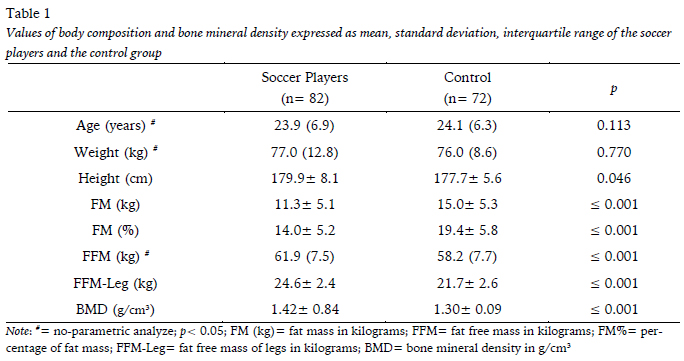
<body><![CDATA[<p><a href="/img/revistas/mot/v10n4/10n04a11t1.jpg">Table 1</a> presents   the main characteristics of the soccer players and the control group. Comparing   both groups a significant difference was observed in the soccer players for all   the body composition variables and the height. There was no difference in age or weight.</p>     
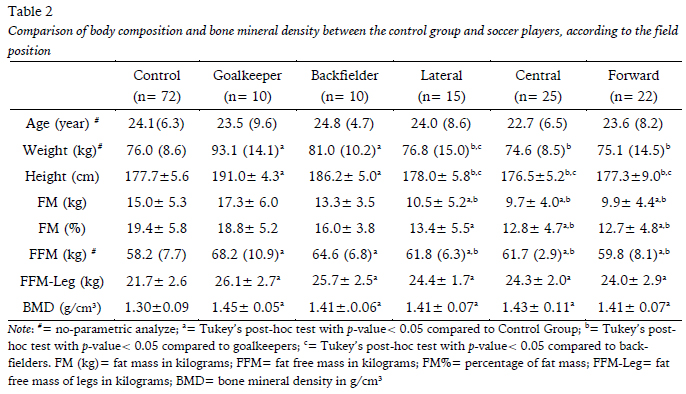
<p><a href="/img/revistas/mot/v10n4/10n04a11t2.jpg">Table 2</a> presents   the different body compositions according to player position. The positions LM   (10.5 &#177; 5.2), CM (9.7 &#177; 4.0) and FW (9.9 &#177; 4.4) had lower values of FM and %FM   than both the GK (17.3 &#177; 6.0) and the control group (15.0 &#177; 5.3). Compared to   the other positions, FFM was higher in the GK (68.2 &#177; 10.9) and BF (64.6 &#177; 6.8)   (<i >p</i>< 0.05). No significant differences   were verified in FFM-Legs among the athletes groups but all of them presented   significantly higher values than the CG (<i >p</i>< 0.05).</p>     
<p>&nbsp;</p> </font>     <p><font size="3" face="Verdana"><b>DISCUSSION</b></font><font size="2" face="Verdana"></font> <font size="2" face="Verdana">    <p>The aims of   this study were (i) to analyze and compare body composition and bone mineral   density in elite Brazilian soccer athletes with a control group, (ii) and to compare according to the field position.</p>     <p>In this   study the soccer players, when compared to the control group, showed   differences in all variables, but for age and weight, showing the effect of   specific training in this sport. The average percentage of fat found in soccer   players was 14%, values similar to those found by Silvestre et al. (2006)   (13.9%) and Matkovic et al. (2003) (14.9%) with first division players from   Connecticut and Croatia respectively. However, they are all higher than those   shown by Sutton, Scott, Wallace, and Reilly (2009) who evaluated four of the   elite English soccer teams. These differences may be due to the instruments   used and evaluation period (pre-season or period of competitions), as well as   the competitive level of the participants. Gissis et al. (2006) analyzed the   values of body fat in soccer players according to their competitive level in   the Greek league teams, showing significantly lower values in the best placed teams.</p>     <p>Sutton et   al. (2009) showed that body fat and bone mineral density are the best variables   to discriminate soccer players from the control group, according to multiple   regression models, this effect was observed in the goalkeepers. In the study by   Sutton et al. (2009) goalkeepers showed higher values of body fat percentage   when compared to other field positions. These results are similar to those   found in this study; however, goalkeepers only differed from midfielders and attackers.</p>     <p>These   differences in fat percentage between goalkeepers and defenders from the   remaining positions may be due to the characteristics required in training and   games. Reilly (1997) noted that goalkeepers and defenders run on average 4 and   8 km, respectively, in a match, while in other positions the distance can reach   12 km. So it is natural that goalkeepers would have a lower aerobic capacity and a higher percentage of body fat.</p>     <p>Matkovic et   al. (2003) and Arnason et al. (2004) reported greater differences between   goalkeepers and other player positions, with goalkeepers being taller, heavier   and having a higher fat percentage. In these two studies small differences between   the other positions (goalies excluded) were also found.</p>     <p>In this   research, goalkeepers also had a higher absolute amount of fat-free mass compared   to the control group, the laterals, midfielders and attackers. However, when   only the fat-free mass of the legs was analyzed the difference found was only   in relation to the control group. Sutton et al. (2009) used the percentage of   fat-free mass and found no differences between the positions of play. These two pieces of information show the importance of different forms of analysis.</p>     ]]></body>
<body><![CDATA[<p>Soccer   players have differences in all body composition variables. In this study   goalkeepers and defenders were taller and heavier than the players from the   sidelines, the midfield and the attack. However, the values of fat-free mass   are influenced by different types of methods which can be used for estimation of the body composition and how the values are used (absolute and relative).</p>     <p>There were   no differences in BMD between soccer players, according to field position, but   when the soccer players were compared with the control group there were   differences (<i >p</i>= 0.001).   Fredericson et al (2007), compared the BMD of soccer players with runners and   sedentary men, and noted that soccer players' total BMD only showed a   difference with the control group, which is similar to our findings. The   highest BMD values found among players can be explained, because soccer is a   sport that involves activities and intermittent high intensities, which include   sprinting, jumping, accelerations, decelerations and quick changes of   direction, which involve the stimulation of acquiring bone mineral (Heinonen,   Sievanen, Kyrolainen, Perttunen, & Kannus, 2001; Robling, Hinant, Burr, & Turner, 2002).</p>     <p>The data   from the present study provides an insight of the anthropometric   characteristics and the body composition of professional soccer players. That   said, some limitations should be addressed. The goalkeeper being a position   with a smaller number of athletes on the team, the data collection season and not having a diet control group.</p>     <p>The results   of this study show that soccer players have specific morphological characteristics   related to body composition as compared to a control group. However, only goalkeepers differed as compared to the other player positions.</p> </font>     <p>&nbsp;</p>     <p><font size="3"><b><font face="Verdana">CONCLUSIONS</font></b></font><font size="2" face="Verdana"> </font> <font size="2" face="Verdana">    <p>It is   possible to conclude that the Brazilian professional soccer players studied in   this study showed significant differences in body composition compared to   non-players. According to the field position, goalkeepers and defenders were   taller and heavier than the players from the sidelines, the midfield and the attack.</p> </font>     <p>&nbsp;</p>     <p><font size="3" face="Verdana"><b>REFERENCES</b></font></p> <font size="2" face="Verdana">     <!-- ref --><p>Arnason, A., Sigurdsson, S. B., Gudmundsson, A., Holme, I., Engebretsen,   L., & Bahr, R. (2004). Physical fitness, injuries, and team performance in   soccer. <i >Medicine & Science in Sports & Exercise, 36</i>(2), 278-285. doi: 10.1249/01.MSS.0000113478.92945.CA&nbsp;&nbsp;&nbsp;&nbsp;&nbsp;&nbsp;&nbsp;&nbsp;[&#160;<a href="javascript:void(0);" onclick="javascript: window.open('/scielo.php?script=sci_nlinks&ref=000062&pid=S1646-107X201400040001100001&lng=','','width=640,height=500,resizable=yes,scrollbars=1,menubar=yes,');">Links</a>&#160;]<!-- end-ref --><!-- ref --><p>Carling, C., & Orhant, E. (2010). Variation in body composition in   professional soccer players: Interseasonal and intraseasonal changes and the   effects of exposure time and player position. <i >Journal of Strength and Conditioning Research, 24</i>(5), 1332-1339. doi: 10.1519/JSC.0b013e3181cc6154&nbsp;&nbsp;&nbsp;&nbsp;&nbsp;&nbsp;&nbsp;&nbsp;[&#160;<a href="javascript:void(0);" onclick="javascript: window.open('/scielo.php?script=sci_nlinks&ref=000063&pid=S1646-107X201400040001100002&lng=','','width=640,height=500,resizable=yes,scrollbars=1,menubar=yes,');">Links</a>&#160;]<!-- end-ref --><!-- ref --><p>Casajus, J. A. (2001). Seasonal variation in fitness variables in   professional soccer players. <i >Journal of Sports Medicine Physical Fitness, 41</i>(4), 463-469.    &nbsp;&nbsp;&nbsp;&nbsp;&nbsp;&nbsp;&nbsp;&nbsp;[&#160;<a href="javascript:void(0);" onclick="javascript: window.open('/scielo.php?script=sci_nlinks&ref=000064&pid=S1646-107X201400040001100003&lng=','','width=640,height=500,resizable=yes,scrollbars=1,menubar=yes,');">Links</a>&#160;]<!-- end-ref --></p>     <!-- ref --><p>Davis, J. A., Brewer, J., & Atkin, D. (1992). Pre-season   physiological characteristics of English first and second division soccer   players.<i > Journal of Sports Sciences, 10</i>(6), 541-547. doi: 10.1080/02640419208729950&nbsp;&nbsp;&nbsp;&nbsp;&nbsp;&nbsp;&nbsp;&nbsp;[&#160;<a href="javascript:void(0);" onclick="javascript: window.open('/scielo.php?script=sci_nlinks&ref=000066&pid=S1646-107X201400040001100004&lng=','','width=640,height=500,resizable=yes,scrollbars=1,menubar=yes,');">Links</a>&#160;]<!-- end-ref --><!-- ref --><p>Franks, A., Williams, A., Reilly, T., & Nevill, A. (1999). Talent   identification in elite youth soccer players: Physical and physiological characteristics. <i >Journal of Sports Sciences, 17</i>(10), 812.    &nbsp;&nbsp;&nbsp;&nbsp;&nbsp;&nbsp;&nbsp;&nbsp;[&#160;<a href="javascript:void(0);" onclick="javascript: window.open('/scielo.php?script=sci_nlinks&ref=000067&pid=S1646-107X201400040001100005&lng=','','width=640,height=500,resizable=yes,scrollbars=1,menubar=yes,');">Links</a>&#160;]<!-- end-ref --></p>     <!-- ref --><p>Fredericson, M., Chew, K., Ngo, J., Cleek, T., Kiratli, J., & Cobb,   K. (2007). Regional bone mineral density in male athletes: A comparison of   soccer players, runners and controls. <i >British Journal of Sports Medicine, 41</i>(10), 664-668.    &nbsp;&nbsp;&nbsp;&nbsp;&nbsp;&nbsp;&nbsp;&nbsp;[&#160;<a href="javascript:void(0);" onclick="javascript: window.open('/scielo.php?script=sci_nlinks&ref=000069&pid=S1646-107X201400040001100006&lng=','','width=640,height=500,resizable=yes,scrollbars=1,menubar=yes,');">Links</a>&#160;]<!-- end-ref --></p>     <!-- ref --><p>Gissis, I., Papadopoulos, C., Kalapotharakos,   V. I., Sotiropoulos, A., Komsis, G., & Manolopoulos, E. (2006). Strength and speed characteristics of elite, subelite, and recreational young soccer players. <i >Research in Sports Medicine, 14</i>(3), 205-214.    &nbsp;&nbsp;&nbsp;&nbsp;&nbsp;&nbsp;&nbsp;&nbsp;[&#160;<a href="javascript:void(0);" onclick="javascript: window.open('/scielo.php?script=sci_nlinks&ref=000071&pid=S1646-107X201400040001100007&lng=','','width=640,height=500,resizable=yes,scrollbars=1,menubar=yes,');">Links</a>&#160;]<!-- end-ref --></p>     ]]></body>
<body><![CDATA[<!-- ref --><p>Goulding, A., Taylor, R. W., Grant, A. M., Jones, S., Taylor, B. J.,   & Williams, S. (2009). Relationships of appendicular LMI and total body LMI   to bone mass and physical activity levels in a birth cohort of New Zealand   five-year olds. <i >Bone, 45</i>(3), 455-459. doi: 10.1016/j.bone.2009.05.007&nbsp;&nbsp;&nbsp;&nbsp;&nbsp;&nbsp;&nbsp;&nbsp;[&#160;<a href="javascript:void(0);" onclick="javascript: window.open('/scielo.php?script=sci_nlinks&ref=000073&pid=S1646-107X201400040001100008&lng=','','width=640,height=500,resizable=yes,scrollbars=1,menubar=yes,');">Links</a>&#160;]<!-- end-ref --><!-- ref --><p>Heinonen, A., Sievanen, H., Kyrolainen, H., Perttunen, J., & Kannus,   P. (2001). Mineral mass, size, and estimated mechanical strength of triple   jumpers' lower limb. <i >Bone, 29</i>(3), 279-285.    &nbsp;&nbsp;&nbsp;&nbsp;&nbsp;&nbsp;&nbsp;&nbsp;[&#160;<a href="javascript:void(0);" onclick="javascript: window.open('/scielo.php?script=sci_nlinks&ref=000074&pid=S1646-107X201400040001100009&lng=','','width=640,height=500,resizable=yes,scrollbars=1,menubar=yes,');">Links</a>&#160;]<!-- end-ref --></p>     <!-- ref --><p>Heymsfield, S. B., Wang, Z. M., Visser, M., Gallagher, D., & Pierson,   R. N. (1996). Techniques used in the measurement of body composition: An   overview with emphasis on bioelectrical impedance analysis. <i >American Journal of Clinical Nutrition, 64</i>(3), S478-S484.    &nbsp;&nbsp;&nbsp;&nbsp;&nbsp;&nbsp;&nbsp;&nbsp;[&#160;<a href="javascript:void(0);" onclick="javascript: window.open('/scielo.php?script=sci_nlinks&ref=000076&pid=S1646-107X201400040001100010&lng=','','width=640,height=500,resizable=yes,scrollbars=1,menubar=yes,');">Links</a>&#160;]<!-- end-ref --></p>     <!-- ref --><p>Lohman, T. G., Roche, A. F. & Heymsfield, S. B. (1996). Dual energy   x-ray absorptiometry. In A. F. Roche, S. B. Heymsfield & T. G. Lohman   (Eds.) <i >Human body composition </i>(63-78). Champaign, Il: Human Kinetics.    &nbsp;&nbsp;&nbsp;&nbsp;&nbsp;&nbsp;&nbsp;&nbsp;[&#160;<a href="javascript:void(0);" onclick="javascript: window.open('/scielo.php?script=sci_nlinks&ref=000078&pid=S1646-107X201400040001100011&lng=','','width=640,height=500,resizable=yes,scrollbars=1,menubar=yes,');">Links</a>&#160;]<!-- end-ref --></p>     <!-- ref --><p>Matkovic, B. R., Durakovic, M., Matkovic, B., Jankovic, S., Ruzic, L.,   Leko, G., & Kondric, M. (2003). Morphological differences of elite Croatian soccer players according to the team position. <i >Collegium Antropologicum, 27</i>(S1), 167-174.    &nbsp;&nbsp;&nbsp;&nbsp;&nbsp;&nbsp;&nbsp;&nbsp;[&#160;<a href="javascript:void(0);" onclick="javascript: window.open('/scielo.php?script=sci_nlinks&ref=000080&pid=S1646-107X201400040001100012&lng=','','width=640,height=500,resizable=yes,scrollbars=1,menubar=yes,');">Links</a>&#160;]<!-- end-ref --></p>     <!-- ref --><p>Reilly, T. (1997). Energetics of high-intensity exercise (soccer) with   particular reference to fatigue. <i >Journal of Sports Sciences, 15</i>(3), 257-263. doi: 10.1080/026404197367263&nbsp;&nbsp;&nbsp;&nbsp;&nbsp;&nbsp;&nbsp;&nbsp;[&#160;<a href="javascript:void(0);" onclick="javascript: window.open('/scielo.php?script=sci_nlinks&ref=000082&pid=S1646-107X201400040001100013&lng=','','width=640,height=500,resizable=yes,scrollbars=1,menubar=yes,');">Links</a>&#160;]<!-- end-ref --><!-- ref --><p>Reilly, T., & Williams, A. M. (Eds.) (2003). <i >Science and soccer</i>. London: Routledge.    &nbsp;&nbsp;&nbsp;&nbsp;&nbsp;&nbsp;&nbsp;&nbsp;[&#160;<a href="javascript:void(0);" onclick="javascript: window.open('/scielo.php?script=sci_nlinks&ref=000083&pid=S1646-107X201400040001100014&lng=','','width=640,height=500,resizable=yes,scrollbars=1,menubar=yes,');">Links</a>&#160;]<!-- end-ref --></p>     <!-- ref --><p>Reilly, T., Bangsbo, J., & Franks, A. (2000). Anthropometric and   physiological predispositions for elite soccer. <i >Journal of Sports Sciences, 18</i>(9), 669-683. doi: 10.1080/02640410050120050&nbsp;&nbsp;&nbsp;&nbsp;&nbsp;&nbsp;&nbsp;&nbsp;[&#160;<a href="javascript:void(0);" onclick="javascript: window.open('/scielo.php?script=sci_nlinks&ref=000085&pid=S1646-107X201400040001100015&lng=','','width=640,height=500,resizable=yes,scrollbars=1,menubar=yes,');">Links</a>&#160;]<!-- end-ref --><!-- ref --><p>Rhodes, E. C., Mosher, R. E., McKenzie, D. C., Franks, I. M., Potts, J.   E., & Wenger, H. A. (1986). Physiological profiles of the Canadian Olympic   Soccer Team. <i >Canadian Journal of Applied Sport Sciences, 11</i>(1), 31-36.    &nbsp;&nbsp;&nbsp;&nbsp;&nbsp;&nbsp;&nbsp;&nbsp;[&#160;<a href="javascript:void(0);" onclick="javascript: window.open('/scielo.php?script=sci_nlinks&ref=000086&pid=S1646-107X201400040001100016&lng=','','width=640,height=500,resizable=yes,scrollbars=1,menubar=yes,');">Links</a>&#160;]<!-- end-ref --></p>     <!-- ref --><p>Rienzi, E., Mazza, J. C., Carter, J. E. L., & Reilly, T. (1998). <i >Futbolista sudamericano de &#233;lite: Morfolog&#237;a,   an&#225;lisis del juego y performance: resultados de las investigaciones en   composici&#243;n corporal, an&#225;lisis del movimiento y an&#225;lisis t&#225;ctico, en la Copa Am&#233;rica 1995 (Uruguay)</i>. Argentina: Editorial Biosystem Servicio Educativo.    &nbsp;&nbsp;&nbsp;&nbsp;&nbsp;&nbsp;&nbsp;&nbsp;[&#160;<a href="javascript:void(0);" onclick="javascript: window.open('/scielo.php?script=sci_nlinks&ref=000088&pid=S1646-107X201400040001100017&lng=','','width=640,height=500,resizable=yes,scrollbars=1,menubar=yes,');">Links</a>&#160;]<!-- end-ref --></p>     <!-- ref --><p>Robling, A. G., Hinant, F. M., Burr, D. B., & Turner, C. H. (2002).   Shorter, more frequent mechanical loading sessions enhance bone mass. <i >Medicine & Science in Sports & Exercise, 34</i>(2), 196-202. doi: 10.1097/00005768-200202000-00003&nbsp;&nbsp;&nbsp;&nbsp;&nbsp;&nbsp;&nbsp;&nbsp;[&#160;<a href="javascript:void(0);" onclick="javascript: window.open('/scielo.php?script=sci_nlinks&ref=000090&pid=S1646-107X201400040001100018&lng=','','width=640,height=500,resizable=yes,scrollbars=1,menubar=yes,');">Links</a>&#160;]<!-- end-ref --><!-- ref --><p>Silvestre, R., West, C., Maresh, C. M., & Kraemer, W. J. (2006).   Body composition and physical performance in men's soccer: A study of a National   Collegiate Athletic Association Division I team. <i >Journal of Strength and Conditioning Research, 20</i>(1), 177-183. doi: 10.1519/R-17715.1&nbsp;&nbsp;&nbsp;&nbsp;&nbsp;&nbsp;&nbsp;&nbsp;[&#160;<a href="javascript:void(0);" onclick="javascript: window.open('/scielo.php?script=sci_nlinks&ref=000091&pid=S1646-107X201400040001100019&lng=','','width=640,height=500,resizable=yes,scrollbars=1,menubar=yes,');">Links</a>&#160;]<!-- end-ref --><!-- ref --><p>Sporis, G., Jukic, I., Ostojic, S. M., & Milanovic, D. (2009).   Fitness profiling in soccer: Physical and physiologic characteristics of elite   players. <i >Journal of Strength and Conditioning Research, 23</i>(7), 1947-1953. doi: 10.1519/JSC.0b013e3181b3e141&nbsp;&nbsp;&nbsp;&nbsp;&nbsp;&nbsp;&nbsp;&nbsp;[&#160;<a href="javascript:void(0);" onclick="javascript: window.open('/scielo.php?script=sci_nlinks&ref=000092&pid=S1646-107X201400040001100020&lng=','','width=640,height=500,resizable=yes,scrollbars=1,menubar=yes,');">Links</a>&#160;]<!-- end-ref --><!-- ref --><p>Sutton, L., Scott, M., Wallace, J., & Reilly, T. (2009). Body   composition of English Premier League soccer players: Influence of playing   position, international status, and ethnicity. <i >Journal of Sports Sciences, 27</i>(10), 1019-1026. doi: 10.1080/02640410903030305&nbsp;&nbsp;&nbsp;&nbsp;&nbsp;&nbsp;&nbsp;&nbsp;[&#160;<a href="javascript:void(0);" onclick="javascript: window.open('/scielo.php?script=sci_nlinks&ref=000093&pid=S1646-107X201400040001100021&lng=','','width=640,height=500,resizable=yes,scrollbars=1,menubar=yes,');">Links</a>&#160;]<!-- end-ref --><p>&nbsp;</p>     <p><font size="2" face="Verdana"><b >Acknowledgments:    <br> </b>Nothing to declare.    <br> <b >Conflicts of Interest:    <br> </b>Nothing to declare.    <br> <b >Funding:    <br> </b>Nothing to declare.</font></p>     <p><font size="2" face="Verdana">Manuscript received February 27, 2014; Revised April 21, 2014;   Accepted April 25, 2014</font></p>     <p>&nbsp;</p>     ]]></body>
<body><![CDATA[<p>&nbsp;</p>     <p><font size="2" face="Verdana"><a name="end"></a><a href="#topo">*</a><i >Corresponding   author</i>: Departamento de Educa&#231;&#227;o F&#237;sica, Universidade Estadual Paulista   (UNESP), Rua Roberto Simonsen, n&#186; 305 &#8211; Centro Educacional, Presidente Prudente, CEP 19060-900 S&#227;o Paulo, Brasil;    <i >E-mail</i>: <a href="mailto:netoef@yahoo.com.br">netoef@yahoo.com.br</a></font></p>      ]]></body><back>
<ref-list>
<ref id="B1">
<nlm-citation citation-type="journal">
<person-group person-group-type="author">
<name>
<surname><![CDATA[Arnason]]></surname>
<given-names><![CDATA[A.]]></given-names>
</name>
<name>
<surname><![CDATA[Sigurdsson]]></surname>
<given-names><![CDATA[S. B.]]></given-names>
</name>
<name>
<surname><![CDATA[Gudmundsson]]></surname>
<given-names><![CDATA[A.]]></given-names>
</name>
<name>
<surname><![CDATA[Holme]]></surname>
<given-names><![CDATA[I.]]></given-names>
</name>
<name>
<surname><![CDATA[Engebretsen]]></surname>
<given-names><![CDATA[L.]]></given-names>
</name>
<name>
<surname><![CDATA[Bahr]]></surname>
<given-names><![CDATA[R.]]></given-names>
</name>
</person-group>
<article-title xml:lang="en"><![CDATA[Physical fitness, injuries, and team performance in soccer]]></article-title>
<source><![CDATA[Medicine & Science in Sports & Exercise]]></source>
<year>2004</year>
<volume>36</volume>
<numero>2</numero>
<issue>2</issue>
<page-range>278-285</page-range></nlm-citation>
</ref>
<ref id="B2">
<nlm-citation citation-type="journal">
<person-group person-group-type="author">
<name>
<surname><![CDATA[Carling]]></surname>
<given-names><![CDATA[C.]]></given-names>
</name>
<name>
<surname><![CDATA[Orhant]]></surname>
<given-names><![CDATA[E.]]></given-names>
</name>
</person-group>
<article-title xml:lang="en"><![CDATA[Variation in body composition in professional soccer players: Interseasonal and intraseasonal changes and the effects of exposure time and player position]]></article-title>
<source><![CDATA[Journal of Strength and Conditioning Research]]></source>
<year>2010</year>
<volume>24</volume>
<numero>5</numero>
<issue>5</issue>
<page-range>1332-1339</page-range></nlm-citation>
</ref>
<ref id="B3">
<nlm-citation citation-type="journal">
<person-group person-group-type="author">
<name>
<surname><![CDATA[Casajus]]></surname>
<given-names><![CDATA[J. A.]]></given-names>
</name>
</person-group>
<article-title xml:lang="en"><![CDATA[Seasonal variation in fitness variables in professional soccer players]]></article-title>
<source><![CDATA[Journal of Sports Medicine Physical Fitness]]></source>
<year>2001</year>
<volume>41</volume>
<numero>4</numero>
<issue>4</issue>
<page-range>463-469</page-range></nlm-citation>
</ref>
<ref id="B4">
<nlm-citation citation-type="journal">
<person-group person-group-type="author">
<name>
<surname><![CDATA[Davis]]></surname>
<given-names><![CDATA[J. A.]]></given-names>
</name>
<name>
<surname><![CDATA[Brewer]]></surname>
<given-names><![CDATA[J.]]></given-names>
</name>
<name>
<surname><![CDATA[Atkin]]></surname>
<given-names><![CDATA[D.]]></given-names>
</name>
</person-group>
<article-title xml:lang="en"><![CDATA[Pre-season physiological characteristics of English first and second division soccer players]]></article-title>
<source><![CDATA[Journal of Sports Sciences]]></source>
<year>1992</year>
<volume>10</volume>
<numero>6</numero>
<issue>6</issue>
<page-range>541-547</page-range></nlm-citation>
</ref>
<ref id="B5">
<nlm-citation citation-type="journal">
<person-group person-group-type="author">
<name>
<surname><![CDATA[Franks]]></surname>
<given-names><![CDATA[A.]]></given-names>
</name>
<name>
<surname><![CDATA[Williams]]></surname>
<given-names><![CDATA[A.]]></given-names>
</name>
<name>
<surname><![CDATA[Reilly]]></surname>
<given-names><![CDATA[T.]]></given-names>
</name>
<name>
<surname><![CDATA[Nevill]]></surname>
<given-names><![CDATA[A.]]></given-names>
</name>
</person-group>
<article-title xml:lang="en"><![CDATA[Talent identification in elite youth soccer players: Physical and physiological characteristics]]></article-title>
<source><![CDATA[Journal of Sports Sciences]]></source>
<year>1999</year>
<volume>17</volume>
<numero>10</numero>
<issue>10</issue>
<page-range>812</page-range></nlm-citation>
</ref>
<ref id="B6">
<nlm-citation citation-type="journal">
<person-group person-group-type="author">
<name>
<surname><![CDATA[Fredericson]]></surname>
<given-names><![CDATA[M.]]></given-names>
</name>
<name>
<surname><![CDATA[Chew]]></surname>
<given-names><![CDATA[K.]]></given-names>
</name>
<name>
<surname><![CDATA[Ngo]]></surname>
<given-names><![CDATA[J.]]></given-names>
</name>
<name>
<surname><![CDATA[Cleek]]></surname>
<given-names><![CDATA[T.]]></given-names>
</name>
<name>
<surname><![CDATA[Kiratli]]></surname>
<given-names><![CDATA[J.]]></given-names>
</name>
<name>
<surname><![CDATA[Cobb]]></surname>
<given-names><![CDATA[K.]]></given-names>
</name>
</person-group>
<article-title xml:lang="en"><![CDATA[Regional bone mineral density in male athletes: A comparison of soccer players, runners and controls]]></article-title>
<source><![CDATA[British Journal of Sports Medicine]]></source>
<year>2007</year>
<volume>41</volume>
<numero>10</numero>
<issue>10</issue>
<page-range>664-668</page-range></nlm-citation>
</ref>
<ref id="B7">
<nlm-citation citation-type="journal">
<person-group person-group-type="author">
<name>
<surname><![CDATA[Gissis]]></surname>
<given-names><![CDATA[I.]]></given-names>
</name>
<name>
<surname><![CDATA[Papadopoulos]]></surname>
<given-names><![CDATA[C.]]></given-names>
</name>
<name>
<surname><![CDATA[Kalapotharakos]]></surname>
<given-names><![CDATA[V. I.]]></given-names>
</name>
<name>
<surname><![CDATA[Sotiropoulos]]></surname>
<given-names><![CDATA[A.]]></given-names>
</name>
<name>
<surname><![CDATA[Komsis]]></surname>
<given-names><![CDATA[G.]]></given-names>
</name>
<name>
<surname><![CDATA[Manolopoulos]]></surname>
<given-names><![CDATA[E.]]></given-names>
</name>
</person-group>
<article-title xml:lang="en"><![CDATA[Strength and speed characteristics of elite, subelite, and recreational young soccer players]]></article-title>
<source><![CDATA[Research in Sports Medicine]]></source>
<year>2006</year>
<volume>14</volume>
<numero>3</numero>
<issue>3</issue>
<page-range>205-214</page-range></nlm-citation>
</ref>
<ref id="B8">
<nlm-citation citation-type="journal">
<person-group person-group-type="author">
<name>
<surname><![CDATA[Goulding]]></surname>
<given-names><![CDATA[A.]]></given-names>
</name>
<name>
<surname><![CDATA[Taylor]]></surname>
<given-names><![CDATA[R. W.]]></given-names>
</name>
<name>
<surname><![CDATA[Grant]]></surname>
<given-names><![CDATA[A. M.]]></given-names>
</name>
<name>
<surname><![CDATA[Jones]]></surname>
<given-names><![CDATA[S.]]></given-names>
</name>
<name>
<surname><![CDATA[Taylor]]></surname>
<given-names><![CDATA[B. J.]]></given-names>
</name>
<name>
<surname><![CDATA[Williams]]></surname>
<given-names><![CDATA[S.]]></given-names>
</name>
</person-group>
<article-title xml:lang="en"><![CDATA[Relationships of appendicular LMI and total body LMI to bone mass and physical activity levels in a birth cohort of New Zealand five-year olds]]></article-title>
<source><![CDATA[Bone]]></source>
<year>2009</year>
<volume>45</volume>
<numero>3</numero>
<issue>3</issue>
<page-range>455-459</page-range></nlm-citation>
</ref>
<ref id="B9">
<nlm-citation citation-type="journal">
<person-group person-group-type="author">
<name>
<surname><![CDATA[Heinonen]]></surname>
<given-names><![CDATA[A.]]></given-names>
</name>
<name>
<surname><![CDATA[Sievanen]]></surname>
<given-names><![CDATA[H.]]></given-names>
</name>
<name>
<surname><![CDATA[Kyrolainen]]></surname>
<given-names><![CDATA[H.]]></given-names>
</name>
<name>
<surname><![CDATA[Perttunen]]></surname>
<given-names><![CDATA[J.]]></given-names>
</name>
<name>
<surname><![CDATA[Kannus]]></surname>
<given-names><![CDATA[P.]]></given-names>
</name>
</person-group>
<article-title xml:lang="en"><![CDATA[Mineral mass, size, and estimated mechanical strength of triple jumpers' lower limb]]></article-title>
<source><![CDATA[Bone]]></source>
<year>2001</year>
<volume>29</volume>
<numero>3</numero>
<issue>3</issue>
<page-range>279-285</page-range></nlm-citation>
</ref>
<ref id="B10">
<nlm-citation citation-type="journal">
<person-group person-group-type="author">
<name>
<surname><![CDATA[Heymsfield]]></surname>
<given-names><![CDATA[S. B.]]></given-names>
</name>
<name>
<surname><![CDATA[Wang]]></surname>
<given-names><![CDATA[Z. M.]]></given-names>
</name>
<name>
<surname><![CDATA[Visser]]></surname>
<given-names><![CDATA[M.]]></given-names>
</name>
<name>
<surname><![CDATA[Gallagher]]></surname>
<given-names><![CDATA[D.]]></given-names>
</name>
<name>
<surname><![CDATA[Pierson]]></surname>
<given-names><![CDATA[R. N.]]></given-names>
</name>
</person-group>
<article-title xml:lang="en"><![CDATA[Techniques used in the measurement of body composition: An overview with emphasis on bioelectrical impedance analysis]]></article-title>
<source><![CDATA[American Journal of Clinical Nutrition]]></source>
<year>1996</year>
<volume>64</volume>
<numero>3</numero>
<issue>3</issue>
<page-range>S478-S484</page-range></nlm-citation>
</ref>
<ref id="B11">
<nlm-citation citation-type="book">
<person-group person-group-type="author">
<name>
<surname><![CDATA[Lohman]]></surname>
<given-names><![CDATA[T. G.]]></given-names>
</name>
<name>
<surname><![CDATA[Roche]]></surname>
<given-names><![CDATA[A. F.]]></given-names>
</name>
<name>
<surname><![CDATA[Heymsfield]]></surname>
<given-names><![CDATA[S. B.]]></given-names>
</name>
</person-group>
<article-title xml:lang="en"><![CDATA[Dual energy x-ray absorptiometry]]></article-title>
<person-group person-group-type="editor">
<name>
<surname><![CDATA[Roche]]></surname>
<given-names><![CDATA[A. F.]]></given-names>
</name>
<name>
<surname><![CDATA[Heymsfield]]></surname>
<given-names><![CDATA[S. B.]]></given-names>
</name>
<name>
<surname><![CDATA[Lohman]]></surname>
<given-names><![CDATA[T. G.]]></given-names>
</name>
</person-group>
<source><![CDATA[Human body composition]]></source>
<year>1996</year>
<page-range>63-78</page-range><publisher-loc><![CDATA[Champaign^eIl Il]]></publisher-loc>
<publisher-name><![CDATA[Human Kinetics]]></publisher-name>
</nlm-citation>
</ref>
<ref id="B12">
<nlm-citation citation-type="journal">
<person-group person-group-type="author">
<name>
<surname><![CDATA[Matkovic]]></surname>
<given-names><![CDATA[B. R.]]></given-names>
</name>
<name>
<surname><![CDATA[Durakovic]]></surname>
<given-names><![CDATA[M.]]></given-names>
</name>
<name>
<surname><![CDATA[Matkovic]]></surname>
<given-names><![CDATA[B.]]></given-names>
</name>
<name>
<surname><![CDATA[Jankovic]]></surname>
<given-names><![CDATA[S.]]></given-names>
</name>
<name>
<surname><![CDATA[Ruzic]]></surname>
<given-names><![CDATA[L.]]></given-names>
</name>
<name>
<surname><![CDATA[Leko]]></surname>
<given-names><![CDATA[G.]]></given-names>
</name>
<name>
<surname><![CDATA[Kondric]]></surname>
<given-names><![CDATA[M.]]></given-names>
</name>
</person-group>
<article-title xml:lang="en"><![CDATA[Morphological differences of elite Croatian soccer players according to the team position]]></article-title>
<source><![CDATA[Collegium Antropologicum]]></source>
<year>2003</year>
<volume>27</volume>
<numero>S1</numero>
<issue>S1</issue>
<page-range>167-174</page-range></nlm-citation>
</ref>
<ref id="B13">
<nlm-citation citation-type="journal">
<person-group person-group-type="author">
<name>
<surname><![CDATA[Reilly]]></surname>
<given-names><![CDATA[T.]]></given-names>
</name>
</person-group>
<article-title xml:lang="en"><![CDATA[Energetics of high-intensity exercise (soccer) with particular reference to fatigue]]></article-title>
<source><![CDATA[Journal of Sports Sciences]]></source>
<year>1997</year>
<volume>15</volume>
<numero>3</numero>
<issue>3</issue>
<page-range>257-263</page-range></nlm-citation>
</ref>
<ref id="B14">
<nlm-citation citation-type="book">
<person-group person-group-type="author">
<name>
<surname><![CDATA[Reilly]]></surname>
<given-names><![CDATA[T.]]></given-names>
</name>
<name>
<surname><![CDATA[Williams]]></surname>
<given-names><![CDATA[A. M.]]></given-names>
</name>
</person-group>
<source><![CDATA[Science and soccer]]></source>
<year>2003</year>
<publisher-loc><![CDATA[London ]]></publisher-loc>
<publisher-name><![CDATA[Routledge]]></publisher-name>
</nlm-citation>
</ref>
<ref id="B15">
<nlm-citation citation-type="journal">
<person-group person-group-type="author">
<name>
<surname><![CDATA[Reilly]]></surname>
<given-names><![CDATA[T.]]></given-names>
</name>
<name>
<surname><![CDATA[Bangsbo]]></surname>
<given-names><![CDATA[J.]]></given-names>
</name>
<name>
<surname><![CDATA[Franks]]></surname>
<given-names><![CDATA[A.]]></given-names>
</name>
</person-group>
<article-title xml:lang="en"><![CDATA[Anthropometric and physiological predispositions for elite soccer]]></article-title>
<source><![CDATA[Journal of Sports Sciences]]></source>
<year>2000</year>
<volume>18</volume>
<numero>9</numero>
<issue>9</issue>
<page-range>669-683</page-range></nlm-citation>
</ref>
<ref id="B16">
<nlm-citation citation-type="journal">
<person-group person-group-type="author">
<name>
<surname><![CDATA[Rhodes]]></surname>
<given-names><![CDATA[E. C.]]></given-names>
</name>
<name>
<surname><![CDATA[Mosher]]></surname>
<given-names><![CDATA[R. E.]]></given-names>
</name>
<name>
<surname><![CDATA[McKenzie]]></surname>
<given-names><![CDATA[D. C.]]></given-names>
</name>
<name>
<surname><![CDATA[Franks]]></surname>
<given-names><![CDATA[I. M.]]></given-names>
</name>
<name>
<surname><![CDATA[Potts]]></surname>
<given-names><![CDATA[J. E.]]></given-names>
</name>
<name>
<surname><![CDATA[Wenger]]></surname>
<given-names><![CDATA[H. A.]]></given-names>
</name>
</person-group>
<article-title xml:lang="en"><![CDATA[Physiological profiles of the Canadian Olympic Soccer Team]]></article-title>
<source><![CDATA[Canadian Journal of Applied Sport Sciences]]></source>
<year>1986</year>
<volume>11</volume>
<numero>1</numero>
<issue>1</issue>
<page-range>31-36</page-range></nlm-citation>
</ref>
<ref id="B17">
<nlm-citation citation-type="book">
<person-group person-group-type="author">
<name>
<surname><![CDATA[Rienzi]]></surname>
<given-names><![CDATA[E.]]></given-names>
</name>
<name>
<surname><![CDATA[Mazza]]></surname>
<given-names><![CDATA[J. C.]]></given-names>
</name>
<name>
<surname><![CDATA[Carter]]></surname>
<given-names><![CDATA[J. E. L.]]></given-names>
</name>
<name>
<surname><![CDATA[Reilly]]></surname>
<given-names><![CDATA[T.]]></given-names>
</name>
</person-group>
<source><![CDATA[Futbolista sudamericano de élite: Morfología, análisis del juego y performance: resultados de las investigaciones en composición corporal, análisis del movimiento y análisis táctico, en la Copa América 1995 (Uruguay)]]></source>
<year>1998</year>
<publisher-name><![CDATA[Editorial Biosystem Servicio Educativo]]></publisher-name>
</nlm-citation>
</ref>
<ref id="B18">
<nlm-citation citation-type="journal">
<person-group person-group-type="author">
<name>
<surname><![CDATA[Robling]]></surname>
<given-names><![CDATA[A. G.]]></given-names>
</name>
<name>
<surname><![CDATA[Hinant]]></surname>
<given-names><![CDATA[F. M.]]></given-names>
</name>
<name>
<surname><![CDATA[Burr]]></surname>
<given-names><![CDATA[D. B.]]></given-names>
</name>
<name>
<surname><![CDATA[Turner]]></surname>
<given-names><![CDATA[C. H.]]></given-names>
</name>
</person-group>
<article-title xml:lang="en"><![CDATA[Shorter, more frequent mechanical loading sessions enhance bone mass]]></article-title>
<source><![CDATA[Medicine & Science in Sports & Exercise]]></source>
<year>2002</year>
<volume>34</volume>
<numero>2</numero>
<issue>2</issue>
<page-range>196-202</page-range></nlm-citation>
</ref>
<ref id="B19">
<nlm-citation citation-type="journal">
<person-group person-group-type="author">
<name>
<surname><![CDATA[Silvestre]]></surname>
<given-names><![CDATA[R.]]></given-names>
</name>
<name>
<surname><![CDATA[West]]></surname>
<given-names><![CDATA[C.]]></given-names>
</name>
<name>
<surname><![CDATA[Maresh]]></surname>
<given-names><![CDATA[C. M.]]></given-names>
</name>
<name>
<surname><![CDATA[Kraemer]]></surname>
<given-names><![CDATA[W. J.]]></given-names>
</name>
</person-group>
<article-title xml:lang="en"><![CDATA[Body composition and physical performance in men's soccer: A study of a National Collegiate Athletic Association Division I team]]></article-title>
<source><![CDATA[Journal of Strength and Conditioning Research]]></source>
<year>2006</year>
<volume>20</volume>
<numero>1</numero>
<issue>1</issue>
<page-range>177-183</page-range></nlm-citation>
</ref>
<ref id="B20">
<nlm-citation citation-type="journal">
<person-group person-group-type="author">
<name>
<surname><![CDATA[Sporis]]></surname>
<given-names><![CDATA[G.]]></given-names>
</name>
<name>
<surname><![CDATA[Jukic]]></surname>
<given-names><![CDATA[I.]]></given-names>
</name>
<name>
<surname><![CDATA[Ostojic]]></surname>
<given-names><![CDATA[S. M.]]></given-names>
</name>
<name>
<surname><![CDATA[Milanovic]]></surname>
<given-names><![CDATA[D.]]></given-names>
</name>
</person-group>
<article-title xml:lang="en"><![CDATA[Fitness profiling in soccer: Physical and physiologic characteristics of elite players]]></article-title>
<source><![CDATA[Journal of Strength and Conditioning Research]]></source>
<year>2009</year>
<volume>23</volume>
<numero>7</numero>
<issue>7</issue>
<page-range>1947-1953</page-range></nlm-citation>
</ref>
<ref id="B21">
<nlm-citation citation-type="journal">
<person-group person-group-type="author">
<name>
<surname><![CDATA[Sutton]]></surname>
<given-names><![CDATA[L.]]></given-names>
</name>
<name>
<surname><![CDATA[Scott]]></surname>
<given-names><![CDATA[M.]]></given-names>
</name>
<name>
<surname><![CDATA[Wallace]]></surname>
<given-names><![CDATA[J.]]></given-names>
</name>
<name>
<surname><![CDATA[Reilly]]></surname>
<given-names><![CDATA[T.]]></given-names>
</name>
</person-group>
<article-title xml:lang="en"><![CDATA[Body composition of English Premier League soccer players: Influence of playing position, international status, and ethnicity]]></article-title>
<source><![CDATA[Journal of Sports Sciences]]></source>
<year>2009</year>
<volume>27</volume>
<numero>10</numero>
<issue>10</issue>
<page-range>1019-1026</page-range></nlm-citation>
</ref>
</ref-list>
</back>
</article>