<?xml version="1.0" encoding="ISO-8859-1"?><article xmlns:mml="http://www.w3.org/1998/Math/MathML" xmlns:xlink="http://www.w3.org/1999/xlink" xmlns:xsi="http://www.w3.org/2001/XMLSchema-instance">
<front>
<journal-meta>
<journal-id>1646-107X</journal-id>
<journal-title><![CDATA[Motricidade]]></journal-title>
<abbrev-journal-title><![CDATA[Motri.]]></abbrev-journal-title>
<issn>1646-107X</issn>
<publisher>
<publisher-name><![CDATA[Edições Desafio Singular]]></publisher-name>
</publisher>
</journal-meta>
<article-meta>
<article-id>S1646-107X2015000100012</article-id>
<article-id pub-id-type="doi">10.6063/motricidade.3441</article-id>
<title-group>
<article-title xml:lang="en"><![CDATA[Visual conditions and postural directions affect postural sway variability in patients with Parkinson’s disease]]></article-title>
<article-title xml:lang="pt"><![CDATA[Alterações nas condições visuais pode afetar a variabilidade de oscilação postural em pacientes com Parkinson em diferentes níveis da doença]]></article-title>
</title-group>
<contrib-group>
<contrib contrib-type="author">
<name>
<surname><![CDATA[Rinaldi]]></surname>
<given-names><![CDATA[Natalia Madalena]]></given-names>
</name>
<xref ref-type="aff" rid="A01"/>
</contrib>
<contrib contrib-type="author">
<name>
<surname><![CDATA[Barbieri]]></surname>
<given-names><![CDATA[Fabio Augusto]]></given-names>
</name>
<xref ref-type="aff" rid="A02"/>
</contrib>
<contrib contrib-type="author">
<name>
<surname><![CDATA[Teixeira-Arroyo]]></surname>
<given-names><![CDATA[Claudia]]></given-names>
</name>
<xref ref-type="aff" rid="A02"/>
</contrib>
<contrib contrib-type="author">
<name>
<surname><![CDATA[Stella]]></surname>
<given-names><![CDATA[Florindo]]></given-names>
</name>
<xref ref-type="aff" rid="A02"/>
<xref ref-type="aff" rid="A03"/>
</contrib>
<contrib contrib-type="author">
<name>
<surname><![CDATA[Gobbi]]></surname>
<given-names><![CDATA[Lilian Teresa Bucken]]></given-names>
</name>
<xref ref-type="aff" rid="A02"/>
</contrib>
</contrib-group>
<aff id="A01">
<institution><![CDATA[,Universidade de São Paulo Faculdade de Medicina ]]></institution>
<addr-line><![CDATA[Ribeirão Preto SP]]></addr-line>
<country>Brasil</country>
</aff>
<aff id="A02">
<institution><![CDATA[,Universidade Estadual Paulista Laboratório de Estudos de Locomoção e Postura ]]></institution>
<addr-line><![CDATA[Rio Claro SP]]></addr-line>
<country>Brasil</country>
</aff>
<aff id="A03">
<institution><![CDATA[,Universidade Estadual de Campinas  ]]></institution>
<addr-line><![CDATA[Campinas SP]]></addr-line>
<country>Brasil</country>
</aff>
<pub-date pub-type="pub">
<day>00</day>
<month>03</month>
<year>2015</year>
</pub-date>
<pub-date pub-type="epub">
<day>00</day>
<month>03</month>
<year>2015</year>
</pub-date>
<volume>11</volume>
<numero>1</numero>
<fpage>118</fpage>
<lpage>125</lpage>
<copyright-statement/>
<copyright-year/>
<self-uri xlink:href="http://scielo.pt/scielo.php?script=sci_arttext&amp;pid=S1646-107X2015000100012&amp;lng=en&amp;nrm=iso"></self-uri><self-uri xlink:href="http://scielo.pt/scielo.php?script=sci_abstract&amp;pid=S1646-107X2015000100012&amp;lng=en&amp;nrm=iso"></self-uri><self-uri xlink:href="http://scielo.pt/scielo.php?script=sci_pdf&amp;pid=S1646-107X2015000100012&amp;lng=en&amp;nrm=iso"></self-uri><abstract abstract-type="short" xml:lang="en"><p><![CDATA[Postural sway variability was evaluated in Parkinson’s disease (PD) patients at different stages of disease. Twenty PD patients were grouped into two groups (unilateral, 14; bilateral, 6) according to disease severity. The results showed no significant differences in postural sway variability between the groups (p &gt;= 0.05). Postural sway variability was higher in the antero-posterior direction and with the eyes closed. Significant differences between the unilateral and bilateral groups were observed in clinical tests (UPDRS, Berg Balance Scale, and retropulsion test; p <= 0.05, all). Postural sway variability was unaffected by disease severity, indicating that neurological mechanisms for postural control still function at advanced stages of disease. Postural sway instability appears to occur in the antero-posterior direction to compensate for the stooped posture. The eyes-closed condition during upright stance appears to be challenging for PD patients because of the associated sensory integration deficit. Finally, objective measures such as postural sway variability may be more reliable than clinical tests to evaluate changes in balance control in PD patients.]]></p></abstract>
<abstract abstract-type="short" xml:lang="pt"><p><![CDATA[Variabilidade de oscilação postural, testes de equilíbrio de Berg e retropulsão foram investigados em pacientes com DP em diferentes estágios da doença. Vinte pacientes com DP participaram deste estudo e foram distribuídos em dois grupos: unilateral (14) e bilateral (6). Os resultados mostraram diferença não significativa entre os grupos para a variabilidade de oscilação postural (p&gt;=0.05). Ainda, a variabilidade de oscilação postural foi maior na direção antero-posterior e na condição de olhos fechados. Para os testes clínicos, UPDRS (seções funcional e motora), teste de Berg e retropulsão, foi encontrada diferença significativa entre os grupos (unilateral e bilateral) (p<=0.05). A partir destes resultados, foi possível concluir que a variabilidade de oscilação postural não muda em função da severidade da doença. Os mecanismos neurológicos para o controle postural ainda estão operando no estágio avançado da doença. Assim, a instabilidade postural parece ocorrer na direção antero-posterior como um mecanismo compensatório em função da postura rígida. A condição de olhos fechados parece ser desafiadora para pacientes com DP, em função dos deficits da integração sensorial. Finalmente, a variabilidade de oscilação postural pode ser considerada uma medida confiável, pois elimina o efeito da subjetividade.]]></p></abstract>
<kwd-group>
<kwd lng="en"><![CDATA[variability]]></kwd>
<kwd lng="en"><![CDATA[postural control]]></kwd>
<kwd lng="en"><![CDATA[sensory information]]></kwd>
<kwd lng="en"><![CDATA[balance tests]]></kwd>
<kwd lng="pt"><![CDATA[variabilidade]]></kwd>
<kwd lng="pt"><![CDATA[controle postural]]></kwd>
<kwd lng="pt"><![CDATA[informação sensorial]]></kwd>
<kwd lng="pt"><![CDATA[testes de equilíbrio]]></kwd>
</kwd-group>
</article-meta>
</front><body><![CDATA[ 

    <p align="right"><b><font size="2" face="Verdana">ARTIGO ORIGINAL</font></b></p>
    <p align="right">&nbsp;</p>

    <p><font size="4" face="Verdana"><b>Visual
conditions and postural directions affect postural sway variability in patients
with Parkinson’s disease</b></font></p>
    <p>&nbsp;</p>

    <p><font size="3" face="Verdana"><b>Alterações nas condições visuais pode afetar a variabilidade de
oscilação postural em pacientes com Parkinson em diferentes níveis da doença</b></font></p>
    <p>&nbsp;</p>
    <p>&nbsp;</p>


    <p><font size="2" face="Verdana"><b>Natalia Madalena Rinaldi<sup>1<a name="topo"></a><a href="#end">*</a></sup>, Fabio Augusto Barbieri<sup>2</sup>, Claudia Teixeira-Arroyo<sup>2</sup>, Florindo Stella<sup>2,3</sup>, Lilian Teresa Bucken Gobbi<sup>2</sup></b></font></p>


    <p><font size="2" face="Verdana"><sup>1</sup><i>Universidade de S&atilde;o Paulo - USP, Faculdade
de Medicina, Ribeir&atilde;o Preto, SP, Brasil.    ]]></body>
<body><![CDATA[<br>
</i><sup>2</sup><i>Universidade Estadual Paulista - UNESP,
Laborat&oacute;rio de Estudos de Locomo&ccedil;&atilde;o e Postura (LEPLO), Rio Claro, SP, Brasil.    <br>
</i><sup>3</sup><i>Universidade Estadual de Campinas - UNICAMP,
Campinas, SP, Brasil.</i></font></p>

    <p>&nbsp;</p>

    <p>&nbsp;</p>

<hr noshade size="1">

    <p><b><font size="2" face="Verdana">ABSTRACT</font></b></p>
<font size="2" face="Verdana">
    <p>Postural sway variability was evaluated in Parkinson’s
disease (PD) patients at different stages of disease. Twenty PD patients were
grouped into two groups (unilateral, 14; bilateral, 6) according to disease
severity. The results showed no significant differences in postural sway
variability between the groups (p >= 0.05). Postural sway variability was higher
in the antero-posterior direction and with the eyes closed. Significant differences
between the unilateral and bilateral groups were observed in clinical tests
(UPDRS, Berg Balance Scale, and retropulsion test; p <= 0.05, all). Postural
sway variability was unaffected by disease severity, indicating that
neurological mechanisms for postural control still function at advanced stages
of disease. Postural sway instability appears to occur in the antero-posterior
direction to compensate for the stooped posture. The eyes-closed condition
during upright stance appears to be challenging for PD patients because of the
associated sensory integration deficit. Finally, objective measures such as
postural sway variability may be more reliable than clinical tests to evaluate
changes in balance control in PD patients.</p>
</font>
    <p><font size="2" face="Verdana"><b>Keywords:</b> variability, postural control, sensory
information, balance tests.</font></p>

<hr noshade size="1">

    <p><b><font size="2" face="Verdana">RESUMO</font></b></p>
<font size="2" face="Verdana">
    <p>Variabilidade
de oscilação postural, testes de equilíbrio de Berg e retropulsão foram investigados
em pacientes com DP em diferentes estágios da doença. Vinte pacientes com DP
participaram deste estudo e foram distribuídos em dois grupos: unilateral (14)
e bilateral (6). Os resultados mostraram diferença não significativa entre os
grupos para a variabilidade de oscilação postural (p>=0.05). Ainda, a
variabilidade de oscilação postural foi maior na direção antero-posterior e na
condição de olhos fechados. Para os testes clínicos, UPDRS (seções funcional e
motora), teste de Berg e retropulsão, foi encontrada diferença significativa
entre os grupos (unilateral e bilateral) (p<=0.05). A partir destes resultados,
foi possível concluir que a variabilidade de oscilação postural não muda em
função da severidade da doença. Os mecanismos neurológicos para o controle
postural ainda estão operando no estágio avançado da doença. Assim, a
instabilidade postural parece ocorrer na direção antero-posterior como um
mecanismo compensatório em função da postura rígida. A condição de olhos fechados
parece ser desafiadora para pacientes com DP, em função dos deficits da
integração sensorial. Finalmente, a variabilidade de oscilação postural pode
ser considerada uma medida confiável, pois elimina o efeito da subjetividade.</p>
</font>
    <p><font size="2" face="Verdana"><b>Palavras-chave:</b>
variabilidade, controle postural, informação sensorial, testes de equilíbrio.</font></p>

<hr noshade size="1">

    ]]></body>
<body><![CDATA[<p>&nbsp;</p>
    <p><b>&nbsp;</b></p>

    <p><b><font size="3" face="Verdana">INTRODUCTION</font></b></p>
<font size="2" face="Verdana">
    <p>Postural instability
is characterized by increased body sway during quiet stance as a result of
impaired postural control. Postural instability is a major disabling feature in
Parkinson’s disease (PD) patients and a primary risk factor for falls. Postural
instability has been reported in 68% of PD patients (Ashburn, Stack, Pickering, &amp;
Ward, 2001). Postural
sway is greater in the anterior-posterior and medial-lateral directions in
patients with PD than in healthy old adults, which is attributed to a
progressive decline in postural stability control (Janusz W.
B&#322;aszczyk &amp; Orawiec, 2011). Additionally, greater postural impairment
during sensory manipulation tasks (eyes closed and changing visual information)
has been observed in patients with PD than in healthy controls, suggesting that
basal ganglia are crucial for sensory-motor integration (Brown et al., 2006; Suarez et al.,
2011).
Moreover, patients with PD are highly visually dependent and continue to use
visual cues for postural control even when information is not appropriate (Azulay et al., 1999). In fact, B&#322;aszczyk,
Orawiec, Duda-K&#322;odowska, and Opala, (2007) found higher
medial-lateral sway in the eyes-closed than in the eyes-open condition in PD
patients compared to healthy controls and concluded that PD patients have
postural instability in challenging visual conditions (eyes closed), suggesting
that the eyes-closed condition may be associated with a higher risk for falls.</p>

    <p>Patients at more
advanced stages of PD have postural instability as evidenced by a re-tropulsion
test (Item 30 of the Unified Parkinson’s Disease Rating Scale &#8211; UPDRS) (Fahn &amp; Elton, 1986). Frenklach, Louie,
Koop, and Bronte-Stewart (2009) investigated postural
sway in static (still platform) and dynamic (sway referenced platform)
conditions and found excessive postural sway at more advanced stages of the
disease, suggesting that patients in later stages of PD are at an increased
risk for falling. Thus, investigating postural control at different stages of
the disease may help identify the risk for falling and sensory-motor problems
to initiate a postural rehabilitation program in PD patients.</p>

    <p>Postural instability
in PD patients can be evaluated by measuring the center of pressure (B&#322;aszczyk
et al., 2007; Matinolli et al., 2007), postural sway angle (Adkin, Bloem, &amp; Allum, 2005), and trunk linear acceleration (Mancini et al., 2012). Although these postural sway analyses quantify changes in postural
control, they do not assess postural sway variability due to disease progression
in different visual conditions (eyes open and closed) and postural sway
directions (anterior-posterior and medial-lateral). Postural sway
variability may help identify disabling features of the disease such as
postural instability and changes in the behaviour of PD patients due to disease
progression (van Emmerik &amp; van Wegen, 2002) and play a
functional role by helping explore and identify stability boundaries in these
patients. In addition, postural sway variability may also help identify changes
in postural control in PD patients at different stages of disease and in
different visual conditions. Moreover, postural sway variability may also be
used in postural control studies to detect postural instability in different
visual conditions and postural sway directions.</p>

    <p>Some clinical tests
such as the retropulsion test (Item 30/UPDRS) and the Berg Balance Scale (BBS)
have also been used to identify changes in postural control in PD patients (Jenkins, Johnson, Holmes,
Stephenson, &amp; Spaulding, 2010). However, these
clinical tests are subjective, indirect measures of postural control. Moreover,
it is not known whether the same changes in PD postural control due to disease
progression may be identified in postural sway variability (direct measure) and
in clinical tests (indirect measure). This study aimed to investigate postural
sway variability in PD patients at different stages of disease in different
visual conditions (eyes open and closed) and postural directions (anterior-posterior
and medial-lateral) and compare the postural control performance of PD patients
in clinical (Item 30), functional (BBS), and postural sway variability tests. </p>
</font>
    <p>&nbsp;</p>

    <p><b><font size="3" face="Verdana">METHODS</font></b></p>

    <p><b><font size="2" face="Verdana">Participants</font></b></p>
<font size="2" face="Verdana">
    ]]></body>
<body><![CDATA[<p>Twenty patients with
idiopathic PD ranging from 1 to 3 on the Hoehn and Yahr (HY) scale (Hoehn &amp; Yahr, 1967) participated in this
study. Participants were grouped into two HY groups according to severity of
PD: unilateral (stages 1 and 1.5) and bilateral (stages 2&#8211;3) disease. The
inclusion criteria were: diagnosis of PD and absence of neuromuscular,
vestibular, or osteoarticular disorders and dementia, which could affect
postural task performance. All participants followed their usual medication
regimen during testing. The study was approved by the local ethics committee
(UNESP/RC). All participants signed an informed consent form.</p>
</font>

    <p><b><font size="2" face="Verdana">Procedures</font></b></p>
<font size="2" face="Verdana">
    <p>Data were collected
on two consecutive
days. On the first day, the demographic, anthropometric, and clinical variables
including PD severity (HY and UPDRS staging) and cognitive screening
(Mini-Mental State Exam &#8211; MMSE) were determined. The Berg Balance Scale
(BBS), which includes 14 items that evaluate the ability to maintain balance in
different postural positions, was applied to measure functional balance,
whereas the UPDRS retropulsion test (Item 30 &#8211; motor section) is a
clinical test that was used to determine postural stability in PD patients.
Higher scores in the BBS and retropulsion tests indicate better and worse
performance, respectively.</p>

    <p>On the second day,
postural instability was determined using postural sway kinematic analysis.
Participants were asked to wear reflective markers and postural tasks were
recorded with a digital camcorder. The postural task consisted of standing as
quietly as possible for 30 sec with eyes open (EO) and eyes closed (EC).
Participants wore goggles in the eyes-closed condition to ensure that no visual
information was captured. Three 30-sec trials were performed in each condition
and trials were randomized.</p>

    <p>Postural sway was
assessed in the medial-lateral (ML) and anterior-posterior (AP) directions and
recorded with a digital camcorder with a 60 Hz field rate that created 2D
kinematic data. Fifteen-mm reflective markers were placed on the right and left
acromion process and right and left anterior center of the ankle joint for the
ML analysis and on the right acromion and right lateral malleolus for the AP
analysis, totalling six reflective markers. These anatomical landmark positions
are based on an inverted pendulum model and are appropriate for measuring
postural instability (Suarez et al., 2011).</p>

    <p>The measuring area
was calibrated prior to each postural task analysis. Images were captured by a
video card coupled to a computer. Markers were digitized automatically using
the Digital Video for Windows (DVIDEOW) software (Figueroa, Leite, &amp; Barros,
2003). The <i>x</i> and <i>y</i> coordinates for each marker were converted to the metric system
using a bidimensional reference system with four control points (1.5 x 1.8 m).
Raw data were filtered using a low-pass, second-order digital Butterworth
filter with a cut-off frequency of 5 Hz using the Matlab 7<sup>®</sup>
software.</p>
</font>

    <p><b><font size="2" face="Verdana">Statistical Analysis</font></b></p>
<font size="2" face="Verdana">
    <p>The score of each
item was computed for the BBS and UPDRS (Item 30) analyses. The angular
amplitude of body oscillation (degrees), used as the dependent variable, was
calculated by subtracting the maximum and minimum body oscillation values
during the entire trial in both directions (anterior-posterior and
medial-lateral). Postural sway variability was determined by calculating the
standard deviation of the angular amplitude oscillation.</p>

    <p>The
Kolmogorov-Smirnov and Levene tests showed that the data were not normally
distributed and homogenous and thus the unpaired Mann-Whitney test was used to
compare differences in group characteristics and clinical balance tests between
the HY groups. Because postural sway variables were normally distributed
(Kolmogorov-Smirnov test) and homogenous (Levene test), we used a three-way
analysis of variance (ANOVA) with repeated measures to compare postural sway variability
between HY groups (unilateral and bilateral), conditions (eyes open and
closed), and direction (AP and ML). The cut-off criteria for the effect size
(partial eta squared [&#951;<sub>p</sub><sup>2</sup>]) were:
small effect (0.20 <= &#951;<sub>p</sub><sup>2</sup> &lt; 0.50), medium effect (0.50 <= &#951;<sub>p</sub><sup>2</sup> &lt; 0.80), and large effect (&#951;<sub>p</sub><sup>2</sup> >= 0.80) as suggested by Cohen (1992). The observer power
(0&#8211;1) was also analysed. The significance level was set at p <= 0.05. All
analyses were performed using the SPSS software (SPSS for Windows 10.0<sup>®</sup>).</p>
</font>
    <p>&nbsp;</p>

    ]]></body>
<body><![CDATA[<p><b><font size="3" face="Verdana">RESULTS</font></b></p>
<font size="2" face="Verdana">
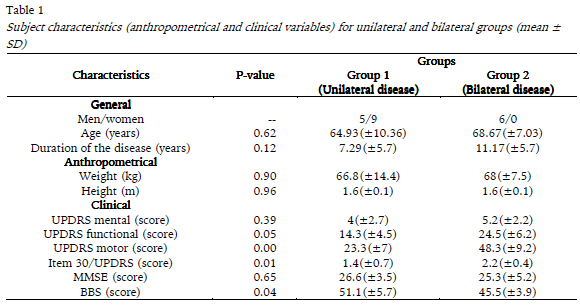
    <p>There were no
differences in age, height, weight, disease duration, cognitive state (MMSE),
and UPDRS staging (mental section) between the unilateral and bilateral groups.
However, the motor and functional UPDRS scores were significantly lower in the
unilateral group than in the bilateral group, whereas the opposite result was
observed in the BBS score (Mann-Whitney test, p <= 0.05 all; <a href="#t1">Table 1</a>).
</p>
    <p>&nbsp;</p>
    <p><a name="t1"></a></p>
    <p align="center"><img src="/img/revistas/mot/v11n1/11n1a12t1.jpg" width="580" height="305"></p>
    
<p>&nbsp;</p>
    <p>The
  three-way ANOVA (HY group x eye condition x sway direction) with repeated
  measures on the last two factors showed no significant differences between HY
  groups (F<sub>1,18</sub> = 34.02, p = 0.86, &#951;<sub>p</sub><sup>2</sup> =
    0.65, observer power = 1.0) and interaction (F<sub>1,18</sub> = 1.48, p = 0.24,
  &#951;<sub>p</sub><sup>2</sup> =
    0.076, observed power = 0.73), but showed significant differences in eye
    condition (F<sub>1,18</sub> = 7.35, p = 0.014, partial &#951;<sub>p</sub><sup>2</sup> =
      0.29, observed power = 0.74) and sway direction (F<sub>1,18</sub> = 11.42, p =
      0.003, &#951;<sub>p</sub><sup>2</sup> =
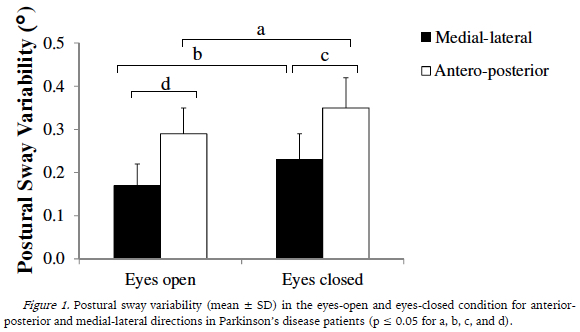
        0.38, observed power = 0.89). Postural sway variability in the AP and ML
        directions was greater in the eyes-closed than in the eyes-open condition for
        both groups (<a href="#f1">Figure 1</a>). In addition, postural sway variability was higher in
the AP than in the ML direction for both visual conditions (<a href="#f1">Figure 1</a>).</p>
    <p>&nbsp;</p>
    <p><a name="f1"></a></p>
    <p align="center"><img src="/img/revistas/mot/v11n1/11n1a12f1.jpg" width="580" height="332"></p>
    
]]></body>
<body><![CDATA[<p>&nbsp;</p>
</font>
    <p>&nbsp;</p>

    <p><b><font size="3" face="Verdana">DISCUSSION</font></b></p>
<font size="2" face="Verdana">
    <p>This study aimed to
evaluate postural sway variability and postural control performance in different
balance tests (Item 30, BBS, and upright stance) in PD patients at different
stages of disease. Postural sway variability was not affected by disease
severity. In addition, postural control mechanism was preserved during the
static upright stance task in patients at moderate stages of disease. Thus,
balance control mechanisms are likely still operative in PD patients at
moderate stages of disease.</p>

    <p>Frenklach et al. (2009) evaluated postural
sway in patients with PD at different stages of disease and healthy controls
under static and dynamic conditions with eyes open, eyes closed, and
sway-referenced visual surround (sensory organization test). The authors did
not find any differences between patients at early stages of PD and healthy
controls for all sensory conditions tested. However, they showed that postural
sway increased with disease severity. The contrasting results between that
study and ours may be explained by the medication status of participants:
patients were evaluated off dopaminergic medication in Frenklach et al. (2009), whereas in our
study participants were evaluated while taking their current medication. In
fact, stability limits are influenced by the levodopa status in patients with
PD (Mancini, Rocchi, Horak, &amp; Chiari,
2008).
Moreover, we investigated PD patients at early and moderate stages of disease,
whereas Frenklach et al. (2009) evaluated PD
patients at advanced stages. Thus, the different results observed between Frenklach
et al. (2009) and our study may be
explained by the different medication status and disease severity. Moreover,
even though we did not include healthy controls in our study, no significant
differences in any stabilographic parameters have been observed in results
published elsewhere between healthy controls and people with PD at early and
moderate stages 
(Zawadka-Kunikowska et al., 2014).</p>

    <p>No patients in this
study presented dyskinesia or motor fluctuations that could compromise balance
in postural tasks (Armand, Landis, Sztajzel, &amp;
Burkhard, 2009). Chastan,
Debono, Maltête, and Weber (2008) observed some
changes in dynamic postural conditions between patients at early stages of PD
and healthy subjects. Despite the changes in postural stability, patients at
early stages of PD were also able to recover balance during dynamic tasks, as
were healthy subjects. We could also have investigated postural sway variability
in more threatening tasks and some differences between PD patients and healthy
adults may have been observed.</p>

    <p>We found increased
postural sway variability not only in the antero-posterior direction, but also
in the eyes-closed condition. Thus, we can conclude that postural sway
instability occurs in the antero-posterior direction and eyes-closed condition,
because postural sway variability was higher in these two conditions. The
eyes-closed condition is considered a challenging task that disturbs postural
sway in PD patients. Brown et al. (2006) observed increased
postural sway in static conditions with eyes closed and showed that it took
more time for PD patients than for healthy controls to stabilize upright stance
after vision was restored. Recently, Oude Nijhuis, Allum, Nanhoe-Mahabier, and
Bloem (2014) have shown that
center of mass displacement was 17% greater in the eyes-closed than in the
eyes-open condition in PD patients. In our study, we also show that the
eyes-closed condition is more threatening for PD patients, because it increases
postural sway variability. Thus, increased postural sway variability can be
described as a change in the postural control system caused by PD and may be an
impaired compensatory mechanism for recovering balance. Moreover, the increased
postural sway variability may stem from a deficit in the reorganization of
sensory information for postural control, indicating that basal ganglia are
critical for integrating sensory information (Brown et al., 2006). The increased body
sway in the antero-posterior direction observed in our study represents an
impairment of the postural system and may be associated with falls.</p>

    <p>We also observed that
PD patients adopted a stooped posture in the UPDRS test. The stooped posture is
characterized by forward tilting of the center of mass and is a compensatory
posture used to fight instability that may be partly responsible for the
abnormal postural responses in subjects with PD (Jacobs, Dimitrova, Nutt, &amp;
Horak, 2005). Thus,
the increased postural variability in the antero-posterior direction may be a
compensatory mechanism for the stooped posture (Benatru, Vaugoyeau, &amp; Azulay,
2008). The
results of this study are in agreement with other studies that reported
increased postural sway in the anterior-posterior direction (B&#322;aszczyk
et al., 2007) in the eyes-closed condition. Because
of the rigidity and functionality problems observed in the UPDRS test, PD
patients were not able to compensate for the postural sway in the
medial-lateral direction, resulting in greater postural instability in the
antero-posterior direction. Thus, the increased postural sway variability in
the anterior-posterior direction is a compensatory mechanism for postural sway
that occurs in the same direction as the postural problems (Benatru et al., 2008), as well as for
cervical rigidity (Franzén
et al., 2009). Cervical
rigidity plays a significant role in functional mobility and may contribute significantly
to balance and mobility disorders (Franzén
et al., 2009). It
should be noted that the UPDRS test is limited by the subjective estimation of
tone in the extremities and the neck when the patient is sitting.</p>

    <p>The differences in
UPDRS II-III scores between the HY groups were expected, because of the difference
in disease severity between the unilateral and bilateral groups. Similarly,
performance in the BBS and Item 30 test was also affected by disease severity:
patients in the unilateral group performed better than patients in the
bilateral group. This result is in agreement with Hoehn and Yahr (1967), who showed postural
instability in PD patients at moderate and severe stages of disease. However,
postural sway variability was not affected by disease progression in our study.
Thus, postural sway variability may be more reliable than clinical tests to identify
factors that affect balance control in PD patients, because it is an objective
measure that recognizes changes in body balance with aging and neurological
disease (van Emmerik &amp; van Wegen, 2002). Based on these
results, we suggest that postural sway variability rather than indirect tests
such as the BBS and retropulsion test can be used in clinical practice to
evaluate body balance control because this variable can detect significant
changes in postural control.</p>

    <p>The type of task used
in each clinical test should also be considered, because the upright stance
task is a static test whereas the BBS and Item 30 include dynamic tasks.
Previously, Jenkins, Johnson, Holmes, Stephenson, and Spaulding (2010) also reported that
the UPDRS test may not be appropriate to evaluate postural stability in PD
patients. In that study, the authors found that a functional reaching test is
more reliable to evaluate postural instability. Moreover, the level of
difficulty of each test should also be considered. For instance, the upright
stance task is not threatening for PD patients at any stage of disease, whereas
the clinical balance tests may be more challenging because of the dynamic
tasks. Additionally, for patients at more advanced stages of PD the dynamic
tasks might be more difficult to perform. Lastly, dual-task paradigms and dynamic
tasks may also be used to identify functional changes in postural control as a
result of disease progression.</p>

    ]]></body>
<body><![CDATA[<p>One limitation of
this study is that we did not include a healthy control group and more advanced
stages of PD that could provide additional evidence about postural sway
variability during disease progression. Additionally, we used a single segment
(inverted pendulum) to analyze postural control. Analyzing quiet stance in
different body strategies could have also been beneficial because the postural
control system is more complex than an inverted pendulum and behaves like a multilink
pendulum (Creath, Kiemel, Horak, Peterka,
&amp; Jeka, 2005). Although postural
control should be analyzed as a multilink pendulum, it has been shown that PD
patients do not use a hip strategy, because they have small responses, stiff postural
coordination, and impaired proprioception (Baston, Mancini, Schoneburg, Horak,
&amp; Rocchi, 2014). Thus, the placement of reflective markers on the shoulder and the ankle
was appropriate to quantify postural sway variability as an inverted pendulum (Suarez et al., 2011).</p>
</font>
    <p>&nbsp;</p>

    <p><b><font size="3" face="Verdana">CONCLUSION</font></b></p>
<font size="2" face="Verdana">
    <p>Postural sway
variability was not affected by disease severity and was in the
anterior-posterior direction, likely to compensate for the stooped posture. In
addition, postural sway variability was higher in the eyes-closed condition,
which appears to be challenging for PD patients because of the associated sensory
integration deficit. Finally, clinical tests and postural sway variability differed
in their ability to detect postural changes in PD patients. We suggest that objective
measures such as postural sway variability may be used in clinical practice to
evaluate changes in balance control in PD patients.</p>
</font>

    <p>&nbsp;</p>
    <p><b><font size="3" face="Verdana">REFERÊNCIAS</font></b></p>
<font size="2" face="Verdana">
    <!-- ref --><p>Adkin, A. L., Bloem, B. R.,
&amp; Allum, J. H. J. (2005). Trunk sway measurements during
stance and gait tasks in Parkinson’s disease. <i>Gait &amp; Posture</i>, <i>22</i>(3),
240&#8211;249. <a href="http://doi.org/10.1016/j.gaitpost.2004.09.009" target="_blank">http://doi.org/10.1016/j.gaitpost.2004.09.009</a>&nbsp;&nbsp;&nbsp;&nbsp;&nbsp;&nbsp;&nbsp;&nbsp;[&#160;<a href="javascript:void(0);" onclick="javascript: window.open('/scielo.php?script=sci_nlinks&ref=000069&pid=S1646-107X201500010001200001&lng=','','width=640,height=500,resizable=yes,scrollbars=1,menubar=yes,');">Links</a>&#160;]<!-- end-ref --><!-- ref --><p>Armand, S., Landis, T., Sztajzel, R., &amp;
Burkhard, P. R. (2009). Dyskinesia-induced postural instability in Parkinson’s
disease. <i>Parkinsonism &amp; Related Disorders</i>, <i>15</i>(5),
359&#8211;364. <a href="http://doi.org/10.1016/j.parkreldis.2008.08.007" target="_blank">http://doi.org/10.1016/j.parkreldis.2008.08.007</a>&nbsp;&nbsp;&nbsp;&nbsp;&nbsp;&nbsp;&nbsp;&nbsp;[&#160;<a href="javascript:void(0);" onclick="javascript: window.open('/scielo.php?script=sci_nlinks&ref=000070&pid=S1646-107X201500010001200002&lng=','','width=640,height=500,resizable=yes,scrollbars=1,menubar=yes,');">Links</a>&#160;]<!-- end-ref --><!-- ref --><p>Ashburn, A., Stack, E., Pickering, R. M., &amp;
Ward, C. D. (2001). A community&#8208;dwelling sample of people with Parkinson’s
disease: characteristics of fallers and non&#8208;fallers. <i>Age and Ageing</i>,
<i>30</i>(1), 47&#8211;52. <a href="http://doi.org/10.1093/ageing/30.1.47" target="_blank">http://doi.org/10.1093/ageing/30.1.47</a>&nbsp;&nbsp;&nbsp;&nbsp;&nbsp;&nbsp;&nbsp;&nbsp;[&#160;<a href="javascript:void(0);" onclick="javascript: window.open('/scielo.php?script=sci_nlinks&ref=000071&pid=S1646-107X201500010001200003&lng=','','width=640,height=500,resizable=yes,scrollbars=1,menubar=yes,');">Links</a>&#160;]<!-- end-ref --><!-- ref --><p>Azulay, J.-P., Mesure, S., Amblard, B., Blin,
O., Sangla, I., &amp; Pouget, J. (1999). Visual control of locomotion in Parkinson’s
disease. <i>Brain</i>, <i>122</i>(1), 111&#8211;120.
<a href="http://doi.org/10.1093/brain/122.1.111" target="_blank">http://doi.org/10.1093/brain/122.1.111</a>&nbsp;&nbsp;&nbsp;&nbsp;&nbsp;&nbsp;&nbsp;&nbsp;[&#160;<a href="javascript:void(0);" onclick="javascript: window.open('/scielo.php?script=sci_nlinks&ref=000072&pid=S1646-107X201500010001200004&lng=','','width=640,height=500,resizable=yes,scrollbars=1,menubar=yes,');">Links</a>&#160;]<!-- end-ref --><!-- ref --><p>Baston, C., Mancini, M., Schoneburg, B., Horak,
F., &amp; Rocchi, L. (2014). Postural strategies assessed with inertial sensors
in healthy and parkinsonian subjects. <i>Gait &amp; Posture</i>, <i>40</i>(1),
70&#8211;75. <a href="http://doi.org/10.1016/j.gaitpost.2014.02.012" target="_blank">http://doi.org/10.1016/j.gaitpost.2014.02.012</a>&nbsp;&nbsp;&nbsp;&nbsp;&nbsp;&nbsp;&nbsp;&nbsp;[&#160;<a href="javascript:void(0);" onclick="javascript: window.open('/scielo.php?script=sci_nlinks&ref=000073&pid=S1646-107X201500010001200005&lng=','','width=640,height=500,resizable=yes,scrollbars=1,menubar=yes,');">Links</a>&#160;]<!-- end-ref --><!-- ref --><p>Benatru, I., Vaugoyeau, M., &amp; Azulay, J.-P.
(2008). Postural disorders in Parkinson’s disease. <i>Clinical Neurophysiology</i>,
<i>38</i>(6), 459&#8211;465. <a href="http://doi.org/10.1016/j.neucli.2008.07.006" target="_blank">http://doi.org/10.1016/j.neucli.2008.07.006</a>&nbsp;&nbsp;&nbsp;&nbsp;&nbsp;&nbsp;&nbsp;&nbsp;[&#160;<a href="javascript:void(0);" onclick="javascript: window.open('/scielo.php?script=sci_nlinks&ref=000074&pid=S1646-107X201500010001200006&lng=','','width=640,height=500,resizable=yes,scrollbars=1,menubar=yes,');">Links</a>&#160;]<!-- end-ref --><!-- ref --><p>B&#322;aszczyk, J. W., &amp; Orawiec, R.
(2011). Assessment of postural control in patients with Parkinson’s disease:
Sway ratio analysis. <i>Human Movement Science</i>, <i>30</i>(2),
396&#8211;404. <a href="http://doi.org/10.1016/j.humov.2010.07.017" target="_blank">http://doi.org/10.1016/j.humov.2010.07.017</a>&nbsp;&nbsp;&nbsp;&nbsp;&nbsp;&nbsp;&nbsp;&nbsp;[&#160;<a href="javascript:void(0);" onclick="javascript: window.open('/scielo.php?script=sci_nlinks&ref=000075&pid=S1646-107X201500010001200007&lng=','','width=640,height=500,resizable=yes,scrollbars=1,menubar=yes,');">Links</a>&#160;]<!-- end-ref --><!-- ref --><p>B&#322;aszczyk, J. W., Orawiec, R.,
Duda-K&#322;odowska, D., &amp; Opala, G. (2007). Assessment of postural
instability in patients with Parkinson’s disease. <i>Experimental Brain
Research</i>, <i>183</i>(1), 107&#8211;114. <a href="http://doi.org/10.1007/s00221-007-1024-y" target="_blank">http://doi.org/10.1007/s00221-007-1024-y</a>&nbsp;&nbsp;&nbsp;&nbsp;&nbsp;&nbsp;&nbsp;&nbsp;[&#160;<a href="javascript:void(0);" onclick="javascript: window.open('/scielo.php?script=sci_nlinks&ref=000076&pid=S1646-107X201500010001200008&lng=','','width=640,height=500,resizable=yes,scrollbars=1,menubar=yes,');">Links</a>&#160;]<!-- end-ref --><!-- ref --><p>Brown, L. A., Cooper, S. A., Doan, J. B., Clark
Dickin, D., Whishaw, I. Q., Pellis, S. M., &amp; Suchowersky, O. (2006). Parkinsonian
deficits in sensory integration for postural control: Temporal response to
changes in visual input. <i>Parkinsonism &amp; Related Disorders</i>, <i>12</i>(6),
376&#8211;381. <a href="http://doi.org/10.1016/j.parkreldis.2006.03.004" target="_blank">http://doi.org/10.1016/j.parkreldis.2006.03.004</a>&nbsp;&nbsp;&nbsp;&nbsp;&nbsp;&nbsp;&nbsp;&nbsp;[&#160;<a href="javascript:void(0);" onclick="javascript: window.open('/scielo.php?script=sci_nlinks&ref=000077&pid=S1646-107X201500010001200009&lng=','','width=640,height=500,resizable=yes,scrollbars=1,menubar=yes,');">Links</a>&#160;]<!-- end-ref --><!-- ref --><p>Chastan, N., Debono, B., Maltête, D., &amp; Weber,
J. (2008). Discordance between measured postural instability and absence of
clinical symptoms in Parkinson’s disease patients in the early stages of the
disease. <i>Movement Disorders</i>, <i>23</i>(3), 366&#8211;372.
<a href="http://doi.org/10.1002/mds.21840" target="_blank">http://doi.org/10.1002/mds.21840</a>&nbsp;&nbsp;&nbsp;&nbsp;&nbsp;&nbsp;&nbsp;&nbsp;[&#160;<a href="javascript:void(0);" onclick="javascript: window.open('/scielo.php?script=sci_nlinks&ref=000078&pid=S1646-107X201500010001200010&lng=','','width=640,height=500,resizable=yes,scrollbars=1,menubar=yes,');">Links</a>&#160;]<!-- end-ref --><!-- ref --><p>Cohen, J. (1992). A power primer. <i>Psychological
Bulletin</i>, <i>112</i>(1), 155&#8211;159.
<a href="http://doi.org/10.1037/0033-2909.112.1.155" target="_blank">http://doi.org/10.1037/0033-2909.112.1.155</a>&nbsp;&nbsp;&nbsp;&nbsp;&nbsp;&nbsp;&nbsp;&nbsp;[&#160;<a href="javascript:void(0);" onclick="javascript: window.open('/scielo.php?script=sci_nlinks&ref=000079&pid=S1646-107X201500010001200011&lng=','','width=640,height=500,resizable=yes,scrollbars=1,menubar=yes,');">Links</a>&#160;]<!-- end-ref --><!-- ref --><p>Creath, R., Kiemel, T., Horak, F., Peterka, R.,
&amp; Jeka, J. (2005). A unified view of quiet and perturbed stance: simultaneous
co-existing excitable modes. <i>Neuroscience Letters</i>, <i>377</i>(2),
75&#8211;80. <a href="http://doi.org/10.1016/j.neulet.2004.11.071" target="_blank">http://doi.org/10.1016/j.neulet.2004.11.071</a>&nbsp;&nbsp;&nbsp;&nbsp;&nbsp;&nbsp;&nbsp;&nbsp;[&#160;<a href="javascript:void(0);" onclick="javascript: window.open('/scielo.php?script=sci_nlinks&ref=000080&pid=S1646-107X201500010001200012&lng=','','width=640,height=500,resizable=yes,scrollbars=1,menubar=yes,');">Links</a>&#160;]<!-- end-ref --><!-- ref --><p>Fahn, S., &amp; Elton, R. (1986). Unified Parkinson’s
disease rating scale. Em S. Fahn, P. Jenner, C. D. Marsden, &amp; P. Teychenne
(Eds.), <i>Recent Developments in Parkinson’s Disease</i> (pp. 153&#8211; 163).
Londres:
Macmillan.    &nbsp;&nbsp;&nbsp;&nbsp;&nbsp;&nbsp;&nbsp;&nbsp;[&#160;<a href="javascript:void(0);" onclick="javascript: window.open('/scielo.php?script=sci_nlinks&ref=000081&pid=S1646-107X201500010001200013&lng=','','width=640,height=500,resizable=yes,scrollbars=1,menubar=yes,');">Links</a>&#160;]<!-- end-ref --></p>

    ]]></body>
<body><![CDATA[<!-- ref --><p>Figueroa,
P. J., Leite, N. J., &amp; Barros, R. M. L. (2003). A
flexible software for tracking of markers used in human motion analysis. <i>Computer
Methods and Programs in Biomedicine</i>, <i>72</i>(2), 155&#8211;165.
<a href="http://doi.org/10.1016/S0169-2607(02)00122-0" target="_blank">http://doi.org/10.1016/S0169-2607(02)00122-0</a>&nbsp;&nbsp;&nbsp;&nbsp;&nbsp;&nbsp;&nbsp;&nbsp;[&#160;<a href="javascript:void(0);" onclick="javascript: window.open('/scielo.php?script=sci_nlinks&ref=000083&pid=S1646-107X201500010001200014&lng=','','width=640,height=500,resizable=yes,scrollbars=1,menubar=yes,');">Links</a>&#160;]<!-- end-ref --><!-- ref --><p>Franzén, E., Paquette, C., Gurfinkel, V. S.,
Cordo, P. J., Nutt, J. G., &amp; Horak, F. B. (2009). Reduced performance in
balance, walking and turning tasks is associated with increased neck tone in
Parkinson’s disease. <i>Experimental Neurology</i>, <i>219</i>(2),
430&#8211;438. <a href="http://doi.org/10.1016/j.expneurol.2009.06.013" target="_blank">http://doi.org/10.1016/j.expneurol.2009.06.013</a>&nbsp;&nbsp;&nbsp;&nbsp;&nbsp;&nbsp;&nbsp;&nbsp;[&#160;<a href="javascript:void(0);" onclick="javascript: window.open('/scielo.php?script=sci_nlinks&ref=000084&pid=S1646-107X201500010001200015&lng=','','width=640,height=500,resizable=yes,scrollbars=1,menubar=yes,');">Links</a>&#160;]<!-- end-ref --><!-- ref --><p>Frenklach, A., Louie, S., Koop, M. M., &amp;
Bronte-Stewart, H. (2009). Excessive postural sway and the risk of falls at
different stages of Parkinson’s disease. <i>Movement Disorders</i>, <i>24</i>(3),
377&#8211;385. <a href="http://doi.org/10.1002/mds.22358" target="_blank">http://doi.org/10.1002/mds.22358</a>&nbsp;&nbsp;&nbsp;&nbsp;&nbsp;&nbsp;&nbsp;&nbsp;[&#160;<a href="javascript:void(0);" onclick="javascript: window.open('/scielo.php?script=sci_nlinks&ref=000085&pid=S1646-107X201500010001200016&lng=','','width=640,height=500,resizable=yes,scrollbars=1,menubar=yes,');">Links</a>&#160;]<!-- end-ref --><!-- ref --><p>Hoehn, M. M., &amp; Yahr, M. D. (1967). Parkinsonism:
onset, progression and mortality. <i>Neurology</i>, <i>17</i>(5),
427&#8211;442.    &nbsp;&nbsp;&nbsp;&nbsp;&nbsp;&nbsp;&nbsp;&nbsp;[&#160;<a href="javascript:void(0);" onclick="javascript: window.open('/scielo.php?script=sci_nlinks&ref=000086&pid=S1646-107X201500010001200017&lng=','','width=640,height=500,resizable=yes,scrollbars=1,menubar=yes,');">Links</a>&#160;]<!-- end-ref --></p>

    <!-- ref --><p>Jacobs, J. V., Dimitrova, D. M., Nutt, J. G.,
&amp; Horak, F. B. (2005). Can stooped posture explain multidirectional postural
instability in patients with Parkinson’s disease? <i>Experimental brain
research. Experimentelle Hirnforschung. Experimentation cerebrale</i>, <i>166</i>(1),
78&#8211;88. <a href="http://doi.org/10.1007/s00221-005-2346-2" target="_blank">http://doi.org/10.1007/s00221-005-2346-2</a>&nbsp;&nbsp;&nbsp;&nbsp;&nbsp;&nbsp;&nbsp;&nbsp;[&#160;<a href="javascript:void(0);" onclick="javascript: window.open('/scielo.php?script=sci_nlinks&ref=000088&pid=S1646-107X201500010001200018&lng=','','width=640,height=500,resizable=yes,scrollbars=1,menubar=yes,');">Links</a>&#160;]<!-- end-ref --><!-- ref --><p>Jenkins, M. E., Johnson, A. M., Holmes, J. D.,
Stephenson, F. F., &amp; Spaulding, S. J. (2010). Predictive validity of the
UPDRS postural stability score and the Functional Reach Test, when compared
with ecologically valid reaching tasks. <i>Parkinsonism &amp; Related Disorders</i>,
<i>16</i>(6), 409&#8211;411. <a href="http://doi.org/10.1016/j.parkreldis.2010.04.002" target="_blank">http://doi.org/10.1016/j.parkreldis.2010.04.002</a>&nbsp;&nbsp;&nbsp;&nbsp;&nbsp;&nbsp;&nbsp;&nbsp;[&#160;<a href="javascript:void(0);" onclick="javascript: window.open('/scielo.php?script=sci_nlinks&ref=000089&pid=S1646-107X201500010001200019&lng=','','width=640,height=500,resizable=yes,scrollbars=1,menubar=yes,');">Links</a>&#160;]<!-- end-ref --><!-- ref --><p>Mancini, M., Carlson-Kuhta, P., Zampieri, C.,
Nutt, J. G., Chiari, L., &amp; Horak, F. B. (2012). Postural sway as a marker
of progression in Parkinson’s disease: A pilot longitudinal study. <i>Gait
&amp; Posture</i>, <i>36</i>(3), 471&#8211;476. <a href="http://doi.org/10.1016/j.gaitpost.2012.04.010" target="_blank">http://doi.org/10.1016/j.gaitpost.2012.04.010</a>&nbsp;&nbsp;&nbsp;&nbsp;&nbsp;&nbsp;&nbsp;&nbsp;[&#160;<a href="javascript:void(0);" onclick="javascript: window.open('/scielo.php?script=sci_nlinks&ref=000090&pid=S1646-107X201500010001200020&lng=','','width=640,height=500,resizable=yes,scrollbars=1,menubar=yes,');">Links</a>&#160;]<!-- end-ref --><!-- ref --><p>Mancini, M., Rocchi, L., Horak, F. B., &amp;
Chiari, L. (2008). Effects of Parkinson’s disease and levodopa on functional
limits of stability. <i>Clinical Biomechanics</i>, <i>23</i>(4), 450&#8211;458.
<a href="http://doi.org/10.1016/j.clinbiomech.2007.11.007" target="_blank">http://doi.org/10.1016/j.clinbiomech.2007.11.007</a>&nbsp;&nbsp;&nbsp;&nbsp;&nbsp;&nbsp;&nbsp;&nbsp;[&#160;<a href="javascript:void(0);" onclick="javascript: window.open('/scielo.php?script=sci_nlinks&ref=000091&pid=S1646-107X201500010001200021&lng=','','width=640,height=500,resizable=yes,scrollbars=1,menubar=yes,');">Links</a>&#160;]<!-- end-ref --><!-- ref --><p>Matinolli, M., Korpelainen, J. T., Korpelainen,
R., Sotaniemi, K. A., Virranniemi, M., &amp; Myllylä, V. V. (2007). Postural
sway and falls in Parkinson’s disease: A regression approach. <i>Movement Disorders</i>,
<i>22</i>(13), 1927&#8211;1935. <a href="http://doi.org/10.1002/mds.21633" target="_blank">http://doi.org/10.1002/mds.21633</a>&nbsp;&nbsp;&nbsp;&nbsp;&nbsp;&nbsp;&nbsp;&nbsp;[&#160;<a href="javascript:void(0);" onclick="javascript: window.open('/scielo.php?script=sci_nlinks&ref=000092&pid=S1646-107X201500010001200022&lng=','','width=640,height=500,resizable=yes,scrollbars=1,menubar=yes,');">Links</a>&#160;]<!-- end-ref --><!-- ref --><p>Oude Nijhuis, L. B., Allum, J. H. J.,
Nanhoe-Mahabier, W., &amp; Bloem, B. R. (2014). Influence of Perturbation
Velocity on Balance Control in Parkinson’s Disease. <i>PLoS ONE</i>, <i>9</i>(1), e86650.
<a href="http://doi.org/10.1371/journal.pone.0086650" target="_blank">http://doi.org/10.1371/journal.pone.0086650</a>&nbsp;&nbsp;&nbsp;&nbsp;&nbsp;&nbsp;&nbsp;&nbsp;[&#160;<a href="javascript:void(0);" onclick="javascript: window.open('/scielo.php?script=sci_nlinks&ref=000093&pid=S1646-107X201500010001200023&lng=','','width=640,height=500,resizable=yes,scrollbars=1,menubar=yes,');">Links</a>&#160;]<!-- end-ref --><!-- ref --><p>Suarez,
H., Geisinger, D., Ferreira, E. D., Nogueira, S., Arocena, S., Roman, C. S.,
&amp; Suarez, A. (2011). Balance in Parkinson’s
disease patients changing the visual input. <i>Brazilian Journal of
Otorhinolaryngology</i>, <i>77</i>(5), 651&#8211;655. <a href="http://doi.org/10.1590/S1808-86942011000500019" target="_blank">http://doi.org/10.1590/S1808-86942011000500019</a>&nbsp;&nbsp;&nbsp;&nbsp;&nbsp;&nbsp;&nbsp;&nbsp;[&#160;<a href="javascript:void(0);" onclick="javascript: window.open('/scielo.php?script=sci_nlinks&ref=000094&pid=S1646-107X201500010001200024&lng=','','width=640,height=500,resizable=yes,scrollbars=1,menubar=yes,');">Links</a>&#160;]<!-- end-ref --><!-- ref --><p>Van Emmerik, R. E. A., &amp; van Wegen, E. E.
H. (2002). On the functional aspects of variability in postural control. <i>Exercise
and Sport Sciences Reviews</i>, <i>30</i>(4), 177&#8211;183.
<a href="http://doi.org/10.1097/00003677-200210000-00007" target="_blank">http://doi.org/10.1097/00003677-200210000-00007</a>&nbsp;&nbsp;&nbsp;&nbsp;&nbsp;&nbsp;&nbsp;&nbsp;[&#160;<a href="javascript:void(0);" onclick="javascript: window.open('/scielo.php?script=sci_nlinks&ref=000095&pid=S1646-107X201500010001200025&lng=','','width=640,height=500,resizable=yes,scrollbars=1,menubar=yes,');">Links</a>&#160;]<!-- end-ref --><!-- ref --><p>Zawadka-Kunikowska, M., Zalewski, P., Klawe, J.
J., Pawlak, J., Tafil-Klawe, M., K&#281;dziora-Kornatowska, K.,
&amp; Newton, J. L. (2014). Age-related changes in cognitive function and
postural control in Parkinson’s disease. <i>Aging Clinical and Experimental Research</i>, <i>26</i>(5), 505&#8211;510.
<a href="http://doi.org/10.1007/s40520-014-0209-z" target="_blank">http://doi.org/10.1007/s40520-014-0209-z</a>&nbsp;&nbsp;&nbsp;&nbsp;&nbsp;&nbsp;&nbsp;&nbsp;[&#160;<a href="javascript:void(0);" onclick="javascript: window.open('/scielo.php?script=sci_nlinks&ref=000096&pid=S1646-107X201500010001200026&lng=','','width=640,height=500,resizable=yes,scrollbars=1,menubar=yes,');">Links</a>&#160;]<!-- end-ref --><p>&nbsp;</p>
    <p><font size="2" face="Verdana"><b>Acknowledgments:     <br>
</b>Nothing to declare.    <br>
<b>Conflicts of Interest</b><b>:    <br>
</b>Nothing to declare.    <br>
<b>Funding:     ]]></body>
<body><![CDATA[<br>
</b>Nothing to declare.</font></p>
    <p><font size="2" face="Verdana">Manuscript
  received January 20<sup>th</sup>, 2014; Accepted May 27<sup>th</sup>,
  2014</font></p>
    <p>&nbsp;</p>
    <p>&nbsp;</p>
    <p><font size="2" face="Verdana"><a name="end"></a><a href="#topo">*</a><i> Autor correspondente</i>: Faculdade de Medicina de Ribeir&atilde;o Preto
  &#8211; USP, Av. Bandeirantes, 3900 &#8211; Ribeir&atilde;o Preto &#8211; SP. 14040-907<i>; E-mail: </i><a href="mailto:narinaldi@yahoo.com.br">narinaldi@yahoo.com.br</a></font></p>
     ]]></body><back>
<ref-list>
<ref id="B1">
<nlm-citation citation-type="journal">
<person-group person-group-type="author">
<name>
<surname><![CDATA[Adkin]]></surname>
<given-names><![CDATA[A. L.]]></given-names>
</name>
<name>
<surname><![CDATA[Bloem]]></surname>
<given-names><![CDATA[B. R.]]></given-names>
</name>
<name>
<surname><![CDATA[Allum]]></surname>
<given-names><![CDATA[J. H. J.]]></given-names>
</name>
</person-group>
<article-title xml:lang="en"><![CDATA[Trunk sway measurements during stance and gait tasks in Parkinson’s disease]]></article-title>
<source><![CDATA[Gait & Posture]]></source>
<year>2005</year>
<volume>22</volume>
<numero>3</numero>
<issue>3</issue>
<page-range>240-249</page-range></nlm-citation>
</ref>
<ref id="B2">
<nlm-citation citation-type="journal">
<person-group person-group-type="author">
<name>
<surname><![CDATA[Armand]]></surname>
<given-names><![CDATA[S.]]></given-names>
</name>
<name>
<surname><![CDATA[Landis]]></surname>
<given-names><![CDATA[T.]]></given-names>
</name>
<name>
<surname><![CDATA[Sztajzel]]></surname>
<given-names><![CDATA[R.]]></given-names>
</name>
<name>
<surname><![CDATA[Burkhard]]></surname>
<given-names><![CDATA[P. R.]]></given-names>
</name>
</person-group>
<article-title xml:lang="en"><![CDATA[Dyskinesia-induced postural instability in Parkinson’s disease]]></article-title>
<source><![CDATA[Parkinsonism & Related Disorders]]></source>
<year>2009</year>
<volume>15</volume>
<numero>5</numero>
<issue>5</issue>
<page-range>359-364</page-range></nlm-citation>
</ref>
<ref id="B3">
<nlm-citation citation-type="journal">
<person-group person-group-type="author">
<name>
<surname><![CDATA[Ashburn]]></surname>
<given-names><![CDATA[A.]]></given-names>
</name>
<name>
<surname><![CDATA[Stack]]></surname>
<given-names><![CDATA[E.]]></given-names>
</name>
<name>
<surname><![CDATA[Pickering]]></surname>
<given-names><![CDATA[R. M.]]></given-names>
</name>
<name>
<surname><![CDATA[Ward]]></surname>
<given-names><![CDATA[C. D.]]></given-names>
</name>
</person-group>
<article-title xml:lang="en"><![CDATA[A community&#8208;dwelling sample of people with Parkinson’s disease: characteristics of fallers and non&#8208;fallers]]></article-title>
<source><![CDATA[Age and Ageing]]></source>
<year>2001</year>
<volume>30</volume>
<numero>1</numero>
<issue>1</issue>
<page-range>47-52</page-range></nlm-citation>
</ref>
<ref id="B4">
<nlm-citation citation-type="journal">
<person-group person-group-type="author">
<name>
<surname><![CDATA[Azulay]]></surname>
<given-names><![CDATA[J.-P.]]></given-names>
</name>
<name>
<surname><![CDATA[Mesure]]></surname>
<given-names><![CDATA[S.]]></given-names>
</name>
<name>
<surname><![CDATA[Amblard]]></surname>
<given-names><![CDATA[B.]]></given-names>
</name>
<name>
<surname><![CDATA[Blin]]></surname>
<given-names><![CDATA[O.]]></given-names>
</name>
<name>
<surname><![CDATA[Sangla]]></surname>
<given-names><![CDATA[I.]]></given-names>
</name>
<name>
<surname><![CDATA[Pouget]]></surname>
<given-names><![CDATA[J.]]></given-names>
</name>
</person-group>
<article-title xml:lang="en"><![CDATA[Visual control of locomotion in Parkinson’s disease]]></article-title>
<source><![CDATA[Brain]]></source>
<year>1999</year>
<volume>122</volume>
<numero>1</numero>
<issue>1</issue>
<page-range>111-120</page-range></nlm-citation>
</ref>
<ref id="B5">
<nlm-citation citation-type="journal">
<person-group person-group-type="author">
<name>
<surname><![CDATA[Baston]]></surname>
<given-names><![CDATA[C.]]></given-names>
</name>
<name>
<surname><![CDATA[Mancini]]></surname>
<given-names><![CDATA[M.]]></given-names>
</name>
<name>
<surname><![CDATA[Schoneburg]]></surname>
<given-names><![CDATA[B.]]></given-names>
</name>
<name>
<surname><![CDATA[Horak]]></surname>
<given-names><![CDATA[F.]]></given-names>
</name>
<name>
<surname><![CDATA[Rocchi]]></surname>
<given-names><![CDATA[L.]]></given-names>
</name>
</person-group>
<article-title xml:lang="en"><![CDATA[Postural strategies assessed with inertial sensors in healthy and parkinsonian subjects]]></article-title>
<source><![CDATA[Gait & Posture]]></source>
<year>2014</year>
<volume>40</volume>
<numero>1</numero>
<issue>1</issue>
<page-range>70-75</page-range></nlm-citation>
</ref>
<ref id="B6">
<nlm-citation citation-type="journal">
<person-group person-group-type="author">
<name>
<surname><![CDATA[Benatru]]></surname>
<given-names><![CDATA[I.]]></given-names>
</name>
<name>
<surname><![CDATA[Vaugoyeau]]></surname>
<given-names><![CDATA[M.]]></given-names>
</name>
<name>
<surname><![CDATA[Azulay]]></surname>
<given-names><![CDATA[J.-P.]]></given-names>
</name>
</person-group>
<article-title xml:lang="en"><![CDATA[Postural disorders in Parkinson’s disease]]></article-title>
<source><![CDATA[Clinical Neurophysiology]]></source>
<year>2008</year>
<volume>38</volume>
<numero>6</numero>
<issue>6</issue>
<page-range>459-465</page-range></nlm-citation>
</ref>
<ref id="B7">
<nlm-citation citation-type="journal">
<person-group person-group-type="author">
<name>
<surname><![CDATA[B&#322;aszczyk]]></surname>
<given-names><![CDATA[J. W.]]></given-names>
</name>
<name>
<surname><![CDATA[Orawiec]]></surname>
<given-names><![CDATA[R.]]></given-names>
</name>
</person-group>
<article-title xml:lang="en"><![CDATA[Assessment of postural control in patients with Parkinson’s disease: Sway ratio analysis]]></article-title>
<source><![CDATA[Human Movement Science]]></source>
<year>2011</year>
<volume>30</volume>
<numero>2</numero>
<issue>2</issue>
<page-range>396-404</page-range></nlm-citation>
</ref>
<ref id="B8">
<nlm-citation citation-type="journal">
<person-group person-group-type="author">
<name>
<surname><![CDATA[B&#322;aszczyk]]></surname>
<given-names><![CDATA[J. W.]]></given-names>
</name>
<name>
<surname><![CDATA[Orawiec]]></surname>
<given-names><![CDATA[R.]]></given-names>
</name>
<name>
<surname><![CDATA[Duda-K&#322;odowska]]></surname>
<given-names><![CDATA[D.]]></given-names>
</name>
<name>
<surname><![CDATA[Opala]]></surname>
<given-names><![CDATA[G.]]></given-names>
</name>
</person-group>
<article-title xml:lang="en"><![CDATA[Assessment of postural instability in patients with Parkinson’s disease]]></article-title>
<source><![CDATA[Experimental Brain Research]]></source>
<year>2007</year>
<volume>183</volume>
<numero>1</numero>
<issue>1</issue>
<page-range>107-114</page-range></nlm-citation>
</ref>
<ref id="B9">
<nlm-citation citation-type="journal">
<person-group person-group-type="author">
<name>
<surname><![CDATA[Brown]]></surname>
<given-names><![CDATA[L. A.]]></given-names>
</name>
<name>
<surname><![CDATA[Cooper]]></surname>
<given-names><![CDATA[S. A.]]></given-names>
</name>
<name>
<surname><![CDATA[Doan]]></surname>
<given-names><![CDATA[J. B.]]></given-names>
</name>
<name>
<surname><![CDATA[Clark Dickin]]></surname>
<given-names><![CDATA[D.]]></given-names>
</name>
<name>
<surname><![CDATA[Whishaw]]></surname>
<given-names><![CDATA[I. Q.]]></given-names>
</name>
<name>
<surname><![CDATA[Pellis]]></surname>
<given-names><![CDATA[S. M.]]></given-names>
</name>
<name>
<surname><![CDATA[Suchowersky]]></surname>
<given-names><![CDATA[O.]]></given-names>
</name>
</person-group>
<article-title xml:lang="en"><![CDATA[Parkinsonian deficits in sensory integration for postural control: Temporal response to changes in visual input]]></article-title>
<source><![CDATA[Parkinsonism & Related Disorders]]></source>
<year>2006</year>
<volume>12</volume>
<numero>6</numero>
<issue>6</issue>
<page-range>376-381</page-range></nlm-citation>
</ref>
<ref id="B10">
<nlm-citation citation-type="journal">
<person-group person-group-type="author">
<name>
<surname><![CDATA[Chastan]]></surname>
<given-names><![CDATA[N.]]></given-names>
</name>
<name>
<surname><![CDATA[Debono]]></surname>
<given-names><![CDATA[B.]]></given-names>
</name>
<name>
<surname><![CDATA[Maltête]]></surname>
<given-names><![CDATA[D.]]></given-names>
</name>
<name>
<surname><![CDATA[Weber]]></surname>
<given-names><![CDATA[J.]]></given-names>
</name>
</person-group>
<article-title xml:lang="en"><![CDATA[Discordance between measured postural instability and absence of clinical symptoms in Parkinson’s disease patients in the early stages of the disease]]></article-title>
<source><![CDATA[Movement Disorders]]></source>
<year>2008</year>
<volume>23</volume>
<numero>3</numero>
<issue>3</issue>
<page-range>366-372</page-range></nlm-citation>
</ref>
<ref id="B11">
<nlm-citation citation-type="journal">
<person-group person-group-type="author">
<name>
<surname><![CDATA[Cohen]]></surname>
<given-names><![CDATA[J.]]></given-names>
</name>
</person-group>
<article-title xml:lang="en"><![CDATA[A power primer]]></article-title>
<source><![CDATA[Psychological Bulletin]]></source>
<year>1992</year>
<volume>112</volume>
<numero>1</numero>
<issue>1</issue>
<page-range>155-159</page-range></nlm-citation>
</ref>
<ref id="B12">
<nlm-citation citation-type="journal">
<person-group person-group-type="author">
<name>
<surname><![CDATA[Creath]]></surname>
<given-names><![CDATA[R.]]></given-names>
</name>
<name>
<surname><![CDATA[Kiemel]]></surname>
<given-names><![CDATA[T.]]></given-names>
</name>
<name>
<surname><![CDATA[Horak]]></surname>
<given-names><![CDATA[F.]]></given-names>
</name>
<name>
<surname><![CDATA[Peterka]]></surname>
<given-names><![CDATA[R.]]></given-names>
</name>
<name>
<surname><![CDATA[Jeka]]></surname>
<given-names><![CDATA[J.]]></given-names>
</name>
</person-group>
<article-title xml:lang="en"><![CDATA[A unified view of quiet and perturbed stance: simultaneous co-existing excitable modes]]></article-title>
<source><![CDATA[Neuroscience Letters]]></source>
<year>2005</year>
<volume>377</volume>
<numero>2</numero>
<issue>2</issue>
<page-range>75-80</page-range></nlm-citation>
</ref>
<ref id="B13">
<nlm-citation citation-type="book">
<person-group person-group-type="author">
<name>
<surname><![CDATA[Fahn]]></surname>
<given-names><![CDATA[S.]]></given-names>
</name>
<name>
<surname><![CDATA[Elton]]></surname>
<given-names><![CDATA[R.]]></given-names>
</name>
</person-group>
<article-title xml:lang="en"><![CDATA[Unified Parkinson’s disease rating scale]]></article-title>
<person-group person-group-type="editor">
<name>
<surname><![CDATA[Fahn]]></surname>
<given-names><![CDATA[S.]]></given-names>
</name>
<name>
<surname><![CDATA[Jenner]]></surname>
<given-names><![CDATA[P.]]></given-names>
</name>
<name>
<surname><![CDATA[Marsden]]></surname>
<given-names><![CDATA[C. D.]]></given-names>
</name>
<name>
<surname><![CDATA[Teychenne]]></surname>
<given-names><![CDATA[P.]]></given-names>
</name>
</person-group>
<source><![CDATA[Recent Developments in Parkinson’s Disease]]></source>
<year>1986</year>
<page-range>153- 163</page-range><publisher-loc><![CDATA[Londres ]]></publisher-loc>
<publisher-name><![CDATA[Macmillan]]></publisher-name>
</nlm-citation>
</ref>
<ref id="B14">
<nlm-citation citation-type="journal">
<person-group person-group-type="author">
<name>
<surname><![CDATA[Figueroa]]></surname>
<given-names><![CDATA[P. J.]]></given-names>
</name>
<name>
<surname><![CDATA[Leite]]></surname>
<given-names><![CDATA[N. J.]]></given-names>
</name>
<name>
<surname><![CDATA[Barros]]></surname>
<given-names><![CDATA[R. M. L.]]></given-names>
</name>
</person-group>
<article-title xml:lang="en"><![CDATA[A flexible software for tracking of markers used in human motion analysis]]></article-title>
<source><![CDATA[Computer Methods and Programs in Biomedicine]]></source>
<year>2003</year>
<volume>72</volume>
<numero>2</numero>
<issue>2</issue>
<page-range>155-165</page-range></nlm-citation>
</ref>
<ref id="B15">
<nlm-citation citation-type="journal">
<person-group person-group-type="author">
<name>
<surname><![CDATA[Franzén]]></surname>
<given-names><![CDATA[E.]]></given-names>
</name>
<name>
<surname><![CDATA[Paquette]]></surname>
<given-names><![CDATA[C.]]></given-names>
</name>
<name>
<surname><![CDATA[Gurfinkel]]></surname>
<given-names><![CDATA[V. S.]]></given-names>
</name>
<name>
<surname><![CDATA[Cordo]]></surname>
<given-names><![CDATA[P. J.]]></given-names>
</name>
<name>
<surname><![CDATA[Nutt]]></surname>
<given-names><![CDATA[J. G.]]></given-names>
</name>
<name>
<surname><![CDATA[Horak]]></surname>
<given-names><![CDATA[F. B.]]></given-names>
</name>
</person-group>
<article-title xml:lang="en"><![CDATA[Reduced performance in balance, walking and turning tasks is associated with increased neck tone in Parkinson’s disease]]></article-title>
<source><![CDATA[Experimental Neurology]]></source>
<year>2009</year>
<volume>219</volume>
<numero>2</numero>
<issue>2</issue>
<page-range>430-438</page-range></nlm-citation>
</ref>
<ref id="B16">
<nlm-citation citation-type="journal">
<person-group person-group-type="author">
<name>
<surname><![CDATA[Frenklach]]></surname>
<given-names><![CDATA[A.]]></given-names>
</name>
<name>
<surname><![CDATA[Louie]]></surname>
<given-names><![CDATA[S.]]></given-names>
</name>
<name>
<surname><![CDATA[Koop]]></surname>
<given-names><![CDATA[M. M.]]></given-names>
</name>
<name>
<surname><![CDATA[Bronte-Stewart]]></surname>
<given-names><![CDATA[H.]]></given-names>
</name>
</person-group>
<article-title xml:lang="en"><![CDATA[Excessive postural sway and the risk of falls at different stages of Parkinson’s disease]]></article-title>
<source><![CDATA[Movement Disorders]]></source>
<year>2009</year>
<volume>24</volume>
<numero>3</numero>
<issue>3</issue>
<page-range>377-385</page-range></nlm-citation>
</ref>
<ref id="B17">
<nlm-citation citation-type="journal">
<person-group person-group-type="author">
<name>
<surname><![CDATA[Hoehn]]></surname>
<given-names><![CDATA[M. M.]]></given-names>
</name>
<name>
<surname><![CDATA[Yahr]]></surname>
<given-names><![CDATA[M. D.]]></given-names>
</name>
</person-group>
<article-title xml:lang="en"><![CDATA[Parkinsonism: onset, progression and mortality]]></article-title>
<source><![CDATA[Neurology]]></source>
<year>1967</year>
<volume>17</volume>
<numero>5</numero>
<issue>5</issue>
<page-range>427-442</page-range></nlm-citation>
</ref>
<ref id="B18">
<nlm-citation citation-type="journal">
<person-group person-group-type="author">
<name>
<surname><![CDATA[Jacobs]]></surname>
<given-names><![CDATA[J. V.]]></given-names>
</name>
<name>
<surname><![CDATA[Dimitrova]]></surname>
<given-names><![CDATA[D. M.]]></given-names>
</name>
<name>
<surname><![CDATA[Nutt]]></surname>
<given-names><![CDATA[J. G.]]></given-names>
</name>
<name>
<surname><![CDATA[Horak]]></surname>
<given-names><![CDATA[F. B.]]></given-names>
</name>
</person-group>
<article-title xml:lang="en"><![CDATA[Can stooped posture explain multidirectional postural instability in patients with Parkinson’s disease?]]></article-title>
<source><![CDATA[Experimental brain research. Experimentelle Hirnforschung. Experimentation cerebrale]]></source>
<year>2005</year>
<volume>166</volume>
<numero>1</numero>
<issue>1</issue>
<page-range>78-88</page-range></nlm-citation>
</ref>
<ref id="B19">
<nlm-citation citation-type="journal">
<person-group person-group-type="author">
<name>
<surname><![CDATA[Jenkins]]></surname>
<given-names><![CDATA[M. E.]]></given-names>
</name>
<name>
<surname><![CDATA[Johnson]]></surname>
<given-names><![CDATA[A. M.]]></given-names>
</name>
<name>
<surname><![CDATA[Holmes]]></surname>
<given-names><![CDATA[J. D.]]></given-names>
</name>
<name>
<surname><![CDATA[Stephenson]]></surname>
<given-names><![CDATA[F. F.]]></given-names>
</name>
<name>
<surname><![CDATA[Spaulding]]></surname>
<given-names><![CDATA[S. J.]]></given-names>
</name>
</person-group>
<article-title xml:lang="en"><![CDATA[Predictive validity of the UPDRS postural stability score and the Functional Reach Test, when compared with ecologically valid reaching tasks]]></article-title>
<source><![CDATA[Parkinsonism & Related Disorders]]></source>
<year>2010</year>
<volume>16</volume>
<numero>6</numero>
<issue>6</issue>
<page-range>409-411</page-range></nlm-citation>
</ref>
<ref id="B20">
<nlm-citation citation-type="journal">
<person-group person-group-type="author">
<name>
<surname><![CDATA[Mancini]]></surname>
<given-names><![CDATA[M.]]></given-names>
</name>
<name>
<surname><![CDATA[Carlson-Kuhta]]></surname>
<given-names><![CDATA[P.]]></given-names>
</name>
<name>
<surname><![CDATA[Zampieri]]></surname>
<given-names><![CDATA[C.]]></given-names>
</name>
<name>
<surname><![CDATA[Nutt]]></surname>
<given-names><![CDATA[J. G.]]></given-names>
</name>
<name>
<surname><![CDATA[Chiari]]></surname>
<given-names><![CDATA[L.]]></given-names>
</name>
<name>
<surname><![CDATA[Horak]]></surname>
<given-names><![CDATA[F. B.]]></given-names>
</name>
</person-group>
<article-title xml:lang="en"><![CDATA[Postural sway as a marker of progression in Parkinson’s disease: A pilot longitudinal study]]></article-title>
<source><![CDATA[Gait & Posture]]></source>
<year>2012</year>
<volume>36</volume>
<numero>3</numero>
<issue>3</issue>
<page-range>471-476</page-range></nlm-citation>
</ref>
<ref id="B21">
<nlm-citation citation-type="journal">
<person-group person-group-type="author">
<name>
<surname><![CDATA[Mancini]]></surname>
<given-names><![CDATA[M.]]></given-names>
</name>
<name>
<surname><![CDATA[Rocchi]]></surname>
<given-names><![CDATA[L.]]></given-names>
</name>
<name>
<surname><![CDATA[Horak]]></surname>
<given-names><![CDATA[F. B.]]></given-names>
</name>
<name>
<surname><![CDATA[Chiari]]></surname>
<given-names><![CDATA[L.]]></given-names>
</name>
</person-group>
<article-title xml:lang="en"><![CDATA[Effects of Parkinson’s disease and levodopa on functional limits of stability]]></article-title>
<source><![CDATA[Clinical Biomechanics]]></source>
<year>2008</year>
<volume>23</volume>
<numero>4</numero>
<issue>4</issue>
<page-range>450-458</page-range></nlm-citation>
</ref>
<ref id="B22">
<nlm-citation citation-type="journal">
<person-group person-group-type="author">
<name>
<surname><![CDATA[Matinolli]]></surname>
<given-names><![CDATA[M.]]></given-names>
</name>
<name>
<surname><![CDATA[Korpelainen]]></surname>
<given-names><![CDATA[J. T.]]></given-names>
</name>
<name>
<surname><![CDATA[Korpelainen]]></surname>
<given-names><![CDATA[R.]]></given-names>
</name>
<name>
<surname><![CDATA[Sotaniemi]]></surname>
<given-names><![CDATA[K. A.]]></given-names>
</name>
<name>
<surname><![CDATA[Virranniemi]]></surname>
<given-names><![CDATA[M.]]></given-names>
</name>
<name>
<surname><![CDATA[Myllylä]]></surname>
<given-names><![CDATA[V. V.]]></given-names>
</name>
</person-group>
<article-title xml:lang="en"><![CDATA[Postural sway and falls in Parkinson’s disease: A regression approach]]></article-title>
<source><![CDATA[Movement Disorders]]></source>
<year>2007</year>
<volume>22</volume>
<numero>13</numero>
<issue>13</issue>
<page-range>1927-1935</page-range></nlm-citation>
</ref>
<ref id="B23">
<nlm-citation citation-type="journal">
<person-group person-group-type="author">
<name>
<surname><![CDATA[Oude Nijhuis]]></surname>
<given-names><![CDATA[L. B.]]></given-names>
</name>
<name>
<surname><![CDATA[Allum]]></surname>
<given-names><![CDATA[J. H. J.]]></given-names>
</name>
<name>
<surname><![CDATA[Nanhoe-Mahabier]]></surname>
<given-names><![CDATA[W.]]></given-names>
</name>
<name>
<surname><![CDATA[Bloem]]></surname>
<given-names><![CDATA[B. R.]]></given-names>
</name>
</person-group>
<article-title xml:lang="en"><![CDATA[Influence of Perturbation Velocity on Balance Control in Parkinson’s Disease]]></article-title>
<source><![CDATA[PLoS ONE]]></source>
<year>2014</year>
<volume>9</volume>
<numero>1</numero>
<issue>1</issue>
</nlm-citation>
</ref>
<ref id="B24">
<nlm-citation citation-type="journal">
<person-group person-group-type="author">
<name>
<surname><![CDATA[Suarez]]></surname>
<given-names><![CDATA[H.]]></given-names>
</name>
<name>
<surname><![CDATA[Geisinger]]></surname>
<given-names><![CDATA[D.]]></given-names>
</name>
<name>
<surname><![CDATA[Ferreira]]></surname>
<given-names><![CDATA[E. D.]]></given-names>
</name>
<name>
<surname><![CDATA[Nogueira]]></surname>
<given-names><![CDATA[S.]]></given-names>
</name>
<name>
<surname><![CDATA[Arocena]]></surname>
<given-names><![CDATA[S.]]></given-names>
</name>
<name>
<surname><![CDATA[Roman]]></surname>
<given-names><![CDATA[C. S.]]></given-names>
</name>
<name>
<surname><![CDATA[Suarez]]></surname>
<given-names><![CDATA[A.]]></given-names>
</name>
</person-group>
<article-title xml:lang="en"><![CDATA[Balance in Parkinson’s disease patients changing the visual input]]></article-title>
<source><![CDATA[Brazilian Journal of Otorhinolaryngology]]></source>
<year>2011</year>
<volume>77</volume>
<numero>5</numero>
<issue>5</issue>
<page-range>651-655</page-range></nlm-citation>
</ref>
<ref id="B25">
<nlm-citation citation-type="journal">
<person-group person-group-type="author">
<name>
<surname><![CDATA[Van Emmerik]]></surname>
<given-names><![CDATA[R. E. A.]]></given-names>
</name>
<name>
<surname><![CDATA[van Wegen]]></surname>
<given-names><![CDATA[E. E. H.]]></given-names>
</name>
</person-group>
<article-title xml:lang="en"><![CDATA[On the functional aspects of variability in postural control]]></article-title>
<source><![CDATA[Exercise and Sport Sciences Reviews]]></source>
<year>2002</year>
<volume>30</volume>
<numero>4</numero>
<issue>4</issue>
<page-range>177-183</page-range></nlm-citation>
</ref>
<ref id="B26">
<nlm-citation citation-type="journal">
<person-group person-group-type="author">
<name>
<surname><![CDATA[Zawadka-Kunikowska]]></surname>
<given-names><![CDATA[M.]]></given-names>
</name>
<name>
<surname><![CDATA[Zalewski]]></surname>
<given-names><![CDATA[P.]]></given-names>
</name>
<name>
<surname><![CDATA[Klawe]]></surname>
<given-names><![CDATA[J. J.]]></given-names>
</name>
<name>
<surname><![CDATA[Pawlak]]></surname>
<given-names><![CDATA[J.]]></given-names>
</name>
<name>
<surname><![CDATA[Tafil-Klawe]]></surname>
<given-names><![CDATA[M.]]></given-names>
</name>
<name>
<surname><![CDATA[K&#281;dziora-Kornatowska]]></surname>
<given-names><![CDATA[K.]]></given-names>
</name>
<name>
<surname><![CDATA[Newton]]></surname>
<given-names><![CDATA[J. L.]]></given-names>
</name>
</person-group>
<article-title xml:lang="en"><![CDATA[Age-related changes in cognitive function and postural control in Parkinson’s disease]]></article-title>
<source><![CDATA[Aging Clinical and Experimental Research]]></source>
<year>2014</year>
<volume>26</volume>
<numero>5</numero>
<issue>5</issue>
<page-range>505-510</page-range></nlm-citation>
</ref>
</ref-list>
</back>
</article>