<?xml version="1.0" encoding="ISO-8859-1"?><article xmlns:mml="http://www.w3.org/1998/Math/MathML" xmlns:xlink="http://www.w3.org/1999/xlink" xmlns:xsi="http://www.w3.org/2001/XMLSchema-instance">
<front>
<journal-meta>
<journal-id>1646-107X</journal-id>
<journal-title><![CDATA[Motricidade]]></journal-title>
<abbrev-journal-title><![CDATA[Motri.]]></abbrev-journal-title>
<issn>1646-107X</issn>
<publisher>
<publisher-name><![CDATA[Edições Desafio Singular]]></publisher-name>
</publisher>
</journal-meta>
<article-meta>
<article-id>S1646-107X2015000100015</article-id>
<article-id pub-id-type="doi">10.6063/motricidade.3727</article-id>
<title-group>
<article-title xml:lang="en"><![CDATA[Practice of moderate physical activity can attenuate the loss of lean body mass in menopausal women]]></article-title>
<article-title xml:lang="pt"><![CDATA[A prática de atividade física moderada pode atenuar a perda de massa magra em mulheres na menopausa]]></article-title>
</title-group>
<contrib-group>
<contrib contrib-type="author">
<name>
<surname><![CDATA[Diniz]]></surname>
<given-names><![CDATA[Tiego A.]]></given-names>
</name>
<xref ref-type="aff" rid="A01"/>
<xref ref-type="aff" rid="A02"/>
</contrib>
<contrib contrib-type="author">
<name>
<surname><![CDATA[Christofaro]]></surname>
<given-names><![CDATA[Diego G.D.]]></given-names>
</name>
<xref ref-type="aff" rid="A03"/>
</contrib>
<contrib contrib-type="author">
<name>
<surname><![CDATA[Santos]]></surname>
<given-names><![CDATA[Vanessa R. dos]]></given-names>
</name>
<xref ref-type="aff" rid="A01"/>
</contrib>
<contrib contrib-type="author">
<name>
<surname><![CDATA[Viezel]]></surname>
<given-names><![CDATA[Juliana]]></given-names>
</name>
<xref ref-type="aff" rid="A01"/>
</contrib>
<contrib contrib-type="author">
<name>
<surname><![CDATA[Buonani]]></surname>
<given-names><![CDATA[Camila]]></given-names>
</name>
<xref ref-type="aff" rid="A01"/>
</contrib>
<contrib contrib-type="author">
<name>
<surname><![CDATA[Rossi]]></surname>
<given-names><![CDATA[Fabricio E.]]></given-names>
</name>
<xref ref-type="aff" rid="A01"/>
<xref ref-type="aff" rid="A02"/>
</contrib>
<contrib contrib-type="author">
<name>
<surname><![CDATA[Junior]]></surname>
<given-names><![CDATA[Ismael F. Freitas]]></given-names>
</name>
<xref ref-type="aff" rid="A01"/>
</contrib>
</contrib-group>
<aff id="A01">
<institution><![CDATA[,Sao Paulo State University Department of Physical Education Center of Studies and Laboratory of Evaluation and Prescription of Motor Activities]]></institution>
<addr-line><![CDATA[Presidente Prudente SP]]></addr-line>
<country>Brazil</country>
</aff>
<aff id="A02">
<institution><![CDATA[,Sao Paulo State University Department of Physical Education Exercise and Immunometabolism Research Group]]></institution>
<addr-line><![CDATA[Presidente Prudente SP]]></addr-line>
<country>Brazil</country>
</aff>
<aff id="A03">
<institution><![CDATA[,Sao Paulo State University Study Group of Physical Activity and Health ]]></institution>
<addr-line><![CDATA[Presidente Prudente ]]></addr-line>
<country>Brazil</country>
</aff>
<pub-date pub-type="pub">
<day>00</day>
<month>03</month>
<year>2015</year>
</pub-date>
<pub-date pub-type="epub">
<day>00</day>
<month>03</month>
<year>2015</year>
</pub-date>
<volume>11</volume>
<numero>1</numero>
<fpage>151</fpage>
<lpage>159</lpage>
<copyright-statement/>
<copyright-year/>
<self-uri xlink:href="http://scielo.pt/scielo.php?script=sci_arttext&amp;pid=S1646-107X2015000100015&amp;lng=en&amp;nrm=iso"></self-uri><self-uri xlink:href="http://scielo.pt/scielo.php?script=sci_abstract&amp;pid=S1646-107X2015000100015&amp;lng=en&amp;nrm=iso"></self-uri><self-uri xlink:href="http://scielo.pt/scielo.php?script=sci_pdf&amp;pid=S1646-107X2015000100015&amp;lng=en&amp;nrm=iso"></self-uri><abstract abstract-type="short" xml:lang="en"><p><![CDATA[The aim of this study was to analyze the relationship between physical activity (PA) and total body (BLM), leg (LLM) and arm lean mass (ALM) in menopausal women. Sixty two 62 menopausal women were included (61.2±7.6 years). Their practice of PA was assessed by Actigraph GT3X accelerometer, and is reported as minutes per week of light or moderate-vigorous PA, and total PA. The sample was dichotomized into two groups according to their weekly practice of PA moderate-vigorous; physically active (&gt;=150 minutes) and insufficiently active (<150 minutes). Body composition measures were assessed by DXA and were reported as percentages. Comparisons between the groups of PA and total and segmental lean body mass were performed by independent t test. Association between the tertile of BLM and the groups of PA were performed by chi-square test. Physically active women showed significantly higher mean values for BLM (52.8±5.4 vs 49.8±4.7; p=0.028) and LLM (17.1±2.2 vs 15.9±1.8; p=0.026), whereas the difference in the ALM was not significant. When the BLM was categorized into tertiles, it was significantly greater in physically active women (higher tertile=44.7%), compared with the insufficiently active women (higher tertile=16.7%). Menopausal women who spent more minutes engaged in moderate-vigorous PA can showed higher BLM and LLM.]]></p></abstract>
<abstract abstract-type="short" xml:lang="pt"><p><![CDATA[O objetivo do presente estudo foi analisar a relação da atividade física (AF) e massa corporal magra total (BLM), de pernas (LLM) e braços (ALM) em mulheres na menopausa. Participaram do estudo 62 mulheres (61.2±7.6 anos). A pratica habitual de AF foi avaliada através do acelerômetro marca Actigraph GT3X e foi expressa em minutos por semana de AF leve e moderada-vigorosa, e AF total. A amostra foi dicotomizada em dois grupos de acordo com a prática semanal de AF moderada-vigorosa; grupo fisicamente ativo (&gt;=150 minutos) e insuficientemente ativo (<150 minutos). A medidas de composição corporal foram estimadas utilizando o DEXA e foi reportada como percentual. A comparação entre os grupos de AF e a massa corporal magra total e segmentar foram realizadas pelo test t independente. A associação entre os tercis de BLM e os grupos de AF foi realizado pelo Qui-quadrado. O grupo fisicamente ativo apresentou maiores valores médios para BML (52.8±5.4 vs 49.8±4.7; p=0.028) e LLM (17.1±2.2 vs 15.9±1.8; p=0.026), enquanto que a diferença para ALM não foi estatisticamente diferente. Quando o BLM foi categorizado em tercis, 44.7% das mulheres fisicamente ativas se encontravam no tercil superior, enquanto que apenas 16.7% das insuficientemente ativas se encontravam nesse tercil. Mulheres na menopausa que despende maior tempo tempo em AF moderada-vigorosa podem apresentar maiores valores de massa corporal magra total e segmentar.]]></p></abstract>
<kwd-group>
<kwd lng="en"><![CDATA[menopause]]></kwd>
<kwd lng="en"><![CDATA[women]]></kwd>
<kwd lng="en"><![CDATA[motor activity]]></kwd>
<kwd lng="en"><![CDATA[accelerometry]]></kwd>
<kwd lng="en"><![CDATA[skeletal muscle]]></kwd>
<kwd lng="en"><![CDATA[health]]></kwd>
<kwd lng="pt"><![CDATA[menopausa]]></kwd>
<kwd lng="pt"><![CDATA[mulheres]]></kwd>
<kwd lng="pt"><![CDATA[atividade motora]]></kwd>
<kwd lng="pt"><![CDATA[acelerometria]]></kwd>
<kwd lng="pt"><![CDATA[músculo-esquelético]]></kwd>
<kwd lng="pt"><![CDATA[saúde]]></kwd>
</kwd-group>
</article-meta>
</front><body><![CDATA[ 

    <p align="right"><b><font size="2" face="Verdana">ARTIGO ORIGINAL</font></b></p>
    <p align="right">&nbsp;</p>

    <p><font size="4" face="Verdana"><b>Practice
of moderate physical activity can attenuate the loss of lean body mass in
menopausal women</b></font></p>
    <p>&nbsp;</p>

    <p><font size="3" face="Verdana"><b>A prática de atividade física moderada pode atenuar a perda de
massa magra em mulheres na menopausa</b></font></p>
    <p>&nbsp;</p>
    <p>&nbsp;</p>


    <p><font size="2" face="Verdana"><b>Tiego A. Diniz<sup>1,2<a name="topo"></a><a href="#end">*</a></sup>, Diego G.D. Christofaro<sup>3</sup>, Vanessa R. dos Santos<sup>1</sup>, Juliana Viezel<sup>1</sup>, Camila Buonani<sup>1</sup>, Fabricio E. Rossi<sup>1,2</sup>, Ismael F. Freitas Junior<sup>1</sup></b></font></p>


    <p><font size="2" face="Verdana"><sup>1</sup><i>Center
of Studies and Laboratory of Evaluation and Prescription of Motor Activities
(CELAPAM), Department of Physical Education, Sao Paulo State University
(UNESP), 19060-900, Presidente Prudente, SP, Brazil.    ]]></body>
<body><![CDATA[<br>
</i><sup>2</sup><i>Exercise and Immunometabolism
  Research Group, Department of Physical Education, Sao Paulo State University
(UNESP), 19060-900, Presidente Prudente, SP, Brazil.    <br>
</i><sup>3</sup><i>Study
  Group of Physical Activity and Health, Sao Paulo State University, Presidente
Prudente, Brazil</i></font></p>
    <p>&nbsp;</p>
    <p>&nbsp;</p>
<hr noshade size="1">

    <p><font size="2" face="Verdana"><b>ABSTRACT</b></font></p>
<font size="2" face="Verdana">
    <p>The aim of this study was to analyze the relationship between physical
activity (PA) and total body (BLM), leg (LLM) and arm lean mass (ALM) in
menopausal women. Sixty two 62 menopausal women were included (61.2±7.6 years).
Their practice of PA was assessed by Actigraph GT3X accelerometer, and is
reported as minutes per week of light or moderate-vigorous PA, and total PA.
The sample was dichotomized into two groups according to their weekly practice
of PA moderate-vigorous; physically active (>=150 minutes) and insufficiently
active (&lt;150 minutes). Body composition measures were assessed by DXA and
were reported as percentages. Comparisons between the groups of PA and total
and segmental lean body mass were performed by independent t test. Association
between the tertile of BLM and the groups of PA were performed by chi-square
test. Physically active women showed significantly higher mean values for BLM
(52.8±5.4 vs 49.8±4.7; p=0.028) and LLM (17.1±2.2 vs 15.9±1.8; p=0.026),
whereas the difference in the ALM was not significant. When the BLM was
categorized into tertiles, it was significantly greater in physically active
women (higher tertile=44.7%), compared with the insufficiently active women
(higher tertile=16.7%). Menopausal women who spent more minutes engaged in
moderate-vigorous PA can showed higher BLM and LLM.</p>
</font>
    <p><font size="2" face="Verdana"><b>Keywords</b>: menopause, women, motor activity,
accelerometry, skeletal muscle, health.</font></p>
<hr noshade size="1">
    <p><font size="2" face="Verdana"><b>RESUMO</b></font></p>
<font size="2" face="Verdana">
    <p>O
objetivo do presente estudo foi analisar a relação da atividade física (AF) e
massa corporal magra total (BLM), de pernas (LLM) e braços (ALM) em mulheres na
menopausa. Participaram do estudo 62 mulheres (61.2±7.6 anos). A pratica
habitual de AF foi avaliada através do acelerômetro marca Actigraph GT3X e foi
expressa em minutos por semana de AF leve e moderada-vigorosa, e AF total. A
amostra foi dicotomizada em dois grupos de acordo com a prática semanal de AF
moderada-vigorosa; grupo fisicamente ativo (>=150 minutos) e insuficientemente
ativo (&lt;150 minutos). A medidas de composição corporal foram estimadas
utilizando o DEXA e foi reportada como percentual. A comparação entre os grupos
de AF e a massa corporal magra total e segmentar foram realizadas pelo test t
independente. A associação entre os tercis de BLM e os grupos de AF foi
realizado pelo Qui-quadrado. O grupo fisicamente ativo apresentou maiores
valores médios para BML (52.8±5.4
vs 49.8±4.7; p=0.028) e LLM (17.1±2.2 vs 15.9±1.8; p=0.026), enquanto que a diferença para ALM
não foi estatisticamente diferente. Quando o BLM foi categorizado em tercis, 44.7%
das mulheres fisicamente ativas se encontravam no tercil superior, enquanto que
apenas 16.7% das insuficientemente ativas se encontravam nesse tercil. Mulheres
na menopausa que despende maior tempo tempo em AF moderada-vigorosa podem
apresentar maiores valores de massa corporal magra total e segmentar.&nbsp; </p>
</font>
    <p><font size="2" face="Verdana"><b>Keywords</b>:
menopausa, mulheres, atividade motora, acelerometria, músculo-esquelético, saúde.</font></p>
<hr noshade size="1">
    ]]></body>
<body><![CDATA[<p>&nbsp;</p>

    <p>&nbsp;</p>


    <p><b><font size="3" face="Verdana">INTRODUCTION</font></b></p>
<font size="2" face="Verdana">
    <p>With the demographic transition which has occurred in recent decades due
to lower mortality and fertility rates, population life expectancy has
increased dramatically, resulting in a population which is growing older (Carvalho &amp; Rodríguez-Wong, 2008). In women, this growth is greater than men because their life
expectancy is higher (Luy &amp; Gast, 2014).</p>

    <p>Aging is a continuous process in which
morphological and functional declines occur, such as decreased lean body mass,
bone and functional capacity (Buffa, Floris, Putzu, &amp; Marini, 2011; Penha, Piçarro, Neto, &amp;
De, 2012; Roubenoff &amp; Hughes, 2000), factors which may contribute significantly to an increase in the risk
of falls and fractures (Mazo, Liposcki, Ananda, &amp; Prevê, 2007), as well as negative changes in the metabolic profile (Lara, Casanova, &amp; Spritzer,
2010). In the case of women, these aging consequences are intensified with menopause,
a period characterized by the disruption of menstrual cycles and loss of
ovarian function (World Health Organization, 1996).</p>

    <p>A decrease in lean body mass can be
attributed to changes in muscle components, such as decreases in the number and
size of muscle fibers and loss of complete motor units, having motor neuron,
axon, and all innervated muscle fibers (Zhong, Chen, &amp; Thompson, 2007). Another variable to be considered in the aging process is insufficient
physical activity practice. Insufficiently active individuals tend to have
lower values for lean body mass and a higher prevalence of reduced functional
capacity, because regular practice of physical activity throughout life slows
muscle loss and contributes to the conservation of functional capacity (Abe et al., 2012; Kamel, 2003). Thus, physical activity becomes an effective strategy for maintaining
lean body mass, preventing falls and lowering functional dependence.</p>

    <p>The literature contains few studies
that have analyzed the relationship between physical activity practice and lean
body mass (Buonani et al., 2013; Park, Park,
Shephard, &amp; Aoyagi, 2010),
and in addition, there are a lack of studies that have investigated these
aspects in menopausal women using accurate instruments to measure physical
activity. </p>

    <p>Thus, the aim of this study was to analyze
the influence of physical activity, using accelerometry, on total and segmental
lean body mass in menopausal women aged over 50 years.</p>
</font>
    <p>&nbsp;</p>

    <p><b><font size="3" face="Verdana">METHOD</font></b></p>

    ]]></body>
<body><![CDATA[<p><font size="2" face="Verdana"><b>Participants</b></font></p>
<font size="2" face="Verdana">
    <p>The sample consisted of sixty-two
postmenopausal women aged 50-79 (mean 61.2±7.6 years), who were engaged in an
exercise program promoted by the Department of Physical Education of the <i>Universidade Estatual Paulista</i> (UNESP),
located in the city of Presidente Prudente, São Paulo, Brazil. To be eligible,
the women had to meet the following inclusion criteria: 1) female, 2) postmenopausal
(no menstruation for 1 year or more) (WHO, 1996), 3) aged 50 years or more on the date of the assessment, 4) be
overweight (%BF>=35) (Bouchard, Dionne, &amp; Brochu,
2009), 5) no practice of regular exercise for a period of 6 months prior to
the valuation date, 6) no use of hormone therapy. The present study reports
only the baseline measures of the exercise program. Initially, 67 women agree
to participate in the study, however, five were excluded because measures from
the accelerometer data were not complete. All participants gave written
informed consent, and the study protocol was reviewed and approved by the
Ethical Research Committee of UNESP (number 64/2011).</p>

</font>

    <p><font size="2" face="Verdana"><b>Instruments</b></font></p>
<font size="2" face="Verdana">
    <p>Anthropometry
and Body composition</p>

    <p>Height was measured in the upright
position to the nearest 0.1 centimeter without shoes using a wall-mounted stadiometer
(Sanny, São Bernardo do Campo, São Paulo, Brazil). Body mass was measured with
a calibrated electronic scale (Filizola, model Personal Line, São Paulo,
Brazil) with a precision of 0.1 kilogram.</p>

    <p>Body lean
mass was assessed using dual energy X-ray absorptiometry
(DXA) (Lunar, DPX-MD, software 4.7) and is reported as percentages. This device provides lean mass percentage
divided by body segments (upper limbs, trunk, legs and arms), which allowed for
the analysis performed in this study.</p>
</font>

    <p><font size="2" face="Verdana"><b>Procedures</b></font></p>
<font size="2" face="Verdana">
    <p>Physical
activity</p>

    <p>The practice of habitual physical activity
was measured using accelerometers (ActiGraph GT3X, Pensacola, FL), which can be
used to objectively measure the duration and intensity of physical activity
under free-living conditions. The devices are small (size 3.8 cm x 3.7 cm x 1.8
cm) and lightweight (27 g), and are designed to record movements in the
anteroposterior, mediolateral, and vertical orthogonal planes. <i>ActiGraphGT3X </i>accelerometer measures and
records changes in acceleration whose magnitudes cover approximately 0.05-2.5 g
(g = 9.8 m/s<sup>2</sup>) within a frequency range of 0.25- 2.5 Hertz, and&nbsp; it is digitized by an Analogue-Digital
converter 12 bit at a rate of 30 times per second (30 Hz). The sampling
interval was set at 60 seconds (epoch). For this study population we chose this
period of epoch because the pattern of physical activity is related to low
intensity and long duration (Trost, McIver, &amp; Pate, 2005).</p>

    <p>Each accelerometer was attached to an
elastic belt and was securely positioned near the right iliac crest. The participants
used the equipment for eight days consecutively, of which seven were full days,
and were instructed to wear the accelerometer while awake, and to remove it for
water activities.</p>

    ]]></body>
<body><![CDATA[<p>Initially, specific software (The ActiLife5
Data Analysis Software by Actigraph) was used to analyze the data, and only
full days of monitoring were included in the database. Secondly, zero hours
consecutive counts were excluded from the analysis as they were considered to
be periods when the participants were not wearing the device and days containing
less than ten hours of monitoring, as these would have had the power to increase
the variability (Craig et al., 2003). Finally, each participant wore the accelerometer for at least five full
days (Trost et al., 2005).</p>

    <p>Intensity levels were analyzed according
to the recommendation established by Sasaki, John and Freedson (2011) for a triaxial accelerometer. Light physical activity (&lt;3 METs) was
defined as less than 2690 counts per minute, moderate physical activity was
defined as between 2690 and 6166 counts per minute (3.0-5.9 METs), and vigorous
physical activity was defined as greater than 9642 counts per minute (&gt;9.0
METs). Practice of physical activity was expressed in minutes per week of light
physical activity, moderate to vigorous physical activity and total counts of
physical activity (gross values established by three-axis vector magnitude).</p>

    <p>Women were considered insufficiently
active if they accumulated fewer than 150 minutes of moderate-vigorous physical
activity, whilst women who accumulated 150 minutes or more of moderate-vigorous
physical activity were considered physically active, according to the recommendations
of the American College of Sports Medicine (ACSM) (Haskell et al., 2007).</p>
</font>

    <p><font size="2" face="Verdana"><b>Statistical analysis</b></font>
</p>
<font size="2" face="Verdana">
    <p>All data were analyzed using BioEstat
  (version 5.0) and statistical significance was set at the p&lt;0.05 level.
  Characteristics of the sample were described by mean (standard deviation) and
  median (interquartile range) using the Kolmogorov-Smirnov test. The Independent
  t test was used to compare habitual physical activity (physically active and
  insufficiently active) and total body, leg and arm lean mass. Chi-square was
  used after we divided subjects arbitrarily into increasing tertiles of total
  lean body mass (T1-T3), in percentages, to verify the statistical significance
  of associations between lean body mass and physical activity. In addition, we
  performed the odds ratio of this association by the Binary Logistic Regression
  to analyze the magnitude of possible associations between physical activity and
  lean mass.</p>
</font>
    <p>&nbsp;</p>

    <p><b><font size="3" face="Verdana">RESULTS</font></b></p>
<font size="2" face="Verdana">
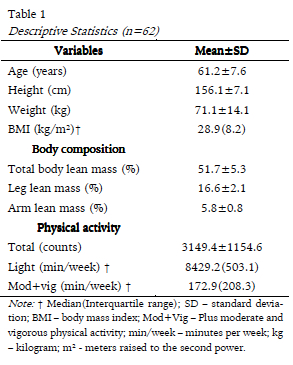
    <p>The anthropometry, body composition
and physical activity characteristics of the study participants are listed in <a href="#t1">table
1</a>. The mean age of the women was 61.2 ± 7.6 years. The median BMI was in the
overweight range (28.9 kg/m&sup2;). Women preferred light physical activity
(8429.2 [503.1] minutes per week), which accounted for 98.1% of total physical
activity, however, over half of the participants practiced a value of greater
than 150 minutes per week of moderate-vigorous physical activity (61.3%), meeting
the recommendations proposed by the ACSM for health improvements (Haskell et
al., 2007).</p>
    <p>&nbsp;</p>
    <p><a name="t1"></a></p>
    ]]></body>
<body><![CDATA[<p align="center"><img src="/img/revistas/mot/v11n1/11n1a15t1.jpg" width="293" height="365"></p>
    
<p>&nbsp;</p>


    <p>Although the median of
  moderate-vigorous physical activity was higher than the recommendations of the
  ACSM (Haskell et al., 2007), 38.7% of women were below the recommended threshold, as well as 53.2%
  who did not practice any vigorous physical activity. In contrast, sixteen women
  (25.8%) practiced 300 or more minutes per week of moderate-vigorous physical
activity, achieving a higher value than that recommended.</p>


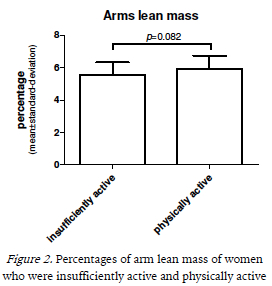
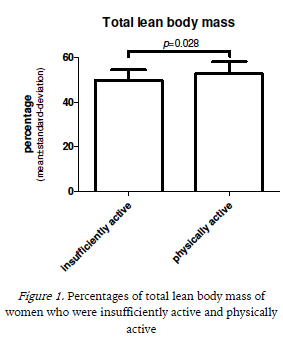
    <p>Figures <a href="#f1">1</a>, <a href="#f2">2</a> and <a href="#f3">3</a> represent the comparison
of the average percentages of total body, leg and arm lean mass, respectively,
between women who were physically active and insufficiently active. Physically
active women showed significantly higher mean values for total lean body mass
(52.8 ± 5.4 vs 49.8 ± 4.7; p = 0.028) and leg lean mass (17.1 ± 2.2 vs 15.9 ±
1.8; p = 0.026), whereas the difference in arm lean mass was not significant
(5.9 ± 0.8 vs 5.5 ± 0.8; p = 0.082).</p>
    <p>&nbsp;</p>
    <p><a name="f1"></a></p>
    <p align="center"><img src="/img/revistas/mot/v11n1/11n1a15f1.jpg" width="283" height="337"></p>
    
<p>&nbsp;</p>
    <p><a name="f2"></a></p>
    <p align="center"><img src="/img/revistas/mot/v11n1/11n1a15f2.jpg" width="272" height="286"></p>
    
]]></body>
<body><![CDATA[<p>&nbsp;</p>
    <p><a name="f3"></a></p>
    <p align="center"><img src="/img/revistas/mot/v11n1/11n1a15f3.jpg" width="275" height="287"></p>
    
<p>&nbsp;</p>


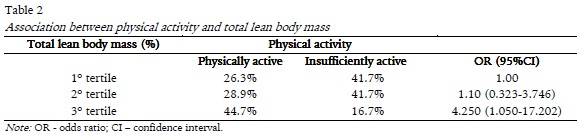
    <p>When we analyze the association between
  physical activity and increasing tertiles of percentage of total lean body
  mass, by Chi-square test, we found that those who were in the higher tertile
  were, predominantly, physically active (p =0.042). Moreover, the odds ratio, in
  <a href="#t2">table 2</a>, showed that who were physically active had 4.2 times more chance to
have greater lean mass (OR=4.250; 95%CI=1.050-17.202).</p>
    <p>&nbsp;</p>
    <p><a name="t2"></a></p>
    <p align="center"><img src="/img/revistas/mot/v11n1/11n1a15t2.jpg" width="580" height="138"></p>
    
<p>&nbsp;</p>
</font>
    <p><b><font size="3" face="Verdana">DISCUSSION</font></b></p>
<font size="2" face="Verdana">
    ]]></body>
<body><![CDATA[<p>In this cross-sectional study on the
influence of physical activity on total body, leg and arm lean mass, we found
that the women who spent 150 or more minutes per week engaged in
moderate-vigorous physical activity showed higher values of total body and leg
lean mass.</p>

    <p>In a study on the elderly, Raguso et
al. (2006) obtained similar findings to ours in the baseline period, whereby 47%
of women were classified as active, achieving an average of 90 minutes per week
of moderate-vigorous physical activity, and the women who had a 10% increase in
energy expenditure derived from moderate-vigorous physical activity were able
to increase lean body mass by up to 0.5 kg. It is known that menopausal women
showed, approximately, a 3 kg loss of lean body mass compared to pre-menopausal
women (Poehlman et al., 1995). Thus as little as 500 g increase of lean body mass may decrease the
risk of falls and fractures, promoting greater functional independence and
quality of life.</p>

    <p>Genton et al. (2011) studied the impact of physical activity on the body composition of
elderly men and women over a period of nine years, and although our study
lasted only 8 days, they found similar data to ours. When they compared the
women who either increased or decreased their physical activity over the nine
years, they observed that the increased physical activity group showed less
weight loss; and although this group presented a reduction in lean body mass,
it was lower when compared to the decreased physical activity group over the
nine years, showing that physical activity may be an interesting strategy to
mitigate reductions in lean body mass.</p>

    <p>Similarly, Hansen and Alen (2002) in a transversal study with menopausal women found no statistical
significance between the total lean body mass of women who practiced a higher
mean value of physical activity compared to those with lower values (41.8 ± 4.3
vs 41.1 ± 4.3). Levels of physical activity were classified by a
semi-structured interview that contained questions about the type, frequency,
duration and intensity of physical activity during the six months prior to the
study.</p>

    <p>These conflicting results may be due
to the limitation of the instruments used to measure habitual physical
activity, as questionnaires are difficult to apply in this population, as short
and long term memory are limited, and cognitive loss is also common (Park et al., 2010; Shephard, 2003). Moreover, it emphasizes that different types of questionnaires may
have distinct cut-off points to categorize a subject as active or not, when
compared to other questionnaires, and this fact can also influence the results.
Again, our accelerometer measures lasted only days, but group differences were
evident.</p>

    <p>However, Park, Park, Shephard and
Aoyagi (2011), in a study with the elderly using instruments similar to the
present study, had similar findings to ours. The authors found that the
sarcopenic group accumulated fewer steps per day, as well as, lower values of
moderate-vigorous physical activity, when compared with the non-sarcopenic
group. In addition, when the minutes of moderate-vigorous physical activity
were divided into quartiles, and adjusted for age, they found that women in the
upper quartile had higher values of muscle mass compared with those in the
lower quartiles. </p>

    <p>Several physiological processes may
explain this higher amount of lean body mass in women with higher levels of
physical activity (Walrand, Guillet, Salles, Cano,
&amp; Boirie, 2011)
One possible factor is that by having an increased volume and intensity of
physical activity they may have lower circulating concentrations of
inflammatory markers such as interleukin-6 and C-reactive protein, as seen by
Reuben, Judd-Hamilton, Harris and Seeman (2003) in the elderly, and these in turn are responsible for muscle
degradation (Schaap, Pluijm, Deeg, &amp; Visser,
2006). </p>

    <p>Lean body mass is one of the variables
which can be used for mortality indication (Bunout, de la Maza, Barrera, Leiva,
&amp; Hirsch, 2011) and
decreased functional capacity, which in turn is highly prevalent in older
individuals and confers an increased risk of falls and fractures, increasing
the number of hospitalizations and use of public health services (Mazo et al., 2007). Furthermore, during menopause an aggravation of this situation occurs,
in that, during this period a marked decrease in lean body mass can be
observed, frequently occasioned by non-modifiable factors such as age,
endocrine changes, oxidative stress, and modifiable factors, such as the poor
practice of physical activity (Maltais, Desroches, &amp; Dionne,
2009) and inadequate dietary intake, essentially, amino acids (Short &amp; Nair, 2000).</p>

    <p>Some limitations of this study should
be mentioned. Firstly, the cross-sectional design does not allow any inference
of cause and effect considering the short time of evaluation (eight days). Secondly,
the small sample size indicates that caution should be applied when extrapolating
the results to the general population. Finally, the time spent in different
intensities of physical activity should be considered approximate as there is
no clear consensus of an optimal cut-off point for the study population.
However, despite these limitations we suggest that physically active women can
show greater amounts of lean body mass and it can reflect positively on their
quality of life.</p>

    <p>However, the positive aspects of this
research should be emphasized. The measurement of physical activity using a
triaxial accelerometer, thereby excluding the error of self-reported measuring,
decreases the chance of misclassification of light, moderate and vigorous physical
activity, inherent in questionnaires (Shephard, 2003). Furthermore, the estimation of total and segmented body composition by
DXA is a strength of the study, as it is a reliable and high precision method
for assessing the studied population and allows for analysis by body grouping (Woodrow, 2009). Additionally, the difficulty of comparison with other studies that
used similarly accurate instruments, demonstrates that the practice of physical
activity and its relationship to total lean body mass, especially segmented,
has been little studied in premenopausal women.</p>
</font>
    ]]></body>
<body><![CDATA[<p>&nbsp;</p>

    <p><b><font size="3" face="Verdana">CONCLUSION</font></b></p>
<font size="2" face="Verdana">
    <p>In summary, the results observed in
this study suggest that the practice of moderate-vigorous habitual physical activity
with a weekly volume of 150 minutes, or more, can help to ease the loss of
total body and leg lean mass in menopausal women. Thus, strategies aimed at
providing the opportunity for menopausal women to engage in physical activities
becomes important, both for improving quality of life, and from the point of
view of public health.</p>
</font>


    <p>&nbsp;</p>
    <p><b><font size="3" face="Verdana">REFERÊNCIAS</font></b></p>
<font size="2" face="Verdana">
    <!-- ref --><p>Abe,
T., Mitsukawa, N., Thiebaud, R. S., Loenneke, J. P., Loftin, M., &amp; Ogawa,
M. (2012). Lower body site-specific sarcopenia and accelerometer-determined
moderate and vigorous physical activity: the HIREGASAKI study. <i>Aging
Clinical and Experimental Research</i>, <i>24</i>(6), 657&#8211;662.
<a href="http://doi.org/10.3275/8758" target="_blank">http://doi.org/10.3275/8758</a>&nbsp;&nbsp;&nbsp;&nbsp;&nbsp;&nbsp;&nbsp;&nbsp;[&#160;<a href="javascript:void(0);" onclick="javascript: window.open('/scielo.php?script=sci_nlinks&ref=000088&pid=S1646-107X201500010001500001&lng=','','width=640,height=500,resizable=yes,scrollbars=1,menubar=yes,');">Links</a>&#160;]<!-- end-ref --><!-- ref --><p>Bouchard, D. R., Dionne, I. J., &amp; Brochu, M. (2009).
Sarcopenic/obesity and physical capacity in older men and women: data from the
Nutrition as a Determinant of Successful Aging (NuAge)-the Quebec longitudinal
Study. <i>Obesity (Silver Spring, Md.)</i>, <i>17</i>(11), 2082&#8211;2088.
<a href="http://doi.org/10.1038/oby.2009.109" target="_blank">http://doi.org/10.1038/oby.2009.109</a>&nbsp;&nbsp;&nbsp;&nbsp;&nbsp;&nbsp;&nbsp;&nbsp;[&#160;<a href="javascript:void(0);" onclick="javascript: window.open('/scielo.php?script=sci_nlinks&ref=000089&pid=S1646-107X201500010001500002&lng=','','width=640,height=500,resizable=yes,scrollbars=1,menubar=yes,');">Links</a>&#160;]<!-- end-ref --><!-- ref --><p>Buffa, R., Floris, G. U., Putzu, P. F., &amp; Marini, E. (2011). Body
composition variations in ageing. <i>Collegium Antropologicum</i>, <i>35</i>(1),
259&#8211;265.    &nbsp;&nbsp;&nbsp;&nbsp;&nbsp;&nbsp;&nbsp;&nbsp;[&#160;<a href="javascript:void(0);" onclick="javascript: window.open('/scielo.php?script=sci_nlinks&ref=000090&pid=S1646-107X201500010001500003&lng=','','width=640,height=500,resizable=yes,scrollbars=1,menubar=yes,');">Links</a>&#160;]<!-- end-ref --></p>

    <!-- ref --><p>Bunout, D., de la Maza, M.
P., Barrera, G., Leiva, L., &amp; Hirsch, S. (2011). Association
between sarcopenia and mortality in healthy older people. <i>Australasian Journal
on Ageing</i>, <i>30</i>(2), 89&#8211;92. <a href="http://doi.org/10.1111/j.1741-6612.2010.00448.x" target="_blank">http://doi.org/10.1111/j.1741-6612.2010.00448.x</a>&nbsp;&nbsp;&nbsp;&nbsp;&nbsp;&nbsp;&nbsp;&nbsp;[&#160;<a href="javascript:void(0);" onclick="javascript: window.open('/scielo.php?script=sci_nlinks&ref=000092&pid=S1646-107X201500010001500004&lng=','','width=640,height=500,resizable=yes,scrollbars=1,menubar=yes,');">Links</a>&#160;]<!-- end-ref --><!-- ref --><p>Buonani, C., Rosa, C. S. da
C., Diniz, T. A., Christofaro, D. G. D., Monteiro, H. L., Rossi, F. E., …
Forte, I. (2013). Prática de atividade física e composição corporal em mulheres
na menopausa. <i>Revista Brasileira de Ginecologia e Obstetrícia</i>, <i>35</i>(4),
153&#8211;158. <a href="http://doi.org/10.1590/S0100-72032013000400004" target="_blank">http://doi.org/10.1590/S0100-72032013000400004</a>&nbsp;&nbsp;&nbsp;&nbsp;&nbsp;&nbsp;&nbsp;&nbsp;[&#160;<a href="javascript:void(0);" onclick="javascript: window.open('/scielo.php?script=sci_nlinks&ref=000093&pid=S1646-107X201500010001500005&lng=','','width=640,height=500,resizable=yes,scrollbars=1,menubar=yes,');">Links</a>&#160;]<!-- end-ref --><!-- ref --><p>Carvalho, J. A. M. de, &amp;
Rodríguez-Wong, L. L. (2008). A transição da estrutura etária da população
brasileira na primeira metade do século XXI. <i>Cadernos de Saúde Pública</i>, <i>24</i>(3),
597&#8211;605. <a href="http://doi.org/10.1590/S0102-311X2008000300013" target="_blank">http://doi.org/10.1590/S0102-311X2008000300013</a>&nbsp;&nbsp;&nbsp;&nbsp;&nbsp;&nbsp;&nbsp;&nbsp;[&#160;<a href="javascript:void(0);" onclick="javascript: window.open('/scielo.php?script=sci_nlinks&ref=000094&pid=S1646-107X201500010001500006&lng=','','width=640,height=500,resizable=yes,scrollbars=1,menubar=yes,');">Links</a>&#160;]<!-- end-ref --><!-- ref --><p>Craig, C. L., Marshall, A.
L., Sjöström, M., Bauman, A. E., Booth, M. L., Ainsworth, B. E., … Oja, P. (2003). International physical activity questionnaire:
12-country reliability and validity. <i>Medicine and Science in Sports and
Exercise</i>, <i>35</i>(8), 1381&#8211;1395.
<a href="http://doi.org/10.1249/01.MSS.0000078924.61453.FB" target="_blank">http://doi.org/10.1249/01.MSS.0000078924.61453.FB</a>&nbsp;&nbsp;&nbsp;&nbsp;&nbsp;&nbsp;&nbsp;&nbsp;[&#160;<a href="javascript:void(0);" onclick="javascript: window.open('/scielo.php?script=sci_nlinks&ref=000095&pid=S1646-107X201500010001500007&lng=','','width=640,height=500,resizable=yes,scrollbars=1,menubar=yes,');">Links</a>&#160;]<!-- end-ref --><!-- ref --><p>Genton, L., Karsegard, V. L., Chevalley, T., Kossovsky, M. P., Darmon,
P., &amp; Pichard, C. (2011). Body composition changes over 9 years in healthy
elderly subjects and impact of physical activity. <i>Clinical Nutrition</i>, <i>30</i>(4),
436&#8211;442. <a href="http://doi.org/10.1016/j.clnu.2011.01.009" target="_blank">http://doi.org/10.1016/j.clnu.2011.01.009</a>&nbsp;&nbsp;&nbsp;&nbsp;&nbsp;&nbsp;&nbsp;&nbsp;[&#160;<a href="javascript:void(0);" onclick="javascript: window.open('/scielo.php?script=sci_nlinks&ref=000096&pid=S1646-107X201500010001500008&lng=','','width=640,height=500,resizable=yes,scrollbars=1,menubar=yes,');">Links</a>&#160;]<!-- end-ref --><!-- ref --><p>Hansen, R. D., &amp; Allen, B. J. (2002). Habitual physical activity,
anabolic hormones, and potassium content of fat-free mass in postmenopausal
women. <i>The American Journal of Clinical Nutrition</i>, <i>75</i>(2),
314&#8211;320.    &nbsp;&nbsp;&nbsp;&nbsp;&nbsp;&nbsp;&nbsp;&nbsp;[&#160;<a href="javascript:void(0);" onclick="javascript: window.open('/scielo.php?script=sci_nlinks&ref=000097&pid=S1646-107X201500010001500009&lng=','','width=640,height=500,resizable=yes,scrollbars=1,menubar=yes,');">Links</a>&#160;]<!-- end-ref --></p>

    <!-- ref --><p>Haskell, W. L., Lee, I.-M., Pate, R. R., Powell, K. E., Blair, S. N., Franklin,
B. A., … American Heart Association. (2007). Physical activity and public
health: updated recommendation for adults from the American College of Sports
Medicine and the American Heart Association. <i>Circulation</i>, <i>116</i>(9),
1081&#8211;1093. <a href="http://doi.org/10.1161/CIRCULATIONAHA.107.185649" target="_blank">http://doi.org/10.1161/CIRCULATIONAHA.107.185649</a>&nbsp;&nbsp;&nbsp;&nbsp;&nbsp;&nbsp;&nbsp;&nbsp;[&#160;<a href="javascript:void(0);" onclick="javascript: window.open('/scielo.php?script=sci_nlinks&ref=000099&pid=S1646-107X201500010001500010&lng=','','width=640,height=500,resizable=yes,scrollbars=1,menubar=yes,');">Links</a>&#160;]<!-- end-ref --><!-- ref --><p>Kamel, H. K. (2003). Sarcopenia and Aging. <i>Nutrition Reviews</i>, <i>61</i>(5),
157&#8211;167. <a href="http://doi.org/10.1301/nr.2003.may.157-167" target="_blank">http://doi.org/10.1301/nr.2003.may.157-167</a>&nbsp;&nbsp;&nbsp;&nbsp;&nbsp;&nbsp;&nbsp;&nbsp;[&#160;<a href="javascript:void(0);" onclick="javascript: window.open('/scielo.php?script=sci_nlinks&ref=000100&pid=S1646-107X201500010001500011&lng=','','width=640,height=500,resizable=yes,scrollbars=1,menubar=yes,');">Links</a>&#160;]<!-- end-ref --><!-- ref --><p>Lara, S., Casanova, G., &amp;
Spritzer, P. M. (2010). Influence of habitual physical activity
on body composition, fat distribution and metabolic variables in early
postmenopausal women receiving hormonal therapy. <i>European Journal of Obstetrics,
Gynecology, and Reproductive Biology</i>, <i>150</i>(1), 52&#8211;56.
<a href="http://doi.org/10.1016/j.ejogrb.2010.02.007" target="_blank">http://doi.org/10.1016/j.ejogrb.2010.02.007</a>&nbsp;&nbsp;&nbsp;&nbsp;&nbsp;&nbsp;&nbsp;&nbsp;[&#160;<a href="javascript:void(0);" onclick="javascript: window.open('/scielo.php?script=sci_nlinks&ref=000101&pid=S1646-107X201500010001500012&lng=','','width=640,height=500,resizable=yes,scrollbars=1,menubar=yes,');">Links</a>&#160;]<!-- end-ref --><!-- ref --><p>Luy, M., &amp; Gast, K. (2014). Do women live longer or do men die
earlier? Reflections on the causes of sex differences in life expectancy. <i>Gerontology</i>,
<i>60</i>(2), 143&#8211;153. <a href="http://doi.org/10.1159/000355310" target="_blank">http://doi.org/10.1159/000355310</a>&nbsp;&nbsp;&nbsp;&nbsp;&nbsp;&nbsp;&nbsp;&nbsp;[&#160;<a href="javascript:void(0);" onclick="javascript: window.open('/scielo.php?script=sci_nlinks&ref=000102&pid=S1646-107X201500010001500013&lng=','','width=640,height=500,resizable=yes,scrollbars=1,menubar=yes,');">Links</a>&#160;]<!-- end-ref --><!-- ref --><p>Maltais, M. L., Desroches, J., &amp; Dionne, I. J. (2009). Changes in
muscle mass and strength after menopause. <i>Journal of Musculoskeletal &amp; Neuronal Interactions</i>, <i>9</i>(4), 186&#8211;197.    &nbsp;&nbsp;&nbsp;&nbsp;&nbsp;&nbsp;&nbsp;&nbsp;[&#160;<a href="javascript:void(0);" onclick="javascript: window.open('/scielo.php?script=sci_nlinks&ref=000103&pid=S1646-107X201500010001500014&lng=','','width=640,height=500,resizable=yes,scrollbars=1,menubar=yes,');">Links</a>&#160;]<!-- end-ref --></p>

    <!-- ref --><p>Mazo, G. Z., Liposcki, D. B.,
Ananda, C., &amp; Prevê, D. (2007). Condições de saúde, incidência de quedas e
nível de atividade física dos idosos. <i>Brazilian
Journal of Physical Therapy</i>, <i>11</i>(6), 437&#8211;442.
<a href="http://doi.org/10.1590/S1413-35552007000600004" target="_blank">http://doi.org/10.1590/S1413-35552007000600004</a>&nbsp;&nbsp;&nbsp;&nbsp;&nbsp;&nbsp;&nbsp;&nbsp;[&#160;<a href="javascript:void(0);" onclick="javascript: window.open('/scielo.php?script=sci_nlinks&ref=000105&pid=S1646-107X201500010001500015&lng=','','width=640,height=500,resizable=yes,scrollbars=1,menubar=yes,');">Links</a>&#160;]<!-- end-ref --><!-- ref --><p>Park, H., Park, S., Shephard, R. J., &amp; Aoyagi, Y. (2010). Yearlong
physical activity and sarcopenia in older adults: the Nakanojo Study. <i>European
Journal of Applied Physiology</i>, <i>109</i>(5), 953&#8211;961.
<a href="http://doi.org/10.1007/s00421-010-1424-8" target="_blank">http://doi.org/10.1007/s00421-010-1424-8</a>&nbsp;&nbsp;&nbsp;&nbsp;&nbsp;&nbsp;&nbsp;&nbsp;[&#160;<a href="javascript:void(0);" onclick="javascript: window.open('/scielo.php?script=sci_nlinks&ref=000106&pid=S1646-107X201500010001500016&lng=','','width=640,height=500,resizable=yes,scrollbars=1,menubar=yes,');">Links</a>&#160;]<!-- end-ref --><!-- ref --><p>Penha, J. C. L., Piçarro, I. da C., Neto, B., &amp; De, T. L. (2012). Evolução da aptidão física e
capacidade funcional de mulheres ativas acima de 50 anos de idade de acordo com
a idade cronológica, na cidade de Santos. <i>Ciência &amp; Saúde Coletiva</i>, <i>17</i>(1),
245&#8211;253. <a href="http://doi.org/10.1590/S1413-81232012000100027" target="_blank">http://doi.org/10.1590/S1413-81232012000100027</a>&nbsp;&nbsp;&nbsp;&nbsp;&nbsp;&nbsp;&nbsp;&nbsp;[&#160;<a href="javascript:void(0);" onclick="javascript: window.open('/scielo.php?script=sci_nlinks&ref=000107&pid=S1646-107X201500010001500017&lng=','','width=640,height=500,resizable=yes,scrollbars=1,menubar=yes,');">Links</a>&#160;]<!-- end-ref --><!-- ref --><p>Poehlman, E. T., Toth, M. J.,
Fishman, P. S., Vaitkevicius, P., Gottlieb, S. S., Fisher, M. L., &amp; Fonong,
T. (1995). Sarcopenia in aging humans: the impact of
menopause and disease. <i>The Journals of Gerontology. Series A, Biological
Sciences and Medical Sciences</i>, <i>50 Spec No</i>, 73&#8211;77.
<a href="http://doi.org/10.1093/gerona/50A.Special_Issue.73" target="_blank">http://doi.org/10.1093/gerona/50A.Special_Issue.73</a>&nbsp;&nbsp;&nbsp;&nbsp;&nbsp;&nbsp;&nbsp;&nbsp;[&#160;<a href="javascript:void(0);" onclick="javascript: window.open('/scielo.php?script=sci_nlinks&ref=000108&pid=S1646-107X201500010001500018&lng=','','width=640,height=500,resizable=yes,scrollbars=1,menubar=yes,');">Links</a>&#160;]<!-- end-ref --><!-- ref --><p>Raguso, C. A., Kyle, U., Kossovsky, M. P., Roynette, C., Paoloni-Giacobino,
A., Hans, D., … Pichard, C. (2006). A 3-year longitudinal study on body
composition changes in the elderly: role of physical exercise. <i>Clinical
Nutrition (Edinburgh, Scotland)</i>, <i>25</i>(4), 573&#8211;580.
<a href="http://doi.org/10.1016/j.clnu.2005.10.013" target="_blank">http://doi.org/10.1016/j.clnu.2005.10.013</a>&nbsp;&nbsp;&nbsp;&nbsp;&nbsp;&nbsp;&nbsp;&nbsp;[&#160;<a href="javascript:void(0);" onclick="javascript: window.open('/scielo.php?script=sci_nlinks&ref=000109&pid=S1646-107X201500010001500019&lng=','','width=640,height=500,resizable=yes,scrollbars=1,menubar=yes,');">Links</a>&#160;]<!-- end-ref --><!-- ref --><p>Reuben, D. B., Judd-Hamilton, L., Harris, T. B., &amp; Seeman, T. E.
(2003). The associations between physical activity and inflammatory markers in
high-functioning older persons: MacArthur studies of successful aging. <i>Journal
of the American Geriatrics Society</i>, <i>51</i>(8), 1125&#8211;1130.
<a href="http://doi.org/10.1046/j.1532-5415.2003.51380.x" target="_blank">http://doi.org/10.1046/j.1532-5415.2003.51380.x</a>&nbsp;&nbsp;&nbsp;&nbsp;&nbsp;&nbsp;&nbsp;&nbsp;[&#160;<a href="javascript:void(0);" onclick="javascript: window.open('/scielo.php?script=sci_nlinks&ref=000110&pid=S1646-107X201500010001500020&lng=','','width=640,height=500,resizable=yes,scrollbars=1,menubar=yes,');">Links</a>&#160;]<!-- end-ref --><!-- ref --><p>Roubenoff, R., &amp; Hughes, V. A. (2000). Sarcopenia Current Concepts. <i>The
Journals of Gerontology Series A: Biological Sciences and Medical Sciences</i>,
<i>55</i>(12), M716&#8211;M724. <a href="http://doi.org/10.1093/gerona/55.12.M716" target="_blank">http://doi.org/10.1093/gerona/55.12.M716</a>&nbsp;&nbsp;&nbsp;&nbsp;&nbsp;&nbsp;&nbsp;&nbsp;[&#160;<a href="javascript:void(0);" onclick="javascript: window.open('/scielo.php?script=sci_nlinks&ref=000111&pid=S1646-107X201500010001500021&lng=','','width=640,height=500,resizable=yes,scrollbars=1,menubar=yes,');">Links</a>&#160;]<!-- end-ref --><!-- ref --><p>Sasaki, J. E., John, D., &amp; Freedson, P. S. (2011). Validation and
comparison of ActiGraph activity monitors. <i>Journal of Science and Medicine
in Sport / Sports Medicine Australia</i>, <i>14</i>(5), 411&#8211;416.
<a href="http://doi.org/10.1016/j.jsams.2011.04.003" target="_blank">http://doi.org/10.1016/j.jsams.2011.04.003</a>&nbsp;&nbsp;&nbsp;&nbsp;&nbsp;&nbsp;&nbsp;&nbsp;[&#160;<a href="javascript:void(0);" onclick="javascript: window.open('/scielo.php?script=sci_nlinks&ref=000112&pid=S1646-107X201500010001500022&lng=','','width=640,height=500,resizable=yes,scrollbars=1,menubar=yes,');">Links</a>&#160;]<!-- end-ref --><!-- ref --><p>Schaap, L. A., Pluijm, S. M. F., Deeg, D. J. H., &amp; Visser, M.
(2006). Inflammatory markers and loss of muscle mass (sarcopenia) and strength.
<i>The American Journal of Medicine</i>, <i>119</i>(6), 526.e9&#8211;17.
<a href="http://doi.org/10.1016/j.amjmed.2005.10.049" target="_blank">http://doi.org/10.1016/j.amjmed.2005.10.049</a>&nbsp;&nbsp;&nbsp;&nbsp;&nbsp;&nbsp;&nbsp;&nbsp;[&#160;<a href="javascript:void(0);" onclick="javascript: window.open('/scielo.php?script=sci_nlinks&ref=000113&pid=S1646-107X201500010001500023&lng=','','width=640,height=500,resizable=yes,scrollbars=1,menubar=yes,');">Links</a>&#160;]<!-- end-ref --><!-- ref --><p>Shephard, R. J. (2003). Limits to the measurement of habitual physical
activity by questionnaires. <i>British Journal of Sports Medicine</i>, <i>37</i>(3),
197&#8211;206. <a href="http://doi.org/10.1136/bjsm.37.3.197" target="_blank">http://doi.org/10.1136/bjsm.37.3.197</a>&nbsp;&nbsp;&nbsp;&nbsp;&nbsp;&nbsp;&nbsp;&nbsp;[&#160;<a href="javascript:void(0);" onclick="javascript: window.open('/scielo.php?script=sci_nlinks&ref=000114&pid=S1646-107X201500010001500024&lng=','','width=640,height=500,resizable=yes,scrollbars=1,menubar=yes,');">Links</a>&#160;]<!-- end-ref --><!-- ref --><p>Short, K. R., &amp; Nair, K. S. (2000). The effect of age on protein
metabolism. <i>Current Opinion in Clinical Nutrition and Metabolic Care</i>, <i>3</i>(1),
39&#8211;44.    &nbsp;&nbsp;&nbsp;&nbsp;&nbsp;&nbsp;&nbsp;&nbsp;[&#160;<a href="javascript:void(0);" onclick="javascript: window.open('/scielo.php?script=sci_nlinks&ref=000115&pid=S1646-107X201500010001500025&lng=','','width=640,height=500,resizable=yes,scrollbars=1,menubar=yes,');">Links</a>&#160;]<!-- end-ref --></p>

    <!-- ref --><p>Trost, S. G., McIver, K. L., &amp; Pate, R. R. (2005). Conducting
accelerometer-based activity assessments in field-based research. <i>Medicine
and Science in Sports and Exercise</i>, <i>37</i>(11 Suppl), S531&#8211;S543.    &nbsp;&nbsp;&nbsp;&nbsp;&nbsp;&nbsp;&nbsp;&nbsp;[&#160;<a href="javascript:void(0);" onclick="javascript: window.open('/scielo.php?script=sci_nlinks&ref=000117&pid=S1646-107X201500010001500026&lng=','','width=640,height=500,resizable=yes,scrollbars=1,menubar=yes,');">Links</a>&#160;]<!-- end-ref --></p>

    <!-- ref --><p>Walrand, S., Guillet, C., Salles, J., Cano, N., &amp; Boirie, Y. (2011).
Physiopathological mechanism of sarcopenia. <i>Clinics in Geriatric Medicine</i>,
<i>27</i>(3), 365&#8211;385. <a href="http://doi.org/10.1016/j.cger.2011.03.005" target="_blank">http://doi.org/10.1016/j.cger.2011.03.005</a>&nbsp;&nbsp;&nbsp;&nbsp;&nbsp;&nbsp;&nbsp;&nbsp;[&#160;<a href="javascript:void(0);" onclick="javascript: window.open('/scielo.php?script=sci_nlinks&ref=000119&pid=S1646-107X201500010001500027&lng=','','width=640,height=500,resizable=yes,scrollbars=1,menubar=yes,');">Links</a>&#160;]<!-- end-ref --><!-- ref --><p>Woodrow, G. (2009). Body composition analysis techniques in the aged
adult: indications and limitations. <i>Current Opinion in Clinical Nutrition
and Metabolic Care</i>, <i>12</i>(1), 8&#8211;14.
<a href="http://doi.org/10.1097/MCO.0b013e32831b9c5b" target="_blank">http://doi.org/10.1097/MCO.0b013e32831b9c5b</a>&nbsp;&nbsp;&nbsp;&nbsp;&nbsp;&nbsp;&nbsp;&nbsp;[&#160;<a href="javascript:void(0);" onclick="javascript: window.open('/scielo.php?script=sci_nlinks&ref=000120&pid=S1646-107X201500010001500028&lng=','','width=640,height=500,resizable=yes,scrollbars=1,menubar=yes,');">Links</a>&#160;]<!-- end-ref --><!-- ref --><p>World Health Organization. (1996). Research on the menopause in the
1990s. Report of a WHO Scientific Group. <i>World Health Organization Technical
Report Series</i>, <i>866</i>, 1&#8211;107.    &nbsp;&nbsp;&nbsp;&nbsp;&nbsp;&nbsp;&nbsp;&nbsp;[&#160;<a href="javascript:void(0);" onclick="javascript: window.open('/scielo.php?script=sci_nlinks&ref=000121&pid=S1646-107X201500010001500029&lng=','','width=640,height=500,resizable=yes,scrollbars=1,menubar=yes,');">Links</a>&#160;]<!-- end-ref --></p>

    ]]></body>
<body><![CDATA[<!-- ref --><p>Zhong, S., Chen, C. N., &amp; Thompson, L. V. (2007). Sarcopenia of
ageing: functional, structural and biochemical alterations. <i>Brazilian Journal of Physical
Therapy</i>, <i>11</i>(2),
91&#8211;97. <a href="http://doi.org/10.1590/S1413-35552007000200002" target="_blank">http://doi.org/10.1590/S1413-35552007000200002</a>&nbsp;&nbsp;&nbsp;&nbsp;&nbsp;&nbsp;&nbsp;&nbsp;[&#160;<a href="javascript:void(0);" onclick="javascript: window.open('/scielo.php?script=sci_nlinks&ref=000123&pid=S1646-107X201500010001500030&lng=','','width=640,height=500,resizable=yes,scrollbars=1,menubar=yes,');">Links</a>&#160;]<!-- end-ref --><p>&nbsp;</p>
    <p><font size="2" face="Verdana"><b>Acknowledgments:    <br>
</b>Nothing
  to declare.    <br>
  <b>Conflict of interest:    <br>
  </b>Nothing
  to declare.    <br>
  <b>Funding:    <br>
  </b>Nothing
to declare.</font></p>
    <p><font size="2" face="Verdana">Manuscript received in April 8<sup>th</sup>,
  2014; Accepted June 3<sup>rd</sup>, 2014</font></p>
    <p>&nbsp;</p>
    ]]></body>
<body><![CDATA[<p>&nbsp;</p>
    <p><font size="2" face="Verdana"><a name="end"></a><a href="#topo">*</a><i>Corresponding Author</i>: Department of Physical Education, S&atilde;o Paulo State University, UNESP,
  Rua Roberto Simonsen, 305, 19060-900 Presidente Prudente, SP, Brazil. <i>Email:</i> <a href="mailto:tiegodiniz@gmail.com">tiegodiniz@gmail.com</a></font></p>
     ]]></body><back>
<ref-list>
<ref id="B1">
<nlm-citation citation-type="journal">
<person-group person-group-type="author">
<name>
<surname><![CDATA[Abe]]></surname>
<given-names><![CDATA[T.]]></given-names>
</name>
<name>
<surname><![CDATA[Mitsukawa]]></surname>
<given-names><![CDATA[N.]]></given-names>
</name>
<name>
<surname><![CDATA[Thiebaud]]></surname>
<given-names><![CDATA[R. S.]]></given-names>
</name>
<name>
<surname><![CDATA[Loenneke]]></surname>
<given-names><![CDATA[J. P.]]></given-names>
</name>
<name>
<surname><![CDATA[Loftin]]></surname>
<given-names><![CDATA[M.]]></given-names>
</name>
<name>
<surname><![CDATA[Ogawa]]></surname>
<given-names><![CDATA[M.]]></given-names>
</name>
</person-group>
<article-title xml:lang="en"><![CDATA[Lower body site-specific sarcopenia and accelerometer-determined moderate and vigorous physical activity: the HIREGASAKI study]]></article-title>
<source><![CDATA[Aging Clinical and Experimental Research]]></source>
<year>2012</year>
<volume>24</volume>
<numero>6</numero>
<issue>6</issue>
<page-range>657-662</page-range></nlm-citation>
</ref>
<ref id="B2">
<nlm-citation citation-type="journal">
<person-group person-group-type="author">
<name>
<surname><![CDATA[Bouchard]]></surname>
<given-names><![CDATA[D. R.]]></given-names>
</name>
<name>
<surname><![CDATA[Dionne]]></surname>
<given-names><![CDATA[I. J.]]></given-names>
</name>
<name>
<surname><![CDATA[Brochu]]></surname>
<given-names><![CDATA[M.]]></given-names>
</name>
</person-group>
<article-title xml:lang="en"><![CDATA[Sarcopenic/obesity and physical capacity in older men and women: data from the Nutrition as a Determinant of Successful Aging (NuAge)-the Quebec longitudinal Study]]></article-title>
<source><![CDATA[Obesity (Silver Spring, Md.)]]></source>
<year>2009</year>
<volume>17</volume>
<numero>11</numero>
<issue>11</issue>
<page-range>2082-2088</page-range></nlm-citation>
</ref>
<ref id="B3">
<nlm-citation citation-type="journal">
<person-group person-group-type="author">
<name>
<surname><![CDATA[Buffa]]></surname>
<given-names><![CDATA[R.]]></given-names>
</name>
<name>
<surname><![CDATA[Floris]]></surname>
<given-names><![CDATA[G. U.]]></given-names>
</name>
<name>
<surname><![CDATA[Putzu]]></surname>
<given-names><![CDATA[P. F.]]></given-names>
</name>
<name>
<surname><![CDATA[Marini]]></surname>
<given-names><![CDATA[E.]]></given-names>
</name>
</person-group>
<article-title xml:lang="en"><![CDATA[Body composition variations in ageing]]></article-title>
<source><![CDATA[Collegium Antropologicum]]></source>
<year>2011</year>
<volume>35</volume>
<numero>1</numero>
<issue>1</issue>
<page-range>259-265</page-range></nlm-citation>
</ref>
<ref id="B4">
<nlm-citation citation-type="journal">
<person-group person-group-type="author">
<name>
<surname><![CDATA[Bunout]]></surname>
<given-names><![CDATA[D.]]></given-names>
</name>
<name>
<surname><![CDATA[de la Maza]]></surname>
<given-names><![CDATA[M. P.]]></given-names>
</name>
<name>
<surname><![CDATA[Barrera]]></surname>
<given-names><![CDATA[G.]]></given-names>
</name>
<name>
<surname><![CDATA[Leiva]]></surname>
<given-names><![CDATA[L.]]></given-names>
</name>
<name>
<surname><![CDATA[Hirsch]]></surname>
<given-names><![CDATA[S.]]></given-names>
</name>
</person-group>
<article-title xml:lang="en"><![CDATA[Association between sarcopenia and mortality in healthy older people]]></article-title>
<source><![CDATA[Australasian Journal on Ageing]]></source>
<year>2011</year>
<volume>30</volume>
<numero>2</numero>
<issue>2</issue>
<page-range>89-92</page-range></nlm-citation>
</ref>
<ref id="B5">
<nlm-citation citation-type="journal">
<person-group person-group-type="author">
<name>
<surname><![CDATA[Buonani]]></surname>
<given-names><![CDATA[C.]]></given-names>
</name>
<name>
<surname><![CDATA[Rosa]]></surname>
<given-names><![CDATA[C. S. da C.]]></given-names>
</name>
<name>
<surname><![CDATA[Diniz]]></surname>
<given-names><![CDATA[T. A.]]></given-names>
</name>
<name>
<surname><![CDATA[Christofaro]]></surname>
<given-names><![CDATA[D. G. D.]]></given-names>
</name>
<name>
<surname><![CDATA[Monteiro]]></surname>
<given-names><![CDATA[H. L.]]></given-names>
</name>
<name>
<surname><![CDATA[Rossi]]></surname>
<given-names><![CDATA[F. E.]]></given-names>
</name>
<name>
<surname><![CDATA[Forte]]></surname>
<given-names><![CDATA[I.]]></given-names>
</name>
</person-group>
<article-title xml:lang="pt"><![CDATA[Prática de atividade física e composição corporal em mulheres na menopausa]]></article-title>
<source><![CDATA[Revista Brasileira de Ginecologia e Obstetrícia]]></source>
<year>2013</year>
<volume>35</volume>
<numero>4</numero>
<issue>4</issue>
<page-range>153-158</page-range></nlm-citation>
</ref>
<ref id="B6">
<nlm-citation citation-type="journal">
<person-group person-group-type="author">
<name>
<surname><![CDATA[Carvalho]]></surname>
<given-names><![CDATA[J. A. M. de]]></given-names>
</name>
<name>
<surname><![CDATA[Rodríguez-Wong]]></surname>
<given-names><![CDATA[L. L.]]></given-names>
</name>
</person-group>
<article-title xml:lang="pt"><![CDATA[A transição da estrutura etária da população brasileira na primeira metade do século XXI]]></article-title>
<source><![CDATA[Cadernos de Saúde Pública]]></source>
<year>2008</year>
<volume>24</volume>
<numero>3</numero>
<issue>3</issue>
<page-range>597-605</page-range></nlm-citation>
</ref>
<ref id="B7">
<nlm-citation citation-type="journal">
<person-group person-group-type="author">
<name>
<surname><![CDATA[Craig]]></surname>
<given-names><![CDATA[C. L.]]></given-names>
</name>
<name>
<surname><![CDATA[Marshall]]></surname>
<given-names><![CDATA[A. L.]]></given-names>
</name>
<name>
<surname><![CDATA[Sjöström]]></surname>
<given-names><![CDATA[M.]]></given-names>
</name>
<name>
<surname><![CDATA[Bauman]]></surname>
<given-names><![CDATA[A. E.]]></given-names>
</name>
<name>
<surname><![CDATA[Booth]]></surname>
<given-names><![CDATA[M. L.]]></given-names>
</name>
<name>
<surname><![CDATA[Ainsworth]]></surname>
<given-names><![CDATA[B. E.]]></given-names>
</name>
<name>
<surname><![CDATA[Oja]]></surname>
<given-names><![CDATA[P.]]></given-names>
</name>
</person-group>
<article-title xml:lang="en"><![CDATA[International physical activity questionnaire: 12-country reliability and validity]]></article-title>
<source><![CDATA[Medicine and Science in Sports and Exercise]]></source>
<year>2003</year>
<volume>35</volume>
<numero>8</numero>
<issue>8</issue>
<page-range>1381-1395</page-range></nlm-citation>
</ref>
<ref id="B8">
<nlm-citation citation-type="journal">
<person-group person-group-type="author">
<name>
<surname><![CDATA[Genton]]></surname>
<given-names><![CDATA[L.]]></given-names>
</name>
<name>
<surname><![CDATA[Karsegard]]></surname>
<given-names><![CDATA[V. L.]]></given-names>
</name>
<name>
<surname><![CDATA[Chevalley]]></surname>
<given-names><![CDATA[T.]]></given-names>
</name>
<name>
<surname><![CDATA[Kossovsky]]></surname>
<given-names><![CDATA[M. P.]]></given-names>
</name>
<name>
<surname><![CDATA[Darmon]]></surname>
<given-names><![CDATA[P.]]></given-names>
</name>
<name>
<surname><![CDATA[Pichard]]></surname>
<given-names><![CDATA[C.]]></given-names>
</name>
</person-group>
<article-title xml:lang="en"><![CDATA[Body composition changes over 9 years in healthy elderly subjects and impact of physical activity]]></article-title>
<source><![CDATA[Clinical Nutrition]]></source>
<year>2011</year>
<volume>30</volume>
<numero>4</numero>
<issue>4</issue>
<page-range>436-442</page-range></nlm-citation>
</ref>
<ref id="B9">
<nlm-citation citation-type="journal">
<person-group person-group-type="author">
<name>
<surname><![CDATA[Hansen]]></surname>
<given-names><![CDATA[R. D.]]></given-names>
</name>
<name>
<surname><![CDATA[Allen]]></surname>
<given-names><![CDATA[B. J.]]></given-names>
</name>
</person-group>
<article-title xml:lang="en"><![CDATA[Habitual physical activity, anabolic hormones, and potassium content of fat-free mass in postmenopausal women]]></article-title>
<source><![CDATA[The American Journal of Clinical Nutrition]]></source>
<year>2002</year>
<volume>75</volume>
<numero>2</numero>
<issue>2</issue>
<page-range>314-320</page-range></nlm-citation>
</ref>
<ref id="B10">
<nlm-citation citation-type="journal">
<person-group person-group-type="author">
<name>
<surname><![CDATA[Haskell]]></surname>
<given-names><![CDATA[W. L.]]></given-names>
</name>
<name>
<surname><![CDATA[Lee]]></surname>
<given-names><![CDATA[I.-M.]]></given-names>
</name>
<name>
<surname><![CDATA[Pate]]></surname>
<given-names><![CDATA[R. R.]]></given-names>
</name>
<name>
<surname><![CDATA[Powell]]></surname>
<given-names><![CDATA[K. E.]]></given-names>
</name>
<name>
<surname><![CDATA[Blair]]></surname>
<given-names><![CDATA[S. N.]]></given-names>
</name>
<name>
<surname><![CDATA[Franklin]]></surname>
<given-names><![CDATA[B. A.]]></given-names>
</name>
</person-group>
<collab>American Heart Association</collab>
<article-title xml:lang="en"><![CDATA[Physical activity and public health: updated recommendation for adults from the American College of Sports Medicine and the American Heart Association]]></article-title>
<source><![CDATA[Circulation]]></source>
<year>2007</year>
<volume>116</volume>
<numero>9</numero>
<issue>9</issue>
<page-range>1081-1093</page-range></nlm-citation>
</ref>
<ref id="B11">
<nlm-citation citation-type="journal">
<person-group person-group-type="author">
<name>
<surname><![CDATA[Kamel]]></surname>
<given-names><![CDATA[H. K.]]></given-names>
</name>
</person-group>
<article-title xml:lang="en"><![CDATA[Sarcopenia and Aging]]></article-title>
<source><![CDATA[Nutrition Reviews]]></source>
<year>2003</year>
<volume>61</volume>
<numero>5</numero>
<issue>5</issue>
<page-range>157-167</page-range></nlm-citation>
</ref>
<ref id="B12">
<nlm-citation citation-type="journal">
<person-group person-group-type="author">
<name>
<surname><![CDATA[Lara]]></surname>
<given-names><![CDATA[S.]]></given-names>
</name>
<name>
<surname><![CDATA[Casanova]]></surname>
<given-names><![CDATA[G.]]></given-names>
</name>
<name>
<surname><![CDATA[Spritzer]]></surname>
<given-names><![CDATA[P. M.]]></given-names>
</name>
</person-group>
<article-title xml:lang="en"><![CDATA[Influence of habitual physical activity on body composition, fat distribution and metabolic variables in early postmenopausal women receiving hormonal therapy]]></article-title>
<source><![CDATA[European Journal of Obstetrics, Gynecology, and Reproductive Biology]]></source>
<year>2010</year>
<volume>150</volume>
<numero>1</numero>
<issue>1</issue>
<page-range>52-56</page-range></nlm-citation>
</ref>
<ref id="B13">
<nlm-citation citation-type="journal">
<person-group person-group-type="author">
<name>
<surname><![CDATA[Luy]]></surname>
<given-names><![CDATA[M.]]></given-names>
</name>
<name>
<surname><![CDATA[Gast]]></surname>
<given-names><![CDATA[K.]]></given-names>
</name>
</person-group>
<article-title xml:lang="en"><![CDATA[Do women live longer or do men die earlier?: Reflections on the causes of sex differences in life expectancy]]></article-title>
<source><![CDATA[Gerontology]]></source>
<year>2014</year>
<volume>60</volume>
<numero>2</numero>
<issue>2</issue>
<page-range>143-153</page-range></nlm-citation>
</ref>
<ref id="B14">
<nlm-citation citation-type="journal">
<person-group person-group-type="author">
<name>
<surname><![CDATA[Maltais]]></surname>
<given-names><![CDATA[M. L.]]></given-names>
</name>
<name>
<surname><![CDATA[Desroches]]></surname>
<given-names><![CDATA[J.]]></given-names>
</name>
<name>
<surname><![CDATA[Dionne]]></surname>
<given-names><![CDATA[I. J.]]></given-names>
</name>
</person-group>
<article-title xml:lang="en"><![CDATA[Changes in muscle mass and strength after menopause]]></article-title>
<source><![CDATA[Journal of Musculoskeletal & Neuronal Interactions]]></source>
<year>2009</year>
<volume>9</volume>
<numero>4</numero>
<issue>4</issue>
<page-range>186-197</page-range></nlm-citation>
</ref>
<ref id="B15">
<nlm-citation citation-type="journal">
<person-group person-group-type="author">
<name>
<surname><![CDATA[Mazo]]></surname>
<given-names><![CDATA[G. Z.]]></given-names>
</name>
<name>
<surname><![CDATA[Liposcki]]></surname>
<given-names><![CDATA[D. B.]]></given-names>
</name>
<name>
<surname><![CDATA[Ananda]]></surname>
<given-names><![CDATA[C.]]></given-names>
</name>
<name>
<surname><![CDATA[Prevê]]></surname>
<given-names><![CDATA[D.]]></given-names>
</name>
</person-group>
<article-title xml:lang="pt"><![CDATA[Condições de saúde, incidência de quedas e nível de atividade física dos idosos]]></article-title>
<source><![CDATA[Brazilian Journal of Physical Therapy]]></source>
<year>2007</year>
<volume>11</volume>
<numero>6</numero>
<issue>6</issue>
<page-range>437-442</page-range></nlm-citation>
</ref>
<ref id="B16">
<nlm-citation citation-type="journal">
<person-group person-group-type="author">
<name>
<surname><![CDATA[Park]]></surname>
<given-names><![CDATA[H.]]></given-names>
</name>
<name>
<surname><![CDATA[Park]]></surname>
<given-names><![CDATA[S.]]></given-names>
</name>
<name>
<surname><![CDATA[Shephard]]></surname>
<given-names><![CDATA[R. J.]]></given-names>
</name>
<name>
<surname><![CDATA[Aoyagi]]></surname>
<given-names><![CDATA[Y.]]></given-names>
</name>
</person-group>
<article-title xml:lang="en"><![CDATA[Yearlong physical activity and sarcopenia in older adults: the Nakanojo Study]]></article-title>
<source><![CDATA[European Journal of Applied Physiology]]></source>
<year>2010</year>
<volume>109</volume>
<numero>5</numero>
<issue>5</issue>
<page-range>953-961</page-range></nlm-citation>
</ref>
<ref id="B17">
<nlm-citation citation-type="journal">
<person-group person-group-type="author">
<name>
<surname><![CDATA[Penha]]></surname>
<given-names><![CDATA[J. C. L.]]></given-names>
</name>
<name>
<surname><![CDATA[Piçarro]]></surname>
<given-names><![CDATA[I. da C.]]></given-names>
</name>
<name>
<surname><![CDATA[Neto]]></surname>
<given-names><![CDATA[B.]]></given-names>
</name>
<name>
<surname><![CDATA[De]]></surname>
<given-names><![CDATA[T. L.]]></given-names>
</name>
</person-group>
<article-title xml:lang="pt"><![CDATA[Evolução da aptidão física e capacidade funcional de mulheres ativas acima de 50 anos de idade de acordo com a idade cronológica, na cidade de Santos]]></article-title>
<source><![CDATA[Ciência & Saúde Coletiva]]></source>
<year>2012</year>
<volume>17</volume>
<numero>1</numero>
<issue>1</issue>
<page-range>245-253</page-range></nlm-citation>
</ref>
<ref id="B18">
<nlm-citation citation-type="journal">
<person-group person-group-type="author">
<name>
<surname><![CDATA[Poehlman]]></surname>
<given-names><![CDATA[E. T.]]></given-names>
</name>
<name>
<surname><![CDATA[Toth]]></surname>
<given-names><![CDATA[M. J.]]></given-names>
</name>
<name>
<surname><![CDATA[Fishman]]></surname>
<given-names><![CDATA[P. S.]]></given-names>
</name>
<name>
<surname><![CDATA[Vaitkevicius]]></surname>
<given-names><![CDATA[P.]]></given-names>
</name>
<name>
<surname><![CDATA[Gottlieb]]></surname>
<given-names><![CDATA[S. S.]]></given-names>
</name>
<name>
<surname><![CDATA[Fisher]]></surname>
<given-names><![CDATA[M. L.]]></given-names>
</name>
<name>
<surname><![CDATA[Fonong]]></surname>
<given-names><![CDATA[T.]]></given-names>
</name>
</person-group>
<article-title xml:lang="en"><![CDATA[Sarcopenia in aging humans: the impact of menopause and disease]]></article-title>
<source><![CDATA[The Journals of Gerontology. Series A, Biological Sciences and Medical Sciences]]></source>
<year>1995</year>
<numero>50</numero>
<issue>50</issue>
<page-range>73-77</page-range></nlm-citation>
</ref>
<ref id="B19">
<nlm-citation citation-type="journal">
<person-group person-group-type="author">
<name>
<surname><![CDATA[Raguso]]></surname>
<given-names><![CDATA[C. A.]]></given-names>
</name>
<name>
<surname><![CDATA[Kyle]]></surname>
<given-names><![CDATA[U.]]></given-names>
</name>
<name>
<surname><![CDATA[Kossovsky]]></surname>
<given-names><![CDATA[M. P.]]></given-names>
</name>
<name>
<surname><![CDATA[Roynette]]></surname>
<given-names><![CDATA[C.]]></given-names>
</name>
<name>
<surname><![CDATA[Paoloni-Giacobino]]></surname>
<given-names><![CDATA[A.]]></given-names>
</name>
<name>
<surname><![CDATA[Hans]]></surname>
<given-names><![CDATA[D.]]></given-names>
</name>
<name>
<surname><![CDATA[Pichard]]></surname>
<given-names><![CDATA[C.]]></given-names>
</name>
</person-group>
<article-title xml:lang="en"><![CDATA[A 3-year longitudinal study on body composition changes in the elderly: role of physical exercise]]></article-title>
<source><![CDATA[Clinical Nutrition (Edinburgh, Scotland)]]></source>
<year>2006</year>
<volume>25</volume>
<numero>4</numero>
<issue>4</issue>
<page-range>573-580</page-range></nlm-citation>
</ref>
<ref id="B20">
<nlm-citation citation-type="journal">
<person-group person-group-type="author">
<name>
<surname><![CDATA[Reuben]]></surname>
<given-names><![CDATA[D. B.]]></given-names>
</name>
<name>
<surname><![CDATA[Judd-Hamilton]]></surname>
<given-names><![CDATA[L.]]></given-names>
</name>
<name>
<surname><![CDATA[Harris]]></surname>
<given-names><![CDATA[T. B.]]></given-names>
</name>
<name>
<surname><![CDATA[Seeman]]></surname>
<given-names><![CDATA[T. E.]]></given-names>
</name>
</person-group>
<article-title xml:lang="en"><![CDATA[The associations between physical activity and inflammatory markers in high-functioning older person: MacArthur studies of successful aging]]></article-title>
<source><![CDATA[Journal of the American Geriatrics Society]]></source>
<year>2003</year>
<volume>51</volume>
<numero>8</numero>
<issue>8</issue>
<page-range>1125-1130</page-range></nlm-citation>
</ref>
<ref id="B21">
<nlm-citation citation-type="journal">
<person-group person-group-type="author">
<name>
<surname><![CDATA[Roubenoff]]></surname>
<given-names><![CDATA[R.]]></given-names>
</name>
<name>
<surname><![CDATA[Hughes]]></surname>
<given-names><![CDATA[V. A.]]></given-names>
</name>
</person-group>
<article-title xml:lang="en"><![CDATA[Sarcopenia Current Concepts]]></article-title>
<source><![CDATA[The Journals of Gerontology Series A: Biological Sciences and Medical Sciences]]></source>
<year>2000</year>
<volume>55</volume>
<numero>12</numero>
<issue>12</issue>
<page-range>M716-M724</page-range></nlm-citation>
</ref>
<ref id="B22">
<nlm-citation citation-type="journal">
<person-group person-group-type="author">
<name>
<surname><![CDATA[Sasaki]]></surname>
<given-names><![CDATA[J. E.]]></given-names>
</name>
<name>
<surname><![CDATA[John]]></surname>
<given-names><![CDATA[D.]]></given-names>
</name>
<name>
<surname><![CDATA[Freedson]]></surname>
<given-names><![CDATA[P. S.]]></given-names>
</name>
</person-group>
<article-title xml:lang="en"><![CDATA[Validation and comparison of ActiGraph activity monitors]]></article-title>
<source><![CDATA[Journal of Science and Medicine in Sport / Sports Medicine Australia]]></source>
<year>2011</year>
<volume>14</volume>
<numero>5</numero>
<issue>5</issue>
<page-range>411-416</page-range></nlm-citation>
</ref>
<ref id="B23">
<nlm-citation citation-type="journal">
<person-group person-group-type="author">
<name>
<surname><![CDATA[Schaap]]></surname>
<given-names><![CDATA[L. A.]]></given-names>
</name>
<name>
<surname><![CDATA[Pluijm]]></surname>
<given-names><![CDATA[S. M. F.]]></given-names>
</name>
<name>
<surname><![CDATA[Deeg]]></surname>
<given-names><![CDATA[D. J. H.]]></given-names>
</name>
<name>
<surname><![CDATA[Visser]]></surname>
<given-names><![CDATA[M.]]></given-names>
</name>
</person-group>
<article-title xml:lang="en"><![CDATA[Inflammatory markers and loss of muscle mass (sarcopenia) and strength]]></article-title>
<source><![CDATA[The American Journal of Medicine]]></source>
<year>2006</year>
<volume>119</volume>
<numero>6</numero>
<issue>6</issue>
<page-range>526.e9-17</page-range></nlm-citation>
</ref>
<ref id="B24">
<nlm-citation citation-type="journal">
<person-group person-group-type="author">
<name>
<surname><![CDATA[Shephard]]></surname>
<given-names><![CDATA[R. J.]]></given-names>
</name>
</person-group>
<article-title xml:lang="en"><![CDATA[Limits to the measurement of habitual physical activity by questionnaires]]></article-title>
<source><![CDATA[British Journal of Sports Medicine]]></source>
<year>2003</year>
<volume>37</volume>
<numero>3</numero>
<issue>3</issue>
<page-range>197-206</page-range></nlm-citation>
</ref>
<ref id="B25">
<nlm-citation citation-type="journal">
<person-group person-group-type="author">
<name>
<surname><![CDATA[Short]]></surname>
<given-names><![CDATA[K. R.]]></given-names>
</name>
<name>
<surname><![CDATA[Nair]]></surname>
<given-names><![CDATA[K. S.]]></given-names>
</name>
</person-group>
<article-title xml:lang="en"><![CDATA[The effect of age on protein metabolism]]></article-title>
<source><![CDATA[Current Opinion in Clinical Nutrition and Metabolic Care]]></source>
<year>2000</year>
<volume>3</volume>
<numero>1</numero>
<issue>1</issue>
<page-range>39-44</page-range></nlm-citation>
</ref>
<ref id="B26">
<nlm-citation citation-type="journal">
<person-group person-group-type="author">
<name>
<surname><![CDATA[Trost]]></surname>
<given-names><![CDATA[S. G.]]></given-names>
</name>
<name>
<surname><![CDATA[McIver]]></surname>
<given-names><![CDATA[K. L.]]></given-names>
</name>
<name>
<surname><![CDATA[Pate]]></surname>
<given-names><![CDATA[R. R.]]></given-names>
</name>
</person-group>
<article-title xml:lang="en"><![CDATA[Conducting accelerometer-based activity assessments in field-based research]]></article-title>
<source><![CDATA[Medicine and Science in Sports and Exercise]]></source>
<year>2005</year>
<volume>37</volume>
<numero>^s11</numero>
<issue>^s11</issue>
<supplement>11</supplement>
<page-range>S531-S543</page-range></nlm-citation>
</ref>
<ref id="B27">
<nlm-citation citation-type="journal">
<person-group person-group-type="author">
<name>
<surname><![CDATA[Walrand]]></surname>
<given-names><![CDATA[S.]]></given-names>
</name>
<name>
<surname><![CDATA[Guillet]]></surname>
<given-names><![CDATA[C.]]></given-names>
</name>
<name>
<surname><![CDATA[Salles]]></surname>
<given-names><![CDATA[J.]]></given-names>
</name>
<name>
<surname><![CDATA[Cano]]></surname>
<given-names><![CDATA[N.]]></given-names>
</name>
<name>
<surname><![CDATA[Boirie]]></surname>
<given-names><![CDATA[Y.]]></given-names>
</name>
</person-group>
<article-title xml:lang="en"><![CDATA[Physiopathological mechanism of sarcopenia]]></article-title>
<source><![CDATA[Clinics in Geriatric Medicine]]></source>
<year>2011</year>
<volume>27</volume>
<numero>3</numero>
<issue>3</issue>
<page-range>365-385</page-range></nlm-citation>
</ref>
<ref id="B28">
<nlm-citation citation-type="journal">
<person-group person-group-type="author">
<name>
<surname><![CDATA[Woodrow]]></surname>
<given-names><![CDATA[G.]]></given-names>
</name>
</person-group>
<article-title xml:lang="en"><![CDATA[Body composition analysis techniques in the aged adult: indications and limitations]]></article-title>
<source><![CDATA[Current Opinion in Clinical Nutrition and Metabolic Care]]></source>
<year>2009</year>
<volume>12</volume>
<numero>1</numero>
<issue>1</issue>
<page-range>8-14</page-range></nlm-citation>
</ref>
<ref id="B29">
<nlm-citation citation-type="journal">
<collab>World Health Organization</collab>
<article-title xml:lang="en"><![CDATA[Research on the menopause in the 1990s: Report of a WHO Scientific Group]]></article-title>
<source><![CDATA[World Health Organization Technical Report Series]]></source>
<year>1996</year>
<numero>866</numero>
<issue>866</issue>
<page-range>1-107</page-range></nlm-citation>
</ref>
<ref id="B30">
<nlm-citation citation-type="journal">
<person-group person-group-type="author">
<name>
<surname><![CDATA[Zhong]]></surname>
<given-names><![CDATA[S.]]></given-names>
</name>
<name>
<surname><![CDATA[Chen]]></surname>
<given-names><![CDATA[C. N.]]></given-names>
</name>
<name>
<surname><![CDATA[Thompson]]></surname>
<given-names><![CDATA[L. V.]]></given-names>
</name>
</person-group>
<article-title xml:lang="en"><![CDATA[Sarcopenia of ageing: functional, structural and biochemical alterations]]></article-title>
<source><![CDATA[Brazilian Journal of Physical Therapy]]></source>
<year>2007</year>
<volume>11</volume>
<numero>2</numero>
<issue>2</issue>
<page-range>91-97</page-range></nlm-citation>
</ref>
</ref-list>
</back>
</article>