<?xml version="1.0" encoding="ISO-8859-1"?><article xmlns:mml="http://www.w3.org/1998/Math/MathML" xmlns:xlink="http://www.w3.org/1999/xlink" xmlns:xsi="http://www.w3.org/2001/XMLSchema-instance">
<front>
<journal-meta>
<journal-id>1646-107X</journal-id>
<journal-title><![CDATA[Motricidade]]></journal-title>
<abbrev-journal-title><![CDATA[Motri.]]></abbrev-journal-title>
<issn>1646-107X</issn>
<publisher>
<publisher-name><![CDATA[Edições Desafio Singular]]></publisher-name>
</publisher>
</journal-meta>
<article-meta>
<article-id>S1646-107X2015000200003</article-id>
<article-id pub-id-type="doi">10.6063/motricidade.3069</article-id>
<title-group>
<article-title xml:lang="en"><![CDATA[The effects induced by swimming training on rats submitted to normal and hypercaloric diets]]></article-title>
<article-title xml:lang="pt"><![CDATA[Os efeitos induzidos pelo treino de natação em ratos sujeitos a dietas normal e hipercalórica]]></article-title>
</title-group>
<contrib-group>
<contrib contrib-type="author">
<name>
<surname><![CDATA[Santos]]></surname>
<given-names><![CDATA[Alice Cristina Antonio Dos]]></given-names>
</name>
<xref ref-type="aff" rid="A01"/>
<xref ref-type="aff" rid="A02"/>
</contrib>
<contrib contrib-type="author">
<name>
<surname><![CDATA[Papoti]]></surname>
<given-names><![CDATA[Marcelo]]></given-names>
</name>
<xref ref-type="aff" rid="A03"/>
</contrib>
<contrib contrib-type="author">
<name>
<surname><![CDATA[Manchado-Gobatto]]></surname>
<given-names><![CDATA[Fúlvia De Barros]]></given-names>
</name>
</contrib>
<contrib contrib-type="author">
<name>
<surname><![CDATA[Bonfim]]></surname>
<given-names><![CDATA[Mariana Rotta]]></given-names>
</name>
<xref ref-type="aff" rid="A05"/>
</contrib>
<contrib contrib-type="author">
<name>
<surname><![CDATA[Castoldi]]></surname>
<given-names><![CDATA[Robson Chacon]]></given-names>
</name>
<xref ref-type="aff" rid="A04"/>
<xref ref-type="aff" rid="A05"/>
<xref ref-type="aff" rid="A06"/>
</contrib>
<contrib contrib-type="author">
<name>
<surname><![CDATA[Camargo]]></surname>
<given-names><![CDATA[Regina Celi Trindade]]></given-names>
</name>
<xref ref-type="aff" rid="A05"/>
</contrib>
<contrib contrib-type="author">
<name>
<surname><![CDATA[Filho]]></surname>
<given-names><![CDATA[José Carlos Silva Camargo]]></given-names>
</name>
<xref ref-type="aff" rid="A05"/>
</contrib>
</contrib-group>
<aff id="A01">
<institution><![CDATA[,Universidade Estadual Paulista Júlio de Mesquita Filho  ]]></institution>
<addr-line><![CDATA[ ]]></addr-line>
</aff>
<aff id="A02">
<institution><![CDATA[,Universidade do Oeste Paulista  ]]></institution>
<addr-line><![CDATA[São Paulo ]]></addr-line>
<country>Brazil</country>
</aff>
<aff id="A03">
<institution><![CDATA[,Escola de Educação Física de Ribeirao Preto  ]]></institution>
<addr-line><![CDATA[Ribeirao Preto ]]></addr-line>
<country>Brazil</country>
</aff>
<aff id="A04">
<institution><![CDATA[,Campinas State University College Applied Science ]]></institution>
<addr-line><![CDATA[Campinas ]]></addr-line>
<country>Brazil</country>
</aff>
<aff id="A05">
<institution><![CDATA[,Sao Paulo State University Laboratory for Muscle Plasticity´s Analysis Department of Physical Therapy]]></institution>
<addr-line><![CDATA[São Paulo ]]></addr-line>
<country>Brazil</country>
</aff>
<aff id="A06">
<institution><![CDATA[,University of Western São Paulo Physical Education Department ]]></institution>
<addr-line><![CDATA[São Paulo ]]></addr-line>
<country>Brazil</country>
</aff>
<pub-date pub-type="pub">
<day>00</day>
<month>06</month>
<year>2015</year>
</pub-date>
<pub-date pub-type="epub">
<day>00</day>
<month>06</month>
<year>2015</year>
</pub-date>
<volume>11</volume>
<numero>2</numero>
<fpage>16</fpage>
<lpage>24</lpage>
<copyright-statement/>
<copyright-year/>
<self-uri xlink:href="http://scielo.pt/scielo.php?script=sci_arttext&amp;pid=S1646-107X2015000200003&amp;lng=en&amp;nrm=iso"></self-uri><self-uri xlink:href="http://scielo.pt/scielo.php?script=sci_abstract&amp;pid=S1646-107X2015000200003&amp;lng=en&amp;nrm=iso"></self-uri><self-uri xlink:href="http://scielo.pt/scielo.php?script=sci_pdf&amp;pid=S1646-107X2015000200003&amp;lng=en&amp;nrm=iso"></self-uri><abstract abstract-type="short" xml:lang="en"><p><![CDATA[The main aim of the present study was to analyse the effects induced by six weeks of swimming periodized training (SPT) on the aerobic capacity (AC) and body weight (BW), on rats fed with either normal or hypercaloric diets. Twenty-four Wistar rats (90 days old) were divided in two groups: Normocaloric (NG, n = 12) and Hypercaloric (HG, n = 12). The rats were fed with respective diets (NG or HG) for eight weeks and then underwent SPT for six weeks. Before (pre) and after (post) the SPT, the animals were submitted to an AC determination, using a ”Chassain Test” . There was no significant changes to AC in the HG group (pre = 5.59 ± 4.56% BW vs. post = 4.45 ± 1.66% BW), but in the NG group it increased significantly (pre = 3.95 ± 2.42% BW vs. post = 4.48 ± 1.18% BW).]]></p></abstract>
<abstract abstract-type="short" xml:lang="pt"><p><![CDATA[O objetivo do presente estudo foi investigar os efeitos de seis semanas de treinamento periodizado em natação (TPN) na capacidade aeróbia e peso corporal (PC) de ratos alimentados com dieta normal ou hipercalórica. 24 ratos Wistar (90 dias de idade) foram divididos em dois grupos: Normocalórico (NC, n = 12) e Hipercalórico (HC, n = 12). Os ratos foram alimentados com as respectivas dietas (NC e HC) por oito semanas e TPN por seis semanas. Antes (pré) e depois (pós) ao TPN os animais foram submetidos ao teste para a determinação da capacidade aeróbia (CA), usando o “Teste de Chassain”. Não se observou mudanças significativas na CA no grupo HC (pré = 5.59 ± 4.56% PC, post = 4.45 ± 1.66% PC), mas no grupo NC, houve o aumento significante (pré = 3.95 ± 2.42% PC e pós = 4.48 ± 1.18% PC) respectivamente]]></p></abstract>
<kwd-group>
<kwd lng="en"><![CDATA[Obesity]]></kwd>
<kwd lng="en"><![CDATA[Swimming]]></kwd>
<kwd lng="en"><![CDATA[Aerobic Capacity]]></kwd>
<kwd lng="en"><![CDATA[Lactate]]></kwd>
<kwd lng="en"><![CDATA[Performance]]></kwd>
<kwd lng="pt"><![CDATA[Obesidade]]></kwd>
<kwd lng="pt"><![CDATA[Natação]]></kwd>
<kwd lng="pt"><![CDATA[Capacidade Aeróbia]]></kwd>
<kwd lng="pt"><![CDATA[Lactato]]></kwd>
<kwd lng="pt"><![CDATA[Desempenho]]></kwd>
</kwd-group>
</article-meta>
</front><body><![CDATA[ <p align="right"><font size="2" face="Verdana"><b>ORIGINAL ARTICLE</b></font></p>     <p>&nbsp;</p>     <p><b><font size="4" face="Verdana">The effects   induced by swimming training on rats submitted to normal and hypercaloric diets</font></b></p>     <p>&nbsp;</p>     <p><b><font size="3" face="Verdana">Os efeitos induzidos pelo treino de natação em ratos sujeitos a   dietas normal e hipercalórica</font></b></p>     <p>&nbsp;</p>     <p>&nbsp;</p>     <p><b><font size="2" face="Verdana">Alice   Cristina Antonio Dos Santos<sup>1</sup>; Marcelo Papoti<sup>2</sup>; Fúlvia De Barros Manchado-Gobatto; Mariana Rotta Bonfim<sup>4</sup>; Robson Chacon Castoldi<sup>3,4,5,<a href="#end">*</a></sup></font></b><a name="topo"></a><b><font size="2" face="Verdana">; Regina Celi Trindade Camargo<sup>4</sup>; José Carlos Silva Camargo Filho<sup>4</sup></font></b></p>     <p><font size="2" face="Verdana"><sup>1</sup> <i>Universidade   Estadual Paulista &quot;J&uacute;lio de Mesquita Filho&quot;; Universidade do Oeste Paulista, S&atilde;o Paulo, Brazil    <br> </i></font><font size="2" face="Verdana"><sup>2</sup> <i>Escola de Educa&ccedil;&atilde;o F&iacute;sica de Ribeirao Preto, Ribeirao Preto, Brazil    ]]></body>
<body><![CDATA[<br> </i></font><font size="2" face="Verdana"><sup>3</sup> <i>Campinas State University, College Applied Science, Campinas, Brazil    <br> </i></font><font size="2" face="Verdana"><sup>4 </sup><i>Department of Physical Therapy. Laboratory for Muscle Plasticity&acute;s Analysis. Sao Paulo State University, S&atilde;o Paulo, Brazil    <br> </i></font><font size="2" face="Verdana"><sup>5 </sup><i>University of Western S&atilde;o Paulo. Physical Education Department &ndash; S&atilde;o Paulo, Brazil</i></font></p>     <p>&nbsp;</p>     <p><font size="2" face="Verdana"><i>    <br> </i></font></p> <hr noshade size="1">     <p><font size="2" face="Verdana"><b>ABSTRACT</b></font></p>     <p><font size="2" face="Verdana">The main aim of   the present study was to analyse the effects induced by six weeks of swimming   periodized training (SPT) on the aerobic capacity (AC) and body weight (BW), on   rats fed with either normal or hypercaloric diets.   Twenty-four Wistar rats (90 days old) were divided in   two groups: Normocaloric (NG, n = 12) and Hypercaloric   (HG, n =   12). The rats were fed with respective diets (NG or HG) for   eight weeks and then underwent SPT for six weeks. Before   (pre) and after (post) the SPT, the animals were submitted to an AC determination, using a   ”Chassain Test” . There was no significant changes to AC in the HG group (pre = 5.59 ±   4.56% BW vs. post = 4.45 ± 1.66% BW), but in the NG group it increased   significantly (pre = 3.95 ± 2.42% BW vs. post = 4.48 ± 1.18% BW). </font></p>     <p><font size="2" face="Verdana"><b>Keywords: </b>Obesity, Swimming, Aerobic Capacity, Lactate, Performance.</font></p> <hr noshade size="1">     <p><font size="2" face="Verdana"><b>RESUMO</b></font></p>     ]]></body>
<body><![CDATA[<p><font size="2" face="Verdana">O objetivo do presente estudo foi   investigar os efeitos de seis semanas de treinamento periodizado em natação   (TPN) na capacidade aeróbia e peso corporal (PC) de ratos alimentados com dieta   normal ou hipercalórica. 24 ratos Wistar (90 dias de idade) foram divididos em   dois grupos: Normocalórico (NC, n = 12) e Hipercalórico (HC, n = 12). Os ratos   foram alimentados com as respectivas dietas (NC e HC) por oito semanas e TPN   por seis semanas. Antes (pré) e depois (pós) ao TPN os animais foram submetidos   ao teste para a determinação da capacidade aeróbia (CA), usando o “Teste de   Chassain”. Não se observou mudanças significativas na CA no grupo HC (pré =   5.59 ± 4.56% PC, post = 4.45 ± 1.66% PC), mas no grupo NC, houve o aumento significante (pré = 3.95 ± 2.42% PC e pós = 4.48 ± 1.18% PC) respectivamente</font></p>     <p><font size="2" face="Verdana"><b>Palavras-chaves:</b> Obesidade, Natação, Capacidade Aeróbia, Lactato, Desempenho</font></p> <hr noshade size="1">     <p>&nbsp;</p>     <p>&nbsp;</p>     <p><font size="3" face="Verdana"><b>INTRODUCTION</b></font></p>     <p><font size="2" face="Verdana">A contemporary lifestyle influences eating   habits, promoting a diet loaded with fat or carbohydrates, popularly known as   the “westernized” or “fast food” diet (Cesaretti &amp; Kohlmann Junior, 2006). As a result of a high fat intake, excessive body fat accumulation occurs,   which predisposes to   overweight and obesity, which in turn   characterizes this type of diet as a risk factor for the development of chronic   diseases (CD). This can lead to increased rates of mortality   and a diminished quality of life, which makes it of paramount   importance for global   public health (Hardman, 1999; Mendonça &amp; Anjos, 2004; Ribeiro   Filho, Mariosa, Ferreira, &amp; Zanella, 2006; Sociedade Brasileira de Cardiologia, 2005).</font></p>     <p><font size="2" face="Verdana">Nowadays, we have seen   significant increases in the prevalence of overweight and obesity in both Brazil and the world because of endogenous (genetic, psychogenic, neurologic and endocrine) and exogenous (environmental factors, physical inactivity and poor dietary habits) factors (Araújo et al., 2009). Behavioral therapy has   been used as a non-drug intervention aimed at controlling overweight and reducing cardiovascular risk, which involves exercise either allied with diet or not (Ward-Smith, 2010). Trying to reproduce human nutritional behavior, may elucidate this food approach, as well as make it possible to monitor the variables with greater precision and control, and, with this aim, there   have been several   experimental studies in   rodents, promoting obesity by offering a high calorie diet (Cesaretti &amp; Kohlmann Junior, 2006; Diniz et al., 2008; Estadella, Oyama, Dâmaso, Ribeiro, &amp; Oller Do Nascimento, 2004).</font></p>     <p><font size="2" face="Verdana">Rats are an appropriate choice due to their   ease of handling, small size and good response to exercise (Araujo, Papoti, Manchado, de Mello, &amp; Gobatto, 2007; Gobatto et   al., 2008). Recent studies have used swimming exercise (Bernardes, Manzoni, Souza, Tenório, &amp;   Dâmaso, 2004; Camargo-Filho et al., 2006; Cunha, da Cunha, Segundo, Moreira,   &amp; Simões, 2008; Estadella et al., 2004; Gobatto et al., 2001; Zambon et   al., 2009) in a rectangular training model, which uses a standard volume and intensity   throughout the training period. Therefore there is a minimized risk of injury and overtraining, allowing for performance maximization (Araujo, Papoti, Manchado-Gobatto, Mello, &amp; Gobatto, 2010).</font></p>     <p><font size="2" face="Verdana">However, there is lack of research   regarding the application of periodized training using different types of   exercise, in addition to applying normal and hypercaloric diets, especially   with the use of physiological parameters such as blood acidosis. The main aim of the present   study was to analyse the effects induced by six weeks of swimming periodized   training (SPT) on the aerobic capacity (AC) and body weight (BW), on rats fed with either normal or hypercaloric diets.</font></p>     <p>&nbsp;</p>     ]]></body>
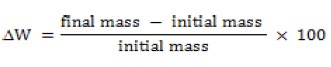
<body><![CDATA[<p><font size="3" face="Verdana"><b>METHODS</b></font></p>     <p><font size="2" face="Verdana"><b>Animals </b></font></p>     <p><font size="2" face="Verdana">Twenty-four male Wistar rats (<i>Rattus</i> <i>norvegicus</i>) with 90 days old (body mass: 364.1 ± 34.8 g) were placed in collective plastic cages (5 animals per cage) in a temperature controlled room   (22 ± 2° C), with a relative humidity of 60% and lights from 7:00am to 7:00pm (12/12 hours). Throughout the experiment the animals received food and water <i>ad</i> <i>libitum.</i></font></p>     <p><font size="2" face="Verdana">All the procedures followed the “Ethical   Principles in Animal Experimentation” adopted by the Brazilian Society of Laboratory   Animal Science (SBCAL) and received approval from the Ethics Committee of this institution under no. 2/2010.</font></p>     <p><font size="2" face="Verdana"><b>Experimental design</b></font></p>     <p><font size="2" face="Verdana">After   environmental adaptation,   the animals were paired according to body weight (g) and divided in two groups containing 12 animals each, differentiated by the type of diet. One group “normocaloric” (NG) was fed a normal calorie diet,   which consisted of commercial food for rats (Primor) containing 4.07 kcal / g and the other group “hypercaloric”(HG) was   fed with a high calorie diet,   which consisted of a mixture of hyper-energy foods totalling 5.12 kcal/g (Zambon et al., 2009). After the division of the groups, the feed was maintained until the end of the experiment.</font></p>     <p><font size="2" face="Verdana">Throughout the experiment, the animals were weigh up once a week and food intake was measured daily. Food consumption was calculated as the difference between feed offered and left over. To calculate the body mass evolution we used the following formula (Bernardes et al., 2004):</font></p>     <p align="center">&nbsp;</p>     <p align="center"><img src="/img/revistas/mot/v11n2/11n2a03e1.jpg" width="331" height="67"></p>     
<p align="center">&nbsp;</p>     ]]></body>
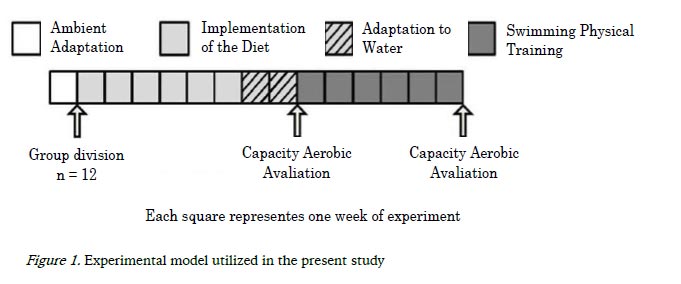
<body><![CDATA[<p><font size="2" face="Verdana">Although not being a usual activity, exercise performed in water (besides the activity itself) produces emotional stimuli by presenting the impossibility of escape and imminence of death (Camargo-Filho et al., 2006). For this   reason, all the animals performed adaptation to the water for 10 days (Manchado, Gobatto, Voltarelli, &amp; Mello, 2006) before the experimental protocol, in order to reduce the animals´ stress without, however, promoting physiological adaptations in response to physical training.</font></p>     <p><font size="2" face="Verdana">For the   adaptation, we used a tank containing eight PVC cylindrical tubes (25 cm diameter   x 120 cm depth). This tank was filled with water (31±1°C) reaching a maximum of   100 cm, so that the animals could not support their tail end on the bottom of   the tank. During the final three days the animals performed swimming with an   overload of 3% of body mass (BW), the  intensity was maintained by using cloth bags containing lead, tied with elastic to each animal´s thorax (Manchado et al., 2006).</font></p>     <p><font size="2" face="Verdana">After eight weeks of diet application (normal-and hypercaloric), the animals underwent a test for aerobic capacity determination (AC), a swimming periodized training (SPT) protocol and another test to determine AC after the training period (<a href="/img/revistas/mot/v11n2/11n2a03f1.jpg">figure 1</a>).</font></p>     
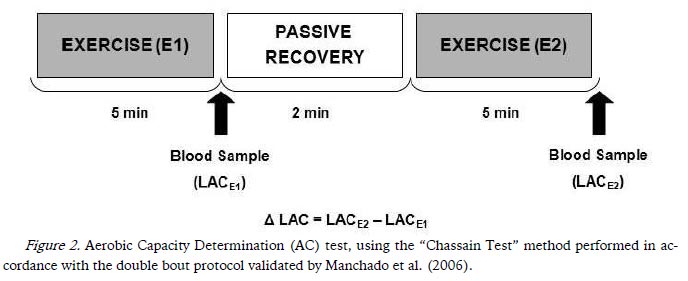
<p><i><font size="2" face="Verdana">Aerobic capacity</font></i></p>     <p><font size="2" face="Verdana">Aerobic capacity (AC) was assessed   using the “Chassain Test” (non-exhaustive double   efforts) method, performed in accordance   with the double bout protocol validated by Manchado, Gobatto, Voltarelli, e   Mello (2006) at two different times: before and after training, in environmental conditions similar to those of the adaptation period.</font></p>     <p><font size="2" face="Verdana">The   protocol consisted of 3 to 4 continuous swimming tests with a randomly distributed   overload of 4%, 6%, 7% and 8% of BW. The rats performed two loads per day with a six hour rest interval, which   comprised two   days for testing. The rats swam 2   x 5 min at the same intensity, with 2 min of passive recovery, resulting in a total duration of 12 min (<a href="/img/revistas/mot/v11n2/11n2a03f2.jpg">figure 2</a>).</font></p>     
<p><font size="2" face="Verdana">Blood samples   were collected from a cut at the tail tip at the end of each bout of exercise.   Samples (25µL) were placed in plastic tubes (Eppendorf – 1.5 mL capacity) with   50µL of Sodium Fluoride (1%) for further   analysis. To   avoid blood dilution by water, the rats were dried before blood collection and   then returned to the water immediately after the collection. Lactate concentrations were   determined in the lactate analyser model YSI 1500 Sport (Yellow Springs, Ohio, EUA).</font></p>     <p><font size="2" face="Verdana">For each intensity the change in lactate (&#8710;LAC) was calculated by subtracting the concentration obtained after the first bout (LAC<sub>E1</sub>) from the concentration obtained at the end of the second bout (LAC<sub>E2</sub>). Then a linear interpolation was plotted, returning a null exercise load, equivalent to the critical load.</font></p>     <p><i><font size="2" face="Verdana">Swimming training programs</font></i></p>     <p><font size="2" face="Verdana">SPT was conducted for six weeks under the same conditions of AC, subdivided into three levels (Araujo et al., 2010): Easy endurance (END1), Moderate (END2) and Intense (END3) related to the anaerobic threshold (Lan) estimated using the non-exhaustive method (&#8776; 4.8 % BW) (Manchado et al., 2006).</font></p>     ]]></body>
<body><![CDATA[<p><font size="2" face="Verdana">The END1 training sessions were performed over 60 min of continuous exercise at 80% of Lan. The END2 sessions were composed of continuous swimming at the intensity corresponding to Lan for 30 min. In the END3 sessions the rats were submitted to swimming intervals which lasted for five minutes with a recovery time of one minute and 15 min of exercise with an intensity of 120% Lan (<a href="/img/revistas/mot/v11n2/11n2a03t1.jpg">table 1</a>).</font></p>     
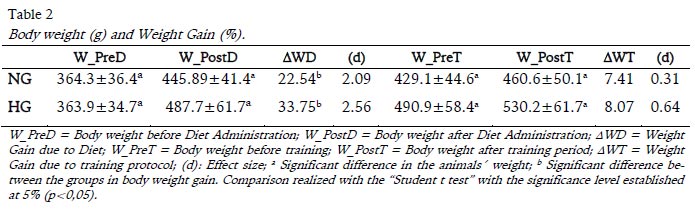
<p><font size="2" face="Verdana">At the end of each session, the animals were dried with cotton and kept for 30 min in a wooden box heated by an incandescent light, then returned to their cages (Camargo-Filho et al., 2006). </font></p>     <p><font size="2" face="Verdana"><b>Statistical Analyses</b></font></p>     <p><font size="2" face="Verdana">The results are expressed as mean ± SD. Data normality was confirmed using the Shapiro-Wilk test. To compare data before and after training and between the HG and NG   groups, the Student t test was used for paired and unpaired samples   respectively. The “effect size” was calculated by Cohen´s   index, subtracting the mean of the experimental group from that of the control   group and dividing for standard deviation (M<sub>1</sub> – M<sub>2</sub> / SD). In all cases the significance was fixed at 95% (p&lt;0.05).</font></p>     <p>&nbsp;</p>     <p><font size="3" face="Verdana"><b>RESULTS</b></font></p>     <p><font size="2" face="Verdana">The mean values and standard deviation of the animals´ body mass in each group and their mass gain during the experimental diet and training are detailed in <a href="/img/revistas/mot/v11n2/11n2a03t2.jpg">table 2</a>. We noticed a significant increase in body weight (g) in both groups after diet and training. </font></p>     
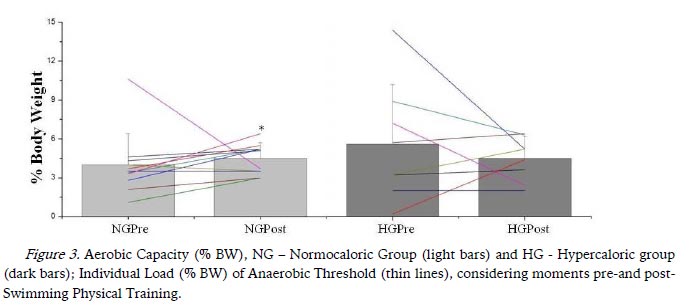
<p><font size="2" face="Verdana">The animals´ dietary intake averaged 29.27 ± 4.14 g for the NG group and 22.72 ± 3.77 g for the HG, but with no significant difference (p&gt;0,05). However, it was noticed that rats consuming the high calorie diet tended to decrease their food intake over time.</font></p>     <p><font size="2" face="Verdana">Deltas (&#8710;LAC) obtained in each load of effort of AC determination   ranged from 0.9% to 3.6% BW in trained animal. After training, negative values   of &#8710;LAC for both groups of 4% BW intensity were identified, revealing a possible adaptation of the rats to SPT.</font></p>     <p><font size="2" face="Verdana">Results show that the NG group reached AC at an intensity of 3.94 ± 2.42% BW before training, increasing to 4.48 ± 1.18% BW after the training period, showing statistical significance. On the other hand, the HG group reached an AC of 5.59 ± 4.56% BW before training and 4.45 ± 1.66% BW after  SPT  (<a href="/img/revistas/mot/v11n2/11n2a03f3.jpg">figure 3</a>).</font></p>     
]]></body>
<body><![CDATA[<p>&nbsp;</p>     <p><font size="3" face="Verdana"><b>DISCUSSION</b></font></p>     <p><font size="2" face="Verdana">The main finding of this study is that the training was able to contain the increase in the animals’ body   weight in both groups and increase the aerobic capacity of those who had access to standard food. It is known that the incidence of   obesity is increasing in the world population, causing many health problems, including cardiovascular risk, diabetes and other chronic diseases, both in men and women (Araújo et al., 2009). Most diseases caused by obesity are associated with an increase in visceral adiposity, where excess fat intake and lack of physical activity are the likely causes of this accumulation (Zambon et al., 2009).</font></p>     <p><font size="2" face="Verdana">In this study, we chose the exogenous obesity model, which most closely resembles human obesity. For this, we administered a high calorie diet to animals by replacing their conventional diet with another made up of a combination of standard chow and high-calorie substances (chocolate, peanuts and cookies). We noticed a significant   difference in body weight due to the administration   of both diets, but the HG group showed the greatest   variation in   weight when compared to the NG, with an   increase of 33.75% BW, which agrees with information in the literature regarding an increase in BW due to diet (Cesaretti &amp; Kohlmann Junior, 2006; Duarte et al., 2006).</font></p>     <p><font size="2" face="Verdana">However, it was observed that the HG food intake was lower than the NG. This decrease suggests increased satiety by the HG group, because high-fat diets have reduced feed efficiency and increased metabolic efficiency due to high plasma levels of metabolic substrates such as glucose and triglycerides (Bernardes et al., 2004; Zambon et al., 2009). </font></p>     <p><font size="2" face="Verdana">Exercise has been used as a non-pharmacological   treatment because of its ability to change the attitudes of some key enzymes in the metabolic   system that prevent and mitigate metabolic syndrome effects (Moura et al., 2008). Using this   information and knowing that AC level has an inverse relationship with the risk of developing cardiovascular   disease (Moura et al., 2008), the training   model   used in this study makes use of stimuli distributed in three different intensities to develop AC; merging the partial restoration of intramuscular glycogen content (END1), maintaining the highest lactate concentration without causing progressive lactacidemia accumulation throughout the session (END2) and the development of aerobic power (END3) (Araujo et al., 2010). Training at AC intensity is advantageous without reaching maximum oxygen consumption, thus diminishing cardiovascular risks (Cunha et al., 2008).</font></p>     <p><font size="2" face="Verdana">In this study, the three training intensities (80%, 100% and 120% of AC) were related to the anaerobic threshold (Lan) of 4.8% of BW, estimated by the non-exhaustive method (Manchado et al., 2006).   Blood lactate measurement was used to evaluate training influence on AC. Originally; the protocol consisted of four tests with different random loads. However, this study showed a high level of failure at the higher intensity for the   HG group, leading to an   adjustment in   the AC calculation, where all the values obtained with an 8% BW overload were discarded from both groups.</font></p>     <p><font size="2" face="Verdana">The change in lactate concentration found at the end of each bout performed at the same intensity is considered in the   evaluation. Animals reached blood lactate stabilization at a load of approximately 4% BW for the NG group and 5% BW for the HG, before training. After SPT, this stabilization was approximately 5% BW for both groups. This intensity is similar to those obtained by Gobatto et al. (2001), Voltarelli, Gobatto, e Mello (2002), Manchado et al. (2006), Araujo, Papoti, Manchado, de Mello, e Gobatto. (2007), Gobatto et al. (2008), who denoted this stabilization at between 5 and 6% BW.</font></p>     <p><font size="2" face="Verdana">It was observed that for the HG group the load was maintained, but the variation magnitude between the animals decreased. These data concur with another study (Gobatto et al., 2001), where the same strain of sedentary animals showed stabilization in blood lactate concentration during similar exercise with an overload of between 5 and 6% BW.</font></p>     <p><font size="2" face="Verdana">In their study, Chen et al. (2010) showed an   inverse association between a high calorie diet, induced obesity and bone density, because free fatty acids can produce bone loss or reabsorption, thereby decreasing bone mineral density. Another study (Reis, 2010) showed that body density (BD) influences the exercise intensity in water, since exercise has a high negative correlation with BD and hydrostatic weighing (HW). In addition, the high calorie diet offered was able to make the animals physically heavier, larger and less dense, showing lower values for HW and BD while the relative intensity of MLSS presented lower values compared to the control group.</font></p>     ]]></body>
<body><![CDATA[<p><font size="2" face="Verdana">Based on this, it is assumed that because they are obese due to diet administration, the HG animals may have a decreased body density, which is suggested to have facilitated their buoyancy and made both training and testing easier to perform because they required less effort compared to the NG animals, with subsequent AC maintenance.</font></p>     <p><font size="2" face="Verdana">Thus, the   present study collaborates with the literature in showing the effects of swimming   physical training on body composition and aerobic capacity in Wistar rats. However, there are limitations   related to the type of training. Experimental models utilizing running and jumping physical protocols and different intensities could contribute to this research.</font></p>     <p>&nbsp;</p>     <p><font size="3" face="Verdana"><b>CONCLUSIONS</b></font></p>     <p><font size="2" face="Verdana">In short, we can conclude that in this study the proposed six   weeks swimming periodized training protocol showed sensitivity to the lactate test and was able to halt the increase in body   mass of both groups and improve the aerobic capacity of rats consuming a normal calorie diet. Taking into account that one of the ways of preventing and treating   cardiovascular diseases is aerobic training, the proposed model could be   applied to the assessment, prescription and control of the training intensity, since it presents a non-exhaustive method.</font></p>     <p>&nbsp;</p>     <p><font size="3" face="Verdana"><b>REFERENCES</b></font></p>     <!-- ref --><p><font size="2" face="Verdana">Araujo, G. G. de, Papoti, M., Manchado-Gobatto, F. de   B., Mello, M. A. R. de, &amp; Gobatto, C. A. (2010). Standardization of an experimental periodized training   protocol in swimming rats. <i>Revista     Brasileira de Medicina do Esporte</i>, <i>16</i>(1), 51–56. <a href="http://doi.org/10.1590/S1517-86922010000100010" target="_blank">http://doi.org/10.1590/S1517-86922010000100010</a></font>&nbsp;&nbsp;&nbsp;&nbsp;&nbsp;&nbsp;&nbsp;&nbsp;[&#160;<a href="javascript:void(0);" onclick="javascript: window.open('/scielo.php?script=sci_nlinks&ref=000080&pid=S1646-107X201500020000300001&lng=','','width=640,height=500,resizable=yes,scrollbars=1,menubar=yes,');">Links</a>&#160;]<!-- end-ref --><!-- ref --><p><font size="2" face="Verdana">Araújo, M. B. de,   Manchado-Gobatto, F. de B., Voltarelli, F. A., Ribeiro, C., Mota, C. S. de A.,   Gobatto, C. A., &amp; Mello, M. A. R. de. (2009). Efeitos do treinamento de   corrida em diferentes intensidades sobre a capacidade aeróbia e produção de   lactato pelo músculo de ratos Wistar. <i>Revista Brasileira de Medicina do Esporte</i>, <i>15</i>(5), 365–369. <a href="http://doi.org/10.1590/S1517-86922009000600009" target="_blank">http://doi.org/10.1590/S1517-86922009000600009</a></font>&nbsp;&nbsp;&nbsp;&nbsp;&nbsp;&nbsp;&nbsp;&nbsp;[&#160;<a href="javascript:void(0);" onclick="javascript: window.open('/scielo.php?script=sci_nlinks&ref=000081&pid=S1646-107X201500020000300002&lng=','','width=640,height=500,resizable=yes,scrollbars=1,menubar=yes,');">Links</a>&#160;]<!-- end-ref --><!-- ref --><p><font size="2" face="Verdana">Araujo, G. G., Papoti, M.,   Manchado, F., de Mello, M. A. R., &amp; Gobatto, C. A. (2007). Protocols for hyperlactatemia induction in   the lactate minimum test adapted to swimming rats. <i>Comparative Biochemistry     and Physiology Part A: Molecular &amp; Integrative Physiology</i>, <i>148</i>(4), 888–892. <a href="http://doi.org/10.1016/j.cbpa.2007.09.002" target="_blank">http://doi.org/10.1016/j.cbpa.2007.09.002</a></font>&nbsp;&nbsp;&nbsp;&nbsp;&nbsp;&nbsp;&nbsp;&nbsp;[&#160;<a href="javascript:void(0);" onclick="javascript: window.open('/scielo.php?script=sci_nlinks&ref=000082&pid=S1646-107X201500020000300003&lng=','','width=640,height=500,resizable=yes,scrollbars=1,menubar=yes,');">Links</a>&#160;]<!-- end-ref --><!-- ref --><p><font size="2" face="Verdana">Bernardes, D., Manzoni, M. S.   J., Souza, C. P. de, Tenório, N., &amp; Dâmaso, A. R. (2004). Efeitos da dieta   hiperlipídica e do treinamento de natação sobre o metabolismo de recuperação ao   exercício em ratos. <i>Revista Brasileira de Educação Física e Esporte</i>, <i>18</i>(2), 191–200. <a href="http://doi.org/10.1590/S1807-55092004000200007" target="_blank">http://doi.org/10.1590/S1807-55092004000200007</a></font>&nbsp;&nbsp;&nbsp;&nbsp;&nbsp;&nbsp;&nbsp;&nbsp;[&#160;<a href="javascript:void(0);" onclick="javascript: window.open('/scielo.php?script=sci_nlinks&ref=000083&pid=S1646-107X201500020000300004&lng=','','width=640,height=500,resizable=yes,scrollbars=1,menubar=yes,');">Links</a>&#160;]<!-- end-ref --><!-- ref --><p><font size="2" face="Verdana">Camargo-Filho, J. C. S.,   Silva, J. C., Vanderlei, L. C. M., Camargo, R. C. T., Francischeti, F. A.,   Belangero, W. D., &amp; Pai, V. D. (2006). Efeitos do esteróide anabólico   nandrolona sobre o músculo sóleo de ratos submetidos a treinamento físico   através de natação: estudo histológico, histoquímico e morfométrico. <i>Revista Brasileira de Medicina do Esporte</i>, <i>12</i>(5), 243–247. <a href="http://doi.org/10.1590/S1517-86922006000500004" target="_blank">http://doi.org/10.1590/S1517-86922006000500004</a></font>&nbsp;&nbsp;&nbsp;&nbsp;&nbsp;&nbsp;&nbsp;&nbsp;[&#160;<a href="javascript:void(0);" onclick="javascript: window.open('/scielo.php?script=sci_nlinks&ref=000084&pid=S1646-107X201500020000300005&lng=','','width=640,height=500,resizable=yes,scrollbars=1,menubar=yes,');">Links</a>&#160;]<!-- end-ref --><p><font size="2" face="Verdana">Cesaretti, M. L.   R., &amp; Kohlmann Junior, O. (2006). Modelos   experimentais de resistência à insulina e obesidade: lições aprendidas. <i>Arquivos Brasileiros de Endocrinologia &amp;amp; Metabologia</i>, <i>50</i>(2), 190–197. <a href="http://doi.org/10.1590/S0004-27302006000200005" target="_blank">http://doi.org/10.1590/S0004-27302006000200005</a></font></p>     <!-- ref --><p><font size="2" face="Verdana">Chen, J.-R.,   Lazarenko, O. P., Wu, X., Tong, Y., Blackburn, M. L., Shankar, K., … Ronis, M.   J. J. (2010). Obesity reduces bone density associated with activation of ppar&#947; and suppression of wnt/&#946;-catenin in rapidly growing male rats. <i>PLoS ONE</i>, <i>5</i>(10), e13704. <a href="http://doi.org/10.1371/journal.pone.0013704" target="_blank">http://doi.org/10.1371/journal.pone.0013704</a></font>&nbsp;&nbsp;&nbsp;&nbsp;&nbsp;&nbsp;&nbsp;&nbsp;[&#160;<a href="javascript:void(0);" onclick="javascript: window.open('/scielo.php?script=sci_nlinks&ref=000086&pid=S1646-107X201500020000300007&lng=','','width=640,height=500,resizable=yes,scrollbars=1,menubar=yes,');">Links</a>&#160;]<!-- end-ref --><!-- ref --><p><font size="2" face="Verdana">Cunha, V. N. de C., da Cunha,   R. R., Segundo, P. R., Moreira, S. R., &amp; Simões, H. G. (2008). Treinamento   de natação na intensidade do limiar anaeróbio melhora a aptidão funcional de   ratos idosos. <i>Revista Brasileira de Medicina do Esporte</i>, <i>14</i>(6), 533–538. <a href="http://doi.org/10.1590/S1517-86922008000600012" target="_blank">http://doi.org/10.1590/S1517-86922008000600012</a></font>&nbsp;&nbsp;&nbsp;&nbsp;&nbsp;&nbsp;&nbsp;&nbsp;[&#160;<a href="javascript:void(0);" onclick="javascript: window.open('/scielo.php?script=sci_nlinks&ref=000087&pid=S1646-107X201500020000300008&lng=','','width=640,height=500,resizable=yes,scrollbars=1,menubar=yes,');">Links</a>&#160;]<!-- end-ref --><!-- ref --><p><font size="2" face="Verdana">Diniz, Y. S., Burneiko, R.   M., Seiva, F. R. F., Almeida, F. Q. A., Galhardi, C. M., Filho, J. L. V. B. N.,   … Novelli, E. L. B. (2008).   Diet compounds, glycemic index and obesity-related cardiac effects. <i>International Journal of Cardiology</i>, <i>124</i>(1), 92–99. <a href="http://doi.org/10.1016/j.ijcard.2006.12.025" target="_blank">http://doi.org/10.1016/j.ijcard.2006.12.025</a></font>&nbsp;&nbsp;&nbsp;&nbsp;&nbsp;&nbsp;&nbsp;&nbsp;[&#160;<a href="javascript:void(0);" onclick="javascript: window.open('/scielo.php?script=sci_nlinks&ref=000088&pid=S1646-107X201500020000300009&lng=','','width=640,height=500,resizable=yes,scrollbars=1,menubar=yes,');">Links</a>&#160;]<!-- end-ref --><!-- ref --><p><font size="2" face="Verdana">Duarte, A. C. G.   de O., Fonseca, D. F., Manzoni, M. S. J., Soave, C. F., Sene-Fiorese, M.,   Dâmaso, A. R., &amp; Cheik, N. C. (2006). Dieta   hiperlipídica e capacidade secretória de insulina em ratos. <i>Revista de Nutrição</i>, <i>19</i>(3), 341–348. <a href="http://doi.org/10.1590/S1415-52732006000300005" target="_blank">http://doi.org/10.1590/S1415-52732006000300005</a></font>&nbsp;&nbsp;&nbsp;&nbsp;&nbsp;&nbsp;&nbsp;&nbsp;[&#160;<a href="javascript:void(0);" onclick="javascript: window.open('/scielo.php?script=sci_nlinks&ref=000089&pid=S1646-107X201500020000300010&lng=','','width=640,height=500,resizable=yes,scrollbars=1,menubar=yes,');">Links</a>&#160;]<!-- end-ref --><!-- ref --><p><font size="2" face="Verdana">Estadella, D., Oyama, L. M.,   Dâmaso, A. R., Ribeiro, E. B., &amp; Oller Do Nascimento, C. M. (2004). Effect of palatable hyperlipidic diet on   lipid metabolism of sedentary and exercised rats. <i>Nutrition</i>, <i>20</i>(2), 218–224. <a href="http://doi.org/10.1016/j.nut.2003.10.008" target="_blank">http://doi.org/10.1016/j.nut.2003.10.008</a></font>&nbsp;&nbsp;&nbsp;&nbsp;&nbsp;&nbsp;&nbsp;&nbsp;[&#160;<a href="javascript:void(0);" onclick="javascript: window.open('/scielo.php?script=sci_nlinks&ref=000090&pid=S1646-107X201500020000300011&lng=','','width=640,height=500,resizable=yes,scrollbars=1,menubar=yes,');">Links</a>&#160;]<!-- end-ref --><!-- ref --><p><font size="2" face="Verdana">Gobatto, C. A., de Mello, M.   A. R., Sibuya, C. Y., de Azevedo, J. R. M., Santos, L. A. dos, &amp; Kokubun,   E. (2001). Maximal lactate   steady state in rats submitted to swimming exercise. <i>Comparative     Biochemistry and Physiology Part A: Molecular &amp; Integrative Physiology</i>, <i>130</i>(1), 21–27. <a href="http://doi.org/10.1016/S1095-6433(01)00362-2" target="_blank">http://doi.org/10.1016/S1095-6433(01)00362-2</a></font>&nbsp;&nbsp;&nbsp;&nbsp;&nbsp;&nbsp;&nbsp;&nbsp;[&#160;<a href="javascript:void(0);" onclick="javascript: window.open('/scielo.php?script=sci_nlinks&ref=000091&pid=S1646-107X201500020000300012&lng=','','width=640,height=500,resizable=yes,scrollbars=1,menubar=yes,');">Links</a>&#160;]<!-- end-ref --><!-- ref --><p><font size="2" face="Verdana">Gobatto, C. A., Mello, M. A.   R. de, Gobatto, F. de B. M., Papoti, M., Voltarelli, F. A., Contarteze, R. V.   L., &amp; Araujo, G. G. de. (2008). Avaliações fisiológicas adaptadas à   roedores: aplicações ao treinamento em diferentes modelos experimentais. <i>Revista Mackenzie de Educação Física e Esporte</i>, <i>7</i>(1), 137–147.    &nbsp;&nbsp;&nbsp;&nbsp;&nbsp;&nbsp;&nbsp;&nbsp;[&#160;<a href="javascript:void(0);" onclick="javascript: window.open('/scielo.php?script=sci_nlinks&ref=000092&pid=S1646-107X201500020000300013&lng=','','width=640,height=500,resizable=yes,scrollbars=1,menubar=yes,');">Links</a>&#160;]<!-- end-ref --></font></p>     <!-- ref --><p><font size="2" face="Verdana">Hardman, A. E. (1999). Physical activity, obesity and blood lipids.   <i>International Journal of Obesity and Related Metabolic Disorders</i>, <i>23 Suppl 3</i>, S64–71.    &nbsp;&nbsp;&nbsp;&nbsp;&nbsp;&nbsp;&nbsp;&nbsp;[&#160;<a href="javascript:void(0);" onclick="javascript: window.open('/scielo.php?script=sci_nlinks&ref=000094&pid=S1646-107X201500020000300014&lng=','','width=640,height=500,resizable=yes,scrollbars=1,menubar=yes,');">Links</a>&#160;]<!-- end-ref --></font></p>     <!-- ref --><p><font size="2" face="Verdana">Manchado, F. de B., Gobatto,   C. A., Voltarelli, F. A., &amp; Mello, M. A. R. (2006). Non-exhaustive test for aerobic capacity   determination in swimming rats. <i>Applied Physiology, Nutrition, and Metabolism</i>, <i>31</i>(6), 731–736. <a href="http://doi.org/10.1139/h06-079" target="_blank">http://doi.org/10.1139/h06-079</a></font>&nbsp;&nbsp;&nbsp;&nbsp;&nbsp;&nbsp;&nbsp;&nbsp;[&#160;<a href="javascript:void(0);" onclick="javascript: window.open('/scielo.php?script=sci_nlinks&ref=000096&pid=S1646-107X201500020000300015&lng=','','width=640,height=500,resizable=yes,scrollbars=1,menubar=yes,');">Links</a>&#160;]<!-- end-ref --><!-- ref --><p><font size="2" face="Verdana">Mendonça, C. P.,   &amp; Anjos, L. A. dos. (2004). Aspectos   das práticas alimentares e da atividade física como determinantes do   crescimento do sobrepeso/obesidade no Brasil. <i>Cadernos de Saúde Pública</i>, <i>20</i>(3), 698–709.    &nbsp;&nbsp;&nbsp;&nbsp;&nbsp;&nbsp;&nbsp;&nbsp;[&#160;<a href="javascript:void(0);" onclick="javascript: window.open('/scielo.php?script=sci_nlinks&ref=000097&pid=S1646-107X201500020000300016&lng=','','width=640,height=500,resizable=yes,scrollbars=1,menubar=yes,');">Links</a>&#160;]<!-- end-ref --></font></p>     <!-- ref --><p><font size="2" face="Verdana">Moura, R. F. de, Cambri, L.   T., Junior, Q., De, A. C., Nascimento, C. M. C., Arantes, L. M., … Melo, M. A.   R. (2008). Capacidade aeróbia de ratos alimentados com dieta rica em frutose. <i>Revista Brasileira de Medicina do Esporte</i>, <i>14</i>(5), 422–426. <a href="http://doi.org/10.1590/S1517-86922008000500004" target="_blank">http://doi.org/10.1590/S1517-86922008000500004</a></font>&nbsp;&nbsp;&nbsp;&nbsp;&nbsp;&nbsp;&nbsp;&nbsp;[&#160;<a href="javascript:void(0);" onclick="javascript: window.open('/scielo.php?script=sci_nlinks&ref=000099&pid=S1646-107X201500020000300017&lng=','','width=640,height=500,resizable=yes,scrollbars=1,menubar=yes,');">Links</a>&#160;]<!-- end-ref --><!-- ref --><p><font size="2" face="Verdana">Reis, I. G. M. (2010). <i>Análise   dos parâmetros de força e padrão de nado de ratos controles e obesos, a partir   de um sistema de aquisição de sinais em natação atada. Influência da intensidade   do exercício e da densidade corporal</i> (Dissertação de mestrado em Ciências da Motricidade). Universidade Estadual Paulista, Campus de Rio Claro.    &nbsp;&nbsp;&nbsp;&nbsp;&nbsp;&nbsp;&nbsp;&nbsp;[&#160;<a href="javascript:void(0);" onclick="javascript: window.open('/scielo.php?script=sci_nlinks&ref=000100&pid=S1646-107X201500020000300018&lng=','','width=640,height=500,resizable=yes,scrollbars=1,menubar=yes,');">Links</a>&#160;]<!-- end-ref --></font></p>     <!-- ref --><p><font size="2" face="Verdana">Ribeiro Filho, F. F.,   Mariosa, L. S., Ferreira, S. R. G., &amp; Zanella, M. T. (2006). Gordura   visceral e síndrome metabólica: mais que uma simples associação. <i>Arquivos Brasileiros de Endocrinologia &amp; Metabologia</i>, <i>50</i>(2), 230–238. <a href="http://doi.org/10.1590/S0004-27302006000200009" target="_blank">http://doi.org/10.1590/S0004-27302006000200009</a></font>&nbsp;&nbsp;&nbsp;&nbsp;&nbsp;&nbsp;&nbsp;&nbsp;[&#160;<a href="javascript:void(0);" onclick="javascript: window.open('/scielo.php?script=sci_nlinks&ref=000102&pid=S1646-107X201500020000300019&lng=','','width=640,height=500,resizable=yes,scrollbars=1,menubar=yes,');">Links</a>&#160;]<!-- end-ref --><!-- ref --><p><font size="2" face="Verdana">Sociedade Brasileira de   Cardiologia. (2005). I Diretriz Brasileira de Diagnóstico e Tratamento da   Síndrome Metabólica. <i>Arquivos Brasileiros de Cardiologia</i>, <i>84</i>(supl.1), 3–28.    &nbsp;&nbsp;&nbsp;&nbsp;&nbsp;&nbsp;&nbsp;&nbsp;[&#160;<a href="javascript:void(0);" onclick="javascript: window.open('/scielo.php?script=sci_nlinks&ref=000103&pid=S1646-107X201500020000300020&lng=','','width=640,height=500,resizable=yes,scrollbars=1,menubar=yes,');">Links</a>&#160;]<!-- end-ref --></font></p>     <!-- ref --><p><font size="2" face="Verdana">Voltarelli, F. A., Gobatto,   C. A., &amp; Mello, M. A. R. de. (2002).   Determination of anaerobic threshold in rats using the lactate minimum test. <i>Brazilian Journal of Medical and Biological Research</i>, <i>35</i>(11), 1389–1394. <a href="http://doi.org/10.1590/S0100-879X2002001100018" target="_blank">http://doi.org/10.1590/S0100-879X2002001100018</a></font>&nbsp;&nbsp;&nbsp;&nbsp;&nbsp;&nbsp;&nbsp;&nbsp;[&#160;<a href="javascript:void(0);" onclick="javascript: window.open('/scielo.php?script=sci_nlinks&ref=000105&pid=S1646-107X201500020000300021&lng=','','width=640,height=500,resizable=yes,scrollbars=1,menubar=yes,');">Links</a>&#160;]<!-- end-ref --><!-- ref --><p><font size="2" face="Verdana">Ward-Smith, P.   (2010). Obesity--America’s health crisis. <i>Urologic Nursing</i>, <i>30</i>(4), 242–245.    &nbsp;&nbsp;&nbsp;&nbsp;&nbsp;&nbsp;&nbsp;&nbsp;[&#160;<a href="javascript:void(0);" onclick="javascript: window.open('/scielo.php?script=sci_nlinks&ref=000106&pid=S1646-107X201500020000300022&lng=','','width=640,height=500,resizable=yes,scrollbars=1,menubar=yes,');">Links</a>&#160;]<!-- end-ref --></font></p>     <!-- ref --><p><font size="2" face="Verdana">Zambon, L., Duarte, F. O.,   Freitas, L. F. de, Scarmagnani, F. R. R., Dâmaso, A., Duarte, A. C. G. de O.,   &amp; Sene-Fiorese, M. (2009). Efeitos de dois tipos de treinamento de natação   sobre a adiposidade e o perfil lipídico de ratos obesos exógenos. <i>Revista de Nutrição</i>, <i>22</i>(5), 707–715. <a href="http://doi.org/10.1590/S1415-52732009000500011" target="_blank">http://doi.org/10.1590/S1415-52732009000500011</a></font>&nbsp;&nbsp;&nbsp;&nbsp;&nbsp;&nbsp;&nbsp;&nbsp;[&#160;<a href="javascript:void(0);" onclick="javascript: window.open('/scielo.php?script=sci_nlinks&ref=000108&pid=S1646-107X201500020000300023&lng=','','width=640,height=500,resizable=yes,scrollbars=1,menubar=yes,');">Links</a>&#160;]<!-- end-ref --><p>&nbsp;</p>     <p><font size="2" face="Verdana"><b>Acknowledgments: </b></font>    <br> <font size="2" face="Verdana">Nothing to declare    <br> </font><font size="2" face="Verdana"><b>Conflicts of Interest:    ]]></body>
<body><![CDATA[<br> </b></font><font size="2" face="Verdana">Nothing to declare    <br> </font><font size="2" face="Verdana"><b>Funding:    <br> </b></font><font size="2" face="Verdana">Nothing to declare</font></p>     <p><font size="2" face="Verdana">Manuscript received October 19<sup>th</sup>, 2013; Accepted June 14<sup>th</sup>, 2014 </font></p>     <p>&nbsp;</p>     <p>&nbsp;</p>     <p><font size="2" face="Verdana"><a href="#topo">*</a><a name="end" id="end"></a><i> Autor correspondente</i>:   Roberto Simonsen Street, 300, Centro Educacional - Presidente Prudente, S&atilde;o Paulo, Brazil <i>E-mail</i>: <a href="mailto:castoldi_rc@yahoo.com.br">castoldi_rc@yahoo.com.br</a></font></p>      ]]></body><back>
<ref-list>
<ref id="B1">
<nlm-citation citation-type="journal">
<person-group person-group-type="author">
<name>
<surname><![CDATA[Araujo]]></surname>
<given-names><![CDATA[G. G. de]]></given-names>
</name>
<name>
<surname><![CDATA[Papoti]]></surname>
<given-names><![CDATA[M.]]></given-names>
</name>
<name>
<surname><![CDATA[Manchado-Gobatto]]></surname>
<given-names><![CDATA[F. de B.]]></given-names>
</name>
<name>
<surname><![CDATA[Mello]]></surname>
<given-names><![CDATA[M. A. R. de]]></given-names>
</name>
<name>
<surname><![CDATA[Gobatto]]></surname>
<given-names><![CDATA[C. A.]]></given-names>
</name>
</person-group>
<article-title xml:lang="en"><![CDATA[Standardization of an experimental periodized training protocol in swimming rats]]></article-title>
<source><![CDATA[Revista Brasileira de Medicina do Esporte]]></source>
<year>2010</year>
<volume>16</volume>
<numero>1</numero>
<issue>1</issue>
<page-range>51-56</page-range></nlm-citation>
</ref>
<ref id="B2">
<nlm-citation citation-type="journal">
<person-group person-group-type="author">
<name>
<surname><![CDATA[Araújo]]></surname>
<given-names><![CDATA[M. B. de]]></given-names>
</name>
<name>
<surname><![CDATA[Manchado-Gobatto]]></surname>
<given-names><![CDATA[F. de B.]]></given-names>
</name>
<name>
<surname><![CDATA[Voltarelli]]></surname>
<given-names><![CDATA[F. A.]]></given-names>
</name>
<name>
<surname><![CDATA[Ribeiro]]></surname>
<given-names><![CDATA[C.]]></given-names>
</name>
<name>
<surname><![CDATA[Mota]]></surname>
<given-names><![CDATA[C. S. de A.]]></given-names>
</name>
<name>
<surname><![CDATA[Gobatto]]></surname>
<given-names><![CDATA[C. A.]]></given-names>
</name>
<name>
<surname><![CDATA[Mello]]></surname>
<given-names><![CDATA[M. A. R. de.]]></given-names>
</name>
</person-group>
<article-title xml:lang="pt"><![CDATA[Efeitos do treinamento de corrida em diferentes intensidades sobre a capacidade aeróbia e produção de lactato pelo músculo de ratos Wistar]]></article-title>
<source><![CDATA[Revista Brasileira de Medicina do Esporte]]></source>
<year>2009</year>
<volume>15</volume>
<numero>5</numero>
<issue>5</issue>
<page-range>365-369</page-range></nlm-citation>
</ref>
<ref id="B3">
<nlm-citation citation-type="journal">
<person-group person-group-type="author">
<name>
<surname><![CDATA[Araujo]]></surname>
<given-names><![CDATA[G. G.]]></given-names>
</name>
<name>
<surname><![CDATA[Papoti]]></surname>
<given-names><![CDATA[M.]]></given-names>
</name>
<name>
<surname><![CDATA[Manchado]]></surname>
<given-names><![CDATA[F.]]></given-names>
</name>
<name>
<surname><![CDATA[de Mello]]></surname>
<given-names><![CDATA[M. A. R.]]></given-names>
</name>
<name>
<surname><![CDATA[Gobatto]]></surname>
<given-names><![CDATA[C. A.]]></given-names>
</name>
</person-group>
<article-title xml:lang="en"><![CDATA[Protocols for hyperlactatemia induction in the lactate minimum test adapted to swimming rats]]></article-title>
<source><![CDATA[Comparative Biochemistry and Physiology Part A: Molecular & Integrative Physiology]]></source>
<year>2007</year>
<volume>148</volume>
<numero>4</numero>
<issue>4</issue>
<page-range>888-892</page-range></nlm-citation>
</ref>
<ref id="B4">
<nlm-citation citation-type="journal">
<person-group person-group-type="author">
<name>
<surname><![CDATA[Bernardes]]></surname>
<given-names><![CDATA[D.]]></given-names>
</name>
<name>
<surname><![CDATA[Manzoni]]></surname>
<given-names><![CDATA[M. S. J.]]></given-names>
</name>
<name>
<surname><![CDATA[Souza]]></surname>
<given-names><![CDATA[C. P. de]]></given-names>
</name>
<name>
<surname><![CDATA[Tenório]]></surname>
<given-names><![CDATA[N.]]></given-names>
</name>
<name>
<surname><![CDATA[Dâmaso]]></surname>
<given-names><![CDATA[A. R.]]></given-names>
</name>
</person-group>
<article-title xml:lang="pt"><![CDATA[Efeitos da dieta hiperlipídica e do treinamento de natação sobre o metabolismo de recuperação ao exercício em ratos]]></article-title>
<source><![CDATA[Revista Brasileira de Educação Física e Esporte]]></source>
<year>2004</year>
<volume>18</volume>
<numero>2</numero>
<issue>2</issue>
<page-range>191-200</page-range></nlm-citation>
</ref>
<ref id="B5">
<nlm-citation citation-type="journal">
<person-group person-group-type="author">
<name>
<surname><![CDATA[Camargo-Filho]]></surname>
<given-names><![CDATA[J. C. S.]]></given-names>
</name>
<name>
<surname><![CDATA[Silva]]></surname>
<given-names><![CDATA[J. C.]]></given-names>
</name>
<name>
<surname><![CDATA[Vanderlei]]></surname>
<given-names><![CDATA[L. C. M.]]></given-names>
</name>
<name>
<surname><![CDATA[Camargo]]></surname>
<given-names><![CDATA[R. C. T.]]></given-names>
</name>
<name>
<surname><![CDATA[Francischeti]]></surname>
<given-names><![CDATA[F. A.]]></given-names>
</name>
<name>
<surname><![CDATA[Belangero]]></surname>
<given-names><![CDATA[W. D.]]></given-names>
</name>
<name>
<surname><![CDATA[Pai]]></surname>
<given-names><![CDATA[V. D.]]></given-names>
</name>
</person-group>
<article-title xml:lang="pt"><![CDATA[Efeitos do esteróide anabólico nandrolona sobre o músculo sóleo de ratos submetidos a treinamento físico através de natação: estudo histológico, histoquímico e morfométrico]]></article-title>
<source><![CDATA[Revista Brasileira de Medicina do Esporte]]></source>
<year>2006</year>
<volume>12</volume>
<numero>5</numero>
<issue>5</issue>
<page-range>243-247</page-range></nlm-citation>
</ref>
<ref id="B6">
<nlm-citation citation-type="journal">
<person-group person-group-type="author">
<name>
<surname><![CDATA[Cesaretti]]></surname>
<given-names><![CDATA[M. L. R.]]></given-names>
</name>
<name>
<surname><![CDATA[Kohlmann Junior]]></surname>
<given-names><![CDATA[O.]]></given-names>
</name>
</person-group>
<article-title xml:lang="pt"><![CDATA[Modelos experimentais de resistência à insulina e obesidade: lições aprendidas]]></article-title>
<source><![CDATA[Arquivos Brasileiros de Endocrinologia & Metabologia]]></source>
<year>2006</year>
<volume>50</volume>
<numero>2</numero>
<issue>2</issue>
<page-range>190-197</page-range></nlm-citation>
</ref>
<ref id="B7">
<nlm-citation citation-type="journal">
<person-group person-group-type="author">
<name>
<surname><![CDATA[Chen]]></surname>
<given-names><![CDATA[J.-R.]]></given-names>
</name>
<name>
<surname><![CDATA[Lazarenko]]></surname>
<given-names><![CDATA[O. P.]]></given-names>
</name>
<name>
<surname><![CDATA[Wu]]></surname>
<given-names><![CDATA[X.]]></given-names>
</name>
<name>
<surname><![CDATA[Tong]]></surname>
<given-names><![CDATA[Y.]]></given-names>
</name>
<name>
<surname><![CDATA[Blackburn]]></surname>
<given-names><![CDATA[M. L.]]></given-names>
</name>
<name>
<surname><![CDATA[Shankar]]></surname>
<given-names><![CDATA[K.]]></given-names>
</name>
<name>
<surname><![CDATA[Ronis]]></surname>
<given-names><![CDATA[M. J. J.]]></given-names>
</name>
</person-group>
<article-title xml:lang="en"><![CDATA[Obesity reduces bone density associated with activation of ppar&#947; and suppression of wnt/&#946;-catenin in rapidly growing male rats]]></article-title>
<source><![CDATA[PLoS ONE]]></source>
<year>2010</year>
<volume>5</volume>
<numero>10</numero>
<issue>10</issue>
<page-range>e13704</page-range></nlm-citation>
</ref>
<ref id="B8">
<nlm-citation citation-type="journal">
<person-group person-group-type="author">
<name>
<surname><![CDATA[Cunha]]></surname>
<given-names><![CDATA[V. N. de C.]]></given-names>
</name>
<name>
<surname><![CDATA[da Cunha]]></surname>
<given-names><![CDATA[R. R.]]></given-names>
</name>
<name>
<surname><![CDATA[Segundo]]></surname>
<given-names><![CDATA[P. R.]]></given-names>
</name>
<name>
<surname><![CDATA[Moreira]]></surname>
<given-names><![CDATA[S. R.]]></given-names>
</name>
<name>
<surname><![CDATA[Simões]]></surname>
<given-names><![CDATA[H. G.]]></given-names>
</name>
</person-group>
<article-title xml:lang="pt"><![CDATA[Treinamento de natação na intensidade do limiar anaeróbio melhora a aptidão funcional de ratos idosos]]></article-title>
<source><![CDATA[Revista Brasileira de Medicina do Esporte]]></source>
<year>2008</year>
<volume>14</volume>
<numero>6</numero>
<issue>6</issue>
<page-range>533-538</page-range></nlm-citation>
</ref>
<ref id="B9">
<nlm-citation citation-type="journal">
<person-group person-group-type="author">
<name>
<surname><![CDATA[Diniz]]></surname>
<given-names><![CDATA[Y. S.]]></given-names>
</name>
<name>
<surname><![CDATA[Burneiko]]></surname>
<given-names><![CDATA[R. M.]]></given-names>
</name>
<name>
<surname><![CDATA[Seiva]]></surname>
<given-names><![CDATA[F. R. F.]]></given-names>
</name>
<name>
<surname><![CDATA[Almeida]]></surname>
<given-names><![CDATA[F. Q. A.]]></given-names>
</name>
<name>
<surname><![CDATA[Galhardi]]></surname>
<given-names><![CDATA[C. M.]]></given-names>
</name>
<name>
<surname><![CDATA[Filho]]></surname>
<given-names><![CDATA[J. L. V. B. N.]]></given-names>
</name>
<name>
<surname><![CDATA[Novelli]]></surname>
<given-names><![CDATA[E. L. B.]]></given-names>
</name>
</person-group>
<article-title xml:lang="en"><![CDATA[Diet compounds, glycemic index and obesity-related cardiac effects]]></article-title>
<source><![CDATA[International Journal of Cardiology]]></source>
<year>2008</year>
<volume>124</volume>
<numero>1</numero>
<issue>1</issue>
<page-range>92-99</page-range></nlm-citation>
</ref>
<ref id="B10">
<nlm-citation citation-type="journal">
<person-group person-group-type="author">
<name>
<surname><![CDATA[Duarte]]></surname>
<given-names><![CDATA[A. C. G. de O.]]></given-names>
</name>
<name>
<surname><![CDATA[Fonseca]]></surname>
<given-names><![CDATA[D. F.]]></given-names>
</name>
<name>
<surname><![CDATA[Manzoni]]></surname>
<given-names><![CDATA[M. S. J.]]></given-names>
</name>
<name>
<surname><![CDATA[Soave]]></surname>
<given-names><![CDATA[C. F.]]></given-names>
</name>
<name>
<surname><![CDATA[Sene-Fiorese]]></surname>
<given-names><![CDATA[M.]]></given-names>
</name>
<name>
<surname><![CDATA[Dâmaso]]></surname>
<given-names><![CDATA[A. R.]]></given-names>
</name>
<name>
<surname><![CDATA[Cheik]]></surname>
<given-names><![CDATA[N. C.]]></given-names>
</name>
</person-group>
<article-title xml:lang="pt"><![CDATA[Dieta hiperlipídica e capacidade secretória de insulina em ratos]]></article-title>
<source><![CDATA[Revista de Nutrição]]></source>
<year>2006</year>
<volume>19</volume>
<numero>3</numero>
<issue>3</issue>
<page-range>341-348</page-range></nlm-citation>
</ref>
<ref id="B11">
<nlm-citation citation-type="journal">
<person-group person-group-type="author">
<name>
<surname><![CDATA[Estadella]]></surname>
<given-names><![CDATA[D.]]></given-names>
</name>
<name>
<surname><![CDATA[Oyama]]></surname>
<given-names><![CDATA[L. M.]]></given-names>
</name>
<name>
<surname><![CDATA[Dâmaso]]></surname>
<given-names><![CDATA[A. R.]]></given-names>
</name>
<name>
<surname><![CDATA[Ribeiro]]></surname>
<given-names><![CDATA[E. B.]]></given-names>
</name>
<name>
<surname><![CDATA[Oller Do Nascimento]]></surname>
<given-names><![CDATA[C. M.]]></given-names>
</name>
</person-group>
<article-title xml:lang="en"><![CDATA[Effect of palatable hyperlipidic diet on lipid metabolism of sedentary and exercised rats]]></article-title>
<source><![CDATA[Nutrition]]></source>
<year>2004</year>
<volume>20</volume>
<numero>2</numero>
<issue>2</issue>
<page-range>218-224</page-range></nlm-citation>
</ref>
<ref id="B12">
<nlm-citation citation-type="journal">
<person-group person-group-type="author">
<name>
<surname><![CDATA[Gobatto]]></surname>
<given-names><![CDATA[C. A.]]></given-names>
</name>
<name>
<surname><![CDATA[de Mello]]></surname>
<given-names><![CDATA[M. A. R.]]></given-names>
</name>
<name>
<surname><![CDATA[Sibuya]]></surname>
<given-names><![CDATA[C. Y.]]></given-names>
</name>
<name>
<surname><![CDATA[de Azevedo]]></surname>
<given-names><![CDATA[J. R. M.]]></given-names>
</name>
<name>
<surname><![CDATA[Santos]]></surname>
<given-names><![CDATA[L. A. dos]]></given-names>
</name>
<name>
<surname><![CDATA[Kokubun]]></surname>
<given-names><![CDATA[E.]]></given-names>
</name>
</person-group>
<article-title xml:lang="en"><![CDATA[Maximal lactate steady state in rats submitted to swimming exercise]]></article-title>
<source><![CDATA[Comparative Biochemistry and Physiology Part A: Molecular & Integrative Physiology]]></source>
<year>2001</year>
<volume>130</volume>
<numero>1</numero>
<issue>1</issue>
<page-range>21-27</page-range></nlm-citation>
</ref>
<ref id="B13">
<nlm-citation citation-type="journal">
<person-group person-group-type="author">
<name>
<surname><![CDATA[Gobatto]]></surname>
<given-names><![CDATA[C. A.]]></given-names>
</name>
<name>
<surname><![CDATA[Mello]]></surname>
<given-names><![CDATA[M. A. R. de]]></given-names>
</name>
<name>
<surname><![CDATA[Gobatto]]></surname>
<given-names><![CDATA[F. de B. M.]]></given-names>
</name>
<name>
<surname><![CDATA[Papoti]]></surname>
<given-names><![CDATA[M.]]></given-names>
</name>
<name>
<surname><![CDATA[Voltarelli]]></surname>
<given-names><![CDATA[F. A.]]></given-names>
</name>
<name>
<surname><![CDATA[Contarteze]]></surname>
<given-names><![CDATA[R. V. L.]]></given-names>
</name>
<name>
<surname><![CDATA[Araujo]]></surname>
<given-names><![CDATA[G. G. de.]]></given-names>
</name>
</person-group>
<article-title xml:lang="pt"><![CDATA[Avaliações fisiológicas adaptadas à roedores: aplicações ao treinamento em diferentes modelos experimentais]]></article-title>
<source><![CDATA[Revista Mackenzie de Educação Física e Esporte]]></source>
<year>2008</year>
<volume>7</volume>
<numero>1</numero>
<issue>1</issue>
<page-range>137-147</page-range></nlm-citation>
</ref>
<ref id="B14">
<nlm-citation citation-type="journal">
<person-group person-group-type="author">
<name>
<surname><![CDATA[Hardman]]></surname>
<given-names><![CDATA[A. E.]]></given-names>
</name>
</person-group>
<article-title xml:lang="en"><![CDATA[Physical activity, obesity and blood lipids]]></article-title>
<source><![CDATA[International Journal of Obesity and Related Metabolic Disorders]]></source>
<year>1999</year>
<volume>23</volume>
<numero>^s3</numero>
<issue>^s3</issue>
<supplement>3</supplement>
<page-range>S64-71</page-range></nlm-citation>
</ref>
<ref id="B15">
<nlm-citation citation-type="journal">
<person-group person-group-type="author">
<name>
<surname><![CDATA[Manchado]]></surname>
<given-names><![CDATA[F. de B.]]></given-names>
</name>
<name>
<surname><![CDATA[Gobatto]]></surname>
<given-names><![CDATA[C. A.]]></given-names>
</name>
<name>
<surname><![CDATA[Voltarelli]]></surname>
<given-names><![CDATA[F. A.]]></given-names>
</name>
<name>
<surname><![CDATA[Mello]]></surname>
<given-names><![CDATA[M. A. R.]]></given-names>
</name>
</person-group>
<article-title xml:lang="en"><![CDATA[Non-exhaustive test for aerobic capacity determination in swimming rats]]></article-title>
<source><![CDATA[Applied Physiology, Nutrition, and Metabolism]]></source>
<year>2006</year>
<volume>31</volume>
<numero>6</numero>
<issue>6</issue>
<page-range>731-736</page-range></nlm-citation>
</ref>
<ref id="B16">
<nlm-citation citation-type="journal">
<person-group person-group-type="author">
<name>
<surname><![CDATA[Mendonça]]></surname>
<given-names><![CDATA[C. P.]]></given-names>
</name>
<name>
<surname><![CDATA[Anjos]]></surname>
<given-names><![CDATA[L. A. dos.]]></given-names>
</name>
</person-group>
<article-title xml:lang="pt"><![CDATA[Aspectos das práticas alimentares e da atividade física como determinantes do crescimento do sobrepeso/obesidade no Brasil]]></article-title>
<source><![CDATA[Cadernos de Saúde Pública]]></source>
<year>2004</year>
<volume>20</volume>
<numero>3</numero>
<issue>3</issue>
<page-range>698-709</page-range></nlm-citation>
</ref>
<ref id="B17">
<nlm-citation citation-type="journal">
<person-group person-group-type="author">
<name>
<surname><![CDATA[Moura]]></surname>
<given-names><![CDATA[R. F. de]]></given-names>
</name>
<name>
<surname><![CDATA[Cambri]]></surname>
<given-names><![CDATA[L. T.]]></given-names>
</name>
<name>
<surname><![CDATA[Junior]]></surname>
<given-names><![CDATA[Q.]]></given-names>
</name>
<name>
<surname><![CDATA[De]]></surname>
<given-names><![CDATA[A. C.]]></given-names>
</name>
<name>
<surname><![CDATA[Nascimento]]></surname>
<given-names><![CDATA[C. M. C.]]></given-names>
</name>
<name>
<surname><![CDATA[Arantes]]></surname>
<given-names><![CDATA[L. M.]]></given-names>
</name>
<name>
<surname><![CDATA[Melo]]></surname>
<given-names><![CDATA[M. A. R.]]></given-names>
</name>
</person-group>
<article-title xml:lang="pt"><![CDATA[Capacidade aeróbia de ratos alimentados com dieta rica em frutose]]></article-title>
<source><![CDATA[Revista Brasileira de Medicina do Esporte]]></source>
<year>2008</year>
<volume>14</volume>
<numero>5</numero>
<issue>5</issue>
<page-range>422-426</page-range></nlm-citation>
</ref>
<ref id="B18">
<nlm-citation citation-type="">
<person-group person-group-type="author">
<name>
<surname><![CDATA[Reis]]></surname>
<given-names><![CDATA[I. G. M.]]></given-names>
</name>
</person-group>
<source><![CDATA[Análise dos parâmetros de força e padrão de nado de ratos controles e obesos, a partir de um sistema de aquisição de sinais em natação atada: Influência da intensidade do exercício e da densidade corporal]]></source>
<year>2010</year>
</nlm-citation>
</ref>
<ref id="B19">
<nlm-citation citation-type="journal">
<person-group person-group-type="author">
<name>
<surname><![CDATA[Ribeiro Filho]]></surname>
<given-names><![CDATA[F. F.]]></given-names>
</name>
<name>
<surname><![CDATA[Mariosa]]></surname>
<given-names><![CDATA[L. S.]]></given-names>
</name>
<name>
<surname><![CDATA[Ferreira]]></surname>
<given-names><![CDATA[S. R. G.]]></given-names>
</name>
<name>
<surname><![CDATA[Zanella]]></surname>
<given-names><![CDATA[M. T.]]></given-names>
</name>
</person-group>
<article-title xml:lang="pt"><![CDATA[Gordura visceral e síndrome metabólica: mais que uma simples associação]]></article-title>
<source><![CDATA[Arquivos Brasileiros de Endocrinologia & Metabologia]]></source>
<year>2006</year>
<volume>50</volume>
<numero>2</numero>
<issue>2</issue>
<page-range>230-238</page-range></nlm-citation>
</ref>
<ref id="B20">
<nlm-citation citation-type="journal">
<collab>Sociedade Brasileira de Cardiologia</collab>
<article-title xml:lang="pt"><![CDATA[I Diretriz Brasileira de Diagnóstico e Tratamento da Síndrome Metabólica]]></article-title>
<source><![CDATA[Arquivos Brasileiros de Cardiologia]]></source>
<year>2005</year>
<volume>84</volume>
<numero>^s1</numero>
<issue>^s1</issue>
<supplement>1</supplement>
<page-range>3-28</page-range></nlm-citation>
</ref>
<ref id="B21">
<nlm-citation citation-type="journal">
<person-group person-group-type="author">
<name>
<surname><![CDATA[Voltarelli]]></surname>
<given-names><![CDATA[F. A.]]></given-names>
</name>
<name>
<surname><![CDATA[Gobatto]]></surname>
<given-names><![CDATA[C. A.]]></given-names>
</name>
<name>
<surname><![CDATA[Mello]]></surname>
<given-names><![CDATA[M. A. R. de]]></given-names>
</name>
</person-group>
<article-title xml:lang="en"><![CDATA[Determination of anaerobic threshold in rats using the lactate minimum test]]></article-title>
<source><![CDATA[Brazilian Journal of Medical and Biological Research]]></source>
<year>2002</year>
<volume>35</volume>
<numero>11</numero>
<issue>11</issue>
<page-range>1389-1394</page-range></nlm-citation>
</ref>
<ref id="B22">
<nlm-citation citation-type="journal">
<person-group person-group-type="author">
<name>
<surname><![CDATA[Ward-Smith]]></surname>
<given-names><![CDATA[P.]]></given-names>
</name>
</person-group>
<article-title xml:lang="en"><![CDATA[Obesity: America’s health crisis]]></article-title>
<source><![CDATA[Urologic Nursing]]></source>
<year>2010</year>
<volume>30</volume>
<numero>4</numero>
<issue>4</issue>
<page-range>242-245</page-range></nlm-citation>
</ref>
<ref id="B23">
<nlm-citation citation-type="journal">
<person-group person-group-type="author">
<name>
<surname><![CDATA[Zambon]]></surname>
<given-names><![CDATA[L.]]></given-names>
</name>
<name>
<surname><![CDATA[Duarte]]></surname>
<given-names><![CDATA[F. O.]]></given-names>
</name>
<name>
<surname><![CDATA[Freitas]]></surname>
<given-names><![CDATA[L. F. de]]></given-names>
</name>
<name>
<surname><![CDATA[Scarmagnani]]></surname>
<given-names><![CDATA[F. R. R.]]></given-names>
</name>
<name>
<surname><![CDATA[Dâmaso]]></surname>
<given-names><![CDATA[A.]]></given-names>
</name>
<name>
<surname><![CDATA[Duarte]]></surname>
<given-names><![CDATA[A. C. G. de O.]]></given-names>
</name>
<name>
<surname><![CDATA[Sene-Fiorese]]></surname>
<given-names><![CDATA[M.]]></given-names>
</name>
</person-group>
<article-title xml:lang="pt"><![CDATA[Efeitos de dois tipos de treinamento de natação sobre a adiposidade e o perfil lipídico de ratos obesos exógenos]]></article-title>
<source><![CDATA[Revista de Nutrição]]></source>
<year>2009</year>
<volume>22</volume>
<numero>5</numero>
<issue>5</issue>
<page-range>707-715</page-range></nlm-citation>
</ref>
</ref-list>
</back>
</article>