<?xml version="1.0" encoding="ISO-8859-1"?><article xmlns:mml="http://www.w3.org/1998/Math/MathML" xmlns:xlink="http://www.w3.org/1999/xlink" xmlns:xsi="http://www.w3.org/2001/XMLSchema-instance">
<front>
<journal-meta>
<journal-id>1646-107X</journal-id>
<journal-title><![CDATA[Motricidade]]></journal-title>
<abbrev-journal-title><![CDATA[Motri.]]></abbrev-journal-title>
<issn>1646-107X</issn>
<publisher>
<publisher-name><![CDATA[Edições Desafio Singular]]></publisher-name>
</publisher>
</journal-meta>
<article-meta>
<article-id>S1646-107X2015000200011</article-id>
<article-id pub-id-type="doi">10.6063/motricidade.3680</article-id>
<title-group>
<article-title xml:lang="en"><![CDATA[Anthropometric parameters as predictors of muscle mass in elderly women]]></article-title>
<article-title xml:lang="pt"><![CDATA[Parâmetros antropométricos como preditores da massa muscular em mulheres idosas]]></article-title>
</title-group>
<contrib-group>
<contrib contrib-type="author">
<name>
<surname><![CDATA[Santana]]></surname>
<given-names><![CDATA[Fábio da Silva]]></given-names>
</name>
<xref ref-type="aff" rid="A01"/>
</contrib>
<contrib contrib-type="author">
<name>
<surname><![CDATA[Farah]]></surname>
<given-names><![CDATA[Breno Quintela]]></given-names>
</name>
<xref ref-type="aff" rid="A01"/>
<xref ref-type="aff" rid="A02"/>
</contrib>
<contrib contrib-type="author">
<name>
<surname><![CDATA[Soares]]></surname>
<given-names><![CDATA[Antonio Henrique Germano]]></given-names>
</name>
<xref ref-type="aff" rid="A01"/>
<xref ref-type="aff" rid="A02"/>
</contrib>
<contrib contrib-type="author">
<name>
<surname><![CDATA[Correia]]></surname>
<given-names><![CDATA[Marilia de Almeida]]></given-names>
</name>
<xref ref-type="aff" rid="A01"/>
<xref ref-type="aff" rid="A02"/>
</contrib>
<contrib contrib-type="author">
<name>
<surname><![CDATA[Prazeres]]></surname>
<given-names><![CDATA[Thaliane Mayara Pessôa dos]]></given-names>
</name>
<xref ref-type="aff" rid="A01"/>
<xref ref-type="aff" rid="A02"/>
</contrib>
<contrib contrib-type="author">
<name>
<surname><![CDATA[Filho]]></surname>
<given-names><![CDATA[Ademar Lucena]]></given-names>
</name>
<xref ref-type="aff" rid="A01"/>
<xref ref-type="aff" rid="A02"/>
</contrib>
<contrib contrib-type="author">
<name>
<surname><![CDATA[Ritti-Dias]]></surname>
<given-names><![CDATA[Raphael Mendes]]></given-names>
</name>
<xref ref-type="aff" rid="A01"/>
<xref ref-type="aff" rid="A02"/>
<xref ref-type="aff" rid="A03"/>
</contrib>
</contrib-group>
<aff id="A01">
<institution><![CDATA[,University of Pernambuco  ]]></institution>
<addr-line><![CDATA[Recife ]]></addr-line>
<country>Brazil</country>
</aff>
<aff id="A02">
<institution><![CDATA[,Federal University of Paraíba  ]]></institution>
<addr-line><![CDATA[Recife/João Pessoa ]]></addr-line>
<country>Brazil</country>
</aff>
<aff id="A03">
<institution><![CDATA[,Albert Einstein Institute of Education and Research  ]]></institution>
<addr-line><![CDATA[São Paulo ]]></addr-line>
<country>Brazil</country>
</aff>
<pub-date pub-type="pub">
<day>00</day>
<month>06</month>
<year>2015</year>
</pub-date>
<pub-date pub-type="epub">
<day>00</day>
<month>06</month>
<year>2015</year>
</pub-date>
<volume>11</volume>
<numero>2</numero>
<fpage>107</fpage>
<lpage>114</lpage>
<copyright-statement/>
<copyright-year/>
<self-uri xlink:href="http://scielo.pt/scielo.php?script=sci_arttext&amp;pid=S1646-107X2015000200011&amp;lng=en&amp;nrm=iso"></self-uri><self-uri xlink:href="http://scielo.pt/scielo.php?script=sci_abstract&amp;pid=S1646-107X2015000200011&amp;lng=en&amp;nrm=iso"></self-uri><self-uri xlink:href="http://scielo.pt/scielo.php?script=sci_pdf&amp;pid=S1646-107X2015000200011&amp;lng=en&amp;nrm=iso"></self-uri><abstract abstract-type="short" xml:lang="en"><p><![CDATA[The aims of study were to analyze the relationship between muscle mass and anthropometric parameters in elderly women and to develop a mathematical model to predict muscle mass based on anthropometric parameters. The study included 63 elderly women (71.4 ± 4.4 years). Body weight, height, arm, waist, hip and calf circumferences were measured. Muscle mass was estimated using a densitometry. The muscle mass index was calculated using the equation (muscle mass index = muscle mass [kg] / height [m]²). A significant correlation was found between muscle mass and body weight (r = 0.782), arm (r=0.688), waist (r=0.467), hip (r=0.629) and calf circumferences (r=0.592) with p<0.05 for all. Regression analysis indicated that body mass and calf circumference were independent predictors of muscle mass (r=0.81, r²=0.65, F=55.7). The prediction model obtained was muscle mass (kg) =-0.543+(0.162 × body mass)+(0.151 × calf circumference). No differences were observed between the amount of muscle mass and muscle mass index estimated by densitometry and by equation (p&gt;0.05). The results of this study indicated that body mass, body mass index, arm, waist, hip and calf circumferences are related to muscle mass elderly women. The muscle mass can be adequately predicted based on data from body mass and calf circumference.]]></p></abstract>
<abstract abstract-type="short" xml:lang="pt"><p><![CDATA[Os objetivos do estudo foram analisar a relação entre a massa muscular e parâmetros antropométricos em mulheres idosas e desenvolver um modelo matemático para predição da massa muscular. O estudo incluiu 63 idosas (71 ± 4.4 anos). Massa corporal, altura e circunferências do braço, cintura, quadril e panturrilha foram medidas. Massa muscular foi estimada utilizando a densitometria. O índice de massa muscular foi calculado usando a equação (índice de massa muscular= massa muscular [kg] / altura [m]²). Uma correlação significante foi encontrada entre a massa muscular e a massa corporal (r = 0.782), circunferência do braço (r = 0.688), circunferência da cintura (r = 0.467), circunferência do quadril (r = 0.629) e circunferência da panturrilha (r = 0.592) com p < 0.05 para todas. A análise de regressão indicou que a massa corporal e a circunferência da panturrilha foram preditores independentes da massa muscular (r = 0.81, r² = 0.65, F = 55.7). O modelo de regressão linear obtido foi de massa muscular (kg) =-0.543+ (0.162 × massa corporal) + (0.151 × circunferência da panturrilha). Não foram observadas diferenças entre a massa muscular e o índice de massa muscular estimados pela densitometria e pela equação (p &gt; 0.05). Os resultados deste estudo indicaram que a massa corporal, índice de massa corporal, circunferência do braço, circunferência da cintura, circunferência do quadril e circunferência da panturrilha estão relacionados com a massa muscular de mulheres idosas. A massa muscular pode ser adequadamente predita com base nos dados de massa corporal e de circunferência da panturrilha.]]></p></abstract>
<kwd-group>
<kwd lng="en"><![CDATA[aging]]></kwd>
<kwd lng="en"><![CDATA[elderly]]></kwd>
<kwd lng="en"><![CDATA[body composition]]></kwd>
<kwd lng="en"><![CDATA[skeletal muscle]]></kwd>
<kwd lng="pt"><![CDATA[envelhecimento]]></kwd>
<kwd lng="pt"><![CDATA[idosos]]></kwd>
<kwd lng="pt"><![CDATA[composição corporal]]></kwd>
<kwd lng="pt"><![CDATA[músculo-esquelético]]></kwd>
</kwd-group>
</article-meta>
</front><body><![CDATA[ <p align="right"><b><font size="2" face="Verdana">ORIGINAL ARTICLE</font></b></p>     <p>&nbsp;</p>     <p><b><font size="4" face="Verdana">Anthropometric parameters as predictors   of muscle mass in elderly women</font></b></p>     <p>&nbsp;</p>     <p><font size="3" face="Verdana"><b>Parâmetros antropométricos como preditores da massa muscular em   mulheres idosas</b></font></p>     <p>&nbsp;</p>     <p>&nbsp;</p>     <p><b><font size="2" face="Verdana">Fábio da Silva Santana<sup>1</sup>; Breno Quintela Farah<sup>2</sup>; Antonio Henrique Germano   Soares<sup>2</sup>; Marilia   de Almeida Correia<sup>2</sup>;   Thaliane Mayara Pessôa dos Prazeres<sup>2</sup>;   Ademar Lucena Filho<sup>2</sup>;   Raphael Mendes Ritti-Dias<b><sup>1,2,3,<a href="#end">*</a><a name="topo"></a></sup>;</b></font></b></p>     <p><font size="2" face="Verdana"><sup>1</sup> <i>Program of   Post-Graduation in Hebiatria</i> of University of Pernambuco, <i>Recife, Brazil    <br> </i></font><font size="2" face="Verdana"><sup>2</sup> <i>Associated Program of   Post-Graduation of University of Pernambuco and Federal University of Para&iacute;ba, Recife/Jo&atilde;o Pessoa, Brazil    ]]></body>
<body><![CDATA[<br> </i></font><font size="2" face="Verdana">&sup3; <i>Albert Einstein Institute of Education and Research, S&atilde;o Paulo, Brazil</i></font></p>     <p>&nbsp;</p>     <p>&nbsp;</p> <hr noshade size="1">     <p><font size="2" face="Verdana"><b>ABSTRACT</b></font></p>     <p><font size="2" face="Verdana">The aims of study were to analyze the   relationship between muscle mass and anthropometric parameters in elderly women   and to develop a mathematical model to predict muscle mass based on anthropometric   parameters. The study included 63 elderly women (71.4 ± 4.4 years). Body   weight, height, arm, waist, hip and calf circumferences were measured. Muscle   mass was estimated using a densitometry. The muscle mass index was calculated using   the equation (muscle mass index = muscle mass [kg] / height [m]²). A significant   correlation was found between muscle mass and body weight (r = 0.782), arm   (r=0.688), waist (r=0.467), hip (r=0.629) and calf circumferences (r=0.592)   with p&lt;0.05 for all. Regression analysis indicated that body mass and calf   circumference were independent predictors of muscle mass (r=0.81, r²=0.65,   F=55.7). The prediction model obtained was muscle mass (kg) =-0.543+(0.162 × body   mass)+(0.151 × calf circumference). No differences were observed between the   amount of muscle mass and muscle mass index estimated by densitometry and by equation (p&gt;0.05). The results of this study   indicated that body mass, body mass index, arm, waist, hip and calf circumferences   are related to muscle mass elderly women. The muscle mass can be adequately predicted based on data from body mass and calf circumference. </font></p>     <p><font size="2" face="Verdana"><b>Keywords: </b>aging, elderly, body composition, skeletal muscle</font></p> <hr noshade size="1">     <p><font size="2" face="Verdana"><b>RESUMO</b></font></p>     <p><font size="2" face="Verdana">Os objetivos do estudo foram analisar a relação entre a   massa muscular e parâmetros antropométricos em mulheres idosas e desenvolver um   modelo matemático para predição da massa muscular. O estudo incluiu 63 idosas   (71 ± 4.4 anos). Massa corporal, altura e circunferências do braço, cintura,   quadril e panturrilha foram medidas. Massa muscular foi estimada utilizando a   densitometria. O índice de massa muscular foi calculado usando a equação   (índice de massa muscular= massa muscular [kg] / altura [m]²). Uma correlação   significante foi encontrada entre a massa muscular e a massa corporal (r = 0.782),   circunferência do braço (r = 0.688), circunferência da cintura (r = 0.467),   circunferência do quadril (r = 0.629) e circunferência da panturrilha (r = 0.592)   com p &lt; 0.05 para todas. A análise de regressão indicou que a massa corporal   e a circunferência da panturrilha foram preditores independentes da massa   muscular (r = 0.81, r² = 0.65, F = 55.7). O modelo de regressão linear obtido   foi de massa muscular (kg) =-0.543+ (0.162 × massa corporal) + (0.151 × circunferência da   panturrilha). Não foram observadas diferenças entre a massa muscular e o índice   de massa muscular estimados pela densitometria e pela equação (p &gt; 0.05). Os   resultados deste estudo indicaram que a massa corporal, índice de massa   corporal, circunferência do braço, circunferência da cintura, circunferência do   quadril e circunferência da panturrilha estão relacionados com a massa muscular   de mulheres idosas. A massa muscular pode ser adequadamente predita com base nos dados de massa corporal e de circunferência da panturrilha. </font></p>     <p><font size="2" face="Verdana"><b>Palavras-chaves: </b>envelhecimento, idosos, composição corporal, músculo-esquelético</font></p> <hr noshade size="1">     <p>&nbsp;</p>     ]]></body>
<body><![CDATA[<p>&nbsp;</p>     <p><font size="3" face="Verdana"><b>INTRODUCTION</b></font></p>     <p><font size="2" face="Verdana">The ageing process   alters body composition, including increases in adiposity and decreases in   muscle mass (MM) (Baumgartner, 2000; Baumgartner, Waters, Gallagher, Morley,   &amp; Garry, 1999; Doherty, 2003; Forbes &amp; Reina, 1970; Lang   et al., 2010).   Reduction in MM due to ageing is one of the most important factors, since it   directly impacts the functionality of elderly (Baumgartner et al., 1998; Janssen, 2006), by reducing muscular strength and power (Deschenes, 2004), this condition is commonly called sarcopenia. The more pronounced   changes occur in women, especially after menopause and constitute a major public health problem (Janssen, Heymsfield, &amp; Ross, 2002).</font></p>     <p><font size="2" face="Verdana">Sarcopenia have   been identified in the elderly using the MM index (MMI) (Janssen et al., 2002; Rech,   Dellagrana, Marucci, &amp; Petroski, 2012; Rolland   et al., 2003), which is closely related to muscle   fitness, functional impairment and disability (Janssen et al., 2002).   Therefore, the early identification of sarcopenia can improve the therapeutic   strategies in order to prevent the decreases MM reduction. However, obtaining   of MMI requires expensive equipment (Janssen et al., 2002; Tichet   et al., 2008),   limiting its use in clinical practice. Thus, more affordable methods for estimating MM in the elderly are needed. </font></p>     <p><font size="2" face="Verdana">Anthropometry has   been used to estimate MM in men, women, healthy, malnourished overweight and   obese individuals (Baumgartner et al., 1998; Baumgartner et al., 1999; Chumlea, Guo, Vellas, &amp; Guigoz, 1995; Patrick, Bassey, &amp; Fentem, 1982; Quiroz-Olguin, Serralde-Zuniga,   Saldana-Morales, &amp; Guevara-Cruz, 2013).    McIntosh et al (2013) recently developed an equation to estimate   the MMI in the elderly; however, the equation was proposed using bioelectrical   impedance as the standard method and this is known to produce a significant   bias in the estimation of MM (Williams &amp; Bale, 1998).   Furthermore, this study did not analyze the concordance between measures, which sets up an important gap about quality of the proposed model (Williams &amp; Bale, 1998).</font></p>     <p><font size="2" face="Verdana">In this sense,   although the method dual-energy X-ray absorptiometry (DXA) is not the gold   standard for body composition assessments, some evidence showed that it   provides more accurate values when compared to bioelectrical impedance, which   suggest that the use of mathematical models based on the DXA parameters to estimate the MM appears to be more reliable than bioelectrical impedance.</font></p>     <p><font size="2" face="Verdana">Therefore, the aims of study were to analyze the relationship between muscle   mass and anthropometric parameters in elderly women and to develop a mathematical model to predict muscle mass based on anthropometric parameters.</font></p>     <p>&nbsp;</p>     <p><font size="3" face="Verdana"><b>METHOD</b></font></p>     <p><font size="2" face="Verdana"><b>Participants</b></font></p>     ]]></body>
<body><![CDATA[<p><font size="2" face="Verdana">Were recruited 63   recreationally active elderly women, involved in exercise program at the   University, this program consisted basically of water aerobics. Inclusion   criteria were age greater than or equal to 65 years old and attended by   physical activity program at the University. Volunteers with disabilities,   inability to perform the measurement of DXA due diseases or refuse to make any anthropometric measure were excluded.</font></p>     <p><font size="2" face="Verdana">All participants   were informed of the study procedures and signed a term of informed consent.   The project was approved by the University’s Research Ethics Committee (094/11).</font></p>     <p><font size="2" face="Verdana"><b>Procedures</b></font></p>     <p><i><font size="2" face="Verdana">Anthropometric parameters</font></i></p>     <p><font size="2" face="Verdana">Body mass was   measured with participants wearing light clothes and no shoes, using automatic   scales (Welmy, São Paulo, Brazil), and height using a stadiometer connected to   scales. Body mass index was calculated as the ratio between body mass and   height squared. The criterion used for obesity was a body mass index of 30/kg/m² or higher. The   circumferences of the right arm, waist, hip and calf were assessed using a   flexible measuring tape (Sanny, São Paulo, Brazil). All circumferences were   obtained in triplicate, according to the standard procedure proposed by   Callaway et al (1988), by the same evaluator certificate by <i>International Society for Advancement in Kinanthropometry (ISAK).</i></font></p>     <p><i><font size="2" face="Verdana">Body composition</font></i></p>     <p><font size="2" face="Verdana">MM was estimated   by DXA (Lunar Prodigy DXA, model NRL 41990, GE Lunar, Madison, WI). For the   assessment, participants were instructed to remain clothed but to remove any   metallic prosthesis or objects. The procedure lasted 5 to 10 minutes for each   individual and was carried out by the same technician who calibrated the device   according to the manufacturer's recommendations. The values of fat free mass in the appendicular area were used to estimate muscle mass (Kim, Wang, Heymsfield, Baumgartner, &amp; Gallagher, 2002). The MMI was calculated as [MM (kg) ÷ height (m)²] (Lee et al., 2000).</font></p>     <p><font size="2" face="Verdana"><b>Statistical analysis</b></font></p>     <p><font size="2" face="Verdana">Data normality was   confirmed using the Kolmogorov-Smirnov test. Pearson’s coefficient correlation was used to confirm the relationship between MM and anthropometric parameters.</font></p>     <p><font size="2" face="Verdana">Simple and   multiple linear regression models were performed to assess the predictive value   of variables (age, body mass, height, body mass index, arm waist, hip, calf   circumferences) and estimate MM. Based on this analysis, a mathematical   equation was proposed to estimate MM. The MM and MMI values obtained by DXA   were compared with the estimated values obtained from the proposed regression   model using the paired t-test. Bland-Altman (1986) plots were used to check the consistency   between the values obtained using DXA and those estimated by the equation and   to describe the average difference (bias) and the respective limits of agreement.</font></p>     ]]></body>
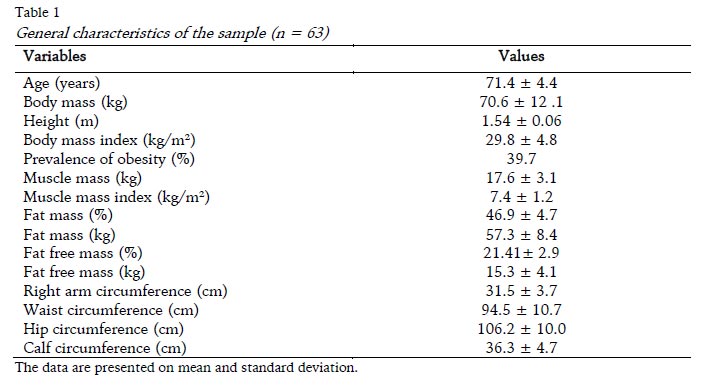
<body><![CDATA[<p><font size="2" face="Verdana">For all   inferential analysis the significance level adopted was 5%. The procedures were   carried out using the Statistical Package for the Social Sciences, version 20 and <i>GraphPad Prism</i> version 6.0.</font></p>     <p>&nbsp;</p>     <p><font size="3" face="Verdana"><b>RESULTS</b></font></p>     <p><font size="2" face="Verdana">The characteristics of the sample are presented in <a href="/img/revistas/mot/v11n2/11n2a11t1.jpg">table 1</a>.</font></p>     
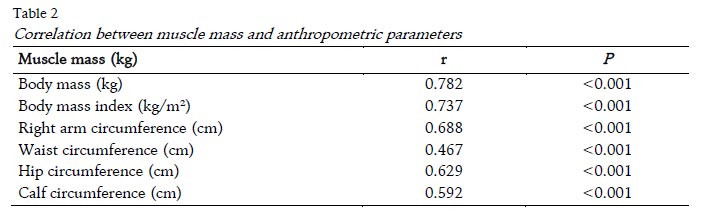
<p><font size="2" face="Verdana">The data are presented on mean and standard deviation.</font></p>     <p><font size="2" face="Verdana"><a href="/img/revistas/mot/v11n2/11n2a11t2.jpg">Table 2</a> shows correlations between MM and   anthropometric parameters. A significant positive correlation between MM and   body mass, body mass index, arm circumference, waist circumference, hip circumference and calf circumference were observed (p&lt;0.001 for all).</font></p>     
<p><font size="2" face="Verdana">In multiple regression analysis, body mass   (F=96.0) and calf circumference (F=32.9) adequately estimated MM (F=55.7; r=0.81; r²=0.65; SEE=1.83) (<a href="/img/revistas/mot/v11n2/11n2a11t3.jpg">Table 3</a>).</font></p>     
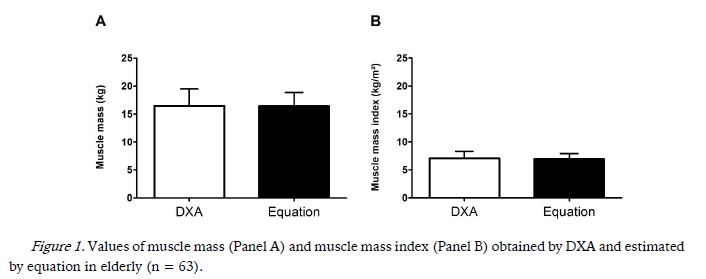
<p align="center"><a href="/img/revistas/mot/v11n2/11n2a11f1.jpg"><font size="2" face="Verdana">Figure 1</font></a></p>     
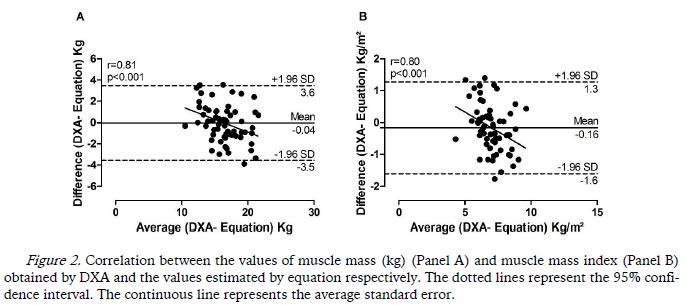
<p><font size="2" face="Verdana"><a href="/img/revistas/mot/v11n2/11n2a11f2.jpg">Figure 2</a>  presents the agreement between MM and MMI values obtained by DXA and estimated   by the proposed equation. The concordance between MM values estimated by   proposed equation and obtained by DXA were: <i>bias</i>= -0.04 and SD=1.80 and   limits of agreement of 95% for (-3.60; 3.48). The concordance between MMI   values estimated by proposed equation and obtained by DXA were <i>bias= </i>0.16 and SD= 0.73 and limits of agreement of 95% for (-1.60; 1.28).</font></p>     
<p>&nbsp;</p>     ]]></body>
<body><![CDATA[<p><font size="3" face="Verdana"><b>DISCUSSION</b></font></p>     <p><font size="2" face="Verdana">The novel findings of the present study   were that: a) in elderly women, anthropometric parameters are positively associated   with MM; b) the proposed equation based on calf circumference and body weight adequately estimated MM. </font></p>     <p><font size="2" face="Verdana">In the present study, the body mass was the   main predictor of MM in the elderly women. This finding is reasonable since the   weight loss is one of the main health problems observed in this population (Kyle, Genton, &amp; Pichard, 2005; Kyle, Pirlich, Lochs,   Schuetz, &amp; Pichard, 2005), affecting the immune system and cognitive functions, and this is a   risk factor for infections, falls, and impairment of hepatic protein synthesis (Raslan et al., 2008). Furthermore, reductions in body weight   during ageing are also associated with chronic diseases such as cancer (Wigmore, Plester,   Richardson, &amp; Fearon, 1997), peripheral artery disease (McDermott et al., 2004), heart failure (Mancini et al., 1992), other disorders (Cesari &amp; Pahor,   2008) and in more advanced   cases, can lead to cachexia (Argiles et al., 2010; Evans, 2010; Morley, Thomas, &amp;   Wilson, 2006). On the order   hand, the increment of body weight during aging has been associated with   improved functionality (Harris,   Ballard-Barbasch, Madans, Makuc, &amp; Feldman, 1993; Harris et al., 1997; Newman et al., 2005). In this study, there was an increase of   0.2 kg of MM per 1 kg of body weight, which highlights its importance for MM   estimation. Therefore, maintenance of body weight in elderly women appears to be an important strategy to keep the MM.</font></p>     <p><font size="2" face="Verdana">Interestingly, in the present study, the circumferences   related to adiposity (waist and hip) were associated with MM. These results may   be, at least in part, explained by the elevated skeletal muscle workload in   subjects with higher adiposity levels, which are in line with previous studies.   In fact, Kuk et al (2007) showed a statistically significant relationship between hip   circumference and thigh circumferences, as well as between lower-body and   abdominal MM, regardless of waist circumference. Likewise, Baumgartner et al (1999)  observed that obese elderly women may be   protected from sarcopenia and this may in part be explained by the trophic   effects of increased weight bearing on muscle. Regarding the circumferences   examined in this study, those from the arm and calf were most strongly   associated with MM, which is probably mediated by the lower adiposity observed   in the limbs compared with trunk, making MM the primary component of these circumferences.</font></p>     <p><font size="2" face="Verdana">Likewise, the present study showed that the   total MM was adequately estimated by body mass and calf circumference, using   DXA as the reference method. Importantly, these anthropometric measurements are   simple and easy to perform in practical situations by clinicians and health   professionals, optimizing the planning and implementation of interventions in   order to diagnose and prevent sarcopenia. These results are in line with   previous studies in the literature (Doupe, Martin, Searle,   Kriellaars, &amp; Giesbrecht, 1997; Martin, Spenst, Drinkwater, &amp; Clarys, 1990) that also have  identified the potential   of simple measures to estimate the MM. Martin et al (1990) and Doupe et al (1997) have reported high determination coefficients   with equations based on cadaver dissection (r²=0.97 and r²=0.96, respectively).   Lee et al (2000) validated an equation to estimate MM by means of anthropometric   parameters in obese and non-obese patients aged 20 to 80 and observed a high   determination coefficient (r²=0.86). More recently, Pereira et al. (2013) assessed 264 women aged 60 to 84 years and   adequately estimated appendicular muscle mass using various equations based on   anthropometric measures such as body mass, body mass index, thigh skinfold and   thigh, hip and forearm circumferences (r²&#8805; 0.70 for all equations).   Likewise, the present study was able to adequately estimate the total MM, using   body mass and calf circumference, using DXA as the reference method. These   anthropometric measures are simple and easy to perform in some research   situations and/or in evaluations of body composition at non-laboratory conditions with the purpose of reducing exposure of body parts.</font></p>     <p><font size="2" face="Verdana">These results have important practical applications,   since it is possible to estimate the MMI, which is widely used for diagnosis of   sarcopenia, without incurring high costs in non-laboratory environments. Early   identification of sarcopenia may lead to interventions to reduce the impact of   this important women's health issue. However, despite the good fit obtained   using the proposed equation there was a significant correlation between the   mean of the differences and the average MM in the Bland-Altman analysis. These   results indicate that the proposed equation underestimates the MM in elderly   people with higher MM and overestimates it in those with lower MM. In practical   terms, MM over estimation in elderly women with lower MM may limit the   identification of sarcopenia. In fact, based on the criteria proposed by   Janssen et al (2004) only one elderly woman presented with   sarcopenia when MM was estimated using an anthropometric equation, while DXA   identified four participants with sarcopenia. These results suggest that   caution should be taken in elderly women with low MM, even if they do not meet the criteria for sarcopenia.</font></p>     <p><font size="2" face="Verdana">The present study has a number of limitations.   First, the sample size calculation was not performed previously. Second, MM was   estimated using DXA and not magnetic resonance imaging, although DXA is not the   gold standard for estimating MM (Lee, Wang, &amp; Heymsfield, 2001). Third, the proposed equation for MM   estimation was not cross-validated in an independent group of elderly women.   Finally, this study was performed in elderly women and caution should be taken in extrapolating the results for other populations.</font></p>     <p>&nbsp;</p>     <p><font size="3" face="Verdana"><b>CONCLUSION</b></font></p>     <p><font size="2" face="Verdana">In conclusion, the   results of the present study indicate that MM is related to anthropometric   parameters and that the linear regression model proposed can adequately predict MM in elderly women.</font></p>     ]]></body>
<body><![CDATA[<p>&nbsp;</p>     <p><font size="3" face="Verdana"><b>REFERÊNCIAS</b></font></p>     <!-- ref --><p><font size="3" face="Verdana"></font><font size="2" face="Verdana">Argiles, J. M., Anker, S. D., Evans, W.   J., Morley, J. E., Fearon, K. C., Strasser, F., . . . Baracos, V. E. (2010).   Consensus on cachexia definitions. <i>Journal of the American Medical Directors Association, 11</i>(4), 229-230. doi: 10.1016/j.jamda.2010.02.004</font>&nbsp;&nbsp;&nbsp;&nbsp;&nbsp;&nbsp;&nbsp;&nbsp;[&#160;<a href="javascript:void(0);" onclick="javascript: window.open('/scielo.php?script=sci_nlinks&ref=000065&pid=S1646-107X201500020001100001&lng=','','width=640,height=500,resizable=yes,scrollbars=1,menubar=yes,');">Links</a>&#160;]<!-- end-ref --><!-- ref --><p><font size="2" face="Verdana">Baumgartner, R. N. (2000). Body   composition in healthy aging. <i>Annals of the New York Academy of Sciences, 904</i>, 437-448.    &nbsp;&nbsp;&nbsp;&nbsp;&nbsp;&nbsp;&nbsp;&nbsp;[&#160;<a href="javascript:void(0);" onclick="javascript: window.open('/scielo.php?script=sci_nlinks&ref=000066&pid=S1646-107X201500020001100002&lng=','','width=640,height=500,resizable=yes,scrollbars=1,menubar=yes,');">Links</a>&#160;]<!-- end-ref -->      </font></p>     <!-- ref --><p><font size="2" face="Verdana">Baumgartner, R. N., Koehler, K. M.,   Gallagher, D., Romero, L., Heymsfield, S. B., Ross, R. R., . . . Lindeman, R.   D. (1998). Epidemiology of sarcopenia among the elderly in New Mexico. <i>American Journal of Epidemiology, 147</i>(8), 755-763.    &nbsp;&nbsp;&nbsp;&nbsp;&nbsp;&nbsp;&nbsp;&nbsp;[&#160;<a href="javascript:void(0);" onclick="javascript: window.open('/scielo.php?script=sci_nlinks&ref=000068&pid=S1646-107X201500020001100003&lng=','','width=640,height=500,resizable=yes,scrollbars=1,menubar=yes,');">Links</a>&#160;]<!-- end-ref --> </font></p>     <!-- ref --><p><font size="2" face="Verdana">Baumgartner, R. N., Waters, D. L.,   Gallagher, D., Morley, J. E., &amp; Garry, P. J. (1999). Predictors of skeletal   muscle mass in elderly men and women. <i>Mechanisms of Ageing and Development, 107</i>(2), 123-136.    &nbsp;&nbsp;&nbsp;&nbsp;&nbsp;&nbsp;&nbsp;&nbsp;[&#160;<a href="javascript:void(0);" onclick="javascript: window.open('/scielo.php?script=sci_nlinks&ref=000070&pid=S1646-107X201500020001100004&lng=','','width=640,height=500,resizable=yes,scrollbars=1,menubar=yes,');">Links</a>&#160;]<!-- end-ref --> </font></p>     <!-- ref --><p><font size="2" face="Verdana">Bland, J. M., &amp; Altman, D. G. (1986).   Statistical methods for assessing agreement between two methods of clinical measurement. <i>The Lancet, 1</i>(8476), 307-310.    &nbsp;&nbsp;&nbsp;&nbsp;&nbsp;&nbsp;&nbsp;&nbsp;[&#160;<a href="javascript:void(0);" onclick="javascript: window.open('/scielo.php?script=sci_nlinks&ref=000072&pid=S1646-107X201500020001100005&lng=','','width=640,height=500,resizable=yes,scrollbars=1,menubar=yes,');">Links</a>&#160;]<!-- end-ref --> </font></p>     <!-- ref --><p><font size="2" face="Verdana">Callaway, C., Chumlea, W., Bouchard, C.,   Himes, J., Lohman, T., Martin, A., . . . Seefeldt, V. (1988). Circunferences. <i>Anthropometric standardization reference manual</i>, 39–54.    &nbsp;&nbsp;&nbsp;&nbsp;&nbsp;&nbsp;&nbsp;&nbsp;[&#160;<a href="javascript:void(0);" onclick="javascript: window.open('/scielo.php?script=sci_nlinks&ref=000074&pid=S1646-107X201500020001100006&lng=','','width=640,height=500,resizable=yes,scrollbars=1,menubar=yes,');">Links</a>&#160;]<!-- end-ref --> </font></p>     <!-- ref --><p><font size="2" face="Verdana">Cesari, M., &amp; Pahor, M. (2008). Target   population for clinical trials on sarcopenia. <i>The Journal of Nutrition Health and Aging, 12</i>(7), 470-478.    &nbsp;&nbsp;&nbsp;&nbsp;&nbsp;&nbsp;&nbsp;&nbsp;[&#160;<a href="javascript:void(0);" onclick="javascript: window.open('/scielo.php?script=sci_nlinks&ref=000076&pid=S1646-107X201500020001100007&lng=','','width=640,height=500,resizable=yes,scrollbars=1,menubar=yes,');">Links</a>&#160;]<!-- end-ref --> </font></p>     <!-- ref --><p><font size="2" face="Verdana"><a>Chumlea, W. C., Guo, S. S., Vellas, B.,   &amp; Guigoz, Y. (1995). Techniques of assessing muscle mass and function   (sarcopenia) for epidemiological studies of the elderly. <i>The journals of     gerontology. Series A, Biological sciences and medical sciences, 50 Spec No</i>, 45-51.    &nbsp;&nbsp;&nbsp;&nbsp;&nbsp;&nbsp;&nbsp;&nbsp;[&#160;<a href="javascript:void(0);" onclick="javascript: window.open('/scielo.php?script=sci_nlinks&ref=000078&pid=S1646-107X201500020001100008&lng=','','width=640,height=500,resizable=yes,scrollbars=1,menubar=yes,');">Links</a>&#160;]<!-- end-ref --> </a></font></p>     <!-- ref --><p><font size="2" face="Verdana"><a>Deschenes, M. R. (2004). Effects of aging on muscle fibre type and size. <i>Sports Medicine, 34</i>(12), 809-824.    &nbsp;&nbsp;&nbsp;&nbsp;&nbsp;&nbsp;&nbsp;&nbsp;[&#160;<a href="javascript:void(0);" onclick="javascript: window.open('/scielo.php?script=sci_nlinks&ref=000080&pid=S1646-107X201500020001100009&lng=','','width=640,height=500,resizable=yes,scrollbars=1,menubar=yes,');">Links</a>&#160;]<!-- end-ref --></a></font></p>     <!-- ref --><p><font size="2" face="Verdana"><a>Doherty, T. J. (2003). Invited   review: Aging and sarcopenia. <i>Journal of applied physiology, 95</i>(4), 1717-1727. doi: 10.1152/japplphysiol.00347.2003</a></font>&nbsp;&nbsp;&nbsp;&nbsp;&nbsp;&nbsp;&nbsp;&nbsp;[&#160;<a href="javascript:void(0);" onclick="javascript: window.open('/scielo.php?script=sci_nlinks&ref=000082&pid=S1646-107X201500020001100010&lng=','','width=640,height=500,resizable=yes,scrollbars=1,menubar=yes,');">Links</a>&#160;]<!-- end-ref --><!-- ref --><p><font size="2" face="Verdana"><a>Doupe, M. B., Martin, A. D., Searle,   M. S., Kriellaars, D. J., &amp; Giesbrecht, G. G. (1997). A new formula for   population-based estimation of whole body muscle mass in males. <i>Canadian Journal of Applied Physiology, 22</i>(6), 598-608.    &nbsp;&nbsp;&nbsp;&nbsp;&nbsp;&nbsp;&nbsp;&nbsp;[&#160;<a href="javascript:void(0);" onclick="javascript: window.open('/scielo.php?script=sci_nlinks&ref=000083&pid=S1646-107X201500020001100011&lng=','','width=640,height=500,resizable=yes,scrollbars=1,menubar=yes,');">Links</a>&#160;]<!-- end-ref --> </a></font></p>     <!-- ref --><p><font size="2" face="Verdana"><a>Evans, W. J. (2010). Skeletal muscle   loss: cachexia, sarcopenia, and inactivity. <i>The American Journal of Clinical Nutrition, 91</i>(4), 1123S-1127S. doi: 10.3945/ajcn.2010.28608A</a></font>&nbsp;&nbsp;&nbsp;&nbsp;&nbsp;&nbsp;&nbsp;&nbsp;[&#160;<a href="javascript:void(0);" onclick="javascript: window.open('/scielo.php?script=sci_nlinks&ref=000085&pid=S1646-107X201500020001100012&lng=','','width=640,height=500,resizable=yes,scrollbars=1,menubar=yes,');">Links</a>&#160;]<!-- end-ref --><!-- ref --><p><font size="2" face="Verdana"><a>Forbes, G. B., &amp; Reina, J. C.   (1970). </a>Adult   lean body mass declines with age: some longitudinal observations. <i>Metabolism, 19</i>(9), 653-663.    &nbsp;&nbsp;&nbsp;&nbsp;&nbsp;&nbsp;&nbsp;&nbsp;[&#160;<a href="javascript:void(0);" onclick="javascript: window.open('/scielo.php?script=sci_nlinks&ref=000086&pid=S1646-107X201500020001100013&lng=','','width=640,height=500,resizable=yes,scrollbars=1,menubar=yes,');">Links</a>&#160;]<!-- end-ref --> </font></p>     <!-- ref --><p><font size="2" face="Verdana"><a>Harris, T. B., Ballard-Barbasch, R.,   Madans, J., Makuc, D. M., &amp; Feldman, J. J. (1993). Overweight, weight loss,   and risk of coronary heart disease in older women. The NHANES I Epidemiologic Follow-up Study. <i>American Journal of Epidemiology, 137</i>(12), 1318-1327.    &nbsp;&nbsp;&nbsp;&nbsp;&nbsp;&nbsp;&nbsp;&nbsp;[&#160;<a href="javascript:void(0);" onclick="javascript: window.open('/scielo.php?script=sci_nlinks&ref=000088&pid=S1646-107X201500020001100014&lng=','','width=640,height=500,resizable=yes,scrollbars=1,menubar=yes,');">Links</a>&#160;]<!-- end-ref --> </a></font></p>     <!-- ref --><p><font size="2" face="Verdana"><a>Harris, T. B., Savage, P. J., Tell,   G. S., Haan, M., Kumanyika, S., &amp; Lynch, J. C. (1997). Carrying the burden   of cardiovascular risk in old age: associations of weight and weight change   with prevalent cardiovascular disease, risk factors, and health status in the   Cardiovascular Health Study. <i>The American Journal of Clinical Nutrition, 66</i>(4), 837-844.    &nbsp;&nbsp;&nbsp;&nbsp;&nbsp;&nbsp;&nbsp;&nbsp;[&#160;<a href="javascript:void(0);" onclick="javascript: window.open('/scielo.php?script=sci_nlinks&ref=000090&pid=S1646-107X201500020001100015&lng=','','width=640,height=500,resizable=yes,scrollbars=1,menubar=yes,');">Links</a>&#160;]<!-- end-ref --> </a></font></p>     <!-- ref --><p><font size="2" face="Verdana"><a>Janssen, I. (2006). Influence of   sarcopenia on the development of physical disability: the Cardiovascular Health   Study. <i>Journal of the American Geriatrics Society, 54</i>(1), 56-62. doi: 10.1111/j.1532-5415.2005.00540.x</a></font>&nbsp;&nbsp;&nbsp;&nbsp;&nbsp;&nbsp;&nbsp;&nbsp;[&#160;<a href="javascript:void(0);" onclick="javascript: window.open('/scielo.php?script=sci_nlinks&ref=000092&pid=S1646-107X201500020001100016&lng=','','width=640,height=500,resizable=yes,scrollbars=1,menubar=yes,');">Links</a>&#160;]<!-- end-ref --><!-- ref --><p><font size="2" face="Verdana"><a>Janssen, I., Baumgartner, R. N.,   Ross, R., Rosenberg, I. H., &amp; Roubenoff, R. (2004). Skeletal muscle   cutpoints associated with elevated physical disability risk in older men and women. <i>American Journal of Epidemiology, 159</i>(4), 413-421.    &nbsp;&nbsp;&nbsp;&nbsp;&nbsp;&nbsp;&nbsp;&nbsp;[&#160;<a href="javascript:void(0);" onclick="javascript: window.open('/scielo.php?script=sci_nlinks&ref=000093&pid=S1646-107X201500020001100017&lng=','','width=640,height=500,resizable=yes,scrollbars=1,menubar=yes,');">Links</a>&#160;]<!-- end-ref --> </a></font></p>     <!-- ref --><p><font size="2" face="Verdana"><a>Janssen, I., Heymsfield, S. B.,   &amp; Ross, R. (2002). Low relative skeletal muscle mass (sarcopenia) in older   persons is associated with functional impairment and physical disability. <i>Journal of the American Geriatrics Society, 50</i>(5), 889-896.    &nbsp;&nbsp;&nbsp;&nbsp;&nbsp;&nbsp;&nbsp;&nbsp;[&#160;<a href="javascript:void(0);" onclick="javascript: window.open('/scielo.php?script=sci_nlinks&ref=000095&pid=S1646-107X201500020001100018&lng=','','width=640,height=500,resizable=yes,scrollbars=1,menubar=yes,');">Links</a>&#160;]<!-- end-ref --> </a></font></p>     <!-- ref --><p><font size="2" face="Verdana"><a>Kim, J., Wang, Z., Heymsfield, S.   B., Baumgartner, R. N., &amp; Gallagher, D. (2002). Total-body skeletal muscle   mass: estimation by a new dual-energy X-ray absorptiometry method. <i>The American Journal of Clinical Nutrition, 76</i>(2), 378-383.    &nbsp;&nbsp;&nbsp;&nbsp;&nbsp;&nbsp;&nbsp;&nbsp;[&#160;<a href="javascript:void(0);" onclick="javascript: window.open('/scielo.php?script=sci_nlinks&ref=000097&pid=S1646-107X201500020001100019&lng=','','width=640,height=500,resizable=yes,scrollbars=1,menubar=yes,');">Links</a>&#160;]<!-- end-ref --> </a></font></p>     <!-- ref --><p><font size="2" face="Verdana"><a>Kuk, J. L., Janiszewski, P. M.,   &amp; Ross, R. (2007). Body mass index and hip and thigh circumferences are   negatively associated with visceral adipose tissue after control for waist   circumference. <i>The American Journal of Clinical Nutrition, 85</i>(6), 1540-1544.    &nbsp;&nbsp;&nbsp;&nbsp;&nbsp;&nbsp;&nbsp;&nbsp;[&#160;<a href="javascript:void(0);" onclick="javascript: window.open('/scielo.php?script=sci_nlinks&ref=000099&pid=S1646-107X201500020001100020&lng=','','width=640,height=500,resizable=yes,scrollbars=1,menubar=yes,');">Links</a>&#160;]<!-- end-ref --></a></font></p>     <!-- ref --><p><font size="2" face="Verdana"><a>Kyle, U. G., Genton, L., &amp;   Pichard, C. (2005). Hospital length of stay and nutritional status. <i>Current Opinion in Clinical Nutrition &amp; Metabolic Care, 8</i>(4), 397-402.    &nbsp;&nbsp;&nbsp;&nbsp;&nbsp;&nbsp;&nbsp;&nbsp;[&#160;<a href="javascript:void(0);" onclick="javascript: window.open('/scielo.php?script=sci_nlinks&ref=000101&pid=S1646-107X201500020001100021&lng=','','width=640,height=500,resizable=yes,scrollbars=1,menubar=yes,');">Links</a>&#160;]<!-- end-ref --> </a></font></p>     ]]></body>
<body><![CDATA[<!-- ref --><p><font size="2" face="Verdana"><a>Kyle, U. G., Pirlich, M., Lochs, H.,   Schuetz, T., &amp; Pichard, C. (2005). Increased length of hospital stay in   underweight and overweight patients at hospital admission: a controlled   population study. <i>Clinical Nutrition, 24</i>(1), 133-142. doi: 10.1016/j.clnu.2004.08.012</a></font>&nbsp;&nbsp;&nbsp;&nbsp;&nbsp;&nbsp;&nbsp;&nbsp;[&#160;<a href="javascript:void(0);" onclick="javascript: window.open('/scielo.php?script=sci_nlinks&ref=000103&pid=S1646-107X201500020001100022&lng=','','width=640,height=500,resizable=yes,scrollbars=1,menubar=yes,');">Links</a>&#160;]<!-- end-ref --><!-- ref --><p><font size="2" face="Verdana"><a>Lang, T., Streeper, T., Cawthon, P.,   Baldwin, K., Taaffe, D. R., &amp; Harris, T. B. (2010). Sarcopenia: etiology,   clinical consequences, intervention, and assessment. <i>Osteoporosis International, 21</i>(4), 543-559. doi: 10.1007/s00198-009-1059-y </a></font>&nbsp;&nbsp;&nbsp;&nbsp;&nbsp;&nbsp;&nbsp;&nbsp;[&#160;<a href="javascript:void(0);" onclick="javascript: window.open('/scielo.php?script=sci_nlinks&ref=000104&pid=S1646-107X201500020001100023&lng=','','width=640,height=500,resizable=yes,scrollbars=1,menubar=yes,');">Links</a>&#160;]<!-- end-ref --><!-- ref --><p><font size="2" face="Verdana"><a>Lee, R. C., Wang, Z., Heo, M., Ross,   R., Janssen, I., &amp; Heymsfield, S. B. (2000). Total-body skeletal muscle   mass: development and cross-validation of anthropometric prediction models. <i>The American Journal of Clinical Nutrition, 72</i>(3), 796-803.    &nbsp;&nbsp;&nbsp;&nbsp;&nbsp;&nbsp;&nbsp;&nbsp;[&#160;<a href="javascript:void(0);" onclick="javascript: window.open('/scielo.php?script=sci_nlinks&ref=000105&pid=S1646-107X201500020001100024&lng=','','width=640,height=500,resizable=yes,scrollbars=1,menubar=yes,');">Links</a>&#160;]<!-- end-ref --> </a></font></p>     <!-- ref --><p><font size="2" face="Verdana"><a>Lee, R. C., Wang, Z. M., &amp;   Heymsfield, S. B. (2001). Skeletal muscle mass and aging: regional and   whole-body measurement methods. <i>Canadian Journal of Applied Physiology, 26</i>(1), 102-122.    &nbsp;&nbsp;&nbsp;&nbsp;&nbsp;&nbsp;&nbsp;&nbsp;[&#160;<a href="javascript:void(0);" onclick="javascript: window.open('/scielo.php?script=sci_nlinks&ref=000107&pid=S1646-107X201500020001100025&lng=','','width=640,height=500,resizable=yes,scrollbars=1,menubar=yes,');">Links</a>&#160;]<!-- end-ref -->   </a></font></p>     <!-- ref --><p><font size="2" face="Verdana"><a>Mancini, D. M., Walter, G., Reichek,   N., Lenkinski, R., McCully, K. K., Mullen, J. L., &amp; Wilson, J. R. (1992).   Contribution of skeletal muscle atrophy to exercise intolerance and altered   muscle metabolism in heart failure. <i>Circulation, 85</i>(4), 1364-1373. doi: 10.1161/01.cir.85.4.1364</a></font>&nbsp;&nbsp;&nbsp;&nbsp;&nbsp;&nbsp;&nbsp;&nbsp;[&#160;<a href="javascript:void(0);" onclick="javascript: window.open('/scielo.php?script=sci_nlinks&ref=000109&pid=S1646-107X201500020001100026&lng=','','width=640,height=500,resizable=yes,scrollbars=1,menubar=yes,');">Links</a>&#160;]<!-- end-ref --><!-- ref --><p><font size="2" face="Verdana"><a>Martin, A. D., Spenst, L. F.,   Drinkwater, D. T., &amp; Clarys, J. P. (1990). Anthropometric estimation of   muscle mass in men. <i>Medicine &amp; Science in Sports &amp; Exercise, 22</i>(5), 729-733.    &nbsp;&nbsp;&nbsp;&nbsp;&nbsp;&nbsp;&nbsp;&nbsp;[&#160;<a href="javascript:void(0);" onclick="javascript: window.open('/scielo.php?script=sci_nlinks&ref=000110&pid=S1646-107X201500020001100027&lng=','','width=640,height=500,resizable=yes,scrollbars=1,menubar=yes,');">Links</a>&#160;]<!-- end-ref --> </a></font></p>     <!-- ref --><p><font size="2" face="Verdana"><a>McDermott, M. M., Guralnik, J. M.,   Albay, M., Bandinelli, S., Miniati, B., &amp; Ferrucci, L. (2004). Impairments   of muscles and nerves associated with peripheral arterial disease and their   relationship with lower extremity functioning: the InCHIANTI Study. <i>Journal of the American Geriatrics Society, 52</i>(3), 405-410.    &nbsp;&nbsp;&nbsp;&nbsp;&nbsp;&nbsp;&nbsp;&nbsp;[&#160;<a href="javascript:void(0);" onclick="javascript: window.open('/scielo.php?script=sci_nlinks&ref=000112&pid=S1646-107X201500020001100028&lng=','','width=640,height=500,resizable=yes,scrollbars=1,menubar=yes,');">Links</a>&#160;]<!-- end-ref --> </a></font></p>     <!-- ref --><p><font size="2" face="Verdana"><a>McIntosh, E. I., Smale, K. B., &amp;   Vallis, L. A. (2013). Predicting fat-free mass index and sarcopenia: A pilot   study in community-dwelling older adults. <i>Age, 35</i>(6), 2423-2434. doi: 10.1007/s11357-012-9505-8</a></font>&nbsp;&nbsp;&nbsp;&nbsp;&nbsp;&nbsp;&nbsp;&nbsp;[&#160;<a href="javascript:void(0);" onclick="javascript: window.open('/scielo.php?script=sci_nlinks&ref=000114&pid=S1646-107X201500020001100029&lng=','','width=640,height=500,resizable=yes,scrollbars=1,menubar=yes,');">Links</a>&#160;]<!-- end-ref --><!-- ref --><p><font size="2" face="Verdana"><a>Morley, J. E., Thomas, D. R., &amp;   Wilson, M. M. (2006). Cachexia: pathophysiology and clinical relevance. <i>The American Journal of Clinical Nutrition, 83</i>(4), 735-743.    &nbsp;&nbsp;&nbsp;&nbsp;&nbsp;&nbsp;&nbsp;&nbsp;[&#160;<a href="javascript:void(0);" onclick="javascript: window.open('/scielo.php?script=sci_nlinks&ref=000115&pid=S1646-107X201500020001100030&lng=','','width=640,height=500,resizable=yes,scrollbars=1,menubar=yes,');">Links</a>&#160;]<!-- end-ref -->       </a></font></p>     <!-- ref --><p><font size="2" face="Verdana"><a>Newman, A. B., Lee, J. S., Visser,   M., Goodpaster, B. H., Kritchevsky, S. B., Tylavsky, F. A., . . . Harris, T. B.   (2005). Weight change and the conservation of lean mass in old age: the Health,   Aging and Body Composition Study. <i>The American Journal of Clinical Nutrition, 82</i>(4), 872-878; quiz 915-876.    &nbsp;&nbsp;&nbsp;&nbsp;&nbsp;&nbsp;&nbsp;&nbsp;[&#160;<a href="javascript:void(0);" onclick="javascript: window.open('/scielo.php?script=sci_nlinks&ref=000117&pid=S1646-107X201500020001100031&lng=','','width=640,height=500,resizable=yes,scrollbars=1,menubar=yes,');">Links</a>&#160;]<!-- end-ref --> </a></font></p>     <!-- ref --><p><font size="2" face="Verdana"><a>Patrick, J. M., Bassey, E. J., &amp;   Fentem, P. H. (1982). Changes in body fat and muscle in manual workers at and   after retirement. <i>European Journal of Applied Physiology and Occupational Physiology, 49</i>(2), 187-196.    &nbsp;&nbsp;&nbsp;&nbsp;&nbsp;&nbsp;&nbsp;&nbsp;[&#160;<a href="javascript:void(0);" onclick="javascript: window.open('/scielo.php?script=sci_nlinks&ref=000119&pid=S1646-107X201500020001100032&lng=','','width=640,height=500,resizable=yes,scrollbars=1,menubar=yes,');">Links</a>&#160;]<!-- end-ref --> </a></font></p>     <!-- ref --><p><font size="2" face="Verdana"><a>Pereira, P. G., da Silva, G. A.,   Santos, G. M., Jr., Petroski, E. L., &amp; Geraldes, A. R. (2013). Development   and validation of anthropometric equations to estimate appendicular muscle mass   in elderly women. </a><i>Nutrition journal, 12</i>(1), 92. doi: 10.1186/1475-2891-12-92</font>&nbsp;&nbsp;&nbsp;&nbsp;&nbsp;&nbsp;&nbsp;&nbsp;[&#160;<a href="javascript:void(0);" onclick="javascript: window.open('/scielo.php?script=sci_nlinks&ref=000121&pid=S1646-107X201500020001100033&lng=','','width=640,height=500,resizable=yes,scrollbars=1,menubar=yes,');">Links</a>&#160;]<!-- end-ref --><!-- ref --><p><font size="2" face="Verdana"><a>Quiroz-Olguin, G., Serralde-Zuniga,   A. E., Saldana-Morales, V., &amp; Guevara-Cruz, M. (2013). </a>Validation   of a new formula for predicting body weight in a Mexican population with   overweight and obesity. <i>Nutrición Hospitalaria, 28</i>(3), 690-693. doi: 10.3305/nh.2013.28.3.6455</font>&nbsp;&nbsp;&nbsp;&nbsp;&nbsp;&nbsp;&nbsp;&nbsp;[&#160;<a href="javascript:void(0);" onclick="javascript: window.open('/scielo.php?script=sci_nlinks&ref=000122&pid=S1646-107X201500020001100034&lng=','','width=640,height=500,resizable=yes,scrollbars=1,menubar=yes,');">Links</a>&#160;]<!-- end-ref --><!-- ref --><p><font size="2" face="Verdana"><a>Raslan, M., Gonzalez, M. C., Dias,   M. C. G., Paes-Barbosa, F. C., Cecconello, I., &amp; Waitzberg, D. L. (2008). </a>Applicability   of nutritional screening methods in hospitalized patients. <i>Brazilian Journal of Nutrition, 21</i>, 553-561.    &nbsp;&nbsp;&nbsp;&nbsp;&nbsp;&nbsp;&nbsp;&nbsp;[&#160;<a href="javascript:void(0);" onclick="javascript: window.open('/scielo.php?script=sci_nlinks&ref=000123&pid=S1646-107X201500020001100035&lng=','','width=640,height=500,resizable=yes,scrollbars=1,menubar=yes,');">Links</a>&#160;]<!-- end-ref --> </font></p>     <!-- ref --><p><font size="2" face="Verdana"><a>Rech, C. R., Dellagrana, R. A.,   Marucci, M. d. F. N., &amp; Petroski, E. L. (2012). </a>Validity   of anthropometric equations for the estimation of muscle mass in the elderly. <i>Brazilian Journal of Kinanthropometry and Human Performance, 14</i>, 23-31.    &nbsp;&nbsp;&nbsp;&nbsp;&nbsp;&nbsp;&nbsp;&nbsp;[&#160;<a href="javascript:void(0);" onclick="javascript: window.open('/scielo.php?script=sci_nlinks&ref=000125&pid=S1646-107X201500020001100036&lng=','','width=640,height=500,resizable=yes,scrollbars=1,menubar=yes,');">Links</a>&#160;]<!-- end-ref --> </font></p>     <!-- ref --><p><font size="2" face="Verdana"><a>Rolland, Y., Lauwers-Cances, V.,   Cournot, M., Nourhashemi, F., Reynish, W., Riviere, D., . . . Grandjean, H.   (2003). Sarcopenia, calf circumference, and physical function of elderly women:   a cross-sectional study. <i>Journal of the American Geriatrics Society, 51</i>(8), 1120-1124.    &nbsp;&nbsp;&nbsp;&nbsp;&nbsp;&nbsp;&nbsp;&nbsp;[&#160;<a href="javascript:void(0);" onclick="javascript: window.open('/scielo.php?script=sci_nlinks&ref=000127&pid=S1646-107X201500020001100037&lng=','','width=640,height=500,resizable=yes,scrollbars=1,menubar=yes,');">Links</a>&#160;]<!-- end-ref --> </a></font></p>     <!-- ref --><p><font size="2" face="Verdana"><a>Tichet, J., Vol, S., Goxe, D.,   Salle, A., Berrut, G., &amp; Ritz, P. (2008). Prevalence of sarcopenia in the   French senior population. <i>The Journal of Nutrition Health and Aging, 12</i>(3), 202-206.    &nbsp;&nbsp;&nbsp;&nbsp;&nbsp;&nbsp;&nbsp;&nbsp;[&#160;<a href="javascript:void(0);" onclick="javascript: window.open('/scielo.php?script=sci_nlinks&ref=000129&pid=S1646-107X201500020001100038&lng=','','width=640,height=500,resizable=yes,scrollbars=1,menubar=yes,');">Links</a>&#160;]<!-- end-ref --> </a></font></p>     <!-- ref --><p><font size="2" face="Verdana"><a>Wigmore, S. J., Plester, C. E.,   Richardson, R. A., &amp; Fearon, K. C. (1997). Changes in nutritional status   associated with unresectable pancreatic cancer. <i>British Journal of Cancer, 75</i>(1), 106-109.    &nbsp;&nbsp;&nbsp;&nbsp;&nbsp;&nbsp;&nbsp;&nbsp;[&#160;<a href="javascript:void(0);" onclick="javascript: window.open('/scielo.php?script=sci_nlinks&ref=000131&pid=S1646-107X201500020001100039&lng=','','width=640,height=500,resizable=yes,scrollbars=1,menubar=yes,');">Links</a>&#160;]<!-- end-ref --> </a></font></p>     ]]></body>
<body><![CDATA[<!-- ref --><p><font size="2" face="Verdana"><a>Williams, C. A., &amp;   Bale, P. (1998). Bias and limits of agreement between hydrodensitometry, bioelectrical   impedance and skinfold calipers measures of percentage body fat. </a><i>European     Journal of Applied Physiology and Occupational Physiology, 77</i>(3), 271-277. doi: 10.1007/s004210050332</font>&nbsp;&nbsp;&nbsp;&nbsp;&nbsp;&nbsp;&nbsp;&nbsp;[&#160;<a href="javascript:void(0);" onclick="javascript: window.open('/scielo.php?script=sci_nlinks&ref=000133&pid=S1646-107X201500020001100040&lng=','','width=640,height=500,resizable=yes,scrollbars=1,menubar=yes,');">Links</a>&#160;]<!-- end-ref --><p>&nbsp;</p>     <p><font size="2"><b><font face="Verdana">Agradecimentos:    <br>   </font></b><font face="Verdana">Nothing to declare    <br>   <b>Conflito de Interesses:    <br>   </b>Nothing to declare    <br>   <b>Financiamento:    <br>   </b>Nothing to declare</font></font></p>     <p><font size="2" face="Verdana">Manuscript received March 27<sup>th</sup>, 2014; Accepted October 24<sup>th</sup>, 2014</font></p>     <p>&nbsp;</p>     ]]></body>
<body><![CDATA[<p>&nbsp;</p>     <p><font size="2" face="Verdana"><a href="#topo">*</a><a name="end" id="end"></a><i> </i><i>Autor correspondente</i>: Escola   Superior de Educa&ccedil;&atilde;o F&iacute;sica, Universidade de Pernambuco, Rua Arn&oacute;bio Marques, 310. Santo Amaro, Recife, PE, CEP: 50100-130, Brasil <i>E-mail</i>: <a href="mailto:raphaelritti@gmail.com">raphaelritti@gmail.com</a></font></p>      ]]></body><back>
<ref-list>
<ref id="B1">
<nlm-citation citation-type="journal">
<person-group person-group-type="author">
<name>
<surname><![CDATA[Argiles]]></surname>
<given-names><![CDATA[J. M.]]></given-names>
</name>
<name>
<surname><![CDATA[Anker]]></surname>
<given-names><![CDATA[S. D.]]></given-names>
</name>
<name>
<surname><![CDATA[Evans]]></surname>
<given-names><![CDATA[W. J.]]></given-names>
</name>
<name>
<surname><![CDATA[Morley]]></surname>
<given-names><![CDATA[J. E.]]></given-names>
</name>
<name>
<surname><![CDATA[Fearon]]></surname>
<given-names><![CDATA[K. C.]]></given-names>
</name>
<name>
<surname><![CDATA[Strasser]]></surname>
<given-names><![CDATA[F.]]></given-names>
</name>
<name>
<surname><![CDATA[Baracos]]></surname>
<given-names><![CDATA[V. E.]]></given-names>
</name>
</person-group>
<article-title xml:lang="en"><![CDATA[Consensus on cachexia definitions]]></article-title>
<source><![CDATA[Journal of the American Medical Directors Association]]></source>
<year>2010</year>
<volume>11</volume>
<numero>4</numero>
<issue>4</issue>
<page-range>229-230</page-range></nlm-citation>
</ref>
<ref id="B2">
<nlm-citation citation-type="journal">
<person-group person-group-type="author">
<name>
<surname><![CDATA[Baumgartner]]></surname>
<given-names><![CDATA[R. N.]]></given-names>
</name>
</person-group>
<article-title xml:lang="en"><![CDATA[Body composition in healthy aging]]></article-title>
<source><![CDATA[Annals of the New York Academy of Sciences]]></source>
<year>2000</year>
<volume>904</volume>
<page-range>437-448</page-range></nlm-citation>
</ref>
<ref id="B3">
<nlm-citation citation-type="journal">
<person-group person-group-type="author">
<name>
<surname><![CDATA[Baumgartner]]></surname>
<given-names><![CDATA[R. N.]]></given-names>
</name>
<name>
<surname><![CDATA[Koehler]]></surname>
<given-names><![CDATA[K. M.]]></given-names>
</name>
<name>
<surname><![CDATA[Gallagher]]></surname>
<given-names><![CDATA[D.]]></given-names>
</name>
<name>
<surname><![CDATA[Romero]]></surname>
<given-names><![CDATA[L.]]></given-names>
</name>
<name>
<surname><![CDATA[Heymsfield]]></surname>
<given-names><![CDATA[S. B.]]></given-names>
</name>
<name>
<surname><![CDATA[Ross]]></surname>
<given-names><![CDATA[R. R.]]></given-names>
</name>
<name>
<surname><![CDATA[Lindeman]]></surname>
<given-names><![CDATA[R. D.]]></given-names>
</name>
</person-group>
<article-title xml:lang="en"><![CDATA[Epidemiology of sarcopenia among the elderly in New Mexico]]></article-title>
<source><![CDATA[American Journal of Epidemiology]]></source>
<year>1998</year>
<volume>147</volume>
<numero>8</numero>
<issue>8</issue>
<page-range>755-763</page-range></nlm-citation>
</ref>
<ref id="B4">
<nlm-citation citation-type="journal">
<person-group person-group-type="author">
<name>
<surname><![CDATA[Baumgartner]]></surname>
<given-names><![CDATA[R. N.]]></given-names>
</name>
<name>
<surname><![CDATA[Waters]]></surname>
<given-names><![CDATA[D. L.]]></given-names>
</name>
<name>
<surname><![CDATA[Gallagher]]></surname>
<given-names><![CDATA[D.]]></given-names>
</name>
<name>
<surname><![CDATA[Morley]]></surname>
<given-names><![CDATA[J. E.]]></given-names>
</name>
<name>
<surname><![CDATA[Garry]]></surname>
<given-names><![CDATA[P. J.]]></given-names>
</name>
</person-group>
<article-title xml:lang="en"><![CDATA[Predictors of skeletal muscle mass in elderly men and women]]></article-title>
<source><![CDATA[Mechanisms of Ageing and Development]]></source>
<year>1999</year>
<volume>107</volume>
<numero>2</numero>
<issue>2</issue>
<page-range>123-136</page-range></nlm-citation>
</ref>
<ref id="B5">
<nlm-citation citation-type="journal">
<person-group person-group-type="author">
<name>
<surname><![CDATA[Bland]]></surname>
<given-names><![CDATA[J. M.]]></given-names>
</name>
<name>
<surname><![CDATA[Altman]]></surname>
<given-names><![CDATA[D. G.]]></given-names>
</name>
</person-group>
<article-title xml:lang="en"><![CDATA[Statistical methods for assessing agreement between two methods of clinical measurement]]></article-title>
<source><![CDATA[The Lancet]]></source>
<year>1986</year>
<volume>1</volume>
<numero>8476</numero>
<issue>8476</issue>
<page-range>307-310</page-range></nlm-citation>
</ref>
<ref id="B6">
<nlm-citation citation-type="">
<person-group person-group-type="author">
<name>
<surname><![CDATA[Callaway]]></surname>
<given-names><![CDATA[C.]]></given-names>
</name>
<name>
<surname><![CDATA[Chumlea]]></surname>
<given-names><![CDATA[W.]]></given-names>
</name>
<name>
<surname><![CDATA[Bouchard]]></surname>
<given-names><![CDATA[C.]]></given-names>
</name>
<name>
<surname><![CDATA[Himes]]></surname>
<given-names><![CDATA[J.]]></given-names>
</name>
<name>
<surname><![CDATA[Lohman]]></surname>
<given-names><![CDATA[T.]]></given-names>
</name>
<name>
<surname><![CDATA[Martin]]></surname>
<given-names><![CDATA[A.]]></given-names>
</name>
<name>
<surname><![CDATA[Seefeldt]]></surname>
<given-names><![CDATA[V.]]></given-names>
</name>
</person-group>
<article-title xml:lang="en"><![CDATA[Circunferences]]></article-title>
<source><![CDATA[Anthropometric standardization reference manual]]></source>
<year>1988</year>
<page-range>39-54</page-range></nlm-citation>
</ref>
<ref id="B7">
<nlm-citation citation-type="journal">
<person-group person-group-type="author">
<name>
<surname><![CDATA[Cesari]]></surname>
<given-names><![CDATA[M.]]></given-names>
</name>
<name>
<surname><![CDATA[Pahor]]></surname>
<given-names><![CDATA[M.]]></given-names>
</name>
</person-group>
<article-title xml:lang="en"><![CDATA[Target population for clinical trials on sarcopenia]]></article-title>
<source><![CDATA[The Journal of Nutrition Health and Aging]]></source>
<year>2008</year>
<volume>12</volume>
<numero>7</numero>
<issue>7</issue>
<page-range>470-478</page-range></nlm-citation>
</ref>
<ref id="B8">
<nlm-citation citation-type="journal">
<person-group person-group-type="author">
<name>
<surname><![CDATA[Chumlea]]></surname>
<given-names><![CDATA[W. C.]]></given-names>
</name>
<name>
<surname><![CDATA[Guo]]></surname>
<given-names><![CDATA[S. S.]]></given-names>
</name>
<name>
<surname><![CDATA[Vellas]]></surname>
<given-names><![CDATA[B.]]></given-names>
</name>
<name>
<surname><![CDATA[Guigoz]]></surname>
<given-names><![CDATA[Y.]]></given-names>
</name>
</person-group>
<article-title xml:lang="en"><![CDATA[Techniques of assessing muscle mass and function (sarcopenia) for epidemiological studies of the elderly]]></article-title>
<source><![CDATA[The journals of gerontology. Series A, Biological sciences and medical sciences]]></source>
<year>1995</year>
<volume>50</volume>
<page-range>45-51</page-range></nlm-citation>
</ref>
<ref id="B9">
<nlm-citation citation-type="journal">
<person-group person-group-type="author">
<name>
<surname><![CDATA[Deschenes]]></surname>
<given-names><![CDATA[M. R.]]></given-names>
</name>
</person-group>
<article-title xml:lang="en"><![CDATA[Effects of aging on muscle fibre type and size]]></article-title>
<source><![CDATA[Sports Medicine]]></source>
<year>2004</year>
<volume>34</volume>
<numero>12</numero>
<issue>12</issue>
<page-range>809-824</page-range></nlm-citation>
</ref>
<ref id="B10">
<nlm-citation citation-type="journal">
<person-group person-group-type="author">
<name>
<surname><![CDATA[Doherty]]></surname>
<given-names><![CDATA[T. J.]]></given-names>
</name>
</person-group>
<article-title xml:lang="en"><![CDATA[Invited review: Aging and sarcopenia]]></article-title>
<source><![CDATA[Journal of applied physiology]]></source>
<year>2003</year>
<volume>95</volume>
<numero>4</numero>
<issue>4</issue>
<page-range>1717-1727</page-range></nlm-citation>
</ref>
<ref id="B11">
<nlm-citation citation-type="journal">
<person-group person-group-type="author">
<name>
<surname><![CDATA[Doupe]]></surname>
<given-names><![CDATA[M. B.]]></given-names>
</name>
<name>
<surname><![CDATA[Martin]]></surname>
<given-names><![CDATA[A. D.]]></given-names>
</name>
<name>
<surname><![CDATA[Searle]]></surname>
<given-names><![CDATA[M. S.]]></given-names>
</name>
<name>
<surname><![CDATA[Kriellaars]]></surname>
<given-names><![CDATA[D. J.]]></given-names>
</name>
<name>
<surname><![CDATA[Giesbrecht]]></surname>
<given-names><![CDATA[G. G.]]></given-names>
</name>
</person-group>
<article-title xml:lang="en"><![CDATA[A new formula for population-based estimation of whole body muscle mass in males]]></article-title>
<source><![CDATA[Canadian Journal of Applied Physiology]]></source>
<year>1997</year>
<volume>22</volume>
<numero>6</numero>
<issue>6</issue>
<page-range>598-608</page-range></nlm-citation>
</ref>
<ref id="B12">
<nlm-citation citation-type="journal">
<person-group person-group-type="author">
<name>
<surname><![CDATA[Evans]]></surname>
<given-names><![CDATA[W. J.]]></given-names>
</name>
</person-group>
<article-title xml:lang="en"><![CDATA[Skeletal muscle loss: cachexia, sarcopenia, and inactivity]]></article-title>
<source><![CDATA[The American Journal of Clinical Nutrition]]></source>
<year>2010</year>
<volume>91</volume>
<numero>4</numero>
<issue>4</issue>
<page-range>1123S-1127S</page-range></nlm-citation>
</ref>
<ref id="B13">
<nlm-citation citation-type="journal">
<person-group person-group-type="author">
<name>
<surname><![CDATA[Forbes]]></surname>
<given-names><![CDATA[G. B.]]></given-names>
</name>
<name>
<surname><![CDATA[Reina]]></surname>
<given-names><![CDATA[J. C.]]></given-names>
</name>
</person-group>
<article-title xml:lang="en"><![CDATA[Adult lean body mass declines with age: some longitudinal observations]]></article-title>
<source><![CDATA[Metabolism]]></source>
<year>1970</year>
<volume>19</volume>
<numero>9</numero>
<issue>9</issue>
<page-range>653-663</page-range></nlm-citation>
</ref>
<ref id="B14">
<nlm-citation citation-type="journal">
<person-group person-group-type="author">
<name>
<surname><![CDATA[Harris]]></surname>
<given-names><![CDATA[T. B.]]></given-names>
</name>
<name>
<surname><![CDATA[Ballard-Barbasch]]></surname>
<given-names><![CDATA[R.]]></given-names>
</name>
<name>
<surname><![CDATA[Madans]]></surname>
<given-names><![CDATA[J.]]></given-names>
</name>
<name>
<surname><![CDATA[Makuc]]></surname>
<given-names><![CDATA[D. M.]]></given-names>
</name>
<name>
<surname><![CDATA[Feldman]]></surname>
<given-names><![CDATA[J. J.]]></given-names>
</name>
</person-group>
<article-title xml:lang="en"><![CDATA[Overweight, weight loss, and risk of coronary heart disease in older women: The NHANES I Epidemiologic Follow-up Study]]></article-title>
<source><![CDATA[American Journal of Epidemiology]]></source>
<year>1993</year>
<volume>137</volume>
<numero>12</numero>
<issue>12</issue>
<page-range>1318-1327</page-range></nlm-citation>
</ref>
<ref id="B15">
<nlm-citation citation-type="journal">
<person-group person-group-type="author">
<name>
<surname><![CDATA[Harris]]></surname>
<given-names><![CDATA[T. B.]]></given-names>
</name>
<name>
<surname><![CDATA[Savage]]></surname>
<given-names><![CDATA[P. J.]]></given-names>
</name>
<name>
<surname><![CDATA[Tell]]></surname>
<given-names><![CDATA[G. S.]]></given-names>
</name>
<name>
<surname><![CDATA[Haan]]></surname>
<given-names><![CDATA[M.]]></given-names>
</name>
<name>
<surname><![CDATA[Kumanyika]]></surname>
<given-names><![CDATA[S.]]></given-names>
</name>
<name>
<surname><![CDATA[Lynch]]></surname>
<given-names><![CDATA[J. C.]]></given-names>
</name>
</person-group>
<article-title xml:lang="en"><![CDATA[Carrying the burden of cardiovascular risk in old age: associations of weight and weight change with prevalent cardiovascular disease, risk factors, and health status in the Cardiovascular Health Study]]></article-title>
<source><![CDATA[The American Journal of Clinical Nutrition]]></source>
<year>1997</year>
<volume>66</volume>
<numero>4</numero>
<issue>4</issue>
<page-range>837-844</page-range></nlm-citation>
</ref>
<ref id="B16">
<nlm-citation citation-type="journal">
<person-group person-group-type="author">
<name>
<surname><![CDATA[Janssen]]></surname>
<given-names><![CDATA[I.]]></given-names>
</name>
</person-group>
<article-title xml:lang="en"><![CDATA[Influence of sarcopenia on the development of physical disability: the Cardiovascular Health Study]]></article-title>
<source><![CDATA[Journal of the American Geriatrics Society]]></source>
<year>2006</year>
<volume>54</volume>
<numero>1</numero>
<issue>1</issue>
<page-range>56-62</page-range></nlm-citation>
</ref>
<ref id="B17">
<nlm-citation citation-type="journal">
<person-group person-group-type="author">
<name>
<surname><![CDATA[Janssen]]></surname>
<given-names><![CDATA[I.]]></given-names>
</name>
<name>
<surname><![CDATA[Baumgartner]]></surname>
<given-names><![CDATA[R. N.]]></given-names>
</name>
<name>
<surname><![CDATA[Ross]]></surname>
<given-names><![CDATA[R.]]></given-names>
</name>
<name>
<surname><![CDATA[Rosenberg]]></surname>
<given-names><![CDATA[I. H.]]></given-names>
</name>
<name>
<surname><![CDATA[Roubenoff]]></surname>
<given-names><![CDATA[R.]]></given-names>
</name>
</person-group>
<article-title xml:lang="en"><![CDATA[Skeletal muscle cutpoints associated with elevated physical disability risk in older men and women]]></article-title>
<source><![CDATA[American Journal of Epidemiology]]></source>
<year>2004</year>
<volume>159</volume>
<numero>4</numero>
<issue>4</issue>
<page-range>413-421</page-range></nlm-citation>
</ref>
<ref id="B18">
<nlm-citation citation-type="journal">
<person-group person-group-type="author">
<name>
<surname><![CDATA[Janssen]]></surname>
<given-names><![CDATA[I.]]></given-names>
</name>
<name>
<surname><![CDATA[Heymsfield]]></surname>
<given-names><![CDATA[S. B.]]></given-names>
</name>
<name>
<surname><![CDATA[Ross]]></surname>
<given-names><![CDATA[R.]]></given-names>
</name>
</person-group>
<article-title xml:lang="en"><![CDATA[Low relative skeletal muscle mass (sarcopenia) in older persons is associated with functional impairment and physical disability]]></article-title>
<source><![CDATA[Journal of the American Geriatrics Society]]></source>
<year>2002</year>
<volume>50</volume>
<numero>5</numero>
<issue>5</issue>
<page-range>889-896</page-range></nlm-citation>
</ref>
<ref id="B19">
<nlm-citation citation-type="journal">
<person-group person-group-type="author">
<name>
<surname><![CDATA[Kim]]></surname>
<given-names><![CDATA[J.]]></given-names>
</name>
<name>
<surname><![CDATA[Wang]]></surname>
<given-names><![CDATA[Z.]]></given-names>
</name>
<name>
<surname><![CDATA[Heymsfield]]></surname>
<given-names><![CDATA[S. B.]]></given-names>
</name>
<name>
<surname><![CDATA[Baumgartner]]></surname>
<given-names><![CDATA[R. N.]]></given-names>
</name>
<name>
<surname><![CDATA[Gallagher]]></surname>
<given-names><![CDATA[D.]]></given-names>
</name>
</person-group>
<article-title xml:lang="en"><![CDATA[Total-body skeletal muscle mass: estimation by a new dual-energy X-ray absorptiometry method]]></article-title>
<source><![CDATA[The American Journal of Clinical Nutrition]]></source>
<year>2002</year>
<volume>76</volume>
<numero>2</numero>
<issue>2</issue>
<page-range>378-383</page-range></nlm-citation>
</ref>
<ref id="B20">
<nlm-citation citation-type="journal">
<person-group person-group-type="author">
<name>
<surname><![CDATA[Kuk]]></surname>
<given-names><![CDATA[J. L.]]></given-names>
</name>
<name>
<surname><![CDATA[Janiszewski]]></surname>
<given-names><![CDATA[P. M.]]></given-names>
</name>
<name>
<surname><![CDATA[Ross]]></surname>
<given-names><![CDATA[R.]]></given-names>
</name>
</person-group>
<article-title xml:lang="en"><![CDATA[Body mass index and hip and thigh circumferences are negatively associated with visceral adipose tissue after control for waist circumference]]></article-title>
<source><![CDATA[The American Journal of Clinical Nutrition]]></source>
<year>2007</year>
<volume>85</volume>
<numero>6</numero>
<issue>6</issue>
<page-range>1540-1544</page-range></nlm-citation>
</ref>
<ref id="B21">
<nlm-citation citation-type="journal">
<person-group person-group-type="author">
<name>
<surname><![CDATA[Kyle]]></surname>
<given-names><![CDATA[U. G.]]></given-names>
</name>
<name>
<surname><![CDATA[Genton]]></surname>
<given-names><![CDATA[L.]]></given-names>
</name>
<name>
<surname><![CDATA[Pichard]]></surname>
<given-names><![CDATA[C.]]></given-names>
</name>
</person-group>
<article-title xml:lang="en"><![CDATA[Hospital length of stay and nutritional status]]></article-title>
<source><![CDATA[Current Opinion in Clinical Nutrition & Metabolic Care]]></source>
<year>2005</year>
<volume>8</volume>
<numero>4</numero>
<issue>4</issue>
<page-range>397-402</page-range></nlm-citation>
</ref>
<ref id="B22">
<nlm-citation citation-type="journal">
<person-group person-group-type="author">
<name>
<surname><![CDATA[Kyle]]></surname>
<given-names><![CDATA[U. G.]]></given-names>
</name>
<name>
<surname><![CDATA[Pirlich]]></surname>
<given-names><![CDATA[M.]]></given-names>
</name>
<name>
<surname><![CDATA[Lochs]]></surname>
<given-names><![CDATA[H.]]></given-names>
</name>
<name>
<surname><![CDATA[Schuetz]]></surname>
<given-names><![CDATA[T.]]></given-names>
</name>
<name>
<surname><![CDATA[Pichard]]></surname>
<given-names><![CDATA[C.]]></given-names>
</name>
</person-group>
<article-title xml:lang="en"><![CDATA[Increased length of hospital stay in underweight and overweight patients at hospital admission: a controlled population study]]></article-title>
<source><![CDATA[Clinical Nutrition]]></source>
<year>2005</year>
<volume>24</volume>
<numero>1</numero>
<issue>1</issue>
<page-range>133-142</page-range></nlm-citation>
</ref>
<ref id="B23">
<nlm-citation citation-type="journal">
<person-group person-group-type="author">
<name>
<surname><![CDATA[Lang]]></surname>
<given-names><![CDATA[T.]]></given-names>
</name>
<name>
<surname><![CDATA[Streeper]]></surname>
<given-names><![CDATA[T.]]></given-names>
</name>
<name>
<surname><![CDATA[Cawthon]]></surname>
<given-names><![CDATA[P.]]></given-names>
</name>
<name>
<surname><![CDATA[Baldwin]]></surname>
<given-names><![CDATA[K.]]></given-names>
</name>
<name>
<surname><![CDATA[Taaffe]]></surname>
<given-names><![CDATA[D. R.]]></given-names>
</name>
<name>
<surname><![CDATA[Harris]]></surname>
<given-names><![CDATA[T. B.]]></given-names>
</name>
</person-group>
<article-title xml:lang="en"><![CDATA[Sarcopenia: etiology, clinical consequences, intervention, and assessment]]></article-title>
<source><![CDATA[Osteoporosis International]]></source>
<year>2010</year>
<volume>21</volume>
<numero>4</numero>
<issue>4</issue>
<page-range>543-559</page-range></nlm-citation>
</ref>
<ref id="B24">
<nlm-citation citation-type="journal">
<person-group person-group-type="author">
<name>
<surname><![CDATA[Lee]]></surname>
<given-names><![CDATA[R. C.]]></given-names>
</name>
<name>
<surname><![CDATA[Wang]]></surname>
<given-names><![CDATA[Z.]]></given-names>
</name>
<name>
<surname><![CDATA[Heo]]></surname>
<given-names><![CDATA[M.]]></given-names>
</name>
<name>
<surname><![CDATA[Ross]]></surname>
<given-names><![CDATA[R.]]></given-names>
</name>
<name>
<surname><![CDATA[Janssen]]></surname>
<given-names><![CDATA[I.]]></given-names>
</name>
<name>
<surname><![CDATA[Heymsfield]]></surname>
<given-names><![CDATA[S. B.]]></given-names>
</name>
</person-group>
<article-title xml:lang="en"><![CDATA[Total-body skeletal muscle mass: development and cross-validation of anthropometric prediction models]]></article-title>
<source><![CDATA[The American Journal of Clinical Nutrition]]></source>
<year>2000</year>
<volume>72</volume>
<numero>3</numero>
<issue>3</issue>
<page-range>796-803</page-range></nlm-citation>
</ref>
<ref id="B25">
<nlm-citation citation-type="journal">
<person-group person-group-type="author">
<name>
<surname><![CDATA[Lee]]></surname>
<given-names><![CDATA[R. C.]]></given-names>
</name>
<name>
<surname><![CDATA[Wang]]></surname>
<given-names><![CDATA[Z. M.]]></given-names>
</name>
<name>
<surname><![CDATA[Heymsfield]]></surname>
<given-names><![CDATA[S. B.]]></given-names>
</name>
</person-group>
<article-title xml:lang="en"><![CDATA[Skeletal muscle mass and aging: regional and whole-body measurement methods]]></article-title>
<source><![CDATA[Canadian Journal of Applied Physiology]]></source>
<year>2001</year>
<volume>26</volume>
<numero>1</numero>
<issue>1</issue>
<page-range>102-122</page-range></nlm-citation>
</ref>
<ref id="B26">
<nlm-citation citation-type="journal">
<person-group person-group-type="author">
<name>
<surname><![CDATA[Mancini]]></surname>
<given-names><![CDATA[D. M.]]></given-names>
</name>
<name>
<surname><![CDATA[Walter]]></surname>
<given-names><![CDATA[G.]]></given-names>
</name>
<name>
<surname><![CDATA[Reichek]]></surname>
<given-names><![CDATA[N.]]></given-names>
</name>
<name>
<surname><![CDATA[Lenkinski]]></surname>
<given-names><![CDATA[R.]]></given-names>
</name>
<name>
<surname><![CDATA[McCully]]></surname>
<given-names><![CDATA[K. K.]]></given-names>
</name>
<name>
<surname><![CDATA[Mullen]]></surname>
<given-names><![CDATA[J. L.]]></given-names>
</name>
<name>
<surname><![CDATA[Wilson]]></surname>
<given-names><![CDATA[J. R.]]></given-names>
</name>
</person-group>
<article-title xml:lang="en"><![CDATA[Contribution of skeletal muscle atrophy to exercise intolerance and altered muscle metabolism in heart failure]]></article-title>
<source><![CDATA[Circulation]]></source>
<year>1992</year>
<volume>85</volume>
<numero>4</numero>
<issue>4</issue>
<page-range>1364-1373</page-range></nlm-citation>
</ref>
<ref id="B27">
<nlm-citation citation-type="journal">
<person-group person-group-type="author">
<name>
<surname><![CDATA[Martin]]></surname>
<given-names><![CDATA[A. D.]]></given-names>
</name>
<name>
<surname><![CDATA[Spenst]]></surname>
<given-names><![CDATA[L. F.]]></given-names>
</name>
<name>
<surname><![CDATA[Drinkwater]]></surname>
<given-names><![CDATA[D. T.]]></given-names>
</name>
<name>
<surname><![CDATA[Clarys]]></surname>
<given-names><![CDATA[J. P.]]></given-names>
</name>
</person-group>
<article-title xml:lang="en"><![CDATA[Anthropometric estimation of muscle mass in men]]></article-title>
<source><![CDATA[Medicine & Science in Sports & Exercise]]></source>
<year>1990</year>
<volume>22</volume>
<numero>5</numero>
<issue>5</issue>
<page-range>729-733</page-range></nlm-citation>
</ref>
<ref id="B28">
<nlm-citation citation-type="journal">
<person-group person-group-type="author">
<name>
<surname><![CDATA[McDermott]]></surname>
<given-names><![CDATA[M. M.]]></given-names>
</name>
<name>
<surname><![CDATA[Guralnik]]></surname>
<given-names><![CDATA[J. M.]]></given-names>
</name>
<name>
<surname><![CDATA[Albay]]></surname>
<given-names><![CDATA[M.]]></given-names>
</name>
<name>
<surname><![CDATA[Bandinelli]]></surname>
<given-names><![CDATA[S.]]></given-names>
</name>
<name>
<surname><![CDATA[Miniati]]></surname>
<given-names><![CDATA[B.]]></given-names>
</name>
<name>
<surname><![CDATA[Ferrucci]]></surname>
<given-names><![CDATA[L.]]></given-names>
</name>
</person-group>
<article-title xml:lang="en"><![CDATA[Impairments of muscles and nerves associated with peripheral arterial disease and their relationship with lower extremity functioning: the InCHIANTI Study]]></article-title>
<source><![CDATA[Journal of the American Geriatrics Society]]></source>
<year>2004</year>
<volume>52</volume>
<numero>3</numero>
<issue>3</issue>
<page-range>405-410</page-range></nlm-citation>
</ref>
<ref id="B29">
<nlm-citation citation-type="journal">
<person-group person-group-type="author">
<name>
<surname><![CDATA[McIntosh]]></surname>
<given-names><![CDATA[E. I.]]></given-names>
</name>
<name>
<surname><![CDATA[Smale]]></surname>
<given-names><![CDATA[K. B.]]></given-names>
</name>
<name>
<surname><![CDATA[Vallis]]></surname>
<given-names><![CDATA[L. A.]]></given-names>
</name>
</person-group>
<article-title xml:lang="en"><![CDATA[Predicting fat-free mass index and sarcopenia: A pilot study in community-dwelling older adults]]></article-title>
<source><![CDATA[Age]]></source>
<year>2013</year>
<volume>35</volume>
<numero>6</numero>
<issue>6</issue>
<page-range>2423-2434</page-range></nlm-citation>
</ref>
<ref id="B30">
<nlm-citation citation-type="journal">
<person-group person-group-type="author">
<name>
<surname><![CDATA[Morley]]></surname>
<given-names><![CDATA[J. E.]]></given-names>
</name>
<name>
<surname><![CDATA[Thomas]]></surname>
<given-names><![CDATA[D. R.]]></given-names>
</name>
<name>
<surname><![CDATA[Wilson]]></surname>
<given-names><![CDATA[M. M.]]></given-names>
</name>
</person-group>
<article-title xml:lang="en"><![CDATA[Cachexia: pathophysiology and clinical relevance]]></article-title>
<source><![CDATA[The American Journal of Clinical Nutrition]]></source>
<year>2006</year>
<volume>83</volume>
<numero>4</numero>
<issue>4</issue>
<page-range>735-743</page-range></nlm-citation>
</ref>
<ref id="B31">
<nlm-citation citation-type="journal">
<person-group person-group-type="author">
<name>
<surname><![CDATA[Newman]]></surname>
<given-names><![CDATA[A. B.]]></given-names>
</name>
<name>
<surname><![CDATA[Lee]]></surname>
<given-names><![CDATA[J. S.]]></given-names>
</name>
<name>
<surname><![CDATA[Visser]]></surname>
<given-names><![CDATA[M.]]></given-names>
</name>
<name>
<surname><![CDATA[Goodpaster]]></surname>
<given-names><![CDATA[B. H.]]></given-names>
</name>
<name>
<surname><![CDATA[Kritchevsky]]></surname>
<given-names><![CDATA[S. B.]]></given-names>
</name>
<name>
<surname><![CDATA[Tylavsky]]></surname>
<given-names><![CDATA[F. A.]]></given-names>
</name>
<name>
<surname><![CDATA[Harris]]></surname>
<given-names><![CDATA[T. B.]]></given-names>
</name>
</person-group>
<article-title xml:lang="en"><![CDATA[Weight change and the conservation of lean mass in old age: the Health, Aging and Body Composition Study]]></article-title>
<source><![CDATA[The American Journal of Clinical Nutrition]]></source>
<year>2005</year>
<volume>82</volume>
<numero>4</numero>
<issue>4</issue>
<page-range>872-878</page-range><page-range>915-876</page-range></nlm-citation>
</ref>
<ref id="B32">
<nlm-citation citation-type="journal">
<person-group person-group-type="author">
<name>
<surname><![CDATA[Patrick]]></surname>
<given-names><![CDATA[J. M.]]></given-names>
</name>
<name>
<surname><![CDATA[Bassey]]></surname>
<given-names><![CDATA[E. J.]]></given-names>
</name>
<name>
<surname><![CDATA[Fentem]]></surname>
<given-names><![CDATA[P. H.]]></given-names>
</name>
</person-group>
<article-title xml:lang="en"><![CDATA[Changes in body fat and muscle in manual workers at and after retirement]]></article-title>
<source><![CDATA[European Journal of Applied Physiology and Occupational Physiology]]></source>
<year>1982</year>
<volume>49</volume>
<numero>2</numero>
<issue>2</issue>
<page-range>187-196</page-range></nlm-citation>
</ref>
<ref id="B33">
<nlm-citation citation-type="journal">
<person-group person-group-type="author">
<name>
<surname><![CDATA[Pereira]]></surname>
<given-names><![CDATA[P. G.]]></given-names>
</name>
<name>
<surname><![CDATA[da Silva]]></surname>
<given-names><![CDATA[G. A.]]></given-names>
</name>
<name>
<surname><![CDATA[Santos]]></surname>
<given-names><![CDATA[G. M., Jr.]]></given-names>
</name>
<name>
<surname><![CDATA[Petroski]]></surname>
<given-names><![CDATA[E. L.]]></given-names>
</name>
<name>
<surname><![CDATA[Geraldes]]></surname>
<given-names><![CDATA[A. R.]]></given-names>
</name>
</person-group>
<article-title xml:lang="en"><![CDATA[Development and validation of anthropometric equations to estimate appendicular muscle mass in elderly women]]></article-title>
<source><![CDATA[Nutrition journal]]></source>
<year>2013</year>
<volume>12</volume>
<numero>1</numero>
<issue>1</issue>
<page-range>92</page-range></nlm-citation>
</ref>
<ref id="B34">
<nlm-citation citation-type="journal">
<person-group person-group-type="author">
<name>
<surname><![CDATA[Quiroz-Olguin]]></surname>
<given-names><![CDATA[G.]]></given-names>
</name>
<name>
<surname><![CDATA[Serralde-Zuniga]]></surname>
<given-names><![CDATA[A. E.]]></given-names>
</name>
<name>
<surname><![CDATA[Saldana-Morales]]></surname>
<given-names><![CDATA[V.]]></given-names>
</name>
<name>
<surname><![CDATA[Guevara-Cruz]]></surname>
<given-names><![CDATA[M.]]></given-names>
</name>
</person-group>
<article-title xml:lang="en"><![CDATA[Validation of a new formula for predicting body weight in a Mexican population with overweight and obesity]]></article-title>
<source><![CDATA[Nutrición Hospitalaria]]></source>
<year>2013</year>
<volume>28</volume>
<numero>3</numero>
<issue>3</issue>
<page-range>690-693</page-range></nlm-citation>
</ref>
<ref id="B35">
<nlm-citation citation-type="journal">
<person-group person-group-type="author">
<name>
<surname><![CDATA[Raslan]]></surname>
<given-names><![CDATA[M.]]></given-names>
</name>
<name>
<surname><![CDATA[Gonzalez]]></surname>
<given-names><![CDATA[M. C.]]></given-names>
</name>
<name>
<surname><![CDATA[Dias]]></surname>
<given-names><![CDATA[M. C. G.]]></given-names>
</name>
<name>
<surname><![CDATA[Paes-Barbosa]]></surname>
<given-names><![CDATA[F. C.]]></given-names>
</name>
<name>
<surname><![CDATA[Cecconello]]></surname>
<given-names><![CDATA[I.]]></given-names>
</name>
<name>
<surname><![CDATA[Waitzberg]]></surname>
<given-names><![CDATA[D. L.]]></given-names>
</name>
</person-group>
<article-title xml:lang="en"><![CDATA[Applicability of nutritional screening methods in hospitalized patients]]></article-title>
<source><![CDATA[Brazilian Journal of Nutrition]]></source>
<year>2008</year>
<volume>21</volume>
<page-range>553-561</page-range></nlm-citation>
</ref>
<ref id="B36">
<nlm-citation citation-type="journal">
<person-group person-group-type="author">
<name>
<surname><![CDATA[Rech]]></surname>
<given-names><![CDATA[C. R.]]></given-names>
</name>
<name>
<surname><![CDATA[Dellagrana]]></surname>
<given-names><![CDATA[R. A.]]></given-names>
</name>
<name>
<surname><![CDATA[Marucci]]></surname>
<given-names><![CDATA[M. d. F. N.]]></given-names>
</name>
<name>
<surname><![CDATA[Petroski]]></surname>
<given-names><![CDATA[E. L.]]></given-names>
</name>
</person-group>
<article-title xml:lang="en"><![CDATA[Validity of anthropometric equations for the estimation of muscle mass in the elderly]]></article-title>
<source><![CDATA[Brazilian Journal of Kinanthropometry and Human Performance]]></source>
<year>2012</year>
<volume>14</volume>
<page-range>23-31</page-range></nlm-citation>
</ref>
<ref id="B37">
<nlm-citation citation-type="journal">
<person-group person-group-type="author">
<name>
<surname><![CDATA[Rolland]]></surname>
<given-names><![CDATA[Y.]]></given-names>
</name>
<name>
<surname><![CDATA[Lauwers-Cances]]></surname>
<given-names><![CDATA[V.]]></given-names>
</name>
<name>
<surname><![CDATA[Cournot]]></surname>
<given-names><![CDATA[M.]]></given-names>
</name>
<name>
<surname><![CDATA[Nourhashemi]]></surname>
<given-names><![CDATA[F.]]></given-names>
</name>
<name>
<surname><![CDATA[Reynish]]></surname>
<given-names><![CDATA[W.]]></given-names>
</name>
<name>
<surname><![CDATA[Riviere]]></surname>
<given-names><![CDATA[D.]]></given-names>
</name>
<name>
<surname><![CDATA[Grandjean]]></surname>
<given-names><![CDATA[H.]]></given-names>
</name>
</person-group>
<article-title xml:lang="en"><![CDATA[Sarcopenia, calf circumference, and physical function of elderly women: a cross-sectional study]]></article-title>
<source><![CDATA[Journal of the American Geriatrics Society]]></source>
<year>2003</year>
<volume>51</volume>
<numero>8</numero>
<issue>8</issue>
<page-range>1120-1124</page-range></nlm-citation>
</ref>
<ref id="B38">
<nlm-citation citation-type="journal">
<person-group person-group-type="author">
<name>
<surname><![CDATA[Tichet]]></surname>
<given-names><![CDATA[J.]]></given-names>
</name>
<name>
<surname><![CDATA[Vol]]></surname>
<given-names><![CDATA[S.]]></given-names>
</name>
<name>
<surname><![CDATA[Goxe]]></surname>
<given-names><![CDATA[D.]]></given-names>
</name>
<name>
<surname><![CDATA[Salle]]></surname>
<given-names><![CDATA[A.]]></given-names>
</name>
<name>
<surname><![CDATA[Berrut]]></surname>
<given-names><![CDATA[G.]]></given-names>
</name>
<name>
<surname><![CDATA[Ritz]]></surname>
<given-names><![CDATA[P.]]></given-names>
</name>
</person-group>
<article-title xml:lang="en"><![CDATA[Prevalence of sarcopenia in the French senior population]]></article-title>
<source><![CDATA[The Journal of Nutrition Health and Aging]]></source>
<year>2008</year>
<volume>12</volume>
<numero>3</numero>
<issue>3</issue>
<page-range>202-206</page-range></nlm-citation>
</ref>
<ref id="B39">
<nlm-citation citation-type="journal">
<person-group person-group-type="author">
<name>
<surname><![CDATA[Wigmore]]></surname>
<given-names><![CDATA[S. J.]]></given-names>
</name>
<name>
<surname><![CDATA[Plester]]></surname>
<given-names><![CDATA[C. E.]]></given-names>
</name>
<name>
<surname><![CDATA[Richardson]]></surname>
<given-names><![CDATA[R. A.]]></given-names>
</name>
<name>
<surname><![CDATA[Fearon]]></surname>
<given-names><![CDATA[K. C.]]></given-names>
</name>
</person-group>
<article-title xml:lang="en"><![CDATA[Changes in nutritional status associated with unresectable pancreatic cancer]]></article-title>
<source><![CDATA[British Journal of Cancer]]></source>
<year>1997</year>
<volume>75</volume>
<numero>1</numero>
<issue>1</issue>
<page-range>106-109</page-range></nlm-citation>
</ref>
<ref id="B40">
<nlm-citation citation-type="journal">
<person-group person-group-type="author">
<name>
<surname><![CDATA[Williams]]></surname>
<given-names><![CDATA[C. A.]]></given-names>
</name>
<name>
<surname><![CDATA[Bale]]></surname>
<given-names><![CDATA[P.]]></given-names>
</name>
</person-group>
<article-title xml:lang="en"><![CDATA[Bias and limits of agreement between hydrodensitometry, bioelectrical impedance and skinfold calipers measures of percentage body fat]]></article-title>
<source><![CDATA[European Journal of Applied Physiology and Occupational Physiology]]></source>
<year>1998</year>
<volume>77</volume>
<numero>3</numero>
<issue>3</issue>
<page-range>271-277</page-range></nlm-citation>
</ref>
</ref-list>
</back>
</article>