<?xml version="1.0" encoding="ISO-8859-1"?><article xmlns:mml="http://www.w3.org/1998/Math/MathML" xmlns:xlink="http://www.w3.org/1999/xlink" xmlns:xsi="http://www.w3.org/2001/XMLSchema-instance">
<front>
<journal-meta>
<journal-id>1646-107X</journal-id>
<journal-title><![CDATA[Motricidade]]></journal-title>
<abbrev-journal-title><![CDATA[Motri.]]></abbrev-journal-title>
<issn>1646-107X</issn>
<publisher>
<publisher-name><![CDATA[Edições Desafio Singular]]></publisher-name>
</publisher>
</journal-meta>
<article-meta>
<article-id>S1646-107X2015000300011</article-id>
<article-id pub-id-type="doi">10.6063/motricidade.4100</article-id>
<title-group>
<article-title xml:lang="en"><![CDATA[The agreement between physical activity time reported by the IPAQ and accelerometer in postmenopausal women]]></article-title>
<article-title xml:lang="pt"><![CDATA[Concordância entre o tempo de atividade física avaliado pelo IPAQ e acelerômetro em mulheres pós-menopausa.]]></article-title>
</title-group>
<contrib-group>
<contrib contrib-type="author">
<name>
<surname><![CDATA[Rosa]]></surname>
<given-names><![CDATA[Clara Suemi Costa]]></given-names>
</name>
<xref ref-type="aff" rid="A01"/>
</contrib>
<contrib contrib-type="author">
<name>
<surname><![CDATA[Rossi]]></surname>
<given-names><![CDATA[Fabrício Eduardo]]></given-names>
</name>
<xref ref-type="aff" rid="A01"/>
</contrib>
<contrib contrib-type="author">
<name>
<surname><![CDATA[Buonani]]></surname>
<given-names><![CDATA[Camila]]></given-names>
</name>
<xref ref-type="aff" rid="A02"/>
</contrib>
<contrib contrib-type="author">
<name>
<surname><![CDATA[Fernandes]]></surname>
<given-names><![CDATA[Rômulo Araújo]]></given-names>
</name>
<xref ref-type="aff" rid="A02"/>
</contrib>
<contrib contrib-type="author">
<name>
<surname><![CDATA[Monteiro]]></surname>
<given-names><![CDATA[Henrique Luiz]]></given-names>
</name>
<xref ref-type="aff" rid="A03"/>
</contrib>
<contrib contrib-type="author">
<name>
<surname><![CDATA[Junior]]></surname>
<given-names><![CDATA[Ismael Forte Freitas]]></given-names>
</name>
<xref ref-type="aff" rid="A02"/>
</contrib>
</contrib-group>
<aff id="A01">
<institution><![CDATA[,Universidade Estadual Paulista Instituto de Biociências ]]></institution>
<addr-line><![CDATA[Rio Claro SP]]></addr-line>
<country>Brazil</country>
</aff>
<aff id="A02">
<institution><![CDATA[,Universidade Estadual Paulista Faculdade de Ciências e Tecnologia ]]></institution>
<addr-line><![CDATA[Presidente Prudente SP]]></addr-line>
<country>Brazil</country>
</aff>
<aff id="A03">
<institution><![CDATA[,Universidade Estadual Paulista Faculdade de Ciências ]]></institution>
<addr-line><![CDATA[Bauru SP]]></addr-line>
<country>Brazil</country>
</aff>
<pub-date pub-type="pub">
<day>00</day>
<month>09</month>
<year>2015</year>
</pub-date>
<pub-date pub-type="epub">
<day>00</day>
<month>09</month>
<year>2015</year>
</pub-date>
<volume>11</volume>
<numero>3</numero>
<fpage>106</fpage>
<lpage>113</lpage>
<copyright-statement/>
<copyright-year/>
<self-uri xlink:href="http://scielo.pt/scielo.php?script=sci_arttext&amp;pid=S1646-107X2015000300011&amp;lng=en&amp;nrm=iso"></self-uri><self-uri xlink:href="http://scielo.pt/scielo.php?script=sci_abstract&amp;pid=S1646-107X2015000300011&amp;lng=en&amp;nrm=iso"></self-uri><self-uri xlink:href="http://scielo.pt/scielo.php?script=sci_pdf&amp;pid=S1646-107X2015000300011&amp;lng=en&amp;nrm=iso"></self-uri><abstract abstract-type="short" xml:lang="en"><p><![CDATA[The objective of this study was to assess, in a sample composed by postmenopausal women, the agreement between physical activity time reported by short version of the IPAQ and measured by accelerometer in different intensities. The participants consisted of postmenopausal women aged &#8805; 50 years (N = 60, mean age 61.5±7.5 years). They completed the IPAQ (short version) and then wore an accelerometer for one week. Statistical analysis was composed by the Kappa index, McNemar’s test, specificity and sensitivity, Spearman’s rank correlation and the Wilcoxon test. The amount of time spent in moderate and vigorous physical activity had weak correlation (r=-0.04-0.28) between accelerometer and IPAQ. IPAQ overestimated the minutes spent in moderate and vigorous intensities and underestimated the time spent in light activities. There was not significant agreement between instruments (kappa index= 0.151±0.111; p= 0.185; sensibility, 46% and specificity, 28%). There was a significant inconsistence for the time of physical activity reported by IPAQ.]]></p></abstract>
<abstract abstract-type="short" xml:lang="pt"><p><![CDATA[O objetivo deste estudo foi avaliar a concordância entre o tempo de atividade física relatada pela versão curta do IPAQ e medida por acelerômetro em diferentes intensidades. As participantes foram mulheres na menopausa com idade &#8805; 50 anos (N = 60, idade média de 61,5 ± 7,5 anos). Elas completaram o IPAQ (versão curta) e depois usaram um acelerômetro por uma semana. A análise estatística foi composta pelo índice de Kappa, teste de McNemar, sensibilidade e especificidade, correlação de Spearman e o teste de Wilcoxon. O tempo gasto em atividade física intensa apresentou fraca relação (r=-0,04 - 0,28) entre acelerômetro e IPAQ. IPAQ superestimou os minutos gastos em intensidades moderada e vigorosa e subestimou o tempo gasto em atividades leves. Não houve concordância significativa entre os instrumentos utilizados para medida do nível de atividade física (índice kappa = 0,151 ± 0,111, p = 0,185; sensibilidade, 46% e especificidade, 28%). Houve uma inconsistência significativa para o tempo de atividade física relatada pelo IPAQ.]]></p></abstract>
<kwd-group>
<kwd lng="en"><![CDATA[aging]]></kwd>
<kwd lng="en"><![CDATA[menopausal]]></kwd>
<kwd lng="en"><![CDATA[accelerometer]]></kwd>
<kwd lng="en"><![CDATA[questionnaire]]></kwd>
<kwd lng="en"><![CDATA[agreement]]></kwd>
<kwd lng="pt"><![CDATA[envelhecimento]]></kwd>
<kwd lng="pt"><![CDATA[menopausa]]></kwd>
<kwd lng="pt"><![CDATA[acelerômetro]]></kwd>
<kwd lng="pt"><![CDATA[questionário]]></kwd>
</kwd-group>
</article-meta>
</front><body><![CDATA[ <p align="right"><font size="2" face="Verdana"><b> ORIGINAL ARTICLE</b></font></p>     <p>&nbsp;</p>     <p><font size="4" face="Verdana"><b>The agreement between physical activity time reported by the IPAQ   and accelerometer in postmenopausal women</b></font></p>     <p>&nbsp;</p>     <p><font size="3" face="Verdana"><b>Concordância entre o tempo de atividade   física avaliado pelo IPAQ e acelerômetro em mulheres pós-menopausa.</b></font></p>     <p>&nbsp;</p>     <p>&nbsp;</p>     <p><font size="2" face="Verdana"><b>Clara   Suemi Costa Rosa<sup>1</sup>; Fabrício Eduardo Rossi<sup>1,<a href="#end">*</a></sup></b></font><b><sup><font size="2" face="Verdana"><b><sup><font size="2" face="Verdana"><b><sup><a href="#end"><i><a name="topo" id="topo"></a></i></a></sup></b></font></sup></b></font></sup><font size="2" face="Verdana">; Camila Buonani<sup>2</sup>; Rômulo Araújo Fernandes<sup>2</sup>; Henrique Luiz Monteiro<sup>3</sup>;   Ismael Forte Freitas Junior<sup>2</sup></font></b></p>     <p><font size="2" face="Verdana"><sup>1</sup> <i>Universidade   Estadual Paulista, Instituto de Bioci&ecirc;ncias, Rio Claro &ndash; SP &ndash; Brazil</i>    <br>   <sup>2 </sup><i>Universidade     Estadual Paulista, Faculdade de Ci&ecirc;ncias e Tecnologia, Presidente Prudente &ndash; SP   &ndash; Brazil</i>    ]]></body>
<body><![CDATA[<br>   <sup>3 </sup><i>Universidade Estadual   Paulista, Faculdade de Ci&ecirc;ncias, Bauru &ndash; SP &ndash; Brazil</i></font></p>     <p>&nbsp;</p>     <p>&nbsp;</p> <hr size="1" noshade>     <p><font size="2" face="Verdana"><b>ABSTRACT</b></font></p>     <p><font size="2" face="Verdana">The objective of this study was to assess,   in a sample composed by postmenopausal women, the agreement between physical activity   time reported by short version of the IPAQ and measured by accelerometer in   different intensities. The participants consisted of postmenopausal women aged   &#8805; 50 years (N = 60, mean age 61.5±7.5 years). They completed the IPAQ   (short version) and then wore an accelerometer for one week. Statistical   analysis was composed by the Kappa index, McNemar’s test, specificity and   sensitivity, Spearman’s rank correlation and the Wilcoxon test. The amount of   time spent in moderate and vigorous physical activity had weak correlation   (r=-0.04-0.28) between accelerometer and IPAQ. IPAQ overestimated the minutes   spent in moderate and vigorous intensities and underestimated the time spent in   light activities. There was not significant agreement between instruments (kappa   index= 0.151±0.111; <i>p</i>= 0.185; sensibility, 46% and specificity, 28%). There   was a significant inconsistence for the time of physical activity reported by IPAQ.</font></p>     <p><font size="2" face="Verdana"><b>Keywords:</b> aging, menopausal, accelerometer, questionnaire, agreement</font></p> <hr size="1" noshade>     <p><font size="2" face="Verdana"><b>RESUMO</b></font></p>     <p><font size="2" face="Verdana">O objetivo deste estudo foi avaliar a   concordância entre o tempo de atividade física relatada pela versão curta do   IPAQ e medida por acelerômetro em diferentes intensidades. As participantes   foram mulheres na menopausa com idade &#8805; 50 anos (N = 60, idade média de   61,5 ± 7,5 anos). Elas completaram o IPAQ (versão curta) e depois usaram um   acelerômetro por uma semana. A análise estatística foi composta pelo índice de   Kappa, teste de McNemar, sensibilidade e especificidade, correlação de Spearman   e o teste de Wilcoxon. O tempo gasto em atividade física intensa apresentou   fraca relação (r=-0,04 – 0,28) entre acelerômetro e IPAQ. IPAQ superestimou os   minutos gastos em intensidades moderada e vigorosa e subestimou o tempo gasto   em atividades leves. Não houve concordância significativa entre os instrumentos   utilizados para medida do nível de atividade física (índice kappa = 0,151 ±   0,111, p = 0,185; sensibilidade, 46% e especificidade, 28%). Houve uma   inconsistência significativa para o tempo de atividade física relatada pelo IPAQ.</font></p>     <p><font size="2" face="Verdana"><b>Palavras-chave:</b> envelhecimento; menopausa; acelerômetro, questionário.</font></p> <hr size="1" noshade>     <p>&nbsp;</p>     ]]></body>
<body><![CDATA[<p>&nbsp;</p>     <p><font size="3" face="Verdana"><b>INTRODUCTION</b></font></p>     <p><font size="2" face="Verdana">Daily   physical activity (PA) has been pointed out as important behavior in relation   to the prevention of diseases and mortality (Ahmed,   Blaha, Nasir, Rivera, &amp; Blumenthal, 2012),   mainly in older adults (Centers   for Disease Control and Prevention (CDC), 2005).   The amount of fat and fat-free mass in adults change with increasing age as a   function of a variety of factors, from PA to menopausal, and has been mentioned   as a major cause of disease in postmenopausal women (Poehlman, Toth, &amp; Gardner, 1995). </font></p>     <p><font size="2" face="Verdana">Menopause   not only has an impact on women’s reproductive system, but is also responsible   for significant changes in body composition, with decreasing of fat-free mass   around 3.0 kg, 2.5 kg increase in fat mass and a decline of up to 100 kilocalories   per day in resting metabolic rate when compared to premenopausal women (Poehlman   et al., 1995). Furthermore, the prevalence of physical   inactivity reaches 30% in postmenopausal women (CDC,   2005), factors that may lead to reduced muscle   mass and strength, impair locomotion and balance (Rebelatto   &amp; Castro, 2007), may increase the number of falls   and successively decrease the quality of life causing dependence to perform activities of daily living.</font></p>     <p><font size="2" face="Verdana">Regarding   PA monitoring, there are many technics to measure it, which are usually divided   into laboratorial and field methods (Siervo   &amp; Jebb, 2010). Laboratory methods include greater   objectivity and precision, but require sophisticated and expensive equipment   and, from an epidemiological point of view, these methods are not applicable.   On the other hand, motion sensors, such as accelerometers, estimate the energy   expenditure and intensity of PA (Chen   &amp; Bassett, 2005) and have been used in   epidemiological settings (Tudor-Locke,   Johnson, &amp; Katzmarzyk, 2010). As a field method,   questionnaires are less complex, have lower cost and represent simple   instruments for assessment of PA. However, questionnaires have some limitations   based on recall bias a poor self-perception of PA intensity, particularly in   older adults that may have difficulty with memory and cognition; in addition   changes in lifestyles such as engagement in less structured high level of PA may   compromise the survey accuracy (Grimm, Swartz, Hart, Miller, &amp; Strath, 2012).</font></p>     <p><font size="2" face="Verdana">During   the last decade the International Physical Activity Questionnaire (Craig   et al., 2003) has received special attention by the   scientific literature and has been widely used worldwide. The IPAQ was created   to fulfill the necessity to standardize the assessment of PA in different   cultures around the world (Craig   et al., 2003), consequently searching for its adaptation   the questionnaire has suffered wide cultural modification and changes to   produce more precise information. Highlighting this, in a recent publication   Hallal et al. (2010)   called attention for main lessons learned from this series of adaptations and   emphasizing the requirement to test an instrument previously, even if they have been previously using similar populations. </font></p>     <p><font size="2" face="Verdana">In   a brief search in PubMed, where the keyword “IPAQ” was used, more than 280   articles were found. Of these articles approximately 75 reported validity and   reliability procedures, however, there was no data reporting the agreement   between PA time reported by the IPAQ questionnaire and the accelerometer for postmenopausal women.</font></p>     <p><font size="2" face="Verdana">Additionally,   the validity of IPAQ, using a motion detector, reported in the 12-Country   Reliability and Validity Study of IPAQ short-version is modest r=0.30. However   correlation found for the Brazilian sample (n=28, age: 42.9±14.2) was low and   negative (r=-0.12) (Craig et al., 2003).</font></p>     <p><font size="2" face="Verdana">Therefore,   the objective of this study was to assess, in a sample composed of postmenopausal   women, the agreement between PA time reported by the short version of the IPAQ and measured by an accelerometer for different intensities.</font></p>     <p><font size="2" face="Verdana"><b>&nbsp;</b></font></p>     ]]></body>
<body><![CDATA[<p><font size="3" face="Verdana"><b>METHOD</b></font></p>     <p><font size="2" face="Verdana"><b>Participants</b></font></p>     <p><font size="2" face="Verdana">The sample consisted of   postmenopausal women aged &#8805; 50 years, who were selected to engage in an   exercise program promoted by the Department of Physical Education of the   Universidade Estadual Paulista (UNESP), located in the city of Presidente   Prudente, Brazil. The dissemination of the study was done through newspapers,   television and the Internet. Women interested in participating contacted the   researchers responsible. To participate in this study the inclusion criteria   were: 1) female, 2) postmenopausal (no menstruation for 1 year or more), 3)   aged 50 to 79 years on the date of the assessment, 4) no regular exercise for a   period of 6 months prior to the valuation date (they were asked about exercising   in their leisure-time, such as, sports). The present study reports only the   baseline measures of the exercise program. Considering an a-error   of 5%, b-error of 80% and a minimum   correlation of 0.38 (Oyeyemi   et al., 2014), the sample size considered for this   study was 53 women, then expecting losses our study select 67 women to   participate. However, given some limitations in the questionnaire and   accelerometer data, seven subjects were excluded from this study. The   procedures used in this study meet the criteria of the Ethics in Human Research   according to resolution number 196/96 of the Brazilian Health Ministry and the   study was previously approved by the Ethical Research Committee of the UNESP (number 64/2011). All individuals signed a written consent form.</font></p>     <p><font size="2" face="Verdana"><b>Materials   and Procedures</b></font></p>     <p><font size="2" face="Verdana">The   study has a cross-sectional design and compared the time of PA reported by a   questionnaire with that measured by an accelerometer. The participants were   given detailed instructions on wearing an accelerometer for a consecutive 8-day   period. The questionnaire was applied through a face-to-face interview by a   trained researcher, fallowing the instruction from the Guidelines for Data Processing and Analysis of the International Physical Activity Questionnaire (2005).</font></p>     <p><font size="2" face="Verdana">The International   Physical Activity Questionnaire (IPAQ) was applied in its reduced version (Craig   et al., 2003) for assess the usual week of PA. The   International Group proposed the IPAQ for Consensus on Measures of Physical Activity,   under the seal of the World Health Organization, with representatives from 25   countries, including Brazil. It is an instrument developed in order to estimate   the level of PA practice in populations of different countries and   sociocultural contexts (Craig et al., 2003). </font></p>     <p><font size="2" face="Verdana">The IPAQ is available in   different languages, including Portuguese, and therefore required no   translation. There are two versions of the IPAQ, a long and a short form. We   chose to analyze the questionnaire in its short form, as it is acknowledged to   be the more practical version. This version is composed of eight questions and   information to estimate the time spent per week on different intensities of PA   (moderate, vigorous, walking and sedentary behaviors, such as sitting). In this study, we refer to IPAQ walking intensity as light PA.</font></p>     <p><font size="2" face="Verdana">PA was measured by   accelerometers (ActiGraph GT3X, Pensacola, FL). The devices are lightweight (27   g) and small (size 3.8 cm x 3.7 cm x 1.8 cm), and are designed to record   movements in the three orthogonal planes: anteroposterior, mediolateral, and   vertical. The accelerometer (ActiGraphGT3X) measures and records changes in   acceleration whose magnitudes cover approximately 0.05-2.5 g (g = 9.8 m/s2)   within a frequency range of 0.25- 2.5 Hertz. The output of the accelerometer is   digitized by an Analogue-Digital converter 12 bit at a rate of 30 times per   second (30 Hz). The PA intensity was measured in 60-s epochs, this epoch is   related to low intensity and long duration patterns of PA (Trost,   McIver, &amp; Pate, 2005), which is standard for   monitoring free-living adults (Chen &amp; Bassett, 2005).</font></p>     <p><font size="2" face="Verdana">Accelerometers were   placed on the individuals’ waists using an elastic band. The participants used the   equipment for eight days (only seven were full days). Instructions for use were   given previously. The accelerometer had to be used all day during the hours   that the individual remained awake and should only be removed when there was contact   with water (personal hygiene or water activities). Specific software (The   ActiLife5 Data Analysis Software by Actigraph) was used to analyze the data. We   included only full days of monitoring in the database. Zero hour consecutive   counts were considered to be periods that the individual was not wearing the   accelerometer, days containing less than ten hours of monitoring were excluded   from the analysis, as they had the power to increase variability (Craig   et al., 2003). At the end, each participant had at   least five full days of monitoring (Trost et al., 2005).</font></p>     <p><font size="2" face="Verdana">The PA intensities were   determined as follow: time spent in time spent in light-intensity (100-1951   counts/min), moderate-intensity (1952–5724 counts/min) and vigorous-intensity (&#8805;   5,725 counts/min) (Freedson,   Melanson, &amp; Sirard, 1998). Sedentary time   cut-point for accelerometer was not computed because our analysis did not   distinguish between sleeping and waked time, differently from IPAQ, which   computed only sedentary time from waked time. In the present study counts per   minute in the vertical vector was used according to previous cut points   available in the literature, since, nowadays, there are no three vector’s thresholds   to distinguish sedentary time from light PA. For both instruments the total time   spent on moderate and vigorous activity was computed and then participants were   classified as: sufficiently active (&#8805;150 min per week) and insufficiently   active (&lt;150 min per week), according to the cutoff point proposed by the   American College of Sports Medicine (Haskell et al., 2007).</font></p>     ]]></body>
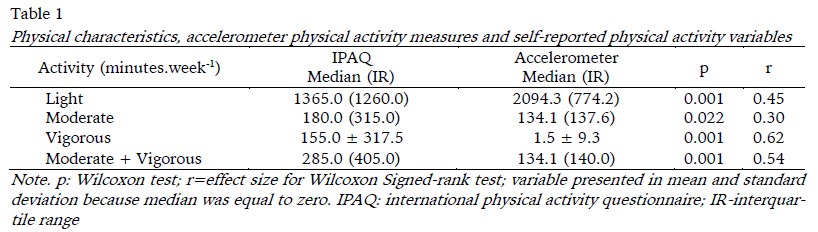
<body><![CDATA[<p><font size="2" face="Verdana"><b>Data Analysis</b></font></p>     <p><font size="2" face="Verdana">For   analysis of the information we utilized non-parametric statistics, since the   data presented non-parametric distribution (Kolmogorov-Smirnov test).   Descriptive statistics were composed of values of median and interquartile   range. For numerical comparisons between the questionnaire and accelerometer   the Wilcoxon test was applied with effect size (r) calculated. Spearman’s   rank-order correlations were used to compare time spent in different PA intensities   between the IPAQ and accelerometer. For categorical data, the McNemar’s test   compared the proportion. To analyze the agreement between IPAQ and   accelerometer to identify subjects that achieve the PA recommendations   (&#8805;150min/week), Kappa index was tested. The ROC curve and its parameters   (sensibility, specificity, area under curve – AUC) were calculated to classify   individuals according to the global standard guideline for sufficient PA   (&#8805;150min/week). The alpha level was set at 0.05 and all statistical analysis was performed using the software BioEstat (release 5.0).</font></p>     <p>&nbsp;    </p>     <p><font size="3" face="Verdana"><b>RESULTS</b>    </font></p>     <p><font size="2" face="Verdana">There   were 60 women with age ranging from 50 to 79 years old (mean age 61.5±7.5   years). The median body mass index was 29.1(8.1) kg.m<sup>-2</sup>. <a href="/img/revistas/mot/v11n3/11n3a11t1.jpg">Table 1</a> shows the median and interquartile range for both instruments. The amount of   time spent in different PA intensities was compared according to the PA   instruments (<a href="/img/revistas/mot/v11n3/11n3a11t1.jpg">Table 1</a>). IPAQ overestimated the minutes spent on moderate and   vigorous intensities (small [r=0.30] to medium [r=0.60] effect size). Conversely, the time spent on light activities were underestimated (medium effect size = 0.45).</font></p>     
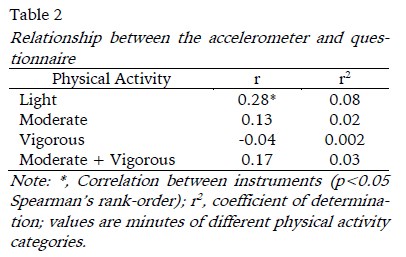
<p><font size="2" face="Verdana">The   correlation between the IPAQ and accelerometer was identified by Spearman rank   (<a href="#f1">Figure 1</a>). According to the accelerometer and IPAQ, the amount of time spent   in PA intensities had a weak relationship (ranging from 0.13 to 0.28). However,   light PA only had a significant correlation (r= 0.279; p= 0.031). On the other   hand, the relationship for vigorous activity presented a negative pattern (r=   -0.041; p=0.756). All correlation consequently, showed small coefficient of determination.</font></p>     <p>&nbsp;</p>     <p><font size="2" face="Verdana"><a name="f1"></a></font></p>     <p align="center"><font size="2" face="Verdana"><img src="/img/revistas/mot/v11n3/11n3a11f1.jpg" width="409" height="475"></font></p>     
<p>&nbsp;</p>     ]]></body>
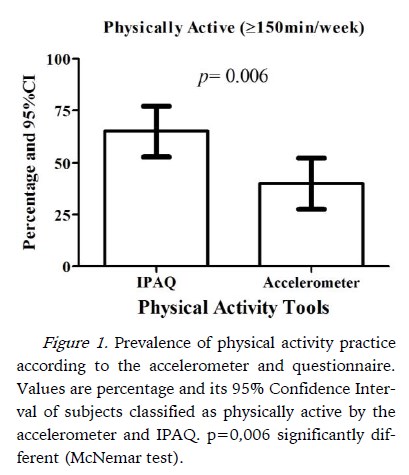
<body><![CDATA[<p><font size="2" face="Verdana">The   percentage of subjects classified as physically active was 40% and 65% for the   accelerometer and IPAQ (McNemar test with p= 0.006 [<a href="#f1">Figure 1</a>]), respectively.   The ROC curve analysis indicated an AUC of 0.58 (IC 95% 0.43 - 0.73, p=0.026).   The sensitivity of the IPAQ to find insufficiently active individuals was 46%, whereas,   28% (the specificity) of those meeting the international recommended guidelines   as determined by the accelerometer were identified by the IPAQ. There was not a   significant agreement between the two PA instruments (kappa index= 0.151±0.111;   p=0.185).</font></p>     <p>&nbsp;</p>     <p align="center"><font size="2" face="Verdana"><img src="/img/revistas/mot/v11n3/11n3a11t2.jpg" width="406" height="257"></font></p>     
<p>&nbsp;</p>     <p>&nbsp;</p>     <p><font size="3" face="Verdana"><b>DISCUSSION</b></font></p>     <p><font size="2" face="Verdana">In   the presented cross-sectional study data reported the agreement between IPAQ   Short version and accelerometer in postmenopausal women. Our results identified   that there were weak agreement between PA time assessed by the questionnaire   and accelerometer (r=0.13 to 0.29). Although these results are similar to what   was reported in the 12-Country Reliability and Validity Study of IPAQ   short-version (r=0.30), the IPAQ significantly underestimated the time spent   light activities and overestimated the time spent on moderate and vigorous PA   when the accumulated accelerometer minutes per day were examined. Similar our   results, Johnson-Kozlow, Sallis, Gilpin, Rock, and Pierce (2006)   studying women who had been diagnosed with breast cancer (average age 57 years)   reported that the maximum total PA score for the IPAQ was approximately three   to four times greater than that obtained on the accelerometer. The IPAQ   significantly overestimated moderate PA by about 225 minutes per week or 239%   (p &lt; 0.001) and significantly overestimated vigorous PA by about 31 minutes   per week or 342% (p &lt; 0.001). Similarly, Grimm, Swartz, Hart, Miller, and   Strath (2012)   identified that women presented 27.3±20.0 min/week for the accelerometer versus   49.5±47.6 min/week for the IPAQ for moderate intensity and 2.0±6.9 min/week for   the accelerometer versus 37.2 ± 50.7 min/week for the IPAQ for vigorous PA (long-form questionnaire).</font></p>     <p><font size="2" face="Verdana">The   identification of correlates of PA is important to target the elaboration of   more effective public health programs related to PA promotion. Therefore,   worldwide there have been a wide variety of epidemiological studies, in which   the main purpose has been to determinate some correlates of PA. From a   statistical point of view, this bias observed for PA provided by IPAQ can   affect the relationship observed between PA and its determinants and, therefore,   some determinants should not be detected (false negative), in addition to, the opposite situation, which can also be observed (false positive).</font></p>     <p><font size="2" face="Verdana">The   above-mentioned overestimation also affected the prevalence of physically   active women, in which the IPAQ generated a rate 62.5% higher than the accelerometer.   During the last decades, developing nations (such as Brazil) have observed an   increase in chronic diseases (Cesse,   Carvalho, Souza, &amp; Luna, 2009). This worrying   trend has been associated with a decrease in PA practice (Fernandes   et al., 2011; Fernandes &amp; Zanesco, 2010).   On the other hand, surprisingly, studies using IPAQ have identified an increase   in PA practice in these nations (Matsudo   et al., 2010). The elaboration of a linear regression   model to describe/adjust this overestimation could be indicated; however, the   absence of normal distribution among PA data and the low relationship between   the IPAQ and accelerometer measures make this elaboration a hard task. Our findings   indicate that the IPAQ overestimation of PA practice should be taken into   account in prevalence studies and hence consistent efforts are necessary to correct this limitation.</font></p>     <p><font size="2" face="Verdana">There   are many hypotheses to explain the lack of disagreement between self-reported   and objective instrument in this population. Among possibilities, such as, lack   of comprehension due to cognitive capacity and educational level (not verified in   this study), and memory, it is possible, also, that the overestimation of time   in PA remain due to the PA held during domestic activities, since we have a   sample of women with an average age of 61 years. Unlike leisure activities,   those performed at work or domestic environment have considerable variation   from day to day and even on the same day in terms of the kind of intensity,   duration and rest periods, causing inconsistence in the self-reported PA (Hallal et al., 2010). </font></p>     ]]></body>
<body><![CDATA[<p><font size="2" face="Verdana">The   study has limitations. The IPAQ assesses PA in different domains for a variety   of activities; however, many of these activities may be under-estimated by   accelerometers. The accelerometer is known not to measure all PA as it underestimates   the one conducted primarily above the waist, such as sweeping or carrying a   load, or activity done on an incline, such as running up a hill, and does not   measure water-based activity at all (Chen   &amp; Bassett, 2005). Yet, our study used uniaxial vector   (vertical vector) that can underestimate patterns of PA compared with cut   points for triaxial accelerometers. Nevertheless, the accelerometer counts used   to assess PA behavior in this study may not hold true for this population, as   well as the cut point utilized (Ward,   Evenson, Vaughn, Rodgers, &amp; Troiano, 2005).   In addition to these limitations, our participant sample included a range of   normal, overweight, and obese individuals, and to our knowledge no known published   work reports on the comparability of the IPAQ and ACC across BMI   classification. Furthermore, the wide range of age that composed the sample   could play an important role in the analysis since older people may have   different patterns of PA. Future studies are warranted in this area to further examine and verify BMI and age. </font></p>     <p>&nbsp;</p> <font size="3" face="Verdana"><b>CONCLUSION</b></font>     <p><font size="2" face="Verdana">In   summary, the presented study identified low agreement between PA time provided   by the IPAQ (short version) and accelerometer. There was a significant   inconsistency between the time of PA reported by the IPAQ (short version),   which overestimated moderate and vigorous activities and underestimated the light one.</font></p>     <p><font size="2" face="Verdana">These   study aim to guide future studies as to the best methods for assessing PA in   post-menopausal women, not only to provide appropriate   surveillance but also to facilitate comparisons with worldwide populations.   We recommend caution when using IPAQ-short version in this population, mainly because of misreporting time of PA.</font></p>     <p>&nbsp;</p>     <p><font size="3" face="Verdana"><b>REFERENCES</b></font></p>     <!-- ref --><p><font size="2" face="Verdana">Ahmed, H. M., Blaha, M. J., Nasir, K.,   Rivera, J. J., &amp; Blumenthal, R. S. (2012). Effects of physical activity on   cardiovascular disease. <i>The American Journal of Cardiology</i>, <i>109</i>(2), 288–295. <a href="http://doi.org/10.1016/j.amjcard.2011.08.042" target="_blank">http://doi.org/10.1016/j.amjcard.2011.08.042</a></font>&nbsp;&nbsp;&nbsp;&nbsp;&nbsp;&nbsp;&nbsp;&nbsp;[&#160;<a href="javascript:void(0);" onclick="javascript: window.open('/scielo.php?script=sci_nlinks&ref=000069&pid=S1646-107X201500030001100001&lng=','','width=640,height=500,resizable=yes,scrollbars=1,menubar=yes,');">Links</a>&#160;]<!-- end-ref --><!-- ref --><p><font size="2" face="Verdana">Centers for   Disease Control and Prevention (CDC). (2005). Trends in leisure-time physical   inactivity by age, sex, and race/ethnicity--United States, 1994-2004. <i>Morbidity and Mortality Weekly Report</i>, <i>54</i>(39), 991–994.    &nbsp;&nbsp;&nbsp;&nbsp;&nbsp;&nbsp;&nbsp;&nbsp;[&#160;<a href="javascript:void(0);" onclick="javascript: window.open('/scielo.php?script=sci_nlinks&ref=000070&pid=S1646-107X201500030001100002&lng=','','width=640,height=500,resizable=yes,scrollbars=1,menubar=yes,');">Links</a>&#160;]<!-- end-ref --></font></p>     <!-- ref --><p><font size="2" face="Verdana">Cesse, E. A. P.,   Carvalho, E. F. de, Souza, W. V. de, &amp; Luna, C. F. (2009). Mortality trends due to circulatory system diseases in Brazil: 1950 to 2000. <i>Arquivos Brasileiros De Cardiologia</i>, <i>93</i>(5), 490–497. <a href="http://doi.org/10.1590/S0066-782X2009001100009" target="_blank">http://doi.org/10.1590/S0066-782X2009001100009</a></font>&nbsp;&nbsp;&nbsp;&nbsp;&nbsp;&nbsp;&nbsp;&nbsp;[&#160;<a href="javascript:void(0);" onclick="javascript: window.open('/scielo.php?script=sci_nlinks&ref=000072&pid=S1646-107X201500030001100003&lng=','','width=640,height=500,resizable=yes,scrollbars=1,menubar=yes,');">Links</a>&#160;]<!-- end-ref --><!-- ref --><p><font size="2" face="Verdana">Chen, K. Y., &amp; Bassett,   D. R. (2005). The technology of   accelerometry-based activity monitors: current and future. <i>Medicine and Science in Sports and Exercise</i>, <i>37</i>(11 Suppl), S490–500.    &nbsp;&nbsp;&nbsp;&nbsp;&nbsp;&nbsp;&nbsp;&nbsp;[&#160;<a href="javascript:void(0);" onclick="javascript: window.open('/scielo.php?script=sci_nlinks&ref=000073&pid=S1646-107X201500030001100004&lng=','','width=640,height=500,resizable=yes,scrollbars=1,menubar=yes,');">Links</a>&#160;]<!-- end-ref --></font></p>     <!-- ref --><p><font size="2" face="Verdana">Craig, C. L.,   Marshall, A. L., Sjöström, M., Bauman, A. E., Booth, M. L., Ainsworth, B. E., …   Oja, P. (2003). International physical activity questionnaire: 12-country   reliability and validity. <i>Medicine and Science in Sports and Exercise</i>, <i>35</i>(8), 1381–1395. <a href="http://doi.org/10.1249/01.MSS.0000078924.61453.FB" target="_blank">http://doi.org/10.1249/01.MSS.0000078924.61453.FB</a></font>&nbsp;&nbsp;&nbsp;&nbsp;&nbsp;&nbsp;&nbsp;&nbsp;[&#160;<a href="javascript:void(0);" onclick="javascript: window.open('/scielo.php?script=sci_nlinks&ref=000075&pid=S1646-107X201500030001100005&lng=','','width=640,height=500,resizable=yes,scrollbars=1,menubar=yes,');">Links</a>&#160;]<!-- end-ref --><!-- ref --><p><font size="2" face="Verdana">Fernandes, R. A.,   Christofaro, D. G. D., Casonatto, J., Codogno, J. S., Rodrigues, E. Q.,   Cardoso, M. L., … Zanesco, A.   (2011). Prevalence of dyslipidemia in individuals physically active during   childhood, adolescence and adult age. <i>Arquivos     Brasileiros de Cardiologia</i>, <i>97</i>(4), 317–323. <a href="http://doi.org/10.1590/S0066-782X2011005000083" target="_blank">http://doi.org/10.1590/S0066-782X2011005000083</a></font>&nbsp;&nbsp;&nbsp;&nbsp;&nbsp;&nbsp;&nbsp;&nbsp;[&#160;<a href="javascript:void(0);" onclick="javascript: window.open('/scielo.php?script=sci_nlinks&ref=000076&pid=S1646-107X201500030001100006&lng=','','width=640,height=500,resizable=yes,scrollbars=1,menubar=yes,');">Links</a>&#160;]<!-- end-ref --><!-- ref --><p><font size="2" face="Verdana">Fernandes, R. A., &amp;   Zanesco, A. (2010). Early physical   activity promotes lower prevalence of chronic diseases in adulthood. <i>Hypertension Research</i>, <i>33</i>(9), 926–931. <a href="http://doi.org/10.1038/hr.2010.106" target="_blank">http://doi.org/10.1038/hr.2010.106</a></font>&nbsp;&nbsp;&nbsp;&nbsp;&nbsp;&nbsp;&nbsp;&nbsp;[&#160;<a href="javascript:void(0);" onclick="javascript: window.open('/scielo.php?script=sci_nlinks&ref=000077&pid=S1646-107X201500030001100007&lng=','','width=640,height=500,resizable=yes,scrollbars=1,menubar=yes,');">Links</a>&#160;]<!-- end-ref --><!-- ref --><p><font size="2" face="Verdana">Freedson, P. S.,   Melanson, E., &amp; Sirard, J. (1998). Calibration of the Computer Science and   Applications, Inc. accelerometer. <i>Medicine and Science in Sports and Exercise</i>, <i>30</i>(5), 777–781. <a href="http://doi.org/10.1097/00005768-199805000-00021" target="_blank">http://doi.org/10.1097/00005768-199805000-00021</a></font>&nbsp;&nbsp;&nbsp;&nbsp;&nbsp;&nbsp;&nbsp;&nbsp;[&#160;<a href="javascript:void(0);" onclick="javascript: window.open('/scielo.php?script=sci_nlinks&ref=000078&pid=S1646-107X201500030001100008&lng=','','width=640,height=500,resizable=yes,scrollbars=1,menubar=yes,');">Links</a>&#160;]<!-- end-ref --><!-- ref --><p><font size="2" face="Verdana">Grimm, E. K.,   Swartz, A. M., Hart, T., Miller, N. E., &amp; Strath, S. J. (2012). Comparison   of the IPAQ-Short Form and accelerometry predictions of physical activity in   older adults. <i>Journal of Aging and Physical Activity</i>, <i>20</i>(1), 64–79.    &nbsp;&nbsp;&nbsp;&nbsp;&nbsp;&nbsp;&nbsp;&nbsp;[&#160;<a href="javascript:void(0);" onclick="javascript: window.open('/scielo.php?script=sci_nlinks&ref=000079&pid=S1646-107X201500030001100009&lng=','','width=640,height=500,resizable=yes,scrollbars=1,menubar=yes,');">Links</a>&#160;]<!-- end-ref --></font></p>     <!-- ref --><p><font size="2" face="Verdana">Hallal, P. C.,   Gomez, L. F., Parra, D. C., Lobelo, F., Mosquera, J., Florindo, A. A., …   Sarmiento, O. L. (2010). Lessons learned after 10 years of IPAQ use in Brazil   and Colombia. <i>Journal of Physical Activity &amp; Health</i>, <i>7 Suppl 2</i>, S259–264.    &nbsp;&nbsp;&nbsp;&nbsp;&nbsp;&nbsp;&nbsp;&nbsp;[&#160;<a href="javascript:void(0);" onclick="javascript: window.open('/scielo.php?script=sci_nlinks&ref=000081&pid=S1646-107X201500030001100010&lng=','','width=640,height=500,resizable=yes,scrollbars=1,menubar=yes,');">Links</a>&#160;]<!-- end-ref --></font></p>     ]]></body>
<body><![CDATA[<!-- ref --><p><font size="2" face="Verdana">Haskell, W. L.,   Lee, I.-M., Pate, R. R., Powell, K. E., Blair, S. N., Franklin, B. A., …   American Heart Association. (2007). Physical activity and public health:   updated recommendation for adults from the American College of Sports Medicine   and the American Heart Association. <i>Circulation</i>, <i>116</i>(9), 1081–1093. <a href="http://doi.org/10.1161/CIRCULATIONAHA.107.185649" target="_blank">http://doi.org/10.1161/CIRCULATIONAHA.107.185649</a></font>&nbsp;&nbsp;&nbsp;&nbsp;&nbsp;&nbsp;&nbsp;&nbsp;[&#160;<a href="javascript:void(0);" onclick="javascript: window.open('/scielo.php?script=sci_nlinks&ref=000083&pid=S1646-107X201500030001100011&lng=','','width=640,height=500,resizable=yes,scrollbars=1,menubar=yes,');">Links</a>&#160;]<!-- end-ref --><!-- ref --><p><font size="2" face="Verdana">IPAQ. (2005).   Guidelines for data processing and analysis of the International Physical Activity Questionnaire (IPAQ)—Short and Long Forms. IPAQ. Obtido de <a href="http://www.ipaq.ki.se/scoring.pdf" target="_blank">http://www.ipaq.ki.se/scoring.pdf</a></font>&nbsp;&nbsp;&nbsp;&nbsp;&nbsp;&nbsp;&nbsp;&nbsp;[&#160;<a href="javascript:void(0);" onclick="javascript: window.open('/scielo.php?script=sci_nlinks&ref=000084&pid=S1646-107X201500030001100012&lng=','','width=640,height=500,resizable=yes,scrollbars=1,menubar=yes,');">Links</a>&#160;]<!-- end-ref --><!-- ref --><p><font size="2" face="Verdana">Johnson-Kozlow,   M., Sallis, J. F., Gilpin, E. A., Rock, C. L., &amp; Pierce, J. P. (2006).   Comparative validation of the IPAQ and the 7-Day PAR among women diagnosed with   breast cancer. <i>The International Journal of Behavioral Nutrition and Physical Activity</i>, <i>3</i>, 7. <a href="http://doi.org/10.1186/1479-5868-3-7" target="_blank">http://doi.org/10.1186/1479-5868-3-7</a></font>&nbsp;&nbsp;&nbsp;&nbsp;&nbsp;&nbsp;&nbsp;&nbsp;[&#160;<a href="javascript:void(0);" onclick="javascript: window.open('/scielo.php?script=sci_nlinks&ref=000085&pid=S1646-107X201500030001100013&lng=','','width=640,height=500,resizable=yes,scrollbars=1,menubar=yes,');">Links</a>&#160;]<!-- end-ref --><!-- ref --><p><font size="2" face="Verdana">Matsudo, V. K. R., Matsudo,   S. M., Araújo, T. L., Andrade, D. R., Oliveira, L. C., &amp; Hallal, P. C.   (2010). Time trends in physical   activity in the state of São Paulo, Brazil: 2002-2008. <i>Medicine and Science in Sports and Exercise</i>, <i>42</i>(12), 2231–2236. <a href="http://doi.org/10.1249/MSS.0b013e3181e1fe8e" target="_blank">http://doi.org/10.1249/MSS.0b013e3181e1fe8e</a></font>&nbsp;&nbsp;&nbsp;&nbsp;&nbsp;&nbsp;&nbsp;&nbsp;[&#160;<a href="javascript:void(0);" onclick="javascript: window.open('/scielo.php?script=sci_nlinks&ref=000086&pid=S1646-107X201500030001100014&lng=','','width=640,height=500,resizable=yes,scrollbars=1,menubar=yes,');">Links</a>&#160;]<!-- end-ref --><!-- ref --><p><font size="2" face="Verdana">Oyeyemi, A. L.,   Bello, U. M., Philemon, S. T., Aliyu, H. N., Majidadi, R. W., &amp; Oyeyemi, A.   Y. (2014). Examining the reliability and validity of a modified version of the   International Physical Activity Questionnaire, long form (IPAQ-LF) in Nigeria:   a cross-sectional study. <i>BMJ Open</i>, <i>4</i>(12), e005820. <a href="http://doi.org/10.1136/bmjopen-2014-005820" target="_blank">http://doi.org/10.1136/bmjopen-2014-005820</a></font>&nbsp;&nbsp;&nbsp;&nbsp;&nbsp;&nbsp;&nbsp;&nbsp;[&#160;<a href="javascript:void(0);" onclick="javascript: window.open('/scielo.php?script=sci_nlinks&ref=000087&pid=S1646-107X201500030001100015&lng=','','width=640,height=500,resizable=yes,scrollbars=1,menubar=yes,');">Links</a>&#160;]<!-- end-ref --><!-- ref --><p><font size="2" face="Verdana">Poehlman, E. T.,   Toth, M. J., &amp; Gardner, A. W. (1995). Changes in energy balance and body   composition at menopause: a controlled longitudinal study. <i>Annals of Internal Medicine</i>, <i>123</i>(9), 673–675. <a href="http://doi.org/10.7326/0003-4819-123-9-199511010-00005" target="_blank">http://doi.org/10.7326/0003-4819-123-9-199511010-00005</a></font>&nbsp;&nbsp;&nbsp;&nbsp;&nbsp;&nbsp;&nbsp;&nbsp;[&#160;<a href="javascript:void(0);" onclick="javascript: window.open('/scielo.php?script=sci_nlinks&ref=000088&pid=S1646-107X201500030001100016&lng=','','width=640,height=500,resizable=yes,scrollbars=1,menubar=yes,');">Links</a>&#160;]<!-- end-ref --><!-- ref --><p><font size="2" face="Verdana">Rebelatto, J. R.,   &amp; Castro, A. P. (2007). Efeito do   programa de revitalização de adultos sobre a ocorrência de quedas dos   participantes. <i>Brazilian     Journal of Physical Therapy</i>, <i>11</i>(5), 383–389. <a href="http://doi.org/10.1590/S1413-35552007000500009" target="_blank">http://doi.org/10.1590/S1413-35552007000500009</a></font>&nbsp;&nbsp;&nbsp;&nbsp;&nbsp;&nbsp;&nbsp;&nbsp;[&#160;<a href="javascript:void(0);" onclick="javascript: window.open('/scielo.php?script=sci_nlinks&ref=000089&pid=S1646-107X201500030001100017&lng=','','width=640,height=500,resizable=yes,scrollbars=1,menubar=yes,');">Links</a>&#160;]<!-- end-ref --><!-- ref --><p><font size="2" face="Verdana">Siervo, M., &amp;   Jebb, S. A. (2010). Body composition assessment: theory into practice:   introduction of multicompartment models. <i>IEEE Engineering in Medicine and     Biology Magazine: The Quarterly Magazine of the Engineering in Medicine &amp; Biology Society</i>, <i>29</i>(1), 48–59. <a href="http://doi.org/10.1109/MEMB.2009.935471" target="_blank">http://doi.org/10.1109/MEMB.2009.935471</a></font>&nbsp;&nbsp;&nbsp;&nbsp;&nbsp;&nbsp;&nbsp;&nbsp;[&#160;<a href="javascript:void(0);" onclick="javascript: window.open('/scielo.php?script=sci_nlinks&ref=000090&pid=S1646-107X201500030001100018&lng=','','width=640,height=500,resizable=yes,scrollbars=1,menubar=yes,');">Links</a>&#160;]<!-- end-ref --><!-- ref --><p><font size="2" face="Verdana">Trost, S. G.,   McIver, K. L., &amp; Pate, R. R. (2005). Conducting accelerometer-based   activity assessments in field-based research. <i>Medicine and Science in Sports and Exercise</i>, <i>37</i>(11 Suppl), S531–543.    &nbsp;&nbsp;&nbsp;&nbsp;&nbsp;&nbsp;&nbsp;&nbsp;[&#160;<a href="javascript:void(0);" onclick="javascript: window.open('/scielo.php?script=sci_nlinks&ref=000091&pid=S1646-107X201500030001100019&lng=','','width=640,height=500,resizable=yes,scrollbars=1,menubar=yes,');">Links</a>&#160;]<!-- end-ref --></font></p>     ]]></body>
<body><![CDATA[<!-- ref --><p><font size="2" face="Verdana">Tudor-Locke, C.,   Johnson, W. D., &amp; Katzmarzyk, P. T. (2010). Accelerometer-determined steps   per day in US children and youth. <i>Medicine and Science in Sports and Exercise</i>, <i>42</i>(12), 2244–2250. <a href="http://doi.org/10.1249/MSS.0b013e3181e32d7f" target="_blank">http://doi.org/10.1249/MSS.0b013e3181e32d7f</a></font>&nbsp;&nbsp;&nbsp;&nbsp;&nbsp;&nbsp;&nbsp;&nbsp;[&#160;<a href="javascript:void(0);" onclick="javascript: window.open('/scielo.php?script=sci_nlinks&ref=000093&pid=S1646-107X201500030001100020&lng=','','width=640,height=500,resizable=yes,scrollbars=1,menubar=yes,');">Links</a>&#160;]<!-- end-ref --><!-- ref --><p><font size="2" face="Verdana">Ward, D. S.,   Evenson, K. R., Vaughn, A., Rodgers, A. B., &amp; Troiano, R. P. (2005).   Accelerometer use in physical activity: best practices and research   recommendations. <i>Medicine and Science     in Sports and Exercise</i>, <i>37</i>(11 Suppl), S582–588.    &nbsp;&nbsp;&nbsp;&nbsp;&nbsp;&nbsp;&nbsp;&nbsp;[&#160;<a href="javascript:void(0);" onclick="javascript: window.open('/scielo.php?script=sci_nlinks&ref=000094&pid=S1646-107X201500030001100021&lng=','','width=640,height=500,resizable=yes,scrollbars=1,menubar=yes,');">Links</a>&#160;]<!-- end-ref --></font></p>     <p>&nbsp;</p>     <p><font size="2" face="Verdana"><b>Agradecimentos:</b>    <br>   Nada a declarar.    <br>   <b>Conflito de Interesses:    <br>   </b>Nada a declarar.    <br>   <b>Financiamento:    <br> </b>Nada a declarar.</font></p>     ]]></body>
<body><![CDATA[<p><font size="2" face="Verdana">Manuscript received June 29<sup>th</sup>, 2014;   Accepted November 12<sup>th</sup>, 2014</font></p>     <p>&nbsp;</p>     <p><font size="2" face="Verdana"><a href="#topo">*</a><font size="2" face="Verdana"><b><sup><b><sup><a href="#end"><i><a name="end" id="topo2"></a></i></a></sup></b></sup></b></font></font> <font size="2" face="Verdana"><i>Corresponding author</i>: Department of Physical Education, Univ. Estadual Paulista &quot;J&uacute;lio Mesquita Filho&quot;, Roberto Simonsen   Street, n&ordm; 305 &ndash; Education Center, Presidente Prudente, 19060-900, S&atilde;o Paulo,   Brazil. <i>E-mail</i>: <a href="mailto:rossifabricio@yahoo.com.br">rossifabricio@yahoo.com.br</a></font></p>      ]]></body><back>
<ref-list>
<ref id="B1">
<nlm-citation citation-type="journal">
<person-group person-group-type="author">
<name>
<surname><![CDATA[Ahmed]]></surname>
<given-names><![CDATA[H. M.]]></given-names>
</name>
<name>
<surname><![CDATA[Blaha]]></surname>
<given-names><![CDATA[M. J.]]></given-names>
</name>
<name>
<surname><![CDATA[Nasir]]></surname>
<given-names><![CDATA[K.]]></given-names>
</name>
<name>
<surname><![CDATA[Rivera]]></surname>
<given-names><![CDATA[J. J.]]></given-names>
</name>
<name>
<surname><![CDATA[Blumenthal]]></surname>
<given-names><![CDATA[R. S.]]></given-names>
</name>
</person-group>
<article-title xml:lang="en"><![CDATA[Effects of physical activity on cardiovascular disease]]></article-title>
<source><![CDATA[The American Journal of Cardiology]]></source>
<year>2012</year>
<volume>109</volume>
<numero>2</numero>
<issue>2</issue>
<page-range>288-295</page-range></nlm-citation>
</ref>
<ref id="B2">
<nlm-citation citation-type="journal">
<collab>Centers for Disease Control and Prevention</collab>
<article-title xml:lang="en"><![CDATA[Trends in leisure-time physical inactivity by age, sex, and race/ethnicity--United States, 1994-2004]]></article-title>
<source><![CDATA[Morbidity and Mortality Weekly Report]]></source>
<year>2005</year>
<volume>54</volume>
<numero>39</numero>
<issue>39</issue>
<page-range>991-994</page-range></nlm-citation>
</ref>
<ref id="B3">
<nlm-citation citation-type="journal">
<person-group person-group-type="author">
<name>
<surname><![CDATA[Cesse]]></surname>
<given-names><![CDATA[E. A. P.]]></given-names>
</name>
<name>
<surname><![CDATA[Carvalho]]></surname>
<given-names><![CDATA[E. F. de]]></given-names>
</name>
<name>
<surname><![CDATA[Souza]]></surname>
<given-names><![CDATA[W. V. de]]></given-names>
</name>
<name>
<surname><![CDATA[Luna]]></surname>
<given-names><![CDATA[C. F.]]></given-names>
</name>
</person-group>
<article-title xml:lang="en"><![CDATA[Mortality trends due to circulatory system diseases in Brazil: 1950 to 2000]]></article-title>
<source><![CDATA[Arquivos Brasileiros De Cardiologia]]></source>
<year>2009</year>
<volume>93</volume>
<numero>5</numero>
<issue>5</issue>
<page-range>490-497</page-range></nlm-citation>
</ref>
<ref id="B4">
<nlm-citation citation-type="journal">
<person-group person-group-type="author">
<name>
<surname><![CDATA[Chen]]></surname>
<given-names><![CDATA[K. Y.]]></given-names>
</name>
<name>
<surname><![CDATA[Bassett]]></surname>
<given-names><![CDATA[D. R.]]></given-names>
</name>
</person-group>
<article-title xml:lang="en"><![CDATA[The technology of accelerometry-based activity monitors: current and future]]></article-title>
<source><![CDATA[Medicine and Science in Sports and Exercise]]></source>
<year>2005</year>
<volume>37</volume>
<numero>^s11</numero>
<issue>^s11</issue>
<supplement>11</supplement>
<page-range>490-500</page-range></nlm-citation>
</ref>
<ref id="B5">
<nlm-citation citation-type="journal">
<person-group person-group-type="author">
<name>
<surname><![CDATA[Craig]]></surname>
<given-names><![CDATA[C. L.]]></given-names>
</name>
<name>
<surname><![CDATA[Marshall]]></surname>
<given-names><![CDATA[A. L.]]></given-names>
</name>
<name>
<surname><![CDATA[Sjöström]]></surname>
<given-names><![CDATA[M.]]></given-names>
</name>
<name>
<surname><![CDATA[Bauman]]></surname>
<given-names><![CDATA[A. E.]]></given-names>
</name>
<name>
<surname><![CDATA[Booth]]></surname>
<given-names><![CDATA[M. L.]]></given-names>
</name>
<name>
<surname><![CDATA[Ainsworth]]></surname>
<given-names><![CDATA[B. E.]]></given-names>
</name>
<name>
<surname><![CDATA[Oja]]></surname>
<given-names><![CDATA[P.]]></given-names>
</name>
</person-group>
<article-title xml:lang="en"><![CDATA[International physical activity questionnaire: 12-country reliability and validity]]></article-title>
<source><![CDATA[Medicine and Science in Sports and Exercise]]></source>
<year>2003</year>
<volume>35</volume>
<numero>8</numero>
<issue>8</issue>
<page-range>1381-1395</page-range></nlm-citation>
</ref>
<ref id="B6">
<nlm-citation citation-type="journal">
<person-group person-group-type="author">
<name>
<surname><![CDATA[Fernandes]]></surname>
<given-names><![CDATA[R. A.]]></given-names>
</name>
<name>
<surname><![CDATA[Christofaro]]></surname>
<given-names><![CDATA[D. G. D.]]></given-names>
</name>
<name>
<surname><![CDATA[Casonatto]]></surname>
<given-names><![CDATA[J.]]></given-names>
</name>
<name>
<surname><![CDATA[Codogno]]></surname>
<given-names><![CDATA[J. S.]]></given-names>
</name>
<name>
<surname><![CDATA[Rodrigues]]></surname>
<given-names><![CDATA[E. Q.]]></given-names>
</name>
<name>
<surname><![CDATA[Cardoso]]></surname>
<given-names><![CDATA[M. L.]]></given-names>
</name>
<name>
<surname><![CDATA[Zanesco]]></surname>
<given-names><![CDATA[A.]]></given-names>
</name>
</person-group>
<article-title xml:lang="en"><![CDATA[Prevalence of dyslipidemia in individuals physically active during childhood, adolescence and adult age]]></article-title>
<source><![CDATA[Arquivos Brasileiros de Cardiologia]]></source>
<year>2011</year>
<volume>97</volume>
<numero>4</numero>
<issue>4</issue>
<page-range>317-323</page-range></nlm-citation>
</ref>
<ref id="B7">
<nlm-citation citation-type="journal">
<person-group person-group-type="author">
<name>
<surname><![CDATA[Fernandes]]></surname>
<given-names><![CDATA[R. A.]]></given-names>
</name>
<name>
<surname><![CDATA[Zanesco]]></surname>
<given-names><![CDATA[A.]]></given-names>
</name>
</person-group>
<article-title xml:lang="en"><![CDATA[Early physical activity promotes lower prevalence of chronic diseases in adulthood]]></article-title>
<source><![CDATA[Hypertension Research]]></source>
<year>2010</year>
<volume>33</volume>
<numero>9</numero>
<issue>9</issue>
<page-range>926-931</page-range></nlm-citation>
</ref>
<ref id="B8">
<nlm-citation citation-type="journal">
<person-group person-group-type="author">
<name>
<surname><![CDATA[Freedson]]></surname>
<given-names><![CDATA[P. S.]]></given-names>
</name>
<name>
<surname><![CDATA[Melanson]]></surname>
<given-names><![CDATA[E.]]></given-names>
</name>
<name>
<surname><![CDATA[Sirard]]></surname>
<given-names><![CDATA[J.]]></given-names>
</name>
</person-group>
<article-title xml:lang="en"><![CDATA[Calibration of the Computer Science and Applications, Inc. accelerometer]]></article-title>
<source><![CDATA[Medicine and Science in Sports and Exercise]]></source>
<year>1998</year>
<volume>30</volume>
<numero>5</numero>
<issue>5</issue>
<page-range>777-781</page-range></nlm-citation>
</ref>
<ref id="B9">
<nlm-citation citation-type="journal">
<person-group person-group-type="author">
<name>
<surname><![CDATA[Grimm]]></surname>
<given-names><![CDATA[E. K.]]></given-names>
</name>
<name>
<surname><![CDATA[Swartz]]></surname>
<given-names><![CDATA[A. M.]]></given-names>
</name>
<name>
<surname><![CDATA[Hart]]></surname>
<given-names><![CDATA[T.]]></given-names>
</name>
<name>
<surname><![CDATA[Miller]]></surname>
<given-names><![CDATA[N. E.]]></given-names>
</name>
<name>
<surname><![CDATA[Strath]]></surname>
<given-names><![CDATA[S. J.]]></given-names>
</name>
</person-group>
<article-title xml:lang="en"><![CDATA[Comparison of the IPAQ-Short Form and accelerometry predictions of physical activity in older adults]]></article-title>
<source><![CDATA[Journal of Aging and Physical Activity]]></source>
<year>2012</year>
<volume>20</volume>
<numero>1</numero>
<issue>1</issue>
<page-range>64-79</page-range></nlm-citation>
</ref>
<ref id="B10">
<nlm-citation citation-type="journal">
<person-group person-group-type="author">
<name>
<surname><![CDATA[Hallal]]></surname>
<given-names><![CDATA[P. C.]]></given-names>
</name>
<name>
<surname><![CDATA[Gomez]]></surname>
<given-names><![CDATA[L. F.]]></given-names>
</name>
<name>
<surname><![CDATA[Parra]]></surname>
<given-names><![CDATA[D. C.]]></given-names>
</name>
<name>
<surname><![CDATA[Lobelo]]></surname>
<given-names><![CDATA[F.]]></given-names>
</name>
<name>
<surname><![CDATA[Mosquera]]></surname>
<given-names><![CDATA[J.]]></given-names>
</name>
<name>
<surname><![CDATA[Florindo]]></surname>
<given-names><![CDATA[A. A.]]></given-names>
</name>
<name>
<surname><![CDATA[Sarmiento]]></surname>
<given-names><![CDATA[O. L.]]></given-names>
</name>
</person-group>
<article-title xml:lang="en"><![CDATA[Lessons learned after 10 years of IPAQ use in Brazil and Colombia]]></article-title>
<source><![CDATA[Journal of Physical Activity & Health]]></source>
<year>2010</year>
<volume>7</volume>
<numero>^s2</numero>
<issue>^s2</issue>
<supplement>2</supplement>
<page-range>259-264</page-range></nlm-citation>
</ref>
<ref id="B11">
<nlm-citation citation-type="journal">
<person-group person-group-type="author">
<name>
<surname><![CDATA[Haskell]]></surname>
<given-names><![CDATA[W. L.]]></given-names>
</name>
<name>
<surname><![CDATA[Lee]]></surname>
<given-names><![CDATA[I.-M.]]></given-names>
</name>
<name>
<surname><![CDATA[Pate]]></surname>
<given-names><![CDATA[R. R.]]></given-names>
</name>
<name>
<surname><![CDATA[Powell]]></surname>
<given-names><![CDATA[K. E.]]></given-names>
</name>
<name>
<surname><![CDATA[Blair]]></surname>
<given-names><![CDATA[S. N.]]></given-names>
</name>
<name>
<surname><![CDATA[Franklin]]></surname>
<given-names><![CDATA[B. A.]]></given-names>
</name>
</person-group>
<collab>American Heart Association</collab>
<article-title xml:lang="en"><![CDATA[Physical activity and public health: updated recommendation for adults from the American College of Sports Medicine and the American Heart Association]]></article-title>
<source><![CDATA[Circulation]]></source>
<year>2007</year>
<volume>116</volume>
<numero>9</numero>
<issue>9</issue>
<page-range>1081-1093</page-range></nlm-citation>
</ref>
<ref id="B12">
<nlm-citation citation-type="book">
<collab>IPAQ</collab>
<source><![CDATA[Guidelines for data processing and analysis of the International Physical Activity Questionnaire (IPAQ)-Short and Long Forms]]></source>
<year>2005</year>
<publisher-name><![CDATA[IPAQ]]></publisher-name>
</nlm-citation>
</ref>
<ref id="B13">
<nlm-citation citation-type="journal">
<person-group person-group-type="author">
<name>
<surname><![CDATA[Johnson-Kozlow]]></surname>
<given-names><![CDATA[M.]]></given-names>
</name>
<name>
<surname><![CDATA[Sallis]]></surname>
<given-names><![CDATA[J. F.]]></given-names>
</name>
<name>
<surname><![CDATA[Gilpin]]></surname>
<given-names><![CDATA[E. A.]]></given-names>
</name>
<name>
<surname><![CDATA[Rock]]></surname>
<given-names><![CDATA[C. L.]]></given-names>
</name>
<name>
<surname><![CDATA[Pierce]]></surname>
<given-names><![CDATA[J. P.]]></given-names>
</name>
</person-group>
<article-title xml:lang="en"><![CDATA[Comparative validation of the IPAQ and the 7-Day PAR among women diagnosed with breast cancer]]></article-title>
<source><![CDATA[The International Journal of Behavioral Nutrition and Physical Activity]]></source>
<year>2006</year>
<volume>3</volume>
<numero>7</numero>
<issue>7</issue>
</nlm-citation>
</ref>
<ref id="B14">
<nlm-citation citation-type="journal">
<person-group person-group-type="author">
<name>
<surname><![CDATA[Matsudo]]></surname>
<given-names><![CDATA[V. K. R.]]></given-names>
</name>
<name>
<surname><![CDATA[Matsudo]]></surname>
<given-names><![CDATA[S. M.]]></given-names>
</name>
<name>
<surname><![CDATA[Araújo]]></surname>
<given-names><![CDATA[T. L.]]></given-names>
</name>
<name>
<surname><![CDATA[Andrade]]></surname>
<given-names><![CDATA[D. R.]]></given-names>
</name>
<name>
<surname><![CDATA[Oliveira]]></surname>
<given-names><![CDATA[L. C.]]></given-names>
</name>
<name>
<surname><![CDATA[Hallal]]></surname>
<given-names><![CDATA[P. C.]]></given-names>
</name>
</person-group>
<article-title xml:lang="en"><![CDATA[Time trends in physical activity in the state of São Paulo, Brazil: 2002-2008]]></article-title>
<source><![CDATA[Medicine and Science in Sports and Exercise]]></source>
<year>2010</year>
<volume>42</volume>
<numero>12</numero>
<issue>12</issue>
<page-range>2231-2236</page-range></nlm-citation>
</ref>
<ref id="B15">
<nlm-citation citation-type="journal">
<person-group person-group-type="author">
<name>
<surname><![CDATA[Oyeyemi]]></surname>
<given-names><![CDATA[A. L.]]></given-names>
</name>
<name>
<surname><![CDATA[Bello]]></surname>
<given-names><![CDATA[U. M.]]></given-names>
</name>
<name>
<surname><![CDATA[Philemon]]></surname>
<given-names><![CDATA[S. T.]]></given-names>
</name>
<name>
<surname><![CDATA[Aliyu]]></surname>
<given-names><![CDATA[H. N.]]></given-names>
</name>
<name>
<surname><![CDATA[Majidadi]]></surname>
<given-names><![CDATA[R. W.]]></given-names>
</name>
<name>
<surname><![CDATA[Oyeyemi]]></surname>
<given-names><![CDATA[A. Y.]]></given-names>
</name>
</person-group>
<article-title xml:lang="en"><![CDATA[Examining the reliability and validity of a modified version of the International Physical Activity Questionnaire, long form (IPAQ-LF) in Nigeria: a cross-sectional study]]></article-title>
<source><![CDATA[BMJ Open]]></source>
<year>2014</year>
<volume>4</volume>
<numero>12</numero>
<issue>12</issue>
<page-range>005820</page-range></nlm-citation>
</ref>
<ref id="B16">
<nlm-citation citation-type="journal">
<person-group person-group-type="author">
<name>
<surname><![CDATA[Poehlman]]></surname>
<given-names><![CDATA[E. T.]]></given-names>
</name>
<name>
<surname><![CDATA[Toth]]></surname>
<given-names><![CDATA[M. J.]]></given-names>
</name>
<name>
<surname><![CDATA[Gardner]]></surname>
<given-names><![CDATA[A. W.]]></given-names>
</name>
</person-group>
<article-title xml:lang="en"><![CDATA[Changes in energy balance and body composition at menopause: a controlled longitudinal study]]></article-title>
<source><![CDATA[Annals of Internal Medicine]]></source>
<year>1995</year>
<volume>123</volume>
<numero>9</numero>
<issue>9</issue>
<page-range>673-675</page-range></nlm-citation>
</ref>
<ref id="B17">
<nlm-citation citation-type="journal">
<person-group person-group-type="author">
<name>
<surname><![CDATA[Rebelatto]]></surname>
<given-names><![CDATA[J. R.]]></given-names>
</name>
<name>
<surname><![CDATA[Castro]]></surname>
<given-names><![CDATA[A. P.]]></given-names>
</name>
</person-group>
<article-title xml:lang="pt"><![CDATA[Efeito do programa de revitalização de adultos sobre a ocorrência de quedas dos participantes]]></article-title>
<source><![CDATA[Brazilian Journal of Physical Therapy]]></source>
<year>2007</year>
<volume>11</volume>
<numero>5</numero>
<issue>5</issue>
<page-range>383-389</page-range></nlm-citation>
</ref>
<ref id="B18">
<nlm-citation citation-type="journal">
<person-group person-group-type="author">
<name>
<surname><![CDATA[Siervo]]></surname>
<given-names><![CDATA[M.]]></given-names>
</name>
<name>
<surname><![CDATA[Jebb]]></surname>
<given-names><![CDATA[S. A.]]></given-names>
</name>
</person-group>
<article-title xml:lang="en"><![CDATA[Body composition assessment: theory into practice: introduction of multicompartment models]]></article-title>
<source><![CDATA[IEEE Engineering in Medicine and Biology Magazine: The Quarterly Magazine of the Engineering in Medicine & Biology Society]]></source>
<year>2010</year>
<volume>29</volume>
<numero>1</numero>
<issue>1</issue>
<page-range>48-59</page-range></nlm-citation>
</ref>
<ref id="B19">
<nlm-citation citation-type="journal">
<person-group person-group-type="author">
<name>
<surname><![CDATA[Trost]]></surname>
<given-names><![CDATA[S. G.]]></given-names>
</name>
<name>
<surname><![CDATA[McIver]]></surname>
<given-names><![CDATA[K. L.]]></given-names>
</name>
<name>
<surname><![CDATA[Pate]]></surname>
<given-names><![CDATA[R. R.]]></given-names>
</name>
</person-group>
<article-title xml:lang="en"><![CDATA[Conducting accelerometer-based activity assessments in field-based research]]></article-title>
<source><![CDATA[Medicine and Science in Sports and Exercise]]></source>
<year>2005</year>
<volume>37</volume>
<numero>^s11</numero>
<issue>^s11</issue>
<supplement>11</supplement>
<page-range>531-543</page-range></nlm-citation>
</ref>
<ref id="B20">
<nlm-citation citation-type="journal">
<person-group person-group-type="author">
<name>
<surname><![CDATA[Tudor-Locke]]></surname>
<given-names><![CDATA[C.]]></given-names>
</name>
<name>
<surname><![CDATA[Johnson]]></surname>
<given-names><![CDATA[W. D.]]></given-names>
</name>
<name>
<surname><![CDATA[Katzmarzyk]]></surname>
<given-names><![CDATA[P. T.]]></given-names>
</name>
</person-group>
<article-title xml:lang="en"><![CDATA[Accelerometer-determined steps per day in US children and youth]]></article-title>
<source><![CDATA[Medicine and Science in Sports and Exercise]]></source>
<year>2010</year>
<volume>42</volume>
<numero>12</numero>
<issue>12</issue>
<page-range>2244-2250</page-range></nlm-citation>
</ref>
<ref id="B21">
<nlm-citation citation-type="journal">
<person-group person-group-type="author">
<name>
<surname><![CDATA[Ward]]></surname>
<given-names><![CDATA[D. S.]]></given-names>
</name>
<name>
<surname><![CDATA[Evenson]]></surname>
<given-names><![CDATA[K. R.]]></given-names>
</name>
<name>
<surname><![CDATA[Vaughn]]></surname>
<given-names><![CDATA[A.]]></given-names>
</name>
<name>
<surname><![CDATA[Rodgers]]></surname>
<given-names><![CDATA[A. B.]]></given-names>
</name>
<name>
<surname><![CDATA[Troiano]]></surname>
<given-names><![CDATA[R. P.]]></given-names>
</name>
</person-group>
<article-title xml:lang="en"><![CDATA[Accelerometer use in physical activity: best practices and research recommendations]]></article-title>
<source><![CDATA[Medicine and Science in Sports and Exercise]]></source>
<year>2005</year>
<volume>37</volume>
<numero>^s11</numero>
<issue>^s11</issue>
<supplement>11</supplement>
<page-range>582-588</page-range></nlm-citation>
</ref>
</ref-list>
</back>
</article>