<?xml version="1.0" encoding="ISO-8859-1"?><article xmlns:mml="http://www.w3.org/1998/Math/MathML" xmlns:xlink="http://www.w3.org/1999/xlink" xmlns:xsi="http://www.w3.org/2001/XMLSchema-instance">
<front>
<journal-meta>
<journal-id>1646-107X</journal-id>
<journal-title><![CDATA[Motricidade]]></journal-title>
<abbrev-journal-title><![CDATA[Motri.]]></abbrev-journal-title>
<issn>1646-107X</issn>
<publisher>
<publisher-name><![CDATA[Edições Desafio Singular]]></publisher-name>
</publisher>
</journal-meta>
<article-meta>
<article-id>S1646-107X2015000300014</article-id>
<article-id pub-id-type="doi">10.6063/motricidade.4706</article-id>
<title-group>
<article-title xml:lang="en"><![CDATA[Resistance exercise performed with repetitions until failure affects nocturnal blood pressure decreases in hypertensive women]]></article-title>
<article-title xml:lang="pt"><![CDATA[Exercício de força realizado com repetições até à falha concêntrica altera a redução noturna da pressão arterial em mulheres hipertensas]]></article-title>
</title-group>
<contrib-group>
<contrib contrib-type="author">
<name>
<surname><![CDATA[Correia]]></surname>
<given-names><![CDATA[Marilia de Almeida]]></given-names>
</name>
<xref ref-type="aff" rid="A01"/>
</contrib>
<contrib contrib-type="author">
<name>
<surname><![CDATA[Lima]]></surname>
<given-names><![CDATA[Aluísio Henrique Rodrigues Andrade]]></given-names>
</name>
<xref ref-type="aff" rid="A02"/>
</contrib>
<contrib contrib-type="author">
<name>
<surname><![CDATA[Cardoso-Junior]]></surname>
<given-names><![CDATA[Crivaldo Gomes]]></given-names>
</name>
<xref ref-type="aff" rid="A03"/>
</contrib>
<contrib contrib-type="author">
<name>
<surname><![CDATA[Rodrigues-da-Silva]]></surname>
<given-names><![CDATA[Anderson José Melo]]></given-names>
</name>
<xref ref-type="aff" rid="A01"/>
</contrib>
<contrib contrib-type="author">
<name>
<surname><![CDATA[Oliveira]]></surname>
<given-names><![CDATA[Jacilene Guedes]]></given-names>
</name>
<xref ref-type="aff" rid="A01"/>
</contrib>
<contrib contrib-type="author">
<name>
<surname><![CDATA[Cavalcante]]></surname>
<given-names><![CDATA[Bruno Remígio]]></given-names>
</name>
<xref ref-type="aff" rid="A01"/>
</contrib>
<contrib contrib-type="author">
<name>
<surname><![CDATA[Souza]]></surname>
<given-names><![CDATA[Bruna Cadengue Coelho]]></given-names>
</name>
<xref ref-type="aff" rid="A01"/>
</contrib>
<contrib contrib-type="author">
<name>
<surname><![CDATA[Macedo-Junior]]></surname>
<given-names><![CDATA[Edson Magno]]></given-names>
</name>
<xref ref-type="aff" rid="A04"/>
</contrib>
<contrib contrib-type="author">
<name>
<surname><![CDATA[Sobral-Filho]]></surname>
<given-names><![CDATA[Dário Celestino]]></given-names>
</name>
<xref ref-type="aff" rid="A04"/>
</contrib>
<contrib contrib-type="author">
<name>
<surname><![CDATA[Ritti-Dias]]></surname>
<given-names><![CDATA[Raphael Mendes]]></given-names>
</name>
<xref ref-type="aff" rid="A01"/>
</contrib>
</contrib-group>
<aff id="A01">
<institution><![CDATA[,University of Pernambuco Associated Graduate Program in Physical Education ]]></institution>
<addr-line><![CDATA[Recife ]]></addr-line>
<country>Brazil</country>
</aff>
<aff id="A02">
<institution><![CDATA[,University of São Paulo School of Physical Education and Sport Exercise Hemodynamic Laboratory]]></institution>
<addr-line><![CDATA[ ]]></addr-line>
<country>Brazil</country>
</aff>
<aff id="A03">
<institution><![CDATA[,State University of Londrina Center of Physical Education and Sport ]]></institution>
<addr-line><![CDATA[ ]]></addr-line>
<country>Brazil</country>
</aff>
<aff id="A04">
<institution><![CDATA[,University of Pernambuco Procape University Hospital ]]></institution>
<addr-line><![CDATA[ ]]></addr-line>
<country>Brasil</country>
</aff>
<pub-date pub-type="pub">
<day>00</day>
<month>09</month>
<year>2015</year>
</pub-date>
<pub-date pub-type="epub">
<day>00</day>
<month>09</month>
<year>2015</year>
</pub-date>
<volume>11</volume>
<numero>3</numero>
<fpage>148</fpage>
<lpage>157</lpage>
<copyright-statement/>
<copyright-year/>
<self-uri xlink:href="http://scielo.pt/scielo.php?script=sci_arttext&amp;pid=S1646-107X2015000300014&amp;lng=en&amp;nrm=iso"></self-uri><self-uri xlink:href="http://scielo.pt/scielo.php?script=sci_abstract&amp;pid=S1646-107X2015000300014&amp;lng=en&amp;nrm=iso"></self-uri><self-uri xlink:href="http://scielo.pt/scielo.php?script=sci_pdf&amp;pid=S1646-107X2015000300014&amp;lng=en&amp;nrm=iso"></self-uri><abstract abstract-type="short" xml:lang="en"><p><![CDATA[Studies have shown that resistance exercise reduces 24-hour blood pressure to levels below resting values, although this is not a universal finding. The number of repetitions has been shown to influence this response. Thus, the aim of the study was to analyze the effects of resistance exercise performed until failure (UF) on 24-hour blood pressure in hypertensive women. Thirteen hypertensive women underwent three experimental sessions in random order: UF, resistance exercise with repetitions before concentric failure (BF) and control (C). Prior to and up to 24 hours after the sessions, cardiovascular variables, as well as the nocturnal fall in blood pressure, the morning surge, and the presence or absence of a blood pressure dip pattern were established using an ambulatory blood pressure monitor. In both wakefulness and sleep there was no significant difference among the three groups. However, after UF and C fewer patients presented a dip in blood pressure (46% and 38%, respectively) compared BF (77%), p=0.047. In conclusion, the UF attenuated blood pressure dips at night in hypertensive patients.]]></p></abstract>
<abstract abstract-type="short" xml:lang="pt"><p><![CDATA[Estudos vêm demonstrando que o exercício de força reduz a pressão arterial para níveis abaixo dos valores de repouso, entretanto este não é um achado universal. O número de repetições do exercício parece influenciar essas respostas. Assim, o objetivo do estudo foi analisar os efeitos do exercício de força realizado com repetições até a falha concêntrica sobre a pressão arterial de 24 horas em mulheres hipertensas. Treze mulheres hipertensas foram submetidas a três sessões experimentais em ordem aleatória: controle (C), exercício de força até a falha concêntrica (FC) e exercício de força com repetições até a redução da cadência (RC). Antes e 24 horas após as sessões as variáveis cardiovasculares - descenso noturno, ascensão matutina e presença ou não de padrão dipper - foram avaliadas por meio de monitorização ambulatorial da pressão arterial. Nos períodos diurno e noturno, não houve diferença significativa entre os três grupos. Entretanto, após FC e C, menos sujeitos apresentaram padrão dipper da pressão arterial (46% e 38%, respectivamente) do que quando comparado aos grupos RC (77%), p=0.047. Como conclusão, o FC atenuou a o padrão dipper da pressão arterial noturna em mulheres hipertensas.]]></p></abstract>
<kwd-group>
<kwd lng="en"><![CDATA[blood pressure]]></kwd>
<kwd lng="en"><![CDATA[hypertension]]></kwd>
<kwd lng="en"><![CDATA[muscle failure]]></kwd>
<kwd lng="en"><![CDATA[resistance exercise]]></kwd>
<kwd lng="pt"><![CDATA[pressão arterial]]></kwd>
<kwd lng="pt"><![CDATA[hipertensão]]></kwd>
<kwd lng="pt"><![CDATA[fadiga muscular]]></kwd>
<kwd lng="pt"><![CDATA[exercício de força]]></kwd>
</kwd-group>
</article-meta>
</front><body><![CDATA[ <p align="right"><font size="2" face="Verdana"><a><b>ARTIGO ORIGINAL</b></a></font></p>     <p>&nbsp;</p>     <p><font size="4" face="Verdana"><b><a>Resistance exercise perfor</a>med with repetitions until failure affects nocturnal blood pressure   decreases in hypertensive women</b></font></p>     <p>&nbsp;</p>     <p><font size="3" face="Verdana"><b>Exercício de força realizado com repetições até à falha   concêntrica altera a redução noturna da pressão arterial em mulheres   hipertensas</b></font></p>     <p>&nbsp;</p>     <p>&nbsp;</p>     <p><font size="2" face="Verdana"><b>Marilia de Almeida Correia<sup>1</sup>; Aluísio Henrique Rodrigues Andrade Lima<sup>2</sup>; Crivaldo Gomes Cardoso-Junior<sup>3</sup>; Anderson José Melo Rodrigues-da-Silva<sup>1</sup>; Jacilene Guedes Oliveira<sup>1</sup>; Bruno Remígio Cavalcante<sup>1</sup>; Bruna Cadengue Coelho Souza<sup>1</sup>; Edson Magno Macedo-Junior<sup>4</sup>; Dário Celestino Sobral-Filho<sup>4</sup>; Raphael Mendes Ritti-Dias<sup>1,<a href="#end">*</a></sup></b></font><b><font size="2" face="Verdana"><b><sup><font size="2" face="Verdana"><b><sup><font size="2" face="Verdana"><b><sup><a href="#end"><i><a name="topo" id="topo"></a></i></a></sup></b></font></sup></b></font></sup></b></font> </b></p>     <p><font size="2" face="Verdana"><sup>1</sup> <i>Associated   Graduate Program in Physical Education UPE/UFPB, University of Pernambuco,   Recife, Brazil    <br>   </i><sup>2</sup> <i>Exercise     Hemodynamic Laboratory, School of Physical Education and Sport, University of     S&atilde;o Paulo, Brazil    ]]></body>
<body><![CDATA[<br>   </i><sup>3</sup> <i>Center     of Physical Education and Sport, State University of Londrina, Brazil    <br>   </i><sup>4</sup> <i>Procape University Hospital, University of Pernambuco, Brasil</i></font></p>     <p>&nbsp;</p>     <p>&nbsp;</p> <hr size="1" noshade>     <p><font size="2" face="Verdana"><b>ABSTRACT</b></font></p>     <p><font size="2" face="Verdana">Studies   have shown that resistance exercise reduces 24-hour blood pressure to levels   below resting values, although this is not a universal finding. The number of   repetitions has been shown to influence this response. Thus, the aim of the   study was to analyze the effects of resistance exercise performed until failure   (UF) on 24-hour blood pressure in hypertensive women. Thirteen hypertensive   women underwent three experimental sessions in random order: UF, resistance   exercise with repetitions before concentric failure (BF) and control (C). Prior   to and up to 24 hours after the sessions, cardiovascular variables, as well as   the nocturnal fall in blood pressure, the morning surge, and the presence or   absence of a blood pressure dip pattern were established using an ambulatory   blood pressure monitor. In both wakefulness and sleep there was no significant   difference among the three groups. However, after UF and C fewer patients   presented a dip in blood pressure (46% and 38%, respectively) compared BF   (77%), p=0.047. In conclusion, the UF attenuated blood pressure dips at night in hypertensive patients.</font></p>     <p><font size="2" face="Verdana"><b>Key words: </b>blood pressure, hypertension, muscle failure, resistance exercise.</font></p> <hr size="1" noshade>     <p><font size="2" face="Verdana"><b>RESUMO</b></font></p>     <p><font size="2" face="Verdana">Estudos vêm   demonstrando que o exercício de força reduz a pressão arterial para níveis   abaixo dos valores de repouso, entretanto este não é um achado universal. O   número de repetições do exercício parece influenciar essas respostas. Assim, o   objetivo do estudo foi analisar os efeitos do exercício de força realizado com   repetições até a falha concêntrica sobre a pressão arterial de 24 horas em   mulheres hipertensas. Treze mulheres hipertensas foram submetidas a três   sessões experimentais em ordem aleatória: controle (C), exercício de força até   a falha concêntrica (FC) e exercício de força com repetições até a redução da   cadência (RC). Antes e 24 horas após as sessões as variáveis cardiovasculares –   descenso noturno, ascensão matutina e presença ou não de padrão dipper – foram   avaliadas por meio de monitorização ambulatorial da pressão arterial. Nos   períodos diurno e noturno, não houve diferença significativa entre os três   grupos. Entretanto, após FC e C, menos sujeitos apresentaram padrão dipper da   pressão arterial (46% e 38%, respectivamente) do que quando comparado aos   grupos RC (77%), p=0.047. Como conclusão, o FC atenuou a o padrão dipper da pressão arterial noturna em mulheres hipertensas.</font></p>     <p><font size="2" face="Verdana"><b>Palavras-chave: </b>pressão arterial, hipertensão, fadiga muscular, exercício de força<i>.</i></font></p> <hr size="1" noshade>     ]]></body>
<body><![CDATA[<p>&nbsp;</p>     <p>&nbsp;</p>     <p><font size="3" face="Verdana"><b>INTRODUCTION</b></font></p>     <p><font size="2" face="Verdana">Hypertension affects 30-45% of adults around the world   (Mancia   et al., 2013)   and is an important cardiovascular risk factor (Cornelissen,   Fagard, Coeckelberghs, &amp; Vanhees, 2011; Cornelissen &amp; Smart, 2013;   Mancia et al., 2013)   directly related to cardiovascular morbidity and mortality (Cornelissen   et al., 2011). Lifestyle changes are   the first line of therapy for hypertensive patients and exercise programs have   been widely encouraged (Mancia et al., 2013).</font></p>     <p><font size="2" face="Verdana">Resistance exercise has been recommended as part of   the therapeutic approach in patients with hypertension (Pescatello   et al., 2004). Studies have shown that   resistance exercise reduces blood pressure (BP) to levels below resting values (Melo,   Alencar Filho, Tinucci, Mion, &amp; Forjaz, 2006; Mota et al., 2009),   although this is not a universal finding (Focht   &amp; Koltyn, 1999; Roltsch, Mendez, Wilund, &amp; Hagberg, 2001).   The different resistance exercise protocols used by various studies may explain   these controversial findings, since variables such as exercised muscle mass and   number of repetitions have been shown to influence post-exercise BP responses (Mediano,   Paravidino, Simão, Pontes, &amp; Polito, 2005; Polito &amp; Farinatti, 2009).   However, whether other resistance training variables influence cardiovascular parameters after resistance exercise remains unclear.</font></p>     <p><font size="2" face="Verdana">The Brazilian Guidelines on Hypertension (2010) recommend that   hypertensive patients should avoid resistance exercise with repetitions until   concentric failure (UF) in order to curb increases in BP during exercise.   However a study observed that in normotensive adult women, UF resulted in a   drop in BP on awakening, suggesting that this prescription may carry   post-exercise cardiovascular benefits for adult women (De   Souza et al., 2013). However, given that   hypertension, in combination with the use of anti-hypertensive medication,   affects post-exercise BP responses (Hermida,   Ayala, Mojón, &amp; Fernández, 2010),   it still unclear whether similar responses are to be found in hypertensive women. </font></p>     <p><font size="2" face="Verdana">The aim of this study was thus to analyze the effect of UF on 24-hour cardiovascular parameters in hypertensive women.</font></p>     <p>&nbsp;</p>     <p><font size="3" face="Verdana"><b>METHODS</b></font></p>     <p><font size="2" face="Verdana"><b>Subjects</b>    </font></p>     ]]></body>
<body><![CDATA[<p><font size="2" face="Verdana">Hypertensive women were recruited from universities   and local communities. Patients with hypertension were included if they: (a)   had a medical diagnosis of hypertension; (b) were aged &gt; 30 years; (c) were   women; (d) were not smokers, obese (body mass index &lt; 30.0 kg/m2) or   diabetic (d) were free of coronary artery disease or arrhythmias, and; (e) were   not using antihypertensive medications that affect heart rate (&#946;-blockers and non-dihydropyridine calcium channel blockers). </font></p>     <p><font size="2" face="Verdana">Screening included body mass and height measurements   to identify obesity and a maximal exercise test on a treadmill using the Bruce   protocol (Eston   &amp; Reilly, 2013) to identify coronary heart disease   or severe arrhythmias. A medical history and a list of current medication were   also obtained in order to identify diabetes and other cardiovascular diseases.   Thirteen patients met the inclusion criteria. None of them were athletes or   involved in systematic sports training. Before enrollment in the study, all   patients provided written consent. The procedures used in this study were approved by the Institutional Review Board of the University.</font></p>     <p><font size="2" face="Verdana"><b>Procedures</b></font></p>     <p><font size="2" face="Verdana">The study comprised eight sessions of adaptation to   the resistance exercises, two sessions of 8-12RM to determine the loads for   experimental sessions, and three experimental sessions. In the case of the   experimental sessions, cardiovascular parameters were obtained prior to and up to 24 hours after the intervention. </font></p>     <p><i><font size="2" face="Verdana">Adaptation sessions</font></i></p>     <p><font size="2" face="Verdana">Patients underwent eight adaptation sessions for   familiarization with the rating of perceived scales and with the cadence of   resistance exercise using the metronome. These sessions were performed twice a   week and also aimed to help patients improve their muscle fitness to be capable   to complete the entire session of UF. The adaptation sessions consisted of nine   exercises - lat pulldown, knee extension, bench press, knee flexion, seated   row, hip adduction, triceps pulley, unilateral hip flexion and biceps curl –   each performed in one set of 10 repetitions with an intensity between 5 and 7   on the OMNI Resistance Exercise Scale (Gearhart,   Lagally, Riechman, Andrews, &amp; Robertson, 2009; Robertson et al., 2003).   All exercises were performed at a cadence of 1 sec/1 sec for concentric and eccentric activities, as measured using a metronome. </font></p>     <p><font size="2" face="Verdana">The instructions for rating perceived exertion defined   perceived exertion as the subjective intensity of effort, strain, discomfort,   and/or fatigue experienced during the resistance exercise in the active muscle.   The instructions also explained the nature and use of the OMNI scale   differentiated ratings as well as how to use the low and high numerical   categories as scale anchor points (Gearhart   et al., 2001).   The scale anchoring procedure provided the patient with an understanding of the   range of sensations that correspond to the low and high rating categories. The   OMNI-RES scale ranged from 0 to 10, where 0 represents maximal rest (i.e., a   seated position) and 10 represents perception above a point that patients could report during the resistance exercise.</font></p>     <p><i><font size="2" face="Verdana">8-12 RM evaluation</font></i></p>     <p><font size="2" face="Verdana">Two days after the last adaptation session, maximal   dynamic strength was evaluated using the 8-12 repetition maximal (RM) test for   the nine exercises previously described. After a warm-up set (10 repetitions)   with approximately 50% of the load used in the first attempt, patients had two   attempts to identify the 8-12RM load. In the first attempt, two researchers   subjectively determined the load that would be used. In the second attempt, the   load was defined based on the performance in the previous attempt. If the   patient was able to complete more than 12 repetitions in the first attempt, the   load in the second attempt was increased. If the patient was not able to   complete eight repetitions, the load for the next attempt was decreased. The   rest period between each attempt was 10 minutes. If the loads were not   determined after two attempts, a new test session was scheduled 48 hours later.   The 8-12RM was recorded as the weight that the patient was able to reach between 8-12 repetitions.</font></p>     <p><i><font size="2" face="Verdana">Experimental sessions</font></i></p>     ]]></body>
<body><![CDATA[<p><font size="2" face="Verdana">The patients underwent three experimental sessions:   UF, resistance exercises before concentric failure (BF) and control (C). The   order of the sessions was randomized. The sessions were conducted in the   morning and the interval between them was at least three days. Prior to   experimental sessions, patients were instructed to avoid physical exercise and ingestion of alcohol or caffeine, and to maintain their regular medication use.</font></p>     <p><font size="2" face="Verdana">In each of the three experimental sessions, patients   rested in a supine position for 20 minutes in a quiet temperature-controlled   room. After the first ten minutes of rest, baseline BP and heart rate were   measured four times, with one minute of interval between measurements, using an   ambulatory BP monitor (Dynamapa, Cardios, Brazil), placed on the non-dominant   arm. After resting measurements, the equipment was disconnected and the patients began the experimental session.</font></p>     <p><font size="2" face="Verdana">In the C session, patients remained seated in the   resistance exercise room, while in UF session, they performed the concentric   exercises until failure, characterized as inability to continue the movement   with the load. In the BF session, patients performed resistance exercises   before concentric failure, characterized as a reduction in pace. The reduction   in pace was determined by one evaluator who subjectively identified the slowed   pace and requested that the patient desist. In all experimental sessions, the   metronome was used to standardize the pace of muscle action (1 sec concentric   /1 sec eccentric). In the BF and UF sessions, the rest interval between   exercises was 2 min and before each exercise a warm up set of 10 repetitions with 25% of 8-12RM was performed.</font></p>     <p><font size="2" face="Verdana">After the interventions, patients returned to the   laboratory to put on the ambulatory BP monitor, on the same arm as the pre   experimental procedures, in order to assess cardiovascular responses every 15   minutes. Additionally, the pedometer (DigiWalker SW-700, Japan) was placed on   one belt attached to waist to access physical activity during daily activities   over a 24-hour period. The patients were asked to keep the ambulatory BP monitor equipment on all day and to remove the pedometer only to sleep.</font></p>     <p><i><font size="2" face="Verdana">Ambulatory blood pressure variables</font></i></p>     <p><font size="2" face="Verdana">Cardiovascular measurements over 24 hours (BP and   heart rate), including waking and sleeping periods were calculated. The mean   value of every hour was calculated as also the average of all, defining as mean   BP 24 hours. The nocturnal BP fall was calculated in absolute terms (mean   waking – mean sleeping BP), which was obtained by the mean of the values   reported in the period that the patients were awake and sleeping, respectively.   The patients were deemed to have experienced a dip if there was a normal nocturnal   systolic BP fall of &#8805; 10%. The morning surge was calculated as the   difference between the mean BP during the last two hours of sleep and that of the first two hours after waking. </font></p>     <p><font size="2" face="Verdana"><b>Statistical analysis</b></font></p>     <p><font size="2" face="Verdana">The Gaussian distribution and the homogeneity of variance   of the data were analyzed using the Shapiro–Wilk and Levene tests and one-way   ANOVA was used to compare the baseline values (systolic BP, diastolic BP, mean   BP and heart rate) among sessions (C, UF and BF). Changes in cardiovascular   variables (BP and heart rate) after the interventions were investigated, using   two-way ANOVA for repeated measures, establishing sessions (C, UF and BF) and   time (pre and post-intervention) as the main factors. Cardiovascular variables   obtained from the ambulatory BP monitor (BP, heart rate and rate pressure   product during 24 hours, waking, sleeping and the morning BP surge) were compared   among the three groups using one-way ANOVA for repeated measures. When   necessary, post hoc comparisons were carried out using the Newman-Keuls test.   To determine the proportion of patients with or without dips after the   interventions, the chi-square and Fisher's exact test were used. For all   analyses, p&lt;0.05 was taken to be statistically significant. Data are presented as mean ± standard deviation.</font></p>     <p>&nbsp;</p>     <p><font size="3" face="Verdana"><b>RESULTS</b></font></p>     ]]></body>
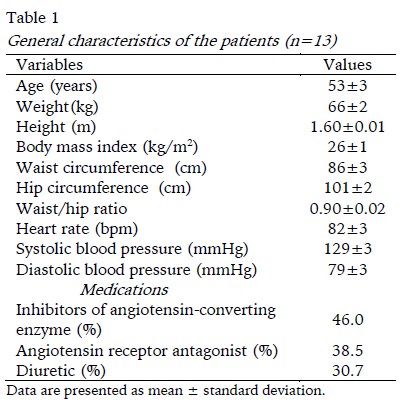
<body><![CDATA[<p><font size="2" face="Verdana">The characteristics of the sample are presented in     <a href="#t1">Table 1</a>. The patients were in average overweight and had controlled BP. All   patients were using antihypertensive medication and the most commonly used drugs were inhibitors of the angiotensin-converting enzyme. </font></p>     <p>&nbsp;</p>     <p><a name="t1"></a></p>     <p align="center"><img src="/img/revistas/mot/v11n3/11n3a14t1.jpg" width="404" height="407"></p>     
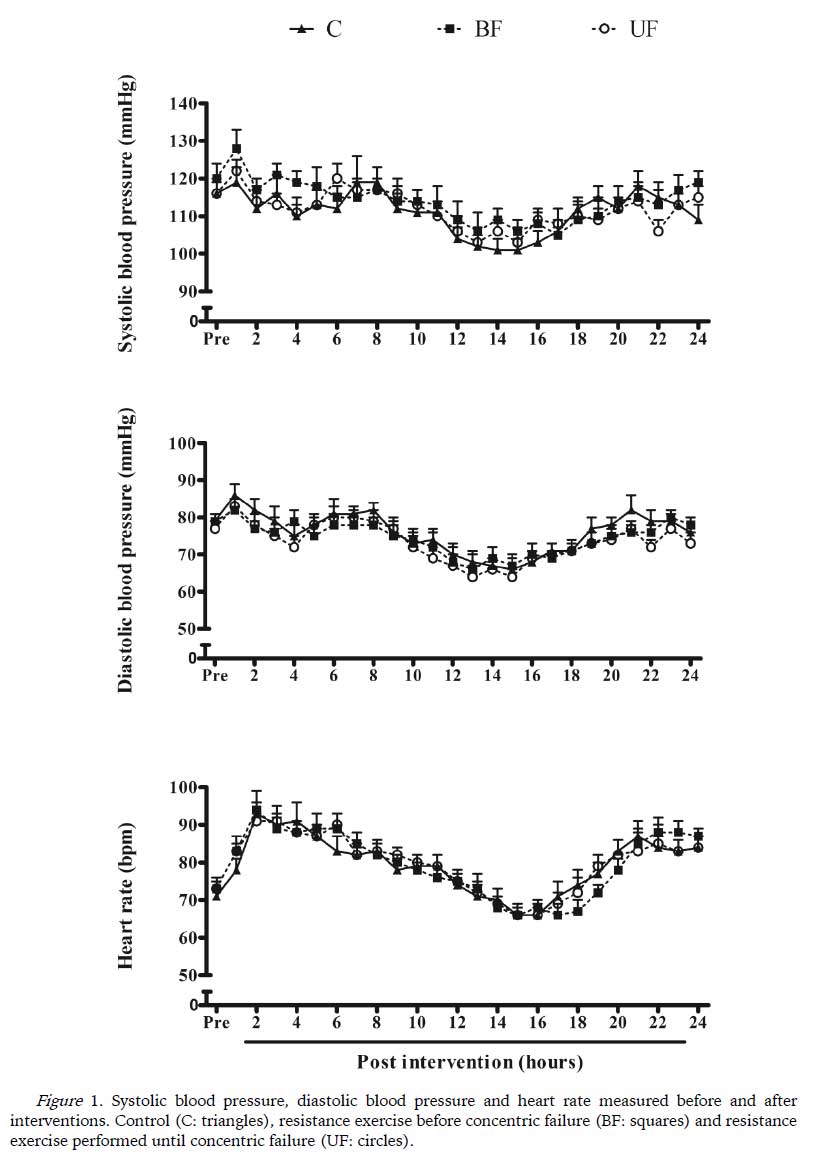
<p>&nbsp;</p>     <p><font size="2" face="Verdana">Pre-intervention cardiovascular variables were similar   for all sessions (p&gt; 0.05). <a href="/img/revistas/mot/v11n3/11n3a14f1.jpg">Figure 1</a> shows the responses of systolic BP,   diastolic BP and heart rate before and hour-to-hour after experimental sessions.</font></p>     
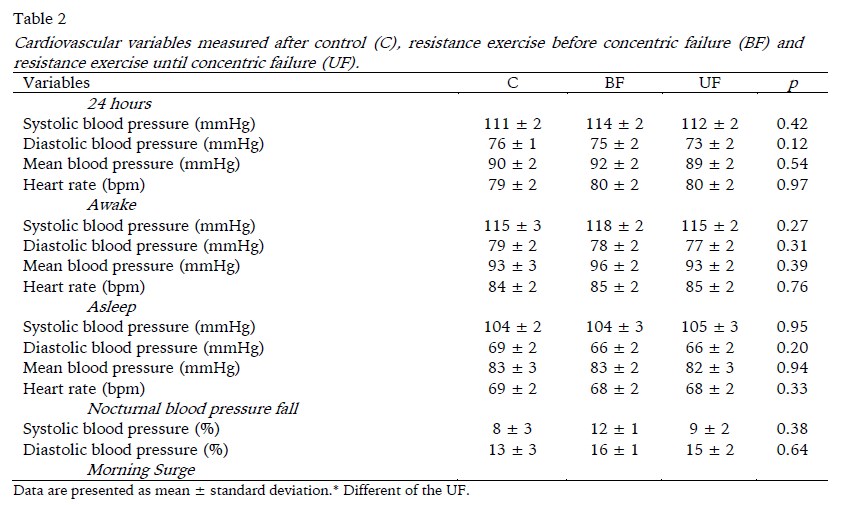
<p><font size="2" face="Verdana">No significant differences were observed among the   three experimental sessions in cardiovascular variables during the 24 hours after the interventions (p&gt; 0.05).</font></p>     <p><font size="2" face="Verdana"><a href="/img/revistas/mot/v11n3/11n3a14t2.jpg">Table   2</a> shows BP values and separately for 24-hour period, periods of waking and sleep, as well as the nocturnal BP dip and morning surge for the three groups. </font></p>     
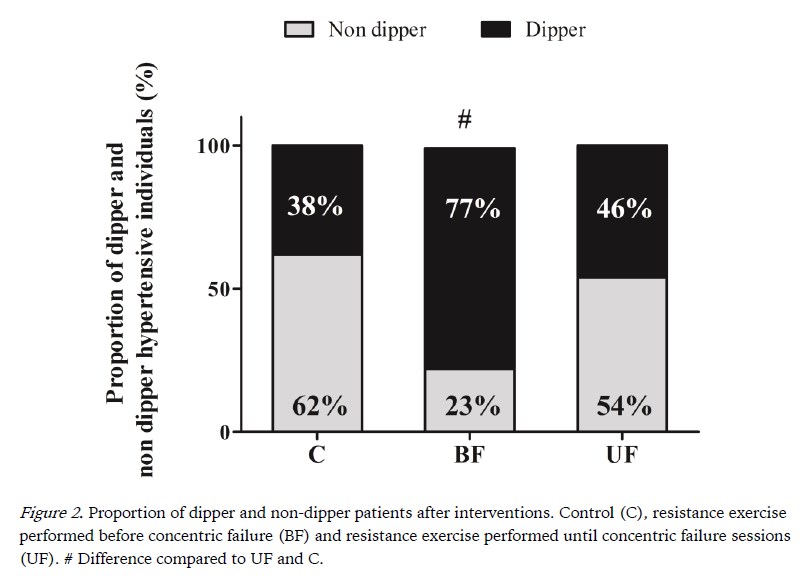
<p><font size="2" face="Verdana">Systolic and diastolic BP   and heart rate were similar   for the three experimental sessions   over a period of 24 hours, and   during periods of wakefulness and sleep.   The morning BP surge   was greater after the BF session compared to   the UF session (<i>p</i> = 0.029). </font></p>     <p><font size="2" face="Verdana"><a href="/img/revistas/mot/v11n3/11n3a14f2.jpg">Figure 2</a> shows the proportion of patients   with a dip in BP for each group. The proportion of patients experiencing a dip   was higher after the BF session compared to the other sessions (<i>p</i> = 0.047). </font></p>     
]]></body>
<body><![CDATA[<p><font size="2" face="Verdana"><a href="/img/revistas/mot/v11n3/11n3a14f3.jpg">Figure 3</a> show the individual responses of   nocturnal blood pressure fall and morning surge to experimental sessions   corrected by the control session. It is possible to observe that nine patients had greater fall and greater increases in morning surge after BF.</font></p>     
<p><font size="2" face="Verdana">The number of steps over the period that   the patients were using ambulatory BP monitor was similar for all sessions (C:   7326 ± 930 steps, BF: 8063 ± 1304 steps; UF: 8134 ± 1158 steps, <i>p</i>&gt;   0.05), indicating that the results observed were not influenced by the amount of physical activity performed after the experimental sessions.</font></p>     <p>&nbsp;</p> <font size="3" face="Verdana"><b>DISCUSSION</b></font>     <p><font size="2" face="Verdana">The results of the present study indicate   (i) that BP and heart rate responses over a 24-hour period and during periods   of wakefulness and sleep may be similar after UF, BF and C sessions; and (ii) that UF may reduce the nocturnal dip in BP compared to BF. </font></p>     <p><font size="2" face="Verdana">Unlike previous studies that observed a   prolonged decrease in the BP in hypertensive individuals (Melo   et al., 2006; Mota et al., 2009),   the present study did not find any change in BP after resistance exercise. A   number of factors may explain this. The patients’ levels of BP prior to the   intervention were well controlled and the increase in post-exercise hypotension   tends to be greater in subjects with higher resting BP (Queiroz,   Gagliardi, Forjaz, &amp; Rezk, 2009).   In fact, the mean systolic BP before the experimental sessions ranged from 116   to 120 mmHg and approximately 92% of the patients had BP levels below 140/90   mmHg. Furthermore, studies have shown that post-exercise BP reduction is   greater in physically inactive subjects and in subjects that are not practicing   resistance exercises (Costa,   Gerage, Gonçalves, Pina, &amp; Polito, 2010; Gerage et al., 2007; Moraes et   al., 2007). It   is therefore possible that   the adaptation period that the patients underwent prior to the   experimental sessions may have lessened the   post-exercise BP reduction observed in the present study.</font></p>     <p><font size="2" face="Verdana">Two previous studies   found decreases in BP during sleep in normotensive subjects that performed a   single session of resistance exercise (Bermudes,   Vassallo, Vasquez, &amp; Lima, 2004; Prista et al., 2013), although this is not a universal finding (De   Souza et al., 2013).   Interestingly, although in the present study we did not find any significant   changes in BP during sleep, there was a decrease in the number of patients who   experienced a dip (defined as a decrease in   BP of &gt;10%) after UF compared to BF. This dip in   systolic BP has been associated with a reduction   in the risk for cardiovascular events (Cornelissen   et al., 2011),   suggesting that UF may increase cardiovascular risk in hypertensive patients.   The mechanisms responsible for the non-dip response after UF are not clear. It   is possible that undertaking resistance exercise until fatigue may generate   micro-lesions in the skeletal muscle (Dolezal,   Potteiger, Jacobsen, &amp; Benedict, 2000; Medrano, 2010)   increasing the levels of inflammatory markers (Medrano,   2010)   and thus leading to increases in BP levels. Another explanation is related to   sympathetic activation. A previous study found that resistance exercise   performed UF reduced cardiac parasympathetic modulation for 24 hours, including   during sleep (De   Souza et al., 2013). UF may have also   increased sympathetic nerve activity during sleep, thereby curbing nocturnal reductions in BP. These hypotheses require further investigation. </font></p>     <p><font size="2" face="Verdana">The morning surge   has been associated with a higher risk of ischemic and hemorrhagic stroke (Kario   et al., 2003),   although the acute effects of resistance exercise on this variable have been   poorly described. A previous study identified that UF attenuated BP increases   upon waking (De   Souza et al., 2013), although the present study found no changes in the morning surge after a UF   session. Moreover, in the present study, the morning surge   was more pronounced after the BF session, which may suggest that this session   may increase cardiovascular risk in the morning. Nevertheless, it is worth   noting that the highest morning surge   value observed after a BF session was 42 mmHg, and 85% of the patients did not   experience a surge of more than 27 mmHg. A previous study observed that a   morning surge of more than 55 mmHg is associated with an increase in   cardiovascular risk, but it remains unclear whether the increases observed in   this study are clinically significant (Kario et al., 2003).</font></p>     <p><font size="2" face="Verdana">The analysis of individual responses   corrected by the control session showed that after BF nine patients had greater   nocturnal blood pressure fall than UF. The same pattern was observed with the   morning surge where nine patients had greater increases after BF compared to   UF. This individual variation indicates that the BP responses after resistance   exercise may be different between patients, which should be investigated. These   data suggest that patients who had greater nocturnal fall also had greater morning surge. </font></p>     <p><font size="2" face="Verdana">The Brazilian Guidelines on Hypertension (2010) include in their   recommendations that hypertensive patients should not perform UF, in order to avoid   the pronounced increases in systolic BP that occur   during resistance exercise. In support, a previous study found that interruption of resistance exercise at   this point can reduce increases in systolic BP during resistance exercise by 25   mmHg compared to UF (Gomides,   Nery, Júnior, Tinucci, &amp; Forjaz, 2007).   The present study provides an additional finding that in most of patients BF   also brings cardiovascular benefits, since, after this session, patients were   more likely to experience a significant dip in nocturnal   BP compared to UF and C. Taken together these   results indicate that avoiding fatigue during resistance exercise may be a   useful way for hypertensive patients to prevent an increase in cardiovascular   risk. It should be noted that the duration of each set of   exercises in the BF session was determined by an evaluator who identified a   change in the pace. A previous study showed that such a procedure has a good   inter-rater reliability (Oliveira   et al., 2013).   From a practical point of view, therefore, the procedures employed in the   present study can be used by clinicians and trainers supervising hypertensive patients during resistance training programs.</font></p>     <p>&nbsp;</p> <font size="3" face="Verdana"><b>CONCLUSION</b></font><font face="Verdana">     ]]></body>
<body><![CDATA[<p><font size="2">In conclusion, UF mitigated   nocturnal BP decreases at night in selected hypertensive patients suggesting   that this type of exercise may increase cardiovascular risk in these patients.   In addition, individual analysis showed that patients should respond   differently to resistance exercise’s types. This finding should be borne in mind when prescribing resistance exercise for hypertensive patients.</font></p> </font>     <p>&nbsp;</p>     <p><font size="3" face="Verdana"><b>REFERENCES</b></font></p>     <!-- ref --><p><font size="2" face="Verdana">Bermudes, A. M. L. de M., Vassallo, D. V., Vasquez, E.   C., &amp; Lima, E. G. (2004). Ambulatory   blood pressure monitoring in normotensive individuals undergoing two single exercise sessions: resistive exercise training and aerobic exercise training. <i>Arquivos Brasileiros De Cardiologia</i>, <i>82</i>(1), 65–71, 57–64.    &nbsp;&nbsp;&nbsp;&nbsp;&nbsp;&nbsp;&nbsp;&nbsp;[&#160;<a href="javascript:void(0);" onclick="javascript: window.open('/scielo.php?script=sci_nlinks&ref=000076&pid=S1646-107X201500030001400001&lng=','','width=640,height=500,resizable=yes,scrollbars=1,menubar=yes,');">Links</a>&#160;]<!-- end-ref --></font></p>     <!-- ref --><p><font size="2" face="Verdana">Cornelissen, V. A., Fagard,   R. H., Coeckelberghs, E., &amp; Vanhees, L. (2011). Impact of resistance training on blood pressure and   other cardiovascular risk factors: a meta-analysis of randomized, controlled   trials. <i>Hypertension</i>, <i>58</i>(5), 950–958. <a href="http://doi.org/10.1161/HYPERTENSIONAHA.111.177071" target="_blank">http://doi.org/10.1161/HYPERTENSIONAHA.111.177071</a></font>&nbsp;&nbsp;&nbsp;&nbsp;&nbsp;&nbsp;&nbsp;&nbsp;[&#160;<a href="javascript:void(0);" onclick="javascript: window.open('/scielo.php?script=sci_nlinks&ref=000078&pid=S1646-107X201500030001400002&lng=','','width=640,height=500,resizable=yes,scrollbars=1,menubar=yes,');">Links</a>&#160;]<!-- end-ref --><!-- ref --><p><font size="2" face="Verdana">Cornelissen, V.   A., &amp; Smart, N. A. (2013). Exercise training for blood pressure: a   systematic review and meta-analysis. <i>Journal of the American Heart Association</i>, <i>2</i>(1), e004473. <a href="http://doi.org/10.1161/JAHA.112.004473" target="_blank">http://doi.org/10.1161/JAHA.112.004473</a></font>&nbsp;&nbsp;&nbsp;&nbsp;&nbsp;&nbsp;&nbsp;&nbsp;[&#160;<a href="javascript:void(0);" onclick="javascript: window.open('/scielo.php?script=sci_nlinks&ref=000079&pid=S1646-107X201500030001400003&lng=','','width=640,height=500,resizable=yes,scrollbars=1,menubar=yes,');">Links</a>&#160;]<!-- end-ref --><!-- ref --><p><font size="2" face="Verdana">Costa, J. B. Y., Gerage, A.   M., Gonçalves, C. G. S., Pina, F. L. C., &amp; Polito, M. D. (2010). Influence of the training status on the   blood pressure behavior after a resistance training session in hypertensive   older females. <i>Revista Brasileira de     Medicina do Esporte</i>, <i>16</i>(2), 103–106. <a href="http://doi.org/10.1590/S1517-86922010000200005" target="_blank">http://doi.org/10.1590/S1517-86922010000200005</a></font>&nbsp;&nbsp;&nbsp;&nbsp;&nbsp;&nbsp;&nbsp;&nbsp;[&#160;<a href="javascript:void(0);" onclick="javascript: window.open('/scielo.php?script=sci_nlinks&ref=000080&pid=S1646-107X201500030001400004&lng=','','width=640,height=500,resizable=yes,scrollbars=1,menubar=yes,');">Links</a>&#160;]<!-- end-ref --><!-- ref --><p><font size="2" face="Verdana">De Souza, J. C., Tibana, R.   A., Cavaglieri, C. R., Vieira, D. C. L., De Sousa, N. M. F., Mendes, F. A. D.   S., … Prestes, J. (2013).   Resistance exercise leading to failure versus not to failure: effects on   cardiovascular control. <i>BMC Cardiovascular Disorders</i>, <i>13</i>, 105. <a href="http://doi.org/10.1186/1471-2261-13-105" target="_blank">http://doi.org/10.1186/1471-2261-13-105</a></font>&nbsp;&nbsp;&nbsp;&nbsp;&nbsp;&nbsp;&nbsp;&nbsp;[&#160;<a href="javascript:void(0);" onclick="javascript: window.open('/scielo.php?script=sci_nlinks&ref=000081&pid=S1646-107X201500030001400005&lng=','','width=640,height=500,resizable=yes,scrollbars=1,menubar=yes,');">Links</a>&#160;]<!-- end-ref --><!-- ref --><p><font size="2" face="Verdana">Dolezal, B. A.,   Potteiger, J. A., Jacobsen, D. J., &amp; Benedict, S. H. (2000). Muscle damage   and resting metabolic rate after acute resistance exercise with an eccentric   overload. <i>Medicine and Science in Sports and Exercise</i>, <i>32</i>(7), 1202–1207.    &nbsp;&nbsp;&nbsp;&nbsp;&nbsp;&nbsp;&nbsp;&nbsp;[&#160;<a href="javascript:void(0);" onclick="javascript: window.open('/scielo.php?script=sci_nlinks&ref=000082&pid=S1646-107X201500030001400006&lng=','','width=640,height=500,resizable=yes,scrollbars=1,menubar=yes,');">Links</a>&#160;]<!-- end-ref --></font></p>     <!-- ref --><p><font size="2" face="Verdana">Eston, R., &amp;   Reilly, T. (2013). <i>Kinanthropometry and Exercise Physiology Laboratory     Manual: Tests, Procedures and Data: Volume Two: Physiology</i>. New York: Routledge.    &nbsp;&nbsp;&nbsp;&nbsp;&nbsp;&nbsp;&nbsp;&nbsp;[&#160;<a href="javascript:void(0);" onclick="javascript: window.open('/scielo.php?script=sci_nlinks&ref=000084&pid=S1646-107X201500030001400007&lng=','','width=640,height=500,resizable=yes,scrollbars=1,menubar=yes,');">Links</a>&#160;]<!-- end-ref --></font></p>     <!-- ref --><p><font size="2" face="Verdana">Focht, B. C.,   &amp; Koltyn, K. F. (1999). Influence of resistance exercise of different   intensities on state anxiety and blood pressure. <i>Medicine and Science in Sports and Exercise</i>, <i>31</i>(3), 456–463.    &nbsp;&nbsp;&nbsp;&nbsp;&nbsp;&nbsp;&nbsp;&nbsp;[&#160;<a href="javascript:void(0);" onclick="javascript: window.open('/scielo.php?script=sci_nlinks&ref=000086&pid=S1646-107X201500030001400008&lng=','','width=640,height=500,resizable=yes,scrollbars=1,menubar=yes,');">Links</a>&#160;]<!-- end-ref --></font></p>     <!-- ref --><p><font size="2" face="Verdana">Gearhart, R. F.,   Goss, F. L., Lagally, K. M., Jakicic, J. M., Gallagher, J., &amp; Robertson, R.   J. (2001). Standardized scaling procedures for rating perceived exertion during   resistance exercise. <i>Journal of Strength and Conditioning Research</i>, <i>15</i>(3), 320–325.    &nbsp;&nbsp;&nbsp;&nbsp;&nbsp;&nbsp;&nbsp;&nbsp;[&#160;<a href="javascript:void(0);" onclick="javascript: window.open('/scielo.php?script=sci_nlinks&ref=000088&pid=S1646-107X201500030001400009&lng=','','width=640,height=500,resizable=yes,scrollbars=1,menubar=yes,');">Links</a>&#160;]<!-- end-ref --></font></p>     <!-- ref --><p><font size="2" face="Verdana">Gearhart, R. F.,   Lagally, K. M., Riechman, S. E., Andrews, R. D., &amp; Robertson, R. J. (2009).   Strength tracking using the OMNI resistance exercise scale in older men and   women. <i>Journal of Strength and Conditioning Research</i>, <i>23</i>(3), 1011–1015. <a href="http://doi.org/10.1519/JSC.0b013e3181a2ec41" target="_blank">http://doi.org/10.1519/JSC.0b013e3181a2ec41</a></font>&nbsp;&nbsp;&nbsp;&nbsp;&nbsp;&nbsp;&nbsp;&nbsp;[&#160;<a href="javascript:void(0);" onclick="javascript: window.open('/scielo.php?script=sci_nlinks&ref=000090&pid=S1646-107X201500030001400010&lng=','','width=640,height=500,resizable=yes,scrollbars=1,menubar=yes,');">Links</a>&#160;]<!-- end-ref --><!-- ref --><p><font size="2" face="Verdana">Gerage, A. M., Cyrino, E. S.,   Schiavoni, D., Nakamura, F. Y., Ronque, E. R. V., Gurjão, A. L. D., &amp;   Gobbi, S. (2007). Effect of   16-week weight training over blood pressure in normotensive and non-trained   women. <i>Revista Brasileira de Medicina     do Esporte</i>, <i>13</i>(6), 361–365. <a href="http://doi.org/10.1590/S1517-86922007000600001" target="_blank">http://doi.org/10.1590/S1517-86922007000600001</a></font>&nbsp;&nbsp;&nbsp;&nbsp;&nbsp;&nbsp;&nbsp;&nbsp;[&#160;<a href="javascript:void(0);" onclick="javascript: window.open('/scielo.php?script=sci_nlinks&ref=000091&pid=S1646-107X201500030001400011&lng=','','width=640,height=500,resizable=yes,scrollbars=1,menubar=yes,');">Links</a>&#160;]<!-- end-ref --><!-- ref --><p><font size="2" face="Verdana">Gomides, R. S., Nery, S. S.,   Júnior, D. S., Tinucci, T., &amp; Forjaz, C. L. M. (2007). Pressão arterial   durante o exercício resistido de diferentes intensidades em indivíduos hipertensos. <i>Coleção Pesquisa em Educação Física</i>, <i>6</i>(1), 435–442.    &nbsp;&nbsp;&nbsp;&nbsp;&nbsp;&nbsp;&nbsp;&nbsp;[&#160;<a href="javascript:void(0);" onclick="javascript: window.open('/scielo.php?script=sci_nlinks&ref=000092&pid=S1646-107X201500030001400012&lng=','','width=640,height=500,resizable=yes,scrollbars=1,menubar=yes,');">Links</a>&#160;]<!-- end-ref --></font></p>     <!-- ref --><p><font size="2" face="Verdana">Hermida, R. C., Ayala, D. E.,   Mojón, A., &amp; Fernández, J. R. (2010). Influence of circadian time of hypertension treatment   on cardiovascular risk: results of the MAPEC study. <i>Chronobiology International</i>, <i>27</i>(8), 1629–1651. <a href="http://doi.org/10.3109/07420528.2010.510230" target="_blank">http://doi.org/10.3109/07420528.2010.510230</a></font>&nbsp;&nbsp;&nbsp;&nbsp;&nbsp;&nbsp;&nbsp;&nbsp;[&#160;<a href="javascript:void(0);" onclick="javascript: window.open('/scielo.php?script=sci_nlinks&ref=000094&pid=S1646-107X201500030001400013&lng=','','width=640,height=500,resizable=yes,scrollbars=1,menubar=yes,');">Links</a>&#160;]<!-- end-ref --><!-- ref --><p><font size="2" face="Verdana">Kario, K.,   Pickering, T. G., Umeda, Y., Hoshide, S., Hoshide, Y., Morinari, M., … Shimada,   K. (2003). Morning surge in blood pressure as a predictor of silent and clinical cerebrovascular disease in elderly hypertensives: a prospective study. <i>Circulation</i>, <i>107</i>(10), 1401–1406.    &nbsp;&nbsp;&nbsp;&nbsp;&nbsp;&nbsp;&nbsp;&nbsp;[&#160;<a href="javascript:void(0);" onclick="javascript: window.open('/scielo.php?script=sci_nlinks&ref=000095&pid=S1646-107X201500030001400014&lng=','','width=640,height=500,resizable=yes,scrollbars=1,menubar=yes,');">Links</a>&#160;]<!-- end-ref --></font></p>     <!-- ref --><p><font size="2" face="Verdana">Mancia, G.,   Fagard, R., Narkiewicz, K., Redon, J., Zanchetti, A., Böhm, M., … Wood, D. A.   (2013). 2013 ESH/ESC guidelines for the management of arterial hypertension:   the Task Force for the Management of Arterial Hypertension of the European   Society of Hypertension (ESH) and of the European Society of Cardiology (ESC). <i>European     Heart Journal</i>, <i>34</i>(28), 2159–2219. <a href="http://doi.org/10.1093/eurheartj/eht151" target="_blank">http://doi.org/10.1093/eurheartj/eht151</a></font>&nbsp;&nbsp;&nbsp;&nbsp;&nbsp;&nbsp;&nbsp;&nbsp;[&#160;<a href="javascript:void(0);" onclick="javascript: window.open('/scielo.php?script=sci_nlinks&ref=000097&pid=S1646-107X201500030001400015&lng=','','width=640,height=500,resizable=yes,scrollbars=1,menubar=yes,');">Links</a>&#160;]<!-- end-ref --><!-- ref --><p><font size="2" face="Verdana">Mediano, M. F. F.,   Paravidino, V., Simão, R., Pontes, F. L., &amp; Polito, M. D. (2005). Subacute   behavior of the blood pressure after power training in controlled hypertensive   individuals. <i>Revista Brasileira de     Medicina do Esporte</i>, <i>11</i>(6), 337–340. <a href="http://doi.org/10.1590/S1517-86922005000600006" target="_blank">http://doi.org/10.1590/S1517-86922005000600006</a></font>&nbsp;&nbsp;&nbsp;&nbsp;&nbsp;&nbsp;&nbsp;&nbsp;[&#160;<a href="javascript:void(0);" onclick="javascript: window.open('/scielo.php?script=sci_nlinks&ref=000098&pid=S1646-107X201500030001400016&lng=','','width=640,height=500,resizable=yes,scrollbars=1,menubar=yes,');">Links</a>&#160;]<!-- end-ref --><!-- ref --><p><font size="2" face="Verdana">Medrano, I. C.   (2010). Muscular failure training in conditioninig neuromuscular programs. <i>Journal     of Human Sport and Exercise</i>, <i>5</i>(2), 196–213. <a href="http://doi.org/10.4100/jhse.2010.52.09" target="_blank">http://doi.org/10.4100/jhse.2010.52.09</a></font>&nbsp;&nbsp;&nbsp;&nbsp;&nbsp;&nbsp;&nbsp;&nbsp;[&#160;<a href="javascript:void(0);" onclick="javascript: window.open('/scielo.php?script=sci_nlinks&ref=000099&pid=S1646-107X201500030001400017&lng=','','width=640,height=500,resizable=yes,scrollbars=1,menubar=yes,');">Links</a>&#160;]<!-- end-ref --><!-- ref --><p><font size="2" face="Verdana">Melo, C. M., Alencar Filho,   A. C., Tinucci, T., Mion, D., &amp; Forjaz, C. L. M. (2006). Postexercise hypotension induced by   low-intensity resistance exercise in hypertensive women receiving captopril. <i>Blood     Pressure Monitoring</i>, <i>11</i>(4), 183–189. <a href="http://doi.org/10.1097/01.mbp.0000218000.42710.91" target="_blank">http://doi.org/10.1097/01.mbp.0000218000.42710.91</a></font>&nbsp;&nbsp;&nbsp;&nbsp;&nbsp;&nbsp;&nbsp;&nbsp;[&#160;<a href="javascript:void(0);" onclick="javascript: window.open('/scielo.php?script=sci_nlinks&ref=000100&pid=S1646-107X201500030001400018&lng=','','width=640,height=500,resizable=yes,scrollbars=1,menubar=yes,');">Links</a>&#160;]<!-- end-ref --><!-- ref --><p><font size="2" face="Verdana">Moraes, M. R.,   Bacurau, R. F. P., Ramalho, J. D. S., Reis, F. C. G., Casarini, D. E., Chagas,   J. R., … Araujo, R. C. (2007). Increase in kinins on post-exercise hypotension   in normotensive and hypertensive volunteers. <i>Biological Chemistry</i>, <i>388</i>(5), 533–540. <a href="http://doi.org/10.1515/BC.2007.055" target="_blank">http://doi.org/10.1515/BC.2007.055</a></font>&nbsp;&nbsp;&nbsp;&nbsp;&nbsp;&nbsp;&nbsp;&nbsp;[&#160;<a href="javascript:void(0);" onclick="javascript: window.open('/scielo.php?script=sci_nlinks&ref=000101&pid=S1646-107X201500030001400019&lng=','','width=640,height=500,resizable=yes,scrollbars=1,menubar=yes,');">Links</a>&#160;]<!-- end-ref --><!-- ref --><p><font size="2" face="Verdana">Mota, M. R.,   Pardono, E., Lima, L. C. J., Arsa, G., Bottaro, M., Campbell, C. S. G., &amp;   Simões, H. G. (2009). Effects of treadmill running and resistance exercises on   lowering blood pressure during the daily work of hypertensive subjects. <i>Journal     of Strength and Conditioning Research</i>, <i>23</i>(8), 2331–2338. <a href="http://doi.org/10.1519/JSC.0b013e3181bac418" target="_blank">http://doi.org/10.1519/JSC.0b013e3181bac418</a></font>&nbsp;&nbsp;&nbsp;&nbsp;&nbsp;&nbsp;&nbsp;&nbsp;[&#160;<a href="javascript:void(0);" onclick="javascript: window.open('/scielo.php?script=sci_nlinks&ref=000102&pid=S1646-107X201500030001400020&lng=','','width=640,height=500,resizable=yes,scrollbars=1,menubar=yes,');">Links</a>&#160;]<!-- end-ref --><!-- ref --><p><font size="2" face="Verdana">Oliveira, J., Silva, A.,   Prazeres, T., Santos, M., Júnior, C. C., &amp; Ritti-Dias, R. (2013).   Reprodutibilidade interavaliadores da identificação da redução da cadência em   exercícios de força. <i>Revista Brasileira de Atividade Física &amp; Saúde</i>, <i>17</i>(6), 512–518. <a href="http://doi.org/10.12820/rbafs.v.17n6p512-518" target="_blank">http://doi.org/10.12820/rbafs.v.17n6p512-518</a></font>&nbsp;&nbsp;&nbsp;&nbsp;&nbsp;&nbsp;&nbsp;&nbsp;[&#160;<a href="javascript:void(0);" onclick="javascript: window.open('/scielo.php?script=sci_nlinks&ref=000103&pid=S1646-107X201500030001400021&lng=','','width=640,height=500,resizable=yes,scrollbars=1,menubar=yes,');">Links</a>&#160;]<!-- end-ref --><!-- ref --><p><font size="2" face="Verdana">Pescatello, L. S.,   Franklin, B. A., Fagard, R., Farquhar, W. B., Kelley, G. A., &amp; Ray, C. A.   (2004). American College of Sports Medicine position stand. Exercise and   hypertension. <i>Medicine and Science in Sports and Exercise</i>, <i>36</i>(3), 533–553.    &nbsp;&nbsp;&nbsp;&nbsp;&nbsp;&nbsp;&nbsp;&nbsp;[&#160;<a href="javascript:void(0);" onclick="javascript: window.open('/scielo.php?script=sci_nlinks&ref=000104&pid=S1646-107X201500030001400022&lng=','','width=640,height=500,resizable=yes,scrollbars=1,menubar=yes,');">Links</a>&#160;]<!-- end-ref --></font></p>     <!-- ref --><p><font size="2" face="Verdana">Polito, M. D.,   &amp; Farinatti, P. T. V. (2009). The effects of muscle mass and number of sets   during resistance exercise on postexercise hypotension. <i>Journal of Strength     and Conditioning Research</i>, <i>23</i>(8), 2351–2357. <a href="http://doi.org/10.1519/JSC.0b013e3181bb71aa" target="_blank">http://doi.org/10.1519/JSC.0b013e3181bb71aa</a></font>&nbsp;&nbsp;&nbsp;&nbsp;&nbsp;&nbsp;&nbsp;&nbsp;[&#160;<a href="javascript:void(0);" onclick="javascript: window.open('/scielo.php?script=sci_nlinks&ref=000106&pid=S1646-107X201500030001400023&lng=','','width=640,height=500,resizable=yes,scrollbars=1,menubar=yes,');">Links</a>&#160;]<!-- end-ref --><!-- ref --><p><font size="2" face="Verdana">Prista, A., Macucule, C. F.,   Queiroz, A. C. C., Silva, N. D., Cardoso, C. G., Tinucci, T., … Forjaz, C. L. M. (2013). A bout of   resistance exercise following the 2007 AHA guidelines decreases asleep blood   pressure in Mozambican men. <i>Journal of Strength and Conditioning Research</i>, <i>27</i>(3), 786–792. <a href="http://doi.org/10.1519/JSC.0b013e31825d9783" target="_blank">http://doi.org/10.1519/JSC.0b013e31825d9783</a></font>&nbsp;&nbsp;&nbsp;&nbsp;&nbsp;&nbsp;&nbsp;&nbsp;[&#160;<a href="javascript:void(0);" onclick="javascript: window.open('/scielo.php?script=sci_nlinks&ref=000107&pid=S1646-107X201500030001400024&lng=','','width=640,height=500,resizable=yes,scrollbars=1,menubar=yes,');">Links</a>&#160;]<!-- end-ref --><!-- ref --><p><font size="2" face="Verdana">Queiroz, A. C. C., Gagliardi,   J. F. L., Forjaz, C. L. M., &amp; Rezk, C. C. (2009). Clinic and ambulatory blood pressure responses after   resistance exercise. <i>Journal of Strength and Conditioning Research</i>, <i>23</i>(2), 571–578. <a href="http://doi.org/10.1519/JSC.0b013e318196b637" target="_blank">http://doi.org/10.1519/JSC.0b013e318196b637</a></font>&nbsp;&nbsp;&nbsp;&nbsp;&nbsp;&nbsp;&nbsp;&nbsp;[&#160;<a href="javascript:void(0);" onclick="javascript: window.open('/scielo.php?script=sci_nlinks&ref=000108&pid=S1646-107X201500030001400025&lng=','','width=640,height=500,resizable=yes,scrollbars=1,menubar=yes,');">Links</a>&#160;]<!-- end-ref --><!-- ref --><p><font size="2" face="Verdana">Robertson, R. J.,   Goss, F. L., Rutkowski, J., Lenz, B., Dixon, C., Timmer, J., … Andreacci, J.   (2003). Concurrent validation of the OMNI perceived exertion scale for   resistance exercise. <i>Medicine and Science in Sports and Exercise</i>, <i>35</i>(2), 333–341. <a href="http://doi.org/10.1249/01.MSS.0000048831.15016.2A" target="_blank">http://doi.org/10.1249/01.MSS.0000048831.15016.2A</a></font>&nbsp;&nbsp;&nbsp;&nbsp;&nbsp;&nbsp;&nbsp;&nbsp;[&#160;<a href="javascript:void(0);" onclick="javascript: window.open('/scielo.php?script=sci_nlinks&ref=000109&pid=S1646-107X201500030001400026&lng=','','width=640,height=500,resizable=yes,scrollbars=1,menubar=yes,');">Links</a>&#160;]<!-- end-ref --><!-- ref --><p><font size="2" face="Verdana">Roltsch, M. H.,   Mendez, T., Wilund, K. R., &amp; Hagberg, J. M. (2001). Acute resistive exercise does not affect ambulatory blood pressure in young men and women. <i>Medicine and Science in Sports and Exercise</i>, <i>33</i>(6), 881–886.    &nbsp;&nbsp;&nbsp;&nbsp;&nbsp;&nbsp;&nbsp;&nbsp;[&#160;<a href="javascript:void(0);" onclick="javascript: window.open('/scielo.php?script=sci_nlinks&ref=000110&pid=S1646-107X201500030001400027&lng=','','width=640,height=500,resizable=yes,scrollbars=1,menubar=yes,');">Links</a>&#160;]<!-- end-ref --></font></p>     <!-- ref --><p><font size="2" face="Verdana">Sociedade Brasileira de   Cardiologia, Sociedade Brasileira de Hipertensão, &amp; Sociedade Brasileira de   Nefrologia. (2010). [VI Brazilian Guidelines on Hypertension]. <i>Arquivos Brasileiros De Cardiologia</i>, <i>95</i>(Suppl 1), 1–51.    &nbsp;&nbsp;&nbsp;&nbsp;&nbsp;&nbsp;&nbsp;&nbsp;[&#160;<a href="javascript:void(0);" onclick="javascript: window.open('/scielo.php?script=sci_nlinks&ref=000112&pid=S1646-107X201500030001400028&lng=','','width=640,height=500,resizable=yes,scrollbars=1,menubar=yes,');">Links</a>&#160;]<!-- end-ref --></font></p>     <p>&nbsp;</p>     <p><font size="2" face="Verdana"><b>Acknowledgments:    <br>   </b>Nothing to declare.    <br>   <b>Conflicts of Interest:    <br>   </b>Nothing   to declare.    <br>   <b>Funding:    <br>   </b>Financial   support was provided by Coordena&ccedil;&atilde;o     de Aperfei&ccedil;oamento de Pessoal de N&iacute;vel Superior (CAPES) and Pronto Socorro Cardiol&oacute;gico de Pernambuco (PROCAPE).</font></p>     <p><font size="2" face="Verdana">Manuscript received August 20<sup>th</sup>, 2014;   Accepted October 26<sup>th</sup>, 2014</font></p>     <p>&nbsp;</p>     ]]></body>
<body><![CDATA[<p>&nbsp;</p>     <p><font size="2" face="Verdana"><a href="#topo">*</a><font size="2" face="Verdana"><b><font size="2" face="Verdana"><b><sup><b><sup><b><sup><a href="#end"><i><a name="end" id="topo2"></a></i></a></sup></b></sup></b></sup></b></font></b></font></font> <font size="2" face="Verdana"><i>Corresponding author</i>: Avenida Albert Einstein, 627/701, Morumbi.   S&atilde;o Paulo, SP. Brazil.   ZIP-code: 05652-900. Phone: (+5511) 21511233. E-mail: <a href="mailto:raphaelritti@gmail.com">raphaelritti@gmail.com</a></font></p>      ]]></body><back>
<ref-list>
<ref id="B1">
<nlm-citation citation-type="journal">
<person-group person-group-type="author">
<name>
<surname><![CDATA[Bermudes]]></surname>
<given-names><![CDATA[A. M. L. de M.]]></given-names>
</name>
<name>
<surname><![CDATA[Vassallo]]></surname>
<given-names><![CDATA[D. V.]]></given-names>
</name>
<name>
<surname><![CDATA[Vasquez]]></surname>
<given-names><![CDATA[E. C.]]></given-names>
</name>
<name>
<surname><![CDATA[Lima]]></surname>
<given-names><![CDATA[E. G.]]></given-names>
</name>
</person-group>
<article-title xml:lang="en"><![CDATA[Ambulatory blood pressure monitoring in normotensive individuals undergoing two single exercise sessions: resistive exercise training and aerobic exercise training]]></article-title>
<source><![CDATA[Arquivos Brasileiros De Cardiologia]]></source>
<year>2004</year>
<volume>82</volume>
<numero>1</numero>
<issue>1</issue>
<page-range>65-71</page-range><page-range>57-64</page-range></nlm-citation>
</ref>
<ref id="B2">
<nlm-citation citation-type="journal">
<person-group person-group-type="author">
<name>
<surname><![CDATA[Cornelissen]]></surname>
<given-names><![CDATA[V. A.]]></given-names>
</name>
<name>
<surname><![CDATA[Fagard]]></surname>
<given-names><![CDATA[R. H.]]></given-names>
</name>
<name>
<surname><![CDATA[Coeckelberghs]]></surname>
<given-names><![CDATA[E.]]></given-names>
</name>
<name>
<surname><![CDATA[Vanhees]]></surname>
<given-names><![CDATA[L.]]></given-names>
</name>
</person-group>
<article-title xml:lang="en"><![CDATA[Impact of resistance training on blood pressure and other cardiovascular risk factors: a meta-analysis of randomized, controlled trials]]></article-title>
<source><![CDATA[Hypertension]]></source>
<year>2011</year>
<volume>58</volume>
<numero>5</numero>
<issue>5</issue>
<page-range>950-958</page-range></nlm-citation>
</ref>
<ref id="B3">
<nlm-citation citation-type="journal">
<person-group person-group-type="author">
<name>
<surname><![CDATA[Cornelissen]]></surname>
<given-names><![CDATA[V. A.]]></given-names>
</name>
<name>
<surname><![CDATA[Smart]]></surname>
<given-names><![CDATA[N. A.]]></given-names>
</name>
</person-group>
<article-title xml:lang="en"><![CDATA[Exercise training for blood pressure: a systematic review and meta-analysis]]></article-title>
<source><![CDATA[Journal of the American Heart Association]]></source>
<year>2013</year>
<volume>2</volume>
<numero>1</numero>
<issue>1</issue>
<page-range>004473</page-range></nlm-citation>
</ref>
<ref id="B4">
<nlm-citation citation-type="journal">
<person-group person-group-type="author">
<name>
<surname><![CDATA[Costa]]></surname>
<given-names><![CDATA[J. B. Y.]]></given-names>
</name>
<name>
<surname><![CDATA[Gerage]]></surname>
<given-names><![CDATA[A. M.]]></given-names>
</name>
<name>
<surname><![CDATA[Gonçalves]]></surname>
<given-names><![CDATA[C. G. S.]]></given-names>
</name>
<name>
<surname><![CDATA[Pina]]></surname>
<given-names><![CDATA[F. L. C.]]></given-names>
</name>
<name>
<surname><![CDATA[Polito]]></surname>
<given-names><![CDATA[M. D.]]></given-names>
</name>
</person-group>
<article-title xml:lang="en"><![CDATA[Influence of the training status on the blood pressure behavior after a resistance training session in hypertensive older females]]></article-title>
<source><![CDATA[Revista Brasileira de Medicina do Esporte]]></source>
<year>2010</year>
<volume>16</volume>
<numero>2</numero>
<issue>2</issue>
<page-range>103-106</page-range></nlm-citation>
</ref>
<ref id="B5">
<nlm-citation citation-type="journal">
<person-group person-group-type="author">
<name>
<surname><![CDATA[De Souza]]></surname>
<given-names><![CDATA[J. C.]]></given-names>
</name>
<name>
<surname><![CDATA[Tibana]]></surname>
<given-names><![CDATA[R. A.]]></given-names>
</name>
<name>
<surname><![CDATA[Cavaglieri]]></surname>
<given-names><![CDATA[C. R.]]></given-names>
</name>
<name>
<surname><![CDATA[Vieira]]></surname>
<given-names><![CDATA[D. C. L.]]></given-names>
</name>
<name>
<surname><![CDATA[De Sousa]]></surname>
<given-names><![CDATA[N. M. F.]]></given-names>
</name>
<name>
<surname><![CDATA[Mendes]]></surname>
<given-names><![CDATA[F. A. D. S.]]></given-names>
</name>
<name>
<surname><![CDATA[Prestes]]></surname>
<given-names><![CDATA[J.]]></given-names>
</name>
</person-group>
<article-title xml:lang="en"><![CDATA[Resistance exercise leading to failure versus not to failure: effects on cardiovascular control]]></article-title>
<source><![CDATA[BMC Cardiovascular Disorders]]></source>
<year>2013</year>
<volume>13</volume>
<numero>105</numero>
<issue>105</issue>
</nlm-citation>
</ref>
<ref id="B6">
<nlm-citation citation-type="journal">
<person-group person-group-type="author">
<name>
<surname><![CDATA[Dolezal]]></surname>
<given-names><![CDATA[B. A.]]></given-names>
</name>
<name>
<surname><![CDATA[Potteiger]]></surname>
<given-names><![CDATA[J. A.]]></given-names>
</name>
<name>
<surname><![CDATA[Jacobsen]]></surname>
<given-names><![CDATA[D. J.]]></given-names>
</name>
<name>
<surname><![CDATA[Benedict]]></surname>
<given-names><![CDATA[S. H.]]></given-names>
</name>
</person-group>
<article-title xml:lang="en"><![CDATA[Muscle damage and resting metabolic rate after acute resistance exercise with an eccentric overload]]></article-title>
<source><![CDATA[Medicine and Science in Sports and Exercise]]></source>
<year>2000</year>
<volume>32</volume>
<numero>7</numero>
<issue>7</issue>
<page-range>1202-1207</page-range></nlm-citation>
</ref>
<ref id="B7">
<nlm-citation citation-type="book">
<person-group person-group-type="author">
<name>
<surname><![CDATA[Eston]]></surname>
<given-names><![CDATA[R.]]></given-names>
</name>
<name>
<surname><![CDATA[Reilly]]></surname>
<given-names><![CDATA[T.]]></given-names>
</name>
</person-group>
<source><![CDATA[Kinanthropometry and Exercise Physiology Laboratory Manual: Tests, Procedures and Data: Volume Two: Physiology]]></source>
<year>2013</year>
<publisher-loc><![CDATA[New York ]]></publisher-loc>
<publisher-name><![CDATA[Routledge]]></publisher-name>
</nlm-citation>
</ref>
<ref id="B8">
<nlm-citation citation-type="journal">
<person-group person-group-type="author">
<name>
<surname><![CDATA[Focht]]></surname>
<given-names><![CDATA[B. C.]]></given-names>
</name>
<name>
<surname><![CDATA[Koltyn]]></surname>
<given-names><![CDATA[K. F.]]></given-names>
</name>
</person-group>
<article-title xml:lang="en"><![CDATA[Influence of resistance exercise of different intensities on state anxiety and blood pressure]]></article-title>
<source><![CDATA[Medicine and Science in Sports and Exercise]]></source>
<year>1999</year>
<volume>31</volume>
<numero>3</numero>
<issue>3</issue>
<page-range>456-463</page-range></nlm-citation>
</ref>
<ref id="B9">
<nlm-citation citation-type="journal">
<person-group person-group-type="author">
<name>
<surname><![CDATA[Gearhart]]></surname>
<given-names><![CDATA[R. F.]]></given-names>
</name>
<name>
<surname><![CDATA[Goss]]></surname>
<given-names><![CDATA[F. L.]]></given-names>
</name>
<name>
<surname><![CDATA[Lagally]]></surname>
<given-names><![CDATA[K. M.]]></given-names>
</name>
<name>
<surname><![CDATA[Jakicic]]></surname>
<given-names><![CDATA[J. M.]]></given-names>
</name>
<name>
<surname><![CDATA[Gallagher]]></surname>
<given-names><![CDATA[J.]]></given-names>
</name>
<name>
<surname><![CDATA[Robertson]]></surname>
<given-names><![CDATA[R. J.]]></given-names>
</name>
</person-group>
<article-title xml:lang="en"><![CDATA[Standardized scaling procedures for rating perceived exertion during resistance exercise]]></article-title>
<source><![CDATA[Journal of Strength and Conditioning Research]]></source>
<year>2001</year>
<volume>15</volume>
<numero>3</numero>
<issue>3</issue>
<page-range>320-325</page-range></nlm-citation>
</ref>
<ref id="B10">
<nlm-citation citation-type="journal">
<person-group person-group-type="author">
<name>
<surname><![CDATA[Gearhart]]></surname>
<given-names><![CDATA[R. F.]]></given-names>
</name>
<name>
<surname><![CDATA[Lagally]]></surname>
<given-names><![CDATA[K. M.]]></given-names>
</name>
<name>
<surname><![CDATA[Riechman]]></surname>
<given-names><![CDATA[S. E.]]></given-names>
</name>
<name>
<surname><![CDATA[Andrews]]></surname>
<given-names><![CDATA[R. D.]]></given-names>
</name>
<name>
<surname><![CDATA[Robertson]]></surname>
<given-names><![CDATA[R. J.]]></given-names>
</name>
</person-group>
<article-title xml:lang="en"><![CDATA[Strength tracking using the OMNI resistance exercise scale in older men and women]]></article-title>
<source><![CDATA[Journal of Strength and Conditioning Research]]></source>
<year>2009</year>
<volume>23</volume>
<numero>3</numero>
<issue>3</issue>
<page-range>1011-1015</page-range></nlm-citation>
</ref>
<ref id="B11">
<nlm-citation citation-type="journal">
<person-group person-group-type="author">
<name>
<surname><![CDATA[Gerage]]></surname>
<given-names><![CDATA[A. M.]]></given-names>
</name>
<name>
<surname><![CDATA[Cyrino]]></surname>
<given-names><![CDATA[E. S.]]></given-names>
</name>
<name>
<surname><![CDATA[Schiavoni]]></surname>
<given-names><![CDATA[D.]]></given-names>
</name>
<name>
<surname><![CDATA[Nakamura]]></surname>
<given-names><![CDATA[F. Y.]]></given-names>
</name>
<name>
<surname><![CDATA[Ronque]]></surname>
<given-names><![CDATA[E. R. V.]]></given-names>
</name>
<name>
<surname><![CDATA[Gurjão]]></surname>
<given-names><![CDATA[A. L. D.]]></given-names>
</name>
<name>
<surname><![CDATA[Gobbi]]></surname>
<given-names><![CDATA[S.]]></given-names>
</name>
</person-group>
<article-title xml:lang="en"><![CDATA[Effect of 16-week weight training over blood pressure in normotensive and non-trained women]]></article-title>
<source><![CDATA[Revista Brasileira de Medicina do Esporte]]></source>
<year>2007</year>
<volume>13</volume>
<numero>6</numero>
<issue>6</issue>
<page-range>361-365</page-range></nlm-citation>
</ref>
<ref id="B12">
<nlm-citation citation-type="journal">
<person-group person-group-type="author">
<name>
<surname><![CDATA[Gomides]]></surname>
<given-names><![CDATA[R. S.]]></given-names>
</name>
<name>
<surname><![CDATA[Nery]]></surname>
<given-names><![CDATA[S. S.]]></given-names>
</name>
<name>
<surname><![CDATA[Júnior]]></surname>
<given-names><![CDATA[D. S.]]></given-names>
</name>
<name>
<surname><![CDATA[Tinucci]]></surname>
<given-names><![CDATA[T.]]></given-names>
</name>
<name>
<surname><![CDATA[Forjaz]]></surname>
<given-names><![CDATA[C. L. M.]]></given-names>
</name>
</person-group>
<article-title xml:lang="en"><![CDATA[Pressão arterial durante o exercício resistido de diferentes intensidades em indivíduos hipertensos]]></article-title>
<source><![CDATA[Coleção Pesquisa em Educação Física]]></source>
<year>2007</year>
<volume>6</volume>
<numero>1</numero>
<issue>1</issue>
<page-range>435-442</page-range></nlm-citation>
</ref>
<ref id="B13">
<nlm-citation citation-type="journal">
<person-group person-group-type="author">
<name>
<surname><![CDATA[Hermida]]></surname>
<given-names><![CDATA[R. C.]]></given-names>
</name>
<name>
<surname><![CDATA[Ayala]]></surname>
<given-names><![CDATA[D. E.]]></given-names>
</name>
<name>
<surname><![CDATA[Mojón]]></surname>
<given-names><![CDATA[A.]]></given-names>
</name>
<name>
<surname><![CDATA[Fernández]]></surname>
<given-names><![CDATA[J. R.]]></given-names>
</name>
</person-group>
<article-title xml:lang="en"><![CDATA[Influence of circadian time of hypertension treatment on cardiovascular risk: results of the MAPEC study]]></article-title>
<source><![CDATA[Chronobiology International]]></source>
<year>2010</year>
<volume>27</volume>
<numero>8</numero>
<issue>8</issue>
<page-range>1629-1651</page-range></nlm-citation>
</ref>
<ref id="B14">
<nlm-citation citation-type="journal">
<person-group person-group-type="author">
<name>
<surname><![CDATA[Kario]]></surname>
<given-names><![CDATA[K.]]></given-names>
</name>
<name>
<surname><![CDATA[Pickering]]></surname>
<given-names><![CDATA[T. G.]]></given-names>
</name>
<name>
<surname><![CDATA[Umeda]]></surname>
<given-names><![CDATA[Y.]]></given-names>
</name>
<name>
<surname><![CDATA[Hoshide]]></surname>
<given-names><![CDATA[S.]]></given-names>
</name>
<name>
<surname><![CDATA[Hoshide]]></surname>
<given-names><![CDATA[Y.]]></given-names>
</name>
<name>
<surname><![CDATA[Morinari]]></surname>
<given-names><![CDATA[M.]]></given-names>
</name>
<name>
<surname><![CDATA[Shimada]]></surname>
<given-names><![CDATA[K.]]></given-names>
</name>
</person-group>
<article-title xml:lang="en"><![CDATA[Morning surge in blood pressure as a predictor of silent and clinical cerebrovascular disease in elderly hypertensives: a prospective study]]></article-title>
<source><![CDATA[Circulation]]></source>
<year>2003</year>
<volume>107</volume>
<numero>10</numero>
<issue>10</issue>
<page-range>1401-1406</page-range></nlm-citation>
</ref>
<ref id="B15">
<nlm-citation citation-type="journal">
<person-group person-group-type="author">
<name>
<surname><![CDATA[Mancia]]></surname>
<given-names><![CDATA[G.]]></given-names>
</name>
<name>
<surname><![CDATA[Fagard]]></surname>
<given-names><![CDATA[R.]]></given-names>
</name>
<name>
<surname><![CDATA[Narkiewicz]]></surname>
<given-names><![CDATA[K.]]></given-names>
</name>
<name>
<surname><![CDATA[Redon]]></surname>
<given-names><![CDATA[J.]]></given-names>
</name>
<name>
<surname><![CDATA[Zanchetti]]></surname>
<given-names><![CDATA[A.]]></given-names>
</name>
<name>
<surname><![CDATA[Böhm]]></surname>
<given-names><![CDATA[M.]]></given-names>
</name>
<name>
<surname><![CDATA[Wood]]></surname>
<given-names><![CDATA[D. A.]]></given-names>
</name>
</person-group>
<article-title xml:lang="en"><![CDATA[2013 ESH/ESC guidelines for the management of arterial hypertension: the Task Force for the Management of Arterial Hypertension of the European Society of Hypertension (ESH) and of the European Society of Cardiology (ESC)]]></article-title>
<source><![CDATA[European Heart Journal]]></source>
<year>2013</year>
<volume>34</volume>
<numero>28</numero>
<issue>28</issue>
<page-range>2159-2219</page-range></nlm-citation>
</ref>
<ref id="B16">
<nlm-citation citation-type="journal">
<person-group person-group-type="author">
<name>
<surname><![CDATA[Mediano]]></surname>
<given-names><![CDATA[M. F. F.]]></given-names>
</name>
<name>
<surname><![CDATA[Paravidino]]></surname>
<given-names><![CDATA[V.]]></given-names>
</name>
<name>
<surname><![CDATA[Simão]]></surname>
<given-names><![CDATA[R.]]></given-names>
</name>
<name>
<surname><![CDATA[Pontes]]></surname>
<given-names><![CDATA[F. L.]]></given-names>
</name>
<name>
<surname><![CDATA[Polito]]></surname>
<given-names><![CDATA[M. D.]]></given-names>
</name>
</person-group>
<article-title xml:lang="en"><![CDATA[Subacute behavior of the blood pressure after power training in controlled hypertensive individuals]]></article-title>
<source><![CDATA[Revista Brasileira de Medicina do Esporte]]></source>
<year>2005</year>
<volume>11</volume>
<numero>6</numero>
<issue>6</issue>
<page-range>337-340</page-range></nlm-citation>
</ref>
<ref id="B17">
<nlm-citation citation-type="journal">
<person-group person-group-type="author">
<name>
<surname><![CDATA[Medrano]]></surname>
<given-names><![CDATA[I. C.]]></given-names>
</name>
</person-group>
<article-title xml:lang="en"><![CDATA[Muscular failure training in conditioninig neuromuscular programs]]></article-title>
<source><![CDATA[Journal of Human Sport and Exercise]]></source>
<year>2010</year>
<volume>5</volume>
<numero>2</numero>
<issue>2</issue>
<page-range>196-213</page-range></nlm-citation>
</ref>
<ref id="B18">
<nlm-citation citation-type="journal">
<person-group person-group-type="author">
<name>
<surname><![CDATA[Melo]]></surname>
<given-names><![CDATA[C. M.]]></given-names>
</name>
<name>
<surname><![CDATA[Alencar Filho]]></surname>
<given-names><![CDATA[A. C.]]></given-names>
</name>
<name>
<surname><![CDATA[Tinucci]]></surname>
<given-names><![CDATA[T.]]></given-names>
</name>
<name>
<surname><![CDATA[Mion]]></surname>
<given-names><![CDATA[D.]]></given-names>
</name>
<name>
<surname><![CDATA[Forjaz]]></surname>
<given-names><![CDATA[C. L. M.]]></given-names>
</name>
</person-group>
<article-title xml:lang="en"><![CDATA[Postexercise hypotension induced by low-intensity resistance exercise in hypertensive women receiving captopril]]></article-title>
<source><![CDATA[Blood Pressure Monitoring]]></source>
<year>2006</year>
<volume>11</volume>
<numero>4</numero>
<issue>4</issue>
<page-range>183-189</page-range></nlm-citation>
</ref>
<ref id="B19">
<nlm-citation citation-type="journal">
<person-group person-group-type="author">
<name>
<surname><![CDATA[Moraes]]></surname>
<given-names><![CDATA[M. R.]]></given-names>
</name>
<name>
<surname><![CDATA[Bacurau]]></surname>
<given-names><![CDATA[R. F. P.]]></given-names>
</name>
<name>
<surname><![CDATA[Ramalho]]></surname>
<given-names><![CDATA[J. D. S.]]></given-names>
</name>
<name>
<surname><![CDATA[Reis]]></surname>
<given-names><![CDATA[F. C. G.]]></given-names>
</name>
<name>
<surname><![CDATA[Casarini]]></surname>
<given-names><![CDATA[D. E.]]></given-names>
</name>
<name>
<surname><![CDATA[Chagas]]></surname>
<given-names><![CDATA[J. R.]]></given-names>
</name>
<name>
<surname><![CDATA[Araujo]]></surname>
<given-names><![CDATA[R. C.]]></given-names>
</name>
</person-group>
<article-title xml:lang="en"><![CDATA[Increase in kinins on post-exercise hypotension in normotensive and hypertensive volunteers]]></article-title>
<source><![CDATA[Biological Chemistry]]></source>
<year>2007</year>
<volume>388</volume>
<numero>5</numero>
<issue>5</issue>
<page-range>533-540</page-range></nlm-citation>
</ref>
<ref id="B20">
<nlm-citation citation-type="journal">
<person-group person-group-type="author">
<name>
<surname><![CDATA[Mota]]></surname>
<given-names><![CDATA[M. R.]]></given-names>
</name>
<name>
<surname><![CDATA[Pardono]]></surname>
<given-names><![CDATA[E.]]></given-names>
</name>
<name>
<surname><![CDATA[Lima]]></surname>
<given-names><![CDATA[L. C. J.]]></given-names>
</name>
<name>
<surname><![CDATA[Arsa]]></surname>
<given-names><![CDATA[G.]]></given-names>
</name>
<name>
<surname><![CDATA[Bottaro]]></surname>
<given-names><![CDATA[M.]]></given-names>
</name>
<name>
<surname><![CDATA[Campbell]]></surname>
<given-names><![CDATA[C. S. G.]]></given-names>
</name>
<name>
<surname><![CDATA[Simões]]></surname>
<given-names><![CDATA[H. G.]]></given-names>
</name>
</person-group>
<article-title xml:lang="en"><![CDATA[Effects of treadmill running and resistance exercises on lowering blood pressure during the daily work of hypertensive subjects]]></article-title>
<source><![CDATA[Journal of Strength and Conditioning Research]]></source>
<year>2009</year>
<volume>23</volume>
<numero>8</numero>
<issue>8</issue>
<page-range>2331-2338</page-range></nlm-citation>
</ref>
<ref id="B21">
<nlm-citation citation-type="journal">
<person-group person-group-type="author">
<name>
<surname><![CDATA[Oliveira]]></surname>
<given-names><![CDATA[J.]]></given-names>
</name>
<name>
<surname><![CDATA[Silva]]></surname>
<given-names><![CDATA[A.]]></given-names>
</name>
<name>
<surname><![CDATA[Prazeres]]></surname>
<given-names><![CDATA[T.]]></given-names>
</name>
<name>
<surname><![CDATA[Santos]]></surname>
<given-names><![CDATA[M.]]></given-names>
</name>
<name>
<surname><![CDATA[Júnior]]></surname>
<given-names><![CDATA[C. C.]]></given-names>
</name>
<name>
<surname><![CDATA[Ritti-Dias]]></surname>
<given-names><![CDATA[R.]]></given-names>
</name>
</person-group>
<article-title xml:lang="pt"><![CDATA[Reprodutibilidade interavaliadores da identificação da redução da cadência em exercícios de força]]></article-title>
<source><![CDATA[Revista Brasileira de Atividade Física & Saúde]]></source>
<year>2013</year>
<volume>17</volume>
<numero>6</numero>
<issue>6</issue>
<page-range>512-518</page-range></nlm-citation>
</ref>
<ref id="B22">
<nlm-citation citation-type="journal">
<person-group person-group-type="author">
<name>
<surname><![CDATA[Pescatello]]></surname>
<given-names><![CDATA[L. S.]]></given-names>
</name>
<name>
<surname><![CDATA[Franklin]]></surname>
<given-names><![CDATA[B. A.]]></given-names>
</name>
<name>
<surname><![CDATA[Fagard]]></surname>
<given-names><![CDATA[R.]]></given-names>
</name>
<name>
<surname><![CDATA[Farquhar]]></surname>
<given-names><![CDATA[W. B.]]></given-names>
</name>
<name>
<surname><![CDATA[Kelley]]></surname>
<given-names><![CDATA[G. A.]]></given-names>
</name>
<name>
<surname><![CDATA[Ray]]></surname>
<given-names><![CDATA[C. A.]]></given-names>
</name>
</person-group>
<article-title xml:lang="en"><![CDATA[American College of Sports Medicine position stand: Exercise and hypertension]]></article-title>
<source><![CDATA[Medicine and Science in Sports and Exercise]]></source>
<year>2004</year>
<volume>36</volume>
<numero>3</numero>
<issue>3</issue>
<page-range>533-553</page-range></nlm-citation>
</ref>
<ref id="B23">
<nlm-citation citation-type="journal">
<person-group person-group-type="author">
<name>
<surname><![CDATA[Polito]]></surname>
<given-names><![CDATA[M. D.]]></given-names>
</name>
<name>
<surname><![CDATA[Farinatti]]></surname>
<given-names><![CDATA[P. T. V.]]></given-names>
</name>
</person-group>
<article-title xml:lang="en"><![CDATA[The effects of muscle mass and number of sets during resistance exercise on postexercise hypotension]]></article-title>
<source><![CDATA[Journal of Strength and Conditioning Research]]></source>
<year>2009</year>
<volume>23</volume>
<numero>8</numero>
<issue>8</issue>
<page-range>2351-2357</page-range></nlm-citation>
</ref>
<ref id="B24">
<nlm-citation citation-type="journal">
<person-group person-group-type="author">
<name>
<surname><![CDATA[Prista]]></surname>
<given-names><![CDATA[A.]]></given-names>
</name>
<name>
<surname><![CDATA[Macucule]]></surname>
<given-names><![CDATA[C. F.]]></given-names>
</name>
<name>
<surname><![CDATA[Queiroz]]></surname>
<given-names><![CDATA[A. C. C.]]></given-names>
</name>
<name>
<surname><![CDATA[Silva]]></surname>
<given-names><![CDATA[N. D.]]></given-names>
</name>
<name>
<surname><![CDATA[Cardoso]]></surname>
<given-names><![CDATA[C. G.]]></given-names>
</name>
<name>
<surname><![CDATA[Tinucci]]></surname>
<given-names><![CDATA[T.]]></given-names>
</name>
<name>
<surname><![CDATA[Forjaz]]></surname>
<given-names><![CDATA[C. L. M.]]></given-names>
</name>
</person-group>
<article-title xml:lang="en"><![CDATA[A bout of resistance exercise following the 2007 AHA guidelines decreases asleep blood pressure in Mozambican men]]></article-title>
<source><![CDATA[Journal of Strength and Conditioning Research]]></source>
<year>2013</year>
<volume>27</volume>
<numero>3</numero>
<issue>3</issue>
<page-range>786-792</page-range></nlm-citation>
</ref>
<ref id="B25">
<nlm-citation citation-type="journal">
<person-group person-group-type="author">
<name>
<surname><![CDATA[Queiroz]]></surname>
<given-names><![CDATA[A. C. C.]]></given-names>
</name>
<name>
<surname><![CDATA[Gagliardi]]></surname>
<given-names><![CDATA[J. F. L.]]></given-names>
</name>
<name>
<surname><![CDATA[Forjaz]]></surname>
<given-names><![CDATA[C. L. M.]]></given-names>
</name>
<name>
<surname><![CDATA[Rezk]]></surname>
<given-names><![CDATA[C. C.]]></given-names>
</name>
</person-group>
<article-title xml:lang="en"><![CDATA[Clinic and ambulatory blood pressure responses after resistance exercise]]></article-title>
<source><![CDATA[Journal of Strength and Conditioning Research]]></source>
<year>2009</year>
<volume>23</volume>
<numero>2</numero>
<issue>2</issue>
<page-range>571-578</page-range></nlm-citation>
</ref>
<ref id="B26">
<nlm-citation citation-type="journal">
<person-group person-group-type="author">
<name>
<surname><![CDATA[Robertson]]></surname>
<given-names><![CDATA[R. J.]]></given-names>
</name>
<name>
<surname><![CDATA[Goss]]></surname>
<given-names><![CDATA[F. L.]]></given-names>
</name>
<name>
<surname><![CDATA[Rutkowski]]></surname>
<given-names><![CDATA[J.]]></given-names>
</name>
<name>
<surname><![CDATA[Lenz]]></surname>
<given-names><![CDATA[B.]]></given-names>
</name>
<name>
<surname><![CDATA[Dixon]]></surname>
<given-names><![CDATA[C.]]></given-names>
</name>
<name>
<surname><![CDATA[Timmer]]></surname>
<given-names><![CDATA[J.]]></given-names>
</name>
<name>
<surname><![CDATA[Andreacci]]></surname>
<given-names><![CDATA[J.]]></given-names>
</name>
</person-group>
<article-title xml:lang="en"><![CDATA[Concurrent validation of the OMNI perceived exertion scale for resistance exercise]]></article-title>
<source><![CDATA[Medicine and Science in Sports and Exercise]]></source>
<year>2003</year>
<volume>35</volume>
<numero>2</numero>
<issue>2</issue>
<page-range>333-341</page-range></nlm-citation>
</ref>
<ref id="B27">
<nlm-citation citation-type="journal">
<person-group person-group-type="author">
<name>
<surname><![CDATA[Roltsch]]></surname>
<given-names><![CDATA[M. H.]]></given-names>
</name>
<name>
<surname><![CDATA[Mendez]]></surname>
<given-names><![CDATA[T.]]></given-names>
</name>
<name>
<surname><![CDATA[Wilund]]></surname>
<given-names><![CDATA[K. R.]]></given-names>
</name>
<name>
<surname><![CDATA[Hagberg]]></surname>
<given-names><![CDATA[J. M.]]></given-names>
</name>
</person-group>
<article-title xml:lang="en"><![CDATA[Acute resistive exercise does not affect ambulatory blood pressure in young men and women]]></article-title>
<source><![CDATA[Medicine and Science in Sports and Exercise]]></source>
<year>2001</year>
<volume>33</volume>
<numero>6</numero>
<issue>6</issue>
<page-range>881-886</page-range></nlm-citation>
</ref>
<ref id="B28">
<nlm-citation citation-type="journal">
<collab>Sociedade Brasileira de Cardiologia</collab>
<collab>Sociedade Brasileira de Hipertensão</collab>
<collab>Sociedade Brasileira de Nefrologia</collab>
<article-title xml:lang="en"><![CDATA[VI Brazilian Guidelines on Hypertension]]></article-title>
<source><![CDATA[Arquivos Brasileiros De Cardiologia]]></source>
<year>2010</year>
<volume>95</volume>
<numero>^s1</numero>
<issue>^s1</issue>
<supplement>1</supplement>
<page-range>1-51</page-range></nlm-citation>
</ref>
</ref-list>
</back>
</article>