<?xml version="1.0" encoding="ISO-8859-1"?><article xmlns:mml="http://www.w3.org/1998/Math/MathML" xmlns:xlink="http://www.w3.org/1999/xlink" xmlns:xsi="http://www.w3.org/2001/XMLSchema-instance">
<front>
<journal-meta>
<journal-id>1646-107X</journal-id>
<journal-title><![CDATA[Motricidade]]></journal-title>
<abbrev-journal-title><![CDATA[Motri.]]></abbrev-journal-title>
<issn>1646-107X</issn>
<publisher>
<publisher-name><![CDATA[Edições Desafio Singular]]></publisher-name>
</publisher>
</journal-meta>
<article-meta>
<article-id>S1646-107X2015000400002</article-id>
<article-id pub-id-type="doi">10.6063/motricidade.2969</article-id>
<title-group>
<article-title xml:lang="en"><![CDATA[Sport commitment in adolescent soccer players]]></article-title>
<article-title xml:lang="pt"><![CDATA[Compromisso desportivo em atletas de futebol adolescentes]]></article-title>
</title-group>
<contrib-group>
<contrib contrib-type="author">
<name>
<surname><![CDATA[Pedreño]]></surname>
<given-names><![CDATA[Noelia Belando]]></given-names>
</name>
<xref ref-type="aff" rid="A01"/>
</contrib>
<contrib contrib-type="author">
<name>
<surname><![CDATA[Ferriz-Morel]]></surname>
<given-names><![CDATA[Roberto]]></given-names>
</name>
<xref ref-type="aff" rid="A01"/>
</contrib>
<contrib contrib-type="author">
<name>
<surname><![CDATA[Rivas]]></surname>
<given-names><![CDATA[Shai]]></given-names>
</name>
<xref ref-type="aff" rid="A01"/>
</contrib>
<contrib contrib-type="author">
<name>
<surname><![CDATA[Almagro]]></surname>
<given-names><![CDATA[Bartolomé]]></given-names>
</name>
<xref ref-type="aff" rid="A03"/>
</contrib>
<contrib contrib-type="author">
<name>
<surname><![CDATA[Sáenz-López]]></surname>
<given-names><![CDATA[Pedro]]></given-names>
</name>
<xref ref-type="aff" rid="A03"/>
</contrib>
<contrib contrib-type="author">
<name>
<surname><![CDATA[Cervelló]]></surname>
<given-names><![CDATA[Eduardo]]></given-names>
</name>
<xref ref-type="aff" rid="A01"/>
</contrib>
<contrib contrib-type="author">
<name>
<surname><![CDATA[Moreno-Murcia]]></surname>
<given-names><![CDATA[Juan Antonio]]></given-names>
</name>
<xref ref-type="aff" rid="A01"/>
</contrib>
</contrib-group>
<aff id="A01">
<institution><![CDATA[,Miguel Hernández University of Elche  ]]></institution>
<addr-line><![CDATA[ ]]></addr-line>
<country>Spain</country>
</aff>
<aff id="A02">
<institution><![CDATA[,University of Almería  ]]></institution>
<addr-line><![CDATA[ ]]></addr-line>
<country>Spain</country>
</aff>
<aff id="A03">
<institution><![CDATA[,University of Huelva  ]]></institution>
<addr-line><![CDATA[ ]]></addr-line>
<country>Spain</country>
</aff>
<pub-date pub-type="pub">
<day>01</day>
<month>12</month>
<year>2015</year>
</pub-date>
<pub-date pub-type="epub">
<day>01</day>
<month>12</month>
<year>2015</year>
</pub-date>
<volume>11</volume>
<numero>4</numero>
<fpage>03</fpage>
<lpage>14</lpage>
<copyright-statement/>
<copyright-year/>
<self-uri xlink:href="http://scielo.pt/scielo.php?script=sci_arttext&amp;pid=S1646-107X2015000400002&amp;lng=en&amp;nrm=iso"></self-uri><self-uri xlink:href="http://scielo.pt/scielo.php?script=sci_abstract&amp;pid=S1646-107X2015000400002&amp;lng=en&amp;nrm=iso"></self-uri><self-uri xlink:href="http://scielo.pt/scielo.php?script=sci_pdf&amp;pid=S1646-107X2015000400002&amp;lng=en&amp;nrm=iso"></self-uri><abstract abstract-type="short" xml:lang="en"><p><![CDATA[The aim of this study was to contribute to the postulates of the self-determination theory, the hierarchical model of intrinsic and extrinsic motivation by Vallerand, and social goals. A structural regression model was estimated to analyze the relations between social goals (responsibility and relationships), praise for autonomous behavior, satisfaction of the basic psychological needs and intrinsic motivation in commitment to sport. A sample of 264 young Spanish soccer players aged between 14 and 16 (M =14.74, SD =.77) participated in the study. Structural Equation Modeling results showed that the social responsibility goal, the social relationship goal and praise for autonomous behavior predicted perceived competence. Furthermore, the relationship goal also predicted the need for relatedness. Satisfaction of the basic psychological needs for competence and relatedness predicted intrinsic motivation. Intrinsic motivation positively predicted future commitment to sport. These results highlighted the importance of social goals, praise for autonomous behavior and psychological mediators in encouraging greater commitment in young soccer players. Future research should focus on the coach’s role in generating greater commitment to sport through the development of intervention methodologies based on social goals.]]></p></abstract>
<abstract abstract-type="short" xml:lang="pt"><p><![CDATA[O objetivo foi testar a capacidade preditiva das metas sociais (responsabilidade e socialização), a importância do comportamento autônomo, a satisfação das necessidades psicológicas básicas e motivação intrínseca no compromisso com o esporte. Contribuindo assim, com os fundamentos da teoria da autodeterminação, o modelo hierárquico da motivação intrínseca e extrínseca de Vallerand e as metas sociais. Participaram do estudo, 264 jovens futebolistas espanhóis de 14 a 16 anos (M = 14.74, SD = .77). Os resultados do modelo de equações estruturais mostrou que as metas de responsabilidade e socialização, e a importância do comportamento autônomo preveem a competência percebida. Além disso, a meta de socialização também previu a necessidade de vínculo social. Também, a satisfação das necessidades psicológicas básicas de competência percebida e vínculo social previram a motivação intrínseca. A motivação intrínseca predigo positivamente o compromisso esportivo. Estes resultados reafirmam a importância das metas sociais, a importância do comportamento autônomo e os mediadores psicológicos no sentido de incentivar maior compromisso esportivo em jovens jogadores de futebol. Futuras pesquisas que pretendem um maior compromisso esportivo, deveriam dar especial atenção na análise de como os técnicos realizam suas metodologias de intervenção, e como aplicam as estratégias motivacionais e as metas sociais.]]></p></abstract>
<kwd-group>
<kwd lng="en"><![CDATA[social goals]]></kwd>
<kwd lng="en"><![CDATA[relatedness]]></kwd>
<kwd lng="en"><![CDATA[competence]]></kwd>
<kwd lng="en"><![CDATA[sport commitment]]></kwd>
<kwd lng="en"><![CDATA[intrinsic motivation]]></kwd>
<kwd lng="en"><![CDATA[self-determination theory]]></kwd>
<kwd lng="pt"><![CDATA[metas sociais]]></kwd>
<kwd lng="pt"><![CDATA[vínculo social]]></kwd>
<kwd lng="pt"><![CDATA[competência percebida]]></kwd>
<kwd lng="pt"><![CDATA[comportamento autônomo]]></kwd>
<kwd lng="pt"><![CDATA[motivação intrínseca]]></kwd>
<kwd lng="pt"><![CDATA[compromisso esportivo]]></kwd>
</kwd-group>
</article-meta>
</front><body><![CDATA[ <p align="right"><font size="2" face="Verdana"><b>ORIGINAL ARTICLE</b></font></p>     <p>&nbsp;</p>     <p><font size="4" face="Verdana"><b>Sport commitment in   adolescent soccer players</b></font></p>     <p>&nbsp;</p>     <p><font size="3" face="Verdana"><b>Compromisso desportivo em atletas de futebol adolescentes</b></font></p>     <p>&nbsp;</p>     <p>&nbsp;</p>     <p><b><font size="2" face="Verdana">Noelia Belando Pedreño<sup>1</sup>;   Roberto Ferriz-Morel<sup>1</sup>; Shai Rivas<sup>1</sup>; Bartolomé Almagro<sup>3</sup>;   Pedro Sáenz-López<sup>3</sup>; Eduardo Cervelló<sup>1</sup>; Juan Antonio Moreno-Murcia<sup>1<a href="#end">,*</a></sup><a name="topo"></a></font></b></p>     <p><font size="2" face="Verdana"><sup>1</sup> <i>Miguel Hern&aacute;ndez University of   Elche, Spain    <br>   </i><sup>2</sup><i> University of Almer&iacute;a, Spain    ]]></body>
<body><![CDATA[<br> </i><sup>3 </sup><i>University of Huelva, Spain</i></font></p>     <p>&nbsp;</p>     <p>&nbsp;</p> <hr noshade size="1">     <p><font size="2" face="Verdana"><b>ABSTRACT</b></font></p>     <p><font size="2" face="Verdana">The aim   of this study was to contribute to the postulates of the self-determination   theory, the hierarchical model of intrinsic and extrinsic motivation by   Vallerand, and social goals. A structural regression model was estimated to   analyze the relations between social goals (responsibility and relationships),   praise for autonomous behavior, satisfaction of the basic psychological needs   and intrinsic motivation in commitment to sport. A sample of 264 young Spanish   soccer players aged between 14 and 16 (<i>M </i>=14.74, <i>SD </i>=.77)   participated in the study. Structural Equation Modeling results showed that the   social responsibility goal, the social relationship goal and praise for   autonomous behavior predicted perceived competence. Furthermore, the   relationship goal also predicted the need for relatedness. Satisfaction of the   basic psychological needs for competence and relatedness predicted intrinsic   motivation. Intrinsic motivation positively predicted future commitment to   sport. These results highlighted the importance of social goals, praise for   autonomous behavior and psychological mediators in encouraging greater   commitment in young soccer players. Future research should focus on the coach’s   role in generating greater commitment to sport through the development of intervention methodologies based on social goals.</font></p>     <p><font size="2" face="Verdana"><b>Keywords:</b> social goals, relatedness, competence, sport commitment, intrinsic motivation, self-determination theory</font></p> <hr noshade size="1">     <p><font size="2" face="Verdana"><b>RESUMO</b></font></p>     <p><font size="2" face="Verdana">O   objetivo foi testar a capacidade preditiva das metas sociais (responsabilidade   e socialização), a importância do comportamento autônomo, a satisfação das   necessidades psicológicas básicas e motivação intrínseca no compromisso com o   esporte. Contribuindo assim, com os fundamentos da teoria da autodeterminação,   o modelo hierárquico da motivação intrínseca e extrínseca de Vallerand e as   metas sociais. Participaram do estudo, 264 jovens futebolistas espanhóis de 14   a 16 anos (<i>M </i>= 14.74, <i>SD</i> = .77). Os resultados do modelo de   equações estruturais mostrou que as metas de responsabilidade e socialização, e   a importância do comportamento autônomo preveem a competência percebida. Além   disso, a meta de socialização também previu a necessidade de vínculo social.   Também, a satisfação das necessidades psicológicas básicas de competência   percebida e vínculo social previram a motivação intrínseca. A motivação   intrínseca predigo positivamente o compromisso esportivo. Estes resultados   reafirmam a importância das metas sociais, a importância do comportamento   autônomo e os mediadores psicológicos no sentido de incentivar maior   compromisso esportivo em jovens jogadores de futebol. Futuras pesquisas que   pretendem um maior compromisso esportivo, deveriam dar especial atenção na   análise de como os técnicos realizam suas metodologias de intervenção, e como aplicam as estratégias motivacionais e as metas sociais.</font></p>     <p><font size="2" face="Verdana"><b>Palavras-chave:</b> metas sociais, vínculo social,   competência percebida, comportamento autônomo, motivação intrínseca, compromisso esportivo</font></p> <hr noshade size="1">     <p>&nbsp;</p>     ]]></body>
<body><![CDATA[<p>&nbsp;</p>     <p><font size="3" face="Verdana"><b>INTRODUCTION</b></font></p>     <p><font size="2" face="Verdana">Doing sufficient physical activity and sports during   childhood and adolescence stimulates physical, cognitive and social development   in young people (Duda &amp; Ntoumanis,   2003; van Beurden et al., 2003). If healthy sports habits are acquired   during these stages of development, they could be maintained in adulthood, and   consequently, dropping out of physical activity and sport could be avoided (Almagro,   Sáenz-López, &amp; Moreno-Murcia, 2010; Caspersen, Pereira, &amp; Curran, 2000;   Cervelló, Escartí, &amp; Guzmán, 2007). Different research papers (Sousa,   Torregrosa, Viladrich, Villamarín, &amp; Cruz, 2007; Torregrosa &amp; Cruz,   2006)   show that commitment to sport is a strong predictor of sports dropout,   maintaining that if there is a greater commitment to sport then there is less   possibility of dropping out. For this reason, and as one of the aims of this   study, there is a clear need for knowledge about the level of future commitment   to sport in a sample of young soccer players through the analysis of the effect   of the relations between social goals (responsibility and relationships),   praise for autonomous behavior, psychological mediators (perceived competence and relatedness) and intrinsic motivation. </font></p>     <p><font size="2" face="Verdana"><i>Praise for autonomous behavior</i></font></p>     <p><font size="2" face="Verdana">In relation to the variables that can predict sport   commitment, coaches play an important role. Authors like Conroy and Coastsworth   (2007) assert   that praise by the coach about an athlete’s autonomous behavior, decisions and   effort could influence the behaviors of satisfaction and commitment to sport.   According to Moreno-Murcia, Gimeno, Pardo, and Dantas (2010), a   training climate which considers the athletes, allowing them to participate in   the decision making process and taking their opinion into account, seems to be   a determining factor in their future commitment to sport. The coach could be   responsible for generating a suitable environment (goals of responsibility   towards practice and cooperation in the team) and motivation for encouraging   athletes to continue doing physical activity and sports at a later age (Ntoumanis, Vazou, &amp;   Duda, 2007).   In this line, in an international study with adolescent soccer players, Quested   et al. (2013)   support the applicability of the basic need theory (Deci &amp; Ryan, 2000;   R. M. Ryan &amp; Deci, 2000) as a framework for understanding the determining factors for sports dropout among European youngsters.</font></p>     <p><font size="2" face="Verdana"><i>Self-Determination theory</i></font></p>     <p><font size="2" face="Verdana">The Basic Need theory (BNT) is one of the mini   theories which comprise the Self-Determination Theory (SDT) (Deci &amp; Ryan, 1985), and   indicates that there are three basic psychological needs (perceived autonomy,   perceived competence and relatedness) that the social context should encompass   if athletes are to achieve greater cognitive-social well-being. These   psychological needs could mediate the influence of social factors and the   athlete’s level of motivation.  For its part, the Integration Organism theory   (IOT) (the mini-theory that explains the SDT), shows that motivation moves on a   continuum of self-determination. The highest level of motivation is intrinsic   motivation, which refers to carrying out an activity for the pleasure and   satisfaction it gives; followed by extrinsic motivation, considered as the   motivation that  moves someone to act in order to obtain an external   compensation; and finally amotivation, which is related to apathetic behaviors.   In relation to this continuum, the levels of self-determination are modified   according to the level of achievement of the three basic needs. In this sense,   in different studies (e.g.,   García-Mas et al., 2010; Zahariadis, Tsorbatzoudis, &amp; Alexandris, 2006)   intrinsic motivation has been shown as a fundamental variable for achieving an   adequate commitment to sport. The association between intrinsic motivation and   future commitment to sport seems logical, since intrinsic motivation implies a   person’s commitment to an activity for the enjoyment and pleasure that it   produces, and therefore, the activity is a means to an end (Deci &amp; Ryan, 1985). In   the area of sports, Smith, Ntoumanis, and Duda (2007) have   demonstrated that coaches with a behavior of autonomy support in training   sessions generate a greater perception of effort and a satisfaction of the basic psychological needs in athletes, thereby increasing intrinsic motivation. </font></p>     <p><font size="2" face="Verdana">As a complement to the postulates of the   self-determination theory, the <i>Hierarchical Model of Intrinsic and     Extrinsic Motivation </i>by Vallerand (1997) establishes   that there are three levels of motivation: global (a person’s general   motivation), contextual (general orientation towards a specific context like   sport) and situational (the motivation a person has during the development of a   particular activity). This model complements the self-determination theory in   that it considers that motivation experienced on one level can influence the   rest of the levels. For example, if an adolescent has positive experiences   during training (situational), he can develop positive attitudes towards a sport (contextual) and commit to an active life style (global).</font></p>     <p><font size="2" face="Verdana"><i>Social Goals</i></font></p>     <p><font size="2" face="Verdana">Another social construct related to motivation is   social goals (Anderman &amp;   Anderman, 1999). In educational psychology, there has been an attempt   to integrate social goals in the study of motivation, since this dimension   influences people’s behavior and performance (Guan, McBride, &amp;   Xiang, 2006; Patrick, Hicks, &amp; Ryan, 1997). Several studies (Allen,   2003; Méndez-Giménez, Cecchini-Estrada, Fernández-Río, &amp; González-Mesa,   2012; Stuntz &amp; Weiss, 2009) have identified the social aspects of   motivation towards physical education and physical activity and sport as   possible determining factors of the most self-determined motivation, which   would bring positive consequences for adolescent athletes such as a greater   adherence to physical activity and sport. This study has considered the   responsibility goal that would reflect a desire to respect social rules and   role expectations (Wentzel, 1991), and   the social relationship goal that would refer to the desire to maintain good   relations with teammates (Ryan, Hicks, &amp;   Midgley, 1997).   In this context, an athlete’s goal might be to become a responsible person in   training tasks, committed to the established rules, or being able to form   friendships within the team. The consideration of social goals is especially   important and appropriate for analyzing adherence to doing physical activity   and sport during adolescence, since it is during this stage that relations with   the peer group have greater importance, and there is an increase in social   concerns like fulfilling their commitment to the team or to teammates, or   feeling well related with others to confirm their competence in what they do (Urdan &amp; Maehr, 1995).</font></p>     ]]></body>
<body><![CDATA[<p><font size="2" face="Verdana">On the basis of the studies revised, it has been noted   that commitment to sport is influenced by the social context that surrounds an   athlete. Scanlan, Simons, Carpenter, Schmidt, and Keeler (1993) define   commitment to sport as a psychological disposition which represents the desire   and decision to continue to participate in sport. This is determined by the   level of enjoyment, personal investments, involvement opportunities and social   constraints, as well as social support (Scanlan, Russel, Beals,   &amp; Scanlan, 2003). In this respect, in the context of physical   education and in line with this study, Giménez, Estrada, Río, and Mesa (2012)   reaffirm that the responsibility and relationship goals can determine   satisfaction of the basic psychological needs, and that they should also be   considered along with other social factors. Likewise, these authors found that   the psychological mediators, relatedness and perceived competence, positively   predicted intrinsic motivation, which in turn predicted intention to do   physical activity and sport in the future. In line with these studies and   others (Cecchini-Estrada,   González-Mesa, Méndez-Giménez, &amp; Fernández-Río, 2011; Moreno-Murcia,   Hernández-Paños, &amp; González-Cutre Coll, 2009), a structural   regression model was designed where it was hypothesized that the social   responsibility and relationship goals, along with praise for autonomous   behavior would positively predict satisfaction of the basic psychological   needs, which would predict intrinsic motivation, which in turn would predict future commitment to sport in adolescent athletes. </font></p>     <p>&nbsp;</p>     <p><font size="3" face="Verdana"><b>METHOD</b></font></p>     <p>    <font size="2" face="Verdana"><b>Participants</b>    </font></p>     <p><font size="2" face="Verdana">The study sample consisted of 264 young Spanish soccer   players (all boys) aged between 14 and 16 (<i>M </i>=14.74, <i>SD </i>=.77) from   different clubs. All the athletes competed in the regional soccer league but in   different categories corresponding to their age (according to the Real   Federación Española de Fútbol (Spanish Royal Federation of Soccer): 20% of the   sample belonged to the juvenile category (13-14 years old) and 80 % of the   sample belonged to the cadet category (15-16 years old). Athletes had been   playing soccer institutionally since they were ten. The research was carried   out on the 15 participating teams during the competition period.   Non-probability and casual sampling is used (also known as convenience sampling).</font></p>     <p><font size="2" face="Verdana"><b>M</b><b>easures</b></font></p>     <p><font size="2" face="Verdana"><i>Social Goal in Sport Scale. </i></font></p>     <p><font size="2" face="Verdana">The   Spanish version (Moreno-Murcia,   González-Cutre Coll, &amp; Sicilia-Camacho, 2007) of the <i>Social     Goal Scale-Physical Education (SGS-PE) </i>by Guan, McBride, and Xiang (2006) was   used. This scale consists of a total of 11 items grouped into two factors, the   relationship goal (e.g., &quot;I would like to get to know my friends who I   train with very well &quot;) and the responsibility goal (e.g., &quot;I try to   do what the coach asks me to do&quot;). Answers were given on a 7-point Likert   scale that range from 1 (strongly disagree) to 7 (strongly agree), preceded by   the phrase &quot;In my training sessions...&quot;. The original   Cronbach alpha values for validation to the Spanish context were .75 for the   relationship factor and .73 for the responsibility factor. The original scale   also presented an adequate fit, as shown in the fit indices obtained in the   confirmatory factor analysis: &#967;<sup>2</sup> (43, N   = 406) = 121.59, p = .00; &#967;<sup>2</sup>/g.l. =   2.82; CFI = .93; NFI = .89; TLI = .91; RMSEA = .06; SRMR = .04. The internal   consistency obtained was .75 for the responsibility dimension and.78 for relationship dimension.</font></p>     <p><font size="2" face="Verdana"><i>Praise for autonomous behavior. </i></font></p>     <p><font size="2" face="Verdana">The   factor, praise for autonomous behavior, from the Spanish version (Conde et al., 2010) from   Conroy and Coatsworth’s (2007) <i>Autonomy-Supportive     Coaching Questionnaire (ASCQ) </i>was used. This factor comprises four items   that measure how players evaluate praise for their autonomy. (e.g., &quot;My   coach assesses my choice of the things I do in training.&quot;) The   questionnaire began with the phrase &quot;In my training sessions...”. The   responses were limited to a Likert scale from 1 (strongly disagree) to 7   (strongly agree). The original Cronbach alpha value for validation to the Spanish context was .70. The internal consistency obtained was .77.</font></p>     ]]></body>
<body><![CDATA[<p><font size="2" face="Verdana"><i>Scale for Satisfaction of Psychological Needs. </i></font></p>     <p><font size="2" face="Verdana">The Spanish version (Moreno-Murcia,   Marzo, Martínez-Galindo, &amp; Conte-Marín, 2011) of the <i>Psychological     Need Satisfaction in Exercise Scale </i>(PNSE; Wilson, Rogers,   Rodgers, &amp; Wild, 2010).The questionnaire included 18 items (six   items in each subscale) for measuring the competence factor (e.g., &quot;I   believe I can do the exercises that are a personal challenge”), the autonomy   factor (e.g., “I believe I can choose the exercises in which I participate”)   and the relatedness factor (e.g., &quot;I feel close to my team mates because   they accept me as. I am.&quot;) The introductory statement was &quot;In my   training sessions ...” The answers were given on a Likert scale with a response   range from 1 to 6, where 1 corresponded to “False” and 6 to “true”. The   original Cronbach alpha values for validation to the Spanish context were .80   for perceived competence, .69 perceived autonomy and relatedness .73. The   alpha values of the scale were .76 for the competence factor and .75 for the   relatedness factor. The unreliability of the autonomy factor made it necessary to remove this psychological mediator for this study.</font></p>     <p><font size="2" face="Verdana"><i>Intrinsic motivation. </i></font></p>     <p><font size="2" face="Verdana">The   general intrinsic motivation factor from the Spanish   version (Moreno-Murcia et al.,   2011)   of the <i>Behavioral Regulation in Sport Questionnaire (BRSQ)</i> by Lonsdale,   Hodge, and Rose (2008) was   used. The scale was preceded by the phrase &quot;I take part in this sport   ....” The factor consisted of four items, these were (”Because I enjoy it,”   “Because it's fun,” “Because I find pleasure in it,” and “Because I like it”).   The answers were scored on a Likert scale ranging from 1   (absolutely false) to 7 (absolutely true). The original   Cronbach alpha value for validation to the Spanish context was.78. An internal consistency value of .75 was obtained.</font></p>     <p><font size="2" face="Verdana"><i>Future commitment. </i></font></p>     <p><font size="2" face="Verdana">The   future commitment factor from the <i>Personal Commitment Scale </i>by Orlick (1990) and   adapted to the Spanish context by Belando, Ferriz-Morell, and Moreno-Murcia (2012) to   evaluate an individual player’s commitment to being constant and dedicated to   doing their sports. This factor had four items (e.g., &quot;I really want to   become an excellent competitor in my sport&quot;), introduced by the phrase   &quot;In my training sessions...&quot;.The answers were limited to a Likert   scale from 1 (Strongly Disagree) to 5 (Strongly Agree). An internal consistency   value of .68 was obtained (this factor had the same Cronbach alpha in its   original version). This value was considered acceptable because of the reduced   number of items which comprise this factor (Hair, Anderson, Tatham, &amp; Black, 1998).</font></p>     <p><font size="2" face="Verdana"><b>Procedure</b></font></p>     <p><font size="2" face="Verdana">Sports   directors from the different clubs were contacted to inform them about the   objective of the research and ask for their collaboration. Written   authorization was asked for from parents of minors, and they were also informed   about the purpose of the research. Before gathering data, the lead researcher   interviewed the coaches for each team to explain the objective of the research   and to arrange a time for completing the questionnaires during one of the   weekly training sessions. The players participated voluntarily and   the questionnaires were filled in anonymously before the training session. To   ensure comprehension of the items, the researchers explained them one by one   and explained how to complete the questionnaire. It took approximately 20   minutes for all of the questions. No difficulties were encountered in understanding the items.</font></p>     <p><font size="2" face="Verdana"><b>Data analysis</b></font></p>     <p><font size="2" face="Verdana">Firstly, the descriptive statistics for all the target   variables (averages and standard deviation) were calculated and internal   consistency for each factor was analyzed by means of the Cronbach alpha   coefficient and the bivariate correlations. Similarly, a structural regression   model was calculated to analyze the hypothesized relations between the   variables. The two-step approach proposed by Anderson and   Gerbing (1988) was   used: first, a measure model was calculated, which would give construct   validity to the dimensions, based on the fourteen measures observed and the   seven latent constructs which correlated freely; and secondly a structural   regression model was formulated which analyzed the predictive relations between   the social goals (responsibility and relationships), praise for autonomous   behavior, psychological mediators (perceived competence and relatedness),   intrinsic motivation and future commitment to sport. The statistical software SPSS 20.0 and AMOS 20.0 was used for the data analysis</font></p>     ]]></body>
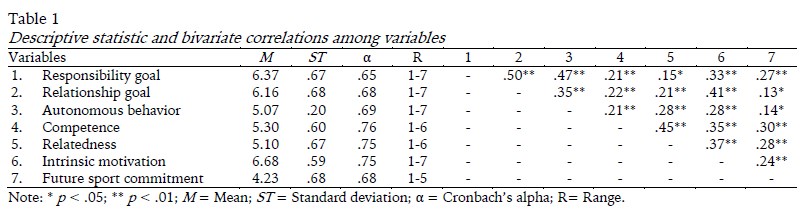
<body><![CDATA[<p>&nbsp;</p>     <p><font size="3" face="Verdana"><b>R</b><b>ESULTS</b> </font></p>     <p><font size="2" face="Verdana"><b>Descriptive   analysis and bivariate correlations</b></font></p>     <p><font size="2" face="Verdana">The   descriptive statistics in Table 1 revealed that the responsibility goal had a   higher value than the relationship goal. While praise for autonomous behavior   scored an average value of 5.07. Perceived competence was valued higher than   relatedness. Intrinsic motivation had a mean value of 6.68 and future   commitment showed a mean value of 4.23. In the correlation analysis it was   observed that all variables studied correlated positively and significantly with each other.</font></p>     <p>&nbsp;</p>     <p align="center"><a href="/img/revistas/mot/v11n4/11n4a02t1.jpg"><font size="2" face="Verdana">Table 1</font></a></p>     
<p>&nbsp;</p>     <p><font size="2" face="Verdana"><b>Analysis of structural regression model</b></font></p>     <p><font size="2" face="Verdana">In order to carry out the analysis of the measure   model and to test the structural regression model (SEM), the number of latent   factors per factor was reduced. This is especially recommended when the size of   the sample is not particularly large compared with the number of the model   variables (Marsh, Richard,   Johnson, Roche, &amp; Tremayne, 1994; Vallerand, 2007). This reduction   can be achieved by putting the items into pairs. So, half of the first items   from each subscale were averaged to form the first block of items, and the   second half were averaged to form the second block of items, and so on until the   last one. Marsh, Richard, Johnson, Roche, and Tremayne (1994)   proposed the use of item pairs because the results are more reliable, they tend   to be distributed more normally, and the ratio of the variables measured in the model and the number of participants is halved.</font></p>     <p><font size="2" face="Verdana">Since the Mardia coefficient was high (113.20), the   maximum verisimilitude method was used along with the bootstrapping method,   which allowed data to be assumed as robust in the presence of the lack of   normality (Byrne, 2001). In   the same way, a series of fit coefficients were   considered to evaluate the measure models’ goodness of fit with the empirical   data. Therefore, based on the studies by different authors (Bentler, 1990; Bollen   &amp; Long, 1993; McDonald &amp; Marsh, 1990), the <i>fit </i>indices   or goodness of fit indices which were considered to evaluate the measure model   were:   &#967;<sup>2</sup>, &#967;<sup>2</sup>/d.f.,   RMSEA (Root Mean Square Error of Approximation), RMSR (Root Mean Square   Residual) and the incremental indices (CFI, IFI and TLI). These goodness of fit   indices are considered acceptable when the &#967;<sup>2</sup>/d.f.   is lower than 5, the incremental indices (CFI, IFI and TLI) are higher than .90   and the error indices (RMSEA and RMSR) are lower than .08 (Hu &amp; Bentler, 1999). The   indices obtained were adequate: &#967;<sup>2</sup> (56, <i>N</i>   = 264) = 88.68, <i>p</i> = .00, &#967;<sup>2</sup>/df =   1.58, CFI = .97, IFI = .95, TLI = .97, SRMR = .04, RMSEA = .05. In addition,   the discriminating validity of the model was examined, keeping in mind that the   correlation between the latent variables attenuated by the measurement error (+   / - 2 times the measurement error) was lower than 1.0. The different results indicate that the measurement model was adequate.</font></p>     ]]></body>
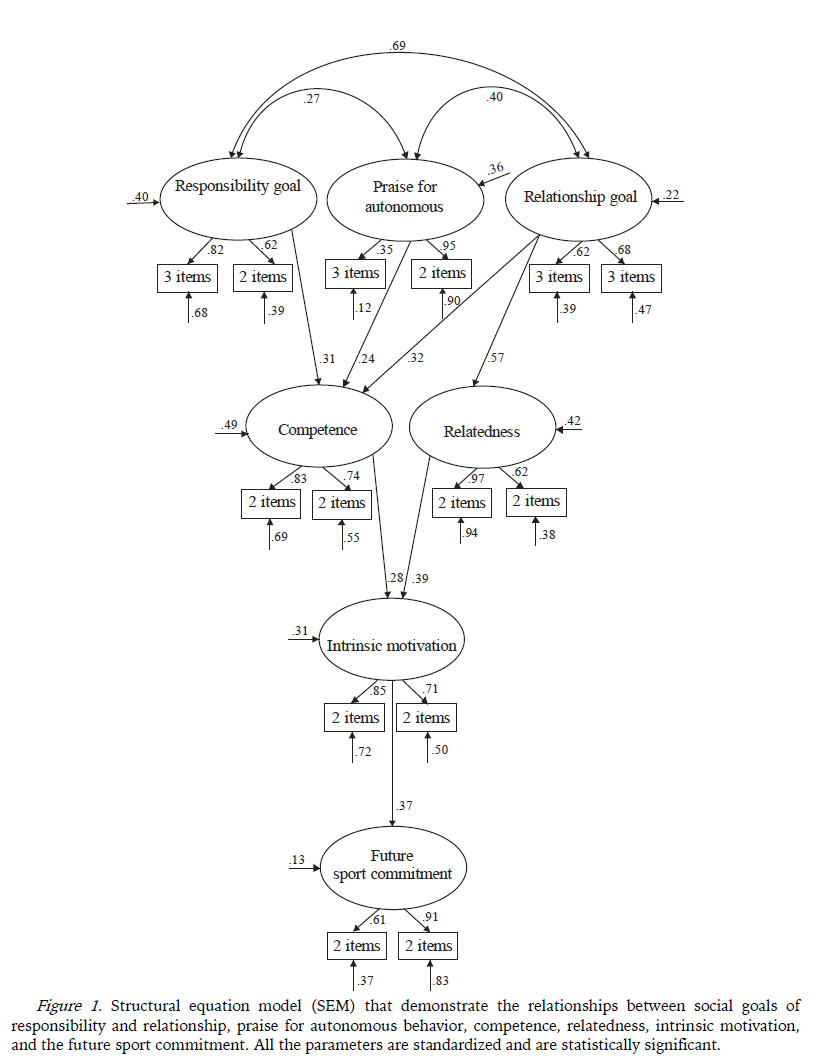
<body><![CDATA[<p><font size="2" face="Verdana">The   second step of the method consisted in verifying the measure model and the   structural regression model simultaneously, which permits focusing on the   conceptual interactions between the latent factors: social goals   (responsibility and  relationships) praise for autonomous behavior,   psychological mediators (perceived competence and relatedness), intrinsic   motivation and future commitment to sport. Thus, the data   obtained was: &#967;<sup>2 </sup>(67, <i>N</i>=264)   = 128.93, <i>p </i>=.00, &#967;<sup>2 </sup>/d.f =   1.92, CFI =. 94, IFI = .94, TLI = .92, SRMR = .06, RMSEA = .06. This data fit the established parameters, so the proposed model is considered adequate.</font></p>     <p><font size="2" face="Verdana">The   results from the structural equations model (Figure 1) established that the   responsibility goal, praise for autonomous behavior and the relationship goal,   positively predicted perceived competence; the relationship goal also predicted   the need for relatedness. As far as perceived competence and relatedness were   concerned, they positively predicted intrinsic motivation. In turn, intrinsic   motivation positively predicted future commitment to sport. The following   variances were obtained: 32% for intrinsic motivation and 13% for commitment to sports.</font></p>     <p>&nbsp;</p>     <p align="center"><a href="/img/revistas/mot/v11n4/11n4a02f1.jpg"><font size="2" face="Verdana">Figure 1</font></a></p>     
<p>&nbsp;</p>     <p>&nbsp;</p>     <p><font size="3" face="Verdana"><b>DISCUSSION</b></font></p>     <p><font size="2" face="Verdana">The purpose behind this study was to complete the   sequence of motivational processes proposed by the self-determination theory   and the model by Vallerand (1997) in   order to explain the level of sports commitment in adolescents. To do so, a   predictive model was estimated where the relations between the social goals   (responsibility and relationship), praise for autonomous behavior,   psychological mediators (perceived competence and relatedness), intrinsic   motivation and future commitment to sport were analyzed. In the analysis of the   structural regression model, the hypothesis presented was partially confirmed.   Social responsibility and social relationship goals, as well as praise for   autonomous behavior positively predicted satisfaction of the need for perceived   competence On the other hand, only the social relationship goal predicted the   need for relatedness. These results are consistent with some studies developed   in physical education (Moreno-Murcia   et al., 2007; Moreno-Murcia, Vera, &amp; Cervelló, 2008), which   show that the responsibility goal positively predicted perceived competence. In   the same way, in other research (Boyd, Weinmann, &amp;   Yin, 2002; Hassandra, Goudas, &amp; Chroni, 2003; Li, Lee, &amp; Solmon, 2005) the   acceptation of responsibility in learning is indicated as the source of   improvement in competence, and the authors point out that the students who are   perceived as more competent are the most motivated. Adolescents that are   responsible for role expectations are likely to be committed to following the   team rules, to value relations with their teammates, and in practice feel more   competent (Méndez-Giménez   et al., 2012).   In accordance with the postulates of the self-determination theory (Deci &amp; Ryan, 1980), it is   possible to observe the effect of social factors (represented by the coach’s   praise for the athlete’s autonomous behavior) on the satisfaction of the basic psychological needs.</font></p>     <p><font size="2" face="Verdana">Looking further into the model presented and the   postulates of the hierarchical model by Vallerand (1997, 2007),   ensuring satisfaction of the basic needs of perceived competence and   relatedness positively predicted intrinsic motivation. This in turn, predicted   future commitment to sport. In this sense, intrinsic motivation has been shown   to be a fundamental variable for achieving an adequate commitment to sport in   different studies (García-Mas   et al., 2010; Jõesaar, Hein, &amp; Hagger, 2011; Zahariadis et al., 2006). This   idea is supported by other studies (Boixadós,   Cruz, Torregrosa, &amp; Valiente, 2004; García-Calvo, Marcos, Clemente, &amp;   Miguel, 2008; Sousa, Cruz, Torregrosa, Vilches, &amp; Viladrich, 2007), which   indicate that a high level of sport commitment shown by adolescents is a   consequence of the effect of the learning context that the coach develops   regarding perceived competence and relatedness, which could generate a greater intrinsic motivation in them.</font></p>     <p><font size="2" face="Verdana">The results obtained could have pedagogical and   procedural implications for training sessions. Coaches should give priority to   effort, personal achievement, provide positive feedback, and set short term   goals adapted to the athlete’s level (Moreno-Murcia &amp;   Martinez-Galindo, 2011). What is more, the goal all sports   programs could pursue could focus on the development of regular physical   activity patterns in order to promote participation in adulthood and, therefore, improve the health of the population (Ntoumanis, 2002).</font></p>     ]]></body>
<body><![CDATA[<p><font size="2" face="Verdana">However,   some limitations should be considered since only the responsibility and   relationship goals were taken into account, and other goals such as the social   status goal or social recognition goal were not. Furthermore, although a   trainer’s praise for an athlete’s autonomous behavior is a different   construct to social goals, we consider that it could act as a social trigger on   the same level as social goals, because of its influence on guaranteeing the   satisfaction of the basic psychological needs (explained in the introduction). Besides this, the lack   of reliability of the autonomy dimension made it necessary to eliminate this   psychological mediator as in the case of other studies in the Spanish context (e.g.,   Méndez-Giménez et al., 2012).   Furthermore,   the internal consistency for this psychological mediator was lower than .60 and   was not explained by either social goals or by praise for autonomous behavior.   Adolescents are likely to have a certain difficulty in understanding and   assimilating the need of perceived autonomy as the ability to make decisions   about the activities the coach proposes, showing personal initiative in   training sessions and matches, and being responsible for their role in the   team; but not as the ability to decide and act as they please. Likewise, it should be   noted that this study uses a correlational methodology, making it necessary to   carry out experimental studies to analyze the cause-effect relations with   respect to the variables studied, so that the common method bias is controlled (Podsakoff, MacKenzie,   Lee, &amp; Podsakoff, 2003).   Furthermore,   the data cannot be extrapolated beyond the ranges observed in the study sample. In which case, the model   proposed is the one which showed the best fit, but due to the problem of   equivalent models which the structural equation technique presents (Hershberger, 2006), it is assumed that the   model presented would not be the only one possible. In this sense, experimental   research could make an in-depth analysis of the psycho-social factors which   would influence, facilitate and reinforce young people to do physical activity,   trying to strengthen the feeling of persistence in doing sport throughout their   lives. The   estimation of theoretical models founded on constructs such as motivational   climate (coach’s facilitating or controlling style), social goals, peer   influence and family environment could be of interest in order to look deeper   into the appearance of more adaptive behaviors towards physical activity and   sport. Likewise, these theoretical models could be contrasted in longitudinal   studies, which guarantee a follow-up of the evolution of the rate of exercise in vital life stages </font></p>     <p>&nbsp;</p>     <p><font size="3" face="Verdana"><b>CONCLUSION</b></font></p>     <p><font size="2" face="Verdana">According to the above, and supported by the results   observed, the main contribution of this study is to test the predictive potential   of the responsibility goal, the relationship goal, and praise for autonomous   behavior on the satisfaction of the needs of competence and social relations,   intrinsic motivation and commitment to sport. This study   reaffirms the idea of the influence of social factors and athletes’ goals, so   that they feel their perceived competence and relatedness are satisfied. Also,   these psychological needs could mediate the relation between social factors and   higher levels of intrinsic motivation related to a higher continuity in physical activity and sport (Tessier et al., 2013).</font></p>     <p>&nbsp;</p>     <p><font size="3" face="Verdana"><b>REFERENCES</b></font></p>     <!-- ref --><p><font size="2" face="Verdana">Allen,   J. B. (2003). Social motivation in youth sport. <i>Journal of Sport and Exercise Psychology</i>, <i>25</i>, 551–567.    &nbsp;&nbsp;&nbsp;&nbsp;&nbsp;&nbsp;&nbsp;&nbsp;[&#160;<a href="javascript:void(0);" onclick="javascript: window.open('/scielo.php?script=sci_nlinks&ref=349289&pid=S1646-107X201500040000200001&lng=','','width=640,height=500,resizable=yes,scrollbars=1,menubar=yes,');">Links</a>&#160;]<!-- end-ref --></font></p>     <!-- ref --><p><font size="2" face="Verdana">Almagro, B. J., Sáenz-López, P., &amp;   Moreno-Murcia, J. A. (2010). Prediction of Sport Adherence Through the   Influence of Autonomy-Supportive Coaching Among Spanish Adolescent Athletes. <i>Journal of Sports Science &amp; Medicine</i>, <i>9</i>(1), 8–14.    &nbsp;&nbsp;&nbsp;&nbsp;&nbsp;&nbsp;&nbsp;&nbsp;[&#160;<a href="javascript:void(0);" onclick="javascript: window.open('/scielo.php?script=sci_nlinks&ref=349291&pid=S1646-107X201500040000200002&lng=','','width=640,height=500,resizable=yes,scrollbars=1,menubar=yes,');">Links</a>&#160;]<!-- end-ref --></font></p>     ]]></body>
<body><![CDATA[<!-- ref --><p><font size="2" face="Verdana">Anderman, L. H., &amp; Anderman, E. M.   (1999). Social Predictors of Changes in Students’ Achievement Goal   Orientations. <i>Contemporary Educational Psychology</i>, <i>24</i>(1), 21–37. <a href="http://doi.org/10.1006/ceps.1998.0978" target="_blank">http://doi.org/10.1006/ceps.1998.0978</a></font>&nbsp;&nbsp;&nbsp;&nbsp;&nbsp;&nbsp;&nbsp;&nbsp;[&#160;<a href="javascript:void(0);" onclick="javascript: window.open('/scielo.php?script=sci_nlinks&ref=349293&pid=S1646-107X201500040000200003&lng=','','width=640,height=500,resizable=yes,scrollbars=1,menubar=yes,');">Links</a>&#160;]<!-- end-ref --><!-- ref --><p><font size="2" face="Verdana">Anderson, J. C., &amp; Gerbing, D. W.   (1988). Structural equation modeling in practice: A review and recommended   two-step approach. <i>Psychological Bulletin</i>, <i>103</i>(3), 411–423. <a href="http://doi.org/10.1037/0033-2909.103.3.411" target="_blank">http://doi.org/10.1037/0033-2909.103.3.411</a></font>&nbsp;&nbsp;&nbsp;&nbsp;&nbsp;&nbsp;&nbsp;&nbsp;[&#160;<a href="javascript:void(0);" onclick="javascript: window.open('/scielo.php?script=sci_nlinks&ref=349294&pid=S1646-107X201500040000200004&lng=','','width=640,height=500,resizable=yes,scrollbars=1,menubar=yes,');">Links</a>&#160;]<!-- end-ref --><!-- ref --><p><font size="2" face="Verdana">Belando, N., Ferriz-Morell, R.,   &amp; Moreno-Murcia, J. A. (2012). Validación De La Escala De Grado De   Compromiso Deportivo En El Contexto Español. <i>Motricidad. European Journal of Human Movement</i>, <i>28</i>, 111–124.    &nbsp;&nbsp;&nbsp;&nbsp;&nbsp;&nbsp;&nbsp;&nbsp;[&#160;<a href="javascript:void(0);" onclick="javascript: window.open('/scielo.php?script=sci_nlinks&ref=349295&pid=S1646-107X201500040000200005&lng=','','width=640,height=500,resizable=yes,scrollbars=1,menubar=yes,');">Links</a>&#160;]<!-- end-ref --></font></p>     <!-- ref --><p><font size="2" face="Verdana">Bentler, P. M. (1990). Comparative fit   indexes in structural models. <i>Psychological Bulletin</i>, <i>107</i>(2), 238–246. <a href="http://doi.org/10.1037/0033-2909.107.2.238" target="_blank">http://doi.org/10.1037/0033-2909.107.2.238</a></font>&nbsp;&nbsp;&nbsp;&nbsp;&nbsp;&nbsp;&nbsp;&nbsp;[&#160;<a href="javascript:void(0);" onclick="javascript: window.open('/scielo.php?script=sci_nlinks&ref=349297&pid=S1646-107X201500040000200006&lng=','','width=640,height=500,resizable=yes,scrollbars=1,menubar=yes,');">Links</a>&#160;]<!-- end-ref --><!-- ref --><p><font size="2" face="Verdana">Boixadós, M., Cruz, J., Torregrosa, M.,   &amp; Valiente, L. (2004). Relationships among motivational climate,   satisfaction, perceived ability, and fair play attitudes in young soccer   players. <i>Journal of Applied Sport Psychology</i>, <i>16</i>(4), 301–317. <a href="http://doi.org/10.1080/10413200490517977" target="_blank">http://doi.org/10.1080/10413200490517977</a></font>&nbsp;&nbsp;&nbsp;&nbsp;&nbsp;&nbsp;&nbsp;&nbsp;[&#160;<a href="javascript:void(0);" onclick="javascript: window.open('/scielo.php?script=sci_nlinks&ref=349298&pid=S1646-107X201500040000200007&lng=','','width=640,height=500,resizable=yes,scrollbars=1,menubar=yes,');">Links</a>&#160;]<!-- end-ref --><!-- ref --><p><font size="2" face="Verdana">Bollen, K. A., &amp; Long, J. S. (1993). <i>Testing Structural Equation Models</i>. Newbury Park, CA: SAGE Publications.    &nbsp;&nbsp;&nbsp;&nbsp;&nbsp;&nbsp;&nbsp;&nbsp;[&#160;<a href="javascript:void(0);" onclick="javascript: window.open('/scielo.php?script=sci_nlinks&ref=349299&pid=S1646-107X201500040000200008&lng=','','width=640,height=500,resizable=yes,scrollbars=1,menubar=yes,');">Links</a>&#160;]<!-- end-ref --></font></p>     <!-- ref --><p><font size="2" face="Verdana">Boyd, M. P., Weinmann, C., &amp; Yin, Z.   N. (2002). The relationship of physical self-perceptions and goal orientations   to intrinsic motivation for exercise. <i>Journal of Sport Behavior</i>, <i>25</i>(1), 1–18.    &nbsp;&nbsp;&nbsp;&nbsp;&nbsp;&nbsp;&nbsp;&nbsp;[&#160;<a href="javascript:void(0);" onclick="javascript: window.open('/scielo.php?script=sci_nlinks&ref=349301&pid=S1646-107X201500040000200009&lng=','','width=640,height=500,resizable=yes,scrollbars=1,menubar=yes,');">Links</a>&#160;]<!-- end-ref --></font></p>     ]]></body>
<body><![CDATA[<!-- ref --><p><font size="2" face="Verdana">Byrne, B. M. (2001). <i>Structural   Equation Modeling with AMOS: Basic Concepts, Applications, and Programming</i>. London: Taylor &amp; Francis.    &nbsp;&nbsp;&nbsp;&nbsp;&nbsp;&nbsp;&nbsp;&nbsp;[&#160;<a href="javascript:void(0);" onclick="javascript: window.open('/scielo.php?script=sci_nlinks&ref=349303&pid=S1646-107X201500040000200010&lng=','','width=640,height=500,resizable=yes,scrollbars=1,menubar=yes,');">Links</a>&#160;]<!-- end-ref --></font></p>     <!-- ref --><p><font size="2" face="Verdana">Caspersen, C. J., Pereira, M. A., &amp;   Curran, K. M. (2000). Changes in physical activity patterns in the United   States, by sex and cross-sectional age. <i>Medicine and Science in Sports and     Exercise</i>, <i>32</i>(9), 1601–1609. <a href="http://doi.org/10.1097/00005768-200009000-00013" target="_blank">http://doi.org/10.1097/00005768-200009000-00013</a></font>&nbsp;&nbsp;&nbsp;&nbsp;&nbsp;&nbsp;&nbsp;&nbsp;[&#160;<a href="javascript:void(0);" onclick="javascript: window.open('/scielo.php?script=sci_nlinks&ref=349305&pid=S1646-107X201500040000200011&lng=','','width=640,height=500,resizable=yes,scrollbars=1,menubar=yes,');">Links</a>&#160;]<!-- end-ref --><!-- ref --><p><font size="2" face="Verdana">Cecchini-Estrada, J. A.,   González-Mesa, C., Méndez-Giménez, A., &amp; Fernández-Río, J. (2011). Achievement   goals, social goals, and motivational regulations in physical education settings. <i>Psicothema</i>, <i>23</i>(1), 51–57.    &nbsp;&nbsp;&nbsp;&nbsp;&nbsp;&nbsp;&nbsp;&nbsp;[&#160;<a href="javascript:void(0);" onclick="javascript: window.open('/scielo.php?script=sci_nlinks&ref=349306&pid=S1646-107X201500040000200012&lng=','','width=640,height=500,resizable=yes,scrollbars=1,menubar=yes,');">Links</a>&#160;]<!-- end-ref --></font></p>     <!-- ref --><p><font size="2" face="Verdana">Cervelló, E. M., Escartí, A., &amp;   Guzmán, J. F. (2007). Youth sport dropout from the achievement goal theory. <i>Psicothema</i>, <i>19</i>(1), 65–71.    &nbsp;&nbsp;&nbsp;&nbsp;&nbsp;&nbsp;&nbsp;&nbsp;[&#160;<a href="javascript:void(0);" onclick="javascript: window.open('/scielo.php?script=sci_nlinks&ref=349308&pid=S1646-107X201500040000200013&lng=','','width=640,height=500,resizable=yes,scrollbars=1,menubar=yes,');">Links</a>&#160;]<!-- end-ref --></font></p>     <!-- ref --><p><font size="2" face="Verdana">Conde, C., Sáenz-López, P., Carmona,   J., González-Cutre, D., Martínez, C., &amp; Moreno-Murcia, J. A. (2010). Validation   of the Autonomy-Supportive Coaching Questionnaire (ASCQ) in young Spanish   athletes. <i>Estudios     de Psicología</i>, <i>31</i>(2), 145–157. <a href="http://doi.org/10.1174/021093910804952250" target="_blank">http://doi.org/10.1174/021093910804952250</a></font>&nbsp;&nbsp;&nbsp;&nbsp;&nbsp;&nbsp;&nbsp;&nbsp;[&#160;<a href="javascript:void(0);" onclick="javascript: window.open('/scielo.php?script=sci_nlinks&ref=349310&pid=S1646-107X201500040000200014&lng=','','width=640,height=500,resizable=yes,scrollbars=1,menubar=yes,');">Links</a>&#160;]<!-- end-ref --><!-- ref --><p><font size="2" face="Verdana">Conroy, D. E., &amp; Coatsworth, D.   J. (2007). Assessing   autonomy-supportive coaching strategies in youth sport. <i>Psychology of Sport and Exercise</i>, <i>8</i>(5), 671–684. <a href="http://doi.org/10.1016/j.psychsport.2006.12.001" target="_blank">http://doi.org/10.1016/j.psychsport.2006.12.001</a></font>&nbsp;&nbsp;&nbsp;&nbsp;&nbsp;&nbsp;&nbsp;&nbsp;[&#160;<a href="javascript:void(0);" onclick="javascript: window.open('/scielo.php?script=sci_nlinks&ref=349311&pid=S1646-107X201500040000200015&lng=','','width=640,height=500,resizable=yes,scrollbars=1,menubar=yes,');">Links</a>&#160;]<!-- end-ref --><!-- ref --><p><font size="2" face="Verdana">Deci, E. L., &amp; Ryan, R. M.   (1980). The   empirical exploration of intrinsic motivational processes. Em L. Berkowitz   (Ed.), <i>Advances in experimental social psychology</i> (Vol. 13, pp. 39–80). New York: Academic Press.    &nbsp;&nbsp;&nbsp;&nbsp;&nbsp;&nbsp;&nbsp;&nbsp;[&#160;<a href="javascript:void(0);" onclick="javascript: window.open('/scielo.php?script=sci_nlinks&ref=349312&pid=S1646-107X201500040000200016&lng=','','width=640,height=500,resizable=yes,scrollbars=1,menubar=yes,');">Links</a>&#160;]<!-- end-ref --></font></p>     <!-- ref --><p><font size="2" face="Verdana">Deci, E. L., &amp; Ryan, R. M. (1985). <i>Intrinsic motivation and self-determination in human behavior</i>. New York: Plenum.    &nbsp;&nbsp;&nbsp;&nbsp;&nbsp;&nbsp;&nbsp;&nbsp;[&#160;<a href="javascript:void(0);" onclick="javascript: window.open('/scielo.php?script=sci_nlinks&ref=349314&pid=S1646-107X201500040000200017&lng=','','width=640,height=500,resizable=yes,scrollbars=1,menubar=yes,');">Links</a>&#160;]<!-- end-ref --></font></p>     <!-- ref --><p><font size="2" face="Verdana">Deci, E. L., &amp; Ryan, R. M. (2000). The   «What» and «Why» of Goal Pursuits: Human Needs and the Self-Determination of   Behavior. <i>Psychological     Inquiry</i>, <i>11</i>(4), 227–268. <a href="http://doi.org/10.1207/S15327965PLI1104_01" target="_blank">http://doi.org/10.1207/S15327965PLI1104_01</a></font>&nbsp;&nbsp;&nbsp;&nbsp;&nbsp;&nbsp;&nbsp;&nbsp;[&#160;<a href="javascript:void(0);" onclick="javascript: window.open('/scielo.php?script=sci_nlinks&ref=349316&pid=S1646-107X201500040000200018&lng=','','width=640,height=500,resizable=yes,scrollbars=1,menubar=yes,');">Links</a>&#160;]<!-- end-ref --><!-- ref --><p><font size="2" face="Verdana">Duda, J. L., &amp; Ntoumanis, N. (2003). Correlates   of achievement goal orientations in physical education. <i>International     Journal of Educational Research</i>, <i>39</i>(4–5), 415–436. <a href="http://doi.org/10.1016/j.ijer.2004.06.007" target="_blank">http://doi.org/10.1016/j.ijer.2004.06.007</a></font>&nbsp;&nbsp;&nbsp;&nbsp;&nbsp;&nbsp;&nbsp;&nbsp;[&#160;<a href="javascript:void(0);" onclick="javascript: window.open('/scielo.php?script=sci_nlinks&ref=349317&pid=S1646-107X201500040000200019&lng=','','width=640,height=500,resizable=yes,scrollbars=1,menubar=yes,');">Links</a>&#160;]<!-- end-ref --><!-- ref --><p><font size="2" face="Verdana">García-Calvo, T., Marcos, F. M. L.,   Clemente, E. M., &amp; Miguel, P. A. S. (2008). El compromiso   deportivo y su relación con factores disposicionales y situacionales   contextuales de la motivación. <i>Revista Internacional de Ciencias del Deporte</i>, <i>4</i>(12), 45–58.    &nbsp;&nbsp;&nbsp;&nbsp;&nbsp;&nbsp;&nbsp;&nbsp;[&#160;<a href="javascript:void(0);" onclick="javascript: window.open('/scielo.php?script=sci_nlinks&ref=349318&pid=S1646-107X201500040000200020&lng=','','width=640,height=500,resizable=yes,scrollbars=1,menubar=yes,');">Links</a>&#160;]<!-- end-ref --></font></p>     <!-- ref --><p><font size="2" face="Verdana">García-Mas, A., Palou, P., Gili, M.,   Ponseti, X., Borras, P. A., Vidal, J., … Sousa, C. (2010).   Commitment, enjoyment and motivation in young soccer competitive players. <i>The Spanish Journal of Psychology</i>, <i>13</i>(2), 609–616.    &nbsp;&nbsp;&nbsp;&nbsp;&nbsp;&nbsp;&nbsp;&nbsp;[&#160;<a href="javascript:void(0);" onclick="javascript: window.open('/scielo.php?script=sci_nlinks&ref=349320&pid=S1646-107X201500040000200021&lng=','','width=640,height=500,resizable=yes,scrollbars=1,menubar=yes,');">Links</a>&#160;]<!-- end-ref --></font></p>     <!-- ref --><p><font size="2" face="Verdana">Guan, J., McBride, R. E., &amp; Xiang, P.   (2006). Reliability and validity evidence for the Social Goal Scale-Physical   Education (SGS-PE) in high school setting. <i>Journal of Teaching in Physical Education</i>, <i>25</i>(2), 226–238.    &nbsp;&nbsp;&nbsp;&nbsp;&nbsp;&nbsp;&nbsp;&nbsp;[&#160;<a href="javascript:void(0);" onclick="javascript: window.open('/scielo.php?script=sci_nlinks&ref=349322&pid=S1646-107X201500040000200022&lng=','','width=640,height=500,resizable=yes,scrollbars=1,menubar=yes,');">Links</a>&#160;]<!-- end-ref --></font></p>     <!-- ref --><p><font size="2" face="Verdana">Hair, J. F., Anderson, R. E., Tatham, R.   L., &amp; Black, W. C. (1998). <i>Multivariate Data Analysis</i>. Upper Saddle River, NJ: Prentice Hall.    &nbsp;&nbsp;&nbsp;&nbsp;&nbsp;&nbsp;&nbsp;&nbsp;[&#160;<a href="javascript:void(0);" onclick="javascript: window.open('/scielo.php?script=sci_nlinks&ref=349324&pid=S1646-107X201500040000200023&lng=','','width=640,height=500,resizable=yes,scrollbars=1,menubar=yes,');">Links</a>&#160;]<!-- end-ref --></font></p>     <!-- ref --><p><font size="2" face="Verdana">Hassandra, M., Goudas, M., &amp; Chroni,   S. (2003). Examining factors associated with intrinsic motivation in physical   education: a qualitative approach. <i>Psychology of Sport and Exercise</i>, <i>4</i>(3), 211–223. <a href="http://doi.org/10.1016/S1469-0292(02)00006-7" target="_blank">http://doi.org/10.1016/S1469-0292(02)00006-7</a></font>&nbsp;&nbsp;&nbsp;&nbsp;&nbsp;&nbsp;&nbsp;&nbsp;[&#160;<a href="javascript:void(0);" onclick="javascript: window.open('/scielo.php?script=sci_nlinks&ref=349326&pid=S1646-107X201500040000200024&lng=','','width=640,height=500,resizable=yes,scrollbars=1,menubar=yes,');">Links</a>&#160;]<!-- end-ref --><!-- ref --><p><font size="2" face="Verdana">Hershberger, S. L. (2006). The problem of   equivalent structural models. Em G. R. Hancock &amp; R. O. Mueller (Eds.), <i>Structural     equation modeling: a second course</i> (pp. 13–42). Greenwich, CT: IAP-Information Age Publishing.    &nbsp;&nbsp;&nbsp;&nbsp;&nbsp;&nbsp;&nbsp;&nbsp;[&#160;<a href="javascript:void(0);" onclick="javascript: window.open('/scielo.php?script=sci_nlinks&ref=349327&pid=S1646-107X201500040000200025&lng=','','width=640,height=500,resizable=yes,scrollbars=1,menubar=yes,');">Links</a>&#160;]<!-- end-ref --></font></p>     <!-- ref --><p><font size="2" face="Verdana">Hu, L., &amp; Bentler, P. M. (1999).   Cutoff criteria for fit indexes in covariance structure analysis: Conventional   criteria versus new alternatives. <i>Structural Equation Modeling: A     Multidisciplinary Journal</i>, <i>6</i>(1), 1–55. <a href="http://doi.org/10.1080/10705519909540118" target="_blank">http://doi.org/10.1080/10705519909540118</a></font>&nbsp;&nbsp;&nbsp;&nbsp;&nbsp;&nbsp;&nbsp;&nbsp;[&#160;<a href="javascript:void(0);" onclick="javascript: window.open('/scielo.php?script=sci_nlinks&ref=349329&pid=S1646-107X201500040000200026&lng=','','width=640,height=500,resizable=yes,scrollbars=1,menubar=yes,');">Links</a>&#160;]<!-- end-ref --><!-- ref --><p><font size="2" face="Verdana">Jõesaar, H., Hein, V., &amp; Hagger, M. S.   (2011). Peer influence on young athletes’ need satisfaction, intrinsic   motivation and persistence in sport: A 12-month prospective study. <i>Psychology     of Sport and Exercise</i>, <i>12</i>(5), 500–508. <a href="http://doi.org/10.1016/j.psychsport.2011.04.005" target="_blank">http://doi.org/10.1016/j.psychsport.2011.04.005</a></font>&nbsp;&nbsp;&nbsp;&nbsp;&nbsp;&nbsp;&nbsp;&nbsp;[&#160;<a href="javascript:void(0);" onclick="javascript: window.open('/scielo.php?script=sci_nlinks&ref=349330&pid=S1646-107X201500040000200027&lng=','','width=640,height=500,resizable=yes,scrollbars=1,menubar=yes,');">Links</a>&#160;]<!-- end-ref --><!-- ref --><p><font size="2" face="Verdana">Li, W., Lee, A. M., &amp; Solmon, M. A.   (2005). Relationships among dispositional ability conceptions, intrinsic   motivation, perceived competence, experience, persistence, and performance. <i>Journal of Teaching in Physical Education</i>, <i>24</i>(1), 51–65.    &nbsp;&nbsp;&nbsp;&nbsp;&nbsp;&nbsp;&nbsp;&nbsp;[&#160;<a href="javascript:void(0);" onclick="javascript: window.open('/scielo.php?script=sci_nlinks&ref=349331&pid=S1646-107X201500040000200028&lng=','','width=640,height=500,resizable=yes,scrollbars=1,menubar=yes,');">Links</a>&#160;]<!-- end-ref --></font></p>     ]]></body>
<body><![CDATA[<!-- ref --><p><font size="2" face="Verdana">Lonsdale, C., Hodge, K., &amp; Rose, E. A.   (2008). The behavioral regulation in sport questionnaire (BRSQ): instrument   development and initial validity evidence. <i>Journal of Sport &amp; Exercise Psychology</i>, <i>30</i>(3), 323–355.    &nbsp;&nbsp;&nbsp;&nbsp;&nbsp;&nbsp;&nbsp;&nbsp;[&#160;<a href="javascript:void(0);" onclick="javascript: window.open('/scielo.php?script=sci_nlinks&ref=349333&pid=S1646-107X201500040000200029&lng=','','width=640,height=500,resizable=yes,scrollbars=1,menubar=yes,');">Links</a>&#160;]<!-- end-ref --></font></p>     <!-- ref --><p><font size="2" face="Verdana">Marsh, H. W., Richard, G. E., Johnson, S.,   Roche, L., &amp; Tremayne, P. (1994). Physical self-description questionnaire:   psychometric properties and a nultitrait-multimethod analysis of relations to   existing instruments. <i>Journal of Sport and Exercise Psychology</i>, <i>16</i>(3), 270–305.    &nbsp;&nbsp;&nbsp;&nbsp;&nbsp;&nbsp;&nbsp;&nbsp;[&#160;<a href="javascript:void(0);" onclick="javascript: window.open('/scielo.php?script=sci_nlinks&ref=349335&pid=S1646-107X201500040000200030&lng=','','width=640,height=500,resizable=yes,scrollbars=1,menubar=yes,');">Links</a>&#160;]<!-- end-ref --></font></p>     <!-- ref --><p><font size="2" face="Verdana">McDonald, R. P., &amp; Marsh, H. W.   (1990). Choosing a multivariate model: Noncentrality and goodness of fit. <i>Psychological     Bulletin</i>, <i>107</i>(2), 247–255. <a href="http://doi.org/10.1037/0033-2909.107.2.247" target="_blank">http://doi.org/10.1037/0033-2909.107.2.247</a></font>&nbsp;&nbsp;&nbsp;&nbsp;&nbsp;&nbsp;&nbsp;&nbsp;[&#160;<a href="javascript:void(0);" onclick="javascript: window.open('/scielo.php?script=sci_nlinks&ref=349337&pid=S1646-107X201500040000200031&lng=','','width=640,height=500,resizable=yes,scrollbars=1,menubar=yes,');">Links</a>&#160;]<!-- end-ref --><!-- ref --><p><font size="2" face="Verdana">Méndez-Giménez, A.,   Cecchini-Estrada, J. A., Fernández-Río, J., &amp; González-Mesa, C. (2012). Self-determination   and social goals: a structural model for understanding the practical intention,   effort and boredom in physical education. <i>Aula abierta</i>, <i>40</i>(1), 51–62.    &nbsp;&nbsp;&nbsp;&nbsp;&nbsp;&nbsp;&nbsp;&nbsp;[&#160;<a href="javascript:void(0);" onclick="javascript: window.open('/scielo.php?script=sci_nlinks&ref=349338&pid=S1646-107X201500040000200032&lng=','','width=640,height=500,resizable=yes,scrollbars=1,menubar=yes,');">Links</a>&#160;]<!-- end-ref --></font></p>     <!-- ref --><p><font size="2" face="Verdana">Moreno-Murcia, J. A., Gimeno, E. C.,   Pardo, P. J. M., &amp; Dantas, E. E. M. (2010). Importance of praise for   autonomous behavior for the enjoyment of aquatic exercise programs. <i>Cuadernos de Psicología del Deporte</i>, <i>10</i>(1), 57–70.    &nbsp;&nbsp;&nbsp;&nbsp;&nbsp;&nbsp;&nbsp;&nbsp;[&#160;<a href="javascript:void(0);" onclick="javascript: window.open('/scielo.php?script=sci_nlinks&ref=349340&pid=S1646-107X201500040000200033&lng=','','width=640,height=500,resizable=yes,scrollbars=1,menubar=yes,');">Links</a>&#160;]<!-- end-ref --></font></p>     <!-- ref --><p><font size="2" face="Verdana">Moreno-Murcia, J. A., González-Cutre   Coll, D., &amp; Sicilia-Camacho, A. (2007). Social goals in physical Education class. <i>Análisis y modificación de conducta</i>, <i>33</i>(149), 351–368.    &nbsp;&nbsp;&nbsp;&nbsp;&nbsp;&nbsp;&nbsp;&nbsp;[&#160;<a href="javascript:void(0);" onclick="javascript: window.open('/scielo.php?script=sci_nlinks&ref=349342&pid=S1646-107X201500040000200034&lng=','','width=640,height=500,resizable=yes,scrollbars=1,menubar=yes,');">Links</a>&#160;]<!-- end-ref --></font></p>     <!-- ref --><p><font size="2" face="Verdana">Moreno-Murcia, J. A.,   Hernández-Paños, A., &amp; González-Cutre Coll, D. (2009). Completing   the self-determination theory with social goals: a study about enjoyment of   physical education. <i>Revista Mexicana de Psicología</i>, <i>26</i>(2), 213–222.    &nbsp;&nbsp;&nbsp;&nbsp;&nbsp;&nbsp;&nbsp;&nbsp;[&#160;<a href="javascript:void(0);" onclick="javascript: window.open('/scielo.php?script=sci_nlinks&ref=349344&pid=S1646-107X201500040000200035&lng=','','width=640,height=500,resizable=yes,scrollbars=1,menubar=yes,');">Links</a>&#160;]<!-- end-ref --></font></p>     <!-- ref --><p><font size="2" face="Verdana">Moreno-Murcia, J. A., &amp;   Martinez-Galindo, C. (2011). <i>Guía para una práctica deportiva igualatoria</i>. Barcelona: INDE.    &nbsp;&nbsp;&nbsp;&nbsp;&nbsp;&nbsp;&nbsp;&nbsp;[&#160;<a href="javascript:void(0);" onclick="javascript: window.open('/scielo.php?script=sci_nlinks&ref=349346&pid=S1646-107X201500040000200036&lng=','','width=640,height=500,resizable=yes,scrollbars=1,menubar=yes,');">Links</a>&#160;]<!-- end-ref --></font></p>     <!-- ref --><p><font size="2" face="Verdana">Moreno-Murcia, J. A., Marzo, J. C.,   Martínez-Galindo, C., &amp; Conte-Marín, L. (2011). Validation of Psychological   Need Satisfaction in Exercise Scale and the Behavioural Regulation in Sport   Questionnaire to the Spanish context. <i>Revista Internacional de Ciencias del Deporte</i>, <i>7</i>(26), 355–369. <a href="http://doi.org/10.5232/ricyde2011.02602" target="_blank">http://doi.org/10.5232/ricyde2011.02602</a></font>&nbsp;&nbsp;&nbsp;&nbsp;&nbsp;&nbsp;&nbsp;&nbsp;[&#160;<a href="javascript:void(0);" onclick="javascript: window.open('/scielo.php?script=sci_nlinks&ref=349348&pid=S1646-107X201500040000200037&lng=','','width=640,height=500,resizable=yes,scrollbars=1,menubar=yes,');">Links</a>&#160;]<!-- end-ref --><!-- ref --><p><font size="2" face="Verdana">Moreno-Murcia, J. A., Vera, J. A., &amp;   Cervelló, E. M. (2008). Efectos de la cesión de responsabilidad de   la evaluación en la motivación y la competencia percibida en al aula de   educación física. <i>Revista de Educación</i>, <i>348</i>, 423–440.    &nbsp;&nbsp;&nbsp;&nbsp;&nbsp;&nbsp;&nbsp;&nbsp;[&#160;<a href="javascript:void(0);" onclick="javascript: window.open('/scielo.php?script=sci_nlinks&ref=349349&pid=S1646-107X201500040000200038&lng=','','width=640,height=500,resizable=yes,scrollbars=1,menubar=yes,');">Links</a>&#160;]<!-- end-ref --></font></p>     <!-- ref --><p><font size="2" face="Verdana">Ntoumanis, N. (2002). Motivational   clusters in a sample of British physical education classes. <i>Psychology of     Sport and Exercise</i>, <i>3</i>(3), 177–194. <a href="http://doi.org/10.1016/S1469-0292(01)00020-6" target="_blank">http://doi.org/10.1016/S1469-0292(01)00020-6</a></font>&nbsp;&nbsp;&nbsp;&nbsp;&nbsp;&nbsp;&nbsp;&nbsp;[&#160;<a href="javascript:void(0);" onclick="javascript: window.open('/scielo.php?script=sci_nlinks&ref=349351&pid=S1646-107X201500040000200039&lng=','','width=640,height=500,resizable=yes,scrollbars=1,menubar=yes,');">Links</a>&#160;]<!-- end-ref --><!-- ref --><p><font size="2" face="Verdana">Ntoumanis, N., Vazou, S., &amp; Duda, J.   L. (2007). Peer-created motivational climate. Em S. Jowett &amp; D. Lavallee   (Eds.), <i>Social Psychology in Sport</i> (pp. 145–156). Champagn, IL: Human Kinetics.    &nbsp;&nbsp;&nbsp;&nbsp;&nbsp;&nbsp;&nbsp;&nbsp;[&#160;<a href="javascript:void(0);" onclick="javascript: window.open('/scielo.php?script=sci_nlinks&ref=349352&pid=S1646-107X201500040000200040&lng=','','width=640,height=500,resizable=yes,scrollbars=1,menubar=yes,');">Links</a>&#160;]<!-- end-ref --></font></p>     <!-- ref --><p><font size="2" face="Verdana">Orlick, T. (1990). <i>In Pursuit of   Excellence: How to Win in Sport and Life Through Mental Training</i>. Champagn, IL: Leisure Press.    &nbsp;&nbsp;&nbsp;&nbsp;&nbsp;&nbsp;&nbsp;&nbsp;[&#160;<a href="javascript:void(0);" onclick="javascript: window.open('/scielo.php?script=sci_nlinks&ref=349354&pid=S1646-107X201500040000200041&lng=','','width=640,height=500,resizable=yes,scrollbars=1,menubar=yes,');">Links</a>&#160;]<!-- end-ref --></font></p>     <!-- ref --><p><font size="2" face="Verdana">Patrick, H., Hicks, L., &amp; Ryan, A. M.   (1997). Relations of perceived social efficacy and social goal pursuit to   self-efficacy for academic work. <i>The Journal of Early Adolescence</i>, <i>17</i>(2), 109–128. <a href="http://doi.org/10.1177/0272431697017002001" target="_blank">http://doi.org/10.1177/0272431697017002001</a></font>&nbsp;&nbsp;&nbsp;&nbsp;&nbsp;&nbsp;&nbsp;&nbsp;[&#160;<a href="javascript:void(0);" onclick="javascript: window.open('/scielo.php?script=sci_nlinks&ref=349356&pid=S1646-107X201500040000200042&lng=','','width=640,height=500,resizable=yes,scrollbars=1,menubar=yes,');">Links</a>&#160;]<!-- end-ref --><!-- ref --><p><font size="2" face="Verdana">Podsakoff, P. M., MacKenzie, S. B., Lee, J.-Y.,   &amp; Podsakoff, N. P. (2003). Common method biases in behavioral research: a   critical review of the literature and recommended remedies. <i>The Journal of     Applied Psychology</i>, <i>88</i>(5), 879–903. <a href="http://doi.org/10.1037/0021-9010.88.5.879" target="_blank">http://doi.org/10.1037/0021-9010.88.5.879</a></font>&nbsp;&nbsp;&nbsp;&nbsp;&nbsp;&nbsp;&nbsp;&nbsp;[&#160;<a href="javascript:void(0);" onclick="javascript: window.open('/scielo.php?script=sci_nlinks&ref=349357&pid=S1646-107X201500040000200043&lng=','','width=640,height=500,resizable=yes,scrollbars=1,menubar=yes,');">Links</a>&#160;]<!-- end-ref --><!-- ref --><p><font size="2" face="Verdana">Quested, E., Ntoumanis, N., Viladrich, C.,   Haug, E., Ommundsen, Y., Hoye, A. V., … Duda, J. L. (2013). Intentions to   drop-out of youth soccer: A test of the basic needs theory among European youth   from five countries. <i>International Journal of Sport and Exercise Psychology</i>, <i>11</i>(4), 395–407. <a href="http://doi.org/10.1080/1612197X.2013.830431" target="_blank">http://doi.org/10.1080/1612197X.2013.830431</a></font>&nbsp;&nbsp;&nbsp;&nbsp;&nbsp;&nbsp;&nbsp;&nbsp;[&#160;<a href="javascript:void(0);" onclick="javascript: window.open('/scielo.php?script=sci_nlinks&ref=349358&pid=S1646-107X201500040000200044&lng=','','width=640,height=500,resizable=yes,scrollbars=1,menubar=yes,');">Links</a>&#160;]<!-- end-ref --><!-- ref --><p><font size="2" face="Verdana">Ryan, A. M., Hicks, L., &amp; Midgley, C.   (1997). Social goals, academic goals, and avoiding seeking help in the   classroom. <i>The Journal of Early Adolescence</i>, <i>17</i>(2), 152–171. <a href="http://doi.org/10.1177/0272431697017002003" target="_blank">http://doi.org/10.1177/0272431697017002003</a></font>&nbsp;&nbsp;&nbsp;&nbsp;&nbsp;&nbsp;&nbsp;&nbsp;[&#160;<a href="javascript:void(0);" onclick="javascript: window.open('/scielo.php?script=sci_nlinks&ref=349359&pid=S1646-107X201500040000200045&lng=','','width=640,height=500,resizable=yes,scrollbars=1,menubar=yes,');">Links</a>&#160;]<!-- end-ref --><!-- ref --><p><font size="2" face="Verdana">Ryan, R. M., &amp; Deci, E. L. (2000).   Self-determination theory and the facilitation of intrinsic motivation, social   development, and well-being. <i>The American Psychologist</i>, <i>55</i>(1), 68–78. <a href="http://doi.org/10.1037/0003-066X.55.1.68" target="_blank">http://doi.org/10.1037/0003-066X.55.1.68</a></font>&nbsp;&nbsp;&nbsp;&nbsp;&nbsp;&nbsp;&nbsp;&nbsp;[&#160;<a href="javascript:void(0);" onclick="javascript: window.open('/scielo.php?script=sci_nlinks&ref=349360&pid=S1646-107X201500040000200046&lng=','','width=640,height=500,resizable=yes,scrollbars=1,menubar=yes,');">Links</a>&#160;]<!-- end-ref --><!-- ref --><p><font size="2" face="Verdana">Scanlan, T. K., Russel, D. G., Beals, K.   P., &amp; Scanlan, L. A. (2003). Sport Psychology project on elite athlete   commitment (PEAK): II. A direct test and expansion of the sport commitment   model with elite amateur sportsmen. <i>Journal of Sport and Exercise Psychology</i>, <i>25</i>(3), 377–401.    &nbsp;&nbsp;&nbsp;&nbsp;&nbsp;&nbsp;&nbsp;&nbsp;[&#160;<a href="javascript:void(0);" onclick="javascript: window.open('/scielo.php?script=sci_nlinks&ref=349361&pid=S1646-107X201500040000200047&lng=','','width=640,height=500,resizable=yes,scrollbars=1,menubar=yes,');">Links</a>&#160;]<!-- end-ref --></font></p>     ]]></body>
<body><![CDATA[<!-- ref --><p><font size="2" face="Verdana">Scanlan, T. K., Simons, J. P., Carpenter,   P. J., Schmidt, G. W., &amp; Keeler, B. (1993). The sport commitment model:   measurement development for the youth-sport domain. <i>Journal of Sport and Exercise Psychology</i>, <i>15</i>(1), 16–38.    &nbsp;&nbsp;&nbsp;&nbsp;&nbsp;&nbsp;&nbsp;&nbsp;[&#160;<a href="javascript:void(0);" onclick="javascript: window.open('/scielo.php?script=sci_nlinks&ref=349363&pid=S1646-107X201500040000200048&lng=','','width=640,height=500,resizable=yes,scrollbars=1,menubar=yes,');">Links</a>&#160;]<!-- end-ref --></font></p>     <!-- ref --><p><font size="2" face="Verdana">Smith, A., Ntoumanis, N., &amp; Duda, J.   (2007). Goal striving, goal attainment, and well-being: adapting and testing   the self-concordance model in sport. <i>Journal of Sport &amp; Exercise Psychology</i>, <i>29</i>(6), 763–782.    &nbsp;&nbsp;&nbsp;&nbsp;&nbsp;&nbsp;&nbsp;&nbsp;[&#160;<a href="javascript:void(0);" onclick="javascript: window.open('/scielo.php?script=sci_nlinks&ref=349365&pid=S1646-107X201500040000200049&lng=','','width=640,height=500,resizable=yes,scrollbars=1,menubar=yes,');">Links</a>&#160;]<!-- end-ref --></font></p>     <!-- ref --><p><font size="2" face="Verdana">Sousa, C., Cruz, J., Torregrosa, M., Vilches,   D., &amp; Viladrich, C. (2007). Evaluación conductual y programa de   asesoramiento personalizado a entrenadores (PAPE) de deportistas jóvenes. <i>Revista de     Psicologia del Deporte</i>, <i>15</i>(2), 263–278.    &nbsp;&nbsp;&nbsp;&nbsp;&nbsp;&nbsp;&nbsp;&nbsp;[&#160;<a href="javascript:void(0);" onclick="javascript: window.open('/scielo.php?script=sci_nlinks&ref=349367&pid=S1646-107X201500040000200050&lng=','','width=640,height=500,resizable=yes,scrollbars=1,menubar=yes,');">Links</a>&#160;]<!-- end-ref --></font></p>     <!-- ref --><p><font size="2" face="Verdana">Sousa, C., Torregrosa, M., Viladrich, C.,   Villamarín, F., &amp; Cruz, J. (2007). The commitment of young soccer players. <i>Psicothema</i>, <i>19</i>(2), 256–262.    &nbsp;&nbsp;&nbsp;&nbsp;&nbsp;&nbsp;&nbsp;&nbsp;[&#160;<a href="javascript:void(0);" onclick="javascript: window.open('/scielo.php?script=sci_nlinks&ref=349369&pid=S1646-107X201500040000200051&lng=','','width=640,height=500,resizable=yes,scrollbars=1,menubar=yes,');">Links</a>&#160;]<!-- end-ref --></font></p>     <!-- ref --><p><font size="2" face="Verdana">Stuntz, C. P., &amp; Weiss, M. R. (2009).   Achievement goal orientations and motivational outcomes in youth sport: The   role of social orientations. <i>Psychology of Sport and Exercise</i>, <i>10</i>(2), 255–262. <a href="http://doi.org/10.1016/j.psychsport.2008.09.001" target="_blank">http://doi.org/10.1016/j.psychsport.2008.09.001</a></font>&nbsp;&nbsp;&nbsp;&nbsp;&nbsp;&nbsp;&nbsp;&nbsp;[&#160;<a href="javascript:void(0);" onclick="javascript: window.open('/scielo.php?script=sci_nlinks&ref=349371&pid=S1646-107X201500040000200052&lng=','','width=640,height=500,resizable=yes,scrollbars=1,menubar=yes,');">Links</a>&#160;]<!-- end-ref --><!-- ref --><p><font size="2" face="Verdana">Tessier, D., Smith, N., Tzioumakis, Y.,   Quested, E., Sarrazin, P., Papaioannou, A., … Duda, J. L. (2013). Comparing the   objective motivational climate created by grassroots soccer coaches in England,   Greece and France. <i>International Journal of Sport and Exercise Psychology</i>, <i>11</i>(4), 365–383. <a href="http://doi.org/10.1080/1612197X.2013.831259" target="_blank">http://doi.org/10.1080/1612197X.2013.831259</a></font>&nbsp;&nbsp;&nbsp;&nbsp;&nbsp;&nbsp;&nbsp;&nbsp;[&#160;<a href="javascript:void(0);" onclick="javascript: window.open('/scielo.php?script=sci_nlinks&ref=349372&pid=S1646-107X201500040000200053&lng=','','width=640,height=500,resizable=yes,scrollbars=1,menubar=yes,');">Links</a>&#160;]<!-- end-ref --><!-- ref --><p><font size="2" face="Verdana">Torregrosa, M., &amp; Cruz, J. (2006). El   deporte infantil como base de la carrera deportiva de adultos activos y   deportistas de élite. Em E. J. Garcés de los Fayos, A. Olmedilla, &amp; P. Jara (Eds.), <i>Physichology and Sport</i> (pp. 585–602). Murcia: Diego Marín.    &nbsp;&nbsp;&nbsp;&nbsp;&nbsp;&nbsp;&nbsp;&nbsp;[&#160;<a href="javascript:void(0);" onclick="javascript: window.open('/scielo.php?script=sci_nlinks&ref=349373&pid=S1646-107X201500040000200054&lng=','','width=640,height=500,resizable=yes,scrollbars=1,menubar=yes,');">Links</a>&#160;]<!-- end-ref --></font></p>     <!-- ref --><p><font size="2" face="Verdana">Urdan, T. C., &amp; Maehr, M. L. (1995).   Beyond a two-goal theory of motivation and achievement: a case for social goals. <i>Review of Educational Research</i>, <i>65</i>(3), 213–243. <a href="http://doi.org/10.3102/00346543065003213" target="_blank">http://doi.org/10.3102/00346543065003213</a></font>&nbsp;&nbsp;&nbsp;&nbsp;&nbsp;&nbsp;&nbsp;&nbsp;[&#160;<a href="javascript:void(0);" onclick="javascript: window.open('/scielo.php?script=sci_nlinks&ref=349375&pid=S1646-107X201500040000200055&lng=','','width=640,height=500,resizable=yes,scrollbars=1,menubar=yes,');">Links</a>&#160;]<!-- end-ref --><!-- ref --><p><font size="2" face="Verdana">Vallerand, R. J. (1997). Toward A   Hierarchical Model of Intrinsic and Extrinsic Motivation. Em M. P. Zanna (Ed.),   <i>Advances in Experimental Social Psychology</i> (Vol. 29, pp. 271–360). New   York: Academic Press. Obtido de <a href="http://www.sciencedirect.com/science/article/pii/S0065260108600192" target="_blank">http://www.sciencedirect.com/science/article/pii/S0065260108600192</a></font>&nbsp;&nbsp;&nbsp;&nbsp;&nbsp;&nbsp;&nbsp;&nbsp;[&#160;<a href="javascript:void(0);" onclick="javascript: window.open('/scielo.php?script=sci_nlinks&ref=349376&pid=S1646-107X201500040000200056&lng=','','width=640,height=500,resizable=yes,scrollbars=1,menubar=yes,');">Links</a>&#160;]<!-- end-ref --><!-- ref --><p><font size="2" face="Verdana">Vallerand, R. J. (2007). Intrinsic and   extrinsic motivation in sport and physical activity. A review a look at the   future. Em G. Tenenbaum &amp; R. C. Eklund (Eds.), <i>Handbook of Sport     Psychology</i> (3rd ed., pp. 59–83). Hoboken, New Jersey: John Wiley &amp;   Sons, Inc. Obtido de <a href="http://onlinelibrary.wiley.com/doi/10.1002/9781118270011.ch3/summar" target="_blank">http://onlinelibrary.wiley.com/doi/10.1002/9781118270011.ch3/summary</a></font>&nbsp;&nbsp;&nbsp;&nbsp;&nbsp;&nbsp;&nbsp;&nbsp;[&#160;<a href="javascript:void(0);" onclick="javascript: window.open('/scielo.php?script=sci_nlinks&ref=349377&pid=S1646-107X201500040000200057&lng=','','width=640,height=500,resizable=yes,scrollbars=1,menubar=yes,');">Links</a>&#160;]<!-- end-ref --><!-- ref --><p><font size="2" face="Verdana">van Beurden, E., Barnett, L. M., Zask, A.,   Dietrich, U. C., Brooks, L. O., &amp; Beard, J. (2003). Can we skill and   activate children through primary school physical education lessons? «Move it   Groove it»--a collaborative health promotion intervention. <i>Preventive Medicine</i>, <i>36</i>(4), 493–501. <a href="http://doi.org/10.1016/S0091-7435(02)00044-0" target="_blank">http://doi.org/10.1016/S0091-7435(02)00044-0</a></font>&nbsp;&nbsp;&nbsp;&nbsp;&nbsp;&nbsp;&nbsp;&nbsp;[&#160;<a href="javascript:void(0);" onclick="javascript: window.open('/scielo.php?script=sci_nlinks&ref=349378&pid=S1646-107X201500040000200058&lng=','','width=640,height=500,resizable=yes,scrollbars=1,menubar=yes,');">Links</a>&#160;]<!-- end-ref --><!-- ref --><p><font size="2" face="Verdana">Wentzel, K. R. (1991). Social Competence   at School: Relation between Social Responsibility and Academic Achievement. <i>Review of Educational Research</i>, <i>61</i>(1), 1–24. <a href="http://doi.org/10.2307/1170665" target="_blank">http://doi.org/10.2307/1170665</a></font>&nbsp;&nbsp;&nbsp;&nbsp;&nbsp;&nbsp;&nbsp;&nbsp;[&#160;<a href="javascript:void(0);" onclick="javascript: window.open('/scielo.php?script=sci_nlinks&ref=349379&pid=S1646-107X201500040000200059&lng=','','width=640,height=500,resizable=yes,scrollbars=1,menubar=yes,');">Links</a>&#160;]<!-- end-ref --><!-- ref --><p><font size="2" face="Verdana">Wilson, P. M., Rogers, W. T., Rodgers, W.   M., &amp; Wild, T. C. (2010). The psychological need satisfaction in exercise scale. <i>Journal of Sport and Exercise Psychology</i>, <i>28</i>(3), 231–251.    &nbsp;&nbsp;&nbsp;&nbsp;&nbsp;&nbsp;&nbsp;&nbsp;[&#160;<a href="javascript:void(0);" onclick="javascript: window.open('/scielo.php?script=sci_nlinks&ref=349380&pid=S1646-107X201500040000200060&lng=','','width=640,height=500,resizable=yes,scrollbars=1,menubar=yes,');">Links</a>&#160;]<!-- end-ref --></font></p>     <!-- ref --><p><font size="2" face="Verdana">Zahariadis, P., Tsorbatzoudis, H., &amp;   Alexandris, K. (2006). Self-determination in sport commitment. <i>Perceptual and     Motor Skills</i>, <i>102</i>(2), 405–420. <a href="http://doi.org/10.2466/pms.102.2.405-420" target="_blank">http://doi.org/10.2466/pms.102.2.405-420</a></font>&nbsp;&nbsp;&nbsp;&nbsp;&nbsp;&nbsp;&nbsp;&nbsp;[&#160;<a href="javascript:void(0);" onclick="javascript: window.open('/scielo.php?script=sci_nlinks&ref=349382&pid=S1646-107X201500040000200061&lng=','','width=640,height=500,resizable=yes,scrollbars=1,menubar=yes,');">Links</a>&#160;]<!-- end-ref --><p>&nbsp;</p>     <p><font size="2" face="Verdana"><b>Acknowledgments: </b>    <br>   Nothing to declare.    <br>   <b>Conflicts of Interest:    <br>   </b>Nothing to declare.    <br>   <b>Funding:    <br>   </b>The author(s) disclosed that they received the following support   for their research and/or authorship of this article: This research was   supported by a Master&rsquo;s Thesis Research the Ministry of Education of the Valencian Community (Spain), called ProgramaVali+d 2011/2014.</font></p>     <p><font size="2" face="Verdana">Manuscript received at November 16<sup>th</sup> 2013; Accepted at May 14<sup>th</sup> 2015 </font></p>     <p>&nbsp;</p>     <p>&nbsp;</p>     ]]></body>
<body><![CDATA[<p><font size="2" face="Verdana"><a href="#topo">*</a><i><a name="end" id="end"></a>Corresponding author</i>: Avda. de la Universidad, s/n 03130,   Elche (Alicante), Spain <i>E-mail</i>: <a href="mailto:j.moreno@umh.es">j.moreno@umh.es</a></font></p>      ]]></body><back>
<ref-list>
<ref id="B1">
<nlm-citation citation-type="journal">
<person-group person-group-type="author">
<name>
<surname><![CDATA[Allen]]></surname>
<given-names><![CDATA[J. B.]]></given-names>
</name>
</person-group>
<article-title xml:lang="en"><![CDATA[Social motivation in youth sport]]></article-title>
<source><![CDATA[Journal of Sport and Exercise Psychology]]></source>
<year>2003</year>
<volume>25</volume>
<page-range>551-567</page-range></nlm-citation>
</ref>
<ref id="B2">
<nlm-citation citation-type="journal">
<person-group person-group-type="author">
<name>
<surname><![CDATA[Almagro]]></surname>
<given-names><![CDATA[B. J.]]></given-names>
</name>
<name>
<surname><![CDATA[Sáenz-López]]></surname>
<given-names><![CDATA[P.]]></given-names>
</name>
<name>
<surname><![CDATA[Moreno-Murcia]]></surname>
<given-names><![CDATA[J. A.]]></given-names>
</name>
</person-group>
<article-title xml:lang="en"><![CDATA[Prediction of Sport Adherence Through the Influence of Autonomy-Supportive Coaching Among Spanish Adolescent Athletes]]></article-title>
<source><![CDATA[Journal of Sports Science & Medicine]]></source>
<year>2010</year>
<volume>9</volume>
<numero>1</numero>
<issue>1</issue>
<page-range>8-14</page-range></nlm-citation>
</ref>
<ref id="B3">
<nlm-citation citation-type="journal">
<person-group person-group-type="author">
<name>
<surname><![CDATA[Anderman]]></surname>
<given-names><![CDATA[L. H.]]></given-names>
</name>
<name>
<surname><![CDATA[Anderman]]></surname>
<given-names><![CDATA[E. M.]]></given-names>
</name>
</person-group>
<article-title xml:lang="en"><![CDATA[Social Predictors of Changes in Students’ Achievement Goal Orientations]]></article-title>
<source><![CDATA[Contemporary Educational Psychology]]></source>
<year>1999</year>
<volume>24</volume>
<numero>1</numero>
<issue>1</issue>
<page-range>21-37</page-range></nlm-citation>
</ref>
<ref id="B4">
<nlm-citation citation-type="journal">
<person-group person-group-type="author">
<name>
<surname><![CDATA[Anderson]]></surname>
<given-names><![CDATA[J. C.]]></given-names>
</name>
<name>
<surname><![CDATA[Gerbing]]></surname>
<given-names><![CDATA[D. W.]]></given-names>
</name>
</person-group>
<article-title xml:lang="en"><![CDATA[Structural equation modeling in practice: A review and recommended two-step approach]]></article-title>
<source><![CDATA[Psychological Bulletin]]></source>
<year>1988</year>
<volume>103</volume>
<numero>3</numero>
<issue>3</issue>
<page-range>411-423</page-range></nlm-citation>
</ref>
<ref id="B5">
<nlm-citation citation-type="journal">
<person-group person-group-type="author">
<name>
<surname><![CDATA[Belando]]></surname>
<given-names><![CDATA[N.]]></given-names>
</name>
<name>
<surname><![CDATA[Ferriz-Morell]]></surname>
<given-names><![CDATA[R.]]></given-names>
</name>
<name>
<surname><![CDATA[Moreno-Murcia]]></surname>
<given-names><![CDATA[J. A.]]></given-names>
</name>
</person-group>
<article-title xml:lang="es"><![CDATA[Validación De La Escala De Grado De Compromiso Deportivo En El Contexto Español]]></article-title>
<source><![CDATA[Motricidad. European Journal of Human Movement]]></source>
<year>2012</year>
<volume>28</volume>
<page-range>111-124</page-range></nlm-citation>
</ref>
<ref id="B6">
<nlm-citation citation-type="journal">
<person-group person-group-type="author">
<name>
<surname><![CDATA[Bentler]]></surname>
<given-names><![CDATA[P. M.]]></given-names>
</name>
</person-group>
<article-title xml:lang="en"><![CDATA[Comparative fit indexes in structural models]]></article-title>
<source><![CDATA[Psychological Bulletin]]></source>
<year>1990</year>
<volume>107</volume>
<numero>2</numero>
<issue>2</issue>
<page-range>238-246</page-range></nlm-citation>
</ref>
<ref id="B7">
<nlm-citation citation-type="journal">
<person-group person-group-type="author">
<name>
<surname><![CDATA[Boixadós]]></surname>
<given-names><![CDATA[M.]]></given-names>
</name>
<name>
<surname><![CDATA[Cruz]]></surname>
<given-names><![CDATA[J.]]></given-names>
</name>
<name>
<surname><![CDATA[Torregrosa]]></surname>
<given-names><![CDATA[M.]]></given-names>
</name>
<name>
<surname><![CDATA[Valiente]]></surname>
<given-names><![CDATA[L.]]></given-names>
</name>
</person-group>
<article-title xml:lang="en"><![CDATA[Relationships among motivational climate, satisfaction, perceived ability, and fair play attitudes in young soccer players]]></article-title>
<source><![CDATA[Journal of Applied Sport Psychology]]></source>
<year>2004</year>
<volume>16</volume>
<numero>4</numero>
<issue>4</issue>
<page-range>301-317</page-range></nlm-citation>
</ref>
<ref id="B8">
<nlm-citation citation-type="book">
<person-group person-group-type="author">
<name>
<surname><![CDATA[Bollen]]></surname>
<given-names><![CDATA[K. A.]]></given-names>
</name>
<name>
<surname><![CDATA[Long]]></surname>
<given-names><![CDATA[J. S.]]></given-names>
</name>
</person-group>
<source><![CDATA[Testing Structural Equation Models]]></source>
<year>1993</year>
<publisher-loc><![CDATA[Newbury Park^eCA CA]]></publisher-loc>
<publisher-name><![CDATA[SAGE Publications]]></publisher-name>
</nlm-citation>
</ref>
<ref id="B9">
<nlm-citation citation-type="journal">
<person-group person-group-type="author">
<name>
<surname><![CDATA[Boyd]]></surname>
<given-names><![CDATA[M. P.]]></given-names>
</name>
<name>
<surname><![CDATA[Weinmann]]></surname>
<given-names><![CDATA[C.]]></given-names>
</name>
<name>
<surname><![CDATA[Yin]]></surname>
<given-names><![CDATA[Z. N.]]></given-names>
</name>
</person-group>
<article-title xml:lang="en"><![CDATA[The relationship of physical self-perceptions and goal orientations to intrinsic motivation for exercise]]></article-title>
<source><![CDATA[Journal of Sport Behavior]]></source>
<year>2002</year>
<volume>25</volume>
<numero>1</numero>
<issue>1</issue>
<page-range>1-18</page-range></nlm-citation>
</ref>
<ref id="B10">
<nlm-citation citation-type="book">
<person-group person-group-type="author">
<name>
<surname><![CDATA[Byrne]]></surname>
<given-names><![CDATA[B. M.]]></given-names>
</name>
</person-group>
<source><![CDATA[Structural Equation Modeling with AMOS: Basic Concepts, Applications, and Programming]]></source>
<year>2001</year>
<publisher-loc><![CDATA[London ]]></publisher-loc>
<publisher-name><![CDATA[Taylor & Francis]]></publisher-name>
</nlm-citation>
</ref>
<ref id="B11">
<nlm-citation citation-type="journal">
<person-group person-group-type="author">
<name>
<surname><![CDATA[Caspersen]]></surname>
<given-names><![CDATA[C. J.]]></given-names>
</name>
<name>
<surname><![CDATA[Pereira]]></surname>
<given-names><![CDATA[M. A.]]></given-names>
</name>
<name>
<surname><![CDATA[Curran]]></surname>
<given-names><![CDATA[K. M.]]></given-names>
</name>
</person-group>
<article-title xml:lang="en"><![CDATA[Changes in physical activity patterns in the United States, by sex and cross-sectional age]]></article-title>
<source><![CDATA[Medicine and Science in Sports and Exercise]]></source>
<year>2000</year>
<volume>32</volume>
<numero>9</numero>
<issue>9</issue>
<page-range>1601-1609</page-range></nlm-citation>
</ref>
<ref id="B12">
<nlm-citation citation-type="journal">
<person-group person-group-type="author">
<name>
<surname><![CDATA[Cecchini-Estrada]]></surname>
<given-names><![CDATA[J. A.]]></given-names>
</name>
<name>
<surname><![CDATA[González-Mesa]]></surname>
<given-names><![CDATA[C.]]></given-names>
</name>
<name>
<surname><![CDATA[Méndez-Giménez]]></surname>
<given-names><![CDATA[A.]]></given-names>
</name>
<name>
<surname><![CDATA[Fernández-Río]]></surname>
<given-names><![CDATA[J.]]></given-names>
</name>
</person-group>
<article-title xml:lang="en"><![CDATA[Achievement goals, social goals, and motivational regulations in physical education settings]]></article-title>
<source><![CDATA[Psicothema]]></source>
<year>2011</year>
<volume>23</volume>
<numero>1</numero>
<issue>1</issue>
<page-range>51-57</page-range></nlm-citation>
</ref>
<ref id="B13">
<nlm-citation citation-type="journal">
<person-group person-group-type="author">
<name>
<surname><![CDATA[Cervelló]]></surname>
<given-names><![CDATA[E. M.]]></given-names>
</name>
<name>
<surname><![CDATA[Escartí]]></surname>
<given-names><![CDATA[A.]]></given-names>
</name>
<name>
<surname><![CDATA[Guzmán]]></surname>
<given-names><![CDATA[J. F.]]></given-names>
</name>
</person-group>
<article-title xml:lang="en"><![CDATA[Youth sport dropout from the achievement goal theory]]></article-title>
<source><![CDATA[Psicothema]]></source>
<year>2007</year>
<volume>19</volume>
<numero>1</numero>
<issue>1</issue>
<page-range>65-71</page-range></nlm-citation>
</ref>
<ref id="B14">
<nlm-citation citation-type="journal">
<person-group person-group-type="author">
<name>
<surname><![CDATA[Conde]]></surname>
<given-names><![CDATA[C.]]></given-names>
</name>
<name>
<surname><![CDATA[Sáenz-López]]></surname>
<given-names><![CDATA[P.]]></given-names>
</name>
<name>
<surname><![CDATA[Carmona]]></surname>
<given-names><![CDATA[J.]]></given-names>
</name>
<name>
<surname><![CDATA[González-Cutre]]></surname>
<given-names><![CDATA[D.]]></given-names>
</name>
<name>
<surname><![CDATA[Martínez]]></surname>
<given-names><![CDATA[C.]]></given-names>
</name>
<name>
<surname><![CDATA[Moreno-Murcia]]></surname>
<given-names><![CDATA[J. A.]]></given-names>
</name>
</person-group>
<article-title xml:lang="en"><![CDATA[Validation of the Autonomy-Supportive Coaching Questionnaire (ASCQ) in young Spanish athletes]]></article-title>
<source><![CDATA[Estudios de Psicología]]></source>
<year>2010</year>
<volume>31</volume>
<numero>2</numero>
<issue>2</issue>
<page-range>145-157</page-range></nlm-citation>
</ref>
<ref id="B15">
<nlm-citation citation-type="journal">
<person-group person-group-type="author">
<name>
<surname><![CDATA[Conroy]]></surname>
<given-names><![CDATA[D. E.]]></given-names>
</name>
<name>
<surname><![CDATA[Coatsworth]]></surname>
<given-names><![CDATA[D. J.]]></given-names>
</name>
</person-group>
<article-title xml:lang="en"><![CDATA[Assessing autonomy-supportive coaching strategies in youth sport]]></article-title>
<source><![CDATA[Psychology of Sport and Exercise]]></source>
<year>2007</year>
<volume>8</volume>
<numero>5</numero>
<issue>5</issue>
<page-range>671-684</page-range></nlm-citation>
</ref>
<ref id="B16">
<nlm-citation citation-type="book">
<person-group person-group-type="author">
<name>
<surname><![CDATA[Deci]]></surname>
<given-names><![CDATA[E. L.]]></given-names>
</name>
<name>
<surname><![CDATA[Ryan]]></surname>
<given-names><![CDATA[R. M.]]></given-names>
</name>
</person-group>
<article-title xml:lang="en"><![CDATA[The empirical exploration of intrinsic motivational processes]]></article-title>
<person-group person-group-type="editor">
<name>
<surname><![CDATA[Berkowitz]]></surname>
<given-names><![CDATA[L.]]></given-names>
</name>
</person-group>
<source><![CDATA[Advances in experimental social psychology]]></source>
<year>1980</year>
<volume>13</volume>
<page-range>39-80</page-range><publisher-loc><![CDATA[New York ]]></publisher-loc>
<publisher-name><![CDATA[Academic Press]]></publisher-name>
</nlm-citation>
</ref>
<ref id="B17">
<nlm-citation citation-type="book">
<person-group person-group-type="author">
<name>
<surname><![CDATA[Deci]]></surname>
<given-names><![CDATA[E. L.]]></given-names>
</name>
<name>
<surname><![CDATA[Ryan]]></surname>
<given-names><![CDATA[R. M.]]></given-names>
</name>
</person-group>
<source><![CDATA[Intrinsic motivation and self-determination in human behavior]]></source>
<year>1985</year>
<publisher-loc><![CDATA[New York ]]></publisher-loc>
<publisher-name><![CDATA[Plenum]]></publisher-name>
</nlm-citation>
</ref>
<ref id="B18">
<nlm-citation citation-type="journal">
<person-group person-group-type="author">
<name>
<surname><![CDATA[Deci]]></surname>
<given-names><![CDATA[E. L.]]></given-names>
</name>
<name>
<surname><![CDATA[Ryan]]></surname>
<given-names><![CDATA[R. M.]]></given-names>
</name>
</person-group>
<article-title xml:lang="en"><![CDATA[The «What» and «Why» of Goal Pursuits: Human Needs and the Self-Determination of Behavior]]></article-title>
<source><![CDATA[Psychological Inquiry]]></source>
<year>2000</year>
<volume>11</volume>
<numero>4</numero>
<issue>4</issue>
<page-range>227-268</page-range></nlm-citation>
</ref>
<ref id="B19">
<nlm-citation citation-type="journal">
<person-group person-group-type="author">
<name>
<surname><![CDATA[Duda]]></surname>
<given-names><![CDATA[J. L.]]></given-names>
</name>
<name>
<surname><![CDATA[Ntoumanis]]></surname>
<given-names><![CDATA[N.]]></given-names>
</name>
</person-group>
<article-title xml:lang="en"><![CDATA[Correlates of achievement goal orientations in physical education]]></article-title>
<source><![CDATA[International Journal of Educational Research]]></source>
<year>2003</year>
<volume>39</volume>
<numero>4-5</numero>
<issue>4-5</issue>
<page-range>415-436</page-range></nlm-citation>
</ref>
<ref id="B20">
<nlm-citation citation-type="journal">
<person-group person-group-type="author">
<name>
<surname><![CDATA[García-Calvo]]></surname>
<given-names><![CDATA[T.]]></given-names>
</name>
<name>
<surname><![CDATA[Marcos]]></surname>
<given-names><![CDATA[F. M. L.]]></given-names>
</name>
<name>
<surname><![CDATA[Clemente]]></surname>
<given-names><![CDATA[E. M.]]></given-names>
</name>
<name>
<surname><![CDATA[Miguel]]></surname>
<given-names><![CDATA[P. A. S.]]></given-names>
</name>
</person-group>
<article-title xml:lang="es"><![CDATA[El compromiso deportivo y su relación con factores disposicionales y situacionales contextuales de la motivación]]></article-title>
<source><![CDATA[Revista Internacional de Ciencias del Deporte]]></source>
<year>2008</year>
<volume>4</volume>
<numero>12</numero>
<issue>12</issue>
<page-range>45-58</page-range></nlm-citation>
</ref>
<ref id="B21">
<nlm-citation citation-type="journal">
<person-group person-group-type="author">
<name>
<surname><![CDATA[García-Mas]]></surname>
<given-names><![CDATA[A.]]></given-names>
</name>
<name>
<surname><![CDATA[Palou]]></surname>
<given-names><![CDATA[P.]]></given-names>
</name>
<name>
<surname><![CDATA[Gili]]></surname>
<given-names><![CDATA[M.]]></given-names>
</name>
<name>
<surname><![CDATA[Ponseti]]></surname>
<given-names><![CDATA[X.]]></given-names>
</name>
<name>
<surname><![CDATA[Borras]]></surname>
<given-names><![CDATA[P. A.]]></given-names>
</name>
<name>
<surname><![CDATA[Vidal]]></surname>
<given-names><![CDATA[J.]]></given-names>
</name>
<name>
<surname><![CDATA[Sousa]]></surname>
<given-names><![CDATA[C.]]></given-names>
</name>
</person-group>
<article-title xml:lang="en"><![CDATA[Commitment, enjoyment and motivation in young soccer competitive players]]></article-title>
<source><![CDATA[The Spanish Journal of Psychology]]></source>
<year>2010</year>
<volume>13</volume>
<numero>2</numero>
<issue>2</issue>
<page-range>609-616</page-range></nlm-citation>
</ref>
<ref id="B22">
<nlm-citation citation-type="journal">
<person-group person-group-type="author">
<name>
<surname><![CDATA[Guan]]></surname>
<given-names><![CDATA[J.]]></given-names>
</name>
<name>
<surname><![CDATA[McBride]]></surname>
<given-names><![CDATA[R. E.]]></given-names>
</name>
<name>
<surname><![CDATA[Xiang]]></surname>
<given-names><![CDATA[P.]]></given-names>
</name>
</person-group>
<article-title xml:lang="en"><![CDATA[Reliability and validity evidence for the Social Goal Scale-Physical Education (SGS-PE) in high school setting]]></article-title>
<source><![CDATA[Journal of Teaching in Physical Education]]></source>
<year>2006</year>
<volume>25</volume>
<numero>2</numero>
<issue>2</issue>
<page-range>226-238</page-range></nlm-citation>
</ref>
<ref id="B23">
<nlm-citation citation-type="book">
<person-group person-group-type="author">
<name>
<surname><![CDATA[Hair]]></surname>
<given-names><![CDATA[J. F.]]></given-names>
</name>
<name>
<surname><![CDATA[Anderson]]></surname>
<given-names><![CDATA[R. E.]]></given-names>
</name>
<name>
<surname><![CDATA[Tatham]]></surname>
<given-names><![CDATA[R. L.]]></given-names>
</name>
<name>
<surname><![CDATA[Black]]></surname>
<given-names><![CDATA[W. C.]]></given-names>
</name>
</person-group>
<source><![CDATA[Multivariate Data Analysis]]></source>
<year>1998</year>
<publisher-loc><![CDATA[Upper Saddle River^eNJ NJ]]></publisher-loc>
<publisher-name><![CDATA[Prentice Hall]]></publisher-name>
</nlm-citation>
</ref>
<ref id="B24">
<nlm-citation citation-type="journal">
<person-group person-group-type="author">
<name>
<surname><![CDATA[Hassandra]]></surname>
<given-names><![CDATA[M.]]></given-names>
</name>
<name>
<surname><![CDATA[Goudas]]></surname>
<given-names><![CDATA[M.]]></given-names>
</name>
<name>
<surname><![CDATA[Chroni]]></surname>
<given-names><![CDATA[S.]]></given-names>
</name>
</person-group>
<article-title xml:lang="en"><![CDATA[Examining factors associated with intrinsic motivation in physical education: a qualitative approach]]></article-title>
<source><![CDATA[Psychology of Sport and Exercise]]></source>
<year>2003</year>
<volume>4</volume>
<numero>3</numero>
<issue>3</issue>
<page-range>211-223</page-range></nlm-citation>
</ref>
<ref id="B25">
<nlm-citation citation-type="book">
<person-group person-group-type="author">
<name>
<surname><![CDATA[Hershberger]]></surname>
<given-names><![CDATA[S. L.]]></given-names>
</name>
</person-group>
<article-title xml:lang="en"><![CDATA[The problem of equivalent structural models]]></article-title>
<person-group person-group-type="editor">
<name>
<surname><![CDATA[Hancock]]></surname>
<given-names><![CDATA[G. R.]]></given-names>
</name>
<name>
<surname><![CDATA[Mueller]]></surname>
<given-names><![CDATA[R. O.]]></given-names>
</name>
</person-group>
<source><![CDATA[Structural equation modeling: a second course]]></source>
<year>2006</year>
<page-range>13-42</page-range><publisher-loc><![CDATA[Greenwich^eCT CT]]></publisher-loc>
<publisher-name><![CDATA[IAP-Information Age Publishing]]></publisher-name>
</nlm-citation>
</ref>
<ref id="B26">
<nlm-citation citation-type="journal">
<person-group person-group-type="author">
<name>
<surname><![CDATA[Hu]]></surname>
<given-names><![CDATA[L.]]></given-names>
</name>
<name>
<surname><![CDATA[Bentler]]></surname>
<given-names><![CDATA[P. M.]]></given-names>
</name>
</person-group>
<article-title xml:lang="en"><![CDATA[Cutoff criteria for fit indexes in covariance structure analysis: Conventional criteria versus new alternatives]]></article-title>
<source><![CDATA[Structural Equation Modeling: A Multidisciplinary Journal]]></source>
<year>1999</year>
<volume>6</volume>
<numero>1</numero>
<issue>1</issue>
<page-range>1-55</page-range></nlm-citation>
</ref>
<ref id="B27">
<nlm-citation citation-type="journal">
<person-group person-group-type="author">
<name>
<surname><![CDATA[Jõesaar]]></surname>
<given-names><![CDATA[H.]]></given-names>
</name>
<name>
<surname><![CDATA[Hein]]></surname>
<given-names><![CDATA[V.]]></given-names>
</name>
<name>
<surname><![CDATA[Hagger]]></surname>
<given-names><![CDATA[M. S.]]></given-names>
</name>
</person-group>
<article-title xml:lang="en"><![CDATA[Peer influence on young athletes’ need satisfaction, intrinsic motivation and persistence in sport: A 12-month prospective study]]></article-title>
<source><![CDATA[Psychology of Sport and Exercise]]></source>
<year>2011</year>
<volume>12</volume>
<numero>5</numero>
<issue>5</issue>
<page-range>500-508</page-range></nlm-citation>
</ref>
<ref id="B28">
<nlm-citation citation-type="journal">
<person-group person-group-type="author">
<name>
<surname><![CDATA[Li]]></surname>
<given-names><![CDATA[W.]]></given-names>
</name>
<name>
<surname><![CDATA[Lee]]></surname>
<given-names><![CDATA[A. M.]]></given-names>
</name>
<name>
<surname><![CDATA[Solmon]]></surname>
<given-names><![CDATA[M. A.]]></given-names>
</name>
</person-group>
<article-title xml:lang="en"><![CDATA[Relationships among dispositional ability conceptions, intrinsic motivation, perceived competence, experience, persistence, and performance]]></article-title>
<source><![CDATA[Journal of Teaching in Physical Education]]></source>
<year>2005</year>
<volume>24</volume>
<numero>1</numero>
<issue>1</issue>
<page-range>51-65</page-range></nlm-citation>
</ref>
<ref id="B29">
<nlm-citation citation-type="journal">
<person-group person-group-type="author">
<name>
<surname><![CDATA[Lonsdale]]></surname>
<given-names><![CDATA[C.]]></given-names>
</name>
<name>
<surname><![CDATA[Hodge]]></surname>
<given-names><![CDATA[K.]]></given-names>
</name>
<name>
<surname><![CDATA[Rose]]></surname>
<given-names><![CDATA[E. A.]]></given-names>
</name>
</person-group>
<article-title xml:lang="en"><![CDATA[The behavioral regulation in sport questionnaire (BRSQ): instrument development and initial validity evidence]]></article-title>
<source><![CDATA[Journal of Sport & Exercise Psychology]]></source>
<year>2008</year>
<volume>30</volume>
<numero>3</numero>
<issue>3</issue>
<page-range>323-355</page-range></nlm-citation>
</ref>
<ref id="B30">
<nlm-citation citation-type="journal">
<person-group person-group-type="author">
<name>
<surname><![CDATA[Marsh]]></surname>
<given-names><![CDATA[H. W.]]></given-names>
</name>
<name>
<surname><![CDATA[Richard]]></surname>
<given-names><![CDATA[G. E.]]></given-names>
</name>
<name>
<surname><![CDATA[Johnson]]></surname>
<given-names><![CDATA[S.]]></given-names>
</name>
<name>
<surname><![CDATA[Roche]]></surname>
<given-names><![CDATA[L.]]></given-names>
</name>
<name>
<surname><![CDATA[Tremayne]]></surname>
<given-names><![CDATA[P.]]></given-names>
</name>
</person-group>
<article-title xml:lang="en"><![CDATA[Physical self-description questionnaire: psychometric properties and a nultitrait-multimethod analysis of relations to existing instruments]]></article-title>
<source><![CDATA[Journal of Sport and Exercise Psychology]]></source>
<year>1994</year>
<volume>16</volume>
<numero>3</numero>
<issue>3</issue>
<page-range>270-305</page-range></nlm-citation>
</ref>
<ref id="B31">
<nlm-citation citation-type="journal">
<person-group person-group-type="author">
<name>
<surname><![CDATA[McDonald]]></surname>
<given-names><![CDATA[R. P.]]></given-names>
</name>
<name>
<surname><![CDATA[Marsh]]></surname>
<given-names><![CDATA[H. W.]]></given-names>
</name>
</person-group>
<article-title xml:lang="en"><![CDATA[Choosing a multivariate model: Noncentrality and goodness of fit]]></article-title>
<source><![CDATA[Psychological Bulletin]]></source>
<year>1990</year>
<volume>107</volume>
<numero>2</numero>
<issue>2</issue>
<page-range>247-255</page-range></nlm-citation>
</ref>
<ref id="B32">
<nlm-citation citation-type="journal">
<person-group person-group-type="author">
<name>
<surname><![CDATA[Méndez-Giménez]]></surname>
<given-names><![CDATA[A.]]></given-names>
</name>
<name>
<surname><![CDATA[Cecchini-Estrada]]></surname>
<given-names><![CDATA[J. A.]]></given-names>
</name>
<name>
<surname><![CDATA[Fernández-Río]]></surname>
<given-names><![CDATA[J.]]></given-names>
</name>
<name>
<surname><![CDATA[González-Mesa]]></surname>
<given-names><![CDATA[C.]]></given-names>
</name>
</person-group>
<article-title xml:lang="en"><![CDATA[Self-determination and social goals: a structural model for understanding the practical intention, effort and boredom in physical education]]></article-title>
<source><![CDATA[Aula abierta]]></source>
<year>2012</year>
<volume>40</volume>
<numero>1</numero>
<issue>1</issue>
<page-range>51-62</page-range></nlm-citation>
</ref>
<ref id="B33">
<nlm-citation citation-type="journal">
<person-group person-group-type="author">
<name>
<surname><![CDATA[Moreno-Murcia]]></surname>
<given-names><![CDATA[J. A.]]></given-names>
</name>
<name>
<surname><![CDATA[Gimeno]]></surname>
<given-names><![CDATA[E. C.]]></given-names>
</name>
<name>
<surname><![CDATA[Pardo]]></surname>
<given-names><![CDATA[P. J. M.]]></given-names>
</name>
<name>
<surname><![CDATA[Dantas]]></surname>
<given-names><![CDATA[E. E. M.]]></given-names>
</name>
</person-group>
<article-title xml:lang="en"><![CDATA[Importance of praise for autonomous behavior for the enjoyment of aquatic exercise programs]]></article-title>
<source><![CDATA[Cuadernos de Psicología del Deporte]]></source>
<year>2010</year>
<volume>10</volume>
<numero>1</numero>
<issue>1</issue>
<page-range>57-70</page-range></nlm-citation>
</ref>
<ref id="B34">
<nlm-citation citation-type="journal">
<person-group person-group-type="author">
<name>
<surname><![CDATA[Moreno-Murcia]]></surname>
<given-names><![CDATA[J. A.]]></given-names>
</name>
<name>
<surname><![CDATA[González-Cutre Coll]]></surname>
<given-names><![CDATA[D.]]></given-names>
</name>
<name>
<surname><![CDATA[Sicilia-Camacho]]></surname>
<given-names><![CDATA[A.]]></given-names>
</name>
</person-group>
<article-title xml:lang="en"><![CDATA[Social goals in physical Education class]]></article-title>
<source><![CDATA[Análisis y modificación de conducta]]></source>
<year>2007</year>
<volume>33</volume>
<numero>149</numero>
<issue>149</issue>
<page-range>351-368</page-range></nlm-citation>
</ref>
<ref id="B35">
<nlm-citation citation-type="journal">
<person-group person-group-type="author">
<name>
<surname><![CDATA[Moreno-Murcia]]></surname>
<given-names><![CDATA[J. A.]]></given-names>
</name>
<name>
<surname><![CDATA[Hernández-Paños]]></surname>
<given-names><![CDATA[A.]]></given-names>
</name>
<name>
<surname><![CDATA[González-Cutre Coll]]></surname>
<given-names><![CDATA[D.]]></given-names>
</name>
</person-group>
<article-title xml:lang="en"><![CDATA[Completing the self-determination theory with social goals: a study about enjoyment of physical education]]></article-title>
<source><![CDATA[Revista Mexicana de Psicología]]></source>
<year>2009</year>
<volume>26</volume>
<numero>2</numero>
<issue>2</issue>
<page-range>213-222</page-range></nlm-citation>
</ref>
<ref id="B36">
<nlm-citation citation-type="book">
<person-group person-group-type="author">
<name>
<surname><![CDATA[Moreno-Murcia]]></surname>
<given-names><![CDATA[J. A.]]></given-names>
</name>
<name>
<surname><![CDATA[Martinez-Galindo]]></surname>
<given-names><![CDATA[C.]]></given-names>
</name>
</person-group>
<source><![CDATA[Guía para una práctica deportiva igualatoria]]></source>
<year>2011</year>
<publisher-loc><![CDATA[Barcelona ]]></publisher-loc>
<publisher-name><![CDATA[INDE]]></publisher-name>
</nlm-citation>
</ref>
<ref id="B37">
<nlm-citation citation-type="journal">
<person-group person-group-type="author">
<name>
<surname><![CDATA[Moreno-Murcia]]></surname>
<given-names><![CDATA[J. A.]]></given-names>
</name>
<name>
<surname><![CDATA[Marzo]]></surname>
<given-names><![CDATA[J. C.]]></given-names>
</name>
<name>
<surname><![CDATA[Martínez-Galindo]]></surname>
<given-names><![CDATA[C.]]></given-names>
</name>
<name>
<surname><![CDATA[Conte-Marín]]></surname>
<given-names><![CDATA[L.]]></given-names>
</name>
</person-group>
<article-title xml:lang="es"><![CDATA[Validation of Psychological Need Satisfaction in Exercise Scale and the Behavioural Regulation in Sport Questionnaire to the Spanish context]]></article-title>
<source><![CDATA[Revista Internacional de Ciencias del Deporte]]></source>
<year>2011</year>
<volume>7</volume>
<numero>26</numero>
<issue>26</issue>
<page-range>355-369</page-range></nlm-citation>
</ref>
<ref id="B38">
<nlm-citation citation-type="journal">
<person-group person-group-type="author">
<name>
<surname><![CDATA[Moreno-Murcia]]></surname>
<given-names><![CDATA[J. A.]]></given-names>
</name>
<name>
<surname><![CDATA[Vera]]></surname>
<given-names><![CDATA[J. A.]]></given-names>
</name>
<name>
<surname><![CDATA[Cervelló]]></surname>
<given-names><![CDATA[E. M.]]></given-names>
</name>
</person-group>
<article-title xml:lang="es"><![CDATA[Efectos de la cesión de responsabilidad de la evaluación en la motivación y la competencia percibida en al aula de educación física]]></article-title>
<source><![CDATA[Revista de Educación]]></source>
<year>2008</year>
<volume>348</volume>
<page-range>423-440</page-range></nlm-citation>
</ref>
<ref id="B39">
<nlm-citation citation-type="journal">
<person-group person-group-type="author">
<name>
<surname><![CDATA[Ntoumanis]]></surname>
<given-names><![CDATA[N.]]></given-names>
</name>
</person-group>
<article-title xml:lang="en"><![CDATA[Motivational clusters in a sample of British physical education classes]]></article-title>
<source><![CDATA[Psychology of Sport and Exercise]]></source>
<year>2002</year>
<volume>3</volume>
<numero>3</numero>
<issue>3</issue>
<page-range>177-194</page-range></nlm-citation>
</ref>
<ref id="B40">
<nlm-citation citation-type="book">
<person-group person-group-type="author">
<name>
<surname><![CDATA[Ntoumanis]]></surname>
<given-names><![CDATA[N.]]></given-names>
</name>
<name>
<surname><![CDATA[Vazou]]></surname>
<given-names><![CDATA[S.]]></given-names>
</name>
<name>
<surname><![CDATA[Duda]]></surname>
<given-names><![CDATA[J. L.]]></given-names>
</name>
</person-group>
<article-title xml:lang="en"><![CDATA[Peer-created motivational climate]]></article-title>
<person-group person-group-type="editor">
<name>
<surname><![CDATA[Jowett]]></surname>
<given-names><![CDATA[S.]]></given-names>
</name>
<name>
<surname><![CDATA[Lavallee]]></surname>
<given-names><![CDATA[D.]]></given-names>
</name>
</person-group>
<source><![CDATA[Social Psychology in Sport]]></source>
<year>2007</year>
<page-range>145-156</page-range><publisher-loc><![CDATA[Champagn^eIL IL]]></publisher-loc>
<publisher-name><![CDATA[Human Kinetics]]></publisher-name>
</nlm-citation>
</ref>
<ref id="B41">
<nlm-citation citation-type="book">
<person-group person-group-type="author">
<name>
<surname><![CDATA[Orlick]]></surname>
<given-names><![CDATA[T.]]></given-names>
</name>
</person-group>
<source><![CDATA[In Pursuit of Excellence: How to Win in Sport and Life Through Mental Training]]></source>
<year>1990</year>
<publisher-loc><![CDATA[Champagn^eIL IL]]></publisher-loc>
<publisher-name><![CDATA[Leisure Press]]></publisher-name>
</nlm-citation>
</ref>
<ref id="B42">
<nlm-citation citation-type="journal">
<person-group person-group-type="author">
<name>
<surname><![CDATA[Patrick]]></surname>
<given-names><![CDATA[H.]]></given-names>
</name>
<name>
<surname><![CDATA[Hicks]]></surname>
<given-names><![CDATA[L.]]></given-names>
</name>
<name>
<surname><![CDATA[Ryan]]></surname>
<given-names><![CDATA[A. M.]]></given-names>
</name>
</person-group>
<article-title xml:lang="en"><![CDATA[Relations of perceived social efficacy and social goal pursuit to self-efficacy for academic work]]></article-title>
<source><![CDATA[The Journal of Early Adolescence]]></source>
<year>1997</year>
<volume>17</volume>
<numero>2</numero>
<issue>2</issue>
<page-range>109-128</page-range></nlm-citation>
</ref>
<ref id="B43">
<nlm-citation citation-type="journal">
<person-group person-group-type="author">
<name>
<surname><![CDATA[Podsakoff]]></surname>
<given-names><![CDATA[P. M.]]></given-names>
</name>
<name>
<surname><![CDATA[MacKenzie]]></surname>
<given-names><![CDATA[S. B.]]></given-names>
</name>
<name>
<surname><![CDATA[Lee]]></surname>
<given-names><![CDATA[J.-Y.]]></given-names>
</name>
<name>
<surname><![CDATA[Podsakoff]]></surname>
<given-names><![CDATA[N. P.]]></given-names>
</name>
</person-group>
<article-title xml:lang="en"><![CDATA[Common method biases in behavioral research: a critical review of the literature and recommended remedies]]></article-title>
<source><![CDATA[The Journal of Applied Psychology]]></source>
<year>2003</year>
<volume>88</volume>
<numero>5</numero>
<issue>5</issue>
<page-range>879-903</page-range></nlm-citation>
</ref>
<ref id="B44">
<nlm-citation citation-type="journal">
<person-group person-group-type="author">
<name>
<surname><![CDATA[Quested]]></surname>
<given-names><![CDATA[E.]]></given-names>
</name>
<name>
<surname><![CDATA[Ntoumanis]]></surname>
<given-names><![CDATA[N.]]></given-names>
</name>
<name>
<surname><![CDATA[Viladrich]]></surname>
<given-names><![CDATA[C.]]></given-names>
</name>
<name>
<surname><![CDATA[Haug]]></surname>
<given-names><![CDATA[E.]]></given-names>
</name>
<name>
<surname><![CDATA[Ommundsen]]></surname>
<given-names><![CDATA[Y.]]></given-names>
</name>
<name>
<surname><![CDATA[Hoye]]></surname>
<given-names><![CDATA[A. V.]]></given-names>
</name>
<name>
<surname><![CDATA[Duda]]></surname>
<given-names><![CDATA[J. L.]]></given-names>
</name>
</person-group>
<article-title xml:lang="en"><![CDATA[Intentions to drop-out of youth soccer: A test of the basic needs theory among European youth from five countries]]></article-title>
<source><![CDATA[International Journal of Sport and Exercise Psychology]]></source>
<year>2013</year>
<volume>11</volume>
<numero>4</numero>
<issue>4</issue>
<page-range>395-407</page-range></nlm-citation>
</ref>
<ref id="B45">
<nlm-citation citation-type="journal">
<person-group person-group-type="author">
<name>
<surname><![CDATA[Ryan]]></surname>
<given-names><![CDATA[A. M.]]></given-names>
</name>
<name>
<surname><![CDATA[Hicks]]></surname>
<given-names><![CDATA[L.]]></given-names>
</name>
<name>
<surname><![CDATA[Midgley]]></surname>
<given-names><![CDATA[C.]]></given-names>
</name>
</person-group>
<article-title xml:lang="en"><![CDATA[Social goals, academic goals, and avoiding seeking help in the classroom]]></article-title>
<source><![CDATA[The Journal of Early Adolescence]]></source>
<year>1997</year>
<volume>17</volume>
<numero>2</numero>
<issue>2</issue>
<page-range>152-171</page-range></nlm-citation>
</ref>
<ref id="B46">
<nlm-citation citation-type="journal">
<person-group person-group-type="author">
<name>
<surname><![CDATA[Ryan]]></surname>
<given-names><![CDATA[R. M.]]></given-names>
</name>
<name>
<surname><![CDATA[Deci]]></surname>
<given-names><![CDATA[E. L.]]></given-names>
</name>
</person-group>
<article-title xml:lang="en"><![CDATA[Self-determination theory and the facilitation of intrinsic motivation, social development, and well-being]]></article-title>
<source><![CDATA[The American Psychologist]]></source>
<year>2000</year>
<volume>55</volume>
<numero>1</numero>
<issue>1</issue>
<page-range>68-78</page-range></nlm-citation>
</ref>
<ref id="B47">
<nlm-citation citation-type="journal">
<person-group person-group-type="author">
<name>
<surname><![CDATA[Scanlan]]></surname>
<given-names><![CDATA[T. K.]]></given-names>
</name>
<name>
<surname><![CDATA[Russel]]></surname>
<given-names><![CDATA[D. G.]]></given-names>
</name>
<name>
<surname><![CDATA[Beals]]></surname>
<given-names><![CDATA[K. P.]]></given-names>
</name>
<name>
<surname><![CDATA[Scanlan]]></surname>
<given-names><![CDATA[L. A.]]></given-names>
</name>
</person-group>
<article-title xml:lang="en"><![CDATA[Sport Psychology project on elite athlete commitment (PEAK): II. A direct test and expansion of the sport commitment model with elite amateur sportsmen]]></article-title>
<source><![CDATA[Journal of Sport and Exercise Psychology]]></source>
<year>2003</year>
<volume>25</volume>
<numero>3</numero>
<issue>3</issue>
<page-range>377-401</page-range></nlm-citation>
</ref>
<ref id="B48">
<nlm-citation citation-type="journal">
<person-group person-group-type="author">
<name>
<surname><![CDATA[Scanlan]]></surname>
<given-names><![CDATA[T. K.]]></given-names>
</name>
<name>
<surname><![CDATA[Simons]]></surname>
<given-names><![CDATA[J. P.]]></given-names>
</name>
<name>
<surname><![CDATA[Carpenter]]></surname>
<given-names><![CDATA[P. J.]]></given-names>
</name>
<name>
<surname><![CDATA[Schmidt]]></surname>
<given-names><![CDATA[G. W.]]></given-names>
</name>
<name>
<surname><![CDATA[Keeler]]></surname>
<given-names><![CDATA[B.]]></given-names>
</name>
</person-group>
<article-title xml:lang="en"><![CDATA[The sport commitment model: measurement development for the youth-sport domain]]></article-title>
<source><![CDATA[Journal of Sport and Exercise Psychology]]></source>
<year>1993</year>
<volume>15</volume>
<numero>1</numero>
<issue>1</issue>
<page-range>16-38</page-range></nlm-citation>
</ref>
<ref id="B49">
<nlm-citation citation-type="journal">
<person-group person-group-type="author">
<name>
<surname><![CDATA[Smith]]></surname>
<given-names><![CDATA[A.]]></given-names>
</name>
<name>
<surname><![CDATA[Ntoumanis]]></surname>
<given-names><![CDATA[N.]]></given-names>
</name>
<name>
<surname><![CDATA[Duda]]></surname>
<given-names><![CDATA[J.]]></given-names>
</name>
</person-group>
<article-title xml:lang="en"><![CDATA[Goal striving, goal attainment, and well-being: adapting and testing the self-concordance model in sport]]></article-title>
<source><![CDATA[Journal of Sport & Exercise Psychology]]></source>
<year>2007</year>
<volume>29</volume>
<numero>6</numero>
<issue>6</issue>
<page-range>763-782</page-range></nlm-citation>
</ref>
<ref id="B50">
<nlm-citation citation-type="journal">
<person-group person-group-type="author">
<name>
<surname><![CDATA[Sousa]]></surname>
<given-names><![CDATA[C.]]></given-names>
</name>
<name>
<surname><![CDATA[Cruz]]></surname>
<given-names><![CDATA[J.]]></given-names>
</name>
<name>
<surname><![CDATA[Torregrosa]]></surname>
<given-names><![CDATA[M.]]></given-names>
</name>
<name>
<surname><![CDATA[Vilches]]></surname>
<given-names><![CDATA[D.]]></given-names>
</name>
<name>
<surname><![CDATA[Viladrich]]></surname>
<given-names><![CDATA[C.]]></given-names>
</name>
</person-group>
<article-title xml:lang="es"><![CDATA[Evaluación conductual y programa de asesoramiento personalizado a entrenadores (PAPE) de deportistas jóvenes]]></article-title>
<source><![CDATA[Revista de Psicologia del Deporte]]></source>
<year>2007</year>
<volume>15</volume>
<numero>2</numero>
<issue>2</issue>
<page-range>263-278</page-range></nlm-citation>
</ref>
<ref id="B51">
<nlm-citation citation-type="journal">
<person-group person-group-type="author">
<name>
<surname><![CDATA[Sousa]]></surname>
<given-names><![CDATA[C.]]></given-names>
</name>
<name>
<surname><![CDATA[Torregrosa]]></surname>
<given-names><![CDATA[M.]]></given-names>
</name>
<name>
<surname><![CDATA[Viladrich]]></surname>
<given-names><![CDATA[C.]]></given-names>
</name>
<name>
<surname><![CDATA[Villamarín]]></surname>
<given-names><![CDATA[F.]]></given-names>
</name>
<name>
<surname><![CDATA[Cruz]]></surname>
<given-names><![CDATA[J.]]></given-names>
</name>
</person-group>
<article-title xml:lang="en"><![CDATA[The commitment of young soccer players]]></article-title>
<source><![CDATA[Psicothema]]></source>
<year>2007</year>
<volume>19</volume>
<numero>2</numero>
<issue>2</issue>
<page-range>256-262</page-range></nlm-citation>
</ref>
<ref id="B52">
<nlm-citation citation-type="journal">
<person-group person-group-type="author">
<name>
<surname><![CDATA[Stuntz]]></surname>
<given-names><![CDATA[C. P.]]></given-names>
</name>
<name>
<surname><![CDATA[Weiss]]></surname>
<given-names><![CDATA[M. R.]]></given-names>
</name>
</person-group>
<article-title xml:lang="en"><![CDATA[Achievement goal orientations and motivational outcomes in youth sport: The role of social orientations]]></article-title>
<source><![CDATA[Psychology of Sport and Exercise]]></source>
<year>2009</year>
<volume>10</volume>
<numero>2</numero>
<issue>2</issue>
<page-range>255-262</page-range></nlm-citation>
</ref>
<ref id="B53">
<nlm-citation citation-type="journal">
<person-group person-group-type="author">
<name>
<surname><![CDATA[Tessier]]></surname>
<given-names><![CDATA[D.]]></given-names>
</name>
<name>
<surname><![CDATA[Smith]]></surname>
<given-names><![CDATA[N.]]></given-names>
</name>
<name>
<surname><![CDATA[Tzioumakis]]></surname>
<given-names><![CDATA[Y.]]></given-names>
</name>
<name>
<surname><![CDATA[Quested]]></surname>
<given-names><![CDATA[E.]]></given-names>
</name>
<name>
<surname><![CDATA[Sarrazin]]></surname>
<given-names><![CDATA[P.]]></given-names>
</name>
<name>
<surname><![CDATA[Papaioannou]]></surname>
<given-names><![CDATA[A.]]></given-names>
</name>
<name>
<surname><![CDATA[Duda]]></surname>
<given-names><![CDATA[J. L.]]></given-names>
</name>
</person-group>
<article-title xml:lang="en"><![CDATA[Comparing the objective motivational climate created by grassroots soccer coaches in England, Greece and France]]></article-title>
<source><![CDATA[International Journal of Sport and Exercise Psychology]]></source>
<year>2013</year>
<volume>11</volume>
<numero>4</numero>
<issue>4</issue>
<page-range>365-383</page-range></nlm-citation>
</ref>
<ref id="B54">
<nlm-citation citation-type="book">
<person-group person-group-type="author">
<name>
<surname><![CDATA[Torregrosa]]></surname>
<given-names><![CDATA[M.]]></given-names>
</name>
<name>
<surname><![CDATA[Cruz]]></surname>
<given-names><![CDATA[J.]]></given-names>
</name>
</person-group>
<article-title xml:lang="es"><![CDATA[El deporte infantil como base de la carrera deportiva de adultos activos y deportistas de élite]]></article-title>
<person-group person-group-type="editor">
<name>
<surname><![CDATA[Fayos]]></surname>
<given-names><![CDATA[E. J. Garcés de los]]></given-names>
</name>
<name>
<surname><![CDATA[Olmedilla]]></surname>
<given-names><![CDATA[A.]]></given-names>
</name>
<name>
<surname><![CDATA[Jara]]></surname>
<given-names><![CDATA[P.]]></given-names>
</name>
</person-group>
<source><![CDATA[Physichology and Sport]]></source>
<year>2006</year>
<page-range>585-602</page-range><publisher-loc><![CDATA[Murcia ]]></publisher-loc>
<publisher-name><![CDATA[Diego Marín]]></publisher-name>
</nlm-citation>
</ref>
<ref id="B55">
<nlm-citation citation-type="journal">
<person-group person-group-type="author">
<name>
<surname><![CDATA[Urdan]]></surname>
<given-names><![CDATA[T. C.]]></given-names>
</name>
<name>
<surname><![CDATA[Maehr]]></surname>
<given-names><![CDATA[M. L.]]></given-names>
</name>
</person-group>
<article-title xml:lang="en"><![CDATA[Beyond a two-goal theory of motivation and achievement: a case for social goals]]></article-title>
<source><![CDATA[Review of Educational Research]]></source>
<year>1995</year>
<volume>65</volume>
<numero>3</numero>
<issue>3</issue>
<page-range>213-243</page-range></nlm-citation>
</ref>
<ref id="B56">
<nlm-citation citation-type="book">
<person-group person-group-type="author">
<name>
<surname><![CDATA[Vallerand]]></surname>
<given-names><![CDATA[R. J.]]></given-names>
</name>
</person-group>
<article-title xml:lang="en"><![CDATA[Toward A Hierarchical Model of Intrinsic and Extrinsic Motivation]]></article-title>
<person-group person-group-type="editor">
<name>
<surname><![CDATA[Zanna]]></surname>
<given-names><![CDATA[M. P.]]></given-names>
</name>
</person-group>
<source><![CDATA[Advances in Experimental Social Psychology]]></source>
<year>1997</year>
<volume>29</volume>
<page-range>271-360</page-range><publisher-loc><![CDATA[New York ]]></publisher-loc>
<publisher-name><![CDATA[Academic Press]]></publisher-name>
</nlm-citation>
</ref>
<ref id="B57">
<nlm-citation citation-type="book">
<person-group person-group-type="author">
<name>
<surname><![CDATA[Vallerand]]></surname>
<given-names><![CDATA[R. J.]]></given-names>
</name>
</person-group>
<article-title xml:lang="en"><![CDATA[Intrinsic and extrinsic motivation in sport and physical activity: A review a look at the future]]></article-title>
<person-group person-group-type="editor">
<name>
<surname><![CDATA[Tenenbaum]]></surname>
<given-names><![CDATA[G.]]></given-names>
</name>
<name>
<surname><![CDATA[Eklund]]></surname>
<given-names><![CDATA[R. C.]]></given-names>
</name>
</person-group>
<source><![CDATA[Handbook of Sport Psychology]]></source>
<year>2007</year>
<edition>3</edition>
<page-range>59-83</page-range><publisher-loc><![CDATA[Hoboken^eNew Jersey New Jersey]]></publisher-loc>
<publisher-name><![CDATA[John Wiley & Sons, Inc.]]></publisher-name>
</nlm-citation>
</ref>
<ref id="B58">
<nlm-citation citation-type="journal">
<person-group person-group-type="author">
<name>
<surname><![CDATA[van Beurden]]></surname>
<given-names><![CDATA[E.]]></given-names>
</name>
<name>
<surname><![CDATA[Barnett]]></surname>
<given-names><![CDATA[L. M.]]></given-names>
</name>
<name>
<surname><![CDATA[Zask]]></surname>
<given-names><![CDATA[A.]]></given-names>
</name>
<name>
<surname><![CDATA[Dietrich]]></surname>
<given-names><![CDATA[U. C.]]></given-names>
</name>
<name>
<surname><![CDATA[Brooks]]></surname>
<given-names><![CDATA[L. O.]]></given-names>
</name>
<name>
<surname><![CDATA[Beard]]></surname>
<given-names><![CDATA[J.]]></given-names>
</name>
</person-group>
<article-title xml:lang="en"><![CDATA[Can we skill and activate children through primary school physical education lessons?: «Move it Groove it»--a collaborative health promotion intervention]]></article-title>
<source><![CDATA[Preventive Medicine]]></source>
<year>2003</year>
<volume>36</volume>
<numero>4</numero>
<issue>4</issue>
<page-range>493-501</page-range></nlm-citation>
</ref>
<ref id="B59">
<nlm-citation citation-type="journal">
<person-group person-group-type="author">
<name>
<surname><![CDATA[Wentzel]]></surname>
<given-names><![CDATA[K. R.]]></given-names>
</name>
</person-group>
<article-title xml:lang="en"><![CDATA[Social Competence at School: Relation between Social Responsibility and Academic Achievement]]></article-title>
<source><![CDATA[Review of Educational Research]]></source>
<year>1991</year>
<volume>61</volume>
<numero>1</numero>
<issue>1</issue>
<page-range>1-24</page-range></nlm-citation>
</ref>
<ref id="B60">
<nlm-citation citation-type="journal">
<person-group person-group-type="author">
<name>
<surname><![CDATA[Wilson]]></surname>
<given-names><![CDATA[P. M.]]></given-names>
</name>
<name>
<surname><![CDATA[Rogers]]></surname>
<given-names><![CDATA[W. T.]]></given-names>
</name>
<name>
<surname><![CDATA[Rodgers]]></surname>
<given-names><![CDATA[W. M.]]></given-names>
</name>
<name>
<surname><![CDATA[Wild]]></surname>
<given-names><![CDATA[T. C.]]></given-names>
</name>
</person-group>
<article-title xml:lang="en"><![CDATA[The psychological need satisfaction in exercise scale]]></article-title>
<source><![CDATA[Journal of Sport and Exercise Psychology]]></source>
<year>2010</year>
<volume>28</volume>
<numero>3</numero>
<issue>3</issue>
<page-range>231-251</page-range></nlm-citation>
</ref>
<ref id="B61">
<nlm-citation citation-type="journal">
<person-group person-group-type="author">
<name>
<surname><![CDATA[Zahariadis]]></surname>
<given-names><![CDATA[P.]]></given-names>
</name>
<name>
<surname><![CDATA[Tsorbatzoudis]]></surname>
<given-names><![CDATA[H.]]></given-names>
</name>
<name>
<surname><![CDATA[Alexandris]]></surname>
<given-names><![CDATA[K.]]></given-names>
</name>
</person-group>
<article-title xml:lang="en"><![CDATA[Self-determination in sport commitment]]></article-title>
<source><![CDATA[Perceptual and Motor Skills]]></source>
<year>2006</year>
<volume>102</volume>
<numero>2</numero>
<issue>2</issue>
<page-range>405-420</page-range></nlm-citation>
</ref>
</ref-list>
</back>
</article>