<?xml version="1.0" encoding="ISO-8859-1"?><article xmlns:mml="http://www.w3.org/1998/Math/MathML" xmlns:xlink="http://www.w3.org/1999/xlink" xmlns:xsi="http://www.w3.org/2001/XMLSchema-instance">
<front>
<journal-meta>
<journal-id>1646-107X</journal-id>
<journal-title><![CDATA[Motricidade]]></journal-title>
<abbrev-journal-title><![CDATA[Motri.]]></abbrev-journal-title>
<issn>1646-107X</issn>
<publisher>
<publisher-name><![CDATA[Edições Desafio Singular]]></publisher-name>
</publisher>
</journal-meta>
<article-meta>
<article-id>S1646-107X2015000400007</article-id>
<article-id pub-id-type="doi">10.6063/motricidade.4033</article-id>
<title-group>
<article-title xml:lang="en"><![CDATA[Postural and Load Distribution Asymmetries in Preschoolers]]></article-title>
<article-title xml:lang="pt"><![CDATA[Assimetrias Postural e de Distribuição de Carga em Pré-escolares]]></article-title>
</title-group>
<contrib-group>
<contrib contrib-type="author">
<name>
<surname><![CDATA[Almeida]]></surname>
<given-names><![CDATA[Paulysnara de Oliveira]]></given-names>
</name>
<xref ref-type="aff" rid="A01"/>
</contrib>
<contrib contrib-type="author">
<name>
<surname><![CDATA[Prudente]]></surname>
<given-names><![CDATA[Geisyani Francisca Gomes]]></given-names>
</name>
<xref ref-type="aff" rid="A01"/>
</contrib>
<contrib contrib-type="author">
<name>
<surname><![CDATA[Sá]]></surname>
<given-names><![CDATA[Fabiane Elpídio de]]></given-names>
</name>
<xref ref-type="aff" rid="A01"/>
</contrib>
<contrib contrib-type="author">
<name>
<surname><![CDATA[Lima]]></surname>
<given-names><![CDATA[Lidiane Andréa Oliveira]]></given-names>
</name>
<xref ref-type="aff" rid="A01"/>
</contrib>
<contrib contrib-type="author">
<name>
<surname><![CDATA[Jesus-Moraleida]]></surname>
<given-names><![CDATA[Fabianna Resende]]></given-names>
</name>
<xref ref-type="aff" rid="A01"/>
</contrib>
<contrib contrib-type="author">
<name>
<surname><![CDATA[Viana-Cardoso]]></surname>
<given-names><![CDATA[Kátia Virginia]]></given-names>
</name>
<xref ref-type="aff" rid="A01"/>
</contrib>
</contrib-group>
<aff id="A01">
<institution><![CDATA[,Universidade Federal do Ceará  ]]></institution>
<addr-line><![CDATA[ ]]></addr-line>
<country>Brasil</country>
</aff>
<pub-date pub-type="pub">
<day>01</day>
<month>12</month>
<year>2015</year>
</pub-date>
<pub-date pub-type="epub">
<day>01</day>
<month>12</month>
<year>2015</year>
</pub-date>
<volume>11</volume>
<numero>4</numero>
<fpage>58</fpage>
<lpage>70</lpage>
<copyright-statement/>
<copyright-year/>
<self-uri xlink:href="http://scielo.pt/scielo.php?script=sci_arttext&amp;pid=S1646-107X2015000400007&amp;lng=en&amp;nrm=iso"></self-uri><self-uri xlink:href="http://scielo.pt/scielo.php?script=sci_abstract&amp;pid=S1646-107X2015000400007&amp;lng=en&amp;nrm=iso"></self-uri><self-uri xlink:href="http://scielo.pt/scielo.php?script=sci_pdf&amp;pid=S1646-107X2015000400007&amp;lng=en&amp;nrm=iso"></self-uri><abstract abstract-type="short" xml:lang="en"><p><![CDATA[The aim of the study was to investigate the postural and load distribution symmetries in preschool children. The sample consisted of 67 preschool children with a median age of 54.00 ± 5.06 months. Postural parameters such as the horizontal alignment of the head, the acromion and Antero Superior Iliac Spines (ASIS), the angles between the acromial and ASIS, frontal, Q, knee and ankle and horizontal asymmetry of the scapula in relation to T3 were evaluated by photogrammetry. The baropodometry was used to identify the distribution of plantar pressure, while the medial arch of the foot was analyzed by photographic image. The median, standard deviation and the symmetry ratio were calculated for each parameter considered symmetry values greater than 90%. The Pearson’s or Spearman’s correlation were used between the parameters analyzed. There was asymmetric for postural and load distribution parameters for both genders and a null correlation between the symmetry of the surface and foot morphology and negative weak correlation significant between of the load foot and the front angle of the lower limb symmetries. The presence of asymmetries, postural and/or of load distribution, observed in early childhood suggest the importance of monitoring the postural and foot load parameters in the long term, preventing future postural and biomechanical alterations.]]></p></abstract>
<abstract abstract-type="short" xml:lang="pt"><p><![CDATA[O objetivo do estudo foi investigar a simetria postural e de distribuição de carga em crianças pré-escolares. A amostra foi composta de 67 crianças pré-escolares. Parâmetros posturais como: os alinhamentos horizontais da cabeça, do acrômio e das Espinhas Ilíacas Antero Superiores (EIAS), os ângulos entre os acrômios e as EIAS, frontal, Q, do joelho e do tornozelo e a assimetria horizontal da escápula em relação à T3 foram avaliados por fotogrametria. Baropodometria foi utilizada para identificar a distribuição da pressão plantar, enquanto o arco medial do pé foi analisado por fotografia. A mediana, o desvio padrão e a razão de simetria foram calculadas para cada parâmetro, sendo considerado simetria valores superiores a 90%. Correlação foi realizada entre os parâmetros analisados. Houve distribuição assimétrica para os parâmetros posturais e de distribuição de carga e uma correlação fraca e significativa entre a simetria da superfície e morfologia podal e entre a simetria da carga podal e do ângulo frontal do membro inferior. A presença de assimetrias, postural e de distribuição de carga observadas na primeira infância sugerem a importância de se monitorar os parâmetros posturais e de carga podal a longo prazo, a fim de prevenir alterações posturais e biomecânicas futuras]]></p></abstract>
<kwd-group>
<kwd lng="en"><![CDATA[Child]]></kwd>
<kwd lng="en"><![CDATA[Preschool]]></kwd>
<kwd lng="en"><![CDATA[Posture]]></kwd>
<kwd lng="pt"><![CDATA[Criança]]></kwd>
<kwd lng="pt"><![CDATA[Pré-escolar]]></kwd>
<kwd lng="pt"><![CDATA[Postura]]></kwd>
</kwd-group>
</article-meta>
</front><body><![CDATA[ <p align="right"><font size="2" face="Verdana"><b>ORIGINAL ARTICLE</b></font></p>     <p>&nbsp;</p>     <p><font size="4" face="Verdana"><b>Postural   and Load Distribution Asymmetries in Preschoolers</b></font></p>     <p>&nbsp;</p>     <p><font size="3" face="Verdana"><b>Assimetrias Postural e de Distribuição de Carga em Pré-escolares</b></font></p>     <p>&nbsp;</p>     <p>&nbsp;</p>     <p><b><font size="2" face="Verdana">Paulysnara de Oliveira Almeida<sup>1</sup>; Geisyani Francisca Gomes Prudente<sup>1</sup>; Fabiane Elpídio de Sá<sup>1</sup>;   Lidiane Andréa Oliveira Lima<sup>1</sup>; Fabianna Resende   Jesus-Moraleida<sup>1</sup>; Kátia Virginia   Viana-Cardoso<sup>1,<a href="#end">*</a></sup><a name="topo"></a></font></b></p>     <p><font size="2" face="Verdana"><sup>1</sup> <i>Universidade Federal do Cear&aacute;, Brasil</i></font></p>     <p>&nbsp;</p>     ]]></body>
<body><![CDATA[<p>&nbsp;</p> <hr noshade size="1">     <p><font size="2" face="Verdana"><b>ABSTRACT</b></font></p>     <p><font size="2" face="Verdana">The aim of the   study was to investigate the postural and load distribution symmetries in   preschool children. The sample consisted of 67 preschool children with a median   age of 54.00   ± 5.06 months.   Postural parameters such as the horizontal alignment of the head, the acromion   and Antero Superior Iliac Spines (ASIS), the angles between the acromial and   ASIS, frontal, Q, knee and ankle and horizontal asymmetry of the scapula in   relation to T3 were evaluated by photogrammetry. The baropodometry was used to   identify the distribution of plantar pressure, while the medial arch of the   foot   was   analyzed by photographic   image.   The median, standard deviation and the symmetry ratio were calculated for each   parameter considered symmetry values greater than 90%. The Pearson’s or   Spearman’s correlation were used between the parameters analyzed. There was   asymmetric for postural and load distribution parameters for both genders and a   null correlation between the symmetry of the surface and foot morphology and   negative weak correlation significant between of the load foot and the front   angle of the lower limb symmetries. The presence of asymmetries,   postural and/or of load distribution, observed in early childhood suggest the   importance of monitoring the postural and foot load parameters in the long term, preventing future postural and biomechanical alterations.</font></p>     <p><font size="2" face="Verdana"><b>Keywords:</b> Child, Preschool, Posture.</font></p> <hr noshade size="1">     <p><font size="2" face="Verdana"><b>RESUMO</b></font></p>     <p><font size="2" face="Verdana">O objetivo do   estudo foi investigar a simetria postural e de distribuição de carga em   crianças pré-escolares. A amostra foi composta de 67 crianças pré-escolares.   Parâmetros posturais como: os alinhamentos horizontais da cabeça, do acrômio e   das Espinhas Ilíacas Antero Superiores (EIAS), os ângulos entre os acrômios e   as EIAS, frontal, Q, do joelho e do tornozelo e a assimetria horizontal da   escápula em relação à T3 foram avaliados por fotogrametria. Baropodometria foi   utilizada para identificar a distribuição da pressão plantar, enquanto o arco   medial do pé foi analisado por fotografia. A mediana, o desvio padrão e a razão   de simetria foram calculadas para cada parâmetro, sendo considerado simetria   valores superiores a 90%. Correlação foi realizada entre os parâmetros   analisados. Houve distribuição assimétrica para os parâmetros posturais e de   distribuição de carga e uma correlação fraca e significativa entre a simetria   da superfície e morfologia podal e entre a simetria da carga podal e do ângulo   frontal do membro inferior. A presença de assimetrias, postural e de distribuição   de carga observadas na primeira infância sugerem a importância de se monitorar   os parâmetros posturais e de carga podal a longo prazo, a fim de prevenir alterações posturais e biomecânicas futuras</font></p>     <p><font size="2" face="Verdana"><b>Palavras-chave:</b> Criança, Pré-escolar, Postura.</font></p> <hr noshade size="1">     <p>&nbsp;</p>     <p><font size="2" face="Verdana"><b>&nbsp;</b></font></p>     <p><font size="3" face="Verdana"><b>INTRODUCTION</b></font></p>     ]]></body>
<body><![CDATA[<p><font size="2" face="Verdana">Posture is   defined as the positioning of body parts that are capable of maintaining proper   body symmetry without discomfort or difficulty during a given time, during   which the musculoskeletal structures are balanced and are therefore less likely   to incur injuries or deformities (Van Maanen, Zonnenberg,   Elvers, &amp; Oostendorp, 1996; Watson &amp; Mac Donncha, 2000). Body symmetry favors   neuropsychomotor development, allowing a coordinated, functional, and   energetically economic movement (Rochat &amp; Goubet,   1995). </font></p>     <p><font size="2" face="Verdana">Postural   misalignment or asymmetry is often observed in infancy and can be idiopathic or   due to different etiologies such as congenital torticollis, congenital   clubfoot, congenital hip dislocation, and plagiocephaly (Behrman,   Kliegman, &amp; Jenson, 2000; Nissinen, Heliövaara, Tallroth, &amp; Poussa,   1989). Juskeliene, Magnus,   Bakketeig, Dailidiene, and Jurkuvenas (1996)) revealed that almost half (46.9%)   of the children, aged 6 to 7 years, whom they evaluated in their study, had postural asymmetry.</font></p>     <p><font size="2" face="Verdana">Some   risk factors may be associated with these asymmetries in childhood, such as low   family economic status, lack of physical activity, and deprivation of psychic   stimuli (Krat&#283;nová, ŽEjglicová, Malý, &amp; Filipová, 2007; Latalski et al., 2013).</font></p>     <p><font size="2" face="Verdana">Early   diagnosis and monitoring of postural asymmetries in childhood are important for   the prevention of plagiocephaly, dislocation of the temporomandibular joint (St John, Mulliken,   Kaban, &amp; Padwa, 2002),   strabismus, torticollis (Cheng &amp; Au, 1994), asymmetric   displacement of the occipital condyles and atlanto-occipital joints,   progressive scoliosis (McMaster, 1983), malformations of the   feet and hips, and gait disorders (Behrman et al., 2000). Among the various   assessment methods of postural asymmetry, photogrammetry is commonly used   because it is considered as a cheap, simple, and reliable resource for   assessing measurements in adults and children (Santos, Silva, Sanada, &amp; Alves, 2009).</font></p>     <p><font size="2" face="Verdana">The first 5   years of life, called “early childhood,” are characterized by the dynamic   processes of development and maturation of the central nervous system (Peskin, Spitzer, Peleg,   &amp; Zalsman, 2011).<sup>.</sup> During this period, the presence of postural asymmetries may cause future   malfunctions, which in turn cause the adaptations of the locomotor system to   alter the biomechanical conditions of the individual. Thus, these asymmetries   can result in excessive loading of the heel and contribute to problems in   growth and development in childhood (Matsuda &amp; Demura, 2013). </font></p>     <p><font size="2" face="Verdana">Plantar   pressure measurement obtained by using baropodometry is normally used to   determine the specific load characteristics of the plantar region of the foot (Stebbins et al., 2005). The study of plantar   pressure distribution allows for the assessment of biomechanical posture, which   aids in the diagnosis and early treatment of various musculoskeletal disorders (Cheng &amp; Au, 1994). However, most studies   do not address postural asymmetry at the early stage of child development (Juskeliene et al.,   1996; Kellis, 2001; Matsuda &amp; Demura, 2013). Thus, postural symmetry and load   distribution are not commonly assessed in early childhood, although they may   contribute to the development of strategies that may minimize long-term biomechanical changes.</font></p>     <p><font size="2" face="Verdana">Accordingly,   this study aimed to investigate postural symmetry and load distribution in   preschool children, and verify how these are affected by sex. We hypothesized that postural asymmetry is attained at preschool age and differs between sexes.</font></p>     <p>&nbsp;</p> <font size="3" face="Verdana"><b>METHOD</b></font><font face="Verdana">     <p><font size="2">This is a quantitative, cross-sectional study.</font></p>     <p><font size="2"><b>P</b><b>articipants</b></font></p>     ]]></body>
<body><![CDATA[<p><font size="2">We evaluated   67 healthy children, including 36 boys (median age, 54.00 ± 4.22 months) and 31   girls (55.00 ± 5.91 months), who were attending a charity nursery in the city of Fortaleza, Brazil.</font></p>     <p><font size="2">The   exclusion criteria for this study were the presence of pathologies in the feet   or other disorders that lead to potential gait limitations, such as previous   fracture of any body part that may have interfered with the development of   posture, genetic diseases or musculoskeletal disorders, or neuromuscular or degenerative diseases. </font></p>     <p><font size="2">Parents or   guardians provided informed consent, and the study was approved by the ethics committee of the Federal University of Ceará (protocol no. 089/11).</font></p>     <p><font size="2"><b>Instruments</b></font></p>     <p><font size="2">Anthropometric   data were assessed by using an anthropometric scale (Welmy, Santa Bárbara d’Oeste, SP, Brazil) with a precision of 100 g in weight and 0.5 cm in height. </font></p>     <p><font size="2">A camera   (Sony Cyber-Shot DSC-P93, Tokyo, Japan) attached to a tripod was used to obtain   the images. These images were then submitted to a photogrammetric analysis   through the Postural Analysis Software (SAPO, São Paulo, Brazil) available at a   public domain (http://puig.pro.br/<i>sapo</i>/) (Ferreira, Duarte, Maldonado, Burke, &amp; Marques, 2010). </font></p>     <p><font size="2">An   electronic baropodometer (Diagnostic Support-DIASU, Rome, Italy) composed of a   modular platform with 4800 active resistive sensors in a 320-cm array was used   for the measurement of plantar pressure distribution. The results were   presented using a color scale, which is proportional to the pressure exerted on   a given area of the detector, where brown shades represent lower pressures and   red shades represent higher pressures. The analysis was performed by using the   Milletrix software that provides a description and quantification of the   distribution of maximum and average surface and load pressures at rest (Bruner et al., 2009). The following   parameters were calculated: maximum pressure (g/cm<sup>2</sup>), average   pressure (g/cm<sup>2</sup>), contact surface area (cm<sup>2</sup>), and load (kg).</font></p>     <p><font size="2"><b>Procedures</b></font></p>     <p><font size="2">The   assessments were conducted at the Laboratory for Analysis of Human Movement.   The environment where the tests were performed was prepared so that the children felt as comfortable and spontaneous as possible.</font></p>     <p><font size="2">For the   anthropometric, postural and baropodometric assessments, all the children   remained barefoot, with minimal clothing, to allow for a good visualization of their postures.</font></p>     ]]></body>
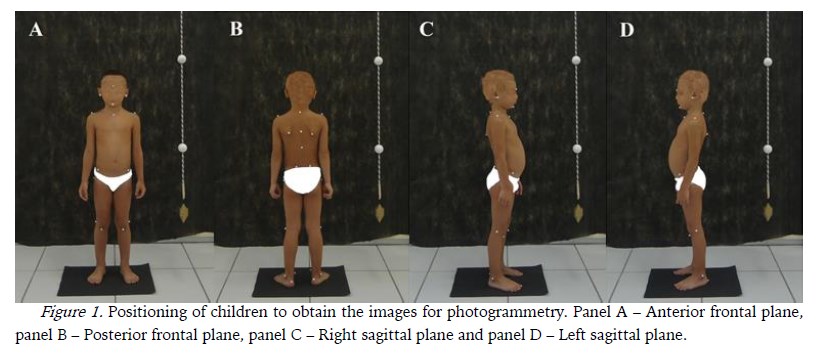
<body><![CDATA[<p><font size="2">Initially, the height (m) and body mass (kg) of the children were measured by using an anthropometric scale. Body mass index (BMI) was calculated by dividing the mass by the height squared.</font></p>     <p><font size="2">Prior   to the original study, the inter-examiner reliability was tested. Prior to the   initiation of the study, the postural photogrammetric measurements of 13   children were assessed by three raters who were familiar with the SAPO program.   The images obtained were subsequently delivered to the evaluators, with the   following guidelines: calibrate the picture, score points according to the   protocol, generate the analysis report, and export results to Excel (Microsoft   Office<sup>®</sup>). For the analysis of intra-examiner reliability, postural   photogrammetry was performed twice at an interval of 1 week, by a single evaluator. </font></p>     <p><font size="2">For   photogrammetric analysis, markers made with half of 15-mm Styrofoam balls were   placed on the following anatomical points in the participants’ bodies:   glabella, earlobes, chin, acromions, manubrium of the sternum, inferior angle   of the scapula, spinous processes of C7, T6 and T12, anterior superior and   upper posterior iliac spines, greater trochanter of the femur, knee joint lines, anterior tuberosity of the tibia, malleolus, and calcaneus.</font></p>     <p><font size="2">The children remained   positioned on foot to obtain postural images in the sagittal and frontal planes   (<a href="/img/revistas/mot/v11n4/11n4a07f1.jpg">Figure 1</a>). For this, a digital camera was positioned on a tripod (height, 1.63   m) at 90º and 1.9 m from the participant. The camera was adjusted for image   enlargement to allow approximately 0.5-m free space above and below the subject to minimize any distortion of image edges (Ferreira et al., 2010).</font></p>     
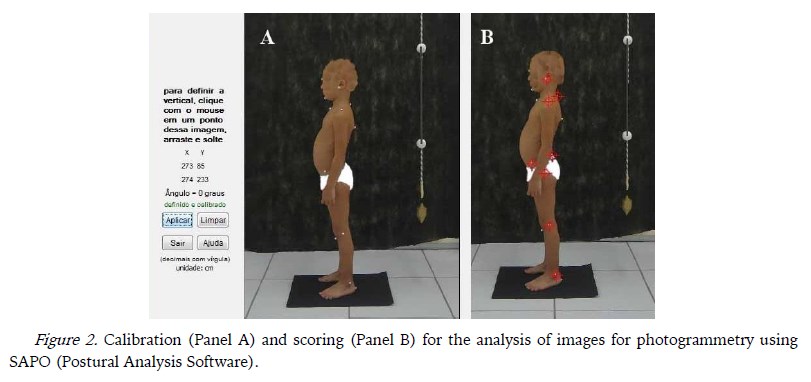
<p><font size="2">A plumb line   marked with two Styrofoam balls at a distance of 0.5 m was used for vertical   calibration of the software, which obtained the number of pixels spanning the   plumb line, which the program converts into centimeters, storing the result as   an internal variable (<a href="/img/revistas/mot/v11n4/11n4a07f2.jpg">Figure 2</a>). Thus, the following variables were analyzed on   photographic images by using the SAPO software: horizontal head alignment,   horizontal alignment of the acromion, horizontal anterior superior iliac spine   (ASIS) alignment, angle between 2 acromions and 2 ASIS, frontal angle of the   right and left lower limbs, right and left Q angles, horizontal asymmetry of   the scapula relative to T3, right and left knee angles, and right and left ankle angles (Ferreira et al., 2010).</font></p>     
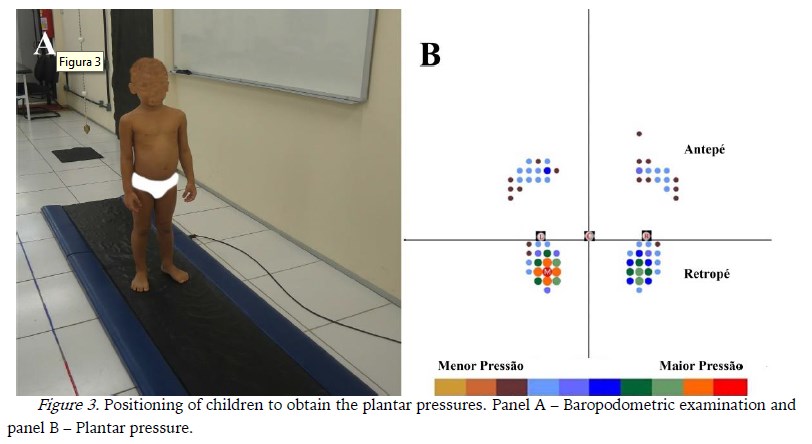
<p><font size="2">Thereafter,   each participant stood for 5–10 seconds on the electronic baropodometry   platform in a postural resting position, with arms at their sides, feet   slightly apart, being encouraged to stay as relaxed as possible in order to not   consciously affect posture during data acquisition. (Filippin, Barbosa, Sacco, &amp; Lobo da Costa, 2007) (<a href="/img/revistas/mot/v11n4/11n4a07f3.jpg">Figure 3</a>).</font></p>     
<p><font size="2">Finally,   foot morphology was assessed by using a single photographic image of both feet   while the participant stood, with relief of the bilateral weight, over a   podograph. The Staheli Arch Index (SAI) was used for evaluation of the medial   longitudinal arch of the footprints by calculating the ratio between the width   of the medial arch of the foot and the width of the heel (Staheli, Chew, &amp; Corbett, 1987).</font></p>     <p><font size="2">The   asymmetries observed during the evaluation of static posture were calculated by   determining the ratio between the smallest and largest values (Clark, 2001). This symmetry ratio   was adapted from Clark (2001) and determined with the   following equation, where X1 and X2 are the variables with the highest and lowest values, respectively:</font></p>     <p><font size="2"><b>Statistical analysis</b></font></p>     <p><font size="2">Descriptive   statistical and normality tests were performed by using the Sigma Stat   statistical software version 3.5 for Windows 3.5 (SPSS Inc. 2007). For data   with a normal distribution, Student’s <i>t</i> test was used, whereas for data   with non-normal distribution, a nonparametric test (Mann-Whitney or Wilcoxon   test) was used for comparison between the two groups. A descriptive analysis of   the parameters of postural photogrammetry, baropodometry, and the SAI values   was performed by calculating the frequency for the variables shown, the   symmetry ratio, the coefficient of variation (CV), and the magnitude of effect.   CV was defined as the ratio between the standard deviation and the mean (CV =   SD/<i>x</i>). The magnitude of the effect was calculated by using Cohen’s <i>d</i> (Cohen, 1994). Statistical analysis   of the inter- and intra-rater reliability of photogrammetry was analyzed by   using the intraclass correlation coefficient (ICC) index, considering a   significance level of p &lt; 0.05. An ICC value of 1 indicates that the angle   values were identical in the comparisons. ICC values lower than 0.70 were   considered not acceptable; those between 0.71 and 0.79, acceptable; those between 0.80 and 0.89, very good; and those higher than 0.90, excellent (Iunes et al., 2005).</font></p>     ]]></body>
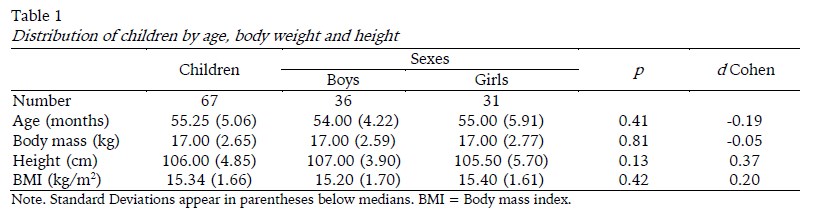
<body><![CDATA[<p><font size="2">Student’s <i>t</i>   test was used to compare sexes and feet, with the data having a normal   distribution.   Finally,   the Pearson correlation test for parametric data or Spearman coefficient for   nonparametric data was used for all the parameters. However, we only described   results with relevance correlations. The Spearman <i>r</i> was qualitatively   assessed as follows: <i>r</i> = 1 (perfect correlation), 0.7 &lt; r &lt; 0.9   (strong correlation), 0.4 &lt; r &lt; 0.7 (moderate correlation), 0.2 &lt; <i>r</i> &lt; 0.4 (weak correlation), and <i>r</i> = 0 (zero correlation). Pearson <i>r</i> correlations between 0.10 and 0.29 were considered weak, values between 0.30   and 0.49 were considered moderate, and values between 0.50 and 1 were   considered as strong. For all the analyses, the level of significance was set at p &lt; 0.05.</font></p> </font>     <p>&nbsp;</p>     <p><font size="3" face="Verdana"><b>RESULTS</b></font></p>     <p><font size="2" face="Verdana"><b>Anthropometric data</b></font></p>     <p><font size="2" face="Verdana"><a href="/img/revistas/mot/v11n4/11n4a07t1.jpg">Table 1</a> presents the   anthropometric data of the 67 children who comprised the study sample; 53.7%   were boys, and 46.3% were girls. No significant differences in anthropometric data   body mass (<i>W</i>= 0.96; <i>p</i>= 0.08) and height (<i>W</i>= 0.97; <i>p</i>= 0.34) were observed between the boys and girls.</font></p>     
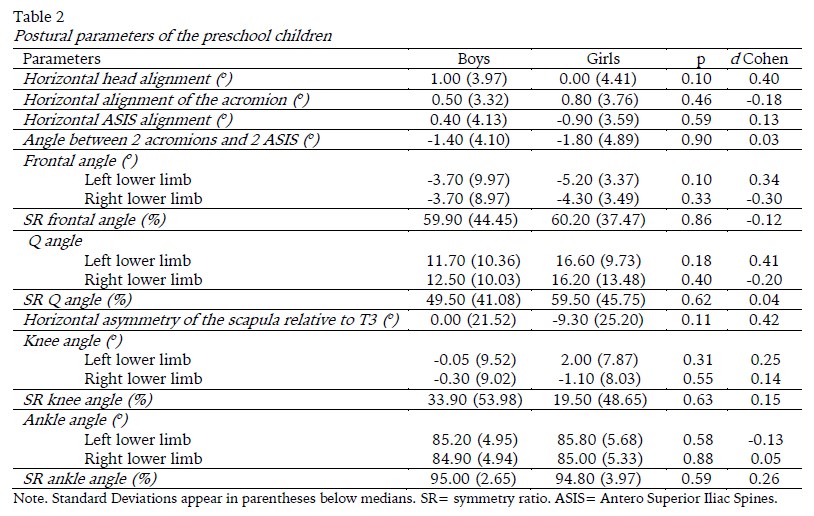
<p><font size="2" face="Verdana">Moderate and   significant positive correlations were observed between BMI and the foot   loadings on the left and right feet (<i>r</i>= 0.46, p&lt; 0.001 and <i>r</i>= 0.34, <i>p</i>= 0.005, respectively) in the study sample.</font></p>     <p><font size="2" face="Verdana"><i>Postural photogrammetric parameters</i></font></p>     <p><font size="2" face="Verdana">The   categorization of the adopted values and the results obtained demonstrate an   excellent inter-rater reliability (ICC &gt; 0.90) for 10 variables (34.4%),   good agreement (0.80 &gt; ICC &gt; 0.89) for 6 variables (20.7%), acceptable   agreement (0.70 &gt; ICC &gt; 0.79) for 3 variables (10.3%), and unacceptable   (ICC &lt; 0.70) for 10 variables (34.4%). The horizontal alignment of the head   with the left and right C7, the vertical alignment of the head with the left   and right acromions, the vertical alignment of the left and right torsos, the   vertical angles of the left and right body, the horizontal alignment of the   left and right pelvis, the difference in the lengths of the lower limbs, the   left and right hip angles (trunk/thigh), the horizontal alignment of the tibial   tuberosity, and the left and right leg/hindfoot angles showed low reliability and were thus excluded from the main analysis.</font></p>     <p><font size="2" face="Verdana"><a href="/img/revistas/mot/v11n4/11n4a07t2.jpg">Table 2</a>  displays the median and standard deviation values, besides the symmetry ratios   of the variables analyzed. The parameters analyzed showed no significant   difference between the lower limbs, and we found a small effect size of the   frontal angle between the left lower limb and right lower limb of   the boys (<i>d</i> Cohen = -0.05; <i>p</i>= 0.71) and of the girls (<i>d</i>   Cohen = -0.28; <i>p</i>= 0.27); a small effect size of the Q angle between   the lower limbs of the boys (<i>d</i> Cohen = -0.01; <i>p</i>= 0.79) and of the   girls (<i>d</i> Cohen = 0.13; <i>p</i>= 0.60); a small effect size of the knee   angle between the lower limbs of the boys (<i>d</i> Cohen = -0.16; <i>p</i>=   0.49) and of the girls (<i>d</i> Cohen = 0.24; <i>p</i> = 0.27);  and we found   also a small effect size of the ankle angle between the left lower limb and   right lower limb of the boys (<i>d</i> Cohen = 0.06; <i>p</i> =0.78) and of the girls (<i>d</i> Cohen = 0.14; <i>p</i>= 0.57).</font></p>     
<p><font size="2" face="Verdana">The   parameters analyzed showed no significant difference between the sexes. With   the exception of the SR ankle angle, all the other SR values were lower than   90%, indicating postural asymmetry in the sample. Photogrammetry parameters   presented CV with values ranging from 5.9% to 1999%. The variable with the   greatest variation was the horizontal alignment of the head and that with the least variation was the ankle angle.</font></p>     ]]></body>
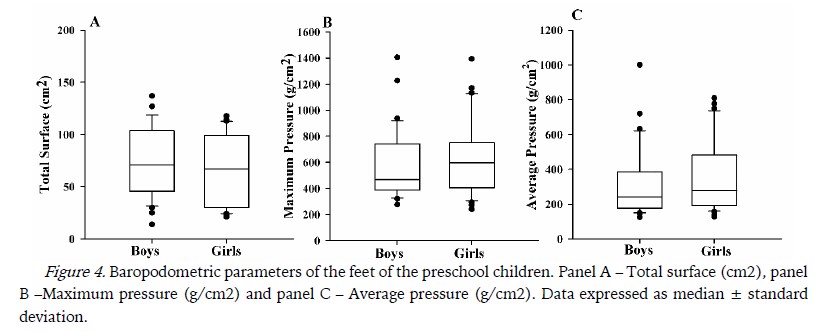
<body><![CDATA[<p><font size="2" face="Verdana"><i>Baropodometric parameters</i></font></p>     <p><font size="2" face="Verdana"><a href="/img/revistas/mot/v11n4/11n4a07f4.jpg">Figure 4</a>  shows the median and standard deviation values of the baropodometric data. The   total surface area was 71.0 ± 78.46 cm<sup>2</sup> for boys and 67.0 ± 33.01 cm<sup>2</sup>   for girls (<i>p</i>= 0.25). The maximum pressure was 467.50 ± 263.0 g/cm<sup>2</sup> for boys and 595.7 ± 283.28 g/cm<sup>2</sup> for girls (<i>p</i>= 0.47), and   the average pressure was 241.9 ± 197.33 g/cm<sup>2</sup> for boys and 211.35 ±   275.9 g/cm<sup>2</sup> for girls (<i>p</i>= 0.25).   Total surface (<i>W</i>= 0.57, <i>p</i> &lt;0.001), maximum pressure (<i>W</i>=   0.88, <i>p</i> &lt; 0.001), and average pressure (<i>W</i>= 0.84, <i>p</i> &lt; 0.001).</font></p>     
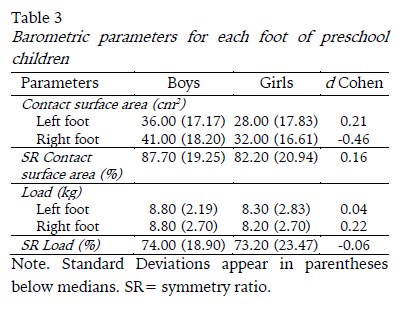
<p><font size="2" face="Verdana"><a href="#t3">Table 3</a>  shows the median and standard deviation values, and symmetry ratios of the   variables for each foot of the children aged 4–5 years. No statistical   differences were observed between the surface of the left and right feet, or   between feet loading. We found a little negative effect size of the contact   surface area between the left foot and right foot of the boys (<i>d</i>   Cohen = -0.16; <i>p</i>= 0.71) and of the girls (<i>d</i> Cohen = -0.07; <i>p</i>=   0.34) and we found also a little positive effect size of the load between the   left foot and right foot of the boys (<i>d</i> Cohen = 0.12; <i>p</i>= 0.60) and of the girls (<i>d</i> Cohen = 0.54; <i>p</i>= 0.15).</font></p>     <p><a name="t3"></a></p>     <p>&nbsp;</p>     <p align="center"><img src="/img/revistas/mot/v11n4/11n4a07t3.jpg" width="404" height="314"></p>     
<p>&nbsp;</p>     <p><font size="2" face="Verdana">The surface   symmetry ratio was lower than 90% in 62.7% of the children (n = 42), while the   loading symmetry ratios were lower in 79.1% (n = 53) of the children tested. The baropodometric parameters had CV ranging from 29% to 82%.</font></p>     <p><font size="2" face="Verdana"><i>Foot morphology (SAI)</i></font></p>     <p><font size="2" face="Verdana">The median   and standard deviation values of the SAI for the left and right feet were 0.74   ± 0.05 and 0.70 ± 0.05, respectively, in the girls, and 0.82 ± 0.05 and 0.75 ±   0.05, respectively, in the boys, with no statistical difference between the   feet of the girls and those of the boys (<i>p</i>= 0.85 and <i>p</i>= 0.99,   respectively; <i>W</i>= 0.04 and <i>W</i>= &#8722;0.03, respectively). The   symmetry ratio of the foot morphology was 86.26% ± 9.49% for the boys and   83.52% ± 25.88% for the girls, with no statistically significant difference (p   = 0.74, <i>W</i> = 0.34). However, the median values were lower than 90%, indicating foot asymmetry. These parameters had CV ranging from 35% to 38%.</font></p>     ]]></body>
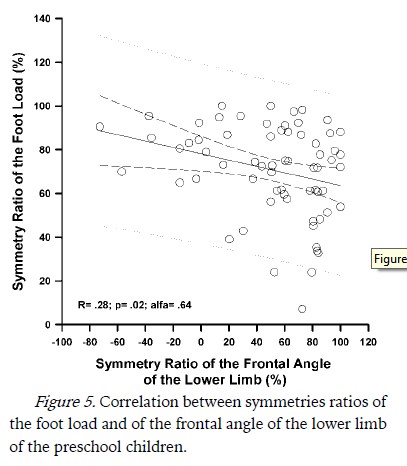
<body><![CDATA[<p><font size="2" face="Verdana"><i>Correlations of postural parameters, foot morphology, and foot loading</i></font></p>     <p><font size="2" face="Verdana">To better   understand the results, we only described the clinically significant   correlations. We found a non significant correlation between the surface RS and the RS of foot morphology (<i>r</i>= 0.07; <i>p</i>= 0.57).</font></p>     <p><font size="2" face="Verdana">We found a   weak negative correlation between the load RS and front-angle RS of the lower limbs (<i>r</i>= &#8722;0.28; <i>p</i>= 0.02; <a href="#f5">Figure 5</a>).</font></p>     <p><a name="f5"></a></p>     <p>&nbsp;</p>     <p align="center"><img src="/img/revistas/mot/v11n4/11n4a07f5.jpg" width="407" height="466"></p>     
<p>&nbsp;</p>     <p>&nbsp;</p>     <p><font size="3" face="Verdana"><b>DISCUSSION</b></font></p>     <p><font size="2" face="Verdana">The results   of this study indicated a postural and foot load distribution asymmetry in the   preschool children, which are in agreement with the results obtained in previous studies in children.</font></p>     ]]></body>
<body><![CDATA[<p><font size="2" face="Verdana">van Vlimmeren, Helders,   van Adrichem, and Engelbert (2004) reviewed   the literature and concluded that postural asymmetry in infancy is a diagnosis   with a large spectrum of functionalities and a multifactorial etiology; that no   consensus has been reached on its definition, nomenclature, and classification;   that data regarding the natural course of postural asymmetry are scarce; and that systematic management of asymmetry is greatly needed in infancy. </font></p>     <p><font size="2" face="Verdana">Juskeliene et al. (1996) found trunk asymmetry   in 46.9% of children aged 6–7 years, with a high prevalence similar to that   found in our study. The ratio between boys and girls was 1.18, and the   difference between the sexes was significantly different from that in our   sample, in which no significant difference was observed between the sexes.   These asymmetries were analyzed with different methods by using a symmetrograph   and plumb line and evaluating the angle between the seventh cervical vertebra   (C7) and lower angles of the scapulae. The discrepancy results may be partially justified by the difference in the instruments used in the studies.</font></p>     <p><font size="2" face="Verdana">Matsuda   and Demura (2013) analyzed plantar   pressure in children aged 3.5–6.5 years and concluded that the pressure   increases with age due to changes in the shape and formation of the   longitudinal arch of the foot, that the interindividual differences are large   but tend to decrease with age, and that the pressure ratio was slightly greater   on the right foot than on the left foot. These authors reported large interindividual variations, in agreement with the CV presented herein. </font></p>     <p><font size="2" face="Verdana">This study   was conducted with 67 preschool children, most of whom were eutrophic. The   characterization of our sample corroborates in part studies by Phethean and   Nester (2012) in which body mass and   the BMI of children 4–7 years of age showed a weak positive association with   plantar pressure data (<i>r</i> &#8804; 0.48, <i>p</i> &lt; 0.05), with no   significant differences in plantar pressures between the boys and girls. These   authors thus suggest that plantar pressure data do not require normalization to body weight or BMI, and can be applied for both boys and girls.</font></p>     <p><font size="2" face="Verdana">Other   authors such as Dowling, Steele, and   Baur (2004)   and Filippin, Barbosa,   Sacco, and Lobo da Costa (2007)   assert that   obese children (high BMI) who were older than our sample (age: 8.8 ± 2.0 and   9.6 ± 0.7 years) generate higher peak pressures. However, in their results, the   continuing effect of the excessive mass of the children seemed to flatten the   medial aspect of the foot. These children presented a developed medial plantar   arch, while the preschoolers had significantly different arch volumes of the   foot because their plantar arches were still developing (Chang, Hung, Wu, Chiu, &amp; Hsu, 2010).</font></p>     <p><font size="2" face="Verdana">In the   postural photogrammetry evaluations, the authors found no reference for   preschoolers in the literature. We only considered variables with acceptable   inter-rater agreement, that is, an ICC index &gt; 0.70. None of the variables   showed significant differences between the sexes, in disagreement with authors   who reported biomechanical and neuromuscular differences between the sexes,   such as Betts, Franks, Duckworth, and Burke (1980).</font></p>     <p><font size="2" face="Verdana">Örtqvist   et al. (2011)   evaluated healthy children aged 9–16 years and found that the reference values   for the knee angle (mean, 13.5° ± 1.9° and 15.3° ± 2.8°) varied according to   age and sex, and these values are similar to those we found for the Q angle. Lafond, Descarreaux,   Normand, and Harrison (2007)   evaluated the sagittal plane posture of children aged 4–12 years and found   significant sex-related differences in the parameters for the shoulder, pelvis,   and knee. These differences may be related to the differences in the ages of   the children in the studies. Studies that found sex-related differences included children older than our study sample.</font></p>     <p><font size="2" face="Verdana">Regarding   the baropodometric data such as total surface area (cm<sup>2</sup>), maximum   pressure (g/cm<sup>2</sup>), and mean pressure (g/cm<sup>2</sup>), we found few   studies with reference values for preschool children. In healthy children with   a mean age of 10 years, Dowling et al. (2004) found higher plantar   surface values than those found in the present study, in which the mean age of   the children was 4.6 years. In the present study, sex did not influence the   parameters measured, which is in agreement with the findings of Hennig, Staats, and   Rosenbaum (1994). </font></p>     <p><font size="2" face="Verdana">Bertsch, Unger,   Winkelmann, and Rosenbaum (2004) pointed out that during infancy, the fat pad present   in the midfoot reduces the load applied on the plantar region, protecting the   structures of the tarsal bones. A feature also indicated on the plantar   pressure distribution in children is that because of the difference in foot   size, pressure surges are considerably smaller in children, representing about   one third of the value found in adults. Early analysis of plantar pressure   distribution can reveal the interface between the plantar surface of the foot   and posture, allowing postural monitoring (Sazonov, Fulk, Hill, Schutz, &amp; Browning, 2011). </font></p>     <p><font size="2" face="Verdana">The present   study revealed a null correlation between surface symmetry and the symmetry of   the foot morphology. These results suggest that the foot morphology in   preschoolers cannot be evaluated through the baropodometry parameter of the foot surface.</font></p>     ]]></body>
<body><![CDATA[<p><font size="2" face="Verdana">Chen et al. (2010) evaluated footprints in   healthy children of different ages, and the mean SAI in children aged 5 years   was 1.05, similar to the mean value that we obtained (0.75). According to Staheli, Chew, and   Corbett (1987),   during childhood, normal SAI values are between 0.70 and 1.35, and the width of   the calcaneus is 1.3 times higher than that of the isthmus. Therefore, the   method of footprint analysis used in this study is adequate for diagnosis in   preschool children (Staheli et al., 1987), and our values are within normal parameter values for the foot morphology in children.</font></p>     <p><font size="2" face="Verdana">Asymmetries   at such an early age can be caused by congenital etiologies such as   torticollis, clubfoot, hip dislocation, and plagiocephaly caused by   intrauterine position (Behrman et al., 2000;   Nissinen et al., 1989).   In childhood, the lower limbs exhibit alignment variations such as rotations   and angular deformities, these variations being the result of normal growth and   development, which are resolved in part without treatment (Sass &amp; Hassan,   2003). In   preschool children, several studies have identified a high prevalence of   postural asymmetries classified as physiological and non-structural that could   be precursors of scoliosis (Juskeliene et al.,   1996; Nissinen et al., 1989; Vercauteren et al., 1982). The children evaluated in this   study are also in this age group, and the symmetry values for many of the   parameters were less than 90%, in agreement with the high prevalence of   asymmetry found in the literature. A two-year prospective study with 7,609   children aged 6 months or younger showed that postural asymmetry persisted in   25% of the children (Boere-Boonekamp &amp; van der Linden-Kuiper, 2001).</font></p>     <p><font size="2" face="Verdana">According to   Juskeliene et al. (1996), the three risk factors   of postural asymmetry are childhood rickets, a high incidence of acute illness,   and decreased levels of physical activity.  According to Latalski et al. (2013), besides the   relationship between physical activity and posture, they found also a relationship between family economic status and health status. </font></p>     <p><font size="2" face="Verdana">Although the   level of physical activity in our sample was not formally assessed, the   children clinically known to have no significant levels of physical activity or   nutritional support because they were children with social risks who were   entered in a neuromotor development program. Thus, the risks referred to by the   authors correlated with the risk to which the study population was subjected.   The embodiment of a physical activity and health education program, and a   prospective control of these asymmetries is an important requirement for this   group of children in order to prevent or reduce the risk of scoliosis and/or future structural asymmetries.</font></p>     <p><font size="2" face="Verdana">We therefore   suggest that in addition to physical activity and nutritional counseling, guidance   of children in this age group, as well as their families, should be provided   regarding the use of footwear with adequate flexibility and without heels, the   correct sleeping position with the appropriate pillow height and a mattress   with the ideal density for their body mass, and the use of pacifiers and   bottles at the right age. Furthermore, preschool children should be provided   with motor and sensory experiences to the feet to stimulate arch formation.   These strategies can minimize the appearance of biomechanical alterations related to postural imbalances. </font></p>     <p><font size="2" face="Verdana">The   limitations of this study must be acknowledged. Measurements of posture and   baropodometric parameters were not performed simultaneously, which might have   contributed to the lack of correlation between some of the measurements.   Nevertheless, baropodometry is suitable for measuring plantar pressure   distribution, and its analysis is predictive of postural symmetry (Gurfinkel, Ivanenko YuP, Levik YuS, &amp; Babakova, 1995).</font></p>     <p><font size="2" face="Verdana">Postural   analysis by performing photogrammetry also has its limitations. Poletto, Sato, Carnaz,   Lobo da Costa, and Gil Coury (2007), indicated differences in results even when   evaluating parameters obtained from the same photograph, such as the symmetry   of the knee evaluated in the frontal plane, and that pictures obtained (e.g.,   right and left knee profile) could influence the outcome of symmetry. The   observation made by the authors can justify the fact that most of the   parameters of postural symmetry showed no significant correlation with any of the parameters of the static baropodometric symmetry.</font></p>     <p><font size="2" face="Verdana">Another limitation is the very large interindividual   differences with high CV mainly in the posture evaluation by photogrammetry (CV   = 5.9%-1999%), even though Santos, Silva, Sanada, and Alves (2009) referred to this as a viable method and has the potential to generate baseline data on postural alignment in children.</font></p>     <p><font size="2" face="Verdana">According to   Filippin et al. (2007), the variability of the   measurements in developing children is a concern. For the variables of peak,   mean, and maximum pressures during walking, the authors found CV of 16%–41%. In   this study, higher CVs were found for the baropodometric parameters, ranging   from 29% to 82%. In a study that assessed the ratio of anteroposterior foot   pressure in children aged 3.5–6.5 years, the interindividual differences were   great but tended to decrease with age (Matsuda &amp; Demura, 2013).</font></p>     <p><font size="2" face="Verdana">Postural   asymmetries in childhood have a multifactorial etiology. Although no consensus   has been reached regarding its definition, classifications, and nomenclature,   and data regarding its natural course are scarce, there is a great need for   systematic management of asymmetry in infancy (van Vlimmeren et al.,   2004).   Future studies should be conducted with a larger sample size to allow the   establishment of age categories in a prospective study to follow up asymmetry   postures throughout early childhood by using the load and foot morphology assessment methods used in this study.</font></p>     ]]></body>
<body><![CDATA[<p>&nbsp;</p> <font size="3" face="Verdana"><b>CONCLUSIONS</b></font><font face="Verdana">     <p><font size="2">Thus, we   conclude that children in the age group studied had a high frequency of   postural asymmetries, especially in the knee, without any difference between   the sexes. For this reason, although asymmetries are a common feature of   development, they are poorly studied. While most asymmetries are spontaneously   resolved, early postural assessment can support the detection and intervention   of disorders of the developing musculoskeletal system and prevent locomotor system adaptations to alter the biomechanical conditions of the individual.</font></p>     <p><font size="2">Therefore,   prospective studies should be conducted with children to monitor these   asymmetries, their causes, and correlations for the prevention of structural   asymmetries such as idiopathic scoliosis. Postural education programs should be implemented early in children’s lives.</font></p>     <p><font size="2">Moreover,   these results provide the basis for a more accurate assessment of postural   changes and deformities in pediatric feet through baropodometric and evaluation   methods for foot morphology that are suitable for this purpose. In addition,   another method for assessing body composition should then be investigated to demonstrate a good correlation with foot load distribution parameters.</font></p> </font>     <p>&nbsp;</p>     <p><font size="3" face="Verdana"><b>REFERENCES</b></font></p>     <!-- ref --><p><font size="2" face="Verdana">Behrman,   R. E., Kliegman, R., &amp; Jenson, B. (2000). <i>Nelson Textbook of Pediatrics</i> (16th ed.). Philadelphia: WB Saunders Co.    &nbsp;&nbsp;&nbsp;&nbsp;&nbsp;&nbsp;&nbsp;&nbsp;[&#160;<a href="javascript:void(0);" onclick="javascript: window.open('/scielo.php?script=sci_nlinks&ref=353093&pid=S1646-107X201500040000700001&lng=','','width=640,height=500,resizable=yes,scrollbars=1,menubar=yes,');">Links</a>&#160;]<!-- end-ref --></font></p>     <!-- ref --><p><font size="2" face="Verdana">Bertsch, C., Unger, H., Winkelmann, W.,   &amp; Rosenbaum, D. (2004). Evaluation of early walking patterns from plantar   pressure distribution measurements. First year results of 42 children. <i>Gait   &amp; Posture</i>, <i>19</i>(3), 235–242. <a href="http://doi.org/10.1016/S0966-6362(03)00064-X" target="_blank">http://doi.org/10.1016/S0966-6362(03)00064-X</a></font>&nbsp;&nbsp;&nbsp;&nbsp;&nbsp;&nbsp;&nbsp;&nbsp;[&#160;<a href="javascript:void(0);" onclick="javascript: window.open('/scielo.php?script=sci_nlinks&ref=353095&pid=S1646-107X201500040000700002&lng=','','width=640,height=500,resizable=yes,scrollbars=1,menubar=yes,');">Links</a>&#160;]<!-- end-ref --><!-- ref --><p><font size="2" face="Verdana">Betts, R. P., Franks, C. I., Duckworth,   T., &amp; Burke, J. (1980). Static and dynamic foot-pressure measurements in   clinical orthopaedics. <i>Medical &amp; Biological Engineering &amp; Computing</i>, <i>18</i>(5), 674–684.    &nbsp;&nbsp;&nbsp;&nbsp;&nbsp;&nbsp;&nbsp;&nbsp;[&#160;<a href="javascript:void(0);" onclick="javascript: window.open('/scielo.php?script=sci_nlinks&ref=353096&pid=S1646-107X201500040000700003&lng=','','width=640,height=500,resizable=yes,scrollbars=1,menubar=yes,');">Links</a>&#160;]<!-- end-ref --></font></p>     <!-- ref --><p><font size="2" face="Verdana">Boere-Boonekamp, M. M., &amp; van der   Linden-Kuiper, L. T. (2001). Positional preference: prevalence in infants and follow-up after two years. <i>Pediatrics</i>, <i>107</i>(2), 339–343.    &nbsp;&nbsp;&nbsp;&nbsp;&nbsp;&nbsp;&nbsp;&nbsp;[&#160;<a href="javascript:void(0);" onclick="javascript: window.open('/scielo.php?script=sci_nlinks&ref=353098&pid=S1646-107X201500040000700004&lng=','','width=640,height=500,resizable=yes,scrollbars=1,menubar=yes,');">Links</a>&#160;]<!-- end-ref --></font></p>     <!-- ref --><p><font size="2" face="Verdana">Bruner, E., Mantini, S., Guerrini, V.,   Ciccarelli, A., Giombini, A., Borrione, P., … Ripani, M. (2009). Preliminary   shape analysis of the outline of the baropodometric foot: patterns of   covariation, allometry, sex and age differences, and loading variations. <i>The Journal of Sports Medicine and Physical Fitness</i>, <i>49</i>(3), 246–254.    &nbsp;&nbsp;&nbsp;&nbsp;&nbsp;&nbsp;&nbsp;&nbsp;[&#160;<a href="javascript:void(0);" onclick="javascript: window.open('/scielo.php?script=sci_nlinks&ref=353100&pid=S1646-107X201500040000700005&lng=','','width=640,height=500,resizable=yes,scrollbars=1,menubar=yes,');">Links</a>&#160;]<!-- end-ref --></font></p>     <!-- ref --><p><font size="2" face="Verdana">Chang, Y. W., Hung, W., Wu, H., Chiu, Y.   C., &amp; Hsu, H. C. (2010). Measurements of foot arch in standing, level   walking, vertical jump and sprint start. <i>International Journal of Sport and Exercise Science</i>, <i>2</i>(2), 35–42.    &nbsp;&nbsp;&nbsp;&nbsp;&nbsp;&nbsp;&nbsp;&nbsp;[&#160;<a href="javascript:void(0);" onclick="javascript: window.open('/scielo.php?script=sci_nlinks&ref=353102&pid=S1646-107X201500040000700006&lng=','','width=640,height=500,resizable=yes,scrollbars=1,menubar=yes,');">Links</a>&#160;]<!-- end-ref --></font></p>     <!-- ref --><p><font size="2" face="Verdana">Chen, K.-C., Yeh, C.-J., Kuo, J.-F.,   Hsieh, C.-L., Yang, S.-F., &amp; Wang, C.-H. (2010). Footprint analysis of   flatfoot in preschool-aged children. <i>European Journal of Pediatrics</i>, <i>170</i>(5), 611–617. <a href="http://doi.org/10.1007/s00431-010-1330-4" target="_blank">http://doi.org/10.1007/s00431-010-1330-4</a></font>&nbsp;&nbsp;&nbsp;&nbsp;&nbsp;&nbsp;&nbsp;&nbsp;[&#160;<a href="javascript:void(0);" onclick="javascript: window.open('/scielo.php?script=sci_nlinks&ref=353104&pid=S1646-107X201500040000700007&lng=','','width=640,height=500,resizable=yes,scrollbars=1,menubar=yes,');">Links</a>&#160;]<!-- end-ref --><!-- ref --><p><font size="2" face="Verdana">Cheng, J. C., &amp; Au, A. W. (1994). Infantile   torticollis: a review of 624 cases. <i>Journal of Pediatric Orthopedics</i>, <i>14</i>(6), 802–808.    &nbsp;&nbsp;&nbsp;&nbsp;&nbsp;&nbsp;&nbsp;&nbsp;[&#160;<a href="javascript:void(0);" onclick="javascript: window.open('/scielo.php?script=sci_nlinks&ref=353105&pid=S1646-107X201500040000700008&lng=','','width=640,height=500,resizable=yes,scrollbars=1,menubar=yes,');">Links</a>&#160;]<!-- end-ref --></font></p>     ]]></body>
<body><![CDATA[<!-- ref --><p><font size="2" face="Verdana">Clark, N. C. (2001). Functional   performance testing following knee ligament injury. <i>Physical Therapy in Sport</i>, <i>2</i>(2), 91–105. <a href="http://doi.org/10.1054/ptsp.2001.0035" target="_blank">http://doi.org/10.1054/ptsp.2001.0035</a></font>&nbsp;&nbsp;&nbsp;&nbsp;&nbsp;&nbsp;&nbsp;&nbsp;[&#160;<a href="javascript:void(0);" onclick="javascript: window.open('/scielo.php?script=sci_nlinks&ref=353107&pid=S1646-107X201500040000700009&lng=','','width=640,height=500,resizable=yes,scrollbars=1,menubar=yes,');">Links</a>&#160;]<!-- end-ref --><!-- ref --><p><font size="2" face="Verdana">Cohen, J. (1994). The earth is round (p&#8194;&lt;&#8194;.05). <i>American   Psychologist</i>, <i>49</i>(12), 997–1003. <a href="http://doi.org/10.1037/0003-066X.49.12.997" target="_blank">http://doi.org/10.1037/0003-066X.49.12.997</a></font>&nbsp;&nbsp;&nbsp;&nbsp;&nbsp;&nbsp;&nbsp;&nbsp;[&#160;<a href="javascript:void(0);" onclick="javascript: window.open('/scielo.php?script=sci_nlinks&ref=353108&pid=S1646-107X201500040000700010&lng=','','width=640,height=500,resizable=yes,scrollbars=1,menubar=yes,');">Links</a>&#160;]<!-- end-ref --><!-- ref --><p><font size="2" face="Verdana">Dowling, A. M., Steele, J. R., &amp; Baur,   L. A. (2004). What are the effects of obesity in children on plantar pressure   distributions? <i>International Journal of Obesity</i>, <i>28</i>(11), 1514–1519. <a href="http://doi.org/10.1038/sj.ijo.0802729" target="_blank">http://doi.org/10.1038/sj.ijo.0802729</a></font>&nbsp;&nbsp;&nbsp;&nbsp;&nbsp;&nbsp;&nbsp;&nbsp;[&#160;<a href="javascript:void(0);" onclick="javascript: window.open('/scielo.php?script=sci_nlinks&ref=353109&pid=S1646-107X201500040000700011&lng=','','width=640,height=500,resizable=yes,scrollbars=1,menubar=yes,');">Links</a>&#160;]<!-- end-ref --><!-- ref --><p><font size="2" face="Verdana">Ferreira, E. A. G., Duarte, M., Maldonado,   E. P., Burke, T. N., &amp; Marques, A. P. (2010). Postural assessment software   (PAS/SAPO): validation and reliabiliy. <i>Clinics</i>, <i>65</i>(7), 675–681. <a href="http://doi.org/10.1590/S1807-59322010000700005" target="_blank">http://doi.org/10.1590/S1807-59322010000700005</a></font>&nbsp;&nbsp;&nbsp;&nbsp;&nbsp;&nbsp;&nbsp;&nbsp;[&#160;<a href="javascript:void(0);" onclick="javascript: window.open('/scielo.php?script=sci_nlinks&ref=353110&pid=S1646-107X201500040000700012&lng=','','width=640,height=500,resizable=yes,scrollbars=1,menubar=yes,');">Links</a>&#160;]<!-- end-ref --><!-- ref --><p><font size="2" face="Verdana">Filippin, N. T., Barbosa, V. L. P., Sacco,   I. C. N., &amp; Lobo da Costa, P. H. (2007). Efeitos da obesidade na   distribuição de pressão plantar em crianças. <i>Brazilian Journal     of Physical Therapy</i>, <i>11</i>(6), 495–501. <a href="http://doi.org/10.1590/S1413-35552007000600012" target="_blank">http://doi.org/10.1590/S1413-35552007000600012</a></font>&nbsp;&nbsp;&nbsp;&nbsp;&nbsp;&nbsp;&nbsp;&nbsp;[&#160;<a href="javascript:void(0);" onclick="javascript: window.open('/scielo.php?script=sci_nlinks&ref=353111&pid=S1646-107X201500040000700013&lng=','','width=640,height=500,resizable=yes,scrollbars=1,menubar=yes,');">Links</a>&#160;]<!-- end-ref --><!-- ref --><p><font size="2" face="Verdana">Gurfinkel, V. S., Ivanenko YuP,  null,   Levik YuS,  null, &amp; Babakova, I. A. (1995). Kinesthetic reference for human orthograde posture. <i>Neuroscience</i>, <i>68</i>(1), 229–243.    &nbsp;&nbsp;&nbsp;&nbsp;&nbsp;&nbsp;&nbsp;&nbsp;[&#160;<a href="javascript:void(0);" onclick="javascript: window.open('/scielo.php?script=sci_nlinks&ref=353112&pid=S1646-107X201500040000700014&lng=','','width=640,height=500,resizable=yes,scrollbars=1,menubar=yes,');">Links</a>&#160;]<!-- end-ref --></font></p>     <!-- ref --><p><font size="2" face="Verdana">Hennig, E. M., Staats, A., &amp;   Rosenbaum, D. (1994). Plantar pressure distribution patterns of young school   children in comparison to adults. <i>Foot &amp; Ankle International</i>, <i>15</i>(1), 35–40.    &nbsp;&nbsp;&nbsp;&nbsp;&nbsp;&nbsp;&nbsp;&nbsp;[&#160;<a href="javascript:void(0);" onclick="javascript: window.open('/scielo.php?script=sci_nlinks&ref=353114&pid=S1646-107X201500040000700015&lng=','','width=640,height=500,resizable=yes,scrollbars=1,menubar=yes,');">Links</a>&#160;]<!-- end-ref --></font></p>     <!-- ref --><p><font size="2" face="Verdana">Iunes, D. H., Castro, F. A., Salgado, H.   S., Moura, I. C., Oliveira, A. S., &amp; Bevilaqua-Grossi, D. (2005).   Confiabilidade intra e interexaminadores e repetibilidade da avaliação postural   pela fotogrametria. <i>Brazilian Journal of Physical Therapy</i>, <i>9</i>(3), 327–334.    &nbsp;&nbsp;&nbsp;&nbsp;&nbsp;&nbsp;&nbsp;&nbsp;[&#160;<a href="javascript:void(0);" onclick="javascript: window.open('/scielo.php?script=sci_nlinks&ref=353116&pid=S1646-107X201500040000700016&lng=','','width=640,height=500,resizable=yes,scrollbars=1,menubar=yes,');">Links</a>&#160;]<!-- end-ref --></font></p>     <!-- ref --><p><font size="2" face="Verdana">Juskeliene, V., Magnus, P., Bakketeig, L.   S., Dailidiene, N., &amp; Jurkuvenas, V. (1996). Prevalence and risk factors   for asymmetric posture in preschool children aged 6-7 years. <i>International Journal of Epidemiology</i>, <i>25</i>(5), 1053–1059.    &nbsp;&nbsp;&nbsp;&nbsp;&nbsp;&nbsp;&nbsp;&nbsp;[&#160;<a href="javascript:void(0);" onclick="javascript: window.open('/scielo.php?script=sci_nlinks&ref=353118&pid=S1646-107X201500040000700017&lng=','','width=640,height=500,resizable=yes,scrollbars=1,menubar=yes,');">Links</a>&#160;]<!-- end-ref --></font></p>     <!-- ref --><p><font size="2" face="Verdana">Kellis, E. (2001). Plantar pressure   distribution during barefoot standing, walking and landing in preschool boys. <i>Gait &amp; Posture</i>, <i>14</i>(2), 92–97.    &nbsp;&nbsp;&nbsp;&nbsp;&nbsp;&nbsp;&nbsp;&nbsp;[&#160;<a href="javascript:void(0);" onclick="javascript: window.open('/scielo.php?script=sci_nlinks&ref=353120&pid=S1646-107X201500040000700018&lng=','','width=640,height=500,resizable=yes,scrollbars=1,menubar=yes,');">Links</a>&#160;]<!-- end-ref --></font></p>     <!-- ref --><p><font size="2" face="Verdana">Krat&#283;nová, J., ŽEjglicová, K.,   Malý, M.,   &amp; Filipová, V.   (2007). Prevalence and Risk Factors of Poor Posture in School Children in the   Czech Republic. <i>Journal of School Health</i>, <i>77</i>(3), 131–137. <a href="http://doi.org/10.1111/j.1746-1561.2007.00182.x" target="_blank">http://doi.org/10.1111/j.1746-1561.2007.00182.x</a></font>&nbsp;&nbsp;&nbsp;&nbsp;&nbsp;&nbsp;&nbsp;&nbsp;[&#160;<a href="javascript:void(0);" onclick="javascript: window.open('/scielo.php?script=sci_nlinks&ref=353122&pid=S1646-107X201500040000700019&lng=','','width=640,height=500,resizable=yes,scrollbars=1,menubar=yes,');">Links</a>&#160;]<!-- end-ref --><!-- ref --><p><font size="2" face="Verdana">Lafond, D., Descarreaux, M., Normand, M.   C., &amp; Harrison, D. E. (2007). Postural development in school children: a   cross-sectional study. <i>Chiropractic &amp; Osteopathy</i>, <i>15</i>, 1. <a href="http://doi.org/10.1186/1746-1340-15-1" target="_blank">http://doi.org/10.1186/1746-1340-15-1</a></font>&nbsp;&nbsp;&nbsp;&nbsp;&nbsp;&nbsp;&nbsp;&nbsp;[&#160;<a href="javascript:void(0);" onclick="javascript: window.open('/scielo.php?script=sci_nlinks&ref=353123&pid=S1646-107X201500040000700020&lng=','','width=640,height=500,resizable=yes,scrollbars=1,menubar=yes,');">Links</a>&#160;]<!-- end-ref --><!-- ref --><p><font size="2" face="Verdana">Latalski, M., Bylina, J., Fatyga, M.,   Repko, M., Filipovic, M., Jarosz, M. J., … Trzpis, T. (2013). Risk factors of   postural defects in children at school age. <i>Annals of Agricultural and Environmental Medicine: AAEM</i>, <i>20</i>(3), 583–587.    &nbsp;&nbsp;&nbsp;&nbsp;&nbsp;&nbsp;&nbsp;&nbsp;[&#160;<a href="javascript:void(0);" onclick="javascript: window.open('/scielo.php?script=sci_nlinks&ref=353124&pid=S1646-107X201500040000700021&lng=','','width=640,height=500,resizable=yes,scrollbars=1,menubar=yes,');">Links</a>&#160;]<!-- end-ref --></font></p>     <!-- ref --><p><font size="2" face="Verdana">Matsuda, S., &amp; Demura, S. (2013).   Age-related, interindividual, and right/left differences in anterior-posterior   foot pressure ratio in preschool children. <i>Journal of Physiological Anthropology</i>, <i>32</i>, 8. <a href="http://doi.org/10.1186/1880-6805-32-8" target="_blank">http://doi.org/10.1186/1880-6805-32-8</a></font>&nbsp;&nbsp;&nbsp;&nbsp;&nbsp;&nbsp;&nbsp;&nbsp;[&#160;<a href="javascript:void(0);" onclick="javascript: window.open('/scielo.php?script=sci_nlinks&ref=353126&pid=S1646-107X201500040000700022&lng=','','width=640,height=500,resizable=yes,scrollbars=1,menubar=yes,');">Links</a>&#160;]<!-- end-ref --><!-- ref --><p><font size="2" face="Verdana">McMaster, M. J. (1983). Infantile   idiopathic scoliosis: can it be prevented? <i>The Journal of Bone and Joint Surgery. British Volume</i>, <i>65</i>(5), 612–617.    &nbsp;&nbsp;&nbsp;&nbsp;&nbsp;&nbsp;&nbsp;&nbsp;[&#160;<a href="javascript:void(0);" onclick="javascript: window.open('/scielo.php?script=sci_nlinks&ref=353127&pid=S1646-107X201500040000700023&lng=','','width=640,height=500,resizable=yes,scrollbars=1,menubar=yes,');">Links</a>&#160;]<!-- end-ref --></font></p>     <!-- ref --><p><font size="2" face="Verdana">Nissinen, M., Heliövaara, M., Tallroth,   K., &amp; Poussa, M. (1989). Trunk asymmetry and scoliosis: Anthropometric   measurements in prepuberal school children. <i>Acta Pædiatrica</i>, <i>78</i>(5), 747–753. <a href="http://doi.org/10.1111/j.1651-2227.1989.tb11137.x" target="_blank">http://doi.org/10.1111/j.1651-2227.1989.tb11137.x</a></font>&nbsp;&nbsp;&nbsp;&nbsp;&nbsp;&nbsp;&nbsp;&nbsp;[&#160;<a href="javascript:void(0);" onclick="javascript: window.open('/scielo.php?script=sci_nlinks&ref=353129&pid=S1646-107X201500040000700024&lng=','','width=640,height=500,resizable=yes,scrollbars=1,menubar=yes,');">Links</a>&#160;]<!-- end-ref --><!-- ref --><p><font size="2" face="Verdana">Örtqvist, M., Moström, E. B., Roos, E. M.,   Lundell, P., Janarv, P.-M., Werner, S., &amp; Broström, E. W. (2011). Reliability   and reference values of two clinical measurements of dynamic and static knee   position in healthy children. <i>Knee Surgery, Sports Traumatology, Arthroscopy</i>, <i>19</i>(12), 2060–2066. <a href="http://doi.org/10.1007/s00167-011-1542-9" target="_blank">http://doi.org/10.1007/s00167-011-1542-9</a></font>&nbsp;&nbsp;&nbsp;&nbsp;&nbsp;&nbsp;&nbsp;&nbsp;[&#160;<a href="javascript:void(0);" onclick="javascript: window.open('/scielo.php?script=sci_nlinks&ref=353130&pid=S1646-107X201500040000700025&lng=','','width=640,height=500,resizable=yes,scrollbars=1,menubar=yes,');">Links</a>&#160;]<!-- end-ref --><!-- ref --><p><font size="2" face="Verdana">Peskin, M., Spitzer, S., Peleg, T., &amp;   Zalsman, G. (2011). [Nosology, assessment and diagnosis of psychiatric   disorders in early childhood]. <i>Harefuah</i>, <i>150</i>(4), 353–358, 419, 418.    &nbsp;&nbsp;&nbsp;&nbsp;&nbsp;&nbsp;&nbsp;&nbsp;[&#160;<a href="javascript:void(0);" onclick="javascript: window.open('/scielo.php?script=sci_nlinks&ref=353131&pid=S1646-107X201500040000700026&lng=','','width=640,height=500,resizable=yes,scrollbars=1,menubar=yes,');">Links</a>&#160;]<!-- end-ref --></font></p>     <!-- ref --><p><font size="2" face="Verdana">Phethean, J., &amp; Nester, C. (2012). The   influence of body weight, body mass index and gender on plantar pressures:   results of a cross-sectional study of healthy children’s feet. <i>Gait &amp;   Posture</i>, <i>36</i>(2), 287–290. <a href="http://doi.org/10.1016/j.gaitpost.2012.03.012" target="_blank">http://doi.org/10.1016/j.gaitpost.2012.03.012</a></font>&nbsp;&nbsp;&nbsp;&nbsp;&nbsp;&nbsp;&nbsp;&nbsp;[&#160;<a href="javascript:void(0);" onclick="javascript: window.open('/scielo.php?script=sci_nlinks&ref=353133&pid=S1646-107X201500040000700027&lng=','','width=640,height=500,resizable=yes,scrollbars=1,menubar=yes,');">Links</a>&#160;]<!-- end-ref --><!-- ref --><p><font size="2" face="Verdana">Rochat, P., &amp; Goubet, N. (1995). Development   of sitting and reaching in 5- to 6-month-old infants. <i>Infant Behavior and     Development</i>, <i>18</i>(1), 53–68. <a href="http://doi.org/10.1016/0163-6383(95)90007-1" target="_blank">http://doi.org/10.1016/0163-6383(95)90007-1</a></font>&nbsp;&nbsp;&nbsp;&nbsp;&nbsp;&nbsp;&nbsp;&nbsp;[&#160;<a href="javascript:void(0);" onclick="javascript: window.open('/scielo.php?script=sci_nlinks&ref=353134&pid=S1646-107X201500040000700028&lng=','','width=640,height=500,resizable=yes,scrollbars=1,menubar=yes,');">Links</a>&#160;]<!-- end-ref --><!-- ref --><p><font size="2" face="Verdana">Santos, M. M., Silva, M. P. C., Sanada, L.   S., &amp; Alves, C. R. J. (2009). Photogrammetric postural analysis on healthy   seven to ten-year-old children: interrater reliability. <i>Brazilian Journal of     Physical Therapy</i>, <i>13</i>(4), 350–355. <a href="http://doi.org/10.1590/S1413-35552009005000047" target="_blank">http://doi.org/10.1590/S1413-35552009005000047</a></font>&nbsp;&nbsp;&nbsp;&nbsp;&nbsp;&nbsp;&nbsp;&nbsp;[&#160;<a href="javascript:void(0);" onclick="javascript: window.open('/scielo.php?script=sci_nlinks&ref=353135&pid=S1646-107X201500040000700029&lng=','','width=640,height=500,resizable=yes,scrollbars=1,menubar=yes,');">Links</a>&#160;]<!-- end-ref --><!-- ref --><p><font size="2" face="Verdana">Sass, P., &amp; Hassan, G. (2003). Lower   extremity abnormalities in children. <i>American Family Physician</i>, <i>68</i>(3), 461–468.    &nbsp;&nbsp;&nbsp;&nbsp;&nbsp;&nbsp;&nbsp;&nbsp;[&#160;<a href="javascript:void(0);" onclick="javascript: window.open('/scielo.php?script=sci_nlinks&ref=353136&pid=S1646-107X201500040000700030&lng=','','width=640,height=500,resizable=yes,scrollbars=1,menubar=yes,');">Links</a>&#160;]<!-- end-ref --></font></p>     <!-- ref --><p><font size="2" face="Verdana">Sazonov, E. S., Fulk, G., Hill, J.,   Schutz, Y., &amp; Browning, R. (2011). Monitoring of posture allocations and   activities by a shoe-based wearable sensor. <i>IEEE Transactions on Bio-Medical     Engineering</i>, <i>58</i>(4), 983–990. <a href="http://doi.org/10.1109/TBME.2010.2046738" target="_blank">http://doi.org/10.1109/TBME.2010.2046738</a></font>&nbsp;&nbsp;&nbsp;&nbsp;&nbsp;&nbsp;&nbsp;&nbsp;[&#160;<a href="javascript:void(0);" onclick="javascript: window.open('/scielo.php?script=sci_nlinks&ref=353138&pid=S1646-107X201500040000700031&lng=','','width=640,height=500,resizable=yes,scrollbars=1,menubar=yes,');">Links</a>&#160;]<!-- end-ref --><!-- ref --><p><font size="2" face="Verdana">Staheli, L. T., Chew, D. E., &amp;   Corbett, M. (1987). The longitudinal arch. A survey of eight hundred and   eighty-two feet in normal children and adults. <i>The Journal of Bone and Joint Surgery. American Volume</i>, <i>69</i>(3), 426–428.    &nbsp;&nbsp;&nbsp;&nbsp;&nbsp;&nbsp;&nbsp;&nbsp;[&#160;<a href="javascript:void(0);" onclick="javascript: window.open('/scielo.php?script=sci_nlinks&ref=353139&pid=S1646-107X201500040000700032&lng=','','width=640,height=500,resizable=yes,scrollbars=1,menubar=yes,');">Links</a>&#160;]<!-- end-ref --></font></p>     <!-- ref --><p><font size="2" face="Verdana">St John, D., Mulliken, J. B., Kaban, L.   B., &amp; Padwa, B. L. (2002). Anthropometric analysis of mandibular asymmetry   in infants with deformational posterior plagiocephaly. <i>Journal of Oral and     Maxillofacial Surgery: Official Journal of the American Association of Oral and Maxillofacial Surgeons</i>, <i>60</i>(8), 873–877.    &nbsp;&nbsp;&nbsp;&nbsp;&nbsp;&nbsp;&nbsp;&nbsp;[&#160;<a href="javascript:void(0);" onclick="javascript: window.open('/scielo.php?script=sci_nlinks&ref=353141&pid=S1646-107X201500040000700033&lng=','','width=640,height=500,resizable=yes,scrollbars=1,menubar=yes,');">Links</a>&#160;]<!-- end-ref --></font></p>     <!-- ref --><p><font size="2" face="Verdana">Stebbins, J. A., Harrington, M. E.,   Giacomozzi, C., Thompson, N., Zavatsky, A., &amp; Theologis, T. N. (2005).   Assessment of sub-division of plantar pressure measurement in children. <i>Gait &amp;   Posture</i>, <i>22</i>(4), 372–376. <a href="http://doi.org/10.1016/j.gaitpost.2004.10.004" target="_blank">http://doi.org/10.1016/j.gaitpost.2004.10.004</a></font>&nbsp;&nbsp;&nbsp;&nbsp;&nbsp;&nbsp;&nbsp;&nbsp;[&#160;<a href="javascript:void(0);" onclick="javascript: window.open('/scielo.php?script=sci_nlinks&ref=353143&pid=S1646-107X201500040000700034&lng=','','width=640,height=500,resizable=yes,scrollbars=1,menubar=yes,');">Links</a>&#160;]<!-- end-ref --><!-- ref --><p><font size="2" face="Verdana">Van Maanen, C. J., Zonnenberg, A. J.,   Elvers, J. W., &amp; Oostendorp, R. A. (1996). Intra/interrater   reliability of measurements on body posture photographs. <i>Cranio: The Journal of Craniomandibular Practice</i>, <i>14</i>(4), 326–331.    &nbsp;&nbsp;&nbsp;&nbsp;&nbsp;&nbsp;&nbsp;&nbsp;[&#160;<a href="javascript:void(0);" onclick="javascript: window.open('/scielo.php?script=sci_nlinks&ref=353144&pid=S1646-107X201500040000700035&lng=','','width=640,height=500,resizable=yes,scrollbars=1,menubar=yes,');">Links</a>&#160;]<!-- end-ref --></font></p>     <!-- ref --><p><font size="2" face="Verdana">van Vlimmeren, L. A., Helders, P. J. M.,   van Adrichem, L. N. A., &amp; Engelbert, R. H. H. (2004). Diagnostic strategies   for the evaluation of asymmetry in infancy-a review. <i>European Journal of Pediatrics</i>, <i>163</i>(4–5), 185–191. <a href="http://doi.org/10.1007/s00431-004-1412-2" target="_blank">http://doi.org/10.1007/s00431-004-1412-2</a></font>&nbsp;&nbsp;&nbsp;&nbsp;&nbsp;&nbsp;&nbsp;&nbsp;[&#160;<a href="javascript:void(0);" onclick="javascript: window.open('/scielo.php?script=sci_nlinks&ref=353146&pid=S1646-107X201500040000700036&lng=','','width=640,height=500,resizable=yes,scrollbars=1,menubar=yes,');">Links</a>&#160;]<!-- end-ref --><!-- ref --><p><font size="2" face="Verdana">Vercauteren, M., Van Beneden, M.,   Verplaetse, R., Croene, P., Uyttendaele, D., &amp; Verdonk, R. (1982). Trunk asymmetries in a Belgian school population. <i>Spine</i>, <i>7</i>(6), 555–562.    &nbsp;&nbsp;&nbsp;&nbsp;&nbsp;&nbsp;&nbsp;&nbsp;[&#160;<a href="javascript:void(0);" onclick="javascript: window.open('/scielo.php?script=sci_nlinks&ref=353147&pid=S1646-107X201500040000700037&lng=','','width=640,height=500,resizable=yes,scrollbars=1,menubar=yes,');">Links</a>&#160;]<!-- end-ref --></font></p>     <!-- ref --><p><font size="2" face="Verdana">Watson, A. W., &amp; Mac Donncha, C.   (2000). A reliable technique for the assessment of posture: assessment criteria   for aspects of posture. <i>The Journal of Sports Medicine and Physical Fitness</i>, <i>40</i>(3), 260–270.    &nbsp;&nbsp;&nbsp;&nbsp;&nbsp;&nbsp;&nbsp;&nbsp;[&#160;<a href="javascript:void(0);" onclick="javascript: window.open('/scielo.php?script=sci_nlinks&ref=353149&pid=S1646-107X201500040000700038&lng=','','width=640,height=500,resizable=yes,scrollbars=1,menubar=yes,');">Links</a>&#160;]<!-- end-ref --></font></p>     <p>&nbsp;</p>     <p><font size="2" face="Verdana"><b>Acknowledgment:</b>    <br>   Nothing to declare.    <br>   <b>Conflict     of interest:    <br>   </b>Nothing to declare.    <br>   <b>Funding:    ]]></body>
<body><![CDATA[<br> </b>Nothing to declare.</font></p>     <p><font size="2" face="Verdana">Manuscript received at June 22<sup>nd</sup> 2014; Accepted at December 17<sup>th</sup> 2014 </font></p>     <p>&nbsp;</p>     <p>&nbsp;</p>     <p><font size="2" face="Verdana"><a href="#topo">*</a><i><a name="end" id="end"></a>Corresponding   author</i>: Dr. Jos&eacute; Louren&ccedil;o, 3308, 1102 apt, Joaquim T&aacute;vora, Fortaleza,   Cear&aacute;, Brazil, telephone mumber:+5585997663814 <i>E-mail</i>: <a href="mailto:kvvc2004@yahoo.com.br">kvvc2004@yahoo.com.br</a></font></p>      ]]></body><back>
<ref-list>
<ref id="B1">
<nlm-citation citation-type="book">
<person-group person-group-type="author">
<name>
<surname><![CDATA[Behrman]]></surname>
<given-names><![CDATA[R. E.]]></given-names>
</name>
<name>
<surname><![CDATA[Kliegman]]></surname>
<given-names><![CDATA[R.]]></given-names>
</name>
<name>
<surname><![CDATA[Jenson]]></surname>
<given-names><![CDATA[B.]]></given-names>
</name>
</person-group>
<source><![CDATA[Nelson Textbook of Pediatrics]]></source>
<year>2000</year>
<edition>16</edition>
<publisher-loc><![CDATA[Philadelphia ]]></publisher-loc>
<publisher-name><![CDATA[WB Saunders Co]]></publisher-name>
</nlm-citation>
</ref>
<ref id="B2">
<nlm-citation citation-type="journal">
<person-group person-group-type="author">
<name>
<surname><![CDATA[Bertsch]]></surname>
<given-names><![CDATA[C.]]></given-names>
</name>
<name>
<surname><![CDATA[Unger]]></surname>
<given-names><![CDATA[H.]]></given-names>
</name>
<name>
<surname><![CDATA[Winkelmann]]></surname>
<given-names><![CDATA[W.]]></given-names>
</name>
<name>
<surname><![CDATA[Rosenbaum]]></surname>
<given-names><![CDATA[D.]]></given-names>
</name>
</person-group>
<article-title xml:lang="en"><![CDATA[Evaluation of early walking patterns from plantar pressure distribution measurements: First year results of 42 children]]></article-title>
<source><![CDATA[Gait & Posture]]></source>
<year>2004</year>
<volume>19</volume>
<numero>3</numero>
<issue>3</issue>
<page-range>235-242</page-range></nlm-citation>
</ref>
<ref id="B3">
<nlm-citation citation-type="journal">
<person-group person-group-type="author">
<name>
<surname><![CDATA[Betts]]></surname>
<given-names><![CDATA[R. P.]]></given-names>
</name>
<name>
<surname><![CDATA[Franks]]></surname>
<given-names><![CDATA[C. I.]]></given-names>
</name>
<name>
<surname><![CDATA[Duckworth]]></surname>
<given-names><![CDATA[T.]]></given-names>
</name>
<name>
<surname><![CDATA[Burke]]></surname>
<given-names><![CDATA[J.]]></given-names>
</name>
</person-group>
<article-title xml:lang="en"><![CDATA[Static and dynamic foot-pressure measurements in clinical orthopaedics]]></article-title>
<source><![CDATA[Medical & Biological Engineering & Computing]]></source>
<year>1980</year>
<volume>18</volume>
<numero>5</numero>
<issue>5</issue>
<page-range>674-684</page-range></nlm-citation>
</ref>
<ref id="B4">
<nlm-citation citation-type="journal">
<person-group person-group-type="author">
<name>
<surname><![CDATA[Boere-Boonekamp]]></surname>
<given-names><![CDATA[M. M.]]></given-names>
</name>
<name>
<surname><![CDATA[van der Linden-Kuiper]]></surname>
<given-names><![CDATA[L. T.]]></given-names>
</name>
</person-group>
<article-title xml:lang="en"><![CDATA[Positional preference: prevalence in infants and follow-up after two years]]></article-title>
<source><![CDATA[Pediatrics]]></source>
<year>2001</year>
<volume>107</volume>
<numero>2</numero>
<issue>2</issue>
<page-range>339-343</page-range></nlm-citation>
</ref>
<ref id="B5">
<nlm-citation citation-type="journal">
<person-group person-group-type="author">
<name>
<surname><![CDATA[Bruner]]></surname>
<given-names><![CDATA[E.]]></given-names>
</name>
<name>
<surname><![CDATA[Mantini]]></surname>
<given-names><![CDATA[S.]]></given-names>
</name>
<name>
<surname><![CDATA[Guerrini]]></surname>
<given-names><![CDATA[V.]]></given-names>
</name>
<name>
<surname><![CDATA[Ciccarelli]]></surname>
<given-names><![CDATA[A.]]></given-names>
</name>
<name>
<surname><![CDATA[Giombini]]></surname>
<given-names><![CDATA[A.]]></given-names>
</name>
<name>
<surname><![CDATA[Borrione]]></surname>
<given-names><![CDATA[P.]]></given-names>
</name>
<name>
<surname><![CDATA[Ripani]]></surname>
<given-names><![CDATA[M.]]></given-names>
</name>
</person-group>
<article-title xml:lang="en"><![CDATA[Preliminary shape analysis of the outline of the baropodometric foot: patterns of covariation, allometry, sex and age differences, and loading variations]]></article-title>
<source><![CDATA[The Journal of Sports Medicine and Physical Fitness]]></source>
<year>2009</year>
<volume>49</volume>
<numero>3</numero>
<issue>3</issue>
<page-range>246-254</page-range></nlm-citation>
</ref>
<ref id="B6">
<nlm-citation citation-type="journal">
<person-group person-group-type="author">
<name>
<surname><![CDATA[Chang]]></surname>
<given-names><![CDATA[Y. W.]]></given-names>
</name>
<name>
<surname><![CDATA[Hung]]></surname>
<given-names><![CDATA[W.]]></given-names>
</name>
<name>
<surname><![CDATA[Wu]]></surname>
<given-names><![CDATA[H.]]></given-names>
</name>
<name>
<surname><![CDATA[Chiu]]></surname>
<given-names><![CDATA[Y. C.]]></given-names>
</name>
<name>
<surname><![CDATA[Hsu]]></surname>
<given-names><![CDATA[H. C.]]></given-names>
</name>
</person-group>
<article-title xml:lang="en"><![CDATA[Measurements of foot arch in standing, level walking, vertical jump and sprint start]]></article-title>
<source><![CDATA[International Journal of Sport and Exercise Science]]></source>
<year>2010</year>
<volume>2</volume>
<numero>2</numero>
<issue>2</issue>
<page-range>35-42</page-range></nlm-citation>
</ref>
<ref id="B7">
<nlm-citation citation-type="journal">
<person-group person-group-type="author">
<name>
<surname><![CDATA[Chen]]></surname>
<given-names><![CDATA[K.-C.]]></given-names>
</name>
<name>
<surname><![CDATA[Yeh]]></surname>
<given-names><![CDATA[C.-J.]]></given-names>
</name>
<name>
<surname><![CDATA[Kuo]]></surname>
<given-names><![CDATA[J.-F.]]></given-names>
</name>
<name>
<surname><![CDATA[Hsieh]]></surname>
<given-names><![CDATA[C.-L.]]></given-names>
</name>
<name>
<surname><![CDATA[Yang]]></surname>
<given-names><![CDATA[S.-F.]]></given-names>
</name>
<name>
<surname><![CDATA[Wang]]></surname>
<given-names><![CDATA[C.-H.]]></given-names>
</name>
</person-group>
<article-title xml:lang="en"><![CDATA[Footprint analysis of flatfoot in preschool-aged children]]></article-title>
<source><![CDATA[European Journal of Pediatrics]]></source>
<year>2010</year>
<volume>170</volume>
<numero>5</numero>
<issue>5</issue>
<page-range>611-617</page-range></nlm-citation>
</ref>
<ref id="B8">
<nlm-citation citation-type="journal">
<person-group person-group-type="author">
<name>
<surname><![CDATA[Cheng]]></surname>
<given-names><![CDATA[J. C.]]></given-names>
</name>
<name>
<surname><![CDATA[Au]]></surname>
<given-names><![CDATA[A. W.]]></given-names>
</name>
</person-group>
<article-title xml:lang="en"><![CDATA[Infantile torticollis: a review of 624 cases]]></article-title>
<source><![CDATA[Journal of Pediatric Orthopedics]]></source>
<year>1994</year>
<volume>14</volume>
<numero>6</numero>
<issue>6</issue>
<page-range>802-808</page-range></nlm-citation>
</ref>
<ref id="B9">
<nlm-citation citation-type="journal">
<person-group person-group-type="author">
<name>
<surname><![CDATA[Clark]]></surname>
<given-names><![CDATA[N. C.]]></given-names>
</name>
</person-group>
<article-title xml:lang="en"><![CDATA[Functional performance testing following knee ligament injury]]></article-title>
<source><![CDATA[Physical Therapy in Sport]]></source>
<year>2001</year>
<volume>2</volume>
<numero>2</numero>
<issue>2</issue>
<page-range>91-105</page-range></nlm-citation>
</ref>
<ref id="B10">
<nlm-citation citation-type="journal">
<person-group person-group-type="author">
<name>
<surname><![CDATA[Cohen]]></surname>
<given-names><![CDATA[J.]]></given-names>
</name>
</person-group>
<article-title xml:lang="en"><![CDATA[The earth is round (p&#8194;<&#8194;.05)]]></article-title>
<source><![CDATA[American Psychologist]]></source>
<year>1994</year>
<volume>49</volume>
<numero>12</numero>
<issue>12</issue>
<page-range>997-1003</page-range></nlm-citation>
</ref>
<ref id="B11">
<nlm-citation citation-type="journal">
<person-group person-group-type="author">
<name>
<surname><![CDATA[Dowling]]></surname>
<given-names><![CDATA[A. M.]]></given-names>
</name>
<name>
<surname><![CDATA[Steele]]></surname>
<given-names><![CDATA[J. R.]]></given-names>
</name>
<name>
<surname><![CDATA[Baur]]></surname>
<given-names><![CDATA[L. A.]]></given-names>
</name>
</person-group>
<article-title xml:lang="en"><![CDATA[What are the effects of obesity in children on plantar pressure distributions?]]></article-title>
<source><![CDATA[International Journal of Obesity]]></source>
<year>2004</year>
<volume>28</volume>
<numero>11</numero>
<issue>11</issue>
<page-range>1514-1519</page-range></nlm-citation>
</ref>
<ref id="B12">
<nlm-citation citation-type="journal">
<person-group person-group-type="author">
<name>
<surname><![CDATA[Ferreira]]></surname>
<given-names><![CDATA[E. A. G.]]></given-names>
</name>
<name>
<surname><![CDATA[Duarte]]></surname>
<given-names><![CDATA[M.]]></given-names>
</name>
<name>
<surname><![CDATA[Maldonado]]></surname>
<given-names><![CDATA[E. P.]]></given-names>
</name>
<name>
<surname><![CDATA[Burke]]></surname>
<given-names><![CDATA[T. N.]]></given-names>
</name>
<name>
<surname><![CDATA[Marques]]></surname>
<given-names><![CDATA[A. P.]]></given-names>
</name>
</person-group>
<article-title xml:lang="en"><![CDATA[Postural assessment software (PAS/SAPO): validation and reliabiliy]]></article-title>
<source><![CDATA[Clinics]]></source>
<year>2010</year>
<volume>65</volume>
<numero>7</numero>
<issue>7</issue>
<page-range>675-681</page-range></nlm-citation>
</ref>
<ref id="B13">
<nlm-citation citation-type="journal">
<person-group person-group-type="author">
<name>
<surname><![CDATA[Filippin]]></surname>
<given-names><![CDATA[N. T.]]></given-names>
</name>
<name>
<surname><![CDATA[Barbosa]]></surname>
<given-names><![CDATA[V. L. P.]]></given-names>
</name>
<name>
<surname><![CDATA[Sacco]]></surname>
<given-names><![CDATA[I. C. N.]]></given-names>
</name>
<name>
<surname><![CDATA[Lobo da Costa]]></surname>
<given-names><![CDATA[P. H.]]></given-names>
</name>
</person-group>
<article-title xml:lang="pt"><![CDATA[Efeitos da obesidade na distribuição de pressão plantar em crianças]]></article-title>
<source><![CDATA[Brazilian Journal of Physical Therapy]]></source>
<year>2007</year>
<volume>11</volume>
<numero>6</numero>
<issue>6</issue>
<page-range>495-501</page-range></nlm-citation>
</ref>
<ref id="B14">
<nlm-citation citation-type="journal">
<person-group person-group-type="author">
<name>
<surname><![CDATA[Gurfinkel]]></surname>
<given-names><![CDATA[V. S.]]></given-names>
</name>
<name>
<surname><![CDATA[Ivanenko YuP]]></surname>
</name>
<name>
<surname><![CDATA[Levik YuS]]></surname>
</name>
<name>
<surname><![CDATA[Babakova]]></surname>
<given-names><![CDATA[I. A.]]></given-names>
</name>
</person-group>
<article-title xml:lang="en"><![CDATA[Kinesthetic reference for human orthograde posture]]></article-title>
<source><![CDATA[Neuroscience]]></source>
<year>1995</year>
<volume>68</volume>
<numero>1</numero>
<issue>1</issue>
<page-range>229-243</page-range></nlm-citation>
</ref>
<ref id="B15">
<nlm-citation citation-type="journal">
<person-group person-group-type="author">
<name>
<surname><![CDATA[Hennig]]></surname>
<given-names><![CDATA[E. M.]]></given-names>
</name>
<name>
<surname><![CDATA[Staats]]></surname>
<given-names><![CDATA[A.]]></given-names>
</name>
<name>
<surname><![CDATA[Rosenbaum]]></surname>
<given-names><![CDATA[D.]]></given-names>
</name>
</person-group>
<article-title xml:lang="en"><![CDATA[Plantar pressure distribution patterns of young school children in comparison to adults]]></article-title>
<source><![CDATA[Foot & Ankle International]]></source>
<year>1994</year>
<volume>15</volume>
<numero>1</numero>
<issue>1</issue>
<page-range>35-40</page-range></nlm-citation>
</ref>
<ref id="B16">
<nlm-citation citation-type="journal">
<person-group person-group-type="author">
<name>
<surname><![CDATA[Iunes]]></surname>
<given-names><![CDATA[D. H.]]></given-names>
</name>
<name>
<surname><![CDATA[Castro]]></surname>
<given-names><![CDATA[F. A.]]></given-names>
</name>
<name>
<surname><![CDATA[Salgado]]></surname>
<given-names><![CDATA[H. S.]]></given-names>
</name>
<name>
<surname><![CDATA[Moura]]></surname>
<given-names><![CDATA[I. C.]]></given-names>
</name>
<name>
<surname><![CDATA[Oliveira]]></surname>
<given-names><![CDATA[A. S.]]></given-names>
</name>
<name>
<surname><![CDATA[Bevilaqua-Grossi]]></surname>
<given-names><![CDATA[D.]]></given-names>
</name>
</person-group>
<article-title xml:lang="pt"><![CDATA[Confiabilidade intra e interexaminadores e repetibilidade da avaliação postural pela fotogrametria]]></article-title>
<source><![CDATA[Brazilian Journal of Physical Therapy]]></source>
<year>2005</year>
<volume>9</volume>
<numero>3</numero>
<issue>3</issue>
<page-range>327-334</page-range></nlm-citation>
</ref>
<ref id="B17">
<nlm-citation citation-type="journal">
<person-group person-group-type="author">
<name>
<surname><![CDATA[Juskeliene]]></surname>
<given-names><![CDATA[V.]]></given-names>
</name>
<name>
<surname><![CDATA[Magnus]]></surname>
<given-names><![CDATA[P.]]></given-names>
</name>
<name>
<surname><![CDATA[Bakketeig]]></surname>
<given-names><![CDATA[L. S.]]></given-names>
</name>
<name>
<surname><![CDATA[Dailidiene]]></surname>
<given-names><![CDATA[N.]]></given-names>
</name>
<name>
<surname><![CDATA[Jurkuvenas]]></surname>
<given-names><![CDATA[V.]]></given-names>
</name>
</person-group>
<article-title xml:lang="en"><![CDATA[Prevalence and risk factors for asymmetric posture in preschool children aged 6-7 years]]></article-title>
<source><![CDATA[International Journal of Epidemiology]]></source>
<year>1996</year>
<volume>25</volume>
<numero>5</numero>
<issue>5</issue>
<page-range>1053-1059</page-range></nlm-citation>
</ref>
<ref id="B18">
<nlm-citation citation-type="journal">
<person-group person-group-type="author">
<name>
<surname><![CDATA[Kellis]]></surname>
<given-names><![CDATA[E.]]></given-names>
</name>
</person-group>
<article-title xml:lang="en"><![CDATA[Plantar pressure distribution during barefoot standing, walking and landing in preschool boys]]></article-title>
<source><![CDATA[Gait & Posture]]></source>
<year>2001</year>
<volume>14</volume>
<numero>2</numero>
<issue>2</issue>
<page-range>92-97</page-range></nlm-citation>
</ref>
<ref id="B19">
<nlm-citation citation-type="journal">
<person-group person-group-type="author">
<name>
<surname><![CDATA[Krat&#283;nová]]></surname>
<given-names><![CDATA[J.]]></given-names>
</name>
<name>
<surname><![CDATA[ŽEjglicová]]></surname>
<given-names><![CDATA[K.]]></given-names>
</name>
<name>
<surname><![CDATA[Malý]]></surname>
<given-names><![CDATA[M.]]></given-names>
</name>
<name>
<surname><![CDATA[Filipová]]></surname>
<given-names><![CDATA[V.]]></given-names>
</name>
</person-group>
<article-title xml:lang="en"><![CDATA[Prevalence and Risk Factors of Poor Posture in School Children in the Czech Republic]]></article-title>
<source><![CDATA[Journal of School Health]]></source>
<year>2007</year>
<volume>77</volume>
<numero>3</numero>
<issue>3</issue>
<page-range>131-137</page-range></nlm-citation>
</ref>
<ref id="B20">
<nlm-citation citation-type="journal">
<person-group person-group-type="author">
<name>
<surname><![CDATA[Lafond]]></surname>
<given-names><![CDATA[D.]]></given-names>
</name>
<name>
<surname><![CDATA[Descarreaux]]></surname>
<given-names><![CDATA[M.]]></given-names>
</name>
<name>
<surname><![CDATA[Normand]]></surname>
<given-names><![CDATA[M. C.]]></given-names>
</name>
<name>
<surname><![CDATA[Harrison]]></surname>
<given-names><![CDATA[D. E.]]></given-names>
</name>
</person-group>
<article-title xml:lang="en"><![CDATA[Postural development in school children: a cross-sectional study]]></article-title>
<source><![CDATA[Chiropractic & Osteopathy]]></source>
<year>2007</year>
<volume>15</volume>
<numero>1</numero>
<issue>1</issue>
</nlm-citation>
</ref>
<ref id="B21">
<nlm-citation citation-type="journal">
<person-group person-group-type="author">
<name>
<surname><![CDATA[Latalski]]></surname>
<given-names><![CDATA[M.]]></given-names>
</name>
<name>
<surname><![CDATA[Bylina]]></surname>
<given-names><![CDATA[J.]]></given-names>
</name>
<name>
<surname><![CDATA[Fatyga]]></surname>
<given-names><![CDATA[M.]]></given-names>
</name>
<name>
<surname><![CDATA[Repko]]></surname>
<given-names><![CDATA[M.]]></given-names>
</name>
<name>
<surname><![CDATA[Filipovic]]></surname>
<given-names><![CDATA[M.]]></given-names>
</name>
<name>
<surname><![CDATA[Jarosz]]></surname>
<given-names><![CDATA[M. J.]]></given-names>
</name>
<name>
<surname><![CDATA[Trzpis]]></surname>
<given-names><![CDATA[T.]]></given-names>
</name>
</person-group>
<article-title xml:lang="en"><![CDATA[Risk factors of postural defects in children at school age]]></article-title>
<source><![CDATA[Annals of Agricultural and Environmental Medicine: AAEM]]></source>
<year>2013</year>
<volume>20</volume>
<numero>3</numero>
<issue>3</issue>
<page-range>583-587</page-range></nlm-citation>
</ref>
<ref id="B22">
<nlm-citation citation-type="journal">
<person-group person-group-type="author">
<name>
<surname><![CDATA[Matsuda]]></surname>
<given-names><![CDATA[S.]]></given-names>
</name>
<name>
<surname><![CDATA[Demura]]></surname>
<given-names><![CDATA[S.]]></given-names>
</name>
</person-group>
<article-title xml:lang="en"><![CDATA[Age-related, interindividual, and right/left differences in anterior-posterior foot pressure ratio in preschool children]]></article-title>
<source><![CDATA[Journal of Physiological Anthropology]]></source>
<year>2013</year>
<volume>32</volume>
<numero>8</numero>
<issue>8</issue>
</nlm-citation>
</ref>
<ref id="B23">
<nlm-citation citation-type="journal">
<person-group person-group-type="author">
<name>
<surname><![CDATA[McMaster]]></surname>
<given-names><![CDATA[M. J.]]></given-names>
</name>
</person-group>
<article-title xml:lang="en"><![CDATA[Infantile idiopathic scoliosis: can it be prevented?]]></article-title>
<source><![CDATA[The Journal of Bone and Joint Surgery. British Volume]]></source>
<year>1983</year>
<volume>65</volume>
<numero>5</numero>
<issue>5</issue>
<page-range>612-617</page-range></nlm-citation>
</ref>
<ref id="B24">
<nlm-citation citation-type="journal">
<person-group person-group-type="author">
<name>
<surname><![CDATA[Nissinen]]></surname>
<given-names><![CDATA[M.]]></given-names>
</name>
<name>
<surname><![CDATA[Heliövaara]]></surname>
<given-names><![CDATA[M.]]></given-names>
</name>
<name>
<surname><![CDATA[Tallroth]]></surname>
<given-names><![CDATA[K.]]></given-names>
</name>
<name>
<surname><![CDATA[Poussa]]></surname>
<given-names><![CDATA[M.]]></given-names>
</name>
</person-group>
<article-title xml:lang="en"><![CDATA[Trunk asymmetry and scoliosis: Anthropometric measurements in prepuberal school children]]></article-title>
<source><![CDATA[Acta Pædiatrica]]></source>
<year>1989</year>
<volume>78</volume>
<numero>5</numero>
<issue>5</issue>
<page-range>747-753</page-range></nlm-citation>
</ref>
<ref id="B25">
<nlm-citation citation-type="journal">
<person-group person-group-type="author">
<name>
<surname><![CDATA[Örtqvist]]></surname>
<given-names><![CDATA[M.]]></given-names>
</name>
<name>
<surname><![CDATA[Moström]]></surname>
<given-names><![CDATA[E. B.]]></given-names>
</name>
<name>
<surname><![CDATA[Roos]]></surname>
<given-names><![CDATA[E. M.]]></given-names>
</name>
<name>
<surname><![CDATA[Lundell]]></surname>
<given-names><![CDATA[P.]]></given-names>
</name>
<name>
<surname><![CDATA[Janarv]]></surname>
<given-names><![CDATA[P.-M.]]></given-names>
</name>
<name>
<surname><![CDATA[Werner]]></surname>
<given-names><![CDATA[S.]]></given-names>
</name>
<name>
<surname><![CDATA[Broström]]></surname>
<given-names><![CDATA[E. W.]]></given-names>
</name>
</person-group>
<article-title xml:lang="en"><![CDATA[Reliability and reference values of two clinical measurements of dynamic and static knee position in healthy children]]></article-title>
<source><![CDATA[Knee Surgery, Sports Traumatology, Arthroscopy]]></source>
<year>2011</year>
<volume>19</volume>
<numero>12</numero>
<issue>12</issue>
<page-range>2060-2066</page-range></nlm-citation>
</ref>
<ref id="B26">
<nlm-citation citation-type="journal">
<person-group person-group-type="author">
<name>
<surname><![CDATA[Peskin]]></surname>
<given-names><![CDATA[M.]]></given-names>
</name>
<name>
<surname><![CDATA[Spitzer]]></surname>
<given-names><![CDATA[S.]]></given-names>
</name>
<name>
<surname><![CDATA[Peleg]]></surname>
<given-names><![CDATA[T.]]></given-names>
</name>
<name>
<surname><![CDATA[Zalsman]]></surname>
<given-names><![CDATA[G.]]></given-names>
</name>
</person-group>
<article-title xml:lang="en"><![CDATA[Nosology, assessment and diagnosis of psychiatric disorders in early childhood]]></article-title>
<source><![CDATA[Harefuah]]></source>
<year>2011</year>
<volume>150</volume>
<numero>4</numero>
<issue>4</issue>
<page-range>353-358</page-range><page-range>419</page-range><page-range>418</page-range></nlm-citation>
</ref>
<ref id="B27">
<nlm-citation citation-type="journal">
<person-group person-group-type="author">
<name>
<surname><![CDATA[Phethean]]></surname>
<given-names><![CDATA[J.]]></given-names>
</name>
<name>
<surname><![CDATA[Nester]]></surname>
<given-names><![CDATA[C.]]></given-names>
</name>
</person-group>
<article-title xml:lang="en"><![CDATA[The influence of body weight, body mass index and gender on plantar pressures: results of a cross-sectional study of healthy children’s feet]]></article-title>
<source><![CDATA[Gait & Posture]]></source>
<year>2012</year>
<volume>36</volume>
<numero>2</numero>
<issue>2</issue>
<page-range>287-290</page-range></nlm-citation>
</ref>
<ref id="B28">
<nlm-citation citation-type="journal">
<person-group person-group-type="author">
<name>
<surname><![CDATA[Rochat]]></surname>
<given-names><![CDATA[P.]]></given-names>
</name>
<name>
<surname><![CDATA[Goubet]]></surname>
<given-names><![CDATA[N.]]></given-names>
</name>
</person-group>
<article-title xml:lang="en"><![CDATA[Development of sitting and reaching in 5- to 6-month-old infants]]></article-title>
<source><![CDATA[Infant Behavior and Development]]></source>
<year>1995</year>
<volume>18</volume>
<numero>1</numero>
<issue>1</issue>
<page-range>53-68</page-range></nlm-citation>
</ref>
<ref id="B29">
<nlm-citation citation-type="journal">
<person-group person-group-type="author">
<name>
<surname><![CDATA[Santos]]></surname>
<given-names><![CDATA[M. M.]]></given-names>
</name>
<name>
<surname><![CDATA[Silva]]></surname>
<given-names><![CDATA[M. P. C.]]></given-names>
</name>
<name>
<surname><![CDATA[Sanada]]></surname>
<given-names><![CDATA[L. S.]]></given-names>
</name>
<name>
<surname><![CDATA[Alves]]></surname>
<given-names><![CDATA[C. R. J.]]></given-names>
</name>
</person-group>
<article-title xml:lang="en"><![CDATA[Photogrammetric postural analysis on healthy seven to ten-year-old children: interrater reliability]]></article-title>
<source><![CDATA[Brazilian Journal of Physical Therapy]]></source>
<year>2009</year>
<volume>13</volume>
<numero>4</numero>
<issue>4</issue>
<page-range>350-355</page-range></nlm-citation>
</ref>
<ref id="B30">
<nlm-citation citation-type="journal">
<person-group person-group-type="author">
<name>
<surname><![CDATA[Sass]]></surname>
<given-names><![CDATA[P.]]></given-names>
</name>
<name>
<surname><![CDATA[Hassan]]></surname>
<given-names><![CDATA[G.]]></given-names>
</name>
</person-group>
<article-title xml:lang="en"><![CDATA[Lower extremity abnormalities in children]]></article-title>
<source><![CDATA[American Family Physician]]></source>
<year>2003</year>
<volume>68</volume>
<numero>3</numero>
<issue>3</issue>
<page-range>461-468</page-range></nlm-citation>
</ref>
<ref id="B31">
<nlm-citation citation-type="journal">
<person-group person-group-type="author">
<name>
<surname><![CDATA[Sazonov]]></surname>
<given-names><![CDATA[E. S.]]></given-names>
</name>
<name>
<surname><![CDATA[Fulk]]></surname>
<given-names><![CDATA[G.]]></given-names>
</name>
<name>
<surname><![CDATA[Hill]]></surname>
<given-names><![CDATA[J.]]></given-names>
</name>
<name>
<surname><![CDATA[Schutz]]></surname>
<given-names><![CDATA[Y.]]></given-names>
</name>
<name>
<surname><![CDATA[Browning]]></surname>
<given-names><![CDATA[R.]]></given-names>
</name>
</person-group>
<article-title xml:lang="en"><![CDATA[Monitoring of posture allocations and activities by a shoe-based wearable sensor]]></article-title>
<source><![CDATA[IEEE Transactions on Bio-Medical Engineering]]></source>
<year>2011</year>
<volume>58</volume>
<numero>4</numero>
<issue>4</issue>
<page-range>983-990</page-range></nlm-citation>
</ref>
<ref id="B32">
<nlm-citation citation-type="journal">
<person-group person-group-type="author">
<name>
<surname><![CDATA[Staheli]]></surname>
<given-names><![CDATA[L. T.]]></given-names>
</name>
<name>
<surname><![CDATA[Chew]]></surname>
<given-names><![CDATA[D. E.]]></given-names>
</name>
<name>
<surname><![CDATA[Corbett]]></surname>
<given-names><![CDATA[M.]]></given-names>
</name>
</person-group>
<article-title xml:lang="en"><![CDATA[The longitudinal arch: A survey of eight hundred and eighty-two feet in normal children and adults]]></article-title>
<source><![CDATA[The Journal of Bone and Joint Surgery. American Volume]]></source>
<year>1987</year>
<volume>69</volume>
<numero>3</numero>
<issue>3</issue>
<page-range>426-428</page-range></nlm-citation>
</ref>
<ref id="B33">
<nlm-citation citation-type="journal">
<person-group person-group-type="author">
<name>
<surname><![CDATA[St John]]></surname>
<given-names><![CDATA[D.]]></given-names>
</name>
<name>
<surname><![CDATA[Mulliken]]></surname>
<given-names><![CDATA[J. B.]]></given-names>
</name>
<name>
<surname><![CDATA[Kaban]]></surname>
<given-names><![CDATA[L. B.]]></given-names>
</name>
<name>
<surname><![CDATA[Padwa]]></surname>
<given-names><![CDATA[B. L.]]></given-names>
</name>
</person-group>
<article-title xml:lang="en"><![CDATA[Anthropometric analysis of mandibular asymmetry in infants with deformational posterior plagiocephaly]]></article-title>
<source><![CDATA[Journal of Oral and Maxillofacial Surgery: Official Journal of the American Association of Oral and Maxillofacial Surgeons]]></source>
<year>2002</year>
<volume>60</volume>
<numero>8</numero>
<issue>8</issue>
<page-range>873-877</page-range></nlm-citation>
</ref>
<ref id="B34">
<nlm-citation citation-type="journal">
<person-group person-group-type="author">
<name>
<surname><![CDATA[Stebbins]]></surname>
<given-names><![CDATA[J. A.]]></given-names>
</name>
<name>
<surname><![CDATA[Harrington]]></surname>
<given-names><![CDATA[M. E.]]></given-names>
</name>
<name>
<surname><![CDATA[Giacomozzi]]></surname>
<given-names><![CDATA[C.]]></given-names>
</name>
<name>
<surname><![CDATA[Thompson]]></surname>
<given-names><![CDATA[N.]]></given-names>
</name>
<name>
<surname><![CDATA[Zavatsky]]></surname>
<given-names><![CDATA[A.]]></given-names>
</name>
<name>
<surname><![CDATA[Theologis]]></surname>
<given-names><![CDATA[T. N.]]></given-names>
</name>
</person-group>
<article-title xml:lang="en"><![CDATA[Assessment of sub-division of plantar pressure measurement in children]]></article-title>
<source><![CDATA[Gait & Posture]]></source>
<year>2005</year>
<volume>22</volume>
<numero>4</numero>
<issue>4</issue>
<page-range>372-376</page-range></nlm-citation>
</ref>
<ref id="B35">
<nlm-citation citation-type="journal">
<person-group person-group-type="author">
<name>
<surname><![CDATA[Van Maanen]]></surname>
<given-names><![CDATA[C. J.]]></given-names>
</name>
<name>
<surname><![CDATA[Zonnenberg]]></surname>
<given-names><![CDATA[A. J.]]></given-names>
</name>
<name>
<surname><![CDATA[Elvers]]></surname>
<given-names><![CDATA[J. W.]]></given-names>
</name>
<name>
<surname><![CDATA[Oostendorp]]></surname>
<given-names><![CDATA[R. A.]]></given-names>
</name>
</person-group>
<article-title xml:lang="en"><![CDATA[Intra/interrater reliability of measurements on body posture photographs]]></article-title>
<source><![CDATA[Cranio: The Journal of Craniomandibular Practice]]></source>
<year>1996</year>
<volume>14</volume>
<numero>4</numero>
<issue>4</issue>
<page-range>326-331</page-range></nlm-citation>
</ref>
<ref id="B36">
<nlm-citation citation-type="journal">
<person-group person-group-type="author">
<name>
<surname><![CDATA[van Vlimmeren]]></surname>
<given-names><![CDATA[L. A.]]></given-names>
</name>
<name>
<surname><![CDATA[Helders]]></surname>
<given-names><![CDATA[P. J. M.]]></given-names>
</name>
<name>
<surname><![CDATA[van Adrichem]]></surname>
<given-names><![CDATA[L. N. A.]]></given-names>
</name>
<name>
<surname><![CDATA[Engelbert]]></surname>
<given-names><![CDATA[R. H. H.]]></given-names>
</name>
</person-group>
<article-title xml:lang="en"><![CDATA[Diagnostic strategies for the evaluation of asymmetry in infancy-a review]]></article-title>
<source><![CDATA[European Journal of Pediatrics]]></source>
<year>2004</year>
<volume>163</volume>
<numero>4-5</numero>
<issue>4-5</issue>
<page-range>185-191</page-range></nlm-citation>
</ref>
<ref id="B37">
<nlm-citation citation-type="journal">
<person-group person-group-type="author">
<name>
<surname><![CDATA[Vercauteren]]></surname>
<given-names><![CDATA[M.]]></given-names>
</name>
<name>
<surname><![CDATA[Van Beneden]]></surname>
<given-names><![CDATA[M.]]></given-names>
</name>
<name>
<surname><![CDATA[Verplaetse]]></surname>
<given-names><![CDATA[R.]]></given-names>
</name>
<name>
<surname><![CDATA[Croene]]></surname>
<given-names><![CDATA[P.]]></given-names>
</name>
<name>
<surname><![CDATA[Uyttendaele]]></surname>
<given-names><![CDATA[D.]]></given-names>
</name>
<name>
<surname><![CDATA[Verdonk]]></surname>
<given-names><![CDATA[R.]]></given-names>
</name>
</person-group>
<article-title xml:lang="en"><![CDATA[Trunk asymmetries in a Belgian school population]]></article-title>
<source><![CDATA[Spine]]></source>
<year>1982</year>
<volume>7</volume>
<numero>6</numero>
<issue>6</issue>
<page-range>555-562</page-range></nlm-citation>
</ref>
<ref id="B38">
<nlm-citation citation-type="journal">
<person-group person-group-type="author">
<name>
<surname><![CDATA[Watson]]></surname>
<given-names><![CDATA[A. W.]]></given-names>
</name>
<name>
<surname><![CDATA[Mac Donncha]]></surname>
<given-names><![CDATA[C.]]></given-names>
</name>
</person-group>
<article-title xml:lang="en"><![CDATA[A reliable technique for the assessment of posture: assessment criteria for aspects of posture]]></article-title>
<source><![CDATA[The Journal of Sports Medicine and Physical Fitness]]></source>
<year>2000</year>
<volume>40</volume>
<numero>3</numero>
<issue>3</issue>
<page-range>260-270</page-range></nlm-citation>
</ref>
</ref-list>
</back>
</article>