<?xml version="1.0" encoding="ISO-8859-1"?><article xmlns:mml="http://www.w3.org/1998/Math/MathML" xmlns:xlink="http://www.w3.org/1999/xlink" xmlns:xsi="http://www.w3.org/2001/XMLSchema-instance">
<front>
<journal-meta>
<journal-id>1646-107X</journal-id>
<journal-title><![CDATA[Motricidade]]></journal-title>
<abbrev-journal-title><![CDATA[Motri.]]></abbrev-journal-title>
<issn>1646-107X</issn>
<publisher>
<publisher-name><![CDATA[Edições Desafio Singular]]></publisher-name>
</publisher>
</journal-meta>
<article-meta>
<article-id>S1646-107X2015000400013</article-id>
<article-id pub-id-type="doi">10.6063/motricidade.6022</article-id>
<title-group>
<article-title xml:lang="en"><![CDATA[Injuries among Portuguese kitesurfers: The most affected body regions. A pilot study]]></article-title>
<article-title xml:lang="pt"><![CDATA[Lesões mais frequentes em praticantes Portugueses de Kitesurf: Um Estudo Piloto]]></article-title>
</title-group>
<contrib-group>
<contrib contrib-type="author">
<name>
<surname><![CDATA[Silva]]></surname>
<given-names><![CDATA[Bruno]]></given-names>
</name>
<xref ref-type="aff" rid="A01"/>
</contrib>
<contrib contrib-type="author">
<name>
<surname><![CDATA[Viana]]></surname>
<given-names><![CDATA[Ricardo]]></given-names>
</name>
<xref ref-type="aff" rid="A01"/>
<xref ref-type="aff" rid="A02"/>
</contrib>
<contrib contrib-type="author">
<name>
<surname><![CDATA[Gama]]></surname>
<given-names><![CDATA[Ana]]></given-names>
</name>
<xref ref-type="aff" rid="A01"/>
<xref ref-type="aff" rid="A02"/>
</contrib>
<contrib contrib-type="author">
<name>
<surname><![CDATA[Pérez-Turpin]]></surname>
<given-names><![CDATA[José António]]></given-names>
</name>
<xref ref-type="aff" rid="A03"/>
</contrib>
<contrib contrib-type="author">
<name>
<surname><![CDATA[Bezerra]]></surname>
<given-names><![CDATA[Pedro]]></given-names>
</name>
<xref ref-type="aff" rid="A01"/>
<xref ref-type="aff" rid="A02"/>
</contrib>
</contrib-group>
<aff id="A01">
<institution><![CDATA[,Viana do Castelo Polytechnic Institute School of Sports and Leisure ]]></institution>
<addr-line><![CDATA[ ]]></addr-line>
<country>Portugal</country>
</aff>
<aff id="A02">
<institution><![CDATA[,Research Center in Sports Science, Health and Human Development  ]]></institution>
<addr-line><![CDATA[ ]]></addr-line>
<country>Portugal</country>
</aff>
<aff id="A03">
<institution><![CDATA[,University of Alicante Departmental Section of Physical Education and Sports ]]></institution>
<addr-line><![CDATA[ ]]></addr-line>
<country>Spain</country>
</aff>
<pub-date pub-type="pub">
<day>01</day>
<month>12</month>
<year>2015</year>
</pub-date>
<pub-date pub-type="epub">
<day>01</day>
<month>12</month>
<year>2015</year>
</pub-date>
<volume>11</volume>
<numero>4</numero>
<fpage>127</fpage>
<lpage>133</lpage>
<copyright-statement/>
<copyright-year/>
<self-uri xlink:href="http://scielo.pt/scielo.php?script=sci_arttext&amp;pid=S1646-107X2015000400013&amp;lng=en&amp;nrm=iso"></self-uri><self-uri xlink:href="http://scielo.pt/scielo.php?script=sci_abstract&amp;pid=S1646-107X2015000400013&amp;lng=en&amp;nrm=iso"></self-uri><self-uri xlink:href="http://scielo.pt/scielo.php?script=sci_pdf&amp;pid=S1646-107X2015000400013&amp;lng=en&amp;nrm=iso"></self-uri><abstract abstract-type="short" xml:lang="en"><p><![CDATA[Aquatic sports keep rising in popularity. Kitesurfing is a high-risk sport that combines aspects of several water sports. Kitesurfing is a relatively new water sport, and the understanding of the injuries due to its practice has not yet been largely investigated. The purpose of this study is to investigate the most common types and causes of injuries among Portuguese kitesurfers. The data was collected using a retrospective 12 months web-based questionnaire. A total of 87 kitesurfers, mostly from the North, showed that 75.9% have a kitesurfing initiation course and 56.3% use protective equipment. A total of 60.9% has been injured in the 12 month’s period, being the knee and the lumbar spine the most common body injury. A reasonable number of injuries occurred while performing a landing or a maneuver, being 53.9% of the injuries reported as a new injury. This 12 month’s retrospective study supports earlier studies and provides basis knowledge about the incidence of Portuguese kitesurfers injuries. The data support the benefits of physical fitness (p< 0.05) in injuries prevention.]]></p></abstract>
<abstract abstract-type="short" xml:lang="pt"><p><![CDATA[A popularidade dos desportos aquáticos tem vindo a aumentar. O kitesurf é um atividade desportiva que combina vários desportos aquáticos, podendo ser considerada uma atividade de alto risco. Os perigos inerentes a estes desportos têm sido amplamente estudados. No entanto, o kitesurf apresenta-se como um desporto relativamente recente e em evolução, onde o entendimento sobre as principais lesões resultantes da sua prática ainda não estão amplamente investigadas. Deste modo, o objetivo deste estudo é identificar as lesões mais frequentes nos kitesurfers Portugueses, bem como as partes do corpo mais afetadas e os elementos causadores dessas lesões. Os dados foram recolhidos segundo um questionário retrospetivo a 12 meses, com base na Internet. A amostra é composta por 87 kitesurfers, residentes maioritariamente no Norte de Portugal. A sua maioria (75,9%) têm curso de iniciação ao kitesurf e utilizam algum tipo de equipamento de proteção (56,3%). Destes 60.9% reportaram a ocorrência de uma lesão ao longo dos últimos 12 meses, onde o joelho e a zona lombar foram os locais mais afetadas. A generalidade das lesões reportadas (53.9%) são novas lesões, que ocorreram maioritariamente em sequência de uma manobra ou após um salto. Os dados recolhidos reforçam outros estudos já realizados, proporcionando dados mais concretos sobre os kitesurfers Portugueses. Por outro lado sustentam ainda os benefícios da condição física dos praticantes (p< 0.05) na prevenção de lesões.]]></p></abstract>
<kwd-group>
<kwd lng="en"><![CDATA[Kitesurf]]></kwd>
<kwd lng="en"><![CDATA[injury]]></kwd>
<kwd lng="en"><![CDATA[physical fitness]]></kwd>
<kwd lng="en"><![CDATA[prevention]]></kwd>
<kwd lng="pt"><![CDATA[Kitesurf]]></kwd>
<kwd lng="pt"><![CDATA[lesões]]></kwd>
<kwd lng="pt"><![CDATA[condição física]]></kwd>
<kwd lng="pt"><![CDATA[prevenção]]></kwd>
</kwd-group>
</article-meta>
</front><body><![CDATA[ <p align="right"><font size="2" face="Verdana"><b>ORIGINAL ARTICLE</b></font></p>     <p>&nbsp;</p>     <p><font size="4" face="Verdana"><b>Injuries among Portuguese kitesurfers: The   most affected body regions. <i>A pilot study</i></b></font></p>     <p>&nbsp;</p>     <p><font size="3" face="Verdana"><b>Lesões mais frequentes em   praticantes Portugueses de Kitesurf. <i>Um Estudo Piloto</i></b></font></p>     <p>&nbsp;</p>     <p>&nbsp;</p>     <p><b><font size="2" face="Verdana">Bruno   Silva<sup>1,<a href="#end">*</a></sup><a name="topo"></a>;  Ricardo Viana<sup>1,2</sup>; Ana Gama<sup>1,2</sup>; José António Pérez-Turpin<sup>3</sup>; Pedro Bezerra<sup>1,2</sup></font></b></p>     <p><font size="2" face="Verdana"><sup>1</sup> <i>School of Sports and Leisure,   Viana do Castelo Polytechnic Institute (Portugal);</i>    <br>   <sup>2</sup><i> Research Center in Sports     Science, Health and Human Development (CIDESD), Portugal    ]]></body>
<body><![CDATA[<br>   </i><sup>3</sup><i>Departmental Section of Physical   Education and Sports, University of Alicante (Spain);</i></font></p>     <p>&nbsp;</p>     <p>&nbsp;</p> <hr noshade size="1">     <p><font size="2" face="Verdana"><b>ABSTRACT</b></font></p>     <p><font size="2" face="Verdana">Aquatic   sports keep rising in popularity. Kitesurfing is a high-risk sport   that combines aspects of several water sports. Kitesurfing is a relatively new   water sport, and the understanding of the injuries due to its practice has not   yet been largely investigated. The purpose of this study is to investigate the   most common types and causes of injuries among Portuguese kitesurfers. The data   was collected using a retrospective 12 months web-based questionnaire. A total   of 87 kitesurfers, mostly from the North, showed that 75.9% have a kitesurfing   initiation course and 56.3% use protective equipment. A total of 60.9% has been   injured in the 12 month’s period, being the knee and the lumbar spine the most   common body injury. A reasonable number of injuries occurred while performing a   landing or a maneuver, being 53.9% of the injuries reported as a new injury.   This 12 month’s retrospective study supports earlier studies and provides basis   knowledge about the incidence of Portuguese kitesurfers injuries. The data support the benefits of physical fitness (p&lt; 0.05) in injuries prevention.</font></p>     <p><font size="2" face="Verdana"><b>Keywords:</b> Kitesurf, injury, physical fitness, prevention</font></p> <hr noshade size="1">     <p><font size="2" face="Verdana"><b>RESUMO</b></font></p>     <p><font size="2" face="Verdana">A popularidade dos   desportos aquáticos tem vindo a aumentar. O kitesurf é um atividade desportiva   que combina vários desportos aquáticos, podendo ser considerada uma atividade   de alto risco. Os perigos inerentes a estes desportos têm sido amplamente   estudados. No entanto, o kitesurf apresenta-se como um desporto relativamente   recente e em evolução, onde o entendimento sobre as principais lesões   resultantes da sua prática ainda não estão amplamente investigadas. Deste modo,   o objetivo deste estudo é identificar as lesões mais frequentes nos kitesurfers   Portugueses, bem como as partes do corpo mais afetadas e os elementos   causadores dessas lesões. Os dados foram recolhidos segundo um questionário   retrospetivo a 12 meses, com base na Internet. A amostra é composta por 87   kitesurfers, residentes maioritariamente no Norte de Portugal. A sua maioria   (75,9%) têm curso de iniciação ao kitesurf e utilizam algum tipo de equipamento   de proteção (56,3%). Destes 60.9% reportaram a ocorrência de uma lesão ao longo   dos últimos 12 meses, onde o joelho e a zona lombar foram os locais mais afetadas.   A generalidade das lesões reportadas (53.9%) são novas lesões, que ocorreram   maioritariamente em sequência de uma manobra ou após um salto. Os dados   recolhidos reforçam outros estudos já realizados, proporcionando dados mais   concretos sobre os kitesurfers Portugueses. Por outro lado sustentam ainda os   benefícios da condição física dos praticantes (p&lt; 0.05) na prevenção de lesões.</font></p>     <p><font size="2" face="Verdana"><b>Palavras-chave: </b>Kitesurf; lesões; condição física; prevenção</font></p> <hr noshade size="1">     <p>&nbsp;</p>     ]]></body>
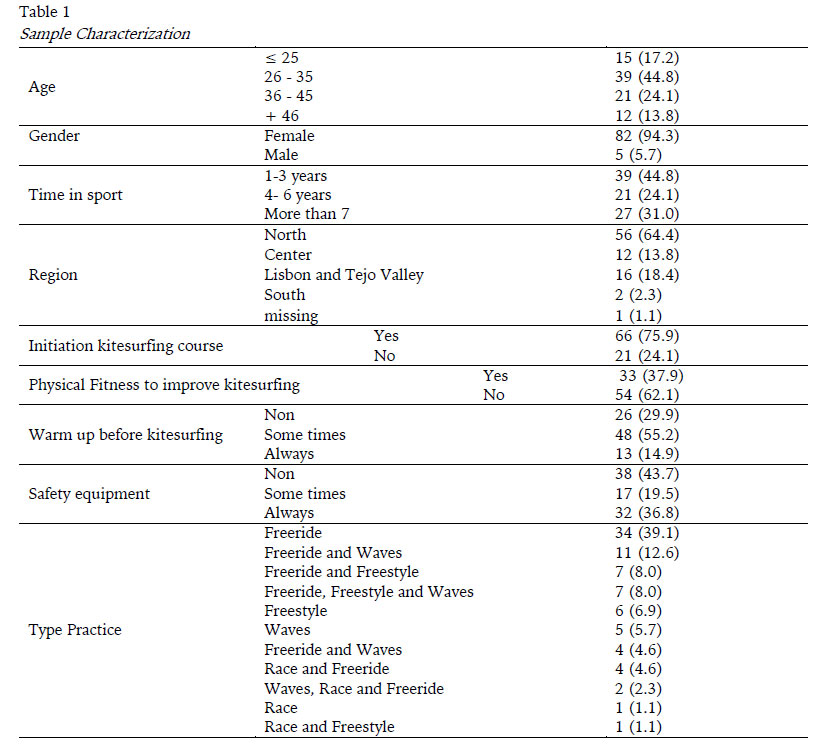
<body><![CDATA[<p>&nbsp;</p> <font size="3" face="Verdana"><b>INTRODUCTION</b></font><font face="Verdana">     <p><font size="2">The past two decades have seen the development and   increased popularity of new sports such as kitesurfing (Kupciw &amp; MacGregor,   2012),   which  is a high-risk sport that is growing in attractiveness and which   combines aspects of several water sports (Bourgois,   Boone, Callewaert, Tipton, &amp; Tallir, 2014; Kupciw &amp; MacGregor, 2012;   Vercruyssen, Blin, L’Huillier, &amp; Brisswalter, 2009). The danger   associated with high-risk sports has become socially accepted in Western   Society (Kupciw &amp; MacGregor,   2012), however, the risk of injury is always present.</font></p>     <p><font size="2">An injury is defined as any physical or psychological   complaint resulted in incapacity to practice or compete normally (Clarsen &amp; Bahr,   2014; Nickel et al., 2004). The quick-release safety system, that   enables the participant to detach the equipment, and the 100% depowerable kites   where introduced in 2004 - 2005, as an important strategy to prevent accidents (Ziegler, Lockemann, &amp; Püschel, 2009).</font></p>     <p><font size="2">In the literature, when considering injuries related   to kitesurfing, it can only be found 3 reviews between 2005 and 2014 and about   another 15 original articles (Bourgois et al., 2014). In   Portuguese we can find 3 publications, 1 review article (Machado &amp;   Coertjens, 2011) and 2 original articles (Berneira, Domingues, Medeiros,   &amp; Vaghetti, 2011; Cruz, Brito, &amp; Cruz, 2009), regarding Brazilian kitesurfers.</font></p>     <p><font size="2">To the best of our knowledge there is no article that characterizes the incidence of injuries among Portuguese kitesurfers.</font></p>     <p><font size="2">This study aims to investigate the incidence of   injuries in Portuguese kitesurfers, to better understand the associated injury   mechanisms, as well as to provide physicians, coaches and athletes with a clear understanding of this specific population group.</font></p> </font>     <p>&nbsp;</p>     <p><font size="3" face="Verdana"><b>METHODS</b></font></p>     <p><font size="2" face="Verdana"><b>Participants</b>    </font></p>     <p><font size="2" face="Verdana">The subjects who participated in the study had at   least, one year of Kitesurfing experience, either competitive or recreational.   A total of 87 kitesurfers, all residents in Portugal, had completed the   questionnaire. From the 87 respondents, 5 were female and 82 were male. Their   ages ranged from 15 to 60 years with an average of 34.2± 9.1 and a practice   period from 1 to 14 years, with a mean of 4.9± 3.2. The participants were   distributed according to the Portuguese Nomenclature of Territorial Units for   Statistics (North, Center, Lisbon and Tejo Valley, and South), representing the North 64.4% of the total participants (<a href="/img/revistas/mot/v11n4/11n4a13t1.jpg">Table 1</a>). </font></p>     
]]></body>
<body><![CDATA[<p><font size="2" face="Verdana"><b>I</b><b>nstruments</b></font></p>     <p><font size="2" face="Verdana">The data was collected using a web-based questionnaire   in Portuguese, distributed in an open web, through an application on Google   drive, in order to reach kitesurfers from all the Portuguese regions. This   12-month retrospective questionnaire, was adapted to Portuguese, from the   previously version of (Pérez-Turpin   et al., 2012)   and applied to a board of experts including kitesurfers (recreational and competitive athletes) and kitesurf instructors that reviewed the questionnaire.</font></p>     <p><font size="2" face="Verdana"><b>Procedures</b></font></p>     <p><font size="2" face="Verdana">Subjects from continental regions of Portugal   completed the web-based questionnaire. It was available for one month (from 11   October to 11 November 2013), via https://docs.google.com/forms/d/1IFIgCJ9S1-lIiKiOrip8lspTCrb-F7pw86FEUzwC7q0/closedform.   This site was linked to Facebook web pages of kitesurfing fans, kitesurfing   forums, such as http://kiteboardlusitano.com and kite surfing schools. The   answers were confidential and the subjects would not be able to be identified.   The questionnaire took about eight minutes to complete and contained questions   about; (i) general information, (ii) physical activity, (iii) protection   systems used and the most frequent style (Freestyle, Waves, Race our Freeride)   (iv) injuries, chosen from a list of musculoskeletal injuries, body regions and   pain, and (v) general information about the consequences of the injuries in   daily life (for details see Pérez-Turpin et al., 2012). </font></p>     <p><font size="2" face="Verdana"><b>S</b><b>tatistical Analysis</b></font></p>     <p><font size="2" face="Verdana">Data was downloaded and checked for completeness and   plausibility before being analyzed by using the SPSS version 22.0 for Windows.   Descriptive statistics were used for analysis and presentation of the results   by checking mean values, standard deviation, coefficient of variance, and   percentage. Due   to the sample distribution it was necessary a non-parametric tests and a   Mann-Whitney test was applied, for two independent groups, and the Kruskal-Wallis   test for three or more independent groups with the post hoc Dunnett's T3 to confirm where the differences occurred,   according to is applicable assumptions. The significance level was set at p &lt;0.05.</font></p>     <p>&nbsp;</p> <font size="3" face="Verdana"><b>R</b><b>ESULTS</b></font><font face="Verdana">     <p><font size="2">A total of 87 kitesurfers, mostly from the North of   Portugal, males in the majority (n= 82), with an average of 4.9±9.1 years of   practice, completed this survey. From the responders, 75.9% have a kitesurfing   initiation course and 56.3% assumed the use of protective equipment. However,   the responders using protective equipment, 65.3%, have reported the use of it   in all situations, being the use of the impact vest their top preference. In   the injured group, 49.1% of the subjects used at least one or more protective gears.</font></p>     <p><font size="2">The most common board used is the TWINTIP model   (77.0%) and half of the responders practice more often the freeride style in detriment of the other kiteboarding styles (<a href="/img/revistas/mot/v11n4/11n4a13t1.jpg">table 1</a>).</font></p>     
<p><font size="2">Most of the subjects (62%) reported that they do not   have any physical fitness program in order to improve the kitesurfing practice   and 70.1% assume to warm up before the practice, but only 14.9% have been completing it every time they practice.</font></p>     ]]></body>
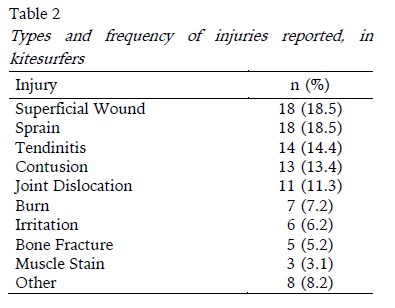
<body><![CDATA[<p><font size="2">In this study 53 subjects reported an injury and 35   had multiple injuries during the last 12 months, 14 surfers reported 2   injuries, 9 surfers reported 3 injuries and 12 surfers reported 4 injuries or more. </font></p>     <p><font size="2">The most common injury types were a Superficial Wound (n= 18), Sprain (n= 18) and Tendinitis (n= 14) (<a href="#t2">Table 2</a>).</font></p>     <p><a name="t2"></a></p>     <p>&nbsp;</p>     <p align="center"><img src="/img/revistas/mot/v11n4/11n4a13t2.jpg" width="395" height="308"></p>     
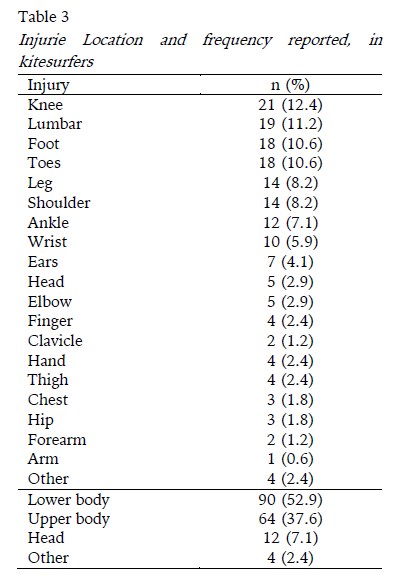
<p>&nbsp;</p>     <p><font size="2">The most affected parts of the body were the knee (n=   21), followed by the lumbar spine (n= 19), foot (n= 18) and toes (n= 18) (<a href="#t3">Table   3</a>). The most common place of injury was the lower extremity (table 3), with the   knee injury totaling 12.4%. Twenty-four of the subjects (27.6%) admitted that   they had chronic pain during kitesurfing, being the knee (n= 9) and the lower   back (n= 5) the most common body region, being a chronic injury the possible reason. </font></p>     <p><a name="t3"></a></p>     <p>&nbsp;</p>     <p align="center"><img src="/img/revistas/mot/v11n4/11n4a13t3.jpg" width="410" height="582"></p>     
]]></body>
<body><![CDATA[<p>&nbsp;</p>     <p><font size="2">The majority of injuries occurred while performing a   landing (n= 26) or a maneuver (n= 22), due to physical fitness (n= 20), fatigue   (n= 20) or due to a jump (n= 19). A few amount of respondents reported having   an injury incident because of the weather (n= 17), a gear problem (n= 7) or due   to ‘other’ causes (n= 2). These data indicated that the majority of the injuries occurred in the water.</font></p>     <p><font size="2">Overall, 53.9% of the injuries were reported as a new   injury, but 35.9% indicate that it is a recurrent injury and 10.3% an increased injury. The greater part of the injuries occurred in summer (70.7%). </font></p>     <p><font size="2">In relation to injuries, having kitesurf initiation   course (p= 0.738); perform warm-up (p= 0.10); use protective equipment (p=   0.134); and having more experience (in years) (p= 0.269), seems not to be a   differentiation factor. Furthermore, kitesurfers that enroll a physical fitness program have less injuries (p= 0.020). </font></p>     <p><font size="2">When   the injury group was asked to indicate the types of medical treatment received   43.4% reported they had consulted a physician (National Health System or   private physician), 11.3% needed to see a rehabilitation specialist (e.g.   physiotherapist or rehabilitation professional from a private insurance), while   13.2% used other treatment as a first aid kit or bed rest. Overall, 32.1% of the respondents did not require any medical treatment, independent of age.</font></p> </font>     <p>&nbsp;</p> <font size="3" face="Verdana"><b>DISCUSSION</b></font><font face="Verdana">     <p><font size="2">The purpose of this study was to investigate the   incidence of injuries in Portuguese kitesurfers, to achieve a better   understanding of associated injury mechanisms and explore potential interferences approaches. </font></p>     <p><font size="2">The average age and years of practice is similar to   other studies (Berneira et al., 2011;   Cruz et al., 2009; Lundgren, Brorsson, &amp; Osvalder, 2011),   explained by the fact of being a recent sport and that only 75,9% have a kite   surfing initiation course. The number of women is low, but perhaps expressive   of the female kitesurfers, because this percentage, 5.7%, is found in other   studies (Pikora, Braham, Hill, &amp; Mills, 2011).</font></p>     <p><font size="2">When tested the influence of having kitesurf   initiation course in the injuries rate, it was verified that it is not   statistical significant (p= 0.738). Having an initiation course, it is an   important safety approach when initiating kitesurfing, but in this sample it was not relevant in terms of being injured.</font></p>     <p><font size="2">The percentage of kitesurfers that use protective   equipment (56.3%), is higher than in another studies (Lundgren et al., 2011).   However, 19.5% of the participants of this group, does not use protective   equipment in all situations. The fact that those who use protective equipment   don’t have less injuries (p=0.134) it could be related to the circumstance that   participants perception of risk and associated norms and practices are a core   role in relation to decision to engage with risk and risk-management strategies   (Powell, 2007). In   the group of those that perform warm up, this same reason may mediating the   fact that around 70.1% assume only perform the warm up sometimes. Other motive   may be the fact that the impact vest is in the top of preferences, similar to   the findings of (Lundgren et al., 2011) and   the lower limb is where the most common injuries occur (Berneira et al., 2011;   Lundgren et al., 2011; Nickel et al., 2004). Additionally,   only 14.9% assumed to warm up always before practice, being the prevalence of   injury not significantly lower among those who claimed to warm up  (p= 0.10).   This findings contrast with (Lundgren et al., 2011) where   the prevalence of injury was significantly lower among those who claimed to warm up. </font></p>     ]]></body>
<body><![CDATA[<p><font size="2">A good level of general Physical Fitness is a useful   predictor of kitesurfing performance (Bourgois et al., 2014). More   than half of the subjects, 62.1%, report that don´t perform a physical activity   in order to improve the kitesurfing practice, but those who enroll a physical   fitness program have less injuries (p= 0.020). Moreover, 20 injuries were   reported to be associated with Physical Fitness and another 20 due to fatigue.   These two possible reported causes of injuries support this finding, because   low physical fitness can lead to earlier fatigue, and together they affect   performance (Ament &amp; Verkerke, 2009; Noakes, 2000), increasing the risks of injury.</font></p>     <p><font size="2">Several studies (Berneira   et al., 2011; Cruz et al., 2009; Lundgren et al., 2011; Nickel et al., 2004;   Pérez-Turpin et al., 2011) indicated the contusion, abrasion and   laceration are the most common injuries types. In the present study, the sprain is one of the most frequent (18.5%), as   demonstrated by (Berneira et al., 2011). In   the other hand, Superficial Wound (18.5%), and Tendinitis (14.4%) represented the second and the third most common injury types (<a href="#t2">table 2</a>).</font></p>     <p><font size="2">The most affected body region was the knee with 12.4%   injuries as stated in (Cruz et al., 2009;   Lundgren et al., 2011). When analyzed the foot, toes and ankle   together (28.3%), the results were similar to (Nickel   et al., 2004; Pérez-Turpin et al., 2011; Petersen, Nickel, Zantop, &amp; Zernial, 2005).</font></p>     <p><font size="2">Overall, 53.9% of injuries were reported as new   incident, similar to (Pikora et al., 2011), being   the knee and the lumbar spine the two most injured region and affected areas   for those that have chronic pain during kitesurfing. This chronic pain is   associated to an old injury in consequence of kitesurfing practice, indicated   as a poor landing or after a trick. According to this fact we think that all   persons involved in the treatment, rehabilitation, and training of kitesurfers   must have a special regard on the mechanism and action of the knee as well mobility and stabilization of the lumbar spine.</font></p>     <p><font size="2">Similar to (Cruz et al., 2009;   Nickel et al., 2004; Pikora et al., 2011), the majority of   the injuries occur in the water and in consequence of a problem when landing or   doing a maneuver. In broad-spectrum, 66% of the participants reported more than   one injury. Other interesting result is the fact that 32.1% of the subjects did   not require any medical treatment and 13.2% used other treatment as a first aid   kit or bed rest. If we combine these two indicators, the majority of the   injuries 45.3% did not require a specialized treatment, contrasting with 43.4%   that consulted a physician. It seems that this is related to the fact that the   majority of participants perform the freeride style. This kitesurf style is about   having fun and learning new techniques something between crossing,   a moderately intense activity (Vercruyssen et al.,   2009),   which lead to less risks than freestyle that involve big air jumps to perform   several tricks, where aerobic and anaerobic metabolism contribute to energy   delivery (Camps, Vercruyssen, &amp; Brisswalter, 2011).</font></p>     <p><font size="2">Some methodological limitations may have some impact   on the results. The fact that it is a web-base, a 12 month’s retrospective   study and a self-reported questionnaire may introduce bias into the study.   However, the answers were confidential and the subjects would not be able to be   identified. One the other hand it was expected that kitesurfers were   experienced and frequent users of the Internet (Lundgren et al., 2011). The   retrospective studies are common in this kind of kitesurfing injury prospection   (Lundgren   et al., 2011; Pérez-Turpin et al., 2011; Petersen et al., 2005; Pikora et al.,   2011; Wegner &amp; Wegener, 2012). Furthermore, it was not possible to   estimate the injury rates, because the majority of the subjects were not able   to accurately estimate the number of hours spent kitesurfing, confirming the   observation of (Bourgois et al., 2014) .   Finally, because of the sample size and distribution, the data can´t be   generalized for the all Portuguese kitesurfers, but perhaps from those from the North of Portugal.</font></p> </font>     <p>&nbsp;</p> <font size="3" face="Verdana"><b>CONCLUSION</b></font><font face="Verdana">     <p><font size="2">In conclusion, and independently of the kind of   training, kitesurfers that enroll a physical fitness program to improve kitesurfing had less injuries </font></p>     <p><font size="2">The lower extremities, especially the knee, were the   most frequent locations of injury, occurring typically in the water and in consequence of a problem when landing or doing a maneuver. </font></p>     <p><font size="2">The assumptions that Kitesurfers with an initiation   course, more experience (in years), that perform warm up and use protective   equipment have less injuries were not verified. As a result, it is necessary to   look at data from a behavioral point of view when perceiving risky behaviors.   This association is in consequence of the fact that only 56.3% use protective   equipment, but not every time they practice, and the same with the warm up, that only 14.9% of the subjects assumed to do it always. </font></p>     ]]></body>
<body><![CDATA[<p><font size="2">Future research is needed to evaluate the impact of   new protective equipment, especially in the lower limbs, and to take in   consideration that some high-risk sport participants take deliberately risk behaviors, trying to identify the true injury risk from kitesurfing.</font></p> </font>     <p>&nbsp;</p>     <p><font size="3" face="Verdana"><b>REFERENCES</b></font></p>     <!-- ref --><p><font size="2" face="Verdana">Ament,   W., &amp; Verkerke, G. J. (2009). Exercise and fatigue. <i>Sports Med</i>, <i>39</i>(5),   389–422. <a href="http://doi.org/10.2165/00007256-200939050-00005" target="_blank">http://doi.org/10.2165/00007256-200939050-00005</a></font>&nbsp;&nbsp;&nbsp;&nbsp;&nbsp;&nbsp;&nbsp;&nbsp;[&#160;<a href="javascript:void(0);" onclick="javascript: window.open('/scielo.php?script=sci_nlinks&ref=351809&pid=S1646-107X201500040001300001&lng=','','width=640,height=500,resizable=yes,scrollbars=1,menubar=yes,');">Links</a>&#160;]<!-- end-ref --><!-- ref --><p><font size="2" face="Verdana">Berneira, J. de O., Domingues, M. R.,   Medeiros, M. A. de, &amp; Vaghetti, C. A. O. (2011). Incidência e   características das lesões em praticantes de kitesurf. <i>Revista Brasileira de     Cineantropometria &amp; Desempenho Humano</i>, <i>13</i>(3), 195–201. <a href="http://doi.org/10.1590/s1980-00372011000300006" target="_blank">http://doi.org/10.1590/s1980-00372011000300006</a></font>&nbsp;&nbsp;&nbsp;&nbsp;&nbsp;&nbsp;&nbsp;&nbsp;[&#160;<a href="javascript:void(0);" onclick="javascript: window.open('/scielo.php?script=sci_nlinks&ref=351810&pid=S1646-107X201500040001300002&lng=','','width=640,height=500,resizable=yes,scrollbars=1,menubar=yes,');">Links</a>&#160;]<!-- end-ref --><!-- ref --><p><font size="2" face="Verdana">Bourgois, J. G., Boone, J., Callewaert,   M., Tipton, M. J., &amp; Tallir, I. B. (2014). Biomechanical and Physiological   Demands of Kitesurfing and Epidemiology of Injury Among Kitesurfers. <i>Sports Medicine</i>, <i>44</i>(1), 55–66. <a href="http://doi.org/10.1007/s40279-013-0103-4" target="_blank">http://doi.org/10.1007/s40279-013-0103-4</a></font>&nbsp;&nbsp;&nbsp;&nbsp;&nbsp;&nbsp;&nbsp;&nbsp;[&#160;<a href="javascript:void(0);" onclick="javascript: window.open('/scielo.php?script=sci_nlinks&ref=351811&pid=S1646-107X201500040001300003&lng=','','width=640,height=500,resizable=yes,scrollbars=1,menubar=yes,');">Links</a>&#160;]<!-- end-ref --><!-- ref --><p><font size="2" face="Verdana">Camps, A., Vercruyssen, F., &amp;   Brisswalter, J. (2011). Variation in heart rate and blood lactate concentration   in freestyle kytesurfing. <i>Journal of Sports Medicine and Physical Fitness</i>, <i>51</i>(2), 313–21.    &nbsp;&nbsp;&nbsp;&nbsp;&nbsp;&nbsp;&nbsp;&nbsp;[&#160;<a href="javascript:void(0);" onclick="javascript: window.open('/scielo.php?script=sci_nlinks&ref=351812&pid=S1646-107X201500040001300004&lng=','','width=640,height=500,resizable=yes,scrollbars=1,menubar=yes,');">Links</a>&#160;]<!-- end-ref --></font></p>     <!-- ref --><p><font size="2" face="Verdana">Clarsen, B., &amp; Bahr, R. (2014).   Matching the choice of injury/illness definition to study setting, purpose and   design: one size does not fit all! <i>Brithis Journal of Sports Medicine</i>, <i>48</i>(7), 510–2. <a href="http://doi.org/10.1136/bjsports-2013-093297" target="_blank">http://doi.org/10.1136/bjsports-2013-093297</a></font>&nbsp;&nbsp;&nbsp;&nbsp;&nbsp;&nbsp;&nbsp;&nbsp;[&#160;<a href="javascript:void(0);" onclick="javascript: window.open('/scielo.php?script=sci_nlinks&ref=351814&pid=S1646-107X201500040001300005&lng=','','width=640,height=500,resizable=yes,scrollbars=1,menubar=yes,');">Links</a>&#160;]<!-- end-ref --><!-- ref --><p><font size="2" face="Verdana">Cruz, W. S., Brito, P. M., &amp; Cruz, N.   S. O. (2009). Prevalência   das lesões Desportivas Músclo-Escléticas dos praticantes de Kitesurf do Estado de Paraíba. <i>Revista Ciência &amp; Saúde</i>, <i>número especial</i>, 108.    &nbsp;&nbsp;&nbsp;&nbsp;&nbsp;&nbsp;&nbsp;&nbsp;[&#160;<a href="javascript:void(0);" onclick="javascript: window.open('/scielo.php?script=sci_nlinks&ref=351815&pid=S1646-107X201500040001300006&lng=','','width=640,height=500,resizable=yes,scrollbars=1,menubar=yes,');">Links</a>&#160;]<!-- end-ref --></font></p>     <!-- ref --><p><font size="2" face="Verdana">Kupciw, D., &amp; MacGregor, A. (2012).   High-risk sport research. <i>The Sport and Exercise Scientist</i>, (31), 28–28.    &nbsp;&nbsp;&nbsp;&nbsp;&nbsp;&nbsp;&nbsp;&nbsp;[&#160;<a href="javascript:void(0);" onclick="javascript: window.open('/scielo.php?script=sci_nlinks&ref=351817&pid=S1646-107X201500040001300007&lng=','','width=640,height=500,resizable=yes,scrollbars=1,menubar=yes,');">Links</a>&#160;]<!-- end-ref --></font></p>     <!-- ref --><p><font size="2" face="Verdana">Lundgren, L., Brorsson, S., &amp;   Osvalder, A. (2011). Injuries related to kitesurfing. <i>World Academy of     Science Engineering and Technology,&nbsp;International Science Index 53</i>, <i>5</i>(5), 1132–1136.    &nbsp;&nbsp;&nbsp;&nbsp;&nbsp;&nbsp;&nbsp;&nbsp;[&#160;<a href="javascript:void(0);" onclick="javascript: window.open('/scielo.php?script=sci_nlinks&ref=351819&pid=S1646-107X201500040001300008&lng=','','width=640,height=500,resizable=yes,scrollbars=1,menubar=yes,');">Links</a>&#160;]<!-- end-ref --></font></p>     <!-- ref --><p><font size="2" face="Verdana">Machado, M. T., &amp; Coertjens, M. (2011). Kitesurfing: Mecanismos de Lesão e Marcadores Bioquímicos, (30), 31–39.    &nbsp;&nbsp;&nbsp;&nbsp;&nbsp;&nbsp;&nbsp;&nbsp;[&#160;<a href="javascript:void(0);" onclick="javascript: window.open('/scielo.php?script=sci_nlinks&ref=351821&pid=S1646-107X201500040001300009&lng=','','width=640,height=500,resizable=yes,scrollbars=1,menubar=yes,');">Links</a>&#160;]<!-- end-ref --></font></p>     <!-- ref --><p><font size="2" face="Verdana">Nickel, C., Zernial, O., Musahl, V., Hansen,   U., Zantop, T., &amp; Petersen, W. (2004). A prospective study of kitesurfing   injuries. <i>American Journal of Sports Medicine</i>, <i>32</i>(4), 921–927. <a href="http://doi.org/10.1177/0363546503262162" target="_blank">http://doi.org/10.1177/0363546503262162</a></font>&nbsp;&nbsp;&nbsp;&nbsp;&nbsp;&nbsp;&nbsp;&nbsp;[&#160;<a href="javascript:void(0);" onclick="javascript: window.open('/scielo.php?script=sci_nlinks&ref=351823&pid=S1646-107X201500040001300010&lng=','','width=640,height=500,resizable=yes,scrollbars=1,menubar=yes,');">Links</a>&#160;]<!-- end-ref --><!-- ref --><p><font size="2" face="Verdana">Noakes, T. D. (2000). Physiological models   to understand exercise fatigue and the adaptations that predict or enhance   athletic performance. <i>Scand J Med Sci Sports</i>, <i>10</i>(3), 123–45. <a href="http://doi.org/10.1034/j.1600-0838.2000.010003123.x" target="_blank">http://doi.org/10.1034/j.1600-0838.2000.010003123.x</a></font>&nbsp;&nbsp;&nbsp;&nbsp;&nbsp;&nbsp;&nbsp;&nbsp;[&#160;<a href="javascript:void(0);" onclick="javascript: window.open('/scielo.php?script=sci_nlinks&ref=351824&pid=S1646-107X201500040001300011&lng=','','width=640,height=500,resizable=yes,scrollbars=1,menubar=yes,');">Links</a>&#160;]<!-- end-ref --><!-- ref --><p><font size="2" face="Verdana">Pérez-Turpin, J. A., Cortell-Tormo, J. M.,   C, S.-L., J.J., C.-M., Cejuela-Anta, R., &amp; Andreu-Cabrera, E. (2012). Lesiones en   Windsurfistas de élite masculinos. <i>Revista Internacional de Medicina Y Ciencias de La Actividad Física Y El Deporte</i>, <i>12</i>(45), 83–92.    &nbsp;&nbsp;&nbsp;&nbsp;&nbsp;&nbsp;&nbsp;&nbsp;[&#160;<a href="javascript:void(0);" onclick="javascript: window.open('/scielo.php?script=sci_nlinks&ref=351825&pid=S1646-107X201500040001300012&lng=','','width=640,height=500,resizable=yes,scrollbars=1,menubar=yes,');">Links</a>&#160;]<!-- end-ref --></font></p>     <!-- ref --><p><font size="2" face="Verdana">Pérez-Turpin, J. A., Cortell-Tormo, J. M.,   Suárez-Llorca, C., Jove-Tossi, M., Andreu-Cabrera, E., &amp; Carrasco-Embuena,   V. (2011). Lesiones en kitesurfistas de élite masculinos. <i>RETOS. Nuevas Tendencias En Educación Física, Deporte Y Recreación</i>, (20), 30–32.    &nbsp;&nbsp;&nbsp;&nbsp;&nbsp;&nbsp;&nbsp;&nbsp;[&#160;<a href="javascript:void(0);" onclick="javascript: window.open('/scielo.php?script=sci_nlinks&ref=351827&pid=S1646-107X201500040001300013&lng=','','width=640,height=500,resizable=yes,scrollbars=1,menubar=yes,');">Links</a>&#160;]<!-- end-ref --></font></p>     <!-- ref --><p><font size="2" face="Verdana">Petersen, W., Nickel, C., Zantop, T.,   &amp; Zernial, O. (2005). Kitesurfing injuries. A young sport. <i>Orthopade</i>, <i>34</i>(5), 419–+. <a href="http://doi.org/10.1007/s00132-005-0792-y" target="_blank">http://doi.org/10.1007/s00132-005-0792-y</a></font>&nbsp;&nbsp;&nbsp;&nbsp;&nbsp;&nbsp;&nbsp;&nbsp;[&#160;<a href="javascript:void(0);" onclick="javascript: window.open('/scielo.php?script=sci_nlinks&ref=351829&pid=S1646-107X201500040001300014&lng=','','width=640,height=500,resizable=yes,scrollbars=1,menubar=yes,');">Links</a>&#160;]<!-- end-ref --><!-- ref --><p><font size="2" face="Verdana">Pikora, T. J., Braham, R., Hill, C., &amp;   Mills, C. (2011). Wet and wild: results from a pilot study assessing injuries   among recreational water users in Western Australia. <i>International Journal of     Injury Control and Safety Promotion</i>, <i>18</i>(2), 119–26. <a href="http://doi.org/10.1080/17457300.2010.540333" target="_blank">http://doi.org/10.1080/17457300.2010.540333</a></font>&nbsp;&nbsp;&nbsp;&nbsp;&nbsp;&nbsp;&nbsp;&nbsp;[&#160;<a href="javascript:void(0);" onclick="javascript: window.open('/scielo.php?script=sci_nlinks&ref=351830&pid=S1646-107X201500040001300015&lng=','','width=640,height=500,resizable=yes,scrollbars=1,menubar=yes,');">Links</a>&#160;]<!-- end-ref --><!-- ref --><p><font size="2" face="Verdana">Powell, C. (2007). The perception of risk   and risk taking behavior: implications for incident prevention strategies. <i>Wilderness &amp; Environmental Medicine</i>, <i>18</i>(1),    &nbsp;&nbsp;&nbsp;&nbsp;&nbsp;&nbsp;&nbsp;&nbsp;[&#160;<a href="javascript:void(0);" onclick="javascript: window.open('/scielo.php?script=sci_nlinks&ref=351831&pid=S1646-107X201500040001300016&lng=','','width=640,height=500,resizable=yes,scrollbars=1,menubar=yes,');">Links</a>&#160;]<!-- end-ref --> 10–5.</font></p>     <!-- ref --><p><font size="2" face="Verdana">Vercruyssen, F., Blin, N., L’Huillier, D.,   &amp; Brisswalter, J. (2009). Assessment of physiological demand in   kitesurfing. <i>European Journal of Applied Physiology</i>, <i>105</i>(1), 103–9. <a href="http://doi.org/10.1007/s00421-008-0879-3" target="_blank">http://doi.org/10.1007/s00421-008-0879-3</a></font>&nbsp;&nbsp;&nbsp;&nbsp;&nbsp;&nbsp;&nbsp;&nbsp;[&#160;<a href="javascript:void(0);" onclick="javascript: window.open('/scielo.php?script=sci_nlinks&ref=351833&pid=S1646-107X201500040001300017&lng=','','width=640,height=500,resizable=yes,scrollbars=1,menubar=yes,');">Links</a>&#160;]<!-- end-ref --><!-- ref --><p><font size="2" face="Verdana">Wegner, M., &amp; Wegener, F. (2012). The   relationship between sensation seeking and tendency to suffer injuries among   kite surfers. <i>Zeitschrift Für Sportpsychologie</i>, <i>19</i>(3), 122–130. <a href="http://doi.org/10.1026/1612-5010/a000076" target="_blank">http://doi.org/10.1026/1612-5010/a000076</a></font>&nbsp;&nbsp;&nbsp;&nbsp;&nbsp;&nbsp;&nbsp;&nbsp;[&#160;<a href="javascript:void(0);" onclick="javascript: window.open('/scielo.php?script=sci_nlinks&ref=351834&pid=S1646-107X201500040001300018&lng=','','width=640,height=500,resizable=yes,scrollbars=1,menubar=yes,');">Links</a>&#160;]<!-- end-ref --><!-- ref --><p><font size="2" face="Verdana">Ziegler, M., Lockemann, U., &amp; Püschel,   K. (2009). Fatal accident during kite&nbsp;surfing lesson. <i>Rechtsmedizin</i>, <i>19</i>(3), 162–164. <a href="http://doi.org/10.1007/s00194-008-0582-z" target="_blank">http://doi.org/10.1007/s00194-008-0582-z</a></font>&nbsp;&nbsp;&nbsp;&nbsp;&nbsp;&nbsp;&nbsp;&nbsp;[&#160;<a href="javascript:void(0);" onclick="javascript: window.open('/scielo.php?script=sci_nlinks&ref=351835&pid=S1646-107X201500040001300019&lng=','','width=640,height=500,resizable=yes,scrollbars=1,menubar=yes,');">Links</a>&#160;]<!-- end-ref --><p>&nbsp;</p>     <p><font size="2" face="Verdana"><b>Acknowledgments: </b>    <br>   The authors thank to all the kitesurfers who agreed to participate   in the study and contributed to its diffusion in the social networks    <br>   <b>Conflicts of Interest:    <br>   </b>Nothing to declare.    <br>   <b>Funding:    <br> </b>Nothing to declare.</font></p>     <p><font size="2" face="Verdana">Manuscript received at October 23<sup>rd</sup> 2014; Accepted at November 13<sup>th</sup> 2015</font></p>     <p>&nbsp;</p>     <p>&nbsp;</p>     ]]></body>
<body><![CDATA[<p><font size="2" face="Verdana"><a href="#topo">*</a><i><a name="end" id="end"></a>Corresponding   author: Bruno Silva; Complexo Desportivo e Lazer de Melga&ccedil;o &ndash; Monte Prado   4960-320 Melga&ccedil;o &ndash; Portugal E-mail</i>: <a href="mailto:silvabruno@esdl.ipvc.pt">silvabruno@esdl.ipvc.pt</a></font></p>      ]]></body><back>
<ref-list>
<ref id="B1">
<nlm-citation citation-type="journal">
<person-group person-group-type="author">
<name>
<surname><![CDATA[Ament]]></surname>
<given-names><![CDATA[W.]]></given-names>
</name>
<name>
<surname><![CDATA[Verkerke]]></surname>
<given-names><![CDATA[G. J.]]></given-names>
</name>
</person-group>
<article-title xml:lang="en"><![CDATA[Exercise and fatigue]]></article-title>
<source><![CDATA[Sports Med]]></source>
<year>2009</year>
<volume>39</volume>
<numero>5</numero>
<issue>5</issue>
<page-range>389-422</page-range></nlm-citation>
</ref>
<ref id="B2">
<nlm-citation citation-type="journal">
<person-group person-group-type="author">
<name>
<surname><![CDATA[Berneira]]></surname>
<given-names><![CDATA[J. de O.]]></given-names>
</name>
<name>
<surname><![CDATA[Domingues]]></surname>
<given-names><![CDATA[M. R.]]></given-names>
</name>
<name>
<surname><![CDATA[Medeiros]]></surname>
<given-names><![CDATA[M. A. de]]></given-names>
</name>
<name>
<surname><![CDATA[Vaghetti]]></surname>
<given-names><![CDATA[C. A. O.]]></given-names>
</name>
</person-group>
<article-title xml:lang="pt"><![CDATA[Incidência e características das lesões em praticantes de kitesurf]]></article-title>
<source><![CDATA[Revista Brasileira de Cineantropometria & Desempenho Humano]]></source>
<year>2011</year>
<volume>13</volume>
<numero>3</numero>
<issue>3</issue>
<page-range>195-201</page-range></nlm-citation>
</ref>
<ref id="B3">
<nlm-citation citation-type="journal">
<person-group person-group-type="author">
<name>
<surname><![CDATA[Bourgois]]></surname>
<given-names><![CDATA[J. G.]]></given-names>
</name>
<name>
<surname><![CDATA[Boone]]></surname>
<given-names><![CDATA[J.]]></given-names>
</name>
<name>
<surname><![CDATA[Callewaert]]></surname>
<given-names><![CDATA[M.]]></given-names>
</name>
<name>
<surname><![CDATA[Tipton]]></surname>
<given-names><![CDATA[M. J.]]></given-names>
</name>
<name>
<surname><![CDATA[Tallir]]></surname>
<given-names><![CDATA[I. B.]]></given-names>
</name>
</person-group>
<article-title xml:lang="en"><![CDATA[Biomechanical and Physiological Demands of Kitesurfing and Epidemiology of Injury Among Kitesurfers]]></article-title>
<source><![CDATA[Sports Medicine]]></source>
<year>2014</year>
<volume>44</volume>
<numero>1</numero>
<issue>1</issue>
<page-range>55-66</page-range></nlm-citation>
</ref>
<ref id="B4">
<nlm-citation citation-type="journal">
<person-group person-group-type="author">
<name>
<surname><![CDATA[Camps]]></surname>
<given-names><![CDATA[A.]]></given-names>
</name>
<name>
<surname><![CDATA[Vercruyssen]]></surname>
<given-names><![CDATA[F.]]></given-names>
</name>
<name>
<surname><![CDATA[Brisswalter]]></surname>
<given-names><![CDATA[J.]]></given-names>
</name>
</person-group>
<article-title xml:lang="en"><![CDATA[Variation in heart rate and blood lactate concentration in freestyle kytesurfing]]></article-title>
<source><![CDATA[Journal of Sports Medicine and Physical Fitness]]></source>
<year>2011</year>
<volume>51</volume>
<numero>2</numero>
<issue>2</issue>
<page-range>313-21</page-range></nlm-citation>
</ref>
<ref id="B5">
<nlm-citation citation-type="journal">
<person-group person-group-type="author">
<name>
<surname><![CDATA[Clarsen]]></surname>
<given-names><![CDATA[B.]]></given-names>
</name>
<name>
<surname><![CDATA[Bahr]]></surname>
<given-names><![CDATA[R.]]></given-names>
</name>
</person-group>
<article-title xml:lang="en"><![CDATA[Matching the choice of injury/illness definition to study setting, purpose and design: one size does not fit all!]]></article-title>
<source><![CDATA[Brithis Journal of Sports Medicine]]></source>
<year>2014</year>
<volume>48</volume>
<numero>7</numero>
<issue>7</issue>
<page-range>510-2</page-range></nlm-citation>
</ref>
<ref id="B6">
<nlm-citation citation-type="journal">
<person-group person-group-type="author">
<name>
<surname><![CDATA[Cruz]]></surname>
<given-names><![CDATA[W. S.]]></given-names>
</name>
<name>
<surname><![CDATA[Brito]]></surname>
<given-names><![CDATA[P. M.]]></given-names>
</name>
<name>
<surname><![CDATA[Cruz]]></surname>
<given-names><![CDATA[N. S. O.]]></given-names>
</name>
</person-group>
<article-title xml:lang="pt"><![CDATA[Prevalência das lesões Desportivas Músclo-Escléticas dos praticantes de Kitesurf do Estado de Paraíba]]></article-title>
<source><![CDATA[Revista Ciência & Saúde]]></source>
<year>2009</year>
<page-range>108</page-range></nlm-citation>
</ref>
<ref id="B7">
<nlm-citation citation-type="journal">
<person-group person-group-type="author">
<name>
<surname><![CDATA[Kupciw]]></surname>
<given-names><![CDATA[D.]]></given-names>
</name>
<name>
<surname><![CDATA[MacGregor]]></surname>
<given-names><![CDATA[A.]]></given-names>
</name>
</person-group>
<article-title xml:lang="en"><![CDATA[High-risk sport research]]></article-title>
<source><![CDATA[The Sport and Exercise Scientist]]></source>
<year>2012</year>
<volume>31</volume>
<page-range>28-28</page-range></nlm-citation>
</ref>
<ref id="B8">
<nlm-citation citation-type="journal">
<person-group person-group-type="author">
<name>
<surname><![CDATA[Lundgren]]></surname>
<given-names><![CDATA[L.]]></given-names>
</name>
<name>
<surname><![CDATA[Brorsson]]></surname>
<given-names><![CDATA[S.]]></given-names>
</name>
<name>
<surname><![CDATA[Osvalder]]></surname>
<given-names><![CDATA[A.]]></given-names>
</name>
</person-group>
<article-title xml:lang="en"><![CDATA[Injuries related to kitesurfing]]></article-title>
<source><![CDATA[World Academy of Science Engineering and Technology, International Science Index]]></source>
<year>2011</year>
<volume>53</volume>
<numero>5</numero>
<issue>5</issue>
<page-range>1132-1136</page-range></nlm-citation>
</ref>
<ref id="B9">
<nlm-citation citation-type="">
<person-group person-group-type="author">
<name>
<surname><![CDATA[Machado]]></surname>
<given-names><![CDATA[M. T.]]></given-names>
</name>
<name>
<surname><![CDATA[Coertjens]]></surname>
<given-names><![CDATA[M.]]></given-names>
</name>
</person-group>
<source><![CDATA[Kitesurfing: Mecanismos de Lesão e Marcadores Bioquímicos]]></source>
<year>2011</year>
<page-range>31-39</page-range></nlm-citation>
</ref>
<ref id="B10">
<nlm-citation citation-type="journal">
<person-group person-group-type="author">
<name>
<surname><![CDATA[Nickel]]></surname>
<given-names><![CDATA[C.]]></given-names>
</name>
<name>
<surname><![CDATA[Zernial]]></surname>
<given-names><![CDATA[O.]]></given-names>
</name>
<name>
<surname><![CDATA[Musahl]]></surname>
<given-names><![CDATA[V.]]></given-names>
</name>
<name>
<surname><![CDATA[Hansen]]></surname>
<given-names><![CDATA[U.]]></given-names>
</name>
<name>
<surname><![CDATA[Zantop]]></surname>
<given-names><![CDATA[T.]]></given-names>
</name>
<name>
<surname><![CDATA[Petersen]]></surname>
<given-names><![CDATA[W.]]></given-names>
</name>
</person-group>
<article-title xml:lang="en"><![CDATA[A prospective study of kitesurfing injuries]]></article-title>
<source><![CDATA[American Journal of Sports Medicine]]></source>
<year>2004</year>
<volume>32</volume>
<numero>4</numero>
<issue>4</issue>
<page-range>921-927</page-range></nlm-citation>
</ref>
<ref id="B11">
<nlm-citation citation-type="journal">
<person-group person-group-type="author">
<name>
<surname><![CDATA[Noakes]]></surname>
<given-names><![CDATA[T. D.]]></given-names>
</name>
</person-group>
<article-title xml:lang="en"><![CDATA[Physiological models to understand exercise fatigue and the adaptations that predict or enhance athletic performance]]></article-title>
<source><![CDATA[Scand J Med Sci Sports]]></source>
<year>2000</year>
<volume>10</volume>
<numero>3</numero>
<issue>3</issue>
<page-range>123-45</page-range></nlm-citation>
</ref>
<ref id="B12">
<nlm-citation citation-type="journal">
<person-group person-group-type="author">
<name>
<surname><![CDATA[Pérez-Turpin]]></surname>
<given-names><![CDATA[J. A.]]></given-names>
</name>
<name>
<surname><![CDATA[Cortell-Tormo]]></surname>
<given-names><![CDATA[J. M.]]></given-names>
</name>
<name>
<surname><![CDATA[C]]></surname>
<given-names><![CDATA[S.-L.]]></given-names>
</name>
<name>
<surname><![CDATA[J.J.]]></surname>
<given-names><![CDATA[C.-M.]]></given-names>
</name>
<name>
<surname><![CDATA[Cejuela-Anta]]></surname>
<given-names><![CDATA[R.]]></given-names>
</name>
<name>
<surname><![CDATA[Andreu-Cabrera]]></surname>
<given-names><![CDATA[E.]]></given-names>
</name>
</person-group>
<article-title xml:lang="es"><![CDATA[Lesiones en Windsurfistas de élite masculinos]]></article-title>
<source><![CDATA[Revista Internacional de Medicina Y Ciencias de La Actividad Física Y El Deporte]]></source>
<year>2012</year>
<volume>12</volume>
<numero>45</numero>
<issue>45</issue>
<page-range>83-92</page-range></nlm-citation>
</ref>
<ref id="B13">
<nlm-citation citation-type="journal">
<person-group person-group-type="author">
<name>
<surname><![CDATA[Pérez-Turpin]]></surname>
<given-names><![CDATA[J. A.]]></given-names>
</name>
<name>
<surname><![CDATA[Cortell-Tormo]]></surname>
<given-names><![CDATA[J. M.]]></given-names>
</name>
<name>
<surname><![CDATA[Suárez-Llorca]]></surname>
<given-names><![CDATA[C.]]></given-names>
</name>
<name>
<surname><![CDATA[Jove-Tossi]]></surname>
<given-names><![CDATA[M.]]></given-names>
</name>
<name>
<surname><![CDATA[Andreu-Cabrera]]></surname>
<given-names><![CDATA[E.]]></given-names>
</name>
<name>
<surname><![CDATA[Carrasco-Embuena]]></surname>
<given-names><![CDATA[V.]]></given-names>
</name>
</person-group>
<article-title xml:lang="es"><![CDATA[Lesiones en kitesurfistas de élite masculinos]]></article-title>
<source><![CDATA[RETOS. Nuevas Tendencias En Educación Física, Deporte Y Recreación]]></source>
<year>2011</year>
<volume>20</volume>
<page-range>30-32</page-range></nlm-citation>
</ref>
<ref id="B14">
<nlm-citation citation-type="journal">
<person-group person-group-type="author">
<name>
<surname><![CDATA[Petersen]]></surname>
<given-names><![CDATA[W.]]></given-names>
</name>
<name>
<surname><![CDATA[Nickel]]></surname>
<given-names><![CDATA[C.]]></given-names>
</name>
<name>
<surname><![CDATA[Zantop]]></surname>
<given-names><![CDATA[T.]]></given-names>
</name>
<name>
<surname><![CDATA[Zernial]]></surname>
<given-names><![CDATA[O.]]></given-names>
</name>
</person-group>
<article-title xml:lang="en"><![CDATA[Kitesurfing injuries: A young sport]]></article-title>
<source><![CDATA[Orthopade]]></source>
<year>2005</year>
<volume>34</volume>
<numero>5</numero>
<issue>5</issue>
<page-range>419</page-range></nlm-citation>
</ref>
<ref id="B15">
<nlm-citation citation-type="journal">
<person-group person-group-type="author">
<name>
<surname><![CDATA[Pikora]]></surname>
<given-names><![CDATA[T. J.]]></given-names>
</name>
<name>
<surname><![CDATA[Braham]]></surname>
<given-names><![CDATA[R.]]></given-names>
</name>
<name>
<surname><![CDATA[Hill]]></surname>
<given-names><![CDATA[C.]]></given-names>
</name>
<name>
<surname><![CDATA[Mills]]></surname>
<given-names><![CDATA[C.]]></given-names>
</name>
</person-group>
<article-title xml:lang="en"><![CDATA[Wet and wild: results from a pilot study assessing injuries among recreational water users in Western Australia]]></article-title>
<source><![CDATA[International Journal of Injury Control and Safety Promotion]]></source>
<year>2011</year>
<volume>18</volume>
<numero>2</numero>
<issue>2</issue>
<page-range>119-26</page-range></nlm-citation>
</ref>
<ref id="B16">
<nlm-citation citation-type="journal">
<person-group person-group-type="author">
<name>
<surname><![CDATA[Powell]]></surname>
<given-names><![CDATA[C.]]></given-names>
</name>
</person-group>
<article-title xml:lang="en"><![CDATA[The perception of risk and risk taking behavior: implications for incident prevention strategies]]></article-title>
<source><![CDATA[Wilderness & Environmental Medicine]]></source>
<year>2007</year>
<volume>18</volume>
<numero>1</numero>
<issue>1</issue>
<page-range>10-5</page-range></nlm-citation>
</ref>
<ref id="B17">
<nlm-citation citation-type="journal">
<person-group person-group-type="author">
<name>
<surname><![CDATA[Vercruyssen]]></surname>
<given-names><![CDATA[F.]]></given-names>
</name>
<name>
<surname><![CDATA[Blin]]></surname>
<given-names><![CDATA[N.]]></given-names>
</name>
<name>
<surname><![CDATA[L’Huillier]]></surname>
<given-names><![CDATA[D.]]></given-names>
</name>
<name>
<surname><![CDATA[Brisswalter]]></surname>
<given-names><![CDATA[J.]]></given-names>
</name>
</person-group>
<article-title xml:lang="en"><![CDATA[Assessment of physiological demand in kitesurfing]]></article-title>
<source><![CDATA[European Journal of Applied Physiology]]></source>
<year>2009</year>
<volume>105</volume>
<numero>1</numero>
<issue>1</issue>
<page-range>103-9</page-range></nlm-citation>
</ref>
<ref id="B18">
<nlm-citation citation-type="journal">
<person-group person-group-type="author">
<name>
<surname><![CDATA[Wegner]]></surname>
<given-names><![CDATA[M.]]></given-names>
</name>
<name>
<surname><![CDATA[Wegener]]></surname>
<given-names><![CDATA[F.]]></given-names>
</name>
</person-group>
<article-title xml:lang="en"><![CDATA[The relationship between sensation seeking and tendency to suffer injuries among kite surfers]]></article-title>
<source><![CDATA[Zeitschrift Für Sportpsychologie]]></source>
<year>2012</year>
<volume>19</volume>
<numero>3</numero>
<issue>3</issue>
<page-range>122-130</page-range></nlm-citation>
</ref>
<ref id="B19">
<nlm-citation citation-type="journal">
<person-group person-group-type="author">
<name>
<surname><![CDATA[Ziegler]]></surname>
<given-names><![CDATA[M.]]></given-names>
</name>
<name>
<surname><![CDATA[Lockemann]]></surname>
<given-names><![CDATA[U.]]></given-names>
</name>
<name>
<surname><![CDATA[Püschel]]></surname>
<given-names><![CDATA[K.]]></given-names>
</name>
</person-group>
<article-title xml:lang="en"><![CDATA[Fatal accident during kite surfing lesson]]></article-title>
<source><![CDATA[Rechtsmedizin]]></source>
<year>2009</year>
<volume>19</volume>
<numero>3</numero>
<issue>3</issue>
<page-range>162-164</page-range></nlm-citation>
</ref>
</ref-list>
</back>
</article>
