<?xml version="1.0" encoding="ISO-8859-1"?><article xmlns:mml="http://www.w3.org/1998/Math/MathML" xmlns:xlink="http://www.w3.org/1999/xlink" xmlns:xsi="http://www.w3.org/2001/XMLSchema-instance">
<front>
<journal-meta>
<journal-id>1646-107X</journal-id>
<journal-title><![CDATA[Motricidade]]></journal-title>
<abbrev-journal-title><![CDATA[Motri.]]></abbrev-journal-title>
<issn>1646-107X</issn>
<publisher>
<publisher-name><![CDATA[Edições Desafio Singular]]></publisher-name>
</publisher>
</journal-meta>
<article-meta>
<article-id>S1646-107X2016000200002</article-id>
<article-id pub-id-type="doi">10.6063/motricidade.9482</article-id>
<title-group>
<article-title xml:lang="en"><![CDATA[Drowning: a leading killer!]]></article-title>
</title-group>
<contrib-group>
<contrib contrib-type="author">
<name>
<surname><![CDATA[Garrido]]></surname>
<given-names><![CDATA[Nuno D.]]></given-names>
</name>
<xref ref-type="aff" rid="A01"/>
<xref ref-type="aff" rid="A02"/>
</contrib>
<contrib contrib-type="author">
<name>
<surname><![CDATA[Costa]]></surname>
<given-names><![CDATA[Aldo M.]]></given-names>
</name>
<xref ref-type="aff" rid="A02"/>
<xref ref-type="aff" rid="A03"/>
</contrib>
<contrib contrib-type="author">
<name>
<surname><![CDATA[Stallman]]></surname>
<given-names><![CDATA[Robert K.]]></given-names>
</name>
<xref ref-type="aff" rid="A04"/>
<xref ref-type="aff" rid="A05"/>
<xref ref-type="aff" rid="A06"/>
</contrib>
</contrib-group>
<aff id="A01">
<institution><![CDATA[,University of Trás-os-Montes And Alto Douro  ]]></institution>
<addr-line><![CDATA[Vila Real ]]></addr-line>
<country>Portugal</country>
</aff>
<aff id="A02">
<institution><![CDATA[,Research Center in Sports Sciences, Health and Human Development  ]]></institution>
<addr-line><![CDATA[ ]]></addr-line>
<country>Portugal</country>
</aff>
<aff id="A03">
<institution><![CDATA[,University of Beira Interior  ]]></institution>
<addr-line><![CDATA[Covilhã ]]></addr-line>
<country>Portugal</country>
</aff>
<aff id="A04">
<institution><![CDATA[,Norwegian Lifesaving Society  ]]></institution>
<addr-line><![CDATA[Oslo ]]></addr-line>
<country>Norway</country>
</aff>
<aff id="A05">
<institution><![CDATA[,Tanzanian Lifesaving Society  ]]></institution>
<addr-line><![CDATA[Dar Es Salaam ]]></addr-line>
<country>Tanzania</country>
</aff>
<aff id="A06">
<institution><![CDATA[,Norwegian School of Sport Science  ]]></institution>
<addr-line><![CDATA[Oslo ]]></addr-line>
<country>Norway</country>
</aff>
<pub-date pub-type="pub">
<day>00</day>
<month>06</month>
<year>2016</year>
</pub-date>
<pub-date pub-type="epub">
<day>00</day>
<month>06</month>
<year>2016</year>
</pub-date>
<volume>12</volume>
<numero>2</numero>
<fpage>02</fpage>
<lpage>07</lpage>
<copyright-statement/>
<copyright-year/>
<self-uri xlink:href="http://scielo.pt/scielo.php?script=sci_arttext&amp;pid=S1646-107X2016000200002&amp;lng=en&amp;nrm=iso"></self-uri><self-uri xlink:href="http://scielo.pt/scielo.php?script=sci_abstract&amp;pid=S1646-107X2016000200002&amp;lng=en&amp;nrm=iso"></self-uri><self-uri xlink:href="http://scielo.pt/scielo.php?script=sci_pdf&amp;pid=S1646-107X2016000200002&amp;lng=en&amp;nrm=iso"></self-uri></article-meta>
</front><body><![CDATA[ <p align="right"><font size="2" face="verdana"><b>RESEARCH NOTE</b></font></p>     <p>&nbsp;</p>     <p><font size="4" face="verdana"><b>Drowning: a leading killer!</b></font></p>     <p>&nbsp;</p>     <p>&nbsp;</p>     <p><font size="2" face="verdana"><b>Nuno D. Garrido<sup>1,2,<a name="topo"></a><a href="#end">*</a></sup>; Aldo M. Costa<sup>2,3</sup>; Robert K. Stallman<sup>4,5,6</sup></b></font></p>     <p><font size="2" face="verdana"><sup>1</sup><i> University of Trás-os-Montes And Alto Douro, Vila Real, Portugal</i></font>    <br> <font size="2" face="verdana"><sup>2</sup><i> Research Centre in Sports Sciences, Health Sciences and Human Development, CIDESD, Portugal    <br> </i></font><font size="2" face="verdana"><sup>3</sup><i> University of Beira Interior, Covilhã, Portugal    <br> </i></font><font size="2" face="verdana"><sup>4</sup><i> Norwegian Lifesaving Society, Oslo, Norway    ]]></body>
<body><![CDATA[<br> </i></font><font size="2" face="verdana"><sup>5</sup><i> Tanzanian Lifesaving Society, Dar Es Salaam, Tanzania    <br> </i></font><font size="2" face="verdana"><sup>6</sup><i> Norwegian School of Sport Science, Oslo, Norway</i></font></p>     <p>&nbsp;</p>     <p>&nbsp;</p>     <p><font size="2" face="verdana"><b>The Global Burden of Drowning</b></font></p>     <p><font size="2" face="verdana">Approximately 71% of the surface of the Earth, is covered   by water, nearly three times greater than that covered by land. As humans we   spend the first nine months of our lives submerged in liquid and then   ironically, after birth, we are inept at swimming. Yet learning to swim is   imperative, among other things, to help prevent drowning, a leading killer (World Health Organization [WHO], 2014).</font></p>     <p><font size="2" face="verdana">Drowning kills at least 372,000 people worldwide every   year and is the 3rd leading cause of unintentional death, accounting for 7% of   all deaths stemming from accidents (WHO, 2014). It is also estimated that &gt;   90% of all drownings happen in developing countries. Additionally, it is   estimated that the ratio of those non-fatal drownings which require   hospitalization - to fatal drownings is, by the most optimistic estimates, from   1- 4:1 (American Academy of Pediatrics Policy Statement, 2003; Szpilman,   Bierens, Handley, &amp; Orlowski, 2012), or, according to more dramatic   records, as much as 10:1 (Langerdorfer, 2011). Of these, 5% to 10% will suffer   permanent neurological injuries caused by long submersion, late basic life   support maneuvers or long periods of rehabilitation (Weiss, 2010). And we still   have not included those cases not requiring hospitalization. In addition to the   human tragedy, drowning represents a huge economic problem with direct and   indirect costs, including many Disability-Adjusted Life Years lost [DALY, WHO],   (Szpilman et al., 2012; World Health Organization, 2014). The DALY figure is   high also because so many drowning victims are young, with a long productive   life ahead of them. An estimated 1.3 million disability adjusted life years   were lost in 2004 because of death and disability caused by drowning (Peden et   al., 2008). In the United States alone, the estimated economic burden of drowning is 5.3 billion USD each year (Finkelstein, Corso, &amp; Miller, 2006).</font></p>     <p><font size="2" face="verdana"><b>Drowning Research/Statistics</b></font></p>     <p><font size="2" face="verdana">Conceptually, “drowning” is a complex and   multi-faceted phenomenon, characterized as a chain of events (Bierens, 2006).   Accurate statistics demand a definition. Until recently, there was no consensus   on such a definition. However, by 2002, the International Task Force on the   Epidemiology of Drowning presented it’s recommendation to the drowning   prevention community at the first world conference, Drowning 2002 (Amsterdam)   and it was immediately adopted. It was then, quickly adopted by the World   Health Organization. Drowning is “The process of experiencing respiratory   impairment from immersion or submersion in liquid” (Association for Child   Safety Promotion [APSI], 2015; van Beek, Branche, Szpilman, Modell, &amp; Bierens, 2005). </font></p>     <p><font size="2" face="verdana">Research on drowning as a phenomenon presents several   difficulties - most of all, that global data concerning the number of   occurrences are not accurate. Not all cases are registered (in Low and MiddIe   Income Countries many cases occur where no records are kept of cause of death   or deaths are simply not reported), or in other cases, certain events are not   categorized as drowning according to WHO’s International Classification of   Disease (ICD 10) [e.g. transport accidents, suicide, homicide, natural   disasters], (Szpilman et al., 2012). And finally, many nations are not   represented in the global ICD 10 statistics, not meeting the WHO reliability   criteria for inclusion (over 100 nations are not included). The full burden of   drowning is therefore, vastly underestimated. It may well be 2-3 times greater than the reported figure.</font></p>     ]]></body>
<body><![CDATA[<p><font size="2" face="verdana">Nevertheless, detailed analysis of the registered   incidents allows the identification of risk factors of drowning. We would like   to highlight the approach of Eleni Petridou and Alexandra Klimentopoulou (2006)   which divided the risk factors into three broad categories: Sociodemographic, Environmental and Behavioural risk factors.</font></p>     <p><font size="2" face="verdana"><b>Risk Factors </b></font></p>     <p><font size="2" face="verdana">An in-depth analysis of the risk factors is the basis   for the creation of targeted and effective strategies to prevent drowning.   Gender is a risk factor. Globally, twice as many males drown as females. In   many High Income Countries (HIC’s) as many as ten times more males drown than   females. Research has also shown that males more often overestimate their   ability and underestimate risk (Moran et al., 2012). Age is another major risk   factor. Globally, half of all drownings are among those under twenty five years   of age. Here there is regional and economic variation. In many HIC’s the peak   is among middle aged men. In many LIC’s the peak is among 1-14 yr olds. In   Bangladesh, e.g. nearly half of all drownings (43%) are among 1-4 yr olds (WHO, 2014).</font></p>     <p><font size="2" face="verdana">Other major risk factors include lack of supervision   of young children, failure to provide barriers to water (especially near the   home), unsafe water supply, unsafe water crossings, overcrowded and poorly   maintained boats, and more. These risk factors are often poorly understood by   the general public and awareness of the need for water safety and water safety practices is, in general, often weak.</font></p>     <p><font size="2" face="verdana"><b>Interventions</b></font></p>     <p><font size="2" face="verdana">Due to variability of situations which could lead to a   drowning episode, experts suggest the adoption of a multi-layer prevention   model, rather than opting for isolated measures, since no single measure can   prevent all deaths and injuries caused by submersion (Brenner, 2003; Weiss,   2010). Although there are some nuances, this view of multi-layer prevention is   supported by major global organizations with responsibilities in this matter,   from which we highlight the World Health Organization, the American Academy of   Pediatrics, the American Red Cross and the International Task Force on Open   Water Drowning Prevention. Among the preventive measures we would like to   emphasize are:  alarms and surrounding   safety barriers for swimming pools, the covering of swimming pools, close adult   supervision of children, the provision and training of lifeguards, well   designed and well placed safety signage and flags (especially at beaches),   strengthening of policy regarding safe boat transportation (overloading,   maintenance, etc.), knowledge of resuscitation techniques, the use of personal   flotation devices, dissemination of water safety information, and  instruction in swimming and water safety. All   of these might be considered both steps in raising water safety awareness and practical applications of such.</font></p>     <p><font size="2" face="verdana"><b>Learn to Swim: An Essential Intervention </b></font></p>     <p><font size="2" face="verdana">What does &quot;knowing how to swim&quot; really mean?   Some authors define mastery of this competence as swimming a given distance,   while others put the emphasis on <b><i>how</i></b> this/any given distance is   swum (Stallman, Junge, &amp; Blixt, 2008). In the teaching of swimming there is   a tendency to emphasize an error correction style of teaching, giving a strong   emphasis to the technical mastery of movements, in a stable and predictable   environment (Light &amp; Wallian, 2008). This fails to recognize that learning   to swim is a dynamic process in which the person, the task at hand and the   environment all influence the learning process, and the outcome (Langerdorfer,   2015). We must also remember that learning to swim usually takes place in quiet   water while the majority of drownings occur in open water. Here the environment   has raised the stakes, the challenge is greater. Sadly, many cannot meet the   increased challenge; a person who can swim in quiet water cannot necessarily   swim in open water [perhaps rough, cold water, wearing clothing, etc.] (Kjendlie et al., 2013; Tipton, Reilly, Rees, Spray, &amp; Golden, 2008).</font></p>     <p><font size="2" face="verdana">The impact that swimming lessons have in preventing   drowning episodes has been only poorly quantified. In the huge Bangladesh   study, (where exposure to water is part of daily living and drowning is of   epidemic proportions), researchers followed a cohort (N=132,000) for five   years. Half had been taught to swim, half had not. They found a huge reduction   in drownings (Linnan, Rahman, Rahman, Scarr, &amp; Cox, 2011). A case-control   study in rural China has found a protective effect of swimming lessons on   drowning among children aged 1–4 years (Yang, Nong, Li, Feng, &amp; Lo, 2007).   Among high income countries (HICs), a case-control study in the U.S. found a   positive association between swimming skill and drowning prevention in children   less than five years of age (Brenner et al., 2009). Otherwise, this relationship remains poorly understood.</font></p>     <p><font size="2" face="verdana">These studies provide powerful support for water   safety education, though deeper understanding of the protective value of the   competencies taught within these programs continues to be poorly understood.   Nonetheless, it is agreed that all children should receive water safety   training, which may be an effective factor in reducing the risk of drowning   (American Red Cross, 2009; Asher, Rivara, Felix, Vance, &amp; Dunne, 1995;   European Child Safety Alliance, 2007; International Life Saving Association, 2015).</font></p>     ]]></body>
<body><![CDATA[<p><font size="2" face="verdana">In some cultures, undue emphasis is placed on swimming   for it’s competitive, entertainment value. Here, recognition of the need for   drowning prevention seems to be under-emphasized and poorly understood; a   failure to understand the scope of the global burden of drowning. Teaching aims   towards the maximization of swimming efficiency, aiming to swim a given   distance in the shortest time possible. In other cultures, it has long been   realized that there is no contradiction between learning those competencies   which make a person less susceptible to drowning and those competencies which   prepare the path towards higher levels of performance and competition. Aquatic   movement researchers and practitioners and drowning prevention researchers and   practitioners, share in the responsibility for drowning prevention though they   are often unaware of it. &quot;We're in the same boat - brother&quot; (Stallman &amp; Kjendlie, 2013).</font></p>     <p><font size="2" face="verdana">The question “What should be taught to children?” is   too infrequently asked. There remains great variation in what is taught and   programs continue to be guided by tradition and expert opinion. The great variation is proof that we have not agreed on the content of learn – to – swim.</font></p>     <p><font size="2" face="verdana">In this editorial, we share ideologically the approach   that safety (drowning prevention) always comes first. It is of paramount   importance to place the focus on swimming skills considered essential in drowning prevention.</font></p>     <p><font size="2" face="verdana">Stallman, Junge and Blixt (2008) identified the main   causes of drowning (once in the water) and discussed the relationship between   these causes and what children should learn at an early level. They found that   there is some consensus on three basic principles, yielding essential skills   whose mastery in various scenarios and conditions, together with a broad   aquatic repertoire, could culminate in a definition of knowing how to   swim. To survive in open water, in surf, or at low temperatures, one requires repeated practice in such conditions (Langerdorfer, 2015; Quan et al., 2015). </font></p>     <p>&nbsp;</p>     <p align="center"><a href="/img/revistas/mot/v12n2/12n2a02t1.jpg"><font size="2" face="verdana">Table 1</font></a></p>     
<p>&nbsp;</p>     <p><font size="2" face="verdana">By this logic, some argue that children should develop   a broad, all-around aquatic motor repertoire, practicing swimming skills under   various conditions, indoor, outdoor, clothed, with waves, etc., not limited   only to the practice of swimming strokes, but improving their aquatic literacy   through the practice of other related competencies (Langendorfer &amp; Bruya, 1995).</font></p>     <p><font size="2" face="verdana"><b>Water Competence</b></font></p>     <p><font size="2" face="verdana">The concept of water competence was launched in 1995   by Langendorfer and Bruya. They emphasized both a broad repertoire of physical   skills as well as knowledge and values. Moran (2014) adapted this to drowning   prevention, defining it as “the sum of all personal aquatic movements that help   prevent drowning, as well as the associated water safety knowledge, attitudes, and behavior that facilitate safety in, on and around the water”. </font></p>     ]]></body>
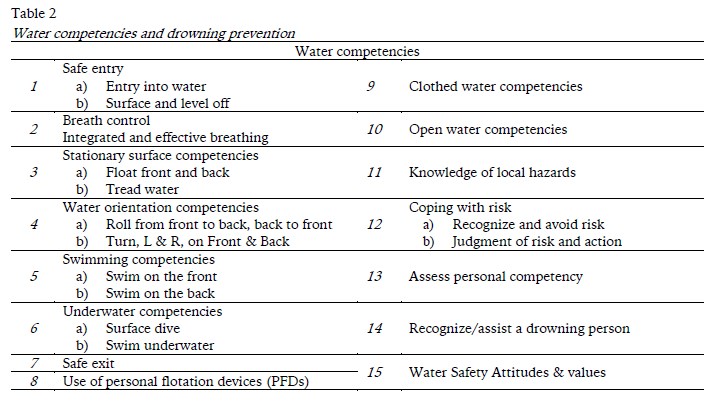
<body><![CDATA[<p><font size="2" face="verdana">In 2011 at the World Conference on Drowning   Prevention, an International Working Group was formed to further develop the   concept of water competence. At the WCDP 2013, in Potsdam, a workshop was conducted   and a preliminary report was presented to the Drowning Prevention Commission, ILSF, and cooperation was launched.</font></p>     <p><font size="2" face="verdana">The advent of the concept of “water competence” has   opened the door for a revival of the interest in the development of a broad   repertoire of physical aquatic skills and of the integration of both cognitive   and afferent competencies. It also shifts the focus from “defining swimming” to   a broader and more inclusive notion of which competencies can contribute to   making people less susceptible to the risk of drowning. The aims of the   International Working Group have been to further develop the concept of water   competence and to disseminate it. The specific objectives have been to a)   define water competence, b) support each recommended competency with research   evidence showing it’s protective value, and c) to identify areas needing further research. </font></p>     <p><font size="2" face="verdana">The title chosen for this project reflects the shift   of emphasis over time from defining swimming or swimming skill to identifying   what should be taught and to support the recommended competencies with research   evidence. This has not been done before, mostly because such research evidence   has only become available in the past 10-15 years. The document is entitled,   “From Swimming Skill to Water Competence: Towards a More Inclusive Drowning Prevention Future”.</font></p>     <p><font size="2" face="verdana"><a href="/img/revistas/mot/v12n2/12n2a02t2.jpg">Table 2</a> above, lists the competencies identified as   essential, as supported by research evidence showing protective value   (Stallman, Moran, Langerdorfer, &amp; Quan, in Press). It will appear soon in the International Journal of Aquatic Research and Education.</font></p>     
<p><font size="2" face="verdana">Water competence is a much more comprehensive and   inclusive concept than 'swimming skill', since it also includes both cognitive   and afferent competencies (Moran et al., 2012; Stallman et al., in Press),   making it especially relevant in the prevention of drowning. Brenner, Moran,   Stallman, Gilchrist, and McVan (2006, p. 116) recommended that “swimming   ability be promoted as a necessary component of water competence, but with the   understanding that swimming ability alone is [often] not sufficient to prevent   drowning”. Nevertheless, as mentioned before drowning is a complex and   difficult research phenomenon, as is its prevention. The concept of water competence is a living concept and still in development (Quan et al., 2015).</font></p>     <p><font size="2" face="verdana">Please keep yourself water safe!</font></p>     <p>&nbsp;</p>     <p><font size="3" face="verdana"><b>REFERENCES</b></font></p>     <!-- ref --><p><font size="2" face="verdana">American Academy of Pediatrics Policy Statement. (2003). Prevention of   Drowning in Infants, Children, and Adolescents. <i>Pediatrics</i>, <i>112</i>(2), 437–439.    &nbsp;&nbsp;&nbsp;&nbsp;&nbsp;&nbsp;&nbsp;&nbsp;[&#160;<a href="javascript:void(0);" onclick="javascript: window.open('/scielo.php?script=sci_nlinks&ref=353277&pid=S1646-107X201600020000200001&lng=','','width=640,height=500,resizable=yes,scrollbars=1,menubar=yes,');">Links</a>&#160;]<!-- end-ref --></font></p>     ]]></body>
<body><![CDATA[<!-- ref --><p><font size="2" face="verdana">American Red Cross. (2009). <i>Swimming and  Water Safety</i>. Yardley: StayWell. Obtido de <a target="_blank" href="https://www.redcross.org/images/MEDIA_CustomProductCatalog/m3240085_SwimmingWaterSafety.pdf">https://www.redcross.org/images/MEDIA_CustomProductCatalog/m3240085_SwimmingWaterSafety.pdf</a></font>&nbsp;&nbsp;&nbsp;&nbsp;&nbsp;&nbsp;&nbsp;&nbsp;[&#160;<a href="javascript:void(0);" onclick="javascript: window.open('/scielo.php?script=sci_nlinks&ref=353279&pid=S1646-107X201600020000200002&lng=','','width=640,height=500,resizable=yes,scrollbars=1,menubar=yes,');">Links</a>&#160;]<!-- end-ref --><!-- ref --><p><font size="2" face="verdana">Asher, K. N., Rivara, F. P., Felix, D., Vance, L., &amp; Dunne, R.   (1995). Water safety training as a potential means of reducing risk of young children’s drowning. <i>Injury Prevention</i>, <i>1</i>(4), 228–233.    &nbsp;&nbsp;&nbsp;&nbsp;&nbsp;&nbsp;&nbsp;&nbsp;[&#160;<a href="javascript:void(0);" onclick="javascript: window.open('/scielo.php?script=sci_nlinks&ref=353280&pid=S1646-107X201600020000200003&lng=','','width=640,height=500,resizable=yes,scrollbars=1,menubar=yes,');">Links</a>&#160;]<!-- end-ref --></font></p>     <!-- ref --><p><font size="2" face="verdana">Associação para a Promoção da Segurança Infantil. (2015). Afogamentos em   Crianças e Jovens em Portugal Atualização de casos – Junho de 2015. APSI. Obtido de <a target="_blank" href="http://www.apsi.org.pt/images/PDF/Noticias/BrincareNadarSeg/Afogamentos_criancas_jovens_2005-2014_Principais_resultados_Atual_2015.pdf">http://www.apsi.org.pt/images/PDF/Noticias/BrincareNadarSeg/Afogamentos_criancas_jovens_2005-2014_Principais_resultados_Atual_2015.pdf</a></font>&nbsp;&nbsp;&nbsp;&nbsp;&nbsp;&nbsp;&nbsp;&nbsp;[&#160;<a href="javascript:void(0);" onclick="javascript: window.open('/scielo.php?script=sci_nlinks&ref=353282&pid=S1646-107X201600020000200004&lng=','','width=640,height=500,resizable=yes,scrollbars=1,menubar=yes,');">Links</a>&#160;]<!-- end-ref --><!-- ref --><p><font size="2" face="verdana">Bierens, J. J. L. M. (Ed.). (2006). <i>Handbook on Drowning: Prevention, Rescue, Treatment</i>. Berlin: Springer-Verlag.    &nbsp;&nbsp;&nbsp;&nbsp;&nbsp;&nbsp;&nbsp;&nbsp;[&#160;<a href="javascript:void(0);" onclick="javascript: window.open('/scielo.php?script=sci_nlinks&ref=353283&pid=S1646-107X201600020000200005&lng=','','width=640,height=500,resizable=yes,scrollbars=1,menubar=yes,');">Links</a>&#160;]<!-- end-ref --></font></p>     <!-- ref --><p><font size="2" face="verdana">Brenner, R. A. (2003). Prevention of drowning in infants, children, and adolescents. <i>Pediatrics</i>, <i>112</i>(2), 440–445. <a target="_blank" href="https://doi.org/10.1542/peds.112.2.440">https://doi.org/10.1542/peds.112.2.440</a></font>&nbsp;&nbsp;&nbsp;&nbsp;&nbsp;&nbsp;&nbsp;&nbsp;[&#160;<a href="javascript:void(0);" onclick="javascript: window.open('/scielo.php?script=sci_nlinks&ref=353285&pid=S1646-107X201600020000200006&lng=','','width=640,height=500,resizable=yes,scrollbars=1,menubar=yes,');">Links</a>&#160;]<!-- end-ref --><!-- ref --><p><font size="2" face="verdana">Brenner, R. A., Moran, K., Stallman, R. K., Gilchrist, J., &amp; McVan,   J. (2006). Swimming ability and the risk of drowning. Em J. J. L. M. Bierens   (Ed.), <i>Handbook on Drowning: Prevention, Rescue, Treatment</i> (pp. 112–117). Berlin: Springer-Verlag.    &nbsp;&nbsp;&nbsp;&nbsp;&nbsp;&nbsp;&nbsp;&nbsp;[&#160;<a href="javascript:void(0);" onclick="javascript: window.open('/scielo.php?script=sci_nlinks&ref=353286&pid=S1646-107X201600020000200007&lng=','','width=640,height=500,resizable=yes,scrollbars=1,menubar=yes,');">Links</a>&#160;]<!-- end-ref --></font></p>     <!-- ref --><p><font size="2" face="verdana">Brenner, R. A., Taneja, G. S., Haynie, D. L., Trumble, A. C., Qian, C.,   Klinger, R. M., &amp; Klebanoff, M. A. (2009). Association between swimming   lessons and drowning in childhood: a case-control study. <i>Archives of Pediatrics &amp; Adolescent Medicine</i>, <i>163</i>(3), 203–210. <a target="_blank" href="https://doi.org/10.1001/archpediatrics.2008.563">https://doi.org/10.1001/archpediatrics.2008.563</a></font>&nbsp;&nbsp;&nbsp;&nbsp;&nbsp;&nbsp;&nbsp;&nbsp;[&#160;<a href="javascript:void(0);" onclick="javascript: window.open('/scielo.php?script=sci_nlinks&ref=353288&pid=S1646-107X201600020000200008&lng=','','width=640,height=500,resizable=yes,scrollbars=1,menubar=yes,');">Links</a>&#160;]<!-- end-ref --><!-- ref --><p><font size="2" face="verdana">European Child Safety Alliance. (2007). Childhood drowning, near   drowning - facts and prevention. Consumer Safety Institute in the Netherlands. Obtido de <a target="_blank" href="http://www.childsafetyeurope.org/injurytopics/drowningwatersafety/info/water-wise-facts.pdf">http://www.childsafetyeurope.org/injurytopics/drowningwatersafety/info/water-wise-facts.pdf</a></font>&nbsp;&nbsp;&nbsp;&nbsp;&nbsp;&nbsp;&nbsp;&nbsp;[&#160;<a href="javascript:void(0);" onclick="javascript: window.open('/scielo.php?script=sci_nlinks&ref=353289&pid=S1646-107X201600020000200009&lng=','','width=640,height=500,resizable=yes,scrollbars=1,menubar=yes,');">Links</a>&#160;]<!-- end-ref --><!-- ref --><p><font size="2" face="verdana">Finkelstein, E., Corso, P. S., &amp; Miller, T. R. (2006). <i>The   incidence and economic burden of injuries in the United States</i>. New York: Oxford University Press.    &nbsp;&nbsp;&nbsp;&nbsp;&nbsp;&nbsp;&nbsp;&nbsp;[&#160;<a href="javascript:void(0);" onclick="javascript: window.open('/scielo.php?script=sci_nlinks&ref=353290&pid=S1646-107X201600020000200010&lng=','','width=640,height=500,resizable=yes,scrollbars=1,menubar=yes,');">Links</a>&#160;]<!-- end-ref --></font></p>     <!-- ref --><p><font size="2" face="verdana">International Life Saving Association. (2015). <i>Drowning Prevention   Strategies: A framework to reduce drowning deaths in the aquatic environment   for nations/regions engaged in lifesaving</i>. Leuven, Belgium: The International Life Saving Federation.    &nbsp;&nbsp;&nbsp;&nbsp;&nbsp;&nbsp;&nbsp;&nbsp;[&#160;<a href="javascript:void(0);" onclick="javascript: window.open('/scielo.php?script=sci_nlinks&ref=353292&pid=S1646-107X201600020000200011&lng=','','width=640,height=500,resizable=yes,scrollbars=1,menubar=yes,');">Links</a>&#160;]<!-- end-ref --></font></p>     <!-- ref --><p><font size="2" face="verdana">Kjendlie, P.-L., Pedersen, T., Thoresen, T., Setlo, T., Moran, K., &amp;   Stallman, R. K. (2013). Can You Swim in Waves? Children’s Swimming, Floating,   and Entry Skills in Calm and Simulated Unsteady Water Conditions. <i>International Journal of Aquatic Research and Education</i>, <i>7</i>(4), 301–313.    &nbsp;&nbsp;&nbsp;&nbsp;&nbsp;&nbsp;&nbsp;&nbsp;[&#160;<a href="javascript:void(0);" onclick="javascript: window.open('/scielo.php?script=sci_nlinks&ref=353294&pid=S1646-107X201600020000200012&lng=','','width=640,height=500,resizable=yes,scrollbars=1,menubar=yes,');">Links</a>&#160;]<!-- end-ref --></font></p>     <!-- ref --><p><font size="2" face="verdana">Langendorfer, S. J., &amp; Bruya, L. D. (1995). <i>Aquatic Readiness: Developing Water Competence in Young Children</i>. Urbana, IL: Human Kinetics.    &nbsp;&nbsp;&nbsp;&nbsp;&nbsp;&nbsp;&nbsp;&nbsp;[&#160;<a href="javascript:void(0);" onclick="javascript: window.open('/scielo.php?script=sci_nlinks&ref=353296&pid=S1646-107X201600020000200013&lng=','','width=640,height=500,resizable=yes,scrollbars=1,menubar=yes,');">Links</a>&#160;]<!-- end-ref --></font></p>     <!-- ref --><p><font size="2" face="verdana">Langerdorfer, S. J. (2011). Considering Drowning, Drowning Prevention,   and Learning to Swim. <i>International Journal of Aquatic Research and Education</i>, <i>5</i>(3), 236–243.    &nbsp;&nbsp;&nbsp;&nbsp;&nbsp;&nbsp;&nbsp;&nbsp;[&#160;<a href="javascript:void(0);" onclick="javascript: window.open('/scielo.php?script=sci_nlinks&ref=353298&pid=S1646-107X201600020000200014&lng=','','width=640,height=500,resizable=yes,scrollbars=1,menubar=yes,');">Links</a>&#160;]<!-- end-ref --></font></p>     <!-- ref --><p><font size="2" face="verdana">Langerdorfer, S. J. (2015). Changing Learn-to-Swim and Drowning   Prevention Using Aquatic Readiness and Water Competence. <i>International Journal of Aquatic Research and Education</i>, <i>9</i>(1), 4–11. <a target="_blank" href="https://doi.org/0.1123/ijare.2014-0082">https://doi.org/0.1123/ijare.2014-0082</a></font>&nbsp;&nbsp;&nbsp;&nbsp;&nbsp;&nbsp;&nbsp;&nbsp;[&#160;<a href="javascript:void(0);" onclick="javascript: window.open('/scielo.php?script=sci_nlinks&ref=353300&pid=S1646-107X201600020000200015&lng=','','width=640,height=500,resizable=yes,scrollbars=1,menubar=yes,');">Links</a>&#160;]<!-- end-ref --><!-- ref --><p><font size="2" face="verdana">Light, R., &amp; Wallian, N. (2008). A Constructivist-Informed Approach to Teaching Swimming. <i>Quest</i>, <i>60</i>(3), 387–404. <a target="_blank" href="https://doi.org/10.1080/00336297.2008.10483588">https://doi.org/10.1080/00336297.2008.10483588</a></font>&nbsp;&nbsp;&nbsp;&nbsp;&nbsp;&nbsp;&nbsp;&nbsp;[&#160;<a href="javascript:void(0);" onclick="javascript: window.open('/scielo.php?script=sci_nlinks&ref=353301&pid=S1646-107X201600020000200016&lng=','','width=640,height=500,resizable=yes,scrollbars=1,menubar=yes,');">Links</a>&#160;]<!-- end-ref --><!-- ref --><p><font size="2" face="verdana">Linnan, M., Rahman, F., Rahman, A., Scarr, J., &amp; Cox, R. (2011).   Child drowning in Asia: From evidence to action. Em <i>Proceedings, World Conference on Drowning Prevention</i> (p. 29). Da Nang, Viet Nam.    &nbsp;&nbsp;&nbsp;&nbsp;&nbsp;&nbsp;&nbsp;&nbsp;[&#160;<a href="javascript:void(0);" onclick="javascript: window.open('/scielo.php?script=sci_nlinks&ref=353302&pid=S1646-107X201600020000200017&lng=','','width=640,height=500,resizable=yes,scrollbars=1,menubar=yes,');">Links</a>&#160;]<!-- end-ref --></font></p>     <!-- ref --><p><font size="2" face="verdana">Moran, K. (2014). Can You Swim in Clothes? An Exploratory Investigation   of the Effect of Clothing on Water Competency. <i>International Journal of Aquatic Research and Education</i>, <i>8</i>(4), 338–350.    &nbsp;&nbsp;&nbsp;&nbsp;&nbsp;&nbsp;&nbsp;&nbsp;[&#160;<a href="javascript:void(0);" onclick="javascript: window.open('/scielo.php?script=sci_nlinks&ref=353304&pid=S1646-107X201600020000200018&lng=','','width=640,height=500,resizable=yes,scrollbars=1,menubar=yes,');">Links</a>&#160;]<!-- end-ref --></font></p>     <!-- ref --><p><font size="2" face="verdana">Moran, K., Stallman, R., Kjendlie, P.-L., Dahl, D., Blitvich, J.,   Petrass, L., … Shimongata, S. (2012). Can You swim? An Exploration of Measuring   Real and Perceived Water Competency. <i>International Journal of Aquatic Research and Education</i>, <i>6</i>(2), 122–135.    &nbsp;&nbsp;&nbsp;&nbsp;&nbsp;&nbsp;&nbsp;&nbsp;[&#160;<a href="javascript:void(0);" onclick="javascript: window.open('/scielo.php?script=sci_nlinks&ref=353306&pid=S1646-107X201600020000200019&lng=','','width=640,height=500,resizable=yes,scrollbars=1,menubar=yes,');">Links</a>&#160;]<!-- end-ref --></font></p>     <!-- ref --><p><font size="2" face="verdana">Peden, M., Oyegbite, K., Ozanne-Smith, J., Hyder, A., Branche, C.,   Rahman, F., … Bartolomeos, K. (Eds.). (2008). <i>World report on child injury prevention</i>. Geneva: World Health Organization. Obtido de <a target="_blank" href="http://whqlibdoc.who.int/publications/2008/9789241563574_eng.pdf">http://whqlibdoc.who.int/publications/2008/9789241563574_eng.pdf</a></font>&nbsp;&nbsp;&nbsp;&nbsp;&nbsp;&nbsp;&nbsp;&nbsp;[&#160;<a href="javascript:void(0);" onclick="javascript: window.open('/scielo.php?script=sci_nlinks&ref=353308&pid=S1646-107X201600020000200020&lng=','','width=640,height=500,resizable=yes,scrollbars=1,menubar=yes,');">Links</a>&#160;]<!-- end-ref --><!-- ref --><p><font size="2" face="verdana">Petridou, E., &amp; Klimentopoulou, A. (2006). Risk Factors for Drowning. Em J. J. L. M. Bierens (Ed.), <i>Handbook on Drowning: Prevention, Rescue, Treatment</i> (pp. 63–69). New York: Springer Science &amp; Business Media.    &nbsp;&nbsp;&nbsp;&nbsp;&nbsp;&nbsp;&nbsp;&nbsp;[&#160;<a href="javascript:void(0);" onclick="javascript: window.open('/scielo.php?script=sci_nlinks&ref=353309&pid=S1646-107X201600020000200021&lng=','','width=640,height=500,resizable=yes,scrollbars=1,menubar=yes,');">Links</a>&#160;]<!-- end-ref --></font></p>     <!-- ref --><p><font size="2" face="verdana">Quan, L., Ramos, W., Harvey, C., Kublick, L., Langendorfer, S., Lees,   T., … Wernicki, P. (2015). Toward Defining Water Competency: An American Red   Cross Definition. <i>International Journal of Aquatic Research and Education</i>, <i>9</i>(1), 12–23.    &nbsp;&nbsp;&nbsp;&nbsp;&nbsp;&nbsp;&nbsp;&nbsp;[&#160;<a href="javascript:void(0);" onclick="javascript: window.open('/scielo.php?script=sci_nlinks&ref=353311&pid=S1646-107X201600020000200022&lng=','','width=640,height=500,resizable=yes,scrollbars=1,menubar=yes,');">Links</a>&#160;]<!-- end-ref --></font></p>     <!-- ref --><p><font size="2" face="verdana">Stallman, R. K., Junge, M., &amp; Blixt, T. (2008). The Teaching of   Swimming Based on a Model Derived from the Causes of Drowning. <i>International Journal of Aquatic Research and Education</i>, <i>2</i>(4), 372–382.    &nbsp;&nbsp;&nbsp;&nbsp;&nbsp;&nbsp;&nbsp;&nbsp;[&#160;<a href="javascript:void(0);" onclick="javascript: window.open('/scielo.php?script=sci_nlinks&ref=353313&pid=S1646-107X201600020000200023&lng=','','width=640,height=500,resizable=yes,scrollbars=1,menubar=yes,');">Links</a>&#160;]<!-- end-ref --></font></p>     <!-- ref --><p><font size="2" face="verdana">Stallman, R. K., &amp; Kjendlie, P.-L. (2013). «We’re in the Same Boat –   Brother!» Aquatic Movement Research and Drowning Prevention Research. <i>International Journal of Aquatic Research and Education</i>, <i>7</i>, 102–104.    &nbsp;&nbsp;&nbsp;&nbsp;&nbsp;&nbsp;&nbsp;&nbsp;[&#160;<a href="javascript:void(0);" onclick="javascript: window.open('/scielo.php?script=sci_nlinks&ref=353315&pid=S1646-107X201600020000200024&lng=','','width=640,height=500,resizable=yes,scrollbars=1,menubar=yes,');">Links</a>&#160;]<!-- end-ref --></font></p>     <!-- ref --><p><font size="2" face="verdana">Stallman, R. K., Moran, K., Langerdorfer, S. J., &amp; Quan, L. (in   Press). From Swimming Skill to Water Competence: Towards a More Inclusive   Drowning Prevention Future. <i>The International Journal of Aquatic Research ad Education</i>.    &nbsp;&nbsp;&nbsp;&nbsp;&nbsp;&nbsp;&nbsp;&nbsp;[&#160;<a href="javascript:void(0);" onclick="javascript: window.open('/scielo.php?script=sci_nlinks&ref=353317&pid=S1646-107X201600020000200025&lng=','','width=640,height=500,resizable=yes,scrollbars=1,menubar=yes,');">Links</a>&#160;]<!-- end-ref --></font></p>     ]]></body>
<body><![CDATA[<!-- ref --><p><font size="2" face="verdana">Szpilman, D., Bierens, J. J. L. M., Handley, A. J., &amp; Orlowski, J.   P. (2012). Drowning. <i>New England Journal of Medicine</i>, <i>366</i>(22), 2102–2110. <a target="_blank" href="https://doi.org/10.1056/NEJMra1013317">https://doi.org/10.1056/NEJMra1013317</a></font>&nbsp;&nbsp;&nbsp;&nbsp;&nbsp;&nbsp;&nbsp;&nbsp;[&#160;<a href="javascript:void(0);" onclick="javascript: window.open('/scielo.php?script=sci_nlinks&ref=353319&pid=S1646-107X201600020000200026&lng=','','width=640,height=500,resizable=yes,scrollbars=1,menubar=yes,');">Links</a>&#160;]<!-- end-ref --><!-- ref --><p><font size="2" face="verdana">Tipton, M., Reilly, T., Rees, A., Spray, G., &amp; Golden, F. (2008).   Swimming performance in surf: the influence of experience. <i>International Journal of Sports Medicine</i>, <i>29</i>(11), 895–898. <a target="_blank" href="https://doi.org/10.1055/s-2008-1038510">https://doi.org/10.1055/s-2008-1038510</a></font>&nbsp;&nbsp;&nbsp;&nbsp;&nbsp;&nbsp;&nbsp;&nbsp;[&#160;<a href="javascript:void(0);" onclick="javascript: window.open('/scielo.php?script=sci_nlinks&ref=353320&pid=S1646-107X201600020000200027&lng=','','width=640,height=500,resizable=yes,scrollbars=1,menubar=yes,');">Links</a>&#160;]<!-- end-ref --><!-- ref --><p><font size="2" face="verdana">van Beek, E. F., Branche, C. M., Szpilman, D., Modell, J. H., &amp;   Bierens, J. J. L. M. (2005). A new definition of drowning: toward documentation   and prevention of  a global health problem. <i>Bulletin of the World Health Organisation</i>, <i>83</i>, 853–856.    &nbsp;&nbsp;&nbsp;&nbsp;&nbsp;&nbsp;&nbsp;&nbsp;[&#160;<a href="javascript:void(0);" onclick="javascript: window.open('/scielo.php?script=sci_nlinks&ref=353321&pid=S1646-107X201600020000200028&lng=','','width=640,height=500,resizable=yes,scrollbars=1,menubar=yes,');">Links</a>&#160;]<!-- end-ref --></font></p>     <!-- ref --><p><font size="2" face="verdana">Weiss, J. (2010). Prevention of Drowning. <i>Pediatrics</i>, <i>126</i>(1), e253–e262. <a target="_blank" href="https://doi.org/10.1542/peds.2010-1265">https://doi.org/10.1542/peds.2010-1265</a></font>&nbsp;&nbsp;&nbsp;&nbsp;&nbsp;&nbsp;&nbsp;&nbsp;[&#160;<a href="javascript:void(0);" onclick="javascript: window.open('/scielo.php?script=sci_nlinks&ref=353323&pid=S1646-107X201600020000200029&lng=','','width=640,height=500,resizable=yes,scrollbars=1,menubar=yes,');">Links</a>&#160;]<!-- end-ref --><!-- ref --><p><font size="2" face="verdana">World Health Organization. (2014). Drowning: Fact sheet. Obtido 8 de Maio de 2016, de <a target="_blank" href="http://www.who.int/mediacentre/factsheets/fs347/en/">http://www.who.int/mediacentre/factsheets/fs347/en/</a></font>&nbsp;&nbsp;&nbsp;&nbsp;&nbsp;&nbsp;&nbsp;&nbsp;[&#160;<a href="javascript:void(0);" onclick="javascript: window.open('/scielo.php?script=sci_nlinks&ref=353324&pid=S1646-107X201600020000200030&lng=','','width=640,height=500,resizable=yes,scrollbars=1,menubar=yes,');">Links</a>&#160;]<!-- end-ref --><!-- ref --><p><font size="2" face="verdana">Yang, L., Nong, Q.-Q., Li, C.-L., Feng, Q.-M., &amp; Lo, S. K. (2007).   Risk factors for childhood drowning in rural regions of a developing country: a   case-control study. <i>Injury Prevention: Journal of the International Society for Child and Adolescent Injury Prevention</i>, <i>13</i>(3), 178–182. <a target="_blank" href="https://doi.org/10.1136/ip.2006.013409">https://doi.org/10.1136/ip.2006.013409</a></font>&nbsp;&nbsp;&nbsp;&nbsp;&nbsp;&nbsp;&nbsp;&nbsp;[&#160;<a href="javascript:void(0);" onclick="javascript: window.open('/scielo.php?script=sci_nlinks&ref=353325&pid=S1646-107X201600020000200031&lng=','','width=640,height=500,resizable=yes,scrollbars=1,menubar=yes,');">Links</a>&#160;]<!-- end-ref --><p>&nbsp;</p>     <p><font size="2" face="verdana"><b>Acknowledgments:    <br> </b></font><font size="2" face="verdana">Nothing to declare    ]]></body>
<body><![CDATA[<br> </font><font size="2" face="verdana"><b>Conflict of Interest:    <br> </b></font><font size="2" face="verdana">Nothing to declare    <br> </font><font size="2" face="verdana"><b>Funding:    <br> </b></font><font size="2" face="verdana">Nothing to declare</font></p>     <p><font size="2" face="verdana">Manuscript received at June 8<sup>th</sup> 2016; Accepted at June 23<sup>rd </sup>2016 </font></p>     <p>&nbsp;</p>     <p>&nbsp;</p>     <p><font size="2" face="verdana"><a name="end"></a><a href="#topo">*</a><i> Corresponding Author</i>: Complexo Desportivo da UTAD, Quinta de Prados, 5000 Vila Real, Portugal. <i>E-mail</i>: <a href="mailto:ndgarrido@gmail.com">ndgarrido@gmail.com</a></font></p>      ]]></body><back>
<ref-list>
<ref id="B1">
<nlm-citation citation-type="journal">
<collab>American Academy of Pediatrics</collab>
<article-title xml:lang="en"><![CDATA[Prevention of Drowning in Infants, Children, and Adolescents]]></article-title>
<source><![CDATA[Pediatrics]]></source>
<year>2003</year>
<volume>112</volume>
<numero>2</numero>
<issue>2</issue>
<page-range>437-439</page-range></nlm-citation>
</ref>
<ref id="B2">
<nlm-citation citation-type="book">
<collab>American Red Cross</collab>
<source><![CDATA[Swimming and Water Safety]]></source>
<year>2009</year>
<publisher-loc><![CDATA[Yardley ]]></publisher-loc>
<publisher-name><![CDATA[StayWell]]></publisher-name>
</nlm-citation>
</ref>
<ref id="B3">
<nlm-citation citation-type="journal">
<person-group person-group-type="author">
<name>
<surname><![CDATA[Asher]]></surname>
<given-names><![CDATA[K. N.]]></given-names>
</name>
<name>
<surname><![CDATA[Rivara]]></surname>
<given-names><![CDATA[F. P.]]></given-names>
</name>
<name>
<surname><![CDATA[Felix]]></surname>
<given-names><![CDATA[D.]]></given-names>
</name>
<name>
<surname><![CDATA[Vance]]></surname>
<given-names><![CDATA[L.]]></given-names>
</name>
<name>
<surname><![CDATA[Dunne]]></surname>
<given-names><![CDATA[R.]]></given-names>
</name>
</person-group>
<article-title xml:lang="en"><![CDATA[Water safety training as a potential means of reducing risk of young children’s drowning]]></article-title>
<source><![CDATA[Injury Prevention]]></source>
<year>1995</year>
<volume>1</volume>
<numero>4</numero>
<issue>4</issue>
<page-range>228-233</page-range></nlm-citation>
</ref>
<ref id="B4">
<nlm-citation citation-type="book">
<collab>Associação para a Promoção da Segurança Infantil</collab>
<source><![CDATA[Afogamentos em Crianças e Jovens em Portugal Atualização de casos: Junho de 2015]]></source>
<year>2015</year>
<publisher-name><![CDATA[APSI]]></publisher-name>
</nlm-citation>
</ref>
<ref id="B5">
<nlm-citation citation-type="book">
<person-group person-group-type="author">
<name>
<surname><![CDATA[Bierens]]></surname>
<given-names><![CDATA[J. J. L. M.]]></given-names>
</name>
</person-group>
<source><![CDATA[Handbook on Drowning: Prevention, Rescue, Treatment]]></source>
<year>2006</year>
<publisher-loc><![CDATA[Berlin ]]></publisher-loc>
<publisher-name><![CDATA[Springer-Verlag]]></publisher-name>
</nlm-citation>
</ref>
<ref id="B6">
<nlm-citation citation-type="journal">
<person-group person-group-type="author">
<name>
<surname><![CDATA[Brenner]]></surname>
<given-names><![CDATA[R. A.]]></given-names>
</name>
</person-group>
<article-title xml:lang="”en”"><![CDATA[Prevention of drowning in infants, children, and adolescents]]></article-title>
<source><![CDATA[Pediatrics]]></source>
<year>2003</year>
<volume>112</volume>
<numero>2</numero>
<issue>2</issue>
<page-range>440-445</page-range></nlm-citation>
</ref>
<ref id="B7">
<nlm-citation citation-type="book">
<person-group person-group-type="author">
<name>
<surname><![CDATA[Brenner]]></surname>
<given-names><![CDATA[R. A.]]></given-names>
</name>
<name>
<surname><![CDATA[Moran]]></surname>
<given-names><![CDATA[K.]]></given-names>
</name>
<name>
<surname><![CDATA[Stallman]]></surname>
<given-names><![CDATA[R. K.]]></given-names>
</name>
<name>
<surname><![CDATA[Gilchrist]]></surname>
<given-names><![CDATA[J.]]></given-names>
</name>
<name>
<surname><![CDATA[McVan]]></surname>
<given-names><![CDATA[J.]]></given-names>
</name>
</person-group>
<article-title xml:lang="en"><![CDATA[Swimming ability and the risk of drowning]]></article-title>
<person-group person-group-type="editor">
<name>
<surname><![CDATA[Bierens]]></surname>
<given-names><![CDATA[J. J. L. M.]]></given-names>
</name>
</person-group>
<source><![CDATA[Handbook on Drowning: Prevention, Rescue, Treatment]]></source>
<year>2006</year>
<page-range>112-117</page-range><publisher-loc><![CDATA[Berlin ]]></publisher-loc>
<publisher-name><![CDATA[Springer-Verlag]]></publisher-name>
</nlm-citation>
</ref>
<ref id="B8">
<nlm-citation citation-type="journal">
<person-group person-group-type="author">
<name>
<surname><![CDATA[Brenner]]></surname>
<given-names><![CDATA[R. A.]]></given-names>
</name>
<name>
<surname><![CDATA[Taneja]]></surname>
<given-names><![CDATA[G. S.]]></given-names>
</name>
<name>
<surname><![CDATA[Haynie]]></surname>
<given-names><![CDATA[D. L.]]></given-names>
</name>
<name>
<surname><![CDATA[Trumble]]></surname>
<given-names><![CDATA[A. C.]]></given-names>
</name>
<name>
<surname><![CDATA[Qian]]></surname>
<given-names><![CDATA[C.]]></given-names>
</name>
<name>
<surname><![CDATA[Klinger]]></surname>
<given-names><![CDATA[R. M.]]></given-names>
</name>
<name>
<surname><![CDATA[Klebanoff]]></surname>
<given-names><![CDATA[M. A.]]></given-names>
</name>
</person-group>
<article-title xml:lang="en"><![CDATA[Association between swimming lessons and drowning in childhood: a case-control study]]></article-title>
<source><![CDATA[Archives of Pediatrics & Adolescent Medicine]]></source>
<year>2009</year>
<volume>163</volume>
<numero>3</numero>
<issue>3</issue>
<page-range>203-210</page-range></nlm-citation>
</ref>
<ref id="B9">
<nlm-citation citation-type="book">
<collab>European Child Safety Alliance</collab>
<source><![CDATA[Childhood drowning, near drowning: facts and prevention]]></source>
<year>2007</year>
<publisher-name><![CDATA[Consumer Safety Institute in the Netherlands]]></publisher-name>
</nlm-citation>
</ref>
<ref id="B10">
<nlm-citation citation-type="book">
<person-group person-group-type="author">
<name>
<surname><![CDATA[Finkelstein]]></surname>
<given-names><![CDATA[E.]]></given-names>
</name>
<name>
<surname><![CDATA[Corso]]></surname>
<given-names><![CDATA[P. S.]]></given-names>
</name>
<name>
<surname><![CDATA[Miller]]></surname>
<given-names><![CDATA[T. R.]]></given-names>
</name>
</person-group>
<source><![CDATA[The incidence and economic burden of injuries in the United States]]></source>
<year>2006</year>
<publisher-loc><![CDATA[New York ]]></publisher-loc>
<publisher-name><![CDATA[Oxford University Press]]></publisher-name>
</nlm-citation>
</ref>
<ref id="B11">
<nlm-citation citation-type="book">
<collab>International Life Saving Association</collab>
<source><![CDATA[Drowning Prevention Strategies: A framework to reduce drowning deaths in the aquatic environment for nations/regions engaged in lifesaving]]></source>
<year>2015</year>
<publisher-loc><![CDATA[Leuven ]]></publisher-loc>
<publisher-name><![CDATA[The International Life Saving Federation]]></publisher-name>
</nlm-citation>
</ref>
<ref id="B12">
<nlm-citation citation-type="journal">
<person-group person-group-type="author">
<name>
<surname><![CDATA[Kjendlie]]></surname>
<given-names><![CDATA[P.-L.]]></given-names>
</name>
<name>
<surname><![CDATA[Pedersen]]></surname>
<given-names><![CDATA[T.]]></given-names>
</name>
<name>
<surname><![CDATA[Thoresen]]></surname>
<given-names><![CDATA[T.]]></given-names>
</name>
<name>
<surname><![CDATA[Setlo]]></surname>
<given-names><![CDATA[T.]]></given-names>
</name>
<name>
<surname><![CDATA[Moran]]></surname>
<given-names><![CDATA[K.]]></given-names>
</name>
<name>
<surname><![CDATA[Stallman]]></surname>
<given-names><![CDATA[R. K.]]></given-names>
</name>
</person-group>
<article-title xml:lang="en"><![CDATA[Can You Swim in Waves?: Children’s Swimming, Floating, and Entry Skills in Calm and Simulated Unsteady Water Conditions]]></article-title>
<source><![CDATA[International Journal of Aquatic Research and Education]]></source>
<year>2013</year>
<volume>7</volume>
<numero>4</numero>
<issue>4</issue>
<page-range>301-313</page-range></nlm-citation>
</ref>
<ref id="B13">
<nlm-citation citation-type="book">
<person-group person-group-type="author">
<name>
<surname><![CDATA[Langendorfer]]></surname>
<given-names><![CDATA[S. J.]]></given-names>
</name>
<name>
<surname><![CDATA[Bruya]]></surname>
<given-names><![CDATA[L. D.]]></given-names>
</name>
</person-group>
<source><![CDATA[Aquatic Readiness: Developing Water Competence in Young Children]]></source>
<year>1995</year>
<publisher-loc><![CDATA[Urbana^eIL IL]]></publisher-loc>
<publisher-name><![CDATA[Human Kinetics]]></publisher-name>
</nlm-citation>
</ref>
<ref id="B14">
<nlm-citation citation-type="journal">
<person-group person-group-type="author">
<name>
<surname><![CDATA[Langerdorfer]]></surname>
<given-names><![CDATA[S. J.]]></given-names>
</name>
</person-group>
<article-title xml:lang="en"><![CDATA[Considering Drowning, Drowning Prevention, and Learning to Swim]]></article-title>
<source><![CDATA[International Journal of Aquatic Research and Education]]></source>
<year>2011</year>
<volume>5</volume>
<numero>3</numero>
<issue>3</issue>
<page-range>236-243</page-range></nlm-citation>
</ref>
<ref id="B15">
<nlm-citation citation-type="journal">
<person-group person-group-type="author">
<name>
<surname><![CDATA[Langerdorfer]]></surname>
<given-names><![CDATA[S. J.]]></given-names>
</name>
</person-group>
<article-title xml:lang="en"><![CDATA[Changing Learn-to-Swim and Drowning Prevention Using Aquatic Readiness and Water Competence]]></article-title>
<source><![CDATA[International Journal of Aquatic Research and Education]]></source>
<year>2015</year>
<volume>9</volume>
<numero>1</numero>
<issue>1</issue>
<page-range>4-11</page-range></nlm-citation>
</ref>
<ref id="B16">
<nlm-citation citation-type="journal">
<person-group person-group-type="author">
<name>
<surname><![CDATA[Light]]></surname>
<given-names><![CDATA[R.]]></given-names>
</name>
<name>
<surname><![CDATA[Wallian]]></surname>
<given-names><![CDATA[N.]]></given-names>
</name>
</person-group>
<article-title xml:lang="en"><![CDATA[A Constructivist-Informed Approach to Teaching Swimming]]></article-title>
<source><![CDATA[Quest]]></source>
<year>2008</year>
<volume>60</volume>
<numero>3</numero>
<issue>3</issue>
<page-range>387-404</page-range></nlm-citation>
</ref>
<ref id="B17">
<nlm-citation citation-type="">
<person-group person-group-type="author">
<name>
<surname><![CDATA[Linnan]]></surname>
<given-names><![CDATA[M.]]></given-names>
</name>
<name>
<surname><![CDATA[Rahman]]></surname>
<given-names><![CDATA[F.]]></given-names>
</name>
<name>
<surname><![CDATA[Rahman]]></surname>
<given-names><![CDATA[A.]]></given-names>
</name>
<name>
<surname><![CDATA[Scarr]]></surname>
<given-names><![CDATA[J.]]></given-names>
</name>
<name>
<surname><![CDATA[Cox]]></surname>
<given-names><![CDATA[R.]]></given-names>
</name>
</person-group>
<article-title xml:lang="en"><![CDATA[Child drowning in Asia: From evidence to action]]></article-title>
<source><![CDATA[Proceedings, World Conference on Drowning Prevention]]></source>
<year>2011</year>
<page-range>29</page-range><publisher-loc><![CDATA[Da Nang ]]></publisher-loc>
</nlm-citation>
</ref>
<ref id="B18">
<nlm-citation citation-type="journal">
<person-group person-group-type="author">
<name>
<surname><![CDATA[Moran]]></surname>
<given-names><![CDATA[K.]]></given-names>
</name>
</person-group>
<article-title xml:lang="en"><![CDATA[Can You Swim in Clothes?: An Exploratory Investigation of the Effect of Clothing on Water Competency]]></article-title>
<source><![CDATA[International Journal of Aquatic Research and Education]]></source>
<year>2014</year>
<volume>8</volume>
<numero>4</numero>
<issue>4</issue>
<page-range>338-350</page-range></nlm-citation>
</ref>
<ref id="B19">
<nlm-citation citation-type="journal">
<person-group person-group-type="author">
<name>
<surname><![CDATA[Moran]]></surname>
<given-names><![CDATA[K.]]></given-names>
</name>
<name>
<surname><![CDATA[Stallman]]></surname>
<given-names><![CDATA[R.]]></given-names>
</name>
<name>
<surname><![CDATA[Kjendlie]]></surname>
<given-names><![CDATA[P.-L.]]></given-names>
</name>
<name>
<surname><![CDATA[Dahl]]></surname>
<given-names><![CDATA[D.]]></given-names>
</name>
<name>
<surname><![CDATA[Blitvich]]></surname>
<given-names><![CDATA[J.]]></given-names>
</name>
<name>
<surname><![CDATA[Petrass]]></surname>
<given-names><![CDATA[L.]]></given-names>
</name>
<name>
<surname><![CDATA[Shimongata]]></surname>
<given-names><![CDATA[S.]]></given-names>
</name>
</person-group>
<article-title xml:lang="en"><![CDATA[Can You swim?: An Exploration of Measuring Real and Perceived Water Competency]]></article-title>
<source><![CDATA[International Journal of Aquatic Research and Education]]></source>
<year>2012</year>
<volume>6</volume>
<numero>2</numero>
<issue>2</issue>
<page-range>122-135</page-range></nlm-citation>
</ref>
<ref id="B20">
<nlm-citation citation-type="book">
<person-group person-group-type="author">
<name>
<surname><![CDATA[Peden]]></surname>
<given-names><![CDATA[M.]]></given-names>
</name>
<name>
<surname><![CDATA[Oyegbite]]></surname>
<given-names><![CDATA[K.]]></given-names>
</name>
<name>
<surname><![CDATA[Ozanne-Smith]]></surname>
<given-names><![CDATA[J.]]></given-names>
</name>
<name>
<surname><![CDATA[Hyder]]></surname>
<given-names><![CDATA[A.]]></given-names>
</name>
<name>
<surname><![CDATA[Branche]]></surname>
<given-names><![CDATA[C.]]></given-names>
</name>
<name>
<surname><![CDATA[Rahman]]></surname>
<given-names><![CDATA[F.]]></given-names>
</name>
<name>
<surname><![CDATA[Bartolomeos]]></surname>
<given-names><![CDATA[K.]]></given-names>
</name>
</person-group>
<source><![CDATA[World report on child injury prevention]]></source>
<year>2008</year>
<publisher-loc><![CDATA[Geneva ]]></publisher-loc>
<publisher-name><![CDATA[World Health Organization]]></publisher-name>
</nlm-citation>
</ref>
<ref id="B21">
<nlm-citation citation-type="book">
<person-group person-group-type="author">
<name>
<surname><![CDATA[Petridou]]></surname>
<given-names><![CDATA[E.]]></given-names>
</name>
<name>
<surname><![CDATA[Klimentopoulou]]></surname>
<given-names><![CDATA[A.]]></given-names>
</name>
</person-group>
<article-title xml:lang="en"><![CDATA[Risk Factors for Drowning]]></article-title>
<person-group person-group-type="editor">
<name>
<surname><![CDATA[Bierens]]></surname>
<given-names><![CDATA[J. J. L. M.]]></given-names>
</name>
</person-group>
<source><![CDATA[Handbook on Drowning: Prevention, Rescue, Treatment]]></source>
<year>2006</year>
<page-range>63-69</page-range><publisher-loc><![CDATA[New York ]]></publisher-loc>
<publisher-name><![CDATA[Springer Science & Business Media]]></publisher-name>
</nlm-citation>
</ref>
<ref id="B22">
<nlm-citation citation-type="journal">
<person-group person-group-type="author">
<name>
<surname><![CDATA[Quan]]></surname>
<given-names><![CDATA[L.]]></given-names>
</name>
<name>
<surname><![CDATA[Ramos]]></surname>
<given-names><![CDATA[W.]]></given-names>
</name>
<name>
<surname><![CDATA[Harvey]]></surname>
<given-names><![CDATA[C.]]></given-names>
</name>
<name>
<surname><![CDATA[Kublick]]></surname>
<given-names><![CDATA[L.]]></given-names>
</name>
<name>
<surname><![CDATA[Langendorfer]]></surname>
<given-names><![CDATA[S.]]></given-names>
</name>
<name>
<surname><![CDATA[Lees]]></surname>
<given-names><![CDATA[T.]]></given-names>
</name>
<name>
<surname><![CDATA[Wernicki]]></surname>
<given-names><![CDATA[P.]]></given-names>
</name>
</person-group>
<article-title xml:lang="en"><![CDATA[Toward Defining Water Competency: An American Red Cross Definition]]></article-title>
<source><![CDATA[International Journal of Aquatic Research and Education]]></source>
<year>2015</year>
<volume>9</volume>
<numero>1</numero>
<issue>1</issue>
<page-range>12-23</page-range></nlm-citation>
</ref>
<ref id="B23">
<nlm-citation citation-type="journal">
<person-group person-group-type="author">
<name>
<surname><![CDATA[Stallman]]></surname>
<given-names><![CDATA[R. K.]]></given-names>
</name>
<name>
<surname><![CDATA[Junge]]></surname>
<given-names><![CDATA[M.]]></given-names>
</name>
<name>
<surname><![CDATA[Blixt]]></surname>
<given-names><![CDATA[T.]]></given-names>
</name>
</person-group>
<article-title xml:lang="en"><![CDATA[The Teaching of Swimming Based on a Model Derived from the Causes of Drowning]]></article-title>
<source><![CDATA[International Journal of Aquatic Research and Education]]></source>
<year>2008</year>
<volume>2</volume>
<numero>4</numero>
<issue>4</issue>
<page-range>372-382</page-range></nlm-citation>
</ref>
<ref id="B24">
<nlm-citation citation-type="journal">
<person-group person-group-type="author">
<name>
<surname><![CDATA[Stallman]]></surname>
<given-names><![CDATA[R. K.]]></given-names>
</name>
<name>
<surname><![CDATA[Kjendlie]]></surname>
<given-names><![CDATA[P.-L.]]></given-names>
</name>
</person-group>
<article-title xml:lang="en"><![CDATA[We’re in the Same Boat - Brother!: Aquatic Movement Research and Drowning Prevention Research]]></article-title>
<source><![CDATA[International Journal of Aquatic Research and Education]]></source>
<year>2013</year>
<volume>7</volume>
<page-range>102-104</page-range></nlm-citation>
</ref>
<ref id="B25">
<nlm-citation citation-type="journal">
<person-group person-group-type="author">
<name>
<surname><![CDATA[Stallman]]></surname>
<given-names><![CDATA[R. K.]]></given-names>
</name>
<name>
<surname><![CDATA[Moran]]></surname>
<given-names><![CDATA[K.]]></given-names>
</name>
<name>
<surname><![CDATA[Langerdorfer]]></surname>
<given-names><![CDATA[S. J.]]></given-names>
</name>
<name>
<surname><![CDATA[Quan]]></surname>
<given-names><![CDATA[L.]]></given-names>
</name>
</person-group>
<article-title xml:lang="en"><![CDATA[From Swimming Skill to Water Competence: Towards a More Inclusive Drowning Prevention Future]]></article-title>
<source><![CDATA[The International Journal of Aquatic Research ad Education]]></source>
<year></year>
</nlm-citation>
</ref>
<ref id="B26">
<nlm-citation citation-type="journal">
<person-group person-group-type="author">
<name>
<surname><![CDATA[Szpilman]]></surname>
<given-names><![CDATA[D.]]></given-names>
</name>
<name>
<surname><![CDATA[Bierens]]></surname>
<given-names><![CDATA[J. J. L. M.]]></given-names>
</name>
<name>
<surname><![CDATA[Handley]]></surname>
<given-names><![CDATA[A. J.]]></given-names>
</name>
<name>
<surname><![CDATA[Orlowski]]></surname>
<given-names><![CDATA[J. P.]]></given-names>
</name>
</person-group>
<article-title xml:lang="en"><![CDATA[Drowning]]></article-title>
<source><![CDATA[New England Journal of Medicine]]></source>
<year>2012</year>
<volume>366</volume>
<numero>22</numero>
<issue>22</issue>
<page-range>2102-2110</page-range></nlm-citation>
</ref>
<ref id="B27">
<nlm-citation citation-type="journal">
<person-group person-group-type="author">
<name>
<surname><![CDATA[Tipton]]></surname>
<given-names><![CDATA[M.]]></given-names>
</name>
<name>
<surname><![CDATA[Reilly]]></surname>
<given-names><![CDATA[T.]]></given-names>
</name>
<name>
<surname><![CDATA[Rees]]></surname>
<given-names><![CDATA[A.]]></given-names>
</name>
<name>
<surname><![CDATA[Spray]]></surname>
<given-names><![CDATA[G.]]></given-names>
</name>
<name>
<surname><![CDATA[Golden]]></surname>
<given-names><![CDATA[F.]]></given-names>
</name>
</person-group>
<article-title xml:lang="en"><![CDATA[Swimming performance in surf: the influence of experience]]></article-title>
<source><![CDATA[International Journal of Sports Medicine]]></source>
<year>2008</year>
<volume>29</volume>
<numero>11</numero>
<issue>11</issue>
<page-range>895-898</page-range></nlm-citation>
</ref>
<ref id="B28">
<nlm-citation citation-type="journal">
<person-group person-group-type="author">
<name>
<surname><![CDATA[van Beek]]></surname>
<given-names><![CDATA[E. F.]]></given-names>
</name>
<name>
<surname><![CDATA[Branche]]></surname>
<given-names><![CDATA[C. M.]]></given-names>
</name>
<name>
<surname><![CDATA[Szpilman]]></surname>
<given-names><![CDATA[D.]]></given-names>
</name>
<name>
<surname><![CDATA[Modell]]></surname>
<given-names><![CDATA[J. H.]]></given-names>
</name>
<name>
<surname><![CDATA[Bierens]]></surname>
<given-names><![CDATA[J. J. L. M.]]></given-names>
</name>
</person-group>
<article-title xml:lang="en"><![CDATA[A new definition of drowning: toward documentation and prevention of a global health problem]]></article-title>
<source><![CDATA[Bulletin of the World Health Organisation]]></source>
<year>2005</year>
<volume>83</volume>
<page-range>853-856</page-range></nlm-citation>
</ref>
<ref id="B29">
<nlm-citation citation-type="journal">
<person-group person-group-type="author">
<name>
<surname><![CDATA[Weiss]]></surname>
<given-names><![CDATA[J.]]></given-names>
</name>
</person-group>
<article-title xml:lang="en"><![CDATA[Prevention of Drowning]]></article-title>
<source><![CDATA[Pediatrics]]></source>
<year>2010</year>
<volume>126</volume>
<numero>1</numero>
<issue>1</issue>
<page-range>e253-e262</page-range></nlm-citation>
</ref>
<ref id="B30">
<nlm-citation citation-type="">
<collab>World Health Organization</collab>
<source><![CDATA[Drowning: Fact sheet]]></source>
<year>2014</year>
</nlm-citation>
</ref>
<ref id="B31">
<nlm-citation citation-type="journal">
<person-group person-group-type="author">
<name>
<surname><![CDATA[Yang]]></surname>
<given-names><![CDATA[L.]]></given-names>
</name>
<name>
<surname><![CDATA[Nong]]></surname>
<given-names><![CDATA[Q.-Q.]]></given-names>
</name>
<name>
<surname><![CDATA[Li]]></surname>
<given-names><![CDATA[C.-L.]]></given-names>
</name>
<name>
<surname><![CDATA[Feng]]></surname>
<given-names><![CDATA[Q.-M.]]></given-names>
</name>
<name>
<surname><![CDATA[Lo]]></surname>
<given-names><![CDATA[S. K.]]></given-names>
</name>
</person-group>
<article-title xml:lang="en"><![CDATA[Risk factors for childhood drowning in rural regions of a developing country: a case-control study]]></article-title>
<source><![CDATA[Injury Prevention: Journal of the International Society for Child and Adolescent Injury Prevention]]></source>
<year>2007</year>
<volume>13</volume>
<numero>3</numero>
<issue>3</issue>
<page-range>178-182</page-range></nlm-citation>
</ref>
</ref-list>
</back>
</article>