<?xml version="1.0" encoding="ISO-8859-1"?><article xmlns:mml="http://www.w3.org/1998/Math/MathML" xmlns:xlink="http://www.w3.org/1999/xlink" xmlns:xsi="http://www.w3.org/2001/XMLSchema-instance">
<front>
<journal-meta>
<journal-id>1646-107X</journal-id>
<journal-title><![CDATA[Motricidade]]></journal-title>
<abbrev-journal-title><![CDATA[Motri.]]></abbrev-journal-title>
<issn>1646-107X</issn>
<publisher>
<publisher-name><![CDATA[Edições Desafio Singular]]></publisher-name>
</publisher>
</journal-meta>
<article-meta>
<article-id>S1646-107X2016000200004</article-id>
<article-id pub-id-type="doi">10.6063/motricidade.6277</article-id>
<title-group>
<article-title xml:lang="en"><![CDATA[Factors associated with body image dissatisfaction in Portuguese adolescents: obesity, sports activity and TV watching]]></article-title>
</title-group>
<contrib-group>
<contrib contrib-type="author">
<name>
<surname><![CDATA[Coelho]]></surname>
<given-names><![CDATA[Eduarda Maria]]></given-names>
</name>
<xref ref-type="aff" rid="A01"/>
<xref ref-type="aff" rid="A02"/>
</contrib>
<contrib contrib-type="author">
<name>
<surname><![CDATA[Fonseca]]></surname>
<given-names><![CDATA[Sandra Celina]]></given-names>
</name>
<xref ref-type="aff" rid="A01"/>
</contrib>
<contrib contrib-type="author">
<name>
<surname><![CDATA[Pinto]]></surname>
<given-names><![CDATA[Graça Sofia]]></given-names>
</name>
<xref ref-type="aff" rid="A01"/>
</contrib>
<contrib contrib-type="author">
<name>
<surname><![CDATA[Mourão-Carvalhal]]></surname>
<given-names><![CDATA[Maria Isabel]]></given-names>
</name>
<xref ref-type="aff" rid="A02"/>
</contrib>
</contrib-group>
<aff id="A01">
<institution><![CDATA[,University of Trás-os-Montes and Alto Douro Sports Science, Exercise & Health Department ]]></institution>
<addr-line><![CDATA[Vila Real ]]></addr-line>
<country>Portugal</country>
</aff>
<aff id="A02">
<institution><![CDATA[,Research Center in Sports Sciences, Health and Human Development  ]]></institution>
<addr-line><![CDATA[ ]]></addr-line>
</aff>
<pub-date pub-type="pub">
<day>00</day>
<month>06</month>
<year>2016</year>
</pub-date>
<pub-date pub-type="epub">
<day>00</day>
<month>06</month>
<year>2016</year>
</pub-date>
<volume>12</volume>
<numero>2</numero>
<fpage>18</fpage>
<lpage>26</lpage>
<copyright-statement/>
<copyright-year/>
<self-uri xlink:href="http://scielo.pt/scielo.php?script=sci_arttext&amp;pid=S1646-107X2016000200004&amp;lng=en&amp;nrm=iso"></self-uri><self-uri xlink:href="http://scielo.pt/scielo.php?script=sci_abstract&amp;pid=S1646-107X2016000200004&amp;lng=en&amp;nrm=iso"></self-uri><self-uri xlink:href="http://scielo.pt/scielo.php?script=sci_pdf&amp;pid=S1646-107X2016000200004&amp;lng=en&amp;nrm=iso"></self-uri><abstract abstract-type="short" xml:lang="en"><p><![CDATA[This cross-sectional study intended to determine the prevalence of body image dissatisfaction and associated factors in Portuguese adolescents (N=529, 10-18 years, 53.7% male and 46.3% female). The prevalence of body dissatisfaction (estimated through Collins's silhouettes) was 58%. Multivariate logistic regression analyses showed that the variables associated were: obesity, watch TV over 2 hours/day and practice sport activities 4 or more days/week. In male, obesity and watch TV over 2 hours/day were related to body dissatisfaction and among female only obesity had statistical significance. It is necessary to considered different public health interventions for men and women in order to reduce this high body image dissatisfaction.]]></p></abstract>
<kwd-group>
<kwd lng="en"><![CDATA[Body image]]></kwd>
<kwd lng="en"><![CDATA[adolescence]]></kwd>
<kwd lng="en"><![CDATA[gender]]></kwd>
<kwd lng="en"><![CDATA[obesity]]></kwd>
<kwd lng="en"><![CDATA[sports activity]]></kwd>
</kwd-group>
</article-meta>
</front><body><![CDATA[ <p align="right"><b><font size="2" face="verdana">ORIGINAL ARTICLE</font></b></p>     <p>&nbsp;</p>     <p><font size="4" face="verdana"><b>Factors   associated with body image dissatisfaction in Portuguese adolescents: obesity,   sports activity and TV watching</b></font></p>     <p>&nbsp;</p>     <p>&nbsp;</p>     <p><b><font size="2" face="verdana">Eduarda Maria Coelho<sup>1,2,<a name="topo"></a><a href="#end">*</a></sup>; Sandra Celina Fonseca<sup>1</sup>; Graça Sofia Pinto<sup>1</sup>; Maria Isabel Mourão-Carvalhal<sup>2</sup></font></b></p>     <p><font size="2" face="verdana"><sup>1</sup><i> Sports Science,   Exercise &amp; Health Department of University of Trás-os-Montes and Alto Douro, Vila Real, Portugal    <br> </i></font><font size="2" face="verdana"><sup>2</sup><i> Research Center in Sports Sciences, Health and Human Development (CIDESD)</i></font></p>     <p>&nbsp;</p>     <p>&nbsp;</p> <hr size="1" noshade>     ]]></body>
<body><![CDATA[<p><font size="2" face="verdana"><b>ABSTRACT</b></font></p>     <p><font size="2" face="verdana">This   cross-sectional study intended to determine the prevalence of body image   dissatisfaction and associated factors in Portuguese adolescents (N=529, 10-18   years, 53.7% male and 46.3% female). The prevalence of body dissatisfaction   (estimated through Collins's silhouettes) was 58%. Multivariate logistic   regression analyses showed that the variables associated were: obesity, watch   TV over 2 hours/day and practice sport activities 4 or more days/week. In male,   obesity and watch TV over 2 hours/day were related to body dissatisfaction and   among female only obesity had statistical significance. It is necessary to   considered different public health interventions for men and women in order to reduce this high body image dissatisfaction.</font></p>     <p><font size="2" face="verdana"><i><b>Keywords:</b></i> Body image, adolescence, gender, obesity, sports activity</font></p> <hr size="1" noshade>     <p>&nbsp;</p>     <p>&nbsp;</p>     <p><font size="3" face="verdana"><b>INTRODUCTION</b></font></p>     <p><font size="2" face="verdana">Body image was defined as “the picture we have in our   minds of the size, shape and form of our bodies; and our feelings concerning   these characteristics and our constituent body parts” (Slade, 1994). Young   people show great concern with body image from an early age. Dohnt and   Tiggemann (2006) found that body image concerns are relevant and present in   young girls from 5 to 8 years of age. Body image dissatisfaction seems to   increase with age, peaking during early adolescence, particularly among females   (Littleton &amp; Ollendick, 2003). Recent investigations have shown that   dissatisfaction with body size is a common concern among both female and male   adolescents. A transcultural study conducted by Al Sabbah et al. (2009) among   schoolchildren (11-15 years old) in 24 countries showed an increased body   weight dissatisfaction with age, and a higher prevalence in girls and obese   adolescents. The higher values of body weight dissatisfaction for girls were in   the Czech Republic (61.8%) and for boys in Italy (39.9%). In Portugal, this   prevalence was 23.9% for boys and 44.0% for girls. Recent studies also confirm   that girls show a more negative body image comparing with boys (Kantanista, Osi&#324;ski, Borowiec, Tomczak, &amp;   Król-Zieli&#324;ska, 2015; Santana et al., 2013).</font></p>     <p><font size="2" face="verdana">Body dissatisfaction is the attitudinal component of   body image (the other is the perceptual component), involving the person’s   negative thoughts and feelings about his or her own body and associated with   low self-esteem, eating disorders, depression and suicide attempt (Kim &amp;   Kim, 2009; Shin &amp; Shin, 2008; Stice &amp; Bearman, 2001; Stice, Hayward,   Cameron, Killen, &amp; Taylor, 2000; van den Berg, Mond, Eisenberg, Ackard,   &amp; Neumark-Sztainer, 2010). Such conditions affect adolescents’ health and   quality of life. Despite this evidence, few studies have analyzed the risk factors that can predict body dissatisfaction, especially in Portugal. </font></p>     <p><font size="2" face="verdana">Several sociocultural, biologic, and interpersonal   factors that may promote body dissatisfaction have been identified: gender   (Alikasifoglu, Ercan, Erginoz, Albayearak-Kaymak, &amp; Uysal, 2011; Almeida,   2004; Duca et al., 2010; Fidelix, Silva, Pelegrini, Silva, &amp; Petroski,   2011) age (Almeida, 2004; Duca et al., 2010; Silva, Nahas, de Sousa, Del Duca,   &amp; Peres, 2011), obesity (Alikasifoglu et al., 2011; Almeida, 2004; Costa   &amp; Vasconcelos, 2010; Duca et al., 2010; Gilbert-Diamond, Baylin,   Mora-Plazas, &amp; Villamor, 2009; Martins, Pelegrini, Matheus, &amp; Petroski,   2010; Petroski, Pelegrini, &amp; Glaner, 2009; Santana et al., 2013; Silva et   al., 2011; Triches &amp; Giugliani, 2007), socioeconomic status (Almeida, 2004;   Silva et al., 2011; Triches &amp; Giugliani, 2007), physical activity (Burgess,   Grogan, &amp; Burwitz, 2006; Gaspar, Amaral, Oliveira, &amp; Borges, 2011;   Kirkcaldy, Shephard, &amp; Siefen, 2002; Kruger, Lee, Ainsworth, &amp; Macera,   2008; Silva et al., 2011), hours watching TV (Alikasifoglu et al., 2011),   unhealthy food patterns (Alikasifoglu et al., 2011), skipping meals (Duca et al., 2010) and alcohol habits (Silva et al., 2011).</font></p>     <p><font size="2" face="verdana">Today a sedentary lifestyle and hyper-caloric food   pattern are the leading causes of weight gain and obesity, and in Western   societies, the adoption of thinner body models has led to higher body image   dissatisfaction. To provide effective intervention, it is important to know the   risk factors to identify the etiology of body dissatisfaction in Portuguese   adolescents. In this context, we aimed to determine the prevalence of body   image dissatisfaction and associated factors in Portuguese adolescents, stratified by gender.</font></p>     ]]></body>
<body><![CDATA[<p>&nbsp;</p>     <p><font size="3" face="verdana"><b>METHOD</b></font></p>     <p><font size="2" face="verdana">This study was approved by the Ethics Committee of   Research Center in Sports, Health Sciences and Human Development and followed   all ethical aspects in the Declaration of Helsinki, which was recently published by Harriss and Atkinson (2009).</font></p>     <p><font size="2" face="verdana"><b>Sample</b></font></p>     <p><font size="2" face="verdana">A cross-sectional study was conducted in 2013, to   assess body image dissatisfaction among adolescents in a North Portugal public   school. The convenience sample was composed of 529 adolescents aged 10-18 (13.32±1.59 years), of both genders (53.7% male and 46.3% female).</font></p>     <p><font size="2" face="verdana"><b>Instruments and Procedures</b></font></p>     <p><font size="2" face="verdana"><i>Body Image Measure</i></font></p>     <p><font size="2" face="verdana">Body shape perception was measured using a modified   Stunkard Body Rate Scale developed by Collins (1991). The pictorial scale   consisted of seven images of boys and girls, each image corresponding to an   increase in shape, from very thin (silhouette 1) to obese (silhouette 7). Each   subject identified the figure that best represented his/her body shape   (representing current body) and the figure that they would like to have   (desired and ideal body). Body dissatisfaction was estimated by the current   minus the ideal body, with values ranging from -8 to 8. Positive scores   indicate that the subject is dissatisfied by being heavier than ideal; negative   that the subject is dissatisfied by being lighter than ideal and a score of   zero indicates satisfaction with body shape.    Adolescents were tested individually in a private space at school.   Psychometric research on this scale indicates a good concurrent validity in   Portuguese children (Coelho, Padez, Moreira, Rosado, &amp; Mourão-Carvalhal,   2013). In this study, the Spearman correlation coefficient between body image and Body Mass Index (BMI) of .60 also indicates a good concurrent validity. </font></p>     <p><font size="2" face="verdana"><i>Anthropometric Measures </i></font></p>     <p><font size="2" face="verdana">Standard procedures for anthropometric measurements   (height and weight) were performed by two trained technicians on lightly   dressed and barefoot adolescents. Height and weight were measured using a   stadiometer, with the head positioned according to the Frankfort plane, and an   electronic scale with a precision of 100 g. BMI was calculated (weight/height<sup>2</sup>,   Kg/m<sup>2</sup>) and the sample was classified as normal weight, overweight   and obese based on average centiles (Cole, Bellizzi, Flegal, &amp; Dietz,   2000). Later in this study, the “obese” group includes overweight and obese adolescents.</font></p>     ]]></body>
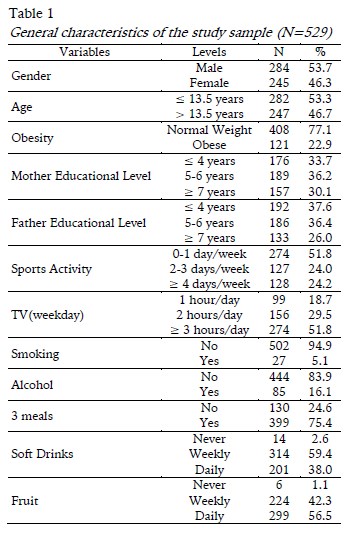
<body><![CDATA[<p><font size="2" face="verdana"><i>Lifestyle and Socioeconomic Status</i></font></p>     <p><font size="2" face="verdana">Lifestyle, socioeconomic status (SES) and demographic   characteristics were obtained by questionnaire. This questionnaire was designed   to collect information about factors that may be associated with body   dissatisfaction. Gender, age (categorized in &#8804;13.5 and &gt;13.5 years   old), parents’ level of education (&#8804;4 years, 5-6 years, &#8805;7 years),   time spent watching TV (1 hr/day, 2 hrs/day, &#8805;3 hrs/day), frequency of   sports activities (0-1 day/week, 2-3 days/week, &#8805;4 days/week), alcohol   and tobacco consumption (yes, no), three meals daily (yes, no), frequency of   soft drink consumption (never, weekly, daily) and fruit consumption (never, weekly, daily) were the variables chosen to include in regression models. </font></p>     <p><font size="2" face="verdana"><b>Statistical analysis</b></font></p>     <p><font size="2" face="verdana">Prevalence of body dissatisfaction was calculated in   percentage and qui-squared tests in order to analyze the association with gender and obesity.</font></p>     <p><font size="2" face="verdana">Logistic regression analyses (univariate and   multivariate expressed by odds ratios in 95% confidence intervals) based on the   maximum likelihood method were used to investigate the association of lifestyle   and SES factors with the prevalence of body image dissatisfaction. After   identifying the variables associated with body dissatisfaction separately, only   were include in multivariate logistic regression, those that were significant   (p&#8804;.20). The multivariate model analyzed all the variables together,   adjusted for the remaining independent variables (obesity, father education level, sports activity, TV weekday and fruit).</font></p>     <p>&nbsp;</p>     <p><font size="3" face="verdana"><b>RESULTS</b></font></p>     <p><font size="2" face="verdana">The general characteristics of the sample are presented in <a href="#t1">Table 1</a>.</font></p>     <p><a name="t1"></a></p>     <p>&nbsp;</p>     ]]></body>
<body><![CDATA[<p align="center"><img src="/img/revistas/mot/v12n2/12n2a04t1.jpg" width="359" height="542"></p>     
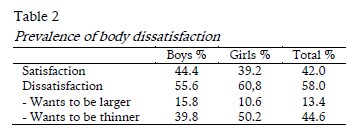
<p>&nbsp;</p>     <p><font size="2" face="verdana">Of the total sample 22.9% were overweight and obese.   During free-time activities 51.8% spent 0-1 days/week in sports activities and   51.8% watched TV more than three hours per day. Alcohol consumption and smoking   percentages were 5.1% and 16.1%, respectively. Regarding daily eating behavior,   24.6% of adolescents had fewer than three meals per day, 38% consumed soft drinks and 56.5% ate fruit. </font></p>     <p><font size="2" face="verdana">The prevalence of body dissatisfaction was 58% (see     <a href="#t2">Table 2</a>), with a higher percentage of those who wanted to be thinner (44.6%).   Gender was not significantly associated with body dissatisfaction (&#967;<sup>2</sup>(1)= 1.45,   p=.251). However, this association becomes significant when we analyze whether   adolescents wish to have thinner or larger bodies (&#967;<sup>2</sup>(2)= 6.72, p=.035). More girls (50.2%)   than boys (39.8%) wished to have a thinner body, while more boys wanted to be larger (15.8% vs. 10.6%). </font></p>     <p><a name="t2"></a></p>     <p>&nbsp;</p>     <p align="center"><img src="/img/revistas/mot/v12n2/12n2a04t2.jpg" width="354" height="139"></p>     
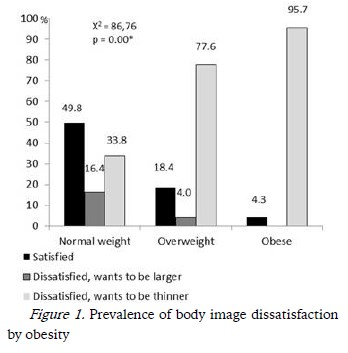
<p>&nbsp;</p>     <p><font size="2" face="verdana">The prevalence of overweight and obese subjects was   18.5% and 4.3%, respectively. Significant differences were found in obesity   prevalence by gender (&#967;<sup>2</sup>(1)= 22.88, p&lt;.000); obesity was higher in boys than girls (31% vs. 13.5%).</font></p>     <p><font size="2" face="verdana">As illustrated in <a href="#f1">Figure 1</a>, a significant association   was found between obesity and body dissatisfaction (&#967;<sup>2</sup>(4)= 86.76, p=.000). Obese and   overweight adolescents were more dissatisfied with their body image (95.7% and   77.6%, respectively) and wished be thinner. Of the normal-weight group, only 49.8% were satisfied with their body image.</font></p>     ]]></body>
<body><![CDATA[<p><a name="f1"></a></p>     <p>&nbsp;</p>     <p align="center"><font size="2" face="verdana"><img src="/img/revistas/mot/v12n2/12n2a04f1.jpg" width="348" height="353"></font></p>     
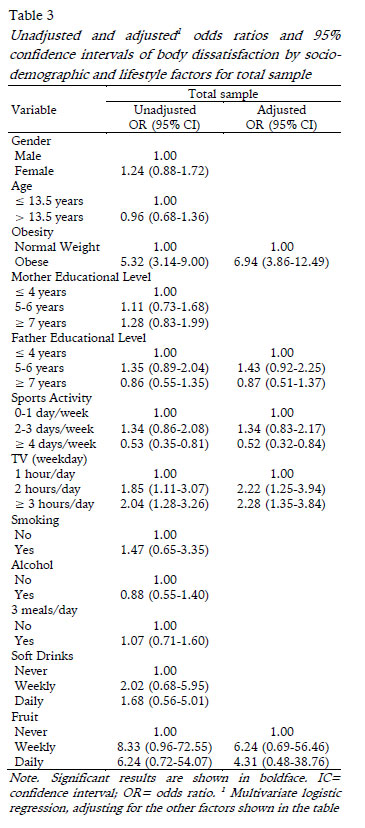
<p>&nbsp;</p>     <p><font size="2" face="verdana">Univariate logistic regression revealed that the   following variables are associated with body dissatisfaction (<a href="#t3">Table 3</a>): obesity   (OR=5.32; IC95%: 3.14-9.00), watching TV more than two hours per day (OR=1.85;   IC95%: 1.11-3.07; OR=2.04; IC95%: 1.28-3.26) and four or more days per week of   sports activities (OR=0.53; IC95%: 0.35-0.81). In the final model, attained by   multivariate logistic regression, the variables that maintained the association   were the same: obesity (OR=6.94; IC95%: 3.86-12.49), four or more days per week   of sport activities (OR=0.52; IC95%: 0.32-0.84) and watching TV more than two   hours per day (OR=2.22; IC95%: 1.25-3.94; OR=2.28; IC95%: 1.35-3.84).</font></p>     <p><a name="t3"></a></p>     <p>&nbsp;</p>     <p align="center"><img src="/img/revistas/mot/v12n2/12n2a04t3.jpg" width="365" height="828"></p>     
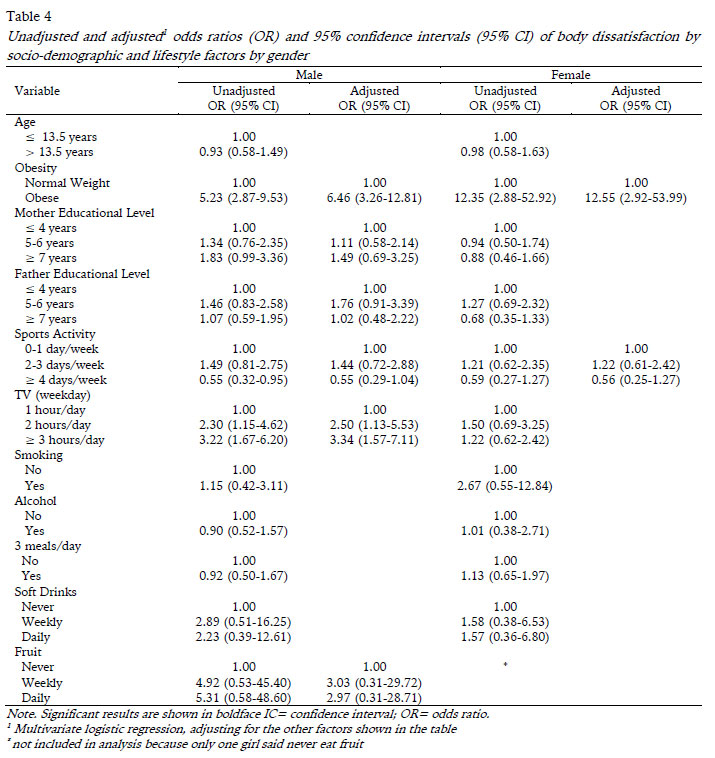
<p>&nbsp;</p>     <p><font size="2" face="verdana">Separate logistic regressions (univariate and   multivariate) were conducted for female and male adolescents in order to identify   the variables that were associated with body image dissatisfaction for each   gender (see <a href="/img/revistas/mot/v12n2/12n2a04t4.jpg">Table 4</a>). Among male adolescents, the variables that showed a   significant association by univariate logistic regression were obesity   (OR=5.23; IC95%: 2.87-9.53), four or more days per week of sports activities   (OR=0.55; IC95%: 0.32-0.95) and watching TV more than two hours per day   (OR=2.30; IC95%: 1.15-4.62; OR=3.22; IC95%: 1.67-6.20). In the final model, the   variables that kept the association were obesity (OR=6.46; IC95%: 3.26-12.81)   and watching TV more than two hours per day (OR=2.50; IC95%: 1.13-5.53;   OR=3.34; IC95%: 1.57-7.11). </font></p>     
]]></body>
<body><![CDATA[<p><font size="2" face="verdana">Among female adolescents, obesity was the only   variable that had a significant association with body dissatisfaction, on both   univariate (OR= 12.35; IC95%: 2.88-52.92) and multivariate (OR=12.55; IC95%: 2.92-53.99) logistic regressions.</font></p>     <p>&nbsp;</p>     <p><font size="3" face="verdana"><b>DISCUSSION</b></font></p>     <p><font size="2" face="verdana">O The results confirm a high prevalence of body image   dissatisfaction in young people (10-18 years), especially in overweight and   obese adolescents. The risk factors associated with body image dissatisfaction   are obesity and time spent watching TV, while sports activity is a preventive one.</font></p>     <p><font size="2" face="verdana">The discrepancies concerning body image dissatisfaction   prevalence between countries are due to several cultural, ethnic and   socioeconomic variables, as well as the different instruments applied and   dissimilar age samples. In this study, we found that the prevalence of body   image dissatisfaction was 58%. Similar results were observed in Brazilian   adolescents (19.5%-64.2) (Duca et al., 2010; Fidelix et al., 2011; Petroski et   al., 2009), while lower results were found in Middle Eastern countries, ranging   from 11.4% in Pakistan to 21.2% in Jordan (Alikasifoglu et al., 2011; Mousa,   Mashal, Al-Domi, &amp; Jibril, 2010; Mumford, Whitehouse, &amp; Choudry, 1992).   This discrepancy can be explained by greater social and cultural similarities   between Portugal and Brazil than between these countries and Middle Eastern nations. </font></p>     <p><font size="2" face="verdana">However, while in the past body image concerns may   have been more often associated with women, today both genders share these   concerns, but for different reasons. The results of this study are consistent   with previous studies (Fountoulakis &amp; Grogan, 2014; Petroski et al., 2009;   Silva et al., 2011; Triches &amp; Giugliani, 2007): girls want to lose weight   to become thinner, while boys want to gain weight and increase muscle mass. Two   possible explanations may justify this: greater media influence on women’s beauty   standards (Posavac &amp; Posavac, 2002) and men´s pursuit of lean, muscular   bodies (Cafri et al., 2005). A qualitative study done by Hargreaves and   Tiggemann (2006) on boys’ body image (14-16 years old) reinforces the finding that the subjects do not believe mass media influences their body image. </font></p>     <p><font size="2" face="verdana">In accordance with other studies (Alikasifoglu et al.,   2011; Almeida, 2004; Costa &amp; Vasconcelos, 2010; Duca et al., 2010;   Gilbert-Diamond et al., 2009; Martins et al., 2010; Pallan, Hiam, Duda, &amp;   Adab, 2011; Petroski et al., 2009; Santana et al., 2013; Silva et al., 2011;   Triches &amp; Giugliani, 2007), our results revealed the prevalence of obesity   as one of the most important factors in development of body dissatisfaction,   with obese subjects presenting a risk for dissatisfaction seven times higher   than their normal-weight peers. Obesity was the only variable associated with   body dissatisfaction in females, and showed a higher risk than for males.   Presnell, Bearman, and Stice (2004) have suggested that girls are dissatisfied   with their bodies regardless of their weight, whereas boys become concerned only when they are overweight.</font></p>     <p><font size="2" face="verdana">In effect, obese participants revealed higher body   image dissatisfaction than normal-weight participants. Still, half of   normal-weight participants desired to be thinner. Today, Western societies   demand thinner body profiles, and through enculturation processes, younger   people absorb these references at an early age. Similar to our investigation,   the study developed by Al Sabbah et al. (2009) of adolescents (11-15 years) in   24 European countries, the USA and Canada also found high body image   dissatisfaction in obese (between 54.0% and 85.4%) and in non-overweight (between 22,5% and 45.1%) adolescents. </font></p>     <p><font size="2" face="verdana">While demographic variables such as gender and age   have been reported in the literature as associated with body dissatisfaction   (Alikasifoglu et al., 2011; Almeida, 2004; Duca et al., 2010; Fidelix et al.,   2011; Silva et al., 2011), results from the present study did not confirm this   association. Parental schooling was also not associated with body   dissatisfaction, meaning that children from different social classes seem to be   exposed to the same messages of body image from family, friends and the media (Pinheiro &amp; Giugliani, 2006).</font></p>     <p><font size="2" face="verdana">On the other hand, sports activity was the only   variable acting as a preventive factor for body image dissatisfaction. A   cross-sectional study with Portuguese adolescents (10-17 years) reached the   same conclusion - higher levels of physical activity were associated with a   protective effect on body dissatisfaction (Gaspar et al., 2011). The results of   a longitudinal research showed that participation in 6 weeks aerobic dance   reduced body dissatisfaction among adolescent girls (Burgess et al., 2006). Two   recent meta-analysis studies also proved that physical exercise is associated   with a more positive body image (Campbell &amp; Hausenblas, 2009; Hausenblas   &amp; Fallon, 2006). The higher proprioceptive information input and   somatosensory conscience given by exercise (Damásio, 2000) allows for a better   body image. On the other hand, Costa and Vasconcelos (2010) did not find this   association, though their results might be explained by the method used to   assess physical activity (a dichotomic scale: practice/no practice), which   disallows differentiation in amount of practice per week. We highlight the positive association of physical activity four or more days per week.</font></p>     ]]></body>
<body><![CDATA[<p><font size="2" face="verdana">The hours spent daily watching television during the   week also showed a significant association with body image dissatisfaction in   males and in the total sample. Similar results were found by Alikasifoglu et   al. (2011). Adolescents who spend more than two hours/day watching TV have   double the risk of body image dissatisfaction compared to those who watch up to   one hour per day. The risk is three times higher in males who watch more than   three hours/day. This could be due to the fact that time spent watching TV is   one of the sedentary activities most commonly associated with obesity   (Marshall, Biddle, Gorely, Cameron, &amp; Murdey, 2004), as well as to TV’s role in promoting beauty ideals such as thinness and hyper-caloric food intake.</font></p>     <p><font size="2" face="verdana">Lifestyle factors, dietary patterns and substances   consumption (alcohol and smoking) were not associated with body image   dissatisfaction in our study. However, Duca et al. (2010) showed that   adolescents who want to lose weight more frequently adhere to induced vomiting,   medication intake and smoking habits, and eat fewer than three meals daily.   Silva, Nahas, de Sousa, Del Duca, and Peres (2011) found an association between   alcohol abuse and body image dissatisfaction in males (with drinkers having a 1.7 times higher risk for dissatisfaction).</font></p>     <p><font size="2" face="verdana">Several limitations should be highlighted in this   study and need to be kept in mind when analyzing the results. First, the   cross-sectional design cannot establish cause-effect relationships. Second, the   use of a convenience sample restricts generalization and inference about   populations. Third, the study did not include psychological variables, such as   negative mood, depression, self-esteem and perfectionism, variables that have also been cited as associated with body image dissatisfaction. </font></p>     <p><font size="2" face="verdana">Some of this study’s strengths lie in the analysis of   factors associated with body image dissatisfaction by gender (a gap in the   literature) and in the use of a multivariate logistic regression with the   inclusion of several background variables, allowing determination of risk and   preventive factors associated with body dissatisfaction in order to design differentiated public heath interventions to reduced body dissatisfaction.</font></p>     <p>&nbsp;</p>     <p><font size="3" face="verdana"><b>CONCLUSIONS</b></font></p>     <p><font size="2" face="verdana">The current findings confirm a high prevalence of body   image dissatisfaction in young people (58%), especially in overweight and obese   adolescents. Obesity is a risk factor of body image dissatisfaction for both,   male and female; while for boys, the time spent watching TV is a risk factor   and sports activity is a preventive one .It is necessary to consider a   different intervention for men and women in order to reduce body image   dissatisfaction. Recent public health guidelines highlight the importance of   minimizing time spent sitting in adolescents, mainly the time young male spent   watching television. The adoption of an active lifestyle and healthy eating   habits can contribute significantly to the promotion of a more positive body image.</font></p>     <p>&nbsp;</p>     <p><font size="3" face="verdana"><b>REFERENCES</b></font></p>     <!-- ref --><p><font size="2" face="verdana">Al Sabbah, H., Vereecken, C. A., Elgar, F. J., Nansel, T., Aasvee, K.,   Abdeen, Z., … Maes, L. (2009).   Body weight dissatisfaction and communication with parents among adolescents in   24 countries: international cross-sectional survey. <i>BMC Public Health</i>, <i>9</i>, 52. <a target="_blank" href="http://doi.org/10.1186/1471-2458-9-52">http://doi.org/10.1186/1471-2458-9-52</a></font>&nbsp;&nbsp;&nbsp;&nbsp;&nbsp;&nbsp;&nbsp;&nbsp;[&#160;<a href="javascript:void(0);" onclick="javascript: window.open('/scielo.php?script=sci_nlinks&ref=353635&pid=S1646-107X201600020000400001&lng=','','width=640,height=500,resizable=yes,scrollbars=1,menubar=yes,');">Links</a>&#160;]<!-- end-ref --><!-- ref --><p><font size="2" face="verdana">Alikasifoglu, M., Ercan, O., Erginoz, E., Albayearak-Kaymak, D., &amp;   Uysal, O. (2011). Factors Associated with Dissatisfaction of Body Image among Turkish Adolescents. <i>Journal of Adolescent Health</i>, <i>48</i>(2), S53. <a target="_blank" href="http://doi.org/10.1016/j.jadohealth.2010.11.114">http://doi.org/10.1016/j.jadohealth.2010.11.114</a></font>&nbsp;&nbsp;&nbsp;&nbsp;&nbsp;&nbsp;&nbsp;&nbsp;[&#160;<a href="javascript:void(0);" onclick="javascript: window.open('/scielo.php?script=sci_nlinks&ref=353636&pid=S1646-107X201600020000400002&lng=','','width=640,height=500,resizable=yes,scrollbars=1,menubar=yes,');">Links</a>&#160;]<!-- end-ref --><!-- ref --><p><font size="2" face="verdana">Almeida, A. M. D. (2004). Insatisfação com o peso corporal. <i>Revista Portuguesa de Medicina Geral e Familiar</i>, <i>20</i>(6), 651–66.    &nbsp;&nbsp;&nbsp;&nbsp;&nbsp;&nbsp;&nbsp;&nbsp;[&#160;<a href="javascript:void(0);" onclick="javascript: window.open('/scielo.php?script=sci_nlinks&ref=353637&pid=S1646-107X201600020000400003&lng=','','width=640,height=500,resizable=yes,scrollbars=1,menubar=yes,');">Links</a>&#160;]<!-- end-ref --></font></p>     <!-- ref --><p><font size="2" face="verdana">Burgess, G., Grogan, S., &amp; Burwitz, L. (2006). Effects of a 6-week   aerobic dance intervention on body image and physical self-perceptions in adolescent girls. <i>Body Image</i>, <i>3</i>(1), 57–66. <a target="_blank" href="http://doi.org/10.1016/j.bodyim.2005.10.005">http://doi.org/10.1016/j.bodyim.2005.10.005</a></font>&nbsp;&nbsp;&nbsp;&nbsp;&nbsp;&nbsp;&nbsp;&nbsp;[&#160;<a href="javascript:void(0);" onclick="javascript: window.open('/scielo.php?script=sci_nlinks&ref=353639&pid=S1646-107X201600020000400004&lng=','','width=640,height=500,resizable=yes,scrollbars=1,menubar=yes,');">Links</a>&#160;]<!-- end-ref --><!-- ref --><p><font size="2" face="verdana">Cafri, G., Thompson, J. K., Ricciardelli, L., McCabe, M., Smolak, L.,   &amp; Yesalis, C. (2005). Pursuit of the muscular ideal: Physical and   psychological consequences and putative risk factors. <i>Clinical Psychology Review</i>, <i>25</i>(2), 215–239. <a target="_blank" href="http://doi.org/10.1016/j.cpr.2004.09.003">http://doi.org/10.1016/j.cpr.2004.09.003</a></font>&nbsp;&nbsp;&nbsp;&nbsp;&nbsp;&nbsp;&nbsp;&nbsp;[&#160;<a href="javascript:void(0);" onclick="javascript: window.open('/scielo.php?script=sci_nlinks&ref=353640&pid=S1646-107X201600020000400005&lng=','','width=640,height=500,resizable=yes,scrollbars=1,menubar=yes,');">Links</a>&#160;]<!-- end-ref --><!-- ref --><p><font size="2" face="verdana">Campbell, A., &amp; Hausenblas, H. A. (2009). Effects of exercise   interventions on body image: a meta-analysis. <i>Journal of Health Psychology</i>, <i>14</i>(6), 780–793. <a target="_blank" href="http://doi.org/10.1177/1359105309338977">http://doi.org/10.1177/1359105309338977</a></font>&nbsp;&nbsp;&nbsp;&nbsp;&nbsp;&nbsp;&nbsp;&nbsp;[&#160;<a href="javascript:void(0);" onclick="javascript: window.open('/scielo.php?script=sci_nlinks&ref=353641&pid=S1646-107X201600020000400006&lng=','','width=640,height=500,resizable=yes,scrollbars=1,menubar=yes,');">Links</a>&#160;]<!-- end-ref --><!-- ref --><p><font size="2" face="verdana">Coelho, E. M., Padez, C., Moreira, P., Rosado, V., &amp;   Mourão-Carvalhal, I. (2013). BMI and self-perceived body shape in Portuguese   children. <i>Revista de Psicología del Deporte</i>, <i>22</i>(2), 371–376.    &nbsp;&nbsp;&nbsp;&nbsp;&nbsp;&nbsp;&nbsp;&nbsp;[&#160;<a href="javascript:void(0);" onclick="javascript: window.open('/scielo.php?script=sci_nlinks&ref=353642&pid=S1646-107X201600020000400007&lng=','','width=640,height=500,resizable=yes,scrollbars=1,menubar=yes,');">Links</a>&#160;]<!-- end-ref --></font></p>     <!-- ref --><p><font size="2" face="verdana">Cole, T. J., Bellizzi, M. C., Flegal, K. M., &amp; Dietz, W. H.   (2000). Establishing a   standard definition for child overweight and obesity worldwide: international survey. <i>BMJ</i>, <i>320</i>(7244), 1240–1243. <a target="_blank" href="http://doi.org/10.1136/bmj.320.7244.1240">http://doi.org/10.1136/bmj.320.7244.1240</a></font>&nbsp;&nbsp;&nbsp;&nbsp;&nbsp;&nbsp;&nbsp;&nbsp;[&#160;<a href="javascript:void(0);" onclick="javascript: window.open('/scielo.php?script=sci_nlinks&ref=353644&pid=S1646-107X201600020000400008&lng=','','width=640,height=500,resizable=yes,scrollbars=1,menubar=yes,');">Links</a>&#160;]<!-- end-ref --><!-- ref --><p><font size="2" face="verdana">Collins, M. E. (1991). Body figure perceptions and preferences among   preadolescent children. <i>International Journal of Eating Disorders</i>, <i>10</i>(2), 199–208. <a target="_blank" href="http://doi.org/10.1002/1098-108X(199103)10:2%3c199::AID-EAT2260100209%3e3.0.CO;2-D">http://doi.org/10.1002/1098-108X(199103)10:2&lt;199::AID-EAT2260100209&gt;3.0.CO;2-D</a></font>&nbsp;&nbsp;&nbsp;&nbsp;&nbsp;&nbsp;&nbsp;&nbsp;[&#160;<a href="javascript:void(0);" onclick="javascript: window.open('/scielo.php?script=sci_nlinks&ref=353645&pid=S1646-107X201600020000400009&lng=','','width=640,height=500,resizable=yes,scrollbars=1,menubar=yes,');">Links</a>&#160;]<!-- end-ref --><!-- ref --><p><font size="2" face="verdana">Costa, L. da C. F., &amp; Vasconcelos, F. de A. G. de. (2010).   Influência de fatores socioeconômicos, comportamentais e nutricionais na   insatisfação com a imagem corporal de universitárias em Florianópolis, SC. <i>Revista Brasileira de Epidemiologia</i>, <i>13</i>(4), 665–676. <a target="_blank" href="http://doi.org/10.1590/S1415-790X2010000400011">http://doi.org/10.1590/S1415-790X2010000400011</a></font>&nbsp;&nbsp;&nbsp;&nbsp;&nbsp;&nbsp;&nbsp;&nbsp;[&#160;<a href="javascript:void(0);" onclick="javascript: window.open('/scielo.php?script=sci_nlinks&ref=353646&pid=S1646-107X201600020000400010&lng=','','width=640,height=500,resizable=yes,scrollbars=1,menubar=yes,');">Links</a>&#160;]<!-- end-ref --><!-- ref --><p><font size="2" face="verdana">Damásio, A. (2000). <i>O sentimento de si: o corpo, a emoção e a neurobiologia da consciência</i>. Mem-Martins: Publicações Europa-América.    &nbsp;&nbsp;&nbsp;&nbsp;&nbsp;&nbsp;&nbsp;&nbsp;[&#160;<a href="javascript:void(0);" onclick="javascript: window.open('/scielo.php?script=sci_nlinks&ref=353647&pid=S1646-107X201600020000400011&lng=','','width=640,height=500,resizable=yes,scrollbars=1,menubar=yes,');">Links</a>&#160;]<!-- end-ref --></font></p>     <!-- ref --><p><font size="2" face="verdana">Dohnt, H. K., &amp; Tiggemann, M. (2006). Body Image Concerns in Young Girls: The Role of Peers and Media Prior to Adolescence. <i>Journal of Youth and Adolescence</i>, <i>35</i>(2), 135. <a target="_blank" href="http://doi.org/10.1007/s10964-005-9020-7">http://doi.org/10.1007/s10964-005-9020-7</a></font>&nbsp;&nbsp;&nbsp;&nbsp;&nbsp;&nbsp;&nbsp;&nbsp;[&#160;<a href="javascript:void(0);" onclick="javascript: window.open('/scielo.php?script=sci_nlinks&ref=353649&pid=S1646-107X201600020000400012&lng=','','width=640,height=500,resizable=yes,scrollbars=1,menubar=yes,');">Links</a>&#160;]<!-- end-ref --><!-- ref --><p><font size="2" face="verdana">Duca, D., Firpo, G., Garcia, L. M. T., Sousa, T. F. de, Oliveira, E. S.   A. de, &amp; Nahas, M. V. (2010). Insatisfação com o peso corporal e fatores   associados em adolescentes. <i>Revista Paulista de Pediatria</i>, <i>28</i>(4), 340–346. <a target="_blank" href="http://doi.org/10.1590/S0103-05822010000400009">http://doi.org/10.1590/S0103-05822010000400009</a></font>&nbsp;&nbsp;&nbsp;&nbsp;&nbsp;&nbsp;&nbsp;&nbsp;[&#160;<a href="javascript:void(0);" onclick="javascript: window.open('/scielo.php?script=sci_nlinks&ref=353650&pid=S1646-107X201600020000400013&lng=','','width=640,height=500,resizable=yes,scrollbars=1,menubar=yes,');">Links</a>&#160;]<!-- end-ref --><!-- ref --><p><font size="2" face="verdana">Fidelix, Y. L., Silva, D. A. S., Pelegrini, A., Silva, A. F. da, &amp;   Petroski, E. L. (2011). Body image dissatisfaction among adolescents from a   small town: association with gender, age, and area of residence. <i>Revista Brasileira de Cineantropometria &amp; Desempenho Humano</i>, <i>13</i>(3), 202–207. <a target="_blank" href="http://doi.org/10.5007/1980-0037.2011v13n3p202">http://doi.org/10.5007/1980-0037.2011v13n3p202</a></font>&nbsp;&nbsp;&nbsp;&nbsp;&nbsp;&nbsp;&nbsp;&nbsp;[&#160;<a href="javascript:void(0);" onclick="javascript: window.open('/scielo.php?script=sci_nlinks&ref=353651&pid=S1646-107X201600020000400014&lng=','','width=640,height=500,resizable=yes,scrollbars=1,menubar=yes,');">Links</a>&#160;]<!-- end-ref --><!-- ref --><p><font size="2" face="verdana">Fountoulakis, C., &amp; Grogan, S. (2014). An investigation of the links between   body image and exercise participation. <i>Sport &amp; Exercise Psychology Review</i>, <i>198</i>(11), 19–30.    &nbsp;&nbsp;&nbsp;&nbsp;&nbsp;&nbsp;&nbsp;&nbsp;[&#160;<a href="javascript:void(0);" onclick="javascript: window.open('/scielo.php?script=sci_nlinks&ref=353652&pid=S1646-107X201600020000400015&lng=','','width=640,height=500,resizable=yes,scrollbars=1,menubar=yes,');">Links</a>&#160;]<!-- end-ref --></font></p>     <!-- ref --><p><font size="2" face="verdana">Gaspar, M. J. M., Amaral, T. F., Oliveira, B. M. P. M., &amp; Borges, N.   (2011). Protective effect of physical activity on dissatisfaction with body   image in children – A cross-sectional study. <i>Psychology of Sport and Exercise</i>, <i>12</i>(5), 563–569. <a target="_blank" href="http://doi.org/10.1016/j.psychsport.2011.05.004">http://doi.org/10.1016/j.psychsport.2011.05.004</a></font>&nbsp;&nbsp;&nbsp;&nbsp;&nbsp;&nbsp;&nbsp;&nbsp;[&#160;<a href="javascript:void(0);" onclick="javascript: window.open('/scielo.php?script=sci_nlinks&ref=353654&pid=S1646-107X201600020000400016&lng=','','width=640,height=500,resizable=yes,scrollbars=1,menubar=yes,');">Links</a>&#160;]<!-- end-ref --><!-- ref --><p><font size="2" face="verdana">Gilbert-Diamond, D., Baylin, A., Mora-Plazas, M., &amp; Villamor, E.   (2009). Correlates of obesity and body image in Colombian women. <i>Journal of Women’s Health (2002)</i>, <i>18</i>(8), 1145–1151. <a target="_blank" href="http://doi.org/10.1089/jwh.2008.1179">http://doi.org/10.1089/jwh.2008.1179</a></font>&nbsp;&nbsp;&nbsp;&nbsp;&nbsp;&nbsp;&nbsp;&nbsp;[&#160;<a href="javascript:void(0);" onclick="javascript: window.open('/scielo.php?script=sci_nlinks&ref=353655&pid=S1646-107X201600020000400017&lng=','','width=640,height=500,resizable=yes,scrollbars=1,menubar=yes,');">Links</a>&#160;]<!-- end-ref --><!-- ref --><p><font size="2" face="verdana">Hargreaves, D. A., &amp; Tiggemann, M. (2006). «Body image is for   girls»: a qualitative study of boys’ body image. <i>Journal of Health Psychology</i>, <i>11</i>(4), 567–576. <a target="_blank" href="http://doi.org/10.1177/1359105306065017">http://doi.org/10.1177/1359105306065017</a></font>&nbsp;&nbsp;&nbsp;&nbsp;&nbsp;&nbsp;&nbsp;&nbsp;[&#160;<a href="javascript:void(0);" onclick="javascript: window.open('/scielo.php?script=sci_nlinks&ref=353656&pid=S1646-107X201600020000400018&lng=','','width=640,height=500,resizable=yes,scrollbars=1,menubar=yes,');">Links</a>&#160;]<!-- end-ref --><!-- ref --><p><font size="2" face="verdana">Harriss, D. J., &amp; Atkinson, G. (2009). International Journal of   Sports Medicine - ethical standards in sport and exercise science research. <i>International Journal of Sports Medicine</i>, <i>30</i>(10), 701–702. <a target="_blank" href="http://doi.org/10.1055/s-0029-1237378">http://doi.org/10.1055/s-0029-1237378</a></font>&nbsp;&nbsp;&nbsp;&nbsp;&nbsp;&nbsp;&nbsp;&nbsp;[&#160;<a href="javascript:void(0);" onclick="javascript: window.open('/scielo.php?script=sci_nlinks&ref=353657&pid=S1646-107X201600020000400019&lng=','','width=640,height=500,resizable=yes,scrollbars=1,menubar=yes,');">Links</a>&#160;]<!-- end-ref --><!-- ref --><p><font size="2" face="verdana">Hausenblas, H. A., &amp; Fallon, E. A. (2006). Exercise and body image: A meta-analysis. <i>Psychology &amp; Health</i>, <i>21</i>(1), 33–47. <a target="_blank" href="http://doi.org/10.1080/14768320500105270">http://doi.org/10.1080/14768320500105270</a></font>&nbsp;&nbsp;&nbsp;&nbsp;&nbsp;&nbsp;&nbsp;&nbsp;[&#160;<a href="javascript:void(0);" onclick="javascript: window.open('/scielo.php?script=sci_nlinks&ref=353658&pid=S1646-107X201600020000400020&lng=','','width=640,height=500,resizable=yes,scrollbars=1,menubar=yes,');">Links</a>&#160;]<!-- end-ref --><!-- ref --><p><font size="2" face="verdana">Kantanista, A., Osi&#324;ski, W.,   Borowiec, J., Tomczak, M., &amp; Król-Zieli&#324;ska, M. (2015). Body image, BMI, and physical activity in girls and boys aged 14-16 years. <i>Body Image</i>, <i>15</i>, 40–43. <a target="_blank" href="http://doi.org/10.1016/j.bodyim.2015.05.001">http://doi.org/10.1016/j.bodyim.2015.05.001</a></font>&nbsp;&nbsp;&nbsp;&nbsp;&nbsp;&nbsp;&nbsp;&nbsp;[&#160;<a href="javascript:void(0);" onclick="javascript: window.open('/scielo.php?script=sci_nlinks&ref=353659&pid=S1646-107X201600020000400021&lng=','','width=640,height=500,resizable=yes,scrollbars=1,menubar=yes,');">Links</a>&#160;]<!-- end-ref --><!-- ref --><p><font size="2" face="verdana">Kim, D.-S., &amp; Kim, H.-S. (2009). Body-image dissatisfaction as a   predictor of suicidal ideation among Korean boys and girls in different stages   of adolescence: a two-year longitudinal study. <i>The Journal of Adolescent     Health: Official Publication of the Society for Adolescent Medicine</i>, <i>45</i>(1), 47–54. <a target="_blank" href="http://doi.org/10.1016/j.jadohealth.2008.11.017">http://doi.org/10.1016/j.jadohealth.2008.11.017</a></font>&nbsp;&nbsp;&nbsp;&nbsp;&nbsp;&nbsp;&nbsp;&nbsp;[&#160;<a href="javascript:void(0);" onclick="javascript: window.open('/scielo.php?script=sci_nlinks&ref=353660&pid=S1646-107X201600020000400022&lng=','','width=640,height=500,resizable=yes,scrollbars=1,menubar=yes,');">Links</a>&#160;]<!-- end-ref --><!-- ref --><p><font size="2" face="verdana">Kirkcaldy, B. D., Shephard, R. J., &amp; Siefen, R. G. (2002). The   relationship between physical activity and self-image and problem behaviour   among adolescents. <i>Social Psychiatry and Psychiatric Epidemiology</i>, <i>37</i>(11), 544–550. <a target="_blank" href="http://doi.org/10.1007/s00127-002-0554-7">http://doi.org/10.1007/s00127-002-0554-7</a></font>&nbsp;&nbsp;&nbsp;&nbsp;&nbsp;&nbsp;&nbsp;&nbsp;[&#160;<a href="javascript:void(0);" onclick="javascript: window.open('/scielo.php?script=sci_nlinks&ref=353661&pid=S1646-107X201600020000400023&lng=','','width=640,height=500,resizable=yes,scrollbars=1,menubar=yes,');">Links</a>&#160;]<!-- end-ref --><!-- ref --><p><font size="2" face="verdana">Kruger, J., Lee, C.-D., Ainsworth, B. E., &amp; Macera, C. A. (2008).   Body size satisfaction and physical activity levels among men and women. <i>Obesity (Silver Spring, Md.)</i>, <i>16</i>(8), 1976–1979. <a target="_blank" href="http://doi.org/10.1038/oby.2008.311">http://doi.org/10.1038/oby.2008.311</a></font>&nbsp;&nbsp;&nbsp;&nbsp;&nbsp;&nbsp;&nbsp;&nbsp;[&#160;<a href="javascript:void(0);" onclick="javascript: window.open('/scielo.php?script=sci_nlinks&ref=353662&pid=S1646-107X201600020000400024&lng=','','width=640,height=500,resizable=yes,scrollbars=1,menubar=yes,');">Links</a>&#160;]<!-- end-ref --><!-- ref --><p><font size="2" face="verdana">Littleton, H. L., &amp; Ollendick, T. (2003). Negative body image and   disordered eating behavior in children and adolescents: what places youth at   risk and how can these problems be prevented? <i>Clinical Child and Family Psychology Review</i>, <i>6</i>(1), 51–66.    &nbsp;&nbsp;&nbsp;&nbsp;&nbsp;&nbsp;&nbsp;&nbsp;[&#160;<a href="javascript:void(0);" onclick="javascript: window.open('/scielo.php?script=sci_nlinks&ref=353663&pid=S1646-107X201600020000400025&lng=','','width=640,height=500,resizable=yes,scrollbars=1,menubar=yes,');">Links</a>&#160;]<!-- end-ref --></font></p>     <!-- ref --><p><font size="2" face="verdana">Marshall, S. J., Biddle, S. J. H., Gorely, T., Cameron, N., &amp;   Murdey, I. (2004). Relationships between media use, body fatness and physical   activity in children and youth: a meta-analysis. <i>International Journal of     Obesity and Related Metabolic Disorders: Journal of the International Association for the Study of Obesity</i>, <i>28</i>(10), 1238–1246. <a target="_blank" href="http://doi.org/10.1038/sj.ijo.0802706">http://doi.org/10.1038/sj.ijo.0802706</a></font>&nbsp;&nbsp;&nbsp;&nbsp;&nbsp;&nbsp;&nbsp;&nbsp;[&#160;<a href="javascript:void(0);" onclick="javascript: window.open('/scielo.php?script=sci_nlinks&ref=353665&pid=S1646-107X201600020000400026&lng=','','width=640,height=500,resizable=yes,scrollbars=1,menubar=yes,');">Links</a>&#160;]<!-- end-ref --><!-- ref --><p><font size="2" face="verdana">Martins, C. R., Pelegrini, A., Matheus, S. C., &amp; Petroski, E. L.   (2010). Body image   dissatisfaction and its relationship with nutritional status, body fat, and   anorexia and bulimia symptoms in adolescents. <i>Revista de Psiquiatria do Rio Grande     do Sul</i>, <i>32</i>(1), 19–23. <a target="_blank" href="http://doi.org/10.1590/S0101-81082010000100004">http://doi.org/10.1590/S0101-81082010000100004</a></font>&nbsp;&nbsp;&nbsp;&nbsp;&nbsp;&nbsp;&nbsp;&nbsp;[&#160;<a href="javascript:void(0);" onclick="javascript: window.open('/scielo.php?script=sci_nlinks&ref=353666&pid=S1646-107X201600020000400027&lng=','','width=640,height=500,resizable=yes,scrollbars=1,menubar=yes,');">Links</a>&#160;]<!-- end-ref --><!-- ref --><p><font size="2" face="verdana">Mousa, T. Y., Mashal, R. H., Al-Domi, H. A., &amp; Jibril, M. A. (2010).   Body image dissatisfaction among adolescent schoolgirls in Jordan. <i>Body Image</i>, <i>7</i>(1), 46–50. <a target="_blank" href="http://doi.org/10.1016/j.bodyim.2009.10.002">http://doi.org/10.1016/j.bodyim.2009.10.002</a></font>&nbsp;&nbsp;&nbsp;&nbsp;&nbsp;&nbsp;&nbsp;&nbsp;[&#160;<a href="javascript:void(0);" onclick="javascript: window.open('/scielo.php?script=sci_nlinks&ref=353667&pid=S1646-107X201600020000400028&lng=','','width=640,height=500,resizable=yes,scrollbars=1,menubar=yes,');">Links</a>&#160;]<!-- end-ref --><!-- ref --><p><font size="2" face="verdana">Mumford, D. B., Whitehouse, A. M., &amp; Choudry, I. Y. (1992). Survey   of eating disorders in English-medium schools in Lahore, Pakistan. <i>The International Journal of Eating Disorders</i>, <i>11</i>(2), 173–184.    &nbsp;&nbsp;&nbsp;&nbsp;&nbsp;&nbsp;&nbsp;&nbsp;[&#160;<a href="javascript:void(0);" onclick="javascript: window.open('/scielo.php?script=sci_nlinks&ref=353668&pid=S1646-107X201600020000400029&lng=','','width=640,height=500,resizable=yes,scrollbars=1,menubar=yes,');">Links</a>&#160;]<!-- end-ref --></font></p>     <!-- ref --><p><font size="2" face="verdana">Pallan, M. J., Hiam, L. C., Duda, J. L., &amp; Adab, P. (2011). Body   image, body dissatisfaction and weight status in south asian children: a cross-sectional study. <i>BMC Public Health</i>, <i>11</i>, 21. <a target="_blank" href="http://doi.org/10.1186/1471-2458-11-21">http://doi.org/10.1186/1471-2458-11-21</a></font>&nbsp;&nbsp;&nbsp;&nbsp;&nbsp;&nbsp;&nbsp;&nbsp;[&#160;<a href="javascript:void(0);" onclick="javascript: window.open('/scielo.php?script=sci_nlinks&ref=353670&pid=S1646-107X201600020000400030&lng=','','width=640,height=500,resizable=yes,scrollbars=1,menubar=yes,');">Links</a>&#160;]<!-- end-ref --><!-- ref --><p><font size="2" face="verdana">Petroski, E. L., Pelegrini, A., &amp; Glaner, M. F. (2009). Body image dissatisfaction among rural and urban adolescents. <i>Motricidade</i>, <i>5</i>(4), 13–25. <a target="_blank" href="http://doi.org/10.6063/motricidade.5(4).167">http://doi.org/10.6063/motricidade.5(4).167</a></font>&nbsp;&nbsp;&nbsp;&nbsp;&nbsp;&nbsp;&nbsp;&nbsp;[&#160;<a href="javascript:void(0);" onclick="javascript: window.open('/scielo.php?script=sci_nlinks&ref=353671&pid=S1646-107X201600020000400031&lng=','','width=640,height=500,resizable=yes,scrollbars=1,menubar=yes,');">Links</a>&#160;]<!-- end-ref --><!-- ref --><p><font size="2" face="verdana">Pinheiro, A. P., &amp; Giugliani, E. R. J. (2006). Body   dissatisfaction in Brazilian schoolchildren: prevalence and associated factors. <i>Revista de Saúde     Pública</i>, <i>40</i>(3), 489–496. <a target="_blank" href="http://doi.org/10.1590/S0034-89102006000300018">http://doi.org/10.1590/S0034-89102006000300018</a></font>&nbsp;&nbsp;&nbsp;&nbsp;&nbsp;&nbsp;&nbsp;&nbsp;[&#160;<a href="javascript:void(0);" onclick="javascript: window.open('/scielo.php?script=sci_nlinks&ref=353672&pid=S1646-107X201600020000400032&lng=','','width=640,height=500,resizable=yes,scrollbars=1,menubar=yes,');">Links</a>&#160;]<!-- end-ref --><!-- ref --><p><font size="2" face="verdana">Posavac, S. S., &amp; Posavac, H. D. (2002). Predictors of women’s concern with   body weight: the roles of perceived self-media ideal discrepancies and self-esteem. <i>Eating Disorders</i>, <i>10</i>(2), 153–160. <a target="_blank" href="http://doi.org/10.1002/erv.462">http://doi.org/10.1002/erv.462</a></font>&nbsp;&nbsp;&nbsp;&nbsp;&nbsp;&nbsp;&nbsp;&nbsp;[&#160;<a href="javascript:void(0);" onclick="javascript: window.open('/scielo.php?script=sci_nlinks&ref=353673&pid=S1646-107X201600020000400033&lng=','','width=640,height=500,resizable=yes,scrollbars=1,menubar=yes,');">Links</a>&#160;]<!-- end-ref --><!-- ref --><p><font size="2" face="verdana">Presnell, K., Bearman, S. K., &amp; Stice, E. (2004). Risk factors for   body dissatisfaction in adolescent boys and girls: a prospective study. <i>The International Journal of Eating Disorders</i>, <i>36</i>(4), 389–401. <a target="_blank" href="http://doi.org/10.1002/eat.20045">http://doi.org/10.1002/eat.20045</a></font>&nbsp;&nbsp;&nbsp;&nbsp;&nbsp;&nbsp;&nbsp;&nbsp;[&#160;<a href="javascript:void(0);" onclick="javascript: window.open('/scielo.php?script=sci_nlinks&ref=353674&pid=S1646-107X201600020000400034&lng=','','width=640,height=500,resizable=yes,scrollbars=1,menubar=yes,');">Links</a>&#160;]<!-- end-ref --><!-- ref --><p><font size="2" face="verdana">Santana, M. L. P., Silva, R. de C. R., Assis, A. M. O., Raich, R. M.,   Machado, M. E. P. C., de J Pinto, E., … Ribeiro Júnior, H. da C. (2013).   Factors associated with body image dissatisfaction among adolescents in public   schools students in Salvador, Brazil. <i>Nutrición Hospitalaria</i>, <i>28</i>(3), 747–755. <a target="_blank" href="http://doi.org/10.3305/nh.2013.28.3.6281">http://doi.org/10.3305/nh.2013.28.3.6281</a></font>&nbsp;&nbsp;&nbsp;&nbsp;&nbsp;&nbsp;&nbsp;&nbsp;[&#160;<a href="javascript:void(0);" onclick="javascript: window.open('/scielo.php?script=sci_nlinks&ref=353675&pid=S1646-107X201600020000400035&lng=','','width=640,height=500,resizable=yes,scrollbars=1,menubar=yes,');">Links</a>&#160;]<!-- end-ref --><!-- ref --><p><font size="2" face="verdana">Shin, N. Y., &amp; Shin, M. S. (2008). Body dissatisfaction, self-esteem, and depression in obese Korean children. <i>The Journal of Pediatrics</i>, <i>152</i>(4), 502–506. <a target="_blank" href="http://doi.org/10.1016/j.jpeds.2007.09.020">http://doi.org/10.1016/j.jpeds.2007.09.020</a></font>&nbsp;&nbsp;&nbsp;&nbsp;&nbsp;&nbsp;&nbsp;&nbsp;[&#160;<a href="javascript:void(0);" onclick="javascript: window.open('/scielo.php?script=sci_nlinks&ref=353676&pid=S1646-107X201600020000400036&lng=','','width=640,height=500,resizable=yes,scrollbars=1,menubar=yes,');">Links</a>&#160;]<!-- end-ref --><!-- ref --><p><font size="2" face="verdana">Silva, D. A. S., Nahas, M. V., de Sousa, T. F., Del Duca, G. F., &amp;   Peres, K. G. (2011). Prevalence and associated factors with body image dissatisfaction among   adults in southern Brazil: A population-based study. <i>Body Image</i>, <i>8</i>(4), 427–431. <a target="_blank" href="http://doi.org/10.1016/j.bodyim.2011.05.009">http://doi.org/10.1016/j.bodyim.2011.05.009</a></font>&nbsp;&nbsp;&nbsp;&nbsp;&nbsp;&nbsp;&nbsp;&nbsp;[&#160;<a href="javascript:void(0);" onclick="javascript: window.open('/scielo.php?script=sci_nlinks&ref=353677&pid=S1646-107X201600020000400037&lng=','','width=640,height=500,resizable=yes,scrollbars=1,menubar=yes,');">Links</a>&#160;]<!-- end-ref --><!-- ref --><p><font size="2" face="verdana">Slade, P. D. (1994). What is body image? <i>Behaviour Research and Therapy</i>, <i>32</i>(5), 497–502.    &nbsp;&nbsp;&nbsp;&nbsp;&nbsp;&nbsp;&nbsp;&nbsp;[&#160;<a href="javascript:void(0);" onclick="javascript: window.open('/scielo.php?script=sci_nlinks&ref=353678&pid=S1646-107X201600020000400038&lng=','','width=640,height=500,resizable=yes,scrollbars=1,menubar=yes,');">Links</a>&#160;]<!-- end-ref --></font></p>     <!-- ref --><p><font size="2" face="verdana">Stice, E., &amp; Bearman, S. K. (2001). Body-image and eating   disturbances prospectively predict increases in depressive symptoms in   adolescent girls: a growth curve analysis. <i>Developmental Psychology</i>, <i>37</i>(5), 597–607. <a target="_blank" href="http://doi.org/10.1037/0012-1649.37.5.597">http://doi.org/10.1037//0012-1649.37.5.597</a></font>&nbsp;&nbsp;&nbsp;&nbsp;&nbsp;&nbsp;&nbsp;&nbsp;[&#160;<a href="javascript:void(0);" onclick="javascript: window.open('/scielo.php?script=sci_nlinks&ref=353680&pid=S1646-107X201600020000400039&lng=','','width=640,height=500,resizable=yes,scrollbars=1,menubar=yes,');">Links</a>&#160;]<!-- end-ref --><!-- ref --><p><font size="2" face="verdana">Stice, E., Hayward, C., Cameron, R. P., Killen, J. D., &amp; Taylor, C.   B. (2000). Body-image and eating disturbances predict onset of depression among   female adolescents: a longitudinal study. <i>Journal of Abnormal Psychology</i>, <i>109</i>(3), 438–444.    &nbsp;&nbsp;&nbsp;&nbsp;&nbsp;&nbsp;&nbsp;&nbsp;[&#160;<a href="javascript:void(0);" onclick="javascript: window.open('/scielo.php?script=sci_nlinks&ref=353681&pid=S1646-107X201600020000400040&lng=','','width=640,height=500,resizable=yes,scrollbars=1,menubar=yes,');">Links</a>&#160;]<!-- end-ref --></font></p>     <!-- ref --><p><font size="2" face="verdana">Triches, R. M., &amp; Giugliani, E. R. J. (2007). Body dissatisfaction   in school children from two cities in the South of Brazil. <i>Revista de Nutrição</i>, <i>20</i>(2), 119–128. <a target="_blank" href="http://doi.org/10.1590/S1415-52732007000200001">http://doi.org/10.1590/S1415-52732007000200001</a></font>&nbsp;&nbsp;&nbsp;&nbsp;&nbsp;&nbsp;&nbsp;&nbsp;[&#160;<a href="javascript:void(0);" onclick="javascript: window.open('/scielo.php?script=sci_nlinks&ref=353683&pid=S1646-107X201600020000400041&lng=','','width=640,height=500,resizable=yes,scrollbars=1,menubar=yes,');">Links</a>&#160;]<!-- end-ref --><!-- ref --><p><font size="2" face="verdana">van den Berg, P. A., Mond, J., Eisenberg, M., Ackard, D., &amp; Neumark-Sztainer,   D. (2010). The link between body dissatisfaction and self-esteem in   adolescents: similarities across gender, age, weight status, race/ethnicity,   and socioeconomic status. <i>The Journal of Adolescent Health: Official Publication of the Society for Adolescent Medicine</i>, <i>47</i>(3), 290–296. <a target="_blank" href="http://doi.org/10.1016/j.jadohealth.2010.02.004">http://doi.org/10.1016/j.jadohealth.2010.02.004</a></font>&nbsp;&nbsp;&nbsp;&nbsp;&nbsp;&nbsp;&nbsp;&nbsp;[&#160;<a href="javascript:void(0);" onclick="javascript: window.open('/scielo.php?script=sci_nlinks&ref=353684&pid=S1646-107X201600020000400042&lng=','','width=640,height=500,resizable=yes,scrollbars=1,menubar=yes,');">Links</a>&#160;]<!-- end-ref --><p>&nbsp;</p>     ]]></body>
<body><![CDATA[<p><font size="2" face="verdana"><b>Acknowledgments:    <br> </b></font><font size="2" face="verdana">Nothing to declare    <br> </font><font size="2" face="verdana"><b>Conflict of Interest:    <br> </b></font><font size="2" face="verdana">Nothing to declare    <br> </font><font size="2" face="verdana"><b>Funding:    <br> </b></font><font size="2" face="verdana">Nothing to declare</font></p>     <p><font size="2" face="verdana">Manuscript received at December 4<sup>th</sup> 2014; Accepted February 16<sup>th</sup> 2016</font></p>     <p>&nbsp;</p>     <p>&nbsp;</p>     <p><font size="2" face="verdana"><a name="end"></a><a href="#topo">*</a> <i>Corresponding author</i>:   Universidade de Tr&aacute;s-os-Montes e Alto Douro, Complexo Desportivo da UTAD, DCDES-ECVA, Quinta de Prados, 5000-801 Vila Real, Portugal <i>E-mail</i>: <a href="mailto:ecoelho@utad.pt">ecoelho@utad.pt</a></font></p>     ]]></body>
<body><![CDATA[ ]]></body><back>
<ref-list>
<ref id="B1">
<nlm-citation citation-type="journal">
<person-group person-group-type="author">
<name>
<surname><![CDATA[Al Sabbah]]></surname>
<given-names><![CDATA[H.]]></given-names>
</name>
<name>
<surname><![CDATA[Vereecken]]></surname>
<given-names><![CDATA[C. A.]]></given-names>
</name>
<name>
<surname><![CDATA[Elgar]]></surname>
<given-names><![CDATA[F. J.]]></given-names>
</name>
<name>
<surname><![CDATA[Nansel]]></surname>
<given-names><![CDATA[T.]]></given-names>
</name>
<name>
<surname><![CDATA[Aasvee]]></surname>
<given-names><![CDATA[K.]]></given-names>
</name>
<name>
<surname><![CDATA[Abdeen]]></surname>
<given-names><![CDATA[Z.]]></given-names>
</name>
<name>
<surname><![CDATA[Maes]]></surname>
<given-names><![CDATA[L.]]></given-names>
</name>
</person-group>
<article-title xml:lang="en"><![CDATA[Body weight dissatisfaction and communication with parents among adolescents in 24 countries: international cross-sectional survey]]></article-title>
<source><![CDATA[BMC Public Health]]></source>
<year>2009</year>
<volume>9</volume>
<numero>52</numero>
<issue>52</issue>
</nlm-citation>
</ref>
<ref id="B2">
<nlm-citation citation-type="journal">
<person-group person-group-type="author">
<name>
<surname><![CDATA[Alikasifoglu]]></surname>
<given-names><![CDATA[M.]]></given-names>
</name>
<name>
<surname><![CDATA[Ercan]]></surname>
<given-names><![CDATA[O.]]></given-names>
</name>
<name>
<surname><![CDATA[Erginoz]]></surname>
<given-names><![CDATA[E.]]></given-names>
</name>
<name>
<surname><![CDATA[Albayearak-Kaymak]]></surname>
<given-names><![CDATA[D.]]></given-names>
</name>
<name>
<surname><![CDATA[Uysal]]></surname>
<given-names><![CDATA[O.]]></given-names>
</name>
</person-group>
<article-title xml:lang="en"><![CDATA[Factors Associated with Dissatisfaction of Body Image among Turkish Adolescents]]></article-title>
<source><![CDATA[Journal of Adolescent Health]]></source>
<year>2011</year>
<volume>48</volume>
<numero>2</numero>
<issue>2</issue>
<page-range>53</page-range></nlm-citation>
</ref>
<ref id="B3">
<nlm-citation citation-type="journal">
<person-group person-group-type="author">
<name>
<surname><![CDATA[Almeida]]></surname>
<given-names><![CDATA[A. M. D.]]></given-names>
</name>
</person-group>
<article-title xml:lang="pt"><![CDATA[Insatisfação com o peso corporal]]></article-title>
<source><![CDATA[Revista Portuguesa de Medicina Geral e Familiar]]></source>
<year>2004</year>
<volume>20</volume>
<numero>6</numero>
<issue>6</issue>
<page-range>651-66</page-range></nlm-citation>
</ref>
<ref id="B4">
<nlm-citation citation-type="journal">
<person-group person-group-type="author">
<name>
<surname><![CDATA[Burgess]]></surname>
<given-names><![CDATA[G.]]></given-names>
</name>
<name>
<surname><![CDATA[Grogan]]></surname>
<given-names><![CDATA[S.]]></given-names>
</name>
<name>
<surname><![CDATA[Burwitz]]></surname>
<given-names><![CDATA[L.]]></given-names>
</name>
</person-group>
<article-title xml:lang="en"><![CDATA[Effects of a 6-week aerobic dance intervention on body image and physical self-perceptions in adolescent girls]]></article-title>
<source><![CDATA[Body Image]]></source>
<year>2006</year>
<volume>3</volume>
<numero>1</numero>
<issue>1</issue>
<page-range>57-66</page-range></nlm-citation>
</ref>
<ref id="B5">
<nlm-citation citation-type="journal">
<person-group person-group-type="author">
<name>
<surname><![CDATA[Cafri]]></surname>
<given-names><![CDATA[G.]]></given-names>
</name>
<name>
<surname><![CDATA[Thompson]]></surname>
<given-names><![CDATA[J. K.]]></given-names>
</name>
<name>
<surname><![CDATA[Ricciardelli]]></surname>
<given-names><![CDATA[L.]]></given-names>
</name>
<name>
<surname><![CDATA[McCabe]]></surname>
<given-names><![CDATA[M.]]></given-names>
</name>
<name>
<surname><![CDATA[Smolak]]></surname>
<given-names><![CDATA[L.]]></given-names>
</name>
<name>
<surname><![CDATA[Yesalis]]></surname>
<given-names><![CDATA[C.]]></given-names>
</name>
</person-group>
<article-title xml:lang="en"><![CDATA[Pursuit of the muscular ideal: Physical and psychological consequences and putative risk factors]]></article-title>
<source><![CDATA[Clinical Psychology Review]]></source>
<year>2005</year>
<volume>25</volume>
<numero>2</numero>
<issue>2</issue>
<page-range>215-239</page-range></nlm-citation>
</ref>
<ref id="B6">
<nlm-citation citation-type="journal">
<person-group person-group-type="author">
<name>
<surname><![CDATA[Campbell]]></surname>
<given-names><![CDATA[A.]]></given-names>
</name>
<name>
<surname><![CDATA[Hausenblas]]></surname>
<given-names><![CDATA[H. A.]]></given-names>
</name>
</person-group>
<article-title xml:lang="en"><![CDATA[Effects of exercise interventions on body image: a meta-analysis]]></article-title>
<source><![CDATA[Journal of Health Psychology]]></source>
<year>2009</year>
<volume>14</volume>
<numero>6</numero>
<issue>6</issue>
<page-range>780-793</page-range></nlm-citation>
</ref>
<ref id="B7">
<nlm-citation citation-type="journal">
<person-group person-group-type="author">
<name>
<surname><![CDATA[Coelho]]></surname>
<given-names><![CDATA[E. M.]]></given-names>
</name>
<name>
<surname><![CDATA[Padez]]></surname>
<given-names><![CDATA[C.]]></given-names>
</name>
<name>
<surname><![CDATA[Moreira]]></surname>
<given-names><![CDATA[P.]]></given-names>
</name>
<name>
<surname><![CDATA[Rosado]]></surname>
<given-names><![CDATA[V.]]></given-names>
</name>
<name>
<surname><![CDATA[Mourão-Carvalhal]]></surname>
<given-names><![CDATA[I.]]></given-names>
</name>
</person-group>
<article-title xml:lang="en"><![CDATA[BMI and self-perceived body shape in Portuguese children]]></article-title>
<source><![CDATA[Revista de Psicología del Deporte]]></source>
<year>2013</year>
<volume>22</volume>
<numero>2</numero>
<issue>2</issue>
<page-range>371-376</page-range></nlm-citation>
</ref>
<ref id="B8">
<nlm-citation citation-type="journal">
<person-group person-group-type="author">
<name>
<surname><![CDATA[Cole]]></surname>
<given-names><![CDATA[T. J.]]></given-names>
</name>
<name>
<surname><![CDATA[Bellizzi]]></surname>
<given-names><![CDATA[M. C.]]></given-names>
</name>
<name>
<surname><![CDATA[Flegal]]></surname>
<given-names><![CDATA[K. M.]]></given-names>
</name>
<name>
<surname><![CDATA[Dietz]]></surname>
<given-names><![CDATA[W. H.]]></given-names>
</name>
</person-group>
<article-title xml:lang="en"><![CDATA[Establishing a standard definition for child overweight and obesity worldwide: international survey]]></article-title>
<source><![CDATA[BMJ]]></source>
<year>2000</year>
<volume>320</volume>
<numero>7244</numero>
<issue>7244</issue>
<page-range>1240-1243</page-range></nlm-citation>
</ref>
<ref id="B9">
<nlm-citation citation-type="journal">
<person-group person-group-type="author">
<name>
<surname><![CDATA[Collins]]></surname>
<given-names><![CDATA[M. E.]]></given-names>
</name>
</person-group>
<article-title xml:lang="en"><![CDATA[Body figure perceptions and preferences among preadolescent children]]></article-title>
<source><![CDATA[International Journal of Eating Disorders]]></source>
<year>1991</year>
<volume>10</volume>
<numero>2</numero>
<issue>2</issue>
<page-range>199-208</page-range></nlm-citation>
</ref>
<ref id="B10">
<nlm-citation citation-type="journal">
<person-group person-group-type="author">
<name>
<surname><![CDATA[Costa]]></surname>
<given-names><![CDATA[L. da C. F.]]></given-names>
</name>
<name>
<surname><![CDATA[Vasconcelos]]></surname>
<given-names><![CDATA[F. de A. G. de.]]></given-names>
</name>
</person-group>
<article-title xml:lang="en"><![CDATA[Influência de fatores socioeconômicos, comportamentais e nutricionais na insatisfação com a imagem corporal de universitárias em Florianópolis, SC]]></article-title>
<source><![CDATA[Revista Brasileira de Epidemiologia]]></source>
<year>2010</year>
<volume>13</volume>
<numero>4</numero>
<issue>4</issue>
<page-range>665-676</page-range></nlm-citation>
</ref>
<ref id="B11">
<nlm-citation citation-type="book">
<person-group person-group-type="author">
<name>
<surname><![CDATA[Damásio]]></surname>
<given-names><![CDATA[A.]]></given-names>
</name>
</person-group>
<source><![CDATA[O sentimento de si: o corpo, a emoção e a neurobiologia da consciência]]></source>
<year>2000</year>
<publisher-loc><![CDATA[Mem-Martins ]]></publisher-loc>
<publisher-name><![CDATA[Publicações Europa-América]]></publisher-name>
</nlm-citation>
</ref>
<ref id="B12">
<nlm-citation citation-type="journal">
<person-group person-group-type="author">
<name>
<surname><![CDATA[Dohnt]]></surname>
<given-names><![CDATA[H. K.]]></given-names>
</name>
<name>
<surname><![CDATA[Tiggemann]]></surname>
<given-names><![CDATA[M.]]></given-names>
</name>
</person-group>
<article-title xml:lang="en"><![CDATA[Body Image Concerns in Young Girls: The Role of Peers and Media Prior to Adolescence]]></article-title>
<source><![CDATA[Journal of Youth and Adolescence]]></source>
<year>2006</year>
<volume>35</volume>
<numero>2</numero>
<issue>2</issue>
<page-range>135</page-range></nlm-citation>
</ref>
<ref id="B13">
<nlm-citation citation-type="journal">
<person-group person-group-type="author">
<name>
<surname><![CDATA[Duca]]></surname>
<given-names><![CDATA[D.]]></given-names>
</name>
<name>
<surname><![CDATA[Firpo]]></surname>
<given-names><![CDATA[G.]]></given-names>
</name>
<name>
<surname><![CDATA[Garcia]]></surname>
<given-names><![CDATA[L. M. T.]]></given-names>
</name>
<name>
<surname><![CDATA[Sousa]]></surname>
<given-names><![CDATA[T. F. de]]></given-names>
</name>
<name>
<surname><![CDATA[Oliveira]]></surname>
<given-names><![CDATA[E. S. A. de]]></given-names>
</name>
<name>
<surname><![CDATA[Nahas]]></surname>
<given-names><![CDATA[M. V.]]></given-names>
</name>
</person-group>
<article-title xml:lang="pt"><![CDATA[Insatisfação com o peso corporal e fatores associados em adolescentes]]></article-title>
<source><![CDATA[Revista Paulista de Pediatria]]></source>
<year>2010</year>
<volume>28</volume>
<numero>4</numero>
<issue>4</issue>
<page-range>340-346</page-range></nlm-citation>
</ref>
<ref id="B14">
<nlm-citation citation-type="journal">
<person-group person-group-type="author">
<name>
<surname><![CDATA[Fidelix]]></surname>
<given-names><![CDATA[Y. L.]]></given-names>
</name>
<name>
<surname><![CDATA[Silva]]></surname>
<given-names><![CDATA[D. A. S.]]></given-names>
</name>
<name>
<surname><![CDATA[Pelegrini]]></surname>
<given-names><![CDATA[A.]]></given-names>
</name>
<name>
<surname><![CDATA[Silva]]></surname>
<given-names><![CDATA[A. F. da]]></given-names>
</name>
<name>
<surname><![CDATA[Petroski]]></surname>
<given-names><![CDATA[E. L.]]></given-names>
</name>
</person-group>
<article-title xml:lang="en"><![CDATA[Body image dissatisfaction among adolescents from a small town: association with gender, age, and area of residence]]></article-title>
<source><![CDATA[Revista Brasileira de Cineantropometria & Desempenho Humano]]></source>
<year>2011</year>
<volume>13</volume>
<numero>3</numero>
<issue>3</issue>
<page-range>202-207</page-range></nlm-citation>
</ref>
<ref id="B15">
<nlm-citation citation-type="journal">
<person-group person-group-type="author">
<name>
<surname><![CDATA[Fountoulakis]]></surname>
<given-names><![CDATA[C.]]></given-names>
</name>
<name>
<surname><![CDATA[Grogan]]></surname>
<given-names><![CDATA[S.]]></given-names>
</name>
</person-group>
<article-title xml:lang="en"><![CDATA[An investigation of the links between body image and exercise participation]]></article-title>
<source><![CDATA[Sport & Exercise Psychology Review]]></source>
<year>2014</year>
<volume>198</volume>
<numero>11</numero>
<issue>11</issue>
<page-range>19-30</page-range></nlm-citation>
</ref>
<ref id="B16">
<nlm-citation citation-type="journal">
<person-group person-group-type="author">
<name>
<surname><![CDATA[Gaspar]]></surname>
<given-names><![CDATA[M. J. M.]]></given-names>
</name>
<name>
<surname><![CDATA[Amaral]]></surname>
<given-names><![CDATA[T. F.]]></given-names>
</name>
<name>
<surname><![CDATA[Oliveira]]></surname>
<given-names><![CDATA[B. M. P. M.]]></given-names>
</name>
<name>
<surname><![CDATA[Borges]]></surname>
<given-names><![CDATA[N.]]></given-names>
</name>
</person-group>
<article-title xml:lang="en"><![CDATA[Protective effect of physical activity on dissatisfaction with body image in children: A cross-sectional study]]></article-title>
<source><![CDATA[Psychology of Sport and Exercise]]></source>
<year>2011</year>
<volume>12</volume>
<numero>5</numero>
<issue>5</issue>
<page-range>563-569</page-range></nlm-citation>
</ref>
<ref id="B17">
<nlm-citation citation-type="journal">
<person-group person-group-type="author">
<name>
<surname><![CDATA[Gilbert-Diamond]]></surname>
<given-names><![CDATA[D.]]></given-names>
</name>
<name>
<surname><![CDATA[Baylin]]></surname>
<given-names><![CDATA[A.]]></given-names>
</name>
<name>
<surname><![CDATA[Mora-Plazas]]></surname>
<given-names><![CDATA[M.]]></given-names>
</name>
<name>
<surname><![CDATA[Villamor]]></surname>
<given-names><![CDATA[E.]]></given-names>
</name>
</person-group>
<article-title xml:lang="en"><![CDATA[Correlates of obesity and body image in Colombian women]]></article-title>
<source><![CDATA[Journal of Women’s Health (2002)]]></source>
<year>2009</year>
<volume>18</volume>
<numero>8</numero>
<issue>8</issue>
<page-range>1145-1151</page-range></nlm-citation>
</ref>
<ref id="B18">
<nlm-citation citation-type="journal">
<person-group person-group-type="author">
<name>
<surname><![CDATA[Hargreaves]]></surname>
<given-names><![CDATA[D. A.]]></given-names>
</name>
<name>
<surname><![CDATA[Tiggemann]]></surname>
<given-names><![CDATA[M.]]></given-names>
</name>
</person-group>
<article-title xml:lang="en"><![CDATA[Body image is for girls: a qualitative study of boys’ body image]]></article-title>
<source><![CDATA[Journal of Health Psychology]]></source>
<year>2006</year>
<volume>11</volume>
<numero>4</numero>
<issue>4</issue>
<page-range>567-576</page-range></nlm-citation>
</ref>
<ref id="B19">
<nlm-citation citation-type="journal">
<person-group person-group-type="author">
<name>
<surname><![CDATA[Harriss]]></surname>
<given-names><![CDATA[D. J.]]></given-names>
</name>
<name>
<surname><![CDATA[Atkinson]]></surname>
<given-names><![CDATA[G.]]></given-names>
</name>
</person-group>
<article-title xml:lang="en"><![CDATA[International Journal of Sports Medicine: ethical standards in sport and exercise science research]]></article-title>
<source><![CDATA[International Journal of Sports Medicine]]></source>
<year>2009</year>
<volume>30</volume>
<numero>10</numero>
<issue>10</issue>
<page-range>701-702</page-range></nlm-citation>
</ref>
<ref id="B20">
<nlm-citation citation-type="journal">
<person-group person-group-type="author">
<name>
<surname><![CDATA[Hausenblas]]></surname>
<given-names><![CDATA[H. A.]]></given-names>
</name>
<name>
<surname><![CDATA[Fallon]]></surname>
<given-names><![CDATA[E. A.]]></given-names>
</name>
</person-group>
<article-title xml:lang="en"><![CDATA[Exercise and body image: A meta-analysis]]></article-title>
<source><![CDATA[Psychology & Health]]></source>
<year>2006</year>
<volume>21</volume>
<numero>1</numero>
<issue>1</issue>
<page-range>33-47</page-range></nlm-citation>
</ref>
<ref id="B21">
<nlm-citation citation-type="journal">
<person-group person-group-type="author">
<name>
<surname><![CDATA[Kantanista]]></surname>
<given-names><![CDATA[A.]]></given-names>
</name>
<name>
<surname><![CDATA[Osi&#324;ski]]></surname>
<given-names><![CDATA[W.]]></given-names>
</name>
<name>
<surname><![CDATA[Borowiec]]></surname>
<given-names><![CDATA[J.]]></given-names>
</name>
<name>
<surname><![CDATA[Tomczak]]></surname>
<given-names><![CDATA[M.]]></given-names>
</name>
<name>
<surname><![CDATA[Król-Zieli&#324;ska]]></surname>
<given-names><![CDATA[M.]]></given-names>
</name>
</person-group>
<article-title xml:lang="en"><![CDATA[Body image, BMI, and physical activity in girls and boys aged 14-16 years]]></article-title>
<source><![CDATA[Body Image]]></source>
<year>2015</year>
<volume>15</volume>
<page-range>40-43</page-range></nlm-citation>
</ref>
<ref id="B22">
<nlm-citation citation-type="journal">
<person-group person-group-type="author">
<name>
<surname><![CDATA[Kim]]></surname>
<given-names><![CDATA[D.-S.]]></given-names>
</name>
<name>
<surname><![CDATA[Kim]]></surname>
<given-names><![CDATA[H.-S.]]></given-names>
</name>
</person-group>
<article-title xml:lang="en"><![CDATA[Body-image dissatisfaction as a predictor of suicidal ideation among Korean boys and girls in different stages of adolescence: a two-year longitudinal study]]></article-title>
<source><![CDATA[The Journal of Adolescent Health: Official Publication of the Society for Adolescent Medicine]]></source>
<year>2009</year>
<volume>45</volume>
<numero>1</numero>
<issue>1</issue>
<page-range>47-54</page-range></nlm-citation>
</ref>
<ref id="B23">
<nlm-citation citation-type="journal">
<person-group person-group-type="author">
<name>
<surname><![CDATA[Kirkcaldy]]></surname>
<given-names><![CDATA[B. D.]]></given-names>
</name>
<name>
<surname><![CDATA[Shephard]]></surname>
<given-names><![CDATA[R. J.]]></given-names>
</name>
<name>
<surname><![CDATA[Siefen]]></surname>
<given-names><![CDATA[R. G.]]></given-names>
</name>
</person-group>
<article-title xml:lang="en"><![CDATA[The relationship between physical activity and self-image and problem behaviour among adolescents]]></article-title>
<source><![CDATA[Social Psychiatry and Psychiatric Epidemiology]]></source>
<year>2002</year>
<volume>37</volume>
<numero>11</numero>
<issue>11</issue>
<page-range>544-550</page-range></nlm-citation>
</ref>
<ref id="B24">
<nlm-citation citation-type="journal">
<person-group person-group-type="author">
<name>
<surname><![CDATA[Kruger]]></surname>
<given-names><![CDATA[J.]]></given-names>
</name>
<name>
<surname><![CDATA[Lee]]></surname>
<given-names><![CDATA[C.-D.]]></given-names>
</name>
<name>
<surname><![CDATA[Ainsworth]]></surname>
<given-names><![CDATA[B. E.]]></given-names>
</name>
<name>
<surname><![CDATA[Macera]]></surname>
<given-names><![CDATA[C. A.]]></given-names>
</name>
</person-group>
<article-title xml:lang="en"><![CDATA[Body size satisfaction and physical activity levels among men and women]]></article-title>
<source><![CDATA[Obesity (Silver Spring, Md.)]]></source>
<year>2008</year>
<volume>16</volume>
<numero>8</numero>
<issue>8</issue>
<page-range>1976-1979</page-range></nlm-citation>
</ref>
<ref id="B25">
<nlm-citation citation-type="journal">
<person-group person-group-type="author">
<name>
<surname><![CDATA[Littleton]]></surname>
<given-names><![CDATA[H. L.]]></given-names>
</name>
<name>
<surname><![CDATA[Ollendick]]></surname>
<given-names><![CDATA[T.]]></given-names>
</name>
</person-group>
<article-title xml:lang="en"><![CDATA[Negative body image and disordered eating behavior in children and adolescents: what places youth at risk and how can these problems be prevented?]]></article-title>
<source><![CDATA[Clinical Child and Family Psychology Review]]></source>
<year>2003</year>
<volume>6</volume>
<numero>1</numero>
<issue>1</issue>
<page-range>51-66</page-range></nlm-citation>
</ref>
<ref id="B26">
<nlm-citation citation-type="journal">
<person-group person-group-type="author">
<name>
<surname><![CDATA[Marshall]]></surname>
<given-names><![CDATA[S. J.]]></given-names>
</name>
<name>
<surname><![CDATA[Biddle]]></surname>
<given-names><![CDATA[S. J. H.]]></given-names>
</name>
<name>
<surname><![CDATA[Gorely]]></surname>
<given-names><![CDATA[T.]]></given-names>
</name>
<name>
<surname><![CDATA[Cameron]]></surname>
<given-names><![CDATA[N.]]></given-names>
</name>
<name>
<surname><![CDATA[Murdey]]></surname>
<given-names><![CDATA[I.]]></given-names>
</name>
</person-group>
<article-title xml:lang="en"><![CDATA[Relationships between media use, body fatness and physical activity in children and youth: a meta-analysis]]></article-title>
<source><![CDATA[International Journal of Obesity and Related Metabolic Disorders: Journal of the International Association for the Study of Obesity]]></source>
<year>2004</year>
<volume>28</volume>
<numero>10</numero>
<issue>10</issue>
<page-range>1238-1246</page-range></nlm-citation>
</ref>
<ref id="B27">
<nlm-citation citation-type="journal">
<person-group person-group-type="author">
<name>
<surname><![CDATA[Martins]]></surname>
<given-names><![CDATA[C. R.]]></given-names>
</name>
<name>
<surname><![CDATA[Pelegrini]]></surname>
<given-names><![CDATA[A.]]></given-names>
</name>
<name>
<surname><![CDATA[Matheus]]></surname>
<given-names><![CDATA[S. C.]]></given-names>
</name>
<name>
<surname><![CDATA[Petroski]]></surname>
<given-names><![CDATA[E. L.]]></given-names>
</name>
</person-group>
<article-title xml:lang="en"><![CDATA[Body image dissatisfaction and its relationship with nutritional status, body fat, and anorexia and bulimia symptoms in adolescents]]></article-title>
<source><![CDATA[Revista de Psiquiatria do Rio Grande do Sul]]></source>
<year>2010</year>
<volume>32</volume>
<numero>1</numero>
<issue>1</issue>
<page-range>19-23</page-range></nlm-citation>
</ref>
<ref id="B28">
<nlm-citation citation-type="journal">
<person-group person-group-type="author">
<name>
<surname><![CDATA[Mousa]]></surname>
<given-names><![CDATA[T. Y.]]></given-names>
</name>
<name>
<surname><![CDATA[Mashal]]></surname>
<given-names><![CDATA[R. H.]]></given-names>
</name>
<name>
<surname><![CDATA[Al-Domi]]></surname>
<given-names><![CDATA[H. A.]]></given-names>
</name>
<name>
<surname><![CDATA[Jibril]]></surname>
<given-names><![CDATA[M. A.]]></given-names>
</name>
</person-group>
<article-title xml:lang="en"><![CDATA[Body image dissatisfaction among adolescent schoolgirls in Jordan]]></article-title>
<source><![CDATA[Body Image]]></source>
<year>2010</year>
<volume>7</volume>
<numero>1</numero>
<issue>1</issue>
<page-range>46-50</page-range></nlm-citation>
</ref>
<ref id="B29">
<nlm-citation citation-type="journal">
<person-group person-group-type="author">
<name>
<surname><![CDATA[Mumford]]></surname>
<given-names><![CDATA[D. B.]]></given-names>
</name>
<name>
<surname><![CDATA[Whitehouse]]></surname>
<given-names><![CDATA[A. M.]]></given-names>
</name>
<name>
<surname><![CDATA[Choudry]]></surname>
<given-names><![CDATA[I. Y.]]></given-names>
</name>
</person-group>
<article-title xml:lang="en"><![CDATA[Survey of eating disorders in English-medium schools in Lahore, Pakistan]]></article-title>
<source><![CDATA[The International Journal of Eating Disorders]]></source>
<year>1992</year>
<volume>11</volume>
<numero>2</numero>
<issue>2</issue>
<page-range>173-184</page-range></nlm-citation>
</ref>
<ref id="B30">
<nlm-citation citation-type="journal">
<person-group person-group-type="author">
<name>
<surname><![CDATA[Pallan]]></surname>
<given-names><![CDATA[M. J.]]></given-names>
</name>
<name>
<surname><![CDATA[Hiam]]></surname>
<given-names><![CDATA[L. C.]]></given-names>
</name>
<name>
<surname><![CDATA[Duda]]></surname>
<given-names><![CDATA[J. L.]]></given-names>
</name>
<name>
<surname><![CDATA[Adab]]></surname>
<given-names><![CDATA[P.]]></given-names>
</name>
</person-group>
<article-title xml:lang="en"><![CDATA[Body image, body dissatisfaction and weight status in south asian children: a cross-sectional study]]></article-title>
<source><![CDATA[BMC Public Health]]></source>
<year>2011</year>
<volume>11</volume>
<numero>21</numero>
<issue>21</issue>
</nlm-citation>
</ref>
<ref id="B31">
<nlm-citation citation-type="journal">
<person-group person-group-type="author">
<name>
<surname><![CDATA[Petroski]]></surname>
<given-names><![CDATA[E. L.]]></given-names>
</name>
<name>
<surname><![CDATA[Pelegrini]]></surname>
<given-names><![CDATA[A.]]></given-names>
</name>
<name>
<surname><![CDATA[Glaner]]></surname>
<given-names><![CDATA[M. F.]]></given-names>
</name>
</person-group>
<article-title xml:lang="en"><![CDATA[Body image dissatisfaction among rural and urban adolescents]]></article-title>
<source><![CDATA[Motricidade]]></source>
<year>2009</year>
<volume>5</volume>
<numero>4</numero>
<issue>4</issue>
<page-range>13-25</page-range></nlm-citation>
</ref>
<ref id="B32">
<nlm-citation citation-type="journal">
<person-group person-group-type="author">
<name>
<surname><![CDATA[Pinheiro]]></surname>
<given-names><![CDATA[A. P.]]></given-names>
</name>
<name>
<surname><![CDATA[Giugliani]]></surname>
<given-names><![CDATA[E. R. J.]]></given-names>
</name>
</person-group>
<article-title xml:lang="en"><![CDATA[Body dissatisfaction in Brazilian schoolchildren: prevalence and associated factors]]></article-title>
<source><![CDATA[Revista de Saúde Pública]]></source>
<year>2006</year>
<volume>40</volume>
<numero>3</numero>
<issue>3</issue>
<page-range>489-496</page-range></nlm-citation>
</ref>
<ref id="B33">
<nlm-citation citation-type="journal">
<person-group person-group-type="author">
<name>
<surname><![CDATA[Posavac]]></surname>
<given-names><![CDATA[S. S.]]></given-names>
</name>
<name>
<surname><![CDATA[Posavac]]></surname>
<given-names><![CDATA[H. D.]]></given-names>
</name>
</person-group>
<article-title xml:lang="en"><![CDATA[Predictors of women’s concern with body weight: the roles of perceived self-media ideal discrepancies and self-esteem]]></article-title>
<source><![CDATA[Eating Disorders]]></source>
<year>2002</year>
<volume>10</volume>
<numero>2</numero>
<issue>2</issue>
<page-range>153-160</page-range></nlm-citation>
</ref>
<ref id="B34">
<nlm-citation citation-type="journal">
<person-group person-group-type="author">
<name>
<surname><![CDATA[Presnell]]></surname>
<given-names><![CDATA[K.]]></given-names>
</name>
<name>
<surname><![CDATA[Bearman]]></surname>
<given-names><![CDATA[S. K.]]></given-names>
</name>
<name>
<surname><![CDATA[Stice]]></surname>
<given-names><![CDATA[E.]]></given-names>
</name>
</person-group>
<article-title xml:lang="en"><![CDATA[Risk factors for body dissatisfaction in adolescent boys and girls: a prospective study]]></article-title>
<source><![CDATA[The International Journal of Eating Disorders]]></source>
<year>2004</year>
<volume>36</volume>
<numero>4</numero>
<issue>4</issue>
<page-range>389-401</page-range></nlm-citation>
</ref>
<ref id="B35">
<nlm-citation citation-type="journal">
<person-group person-group-type="author">
<name>
<surname><![CDATA[Santana]]></surname>
<given-names><![CDATA[M. L. P.]]></given-names>
</name>
<name>
<surname><![CDATA[Silva]]></surname>
<given-names><![CDATA[R. de C. R.]]></given-names>
</name>
<name>
<surname><![CDATA[Assis]]></surname>
<given-names><![CDATA[A. M. O.]]></given-names>
</name>
<name>
<surname><![CDATA[Raich]]></surname>
<given-names><![CDATA[R. M.]]></given-names>
</name>
<name>
<surname><![CDATA[Machado]]></surname>
<given-names><![CDATA[M. E. P. C.]]></given-names>
</name>
<name>
<surname><![CDATA[de J Pinto]]></surname>
<given-names><![CDATA[E.]]></given-names>
</name>
<name>
<surname><![CDATA[Ribeiro Júnior]]></surname>
<given-names><![CDATA[H. da C.]]></given-names>
</name>
</person-group>
<article-title xml:lang="en"><![CDATA[Factors associated with body image dissatisfaction among adolescents in public schools students in Salvador, Brazil]]></article-title>
<source><![CDATA[Nutrición Hospitalaria]]></source>
<year>2013</year>
<volume>28</volume>
<numero>3</numero>
<issue>3</issue>
<page-range>747-755</page-range></nlm-citation>
</ref>
<ref id="B36">
<nlm-citation citation-type="journal">
<person-group person-group-type="author">
<name>
<surname><![CDATA[Shin]]></surname>
<given-names><![CDATA[N. Y.]]></given-names>
</name>
<name>
<surname><![CDATA[Shin]]></surname>
<given-names><![CDATA[M. S.]]></given-names>
</name>
</person-group>
<article-title xml:lang="en"><![CDATA[Body dissatisfaction, self-esteem, and depression in obese Korean children]]></article-title>
<source><![CDATA[The Journal of Pediatrics]]></source>
<year>2008</year>
<volume>152</volume>
<numero>4</numero>
<issue>4</issue>
<page-range>502-506</page-range></nlm-citation>
</ref>
<ref id="B37">
<nlm-citation citation-type="journal">
<person-group person-group-type="author">
<name>
<surname><![CDATA[Silva]]></surname>
<given-names><![CDATA[D. A. S.]]></given-names>
</name>
<name>
<surname><![CDATA[Nahas]]></surname>
<given-names><![CDATA[M. V.]]></given-names>
</name>
<name>
<surname><![CDATA[de Sousa]]></surname>
<given-names><![CDATA[T. F.]]></given-names>
</name>
<name>
<surname><![CDATA[Del Duca]]></surname>
<given-names><![CDATA[G. F.]]></given-names>
</name>
<name>
<surname><![CDATA[Peres]]></surname>
<given-names><![CDATA[K. G.]]></given-names>
</name>
</person-group>
<article-title xml:lang="en"><![CDATA[Prevalence and associated factors with body image dissatisfaction among adults in southern Brazil: A population-based study]]></article-title>
<source><![CDATA[Body Image]]></source>
<year>2011</year>
<volume>8</volume>
<numero>4</numero>
<issue>4</issue>
<page-range>427-431</page-range></nlm-citation>
</ref>
<ref id="B38">
<nlm-citation citation-type="journal">
<person-group person-group-type="author">
<name>
<surname><![CDATA[Slade]]></surname>
<given-names><![CDATA[P. D.]]></given-names>
</name>
</person-group>
<article-title xml:lang="en"><![CDATA[What is body image?]]></article-title>
<source><![CDATA[Behaviour Research and Therapy]]></source>
<year>1994</year>
<volume>32</volume>
<numero>5</numero>
<issue>5</issue>
<page-range>497-502</page-range></nlm-citation>
</ref>
<ref id="B39">
<nlm-citation citation-type="journal">
<person-group person-group-type="author">
<name>
<surname><![CDATA[Stice]]></surname>
<given-names><![CDATA[E.]]></given-names>
</name>
<name>
<surname><![CDATA[Bearman]]></surname>
<given-names><![CDATA[S. K.]]></given-names>
</name>
</person-group>
<article-title xml:lang="en"><![CDATA[Body-image and eating disturbances prospectively predict increases in depressive symptoms in adolescent girls: a growth curve analysis]]></article-title>
<source><![CDATA[Developmental Psychology]]></source>
<year>2001</year>
<volume>37</volume>
<numero>5</numero>
<issue>5</issue>
<page-range>597-607</page-range></nlm-citation>
</ref>
<ref id="B40">
<nlm-citation citation-type="journal">
<person-group person-group-type="author">
<name>
<surname><![CDATA[Stice]]></surname>
<given-names><![CDATA[E.]]></given-names>
</name>
<name>
<surname><![CDATA[Hayward]]></surname>
<given-names><![CDATA[C.]]></given-names>
</name>
<name>
<surname><![CDATA[Cameron]]></surname>
<given-names><![CDATA[R. P.]]></given-names>
</name>
<name>
<surname><![CDATA[Killen]]></surname>
<given-names><![CDATA[J. D.]]></given-names>
</name>
<name>
<surname><![CDATA[Taylor]]></surname>
<given-names><![CDATA[C. B.]]></given-names>
</name>
</person-group>
<article-title xml:lang="en"><![CDATA[Body-image and eating disturbances predict onset of depression among female adolescents: a longitudinal study]]></article-title>
<source><![CDATA[Journal of Abnormal Psychology]]></source>
<year>2000</year>
<volume>109</volume>
<numero>3</numero>
<issue>3</issue>
<page-range>438-444</page-range></nlm-citation>
</ref>
<ref id="B41">
<nlm-citation citation-type="journal">
<person-group person-group-type="author">
<name>
<surname><![CDATA[Triches]]></surname>
<given-names><![CDATA[R. M.]]></given-names>
</name>
<name>
<surname><![CDATA[Giugliani]]></surname>
<given-names><![CDATA[E. R. J.]]></given-names>
</name>
</person-group>
<article-title xml:lang="en"><![CDATA[Body dissatisfaction in school children from two cities in the South of Brazil]]></article-title>
<source><![CDATA[Revista de Nutrição]]></source>
<year>2007</year>
<volume>20</volume>
<numero>2</numero>
<issue>2</issue>
<page-range>119-128</page-range></nlm-citation>
</ref>
<ref id="B42">
<nlm-citation citation-type="journal">
<person-group person-group-type="author">
<name>
<surname><![CDATA[van den Berg]]></surname>
<given-names><![CDATA[P. A.]]></given-names>
</name>
<name>
<surname><![CDATA[Mond]]></surname>
<given-names><![CDATA[J.]]></given-names>
</name>
<name>
<surname><![CDATA[Eisenberg]]></surname>
<given-names><![CDATA[M.]]></given-names>
</name>
<name>
<surname><![CDATA[Ackard]]></surname>
<given-names><![CDATA[D.]]></given-names>
</name>
<name>
<surname><![CDATA[Neumark-Sztainer]]></surname>
<given-names><![CDATA[D.]]></given-names>
</name>
</person-group>
<article-title xml:lang="en"><![CDATA[The link between body dissatisfaction and self-esteem in adolescents: similarities across gender, age, weight status, race/ethnicity, and socioeconomic status]]></article-title>
<source><![CDATA[The Journal of Adolescent Health: Official Publication of the Society for Adolescent Medicine]]></source>
<year>2010</year>
<volume>47</volume>
<numero>3</numero>
<issue>3</issue>
<page-range>290-296</page-range></nlm-citation>
</ref>
</ref-list>
</back>
</article>