<?xml version="1.0" encoding="ISO-8859-1"?><article xmlns:mml="http://www.w3.org/1998/Math/MathML" xmlns:xlink="http://www.w3.org/1999/xlink" xmlns:xsi="http://www.w3.org/2001/XMLSchema-instance">
<front>
<journal-meta>
<journal-id>1646-107X</journal-id>
<journal-title><![CDATA[Motricidade]]></journal-title>
<abbrev-journal-title><![CDATA[Motri.]]></abbrev-journal-title>
<issn>1646-107X</issn>
<publisher>
<publisher-name><![CDATA[Edições Desafio Singular]]></publisher-name>
</publisher>
</journal-meta>
<article-meta>
<article-id>S1646-107X2016000200014</article-id>
<article-id pub-id-type="doi">10.6063/motricidade.8873</article-id>
<title-group>
<article-title xml:lang="en"><![CDATA[A comparative study of the mastery of fundamental movement skills between different cultures]]></article-title>
</title-group>
<contrib-group>
<contrib contrib-type="author">
<name>
<surname><![CDATA[Santos]]></surname>
<given-names><![CDATA[Fernando Garbeloto dos]]></given-names>
</name>
<xref ref-type="aff" rid="A01"/>
</contrib>
<contrib contrib-type="author">
<name>
<surname><![CDATA[Pacheco]]></surname>
<given-names><![CDATA[Matheus Maia]]></given-names>
</name>
<xref ref-type="aff" rid="A02"/>
</contrib>
<contrib contrib-type="author">
<name>
<surname><![CDATA[Basso]]></surname>
<given-names><![CDATA[Luciano]]></given-names>
</name>
<xref ref-type="aff" rid="A01"/>
</contrib>
<contrib contrib-type="author">
<name>
<surname><![CDATA[Tani]]></surname>
<given-names><![CDATA[Go]]></given-names>
</name>
<xref ref-type="aff" rid="A01"/>
</contrib>
</contrib-group>
<aff id="A01">
<institution><![CDATA[,University of São Paulo School of Sports and Physical Education ]]></institution>
<addr-line><![CDATA[São Paulo ]]></addr-line>
<country>Brazil</country>
</aff>
<aff id="A02">
<institution><![CDATA[,The University of Georgia - Athens Department of Kinesiology ]]></institution>
<addr-line><![CDATA[ ]]></addr-line>
<country>United States of America</country>
</aff>
<pub-date pub-type="pub">
<day>00</day>
<month>06</month>
<year>2016</year>
</pub-date>
<pub-date pub-type="epub">
<day>00</day>
<month>06</month>
<year>2016</year>
</pub-date>
<volume>12</volume>
<numero>2</numero>
<fpage>116</fpage>
<lpage>126</lpage>
<copyright-statement/>
<copyright-year/>
<self-uri xlink:href="http://scielo.pt/scielo.php?script=sci_arttext&amp;pid=S1646-107X2016000200014&amp;lng=en&amp;nrm=iso"></self-uri><self-uri xlink:href="http://scielo.pt/scielo.php?script=sci_abstract&amp;pid=S1646-107X2016000200014&amp;lng=en&amp;nrm=iso"></self-uri><self-uri xlink:href="http://scielo.pt/scielo.php?script=sci_pdf&amp;pid=S1646-107X2016000200014&amp;lng=en&amp;nrm=iso"></self-uri><abstract abstract-type="short" xml:lang="en"><p><![CDATA[It has been suggested that guidance, encouragement and opportunity are crucial factors for children’s motor development. They are especially important to promote the mastery of fundamental movement skills. The present study investigated the association between two elements related to those factors - proposed curriculum of physical education and the most popular sport in a given country - and the incidence of mastery in the FMS in children from 4 to 10 years of age. In order to carry out a cross-cultural comparison, three studies from different countries (Portugal, China and USA) that used TGMD-II were selected. The results indicated association between proposed curriculum and the number of children mastering FMS. This association increases in older age groups of children from USA, the most structured curriculum related to FMS, presenting the highest average percentage of mastery. Additionally, we did not find association of the most popular sports in a given country with the mastery of the related skill. These results are interpreted as evidence for the importance of guidance on the mastery of FMS.]]></p></abstract>
<kwd-group>
<kwd lng="en"><![CDATA[TGMD-II]]></kwd>
<kwd lng="en"><![CDATA[popular sport]]></kwd>
<kwd lng="en"><![CDATA[curriculum proposal]]></kwd>
</kwd-group>
</article-meta>
</front><body><![CDATA[ <p align="right"><b><font size="2" face="verdana">ORIGINAL ARTICLE</font></b></p>     <p>&nbsp;</p>     <p><font size="4" face="verdana"><b>A comparative   study of the mastery of fundamental movement skills between different cultures</b></font></p>     <p>&nbsp;</p>     <p>&nbsp;</p>     <p><b><font size="2" face="verdana">Fernando Garbeloto dos   Santos<sup>1,<a name="topo"></a><a href="#end">*</a></sup>; Matheus Maia Pacheco<sup>2</sup>; Luciano Basso<sup>1</sup>; Go Tani<sup>1</sup></font></b></p>     <p><font size="2" face="verdana"><sup>1</sup><i> School of Sports and Physical Education of University of São Paulo, São Paulo, Brazil    <br> </i></font><font size="2" face="verdana"><sup>2 </sup>Department of Kinesiology - The University of Georgia - Athens, United States of America. </font></p>     <p>&nbsp;</p>     <p>&nbsp;</p> <hr size="1" noshade>     ]]></body>
<body><![CDATA[<p><font size="2" face="verdana"><b>ABSTRACT</b></font></p>     <p><font size="2" face="verdana">It has been   suggested that guidance, encouragement and opportunity are crucial factors for   children’s motor development. They are especially important to promote the   mastery of fundamental movement skills. The present study investigated the   association between two elements related to those factors – proposed curriculum   of physical education and the most popular sport in a given country – and the   incidence of mastery in the FMS in children from 4 to 10 years of age. In order   to carry out a cross-cultural comparison, three studies from different   countries (Portugal, China and USA) that used TGMD-II were selected. The   results indicated association between proposed curriculum and the number of   children mastering FMS. This association increases in older age groups of   children from USA, the most structured curriculum related to FMS, presenting   the highest average percentage of mastery.    Additionally, we did not find association of the most popular sports in   a given country with the mastery of the related skill. These results are interpreted as evidence for the importance of guidance on the mastery of FMS.</font></p>     <p><font size="2" face="verdana"><i><b>Keywords</b></i><b>: </b>TGMD-II, popular sport, curriculum proposal</font></p> <hr size="1" noshade>     <p>&nbsp;</p>     <p>&nbsp;</p>     <p><font size="3" face="verdana"><b>INTRODUCTION</b></font></p>     <p><font size="2" face="verdana">A Fundamental movement skills (FMS) (Wickstrom, 1977)   are considered to be the basis of more advanced patterns of movements typical   of daily living activities and sports (Clark &amp; Metcalfe, 2002;   Haubenstricker &amp; Seefeldt, 1986). Furthermore, studies have shown a   consistent relation between acquisition of these movement patterns and child   participation in physical activities and sports which, in turn, would promote   an active lifestyle (Barnett, Van Beurden, Morgan, Brooks, &amp; Beard, 2008;   Okely, Booth, &amp; Patterson, 2001; Ridgway et al., 2009). Thus, studies   seeking for the understanding of the factors that contribute to the acquisition   of FMS are much needed. Seefeldt and Haubenstricker (1982) indicated that 60%   of American children around 6/7 years of age mastered seven out of eight FMS.   Although these skills are believed to be practiced in different cultures   (Burton &amp; Miller, 1998), recent studies have shown that children from   different countries do not reach the same level of mastery at either 7 or later   ages (Goodway, Robinson, &amp; Crowe, 2010; Okely &amp; Booth, 2004; Valentini, 2012). </font></p>     <p><font size="2" face="verdana">These differences can be linked to several factors. We   underscore the lack of opportunity, encouragement, and guidance for physical   activity practice (Gallahue, Ozmun, &amp; Goodway, 2013; Tani, 2011). With   regard to guidance, physical education classes at school would play an   important role (Manoel, 1994; Tani, 2011). Studies have shown that   interventions with the specific goal of improvement in FMS resulted in good   levels of mastery (Hardy, Barnett, Espinel, &amp; Okely, 2013; van Beurden et   al., 2003; van Beurden, Zask, Barnett, &amp; Dietrich, 2002). However, these   studies have introduced an external intervention program into schools, which   may not reflect the content of the general physical education classes of a given region.</font></p>     <p><font size="2" face="verdana">In general, the content taught in physical education   classes follow guidelines created by competent governing bodies. Portugal   follow the Organization Curriculum and Programs (Departamento do Ensino   Secundário, 1998)) which is fairly comprehensive, but do not specifically   emphasize the development of FMS. Rather, the objectives underline aspects   including socialization among students, learning sports, and popular   recreational activities. In contrast, the physical education guidelines in the   United States of America (USA) and China aim specifically to the development of   FMS (AAHPERD Curriculum Framework Task Force, 2014; Curriculum Development   Council [CDC], 2002). The American curriculum illustrates in detail the requirements   of each age group in terms of mastering the FMS (e.g., in the end of   pre-school, children should master the hop, gallop, run and slide). Similarly,   the Chinese curriculum base its goals on the development of FMS, but share the   emphasis with sports learning, cultural games and activities. Thus, provided   the relation between the proposed curriculum and the actual content of physical   education classes, we expect that the curriculum proposals would influence the   number of children mastering the FMS and/or the speed at which this number is reached. </font></p>     <p><font size="2" face="verdana">Despite the fact that guidelines of each country serve   as a guide to plan the content that will be developed in schools around the   world, there is little information about the relation between the content of national   physical education proposal (e.g. Organization Curriculum and Programs in   Portugal) and the motor performance in children. One of few studies that   investigated these relations, carried out by Koutedakis and Bouziotas (2003),   assessed aspects of health and physical activity levels (e.g. time spent in   intensive physical activity) in Greek adolescents. Nevertheless, we could not   find studies that relate the national curriculum contents to the quality of   movement (e.g. level of mastery in FMS). A cross cultural analysis comparing   different proposals would provide empirical support for future curriculum   proposals. Additionally, distinct percentages of mastery from different studies   cannot imply a direct inference of differences between countries – they may   occur by chance. These studies often have different sample sizes for each age   group and it is not reliable to infer from descriptive statistics. Direct inferential statistics are needed to support such a claim.</font></p>     ]]></body>
<body><![CDATA[<p><font size="2" face="verdana">Beyond the school environment, the most popular sport   in a given country is pointed as a potential influence to the developmental   process of FMS. For example, Wong and Cheung (2006) suggest that cultural   context in western countries will provide more opportunities for children   practice striking, throwing and rolling skills provided these are the main   popular sports of that part of the globe. This phenomenon would occur largely   because children have more spaces for practice (i.e., greatest opportunity) and   encouragement (i.e., encouragement of parents and friends) to perform specific   sports. In addition, marketing and media would reinforce the practice of   certain sports influencing the involvement of children at all ages. Sports   technical structure involves specific skills and FMS. Different sports provide   varying levels of engagement in certain FMS, and as a result some of these are encouraged over others. </font></p>     <p><font size="2" face="verdana">In Portugal, soccer is the most popular sport   (Marivoet, 2000). In this case, the high availability of appropriate space   (e.g., soccer fields, indoor arenas) provides ample opportunity for children to   practice. With a co-occurrence to a higher encouragement, we expect that   children from Portugal will have more practice in the kick – a FMS that is the   basis of this sport. This would result in a greater number of Portuguese   children with mastery in this FMS from earlier age in comparison to children   from other countries where soccer does not exert as much influence. In China   the most popular sports are table tennis and basketball while in the USA there is   preference for American football and baseball (Chen, 2015; Schwartz &amp;   McGarry, 2014). Despite the use of sporting context (i.e. most popular sport)   as an argument to explain possible differences in the mastery of certain FMS in   children from different countries (Afonso et al., 2009; Wong &amp; Cheung, 2006), to date, there is no empirical evidence that support such association.</font></p>     <p><font size="2" face="verdana">In this scenario, the present study investigated the   association between proposed curriculum of physical education and sports culture   in three different regions (Hong Kong - China, 10 states in USA and Madeira   Island - Portugal) and the incidence of mastery in the FMS in children from 4   to 10 years of age. Based on the ideas and evidences above mentioned, this study establishes the following hypotheses:</font></p>     <p><font size="2" face="verdana"><i>Hypothesis 1.</i> The proposed curriculum of physical education in each   country influences child mastery in FMS. Given the specificity of USA and   Chinese curriculum guidelines in relation to FMS, children from Hong Kong and   USA would show higher incidence in mastery the FMS than children from Madeira   Island. Still, the USA would overcome Hong Kong indices due to its well-defined goals for the development of FMS. </font></p>     <p><font size="2" face="verdana"><i>Hypothesis 2. </i>The most popular sport favors the development of   certain FMS. This was answered by the observation of the number of children   mastering the FMS related to the sport of greatest popularity. Thus, the   kicking would be the FMS with more children demonstrating mastery in Madeira   Island (related to soccer), overhand throwing and the striking would take   precedence in the USA (related to American football and baseball), and the   stationary dribble would be more prevalent in Hong Kong (related to basketball).</font></p>     <p>&nbsp;</p>     <p><font size="3" face="verdana"><b>Method</b></font></p>     <p><font size="2" face="verdana"><b>Selection of studies</b></font></p>     <p><font size="2" face="verdana">In order to carry out a cross-cultural comparison, we   searched for studies in different countries with the following criteria: the   study assessed the performance in the FMS with a minimum sample of seventy   subjects per age group – ensuring a power analysis 0.99 for a medium effect;   included ages from 4 to 10 years of life; and provided similar male e female   participants – ensuring an unbiased sample. The following keywords were used:   (*fundamental movement skills*, *fundamental pattern of movement*, *TGMD-II*,   *proficiency*, *mastery*) that might appear in the title, abstract, or   keywords. In order to meet the selection criteria, each study should evaluate   healthy children ages 4 to 10 who had not undergone any motor intervention   program, and used the TGMD-II test to assess the performance of FMS. Research   sources used were: PubMed, Google Scholar, Web of Science. Three studies, each from a different country (Portugal, China, USA), were selected. </font></p>     <p><font size="2" face="verdana">The TGMD-II (Ulrich, 2000) assesses 12 fundamental   movement skills, six locomotor movements (run, gallop, hop, leap, horizontal   jump, slide) and six object control movements (striking a stationary ball,   stationary dribble, catch, kick, overhand throw, underhand roll). All skills   have a number of performance criteria ranging between 3 and 5. If the child   shows mastery in a particular criterion, it receives 1 (one) point, otherwise   it gets 0 (zero). For each skill, the child has two trials to perform the movement pattern.</font></p>     ]]></body>
<body><![CDATA[<p><font size="2" face="verdana">Three studies were identified, as shown in <a href="/img/revistas/mot/v12n2/12n2a14t1.jpg">Table 1</a>  (Afonso et al., 2009; Ulrich, 2000; Wong &amp; Cheung, 2006). All studies considered mastery when the children met all criteria in both attempts. </font></p>     
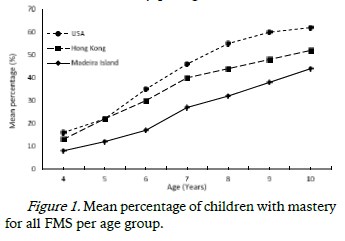
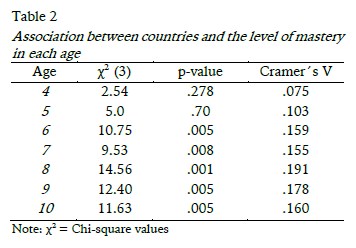
<p><font size="2" face="verdana">All cited studies followed the standards set by Ulrich   (2000) for the training of the experimenters and the reliability coefficients   in both movement classes. All participants of the selected studies had regular   classes of Physical Education in their countries, and after 6 years of age the   frequency was 2 weekly classes for China and USA and 3 classes for Portugal; the classes lasted between 40 and 50 minutes. </font></p>     <p><font size="2" face="verdana"><b>Statistical Analyses</b></font></p>     <p><font size="2" face="verdana">The dependent variable of this study was the average   percentage of children who have attained mastery in the FMS per region   (cities/states/island). We performed a chi-square test to analyze whether there   was an association between the percentage of children with mastery in FMS and   the respective countries. The magnitude of the association was measured by   Cramer’s V statistic. This statistic provides values between zero and one, with   one (1) representing total association between categories and zero representing none.</font></p>     <p><font size="2" face="verdana">We calculated the odds ratio (OR) of a given country   presenting children with mastery of the FMS in comparison to the other two   countries. This was done to verify whether the incidence of children mastering   the FMS in a given country surpasses the incidence of the other two altogether.   Each country was compared in terms of the mean frequency of children with   mastery per age group with the relative frequency of all the other countries   summed up. The values of OR can vary from zero to any positive number. We   assessed these values in terms of its confidence interval to evaluate its   significance. Values significantly higher than one (1) delineates that the   given country has more chances to present children with mastery than the other   two countries summed up. Values significantly smaller than one show that the   given country has fewer chances. Any value that does not differ from one (1)   shows that the country has similar chances of presenting children mastering the given FMS.</font></p>     <p><font size="2" face="verdana">To investigate the sporting context influence on   children proficiency in a specific FMS, we compared the probability of a given   country to present higher percentages of children mastering this specific FMS   than all other FMS for each age group. For instance, we compared the   probability of Portugal present higher percentages of children mastering   kicking (given the influence of soccer) than all other FMS for each age. We   compared the percentages using the z-score of the difference using a one-tailed   distribution (i.e., we tested the alternative hypothesis of the influenced FMS   to show higher percentages than all other FMS). All analyses were performed using Matlab 2013 and SPSS 17.0 software.</font></p>     <p>&nbsp;</p>     <p><font size="3" face="verdana"><b>RESULTS</b></font></p>     <p><font size="2" face="verdana">The chi-square test detected a significant association   between performance on FMS and the evaluated regions. The association values   tend to increase over time (<a href="#t2">Table 2</a>). <a href="#f1">Figure 1</a> presents the mean percentage of   children demonstrating mastery per age, region, and FMS. Around 4 years of age   children had similar performance, however, over the years the difference   between the number of children from different countries who have reached mastery tended to increase. </font></p>     <p><a name="t2"></a></p>     ]]></body>
<body><![CDATA[<p>&nbsp;</p>     <p align="center"><img src="/img/revistas/mot/v12n2/12n2a14t2.jpg" width="356" height="248"></p>     
<p>&nbsp;</p>     <p><a name="f1"></a></p>     <p>&nbsp;</p>     <p align="center"><img src="/img/revistas/mot/v12n2/12n2a14f1.jpg" width="345" height="241"></p>     
<p>&nbsp;</p>     <p><font size="2" face="verdana"><b>Children rate from 4 to 10 years of age with mastery in FMS:   relationship with the curriculum</b></font></p>     <p><font size="2" face="verdana"><a href="#f1">Figure 1</a> presents the average percentage of children with mastery per age. </font></p>     <p><font size="2" face="verdana">It is noteworthy that the curriculum   proposal of China is directed to children older than the 6/7 years old, so   after this age we would find significant increments in the number of children   with mastery. Children from USA presented the highest average percentage of   children with mastery in all ages followed by children from Hong Kong - China   and children from Madeira Island - Portugal respectively.</font></p>     ]]></body>
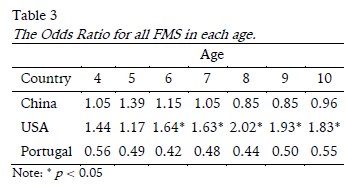
<body><![CDATA[<p><font size="2" face="verdana"><a href="#t3">Table 3</a> presents the results of the   odds-ratio analyses. In consonance with the descriptive results, children from   US showed the highest chances to present mastery in the FMS at all ages   (significant values from the six-year-old group to the ten-year-old group).   Children from Hong Kong showed higher chances to present mastery while children   from Madeira Island showed smaller chances. Nevertheless, the chances for   children from these latter countries did not approach significant levels.   Additionally, only the US presented equal or greater percentage of children   with mastery in the FMS than the expected 60% - and it occurred only for older groups (9- and 10-year-old groups).</font></p>     <p><a name="t3"></a></p>     <p>&nbsp;</p>     <p align="center"><img src="/img/revistas/mot/v12n2/12n2a14t3.jpg" width="346" height="187"></p>     
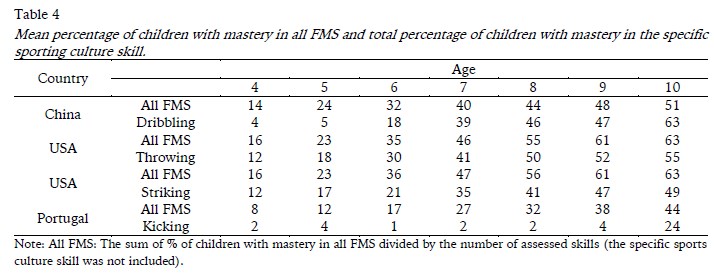
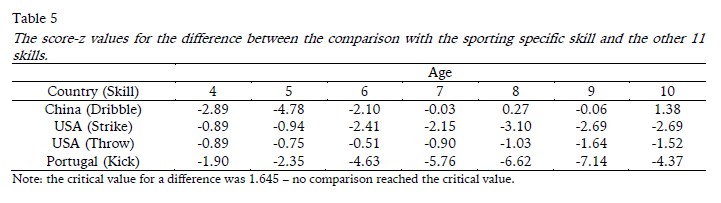
<p>&nbsp;</p>     <p><font size="2" face="verdana"><b>Incidence of children demonstrating mastery: most popular sport </b></font></p>     <p><a href="/img/revistas/mot/v12n2/12n2a14t4.jpg"><font size="2" face="verdana">Table 4</font></a><font size="2" face="verdana"> presents the percentage of children   mastering the FMS to be influenced by the most popular sport of each country   and the mean percentage of all other FMS. Observing the mean percentage of   children with mastery in all FMS, we did not find any effect of most popular   sports in all three regions. <a href="/img/revistas/mot/v12n2/12n2a14t5.jpg">Table 5</a> presents the resultant scores-z of the   percentage comparison between the influenced FMS and the mean of all other. As   can be observed, we did not find any effect of most popular sports in the   mastery of these specific skills when compared with the others FMS. The results   are maintained even when we considered only the object control skills (not shown).</font></p>     
<p><font size="2" face="verdana"><b>&nbsp;</b></font></p>     <p><font size="3" face="verdana"><b>DISCUSSION</b></font></p>     <p><font size="2" face="verdana">This study investigated the association between most   popular sport in the country and curriculum guidelines of Physical Education   with the incidence of children demonstrating mastery in the FMS. To accomplish   this goal, we selected three studies that described children from 4 to 10 years   of age from four different regions (Madeira Island – Portugal, Hong Kong –   China and 10 different states in USA). It was speculated that the specificity   of the curriculum guidelines – in terms of the development of the FMS – would   influence (positively) the incidence of children who achieve skill mastery.   Secondly, the emphasis of each most popular sport would result in a large   number of children mastering in a specific FMS. The results of this study   corroborate only with the first hypothesis. Children from USA presented higher   incidence than children from Hong Kong and Madeira Island on the indices of   mastering the FMS in association with the observed specificity of the respective curriculum guidelines for Physical Education.</font></p>     ]]></body>
<body><![CDATA[<p><font size="2" face="verdana">Due to influence of the most popular sport (e.g.   soccer in Portugal), we expected a higher prevalence of children attaining   mastery in certain skills (e.g. kick in Portugal). However, the results   expressed in <a href="/img/revistas/mot/v12n2/12n2a14t4.jpg">table 4</a> show that compared to other skills, the sport-related FMS   did not demonstrate higher prevalence of mastery. For example, children from   Madeira Island were less likely to present mastery in kicking at almost every   age. In this region, kicking appears to be one of the skills with the lowest number   of children mastering it. Although we observed that children from Hong Kong and   USA showed a larger incidence of mastery in their respective skills, the <a href="/img/revistas/mot/v12n2/12n2a14t5.jpg">table 5</a> shows that these relations were not significant for any country.</font></p>     
<p><font size="2" face="verdana">Based on these results, one can deduce that most   popular sport does not lead to higher rates of children mastering skills   underscored by the most popular national pastimes. Our expectation was based on   the opportunities and encouragement that these sports would provide for the practice   of certain skills. Thus, these factors, isolated, are not sufficient to promote   mastery of FMS. Our results corroborate with those of Wang (2004) and Rimmer   and Kelly (1989). These studies compared children playing freely in a   structured space (i.e., a space with specific structure to support practice of   various skills) with children performing activity under the guidance of a   physical education professional. The results showed that those who received   guidance were the only ones that showed significant improvements in the   performance of FMS. In other words, the addition of proper guidance is necessary in conjunction with opportunity and incentive.</font></p>     <p><font size="2" face="verdana">Nevertheless, these results should be interpreted with   caution. There is an assumption that girls would be less encouraged to   participate in games, sports and physical activities geared primarily to males   (e.g., soccer in Portugal, American football in the USA) (Barnett, van Beurden,   Morgan, Brooks, &amp; Beard, 2010; Butterfield, Angell, &amp; Mason, 2012; Goodway   et al., 2010; Thomas &amp; French, 1985; Valentini, 2012). Moreover,   “male-related&quot; sports are categorized differently in depending on the   culture. Soccer, for instance, is predominantly practiced by men in Portugal,   but is one of the dominant athletic activities performed by girls in the United   States. Despite this potential influence on our results, some studies show that   this might not be the case. Afonso et al. (2009) showed that the best skill in   Madeira Island – considering girls and boys separately – does not relate to the   most popular sport. Although Ulrich (2000) and Wong and Cheung (2006) have not   evaluated the prevalence of mastery by gender, the results found by Pang and   Fong (2009) in Hong Kong and Butterfield, Angell, and Mason (2012) in the   United States showed that sex also did not influence the prevalence of mastery.   Based on these results, it is possible to argue that sex was not a factor that   influenced the prevalence of mastery in the skill associated with the most popular sport. </font></p>     <p><font size="2" face="verdana">In regard to the curriculum guidelines goals for   Physical Education, <a href="#t2">Table 2</a> shows that the mastery of the FMS is strongly   related to the specificity of each program. Consequentially, the results   expressed in <a href="#t3">Table 3</a> demonstrated that children from Madeira Island – in which   the curriculum has general (unspecific) goals – had less chances to present   mastery in the FMS when compared to children from Hong Kong that has more   directed goals in its guidelines. The USA (country with the most direct and   specific goals toward the development of FMS) had the greatest chance to present mastery in various skills. </font></p>     <p><font size="2" face="verdana">Accordingly, studies showed that goal directed   approaches for developing FMS result in significant improvements in performance   (Jones et al., 2011; Logan, Robinson, Wilson, &amp; Lucas, 2012; McKenzie,   Alcaraz, Sallis, &amp; Faucette, 1998). Two Australian projects serve as   examples: &quot;Move it groove it&quot; and &quot;Get skilled get active&quot;.   These projects had as the specific goal to increase the number of children with   mastery in FMS. Their findings showed that after the project began, there were   significant increases in the number of children who performed the FMS   proficiently (Hardy et al., 2013a; van Beurden et al., 2003, 2002). In this   case, specific goals probably provide more opportunity for practice and proper guidance, which leads to better performances in FMS.</font></p>     <p><font size="2" face="verdana">Besides the specific proposal of developing FMS in   USA, another important aspect to be taken into consideration in association   with the superior results of North American children may be the cultural bias   of the test. Given that TGMD-II is an North American test, the skills assessed   were based on the skills proposed by the National Association for Sport and   Physical Education (2004). Thus, it can be said that the development of such   skills may be part of the US cultural context, which caused an elevated number of children demonstrating mastery in FMS.</font></p>     <p><font size="2" face="verdana">Our analysis allows us to make an extra consideration   about the percentage of children who demonstrated mastery over the years. Results   found by Seefeldt and Haubenstricker (1982) showed that at 7 years of age, 60%   of children demonstrated mastery of 7 of 8 tested FMS (throwing, kicking,   running, jumping, catching, dribbling, hopping, and skipping). This is contrary   to our findings. When we consider the number of children with mastery in a   specific skill, it appears that it is rare to observe numbers greater than 60%   in the mastery, even when looking at age groups ranging from 7 to 10 years.   Considering the mean percentage of children with mastery in all FMS, only age   groups equal or older than the 9-year-old group from the US showed values equal   or greater than 60% (<a href="/img/revistas/mot/v12n2/12n2a14t4.jpg">Table 4</a>). In this way, is necessary to reconsider the   expectancy of the moment at which children will show mastery in these skills – it can be said that 60% of mastery at 7 years of life is not the norm. </font></p>     
<p><font size="2" face="verdana">Another consideration is about the different   trajectories in performance. When comparing the prevalence of mastery between   children from USA, Hong Kong and Madeira Island, one can argue that there is no   equifinality effect (i.e., to achieve the same end point starting from   different initial points) in the development of FMS (<a href="#f1">Figure 1</a>). That is, there   is no point of convergence even at the 10-year-old group. Based on this result,   it can be speculated that only the maturational process (which occurs due to   aging) does not promote similar levels of motor performance. The differences   between countries in older groups can be inferred from the specificity of the   curriculum structure. The higher frequency of North American children with   mastery can be linked to two factors: first, the same FMS is focused in   different school grades; second, the curriculum specifies how many components   of FMS children must perform well in each grade. For instance, we can mention   the proposed guideline for the overhand throw: in grade 2 children must show 2   of 5 components being performed in the mature form, in grade 3, 3 of 5   components, and in grade 4 children must perform the overhand throw in the mature   form.  These two factors give support to   the relevance of an increased practice of the same FMS over the years, and   provide guidelines for the physical education teachers in school settings. When   we consider a country that does not provide such a structure or requirements   (e.g., Portugal), the expectation of change per grade (or year) decreases as the results of this study show.</font></p>     <p><font size="2" face="verdana">Our results point out that it is necessary specific   proposals to the development of FMS. Tani (2011) suggests that without the   influence of external factors (proper guidance, encouragement and opportunity)   children will have difficulty mastering the FMS. This is of great concern as   there is significant interdependence between the stages of motor development.   Low performance in the FMS can create a barrier for later stages of development   (Seefeldt, 1980) that result in a detrimental reduction of physically active   children (van Beurden et al., 2002). Our study investigated the aforementioned factors indirectly, but our findings support this relation.</font></p>     <p><font size="2" face="verdana">The influence of environmental factors in the   development of FMS is undeniable. Although several models and perspectives   point in this direction (Bronfenbrenner &amp; Carvalho-Barreto, 2011; Clark,   2005; Gallahue &amp; Ozmun, 2006), few studies provide investigation of these   associations (Venetsanou &amp; Kambas, 2009). Given the presence of FMS in most   sport games, several studies used the argument of the most popular sport   culture could influence and explain inter cultural differences in motor performance   (Aponte, French, &amp; Sherrill, 1990; Chow, Henderson, &amp; Barnett, 2001;   Miyahara et al., 1998; Wong &amp; Cheung, 2006). Nevertheless, to our knowledge   no study investigated the direct influence of most popular sport in each country. We believe that this study furnishes an advancement in this direction. </font></p>     ]]></body>
<body><![CDATA[<p><font size="2" face="verdana">In light of our current findings, some   limitations on the study should be considered. In addition to gender   differences, we must consider that studies by the USA and Hong Kong were   published about nine years apart from Madeira Island. Over the years, a   plethora of geographic and socioeconomic changes may have hindered the   development of FMS (e.g., the decrease in the number of public spaces where   children can engage in physical activities and sports). However, two   multi–cohort longitudinal studies that assessed American children (age = 5 to   13) in the same school (conducted between 1992 and 2000) showed that children   who were assessed with four years apart demonstrated similar chances to   performing object control skill with mastery (Butterfield et al., 2012; Loovis,   Butterfield, &amp; Bagaka’s, 2008). In this case, it seems that this period of   time (9 years) could not be a factor that can explain the differences in performance between countries. </font></p>     <p><font size="2" face="verdana">Another two limitations could be attributed to the   sampling distribution and for the curriculum proposals. While Ulrich (2000)   assessed American children from 10 states, other studies consider one city   (Hong Kong) or region only (Madeira). Thus, our results may have been   influenced by regional characteristics (e.g., regional preferences for a   different sport) that in turn could restrict the development of other skills.   Although the goals of the national curriculum may be considered as good   indicators of the goals established in each school, their contents were not controlled in the present study.</font></p>     <p>&nbsp;</p>     <p><font size="3" face="verdana"><b>CONCLUSION</b></font></p>     <p><font size="2" face="verdana">In conclusion, the results of this study indicate that   the most popular sport is not a determining factor in the level of mastery in   FMS. Furthermore, we found that more direct goals in development of specific   FMS in the national curriculum proposals is associated with a greater   percentage of children that demonstrate mastery in these skills. In this case,   considering the importance of the FMS to both development of specialized motor   skills and its relation to later activities, beside the encouragement from the   media, parents and friends, to increase the chances of a child becoming a   physically active adult, our findings suggest the necessity of specific   programs – supported by a curricular proposal with specific goals to the development of FMS, especially in the early years of school education. </font></p>     <p>&nbsp;</p>     <p><font size="3" face="verdana"><b>REFERENCES</b></font></p>     <!-- ref --><p><font size="2" face="verdana">AAHPERD Curriculum Framework Task Force. (2014). <i>Society of Health and Physical Educator</i>. State University of New York College at Cortland.    &nbsp;&nbsp;&nbsp;&nbsp;&nbsp;&nbsp;&nbsp;&nbsp;[&#160;<a href="javascript:void(0);" onclick="javascript: window.open('/scielo.php?script=sci_nlinks&ref=355470&pid=S1646-107X201600020001400001&lng=','','width=640,height=500,resizable=yes,scrollbars=1,menubar=yes,');">Links</a>&#160;]<!-- end-ref --></font></p>     <!-- ref --><p><font size="2" face="verdana">Afonso, G. H., Freitas, D. H., Carmo, J. M., Lefèvre, J. A., Almeida, M.   J., Lopes, V. P., … Maia, J. (2009). [Motor performance. A normative and   criterial study in children from the Autonomous Region of Madeira, Portugal]. <i>Revista Portuguesa de Ciências do     Desporto</i>, <i>9</i>(2–3), 160–174.    &nbsp;&nbsp;&nbsp;&nbsp;&nbsp;&nbsp;&nbsp;&nbsp;[&#160;<a href="javascript:void(0);" onclick="javascript: window.open('/scielo.php?script=sci_nlinks&ref=355472&pid=S1646-107X201600020001400002&lng=','','width=640,height=500,resizable=yes,scrollbars=1,menubar=yes,');">Links</a>&#160;]<!-- end-ref --></font></p>     <!-- ref --><p><font size="2" face="verdana">Aponte, R., French, R., &amp; Sherrill, C. (1990). Motor development   of Puerto Rican children: cross-cultural perspectives. <i>Perceptual and Motor Skills</i>, <i>71</i>(3 Pt 2), 1200–1202. <a target="_blank" href="http://doi.org/10.2466/pms.1990.71.3f.1200">http://doi.org/10.2466/pms.1990.71.3f.1200</a></font>&nbsp;&nbsp;&nbsp;&nbsp;&nbsp;&nbsp;&nbsp;&nbsp;[&#160;<a href="javascript:void(0);" onclick="javascript: window.open('/scielo.php?script=sci_nlinks&ref=355474&pid=S1646-107X201600020001400003&lng=','','width=640,height=500,resizable=yes,scrollbars=1,menubar=yes,');">Links</a>&#160;]<!-- end-ref --><!-- ref --><p><font size="2" face="verdana">Barnett, L. M., Van Beurden, E., Morgan, P. J., Brooks, L. O., &amp;   Beard, J. R. (2008). Does childhood motor skill proficiency predict adolescent   fitness? <i>Medicine and Science in Sports and Exercise</i>, <i>40</i>(12), 2137–2144. <a target="_blank" href="http://doi.org/10.1249/MSS.0b013e31818160d3">http://doi.org/10.1249/MSS.0b013e31818160d3</a></font>&nbsp;&nbsp;&nbsp;&nbsp;&nbsp;&nbsp;&nbsp;&nbsp;[&#160;<a href="javascript:void(0);" onclick="javascript: window.open('/scielo.php?script=sci_nlinks&ref=355475&pid=S1646-107X201600020001400004&lng=','','width=640,height=500,resizable=yes,scrollbars=1,menubar=yes,');">Links</a>&#160;]<!-- end-ref --><!-- ref --><p><font size="2" face="verdana">Barnett, L. M., van Beurden, E., Morgan, P. J., Brooks, L. O., &amp;   Beard, J. R. (2010). Gender differences in motor skill proficiency from   childhood to adolescence: a longitudinal study. <i>Research Quarterly for Exercise and Sport</i>, <i>81</i>(2), 162–170. <a target="_blank" href="http://doi.org/10.1080/02701367.2010.10599663">http://doi.org/10.1080/02701367.2010.10599663</a></font>&nbsp;&nbsp;&nbsp;&nbsp;&nbsp;&nbsp;&nbsp;&nbsp;[&#160;<a href="javascript:void(0);" onclick="javascript: window.open('/scielo.php?script=sci_nlinks&ref=355476&pid=S1646-107X201600020001400005&lng=','','width=640,height=500,resizable=yes,scrollbars=1,menubar=yes,');">Links</a>&#160;]<!-- end-ref --><!-- ref --><p><font size="2" face="verdana">Beurden, E. va., Barnett, L. ., Zask, A., Dietrich, U. ., Brooks, L. .,   &amp; Beard, J. (2003). Can we skill and activate children through primary   school physical education lessons? «move it groove it»—a collaborative health promotion intervention. <i>Preventive Medicine</i>, <i>36</i>(4), 493–501. <a target="_blank" href="http://doi.org/10.1016/S0091-7435(02)00044-0">http://doi.org/10.1016/S0091-7435(02)00044-0</a></font>&nbsp;&nbsp;&nbsp;&nbsp;&nbsp;&nbsp;&nbsp;&nbsp;[&#160;<a href="javascript:void(0);" onclick="javascript: window.open('/scielo.php?script=sci_nlinks&ref=355477&pid=S1646-107X201600020001400006&lng=','','width=640,height=500,resizable=yes,scrollbars=1,menubar=yes,');">Links</a>&#160;]<!-- end-ref --><!-- ref --><p><font size="2" face="verdana">Bronfenbrenner, U., &amp; Carvalho-Barreto, A. (2011). <i>Bioecologia do   desenvolvimento humano: tornando os seres humanos mais humanos</i>. Porto Alegre: ARTMED.    &nbsp;&nbsp;&nbsp;&nbsp;&nbsp;&nbsp;&nbsp;&nbsp;[&#160;<a href="javascript:void(0);" onclick="javascript: window.open('/scielo.php?script=sci_nlinks&ref=355478&pid=S1646-107X201600020001400007&lng=','','width=640,height=500,resizable=yes,scrollbars=1,menubar=yes,');">Links</a>&#160;]<!-- end-ref --></font></p>     <!-- ref --><p><font size="2" face="verdana">Burton, A. W., &amp; Miller, D. E. (1998). <i>Movement Skill Assessment</i>. Champagn, IL: Human Kinetics.    &nbsp;&nbsp;&nbsp;&nbsp;&nbsp;&nbsp;&nbsp;&nbsp;[&#160;<a href="javascript:void(0);" onclick="javascript: window.open('/scielo.php?script=sci_nlinks&ref=355480&pid=S1646-107X201600020001400008&lng=','','width=640,height=500,resizable=yes,scrollbars=1,menubar=yes,');">Links</a>&#160;]<!-- end-ref --></font></p>     <!-- ref --><p><font size="2" face="verdana">Butterfield, S. A., Angell, R. M., &amp; Mason, C. A. (2012). Age and   sex differences in object control skills by children ages 5 to 14. <i>Perceptual and Motor Skills</i>, <i>114</i>(1), 261–274. <a target="_blank" href="http://doi.org/10.2466/10.11.25.PMS.114.1.261-274">http://doi.org/10.2466/10.11.25.PMS.114.1.261-274</a></font>&nbsp;&nbsp;&nbsp;&nbsp;&nbsp;&nbsp;&nbsp;&nbsp;[&#160;<a href="javascript:void(0);" onclick="javascript: window.open('/scielo.php?script=sci_nlinks&ref=355482&pid=S1646-107X201600020001400009&lng=','','width=640,height=500,resizable=yes,scrollbars=1,menubar=yes,');">Links</a>&#160;]<!-- end-ref --><!-- ref --><p><font size="2" face="verdana">Chen, B. (2015). Sports in China. Obtido de <a target="_blank" href="http://www.foreignercn.com/">http://www.foreignercn.com</a></font>&nbsp;&nbsp;&nbsp;&nbsp;&nbsp;&nbsp;&nbsp;&nbsp;[&#160;<a href="javascript:void(0);" onclick="javascript: window.open('/scielo.php?script=sci_nlinks&ref=355483&pid=S1646-107X201600020001400010&lng=','','width=640,height=500,resizable=yes,scrollbars=1,menubar=yes,');">Links</a>&#160;]<!-- end-ref --><!-- ref --><p><font size="2" face="verdana">Chow, S. M., Henderson, S. E., &amp; Barnett, A. L. (2001). The Movement   Assessment Battery for Children: a comparison of 4-year-old to 6-year-old   children from Hong Kong and the United States. <i>The American Journal of     Occupational Therapy: Official Publication of the American Occupational Therapy Association</i>, <i>55</i>(1), 55–61.    &nbsp;&nbsp;&nbsp;&nbsp;&nbsp;&nbsp;&nbsp;&nbsp;[&#160;<a href="javascript:void(0);" onclick="javascript: window.open('/scielo.php?script=sci_nlinks&ref=355484&pid=S1646-107X201600020001400011&lng=','','width=640,height=500,resizable=yes,scrollbars=1,menubar=yes,');">Links</a>&#160;]<!-- end-ref --></font></p>     <!-- ref --><p><font size="2" face="verdana">Clark, J. E. (2005). From the Beginning: A Developmental Perspective on Movement and Mobility. <i>Quest</i>, <i>57</i>(1), 37–45. <a target="_blank" href="http://doi.org/10.1080/00336297.2005.10491841">http://doi.org/10.1080/00336297.2005.10491841</a></font>&nbsp;&nbsp;&nbsp;&nbsp;&nbsp;&nbsp;&nbsp;&nbsp;[&#160;<a href="javascript:void(0);" onclick="javascript: window.open('/scielo.php?script=sci_nlinks&ref=355486&pid=S1646-107X201600020001400012&lng=','','width=640,height=500,resizable=yes,scrollbars=1,menubar=yes,');">Links</a>&#160;]<!-- end-ref --><!-- ref --><p><font size="2" face="verdana">Clark, J. E., &amp; Metcalfe, J. S. (2002). The mountain of motor   development: A metaphor. <i>Motor development: Research and reviews</i>, <i>2</i>, 163–190.    &nbsp;&nbsp;&nbsp;&nbsp;&nbsp;&nbsp;&nbsp;&nbsp;[&#160;<a href="javascript:void(0);" onclick="javascript: window.open('/scielo.php?script=sci_nlinks&ref=355487&pid=S1646-107X201600020001400013&lng=','','width=640,height=500,resizable=yes,scrollbars=1,menubar=yes,');">Links</a>&#160;]<!-- end-ref --></font></p>     <!-- ref --><p><font size="2" face="verdana">Curriculum Development Council (CDC). (2002). <i>Physical education: Key learning area curriculum guide</i>. Hong Kong.    &nbsp;&nbsp;&nbsp;&nbsp;&nbsp;&nbsp;&nbsp;&nbsp;[&#160;<a href="javascript:void(0);" onclick="javascript: window.open('/scielo.php?script=sci_nlinks&ref=355489&pid=S1646-107X201600020001400014&lng=','','width=640,height=500,resizable=yes,scrollbars=1,menubar=yes,');">Links</a>&#160;]<!-- end-ref --></font></p>     <!-- ref --><p><font size="2" face="verdana">DaCosta, L. P., Bitencourt, V., Nogueira, L., Miragaya, A. M., Matsudo,   V., Noé, R., &amp; Carvalho, A. (2006). Cenário de tendências gerais dos   esportes e atividades físicas no Brasil. <i>Atlas do esporte no Brasil [Internet]. Rio de Janeiro: CONFEF</i>, 21–3.    &nbsp;&nbsp;&nbsp;&nbsp;&nbsp;&nbsp;&nbsp;&nbsp;[&#160;<a href="javascript:void(0);" onclick="javascript: window.open('/scielo.php?script=sci_nlinks&ref=355491&pid=S1646-107X201600020001400015&lng=','','width=640,height=500,resizable=yes,scrollbars=1,menubar=yes,');">Links</a>&#160;]<!-- end-ref --></font></p>     ]]></body>
<body><![CDATA[<!-- ref --><p><font size="2" face="verdana">Departamento do Ensino Secundário. (1998). Organização Curricular e   Programas: Educação Física [Organization Curriculum and Programs]. Ministério da Educação Português.    &nbsp;&nbsp;&nbsp;&nbsp;&nbsp;&nbsp;&nbsp;&nbsp;[&#160;<a href="javascript:void(0);" onclick="javascript: window.open('/scielo.php?script=sci_nlinks&ref=355493&pid=S1646-107X201600020001400016&lng=','','width=640,height=500,resizable=yes,scrollbars=1,menubar=yes,');">Links</a>&#160;]<!-- end-ref --></font></p>     <!-- ref --><p><font size="2" face="verdana">Gallahue, D. L., &amp; Ozmun, J. C. (2006). <i>Understanding Motor Development:   Infants, Children, Adolescents, Adults with PowerWeb</i>. Boston: McGraw-Hill Higher Education.    &nbsp;&nbsp;&nbsp;&nbsp;&nbsp;&nbsp;&nbsp;&nbsp;[&#160;<a href="javascript:void(0);" onclick="javascript: window.open('/scielo.php?script=sci_nlinks&ref=355495&pid=S1646-107X201600020001400017&lng=','','width=640,height=500,resizable=yes,scrollbars=1,menubar=yes,');">Links</a>&#160;]<!-- end-ref --></font></p>     <!-- ref --><p><font size="2" face="verdana">Gallahue, D. L., Ozmun, J. C., &amp; Goodway, J. D. (2013). <i>Understanding   Motor Development: Infants, Children, Adolescents, Adults</i>. Boston: MCGRAW-HILL Higher Education.    &nbsp;&nbsp;&nbsp;&nbsp;&nbsp;&nbsp;&nbsp;&nbsp;[&#160;<a href="javascript:void(0);" onclick="javascript: window.open('/scielo.php?script=sci_nlinks&ref=355497&pid=S1646-107X201600020001400018&lng=','','width=640,height=500,resizable=yes,scrollbars=1,menubar=yes,');">Links</a>&#160;]<!-- end-ref --></font></p>     <!-- ref --><p><font size="2" face="verdana">Goodway, J. D., Robinson, L. E., &amp; Crowe, H. (2010). Gender   Differences in Fundamental Motor Skill Development in Disadvantaged   Preschoolers From Two Geographical Regions. <i>Research Quarterly for Exercise and Sport</i>, <i>81</i>(1), 17–24. <a target="_blank" href="http://doi.org/10.1080/02701367.2010.10599624">http://doi.org/10.1080/02701367.2010.10599624</a></font>&nbsp;&nbsp;&nbsp;&nbsp;&nbsp;&nbsp;&nbsp;&nbsp;[&#160;<a href="javascript:void(0);" onclick="javascript: window.open('/scielo.php?script=sci_nlinks&ref=355499&pid=S1646-107X201600020001400019&lng=','','width=640,height=500,resizable=yes,scrollbars=1,menubar=yes,');">Links</a>&#160;]<!-- end-ref --><!-- ref --><p><font size="2" face="verdana">Hardy, L. L., Barnett, L., Espinel, P., &amp; Okely, A. D. (2013a).   Thirteen-year trends in child and adolescent fundamental movement skills:   1997-2010. <i>Medicine and Science in Sports and Exercise</i>, <i>45</i>(10), 1965–1970. <a target="_blank" href="http://doi.org/10.1249/MSS.0b013e318295a9fc">http://doi.org/10.1249/MSS.0b013e318295a9fc</a></font>&nbsp;&nbsp;&nbsp;&nbsp;&nbsp;&nbsp;&nbsp;&nbsp;[&#160;<a href="javascript:void(0);" onclick="javascript: window.open('/scielo.php?script=sci_nlinks&ref=355500&pid=S1646-107X201600020001400020&lng=','','width=640,height=500,resizable=yes,scrollbars=1,menubar=yes,');">Links</a>&#160;]<!-- end-ref --><!-- ref --><p><font size="2" face="verdana">Hardy, L. L., Barnett, L., Espinel, P., &amp; Okely, A. D. (2013b).   Thirteen-Year Trends in Child and Adolescent Fundamental Movement Skills:   1997–2010. <i>Medicine &amp; Science in Sports &amp; Exercise</i>, <i>45</i>(10), 1965–1970. <a target="_blank" href="http://doi.org/10.1249/MSS.0b013e318295a9fc">http://doi.org/10.1249/MSS.0b013e318295a9fc</a></font>&nbsp;&nbsp;&nbsp;&nbsp;&nbsp;&nbsp;&nbsp;&nbsp;[&#160;<a href="javascript:void(0);" onclick="javascript: window.open('/scielo.php?script=sci_nlinks&ref=355501&pid=S1646-107X201600020001400021&lng=','','width=640,height=500,resizable=yes,scrollbars=1,menubar=yes,');">Links</a>&#160;]<!-- end-ref --><!-- ref --><p><font size="2" face="verdana">Haubenstricker, J., &amp; Seefeldt, V. (1986). Acquisition of motor   skills during childhood. Em V. Seefeldt (Ed.), <i>Physical activity and     well-being</i> (pp. 41–1021). Reston, Virginia: American Alliance for Health, Physical Education, Recreation and Dance.    &nbsp;&nbsp;&nbsp;&nbsp;&nbsp;&nbsp;&nbsp;&nbsp;[&#160;<a href="javascript:void(0);" onclick="javascript: window.open('/scielo.php?script=sci_nlinks&ref=355502&pid=S1646-107X201600020001400022&lng=','','width=640,height=500,resizable=yes,scrollbars=1,menubar=yes,');">Links</a>&#160;]<!-- end-ref --></font></p>     <!-- ref --><p><font size="2" face="verdana">Joanne Hui-Tzu Wang. (2004). A Study on Gross Motor Skills of Preschool Children. <i>Journal of Research in Childhood Education</i>. Obtido de <a target="_blank" href="http://www.tandfonline.com/doi/abs/10.1080/02568540409595052">http://www.tandfonline.com/doi/abs/10.1080/02568540409595052</a></font>&nbsp;&nbsp;&nbsp;&nbsp;&nbsp;&nbsp;&nbsp;&nbsp;[&#160;<a href="javascript:void(0);" onclick="javascript: window.open('/scielo.php?script=sci_nlinks&ref=355504&pid=S1646-107X201600020001400023&lng=','','width=640,height=500,resizable=yes,scrollbars=1,menubar=yes,');">Links</a>&#160;]<!-- end-ref --><!-- ref --><p><font size="2" face="verdana">Jones, R. A., Riethmuller, A., Hesketh, K., Trezise, J., Batterham, M.,   &amp; Okely, A. D. (2011). Promoting fundamental movement skill development and   physical activity in early childhood settings: a cluster randomized controlled trial. <i>Pediatric Exercise Science</i>, <i>23</i>(4), 600–615.    &nbsp;&nbsp;&nbsp;&nbsp;&nbsp;&nbsp;&nbsp;&nbsp;[&#160;<a href="javascript:void(0);" onclick="javascript: window.open('/scielo.php?script=sci_nlinks&ref=355505&pid=S1646-107X201600020001400024&lng=','','width=640,height=500,resizable=yes,scrollbars=1,menubar=yes,');">Links</a>&#160;]<!-- end-ref --></font></p>     <!-- ref --><p><font size="2" face="verdana">Koutedakis, Y., &amp; Bouziotas, C. (2003). National physical education curriculum:   motor and cardiovascular health related fitness in Greek adolescents. <i>British Journal of Sports Medicine</i>, <i>37</i>(4), 311–314.    &nbsp;&nbsp;&nbsp;&nbsp;&nbsp;&nbsp;&nbsp;&nbsp;[&#160;<a href="javascript:void(0);" onclick="javascript: window.open('/scielo.php?script=sci_nlinks&ref=355507&pid=S1646-107X201600020001400025&lng=','','width=640,height=500,resizable=yes,scrollbars=1,menubar=yes,');">Links</a>&#160;]<!-- end-ref --></font></p>     <!-- ref --><p><font size="2" face="verdana">Logan, S. W., Robinson, L. E., Wilson, A. E., &amp; Lucas, W. A. (2012).   Getting the fundamentals of movement: a meta-analysis of the effectiveness of   motor skill interventions in children. <i>Child: Care, Health and Development</i>, <i>38</i>(3), 305–315. <a target="_blank" href="http://doi.org/10.1111/j.1365-2214.2011.01307.x">http://doi.org/10.1111/j.1365-2214.2011.01307.x</a></font>&nbsp;&nbsp;&nbsp;&nbsp;&nbsp;&nbsp;&nbsp;&nbsp;[&#160;<a href="javascript:void(0);" onclick="javascript: window.open('/scielo.php?script=sci_nlinks&ref=355509&pid=S1646-107X201600020001400026&lng=','','width=640,height=500,resizable=yes,scrollbars=1,menubar=yes,');">Links</a>&#160;]<!-- end-ref --><!-- ref --><p><font size="2" face="verdana">Loovis, E. M., Butterfield, S. A., &amp; Bagaka’s, J. G. (2008).   Development of catching by children in kindergarten to grade 8: a multicohort longitudinal study. <i>Perceptual and Motor Skills</i>, <i>107</i>(1), 121–128. <a target="_blank" href="http://doi.org/10.2466/pms.107.1.121-128">http://doi.org/10.2466/pms.107.1.121-128</a></font>&nbsp;&nbsp;&nbsp;&nbsp;&nbsp;&nbsp;&nbsp;&nbsp;[&#160;<a href="javascript:void(0);" onclick="javascript: window.open('/scielo.php?script=sci_nlinks&ref=355510&pid=S1646-107X201600020001400027&lng=','','width=640,height=500,resizable=yes,scrollbars=1,menubar=yes,');">Links</a>&#160;]<!-- end-ref --><!-- ref --><p><font size="2" face="verdana">Manoel, E. J. (1994). Desenvolvimento motor: implicaçöes para a educaçäo física escolar. <i>Revista Paulista de Educação Física</i>, <i>8</i>(1), 82–97.    &nbsp;&nbsp;&nbsp;&nbsp;&nbsp;&nbsp;&nbsp;&nbsp;[&#160;<a href="javascript:void(0);" onclick="javascript: window.open('/scielo.php?script=sci_nlinks&ref=355511&pid=S1646-107X201600020001400028&lng=','','width=640,height=500,resizable=yes,scrollbars=1,menubar=yes,');">Links</a>&#160;]<!-- end-ref --></font></p>     ]]></body>
<body><![CDATA[<!-- ref --><p><font size="2" face="verdana">Marivoet, S. (2000). Práticas desportivas na sociedade portuguesa   (1988-1998). Em <i>Actas do IV Congresso Português de Sociologia: Passados Recentes, Futuros Próximos.</i> Obtido de <a target="_blank" href="http://www.aps.pt/cms/docs_prv/docs/DPR462e088b86481_1.PDF">http://www.aps.pt/cms/docs_prv/docs/DPR462e088b86481_1.PDF</a></font>&nbsp;&nbsp;&nbsp;&nbsp;&nbsp;&nbsp;&nbsp;&nbsp;[&#160;<a href="javascript:void(0);" onclick="javascript: window.open('/scielo.php?script=sci_nlinks&ref=355513&pid=S1646-107X201600020001400029&lng=','','width=640,height=500,resizable=yes,scrollbars=1,menubar=yes,');">Links</a>&#160;]<!-- end-ref --><!-- ref --><p><font size="2" face="verdana">McKenzie, T. L., Alcaraz, J. E., Sallis, J. F., &amp; Faucette, F. N.   (1998). Effects of a   Physical Education Program on Children’s Manipulative Skills. <i>Journal of Teaching in Physical Education</i>, <i>17</i>(3), 327–341. <a target="_blank" href="http://doi.org/10.1123/jtpe.17.3.327">http://doi.org/10.1123/jtpe.17.3.327</a></font>&nbsp;&nbsp;&nbsp;&nbsp;&nbsp;&nbsp;&nbsp;&nbsp;[&#160;<a href="javascript:void(0);" onclick="javascript: window.open('/scielo.php?script=sci_nlinks&ref=355514&pid=S1646-107X201600020001400030&lng=','','width=640,height=500,resizable=yes,scrollbars=1,menubar=yes,');">Links</a>&#160;]<!-- end-ref --><!-- ref --><p><font size="2" face="verdana">Miyahara, M., Tsujii, M., Hanai, T., Jongmans, M., Barnett, A., E.   Henderson, S., … Kageyama, H. (1998). The Movement Assessment Battery for   Children: A preliminary investigation of its usefulness in Japan. <i>Human Movement Science</i>, <i>17</i>(4–5), 679–697. <a target="_blank" href="http://doi.org/10.1016/S0167-9457(98)00018-9">http://doi.org/10.1016/S0167-9457(98)00018-9</a></font>&nbsp;&nbsp;&nbsp;&nbsp;&nbsp;&nbsp;&nbsp;&nbsp;[&#160;<a href="javascript:void(0);" onclick="javascript: window.open('/scielo.php?script=sci_nlinks&ref=355515&pid=S1646-107X201600020001400031&lng=','','width=640,height=500,resizable=yes,scrollbars=1,menubar=yes,');">Links</a>&#160;]<!-- end-ref --><!-- ref --><p><font size="2" face="verdana">National Association for Sport and Physical Education. (2004). <i>Moving   into the future: National standards for physical education</i> (2.<sup>a</sup> ed.). Reston, VA: St. Louis.    &nbsp;&nbsp;&nbsp;&nbsp;&nbsp;&nbsp;&nbsp;&nbsp;[&#160;<a href="javascript:void(0);" onclick="javascript: window.open('/scielo.php?script=sci_nlinks&ref=355516&pid=S1646-107X201600020001400032&lng=','','width=640,height=500,resizable=yes,scrollbars=1,menubar=yes,');">Links</a>&#160;]<!-- end-ref --></font></p>     <!-- ref --><p><font size="2" face="verdana">Okely, A. D., &amp; Booth, M. L. (2004). Mastery of fundamental movement   skills among children in New South Wales: prevalence and sociodemographic   distribution. <i>Journal of Science and Medicine in Sport / Sports Medicine Australia</i>, <i>7</i>(3), 358–372.    &nbsp;&nbsp;&nbsp;&nbsp;&nbsp;&nbsp;&nbsp;&nbsp;[&#160;<a href="javascript:void(0);" onclick="javascript: window.open('/scielo.php?script=sci_nlinks&ref=355518&pid=S1646-107X201600020001400033&lng=','','width=640,height=500,resizable=yes,scrollbars=1,menubar=yes,');">Links</a>&#160;]<!-- end-ref --></font></p>     <!-- ref --><p><font size="2" face="verdana">Okely, A. D., Booth, M. L., &amp; Patterson, J. W. (2001). Relationship   of physical activity to fundamental movement skills among adolescents. <i>Medicine and Science in Sports and Exercise</i>, <i>33</i>(11), 1899–1904.    &nbsp;&nbsp;&nbsp;&nbsp;&nbsp;&nbsp;&nbsp;&nbsp;[&#160;<a href="javascript:void(0);" onclick="javascript: window.open('/scielo.php?script=sci_nlinks&ref=355520&pid=S1646-107X201600020001400034&lng=','','width=640,height=500,resizable=yes,scrollbars=1,menubar=yes,');">Links</a>&#160;]<!-- end-ref --></font></p>     <!-- ref --><p><font size="2" face="verdana">Pang, A. W.-Y., &amp; Fong, D. T.-P. (2009). Fundamental motor skill   proficiency of Hong Kong children aged 6-9 years. <i>Research in Sports Medicine (Print)</i>, <i>17</i>(3), 125–144. <a target="_blank" href="http://doi.org/10.1080/15438620902897516">http://doi.org/10.1080/15438620902897516</a></font>&nbsp;&nbsp;&nbsp;&nbsp;&nbsp;&nbsp;&nbsp;&nbsp;[&#160;<a href="javascript:void(0);" onclick="javascript: window.open('/scielo.php?script=sci_nlinks&ref=355522&pid=S1646-107X201600020001400035&lng=','','width=640,height=500,resizable=yes,scrollbars=1,menubar=yes,');">Links</a>&#160;]<!-- end-ref --><!-- ref --><p><font size="2" face="verdana">Ridgway, C. L., Ong, K. K., Tammelin, T. H., Sharp, S., Ekelund, U.,   &amp; Jarvelin, M.-R. (2009). Infant motor development predicts sports   participation at age 14 years: northern Finland birth cohort of 1966. <i>PloS One</i>, <i>4</i>(8), e6837. <a target="_blank" href="http://doi.org/10.1371/journal.pone.0006837">http://doi.org/10.1371/journal.pone.0006837</a></font>&nbsp;&nbsp;&nbsp;&nbsp;&nbsp;&nbsp;&nbsp;&nbsp;[&#160;<a href="javascript:void(0);" onclick="javascript: window.open('/scielo.php?script=sci_nlinks&ref=355523&pid=S1646-107X201600020001400036&lng=','','width=640,height=500,resizable=yes,scrollbars=1,menubar=yes,');">Links</a>&#160;]<!-- end-ref --><!-- ref --><p><font size="2" face="verdana">Rimmer, James. H., &amp; Kelly, Luke. E. (1989). Gross Motor Development   in Preschool Children with Learning Disabilities. <i>Adapted Physical Activity Quarterly</i>, pp. 268–279.    &nbsp;&nbsp;&nbsp;&nbsp;&nbsp;&nbsp;&nbsp;&nbsp;[&#160;<a href="javascript:void(0);" onclick="javascript: window.open('/scielo.php?script=sci_nlinks&ref=355524&pid=S1646-107X201600020001400037&lng=','','width=640,height=500,resizable=yes,scrollbars=1,menubar=yes,');">Links</a>&#160;]<!-- end-ref --></font></p>     <!-- ref --><p><font size="2" face="verdana">Schwartz, N., &amp; McGarry, T. (2014). The NFL is the most popular sport in America for the 30th year running. Obtido de <a target="_blank" href="http://ftw.usatoday.com/2014/01/nfl-most-popular-sport-poll">http://ftw.usatoday.com/2014/01/nfl-most-popular-sport-poll</a></font>&nbsp;&nbsp;&nbsp;&nbsp;&nbsp;&nbsp;&nbsp;&nbsp;[&#160;<a href="javascript:void(0);" onclick="javascript: window.open('/scielo.php?script=sci_nlinks&ref=355526&pid=S1646-107X201600020001400038&lng=','','width=640,height=500,resizable=yes,scrollbars=1,menubar=yes,');">Links</a>&#160;]<!-- end-ref --><!-- ref --><p><font size="2" face="verdana">Seefeldt, V. (1980). Developmental motor patterns: Implications for   elementary school physical education. Em C. Nadeau, W. Holliwell, K. M. Holliwell, &amp; G. Roberts (Eds.), <i>Psychology of motor behavior and sport</i> (pp. 314–323). Champaign, IL: Human Kinetics.    &nbsp;&nbsp;&nbsp;&nbsp;&nbsp;&nbsp;&nbsp;&nbsp;[&#160;<a href="javascript:void(0);" onclick="javascript: window.open('/scielo.php?script=sci_nlinks&ref=355527&pid=S1646-107X201600020001400039&lng=','','width=640,height=500,resizable=yes,scrollbars=1,menubar=yes,');">Links</a>&#160;]<!-- end-ref --></font></p>     <!-- ref --><p><font size="2" face="verdana">Seefeldt, V., &amp; Haubenstricker, J. (1982). Patterns, phases, or   stages: an analytical model for the study of developmental movement. Em J. A.   S. Kelso &amp; J. E. Clark (Eds.), <i>The Development of Movement Control and Coordination</i> (pp. 309–319). New York: Wiley.    &nbsp;&nbsp;&nbsp;&nbsp;&nbsp;&nbsp;&nbsp;&nbsp;[&#160;<a href="javascript:void(0);" onclick="javascript: window.open('/scielo.php?script=sci_nlinks&ref=355529&pid=S1646-107X201600020001400040&lng=','','width=640,height=500,resizable=yes,scrollbars=1,menubar=yes,');">Links</a>&#160;]<!-- end-ref --></font></p>     <!-- ref --><p><font size="2" face="verdana">Tani, G. (2011). <i>Leituras em educação física: Retratos de uma jornada [Readings in physical education: Pictures of a journey</i>. São Paulo: Phorte.    &nbsp;&nbsp;&nbsp;&nbsp;&nbsp;&nbsp;&nbsp;&nbsp;[&#160;<a href="javascript:void(0);" onclick="javascript: window.open('/scielo.php?script=sci_nlinks&ref=355531&pid=S1646-107X201600020001400041&lng=','','width=640,height=500,resizable=yes,scrollbars=1,menubar=yes,');">Links</a>&#160;]<!-- end-ref --></font></p>     ]]></body>
<body><![CDATA[<!-- ref --><p><font size="2" face="verdana">Thomas, J. R., &amp; French, K. E. (1985). Gender differences across age   in motor performance a meta-analysis. <i>Psychological Bulletin</i>, <i>98</i>(2), 260–282. <a target="_blank" href="http://doi.org/10.1037/0033-2909.98.2.260">http://doi.org/10.1037//0033-2909.98.2.260</a></font>&nbsp;&nbsp;&nbsp;&nbsp;&nbsp;&nbsp;&nbsp;&nbsp;[&#160;<a href="javascript:void(0);" onclick="javascript: window.open('/scielo.php?script=sci_nlinks&ref=355533&pid=S1646-107X201600020001400042&lng=','','width=640,height=500,resizable=yes,scrollbars=1,menubar=yes,');">Links</a>&#160;]<!-- end-ref --><!-- ref --><p><font size="2" face="verdana">Ulrich, D. A. (2000). <i>Test of Gross Motor Development</i>. Austin, Texas: Harcourt Education.    &nbsp;&nbsp;&nbsp;&nbsp;&nbsp;&nbsp;&nbsp;&nbsp;[&#160;<a href="javascript:void(0);" onclick="javascript: window.open('/scielo.php?script=sci_nlinks&ref=355534&pid=S1646-107X201600020001400043&lng=','','width=640,height=500,resizable=yes,scrollbars=1,menubar=yes,');">Links</a>&#160;]<!-- end-ref --></font></p>     <!-- ref --><p><font size="2" face="verdana">Valentini, N. C. (2012). Validity and Reliability of the TGMD-2 for Brazilian Children. <i>Journal of Motor Behavior</i>, <i>44</i>(4), 275–280. <a target="_blank" href="http://doi.org/10.1080/00222895.2012.700967">http://doi.org/10.1080/00222895.2012.700967</a></font>&nbsp;&nbsp;&nbsp;&nbsp;&nbsp;&nbsp;&nbsp;&nbsp;[&#160;<a href="javascript:void(0);" onclick="javascript: window.open('/scielo.php?script=sci_nlinks&ref=355536&pid=S1646-107X201600020001400044&lng=','','width=640,height=500,resizable=yes,scrollbars=1,menubar=yes,');">Links</a>&#160;]<!-- end-ref --><!-- ref --><p><font size="2" face="verdana">van Beurden, E., Barnett, L. M., Zask, A., Dietrich, U. C., Brooks, L.   O., &amp; Beard, J. (2003). Can we skill and activate children through primary   school physical education lessons? «Move it Groove it»--a collaborative health promotion intervention. <i>Preventive Medicine</i>, <i>36</i>(4), 493–501.    &nbsp;&nbsp;&nbsp;&nbsp;&nbsp;&nbsp;&nbsp;&nbsp;[&#160;<a href="javascript:void(0);" onclick="javascript: window.open('/scielo.php?script=sci_nlinks&ref=355537&pid=S1646-107X201600020001400045&lng=','','width=640,height=500,resizable=yes,scrollbars=1,menubar=yes,');">Links</a>&#160;]<!-- end-ref --></font></p>     <!-- ref --><p><font size="2" face="verdana">van Beurden, E., Zask, A., Barnett, L. M., &amp; Dietrich, U. C. (2002).   Fundamental movement skills--how do primary school children perform? The «Move   it Groove it» program in rural Australia. <i>Journal of Science and Medicine in Sport / Sports Medicine Australia</i>, <i>5</i>(3), 244–252.    &nbsp;&nbsp;&nbsp;&nbsp;&nbsp;&nbsp;&nbsp;&nbsp;[&#160;<a href="javascript:void(0);" onclick="javascript: window.open('/scielo.php?script=sci_nlinks&ref=355539&pid=S1646-107X201600020001400046&lng=','','width=640,height=500,resizable=yes,scrollbars=1,menubar=yes,');">Links</a>&#160;]<!-- end-ref --></font></p>     <!-- ref --><p><font size="2" face="verdana">Venetsanou, F., &amp; Kambas, A. (2009). Environmental Factors Affecting   Preschoolers’ Motor Development. <i>Early Childhood Education Journal</i>, <i>37</i>(4), 319–327. <a target="_blank" href="http://doi.org/10.1007/s10643-009-0350-z">http://doi.org/10.1007/s10643-009-0350-z</a></font>&nbsp;&nbsp;&nbsp;&nbsp;&nbsp;&nbsp;&nbsp;&nbsp;[&#160;<a href="javascript:void(0);" onclick="javascript: window.open('/scielo.php?script=sci_nlinks&ref=355541&pid=S1646-107X201600020001400047&lng=','','width=640,height=500,resizable=yes,scrollbars=1,menubar=yes,');">Links</a>&#160;]<!-- end-ref --><!-- ref --><p><font size="2" face="verdana">Wickstrom, R. L. (1977). <i>Fundamental Motor Patterns</i> (Vol. 1). Philadelphia: Lea &amp; Febiger.    &nbsp;&nbsp;&nbsp;&nbsp;&nbsp;&nbsp;&nbsp;&nbsp;[&#160;<a href="javascript:void(0);" onclick="javascript: window.open('/scielo.php?script=sci_nlinks&ref=355542&pid=S1646-107X201600020001400048&lng=','','width=640,height=500,resizable=yes,scrollbars=1,menubar=yes,');">Links</a>&#160;]<!-- end-ref --></font></p>     <!-- ref --><p><font size="2" face="verdana">Wong, A. K. Y., &amp; Cheung, S. Y. (2006). Gross motor skills   performance of Hong Kong Chinese children. <i>Journal of Physical Education &amp;   Recreation</i>, <i>12</i>(2), 23–29.    &nbsp;&nbsp;&nbsp;&nbsp;&nbsp;&nbsp;&nbsp;&nbsp;[&#160;<a href="javascript:void(0);" onclick="javascript: window.open('/scielo.php?script=sci_nlinks&ref=355544&pid=S1646-107X201600020001400049&lng=','','width=640,height=500,resizable=yes,scrollbars=1,menubar=yes,');">Links</a>&#160;]<!-- end-ref --> </font></p>     <p>&nbsp;</p>     <p><font size="2" face="verdana"><b>Acknowledgments:    <br> </b></font><font size="2" face="verdana">We would like to thank   Thomas Novak for his corrections and comments on a previous version of this manuscript.    <br> </font><font size="2" face="verdana"><b>Conflict of Interest:    <br> </b></font><font size="2" face="verdana">Nothing to declare    <br> </font><font size="2" face="verdana"><b>Funding:    <br> </b></font><font size="2" face="verdana">Mateus Maia Pacheco was funded by Cnpq – protocol 211487/2013-9.    ]]></body>
<body><![CDATA[<br> </font><font size="2" face="verdana">The manuscript was funded by CAPES.</font></p>     <p><font size="2" face="verdana">Manuscript received at March 22<sup>nd</sup> 2016; Accepted at May 10<sup>th</sup> 2016 </font></p>     <p>&nbsp;</p>     <p>&nbsp;</p>     <p><font size="2" face="verdana"><a name="end"></a><a href="#topo">*</a><i> Corresponding author</i>: Professor Mello Moraes 65, S&atilde;o Paulo, Brazil <i>E-mail</i>: <a href="mailto:fegarbeloto@gmail.com">fegarbeloto@gmail.com</a></font></p>      ]]></body><back>
<ref-list>
<ref id="B1">
<nlm-citation citation-type="book">
<collab>AAHPERD Curriculum Framework Task Force</collab>
<source><![CDATA[Society of Health and Physical Educator]]></source>
<year>2014</year>
<publisher-loc><![CDATA[Cortland ]]></publisher-loc>
<publisher-name><![CDATA[State University of New York College]]></publisher-name>
</nlm-citation>
</ref>
<ref id="B2">
<nlm-citation citation-type="journal">
<person-group person-group-type="author">
<name>
<surname><![CDATA[Afonso]]></surname>
<given-names><![CDATA[G. H.]]></given-names>
</name>
<name>
<surname><![CDATA[Freitas]]></surname>
<given-names><![CDATA[D. H.]]></given-names>
</name>
<name>
<surname><![CDATA[Carmo]]></surname>
<given-names><![CDATA[J. M.]]></given-names>
</name>
<name>
<surname><![CDATA[Lefèvre]]></surname>
<given-names><![CDATA[J. A.]]></given-names>
</name>
<name>
<surname><![CDATA[Almeida]]></surname>
<given-names><![CDATA[M. J.]]></given-names>
</name>
<name>
<surname><![CDATA[Lopes]]></surname>
<given-names><![CDATA[V. P.]]></given-names>
</name>
<name>
<surname><![CDATA[Maia]]></surname>
<given-names><![CDATA[J.]]></given-names>
</name>
</person-group>
<article-title xml:lang="en"><![CDATA[Motor performance: A normative and criterial study in children from the Autonomous Region of Madeira, Portugal]]></article-title>
<source><![CDATA[Revista Portuguesa de Ciências do Desporto]]></source>
<year>2009</year>
<volume>9</volume>
<numero>2-3</numero>
<issue>2-3</issue>
<page-range>160-174</page-range></nlm-citation>
</ref>
<ref id="B3">
<nlm-citation citation-type="journal">
<person-group person-group-type="author">
<name>
<surname><![CDATA[Aponte]]></surname>
<given-names><![CDATA[R.]]></given-names>
</name>
<name>
<surname><![CDATA[French]]></surname>
<given-names><![CDATA[R.]]></given-names>
</name>
<name>
<surname><![CDATA[Sherrill]]></surname>
<given-names><![CDATA[C.]]></given-names>
</name>
</person-group>
<article-title xml:lang="en"><![CDATA[Motor development of Puerto Rican children: cross-cultural perspectives]]></article-title>
<source><![CDATA[Perceptual and Motor Skills]]></source>
<year>1990</year>
<volume>71</volume>
<numero>3</numero>
<issue>3</issue>
<page-range>1200-1202</page-range></nlm-citation>
</ref>
<ref id="B4">
<nlm-citation citation-type="journal">
<person-group person-group-type="author">
<name>
<surname><![CDATA[Barnett]]></surname>
<given-names><![CDATA[L. M.]]></given-names>
</name>
<name>
<surname><![CDATA[Van Beurden]]></surname>
<given-names><![CDATA[E.]]></given-names>
</name>
<name>
<surname><![CDATA[Morgan]]></surname>
<given-names><![CDATA[P. J.]]></given-names>
</name>
<name>
<surname><![CDATA[Brooks]]></surname>
<given-names><![CDATA[L. O.]]></given-names>
</name>
<name>
<surname><![CDATA[Beard]]></surname>
<given-names><![CDATA[J. R.]]></given-names>
</name>
</person-group>
<article-title xml:lang="en"><![CDATA[Does childhood motor skill proficiency predict adolescent fitness?]]></article-title>
<source><![CDATA[Medicine and Science in Sports and Exercise]]></source>
<year>2008</year>
<volume>40</volume>
<numero>12</numero>
<issue>12</issue>
<page-range>2137-2144</page-range></nlm-citation>
</ref>
<ref id="B5">
<nlm-citation citation-type="journal">
<person-group person-group-type="author">
<name>
<surname><![CDATA[Barnett]]></surname>
<given-names><![CDATA[L. M.]]></given-names>
</name>
<name>
<surname><![CDATA[van Beurden]]></surname>
<given-names><![CDATA[E.]]></given-names>
</name>
<name>
<surname><![CDATA[Morgan]]></surname>
<given-names><![CDATA[P. J.]]></given-names>
</name>
<name>
<surname><![CDATA[Brooks]]></surname>
<given-names><![CDATA[L. O.]]></given-names>
</name>
<name>
<surname><![CDATA[Beard]]></surname>
<given-names><![CDATA[J. R.]]></given-names>
</name>
</person-group>
<article-title xml:lang="en"><![CDATA[Gender differences in motor skill proficiency from childhood to adolescence: a longitudinal study]]></article-title>
<source><![CDATA[Research Quarterly for Exercise and Sport]]></source>
<year>2010</year>
<volume>81</volume>
<numero>2</numero>
<issue>2</issue>
<page-range>162-170</page-range></nlm-citation>
</ref>
<ref id="B6">
<nlm-citation citation-type="journal">
<person-group person-group-type="author">
<name>
<surname><![CDATA[Beurden]]></surname>
<given-names><![CDATA[E. va.]]></given-names>
</name>
<name>
<surname><![CDATA[Barnett]]></surname>
<given-names><![CDATA[L.]]></given-names>
</name>
<name>
<surname><![CDATA[Zask]]></surname>
<given-names><![CDATA[A.]]></given-names>
</name>
<name>
<surname><![CDATA[Dietrich]]></surname>
<given-names><![CDATA[U.]]></given-names>
</name>
<name>
<surname><![CDATA[Brooks]]></surname>
<given-names><![CDATA[L.]]></given-names>
</name>
<name>
<surname><![CDATA[Beard]]></surname>
<given-names><![CDATA[J.]]></given-names>
</name>
</person-group>
<article-title xml:lang="en"><![CDATA[Can we skill and activate children through primary school physical education lessons?: «move it groove it»-a collaborative health promotion intervention]]></article-title>
<source><![CDATA[Preventive Medicine]]></source>
<year>2003</year>
<volume>36</volume>
<numero>4</numero>
<issue>4</issue>
<page-range>493-501</page-range></nlm-citation>
</ref>
<ref id="B7">
<nlm-citation citation-type="book">
<person-group person-group-type="author">
<name>
<surname><![CDATA[Bronfenbrenner]]></surname>
<given-names><![CDATA[U.]]></given-names>
</name>
<name>
<surname><![CDATA[Carvalho-Barreto]]></surname>
<given-names><![CDATA[A.]]></given-names>
</name>
</person-group>
<source><![CDATA[Bioecologia do desenvolvimento humano: tornando os seres humanos mais humanos]]></source>
<year>2011</year>
<publisher-loc><![CDATA[Porto Alegre ]]></publisher-loc>
<publisher-name><![CDATA[ARTMED]]></publisher-name>
</nlm-citation>
</ref>
<ref id="B8">
<nlm-citation citation-type="book">
<person-group person-group-type="author">
<name>
<surname><![CDATA[Burton]]></surname>
<given-names><![CDATA[A. W.]]></given-names>
</name>
<name>
<surname><![CDATA[Miller]]></surname>
<given-names><![CDATA[D. E.]]></given-names>
</name>
</person-group>
<source><![CDATA[Movement Skill Assessment]]></source>
<year>1998</year>
<publisher-loc><![CDATA[Champagn^eIL IL]]></publisher-loc>
<publisher-name><![CDATA[Human Kinetics]]></publisher-name>
</nlm-citation>
</ref>
<ref id="B9">
<nlm-citation citation-type="journal">
<person-group person-group-type="author">
<name>
<surname><![CDATA[Butterfield]]></surname>
<given-names><![CDATA[S. A.]]></given-names>
</name>
<name>
<surname><![CDATA[Angell]]></surname>
<given-names><![CDATA[R. M.]]></given-names>
</name>
<name>
<surname><![CDATA[Mason]]></surname>
<given-names><![CDATA[C. A.]]></given-names>
</name>
</person-group>
<article-title xml:lang="en"><![CDATA[Age and sex differences in object control skills by children ages 5 to 14]]></article-title>
<source><![CDATA[Perceptual and Motor Skills]]></source>
<year>2012</year>
<volume>114</volume>
<numero>1</numero>
<issue>1</issue>
<page-range>261-274</page-range></nlm-citation>
</ref>
<ref id="B10">
<nlm-citation citation-type="">
<person-group person-group-type="author">
<name>
<surname><![CDATA[Chen]]></surname>
<given-names><![CDATA[B.]]></given-names>
</name>
</person-group>
<source><![CDATA[Sports in China]]></source>
<year>2015</year>
</nlm-citation>
</ref>
<ref id="B11">
<nlm-citation citation-type="journal">
<person-group person-group-type="author">
<name>
<surname><![CDATA[Chow]]></surname>
<given-names><![CDATA[S. M.]]></given-names>
</name>
<name>
<surname><![CDATA[Henderson]]></surname>
<given-names><![CDATA[S. E.]]></given-names>
</name>
<name>
<surname><![CDATA[Barnett]]></surname>
<given-names><![CDATA[A. L.]]></given-names>
</name>
</person-group>
<article-title xml:lang="en"><![CDATA[The Movement Assessment Battery for Children: a comparison of 4-year-old to 6-year-old children from Hong Kong and the United States]]></article-title>
<source><![CDATA[The American Journal of Occupational Therapy: Official Publication of the American Occupational Therapy Association]]></source>
<year>2001</year>
<volume>55</volume>
<numero>1</numero>
<issue>1</issue>
<page-range>55-61</page-range></nlm-citation>
</ref>
<ref id="B12">
<nlm-citation citation-type="journal">
<person-group person-group-type="author">
<name>
<surname><![CDATA[Clark]]></surname>
<given-names><![CDATA[J. E.]]></given-names>
</name>
</person-group>
<article-title xml:lang="en"><![CDATA[From the Beginning: A Developmental Perspective on Movement and Mobility]]></article-title>
<source><![CDATA[Quest]]></source>
<year>2005</year>
<volume>57</volume>
<numero>1</numero>
<issue>1</issue>
<page-range>37-45</page-range></nlm-citation>
</ref>
<ref id="B13">
<nlm-citation citation-type="journal">
<person-group person-group-type="author">
<name>
<surname><![CDATA[Clark]]></surname>
<given-names><![CDATA[J. E.]]></given-names>
</name>
<name>
<surname><![CDATA[Metcalfe]]></surname>
<given-names><![CDATA[J. S.]]></given-names>
</name>
</person-group>
<article-title xml:lang="en"><![CDATA[The mountain of motor development: A metaphor]]></article-title>
<source><![CDATA[Motor development: Research and reviews]]></source>
<year>2002</year>
<volume>2</volume>
<numero>163-190</numero>
<issue>163-190</issue>
</nlm-citation>
</ref>
<ref id="B14">
<nlm-citation citation-type="">
<collab>Curriculum Development Council</collab>
<source><![CDATA[Physical education: Key learning area curriculum guide]]></source>
<year>2002</year>
<publisher-loc><![CDATA[Hong Kong ]]></publisher-loc>
</nlm-citation>
</ref>
<ref id="B15">
<nlm-citation citation-type="book">
<person-group person-group-type="author">
<name>
<surname><![CDATA[DaCosta]]></surname>
<given-names><![CDATA[L. P.]]></given-names>
</name>
<name>
<surname><![CDATA[Bitencourt]]></surname>
<given-names><![CDATA[V.]]></given-names>
</name>
<name>
<surname><![CDATA[Nogueira]]></surname>
<given-names><![CDATA[L.]]></given-names>
</name>
<name>
<surname><![CDATA[Miragaya]]></surname>
<given-names><![CDATA[A. M.]]></given-names>
</name>
<name>
<surname><![CDATA[Matsudo]]></surname>
<given-names><![CDATA[V.]]></given-names>
</name>
<name>
<surname><![CDATA[Noé]]></surname>
<given-names><![CDATA[R.]]></given-names>
</name>
<name>
<surname><![CDATA[Carvalho]]></surname>
<given-names><![CDATA[A.]]></given-names>
</name>
</person-group>
<article-title xml:lang="pt"><![CDATA[Cenário de tendências gerais dos esportes e atividades físicas no Brasil]]></article-title>
<source><![CDATA[Atlas do esporte no Brasil]]></source>
<year>2006</year>
<page-range>21-3</page-range><publisher-loc><![CDATA[Rio de Janeiro ]]></publisher-loc>
<publisher-name><![CDATA[CONFEF]]></publisher-name>
</nlm-citation>
</ref>
<ref id="B16">
<nlm-citation citation-type="book">
<collab>Departamento do Ensino Secundário</collab>
<source><![CDATA[Organização Curricular e Programas: Educação Física [Organization Curriculum and Programs]]]></source>
<year>1998</year>
<publisher-name><![CDATA[Ministério da Educação Português]]></publisher-name>
</nlm-citation>
</ref>
<ref id="B17">
<nlm-citation citation-type="book">
<person-group person-group-type="author">
<name>
<surname><![CDATA[Gallahue]]></surname>
<given-names><![CDATA[D. L.]]></given-names>
</name>
<name>
<surname><![CDATA[Ozmun]]></surname>
<given-names><![CDATA[J. C.]]></given-names>
</name>
</person-group>
<source><![CDATA[Understanding Motor Development: Infants, Children, Adolescents, Adults with PowerWeb]]></source>
<year>2006</year>
<publisher-loc><![CDATA[Boston ]]></publisher-loc>
<publisher-name><![CDATA[McGraw-Hill Higher Education]]></publisher-name>
</nlm-citation>
</ref>
<ref id="B18">
<nlm-citation citation-type="book">
<person-group person-group-type="author">
<name>
<surname><![CDATA[Gallahue]]></surname>
<given-names><![CDATA[D. L.]]></given-names>
</name>
<name>
<surname><![CDATA[Ozmun]]></surname>
<given-names><![CDATA[J. C.]]></given-names>
</name>
<name>
<surname><![CDATA[Goodway]]></surname>
<given-names><![CDATA[J. D.]]></given-names>
</name>
</person-group>
<source><![CDATA[Understanding Motor Development: Infants, Children, Adolescents, Adults]]></source>
<year>2013</year>
<publisher-loc><![CDATA[Boston ]]></publisher-loc>
<publisher-name><![CDATA[MCGRAW-HILL Higher Education]]></publisher-name>
</nlm-citation>
</ref>
<ref id="B19">
<nlm-citation citation-type="journal">
<person-group person-group-type="author">
<name>
<surname><![CDATA[Goodway]]></surname>
<given-names><![CDATA[J. D.]]></given-names>
</name>
<name>
<surname><![CDATA[Robinson]]></surname>
<given-names><![CDATA[L. E.]]></given-names>
</name>
<name>
<surname><![CDATA[Crowe]]></surname>
<given-names><![CDATA[H.]]></given-names>
</name>
</person-group>
<article-title xml:lang="en"><![CDATA[Gender Differences in Fundamental Motor Skill Development in Disadvantaged Preschoolers From Two Geographical Regions]]></article-title>
<source><![CDATA[Research Quarterly for Exercise and Sport]]></source>
<year>2010</year>
<volume>81</volume>
<numero>1</numero>
<issue>1</issue>
<page-range>17-24</page-range></nlm-citation>
</ref>
<ref id="B20">
<nlm-citation citation-type="journal">
<person-group person-group-type="author">
<name>
<surname><![CDATA[Hardy]]></surname>
<given-names><![CDATA[L. L.]]></given-names>
</name>
<name>
<surname><![CDATA[Barnett]]></surname>
<given-names><![CDATA[L.]]></given-names>
</name>
<name>
<surname><![CDATA[Espinel]]></surname>
<given-names><![CDATA[P.]]></given-names>
</name>
<name>
<surname><![CDATA[Okely]]></surname>
<given-names><![CDATA[A. D.]]></given-names>
</name>
</person-group>
<article-title xml:lang="en"><![CDATA[Thirteen-year trends in child and adolescent fundamental movement skills: 1997-2010]]></article-title>
<source><![CDATA[Medicine and Science in Sports and Exercise]]></source>
<year>2013</year>
<volume>45</volume>
<numero>10</numero>
<issue>10</issue>
<page-range>1965-1970</page-range></nlm-citation>
</ref>
<ref id="B21">
<nlm-citation citation-type="journal">
<person-group person-group-type="author">
<name>
<surname><![CDATA[Hardy]]></surname>
<given-names><![CDATA[L. L.]]></given-names>
</name>
<name>
<surname><![CDATA[Barnett]]></surname>
<given-names><![CDATA[L.]]></given-names>
</name>
<name>
<surname><![CDATA[Espinel]]></surname>
<given-names><![CDATA[P.]]></given-names>
</name>
<name>
<surname><![CDATA[Okely]]></surname>
<given-names><![CDATA[A. D.]]></given-names>
</name>
</person-group>
<article-title xml:lang="en"><![CDATA[Thirteen-Year Trends in Child and Adolescent Fundamental Movement Skills: 1997-2010]]></article-title>
<source><![CDATA[Medicine & Science in Sports & Exercise]]></source>
<year>2013</year>
<volume>45</volume>
<numero>10</numero>
<issue>10</issue>
<page-range>1965-1970</page-range></nlm-citation>
</ref>
<ref id="B22">
<nlm-citation citation-type="book">
<person-group person-group-type="author">
<name>
<surname><![CDATA[Haubenstricker]]></surname>
<given-names><![CDATA[J.]]></given-names>
</name>
<name>
<surname><![CDATA[Seefeldt]]></surname>
<given-names><![CDATA[V.]]></given-names>
</name>
</person-group>
<article-title xml:lang="en"><![CDATA[Acquisition of motor skills during childhood]]></article-title>
<person-group person-group-type="editor">
<name>
<surname><![CDATA[Seefeldt]]></surname>
<given-names><![CDATA[V.]]></given-names>
</name>
</person-group>
<source><![CDATA[Physical activity and well-being]]></source>
<year>1986</year>
<page-range>41-1021</page-range><publisher-loc><![CDATA[Reston^eVirginia Virginia]]></publisher-loc>
<publisher-name><![CDATA[American Alliance for Health, Physical Education, Recreation and Dance]]></publisher-name>
</nlm-citation>
</ref>
<ref id="B23">
<nlm-citation citation-type="journal">
<person-group person-group-type="author">
<name>
<surname><![CDATA[Wang]]></surname>
<given-names><![CDATA[Joanne Hui-Tzu]]></given-names>
</name>
</person-group>
<article-title xml:lang="en"><![CDATA[A Study on Gross Motor Skills of Preschool Children]]></article-title>
<source><![CDATA[Journal of Research in Childhood Education]]></source>
<year>2004</year>
</nlm-citation>
</ref>
<ref id="B24">
<nlm-citation citation-type="journal">
<person-group person-group-type="author">
<name>
<surname><![CDATA[Jones]]></surname>
<given-names><![CDATA[R. A.]]></given-names>
</name>
<name>
<surname><![CDATA[Riethmuller]]></surname>
<given-names><![CDATA[A.]]></given-names>
</name>
<name>
<surname><![CDATA[Hesketh]]></surname>
<given-names><![CDATA[K.]]></given-names>
</name>
<name>
<surname><![CDATA[Trezise]]></surname>
<given-names><![CDATA[J.]]></given-names>
</name>
<name>
<surname><![CDATA[Batterham]]></surname>
<given-names><![CDATA[M.]]></given-names>
</name>
<name>
<surname><![CDATA[Okely]]></surname>
<given-names><![CDATA[A. D.]]></given-names>
</name>
</person-group>
<article-title xml:lang="en"><![CDATA[Promoting fundamental movement skill development and physical activity in early childhood settings: a cluster randomized controlled trial]]></article-title>
<source><![CDATA[Pediatric Exercise Science]]></source>
<year>2011</year>
<volume>23</volume>
<numero>4</numero>
<issue>4</issue>
<page-range>600-615</page-range></nlm-citation>
</ref>
<ref id="B25">
<nlm-citation citation-type="journal">
<person-group person-group-type="author">
<name>
<surname><![CDATA[Koutedakis]]></surname>
<given-names><![CDATA[Y.]]></given-names>
</name>
<name>
<surname><![CDATA[Bouziotas]]></surname>
<given-names><![CDATA[C.]]></given-names>
</name>
</person-group>
<article-title xml:lang="en"><![CDATA[National physical education curriculum: motor and cardiovascular health related fitness in Greek adolescents]]></article-title>
<source><![CDATA[British Journal of Sports Medicine]]></source>
<year>2003</year>
<volume>37</volume>
<numero>4</numero>
<issue>4</issue>
<page-range>311-314</page-range></nlm-citation>
</ref>
<ref id="B26">
<nlm-citation citation-type="journal">
<person-group person-group-type="author">
<name>
<surname><![CDATA[Logan]]></surname>
<given-names><![CDATA[S. W.]]></given-names>
</name>
<name>
<surname><![CDATA[Robinson]]></surname>
<given-names><![CDATA[L. E.]]></given-names>
</name>
<name>
<surname><![CDATA[Wilson]]></surname>
<given-names><![CDATA[A. E.]]></given-names>
</name>
<name>
<surname><![CDATA[Lucas]]></surname>
<given-names><![CDATA[W. A.]]></given-names>
</name>
</person-group>
<article-title xml:lang="en"><![CDATA[Getting the fundamentals of movement: a meta-analysis of the effectiveness of motor skill interventions in children]]></article-title>
<source><![CDATA[Child: Care, Health and Development]]></source>
<year>2012</year>
<volume>38</volume>
<numero>3</numero>
<issue>3</issue>
<page-range>305-315</page-range></nlm-citation>
</ref>
<ref id="B27">
<nlm-citation citation-type="journal">
<person-group person-group-type="author">
<name>
<surname><![CDATA[Loovis]]></surname>
<given-names><![CDATA[E. M.]]></given-names>
</name>
<name>
<surname><![CDATA[Butterfield]]></surname>
<given-names><![CDATA[S. A.]]></given-names>
</name>
<name>
<surname><![CDATA[Bagaka’s]]></surname>
<given-names><![CDATA[J. G.]]></given-names>
</name>
</person-group>
<article-title xml:lang="en"><![CDATA[Development of catching by children in kindergarten to grade 8: a multicohort longitudinal study]]></article-title>
<source><![CDATA[Perceptual and Motor Skills]]></source>
<year>2008</year>
<volume>107</volume>
<numero>1</numero>
<issue>1</issue>
<page-range>121-128</page-range></nlm-citation>
</ref>
<ref id="B28">
<nlm-citation citation-type="journal">
<person-group person-group-type="author">
<name>
<surname><![CDATA[Manoel]]></surname>
<given-names><![CDATA[E. J.]]></given-names>
</name>
</person-group>
<article-title xml:lang="pt"><![CDATA[Desenvolvimento motor: implicaçöes para a educaçäo física escolar]]></article-title>
<source><![CDATA[Revista Paulista de Educação Física]]></source>
<year>1994</year>
<volume>8</volume>
<numero>1</numero>
<issue>1</issue>
<page-range>82-97</page-range></nlm-citation>
</ref>
<ref id="B29">
<nlm-citation citation-type="">
<person-group person-group-type="author">
<name>
<surname><![CDATA[Marivoet]]></surname>
<given-names><![CDATA[S.]]></given-names>
</name>
</person-group>
<article-title xml:lang="pt"><![CDATA[Práticas desportivas na sociedade portuguesa (1988-1998)]]></article-title>
<source><![CDATA[Actas do IV Congresso Português de Sociologia: Passados Recentes, Futuros Próximos]]></source>
<year>2000</year>
</nlm-citation>
</ref>
<ref id="B30">
<nlm-citation citation-type="journal">
<person-group person-group-type="author">
<name>
<surname><![CDATA[McKenzie]]></surname>
<given-names><![CDATA[T. L.]]></given-names>
</name>
<name>
<surname><![CDATA[Alcaraz]]></surname>
<given-names><![CDATA[J. E.]]></given-names>
</name>
<name>
<surname><![CDATA[Sallis]]></surname>
<given-names><![CDATA[J. F.]]></given-names>
</name>
<name>
<surname><![CDATA[Faucette]]></surname>
<given-names><![CDATA[F. N.]]></given-names>
</name>
</person-group>
<article-title xml:lang="en"><![CDATA[Effects of a Physical Education Program on Children’s Manipulative Skills]]></article-title>
<source><![CDATA[Journal of Teaching in Physical Education]]></source>
<year>1998</year>
<volume>17</volume>
<numero>3</numero>
<issue>3</issue>
<page-range>327-341</page-range></nlm-citation>
</ref>
<ref id="B31">
<nlm-citation citation-type="journal">
<person-group person-group-type="author">
<name>
<surname><![CDATA[Miyahara]]></surname>
<given-names><![CDATA[M.]]></given-names>
</name>
<name>
<surname><![CDATA[Tsujii]]></surname>
<given-names><![CDATA[M.]]></given-names>
</name>
<name>
<surname><![CDATA[Hanai]]></surname>
<given-names><![CDATA[T.]]></given-names>
</name>
<name>
<surname><![CDATA[Jongmans]]></surname>
<given-names><![CDATA[M.]]></given-names>
</name>
<name>
<surname><![CDATA[Barnett]]></surname>
<given-names><![CDATA[A., E.]]></given-names>
</name>
<name>
<surname><![CDATA[Henderson]]></surname>
<given-names><![CDATA[S.]]></given-names>
</name>
<name>
<surname><![CDATA[Kageyama]]></surname>
<given-names><![CDATA[H.]]></given-names>
</name>
</person-group>
<article-title xml:lang="en"><![CDATA[The Movement Assessment Battery for Children: A preliminary investigation of its usefulness in Japan]]></article-title>
<source><![CDATA[Human Movement Science]]></source>
<year>1998</year>
<volume>17</volume>
<numero>4-5</numero>
<issue>4-5</issue>
<page-range>679-697</page-range></nlm-citation>
</ref>
<ref id="B32">
<nlm-citation citation-type="book">
<collab>National Association for Sport and Physical Education</collab>
<source><![CDATA[Moving into the future: National standards for physical education]]></source>
<year>2004</year>
<edition>2</edition>
<publisher-loc><![CDATA[Reston^eVA VA]]></publisher-loc>
<publisher-name><![CDATA[St. Louis]]></publisher-name>
</nlm-citation>
</ref>
<ref id="B33">
<nlm-citation citation-type="journal">
<person-group person-group-type="author">
<name>
<surname><![CDATA[Okely]]></surname>
<given-names><![CDATA[A. D.]]></given-names>
</name>
<name>
<surname><![CDATA[Booth]]></surname>
<given-names><![CDATA[M. L.]]></given-names>
</name>
</person-group>
<article-title xml:lang="en"><![CDATA[Mastery of fundamental movement skills among children in New South Wales: prevalence and sociodemographic distribution]]></article-title>
<source><![CDATA[Journal of Science and Medicine in Sport / Sports Medicine Australia]]></source>
<year>2004</year>
<volume>7</volume>
<numero>3</numero>
<issue>3</issue>
<page-range>358-372</page-range></nlm-citation>
</ref>
<ref id="B34">
<nlm-citation citation-type="journal">
<person-group person-group-type="author">
<name>
<surname><![CDATA[Okely]]></surname>
<given-names><![CDATA[A. D.]]></given-names>
</name>
<name>
<surname><![CDATA[Booth]]></surname>
<given-names><![CDATA[M. L.]]></given-names>
</name>
<name>
<surname><![CDATA[Patterson]]></surname>
<given-names><![CDATA[J. W.]]></given-names>
</name>
</person-group>
<article-title xml:lang="en"><![CDATA[Relationship of physical activity to fundamental movement skills among adolescents]]></article-title>
<source><![CDATA[Medicine and Science in Sports and Exercise]]></source>
<year>2001</year>
<volume>33</volume>
<numero>11</numero>
<issue>11</issue>
<page-range>1899-1904</page-range></nlm-citation>
</ref>
<ref id="B35">
<nlm-citation citation-type="journal">
<person-group person-group-type="author">
<name>
<surname><![CDATA[Pang]]></surname>
<given-names><![CDATA[A. W.-Y.]]></given-names>
</name>
<name>
<surname><![CDATA[Fong]]></surname>
<given-names><![CDATA[D. T.-P.]]></given-names>
</name>
</person-group>
<article-title xml:lang="en"><![CDATA[Fundamental motor skill proficiency of Hong Kong children aged 6-9 years]]></article-title>
<source><![CDATA[Research in Sports Medicine (Print)]]></source>
<year>2009</year>
<volume>17</volume>
<numero>3</numero>
<issue>3</issue>
<page-range>125-144</page-range></nlm-citation>
</ref>
<ref id="B36">
<nlm-citation citation-type="journal">
<person-group person-group-type="author">
<name>
<surname><![CDATA[Ridgway]]></surname>
<given-names><![CDATA[C. L.]]></given-names>
</name>
<name>
<surname><![CDATA[Ong]]></surname>
<given-names><![CDATA[K. K.]]></given-names>
</name>
<name>
<surname><![CDATA[Tammelin]]></surname>
<given-names><![CDATA[T. H.]]></given-names>
</name>
<name>
<surname><![CDATA[Sharp]]></surname>
<given-names><![CDATA[S.]]></given-names>
</name>
<name>
<surname><![CDATA[Ekelund]]></surname>
<given-names><![CDATA[U.]]></given-names>
</name>
<name>
<surname><![CDATA[Jarvelin]]></surname>
<given-names><![CDATA[M.-R.]]></given-names>
</name>
</person-group>
<article-title xml:lang="en"><![CDATA[Infant motor development predicts sports participation at age 14 years: northern Finland birth cohort of 1966]]></article-title>
<source><![CDATA[PloS One]]></source>
<year>2009</year>
<volume>4</volume>
<numero>8</numero>
<issue>8</issue>
<page-range>e6837</page-range></nlm-citation>
</ref>
<ref id="B37">
<nlm-citation citation-type="journal">
<person-group person-group-type="author">
<name>
<surname><![CDATA[Rimmer]]></surname>
<given-names><![CDATA[James. H.]]></given-names>
</name>
<name>
<surname><![CDATA[Kelly]]></surname>
<given-names><![CDATA[Luke. E.]]></given-names>
</name>
</person-group>
<article-title xml:lang="en"><![CDATA[Gross Motor Development in Preschool Children with Learning Disabilities]]></article-title>
<source><![CDATA[Adapted Physical Activity Quarterly]]></source>
<year>1989</year>
<page-range>268-279</page-range></nlm-citation>
</ref>
<ref id="B38">
<nlm-citation citation-type="">
<person-group person-group-type="author">
<name>
<surname><![CDATA[Schwartz]]></surname>
<given-names><![CDATA[N.]]></given-names>
</name>
<name>
<surname><![CDATA[McGarry]]></surname>
<given-names><![CDATA[T.]]></given-names>
</name>
</person-group>
<source><![CDATA[The NFL is the most popular sport in America for the 30th year running]]></source>
<year>2014</year>
</nlm-citation>
</ref>
<ref id="B39">
<nlm-citation citation-type="book">
<person-group person-group-type="author">
<name>
<surname><![CDATA[Seefeldt]]></surname>
<given-names><![CDATA[V.]]></given-names>
</name>
</person-group>
<article-title xml:lang="en"><![CDATA[Developmental motor patterns: Implications for elementary school physical education]]></article-title>
<person-group person-group-type="editor">
<name>
<surname><![CDATA[Nadeau]]></surname>
<given-names><![CDATA[C.]]></given-names>
</name>
<name>
<surname><![CDATA[Holliwell]]></surname>
<given-names><![CDATA[W.]]></given-names>
</name>
<name>
<surname><![CDATA[Holliwell]]></surname>
<given-names><![CDATA[K. M.]]></given-names>
</name>
<name>
<surname><![CDATA[Roberts]]></surname>
<given-names><![CDATA[G.]]></given-names>
</name>
</person-group>
<source><![CDATA[Psychology of motor behavior and sport]]></source>
<year>1980</year>
<page-range>314-323</page-range><publisher-loc><![CDATA[Champaign^eIL IL]]></publisher-loc>
<publisher-name><![CDATA[Human Kinetics]]></publisher-name>
</nlm-citation>
</ref>
<ref id="B40">
<nlm-citation citation-type="book">
<person-group person-group-type="author">
<name>
<surname><![CDATA[Seefeldt]]></surname>
<given-names><![CDATA[V.]]></given-names>
</name>
<name>
<surname><![CDATA[Haubenstricker]]></surname>
<given-names><![CDATA[J.]]></given-names>
</name>
</person-group>
<article-title xml:lang="en"><![CDATA[Patterns, phases, or stages: an analytical model for the study of developmental movement]]></article-title>
<person-group person-group-type="editor">
<name>
<surname><![CDATA[Kelso]]></surname>
<given-names><![CDATA[J. A. S.]]></given-names>
</name>
<name>
<surname><![CDATA[Clark]]></surname>
<given-names><![CDATA[J. E.]]></given-names>
</name>
</person-group>
<source><![CDATA[The Development of Movement Control and Coordination]]></source>
<year>1982</year>
<page-range>309-319</page-range><publisher-loc><![CDATA[New York ]]></publisher-loc>
<publisher-name><![CDATA[Wiley]]></publisher-name>
</nlm-citation>
</ref>
<ref id="B41">
<nlm-citation citation-type="book">
<person-group person-group-type="author">
<name>
<surname><![CDATA[Tani]]></surname>
<given-names><![CDATA[G.]]></given-names>
</name>
</person-group>
<source><![CDATA[Leituras em educação física: Retratos de uma jornada [Readings in physical education: Pictures of a journey]]></source>
<year>2011</year>
<publisher-loc><![CDATA[São Paulo ]]></publisher-loc>
<publisher-name><![CDATA[Phorte]]></publisher-name>
</nlm-citation>
</ref>
<ref id="B42">
<nlm-citation citation-type="journal">
<person-group person-group-type="author">
<name>
<surname><![CDATA[Thomas]]></surname>
<given-names><![CDATA[J. R.]]></given-names>
</name>
<name>
<surname><![CDATA[French]]></surname>
<given-names><![CDATA[K. E.]]></given-names>
</name>
</person-group>
<article-title xml:lang="en"><![CDATA[Gender differences across age in motor performance a meta-analysis]]></article-title>
<source><![CDATA[Psychological Bulletin]]></source>
<year>1985</year>
<volume>98</volume>
<numero>2</numero>
<issue>2</issue>
<page-range>260-282</page-range></nlm-citation>
</ref>
<ref id="B43">
<nlm-citation citation-type="book">
<person-group person-group-type="author">
<name>
<surname><![CDATA[Ulrich]]></surname>
<given-names><![CDATA[D. A.]]></given-names>
</name>
</person-group>
<source><![CDATA[Test of Gross Motor Development]]></source>
<year>2000</year>
<publisher-loc><![CDATA[Austin^eTexas Texas]]></publisher-loc>
<publisher-name><![CDATA[Harcourt Education]]></publisher-name>
</nlm-citation>
</ref>
<ref id="B44">
<nlm-citation citation-type="journal">
<person-group person-group-type="author">
<name>
<surname><![CDATA[Valentini]]></surname>
<given-names><![CDATA[N. C.]]></given-names>
</name>
</person-group>
<article-title xml:lang="en"><![CDATA[Validity and Reliability of the TGMD-2 for Brazilian Children]]></article-title>
<source><![CDATA[Journal of Motor Behavior]]></source>
<year>2012</year>
<volume>44</volume>
<numero>4</numero>
<issue>4</issue>
<page-range>275-280</page-range></nlm-citation>
</ref>
<ref id="B45">
<nlm-citation citation-type="journal">
<person-group person-group-type="author">
<name>
<surname><![CDATA[van Beurden]]></surname>
<given-names><![CDATA[E.]]></given-names>
</name>
<name>
<surname><![CDATA[Barnett]]></surname>
<given-names><![CDATA[L. M.]]></given-names>
</name>
<name>
<surname><![CDATA[Zask]]></surname>
<given-names><![CDATA[A.]]></given-names>
</name>
<name>
<surname><![CDATA[Dietrich]]></surname>
<given-names><![CDATA[U. C.]]></given-names>
</name>
<name>
<surname><![CDATA[Brooks]]></surname>
<given-names><![CDATA[L. O.]]></given-names>
</name>
<name>
<surname><![CDATA[Beard]]></surname>
<given-names><![CDATA[J.]]></given-names>
</name>
</person-group>
<article-title xml:lang="en"><![CDATA[Can we skill and activate children through primary school physical education lessons?: «Move it Groove it»--a collaborative health promotion intervention.]]></article-title>
<source><![CDATA[Preventive Medicine]]></source>
<year>2003</year>
<volume>36</volume>
<numero>4</numero>
<issue>4</issue>
<page-range>493-501</page-range></nlm-citation>
</ref>
<ref id="B46">
<nlm-citation citation-type="journal">
<person-group person-group-type="author">
<name>
<surname><![CDATA[van Beurden]]></surname>
<given-names><![CDATA[E.]]></given-names>
</name>
<name>
<surname><![CDATA[Zask]]></surname>
<given-names><![CDATA[A.]]></given-names>
</name>
<name>
<surname><![CDATA[Barnett]]></surname>
<given-names><![CDATA[L. M.]]></given-names>
</name>
<name>
<surname><![CDATA[Dietrich]]></surname>
<given-names><![CDATA[U. C.]]></given-names>
</name>
</person-group>
<article-title xml:lang="en"><![CDATA[Fundamental movement skills: how do primary school children perform? The «Move it Groove it» program in rural Australia]]></article-title>
<source><![CDATA[Journal of Science and Medicine in Sport / Sports Medicine Australia]]></source>
<year>2002</year>
<volume>5</volume>
<numero>3</numero>
<issue>3</issue>
<page-range>244-252</page-range></nlm-citation>
</ref>
<ref id="B47">
<nlm-citation citation-type="journal">
<person-group person-group-type="author">
<name>
<surname><![CDATA[Venetsanou]]></surname>
<given-names><![CDATA[F.]]></given-names>
</name>
<name>
<surname><![CDATA[Kambas]]></surname>
<given-names><![CDATA[A.]]></given-names>
</name>
</person-group>
<article-title xml:lang="en"><![CDATA[Environmental Factors Affecting Preschoolers’ Motor Development]]></article-title>
<source><![CDATA[Early Childhood Education Journal]]></source>
<year>2009</year>
<volume>37</volume>
<numero>4</numero>
<issue>4</issue>
<page-range>319-327</page-range></nlm-citation>
</ref>
<ref id="B48">
<nlm-citation citation-type="book">
<person-group person-group-type="author">
<name>
<surname><![CDATA[Wickstrom]]></surname>
<given-names><![CDATA[R. L.]]></given-names>
</name>
</person-group>
<source><![CDATA[Fundamental Motor Patterns]]></source>
<year>1977</year>
<volume>1</volume>
<publisher-loc><![CDATA[Philadelphia ]]></publisher-loc>
<publisher-name><![CDATA[Lea & Febiger]]></publisher-name>
</nlm-citation>
</ref>
<ref id="B49">
<nlm-citation citation-type="journal">
<person-group person-group-type="author">
<name>
<surname><![CDATA[Wong]]></surname>
<given-names><![CDATA[A. K. Y.]]></given-names>
</name>
<name>
<surname><![CDATA[Cheung]]></surname>
<given-names><![CDATA[S. Y.]]></given-names>
</name>
</person-group>
<article-title xml:lang="en"><![CDATA[Gross motor skills performance of Hong Kong Chinese children]]></article-title>
<source><![CDATA[Journal of Physical Education & Recreation]]></source>
<year>2006</year>
<volume>12</volume>
<numero>2</numero>
<issue>2</issue>
<page-range>23-29</page-range></nlm-citation>
</ref>
</ref-list>
</back>
</article>