<?xml version="1.0" encoding="ISO-8859-1"?><article xmlns:mml="http://www.w3.org/1998/Math/MathML" xmlns:xlink="http://www.w3.org/1999/xlink" xmlns:xsi="http://www.w3.org/2001/XMLSchema-instance">
<front>
<journal-meta>
<journal-id>1646-107X</journal-id>
<journal-title><![CDATA[Motricidade]]></journal-title>
<abbrev-journal-title><![CDATA[Motri.]]></abbrev-journal-title>
<issn>1646-107X</issn>
<publisher>
<publisher-name><![CDATA[Edições Desafio Singular]]></publisher-name>
</publisher>
</journal-meta>
<article-meta>
<article-id>S1646-107X2016000200015</article-id>
<article-id pub-id-type="doi">10.6063/motricidade.8954</article-id>
<title-group>
<article-title xml:lang="en"><![CDATA[Anaerobic fitness assessment in taekwondo athletes: A new perspective]]></article-title>
</title-group>
<contrib-group>
<contrib contrib-type="author">
<name>
<surname><![CDATA[Rocha]]></surname>
<given-names><![CDATA[Fernando]]></given-names>
</name>
<xref ref-type="aff" rid="A01"/>
<xref ref-type="aff" rid="A02"/>
</contrib>
<contrib contrib-type="author">
<name>
<surname><![CDATA[Louro]]></surname>
<given-names><![CDATA[Hugo]]></given-names>
</name>
<xref ref-type="aff" rid="A02"/>
<xref ref-type="aff" rid="A03"/>
</contrib>
<contrib contrib-type="author">
<name>
<surname><![CDATA[Matias]]></surname>
<given-names><![CDATA[Ricardo]]></given-names>
</name>
<xref ref-type="aff" rid="A04"/>
<xref ref-type="aff" rid="A06"/>
</contrib>
<contrib contrib-type="author">
<name>
<surname><![CDATA[Costa]]></surname>
<given-names><![CDATA[Aldo]]></given-names>
</name>
<xref ref-type="aff" rid="A01"/>
<xref ref-type="aff" rid="A02"/>
<xref ref-type="aff" rid="A05"/>
</contrib>
</contrib-group>
<aff id="A01">
<institution><![CDATA[,University of Beira Interior Department of Sport Sciences ]]></institution>
<addr-line><![CDATA[ ]]></addr-line>
<country>Portugal</country>
</aff>
<aff id="A02">
<institution><![CDATA[,Research Centre for Sport, Health and Human Development  ]]></institution>
<addr-line><![CDATA[ ]]></addr-line>
<country>Portugal</country>
</aff>
<aff id="A03">
<institution><![CDATA[,Polytechnic Institute of Santarém Sports Sciences School of Rio Maior ]]></institution>
<addr-line><![CDATA[ ]]></addr-line>
<country>Portugal</country>
</aff>
<aff id="A04">
<institution><![CDATA[,Setúbal Polytechnic Institute School of Healthcare ]]></institution>
<addr-line><![CDATA[ ]]></addr-line>
<country>Portugal</country>
</aff>
<aff id="A05">
<institution><![CDATA[,University of Beira Interior Health Sciences Investigation Center ]]></institution>
<addr-line><![CDATA[ ]]></addr-line>
</aff>
<aff id="A06">
<institution><![CDATA[,Lisbon University Faculty of Human Kinetics Neuromechanics Research Group]]></institution>
<addr-line><![CDATA[ ]]></addr-line>
<country>Portugal</country>
</aff>
<pub-date pub-type="pub">
<day>00</day>
<month>06</month>
<year>2016</year>
</pub-date>
<pub-date pub-type="epub">
<day>00</day>
<month>06</month>
<year>2016</year>
</pub-date>
<volume>12</volume>
<numero>2</numero>
<fpage>127</fpage>
<lpage>139</lpage>
<copyright-statement/>
<copyright-year/>
<self-uri xlink:href="http://scielo.pt/scielo.php?script=sci_arttext&amp;pid=S1646-107X2016000200015&amp;lng=en&amp;nrm=iso"></self-uri><self-uri xlink:href="http://scielo.pt/scielo.php?script=sci_abstract&amp;pid=S1646-107X2016000200015&amp;lng=en&amp;nrm=iso"></self-uri><self-uri xlink:href="http://scielo.pt/scielo.php?script=sci_pdf&amp;pid=S1646-107X2016000200015&amp;lng=en&amp;nrm=iso"></self-uri><abstract abstract-type="short" xml:lang="en"><p><![CDATA[We intended to determine the concurrent validity of a taekwondo specific anaerobic test (TSAT) to assess anaerobic fitness in taekwondo athletes. Seventeen elite male subjects (17.59 ± 4.34 years of age; 1.72 m ± .07 m in height; 61.3 kg ± 8.7 kg in weight and 15.6% ± 8.5% in body fat) performed a TSAT, which consisted of kicking a punching bag for 30 seconds. The standard test was the Wingate Anaerobic Test. Two trials were made for both tests and the agreement between both was tested. The variables analysed and compared were: peak power; relative peak power; mean anaerobic power; relative mean anaerobic power; fatigue index and anaerobic capacity. The number of kicks performed in the TSAT protocol and the maximum height of the counter movement jump (CMJ) were also registered. Trial I and II had significant ICC results in all variables (P = .000) ranged between 0.56 and 0.97. Both protocols were significantly correlated (r = 0.55 to 0.88; P = .000 to .05). CMJ strongly correlated with the number of techniques (r=0.59; P = .013) and the mean power (r = 0.56; P = .019) of the TSAT. The variables between the two methods correlate and are consistent, except for the anaerobic capacity that although correlated, is not consistent with constant bias, P = 0.001; CI]-705.1;-370.2[. TSAT has a level of agreement with the Wingate, and assigns specificity in the evaluation of these variables.]]></p></abstract>
<kwd-group>
<kwd lng="en"><![CDATA[anaerobic power]]></kwd>
<kwd lng="en"><![CDATA[anaerobic capacity]]></kwd>
<kwd lng="en"><![CDATA[taekwondo]]></kwd>
<kwd lng="en"><![CDATA[specific test]]></kwd>
<kwd lng="en"><![CDATA[Wingate test]]></kwd>
</kwd-group>
</article-meta>
</front><body><![CDATA[ <p align="right"><b><font size="2" face="verdana">ORIGINAL ARTICLE</font></b></p>     <p>&nbsp;</p>     <p><font size="4" face="verdana"><b>Anaerobic   fitness assessment in taekwondo athletes. A new perspective</b></font></p>     <p>&nbsp;</p>     <p>&nbsp;</p>     <p><b><font size="2" face="verdana">Fernando Rocha<sup>1,2</sup>;   Hugo Louro<sup>2,3</sup>; Ricardo Matias<sup>4,6</sup>; Aldo Costa<sup>1,2,5,<a name="topo"></a><a href="#end">*</a></sup></font></b></p>     <p><font size="2" face="verdana"><sup>1</sup><i> Department of Sport Sciences, University of Beira Interior, Portugal;    <br> </i></font><font size="2" face="verdana"><sup>2</sup><i> Research Centre for Sport, Health and Human Development (CIDESD), Portugal;    <br> </i></font><font size="2" face="verdana"><sup>3</sup><i> Sports Sciences School of Rio Maior, Polytechnic Institute of Santarém, Portugal;    <br> </i></font><font size="2" face="verdana"><sup>4 </sup><i>School of Healthcare, Setúbal Polytechnic Institute, Portugal;    ]]></body>
<body><![CDATA[<br> </i></font><font size="2" face="verdana"><sup>5</sup> <i>CICS-UBI Health Sciences Investigation Center, University of Beira Interior;    <br> </i></font><font size="2" face="verdana"><sup>6 </sup><i>Lisbon University,   Faculty of Human Kinetics, Neuromechanics Research Group Group –   Interdisciplinary Centre for Study of Human Performance (CIPER), LBMDF, Portugal.</i></font></p>     <p>&nbsp;</p>     <p>&nbsp;</p> <hr size="1" noshade>     <p><font size="2" face="verdana"><b>ABSTRACT</b></font></p>     <p><font size="2" face="verdana">We intended to   determine the concurrent validity of a taekwondo specific anaerobic test (TSAT)   to assess anaerobic fitness in taekwondo athletes. Seventeen elite male   subjects (17.59 ± 4.34 years of age; 1.72 m ± .07 m in height; 61.3 kg ± 8.7 kg   in weight and 15.6% ± 8.5% in body fat) performed a TSAT, which consisted of   kicking a punching bag for 30 seconds. The standard test was the Wingate   Anaerobic Test. Two trials were made for both tests and the agreement between   both was tested. The variables analysed and compared were: peak power; relative   peak power; mean anaerobic power; relative mean anaerobic power; fatigue index   and anaerobic capacity. The number of kicks performed in the TSAT protocol and   the maximum height of the counter movement jump (CMJ) were also registered.   Trial I and II had significant ICC results in all variables (<i>P </i>= .000)   ranged between 0.56 and 0.97. Both protocols were significantly correlated (r =   0.55 to 0.88; P = .000 to .05). CMJ strongly correlated with the number of   techniques (r=0.59; <i>P = </i>.013) and the mean power (r = 0.56; <i>P = </i>.019)   of the TSAT. The variables between the two methods correlate and are   consistent, except for the anaerobic capacity that although correlated, is not   consistent with constant bias, P = 0.001; CI]-705.1;-370.2[. TSAT has a level   of agreement with the Wingate, and assigns specificity in the evaluation of these variables.</font></p>     <p><font size="2" face="verdana"><i><b>Keywords</b></i><b>: </b>anaerobic power, anaerobic capacity, taekwondo, specific test, Wingate test.</font></p> <hr size="1" noshade>     <p>&nbsp;</p>     <p>&nbsp;</p>     <p><font size="3" face="verdana"><b>INTRODUCTION</b></font></p>     ]]></body>
<body><![CDATA[<p><font size="2" face="verdana">As a martial arts and Olympic sports, taekwondo   performance relies on short bursts of intense exercise in which the phosphagen   system (also called the ATP-PC system) is the predominant energy system used to   resynthesize ATP (Bouhlel et al., 2006; Matsushigue, Hartmann, &amp; Franchini,   2009). Under the World Taekwondo Federation and Olympic rules, competitions   consist of three semi-continuous contact rounds with two minutes each and with   one minute of rest in between. Among the wide variety of techniques used in   competition, all performed with extreme velocity, the kicks to the head,   spinning and jumping kicks and the roundhouse kicks are frequently used. It is   a sport that requires high levels of strength and anaerobic capacity   (Matsushigue et al., 2009). Therefore, the lower limb muscle power is a   variable of interest to evaluate the muscular mechanical characteristic of   taekwondo practitioners. The literature (Olsen &amp; Hopkins, 2003; Ravier,   Grappe, &amp; Rouillon, 2004; Sant’Ana et al., 2014) refers the counter   movement jump (CMJ) as a protocol thatserves this goal, since this test has a   movement pattern similar to that of the martial arts movements. Sant´Ana et al.   (2014) found significant correlations between CMJ and kicks frequency, while   Olsen and Hopkins (2003) link CMJ and similar movements with the enhancement of   speed movements. Ravier, Grappe, and Rouillon (2004) conclude that karate performance depends on explosive strength. </font></p>     <p><font size="2" face="verdana">Taekwondo players elicit near maximal heart rate (HR)   responses (90 % HR peak) and high lactate concentrations (7.0–12.2mmol/l),   which infer that high demands are imposed upon both aerobic and anaerobic   metabolism during the matches (Bridge, Jones, &amp; Drust, 2009; Heller et al.,   1998). Hence, the assessment of anaerobic performance can provide the coach   with valuable information about these athletes’ fitness status as well as   allowing them to monitor improvement through training (Inbar, Bar-Or, &amp;   Skinner, 1996). Individuals with improved anaerobic power are capable of   generating energy at a high rate, which delays the onset of muscle fatigue and   enables the continuation of high-intensity exercises (Heller et al., 1998).   Currently, one of the tests used to assess the anaerobic performance of overall   athletes is the Wingate anaerobic cycle test (WAnT) (Bar-Or, 1987) including   taekwondo athletes (Lin, Yen, Lu, Huang, &amp; Chang, 2006; Melhim, 2001).   Bridge, Ferreira da Silva Santos, Chaabène, Pieter, and Franchini (2014) in a   review article about physical profiles of taekwondo athletes, presented several   studies in which the lower body Wingate anaerobic test performance was used as   an instrument to measure anaerobic power. The same authors also claim that WAnT   constitutes the most common method of assessing anaerobic peak power and   capacity of taekwondo competitors. In that review, relative peak power for   senior males has been reported with values ranging 8.4-14.7W/kg. Concerning the   mean anaerobic power, investigators reported that there is limited data   available, with values for males ranging between 6.6-9.2 W/kg. These values   allow a favourable comparison with those produced by athletes in other intense   short-duration events that elicit demands from the ATP/PC system (Aziz, Tan,   &amp; Teh, 2002; Zupan et al., 2009). The easy application, replication and   scientific acceptance are factors underlying the widespread use of this   laboratory test. In taekwondo the use of this popular test made it possible to   confirm that the intense anaerobic nature of this combat sport and the ability   of the lower limbs to generate high peak power may be essential in competition (Bridge et al., 2014).  </font></p>     <p><font size="2" face="verdana">However, there are physiological and biomechanical   differences between pedaling and &quot;kicking&quot;. As Falcó and Estevan   (2014) testify, running and cycling involve isotonic contractions while kicking   is a complex motor task characterized by large forces exerted in a short period   of time. Consequently, according to Bridge et al. (2014) there is a need of   specificity of the testing protocol, of specialized fitness tests that better   reflect the mechanical actions, activity patterns and metabolic demands of the   sport in a way to improve the validity of data and its application in research and training/competition. </font></p>     <p><font size="2" face="verdana">Recently, Sant’Ana et al. (2014) recognize the WAnT   limitations with regard to their ecological validity in taekwondo. The authors   proposed a new method for anaerobic assessment, specific to this sport using   the <i>Bandal chagui</i> kicking task over 30s. Ten subjects were asked to   perform the largest number of techniques against a punching bag. The number of   kicking cycles (time interval between two consecutive kicks with the same leg)   was significantly correlated with a peak blood lactate concentration (P = 0.04;   r =.65) and the counter movement jump (CMJ) performance (P = 0.03; r =.70). A   drop in kicking cycles’ time and impact magnitude during the last 20% of   kicking cycles was also found when compared to the initial 20% kicking cycles   (P = 0.01). However, no evaluation criterion of the anaerobic capacity was used   (laboratory evaluation of power and anaerobic capacity) to validate this   specific test for taekwondo, which made it impossible to understand the   estimated level of this test to foretell the values obtained in the reference   test. TSAT should evaluate the ideal observation model (anaerobic capacity)   which theoretically must be related to WAnT. Thus, the correlation between the   results of the laboratory test (WAnT) with the results evaluated in the field test (TSAT) has not been assessed as suggested by Bland and Altman (1986).</font></p>     <p><font size="2" face="verdana">Therefore, the aim of this study is to provide valid   evidence to support the effectiveness of a taekwondo specific anaerobic test   (TSAT) to assess anaerobic power and anaerobic capacity in athletes. It was   hypothesized that: i) WAnT underestimates the anaerobic performance of   taekwondo players; ii) the limit of agreement (LoA) between variables for both   test protocols are in a range that allows the use of the two measurement methods interchangeably.</font></p>     <p>&nbsp;</p>     <p><font size="3" face="verdana"><b>METHOD</b></font></p>     <p><font size="2" face="verdana">This is a concurrent validity study with the purpose   to provide evidence to support the effectiveness of a TSAT to assess anaerobic   fitness of taekwondo athletes. A concurrent validation model was applied in the   form of a statistical correlation between the TSAT and the criterion data obtained during the WAnT. </font></p>     <p><font size="2" face="verdana"><b>Participants</b></font></p>     <p><font size="2" face="verdana">A Seventeen male elite subjects (age 17.59 ± 4.34;   body height 1.72m ± .07m; body mass 61.3kg ± 8.7kgand body fat 11.9 ± 5.7 %s)   of the Portuguese taekwondo national team participated in this study. According   to the characterization survey, all subjects were high-level junior and senior   taekwondo athletes over 5 years of experience (black belts) and trained 8.7 ±   1.4 sessions per week. Each athlete’s federal license was also verified to confirm the absence of any impediment to the practice of taekwondo. </font></p>     ]]></body>
<body><![CDATA[<p><font size="2" face="verdana">All subjects and the parents (of under-18-year-old   subjects) were informed in advance about the procedures and asked to sign a   term of consent that had been approved by the University of Beira Interior and carried out according to the Helsinki Declaration.</font></p>     <p><font size="2" face="verdana"><b>Instruments</b></font></p>     <p><font size="2" face="verdana"><i>Anthropometric measures</i></font></p>     <p><font size="2" face="verdana">The anthropometric assessment was carried out   according to the International Working Group of Kinanthropometry methodology   (Ross &amp; Marfell-Jones, 1991). To evaluate height (m) we used a stadiometer   (SECA, model 225, Germany) with a range scale of 0.10 cm. Weight and body fat   were assessed using a Tanita body composition analyser (model TBF-200, Tanita Corporation of America, Inc. Arlington Heights, IL). </font></p>     <p><font size="2" face="verdana"><i>Maximum kicking impact force and power</i></font></p>     <p><font size="2" face="verdana">The maximum kicking impact force was evaluated by   performing the <i>Bandal chagui</i> technique (roundhouse kick) to a boxing   bag. This technique is a turning kick and happens to be the most commonly used kick during competition (Lee, 1996). </font></p>     <p><font size="2" face="verdana">The impact force of the kick was measured using a <i>piezo</i>   sensor (LDT4-028K/L, Measurement Specialties Incorporation) built-in into a   strike shield (Mega-Strike, IMPTEC, United Kingdom). The result is expressed in   units ranging between 0 and 255. Subjects were encouraged to exert their   maximal force in three trials. The rest intervals between the consecutive   measurements lasted 3 minutes. The maximum, value was chosen for analysis.   These units, resulting from the impact force are determined by the degree of   deformation of the sensor; its corresponding value in SI units is not known or   disclosed by the manufacturer. Therefore, it was necessary to establish a   relationship between the force of impact registered by the <i>piezo</i> sensor   and the corresponding kicking power in an SI unit (in <i>watts</i>,). For that   purpose, a 3D motion tracking technology (Xsens, MTi 1-series) was used to   analyze body movement in order to determine the peak kicking power of each   athlete. Seventeen sensors were placed throughout the entire body, particularly   in lower limbs in precise locations (hip, knee and ankle). Each sensor consists of a small gyroscope, an accelerometer and a magnetometer in its interior.</font></p>     <p><font size="2" face="verdana">The MVN Studio Pro software was used to treat the data   enabling its use in Visual 3D software, in a way that allowed defining the segment to be analyzed through the Compute Model Based Tool. </font></p>     <p><font size="2" face="verdana">The option to calculate the power was set up and then   the segment of interest (ankle) and the reference segment (leg) were defined.   For this calculation, power was the result of the multiplication between the angular velocity (rad/s) and the moment of inertia.</font></p>     <p><font size="2" face="verdana"><i>Counter movement jump</i></font></p>     ]]></body>
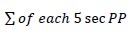
<body><![CDATA[<p><font size="2" face="verdana">The Optojump Next System (Microgate, SARL, Italy) was used to access maximum height mean in CMJ test, (Bosco, 1994).</font></p>     <p><font size="2" face="verdana"><i>Wingate Anaerobic 30 Cycle Test.</i></font></p>     <p><font size="2" face="verdana">The WAnT was performed by all participants for   determining anaerobic power and capacity using a cycle ergometer (Monark,   Ergomedic 939E, Vansbro, Sweden). Reliability and validity information for the   WAnT have been reported across some studies (eg, Bar-Or, 1987; Nicklin, O´Bryant, Zehnbauer, &amp; Collins, 1990).</font></p>     <p><font size="2" face="verdana">The performance indices are peak power (PP), mean anaerobic   power (MAP), anaerobic fatigue or fatigue index (FI) and anaerobic capacity   (AC). Peak power is the highest mechanical power elicited from the test taken   as the average power over any 5 seconds’ period, usually the first 5 seconds.   Mean anaerobic power is the average power maintained throughout the six   segments of 5 seconds. Fatigue index is the amount of the decline in power   during the test expressed as a percentage of peak power (Inbar et al., 1996)   and anaerobic capacity is recorded over the entire 30 seconds of the test (Zupan et al., 2009) and an average is measured.</font></p>     <p><font size="2" face="verdana"><i>TaekwondoSpecific Anaerobic Test (TSAT)</i></font></p>     <p><font size="2" face="verdana">The TSAT consists of performing the <i>Bandal chagui</i> technique for 30 seconds at maximum speed and power against a boxing bag with a   strike shield, using both legs alternately. Before testing, the boxing bag was   set for each athlete´s optimal kicking height and distance to target (strike   shield center). A single <i>piezo</i> sensor (LDT4-028K/L, Measurement   Specialties Incorporation), located in the centre of the strike shield was used   to assess the impact force demonstrated in each kick, expressed in units ranging between 0 and 255. </font></p>     <p><font size="2" face="verdana">During the TSAT, the amount of performed techniques   was recorded, as well as the kicking impact force, in units. These units were   then converted to <i>watts</i> based on a conversion factor that was previously   calculated during the maximum kicking impact force and power test. Consequently, the following variables&nbsp;were calculated as follows: </font></p>     <p><font size="2" face="verdana">(i) Peak Power Output (PP) observed during the first five seconds of TSAT</font></p>     <p><font size="2" face="verdana">PP (watts) = <img src="/img/revistas/mot/v12n2/12n2a15e1.jpg" width="469" height="48"></font></p>     
<p><font size="2" face="verdana">(ii) Relative Peak Power Output (RPP), concerning body weight : </font></p>     ]]></body>
<body><![CDATA[<p><font size="2" face="verdana">RPP (watts/kg body weight) = </font><img src="/img/revistas/mot/v12n2/12n2a15e2.jpg" width="78" height="49"></p>     
<p><font size="2" face="verdana">(iii) Mean Anaerobic Power (MAP),:</font></p>     <p><font size="2" face="verdana">MAP (watts) = </font><img src="/img/revistas/mot/v12n2/12n2a15e3.jpg" width="423" height="42"></p>     
<p><font size="2" face="verdana">(iv) Relative Mean Anaerobic Power (RMAP), concerning body weight:</font></p>     <p><font size="2" face="verdana">RMAP (watts/kg body weight) = </font><img src="/img/revistas/mot/v12n2/12n2a15e4.jpg" width="78" height="37"></p>     
<p><font size="2" face="verdana">(v) Fatigue índex (FI):</font></p>     <p><font size="2" face="verdana">FI (%)= <img src="/img/revistas/mot/v12n2/12n2a15e5.jpg" width="223" height="43"></font></p>     
<p><font size="2" face="verdana">(vi) Anaerobic Capacity (AC),:</font></p>     <p><font size="2" face="verdana">AC (watts) = </font><img src="/img/revistas/mot/v12n2/12n2a15e6.jpg" width="132" height="34"></p>     
<p><font size="2" face="verdana"><b>Procedures</b></font></p>     ]]></body>
<body><![CDATA[<p><font size="2" face="verdana">Participants were tested on four sessions (days) for   two consecutive weekends. All athletes had been competing regularly, exhibiting, at the time of this study, a good overall performance. </font></p>     <p><font size="2" face="verdana">In the 48 hours prior to the first session, subjects   were instructed to refrain from physical activity and underwent one   familiarization session. During this session, all athletes were counseled on   proper exercise technique, as well as stretching and appropriate warm up in   order to prevent the large gains that tend to occur as the subjects learn the   testing procedure and also to verify the protocol acceptance and applicability to this group. </font></p>     <p><font size="2" face="verdana">The first data collection, session 1, included the   anthropometric measures, the kicking impact force (leg strike on the boxing   bag) and the WAnT. Session 2 (at the same hour of the day on the following day)   included the CMJ and the TSAT. In addition, all the procedures (except the   anthropometric evaluation) were repeated the following weekend (sessions 3 and   4) for reliability measurement. During this period and up to 48 hours before   session 3, participants were instructed to maintain their normal diet and training patterns.</font></p>     <p><font size="2" face="verdana">Before testing, the participants were asked to perform   15 minutes of standardized warm-up consisting of running, dynamic joint   mobility exercises and 8 sub maximal jumps. Prior to the WAnT, each subject   performed a 5 minutes warm-up period on a cycle ergometer (Monark, Ergomedic   939E, Vansbro, Sweden). Static stretching exercises were also performed at the   end of the sessions. All tests were conducted in an indoor facility to avoid   weather changes during the pre- and post-test sessions (at a temperature of 19-21ºC). </font></p>     <p><font size="2" face="verdana">The data collection started with the measurement of   weight and height and body mass percentage. Subjects were tested whilst wearing   shorts and t-shirts (shoes were removed). After the participants carried the   warm up, in a random order they began the tests. The maximum kicking impact   force (MKIF) test was the first, after the boxing bag having been previously   adjusted according to the body height of each athlete (the center of the shield was placed in height between the navel and nipples).</font></p>     <p><font size="2" face="verdana">After one hour, the WAnT was performed. Prior to   testing, the seat height was adjusted individually for all athletes in order to   find a knee flexion angle of less than 5 degrees when the leg was fully   extended. The load was the result of multiplying the athlete's body weight by a   constant (0.075 kg per kg/body described by Jackson, Pollock, &amp; Ward,   1980). The test consisted of cycling, i.e. the athlete tried to keep the number   of revolutions as high as possible in an attempt to complete the highest number of revolutions per 30 seconds.</font></p>     <p><font size="2" face="verdana">As mentioned before, each subject was allowed a   warm-up period on another cycle ergometer (Monark, Ergomedic 939E, Vansbro,   Sweden)  at a self-selected cadence (at   50 <i>Watts</i>) including two sprints, each lasting  3 seconds at the end of the  third and fifth minutes (Beneke, Pollmann,   Bleif, Leithäuser, &amp; Hütler, 2002). The test began with the start command,   which released the resistance. Verbal support was given during the entire test   and after finishing the participant continued pedaling for three minutes, with a very light load in order to avoid dizziness and syncope due to testing.</font></p>     <p><font size="2" face="verdana">On the second day of evaluation, at the same time of   the day, after the standardized warm up, the counter movement jump (CMJ) was   performed, wherein each athlete performed 3 trials with 3 minutes in between   for each attempt. The maximum height expressed in centimetres (cm) was   considered for analysis. After one hour, the taekwondo specific anaerobic test   (TSAT) was accomplished- trial I. The re-test, trial II, for WAnT and for TSAT, took place one week later, in the same order.</font></p>     <p><font size="2" face="verdana"><b>Statistical Analysis</b></font></p>     <p><font size="2" face="verdana">All data were analysed using SPSS 20.0 (Chicago, IL).   Standard statistical methods were used for the calculation of means and   standard deviations. The Shapiro-Wilk test was used to verify the normal   distribution of variables. A t-test for paired measures was applied to compare   the mean values obtained in both test situations (WAnT and TSAT) and to verify   any difference between WAnT and TSAT test and re-test, correlated by   intra-class correlation coefficients (ICC). Also the strike shield reliability   was measured through the internal correlation coefficient. Pearson   product-moment correlation coefficients were used to verify the association   among all variables between WAnT and TSAT, and between CMJ and TSAT. The effect   size was evaluated through Cohen´s d. The extent to which WAnT and TSAT   produced the same values, by means of the strength of relation as well as the   extent of agreement, was examined by the Bland-Altman graphics, using XLSTAT   Addinsoft<sup>TM</sup>. For a quantitative analysis, it was deemed that the   values projected by TSAT would be correct if at least 80% of the dots were   inside the limits of agreement. To establish statistical significance <i>P </i>&#8804; 0.05 criterion was used.</font></p>     ]]></body>
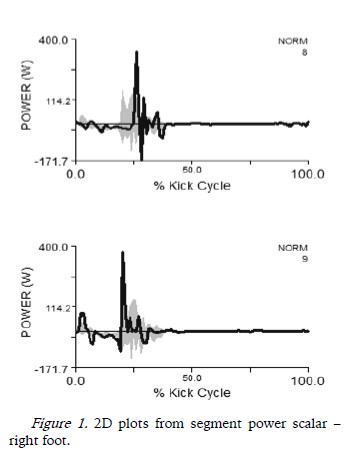
<body><![CDATA[<p>&nbsp;</p>     <p><font size="3" face="verdana"><b>RESULTS</b></font></p>     <p><font size="2" face="verdana">Through 3D analysis, we verify that each unit charged   by the strike shield is equivalent to 3.93 <i>watts</i>, therefore we register   that the mean value of the <i>Bandal chagui</i> impact force is 418 ± 85.1<i>Watts</i>.   <a href="#f1">Figure 1</a> represents the output of two <i>Bandal chagui</i> impacts. The grey   shadow shows the standard deviation of the athlete's data while the line is the average of all athletes’ data.</font></p>     <p><a name="f1"></a></p>     <p>&nbsp;</p>     <p align="center"><img src="/img/revistas/mot/v12n2/12n2a15f1.jpg" width="348" height="459"></p>     
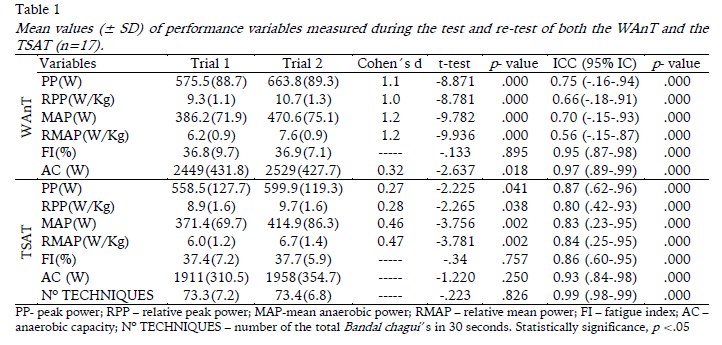
<p>&nbsp;</p>     <p><font size="2" face="verdana"><a href="/img/revistas/mot/v12n2/12n2a15t1.jpg">Table 1</a> shows the mean values (±   standard deviation) for all recorded variables in both test and re-test during   the WAnT and the TSAT.</font></p>     
<p><font size="2" face="verdana">Towards trial II we observed a trend for higher values in both protocols, especially in WAnT protocol.</font></p>     <p><font size="2" face="verdana">The test-retest reliability was assessed   with the mean values of every variable which paired trial I with trial II using   the intra-class correlation coefficient (ICC), ranging for all measures between   0.56 and 0.97 (P = .000) in the WAnT and between 0.89 and 0.99 (P =   .000) in the TSAT. In WAnT, in what concerns the FI variable, from trial I to   trial II, there were no differences (P =.895; ICC = 0.95). For the   remaining variables, there was a difference with a large effect size (from 1.0 to 1.4).</font></p>     ]]></body>
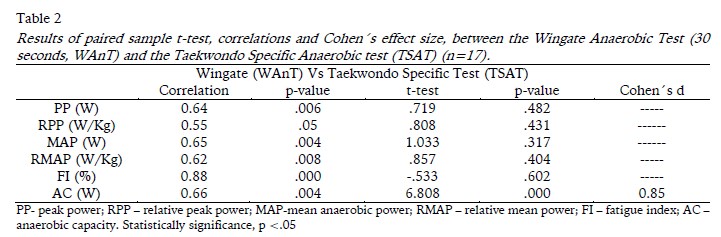
<body><![CDATA[<p><font size="2" face="verdana">In the TSAT, the differences in trial I   and II had an effect size ranged between small and medium (0.33-0.55) for PP,   RPP, MAP and RMAP.  We observed a trend   towards trial II for higher values in all measure variables, although, for FI,   AC and number of techniques the difference was not statistically proved, P =   .757; P = .240; P = .826, respectively. A significant correlation   between CMJ performance and the number of techniques (r = 0.59; <i>P =</i>.013) and the MAP (r = 0.56; P <i>=</i>.019) was registered in the TSAT.</font></p>     <p><font size="2" face="verdana">The reliability for the strike shield had   an internal correlation coefficient of 0.87. One can note in <a href="/img/revistas/mot/v12n2/12n2a15t2.jpg">table 2</a> that   variables in WAnT and TSAT were significantly correlated, FI being the strongest correlation (P =.000, r =.88).</font></p>     
<p><font size="2" face="verdana">Results also show a trend for higher   values in WAnT (<a href="/img/revistas/mot/v12n2/12n2a15t1.jpg">table 1</a>), however, only the AC variable demonstrates being statistically different (P = .000), with a large Cohen´s d, 0.85 (<a href="/img/revistas/mot/v12n2/12n2a15t2.jpg">table 2</a>). </font></p>     
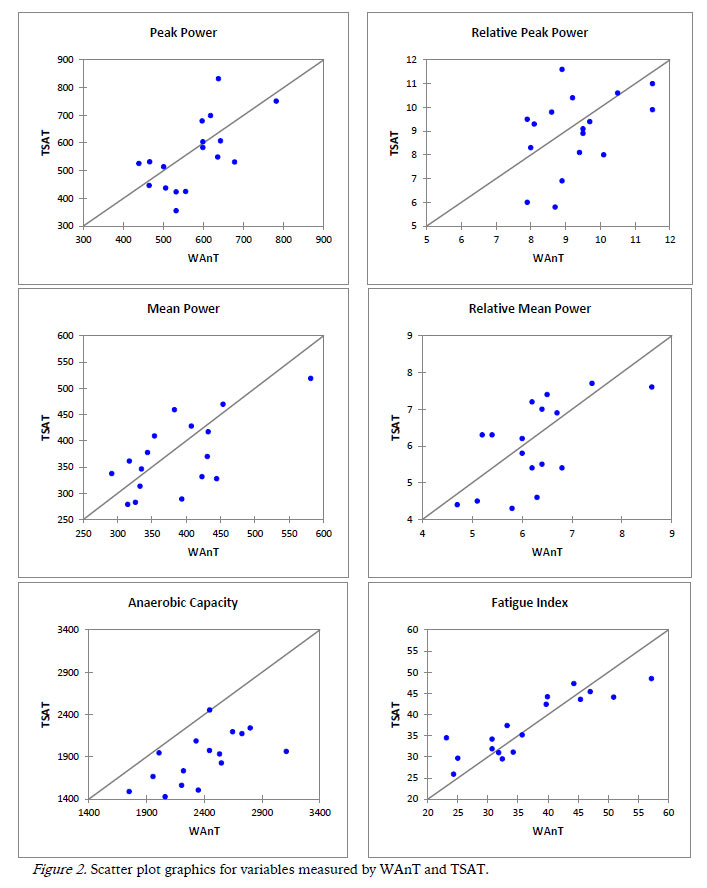
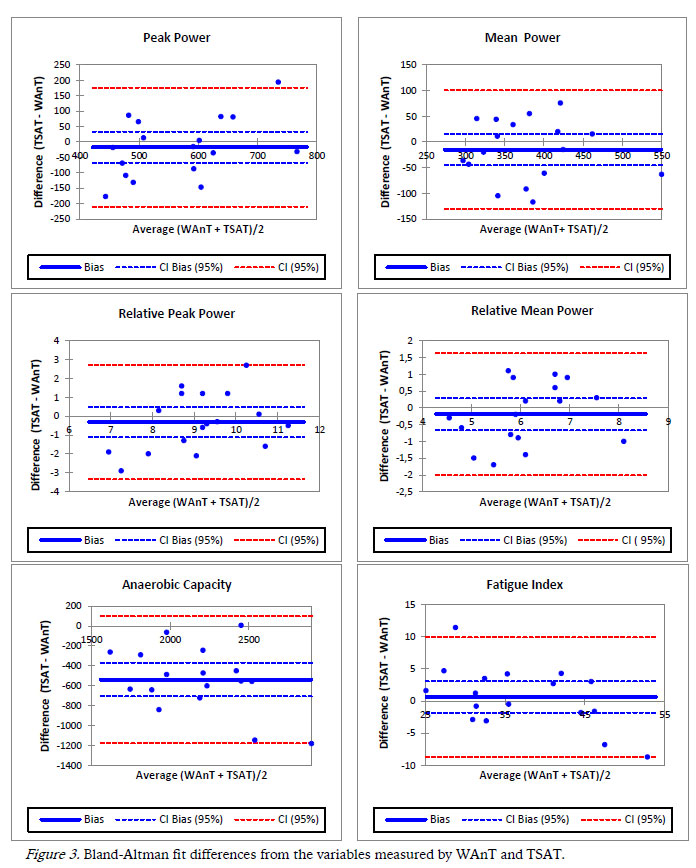
<p><font size="2" face="verdana">In the Bland-Altman analysis, we checked   if the mean of the differences between the results of the two methods were   different from zero (0). According to our data, only the anaerobic capacity variable showed a significant difference, P = 0.0001; CI [-705.1;-370.2]. </font></p>     <p><font size="2" face="verdana">Using a scatter plot graphic, <a href="/img/revistas/mot/v12n2/12n2a15f2.jpg">figure 2</a>, we   compared the reference test (WAnt) with TSAT and we can observe that for the   PP, RPP, MAP, RMAP and FI the data are on both sides of the identity line and   are not distant from it, which means that both methods/tests (WAnT and TSAT)   provide us with similar consistent outcomes.. The TSAT seems to underestimate the AC variable values, once the data is under the identity line.</font></p>     
<p><font size="2" face="verdana">In the Bland-Altman plot graphic, <a href="/img/revistas/mot/v12n2/12n2a15f3.jpg">figure   3</a>, we can infer the following: for PP the bias is -17.1, with a 95% CI of   [-67.7;33.4], the limit of agreement (LoA) is [-210.1;175.8]; for RPP the bias   is the value of -0.3 with a 95% CI [-1.1;0.4], the LoA is [-3.3;2.7]; for MAP,   there is a bias of -14.7 with a 95% CI of [-45.0;15.5] and LoA of   [-130.2;100.7]; for RMAP the bias is -0.2 with a 95% CI of [-0.6;0.3] and a LoA   [-0.2;0.7]; with regard to FI and AC, there is    a bias of 0.6 and -537.6, a 95% CI of [-1.8;3.0] and [-705.0;-370.1] and   a LoA of [-8.7;9.2] and [-1175,9;100.7], respectively. Summing up, the 95% CI   of bias for the first five variables includes the zero (0) value. This can   confirm that the risk of concluding that WAnT and TSAT are different when they   are not is high and should be avoided. The LoA suggests that any difference   between the two measures should lie in this CI, and allows understanding that at least 80% of dots are within this limits.</font></p>     
<p>&nbsp;</p>     <p><font size="3" face="verdana"><b>DISCUSSION</b></font></p>     <p><font size="2" face="verdana">The intent of this study was to evaluate the   concurrent validity of TSAT using the WAnT as gold standard test and to verify   how far the TSAT gives results that are similar to WAnT in an elite male taekwondo subjects. </font></p>     <p><font size="2" face="verdana">Performing a technique with speed and strength are two   important criteria for taekwondo competition (Roosen &amp; Pain, 2006). Several   studies have attempted to assess the kick impact force using measurement   systems whose results are presented in Newtons    (Falcó, Estevan, Álvarez, &amp; Molina-García, 2011; O’Sullivan et al.,   2009) others  in Kilogram-force (Chiu,   Wang, &amp; Chen, 2007) or in joules (Del Vecchio, Franchini, Vecchio, &amp;   Pieter, 2011) and also in gravity acceleration units (g) (Sant’Ana et al.,   2014). Moreover, the electronic body protector used in official taekwondo   matches records the impact in joules. Del Vecchio, Franchini, Vecchio, and   Pieter (2011) presented data from the energy absorbed by the electronic body   protector during taekwondo official competitions and states that the energy values   recorded ranges from 211 ± 34 joules in junior &lt;51kg athletes to 262 ± 49   joules in senior 67-78kg athletes. In this study, we used the watts measurement   system to quantify the <i>Bandal chagui</i> impact because we wanted to   correlate the impact forces with the WAnT results and because the Mega Strike   device measures the impact of a hit in units patented by the manufacturer. We   verify that the <i>Bandal chagui</i> technique can produce in average an impact   force of 418 ± 85.1Watts. Assuming the relationship between joules and watts by   the following formula, Joules= Watts x seconds, and considering the work of   Matsushigue, Hartmann, and Franchini (2009), which refers <i>Bandal chagui</i>   speed values in the order of 0.31 seconds, we realize that the electronic body   protector delivers higher values than those recorded in this study (680 watts   vs. 418 watts). There must be several reasons for this underestimation in the   presented work, and from our point of view it is clear that the difference is   explained by how the impacts are assessed, the material used, contact time, and other factors. </font></p>     ]]></body>
<body><![CDATA[<p><font size="2" face="verdana">For the WAnT evaluation, all participants were   instructed about the proper methods, although, a difference in trial I and   trial II was registered. Barfield, Sells, Rowe, and Hannigan-Downs (2002)   reported a systematic change in peak power (14%) and mean power (5%) between   two trials in WAnT, when there is not a good familiarization with the   evaluation test. In our study, for WAnT, the differences are 15% for peak power   and 21% for mean power. During the sport seasons, all participants are   evaluated with WAnT, and even so, it is evident that any technical gesture   unspecific to the sport performed in WAnT protocol can act as lack of   familiarization, which in a way can explain the differences between trial I and   II. This question became apparent when we recorded differences of 7% and 11%   for the same variables, peak power and mean power respectively, between trial I   and II for the TSAT protocol, both with an ICC above 0.83 and a small to medium   effect size, suggesting that these differences in practice will not have a big impact. </font></p>     <p><font size="2" face="verdana">Several studies have been conducted on the validity,   reliability and/or replication of the 30 seconds Wingate test protocol (Beneke   et al., 2002; Denadai, Gugliemo, &amp; Denadai, 1997). Additionally, Bridge et   al. (2014) in a review article reported 864.6 ± 246.2 w (peak power); 11.8 ±   2.0 w/kg (relative peak power); 671.2 ± 151.3 w (mean power) and 9.2 ± 1.2 w/kg   (relative mean power) for an international US male elite taekwondo sample.   Heller et al. (1998) reported values of 14.7 ± 1.3 w/kg (relative peak power);   344 ± 26.4 J/kg (anaerobic capacity) and a 42.2 ± 7.3% (anaerobic fatigue) in a   sample of elite male and female taekwondo subjects. When considering our   findings in WAnT we reported results in some variables lower than those   considered in literature, such as the peak power, relative peak power and   anaerobic capacity.  The lower values can   explain the value presented in FI, i.e., installed fatigue was also shorter, resulting in a lower FI.</font></p>     <p><font size="2" face="verdana">There is a notorious difference in anaerobic capacity   (about 22%) between both tests. Despite the reliability of the mega strike   shield presenting a good ICC, the power decline in the techniques throughout   the TSAT is evident. We suppose that this decline is partly due to the   reduction of energy sources, including ATP, PC, muscle glycogen and  accumulation of H<sup>+</sup> and inorganic   phosphate (Pi) (Fitts, 2008), but it may also be due to the strike shield not   having the same sensitivity throughout. As declines in physical performance can   be associated with reductions in technical skill performance (Fitts, 2008;   Radman et al., 2016) a decrease in technical aim for the most sensitive part of   the shield may have occurred, presenting, in our view, a difference in values   to the AC variables between the two tests. This observation can also justify   the FI behaviour when compared with the Sant´Ana et al. (2014), although the   values between WAnT and TSAT were very similar, they seem to be higher than 27.69% in the Sant´Ana’ study. </font></p>     <p><font size="2" face="verdana">Sant´Ana et al. (2014) justified the lower values of   the taekwondo anaerobic test, in FI variable, when compared with other authors   using the WAnT, due to the fact that in the WAnT there is a constant load for   the technical gesture (cycling) while in taekwondo specific tests, there is a   brief pause between the kicks which somehow allows for recovery, causing a   lower drop in performance. In this study, assuming the feature mentioned above,   and to justify the similarity of values in the FI variable, we would rather   assume that the similar values between the two tests are due to a specific   technical gesture that imposes physiological dissimilarities between cycling   and kicking. Cycling involves isotonic contractions while kicking is a complex   motor task characterized by large forces exerted in a short period of time   (Falcó &amp; Estevan, 2014) and therefore, there is a central and peripheral   specific adaptation. The specific gesture also allows the athletes to better   synchronize the various phases of the kick skills they use, thus saving energy   in carrying out the test. On the other hand, this ability to synchronize  also allows the athlete a larger fibre   recruitment to mobilize a larger muscle mass in a greater angular velocity and   this, eventually, results in more force applied (Del Vecchio et al., 2011) corresponding to increased energy consumption.</font></p>     <p><font size="2" face="verdana">We suggested that the correlation between the mean   power and number of techniques in the TSAT with CMJ is supported by the   stretch-shortening cycle. When performing the <i>Bandal chagui</i> there is a   knee flexion before a leg extension (when the foot hits the bag), a movement   that mimics the one performed in the CMJ test. With this association, we can   understand that the ability to perform the TSAT, particularly regarding the   number of techniques and the average value of the impact force, depends on the   maximal muscular power production by the knee extensors, a finding also described by Sant´Ana et al (2014). </font></p>     <p><font size="2" face="verdana">We obtained results contrary to our first hypothesis,   WAnT underestimates the anaerobic performance of male taekwondo o athletes, due   to, in our perspective, factors related to impact measurement; nevertheless,   the same results show the existence of a significant correlation, which   suggests that both protocols have the ability to evaluate an identical   variable.. Additionally, there is no proportional bias in all variables (except   for AC), which leads us to mention that there is a level of agreement between   both tests and that confirms our second hypothesis. The level of agreement is   higher after normalization (peak power and mean anaerobic power) according to   the body weight (Falcó, Molina-García, Alvarez, &amp; Estevan, 2013). For the   anaerobic capacity variable the first assumption is that the two methods on   this variable do not consistently provide similar measures because there is a   level of disagreement that may include practical important discrepancies up to   537.6 watts. In fact we have a correlated and inconsistent measure at a   constant bias; however, this bias does not render TSAT meritless to assess   anaerobic capacity. In this particular case, to evaluate AC we could use the   value of the AC plus the bias, as an estimate of the anaerobic capacity from   TSAT. It should also be added that these results are in position to assume the   TSAT validation: a) there are no differences between the tests (mean data) with   the exception of AC variable; b) the Bland and Altman analysis allows for   realization that PP and FI have one dot each beyond the limits of agreement,   while the other variables have all the dots within those limits. So, the cut-off   value of at least 80% of plots within the LoA was accomplished for all variables of TSAT protocol.</font></p>     <p><font size="2" face="verdana">We discussed earlier the sensor sensitivity issue that   may have caused this constant bias. This constitutes a limitation for this   study and should be further investigated through complementary experiments with   an improved power assessment tool, capable of retaining a minimum level of   measurement accuracy that guarantees that every major portion of the strike   shield surface must include a sufficient number of sensors to ensure recording of every possible type and magnitude of hit on it.</font></p>     <p><font size="2" face="verdana">Our findings have been limited to a group of elite   male athletes. Further approaches are needed to confirm if TSAT protocol is   appropriate for assessing other athletes in different levels of training, of different ages and especially in female athletes.</font></p>     <p>&nbsp;</p>     <p><font size="3" face="verdana"><b>CONCLUSION</b></font></p>     ]]></body>
<body><![CDATA[<p><font size="2" face="verdana">It was hypothesized that WAnT underestimates the   anaerobic performance of taekwondo players. In fact, the results showed the   opposite, especially regarding the AC variable; due to decrease of motor acuity   in performing the <i>Bandal chagui</i> with onset fatigue, the techniques began   to be carried out in areas farther from the center of the shield/sensor, with   lower impact values than the force actually applied. Our results also have   shown that TSAT has a level of agreement with the WAnT, especially in the   variables PP, RPP, MAP, RMAP and FI, therefore the protocol attaches great   specificity in assessing anaerobic fitness of taekwondo athletes. The   importance of muscular power in the TSAT is significant when there is a   relation between CMJ and mean power, CMJ and the number of techniques. An   important point in this work was to quantitatively measure the performance   effort, and it has produced a set of equations which can provide a practical impact to the training/anaerobic evaluation process of taekwondo athletes.</font></p>     <p>&nbsp;</p>     <p><font size="3" face="verdana"><b>REFERENCES</b></font></p>     <!-- ref --><p><font size="2" face="verdana">Aziz, A. R., Tan, B., &amp; Teh, K. C. (2002). Physiological Responses   During Matches and Profile of Elite Pencak Silat Exponents. <i>Journal of Sports Science &amp; Medicine</i>, <i>1</i>(4), 147–155.    &nbsp;&nbsp;&nbsp;&nbsp;&nbsp;&nbsp;&nbsp;&nbsp;[&#160;<a href="javascript:void(0);" onclick="javascript: window.open('/scielo.php?script=sci_nlinks&ref=355714&pid=S1646-107X201600020001500001&lng=','','width=640,height=500,resizable=yes,scrollbars=1,menubar=yes,');">Links</a>&#160;]<!-- end-ref --></font></p>     <!-- ref --><p><font size="2" face="verdana">Barfield, J.-P., Sells, P. D., Rowe, D. A., &amp; Hannigan-Downs, K.   (2002). Practice effect of the Wingate anaerobic test. <i>Journal of Strength     and Conditioning Research / National Strength &amp; Conditioning Association</i>, <i>16</i>(3), 472–473.    &nbsp;&nbsp;&nbsp;&nbsp;&nbsp;&nbsp;&nbsp;&nbsp;[&#160;<a href="javascript:void(0);" onclick="javascript: window.open('/scielo.php?script=sci_nlinks&ref=355716&pid=S1646-107X201600020001500002&lng=','','width=640,height=500,resizable=yes,scrollbars=1,menubar=yes,');">Links</a>&#160;]<!-- end-ref --></font></p>     <!-- ref --><p><font size="2" face="verdana">Bar-Or, O. (1987). The Wingate anaerobic test. An update on methodology,   reliability and validity. <i>Sports Medicine (Auckland, N.Z.)</i>, <i>4</i>(6), 381–394.    &nbsp;&nbsp;&nbsp;&nbsp;&nbsp;&nbsp;&nbsp;&nbsp;[&#160;<a href="javascript:void(0);" onclick="javascript: window.open('/scielo.php?script=sci_nlinks&ref=355718&pid=S1646-107X201600020001500003&lng=','','width=640,height=500,resizable=yes,scrollbars=1,menubar=yes,');">Links</a>&#160;]<!-- end-ref --></font></p>     <!-- ref --><p><font size="2" face="verdana">Beneke, R., Pollmann, C., Bleif, I., Leithäuser, R. M., &amp; Hütler, M.   (2002). How anaerobic is the Wingate Anaerobic Test for humans? <i>European Journal of Applied Physiology</i>, <i>87</i>(4–5), 388–392. <a target="_blank" href="http://doi.org/10.1007/s00421-002-0622-4">http://doi.org/10.1007/s00421-002-0622-4</a></font>&nbsp;&nbsp;&nbsp;&nbsp;&nbsp;&nbsp;&nbsp;&nbsp;[&#160;<a href="javascript:void(0);" onclick="javascript: window.open('/scielo.php?script=sci_nlinks&ref=355720&pid=S1646-107X201600020001500004&lng=','','width=640,height=500,resizable=yes,scrollbars=1,menubar=yes,');">Links</a>&#160;]<!-- end-ref --><!-- ref --><p><font size="2" face="verdana">Bland, J. M., &amp; Altman, D. G. (1986). Statistical methods for   assessing agreement between two methods of clinical measurement. <i>Lancet (London,     England)</i>, <i>1</i>(8476), 307–310.    &nbsp;&nbsp;&nbsp;&nbsp;&nbsp;&nbsp;&nbsp;&nbsp;[&#160;<a href="javascript:void(0);" onclick="javascript: window.open('/scielo.php?script=sci_nlinks&ref=355721&pid=S1646-107X201600020001500005&lng=','','width=640,height=500,resizable=yes,scrollbars=1,menubar=yes,');">Links</a>&#160;]<!-- end-ref --></font></p>     <!-- ref --><p><font size="2" face="verdana">Bosco, C. (1994). <i>La valoracion de la fuerza con el test de Bosco</i>. Barcelona: Paidotribo.    &nbsp;&nbsp;&nbsp;&nbsp;&nbsp;&nbsp;&nbsp;&nbsp;[&#160;<a href="javascript:void(0);" onclick="javascript: window.open('/scielo.php?script=sci_nlinks&ref=355723&pid=S1646-107X201600020001500006&lng=','','width=640,height=500,resizable=yes,scrollbars=1,menubar=yes,');">Links</a>&#160;]<!-- end-ref --></font></p>     <!-- ref --><p><font size="2" face="verdana">Bouhlel, E., Jouini, A., Gmada, N., Nefzi, A., Ben Abdallah, K., &amp;   Tabka, Z. (2006). Heart rate and&nbsp;blood lactate responses during Taekwondo training and&nbsp;competition. <i>Science &amp; Sports</i>, <i>21</i>(5), 285–290. <a target="_blank" href="http://doi.org/10.1016/j.scispo.2006.08.003">http://doi.org/10.1016/j.scispo.2006.08.003</a></font>&nbsp;&nbsp;&nbsp;&nbsp;&nbsp;&nbsp;&nbsp;&nbsp;[&#160;<a href="javascript:void(0);" onclick="javascript: window.open('/scielo.php?script=sci_nlinks&ref=355725&pid=S1646-107X201600020001500007&lng=','','width=640,height=500,resizable=yes,scrollbars=1,menubar=yes,');">Links</a>&#160;]<!-- end-ref --><!-- ref --><p><font size="2" face="verdana">Bridge, C. A., Ferreira da Silva Santos, J., Chaabène, H., Pieter, W.,   &amp; Franchini, E. (2014). Physical and physiological profiles of taekwondo athletes. <i>Sports Medicine</i>, <i>44</i>(6), 713–733. <a target="_blank" href="http://doi.org/10.1007/s40279-014-0159-9">http://doi.org/10.1007/s40279-014-0159-9</a></font>&nbsp;&nbsp;&nbsp;&nbsp;&nbsp;&nbsp;&nbsp;&nbsp;[&#160;<a href="javascript:void(0);" onclick="javascript: window.open('/scielo.php?script=sci_nlinks&ref=355726&pid=S1646-107X201600020001500008&lng=','','width=640,height=500,resizable=yes,scrollbars=1,menubar=yes,');">Links</a>&#160;]<!-- end-ref --><!-- ref --><p><font size="2" face="verdana">Bridge, C. A., Jones, M. A., &amp; Drust, B. (2009). Physiological   responses and perceived exertion during international Taekwondo competition. <i>International Journal of Sports Physiology and Performance</i>, <i>4</i>(4), 485–493.    &nbsp;&nbsp;&nbsp;&nbsp;&nbsp;&nbsp;&nbsp;&nbsp;[&#160;<a href="javascript:void(0);" onclick="javascript: window.open('/scielo.php?script=sci_nlinks&ref=355727&pid=S1646-107X201600020001500009&lng=','','width=640,height=500,resizable=yes,scrollbars=1,menubar=yes,');">Links</a>&#160;]<!-- end-ref --></font></p>     <!-- ref --><p><font size="2" face="verdana">Chiu, P. H., Wang, H. H., &amp; Chen, Y. C. (2007). <i>Designing a   measurement system for taekwondo training</i>. Poster Session 1/Sport. Poster 138, S619, Institute of Sports Equipment Technology, TPEC, Taipei, Taiwan.    &nbsp;&nbsp;&nbsp;&nbsp;&nbsp;&nbsp;&nbsp;&nbsp;[&#160;<a href="javascript:void(0);" onclick="javascript: window.open('/scielo.php?script=sci_nlinks&ref=355729&pid=S1646-107X201600020001500010&lng=','','width=640,height=500,resizable=yes,scrollbars=1,menubar=yes,');">Links</a>&#160;]<!-- end-ref --></font></p>     ]]></body>
<body><![CDATA[<!-- ref --><p><font size="2" face="verdana">Del Vecchio, F. B., Franchini, E., Vecchio, A. H. M. D., &amp; Pieter,   W. (2011). Energy absorbed   by electronic body protectors from kicks in a taekwondo competition. <i>Biology of Sport</i>, <i>28</i>(1), 75–78.    &nbsp;&nbsp;&nbsp;&nbsp;&nbsp;&nbsp;&nbsp;&nbsp;[&#160;<a href="javascript:void(0);" onclick="javascript: window.open('/scielo.php?script=sci_nlinks&ref=355731&pid=S1646-107X201600020001500011&lng=','','width=640,height=500,resizable=yes,scrollbars=1,menubar=yes,');">Links</a>&#160;]<!-- end-ref --></font></p>     <!-- ref --><p><font size="2" face="verdana">Denadai, B. S., Gugliemo, L. G. A., &amp; Denadai, M. L. D. (1997). Validade do teste de wingate para a   avaliação da performance em corridas de 50 e 200 metros. <i>Motriz</i>, <i>3</i>(2), 89–94.    &nbsp;&nbsp;&nbsp;&nbsp;&nbsp;&nbsp;&nbsp;&nbsp;[&#160;<a href="javascript:void(0);" onclick="javascript: window.open('/scielo.php?script=sci_nlinks&ref=355733&pid=S1646-107X201600020001500012&lng=','','width=640,height=500,resizable=yes,scrollbars=1,menubar=yes,');">Links</a>&#160;]<!-- end-ref --></font></p>     <!-- ref --><p><font size="2" face="verdana">Falcó, C., &amp; Estevan, I. (2014). Biomechanics in taekwondo: practical   applications. Em M. Haddad (Ed.), <i>Performance optimization in taekwondo: from laboratory to field</i> (pp. 1–23). Foster City, CA: OMICS Group eBooks.    &nbsp;&nbsp;&nbsp;&nbsp;&nbsp;&nbsp;&nbsp;&nbsp;[&#160;<a href="javascript:void(0);" onclick="javascript: window.open('/scielo.php?script=sci_nlinks&ref=355735&pid=S1646-107X201600020001500013&lng=','','width=640,height=500,resizable=yes,scrollbars=1,menubar=yes,');">Links</a>&#160;]<!-- end-ref --></font></p>     <!-- ref --><p><font size="2" face="verdana">Falcó, C., Estevan, I., Álvarez, O., &amp; Molina-García, J. (2011).   Capacity to create impact forces and execution time according to weight   category in taekwondo. <i>Revista de Ciencias del Deporte</i>, <i>7</i>(Suppl), 23–29.    &nbsp;&nbsp;&nbsp;&nbsp;&nbsp;&nbsp;&nbsp;&nbsp;[&#160;<a href="javascript:void(0);" onclick="javascript: window.open('/scielo.php?script=sci_nlinks&ref=355737&pid=S1646-107X201600020001500014&lng=','','width=640,height=500,resizable=yes,scrollbars=1,menubar=yes,');">Links</a>&#160;]<!-- end-ref --></font></p>     <!-- ref --><p><font size="2" face="verdana">Falcó, C., Molina-García, J., Alvarez, O., &amp; Estevan, I. (2013).   Effects of target distance on select biomechanical parameters in taekwondo   roundhouse kick. <i>Sports Biomechanics / International Society of Biomechanics in Sports</i>, <i>12</i>(4), 381–388. <a target="_blank" href="http://doi.org/10.1080/14763141.2013.776626">http://doi.org/10.1080/14763141.2013.776626</a></font>&nbsp;&nbsp;&nbsp;&nbsp;&nbsp;&nbsp;&nbsp;&nbsp;[&#160;<a href="javascript:void(0);" onclick="javascript: window.open('/scielo.php?script=sci_nlinks&ref=355739&pid=S1646-107X201600020001500015&lng=','','width=640,height=500,resizable=yes,scrollbars=1,menubar=yes,');">Links</a>&#160;]<!-- end-ref --><!-- ref --><p><font size="2" face="verdana">Fitts, R. H. (2008). The cross-bridge cycle and skeletal muscle fatigue.   <i>Journal of Applied Physiology (Bethesda, Md.: 1985)</i>, <i>104</i>(2), 551–558. <a target="_blank" href="http://doi.org/10.1152/japplphysiol.01200.2007">http://doi.org/10.1152/japplphysiol.01200.2007</a></font>&nbsp;&nbsp;&nbsp;&nbsp;&nbsp;&nbsp;&nbsp;&nbsp;[&#160;<a href="javascript:void(0);" onclick="javascript: window.open('/scielo.php?script=sci_nlinks&ref=355740&pid=S1646-107X201600020001500016&lng=','','width=640,height=500,resizable=yes,scrollbars=1,menubar=yes,');">Links</a>&#160;]<!-- end-ref --><!-- ref --><p><font size="2" face="verdana">Heller, J., Peric, T., Dlouhá, R., Kohlíková, E., Melichna, J., &amp; Nováková,   H. (1998). Physiological profiles of male and female taekwon-do (ITF) black belts. <i>Journal of Sports Sciences</i>, <i>16</i>(3), 243–249. <a target="_blank" href="http://doi.org/10.1080/026404198366768">http://doi.org/10.1080/026404198366768</a></font>&nbsp;&nbsp;&nbsp;&nbsp;&nbsp;&nbsp;&nbsp;&nbsp;[&#160;<a href="javascript:void(0);" onclick="javascript: window.open('/scielo.php?script=sci_nlinks&ref=355741&pid=S1646-107X201600020001500017&lng=','','width=640,height=500,resizable=yes,scrollbars=1,menubar=yes,');">Links</a>&#160;]<!-- end-ref --><!-- ref --><p><font size="2" face="verdana">Inbar, O., Bar-Or, O., &amp; Skinner, J. S. (1996). <i>The Wingate Anaerobic Test</i>. Champagn, IL: Human Kinetics.    &nbsp;&nbsp;&nbsp;&nbsp;&nbsp;&nbsp;&nbsp;&nbsp;[&#160;<a href="javascript:void(0);" onclick="javascript: window.open('/scielo.php?script=sci_nlinks&ref=355742&pid=S1646-107X201600020001500018&lng=','','width=640,height=500,resizable=yes,scrollbars=1,menubar=yes,');">Links</a>&#160;]<!-- end-ref --></font></p>     <!-- ref --><p><font size="2" face="verdana">Jackson, A. S., Pollock, M. L., &amp; Ward, A. (1980). Generalized   equations for predicting body density of women. <i>Medicine and Science in Sports and Exercise</i>, <i>12</i>(3), 175–181.    &nbsp;&nbsp;&nbsp;&nbsp;&nbsp;&nbsp;&nbsp;&nbsp;[&#160;<a href="javascript:void(0);" onclick="javascript: window.open('/scielo.php?script=sci_nlinks&ref=355744&pid=S1646-107X201600020001500019&lng=','','width=640,height=500,resizable=yes,scrollbars=1,menubar=yes,');">Links</a>&#160;]<!-- end-ref --></font></p>     <!-- ref --><p><font size="2" face="verdana">Lee, K. M. (1996). <i>Tae Kwon Do: Techniques &amp; Training</i>. NY: Sterling Publishing Company.    &nbsp;&nbsp;&nbsp;&nbsp;&nbsp;&nbsp;&nbsp;&nbsp;[&#160;<a href="javascript:void(0);" onclick="javascript: window.open('/scielo.php?script=sci_nlinks&ref=355746&pid=S1646-107X201600020001500020&lng=','','width=640,height=500,resizable=yes,scrollbars=1,menubar=yes,');">Links</a>&#160;]<!-- end-ref --></font></p>     <!-- ref --><p><font size="2" face="verdana">Lin, W.-L., Yen, K.-T., Lu, C.-Y. D., Huang, Y.-H., &amp; Chang, C.-K.   (2006). Anaerobic capacity of&nbsp;elite Taiwanese Taekwondo athletes. <i>Science &amp; Sports</i>, <i>21</i>(5), 291–293. <a target="_blank" href="http://doi.org/10.1016/j.scispo.2006.04.005">http://doi.org/10.1016/j.scispo.2006.04.    &nbsp;&nbsp;&nbsp;&nbsp;&nbsp;&nbsp;&nbsp;&nbsp;[&#160;<a href="javascript:void(0);" onclick="javascript: window.open('/scielo.php?script=sci_nlinks&ref=355748&pid=S1646-107X201600020001500021&lng=','','width=640,height=500,resizable=yes,scrollbars=1,menubar=yes,');">Links</a>&#160;]<!-- end-ref -->005</a></font></p>     <!-- ref --><p><font size="2" face="verdana">Matsushigue, K. A., Hartmann, K., &amp; Franchini, E. (2009). Taekwondo:   Physiological responses and match analysis. <i>Journal of Strength and     Conditioning Research / National Strength &amp; Conditioning Association</i>, <i>23</i>(4), 1112–1117. <a target="_blank" href="http://doi.org/10.1519/JSC.0b013e3181a3c597">http://doi.org/10.1519/JSC.0b013e3181a3c597</a></font>&nbsp;&nbsp;&nbsp;&nbsp;&nbsp;&nbsp;&nbsp;&nbsp;[&#160;<a href="javascript:void(0);" onclick="javascript: window.open('/scielo.php?script=sci_nlinks&ref=355750&pid=S1646-107X201600020001500022&lng=','','width=640,height=500,resizable=yes,scrollbars=1,menubar=yes,');">Links</a>&#160;]<!-- end-ref --><!-- ref --><p><font size="2" face="verdana">Melhim, A. F. (2001). Aerobic and anaerobic power responses to the   practice of taekwon-do. <i>British Journal of Sports Medicine</i>, <i>35</i>(4), 231–234.    &nbsp;&nbsp;&nbsp;&nbsp;&nbsp;&nbsp;&nbsp;&nbsp;[&#160;<a href="javascript:void(0);" onclick="javascript: window.open('/scielo.php?script=sci_nlinks&ref=355751&pid=S1646-107X201600020001500023&lng=','','width=640,height=500,resizable=yes,scrollbars=1,menubar=yes,');">Links</a>&#160;]<!-- end-ref --></font></p>     <!-- ref --><p><font size="2" face="verdana">Nicklin, R., O´Bryant, H., Zehnbauer, T., &amp; Collins, M. (1990). A   computerized method for assessing anaerobic power and work capacity using   maximal cycle ergometry. <i>Journal of Strength and Conditioning Research</i>, <i>4</i>(4), 135–140.    &nbsp;&nbsp;&nbsp;&nbsp;&nbsp;&nbsp;&nbsp;&nbsp;[&#160;<a href="javascript:void(0);" onclick="javascript: window.open('/scielo.php?script=sci_nlinks&ref=355753&pid=S1646-107X201600020001500024&lng=','','width=640,height=500,resizable=yes,scrollbars=1,menubar=yes,');">Links</a>&#160;]<!-- end-ref --></font></p>     <!-- ref --><p><font size="2" face="verdana">Olsen, P. D., &amp; Hopkins, W. G. (2003). The effect of attempted   ballistic training on the force and speed of movements. <i>Journal of Strength     and Conditioning Research / National Strength &amp; Conditioning Association</i>, <i>17</i>(2), 291–298.    &nbsp;&nbsp;&nbsp;&nbsp;&nbsp;&nbsp;&nbsp;&nbsp;[&#160;<a href="javascript:void(0);" onclick="javascript: window.open('/scielo.php?script=sci_nlinks&ref=355755&pid=S1646-107X201600020001500025&lng=','','width=640,height=500,resizable=yes,scrollbars=1,menubar=yes,');">Links</a>&#160;]<!-- end-ref --></font></p>     <!-- ref --><p><font size="2" face="verdana">O’Sullivan, D., Chung, C., Lee, K., Kim, E., Kang, S., Kim, T., &amp;   Shin, I. (2009). Measurement and Comparison of Taekwondo and Yongmudo Turning   Kick Impact Force for Two Target Heights. <i>Journal of Sports Science &amp; Medicine</i>, <i>8</i>(CSSI3), 13–16.    &nbsp;&nbsp;&nbsp;&nbsp;&nbsp;&nbsp;&nbsp;&nbsp;[&#160;<a href="javascript:void(0);" onclick="javascript: window.open('/scielo.php?script=sci_nlinks&ref=355757&pid=S1646-107X201600020001500026&lng=','','width=640,height=500,resizable=yes,scrollbars=1,menubar=yes,');">Links</a>&#160;]<!-- end-ref --></font></p>     <!-- ref --><p><font size="2" face="verdana">Radman, I., Wessner, B., Bachl, N., Ruzic, L., Hackl, M., Prpic, T.,   &amp; Markovic, G. (2016). The acute effects of graded physiological strain on   soccer kicking performance: a randomized, controlled cross-over study. <i>European Journal of Applied Physiology</i>, <i>116</i>(2), 373–382. <a target="_blank" href="http://doi.org/10.1007/s00421-015-3293-7">http://doi.org/10.1007/s00421-015-3293-7</a></font>&nbsp;&nbsp;&nbsp;&nbsp;&nbsp;&nbsp;&nbsp;&nbsp;[&#160;<a href="javascript:void(0);" onclick="javascript: window.open('/scielo.php?script=sci_nlinks&ref=355759&pid=S1646-107X201600020001500027&lng=','','width=640,height=500,resizable=yes,scrollbars=1,menubar=yes,');">Links</a>&#160;]<!-- end-ref --><!-- ref --><p><font size="2" face="verdana">Ravier, G., Grappe, F., &amp; Rouillon, J. D. (2004). Application of   force-velocity cycle ergometer test and vertical jump tests in the functional assessment   of karate competitor. <i>The Journal of Sports Medicine and Physical Fitness</i>, <i>44</i>(4), 349–355.    &nbsp;&nbsp;&nbsp;&nbsp;&nbsp;&nbsp;&nbsp;&nbsp;[&#160;<a href="javascript:void(0);" onclick="javascript: window.open('/scielo.php?script=sci_nlinks&ref=355760&pid=S1646-107X201600020001500028&lng=','','width=640,height=500,resizable=yes,scrollbars=1,menubar=yes,');">Links</a>&#160;]<!-- end-ref --></font></p>     <!-- ref --><p><font size="2" face="verdana">Roosen, A., &amp; Pain, M. T. G. (2006). Impact timing and stretch in   relation to foot velocity in a taekwondo kicking combination. <i>Journal of Biomechanics</i>, <i>39</i>(Suppl 1), S562. <a target="_blank" href="http://doi.org/10.1016/S0021-9290(06)85319-4">http://doi.org/10.1016/S0021-9290(06)85319-4</a></font>&nbsp;&nbsp;&nbsp;&nbsp;&nbsp;&nbsp;&nbsp;&nbsp;[&#160;<a href="javascript:void(0);" onclick="javascript: window.open('/scielo.php?script=sci_nlinks&ref=355762&pid=S1646-107X201600020001500029&lng=','','width=640,height=500,resizable=yes,scrollbars=1,menubar=yes,');">Links</a>&#160;]<!-- end-ref --><!-- ref --><p><font size="2" face="verdana">Ross, W. D., &amp; Marfell-Jones, M. (1991). Kinanthropometry. Em J. D.   MacDougall, H. A. Wenger, &amp; H. J. G. (Ph Green (Eds.), <i>Physiological     Testing of the High-performance Athlete</i>. Champagn, IL: Human Kinetics Books.    &nbsp;&nbsp;&nbsp;&nbsp;&nbsp;&nbsp;&nbsp;&nbsp;[&#160;<a href="javascript:void(0);" onclick="javascript: window.open('/scielo.php?script=sci_nlinks&ref=355763&pid=S1646-107X201600020001500030&lng=','','width=640,height=500,resizable=yes,scrollbars=1,menubar=yes,');">Links</a>&#160;]<!-- end-ref --></font></p>     <!-- ref --><p><font size="2" face="verdana">Sant’Ana, J., Diefenthaeler, F., Dal Pupo, J., Detanico, D., Gugliemo,   L. G. A., &amp; Santos, S. G. (2014). Anaerobic evaluation of Taekwondo   athletes&#8239;: original research. <i>International SportMed Journal</i>, <i>15</i>(4), 492–499.    &nbsp;&nbsp;&nbsp;&nbsp;&nbsp;&nbsp;&nbsp;&nbsp;[&#160;<a href="javascript:void(0);" onclick="javascript: window.open('/scielo.php?script=sci_nlinks&ref=355765&pid=S1646-107X201600020001500031&lng=','','width=640,height=500,resizable=yes,scrollbars=1,menubar=yes,');">Links</a>&#160;]<!-- end-ref --></font></p>     <!-- ref --><p><font size="2" face="verdana">Zupan, M. F., Arata, A. W., Dawson, L. H., Wile, A. L., Payn, T. L.,   &amp; Hannon, M. E. (2009). Wingate Anaerobic Test peak power and anaerobic   capacity classifications for men and women intercollegiate athletes. <i>Journal     of Strength and Conditioning Research / National Strength &amp; Conditioning Association</i>, <i>23</i>(9), 2598–2604. <a target="_blank" href="http://doi.org/10.1519/JSC.0b013e3181b1b21b">http://doi.org/10.1519/JSC.0b013e3181b1b21b</a></font>&nbsp;&nbsp;&nbsp;&nbsp;&nbsp;&nbsp;&nbsp;&nbsp;[&#160;<a href="javascript:void(0);" onclick="javascript: window.open('/scielo.php?script=sci_nlinks&ref=355767&pid=S1646-107X201600020001500032&lng=','','width=640,height=500,resizable=yes,scrollbars=1,menubar=yes,');">Links</a>&#160;]<!-- end-ref --><p>&nbsp;</p>     <p><font size="2" face="verdana"><b>Acknowledgments:    <br> </b></font><font size="2" face="verdana">The expert technical   assistance of Luís Crisóstomo and Rui Ramos in collecting data is kindly   acknowledged and appreciated. The authors thank the athletes who reported to   the laboratory for the two weekends test and also thank the Portuguese taekwondo Federation for supporting this study.    ]]></body>
<body><![CDATA[<br> </font><font size="2" face="verdana"><b>Conflict of Interest:    <br> </b></font><font size="2" face="verdana">The results of the current   study do not constitute endorsement of the product by the authors or the   journal. No conflicts of interest, financial or otherwise, are declared by the authors.    <br> </font><font size="2" face="verdana"><b>Funding:    <br> </b></font><font size="2" face="verdana">Nothing to declare</font></p>     <p><font size="2" face="verdana">Manuscript received at April 8<sup>th</sup> 2016; Accepted at June 18<sup>th</sup> 2016 </font></p>     <p>&nbsp;</p>     <p>&nbsp;</p>     <p><font size="2" face="verdana"><a name="end"></a><a href="#topo">*</a> <i>Corresponding author:</i> Departamento de Desporto da UBI, Convento de Santo Ant&oacute;nio, 6201-001 Covilh&atilde;, Portugal <i>E-mail: </i><a href="mailto:ferdi.rocha@netcabo.pt">ferdi.rocha@netcabo.pt</a></font></p>      ]]></body><back>
<ref-list>
<ref id="B1">
<nlm-citation citation-type="journal">
<person-group person-group-type="author">
<name>
<surname><![CDATA[Aziz]]></surname>
<given-names><![CDATA[A. R.]]></given-names>
</name>
<name>
<surname><![CDATA[Tan]]></surname>
<given-names><![CDATA[B.]]></given-names>
</name>
<name>
<surname><![CDATA[Teh]]></surname>
<given-names><![CDATA[K. C.]]></given-names>
</name>
</person-group>
<article-title xml:lang="en"><![CDATA[Physiological Responses During Matches and Profile of Elite Pencak Silat Exponents]]></article-title>
<source><![CDATA[Journal of Sports Science & Medicine]]></source>
<year>2002</year>
<volume>1</volume>
<numero>4</numero>
<issue>4</issue>
<page-range>147-155</page-range></nlm-citation>
</ref>
<ref id="B2">
<nlm-citation citation-type="journal">
<person-group person-group-type="author">
<name>
<surname><![CDATA[Barfield]]></surname>
<given-names><![CDATA[J.-P.]]></given-names>
</name>
<name>
<surname><![CDATA[Sells]]></surname>
<given-names><![CDATA[P. D.]]></given-names>
</name>
<name>
<surname><![CDATA[Rowe]]></surname>
<given-names><![CDATA[D. A.]]></given-names>
</name>
<name>
<surname><![CDATA[Hannigan-Downs]]></surname>
<given-names><![CDATA[K.]]></given-names>
</name>
</person-group>
<article-title xml:lang="en"><![CDATA[Practice effect of the Wingate anaerobic test]]></article-title>
<source><![CDATA[Journal of Strength and Conditioning Research / National Strength & Conditioning Association]]></source>
<year>2002</year>
<volume>16</volume>
<numero>3</numero>
<issue>3</issue>
<page-range>472-473</page-range></nlm-citation>
</ref>
<ref id="B3">
<nlm-citation citation-type="journal">
<person-group person-group-type="author">
<name>
<surname><![CDATA[Bar-Or]]></surname>
<given-names><![CDATA[O.]]></given-names>
</name>
</person-group>
<article-title xml:lang="en"><![CDATA[The Wingate anaerobic test: An update on methodology, reliability and validity]]></article-title>
<source><![CDATA[Sports Medicine (Auckland, N.Z.)]]></source>
<year>1987</year>
<volume>4</volume>
<numero>6</numero>
<issue>6</issue>
<page-range>381-394</page-range></nlm-citation>
</ref>
<ref id="B4">
<nlm-citation citation-type="journal">
<person-group person-group-type="author">
<name>
<surname><![CDATA[Beneke]]></surname>
<given-names><![CDATA[R.]]></given-names>
</name>
<name>
<surname><![CDATA[Pollmann]]></surname>
<given-names><![CDATA[C.]]></given-names>
</name>
<name>
<surname><![CDATA[Bleif]]></surname>
<given-names><![CDATA[I.]]></given-names>
</name>
<name>
<surname><![CDATA[Leithäuser]]></surname>
<given-names><![CDATA[R. M.]]></given-names>
</name>
<name>
<surname><![CDATA[Hütler]]></surname>
<given-names><![CDATA[M.]]></given-names>
</name>
</person-group>
<article-title xml:lang="en"><![CDATA[How anaerobic is the Wingate Anaerobic Test for humans?]]></article-title>
<source><![CDATA[European Journal of Applied Physiology]]></source>
<year>2002</year>
<volume>87</volume>
<numero>4-5</numero>
<issue>4-5</issue>
<page-range>388-392</page-range></nlm-citation>
</ref>
<ref id="B5">
<nlm-citation citation-type="journal">
<person-group person-group-type="author">
<name>
<surname><![CDATA[Bland]]></surname>
<given-names><![CDATA[J. M.]]></given-names>
</name>
<name>
<surname><![CDATA[Altman]]></surname>
<given-names><![CDATA[D. G.]]></given-names>
</name>
</person-group>
<article-title xml:lang="en"><![CDATA[Statistical methods for assessing agreement between two methods of clinical measurement]]></article-title>
<source><![CDATA[Lancet (London, England)]]></source>
<year>1986</year>
<volume>1</volume>
<numero>8476</numero>
<issue>8476</issue>
<page-range>307-310</page-range></nlm-citation>
</ref>
<ref id="B6">
<nlm-citation citation-type="book">
<person-group person-group-type="author">
<name>
<surname><![CDATA[Bosco]]></surname>
<given-names><![CDATA[C.]]></given-names>
</name>
</person-group>
<source><![CDATA[La valoracion de la fuerza con el test de Bosco]]></source>
<year>1994</year>
<publisher-loc><![CDATA[Barcelona ]]></publisher-loc>
<publisher-name><![CDATA[Paidotribo]]></publisher-name>
</nlm-citation>
</ref>
<ref id="B7">
<nlm-citation citation-type="journal">
<person-group person-group-type="author">
<name>
<surname><![CDATA[Bouhlel]]></surname>
<given-names><![CDATA[E.]]></given-names>
</name>
<name>
<surname><![CDATA[Jouini]]></surname>
<given-names><![CDATA[A.]]></given-names>
</name>
<name>
<surname><![CDATA[Gmada]]></surname>
<given-names><![CDATA[N.]]></given-names>
</name>
<name>
<surname><![CDATA[Nefzi]]></surname>
<given-names><![CDATA[A.]]></given-names>
</name>
<name>
<surname><![CDATA[Ben Abdallah]]></surname>
<given-names><![CDATA[K.]]></given-names>
</name>
<name>
<surname><![CDATA[Tabka]]></surname>
<given-names><![CDATA[Z.]]></given-names>
</name>
</person-group>
<article-title xml:lang="en"><![CDATA[Heart rate and blood lactate responses during Taekwondo training and competition]]></article-title>
<source><![CDATA[Science & Sports]]></source>
<year>2006</year>
<volume>21</volume>
<numero>5</numero>
<issue>5</issue>
<page-range>285-290</page-range></nlm-citation>
</ref>
<ref id="B8">
<nlm-citation citation-type="journal">
<person-group person-group-type="author">
<name>
<surname><![CDATA[Bridge]]></surname>
<given-names><![CDATA[C. A.]]></given-names>
</name>
<name>
<surname><![CDATA[Ferreira da Silva Santos]]></surname>
<given-names><![CDATA[J.]]></given-names>
</name>
<name>
<surname><![CDATA[Chaabène]]></surname>
<given-names><![CDATA[H.]]></given-names>
</name>
<name>
<surname><![CDATA[Pieter]]></surname>
<given-names><![CDATA[W.]]></given-names>
</name>
<name>
<surname><![CDATA[Franchini]]></surname>
<given-names><![CDATA[E.]]></given-names>
</name>
</person-group>
<article-title xml:lang="en"><![CDATA[Physical and physiological profiles of taekwondo athletes]]></article-title>
<source><![CDATA[Sports Medicine]]></source>
<year>2014</year>
<volume>44</volume>
<numero>6</numero>
<issue>6</issue>
<page-range>713-733</page-range></nlm-citation>
</ref>
<ref id="B9">
<nlm-citation citation-type="journal">
<person-group person-group-type="author">
<name>
<surname><![CDATA[Bridge]]></surname>
<given-names><![CDATA[C. A.]]></given-names>
</name>
<name>
<surname><![CDATA[Jones]]></surname>
<given-names><![CDATA[M. A.]]></given-names>
</name>
<name>
<surname><![CDATA[Drust]]></surname>
<given-names><![CDATA[B.]]></given-names>
</name>
</person-group>
<article-title xml:lang="en"><![CDATA[Physiological responses and perceived exertion during international Taekwondo competition]]></article-title>
<source><![CDATA[International Journal of Sports Physiology and Performance]]></source>
<year>2009</year>
<volume>4</volume>
<numero>4</numero>
<issue>4</issue>
<page-range>485-493</page-range></nlm-citation>
</ref>
<ref id="B10">
<nlm-citation citation-type="book">
<person-group person-group-type="author">
<name>
<surname><![CDATA[Chiu]]></surname>
<given-names><![CDATA[P. H.]]></given-names>
</name>
<name>
<surname><![CDATA[Wang]]></surname>
<given-names><![CDATA[H. H.]]></given-names>
</name>
<name>
<surname><![CDATA[Chen]]></surname>
<given-names><![CDATA[Y. C.]]></given-names>
</name>
</person-group>
<source><![CDATA[Designing a measurement system for taekwondo training]]></source>
<year>2007</year>
<volume>138</volume>
<page-range>S619</page-range><publisher-loc><![CDATA[Taipei ]]></publisher-loc>
<publisher-name><![CDATA[Institute of Sports Equipment Technology]]></publisher-name>
</nlm-citation>
</ref>
<ref id="B11">
<nlm-citation citation-type="journal">
<person-group person-group-type="author">
<name>
<surname><![CDATA[Del Vecchio]]></surname>
<given-names><![CDATA[F. B.]]></given-names>
</name>
<name>
<surname><![CDATA[Franchini]]></surname>
<given-names><![CDATA[E.]]></given-names>
</name>
<name>
<surname><![CDATA[Vecchio]]></surname>
<given-names><![CDATA[A. H. M. D.]]></given-names>
</name>
<name>
<surname><![CDATA[Pieter]]></surname>
<given-names><![CDATA[W.]]></given-names>
</name>
</person-group>
<article-title xml:lang="en"><![CDATA[Energy absorbed by electronic body protectors from kicks in a taekwondo competition]]></article-title>
<source><![CDATA[Biology of Sport]]></source>
<year>2011</year>
<volume>28</volume>
<numero>1</numero>
<issue>1</issue>
<page-range>75-78</page-range></nlm-citation>
</ref>
<ref id="B12">
<nlm-citation citation-type="journal">
<person-group person-group-type="author">
<name>
<surname><![CDATA[Denadai]]></surname>
<given-names><![CDATA[B. S.]]></given-names>
</name>
<name>
<surname><![CDATA[Gugliemo]]></surname>
<given-names><![CDATA[L. G. A.]]></given-names>
</name>
<name>
<surname><![CDATA[Denadai]]></surname>
<given-names><![CDATA[M. L. D.]]></given-names>
</name>
</person-group>
<article-title xml:lang="pt"><![CDATA[Validade do teste de wingate para a avaliação da performance em corridas de 50 e 200 metros]]></article-title>
<source><![CDATA[Motriz]]></source>
<year>1997</year>
<volume>3</volume>
<numero>2</numero>
<issue>2</issue>
<page-range>89-94</page-range></nlm-citation>
</ref>
<ref id="B13">
<nlm-citation citation-type="book">
<person-group person-group-type="author">
<name>
<surname><![CDATA[Falcó]]></surname>
<given-names><![CDATA[C.]]></given-names>
</name>
<name>
<surname><![CDATA[Estevan]]></surname>
<given-names><![CDATA[I.]]></given-names>
</name>
</person-group>
<article-title xml:lang="en"><![CDATA[Biomechanics in taekwondo: practical applications]]></article-title>
<person-group person-group-type="editor">
<name>
<surname><![CDATA[Haddad]]></surname>
<given-names><![CDATA[M.]]></given-names>
</name>
</person-group>
<source><![CDATA[Performance optimization in taekwondo: from laboratory to field]]></source>
<year>2014</year>
<page-range>1-23</page-range><publisher-loc><![CDATA[Foster City^eCA CA]]></publisher-loc>
<publisher-name><![CDATA[OMICS Group eBooks]]></publisher-name>
</nlm-citation>
</ref>
<ref id="B14">
<nlm-citation citation-type="journal">
<person-group person-group-type="author">
<name>
<surname><![CDATA[Falcó]]></surname>
<given-names><![CDATA[C.]]></given-names>
</name>
<name>
<surname><![CDATA[Estevan]]></surname>
<given-names><![CDATA[I.]]></given-names>
</name>
<name>
<surname><![CDATA[Álvarez]]></surname>
<given-names><![CDATA[O.]]></given-names>
</name>
<name>
<surname><![CDATA[Molina-García]]></surname>
<given-names><![CDATA[J.]]></given-names>
</name>
</person-group>
<article-title xml:lang="en"><![CDATA[Capacity to create impact forces and execution time according to weight category in taekwondo]]></article-title>
<source><![CDATA[Revista de Ciencias del Deporte]]></source>
<year>2011</year>
<numero>^s7</numero>
<issue>^s7</issue>
<supplement>7</supplement>
<page-range>23-29</page-range></nlm-citation>
</ref>
<ref id="B15">
<nlm-citation citation-type="journal">
<person-group person-group-type="author">
<name>
<surname><![CDATA[Falcó]]></surname>
<given-names><![CDATA[C.]]></given-names>
</name>
<name>
<surname><![CDATA[Molina-García]]></surname>
<given-names><![CDATA[J.]]></given-names>
</name>
<name>
<surname><![CDATA[Alvarez]]></surname>
<given-names><![CDATA[O.]]></given-names>
</name>
<name>
<surname><![CDATA[Estevan]]></surname>
<given-names><![CDATA[I.]]></given-names>
</name>
</person-group>
<article-title xml:lang="en"><![CDATA[Effects of target distance on select biomechanical parameters in taekwondo roundhouse kick]]></article-title>
<source><![CDATA[Sports Biomechanics / International Society of Biomechanics in Sports]]></source>
<year>2013</year>
<volume>12</volume>
<numero>4</numero>
<issue>4</issue>
<page-range>381-388</page-range></nlm-citation>
</ref>
<ref id="B16">
<nlm-citation citation-type="journal">
<person-group person-group-type="author">
<name>
<surname><![CDATA[Fitts]]></surname>
<given-names><![CDATA[R. H.]]></given-names>
</name>
</person-group>
<article-title xml:lang="en"><![CDATA[The cross-bridge cycle and skeletal muscle fatigue]]></article-title>
<source><![CDATA[Journal of Applied Physiology (Bethesda, Md.: 1985)]]></source>
<year>2008</year>
<volume>104</volume>
<numero>2</numero>
<issue>2</issue>
<page-range>551-558</page-range></nlm-citation>
</ref>
<ref id="B17">
<nlm-citation citation-type="journal">
<person-group person-group-type="author">
<name>
<surname><![CDATA[Heller]]></surname>
<given-names><![CDATA[J.]]></given-names>
</name>
<name>
<surname><![CDATA[Peric]]></surname>
<given-names><![CDATA[T.]]></given-names>
</name>
<name>
<surname><![CDATA[Dlouhá]]></surname>
<given-names><![CDATA[R.]]></given-names>
</name>
<name>
<surname><![CDATA[Kohlíková]]></surname>
<given-names><![CDATA[E.]]></given-names>
</name>
<name>
<surname><![CDATA[Melichna]]></surname>
<given-names><![CDATA[J.]]></given-names>
</name>
<name>
<surname><![CDATA[Nováková]]></surname>
<given-names><![CDATA[H.]]></given-names>
</name>
</person-group>
<article-title xml:lang="en"><![CDATA[Physiological profiles of male and female taekwon-do (ITF) black belts]]></article-title>
<source><![CDATA[Journal of Sports Sciences]]></source>
<year>1998</year>
<volume>16</volume>
<numero>3</numero>
<issue>3</issue>
<page-range>243-249</page-range></nlm-citation>
</ref>
<ref id="B18">
<nlm-citation citation-type="book">
<person-group person-group-type="author">
<name>
<surname><![CDATA[Inbar]]></surname>
<given-names><![CDATA[O.]]></given-names>
</name>
<name>
<surname><![CDATA[Bar-Or]]></surname>
<given-names><![CDATA[O.]]></given-names>
</name>
<name>
<surname><![CDATA[Skinner]]></surname>
<given-names><![CDATA[J. S.]]></given-names>
</name>
</person-group>
<source><![CDATA[The Wingate Anaerobic Test]]></source>
<year>1996</year>
<publisher-loc><![CDATA[Champagn^eIL IL]]></publisher-loc>
<publisher-name><![CDATA[Human Kinetics]]></publisher-name>
</nlm-citation>
</ref>
<ref id="B19">
<nlm-citation citation-type="journal">
<person-group person-group-type="author">
<name>
<surname><![CDATA[Jackson]]></surname>
<given-names><![CDATA[A. S.]]></given-names>
</name>
<name>
<surname><![CDATA[Pollock]]></surname>
<given-names><![CDATA[M. L.]]></given-names>
</name>
<name>
<surname><![CDATA[Ward]]></surname>
<given-names><![CDATA[A.]]></given-names>
</name>
</person-group>
<article-title xml:lang="en"><![CDATA[Generalized equations for predicting body density of women]]></article-title>
<source><![CDATA[Medicine and Science in Sports and Exercise]]></source>
<year>1980</year>
<volume>12</volume>
<numero>3</numero>
<issue>3</issue>
<page-range>175-181</page-range></nlm-citation>
</ref>
<ref id="B20">
<nlm-citation citation-type="book">
<person-group person-group-type="author">
<name>
<surname><![CDATA[Lee]]></surname>
<given-names><![CDATA[K. M.]]></given-names>
</name>
</person-group>
<source><![CDATA[Tae Kwon Do: Techniques & Training]]></source>
<year>1996</year>
<publisher-loc><![CDATA[NY ]]></publisher-loc>
<publisher-name><![CDATA[Sterling Publishing Company]]></publisher-name>
</nlm-citation>
</ref>
<ref id="B21">
<nlm-citation citation-type="journal">
<person-group person-group-type="author">
<name>
<surname><![CDATA[Lin]]></surname>
<given-names><![CDATA[W.-L.]]></given-names>
</name>
<name>
<surname><![CDATA[Yen]]></surname>
<given-names><![CDATA[K.-T.]]></given-names>
</name>
<name>
<surname><![CDATA[Lu]]></surname>
<given-names><![CDATA[C.-Y. D.]]></given-names>
</name>
<name>
<surname><![CDATA[Huang]]></surname>
<given-names><![CDATA[Y.-H.]]></given-names>
</name>
<name>
<surname><![CDATA[Chang]]></surname>
<given-names><![CDATA[C.-K.]]></given-names>
</name>
</person-group>
<article-title xml:lang="en"><![CDATA[Anaerobic capacity of elite Taiwanese Taekwondo athletes]]></article-title>
<source><![CDATA[Science & Sports]]></source>
<year>2006</year>
<volume>21</volume>
<numero>5</numero>
<issue>5</issue>
<page-range>291-293</page-range></nlm-citation>
</ref>
<ref id="B22">
<nlm-citation citation-type="journal">
<person-group person-group-type="author">
<name>
<surname><![CDATA[Matsushigue]]></surname>
<given-names><![CDATA[K. A.]]></given-names>
</name>
<name>
<surname><![CDATA[Hartmann]]></surname>
<given-names><![CDATA[K.]]></given-names>
</name>
<name>
<surname><![CDATA[Franchini]]></surname>
<given-names><![CDATA[E.]]></given-names>
</name>
</person-group>
<article-title xml:lang="en"><![CDATA[Taekwondo: Physiological responses and match analysis]]></article-title>
<source><![CDATA[Journal of Strength and Conditioning Research / National Strength & Conditioning Association]]></source>
<year>2009</year>
<volume>23</volume>
<numero>4</numero>
<issue>4</issue>
<page-range>1112-1117</page-range></nlm-citation>
</ref>
<ref id="B23">
<nlm-citation citation-type="journal">
<person-group person-group-type="author">
<name>
<surname><![CDATA[Melhim]]></surname>
<given-names><![CDATA[A. F.]]></given-names>
</name>
</person-group>
<article-title xml:lang="en"><![CDATA[Aerobic and anaerobic power responses to the practice of taekwon-do]]></article-title>
<source><![CDATA[British Journal of Sports Medicine]]></source>
<year>2001</year>
<volume>35</volume>
<numero>4</numero>
<issue>4</issue>
<page-range>231-234</page-range></nlm-citation>
</ref>
<ref id="B24">
<nlm-citation citation-type="journal">
<person-group person-group-type="author">
<name>
<surname><![CDATA[Nicklin]]></surname>
<given-names><![CDATA[R.]]></given-names>
</name>
<name>
<surname><![CDATA[O´Bryant]]></surname>
<given-names><![CDATA[H.]]></given-names>
</name>
<name>
<surname><![CDATA[Zehnbauer]]></surname>
<given-names><![CDATA[T.]]></given-names>
</name>
<name>
<surname><![CDATA[Collins]]></surname>
<given-names><![CDATA[M.]]></given-names>
</name>
</person-group>
<article-title xml:lang="en"><![CDATA[A computerized method for assessing anaerobic power and work capacity using maximal cycle ergometry]]></article-title>
<source><![CDATA[Journal of Strength and Conditioning Research]]></source>
<year>1990</year>
<volume>4</volume>
<numero>4</numero>
<issue>4</issue>
<page-range>135-140</page-range></nlm-citation>
</ref>
<ref id="B25">
<nlm-citation citation-type="journal">
<person-group person-group-type="author">
<name>
<surname><![CDATA[Olsen]]></surname>
<given-names><![CDATA[P. D.]]></given-names>
</name>
<name>
<surname><![CDATA[Hopkins]]></surname>
<given-names><![CDATA[W. G.]]></given-names>
</name>
</person-group>
<article-title xml:lang="en"><![CDATA[The effect of attempted ballistic training on the force and speed of movements]]></article-title>
<source><![CDATA[Journal of Strength and Conditioning Research / National Strength & Conditioning Association]]></source>
<year>2003</year>
<volume>17</volume>
<numero>2</numero>
<issue>2</issue>
<page-range>291-298</page-range></nlm-citation>
</ref>
<ref id="B26">
<nlm-citation citation-type="journal">
<person-group person-group-type="author">
<name>
<surname><![CDATA[O’Sullivan]]></surname>
<given-names><![CDATA[D.]]></given-names>
</name>
<name>
<surname><![CDATA[Chung]]></surname>
<given-names><![CDATA[C.]]></given-names>
</name>
<name>
<surname><![CDATA[Lee]]></surname>
<given-names><![CDATA[K.]]></given-names>
</name>
<name>
<surname><![CDATA[Kim]]></surname>
<given-names><![CDATA[E.]]></given-names>
</name>
<name>
<surname><![CDATA[Kang]]></surname>
<given-names><![CDATA[S.]]></given-names>
</name>
<name>
<surname><![CDATA[Kim]]></surname>
<given-names><![CDATA[T.]]></given-names>
</name>
<name>
<surname><![CDATA[Shin]]></surname>
<given-names><![CDATA[I.]]></given-names>
</name>
</person-group>
<article-title xml:lang="en"><![CDATA[Measurement and Comparison of Taekwondo and Yongmudo Turning Kick Impact Force for Two Target Heights]]></article-title>
<source><![CDATA[Journal of Sports Science & Medicine]]></source>
<year>2009</year>
<volume>8</volume>
<numero>CSSI3</numero>
<issue>CSSI3</issue>
<page-range>13-16</page-range></nlm-citation>
</ref>
<ref id="B27">
<nlm-citation citation-type="journal">
<person-group person-group-type="author">
<name>
<surname><![CDATA[Radman]]></surname>
<given-names><![CDATA[I.]]></given-names>
</name>
<name>
<surname><![CDATA[Wessner]]></surname>
<given-names><![CDATA[B.]]></given-names>
</name>
<name>
<surname><![CDATA[Bachl]]></surname>
<given-names><![CDATA[N.]]></given-names>
</name>
<name>
<surname><![CDATA[Ruzic]]></surname>
<given-names><![CDATA[L.]]></given-names>
</name>
<name>
<surname><![CDATA[Hackl]]></surname>
<given-names><![CDATA[M.]]></given-names>
</name>
<name>
<surname><![CDATA[Prpic]]></surname>
<given-names><![CDATA[T.]]></given-names>
</name>
<name>
<surname><![CDATA[Markovic]]></surname>
<given-names><![CDATA[G.]]></given-names>
</name>
</person-group>
<article-title xml:lang="en"><![CDATA[The acute effects of graded physiological strain on soccer kicking performance: a randomized, controlled cross-over study]]></article-title>
<source><![CDATA[European Journal of Applied Physiology]]></source>
<year>2016</year>
<volume>116</volume>
<numero>2</numero>
<issue>2</issue>
<page-range>373-382</page-range></nlm-citation>
</ref>
<ref id="B28">
<nlm-citation citation-type="journal">
<person-group person-group-type="author">
<name>
<surname><![CDATA[Ravier]]></surname>
<given-names><![CDATA[G.]]></given-names>
</name>
<name>
<surname><![CDATA[Grappe]]></surname>
<given-names><![CDATA[F.]]></given-names>
</name>
<name>
<surname><![CDATA[Rouillon]]></surname>
<given-names><![CDATA[J. D.]]></given-names>
</name>
</person-group>
<article-title xml:lang="en"><![CDATA[Application of force-velocity cycle ergometer test and vertical jump tests in the functional assessment of karate competitor]]></article-title>
<source><![CDATA[The Journal of Sports Medicine and Physical Fitness]]></source>
<year>2004</year>
<volume>44</volume>
<numero>4</numero>
<issue>4</issue>
<page-range>349-355</page-range></nlm-citation>
</ref>
<ref id="B29">
<nlm-citation citation-type="journal">
<person-group person-group-type="author">
<name>
<surname><![CDATA[Roosen]]></surname>
<given-names><![CDATA[A.]]></given-names>
</name>
<name>
<surname><![CDATA[Pain]]></surname>
<given-names><![CDATA[M. T. G.]]></given-names>
</name>
</person-group>
<article-title xml:lang="en"><![CDATA[Impact timing and stretch in relation to foot velocity in a taekwondo kicking combination]]></article-title>
<source><![CDATA[Journal of Biomechanics]]></source>
<year>2006</year>
<volume>39</volume>
<numero>^s1</numero>
<issue>^s1</issue>
<supplement>1</supplement>
<page-range>S562</page-range></nlm-citation>
</ref>
<ref id="B30">
<nlm-citation citation-type="book">
<person-group person-group-type="author">
<name>
<surname><![CDATA[Ross]]></surname>
<given-names><![CDATA[W. D.]]></given-names>
</name>
<name>
<surname><![CDATA[Marfell-Jones]]></surname>
<given-names><![CDATA[M.]]></given-names>
</name>
</person-group>
<article-title xml:lang="en"><![CDATA[Kinanthropometry]]></article-title>
<person-group person-group-type="editor">
<name>
<surname><![CDATA[MacDougall]]></surname>
<given-names><![CDATA[J. D.]]></given-names>
</name>
<name>
<surname><![CDATA[Wenger]]></surname>
<given-names><![CDATA[H. A.]]></given-names>
</name>
<name>
<surname><![CDATA[Ph Green]]></surname>
<given-names><![CDATA[H. J. G.]]></given-names>
</name>
</person-group>
<source><![CDATA[Physiological Testing of the High-performance Athlete]]></source>
<year>1991</year>
<publisher-loc><![CDATA[Champagn^eIL IL]]></publisher-loc>
<publisher-name><![CDATA[Human Kinetics Books]]></publisher-name>
</nlm-citation>
</ref>
<ref id="B31">
<nlm-citation citation-type="journal">
<person-group person-group-type="author">
<name>
<surname><![CDATA[Sant’Ana]]></surname>
<given-names><![CDATA[J.]]></given-names>
</name>
<name>
<surname><![CDATA[Diefenthaeler]]></surname>
<given-names><![CDATA[F.]]></given-names>
</name>
<name>
<surname><![CDATA[Dal Pupo]]></surname>
<given-names><![CDATA[J.]]></given-names>
</name>
<name>
<surname><![CDATA[Detanico]]></surname>
<given-names><![CDATA[D.]]></given-names>
</name>
<name>
<surname><![CDATA[Gugliemo]]></surname>
<given-names><![CDATA[L. G. A.]]></given-names>
</name>
<name>
<surname><![CDATA[Santos]]></surname>
<given-names><![CDATA[S. G.]]></given-names>
</name>
</person-group>
<article-title xml:lang="en"><![CDATA[Anaerobic evaluation of Taekwondo athletes: original research]]></article-title>
<source><![CDATA[International SportMed Journal]]></source>
<year>2014</year>
<volume>15</volume>
<numero>4</numero>
<issue>4</issue>
<page-range>492-499</page-range></nlm-citation>
</ref>
<ref id="B32">
<nlm-citation citation-type="journal">
<person-group person-group-type="author">
<name>
<surname><![CDATA[Zupan]]></surname>
<given-names><![CDATA[M. F.]]></given-names>
</name>
<name>
<surname><![CDATA[Arata]]></surname>
<given-names><![CDATA[A. W.]]></given-names>
</name>
<name>
<surname><![CDATA[Dawson]]></surname>
<given-names><![CDATA[L. H.]]></given-names>
</name>
<name>
<surname><![CDATA[Wile]]></surname>
<given-names><![CDATA[A. L.]]></given-names>
</name>
<name>
<surname><![CDATA[Payn]]></surname>
<given-names><![CDATA[T. L.]]></given-names>
</name>
<name>
<surname><![CDATA[Hannon]]></surname>
<given-names><![CDATA[M. E.]]></given-names>
</name>
</person-group>
<article-title xml:lang="en"><![CDATA[Wingate Anaerobic Test peak power and anaerobic capacity classifications for men and women intercollegiate athletes]]></article-title>
<source><![CDATA[Journal of Strength and Conditioning Research / National Strength & Conditioning Association]]></source>
<year>2009</year>
<volume>23</volume>
<numero>9</numero>
<issue>9</issue>
<page-range>2598-2604</page-range></nlm-citation>
</ref>
</ref-list>
</back>
</article>