<?xml version="1.0" encoding="ISO-8859-1"?><article xmlns:mml="http://www.w3.org/1998/Math/MathML" xmlns:xlink="http://www.w3.org/1999/xlink" xmlns:xsi="http://www.w3.org/2001/XMLSchema-instance">
<front>
<journal-meta>
<journal-id>1646-107X</journal-id>
<journal-title><![CDATA[Motricidade]]></journal-title>
<abbrev-journal-title><![CDATA[Motri.]]></abbrev-journal-title>
<issn>1646-107X</issn>
<publisher>
<publisher-name><![CDATA[Edições Desafio Singular]]></publisher-name>
</publisher>
</journal-meta>
<article-meta>
<article-id>S1646-107X2016000200016</article-id>
<article-id pub-id-type="doi">10.6063/motricidade.6470</article-id>
<title-group>
<article-title xml:lang="en"><![CDATA[Non-invasive postural assessment of the spine in the sagittal plane: a systematic review]]></article-title>
</title-group>
<contrib-group>
<contrib contrib-type="author">
<name>
<surname><![CDATA[Sedrez]]></surname>
<given-names><![CDATA[Juliana Adami]]></given-names>
</name>
<xref ref-type="aff" rid="A01"/>
</contrib>
<contrib contrib-type="author">
<name>
<surname><![CDATA[Candotti]]></surname>
<given-names><![CDATA[Cláudia Tarragô]]></given-names>
</name>
<xref ref-type="aff" rid="A01"/>
</contrib>
<contrib contrib-type="author">
<name>
<surname><![CDATA[Furlanetto]]></surname>
<given-names><![CDATA[Tássia Silveira]]></given-names>
</name>
<xref ref-type="aff" rid="A01"/>
</contrib>
<contrib contrib-type="author">
<name>
<surname><![CDATA[Loss]]></surname>
<given-names><![CDATA[Jefferson Fagundes]]></given-names>
</name>
<xref ref-type="aff" rid="A01"/>
</contrib>
</contrib-group>
<aff id="A01">
<institution><![CDATA[,Federal University of Rio Grande do Sul  ]]></institution>
<addr-line><![CDATA[Porto Alegre ]]></addr-line>
<country>Brasil</country>
</aff>
<pub-date pub-type="pub">
<day>00</day>
<month>06</month>
<year>2016</year>
</pub-date>
<pub-date pub-type="epub">
<day>00</day>
<month>06</month>
<year>2016</year>
</pub-date>
<volume>12</volume>
<numero>2</numero>
<fpage>140</fpage>
<lpage>154</lpage>
<copyright-statement/>
<copyright-year/>
<self-uri xlink:href="http://scielo.pt/scielo.php?script=sci_arttext&amp;pid=S1646-107X2016000200016&amp;lng=en&amp;nrm=iso"></self-uri><self-uri xlink:href="http://scielo.pt/scielo.php?script=sci_abstract&amp;pid=S1646-107X2016000200016&amp;lng=en&amp;nrm=iso"></self-uri><self-uri xlink:href="http://scielo.pt/scielo.php?script=sci_pdf&amp;pid=S1646-107X2016000200016&amp;lng=en&amp;nrm=iso"></self-uri><abstract abstract-type="short" xml:lang="en"><p><![CDATA[The objective of this review was to examine the scientific evidence regarding the aspects of validation in non-invasive methods of assessing the spine in the sagittal plane. A systematic search was conducted in following data bases Scopus, Science Direct, PubMed and Medline. To be included the papers must have: conducted a non-invasive assessment of thoracic kyphosis and/or lumbar lordosis; evaluated at least one aspect of validity; been written in English; and been published in the previously three decades. Papers that score less than three in the QUADAS scale were excluded. Initially, 70 articles were pre-selected. Of this, 52 were finally included as they met the quality criterion. Based on this review, the following techniques/instruments were found to present satisfactory results for all aspects of validity in the assessment of thoracic kyphosis: photogrammetry, flexible ruler, archometer, and DeBrunner’skyphometer. Similarly, photogrammetry, inclinometer, flexible ruler, archometer and kypholordometer were found to present satisfactory results in the assessment of lumbar lordosis. Therefore, it is suggested that these instruments be adopted as first choice for evaluating the spine in the sagittal plane, since they present adequate reproducibility and concurrent validity.]]></p></abstract>
<kwd-group>
<kwd lng="en"><![CDATA[evaluation]]></kwd>
<kwd lng="en"><![CDATA[posture]]></kwd>
<kwd lng="en"><![CDATA[methods]]></kwd>
<kwd lng="en"><![CDATA[reproducibility of results]]></kwd>
<kwd lng="en"><![CDATA[validity of tests]]></kwd>
</kwd-group>
</article-meta>
</front><body><![CDATA[ <p align="right"><b><font size="2" face="verdana">REVIEW ARTICLE</font></b></p>     <p>&nbsp;</p>     <p><font size="4" face="verdana"><b>Non-invasive   postural assessment of the spine in the sagittal plane: a systematic review</b></font></p>     <p>&nbsp;</p>     <p>&nbsp;</p>     <p><font size="2" face="verdana"><b>Juliana Adami Sedrez<sup>1,<a name="topo"></a><a href="#end">*</a></sup>; Cláudia Tarragô Candotti<sup>1</sup>; Tássia Silveira Furlanetto<sup>1</sup>; Jefferson Fagundes Loss<sup>1</sup></b></font></p>     <p><font size="2" face="verdana"><sup>1</sup> <i>Federal University of Rio Grande do Sul, Porto Alegre, Brasil.</i></font></p>     <p>&nbsp;</p>     <p>&nbsp;</p> <hr size="1" noshade>     <p><font size="2" face="verdana"><b>ABSTRACT</b></font></p>     ]]></body>
<body><![CDATA[<p><font size="2" face="verdana">The objective of   this review was to examine the scientific evidence regarding the aspects of   validation in non-invasive methods of assessing the spine in the sagittal   plane. A systematic search was conducted in following data bases Scopus,   Science Direct, PubMed and Medline<i>. </i>To be included the papers must have:   conducted a non-invasive assessment of thoracic kyphosis and/or lumbar   lordosis; evaluated at least one aspect of validity; been written in English;   and been published in the previously three decades. Papers that score less than   three in the QUADAS scale were excluded. Initially, 70 articles were   pre-selected. Of this, 52 were finally included as they met the quality   criterion. Based on this review, the following techniques/instruments were   found to present satisfactory results for all aspects of validity in the   assessment of thoracic kyphosis: photogrammetry, flexible ruler, archometer,   and DeBrunner’skyphometer. Similarly, photogrammetry, inclinometer, flexible   ruler, archometer and kypholordometer were found to present satisfactory   results in the assessment of lumbar lordosis. Therefore, it is suggested that   these instruments be adopted as first choice for evaluating the spine in the   sagittal plane, since they present adequate reproducibility and concurrent validity.</font></p>     <p><font size="2" face="verdana"><i><b>Keywords:</b></i> evaluation; posture; methods; reproducibility of results; validity of tests</font></p> <hr size="1" noshade>     <p>&nbsp;</p>     <p>&nbsp;</p>     <p><font size="3" face="verdana"><b>INTRODUCTION</b></font></p>     <p><font size="2" face="verdana">The sagittal plain of the spine, in physiological   conditions, is composed of a succession of opposed harmonious curves: lumbar   lordosis, thoracic kyphosis, cervical lordosis. In several studies, the   increase in thoracic curvature has been associated with back pain (Ensrud,   Black, Harris, Ettinger, &amp; Cummings, 1997), increased risk of fracture   (Huang, Barrett-Connor, Greendale, &amp; Kado, 2006) and falls (Kado, Huang,   Nguyen, Barrett-Connor, &amp; Greendale, 2007), as well as provoking reduction   in quality of life (Imagama et al., 2011) and increased mortality (Kado et al.,   2009). The reduction of lumbar lordosis also has been associated with the   presence of back pain (Chaléat-Valayer et al., 2011), an increased risk of   falls (Ishikawa, Miyakoshi, Kasukawa, Hongo, &amp; Shimada, 2013), and reduced quality of life (Imagama et al., 2011).</font></p>     <p><font size="2" face="verdana">Therefore, assessment of spinal curvature is an   important factor in both the clinical and research environments. Clinically   such an assessment can be used to select the appropriate treatment, since   therapies are prescribed based on the degree of curvature and/or its   progression. In the research environment, assessing spinal curvatures is   essential to ensure that the results of treatments in intervention studies can be adequately reported.</font></p>     <p><font size="2" face="verdana">Hence, there has been a growing interest in   non-invasive quantitative methods of evaluating the spine in the sagittal   plane, since anatomical and biomechanical assessment of the vertebral column   frequently requires quantitative data. Such non-invasive methods provide   several advantages such as low cost, reduced technical complexity and absence   of side effects. Moreover, the ideal instrument must be effective, precise,   small in size, easy to use and affordable (D’Osualdo, Schierano, &amp; Iannis,   1997). Recently, a systematic review of instruments for the evaluation thoracic   kyphosis was published (Barrett, McCreesh, &amp; Lewis, 2014), however, that   study did not include all the instruments capable of evaluating thoracic curvature nor those for the evaluation of lumbar lordosis.</font></p>     <p><font size="2" face="verdana">Therefore, the aim of this systematic review was to   verify the scientific evidence regarding the validation of different   non-invasive methods of evaluating the spine in the sagittal plane. This will   help health professionals when choosing the most suitable instrument for use in different clinical situations or scientific research.</font></p>     <p>&nbsp;</p>     ]]></body>
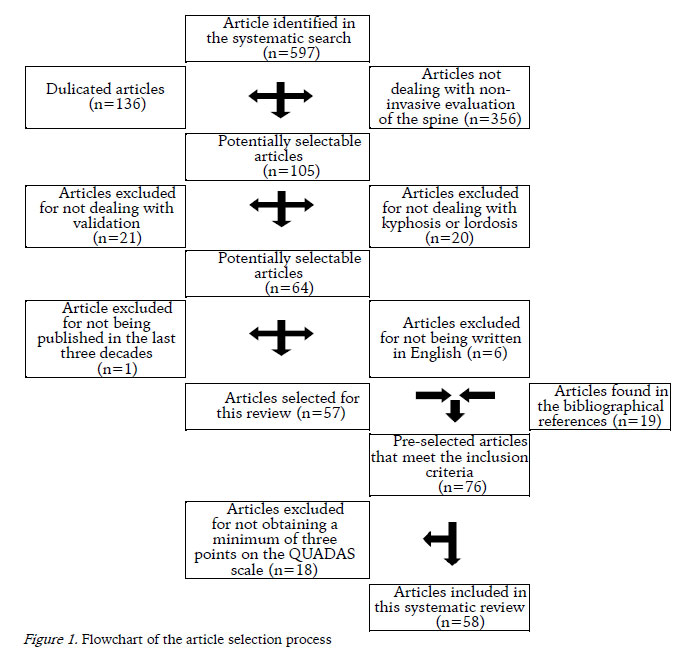
<body><![CDATA[<p><font size="3" face="verdana"><b>METHOD</b></font></p>     <p><font size="2" face="verdana">In April 2013, a systematic search was conducted for   scientific articles in the following databases: Scopus, Science Direct, Pubmed   and Medline. The search terms used  were:   “<i>Noninvasive instrument</i>” OR “<i>Non-invasive Monitoring</i>” OR “<i>Measurement</i>”   OR “<i>Measurements</i>” OR “<i>Postural Assessment</i>” OR “<i>Postural     Evaluation Methods</i>” OR “<i>Non-radiological Measures</i>” AND “<i>Spine       Curvatures</i>” OR “<i>Lumbar Curvatures</i>” OR “<i>Thoracic Curvatures</i>”   OR “<i>Thoracic Curve</i>” OR “<i>Lordosis Curve</i>” OR “<i>Thoracic</i> <i>Kyphosis</i>”   OR “<i>Lumbar Lordosis</i>” OR “<i>Kyphosis</i>” OR “<i>Lordosis</i>” OR “<i>Postural     Assessment</i>” AND “<i>Validation</i>” OR “<i>Validity</i>” OR “<i>Repeatability</i>”   OR “<i>Reproducibility</i>” OR “<i>Reliability</i>” OR “<i>Accurate</i>”   OR “<i>Accuracy</i>”.  To be included in   this systematic revision the articles found were required to meet the following   inclusion criteria: (a) perform a non-invasive evaluation of the spinal   curvatures; (b) perform an evaluation in the sagittal plane of thoracic kyphosis   or lumbar lordosis; (c) evaluate some validation aspect; (d) to be written in   English and (e) to have been published in the last three decades. All the   search, selection, quality evaluation, reading and data extraction procedures   were carried out by two independent evaluators. In the case of any divergence   of opinion between the evaluators, a third evaluator was invited to analyze the article.</font></p>     <p><font size="2" face="verdana">Firstly, the articles were selected based on the   titles and abstracts. Those articles considered for inclusion in the review   were read in full.  After, only those   articles that met all the above-mentioned inclusion criteria were included in   this systematic review. Furthermore, the bibliography of each included article   was checked with the aim of find any articles not found in the electronic search.</font></p>     <p><font size="2" face="verdana">The QUADAS (<i>Quality Assessment of Diagnostic   Accuracy Studies</i>) scale was used to evaluate the quality of the articles.   This consists of a questionnaire with 14 items which were responded as “yes”,   “no” or “unclear”. In the present study, 11 items were applicable to   postural evaluation instruments (Whiting et al., 2004). A minimum of three   points in the QUADAS scale was used as an exclusion criterion in this systematic review.</font></p>     <p><font size="2" face="verdana">Moreover, with the aim of classifying the scientific   evidence contained in the articles, the following rule was used based on QUADAS   scale: (a) articles with three to five points were classified as presenting   “poor evidence”; (b) articles with six to eight points were classified as   presenting “moderate evidence”; and (c) articles with nine to eleven points were classified as presenting “strong evidence”. </font></p>     <p><font size="2" face="verdana">Given the variation in the terminology used in the   studies, to facilitate comparison of their results, in this systematic review   the terminology was standardized as follows: repeatability refers to the degree   of agreement obtained between successive evaluations conducted by the same   evaluator (short period of time); intra-evaluator reproducibility refers to the   degree of agreement obtained between evaluations conducted by the same   evaluator at different times (minimum interval - one day); inter-evaluator   reproducibility refers to the degree of agreement obtained between evaluations   conducted by different evaluators; and validity refers to the agreement between   the measurements obtained using the instrument being tested and those obtained   using the gold standard instrument (Joint Committee for Guides in Metrology, 2012).</font></p>     <p>&nbsp;</p>     <p><font size="3" face="verdana"><b>RESULTS</b></font></p>     <p><font size="2" face="verdana">Initially, 597 articles were found in a database   search, of which 57 were included. When analyzing the bibliographical   references in the selected articles, a further 19 articles were obtained, given   a total of 76 articles that met the inclusion criteria of this systematic review (<a href="/img/revistas/mot/v12n2/12n2a16f1.jpg">Figure 1</a>).</font></p>     
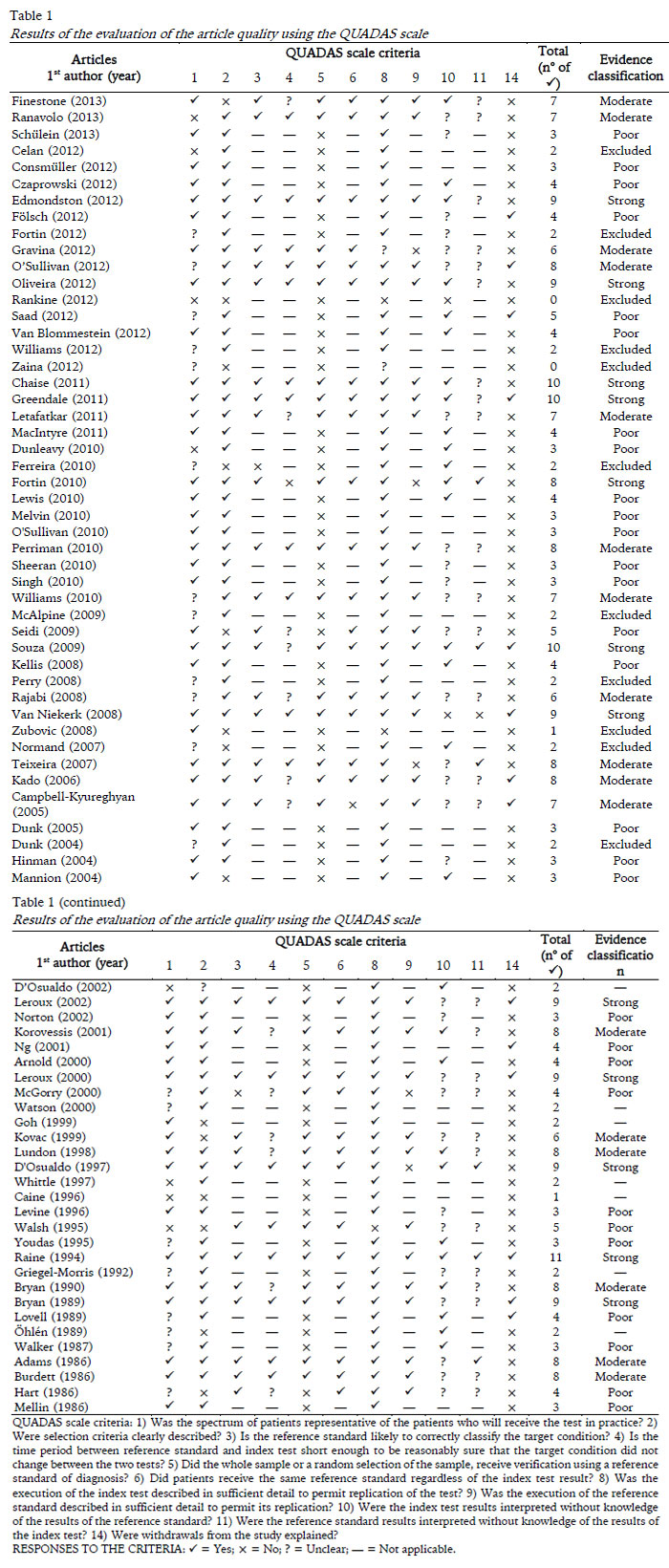
<p><font size="2" face="verdana">The   pre-selected articles were evaluated regarding their methodological quality   using the QUADAS scale (<a href="/img/revistas/mot/v12n2/12n2a16t1.jpg">Table 1</a>). Of the 76 evaluated articles, 18 were   excluded because they did not obtain the stipulated minimum of three points on   the scale, thus 58 articles were finally included in this systematic review.   Regarding the quality of the scientific evidence in the articles, 29 presented poor scientific evidence, 17 moderate evidence and 12 strong evidence.</font></p>     
]]></body>
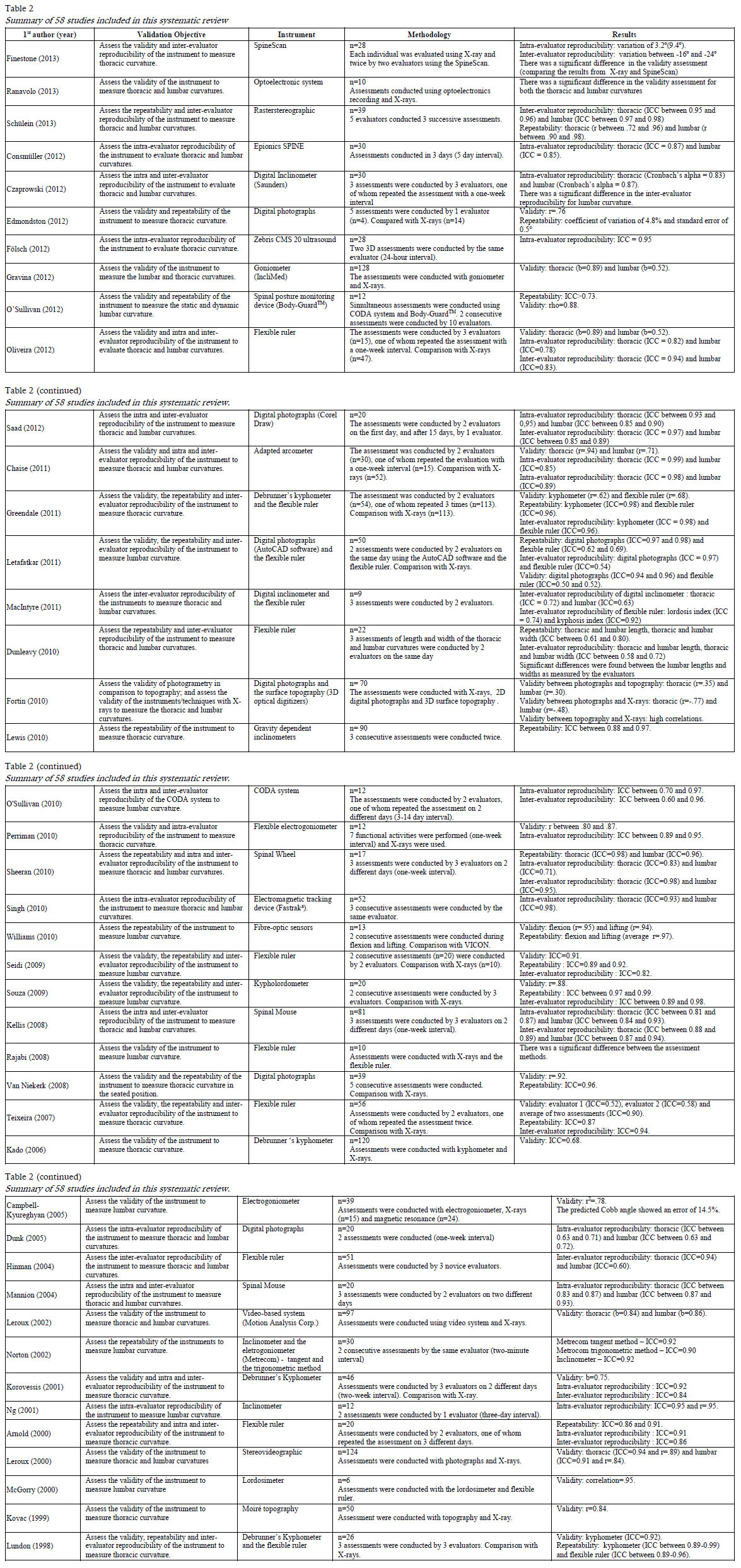
<body><![CDATA[<p><font size="2" face="verdana"><a href="/img/revistas/mot/v12n2/12n2a16t2.jpg">Table   2</a> presents the validation objective, the instrument used, the methodology and   the results for the 58 articles included in this review. The validation   objective shown is not necessarily the primary objective of the corresponding   paper but instead that which deals with aspects of validation in relation to non-invasive instruments used to evaluate spinal posture in sagittal plane. </font></p>     
<p>&nbsp;</p>     <p><font size="3" face="verdana"><b>DISCUSSION</b></font></p>     <p><font size="2" face="verdana">The   aim of this systematic review was to examine the scientific evidence related to   the validation of alternative methods of non-invasive evaluation of the spine   in the sagittal plane. Of the 58 articles included, only 12 were found to   present strong scientific evidence according to the QUADAS scale, indicating   the poor quality of the methodology applied in the reviewed validation   articles. Given this situation, when conducting validation studies, it is   necessary to pay attention to the criteria that determine their quality.   Therefore it is important to evaluate both, the reproducibility and concurrent   validity, thus avoiding any restriction to the applicability of the instrument   for diagnostic use. This systematic review identified 22 different evaluation systems,   which were categorized and analyzed below: (1) flexible ruler, (2)   photogrammetry, (3) inclinometer, (4) spinal mouse, (5) goniometer and   eletrogoniometer, (6) Debrunner’s Kyphometer, (7) surface topography, (8) archometer and (9) other instruments with only one validation study each.</font></p>     <p><font size="2" face="verdana">The flexible ruler was the most frequently described   instrument, having been tested in 16 studies, four of which evaluated the   thoracic region, eight the lumbar region and four both regions. Based on the   results (<a href="/img/revistas/mot/v12n2/12n2a16t2.jpg">Table 2</a>), the flexible ruler can be seen to be more reproducible and   repeatable when used to evaluate the thoracic region by means of the angle   (Greendale, Nili, Huang, Seeger, &amp; Karlamangla, 2011; Lundon, Li, &amp;   Bibershtein, 1998; Oliveira et al., 2012; Teixeira &amp; Carvalho, 2007) or the   kyphosis index (Arnold, Beatty, Harrison, &amp; Olszynski, 2000; Greendale et   al., 2011; Macintyre, Bennett, Bonnyman, &amp; Stratford, 2011; Perry, Smith,   Straker, Coleman, &amp; O'sullivan, 2008). On the other hand, the same   instrument presented lower levels of reproducibility and repeatability for the   variables thoracic ‘length’ and ‘width’    (Saad, Colombo, Ribeiro, &amp; João, 2012). Regarding validity, the   studies present moderate correlation with the radiological exams for the   variable ‘angle’ (Greendale et al., 2011; Oliveira et al., 2012; Teixeira &amp;   Carvalho, 2007) and kyphosis index (Greendale et al., 2011). There are no   results referring to the concurrent validity for the variables thoracic ‘length’ and ‘width’.</font></p>     
<p><font size="2" face="verdana">The flexible ruler presented greater variability when   used to evaluate the lumbar region, displaying excellent intra-evaluator   reproducibility and repeatability in the evaluation of the angle of this region   in most of the studies (Hart &amp; Rose, 1986; Lovell, Rothstein, &amp;   Personius, 1989; Oliveira et al., 2012; Seidi, Rajabi, Ebrahimi, &amp;   Moussavi, 2009; Walker, Rothstein, Finucane, &amp; Lamb, 1987), while there is   disagreement in the literature regarding its inter-evaluator reproducibility   (Letafatkar, Amirsasan, Abdolvahabi, &amp; Hadadnezhad, 2011; Lovell et al.,   1989; Oliveira et al., 2012; Seidi et al., 2009). In relation to the lordosis   index, studies were only found to examine the inter-evaluator reproducibility,   the results of which were moderate (Hinman, 2004; Macintyre et al., 2011). The   validity of the flexible ruler presented a correlation varying from moderate to   excellent (Letafatkar et al., 2011; Oliveira et al., 2012; Souza et al., 2009).   Therefore, it is suggested that when using the flexible ruler to evaluate both   thoracic kyphosis and lumbar lordosis, the angle calculation or index methodology should be used.</font></p>     <p><font size="2" face="verdana">Another technique widely used in studies is   photogrammetry, which was tested in eight studies, two in the thoracic region,   one in the lumbar region and five in both regions. Regarding photogrammetry, it   should be pointed out that data collection protocols used in studies tend to be   very similar. However, regarding data analysis procedures, each of the methods   found used a specific software or digital algorithm. Therefore, each proposed   method should be submitted to validation procedures, which explains the large   number of articles that validate photogrammetry found in this systematic   review. Given this, the health care professional that decides to use any of   these software or digital algorithms should ensure that all the steps in the validation procedure have been completed.</font></p>     <p><font size="2" face="verdana">The inclinometer was tested in eight studies, one in   the thoracic region, three in the lumbar region and four in both regions. When   used to evaluate thoracic kyphosis, the studies demonstrated excellent levels   of repeatability (Lewis &amp; Valentine, 2010), intra (Czaprowski, Pawlowska,   Gebicka, Sitarski, &amp; Kotwicki, 2012; Mellin, 1986) and inter-evaluator   reproducibility (Mellin, 1986). However, the concurrent validity of this   instrument cannot be affirmed, which limits its use as a diagnostic tool. When   used to evaluate lumbar lordosis, the studies demonstrated excellent levels of   intra (Czaprowski et al., 2012; Mellin, 1986; Ng, Kippers, Richardson, &amp;   Parnianpour, 2001) and inter-evaluator reproducibility (Williams, Haq, &amp;   Lee, 2012; Mellin, 1986). Nevertheless, the concurrent validity of this   instrument for the evaluation in the lumbar region has only been tested in the   flexed position (Adams, Dolan, Marx, &amp; Hutton, 1986) thus further investigations in other positions are necessary to permit its use in clinical practice.</font></p>     <p><font size="2" face="verdana">Another instrument, which uses a similar mechanism to   the inclinometer, is the Spinal mouse. It has been described in two studies   that evaluated both the thoracic and lumbar regions. The Spinal mouse was shown   to have excellent levels of intra and inter-evaluator reproducibility, with   results referring to evaluations carried out in both adults (Mannion et al.,   2004) and children (Kellis, Adamou, Tzilios, &amp; Emmanouilidou, 2008). However,   no study was found to demonstrate the concurrent validity of the method and   only one study was found for each population, which limits the generalization of the data obtained. </font></p>     <p><font size="2" face="verdana">The goniometer was evaluated in two articles, one   study evaluated the lumbar region and the other both regions. For the thoracic   kyphosis only the concurrent validity, which was found to be excellent, was   presented (Gravina, Ferraro, Frizziero, Ferraro, &amp; Masiero, 2012). For the   lumbar lordosis excellent inter-evaluator reproducibility was obtained   (Burdett, Brown, &amp; Fall, 1986) without presenting adequate validity   (Burdett et al., 1986; Gravina et al., 2012). The flexible electrogoniometer   was evaluated in four studies, three evaluated the lumbar and one the thoracic   region. Among the studies, the validity for the lumbar region presented   divergent results (Campbell-Kyureghyan, Jorgensen, Burr, &amp; Marras, 2005;   Walsh &amp; Breen, 1995), while the intra-evaluator reproducibility presented   excellent levels (Norton, Hensler, &amp; Zou, 2002; Walsh &amp; Breen, 1995).   For the thoracic region excellent reproducibility and validity were obtained   (Perriman et al., 2010). Notably no studies were found that evaluated all   validation aspects of either the goniometer or the electrogoniometer. Thus, their   use in clinical situations and scientific research is limited as new studies   that evaluate the remaining aspects of validity and in different populations are required. </font></p>     ]]></body>
<body><![CDATA[<p><font size="2" face="verdana">Debrunner’s kyphometer was developed to evaluate   thoracic kyphosis. Its validity has been tested in four studies with moderate   to excellent correlations (Greendale et al., 2011; Kado et al., 2006;   Korovessis, Petsinis, Papazisis, &amp; Baikousis, 2001; Lundon et al., 1998).   Moreover, in relation to the aspects of reproducibility excellent results were   obtained (Greendale et al., 2011; Korovessis et al., 2001; Lundon et al.,   1998). It should be noted that three of the studies evaluated elderly   populations and only one evaluated adolescents (Korovessis et al., 2001),   therefore, more studies are necessary in adolescent populations, as well as in children, young adults and the obese.</font></p>     <p><font size="2" face="verdana">Four studies were found that assessed surface   topography, with excellent concurrent validity reported in the evaluation of   kyphosis and lordosis (Fortin, Feldman, Cheriet, &amp; Labelle, 2010; Kovac   &amp; Pecina, 1999), as well as excellent reproducibility for both curvatures   (Melvin et al., 2010; Schülein, Mendoza, Malzkorn, Harms, &amp; Skwara, 2013).   However, these studies cannot be directly compared because they refer to different   systems (<i>InSpeck</i> 3D Digitalizer System, Moiré Topography and Jenoptik   Formetric). The presented results are not sufficient to test the validity of the system since each one only presents some validations aspects.</font></p>     <p><font size="2" face="verdana">The archometer has been described in two studies, one   evaluated only the thoracic region and the other both regions. Based on these   studies the archometer was found to provide valid and reproducible measurements   (Chaise et al., 2011; D’Osualdo et al., 1997). However, the model from Chaise   et al. (2011) has the advantage that it can be used to evaluate the lumbar and   thoracic region, although all the indices obtained in the evaluation of the   lumbar region were lower than those for the thoracic region. Nevertheless,   further studies are necessary to evaluate the use of the archometer in the lumbar region in different populations in order to allow its wide scale use. </font></p>     <p><font size="2" face="verdana">Each of the other instruments identified in this   systematic review (Spinal Wheel, ultra-sound, fastrack video system, VICON,   optoelectronic system, BodyGuard Monitor, Spine Epions System, SpineScan,   photograph-based visual evaluation, lordosimeter, fiber optics system, kypholordometer and the CODA system) only found to be evaluated in one study. </font></p>     <p><font size="2" face="verdana">This systematic review shows that most of the   instruments have been submitted to validity tests in only a few or in many   cases only one study. In such cases, the validity of the instruments is   dependent on the quality of the methodology applied in the study. Moreover, in   some studies only the internal validity of the instrument was verified, hence   the validity is limited to a specific population with well controlled   characteristics. When the same instrument has been evaluated by different   studies the external validity is increased, hence, there is greater possibility of using the instrument in various populations. </font></p>     <p><font size="2" face="verdana">Furthermore, the important methodological differences   found between the studies hamper any attempt to compare the data obtained, as,   for example: different gold standards used, different statistical analysis   techniques employed and the lack of standardization of terminology, among   others. Another important aspect was the methodological quality of the   validation studies, as there is a lack of studies in the literature with strong   scientific evidence with regard to the validation of non-invasive instruments for evaluating the spine in the sagittal plane.</font></p>     <p>&nbsp;</p>     <p><font size="3" face="verdana"><b>CONCLUSION</b></font></p>     <p><font size="2" face="verdana">In the literature there is a wide range of   non-invasive instruments for evaluating the spine in the sagittal plane,   however, of the 58 studies included in this review only 12 presented strong   scientific evidence. Moreover, only four instruments were evaluated with regard   all the aspects of validity for thoracic kyphosis, namely photogrametry, the   flexicurve, the archometer and DeBrunner’s kyphometer. Similarly, for the   evaluation of lumbar lordosis, five instruments were evaluated with regard all   the aspects of validity, namely photogrametry, the inclinometer, the   flexicurve, the archometer and the kypholordometer. Therefore, it is suggested   that this instruments are adopted as first choice for conducting evaluation of   the spine in the sagittal plane, since they present adequate reproducibility   and concurrent validity. While the instruments that present satisfactory   results in relation to the aspects of reproducibility can be used in clinical   follow-up, it is necessary to note the region the instrument is capable of   evaluating and whether it can be used by the same or distinct evaluators. It is   particularly important to pay attention to the population for which the   instrument was validated, since its use in populations with distinct   characteristics may lead to inconsistent results, thus it is suggested that   instruments be used only for those populations for which the aspects of validity have been evaluated. </font></p>     <p>&nbsp;</p>     ]]></body>
<body><![CDATA[<p><font size="3" face="verdana"><b>REFERÊNCIAS</b></font></p>     <!-- ref --><p><font size="2" face="verdana">Adams, M. A., Dolan, P., Marx, C., &amp; Hutton, W. C. (1986). An   electronic inclinometer technique for measuring lumbar curvature. <i>Clinical Biomechanics</i>, <i>1</i>(3), 130–134. <a target="_blank" href="http://doi.org/10.1016/0268-0033(86)90002-1">http://doi.org/10.1016/0268-0033(86)90002-1</a></font>&nbsp;&nbsp;&nbsp;&nbsp;&nbsp;&nbsp;&nbsp;&nbsp;[&#160;<a href="javascript:void(0);" onclick="javascript: window.open('/scielo.php?script=sci_nlinks&ref=355866&pid=S1646-107X201600020001600001&lng=','','width=640,height=500,resizable=yes,scrollbars=1,menubar=yes,');">Links</a>&#160;]<!-- end-ref --><!-- ref --><p><font size="2" face="verdana">Arnold, C. M., Beatty, B., Harrison, E. L., &amp; Olszynski, W. (2000).   The reliability of five clinical postural alignment measures for women with osteoporosis. <i>Physiotherapy Canada</i>, <i>52</i>(4), 286–294.    &nbsp;&nbsp;&nbsp;&nbsp;&nbsp;&nbsp;&nbsp;&nbsp;[&#160;<a href="javascript:void(0);" onclick="javascript: window.open('/scielo.php?script=sci_nlinks&ref=355867&pid=S1646-107X201600020001600002&lng=','','width=640,height=500,resizable=yes,scrollbars=1,menubar=yes,');">Links</a>&#160;]<!-- end-ref --></font></p>     <!-- ref --><p><font size="2" face="verdana">Barrett, E., McCreesh, K., &amp; Lewis, J. (2014). Reliability and   validity of non-radiographic methods of thoracic kyphosis measurement: a systematic review. <i>Manual Therapy</i>, <i>19</i>(1), 10–17. <a target="_blank" href="http://doi.org/10.1016/j.math.2013.09.003">http://doi.org/10.1016/j.math.2013.09.003</a></font>&nbsp;&nbsp;&nbsp;&nbsp;&nbsp;&nbsp;&nbsp;&nbsp;[&#160;<a href="javascript:void(0);" onclick="javascript: window.open('/scielo.php?script=sci_nlinks&ref=355869&pid=S1646-107X201600020001600003&lng=','','width=640,height=500,resizable=yes,scrollbars=1,menubar=yes,');">Links</a>&#160;]<!-- end-ref --><!-- ref --><p><font size="2" face="verdana">Burdett, R. G., Brown, K. E., &amp; Fall, M. P. (1986). Reliability and   validity of four instruments for measuring lumbar spine and pelvic positions. <i>Physical Therapy</i>, <i>66</i>(5), 677–684.    &nbsp;&nbsp;&nbsp;&nbsp;&nbsp;&nbsp;&nbsp;&nbsp;[&#160;<a href="javascript:void(0);" onclick="javascript: window.open('/scielo.php?script=sci_nlinks&ref=355870&pid=S1646-107X201600020001600004&lng=','','width=640,height=500,resizable=yes,scrollbars=1,menubar=yes,');">Links</a>&#160;]<!-- end-ref --></font></p>     <!-- ref --><p><font size="2" face="verdana">Campbell-Kyureghyan, N., Jorgensen, M., Burr, D., &amp; Marras, W.   (2005). The prediction of lumbar spine geometry: method development and   validation. <i>Clinical Biomechanics (Bristol, Avon)</i>, <i>20</i>(5), 455–464. <a target="_blank" href="http://doi.org/10.1016/j.clinbiomech.2005.01.006">http://doi.org/10.1016/j.clinbiomech.2005.01.006</a></font>&nbsp;&nbsp;&nbsp;&nbsp;&nbsp;&nbsp;&nbsp;&nbsp;[&#160;<a href="javascript:void(0);" onclick="javascript: window.open('/scielo.php?script=sci_nlinks&ref=355872&pid=S1646-107X201600020001600005&lng=','','width=640,height=500,resizable=yes,scrollbars=1,menubar=yes,');">Links</a>&#160;]<!-- end-ref --><!-- ref --><p><font size="2" face="verdana">Chaise, F. O., Candotti, C. T., Torre, M. L., Furlanetto, T. S.,   Pelinson, P. P. T., &amp; Loss, J. F. (2011). Validation, repeatability and   reproducibility of a noninvasive instrument for measuring thoracic and lumbar   curvature of the spine in the sagittal plane. <i>Revista Brasileira De Fisioterapia (São Carlos (São Paulo, Brazil))</i>, <i>15</i>(6), 511–517.    &nbsp;&nbsp;&nbsp;&nbsp;&nbsp;&nbsp;&nbsp;&nbsp;[&#160;<a href="javascript:void(0);" onclick="javascript: window.open('/scielo.php?script=sci_nlinks&ref=355873&pid=S1646-107X201600020001600006&lng=','','width=640,height=500,resizable=yes,scrollbars=1,menubar=yes,');">Links</a>&#160;]<!-- end-ref --></font></p>     ]]></body>
<body><![CDATA[<!-- ref --><p><font size="2" face="verdana">Chaléat-Valayer, E., Mac-Thiong, J.-M., Paquet, J., Berthonnaud, E.,   Siani, F., &amp; Roussouly, P. (2011). Sagittal spino-pelvic alignment in   chronic low back pain. <i>European Spine Journal: Official Publication of the     European Spine Society, the European Spinal Deformity Society, and the European Section of the Cervical Spine Research Society</i>, <i>20 Suppl 5</i>, 634–640. <a target="_blank" href="http://doi.org/10.1007/s00586-011-1931-2">http://doi.org/10.1007/s00586-011-1931-2</a></font>&nbsp;&nbsp;&nbsp;&nbsp;&nbsp;&nbsp;&nbsp;&nbsp;[&#160;<a href="javascript:void(0);" onclick="javascript: window.open('/scielo.php?script=sci_nlinks&ref=355875&pid=S1646-107X201600020001600007&lng=','','width=640,height=500,resizable=yes,scrollbars=1,menubar=yes,');">Links</a>&#160;]<!-- end-ref --><!-- ref --><p><font size="2" face="verdana">Consmüller, T., Rohlmann, A., Weinland, D., Druschel, C., Duda, G. N.,   &amp; Taylor, W. R. (2012). Comparative evaluation of a novel measurement tool   to assess lumbar spine posture and range of motion. <i>European Spine Journal:     Official Publication of the European Spine Society, the European Spinal     Deformity Society, and the European Section of the Cervical Spine Research Society</i>, <i>21</i>(11), 2170–2180. <a target="_blank" href="http://doi.org/10.1007/s00586-012-2312-1">http://doi.org/10.1007/s00586-012-2312-1</a></font>&nbsp;&nbsp;&nbsp;&nbsp;&nbsp;&nbsp;&nbsp;&nbsp;[&#160;<a href="javascript:void(0);" onclick="javascript: window.open('/scielo.php?script=sci_nlinks&ref=355876&pid=S1646-107X201600020001600008&lng=','','width=640,height=500,resizable=yes,scrollbars=1,menubar=yes,');">Links</a>&#160;]<!-- end-ref --><!-- ref --><p><font size="2" face="verdana">Czaprowski, D., Paw&#322;owska, P., G&#281;bicka, A.,   Sitarski, D., &amp; Kotwicki, T. (2012). Intra- and interobserver repeatability   and reliability of the assessment of the anterio-posterior curvatures of the   spine. <i>Ortopedia Traumatologia Rehabilitacja</i>, <i>14</i>(2), 145–154. <a target="_blank" href="http://doi.org/10.5604/15093492.992283">http://doi.org/10.5604/15093492.992283</a></font>&nbsp;&nbsp;&nbsp;&nbsp;&nbsp;&nbsp;&nbsp;&nbsp;[&#160;<a href="javascript:void(0);" onclick="javascript: window.open('/scielo.php?script=sci_nlinks&ref=355877&pid=S1646-107X201600020001600009&lng=','','width=640,height=500,resizable=yes,scrollbars=1,menubar=yes,');">Links</a>&#160;]<!-- end-ref --><!-- ref --><p><font size="2" face="verdana">D’Osualdo, F., Schierano, S., &amp; Iannis, M. (1997). Validation of   clinical measurement of kyphosis with a simple instrument, the arcometer. <i>Spine</i>, <i>22</i>(4), 408–413.    &nbsp;&nbsp;&nbsp;&nbsp;&nbsp;&nbsp;&nbsp;&nbsp;[&#160;<a href="javascript:void(0);" onclick="javascript: window.open('/scielo.php?script=sci_nlinks&ref=355878&pid=S1646-107X201600020001600010&lng=','','width=640,height=500,resizable=yes,scrollbars=1,menubar=yes,');">Links</a>&#160;]<!-- end-ref --></font></p>     <!-- ref --><p><font size="2" face="verdana">Dunk, N. M., Lalonde, J., &amp; Callaghan, J. P. (2005). Implications   for the use of postural analysis as a clinical diagnostic tool: reliability of   quantifying upright standing spinal postures from photographic images. <i>Journal of Manipulative and Physiological Therapeutics</i>, <i>28</i>(6), 386–392. <a target="_blank" href="http://doi.org/10.1016/j.jmpt.2005.06.006">http://doi.org/10.1016/j.jmpt.2005.06.006</a></font>&nbsp;&nbsp;&nbsp;&nbsp;&nbsp;&nbsp;&nbsp;&nbsp;[&#160;<a href="javascript:void(0);" onclick="javascript: window.open('/scielo.php?script=sci_nlinks&ref=355880&pid=S1646-107X201600020001600011&lng=','','width=640,height=500,resizable=yes,scrollbars=1,menubar=yes,');">Links</a>&#160;]<!-- end-ref --><!-- ref --><p><font size="2" face="verdana">Dunleavy, K., Mariano, H., Wiater, T., &amp; Goldberg, A. (2010).   Reliability and minimal detectable change of spinal length and width   measurements using the Flexicurve for usual standing posture in healthy young   adults. <i>Journal of Back and Musculoskeletal Rehabilitation</i>, <i>23</i>(4), 209–214. <a target="_blank" href="http://doi.org/10.3233/BMR-2010-0269">http://doi.org/10.3233/BMR-2010-0269</a></font>&nbsp;&nbsp;&nbsp;&nbsp;&nbsp;&nbsp;&nbsp;&nbsp;[&#160;<a href="javascript:void(0);" onclick="javascript: window.open('/scielo.php?script=sci_nlinks&ref=355881&pid=S1646-107X201600020001600012&lng=','','width=640,height=500,resizable=yes,scrollbars=1,menubar=yes,');">Links</a>&#160;]<!-- end-ref --><!-- ref --><p><font size="2" face="verdana">Edmondston, S. J., Christensen, M. M., Keller, S., Steigen, L. B., &amp;   Barclay, L. (2012). Functional radiographic analysis of thoracic spine   extension motion in asymptomatic men. <i>Journal of Manipulative and Physiological Therapeutics</i>, <i>35</i>(3), 203–208. <a target="_blank" href="http://doi.org/10.1016/j.jmpt.2012.01.008">http://doi.org/10.1016/j.jmpt.2012.01.008</a></font>&nbsp;&nbsp;&nbsp;&nbsp;&nbsp;&nbsp;&nbsp;&nbsp;[&#160;<a href="javascript:void(0);" onclick="javascript: window.open('/scielo.php?script=sci_nlinks&ref=355882&pid=S1646-107X201600020001600013&lng=','','width=640,height=500,resizable=yes,scrollbars=1,menubar=yes,');">Links</a>&#160;]<!-- end-ref --><!-- ref --><p><font size="2" face="verdana">Ensrud, K. E., Black, D. M., Harris, F., Ettinger, B., &amp; Cummings,   S. R. (1997). Correlates of kyphosis in older women. The Fracture Intervention   Trial Research Group. <i>Journal of the American Geriatrics Society</i>, <i>45</i>(6), 682–687.    &nbsp;&nbsp;&nbsp;&nbsp;&nbsp;&nbsp;&nbsp;&nbsp;[&#160;<a href="javascript:void(0);" onclick="javascript: window.open('/scielo.php?script=sci_nlinks&ref=355883&pid=S1646-107X201600020001600014&lng=','','width=640,height=500,resizable=yes,scrollbars=1,menubar=yes,');">Links</a>&#160;]<!-- end-ref --></font></p>     ]]></body>
<body><![CDATA[<!-- ref --><p><font size="2" face="verdana">Finestone, A. S., Marcus, G., Anekstein, Y., Mirovsky, Y., &amp; Agar,   G. (2013). Assessing kyphosis with SpineScan: another attempt to reduce our   dependence on radiography. <i>The Spine Journal: Official Journal of the North American Spine Society</i>, <i>13</i>(8), 926–931. <a target="_blank" href="http://doi.org/10.1016/j.spinee.2013.03.044">http://doi.org/10.1016/j.spinee.2013.03.044</a></font>&nbsp;&nbsp;&nbsp;&nbsp;&nbsp;&nbsp;&nbsp;&nbsp;[&#160;<a href="javascript:void(0);" onclick="javascript: window.open('/scielo.php?script=sci_nlinks&ref=355885&pid=S1646-107X201600020001600015&lng=','','width=640,height=500,resizable=yes,scrollbars=1,menubar=yes,');">Links</a>&#160;]<!-- end-ref --><!-- ref --><p><font size="2" face="verdana">Fölsch, C., Schlögel, S., Lakemeier, S., Wolf, U., Timmesfeld, N., &amp;   Skwara, A. (2012). Test-retest reliability of 3D ultrasound measurements of the thoracic   spine. <i>PM &amp; R: The Journal of Injury, Function, and Rehabilitation</i>, <i>4</i>(5), 335–341. <a target="_blank" href="http://doi.org/10.1016/j.pmrj.2012.01.009">http://doi.org/10.1016/j.pmrj.2012.01.009</a></font>&nbsp;&nbsp;&nbsp;&nbsp;&nbsp;&nbsp;&nbsp;&nbsp;[&#160;<a href="javascript:void(0);" onclick="javascript: window.open('/scielo.php?script=sci_nlinks&ref=355886&pid=S1646-107X201600020001600016&lng=','','width=640,height=500,resizable=yes,scrollbars=1,menubar=yes,');">Links</a>&#160;]<!-- end-ref --><!-- ref --><p><font size="2" face="verdana">Fortin, C., Feldman, D. E., Cheriet, F., &amp; Labelle, H. (2010).   Validity of a quantitative clinical measurement tool of trunk posture in idiopathic scoliosis. <i>Spine</i>, <i>35</i>(19), E988-994. <a target="_blank" href="http://doi.org/10.1097/BRS.0b013e3181cd2cd2">http://doi.org/10.1097/BRS.0b013e3181cd2cd2</a></font>&nbsp;&nbsp;&nbsp;&nbsp;&nbsp;&nbsp;&nbsp;&nbsp;[&#160;<a href="javascript:void(0);" onclick="javascript: window.open('/scielo.php?script=sci_nlinks&ref=355887&pid=S1646-107X201600020001600017&lng=','','width=640,height=500,resizable=yes,scrollbars=1,menubar=yes,');">Links</a>&#160;]<!-- end-ref --><!-- ref --><p><font size="2" face="verdana">Gravina, A. R., Ferraro, C., Frizziero, A., Ferraro, M., &amp; Masiero,   S. (2012). Goniometer evaluation of thoracic kyphosis and lumbar lordosis in   subjects during growth age: a validity study. <i>Studies in Health Technology and Informatics</i>, <i>176</i>, 247–251.    &nbsp;&nbsp;&nbsp;&nbsp;&nbsp;&nbsp;&nbsp;&nbsp;[&#160;<a href="javascript:void(0);" onclick="javascript: window.open('/scielo.php?script=sci_nlinks&ref=355888&pid=S1646-107X201600020001600018&lng=','','width=640,height=500,resizable=yes,scrollbars=1,menubar=yes,');">Links</a>&#160;]<!-- end-ref --></font></p>     <!-- ref --><p><font size="2" face="verdana">Greendale, G. A., Nili, N. S., Huang, M.-H., Seeger, L., &amp;   Karlamangla, A. S. (2011). The reliability and validity of three   non-radiological measures of thoracic kyphosis and their relations to the   standing radiological Cobb angle. <i>Osteoporosis International: A Journal     Established as Result of Cooperation between the European Foundation for     Osteoporosis and the National Osteoporosis Foundation of the USA</i>, <i>22</i>(6), 1897–1905. <a target="_blank" href="http://doi.org/10.1007/s00198-010-1422-z">http://doi.org/10.1007/s00198-010-1422-z</a></font>&nbsp;&nbsp;&nbsp;&nbsp;&nbsp;&nbsp;&nbsp;&nbsp;[&#160;<a href="javascript:void(0);" onclick="javascript: window.open('/scielo.php?script=sci_nlinks&ref=355890&pid=S1646-107X201600020001600019&lng=','','width=640,height=500,resizable=yes,scrollbars=1,menubar=yes,');">Links</a>&#160;]<!-- end-ref --><!-- ref --><p><font size="2" face="verdana">Hart, D. L., &amp; Rose, S. J. (1986). Reliability of a noninvasive   method for measuring the lumbar curve*. <i>The Journal of Orthopaedic and Sports Physical Therapy</i>, <i>8</i>(4), 180–184.    &nbsp;&nbsp;&nbsp;&nbsp;&nbsp;&nbsp;&nbsp;&nbsp;[&#160;<a href="javascript:void(0);" onclick="javascript: window.open('/scielo.php?script=sci_nlinks&ref=355891&pid=S1646-107X201600020001600020&lng=','','width=640,height=500,resizable=yes,scrollbars=1,menubar=yes,');">Links</a>&#160;]<!-- end-ref --></font></p>     <!-- ref --><p><font size="2" face="verdana">Hinman, M. R. (2004). Interrater reliability of flexicurve postural   measures among novice users. <i>Journal of Back and Musculoskeletal Rehabilitation</i>, <i>17</i>(1), 33–36. <a target="_blank" href="http://doi.org/10.3233/BMR-2004-17107">http://doi.org/10.3233/BMR-2004-17107</a></font>&nbsp;&nbsp;&nbsp;&nbsp;&nbsp;&nbsp;&nbsp;&nbsp;[&#160;<a href="javascript:void(0);" onclick="javascript: window.open('/scielo.php?script=sci_nlinks&ref=355893&pid=S1646-107X201600020001600021&lng=','','width=640,height=500,resizable=yes,scrollbars=1,menubar=yes,');">Links</a>&#160;]<!-- end-ref --><!-- ref --><p><font size="2" face="verdana">Huang, M.-H., Barrett-Connor, E., Greendale, G. A., &amp; Kado, D. M.   (2006). Hyperkyphotic posture and risk of future osteoporotic fractures: the   Rancho Bernardo study. <i>Journal of Bone and Mineral Research: The Official     Journal of the American Society for Bone and Mineral Research</i>, <i>21</i>(3), 419–423. <a target="_blank" href="http://doi.org/10.1359/JBMR.051201">http://doi.org/10.1359/JBMR.051201</a></font>&nbsp;&nbsp;&nbsp;&nbsp;&nbsp;&nbsp;&nbsp;&nbsp;[&#160;<a href="javascript:void(0);" onclick="javascript: window.open('/scielo.php?script=sci_nlinks&ref=355894&pid=S1646-107X201600020001600022&lng=','','width=640,height=500,resizable=yes,scrollbars=1,menubar=yes,');">Links</a>&#160;]<!-- end-ref --><!-- ref --><p><font size="2" face="verdana">Imagama, S., Hasegawa, Y., Matsuyama, Y., Sakai, Y., Ito, Z., Hamajima,   N., &amp; Ishiguro, N. (2011). Influence of sagittal balance and physical   ability associated with exercise on quality of life in middle-aged and elderly people. <i>Archives of Osteoporosis</i>, <i>6</i>, 13–20. <a target="_blank" href="http://doi.org/10.1007/s11657-011-0052-1">http://doi.org/10.1007/s11657-011-0052-1</a></font>&nbsp;&nbsp;&nbsp;&nbsp;&nbsp;&nbsp;&nbsp;&nbsp;[&#160;<a href="javascript:void(0);" onclick="javascript: window.open('/scielo.php?script=sci_nlinks&ref=355895&pid=S1646-107X201600020001600023&lng=','','width=640,height=500,resizable=yes,scrollbars=1,menubar=yes,');">Links</a>&#160;]<!-- end-ref --><!-- ref --><p><font size="2" face="verdana">Ishikawa, Y., Miyakoshi, N., Kasukawa, Y., Hongo, M., &amp; Shimada, Y.   (2013). Spinal sagittal contour affecting falls: cut-off value of the lumbar spine for falls. <i>Gait &amp; Posture</i>, <i>38</i>(2), 260–263. <a target="_blank" href="http://doi.org/10.1016/j.gaitpost.2012.11.024">http://doi.org/10.1016/j.gaitpost.2012.11.024</a></font>&nbsp;&nbsp;&nbsp;&nbsp;&nbsp;&nbsp;&nbsp;&nbsp;[&#160;<a href="javascript:void(0);" onclick="javascript: window.open('/scielo.php?script=sci_nlinks&ref=355896&pid=S1646-107X201600020001600024&lng=','','width=640,height=500,resizable=yes,scrollbars=1,menubar=yes,');">Links</a>&#160;]<!-- end-ref --><!-- ref --><p><font size="2" face="verdana">Joint Committee for Guides in Metrology. (2012). <i>International   Vocabulary of Metrology – Basic and general concepts and associated terms</i> (3.<sup>a</sup> ed.). Joint Committee for Guides in Metrology.    &nbsp;&nbsp;&nbsp;&nbsp;&nbsp;&nbsp;&nbsp;&nbsp;[&#160;<a href="javascript:void(0);" onclick="javascript: window.open('/scielo.php?script=sci_nlinks&ref=355897&pid=S1646-107X201600020001600025&lng=','','width=640,height=500,resizable=yes,scrollbars=1,menubar=yes,');">Links</a>&#160;]<!-- end-ref --></font></p>     <!-- ref --><p><font size="2" face="verdana">Kado, D. M., Christianson, L., Palermo, L., Smith-Bindman, R., Cummings,   S. R., &amp; Greendale, G. A. (2006). Comparing a supine radiologic versus   standing clinical measurement of kyphosis in older women: the Fracture Intervention Trial. <i>Spine</i>, <i>31</i>(4), 463–467. <a target="_blank" href="http://doi.org/10.1097/01.brs.0000200131.01313.a9">http://doi.org/10.1097/01.brs.0000200131.01313.a9</a></font>&nbsp;&nbsp;&nbsp;&nbsp;&nbsp;&nbsp;&nbsp;&nbsp;[&#160;<a href="javascript:void(0);" onclick="javascript: window.open('/scielo.php?script=sci_nlinks&ref=355899&pid=S1646-107X201600020001600026&lng=','','width=640,height=500,resizable=yes,scrollbars=1,menubar=yes,');">Links</a>&#160;]<!-- end-ref --><!-- ref --><p><font size="2" face="verdana">Kado, D. M., Huang, M.-H., Nguyen, C. B., Barrett-Connor, E., &amp;   Greendale, G. A. (2007). Hyperkyphotic posture and risk of injurious falls in   older persons: the Rancho Bernardo Study. <i>The Journals of Gerontology. Series A, Biological Sciences and Medical Sciences</i>, <i>62</i>(6), 652–657.    &nbsp;&nbsp;&nbsp;&nbsp;&nbsp;&nbsp;&nbsp;&nbsp;[&#160;<a href="javascript:void(0);" onclick="javascript: window.open('/scielo.php?script=sci_nlinks&ref=355900&pid=S1646-107X201600020001600027&lng=','','width=640,height=500,resizable=yes,scrollbars=1,menubar=yes,');">Links</a>&#160;]<!-- end-ref --></font></p>     <!-- ref --><p><font size="2" face="verdana">Kado, D. M., Lui, L.-Y., Ensrud, K. E., Fink, H. A., Karlamangla, A. S.,   Cummings, S. R., &amp; Study of Osteoporotic Fractures. (2009). Hyperkyphosis   predicts mortality independent of vertebral osteoporosis in older women. <i>Annals of Internal Medicine</i>, <i>150</i>(10), 681–687.    &nbsp;&nbsp;&nbsp;&nbsp;&nbsp;&nbsp;&nbsp;&nbsp;[&#160;<a href="javascript:void(0);" onclick="javascript: window.open('/scielo.php?script=sci_nlinks&ref=355902&pid=S1646-107X201600020001600028&lng=','','width=640,height=500,resizable=yes,scrollbars=1,menubar=yes,');">Links</a>&#160;]<!-- end-ref --></font></p>     <!-- ref --><p><font size="2" face="verdana">Kellis, E., Adamou, G., Tzilios, G., &amp; Emmanouilidou, M. (2008).   Reliability of spinal range of motion in healthy boys using a skin-surface   device. <i>Journal of Manipulative and Physiological Therapeutics</i>, <i>31</i>(8), 570–576. <a target="_blank" href="http://doi.org/10.1016/j.jmpt.2008.09.001">http://doi.org/10.1016/j.jmpt.2008.09.001</a></font>&nbsp;&nbsp;&nbsp;&nbsp;&nbsp;&nbsp;&nbsp;&nbsp;[&#160;<a href="javascript:void(0);" onclick="javascript: window.open('/scielo.php?script=sci_nlinks&ref=355904&pid=S1646-107X201600020001600029&lng=','','width=640,height=500,resizable=yes,scrollbars=1,menubar=yes,');">Links</a>&#160;]<!-- end-ref --><!-- ref --><p><font size="2" face="verdana">Korovessis, P., Petsinis, G., Papazisis, Z., &amp; Baikousis, A. (2001).   Prediction of thoracic kyphosis using the Debrunner kyphometer. <i>Journal of Spinal Disorders</i>, <i>14</i>(1), 67–72.    &nbsp;&nbsp;&nbsp;&nbsp;&nbsp;&nbsp;&nbsp;&nbsp;[&#160;<a href="javascript:void(0);" onclick="javascript: window.open('/scielo.php?script=sci_nlinks&ref=355905&pid=S1646-107X201600020001600030&lng=','','width=640,height=500,resizable=yes,scrollbars=1,menubar=yes,');">Links</a>&#160;]<!-- end-ref --></font></p>     <!-- ref --><p><font size="2" face="verdana">Kovac, V., &amp; Pe&#263;ina, M. (1999).   Moiré topography in measurement of the   sagittal curvatures of the spine. <i>Collegium Antropologicum</i>, <i>23</i>(1), 153–158.    &nbsp;&nbsp;&nbsp;&nbsp;&nbsp;&nbsp;&nbsp;&nbsp;[&#160;<a href="javascript:void(0);" onclick="javascript: window.open('/scielo.php?script=sci_nlinks&ref=355907&pid=S1646-107X201600020001600031&lng=','','width=640,height=500,resizable=yes,scrollbars=1,menubar=yes,');">Links</a>&#160;]<!-- end-ref --></font></p>     <!-- ref --><p><font size="2" face="verdana">Leroux, M. A., Zabjek, K., Simard, G., Badeaux, J., Coillard, C., &amp;   Rivard, C. H. (2000). A noninvasive anthropometric technique for measuring   kyphosis and lordosis: an application for idiopathic scoliosis. <i>Spine</i>, <i>25</i>(13), 1689–1694.    &nbsp;&nbsp;&nbsp;&nbsp;&nbsp;&nbsp;&nbsp;&nbsp;[&#160;<a href="javascript:void(0);" onclick="javascript: window.open('/scielo.php?script=sci_nlinks&ref=355909&pid=S1646-107X201600020001600032&lng=','','width=640,height=500,resizable=yes,scrollbars=1,menubar=yes,');">Links</a>&#160;]<!-- end-ref --></font></p>     <!-- ref --><p><font size="2" face="verdana">Leroux, M. A., Zabjek, K., Simard, G., Coillard, C., &amp; Rivard, C. H.   (2002). Estimated kyphosis and lordosis changes at follow-up in patients with   idiopathic scoliosis. <i>Journal of Pediatric Orthopedics</i>, <i>22</i>(1), 73–79.    &nbsp;&nbsp;&nbsp;&nbsp;&nbsp;&nbsp;&nbsp;&nbsp;[&#160;<a href="javascript:void(0);" onclick="javascript: window.open('/scielo.php?script=sci_nlinks&ref=355911&pid=S1646-107X201600020001600033&lng=','','width=640,height=500,resizable=yes,scrollbars=1,menubar=yes,');">Links</a>&#160;]<!-- end-ref --></font></p>     <!-- ref --><p><font size="2" face="verdana">Letafatkar, A., Amirsasan, R., Abdolvahabi, Z., &amp; Hadadnezhad, M.   (2011). Reliability and validity of the AutoCAD software method in lumbar   lordosis measurement. <i>Journal of Chiropractic Medicine</i>, <i>10</i>(4), 240–247. <a target="_blank" href="http://doi.org/10.1016/j.jcm.2011.02.003">http://doi.org/10.1016/j.jcm.2011.02.003</a></font>&nbsp;&nbsp;&nbsp;&nbsp;&nbsp;&nbsp;&nbsp;&nbsp;[&#160;<a href="javascript:void(0);" onclick="javascript: window.open('/scielo.php?script=sci_nlinks&ref=355913&pid=S1646-107X201600020001600034&lng=','','width=640,height=500,resizable=yes,scrollbars=1,menubar=yes,');">Links</a>&#160;]<!-- end-ref --><!-- ref --><p><font size="2" face="verdana">Lewis, J. S., &amp; Valentine, R. E. (2010). Clinical measurement of the   thoracic kyphosis. A study of the intra-rater reliability in subjects with and without shoulder pain. <i>BMC Musculoskeletal Disorders</i>, <i>11</i>, 39. <a target="_blank" href="http://doi.org/10.1186/1471-2474-11-39">http://doi.org/10.1186/1471-2474-11-39</a></font>&nbsp;&nbsp;&nbsp;&nbsp;&nbsp;&nbsp;&nbsp;&nbsp;[&#160;<a href="javascript:void(0);" onclick="javascript: window.open('/scielo.php?script=sci_nlinks&ref=355914&pid=S1646-107X201600020001600035&lng=','','width=640,height=500,resizable=yes,scrollbars=1,menubar=yes,');">Links</a>&#160;]<!-- end-ref --><!-- ref --><p><font size="2" face="verdana">Lovell, F. W., Rothstein, J. M., &amp; Personius, W. J. (1989).   Reliability of clinical measurements of lumbar lordosis taken with a flexible rule. <i>Physical Therapy</i>, <i>69</i>(2), 96–105.    &nbsp;&nbsp;&nbsp;&nbsp;&nbsp;&nbsp;&nbsp;&nbsp;[&#160;<a href="javascript:void(0);" onclick="javascript: window.open('/scielo.php?script=sci_nlinks&ref=355915&pid=S1646-107X201600020001600036&lng=','','width=640,height=500,resizable=yes,scrollbars=1,menubar=yes,');">Links</a>&#160;]<!-- end-ref --></font></p>     <!-- ref --><p><font size="2" face="verdana">Lundon, K. M., Li, A. M., &amp; Bibershtein, S. (1998). Interrater and   intrarater reliability in the measurement of kyphosis in postmenopausal women with osteoporosis. <i>Spine</i>, <i>23</i>(18), 1978–1985.    &nbsp;&nbsp;&nbsp;&nbsp;&nbsp;&nbsp;&nbsp;&nbsp;[&#160;<a href="javascript:void(0);" onclick="javascript: window.open('/scielo.php?script=sci_nlinks&ref=355917&pid=S1646-107X201600020001600037&lng=','','width=640,height=500,resizable=yes,scrollbars=1,menubar=yes,');">Links</a>&#160;]<!-- end-ref --></font></p>     <!-- ref --><p><font size="2" face="verdana">Macintyre, N. J., Bennett, L., Bonnyman, A. M., &amp; Stratford, P. W.   (2011). Optimizing reliability of digital inclinometer and flexicurve ruler   measures of spine curvatures in postmenopausal women with osteoporosis of the   spine: an illustration of the use of generalizability theory. <i>ISRN Rheumatology</i>, <i>2011</i>, 571698. <a target="_blank" href="http://doi.org/10.5402/2011/571698">http://doi.org/10.5402/2011/571698</a></font>&nbsp;&nbsp;&nbsp;&nbsp;&nbsp;&nbsp;&nbsp;&nbsp;[&#160;<a href="javascript:void(0);" onclick="javascript: window.open('/scielo.php?script=sci_nlinks&ref=355919&pid=S1646-107X201600020001600038&lng=','','width=640,height=500,resizable=yes,scrollbars=1,menubar=yes,');">Links</a>&#160;]<!-- end-ref --><!-- ref --><p><font size="2" face="verdana">Mannion, A. F., Knecht, K., Balaban, G., Dvorak, J., &amp; Grob, D.   (2004). A new skin-surface device for measuring the curvature and global and   segmental ranges of motion of the spine: reliability of measurements and   comparison with data reviewed from the literature. <i>European Spine Journal:     Official Publication of the European Spine Society, the European Spinal     Deformity Society, and the European Section of the Cervical Spine Research Society</i>, <i>13</i>(2), 122–136. <a target="_blank" href="http://doi.org/10.1007/s00586-003-0618-8">http://doi.org/10.1007/s00586-003-0618-8</a></font>&nbsp;&nbsp;&nbsp;&nbsp;&nbsp;&nbsp;&nbsp;&nbsp;[&#160;<a href="javascript:void(0);" onclick="javascript: window.open('/scielo.php?script=sci_nlinks&ref=355920&pid=S1646-107X201600020001600039&lng=','','width=640,height=500,resizable=yes,scrollbars=1,menubar=yes,');">Links</a>&#160;]<!-- end-ref --><!-- ref --><p><font size="2" face="verdana">McGorry, R. W., &amp; Hsiang, S. M. (2000). A method for dynamic   measurement of lumbar lordosis. <i>Journal of Spinal Disorders</i>, <i>13</i>(2), 118–123.    &nbsp;&nbsp;&nbsp;&nbsp;&nbsp;&nbsp;&nbsp;&nbsp;[&#160;<a href="javascript:void(0);" onclick="javascript: window.open('/scielo.php?script=sci_nlinks&ref=355921&pid=S1646-107X201600020001600040&lng=','','width=640,height=500,resizable=yes,scrollbars=1,menubar=yes,');">Links</a>&#160;]<!-- end-ref --></font></p>     <!-- ref --><p><font size="2" face="verdana">Mellin, G. (1986). Measurement of thoracolumbar posture and mobility with a Myrin inclinometer. <i>Spine</i>, <i>11</i>(7), 759–762.    &nbsp;&nbsp;&nbsp;&nbsp;&nbsp;&nbsp;&nbsp;&nbsp;[&#160;<a href="javascript:void(0);" onclick="javascript: window.open('/scielo.php?script=sci_nlinks&ref=355923&pid=S1646-107X201600020001600041&lng=','','width=640,height=500,resizable=yes,scrollbars=1,menubar=yes,');">Links</a>&#160;]<!-- end-ref --></font></p>     ]]></body>
<body><![CDATA[<!-- ref --><p><font size="2" face="verdana">Melvin, M., Mohokum, M., Sylvia, M., Mendoza, S., Udo, W., Sitter, H., …   Skwara, A. (2010). Reproducibility of rasterstereography for kyphotic and   lordotic angles, trunk length, and trunk inclination: a reliability study. <i>Spine</i>, <i>35</i>(14), 1353–1358. <a target="_blank" href="http://doi.org/10.1097/BRS.0b013e3181cbc157">http://doi.org/10.1097/BRS.0b013e3181cbc157</a></font>&nbsp;&nbsp;&nbsp;&nbsp;&nbsp;&nbsp;&nbsp;&nbsp;[&#160;<a href="javascript:void(0);" onclick="javascript: window.open('/scielo.php?script=sci_nlinks&ref=355925&pid=S1646-107X201600020001600042&lng=','','width=640,height=500,resizable=yes,scrollbars=1,menubar=yes,');">Links</a>&#160;]<!-- end-ref --><!-- ref --><p><font size="2" face="verdana">Ng, J. K., Kippers, V., Richardson, C. A., &amp; Parnianpour, M. (2001).   Range of motion and lordosis of the lumbar spine: reliability of measurement and normative values. <i>Spine</i>, <i>26</i>(1), 53–60.    &nbsp;&nbsp;&nbsp;&nbsp;&nbsp;&nbsp;&nbsp;&nbsp;[&#160;<a href="javascript:void(0);" onclick="javascript: window.open('/scielo.php?script=sci_nlinks&ref=355926&pid=S1646-107X201600020001600043&lng=','','width=640,height=500,resizable=yes,scrollbars=1,menubar=yes,');">Links</a>&#160;]<!-- end-ref --></font></p>     <!-- ref --><p><font size="2" face="verdana">Norton, B. J., Hensler, K., &amp; Zou, D. (2002). Comparisons among   noninvasive methods for measuring lumbar curvature in standing. <i>The Journal of Orthopaedic and Sports Physical Therapy</i>, <i>32</i>(8), 405–414. <a target="_blank" href="http://doi.org/10.2519/jospt.2002.32.8.405">http://doi.org/10.2519/jospt.2002.32.8.405</a></font>&nbsp;&nbsp;&nbsp;&nbsp;&nbsp;&nbsp;&nbsp;&nbsp;[&#160;<a href="javascript:void(0);" onclick="javascript: window.open('/scielo.php?script=sci_nlinks&ref=355928&pid=S1646-107X201600020001600044&lng=','','width=640,height=500,resizable=yes,scrollbars=1,menubar=yes,');">Links</a>&#160;]<!-- end-ref --><!-- ref --><p><font size="2" face="verdana">Oliveira, T. S., Candotti, C. T., La Torre, M., Pelinson, P. P. T.,   Furlanetto, T. S., Kutchak, F. M., &amp; Loss, J. F. (2012). Validity and   reproducibility of the measurements obtained using the flexicurve instrument to   evaluate the angles of thoracic and lumbar curvatures of the spine in the   sagittal plane. <i>Rehabilitation Research and Practice</i>, <i>2012</i>, 186156. <a target="_blank" href="http://doi.org/10.1155/2012/186156">http://doi.org/10.1155/2012/186156</a></font>&nbsp;&nbsp;&nbsp;&nbsp;&nbsp;&nbsp;&nbsp;&nbsp;[&#160;<a href="javascript:void(0);" onclick="javascript: window.open('/scielo.php?script=sci_nlinks&ref=355929&pid=S1646-107X201600020001600045&lng=','','width=640,height=500,resizable=yes,scrollbars=1,menubar=yes,');">Links</a>&#160;]<!-- end-ref --><!-- ref --><p><font size="2" face="verdana">O’Sullivan, K., Clifford, A., &amp; Hughes, L. (2010). The reliability   of the CODA motion analysis system for lumbar spine analysis: a pilot study. <i>Physiotherapy Practice and Research</i>, <i>31</i>(1), 16–22. <a target="_blank" href="http://doi.org/10.3233/PPR-2010-31104">http://doi.org/10.3233/PPR-2010-31104</a></font>&nbsp;&nbsp;&nbsp;&nbsp;&nbsp;&nbsp;&nbsp;&nbsp;[&#160;<a href="javascript:void(0);" onclick="javascript: window.open('/scielo.php?script=sci_nlinks&ref=355930&pid=S1646-107X201600020001600046&lng=','','width=640,height=500,resizable=yes,scrollbars=1,menubar=yes,');">Links</a>&#160;]<!-- end-ref --><!-- ref --><p><font size="2" face="verdana">O’Sullivan, K., O’Sullivan, L., Campbell, A., O’Sullivan, P., &amp;   Dankaerts, W. (2012). Towards monitoring lumbo-pelvic posture in real-life   situations: concurrent validity of a novel posture monitor and a traditional   laboratory-based motion analysis system. <i>Manual Therapy</i>, <i>17</i>(1), 77–83. <a target="_blank" href="http://doi.org/10.1016/j.math.2011.09.006">http://doi.org/10.1016/j.math.2011.09.006</a></font>&nbsp;&nbsp;&nbsp;&nbsp;&nbsp;&nbsp;&nbsp;&nbsp;[&#160;<a href="javascript:void(0);" onclick="javascript: window.open('/scielo.php?script=sci_nlinks&ref=355931&pid=S1646-107X201600020001600047&lng=','','width=640,height=500,resizable=yes,scrollbars=1,menubar=yes,');">Links</a>&#160;]<!-- end-ref --><!-- ref --><p><font size="2" face="verdana">Perriman, D. M., Scarvell, J. M., Hughes, A. R., Ashman, B., Lueck, C.   J., &amp; Smith, P. N. (2010). Validation of the flexible electrogoniometer for measuring thoracic kyphosis. <i>Spine</i>, <i>35</i>(14), E633-640. <a target="_blank" href="http://doi.org/10.1097/BRS.0b013e3181d13039">http://doi.org/10.1097/BRS.0b013e3181d13039</a></font>&nbsp;&nbsp;&nbsp;&nbsp;&nbsp;&nbsp;&nbsp;&nbsp;[&#160;<a href="javascript:void(0);" onclick="javascript: window.open('/scielo.php?script=sci_nlinks&ref=355932&pid=S1646-107X201600020001600048&lng=','','width=640,height=500,resizable=yes,scrollbars=1,menubar=yes,');">Links</a>&#160;]<!-- end-ref --><!-- ref --><p><font size="2" face="verdana">Perry, M., Smith, A., Straker, L., Coleman, J., &amp; O’Sullivan, P.   (2008). Reliability of sagittal photographic spinal posture assessment in adolescents. <i>Advances in Physiotherapy</i>, <i>10</i>(2), 66–75. <a target="_blank" href="http://doi.org/10.1080/14038190701728251">http://doi.org/10.1080/14038190701728251</a></font>&nbsp;&nbsp;&nbsp;&nbsp;&nbsp;&nbsp;&nbsp;&nbsp;[&#160;<a href="javascript:void(0);" onclick="javascript: window.open('/scielo.php?script=sci_nlinks&ref=355933&pid=S1646-107X201600020001600049&lng=','','width=640,height=500,resizable=yes,scrollbars=1,menubar=yes,');">Links</a>&#160;]<!-- end-ref --><!-- ref --><p><font size="2" face="verdana">Rajabi, R., Seidi, F., &amp; Mohamadi, F. (2008). Which method is   accurate when using the flexible ruler to measure the lumbar curvature angle?   Deep pint or mid point of arch? <i>World Applied Sciences Journal</i>, <i>4</i>(6), 849–852.    &nbsp;&nbsp;&nbsp;&nbsp;&nbsp;&nbsp;&nbsp;&nbsp;[&#160;<a href="javascript:void(0);" onclick="javascript: window.open('/scielo.php?script=sci_nlinks&ref=355934&pid=S1646-107X201600020001600050&lng=','','width=640,height=500,resizable=yes,scrollbars=1,menubar=yes,');">Links</a>&#160;]<!-- end-ref --></font></p>     <!-- ref --><p><font size="2" face="verdana">Ranavolo, A., Don, R., Draicchio, F., Bartolo, M., Serrao, M., Padua,   L., … Sandrini, G. (2013). Modelling the spine as a deformable body: Feasibility of reconstruction using an optoelectronic system. <i>Applied Ergonomics</i>, <i>44</i>(2), 192–199. <a target="_blank" href="http://doi.org/10.1016/j.apergo.2012.07.004">http://doi.org/10.1016/j.apergo.2012.07.004</a></font>&nbsp;&nbsp;&nbsp;&nbsp;&nbsp;&nbsp;&nbsp;&nbsp;[&#160;<a href="javascript:void(0);" onclick="javascript: window.open('/scielo.php?script=sci_nlinks&ref=355936&pid=S1646-107X201600020001600051&lng=','','width=640,height=500,resizable=yes,scrollbars=1,menubar=yes,');">Links</a>&#160;]<!-- end-ref --><!-- ref --><p><font size="2" face="verdana">Saad, K. R., Colombo, A. S., Ribeiro, A. P., &amp; João, S. M. A.   (2012). Reliability of   photogrammetry in the evaluation of the postural aspects of individuals with   structural scoliosis. <i>Journal of Bodywork and Movement Therapies</i>, <i>16</i>(2), 210–216. <a target="_blank" href="http://doi.org/10.1016/j.jbmt.2011.03.005">http://doi.org/10.1016/j.jbmt.2011.03.005</a></font>&nbsp;&nbsp;&nbsp;&nbsp;&nbsp;&nbsp;&nbsp;&nbsp;[&#160;<a href="javascript:void(0);" onclick="javascript: window.open('/scielo.php?script=sci_nlinks&ref=355937&pid=S1646-107X201600020001600052&lng=','','width=640,height=500,resizable=yes,scrollbars=1,menubar=yes,');">Links</a>&#160;]<!-- end-ref --><!-- ref --><p><font size="2" face="verdana">Schülein, S., Mendoza, S., Malzkorn, R., Harms, J., &amp; Skwara, A.   (2013). Rasterstereographic evaluation of interobserver and intraobserver   reliability in postsurgical adolescent idiopathic scoliosis patients. <i>Journal of Spinal Disorders &amp; Techniques</i>, <i>26</i>(4), E143-149. <a target="_blank" href="http://doi.org/10.1097/BSD.0b013e318281608c">http://doi.org/10.1097/BSD.0b013e318281608c</a></font>&nbsp;&nbsp;&nbsp;&nbsp;&nbsp;&nbsp;&nbsp;&nbsp;[&#160;<a href="javascript:void(0);" onclick="javascript: window.open('/scielo.php?script=sci_nlinks&ref=355938&pid=S1646-107X201600020001600053&lng=','','width=640,height=500,resizable=yes,scrollbars=1,menubar=yes,');">Links</a>&#160;]<!-- end-ref --><!-- ref --><p><font size="2" face="verdana">Seidi, F., Rajabi, R., Ebrahimi, T. I., Tavanai, A. R., &amp; Moussavi,   S. J. (2009). The Iranian flexible ruler reliability and validity in lumbar   lordosis measurements. <i>World Journal of Sport Sciences</i>, <i>2</i>(2), 95–99.    &nbsp;&nbsp;&nbsp;&nbsp;&nbsp;&nbsp;&nbsp;&nbsp;[&#160;<a href="javascript:void(0);" onclick="javascript: window.open('/scielo.php?script=sci_nlinks&ref=355939&pid=S1646-107X201600020001600054&lng=','','width=640,height=500,resizable=yes,scrollbars=1,menubar=yes,');">Links</a>&#160;]<!-- end-ref --></font></p>     <!-- ref --><p><font size="2" face="verdana">Sheeran, L., Sparkes, V., Busse, M., &amp; van Deursen, R. (2010).   Preliminary study: reliability of the spinal wheel. A novel device to measure   spinal postures applied to sitting and standing. <i>European Spine Journal:     Official Publication of the European Spine Society, the European Spinal     Deformity Society, and the European Section of the Cervical Spine Research Society</i>, <i>19</i>(6), 995–1003. <a target="_blank" href="http://doi.org/10.1007/s00586-009-1241-0">http://doi.org/10.1007/s00586-009-1241-0</a></font>&nbsp;&nbsp;&nbsp;&nbsp;&nbsp;&nbsp;&nbsp;&nbsp;[&#160;<a href="javascript:void(0);" onclick="javascript: window.open('/scielo.php?script=sci_nlinks&ref=355941&pid=S1646-107X201600020001600055&lng=','','width=640,height=500,resizable=yes,scrollbars=1,menubar=yes,');">Links</a>&#160;]<!-- end-ref --><!-- ref --><p><font size="2" face="verdana">Singh, D. K., Bailey, M., &amp; Lee, R. (2010). Biplanar   measurement of thoracolumbar curvature in older adults using an electromagnetic   tracking device. <i>Archives of Physical Medicine and Rehabilitation</i>, <i>91</i>(1), 137–142. <a target="_blank" href="http://doi.org/10.1016/j.apmr.2009.08.145">http://doi.org/10.1016/j.apmr.2009.08.145</a></font>&nbsp;&nbsp;&nbsp;&nbsp;&nbsp;&nbsp;&nbsp;&nbsp;[&#160;<a href="javascript:void(0);" onclick="javascript: window.open('/scielo.php?script=sci_nlinks&ref=355942&pid=S1646-107X201600020001600056&lng=','','width=640,height=500,resizable=yes,scrollbars=1,menubar=yes,');">Links</a>&#160;]<!-- end-ref --><!-- ref --><p><font size="2" face="verdana">Souza, F. R., Ferreira, F., Narciso, F. V., Makhoul, C. M. B., Canto, R.   S. T., &amp; Barauna, M. A. (2009). Evaluation of lumbar concavity using a radiographic   method and kypholordometry. <i>Brazilian Journal of Physical Therapy</i>, <i>13</i>(2), 103–109. <a target="_blank" href="http://doi.org/10.1590/S1413-35552009005000016">http://doi.org/10.1590/S1413-35552009005000016</a></font>&nbsp;&nbsp;&nbsp;&nbsp;&nbsp;&nbsp;&nbsp;&nbsp;[&#160;<a href="javascript:void(0);" onclick="javascript: window.open('/scielo.php?script=sci_nlinks&ref=355943&pid=S1646-107X201600020001600057&lng=','','width=640,height=500,resizable=yes,scrollbars=1,menubar=yes,');">Links</a>&#160;]<!-- end-ref --><!-- ref --><p><font size="2" face="verdana">Teixeira, F. A., &amp; Carvalho, G. A. (2007). Reliability and validity   of thoracic kyphosis measurements using the flexicurve method. <i>Brazilian Journal of Physical Therapy</i>, <i>11</i>(3), 199–204. <a target="_blank" href="http://doi.org/10.1590/S1413-35552007000300005">http://doi.org/10.1590/S1413-35552007000300005</a></font>&nbsp;&nbsp;&nbsp;&nbsp;&nbsp;&nbsp;&nbsp;&nbsp;[&#160;<a href="javascript:void(0);" onclick="javascript: window.open('/scielo.php?script=sci_nlinks&ref=355944&pid=S1646-107X201600020001600058&lng=','','width=640,height=500,resizable=yes,scrollbars=1,menubar=yes,');">Links</a>&#160;]<!-- end-ref --><!-- ref --><p><font size="2" face="verdana">van Niekerk, S.-M., Louw, Q., Vaughan, C., Grimmer-Somers, K., &amp;   Schreve, K. (2008). Photographic measurement of upper-body sitting posture of   high school students: a reliability and validity study. <i>BMC Musculoskeletal Disorders</i>, <i>9</i>, 113. <a target="_blank" href="http://doi.org/10.1186/1471-2474-9-113">http://doi.org/10.1186/1471-2474-9-113</a></font>&nbsp;&nbsp;&nbsp;&nbsp;&nbsp;&nbsp;&nbsp;&nbsp;[&#160;<a href="javascript:void(0);" onclick="javascript: window.open('/scielo.php?script=sci_nlinks&ref=355945&pid=S1646-107X201600020001600059&lng=','','width=640,height=500,resizable=yes,scrollbars=1,menubar=yes,');">Links</a>&#160;]<!-- end-ref --><!-- ref --><p><font size="2" face="verdana">Walker, M. L., Rothstein, J. M., Finucane, S. D., &amp; Lamb, R. L.   (1987). Relationships between lumbar lordosis, pelvic tilt, and abdominal muscle performance. <i>Physical Therapy</i>, <i>67</i>(4), 512–516.    &nbsp;&nbsp;&nbsp;&nbsp;&nbsp;&nbsp;&nbsp;&nbsp;[&#160;<a href="javascript:void(0);" onclick="javascript: window.open('/scielo.php?script=sci_nlinks&ref=355946&pid=S1646-107X201600020001600060&lng=','','width=640,height=500,resizable=yes,scrollbars=1,menubar=yes,');">Links</a>&#160;]<!-- end-ref --></font></p>     <!-- ref --><p><font size="2" face="verdana">Walsh, M., &amp; Breen, A. C. (1995). Reliability and validity of the   Metrecom Skeletal Analysis System in the assessment of sagittal plane lumbar angles. <i>Clinical Biomechanics (Bristol, Avon)</i>, <i>10</i>(4), 222–223.    &nbsp;&nbsp;&nbsp;&nbsp;&nbsp;&nbsp;&nbsp;&nbsp;[&#160;<a href="javascript:void(0);" onclick="javascript: window.open('/scielo.php?script=sci_nlinks&ref=355948&pid=S1646-107X201600020001600061&lng=','','width=640,height=500,resizable=yes,scrollbars=1,menubar=yes,');">Links</a>&#160;]<!-- end-ref --></font></p>     <!-- ref --><p><font size="2" face="verdana">Whiting, P., Rutjes, A. W. S., Dinnes, J., Reitsma, J., Bossuyt, P. M.   M., &amp; Kleijnen, J. (2004). Development and validation of methods for   assessing the quality of diagnostic accuracy studies. <i>Health Technology Assessment (Winchester, England)</i>, <i>8</i>(25), iii, 1-234.    &nbsp;&nbsp;&nbsp;&nbsp;&nbsp;&nbsp;&nbsp;&nbsp;[&#160;<a href="javascript:void(0);" onclick="javascript: window.open('/scielo.php?script=sci_nlinks&ref=355950&pid=S1646-107X201600020001600062&lng=','','width=640,height=500,resizable=yes,scrollbars=1,menubar=yes,');">Links</a>&#160;]<!-- end-ref --></font></p>     <!-- ref --><p><font size="2" face="verdana">Williams, J. M., Haq, I., &amp; Lee, R. Y. (2010). Dynamic measurement   of lumbar curvature using fibre-optic sensors. <i>Medical Engineering &amp; Physics</i>, <i>32</i>(9), 1043–1049. <a target="_blank" href="http://doi.org/10.1016/j.medengphy.2010.07.005">http://doi.org/10.1016/j.medengphy.2010.07.005</a></font>&nbsp;&nbsp;&nbsp;&nbsp;&nbsp;&nbsp;&nbsp;&nbsp;[&#160;<a href="javascript:void(0);" onclick="javascript: window.open('/scielo.php?script=sci_nlinks&ref=355952&pid=S1646-107X201600020001600063&lng=','','width=640,height=500,resizable=yes,scrollbars=1,menubar=yes,');">Links</a>&#160;]<!-- end-ref --><!-- ref --><p><font size="2" face="verdana">Williams, J. M., Haq, I., &amp; Lee, R. Y. (2012). Dynamic lumbar   curvature measurement in acute and chronic low back pain sufferers. <i>Archives of Physical Medicine and Rehabilitation</i>, <i>93</i>(11), 2094–2099. <a target="_blank" href="http://doi.org/10.1016/j.apmr.2012.06.012">http://doi.org/10.1016/j.apmr.2012.06.012</a></font>&nbsp;&nbsp;&nbsp;&nbsp;&nbsp;&nbsp;&nbsp;&nbsp;[&#160;<a href="javascript:void(0);" onclick="javascript: window.open('/scielo.php?script=sci_nlinks&ref=355953&pid=S1646-107X201600020001600064&lng=','','width=640,height=500,resizable=yes,scrollbars=1,menubar=yes,');">Links</a>&#160;]<!-- end-ref --><p>&nbsp;</p>     ]]></body>
<body><![CDATA[<p><font size="2" face="verdana"><b>Acknowledgments:    <br> </b></font><font size="2" face="verdana">Nothing to Declare    <br> </font><font size="2" face="verdana"><b>Conflict of interest:    <br> </b></font><font size="2" face="verdana">Nothing to Declare    <br> </font><font size="2" face="verdana"><b>Funding:    <br> </b></font><font size="2" face="verdana">Nothing to Declare</font></p>     <p><font size="2" face="verdana">Manuscript received at January 26<sup>th</sup> 2015; Accepted at January 5<sup>th</sup> 2016 </font></p>     <p>&nbsp;</p>     <p>&nbsp;</p>     <p><font size="2" face="verdana"><a name="end"></a><a href="#topo">*</a><i> Corresponding Author: </i>Escola Superior de   Educa&ccedil;&atilde;o F&iacute;sica, Universidade Federal do Rio Grande do Sul, Rua Felizardo, 750,   Jardim Bot&acirc;nico, CEP: 90690-200 - Porto Alegre, RS, Brasil.<i> E-mail:   </i><a href="mailto:julianasedrez@gmail.com">julianasedrez@gmail.com</a></font></p>     ]]></body>
<body><![CDATA[ ]]></body><back>
<ref-list>
<ref id="B1">
<nlm-citation citation-type="journal">
<person-group person-group-type="author">
<name>
<surname><![CDATA[Adams]]></surname>
<given-names><![CDATA[M. A.]]></given-names>
</name>
<name>
<surname><![CDATA[Dolan]]></surname>
<given-names><![CDATA[P.]]></given-names>
</name>
<name>
<surname><![CDATA[Marx]]></surname>
<given-names><![CDATA[C.]]></given-names>
</name>
<name>
<surname><![CDATA[Hutton]]></surname>
<given-names><![CDATA[W. C.]]></given-names>
</name>
</person-group>
<article-title xml:lang="en"><![CDATA[An electronic inclinometer technique for measuring lumbar curvature]]></article-title>
<source><![CDATA[Clinical Biomechanics]]></source>
<year>1986</year>
<volume>1</volume>
<numero>3</numero>
<issue>3</issue>
<page-range>130-134</page-range></nlm-citation>
</ref>
<ref id="B2">
<nlm-citation citation-type="journal">
<person-group person-group-type="author">
<name>
<surname><![CDATA[Arnold]]></surname>
<given-names><![CDATA[C. M.]]></given-names>
</name>
<name>
<surname><![CDATA[Beatty]]></surname>
<given-names><![CDATA[B.]]></given-names>
</name>
<name>
<surname><![CDATA[Harrison]]></surname>
<given-names><![CDATA[E. L.]]></given-names>
</name>
<name>
<surname><![CDATA[Olszynski]]></surname>
<given-names><![CDATA[W.]]></given-names>
</name>
</person-group>
<article-title xml:lang="en"><![CDATA[The reliability of five clinical postural alignment measures for women with osteoporosis]]></article-title>
<source><![CDATA[Physiotherapy Canada]]></source>
<year>2000</year>
<volume>52</volume>
<numero>4</numero>
<issue>4</issue>
<page-range>286-294</page-range></nlm-citation>
</ref>
<ref id="B3">
<nlm-citation citation-type="journal">
<person-group person-group-type="author">
<name>
<surname><![CDATA[Barrett]]></surname>
<given-names><![CDATA[E.]]></given-names>
</name>
<name>
<surname><![CDATA[McCreesh]]></surname>
<given-names><![CDATA[K.]]></given-names>
</name>
<name>
<surname><![CDATA[Lewis]]></surname>
<given-names><![CDATA[J.]]></given-names>
</name>
</person-group>
<article-title xml:lang="en"><![CDATA[Reliability and validity of non-radiographic methods of thoracic kyphosis measurement: a systematic review]]></article-title>
<source><![CDATA[Manual Therapy]]></source>
<year>2014</year>
<volume>19</volume>
<numero>1</numero>
<issue>1</issue>
<page-range>10-17</page-range></nlm-citation>
</ref>
<ref id="B4">
<nlm-citation citation-type="journal">
<person-group person-group-type="author">
<name>
<surname><![CDATA[Burdett]]></surname>
<given-names><![CDATA[R. G.]]></given-names>
</name>
<name>
<surname><![CDATA[Brown]]></surname>
<given-names><![CDATA[K. E.]]></given-names>
</name>
<name>
<surname><![CDATA[Fall]]></surname>
<given-names><![CDATA[M. P.]]></given-names>
</name>
</person-group>
<article-title xml:lang="en"><![CDATA[Reliability and validity of four instruments for measuring lumbar spine and pelvic positions]]></article-title>
<source><![CDATA[Physical Therapy]]></source>
<year>1986</year>
<volume>66</volume>
<numero>5</numero>
<issue>5</issue>
<page-range>677-684</page-range></nlm-citation>
</ref>
<ref id="B5">
<nlm-citation citation-type="journal">
<person-group person-group-type="author">
<name>
<surname><![CDATA[Campbell-Kyureghyan]]></surname>
<given-names><![CDATA[N.]]></given-names>
</name>
<name>
<surname><![CDATA[Jorgensen]]></surname>
<given-names><![CDATA[M.]]></given-names>
</name>
<name>
<surname><![CDATA[Burr]]></surname>
<given-names><![CDATA[D.]]></given-names>
</name>
<name>
<surname><![CDATA[Marras]]></surname>
<given-names><![CDATA[W.]]></given-names>
</name>
</person-group>
<article-title xml:lang="en"><![CDATA[The prediction of lumbar spine geometry: method development and validation]]></article-title>
<source><![CDATA[Clinical Biomechanics (Bristol, Avon)]]></source>
<year>2005</year>
<volume>20</volume>
<numero>5</numero>
<issue>5</issue>
<page-range>455-464</page-range></nlm-citation>
</ref>
<ref id="B6">
<nlm-citation citation-type="journal">
<person-group person-group-type="author">
<name>
<surname><![CDATA[Chaise]]></surname>
<given-names><![CDATA[F. O.]]></given-names>
</name>
<name>
<surname><![CDATA[Candotti]]></surname>
<given-names><![CDATA[C. T.]]></given-names>
</name>
<name>
<surname><![CDATA[Torre]]></surname>
<given-names><![CDATA[M. L.]]></given-names>
</name>
<name>
<surname><![CDATA[Furlanetto]]></surname>
<given-names><![CDATA[T. S.]]></given-names>
</name>
<name>
<surname><![CDATA[Pelinson]]></surname>
<given-names><![CDATA[P. P. T.]]></given-names>
</name>
<name>
<surname><![CDATA[Loss]]></surname>
<given-names><![CDATA[J. F.]]></given-names>
</name>
</person-group>
<article-title xml:lang="en"><![CDATA[Validation, repeatability and reproducibility of a noninvasive instrument for measuring thoracic and lumbar curvature of the spine in the sagittal plane]]></article-title>
<source><![CDATA[Revista Brasileira De Fisioterapia (São Carlos (São Paulo, Brazil))]]></source>
<year>2011</year>
<volume>15</volume>
<numero>6</numero>
<issue>6</issue>
<page-range>511-517</page-range></nlm-citation>
</ref>
<ref id="B7">
<nlm-citation citation-type="journal">
<person-group person-group-type="author">
<name>
<surname><![CDATA[Chaléat-Valayer]]></surname>
<given-names><![CDATA[E.]]></given-names>
</name>
<name>
<surname><![CDATA[Mac-Thiong]]></surname>
<given-names><![CDATA[J.-M.]]></given-names>
</name>
<name>
<surname><![CDATA[Paquet]]></surname>
<given-names><![CDATA[J.]]></given-names>
</name>
<name>
<surname><![CDATA[Berthonnaud]]></surname>
<given-names><![CDATA[E.]]></given-names>
</name>
<name>
<surname><![CDATA[Siani]]></surname>
<given-names><![CDATA[F.]]></given-names>
</name>
<name>
<surname><![CDATA[Roussouly]]></surname>
<given-names><![CDATA[P.]]></given-names>
</name>
</person-group>
<article-title xml:lang="en"><![CDATA[Sagittal spino-pelvic alignment in chronic low back pain]]></article-title>
<source><![CDATA[European Spine Journal: Official Publication of the European Spine Society, the European Spinal Deformity Society, and the European Section of the Cervical Spine Research Society]]></source>
<year>2011</year>
<volume>20</volume>
<numero>^s5</numero>
<issue>^s5</issue>
<supplement>5</supplement>
<page-range>634-640</page-range></nlm-citation>
</ref>
<ref id="B8">
<nlm-citation citation-type="journal">
<person-group person-group-type="author">
<name>
<surname><![CDATA[Consmüller]]></surname>
<given-names><![CDATA[T.]]></given-names>
</name>
<name>
<surname><![CDATA[Rohlmann]]></surname>
<given-names><![CDATA[A.]]></given-names>
</name>
<name>
<surname><![CDATA[Weinland]]></surname>
<given-names><![CDATA[D.]]></given-names>
</name>
<name>
<surname><![CDATA[Druschel]]></surname>
<given-names><![CDATA[C.]]></given-names>
</name>
<name>
<surname><![CDATA[Duda]]></surname>
<given-names><![CDATA[G. N.]]></given-names>
</name>
<name>
<surname><![CDATA[Taylor]]></surname>
<given-names><![CDATA[W. R.]]></given-names>
</name>
</person-group>
<article-title xml:lang="en"><![CDATA[Comparative evaluation of a novel measurement tool to assess lumbar spine posture and range of motion]]></article-title>
<source><![CDATA[European Spine Journal: Official Publication of the European Spine Society, the European Spinal Deformity Society, and the European Section of the Cervical Spine Research Society]]></source>
<year>2012</year>
<volume>21</volume>
<numero>11</numero>
<issue>11</issue>
<page-range>2170-2180</page-range></nlm-citation>
</ref>
<ref id="B9">
<nlm-citation citation-type="journal">
<person-group person-group-type="author">
<name>
<surname><![CDATA[Czaprowski]]></surname>
<given-names><![CDATA[D.]]></given-names>
</name>
<name>
<surname><![CDATA[Paw&#322;owska]]></surname>
<given-names><![CDATA[P.]]></given-names>
</name>
<name>
<surname><![CDATA[G&#281;bicka]]></surname>
<given-names><![CDATA[A.]]></given-names>
</name>
<name>
<surname><![CDATA[Sitarski]]></surname>
<given-names><![CDATA[D.]]></given-names>
</name>
<name>
<surname><![CDATA[Kotwicki]]></surname>
<given-names><![CDATA[T.]]></given-names>
</name>
</person-group>
<article-title xml:lang="en"><![CDATA[Intra- and interobserver repeatability and reliability of the assessment of the anterio-posterior curvatures of the spine]]></article-title>
<source><![CDATA[Ortopedia Traumatologia Rehabilitacja]]></source>
<year>2012</year>
<volume>14</volume>
<numero>2</numero>
<issue>2</issue>
<page-range>145-154</page-range></nlm-citation>
</ref>
<ref id="B10">
<nlm-citation citation-type="journal">
<person-group person-group-type="author">
<name>
<surname><![CDATA[D’Osualdo]]></surname>
<given-names><![CDATA[F.]]></given-names>
</name>
<name>
<surname><![CDATA[Schierano]]></surname>
<given-names><![CDATA[S.]]></given-names>
</name>
<name>
<surname><![CDATA[Iannis]]></surname>
<given-names><![CDATA[M.]]></given-names>
</name>
</person-group>
<article-title xml:lang="en"><![CDATA[Validation of clinical measurement of kyphosis with a simple instrument, the arcometer]]></article-title>
<source><![CDATA[Spine]]></source>
<year>1997</year>
<volume>22</volume>
<numero>4</numero>
<issue>4</issue>
<page-range>408-413</page-range></nlm-citation>
</ref>
<ref id="B11">
<nlm-citation citation-type="journal">
<person-group person-group-type="author">
<name>
<surname><![CDATA[Dunk]]></surname>
<given-names><![CDATA[N. M.]]></given-names>
</name>
<name>
<surname><![CDATA[Lalonde]]></surname>
<given-names><![CDATA[J.]]></given-names>
</name>
<name>
<surname><![CDATA[Callaghan]]></surname>
<given-names><![CDATA[J. P.]]></given-names>
</name>
</person-group>
<article-title xml:lang="en"><![CDATA[Implications for the use of postural analysis as a clinical diagnostic tool: reliability of quantifying upright standing spinal postures from photographic images]]></article-title>
<source><![CDATA[Journal of Manipulative and Physiological Therapeutics]]></source>
<year>2005</year>
<volume>28</volume>
<numero>6</numero>
<issue>6</issue>
<page-range>386-392</page-range></nlm-citation>
</ref>
<ref id="B12">
<nlm-citation citation-type="journal">
<person-group person-group-type="author">
<name>
<surname><![CDATA[Dunleavy]]></surname>
<given-names><![CDATA[K.]]></given-names>
</name>
<name>
<surname><![CDATA[Mariano]]></surname>
<given-names><![CDATA[H.]]></given-names>
</name>
<name>
<surname><![CDATA[Wiater]]></surname>
<given-names><![CDATA[T.]]></given-names>
</name>
<name>
<surname><![CDATA[Goldberg]]></surname>
<given-names><![CDATA[A.]]></given-names>
</name>
</person-group>
<article-title xml:lang="en"><![CDATA[Reliability and minimal detectable change of spinal length and width measurements using the Flexicurve for usual standing posture in healthy young adults]]></article-title>
<source><![CDATA[Journal of Back and Musculoskeletal Rehabilitation]]></source>
<year>2010</year>
<volume>23</volume>
<numero>4</numero>
<issue>4</issue>
<page-range>209-214</page-range></nlm-citation>
</ref>
<ref id="B13">
<nlm-citation citation-type="journal">
<person-group person-group-type="author">
<name>
<surname><![CDATA[Edmondston]]></surname>
<given-names><![CDATA[S. J.]]></given-names>
</name>
<name>
<surname><![CDATA[Christensen]]></surname>
<given-names><![CDATA[M. M.]]></given-names>
</name>
<name>
<surname><![CDATA[Keller]]></surname>
<given-names><![CDATA[S.]]></given-names>
</name>
<name>
<surname><![CDATA[Steigen]]></surname>
<given-names><![CDATA[L. B.]]></given-names>
</name>
<name>
<surname><![CDATA[Barclay]]></surname>
<given-names><![CDATA[L.]]></given-names>
</name>
</person-group>
<article-title xml:lang="en"><![CDATA[Functional radiographic analysis of thoracic spine extension motion in asymptomatic men]]></article-title>
<source><![CDATA[Journal of Manipulative and Physiological Therapeutics]]></source>
<year>2012</year>
<volume>35</volume>
<numero>3</numero>
<issue>3</issue>
<page-range>203-208</page-range></nlm-citation>
</ref>
<ref id="B14">
<nlm-citation citation-type="journal">
<person-group person-group-type="author">
<name>
<surname><![CDATA[Ensrud]]></surname>
<given-names><![CDATA[K. E.]]></given-names>
</name>
<name>
<surname><![CDATA[Black]]></surname>
<given-names><![CDATA[D. M.]]></given-names>
</name>
<name>
<surname><![CDATA[Harris]]></surname>
<given-names><![CDATA[F.]]></given-names>
</name>
<name>
<surname><![CDATA[Ettinger]]></surname>
<given-names><![CDATA[B.]]></given-names>
</name>
<name>
<surname><![CDATA[Cummings]]></surname>
<given-names><![CDATA[S. R.]]></given-names>
</name>
</person-group>
<article-title xml:lang="en"><![CDATA[Correlates of kyphosis in older women: The Fracture Intervention Trial Research Group]]></article-title>
<source><![CDATA[Journal of the American Geriatrics Society]]></source>
<year>1997</year>
<volume>45</volume>
<numero>6</numero>
<issue>6</issue>
<page-range>682-687</page-range></nlm-citation>
</ref>
<ref id="B15">
<nlm-citation citation-type="journal">
<person-group person-group-type="author">
<name>
<surname><![CDATA[Finestone]]></surname>
<given-names><![CDATA[A. S.]]></given-names>
</name>
<name>
<surname><![CDATA[Marcus]]></surname>
<given-names><![CDATA[G.]]></given-names>
</name>
<name>
<surname><![CDATA[Anekstein]]></surname>
<given-names><![CDATA[Y.]]></given-names>
</name>
<name>
<surname><![CDATA[Mirovsky]]></surname>
<given-names><![CDATA[Y.]]></given-names>
</name>
<name>
<surname><![CDATA[Agar]]></surname>
<given-names><![CDATA[G.]]></given-names>
</name>
</person-group>
<article-title xml:lang="en"><![CDATA[Assessing kyphosis with SpineScan: another attempt to reduce our dependence on radiography]]></article-title>
<source><![CDATA[The Spine Journal: Official Journal of the North American Spine Society]]></source>
<year>2013</year>
<volume>13</volume>
<numero>8</numero>
<issue>8</issue>
<page-range>926-931</page-range></nlm-citation>
</ref>
<ref id="B16">
<nlm-citation citation-type="journal">
<person-group person-group-type="author">
<name>
<surname><![CDATA[Fölsch]]></surname>
<given-names><![CDATA[C.]]></given-names>
</name>
<name>
<surname><![CDATA[Schlögel]]></surname>
<given-names><![CDATA[S.]]></given-names>
</name>
<name>
<surname><![CDATA[Lakemeier]]></surname>
<given-names><![CDATA[S.]]></given-names>
</name>
<name>
<surname><![CDATA[Wolf]]></surname>
<given-names><![CDATA[U.]]></given-names>
</name>
<name>
<surname><![CDATA[Timmesfeld]]></surname>
<given-names><![CDATA[N.]]></given-names>
</name>
<name>
<surname><![CDATA[Skwara]]></surname>
<given-names><![CDATA[A.]]></given-names>
</name>
</person-group>
<article-title xml:lang="en"><![CDATA[Test-retest reliability of 3D ultrasound measurements of the thoracic spine]]></article-title>
<source><![CDATA[PM & R: The Journal of Injury, Function, and Rehabilitation]]></source>
<year>2012</year>
<volume>4</volume>
<numero>5</numero>
<issue>5</issue>
<page-range>335-341</page-range></nlm-citation>
</ref>
<ref id="B17">
<nlm-citation citation-type="journal">
<person-group person-group-type="author">
<name>
<surname><![CDATA[Fortin]]></surname>
<given-names><![CDATA[C.]]></given-names>
</name>
<name>
<surname><![CDATA[Feldman]]></surname>
<given-names><![CDATA[D. E.]]></given-names>
</name>
<name>
<surname><![CDATA[Cheriet]]></surname>
<given-names><![CDATA[F.]]></given-names>
</name>
<name>
<surname><![CDATA[Labelle]]></surname>
<given-names><![CDATA[H.]]></given-names>
</name>
</person-group>
<article-title xml:lang="en"><![CDATA[Validity of a quantitative clinical measurement tool of trunk posture in idiopathic scoliosis]]></article-title>
<source><![CDATA[Spine]]></source>
<year>2010</year>
<volume>35</volume>
<numero>19</numero>
<issue>19</issue>
<page-range>E988-994</page-range></nlm-citation>
</ref>
<ref id="B18">
<nlm-citation citation-type="journal">
<person-group person-group-type="author">
<name>
<surname><![CDATA[Gravina]]></surname>
<given-names><![CDATA[A. R.]]></given-names>
</name>
<name>
<surname><![CDATA[Ferraro]]></surname>
<given-names><![CDATA[C.]]></given-names>
</name>
<name>
<surname><![CDATA[Frizziero]]></surname>
<given-names><![CDATA[A.]]></given-names>
</name>
<name>
<surname><![CDATA[Ferraro]]></surname>
<given-names><![CDATA[M.]]></given-names>
</name>
<name>
<surname><![CDATA[Masiero]]></surname>
<given-names><![CDATA[S.]]></given-names>
</name>
</person-group>
<article-title xml:lang="en"><![CDATA[Goniometer evaluation of thoracic kyphosis and lumbar lordosis in subjects during growth age: a validity study]]></article-title>
<source><![CDATA[Studies in Health Technology and Informatics]]></source>
<year>2012</year>
<volume>176</volume>
<page-range>247-251</page-range></nlm-citation>
</ref>
<ref id="B19">
<nlm-citation citation-type="journal">
<person-group person-group-type="author">
<name>
<surname><![CDATA[Greendale]]></surname>
<given-names><![CDATA[G. A.]]></given-names>
</name>
<name>
<surname><![CDATA[Nili]]></surname>
<given-names><![CDATA[N. S.]]></given-names>
</name>
<name>
<surname><![CDATA[Huang]]></surname>
<given-names><![CDATA[M.-H.]]></given-names>
</name>
<name>
<surname><![CDATA[Seeger]]></surname>
<given-names><![CDATA[L.]]></given-names>
</name>
<name>
<surname><![CDATA[Karlamangla]]></surname>
<given-names><![CDATA[A. S.]]></given-names>
</name>
</person-group>
<article-title xml:lang="en"><![CDATA[The reliability and validity of three non-radiological measures of thoracic kyphosis and their relations to the standing radiological Cobb angle]]></article-title>
<source><![CDATA[Osteoporosis International: A Journal Established as Result of Cooperation between the European Foundation for Osteoporosis and the National Osteoporosis Foundation of the USA]]></source>
<year>2011</year>
<volume>22</volume>
<numero>6</numero>
<issue>6</issue>
<page-range>1897-1905</page-range></nlm-citation>
</ref>
<ref id="B20">
<nlm-citation citation-type="journal">
<person-group person-group-type="author">
<name>
<surname><![CDATA[Hart]]></surname>
<given-names><![CDATA[D. L.]]></given-names>
</name>
<name>
<surname><![CDATA[Rose]]></surname>
<given-names><![CDATA[S. J.]]></given-names>
</name>
</person-group>
<article-title xml:lang="en"><![CDATA[Reliability of a noninvasive method for measuring the lumbar curve]]></article-title>
<source><![CDATA[The Journal of Orthopaedic and Sports Physical Therapy]]></source>
<year>1986</year>
<volume>8</volume>
<numero>4</numero>
<issue>4</issue>
<page-range>180-184</page-range></nlm-citation>
</ref>
<ref id="B21">
<nlm-citation citation-type="journal">
<person-group person-group-type="author">
<name>
<surname><![CDATA[Hinman]]></surname>
<given-names><![CDATA[M. R.]]></given-names>
</name>
</person-group>
<article-title xml:lang="en"><![CDATA[Interrater reliability of flexicurve postural measures among novice users]]></article-title>
<source><![CDATA[Journal of Back and Musculoskeletal Rehabilitation]]></source>
<year>2004</year>
<volume>17</volume>
<numero>1</numero>
<issue>1</issue>
<page-range>33-36</page-range></nlm-citation>
</ref>
<ref id="B22">
<nlm-citation citation-type="journal">
<person-group person-group-type="author">
<name>
<surname><![CDATA[Huang]]></surname>
<given-names><![CDATA[M.-H.]]></given-names>
</name>
<name>
<surname><![CDATA[Barrett-Connor]]></surname>
<given-names><![CDATA[E.]]></given-names>
</name>
<name>
<surname><![CDATA[Greendale]]></surname>
<given-names><![CDATA[G. A.]]></given-names>
</name>
<name>
<surname><![CDATA[Kado]]></surname>
<given-names><![CDATA[D. M.]]></given-names>
</name>
</person-group>
<article-title xml:lang="en"><![CDATA[Hyperkyphotic posture and risk of future osteoporotic fractures: the Rancho Bernardo study]]></article-title>
<source><![CDATA[Journal of Bone and Mineral Research: The Official Journal of the American Society for Bone and Mineral Research]]></source>
<year>2006</year>
<volume>21</volume>
<numero>3</numero>
<issue>3</issue>
<page-range>419-423</page-range></nlm-citation>
</ref>
<ref id="B23">
<nlm-citation citation-type="journal">
<person-group person-group-type="author">
<name>
<surname><![CDATA[Imagama]]></surname>
<given-names><![CDATA[S.]]></given-names>
</name>
<name>
<surname><![CDATA[Hasegawa]]></surname>
<given-names><![CDATA[Y.]]></given-names>
</name>
<name>
<surname><![CDATA[Matsuyama]]></surname>
<given-names><![CDATA[Y.]]></given-names>
</name>
<name>
<surname><![CDATA[Sakai]]></surname>
<given-names><![CDATA[Y.]]></given-names>
</name>
<name>
<surname><![CDATA[Ito]]></surname>
<given-names><![CDATA[Z.]]></given-names>
</name>
<name>
<surname><![CDATA[Hamajima]]></surname>
<given-names><![CDATA[N.]]></given-names>
</name>
<name>
<surname><![CDATA[Ishiguro]]></surname>
<given-names><![CDATA[N.]]></given-names>
</name>
</person-group>
<article-title xml:lang="en"><![CDATA[Influence of sagittal balance and physical ability associated with exercise on quality of life in middle-aged and elderly people]]></article-title>
<source><![CDATA[Archives of Osteoporosis]]></source>
<year>2011</year>
<volume>6</volume>
<page-range>13-20</page-range></nlm-citation>
</ref>
<ref id="B24">
<nlm-citation citation-type="journal">
<person-group person-group-type="author">
<name>
<surname><![CDATA[Ishikawa]]></surname>
<given-names><![CDATA[Y.]]></given-names>
</name>
<name>
<surname><![CDATA[Miyakoshi]]></surname>
<given-names><![CDATA[N.]]></given-names>
</name>
<name>
<surname><![CDATA[Kasukawa]]></surname>
<given-names><![CDATA[Y.]]></given-names>
</name>
<name>
<surname><![CDATA[Hongo]]></surname>
<given-names><![CDATA[M.]]></given-names>
</name>
<name>
<surname><![CDATA[Shimada]]></surname>
<given-names><![CDATA[Y.]]></given-names>
</name>
</person-group>
<article-title xml:lang="en"><![CDATA[Spinal sagittal contour affecting falls: cut-off value of the lumbar spine for falls]]></article-title>
<source><![CDATA[Gait & Posture]]></source>
<year>2013</year>
<volume>38</volume>
<numero>2</numero>
<issue>2</issue>
<page-range>260-263</page-range></nlm-citation>
</ref>
<ref id="B25">
<nlm-citation citation-type="book">
<collab>Joint Committee for Guides in Metrology</collab>
<source><![CDATA[International Vocabulary of Metrology: Basic and general concepts and associated terms]]></source>
<year>2012</year>
<edition>3</edition>
<publisher-name><![CDATA[Joint Committee for Guides in Metrology]]></publisher-name>
</nlm-citation>
</ref>
<ref id="B26">
<nlm-citation citation-type="journal">
<person-group person-group-type="author">
<name>
<surname><![CDATA[Kado]]></surname>
<given-names><![CDATA[D. M.]]></given-names>
</name>
<name>
<surname><![CDATA[Christianson]]></surname>
<given-names><![CDATA[L.]]></given-names>
</name>
<name>
<surname><![CDATA[Palermo]]></surname>
<given-names><![CDATA[L.]]></given-names>
</name>
<name>
<surname><![CDATA[Smith-Bindman]]></surname>
<given-names><![CDATA[R.]]></given-names>
</name>
<name>
<surname><![CDATA[Cummings]]></surname>
<given-names><![CDATA[S. R.]]></given-names>
</name>
<name>
<surname><![CDATA[Greendale]]></surname>
<given-names><![CDATA[G. A.]]></given-names>
</name>
</person-group>
<article-title xml:lang="en"><![CDATA[Comparing a supine radiologic versus standing clinical measurement of kyphosis in older women: the Fracture Intervention Trial]]></article-title>
<source><![CDATA[Spine]]></source>
<year>2006</year>
<volume>31</volume>
<numero>4</numero>
<issue>4</issue>
<page-range>463-467</page-range></nlm-citation>
</ref>
<ref id="B27">
<nlm-citation citation-type="journal">
<person-group person-group-type="author">
<name>
<surname><![CDATA[Kado]]></surname>
<given-names><![CDATA[D. M.]]></given-names>
</name>
<name>
<surname><![CDATA[Huang]]></surname>
<given-names><![CDATA[M.-H.]]></given-names>
</name>
<name>
<surname><![CDATA[Nguyen]]></surname>
<given-names><![CDATA[C. B.]]></given-names>
</name>
<name>
<surname><![CDATA[Barrett-Connor]]></surname>
<given-names><![CDATA[E.]]></given-names>
</name>
<name>
<surname><![CDATA[Greendale]]></surname>
<given-names><![CDATA[G. A.]]></given-names>
</name>
</person-group>
<article-title xml:lang="en"><![CDATA[Hyperkyphotic posture and risk of injurious falls in older persons: the Rancho Bernardo Study]]></article-title>
<source><![CDATA[The Journals of Gerontology. Series A, Biological Sciences and Medical Sciences]]></source>
<year>2007</year>
<volume>62</volume>
<numero>6</numero>
<issue>6</issue>
<page-range>652-657</page-range></nlm-citation>
</ref>
<ref id="B28">
<nlm-citation citation-type="journal">
<person-group person-group-type="author">
<name>
<surname><![CDATA[Kado]]></surname>
<given-names><![CDATA[D. M.]]></given-names>
</name>
<name>
<surname><![CDATA[Lui]]></surname>
<given-names><![CDATA[L.-Y.]]></given-names>
</name>
<name>
<surname><![CDATA[Ensrud]]></surname>
<given-names><![CDATA[K. E.]]></given-names>
</name>
<name>
<surname><![CDATA[Fink]]></surname>
<given-names><![CDATA[H. A.]]></given-names>
</name>
<name>
<surname><![CDATA[Karlamangla]]></surname>
<given-names><![CDATA[A. S.]]></given-names>
</name>
<name>
<surname><![CDATA[Cummings]]></surname>
<given-names><![CDATA[S. R.]]></given-names>
</name>
</person-group>
<collab>Study of Osteoporotic Fractures</collab>
<article-title xml:lang="en"><![CDATA[Hyperkyphosis predicts mortality independent of vertebral osteoporosis in older women]]></article-title>
<source><![CDATA[Annals of Internal Medicine]]></source>
<year>2009</year>
<volume>150</volume>
<numero>10</numero>
<issue>10</issue>
<page-range>681-687</page-range></nlm-citation>
</ref>
<ref id="B29">
<nlm-citation citation-type="journal">
<person-group person-group-type="author">
<name>
<surname><![CDATA[Kellis]]></surname>
<given-names><![CDATA[E.]]></given-names>
</name>
<name>
<surname><![CDATA[Adamou]]></surname>
<given-names><![CDATA[G.]]></given-names>
</name>
<name>
<surname><![CDATA[Tzilios]]></surname>
<given-names><![CDATA[G.]]></given-names>
</name>
<name>
<surname><![CDATA[Emmanouilidou]]></surname>
<given-names><![CDATA[M.]]></given-names>
</name>
</person-group>
<article-title xml:lang="en"><![CDATA[Reliability of spinal range of motion in healthy boys using a skin-surface device]]></article-title>
<source><![CDATA[Journal of Manipulative and Physiological Therapeutics]]></source>
<year>2008</year>
<volume>31</volume>
<numero>8</numero>
<issue>8</issue>
<page-range>570-576</page-range></nlm-citation>
</ref>
<ref id="B30">
<nlm-citation citation-type="journal">
<person-group person-group-type="author">
<name>
<surname><![CDATA[Korovessis]]></surname>
<given-names><![CDATA[P.]]></given-names>
</name>
<name>
<surname><![CDATA[Petsinis]]></surname>
<given-names><![CDATA[G.]]></given-names>
</name>
<name>
<surname><![CDATA[Papazisis]]></surname>
<given-names><![CDATA[Z.]]></given-names>
</name>
<name>
<surname><![CDATA[Baikousis]]></surname>
<given-names><![CDATA[A.]]></given-names>
</name>
</person-group>
<article-title xml:lang="en"><![CDATA[Prediction of thoracic kyphosis using the Debrunner kyphometer]]></article-title>
<source><![CDATA[Journal of Spinal Disorders]]></source>
<year>2001</year>
<volume>14</volume>
<numero>1</numero>
<issue>1</issue>
<page-range>67-72</page-range></nlm-citation>
</ref>
<ref id="B31">
<nlm-citation citation-type="journal">
<person-group person-group-type="author">
<name>
<surname><![CDATA[Kovac]]></surname>
<given-names><![CDATA[V.]]></given-names>
</name>
<name>
<surname><![CDATA[Pe&#263;ina]]></surname>
<given-names><![CDATA[M.]]></given-names>
</name>
</person-group>
<article-title xml:lang="en"><![CDATA[Moiré topography in measurement of the sagittal curvatures of the spine]]></article-title>
<source><![CDATA[Collegium Antropologicum]]></source>
<year>1999</year>
<volume>23</volume>
<numero>1</numero>
<issue>1</issue>
<page-range>153-158</page-range></nlm-citation>
</ref>
<ref id="B32">
<nlm-citation citation-type="journal">
<person-group person-group-type="author">
<name>
<surname><![CDATA[Leroux]]></surname>
<given-names><![CDATA[M. A.]]></given-names>
</name>
<name>
<surname><![CDATA[Zabjek]]></surname>
<given-names><![CDATA[K.]]></given-names>
</name>
<name>
<surname><![CDATA[Simard]]></surname>
<given-names><![CDATA[G.]]></given-names>
</name>
<name>
<surname><![CDATA[Badeaux]]></surname>
<given-names><![CDATA[J.]]></given-names>
</name>
<name>
<surname><![CDATA[Coillard]]></surname>
<given-names><![CDATA[C.]]></given-names>
</name>
<name>
<surname><![CDATA[Rivard]]></surname>
<given-names><![CDATA[C. H.]]></given-names>
</name>
</person-group>
<article-title xml:lang="en"><![CDATA[A noninvasive anthropometric technique for measuring kyphosis and lordosis: an application for idiopathic scoliosis]]></article-title>
<source><![CDATA[Spine]]></source>
<year>2000</year>
<volume>25</volume>
<numero>13</numero>
<issue>13</issue>
<page-range>1689-1694</page-range></nlm-citation>
</ref>
<ref id="B33">
<nlm-citation citation-type="journal">
<person-group person-group-type="author">
<name>
<surname><![CDATA[Leroux]]></surname>
<given-names><![CDATA[M. A.]]></given-names>
</name>
<name>
<surname><![CDATA[Zabjek]]></surname>
<given-names><![CDATA[K.]]></given-names>
</name>
<name>
<surname><![CDATA[Simard]]></surname>
<given-names><![CDATA[G.]]></given-names>
</name>
<name>
<surname><![CDATA[Coillard]]></surname>
<given-names><![CDATA[C.]]></given-names>
</name>
<name>
<surname><![CDATA[Rivard]]></surname>
<given-names><![CDATA[C. H.]]></given-names>
</name>
</person-group>
<article-title xml:lang="en"><![CDATA[Estimated kyphosis and lordosis changes at follow-up in patients with idiopathic scoliosis]]></article-title>
<source><![CDATA[Journal of Pediatric Orthopedics]]></source>
<year>2002</year>
<volume>22</volume>
<numero>1</numero>
<issue>1</issue>
<page-range>73-79</page-range></nlm-citation>
</ref>
<ref id="B34">
<nlm-citation citation-type="journal">
<person-group person-group-type="author">
<name>
<surname><![CDATA[Letafatkar]]></surname>
<given-names><![CDATA[A.]]></given-names>
</name>
<name>
<surname><![CDATA[Amirsasan]]></surname>
<given-names><![CDATA[R.]]></given-names>
</name>
<name>
<surname><![CDATA[Abdolvahabi]]></surname>
<given-names><![CDATA[Z.]]></given-names>
</name>
<name>
<surname><![CDATA[Hadadnezhad]]></surname>
<given-names><![CDATA[M.]]></given-names>
</name>
</person-group>
<article-title xml:lang="en"><![CDATA[Reliability and validity of the AutoCAD software method in lumbar lordosis measurement]]></article-title>
<source><![CDATA[Journal of Chiropractic Medicine]]></source>
<year>2011</year>
<volume>10</volume>
<numero>4</numero>
<issue>4</issue>
<page-range>240-247</page-range></nlm-citation>
</ref>
<ref id="B35">
<nlm-citation citation-type="journal">
<person-group person-group-type="author">
<name>
<surname><![CDATA[Lewis]]></surname>
<given-names><![CDATA[J. S.]]></given-names>
</name>
<name>
<surname><![CDATA[Valentine]]></surname>
<given-names><![CDATA[R. E.]]></given-names>
</name>
</person-group>
<article-title xml:lang="en"><![CDATA[Clinical measurement of the thoracic kyphosis: A study of the intra-rater reliability in subjects with and without shoulder pain]]></article-title>
<source><![CDATA[BMC Musculoskeletal Disorders]]></source>
<year>2010</year>
<volume>11</volume>
<numero>39</numero>
<issue>39</issue>
</nlm-citation>
</ref>
<ref id="B36">
<nlm-citation citation-type="journal">
<person-group person-group-type="author">
<name>
<surname><![CDATA[Lovell]]></surname>
<given-names><![CDATA[F. W.]]></given-names>
</name>
<name>
<surname><![CDATA[Rothstein]]></surname>
<given-names><![CDATA[J. M.]]></given-names>
</name>
<name>
<surname><![CDATA[Personius]]></surname>
<given-names><![CDATA[W. J.]]></given-names>
</name>
</person-group>
<article-title xml:lang="en"><![CDATA[Reliability of clinical measurements of lumbar lordosis taken with a flexible rule]]></article-title>
<source><![CDATA[Physical Therapy]]></source>
<year>1989</year>
<volume>69</volume>
<numero>2</numero>
<issue>2</issue>
<page-range>96-105</page-range></nlm-citation>
</ref>
<ref id="B37">
<nlm-citation citation-type="journal">
<person-group person-group-type="author">
<name>
<surname><![CDATA[Lundon]]></surname>
<given-names><![CDATA[K. M.]]></given-names>
</name>
<name>
<surname><![CDATA[Li]]></surname>
<given-names><![CDATA[A. M.]]></given-names>
</name>
<name>
<surname><![CDATA[Bibershtein]]></surname>
<given-names><![CDATA[S.]]></given-names>
</name>
</person-group>
<article-title xml:lang="en"><![CDATA[Interrater and intrarater reliability in the measurement of kyphosis in postmenopausal women with osteoporosis]]></article-title>
<source><![CDATA[Spine]]></source>
<year>1998</year>
<volume>23</volume>
<numero>18</numero>
<issue>18</issue>
<page-range>1978-1985</page-range></nlm-citation>
</ref>
<ref id="B38">
<nlm-citation citation-type="journal">
<person-group person-group-type="author">
<name>
<surname><![CDATA[Macintyre]]></surname>
<given-names><![CDATA[N. J.]]></given-names>
</name>
<name>
<surname><![CDATA[Bennett]]></surname>
<given-names><![CDATA[L.]]></given-names>
</name>
<name>
<surname><![CDATA[Bonnyman]]></surname>
<given-names><![CDATA[A. M.]]></given-names>
</name>
<name>
<surname><![CDATA[Stratford]]></surname>
<given-names><![CDATA[P. W.]]></given-names>
</name>
</person-group>
<article-title xml:lang="en"><![CDATA[Optimizing reliability of digital inclinometer and flexicurve ruler measures of spine curvatures in postmenopausal women with osteoporosis of the spine: an illustration of the use of generalizability theory]]></article-title>
<source><![CDATA[ISRN Rheumatology, 2011]]></source>
<year>2011</year>
<page-range>571698</page-range></nlm-citation>
</ref>
<ref id="B39">
<nlm-citation citation-type="journal">
<person-group person-group-type="author">
<name>
<surname><![CDATA[Mannion]]></surname>
<given-names><![CDATA[A. F.]]></given-names>
</name>
<name>
<surname><![CDATA[Knecht]]></surname>
<given-names><![CDATA[K.]]></given-names>
</name>
<name>
<surname><![CDATA[Balaban]]></surname>
<given-names><![CDATA[G.]]></given-names>
</name>
<name>
<surname><![CDATA[Dvorak]]></surname>
<given-names><![CDATA[J.]]></given-names>
</name>
<name>
<surname><![CDATA[Grob]]></surname>
<given-names><![CDATA[D.]]></given-names>
</name>
</person-group>
<article-title xml:lang="en"><![CDATA[A new skin-surface device for measuring the curvature and global and segmental ranges of motion of the spine: reliability of measurements and comparison with data reviewed from the literature]]></article-title>
<source><![CDATA[European Spine Journal: Official Publication of the European Spine Society, the European Spinal Deformity Society, and the European Section of the Cervical Spine Research Society]]></source>
<year>2004</year>
<volume>13</volume>
<numero>2</numero>
<issue>2</issue>
<page-range>122-136</page-range></nlm-citation>
</ref>
<ref id="B40">
<nlm-citation citation-type="journal">
<person-group person-group-type="author">
<name>
<surname><![CDATA[McGorry]]></surname>
<given-names><![CDATA[R. W.]]></given-names>
</name>
<name>
<surname><![CDATA[Hsiang]]></surname>
<given-names><![CDATA[S. M.]]></given-names>
</name>
</person-group>
<article-title xml:lang="en"><![CDATA[A method for dynamic measurement of lumbar lordosis]]></article-title>
<source><![CDATA[Journal of Spinal Disorders]]></source>
<year>2000</year>
<volume>13</volume>
<numero>2</numero>
<issue>2</issue>
<page-range>118-123</page-range></nlm-citation>
</ref>
<ref id="B41">
<nlm-citation citation-type="journal">
<person-group person-group-type="author">
<name>
<surname><![CDATA[Mellin]]></surname>
<given-names><![CDATA[G.]]></given-names>
</name>
</person-group>
<article-title xml:lang="en"><![CDATA[Measurement of thoracolumbar posture and mobility with a Myrin inclinometer]]></article-title>
<source><![CDATA[Spine]]></source>
<year>1986</year>
<volume>11</volume>
<numero>7</numero>
<issue>7</issue>
<page-range>759-762</page-range></nlm-citation>
</ref>
<ref id="B42">
<nlm-citation citation-type="journal">
<person-group person-group-type="author">
<name>
<surname><![CDATA[Melvin]]></surname>
<given-names><![CDATA[M.]]></given-names>
</name>
<name>
<surname><![CDATA[Mohokum]]></surname>
<given-names><![CDATA[M.]]></given-names>
</name>
<name>
<surname><![CDATA[Sylvia]]></surname>
<given-names><![CDATA[M.]]></given-names>
</name>
<name>
<surname><![CDATA[Mendoza]]></surname>
<given-names><![CDATA[S.]]></given-names>
</name>
<name>
<surname><![CDATA[Udo]]></surname>
<given-names><![CDATA[W.]]></given-names>
</name>
<name>
<surname><![CDATA[Sitter]]></surname>
<given-names><![CDATA[H.]]></given-names>
</name>
<name>
<surname><![CDATA[Skwara]]></surname>
<given-names><![CDATA[A.]]></given-names>
</name>
</person-group>
<article-title xml:lang="en"><![CDATA[Reproducibility of rasterstereography for kyphotic and lordotic angles, trunk length, and trunk inclination: a reliability study]]></article-title>
<source><![CDATA[Spine]]></source>
<year>2010</year>
<volume>35</volume>
<numero>14</numero>
<issue>14</issue>
<page-range>1353-1358</page-range></nlm-citation>
</ref>
<ref id="B43">
<nlm-citation citation-type="journal">
<person-group person-group-type="author">
<name>
<surname><![CDATA[Ng]]></surname>
<given-names><![CDATA[J. K.]]></given-names>
</name>
<name>
<surname><![CDATA[Kippers]]></surname>
<given-names><![CDATA[V.]]></given-names>
</name>
<name>
<surname><![CDATA[Richardson]]></surname>
<given-names><![CDATA[C. A.]]></given-names>
</name>
<name>
<surname><![CDATA[Parnianpour]]></surname>
<given-names><![CDATA[M.]]></given-names>
</name>
</person-group>
<article-title xml:lang="en"><![CDATA[Range of motion and lordosis of the lumbar spine: reliability of measurement and normative values]]></article-title>
<source><![CDATA[Spine]]></source>
<year>2001</year>
<volume>26</volume>
<numero>1</numero>
<issue>1</issue>
<page-range>53-60</page-range></nlm-citation>
</ref>
<ref id="B44">
<nlm-citation citation-type="journal">
<person-group person-group-type="author">
<name>
<surname><![CDATA[Norton]]></surname>
<given-names><![CDATA[B. J.]]></given-names>
</name>
<name>
<surname><![CDATA[Hensler]]></surname>
<given-names><![CDATA[K.]]></given-names>
</name>
<name>
<surname><![CDATA[Zou]]></surname>
<given-names><![CDATA[D.]]></given-names>
</name>
</person-group>
<article-title xml:lang="en"><![CDATA[Comparisons among noninvasive methods for measuring lumbar curvature in standing]]></article-title>
<source><![CDATA[The Journal of Orthopaedic and Sports Physical Therapy]]></source>
<year>2002</year>
<volume>32</volume>
<numero>8</numero>
<issue>8</issue>
<page-range>405-414</page-range></nlm-citation>
</ref>
<ref id="B45">
<nlm-citation citation-type="journal">
<person-group person-group-type="author">
<name>
<surname><![CDATA[Oliveira]]></surname>
<given-names><![CDATA[T. S.]]></given-names>
</name>
<name>
<surname><![CDATA[Candotti]]></surname>
<given-names><![CDATA[C. T.]]></given-names>
</name>
<name>
<surname><![CDATA[La Torre]]></surname>
<given-names><![CDATA[M.]]></given-names>
</name>
<name>
<surname><![CDATA[Pelinson]]></surname>
<given-names><![CDATA[P. P. T.]]></given-names>
</name>
<name>
<surname><![CDATA[Furlanetto]]></surname>
<given-names><![CDATA[T. S.]]></given-names>
</name>
<name>
<surname><![CDATA[Kutchak]]></surname>
<given-names><![CDATA[F. M.]]></given-names>
</name>
<name>
<surname><![CDATA[Loss]]></surname>
<given-names><![CDATA[J. F.]]></given-names>
</name>
</person-group>
<article-title xml:lang="en"><![CDATA[Validity and reproducibility of the measurements obtained using the flexicurve instrument to evaluate the angles of thoracic and lumbar curvatures of the spine in the sagittal plane]]></article-title>
<source><![CDATA[Rehabilitation Research and Practice, 2012]]></source>
<year>2012</year>
<page-range>186156</page-range></nlm-citation>
</ref>
<ref id="B46">
<nlm-citation citation-type="journal">
<person-group person-group-type="author">
<name>
<surname><![CDATA[O’Sullivan]]></surname>
<given-names><![CDATA[K.]]></given-names>
</name>
<name>
<surname><![CDATA[Clifford]]></surname>
<given-names><![CDATA[A.]]></given-names>
</name>
<name>
<surname><![CDATA[Hughes]]></surname>
<given-names><![CDATA[L.]]></given-names>
</name>
</person-group>
<article-title xml:lang="en"><![CDATA[The reliability of the CODA motion analysis system for lumbar spine analysis: a pilot study]]></article-title>
<source><![CDATA[Physiotherapy Practice and Research]]></source>
<year>2010</year>
<volume>31</volume>
<numero>1</numero>
<issue>1</issue>
<page-range>16-22</page-range></nlm-citation>
</ref>
<ref id="B47">
<nlm-citation citation-type="journal">
<person-group person-group-type="author">
<name>
<surname><![CDATA[O’Sullivan]]></surname>
<given-names><![CDATA[K.]]></given-names>
</name>
<name>
<surname><![CDATA[O’Sullivan]]></surname>
<given-names><![CDATA[L.]]></given-names>
</name>
<name>
<surname><![CDATA[Campbell]]></surname>
<given-names><![CDATA[A.]]></given-names>
</name>
<name>
<surname><![CDATA[O’Sullivan]]></surname>
<given-names><![CDATA[P.]]></given-names>
</name>
<name>
<surname><![CDATA[Dankaerts]]></surname>
<given-names><![CDATA[W.]]></given-names>
</name>
</person-group>
<article-title xml:lang="en"><![CDATA[Towards monitoring lumbo-pelvic posture in real-life situations: concurrent validity of a novel posture monitor and a traditional laboratory-based motion analysis system]]></article-title>
<source><![CDATA[Manual Therapy]]></source>
<year>2012</year>
<volume>17</volume>
<numero>1</numero>
<issue>1</issue>
<page-range>77-83</page-range></nlm-citation>
</ref>
<ref id="B48">
<nlm-citation citation-type="journal">
<person-group person-group-type="author">
<name>
<surname><![CDATA[Perriman]]></surname>
<given-names><![CDATA[D. M.]]></given-names>
</name>
<name>
<surname><![CDATA[Scarvell]]></surname>
<given-names><![CDATA[J. M.]]></given-names>
</name>
<name>
<surname><![CDATA[Hughes]]></surname>
<given-names><![CDATA[A. R.]]></given-names>
</name>
<name>
<surname><![CDATA[Ashman]]></surname>
<given-names><![CDATA[B.]]></given-names>
</name>
<name>
<surname><![CDATA[Lueck]]></surname>
<given-names><![CDATA[C. J.]]></given-names>
</name>
<name>
<surname><![CDATA[Smith]]></surname>
<given-names><![CDATA[P. N.]]></given-names>
</name>
</person-group>
<article-title xml:lang="en"><![CDATA[Validation of the flexible electrogoniometer for measuring thoracic kyphosis]]></article-title>
<source><![CDATA[Spine]]></source>
<year>2010</year>
<volume>35</volume>
<numero>14</numero>
<issue>14</issue>
<page-range>E633-640</page-range></nlm-citation>
</ref>
<ref id="B49">
<nlm-citation citation-type="journal">
<person-group person-group-type="author">
<name>
<surname><![CDATA[Perry]]></surname>
<given-names><![CDATA[M.]]></given-names>
</name>
<name>
<surname><![CDATA[Smith]]></surname>
<given-names><![CDATA[A.]]></given-names>
</name>
<name>
<surname><![CDATA[Straker]]></surname>
<given-names><![CDATA[L.]]></given-names>
</name>
<name>
<surname><![CDATA[Coleman]]></surname>
<given-names><![CDATA[J.]]></given-names>
</name>
<name>
<surname><![CDATA[O’Sullivan]]></surname>
<given-names><![CDATA[P.]]></given-names>
</name>
</person-group>
<article-title xml:lang="en"><![CDATA[Reliability of sagittal photographic spinal posture assessment in adolescents]]></article-title>
<source><![CDATA[Advances in Physiotherapy]]></source>
<year>2008</year>
<volume>10</volume>
<numero>2</numero>
<issue>2</issue>
<page-range>66-75</page-range></nlm-citation>
</ref>
<ref id="B50">
<nlm-citation citation-type="journal">
<person-group person-group-type="author">
<name>
<surname><![CDATA[Rajabi]]></surname>
<given-names><![CDATA[R.]]></given-names>
</name>
<name>
<surname><![CDATA[Seidi]]></surname>
<given-names><![CDATA[F.]]></given-names>
</name>
<name>
<surname><![CDATA[Mohamadi]]></surname>
<given-names><![CDATA[F.]]></given-names>
</name>
</person-group>
<article-title xml:lang="en"><![CDATA[Which method is accurate when using the flexible ruler to measure the lumbar curvature angle?: Deep pint or mid point of arch?]]></article-title>
<source><![CDATA[World Applied Sciences Journal]]></source>
<year>2008</year>
<volume>4</volume>
<numero>6</numero>
<issue>6</issue>
<page-range>849-852</page-range></nlm-citation>
</ref>
<ref id="B51">
<nlm-citation citation-type="journal">
<person-group person-group-type="author">
<name>
<surname><![CDATA[Ranavolo]]></surname>
<given-names><![CDATA[A.]]></given-names>
</name>
<name>
<surname><![CDATA[Don]]></surname>
<given-names><![CDATA[R.]]></given-names>
</name>
<name>
<surname><![CDATA[Draicchio]]></surname>
<given-names><![CDATA[F.]]></given-names>
</name>
<name>
<surname><![CDATA[Bartolo]]></surname>
<given-names><![CDATA[M.]]></given-names>
</name>
<name>
<surname><![CDATA[Serrao]]></surname>
<given-names><![CDATA[M.]]></given-names>
</name>
<name>
<surname><![CDATA[Padua]]></surname>
<given-names><![CDATA[L.]]></given-names>
</name>
<name>
<surname><![CDATA[Sandrini]]></surname>
<given-names><![CDATA[G.]]></given-names>
</name>
</person-group>
<article-title xml:lang="en"><![CDATA[Modelling the spine as a deformable body: Feasibility of reconstruction using an optoelectronic system]]></article-title>
<source><![CDATA[Applied Ergonomics]]></source>
<year>2013</year>
<volume>44</volume>
<numero>2</numero>
<issue>2</issue>
<page-range>192-199</page-range></nlm-citation>
</ref>
<ref id="B52">
<nlm-citation citation-type="journal">
<person-group person-group-type="author">
<name>
<surname><![CDATA[Saad]]></surname>
<given-names><![CDATA[K. R.]]></given-names>
</name>
<name>
<surname><![CDATA[Colombo]]></surname>
<given-names><![CDATA[A. S.]]></given-names>
</name>
<name>
<surname><![CDATA[Ribeiro]]></surname>
<given-names><![CDATA[A. P.]]></given-names>
</name>
<name>
<surname><![CDATA[João]]></surname>
<given-names><![CDATA[S. M. A.]]></given-names>
</name>
</person-group>
<article-title xml:lang="en"><![CDATA[Reliability of photogrammetry in the evaluation of the postural aspects of individuals with structural scoliosis]]></article-title>
<source><![CDATA[Journal of Bodywork and Movement Therapies]]></source>
<year>2012</year>
<volume>16</volume>
<numero>2</numero>
<issue>2</issue>
<page-range>210-216</page-range></nlm-citation>
</ref>
<ref id="B53">
<nlm-citation citation-type="journal">
<person-group person-group-type="author">
<name>
<surname><![CDATA[Schülein]]></surname>
<given-names><![CDATA[S.]]></given-names>
</name>
<name>
<surname><![CDATA[Mendoza]]></surname>
<given-names><![CDATA[S.]]></given-names>
</name>
<name>
<surname><![CDATA[Malzkorn]]></surname>
<given-names><![CDATA[R.]]></given-names>
</name>
<name>
<surname><![CDATA[Harms]]></surname>
<given-names><![CDATA[J.]]></given-names>
</name>
<name>
<surname><![CDATA[Skwara]]></surname>
<given-names><![CDATA[A.]]></given-names>
</name>
</person-group>
<article-title xml:lang="en"><![CDATA[Rasterstereographic evaluation of interobserver and intraobserver reliability in postsurgical adolescent idiopathic scoliosis patients]]></article-title>
<source><![CDATA[Journal of Spinal Disorders & Techniques]]></source>
<year>2013</year>
<volume>26</volume>
<numero>4</numero>
<issue>4</issue>
<page-range>E143-149</page-range></nlm-citation>
</ref>
<ref id="B54">
<nlm-citation citation-type="journal">
<person-group person-group-type="author">
<name>
<surname><![CDATA[Seidi]]></surname>
<given-names><![CDATA[F.]]></given-names>
</name>
<name>
<surname><![CDATA[Rajabi]]></surname>
<given-names><![CDATA[R.]]></given-names>
</name>
<name>
<surname><![CDATA[Ebrahimi]]></surname>
<given-names><![CDATA[T. I.]]></given-names>
</name>
<name>
<surname><![CDATA[Tavanai]]></surname>
<given-names><![CDATA[A. R.]]></given-names>
</name>
<name>
<surname><![CDATA[Moussavi]]></surname>
<given-names><![CDATA[S. J.]]></given-names>
</name>
</person-group>
<article-title xml:lang="en"><![CDATA[The Iranian flexible ruler reliability and validity in lumbar lordosis measurements]]></article-title>
<source><![CDATA[World Journal of Sport Sciences]]></source>
<year>2009</year>
<volume>2</volume>
<numero>2</numero>
<issue>2</issue>
<page-range>95-99</page-range></nlm-citation>
</ref>
<ref id="B55">
<nlm-citation citation-type="journal">
<person-group person-group-type="author">
<name>
<surname><![CDATA[Sheeran]]></surname>
<given-names><![CDATA[L.]]></given-names>
</name>
<name>
<surname><![CDATA[Sparkes]]></surname>
<given-names><![CDATA[V.]]></given-names>
</name>
<name>
<surname><![CDATA[Busse]]></surname>
<given-names><![CDATA[M.]]></given-names>
</name>
<name>
<surname><![CDATA[van Deursen]]></surname>
<given-names><![CDATA[R.]]></given-names>
</name>
</person-group>
<article-title xml:lang="en"><![CDATA[Preliminary study: reliability of the spinal wheel. A novel device to measure spinal postures applied to sitting and standing]]></article-title>
<source><![CDATA[European Spine Journal: Official Publication of the European Spine Society, the European Spinal Deformity Society, and the European Section of the Cervical Spine Research Society]]></source>
<year>2010</year>
<volume>19</volume>
<numero>6</numero>
<issue>6</issue>
<page-range>995-1003</page-range></nlm-citation>
</ref>
<ref id="B56">
<nlm-citation citation-type="journal">
<person-group person-group-type="author">
<name>
<surname><![CDATA[Singh]]></surname>
<given-names><![CDATA[D. K.]]></given-names>
</name>
<name>
<surname><![CDATA[Bailey]]></surname>
<given-names><![CDATA[M.]]></given-names>
</name>
<name>
<surname><![CDATA[Lee]]></surname>
<given-names><![CDATA[R.]]></given-names>
</name>
</person-group>
<article-title xml:lang="en"><![CDATA[Biplanar measurement of thoracolumbar curvature in older adults using an electromagnetic tracking device]]></article-title>
<source><![CDATA[Archives of Physical Medicine and Rehabilitation]]></source>
<year>2010</year>
<volume>91</volume>
<numero>1</numero>
<issue>1</issue>
<page-range>137-142</page-range></nlm-citation>
</ref>
<ref id="B57">
<nlm-citation citation-type="journal">
<person-group person-group-type="author">
<name>
<surname><![CDATA[Souza]]></surname>
<given-names><![CDATA[F. R.]]></given-names>
</name>
<name>
<surname><![CDATA[Ferreira]]></surname>
<given-names><![CDATA[F.]]></given-names>
</name>
<name>
<surname><![CDATA[Narciso]]></surname>
<given-names><![CDATA[F. V.]]></given-names>
</name>
<name>
<surname><![CDATA[Makhoul]]></surname>
<given-names><![CDATA[C. M. B.]]></given-names>
</name>
<name>
<surname><![CDATA[Canto]]></surname>
<given-names><![CDATA[R. S. T.]]></given-names>
</name>
<name>
<surname><![CDATA[Barauna]]></surname>
<given-names><![CDATA[M. A.]]></given-names>
</name>
</person-group>
<article-title xml:lang="en"><![CDATA[Evaluation of lumbar concavity using a radiographic method and kypholordometry]]></article-title>
<source><![CDATA[Brazilian Journal of Physical Therapy]]></source>
<year>2009</year>
<volume>13</volume>
<numero>2</numero>
<issue>2</issue>
<page-range>103-109</page-range></nlm-citation>
</ref>
<ref id="B58">
<nlm-citation citation-type="journal">
<person-group person-group-type="author">
<name>
<surname><![CDATA[Teixeira]]></surname>
<given-names><![CDATA[F. A.]]></given-names>
</name>
<name>
<surname><![CDATA[Carvalho]]></surname>
<given-names><![CDATA[G. A.]]></given-names>
</name>
</person-group>
<article-title xml:lang="en"><![CDATA[Reliability and validity of thoracic kyphosis measurements using the flexicurve method]]></article-title>
<source><![CDATA[Brazilian Journal of Physical Therapy]]></source>
<year>2007</year>
<volume>11</volume>
<numero>3</numero>
<issue>3</issue>
<page-range>199-204</page-range></nlm-citation>
</ref>
<ref id="B59">
<nlm-citation citation-type="journal">
<person-group person-group-type="author">
<name>
<surname><![CDATA[van Niekerk]]></surname>
<given-names><![CDATA[S.-M.]]></given-names>
</name>
<name>
<surname><![CDATA[Louw]]></surname>
<given-names><![CDATA[Q.]]></given-names>
</name>
<name>
<surname><![CDATA[Vaughan]]></surname>
<given-names><![CDATA[C.]]></given-names>
</name>
<name>
<surname><![CDATA[Grimmer-Somers]]></surname>
<given-names><![CDATA[K.]]></given-names>
</name>
<name>
<surname><![CDATA[Schreve]]></surname>
<given-names><![CDATA[K.]]></given-names>
</name>
</person-group>
<article-title xml:lang="en"><![CDATA[Photographic measurement of upper-body sitting posture of high school students: a reliability and validity study]]></article-title>
<source><![CDATA[BMC Musculoskeletal Disorders]]></source>
<year>2008</year>
<volume>9</volume>
<page-range>113</page-range></nlm-citation>
</ref>
<ref id="B60">
<nlm-citation citation-type="journal">
<person-group person-group-type="author">
<name>
<surname><![CDATA[Walker]]></surname>
<given-names><![CDATA[M. L.]]></given-names>
</name>
<name>
<surname><![CDATA[Rothstein]]></surname>
<given-names><![CDATA[J. M.]]></given-names>
</name>
<name>
<surname><![CDATA[Finucane]]></surname>
<given-names><![CDATA[S. D.]]></given-names>
</name>
<name>
<surname><![CDATA[Lamb]]></surname>
<given-names><![CDATA[R. L.]]></given-names>
</name>
</person-group>
<article-title xml:lang="en"><![CDATA[Relationships between lumbar lordosis, pelvic tilt, and abdominal muscle performance]]></article-title>
<source><![CDATA[Physical Therapy]]></source>
<year>1987</year>
<volume>67</volume>
<numero>4</numero>
<issue>4</issue>
<page-range>512-516</page-range></nlm-citation>
</ref>
<ref id="B61">
<nlm-citation citation-type="journal">
<person-group person-group-type="author">
<name>
<surname><![CDATA[Walsh]]></surname>
<given-names><![CDATA[M.]]></given-names>
</name>
<name>
<surname><![CDATA[Breen]]></surname>
<given-names><![CDATA[A. C.]]></given-names>
</name>
</person-group>
<article-title xml:lang="en"><![CDATA[Reliability and validity of the Metrecom Skeletal Analysis System in the assessment of sagittal plane lumbar angles]]></article-title>
<source><![CDATA[Clinical Biomechanics (Bristol, Avon)]]></source>
<year>1995</year>
<volume>10</volume>
<numero>4</numero>
<issue>4</issue>
<page-range>222-223</page-range></nlm-citation>
</ref>
<ref id="B62">
<nlm-citation citation-type="journal">
<person-group person-group-type="author">
<name>
<surname><![CDATA[Whiting]]></surname>
<given-names><![CDATA[P.]]></given-names>
</name>
<name>
<surname><![CDATA[Rutjes]]></surname>
<given-names><![CDATA[A. W. S.]]></given-names>
</name>
<name>
<surname><![CDATA[Dinnes]]></surname>
<given-names><![CDATA[J.]]></given-names>
</name>
<name>
<surname><![CDATA[Reitsma]]></surname>
<given-names><![CDATA[J.]]></given-names>
</name>
<name>
<surname><![CDATA[Bossuyt]]></surname>
<given-names><![CDATA[P. M. M.]]></given-names>
</name>
<name>
<surname><![CDATA[Kleijnen]]></surname>
<given-names><![CDATA[J.]]></given-names>
</name>
</person-group>
<article-title xml:lang="en"><![CDATA[Development and validation of methods for assessing the quality of diagnostic accuracy studies]]></article-title>
<source><![CDATA[Health Technology Assessment (Winchester, England)]]></source>
<year>2004</year>
<volume>8</volume>
<numero>25^siii</numero>
<issue>25^siii</issue>
<supplement>iii</supplement>
<page-range>1-234</page-range></nlm-citation>
</ref>
<ref id="B63">
<nlm-citation citation-type="journal">
<person-group person-group-type="author">
<name>
<surname><![CDATA[Williams]]></surname>
<given-names><![CDATA[J. M.]]></given-names>
</name>
<name>
<surname><![CDATA[Haq]]></surname>
<given-names><![CDATA[I.]]></given-names>
</name>
<name>
<surname><![CDATA[Lee]]></surname>
<given-names><![CDATA[R. Y.]]></given-names>
</name>
</person-group>
<article-title xml:lang="en"><![CDATA[Dynamic measurement of lumbar curvature using fibre-optic sensors]]></article-title>
<source><![CDATA[Medical Engineering & Physics]]></source>
<year>2010</year>
<volume>32</volume>
<numero>9</numero>
<issue>9</issue>
<page-range>1043-1049</page-range></nlm-citation>
</ref>
<ref id="B64">
<nlm-citation citation-type="journal">
<person-group person-group-type="author">
<name>
<surname><![CDATA[Williams]]></surname>
<given-names><![CDATA[J. M.]]></given-names>
</name>
<name>
<surname><![CDATA[Haq]]></surname>
<given-names><![CDATA[I.]]></given-names>
</name>
<name>
<surname><![CDATA[Lee]]></surname>
<given-names><![CDATA[R. Y.]]></given-names>
</name>
</person-group>
<article-title xml:lang="en"><![CDATA[Dynamic lumbar curvature measurement in acute and chronic low back pain sufferers]]></article-title>
<source><![CDATA[Archives of Physical Medicine and Rehabilitation]]></source>
<year>2012</year>
<volume>93</volume>
<numero>11</numero>
<issue>11</issue>
<page-range>2094-2099</page-range></nlm-citation>
</ref>
</ref-list>
</back>
</article>