<?xml version="1.0" encoding="ISO-8859-1"?><article xmlns:mml="http://www.w3.org/1998/Math/MathML" xmlns:xlink="http://www.w3.org/1999/xlink" xmlns:xsi="http://www.w3.org/2001/XMLSchema-instance">
<front>
<journal-meta>
<journal-id>1646-107X</journal-id>
<journal-title><![CDATA[Motricidade]]></journal-title>
<abbrev-journal-title><![CDATA[Motri.]]></abbrev-journal-title>
<issn>1646-107X</issn>
<publisher>
<publisher-name><![CDATA[Edições Desafio Singular]]></publisher-name>
</publisher>
</journal-meta>
<article-meta>
<article-id>S1646-107X2016000300004</article-id>
<article-id pub-id-type="doi">10.6063/motricidade.6099</article-id>
<title-group>
<article-title xml:lang="en"><![CDATA[Fostering Elite Athlete Development and Recreational Sport Participation: a Successful Club Environment]]></article-title>
</title-group>
<contrib-group>
<contrib contrib-type="author">
<name>
<surname><![CDATA[Galatti]]></surname>
<given-names><![CDATA[Larissa Rafaela]]></given-names>
</name>
<xref ref-type="aff" rid="A01"/>
</contrib>
<contrib contrib-type="author">
<name>
<surname><![CDATA[Côté]]></surname>
<given-names><![CDATA[Jean]]></given-names>
</name>
<xref ref-type="aff" rid="A02"/>
</contrib>
<contrib contrib-type="author">
<name>
<surname><![CDATA[Reverdito]]></surname>
<given-names><![CDATA[Riller Silva]]></given-names>
</name>
<xref ref-type="aff" rid="A03"/>
</contrib>
<contrib contrib-type="author">
<name>
<surname><![CDATA[Allan]]></surname>
<given-names><![CDATA[Veronica]]></given-names>
</name>
<xref ref-type="aff" rid="A02"/>
</contrib>
<contrib contrib-type="author">
<name>
<surname><![CDATA[Seoane]]></surname>
<given-names><![CDATA[Antonio Montero]]></given-names>
</name>
<xref ref-type="aff" rid="A04"/>
</contrib>
<contrib contrib-type="author">
<name>
<surname><![CDATA[Paes]]></surname>
<given-names><![CDATA[Roberto Rodrigues]]></given-names>
</name>
<xref ref-type="aff" rid="A05"/>
</contrib>
</contrib-group>
<aff id="A01">
<institution><![CDATA[,University of Campinas School of Applied Sciences ]]></institution>
<addr-line><![CDATA[Limeira ]]></addr-line>
<country>Brazil</country>
</aff>
<aff id="A02">
<institution><![CDATA[,Queen’s University  ]]></institution>
<addr-line><![CDATA[Kingston ]]></addr-line>
<country>Canada</country>
</aff>
<aff id="A03">
<institution><![CDATA[,State University of Mato Grosso Faculty of Health Sciences ]]></institution>
<addr-line><![CDATA[Cáceres ]]></addr-line>
<country>Brazil</country>
</aff>
<aff id="A04">
<institution><![CDATA[,University of Coruña  ]]></institution>
<addr-line><![CDATA[La Coruña ]]></addr-line>
<country>Spain</country>
</aff>
<aff id="A05">
<institution><![CDATA[,University of Campinas Faculty of Physical Education ]]></institution>
<addr-line><![CDATA[Campinas ]]></addr-line>
<country>Brazil</country>
</aff>
<pub-date pub-type="pub">
<day>00</day>
<month>09</month>
<year>2016</year>
</pub-date>
<pub-date pub-type="epub">
<day>00</day>
<month>09</month>
<year>2016</year>
</pub-date>
<volume>12</volume>
<numero>3</numero>
<fpage>20</fpage>
<lpage>31</lpage>
<copyright-statement/>
<copyright-year/>
<self-uri xlink:href="http://scielo.pt/scielo.php?script=sci_arttext&amp;pid=S1646-107X2016000300004&amp;lng=en&amp;nrm=iso"></self-uri><self-uri xlink:href="http://scielo.pt/scielo.php?script=sci_abstract&amp;pid=S1646-107X2016000300004&amp;lng=en&amp;nrm=iso"></self-uri><self-uri xlink:href="http://scielo.pt/scielo.php?script=sci_pdf&amp;pid=S1646-107X2016000300004&amp;lng=en&amp;nrm=iso"></self-uri><abstract abstract-type="short" xml:lang="en"><p><![CDATA[The overall aim of this article was to present a positive case study about how a sport club can foster both elite athlete development in parallel with offering a diverse range of sport activities to attract and maintain a greater number of children and youth for continued participation in a long term sport program. To this end, an in-depth case study was conducted of a model Spanish Basketball Club, considered an example of success in achieving consistent level of performance and high rates of participation among their youth. Data were collected from in-depth interviews with administrators, setting observation, and analysis of current and archived club documents. The results show that the club has created changes over the years that have led to a clear organizational structure with a philosophy that connects its youth development teams and elite teams. An increase focus on youth development, the addition of recreational activities, and the implementation of a coach education program have been linked to enhanced participation rate and performance.]]></p></abstract>
<kwd-group>
<kwd lng="en"><![CDATA[Athlete Development]]></kwd>
<kwd lng="en"><![CDATA[Sport Participation]]></kwd>
<kwd lng="en"><![CDATA[Youth Sport]]></kwd>
<kwd lng="en"><![CDATA[Sport Club]]></kwd>
</kwd-group>
</article-meta>
</front><body><![CDATA[ <p align="right"><font size="2" face="Verdana"><b>ORIGINAL ARTICLE</b></font></p>     <p>&nbsp;</p>     <p><font size="4" face="Verdana"><b>Fostering Elite Athlete   Development and Recreational Sport Participation: a Successful Club Environment</b></font></p>     <p>&nbsp;</p>     <p>&nbsp;</p>     <p><font size="2" face="Verdana"><b>Larissa Rafaela   Galatti<sup>1,<a name="topo"></a><a href="#end">*</a></sup>; Jean Côté<sup>2</sup>; Riller Silva   Reverdito<sup>3</sup>; Veronica Allan<sup>2</sup>; Antonio Montero   Seoane<sup>4</sup>; Roberto   Rodrigues Paes<sup>5</sup></b></font></p>     <p><font size="2" face="Verdana"><sup>1</sup>School of Applied  Sciences, University of Campinas, Limeira, Brazil.    <br>     <sup>2</sup>Queen&rsquo;s University,  Kingston, Canada.    <br>       <sup>3</sup>Faculty of Health  Sciences, State University of Mato Grosso, C&aacute;ceres, Brazil     <br>       <sup>4</sup>University of  Coru&ntilde;a, La Coru&ntilde;a, Spain.    ]]></body>
<body><![CDATA[<br>       <sup>5</sup>Faculty of Physical  Education, University of Campinas, Campinas, Brazil.    <br> </font></p>     <p>&nbsp;</p>     <p>&nbsp;</p> <hr noshade size="1">     <p><font size="2" face="Verdana"><b>ABSTRACT</b></font></p>     <p><font size="2" face="Verdana">The overall aim of   this article was to present a positive case study about how a sport club can   foster both elite athlete development in parallel with offering a diverse range   of sport activities to attract and maintain a greater number of children and youth   for continued participation in a long term sport program.  To   this end, an in-depth case study was conducted of a model Spanish Basketball   Club, considered an example of success in achieving consistent level of   performance and high rates of participation among their youth. Data were   collected from in-depth interviews with administrators, setting observation,   and analysis of current and archived club documents. The results show that the   club has created changes over the years that have led to a clear organizational   structure with a philosophy that connects its youth development teams and elite   teams. An increase focus on youth development, the addition of recreational   activities, and the implementation of a coach education program have been   linked to enhanced participation rate and performance.</font></p>     <p><font size="2" face="Verdana"><b>Keywords:</b> Athlete Development, Sport Participation, Youth Sport, Sport Club</font></p> <hr noshade size="1">     <p>&nbsp;</p>     <p>&nbsp;</p>     <p><font size="3" face="Verdana"><b>INTRODUCTION</b>    </font></p> <font size="2" face="Verdana">    ]]></body>
<body><![CDATA[<p>Sport is   one of mankind’s greatest socio-cultural phenomena. Nowadays, sports clubs are   one of the main organizations supporting sports in various countries around the   world – they are the key institution of elite sports in Latin America and   Europe, while playing a similar role in several other countries (Galatti, 2010; Heinemann, 1999; Jakobsson, 2012; Paes &amp; Galatti,   2013; Rodríguez Díaz, 2008). Worldwide, clubs are an important context where youths learn and   develop themselves in a sport discipline. However, the search for new elite   athletes has lead clubs to maintain a pyramidal model of talent selection,   early specialization, and constraint, which holds several implications for   developing youth and the institution itself (Galatti,   Reverdito, Scaglia, Paes, &amp; Seoane, 2014; Heinemann, 1999; Rodríguez Díaz, 2008). The search   for new elite athletes is not the issue; the issue is that this search appears   to be misguided and restricted to only some aspects of athletes’ so-called <i>talent</i>, particularly considering the restriction   of several sport programs to a pyramidal model that excludes “less talented”   children and teenagers from the process (Côté,   Lidor, &amp; Hackfort, 2009; Fraser-Thomas, Côté, &amp; MacDonald, 2010;   Galatti, 2010; Henriksen, Stambulova, &amp; Roessler, 2010; Jakobsson, 2012; MacDonald, Côté, Eys, &amp; Deakin, 2011; Strachan, Côté, &amp; Deakin, 2011).According to Côté, Lidor, and Hackfort (2009),   the current trends in sport programming are institutionalization, elitism,   early selection and specialization. What traditional sport programs for   youth in clubs do not use to consider is that the development of skills that   lead to excellence in sport occurs from the successful interaction of   biological, psychological, and sociological factors; the interaction of these   factors occurs in relation to two key aspects: the training process and the   environment, considering them not as separate components, but elements of the   same organically designed system (Baker, 2003; Ferreira &amp; Moraes, 2012;   Galatti et al., 2014; Henriksen et al., 2010; Holt &amp; Dunn, 2004; Morgan   &amp; Giacobbi, 2006; Phillips, Davids, Renshaw, &amp; Portus, 2010; Viola, Paes, Galatti, &amp; Ribeiro, 2011).Baker   (2003) suggested that combining quantity and quality of training and   environment with suitable coaches and family support are essential elements for   the development of elite level athletes.    The roles of coaches and other coaching staff, teammates, elite athletes   (i.e., role models) and peers are a fundamental component of this process, in   addition to family, friends and others beyond the sporting environment that   offer social support to athletes in a trajectory where success is expected (Baker, 2003; Holt &amp; Dunn, 2004; Morgan &amp; Giacobbi, 2006). Alongside   the importance of interpersonal relationships, the training activities provided   to young athletes in the sport club environment are also an important   determinant of their future success. Côté and colleagues have presented a   developmental model of sport participation (DMSP) that outlines the possible   trajectories an individual may follow from initiation in sport through to   adulthood (Baker, Côté, &amp; Abernethy, 2003; Côté, Baker,   &amp; Abernethy, 2007; Côté &amp; Fraser-Thomas, 2007; Fraser-Thomas, Côté,   &amp; Deakin, 2005, 2008).   To the authors, diversifying types of sport activities may keep children longer   in sport environment, and can contribute for a lifetime in sport participation, and can increase the possibility of revealing an elite athleteThe social   contexts created by diversifying the learning environments are qualitatively   different, as are the resultant learning and motivational outcomes (Côté, Erickson, &amp; Abernethy, 2013). However, traditional sport programs,   particularly in the club context, tend to structure their programs on   deliberate practice activities and organized competitions (Côté et al., 2009; Côté, Strachan, &amp; Fraser-Thomas, 2008). In the last few years, there has   been an increase in play practice in some of these programs (Davids, Araújo, Correia, &amp; Vilar, 2013; Fradua et al., 2013;   Hill-Haas, Dawson, Impellizzeri, &amp; Coutts, 2011), but the provision of opportunities for   youth-led activities such as deliberate play and spontaneous practice remains of little concern for many clubs. Finally,   the physical setting in which sport takes place is an important element that   affects youth involvement in sport. More than 25 years ago, Carlson (1988) used   Bronfenbrenner’s ecological approach in elite tennis players in Sweden highlighting   the importance of the “place of development” as a determinant of participation and   talent development in sport. Well after, researchers continued to examine the   dynamic of larger sport systems such as successful university sport programs (e.g. Vallée &amp; Bloom, 2005) and sporting clubs (e.g. Henriksen et al., 2010; Henriksen, Stambulova,   &amp; Roessler, 2011). These studies highlight several features of settings   that contribute to athletes’ performances and participation including, among   others, the importance of proximal role models, training that allows for diversification, and positive coach-athletes relationships. </p>     <p>Maintaining   the engagement of children and adolescents is of particular relevance to the   continued success of sports clubs.    Considering the varied and complex factors that contribute to youth   engagement in sport (e.g., activities, relationships, and settings), the   question persists: How can sport clubs promote sport programs that focus on the   development of elite athletes while also facilitating long-term participation   and positive youth development in sport?   Thus, the purpose of this study was to present a positive case study about how a sport club   can foster both elite athlete development in parallel with offering a diverse   range of sport activities to attract and maintain a greater number of children   and youth for continued participation in a long term sport program. The case study was conducted in a model Spanish basketball sport club,   considered the best youth sport club in Galicia state in the studied season   (Sport and Cultural State Council), and a national example of success and excellence in youth academy sport management (El País Newspaper).</p>     <p>&nbsp;</p> </font>     <p><font size="3" face="Verdana"><b>Methods</b>  </font></p> <font size="2" face="Verdana">    <p>This qualitative in-depth case study was conducted   in two phases: (1) the exploratory phase, and (2) the active phase. First, the   exploratory phase included a preliminary research design; it also incorporated   documental research, a review of archival documents to describe the history of   the club and the club sport program. Next, the active phase involved delimiting   the problem, collecting data, and analyzing and interpreting results from   interviews and participant observation (via field diary) with one of the   researchers at work as a coach in the club’s activities (Anguera-Argilaga, 1999). These two phases will be described   separately, with the corresponding results. </p> </font>     <p><font size="2" face="Verdana"><b>Phase 1: Phase 1 – Environment: Knowing the Setting and Justifying the Choice of the Case</b>  </font></p> <font size="2" face="Verdana">    <p>The study was carried out in a   basketball club in the north of Spain, in the region of Galicia, during a   complete season (fictional name “<i>CLUB</i>”).   In addition to articles obtained from national, regional, and local magazines   and newspapers, documents of the Galician Federation of Basketball and internal   club documents, including meeting minutes and legal documents, were consulted   as a part of the document review process. As a result of this document   research, the following inquiry was addressed: “What is the recent trajectory   of this club that reflects its success in the elite team and youth   participation sport, both in sporting results (elite) and the number of participants (youth)?”</p> </font>     <p><font size="2" face="Verdana"><b>Phase 2 – Interviews and Observation: sample, instrument, proceedings and analyses </b>  </font></p> <font size="2" face="Verdana">    <p>Grounded in the findings of phase 1,   the objective moving into phase 2 was to answer the following inquiry: “Which   intentional actions by <i>CLUB</i> favored its constant growth in both the participation of children and youth <i>and</i> elite sport performance?” Individuals directly involved with   the basketball program in <i>CLUB</i> during   the 2008-2009 season were participants or observed in the study, namely: the   presidency and directors, one elite team in a national professional league   organized by the Spanish Basketball Federation (FEB-LEB Bronce), 432 athletes   enrolled in all youth development teams at the ages mandated by the Galicia   Basketball Federation (FGB), approximately 120 children in the development basketball classes in local schools, and 32 coaches.Knowing how a club works means   listening to its members, since the club is not only a bureaucratically   structured organization, but also a reflection of its members’ values (Heinemann, 1999). In order to respect the specificities of the club, the methodology   adopted was participant observation, with the researcher taking up the role of   an Under-12 Youth Team´s coach during the season investigated.  Field diaries and semi-structured interviews   were used. The field diary recorded information about the club’s routine, with   attention to the actions employed in implementing the sports program in   training practices, the pedagogic meetings between coaches and coordinators,   the official games of both the youth development teams and the adult   professional team, and any other activities developed by the club (e.g., sports   camps). This observation gave the principal researcher a profound feel for the culture (Henriksen et al., 2010). The interviews were carried out with   12 managers of the club: eight from previous administrations (including all   presidents, vice-presidents, and sports managers) and four from the   administration in charge during the season investigated, excluding one   municipal sports manager. The interviews were scheduled individually and   performed at the preferred place and time of each collaborator. Moreover, the   order of the interviews followed the chronology of the interviewees’   involvement with the club. The goal was to identify and describe the club and   the operation of its sport program, as well as the commercial and social   actions and services currently offered. A Sony ICD-P520 digital audio recorder   was used to record the interviews, which were conducted in Spanish and transcribed in that language immediately following each interview. </p>     <p>All the interviews conducted with the   past managers help to establish a time line of events that set the stage for   the interview with the current managers of the CLUB. Although we interviewed   all the managers in the history of the club, we conducted an in-depth analysis   of the three managers in action in the studied season. Each interview was   transcribed and organized into categories of information relevant to the   research question; the categories were determined after the data had been   collected (Bardin,   2011). The study followed the research ethics procedures in   effect in Spain and all participants signed the Term of Free Informed Consent in the local language.</p> </font>     ]]></body>
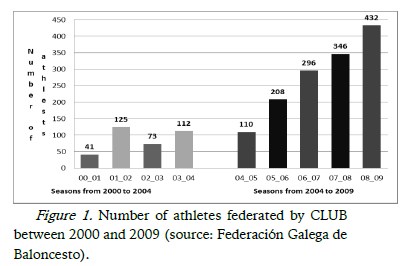
<body><![CDATA[<p>&nbsp;</p>     <p><font size="3" face="Verdana"><b>Results</b></font></p>     <p><font size="2" face="Verdana"><b>Phase 1</b>    </font></p> <font size="2" face="Verdana">    <p>From the documental research, it is described that the <i>CLUB</i> was founded in 1996 and between 2001 and 2004 it   lived a financial and administrative crises that almost caused it to close   down.  Over this period, <i>CLUB </i>focused on the elite team, in what Rodríguez Díaz (2008) calls “intensive” offer, in which few athletes of high technical level   are privileged so as to achieve significant results in competitions with the   highest possible level of demand. In those cases, it is quite common to see an   adult elite team with the minimum number of youth development teams, relying on   a large external sponsor, which causes great dependency and instability in maintaining sports programs (Galatti, 2010).</p>     <p>In 2004,   following changes in its administrative staff, <i>CLUB</i> decided to maintain the elite team and seek the best possible   sports results, but with one additional objective: a sport program based on the   expansion of youth development teams.  By   investing in the formation of a social group linked to the club, a greater   number of children and youth were able to participate in the club and a larger   consumer base enabled the diversification of actions promoted by the club.   Since the changes made in the 2004-2005 season, the organizational structure   and action strategies of the club are described in the <i>CLUB</i>’s Sport Program<a href="#_ftn1" name="_ftnref1" title=""><sup><sup>[1]</sup></sup></a>. From this date until the season   investigated, 2008-2009, <i>CLUB</i> saw an   increase of 374.5% in the number of athletes, as demonstrated in <a href="#f1">Figure 1</a>.   Following this continuous growth in the number of <i>CLUB</i> athletes, the competitive level of <i>CLUB</i> has also continued to increase with each progressing season: <i>CLUB</i>’s elite team has continuously   joined higher performing leagues since the 2004-2005 (progressing through 4 divisions, one each year, coming to “LEB Plata” division).</p> </font>     <p><a name="f1"></a></p>     <p>&nbsp;</p>     <p align="center"><i><font size="2" face="Verdana"><img src="/img/revistas/mot/v12n3/12n3a04f1.jpg" width="409" height="266"></font></i></p>     
<p>&nbsp;</p>     <p><font size="2" face="Verdana">As the   results show, increasing the participation of youth in <i>CLUB</i> appears to have positively affected the performance of its   professional team. After <i>CLUB</i>’s sport   program was showcased in the main nationwide newspaper in Spain, El País, the <i>CLUB</i> was nationally recognized and   subsequently elected as the best club for the promotion of youth sports (in all   the state and among all sports) in 2010 by the Council of Culture and Sports of the Autonomous Region of Galicia. </font></p>     ]]></body>
<body><![CDATA[<p><font size="2" face="Verdana"><b>Phase 2</b>    </font></p>     <p><font size="2" face="Verdana">Nine   categories were identified from the interviews ‘data: (1) organizational   structure, (2) club philosophy, (3) sport program, (4) youth development teams,   (5) recreational activities, (6) elite team, (7) relationship between youth teams and first team, (8) coach education, (9) club image and social impact.</font></p>     <p><font size="2" face="Verdana">(1) <i>Organizational structure:</i>  <i>CLUB</i> is classified as an elite sport club, whose actions are centered towards their   representative teams (Rodríguez Díaz, 2008). This type of club has a sustained   structure of an administrative board and staff, relying on a small number of   members and a larger number of supporters.The   governing board consisted of 12 volunteers and many of them had children who   were playing in <i>CLUB</i> and professions   that enabled the skills and tools valuable for the running of the club (e.g.,   business, banking, advertising, etc.). In general, the governing board   contributed to the prestige or professional nature of <i>CLUB</i>’s personal and social life (Heinemann, 1999). The staff, all   paid, was composed of a sport manager, four full-time coaches, and 28 part-time   coaches. The coaches are responsible for all lessons and training, the   coordination of competition within the organization, and the implementation of   activities sponsored by the club.The amateur   board of directors has clearly differentiated roles from those of the sport   manager and coaches. The volunteer board is responsible for the financial   organization of the club, in addition to the preparation of <i>CLUB</i>’s sport program. In line with the   common philosophy outlined in <i>CLUB</i>’s   sport program, the sport manager and coaches, all of whom are paid staff, apply   the sports program, coordinate and direct all teams, and perform <i>CLUB</i>’s activities. The sports manager is   responsible for the link between amateur directors and paid staff; although   there are differences in priorities, these groups seek understanding from   common goals and compliance with the athletic program.</font></p>     <p><font size="2" face="Verdana">(2) <i>Club philosophy:</i> <i>CLUB</i>’s mission is to   provide access to a quality basketball program and increase the number of   participants associated with <i>CLUB</i> through the provision of two key features: (a) the potential for performance at   the elite sport level, and (b) an educational program of mass sport. This   philosophy was evident in the views of the managers, as well as in the   documents of the club.</font></p>     <p><font size="2" face="Verdana">(3) <i>Sport Program:</i> The structure of the sport programming in <i>CLUB</i> encompassed three sectors: (a) an elite team, (b) youth   development teams, and (c) recreational activities. Each of these sectors can   be defined on an interrelated level; the youth teams feed the elite team, both   as athletes and a supporting social mass, and recreational activities serve to   attract new members to the club, youth participants and spectators alike.</font></p>     <p><font size="2" face="Verdana">(4)<i> Youth Development Teams:</i> <i>CLUB</i> serves more than 500 children and adolescents from 6 to 18 years of age,   including 432 youth athletes registered with the Galician Basketball Federation   and approximately 120 children in beginner basketball classes offered at   municipal facilities and private schools.The   significant number of athletes participating on youth teams is attributed,   among other factors, to a paradigm shift in the club: the extinction of   selective choice among youth athletes, and expansion to include a base of   multiple teams that has allowed the club to form public support and spectator   basketball. To this end, the club has allocated the best trained coaches   (graduates in Physical Education) to the divisions of initiation and first   categories, promoting classes and quality care.Children   and parents who come to the club often do not aspire, initially, to become elite   athletes; thus, <i>CLUB</i> approaches new   athletes with the goal of providing an environment for education and human   development through sport participation. This does not preclude the pursuit of   sporting results and quality technical and tactical instruction on each   recreational team, however, there is no exacerbated pressure to win. In   addition to promoting participation among children and adolescents, the   families of these athletes begin to follow the everyday occurrences of the   club, watching training and competition activities for both children and the   elite team, and increasing the social mass of <i>CLUB</i> as a result.</font></p>     <p><font size="2" face="Verdana">(5)<i> Recreational Activities:</i> This category referred to sporting and   social activities offered to <i>CLUB</i>’s   domestic audience that are related to basketball but go beyond the extent of   regular competitions. These activities include events such as sport camps, recreational tournaments,   basketball meetings, athlete clinics, coach clinics, sport tourism, jamboree   and others. Each of these activities is intended to provide young <i>CLUB</i> basketball players with new ways to   experience basketball. These   activities are targeted to the wider community as well, promoting the <i>CLUB</i> and attracting new members for   youth teams just as spectators are drawn to the elite team. Additionally, such   activities provide economic support for the club by attracting private   sponsorship and funding from public programs related to health and physical   education. Thus, recreational activities and youth development programs are complementary   strategies that promote <i>CLUB</i>’s image,   illustrating a trend of diversified services which, when well offered, recruit   new users to the club.</font></p>     <p><font size="2" face="Verdana">(6)<i> Elite team:</i> it is the showcase of   the club, performing at the national and professional level. The team maintains   a strong representation and identity in the local community, with several   players born in the surrounding city/state. While a source of major   expenditures for the club, the elite team is also an important source for   fundraising via marketing strategies and advertising. Furthermore, the elite   team serves as the stimulator for more than 500 children and youth who practice   basketball at the club, in addition to over 2000 people who crowd the municipal   gym on a weekly basis, raising the local social value.</font></p>     <p><font size="2" face="Verdana">(7)<i> Relationship between youth teams and elite   team:</i> There is a relationship of   mutual collaboration; the youth development teams psychologically motivate the   elite team which, in turn, feeds the desires of children and young people in   the sport of basketball, perhaps inspiring future elite athletes and offering a   means for expansion of the sporting culture related to basketball citywide. The   political aspect of this relationship is also highlighted, given that the large   number of entries with the FGB strengthens <i>CLUB</i> at these institutions, generating economic empowerment as a large number of   people are willing to consume the products related to this sport. Thus, in the   case of the <i>CLUB</i>, there is an aspect   of interdependence between recreational and professional sport.</font></p>     <p><font size="2" face="Verdana">(8)<i> Coach Education:</i> The hiring of strong technical staff in the sport of basketball   was considered crucial to the success of this program. Several coaching   education and follow-up strategies were employed, of which stand out: (a) <i>CLUB</i>’s coaching meetings; (b)   publicizing and demanding social-educational programs to be carried out with   the youth development teams; (c) filling out the Coach’s Notebook (the club’s   own model); (d) promoting internal courses to inform coaches and supporting coaches’   participation in courses promoted by the FGB and FEB; (e) a mentoring program   in which new coaches in the institution are followed by a more experienced   coach with a background in the club; and (f) financially valuing the   achievement of the club’s propositions with a monthly bonus of up to 20% of the   coach’s salary. In addition to these tactics, the parents of young athletes   answer questionnaires to follow and assess the work of the coaches. As a result   of the guidance from <i>CLUB</i> coordinators and the training offered by the club, the coaches learn the   demands of the job and how to perform most effectively.</font></p> <font size="2" face="Verdana">    ]]></body>
<body><![CDATA[<p>(9)<i> Club image and Social Impact: CLUB</i> has   achieved social recognition in both its internal community (i.e., children and   youth, athletes, parents, fans) as well as in the broader external community   (i.e., press, associations, citizens). The social standing that has been   achieved by <i>CLUB</i> is largely   attributed to the quality care of a large number of children and young people,   constant intervention with the community through recreational activities, and   the development of local professional players, creating a team identity that resonates within the city.</p> </font>     <p>&nbsp;</p>     <p><font size="3" face="Verdana"><b>Discussion</b>    </font></p> <font size="2" face="Verdana">    <p>By   analyzing <i>CLUB</i>’s sport program, the   objectives <i>CLUB</i> seeks to achieve are   clear: (a) the promotion of basketball in the greater city community, (b)   strengthening its elite team through an elite model, while also (c) expanding   the youth development teams to go beyond only forming athletes, with the   inclusion of educational concerns regarding the overall development of children and youth participating in the club. </p>     <p>In this structure, the youth development teams – 432 players that make up   30 different teams – are the ones involving the largest number of sports   coaches working in the club. The   large number of athletes participating in the youth academies is attributed,   among other factors, to a shift in the club’s paradigm: The end of trials for   choosing athletes admitted to a few select teams, and the investment in   multiple youth development teams that allow the club to form a public following   that both practices and watches basketball. Therefore,   the club’s sports program favors a diverse practice that enables children and   young people to learn a sport, and thereafter remain in the sport with the   option to either specialize in the club and aspire to be an elite athlete, or   continue to play on competitive teams and participate in recreational   activities with the goal of lifelong sport participation (Côté et al., 2009;   Fraser-Thomas et al., 2005, 2008; Paes &amp; Galatti, 2013; Strachan et al., 2011).</p>     <p>This process begins with the recreational   activities, directly linked with the youth development teams, as a way of   publicizing the club by offering quality services and professionals. From this   first contact with the <i>CLUB</i>, children   and youngsters gain an interest in basketball and many enroll in the youth   development teams. In this way, recreational activities and youth teams   complement one another and are strategic for the club’s image, illustrating a   trend in diversifying services, which, when offered properly, attract new users   to the club (Heinemann,   1999).   These activities provide children with the opportunity to act autonomously in   engaging with the sport, because they have free time to explore the basketball court (Côté et al., 2013; Viola et al., 2011). </p>     <p>Furthermore,   parents and friends that do not play in <i>CLUB</i>’s   youth basketball academy can participate in these activities, which can create   a stimulating environment where young athletes feel supported by relatives and   friends (Baker, 2003;   Ferreira &amp; Moraes, 2012; Galatti et al., 2014; Holt &amp; Dunn, 2004;   Morgan &amp; Giacobbi, 2006). Achieving this level of   extensive social support and family involvement has the potential to keep young   basketball players in the club throughout childhood and adolescence,   potentially serving as future elite players (Baker,   Deakin, &amp; Cote, 2005; Côté et al., 2009; Fraser-Thomas et al., 2010;   Galatti, 2010; Henriksen et al., 2010, 2011; MacDonald et al., 2011; Strachan   et al., 2011), and increasing the possibility of lifelong sport participation (Côté et al., 2013; Silva, Galatti, &amp; Paes, 2010). Thus, offering youth academies must go beyond   the formation of professional athletes; it must promote human development in   children and teenagers who seek the sport through an institutionalized   extracurricular educational process (Côté et al., 2009; Fraser-Thomas et al., 2008; Paes &amp; Galatti, 2013; Strachan et al., 2011). </p>     <p>Although   sporting results and technical-tactical quality are sought in each of the youth   development teams, there is no overwhelming pressure for the teams to perform   successfully since the club aims to develop not only the athlete, but the   person as well, by providing an educational service. On the other hand,   offering young individuals the opportunity to sample several different sports   without any emphasis on specialization and technical-tactical development can   be useful in promoting elite athletes as well (Abbott   &amp; Collins, 2004; Bailey &amp; Morley, 2006; Baker et al., 2003; Balyi,   2002; Côté et al., 2013; Leite, Baker, &amp; Sampaio, 2009). In order for this to occur, a coach education program was developed within the <i>CLUB</i>.</p>     <p><i>CLUB</i>’s   sports program goes beyond the success of the elite team and developing new   elite athletes, demonstrating a focus on internal communication and educational   requirements that foster well-rounded youth development teams. The coaches are   encouraged to talk to the parents, be attentive, and fulfill the basketball   system, an educational program by the club that aims to reinforce a set of   values pertaining to healthy habits, positive attitudes, attendance,   interaction with the team, punctuality, respect, and good grades. An approach that focuses on values   helps to increase parents' confidence in the club and keeps them close to the   activities undertaken, which is critical to children's development in sport (Baker,   2003; Ericsson, Krampe, &amp; Tesch-Romes, 1993; Ferreira &amp; Moraes, 2012). It is an action that shows the club’s   pedagogic concern in terms of sports initiation and human formation (Côté et al., 2009; Fraser-Thomas et al., 2008; Heinemann, 1999;   Jakobsson, 2012; Strachan et al., 2011). From an administrative perspective, the club   president highlights the basketball system in demonstrating the educational   focus of the sports program that must be fulfilled by the president, directors, managers, and coaches.</p>     <p>Hence, the club’s goal of developing an elite sport program in   conjunction with a broad base of child and youth participants has allowed for <i>CLUB</i> to offer quality sport programming   in association with an educational program. Increasing the number of CLUB   members has also led to its third cornerstone: Recreational activities for the   purpose of participation. In   the developmental model   of sport participation (DMSP), the authors indicate that sport initiation   moving away from early specialization and engaging fully in the sampling years   (characterized by relatively high levels of deliberate play and low levels of   deliberate practice in a variety of sports) favors the optimal trajectory for   both elite performance and lifelong sport participation (Côté et al., 2007; Côté &amp; Fraser-Thomas, 2007; Fraser-Thomas et al., 2005, 2008).</p>     ]]></body>
<body><![CDATA[<p>The   structure of <i>CLUB</i> can be viewed in   light of the DMSP, offering recreational activities, multiple youth development   teams, and one elite team, which are linked not hierarchically, but rather, are   complementary and interdependent. Each of these features cumulate in the   stability and continued success of <i>CLUB</i>;   through each of these venues the club is able to provide a myriad of actions   and services to different target groups, enabling federated basketball with a   professional team and several youth teams, while also promoting the sport with various   possible meanings and experiences. </p>     <p>It is not   enough that a club seeking to take part in a professional modality promotes   only the elite team. Adding to this point, it is important to develop a mass of   people who practice, watch, and follow this team, who get involved with the   sport and justify the revenue from investors, while allowing the club to   multiply its own actions at the elite, competitive and recreational levels, as shown in <a href="/img/revistas/mot/v12n3/12n3a04f2.jpg">figure 2</a>.</p> </font>     
<p><font size="2" face="Verdana">It is   important to consider that this investigation is a case report, in which the   aims are deep understanding of either a situation or a background in a specific   period of time, in this case a sports club with a successful sports program   based on the relationship between both elite and youth sports. The observation   of the successful factors of this sports club offer in their correlated   dimensions was possible due to the methodology applied in the research.   However, the results of an investigation of this nature are associated with the   conditions evaluated in this specific environment, and require attention to the comparisons of the evidences found within other contexts.</font></p>     <p><font size="2" face="Verdana">Considering   this caveat, the results found in this investigation could be better compared   with similar studies developed in other sports contexts, which articulate youth   and elite sports. However, this will only be possible when the successful   experiences of sports offered in the contemporary context come to be studied   more often among the sport pedagogy research. Complex and deep studies that aim   to understand a wide context of sports development demand time and multiple   research techniques. The comprehension of the scientific community about this factor   is also important, in which time and effort should not be a deterrent for conducting this type of study.</font></p>     <p>&nbsp;</p>     <p><b><font size="3" face="Verdana">Conclusions</font></b></p>     <p><font size="2" face="Verdana">Sport in today’s   society is a contemporary and diversified phenomenon in constant transformation   and valued at different social levels.    It has multiple social meanings, such as those related to profession,   representation, leisure, health, aesthetics, socialization, and education.  In this new environment, sports clubs have   been struggling to adapt.  In light of   this statement, this paper reported a positive case study about how a sport   club can offer both elite athlete development and a diverse range of sport   activities to attract and maintain a greater number of children and youth for   continued participation in a long-term sport program. Considering the needs and possibilities   raised in the literature review, as well as the findings of this field   research, three fronts of action are proposed in order to promote a sports   program integrating elite (i.e., performance) and recreational (i.e., participation) sport in the context of the sports club:</font></p>     <p><font size="2" face="Verdana">1.   Elite   Team: The elite team provides the most visibility to the club, since it brings   together the best athletes, competes at the professional level, and has several   elements to draw in the public, investors, partners, and consumers.   Additionally, the elite team does not necessarily need to play in the country’s   main competitive category – a team in division C or an under-21 team may play the role of a club’s elite team and amass members and fans to the club. </font></p>     <p><font size="2" face="Verdana">2.   Youth   Development Teams: By investing in multiple youth development teams, clubs can   push beyond the paradigm of selecting only the best. These children and   youngsters make up, from the beginning, the supporters that bolster the sport;   they further amass new supporters in their roles as child- and youth-athletes,   involving their parents, siblings, and friends. In the long run, the youth   teams may foster the development of future elite players, and people linked to   the program may keep in contact as informal players, spectators, coaches,   referees, managers, and sponsors, among other roles. The youth development   teams may also, through partnerships with schools, city halls, and NGOs, expand the reach of the sport and the club to other institutions.</font></p>     <p><font size="2" face="Verdana">3.   Activities:   Various projects and events developed by the club and linked to its sports   program strengthen the internal supporters and attract new people to the CLUB.   In this sense, leisure activities, informal competitions, festivals,   performances, meetings, workshops, etc., strengthen the sport community within   the club. These activities may be focused on both current club users and the   external public, depending on the statutory requirements and philosophical underpinnings of each club. </font></p>     ]]></body>
<body><![CDATA[<p><font size="2" face="Verdana">In   attending to the three key areas outlined above, sports clubs may reap   significant benefits. Thus, in order to diversify and optimize the strategies   in effect for sports clubs, the following points are highlighted: (a) Value the   interdependency between the elite team and associated youth development teams;   (b) View youth development teams as a social mass supporting the club, not a   source of expenses; (c) Develop the person, not just the athlete; Diversify and   tailor the actions to the sport(s) and group(s) involved; (d) Respect the   social group characteristics that motivate and maintain the club; (e)   Professionalize and develop coaches over time; (f) Recognize coaches as the key   players connecting the sports program, board of directors, club members, athletes (of all levels), fans, and all other involved individuals.</font></p>     <p><font size="2" face="Verdana">In conclusion,   the strategies implemented by <i>CLUB</i>   are cause for careful consideration of systematizing more concrete   possibilities for restructuring the relationship between sport clubs   encompassing aspects of both elite and participation and youth development   through sport. However, it is also important to note that each club must be   studied according to its own operational standards and context, and that these   findings may be adapted, but not necessarily generalized, for use in other   clubs. Additionally, greater attention surrounding the educational   possibilities concurrent with sport participation can also be emphasized,   particularly in the context of child and youth development, which is often   viewed as a complement to formal education. To this end, a sports program and   pedagogical procedures that meet this demand must be established. A program   focused on education through sports does not mean disregarding the role of   clubs in forming adult and professional athletes, but rather articulating this   primary goal in the youth development teams in the context of elite sports with others that rise in the reality of contemporary sports.</font></p>     <p>&nbsp;</p>     <p><font size="3" face="Verdana"><b>REFERENCES</b></font></p>     <!-- ref --><p><font size="2" face="Verdana">Abbott, A., &amp; Collins, D. (2004).   Eliminating the dichotomy between theory and practice in talent identification   and development: considering the role of psychology. <i>Journal of Sports     Sciences</i>, <i>22</i>(5), 395–408.   <a href="https://doi.org/10.1080/02640410410001675324" target="_blank">    https://doi.org/10.1080/02640410410001675324</a></font>&nbsp;&nbsp;&nbsp;&nbsp;&nbsp;&nbsp;&nbsp;&nbsp;[&#160;<a href="javascript:void(0);" onclick="javascript: window.open('/scielo.php?script=sci_nlinks&ref=356653&pid=S1646-107X201600030000400001&lng=','','width=640,height=500,resizable=yes,scrollbars=1,menubar=yes,');">Links</a>&#160;]<!-- end-ref --><!-- ref --><p><font size="2" face="Verdana">Anguera-Argilaga, M. T. (1999). Análisis de la competencia en   la selección de observadores. <i>Metodología de las ciencias del comportamiento</i>, <i>1</i>(1), 95–114.    &nbsp;&nbsp;&nbsp;&nbsp;&nbsp;&nbsp;&nbsp;&nbsp;[&#160;<a href="javascript:void(0);" onclick="javascript: window.open('/scielo.php?script=sci_nlinks&ref=356654&pid=S1646-107X201600030000400002&lng=','','width=640,height=500,resizable=yes,scrollbars=1,menubar=yes,');">Links</a>&#160;]<!-- end-ref --></font></p>     <!-- ref --><p><font size="2" face="Verdana">Bailey,   R., &amp; Morley, D. (2006). Towards a model of talent   development in physical education. <i>Sport, Education and Society</i>, <i>11</i>(3), 211–230. <a href="https://doi.org/10.1080/13573320600813366" target="_blank">https://doi.org/10.1080/13573320600813366</a></font>&nbsp;&nbsp;&nbsp;&nbsp;&nbsp;&nbsp;&nbsp;&nbsp;[&#160;<a href="javascript:void(0);" onclick="javascript: window.open('/scielo.php?script=sci_nlinks&ref=356656&pid=S1646-107X201600030000400003&lng=','','width=640,height=500,resizable=yes,scrollbars=1,menubar=yes,');">Links</a>&#160;]<!-- end-ref --><!-- ref --><p><font size="2" face="Verdana">Baker, J. (2003). Early Specialization in Youth   Sport: A Requirement for Adult Expertise? <i>High Ability Studies</i>, <i>14</i>(1), 85–94.    &nbsp;&nbsp;&nbsp;&nbsp;&nbsp;&nbsp;&nbsp;&nbsp;[&#160;<a href="javascript:void(0);" onclick="javascript: window.open('/scielo.php?script=sci_nlinks&ref=356657&pid=S1646-107X201600030000400004&lng=','','width=640,height=500,resizable=yes,scrollbars=1,menubar=yes,');">Links</a>&#160;]<!-- end-ref --></font></p>     ]]></body>
<body><![CDATA[<!-- ref --><p><font size="2" face="Verdana">Baker, J., Côté, J., &amp; Abernethy, B.   (2003). Learning from the Experts: Practice Activities of Expert Decision   Makers in Sport. <i>Research Quarterly for Exercise and Sport</i>, <i>74</i>(3), 342–347. <a href="https://doi.org/10.1080/02701367.2003.10609101" target="_blank">https://doi.org/10.1080/02701367.2003.10609101</a></font>&nbsp;&nbsp;&nbsp;&nbsp;&nbsp;&nbsp;&nbsp;&nbsp;[&#160;<a href="javascript:void(0);" onclick="javascript: window.open('/scielo.php?script=sci_nlinks&ref=356659&pid=S1646-107X201600030000400005&lng=','','width=640,height=500,resizable=yes,scrollbars=1,menubar=yes,');">Links</a>&#160;]<!-- end-ref --><!-- ref --><p><font size="2" face="Verdana">Baker, J., Deakin, J., &amp; Cote, J. (2005).   On the utility of deliberate practice: Predicting performance in   ultra-endurance triathletes from training indices. <i>International Journal of Sport Psychology</i>, <i>36</i>(3), 225–240.    &nbsp;&nbsp;&nbsp;&nbsp;&nbsp;&nbsp;&nbsp;&nbsp;[&#160;<a href="javascript:void(0);" onclick="javascript: window.open('/scielo.php?script=sci_nlinks&ref=356660&pid=S1646-107X201600030000400006&lng=','','width=640,height=500,resizable=yes,scrollbars=1,menubar=yes,');">Links</a>&#160;]<!-- end-ref --></font></p>     <!-- ref --><p><font size="2" face="Verdana">Balyi, I. (2002). Long-term Athlete Development: the system and solutions Faster Higher Stronger. <i>Faster Higher Stronger</i>, (14), 9–12.    &nbsp;&nbsp;&nbsp;&nbsp;&nbsp;&nbsp;&nbsp;&nbsp;[&#160;<a href="javascript:void(0);" onclick="javascript: window.open('/scielo.php?script=sci_nlinks&ref=356662&pid=S1646-107X201600030000400007&lng=','','width=640,height=500,resizable=yes,scrollbars=1,menubar=yes,');">Links</a>&#160;]<!-- end-ref --></font></p>     <!-- ref --><p><font size="2" face="Verdana">Bardin, L. (2011). <i>Análise de conteúdo</i>. Lisboa: Edições 70.    &nbsp;&nbsp;&nbsp;&nbsp;&nbsp;&nbsp;&nbsp;&nbsp;[&#160;<a href="javascript:void(0);" onclick="javascript: window.open('/scielo.php?script=sci_nlinks&ref=356664&pid=S1646-107X201600030000400008&lng=','','width=640,height=500,resizable=yes,scrollbars=1,menubar=yes,');">Links</a>&#160;]<!-- end-ref --></font></p>     <!-- ref --><p><font size="2" face="Verdana">Carlson, R. (1988). The Socialization of Elite   Tennis Players in Sweden: An Analysis of the Players’ Backgrounds and   Development. <i>Sociology of Sport Journal</i>, <i>5</i>(3), 241–256. <a href="https://doi.org/10.1123/ssj.5.3.241" target="_blank">https://doi.org/10.1123/ssj.5.3.241</a></font>&nbsp;&nbsp;&nbsp;&nbsp;&nbsp;&nbsp;&nbsp;&nbsp;[&#160;<a href="javascript:void(0);" onclick="javascript: window.open('/scielo.php?script=sci_nlinks&ref=356666&pid=S1646-107X201600030000400009&lng=','','width=640,height=500,resizable=yes,scrollbars=1,menubar=yes,');">Links</a>&#160;]<!-- end-ref --><!-- ref --><p><font size="2" face="Verdana">Côté, J., Baker, J., &amp; Abernethy, B.   (2007). Practice and Play in the Development of Sport Expertise. Em G.   Tenenbaum &amp; R. C. Eklund (Eds.), <i>Handbook of Sport Psychology</i> (3<sup>rd</sup> Ed., pp. 184–202). New York: John Wiley &amp; Sons.    &nbsp;&nbsp;&nbsp;&nbsp;&nbsp;&nbsp;&nbsp;&nbsp;[&#160;<a href="javascript:void(0);" onclick="javascript: window.open('/scielo.php?script=sci_nlinks&ref=356667&pid=S1646-107X201600030000400010&lng=','','width=640,height=500,resizable=yes,scrollbars=1,menubar=yes,');">Links</a>&#160;]<!-- end-ref --></font></p>     ]]></body>
<body><![CDATA[<!-- ref --><p><font size="2" face="Verdana">Côté, J., Erickson, K., &amp; Abernethy, B.   (2013). Practice and play in sport development. Em J. Côté &amp; R. Lidor   (Eds.), <i>Condition of children’s talent development in sport</i> (pp. 9–20). Morgantown: Fitness Information Technology.    &nbsp;&nbsp;&nbsp;&nbsp;&nbsp;&nbsp;&nbsp;&nbsp;[&#160;<a href="javascript:void(0);" onclick="javascript: window.open('/scielo.php?script=sci_nlinks&ref=356669&pid=S1646-107X201600030000400011&lng=','','width=640,height=500,resizable=yes,scrollbars=1,menubar=yes,');">Links</a>&#160;]<!-- end-ref --></font></p>     <!-- ref --><p><font size="2" face="Verdana">Côté, J., &amp; Fraser-Thomas, J. (2007). Youth   involvement in sport. Em P. Crocker (Ed.), <i>Sport psychology: A Canadian perspective</i> (pp. 270–298). Toronto: Pearson.    &nbsp;&nbsp;&nbsp;&nbsp;&nbsp;&nbsp;&nbsp;&nbsp;[&#160;<a href="javascript:void(0);" onclick="javascript: window.open('/scielo.php?script=sci_nlinks&ref=356671&pid=S1646-107X201600030000400012&lng=','','width=640,height=500,resizable=yes,scrollbars=1,menubar=yes,');">Links</a>&#160;]<!-- end-ref --></font></p>     <!-- ref --><p><font size="2" face="Verdana">Côté, J., Lidor, R., &amp; Hackfort, D. (2009).   ISSP position stand: To sample or to specialize? Seven postulates about youth   sport activities that lead to continued participation and elite performance. <i>International     Journal of Sport and Exercise Psychology</i>, <i>7</i>(1), 7–17. <a href="https://doi.org/10.1080/1612197X.2009.9671889" target="_blank">https://doi.org/10.1080/1612197X.2009.9671889</a></font>&nbsp;&nbsp;&nbsp;&nbsp;&nbsp;&nbsp;&nbsp;&nbsp;[&#160;<a href="javascript:void(0);" onclick="javascript: window.open('/scielo.php?script=sci_nlinks&ref=356673&pid=S1646-107X201600030000400013&lng=','','width=640,height=500,resizable=yes,scrollbars=1,menubar=yes,');">Links</a>&#160;]<!-- end-ref --><!-- ref --><p><font size="2" face="Verdana">Côté, J., Strachan, L., &amp; Fraser-Thomas, J.   (2008). Participation, personal development, and performance through sport. Em   N. L. Holt (Ed.), <i>Positive  youth  development    through  sport</i> (pp. 34–45). London: Routledge.    &nbsp;&nbsp;&nbsp;&nbsp;&nbsp;&nbsp;&nbsp;&nbsp;[&#160;<a href="javascript:void(0);" onclick="javascript: window.open('/scielo.php?script=sci_nlinks&ref=356674&pid=S1646-107X201600030000400014&lng=','','width=640,height=500,resizable=yes,scrollbars=1,menubar=yes,');">Links</a>&#160;]<!-- end-ref --></font></p>     <!-- ref --><p><font size="2" face="Verdana">Davids, K., Araújo, D., Correia, V., &amp;   Vilar, L. (2013). How small-sided and conditioned games enhance acquisition of   movement and decision-making skills. <i>Exercise and Sport Sciences Reviews</i>, <i>41</i>(3), 154–161. <a href="https://doi.org/10.1097/JES.0b013e318292f3ec" target="_blank">https://doi.org/10.1097/JES.0b013e318292f3ec</a></font>&nbsp;&nbsp;&nbsp;&nbsp;&nbsp;&nbsp;&nbsp;&nbsp;[&#160;<a href="javascript:void(0);" onclick="javascript: window.open('/scielo.php?script=sci_nlinks&ref=356676&pid=S1646-107X201600030000400015&lng=','','width=640,height=500,resizable=yes,scrollbars=1,menubar=yes,');">Links</a>&#160;]<!-- end-ref --><!-- ref --><p><font size="2" face="Verdana">Ericsson, K. A., Krampe, R. T., &amp;   Tesch-Romes, C. (1993). The Role of Deliberate Practice in the Acquisition of   Expert Performance. <i>Psychological Review</i>, <i>100</i>(3), 363–406. <a href="https://doi.org/10.1037//0033-295X.100.3.363" target="_blank">https://doi.org/10.1037//0033-295X.100.3.363</a></font>&nbsp;&nbsp;&nbsp;&nbsp;&nbsp;&nbsp;&nbsp;&nbsp;[&#160;<a href="javascript:void(0);" onclick="javascript: window.open('/scielo.php?script=sci_nlinks&ref=356677&pid=S1646-107X201600030000400016&lng=','','width=640,height=500,resizable=yes,scrollbars=1,menubar=yes,');">Links</a>&#160;]<!-- end-ref --><!-- ref --><p><font size="2" face="Verdana">Ferreira, R. M., &amp; Moraes, L. C. de.   (2012). Family influence in the first phase of the career development of   Brazilian swimmers Olympic medalists. <i>Motricidade</i>, <i>8</i>(2), 42–51. <a href="https://doi.org/10.6063/motricidade.8(2).711" target="_blank">https://doi.org/10.6063/motricidade.8(2).711</a></font>&nbsp;&nbsp;&nbsp;&nbsp;&nbsp;&nbsp;&nbsp;&nbsp;[&#160;<a href="javascript:void(0);" onclick="javascript: window.open('/scielo.php?script=sci_nlinks&ref=356678&pid=S1646-107X201600030000400017&lng=','','width=640,height=500,resizable=yes,scrollbars=1,menubar=yes,');">Links</a>&#160;]<!-- end-ref --><!-- ref --><p><font size="2" face="Verdana">Fradua,   L., Zubillaga, A., Caro, Ó., Fernández-García, Á. I., Ruiz-Ruiz, C., &amp;   Tenga, A. (2013). Designing small-sided games for training   tactical aspects in soccer: Extrapolating pitch sizes from full-size   professional matches. <i>Journal of Sports Sciences</i>, <i>31</i>(6), 573–581. <a href="https://doi.org/10.1080/02640414.2012.746722" target="_blank">https://doi.org/10.1080/02640414.2012.746722</a></font>&nbsp;&nbsp;&nbsp;&nbsp;&nbsp;&nbsp;&nbsp;&nbsp;[&#160;<a href="javascript:void(0);" onclick="javascript: window.open('/scielo.php?script=sci_nlinks&ref=356679&pid=S1646-107X201600030000400018&lng=','','width=640,height=500,resizable=yes,scrollbars=1,menubar=yes,');">Links</a>&#160;]<!-- end-ref --><!-- ref --><p><font size="2" face="Verdana">Fraser-Thomas, J., Côté, J., &amp; Deakin, J.   (2005). Youth sport programs: an avenue to foster positive youth development. <i>Physical     Education and Sport Pedagogy</i>, <i>10</i>(1), 19–40. <a href="https://doi.org/10.1080/1740898042000334890" target="_blank">https://doi.org/10.1080/1740898042000334890</a></font>&nbsp;&nbsp;&nbsp;&nbsp;&nbsp;&nbsp;&nbsp;&nbsp;[&#160;<a href="javascript:void(0);" onclick="javascript: window.open('/scielo.php?script=sci_nlinks&ref=356680&pid=S1646-107X201600030000400019&lng=','','width=640,height=500,resizable=yes,scrollbars=1,menubar=yes,');">Links</a>&#160;]<!-- end-ref --><!-- ref --><p><font size="2" face="Verdana">Fraser-Thomas, J., Côté, J., &amp; Deakin, J.   (2008). Understanding dropout and prolonged engagement in adolescent   competitive sport. <i>Psychology of Sport and Exercise</i>, <i>9</i>(5), 645–662. <a href="https://doi.org/10.1016/j.psychsport.2007.08.003" target="_blank">https://doi.org/10.1016/j.psychsport.2007.08.003</a></font>&nbsp;&nbsp;&nbsp;&nbsp;&nbsp;&nbsp;&nbsp;&nbsp;[&#160;<a href="javascript:void(0);" onclick="javascript: window.open('/scielo.php?script=sci_nlinks&ref=356681&pid=S1646-107X201600030000400020&lng=','','width=640,height=500,resizable=yes,scrollbars=1,menubar=yes,');">Links</a>&#160;]<!-- end-ref --><!-- ref --><p><font size="2" face="Verdana">Fraser-Thomas,   J., Côté, J., &amp; MacDonald, D. J. (2010). Community   Size in Youth Sport Settings: Examining Developmental Assets and Sport   Withdrawal. <i>Revue phénEPS / PHEnex Journal</i>, <i>2</i>(2), 1–9.    &nbsp;&nbsp;&nbsp;&nbsp;&nbsp;&nbsp;&nbsp;&nbsp;[&#160;<a href="javascript:void(0);" onclick="javascript: window.open('/scielo.php?script=sci_nlinks&ref=356682&pid=S1646-107X201600030000400021&lng=','','width=640,height=500,resizable=yes,scrollbars=1,menubar=yes,');">Links</a>&#160;]<!-- end-ref --></font></p>     <!-- ref --><p><font size="2" face="Verdana">Galatti,   L. R. (2010). <i>Esporte e Clube Sócio-esportivo: percurso, contextos e     perspectivas a partir de estudo de caso em clube esportivo espanhol</i> (Dissertação de Doutoramento em Educação Física). Universidade Estadual de Campinas, Campinas, SP.    &nbsp;&nbsp;&nbsp;&nbsp;&nbsp;&nbsp;&nbsp;&nbsp;[&#160;<a href="javascript:void(0);" onclick="javascript: window.open('/scielo.php?script=sci_nlinks&ref=356684&pid=S1646-107X201600030000400022&lng=','','width=640,height=500,resizable=yes,scrollbars=1,menubar=yes,');">Links</a>&#160;]<!-- end-ref --></font></p>     <!-- ref --><p><font size="2" face="Verdana">Galatti,   L. R., Reverdito, R. S., Scaglia, A. J., Paes, R. R., &amp; Seoane, A. M.   (2014). Pedagogia do Esporte: tensão na ciência e o ensino dos Jogos Esportivos Coletivos. <i>Journal of Physical Education</i>, <i>25</i>(1), 153–162. <a href="https://doi.org/10.4025/reveducfis.v25i1.21088" target="_blank">https://doi.org/10.4025/reveducfis.v25i1.21088</a></font>&nbsp;&nbsp;&nbsp;&nbsp;&nbsp;&nbsp;&nbsp;&nbsp;[&#160;<a href="javascript:void(0);" onclick="javascript: window.open('/scielo.php?script=sci_nlinks&ref=356686&pid=S1646-107X201600030000400023&lng=','','width=640,height=500,resizable=yes,scrollbars=1,menubar=yes,');">Links</a>&#160;]<!-- end-ref --><!-- ref --><p><font size="2" face="Verdana">Heinemann, K. (1999). <i>Sociología de las organizaciones voluntarias: el ejemplo del club deportivo</i>. Valência: Tirant lo Blanch.    &nbsp;&nbsp;&nbsp;&nbsp;&nbsp;&nbsp;&nbsp;&nbsp;[&#160;<a href="javascript:void(0);" onclick="javascript: window.open('/scielo.php?script=sci_nlinks&ref=356687&pid=S1646-107X201600030000400024&lng=','','width=640,height=500,resizable=yes,scrollbars=1,menubar=yes,');">Links</a>&#160;]<!-- end-ref --></font></p>     ]]></body>
<body><![CDATA[<!-- ref --><p><font size="2" face="Verdana">Henriksen,   K., Stambulova, N., &amp; Roessler, K. K. (2010). Successful   talent development in track and field: considering the role of environment. <i>Scandinavian     Journal of Medicine &amp; Science in Sports</i>, <i>20</i>(S2), 122–132. <a href="https://doi.org/10.1111/j.1600-0838.2010.01187.x" target="_blank">https://doi.org/10.1111/j.1600-0838.2010.01187.x</a></font>&nbsp;&nbsp;&nbsp;&nbsp;&nbsp;&nbsp;&nbsp;&nbsp;[&#160;<a href="javascript:void(0);" onclick="javascript: window.open('/scielo.php?script=sci_nlinks&ref=356689&pid=S1646-107X201600030000400025&lng=','','width=640,height=500,resizable=yes,scrollbars=1,menubar=yes,');">Links</a>&#160;]<!-- end-ref --><!-- ref --><p><font size="2" face="Verdana">Henriksen, K., Stambulova, N., &amp; Roessler,   K. K. (2011). Riding the Wave of an Expert: A Successful Talent Development   Environment in Kayaking. <i>The Sport Psychologist</i>, <i>25</i>(3), 341–362. <a href="https://doi.org/10.1123/tsp.25.3.341" target="_blank">https://doi.org/10.1123/tsp.25.3.341</a></font>&nbsp;&nbsp;&nbsp;&nbsp;&nbsp;&nbsp;&nbsp;&nbsp;[&#160;<a href="javascript:void(0);" onclick="javascript: window.open('/scielo.php?script=sci_nlinks&ref=356690&pid=S1646-107X201600030000400026&lng=','','width=640,height=500,resizable=yes,scrollbars=1,menubar=yes,');">Links</a>&#160;]<!-- end-ref --><!-- ref --><p><font size="2" face="Verdana">Hill-Haas, S. V., Dawson, B., Impellizzeri, F.   M., &amp; Coutts, A. J. (2011). Physiology of small-sided games training in   football: a systematic review. <i>Sports Medicine</i>, <i>41</i>(3), 199–220. <a href="https://doi.org/10.2165/11539740-000000000-00000" target="_blank">https://doi.org/10.2165/11539740-000000000-00000</a></font>&nbsp;&nbsp;&nbsp;&nbsp;&nbsp;&nbsp;&nbsp;&nbsp;[&#160;<a href="javascript:void(0);" onclick="javascript: window.open('/scielo.php?script=sci_nlinks&ref=356691&pid=S1646-107X201600030000400027&lng=','','width=640,height=500,resizable=yes,scrollbars=1,menubar=yes,');">Links</a>&#160;]<!-- end-ref --><!-- ref --><p><font size="2" face="Verdana">Holt, N. L., &amp; Dunn, J. G. H. (2004).   Toward a Grounded Theory of the Psychosocial Competencies and Environmental   Conditions Associated with Soccer Success. <i>Journal of Applied Sport     Psychology</i>, <i>16</i>(3), 199–219. <a href="https://doi.org/10.1080/10413200490437949" target="_blank">https://doi.org/10.1080/10413200490437949</a></font>&nbsp;&nbsp;&nbsp;&nbsp;&nbsp;&nbsp;&nbsp;&nbsp;[&#160;<a href="javascript:void(0);" onclick="javascript: window.open('/scielo.php?script=sci_nlinks&ref=356692&pid=S1646-107X201600030000400028&lng=','','width=640,height=500,resizable=yes,scrollbars=1,menubar=yes,');">Links</a>&#160;]<!-- end-ref --><!-- ref --><p><font size="2" face="Verdana">Jakobsson, B. T. (2012). What makes teenagers   continue? A salutogenic approach to understanding youth participation in   Swedish club sports. <i>Physical Education and Sport Pedagogy</i>, <i>19</i>(3), 239–252. <a href="https://doi.org/10.1080/17408989.2012.754003" target="_blank">https://doi.org/10.1080/17408989.2012.754003</a></font>&nbsp;&nbsp;&nbsp;&nbsp;&nbsp;&nbsp;&nbsp;&nbsp;[&#160;<a href="javascript:void(0);" onclick="javascript: window.open('/scielo.php?script=sci_nlinks&ref=356693&pid=S1646-107X201600030000400029&lng=','','width=640,height=500,resizable=yes,scrollbars=1,menubar=yes,');">Links</a>&#160;]<!-- end-ref --><!-- ref --><p><font size="2" face="Verdana">Leite, N., Baker, J., &amp; Sampaio, J. (2009).   Paths to Expertise in Portuguese National Team Athletes. <i>Journal of Sports Science &amp; Medicine</i>, <i>8</i>(4), 560–566.    &nbsp;&nbsp;&nbsp;&nbsp;&nbsp;&nbsp;&nbsp;&nbsp;[&#160;<a href="javascript:void(0);" onclick="javascript: window.open('/scielo.php?script=sci_nlinks&ref=356694&pid=S1646-107X201600030000400030&lng=','','width=640,height=500,resizable=yes,scrollbars=1,menubar=yes,');">Links</a>&#160;]<!-- end-ref --></font></p>     <!-- ref --><p><font size="2" face="Verdana">MacDonald, D. J., Côté, J., Eys, M., &amp;   Deakin, J. (2011). The Role of Enjoyment and Motivational Climate in Relation   to the Personal Development of Team Sport Athletes. <i>The Sport Psychologist</i>, <i>25</i>(1), 32–46. <a href="https://doi.org/10.1123/tsp.25.1.32" target="_blank">https://doi.org/10.1123/tsp.25.1.32</a></font>&nbsp;&nbsp;&nbsp;&nbsp;&nbsp;&nbsp;&nbsp;&nbsp;[&#160;<a href="javascript:void(0);" onclick="javascript: window.open('/scielo.php?script=sci_nlinks&ref=356696&pid=S1646-107X201600030000400031&lng=','','width=640,height=500,resizable=yes,scrollbars=1,menubar=yes,');">Links</a>&#160;]<!-- end-ref --><!-- ref --><p><font size="2" face="Verdana">Morgan, T. K., &amp; Giacobbi, P. R. (2006).   Toward Two Grounded Theories of the Talent Development and Social Support   Process of Highly Successful Collegiate Athletes. <i>The Sport Psychologist</i>, <i>20</i>(3), 295–313. <a href="https://doi.org/10.1123/tsp.20.3.295" target="_blank">https://doi.org/10.1123/tsp.20.3.295</a></font>&nbsp;&nbsp;&nbsp;&nbsp;&nbsp;&nbsp;&nbsp;&nbsp;[&#160;<a href="javascript:void(0);" onclick="javascript: window.open('/scielo.php?script=sci_nlinks&ref=356697&pid=S1646-107X201600030000400032&lng=','','width=640,height=500,resizable=yes,scrollbars=1,menubar=yes,');">Links</a>&#160;]<!-- end-ref --><!-- ref --><p><font size="2" face="Verdana">Paes, R. R., &amp; Galatti, L. R. (2013). Pedagogia do Esporte: o   esporte educacional no contexto do clube contemporâneo. Em C. E. B. Gonçalves   (Ed.), <i>Educação pelo Desporte e Associativismo Desportivo</i> (pp. 85–110). Porto: Edições Afrontamento.    &nbsp;&nbsp;&nbsp;&nbsp;&nbsp;&nbsp;&nbsp;&nbsp;[&#160;<a href="javascript:void(0);" onclick="javascript: window.open('/scielo.php?script=sci_nlinks&ref=356698&pid=S1646-107X201600030000400033&lng=','','width=640,height=500,resizable=yes,scrollbars=1,menubar=yes,');">Links</a>&#160;]<!-- end-ref --></font></p>     <!-- ref --><p><font size="2" face="Verdana">Phillips,   E., Davids, K., Renshaw, I., &amp; Portus, M. (2010). Expert   performance in sport and the dynamics of talent development. <i>Sports Medicine     (Auckland, N.Z.)</i>, <i>40</i>(4), 271–283. <a href="https://doi.org/10.2165/11319430-000000000-00000" target="_blank">https://doi.org/10.2165/11319430-000000000-00000</a></font>&nbsp;&nbsp;&nbsp;&nbsp;&nbsp;&nbsp;&nbsp;&nbsp;[&#160;<a href="javascript:void(0);" onclick="javascript: window.open('/scielo.php?script=sci_nlinks&ref=356700&pid=S1646-107X201600030000400034&lng=','','width=640,height=500,resizable=yes,scrollbars=1,menubar=yes,');">Links</a>&#160;]<!-- end-ref --><!-- ref --><p><font size="2" face="Verdana">Rodríguez Díaz, Á. (2008). <i>El deporte en la construcción del espacio social</i>. Madrid: Centro de Investigaciones Sociológicas (CIS).    &nbsp;&nbsp;&nbsp;&nbsp;&nbsp;&nbsp;&nbsp;&nbsp;[&#160;<a href="javascript:void(0);" onclick="javascript: window.open('/scielo.php?script=sci_nlinks&ref=356701&pid=S1646-107X201600030000400035&lng=','','width=640,height=500,resizable=yes,scrollbars=1,menubar=yes,');">Links</a>&#160;]<!-- end-ref --></font></p>     <!-- ref --><p><font size="2" face="Verdana">Silva,   R. M. P., Galatti, L. R., &amp; Paes, R. R. (2010). Pedagogia do esporte e   iniciação esportiva tardia: perspectivas a partir da modalidade basquetebol. <i>Pensar a Prática</i>, <i>13</i>(1), 1–15. <a href="https://doi.org/10.5216/rpp.v13i1.7629" target="_blank">https://doi.org/10.5216/rpp.v13i1.7629</a></font>&nbsp;&nbsp;&nbsp;&nbsp;&nbsp;&nbsp;&nbsp;&nbsp;[&#160;<a href="javascript:void(0);" onclick="javascript: window.open('/scielo.php?script=sci_nlinks&ref=356703&pid=S1646-107X201600030000400036&lng=','','width=640,height=500,resizable=yes,scrollbars=1,menubar=yes,');">Links</a>&#160;]<!-- end-ref --><!-- ref --><p><font size="2" face="Verdana">Strachan,   L., Côté, J., &amp; Deakin, J. (2011). A new   view: exploring positive youth development in elite sport contexts. <i>Qualitative     Research in Sport, Exercise and Health</i>, <i>3</i>(1), 9–32. <a href="https://doi.org/10.1080/19398441.2010.541483" target="_blank">https://doi.org/10.1080/19398441.2010.541483</a></font>&nbsp;&nbsp;&nbsp;&nbsp;&nbsp;&nbsp;&nbsp;&nbsp;[&#160;<a href="javascript:void(0);" onclick="javascript: window.open('/scielo.php?script=sci_nlinks&ref=356704&pid=S1646-107X201600030000400037&lng=','','width=640,height=500,resizable=yes,scrollbars=1,menubar=yes,');">Links</a>&#160;]<!-- end-ref --><!-- ref --><p><font size="2" face="Verdana">Vallée, C. N., &amp; Bloom, G. A. (2005).   Building a Successful University Program: Key and Common Elements of Expert   Coaches. <i>Journal of Applied Sport Psychology</i>, <i>17</i>(3), 179–196. <a href="https://doi.org/10.1080/10413200591010021" target="_blank">https://doi.org/10.1080/10413200591010021</a></font>&nbsp;&nbsp;&nbsp;&nbsp;&nbsp;&nbsp;&nbsp;&nbsp;[&#160;<a href="javascript:void(0);" onclick="javascript: window.open('/scielo.php?script=sci_nlinks&ref=356705&pid=S1646-107X201600030000400038&lng=','','width=640,height=500,resizable=yes,scrollbars=1,menubar=yes,');">Links</a>&#160;]<!-- end-ref --><!-- ref --><p><font size="2" face="Verdana">Viola,   G., Paes, R., Galatti, L., &amp; Ribeiro, S. (2011). Pedagogia do esporte e autonomia: um estudo em projeto social de educação não formal. <i>Pensar a Prática</i>, <i>14</i>(3), 1–21. <a href="https://doi.org/10.5216/rpp.v14i3.10913" target="_blank">https://doi.org/10.5216/rpp.v14i3.10913</a></font>&nbsp;&nbsp;&nbsp;&nbsp;&nbsp;&nbsp;&nbsp;&nbsp;[&#160;<a href="javascript:void(0);" onclick="javascript: window.open('/scielo.php?script=sci_nlinks&ref=356706&pid=S1646-107X201600030000400039&lng=','','width=640,height=500,resizable=yes,scrollbars=1,menubar=yes,');">Links</a>&#160;]<!-- end-ref --><p>&nbsp;</p>     <p><font size="3" face="Verdana"><b>NOTES</b></font></p>     ]]></body>
<body><![CDATA[<p><font size="2" face="Verdana"><a style='mso-footnote-id: ftn1' href="#_ftnref1" name="_ftn1" title="">   <![if !supportFootnotes]>   [1]   <![endif]>   </a> Internal documents of the CLUB were used,   such as: the manager’s club plan, sporting curriculum, the work plan of the   coaches, and athlete records in Galician Basketball Federation (FGB).</font></p>     <p>&nbsp;</p>     <p><font size="2" face="Verdana"><b>Acknowledgments:</b>    <br>   Nothing to declare    <br>   <b>Conflict     of Interest:    <br>   </b>Nothing to   declare    <br>   <b>Funding:    <br>   </b>Nothing to   declare</font></p>     <p><font size="2" face="Verdana">Manuscript received at  November 13th 2014; Accepted at September 8th 2016</font></p>     <p>&nbsp;</p>     ]]></body>
<body><![CDATA[<p>&nbsp;</p>     <p><font size="2" face="Verdana"><b><sup><a name="end"></a><a href="#topo">*</a></sup></b> <i>Corresponding author:</i> Faculdade de Ci&ecirc;ncias Aplicadas da Unicamp - R. Pedro Zaccaria, 1300&nbsp;.  Caixa Postal 1068, CEP 13484-350 - Limeira - S&atilde;o Paulo. <i>E-mail</i>: <a href="mailto:lagalatti@hotmail.com">lagalatti@hotmail.com</a></font></p>     <p></p>      ]]></body><back>
<ref-list>
<ref id="B1">
<nlm-citation citation-type="journal">
<person-group person-group-type="author">
<name>
<surname><![CDATA[Abbott]]></surname>
<given-names><![CDATA[A.]]></given-names>
</name>
<name>
<surname><![CDATA[Collins]]></surname>
<given-names><![CDATA[D.]]></given-names>
</name>
</person-group>
<article-title xml:lang="en"><![CDATA[Eliminating the dichotomy between theory and practice in talent identification and development: considering the role of psychology]]></article-title>
<source><![CDATA[Journal of Sports Sciences]]></source>
<year>2004</year>
<volume>22</volume>
<numero>5</numero>
<issue>5</issue>
<page-range>395-408</page-range></nlm-citation>
</ref>
<ref id="B2">
<nlm-citation citation-type="journal">
<person-group person-group-type="author">
<name>
<surname><![CDATA[Anguera-Argilaga]]></surname>
<given-names><![CDATA[M. T.]]></given-names>
</name>
</person-group>
<article-title xml:lang="es"><![CDATA[Análisis de la competencia en la selección de observadores]]></article-title>
<source><![CDATA[Metodología de las ciencias del comportamiento]]></source>
<year>1999</year>
<volume>1</volume>
<numero>1</numero>
<issue>1</issue>
<page-range>95-114</page-range></nlm-citation>
</ref>
<ref id="B3">
<nlm-citation citation-type="journal">
<person-group person-group-type="author">
<name>
<surname><![CDATA[Bailey]]></surname>
<given-names><![CDATA[R.]]></given-names>
</name>
<name>
<surname><![CDATA[Morley]]></surname>
<given-names><![CDATA[D.]]></given-names>
</name>
</person-group>
<article-title xml:lang="en"><![CDATA[Towards a model of talent development in physical education]]></article-title>
<source><![CDATA[Sport, Education and Society]]></source>
<year>2006</year>
<volume>11</volume>
<numero>3</numero>
<issue>3</issue>
<page-range>211-230</page-range></nlm-citation>
</ref>
<ref id="B4">
<nlm-citation citation-type="journal">
<person-group person-group-type="author">
<name>
<surname><![CDATA[Baker]]></surname>
<given-names><![CDATA[J.]]></given-names>
</name>
</person-group>
<article-title xml:lang="en"><![CDATA[Early Specialization in Youth Sport: A Requirement for Adult Expertise?]]></article-title>
<source><![CDATA[High Ability Studies]]></source>
<year>2003</year>
<volume>14</volume>
<numero>1</numero>
<issue>1</issue>
<page-range>85-94</page-range></nlm-citation>
</ref>
<ref id="B5">
<nlm-citation citation-type="journal">
<person-group person-group-type="author">
<name>
<surname><![CDATA[Baker]]></surname>
<given-names><![CDATA[J.]]></given-names>
</name>
<name>
<surname><![CDATA[Côté]]></surname>
<given-names><![CDATA[J.]]></given-names>
</name>
<name>
<surname><![CDATA[Abernethy]]></surname>
<given-names><![CDATA[B.]]></given-names>
</name>
</person-group>
<article-title xml:lang="en"><![CDATA[Learning from the Experts: Practice Activities of Expert Decision Makers in Sport]]></article-title>
<source><![CDATA[Research Quarterly for Exercise and Sport]]></source>
<year>2003</year>
<volume>74</volume>
<numero>3</numero>
<issue>3</issue>
<page-range>342-347</page-range></nlm-citation>
</ref>
<ref id="B6">
<nlm-citation citation-type="journal">
<person-group person-group-type="author">
<name>
<surname><![CDATA[Baker]]></surname>
<given-names><![CDATA[J.]]></given-names>
</name>
<name>
<surname><![CDATA[Deakin]]></surname>
<given-names><![CDATA[J.]]></given-names>
</name>
<name>
<surname><![CDATA[Cote]]></surname>
<given-names><![CDATA[J.]]></given-names>
</name>
</person-group>
<article-title xml:lang="en"><![CDATA[On the utility of deliberate practice: Predicting performance in ultra-endurance triathletes from training indices]]></article-title>
<source><![CDATA[International Journal of Sport Psychology]]></source>
<year>2005</year>
<volume>36</volume>
<numero>3</numero>
<issue>3</issue>
<page-range>225-240</page-range></nlm-citation>
</ref>
<ref id="B7">
<nlm-citation citation-type="journal">
<person-group person-group-type="author">
<name>
<surname><![CDATA[Balyi]]></surname>
<given-names><![CDATA[I.]]></given-names>
</name>
</person-group>
<article-title xml:lang="en"><![CDATA[Long-term Athlete Development: the system and solutions Faster Higher Stronger]]></article-title>
<source><![CDATA[Faster Higher Stronger]]></source>
<year>2002</year>
<volume>14</volume>
<page-range>9-12</page-range></nlm-citation>
</ref>
<ref id="B8">
<nlm-citation citation-type="book">
<person-group person-group-type="author">
<name>
<surname><![CDATA[Bardin]]></surname>
<given-names><![CDATA[L.]]></given-names>
</name>
</person-group>
<source><![CDATA[Análise de conteúdo]]></source>
<year>2011</year>
<publisher-loc><![CDATA[Lisboa ]]></publisher-loc>
<publisher-name><![CDATA[Edições 70]]></publisher-name>
</nlm-citation>
</ref>
<ref id="B9">
<nlm-citation citation-type="journal">
<person-group person-group-type="author">
<name>
<surname><![CDATA[Carlson]]></surname>
<given-names><![CDATA[R.]]></given-names>
</name>
</person-group>
<article-title xml:lang="en"><![CDATA[The Socialization of Elite Tennis Players in Sweden: An Analysis of the Players’ Backgrounds and Development]]></article-title>
<source><![CDATA[Sociology of Sport Journal]]></source>
<year>1988</year>
<volume>5</volume>
<numero>3</numero>
<issue>3</issue>
<page-range>241-256</page-range></nlm-citation>
</ref>
<ref id="B10">
<nlm-citation citation-type="book">
<person-group person-group-type="author">
<name>
<surname><![CDATA[Côté]]></surname>
<given-names><![CDATA[J.]]></given-names>
</name>
<name>
<surname><![CDATA[Baker]]></surname>
<given-names><![CDATA[J.]]></given-names>
</name>
<name>
<surname><![CDATA[Abernethy]]></surname>
<given-names><![CDATA[B.]]></given-names>
</name>
</person-group>
<article-title xml:lang="en"><![CDATA[Practice and Play in the Development of Sport Expertise]]></article-title>
<person-group person-group-type="editor">
<name>
<surname><![CDATA[Tenenbaum]]></surname>
<given-names><![CDATA[G.]]></given-names>
</name>
<name>
<surname><![CDATA[Eklund]]></surname>
<given-names><![CDATA[R. C.]]></given-names>
</name>
</person-group>
<source><![CDATA[Handbook of Sport Psychology]]></source>
<year>2007</year>
<edition>3</edition>
<page-range>184-202</page-range><publisher-loc><![CDATA[New York ]]></publisher-loc>
<publisher-name><![CDATA[John Wiley & Sons]]></publisher-name>
</nlm-citation>
</ref>
<ref id="B11">
<nlm-citation citation-type="book">
<person-group person-group-type="author">
<name>
<surname><![CDATA[Côté]]></surname>
<given-names><![CDATA[J.]]></given-names>
</name>
<name>
<surname><![CDATA[Erickson]]></surname>
<given-names><![CDATA[K.]]></given-names>
</name>
<name>
<surname><![CDATA[Abernethy]]></surname>
<given-names><![CDATA[B.]]></given-names>
</name>
</person-group>
<article-title xml:lang="en"><![CDATA[Practice and play in sport development]]></article-title>
<person-group person-group-type="editor">
<name>
<surname><![CDATA[Côté]]></surname>
<given-names><![CDATA[J.]]></given-names>
</name>
<name>
<surname><![CDATA[Lidor]]></surname>
<given-names><![CDATA[R.]]></given-names>
</name>
</person-group>
<source><![CDATA[Condition of children’s talent development in sport]]></source>
<year>2013</year>
<page-range>9-20</page-range><publisher-loc><![CDATA[Morgantown ]]></publisher-loc>
<publisher-name><![CDATA[Fitness Information Technology]]></publisher-name>
</nlm-citation>
</ref>
<ref id="B12">
<nlm-citation citation-type="book">
<person-group person-group-type="author">
<name>
<surname><![CDATA[Côté]]></surname>
<given-names><![CDATA[J.]]></given-names>
</name>
<name>
<surname><![CDATA[Fraser-Thomas]]></surname>
<given-names><![CDATA[J.]]></given-names>
</name>
</person-group>
<article-title xml:lang="en"><![CDATA[Youth involvement in sport]]></article-title>
<person-group person-group-type="editor">
<name>
<surname><![CDATA[Crocker]]></surname>
<given-names><![CDATA[P.]]></given-names>
</name>
</person-group>
<source><![CDATA[Sport psychology: A Canadian perspective]]></source>
<year>2007</year>
<page-range>270-298</page-range><publisher-loc><![CDATA[Toronto ]]></publisher-loc>
<publisher-name><![CDATA[Pearson]]></publisher-name>
</nlm-citation>
</ref>
<ref id="B13">
<nlm-citation citation-type="journal">
<person-group person-group-type="author">
<name>
<surname><![CDATA[Côté]]></surname>
<given-names><![CDATA[J.]]></given-names>
</name>
<name>
<surname><![CDATA[Lidor]]></surname>
<given-names><![CDATA[R.]]></given-names>
</name>
<name>
<surname><![CDATA[Hackfort]]></surname>
<given-names><![CDATA[D.]]></given-names>
</name>
</person-group>
<article-title xml:lang="en"><![CDATA[ISSP position stand: To sample or to specialize? Seven postulates about youth sport activities that lead to continued participation and elite performance]]></article-title>
<source><![CDATA[International Journal of Sport and Exercise Psychology]]></source>
<year>2009</year>
<volume>7</volume>
<numero>1</numero>
<issue>1</issue>
<page-range>7-17</page-range></nlm-citation>
</ref>
<ref id="B14">
<nlm-citation citation-type="book">
<person-group person-group-type="author">
<name>
<surname><![CDATA[Côté]]></surname>
<given-names><![CDATA[J.]]></given-names>
</name>
<name>
<surname><![CDATA[Strachan]]></surname>
<given-names><![CDATA[L.]]></given-names>
</name>
<name>
<surname><![CDATA[Fraser-Thomas]]></surname>
<given-names><![CDATA[J.]]></given-names>
</name>
</person-group>
<article-title xml:lang="en"><![CDATA[Participation, personal development, and performance through sport]]></article-title>
<person-group person-group-type="editor">
<name>
<surname><![CDATA[Holt]]></surname>
<given-names><![CDATA[N. L.]]></given-names>
</name>
</person-group>
<source><![CDATA[Positive youth development through sport]]></source>
<year>2008</year>
<page-range>34-45</page-range><publisher-loc><![CDATA[London ]]></publisher-loc>
<publisher-name><![CDATA[Routledge]]></publisher-name>
</nlm-citation>
</ref>
<ref id="B15">
<nlm-citation citation-type="journal">
<person-group person-group-type="author">
<name>
<surname><![CDATA[Davids]]></surname>
<given-names><![CDATA[K.]]></given-names>
</name>
<name>
<surname><![CDATA[Araújo]]></surname>
<given-names><![CDATA[D.]]></given-names>
</name>
<name>
<surname><![CDATA[Correia]]></surname>
<given-names><![CDATA[V.]]></given-names>
</name>
<name>
<surname><![CDATA[Vilar]]></surname>
<given-names><![CDATA[L.]]></given-names>
</name>
</person-group>
<article-title xml:lang="en"><![CDATA[How small-sided and conditioned games enhance acquisition of movement and decision-making skills]]></article-title>
<source><![CDATA[Exercise and Sport Sciences Reviews]]></source>
<year>2013</year>
<volume>41</volume>
<numero>3</numero>
<issue>3</issue>
<page-range>154-161</page-range></nlm-citation>
</ref>
<ref id="B16">
<nlm-citation citation-type="journal">
<person-group person-group-type="author">
<name>
<surname><![CDATA[Ericsson]]></surname>
<given-names><![CDATA[K. A.]]></given-names>
</name>
<name>
<surname><![CDATA[Krampe]]></surname>
<given-names><![CDATA[R. T.]]></given-names>
</name>
<name>
<surname><![CDATA[Tesch-Romes]]></surname>
<given-names><![CDATA[C.]]></given-names>
</name>
</person-group>
<article-title xml:lang="en"><![CDATA[The Role of Deliberate Practice in the Acquisition of Expert Performance]]></article-title>
<source><![CDATA[Psychological Review]]></source>
<year>1993</year>
<volume>100</volume>
<numero>3</numero>
<issue>3</issue>
<page-range>363-406</page-range></nlm-citation>
</ref>
<ref id="B17">
<nlm-citation citation-type="journal">
<person-group person-group-type="author">
<name>
<surname><![CDATA[Ferreira]]></surname>
<given-names><![CDATA[R. M.]]></given-names>
</name>
<name>
<surname><![CDATA[Moraes]]></surname>
<given-names><![CDATA[L. C. de.]]></given-names>
</name>
</person-group>
<article-title xml:lang="en"><![CDATA[Family influence in the first phase of the career development of Brazilian swimmers Olympic medalists]]></article-title>
<source><![CDATA[Motricidade]]></source>
<year>2012</year>
<volume>8</volume>
<numero>2</numero>
<issue>2</issue>
<page-range>42-51</page-range></nlm-citation>
</ref>
<ref id="B18">
<nlm-citation citation-type="journal">
<person-group person-group-type="author">
<name>
<surname><![CDATA[Fradua]]></surname>
<given-names><![CDATA[L.]]></given-names>
</name>
<name>
<surname><![CDATA[Zubillaga]]></surname>
<given-names><![CDATA[A.]]></given-names>
</name>
<name>
<surname><![CDATA[Caro]]></surname>
<given-names><![CDATA[Ó.]]></given-names>
</name>
<name>
<surname><![CDATA[Fernández-García]]></surname>
<given-names><![CDATA[Á. I.]]></given-names>
</name>
<name>
<surname><![CDATA[Ruiz-Ruiz]]></surname>
<given-names><![CDATA[C.]]></given-names>
</name>
<name>
<surname><![CDATA[Tenga]]></surname>
<given-names><![CDATA[A.]]></given-names>
</name>
</person-group>
<article-title xml:lang="en"><![CDATA[Designing small-sided games for training tactical aspects in soccer: Extrapolating pitch sizes from full-size professional matches]]></article-title>
<source><![CDATA[Journal of Sports Sciences]]></source>
<year>2013</year>
<volume>31</volume>
<numero>6</numero>
<issue>6</issue>
<page-range>573-581</page-range></nlm-citation>
</ref>
<ref id="B19">
<nlm-citation citation-type="journal">
<person-group person-group-type="author">
<name>
<surname><![CDATA[Fraser-Thomas]]></surname>
<given-names><![CDATA[J.]]></given-names>
</name>
<name>
<surname><![CDATA[Côté]]></surname>
<given-names><![CDATA[J.]]></given-names>
</name>
<name>
<surname><![CDATA[Deakin]]></surname>
<given-names><![CDATA[J.]]></given-names>
</name>
</person-group>
<article-title xml:lang="en"><![CDATA[Youth sport programs: an avenue to foster positive youth development]]></article-title>
<source><![CDATA[Physical Education and Sport Pedagogy]]></source>
<year>2005</year>
<volume>10</volume>
<numero>1</numero>
<issue>1</issue>
<page-range>19-40</page-range></nlm-citation>
</ref>
<ref id="B20">
<nlm-citation citation-type="journal">
<person-group person-group-type="author">
<name>
<surname><![CDATA[Fraser-Thomas]]></surname>
<given-names><![CDATA[J.]]></given-names>
</name>
<name>
<surname><![CDATA[Côté]]></surname>
<given-names><![CDATA[J.]]></given-names>
</name>
<name>
<surname><![CDATA[Deakin]]></surname>
<given-names><![CDATA[J.]]></given-names>
</name>
</person-group>
<article-title xml:lang="en"><![CDATA[Understanding dropout and prolonged engagement in adolescent competitive sport]]></article-title>
<source><![CDATA[Psychology of Sport and Exercise]]></source>
<year>2008</year>
<volume>9</volume>
<numero>5</numero>
<issue>5</issue>
<page-range>645-662</page-range></nlm-citation>
</ref>
<ref id="B21">
<nlm-citation citation-type="journal">
<person-group person-group-type="author">
<name>
<surname><![CDATA[Fraser-Thomas]]></surname>
<given-names><![CDATA[J.]]></given-names>
</name>
<name>
<surname><![CDATA[Côté]]></surname>
<given-names><![CDATA[J.]]></given-names>
</name>
<name>
<surname><![CDATA[MacDonald]]></surname>
<given-names><![CDATA[D. J.]]></given-names>
</name>
</person-group>
<article-title xml:lang="en"><![CDATA[Community Size in Youth Sport Settings: Examining Developmental Assets and Sport Withdrawal]]></article-title>
<source><![CDATA[Revue phénEPS / PHEnex Journal]]></source>
<year>2010</year>
<volume>2</volume>
<numero>2</numero>
<issue>2</issue>
<page-range>1-9</page-range></nlm-citation>
</ref>
<ref id="B22">
<nlm-citation citation-type="">
<person-group person-group-type="author">
<name>
<surname><![CDATA[Galatti]]></surname>
<given-names><![CDATA[L. R.]]></given-names>
</name>
</person-group>
<source><![CDATA[Esporte e Clube Sócio-esportivo: percurso, contextos e perspectivas a partir de estudo de caso em clube esportivo espanhol]]></source>
<year>2010</year>
</nlm-citation>
</ref>
<ref id="B23">
<nlm-citation citation-type="journal">
<person-group person-group-type="author">
<name>
<surname><![CDATA[Galatti]]></surname>
<given-names><![CDATA[L. R.]]></given-names>
</name>
<name>
<surname><![CDATA[Reverdito]]></surname>
<given-names><![CDATA[R. S.]]></given-names>
</name>
<name>
<surname><![CDATA[Scaglia]]></surname>
<given-names><![CDATA[A. J.]]></given-names>
</name>
<name>
<surname><![CDATA[Paes]]></surname>
<given-names><![CDATA[R. R.]]></given-names>
</name>
<name>
<surname><![CDATA[Seoane]]></surname>
<given-names><![CDATA[A. M.]]></given-names>
</name>
</person-group>
<article-title xml:lang="pt"><![CDATA[Pedagogia do Esporte: tensão na ciência e o ensino dos Jogos Esportivos Coletivos]]></article-title>
<source><![CDATA[Journal of Physical Education]]></source>
<year>2014</year>
<volume>25</volume>
<numero>1</numero>
<issue>1</issue>
<page-range>153-162</page-range></nlm-citation>
</ref>
<ref id="B24">
<nlm-citation citation-type="book">
<person-group person-group-type="author">
<name>
<surname><![CDATA[Heinemann]]></surname>
<given-names><![CDATA[K.]]></given-names>
</name>
</person-group>
<source><![CDATA[Sociología de las organizaciones voluntarias: el ejemplo del club deportivo]]></source>
<year>1999</year>
<publisher-loc><![CDATA[Valência ]]></publisher-loc>
<publisher-name><![CDATA[Tirant lo Blanch]]></publisher-name>
</nlm-citation>
</ref>
<ref id="B25">
<nlm-citation citation-type="journal">
<person-group person-group-type="author">
<name>
<surname><![CDATA[Henriksen]]></surname>
<given-names><![CDATA[K.]]></given-names>
</name>
<name>
<surname><![CDATA[Stambulova]]></surname>
<given-names><![CDATA[N.]]></given-names>
</name>
<name>
<surname><![CDATA[Roessler]]></surname>
<given-names><![CDATA[K. K.]]></given-names>
</name>
</person-group>
<article-title xml:lang="en"><![CDATA[Successful talent development in track and field: considering the role of environment]]></article-title>
<source><![CDATA[Scandinavian Journal of Medicine & Science in Sports]]></source>
<year>2010</year>
<volume>20</volume>
<numero>^s2</numero>
<issue>^s2</issue>
<supplement>2</supplement>
<page-range>122-132</page-range></nlm-citation>
</ref>
<ref id="B26">
<nlm-citation citation-type="journal">
<person-group person-group-type="author">
<name>
<surname><![CDATA[Henriksen]]></surname>
<given-names><![CDATA[K.]]></given-names>
</name>
<name>
<surname><![CDATA[Stambulova]]></surname>
<given-names><![CDATA[N.]]></given-names>
</name>
<name>
<surname><![CDATA[Roessler]]></surname>
<given-names><![CDATA[K. K.]]></given-names>
</name>
</person-group>
<article-title xml:lang="en"><![CDATA[Riding the Wave of an Expert: A Successful Talent Development Environment in Kayaking]]></article-title>
<source><![CDATA[The Sport Psychologist]]></source>
<year>2011</year>
<volume>25</volume>
<numero>3</numero>
<issue>3</issue>
<page-range>341-362</page-range></nlm-citation>
</ref>
<ref id="B27">
<nlm-citation citation-type="journal">
<person-group person-group-type="author">
<name>
<surname><![CDATA[Hill-Haas]]></surname>
<given-names><![CDATA[S. V.]]></given-names>
</name>
<name>
<surname><![CDATA[Dawson]]></surname>
<given-names><![CDATA[B.]]></given-names>
</name>
<name>
<surname><![CDATA[Impellizzeri]]></surname>
<given-names><![CDATA[F. M.]]></given-names>
</name>
<name>
<surname><![CDATA[Coutts]]></surname>
<given-names><![CDATA[A. J.]]></given-names>
</name>
</person-group>
<article-title xml:lang="en"><![CDATA[Physiology of small-sided games training in football: a systematic review]]></article-title>
<source><![CDATA[Sports Medicine]]></source>
<year>2011</year>
<volume>41</volume>
<numero>3</numero>
<issue>3</issue>
<page-range>199-220</page-range></nlm-citation>
</ref>
<ref id="B28">
<nlm-citation citation-type="journal">
<person-group person-group-type="author">
<name>
<surname><![CDATA[Holt]]></surname>
<given-names><![CDATA[N. L.]]></given-names>
</name>
<name>
<surname><![CDATA[Dunn]]></surname>
<given-names><![CDATA[J. G. H.]]></given-names>
</name>
</person-group>
<article-title xml:lang="en"><![CDATA[Toward a Grounded Theory of the Psychosocial Competencies and Environmental Conditions Associated with Soccer Success]]></article-title>
<source><![CDATA[Journal of Applied Sport Psychology]]></source>
<year>2004</year>
<volume>16</volume>
<numero>3</numero>
<issue>3</issue>
<page-range>199-219</page-range></nlm-citation>
</ref>
<ref id="B29">
<nlm-citation citation-type="journal">
<person-group person-group-type="author">
<name>
<surname><![CDATA[Jakobsson]]></surname>
<given-names><![CDATA[B. T.]]></given-names>
</name>
</person-group>
<article-title xml:lang="en"><![CDATA[What makes teenagers continue?: A salutogenic approach to understanding youth participation in Swedish club sports]]></article-title>
<source><![CDATA[Physical Education and Sport Pedagogy]]></source>
<year>2012</year>
<volume>19</volume>
<numero>3</numero>
<issue>3</issue>
<page-range>239-252</page-range></nlm-citation>
</ref>
<ref id="B30">
<nlm-citation citation-type="journal">
<person-group person-group-type="author">
<name>
<surname><![CDATA[Leite]]></surname>
<given-names><![CDATA[N.]]></given-names>
</name>
<name>
<surname><![CDATA[Baker]]></surname>
<given-names><![CDATA[J.]]></given-names>
</name>
<name>
<surname><![CDATA[Sampaio]]></surname>
<given-names><![CDATA[J.]]></given-names>
</name>
</person-group>
<article-title xml:lang="en"><![CDATA[Paths to Expertise in Portuguese National Team Athletes]]></article-title>
<source><![CDATA[Journal of Sports Science & Medicine]]></source>
<year>2009</year>
<volume>8</volume>
<numero>4</numero>
<issue>4</issue>
<page-range>560-566</page-range></nlm-citation>
</ref>
<ref id="B31">
<nlm-citation citation-type="journal">
<person-group person-group-type="author">
<name>
<surname><![CDATA[MacDonald]]></surname>
<given-names><![CDATA[D. J.]]></given-names>
</name>
<name>
<surname><![CDATA[Côté]]></surname>
<given-names><![CDATA[J.]]></given-names>
</name>
<name>
<surname><![CDATA[Eys]]></surname>
<given-names><![CDATA[M.]]></given-names>
</name>
<name>
<surname><![CDATA[Deakin]]></surname>
<given-names><![CDATA[J.]]></given-names>
</name>
</person-group>
<article-title xml:lang="en"><![CDATA[The Role of Enjoyment and Motivational Climate in Relation to the Personal Development of Team Sport Athletes]]></article-title>
<source><![CDATA[The Sport Psychologist]]></source>
<year>2011</year>
<volume>25</volume>
<numero>1</numero>
<issue>1</issue>
<page-range>32-46</page-range></nlm-citation>
</ref>
<ref id="B32">
<nlm-citation citation-type="journal">
<person-group person-group-type="author">
<name>
<surname><![CDATA[Morgan]]></surname>
<given-names><![CDATA[T. K.]]></given-names>
</name>
<name>
<surname><![CDATA[Giacobbi]]></surname>
<given-names><![CDATA[P. R.]]></given-names>
</name>
</person-group>
<article-title xml:lang="en"><![CDATA[Toward Two Grounded Theories of the Talent Development and Social Support Process of Highly Successful Collegiate Athletes]]></article-title>
<source><![CDATA[The Sport Psychologist]]></source>
<year>2006</year>
<volume>20</volume>
<numero>3</numero>
<issue>3</issue>
<page-range>295-313</page-range></nlm-citation>
</ref>
<ref id="B33">
<nlm-citation citation-type="book">
<person-group person-group-type="author">
<name>
<surname><![CDATA[Paes]]></surname>
<given-names><![CDATA[R. R.]]></given-names>
</name>
<name>
<surname><![CDATA[Galatti]]></surname>
<given-names><![CDATA[L. R.]]></given-names>
</name>
</person-group>
<article-title xml:lang="pt"><![CDATA[Pedagogia do Esporte: o esporte educacional no contexto do clube contemporâneo]]></article-title>
<person-group person-group-type="editor">
<name>
<surname><![CDATA[Gonçalves]]></surname>
<given-names><![CDATA[C. E. B.]]></given-names>
</name>
</person-group>
<source><![CDATA[Educação pelo Desporte e Associativismo Desportivo]]></source>
<year>2013</year>
<page-range>85-110</page-range><publisher-loc><![CDATA[Porto ]]></publisher-loc>
<publisher-name><![CDATA[Edições Afrontamento]]></publisher-name>
</nlm-citation>
</ref>
<ref id="B34">
<nlm-citation citation-type="journal">
<person-group person-group-type="author">
<name>
<surname><![CDATA[Phillips]]></surname>
<given-names><![CDATA[E.]]></given-names>
</name>
<name>
<surname><![CDATA[Davids]]></surname>
<given-names><![CDATA[K.]]></given-names>
</name>
<name>
<surname><![CDATA[Renshaw]]></surname>
<given-names><![CDATA[I.]]></given-names>
</name>
<name>
<surname><![CDATA[Portus]]></surname>
<given-names><![CDATA[M.]]></given-names>
</name>
</person-group>
<article-title xml:lang="en"><![CDATA[Expert performance in sport and the dynamics of talent development]]></article-title>
<source><![CDATA[Sports Medicine (Auckland, N.Z.)]]></source>
<year>2010</year>
<volume>40</volume>
<numero>4</numero>
<issue>4</issue>
<page-range>271-283</page-range></nlm-citation>
</ref>
<ref id="B35">
<nlm-citation citation-type="book">
<person-group person-group-type="author">
<name>
<surname><![CDATA[Rodríguez Díaz]]></surname>
<given-names><![CDATA[Á.]]></given-names>
</name>
</person-group>
<source><![CDATA[El deporte en la construcción del espacio social]]></source>
<year>2008</year>
<publisher-loc><![CDATA[Madrid ]]></publisher-loc>
<publisher-name><![CDATA[Centro de Investigaciones Sociológicas (CIS)]]></publisher-name>
</nlm-citation>
</ref>
<ref id="B36">
<nlm-citation citation-type="journal">
<person-group person-group-type="author">
<name>
<surname><![CDATA[Silva]]></surname>
<given-names><![CDATA[R. M. P.]]></given-names>
</name>
<name>
<surname><![CDATA[Galatti]]></surname>
<given-names><![CDATA[L. R.]]></given-names>
</name>
<name>
<surname><![CDATA[Paes]]></surname>
<given-names><![CDATA[R. R.]]></given-names>
</name>
</person-group>
<article-title xml:lang="pt"><![CDATA[Pedagogia do esporte e iniciação esportiva tardia: perspectivas a partir da modalidade basquetebol]]></article-title>
<source><![CDATA[Pensar a Prática]]></source>
<year>2010</year>
<volume>13</volume>
<numero>1</numero>
<issue>1</issue>
<page-range>1-15</page-range></nlm-citation>
</ref>
<ref id="B37">
<nlm-citation citation-type="journal">
<person-group person-group-type="author">
<name>
<surname><![CDATA[Strachan]]></surname>
<given-names><![CDATA[L.]]></given-names>
</name>
<name>
<surname><![CDATA[Côté]]></surname>
<given-names><![CDATA[J.]]></given-names>
</name>
<name>
<surname><![CDATA[Deakin]]></surname>
<given-names><![CDATA[J.]]></given-names>
</name>
</person-group>
<article-title xml:lang="en"><![CDATA[A new view: exploring positive youth development in elite sport contexts]]></article-title>
<source><![CDATA[Qualitative Research in Sport, Exercise and Health]]></source>
<year>2011</year>
<volume>3</volume>
<numero>1</numero>
<issue>1</issue>
<page-range>9-32</page-range></nlm-citation>
</ref>
<ref id="B38">
<nlm-citation citation-type="journal">
<person-group person-group-type="author">
<name>
<surname><![CDATA[Vallée]]></surname>
<given-names><![CDATA[C. N.]]></given-names>
</name>
<name>
<surname><![CDATA[Bloom]]></surname>
<given-names><![CDATA[G. A.]]></given-names>
</name>
</person-group>
<article-title xml:lang="en"><![CDATA[Building a Successful University Program: Key and Common Elements of Expert Coaches]]></article-title>
<source><![CDATA[Journal of Applied Sport Psychology]]></source>
<year>2005</year>
<volume>17</volume>
<numero>3</numero>
<issue>3</issue>
<page-range>179-196</page-range></nlm-citation>
</ref>
<ref id="B39">
<nlm-citation citation-type="journal">
<person-group person-group-type="author">
<name>
<surname><![CDATA[Viola]]></surname>
<given-names><![CDATA[G.]]></given-names>
</name>
<name>
<surname><![CDATA[Paes]]></surname>
<given-names><![CDATA[R.]]></given-names>
</name>
<name>
<surname><![CDATA[Galatti]]></surname>
<given-names><![CDATA[L.]]></given-names>
</name>
<name>
<surname><![CDATA[Ribeiro]]></surname>
<given-names><![CDATA[S.]]></given-names>
</name>
</person-group>
<article-title xml:lang="pt"><![CDATA[Pedagogia do esporte e autonomia: um estudo em projeto social de educação não formal]]></article-title>
<source><![CDATA[Pensar a Prática]]></source>
<year>2011</year>
<volume>14</volume>
<numero>3</numero>
<issue>3</issue>
<page-range>1-21</page-range></nlm-citation>
</ref>
</ref-list>
</back>
</article>
