<?xml version="1.0" encoding="ISO-8859-1"?><article xmlns:mml="http://www.w3.org/1998/Math/MathML" xmlns:xlink="http://www.w3.org/1999/xlink" xmlns:xsi="http://www.w3.org/2001/XMLSchema-instance">
<front>
<journal-meta>
<journal-id>1646-107X</journal-id>
<journal-title><![CDATA[Motricidade]]></journal-title>
<abbrev-journal-title><![CDATA[Motri.]]></abbrev-journal-title>
<issn>1646-107X</issn>
<publisher>
<publisher-name><![CDATA[Edições Desafio Singular]]></publisher-name>
</publisher>
</journal-meta>
<article-meta>
<article-id>S1646-107X2016000300005</article-id>
<article-id pub-id-type="doi">10.6063/motricidade.6502</article-id>
<title-group>
<article-title xml:lang="en"><![CDATA[Acquisition and Transfer of Values and Social Skills through a Physical Education Program Focused in the Affective Domain]]></article-title>
</title-group>
<contrib-group>
<contrib contrib-type="author">
<name>
<surname><![CDATA[Gil-Madrona]]></surname>
<given-names><![CDATA[Pedro]]></given-names>
</name>
<xref ref-type="aff" rid="A01"/>
</contrib>
<contrib contrib-type="author">
<name>
<surname><![CDATA[Samalot- Rivera]]></surname>
<given-names><![CDATA[Amaury]]></given-names>
</name>
<xref ref-type="aff" rid="A01"/>
</contrib>
<contrib contrib-type="author">
<name>
<surname><![CDATA[Kozub]]></surname>
<given-names><![CDATA[Francis M]]></given-names>
</name>
<xref ref-type="aff" rid="A01"/>
</contrib>
</contrib-group>
<aff id="A01">
<institution><![CDATA[,Universidad de Castilla La Mancha  ]]></institution>
<addr-line><![CDATA[ ]]></addr-line>
</aff>
<pub-date pub-type="pub">
<day>00</day>
<month>09</month>
<year>2016</year>
</pub-date>
<pub-date pub-type="epub">
<day>00</day>
<month>09</month>
<year>2016</year>
</pub-date>
<volume>12</volume>
<numero>3</numero>
<fpage>32</fpage>
<lpage>38</lpage>
<copyright-statement/>
<copyright-year/>
<self-uri xlink:href="http://scielo.pt/scielo.php?script=sci_arttext&amp;pid=S1646-107X2016000300005&amp;lng=en&amp;nrm=iso"></self-uri><self-uri xlink:href="http://scielo.pt/scielo.php?script=sci_abstract&amp;pid=S1646-107X2016000300005&amp;lng=en&amp;nrm=iso"></self-uri><self-uri xlink:href="http://scielo.pt/scielo.php?script=sci_pdf&amp;pid=S1646-107X2016000300005&amp;lng=en&amp;nrm=iso"></self-uri><abstract abstract-type="short" xml:lang="en"><p><![CDATA[The purpose of this study was to examine the effectiveness of a physical education (PE) program focused on the affective domain for 6th to 8th grade students with respect to the acquisition and transfer of social skills and values. Further, the extent that general classroom teachers and parents perceived if the learned skills where transferred to other context outside the PE class was examined in a sample of 274 students (ages 11 to 13 years old). One hundred and forty-five males (53%) and 129 females (47%) from five urban schools in Albacete Spain were studied. Three questionnaires were used (pre and post rating scales) as data collection instruments for students, teachers and parents. Results demonstrated encouraging estimates of reliability for the subscales of PE teachers’ perceptions of students’ values and regular education teaches perceptions with very strong values of internal consistency .82 and .93 respectively. Posttest values were slightly higher. Further, findings demonstrated positive outcomes after the intervention in teacher perceptions about students values levels (t =-8,05; p < .01), enjoyment, (t =-7.10; p < .01), fair play (t = -8.09; p < .01), social relation (t = -6.48; p < .01), good habits (t = -7.43; p < .01) and emotional control (t = -6.03; p < .01) in favor of the intervention group. These results support previous studies evidencing that integrating social skills and values intervention in the PE class increase students’ development in the affective domain.]]></p></abstract>
<kwd-group>
<kwd lng="en"><![CDATA[Values]]></kwd>
<kwd lng="en"><![CDATA[social skills]]></kwd>
<kwd lng="en"><![CDATA[fair play]]></kwd>
<kwd lng="en"><![CDATA[physical education]]></kwd>
<kwd lng="en"><![CDATA[affective domain]]></kwd>
<kwd lng="en"><![CDATA[teachers]]></kwd>
<kwd lng="en"><![CDATA[parents and students]]></kwd>
</kwd-group>
</article-meta>
</front><body><![CDATA[ <p align="right"><font size="2" face="Verdana"><b>ORIGINAL ARTICLE</b></font></p>      <p>&nbsp;</p>     <p><font size="4" face="Verdana"><b>Acquisition and Transfer of   Values and Social Skills through a Physical Education Program Focused in the   Affective Domain</b></font></p>     <p>&nbsp;</p>     <p>&nbsp;</p>     <p><font size="2" face="Verdana"><b>Pedro Gil-Madrona<sup>1,<a name="topo"></a><a href="#end">*</a></sup>; Amaury Samalot- Rivera<sup>1</sup>; Francis M Kozub<sup>1</sup></b></font></p>     <p><font size="2" face="Verdana"><sup>1</sup>Universidad de Castilla La  Mancha</font>.</p>     <p>&nbsp;</p>     <p>&nbsp;</p> <hr noshade size="1">     <p><font size="2" face="Verdana"><b>ABSTRACT</b></font></p>     ]]></body>
<body><![CDATA[<p><font size="2" face="Verdana">The purpose of this study was to examine the   effectiveness of a physical education (PE) program focused on the affective   domain for 6th to 8<sup>th</sup> grade students with respect to the acquisition   and transfer of social skills and values. Further, the extent that general   classroom teachers and parents perceived if the learned skills where   transferred to other context outside the PE class was examined in a sample of   274 students (ages 11 to 13 years old). One hundred and forty-five males (53%)   and 129 females (47%) from five urban schools in Albacete Spain were studied.   Three questionnaires were used (pre and post rating scales) as data collection   instruments for students, teachers and parents. Results demonstrated   encouraging estimates of reliability for the subscales of PE teachers’   perceptions of students’ values and regular education teaches perceptions with   very strong values of internal consistency .82 and .93 respectively. Posttest   values were slightly higher. Further, findings demonstrated positive outcomes   after the intervention in teacher perceptions about students values levels (<i>t</i> =-8,05; <i>p</i> &lt; .01), enjoyment, (<i>t</i>   =-7.10; <i>p</i> &lt; .01), fair play (<i>t</i> = -8.09; <i>p</i> &lt; .01), social relation (<i>t</i>   = -6.48; <i>p</i> &lt; .01), good habits (<i>t</i> = -7.43; <i>p</i> &lt; .01) and emotional control <i>(t = -6.03; p &lt; .01</i>) in favor of the intervention group<i>.</i> These results support previous studies   evidencing that integrating social skills and values intervention in the PE class increase students’ development in the affective domain. </font></p>     <p><font size="2" face="Verdana"><b>Keywords: </b>Values, social   skills, fair play, physical education, affective domain, teachers, parents and students.</font></p> <hr noshade size="1">     <p>&nbsp;</p>     <p>&nbsp;</p>     <p><font size="3" face="Verdana"><b>INTRODUCTION</b></font></p>     <p><font size="2" face="Verdana">The effectiveness of integrating the teaching   of social skills and values in the PE context had been studied (Hellison, 2011;   Samalot-Rivera &amp; Porretta, 2012; Vidoni &amp; Ward, 2009). However, there   is not much empirical evidence about its effectiveness beyond the physical   education class (Samalot-Rivera &amp; Porretta, 2009). For purpose of this   study, social skills will be defined as socially acceptable behaviors that   enable the person to interact with others in ways that elicit positive   responses and assist in avoiding negative responses for them (Cartledge &amp;   Milburn, 1995). In other hand, values refer to a   set of beliefs that guide the behavior of humans. Values possess a certain   level of subjectivity and vary from one culture or group to the other.  For   example; for some students it is important to embrace the value of fair play   when they participate in sports or games but for others winning is more   important even if they have to bend the rules (Arruce-Giraldez, 2011). For this   reason, researchers believe it is important for all educators including   physical educators to implement programs to develop appropriate social skills   and values to their students through the PE class (Samalot–Rivera &amp;   Porretta, 2012; Samalot–Rivera, 2013; Shehu, 2010; Sugden, 2006; Torres,   2011).  </font></p>     <p><font size="2" face="Verdana">Social skills instruction is based on Social Learning Theory (Bandura,   1977) which is a proactive, positive intervention designed to replace negative   behaviors with more desirable ones and to teach students more constructive   socially rewarding ways to behave (Cartledge, Gardner, &amp; Ford, 2008). Based   on social learning theory, most behaviors are learned and thus direct instruction can be used to teach appropriate social behaviors (Ormrod, 1999).</font></p>     <p><font size="2" face="Verdana">Cecchini-Estrada, Montero, and Peña (2009) view fair play as an ideal   ethical set of behaviors that can be acquired by participating in sports. Also   that these set of behaviors can be transferred to other areas of life outside   the gym. However, Hellison (2011) and others (e.g. Samalot-Rivera &amp;   Porretta, 2012; Vidoni &amp; Ward, 2009) concluded that it is important to take   time and explicitly teach social skills and values through the PE class and we   should not assumed that students will learn this skills by just participating   in the PE class. Samalot-Rivera and Porretta (2012) studied the effectiveness   of a social skill curriculum intervention on the acquisition and transfer of   appropriate social behaviors through PE on students with emotional disturbance.   The intervention consisted of three sets of social skills: appropriate   behaviors when winning, appropriate behaviors when loosing and appropriate   behaviors during the game. Results demonstrated that the intervention was   effective increasing appropriate behavior and decreasing inappropriate ones   during PE class. Further, social validity data demonstrated that parents and   teachers valued the program intervention. In another study Vidoni and Ward   (2009) examined the effects of Fair Play Instruction on middle school physical   education classes during a tag rugby unit. The Fair Play intervention consisted   of: (a) students developing a chart with fair play cues to be accomplished   during the lesson, (b) teacher’s prompts and praise during the lesson related   to fair play behaviors, and (c) positive pinpointing of fair play behaviors   used by students during the lesson closure. Fair Play Instruction was   consistently effective in increasing students’ active participation, and in   decreasing waiting time for all participants. Also it was effective in   decreasing the number of harmful behaviors. Further, social validity data from   this study provided strong evidence that teachers and students valued the intervention.</font></p>     <p><font size="2" face="Verdana">The purpose of this study is to examine the   effectiveness of PE programming focused on the teaching of social skills and   values within the content of fair play, social relations, effort and   self-improvement, good manners and self-control on the socio – affective domain   of 6<sup>th</sup> to 8<sup>th</sup> grade students.  It is also trying to determine parents’ and   teachers’ perceptions about the learned skills through the PE class. Further to   see if these skills transfer to other contexts outside the class.   It was hypothesized that the application of   an intervention program focused on social skills and values during the PE class will improve students’ behaviors during and after class. </font></p>     <p>&nbsp;</p>     ]]></body>
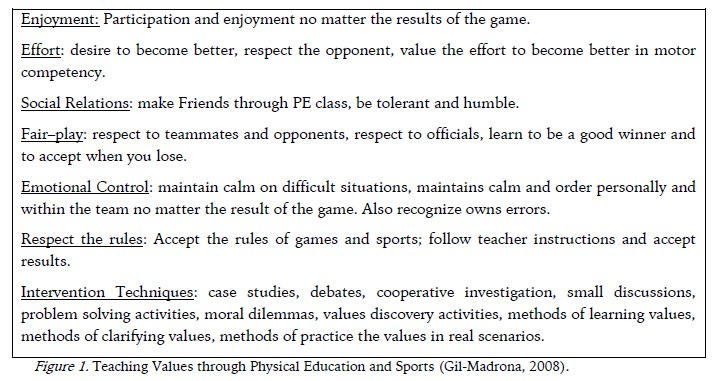
<body><![CDATA[<p><font size="3" face="Verdana"><b>Methods</b></font></p>     <p><font size="3" face="Verdana"><b></b></font><font size="2" face="Verdana"><b>Participants </b>    </font></p> <font size="2" face="Verdana">     <p>Purposeful   sampling resulted in 274 6<sup>th</sup> to 8<sup>th</sup> grade students   including 145 (53%) males and 129 (47%) females between the ages of 11 and 13   years from five urban schools from Albacete Spain. Informed consent was secured   from all five schools, teachers, and parent school council prior to conducting this study. </p> </font>     <p><font size="2" face="Verdana"><b>Intervention and Procedures</b>  </font></p> <font size="2" face="Verdana">    <p><i>Teacher Training</i></p>     <p>Teacher training sessions took place once a week during the time of the   investigation. During these training sessions the principal investigator   prepared the teachers on how to provide the intervention and collect data. For   training purposes, PE teachers recorded students’ behaviors fifteen days   previous to the intervention via observation with an observation form, analyzed   behaviors and come to agreement about scoring criteria. </p> </font>     <p><font size="2" face="Verdana"><i>Intervention</i></font></p>     <p><font size="2" face="Verdana">The intervention consisted of the integration of a set of values and   social skills throughout physical education lessons. This intervention was   based on previous work by Gil-Madrona (2008) related to the development of   values during the physical education class. Intervention and control groups   were randomly selected in each school resulting in 274 students from 6<sup>th</sup>   to 8<sup>th</sup> grade including 145 (53%) males and 129 (47%) females between   the ages of 11 and 13 years. The intervention was implemented to the   experimental group through a period of three months for a total of 24 classes.   The control group remained with their established general PE programed instruction.   The instruction for both groups (intervention and control) in each school was   provided by the same PE teacher. The content of the intervention program focused on the education of values. This program is outlined in <a href="/img/revistas/mot/v12n3/12n3a05f1.jpg">Figure 1</a>.</font></p>     
<p><font size="2" face="Verdana"><b>Data Collection and Instrument Development</b></font></p>     <p><font size="2" face="Verdana">Three likert scale   questionnaires were used (pre and post rating scales) as data collection   instruments for students, teachers and parents. First a questionnaire was   applied to the students so they could record their own   perceptions of their behaviors during the PE class. Also a questionnaire was   given to their parents to measure student behaviors in their family   environment. Further a questionnaire was given to their general classroom   teacher to measure their behaviors outside the physical education classroom in   the school context. All this was done before and after the intervention to   measure the effectiveness of it. </font></p>     ]]></body>
<body><![CDATA[<p><font size="2" face="Verdana">The instruments (likert scale questionnaires) were developed by the   research team based on the work of Rokeach (1973), Lee and Cook (1990), Lee,   Whitehead and Balchin (2000), Escartí (2005), Carranza and Mora (2003),   Marchant and Pérez (2008), and Josephson (2010). Instruments were revised and   content validated by a group of experts from other universities from Spain and the United States. </font></p>     <p><font size="2" face="Verdana">The questionnaire used for the study provided a range of values for each   item between 1 to 5. The content of the items are found in <a href="/img/revistas/mot/v12n3/12n3a05f1.jpg">Figure 1</a>. Evidence   for subscale internal consistency included moderate to very strong values.   Alpha coefficients resulted in values for student self-perceptions (&#945; = .60), parent perceptions about students’ values (&#945; = .56), physical educators’ perceptions of students’ values (&#945; = .82), and regular educators’ perceptions (&#945; = .93) that were varied in magnitude.    Values show that all subscales   resulted in moderate to very strong estimates of reliability for these data.   Specifically, with respect to responses from students and parents, the rating   scales resulted in only moderate alpha coefficients with these values improving somewhat from post test estimates. </font></p>     
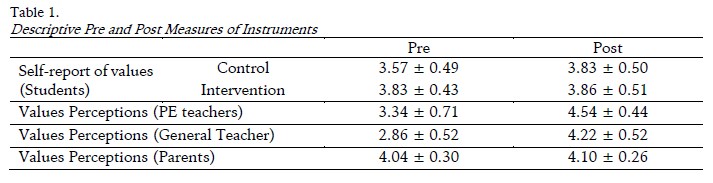
<p><font size="2" face="Verdana"><b>Data Analysis </b>    </font></p> <font size="2" face="Verdana">    <p>Descriptive statistics were calculated for   these data initially. This was followed by an examination of alpha coefficients   to estimate reliability of scales. To examine data further, Pearson correlation   was used to study relationships between sub scales. Further, t tests were used   to make inferences relative to the tested hypotheses. These included   examination of pre and post evaluations for the different considered variables:   students self-reports of values, the perception of students values from the physical   education teacher, the perception of students values from the regular classroom   teacher and the perception of students values from parents. Every specific   values was calculated (fun, fair play, positive social relations, emotional   control, effort and good habits) going from the score averages from each   instrument followed by other four global measurements obtaining final variables used for the analysis. </p>     <p>&nbsp;</p> </font>     <p><font size="3" face="Verdana"><b>Results</b>  </font></p> <font size="2" face="Verdana">    <p>Results   are presented in three different areas: descriptive (<a href="#t1">table 1</a>), correlational   and T test for physical education teachers. <a href="#t1">Table 1</a> descriptive results   demonstrate measures close to 4 to 5, on a scale from 1 to 5. All instrument   measures demonstrate increases from pre to post test in the intervention group.   PE and general teacher perceptions obtained the highest post test scores with 4.54 and 4.22 respectively. </p>     <p><a name="t1"></a></p>     <p>&nbsp;</p>     <p align="center"><img src="/img/revistas/mot/v12n3/12n3a05t1.jpg" width="713" height="183"></p>     
]]></body>
<body><![CDATA[<p>&nbsp;</p>     <p>Correlation   measures estimated relationships between variables. PE teachers and students   with (<i>r </i>= .30, <i>p</i> &lt; .01), PE teacher and general teachers with (<i>r </i>= .51, p &lt; .01), PE teacher and   parents with (<i>r</i>=0.13, p &gt; .01),   general teachers and parents with (<i>r </i>=   .26, <i>p</i> &lt; .01), general teachers   and students with (<i>r </i>= .34, <i>p</i> &lt; .01) and students and parents   with (<i>r </i>= .34, <i>p</i> &lt; .01). </p>     <p>Global   measures of T test were compared (students, physical education teacher, regular   classroom teachers and parents). Results for the control group were not   significant (pre and post test). However, in the intervention group there is a   significant improvement on PE perceptions about students values levels (<i>t</i> =-8.05; <i>p</i> &lt; .01). Meanwhile students perceptions (<i>t</i> = -0.62; <i>p</i> &gt; .05),   regular teacher perceptions (<i>t</i> =   -0.71; <i>p</i> &gt; .05) and parents   perceptions (<i>t </i>= 0.97; <i>p</i> &gt; .05) the intervention was not   significant. </p>     <p>The   perception of physical education teachers had the following significant scores   in the intervention group in relation to the values of enjoyment (<i>t</i> =-7.10; <i>p</i> &lt; .01), fair play (<i>t</i>   = -8.09; <i>p</i> &lt; .01), social relation   (<i>t</i> = -6.48; <i>p</i> &lt; .01), good habits (<i>t</i>   = -7.43; <i>p</i> &lt; .01) y emotional   control <i>(t = -</i>6.03; p &lt; .01<i>).</i> In the control group there was no   significant within group differences on values of enjoyment, fair play, good   habits and social relations. But there are significant differences on the   values of effort (<i>t</i> = 2.86; <i>p</i> &lt; .01) that we can interpreted that   the intervention did had an effect on this results; and emotional control (<i>t</i> = 2.86; <i>p</i> &lt; .01) that can be explained due to the psychological   maturation of the students in both the intervention and control group; but with the intervention this value increase. </p>     <p>&nbsp;</p> </font>     <p><font size="3" face="Verdana"><b>Discussion and Conclusion </b>  </font></p> <font size="2" face="Verdana">    <p>There had been some intervention programs for development of values in   physical activity and sport contexts like (Shields &amp; Bredemeier, 1995;   Weiss &amp; Smith ,2002), «Fair-play for children», (Gibbons, Ebbeck, &amp;   Weiss, 1995; Wandzilak, Caroll, &amp; Ansorrge, 1988); «Development of Life   Abilities» (Danish &amp; Nellen, 1997); «Personal and Social Responsibility»   (Hastie &amp; Buchanan,2000; Hellison,2011); «Moral Development» (Miller,   Bredemeier, &amp; Shields, 1997); and «Sport for Peace» (Ennis et al., 1999), «Fair Play Code of Conduct»   (Siedentop, Hastie &amp; Van der Mars,    2004) «Appropriate Behavior Through Physical Education and Sport Curriculum» (Samalot-Rivera, 2007),among others. </p>     <p>In Spain, every day teachers are implementing programs to develop   “appropriate behaviors” using PE and sport as resources for the development of   those values, moral development and personal and social responsibility (Cecchini,   Fernández-Losa &amp; González, 2008; Gil-Madrona, 2008; Gutiérrez &amp; Vivó, 2002), obtaining positive results. </p>     <p>In the present study that evolve from a holistic evaluation, it is   observed that those groups that intervention is not used (a program on teaching   values and appropriate behavior through physical education) there is not   significant improvements on behaviors. There is no significant difference in   values when comparing pre and posttest scores in any of the four different   instruments. On the other hand, evidence is provided of the effectiveness of   intervention and improvement in social skills for the group that received the   intervention. This results support previous research that demonstrate that   students benefit and improve in their social behaviors during the physical   education class when interventions are implemented (Madrid-Lopez,   Prieto-Ayuso, Samalot-Rivera, &amp; Gil-Madrona, 2016; Saiz-Panadero, Prieto-Ayuso, Gutierrez-Marín, &amp; Gil-Madrona, 2016; Samalot–Rivera &amp; Porretta, 2012; Vidoni &amp; Ward, 2009). </p>     <p>In relation to transfer the learned values in physical education to   other context, this can but students need to be willing to do that (Escartí,   Pacual, &amp; Gutiérrez, 2005; Hellison, 2011; Tomporowski, Davis, Miller, &amp;   Naglieri, 2008; Shehu, 2010). In this study the transfer of learned values and   behaviors for the intervention group is not noticed by parents and general   classroom teacher. The average scores in values between the POST scores are   significantly higher than the average scores for PRE for the intervention group   in all four estimations (with students, with PE teacher, with general teacher   and parents). Changes are generally produced in the PE classes and there is no   transfer of the acquired values to other social context. This mean that general   teacher and parents did not perceived with the same intensity the changes that   the PE teachers reported in their classes. Also support previous findings about   the difficulty of transferring learned appropriate behaviors in PE class to   other context if follow up or collaboration between teachers and parents is not in place (Samalot- Rivera &amp; Porretta, 2012). </p>     ]]></body>
<body><![CDATA[<p>This study also reveals two subscales with encouraging estimates of   reliability to measure social skills development in the school context.  The results of this study confirm results   from other previous studies in terms of the PE perceptions of the values their   students gain through the intervention related to social skills and values,   moral reasoning (Gutierrez &amp; Vivó, 2002; Russell,   2011; Wandislak, Carrol &amp; Ansorge, 1988),   social competences (Danish &amp; Nellen, 1997; Skinner, Zakus, &amp; Cowell,   2008), disruptive behaviors on (Ennis et   al., 1999; Samalot-Rivera, 2007), and social responsibility (Cecchini,   Montero, &amp; Peña, 2003; Escartí, Pacual, &amp; Gutiérrez, 2005; Gil-Madrona, 2003). </p>     <p>The   application of the PE and sport program improved the development of each one of   the variables in the intervention group. However, for the variable of   self-control there were differences in both groups. The explanation for this to   happen also in the control group is basically due to maturity process and part   of the structure provided by the teacher during the PE class. However, better   results were obtained in the intervention group. </p>     <p>In   summary we can conclude that when a social skills and values intervention in   the PE class is implemented, students increase their knowledge about how to   behave increasing positively their overall experience in the PE class. Also   that the behaviors acquired through the PE class intervention can be   transferred to some extent to other environments.  Future research in this topic should focus on   effective ways to increase the generalization of the learned behaviors to other   settings in and outside the school setting. </p> </font>     <p>&nbsp;</p>     <p><font size="3" face="Verdana"><b>REFERENCES</b></font></p>     <!-- ref --><p><font size="2" face="Verdana">Arrufe-Giraldes, V. (2011). La educación en   valores en el aula de Educación Física. ¿Mito o realidad? <i>EmásF. Revista Digital de Educación Física, 9, </i>1- 11.    &nbsp;&nbsp;&nbsp;&nbsp;&nbsp;&nbsp;&nbsp;&nbsp;[&#160;<a href="javascript:void(0);" onclick="javascript: window.open('/scielo.php?script=sci_nlinks&ref=356820&pid=S1646-107X201600030000500001&lng=','','width=640,height=500,resizable=yes,scrollbars=1,menubar=yes,');">Links</a>&#160;]<!-- end-ref --></font></p>     <!-- ref --><p><font size="2" face="Verdana">Bandura, A. (1977). <i>Social learning theory</i>. Englewood Cliffs, N. J.: Prentice Hall.    &nbsp;&nbsp;&nbsp;&nbsp;&nbsp;&nbsp;&nbsp;&nbsp;[&#160;<a href="javascript:void(0);" onclick="javascript: window.open('/scielo.php?script=sci_nlinks&ref=356822&pid=S1646-107X201600030000500002&lng=','','width=640,height=500,resizable=yes,scrollbars=1,menubar=yes,');">Links</a>&#160;]<!-- end-ref --></font></p>     <!-- ref --><p><font size="2" face="Verdana">Carranza, M., &amp; Mora, J. M. (2003). <i>Educación física y valores: Educando en un mundo complejo</i>. Barcelona: Graó.    &nbsp;&nbsp;&nbsp;&nbsp;&nbsp;&nbsp;&nbsp;&nbsp;[&#160;<a href="javascript:void(0);" onclick="javascript: window.open('/scielo.php?script=sci_nlinks&ref=356824&pid=S1646-107X201600030000500003&lng=','','width=640,height=500,resizable=yes,scrollbars=1,menubar=yes,');">Links</a>&#160;]<!-- end-ref --></font></p>     <!-- ref --><p><font size="2" face="Verdana">Cartledge, G., Gardner, R.,   &amp; Ford, D. Y. (2009). <i>Diverse Learners with Exceptionalities: Culturally Responsive Teaching in the Inclusive Classroom</i>. Pearson.    &nbsp;&nbsp;&nbsp;&nbsp;&nbsp;&nbsp;&nbsp;&nbsp;[&#160;<a href="javascript:void(0);" onclick="javascript: window.open('/scielo.php?script=sci_nlinks&ref=356826&pid=S1646-107X201600030000500004&lng=','','width=640,height=500,resizable=yes,scrollbars=1,menubar=yes,');">Links</a>&#160;]<!-- end-ref --></font></p>     <!-- ref --><p><font size="2" face="Verdana">Cartledge,   G., &amp; Milburn, J. F (1995). <i>Teaching     social skills to children and youth: Innovative approaches</i> (3<sup>rd</sup> ed.). Boston: Allyn &amp; Bacon</font>&nbsp;&nbsp;&nbsp;&nbsp;&nbsp;&nbsp;&nbsp;&nbsp;[&#160;<a href="javascript:void(0);" onclick="javascript: window.open('/scielo.php?script=sci_nlinks&ref=356828&pid=S1646-107X201600030000500005&lng=','','width=640,height=500,resizable=yes,scrollbars=1,menubar=yes,');">Links</a>&#160;]<!-- end-ref --><!-- ref --><p><font size="2" face="Verdana">Cecchini-Estrada, J. A., González de Mesa, C., Alonso-González, C.,   Berreal-San Martín, J. M., Fernández-Gutiérrez, C., García-Viejo, M.,   Llaneza-Lobo, R., &amp; Nuño-Iglesias, P. (2009). Repercusiones del Programa   Delfos sobre los niveles de agresividad en el deporte y otros contextos de la vida diaria. <i>Apunts</i>, <i>96</i>, 34-41.    &nbsp;&nbsp;&nbsp;&nbsp;&nbsp;&nbsp;&nbsp;&nbsp;[&#160;<a href="javascript:void(0);" onclick="javascript: window.open('/scielo.php?script=sci_nlinks&ref=356829&pid=S1646-107X201600030000500006&lng=','','width=640,height=500,resizable=yes,scrollbars=1,menubar=yes,');">Links</a>&#160;]<!-- end-ref --></font></p>     <!-- ref --><p><font size="2" face="Verdana">Cecchini-Estrada, J. A., Montero, J., &amp; Peña, V. (2003).   Repercusiones del Programa de Intervención para Desarrollar la Responsabilidad   Personal y Social sobre los comportamientos de fair-play y el auto-control. <i>Psicothema, 15,</i> 631-637.    &nbsp;&nbsp;&nbsp;&nbsp;&nbsp;&nbsp;&nbsp;&nbsp;[&#160;<a href="javascript:void(0);" onclick="javascript: window.open('/scielo.php?script=sci_nlinks&ref=356831&pid=S1646-107X201600030000500007&lng=','','width=640,height=500,resizable=yes,scrollbars=1,menubar=yes,');">Links</a>&#160;]<!-- end-ref --></font></p>     <!-- ref --><p><font size="2" face="Verdana">Cecchini-Estrada, J. A., Fernández- Losa, J., &amp; González, C.   (2008).  Repercusiones del Programa Delfos de educación en valores a través del   deporte en jóvenes escolares. <i>Revista de Educación,     346,</i> 167-186.    &nbsp;&nbsp;&nbsp;&nbsp;&nbsp;&nbsp;&nbsp;&nbsp;[&#160;<a href="javascript:void(0);" onclick="javascript: window.open('/scielo.php?script=sci_nlinks&ref=356833&pid=S1646-107X201600030000500008&lng=','','width=640,height=500,resizable=yes,scrollbars=1,menubar=yes,');">Links</a>&#160;]<!-- end-ref --></font></p>     ]]></body>
<body><![CDATA[<!-- ref --><p><font size="2" face="Verdana">Danish, S., &amp; Nellen, V. C.   (1997). New roles for sport psychologists: Teaching life skills through sport to at-risk youth. <i>Quest,</i> <i>49,</i> 100-113.    &nbsp;&nbsp;&nbsp;&nbsp;&nbsp;&nbsp;&nbsp;&nbsp;[&#160;<a href="javascript:void(0);" onclick="javascript: window.open('/scielo.php?script=sci_nlinks&ref=356835&pid=S1646-107X201600030000500009&lng=','','width=640,height=500,resizable=yes,scrollbars=1,menubar=yes,');">Links</a>&#160;]<!-- end-ref --></font></p>     <!-- ref --><p><font size="2" face="Verdana">Ennis, C. D., Solmon, M. A.,   Satina, B., Loftus, S. J., Mensch, J., &amp; McCauley, M. T. (1999). Creating a   sense of family in urban schools using the Sport for Peace curriculum. <i>Research Quarterly for Exercise and Sport,</i> <i>70,</i> 273-285.    &nbsp;&nbsp;&nbsp;&nbsp;&nbsp;&nbsp;&nbsp;&nbsp;[&#160;<a href="javascript:void(0);" onclick="javascript: window.open('/scielo.php?script=sci_nlinks&ref=356837&pid=S1646-107X201600030000500010&lng=','','width=640,height=500,resizable=yes,scrollbars=1,menubar=yes,');">Links</a>&#160;]<!-- end-ref --></font></p>     <!-- ref --><p><font size="2" face="Verdana">Escartí, A. (2005). <i>Utilización del deporte y la actividad física   como herramienta para enseñar responsabilidad personal y social a niños/as en   edad escolar</i>. Primer Congreso Deporte en edad escolar. Valencia. Adjuntamente de Valencia y Fundación Deportiva Municipal.    &nbsp;&nbsp;&nbsp;&nbsp;&nbsp;&nbsp;&nbsp;&nbsp;[&#160;<a href="javascript:void(0);" onclick="javascript: window.open('/scielo.php?script=sci_nlinks&ref=356839&pid=S1646-107X201600030000500011&lng=','','width=640,height=500,resizable=yes,scrollbars=1,menubar=yes,');">Links</a>&#160;]<!-- end-ref --></font></p>     <!-- ref --><p><font size="2" face="Verdana">Escartí, A., Pacual, C., &amp; Gutiérrez, M. (2005). <i>Responsabilidad   personal y social a través de la educación física y el deporte</i>. Barcelona: Graó.    &nbsp;&nbsp;&nbsp;&nbsp;&nbsp;&nbsp;&nbsp;&nbsp;[&#160;<a href="javascript:void(0);" onclick="javascript: window.open('/scielo.php?script=sci_nlinks&ref=356841&pid=S1646-107X201600030000500012&lng=','','width=640,height=500,resizable=yes,scrollbars=1,menubar=yes,');">Links</a>&#160;]<!-- end-ref --></font></p>     <!-- ref --><p><font size="2" face="Verdana">Gibbons, S. L., Ebbeck, V., &amp; Weis, M. R. (1995). Fair play for kids:   Effects of moral development of children in physical education. <i>Research Quarterly for Exercise and Sport</i>, <i>66</i>, 247-255.    &nbsp;&nbsp;&nbsp;&nbsp;&nbsp;&nbsp;&nbsp;&nbsp;[&#160;<a href="javascript:void(0);" onclick="javascript: window.open('/scielo.php?script=sci_nlinks&ref=356843&pid=S1646-107X201600030000500013&lng=','','width=640,height=500,resizable=yes,scrollbars=1,menubar=yes,');">Links</a>&#160;]<!-- end-ref --></font></p>     ]]></body>
<body><![CDATA[<!-- ref --><p><font size="2" face="Verdana">Gil-Madrona, P. (2003). <i>Diseño y desarrollo curricular en educación física y educación infantil</i>. Sevilla: Wanceulen.    &nbsp;&nbsp;&nbsp;&nbsp;&nbsp;&nbsp;&nbsp;&nbsp;[&#160;<a href="javascript:void(0);" onclick="javascript: window.open('/scielo.php?script=sci_nlinks&ref=356845&pid=S1646-107X201600030000500014&lng=','','width=640,height=500,resizable=yes,scrollbars=1,menubar=yes,');">Links</a>&#160;]<!-- end-ref --></font></p>     <!-- ref --><p><font size="2" face="Verdana">Gil-Madrona, P. (Cord) (2008). <i>La Educación   Física y los deportes: Concreciones prácticas de educación en valores</i> (Ediciones Mágina). Granada: Editorial Octaedro Andalucía.    &nbsp;&nbsp;&nbsp;&nbsp;&nbsp;&nbsp;&nbsp;&nbsp;[&#160;<a href="javascript:void(0);" onclick="javascript: window.open('/scielo.php?script=sci_nlinks&ref=356847&pid=S1646-107X201600030000500015&lng=','','width=640,height=500,resizable=yes,scrollbars=1,menubar=yes,');">Links</a>&#160;]<!-- end-ref --></font></p>     <!-- ref --><p><font size="2" face="Verdana">Gutiérrez, M., &amp; Vivó, P. (2002). Desarrollo sociomoral en Educación Física. <i>VII Congreso AEISAD</i>. Gijón.    &nbsp;&nbsp;&nbsp;&nbsp;&nbsp;&nbsp;&nbsp;&nbsp;[&#160;<a href="javascript:void(0);" onclick="javascript: window.open('/scielo.php?script=sci_nlinks&ref=356849&pid=S1646-107X201600030000500016&lng=','','width=640,height=500,resizable=yes,scrollbars=1,menubar=yes,');">Links</a>&#160;]<!-- end-ref --></font></p>     <!-- ref --><p><font size="2" face="Verdana">Hastie, P.A., &amp; Buchanan,   A.M. (2000). Teaching responsibility through sport education: Prospects of a coalition. <i>Research Quarterly for Exercise and Sport</i>, <i>71,</i> 25-36.    &nbsp;&nbsp;&nbsp;&nbsp;&nbsp;&nbsp;&nbsp;&nbsp;[&#160;<a href="javascript:void(0);" onclick="javascript: window.open('/scielo.php?script=sci_nlinks&ref=356851&pid=S1646-107X201600030000500017&lng=','','width=640,height=500,resizable=yes,scrollbars=1,menubar=yes,');">Links</a>&#160;]<!-- end-ref --></font></p>     <!-- ref --><p><font size="2" face="Verdana">Hellison, D. R. (2011). <i>Teaching personal and social responsibility through physical activity </i>(3<sup>rd</sup> ed.). Champaign, IL: Human Kinetics.    &nbsp;&nbsp;&nbsp;&nbsp;&nbsp;&nbsp;&nbsp;&nbsp;[&#160;<a href="javascript:void(0);" onclick="javascript: window.open('/scielo.php?script=sci_nlinks&ref=356853&pid=S1646-107X201600030000500018&lng=','','width=640,height=500,resizable=yes,scrollbars=1,menubar=yes,');">Links</a>&#160;]<!-- end-ref --></font></p>     ]]></body>
<body><![CDATA[<!-- ref --><p><font size="2" face="Verdana">Josephson, M. (2010). <i>Un estudio sobre los valores en Puerto Rico</i>. Josephson Institute. Recuperado de: <a href="http://josephsoninstitute.org/pdf/report_puerto-rico_values-survey_2010.pdf" target="_blank">http://josephsoninstitute.org/pdf/report_puerto-rico_values-survey_2010.pdf</a></font>&nbsp;&nbsp;&nbsp;&nbsp;&nbsp;&nbsp;&nbsp;&nbsp;[&#160;<a href="javascript:void(0);" onclick="javascript: window.open('/scielo.php?script=sci_nlinks&ref=356855&pid=S1646-107X201600030000500019&lng=','','width=640,height=500,resizable=yes,scrollbars=1,menubar=yes,');">Links</a>&#160;]<!-- end-ref --><!-- ref --><p><font size="2" face="Verdana">Lee, M., &amp; Cook, C. (1990). <i>Review of the literature on fairplay with special reference to children’s   sport. </i>Comunicación presentada al Council of Europe Meeting on Fairplay in Children’s Sport. Paris: Noviembre 1989.    &nbsp;&nbsp;&nbsp;&nbsp;&nbsp;&nbsp;&nbsp;&nbsp;[&#160;<a href="javascript:void(0);" onclick="javascript: window.open('/scielo.php?script=sci_nlinks&ref=356856&pid=S1646-107X201600030000500020&lng=','','width=640,height=500,resizable=yes,scrollbars=1,menubar=yes,');">Links</a>&#160;]<!-- end-ref --></font></p>     <!-- ref --><p><font size="2" face="Verdana">Lee,   M. J., Whitehead, J., &amp; Balchin, N. (2000). The Measurement of Values in   Youth Sport: Development of the Youth Sport Values Questionnaire. <i>Journal of Sport and Exercise Psychology</i>, <i>22</i>(4), 307–326. <a href="https://doi.org/10.1123/jsep.22.4.307" target="_blank">https://doi.org/10.1123/jsep.22.4.307</a></font>&nbsp;&nbsp;&nbsp;&nbsp;&nbsp;&nbsp;&nbsp;&nbsp;[&#160;<a href="javascript:void(0);" onclick="javascript: window.open('/scielo.php?script=sci_nlinks&ref=356858&pid=S1646-107X201600030000500021&lng=','','width=640,height=500,resizable=yes,scrollbars=1,menubar=yes,');">Links</a>&#160;]<!-- end-ref --><!-- ref --><p><font size="2" face="Verdana">Madrid-Lopez,   P., Prieto-Ayuso, A., Samalot-Rivera, A., &amp; Gil-Madrona, P. (2016). An extracurricular proposal for the promotion of appropriate attitudes in physical education and sports. <i>Retos, 30</i>, 36-43.    &nbsp;&nbsp;&nbsp;&nbsp;&nbsp;&nbsp;&nbsp;&nbsp;[&#160;<a href="javascript:void(0);" onclick="javascript: window.open('/scielo.php?script=sci_nlinks&ref=356859&pid=S1646-107X201600030000500022&lng=','','width=640,height=500,resizable=yes,scrollbars=1,menubar=yes,');">Links</a>&#160;]<!-- end-ref --></font></p>     <!-- ref --><p><font size="2" face="Verdana">Marchant, J., &amp; Pérez, A. (2008). <i>Transversalidad y valores en el   desarrollo del currículum y la evaluación. La evaluación de actitudes y   valores. </i>Universidad de Santiago de Chile. Facultad de humanidades. Magister en educación.    &nbsp;&nbsp;&nbsp;&nbsp;&nbsp;&nbsp;&nbsp;&nbsp;[&#160;<a href="javascript:void(0);" onclick="javascript: window.open('/scielo.php?script=sci_nlinks&ref=356861&pid=S1646-107X201600030000500023&lng=','','width=640,height=500,resizable=yes,scrollbars=1,menubar=yes,');">Links</a>&#160;]<!-- end-ref --></font></p>     <!-- ref --><p><font size="2" face="Verdana">Miller, S., Bredemeier, B.,   &amp; Shields, D. (1997). Sociomoral education through physical education with at-risk children. <i>Quest, 49,</i> 114-129.    &nbsp;&nbsp;&nbsp;&nbsp;&nbsp;&nbsp;&nbsp;&nbsp;[&#160;<a href="javascript:void(0);" onclick="javascript: window.open('/scielo.php?script=sci_nlinks&ref=356863&pid=S1646-107X201600030000500024&lng=','','width=640,height=500,resizable=yes,scrollbars=1,menubar=yes,');">Links</a>&#160;]<!-- end-ref --></font></p>     ]]></body>
<body><![CDATA[<!-- ref --><p><font size="2" face="Verdana">Ormrod, J. E. (1999). <i>Human   Learning</i> (3<sup>rd</sup> ed.). Upper Saddle River, N. J.: Merrill Prentice Hall.    &nbsp;&nbsp;&nbsp;&nbsp;&nbsp;&nbsp;&nbsp;&nbsp;[&#160;<a href="javascript:void(0);" onclick="javascript: window.open('/scielo.php?script=sci_nlinks&ref=356865&pid=S1646-107X201600030000500025&lng=','','width=640,height=500,resizable=yes,scrollbars=1,menubar=yes,');">Links</a>&#160;]<!-- end-ref --></font></p>     <!-- ref --><p><font size="2" face="Verdana">Rokeach, M. (1973). <i>The Nature of Human Values</i>. New York: Free Press.    &nbsp;&nbsp;&nbsp;&nbsp;&nbsp;&nbsp;&nbsp;&nbsp;[&#160;<a href="javascript:void(0);" onclick="javascript: window.open('/scielo.php?script=sci_nlinks&ref=356867&pid=S1646-107X201600030000500026&lng=','','width=640,height=500,resizable=yes,scrollbars=1,menubar=yes,');">Links</a>&#160;]<!-- end-ref --></font></p>     <!-- ref --><p><font size="2" face="Verdana">Russel, J. S. (2011). The   Moral Ambiguity of Coaching Youth Sport. Em A. R. Hardman &amp; C. Jones (Eds.), <i>The Ethics of Sports Coaching</i> (pp. 87–103). Oxon: Routledge.    &nbsp;&nbsp;&nbsp;&nbsp;&nbsp;&nbsp;&nbsp;&nbsp;[&#160;<a href="javascript:void(0);" onclick="javascript: window.open('/scielo.php?script=sci_nlinks&ref=356869&pid=S1646-107X201600030000500027&lng=','','width=640,height=500,resizable=yes,scrollbars=1,menubar=yes,');">Links</a>&#160;]<!-- end-ref --></font></p>     <!-- ref --><p><font size="2" face="Verdana">Saiz-Panadero, M.,   Prieto-Ayuso, A., Gutiérrez-Marín, E. C., &amp; Gil-Madrona, P. (2016). Initial evaluation   in 6th grade elementary teaching social skills and intervention approach school   physical education. <i>SporTK: Revista Euroamericana de Ciencias del Deporte, 5</i>(1), 65-74.    &nbsp;&nbsp;&nbsp;&nbsp;&nbsp;&nbsp;&nbsp;&nbsp;[&#160;<a href="javascript:void(0);" onclick="javascript: window.open('/scielo.php?script=sci_nlinks&ref=356871&pid=S1646-107X201600030000500028&lng=','','width=640,height=500,resizable=yes,scrollbars=1,menubar=yes,');">Links</a>&#160;]<!-- end-ref --> </font></p>     <!-- ref --><p><font size="2" face="Verdana">Samalot-Rivera, A., &amp; Porretta, D. L. (2012). The influence of social skills   instruction on sport and game related behaviors of students with emotional or behavioral disorders. <i>Physical Education and Sport Pedagogy, 17,</i> 1-16.    &nbsp;&nbsp;&nbsp;&nbsp;&nbsp;&nbsp;&nbsp;&nbsp;[&#160;<a href="javascript:void(0);" onclick="javascript: window.open('/scielo.php?script=sci_nlinks&ref=356873&pid=S1646-107X201600030000500029&lng=','','width=640,height=500,resizable=yes,scrollbars=1,menubar=yes,');">Links</a>&#160;]<!-- end-ref --></font></p>     ]]></body>
<body><![CDATA[<!-- ref --><p><font size="2" face="Verdana">Samalot-Rivera, A. (2007). <i>The   effects of a social skill instruction on the sport and game related behaviors   of children and adolescents with emotional or behavioral disabilities </i>(Doctoral   Dissertation). The Ohio State University, Columbus, OH.    &nbsp;&nbsp;&nbsp;&nbsp;&nbsp;&nbsp;&nbsp;&nbsp;[&#160;<a href="javascript:void(0);" onclick="javascript: window.open('/scielo.php?script=sci_nlinks&ref=356875&pid=S1646-107X201600030000500030&lng=','','width=640,height=500,resizable=yes,scrollbars=1,menubar=yes,');">Links</a>&#160;]<!-- end-ref --></font></p>     <!-- ref --><p><font size="2" face="Verdana">Samalot-Rivera, A. (2013). Modelos a utilizar   para la enseñanza de valores y destrezas sociales apropiadas en la Educación   Física y el Deporte: una revisión de literatura. <i>EFDeportes, 184</i>. Retrieved   from  <a href="http://www.efdeportes.com/efd184/la-ensenanza-de-valores-y-destrezas-sociales.htm" target="_blank">http://www.efdeportes.com/efd184/la-ensenanza-de-valores-y-destrezas-sociales.htm</a></font>&nbsp;&nbsp;&nbsp;&nbsp;&nbsp;&nbsp;&nbsp;&nbsp;[&#160;<a href="javascript:void(0);" onclick="javascript: window.open('/scielo.php?script=sci_nlinks&ref=356877&pid=S1646-107X201600030000500031&lng=','','width=640,height=500,resizable=yes,scrollbars=1,menubar=yes,');">Links</a>&#160;]<!-- end-ref --><!-- ref --><p><font size="2" face="Verdana">Shehu, J. (2010<i>). </i>Football for Hope Centres in Africa: Intentions,   Assumptions and Gendered Implications. In J. Shehu (Ed.), <i>Gender, Sport and Development in Africa: Cross-Cultural Perspectives on     Patterns of Representation and Marginalization</i> (pp. 135-154). Dakar, SEN: Counsel for the Development of Social Science Research in Africa.    &nbsp;&nbsp;&nbsp;&nbsp;&nbsp;&nbsp;&nbsp;&nbsp;[&#160;<a href="javascript:void(0);" onclick="javascript: window.open('/scielo.php?script=sci_nlinks&ref=356878&pid=S1646-107X201600030000500032&lng=','','width=640,height=500,resizable=yes,scrollbars=1,menubar=yes,');">Links</a>&#160;]<!-- end-ref --> </font></p>     <!-- ref --><p><font size="2" face="Verdana">Shields, D., &amp; Bredemeier,   B. (1995). <i>Character development and physical activity</i>. Champaign, IL: Human Kinetics.    &nbsp;&nbsp;&nbsp;&nbsp;&nbsp;&nbsp;&nbsp;&nbsp;[&#160;<a href="javascript:void(0);" onclick="javascript: window.open('/scielo.php?script=sci_nlinks&ref=356880&pid=S1646-107X201600030000500033&lng=','','width=640,height=500,resizable=yes,scrollbars=1,menubar=yes,');">Links</a>&#160;]<!-- end-ref --></font></p>     <!-- ref --><p><font size="2" face="Verdana">Siedentop, D., Hastie, P.A., &amp; Van der Mars, H. (2004). <i>Complete guide to sport education </i>(2<sup>nd</sup> ed.). Champaign, IL: Human Kinetics.    &nbsp;&nbsp;&nbsp;&nbsp;&nbsp;&nbsp;&nbsp;&nbsp;[&#160;<a href="javascript:void(0);" onclick="javascript: window.open('/scielo.php?script=sci_nlinks&ref=356882&pid=S1646-107X201600030000500034&lng=','','width=640,height=500,resizable=yes,scrollbars=1,menubar=yes,');">Links</a>&#160;]<!-- end-ref --></font></p>     <!-- ref --><p><font size="2" face="Verdana">Skinner, J., Zakus, D., &amp;   Edwards, A. (2008). Coming in From the Margins: Ethnicity, Community Support,   and the Rebranding of Australian Soccer. <i>Soccer and Society, 9</i>(3) 394-404.    &nbsp;&nbsp;&nbsp;&nbsp;&nbsp;&nbsp;&nbsp;&nbsp;[&#160;<a href="javascript:void(0);" onclick="javascript: window.open('/scielo.php?script=sci_nlinks&ref=356884&pid=S1646-107X201600030000500035&lng=','','width=640,height=500,resizable=yes,scrollbars=1,menubar=yes,');">Links</a>&#160;]<!-- end-ref --></font></p>     <!-- ref --><p><font size="2" face="Verdana">Sugden, J. (2006). Teaching and   Playing Sport for Conflict Resolution and Co-existence in Israel.  <i>International Review for the Sociology of Sport, 41</i>(2), 221-240.    &nbsp;&nbsp;&nbsp;&nbsp;&nbsp;&nbsp;&nbsp;&nbsp;[&#160;<a href="javascript:void(0);" onclick="javascript: window.open('/scielo.php?script=sci_nlinks&ref=356886&pid=S1646-107X201600030000500036&lng=','','width=640,height=500,resizable=yes,scrollbars=1,menubar=yes,');">Links</a>&#160;]<!-- end-ref --></font></p>     <!-- ref --><p><font size="2" face="Verdana">Tomporowski, P. D., Davis, C.   L., Miller, P. H., &amp; Naglieri, J. A. (2007). Exercise and Children’s   Intelligence, Cognition, and Academic Achievement. <i>Educational Psychology Review</i>, <i>20</i>(2), 111–131. <a href="https://doi.org/10.1007/s10648-007-9057-0" target="_blank">https://doi.org/10.1007/s10648-007-9057-0</a></font>&nbsp;&nbsp;&nbsp;&nbsp;&nbsp;&nbsp;&nbsp;&nbsp;[&#160;<a href="javascript:void(0);" onclick="javascript: window.open('/scielo.php?script=sci_nlinks&ref=356888&pid=S1646-107X201600030000500037&lng=','','width=640,height=500,resizable=yes,scrollbars=1,menubar=yes,');">Links</a>&#160;]<!-- end-ref --><!-- ref --><p><font size="2" face="Verdana">Torres, C. (2011). Morally   Incompatible? An Analysis of the Relationship between competitive sport and international relations at the Olympic Games. <i>SAIS Review,</i> <i>31</i>(1), 3-16.    &nbsp;&nbsp;&nbsp;&nbsp;&nbsp;&nbsp;&nbsp;&nbsp;[&#160;<a href="javascript:void(0);" onclick="javascript: window.open('/scielo.php?script=sci_nlinks&ref=356889&pid=S1646-107X201600030000500038&lng=','','width=640,height=500,resizable=yes,scrollbars=1,menubar=yes,');">Links</a>&#160;]<!-- end-ref --></font></p>     <!-- ref --><p><font size="2" face="Verdana">Vidoni,   C.,   &amp; Ward, P. (2009). Effects of fair play instruction on student social skills   during a middle school sport education unit. <i>PhysicalEducation &amp; Sport Pedagogy Journal</i>, <i>14</i>(3), 285-310.    &nbsp;&nbsp;&nbsp;&nbsp;&nbsp;&nbsp;&nbsp;&nbsp;[&#160;<a href="javascript:void(0);" onclick="javascript: window.open('/scielo.php?script=sci_nlinks&ref=356891&pid=S1646-107X201600030000500039&lng=','','width=640,height=500,resizable=yes,scrollbars=1,menubar=yes,');">Links</a>&#160;]<!-- end-ref --></font></p>     <!-- ref --><p><font size="2" face="Verdana">Wandzilak, T., Carroll, T.,   &amp; Ansorge, C. J. (1988). Values development through physical activity:   Promoting sportmanlike behaviors, perceptions, and moral reasoning. <i>Journal of Teaching in Physical Education</i>, <i>8</i>(1), 13-22.    &nbsp;&nbsp;&nbsp;&nbsp;&nbsp;&nbsp;&nbsp;&nbsp;[&#160;<a href="javascript:void(0);" onclick="javascript: window.open('/scielo.php?script=sci_nlinks&ref=356893&pid=S1646-107X201600030000500040&lng=','','width=640,height=500,resizable=yes,scrollbars=1,menubar=yes,');">Links</a>&#160;]<!-- end-ref --></font></p>     ]]></body>
<body><![CDATA[<!-- ref --><p><font size="2" face="Verdana">Weiss,   M.R., &amp; Smith, A.L. (2002). Friendship quality in youth sport: Relationship   to age, gender, and motivation variables. <i>Journal of Sport &amp; Exercise Psychology</i>, <i>24, </i>420-437.    &nbsp;&nbsp;&nbsp;&nbsp;&nbsp;&nbsp;&nbsp;&nbsp;[&#160;<a href="javascript:void(0);" onclick="javascript: window.open('/scielo.php?script=sci_nlinks&ref=356895&pid=S1646-107X201600030000500041&lng=','','width=640,height=500,resizable=yes,scrollbars=1,menubar=yes,');">Links</a>&#160;]<!-- end-ref --></font></p>     <p>&nbsp;</p>     <p><font size="2" face="Verdana"><b>Acknowledgments:</b>    <br>   Nothing to declare    <br>   <b>Conflict     of interest:    <br>   </b>Nothing to declare    <br>   <b>Funding:    <br> </b>Nothing to declare</font></p>     <p><font size="2" face="Verdana">Manuscript received at  February 2nd 2015; Accepted at October 19th 2016 </font></p>     ]]></body>
<body><![CDATA[<p>&nbsp;</p>     <p>&nbsp;</p>     <p><font size="2" face="Verdana"><b><sup><a name="end"></a><a href="#topo">*</a></sup></b> <i>Corresponding Author</i>: Faculdad de Educaci&oacute;n de Albacete. Universidad de  Castilla La Mancha. Espa&ntilde;a. <i>E-mail</i>: <a href="mailto:Pedro.Gil@uclm.es">Pedro.Gil@uclm.es</a></font></p>      ]]></body><back>
<ref-list>
<ref id="B1">
<nlm-citation citation-type="journal">
<person-group person-group-type="author">
<name>
<surname><![CDATA[Arrufe-Giraldes]]></surname>
<given-names><![CDATA[V.]]></given-names>
</name>
</person-group>
<article-title xml:lang="es"><![CDATA[La educación en valores en el aula de Educación Física: ¿Mito o realidad?]]></article-title>
<source><![CDATA[EmásF. Revista Digital de Educación Física]]></source>
<year>2011</year>
<volume>9</volume>
<page-range>1- 11</page-range></nlm-citation>
</ref>
<ref id="B2">
<nlm-citation citation-type="book">
<person-group person-group-type="author">
<name>
<surname><![CDATA[Bandura]]></surname>
<given-names><![CDATA[A.]]></given-names>
</name>
</person-group>
<source><![CDATA[Social learning theory]]></source>
<year>1977</year>
<publisher-loc><![CDATA[Englewood Cliffs^eN. J. N. J.]]></publisher-loc>
<publisher-name><![CDATA[Prentice Hall]]></publisher-name>
</nlm-citation>
</ref>
<ref id="B3">
<nlm-citation citation-type="book">
<person-group person-group-type="author">
<name>
<surname><![CDATA[Carranza]]></surname>
<given-names><![CDATA[M.]]></given-names>
</name>
<name>
<surname><![CDATA[Mora]]></surname>
<given-names><![CDATA[J. M.]]></given-names>
</name>
</person-group>
<source><![CDATA[Educación física y valores: Educando en un mundo complejo]]></source>
<year>2003</year>
<publisher-loc><![CDATA[Barcelona ]]></publisher-loc>
<publisher-name><![CDATA[Graó]]></publisher-name>
</nlm-citation>
</ref>
<ref id="B4">
<nlm-citation citation-type="book">
<person-group person-group-type="author">
<name>
<surname><![CDATA[Cartledge]]></surname>
<given-names><![CDATA[G.]]></given-names>
</name>
<name>
<surname><![CDATA[Gardner]]></surname>
<given-names><![CDATA[R.]]></given-names>
</name>
<name>
<surname><![CDATA[Ford]]></surname>
<given-names><![CDATA[D. Y.]]></given-names>
</name>
</person-group>
<source><![CDATA[Diverse Learners with Exceptionalities: Culturally Responsive Teaching in the Inclusive Classroom]]></source>
<year>2009</year>
<publisher-name><![CDATA[Pearson]]></publisher-name>
</nlm-citation>
</ref>
<ref id="B5">
<nlm-citation citation-type="book">
<person-group person-group-type="author">
<name>
<surname><![CDATA[Cartledge]]></surname>
<given-names><![CDATA[G.]]></given-names>
</name>
<name>
<surname><![CDATA[Milburn]]></surname>
<given-names><![CDATA[J. F]]></given-names>
</name>
</person-group>
<source><![CDATA[Teaching social skills to children and youth: Innovative approaches]]></source>
<year>1995</year>
<edition>3</edition>
<publisher-loc><![CDATA[Boston ]]></publisher-loc>
<publisher-name><![CDATA[Allyn & Bacon]]></publisher-name>
</nlm-citation>
</ref>
<ref id="B6">
<nlm-citation citation-type="journal">
<person-group person-group-type="author">
<name>
<surname><![CDATA[Cecchini-Estrada]]></surname>
<given-names><![CDATA[J. A.]]></given-names>
</name>
<name>
<surname><![CDATA[González de Mesa]]></surname>
<given-names><![CDATA[C.]]></given-names>
</name>
<name>
<surname><![CDATA[Alonso-González]]></surname>
<given-names><![CDATA[C.]]></given-names>
</name>
<name>
<surname><![CDATA[Berreal-San Martín]]></surname>
<given-names><![CDATA[J. M.]]></given-names>
</name>
<name>
<surname><![CDATA[Fernández-Gutiérrez]]></surname>
<given-names><![CDATA[C.]]></given-names>
</name>
<name>
<surname><![CDATA[García-Viejo]]></surname>
<given-names><![CDATA[M.]]></given-names>
</name>
<name>
<surname><![CDATA[Llaneza-Lobo]]></surname>
<given-names><![CDATA[R.]]></given-names>
</name>
<name>
<surname><![CDATA[Nuño-Iglesias]]></surname>
<given-names><![CDATA[P.]]></given-names>
</name>
</person-group>
<article-title xml:lang="es"><![CDATA[Repercusiones del Programa Delfos sobre los niveles de agresividad en el deporte y otros contextos de la vida diaria]]></article-title>
<source><![CDATA[Apunts]]></source>
<year>2009</year>
<volume>96</volume>
<page-range>34-41</page-range></nlm-citation>
</ref>
<ref id="B7">
<nlm-citation citation-type="journal">
<person-group person-group-type="author">
<name>
<surname><![CDATA[Cecchini-Estrada]]></surname>
<given-names><![CDATA[J. A.]]></given-names>
</name>
<name>
<surname><![CDATA[Montero]]></surname>
<given-names><![CDATA[J.]]></given-names>
</name>
<name>
<surname><![CDATA[Peña]]></surname>
<given-names><![CDATA[V.]]></given-names>
</name>
</person-group>
<article-title xml:lang="es"><![CDATA[Repercusiones del Programa de Intervención para Desarrollar la Responsabilidad Personal y Social sobre los comportamientos de fair-play y el auto-control]]></article-title>
<source><![CDATA[Psicothema]]></source>
<year>2003</year>
<volume>15</volume>
<page-range>631-637</page-range></nlm-citation>
</ref>
<ref id="B8">
<nlm-citation citation-type="journal">
<person-group person-group-type="author">
<name>
<surname><![CDATA[Cecchini-Estrada]]></surname>
<given-names><![CDATA[J. A.]]></given-names>
</name>
<name>
<surname><![CDATA[Fernández- Losa]]></surname>
<given-names><![CDATA[J.]]></given-names>
</name>
<name>
<surname><![CDATA[González]]></surname>
<given-names><![CDATA[C.]]></given-names>
</name>
</person-group>
<article-title xml:lang="es"><![CDATA[Repercusiones del Programa Delfos de educación en valores a través del deporte en jóvenes escolares]]></article-title>
<source><![CDATA[Revista de Educación]]></source>
<year>2008</year>
<volume>346</volume>
<page-range>167-186</page-range></nlm-citation>
</ref>
<ref id="B9">
<nlm-citation citation-type="journal">
<person-group person-group-type="author">
<name>
<surname><![CDATA[Danish]]></surname>
<given-names><![CDATA[S.]]></given-names>
</name>
<name>
<surname><![CDATA[Nellen]]></surname>
<given-names><![CDATA[V. C.]]></given-names>
</name>
</person-group>
<article-title xml:lang="en"><![CDATA[New roles for sport psychologists: Teaching life skills through sport to at-risk youth]]></article-title>
<source><![CDATA[Quest]]></source>
<year>1997</year>
<volume>49</volume>
<page-range>100-113</page-range></nlm-citation>
</ref>
<ref id="B10">
<nlm-citation citation-type="journal">
<person-group person-group-type="author">
<name>
<surname><![CDATA[Ennis]]></surname>
<given-names><![CDATA[C. D.]]></given-names>
</name>
<name>
<surname><![CDATA[Solmon]]></surname>
<given-names><![CDATA[M. A.]]></given-names>
</name>
<name>
<surname><![CDATA[Satina]]></surname>
<given-names><![CDATA[B.]]></given-names>
</name>
<name>
<surname><![CDATA[Loftus]]></surname>
<given-names><![CDATA[S. J.]]></given-names>
</name>
<name>
<surname><![CDATA[Mensch]]></surname>
<given-names><![CDATA[J.]]></given-names>
</name>
<name>
<surname><![CDATA[McCauley]]></surname>
<given-names><![CDATA[M. T.]]></given-names>
</name>
</person-group>
<article-title xml:lang="en"><![CDATA[Creating a sense of family in urban schools using the Sport for Peace curriculum]]></article-title>
<source><![CDATA[Research Quarterly for Exercise and Sport]]></source>
<year>1999</year>
<volume>70</volume>
<page-range>273-285</page-range></nlm-citation>
</ref>
<ref id="B11">
<nlm-citation citation-type="confpro">
<person-group person-group-type="author">
<name>
<surname><![CDATA[Escartí]]></surname>
<given-names><![CDATA[A.]]></given-names>
</name>
</person-group>
<article-title xml:lang="es"><![CDATA[Utilización del deporte y la actividad física como herramienta para enseñar responsabilidad personal y social a niños/as en edad escolar]]></article-title>
<source><![CDATA[]]></source>
<year>2005</year>
<conf-name><![CDATA[ Primer Congreso Deporte en edad escolar]]></conf-name>
<conf-loc>Valencia </conf-loc>
</nlm-citation>
</ref>
<ref id="B12">
<nlm-citation citation-type="book">
<person-group person-group-type="author">
<name>
<surname><![CDATA[Escartí]]></surname>
<given-names><![CDATA[A.]]></given-names>
</name>
<name>
<surname><![CDATA[Pacual]]></surname>
<given-names><![CDATA[C.]]></given-names>
</name>
<name>
<surname><![CDATA[Gutiérrez]]></surname>
<given-names><![CDATA[M.]]></given-names>
</name>
</person-group>
<source><![CDATA[Responsabilidad personal y social a través de la educación física y el deporte]]></source>
<year>2005</year>
<publisher-loc><![CDATA[Barcelona ]]></publisher-loc>
<publisher-name><![CDATA[Graó]]></publisher-name>
</nlm-citation>
</ref>
<ref id="B13">
<nlm-citation citation-type="journal">
<person-group person-group-type="author">
<name>
<surname><![CDATA[Gibbons]]></surname>
<given-names><![CDATA[S. L.]]></given-names>
</name>
<name>
<surname><![CDATA[Ebbeck]]></surname>
<given-names><![CDATA[V.]]></given-names>
</name>
<name>
<surname><![CDATA[Weis]]></surname>
<given-names><![CDATA[M. R.]]></given-names>
</name>
</person-group>
<article-title xml:lang="en"><![CDATA[Fair play for kids: Effects of moral development of children in physical education]]></article-title>
<source><![CDATA[Research Quarterly for Exercise and Sport]]></source>
<year>1995</year>
<volume>66</volume>
<page-range>247-255</page-range></nlm-citation>
</ref>
<ref id="B14">
<nlm-citation citation-type="book">
<person-group person-group-type="author">
<name>
<surname><![CDATA[Gil-Madrona]]></surname>
<given-names><![CDATA[P.]]></given-names>
</name>
</person-group>
<source><![CDATA[Diseño y desarrollo curricular en educación física y educación infantil]]></source>
<year>2003</year>
<publisher-loc><![CDATA[Sevilla ]]></publisher-loc>
<publisher-name><![CDATA[Wanceulen]]></publisher-name>
</nlm-citation>
</ref>
<ref id="B15">
<nlm-citation citation-type="book">
<person-group person-group-type="author">
<name>
<surname><![CDATA[Gil-Madrona]]></surname>
<given-names><![CDATA[P.]]></given-names>
</name>
</person-group>
<source><![CDATA[La Educación Física y los deportes: Concreciones prácticas de educación en valores]]></source>
<year>2008</year>
<publisher-loc><![CDATA[Granada ]]></publisher-loc>
<publisher-name><![CDATA[Editorial Octaedro Andalucía]]></publisher-name>
</nlm-citation>
</ref>
<ref id="B16">
<nlm-citation citation-type="confpro">
<person-group person-group-type="author">
<name>
<surname><![CDATA[Gutiérrez]]></surname>
<given-names><![CDATA[M.]]></given-names>
</name>
<name>
<surname><![CDATA[Vivó]]></surname>
<given-names><![CDATA[P.]]></given-names>
</name>
</person-group>
<article-title xml:lang="es"><![CDATA[Desarrollo sociomoral en Educación Física]]></article-title>
<source><![CDATA[]]></source>
<year>2002</year>
<conf-name><![CDATA[VII Congreso AEISAD]]></conf-name>
<conf-loc>Gijón </conf-loc>
</nlm-citation>
</ref>
<ref id="B17">
<nlm-citation citation-type="journal">
<person-group person-group-type="author">
<name>
<surname><![CDATA[Hastie]]></surname>
<given-names><![CDATA[P.A.]]></given-names>
</name>
<name>
<surname><![CDATA[Buchanan]]></surname>
<given-names><![CDATA[A.M.]]></given-names>
</name>
</person-group>
<article-title xml:lang="en"><![CDATA[Teaching responsibility through sport education: Prospects of a coalition]]></article-title>
<source><![CDATA[Research Quarterly for Exercise and Sport]]></source>
<year>2000</year>
<volume>71</volume>
<page-range>25-36</page-range></nlm-citation>
</ref>
<ref id="B18">
<nlm-citation citation-type="book">
<person-group person-group-type="author">
<name>
<surname><![CDATA[Hellison]]></surname>
<given-names><![CDATA[D. R.]]></given-names>
</name>
</person-group>
<source><![CDATA[Teaching personal and social responsibility through physical activity]]></source>
<year>2011</year>
<edition>3</edition>
<publisher-loc><![CDATA[Champaign^eIL IL]]></publisher-loc>
<publisher-name><![CDATA[Human Kinetics]]></publisher-name>
</nlm-citation>
</ref>
<ref id="B19">
<nlm-citation citation-type="book">
<person-group person-group-type="author">
<name>
<surname><![CDATA[Josephson]]></surname>
<given-names><![CDATA[M.]]></given-names>
</name>
</person-group>
<source><![CDATA[Un estudio sobre los valores en Puerto Rico]]></source>
<year>2010</year>
<publisher-name><![CDATA[Josephson Institute]]></publisher-name>
</nlm-citation>
</ref>
<ref id="B20">
<nlm-citation citation-type="confpro">
<person-group person-group-type="author">
<name>
<surname><![CDATA[Lee]]></surname>
<given-names><![CDATA[M.]]></given-names>
</name>
<name>
<surname><![CDATA[Cook]]></surname>
<given-names><![CDATA[C.]]></given-names>
</name>
</person-group>
<article-title xml:lang="en"><![CDATA[Review of the literature on fairplay with special reference to children’s sport]]></article-title>
<source><![CDATA[]]></source>
<year>1990</year>
<conf-name><![CDATA[ Council of Europe Meeting on Fairplay in Children’s Sport]]></conf-name>
<conf-date>Noviembre 1989</conf-date>
<conf-loc>Paris </conf-loc>
</nlm-citation>
</ref>
<ref id="B21">
<nlm-citation citation-type="journal">
<person-group person-group-type="author">
<name>
<surname><![CDATA[Lee]]></surname>
<given-names><![CDATA[M. J.]]></given-names>
</name>
<name>
<surname><![CDATA[Whitehead]]></surname>
<given-names><![CDATA[J.]]></given-names>
</name>
<name>
<surname><![CDATA[Balchin]]></surname>
<given-names><![CDATA[N.]]></given-names>
</name>
</person-group>
<article-title xml:lang="en"><![CDATA[The Measurement of Values in Youth Sport: Development of the Youth Sport Values Questionnaire]]></article-title>
<source><![CDATA[Journal of Sport and Exercise Psychology]]></source>
<year>2000</year>
<volume>22</volume>
<numero>4</numero>
<issue>4</issue>
<page-range>307-326</page-range></nlm-citation>
</ref>
<ref id="B22">
<nlm-citation citation-type="journal">
<person-group person-group-type="author">
<name>
<surname><![CDATA[Madrid-Lopez]]></surname>
<given-names><![CDATA[P.]]></given-names>
</name>
<name>
<surname><![CDATA[Prieto-Ayuso]]></surname>
<given-names><![CDATA[A.]]></given-names>
</name>
<name>
<surname><![CDATA[Samalot-Rivera]]></surname>
<given-names><![CDATA[A.]]></given-names>
</name>
<name>
<surname><![CDATA[Gil-Madrona]]></surname>
<given-names><![CDATA[P.]]></given-names>
</name>
</person-group>
<article-title xml:lang="en"><![CDATA[An extracurricular proposal for the promotion of appropriate attitudes in physical education and sports]]></article-title>
<source><![CDATA[Retos]]></source>
<year>2016</year>
<volume>30</volume>
<page-range>36-43</page-range></nlm-citation>
</ref>
<ref id="B23">
<nlm-citation citation-type="">
<person-group person-group-type="author">
<name>
<surname><![CDATA[Marchant]]></surname>
<given-names><![CDATA[J.]]></given-names>
</name>
<name>
<surname><![CDATA[Pérez]]></surname>
<given-names><![CDATA[A.]]></given-names>
</name>
</person-group>
<source><![CDATA[Transversalidad y valores en el desarrollo del currículum y la evaluación: La evaluación de actitudes y valores]]></source>
<year>2008</year>
</nlm-citation>
</ref>
<ref id="B24">
<nlm-citation citation-type="journal">
<person-group person-group-type="author">
<name>
<surname><![CDATA[Miller]]></surname>
<given-names><![CDATA[S.]]></given-names>
</name>
<name>
<surname><![CDATA[Bredemeier]]></surname>
<given-names><![CDATA[B.]]></given-names>
</name>
<name>
<surname><![CDATA[Shields]]></surname>
<given-names><![CDATA[D.]]></given-names>
</name>
</person-group>
<article-title xml:lang="en"><![CDATA[Sociomoral education through physical education with at-risk children]]></article-title>
<source><![CDATA[Quest]]></source>
<year>1997</year>
<volume>49</volume>
<page-range>114-129</page-range></nlm-citation>
</ref>
<ref id="B25">
<nlm-citation citation-type="book">
<person-group person-group-type="author">
<name>
<surname><![CDATA[Ormrod]]></surname>
<given-names><![CDATA[J. E.]]></given-names>
</name>
</person-group>
<source><![CDATA[Human Learning]]></source>
<year>1999</year>
<edition>3</edition>
<publisher-loc><![CDATA[Upper Saddle River^eN. J. N. J.]]></publisher-loc>
<publisher-name><![CDATA[Merrill Prentice Hall]]></publisher-name>
</nlm-citation>
</ref>
<ref id="B26">
<nlm-citation citation-type="book">
<person-group person-group-type="author">
<name>
<surname><![CDATA[Rokeach]]></surname>
<given-names><![CDATA[M.]]></given-names>
</name>
</person-group>
<source><![CDATA[The Nature of Human Values]]></source>
<year>1973</year>
<publisher-loc><![CDATA[New York ]]></publisher-loc>
<publisher-name><![CDATA[Free Press]]></publisher-name>
</nlm-citation>
</ref>
<ref id="B27">
<nlm-citation citation-type="book">
<person-group person-group-type="author">
<name>
<surname><![CDATA[Russel]]></surname>
<given-names><![CDATA[J. S.]]></given-names>
</name>
</person-group>
<article-title xml:lang="en"><![CDATA[The Moral Ambiguity of Coaching Youth Sport]]></article-title>
<person-group person-group-type="editor">
<name>
<surname><![CDATA[Hardman]]></surname>
<given-names><![CDATA[A. R.]]></given-names>
</name>
<name>
<surname><![CDATA[Jones]]></surname>
<given-names><![CDATA[C.]]></given-names>
</name>
</person-group>
<source><![CDATA[The Ethics of Sports Coaching]]></source>
<year>2011</year>
<page-range>87-103</page-range><publisher-loc><![CDATA[Oxon ]]></publisher-loc>
<publisher-name><![CDATA[Routledge]]></publisher-name>
</nlm-citation>
</ref>
<ref id="B28">
<nlm-citation citation-type="journal">
<person-group person-group-type="author">
<name>
<surname><![CDATA[Saiz-Panadero]]></surname>
<given-names><![CDATA[M.]]></given-names>
</name>
<name>
<surname><![CDATA[Prieto-Ayuso]]></surname>
<given-names><![CDATA[A.]]></given-names>
</name>
<name>
<surname><![CDATA[Gutiérrez-Marín]]></surname>
<given-names><![CDATA[E. C.]]></given-names>
</name>
<name>
<surname><![CDATA[Gil-Madrona]]></surname>
<given-names><![CDATA[P.]]></given-names>
</name>
</person-group>
<article-title xml:lang="en"><![CDATA[Initial evaluation in 6th grade elementary teaching social skills and intervention approach school physical education]]></article-title>
<source><![CDATA[SporTK: Revista Euroamericana de Ciencias del Deporte]]></source>
<year>2016</year>
<volume>5</volume>
<numero>1</numero>
<issue>1</issue>
<page-range>65-74</page-range></nlm-citation>
</ref>
<ref id="B29">
<nlm-citation citation-type="journal">
<person-group person-group-type="author">
<name>
<surname><![CDATA[Samalot-Rivera]]></surname>
<given-names><![CDATA[A.]]></given-names>
</name>
<name>
<surname><![CDATA[Porretta]]></surname>
<given-names><![CDATA[D. L.]]></given-names>
</name>
</person-group>
<article-title xml:lang="en"><![CDATA[The influence of social skills instruction on sport and game related behaviors of students with emotional or behavioral disorders]]></article-title>
<source><![CDATA[Physical Education and Sport Pedagogy]]></source>
<year>2012</year>
<volume>17</volume>
<page-range>1-16</page-range></nlm-citation>
</ref>
<ref id="B30">
<nlm-citation citation-type="">
<person-group person-group-type="author">
<name>
<surname><![CDATA[Samalot-Rivera]]></surname>
<given-names><![CDATA[A.]]></given-names>
</name>
</person-group>
<source><![CDATA[The effects of a social skill instruction on the sport and game related behaviors of children and adolescents with emotional or behavioral disabilities]]></source>
<year>2007</year>
</nlm-citation>
</ref>
<ref id="B31">
<nlm-citation citation-type="journal">
<person-group person-group-type="author">
<name>
<surname><![CDATA[Samalot-Rivera]]></surname>
<given-names><![CDATA[A.]]></given-names>
</name>
</person-group>
<article-title xml:lang="es"><![CDATA[Modelos a utilizar para la enseñanza de valores y destrezas sociales apropiadas en la Educación Física y el Deporte: una revisión de literatura]]></article-title>
<source><![CDATA[EFDeportes]]></source>
<year>2013</year>
<volume>184</volume>
</nlm-citation>
</ref>
<ref id="B32">
<nlm-citation citation-type="book">
<person-group person-group-type="author">
<name>
<surname><![CDATA[Shehu]]></surname>
<given-names><![CDATA[J.]]></given-names>
</name>
</person-group>
<article-title xml:lang="en"><![CDATA[Football for Hope Centres in Africa: Intentions, Assumptions and Gendered Implications]]></article-title>
<person-group person-group-type="editor">
<name>
<surname><![CDATA[Shehu]]></surname>
<given-names><![CDATA[J.]]></given-names>
</name>
</person-group>
<source><![CDATA[Gender, Sport and Development in Africa: Cross-Cultural Perspectives on Patterns of Representation and Marginalization]]></source>
<year>2010</year>
<page-range>135-154</page-range><publisher-loc><![CDATA[Dakar ]]></publisher-loc>
<publisher-name><![CDATA[Counsel for the Development of Social Science Research in Africa]]></publisher-name>
</nlm-citation>
</ref>
<ref id="B33">
<nlm-citation citation-type="book">
<person-group person-group-type="author">
<name>
<surname><![CDATA[Shields]]></surname>
<given-names><![CDATA[D.]]></given-names>
</name>
<name>
<surname><![CDATA[Bredemeier]]></surname>
<given-names><![CDATA[B.]]></given-names>
</name>
</person-group>
<source><![CDATA[Character development and physical activity]]></source>
<year>1995</year>
<publisher-loc><![CDATA[Champaign^eIL IL]]></publisher-loc>
<publisher-name><![CDATA[Human Kinetics]]></publisher-name>
</nlm-citation>
</ref>
<ref id="B34">
<nlm-citation citation-type="book">
<person-group person-group-type="author">
<name>
<surname><![CDATA[Siedentop]]></surname>
<given-names><![CDATA[D.]]></given-names>
</name>
<name>
<surname><![CDATA[Hastie]]></surname>
<given-names><![CDATA[P.A.]]></given-names>
</name>
<name>
<surname><![CDATA[Van der Mars]]></surname>
<given-names><![CDATA[H.]]></given-names>
</name>
</person-group>
<source><![CDATA[Complete guide to sport education]]></source>
<year>2004</year>
<edition>2</edition>
<publisher-loc><![CDATA[Champaign^eIL IL]]></publisher-loc>
<publisher-name><![CDATA[Human Kinetics]]></publisher-name>
</nlm-citation>
</ref>
<ref id="B35">
<nlm-citation citation-type="journal">
<person-group person-group-type="author">
<name>
<surname><![CDATA[Skinner]]></surname>
<given-names><![CDATA[J.]]></given-names>
</name>
<name>
<surname><![CDATA[Zakus]]></surname>
<given-names><![CDATA[D.]]></given-names>
</name>
<name>
<surname><![CDATA[Edwards]]></surname>
<given-names><![CDATA[A.]]></given-names>
</name>
</person-group>
<article-title xml:lang="en"><![CDATA[Coming in From the Margins: Ethnicity, Community Support, and the Rebranding of Australian Soccer]]></article-title>
<source><![CDATA[Soccer and Society]]></source>
<year>2008</year>
<volume>9</volume>
<numero>3</numero>
<issue>3</issue>
<page-range>394-404</page-range></nlm-citation>
</ref>
<ref id="B36">
<nlm-citation citation-type="journal">
<person-group person-group-type="author">
<name>
<surname><![CDATA[Sugden]]></surname>
<given-names><![CDATA[J.]]></given-names>
</name>
</person-group>
<article-title xml:lang="en"><![CDATA[Teaching and Playing Sport for Conflict Resolution and Co-existence in Israel]]></article-title>
<source><![CDATA[International Review for the Sociology of Sport]]></source>
<year>2006</year>
<volume>41</volume>
<numero>2</numero>
<issue>2</issue>
<page-range>221-240</page-range></nlm-citation>
</ref>
<ref id="B37">
<nlm-citation citation-type="journal">
<person-group person-group-type="author">
<name>
<surname><![CDATA[Tomporowski]]></surname>
<given-names><![CDATA[P. D.]]></given-names>
</name>
<name>
<surname><![CDATA[Davis]]></surname>
<given-names><![CDATA[C. L.]]></given-names>
</name>
<name>
<surname><![CDATA[Miller]]></surname>
<given-names><![CDATA[P. H.]]></given-names>
</name>
<name>
<surname><![CDATA[Naglieri]]></surname>
<given-names><![CDATA[J. A.]]></given-names>
</name>
</person-group>
<article-title xml:lang="en"><![CDATA[Exercise and Children’s Intelligence, Cognition, and Academic Achievement]]></article-title>
<source><![CDATA[Educational Psychology Review]]></source>
<year>2007</year>
<volume>20</volume>
<numero>2</numero>
<issue>2</issue>
<page-range>111-131</page-range></nlm-citation>
</ref>
<ref id="B38">
<nlm-citation citation-type="journal">
<person-group person-group-type="author">
<name>
<surname><![CDATA[Torres]]></surname>
<given-names><![CDATA[C.]]></given-names>
</name>
</person-group>
<article-title xml:lang="en"><![CDATA[Morally Incompatible?: An Analysis of the Relationship between competitive sport and international relations at the Olympic Games]]></article-title>
<source><![CDATA[SAIS Review]]></source>
<year>2011</year>
<volume>31</volume>
<numero>1</numero>
<issue>1</issue>
<page-range>3-16</page-range></nlm-citation>
</ref>
<ref id="B39">
<nlm-citation citation-type="journal">
<person-group person-group-type="author">
<name>
<surname><![CDATA[Vidoni]]></surname>
<given-names><![CDATA[C.]]></given-names>
</name>
<name>
<surname><![CDATA[Ward]]></surname>
<given-names><![CDATA[P.]]></given-names>
</name>
</person-group>
<article-title xml:lang="en"><![CDATA[Effects of fair play instruction on student social skills during a middle school sport education unit]]></article-title>
<source><![CDATA[PhysicalEducation & Sport Pedagogy Journal]]></source>
<year>2009</year>
<volume>14</volume>
<numero>3</numero>
<issue>3</issue>
<page-range>285-310</page-range></nlm-citation>
</ref>
<ref id="B40">
<nlm-citation citation-type="journal">
<person-group person-group-type="author">
<name>
<surname><![CDATA[Wandzilak]]></surname>
<given-names><![CDATA[T.]]></given-names>
</name>
<name>
<surname><![CDATA[Carroll]]></surname>
<given-names><![CDATA[T.]]></given-names>
</name>
<name>
<surname><![CDATA[Ansorge]]></surname>
<given-names><![CDATA[C. J.]]></given-names>
</name>
</person-group>
<article-title xml:lang="en"><![CDATA[Values development through physical activity: Promoting sportmanlike behaviors, perceptions, and moral reasoning]]></article-title>
<source><![CDATA[Journal of Teaching in Physical Education]]></source>
<year>1988</year>
<volume>8</volume>
<numero>1</numero>
<issue>1</issue>
<page-range>13-22</page-range></nlm-citation>
</ref>
<ref id="B41">
<nlm-citation citation-type="journal">
<person-group person-group-type="author">
<name>
<surname><![CDATA[Weiss]]></surname>
<given-names><![CDATA[M.R.]]></given-names>
</name>
<name>
<surname><![CDATA[Smith]]></surname>
<given-names><![CDATA[A.L.]]></given-names>
</name>
</person-group>
<article-title xml:lang="en"><![CDATA[Friendship quality in youth sport: Relationship to age, gender, and motivation variables]]></article-title>
<source><![CDATA[Journal of Sport & Exercise Psychology]]></source>
<year>2002</year>
<volume>24</volume>
<page-range>420-437</page-range></nlm-citation>
</ref>
</ref-list>
</back>
</article>
