<?xml version="1.0" encoding="ISO-8859-1"?><article xmlns:mml="http://www.w3.org/1998/Math/MathML" xmlns:xlink="http://www.w3.org/1999/xlink" xmlns:xsi="http://www.w3.org/2001/XMLSchema-instance">
<front>
<journal-meta>
<journal-id>1646-107X</journal-id>
<journal-title><![CDATA[Motricidade]]></journal-title>
<abbrev-journal-title><![CDATA[Motri.]]></abbrev-journal-title>
<issn>1646-107X</issn>
<publisher>
<publisher-name><![CDATA[Edições Desafio Singular]]></publisher-name>
</publisher>
</journal-meta>
<article-meta>
<article-id>S1646-107X2016000300009</article-id>
<article-id pub-id-type="doi">10.6063/motricidade.6397</article-id>
<title-group>
<article-title xml:lang="en"><![CDATA[Motor assessment instruments and psychometric procedures: A systematic review]]></article-title>
</title-group>
<contrib-group>
<contrib contrib-type="author">
<name>
<surname><![CDATA[Medeiros]]></surname>
<given-names><![CDATA[Pâmella de]]></given-names>
</name>
<xref ref-type="aff" rid="A01"/>
</contrib>
<contrib contrib-type="author">
<name>
<surname><![CDATA[Zequinão]]></surname>
<given-names><![CDATA[Marcela Almeida]]></given-names>
</name>
<xref ref-type="aff" rid="A02"/>
</contrib>
<contrib contrib-type="author">
<name>
<surname><![CDATA[Fronza]]></surname>
<given-names><![CDATA[Fernanda Cerveira]]></given-names>
</name>
<xref ref-type="aff" rid="A01"/>
</contrib>
<contrib contrib-type="author">
<name>
<surname><![CDATA[Santos]]></surname>
<given-names><![CDATA[João Otacilio Libardoni dos]]></given-names>
</name>
<xref ref-type="aff" rid="A03"/>
</contrib>
<contrib contrib-type="author">
<name>
<surname><![CDATA[Cardoso]]></surname>
<given-names><![CDATA[Fernando Luiz]]></given-names>
</name>
<xref ref-type="aff" rid="A01"/>
</contrib>
</contrib-group>
<aff id="A01">
<institution><![CDATA[,University of the State of Santa Catarina  ]]></institution>
<addr-line><![CDATA[Florianopolis ]]></addr-line>
<country>Brazil</country>
</aff>
<aff id="A02">
<institution><![CDATA[,University of Minho do Minho  ]]></institution>
<addr-line><![CDATA[Braga ]]></addr-line>
<country>Portugal</country>
</aff>
<aff id="A03">
<institution><![CDATA[,Universidade Federal do Amazonas  ]]></institution>
<addr-line><![CDATA[ ]]></addr-line>
</aff>
<pub-date pub-type="pub">
<day>00</day>
<month>09</month>
<year>2016</year>
</pub-date>
<pub-date pub-type="epub">
<day>00</day>
<month>09</month>
<year>2016</year>
</pub-date>
<volume>12</volume>
<numero>3</numero>
<fpage>64</fpage>
<lpage>75</lpage>
<copyright-statement/>
<copyright-year/>
<self-uri xlink:href="http://scielo.pt/scielo.php?script=sci_arttext&amp;pid=S1646-107X2016000300009&amp;lng=en&amp;nrm=iso"></self-uri><self-uri xlink:href="http://scielo.pt/scielo.php?script=sci_abstract&amp;pid=S1646-107X2016000300009&amp;lng=en&amp;nrm=iso"></self-uri><self-uri xlink:href="http://scielo.pt/scielo.php?script=sci_pdf&amp;pid=S1646-107X2016000300009&amp;lng=en&amp;nrm=iso"></self-uri><abstract abstract-type="short" xml:lang="en"><p><![CDATA[It was our objective to identify the psychometric elements to an epistemological reflection through a systematic review of cross-cultural validation procedures of TGMD-2 batteries, MABC-2 and KTK. Searches were carried out by two evaluators independently without year and language restrictions in six databases: Web of Science, Science Direct, Lilacs, Scopus, Pubmed and The ScientificElectronic Library Online - SciELO. The key words used were: "MABC", "TGMD" and "KTK" all of them combined with the word "validity". There was a total of 734 articles, of which, after the exclusion criteria, remained only 11 studies. It was found that there are differences between the authors in relation to the psychometric factors taken into account in cross-cultural validation. So that there was a lack of unanimity of the validation criteria of all studies in this field.]]></p></abstract>
<kwd-group>
<kwd lng="en"><![CDATA[Epistemology]]></kwd>
<kwd lng="en"><![CDATA[Psychometrics]]></kwd>
<kwd lng="en"><![CDATA[Motor Assessment]]></kwd>
</kwd-group>
</article-meta>
</front><body><![CDATA[  <font face="Verdana" size="2">        <p align="right"><b>REVIEW ARTICLE</b></p>     <p>&nbsp;</p> </font>     <p><font size="4" face="Verdana"><b>Motor assessment instruments and   psychometric procedures: A systematic review</b></font> </p> <font face="Verdana" size="2">     <p>&nbsp;</p>     <p>&nbsp;</p>     <p><b>Pâmella de Medeiros<sup>1,</sup></b><b><sup><a name="topo"></a><a href="#end">*</a></sup></b><b>; Marcela Almeida Zequinão<sup>2</sup>; Fernanda Cerveira Fronza<sup>1</sup>; João Otacilio Libardoni dos Santos<sup>3</sup>; Fernando Luiz Cardoso<sup>1</sup></b></p>     <p><i><b><sup>1</sup></b>University  of the State of Santa Catarina, UDESC, Florianopolis, Brazil</i>    <br>   <b><sup>2</sup></b><i>University of Minho do Minho, UM, Braga, Portugal</i>    <br> <b><sup>3</sup></b><i>Universidade Federal do Amazonas - UFAM</i> </p>     ]]></body>
<body><![CDATA[<p>&nbsp;</p>     <p>&nbsp;</p> </font> <hr noshade size="1"> <font face="Verdana" size="2">     <p><b>ABSTRACT</b></p>     <p>It was our objective to identify the   psychometric elements to an epistemological reflection through a systematic   review of cross-cultural validation procedures of TGMD-2 batteries, MABC-2 and   KTK. Searches were carried out by two evaluators independently without year and   language restrictions in six databases: Web of Science, Science Direct, Lilacs,   Scopus, Pubmed and The ScientificElectronic Library Online - SciELO. The key   words used were: &quot;MABC&quot;, &quot;TGMD&quot; and &quot;KTK&quot; all of   them combined with the word &quot;validity&quot;. There was a total of 734   articles, of which, after the exclusion criteria, remained only 11 studies. It   was found that there are differences between the authors in relation to the   psychometric factors taken into account in cross-cultural validation. So that   there was a lack of unanimity of the validation criteria of all studies in this field.</p>     <p><b>Keywords:</b> Epistemology, Psychometrics, Motor Assessment.</p> </font> <hr noshade size="1">     <p>&nbsp;</p>     <p>&nbsp;</p>     <p><font size="3" face="Verdana"><b>Introduction</b></font></p> <font face="Verdana" size="2">     <p>Motor   assessment is an excellent technique for the human development professionals to   identify the aspects regarding which the individuals assessed need further   attention (Payne &amp; Isaacs, 2007). This process is considered as a means to   verify the extent to which the objectives are being reached, identifying   children who need individual attention and reformulating the work through the   adoption of procedures that permit remedying the shortcomings identified in the   motor learning process. Hence, this knowledge on the motor performance provides   relevant information to plan Physical Education and Sports programs, as it   permits the formulation of motor intervention strategies in the programming of   daily routines during pedagogical practice (Krebs, Duarte, Nobre, Nazario, &amp; Libardoni dos Santos, 2011).</p>     <p>Due   to the importance of motor assessment, for diagnostic purposes as well as to   determine intervention strategies, over the years, measures have been   constructed/validated in different countries around the world and have been   used in research to assess the motor performance of children and adolescents   (Henderson, Sugden, &amp; Barnett, 2007; Piek, Gasson, &amp; Barrett, 2002;   Rosa Neto, 2002; Souza, Ferreira, Catuzo, &amp; Correa, 2007; Ulrich, 2000).   Among these motor batteries, the “Test of Gross Motor Development Second   Edition –TGMD-2” (Ulrich, 2000), the “Movement Assessment Battery for Children   – MABC2” (Barnett, Henderson, &amp; Sugden, 2007) and the “Körperkoordinationtest Für Kinder –   KTK” (Kiphard &amp; Schilling, 1974) can be highlighted. Although different   motor batteries exist, ranging from the eldest to the most recent examples, the   above batteries were chosen in function of the large number of studies produced   that have used these tests in recent years. In addition, these instruments tend   to be the most used in research on motor performance in different countries   (Freitas et al., 2016; Liu, Hamilton, &amp; Smith, 2015; Martins, Silva,   Marinho, &amp; Costa, 2015; Rudd et al., 2015), including Brazil (Luz et al.,   2015; Moreira, Magalhães, Dourado, Lemos, &amp; Alves, 2014; Van Keulen, Benda, Ugrinowitsch, Valentini, &amp; Krebs, 2016). </p>     ]]></body>
<body><![CDATA[<p>Although   these tools are widely used to assess the motor performance around the world,   few of them have been validated or adapted to the reality they are applied in.   In addition, it has been observed that validations or cultural adaptations have   not been executed with due psychometric rigor. In that sense, the International   Test Commission (ITC, 2010) highlights that many of the measures used in other   countries do not apply all recommended procedures for validation and adaptation   in other populations. As a result, the batteries diverge on the psychometric   elements used (validity and reliability) (Pasquali, 2010), making the   instrument weaker (Libardoni dos Santos, 2014). That may be so as many researchers   still mix up the conceptual differences between validating and adapting a measure.</p>     <p>When   distinguishing between validation and cross-cultural adaptation, it is verified   that the cross-cultural adaptation simply translates the original or,   exceptionally, compares the translation literally with a back-translation   (Reichenheim &amp; Moraes, 2007). The cross-cultural validation of a tool, on   the other hand, represents the extent to which the instrument can assess what   it intends to and the extent to which this specific test can measure the same   thing in different people who do not belong to the population it was created   for. For this procedure to be valid and reliable, the psychometric procedures suggested in the literature (Pasquali, 2010). </p>     <p>For   the cross-cultural validation of an instrument, some validity and reliability   aspects should be taken into account: 1) content validity – intended to define   the items to be included in the instrument, with a consistent theoretical   framework; 2) construct validity – described based on theoretical concepts and   should be transformed into measurable items; and 3) criterion validity – refers   to the correlation between the scores of one test and other performance   measures (Libardoni dos Santos, 2014; Pasquali, 2010). Concerning the   reliability criteria: 1) test-retest – the instrument is applied twice to the   same group of people with an interval between the applications, verifying the   reliability between the results of the two applications (Sampieri, Collado,   &amp; Lucio, 1996), 2) inter or intra-rater – reproducibility test using more   than one rater (inter) and a single rater (intra) to obtain the repeatability   of the method (Ribeiro, Trombini-Souza, Iunes, &amp; Monte-Rasso, 2006) and 3)   internal consistency – refers to the extent to which the items of a scale are mutually correlated (Sun et al., 2007).</p>     <p>The   lack of convergence in the criteria used to validate the instruments can alter   their essence as, in the creation as well as in the validation, the instrument   should seek cultural clarity, pertinence, reliability and validity (Cicchetti   &amp; Rourke, 2004). A non-reliable assessment inevitably leads to mistaken   interpretations of individual development (Yun &amp; Ulrich, 2002), resulting   in the production of false indicators or failing to detect some kind of   disorder and/or motor impairment (Henderson et al., 2007). Some studies present   different motor performance results when considering the same population   sample, that is, individuals from the same age and the same regions (Berleze,   Haefner, &amp; Valentini, 2007; Souza et al., 2007; Souza, Berleza, &amp;   Valentini, 2008). We speculate that these divergences can be due to the use of   instruments with constructs and dimensions that differ from the conditions they   are applied in, often not demonstrating validity for the reality of the population it is applied in.</p>     <p>The   weakness of the motor batteries concerning the validations and adaptations to   other cultures, in combination with their extensive use all over the world,   indicate a great problem in the field of motor performance and in Physical   Education. These aspects make it difficult to compare results among the   studies, and often end up underestimating or overestimating the performance of   children and adolescents in countries in which no adequate validation was   undertaken. That reality points towards possible interferences and,   consequently, discrepant results, in research as well as in education,   considering that researchers are often unable to establish a point of normality   for the study population, and that interventions by Physical Education teachers can be impaired by assessment that do not express the students’ reality.</p>     <p>Thus,   as the authors are unfamiliar with other studies intended to join further   details on this theme, this review emerged from the need to verify if the   studies are following the appropriate psychometric rigor for the validation,   with a view to improving the quality of new studies, and with a view to   enhancing a discussion among motor performance researchers about possible   solutions to the gaps in the literature. Then, we can demonstrate what   psychometric elements should be followed, granting support for further   validations and even for the construction of new instruments. Thus, the   objective in this study was to confront information from the literature about   the psychometric elements taken into account in the cross-cultural validation   of the TGMD-2, MABC-2 and KTK batteries in different countries, by means of a   systematic review; as well as to elaborate an epistemological reflection on the criteria used to elaborate and validate these instruments.</p>     <p><i>The motor batteries analyzed: TGMD-2, MABC-2, KTK</i></p>     <p>The objective of the TGMD-2   (Ulrich, 2000) is to assess the motor behavior, broad functioning and motor   development level of children between 3 years and 10 years and 11 months of   age. The test consists of multiple fundamental motor skills and assesses how   the children coordinate the trunk and limbs while performing a motor skill,   that is, it analyzes the presence or absence of different skill components   instead of mainly assessing the end product of the performance. The test   assesses 12 basic motor skills, divided in two specific components: locomotion   skills (run, gallop, hop, leap, horizontal jump and slide); and object control   skills (striking a stationary ball, stationary dribble, catch, kick, overhand   throw and underhand roll). Both components have 24 performance criteria each   and, if the child presents the efficiency criterion correctly, (s)he receives   score “1”; if not, (s)he receives “0” in each of the attempts. The child is   scored according to the age and sex for each subtest, determining his/her   development level, qualified as a gross motor quotient, which is classified in   seven categories: “very poor, poor, below average, average, above average, superior and highly superior”.  </p>     <p>The   MABC 2 (Henderson et al., 2007)  is used   to identify motor difficulties in children and adolescents between 3 and 16   years of age, consisting of three sets of tasks appropriate to the specific age   bands: Age band 1 (3 to 6 years); Age band 2 (7 to 10 years), used for analysis   in this study, and Age band 3 (11 to 16 years). The tasks to assess each skill   in the motor test for Age Band 2 (7 to 10 years) include: Manual Dexterity   (placing pegs, threading beads and bicycle trail), Aiming and Catching (aiming   and catching with both hands and catching beanbag), Balance (balancing on the   table, heel to toe walking and jumping on mats). After the application of the   tests, the gross scores are converted into standard scores. The standard scores   are added up in each skills category, resulting in the total score of the motor   components. By adding up the latter, the standard test score or total result is   obtained. Both the standard scores and the total results are compared to a   table of percentiles, which permits ranking the children’s motor performance. A   higher score indicates a higher standard score and, consequently, a higher   percentile. Thus, the component score and the total test score and its respective standard scores and percentiles are directly proportional.</p>     <p>The   KTK (Kiphard &amp; Schilling, 1974) is a homogeneous battery to assess the   bodily coordination capacity intended to examine the basic motor function of   children and adolescents between 6 and 14 years of age. Its components are   balance, rhythm, laterality, speed and agility, distributed in four tasks, all   of which are intended to categorize facets of total body coordination and body   mastery. The tasks include: Keeping balance walking backwards; One-legged   hopping; Jumping from side to side; and Moving sideways. The KTK uses the same   coordination tasks for different ages. Therefore, the contents of the tasks   should add difficulties according to the individuals’ age. The distinction by   age, for example, is achieved according to criteria like: increased height or   distance; increased speed; greater precision in the execution, measured, for   example, in function of the larger number of hits in a certain number of   attempts. The test also permits different types of presentations and discussion   of the results: per task, by adding up the scores on the four tasks and by the motor quotient, calculated by adding up the scores.</p>     ]]></body>
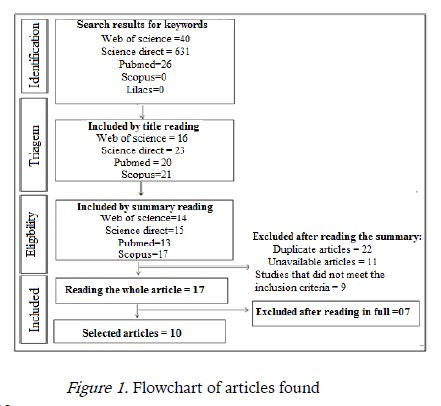
<body><![CDATA[<p>&nbsp;</p> </font>     <p><font size="3" face="Verdana"><b>Method</b></font></p> <font face="Verdana" size="2">     <p>The use of the motor batteries   in different countries stressed the need to confront, by means of a systematic   review, information on the psychometric elements taken into account in the   cross-cultural validation of the TGMD-2, MABC-2 and KTK. Thus, an exploratory   study was undertaken and, in this kind of reviews, the documents studied are   selected through a systematic method, based on the separation per themes and research axes.</p>     <p>To comply with the criteria of   the Prisma Declaration, (Urru´tiaa &amp; Bon&#64257;ll, 2010), two evaluators   independently looked for articles published in English and Portuguese, without   time restrictions, in six databases: Web of Science, Science Direct, Lilacs,   Scopus, Pubmed and The Scientific Electronic Library Online – SciELO. The   keywords used were: “MABC”, “TGMD” and “KTK”, all of which were combined, using   the Boolean operator “and”, with the descriptors “validity” and <i>“validade”.</i> First, the analyses   were based on the titles of the articles, identifying the studies that could   possibly attend to the study objective. Then, the articles were excluded whose   abstracts did not fit. Finally, the full articles were analyzed, using articles   and abstracts that were unavailable, repeated or did not fit the objectives as   an exclusion criterion. The searches were undertaken between September and October 2014.</p>     <p>The inclusion criterion only   considered scientific articles for the cross-cultural validation of the motor   batteries KTK, MABC-2 and TGMD-2, excluding the following from the analysis:   (a) books, book chapters, dissertations and theses; (b) unavailable articles   and abstracts; (c) repeated articles and abstracts; (d) lectures and congress abstracts. </p>     <p>Based on this review, we   elaborated an epistemological reflection on the criteria used to validate these   instruments, with a view to studying the scientific knowledge from a critical   viewpoint, reflecting and discussing on the methods, cultural significance, place, limits and emergence of knowledge (Aranha &amp; Martins, 2003). </p>     <p>&nbsp;</p> </font>     <p><font size="3" face="Verdana"><b>Results</b></font></p> <font face="Verdana" size="2">     <p>In total, 734 articles were found, of which only 10 studies were maintained after the exclusion criteria. <a href="#f1">Figure 1</a>.</p>     <p><a name="f1"></a></p>     ]]></body>
<body><![CDATA[<p>&nbsp;</p>     <p align="center"><img src="/img/revistas/mot/v12n3/12n3a09f1.jpg" width="441" height="406"></p>     
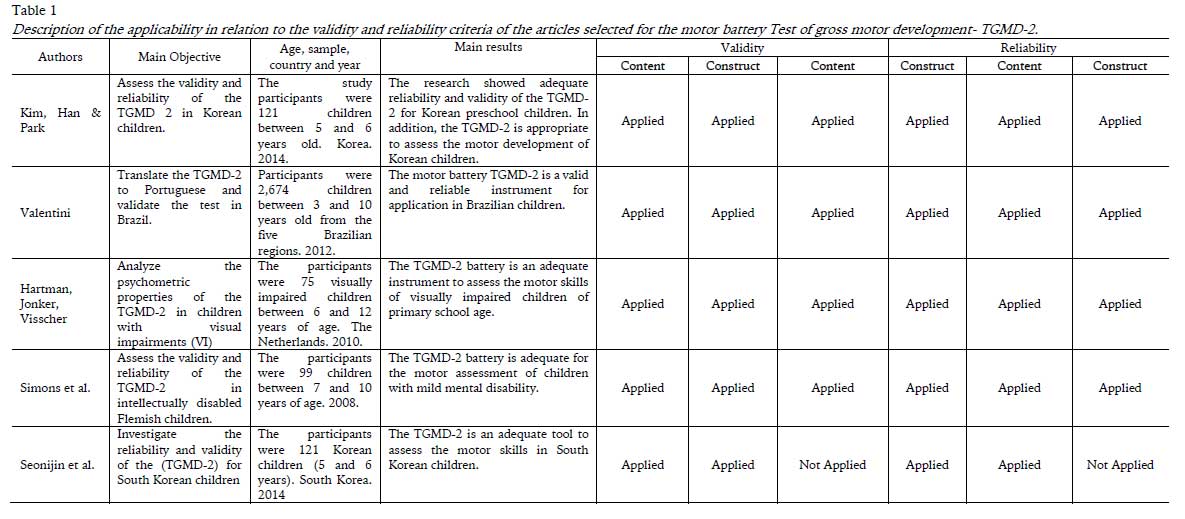
<p>&nbsp;</p>     <p>Five articles were found related to   the motor battery TGMD-2, four of which present all psychometric test elements   in terms of validity and reliability. In two studies, however, the lack of   applicability was observed concerning the criterion validity and the inter/intra-rater reliability (<a href="/img/revistas/mot/v12n3/12n3a09t1.jpg">Table 1</a>).</p>     
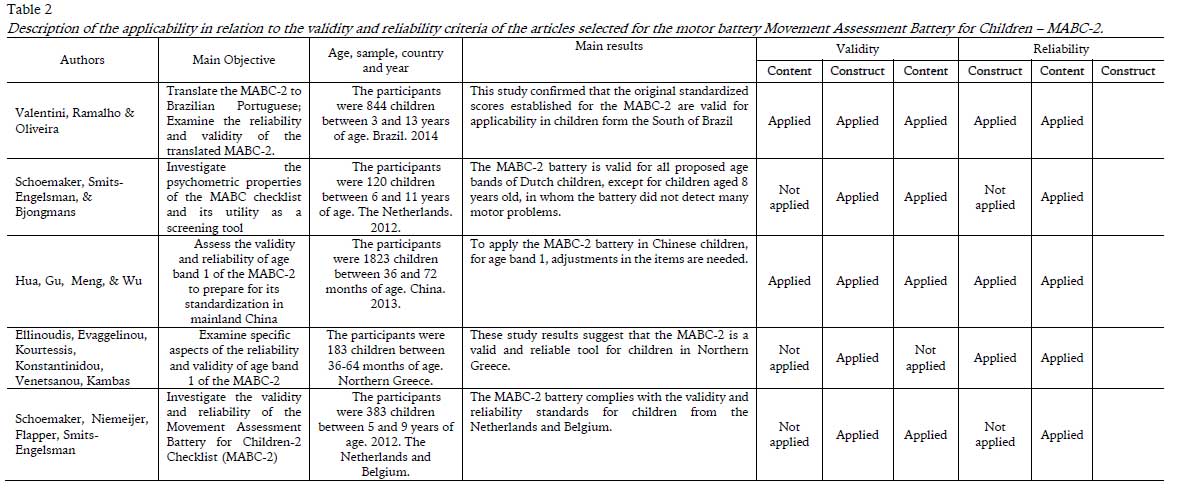
<p>What the MABC-2 battery is concerned,   five studies were selected, only two of which presented all validity and   reliability criteria. As for the remainder, mainly the content validity criterion was lacking (<a href="/img/revistas/mot/v12n3/12n3a09t2.jpg">Table 2</a>).</p>     
<p>Regarding the KTK motor battery, no articles were found with the proper inclusion criteria proposed in this study.</p>     <p>&nbsp;</p> </font>     <p><font size="3" face="Verdana"><b>DISCUSSION</b></font></p> <font face="Verdana" size="2">     <p>The intent in this study was to   confront information from the literature about the psychometric elements taken   into account in the cross-cultural validation of the TGMD-2, MABC-2 and KTK   batteries in different countries, by means of a systematic review; as well as   to elaborate an epistemological reflection on the criteria used in the   elaboration and validation of these tools. According to the research findings,   five cross-cultural validation articles were found for the motor battery   TGMD-2, five for the MABC-2 and none for the KTK. Concerning the main results   of the validation articles identified in this study, they were similar in that   all authors concluded that the motor batteries were valid and reliable in the   selected samples. Only some reservations were found in the studies by   Schoemaker, Smits-Engelsman, and Bjongmans, (2003), in which the MABC-2 battery   did not detect children with motor problems in the age range of eight years in   the Netherlands; and in the study by Hua et al.(2013), in which the authors   highlighted the need for adjustments in the items of the MABC-2 battery for Chinese children in a given age range. </p>     <p>Among the 10 articles selected, 6   presented all validity and reliability criteria analyzed in this study   (Hartman, Jonker, &amp; Visscher, 2010; Hua et al., 2013; Joo &amp; Clark,   2014; Kim, Han, &amp; Park, 2014; Simons et al., 2008; Valentini, 2012). The   other four articles, however, presented incongruences with regard to the   criteria adopted. It was verified that, in the study by Ellinoudis et al.,   (2011) the content analysis for the validity of the battery was not identified.   In Seonijin et al. (2014), the criterion/concurrent/convergent analysis was not   identified for the validity and the inter/intra-rater analysis for the   reliability. In the studies by Schoemaker et al. (2003) and Schoemaker et al.,   (2012) the content analysis for validity and the test-retest and inter/intra-rater analysis were not identified for reliability.</p>     ]]></body>
<body><![CDATA[<p>Hence, it is observed that there is   no unanimity on the use of the recommended criteria (Borsa, Damásio, &amp;   Bandeira, 2012; Pasquali, 2006) for the cross-cultural validation of the   instruments under analysis. These findings are in line with the study by Cools,   de Martelaer, Samaey and Andries (2009), in which the authors developed a study   on the psychometric elements used in the creation of seven motor assessment   instruments and also verified that the authors did not use the same principles or psychometric criteria to validate the batteries.</p>     <p>The adoption of different criteria in   the cross-cultural validations appoints weaknesses of the motor batteries in   certain populations, directly interfering in the results of the scientific   productions. Wright, Sugden, and Tan (1994) highlight that, although   satisfactory results were found in the application of a certain motor battery,   it would need some adjustments to cover particularities of children from other   contexts. That was also verified in the study by Miyahara et al., (1998)   developed in Japan, in which the authors highlighted the need to adequate the   tasks in the test to the experiences of the children in that environment.   Rosblad and Gard (1998) also evidenced differences between the American and   Swedish samples in the performance of the skills tests using ball and balance.   Chow, Henderson, and Barbett, (2001) observed that the performance of children   from Hong Kong was superior to that of American children on the balance and   manual skills tests, attributing these differences to the particularities of   the environment they lived in. In addition, Smits-Engelsman, Henderson, and   Michels (1998) related two motor batteries and found differences in the tests’   capacity, attributing these differences to the particularities of the   environment each test was constructed in. The application of the motor   batteries in different countries faced other difficulties, such as high   asymmetry and social inequality rates, motivational aspects, mechanical and   anthropometric aspects, familiarity or not with a certain motor task and   different meanings the individual attributed to that task (Payne &amp; Isaacs, 2007)</p>     <p>This lack of coherence in the   psychometric procedures or criteria the researchers use in the construction and   validation of the motor assessment instruments makes it difficult to understand   the process as a whole (Libardoni dos Santos, 2014). The International Test   Commission (ITC, 2010) had already highlighted that many of the measures used   in other countries do not follow all recommended procedures for validation in   other populations, proposing guidelines to bridge these divergences. In this   perspective, Cools et al., (2009) highlight that the most fundamental criticism   concerning the validation of motor assessment instruments is that they do not   have the same psychometric quality as the instruments used in other areas, like psychology for example.</p>     <p>Also from a general perspective, when   confronting the psychometric procedures appointed in Pasquali, (2006) with the   psychometric procedures used in the motor area (Pictures 1 and 2), some   weaknesses are common. The motor instruments tend to follow the strict caution   taken with elements like validity and reliability, but do not deepen these   elements as a whole in accordance with psychometric recommendations (Borsa et   al., 2012; Libardoni dos Santos, 2014), mainly when considering validity (<a href="/img/revistas/mot/v12n3/12n3a09t1.jpg">Table 1</a> and <a href="/img/revistas/mot/v12n3/12n3a09t2.jpg">2</a>).</p>     
<p>When analyzing each battery   separately, it could be observed in the articles about the TGMD-2 battery that,   among the five articles found (Picture 2), four presented all psychometric   elements needed to validate and/or adapt a motor assessment instrument (Kim et   al., 2014; Simons et al., 2008; N.C Valentini, 2012). In a study by Seonijin et   al., (2014), however, the lack of applicability was observed with regard to the   criterion validity and inter/intra-rater reliability. The importance of caution   with the lack of testing of these elements is highlighted, as the criterion   validity is intended to verify if the instrument can identify the persons who are truly better at performing a given skill (Viana, 1989).</p>     <p>Hence, the   (predictive or concurrent) criterion validity of a test can suffer the   influence of other factors not associated with the test, which can affect the   magnitude of the validity coefficient. In addition, the lack of criterion   validity does not always reflect the lack of validity, but can indicate the   possibility that the criterion is totally questionable   (Libardoni dos Santos, 2014). As regards the inter/intra-rater reliability, it   is important to highlight that not testing this element can entailing measuring   errors, as it indicates the extent to which the differences in the scores   derive from variations in the characteristic examined and not from casual errors by the raters (Raymundo, 2009).</p>     <p>Concerning the MABC-2 battery, five   studies were selected, only two of which (Hua et al., 2013; Valentini, Ramalho,   &amp; Oliveira, 2014) presented all recommended validity and reliability   criteria (Borsa et al., 2012; Pasquali, 2006). In the remainder, mainly the   content validity criterion was missing. Tritschler (2003) highlights the   importance of content validity, as validity is a fundamental element in the   elaboration of an assessment tool. According to Sim and Arnell, (1993),   validity refers to the relation between the measure and the previously defined   phenomenon (construct), that is, what the instrument intends to measure in a   specific context. Validity is considered as an inherent part not only of the   instrument, but as an attribute of the collection and analysis, that is, of the test as a whole (Morrow, et al., 1995).</p>     <p>Concerning the KTK battery, no   articles were found with the same inclusion criteria as in this study, although   the instrument is frequently used in Brazil. That can be due to the uncommon   validation of this motor assessment instrument in other countries, and even to the unavailable studies in the selected databases.</p>     <p>It is important to highlight that   validations and cross-cultural adaptations are complex tasks that require   planning and rigor (Cassepp-Borges, Balbinotti, &amp; Teodoro, 2010), in which   the validity of the tool needs to be proven in another cultural context (Borsa   et al., 2012). The lack of criterion can produce maladapted instrument with   incoherent or hardly reliable data (Borsa et al., 2012). An assessment instrument that is not valid ends up losing its essence (Cools et al., 2009).</p>     <p>Thus, based on all questions raised,   inquiries emerge on the existing paradigms in Physical Education, and   consequently on the motor behavior that is part of it. These paradigms include   the lack of dialogue, whether between Physical Education and other areas or   among motor behavior researchers themselves. Until the establishment of a   dialogue on the standardization of instrument validations and constructions,   breaking with that paradigm, a long road lies ahead, facing great resistance, which can be called an epistemological obstacle (Bachelard, 1996).</p>     ]]></body>
<body><![CDATA[<p>These obstacles have made it   difficult to improve the instruments used in the area and to reach a consensus   on the psychometric elements that should be used in the validations, resulting   in studies with less reliable data, which are incapable of reflecting the   reality or of being compared and reapplied in different cultures. These   limitations could be overcome in other studies if Physical Education   researchers were willing to dialogue in order to find the best answers together   with the researchers who have been developing similar studies and with more   positive results. This lack of interaction in the area limits the psychometric   knowledge, but also the understanding that the phenomenon can reach beyond the   limited world it was created for. Therefore, its applicability needs to be   understood and verified in other contexts and perhaps further explored by other areas of science.</p>     <p>Similarly, this lack of interaction   among the researchers in the area was clear, in view of the different existing   motor batteries that, overall, aim to assess similar criteria but do not find a   consensus. Therefore, equivalent knowledge needs to be constructed on the   validations of motor instruments, the interactions with the world and among the   researchers (Oliveira &amp; Caminha, 2014), but mainly on the understanding of   their objectives, goals and targets, with a view to a better understanding of the area (Werner, 1998).</p>     <p>These findings indicate that, in recent   years, instead of trying to improve existing tools, the researchers end up   putting forward their truths by creating new instruments. Although these have   been important research tools, they were insufficient to solve the shortages   found in the area. In addition, the continued transmission of this knowledge   without proper questioning is highlighted as, according to Fensterseifer   (2009), the problem is not about “transmitting truths”, but about not revealing   the nature of these truths, that is, assuming and presenting the limitations implicit in these research instruments for example. </p>     <p>Nevertheless, the standardization in   general is going through a profound crisis (Fensterseifer, 2009). That can be   beneficial in this area, considering that, at times of crisis, if the   established values are no longer sustained, there is space to affirm new   values. Hence, the knowledge validation process is open, in which the human   truths assume their precarious status and are always suspected. They only   survive as long as they are “co-validated” by concrete subjects in equally   concrete situations, which would consequently turn the dialogue into an almost compulsory tool in knowledge construction.</p>     <p>&nbsp;</p> </font><font size="3" face="Verdana"><b>Conclusion</b></font> <font face="Verdana" size="2">    <p>Although some studies presented   similar validation criteria, there is no consensus on the use of the   recommended criteria for the cross-cultural validation of the instruments in   question. The authors diverge on the psychometric elements taken into account   in the cross-cultural validations and there was no consensus on the validation   criteria of all studies found. Although there are no regulations among the   researchers in the area, the psychometric elements (validity and reliability)   should be respected as a whole, in the cross-cultural validations as well as in   the creation of motor assessment tools, thus achieving more valid and reliable results.</p>     <p>As study limitations, we highlight   the sole use of articles published in English and Portuguese, which may have   resulted in the exclusion of other articles about the theme that were published   in other languages. The same limitation extends to the databases used, so that   these results cannot be generalized to all publications in other databases.   Finally, it is highlighted that some articles were not considered in the   analysis because they were not accessible to the authors, which may have limited the interpretation of the results.</p>     <p>&nbsp;</p> </font>     <p><font size="3" face="Verdana"><b>REFERENCES</b></font></p> <font face="Verdana" size="2">     <!-- ref --><p>Aranha,   M. L. d. A., &amp; Martins, M. H. P. (2003).<i>   Filosofando: introdução à filosofia</i> (Vol. 3). São Paulo: Moderna.    &nbsp;&nbsp;&nbsp;&nbsp;&nbsp;&nbsp;&nbsp;&nbsp;[&#160;<a href="javascript:void(0);" onclick="javascript: window.open('/scielo.php?script=sci_nlinks&ref=357531&pid=S1646-107X201600030000900001&lng=','','width=640,height=500,resizable=yes,scrollbars=1,menubar=yes,');">Links</a>&#160;]<!-- end-ref --></p>     <!-- ref --><p>Bachelard,   G. (1996). <i>A formação do espirito     científico: contribuição para uma psicanálise do conhecimento. </i>Rio de Janeiro: Contraponto.    &nbsp;&nbsp;&nbsp;&nbsp;&nbsp;&nbsp;&nbsp;&nbsp;[&#160;<a href="javascript:void(0);" onclick="javascript: window.open('/scielo.php?script=sci_nlinks&ref=357533&pid=S1646-107X201600030000900002&lng=','','width=640,height=500,resizable=yes,scrollbars=1,menubar=yes,');">Links</a>&#160;]<!-- end-ref --></p>     <!-- ref --><p>Barnett, A., Henderson, S., &amp; Sugden, D. (2007). <i>Movement Assessment   Battery for Children – MABC2. </i>London: Psicological Corporation.    &nbsp;&nbsp;&nbsp;&nbsp;&nbsp;&nbsp;&nbsp;&nbsp;[&#160;<a href="javascript:void(0);" onclick="javascript: window.open('/scielo.php?script=sci_nlinks&ref=357535&pid=S1646-107X201600030000900003&lng=','','width=640,height=500,resizable=yes,scrollbars=1,menubar=yes,');">Links</a>&#160;]<!-- end-ref --></p>     <!-- ref --><p>Berleze,   A., Haefner, L. S. B., &amp; Valentini, N. C. (2007). Desempenho motor de   crianças obesas: uma investigação do processo e produto de habilidades motoras   fundamentais. <i>Revista Brasileira de Cineantropometria e desempenho Humano, 9</i>(2), 134-144.    &nbsp;&nbsp;&nbsp;&nbsp;&nbsp;&nbsp;&nbsp;&nbsp;[&#160;<a href="javascript:void(0);" onclick="javascript: window.open('/scielo.php?script=sci_nlinks&ref=357537&pid=S1646-107X201600030000900004&lng=','','width=640,height=500,resizable=yes,scrollbars=1,menubar=yes,');">Links</a>&#160;]<!-- end-ref --> </p>     <!-- ref --><p>Borsa,   J. C., Damásio, B. F., &amp; Bandeira, D. R. (2012). Adaptação e Validação de Instrumentos Psicológicos entre Culturas: Algumas Consideraçõe. <i>Paidéia, 22</i>(53), 423-432.    &nbsp;&nbsp;&nbsp;&nbsp;&nbsp;&nbsp;&nbsp;&nbsp;[&#160;<a href="javascript:void(0);" onclick="javascript: window.open('/scielo.php?script=sci_nlinks&ref=357539&pid=S1646-107X201600030000900005&lng=','','width=640,height=500,resizable=yes,scrollbars=1,menubar=yes,');">Links</a>&#160;]<!-- end-ref --> </p>     <!-- ref --><p>Cassepp-Borges,   V., Balbinotti, M. A. A., &amp; Teodoro, M. L. M. (2010). <i>Tradução e validação de conteúdo: Uma proposta para a adaptação de     instrumentos. In L. Pasquali (Org.), Instrumentação psicológica: Fundamentos e prática</i>. Porto Alegre: Artmed.    &nbsp;&nbsp;&nbsp;&nbsp;&nbsp;&nbsp;&nbsp;&nbsp;[&#160;<a href="javascript:void(0);" onclick="javascript: window.open('/scielo.php?script=sci_nlinks&ref=357541&pid=S1646-107X201600030000900006&lng=','','width=640,height=500,resizable=yes,scrollbars=1,menubar=yes,');">Links</a>&#160;]<!-- end-ref --></p>     <!-- ref --><p>Chow, S. M. K., Henderson, S. E., &amp; Barnett, A. L.   (2001). The movement assessment battery for children: a comparison of   4-year-old to 6-year-old children from Hong Kong and de United States.<i> The American Journal of Occupational Therapy 55</i>, 55-61.    &nbsp;&nbsp;&nbsp;&nbsp;&nbsp;&nbsp;&nbsp;&nbsp;[&#160;<a href="javascript:void(0);" onclick="javascript: window.open('/scielo.php?script=sci_nlinks&ref=357543&pid=S1646-107X201600030000900007&lng=','','width=640,height=500,resizable=yes,scrollbars=1,menubar=yes,');">Links</a>&#160;]<!-- end-ref --> </p>     <!-- ref --><p>Cicchetti, D. V., &amp; Rourke, B. P. (2004). <i>Methodological and biostatistical   foundations of clinical neuropsychology and medical and health disciplines</i>: CRC Press.    &nbsp;&nbsp;&nbsp;&nbsp;&nbsp;&nbsp;&nbsp;&nbsp;[&#160;<a href="javascript:void(0);" onclick="javascript: window.open('/scielo.php?script=sci_nlinks&ref=357545&pid=S1646-107X201600030000900008&lng=','','width=640,height=500,resizable=yes,scrollbars=1,menubar=yes,');">Links</a>&#160;]<!-- end-ref --></p>     <!-- ref --><p>Cools, W., De Martelaer, K., Samaey, C., &amp;   Andries, C. (2009). Movement skill assessment of typically developing preschool   children: A review of seven movement skill assessment tools. <i>Journal of Sports Science and Medicine, 8</i>, 154-168.    &nbsp;&nbsp;&nbsp;&nbsp;&nbsp;&nbsp;&nbsp;&nbsp;[&#160;<a href="javascript:void(0);" onclick="javascript: window.open('/scielo.php?script=sci_nlinks&ref=357547&pid=S1646-107X201600030000900009&lng=','','width=640,height=500,resizable=yes,scrollbars=1,menubar=yes,');">Links</a>&#160;]<!-- end-ref --> </p>     <!-- ref --><p>Ellinoudis, T., Evaggelinou, C., Kourtessis, T.,   Konstantinidou, Z., Venetsanou, F., &amp; Kambas, A. (2011). Reliability and   validity of age band 1 of the Movement Assessment Battery for Children - Second   Edition. <i>Research in Developmental Disabilities, 32</i>(3), 1046-1051. doi:10.1016/j.ridd.2011.01.035&nbsp;&nbsp;&nbsp;&nbsp;&nbsp;&nbsp;&nbsp;&nbsp;[&#160;<a href="javascript:void(0);" onclick="javascript: window.open('/scielo.php?script=sci_nlinks&ref=357549&pid=S1646-107X201600030000900010&lng=','','width=640,height=500,resizable=yes,scrollbars=1,menubar=yes,');">Links</a>&#160;]<!-- end-ref --><!-- ref --><p>Fensterseifer, P. V. (2009). Epistemologia   pratica e pedagógica. <i>Rev. Bras. Cienc. Esporte, 30</i>(3), 203-214.    &nbsp;&nbsp;&nbsp;&nbsp;&nbsp;&nbsp;&nbsp;&nbsp;[&#160;<a href="javascript:void(0);" onclick="javascript: window.open('/scielo.php?script=sci_nlinks&ref=357550&pid=S1646-107X201600030000900011&lng=','','width=640,height=500,resizable=yes,scrollbars=1,menubar=yes,');">Links</a>&#160;]<!-- end-ref --> </p>     ]]></body>
<body><![CDATA[<!-- ref --><p>Freitas,   D. L., Lausen, B., Maia, J. A., Gouveia, E. R., Thomis, M., Lefevre, J.,   Malina, R. M. (2016). Skeletal   Maturation, body size, and motor coordination in youth 11-14 years. <i>Medicine &amp; Science in Sports &amp; Exercise, 48(6), 1129-1135</i>&nbsp;&nbsp;&nbsp;&nbsp;&nbsp;&nbsp;&nbsp;&nbsp;[&#160;<a href="javascript:void(0);" onclick="javascript: window.open('/scielo.php?script=sci_nlinks&ref=357552&pid=S1646-107X201600030000900012&lng=','','width=640,height=500,resizable=yes,scrollbars=1,menubar=yes,');">Links</a>&#160;]<!-- end-ref --><!-- ref --><p>Hartman, E., Jonker, L., &amp; Visscher, C. (2010).   Reliability and validity of the TGMD-2 in primary-school-age children with   visual impairments. <i>Adapted Physical Activity Quarterly, 27</i>(2), 143-159&nbsp;&nbsp;&nbsp;&nbsp;&nbsp;&nbsp;&nbsp;&nbsp;[&#160;<a href="javascript:void(0);" onclick="javascript: window.open('/scielo.php?script=sci_nlinks&ref=357553&pid=S1646-107X201600030000900013&lng=','','width=640,height=500,resizable=yes,scrollbars=1,menubar=yes,');">Links</a>&#160;]<!-- end-ref --><!-- ref --><p>Henderson, S. E., Sugden, D. A., &amp; Barnett, A. L.   (2007). <i>Movement Assessment Battery for children – 2 Examiner’s Manual</i>. London: Harcourt Assessment,    &nbsp;&nbsp;&nbsp;&nbsp;&nbsp;&nbsp;&nbsp;&nbsp;[&#160;<a href="javascript:void(0);" onclick="javascript: window.open('/scielo.php?script=sci_nlinks&ref=357554&pid=S1646-107X201600030000900014&lng=','','width=640,height=500,resizable=yes,scrollbars=1,menubar=yes,');">Links</a>&#160;]<!-- end-ref -->.</p>     <!-- ref --><p>Hua, J., Gu, G., Meng, W., &amp; Wu, Z. (2013). Age   band 1 of the Movement Assessment Battery for Children-Second Edition:   Exploring its usefulness in mainland China. <i>Research     in Developmental Disabilities, 34</i>(2), 801-808. doi:10.1016/j.ridd.2012.10.012&nbsp;&nbsp;&nbsp;&nbsp;&nbsp;&nbsp;&nbsp;&nbsp;[&#160;<a href="javascript:void(0);" onclick="javascript: window.open('/scielo.php?script=sci_nlinks&ref=357556&pid=S1646-107X201600030000900015&lng=','','width=640,height=500,resizable=yes,scrollbars=1,menubar=yes,');">Links</a>&#160;]<!-- end-ref --><!-- ref --><p>Joo, K. &amp; Clark, J. E. (2014). Validity and   Reliability of the TGMD-2 for South Korean Children. <i>Journal of Motor Behavior, 46</i>(5), 351-356.    &nbsp;&nbsp;&nbsp;&nbsp;&nbsp;&nbsp;&nbsp;&nbsp;[&#160;<a href="javascript:void(0);" onclick="javascript: window.open('/scielo.php?script=sci_nlinks&ref=357557&pid=S1646-107X201600030000900016&lng=','','width=640,height=500,resizable=yes,scrollbars=1,menubar=yes,');">Links</a>&#160;]<!-- end-ref --> </p>     <!-- ref --><p>Kim, C. L., Han, W. H., &amp; Park, H. (2014).   Reliability and Validity of the Test of Gross Motor Development-II in Korean   Preschool Children: Applying AHP. <i>Research in Developmental Disabilities, 35</i>(4), 800-807.    &nbsp;&nbsp;&nbsp;&nbsp;&nbsp;&nbsp;&nbsp;&nbsp;[&#160;<a href="javascript:void(0);" onclick="javascript: window.open('/scielo.php?script=sci_nlinks&ref=357559&pid=S1646-107X201600030000900017&lng=','','width=640,height=500,resizable=yes,scrollbars=1,menubar=yes,');">Links</a>&#160;]<!-- end-ref --> </p>     <!-- ref --><p>Kiphard, E. J., &amp; Schilling, V. F. (1974).<i> Köper-koordinations-test für Kinder – KTK,   Beltz Test.</i> Weinhein: Gmbh.    &nbsp;&nbsp;&nbsp;&nbsp;&nbsp;&nbsp;&nbsp;&nbsp;[&#160;<a href="javascript:void(0);" onclick="javascript: window.open('/scielo.php?script=sci_nlinks&ref=357561&pid=S1646-107X201600030000900018&lng=','','width=640,height=500,resizable=yes,scrollbars=1,menubar=yes,');">Links</a>&#160;]<!-- end-ref --></p>     <!-- ref --><p>Krebs,   R. J., Duarte, M. G., Nobre, G. C., Nazario, P. F., &amp; Libardoni dos Santos,   J. O. (2011). Relação entre escores de desempenho motor e aptidão física em   crianças com idades entre 07 e 08 anos. <i>Revista Brasileira de Cineantropometria e Desempenho Humano, 13(2), 94-99.    &nbsp;&nbsp;&nbsp;&nbsp;&nbsp;&nbsp;&nbsp;&nbsp;[&#160;<a href="javascript:void(0);" onclick="javascript: window.open('/scielo.php?script=sci_nlinks&ref=357563&pid=S1646-107X201600030000900019&lng=','','width=640,height=500,resizable=yes,scrollbars=1,menubar=yes,');">Links</a>&#160;]<!-- end-ref --></i></p>     <!-- ref --><p>Libardoni   dos Santos, J. O. (2014). <i>Aspectos da     validade de conteúdo e construto de tarefas motoras</i> (Dissertação de Doutorado). Universidade do Estado de Santa Catarina, Florianópolis.    &nbsp;&nbsp;&nbsp;&nbsp;&nbsp;&nbsp;&nbsp;&nbsp;[&#160;<a href="javascript:void(0);" onclick="javascript: window.open('/scielo.php?script=sci_nlinks&ref=357565&pid=S1646-107X201600030000900020&lng=','','width=640,height=500,resizable=yes,scrollbars=1,menubar=yes,');">Links</a>&#160;]<!-- end-ref --> </p>     <!-- ref --><p>Liu, T., Hamilton, M., &amp; Smith, S. (2015). Motor proficiency of the Head Start and typically   developing children on MABC-2. <i>Journal of     Child and Adolescent Behaviour</i>, <i>3</i>(2), 1-4.    &nbsp;&nbsp;&nbsp;&nbsp;&nbsp;&nbsp;&nbsp;&nbsp;[&#160;<a href="javascript:void(0);" onclick="javascript: window.open('/scielo.php?script=sci_nlinks&ref=357567&pid=S1646-107X201600030000900021&lng=','','width=640,height=500,resizable=yes,scrollbars=1,menubar=yes,');">Links</a>&#160;]<!-- end-ref --></p>     <!-- ref --><p>Luz, O. G. L., Seabra, A. F. T., Santos, R., Padez,   C., Ferreira, J. P., &amp; Silva, M. J. C. (2015). Associação entre   IMC e teste de coordenação corporal para crianças (KTK). Uma meta-análise. <i>Revista brasileira de medicina do esporte, 21</i>(3), 230-235.    &nbsp;&nbsp;&nbsp;&nbsp;&nbsp;&nbsp;&nbsp;&nbsp;[&#160;<a href="javascript:void(0);" onclick="javascript: window.open('/scielo.php?script=sci_nlinks&ref=357569&pid=S1646-107X201600030000900022&lng=','','width=640,height=500,resizable=yes,scrollbars=1,menubar=yes,');">Links</a>&#160;]<!-- end-ref --></p>     <!-- ref --><p>Martins,   V., Silva, A. J., Marinho, D. A., &amp; Costa, A. M. (2015). Desenvolvimento   motor global de crianças do 1° ciclo do ensino básico com e sem prática prévia de natação em contexto escolar. <i>Motricidade, 11</i>(1), 87-97.    &nbsp;&nbsp;&nbsp;&nbsp;&nbsp;&nbsp;&nbsp;&nbsp;[&#160;<a href="javascript:void(0);" onclick="javascript: window.open('/scielo.php?script=sci_nlinks&ref=357571&pid=S1646-107X201600030000900023&lng=','','width=640,height=500,resizable=yes,scrollbars=1,menubar=yes,');">Links</a>&#160;]<!-- end-ref --> </p>     <!-- ref --><p>Miyahara, M., Tsujii, M., Hanai, T., Jongmans, M.,   Barnett, A., Henderson, S. E., &amp; Kageyama, H. (1998). The movement   Assessment Battery for Children: A preliminary investigation of its usefulness   in Japan. <i>Human Moviment     Science, 17</i>(4), 679-679.    &nbsp;&nbsp;&nbsp;&nbsp;&nbsp;&nbsp;&nbsp;&nbsp;[&#160;<a href="javascript:void(0);" onclick="javascript: window.open('/scielo.php?script=sci_nlinks&ref=357573&pid=S1646-107X201600030000900024&lng=','','width=640,height=500,resizable=yes,scrollbars=1,menubar=yes,');">Links</a>&#160;]<!-- end-ref --> </p>     <!-- ref --><p>Moreira,   R. S., Magalhães, L. C., Dourado, J. S., Lemos, S. M., &amp; Alves, C. R.   (2014). Factors influencing the motor development of   prematurely born school-aged children in Brazil. <i>Research Development Disabilities, 35</i>(9), 1941-1951.    &nbsp;&nbsp;&nbsp;&nbsp;&nbsp;&nbsp;&nbsp;&nbsp;[&#160;<a href="javascript:void(0);" onclick="javascript: window.open('/scielo.php?script=sci_nlinks&ref=357575&pid=S1646-107X201600030000900025&lng=','','width=640,height=500,resizable=yes,scrollbars=1,menubar=yes,');">Links</a>&#160;]<!-- end-ref --> </p>     <!-- ref --><p>Oliveira,   G. M., &amp; Caminha, O. I. (2014). Epistemologia genética e educação física:   algumas implicações pedagógicas. <i>Revista Brasileira de Psicologia Escolar e Educacional, 18</i>(1), 57-65.    &nbsp;&nbsp;&nbsp;&nbsp;&nbsp;&nbsp;&nbsp;&nbsp;[&#160;<a href="javascript:void(0);" onclick="javascript: window.open('/scielo.php?script=sci_nlinks&ref=357577&pid=S1646-107X201600030000900026&lng=','','width=640,height=500,resizable=yes,scrollbars=1,menubar=yes,');">Links</a>&#160;]<!-- end-ref --> </p>     <!-- ref --><p>Pasquali,   L. (2006). <i>Técnicas de Exame Psicológico: manual</i> (Vol. 2). São Paulo: Caso do Psicólogo.    &nbsp;&nbsp;&nbsp;&nbsp;&nbsp;&nbsp;&nbsp;&nbsp;[&#160;<a href="javascript:void(0);" onclick="javascript: window.open('/scielo.php?script=sci_nlinks&ref=357579&pid=S1646-107X201600030000900027&lng=','','width=640,height=500,resizable=yes,scrollbars=1,menubar=yes,');">Links</a>&#160;]<!-- end-ref --></p>     <!-- ref --><p>Pasquali,   L. (2010). <i>Instrumentação Psicológica</i>. Porto Alegre: Artmed.    &nbsp;&nbsp;&nbsp;&nbsp;&nbsp;&nbsp;&nbsp;&nbsp;[&#160;<a href="javascript:void(0);" onclick="javascript: window.open('/scielo.php?script=sci_nlinks&ref=357581&pid=S1646-107X201600030000900028&lng=','','width=640,height=500,resizable=yes,scrollbars=1,menubar=yes,');">Links</a>&#160;]<!-- end-ref --></p>     <!-- ref --><p>Payne, V. G., &amp; Isaacs, L. D. (2007). <i>Desenvolvimento Motor Humano: Uma   Abordagem Vitalícia</i>. Rio de Janeiro: Guanabara Koogan.    &nbsp;&nbsp;&nbsp;&nbsp;&nbsp;&nbsp;&nbsp;&nbsp;[&#160;<a href="javascript:void(0);" onclick="javascript: window.open('/scielo.php?script=sci_nlinks&ref=357583&pid=S1646-107X201600030000900029&lng=','','width=640,height=500,resizable=yes,scrollbars=1,menubar=yes,');">Links</a>&#160;]<!-- end-ref --></p>     <!-- ref --><p>Piek,   J., P, Gasson, N., &amp; Barrett, N. (2002). Limb and gender differences in the development of coordination in early   infancy. <i>Human Movement     Science, 21</i>(5), 621-639.    &nbsp;&nbsp;&nbsp;&nbsp;&nbsp;&nbsp;&nbsp;&nbsp;[&#160;<a href="javascript:void(0);" onclick="javascript: window.open('/scielo.php?script=sci_nlinks&ref=357585&pid=S1646-107X201600030000900030&lng=','','width=640,height=500,resizable=yes,scrollbars=1,menubar=yes,');">Links</a>&#160;]<!-- end-ref --> </p>     <!-- ref --><p>Raymundo,   V. P. (2009). Construção e validação de instrumentos: um desafio para a   psicolinguística. <i>Letras de Hoje, 44</i>(3), 86-93.    &nbsp;&nbsp;&nbsp;&nbsp;&nbsp;&nbsp;&nbsp;&nbsp;[&#160;<a href="javascript:void(0);" onclick="javascript: window.open('/scielo.php?script=sci_nlinks&ref=357587&pid=S1646-107X201600030000900031&lng=','','width=640,height=500,resizable=yes,scrollbars=1,menubar=yes,');">Links</a>&#160;]<!-- end-ref --> </p>     <!-- ref --><p>Reichenheim,   M. E., &amp; Moraes, C. L. (2007). Operacionalização de adaptação transcultural de instrumentos de aferição usados em epidemiologia. <i>Revista de Saúde Pública, 41</i>(4), 665-673.    &nbsp;&nbsp;&nbsp;&nbsp;&nbsp;&nbsp;&nbsp;&nbsp;[&#160;<a href="javascript:void(0);" onclick="javascript: window.open('/scielo.php?script=sci_nlinks&ref=357589&pid=S1646-107X201600030000900032&lng=','','width=640,height=500,resizable=yes,scrollbars=1,menubar=yes,');">Links</a>&#160;]<!-- end-ref --> </p>     <!-- ref --><p>Ribeiro,   A. P., Trombini-Souza, F., Iunes, D. H., &amp; Monte-Rasso, V. V. (2006).   Confiabilidade inter e intraexaminador da fotopodometria e intra-examinador da   fotopodoscopia. <i>Revista Brasileira de Fisioterapia, 10</i>(4), 435-439.    &nbsp;&nbsp;&nbsp;&nbsp;&nbsp;&nbsp;&nbsp;&nbsp;[&#160;<a href="javascript:void(0);" onclick="javascript: window.open('/scielo.php?script=sci_nlinks&ref=357591&pid=S1646-107X201600030000900033&lng=','','width=640,height=500,resizable=yes,scrollbars=1,menubar=yes,');">Links</a>&#160;]<!-- end-ref --> </p>     <!-- ref --><p>Rosa   Neto, F. (2002). <i>Manual de avaliação motora </i>(Vol. 1). Porto Alegre: Artmed - Artes Médicas.    &nbsp;&nbsp;&nbsp;&nbsp;&nbsp;&nbsp;&nbsp;&nbsp;[&#160;<a href="javascript:void(0);" onclick="javascript: window.open('/scielo.php?script=sci_nlinks&ref=357593&pid=S1646-107X201600030000900034&lng=','','width=640,height=500,resizable=yes,scrollbars=1,menubar=yes,');">Links</a>&#160;]<!-- end-ref --></p>     <!-- ref --><p>Rosblad, B., &amp; Gard, L. (1998). The assessment of   child with developmental coordinaiton disorders in Sweden: a preliminary   investigation of the Movement ABC. <i>Human Movement Science, 17</i>, 711-719.    &nbsp;&nbsp;&nbsp;&nbsp;&nbsp;&nbsp;&nbsp;&nbsp;[&#160;<a href="javascript:void(0);" onclick="javascript: window.open('/scielo.php?script=sci_nlinks&ref=357595&pid=S1646-107X201600030000900035&lng=','','width=640,height=500,resizable=yes,scrollbars=1,menubar=yes,');">Links</a>&#160;]<!-- end-ref --> </p>     <!-- ref --><p>Rudd, J., Butson, M., Barnet, L., Farrow, D., Berry,   J., Borkoles, E., &amp; Polman, R. (2015). Physical literacy development in   Australian youth: A current concern: How should we measure movemente competence   in children? <i>Journal of Science and Medicine in Sport, 19</i>(1), e62.    &nbsp;&nbsp;&nbsp;&nbsp;&nbsp;&nbsp;&nbsp;&nbsp;[&#160;<a href="javascript:void(0);" onclick="javascript: window.open('/scielo.php?script=sci_nlinks&ref=357597&pid=S1646-107X201600030000900036&lng=','','width=640,height=500,resizable=yes,scrollbars=1,menubar=yes,');">Links</a>&#160;]<!-- end-ref --></p>     <!-- ref --><p>Schoemaker, M. M., Niemeijer, A. S., Flapper, B. C.   T., &amp; Smits-Engelsman, B. C. M. (2012). Validity and reliability of the   Movement Assessment Battery for Children-2 Checklist for children with and   without motor impairments. <i>Developmental Medicine and Child Neurology, 54</i>(4), 368-375. doi:10.1111/j.1469-8749.2012.04226.x&nbsp;&nbsp;&nbsp;&nbsp;&nbsp;&nbsp;&nbsp;&nbsp;[&#160;<a href="javascript:void(0);" onclick="javascript: window.open('/scielo.php?script=sci_nlinks&ref=357599&pid=S1646-107X201600030000900037&lng=','','width=640,height=500,resizable=yes,scrollbars=1,menubar=yes,');">Links</a>&#160;]<!-- end-ref --><!-- ref --><p>Schoemaker, M. M., Smits-Engelsman, &amp; Bjongmans,   M. J. (2003). Psychometric properties of the Movement Assessment Battery for   Children&#8208;Checklist as a   screening instrument for children with a developmental co&#8208;ordination   disorder. <i>British Journal of Educational Psychology, 73</i>(3), 425-441.    &nbsp;&nbsp;&nbsp;&nbsp;&nbsp;&nbsp;&nbsp;&nbsp;[&#160;<a href="javascript:void(0);" onclick="javascript: window.open('/scielo.php?script=sci_nlinks&ref=357600&pid=S1646-107X201600030000900038&lng=','','width=640,height=500,resizable=yes,scrollbars=1,menubar=yes,');">Links</a>&#160;]<!-- end-ref --> </p>     ]]></body>
<body><![CDATA[<!-- ref --><p>Seonijin, K., Min Joo, K., Valentini, N. C., &amp;   Clark, J. E. (2014). Validity and Reliability of the TGMD-2 for South Korean   Children. <i>Journal Motor Behavior, 56</i>(5), 351-356.    &nbsp;&nbsp;&nbsp;&nbsp;&nbsp;&nbsp;&nbsp;&nbsp;[&#160;<a href="javascript:void(0);" onclick="javascript: window.open('/scielo.php?script=sci_nlinks&ref=357602&pid=S1646-107X201600030000900039&lng=','','width=640,height=500,resizable=yes,scrollbars=1,menubar=yes,');">Links</a>&#160;]<!-- end-ref --> </p>     <!-- ref --><p>Simons, J., Daly, D., Theodorou, F., Caron, C.,   Simons, J., &amp; Andoniadou, E. (2008). Validity and reliability of the TGMD-2   in 7-10-year-old Flemish children with intellectual disability. <i>Adapted Physical Activity Quarterly, 25</i>(1), 71-82.    &nbsp;&nbsp;&nbsp;&nbsp;&nbsp;&nbsp;&nbsp;&nbsp;[&#160;<a href="javascript:void(0);" onclick="javascript: window.open('/scielo.php?script=sci_nlinks&ref=357604&pid=S1646-107X201600030000900040&lng=','','width=640,height=500,resizable=yes,scrollbars=1,menubar=yes,');">Links</a>&#160;]<!-- end-ref --> </p>     <!-- ref --><p>Smits-Engelsman, B. C. M., Henderson, S. E., &amp;   Michels, C. G. J. (1998). The assessment of children with developmental   coordination disorders in the Netherlands : the relationship between the   movement assessment battery for children and the korperkoordinations test fur   kinder. <i>Human Movement     Science, 17</i>, 699-709.    &nbsp;&nbsp;&nbsp;&nbsp;&nbsp;&nbsp;&nbsp;&nbsp;[&#160;<a href="javascript:void(0);" onclick="javascript: window.open('/scielo.php?script=sci_nlinks&ref=357606&pid=S1646-107X201600030000900041&lng=','','width=640,height=500,resizable=yes,scrollbars=1,menubar=yes,');">Links</a>&#160;]<!-- end-ref --> </p>     <!-- ref --><p>Souza,   C., Ferreira, L., Catuzo, M. T., &amp; Correa, U. C. (2007). O teste ABC do movimento em crianças de ambientes diferentes. <i>Revista Portuguesa de Ciências do Desporto, 7</i>(1), 36-47.    &nbsp;&nbsp;&nbsp;&nbsp;&nbsp;&nbsp;&nbsp;&nbsp;[&#160;<a href="javascript:void(0);" onclick="javascript: window.open('/scielo.php?script=sci_nlinks&ref=357608&pid=S1646-107X201600030000900042&lng=','','width=640,height=500,resizable=yes,scrollbars=1,menubar=yes,');">Links</a>&#160;]<!-- end-ref --> </p>     <!-- ref --><p>Souza,   M. C., Berleza, A., &amp; Valentini, N. C. (2008). Efeitos de um programa de   educação pelo esporte no domínio das habilidades motoras fundamentais e   especializadas: ênfase na dança. <i>Revista da Educação Física, 19</i>(4), 509-519.    &nbsp;&nbsp;&nbsp;&nbsp;&nbsp;&nbsp;&nbsp;&nbsp;[&#160;<a href="javascript:void(0);" onclick="javascript: window.open('/scielo.php?script=sci_nlinks&ref=357610&pid=S1646-107X201600030000900043&lng=','','width=640,height=500,resizable=yes,scrollbars=1,menubar=yes,');">Links</a>&#160;]<!-- end-ref --> </p>     ]]></body>
<body><![CDATA[<!-- ref --><p>Sun, W., Chou, C.-P., Stacy, A. W., Ma, H., Unger, J.,   &amp; Gallager, P. (2007). SAS and SPSS   macros to calculate standardized Cronbach's alpha using the upper bound of the   phi coefficient for dichotomous items. <i>Behavior Research Methods, 39</i>, 71-84.    &nbsp;&nbsp;&nbsp;&nbsp;&nbsp;&nbsp;&nbsp;&nbsp;[&#160;<a href="javascript:void(0);" onclick="javascript: window.open('/scielo.php?script=sci_nlinks&ref=357612&pid=S1646-107X201600030000900044&lng=','','width=640,height=500,resizable=yes,scrollbars=1,menubar=yes,');">Links</a>&#160;]<!-- end-ref --> </p>     <!-- ref --><p>Tritschler, K.   (2003). <i>Medida e avaliação em educação física e esportes</i> (5<sup>th</sup> ed.). São Paulo: Manole.    &nbsp;&nbsp;&nbsp;&nbsp;&nbsp;&nbsp;&nbsp;&nbsp;[&#160;<a href="javascript:void(0);" onclick="javascript: window.open('/scielo.php?script=sci_nlinks&ref=357614&pid=S1646-107X201600030000900045&lng=','','width=640,height=500,resizable=yes,scrollbars=1,menubar=yes,');">Links</a>&#160;]<!-- end-ref --></p>     <!-- ref --><p>Ulrich, D. A. (2000). <i>TGMD 2 – Test of gross motor development   examinar’s manual</i> (2<sup>nd</sup> ed.). Austin, Texas: Pro-Ed.    &nbsp;&nbsp;&nbsp;&nbsp;&nbsp;&nbsp;&nbsp;&nbsp;[&#160;<a href="javascript:void(0);" onclick="javascript: window.open('/scielo.php?script=sci_nlinks&ref=357616&pid=S1646-107X201600030000900046&lng=','','width=640,height=500,resizable=yes,scrollbars=1,menubar=yes,');">Links</a>&#160;]<!-- end-ref --></p>     <!-- ref --><p>Urru´tiaa, G., &amp; Bon&#64257;ll, X. (2010). PRISMA declaration: A proposal to   improve the publication of systematic reviews andmeta-analyses. <i>Medicina Clinica, 135</i>(11), 507-511.    &nbsp;&nbsp;&nbsp;&nbsp;&nbsp;&nbsp;&nbsp;&nbsp;[&#160;<a href="javascript:void(0);" onclick="javascript: window.open('/scielo.php?script=sci_nlinks&ref=357618&pid=S1646-107X201600030000900047&lng=','','width=640,height=500,resizable=yes,scrollbars=1,menubar=yes,');">Links</a>&#160;]<!-- end-ref --> </p>     <!-- ref --><p>Valentini, N. C. (2012). Validity and reliability of   the TGMD-2 for Brazilian children. <i>Journal of Motor Behavior, 44</i>(4), 275-280.    &nbsp;&nbsp;&nbsp;&nbsp;&nbsp;&nbsp;&nbsp;&nbsp;[&#160;<a href="javascript:void(0);" onclick="javascript: window.open('/scielo.php?script=sci_nlinks&ref=357620&pid=S1646-107X201600030000900048&lng=','','width=640,height=500,resizable=yes,scrollbars=1,menubar=yes,');">Links</a>&#160;]<!-- end-ref --> </p>     ]]></body>
<body><![CDATA[<!-- ref --><p>Valentini, N. C., Ramalho, M. N., &amp; Oliveira, M.   A. (2014). Movement Assessment Battery for Children-2: Translation, reliability, and validity for Brazilian children. <i>Research in Developmental Disabilities, 35</i>(3), 733-740. doi:10.1016/j.ridd.2013.10.028&nbsp;&nbsp;&nbsp;&nbsp;&nbsp;&nbsp;&nbsp;&nbsp;[&#160;<a href="javascript:void(0);" onclick="javascript: window.open('/scielo.php?script=sci_nlinks&ref=357622&pid=S1646-107X201600030000900049&lng=','','width=640,height=500,resizable=yes,scrollbars=1,menubar=yes,');">Links</a>&#160;]<!-- end-ref --><!-- ref --><p>Van Keulen, G. E., Benda, R. N., Ugrinowitsch, H.,   Valentini, N. C., &amp; Krebs, R. J. (2016). A influência de uma   intervenção utilizando a prática variada e em blocos no desempenho das   habilidade de controle de objetos em crianças eutróficas de 6 e 7 anos. <i>Revista da Educação Física, 27</i>(1), 2707-16.    &nbsp;&nbsp;&nbsp;&nbsp;&nbsp;&nbsp;&nbsp;&nbsp;[&#160;<a href="javascript:void(0);" onclick="javascript: window.open('/scielo.php?script=sci_nlinks&ref=357623&pid=S1646-107X201600030000900050&lng=','','width=640,height=500,resizable=yes,scrollbars=1,menubar=yes,');">Links</a>&#160;]<!-- end-ref -->  </p>     <!-- ref --><p>Viana,   H. M. (1989). <i>Introdução à avaliação educacional</i>. São Paulo: IBRASA.    &nbsp;&nbsp;&nbsp;&nbsp;&nbsp;&nbsp;&nbsp;&nbsp;[&#160;<a href="javascript:void(0);" onclick="javascript: window.open('/scielo.php?script=sci_nlinks&ref=357625&pid=S1646-107X201600030000900051&lng=','','width=640,height=500,resizable=yes,scrollbars=1,menubar=yes,');">Links</a>&#160;]<!-- end-ref --></p>     <!-- ref --><p>Wright, H., Sugden, D. A., &amp; Tan, J. (1994).   Identification of chidren with movement problems in singapore: usefulness of   the movement ABC checklist. <i>Adapted Physical Activity Quarterly, 11</i>(2), 150-57.    &nbsp;&nbsp;&nbsp;&nbsp;&nbsp;&nbsp;&nbsp;&nbsp;[&#160;<a href="javascript:void(0);" onclick="javascript: window.open('/scielo.php?script=sci_nlinks&ref=357627&pid=S1646-107X201600030000900052&lng=','','width=640,height=500,resizable=yes,scrollbars=1,menubar=yes,');">Links</a>&#160;]<!-- end-ref --> </p>     <!-- ref --><p>Yun, J., &amp; Ulrich, D. A. (2002). Estimating   measurement validity: A tutorial. <i>Adapted Physical Activity Quarterly, 19</i>(1), 32–47.    &nbsp;&nbsp;&nbsp;&nbsp;&nbsp;&nbsp;&nbsp;&nbsp;[&#160;<a href="javascript:void(0);" onclick="javascript: window.open('/scielo.php?script=sci_nlinks&ref=357629&pid=S1646-107X201600030000900053&lng=','','width=640,height=500,resizable=yes,scrollbars=1,menubar=yes,');">Links</a>&#160;]<!-- end-ref --> </p>     <p>&nbsp;</p>     ]]></body>
<body><![CDATA[<p><b>Acknowledgments:</b>    <br>   Nothing to declare    <br>   <b>Conflict of interest:    <br>   </b>Nothing to   declare    <br>   <b>Funding:    <br>   </b>Nothing to declare</p>     <p>Manuscript received at  January 9th 2015; Accepted at September 9th 2016</p>     <p>&nbsp;</p>     <p>&nbsp;</p> <b><sup><a name="end"></a><a href="#topo">*</a></sup></b> <i>Corresponding Author</i>: University of the State of Santa Catarina &ndash;  UDESC. Street Simone Paschoal, n&deg;358. Cep:88080-350 - Coqueiros, Florianopolis  &ndash; SC, Brasil. <i>E-mail</i>: <a href="mailto:pamellademedeiros@hotmail.com">pamellademedeiros@hotmail.com</a></font>      ]]></body><back>
<ref-list>
<ref id="B1">
<nlm-citation citation-type="book">
<person-group person-group-type="author">
<name>
<surname><![CDATA[Aranha]]></surname>
<given-names><![CDATA[M. L. d. A.]]></given-names>
</name>
<name>
<surname><![CDATA[Martins]]></surname>
<given-names><![CDATA[M. H. P.]]></given-names>
</name>
</person-group>
<source><![CDATA[Filosofando: introdução à filosofia]]></source>
<year>2003</year>
<volume>3</volume>
<publisher-loc><![CDATA[São Paulo ]]></publisher-loc>
<publisher-name><![CDATA[Moderna]]></publisher-name>
</nlm-citation>
</ref>
<ref id="B2">
<nlm-citation citation-type="book">
<person-group person-group-type="author">
<name>
<surname><![CDATA[Bachelard]]></surname>
<given-names><![CDATA[G.]]></given-names>
</name>
</person-group>
<source><![CDATA[A formação do espirito científico: contribuição para uma psicanálise do conhecimento]]></source>
<year>1996</year>
<publisher-loc><![CDATA[Rio de Janeiro ]]></publisher-loc>
<publisher-name><![CDATA[Contraponto]]></publisher-name>
</nlm-citation>
</ref>
<ref id="B3">
<nlm-citation citation-type="book">
<person-group person-group-type="author">
<name>
<surname><![CDATA[Barnett]]></surname>
<given-names><![CDATA[A.]]></given-names>
</name>
<name>
<surname><![CDATA[Henderson]]></surname>
<given-names><![CDATA[S.]]></given-names>
</name>
<name>
<surname><![CDATA[Sugden]]></surname>
<given-names><![CDATA[D.]]></given-names>
</name>
</person-group>
<source><![CDATA[Movement Assessment Battery for Children: MABC2]]></source>
<year>2007</year>
<publisher-loc><![CDATA[London ]]></publisher-loc>
<publisher-name><![CDATA[Psicological Corporation]]></publisher-name>
</nlm-citation>
</ref>
<ref id="B4">
<nlm-citation citation-type="journal">
<person-group person-group-type="author">
<name>
<surname><![CDATA[Berleze]]></surname>
<given-names><![CDATA[A.]]></given-names>
</name>
<name>
<surname><![CDATA[Haefner]]></surname>
<given-names><![CDATA[L. S. B.]]></given-names>
</name>
<name>
<surname><![CDATA[Valentini]]></surname>
<given-names><![CDATA[N. C.]]></given-names>
</name>
</person-group>
<article-title xml:lang="pt"><![CDATA[Desempenho motor de crianças obesas: uma investigação do processo e produto de habilidades motoras fundamentais]]></article-title>
<source><![CDATA[Revista Brasileira de Cineantropometria e desempenho Humano]]></source>
<year>2007</year>
<volume>9</volume>
<numero>2</numero>
<issue>2</issue>
<page-range>134-144</page-range></nlm-citation>
</ref>
<ref id="B5">
<nlm-citation citation-type="journal">
<person-group person-group-type="author">
<name>
<surname><![CDATA[Borsa]]></surname>
<given-names><![CDATA[J. C.]]></given-names>
</name>
<name>
<surname><![CDATA[Damásio]]></surname>
<given-names><![CDATA[B. F.]]></given-names>
</name>
<name>
<surname><![CDATA[Bandeira]]></surname>
<given-names><![CDATA[D. R.]]></given-names>
</name>
</person-group>
<article-title xml:lang="pt"><![CDATA[Adaptação e Validação de Instrumentos Psicológicos entre Culturas: Algumas Consideraçõe]]></article-title>
<source><![CDATA[Paidéia]]></source>
<year>2012</year>
<volume>22</volume>
<numero>53</numero>
<issue>53</issue>
<page-range>423-432</page-range></nlm-citation>
</ref>
<ref id="B6">
<nlm-citation citation-type="book">
<person-group person-group-type="author">
<name>
<surname><![CDATA[Cassepp-Borges]]></surname>
<given-names><![CDATA[V.]]></given-names>
</name>
<name>
<surname><![CDATA[Balbinotti]]></surname>
<given-names><![CDATA[M. A. A.]]></given-names>
</name>
<name>
<surname><![CDATA[Teodoro]]></surname>
<given-names><![CDATA[M. L. M.]]></given-names>
</name>
</person-group>
<article-title xml:lang="pt"><![CDATA[Tradução e validação de conteúdo: Uma proposta para a adaptação de instrumentos]]></article-title>
<person-group person-group-type="editor">
<name>
<surname><![CDATA[Pasquali]]></surname>
<given-names><![CDATA[L.]]></given-names>
</name>
</person-group>
<source><![CDATA[Instrumentação psicológica: Fundamentos e prática]]></source>
<year>2010</year>
<publisher-loc><![CDATA[Porto Alegre ]]></publisher-loc>
<publisher-name><![CDATA[Artmed]]></publisher-name>
</nlm-citation>
</ref>
<ref id="B7">
<nlm-citation citation-type="journal">
<person-group person-group-type="author">
<name>
<surname><![CDATA[Chow]]></surname>
<given-names><![CDATA[S. M. K.]]></given-names>
</name>
<name>
<surname><![CDATA[Henderson]]></surname>
<given-names><![CDATA[S. E.]]></given-names>
</name>
<name>
<surname><![CDATA[Barnett]]></surname>
<given-names><![CDATA[A. L.]]></given-names>
</name>
</person-group>
<article-title xml:lang="en"><![CDATA[The movement assessment battery for children: a comparison of 4-year-old to 6-year-old children from Hong Kong and de United States]]></article-title>
<source><![CDATA[The American Journal of Occupational Therapy]]></source>
<year>2001</year>
<volume>55</volume>
<page-range>55-61</page-range></nlm-citation>
</ref>
<ref id="B8">
<nlm-citation citation-type="">
<person-group person-group-type="author">
<name>
<surname><![CDATA[Cicchetti]]></surname>
<given-names><![CDATA[D. V.]]></given-names>
</name>
<name>
<surname><![CDATA[Rourke]]></surname>
<given-names><![CDATA[B. P.]]></given-names>
</name>
</person-group>
<source><![CDATA[Methodological and biostatistical foundations of clinical neuropsychology and medical and health disciplines: CRC Press]]></source>
<year>2004</year>
</nlm-citation>
</ref>
<ref id="B9">
<nlm-citation citation-type="journal">
<person-group person-group-type="author">
<name>
<surname><![CDATA[Cools]]></surname>
<given-names><![CDATA[W.]]></given-names>
</name>
<name>
<surname><![CDATA[De Martelaer]]></surname>
<given-names><![CDATA[K.]]></given-names>
</name>
<name>
<surname><![CDATA[Samaey]]></surname>
<given-names><![CDATA[C.]]></given-names>
</name>
<name>
<surname><![CDATA[Andries]]></surname>
<given-names><![CDATA[C.]]></given-names>
</name>
</person-group>
<article-title xml:lang="en"><![CDATA[Movement skill assessment of typically developing preschool children: A review of seven movement skill assessment tools]]></article-title>
<source><![CDATA[Journal of Sports Science and Medicine]]></source>
<year>2009</year>
<volume>8</volume>
<page-range>154-168</page-range></nlm-citation>
</ref>
<ref id="B10">
<nlm-citation citation-type="journal">
<person-group person-group-type="author">
<name>
<surname><![CDATA[Ellinoudis]]></surname>
<given-names><![CDATA[T.]]></given-names>
</name>
<name>
<surname><![CDATA[Evaggelinou]]></surname>
<given-names><![CDATA[C.]]></given-names>
</name>
<name>
<surname><![CDATA[Kourtessis]]></surname>
<given-names><![CDATA[T.]]></given-names>
</name>
<name>
<surname><![CDATA[Konstantinidou]]></surname>
<given-names><![CDATA[Z.]]></given-names>
</name>
<name>
<surname><![CDATA[Venetsanou]]></surname>
<given-names><![CDATA[F.]]></given-names>
</name>
<name>
<surname><![CDATA[Kambas]]></surname>
<given-names><![CDATA[A.]]></given-names>
</name>
</person-group>
<article-title xml:lang="en"><![CDATA[Reliability and validity of age band 1 of the Movement Assessment Battery for Children: Second Edition]]></article-title>
<source><![CDATA[Research in Developmental Disabilities]]></source>
<year>2011</year>
<volume>32</volume>
<numero>3</numero>
<issue>3</issue>
<page-range>1046-1051</page-range></nlm-citation>
</ref>
<ref id="B11">
<nlm-citation citation-type="journal">
<person-group person-group-type="author">
<name>
<surname><![CDATA[Fensterseifer]]></surname>
<given-names><![CDATA[P. V.]]></given-names>
</name>
</person-group>
<article-title xml:lang="pt"><![CDATA[Epistemologia pratica e pedagógica]]></article-title>
<source><![CDATA[Rev. Bras. Cienc. Esporte]]></source>
<year>2009</year>
<volume>30</volume>
<numero>3</numero>
<issue>3</issue>
<page-range>203-214</page-range></nlm-citation>
</ref>
<ref id="B12">
<nlm-citation citation-type="journal">
<person-group person-group-type="author">
<name>
<surname><![CDATA[Freitas]]></surname>
<given-names><![CDATA[D. L.]]></given-names>
</name>
<name>
<surname><![CDATA[Lausen]]></surname>
<given-names><![CDATA[B.]]></given-names>
</name>
<name>
<surname><![CDATA[Maia]]></surname>
<given-names><![CDATA[J. A.]]></given-names>
</name>
<name>
<surname><![CDATA[Gouveia]]></surname>
<given-names><![CDATA[E. R.]]></given-names>
</name>
<name>
<surname><![CDATA[Thomis]]></surname>
<given-names><![CDATA[M.]]></given-names>
</name>
<name>
<surname><![CDATA[Lefevre]]></surname>
<given-names><![CDATA[J.]]></given-names>
</name>
<name>
<surname><![CDATA[Malina]]></surname>
<given-names><![CDATA[R. M.]]></given-names>
</name>
</person-group>
<article-title xml:lang="en"><![CDATA[Skeletal Maturation, body size, and motor coordination in youth 11-14 years]]></article-title>
<source><![CDATA[Medicine & Science in Sports & Exercise]]></source>
<year>2016</year>
<volume>48</volume>
<numero>6</numero>
<issue>6</issue>
<page-range>1129-1135</page-range></nlm-citation>
</ref>
<ref id="B13">
<nlm-citation citation-type="journal">
<person-group person-group-type="author">
<name>
<surname><![CDATA[Hartman]]></surname>
<given-names><![CDATA[E.]]></given-names>
</name>
<name>
<surname><![CDATA[Jonker]]></surname>
<given-names><![CDATA[L.]]></given-names>
</name>
<name>
<surname><![CDATA[Visscher]]></surname>
<given-names><![CDATA[C.]]></given-names>
</name>
</person-group>
<article-title xml:lang="en"><![CDATA[Reliability and validity of the TGMD-2 in primary-school-age children with visual impairments]]></article-title>
<source><![CDATA[Adapted Physical Activity Quarterly]]></source>
<year>2010</year>
<volume>27</volume>
<numero>2</numero>
<issue>2</issue>
<page-range>143-159</page-range></nlm-citation>
</ref>
<ref id="B14">
<nlm-citation citation-type="book">
<person-group person-group-type="author">
<name>
<surname><![CDATA[Henderson]]></surname>
<given-names><![CDATA[S. E.]]></given-names>
</name>
<name>
<surname><![CDATA[Sugden]]></surname>
<given-names><![CDATA[D. A.]]></given-names>
</name>
<name>
<surname><![CDATA[Barnett]]></surname>
<given-names><![CDATA[A. L.]]></given-names>
</name>
</person-group>
<source><![CDATA[Movement Assessment Battery for children: 2 Examiner’s Manual]]></source>
<year>2007</year>
<publisher-loc><![CDATA[London ]]></publisher-loc>
<publisher-name><![CDATA[Harcourt Assessment]]></publisher-name>
</nlm-citation>
</ref>
<ref id="B15">
<nlm-citation citation-type="journal">
<person-group person-group-type="author">
<name>
<surname><![CDATA[Hua]]></surname>
<given-names><![CDATA[J.]]></given-names>
</name>
<name>
<surname><![CDATA[Gu]]></surname>
<given-names><![CDATA[G.]]></given-names>
</name>
<name>
<surname><![CDATA[Meng]]></surname>
<given-names><![CDATA[W.]]></given-names>
</name>
<name>
<surname><![CDATA[Wu]]></surname>
<given-names><![CDATA[Z.]]></given-names>
</name>
</person-group>
<article-title xml:lang="en"><![CDATA[Age band 1 of the Movement Assessment Battery for Children-Second Edition: Exploring its usefulness in mainland China]]></article-title>
<source><![CDATA[Research in Developmental Disabilities]]></source>
<year>2013</year>
<volume>34</volume>
<numero>2</numero>
<issue>2</issue>
<page-range>801-808</page-range></nlm-citation>
</ref>
<ref id="B16">
<nlm-citation citation-type="journal">
<person-group person-group-type="author">
<name>
<surname><![CDATA[Joo]]></surname>
<given-names><![CDATA[K.]]></given-names>
</name>
<name>
<surname><![CDATA[Clark]]></surname>
<given-names><![CDATA[J. E.]]></given-names>
</name>
</person-group>
<article-title xml:lang="en"><![CDATA[Validity and Reliability of the TGMD-2 for South Korean Children]]></article-title>
<source><![CDATA[Journal of Motor Behavior]]></source>
<year>2014</year>
<volume>46</volume>
<numero>5</numero>
<issue>5</issue>
<page-range>351-356</page-range></nlm-citation>
</ref>
<ref id="B17">
<nlm-citation citation-type="journal">
<person-group person-group-type="author">
<name>
<surname><![CDATA[Kim]]></surname>
<given-names><![CDATA[C. L.]]></given-names>
</name>
<name>
<surname><![CDATA[Han]]></surname>
<given-names><![CDATA[W. H.]]></given-names>
</name>
<name>
<surname><![CDATA[Park]]></surname>
<given-names><![CDATA[H.]]></given-names>
</name>
</person-group>
<article-title xml:lang="en"><![CDATA[Reliability and Validity of the Test of Gross Motor Development-II in Korean Preschool Children: Applying AHP]]></article-title>
<source><![CDATA[Research in Developmental Disabilities]]></source>
<year>2014</year>
<volume>35</volume>
<numero>4</numero>
<issue>4</issue>
<page-range>800-807</page-range></nlm-citation>
</ref>
<ref id="B18">
<nlm-citation citation-type="book">
<person-group person-group-type="author">
<name>
<surname><![CDATA[Kiphard]]></surname>
<given-names><![CDATA[E. J.]]></given-names>
</name>
<name>
<surname><![CDATA[Schilling]]></surname>
<given-names><![CDATA[V. F.]]></given-names>
</name>
</person-group>
<source><![CDATA[Köper-koordinations-test für Kinder: KTK, Beltz Test]]></source>
<year>1974</year>
<publisher-loc><![CDATA[Weinhein ]]></publisher-loc>
<publisher-name><![CDATA[Gmbh]]></publisher-name>
</nlm-citation>
</ref>
<ref id="B19">
<nlm-citation citation-type="journal">
<person-group person-group-type="author">
<name>
<surname><![CDATA[Krebs]]></surname>
<given-names><![CDATA[R. J.]]></given-names>
</name>
<name>
<surname><![CDATA[Duarte]]></surname>
<given-names><![CDATA[M. G.]]></given-names>
</name>
<name>
<surname><![CDATA[Nobre]]></surname>
<given-names><![CDATA[G. C.]]></given-names>
</name>
<name>
<surname><![CDATA[Nazario]]></surname>
<given-names><![CDATA[P. F.]]></given-names>
</name>
<name>
<surname><![CDATA[Libardoni dos Santos]]></surname>
<given-names><![CDATA[J. O.]]></given-names>
</name>
</person-group>
<article-title xml:lang="pt"><![CDATA[Relação entre escores de desempenho motor e aptidão física em crianças com idades entre 07 e 08 anos]]></article-title>
<source><![CDATA[Revista Brasileira de Cineantropometria e Desempenho Humano]]></source>
<year>2011</year>
<volume>13</volume>
<numero>2</numero>
<issue>2</issue>
<page-range>94-99</page-range></nlm-citation>
</ref>
<ref id="B20">
<nlm-citation citation-type="">
<person-group person-group-type="author">
<name>
<surname><![CDATA[Libardoni dos Santos]]></surname>
<given-names><![CDATA[J. O.]]></given-names>
</name>
</person-group>
<source><![CDATA[Aspectos da validade de conteúdo e construto de tarefas motoras]]></source>
<year>2014</year>
</nlm-citation>
</ref>
<ref id="B21">
<nlm-citation citation-type="journal">
<person-group person-group-type="author">
<name>
<surname><![CDATA[Liu]]></surname>
<given-names><![CDATA[T.]]></given-names>
</name>
<name>
<surname><![CDATA[Hamilton]]></surname>
<given-names><![CDATA[M.]]></given-names>
</name>
<name>
<surname><![CDATA[Smith]]></surname>
<given-names><![CDATA[S.]]></given-names>
</name>
</person-group>
<article-title xml:lang="en"><![CDATA[Motor proficiency of the Head Start and typically developing children on MABC-2]]></article-title>
<source><![CDATA[Journal of Child and Adolescent Behaviour]]></source>
<year>2015</year>
<volume>3</volume>
<numero>2</numero>
<issue>2</issue>
<page-range>1-4</page-range></nlm-citation>
</ref>
<ref id="B22">
<nlm-citation citation-type="journal">
<person-group person-group-type="author">
<name>
<surname><![CDATA[Luz]]></surname>
<given-names><![CDATA[O. G. L.]]></given-names>
</name>
<name>
<surname><![CDATA[Seabra]]></surname>
<given-names><![CDATA[A. F. T.]]></given-names>
</name>
<name>
<surname><![CDATA[Santos]]></surname>
<given-names><![CDATA[R.]]></given-names>
</name>
<name>
<surname><![CDATA[Padez]]></surname>
<given-names><![CDATA[C.]]></given-names>
</name>
<name>
<surname><![CDATA[Ferreira]]></surname>
<given-names><![CDATA[J. P.]]></given-names>
</name>
<name>
<surname><![CDATA[Silva]]></surname>
<given-names><![CDATA[M. J. C.]]></given-names>
</name>
</person-group>
<article-title xml:lang="pt"><![CDATA[Associação entre IMC e teste de coordenação corporal para crianças (KTK): Uma meta-análise]]></article-title>
<source><![CDATA[Revista brasileira de medicina do esporte]]></source>
<year>2015</year>
<volume>21</volume>
<numero>3</numero>
<issue>3</issue>
<page-range>230-235</page-range></nlm-citation>
</ref>
<ref id="B23">
<nlm-citation citation-type="journal">
<person-group person-group-type="author">
<name>
<surname><![CDATA[Martins]]></surname>
<given-names><![CDATA[V.]]></given-names>
</name>
<name>
<surname><![CDATA[Silva]]></surname>
<given-names><![CDATA[A. J.]]></given-names>
</name>
<name>
<surname><![CDATA[Marinho]]></surname>
<given-names><![CDATA[D. A.]]></given-names>
</name>
<name>
<surname><![CDATA[Costa]]></surname>
<given-names><![CDATA[A. M.]]></given-names>
</name>
</person-group>
<article-title xml:lang="pt"><![CDATA[Desenvolvimento motor global de crianças do 1° ciclo do ensino básico com e sem prática prévia de natação em contexto escolar]]></article-title>
<source><![CDATA[Motricidade]]></source>
<year>2015</year>
<volume>11</volume>
<numero>1</numero>
<issue>1</issue>
<page-range>87-97</page-range></nlm-citation>
</ref>
<ref id="B24">
<nlm-citation citation-type="journal">
<person-group person-group-type="author">
<name>
<surname><![CDATA[Miyahara]]></surname>
<given-names><![CDATA[M.]]></given-names>
</name>
<name>
<surname><![CDATA[Tsujii]]></surname>
<given-names><![CDATA[M.]]></given-names>
</name>
<name>
<surname><![CDATA[Hanai]]></surname>
<given-names><![CDATA[T.]]></given-names>
</name>
<name>
<surname><![CDATA[Jongmans]]></surname>
<given-names><![CDATA[M.]]></given-names>
</name>
<name>
<surname><![CDATA[Barnett]]></surname>
<given-names><![CDATA[A.]]></given-names>
</name>
<name>
<surname><![CDATA[Henderson]]></surname>
<given-names><![CDATA[S. E.]]></given-names>
</name>
<name>
<surname><![CDATA[Kageyama]]></surname>
<given-names><![CDATA[H.]]></given-names>
</name>
</person-group>
<article-title xml:lang="en"><![CDATA[The movement Assessment Battery for Children: A preliminary investigation of its usefulness in Japan]]></article-title>
<source><![CDATA[Human Moviment Science]]></source>
<year>1998</year>
<volume>17</volume>
<numero>4</numero>
<issue>4</issue>
<page-range>679-679</page-range></nlm-citation>
</ref>
<ref id="B25">
<nlm-citation citation-type="journal">
<person-group person-group-type="author">
<name>
<surname><![CDATA[Moreira]]></surname>
<given-names><![CDATA[R. S.]]></given-names>
</name>
<name>
<surname><![CDATA[Magalhães]]></surname>
<given-names><![CDATA[L. C.]]></given-names>
</name>
<name>
<surname><![CDATA[Dourado]]></surname>
<given-names><![CDATA[J. S.]]></given-names>
</name>
<name>
<surname><![CDATA[Lemos]]></surname>
<given-names><![CDATA[S. M.]]></given-names>
</name>
<name>
<surname><![CDATA[Alves]]></surname>
<given-names><![CDATA[C. R.]]></given-names>
</name>
</person-group>
<article-title xml:lang="en"><![CDATA[Factors influencing the motor development of prematurely born school-aged children in Brazil]]></article-title>
<source><![CDATA[Research Development Disabilities]]></source>
<year>2014</year>
<volume>35</volume>
<numero>9</numero>
<issue>9</issue>
<page-range>1941-1951</page-range></nlm-citation>
</ref>
<ref id="B26">
<nlm-citation citation-type="journal">
<person-group person-group-type="author">
<name>
<surname><![CDATA[Oliveira]]></surname>
<given-names><![CDATA[G. M.]]></given-names>
</name>
<name>
<surname><![CDATA[Caminha]]></surname>
<given-names><![CDATA[O. I.]]></given-names>
</name>
</person-group>
<article-title xml:lang="pt"><![CDATA[Epistemologia genética e educação física: algumas implicações pedagógicas]]></article-title>
<source><![CDATA[Revista Brasileira de Psicologia Escolar e Educacional]]></source>
<year>2014</year>
<volume>18</volume>
<numero>1</numero>
<issue>1</issue>
<page-range>57-65</page-range></nlm-citation>
</ref>
<ref id="B27">
<nlm-citation citation-type="book">
<person-group person-group-type="author">
<name>
<surname><![CDATA[Pasquali]]></surname>
<given-names><![CDATA[L.]]></given-names>
</name>
</person-group>
<source><![CDATA[Técnicas de Exame Psicológico: manual]]></source>
<year>2006</year>
<volume>2</volume>
<publisher-loc><![CDATA[São Paulo ]]></publisher-loc>
<publisher-name><![CDATA[Caso do Psicólogo]]></publisher-name>
</nlm-citation>
</ref>
<ref id="B28">
<nlm-citation citation-type="book">
<person-group person-group-type="author">
<name>
<surname><![CDATA[Pasquali]]></surname>
<given-names><![CDATA[L.]]></given-names>
</name>
</person-group>
<source><![CDATA[Instrumentação Psicológica]]></source>
<year>2010</year>
<publisher-loc><![CDATA[Porto Alegre ]]></publisher-loc>
<publisher-name><![CDATA[Artmed]]></publisher-name>
</nlm-citation>
</ref>
<ref id="B29">
<nlm-citation citation-type="book">
<person-group person-group-type="author">
<name>
<surname><![CDATA[Payne]]></surname>
<given-names><![CDATA[V. G.]]></given-names>
</name>
<name>
<surname><![CDATA[Isaacs]]></surname>
<given-names><![CDATA[L. D.]]></given-names>
</name>
</person-group>
<source><![CDATA[Desenvolvimento Motor Humano: Uma Abordagem Vitalícia]]></source>
<year>2007</year>
<publisher-loc><![CDATA[Rio de Janeiro ]]></publisher-loc>
<publisher-name><![CDATA[Guanabara Koogan]]></publisher-name>
</nlm-citation>
</ref>
<ref id="B30">
<nlm-citation citation-type="journal">
<person-group person-group-type="author">
<name>
<surname><![CDATA[Piek]]></surname>
<given-names><![CDATA[J., P]]></given-names>
</name>
<name>
<surname><![CDATA[Gasson]]></surname>
<given-names><![CDATA[N.]]></given-names>
</name>
<name>
<surname><![CDATA[Barrett]]></surname>
<given-names><![CDATA[N.]]></given-names>
</name>
</person-group>
<article-title xml:lang="en"><![CDATA[Limb and gender differences in the development of coordination in early infancy]]></article-title>
<source><![CDATA[Human Movement Science]]></source>
<year>2002</year>
<volume>21</volume>
<numero>5</numero>
<issue>5</issue>
<page-range>621-639</page-range></nlm-citation>
</ref>
<ref id="B31">
<nlm-citation citation-type="journal">
<person-group person-group-type="author">
<name>
<surname><![CDATA[Raymundo]]></surname>
<given-names><![CDATA[V. P.]]></given-names>
</name>
</person-group>
<article-title xml:lang="pt"><![CDATA[Construção e validação de instrumentos: um desafio para a psicolinguística]]></article-title>
<source><![CDATA[Letras de Hoje]]></source>
<year>2009</year>
<volume>44</volume>
<numero>3</numero>
<issue>3</issue>
<page-range>86-93</page-range></nlm-citation>
</ref>
<ref id="B32">
<nlm-citation citation-type="journal">
<person-group person-group-type="author">
<name>
<surname><![CDATA[Reichenheim]]></surname>
<given-names><![CDATA[M. E.]]></given-names>
</name>
<name>
<surname><![CDATA[Moraes]]></surname>
<given-names><![CDATA[C. L.]]></given-names>
</name>
</person-group>
<article-title xml:lang="pt"><![CDATA[Operacionalização de adaptação transcultural de instrumentos de aferição usados em epidemiologia]]></article-title>
<source><![CDATA[Revista de Saúde Pública]]></source>
<year>2007</year>
<volume>41</volume>
<numero>4</numero>
<issue>4</issue>
<page-range>665-673</page-range></nlm-citation>
</ref>
<ref id="B33">
<nlm-citation citation-type="journal">
<person-group person-group-type="author">
<name>
<surname><![CDATA[Ribeiro]]></surname>
<given-names><![CDATA[A. P.]]></given-names>
</name>
<name>
<surname><![CDATA[Trombini-Souza]]></surname>
<given-names><![CDATA[F.]]></given-names>
</name>
<name>
<surname><![CDATA[Iunes]]></surname>
<given-names><![CDATA[D. H.]]></given-names>
</name>
<name>
<surname><![CDATA[Monte-Rasso]]></surname>
<given-names><![CDATA[V. V.]]></given-names>
</name>
</person-group>
<article-title xml:lang="pt"><![CDATA[Confiabilidade inter e intraexaminador da fotopodometria e intra-examinador da fotopodoscopia]]></article-title>
<source><![CDATA[Revista Brasileira de Fisioterapia]]></source>
<year>2006</year>
<volume>10</volume>
<numero>4</numero>
<issue>4</issue>
<page-range>435-439</page-range></nlm-citation>
</ref>
<ref id="B34">
<nlm-citation citation-type="book">
<person-group person-group-type="author">
<name>
<surname><![CDATA[Rosa Neto]]></surname>
<given-names><![CDATA[F.]]></given-names>
</name>
</person-group>
<source><![CDATA[Manual de avaliação motora]]></source>
<year>2002</year>
<volume>1</volume>
<publisher-loc><![CDATA[Porto Alegre ]]></publisher-loc>
<publisher-name><![CDATA[Artmed - Artes Médicas]]></publisher-name>
</nlm-citation>
</ref>
<ref id="B35">
<nlm-citation citation-type="journal">
<person-group person-group-type="author">
<name>
<surname><![CDATA[Rosblad]]></surname>
<given-names><![CDATA[B.]]></given-names>
</name>
<name>
<surname><![CDATA[Gard]]></surname>
<given-names><![CDATA[L.]]></given-names>
</name>
</person-group>
<article-title xml:lang="en"><![CDATA[The assessment of child with developmental coordinaiton disorders in Sweden: a preliminary investigation of the Movement ABC]]></article-title>
<source><![CDATA[Human Movement Science]]></source>
<year>1998</year>
<volume>17</volume>
<page-range>711-719</page-range></nlm-citation>
</ref>
<ref id="B36">
<nlm-citation citation-type="journal">
<person-group person-group-type="author">
<name>
<surname><![CDATA[Rudd]]></surname>
<given-names><![CDATA[J.]]></given-names>
</name>
<name>
<surname><![CDATA[Butson]]></surname>
<given-names><![CDATA[M.]]></given-names>
</name>
<name>
<surname><![CDATA[Barnet]]></surname>
<given-names><![CDATA[L.]]></given-names>
</name>
<name>
<surname><![CDATA[Farrow]]></surname>
<given-names><![CDATA[D.]]></given-names>
</name>
<name>
<surname><![CDATA[Berry]]></surname>
<given-names><![CDATA[J.]]></given-names>
</name>
<name>
<surname><![CDATA[Borkoles]]></surname>
<given-names><![CDATA[E.]]></given-names>
</name>
<name>
<surname><![CDATA[Polman]]></surname>
<given-names><![CDATA[R.]]></given-names>
</name>
</person-group>
<article-title xml:lang="en"><![CDATA[Physical literacy development in Australian youth: A current concern: How should we measure movemente competence in children?]]></article-title>
<source><![CDATA[Journal of Science and Medicine in Sport]]></source>
<year>2015</year>
<volume>19</volume>
<numero>1</numero>
<issue>1</issue>
<page-range>e62</page-range></nlm-citation>
</ref>
<ref id="B37">
<nlm-citation citation-type="journal">
<person-group person-group-type="author">
<name>
<surname><![CDATA[Schoemaker]]></surname>
<given-names><![CDATA[M. M.]]></given-names>
</name>
<name>
<surname><![CDATA[Niemeijer]]></surname>
<given-names><![CDATA[A. S.]]></given-names>
</name>
<name>
<surname><![CDATA[Flapper]]></surname>
<given-names><![CDATA[B. C. T.]]></given-names>
</name>
<name>
<surname><![CDATA[Smits-Engelsman]]></surname>
<given-names><![CDATA[B. C. M.]]></given-names>
</name>
</person-group>
<article-title xml:lang="en"><![CDATA[Validity and reliability of the Movement Assessment Battery for Children-2 Checklist for children with and without motor impairments]]></article-title>
<source><![CDATA[Developmental Medicine and Child Neurology]]></source>
<year>2012</year>
<volume>54</volume>
<numero>4</numero>
<issue>4</issue>
<page-range>368-375</page-range></nlm-citation>
</ref>
<ref id="B38">
<nlm-citation citation-type="journal">
<person-group person-group-type="author">
<name>
<surname><![CDATA[Schoemaker]]></surname>
<given-names><![CDATA[M. M.]]></given-names>
</name>
<name>
<surname><![CDATA[Smits-Engelsman]]></surname>
</name>
<name>
<surname><![CDATA[Bjongmans]]></surname>
<given-names><![CDATA[M. J.]]></given-names>
</name>
</person-group>
<article-title xml:lang="en"><![CDATA[Psychometric properties of the Movement Assessment Battery for Children&#8208;Checklist as a screening instrument for children with a developmental co&#8208;ordination disorder]]></article-title>
<source><![CDATA[British Journal of Educational Psychology]]></source>
<year>2003</year>
<volume>73</volume>
<numero>3</numero>
<issue>3</issue>
<page-range>425-441</page-range></nlm-citation>
</ref>
<ref id="B39">
<nlm-citation citation-type="journal">
<person-group person-group-type="author">
<name>
<surname><![CDATA[Seonijin]]></surname>
<given-names><![CDATA[K.]]></given-names>
</name>
<name>
<surname><![CDATA[Min Joo]]></surname>
<given-names><![CDATA[K.]]></given-names>
</name>
<name>
<surname><![CDATA[Valentini]]></surname>
<given-names><![CDATA[N. C.]]></given-names>
</name>
<name>
<surname><![CDATA[Clark]]></surname>
<given-names><![CDATA[J. E.]]></given-names>
</name>
</person-group>
<article-title xml:lang="en"><![CDATA[Validity and Reliability of the TGMD-2 for South Korean Children]]></article-title>
<source><![CDATA[Journal Motor Behavior]]></source>
<year>2014</year>
<volume>56</volume>
<numero>5</numero>
<issue>5</issue>
<page-range>351-356</page-range></nlm-citation>
</ref>
<ref id="B40">
<nlm-citation citation-type="journal">
<person-group person-group-type="author">
<name>
<surname><![CDATA[Simons]]></surname>
<given-names><![CDATA[J.]]></given-names>
</name>
<name>
<surname><![CDATA[Daly]]></surname>
<given-names><![CDATA[D.]]></given-names>
</name>
<name>
<surname><![CDATA[Theodorou]]></surname>
<given-names><![CDATA[F.]]></given-names>
</name>
<name>
<surname><![CDATA[Caron]]></surname>
<given-names><![CDATA[C.]]></given-names>
</name>
<name>
<surname><![CDATA[Simons]]></surname>
<given-names><![CDATA[J.]]></given-names>
</name>
<name>
<surname><![CDATA[Andoniadou]]></surname>
<given-names><![CDATA[E.]]></given-names>
</name>
</person-group>
<article-title xml:lang="en"><![CDATA[Validity and reliability of the TGMD-2 in 7-10-year-old Flemish children with intellectual disability]]></article-title>
<source><![CDATA[Adapted Physical Activity Quarterly]]></source>
<year>2008</year>
<volume>25</volume>
<numero>1</numero>
<issue>1</issue>
<page-range>71-82</page-range></nlm-citation>
</ref>
<ref id="B41">
<nlm-citation citation-type="journal">
<person-group person-group-type="author">
<name>
<surname><![CDATA[Smits-Engelsman]]></surname>
<given-names><![CDATA[B. C. M.]]></given-names>
</name>
<name>
<surname><![CDATA[Henderson]]></surname>
<given-names><![CDATA[S. E.]]></given-names>
</name>
<name>
<surname><![CDATA[Michels]]></surname>
<given-names><![CDATA[C. G. J.]]></given-names>
</name>
</person-group>
<article-title xml:lang="en"><![CDATA[The assessment of children with developmental coordination disorders in the Netherlands: the relationship between the movement assessment battery for children and the korperkoordinations test fur kinder]]></article-title>
<source><![CDATA[Human Movement Science]]></source>
<year>1998</year>
<volume>17</volume>
<page-range>699-709</page-range></nlm-citation>
</ref>
<ref id="B42">
<nlm-citation citation-type="journal">
<person-group person-group-type="author">
<name>
<surname><![CDATA[Souza]]></surname>
<given-names><![CDATA[C.]]></given-names>
</name>
<name>
<surname><![CDATA[Ferreira]]></surname>
<given-names><![CDATA[L.]]></given-names>
</name>
<name>
<surname><![CDATA[Catuzo]]></surname>
<given-names><![CDATA[M. T.]]></given-names>
</name>
<name>
<surname><![CDATA[Correa]]></surname>
<given-names><![CDATA[U. C.]]></given-names>
</name>
</person-group>
<article-title xml:lang="pt"><![CDATA[O teste ABC do movimento em crianças de ambientes diferentes]]></article-title>
<source><![CDATA[Revista Portuguesa de Ciências do Desporto]]></source>
<year>2007</year>
<volume>7</volume>
<numero>1</numero>
<issue>1</issue>
<page-range>36-47</page-range></nlm-citation>
</ref>
<ref id="B43">
<nlm-citation citation-type="journal">
<person-group person-group-type="author">
<name>
<surname><![CDATA[Souza]]></surname>
<given-names><![CDATA[M. C.]]></given-names>
</name>
<name>
<surname><![CDATA[Berleza]]></surname>
<given-names><![CDATA[A.]]></given-names>
</name>
<name>
<surname><![CDATA[Valentini]]></surname>
<given-names><![CDATA[N. C.]]></given-names>
</name>
</person-group>
<article-title xml:lang="pt"><![CDATA[Efeitos de um programa de educação pelo esporte no domínio das habilidades motoras fundamentais e especializadas: ênfase na dança]]></article-title>
<source><![CDATA[Revista da Educação Física]]></source>
<year>2008</year>
<volume>19</volume>
<numero>4</numero>
<issue>4</issue>
<page-range>509-519</page-range></nlm-citation>
</ref>
<ref id="B44">
<nlm-citation citation-type="journal">
<person-group person-group-type="author">
<name>
<surname><![CDATA[Sun]]></surname>
<given-names><![CDATA[W.]]></given-names>
</name>
<name>
<surname><![CDATA[Chou]]></surname>
<given-names><![CDATA[C.-P.]]></given-names>
</name>
<name>
<surname><![CDATA[Stacy]]></surname>
<given-names><![CDATA[A. W.]]></given-names>
</name>
<name>
<surname><![CDATA[Ma]]></surname>
<given-names><![CDATA[H.]]></given-names>
</name>
<name>
<surname><![CDATA[Unger]]></surname>
<given-names><![CDATA[J.]]></given-names>
</name>
<name>
<surname><![CDATA[Gallager]]></surname>
<given-names><![CDATA[P.]]></given-names>
</name>
</person-group>
<article-title xml:lang="en"><![CDATA[SAS and SPSS macros to calculate standardized Cronbach's alpha using the upper bound of the phi coefficient for dichotomous items]]></article-title>
<source><![CDATA[Behavior Research Methods]]></source>
<year>2007</year>
<volume>39</volume>
<numero>71-84</numero>
<issue>71-84</issue>
</nlm-citation>
</ref>
<ref id="B45">
<nlm-citation citation-type="book">
<person-group person-group-type="author">
<name>
<surname><![CDATA[Tritschler]]></surname>
<given-names><![CDATA[K.]]></given-names>
</name>
</person-group>
<source><![CDATA[Medida e avaliação em educação física e esportes]]></source>
<year>2003</year>
<edition>5</edition>
<publisher-loc><![CDATA[São Paulo ]]></publisher-loc>
<publisher-name><![CDATA[Manole]]></publisher-name>
</nlm-citation>
</ref>
<ref id="B46">
<nlm-citation citation-type="book">
<person-group person-group-type="author">
<name>
<surname><![CDATA[Ulrich]]></surname>
<given-names><![CDATA[D. A.]]></given-names>
</name>
</person-group>
<source><![CDATA[TGMD 2: Test of gross motor development examinar’s manual]]></source>
<year>2000</year>
<edition>2</edition>
<publisher-loc><![CDATA[Austin^eTexas Texas]]></publisher-loc>
<publisher-name><![CDATA[Pro-Ed]]></publisher-name>
</nlm-citation>
</ref>
<ref id="B47">
<nlm-citation citation-type="journal">
<person-group person-group-type="author">
<name>
<surname><![CDATA[Urru´tiaa]]></surname>
<given-names><![CDATA[G.]]></given-names>
</name>
<name>
<surname><![CDATA[Bon&#64257;ll]]></surname>
<given-names><![CDATA[X.]]></given-names>
</name>
</person-group>
<article-title xml:lang="en"><![CDATA[PRISMA declaration: A proposal to improve the publication of systematic reviews andmeta-analyses]]></article-title>
<source><![CDATA[Medicina Clinica]]></source>
<year>2010</year>
<volume>135</volume>
<numero>11</numero>
<issue>11</issue>
<page-range>507-511</page-range></nlm-citation>
</ref>
<ref id="B48">
<nlm-citation citation-type="journal">
<person-group person-group-type="author">
<name>
<surname><![CDATA[Valentini]]></surname>
<given-names><![CDATA[N. C.]]></given-names>
</name>
</person-group>
<article-title xml:lang="en"><![CDATA[Validity and reliability of the TGMD-2 for Brazilian children]]></article-title>
<source><![CDATA[Journal of Motor Behavior]]></source>
<year>2012</year>
<volume>44</volume>
<numero>4</numero>
<issue>4</issue>
<page-range>275-280</page-range></nlm-citation>
</ref>
<ref id="B49">
<nlm-citation citation-type="journal">
<person-group person-group-type="author">
<name>
<surname><![CDATA[Valentini]]></surname>
<given-names><![CDATA[N. C.]]></given-names>
</name>
<name>
<surname><![CDATA[Ramalho]]></surname>
<given-names><![CDATA[M. N.]]></given-names>
</name>
<name>
<surname><![CDATA[Oliveira]]></surname>
<given-names><![CDATA[M. A.]]></given-names>
</name>
</person-group>
<article-title xml:lang="en"><![CDATA[Movement Assessment Battery for Children-2: Translation, reliability, and validity for Brazilian children]]></article-title>
<source><![CDATA[Research in Developmental Disabilities]]></source>
<year>2014</year>
<volume>35</volume>
<numero>3</numero>
<issue>3</issue>
<page-range>733-740</page-range></nlm-citation>
</ref>
<ref id="B50">
<nlm-citation citation-type="journal">
<person-group person-group-type="author">
<name>
<surname><![CDATA[Van Keulen]]></surname>
<given-names><![CDATA[G. E.]]></given-names>
</name>
<name>
<surname><![CDATA[Benda]]></surname>
<given-names><![CDATA[R. N.]]></given-names>
</name>
<name>
<surname><![CDATA[Ugrinowitsch]]></surname>
<given-names><![CDATA[H.]]></given-names>
</name>
<name>
<surname><![CDATA[Valentini]]></surname>
<given-names><![CDATA[N. C.]]></given-names>
</name>
<name>
<surname><![CDATA[Krebs]]></surname>
<given-names><![CDATA[R. J.]]></given-names>
</name>
</person-group>
<article-title xml:lang="pt"><![CDATA[A influência de uma intervenção utilizando a prática variada e em blocos no desempenho das habilidade de controle de objetos em crianças eutróficas de 6 e 7 anos]]></article-title>
<source><![CDATA[Revista da Educação Física]]></source>
<year>2016</year>
<volume>27</volume>
<numero>1</numero>
<issue>1</issue>
<page-range>2707-16</page-range></nlm-citation>
</ref>
<ref id="B51">
<nlm-citation citation-type="book">
<person-group person-group-type="author">
<name>
<surname><![CDATA[Viana]]></surname>
<given-names><![CDATA[H. M.]]></given-names>
</name>
</person-group>
<source><![CDATA[Introdução à avaliação educacional]]></source>
<year>1989</year>
<publisher-loc><![CDATA[São Paulo ]]></publisher-loc>
<publisher-name><![CDATA[IBRASA]]></publisher-name>
</nlm-citation>
</ref>
<ref id="B52">
<nlm-citation citation-type="journal">
<person-group person-group-type="author">
<name>
<surname><![CDATA[Wright]]></surname>
<given-names><![CDATA[H.]]></given-names>
</name>
<name>
<surname><![CDATA[Sugden]]></surname>
<given-names><![CDATA[D. A.]]></given-names>
</name>
<name>
<surname><![CDATA[Tan]]></surname>
<given-names><![CDATA[J.]]></given-names>
</name>
</person-group>
<article-title xml:lang="en"><![CDATA[Identification of chidren with movement problems in singapore: usefulness of the movement ABC checklist]]></article-title>
<source><![CDATA[Adapted Physical Activity Quarterly]]></source>
<year>1994</year>
<volume>11</volume>
<numero>2</numero>
<issue>2</issue>
<page-range>150-57</page-range></nlm-citation>
</ref>
<ref id="B53">
<nlm-citation citation-type="journal">
<person-group person-group-type="author">
<name>
<surname><![CDATA[Yun]]></surname>
<given-names><![CDATA[J.]]></given-names>
</name>
<name>
<surname><![CDATA[Ulrich]]></surname>
<given-names><![CDATA[D. A.]]></given-names>
</name>
</person-group>
<article-title xml:lang="en"><![CDATA[Estimating measurement validity: A tutorial]]></article-title>
<source><![CDATA[Adapted Physical Activity Quarterly]]></source>
<year>2002</year>
<volume>19</volume>
<numero>1</numero>
<issue>1</issue>
<page-range>32-47</page-range></nlm-citation>
</ref>
</ref-list>
</back>
</article>