<?xml version="1.0" encoding="ISO-8859-1"?><article xmlns:mml="http://www.w3.org/1998/Math/MathML" xmlns:xlink="http://www.w3.org/1999/xlink" xmlns:xsi="http://www.w3.org/2001/XMLSchema-instance">
<front>
<journal-meta>
<journal-id>1646-107X</journal-id>
<journal-title><![CDATA[Motricidade]]></journal-title>
<abbrev-journal-title><![CDATA[Motri.]]></abbrev-journal-title>
<issn>1646-107X</issn>
<publisher>
<publisher-name><![CDATA[Edições Desafio Singular]]></publisher-name>
</publisher>
</journal-meta>
<article-meta>
<article-id>S1646-107X2017000100006</article-id>
<title-group>
<article-title xml:lang="en"><![CDATA[Development and preliminary research on the measure properties of a perceptual and motor demands assessment protocol for virtual reality systems]]></article-title>
</title-group>
<contrib-group>
<contrib contrib-type="author">
<name>
<surname><![CDATA[Cairolli]]></surname>
<given-names><![CDATA[Fábio Fabregas]]></given-names>
</name>
<xref ref-type="aff" rid="A01"/>
</contrib>
<contrib contrib-type="author">
<name>
<surname><![CDATA[Bonuzzi]]></surname>
<given-names><![CDATA[Giordano Marcio Gatinho]]></given-names>
</name>
<xref ref-type="aff" rid="A01"/>
<xref ref-type="aff" rid="A02"/>
</contrib>
<contrib contrib-type="author">
<name>
<surname><![CDATA[Palma]]></surname>
<given-names><![CDATA[Gisele Carla dos Santos]]></given-names>
</name>
<xref ref-type="aff" rid="A01"/>
</contrib>
<contrib contrib-type="author">
<name>
<surname><![CDATA[Soares]]></surname>
<given-names><![CDATA[Marcos Antônio Arlindo]]></given-names>
</name>
<xref ref-type="aff" rid="A01"/>
</contrib>
<contrib contrib-type="author">
<name>
<surname><![CDATA[Pompeu]]></surname>
<given-names><![CDATA[José Eduardo]]></given-names>
</name>
<xref ref-type="aff" rid="A03"/>
</contrib>
<contrib contrib-type="author">
<name>
<surname><![CDATA[Faria]]></surname>
<given-names><![CDATA[Christina Danielli Coelho de Morais]]></given-names>
</name>
<xref ref-type="aff" rid="A04"/>
</contrib>
<contrib contrib-type="author">
<name>
<surname><![CDATA[Torriani-Pasin]]></surname>
<given-names><![CDATA[Camila]]></given-names>
</name>
<xref ref-type="aff" rid="A01"/>
</contrib>
</contrib-group>
<aff id="A01">
<institution><![CDATA[,Universidade de São Paulo Escola de Educação Física e Esporte ]]></institution>
<addr-line><![CDATA[São Paulo ]]></addr-line>
<country>Brasil</country>
</aff>
<aff id="A02">
<institution><![CDATA[,Universidade Paulista  ]]></institution>
<addr-line><![CDATA[São Paulo ]]></addr-line>
<country>Brasil</country>
</aff>
<aff id="A03">
<institution><![CDATA[,Universidade de São Paulo Faculdade de Medicina ]]></institution>
<addr-line><![CDATA[São Paulo ]]></addr-line>
<country>Brasil</country>
</aff>
<aff id="A04">
<institution><![CDATA[,Universidade Federal de Minas Gerais Escola de Educação Física, Fisioterapia e Terapia Ocupacional ]]></institution>
<addr-line><![CDATA[Belo Horizonte ]]></addr-line>
<country>Brasil</country>
</aff>
<pub-date pub-type="pub">
<day>00</day>
<month>03</month>
<year>2017</year>
</pub-date>
<pub-date pub-type="epub">
<day>00</day>
<month>03</month>
<year>2017</year>
</pub-date>
<volume>13</volume>
<numero>1</numero>
<fpage>50</fpage>
<lpage>58</lpage>
<copyright-statement/>
<copyright-year/>
<self-uri xlink:href="http://scielo.pt/scielo.php?script=sci_arttext&amp;pid=S1646-107X2017000100006&amp;lng=en&amp;nrm=iso"></self-uri><self-uri xlink:href="http://scielo.pt/scielo.php?script=sci_abstract&amp;pid=S1646-107X2017000100006&amp;lng=en&amp;nrm=iso"></self-uri><self-uri xlink:href="http://scielo.pt/scielo.php?script=sci_pdf&amp;pid=S1646-107X2017000100006&amp;lng=en&amp;nrm=iso"></self-uri><abstract abstract-type="short" xml:lang="en"><p><![CDATA[The virtual reality has been frequently required in rehabilitation settings. However, it still lacks specificity, making it necessary to establish specific criteria to classify the most relevant aspects of electronic games to allow interventions based on virtual reality. Therefore, the purpose of this study is to develop a “Perceptual and motor demands assessment protocol for virtual reality systems” and to investigate its content validity and intra and inter observer agreement. The protocol was created through a literature review including classical studies as well as a review of recent articles about motor behavior, physical training, cognitive neuroscience and virtual reality. The previous versions were presented in study group meetings and congresses, and modified accordingly to suggestions of experts. Three examiners used the final version to analyze twice the total of 20 videos of individuals in a virtual environment and answered a questionnaire about its content validity. Most of the obtained values were classified as “good” (concordance from 80% to 89%) or “excellent” (concordance from 90% to 100%) by the three examiners and the protocol’s content validity was adequate. The protocol is valid, applicable and practical for analyzing different requirements of electronic games in a virtual environment.]]></p></abstract>
<kwd-group>
<kwd lng="en"><![CDATA[rehabilitation]]></kwd>
<kwd lng="en"><![CDATA[virtual reality]]></kwd>
<kwd lng="en"><![CDATA[assessment]]></kwd>
<kwd lng="en"><![CDATA[measure properties]]></kwd>
</kwd-group>
</article-meta>
</front><body><![CDATA[  <font face="Verdana" size="2">      <p align="right"><b>ORIGINAL ARTICLE</b></p>      <p>&nbsp;</p> </font>     <p><font size="4" face="Verdana"><b>Development   and preliminary research on the measure properties of a perceptual and motor   demands assessment protocol for virtual reality systems</b></font></p> <font face="Verdana" size="2">     <p>&nbsp;</p>     <p>&nbsp;</p>     <p><b>Fábio Fabregas Cairolli<sup>1</sup>; Giordano Marcio Gatinho Bonuzzi<sup>1,2,</sup><a href="#end"><sup>*</sup></a><a name="topo"></a>; Gisele Carla dos Santos Palma<sup>1</sup>; Marcos Antônio Arlindo Soares<sup>1</sup>; José Eduardo Pompeu<sup>3</sup>; Christina Danielli Coelho de Morais Faria<sup>4</sup>; Camila Torriani-Pasin<sup>1</sup></b></p>     <p><sup>1</sup> <i>Escola de Educação Física   e Esporte, Universidade de São Paulo, São Paulo, Brasil.     <br>   </i><sup>2</sup> <i>Universidade Paulista,     UNIP, São Paulo, Brasil.     <br>   </i><sup>3</sup> <i>Faculdade de Medicina,     Universidade de São Paulo, São Paulo, Brasil.     ]]></body>
<body><![CDATA[<br>   </i><sup>4</sup> <i>Escola de Educação Física,     Fisioterapia e Terapia Ocupacional, Universidade Federal de Minas Gerais, Belo     Horizonte, Brasil. </i></p>     <p>&nbsp;</p>     <p>&nbsp;</p> </font> <hr noshade size="1"> <font face="Verdana" size="2">     <p><b>ABSTRACT</b></p>     <p>The virtual   reality has been frequently required in rehabilitation settings. However, it   still lacks specificity, making it necessary to establish specific criteria to   classify the most relevant aspects of electronic games to allow interventions   based on virtual reality. Therefore, the purpose of this study is to develop a   “Perceptual and motor demands assessment protocol for virtual reality systems”   and to investigate its content validity and intra and inter observer agreement.   The protocol was created through a literature review including classical   studies as well as a review of recent articles about motor behavior, physical   training, cognitive neuroscience and virtual reality. The previous versions   were presented in study group meetings and congresses, and modified accordingly   to suggestions of experts. Three examiners used the final version to analyze   twice the total of 20 videos of individuals in a virtual environment and   answered a questionnaire about its content validity. Most of the obtained   values were classified as “good” (concordance from 80% to 89%) or “excellent”   (concordance from 90% to 100%) by the three examiners and the protocol’s   content validity was adequate. The protocol is valid, applicable and practical   for analyzing different requirements of electronic games in a virtual environment.</p>     <p><b>Keywords:</b> rehabilitation, virtual reality, assessment, measure properties</p> </font> <hr noshade size="1"> <font face="Verdana" size="2">     <p>&nbsp;</p>     <p>&nbsp;</p> </font>     <p><font size="3" face="Verdana"><b>INTRODUCTION</b></font></p> <font face="Verdana" size="2">     <p>Virtual Reality (VR) has received special attention since 1990 in   rehabilitation researchers, due to its recent spread and increased usage in   different ages and health conditions (Keshner, 2004). The VR term is defined as   the interface between a human user and a computer which allows navigation and   interaction in a three-dimensional environment through multisensory devices for feedback and participation (Kirner &amp; Tori, 2004).</p>     ]]></body>
<body><![CDATA[<p>VR can also be seen as a therapeutic condition, which promotes a wide   range of usage possibilities due to its features. Descriptions of its usage are   present in literature by electronic gaming or more sophisticated interfaces.   The use of electronic games as a rehabilitation resource can be seen as a   specific format of VR, in which the task is enjoyable and the environment is   motivating and fun. However, the exact definition of “playing” is controversial   (Kirner &amp; Kirner, 2011) and, probably for this reason, the definition of VR   is commonly used as a synonym for electronic gaming (e.g., Deutsch et al. 2011; Laver, George, Thomas, Deutsch, &amp; Crotty, 2015). </p>     <p>The VR environment can be classified as immersive, interactive (Cho et   al., 2002; Kirner &amp; Kirner, 2011), surrounding, realistic, safe, and   consistent in the info provided to users (Rizzo, Schultheis, Kerns, &amp;   Mateer, 2004; Standen &amp; Brown, 2005). It offers varied and quantitative   feedback (Riener &amp; Harders, 2012), which can favor the development of   complex tasks presented in increasing difficult levels (Stewart, Whitford, McLaughlin,   Rizzo, &amp; Winstein, 2006). Such immersion and adjust of these levels make   the virtual environment motivating and interesting (Levin, Weiss, &amp;   Keshner, 2015), while the previous features allow to analyze and optimize the   environment itself, for research and individuals’ evaluation and treatment   (Rizzo et al., 2004). The virtual environment can also be changed in all ways   to adjust its features to achieve specific goals. It is considered safe for   people with neurological disabilities to exercise, since doing so in the real   world is often more difficult and dangerous (Standen &amp; Brown, 2005).   According to Levin, Weiss, and Keshner (2015), VR is more motivating than   conventional rehabilitation, which potentiates the effects of proposed interventions, keeping the individual engaged in an interactive environment.</p>     <p>There are already registers of these technologies being used for   neuromotor recovery and effective rehabilitation of some health conditions,   such as Down Syndrome (Lin &amp; Wuang, 2012), stroke (Laver et al., 2015;   Pompeu, Alonso, Masson, Pompeu, &amp; Torriani-Pasin, 2014), spinal cord injury   (Carlozzi, Gade, Rizzo, &amp; Tulsky, 2013), Parkinson’s Disease (PD) (Pompeu   et al., 2014), psychological disorders as autism, Attention deficit   hyperactivity disorder (Wuang, Chiang, Su, &amp; Wang, 2011), anxiety and   phobias (Parsons &amp; Rizzo, 2008), and also obesity and eating disorders (Riva, 2011).</p>     <p>Research is also being done in order to show the development of   software, interfaces, instruments and other aids for VR users’ needs (Bell   &amp; Weinstein, 2011; Broeren, Claesson, Goude, Rydmark, &amp; Sunnerhagen,   2008). However, VR usage in rehabilitation is still empirical and lacks   specificity for neurological patients’ needs. Thus, more research is needed in   order to establish this resource’s use (Monteiro, 2011) and, specially, studies   about the proper choice of electronic games to be used accordingly to the goals established for each individual’s rehabilitation.</p>     <p>Therefore, in order to make VR-based interventions for rehabilitation,   specific criteria for classifying the most relevant features provided to the   user of some electronic games in VR-based systems need to be established. After   analyzing these features, it is possible to list the main features and demands   of each game, enabling a more precise and adequate use to address each   population’s needs. In this context, Deutsch et al. (2011) investigated   thoroughly two games from the console Nintendo Wii, Wii Sports and Wii Fit,   aiming to validate the system use itself. The work described the activities of   each game, the feedback provided by the system in each case and if (and in some   cases how) it challenged the user’s balance, coordination, endurance, strength   and upper extremity control. However, the validation model used in this study   has some limitations to the number of features examined, including only the   motor domain. Besides, only one system was used, which makes difficult a wide usage of this classification system for other VR systems.</p>     <p>Due to the diversity of available VR systems, ranging from the   originally produced for domestic use (Morrow, Docan, Burdea, &amp; Merians,   2006; Yavuzer, Senel, Atay, &amp; Stam, 2008) (usually known as consoles) to   the ones developed specifically for therapeutic goals, developing a protocol to   classify VR system demands can aid in the choice of an appropriate VR-based task to each user’s needs.</p>     <p>The purpose of this study is to develop a “Perceptual and motor demands   assessment protocol for virtual reality systems” and to investigate its content   validity and intra and inter observer agreement by using the referred protocol in two different consoles.</p>     <p>&nbsp;</p> </font>     <p><font size="3" face="Verdana"><b>METHODS</b></font></p> <font face="Verdana" size="2">     <p>This study was   submitted and approved by the School of Physical Education and Sports of the   University of São Paulo Ethics Committee (registration number: 318.659/2013).   The planning, development and content validity investigation procedures   followed the guidelines proposed by Benson and Clark (1982) and Davis (1996)   and are described below. Recent studies related to the development and measure   properties’ investigation of other instruments from the rehabilitation field   also followed those guidelines (Natalio et al., 2011; Natalio, Faria, Teixeira-Salmela, &amp; Michaelsen, 2014).</p>     ]]></body>
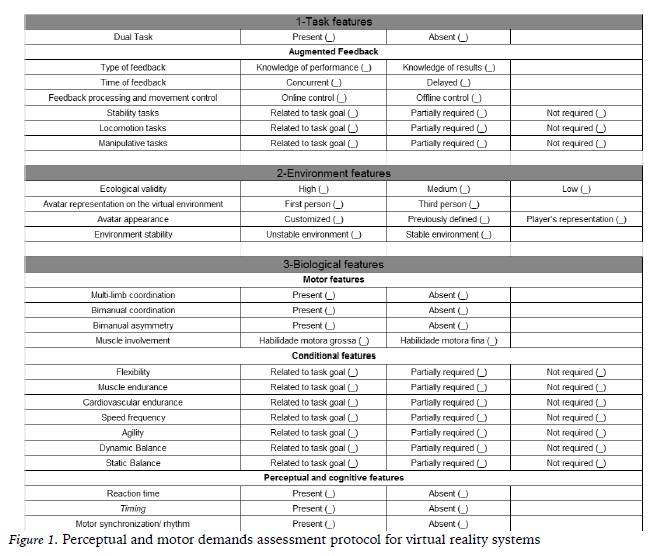
<body><![CDATA[<p><b>Instrument</b></p>     <p>The first step on   the development of this assessment protocol was a broad review of classic   references and recent articles related to motor behavior (Gallahue &amp; Ozmun,   2002; Schmidt &amp; Lee, 2011), exercise and physical/sports training   (Platonov, 2008; Weineck, 1999), cognitive neurosciences (Gazzaniga &amp;   Reuter-Lorenz, 2010) and VR (Keshner, 2004; Saposnik &amp; Levin, 2011). This   way, the first items to be included were identified. Also, there was an   important role the use of the model of motor skills classification by Fleishman   (Fleishman, 1964) and Gentile’s taxonomy of tasks (Gentile, 2000) on the   content of the protocol. The first classified a wide range of skills in two   main groups (perceptual-motor and physical proficiency abilities), while the   later produced a classification based on environmental demands (static or   dynamic) and the function of the action (locomotion, manipulation and stabilization).</p>     <p>After reviewing   the referred literature, two independent examiners from the areas of Sport   Science and Physiotherapy selected and prepared the relevant items to compose   the protocol with a third examiner helping in case of divergence and voting on the inclusion or exclusion of the items.</p>     <p>Preliminary   versions of the protocol were presented in the study group meetings in order to   get to the first pilot version. This version was then presented in the   Brazilian Congress of Motor Behavior (Bonuzzi, Palma, Torriani-Pasin, Soares,   &amp; Antunes, 2012) and, after specialists’ opinions, modified accordingly.   Then it was presented in two other congresses (Palma, Cairolli, Bonuzzi,   Soares, &amp; Torriani-Pasin, 2014; Soares et al., 2014), going through the   same process and being adjusted again, until the first version was established;   then, its content validity and reliability could be tested. The final version   of the “Perceptual and motor demands assessment protocol for virtual reality   systems” (<a href="/img/revistas/mot/v13n1/13n1a06f1.jpg">Figure 1</a>) is composed by 25 items, divided in three domains: 1- Task   features (seven items), 2- Environment features (four items), 3- Biological   features, divided in 3a-Biological motor features (four items), 3b- Biological   conditional features (seven items) and 3c- Biological perceptual and cognitive   features (three items). The items had two or three answer options, in which only one could be chosen. The domains are described below:</p>     
<p>1-Task features: presence or absence of dual task,   augmented feedback (type, when it is provided, how it is used to control   movement) and intent in stability, locomotion and manipulation to the task’s goal.</p>     <p>2- Environment features: Ecological validity, Avatar   representation on the virtual environment, Avatar’s appearance, Environment stability.</p>     <p>3- Biological features:</p>     <p>a) Motor features: presence or absence of multi-limb coordination, bimanual coordination, bimanual asymmetry, muscle involvement;</p>     <p>b) Conditional features: flexibility, muscle   endurance, cardiovascular endurance, speed frequency, agility, dynamics balance and static balance relate to the task goal.</p>     <p>c) Perceptual and cognitive features: presence and absence of reaction time, timing, Motor synchronization/rhythm.</p>     ]]></body>
<body><![CDATA[<p>Detailed   definitions of each item were presented as part of the protocol in supplementary document (attachment 1) </p>     <p><b>Sample and Procedures</b></p>     <p>In order to   investigate the assessment protocol’s content validity, a semi-structured   questionnaire was developed and divided in three parts. The first part had   questions about the examiner’s previous experience and formation (both academic   and professional). The second part had questions about each domain of the   protocol (Task, Environment and Biological features) and the items’ relevance,   items’ clarity, if the answer options were adequate and if some item should be   included or excluded. The third part asked for the time spent to fill in the   protocol during the videos’ analysis (described below) and comments about whether using the protocol was practical or not.</p>     <p>Additionally,   five young college students were recorded with a SONY DCR-PJ5 camcorder (after   signing a consent) performing different activities in a VR environment. Two   different consoles were used in this phase of the study (Nintendo Wii and XBOX   360 with motion sensor Kinect). The selected games were five from the “Kinect   Adventures!” (20,000 Leaks, Rally Ball, Reflex Ridge, River Rush, Space Pop) and   five from the game “Wii Sports” (Baseball, Bowling, Boxing, Golf, Tennis). A   total of 20 videos were recorded, with two different individuals for each activity.</p>     <p>Three examiners   with previous academic experience in Physiotherapy and Sport Science, with two   of them also having clinical/professional experience, participated in the   following part of the study after signing a consent. A more detailed description of their experience can be seen in <a href="/img/revistas/mot/v13n1/13n1a06t1.jpg">Table 1</a>.</p>     
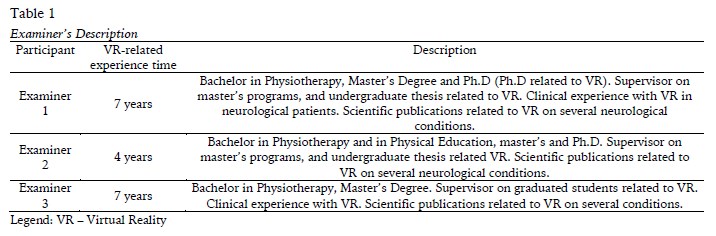
<p>The examiners   evaluated independently the assessment protocol’s first version. Each one of   them got a copy of the assessment protocol with a text explaining its   development phase and the recorded videos. They were oriented to independently   read everything first, watch the videos, classify them using the protocol and,   finally, answer the questionnaire for the content validity evaluation. All study's phase were conducted in Portuguese.</p>     <p>For the   reliability test, inter-observer agreement rates were used, considering the   first analysis of the 20 videos by the three examiners. After 15 days, the   examiners analyzed the same videos again in a random order, also independently,   with the same version of the protocol. This second data was used to test the intra-observer agreement reliability.</p>     <p><b>Statistical Analyses</b></p>     <p>For statistical   analysis of the content validity, a descriptive analysis was made considering   the simple rates of the examiners’ answers on the questions about relevance and clarity of items and domains/subdomains in the questionnaire.</p>     <p>For inferential   statistical analysis of reliability, which was done separately for each console   (Nintendo Wii and XBOX 360), the observer agreement test (Thomas, Nelson, &amp;   Silverman, 2012) was used for each item of the protocol. The obtained results   were then classified according to Giannichi's parameters (Giannichi, 1984):   0-0.59 is classified as “weak”, 0.60-0.79 is “regular”, 0.8-0.89 is “good” and   0.9-1 is “excellent”. It was set as reliable the concordance higher than 0.7 to   determine the test’s reliability, according to Kiss (1987) and Tabachnick and Fidell (2007).</p>     ]]></body>
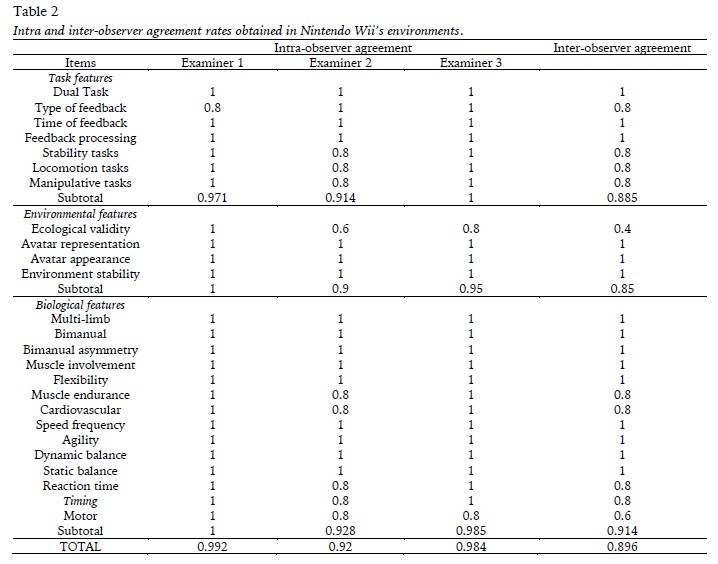
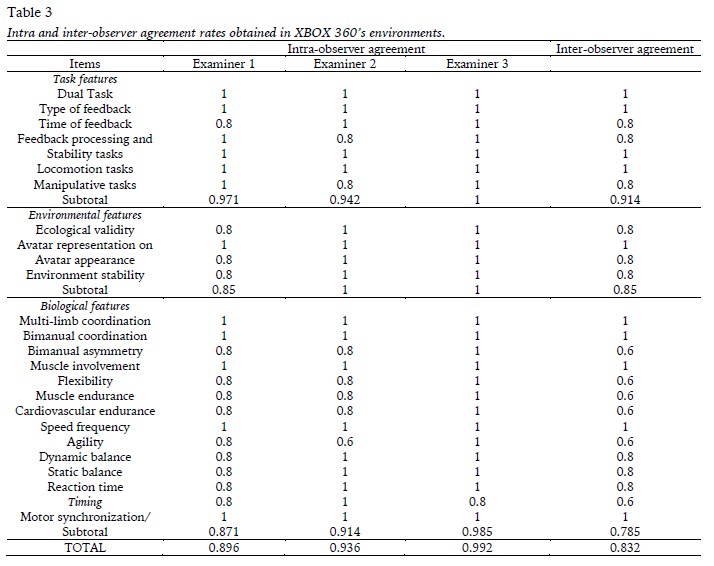
<body><![CDATA[<p>&nbsp;</p> </font>     <p><font size="3" face="Verdana"><b>RESULTS</b></font></p> <font face="Verdana" size="2">     <p>Concerning the content validity, all the items in the three domains of   the assessment protocol were considered relevant to its context of evaluation,   seen as well-explained and the answer options were appropriate on all items by   all the three examiners. None of them requested the inclusion of a new item or   the exclusion of an existing one in any of the three domains. Finally, the examiners spent an average of nine minutes to fill in the protocol.</p>     <p>Intra and inter-observer agreement rates obtained for each of the consoles are presented in <a href="/img/revistas/mot/v13n1/13n1a06t2.jpg">tables 2</a> and <a href="/img/revistas/mot/v13n1/13n1a06t3.jpg">3</a>.</p>     
<p>As it can be seen, most of the intra-observer agreement rates can be   classified as “excellent”, and most of the inter-observer agreement rates are   classified as “good”. However, there are some values classified in lower   standards, especially on the Biological features from XBOX 360’s analysis:   Bimanual asymmetry, Flexibility, Muscle endurance, Cardiovascular endurance,   Agility, Timing. Inter-observer agreement rates for these items were of 0.6,   while high intra-observer agreement rates were obtained. The mean value for   Biological features in XBOX 360’s analysis was the lowest (0.785), being the   only one classified as “regular”, despite still being in the established validity standards.</p>     <p>The lowest rates found in Nintendo Wii’s analysis were on the items   “Ecological Validity” (0.4 in inter-observer agreement and 0.6 in   intra-observer agreement from the second examiner) and “Motor synchronization/ rhythm” (0.6 inter-observer agreement).</p>     <p>&nbsp;</p> </font>     <p><font size="3" face="Verdana"><b>DISCUSSION</b></font></p> <font face="Verdana" size="2">     <p>Results showed that the proposed version of the assessment protocol is   adequate and its items have an acceptable content validity, according to the three consulted specialists.</p>     <p>However, it can be seen that the reliability results varied in both   systems: despite the great unity concerning the intra-observer agreement rates,   inter-observer rates had their lowest values on Wii’s analysis of Environment   features, while XBOX 360’s lowest values in this case were found on Biological features.</p>     ]]></body>
<body><![CDATA[<p>Such results may have appeared due to peculiarities from both systems,   such as the fairly “childish” look from Nintendo’s games, interfering on the   ecological validity’s evaluation. For its greater precision and consequently   being able to show a greater spectrum of corporal demands, XBOX 360’s motion   sensing input device, Kinect, might also justify these findings. In these   cases, the protocol itself can be seen as a tool capable of bringing up these peculiarities from different systems.</p>     <p>It is also possible to speculate that the description of an item was   precise, but the answer options given were limited to describe the   possibilities for that item. For example, the Biological features had three   answer options in most of the items (“Mainly required”, “Partially required”,   “Not required”). Still, every item from this part can be seen as partially   linked to success in any task, which may have contributed for lower inter-observer rates.</p>     <p>However, such division aims to evidence the relative importance of each   capacity and at least try to avoid “present” and “absent”- type answers, since   each examiner may perceive the same action in different ways. The use of   different methods or a previous training, as suggested by an examiner, could be   an option. However, it would demand more time before the beginning of its usage by an individual and make the protocol less practical to be used.</p>     <p>With the obtained results, it is expected that the protocol will be used   to a selection of VR-based games which is more specific to a population’s   needs. For example, it can be used to help treating people with PD (which   usually have impaired balance, worse performance in dual task, etc) (Pompeu et   al., 2014), by choosing a game that stimulates these abilities, such as XBOX   360’s “20,000 leaks” or Nintendo Wii’s “Tennis”. Thus, using the assessment   protocol allows the alignment of game features and user needs in order to find the best resource to treat a patient.</p>     <p>Such descriptions can also help raising the specificity of systems to be   created, working as a guide to game production to be used for game industry   workers who are less used to the possibilities/needs within rehabilitation and movement areas.</p>     <p>We can point as a study limitation, the time of experience of the   examiners who assessed the protocol. However, we have to consider that the   advent of VR technology is recent and the studies using this technology, as   well as, the development of these VR tools can be considered relatively new,   especially in development countries. Therefore, we considered at least 4 years   of experience in the research and in the clinical practice with VR. As an   expertise parameter, it does not corroborate with the literature which   considers at least 10 years of experience for this classification (Kiss, 1987; Thomas et al., 2012). </p>     <p>Lastly, future studies are necessary to test the use of the protocol in   other types of systems, in specific populations, as well as a second, most detailed analysis of its content validity.</p>     <p>&nbsp;</p> </font>     <p><font size="3" face="Verdana"><b>CONCLUSION</b></font></p> <font face="Verdana" size="2">     <p>The “Perceptual and motor demands assessment protocol for virtual   reality systems” presented valid content, practicality and adequate intra and inter-observer reliability for both tested consoles.</p>     ]]></body>
<body><![CDATA[<p>&nbsp;</p> </font>     <p><font size="3" face="Verdana"><b>REFERENCES</b></font></p> <font face="Verdana" size="2">     <!-- ref --><p>Bell, M. D., &amp; Weinstein, A. (2011). Simulated Job Interview Skill   Training for People with Psychiatric Disability: Feasibility and Tolerability   of Virtual Reality Training. <i>Schizophrenia Bulletin</i>, <i>37</i>(suppl 2), S91–S97. <a href="http://doi.org/10.1093/schbul/sbr061" target="_blank">http://doi.org/10.1093/schbul/sbr061</a>&nbsp;&nbsp;&nbsp;&nbsp;&nbsp;&nbsp;&nbsp;&nbsp;[&#160;<a href="javascript:void(0);" onclick="javascript: window.open('/scielo.php?script=sci_nlinks&ref=362520&pid=S1646-107X201700010000600001&lng=','','width=640,height=500,resizable=yes,scrollbars=1,menubar=yes,');">Links</a>&#160;]<!-- end-ref --><!-- ref --><p>Benson, J., &amp; Clark, F. (1982). A guide for instrument development   and validation. <i>The American Journal of Occupational Therapy.&#8239;: Official Publication of the American Occupational Therapy Association</i>, <i>36</i>, 789–800. <a href="http://doi.org/http:/dx.doi.org/10.5014/ajot.36.12.789" target="_blank">http://doi.org/http://dx.doi.org/10.5014/ajot.36.12.789</a>&nbsp;&nbsp;&nbsp;&nbsp;&nbsp;&nbsp;&nbsp;&nbsp;[&#160;<a href="javascript:void(0);" onclick="javascript: window.open('/scielo.php?script=sci_nlinks&ref=362521&pid=S1646-107X201700010000600002&lng=','','width=640,height=500,resizable=yes,scrollbars=1,menubar=yes,');">Links</a>&#160;]<!-- end-ref --><!-- ref --><p>Bonuzzi, G. M. G., Palma, G. C., Torriani-pasin, C., Soares, M. A. A.,   &amp; Antunes, G. L. (2012). Protocolo de avaliação de demandas motoras dos   jogos eletrônicos realizados em ambiente virtual. In <i>Congresso Brasileiro de Comportamento Motor</i> (pp. 103–103). São Paulo: Socibracom.    &nbsp;&nbsp;&nbsp;&nbsp;&nbsp;&nbsp;&nbsp;&nbsp;[&#160;<a href="javascript:void(0);" onclick="javascript: window.open('/scielo.php?script=sci_nlinks&ref=362522&pid=S1646-107X201700010000600003&lng=','','width=640,height=500,resizable=yes,scrollbars=1,menubar=yes,');">Links</a>&#160;]<!-- end-ref --></p>     <!-- ref --><p>Broeren, J., Claesson, L., Goude, D., Rydmark, M., &amp; Sunnerhagen, K.   S. (2008). Virtual rehabilitation in an activity centre for community-dwelling   persons with stroke: The possibilities of 3-dimensional computer games. <i>Cerebrovascular Diseases</i>, <i>26</i>(3), 289–296. <a href="http://doi.org/10.1159/000149576" target="_blank">http://doi.org/10.1159/000149576</a>&nbsp;&nbsp;&nbsp;&nbsp;&nbsp;&nbsp;&nbsp;&nbsp;[&#160;<a href="javascript:void(0);" onclick="javascript: window.open('/scielo.php?script=sci_nlinks&ref=362524&pid=S1646-107X201700010000600004&lng=','','width=640,height=500,resizable=yes,scrollbars=1,menubar=yes,');">Links</a>&#160;]<!-- end-ref --><!-- ref --><p>Carlozzi, N. E., Gade, V., Rizzo, A. S., &amp; Tulsky, D. S. (2013).   Using virtual reality driving simulators in persons with spinal cord injury:   three screen display versus head mounted display. <i>Disability and Rehabilitation. Assistive Technology</i>, <i>8</i>(2), 176–80. <a href="http://doi.org/10.3109/17483107.2012.699990" target="_blank">http://doi.org/10.3109/17483107.2012.699990</a>&nbsp;&nbsp;&nbsp;&nbsp;&nbsp;&nbsp;&nbsp;&nbsp;[&#160;<a href="javascript:void(0);" onclick="javascript: window.open('/scielo.php?script=sci_nlinks&ref=362525&pid=S1646-107X201700010000600005&lng=','','width=640,height=500,resizable=yes,scrollbars=1,menubar=yes,');">Links</a>&#160;]<!-- end-ref --><!-- ref --><p>Cho, B.-H., Ku, J., Jang, D. P., Kim, S., Lee, Y. H., Kim, I. Y., … Kim,   S. I. (2002). The effect of virtual reality cognitive training for attention   enhancement. <i>Cyberpsychology &amp; Behavior&#8239;: The Impact of the Internet, Multimedia and Virtual Reality on Behavior     and Society</i>, <i>5</i>(2), 129–137. <a href="http://doi.org/10.1089/109493102753770516" target="_blank">http://doi.org/10.1089/109493102753770516</a>&nbsp;&nbsp;&nbsp;&nbsp;&nbsp;&nbsp;&nbsp;&nbsp;[&#160;<a href="javascript:void(0);" onclick="javascript: window.open('/scielo.php?script=sci_nlinks&ref=362526&pid=S1646-107X201700010000600006&lng=','','width=640,height=500,resizable=yes,scrollbars=1,menubar=yes,');">Links</a>&#160;]<!-- end-ref --><!-- ref --><p>Davis, A. E. (1996). Instrument development: getting started. <i>The Journal of Neuroscience Nursing</i>, <i>28</i>(3), 204–207. Retrieved from <a href="http://www.ncbi.nlm.nih.gov/pubmed/8818987" target="_blank">http://www.ncbi.nlm.nih.gov/pubmed/8818987</a>&nbsp;&nbsp;&nbsp;&nbsp;&nbsp;&nbsp;&nbsp;&nbsp;[&#160;<a href="javascript:void(0);" onclick="javascript: window.open('/scielo.php?script=sci_nlinks&ref=362527&pid=S1646-107X201700010000600007&lng=','','width=640,height=500,resizable=yes,scrollbars=1,menubar=yes,');">Links</a>&#160;]<!-- end-ref --><!-- ref --><p>Deutsch, J. E., Brettler, A., Smith, C., Welsh, J., John, R.,   Guarrera-Bowlby, P., &amp; Kafri, M. (2011). Nintendo Wii Sports and Wii Fit   Game Analysis, Validation, and Application to Stroke Rehabilitation. <i>Topics in Stroke Rehabilitation</i>, <i>18</i>(6), 701–719. <a href="http://doi.org/10.1310/tsr1806-701" target="_blank">http://doi.org/10.1310/tsr1806-701</a>&nbsp;&nbsp;&nbsp;&nbsp;&nbsp;&nbsp;&nbsp;&nbsp;[&#160;<a href="javascript:void(0);" onclick="javascript: window.open('/scielo.php?script=sci_nlinks&ref=362528&pid=S1646-107X201700010000600008&lng=','','width=640,height=500,resizable=yes,scrollbars=1,menubar=yes,');">Links</a>&#160;]<!-- end-ref --><!-- ref --><p>Fleishman, E. A. (1964). <i>The Structure and Measurement of Physical Fitness</i>. Oxford: Prentice-Hall.    &nbsp;&nbsp;&nbsp;&nbsp;&nbsp;&nbsp;&nbsp;&nbsp;[&#160;<a href="javascript:void(0);" onclick="javascript: window.open('/scielo.php?script=sci_nlinks&ref=362529&pid=S1646-107X201700010000600009&lng=','','width=640,height=500,resizable=yes,scrollbars=1,menubar=yes,');">Links</a>&#160;]<!-- end-ref --></p>     <!-- ref --><p>Gallahue, D. L., &amp; Ozmun, J. C. (2002). <i>Understanding motor   development: Infants, children, adolescents, adults</i>. <i>Pediatrics</i> (Vol. 118). <a href="http://doi.org/10.1542/peds.2006-0742" target="_blank">http://doi.org/10.1542/peds.2006-0742</a>&nbsp;&nbsp;&nbsp;&nbsp;&nbsp;&nbsp;&nbsp;&nbsp;[&#160;<a href="javascript:void(0);" onclick="javascript: window.open('/scielo.php?script=sci_nlinks&ref=362531&pid=S1646-107X201700010000600010&lng=','','width=640,height=500,resizable=yes,scrollbars=1,menubar=yes,');">Links</a>&#160;]<!-- end-ref --><!-- ref --><p>Gazzaniga, M. S., &amp; Reuter-Lorenz, P. A. (2010). <i>The Cognitive Neuroscience of Mind</i>. <i>A Tribute to Michael S. Gazzaniga</i>. <a href="http://doi.org/10.1086/659918" target="_blank">http://doi.org/10.1086/659918</a>&nbsp;&nbsp;&nbsp;&nbsp;&nbsp;&nbsp;&nbsp;&nbsp;[&#160;<a href="javascript:void(0);" onclick="javascript: window.open('/scielo.php?script=sci_nlinks&ref=362532&pid=S1646-107X201700010000600011&lng=','','width=640,height=500,resizable=yes,scrollbars=1,menubar=yes,');">Links</a>&#160;]<!-- end-ref --><!-- ref --><p>Gentile, A. M. (2000). Skill acquisition: Action, movement, and   neuromotor processes. In <i>Movement Science: Foundations for Physical Therapy</i> (pp. 93–154).    &nbsp;&nbsp;&nbsp;&nbsp;&nbsp;&nbsp;&nbsp;&nbsp;[&#160;<a href="javascript:void(0);" onclick="javascript: window.open('/scielo.php?script=sci_nlinks&ref=362533&pid=S1646-107X201700010000600012&lng=','','width=640,height=500,resizable=yes,scrollbars=1,menubar=yes,');">Links</a>&#160;]<!-- end-ref --></p>     <!-- ref --><p>Giannichi, R. S. (1984). <i>Medidas e avaliação em educação física</i>. Viçosa: Imprensa Universitária.    &nbsp;&nbsp;&nbsp;&nbsp;&nbsp;&nbsp;&nbsp;&nbsp;[&#160;<a href="javascript:void(0);" onclick="javascript: window.open('/scielo.php?script=sci_nlinks&ref=362535&pid=S1646-107X201700010000600013&lng=','','width=640,height=500,resizable=yes,scrollbars=1,menubar=yes,');">Links</a>&#160;]<!-- end-ref --></p>     <!-- ref --><p>Keshner, E. A. (2004). Virtual reality and physical rehabilitation: a   new toy or a new research and rehabilitation tool? <i>Journal of Neuroengineering and Rehabilitation</i>, <i>1</i>(1), 8. <a href="http://doi.org/10.1186/1743-0003-1-8" target="_blank">http://doi.org/10.1186/1743-0003-1-8</a>&nbsp;&nbsp;&nbsp;&nbsp;&nbsp;&nbsp;&nbsp;&nbsp;[&#160;<a href="javascript:void(0);" onclick="javascript: window.open('/scielo.php?script=sci_nlinks&ref=362537&pid=S1646-107X201700010000600014&lng=','','width=640,height=500,resizable=yes,scrollbars=1,menubar=yes,');">Links</a>&#160;]<!-- end-ref --><!-- ref --><p>Kirner, C., &amp; Kirner, T. G. (2011). Realidade Virtual e Aumentada:   Aplicações e Tendências. In <i>Realidade Virtual e Aumentada Aplicações e Tendências</i> (p. 151).    &nbsp;&nbsp;&nbsp;&nbsp;&nbsp;&nbsp;&nbsp;&nbsp;[&#160;<a href="javascript:void(0);" onclick="javascript: window.open('/scielo.php?script=sci_nlinks&ref=362538&pid=S1646-107X201700010000600015&lng=','','width=640,height=500,resizable=yes,scrollbars=1,menubar=yes,');">Links</a>&#160;]<!-- end-ref --></p>     <!-- ref --><p>Kirner, C., &amp; Tori, R. (2004). Introdução à Realidade Virtual,   Realidade Misturada e Hiper-realidade. In <i>Realidade Virtual: Conceitos, Tecnologia e Tendências</i> (Vol. 1, pp. 3–20). Retrieved from <a href="http://www.visual.pro.br/dl6/Cap1-prelim-kirner-tori.doc" target="_blank">http://www.visual.pro.br/dl6/Cap1-prelim-kirner-tori.doc</a>&nbsp;&nbsp;&nbsp;&nbsp;&nbsp;&nbsp;&nbsp;&nbsp;[&#160;<a href="javascript:void(0);" onclick="javascript: window.open('/scielo.php?script=sci_nlinks&ref=362540&pid=S1646-107X201700010000600016&lng=','','width=640,height=500,resizable=yes,scrollbars=1,menubar=yes,');">Links</a>&#160;]<!-- end-ref --><!-- ref --><p>Kiss, M. A. P. D. (1987). <i>Avaliação Em Educação Física: Aspectos Biológicos E Educacionais.</i> São Paulo: Manole.    &nbsp;&nbsp;&nbsp;&nbsp;&nbsp;&nbsp;&nbsp;&nbsp;[&#160;<a href="javascript:void(0);" onclick="javascript: window.open('/scielo.php?script=sci_nlinks&ref=362541&pid=S1646-107X201700010000600017&lng=','','width=640,height=500,resizable=yes,scrollbars=1,menubar=yes,');">Links</a>&#160;]<!-- end-ref --></p>     <!-- ref --><p>Laver, K. E., George, S., Thomas, S., Deutsch, J. E., &amp; Crotty, M.   (2015). Virtual reality for stroke rehabilitation. <i>The Cochrane Database of Systematic Reviews</i>, <i>2</i>, CD008349. <a href="http://doi.org/10.1002/14651858.CD008349.pub3" target="_blank">http://doi.org/10.1002/14651858.CD008349.pub3</a>&nbsp;&nbsp;&nbsp;&nbsp;&nbsp;&nbsp;&nbsp;&nbsp;[&#160;<a href="javascript:void(0);" onclick="javascript: window.open('/scielo.php?script=sci_nlinks&ref=362543&pid=S1646-107X201700010000600018&lng=','','width=640,height=500,resizable=yes,scrollbars=1,menubar=yes,');">Links</a>&#160;]<!-- end-ref --><!-- ref --><p>Levin, M. F., Weiss, P. L., &amp; Keshner, E. a. (2015). Emergence of   Virtual Reality as a Tool for Upper Limb Rehabilitation: Incorporation of Motor   Control and Motor Learning Principles. <i>Physical Therapy</i>, <i>95</i>(3), 415–425. <a href="http://doi.org/10.2522/ptj.20130579" target="_blank">http://doi.org/10.2522/ptj.20130579</a>&nbsp;&nbsp;&nbsp;&nbsp;&nbsp;&nbsp;&nbsp;&nbsp;[&#160;<a href="javascript:void(0);" onclick="javascript: window.open('/scielo.php?script=sci_nlinks&ref=362544&pid=S1646-107X201700010000600019&lng=','','width=640,height=500,resizable=yes,scrollbars=1,menubar=yes,');">Links</a>&#160;]<!-- end-ref --><!-- ref --><p>Lin, H.-C., &amp; Wuang, Y.-P. (2012). Strength and agility training in   adolescents with Down syndrome: A randomized controlled trial. <i>Research in Developmental Disabilities</i>, <i>33</i>(6), 2236–2244. <a href="http://doi.org/10.1016/j.ridd.2012.06.017" target="_blank">http://doi.org/10.1016/j.ridd.2012.06.017</a>&nbsp;&nbsp;&nbsp;&nbsp;&nbsp;&nbsp;&nbsp;&nbsp;[&#160;<a href="javascript:void(0);" onclick="javascript: window.open('/scielo.php?script=sci_nlinks&ref=362545&pid=S1646-107X201700010000600020&lng=','','width=640,height=500,resizable=yes,scrollbars=1,menubar=yes,');">Links</a>&#160;]<!-- end-ref --><!-- ref --><p>Monteiro, C. B. m. (2011). <i>Realidade virtual na paralisia cerebral</i> (1st ed.). São Paulo: Plêiade.    &nbsp;&nbsp;&nbsp;&nbsp;&nbsp;&nbsp;&nbsp;&nbsp;[&#160;<a href="javascript:void(0);" onclick="javascript: window.open('/scielo.php?script=sci_nlinks&ref=362546&pid=S1646-107X201700010000600021&lng=','','width=640,height=500,resizable=yes,scrollbars=1,menubar=yes,');">Links</a>&#160;]<!-- end-ref --></p>     ]]></body>
<body><![CDATA[<!-- ref --><p>Morrow, K., Docan, C., Burdea, G., &amp; Merians, A. (2006). Low-cost   Virtual Rehabilitation of the Hand for Patients Post-Stroke. In <i>2006 International Workshop on Virtual Rehabilitation</i> (pp. 6–10). IEEE. <a href="http://doi.org/10.1109/IWVR.2006.1707518" target="_blank">http://doi.org/10.1109/IWVR.2006.1707518</a>&nbsp;&nbsp;&nbsp;&nbsp;&nbsp;&nbsp;&nbsp;&nbsp;[&#160;<a href="javascript:void(0);" onclick="javascript: window.open('/scielo.php?script=sci_nlinks&ref=362548&pid=S1646-107X201700010000600022&lng=','','width=640,height=500,resizable=yes,scrollbars=1,menubar=yes,');">Links</a>&#160;]<!-- end-ref --><!-- ref --><p>Natalio, M. A., Faria, C. D. C. M., Teixeira-Salmela, L. F., &amp;   Michaelsen, S. M. (2014). Content validation of a clinical assessment   instrument for stair ascent and descent in individuals with hemiparesis. <i>Brazilian Journal of Physical Therapy</i>, <i>18</i>(4), 353–363. <a href="http://doi.org/10.1590/bjpt-rbf.2014.0052" target="_blank">http://doi.org/10.1590/bjpt-rbf.2014.0052</a>&nbsp;&nbsp;&nbsp;&nbsp;&nbsp;&nbsp;&nbsp;&nbsp;[&#160;<a href="javascript:void(0);" onclick="javascript: window.open('/scielo.php?script=sci_nlinks&ref=362549&pid=S1646-107X201700010000600023&lng=','','width=640,height=500,resizable=yes,scrollbars=1,menubar=yes,');">Links</a>&#160;]<!-- end-ref --><!-- ref --><p>Natalio, M. A., Michaelsen, S. M., Nunes, G. S., Virtuoso, J. F., Faria,   C. D. C. M., &amp; Teixeira-Salmela, L. F. (2011). Etapas de desenvolvimento de   um instrumento de avaliação clínica da subida e descida de escada em indivíduos com hemiparesia. <i>Terapia Manual</i>, <i>9</i>, 334–342.    &nbsp;&nbsp;&nbsp;&nbsp;&nbsp;&nbsp;&nbsp;&nbsp;[&#160;<a href="javascript:void(0);" onclick="javascript: window.open('/scielo.php?script=sci_nlinks&ref=362550&pid=S1646-107X201700010000600024&lng=','','width=640,height=500,resizable=yes,scrollbars=1,menubar=yes,');">Links</a>&#160;]<!-- end-ref --></p>     <!-- ref --><p>Palma, G. C., Cairolli, F. F., Bonuzzi, G. M. G., Soares, M. A. A.,   &amp; Torriani-Pasin, C. (2014). Protocolo de classificação das demandas   percepto-motoras de sistemas de realidade virtual. In <i>III Congresso Brasileiro de Fisioterapia Neurofuncional</i>.    &nbsp;&nbsp;&nbsp;&nbsp;&nbsp;&nbsp;&nbsp;&nbsp;[&#160;<a href="javascript:void(0);" onclick="javascript: window.open('/scielo.php?script=sci_nlinks&ref=362552&pid=S1646-107X201700010000600025&lng=','','width=640,height=500,resizable=yes,scrollbars=1,menubar=yes,');">Links</a>&#160;]<!-- end-ref --> Belo Horizonte.</p>     <!-- ref --><p>Parsons, T. D., &amp; Rizzo, A. a. (2008). Affective outcomes of virtual   reality exposure therapy for anxiety and specific phobias: A meta-analysis. <i>Journal of Behavior Therapy and Experimental Psychiatry</i>, <i>39</i>(3), 250–261. <a href="http://doi.org/10.1016/j.jbtep.2007.07.007" target="_blank">http://doi.org/10.1016/j.jbtep.2007.07.007</a>&nbsp;&nbsp;&nbsp;&nbsp;&nbsp;&nbsp;&nbsp;&nbsp;[&#160;<a href="javascript:void(0);" onclick="javascript: window.open('/scielo.php?script=sci_nlinks&ref=362554&pid=S1646-107X201700010000600026&lng=','','width=640,height=500,resizable=yes,scrollbars=1,menubar=yes,');">Links</a>&#160;]<!-- end-ref --><!-- ref --><p>Platonov, V. N. (2008). <i>Tratado Geral de Treinamento Desportivo</i>. São Paulo.    &nbsp;&nbsp;&nbsp;&nbsp;&nbsp;&nbsp;&nbsp;&nbsp;[&#160;<a href="javascript:void(0);" onclick="javascript: window.open('/scielo.php?script=sci_nlinks&ref=362555&pid=S1646-107X201700010000600027&lng=','','width=640,height=500,resizable=yes,scrollbars=1,menubar=yes,');">Links</a>&#160;]<!-- end-ref --></p>     <!-- ref --><p>Pompeu, J. E., Alonso, T. H., Masson, I. B., Pompeu, S. M. A. A., &amp;   Torriani-Pasin, C. (2014). Os efeitos da realidade virtual na reabilitação do   acidente vascular encefálico: Uma revisão sistemática. <i>Motricidade</i>, <i>10</i>(4). <a href="http://doi.org/10.6063/motricidade.10(4).3341" target="_blank">http://doi.org/10.6063/motricidade.10(4).3341</a>&nbsp;&nbsp;&nbsp;&nbsp;&nbsp;&nbsp;&nbsp;&nbsp;[&#160;<a href="javascript:void(0);" onclick="javascript: window.open('/scielo.php?script=sci_nlinks&ref=362557&pid=S1646-107X201700010000600028&lng=','','width=640,height=500,resizable=yes,scrollbars=1,menubar=yes,');">Links</a>&#160;]<!-- end-ref --><!-- ref --><p>Pompeu, J. E., Arduini, L. A., Botelho, A. R., Fonseca, M. B. F.,   Pompeu, S. M. A. A., Torriani-Pasin, C., &amp; Deutsch, J. E. (2014).   Feasibility, safety and outcomes of playing Kinect Adventures!<sup>TM</sup> for   people with Parkinson’s disease: a pilot study. <i>Physiotherapy</i>, <i>100</i>(2), 162–168. <a href="http://doi.org/10.1016/j.physio.2013.10.003" target="_blank">http://doi.org/10.1016/j.physio.2013.10.003</a>&nbsp;&nbsp;&nbsp;&nbsp;&nbsp;&nbsp;&nbsp;&nbsp;[&#160;<a href="javascript:void(0);" onclick="javascript: window.open('/scielo.php?script=sci_nlinks&ref=362558&pid=S1646-107X201700010000600029&lng=','','width=640,height=500,resizable=yes,scrollbars=1,menubar=yes,');">Links</a>&#160;]<!-- end-ref --><!-- ref --><p>Riener, R., &amp; Harders, M. (2012). Introduction to Virtual Reality in   Medicine. In <i>Virtual Reality in Medicine</i> (pp. 1–12). London: Springer London. <a href="http://doi.org/10.1007/978-1-4471-4011-5_1" target="_blank">http://doi.org/10.1007/978-1-4471-4011-5_1</a>&nbsp;&nbsp;&nbsp;&nbsp;&nbsp;&nbsp;&nbsp;&nbsp;[&#160;<a href="javascript:void(0);" onclick="javascript: window.open('/scielo.php?script=sci_nlinks&ref=362559&pid=S1646-107X201700010000600030&lng=','','width=640,height=500,resizable=yes,scrollbars=1,menubar=yes,');">Links</a>&#160;]<!-- end-ref --><!-- ref --><p>Riva, G. (2011). The Key to Unlocking the Virtual Body: Virtual Reality   in the Treatment of Obesity and Eating Disorders. <i>Journal of Diabetes Science and Technology</i>, <i>5</i>(2), 283–292. <a href="http://doi.org/10.1177/193229681100500213" target="_blank">http://doi.org/10.1177/193229681100500213</a>&nbsp;&nbsp;&nbsp;&nbsp;&nbsp;&nbsp;&nbsp;&nbsp;[&#160;<a href="javascript:void(0);" onclick="javascript: window.open('/scielo.php?script=sci_nlinks&ref=362560&pid=S1646-107X201700010000600031&lng=','','width=640,height=500,resizable=yes,scrollbars=1,menubar=yes,');">Links</a>&#160;]<!-- end-ref --><!-- ref --><p>Rizzo, A. a, Schultheis, M., Kerns, K. A., &amp; Mateer, C. (2004).   Analysis of assets for virtual reality applications in neuropsychology. <i>Neuropsychological Rehabilitation</i>, <i>14</i>(1-2), 207–239. <a href="http://doi.org/10.1080/09602010343000183" target="_blank">http://doi.org/10.1080/09602010343000183</a>&nbsp;&nbsp;&nbsp;&nbsp;&nbsp;&nbsp;&nbsp;&nbsp;[&#160;<a href="javascript:void(0);" onclick="javascript: window.open('/scielo.php?script=sci_nlinks&ref=362561&pid=S1646-107X201700010000600032&lng=','','width=640,height=500,resizable=yes,scrollbars=1,menubar=yes,');">Links</a>&#160;]<!-- end-ref --><!-- ref --><p>Saposnik, G., &amp; Levin, M. (2011). Virtual reality in stroke   rehabilitation: A meta-analysis and implications for clinicians. <i>Stroke</i>, <i>42</i>(5), 1380–1386. <a href="http://doi.org/10.1161/STROKEAHA.110.605451" target="_blank">http://doi.org/10.1161/STROKEAHA.110.605451</a>&nbsp;&nbsp;&nbsp;&nbsp;&nbsp;&nbsp;&nbsp;&nbsp;[&#160;<a href="javascript:void(0);" onclick="javascript: window.open('/scielo.php?script=sci_nlinks&ref=362562&pid=S1646-107X201700010000600033&lng=','','width=640,height=500,resizable=yes,scrollbars=1,menubar=yes,');">Links</a>&#160;]<!-- end-ref --><!-- ref --><p>Schmidt, R. A., &amp; Lee, T. D. (2011). <i>Motor Control and Learning: A Behavioral Emphasis.</i> (5th ed.). Champaign: Human Kinetics.    &nbsp;&nbsp;&nbsp;&nbsp;&nbsp;&nbsp;&nbsp;&nbsp;[&#160;<a href="javascript:void(0);" onclick="javascript: window.open('/scielo.php?script=sci_nlinks&ref=362563&pid=S1646-107X201700010000600034&lng=','','width=640,height=500,resizable=yes,scrollbars=1,menubar=yes,');">Links</a>&#160;]<!-- end-ref --></p>     <!-- ref --><p>Soares, M. A. A., Palma, G. C., Cairolli, F. F., Bonuzzi, G. M. G.,   Pompeu, J. E., Monteiro, C. B. M., … Torriani-Pasin, C. (2014). Criação e   Validação das Demandas Percepto-Motoras dos sistemas de Realidade Virtual. In <i>VII Congresso Brasileiro de Comportamento Motor</i>. Socibracom.    &nbsp;&nbsp;&nbsp;&nbsp;&nbsp;&nbsp;&nbsp;&nbsp;[&#160;<a href="javascript:void(0);" onclick="javascript: window.open('/scielo.php?script=sci_nlinks&ref=362565&pid=S1646-107X201700010000600035&lng=','','width=640,height=500,resizable=yes,scrollbars=1,menubar=yes,');">Links</a>&#160;]<!-- end-ref --></p>     <!-- ref --><p>Standen, P. J., &amp; Brown, D. J. (2005). Virtual reality in the   rehabilitation of people with intellectual disabilities: review. <i>Cyberpsychology &amp; Behavior</i>, <i>8</i>(3), 272–282. <a href="http://doi.org/10.1089/cpb.2005.8.272" target="_blank">http://doi.org/10.1089/cpb.2005.8.272</a>&nbsp;&nbsp;&nbsp;&nbsp;&nbsp;&nbsp;&nbsp;&nbsp;[&#160;<a href="javascript:void(0);" onclick="javascript: window.open('/scielo.php?script=sci_nlinks&ref=362567&pid=S1646-107X201700010000600036&lng=','','width=640,height=500,resizable=yes,scrollbars=1,menubar=yes,');">Links</a>&#160;]<!-- end-ref --><!-- ref --><p>Stewart, J. C., Whitford, M., McLaughlin, M., Rizzo,  a., &amp; Winstein, C. J. (2006). Pilot Trial   Results from a Virtual Reality System Designed to Enhance Recovery of Skilled   Arm and Hand Movements after Stroke. <i>2006 International Workshop on Virtual Rehabilitation</i>, 11–17. <a href="http://doi.org/10.1109/IWVR.2006.1707519" target="_blank">http://doi.org/10.1109/IWVR.2006.1707519</a>&nbsp;&nbsp;&nbsp;&nbsp;&nbsp;&nbsp;&nbsp;&nbsp;[&#160;<a href="javascript:void(0);" onclick="javascript: window.open('/scielo.php?script=sci_nlinks&ref=362568&pid=S1646-107X201700010000600037&lng=','','width=640,height=500,resizable=yes,scrollbars=1,menubar=yes,');">Links</a>&#160;]<!-- end-ref --><!-- ref --><p>Tabachnick, B. G., &amp; Fidell, L. S. (2007). <i>Using multivariate   statistics</i>. <i>PsycCRITIQUES</i> (5th ed., Vol. 28). Boston: Allyn and Bacon. <a href="http://doi.org/10.1037/022267" target="_blank">http://doi.org/10.1037/022267</a>&nbsp;&nbsp;&nbsp;&nbsp;&nbsp;&nbsp;&nbsp;&nbsp;[&#160;<a href="javascript:void(0);" onclick="javascript: window.open('/scielo.php?script=sci_nlinks&ref=362569&pid=S1646-107X201700010000600038&lng=','','width=640,height=500,resizable=yes,scrollbars=1,menubar=yes,');">Links</a>&#160;]<!-- end-ref --><!-- ref --><p>Thomas, J. R., Nelson, J. K., &amp; Silverman, S. J. (2012). <i>Métodos de Pesquisa Em Atividade Física</i>. São Paulo: Artmed.    &nbsp;&nbsp;&nbsp;&nbsp;&nbsp;&nbsp;&nbsp;&nbsp;[&#160;<a href="javascript:void(0);" onclick="javascript: window.open('/scielo.php?script=sci_nlinks&ref=362570&pid=S1646-107X201700010000600039&lng=','','width=640,height=500,resizable=yes,scrollbars=1,menubar=yes,');">Links</a>&#160;]<!-- end-ref --></p>     <!-- ref --><p>Weineck, J. (1999). <i>Treinamento Ideal</i> (9th ed.). São Paulo: Manole.    &nbsp;&nbsp;&nbsp;&nbsp;&nbsp;&nbsp;&nbsp;&nbsp;[&#160;<a href="javascript:void(0);" onclick="javascript: window.open('/scielo.php?script=sci_nlinks&ref=362572&pid=S1646-107X201700010000600040&lng=','','width=640,height=500,resizable=yes,scrollbars=1,menubar=yes,');">Links</a>&#160;]<!-- end-ref --></p>     <!-- ref --><p>Wuang, Y. P., Chiang, C. S., Su, C. Y., &amp; Wang, C. C. (2011).   Effectiveness of virtual reality using Wii gaming technology in children with   Down syndrome. <i>Research in Developmental Disabilities</i>, <i>32</i>(1), 312–321. <a href="http://doi.org/10.1016/j.ridd.2010.10.002" target="_blank">http://doi.org/10.1016/j.ridd.2010.10.002</a>&nbsp;&nbsp;&nbsp;&nbsp;&nbsp;&nbsp;&nbsp;&nbsp;[&#160;<a href="javascript:void(0);" onclick="javascript: window.open('/scielo.php?script=sci_nlinks&ref=362574&pid=S1646-107X201700010000600041&lng=','','width=640,height=500,resizable=yes,scrollbars=1,menubar=yes,');">Links</a>&#160;]<!-- end-ref --><!-- ref --><p>Yavuzer, G., Senel, A., Atay, M. B., &amp; Stam, H. J. (2008).   “Playstation eyetoy games” improve upper extremity-related motor functioning in   subacute stroke: A randomized controlled clinical trial. <i>European Journal of Physical and Rehabilitation Medicine</i>, <i>44</i>(3), 237–244.    &nbsp;&nbsp;&nbsp;&nbsp;&nbsp;&nbsp;&nbsp;&nbsp;[&#160;<a href="javascript:void(0);" onclick="javascript: window.open('/scielo.php?script=sci_nlinks&ref=362575&pid=S1646-107X201700010000600042&lng=','','width=640,height=500,resizable=yes,scrollbars=1,menubar=yes,');">Links</a>&#160;]<!-- end-ref --></p>     <p>&nbsp;</p>     ]]></body>
<body><![CDATA[<p><b>Acknowledgments:</b>    <br>   Nothing to declare<b>    <br>   Conflict of interests:</b>    <br>   Nothing to declare<b>    <br>   Funding:    <br>   </b>This research was performed with support from CAPES,   organization of the Brazilian government dedicated for developing human recourses.</p> </font>     <p><font size="2" face="Verdana">Manuscript   received at March 2nd 2016; Accepted at December   1st 2016 </font></p>     <p>&nbsp;</p>     <p>&nbsp;</p>     <p><font face="Verdana" size="2"><a name="end"></a><a href="#topo">*</a> <i>Corresponding author</i>: Avenida Professor Mello   Moraes, 65 &ndash; Cidade Universit&aacute;ria, S&atilde;o Paulo &ndash; SP, 05508-030 <i>E-mail</i>:   <a href="mailto:giordanomgb@gmail.com">giordanomgb@gmail.com</a></font></p>     ]]></body>
<body><![CDATA[<p>&nbsp;</p>     <p>&nbsp;</p>      <p><font size="3" face="Verdana"><b>Attachment 1: Detailed definitions of each item of the protocol</b></font></p> <font face="Verdana" size="2">     <p>·&nbsp;&nbsp;&nbsp;&nbsp;&nbsp;&nbsp;&nbsp;&nbsp; <i>Task Features</i></p>     <p>·&nbsp;&nbsp;&nbsp;&nbsp;&nbsp;&nbsp;&nbsp;&nbsp;   Dual Task: Execution of two or more tasks   simultaneously, which divides the attentional resources during their execution. This item can be classified as:</p>     <p>·&nbsp;&nbsp;&nbsp;&nbsp;&nbsp;&nbsp;&nbsp;&nbsp;   Present: This feature is required during the activity.</p>     <p>·&nbsp;&nbsp;&nbsp;&nbsp;&nbsp;&nbsp;&nbsp;&nbsp;   Absent: This feature is not required during the activity.</p>     <p>·&nbsp;&nbsp;&nbsp;&nbsp;&nbsp;&nbsp;&nbsp;&nbsp;   Augmented Feedback: Information about the execution of   a task added to the sensorial information and coming from an external provider to the subject. Augmented Feedback will be analyzed in terms of:</p>     <p>1.2.1 Type of feedback:</p>     <p>·&nbsp;&nbsp;&nbsp;&nbsp;&nbsp;&nbsp;&nbsp;&nbsp;   Knowledge of Performance: information about movement/task parameters. </p>     ]]></body>
<body><![CDATA[<p>·&nbsp;&nbsp;&nbsp;&nbsp;&nbsp;&nbsp;&nbsp;&nbsp;   Knowledge of Results: information about movement/task results.</p>     <p>1.2.2 Time of feedback:</p>     <p>·&nbsp;&nbsp;&nbsp;&nbsp;&nbsp;&nbsp;&nbsp;&nbsp;   Concurrent: information is provided during the movement.</p>     <p>·&nbsp;&nbsp;&nbsp;&nbsp;&nbsp;&nbsp;&nbsp;&nbsp;   Delayed: information is provided after a few seconds movement is finished.</p>     <p>·&nbsp;&nbsp;&nbsp;&nbsp;&nbsp;&nbsp;&nbsp;&nbsp;    Feedback processing and movement control:</p>     <p>·&nbsp;&nbsp;&nbsp;&nbsp;&nbsp;&nbsp;&nbsp;&nbsp;   Online Control: When the task does not allow feedback   use for adjustments during its execution. Motor adjustments occur during the execution.</p>     <p>·&nbsp;&nbsp;&nbsp;&nbsp;&nbsp;&nbsp;&nbsp;&nbsp;   Offline Control: When the task allows feedback use for adjustments during its execution. Motor adjustments occur before the execution.</p>     <p>1.4 – Intention of movement</p>     <p>·&nbsp;&nbsp;&nbsp;&nbsp;&nbsp;&nbsp;&nbsp;&nbsp;   Stability tasks: emphasis in keeping balance during   dynamic or static situations (one single leg, sitting, dodging, rolling This item can be classified as:</p>     <p>·&nbsp;&nbsp;&nbsp;&nbsp;&nbsp;&nbsp;&nbsp;&nbsp;   Related to task goal: Essential for success in the task.</p>     ]]></body>
<body><![CDATA[<p>·&nbsp;&nbsp;&nbsp;&nbsp;&nbsp;&nbsp;&nbsp;&nbsp;   Partially   required: It is necessary in the task accomplishment, but it is not a main requirement for success.</p>     <p>·&nbsp;&nbsp;&nbsp;&nbsp;&nbsp;&nbsp;&nbsp;&nbsp;   Not required: Does not interfere in task success.</p>     <p>Locomotive tasks: tasks aiming to take the individual from one place to another (i.e. walking, running, swimming):</p>     <p>·&nbsp;&nbsp;&nbsp;&nbsp;&nbsp;&nbsp;&nbsp;&nbsp;   Related to task goal: Essential for success in the task.</p>     <p>·&nbsp;&nbsp;&nbsp;&nbsp;&nbsp;&nbsp;&nbsp;&nbsp;   Partially   required: It is necessary in the task accomplishment, but it is not a main requirement for success.</p>     <p>·&nbsp;&nbsp;&nbsp;&nbsp;&nbsp;&nbsp;&nbsp;&nbsp;   Not required: Does not interfere in task success.</p>     <p>Manipulative tasks: applying force to an object or stopping an object movement (i.e. hitting, writing, knitting):</p>     <p>·&nbsp;&nbsp;&nbsp;&nbsp;&nbsp;&nbsp;&nbsp;&nbsp;   Related to task goal: Essential for success in the task.</p>     <p>·&nbsp;&nbsp;&nbsp;&nbsp;&nbsp;&nbsp;&nbsp;&nbsp;   Partially   required: It is necessary in the task accomplishment, but it is not a main requirement for success.</p>     <p>·&nbsp;&nbsp;&nbsp;&nbsp;&nbsp;&nbsp;&nbsp;&nbsp;   Not required: Does not interfere in task success.</p>     ]]></body>
<body><![CDATA[<p>·&nbsp;&nbsp;&nbsp;&nbsp;&nbsp;&nbsp;&nbsp;&nbsp; <i>Environment features</i></p>     <p>·&nbsp;&nbsp;&nbsp;&nbsp;&nbsp;&nbsp;&nbsp;&nbsp;   2.1- Ecological Validity: Level of similarity of a   representation of the real world on a virtual environment to reality itself, including the task execution. This item can be classified as:</p>     <p>·&nbsp;&nbsp;&nbsp;&nbsp;&nbsp;&nbsp;&nbsp;&nbsp;   High: Virtual environment and task are very similar to reality.</p>     <p>·&nbsp;&nbsp;&nbsp;&nbsp;&nbsp;&nbsp;&nbsp;&nbsp;   Medium: Virtual environment and task are somewhat similar to reality.</p>     <p>·&nbsp;&nbsp;&nbsp;&nbsp;&nbsp;&nbsp;&nbsp;&nbsp;   Low: Virtual environment and task are not similar to reality.</p>     <p>2.2- Avatar representation on virtual environment:   representation of the subject on the virtual environment. This item can be classified as: </p>     <p>·&nbsp;&nbsp;&nbsp;&nbsp;&nbsp;&nbsp;&nbsp;&nbsp; First person;</p>     <p>·&nbsp;&nbsp;&nbsp;&nbsp;&nbsp;&nbsp;&nbsp;&nbsp; Third person.</p>     <p>2.3- Avatar appearance: how the avatar is represented in the virtual environment. This item can be classified as:</p>     <p>·&nbsp;&nbsp;&nbsp;&nbsp;&nbsp;&nbsp;&nbsp;&nbsp;   Customized: Created by the subject from options offered by the system.</p>     ]]></body>
<body><![CDATA[<p>·&nbsp;&nbsp;&nbsp;&nbsp;&nbsp;&nbsp;&nbsp;&nbsp;   Previously defined: Assigned automatically by the system.</p>     <p>·&nbsp;&nbsp;&nbsp;&nbsp;&nbsp;&nbsp;&nbsp;&nbsp;   Player’s   representation: the subject is represented on the virtual environment on a similar way.</p>     <p>2.4- Environment stability: predictability of environment variations.  This item can be classified as:</p>     <p>·&nbsp;&nbsp;&nbsp;&nbsp;&nbsp;&nbsp;&nbsp;&nbsp;   Unstable environment: unpredictable environment, with changes happening.</p>     <p>·&nbsp;&nbsp;&nbsp;&nbsp;&nbsp;&nbsp;&nbsp;&nbsp;   Stable environment: predictable environment, with few or no changes.</p>     <p>3.-<i> Biological features </i></p>     <p>3.1<i> – Motor features </i></p>     <p>3.1.1- Multi-limb coordination - Capacity   of coordinating multiple limbs simultaneously (i.e. juggling, playing the drums). This item can be classified as:</p>     <p>·&nbsp;&nbsp;&nbsp;&nbsp;&nbsp;&nbsp;&nbsp;&nbsp;   Present: This feature is required during the activity.</p>     <p>·&nbsp;&nbsp;&nbsp;&nbsp;&nbsp;&nbsp;&nbsp;&nbsp;   Absent: This feature is not required during the activity.</p>     ]]></body>
<body><![CDATA[<p>3.1.2- Bimanual coordination: Required for tasks in which the two upper limbs execute the same movements. This item can be classified as:</p>     <p>·&nbsp;&nbsp;&nbsp;&nbsp;&nbsp;&nbsp;&nbsp;&nbsp;   Present: This feature is required during the activity.</p>     <p>·&nbsp;&nbsp;&nbsp;&nbsp;&nbsp;&nbsp;&nbsp;&nbsp;   Absent: This feature is not required during the activity.</p>     <p>3.1.3- Bimanual asymmetry: Movements in which both upper limbs are   required, but with spatial and temporal differences. This item can be classified as:</p>     <p>·&nbsp;&nbsp;&nbsp;&nbsp;&nbsp;&nbsp;&nbsp;&nbsp;   Present: This feature is required during the activity.</p>     <p>·&nbsp;&nbsp;&nbsp;&nbsp;&nbsp;&nbsp;&nbsp;&nbsp;   Absent: This feature is not required during the activity.</p>     <p>3.1.4- Muscle involvement: Which size/type of muscles are mainly required for the task. This item can be classified as:</p>     <p>·&nbsp;&nbsp;&nbsp;&nbsp;&nbsp;&nbsp;&nbsp;&nbsp;   Gross motor   skill: Use of major muscle groups in the task (i.e. running, jumping, throwing).</p>     <p>·&nbsp;&nbsp;&nbsp;&nbsp;&nbsp;&nbsp;&nbsp;&nbsp;   Fine motor skill:   Use of minor muscle groups, usually for a precision task (i.e. writing, typing, painting).</p>     <p>3.2 – <i>Conditional features</i></p>     ]]></body>
<body><![CDATA[<p>3.2.1 – Flexibility: capacity of performing movements in a great range:</p>     <p>·&nbsp;&nbsp;&nbsp;&nbsp;&nbsp;&nbsp;&nbsp;&nbsp;   Related to task goal: Essential for success in the task.</p>     <p>·&nbsp;&nbsp;&nbsp;&nbsp;&nbsp;&nbsp;&nbsp;&nbsp;   Partially   required: It is necessary in the task accomplishment, but it is not a main requirement for success.</p>     <p>·&nbsp;&nbsp;&nbsp;&nbsp;&nbsp;&nbsp;&nbsp;&nbsp;   Not required: Does not interfere in task success.</p>     <p>3.2.2 – Muscle endurance: Capacity of an individual to keep applying force for a certain period time:</p>     <p>·&nbsp;&nbsp;&nbsp;&nbsp;&nbsp;&nbsp;&nbsp;&nbsp;   Related to task goal: Essential for success in the task.</p>     <p>·&nbsp;&nbsp;&nbsp;&nbsp;&nbsp;&nbsp;&nbsp;&nbsp;   Partially   required: It is necessary in the task accomplishment, but it is not a main requirement for success.</p>     <p>·&nbsp;&nbsp;&nbsp;&nbsp;&nbsp;&nbsp;&nbsp;&nbsp;   Not required: Does not interfere in task success.</p>     <p>3.2.3 – Cardiovascular endurance: Capacity to perform   cyclical, continuous submaximal activities, being limited by oxygen supplying by cardiopulmonary system:</p>     <p>·&nbsp;&nbsp;&nbsp;&nbsp;&nbsp;&nbsp;&nbsp;&nbsp;   Related to task goal: Essential for success in the task.</p>     ]]></body>
<body><![CDATA[<p>·&nbsp;&nbsp;&nbsp;&nbsp;&nbsp;&nbsp;&nbsp;&nbsp;   Partially   required: It is necessary in the task accomplishment, but it is not a main requirement for success.</p>     <p>·&nbsp;&nbsp;&nbsp;&nbsp;&nbsp;&nbsp;&nbsp;&nbsp;   Not required: Does not interfere in task success.</p>     <p>3.2.4 – Speed frequency: Capacity of performing similar movements in high velocity with little resistance to overcome:</p>     <p>·&nbsp;&nbsp;&nbsp;&nbsp;&nbsp;&nbsp;&nbsp;&nbsp;   Related to task goal: Essential for success in the task.</p>     <p>·&nbsp;&nbsp;&nbsp;&nbsp;&nbsp;&nbsp;&nbsp;&nbsp;   Partially   required: It is necessary in the task accomplishment, but it is not a main requirement for success.</p>     <p>·&nbsp;&nbsp;&nbsp;&nbsp;&nbsp;&nbsp;&nbsp;&nbsp;   Not required: Does not interfere in task success.</p>     <p>3.2.5 – Agility – Capacity of changing global movements in a small amount of time:</p>     <p>·&nbsp;&nbsp;&nbsp;&nbsp;&nbsp;&nbsp;&nbsp;&nbsp;   Related to task goal: Essential for success in the task.</p>     <p>·&nbsp;&nbsp;&nbsp;&nbsp;&nbsp;&nbsp;&nbsp;&nbsp;   Partially   required: It is necessary in the task accomplishment, but it is not a main requirement for success.</p>     <p>·&nbsp;&nbsp;&nbsp;&nbsp;&nbsp;&nbsp;&nbsp;&nbsp;   Not required: Does not interfere in task success.</p>     ]]></body>
<body><![CDATA[<p>3.2.6.1 – Dynamic balance – Capacity of keeping balance in unstable conditions:</p>     <p>·&nbsp;&nbsp;&nbsp;&nbsp;&nbsp;&nbsp;&nbsp;&nbsp;   Related to task goal: Essential for success in the task.</p>     <p>·&nbsp;&nbsp;&nbsp;&nbsp;&nbsp;&nbsp;&nbsp;&nbsp;   Partially   required: It is necessary in the task accomplishment, but it is not a main requirement for success.</p>     <p>·&nbsp;&nbsp;&nbsp;&nbsp;&nbsp;&nbsp;&nbsp;&nbsp;   Not required: Does not interfere in task success.</p>     <p>3.2.6.2 – Static balance – Capacity of keeping balance in stable conditions:</p>     <p>·&nbsp;&nbsp;&nbsp;&nbsp;&nbsp;&nbsp;&nbsp;&nbsp;   Related to task goal: Essential for success in the task.</p>     <p>·&nbsp;&nbsp;&nbsp;&nbsp;&nbsp;&nbsp;&nbsp;&nbsp;   Partially   required: It is necessary in the task accomplishment, but it is not a main requirement for success.</p>     <p>·&nbsp;&nbsp;&nbsp;&nbsp;&nbsp;&nbsp;&nbsp;&nbsp;   Not required: Does not interfere in task success.</p>     <p>3.3 – <i>Perceptual and cognitive features.</i></p>     <p>3.3.1 - Reaction time: Ability of quickly respond to a stimulus   (considering one type of stimulus and one type of answer). This item can be classified as:</p>     ]]></body>
<body><![CDATA[<p>·&nbsp;&nbsp;&nbsp;&nbsp;&nbsp;&nbsp;&nbsp;&nbsp;   Present: This feature is required during the activity.</p>     <p>·&nbsp;&nbsp;&nbsp;&nbsp;&nbsp;&nbsp;&nbsp;&nbsp;   Absent: This feature is not required during the activity.</p>     <p>3.3.2 - Timing:   Production of adjustments in continuous anticipatory or interception movements   in order to respond to changes on a moving target (i.e. stepping into an escalator, entering a revolving door). This item can be classified as:</p>     <p>·&nbsp;&nbsp;&nbsp;&nbsp;&nbsp;&nbsp;&nbsp;&nbsp;   Present: This feature is required during the activity.</p>     <p>·&nbsp;&nbsp;&nbsp;&nbsp;&nbsp;&nbsp;&nbsp;&nbsp;   Absent: This feature is not required during the activity.</p>     <p>3.3.3 - Motor   synchronization/rhythm – Ability to synchronize movements to an external rhythm source (i.e. following a choreography). This item can be classified as:</p>     <p>·&nbsp;&nbsp;&nbsp;&nbsp;&nbsp;&nbsp;&nbsp;&nbsp;   Present: This feature is required during the activity.</p>     <p>·&nbsp;&nbsp;&nbsp;&nbsp;&nbsp;&nbsp;&nbsp;&nbsp;   Absent: This feature is not required during the activity.</p> </font>      ]]></body><back>
<ref-list>
<ref id="B1">
<nlm-citation citation-type="journal">
<person-group person-group-type="author">
<name>
<surname><![CDATA[Bell]]></surname>
<given-names><![CDATA[M. D.]]></given-names>
</name>
<name>
<surname><![CDATA[Weinstein]]></surname>
<given-names><![CDATA[A.]]></given-names>
</name>
</person-group>
<article-title xml:lang="en"><![CDATA[Simulated Job Interview Skill Training for People with Psychiatric Disability: Feasibility and Tolerability of Virtual Reality Training]]></article-title>
<source><![CDATA[Schizophrenia Bulletin]]></source>
<year>2011</year>
<volume>37</volume>
<numero>^s2</numero>
<issue>^s2</issue>
<supplement>2</supplement>
<page-range>S91-S97</page-range></nlm-citation>
</ref>
<ref id="B2">
<nlm-citation citation-type="journal">
<person-group person-group-type="author">
<name>
<surname><![CDATA[Benson]]></surname>
<given-names><![CDATA[J.]]></given-names>
</name>
<name>
<surname><![CDATA[Clark]]></surname>
<given-names><![CDATA[F.]]></given-names>
</name>
</person-group>
<article-title xml:lang="en"><![CDATA[A guide for instrument development and validation]]></article-title>
<source><![CDATA[The American Journal of Occupational Therapy.&#8239;: Official Publication of the American Occupational Therapy Association]]></source>
<year>1982</year>
<volume>36</volume>
<page-range>789-800</page-range></nlm-citation>
</ref>
<ref id="B3">
<nlm-citation citation-type="book">
<person-group person-group-type="author">
<name>
<surname><![CDATA[Bonuzzi]]></surname>
<given-names><![CDATA[G. M. G.]]></given-names>
</name>
<name>
<surname><![CDATA[Palma]]></surname>
<given-names><![CDATA[G. C.]]></given-names>
</name>
<name>
<surname><![CDATA[Torriani-pasin]]></surname>
<given-names><![CDATA[C.]]></given-names>
</name>
<name>
<surname><![CDATA[Soares]]></surname>
<given-names><![CDATA[M. A. A.]]></given-names>
</name>
<name>
<surname><![CDATA[Antunes]]></surname>
<given-names><![CDATA[G. L.]]></given-names>
</name>
</person-group>
<article-title xml:lang="pt"><![CDATA[Protocolo de avaliação de demandas motoras dos jogos eletrônicos realizados em ambiente virtual]]></article-title>
<source><![CDATA[Congresso Brasileiro de Comportamento Motor]]></source>
<year>2012</year>
<page-range>103-103</page-range><publisher-loc><![CDATA[São Paulo ]]></publisher-loc>
<publisher-name><![CDATA[Socibracom]]></publisher-name>
</nlm-citation>
</ref>
<ref id="B4">
<nlm-citation citation-type="journal">
<person-group person-group-type="author">
<name>
<surname><![CDATA[Broeren]]></surname>
<given-names><![CDATA[J.]]></given-names>
</name>
<name>
<surname><![CDATA[Claesson]]></surname>
<given-names><![CDATA[L.]]></given-names>
</name>
<name>
<surname><![CDATA[Goude]]></surname>
<given-names><![CDATA[D.]]></given-names>
</name>
<name>
<surname><![CDATA[Rydmark]]></surname>
<given-names><![CDATA[M.]]></given-names>
</name>
<name>
<surname><![CDATA[Sunnerhagen]]></surname>
<given-names><![CDATA[K. S.]]></given-names>
</name>
</person-group>
<article-title xml:lang="en"><![CDATA[Virtual rehabilitation in an activity centre for community-dwelling persons with stroke: The possibilities of 3-dimensional computer games]]></article-title>
<source><![CDATA[Cerebrovascular Diseases]]></source>
<year>2008</year>
<volume>26</volume>
<numero>3</numero>
<issue>3</issue>
<page-range>289-296</page-range></nlm-citation>
</ref>
<ref id="B5">
<nlm-citation citation-type="journal">
<person-group person-group-type="author">
<name>
<surname><![CDATA[Carlozzi]]></surname>
<given-names><![CDATA[N. E.]]></given-names>
</name>
<name>
<surname><![CDATA[Gade]]></surname>
<given-names><![CDATA[V.]]></given-names>
</name>
<name>
<surname><![CDATA[Rizzo]]></surname>
<given-names><![CDATA[A. S.]]></given-names>
</name>
<name>
<surname><![CDATA[Tulsky]]></surname>
<given-names><![CDATA[D. S.]]></given-names>
</name>
</person-group>
<article-title xml:lang="en"><![CDATA[Using virtual reality driving simulators in persons with spinal cord injury: three screen display versus head mounted display]]></article-title>
<source><![CDATA[Disability and Rehabilitation. Assistive Technology]]></source>
<year>2013</year>
<volume>8</volume>
<numero>2</numero>
<issue>2</issue>
<page-range>176-80</page-range></nlm-citation>
</ref>
<ref id="B6">
<nlm-citation citation-type="journal">
<person-group person-group-type="author">
<name>
<surname><![CDATA[Cho]]></surname>
<given-names><![CDATA[B.-H.]]></given-names>
</name>
<name>
<surname><![CDATA[Ku]]></surname>
<given-names><![CDATA[J.]]></given-names>
</name>
<name>
<surname><![CDATA[Jang]]></surname>
<given-names><![CDATA[D. P.]]></given-names>
</name>
<name>
<surname><![CDATA[Kim]]></surname>
<given-names><![CDATA[S.]]></given-names>
</name>
<name>
<surname><![CDATA[Lee]]></surname>
<given-names><![CDATA[Y. H.]]></given-names>
</name>
<name>
<surname><![CDATA[Kim]]></surname>
<given-names><![CDATA[I. Y.]]></given-names>
</name>
<name>
<surname><![CDATA[Kim]]></surname>
<given-names><![CDATA[S.]]></given-names>
</name>
</person-group>
<article-title xml:lang="en"><![CDATA[The effect of virtual reality cognitive training for attention enhancement]]></article-title>
<source><![CDATA[Cyberpsychology & Behavior&#8239;: The Impact of the Internet, Multimedia and Virtual Reality on Behavior and Society]]></source>
<year>2002</year>
<volume>5</volume>
<numero>2</numero>
<issue>2</issue>
<page-range>129-137</page-range></nlm-citation>
</ref>
<ref id="B7">
<nlm-citation citation-type="journal">
<person-group person-group-type="author">
<name>
<surname><![CDATA[Davis]]></surname>
<given-names><![CDATA[A. E.]]></given-names>
</name>
</person-group>
<article-title xml:lang="en"><![CDATA[Instrument development: getting started]]></article-title>
<source><![CDATA[The Journal of Neuroscience Nursing]]></source>
<year>1996</year>
<volume>28</volume>
<numero>3</numero>
<issue>3</issue>
<page-range>204-207</page-range></nlm-citation>
</ref>
<ref id="B8">
<nlm-citation citation-type="journal">
<person-group person-group-type="author">
<name>
<surname><![CDATA[Deutsch]]></surname>
<given-names><![CDATA[J. E.]]></given-names>
</name>
<name>
<surname><![CDATA[Brettler]]></surname>
<given-names><![CDATA[A.]]></given-names>
</name>
<name>
<surname><![CDATA[Smith]]></surname>
<given-names><![CDATA[C.]]></given-names>
</name>
<name>
<surname><![CDATA[Welsh]]></surname>
<given-names><![CDATA[J.]]></given-names>
</name>
<name>
<surname><![CDATA[John]]></surname>
<given-names><![CDATA[R.]]></given-names>
</name>
<name>
<surname><![CDATA[Guarrera-Bowlby]]></surname>
<given-names><![CDATA[P.]]></given-names>
</name>
<name>
<surname><![CDATA[Kafri]]></surname>
<given-names><![CDATA[M.]]></given-names>
</name>
</person-group>
<article-title xml:lang="en"><![CDATA[Nintendo Wii Sports and Wii Fit Game Analysis, Validation, and Application to Stroke Rehabilitation]]></article-title>
<source><![CDATA[Topics in Stroke Rehabilitation]]></source>
<year>2011</year>
<volume>18</volume>
<numero>6</numero>
<issue>6</issue>
<page-range>701-719</page-range></nlm-citation>
</ref>
<ref id="B9">
<nlm-citation citation-type="book">
<person-group person-group-type="author">
<name>
<surname><![CDATA[Fleishman]]></surname>
<given-names><![CDATA[E. A.]]></given-names>
</name>
</person-group>
<source><![CDATA[The Structure and Measurement of Physical Fitness]]></source>
<year>1964</year>
<publisher-loc><![CDATA[Oxford ]]></publisher-loc>
<publisher-name><![CDATA[Prentice-Hall]]></publisher-name>
</nlm-citation>
</ref>
<ref id="B10">
<nlm-citation citation-type="journal">
<person-group person-group-type="author">
<name>
<surname><![CDATA[Gallahue]]></surname>
<given-names><![CDATA[D. L.]]></given-names>
</name>
<name>
<surname><![CDATA[Ozmun]]></surname>
<given-names><![CDATA[J. C.]]></given-names>
</name>
</person-group>
<article-title xml:lang="en"><![CDATA[Understanding motor development: Infants, children, adolescents, adults]]></article-title>
<source><![CDATA[Pediatrics]]></source>
<year>2002</year>
<volume>118</volume>
</nlm-citation>
</ref>
<ref id="B11">
<nlm-citation citation-type="">
<person-group person-group-type="author">
<name>
<surname><![CDATA[Gazzaniga]]></surname>
<given-names><![CDATA[M. S.]]></given-names>
</name>
<name>
<surname><![CDATA[Reuter-Lorenz]]></surname>
<given-names><![CDATA[P. A.]]></given-names>
</name>
</person-group>
<source><![CDATA[The Cognitive Neuroscience of Mind: A Tribute to Michael S. Gazzaniga]]></source>
<year>2010</year>
</nlm-citation>
</ref>
<ref id="B12">
<nlm-citation citation-type="journal">
<person-group person-group-type="author">
<name>
<surname><![CDATA[Gentile]]></surname>
<given-names><![CDATA[A. M.]]></given-names>
</name>
</person-group>
<article-title xml:lang="en"><![CDATA[Skill acquisition: Action, movement, and neuromotor processes]]></article-title>
<source><![CDATA[Movement Science: Foundations for Physical Therapy]]></source>
<year>2000</year>
<page-range>93-154</page-range></nlm-citation>
</ref>
<ref id="B13">
<nlm-citation citation-type="book">
<person-group person-group-type="author">
<name>
<surname><![CDATA[Giannichi]]></surname>
<given-names><![CDATA[R. S.]]></given-names>
</name>
</person-group>
<source><![CDATA[Medidas e avaliação em educação física]]></source>
<year>1984</year>
<publisher-loc><![CDATA[Viçosa ]]></publisher-loc>
<publisher-name><![CDATA[Imprensa Universitária]]></publisher-name>
</nlm-citation>
</ref>
<ref id="B14">
<nlm-citation citation-type="journal">
<person-group person-group-type="author">
<name>
<surname><![CDATA[Keshner]]></surname>
<given-names><![CDATA[E. A.]]></given-names>
</name>
</person-group>
<article-title xml:lang="en"><![CDATA[Virtual reality and physical rehabilitation: a new toy or a new research and rehabilitation tool?]]></article-title>
<source><![CDATA[Journal of Neuroengineering and Rehabilitation]]></source>
<year>2004</year>
<volume>1</volume>
<numero>1</numero>
<issue>1</issue>
</nlm-citation>
</ref>
<ref id="B15">
<nlm-citation citation-type="">
<person-group person-group-type="author">
<name>
<surname><![CDATA[Kirner]]></surname>
<given-names><![CDATA[C.]]></given-names>
</name>
<name>
<surname><![CDATA[Kirner]]></surname>
<given-names><![CDATA[T. G.]]></given-names>
</name>
</person-group>
<article-title xml:lang="pt"><![CDATA[Realidade Virtual e Aumentada: Aplicações e Tendências]]></article-title>
<source><![CDATA[Realidade Virtual e Aumentada Aplicações e Tendências]]></source>
<year>2011</year>
<page-range>151</page-range></nlm-citation>
</ref>
<ref id="B16">
<nlm-citation citation-type="">
<person-group person-group-type="author">
<name>
<surname><![CDATA[Kirner]]></surname>
<given-names><![CDATA[C.]]></given-names>
</name>
<name>
<surname><![CDATA[Tori]]></surname>
<given-names><![CDATA[R.]]></given-names>
</name>
</person-group>
<article-title xml:lang="pt"><![CDATA[Introdução à Realidade Virtual, Realidade Misturada e Hiper-realidade]]></article-title>
<source><![CDATA[Realidade Virtual: Conceitos, Tecnologia e Tendências]]></source>
<year>2004</year>
<volume>1</volume>
<page-range>3-20</page-range></nlm-citation>
</ref>
<ref id="B17">
<nlm-citation citation-type="book">
<person-group person-group-type="author">
<name>
<surname><![CDATA[Kiss]]></surname>
<given-names><![CDATA[M. A. P. D.]]></given-names>
</name>
</person-group>
<source><![CDATA[Avaliação Em Educação Física: Aspectos Biológicos E Educacionais]]></source>
<year>1987</year>
<publisher-loc><![CDATA[São Paulo ]]></publisher-loc>
<publisher-name><![CDATA[Manole]]></publisher-name>
</nlm-citation>
</ref>
<ref id="B18">
<nlm-citation citation-type="journal">
<person-group person-group-type="author">
<name>
<surname><![CDATA[Laver]]></surname>
<given-names><![CDATA[K. E.]]></given-names>
</name>
<name>
<surname><![CDATA[George]]></surname>
<given-names><![CDATA[S.]]></given-names>
</name>
<name>
<surname><![CDATA[Thomas]]></surname>
<given-names><![CDATA[S.]]></given-names>
</name>
<name>
<surname><![CDATA[Deutsch]]></surname>
<given-names><![CDATA[J. E.]]></given-names>
</name>
<name>
<surname><![CDATA[Crotty]]></surname>
<given-names><![CDATA[M.]]></given-names>
</name>
</person-group>
<article-title xml:lang="en"><![CDATA[Virtual reality for stroke rehabilitation]]></article-title>
<source><![CDATA[The Cochrane Database of Systematic Reviews]]></source>
<year>2015</year>
<volume>2</volume>
</nlm-citation>
</ref>
<ref id="B19">
<nlm-citation citation-type="journal">
<person-group person-group-type="author">
<name>
<surname><![CDATA[Levin]]></surname>
<given-names><![CDATA[M. F.]]></given-names>
</name>
<name>
<surname><![CDATA[Weiss]]></surname>
<given-names><![CDATA[P. L.]]></given-names>
</name>
<name>
<surname><![CDATA[Keshner]]></surname>
<given-names><![CDATA[E. a.]]></given-names>
</name>
</person-group>
<article-title xml:lang="en"><![CDATA[Emergence of Virtual Reality as a Tool for Upper Limb Rehabilitation: Incorporation of Motor Control and Motor Learning Principles]]></article-title>
<source><![CDATA[Physical Therapy]]></source>
<year>2015</year>
<volume>95</volume>
<numero>3</numero>
<issue>3</issue>
<page-range>415-425</page-range></nlm-citation>
</ref>
<ref id="B20">
<nlm-citation citation-type="journal">
<person-group person-group-type="author">
<name>
<surname><![CDATA[Lin]]></surname>
<given-names><![CDATA[H.-C.]]></given-names>
</name>
<name>
<surname><![CDATA[Wuang]]></surname>
<given-names><![CDATA[Y.-P.]]></given-names>
</name>
</person-group>
<article-title xml:lang="en"><![CDATA[Strength and agility training in adolescents with Down syndrome: A randomized controlled trial]]></article-title>
<source><![CDATA[Research in Developmental Disabilities]]></source>
<year>2012</year>
<volume>33</volume>
<numero>6</numero>
<issue>6</issue>
<page-range>2236-2244</page-range></nlm-citation>
</ref>
<ref id="B21">
<nlm-citation citation-type="book">
<person-group person-group-type="author">
<name>
<surname><![CDATA[Monteiro]]></surname>
<given-names><![CDATA[C. B. m.]]></given-names>
</name>
</person-group>
<source><![CDATA[Realidade virtual na paralisia cerebral]]></source>
<year>2011</year>
<edition>1</edition>
<publisher-loc><![CDATA[São Paulo ]]></publisher-loc>
<publisher-name><![CDATA[Plêiade]]></publisher-name>
</nlm-citation>
</ref>
<ref id="B22">
<nlm-citation citation-type="book">
<person-group person-group-type="author">
<name>
<surname><![CDATA[Morrow]]></surname>
<given-names><![CDATA[K.]]></given-names>
</name>
<name>
<surname><![CDATA[Docan]]></surname>
<given-names><![CDATA[C.]]></given-names>
</name>
<name>
<surname><![CDATA[Burdea]]></surname>
<given-names><![CDATA[G.]]></given-names>
</name>
<name>
<surname><![CDATA[Merians]]></surname>
<given-names><![CDATA[A.]]></given-names>
</name>
</person-group>
<article-title xml:lang="en"><![CDATA[Low-cost Virtual Rehabilitation of the Hand for Patients Post-Stroke]]></article-title>
<source><![CDATA[2006 International Workshop on Virtual Rehabilitation]]></source>
<year>2006</year>
<page-range>6-10</page-range><publisher-name><![CDATA[IEEE]]></publisher-name>
</nlm-citation>
</ref>
<ref id="B23">
<nlm-citation citation-type="journal">
<person-group person-group-type="author">
<name>
<surname><![CDATA[Natalio]]></surname>
<given-names><![CDATA[M. A.]]></given-names>
</name>
<name>
<surname><![CDATA[Faria]]></surname>
<given-names><![CDATA[C. D. C. M.]]></given-names>
</name>
<name>
<surname><![CDATA[Teixeira-Salmela]]></surname>
<given-names><![CDATA[L. F.]]></given-names>
</name>
<name>
<surname><![CDATA[Michaelsen]]></surname>
<given-names><![CDATA[S. M.]]></given-names>
</name>
</person-group>
<article-title xml:lang="en"><![CDATA[Content validation of a clinical assessment instrument for stair ascent and descent in individuals with hemiparesis]]></article-title>
<source><![CDATA[Brazilian Journal of Physical Therapy]]></source>
<year>2014</year>
<volume>18</volume>
<numero>4</numero>
<issue>4</issue>
<page-range>353-363</page-range></nlm-citation>
</ref>
<ref id="B24">
<nlm-citation citation-type="journal">
<person-group person-group-type="author">
<name>
<surname><![CDATA[Natalio]]></surname>
<given-names><![CDATA[M. A.]]></given-names>
</name>
<name>
<surname><![CDATA[Michaelsen]]></surname>
<given-names><![CDATA[S. M.]]></given-names>
</name>
<name>
<surname><![CDATA[Nunes]]></surname>
<given-names><![CDATA[G. S.]]></given-names>
</name>
<name>
<surname><![CDATA[Virtuoso]]></surname>
<given-names><![CDATA[J. F.]]></given-names>
</name>
<name>
<surname><![CDATA[Faria]]></surname>
<given-names><![CDATA[C. D. C. M.]]></given-names>
</name>
<name>
<surname><![CDATA[Teixeira-Salmela]]></surname>
<given-names><![CDATA[L. F.]]></given-names>
</name>
</person-group>
<article-title xml:lang="pt"><![CDATA[Etapas de desenvolvimento de um instrumento de avaliação clínica da subida e descida de escada em indivíduos com hemiparesia]]></article-title>
<source><![CDATA[Terapia Manual]]></source>
<year>2011</year>
<volume>9</volume>
<page-range>334-342</page-range></nlm-citation>
</ref>
<ref id="B25">
<nlm-citation citation-type="">
<person-group person-group-type="author">
<name>
<surname><![CDATA[Palma]]></surname>
<given-names><![CDATA[G. C.]]></given-names>
</name>
<name>
<surname><![CDATA[Cairolli]]></surname>
<given-names><![CDATA[F. F.]]></given-names>
</name>
<name>
<surname><![CDATA[Bonuzzi]]></surname>
<given-names><![CDATA[G. M. G.]]></given-names>
</name>
<name>
<surname><![CDATA[Soares]]></surname>
<given-names><![CDATA[M. A. A.]]></given-names>
</name>
<name>
<surname><![CDATA[Torriani-Pasin]]></surname>
<given-names><![CDATA[C.]]></given-names>
</name>
</person-group>
<article-title xml:lang="pt"><![CDATA[Protocolo de classificação das demandas percepto-motoras de sistemas de realidade virtual]]></article-title>
<source><![CDATA[]]></source>
<year>2014</year>
</nlm-citation>
</ref>
<ref id="B26">
<nlm-citation citation-type="journal">
<person-group person-group-type="author">
<name>
<surname><![CDATA[Parsons]]></surname>
<given-names><![CDATA[T. D.]]></given-names>
</name>
<name>
<surname><![CDATA[Rizzo]]></surname>
<given-names><![CDATA[A. a.]]></given-names>
</name>
</person-group>
<article-title xml:lang="en"><![CDATA[Affective outcomes of virtual reality exposure therapy for anxiety and specific phobias: A meta-analysis]]></article-title>
<source><![CDATA[Journal of Behavior Therapy and Experimental Psychiatry]]></source>
<year>2008</year>
<volume>39</volume>
<numero>3</numero>
<issue>3</issue>
<page-range>250-261</page-range></nlm-citation>
</ref>
<ref id="B27">
<nlm-citation citation-type="">
<person-group person-group-type="author">
<name>
<surname><![CDATA[Platonov]]></surname>
<given-names><![CDATA[V. N.]]></given-names>
</name>
</person-group>
<source><![CDATA[Tratado Geral de Treinamento Desportivo]]></source>
<year>2008</year>
<publisher-loc><![CDATA[São Paulo ]]></publisher-loc>
</nlm-citation>
</ref>
<ref id="B28">
<nlm-citation citation-type="journal">
<person-group person-group-type="author">
<name>
<surname><![CDATA[Pompeu]]></surname>
<given-names><![CDATA[J. E.]]></given-names>
</name>
<name>
<surname><![CDATA[Alonso]]></surname>
<given-names><![CDATA[T. H.]]></given-names>
</name>
<name>
<surname><![CDATA[Masson]]></surname>
<given-names><![CDATA[I. B.]]></given-names>
</name>
<name>
<surname><![CDATA[Pompeu]]></surname>
<given-names><![CDATA[S. M. A. A.]]></given-names>
</name>
<name>
<surname><![CDATA[Torriani-Pasin]]></surname>
<given-names><![CDATA[C.]]></given-names>
</name>
</person-group>
<article-title xml:lang="pt"><![CDATA[Os efeitos da realidade virtual na reabilitação do acidente vascular encefálico: Uma revisão sistemática]]></article-title>
<source><![CDATA[Motricidade]]></source>
<year>2014</year>
<volume>10</volume>
<numero>4</numero>
<issue>4</issue>
</nlm-citation>
</ref>
<ref id="B29">
<nlm-citation citation-type="journal">
<person-group person-group-type="author">
<name>
<surname><![CDATA[Pompeu]]></surname>
<given-names><![CDATA[J. E.]]></given-names>
</name>
<name>
<surname><![CDATA[Arduini]]></surname>
<given-names><![CDATA[L. A.]]></given-names>
</name>
<name>
<surname><![CDATA[Botelho]]></surname>
<given-names><![CDATA[A. R.]]></given-names>
</name>
<name>
<surname><![CDATA[Fonseca]]></surname>
<given-names><![CDATA[M. B. F.]]></given-names>
</name>
<name>
<surname><![CDATA[Pompeu]]></surname>
<given-names><![CDATA[S. M. A. A.]]></given-names>
</name>
<name>
<surname><![CDATA[Torriani-Pasin]]></surname>
<given-names><![CDATA[C.]]></given-names>
</name>
<name>
<surname><![CDATA[Deutsch]]></surname>
<given-names><![CDATA[J. E.]]></given-names>
</name>
</person-group>
<article-title xml:lang="en"><![CDATA[Feasibility, safety and outcomes of playing Kinect Adventures!TM for people with Parkinson’s disease: a pilot study]]></article-title>
<source><![CDATA[Physiotherapy]]></source>
<year>2014</year>
<volume>100</volume>
<numero>2</numero>
<issue>2</issue>
<page-range>162-168</page-range></nlm-citation>
</ref>
<ref id="B30">
<nlm-citation citation-type="book">
<person-group person-group-type="author">
<name>
<surname><![CDATA[Riener]]></surname>
<given-names><![CDATA[R.]]></given-names>
</name>
<name>
<surname><![CDATA[Harders]]></surname>
<given-names><![CDATA[M.]]></given-names>
</name>
</person-group>
<article-title xml:lang="en"><![CDATA[Introduction to Virtual Reality in Medicine]]></article-title>
<person-group person-group-type="editor">
<name>
<surname><![CDATA[Medicine]]></surname>
<given-names><![CDATA[Virtual Reality in]]></given-names>
</name>
</person-group>
<source><![CDATA[]]></source>
<year>2012</year>
<page-range>1-12</page-range><publisher-loc><![CDATA[London ]]></publisher-loc>
<publisher-name><![CDATA[Springer London]]></publisher-name>
</nlm-citation>
</ref>
<ref id="B31">
<nlm-citation citation-type="journal">
<person-group person-group-type="author">
<name>
<surname><![CDATA[Riva]]></surname>
<given-names><![CDATA[G.]]></given-names>
</name>
</person-group>
<article-title xml:lang="en"><![CDATA[The Key to Unlocking the Virtual Body: Virtual Reality in the Treatment of Obesity and Eating Disorders]]></article-title>
<source><![CDATA[Journal of Diabetes Science and Technology]]></source>
<year>2011</year>
<volume>5</volume>
<numero>2</numero>
<issue>2</issue>
<page-range>283-292</page-range></nlm-citation>
</ref>
<ref id="B32">
<nlm-citation citation-type="journal">
<person-group person-group-type="author">
<name>
<surname><![CDATA[Rizzo]]></surname>
<given-names><![CDATA[A. a]]></given-names>
</name>
<name>
<surname><![CDATA[Schultheis]]></surname>
<given-names><![CDATA[M.]]></given-names>
</name>
<name>
<surname><![CDATA[Kerns]]></surname>
<given-names><![CDATA[K. A.]]></given-names>
</name>
<name>
<surname><![CDATA[Mateer]]></surname>
<given-names><![CDATA[C.]]></given-names>
</name>
</person-group>
<article-title xml:lang="en"><![CDATA[Analysis of assets for virtual reality applications in neuropsychology]]></article-title>
<source><![CDATA[Neuropsychological Rehabilitation]]></source>
<year>2004</year>
<volume>14</volume>
<numero>1-2</numero>
<issue>1-2</issue>
<page-range>207-239</page-range></nlm-citation>
</ref>
<ref id="B33">
<nlm-citation citation-type="journal">
<person-group person-group-type="author">
<name>
<surname><![CDATA[Saposnik]]></surname>
<given-names><![CDATA[G.]]></given-names>
</name>
<name>
<surname><![CDATA[Levin]]></surname>
<given-names><![CDATA[M.]]></given-names>
</name>
</person-group>
<article-title xml:lang="en"><![CDATA[Virtual reality in stroke rehabilitation: A meta-analysis and implications for clinicians]]></article-title>
<source><![CDATA[Stroke]]></source>
<year>2011</year>
<volume>42</volume>
<numero>5</numero>
<issue>5</issue>
<page-range>1380-1386</page-range></nlm-citation>
</ref>
<ref id="B34">
<nlm-citation citation-type="book">
<person-group person-group-type="author">
<name>
<surname><![CDATA[Schmidt]]></surname>
<given-names><![CDATA[R. A.]]></given-names>
</name>
<name>
<surname><![CDATA[Lee]]></surname>
<given-names><![CDATA[T. D.]]></given-names>
</name>
</person-group>
<source><![CDATA[Motor Control and Learning: A Behavioral Emphasis]]></source>
<year>2011</year>
<edition>5</edition>
<publisher-loc><![CDATA[Champaign ]]></publisher-loc>
<publisher-name><![CDATA[Human Kinetics]]></publisher-name>
</nlm-citation>
</ref>
<ref id="B35">
<nlm-citation citation-type="book">
<person-group person-group-type="author">
<name>
<surname><![CDATA[Soares]]></surname>
<given-names><![CDATA[M. A. A.]]></given-names>
</name>
<name>
<surname><![CDATA[Palma]]></surname>
<given-names><![CDATA[G. C.]]></given-names>
</name>
<name>
<surname><![CDATA[Cairolli]]></surname>
<given-names><![CDATA[F. F.]]></given-names>
</name>
<name>
<surname><![CDATA[Bonuzzi]]></surname>
<given-names><![CDATA[G. M. G.]]></given-names>
</name>
<name>
<surname><![CDATA[Pompeu]]></surname>
<given-names><![CDATA[J. E.]]></given-names>
</name>
<name>
<surname><![CDATA[Monteiro]]></surname>
<given-names><![CDATA[C. B. M.]]></given-names>
</name>
<name>
<surname><![CDATA[Torriani-Pasin]]></surname>
<given-names><![CDATA[C.]]></given-names>
</name>
</person-group>
<article-title xml:lang="pt"><![CDATA[Criação e Validação das Demandas Percepto-Motoras dos sistemas de Realidade Virtual]]></article-title>
<source><![CDATA[VII Congresso Brasileiro de Comportamento Motor]]></source>
<year>2014</year>
<publisher-name><![CDATA[Socibracom]]></publisher-name>
</nlm-citation>
</ref>
<ref id="B36">
<nlm-citation citation-type="journal">
<person-group person-group-type="author">
<name>
<surname><![CDATA[Standen]]></surname>
<given-names><![CDATA[P. J.]]></given-names>
</name>
<name>
<surname><![CDATA[Brown]]></surname>
<given-names><![CDATA[D. J.]]></given-names>
</name>
</person-group>
<article-title xml:lang="en"><![CDATA[Virtual reality in the rehabilitation of people with intellectual disabilities: review]]></article-title>
<source><![CDATA[Cyberpsychology & Behavior]]></source>
<year>2005</year>
<volume>8</volume>
<numero>3</numero>
<issue>3</issue>
<page-range>272-282</page-range></nlm-citation>
</ref>
<ref id="B37">
<nlm-citation citation-type="">
<person-group person-group-type="author">
<name>
<surname><![CDATA[Stewart]]></surname>
<given-names><![CDATA[J. C.]]></given-names>
</name>
<name>
<surname><![CDATA[Whitford]]></surname>
<given-names><![CDATA[M.]]></given-names>
</name>
<name>
<surname><![CDATA[McLaughlin]]></surname>
<given-names><![CDATA[M.]]></given-names>
</name>
<name>
<surname><![CDATA[a.]]></surname>
<given-names><![CDATA[Rizzo,]]></given-names>
</name>
<name>
<surname><![CDATA[Winstein]]></surname>
<given-names><![CDATA[C. J.]]></given-names>
</name>
</person-group>
<article-title xml:lang="en"><![CDATA[Pilot Trial Results from a Virtual Reality System Designed to Enhance Recovery of Skilled Arm and Hand Movements after Stroke]]></article-title>
<source><![CDATA[2006 International Workshop on Virtual Rehabilitation]]></source>
<year>2006</year>
<page-range>11-17</page-range></nlm-citation>
</ref>
<ref id="B38">
<nlm-citation citation-type="book">
<person-group person-group-type="author">
<name>
<surname><![CDATA[Tabachnick]]></surname>
<given-names><![CDATA[B. G.]]></given-names>
</name>
<name>
<surname><![CDATA[Fidell]]></surname>
<given-names><![CDATA[L. S.]]></given-names>
</name>
</person-group>
<source><![CDATA[Using multivariate statistics: PsycCRITIQUES]]></source>
<year>2007</year>
<volume>28</volume>
<edition>5</edition>
<publisher-loc><![CDATA[Boston ]]></publisher-loc>
<publisher-name><![CDATA[Allyn and Bacon]]></publisher-name>
</nlm-citation>
</ref>
<ref id="B39">
<nlm-citation citation-type="book">
<person-group person-group-type="author">
<name>
<surname><![CDATA[Thomas]]></surname>
<given-names><![CDATA[J. R.]]></given-names>
</name>
<name>
<surname><![CDATA[Nelson]]></surname>
<given-names><![CDATA[J. K.]]></given-names>
</name>
<name>
<surname><![CDATA[Silverman]]></surname>
<given-names><![CDATA[S. J.]]></given-names>
</name>
</person-group>
<source><![CDATA[Métodos de Pesquisa Em Atividade Física]]></source>
<year>2012</year>
<publisher-loc><![CDATA[São Paulo ]]></publisher-loc>
<publisher-name><![CDATA[Artmed]]></publisher-name>
</nlm-citation>
</ref>
<ref id="B40">
<nlm-citation citation-type="book">
<person-group person-group-type="author">
<name>
<surname><![CDATA[Weineck]]></surname>
<given-names><![CDATA[J.]]></given-names>
</name>
</person-group>
<source><![CDATA[Treinamento Ideal]]></source>
<year>1999</year>
<edition>9</edition>
<publisher-loc><![CDATA[São Paulo ]]></publisher-loc>
<publisher-name><![CDATA[Manole]]></publisher-name>
</nlm-citation>
</ref>
<ref id="B41">
<nlm-citation citation-type="journal">
<person-group person-group-type="author">
<name>
<surname><![CDATA[Wuang]]></surname>
<given-names><![CDATA[Y. P.]]></given-names>
</name>
<name>
<surname><![CDATA[Chiang]]></surname>
<given-names><![CDATA[C. S.]]></given-names>
</name>
<name>
<surname><![CDATA[Su]]></surname>
<given-names><![CDATA[C. Y.]]></given-names>
</name>
<name>
<surname><![CDATA[Wang]]></surname>
<given-names><![CDATA[C. C.]]></given-names>
</name>
</person-group>
<article-title xml:lang="en"><![CDATA[Effectiveness of virtual reality using Wii gaming technology in children with Down syndrome]]></article-title>
<source><![CDATA[Research in Developmental Disabilities]]></source>
<year>2011</year>
<volume>32</volume>
<numero>1</numero>
<issue>1</issue>
<page-range>312-321</page-range></nlm-citation>
</ref>
<ref id="B42">
<nlm-citation citation-type="journal">
<person-group person-group-type="author">
<name>
<surname><![CDATA[Yavuzer]]></surname>
<given-names><![CDATA[G.]]></given-names>
</name>
<name>
<surname><![CDATA[Senel]]></surname>
<given-names><![CDATA[A.]]></given-names>
</name>
<name>
<surname><![CDATA[Atay]]></surname>
<given-names><![CDATA[M. B.]]></given-names>
</name>
<name>
<surname><![CDATA[Stam]]></surname>
<given-names><![CDATA[H. J.]]></given-names>
</name>
</person-group>
<article-title xml:lang="en"><![CDATA[“Playstation eyetoy games” improve upper extremity-related motor functioning in subacute stroke: A randomized controlled clinical trial]]></article-title>
<source><![CDATA[European Journal of Physical and Rehabilitation Medicine]]></source>
<year>2008</year>
<volume>44</volume>
<numero>3</numero>
<issue>3</issue>
<page-range>237-244</page-range></nlm-citation>
</ref>
</ref-list>
</back>
</article>